#LeanInTogether | LeanIn.Org/Men
#LeanInTogether
TIPS FOR MEN: HOW TO BE A WORKPLACE MVP
Get the complete tips at leanin.org/tips/mvp
HeroImages/Getty Images
#LeanInTogether | LeanIn.Org/Men
Men are expected to be assertive and confident, so
we welcome their leadership.
In contrast, women are expected to be nurturing and collaborative,
so when they lead, they go against our expectations and often face
pushback. Challenge these stereotypes by pointing out bias and
supporting your female colleagues. You have a strong incentive to
make sure that women succeed in your organization—men who
work well with women and tap the full talents of their teams
outperform their peers.
TIPS FOR MEN:
HOW TO BE A WORKPLACE MVP
#LeanInTogether | LeanIn.Org/Men
1SITUATION
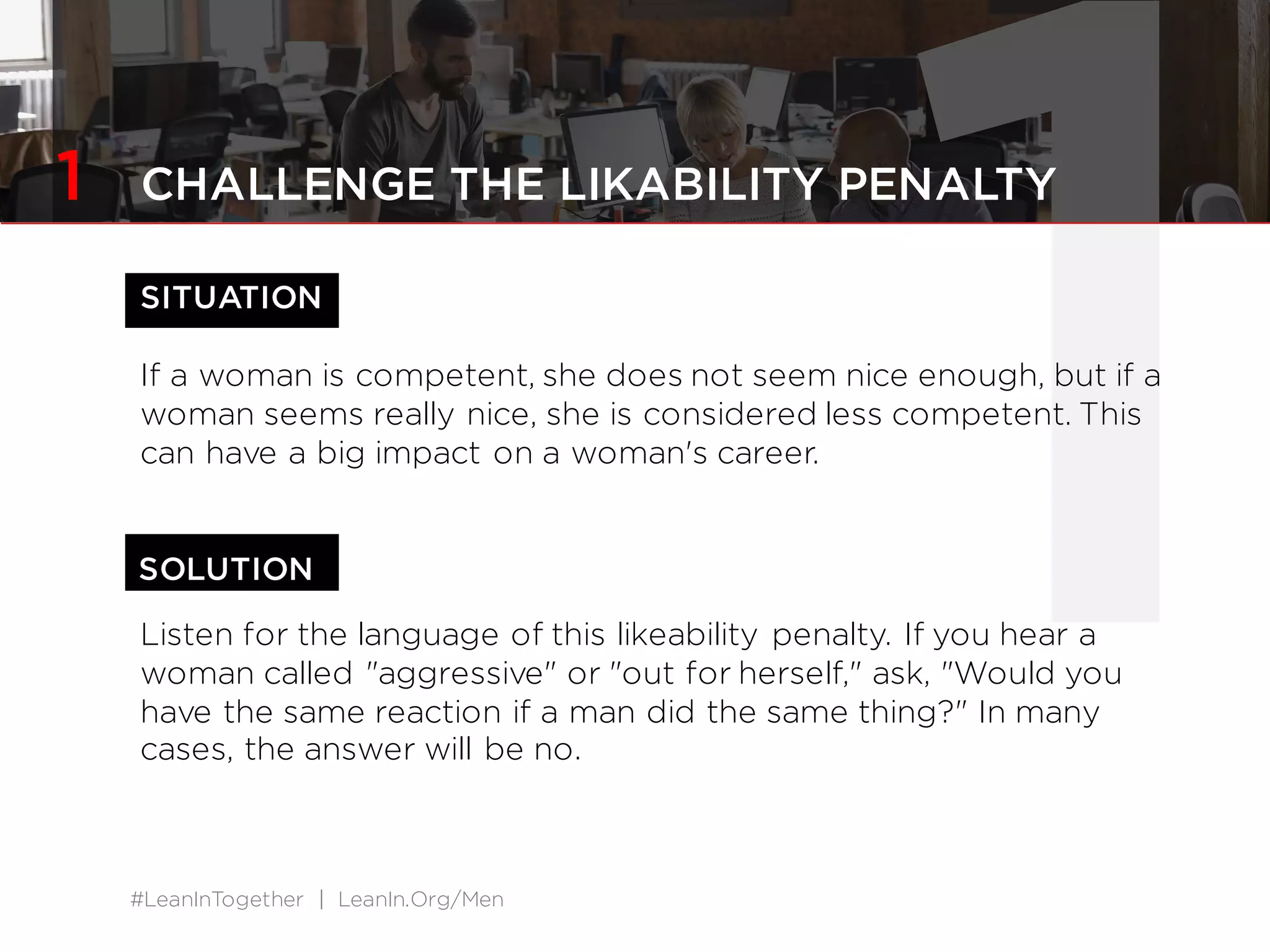
If a woman is competent, she does not seem nice enough, but if a
woman seems really nice, she is considered less competent. This
can have a big impact on a woman's career.
Listen for the language of this likeability penalty. If you hear a
woman called "aggressive" or "out for herself," ask, "Would you
have the same reaction if a man did the same thing?" In many
cases, the answer will be no.
SOLUTION
1 CHALLENGE THE LIKABILITY PENALTY
#LeanInTogether | LeanIn.Org/Men#LeanInTogether | LeanIn.Org/Men
Women are often hired
based on past performance,
while men are often hired
for their potential.
#LeanInTogether | LeanIn.Org/Men
2 EVALUATE PERFORMANCE FAIRLY
SITUATION
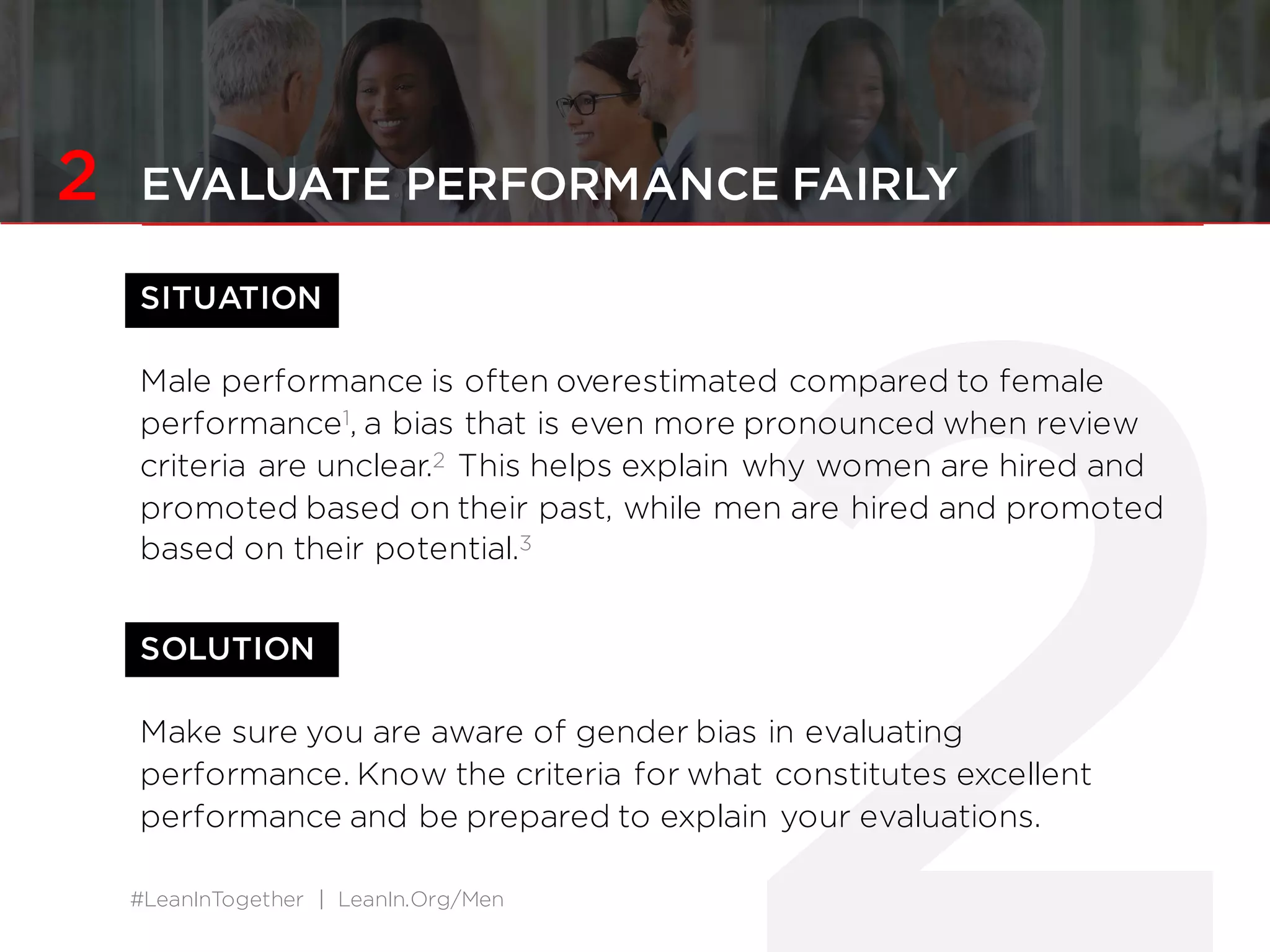
Male performance is often overestimated compared to female
performance1, a bias that is even more pronounced when review
criteria are unclear.2 This helps explain why women are hired and
promoted based on their past, while men are hired and promoted
based on their potential.3
SOLUTION
Make sure you are aware of gender bias in evaluating
performance. Know the criteria for what constitutes excellent
performance and be prepared to explain your evaluations.
#LeanInTogether | LeanIn.Org/Men#LeanInTogether | LeanIn.Org/Men
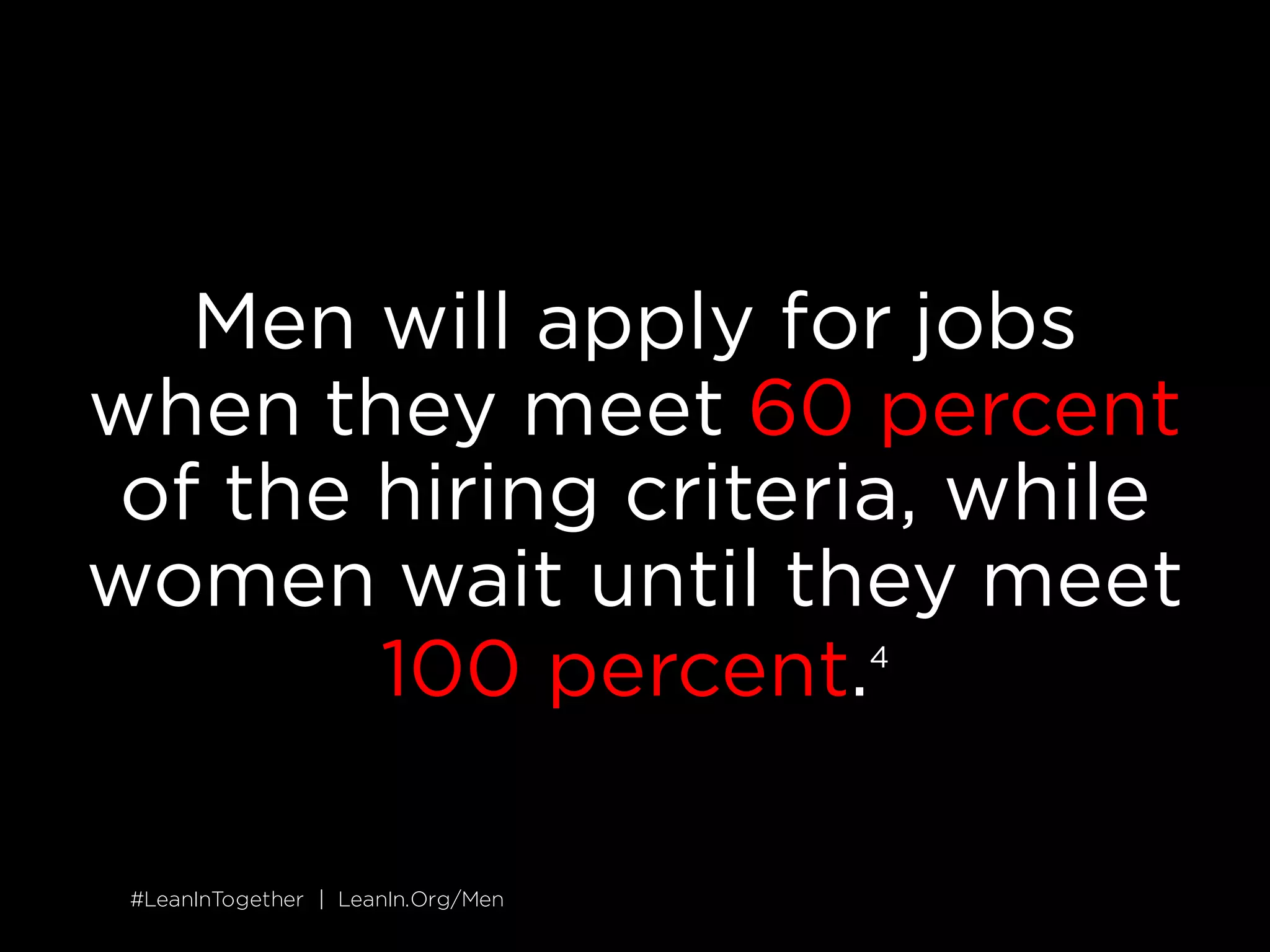
Men will apply for jobs
when they meet 60 percent
of the hiring criteria, while
women wait until they meet
100 percent.4
#LeanInTogether | LeanIn.Org/Men
SITUATION
SOLUTION
3 GIVE WOMEN CREDIT
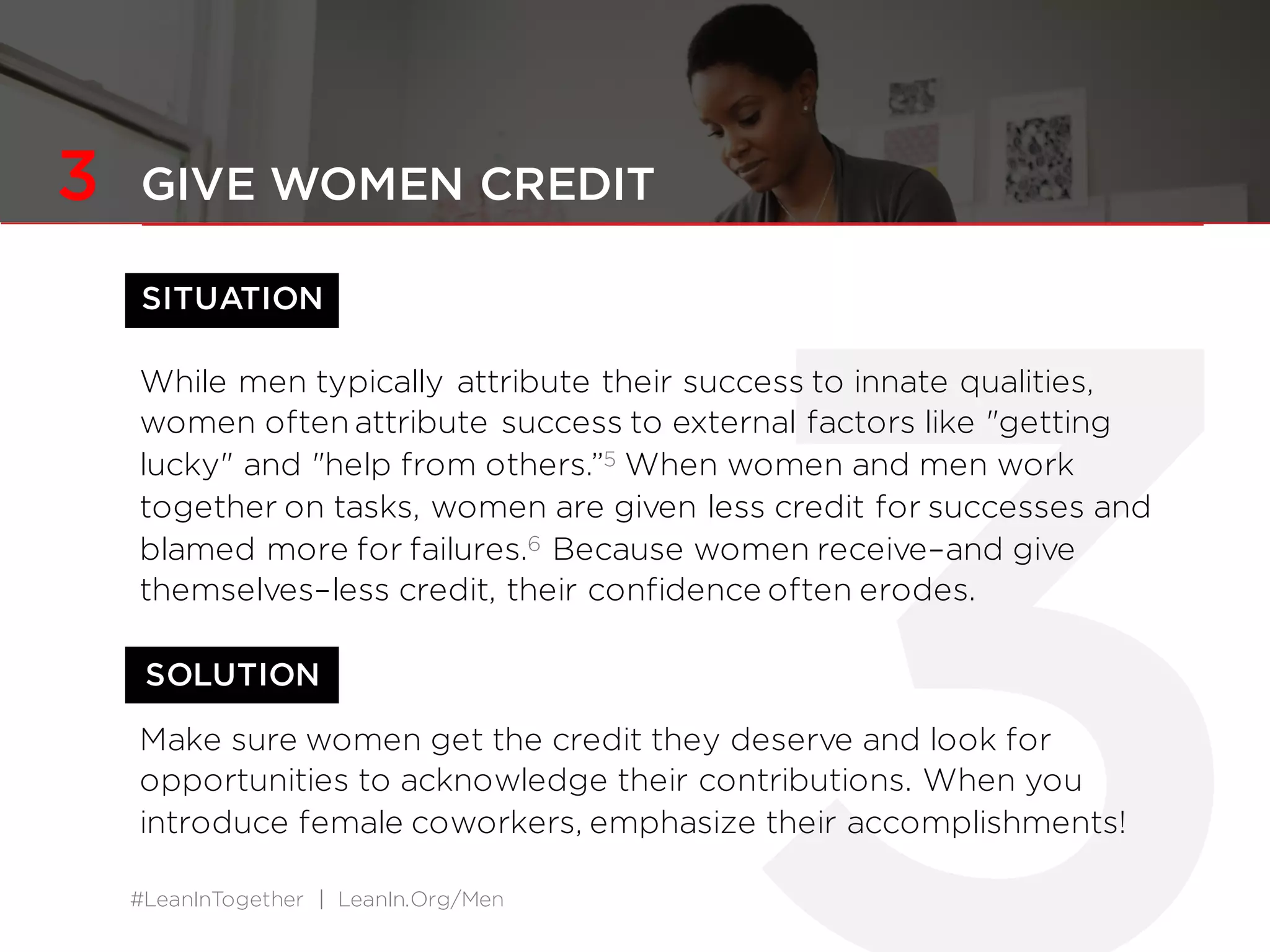
While men typically attribute their success to innate qualities,
women often attribute success to external factors like "getting
lucky" and "help from others.”5 When women and men work
together on tasks, women are given less credit for successes and
blamed more for failures.6 Because women receive–and give
themselves–less credit, their confidence often erodes.
Make sure women get the credit they deserve and look for
opportunities to acknowledge their contributions. When you
introduce female coworkers, emphasize their accomplishments!
#LeanInTogether | LeanIn.Org/Men#LeanInTogether | LeanIn.Org/Men
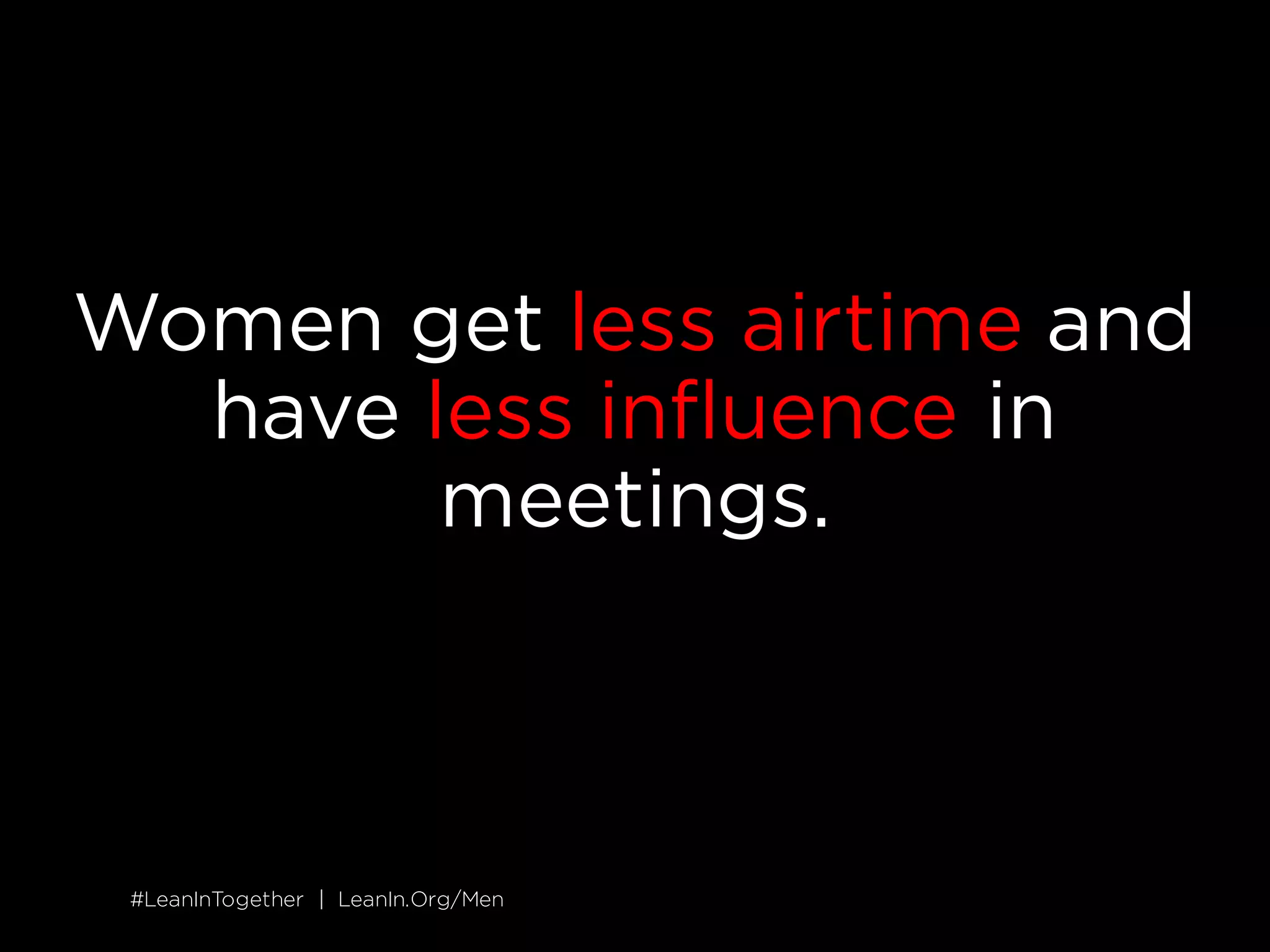
Women get less airtime and
have less influence in
meetings.
#LeanInTogether | LeanIn.Org/Men
SOLUTION
4 GET THE MOST OF OUT OF MEETINGS
SITUATION
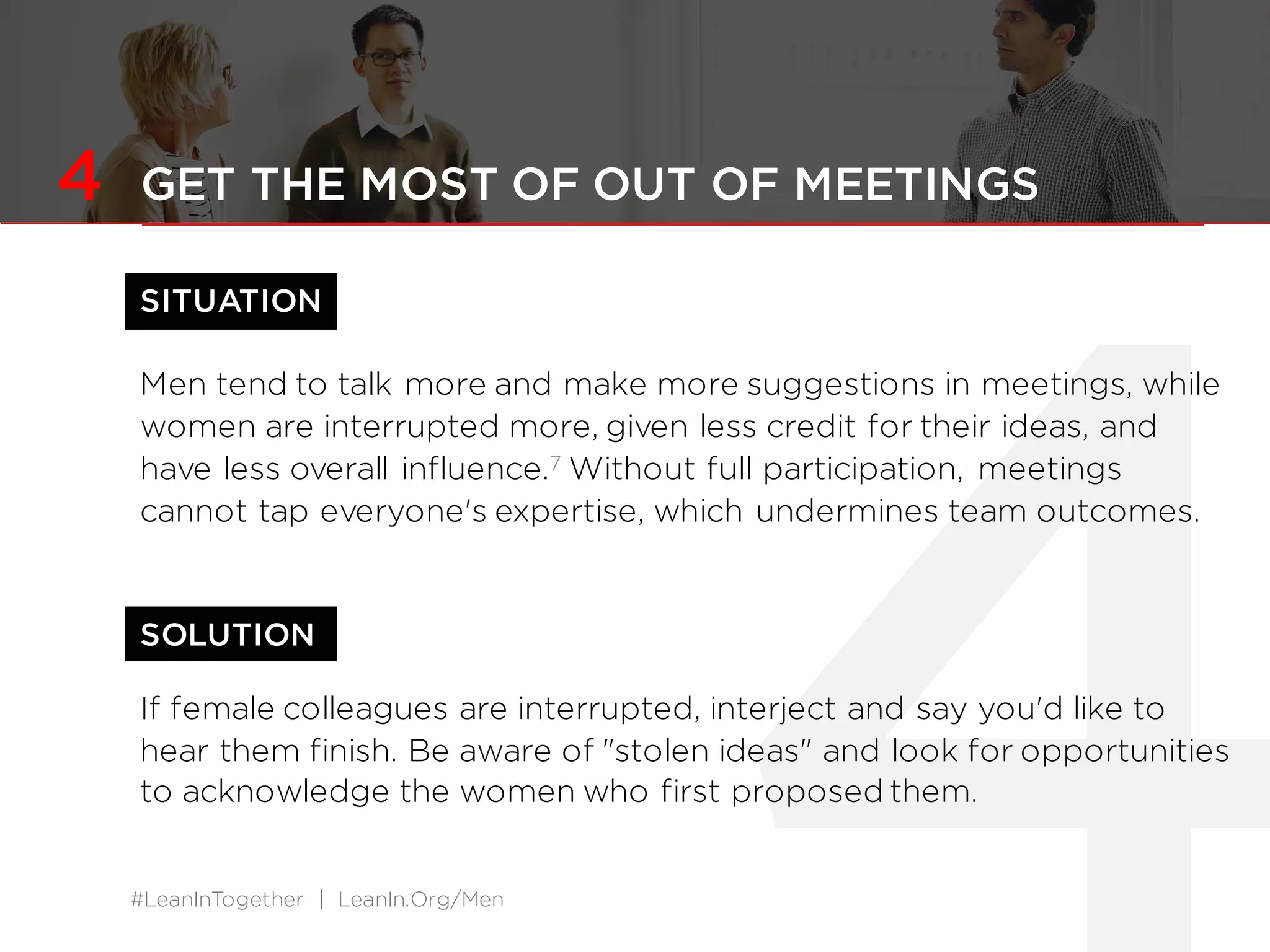
Men tend to talk more and make more suggestions in meetings, while
women are interrupted more, given less credit for their ideas, and
have less overall influence.7 Without full participation, meetings
cannot tap everyone's expertise, which undermines team outcomes.
If female colleagues are interrupted, interject and say you'd like to
hear them finish. Be aware of "stolen ideas" and look for opportunities
to acknowledge the women who first proposed them.
#LeanInTogether | LeanIn.Org/Men
SOLUTION
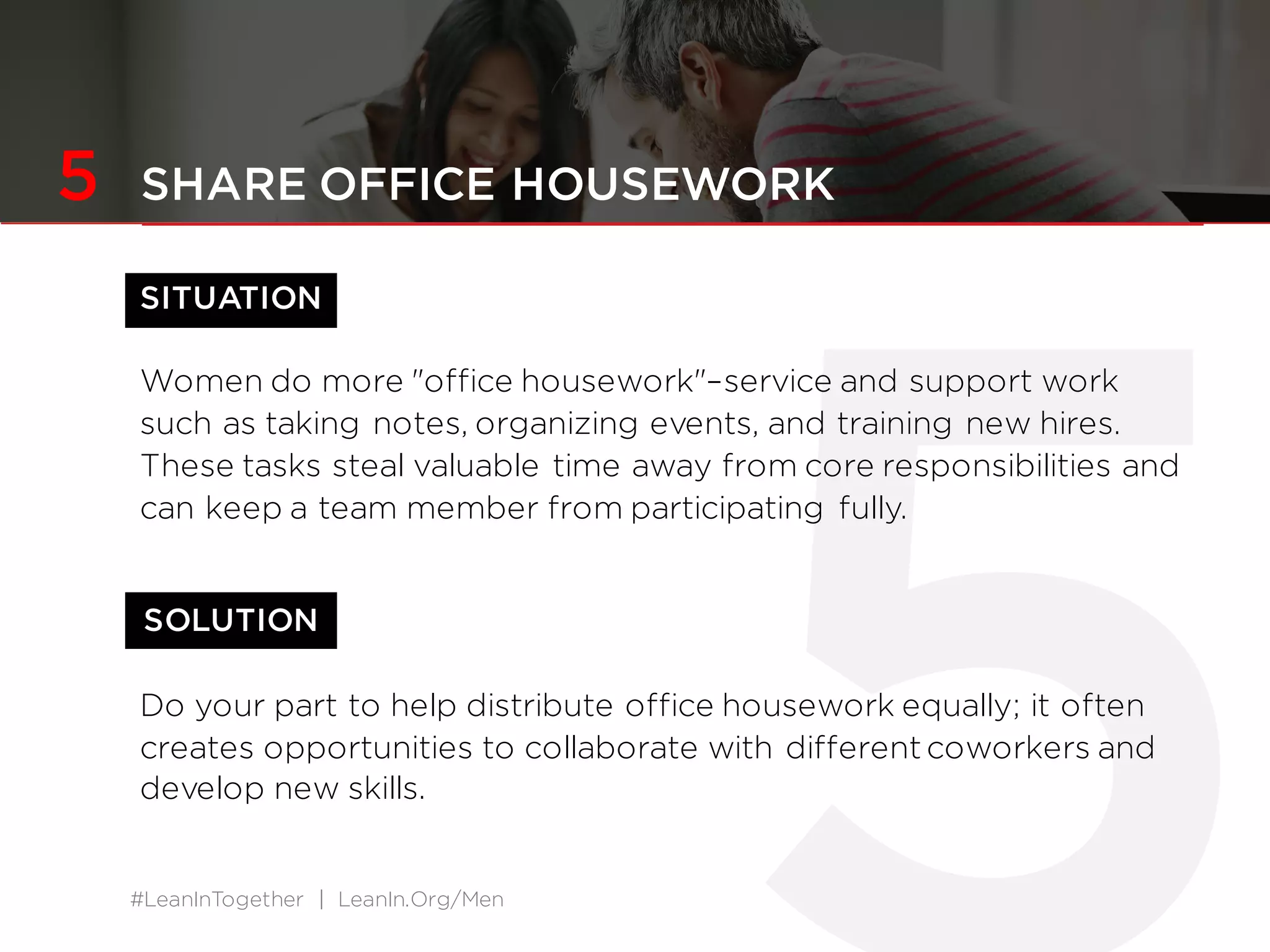
5 SHARE OFFICE HOUSEWORK
SITUATION
Women do more "office housework"–service and support work
such as taking notes, organizing events, and training new hires.
These tasks steal valuable time away from core responsibilities and
can keep a team member from participating fully.
Do your part to help distribute office housework equally; it often
creates opportunities to collaborate with different coworkers and
develop new skills.
#LeanInTogether | LeanIn.Org/Men#LeanInTogether | LeanIn.Org/Men
Motherhood triggers
assumptions that a woman
is less competent and less
committed to her career.
#LeanInTogether | LeanIn.Org/Men
SOLUTION
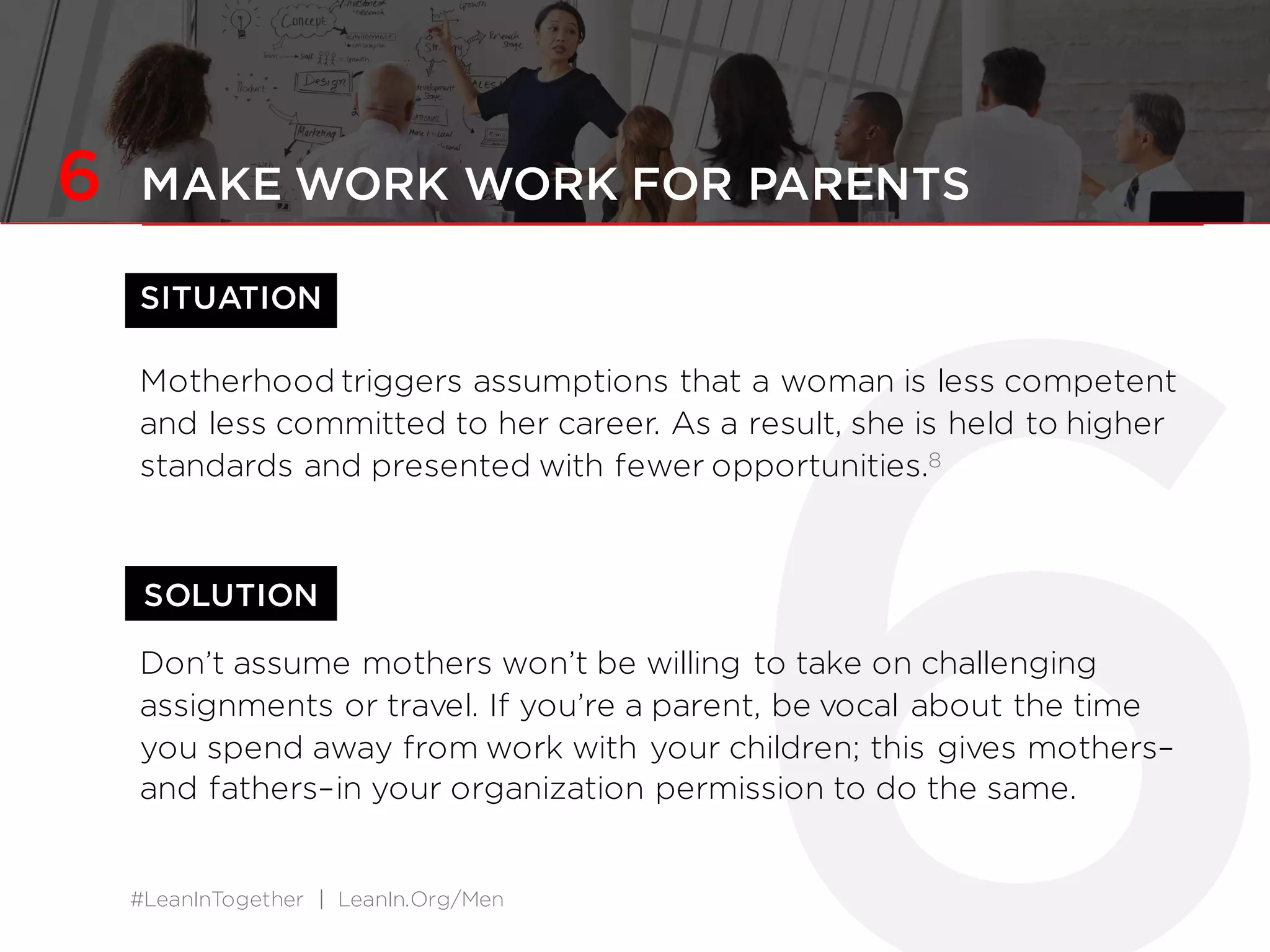
6 MAKE WORK WORK FOR PARENTS
SITUATION
Motherhood triggers assumptions that a woman is less competent
and less committed to her career. As a result, she is held to higher
standards and presented with fewer opportunities.8
Don’t assume mothers won’t be willing to take on challenging
assignments or travel. If you’re a parent, be vocal about the time
you spend away from work with your children; this gives mothers–
and fathers–in your organization permission to do the same.
#LeanInTogether | LeanIn.Org/Men
When men lean in for equality, they win—and so does everyone else.
Men have an important role to play in reaching equality, and
everyone benefits when they do. Children with involved fathers are
happier, healthier, and more successful. Couples who share
responsibilities have stronger marriages. Diverse teams and
companies produce better results.
Leaning in is not just the right thing to do—it’s the smart thing to do.
Learn more at leanin.org/men
PROUD TO
#LEANINTOGETHER
#LeanInTogether | LeanIn.Org/Men
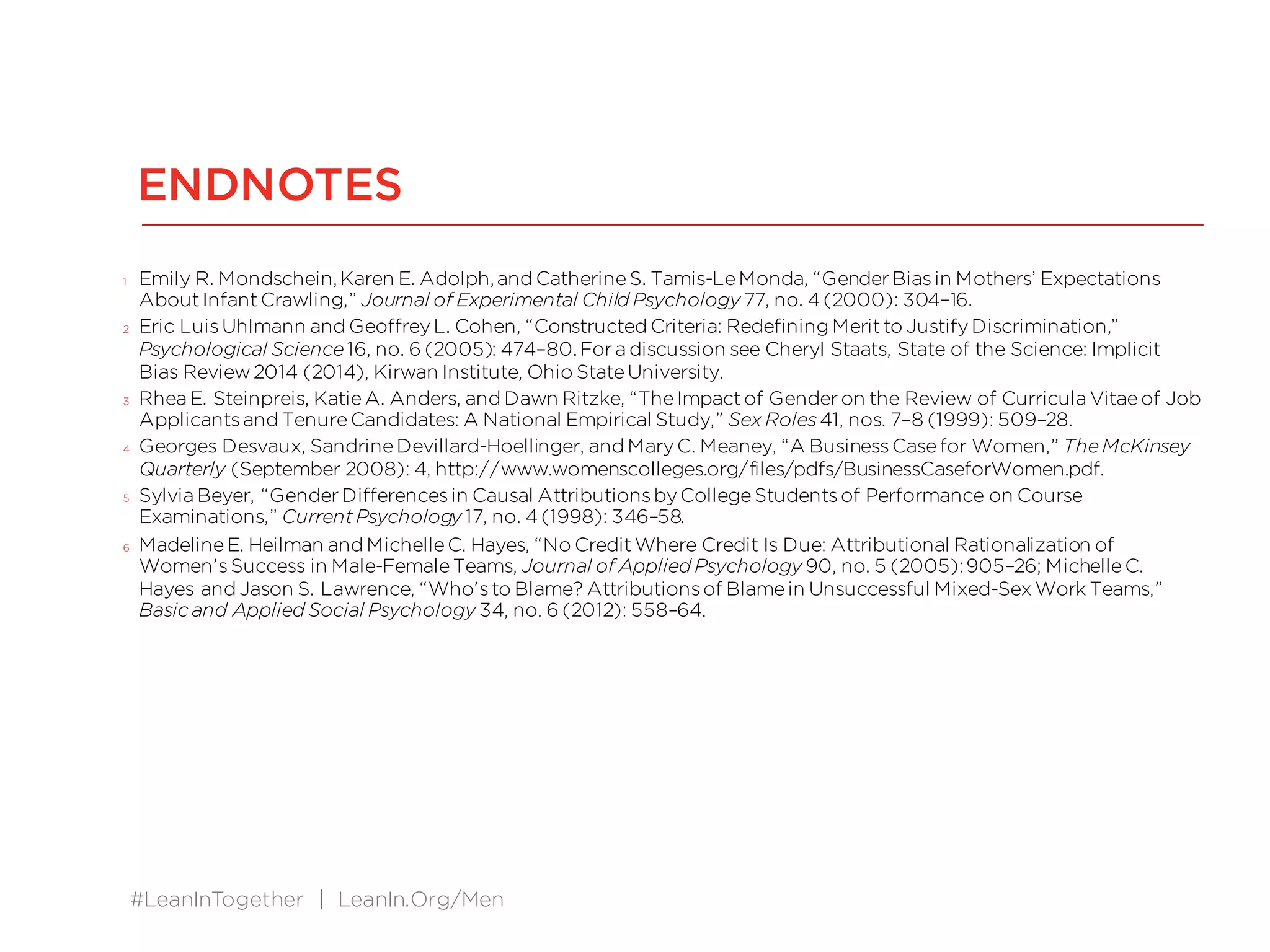
ENDNOTES
1 Emily R. Mondschein,Karen E. Adolph,and CatherineS. Tamis-LeMonda, “GenderBiasin Mothers’ Expectations
AboutInfantCrawling,” Journal of Experimental Child Psychology 77, no. 4 (2000): 304–16.
2 Eric LuisUhlmann and GeoffreyL. Cohen, “Constructed Criteria: Redefining Meritto JustifyDiscrimination,”
Psychological Science16, no. 6 (2005): 474–80.Fora discussion see Cheryl Staats, State of the Science: Implicit
Bias Review2014 (2014), Kirwan Institute, Ohio StateUniversity.
3 Rhea E. Steinpreis, KatieA. Anders, and Dawn Ritzke, “TheImpactof Genderon the Review of Curricula Vitaeof Job
Applicantsand TenureCandidates: A National Empirical Study,” Sex Roles41, nos. 7–8 (1999): 509–28.
4 Georges Desvaux, SandrineDevillard-Hoellinger, and MaryC. Meaney, “A BusinessCasefor Women,” TheMcKinsey
Quarterly (September 2008): 4, http://www.womenscolleges.org/files/pdfs/BusinessCaseforWomen.pdf.
5 Sylvia Beyer, “GenderDifferencesin Causal AttributionsbyCollegeStudentsof Performance on Course
Examinations,” CurrentPsychology 17, no. 4 (1998): 346–58.
6 MadelineE. Heilman and MichelleC. Hayes, “No CreditWhere Credit Is Due: Attributional Rationalization of
Women’sSuccess in Male-FemaleTeams, Journal of Applied Psychology 90, no. 5 (2005):905–26; MichelleC.
Hayes and Jason S. Lawrence, “Who’sto Blame? Attributionsof Blamein Unsuccessful Mixed-Sex Work Teams,”
Basic and Applied Social Psychology 34, no. 6 (2012): 558–64.
#LeanInTogether | LeanIn.Org/Men
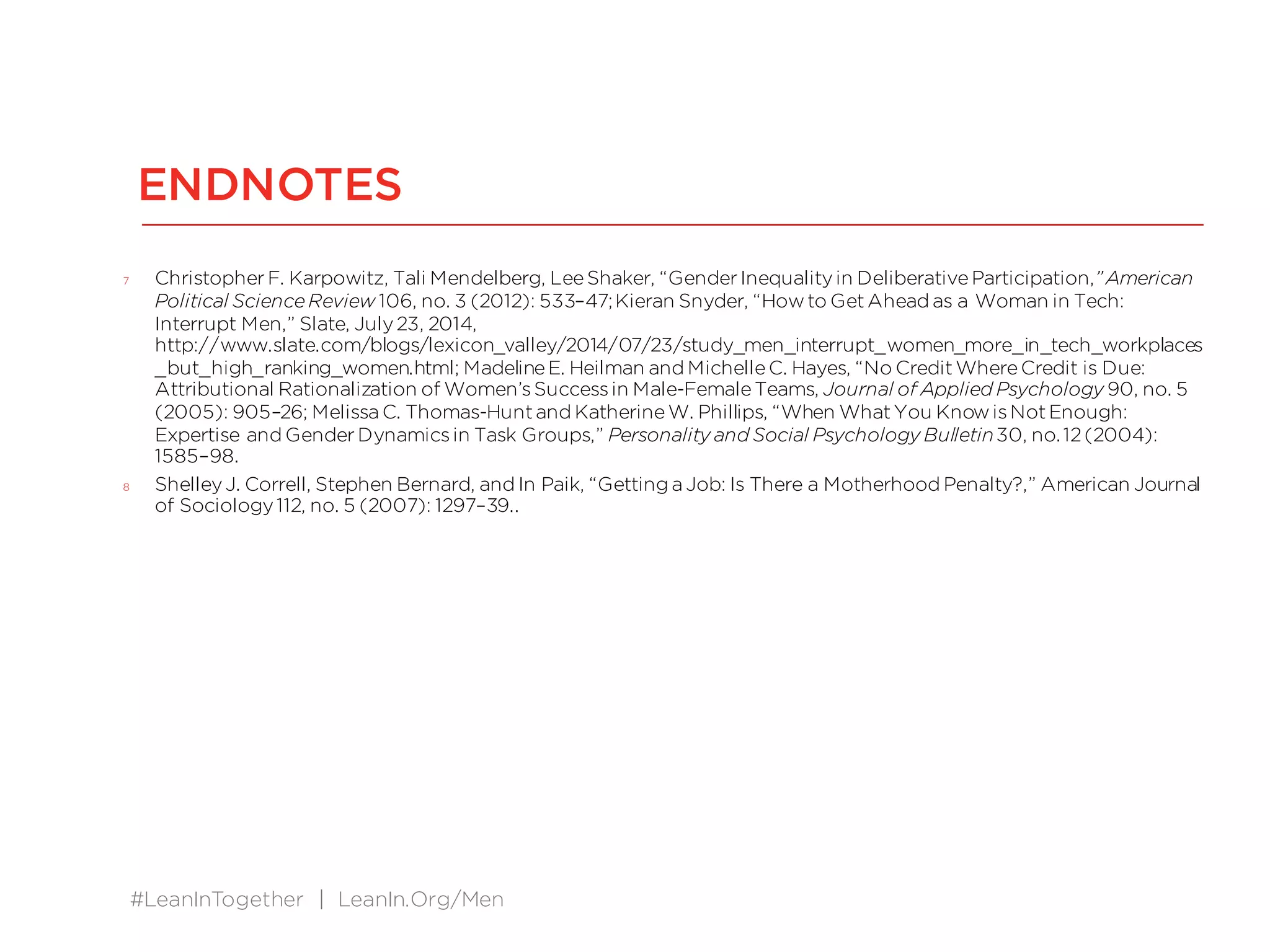
ENDNOTES
7 ChristopherF. Karpowitz, Tali Mendelberg, LeeShaker, “GenderInequalityin DeliberativeParticipation,”American
Political ScienceReview 106, no. 3 (2012): 533–47;Kieran Snyder, “Howto GetAhead as a Woman in Tech:
Interrupt Men,” Slate, July23, 2014,
http://www.slate.com/blogs/lexicon_valley/2014/07/23/study_men_interrupt_women_more_in_tech_workplaces
_but_high_ranking_women.html; MadelineE. Heilman and MichelleC. Hayes, “No CreditWhereCredit is Due:
Attributional Rationalization of Women’sSuccessin Male-FemaleTeams, Journal of Applied Psychology 90, no. 5
(2005): 905–26; Melissa C. Thomas-Huntand KatherineW. Phillips, “When WhatYou KnowisNotEnough:
Expertise and GenderDynamicsin Task Groups,” Personality and Social Psychology Bulletin30, no.12(2004):
1585–98.
8 ShelleyJ. Correll, Stephen Bernard, and In Paik, “Getting a Job: Is There a Motherhood Penalty?,” American Journal
of Sociology112, no. 5 (2007): 1297–39..

#LeanInTogether: How to Be a Workplace MVP

  • 1.
    #LeanInTogether | LeanIn.Org/Men #LeanInTogether TIPSFOR MEN: HOW TO BE A WORKPLACE MVP Get the complete tips at leanin.org/tips/mvp HeroImages/Getty Images
  • 2.
    #LeanInTogether | LeanIn.Org/Men Menare expected to be assertive and confident, so we welcome their leadership. In contrast, women are expected to be nurturing and collaborative, so when they lead, they go against our expectations and often face pushback. Challenge these stereotypes by pointing out bias and supporting your female colleagues. You have a strong incentive to make sure that women succeed in your organization—men who work well with women and tap the full talents of their teams outperform their peers. TIPS FOR MEN: HOW TO BE A WORKPLACE MVP
  • 3.
    #LeanInTogether | LeanIn.Org/Men 1SITUATION Ifa woman is competent, she does not seem nice enough, but if a woman seems really nice, she is considered less competent. This can have a big impact on a woman's career. Listen for the language of this likeability penalty. If you hear a woman called "aggressive" or "out for herself," ask, "Would you have the same reaction if a man did the same thing?" In many cases, the answer will be no. SOLUTION 1 CHALLENGE THE LIKABILITY PENALTY
  • 4.
    #LeanInTogether | LeanIn.Org/Men#LeanInTogether| LeanIn.Org/Men Women are often hired based on past performance, while men are often hired for their potential.
  • 5.
    #LeanInTogether | LeanIn.Org/Men 2EVALUATE PERFORMANCE FAIRLY SITUATION Male performance is often overestimated compared to female performance1, a bias that is even more pronounced when review criteria are unclear.2 This helps explain why women are hired and promoted based on their past, while men are hired and promoted based on their potential.3 SOLUTION Make sure you are aware of gender bias in evaluating performance. Know the criteria for what constitutes excellent performance and be prepared to explain your evaluations.
  • 6.
    #LeanInTogether | LeanIn.Org/Men#LeanInTogether| LeanIn.Org/Men Men will apply for jobs when they meet 60 percent of the hiring criteria, while women wait until they meet 100 percent.4
  • 7.
    #LeanInTogether | LeanIn.Org/Men SITUATION SOLUTION 3GIVE WOMEN CREDIT While men typically attribute their success to innate qualities, women often attribute success to external factors like "getting lucky" and "help from others.”5 When women and men work together on tasks, women are given less credit for successes and blamed more for failures.6 Because women receive–and give themselves–less credit, their confidence often erodes. Make sure women get the credit they deserve and look for opportunities to acknowledge their contributions. When you introduce female coworkers, emphasize their accomplishments!
  • 8.
    #LeanInTogether | LeanIn.Org/Men#LeanInTogether| LeanIn.Org/Men Women get less airtime and have less influence in meetings.
  • 9.
    #LeanInTogether | LeanIn.Org/Men SOLUTION 4GET THE MOST OF OUT OF MEETINGS SITUATION Men tend to talk more and make more suggestions in meetings, while women are interrupted more, given less credit for their ideas, and have less overall influence.7 Without full participation, meetings cannot tap everyone's expertise, which undermines team outcomes. If female colleagues are interrupted, interject and say you'd like to hear them finish. Be aware of "stolen ideas" and look for opportunities to acknowledge the women who first proposed them.
  • 10.
    #LeanInTogether | LeanIn.Org/Men SOLUTION 5SHARE OFFICE HOUSEWORK SITUATION Women do more "office housework"–service and support work such as taking notes, organizing events, and training new hires. These tasks steal valuable time away from core responsibilities and can keep a team member from participating fully. Do your part to help distribute office housework equally; it often creates opportunities to collaborate with different coworkers and develop new skills.
  • 11.
    #LeanInTogether | LeanIn.Org/Men#LeanInTogether| LeanIn.Org/Men Motherhood triggers assumptions that a woman is less competent and less committed to her career.
  • 12.
    #LeanInTogether | LeanIn.Org/Men SOLUTION 6MAKE WORK WORK FOR PARENTS SITUATION Motherhood triggers assumptions that a woman is less competent and less committed to her career. As a result, she is held to higher standards and presented with fewer opportunities.8 Don’t assume mothers won’t be willing to take on challenging assignments or travel. If you’re a parent, be vocal about the time you spend away from work with your children; this gives mothers– and fathers–in your organization permission to do the same.
  • 13.
    #LeanInTogether | LeanIn.Org/Men Whenmen lean in for equality, they win—and so does everyone else. Men have an important role to play in reaching equality, and everyone benefits when they do. Children with involved fathers are happier, healthier, and more successful. Couples who share responsibilities have stronger marriages. Diverse teams and companies produce better results. Leaning in is not just the right thing to do—it’s the smart thing to do. Learn more at leanin.org/men PROUD TO #LEANINTOGETHER
  • 14.
    #LeanInTogether | LeanIn.Org/Men ENDNOTES 1Emily R. Mondschein,Karen E. Adolph,and CatherineS. Tamis-LeMonda, “GenderBiasin Mothers’ Expectations AboutInfantCrawling,” Journal of Experimental Child Psychology 77, no. 4 (2000): 304–16. 2 Eric LuisUhlmann and GeoffreyL. Cohen, “Constructed Criteria: Redefining Meritto JustifyDiscrimination,” Psychological Science16, no. 6 (2005): 474–80.Fora discussion see Cheryl Staats, State of the Science: Implicit Bias Review2014 (2014), Kirwan Institute, Ohio StateUniversity. 3 Rhea E. Steinpreis, KatieA. Anders, and Dawn Ritzke, “TheImpactof Genderon the Review of Curricula Vitaeof Job Applicantsand TenureCandidates: A National Empirical Study,” Sex Roles41, nos. 7–8 (1999): 509–28. 4 Georges Desvaux, SandrineDevillard-Hoellinger, and MaryC. Meaney, “A BusinessCasefor Women,” TheMcKinsey Quarterly (September 2008): 4, http://www.womenscolleges.org/files/pdfs/BusinessCaseforWomen.pdf. 5 Sylvia Beyer, “GenderDifferencesin Causal AttributionsbyCollegeStudentsof Performance on Course Examinations,” CurrentPsychology 17, no. 4 (1998): 346–58. 6 MadelineE. Heilman and MichelleC. Hayes, “No CreditWhere Credit Is Due: Attributional Rationalization of Women’sSuccess in Male-FemaleTeams, Journal of Applied Psychology 90, no. 5 (2005):905–26; MichelleC. Hayes and Jason S. Lawrence, “Who’sto Blame? Attributionsof Blamein Unsuccessful Mixed-Sex Work Teams,” Basic and Applied Social Psychology 34, no. 6 (2012): 558–64.
  • 15.
    #LeanInTogether | LeanIn.Org/Men ENDNOTES 7ChristopherF. Karpowitz, Tali Mendelberg, LeeShaker, “GenderInequalityin DeliberativeParticipation,”American Political ScienceReview 106, no. 3 (2012): 533–47;Kieran Snyder, “Howto GetAhead as a Woman in Tech: Interrupt Men,” Slate, July23, 2014, http://www.slate.com/blogs/lexicon_valley/2014/07/23/study_men_interrupt_women_more_in_tech_workplaces _but_high_ranking_women.html; MadelineE. Heilman and MichelleC. Hayes, “No CreditWhereCredit is Due: Attributional Rationalization of Women’sSuccessin Male-FemaleTeams, Journal of Applied Psychology 90, no. 5 (2005): 905–26; Melissa C. Thomas-Huntand KatherineW. Phillips, “When WhatYou KnowisNotEnough: Expertise and GenderDynamicsin Task Groups,” Personality and Social Psychology Bulletin30, no.12(2004): 1585–98. 8 ShelleyJ. Correll, Stephen Bernard, and In Paik, “Getting a Job: Is There a Motherhood Penalty?,” American Journal of Sociology112, no. 5 (2007): 1297–39..