Design Thinking
Finding problems worth solving and
solutions worth making in healthcare
#SXSHackmed
http://sxshackmed.mithackmed.com
@ADAMCONNORADAM CONNOR EXPERIENCE DESIGNER, VP ORGANIZATIONAL DESIGN & TRAINING
Where do new ideas
come from?
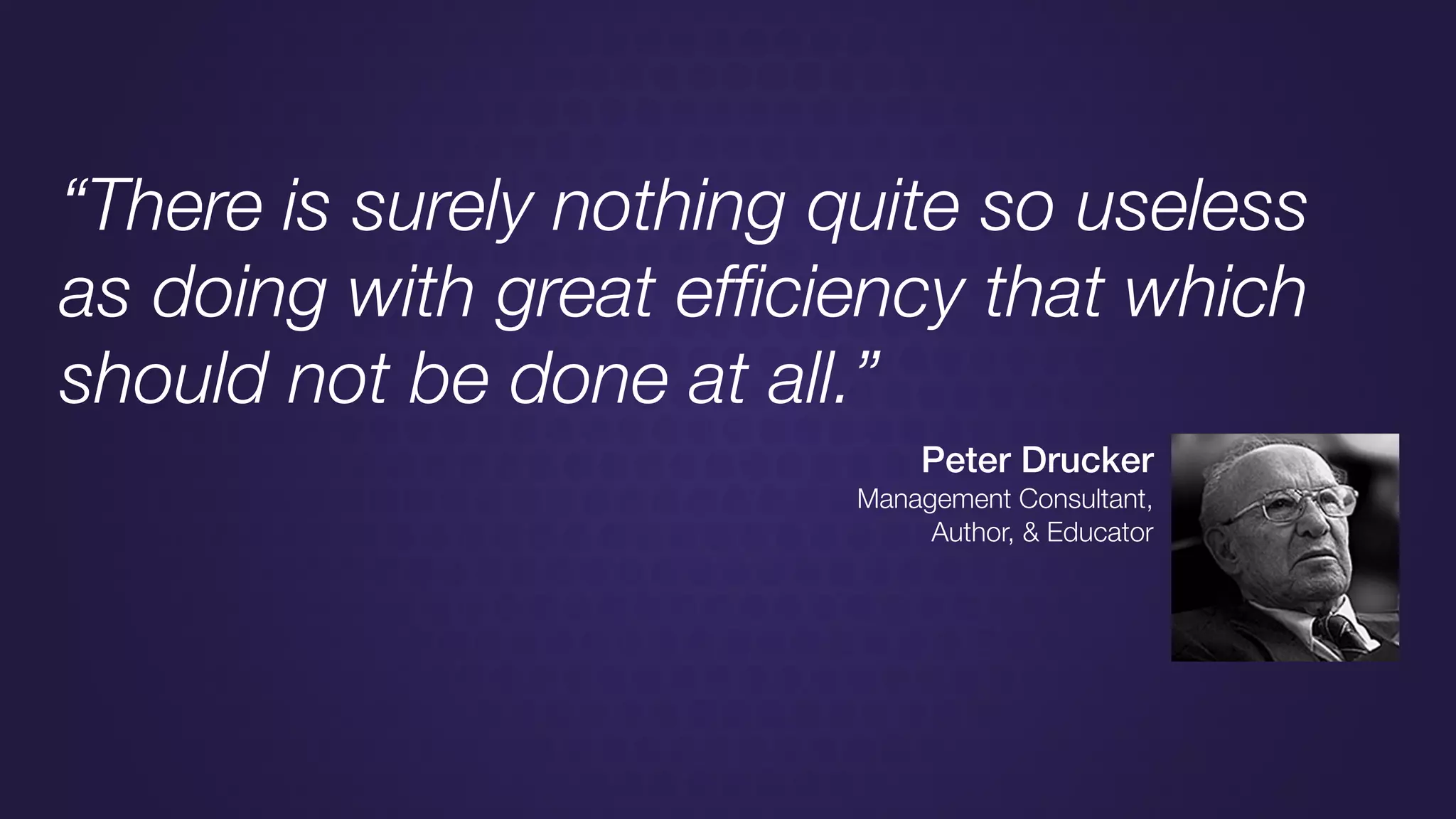
“There is surely nothing quite so useless
as doing with great efficiency that which
should not be done at all.”
Peter Drucker
Management Consultant,
Author, & Educator
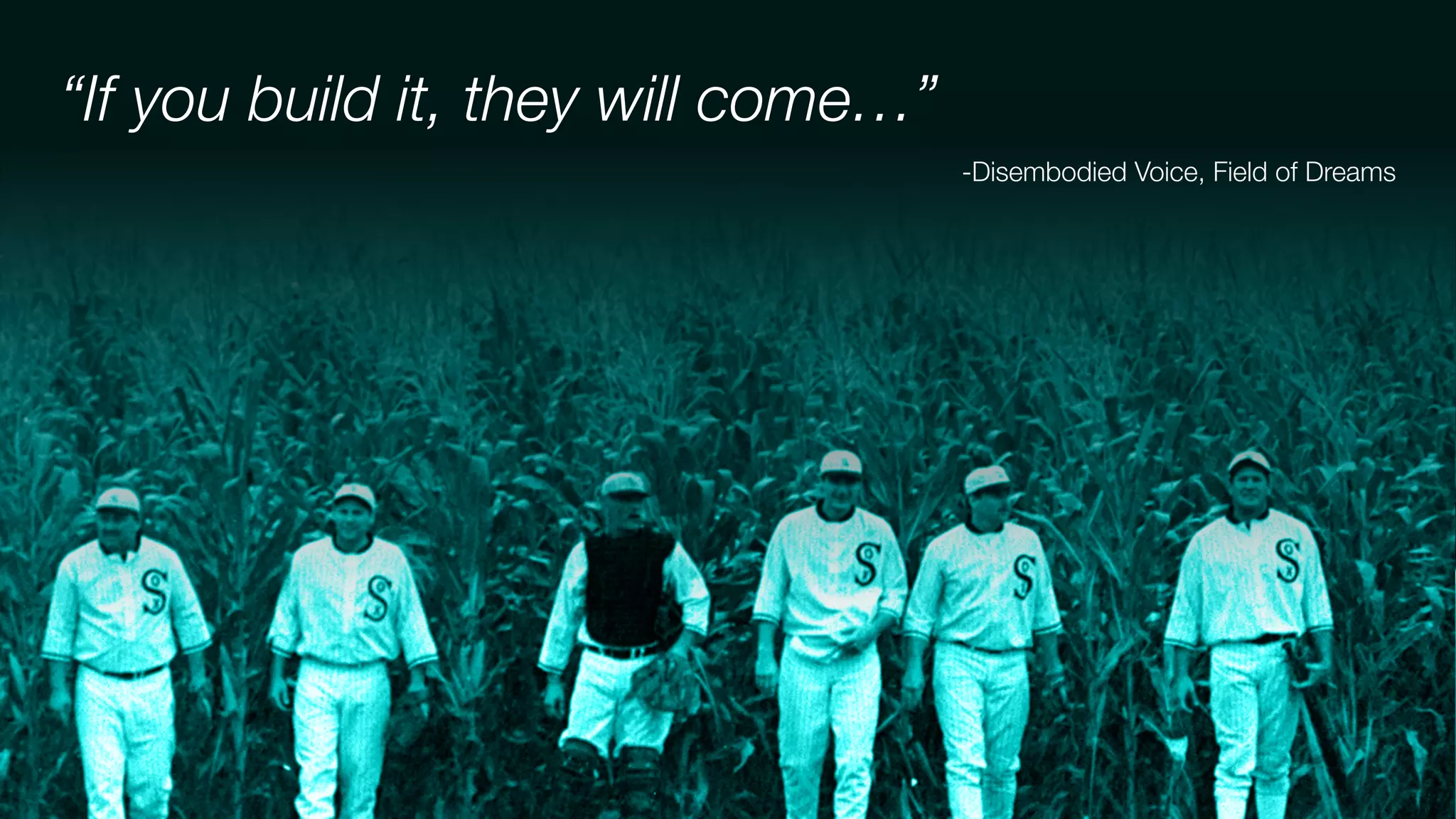
“If you build it, they will come…”
-Disembodied Voice, Field of Dreams
“If you build it, they will come…”
-Disembodied Voice, Field of Dreams
IS A MISQUOTED, BULLSHIT LINE
FROM A MOVIE THAT HAS WASTED
THE TIME OF COUNTLESS PEOPLE
AND ORGANIZATIONS FOR FAR TOO
DAMN LONG.

(the actual line is: “If you build it, he will come.”)
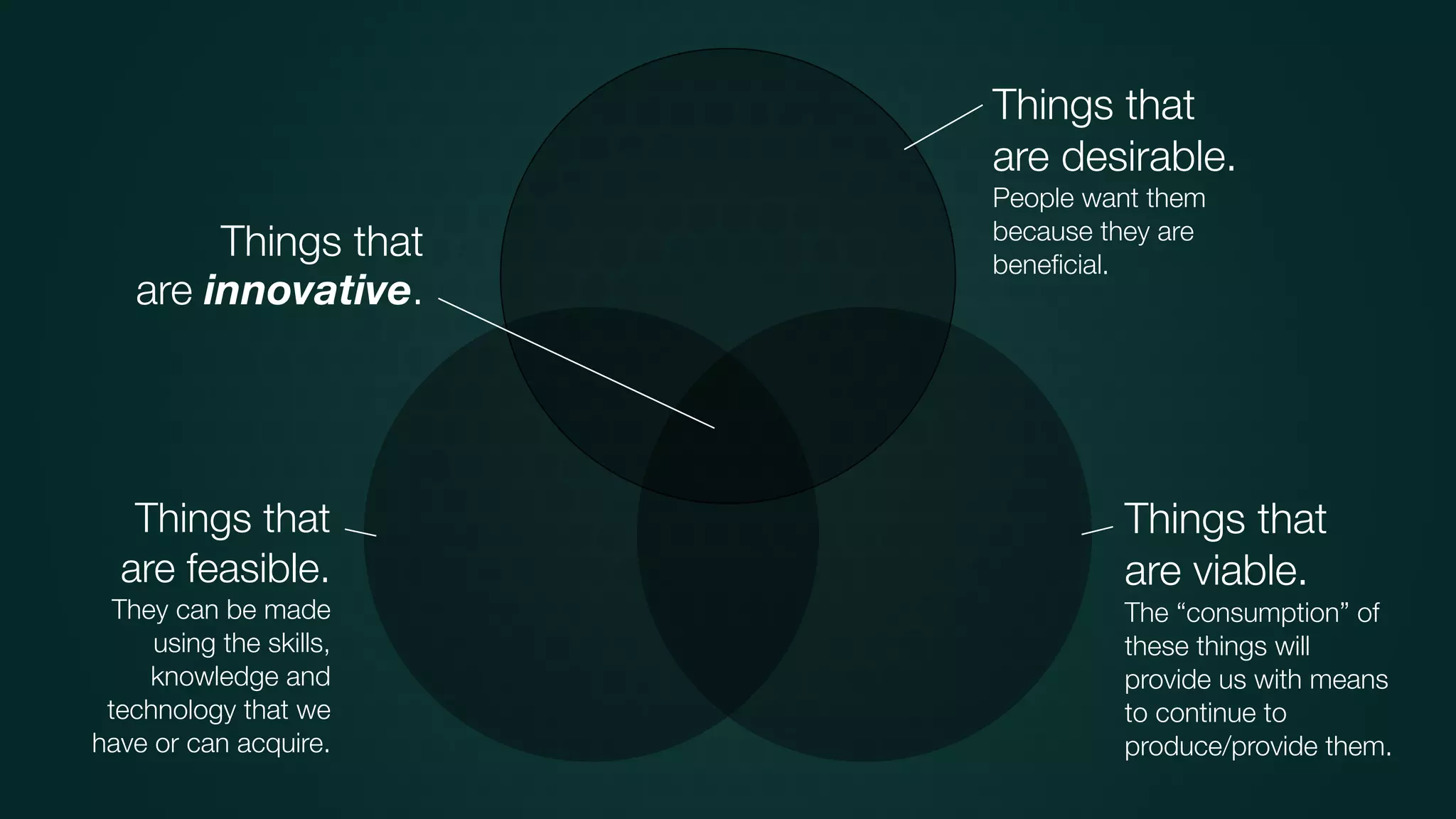
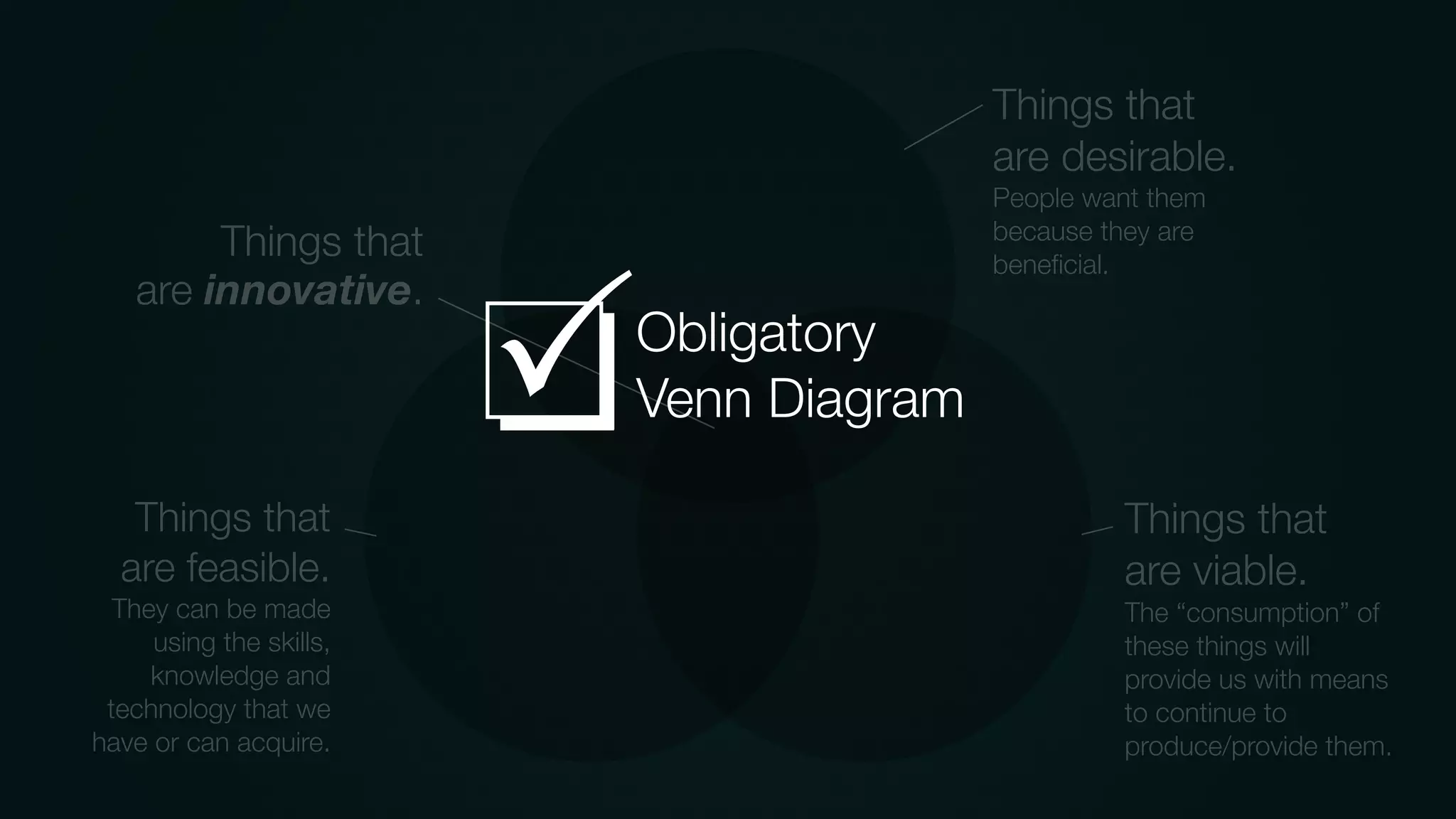
Things that
are desirable.
People want them
because they are
beneficial.
Things that
are feasible.
They can be made
using the skills,
knowledge and
technology that we
have or can acquire.
Things that
are viable.
The “consumption” of
these things will
provide us with means
to continue to
produce/provide them.
Things that
are innovative.
Things that
are desirable.
People want them
because they are
beneficial.
Things that
are feasible.
They can be made
using the skills,
knowledge and
technology that we
have or can acquire.
Things that
are viable.
The “consumption” of
these things will
provide us with means
to continue to
produce/provide them.
Things that
are innovative.
Obligatory
Venn DiagramP
Innovation has more to do with adding
value than new concepts.
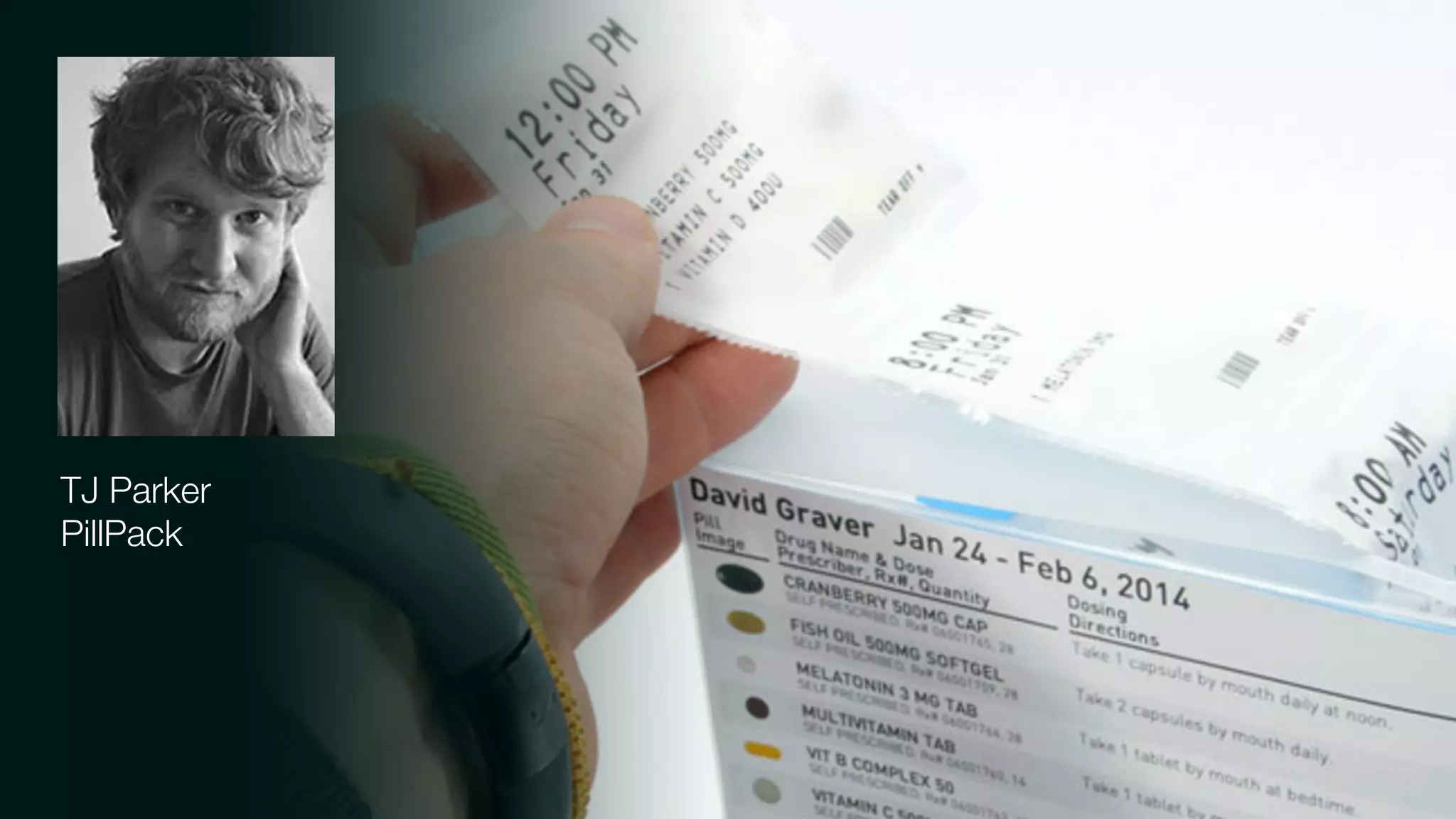
TJ Parker
PillPack
Mick Coulas
is an abstraction of
the principles and process that
designers use to solve problems.
Design Thinking
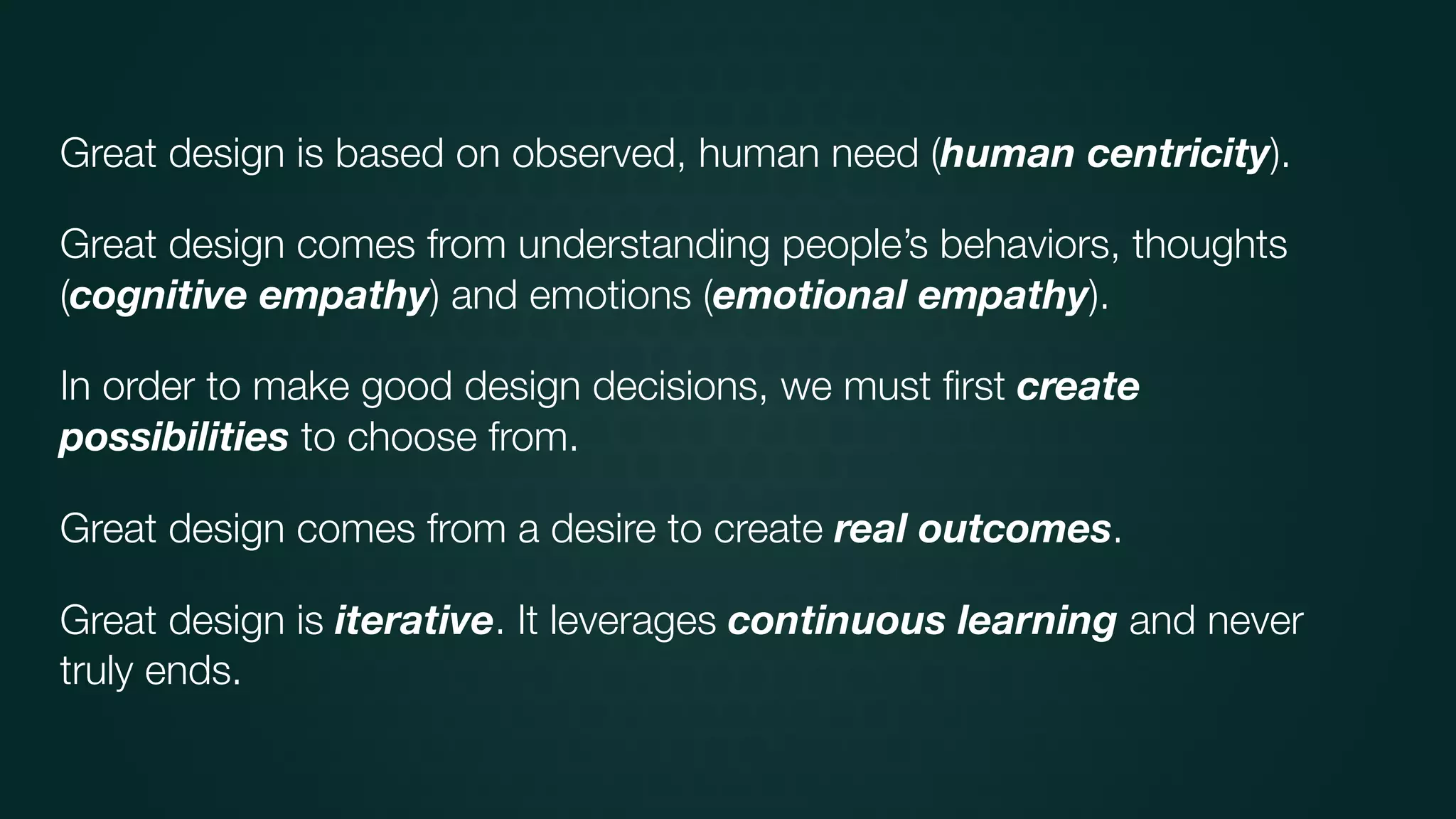
Great design is based on observed, human need (human centricity).
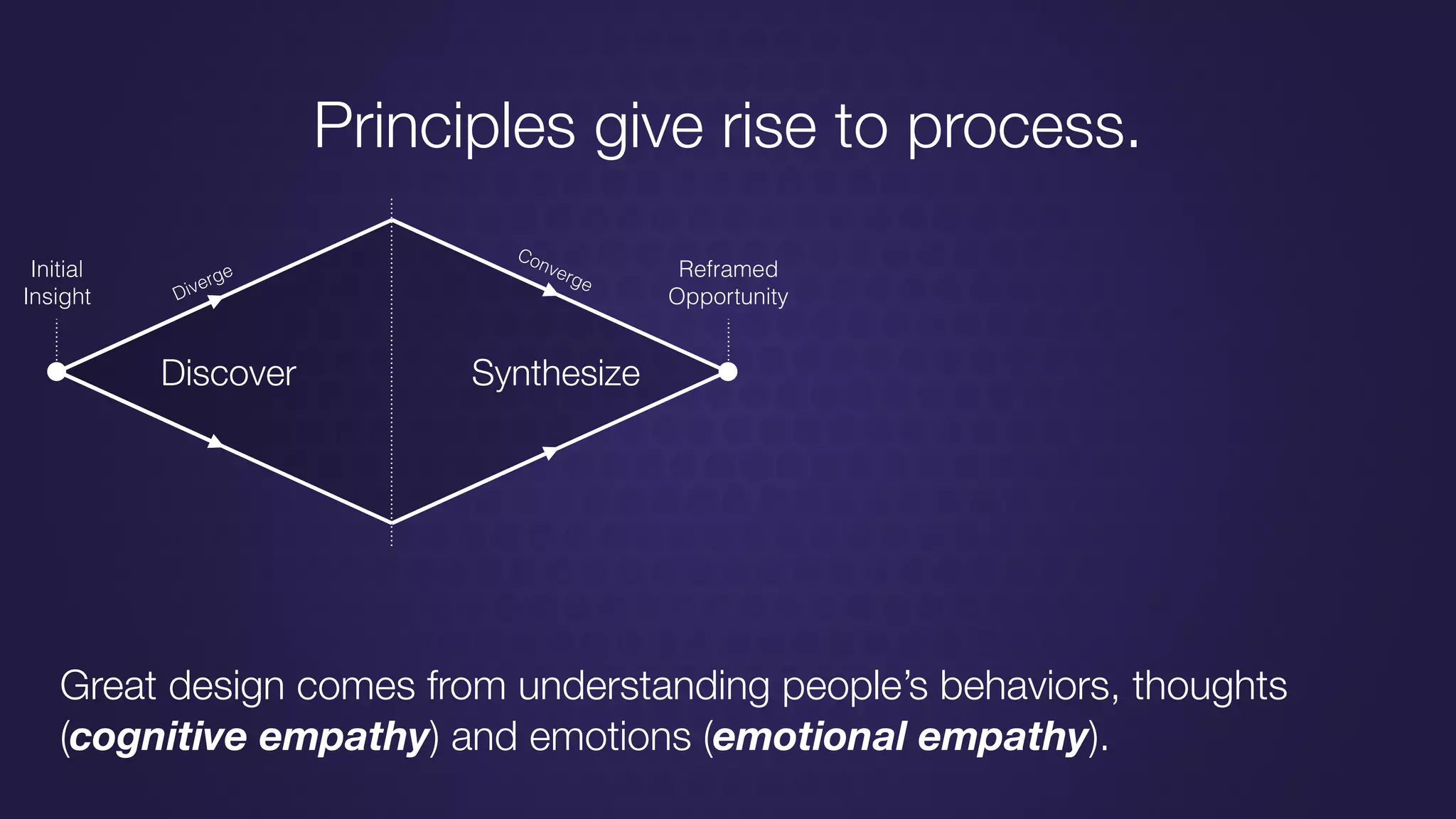
Great design comes from understanding people’s behaviors, thoughts
(cognitive empathy) and emotions (emotional empathy).
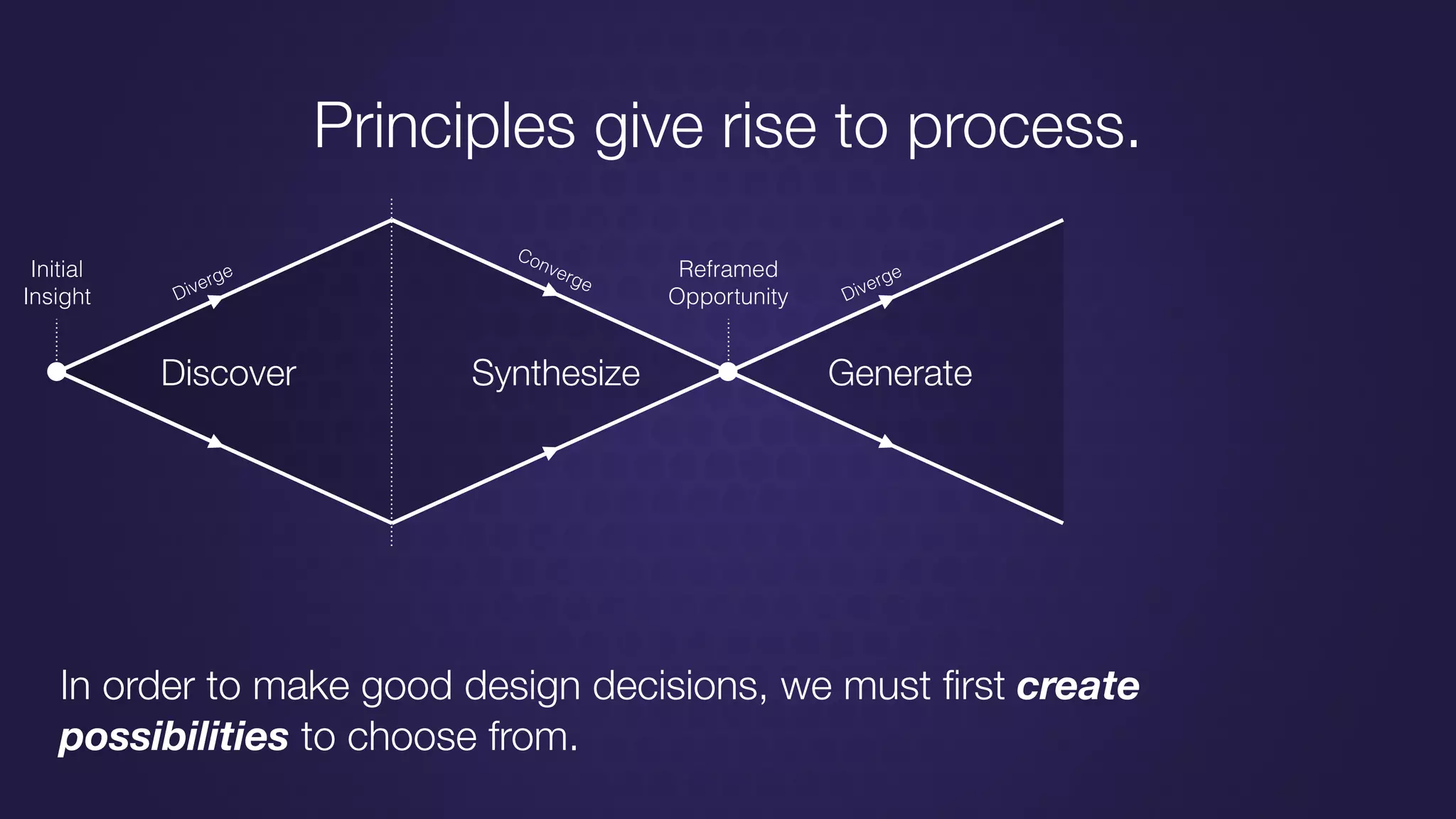
In order to make good design decisions, we must first create
possibilities to choose from.
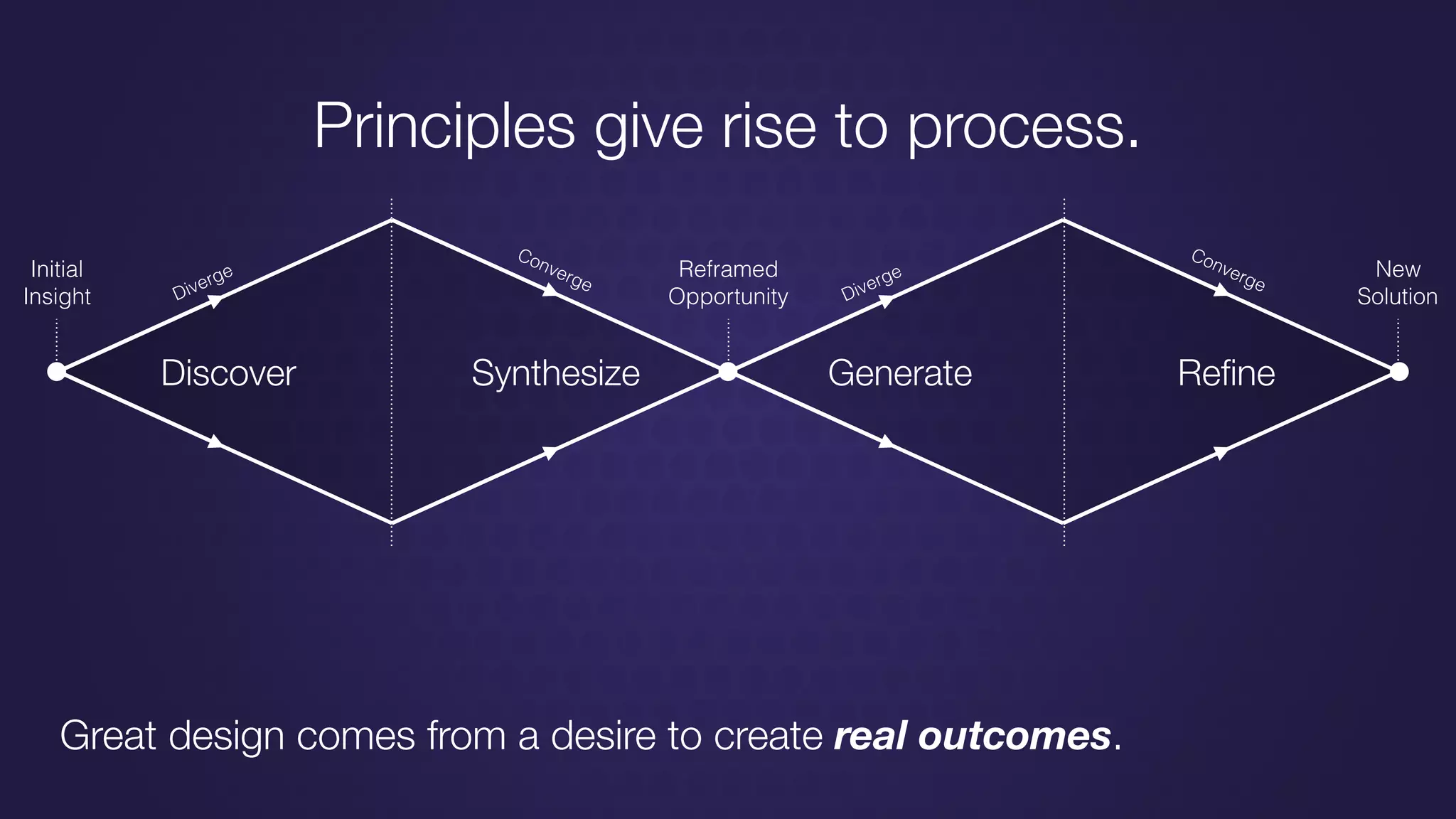
Great design comes from a desire to create real outcomes.
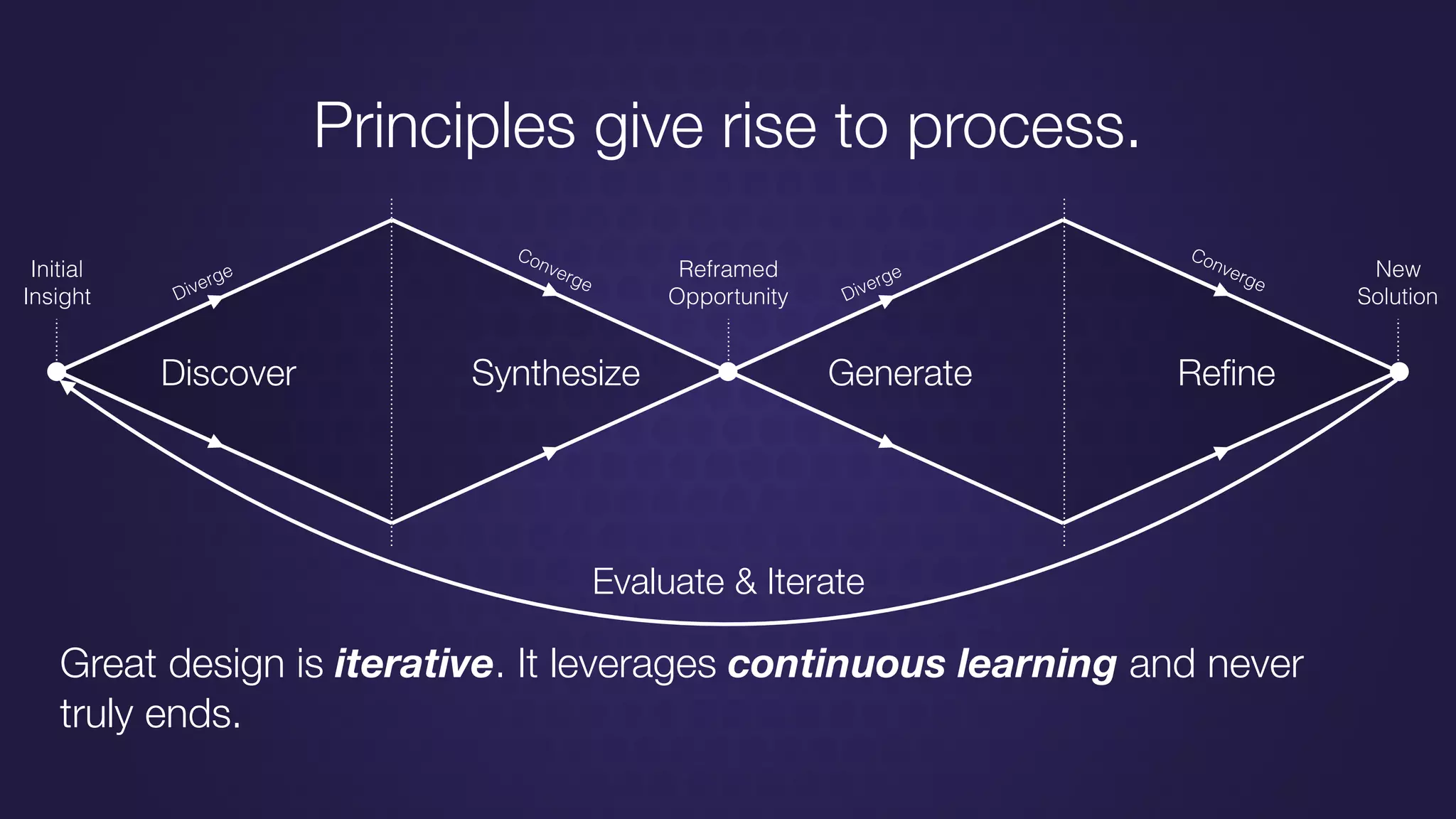
Great design is iterative. It leverages continuous learning and never
truly ends.
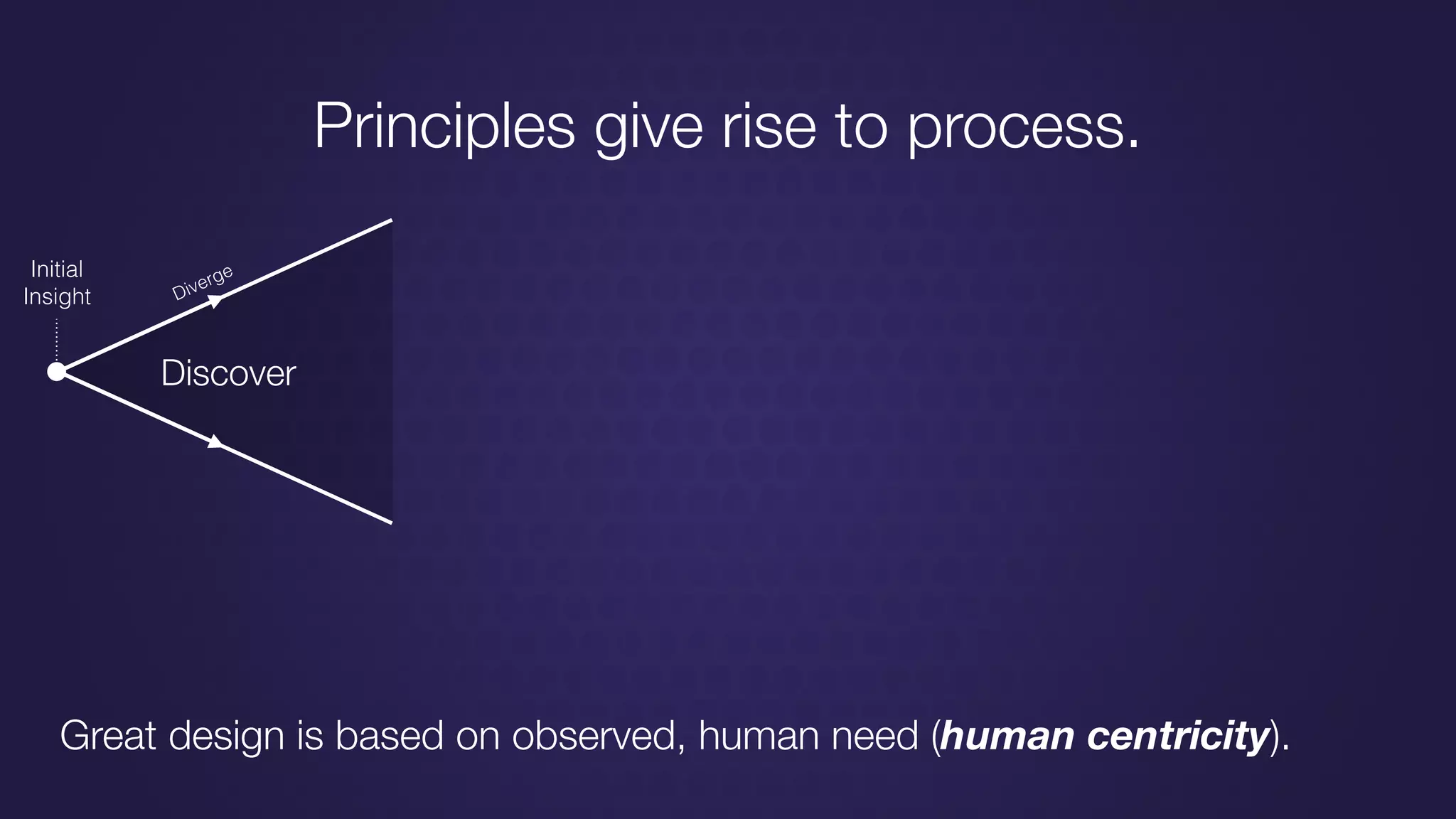
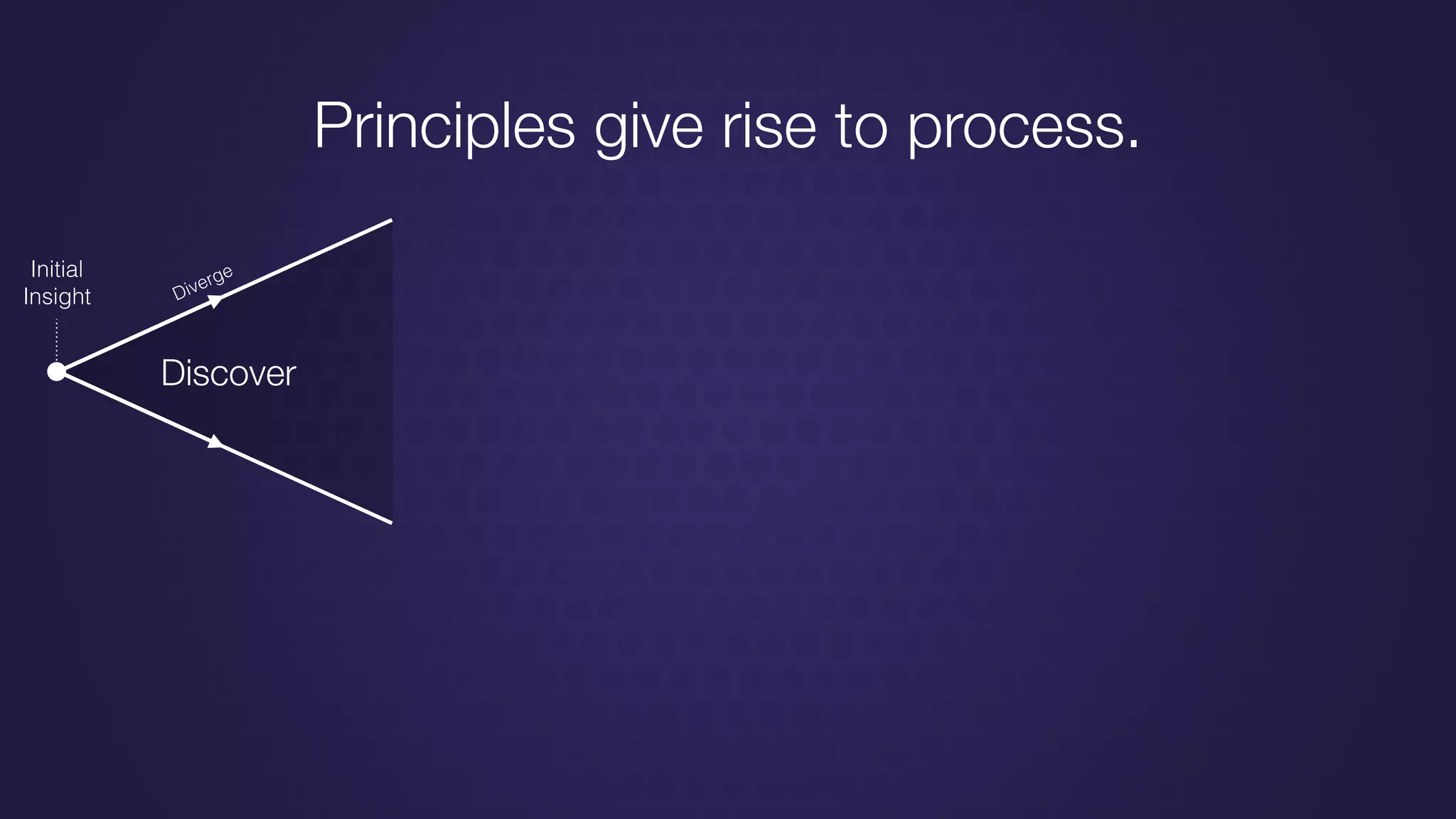
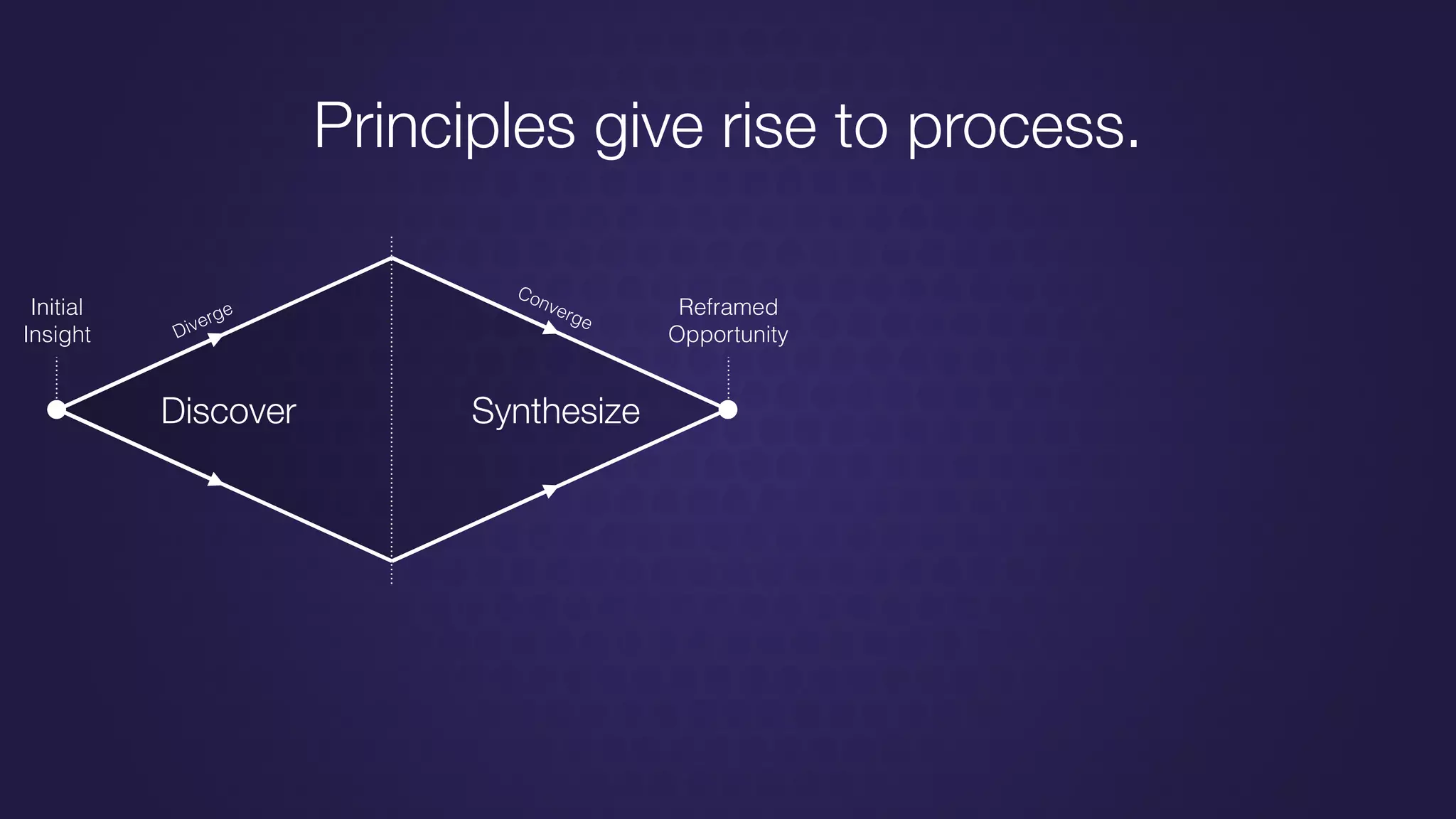
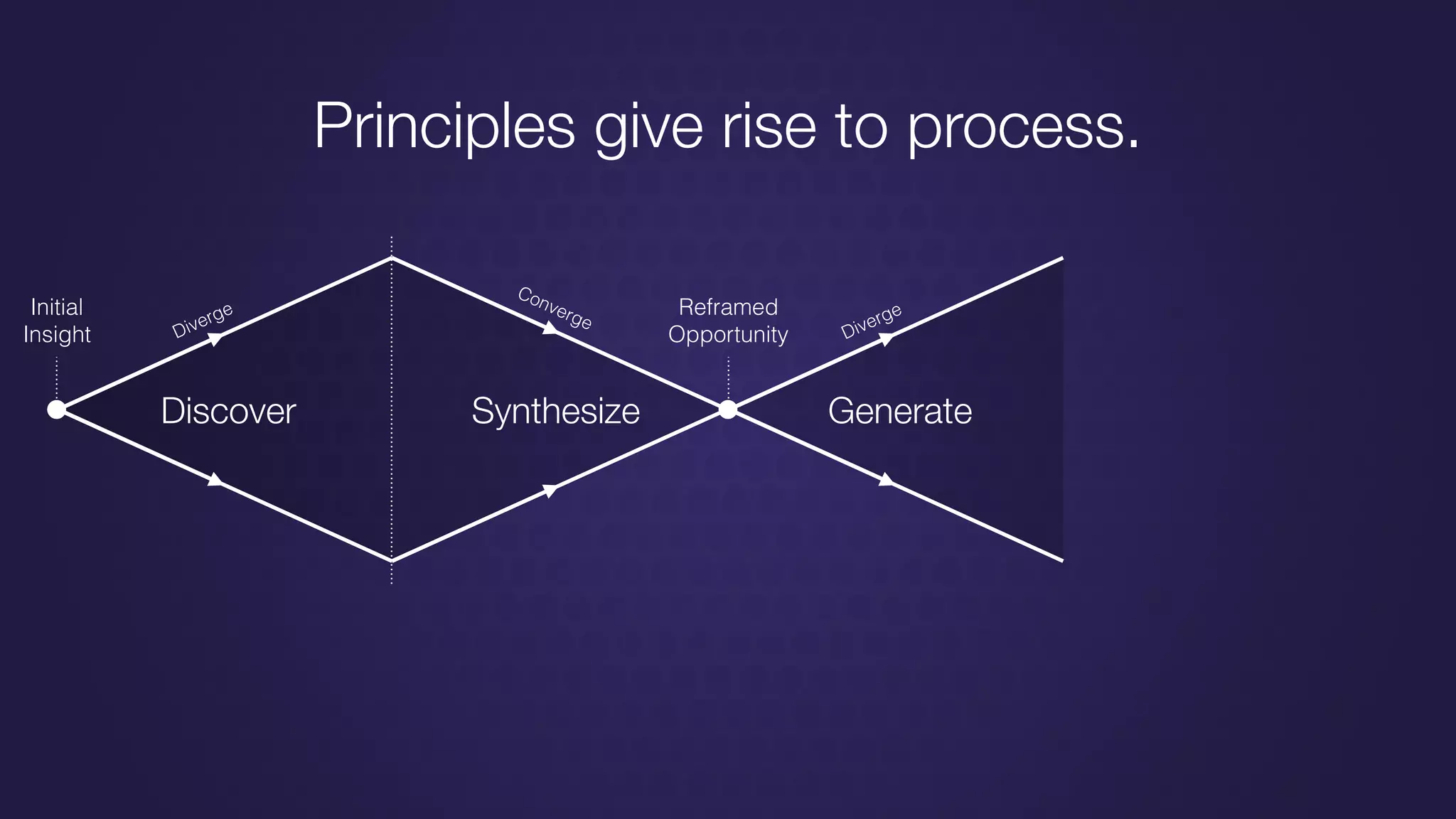
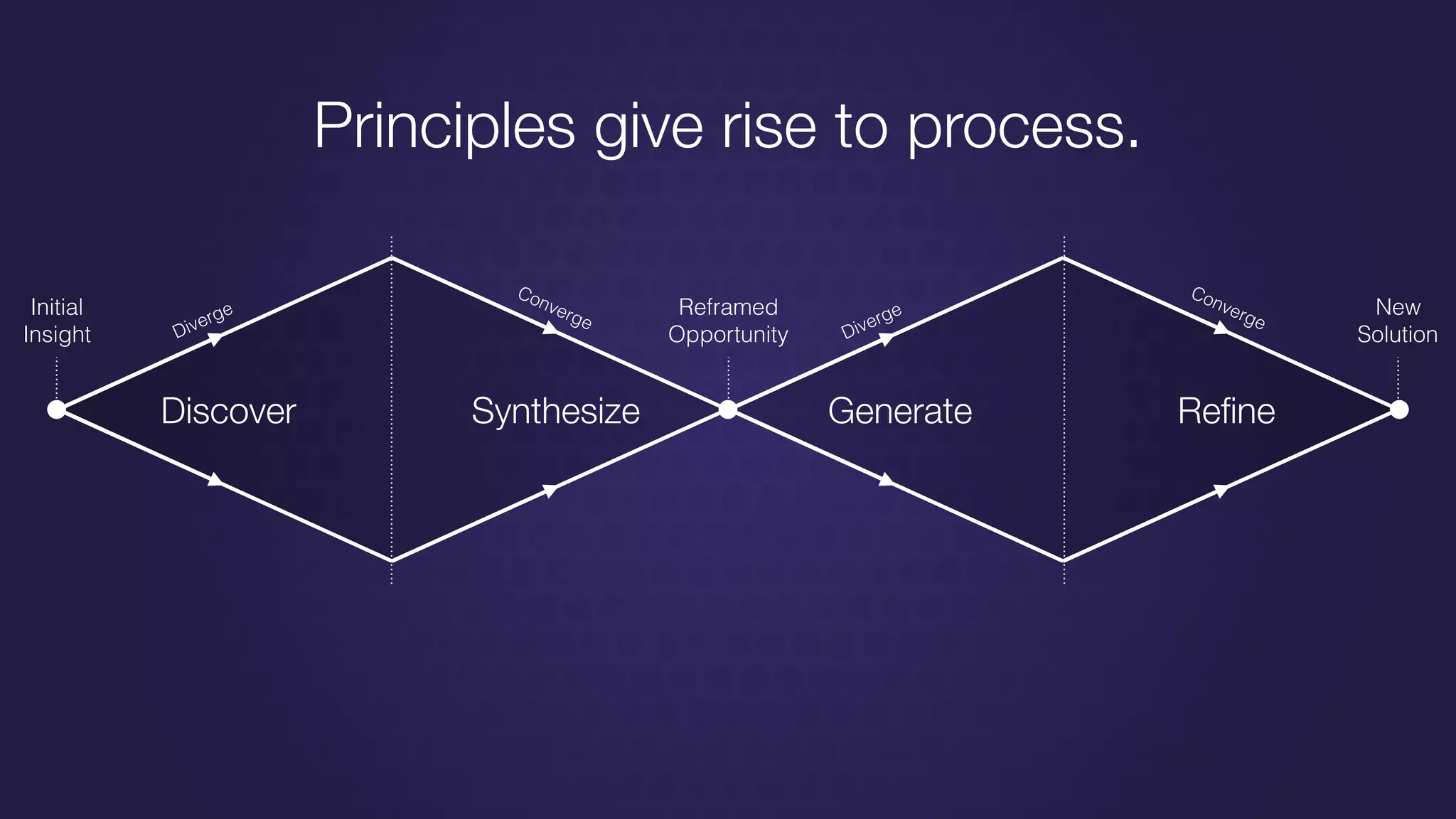
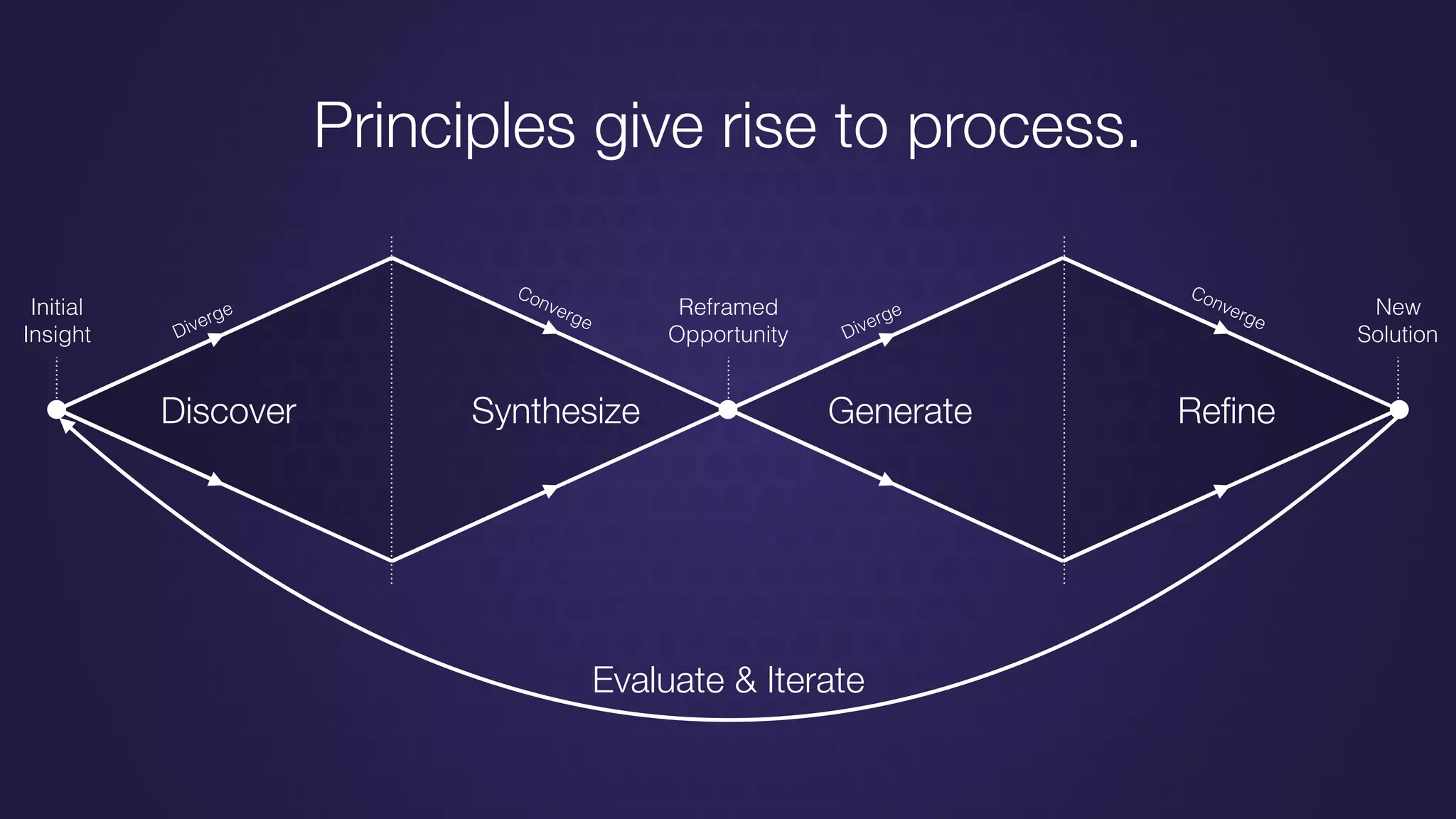
Principles give rise to process.
Discover
DivergeInitial
Insight
Principles give rise to process.
Great design is based on observed, human need (human centricity).
Discover Synthesize
Diverge
Converge
Initial
Insight
Reframed
Opportunity
Principles give rise to process.
Great design comes from understanding people’s behaviors, thoughts
(cognitive empathy) and emotions (emotional empathy).
Discover Synthesize Generate
Diverge
Diverge
Converge
Initial
Insight
Reframed
Opportunity
Principles give rise to process.
In order to make good design decisions, we must first create
possibilities to choose from.
Discover Synthesize Generate Refine
Diverge
Diverge
Converge
Converge
Initial
Insight
Reframed
Opportunity
New
Solution
Principles give rise to process.
Great design comes from a desire to create real outcomes.
Discover Synthesize Generate Refine
Diverge
Diverge
Converge
Converge
Evaluate & Iterate
Initial
Insight
Reframed
Opportunity
New
Solution
Principles give rise to process.
Great design is iterative. It leverages continuous learning and never
truly ends.
Discover
DivergeInitial
Insight
Principles give rise to process.
You have to understand a problem
before you can solve it.
And often the problems you’re asked to
solve are not the one’s you need to solve.
Problems are often composed of or
caused by other problems…
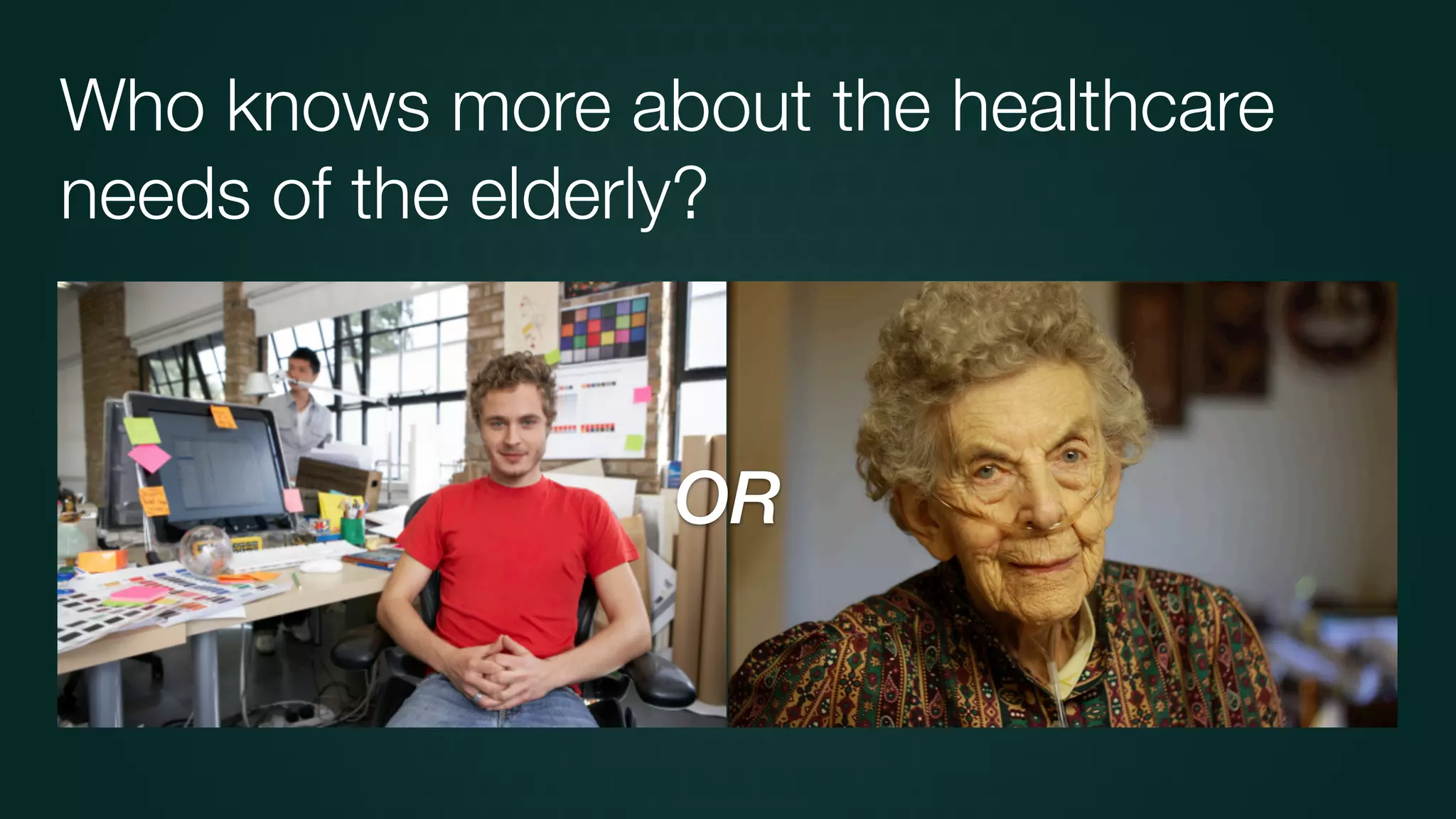
Who knows more about the healthcare
needs of the elderly?
OR
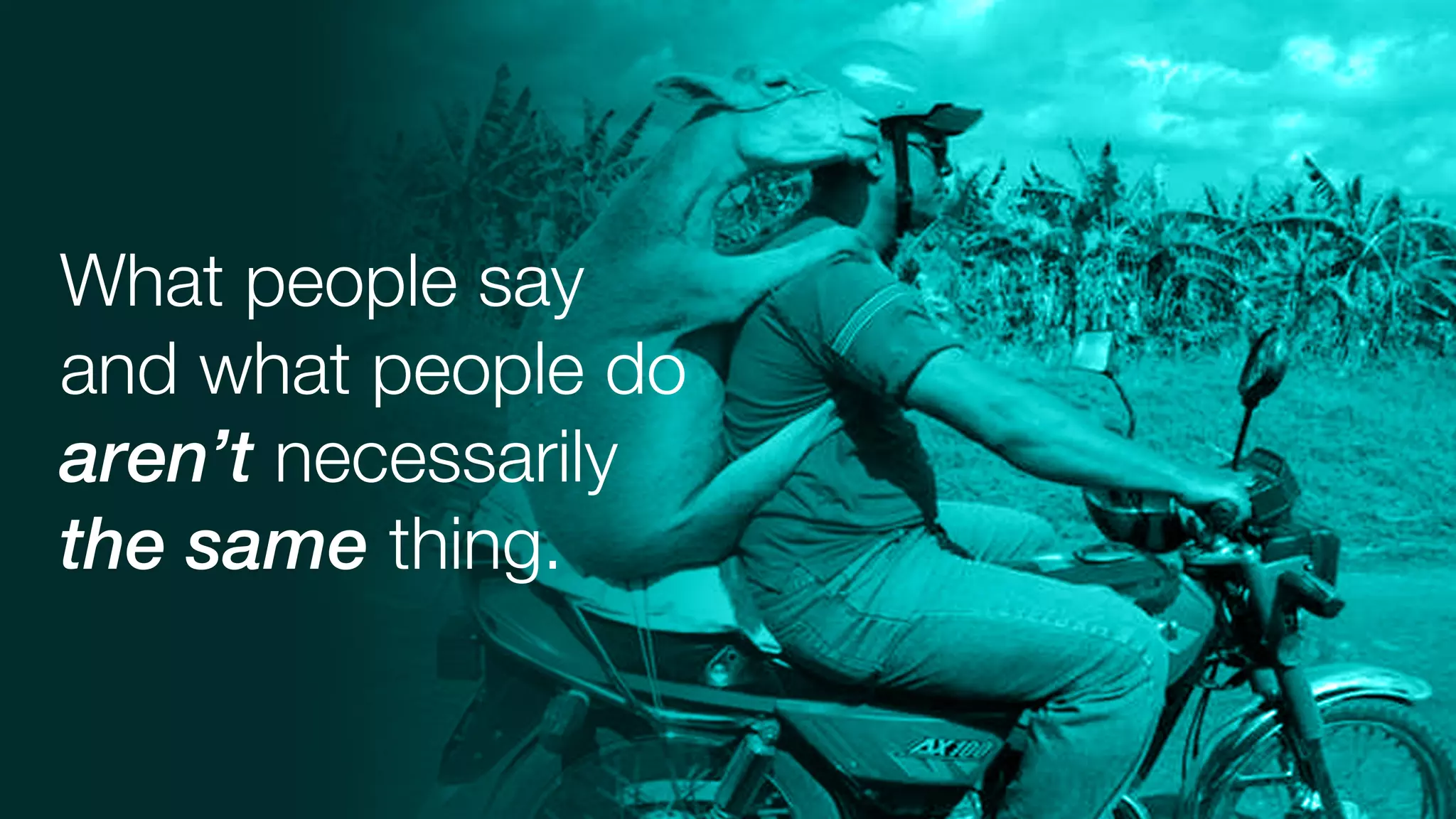
What people say
and what people do
aren’t necessarily
the same thing.
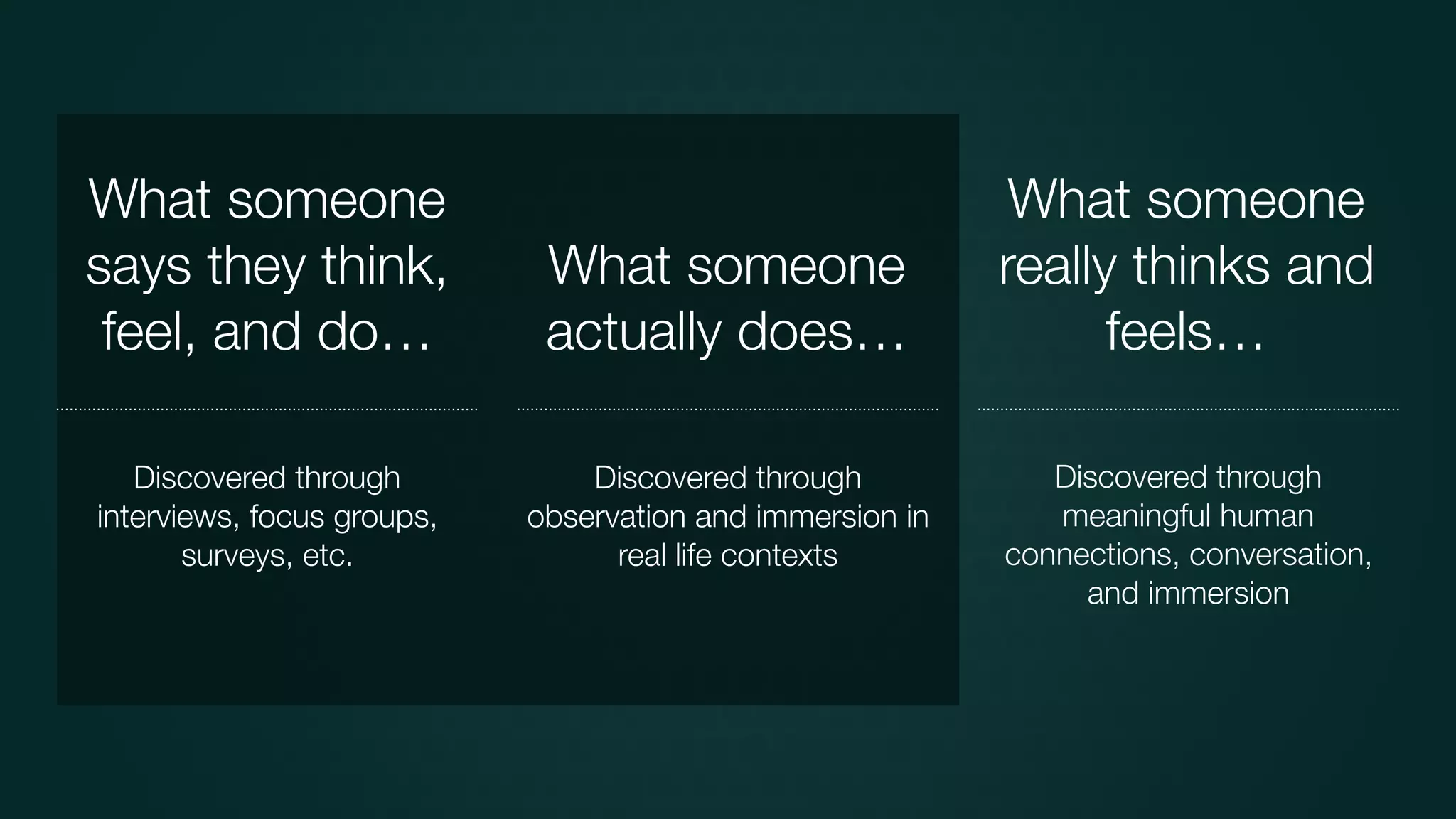
What someone
says they think,
feel, and do…
What someone
actually does…
What someone
really thinks and
feels…
Discovered through
interviews, focus groups,
surveys, etc.
Discovered through
observation and immersion in
real life contexts
Discovered through
meaningful human
connections, conversation,
and immersion
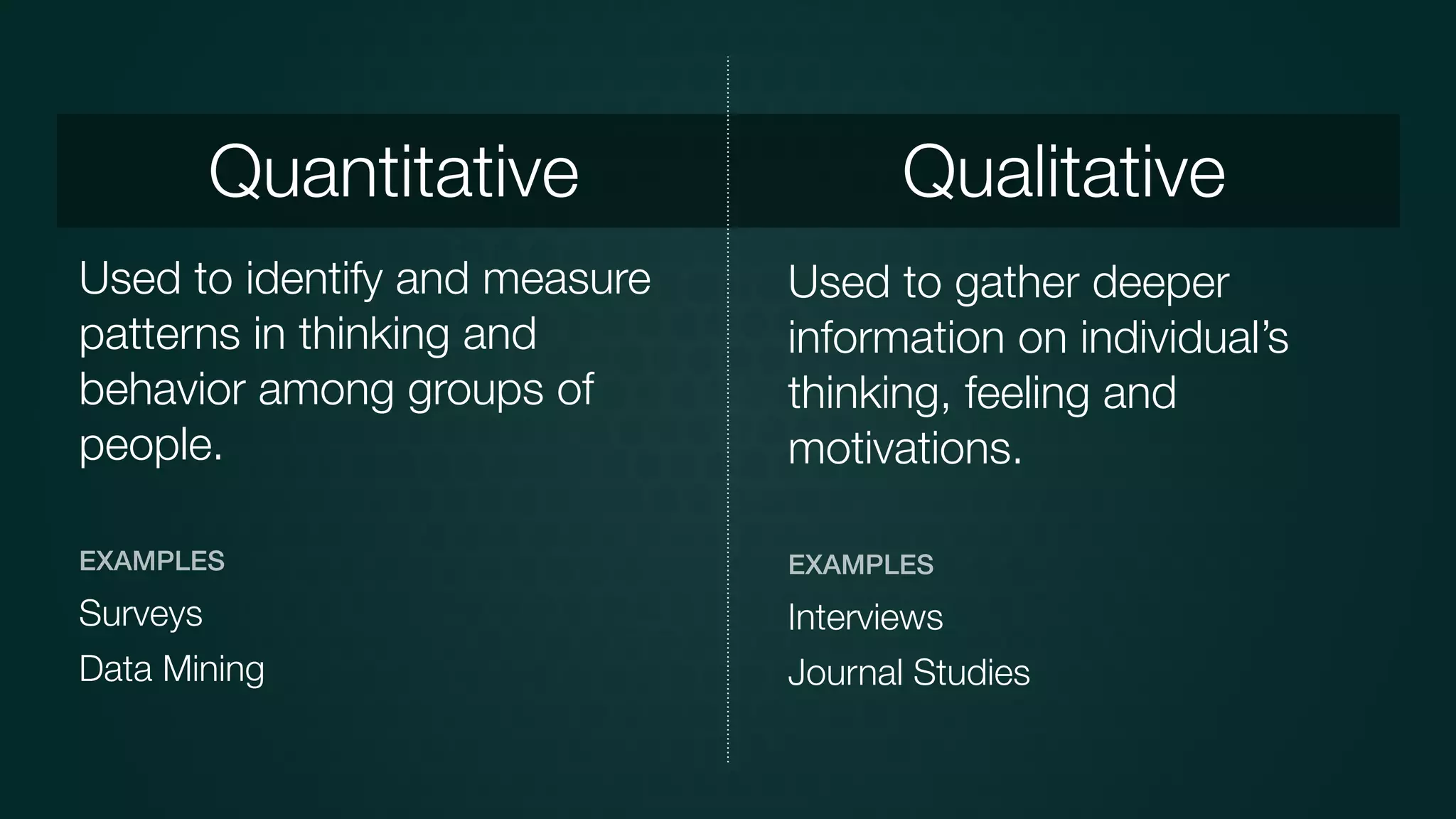
Used to gather deeper
information on individual’s
thinking, feeling and
motivations.
EXAMPLES
Interviews
Journal Studies
Used to identify and measure
patterns in thinking and
behavior among groups of
people.
EXAMPLES
Surveys
Data Mining
Quantitative Qualitative
Used to gather deeper
information on individual’s
thinking, feeling and
motivations.
EXAMPLES
Interviews
Journal Studies
Used to identify and measure
patterns in thinking and
behavior among groups of
people.
EXAMPLES
Surveys
Data Mining
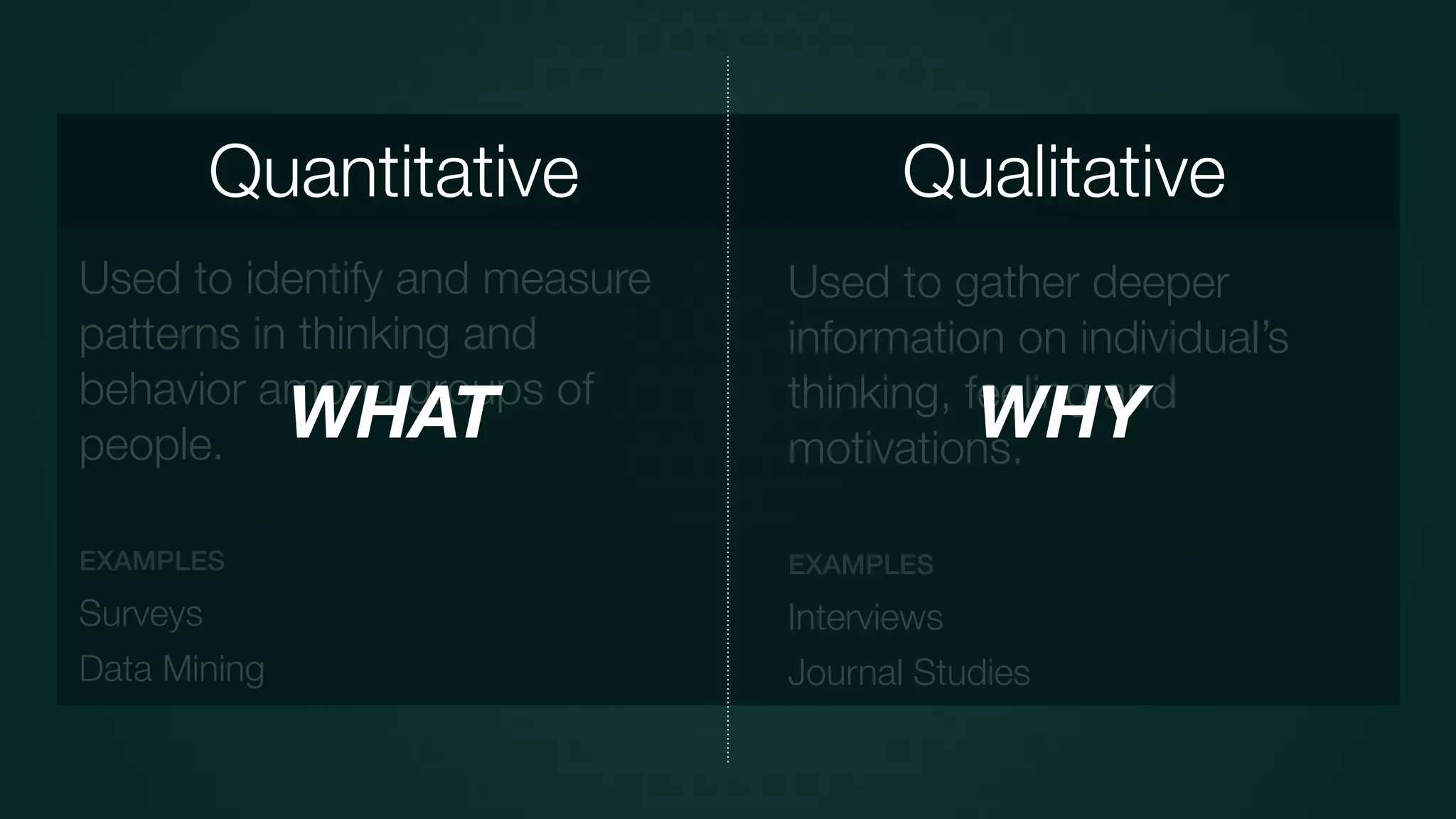
WHAT WHY
Quantitative Qualitative
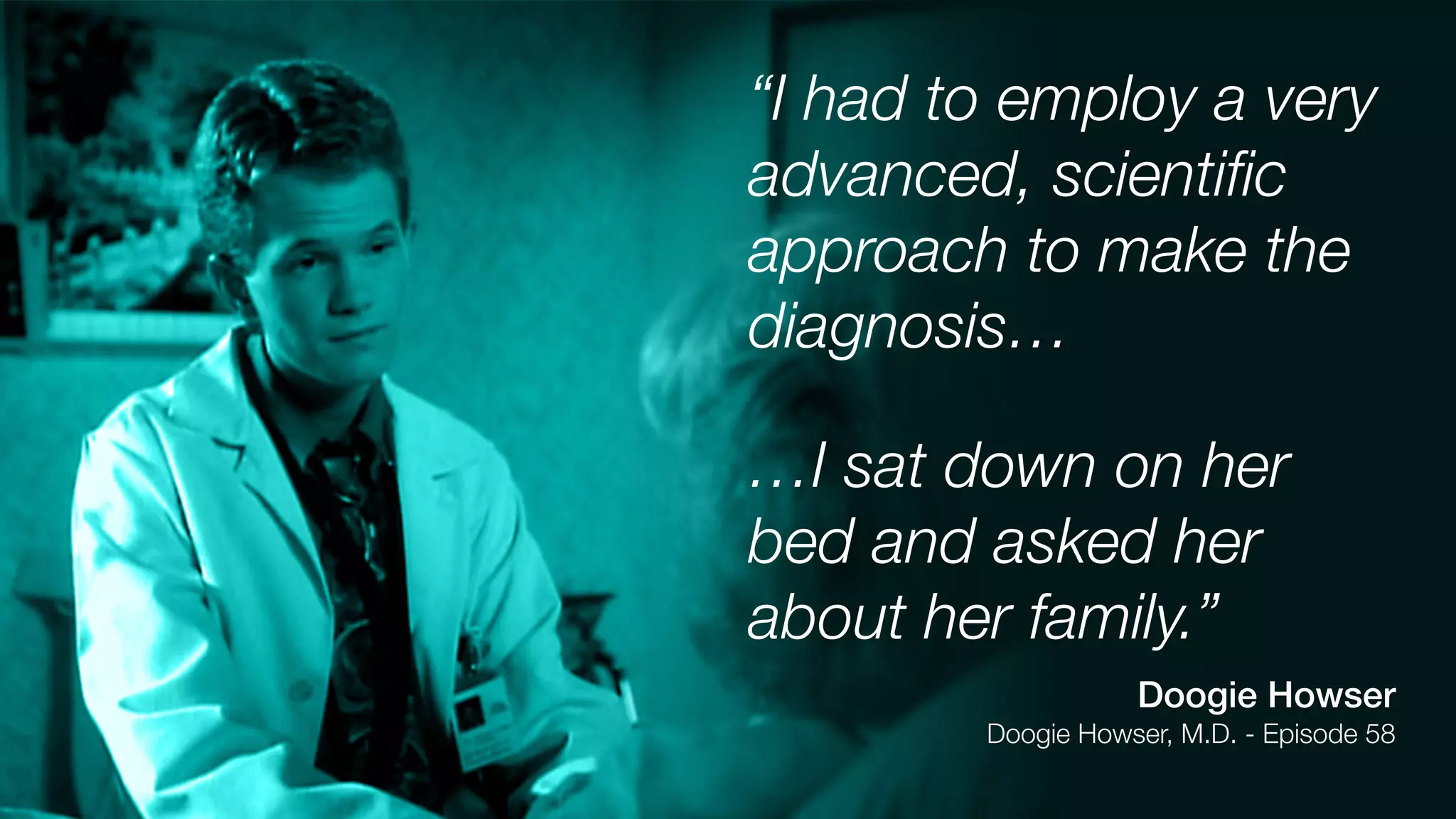
“I had to employ a very
advanced, scientific
approach to make the
diagnosis…
…I sat down on her
bed and asked her
about her family.”
Doogie Howser
Doogie Howser, M.D. - Episode 58
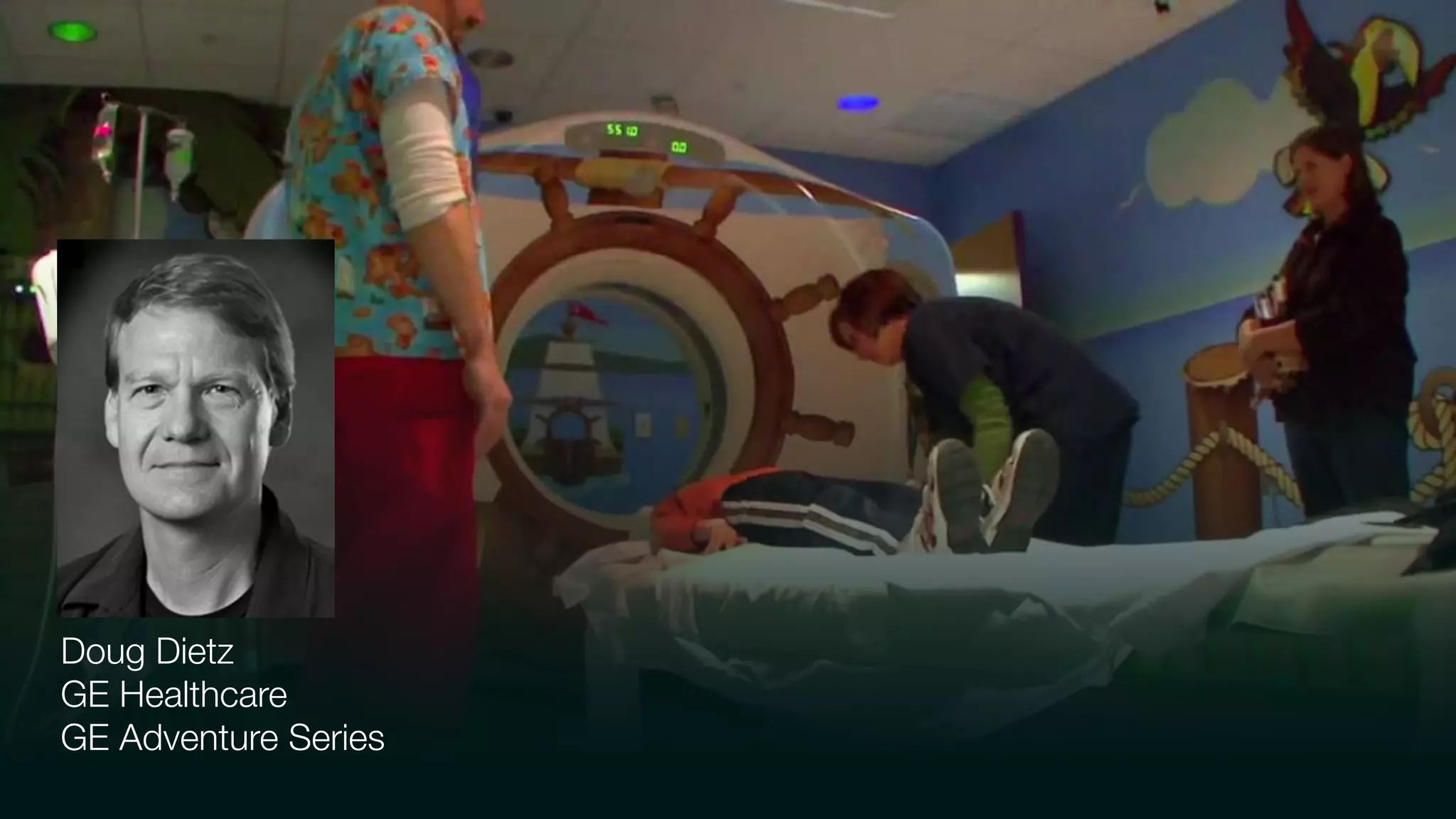
Doug Dietz
GE Healthcare
GE Adventure Series
Once you’ve gathered a
bunch of information, you
need to make sense of it.
Discover Synthesize
Diverge
Converge
Initial
Insight
Reframed
Opportunity
Principles give rise to process.
Synthesis is the process of making sense
of data and insights through analysis like
comparison, categorization, pattern
recognition, and pruning.
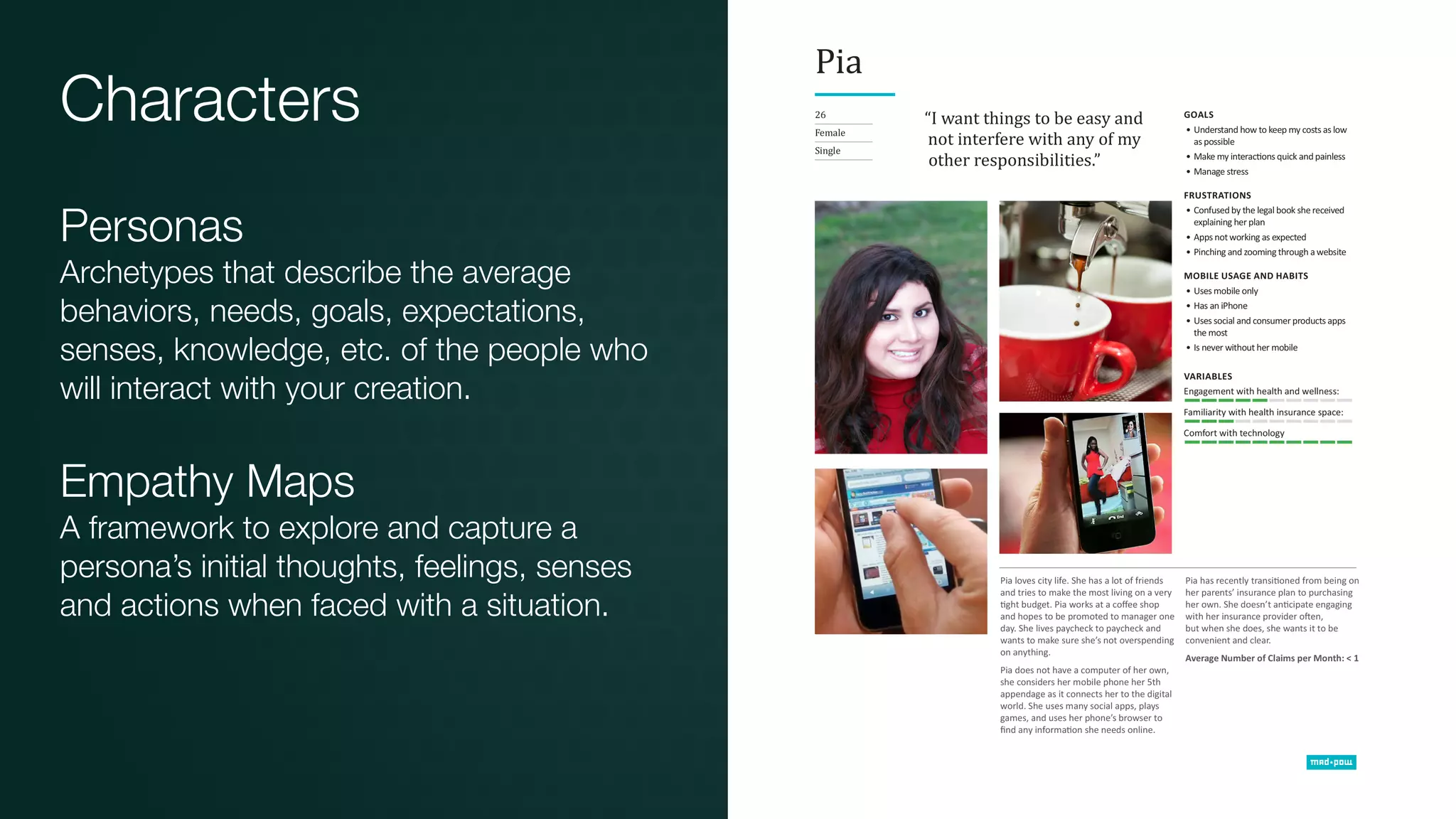
Characters
Personas
Archetypes that describe the average
behaviors, needs, goals, expectations,
senses, knowledge, etc. of the people who
will interact with your creation.
Empathy Maps
A framework to explore and capture a
persona’s initial thoughts, feelings, senses
and actions when faced with a situation.
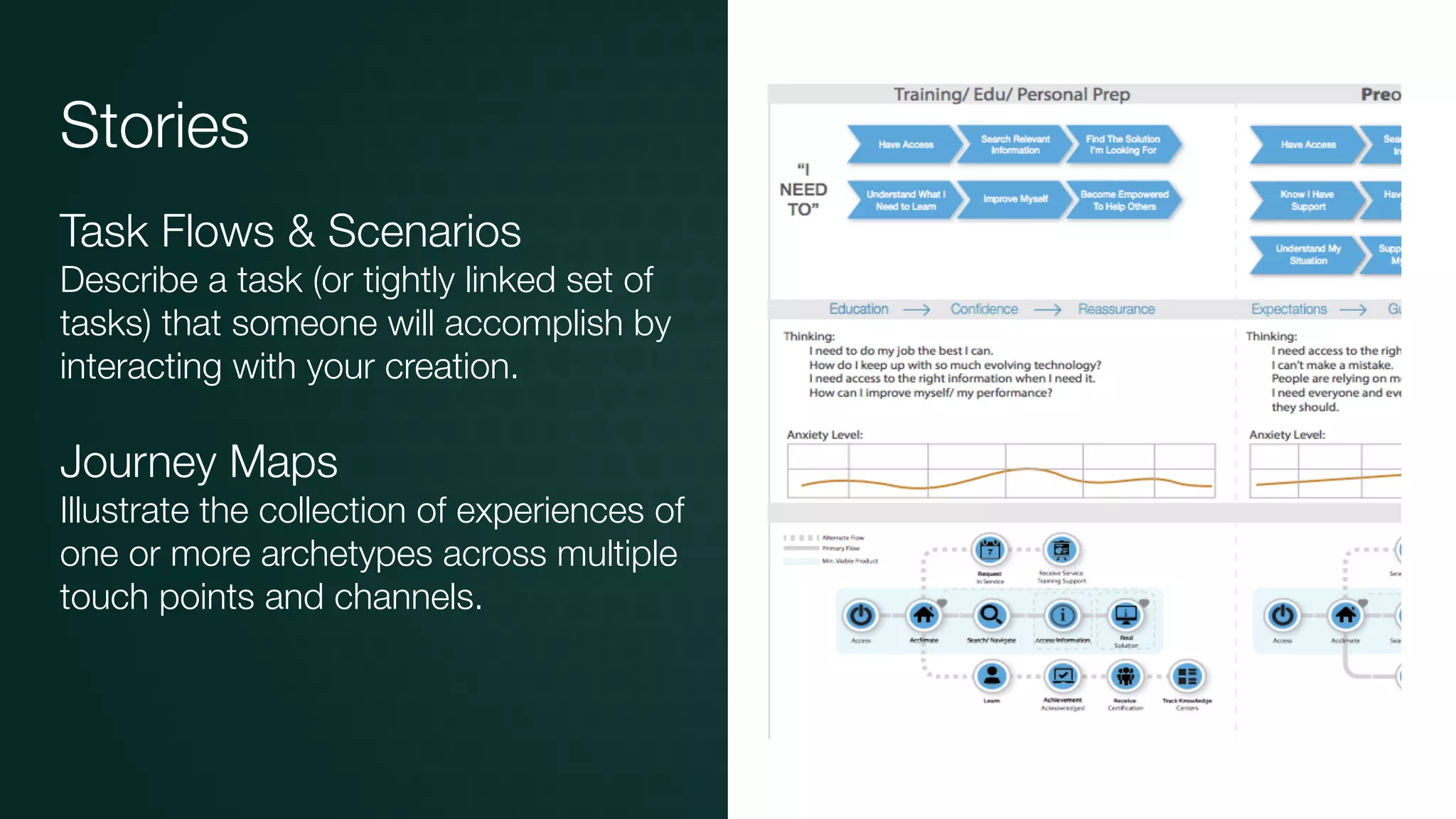
Stories
Task Flows & Scenarios
Describe a task (or tightly linked set of
tasks) that someone will accomplish by
interacting with your creation.
Journey Maps
Illustrate the collection of experiences of
one or more archetypes across multiple
touch points and channels.
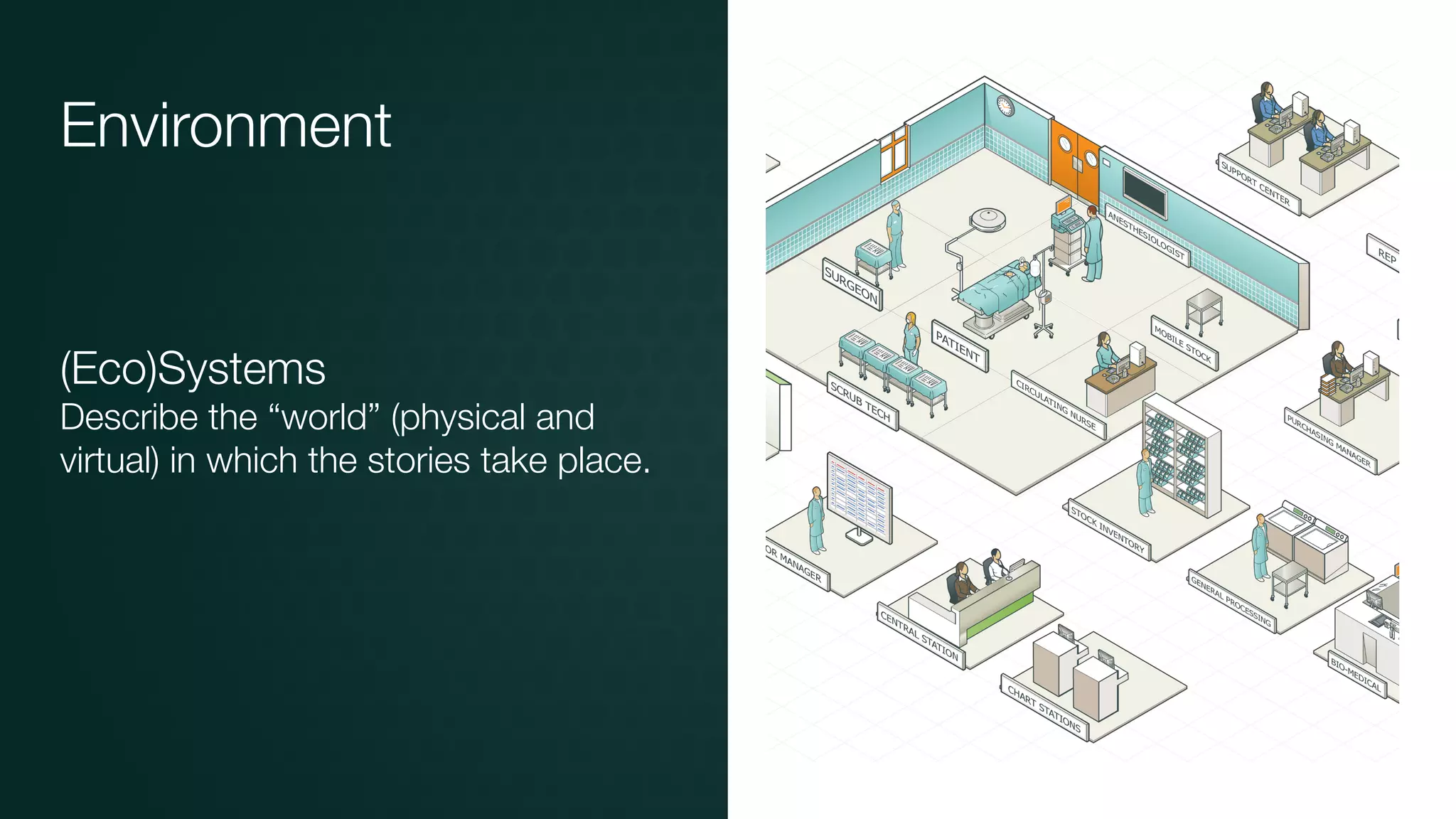
Environment
(Eco)Systems
Describe the “world” (physical and
virtual) in which the stories take place.
The solutions we arrive at are directly
influenced by how we focus and frame
the challenge.
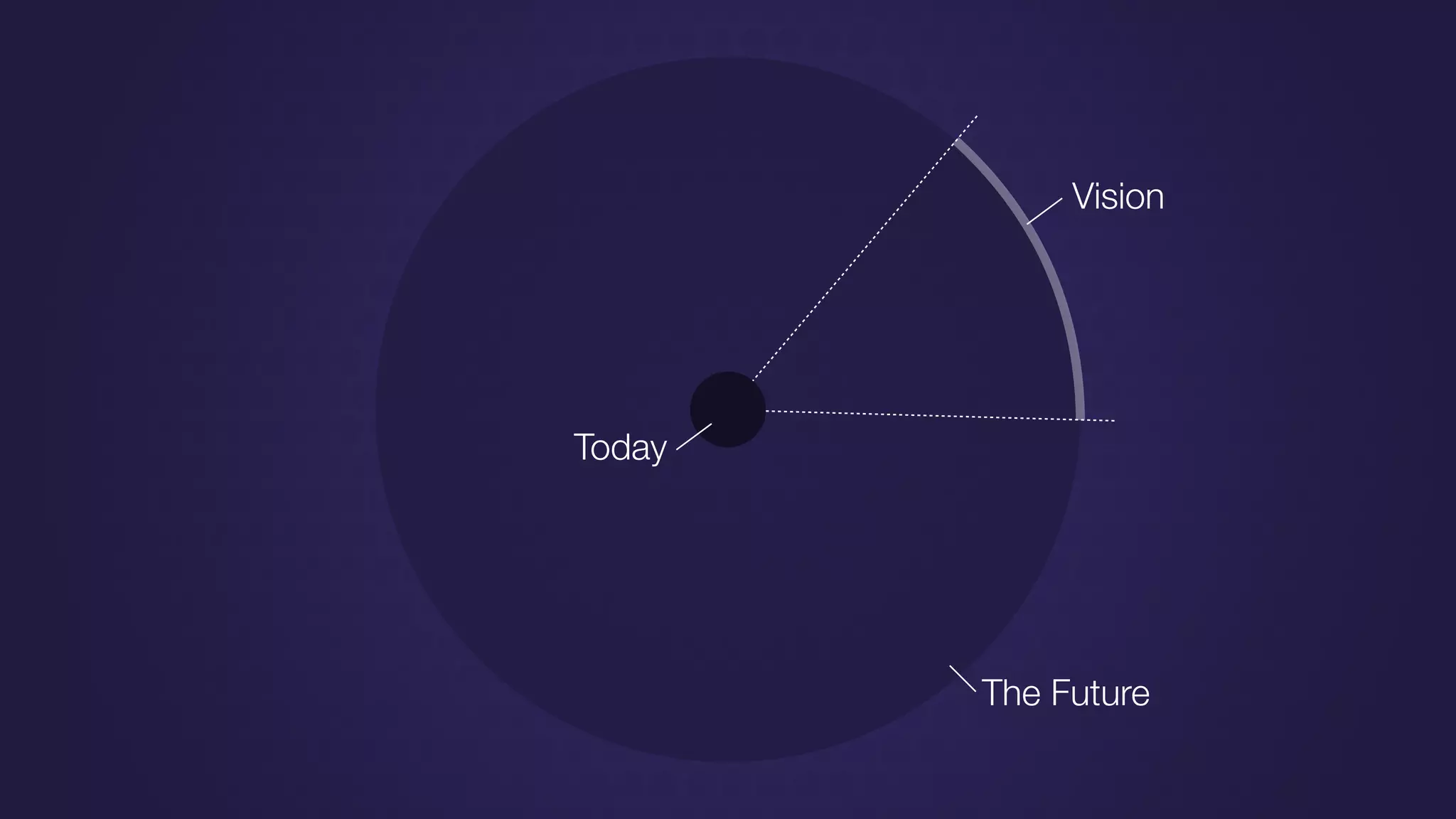
Understanding a problem and it’s contexts
isn’t enough.
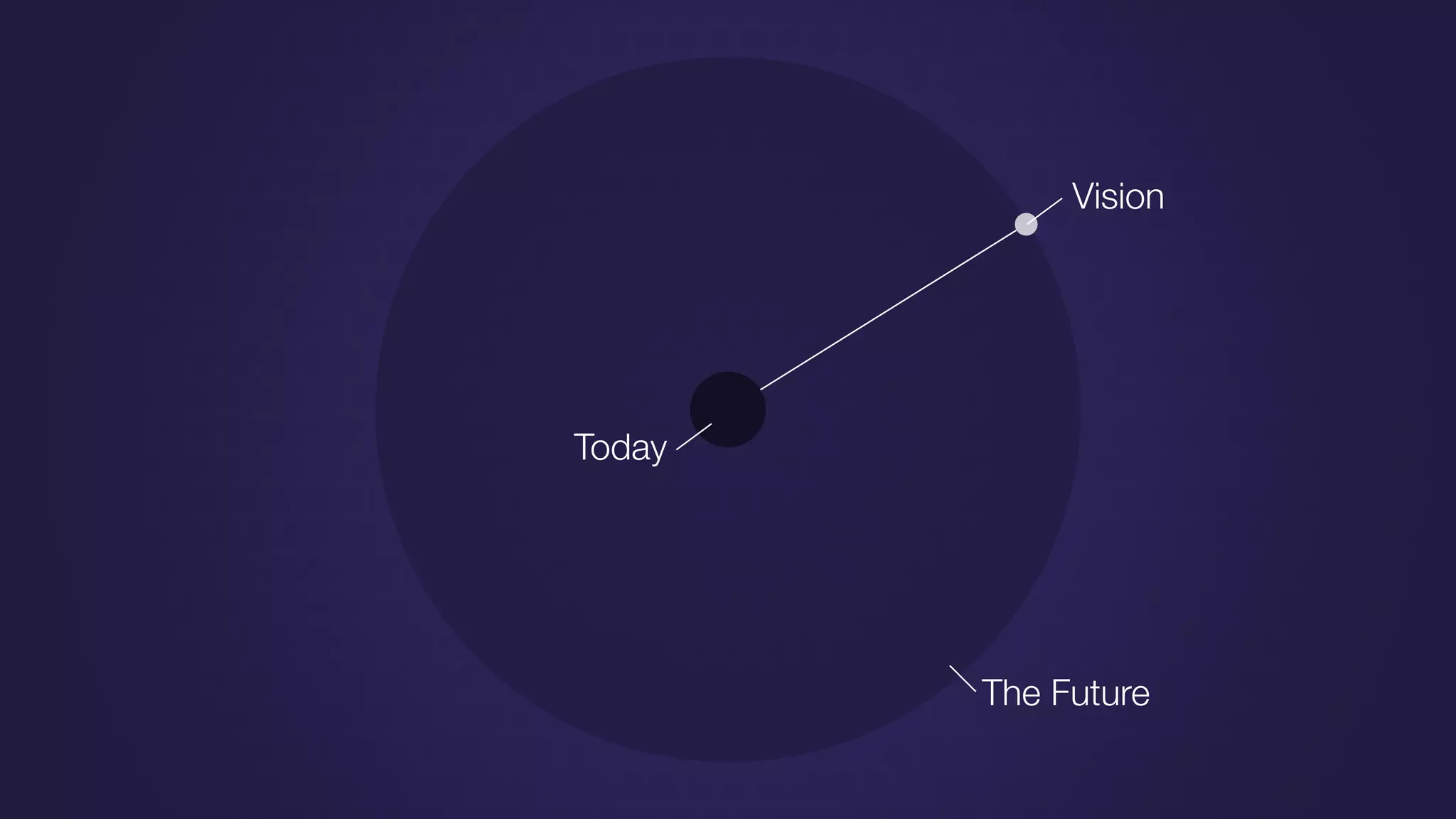
We also need a vision.
The Future
Vision
Today
The Future
Vision
Today
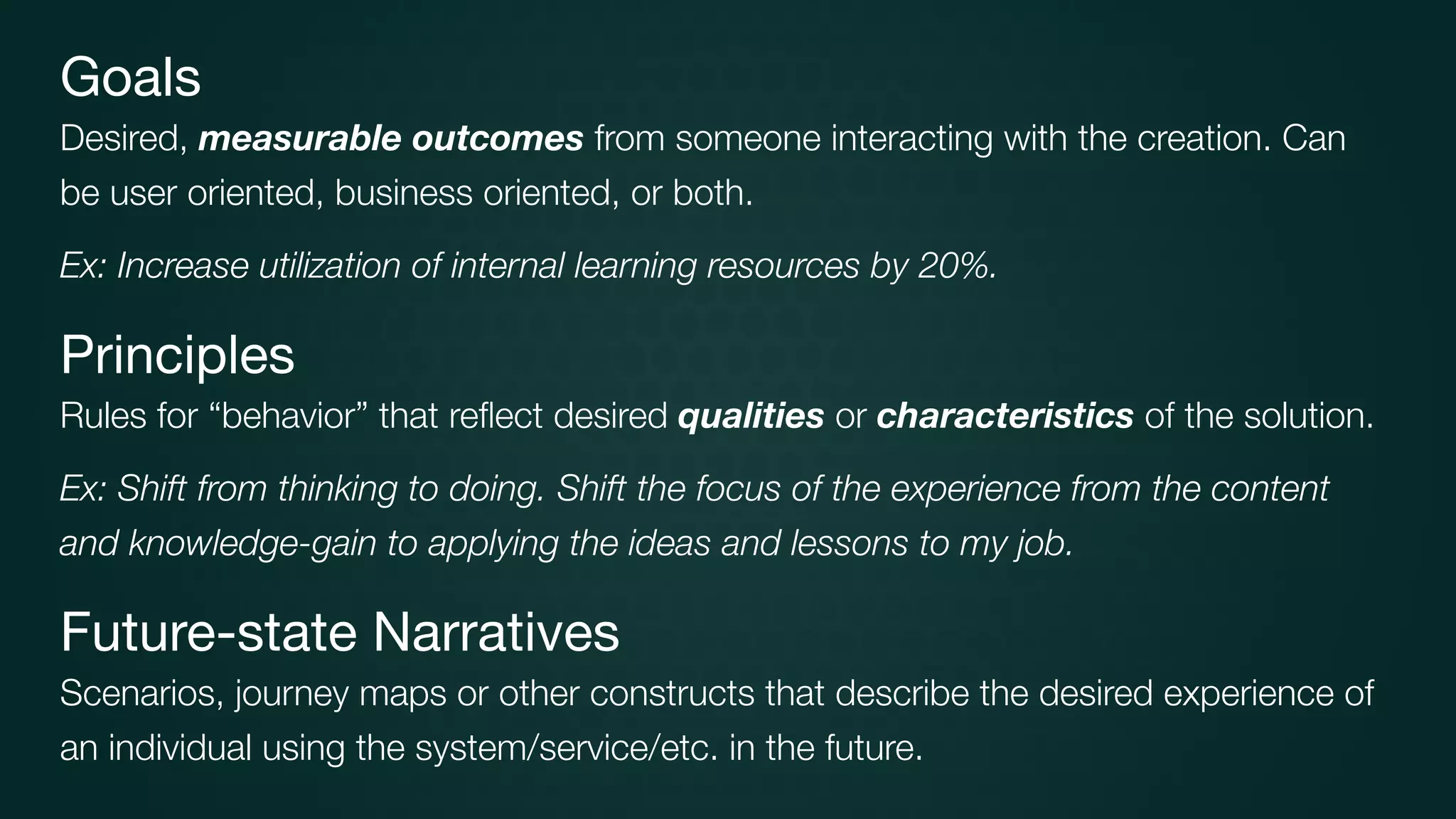
Goals

Desired, measurable outcomes from someone interacting with the creation. Can
be user oriented, business oriented, or both.
Ex: Increase utilization of internal learning resources by 20%.
Principles

Rules for “behavior” that reflect desired qualities or characteristics of the solution.
Ex: Shift from thinking to doing. Shift the focus of the experience from the content
and knowledge-gain to applying the ideas and lessons to my job.
Future-state Narratives

Scenarios, journey maps or other constructs that describe the desired experience of
an individual using the system/service/etc. in the future.
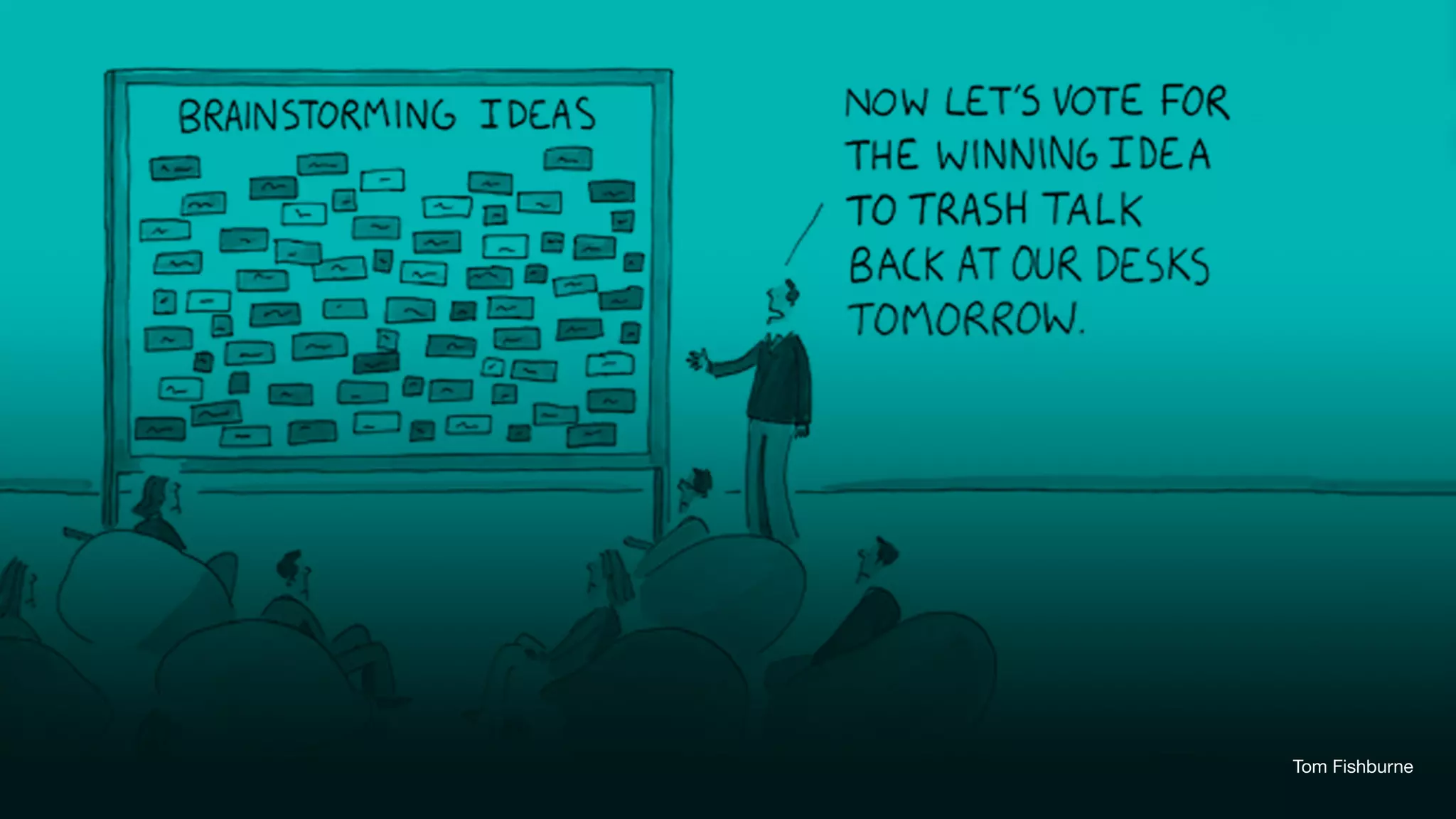
Tom Fishburne
Discover Synthesize Generate
Diverge
Diverge
Converge
Initial
Insight
Reframed
Opportunity
Principles give rise to process.
Often organizations struggle to come up
with ideas because they focus on coming
up with the solution before coming up
with any solution.
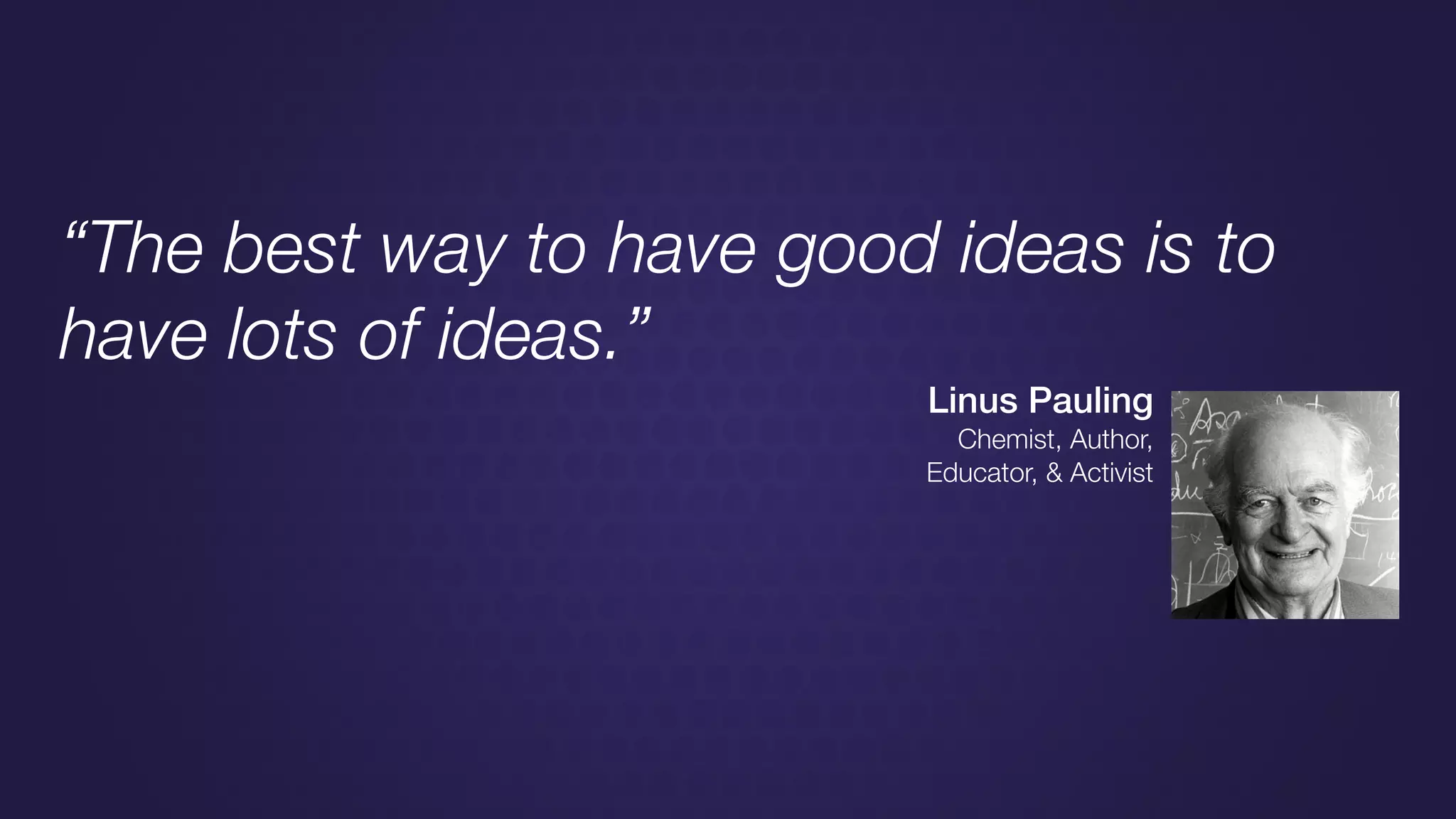
“The best way to have good ideas is to
have lots of ideas.”
Linus Pauling
Chemist, Author,
Educator, & Activist
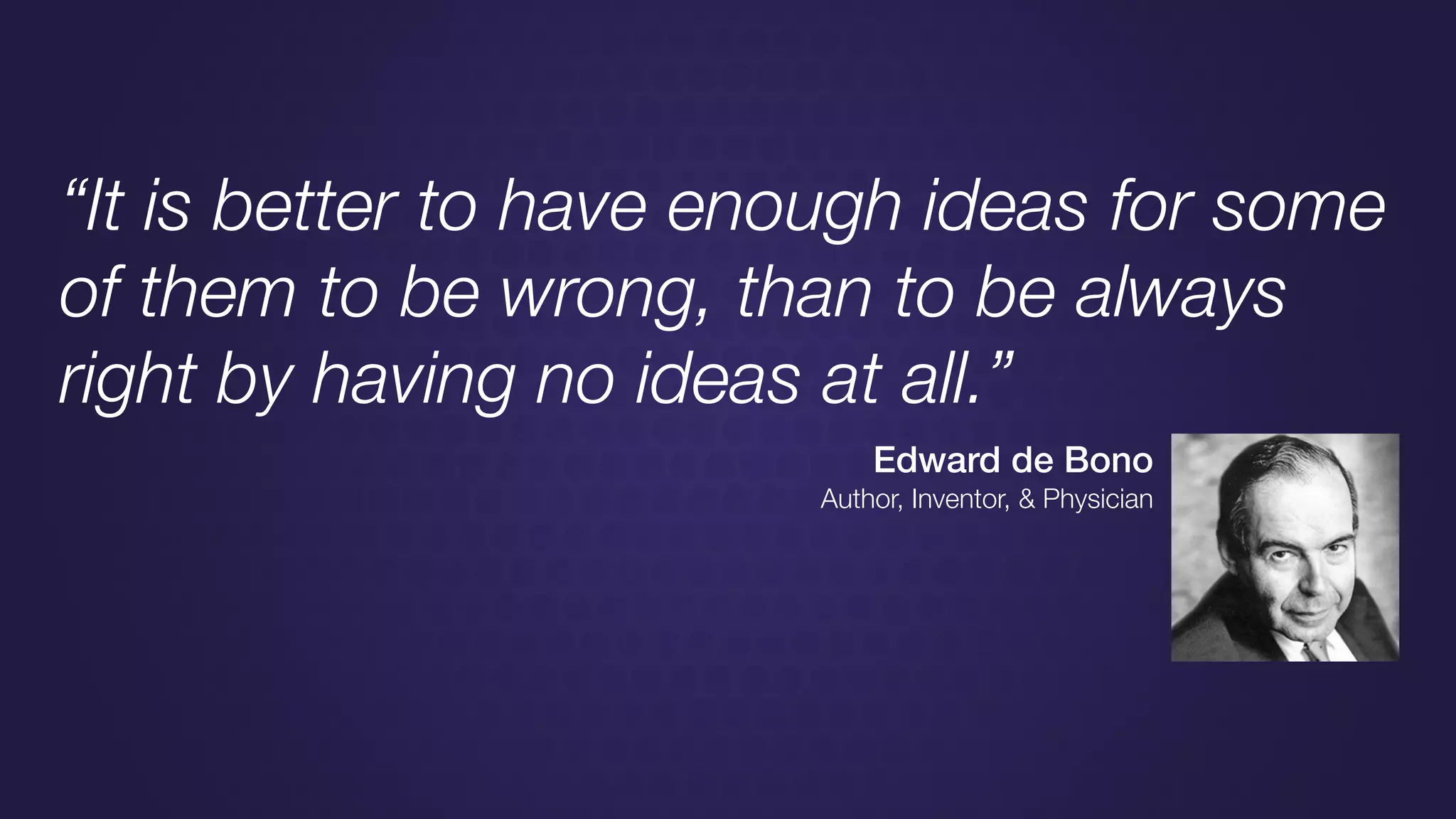
“It is better to have enough ideas for some
of them to be wrong, than to be always
right by having no ideas at all.”
Edward de Bono
Author, Inventor, & Physician
The goal of the generation phase is to
come up with as many potential solutions
as you can, no matter their validity.
To do this, we must be methodical in how
we use the mortal enemy of the
imagination: critical thinking.
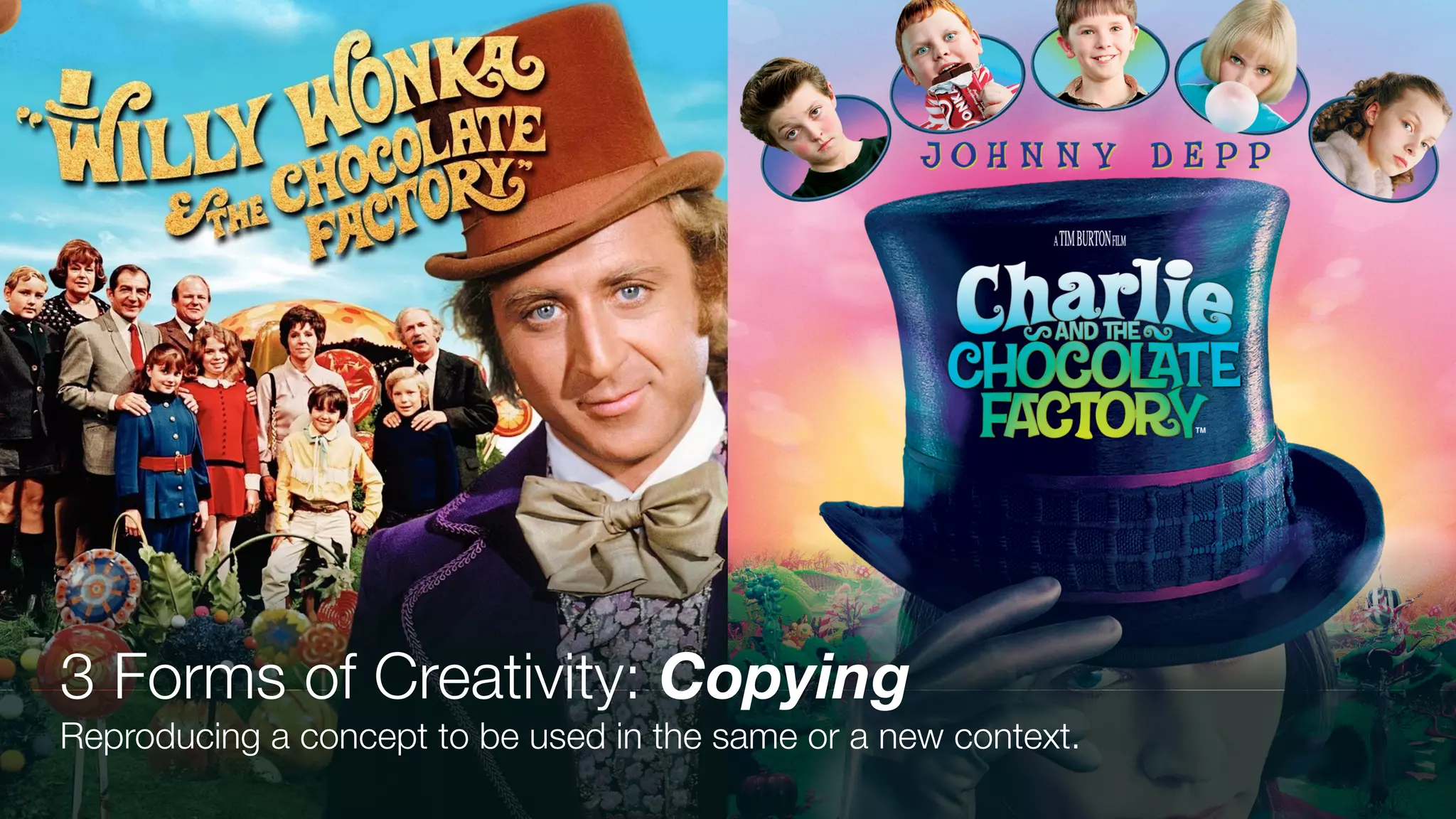
3 Forms of Creativity: Copying
Reproducing a concept to be used in the same or a new context.
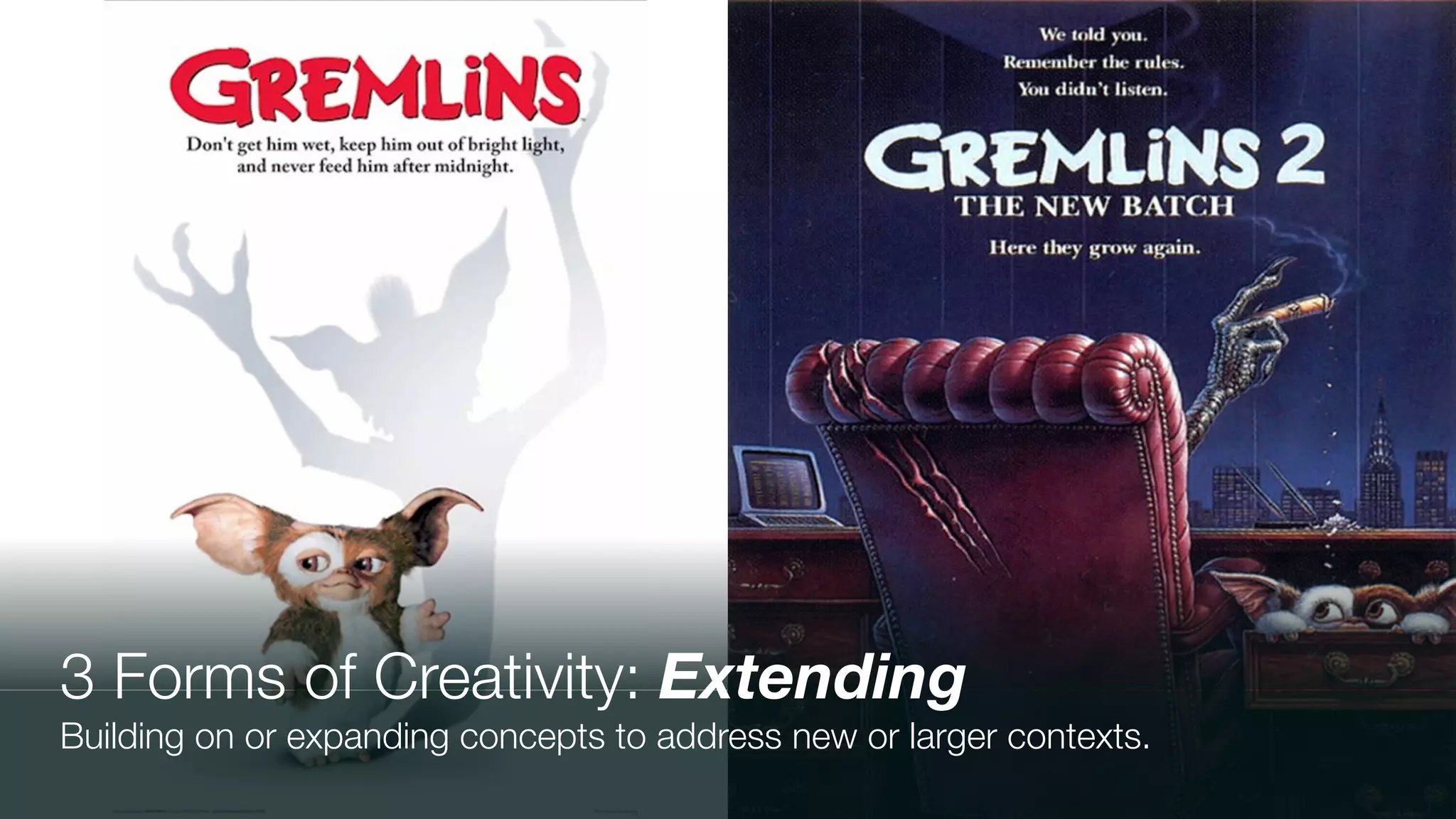
3 Forms of Creativity: Extending
Building on or expanding concepts to address new or larger contexts.
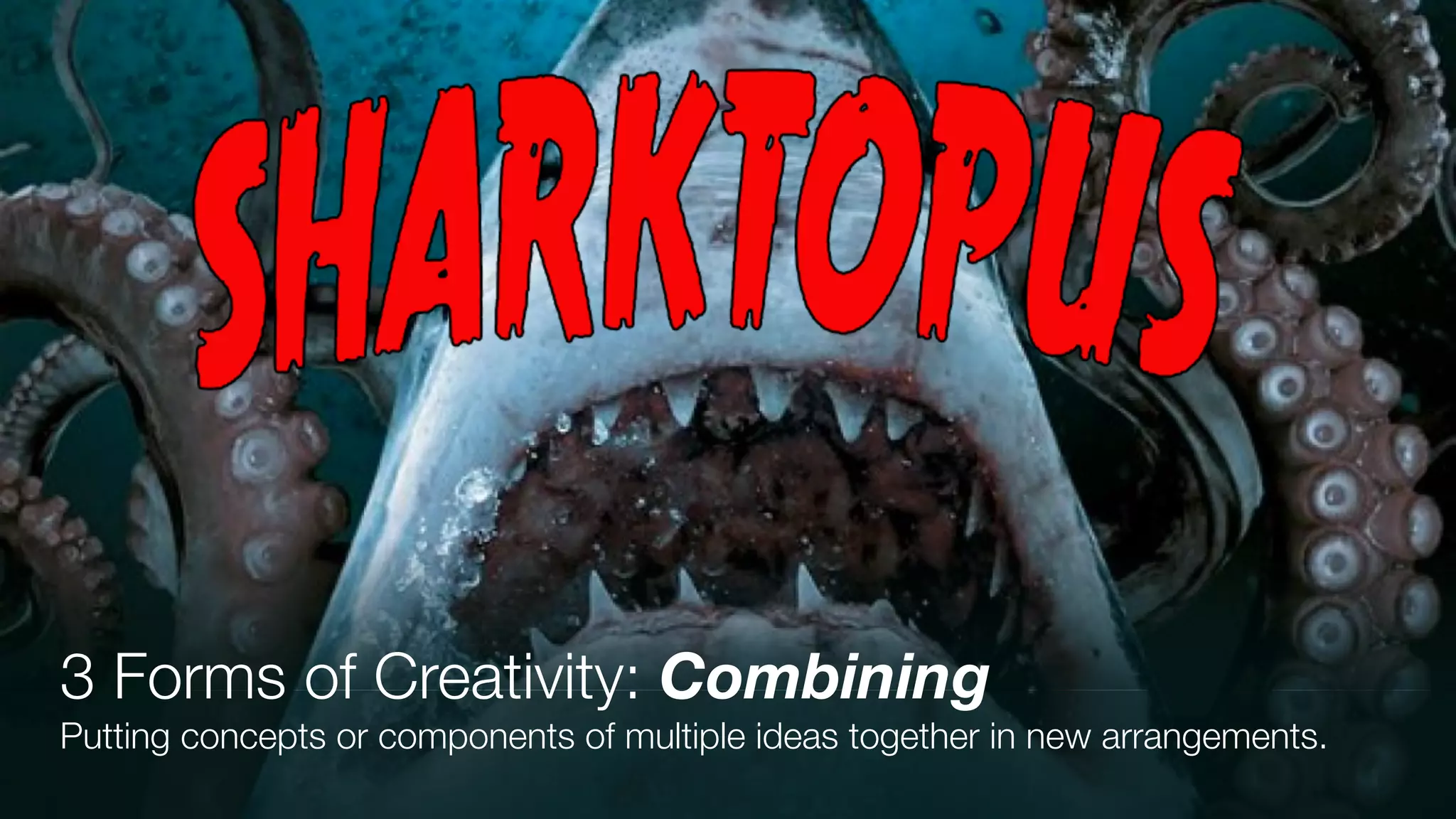
3 Forms of Creativity: Combining
Putting concepts or components of multiple ideas together in new arrangements.
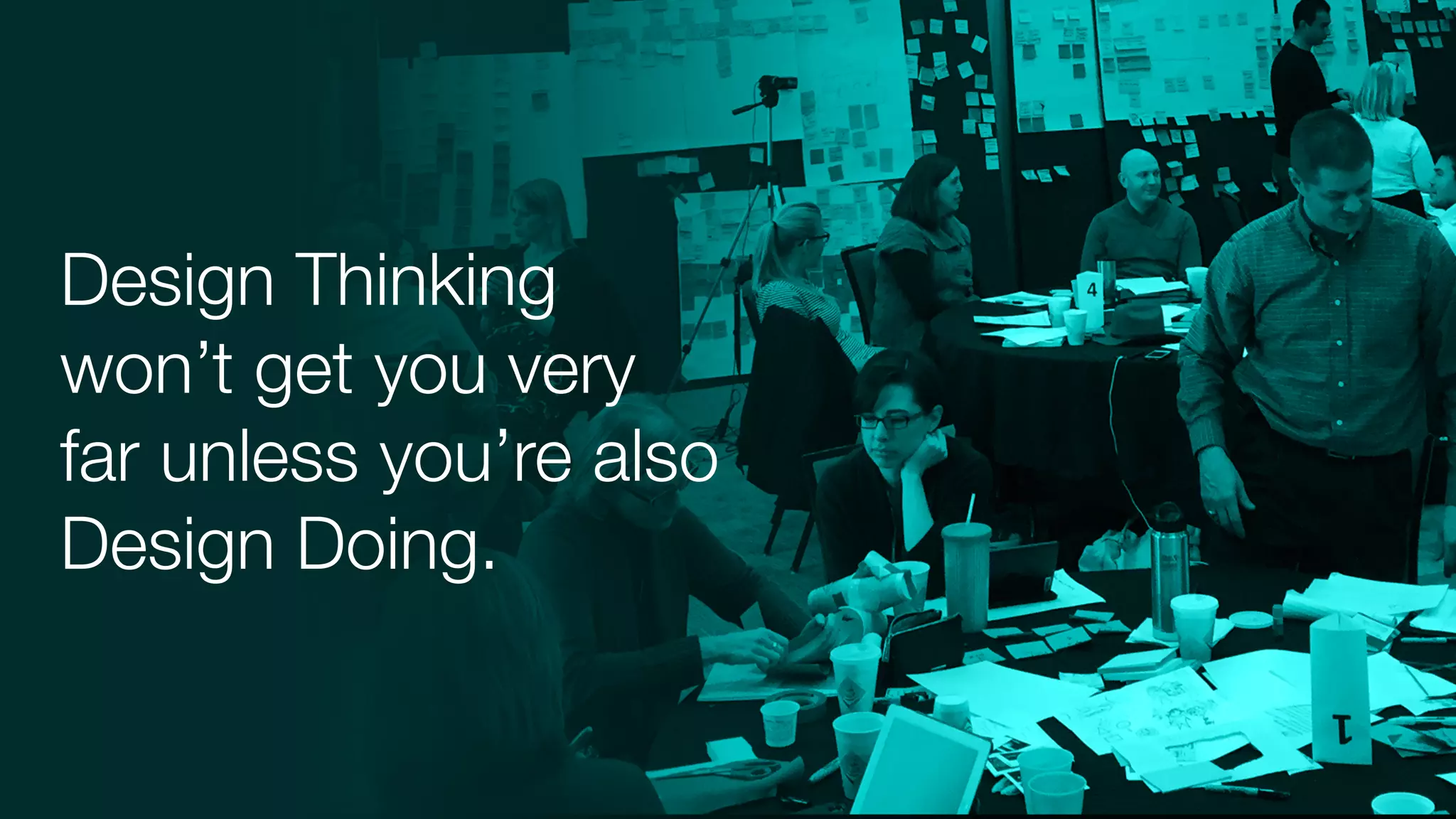
Design Thinking
won’t get you very
far unless you’re also
Design Doing.
Discover Synthesize Generate Refine
Diverge
Diverge
Converge
Converge
Initial
Insight
Reframed
Opportunity
New
Solution
Principles give rise to process.
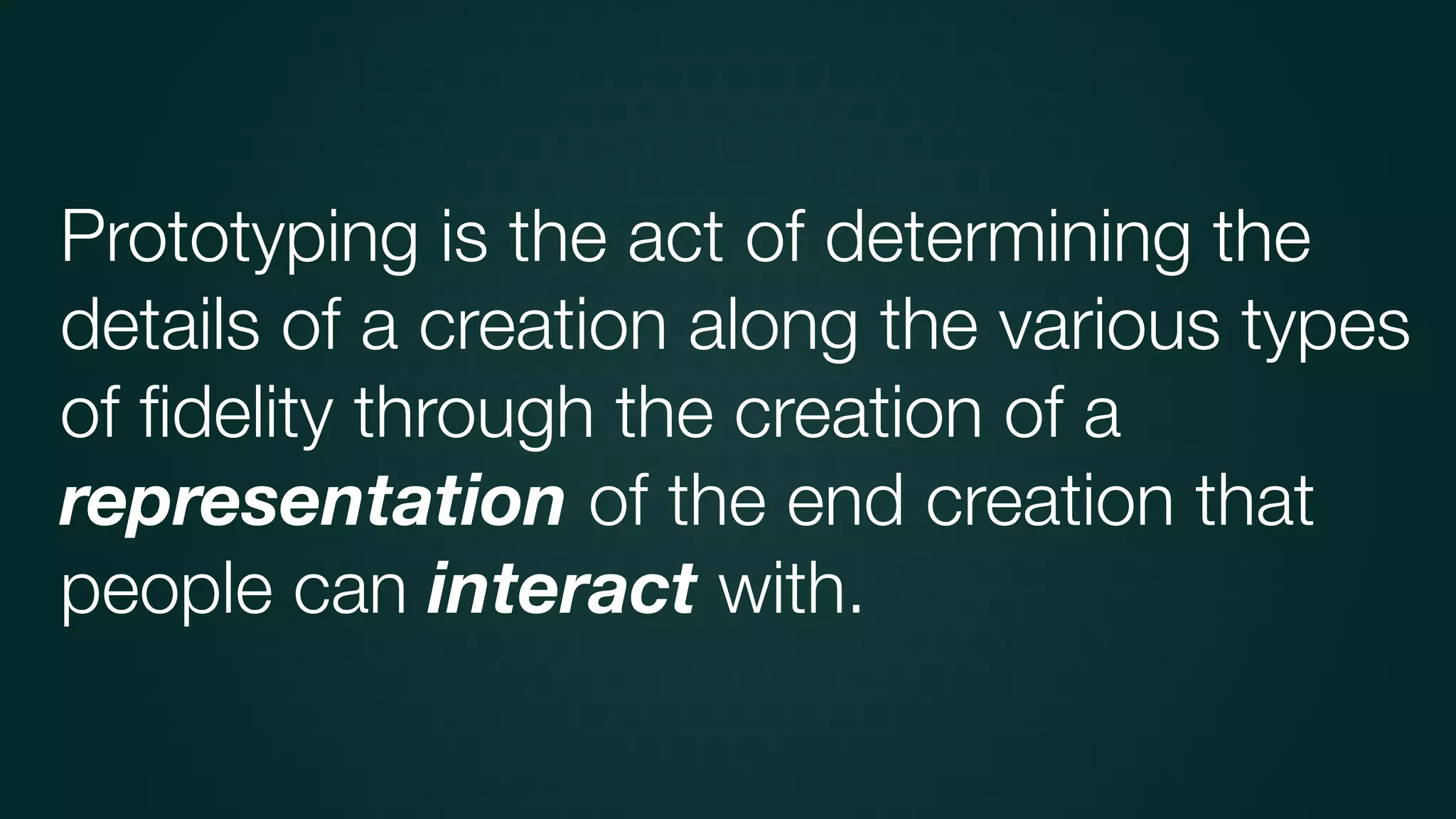
Prototyping is the act of determining the
details of a creation along the various types
of fidelity through the creation of a
representation of the end creation that
people can interact with.
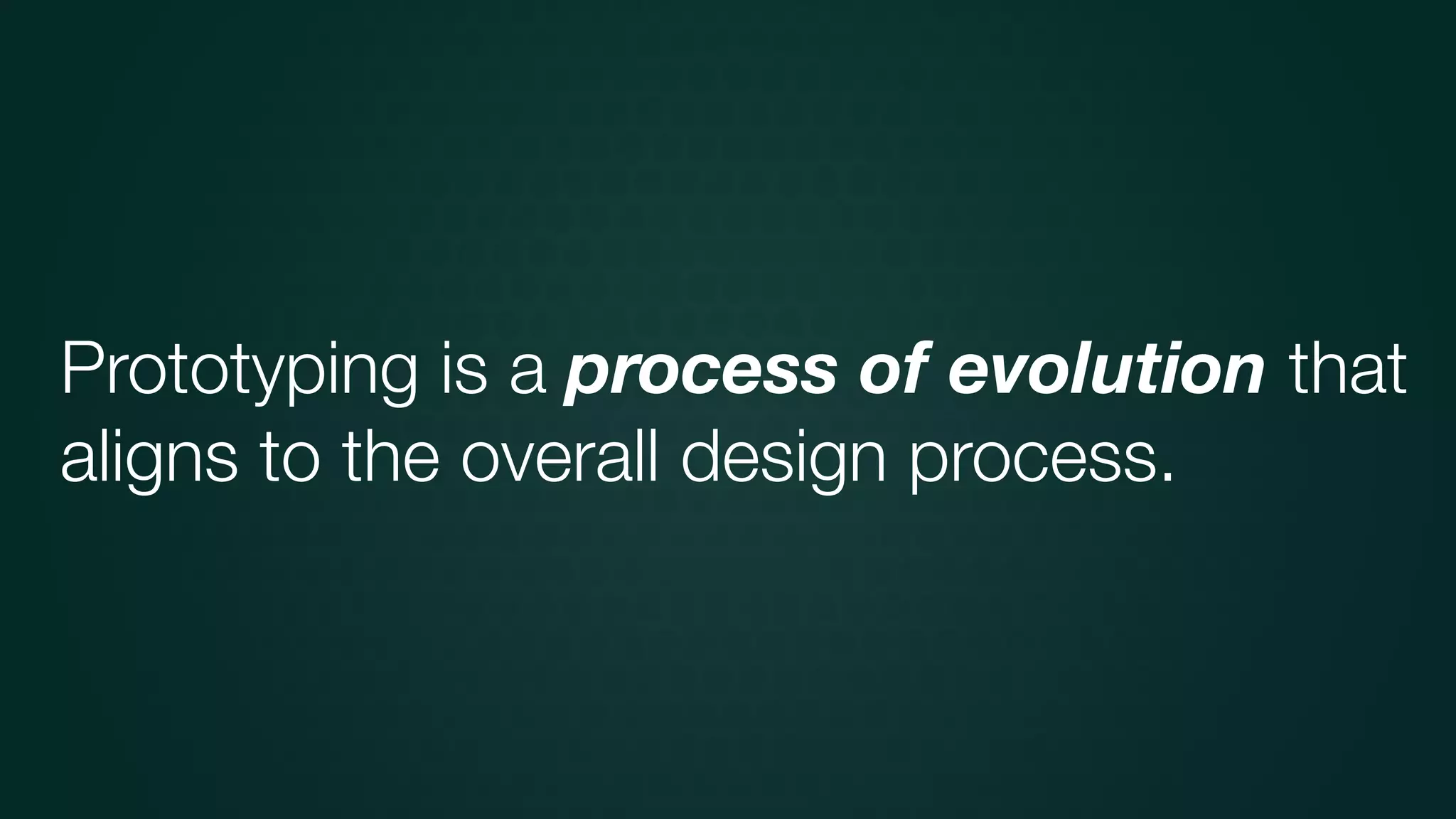
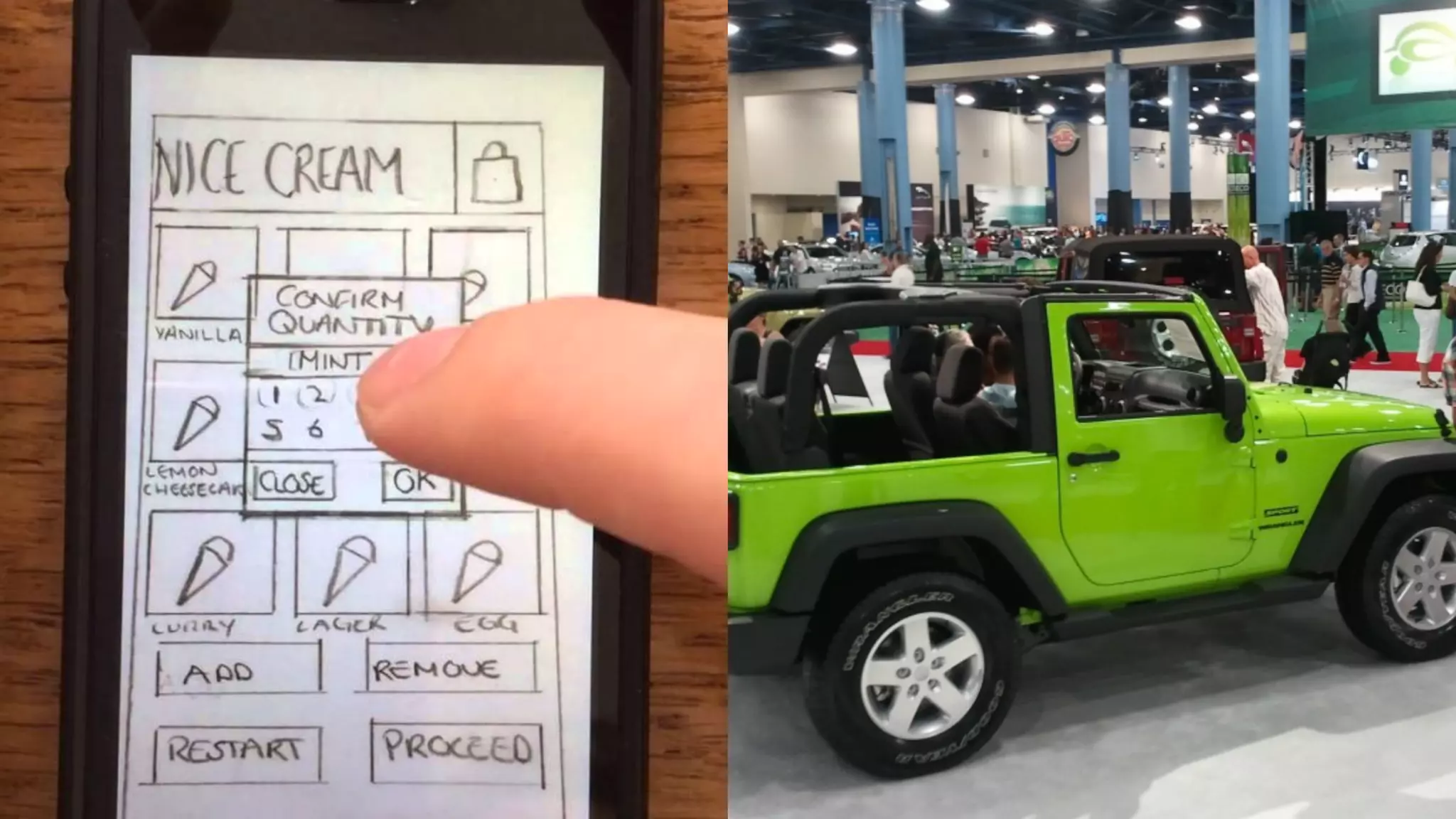
Prototyping is a process of evolution that
aligns to the overall design process.
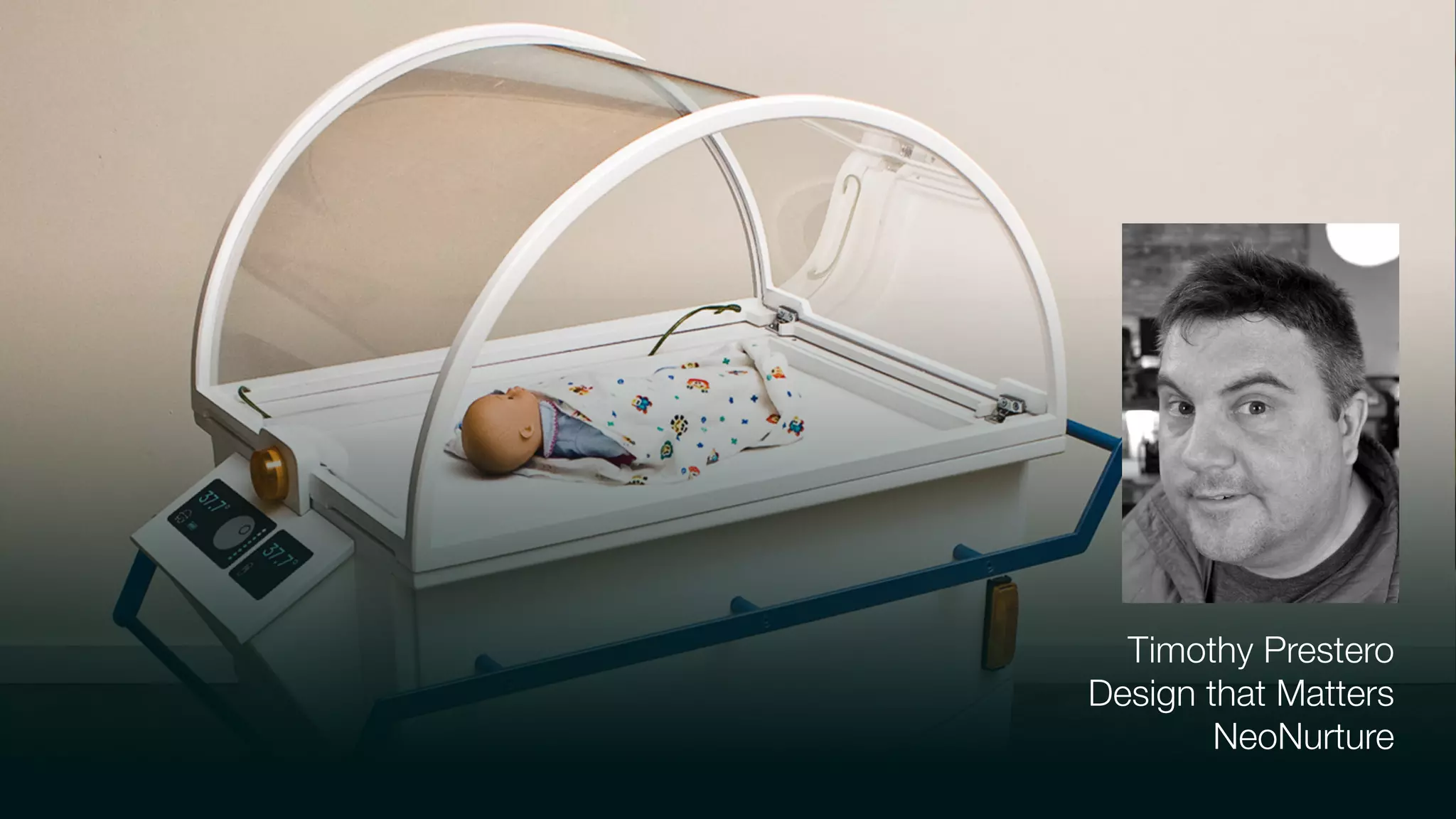
Great design comes from a desire to
create real outcomes.
Timothy Prestero
Design that Matters
NeoNurture
Once we’ve got something prototyped, we
put it out into the world, observe it and
begin the cycle again.
Discover Synthesize Generate Refine
Diverge
Diverge
Converge
Converge
Evaluate & Iterate
Initial
Insight
Reframed
Opportunity
New
Solution
Principles give rise to process.
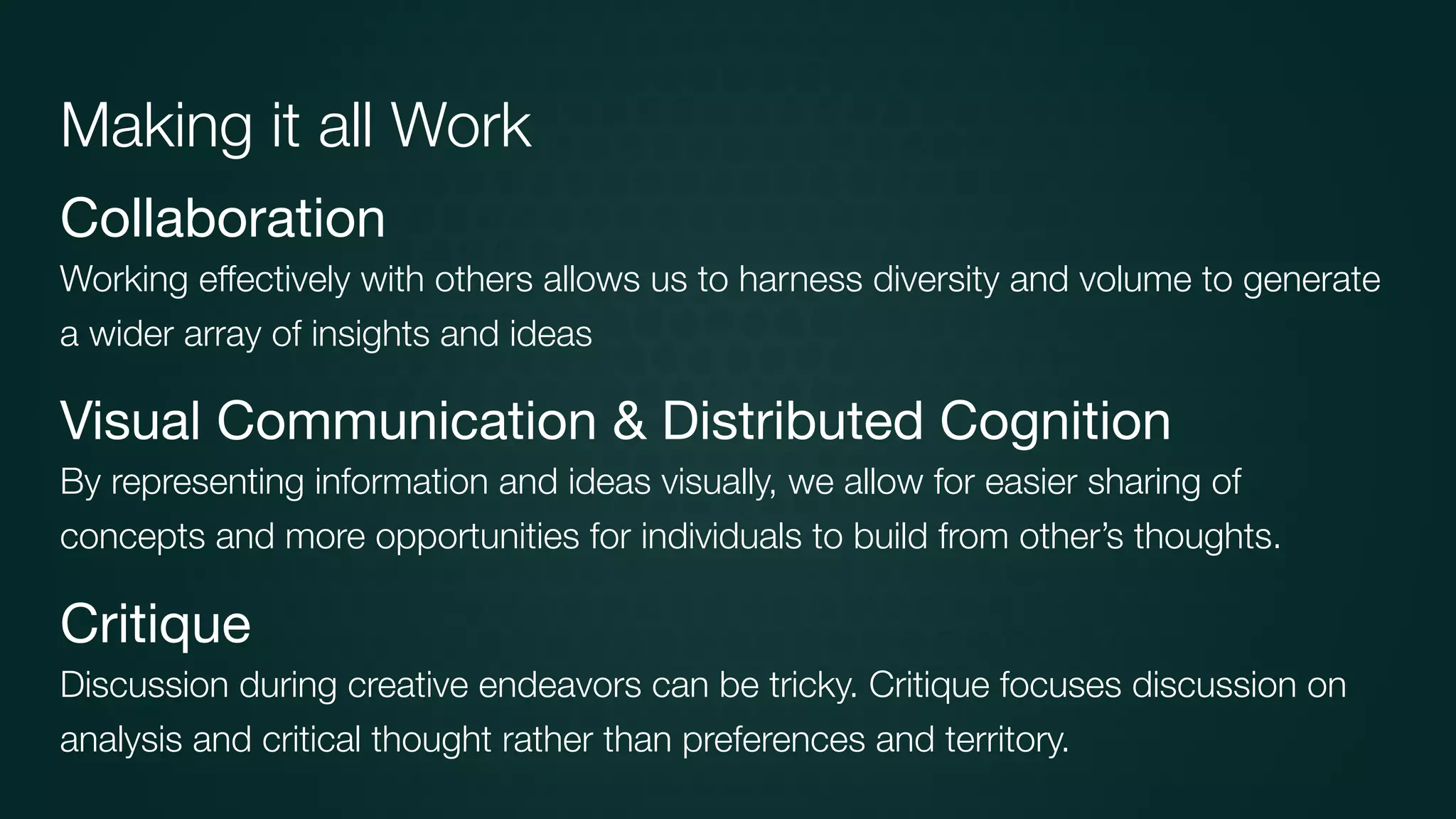
Collaboration

Working effectively with others allows us to harness diversity and volume to generate
a wider array of insights and ideas
Visual Communication & Distributed Cognition

By representing information and ideas visually, we allow for easier sharing of
concepts and more opportunities for individuals to build from other’s thoughts.
Critique

Discussion during creative endeavors can be tricky. Critique focuses discussion on
analysis and critical thought rather than preferences and territory.
Making it all Work
It never really ends.
HXREFACTORED.COM
Use code SXSW4HXR for $100 off registration!
Thank You!
@adamconnor

aconnor@madpow.net
Adam Connor
Experience Designer
VP Organizational Design & Training

Design Thinking: Finding Problems Worth Solving In Health

  • 1.
    Design Thinking Finding problemsworth solving and solutions worth making in healthcare #SXSHackmed http://sxshackmed.mithackmed.com @ADAMCONNORADAM CONNOR EXPERIENCE DESIGNER, VP ORGANIZATIONAL DESIGN & TRAINING
  • 2.
    Where do newideas come from?
  • 3.
    “There is surelynothing quite so useless as doing with great efficiency that which should not be done at all.” Peter Drucker Management Consultant, Author, & Educator
  • 4.
    “If you buildit, they will come…” -Disembodied Voice, Field of Dreams
  • 5.
    “If you buildit, they will come…” -Disembodied Voice, Field of Dreams IS A MISQUOTED, BULLSHIT LINE FROM A MOVIE THAT HAS WASTED THE TIME OF COUNTLESS PEOPLE AND ORGANIZATIONS FOR FAR TOO DAMN LONG. (the actual line is: “If you build it, he will come.”)
  • 6.
    Things that are desirable. Peoplewant them because they are beneficial. Things that are feasible. They can be made using the skills, knowledge and technology that we have or can acquire. Things that are viable. The “consumption” of these things will provide us with means to continue to produce/provide them. Things that are innovative.
  • 7.
    Things that are desirable. Peoplewant them because they are beneficial. Things that are feasible. They can be made using the skills, knowledge and technology that we have or can acquire. Things that are viable. The “consumption” of these things will provide us with means to continue to produce/provide them. Things that are innovative. Obligatory Venn DiagramP
  • 8.
    Innovation has moreto do with adding value than new concepts.
  • 9.
  • 10.
  • 11.
    is an abstractionof the principles and process that designers use to solve problems. Design Thinking
  • 12.
    Great design isbased on observed, human need (human centricity). Great design comes from understanding people’s behaviors, thoughts (cognitive empathy) and emotions (emotional empathy). In order to make good design decisions, we must first create possibilities to choose from. Great design comes from a desire to create real outcomes. Great design is iterative. It leverages continuous learning and never truly ends.
  • 13.
  • 14.
    Discover DivergeInitial Insight Principles give riseto process. Great design is based on observed, human need (human centricity).
  • 15.
    Discover Synthesize Diverge Converge Initial Insight Reframed Opportunity Principles giverise to process. Great design comes from understanding people’s behaviors, thoughts (cognitive empathy) and emotions (emotional empathy).
  • 16.
    Discover Synthesize Generate Diverge Diverge Converge Initial Insight Reframed Opportunity Principlesgive rise to process. In order to make good design decisions, we must first create possibilities to choose from.
  • 17.
    Discover Synthesize GenerateRefine Diverge Diverge Converge Converge Initial Insight Reframed Opportunity New Solution Principles give rise to process. Great design comes from a desire to create real outcomes.
  • 18.
    Discover Synthesize GenerateRefine Diverge Diverge Converge Converge Evaluate & Iterate Initial Insight Reframed Opportunity New Solution Principles give rise to process. Great design is iterative. It leverages continuous learning and never truly ends.
  • 19.
  • 20.
    You have tounderstand a problem before you can solve it.
  • 21.
    And often theproblems you’re asked to solve are not the one’s you need to solve. Problems are often composed of or caused by other problems…
  • 22.
    Who knows moreabout the healthcare needs of the elderly? OR
  • 23.
    What people say andwhat people do aren’t necessarily the same thing.
  • 24.
    What someone says theythink, feel, and do… What someone actually does… What someone really thinks and feels… Discovered through interviews, focus groups, surveys, etc. Discovered through observation and immersion in real life contexts Discovered through meaningful human connections, conversation, and immersion
  • 25.
    Used to gatherdeeper information on individual’s thinking, feeling and motivations. EXAMPLES Interviews Journal Studies Used to identify and measure patterns in thinking and behavior among groups of people. EXAMPLES Surveys Data Mining Quantitative Qualitative
  • 26.
    Used to gatherdeeper information on individual’s thinking, feeling and motivations. EXAMPLES Interviews Journal Studies Used to identify and measure patterns in thinking and behavior among groups of people. EXAMPLES Surveys Data Mining WHAT WHY Quantitative Qualitative
  • 27.
    “I had toemploy a very advanced, scientific approach to make the diagnosis… …I sat down on her bed and asked her about her family.” Doogie Howser Doogie Howser, M.D. - Episode 58
  • 28.
  • 29.
    Once you’ve gathereda bunch of information, you need to make sense of it.
  • 30.
  • 31.
    Synthesis is theprocess of making sense of data and insights through analysis like comparison, categorization, pattern recognition, and pruning.
  • 32.
    Characters Personas Archetypes that describethe average behaviors, needs, goals, expectations, senses, knowledge, etc. of the people who will interact with your creation. Empathy Maps A framework to explore and capture a persona’s initial thoughts, feelings, senses and actions when faced with a situation.
  • 33.
    Stories Task Flows &Scenarios Describe a task (or tightly linked set of tasks) that someone will accomplish by interacting with your creation. Journey Maps Illustrate the collection of experiences of one or more archetypes across multiple touch points and channels.
  • 34.
    Environment (Eco)Systems Describe the “world”(physical and virtual) in which the stories take place.
  • 35.
    The solutions wearrive at are directly influenced by how we focus and frame the challenge.
  • 36.
    Understanding a problemand it’s contexts isn’t enough. We also need a vision.
  • 37.
  • 38.
  • 39.
    Goals Desired, measurable outcomesfrom someone interacting with the creation. Can be user oriented, business oriented, or both. Ex: Increase utilization of internal learning resources by 20%. Principles Rules for “behavior” that reflect desired qualities or characteristics of the solution. Ex: Shift from thinking to doing. Shift the focus of the experience from the content and knowledge-gain to applying the ideas and lessons to my job. Future-state Narratives Scenarios, journey maps or other constructs that describe the desired experience of an individual using the system/service/etc. in the future.
  • 40.
  • 41.
  • 42.
    Often organizations struggleto come up with ideas because they focus on coming up with the solution before coming up with any solution.
  • 43.
    “The best wayto have good ideas is to have lots of ideas.” Linus Pauling Chemist, Author, Educator, & Activist
  • 44.
    “It is betterto have enough ideas for some of them to be wrong, than to be always right by having no ideas at all.” Edward de Bono Author, Inventor, & Physician
  • 45.
    The goal ofthe generation phase is to come up with as many potential solutions as you can, no matter their validity. To do this, we must be methodical in how we use the mortal enemy of the imagination: critical thinking.
  • 46.
    3 Forms ofCreativity: Copying Reproducing a concept to be used in the same or a new context.
  • 47.
    3 Forms ofCreativity: Extending Building on or expanding concepts to address new or larger contexts.
  • 48.
    3 Forms ofCreativity: Combining Putting concepts or components of multiple ideas together in new arrangements.
  • 49.
    Design Thinking won’t getyou very far unless you’re also Design Doing.
  • 50.
    Discover Synthesize GenerateRefine Diverge Diverge Converge Converge Initial Insight Reframed Opportunity New Solution Principles give rise to process.
  • 51.
    Prototyping is theact of determining the details of a creation along the various types of fidelity through the creation of a representation of the end creation that people can interact with.
  • 52.
    Prototyping is aprocess of evolution that aligns to the overall design process.
  • 54.
    Great design comesfrom a desire to create real outcomes.
  • 55.
    Timothy Prestero Design thatMatters NeoNurture
  • 56.
    Once we’ve gotsomething prototyped, we put it out into the world, observe it and begin the cycle again.
  • 57.
    Discover Synthesize GenerateRefine Diverge Diverge Converge Converge Evaluate & Iterate Initial Insight Reframed Opportunity New Solution Principles give rise to process.
  • 58.
    Collaboration Working effectively withothers allows us to harness diversity and volume to generate a wider array of insights and ideas Visual Communication & Distributed Cognition By representing information and ideas visually, we allow for easier sharing of concepts and more opportunities for individuals to build from other’s thoughts. Critique Discussion during creative endeavors can be tricky. Critique focuses discussion on analysis and critical thought rather than preferences and territory. Making it all Work
  • 59.
  • 60.
    HXREFACTORED.COM Use code SXSW4HXRfor $100 off registration!
  • 61.
    Thank You! @adamconnor aconnor@madpow.net Adam Connor ExperienceDesigner VP Organizational Design & Training