The Puzzles Librarians Need to
Solve
Lee Rainie
Director – Internet, Science and Technology Research
February 9, 2016
VALA - Melbourne
@lrainie | @pewinternet | @pewresearch
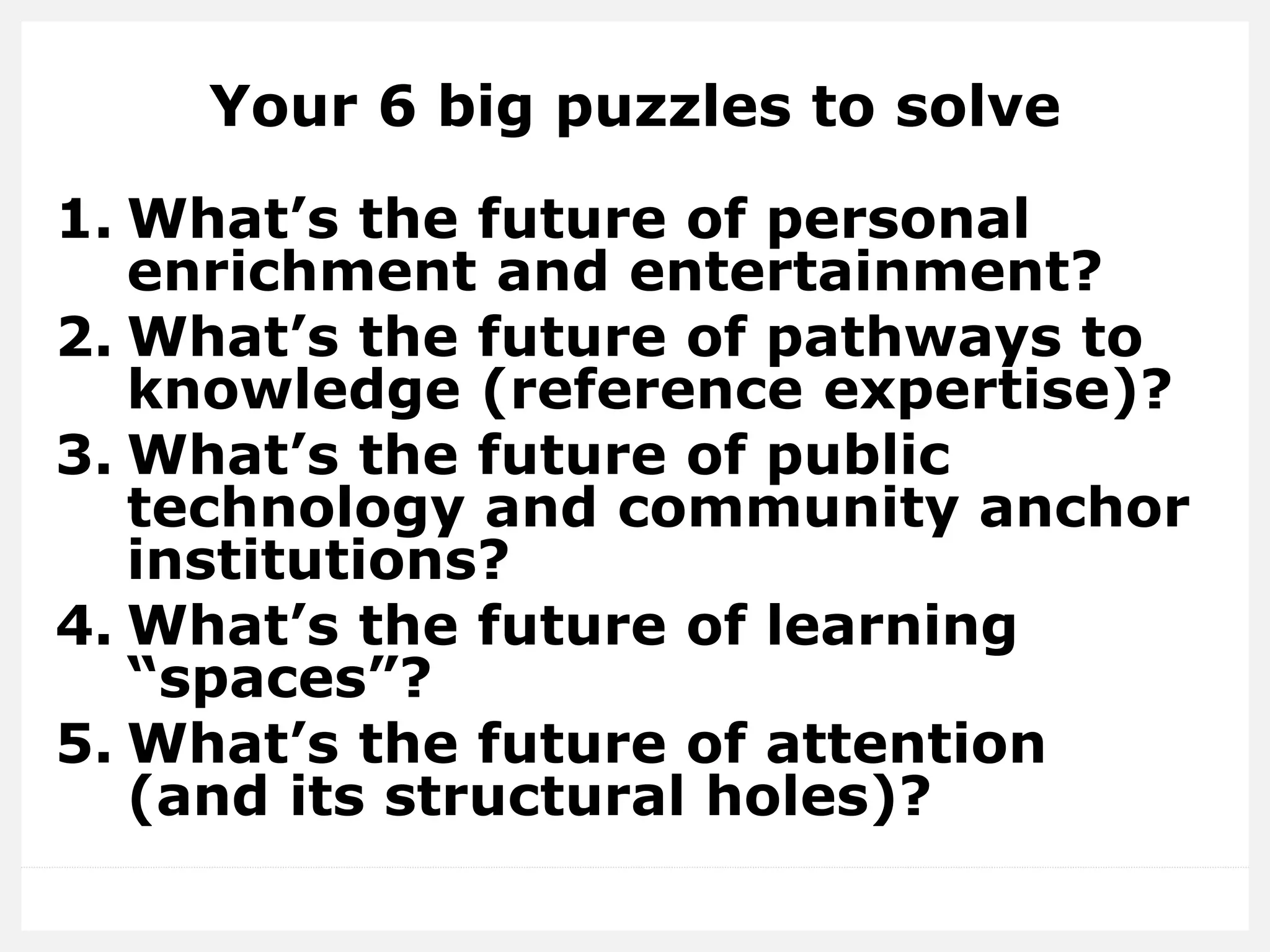
Your 6 big puzzles to solve
1. What’s the future of personal
enrichment and entertainment?
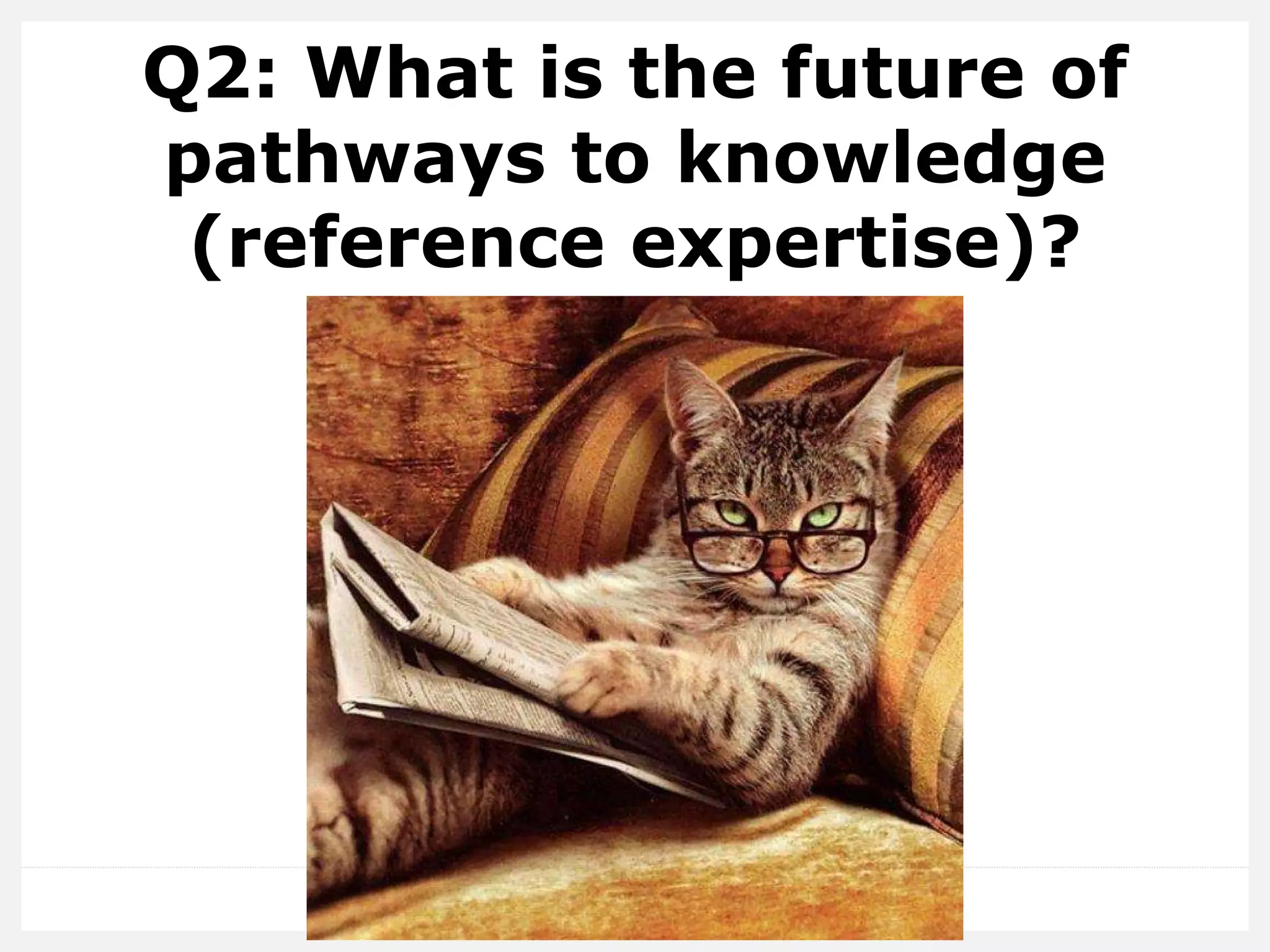
2. What’s the future of pathways to
knowledge (reference expertise)?
3. What’s the future of public
technology and community anchor
institutions?
4. What’s the future of learning
“spaces”?
5. What’s the future of attention
(and its structural holes)?
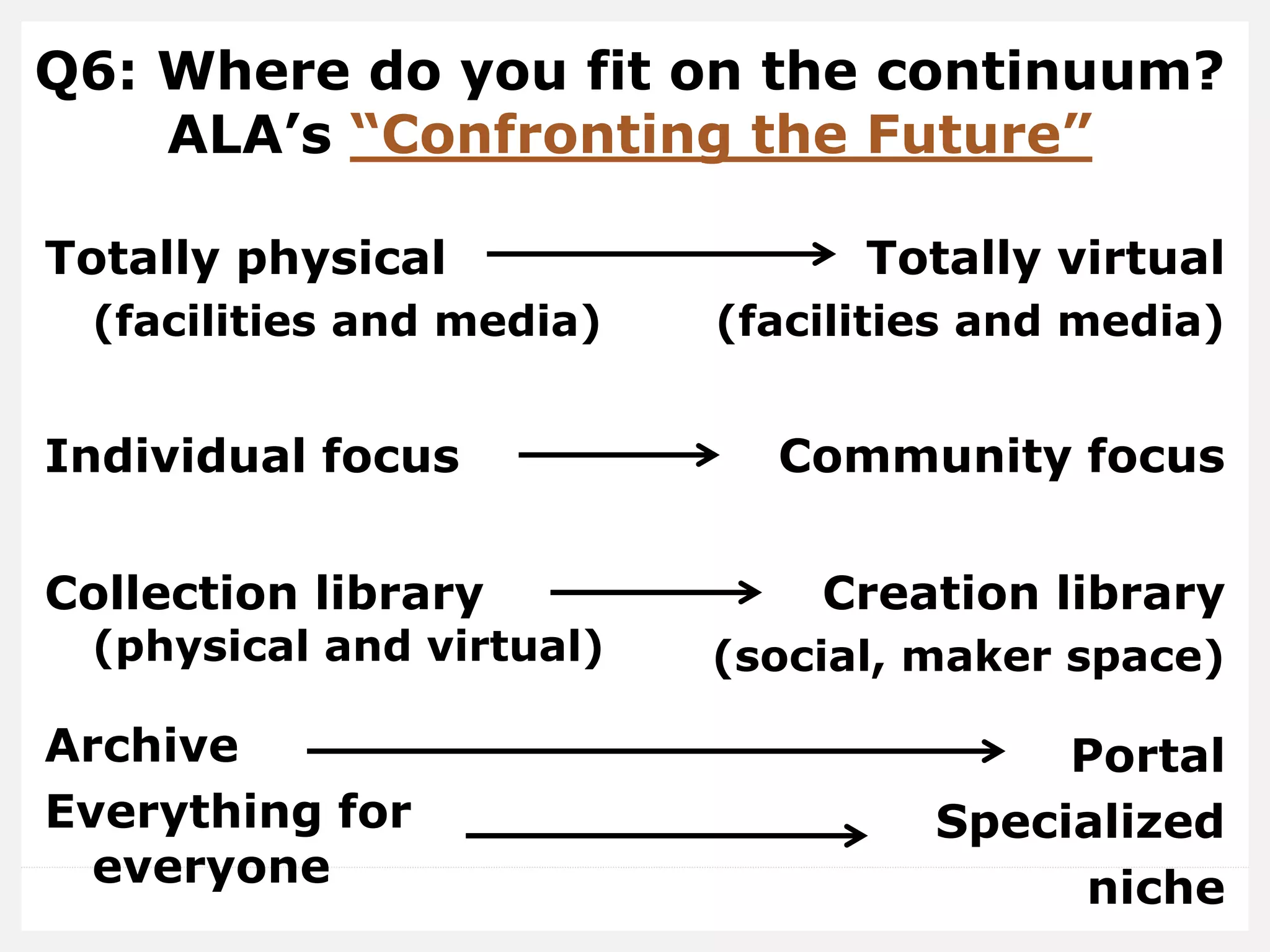
Q6: Where do you fit on the continuum?
ALA’s “Confronting the Future”
Totally physical
(facilities and media)
Individual focus
Collection library
(physical and virtual)
Archive
Everything for
everyone
Totally virtual
(facilities and media)
Community focus
Creation library
(social, maker space)
Portal
Specialized
niche
Starting point:
Your foundation is pretty solid
Our previous findings
libraries.pewinternet.org
• People think libraries are important,
especially for communities
• People like and trust librarians
• People think libraries level of the
playing field for those without vast
resources
• People think libraries provide services
that are hard to get elsewhere
• People believe libraries have
rebranded themselves as tech hubs
http://www.pewinternet.org/2014/03/13/library-engagement-typology/
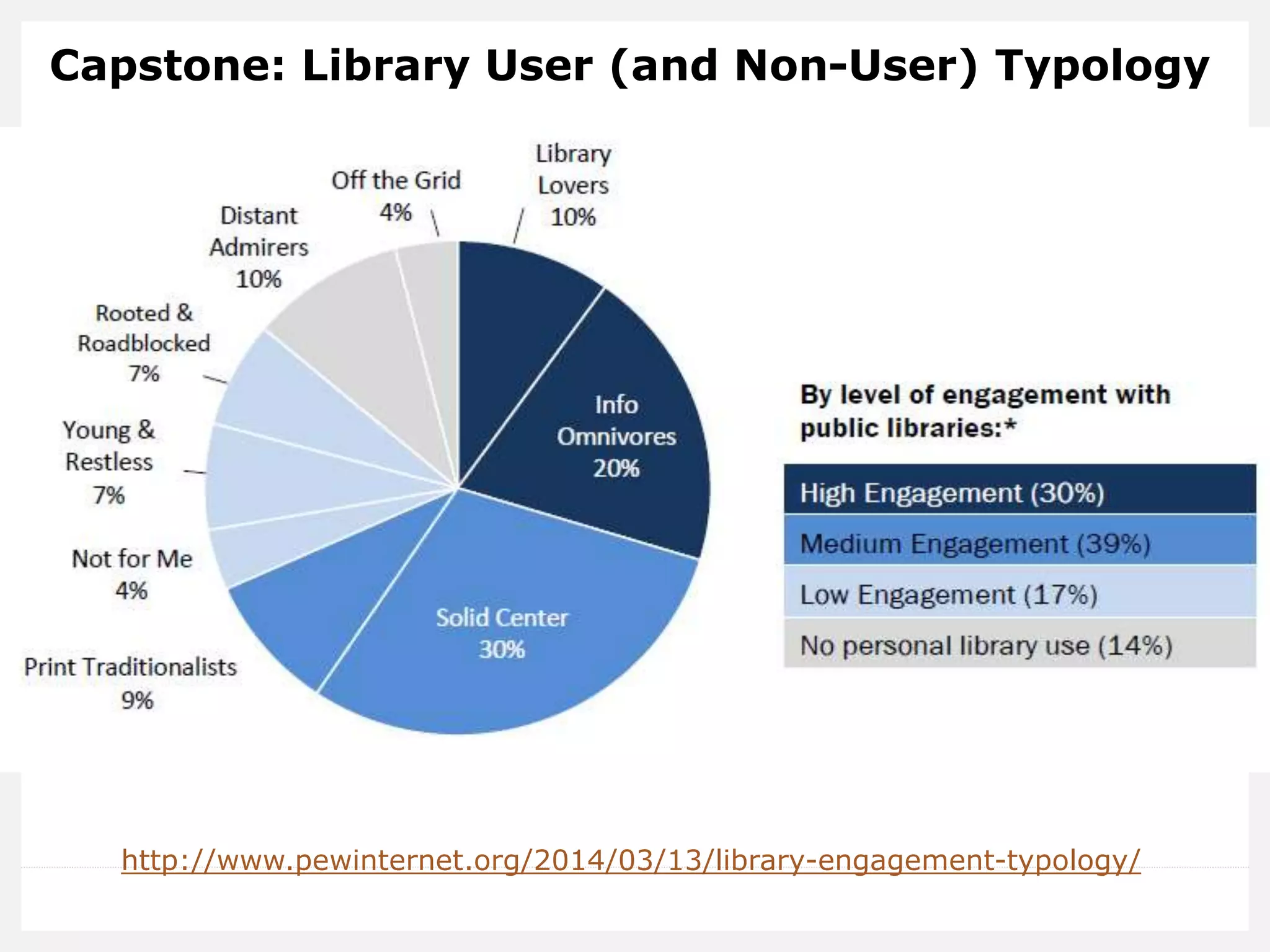
Capstone: Library User (and Non-User) Typology
Q1: What is the future of
knowledge?
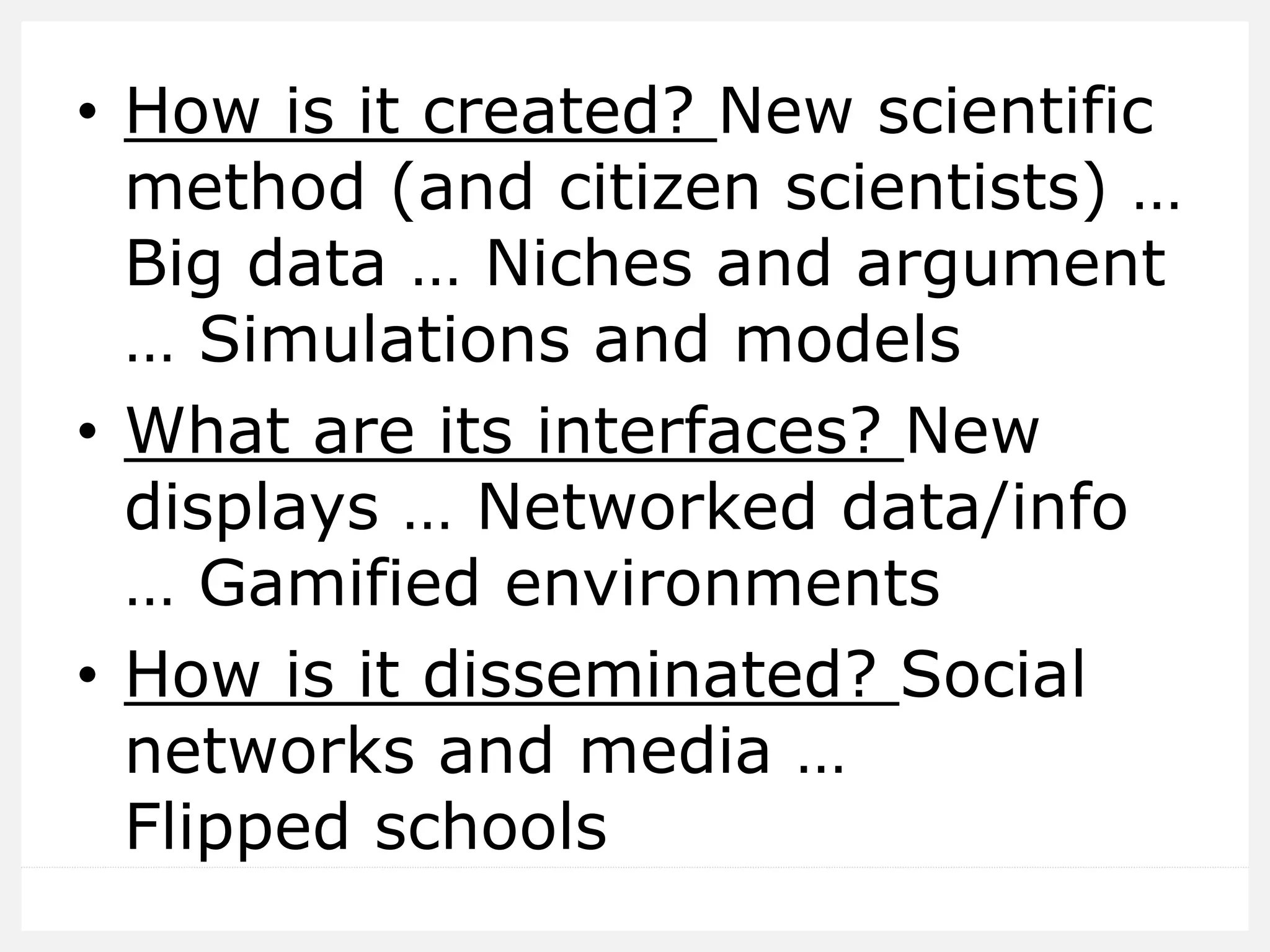
• How is it created? New scientific
method (and citizen scientists) …
Big data … Niches and argument
… Simulations and models
• What are its interfaces? New
displays … Networked data/info
… Gamified environments
• How is it disseminated? Social
networks and media …
Flipped schools
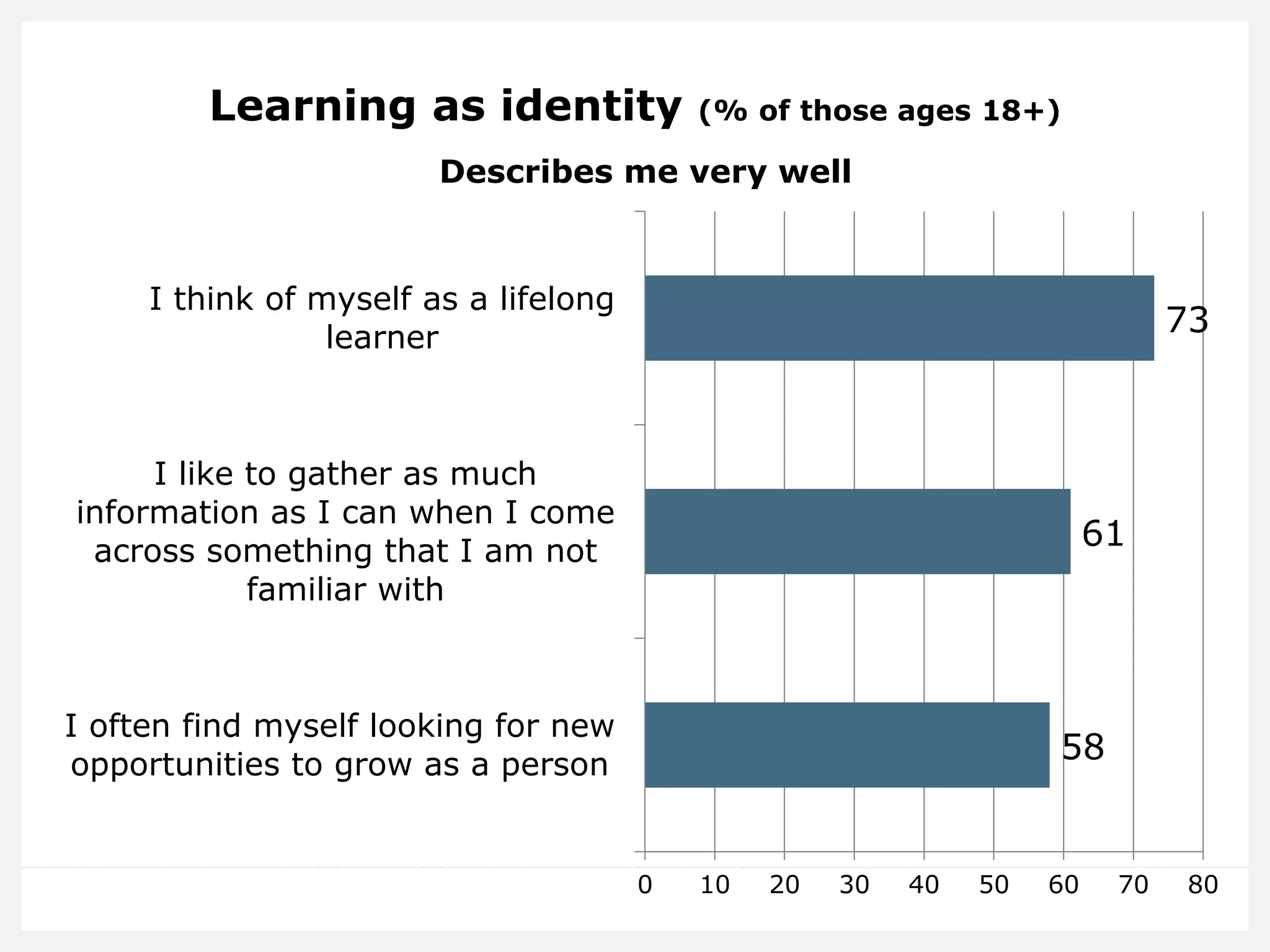
Learning as identity (% of those ages 18+)
58
61
73
0 10 20 30 40 50 60 70 80
I often find myself looking for new
opportunities to grow as a person
I like to gather as much
information as I can when I come
across something that I am not
familiar with
I think of myself as a lifelong
learner
Describes me very well
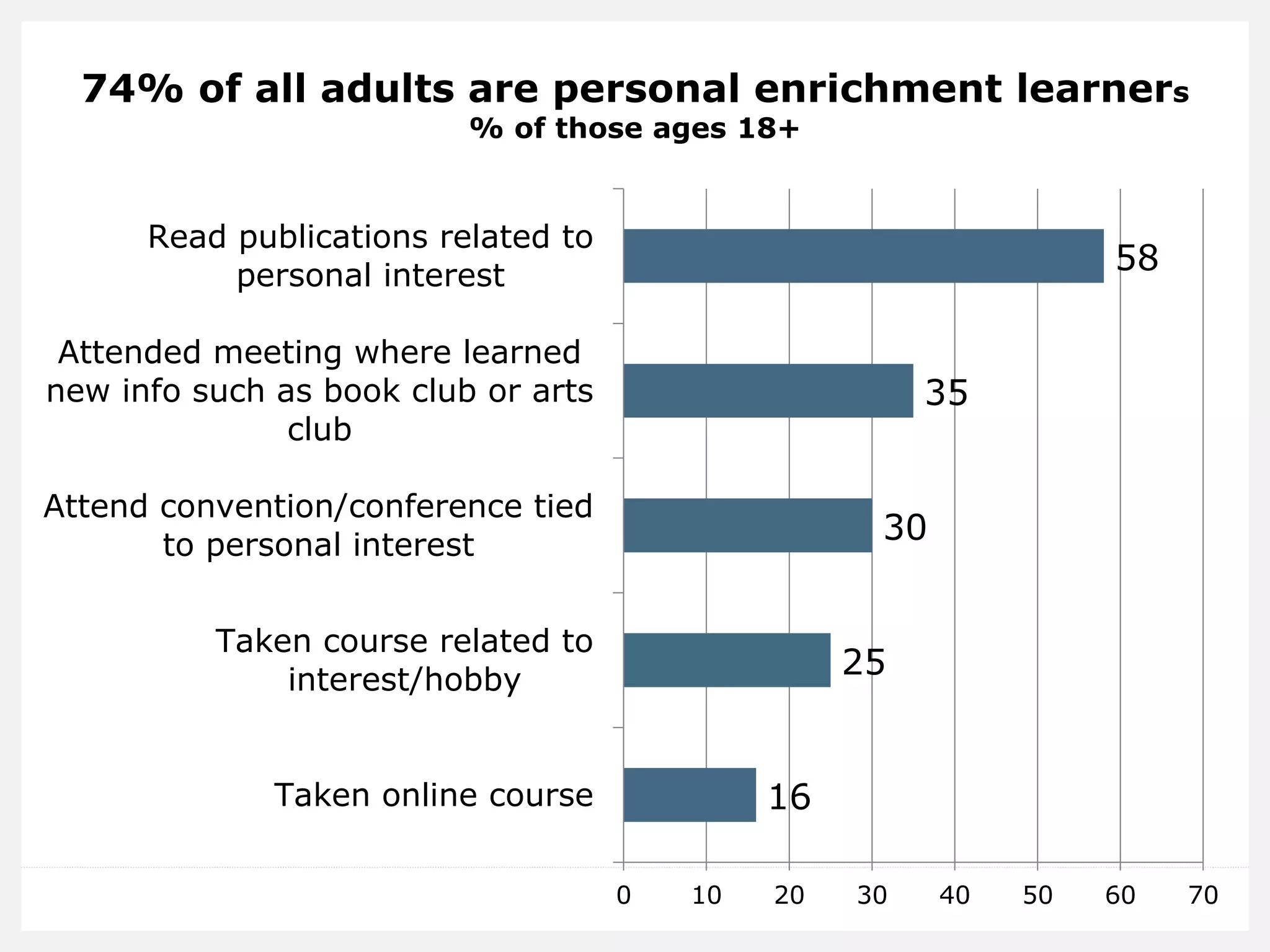
74% of all adults are personal enrichment learners
% of those ages 18+
16
25
30
35
58
0 10 20 30 40 50 60 70
Taken online course
Taken course related to
interest/hobby
Attend convention/conference tied
to personal interest
Attended meeting where learned
new info such as book club or arts
club
Read publications related to
personal interest
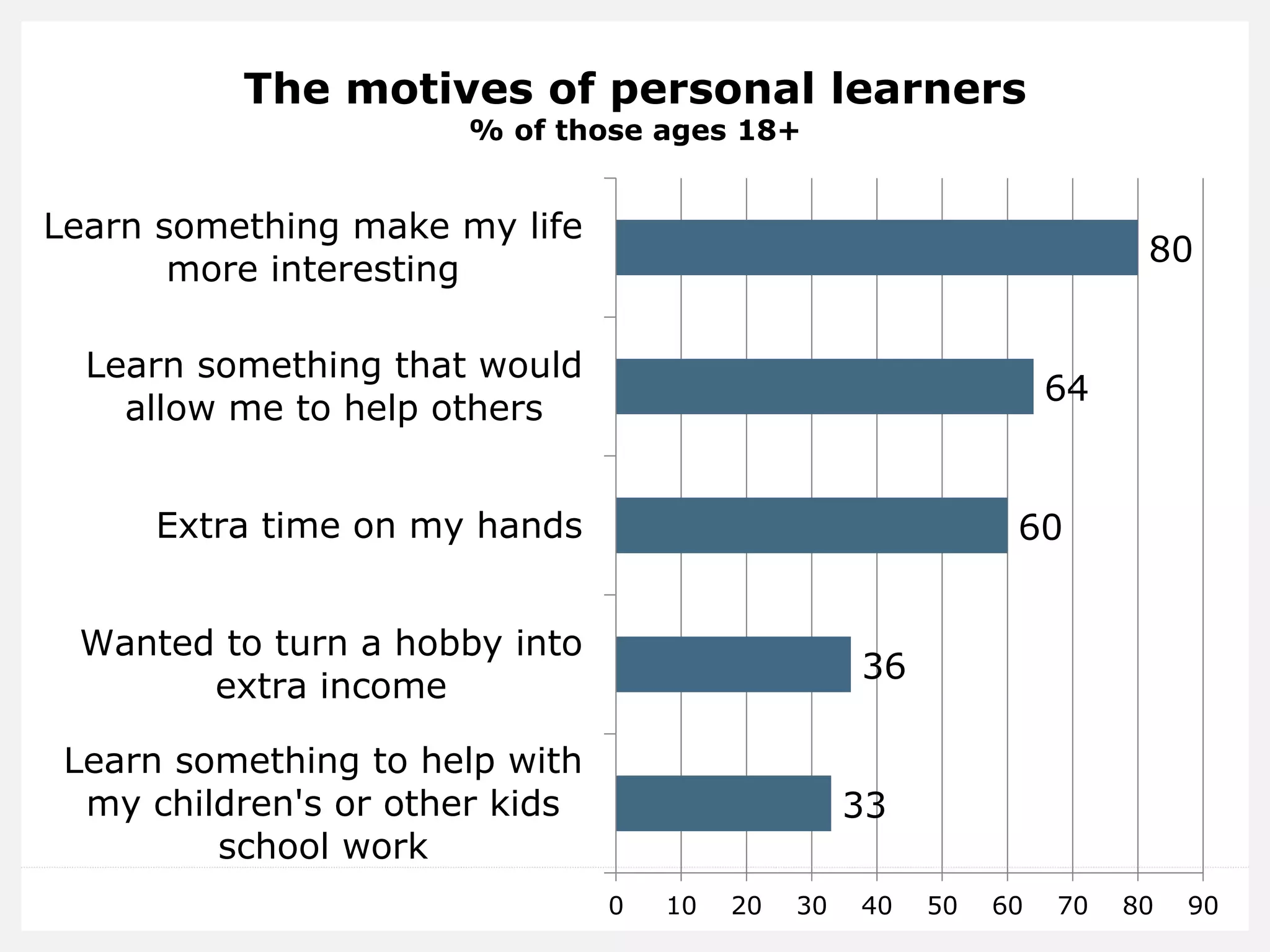
The motives of personal learners
% of those ages 18+
33
36
60
64
80
0 10 20 30 40 50 60 70 80 90
Learn something to help with
my children's or other kids
school work
Wanted to turn a hobby into
extra income
Extra time on my hands
Learn something that would
allow me to help others
Learn something make my life
more interesting
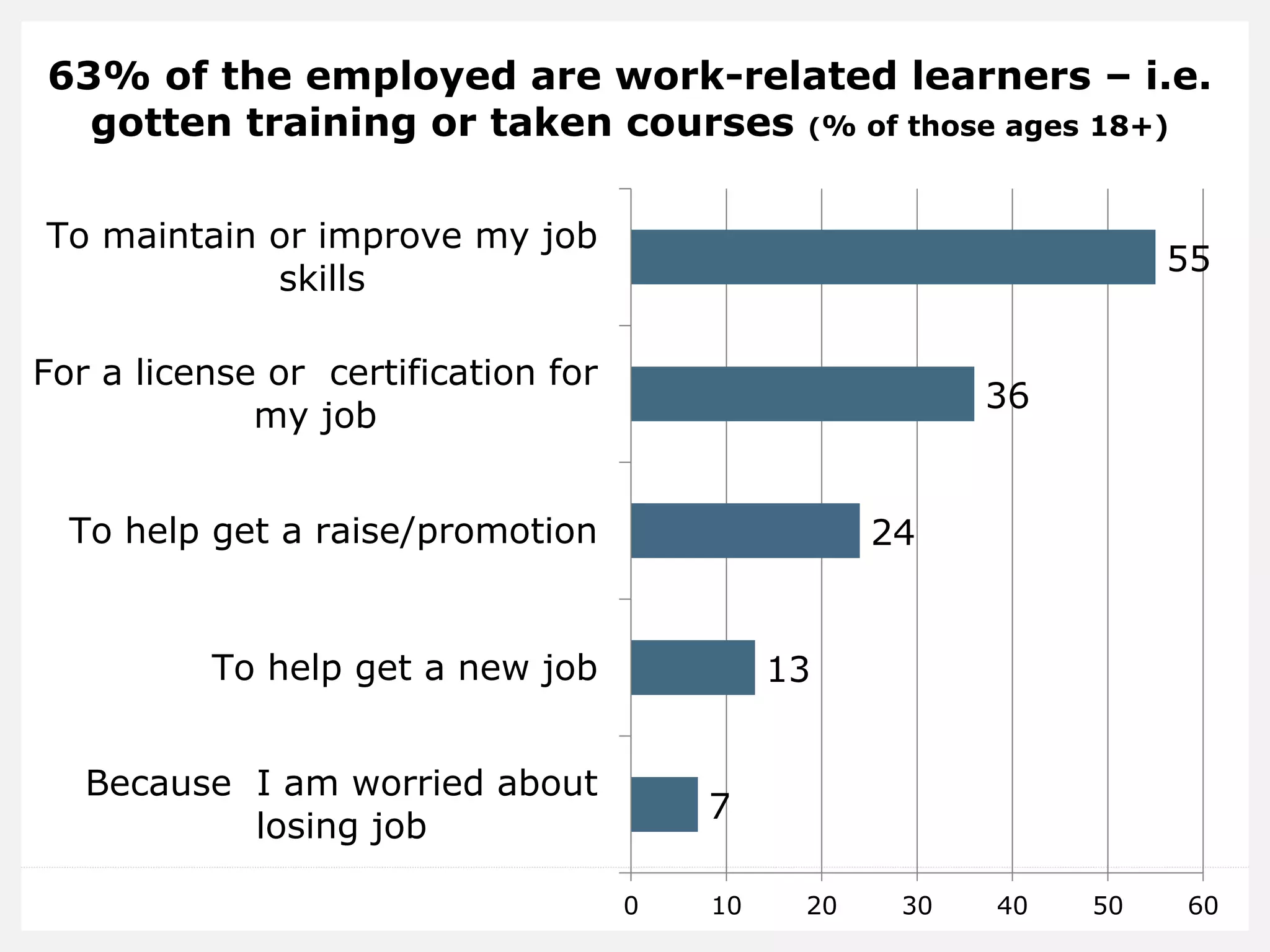
63% of the employed are work-related learners – i.e.
gotten training or taken courses (% of those ages 18+)
7
13
24
36
55
0 10 20 30 40 50 60
Because I am worried about
losing job
To help get a new job
To help get a raise/promotion
For a license or certification for
my job
To maintain or improve my job
skills
Q2: What is the future of
pathways to knowledge
(reference expertise)?
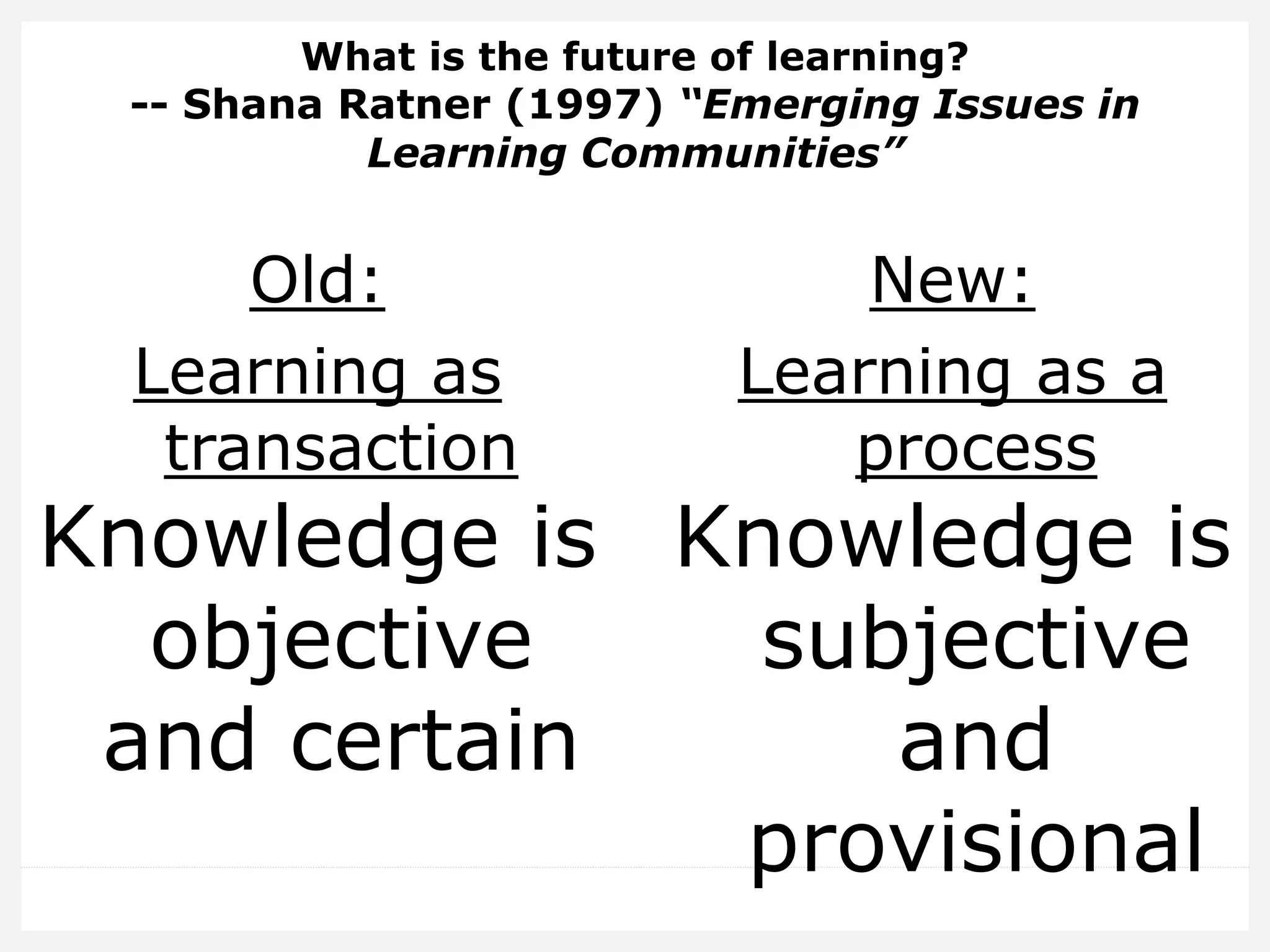
What is the future of learning?
-- Shana Ratner (1997) “Emerging Issues in
Learning Communities”
New:
Learning as a
process
Knowledge is
objective
and certain
Old:
Learning as
transaction
Knowledge is
subjective
and
provisional
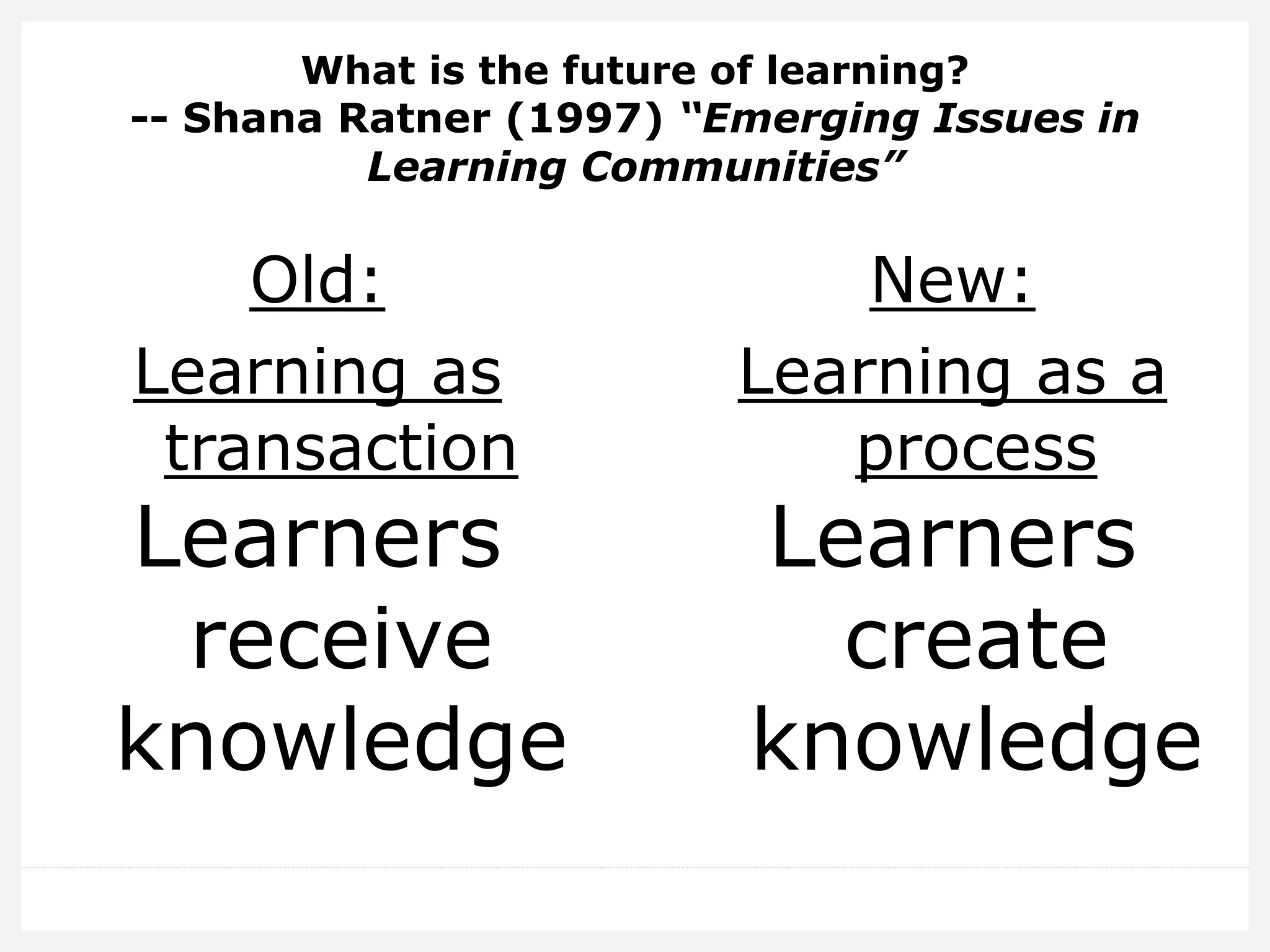
New:
Learning as a
process
Learners
receive
knowledge
Old:
Learning as
transaction
Learners
create
knowledge
What is the future of learning?
-- Shana Ratner (1997) “Emerging Issues in
Learning Communities”
New:
Learning as a
process
Knowledge is
organized in stable,
hierarchical
structures that can
be treated
independently of one
another
Old:
Learning as
transaction
Knowledge is
organized
“ecologically”-
disciplines are
integrative and
interactive
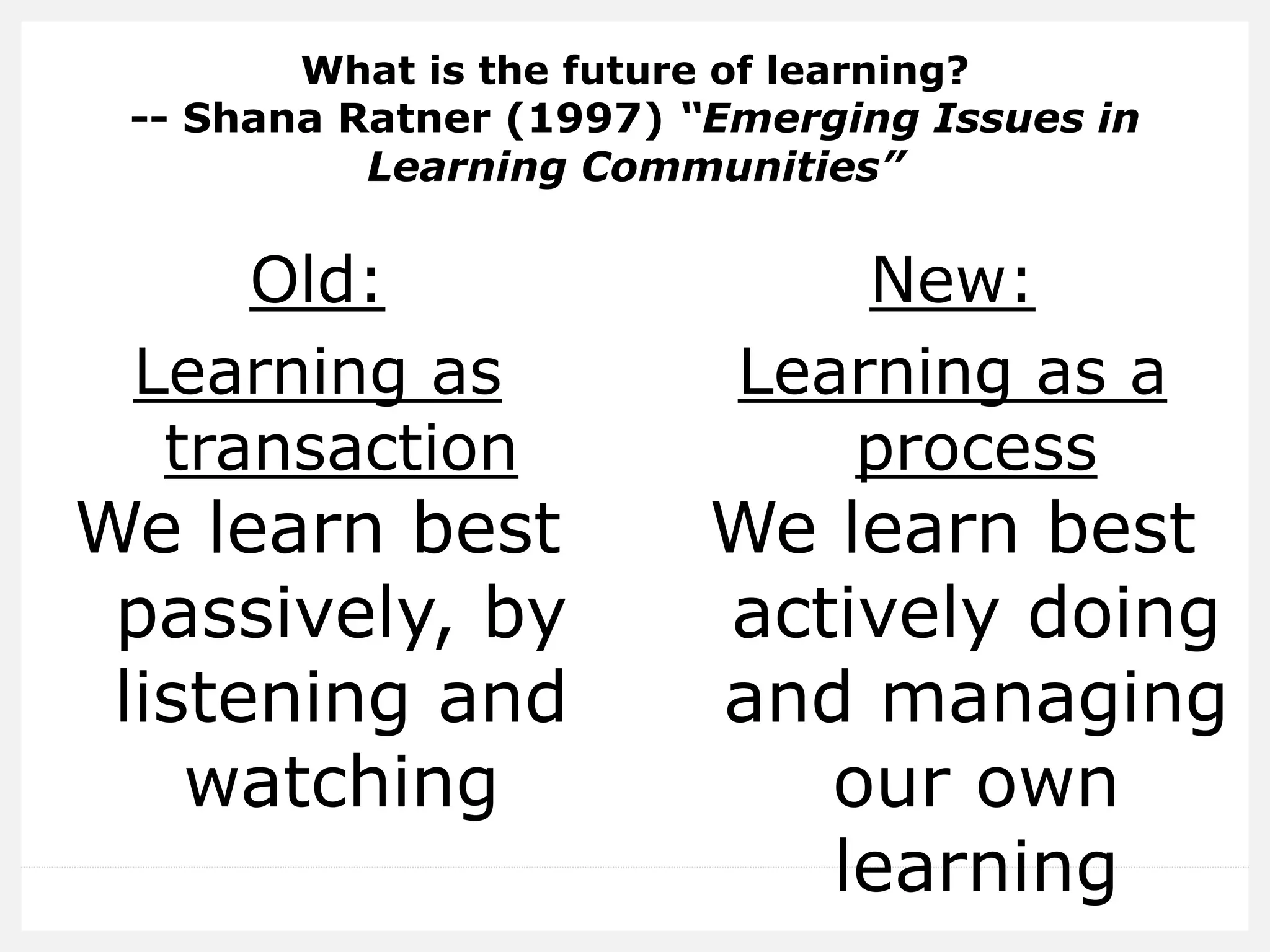
What is the future of learning?
-- Shana Ratner (1997) “Emerging Issues in
Learning Communities”
New:
Learning as a
process
We learn best
passively, by
listening and
watching
Old:
Learning as
transaction
We learn best
actively doing
and managing
our own
learning
What is the future of learning?
-- Shana Ratner (1997) “Emerging Issues in
Learning Communities”
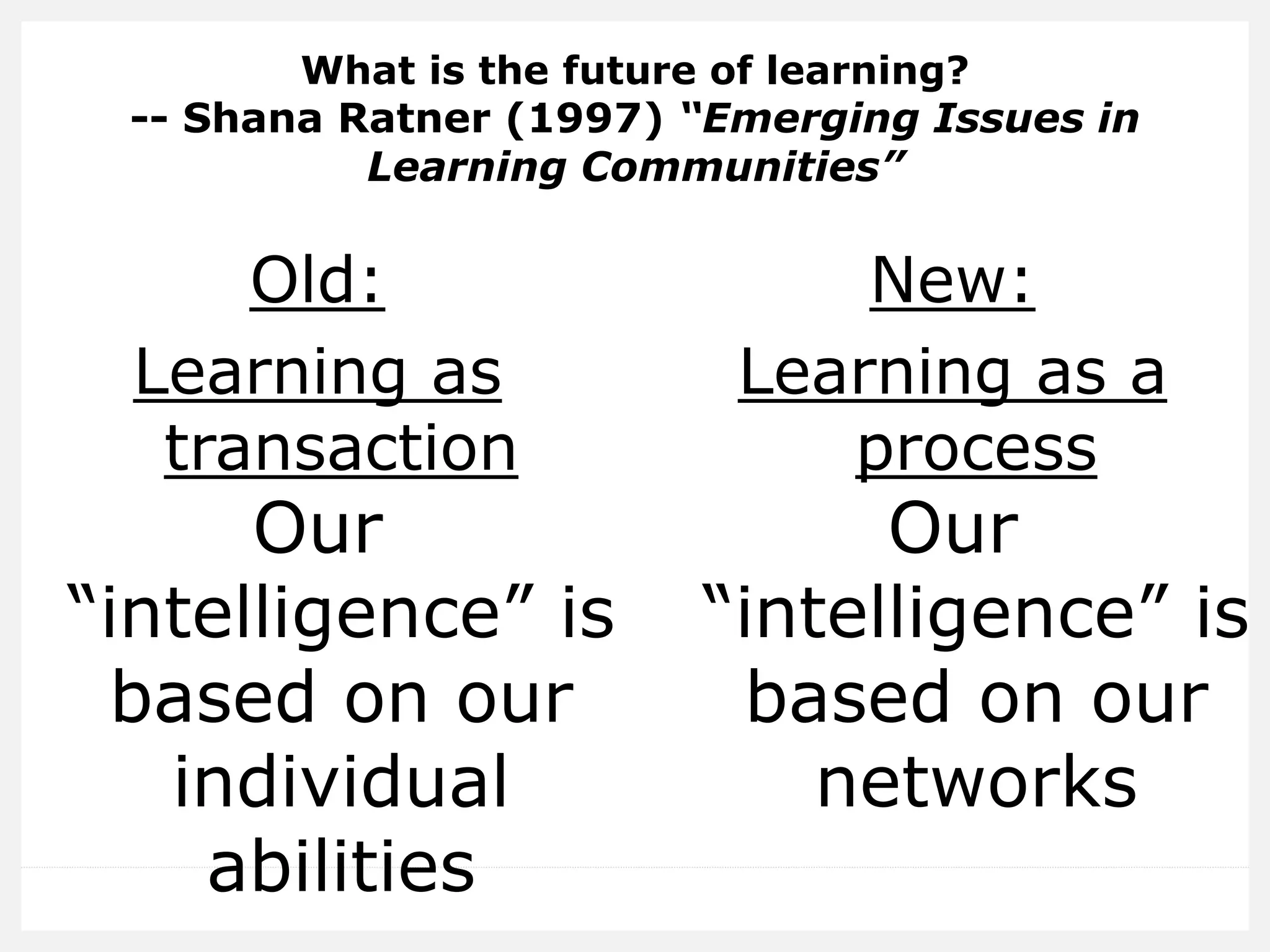
New:
Learning as a
process
Our
“intelligence” is
based on our
individual
abilities
Old:
Learning as
transaction
Our
“intelligence” is
based on our
networks
What is the future of learning?
-- Shana Ratner (1997) “Emerging Issues in
Learning Communities”
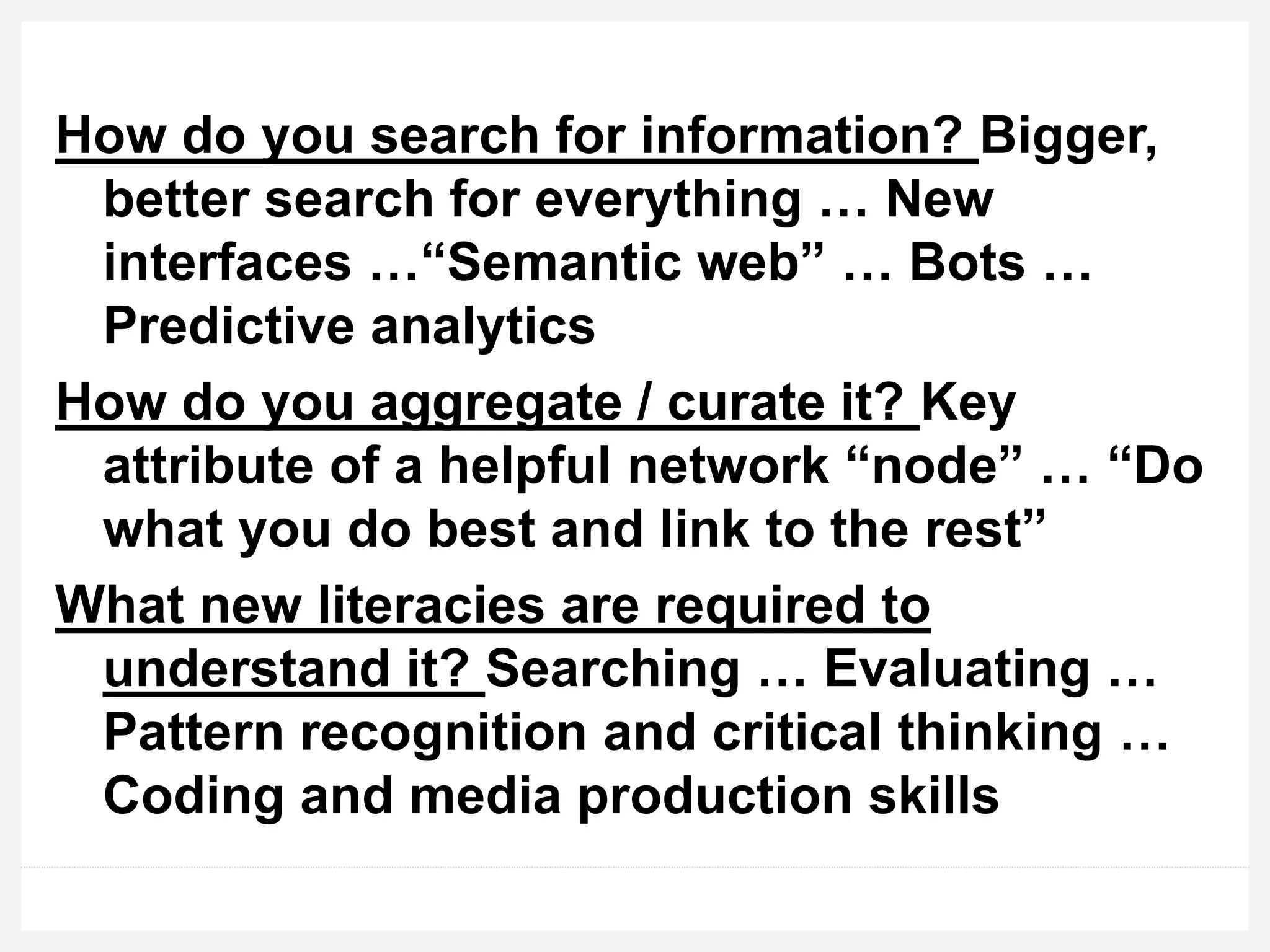
How do you search for information? Bigger,
better search for everything … New
interfaces …“Semantic web” … Bots …
Predictive analytics
How do you aggregate / curate it? Key
attribute of a helpful network “node” … “Do
what you do best and link to the rest”
What new literacies are required to
understand it? Searching … Evaluating …
Pattern recognition and critical thinking …
Coding and media production skills
Q3: What is the future of public
technology and community anchor
institutions?
22
Libraries stack up well vs. others
How confident? How important?
63 28
Library to community
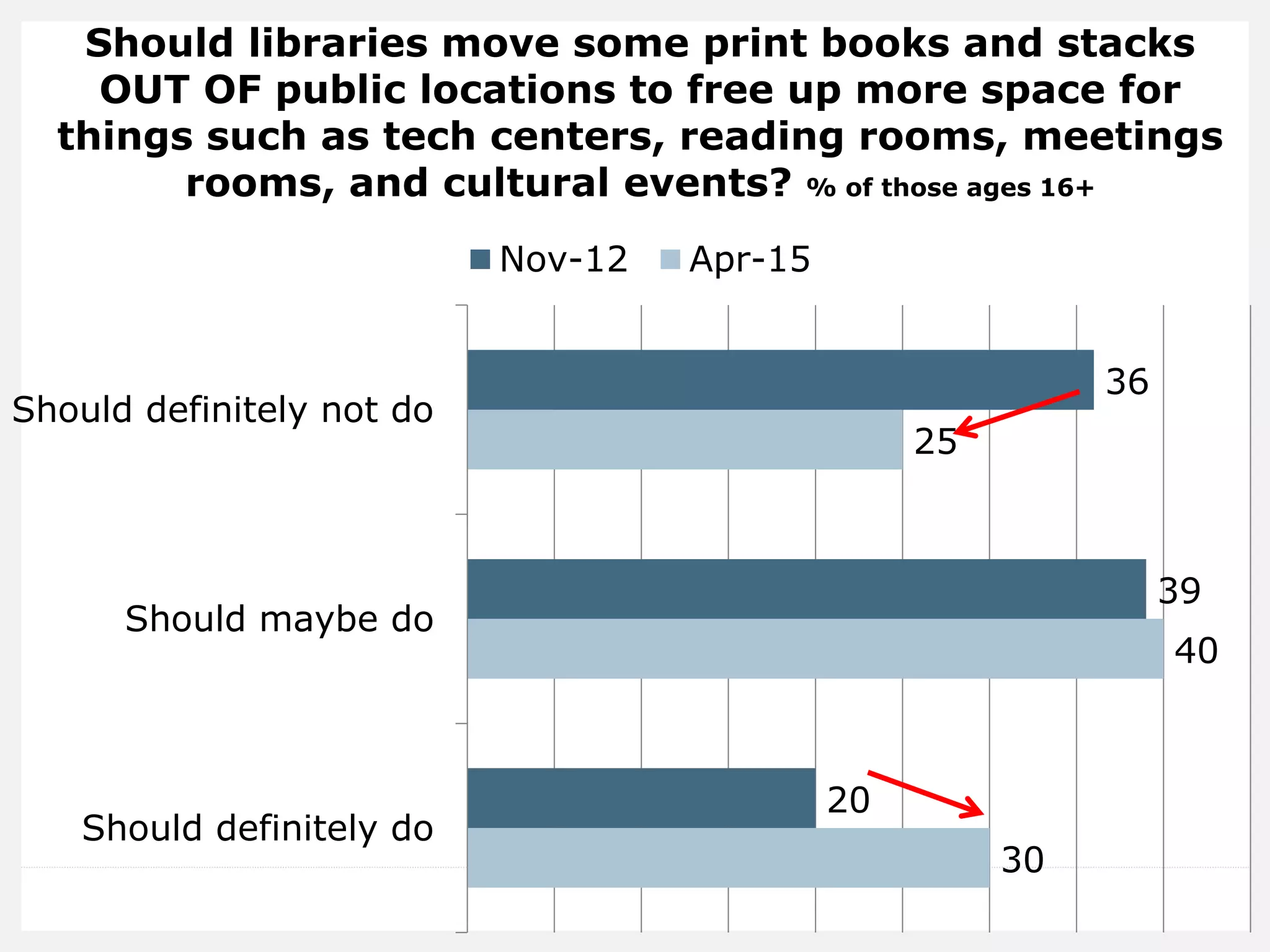
Should libraries move some print books and stacks
OUT OF public locations to free up more space for
things such as tech centers, reading rooms, meetings
rooms, and cultural events? % of those ages 16+
30
40
25
20
39
36
Should definitely do
Should maybe do
Should definitely not do
Nov-12 Apr-15
February 5, 2016 24www.pewresearch.org
The clear public
mandate: Do
something for
education ….
Large majorities
of Americans
see libraries as
part of the
educational
ecosystem and
as resources
for promoting
digital and
information
literacy.
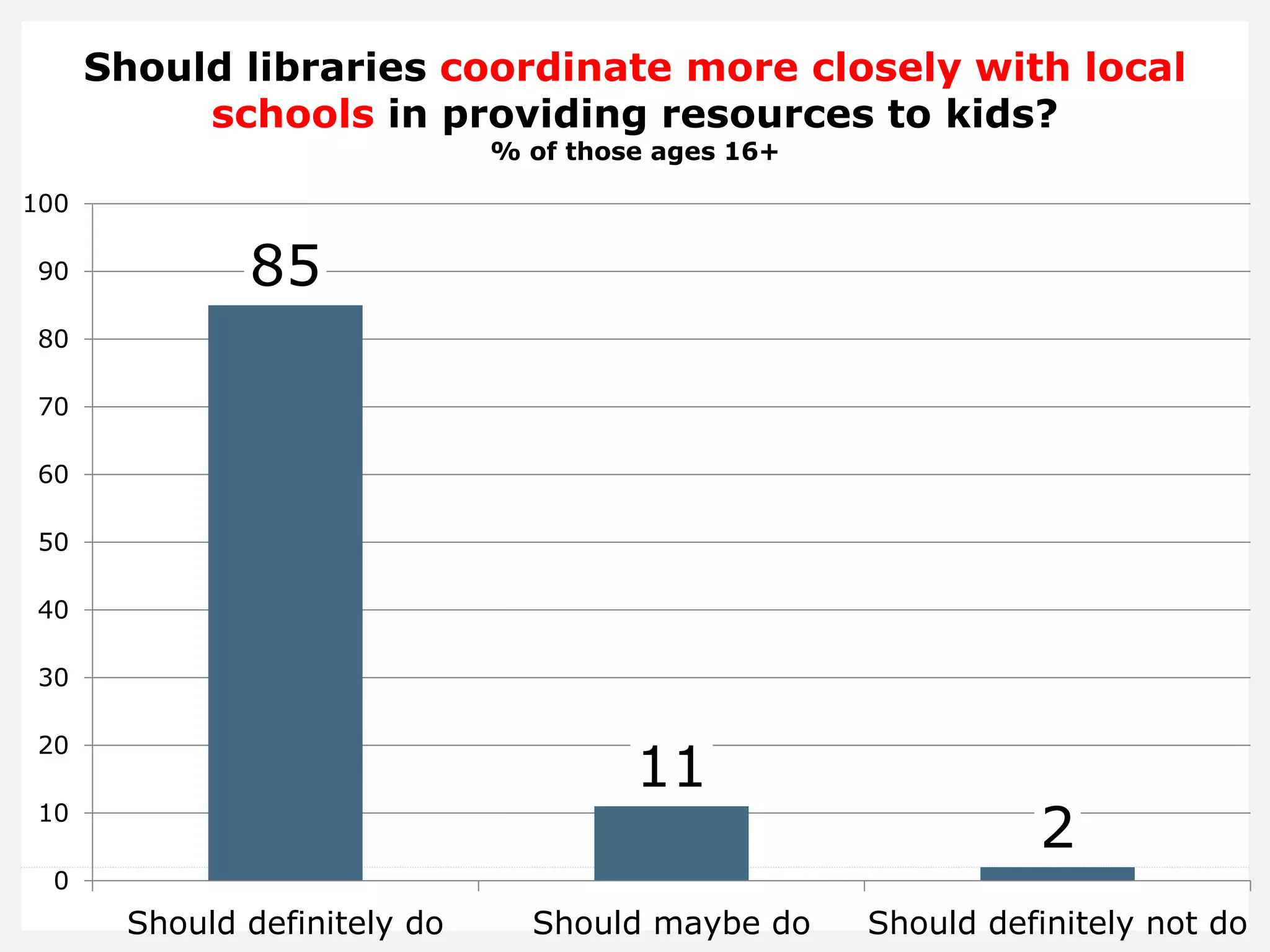
Should libraries coordinate more closely with local
schools in providing resources to kids?
% of those ages 16+
85
11
2
0
10
20
30
40
50
60
70
80
90
100
Should definitely do Should maybe do Should definitely not do
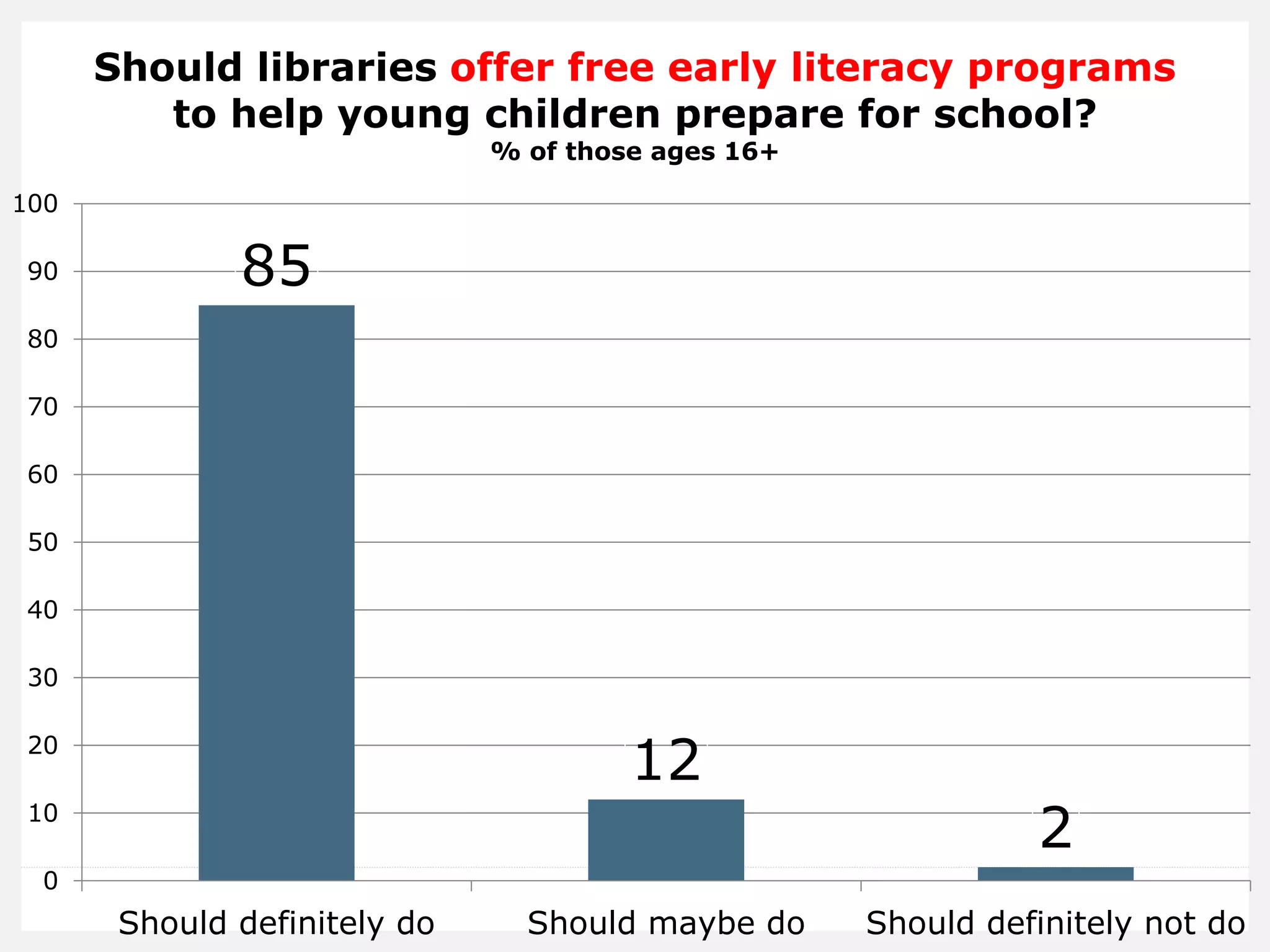
85
12
2
0
10
20
30
40
50
60
70
80
90
100
Should definitely do Should maybe do Should definitely not do
Should libraries offer free early literacy programs
to help young children prepare for school?
% of those ages 16+
Should libraries offer programs to teach people,
including kids and senior citizens, how to use digital
tools such as computers, smartphones and apps?
% of those ages 16+
78
16
3
0
10
20
30
40
50
60
70
80
90
100
Should definitely do Should maybe do Should definitely not do
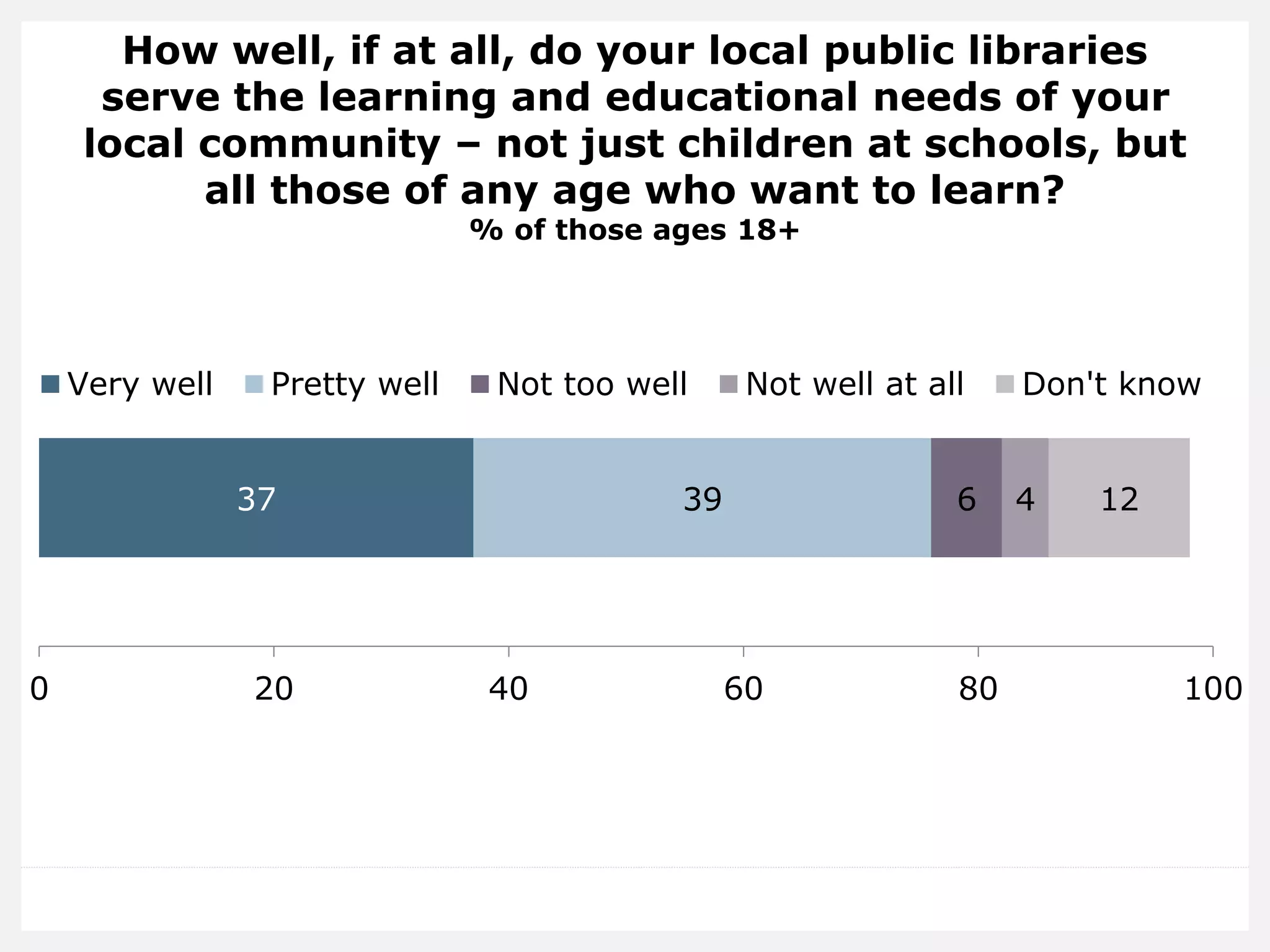
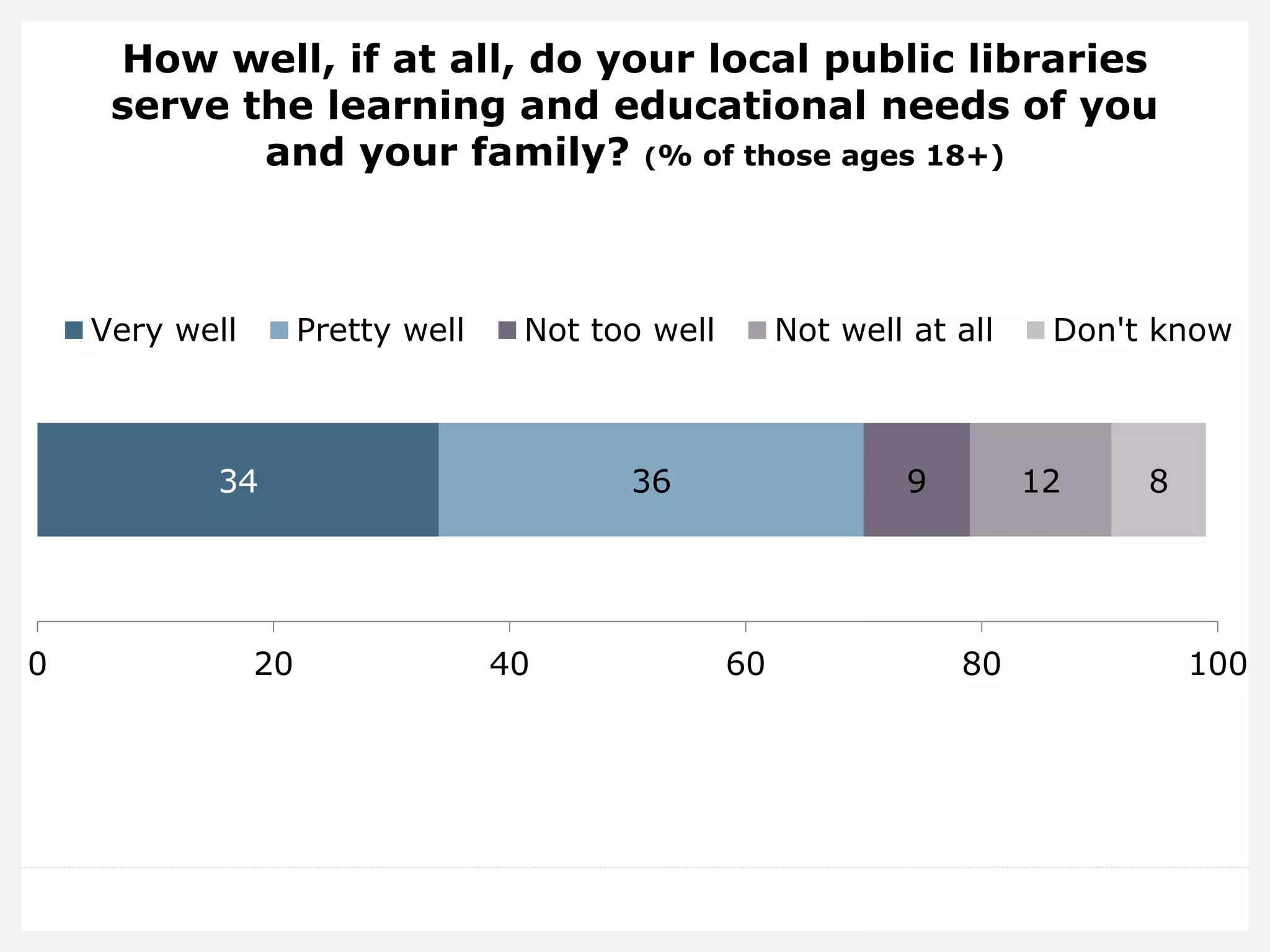
How well, if at all, do your local public libraries
serve the learning and educational needs of your
local community – not just children at schools, but
all those of any age who want to learn?
% of those ages 18+
37 39 6 4 12
0 20 40 60 80 100
Very well Pretty well Not too well Not well at all Don't know
How well, if at all, do your local public libraries
serve the learning and educational needs of you
and your family? (% of those ages 18+)
34 36 9 12 8
0 20 40 60 80 100
Very well Pretty well Not too well Not well at all Don't know
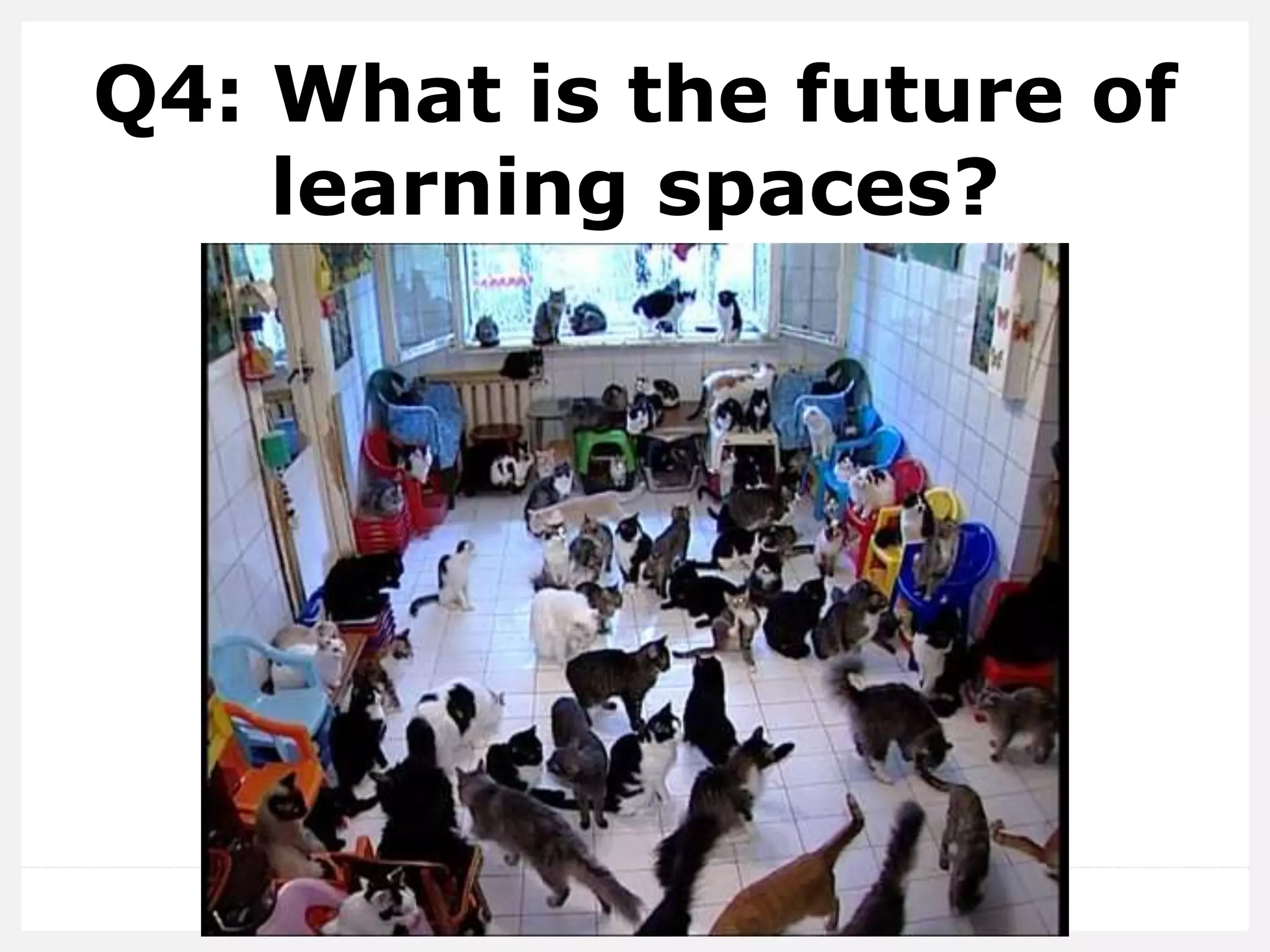
Q4: What is the future of
learning spaces?
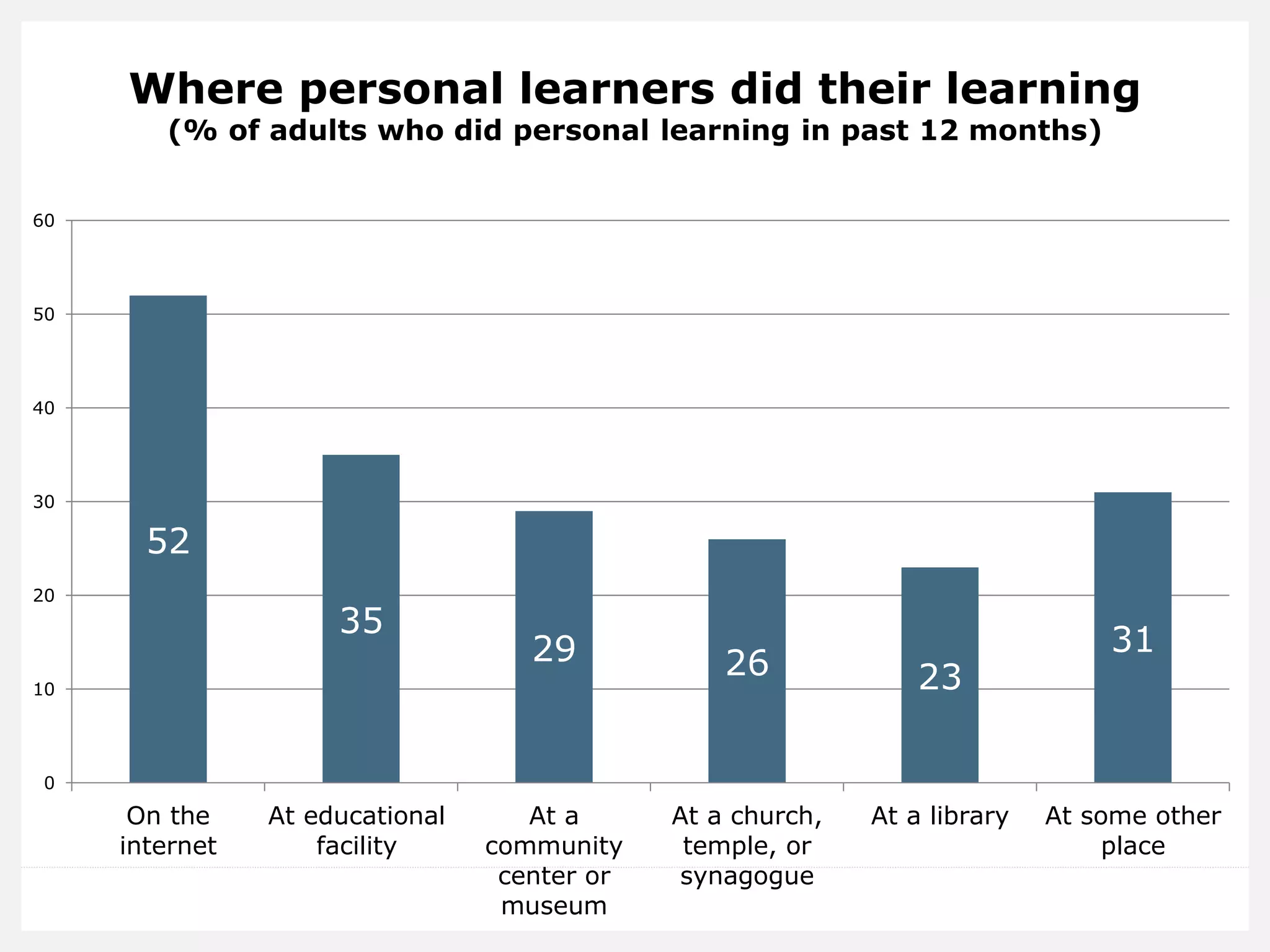
Where personal learners did their learning
(% of adults who did personal learning in past 12 months)
52
35
29 26 23
31
0
10
20
30
40
50
60
On the
internet
At educational
facility
At a
community
center or
museum
At a church,
temple, or
synagogue
At a library At some other
place
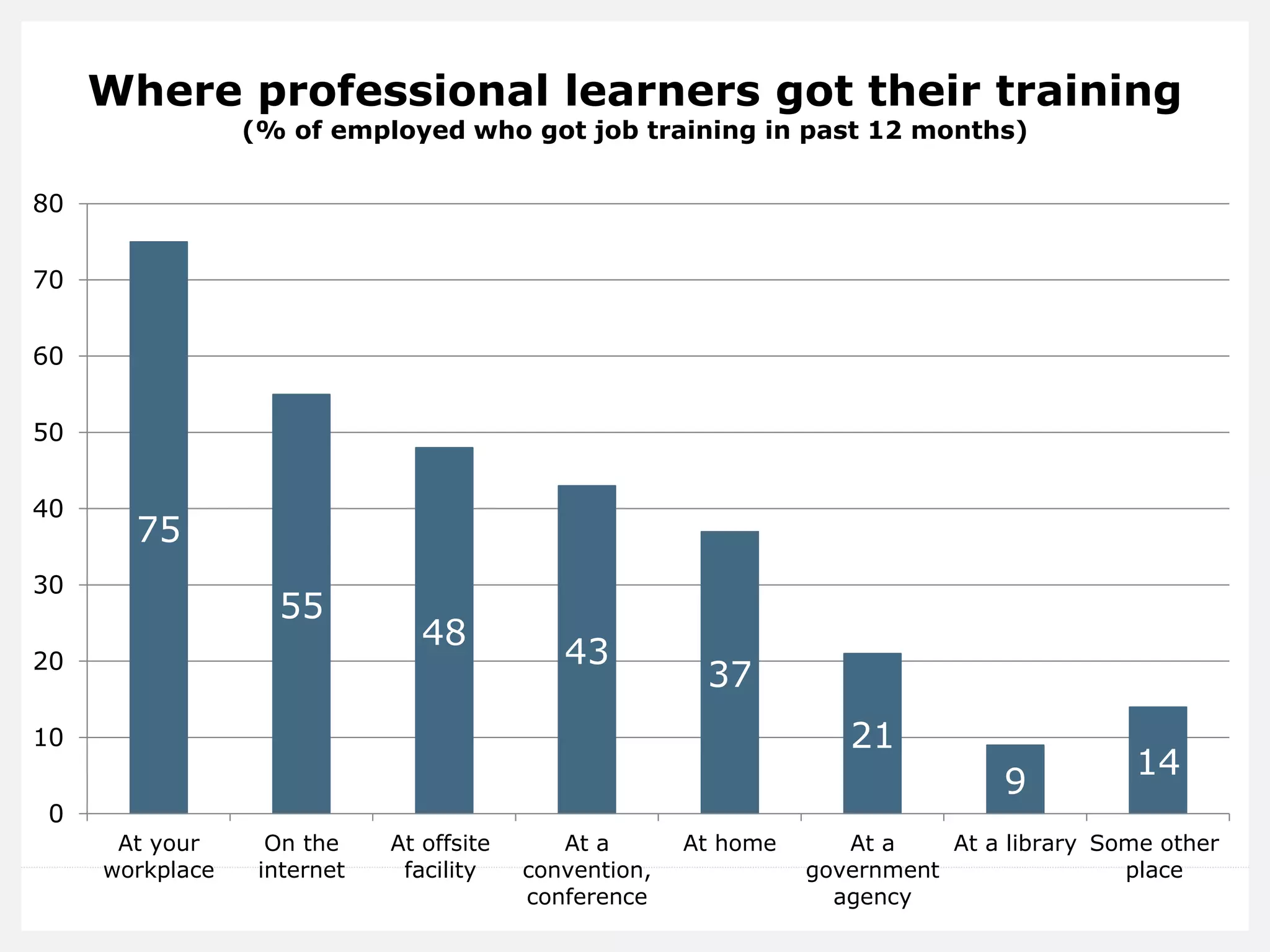
Where professional learners got their training
(% of employed who got job training in past 12 months)
75
55
48
43
37
21
9
14
0
10
20
30
40
50
60
70
80
At your
workplace
On the
internet
At offsite
facility
At a
convention,
conference
At home At a
government
agency
At a library Some other
place
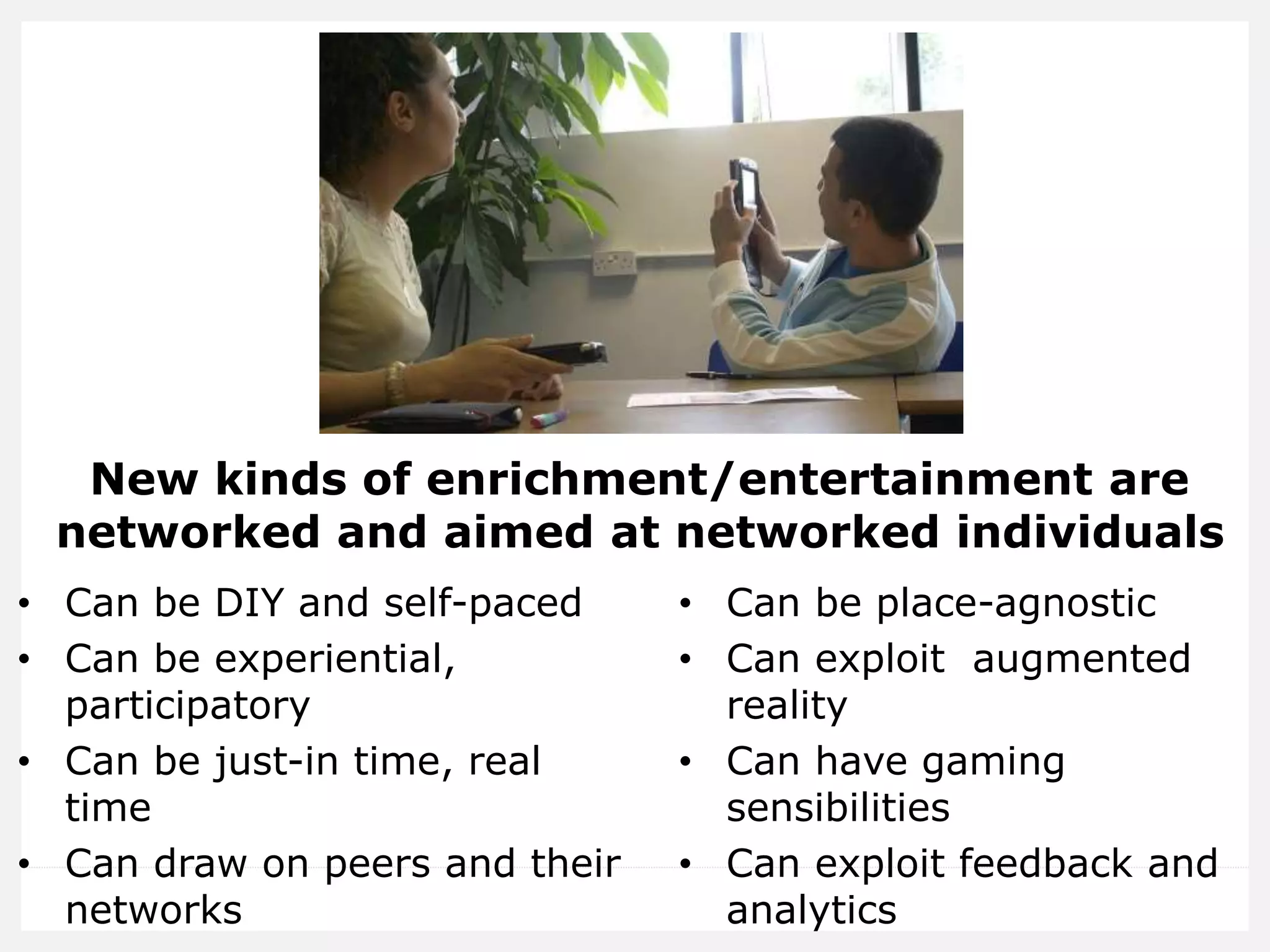
New kinds of enrichment/entertainment are
networked and aimed at networked individuals
• Can be DIY and self-paced
• Can be experiential,
participatory
• Can be just-in time, real
time
• Can draw on peers and their
networks
• Can be place-agnostic
• Can exploit augmented
reality
• Can have gaming
sensibilities
• Can exploit feedback and
analytics
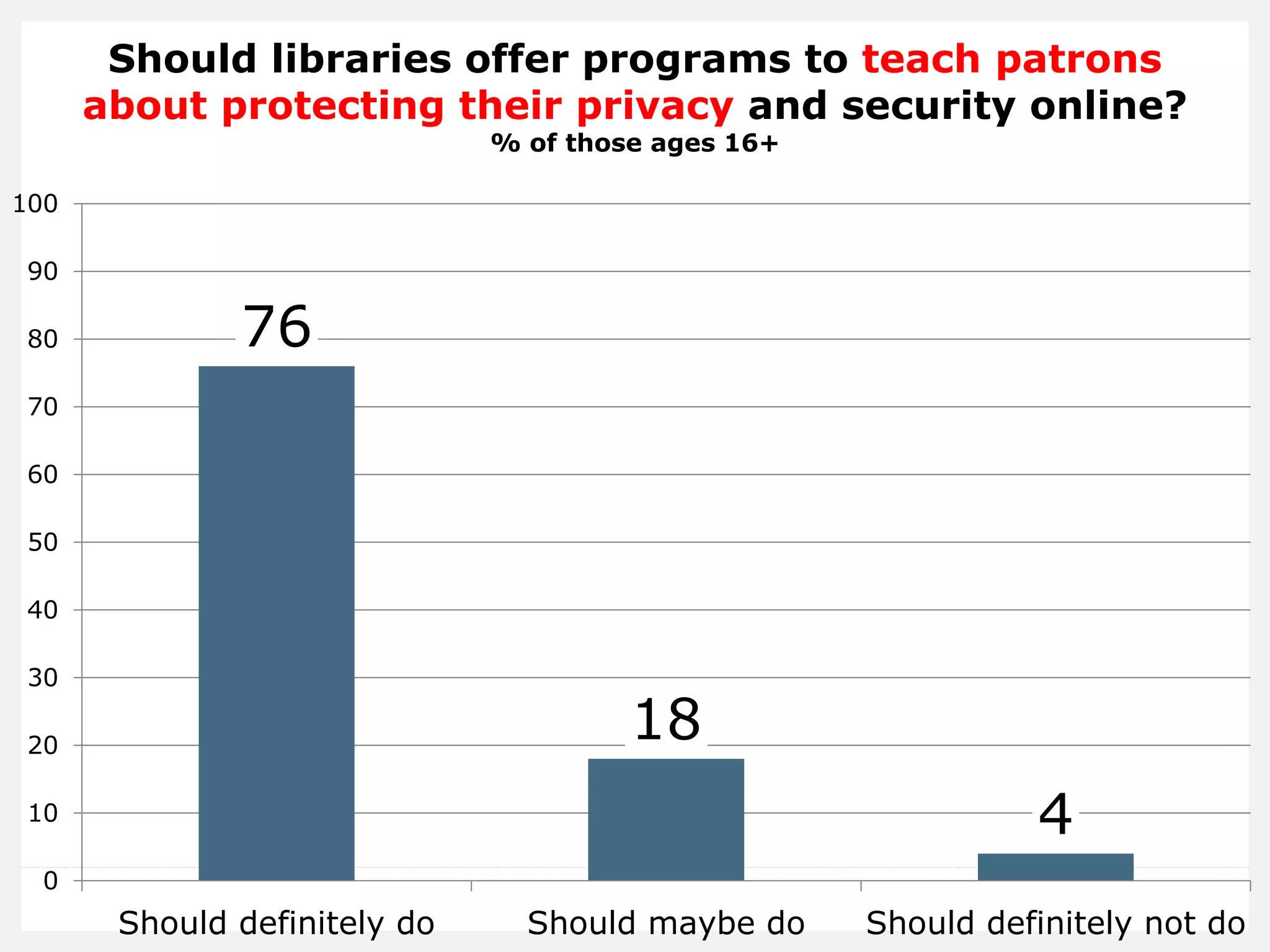
Should libraries offer programs to teach patrons
about protecting their privacy and security online?
% of those ages 16+
76
18
4
0
10
20
30
40
50
60
70
80
90
100
Should definitely do Should maybe do Should definitely not do
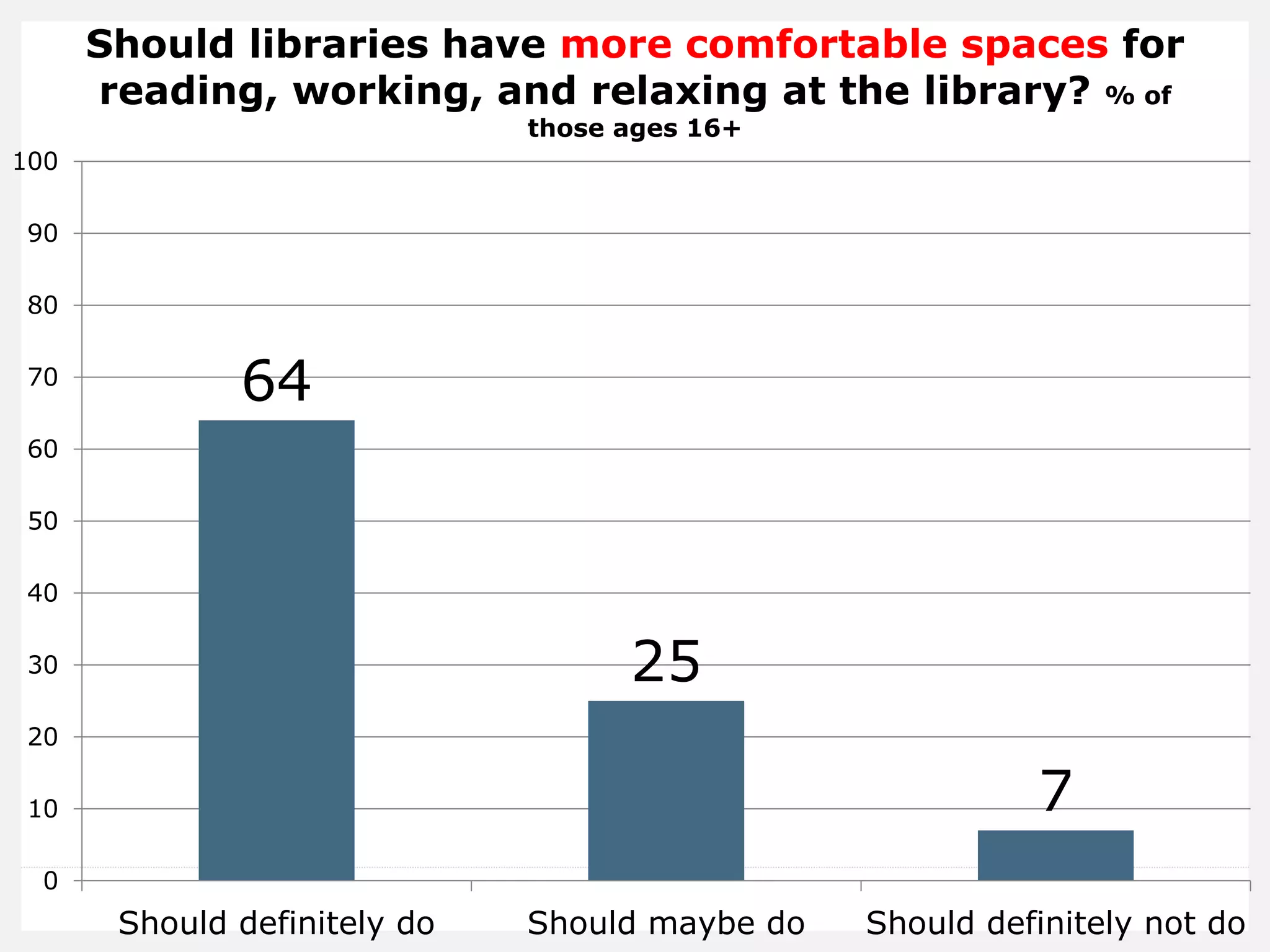
Should libraries have more comfortable spaces for
reading, working, and relaxing at the library? % of
those ages 16+
64
25
7
0
10
20
30
40
50
60
70
80
90
100
Should definitely do Should maybe do Should definitely not do
Q5: What is the future of
attention?
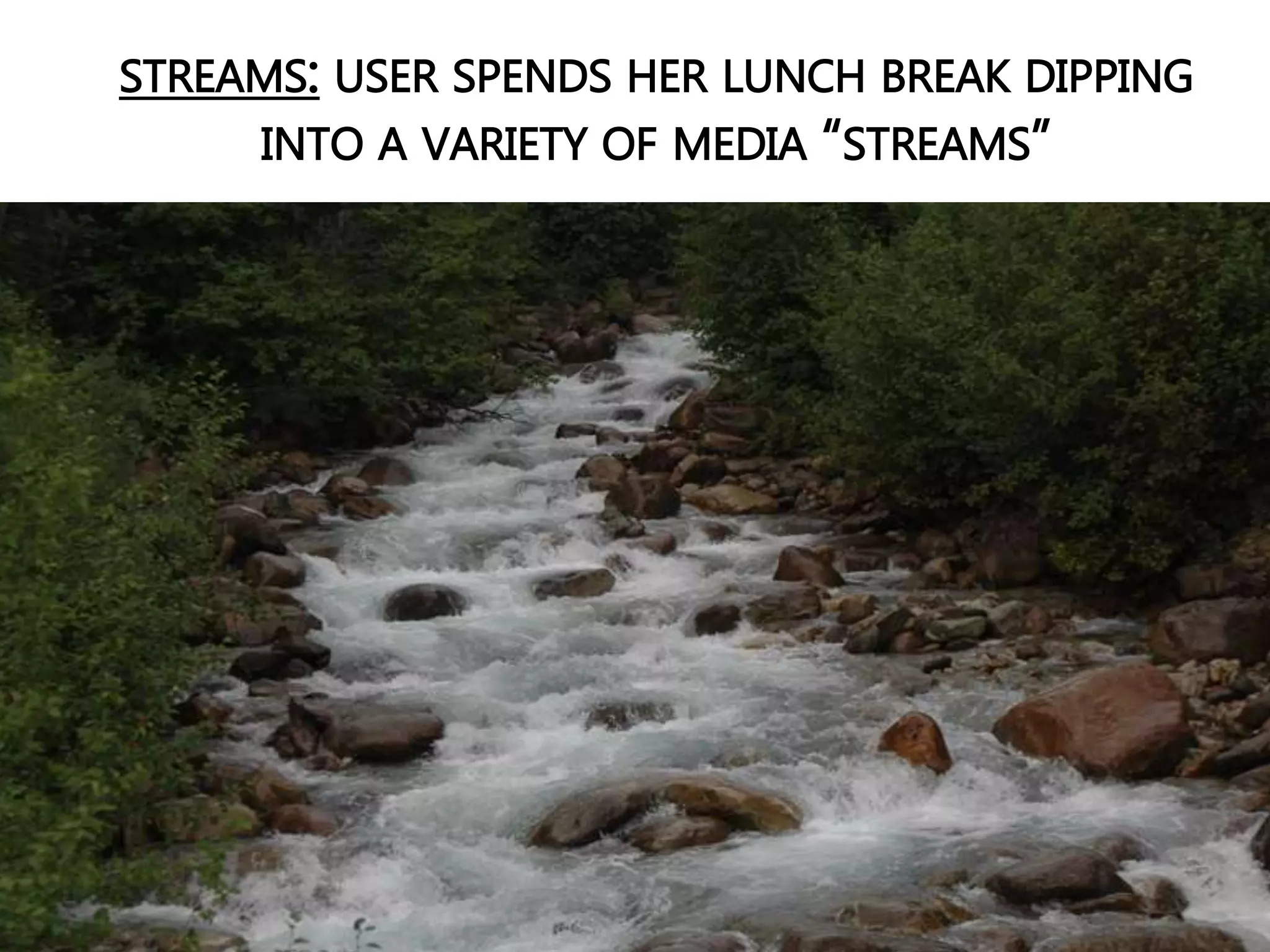
STREAMS: USER SPENDS HER LUNCH BREAK DIPPING
INTO A VARIETY OF MEDIA “STREAMS”
How it works
• Motive – catching up / checking in / curiosity
• Content – news (broad definition), social updates
• Demographics – tilts under 35 / female
• Device – any / all
• Engagement – continuous partial attention /
horizontal scans / sharing
• Influentials – editors, social networks
• ~ Mindshare – quarter to a third of media time
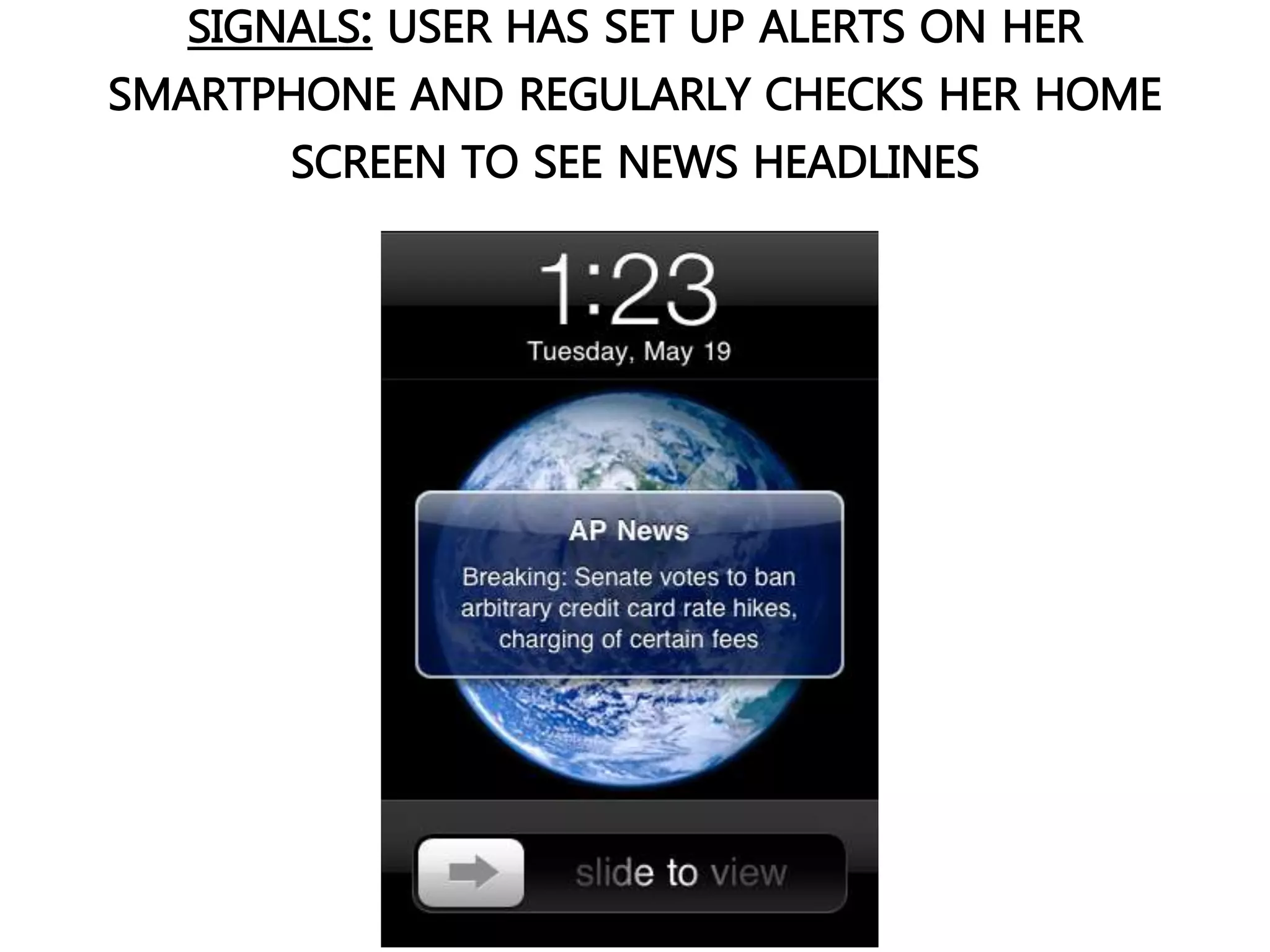
SIGNALS: USER HAS SET UP ALERTS ON HER
SMARTPHONE AND REGULARLY CHECKS HER HOME
SCREEN TO SEE NEWS HEADLINES
How it works
• Motive – real-time awareness
• Content – headlines, new information, first
impressions matter most
• Demographics – under 30, tilts women
• Device – smartphone, tablet
• Engagement – glancing OR galvanized
• Influentials – brands
• ~ Mindshare – < 5% of media time
SNACKS: USER ACCESSES HER MOBILE DEVICE WHEN SHE
HAS A SMALL AMOUNT OF TIME TO KILL
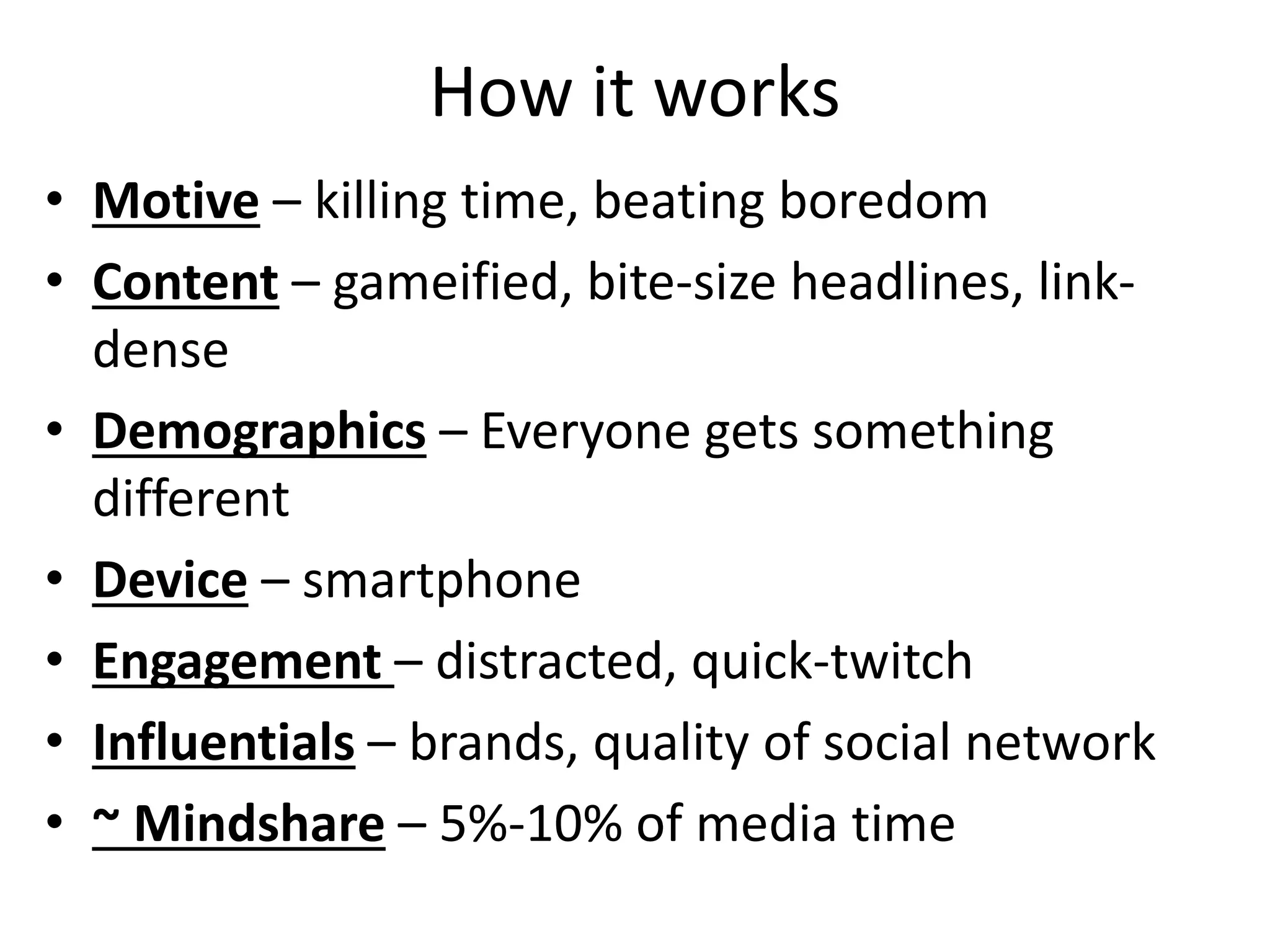
How it works
• Motive – killing time, beating boredom
• Content – gameified, bite-size headlines, link-
dense
• Demographics – Everyone gets something
different
• Device – smartphone
• Engagement – distracted, quick-twitch
• Influentials – brands, quality of social network
• ~ Mindshare – 5%-10% of media time
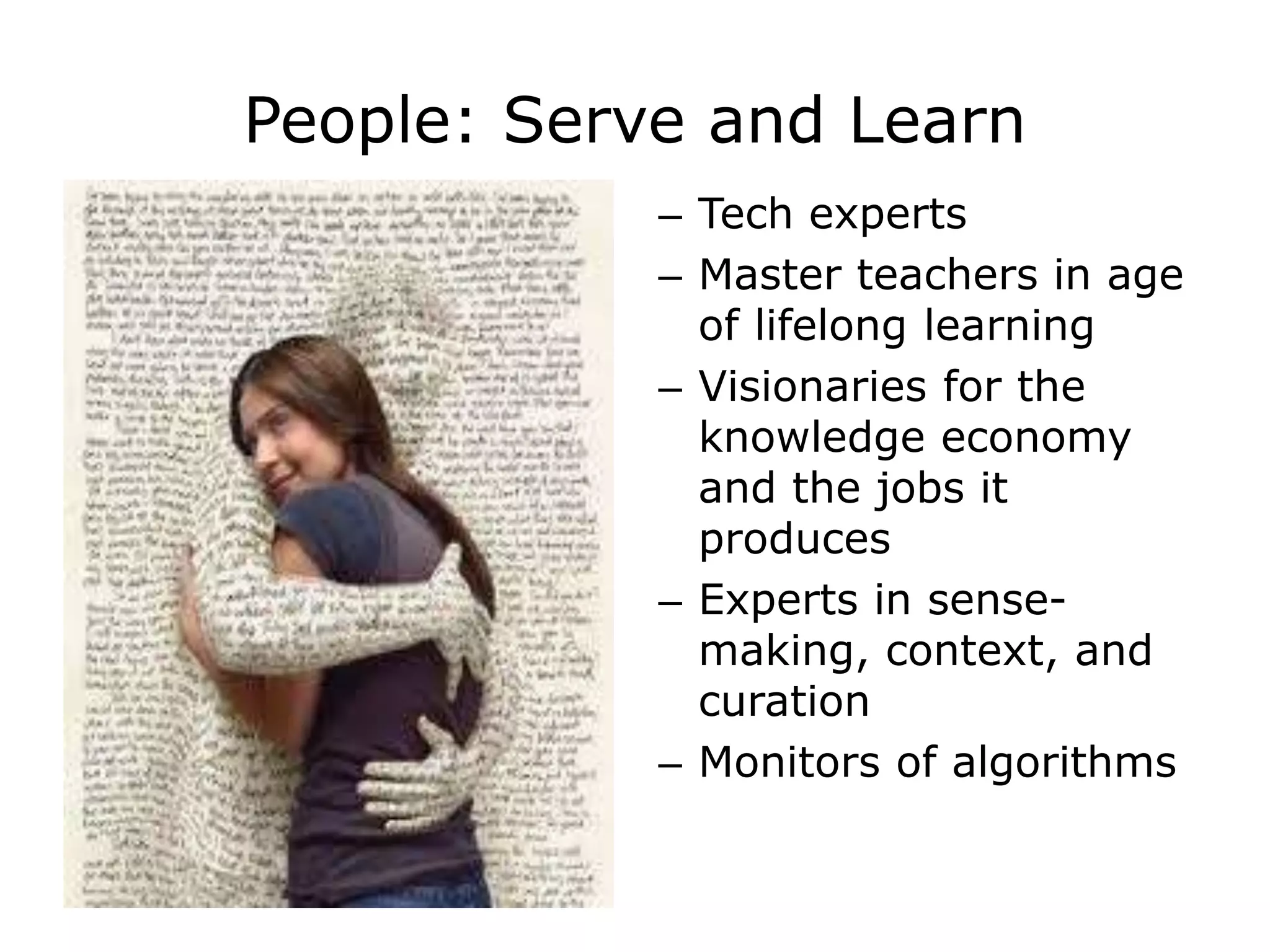
People: Serve and Learn
– Tech experts
– Master teachers in age
of lifelong learning
– Visionaries for the
knowledge economy
and the jobs it
produces
– Experts in sense-
making, context, and
curation
– Monitors of algorithms
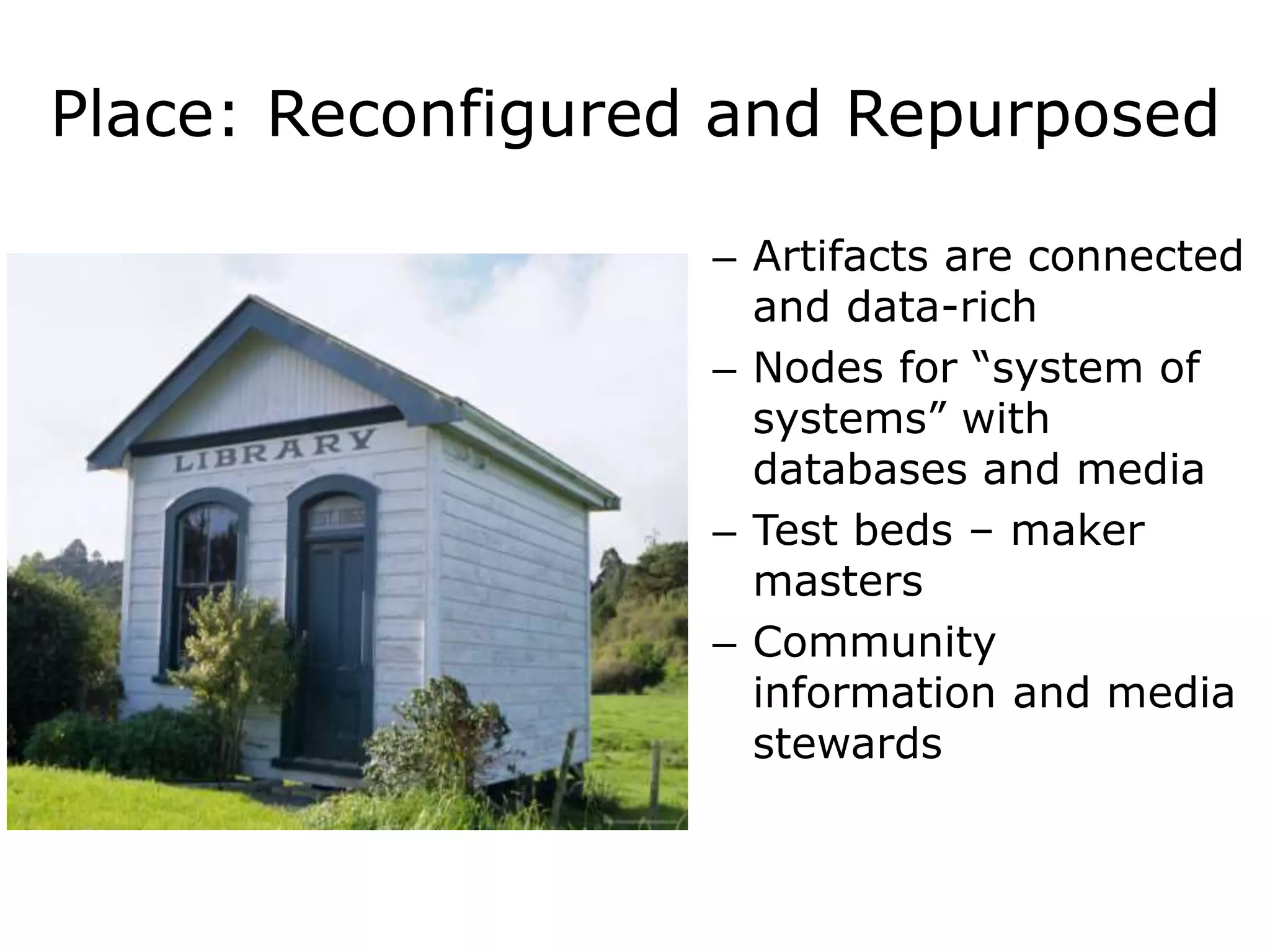
Place: Reconfigured and Repurposed
– Artifacts are connected
and data-rich
– Nodes for “system of
systems” with
databases and media
– Test beds – maker
masters
– Community
information and media
stewards
Platform: Community Resource
– Trusted institution
and privacy watchdog
– Advocates for free
and open
– Advocates for closing
digital divides
– Data and collections
repositories
– Civic specialists –
esp. in learning
realms
Examples of market and cultural shortcomings
librarians are addressing – or could address
1) Technology non-users - skills training in new
literacies
2) Pre-school programs
3) After school activities
4) English as a second language courses
5) Lifelong learning opportunities / credentialing
competency
6) Fill gaps in local media ecosystem – community
and civic information/curation
7) Help for small business / entrepreneurs / non-
profits
8) Serendipity agents of discovery
Be not
afraid
Extra material
Pew Research Center archive of
library-related research:
Libraries.pewinternet.org
Q1: What is the future of
knowledge?
• How is it created?
• What are its interfaces?
• How is it disseminated?
Homework: Too Big To Know
David Weinberger
Q2: What is the future of
reference expertise?
How do you search for information?
How do you aggregate / curate it?
What new literacies are required to
understand it?
Homework: http://searchengineland.com/
Danny Sullivan & Co.
Q3: What is the future of
public technology
What is the future of knowledge access points?
What divides persist / emerge?
What lending models are enabled in a new era of
property / subscription / sharing?
Homework: Confronting the Future: Strategic Visions
for the 21st Century Public Library
Roger Levien
Q4: What is the future of
learning spaces
What fosters collaboration? Creativity? Problem
solving?
What is the role of solitude and quiet spaces?
What other alliances can you strike with institutions
that share your goals about providing key
information to your community?
Homework: A New Culture of Learning
Douglas Thomas & John Seely Brown
Q5: What is the future of
community anchor institutions
Does local matter?
What does our community need?
Homework: Informing Communities:
Sustaining Democracy in the Digital Age
Knight Commission on the Information
Needs of Communities
Q6: What’s the
franchise?
What’s the commodity?
Homework: The Innovators Dilemma
The Innovators Solution
Clayton Christensen, Michael Raynor
What Would Google Do?
Jeff Jarvis

The Puzzles Librarians Need to Solve - Vala 2016

  • 1.
    The Puzzles LibrariansNeed to Solve Lee Rainie Director – Internet, Science and Technology Research February 9, 2016 VALA - Melbourne @lrainie | @pewinternet | @pewresearch
  • 3.
    Your 6 bigpuzzles to solve 1. What’s the future of personal enrichment and entertainment? 2. What’s the future of pathways to knowledge (reference expertise)? 3. What’s the future of public technology and community anchor institutions? 4. What’s the future of learning “spaces”? 5. What’s the future of attention (and its structural holes)?
  • 4.
    Q6: Where doyou fit on the continuum? ALA’s “Confronting the Future” Totally physical (facilities and media) Individual focus Collection library (physical and virtual) Archive Everything for everyone Totally virtual (facilities and media) Community focus Creation library (social, maker space) Portal Specialized niche
  • 5.
  • 6.
    Our previous findings libraries.pewinternet.org •People think libraries are important, especially for communities • People like and trust librarians • People think libraries level of the playing field for those without vast resources • People think libraries provide services that are hard to get elsewhere • People believe libraries have rebranded themselves as tech hubs
  • 7.
  • 8.
    Q1: What isthe future of knowledge?
  • 9.
    • How isit created? New scientific method (and citizen scientists) … Big data … Niches and argument … Simulations and models • What are its interfaces? New displays … Networked data/info … Gamified environments • How is it disseminated? Social networks and media … Flipped schools
  • 10.
    Learning as identity(% of those ages 18+) 58 61 73 0 10 20 30 40 50 60 70 80 I often find myself looking for new opportunities to grow as a person I like to gather as much information as I can when I come across something that I am not familiar with I think of myself as a lifelong learner Describes me very well
  • 11.
    74% of alladults are personal enrichment learners % of those ages 18+ 16 25 30 35 58 0 10 20 30 40 50 60 70 Taken online course Taken course related to interest/hobby Attend convention/conference tied to personal interest Attended meeting where learned new info such as book club or arts club Read publications related to personal interest
  • 12.
    The motives ofpersonal learners % of those ages 18+ 33 36 60 64 80 0 10 20 30 40 50 60 70 80 90 Learn something to help with my children's or other kids school work Wanted to turn a hobby into extra income Extra time on my hands Learn something that would allow me to help others Learn something make my life more interesting
  • 13.
    63% of theemployed are work-related learners – i.e. gotten training or taken courses (% of those ages 18+) 7 13 24 36 55 0 10 20 30 40 50 60 Because I am worried about losing job To help get a new job To help get a raise/promotion For a license or certification for my job To maintain or improve my job skills
  • 14.
    Q2: What isthe future of pathways to knowledge (reference expertise)?
  • 15.
    What is thefuture of learning? -- Shana Ratner (1997) “Emerging Issues in Learning Communities” New: Learning as a process Knowledge is objective and certain Old: Learning as transaction Knowledge is subjective and provisional
  • 16.
    New: Learning as a process Learners receive knowledge Old: Learningas transaction Learners create knowledge What is the future of learning? -- Shana Ratner (1997) “Emerging Issues in Learning Communities”
  • 17.
    New: Learning as a process Knowledgeis organized in stable, hierarchical structures that can be treated independently of one another Old: Learning as transaction Knowledge is organized “ecologically”- disciplines are integrative and interactive What is the future of learning? -- Shana Ratner (1997) “Emerging Issues in Learning Communities”
  • 18.
    New: Learning as a process Welearn best passively, by listening and watching Old: Learning as transaction We learn best actively doing and managing our own learning What is the future of learning? -- Shana Ratner (1997) “Emerging Issues in Learning Communities”
  • 19.
    New: Learning as a process Our “intelligence”is based on our individual abilities Old: Learning as transaction Our “intelligence” is based on our networks What is the future of learning? -- Shana Ratner (1997) “Emerging Issues in Learning Communities”
  • 20.
    How do yousearch for information? Bigger, better search for everything … New interfaces …“Semantic web” … Bots … Predictive analytics How do you aggregate / curate it? Key attribute of a helpful network “node” … “Do what you do best and link to the rest” What new literacies are required to understand it? Searching … Evaluating … Pattern recognition and critical thinking … Coding and media production skills
  • 21.
    Q3: What isthe future of public technology and community anchor institutions?
  • 22.
    22 Libraries stack upwell vs. others How confident? How important? 63 28 Library to community
  • 23.
    Should libraries movesome print books and stacks OUT OF public locations to free up more space for things such as tech centers, reading rooms, meetings rooms, and cultural events? % of those ages 16+ 30 40 25 20 39 36 Should definitely do Should maybe do Should definitely not do Nov-12 Apr-15
  • 24.
    February 5, 201624www.pewresearch.org The clear public mandate: Do something for education …. Large majorities of Americans see libraries as part of the educational ecosystem and as resources for promoting digital and information literacy.
  • 25.
    Should libraries coordinatemore closely with local schools in providing resources to kids? % of those ages 16+ 85 11 2 0 10 20 30 40 50 60 70 80 90 100 Should definitely do Should maybe do Should definitely not do
  • 26.
    85 12 2 0 10 20 30 40 50 60 70 80 90 100 Should definitely doShould maybe do Should definitely not do Should libraries offer free early literacy programs to help young children prepare for school? % of those ages 16+
  • 27.
    Should libraries offerprograms to teach people, including kids and senior citizens, how to use digital tools such as computers, smartphones and apps? % of those ages 16+ 78 16 3 0 10 20 30 40 50 60 70 80 90 100 Should definitely do Should maybe do Should definitely not do
  • 28.
    How well, ifat all, do your local public libraries serve the learning and educational needs of your local community – not just children at schools, but all those of any age who want to learn? % of those ages 18+ 37 39 6 4 12 0 20 40 60 80 100 Very well Pretty well Not too well Not well at all Don't know
  • 29.
    How well, ifat all, do your local public libraries serve the learning and educational needs of you and your family? (% of those ages 18+) 34 36 9 12 8 0 20 40 60 80 100 Very well Pretty well Not too well Not well at all Don't know
  • 30.
    Q4: What isthe future of learning spaces?
  • 31.
    Where personal learnersdid their learning (% of adults who did personal learning in past 12 months) 52 35 29 26 23 31 0 10 20 30 40 50 60 On the internet At educational facility At a community center or museum At a church, temple, or synagogue At a library At some other place
  • 32.
    Where professional learnersgot their training (% of employed who got job training in past 12 months) 75 55 48 43 37 21 9 14 0 10 20 30 40 50 60 70 80 At your workplace On the internet At offsite facility At a convention, conference At home At a government agency At a library Some other place
  • 33.
    New kinds ofenrichment/entertainment are networked and aimed at networked individuals • Can be DIY and self-paced • Can be experiential, participatory • Can be just-in time, real time • Can draw on peers and their networks • Can be place-agnostic • Can exploit augmented reality • Can have gaming sensibilities • Can exploit feedback and analytics
  • 34.
    Should libraries offerprograms to teach patrons about protecting their privacy and security online? % of those ages 16+ 76 18 4 0 10 20 30 40 50 60 70 80 90 100 Should definitely do Should maybe do Should definitely not do
  • 35.
    Should libraries havemore comfortable spaces for reading, working, and relaxing at the library? % of those ages 16+ 64 25 7 0 10 20 30 40 50 60 70 80 90 100 Should definitely do Should maybe do Should definitely not do
  • 36.
    Q5: What isthe future of attention?
  • 37.
    STREAMS: USER SPENDSHER LUNCH BREAK DIPPING INTO A VARIETY OF MEDIA “STREAMS”
  • 38.
    How it works •Motive – catching up / checking in / curiosity • Content – news (broad definition), social updates • Demographics – tilts under 35 / female • Device – any / all • Engagement – continuous partial attention / horizontal scans / sharing • Influentials – editors, social networks • ~ Mindshare – quarter to a third of media time
  • 39.
    SIGNALS: USER HASSET UP ALERTS ON HER SMARTPHONE AND REGULARLY CHECKS HER HOME SCREEN TO SEE NEWS HEADLINES
  • 40.
    How it works •Motive – real-time awareness • Content – headlines, new information, first impressions matter most • Demographics – under 30, tilts women • Device – smartphone, tablet • Engagement – glancing OR galvanized • Influentials – brands • ~ Mindshare – < 5% of media time
  • 41.
    SNACKS: USER ACCESSESHER MOBILE DEVICE WHEN SHE HAS A SMALL AMOUNT OF TIME TO KILL
  • 42.
    How it works •Motive – killing time, beating boredom • Content – gameified, bite-size headlines, link- dense • Demographics – Everyone gets something different • Device – smartphone • Engagement – distracted, quick-twitch • Influentials – brands, quality of social network • ~ Mindshare – 5%-10% of media time
  • 43.
    People: Serve andLearn – Tech experts – Master teachers in age of lifelong learning – Visionaries for the knowledge economy and the jobs it produces – Experts in sense- making, context, and curation – Monitors of algorithms
  • 44.
    Place: Reconfigured andRepurposed – Artifacts are connected and data-rich – Nodes for “system of systems” with databases and media – Test beds – maker masters – Community information and media stewards
  • 45.
    Platform: Community Resource –Trusted institution and privacy watchdog – Advocates for free and open – Advocates for closing digital divides – Data and collections repositories – Civic specialists – esp. in learning realms
  • 46.
    Examples of marketand cultural shortcomings librarians are addressing – or could address 1) Technology non-users - skills training in new literacies 2) Pre-school programs 3) After school activities 4) English as a second language courses 5) Lifelong learning opportunities / credentialing competency 6) Fill gaps in local media ecosystem – community and civic information/curation 7) Help for small business / entrepreneurs / non- profits 8) Serendipity agents of discovery
  • 47.
  • 48.
    Extra material Pew ResearchCenter archive of library-related research: Libraries.pewinternet.org
  • 49.
    Q1: What isthe future of knowledge? • How is it created? • What are its interfaces? • How is it disseminated? Homework: Too Big To Know David Weinberger
  • 50.
    Q2: What isthe future of reference expertise? How do you search for information? How do you aggregate / curate it? What new literacies are required to understand it? Homework: http://searchengineland.com/ Danny Sullivan & Co.
  • 51.
    Q3: What isthe future of public technology What is the future of knowledge access points? What divides persist / emerge? What lending models are enabled in a new era of property / subscription / sharing? Homework: Confronting the Future: Strategic Visions for the 21st Century Public Library Roger Levien
  • 52.
    Q4: What isthe future of learning spaces What fosters collaboration? Creativity? Problem solving? What is the role of solitude and quiet spaces? What other alliances can you strike with institutions that share your goals about providing key information to your community? Homework: A New Culture of Learning Douglas Thomas & John Seely Brown
  • 53.
    Q5: What isthe future of community anchor institutions Does local matter? What does our community need? Homework: Informing Communities: Sustaining Democracy in the Digital Age Knight Commission on the Information Needs of Communities
  • 54.
    Q6: What’s the franchise? What’sthe commodity? Homework: The Innovators Dilemma The Innovators Solution Clayton Christensen, Michael Raynor What Would Google Do? Jeff Jarvis

Editor's Notes

  • #2 Title: The puzzles librarians need to solve   Abstract: In order to thrive in the future, librarians will need to be great forecasters and innovators. There are key puzzles they need to figure out. Among them: What’s the future of personal enrichment and entertainment? What’s the future of people’s pathways to knowledge and reference expertise? What’s the future of public technology and community anchor institutions? What’s the future of learning “spaces”? What’s the future of attention and its structural holes? Lee Rainie of the Pew Research Center will describe how his organization’s research provides guideposts for librarians along three dimensions of library activity: the people, the place, and the platform.  
  • #10 Homework: Too Big To Know (David Weinberger) Susannah book The big data book about new paradigm
  • #21 Homework: http://searchengineland.com/ (Danny Sullivan & Co.) Google blog
  • #38 Motive – browsing for updates / checking in / catching up Content – News (very broad definition), social updates Device – Any Mental engagement / frame of mind – continuous partial attention Gatekeepers and influencers – editors and social networks Proportion of time – quarter to a third of media time Best media strategy – apps, shareable content, mediated by networks, curated by editors Unique point – this is new phenomenon in the digital age [[[[Alerts]]]]] [[[[Anticipatory – IoT]]]]
  • #40 Alerts Breaking news / events