





REUTERS INSTITUTE
DIGITAL NEWS REPORT
KEY FINDINGS FROM 2015
Edited highlights
Curated by:
Damian Radcliffe
Background and
methodology
This is one of the largest news surveys in
the world. Explores the online news habits
of more than 20,000 people in twelve
countries. Research was conducted online
in January/early February 2015.
Additional analysis of key themes, country
level insights from network of partners
RISJ Digital News Report 2015 2
Please note that Brazil is representative of an urban population rather than a national population.
Source: Internet World Stats www.internetworldstats.com internet population estimate 2014.
Key
findings
from
2015
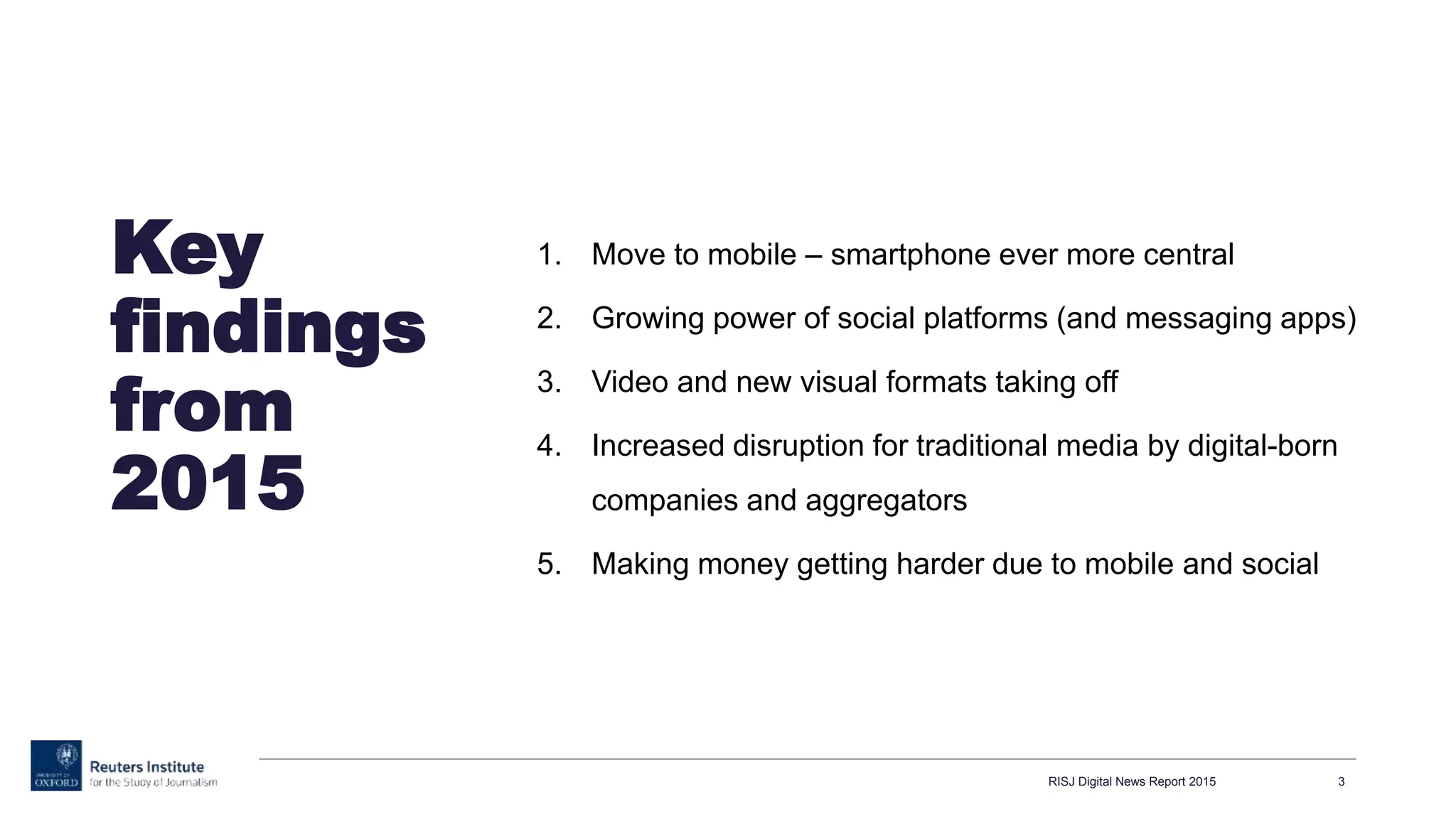
1. Move to mobile – smartphone ever more central
2. Growing power of social platforms (and messaging apps)
3. Video and new visual formats taking off
4. Increased disruption for traditional media by digital-born
companies and aggregators
5. Making money getting harder due to mobile and social
RISJ Digital News Report 2015 3
1. CENTRALITY
OF SMARTPHONES
9 July RISJ Digital News Report 2015
Presentation to TRF Board
4
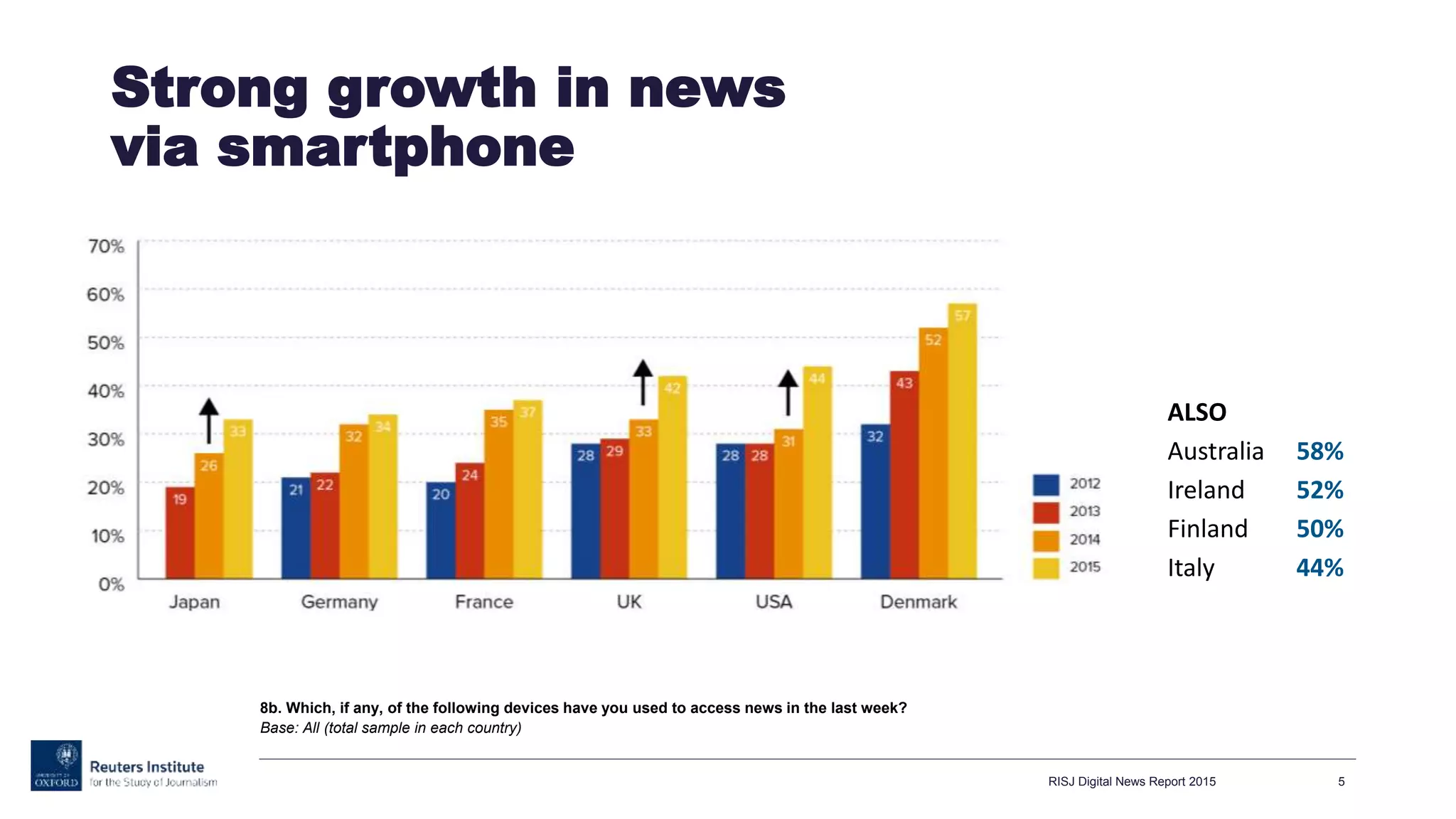
Strong growth in news
via smartphone
RISJ Digital News Report 2015 5
8b. Which, if any, of the following devices have you used to access news in the last week?
Base: All (total sample in each country)
ALSO
Australia 58%
Ireland 52%
Finland 50%
Italy 44%
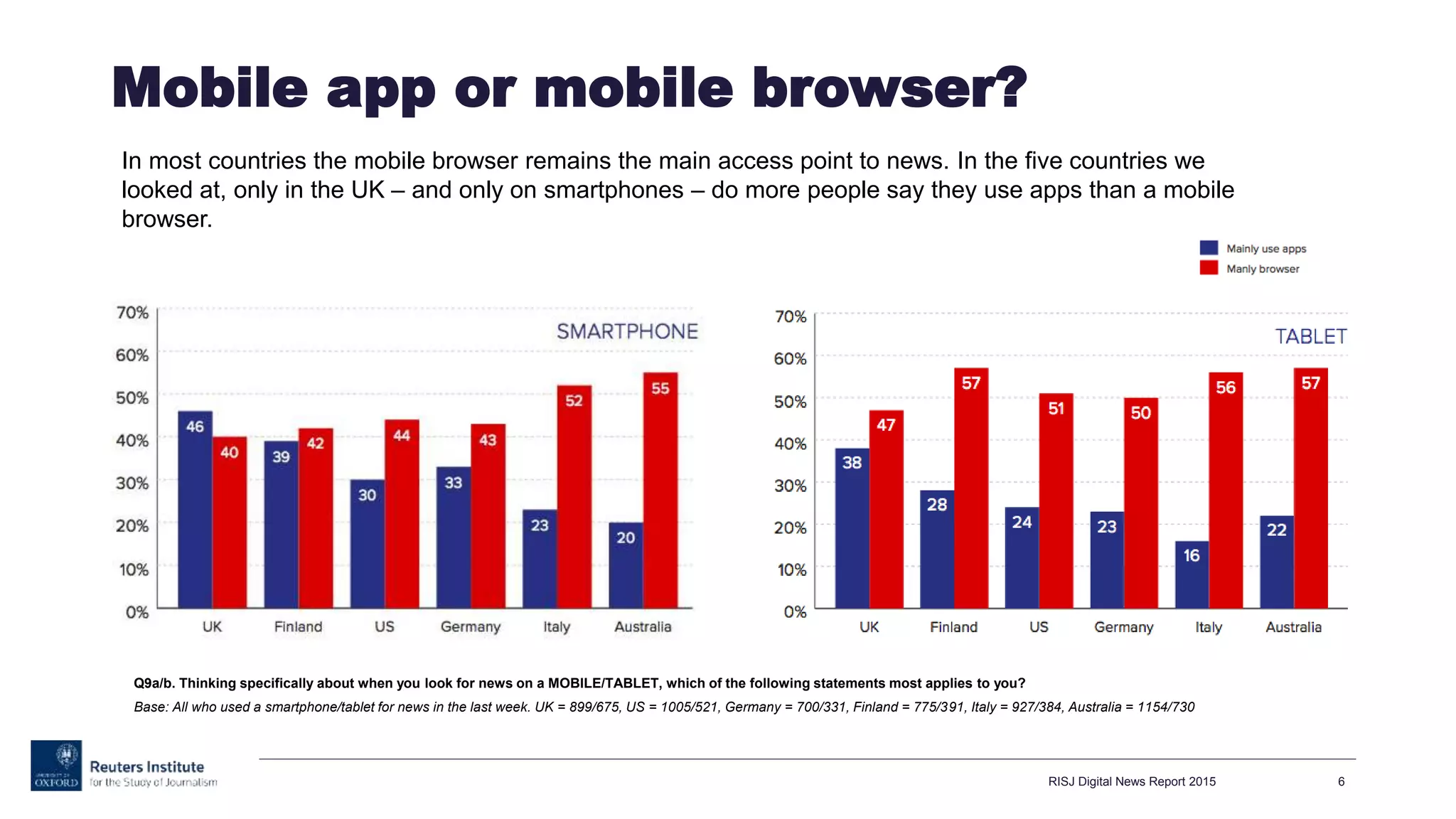
Mobile app or mobile browser?
RISJ Digital News Report 2015 6
In most countries the mobile browser remains the main access point to news. In the five countries we
looked at, only in the UK – and only on smartphones – do more people say they use apps than a mobile
browser.
Q9a/b. Thinking specifically about when you look for news on a MOBILE/TABLET, which of the following statements most applies to you?
Base: All who used a smartphone/tablet for news in the last week. UK = 899/675, US = 1005/521, Germany = 700/331, Finland = 775/391, Italy = 927/384, Australia = 1154/730
The app gap
70%
have a news app installed
on their phone, only a third
actually use them in a
given week
RISJ Digital News Report 2015 7
2. SOURCES OF
NEWS
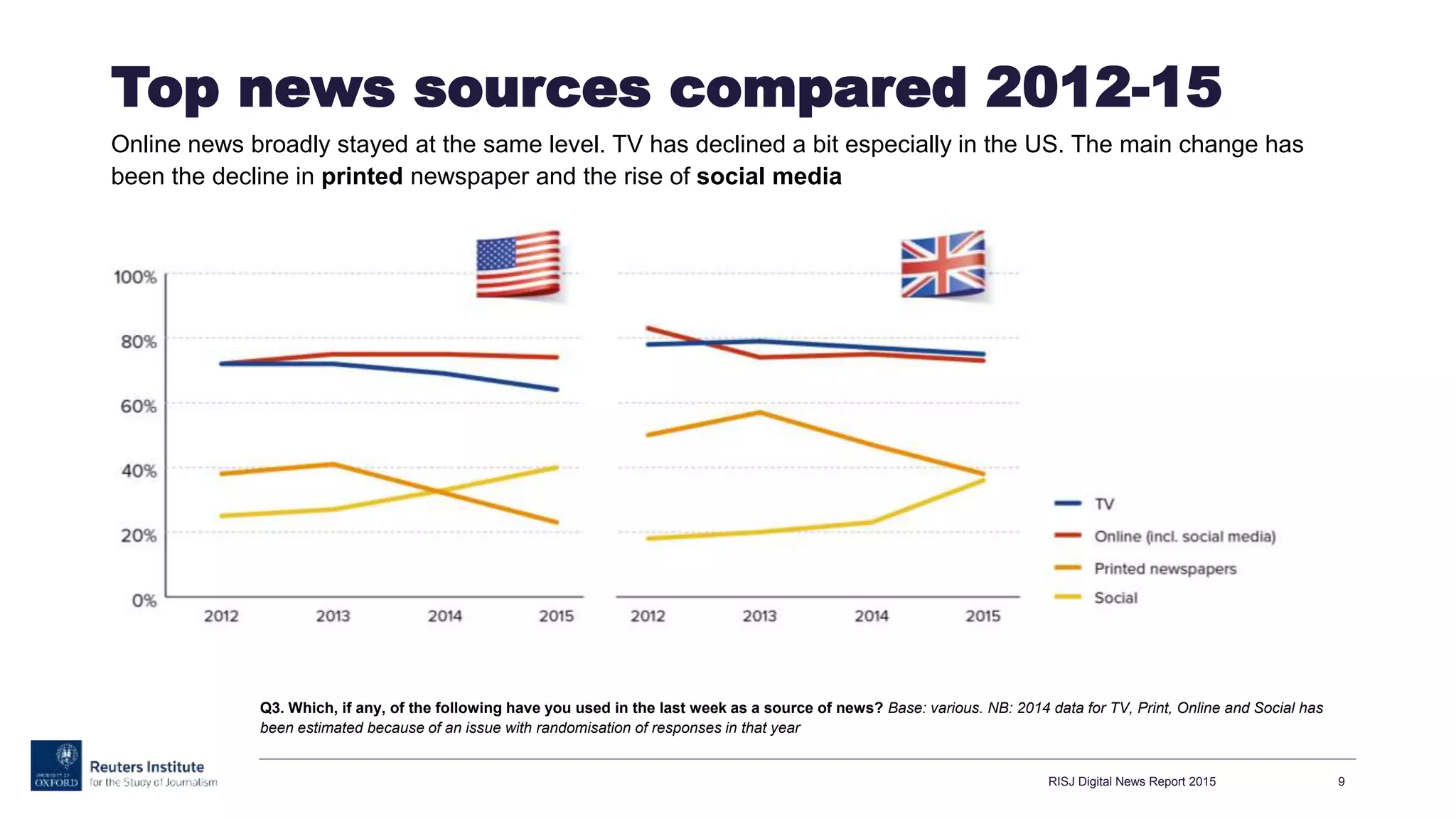
Top news sources compared 2012-15
Online news broadly stayed at the same level. TV has declined a bit especially in the US. The main change has
been the decline in printed newspaper and the rise of social media
RISJ Digital News Report 2015 9
Q3. Which, if any, of the following have you used in the last week as a source of news? Base: various. NB: 2014 data for TV, Print, Online and Social has
been estimated because of an issue with randomisation of responses in that year
Top news sources compared 2012-15
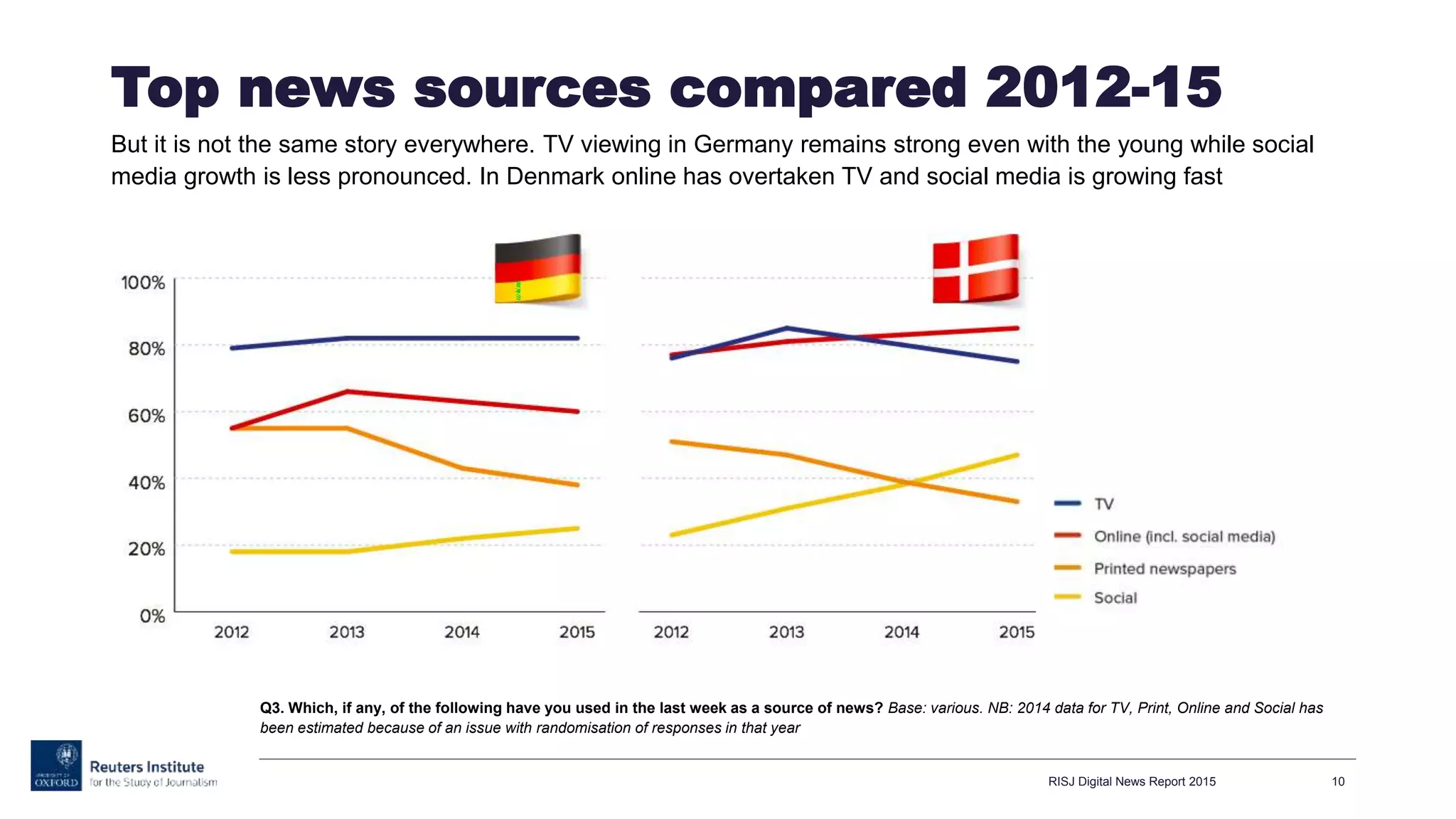
But it is not the same story everywhere. TV viewing in Germany remains strong even with the young while social
media growth is less pronounced. In Denmark online has overtaken TV and social media is growing fast
RISJ Digital News Report 2015 10
Q3. Which, if any, of the following have you used in the last week as a source of news? Base: various. NB: 2014 data for TV, Print, Online and Social has
been estimated because of an issue with randomisation of responses in that year
Main source of news
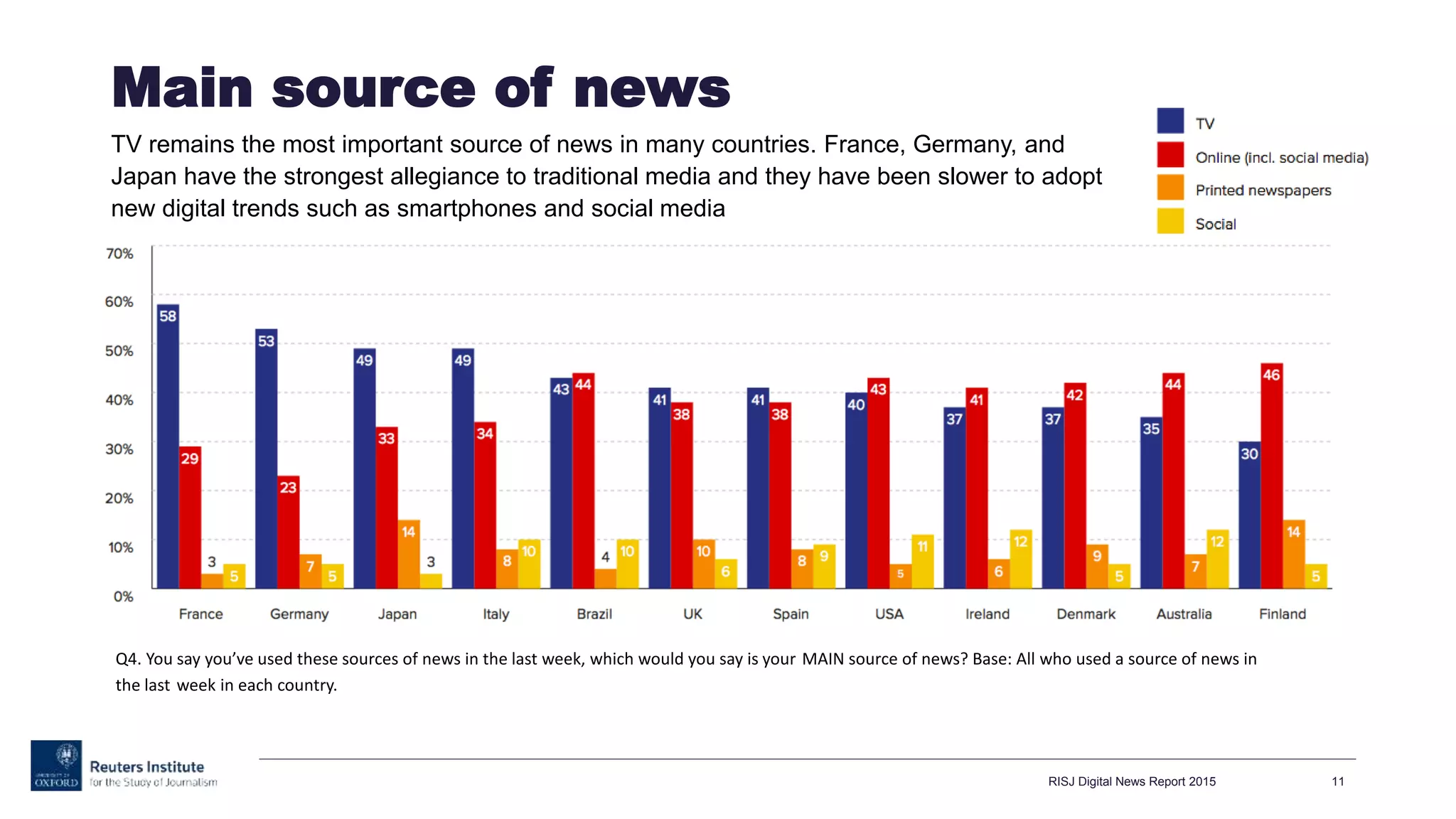
TV remains the most important source of news in many countries. France, Germany, and
Japan have the strongest allegiance to traditional media and they have been slower to adopt
new digital trends such as smartphones and social media
RISJ Digital News Report 2015 11
Q4. You say you’ve used these sources of news in the last week, which would you say is your MAIN source of news? Base: All who used a source of news in
the last week in each country.
Main source of news by age
RISJ Digital News Report 2015 12
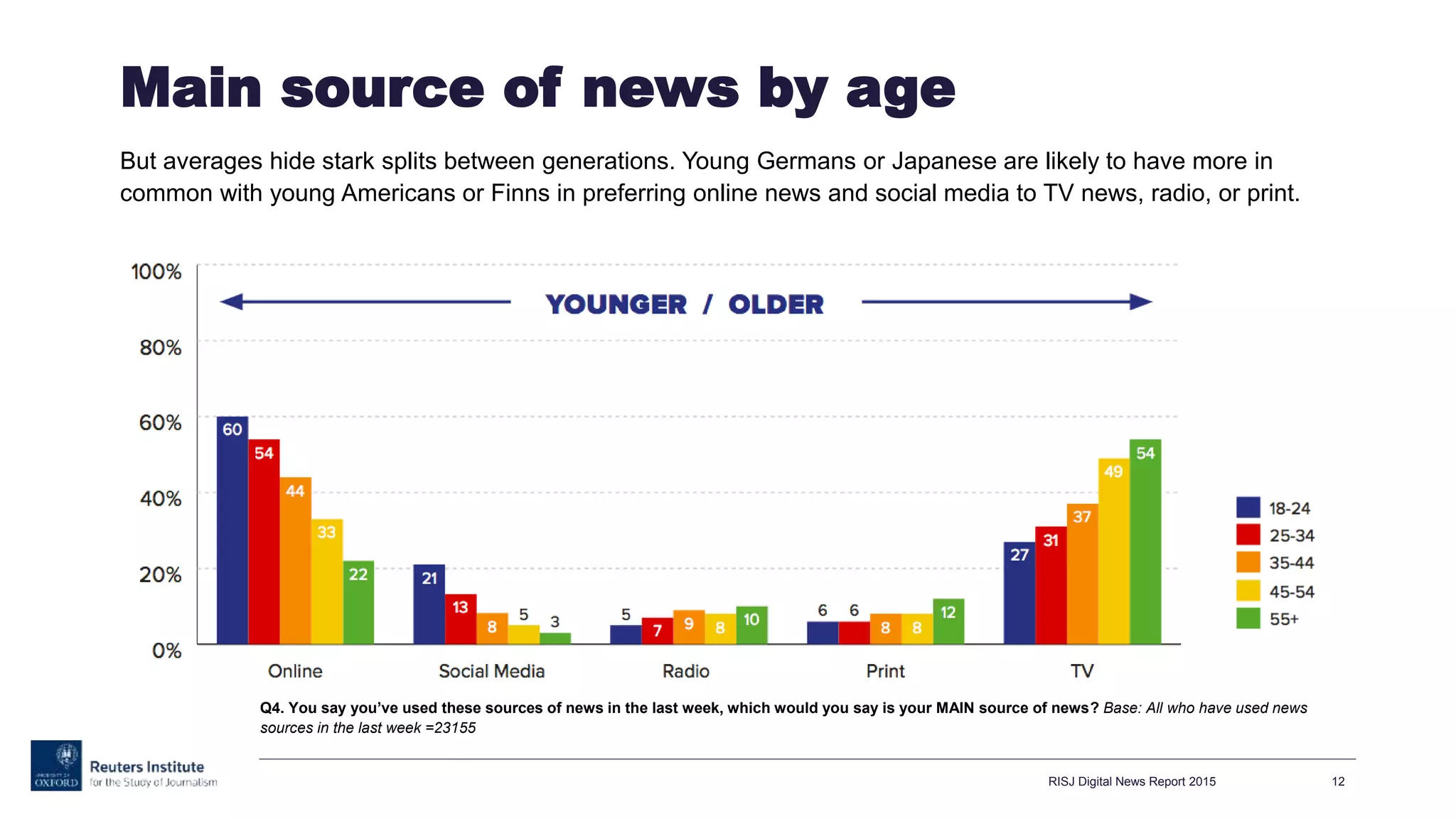
Q4. You say you’ve used these sources of news in the last week, which would you say is your MAIN source of news? Base: All who have used news
sources in the last week =23155
But averages hide stark splits between generations. Young Germans or Japanese are likely to have more in
common with young Americans or Finns in preferring online news and social media to TV news, radio, or print.
Young turning away from TV News
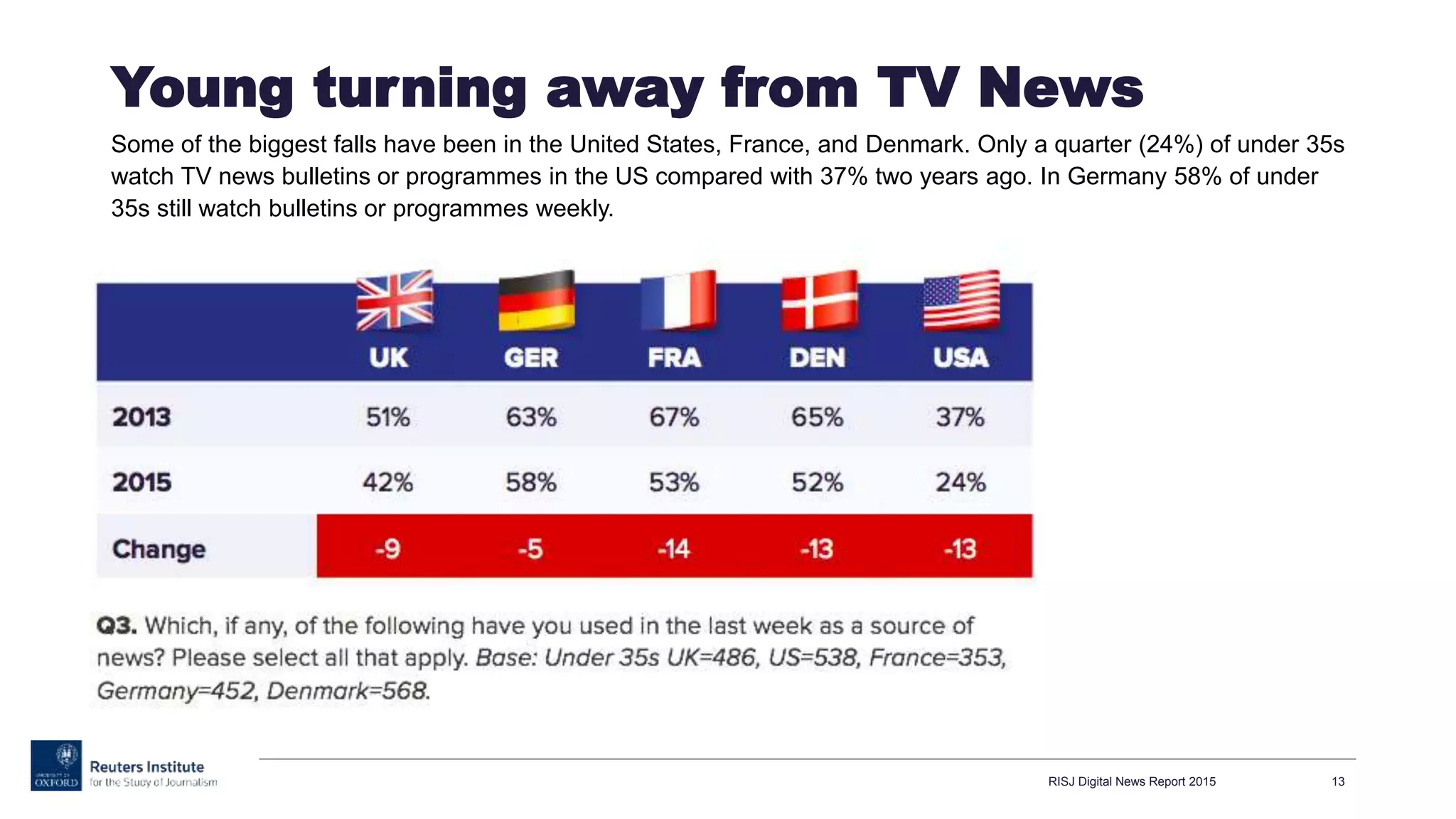
Some of the biggest falls have been in the United States, France, and Denmark. Only a quarter (24%) of under 35s
watch TV news bulletins or programmes in the US compared with 37% two years ago. In Germany 58% of under
35s still watch bulletins or programmes weekly.
RISJ Digital News Report 2015 13
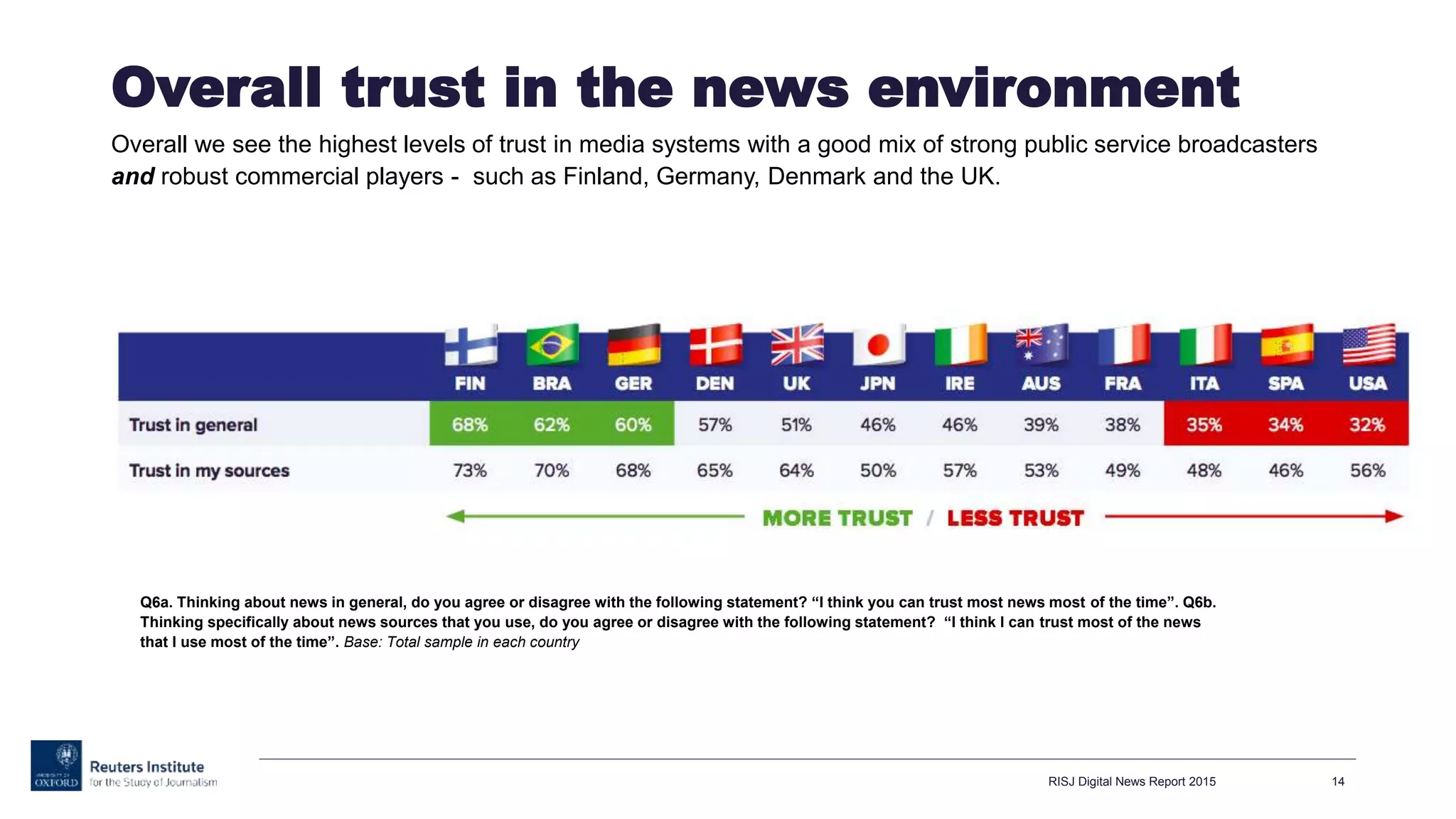
Overall trust in the news environment
Overall we see the highest levels of trust in media systems with a good mix of strong public service broadcasters
and robust commercial players - such as Finland, Germany, Denmark and the UK.
RISJ Digital News Report 2015 14
Q6a. Thinking about news in general, do you agree or disagree with the following statement? “I think you can trust most news most of the time”. Q6b.
Thinking specifically about news sources that you use, do you agree or disagree with the following statement? “I think I can trust most of the news
that I use most of the time”. Base: Total sample in each country
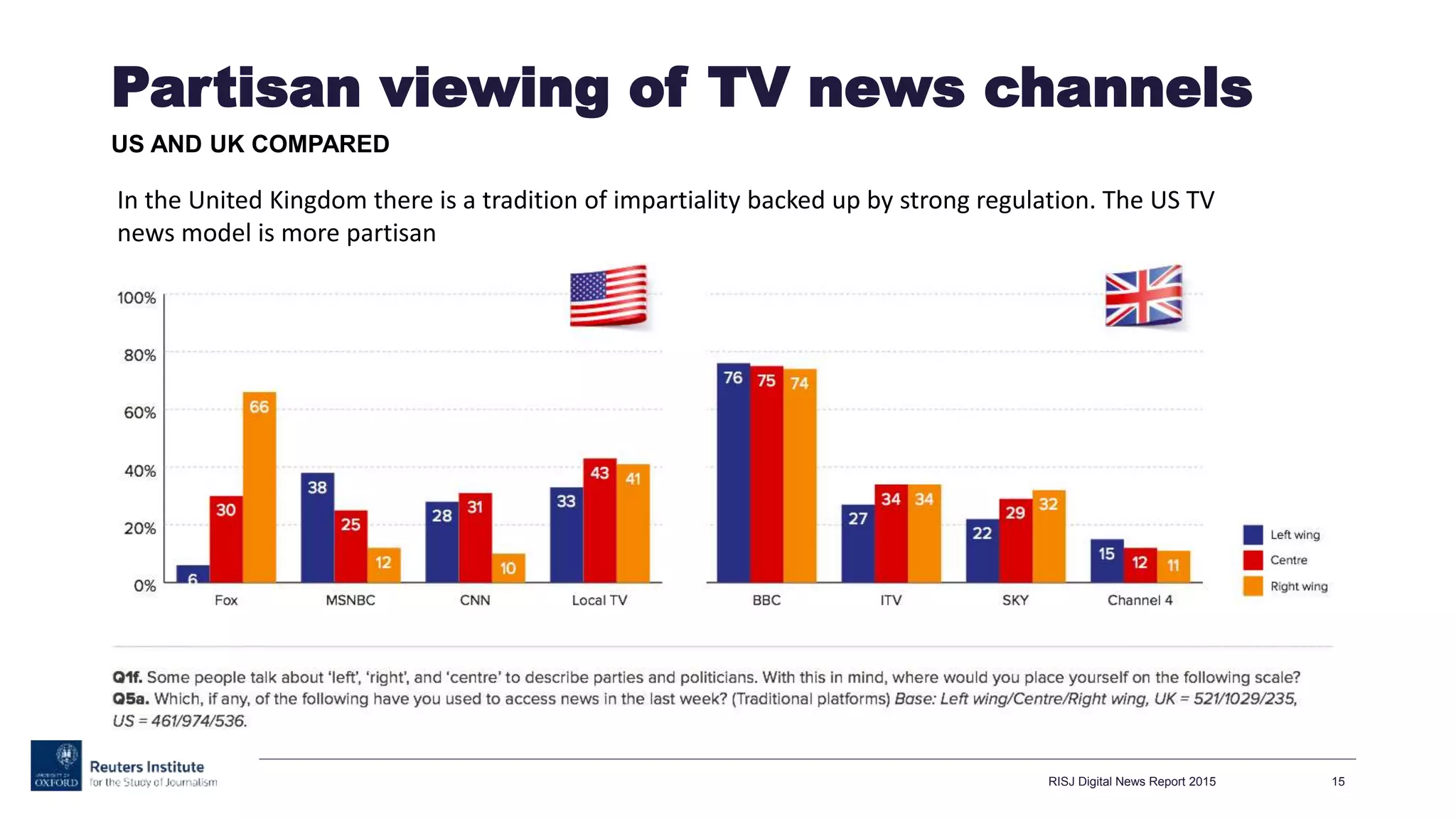
Partisan viewing of TV news channels
US AND UK COMPARED
RISJ Digital News Report 2015 15
In the United Kingdom there is a tradition of impartiality backed up by strong regulation. The US TV
news model is more partisan
3. SOCIAL MEDIA
AND MESSAGING
APPS
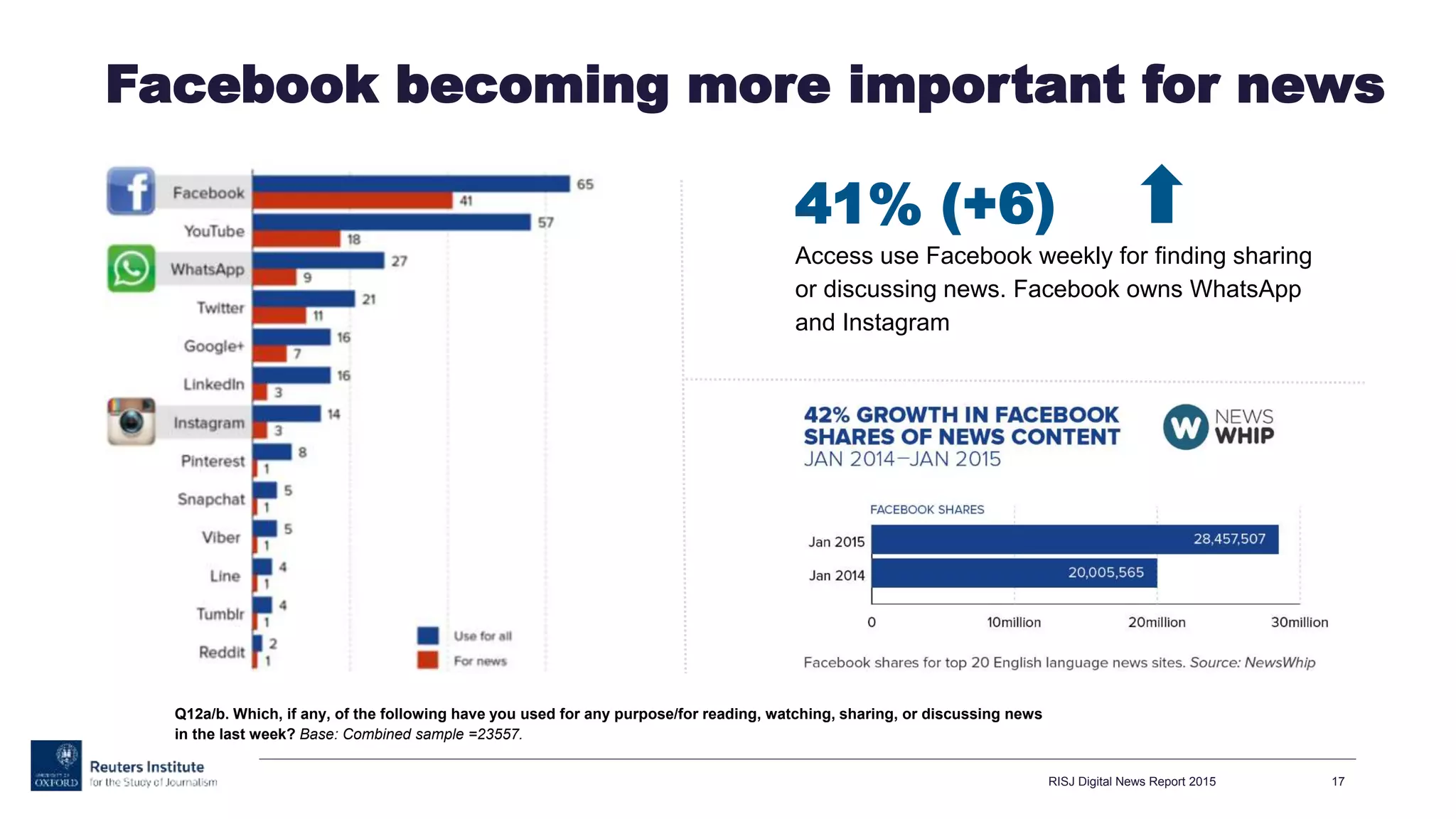
Facebook becoming more important for news
RISJ Digital News Report 2015 17
Q12a/b. Which, if any, of the following have you used for any purpose/for reading, watching, sharing, or discussing news
in the last week? Base: Combined sample =23557.
41% (+6)
Access use Facebook weekly for finding sharing
or discussing news. Facebook owns WhatsApp
and Instagram
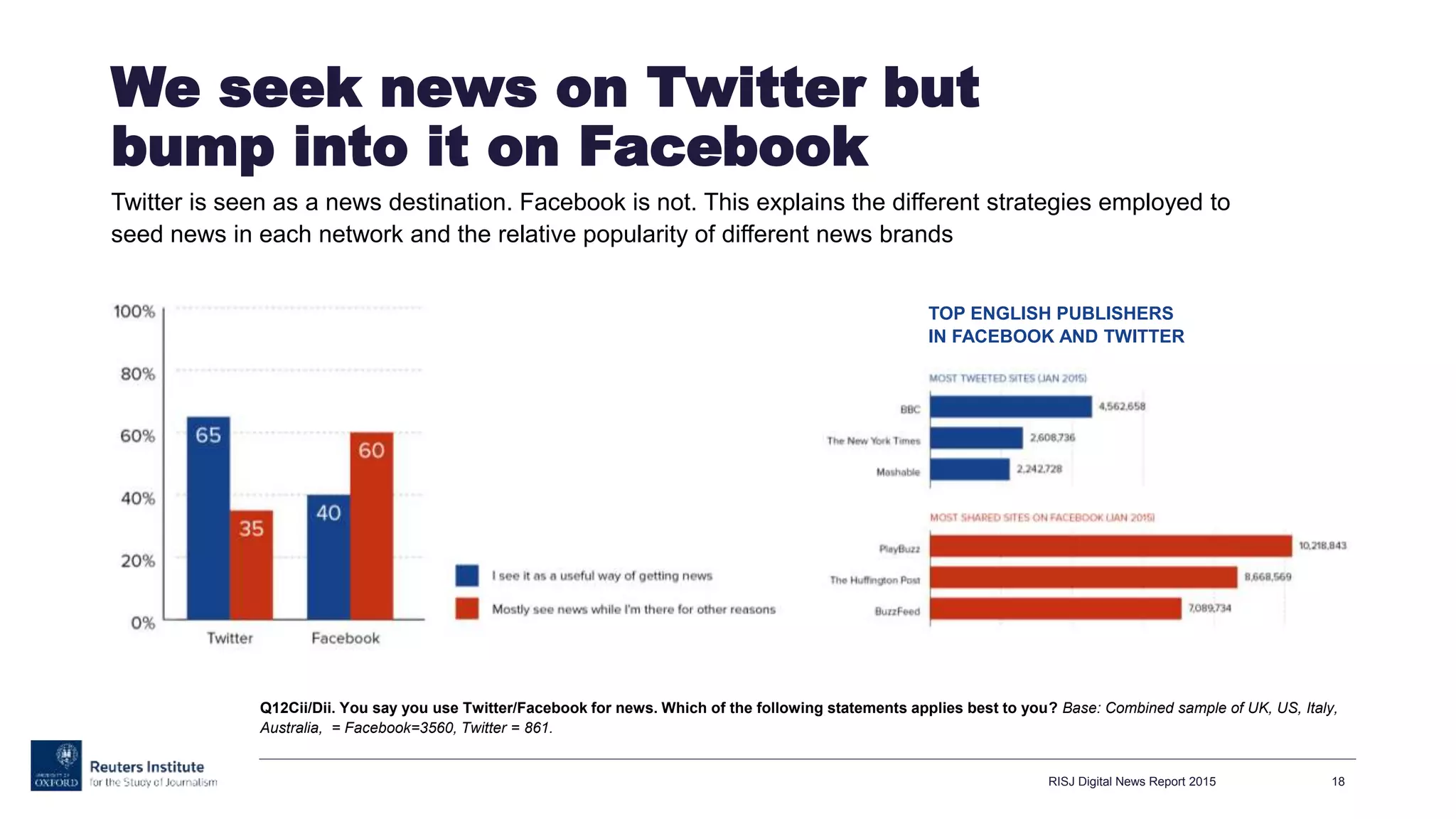
We seek news on Twitter but
bump into it on Facebook
Twitter is seen as a news destination. Facebook is not. This explains the different strategies employed to
seed news in each network and the relative popularity of different news brands
RISJ Digital News Report 2015 18
Q12Cii/Dii. You say you use Twitter/Facebook for news. Which of the following statements applies best to you? Base: Combined sample of UK, US, Italy,
Australia, = Facebook=3560, Twitter = 861.
TOP ENGLISH PUBLISHERS
IN FACEBOOK AND TWITTER
RISJ Digital News Report 2015 19
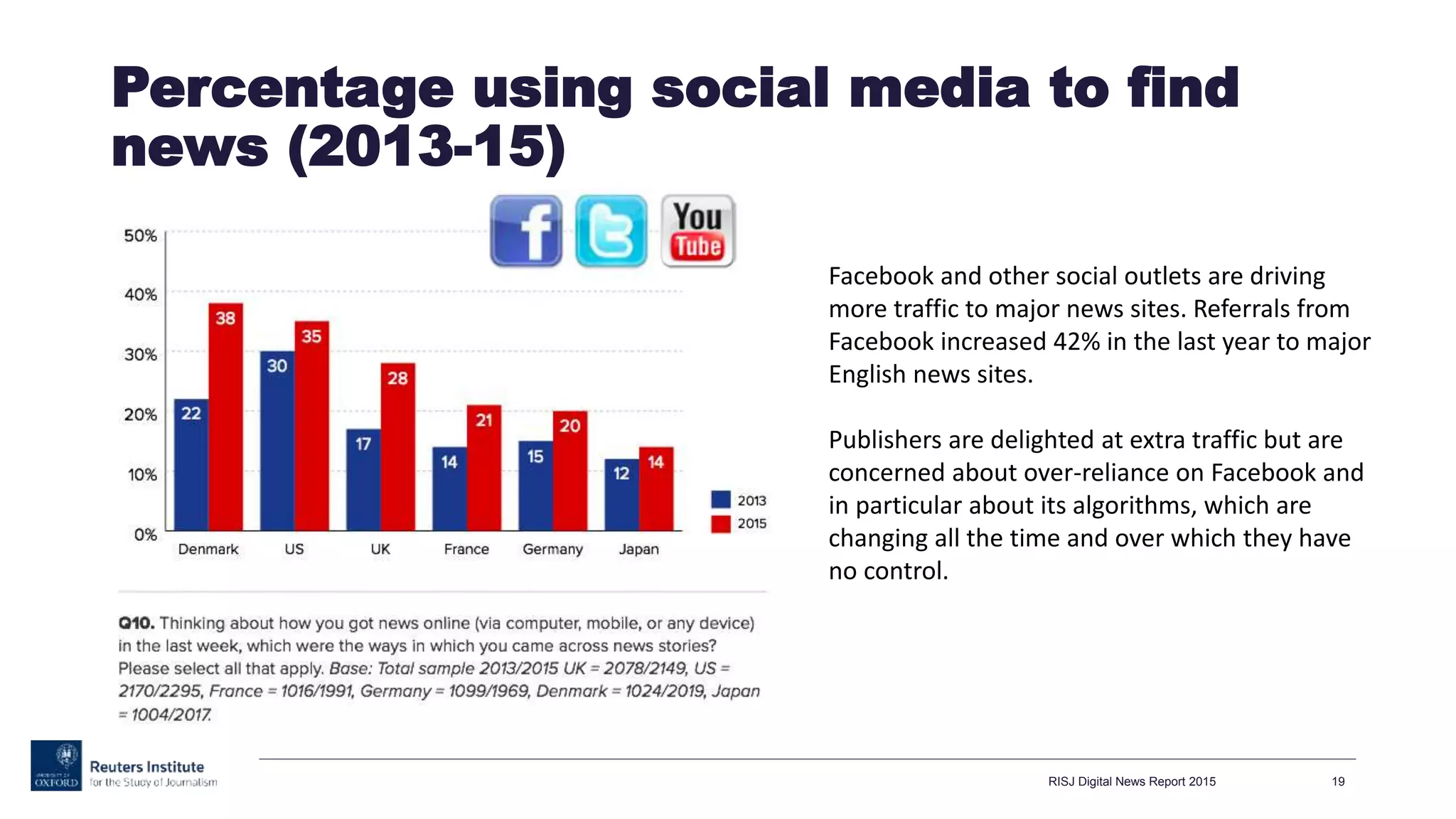
Percentage using social media to find
news (2013-15)
Facebook and other social outlets are driving
more traffic to major news sites. Referrals from
Facebook increased 42% in the last year to major
English news sites.
Publishers are delighted at extra traffic but are
concerned about over-reliance on Facebook and
in particular about its algorithms, which are
changing all the time and over which they have
no control.
4. VIDEO GROWTH
AND NEW FORMATS
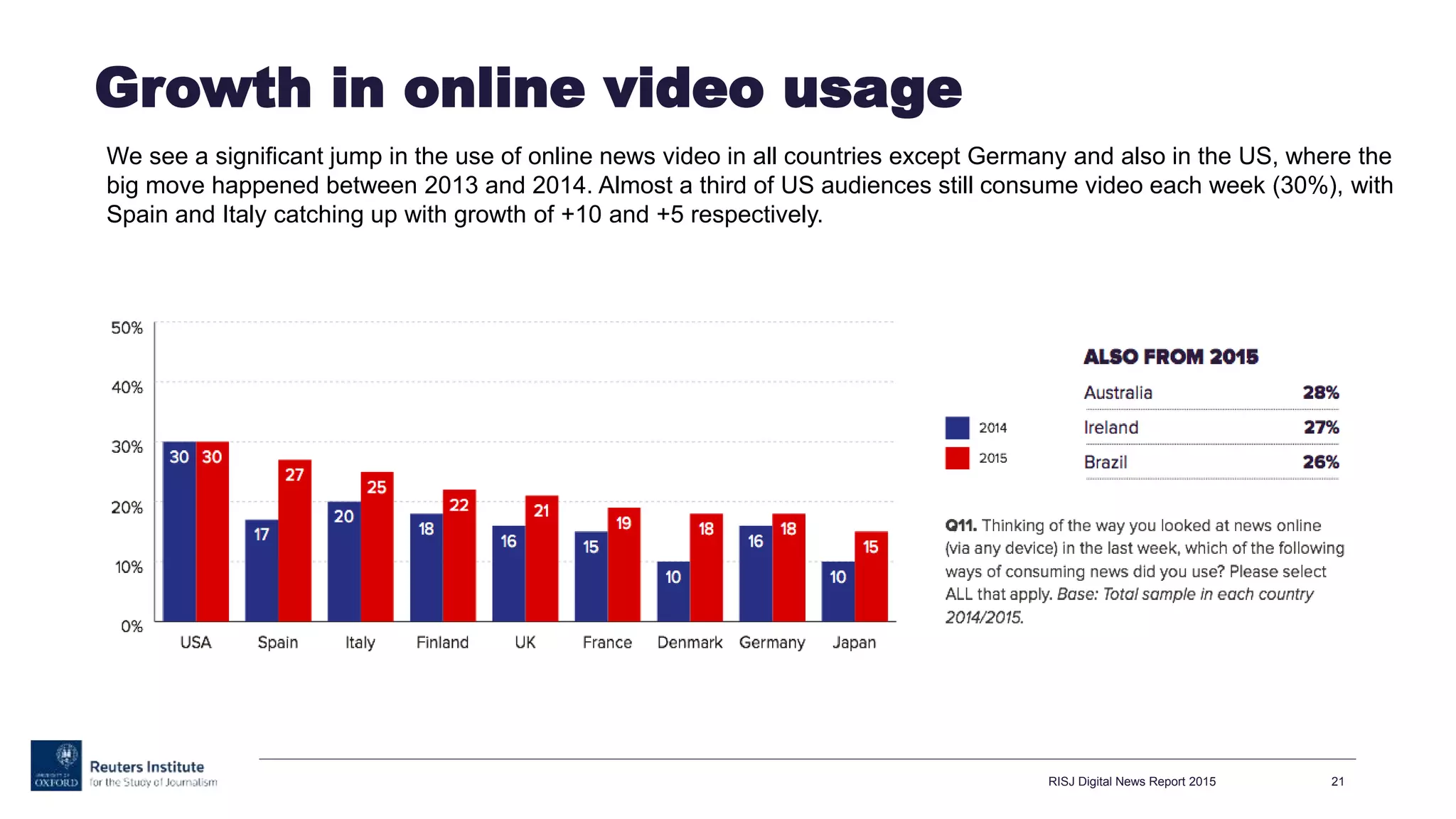
Growth in online video usage
RISJ Digital News Report 2015 21
We see a significant jump in the use of online news video in all countries except Germany and also in the US, where the
big move happened between 2013 and 2014. Almost a third of US audiences still consume video each week (30%), with
Spain and Italy catching up with growth of +10 and +5 respectively.
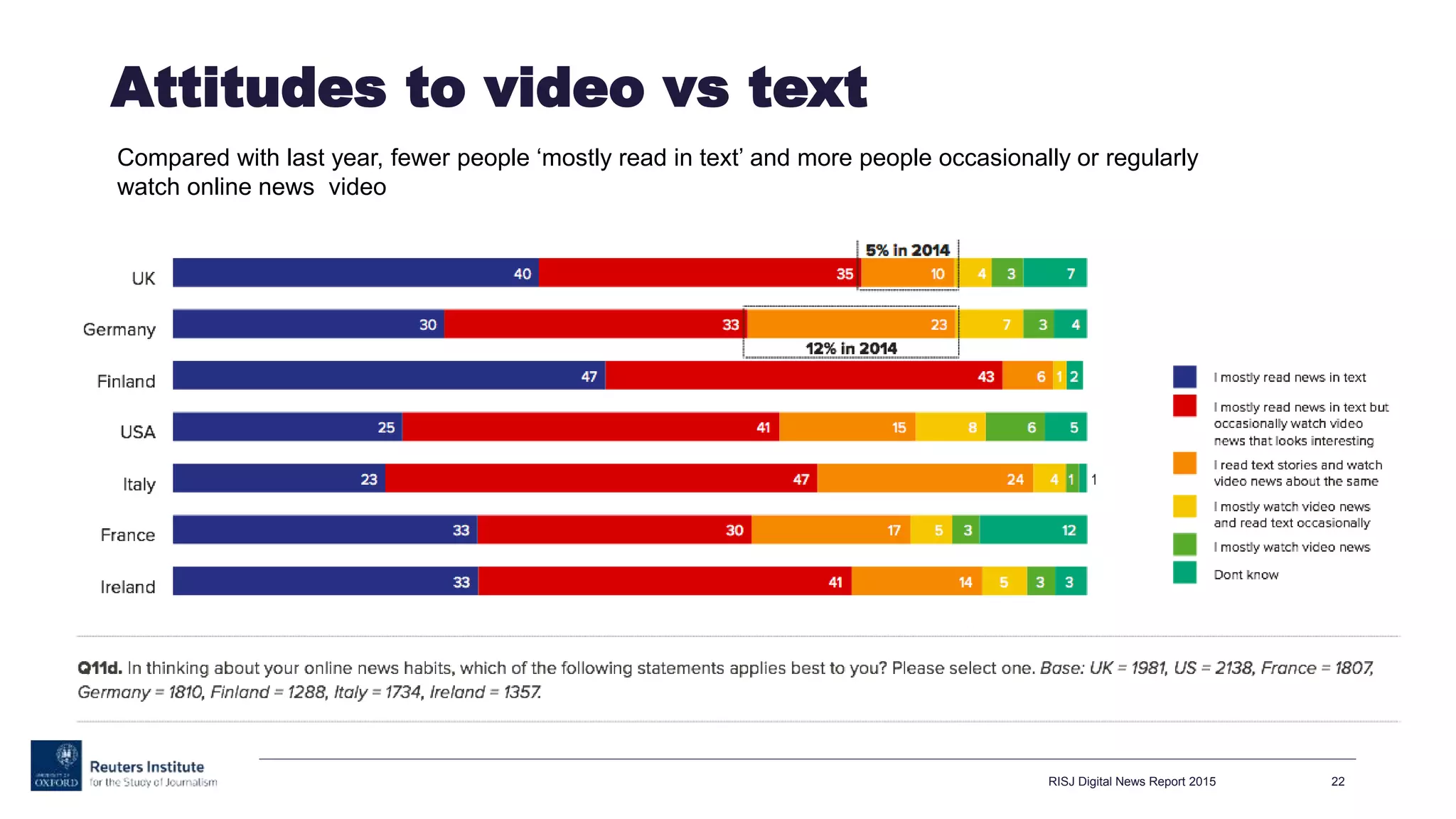
Attitudes to video vs text
RISJ Digital News Report 2015 22
Compared with last year, fewer people ‘mostly read in text’ and more people occasionally or regularly
watch online news video
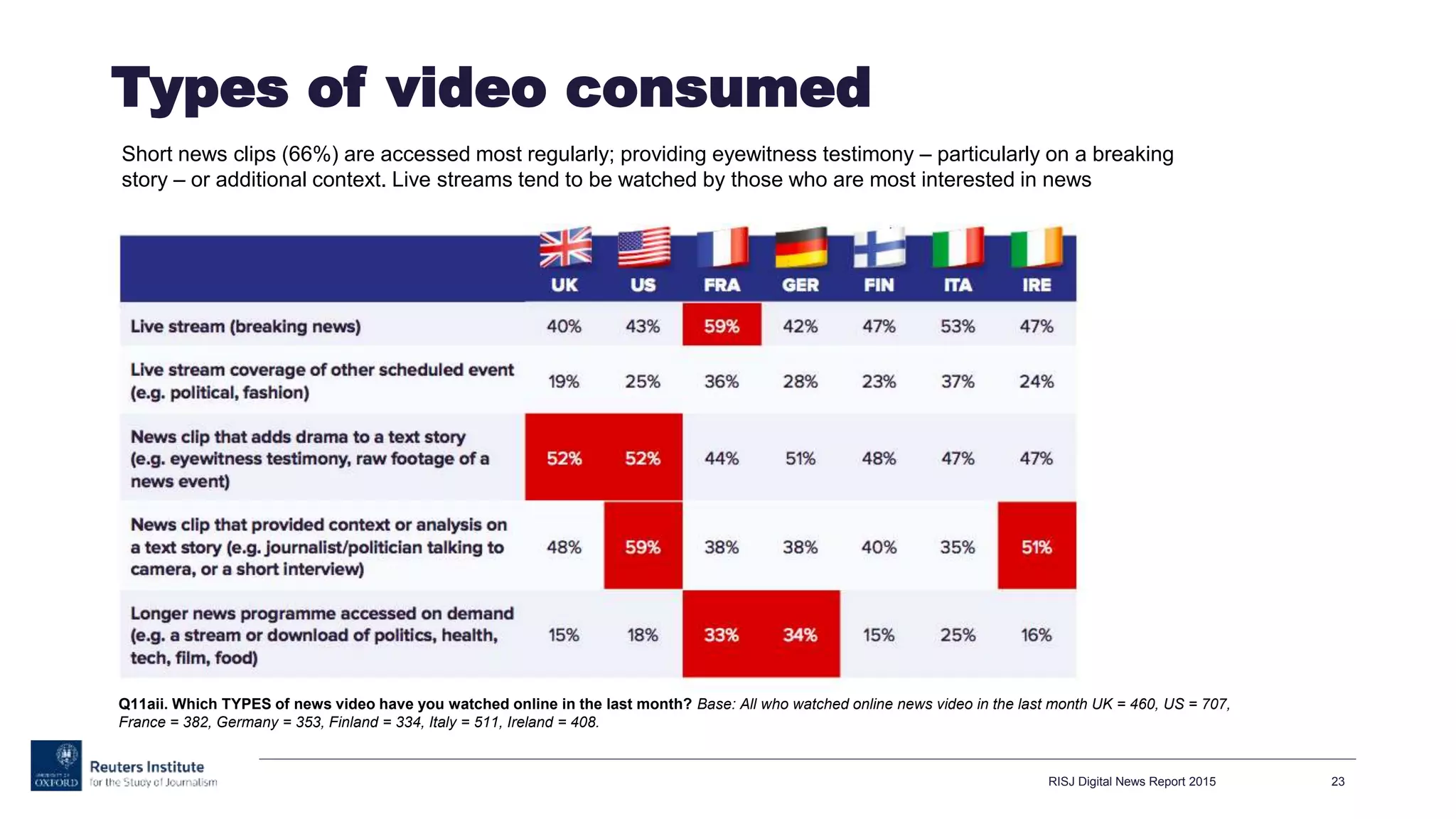
Types of video consumed
RISJ Digital News Report 2015 23
Q11aii. Which TYPES of news video have you watched online in the last month? Base: All who watched online news video in the last month UK = 460, US = 707,
France = 382, Germany = 353, Finland = 334, Italy = 511, Ireland = 408.
Short news clips (66%) are accessed most regularly; providing eyewitness testimony – particularly on a breaking
story – or additional context. Live streams tend to be watched by those who are most interested in news
Barriers to video usage
RISJ Digital News Report 2015 24
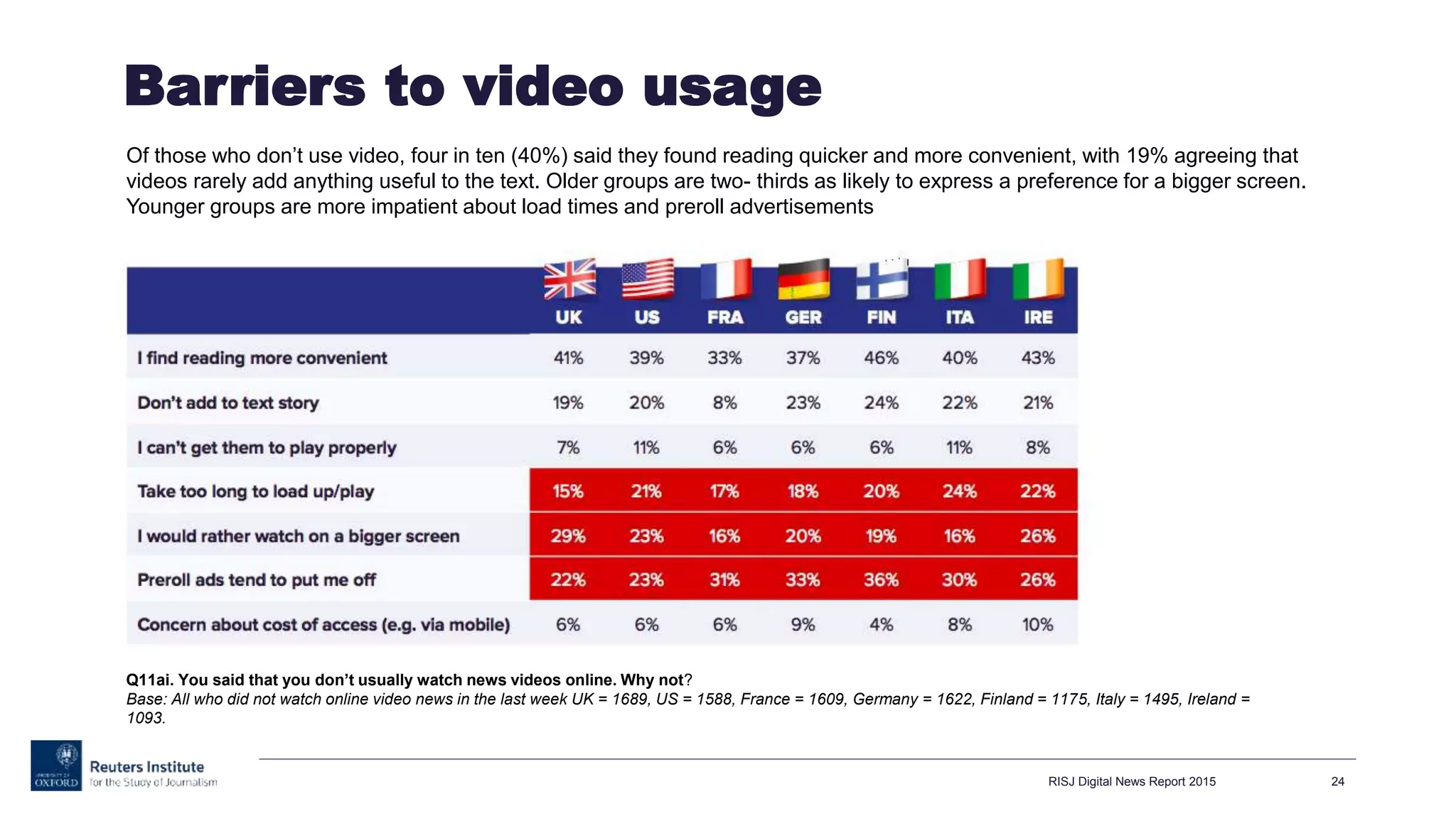
Q11ai. You said that you don’t usually watch news videos online. Why not?
Base: All who did not watch online video news in the last week UK = 1689, US = 1588, France = 1609, Germany = 1622, Finland = 1175, Italy = 1495, Ireland =
1093.
Of those who don’t use video, four in ten (40%) said they found reading quicker and more convenient, with 19% agreeing that
videos rarely add anything useful to the text. Older groups are two- thirds as likely to express a preference for a bigger screen.
Younger groups are more impatient about load times and preroll advertisements
5. DISRUPTION
TO TRADITIONAL
BRANDS
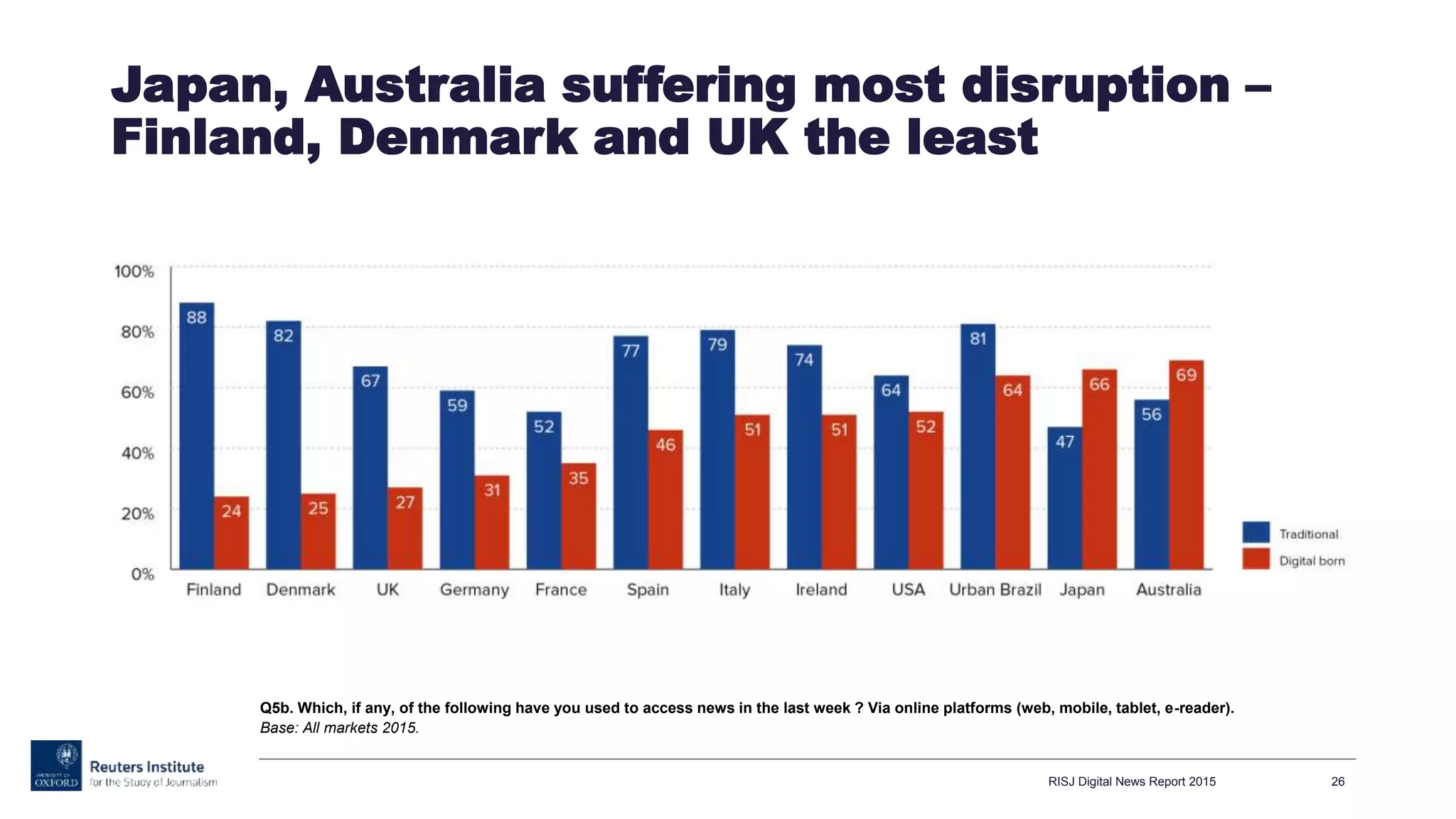
Japan, Australia suffering most disruption –
Finland, Denmark and UK the least
RISJ Digital News Report 2015 26
Q5b. Which, if any, of the following have you used to access news in the last week ? Via online platforms (web, mobile, tablet, e-reader).
Base: All markets 2015.
Battle for global eyeballs
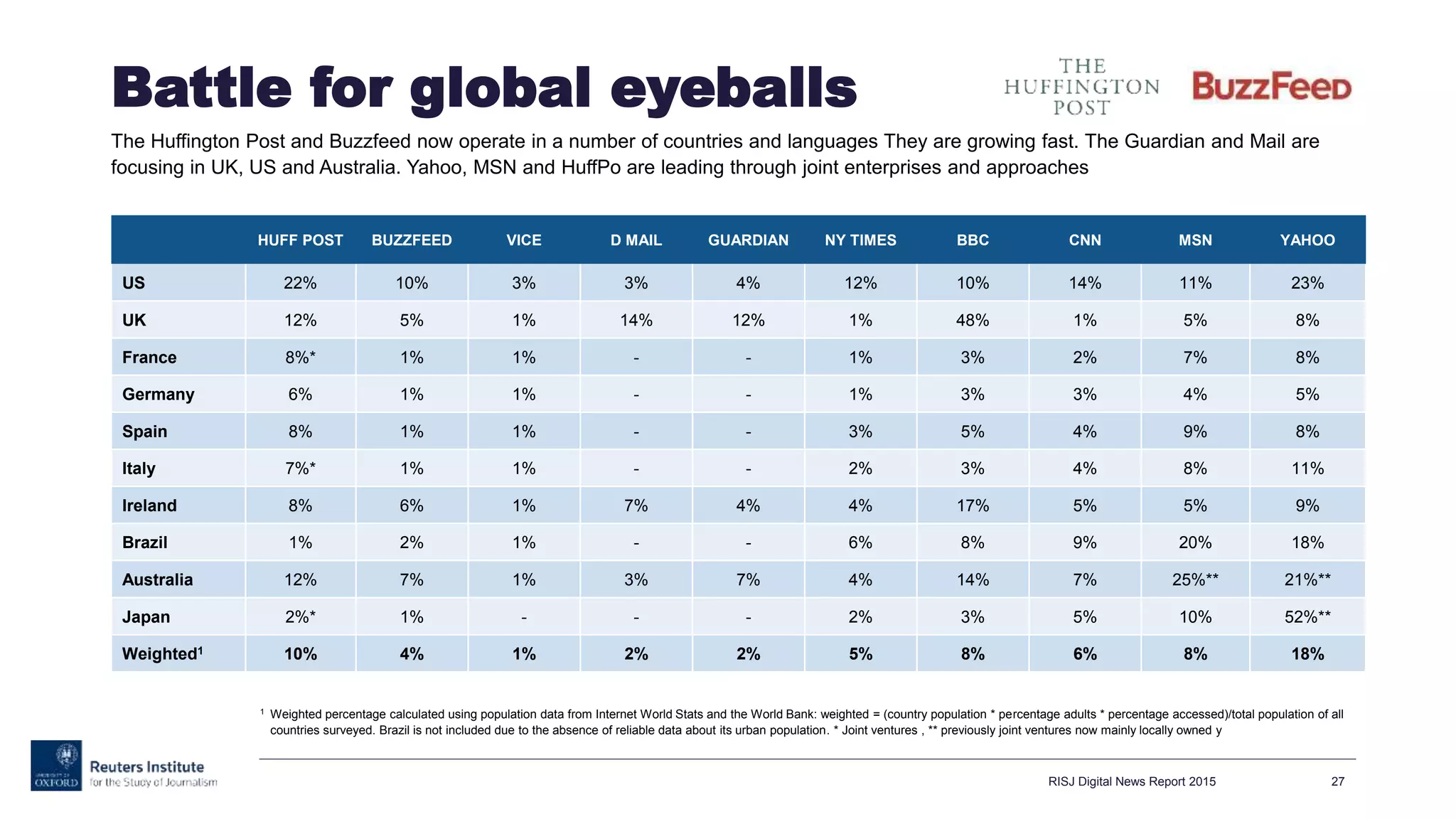
The Huffington Post and Buzzfeed now operate in a number of countries and languages They are growing fast. The Guardian and Mail are
focusing in UK, US and Australia. Yahoo, MSN and HuffPo are leading through joint enterprises and approaches
RISJ Digital News Report 2015 27
1 Weighted percentage calculated using population data from Internet World Stats and the World Bank: weighted = (country population * percentage adults * percentage accessed)/total population of all
countries surveyed. Brazil is not included due to the absence of reliable data about its urban population. * Joint ventures , ** previously joint ventures now mainly locally owned y
HUFF POST BUZZFEED VICE D MAIL GUARDIAN NY TIMES BBC CNN MSN YAHOO
US 22% 10% 3% 3% 4% 12% 10% 14% 11% 23%
UK 12% 5% 1% 14% 12% 1% 48% 1% 5% 8%
France 8%* 1% 1% - - 1% 3% 2% 7% 8%
Germany 6% 1% 1% - - 1% 3% 3% 4% 5%
Spain 8% 1% 1% - - 3% 5% 4% 9% 8%
Italy 7%* 1% 1% - - 2% 3% 4% 8% 11%
Ireland 8% 6% 1% 7% 4% 4% 17% 5% 5% 9%
Brazil 1% 2% 1% - - 6% 8% 9% 20% 18%
Australia 12% 7% 1% 3% 7% 4% 14% 7% 25%** 21%**
Japan 2%* 1% - - - 2% 3% 5% 10% 52%**
Weighted1 10% 4% 1% 2% 2% 5% 8% 6% 8% 18%
New routes to news accelerate disruption
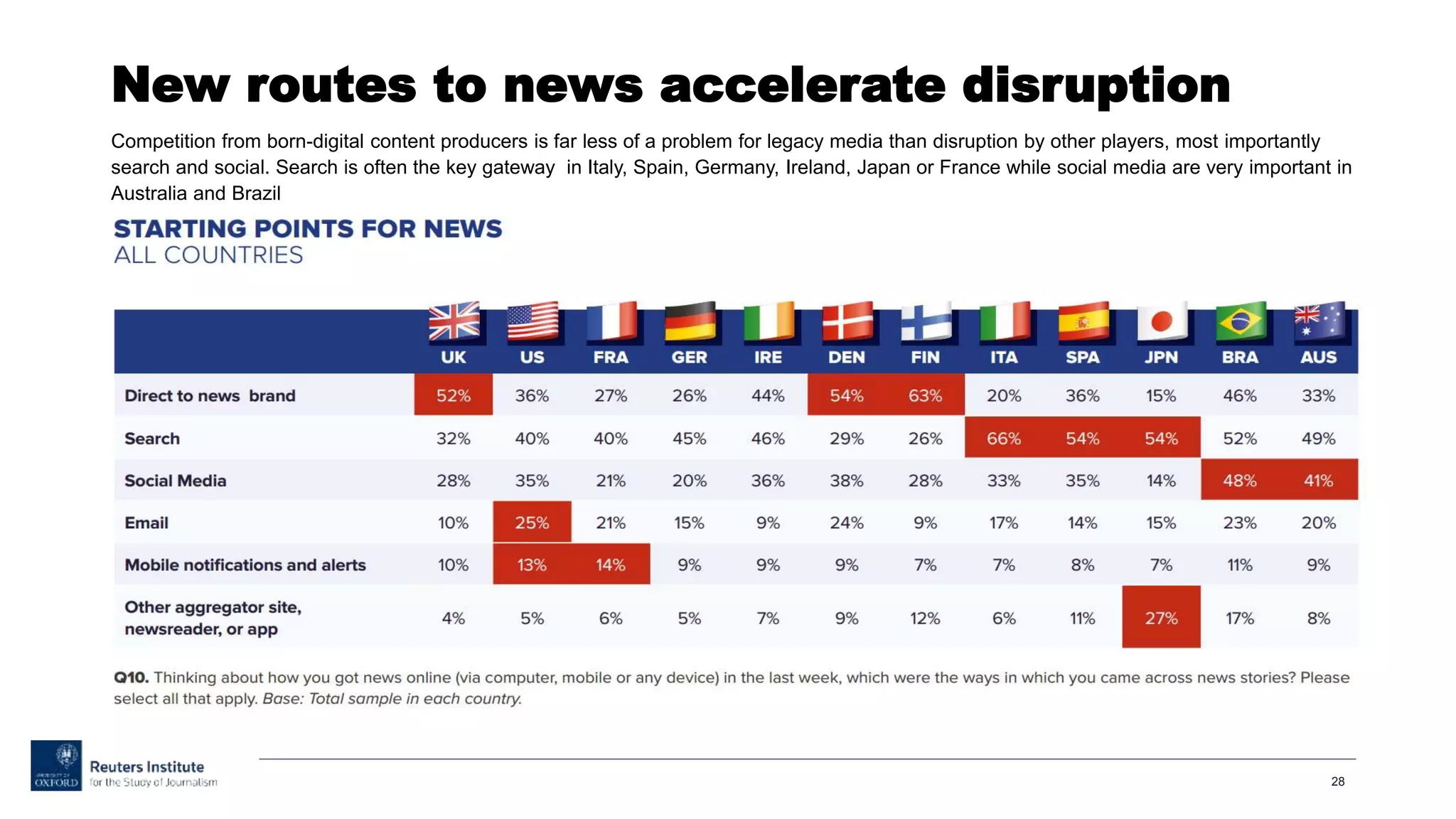
Competition from born-digital content producers is far less of a problem for legacy media than disruption by other players, most importantly
search and social. Search is often the key gateway in Italy, Spain, Germany, Ireland, Japan or France while social media are very important in
Australia and Brazil
28
6. TOP BRANDS BY
COUNTRY
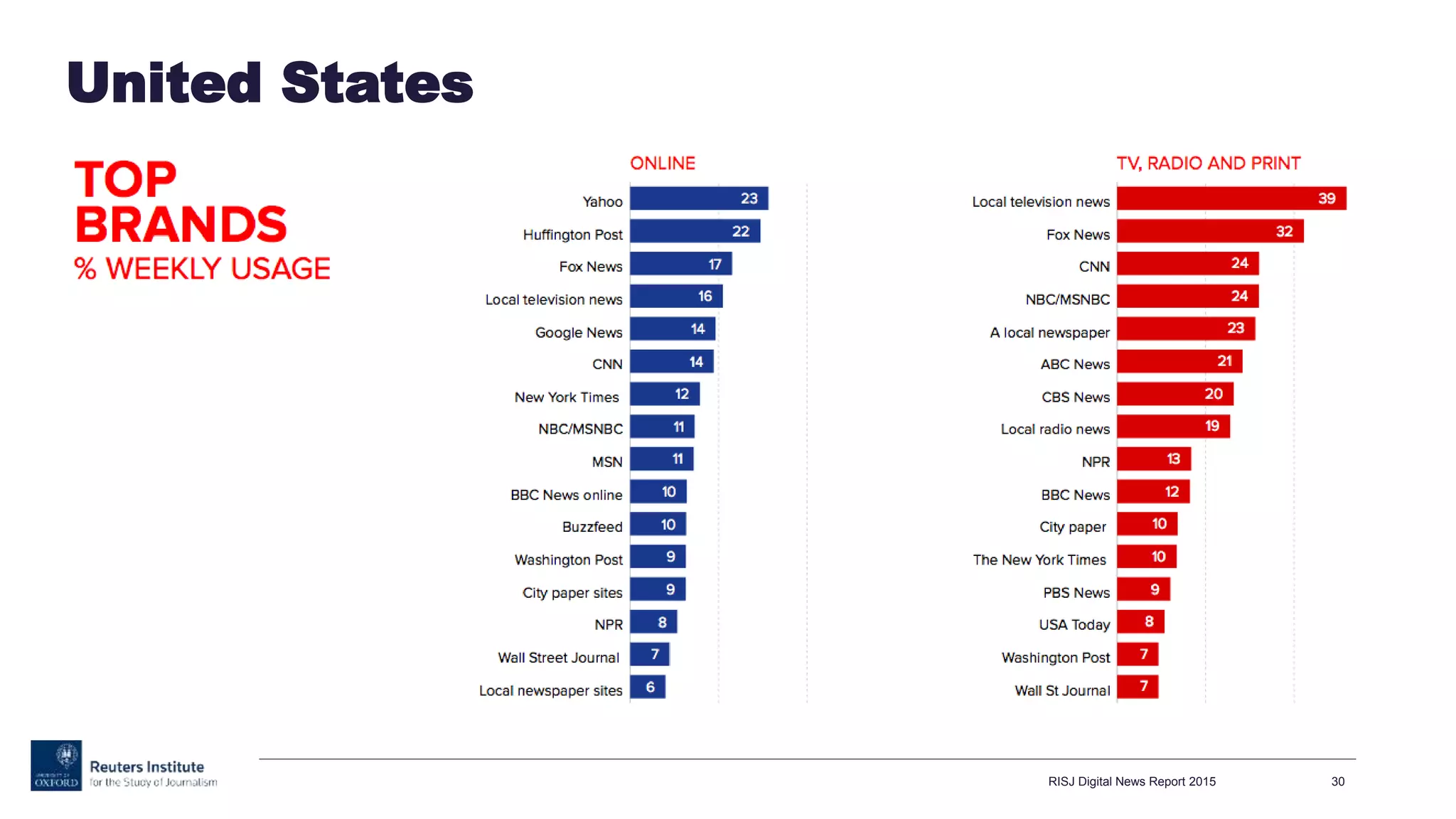
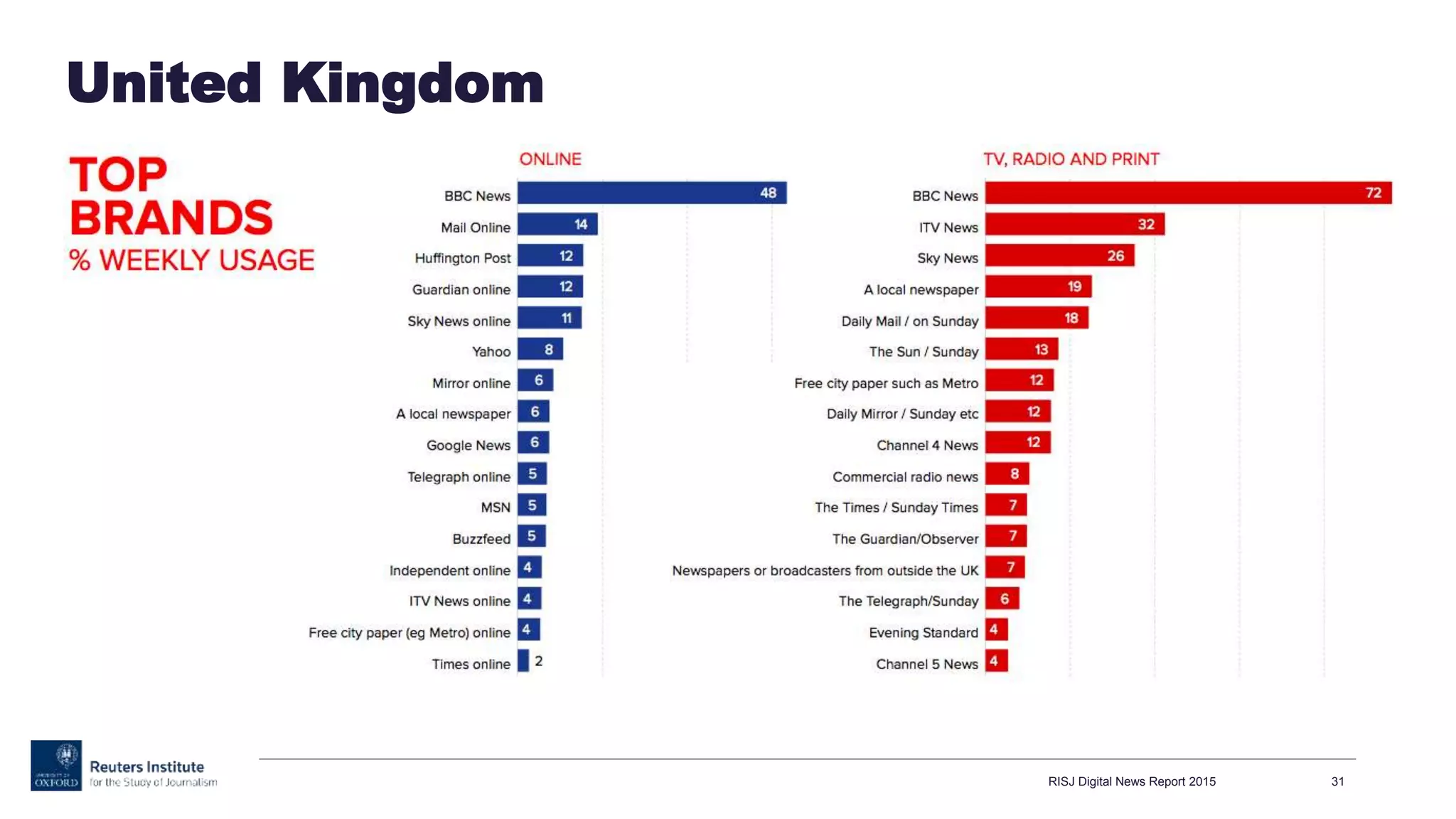
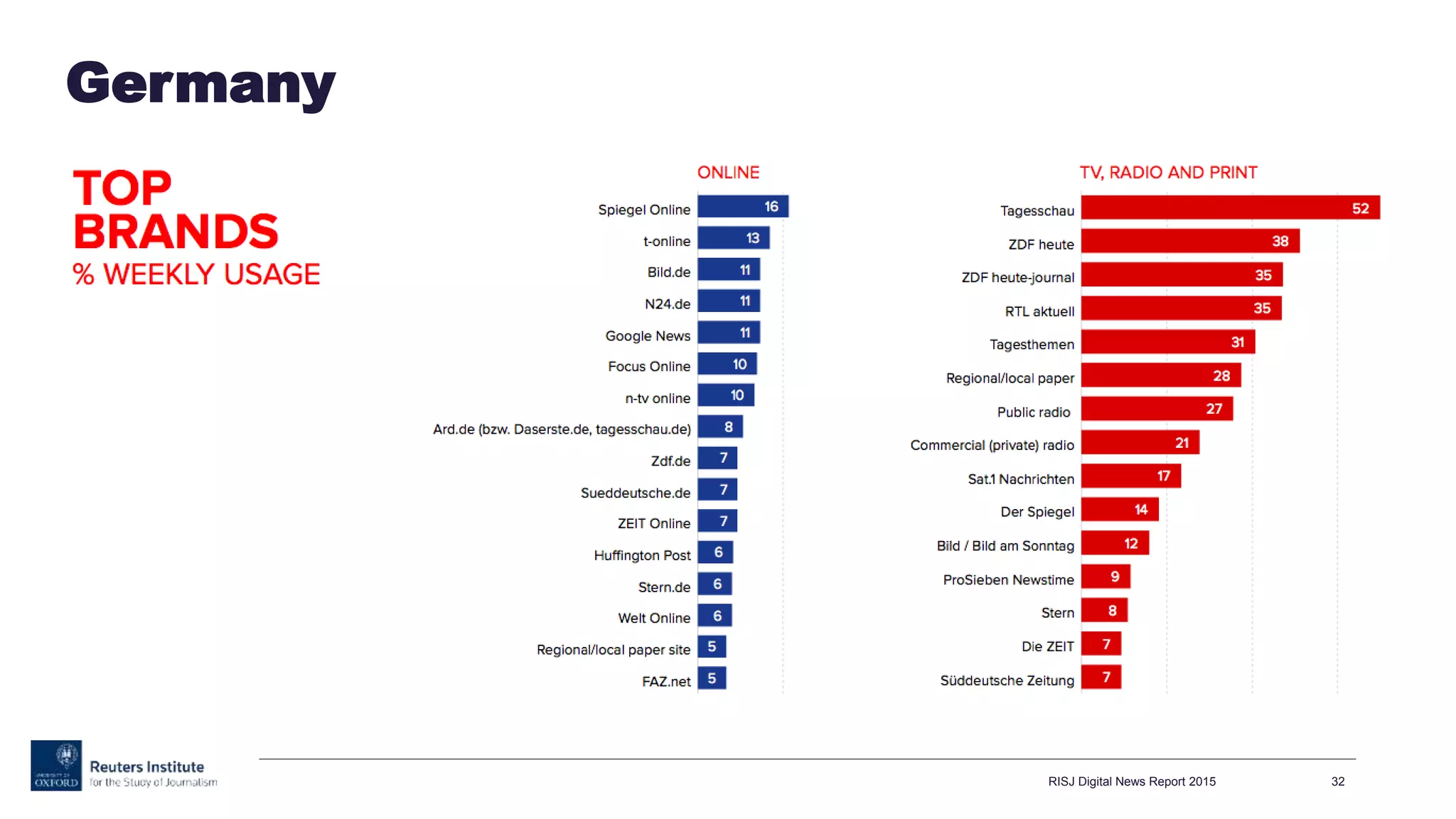
RISJ Digital News Report 2015 30
United States
RISJ Digital News Report 2015 31
United Kingdom
RISJ Digital News Report 2015 32
Germany
7. THE BUSINESS OF
JOURNALISM
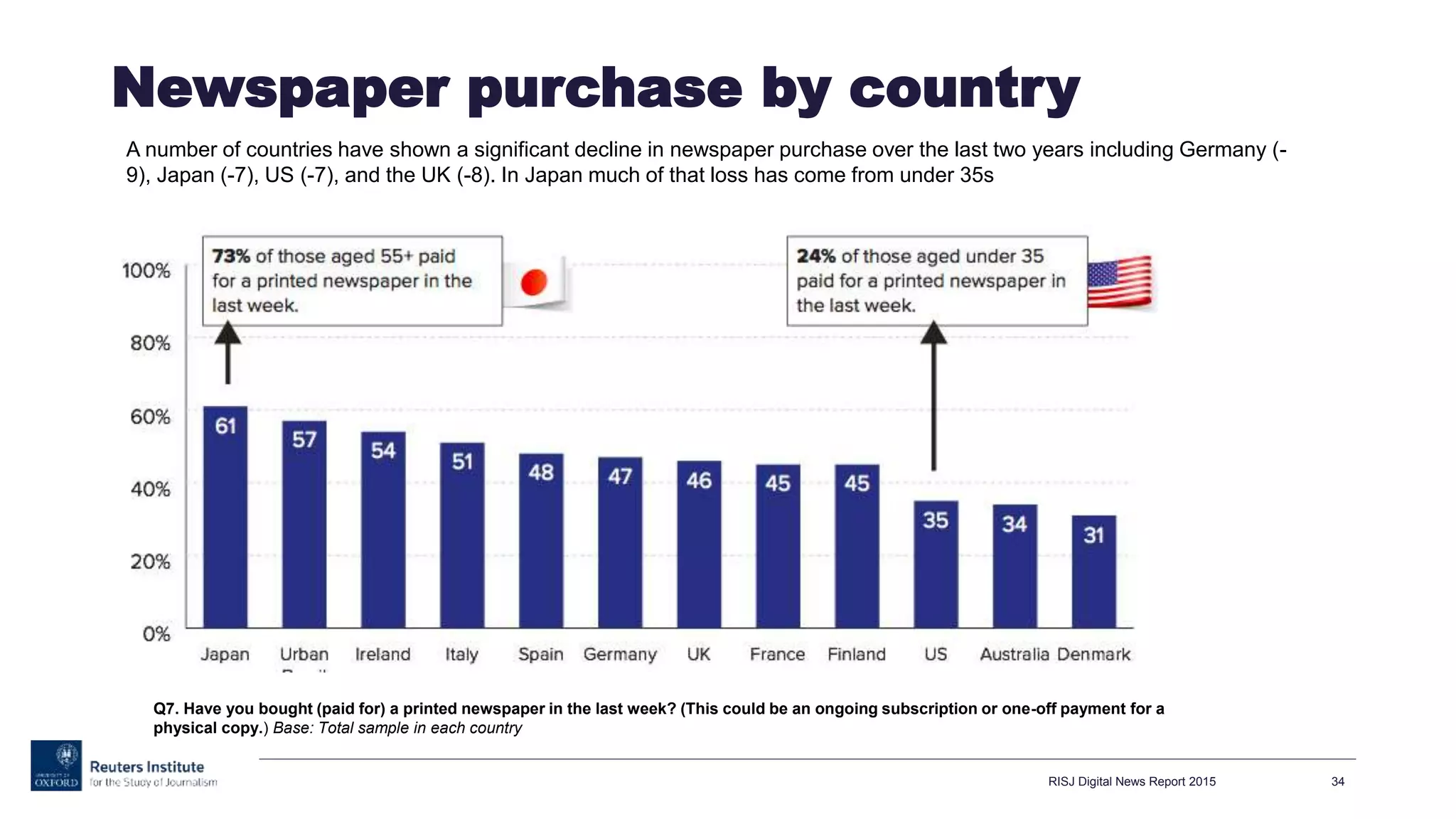
RISJ Digital News Report 2015 34
Newspaper purchase by country
Q7. Have you bought (paid for) a printed newspaper in the last week? (This could be an ongoing subscription or one-off payment for a
physical copy.) Base: Total sample in each country
A number of countries have shown a significant decline in newspaper purchase over the last two years including Germany (-
9), Japan (-7), US (-7), and the UK (-8). In Japan much of that loss has come from under 35s
Paying for online news content
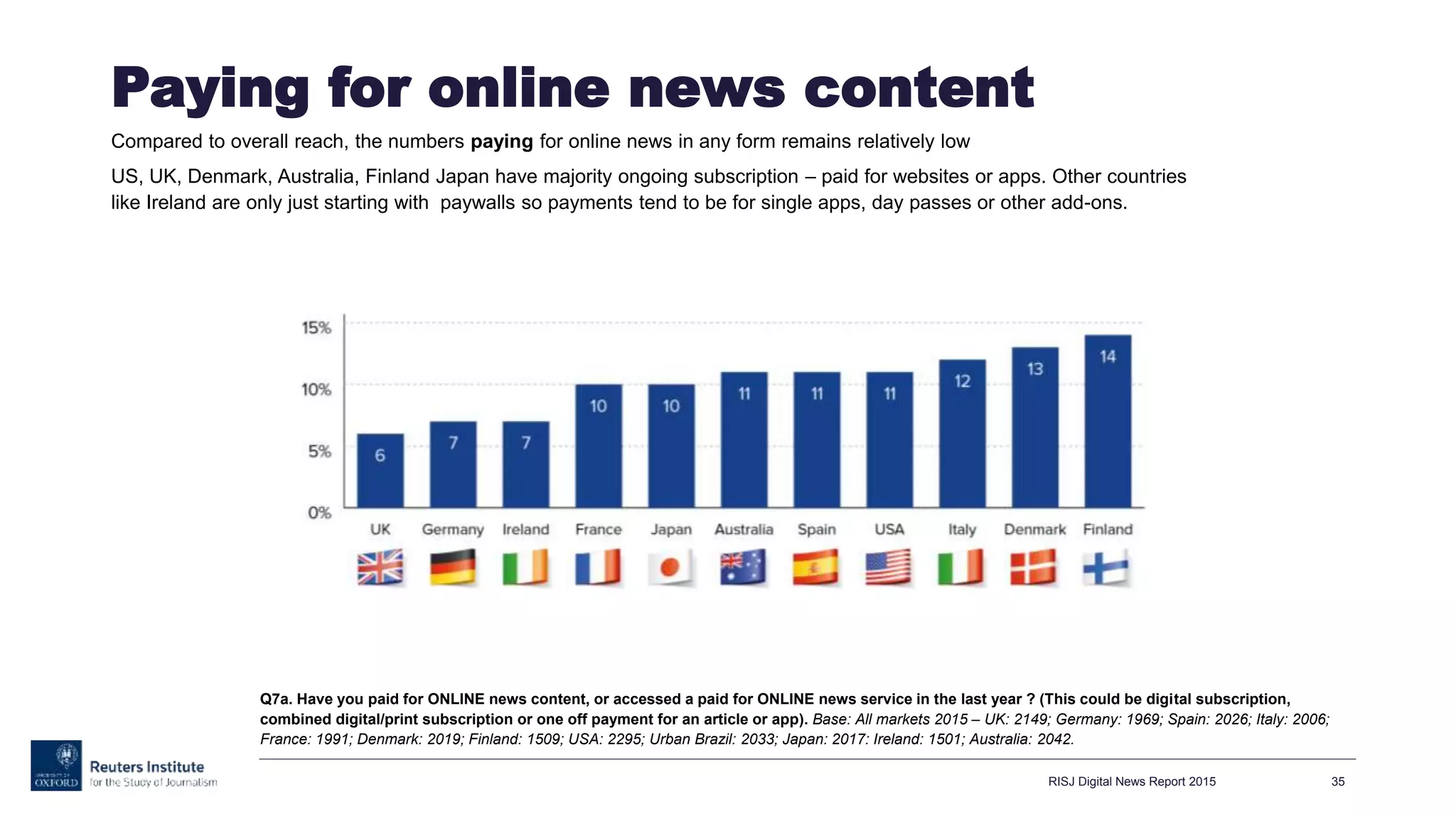
Compared to overall reach, the numbers paying for online news in any form remains relatively low
US, UK, Denmark, Australia, Finland Japan have majority ongoing subscription – paid for websites or apps. Other countries
like Ireland are only just starting with paywalls so payments tend to be for single apps, day passes or other add-ons.
RISJ Digital News Report 2015 35
Q7a. Have you paid for ONLINE news content, or accessed a paid for ONLINE news service in the last year ? (This could be digital subscription,
combined digital/print subscription or one off payment for an article or app). Base: All markets 2015 – UK: 2149; Germany: 1969; Spain: 2026; Italy: 2006;
France: 1991; Denmark: 2019; Finland: 1509; USA: 2295; Urban Brazil: 2033; Japan: 2017: Ireland: 1501; Australia: 2042.
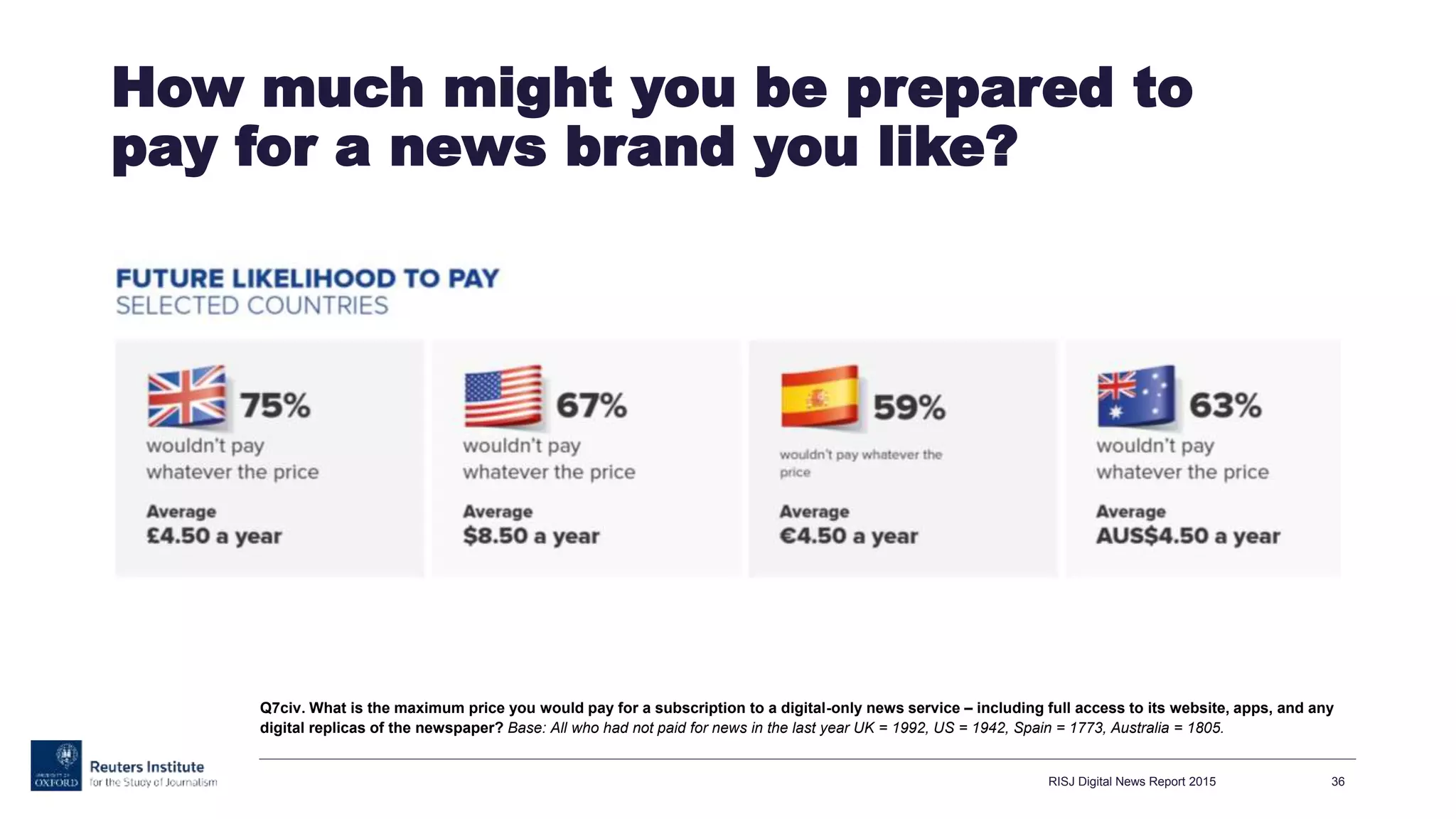
How much might you be prepared to
pay for a news brand you like?
RISJ Digital News Report 2015 36
Q7civ. What is the maximum price you would pay for a subscription to a digital-only news service – including full access to its website, apps, and any
digital replicas of the newspaper? Base: All who had not paid for news in the last year UK = 1992, US = 1942, Spain = 1773, Australia = 1805.
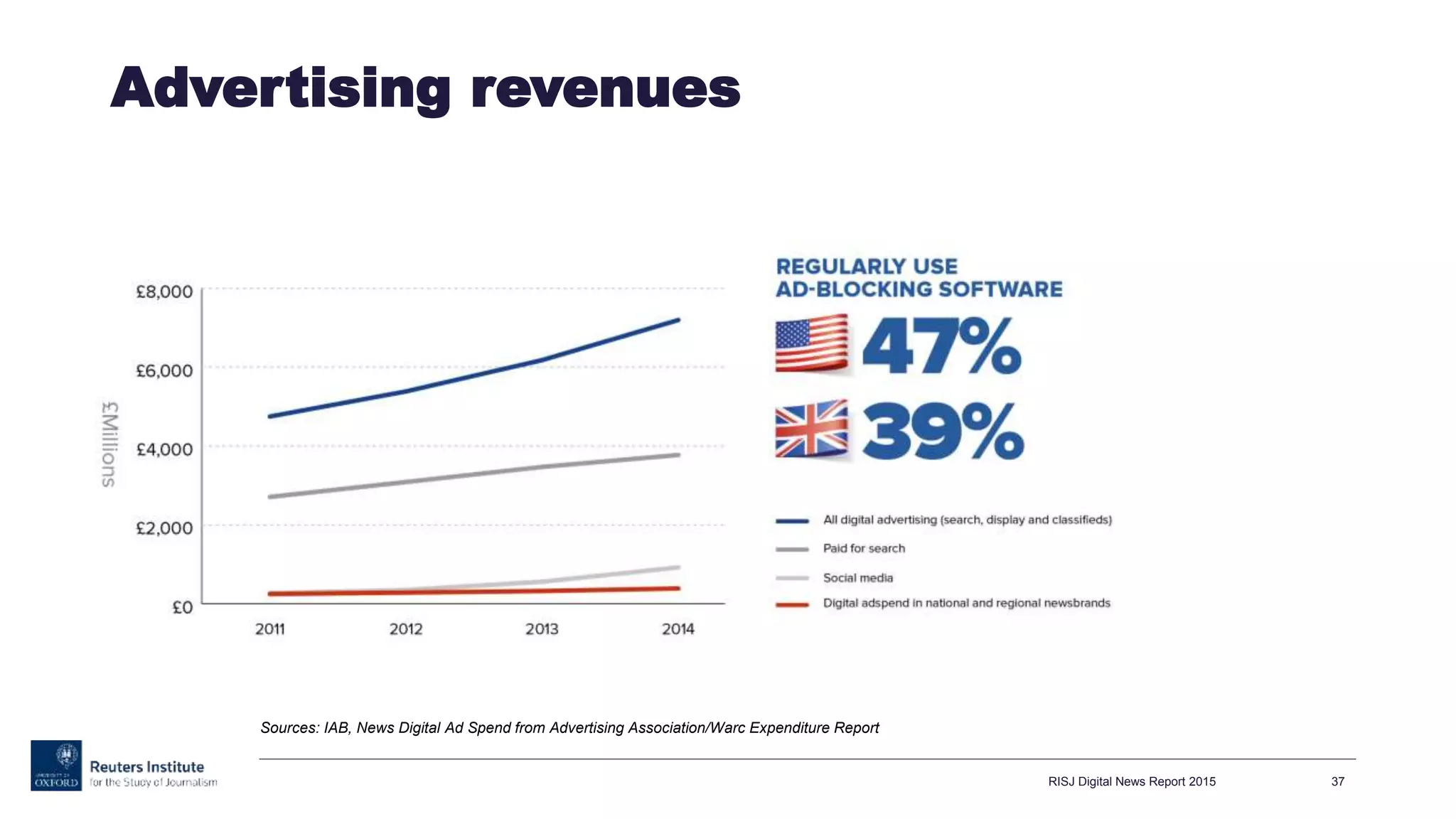
Advertising revenues
RISJ Digital News Report 2015 37
Sources: IAB, News Digital Ad Spend from Advertising Association/Warc Expenditure Report
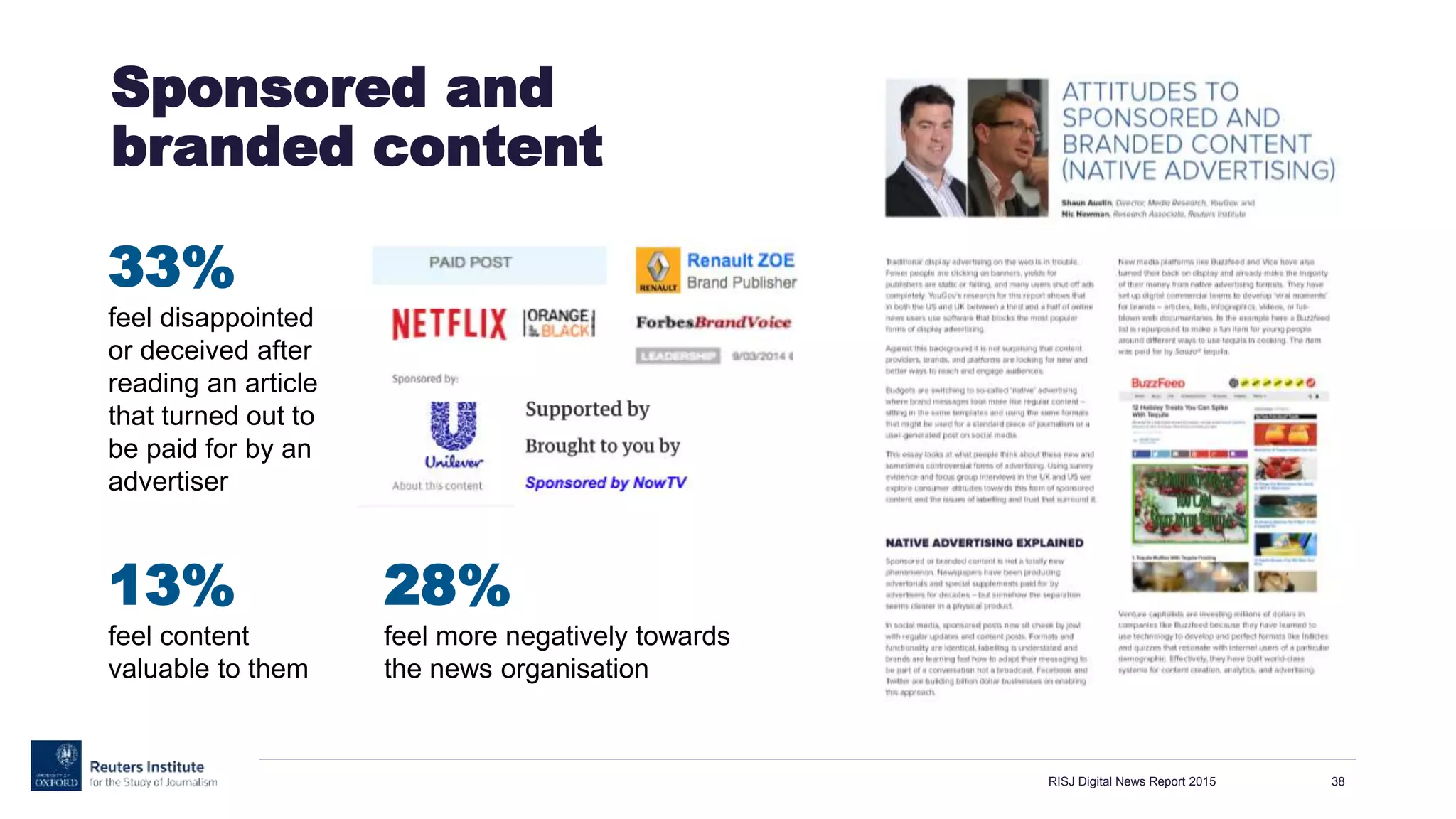
Sponsored and
branded content
RISJ Digital News Report 2015 38
33%
feel disappointed
or deceived after
reading an article
that turned out to
be paid for by an
advertiser
13%
feel content
valuable to them
28%
feel more negatively towards
the news organisation
1. Smartphones are changing the news
experience. How can news brands get share of
attention?
2. More offsite consumption (social networks,
aggregators) feeds traffic but at cost of control
3. Can legacy media innovate enough to hold their
own against disrupters?
4. Business prospects for advertising and pay
models remain challenging
39
Key implications
for industry
 Do we know enough about growing digital brands?
(HuffPo, Buzzfeed, Vice etc.)
 What relationships do we have with them?
(internships) Are they looking for different skills?
 How do we teach writing for mobile, social, or
pieces which blend video and text?
 What’s the best way to pool our learning –
journalism, PR and advertising – to understand
interlinked changes across our industry?
40
Potential
implications
for SOJC
Thanks for listening.
More information:
www.digitalnewsreport.org
RISJ Digital News Report 2015 41

Reuters Institute Digital News Report 2015: Selected highlights

  • 1.
    REUTERS INSTITUTE DIGITAL NEWSREPORT KEY FINDINGS FROM 2015 Edited highlights Curated by: Damian Radcliffe
  • 2.
    Background and methodology This isone of the largest news surveys in the world. Explores the online news habits of more than 20,000 people in twelve countries. Research was conducted online in January/early February 2015. Additional analysis of key themes, country level insights from network of partners RISJ Digital News Report 2015 2 Please note that Brazil is representative of an urban population rather than a national population. Source: Internet World Stats www.internetworldstats.com internet population estimate 2014.
  • 3.
    Key findings from 2015 1. Move tomobile – smartphone ever more central 2. Growing power of social platforms (and messaging apps) 3. Video and new visual formats taking off 4. Increased disruption for traditional media by digital-born companies and aggregators 5. Making money getting harder due to mobile and social RISJ Digital News Report 2015 3
  • 4.
    1. CENTRALITY OF SMARTPHONES 9July RISJ Digital News Report 2015 Presentation to TRF Board 4
  • 5.
    Strong growth innews via smartphone RISJ Digital News Report 2015 5 8b. Which, if any, of the following devices have you used to access news in the last week? Base: All (total sample in each country) ALSO Australia 58% Ireland 52% Finland 50% Italy 44%
  • 6.
    Mobile app ormobile browser? RISJ Digital News Report 2015 6 In most countries the mobile browser remains the main access point to news. In the five countries we looked at, only in the UK – and only on smartphones – do more people say they use apps than a mobile browser. Q9a/b. Thinking specifically about when you look for news on a MOBILE/TABLET, which of the following statements most applies to you? Base: All who used a smartphone/tablet for news in the last week. UK = 899/675, US = 1005/521, Germany = 700/331, Finland = 775/391, Italy = 927/384, Australia = 1154/730
  • 7.
    The app gap 70% havea news app installed on their phone, only a third actually use them in a given week RISJ Digital News Report 2015 7
  • 8.
  • 9.
    Top news sourcescompared 2012-15 Online news broadly stayed at the same level. TV has declined a bit especially in the US. The main change has been the decline in printed newspaper and the rise of social media RISJ Digital News Report 2015 9 Q3. Which, if any, of the following have you used in the last week as a source of news? Base: various. NB: 2014 data for TV, Print, Online and Social has been estimated because of an issue with randomisation of responses in that year
  • 10.
    Top news sourcescompared 2012-15 But it is not the same story everywhere. TV viewing in Germany remains strong even with the young while social media growth is less pronounced. In Denmark online has overtaken TV and social media is growing fast RISJ Digital News Report 2015 10 Q3. Which, if any, of the following have you used in the last week as a source of news? Base: various. NB: 2014 data for TV, Print, Online and Social has been estimated because of an issue with randomisation of responses in that year
  • 11.
    Main source ofnews TV remains the most important source of news in many countries. France, Germany, and Japan have the strongest allegiance to traditional media and they have been slower to adopt new digital trends such as smartphones and social media RISJ Digital News Report 2015 11 Q4. You say you’ve used these sources of news in the last week, which would you say is your MAIN source of news? Base: All who used a source of news in the last week in each country.
  • 12.
    Main source ofnews by age RISJ Digital News Report 2015 12 Q4. You say you’ve used these sources of news in the last week, which would you say is your MAIN source of news? Base: All who have used news sources in the last week =23155 But averages hide stark splits between generations. Young Germans or Japanese are likely to have more in common with young Americans or Finns in preferring online news and social media to TV news, radio, or print.
  • 13.
    Young turning awayfrom TV News Some of the biggest falls have been in the United States, France, and Denmark. Only a quarter (24%) of under 35s watch TV news bulletins or programmes in the US compared with 37% two years ago. In Germany 58% of under 35s still watch bulletins or programmes weekly. RISJ Digital News Report 2015 13
  • 14.
    Overall trust inthe news environment Overall we see the highest levels of trust in media systems with a good mix of strong public service broadcasters and robust commercial players - such as Finland, Germany, Denmark and the UK. RISJ Digital News Report 2015 14 Q6a. Thinking about news in general, do you agree or disagree with the following statement? “I think you can trust most news most of the time”. Q6b. Thinking specifically about news sources that you use, do you agree or disagree with the following statement? “I think I can trust most of the news that I use most of the time”. Base: Total sample in each country
  • 15.
    Partisan viewing ofTV news channels US AND UK COMPARED RISJ Digital News Report 2015 15 In the United Kingdom there is a tradition of impartiality backed up by strong regulation. The US TV news model is more partisan
  • 16.
    3. SOCIAL MEDIA ANDMESSAGING APPS
  • 17.
    Facebook becoming moreimportant for news RISJ Digital News Report 2015 17 Q12a/b. Which, if any, of the following have you used for any purpose/for reading, watching, sharing, or discussing news in the last week? Base: Combined sample =23557. 41% (+6) Access use Facebook weekly for finding sharing or discussing news. Facebook owns WhatsApp and Instagram
  • 18.
    We seek newson Twitter but bump into it on Facebook Twitter is seen as a news destination. Facebook is not. This explains the different strategies employed to seed news in each network and the relative popularity of different news brands RISJ Digital News Report 2015 18 Q12Cii/Dii. You say you use Twitter/Facebook for news. Which of the following statements applies best to you? Base: Combined sample of UK, US, Italy, Australia, = Facebook=3560, Twitter = 861. TOP ENGLISH PUBLISHERS IN FACEBOOK AND TWITTER
  • 19.
    RISJ Digital NewsReport 2015 19 Percentage using social media to find news (2013-15) Facebook and other social outlets are driving more traffic to major news sites. Referrals from Facebook increased 42% in the last year to major English news sites. Publishers are delighted at extra traffic but are concerned about over-reliance on Facebook and in particular about its algorithms, which are changing all the time and over which they have no control.
  • 20.
  • 21.
    Growth in onlinevideo usage RISJ Digital News Report 2015 21 We see a significant jump in the use of online news video in all countries except Germany and also in the US, where the big move happened between 2013 and 2014. Almost a third of US audiences still consume video each week (30%), with Spain and Italy catching up with growth of +10 and +5 respectively.
  • 22.
    Attitudes to videovs text RISJ Digital News Report 2015 22 Compared with last year, fewer people ‘mostly read in text’ and more people occasionally or regularly watch online news video
  • 23.
    Types of videoconsumed RISJ Digital News Report 2015 23 Q11aii. Which TYPES of news video have you watched online in the last month? Base: All who watched online news video in the last month UK = 460, US = 707, France = 382, Germany = 353, Finland = 334, Italy = 511, Ireland = 408. Short news clips (66%) are accessed most regularly; providing eyewitness testimony – particularly on a breaking story – or additional context. Live streams tend to be watched by those who are most interested in news
  • 24.
    Barriers to videousage RISJ Digital News Report 2015 24 Q11ai. You said that you don’t usually watch news videos online. Why not? Base: All who did not watch online video news in the last week UK = 1689, US = 1588, France = 1609, Germany = 1622, Finland = 1175, Italy = 1495, Ireland = 1093. Of those who don’t use video, four in ten (40%) said they found reading quicker and more convenient, with 19% agreeing that videos rarely add anything useful to the text. Older groups are two- thirds as likely to express a preference for a bigger screen. Younger groups are more impatient about load times and preroll advertisements
  • 25.
  • 26.
    Japan, Australia sufferingmost disruption – Finland, Denmark and UK the least RISJ Digital News Report 2015 26 Q5b. Which, if any, of the following have you used to access news in the last week ? Via online platforms (web, mobile, tablet, e-reader). Base: All markets 2015.
  • 27.
    Battle for globaleyeballs The Huffington Post and Buzzfeed now operate in a number of countries and languages They are growing fast. The Guardian and Mail are focusing in UK, US and Australia. Yahoo, MSN and HuffPo are leading through joint enterprises and approaches RISJ Digital News Report 2015 27 1 Weighted percentage calculated using population data from Internet World Stats and the World Bank: weighted = (country population * percentage adults * percentage accessed)/total population of all countries surveyed. Brazil is not included due to the absence of reliable data about its urban population. * Joint ventures , ** previously joint ventures now mainly locally owned y HUFF POST BUZZFEED VICE D MAIL GUARDIAN NY TIMES BBC CNN MSN YAHOO US 22% 10% 3% 3% 4% 12% 10% 14% 11% 23% UK 12% 5% 1% 14% 12% 1% 48% 1% 5% 8% France 8%* 1% 1% - - 1% 3% 2% 7% 8% Germany 6% 1% 1% - - 1% 3% 3% 4% 5% Spain 8% 1% 1% - - 3% 5% 4% 9% 8% Italy 7%* 1% 1% - - 2% 3% 4% 8% 11% Ireland 8% 6% 1% 7% 4% 4% 17% 5% 5% 9% Brazil 1% 2% 1% - - 6% 8% 9% 20% 18% Australia 12% 7% 1% 3% 7% 4% 14% 7% 25%** 21%** Japan 2%* 1% - - - 2% 3% 5% 10% 52%** Weighted1 10% 4% 1% 2% 2% 5% 8% 6% 8% 18%
  • 28.
    New routes tonews accelerate disruption Competition from born-digital content producers is far less of a problem for legacy media than disruption by other players, most importantly search and social. Search is often the key gateway in Italy, Spain, Germany, Ireland, Japan or France while social media are very important in Australia and Brazil 28
  • 29.
    6. TOP BRANDSBY COUNTRY
  • 30.
    RISJ Digital NewsReport 2015 30 United States
  • 31.
    RISJ Digital NewsReport 2015 31 United Kingdom
  • 32.
    RISJ Digital NewsReport 2015 32 Germany
  • 33.
    7. THE BUSINESSOF JOURNALISM
  • 34.
    RISJ Digital NewsReport 2015 34 Newspaper purchase by country Q7. Have you bought (paid for) a printed newspaper in the last week? (This could be an ongoing subscription or one-off payment for a physical copy.) Base: Total sample in each country A number of countries have shown a significant decline in newspaper purchase over the last two years including Germany (- 9), Japan (-7), US (-7), and the UK (-8). In Japan much of that loss has come from under 35s
  • 35.
    Paying for onlinenews content Compared to overall reach, the numbers paying for online news in any form remains relatively low US, UK, Denmark, Australia, Finland Japan have majority ongoing subscription – paid for websites or apps. Other countries like Ireland are only just starting with paywalls so payments tend to be for single apps, day passes or other add-ons. RISJ Digital News Report 2015 35 Q7a. Have you paid for ONLINE news content, or accessed a paid for ONLINE news service in the last year ? (This could be digital subscription, combined digital/print subscription or one off payment for an article or app). Base: All markets 2015 – UK: 2149; Germany: 1969; Spain: 2026; Italy: 2006; France: 1991; Denmark: 2019; Finland: 1509; USA: 2295; Urban Brazil: 2033; Japan: 2017: Ireland: 1501; Australia: 2042.
  • 36.
    How much mightyou be prepared to pay for a news brand you like? RISJ Digital News Report 2015 36 Q7civ. What is the maximum price you would pay for a subscription to a digital-only news service – including full access to its website, apps, and any digital replicas of the newspaper? Base: All who had not paid for news in the last year UK = 1992, US = 1942, Spain = 1773, Australia = 1805.
  • 37.
    Advertising revenues RISJ DigitalNews Report 2015 37 Sources: IAB, News Digital Ad Spend from Advertising Association/Warc Expenditure Report
  • 38.
    Sponsored and branded content RISJDigital News Report 2015 38 33% feel disappointed or deceived after reading an article that turned out to be paid for by an advertiser 13% feel content valuable to them 28% feel more negatively towards the news organisation
  • 39.
    1. Smartphones arechanging the news experience. How can news brands get share of attention? 2. More offsite consumption (social networks, aggregators) feeds traffic but at cost of control 3. Can legacy media innovate enough to hold their own against disrupters? 4. Business prospects for advertising and pay models remain challenging 39 Key implications for industry
  • 40.
     Do weknow enough about growing digital brands? (HuffPo, Buzzfeed, Vice etc.)  What relationships do we have with them? (internships) Are they looking for different skills?  How do we teach writing for mobile, social, or pieces which blend video and text?  What’s the best way to pool our learning – journalism, PR and advertising – to understand interlinked changes across our industry? 40 Potential implications for SOJC
  • 41.
    Thanks for listening. Moreinformation: www.digitalnewsreport.org RISJ Digital News Report 2015 41

Editor's Notes

  • #2 History and background 2012 = 5 countries UK, US, Germany, France and Denmark Now at 18. Growing to 30.
  • #41 HuffPo wants to be in 50 countries within the next decade.The publisher, which celebrated its 10th birthday this May and has 15 international editions. The publisher also wants its network of 100,000 bloggers to expand to 1 million, according to Huffington. Buzzfeed opened its first site outside the United States in 2013 in the United Kingdom, and has since added editorial operations in France, Australia, Brazil, India, and Germany. There’s also the New York-based BuzzFeed Español that targets a Latin American audience. The expansion to Mumbai, Berlin, and now Mexico City were announced last summer (along with a planned move to Tokyo). and Canada. HiredCraig Silverman to lead the site’s editorial efforts north of the border.)