Report Date: 2025-11-30 Engineering Standards Analysis
Steel Reinforcement Standards
Comparison
Eurocode, Indian Code & AASHTO
A Comprehensive Analysis of High-Grade Carbon Steel and Stainless Steel Specifications
Eurocode High-Grade Steel (B500)
Key Specifications
Designated as B500 steel
Minimum yield strength ( fyk ): 500 MPa
Used primarily in reinforced concrete applications
Steel categorized into three ductility classes based on
performance requirements
Design Considerations
Ductility classes crucial for seismic design applications
Higher class numbers indicate higher ductility and energy
absorption capacity
Strength ratios and elongation values ensure reliable
performance under stress
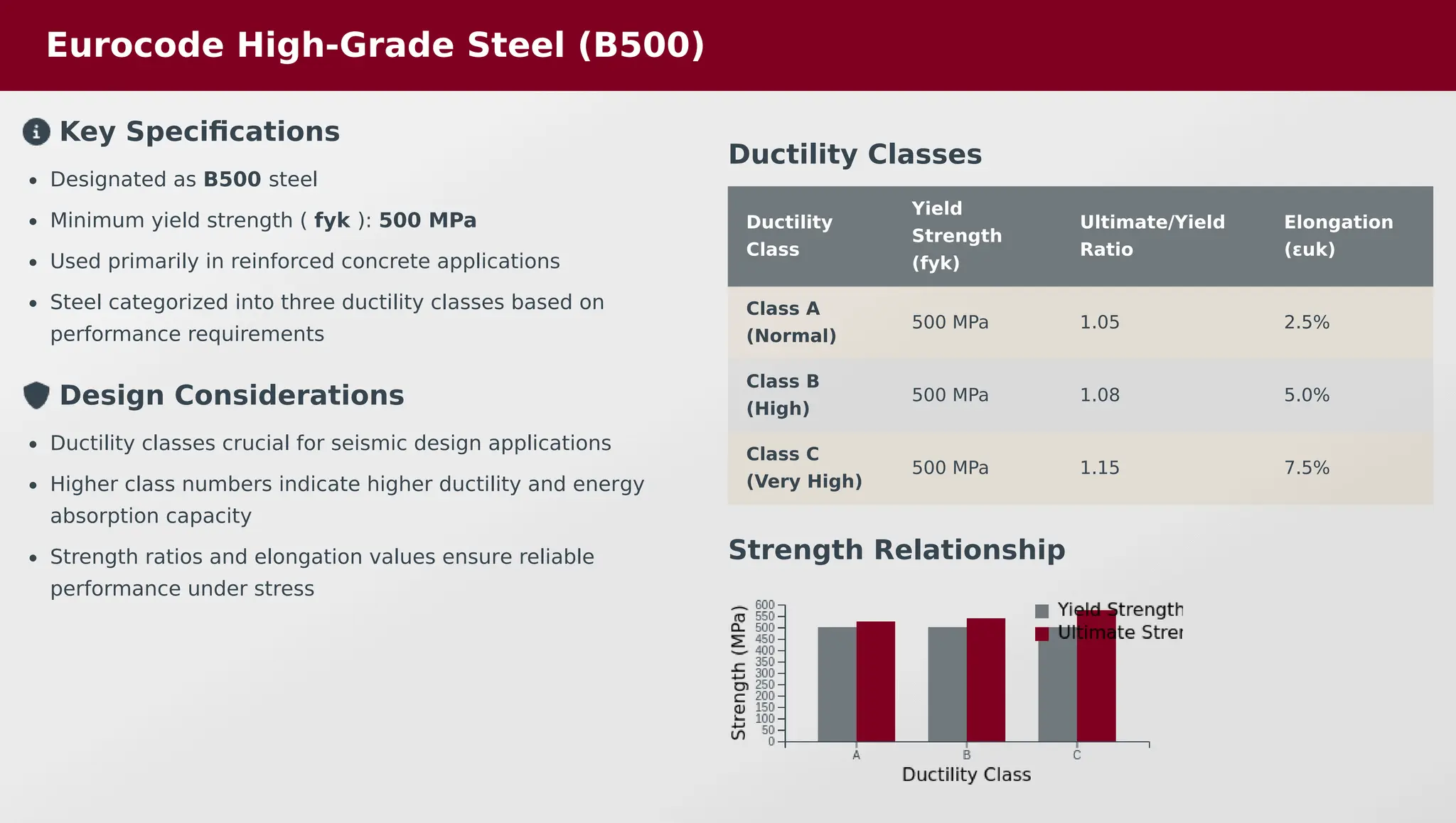
Ductility Classes
Ductility
Class
Yield
Strength
(fyk)
Ultimate/Yield
Ratio
Elongation
(εuk)
Class A
(Normal)
500 MPa 1.05 2.5%
Class B
(High)
500 MPa 1.08 5.0%
Class C
(Very High)
500 MPa 1.15 7.5%
Strength Relationship
Indian Code High-Grade Steel (Fe 500)
Key Specifications
Designated as Fe 500 or Fe 500D according to IS 1786
"Fe" indicates ferrous material (iron/steel)
Number 500 represents minimum yield strength of 500 MPa
Grade Fe 500D has enhanced ductility for seismic applications
Seismic Applications
High ductility version (Fe 500D) is specifically recommended for
earthquake-resistant structures in seismic zones.
Design Standards
Specified under IS 1786 standard, which governs high-strength
deformed bars for reinforced concrete.
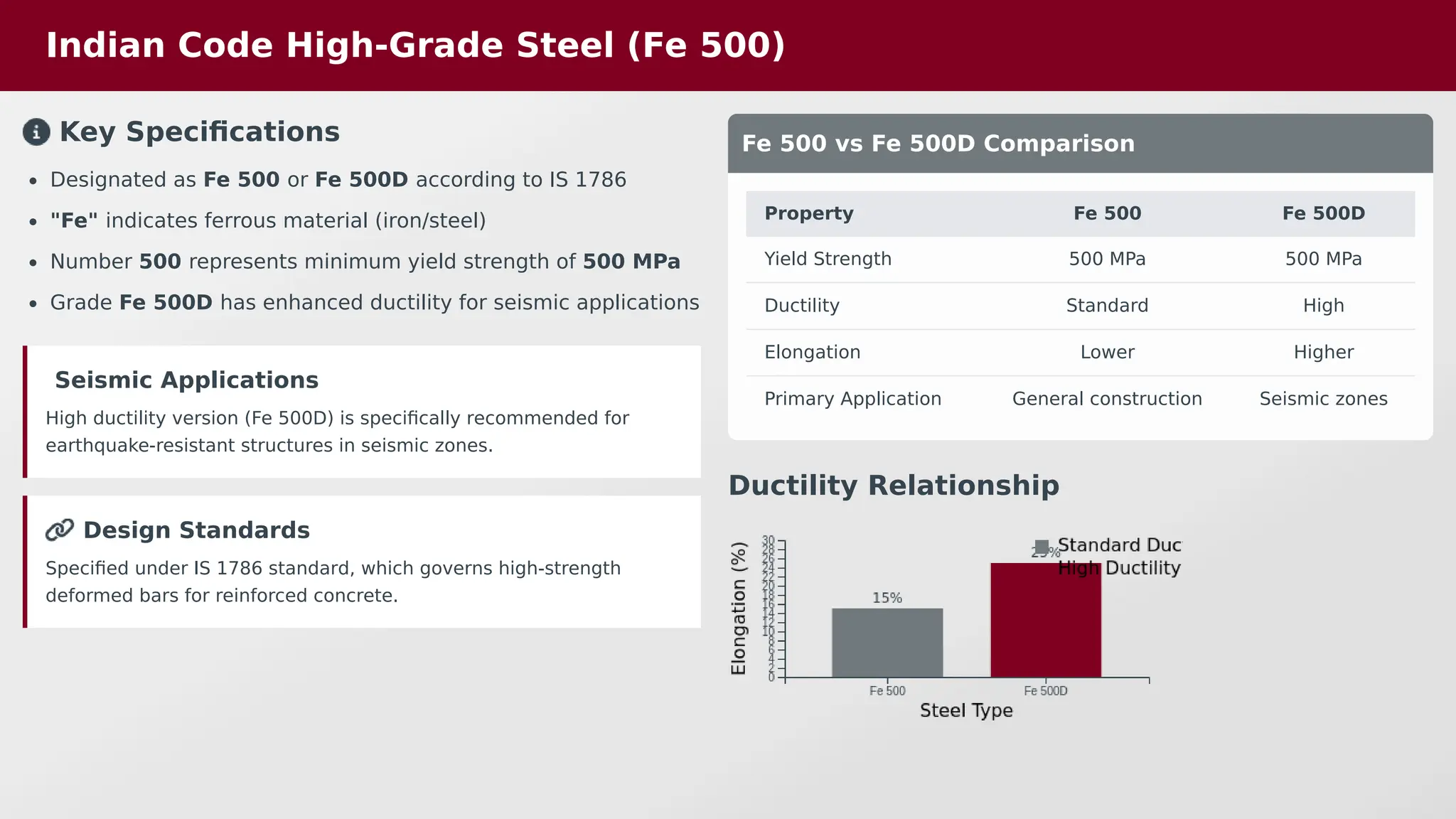
Fe 500 vs Fe 500D Comparison
Property Fe 500 Fe 500D
Yield Strength 500 MPa 500 MPa
Ductility Standard High
Elongation Lower Higher
Primary Application General construction Seismic zones
Ductility Relationship
AASHTO High-Grade Steel (Grade 60/80)
Key Specifications
Primarily uses ASTM standards
Common grades: Grade 60 and Grade 80
Grade 60: 420 MPa yield strength (~60 ksi)
Grade 80: 550 MPa yield strength (~80 ksi)
Governed by ASTM A615 or ASTM A706
Design Considerations
ASTM A706 specifically for weldable and seismic applications
Provides additional controls on chemical composition and
mechanical properties
Grade 80 increasingly used for applications requiring greater
strength
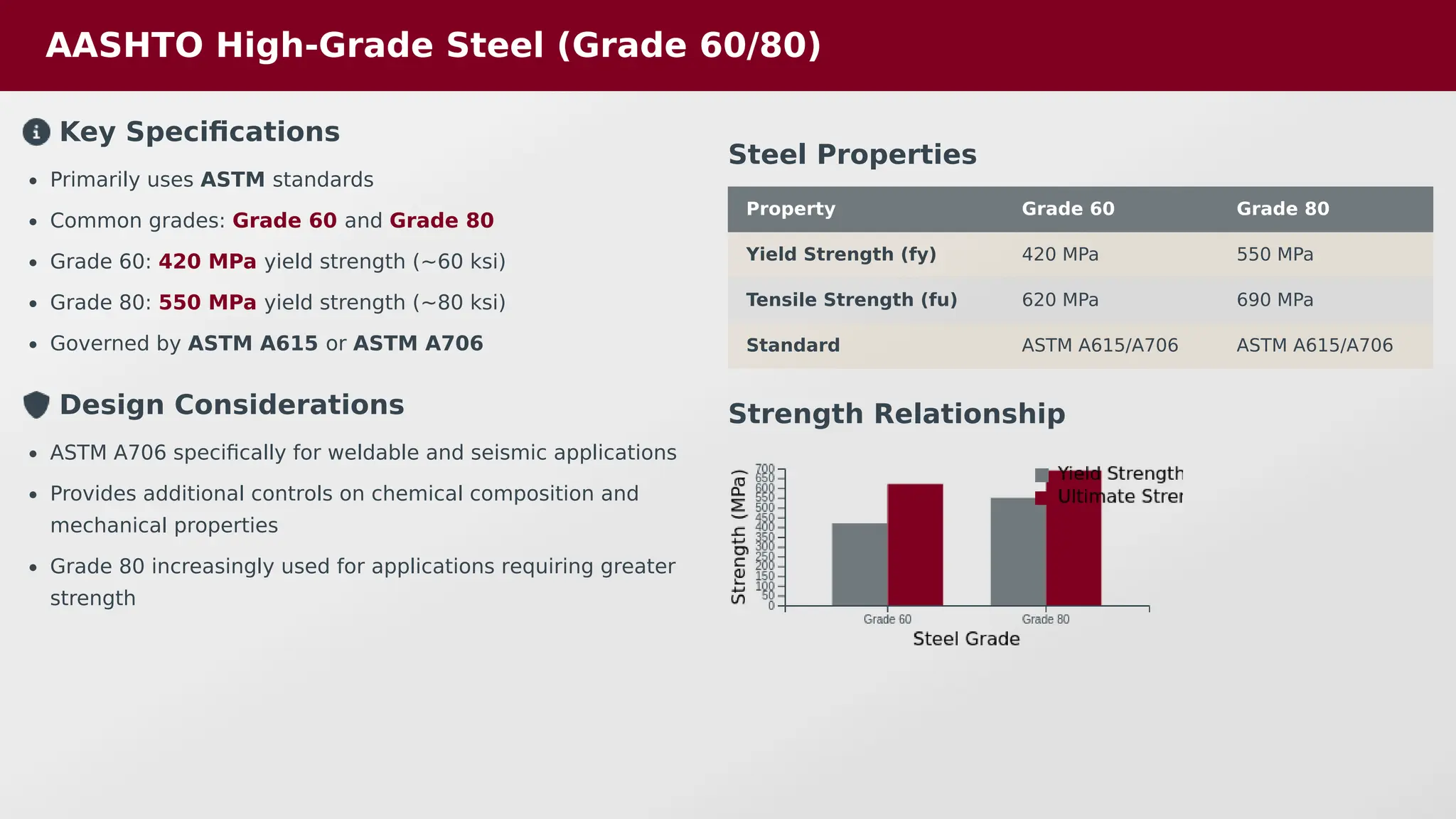
Steel Properties
Property Grade 60 Grade 80
Yield Strength (fy) 420 MPa 550 MPa
Tensile Strength (fu) 620 MPa 690 MPa
Standard ASTM A615/A706 ASTM A615/A706
Strength Relationship
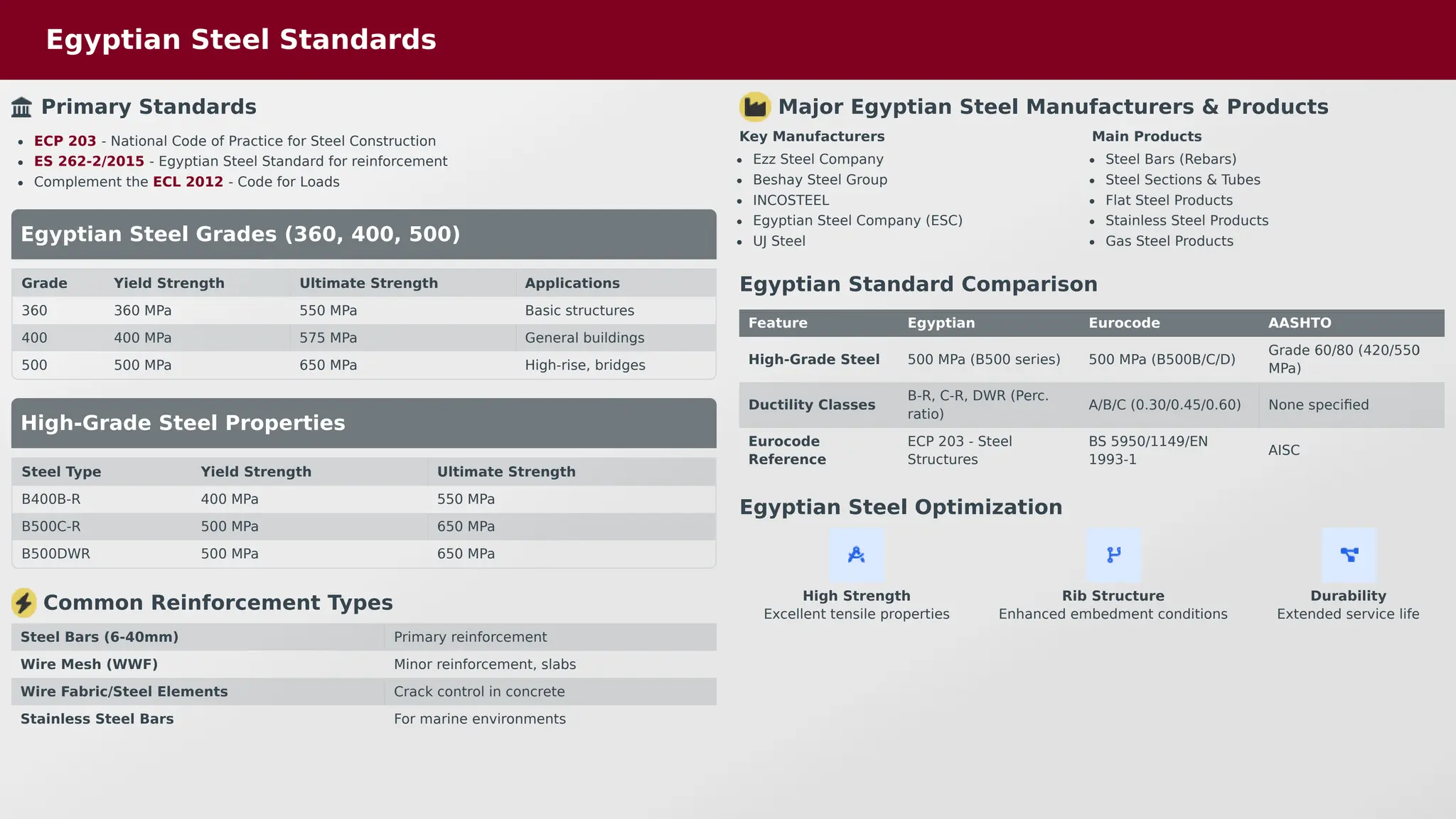
Egyptian Steel Standards
Primary Standards
ECP 203 - National Code of Practice for Steel Construction
ES 262-2/2015 - Egyptian Steel Standard for reinforcement
Complement the ECL 2012 - Code for Loads
Egyptian Steel Grades (360, 400, 500)
Grade Yield Strength Ultimate Strength Applications
360 360 MPa 550 MPa Basic structures
400 400 MPa 575 MPa General buildings
500 500 MPa 650 MPa High-rise, bridges
High-Grade Steel Properties
Steel Type Yield Strength Ultimate Strength
B400B-R 400 MPa 550 MPa
B500C-R 500 MPa 650 MPa
B500DWR 500 MPa 650 MPa
Common Reinforcement Types
Steel Bars (6-40mm) Primary reinforcement
Wire Mesh (WWF) Minor reinforcement, slabs
Wire Fabric/Steel Elements Crack control in concrete
Stainless Steel Bars For marine environments
Major Egyptian Steel Manufacturers & Products
Key Manufacturers
Ezz Steel Company
Beshay Steel Group
INCOSTEEL
Egyptian Steel Company (ESC)
UJ Steel
Main Products
Steel Bars (Rebars)
Steel Sections & Tubes
Flat Steel Products
Stainless Steel Products
Gas Steel Products
Egyptian Standard Comparison
Feature Egyptian Eurocode AASHTO
High-Grade Steel 500 MPa (B500 series) 500 MPa (B500B/C/D)
Grade 60/80 (420/550
MPa)
Ductility Classes
B-R, C-R, DWR (Perc.
ratio)
A/B/C (0.30/0.45/0.60) None specified
Eurocode
Reference
ECP 203 - Steel
Structures
BS 5950/1149/EN
1993-1
AISC
Egyptian Steel Optimization
High Strength
Excellent tensile properties
Rib Structure
Enhanced embedment conditions
Durability
Extended service life
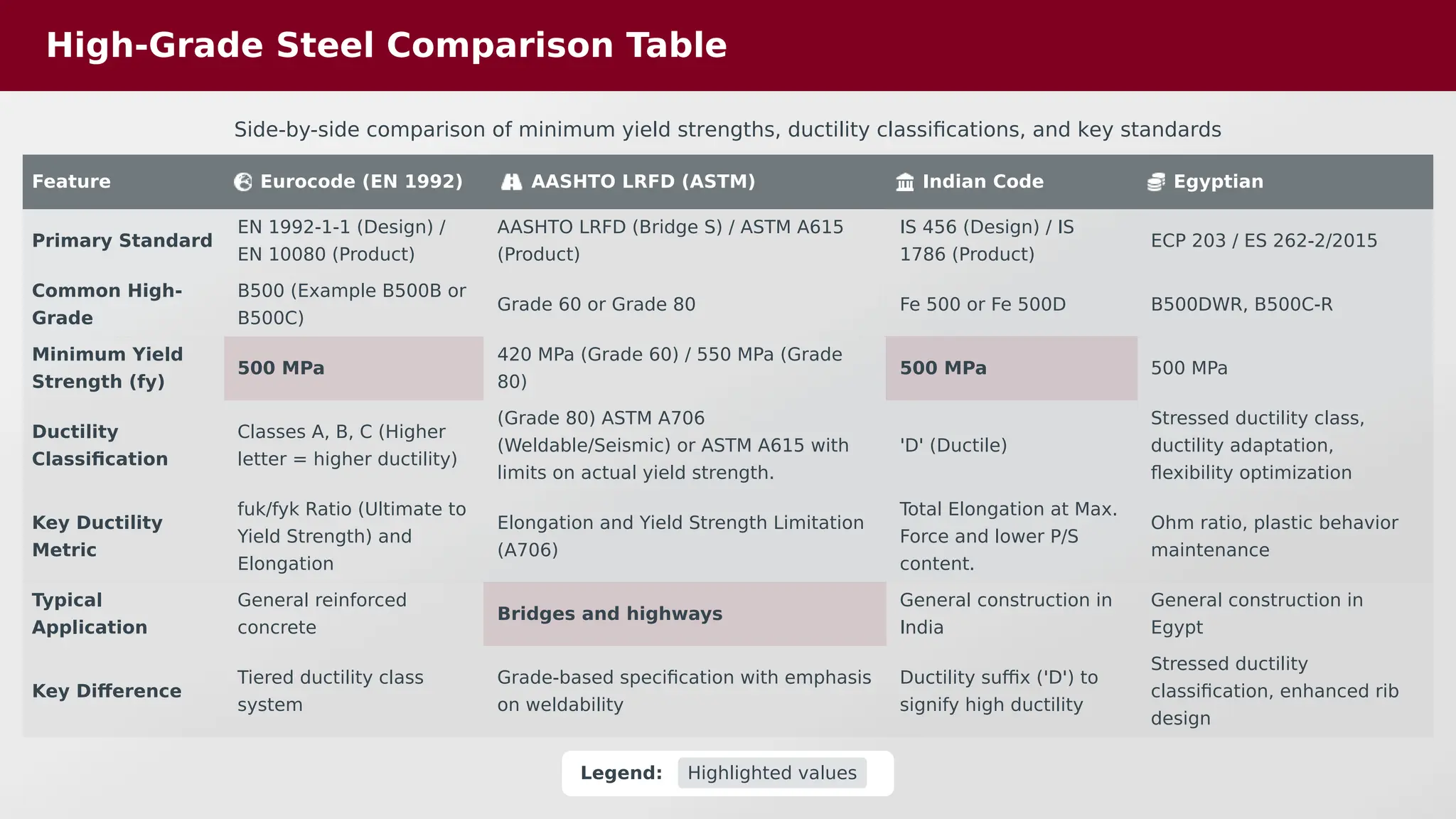
High-Grade Steel Comparison Table
Side-by-side comparison of minimum yield strengths, ductility classifications, and key standards
Feature Eurocode (EN 1992) AASHTO LRFD (ASTM) Indian Code Egyptian
Primary Standard
EN 1992-1-1 (Design) /
EN 10080 (Product)
AASHTO LRFD (Bridge S) / ASTM A615
(Product)
IS 456 (Design) / IS
1786 (Product)
ECP 203 / ES 262-2/2015
Common High-
Grade
B500 (Example B500B or
B500C)
Grade 60 or Grade 80 Fe 500 or Fe 500D B500DWR, B500C-R
Minimum Yield
Strength (fy)
500 MPa
420 MPa (Grade 60) / 550 MPa (Grade
80)
500 MPa 500 MPa
Ductility
Classification
Classes A, B, C (Higher
letter = higher ductility)
(Grade 80) ASTM A706
(Weldable/Seismic) or ASTM A615 with
limits on actual yield strength.
'D' (Ductile)
Stressed ductility class,
ductility adaptation,
flexibility optimization
Key Ductility
Metric
fuk/fyk Ratio (Ultimate to
Yield Strength) and
Elongation
Elongation and Yield Strength Limitation
(A706)
Total Elongation at Max.
Force and lower P/S
content.
Ohm ratio, plastic behavior
maintenance
Typical
Application
General reinforced
concrete
Bridges and highways
General construction in
India
General construction in
Egypt
Key Difference
Tiered ductility class
system
Grade-based specification with emphasis
on weldability
Ductility suffix ('D') to
signify high ductility
Stressed ductility
classification, enhanced rib
design
Legend: Highlighted values
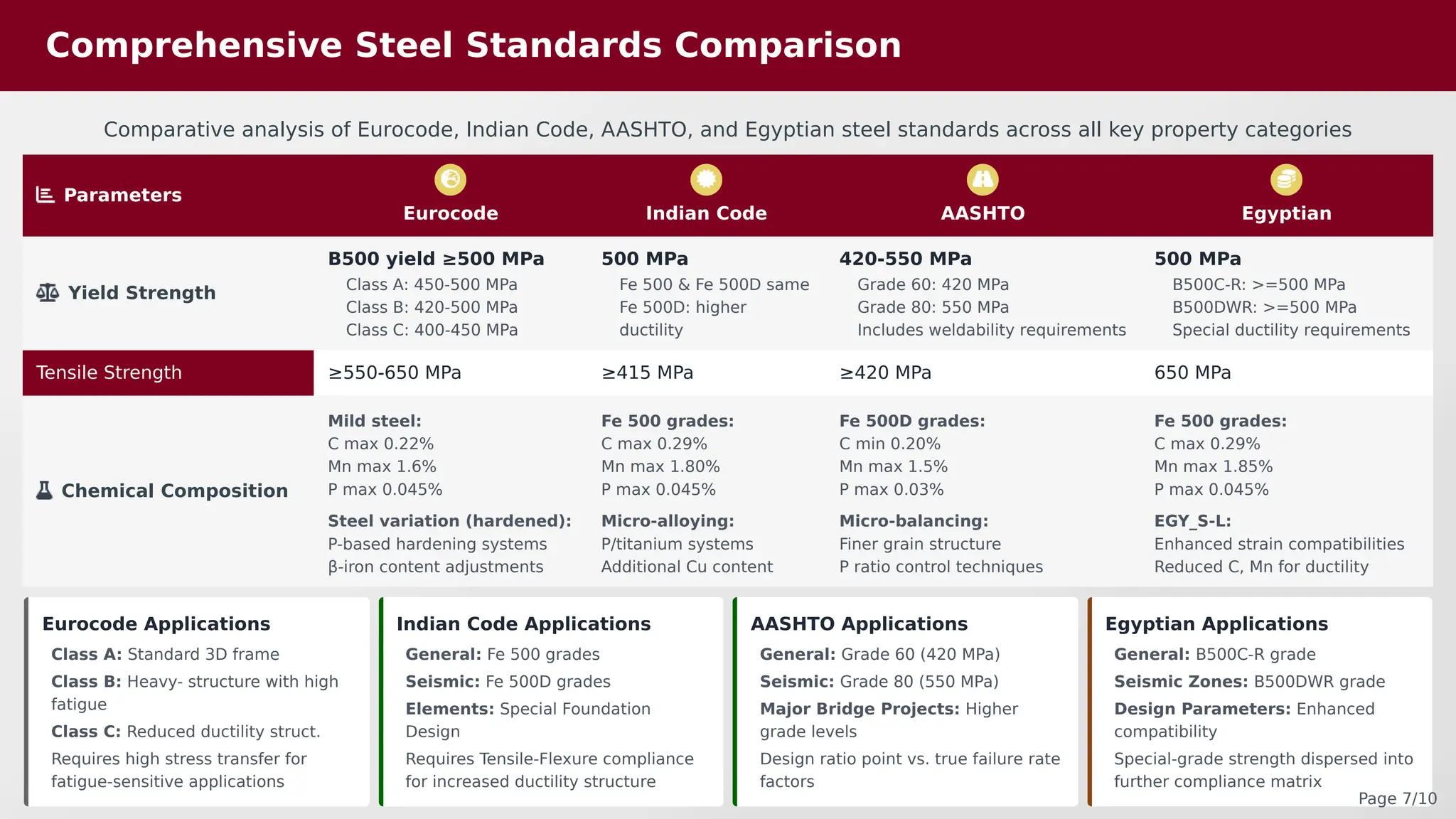
Comprehensive Steel Standards Comparison
Comparative analysis of Eurocode, Indian Code, AASHTO, and Egyptian steel standards across all key property categories
Parameters
Eurocode Indian Code AASHTO Egyptian
Yield Strength
B500 yield ≥500 MPa
Class A: 450-500 MPa
Class B: 420-500 MPa
Class C: 400-450 MPa
500 MPa
Fe 500 & Fe 500D same
Fe 500D: higher
ductility
420-550 MPa
Grade 60: 420 MPa
Grade 80: 550 MPa
Includes weldability requirements
500 MPa
B500C-R: >=500 MPa
B500DWR: >=500 MPa
Special ductility requirements
Tensile Strength ≥550-650 MPa ≥415 MPa ≥420 MPa 650 MPa
Chemical Composition
Mild steel:
C max 0.22%
Mn max 1.6%
P max 0.045%
Steel variation (hardened):
P-based hardening systems
β-iron content adjustments
Fe 500 grades:
C max 0.29%
Mn max 1.80%
P max 0.045%
Micro-alloying:
P/titanium systems
Additional Cu content
Fe 500D grades:
C min 0.20%
Mn max 1.5%
P max 0.03%
Micro-balancing:
Finer grain structure
P ratio control techniques
Fe 500 grades:
C max 0.29%
Mn max 1.85%
P max 0.045%
EGY_S-L:
Enhanced strain compatibilities
Reduced C, Mn for ductility
Eurocode Applications
Class A: Standard 3D frame
Class B: Heavy- structure with high
fatigue
Class C: Reduced ductility struct.
Requires high stress transfer for
fatigue-sensitive applications
Indian Code Applications
General: Fe 500 grades
Seismic: Fe 500D grades
Elements: Special Foundation
Design
Requires Tensile-Flexure compliance
for increased ductility structure
AASHTO Applications
General: Grade 60 (420 MPa)
Seismic: Grade 80 (550 MPa)
Major Bridge Projects: Higher
grade levels
Design ratio point vs. true failure rate
factors
Egyptian Applications
General: B500C-R grade
Seismic Zones: B500DWR grade
Design Parameters: Enhanced
compatibility
Special-grade strength dispersed into
further compliance matrix
Page 7/10
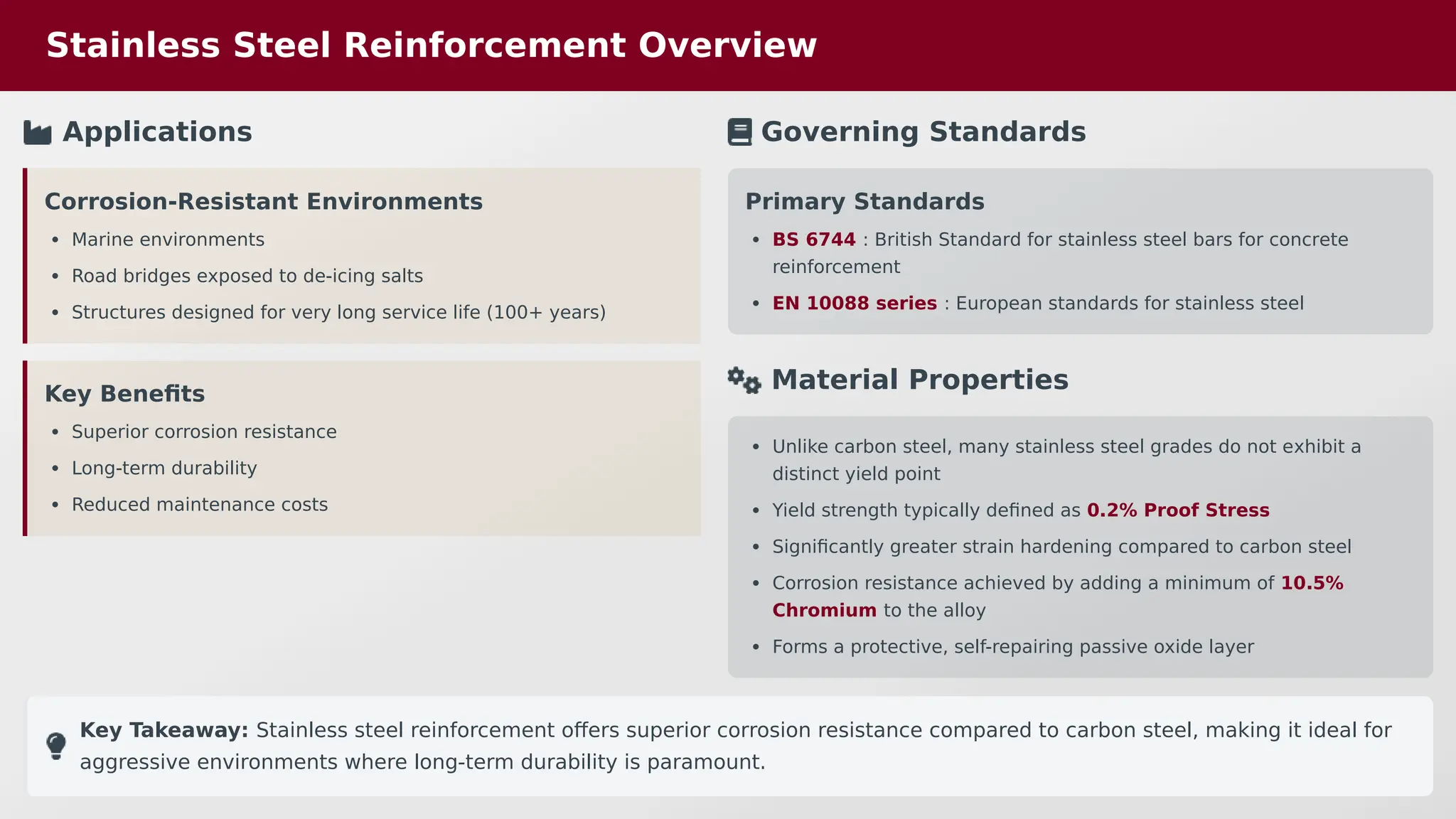
Stainless Steel Reinforcement Overview
Applications
Corrosion-Resistant Environments
Marine environments
Road bridges exposed to de-icing salts
Structures designed for very long service life (100+ years)
Key Benefits
Superior corrosion resistance
Long-term durability
Reduced maintenance costs
Governing Standards
Primary Standards
BS 6744 : British Standard for stainless steel bars for concrete
reinforcement
EN 10088 series : European standards for stainless steel
Material Properties
Unlike carbon steel, many stainless steel grades do not exhibit a
distinct yield point
Yield strength typically defined as 0.2% Proof Stress
Significantly greater strain hardening compared to carbon steel
Corrosion resistance achieved by adding a minimum of 10.5%
Chromium to the alloy
Forms a protective, self-repairing passive oxide layer
Key Takeaway: Stainless steel reinforcement offers superior corrosion resistance compared to carbon steel, making it ideal for
aggressive environments where long-term durability is paramount.
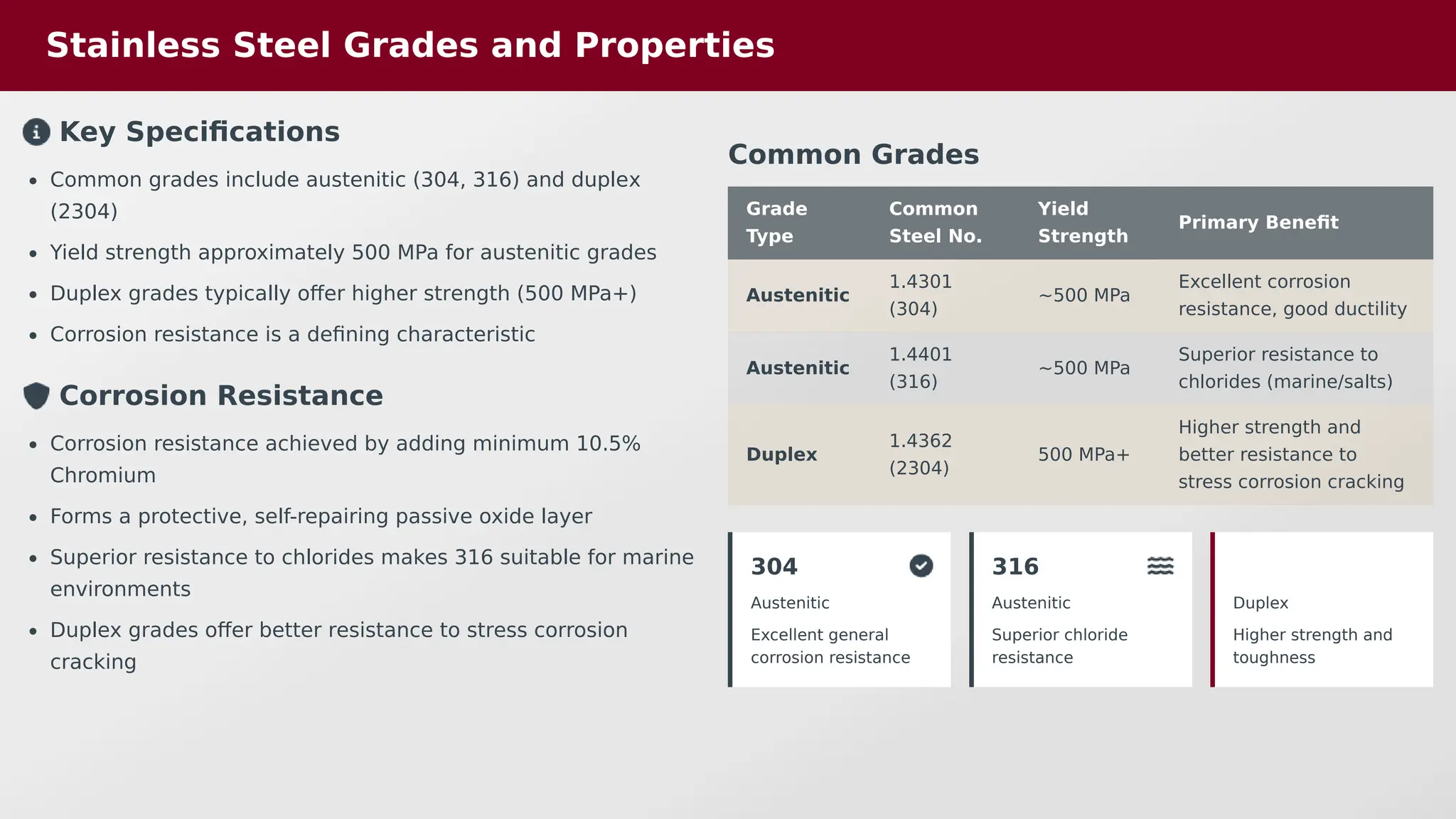
Stainless Steel Grades and Properties
Key Specifications
Common grades include austenitic (304, 316) and duplex
(2304)
Yield strength approximately 500 MPa for austenitic grades
Duplex grades typically offer higher strength (500 MPa+)
Corrosion resistance is a defining characteristic
Corrosion Resistance
Corrosion resistance achieved by adding minimum 10.5%
Chromium
Forms a protective, self-repairing passive oxide layer
Superior resistance to chlorides makes 316 suitable for marine
environments
Duplex grades offer better resistance to stress corrosion
cracking
Common Grades
Grade
Type
Common
Steel No.
Yield
Strength
Primary Benefit
Austenitic
1.4301
(304)
~500 MPa
Excellent corrosion
resistance, good ductility
Austenitic
1.4401
(316)
~500 MPa
Superior resistance to
chlorides (marine/salts)
Duplex
1.4362
(2304)
500 MPa+
Higher strength and
better resistance to
stress corrosion cracking
304
Austenitic
Excellent general
corrosion resistance
316
Austenitic
Superior chloride
resistance
Duplex
Higher strength and
toughness
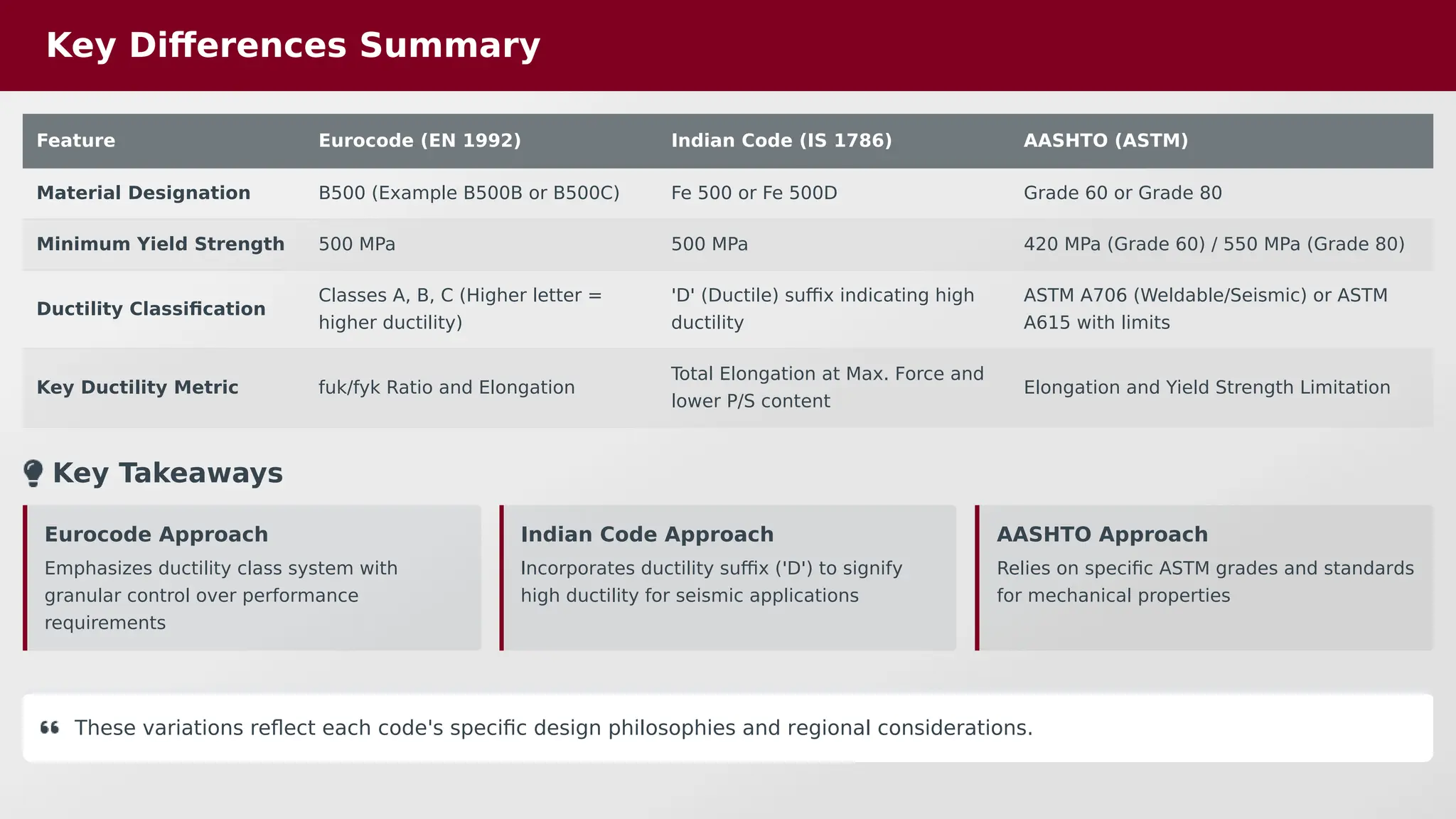
Key Differences Summary
Feature Eurocode (EN 1992) Indian Code (IS 1786) AASHTO (ASTM)
Material Designation B500 (Example B500B or B500C) Fe 500 or Fe 500D Grade 60 or Grade 80
Minimum Yield Strength 500 MPa 500 MPa 420 MPa (Grade 60) / 550 MPa (Grade 80)
Ductility Classification
Classes A, B, C (Higher letter =
higher ductility)
'D' (Ductile) suffix indicating high
ductility
ASTM A706 (Weldable/Seismic) or ASTM
A615 with limits
Key Ductility Metric fuk/fyk Ratio and Elongation
Total Elongation at Max. Force and
lower P/S content
Elongation and Yield Strength Limitation
Key Takeaways
Eurocode Approach
Emphasizes ductility class system with
granular control over performance
requirements
Indian Code Approach
Incorporates ductility suffix ('D') to signify
high ductility for seismic applications
AASHTO Approach
Relies on specific ASTM grades and standards
for mechanical properties
These variations reflect each code's specific design philosophies and regional considerations.

Steel+Reinforcement+Standards+Comparison (1).pdf

  • 1.
    Report Date: 2025-11-30Engineering Standards Analysis Steel Reinforcement Standards Comparison Eurocode, Indian Code & AASHTO A Comprehensive Analysis of High-Grade Carbon Steel and Stainless Steel Specifications
  • 2.
    Eurocode High-Grade Steel(B500) Key Specifications Designated as B500 steel Minimum yield strength ( fyk ): 500 MPa Used primarily in reinforced concrete applications Steel categorized into three ductility classes based on performance requirements Design Considerations Ductility classes crucial for seismic design applications Higher class numbers indicate higher ductility and energy absorption capacity Strength ratios and elongation values ensure reliable performance under stress Ductility Classes Ductility Class Yield Strength (fyk) Ultimate/Yield Ratio Elongation (εuk) Class A (Normal) 500 MPa 1.05 2.5% Class B (High) 500 MPa 1.08 5.0% Class C (Very High) 500 MPa 1.15 7.5% Strength Relationship
  • 3.
    Indian Code High-GradeSteel (Fe 500) Key Specifications Designated as Fe 500 or Fe 500D according to IS 1786 "Fe" indicates ferrous material (iron/steel) Number 500 represents minimum yield strength of 500 MPa Grade Fe 500D has enhanced ductility for seismic applications Seismic Applications High ductility version (Fe 500D) is specifically recommended for earthquake-resistant structures in seismic zones. Design Standards Specified under IS 1786 standard, which governs high-strength deformed bars for reinforced concrete. Fe 500 vs Fe 500D Comparison Property Fe 500 Fe 500D Yield Strength 500 MPa 500 MPa Ductility Standard High Elongation Lower Higher Primary Application General construction Seismic zones Ductility Relationship
  • 4.
    AASHTO High-Grade Steel(Grade 60/80) Key Specifications Primarily uses ASTM standards Common grades: Grade 60 and Grade 80 Grade 60: 420 MPa yield strength (~60 ksi) Grade 80: 550 MPa yield strength (~80 ksi) Governed by ASTM A615 or ASTM A706 Design Considerations ASTM A706 specifically for weldable and seismic applications Provides additional controls on chemical composition and mechanical properties Grade 80 increasingly used for applications requiring greater strength Steel Properties Property Grade 60 Grade 80 Yield Strength (fy) 420 MPa 550 MPa Tensile Strength (fu) 620 MPa 690 MPa Standard ASTM A615/A706 ASTM A615/A706 Strength Relationship
  • 5.
    Egyptian Steel Standards PrimaryStandards ECP 203 - National Code of Practice for Steel Construction ES 262-2/2015 - Egyptian Steel Standard for reinforcement Complement the ECL 2012 - Code for Loads Egyptian Steel Grades (360, 400, 500) Grade Yield Strength Ultimate Strength Applications 360 360 MPa 550 MPa Basic structures 400 400 MPa 575 MPa General buildings 500 500 MPa 650 MPa High-rise, bridges High-Grade Steel Properties Steel Type Yield Strength Ultimate Strength B400B-R 400 MPa 550 MPa B500C-R 500 MPa 650 MPa B500DWR 500 MPa 650 MPa Common Reinforcement Types Steel Bars (6-40mm) Primary reinforcement Wire Mesh (WWF) Minor reinforcement, slabs Wire Fabric/Steel Elements Crack control in concrete Stainless Steel Bars For marine environments Major Egyptian Steel Manufacturers & Products Key Manufacturers Ezz Steel Company Beshay Steel Group INCOSTEEL Egyptian Steel Company (ESC) UJ Steel Main Products Steel Bars (Rebars) Steel Sections & Tubes Flat Steel Products Stainless Steel Products Gas Steel Products Egyptian Standard Comparison Feature Egyptian Eurocode AASHTO High-Grade Steel 500 MPa (B500 series) 500 MPa (B500B/C/D) Grade 60/80 (420/550 MPa) Ductility Classes B-R, C-R, DWR (Perc. ratio) A/B/C (0.30/0.45/0.60) None specified Eurocode Reference ECP 203 - Steel Structures BS 5950/1149/EN 1993-1 AISC Egyptian Steel Optimization High Strength Excellent tensile properties Rib Structure Enhanced embedment conditions Durability Extended service life
  • 6.
    High-Grade Steel ComparisonTable Side-by-side comparison of minimum yield strengths, ductility classifications, and key standards Feature Eurocode (EN 1992) AASHTO LRFD (ASTM) Indian Code Egyptian Primary Standard EN 1992-1-1 (Design) / EN 10080 (Product) AASHTO LRFD (Bridge S) / ASTM A615 (Product) IS 456 (Design) / IS 1786 (Product) ECP 203 / ES 262-2/2015 Common High- Grade B500 (Example B500B or B500C) Grade 60 or Grade 80 Fe 500 or Fe 500D B500DWR, B500C-R Minimum Yield Strength (fy) 500 MPa 420 MPa (Grade 60) / 550 MPa (Grade 80) 500 MPa 500 MPa Ductility Classification Classes A, B, C (Higher letter = higher ductility) (Grade 80) ASTM A706 (Weldable/Seismic) or ASTM A615 with limits on actual yield strength. 'D' (Ductile) Stressed ductility class, ductility adaptation, flexibility optimization Key Ductility Metric fuk/fyk Ratio (Ultimate to Yield Strength) and Elongation Elongation and Yield Strength Limitation (A706) Total Elongation at Max. Force and lower P/S content. Ohm ratio, plastic behavior maintenance Typical Application General reinforced concrete Bridges and highways General construction in India General construction in Egypt Key Difference Tiered ductility class system Grade-based specification with emphasis on weldability Ductility suffix ('D') to signify high ductility Stressed ductility classification, enhanced rib design Legend: Highlighted values
  • 7.
    Comprehensive Steel StandardsComparison Comparative analysis of Eurocode, Indian Code, AASHTO, and Egyptian steel standards across all key property categories Parameters Eurocode Indian Code AASHTO Egyptian Yield Strength B500 yield ≥500 MPa Class A: 450-500 MPa Class B: 420-500 MPa Class C: 400-450 MPa 500 MPa Fe 500 & Fe 500D same Fe 500D: higher ductility 420-550 MPa Grade 60: 420 MPa Grade 80: 550 MPa Includes weldability requirements 500 MPa B500C-R: >=500 MPa B500DWR: >=500 MPa Special ductility requirements Tensile Strength ≥550-650 MPa ≥415 MPa ≥420 MPa 650 MPa Chemical Composition Mild steel: C max 0.22% Mn max 1.6% P max 0.045% Steel variation (hardened): P-based hardening systems β-iron content adjustments Fe 500 grades: C max 0.29% Mn max 1.80% P max 0.045% Micro-alloying: P/titanium systems Additional Cu content Fe 500D grades: C min 0.20% Mn max 1.5% P max 0.03% Micro-balancing: Finer grain structure P ratio control techniques Fe 500 grades: C max 0.29% Mn max 1.85% P max 0.045% EGY_S-L: Enhanced strain compatibilities Reduced C, Mn for ductility Eurocode Applications Class A: Standard 3D frame Class B: Heavy- structure with high fatigue Class C: Reduced ductility struct. Requires high stress transfer for fatigue-sensitive applications Indian Code Applications General: Fe 500 grades Seismic: Fe 500D grades Elements: Special Foundation Design Requires Tensile-Flexure compliance for increased ductility structure AASHTO Applications General: Grade 60 (420 MPa) Seismic: Grade 80 (550 MPa) Major Bridge Projects: Higher grade levels Design ratio point vs. true failure rate factors Egyptian Applications General: B500C-R grade Seismic Zones: B500DWR grade Design Parameters: Enhanced compatibility Special-grade strength dispersed into further compliance matrix Page 7/10
  • 8.
    Stainless Steel ReinforcementOverview Applications Corrosion-Resistant Environments Marine environments Road bridges exposed to de-icing salts Structures designed for very long service life (100+ years) Key Benefits Superior corrosion resistance Long-term durability Reduced maintenance costs Governing Standards Primary Standards BS 6744 : British Standard for stainless steel bars for concrete reinforcement EN 10088 series : European standards for stainless steel Material Properties Unlike carbon steel, many stainless steel grades do not exhibit a distinct yield point Yield strength typically defined as 0.2% Proof Stress Significantly greater strain hardening compared to carbon steel Corrosion resistance achieved by adding a minimum of 10.5% Chromium to the alloy Forms a protective, self-repairing passive oxide layer Key Takeaway: Stainless steel reinforcement offers superior corrosion resistance compared to carbon steel, making it ideal for aggressive environments where long-term durability is paramount.
  • 9.
    Stainless Steel Gradesand Properties Key Specifications Common grades include austenitic (304, 316) and duplex (2304) Yield strength approximately 500 MPa for austenitic grades Duplex grades typically offer higher strength (500 MPa+) Corrosion resistance is a defining characteristic Corrosion Resistance Corrosion resistance achieved by adding minimum 10.5% Chromium Forms a protective, self-repairing passive oxide layer Superior resistance to chlorides makes 316 suitable for marine environments Duplex grades offer better resistance to stress corrosion cracking Common Grades Grade Type Common Steel No. Yield Strength Primary Benefit Austenitic 1.4301 (304) ~500 MPa Excellent corrosion resistance, good ductility Austenitic 1.4401 (316) ~500 MPa Superior resistance to chlorides (marine/salts) Duplex 1.4362 (2304) 500 MPa+ Higher strength and better resistance to stress corrosion cracking 304 Austenitic Excellent general corrosion resistance 316 Austenitic Superior chloride resistance Duplex Higher strength and toughness
  • 10.
    Key Differences Summary FeatureEurocode (EN 1992) Indian Code (IS 1786) AASHTO (ASTM) Material Designation B500 (Example B500B or B500C) Fe 500 or Fe 500D Grade 60 or Grade 80 Minimum Yield Strength 500 MPa 500 MPa 420 MPa (Grade 60) / 550 MPa (Grade 80) Ductility Classification Classes A, B, C (Higher letter = higher ductility) 'D' (Ductile) suffix indicating high ductility ASTM A706 (Weldable/Seismic) or ASTM A615 with limits Key Ductility Metric fuk/fyk Ratio and Elongation Total Elongation at Max. Force and lower P/S content Elongation and Yield Strength Limitation Key Takeaways Eurocode Approach Emphasizes ductility class system with granular control over performance requirements Indian Code Approach Incorporates ductility suffix ('D') to signify high ductility for seismic applications AASHTO Approach Relies on specific ASTM grades and standards for mechanical properties These variations reflect each code's specific design philosophies and regional considerations.