European Youth Foundation
Supporting young people and youth organisations since 1972
1
What is the Council of Europe?
2
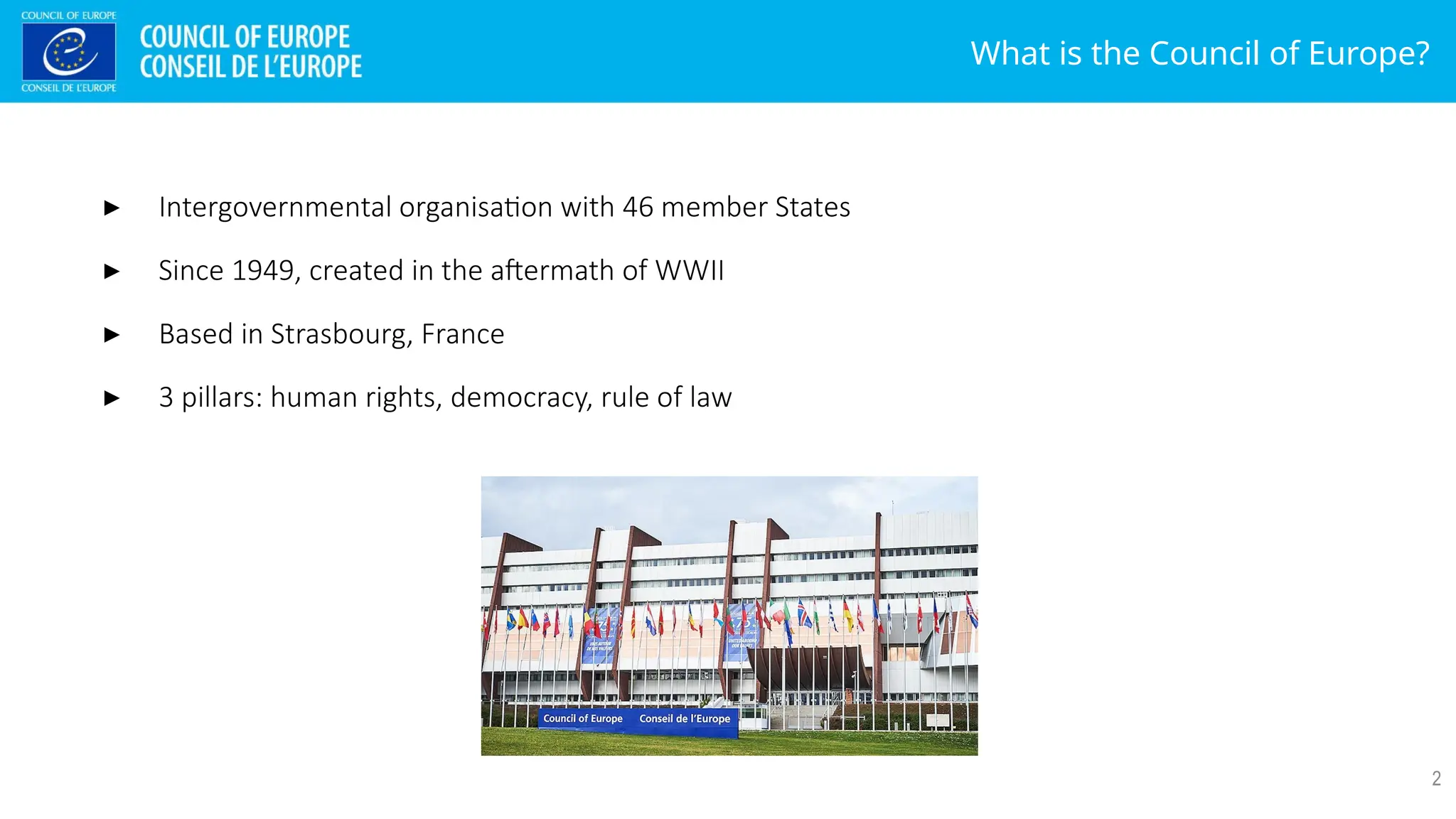
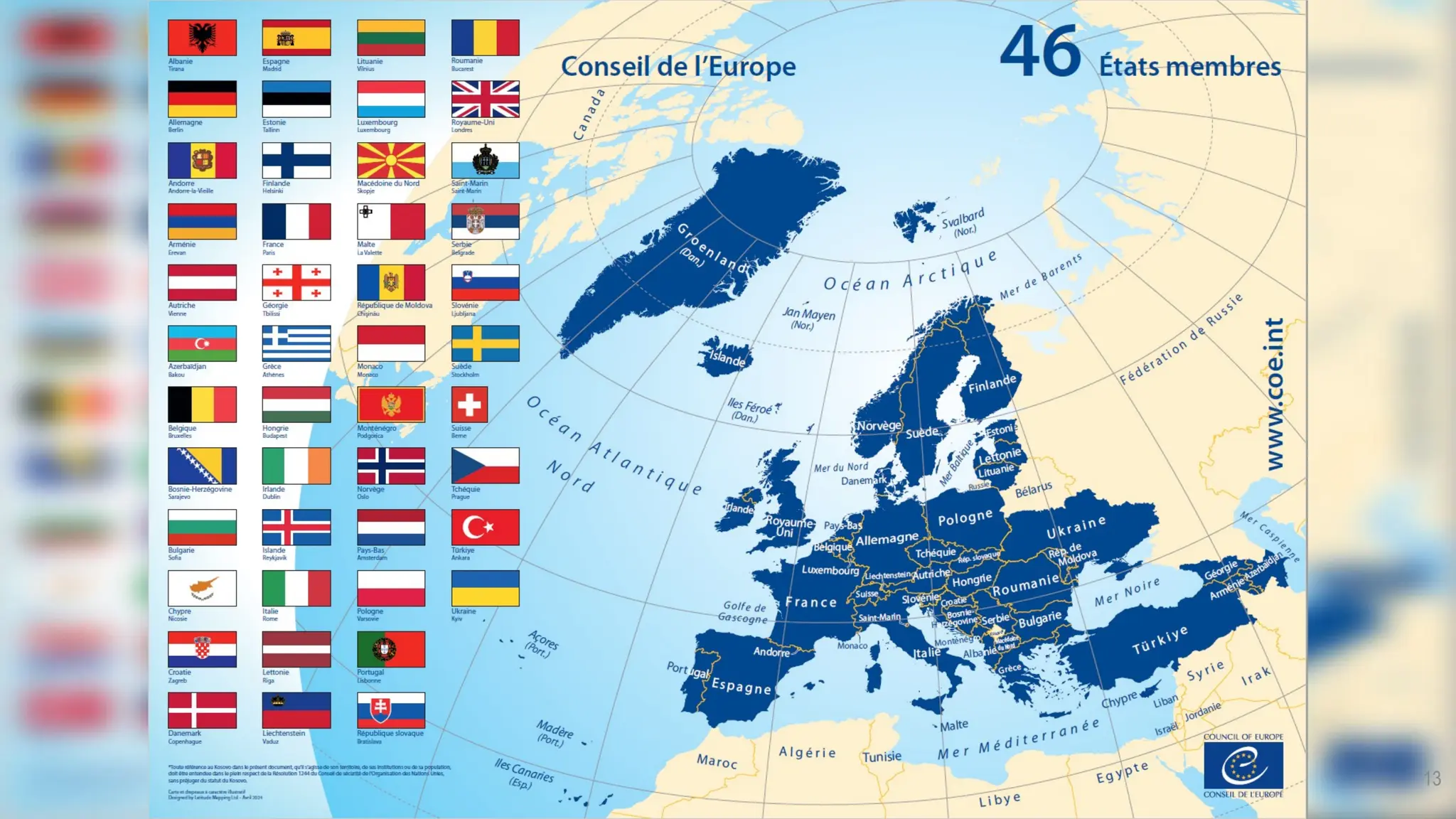
▸ Intergovernmental organisation with 46 member States
▸ Since 1949, created in the aftermath of WWII
▸ Based in Strasbourg, France
▸ 3 pillars: human rights, democracy, rule of law
EYF mission
3
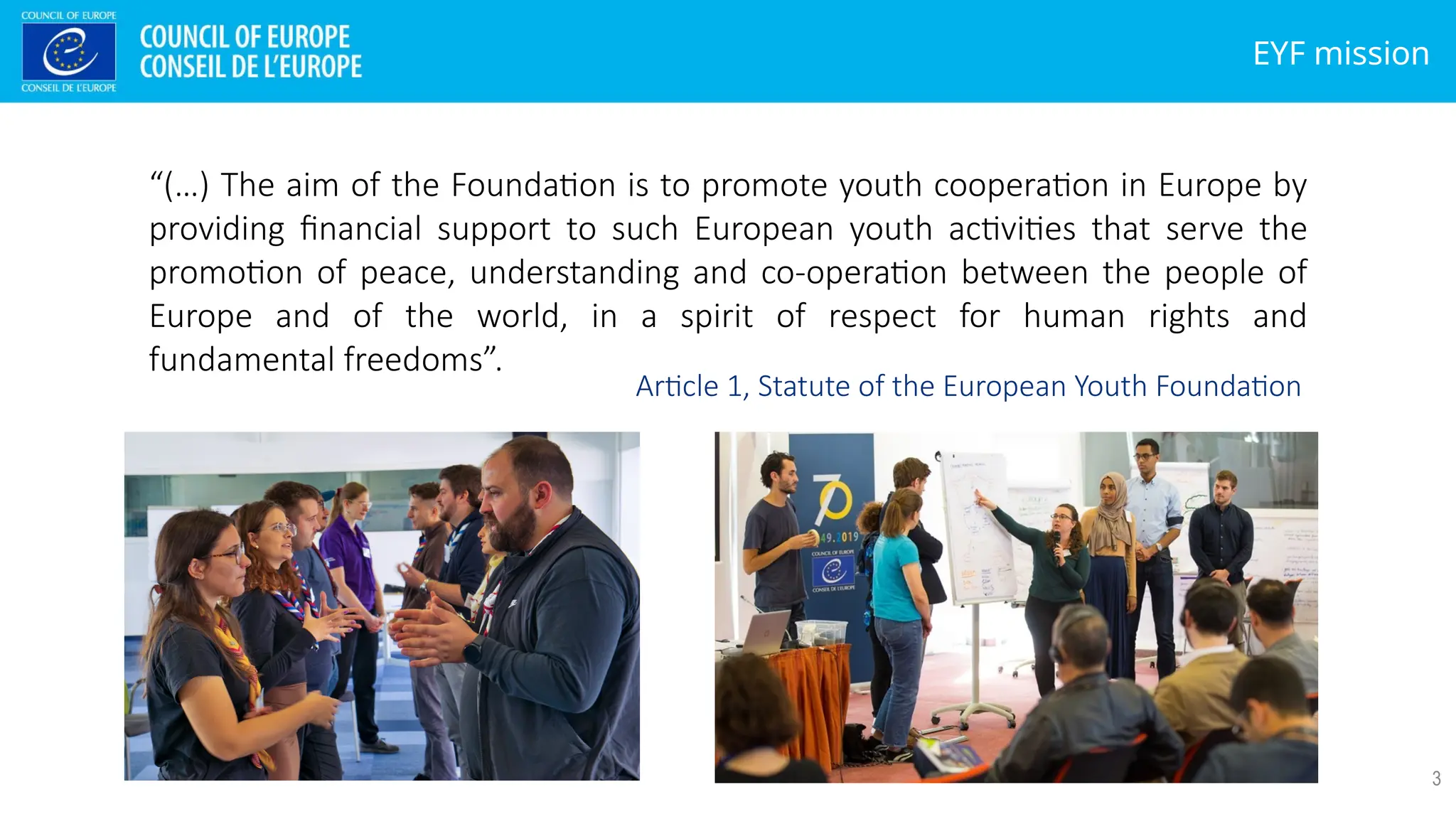
“(…) The aim of the Foundation is to promote youth cooperation in Europe by
providing financial support to such European youth activities that serve the
promotion of peace, understanding and co-operation between the people of
Europe and of the world, in a spirit of respect for human rights and
fundamental freedoms”.
Article 1, Statute of the European Youth Foundation
EYF key facts
4
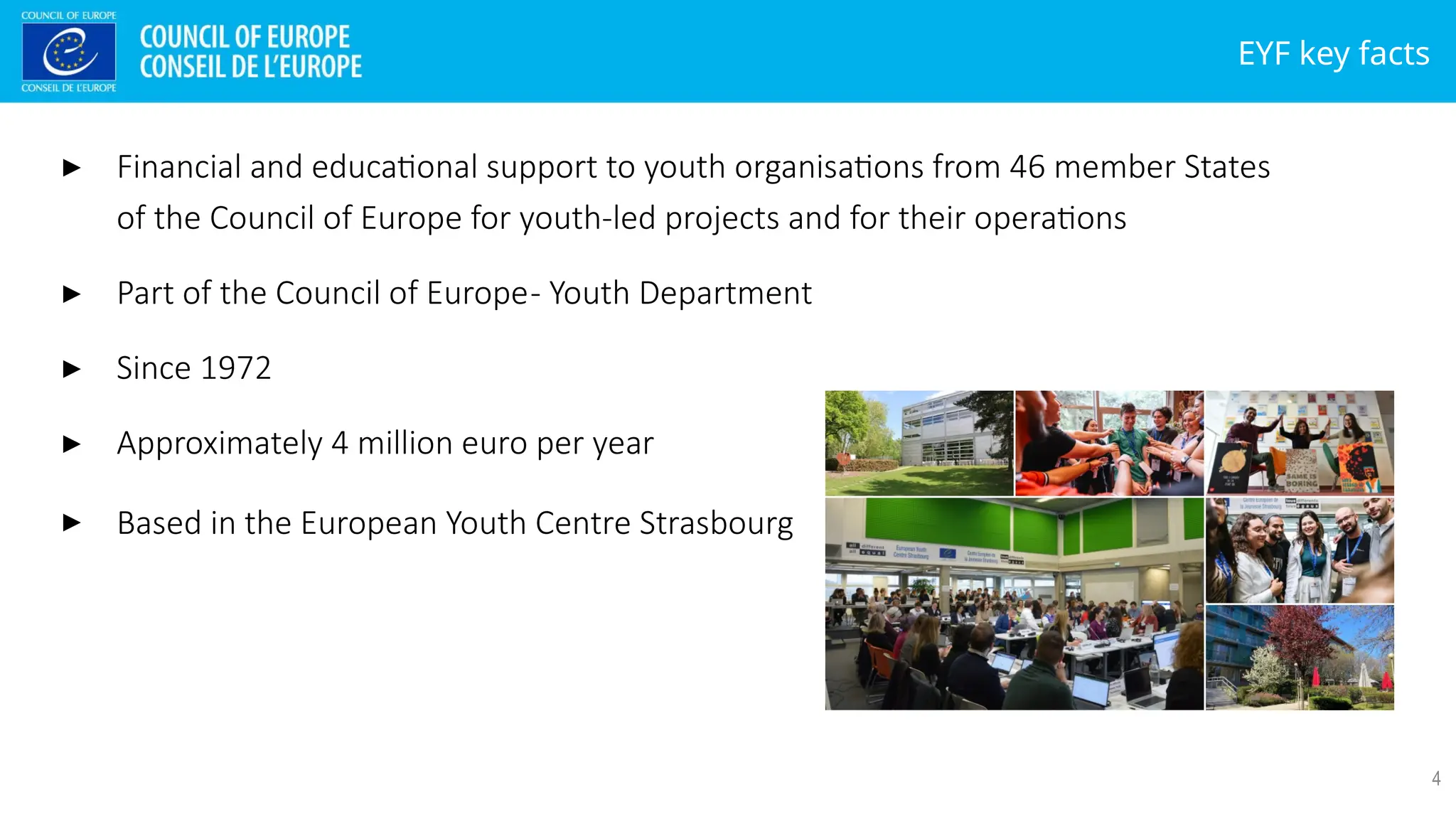
▸ Financial and educational support to youth organisations from 46 member States
of the Council of Europe for youth-led projects and for their operations
▸ Part of the Council of Europe- Youth Department
▸ Since 1972
▸ Approximately 4 million euro per year
▸ Based in the European Youth Centre Strasbourg
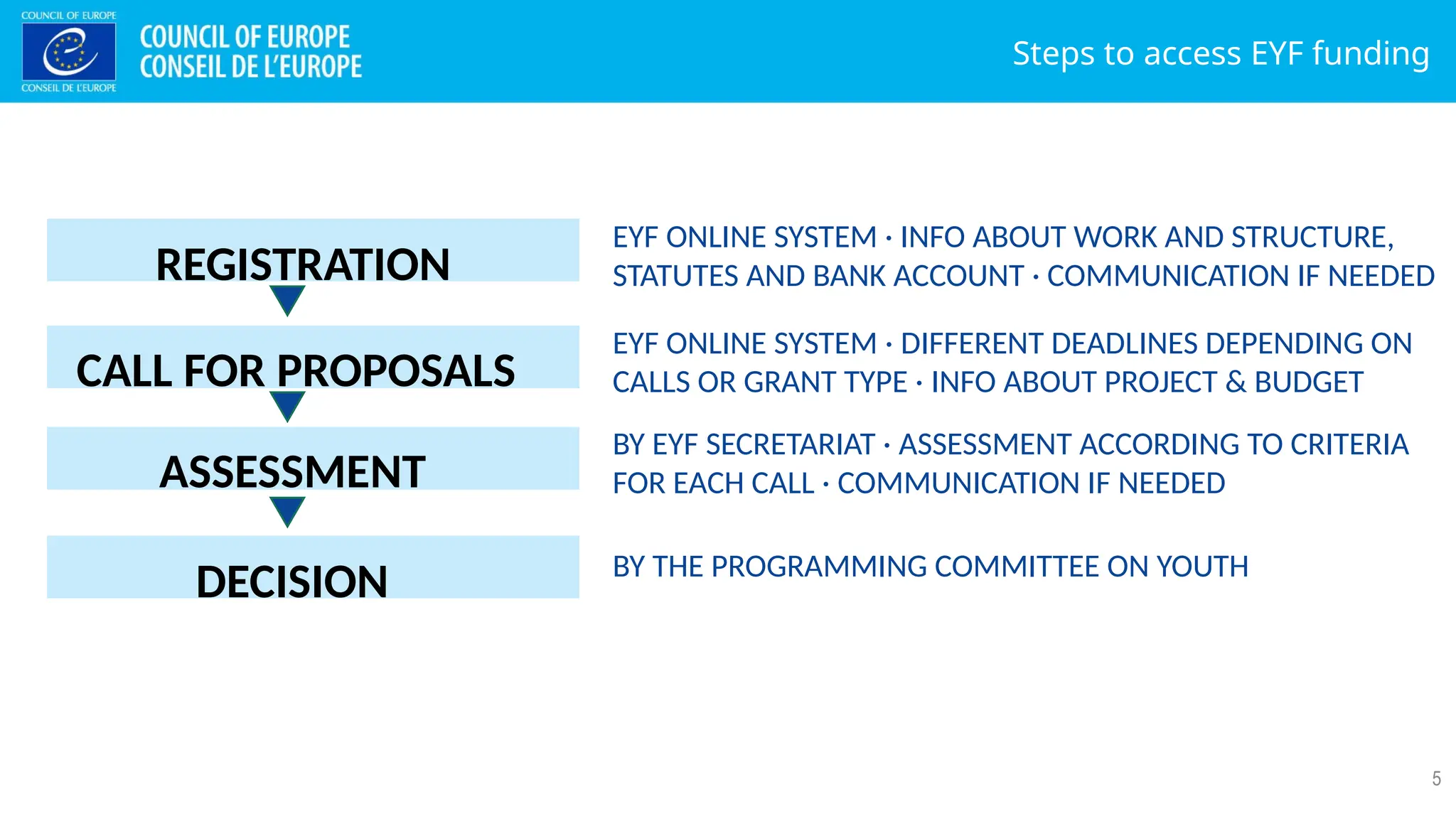
Steps to access EYF funding
5
REGISTRATION
EYF ONLINE SYSTEM · INFO ABOUT WORK AND STRUCTURE,
STATUTES AND BANK ACCOUNT · COMMUNICATION IF NEEDED
EYF ONLINE SYSTEM · DIFFERENT DEADLINES DEPENDING ON
CALLS OR GRANT TYPE · INFO ABOUT PROJECT & BUDGET
BY EYF SECRETARIAT · ASSESSMENT ACCORDING TO CRITERIA
FOR EACH CALL · COMMUNICATION IF NEEDED
BY THE PROGRAMMING COMMITTEE ON YOUTH
CALL FOR PROPOSALS
ASSESSMENT
DECISION
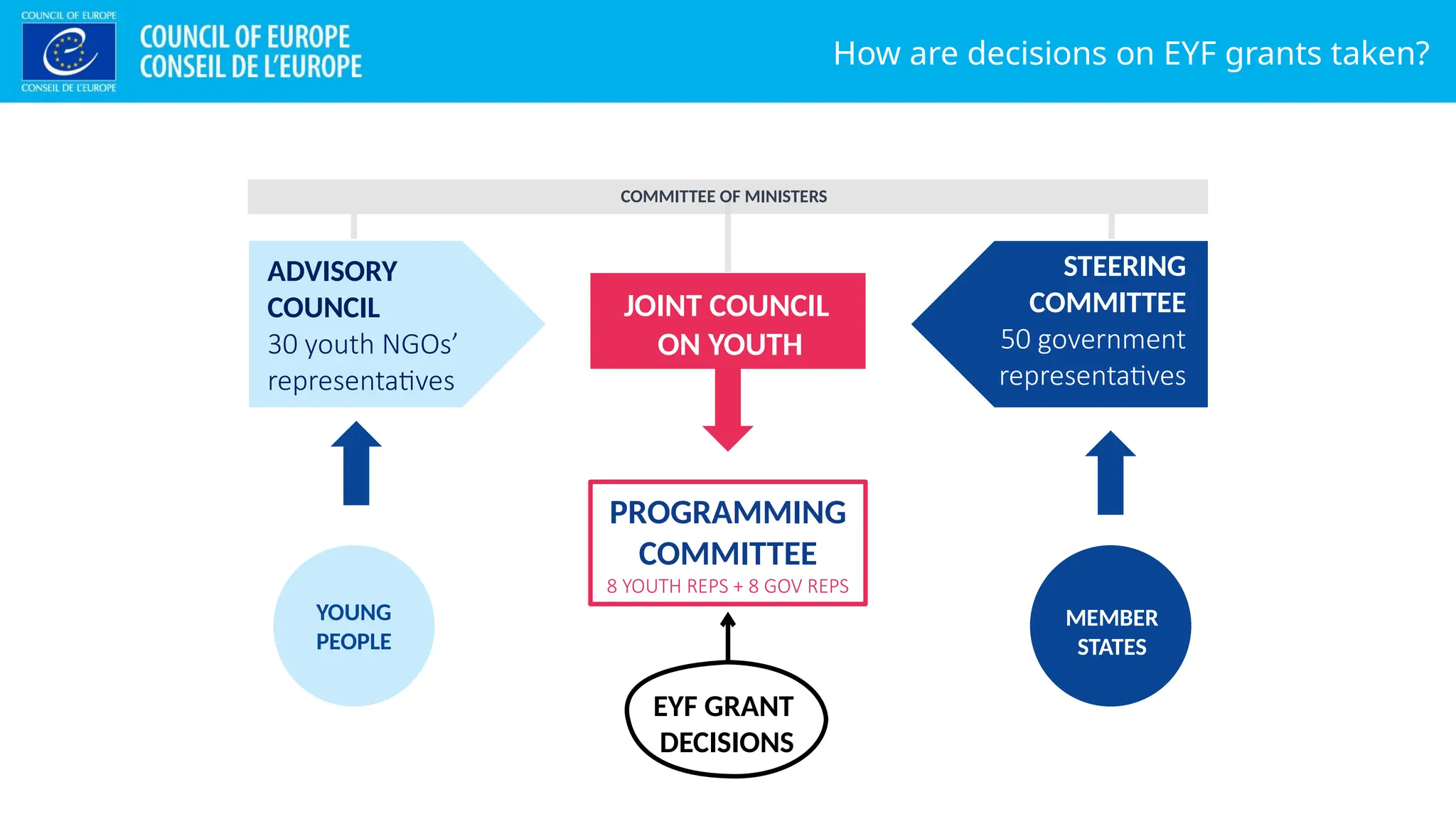
ADVISORY
COUNCIL
30 youth NGOs’
representatives
JOINT COUNCIL
ON YOUTH
STEERING
COMMITTEE
50 government
representatives
COMMITTEE OF MINISTERS
MEMBER
STATES
PROGRAMMING
COMMITTEE
8 YOUTH REPS + 8 GOV REPS
YOUNG
PEOPLE
EYF GRANT
DECISIONS
How are decisions on EYF grants taken?
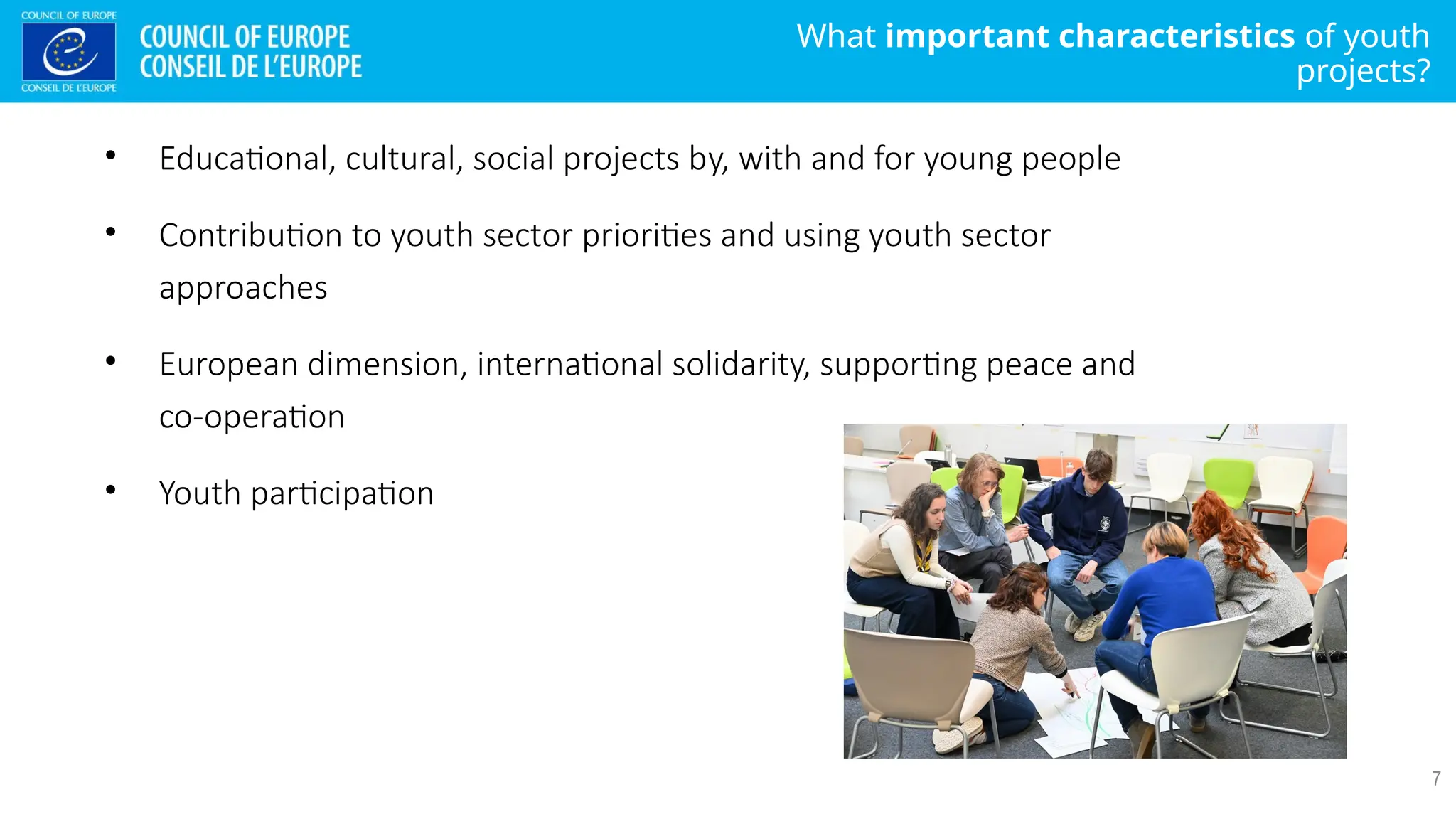
What important characteristics of youth
projects?
7
• Educational, cultural, social projects by, with and for young people
• Contribution to youth sector priorities and using youth sector
approaches
• European dimension, international solidarity, supporting peace and
co-operation
• Youth participation
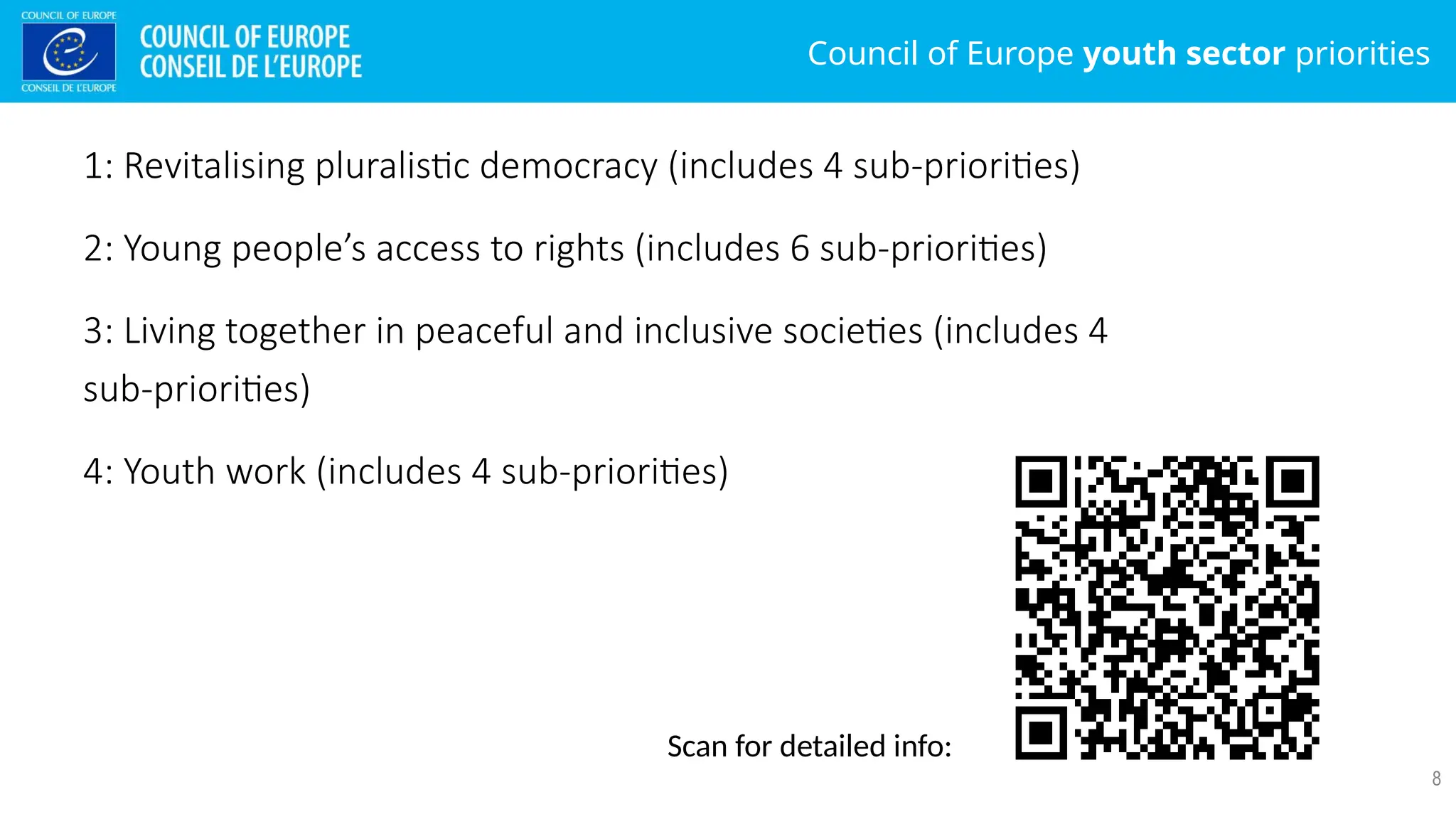
Council of Europe youth sector priorities
8
1: Revitalising pluralistic democracy (includes 4 sub-priorities)
2: Young people’s access to rights (includes 6 sub-priorities)
3: Living together in peaceful and inclusive societies (includes 4
sub-priorities)
4: Youth work (includes 4 sub-priorities)
Scan for detailed info:
What types of project grants does the EYF
have?
9
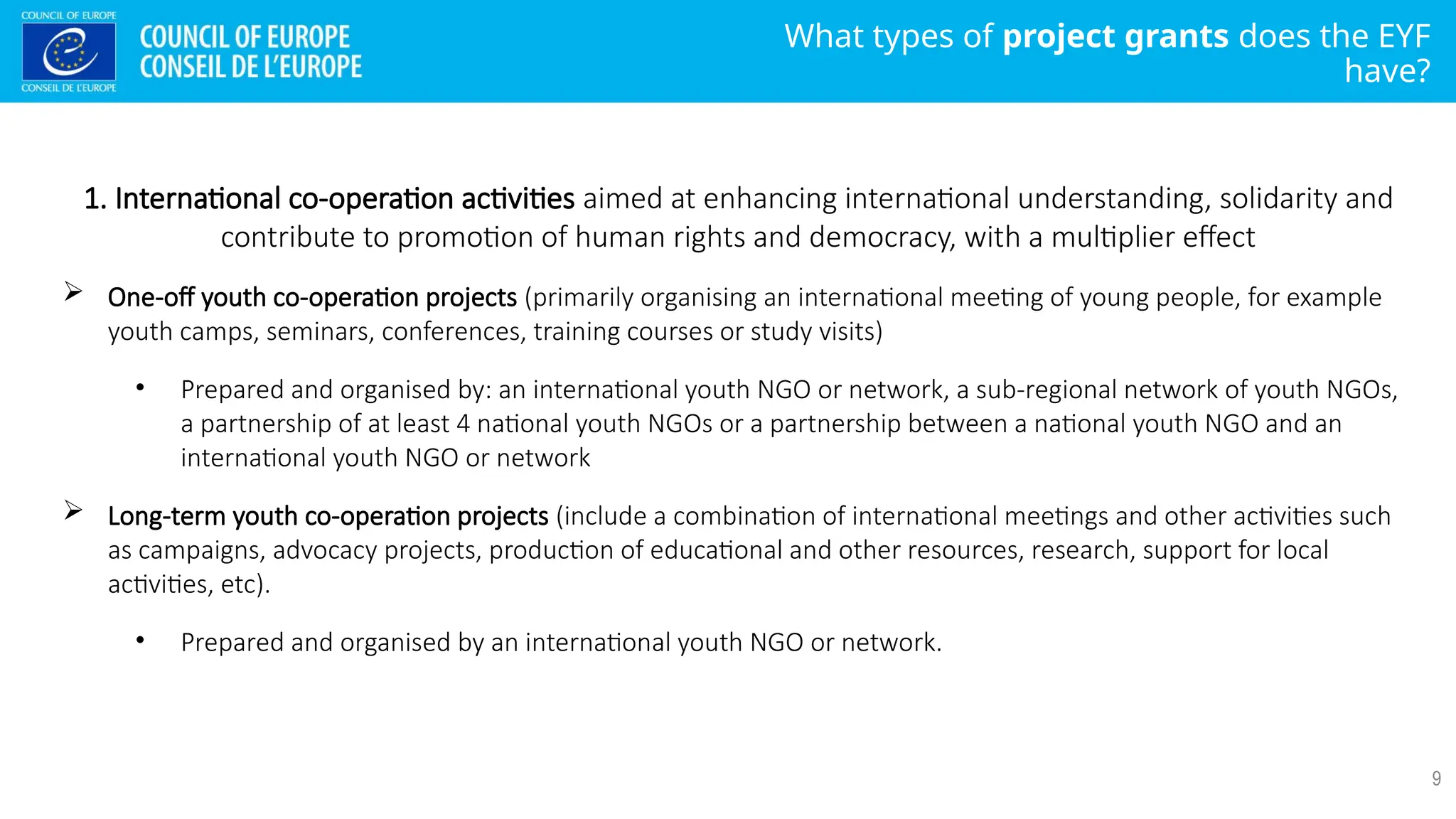
1. International co-operation activities aimed at enhancing international understanding, solidarity and
contribute to promotion of human rights and democracy, with a multiplier effect
 One-off youth co-operation projects (primarily organising an international meeting of young people, for example
youth camps, seminars, conferences, training courses or study visits)
• Prepared and organised by: an international youth NGO or network, a sub-regional network of youth NGOs,
a partnership of at least 4 national youth NGOs or a partnership between a national youth NGO and an
international youth NGO or network
 Long-term youth co-operation projects (include a combination of international meetings and other activities such
as campaigns, advocacy projects, production of educational and other resources, research, support for local
activities, etc).
• Prepared and organised by an international youth NGO or network.
What types of project grants does the EYF
have?
10
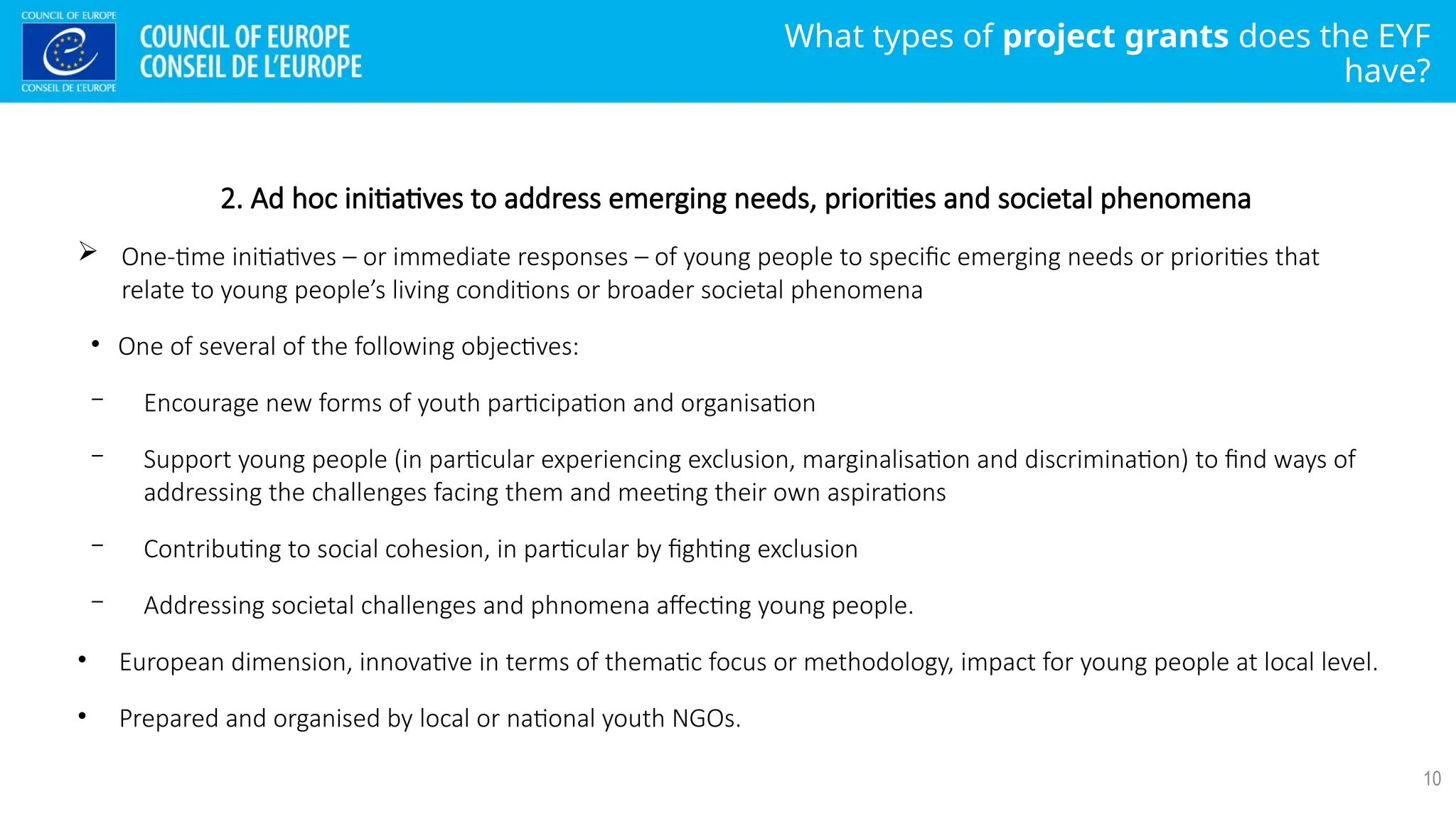
2. Ad hoc initiatives to address emerging needs, priorities and societal phenomena
 One-time initiatives – or immediate responses – of young people to specific emerging needs or priorities that
relate to young people’s living conditions or broader societal phenomena
• One of several of the following objectives:
− Encourage new forms of youth participation and organisation
− Support young people (in particular experiencing exclusion, marginalisation and discrimination) to find ways of
addressing the challenges facing them and meeting their own aspirations
− Contributing to social cohesion, in particular by fighting exclusion
− Addressing societal challenges and phnomena affecting young people.
• European dimension, innovative in terms of thematic focus or methodology, impact for young people at local level.
• Prepared and organised by local or national youth NGOs.
What types of structural grants does the EYF
have?
11
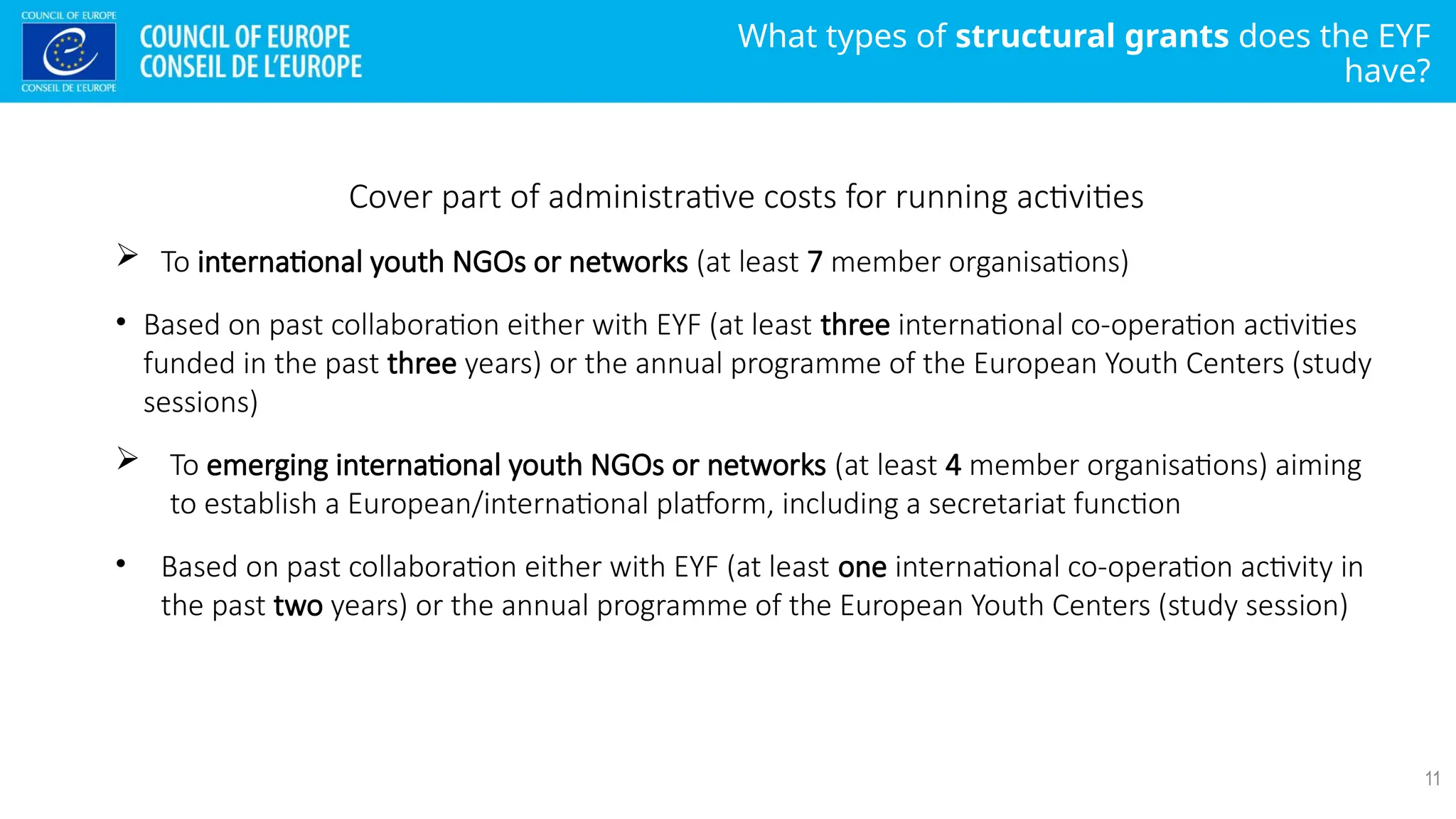
Cover part of administrative costs for running activities
 To international youth NGOs or networks (at least 7 member organisations)
• Based on past collaboration either with EYF (at least three international co-operation activities
funded in the past three years) or the annual programme of the European Youth Centers (study
sessions)
 To emerging international youth NGOs or networks (at least 4 member organisations) aiming
to establish a European/international platform, including a secretariat function
• Based on past collaboration either with EYF (at least one international co-operation activity in
the past two years) or the annual programme of the European Youth Centers (study session)
Where can you find our calls for proposals?
12
website – eyf.coe.int
granting system – fej.coe.int
eyf@coe.int
@YouthCOE
@coe_youth
@youth-council-of-europe-action
STAY TUNED FOR OPEN CALLS
13

PresentationEYFpostReform-EN - V28nov2025.pptx

  • 1.
    European Youth Foundation Supportingyoung people and youth organisations since 1972 1
  • 2.
    What is theCouncil of Europe? 2 ▸ Intergovernmental organisation with 46 member States ▸ Since 1949, created in the aftermath of WWII ▸ Based in Strasbourg, France ▸ 3 pillars: human rights, democracy, rule of law
  • 3.
    EYF mission 3 “(…) Theaim of the Foundation is to promote youth cooperation in Europe by providing financial support to such European youth activities that serve the promotion of peace, understanding and co-operation between the people of Europe and of the world, in a spirit of respect for human rights and fundamental freedoms”. Article 1, Statute of the European Youth Foundation
  • 4.
    EYF key facts 4 ▸Financial and educational support to youth organisations from 46 member States of the Council of Europe for youth-led projects and for their operations ▸ Part of the Council of Europe- Youth Department ▸ Since 1972 ▸ Approximately 4 million euro per year ▸ Based in the European Youth Centre Strasbourg
  • 5.
    Steps to accessEYF funding 5 REGISTRATION EYF ONLINE SYSTEM · INFO ABOUT WORK AND STRUCTURE, STATUTES AND BANK ACCOUNT · COMMUNICATION IF NEEDED EYF ONLINE SYSTEM · DIFFERENT DEADLINES DEPENDING ON CALLS OR GRANT TYPE · INFO ABOUT PROJECT & BUDGET BY EYF SECRETARIAT · ASSESSMENT ACCORDING TO CRITERIA FOR EACH CALL · COMMUNICATION IF NEEDED BY THE PROGRAMMING COMMITTEE ON YOUTH CALL FOR PROPOSALS ASSESSMENT DECISION
  • 6.
    ADVISORY COUNCIL 30 youth NGOs’ representatives JOINTCOUNCIL ON YOUTH STEERING COMMITTEE 50 government representatives COMMITTEE OF MINISTERS MEMBER STATES PROGRAMMING COMMITTEE 8 YOUTH REPS + 8 GOV REPS YOUNG PEOPLE EYF GRANT DECISIONS How are decisions on EYF grants taken?
  • 7.
    What important characteristicsof youth projects? 7 • Educational, cultural, social projects by, with and for young people • Contribution to youth sector priorities and using youth sector approaches • European dimension, international solidarity, supporting peace and co-operation • Youth participation
  • 8.
    Council of Europeyouth sector priorities 8 1: Revitalising pluralistic democracy (includes 4 sub-priorities) 2: Young people’s access to rights (includes 6 sub-priorities) 3: Living together in peaceful and inclusive societies (includes 4 sub-priorities) 4: Youth work (includes 4 sub-priorities) Scan for detailed info:
  • 9.
    What types ofproject grants does the EYF have? 9 1. International co-operation activities aimed at enhancing international understanding, solidarity and contribute to promotion of human rights and democracy, with a multiplier effect  One-off youth co-operation projects (primarily organising an international meeting of young people, for example youth camps, seminars, conferences, training courses or study visits) • Prepared and organised by: an international youth NGO or network, a sub-regional network of youth NGOs, a partnership of at least 4 national youth NGOs or a partnership between a national youth NGO and an international youth NGO or network  Long-term youth co-operation projects (include a combination of international meetings and other activities such as campaigns, advocacy projects, production of educational and other resources, research, support for local activities, etc). • Prepared and organised by an international youth NGO or network.
  • 10.
    What types ofproject grants does the EYF have? 10 2. Ad hoc initiatives to address emerging needs, priorities and societal phenomena  One-time initiatives – or immediate responses – of young people to specific emerging needs or priorities that relate to young people’s living conditions or broader societal phenomena • One of several of the following objectives: − Encourage new forms of youth participation and organisation − Support young people (in particular experiencing exclusion, marginalisation and discrimination) to find ways of addressing the challenges facing them and meeting their own aspirations − Contributing to social cohesion, in particular by fighting exclusion − Addressing societal challenges and phnomena affecting young people. • European dimension, innovative in terms of thematic focus or methodology, impact for young people at local level. • Prepared and organised by local or national youth NGOs.
  • 11.
    What types ofstructural grants does the EYF have? 11 Cover part of administrative costs for running activities  To international youth NGOs or networks (at least 7 member organisations) • Based on past collaboration either with EYF (at least three international co-operation activities funded in the past three years) or the annual programme of the European Youth Centers (study sessions)  To emerging international youth NGOs or networks (at least 4 member organisations) aiming to establish a European/international platform, including a secretariat function • Based on past collaboration either with EYF (at least one international co-operation activity in the past two years) or the annual programme of the European Youth Centers (study session)
  • 12.
    Where can youfind our calls for proposals? 12 website – eyf.coe.int granting system – fej.coe.int eyf@coe.int @YouthCOE @coe_youth @youth-council-of-europe-action STAY TUNED FOR OPEN CALLS
  • 13.

Editor's Notes

  • #6 Co-management of the youth sector In other departments of the Council of Europe, the decisions are made almost exclusively by member States representatives. In the youth sector, young people are also part of the decision process. Government Representatives from the 50 signatory states of the European Cultural Convention compose the European Steering Committee for Youth (CDEJ). These are usually representatives from the ministries responsible for youth. The steering committee promotes intergovernmental co-operation and a space for exchanges between countries on youth policy. Youth representatives coming from 30 youth organisations from all over Europe compose the Advisory Council on Youth (CCJ). The CCJ provides input on all activities of the Youth Sector and assures the involvement of young people in other Council of Europe activities. Together, the CDEJ and the Advisory Council compose the Joint Council on Youth (CMJ), a co-decision body which establishes the youth sector’s priorities, objectives and budgets. 8 members of the CCJ and 8 members of the CDEJ are elected to sit on the Programming Committee on Youth (CPJ) for a 2-year mandate to establish and monitor the programmes of the European Youth Centres and of the European Youth Foundation … and to take the decisions on all EYF project applications! More information on co-management: https://www.coe.int/en/web/youth/co-management