After 21 centuries of scientific inquiry,
our understanding of cellular biology
has made significant progress, but the
percentage of nervous system cells for
which we fully understand all
functions is indeed relatively low
[almost 10%]. The 90%, are still under
exploration.
Ashour’s High Yield Guide
USMLE Clinical Anatomy
Case report
This study reports a rare case of acute
obstructive hydrocephalus following
aqueductal stenosis.
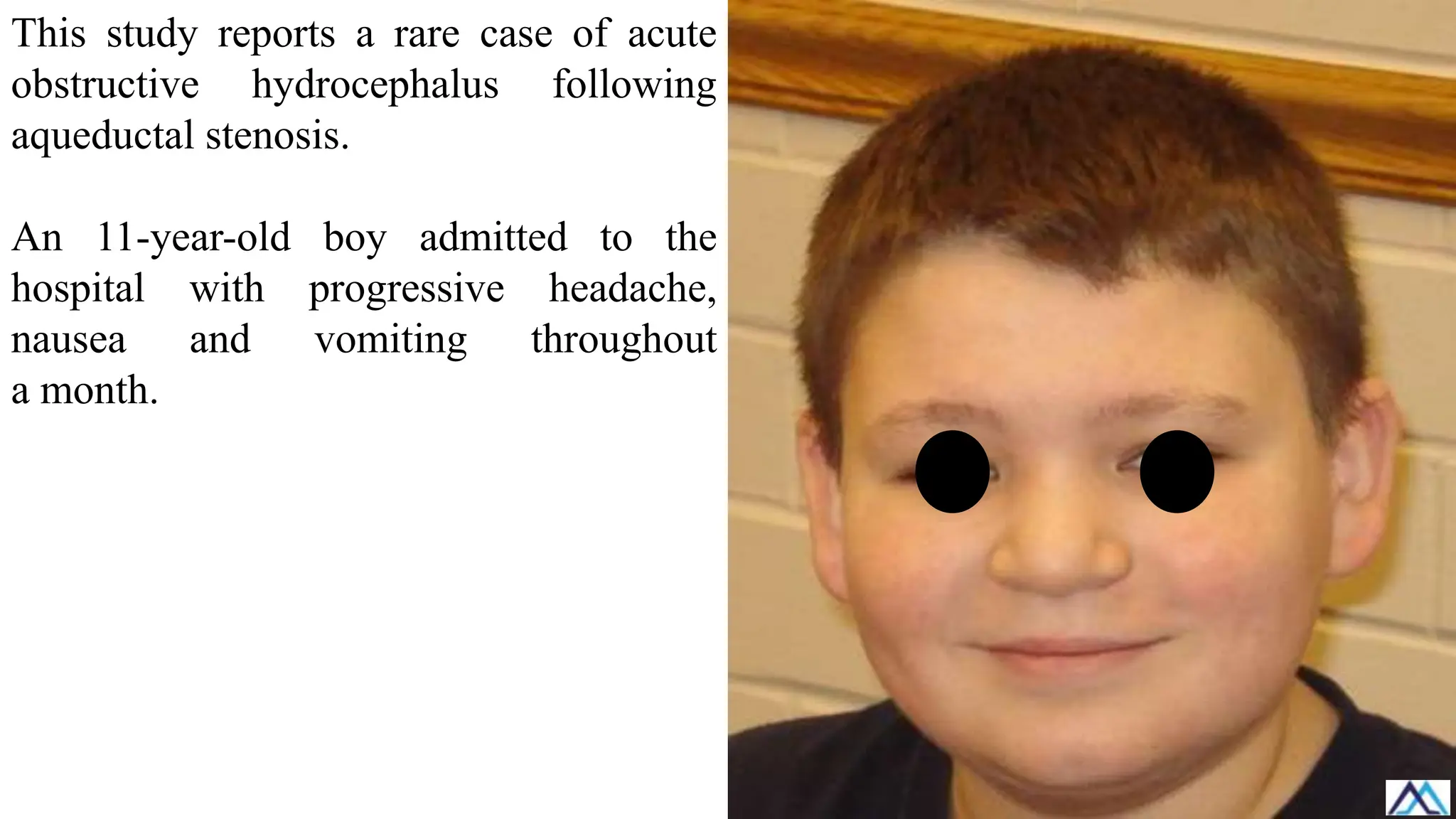
An 11-year-old boy admitted to the
hospital with progressive headache,
nausea and vomiting throughout
a month.
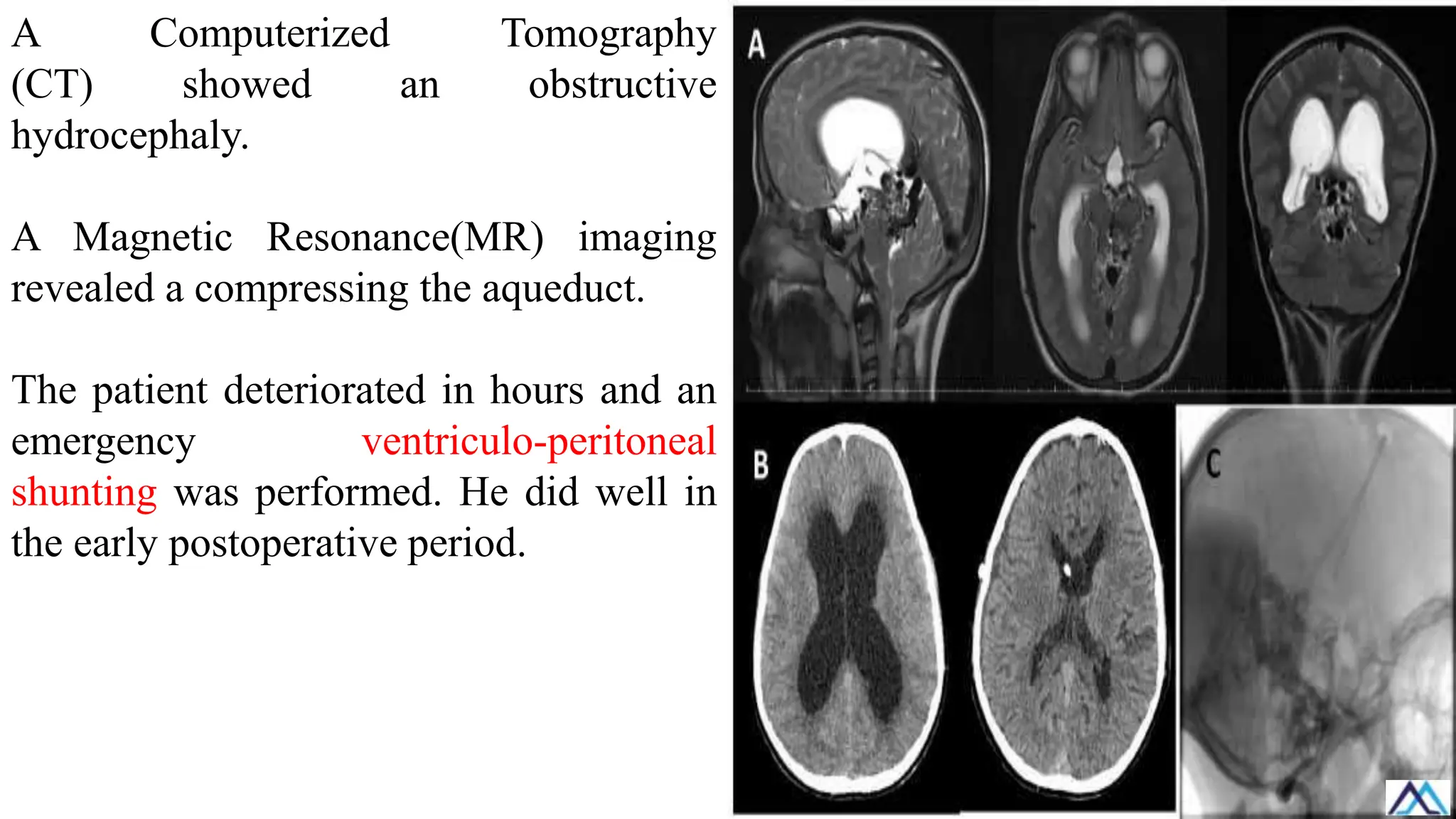
A Computerized Tomography
(CT) showed an obstructive
hydrocephaly.
A Magnetic Resonance(MR) imaging
revealed a compressing the aqueduct.
The patient deteriorated in hours and an
emergency ventriculo-peritoneal
shunting was performed. He did well in
the early postoperative period.
C.S.F
&
MENINGES
ILOs
A. Describe the Anatomy and Function of the Meninges: Students will be able to describe the anatomy of the meninges,
including the three protective layers surrounding the brain and spinal cord: the dura mater, arachnoid mater, and pia
mater. They will understand the structure and function of each layer, including how they contribute to protecting the
CNS and maintaining its structural integrity.
B. Explain the Production and Circulation of Cerebrospinal Fluid (CSF): Students will be able to explain how cerebrospinal
fluid (CSF) is produced by the choroid plexuses in the ventricles of the brain. They will describe the pathway of CSF
circulation through the ventricular system, its flow through the subarachnoid space, and its reabsorption into the
venous system via the arachnoid granulations.
C. Describe the Role of CSF in Maintaining CNS Homeostasis: Students will be able to describe the role of CSF in
maintaining CNS homeostasis, including its functions in cushioning the brain and spinal cord, removing metabolic
waste products, and providing a stable chemical environment for neural tissue. They will understand how CSF helps to
protect the CNS from mechanical injury and regulate intracranial pressure.
D. Identify and Interpret Clinical Procedures Related to CSF and Meninges: Students will be able to identify and interpret
clinical procedures related to CSF and the meninges, such as lumbar puncture (spinal tap) and imaging techniques
like CT and MRI. They will understand how these procedures are used to assess CSF composition, measure
intracranial pressure, and detect conditions affecting the meninges, such as meningitis or tumors.
While the meninges themselves are not
typically the direct target of surgical
procedures, they play a crucial role in
neurosurgery and other related
interventions. The meninges are the
protective layers surrounding the brain
and spinal cord, consisting of the dura
mater, arachnoid mater, and pia mater.
The surgical importance of the meninges
lies in their role as protective barriers and
their involvement in certain medical
conditions and procedure.
MENINGES
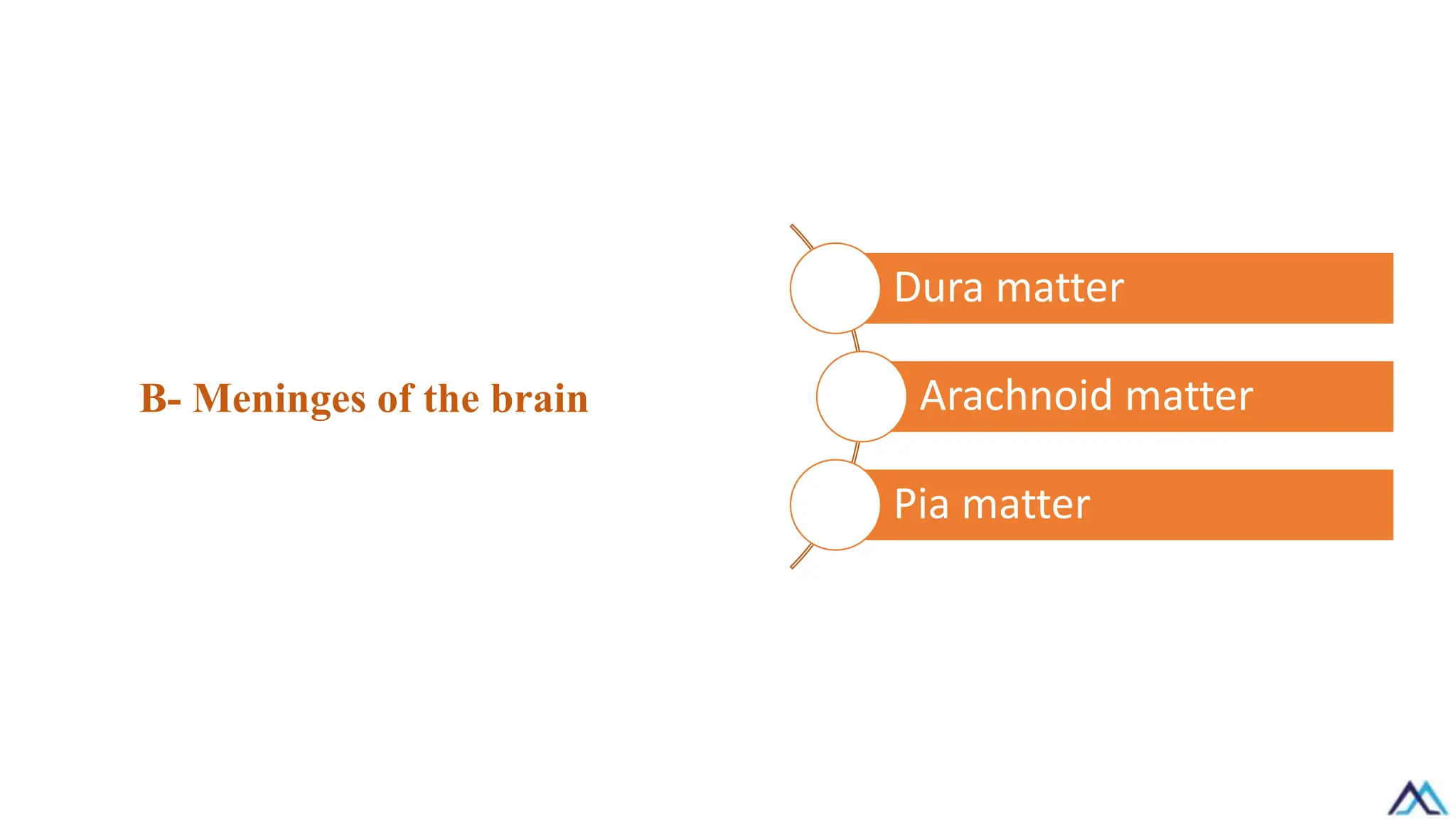
A- Meninges of the spinal cord B- Meninges of the brain
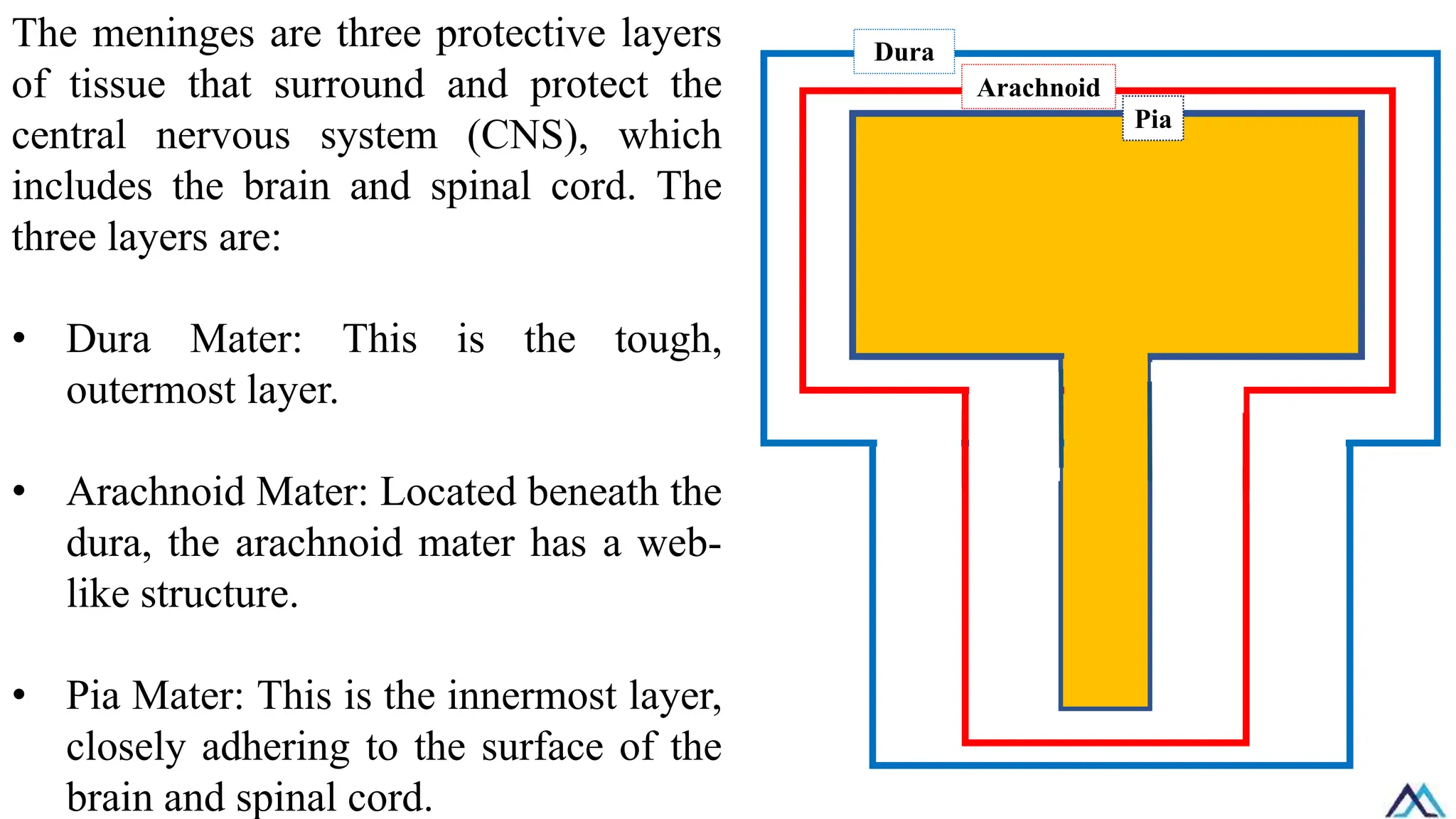
The meninges are three protective layers
of tissue that surround and protect the
central nervous system (CNS), which
includes the brain and spinal cord. The
three layers are:
• Dura Mater: This is the tough,
outermost layer.
• Arachnoid Mater: Located beneath the
dura, the arachnoid mater has a web-
like structure.
• Pia Mater: This is the innermost layer,
closely adhering to the surface of the
brain and spinal cord.
Dura
Arachnoid
Pia
A- Meninges of the spinal cord
Dura matter
Arachnoid matter
Pia matter
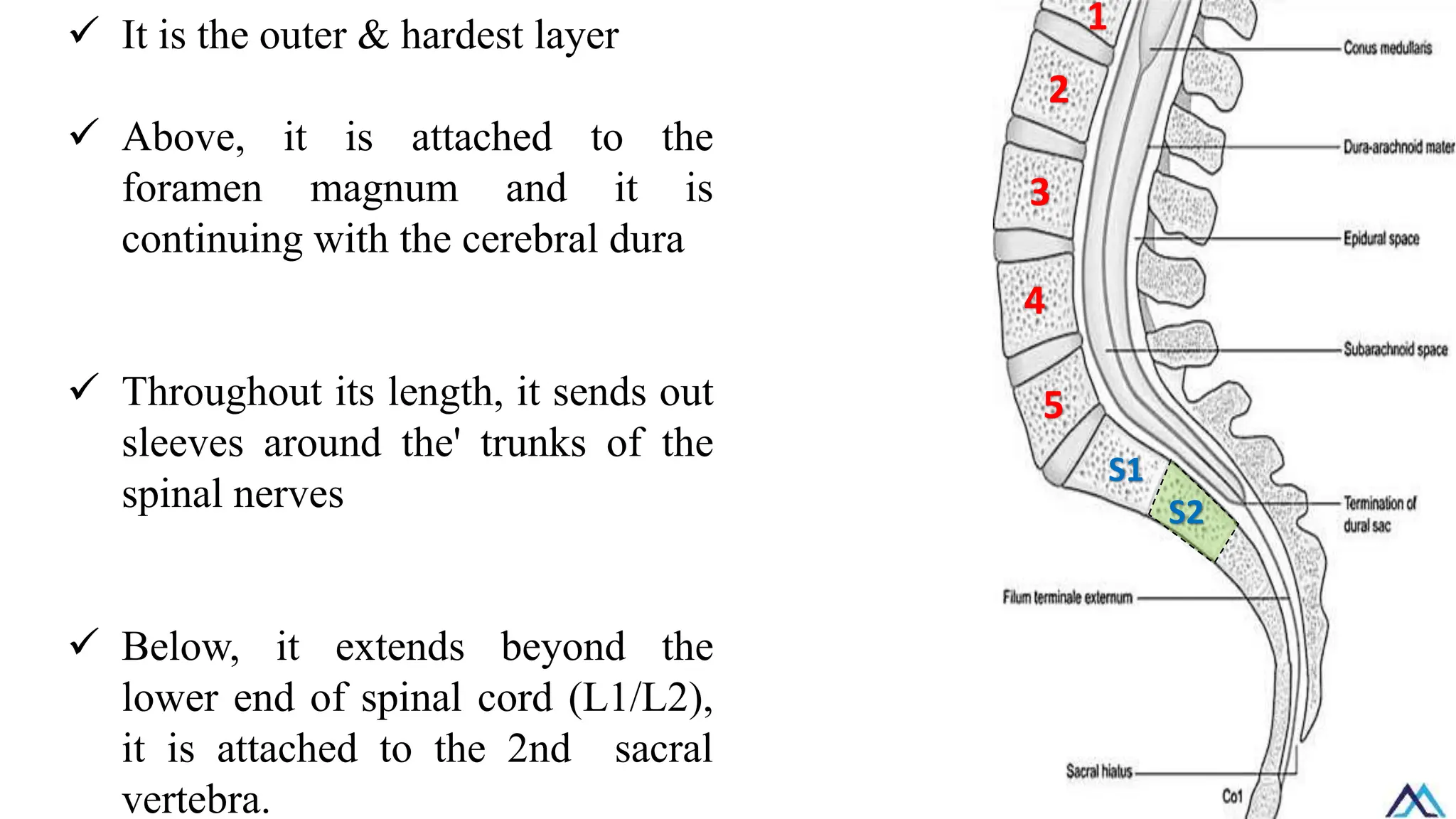
• Spinal Dura matter
✓ It is the outer & hardest layer
✓ Above, it is attached to the
foramen magnum and it is
continuing with the cerebral dura
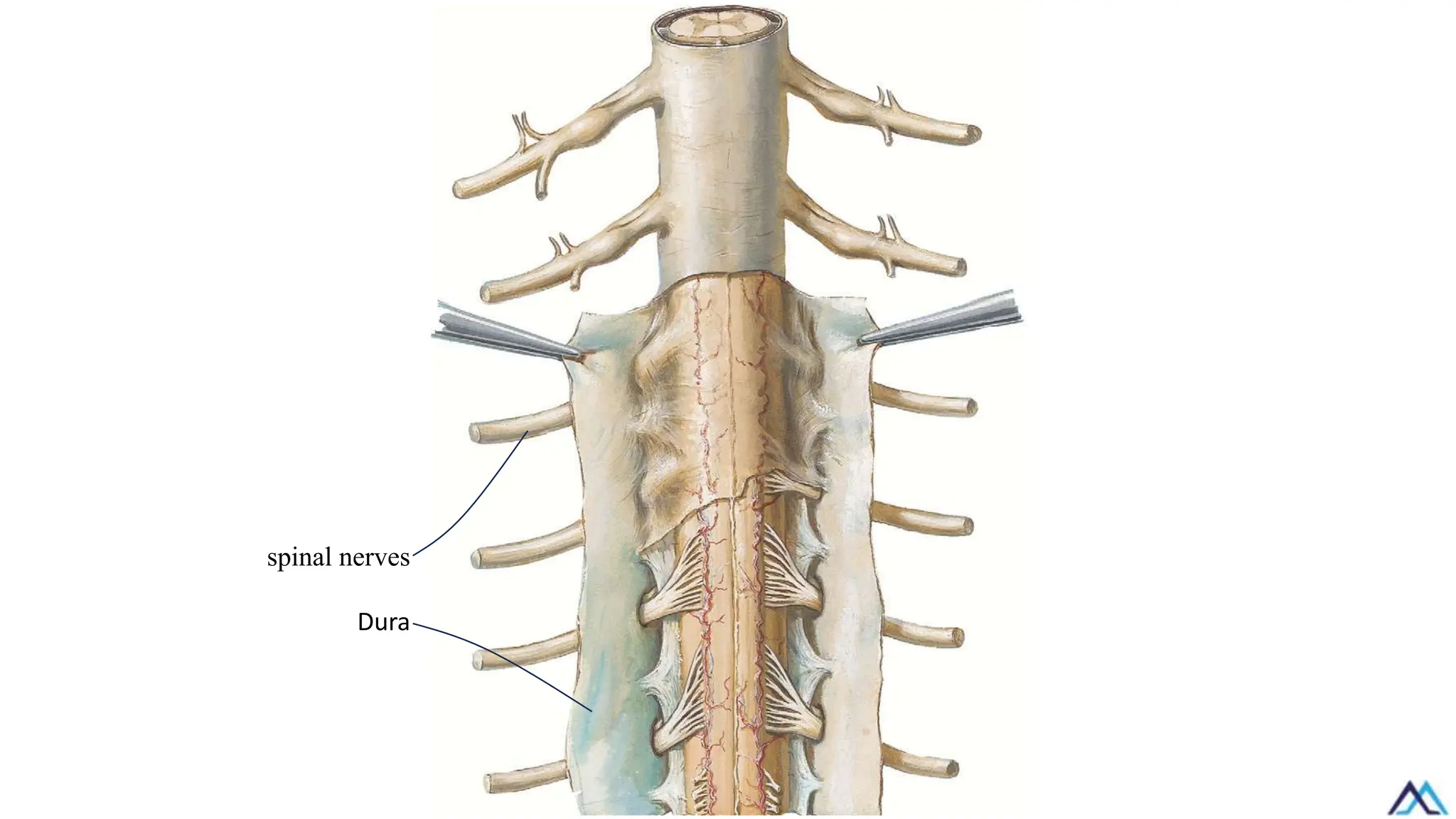
✓ Throughout its length, it sends out
sleeves around the' trunks of the
spinal nerves
✓ Below, it extends beyond the
lower end of spinal cord (L1/L2),
it is attached to the 2nd sacral
vertebra.
1
2
3
5
4
S1
S2
spinal nerves
Dura
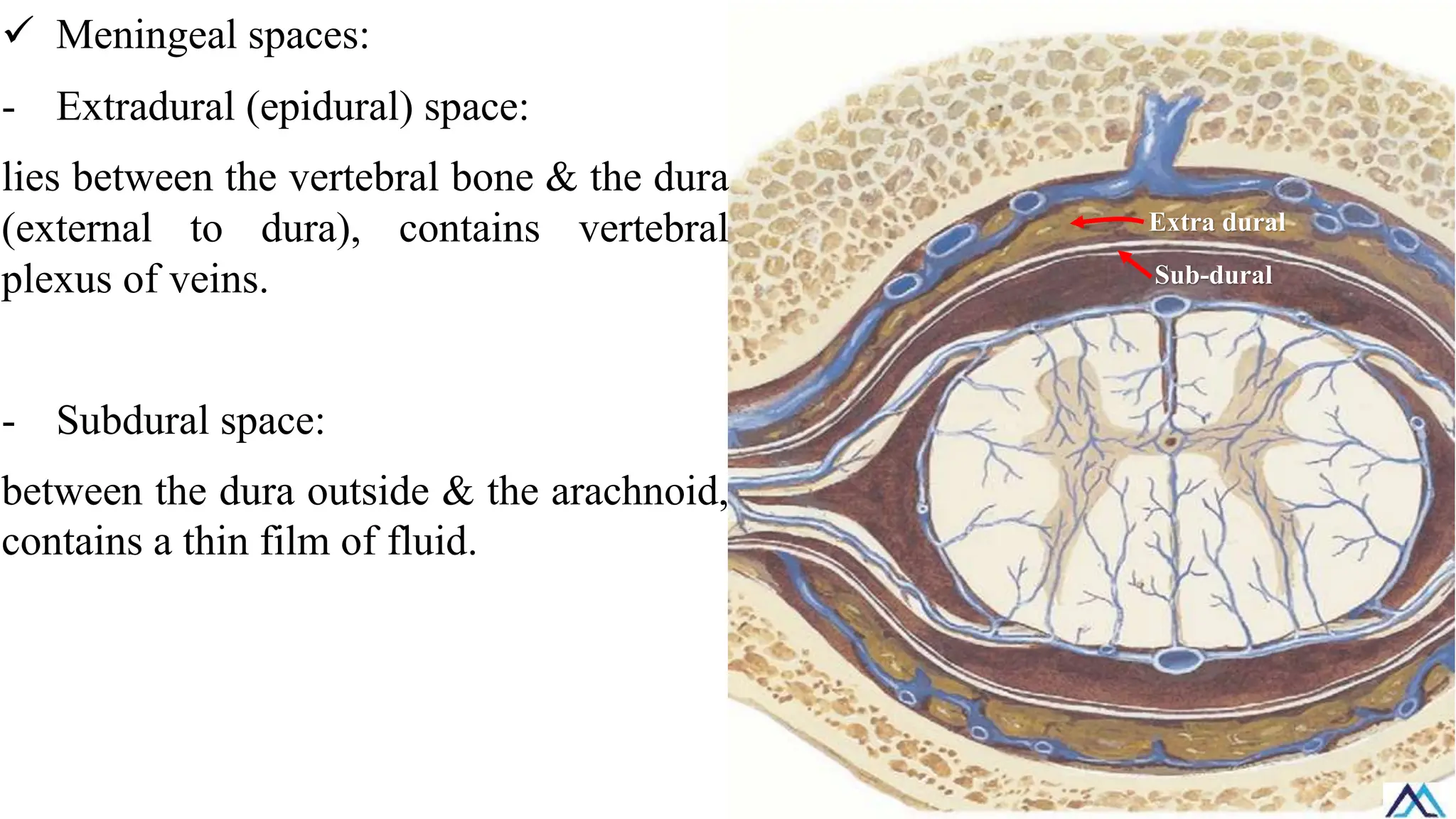
✓ Meningeal spaces:
- Extradural (epidural) space:
lies between the vertebral bone & the dura
(external to dura), contains vertebral
plexus of veins.
- Subdural space:
between the dura outside & the arachnoid,
contains a thin film of fluid.
Extra dural
Sub-dural
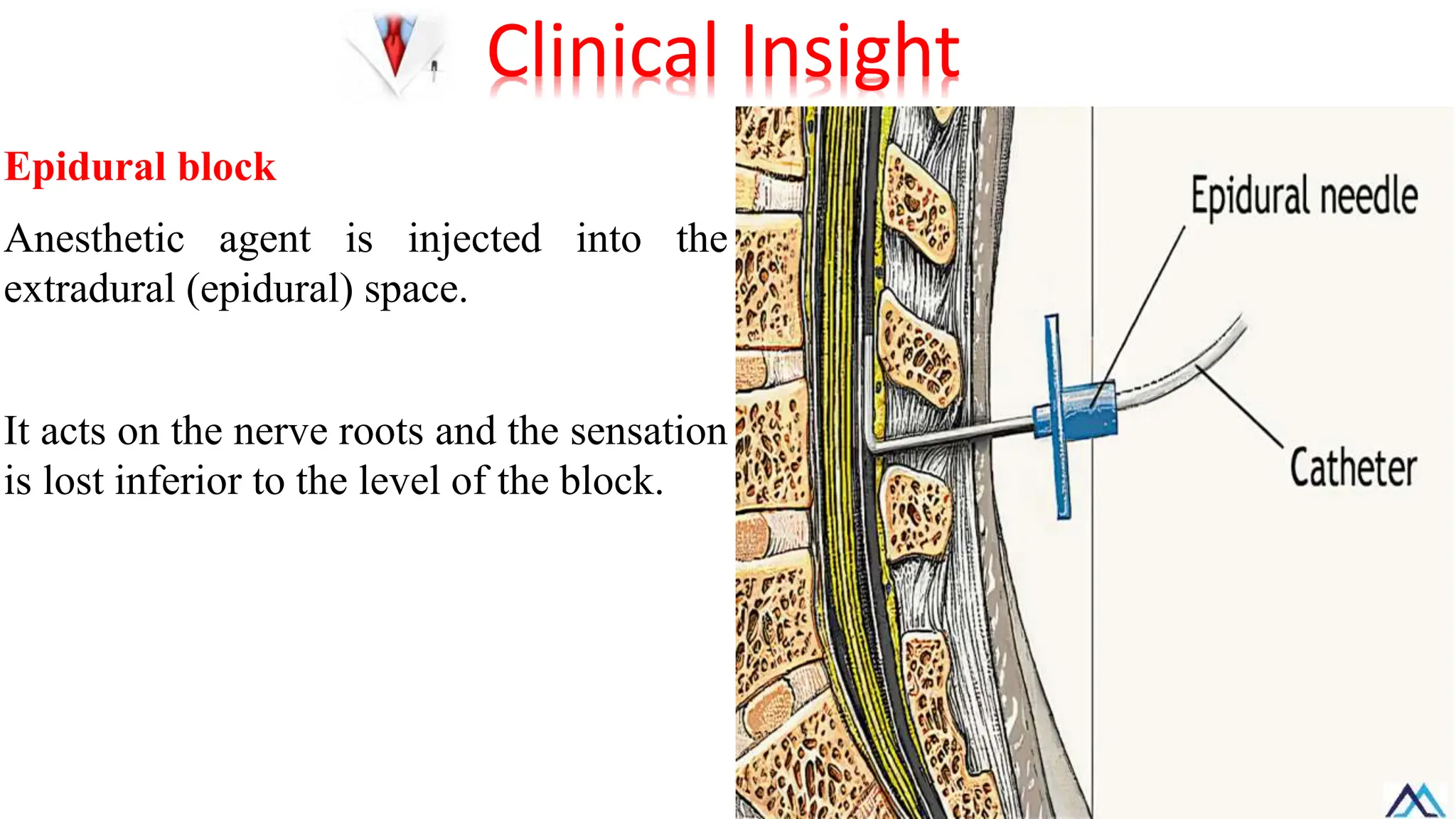
Epidural block
Anesthetic agent is injected into the
extradural (epidural) space.
It acts on the nerve roots and the sensation
is lost inferior to the level of the block.
Clinical Insight
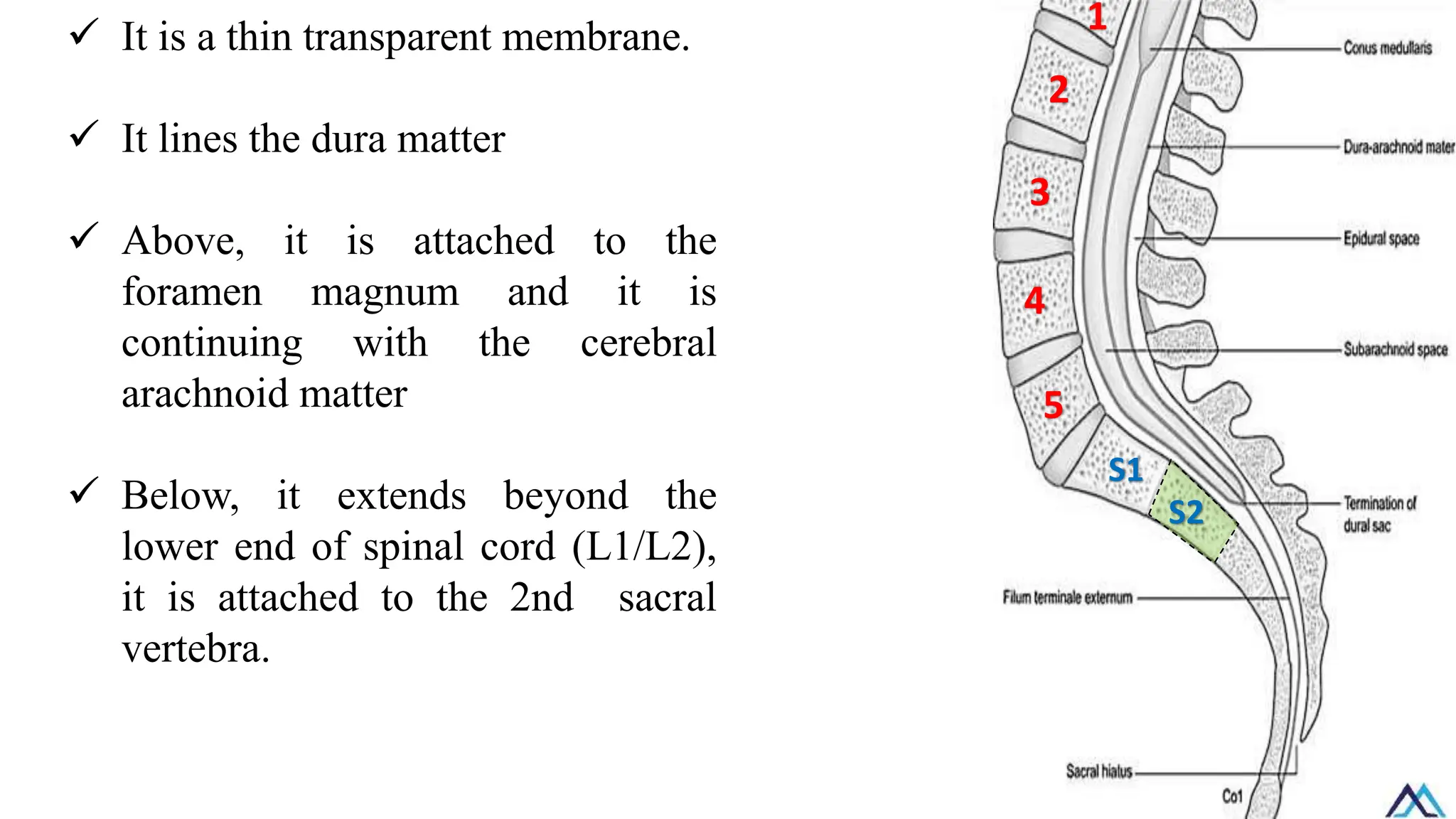
• Spinal Arachnoid matter
✓ It is a thin transparent membrane.
✓ It lines the dura matter
✓ Above, it is attached to the
foramen magnum and it is
continuing with the cerebral
arachnoid matter
✓ Below, it extends beyond the
lower end of spinal cord (L1/L2),
it is attached to the 2nd sacral
vertebra.
1
2
3
5
4
S1
S2
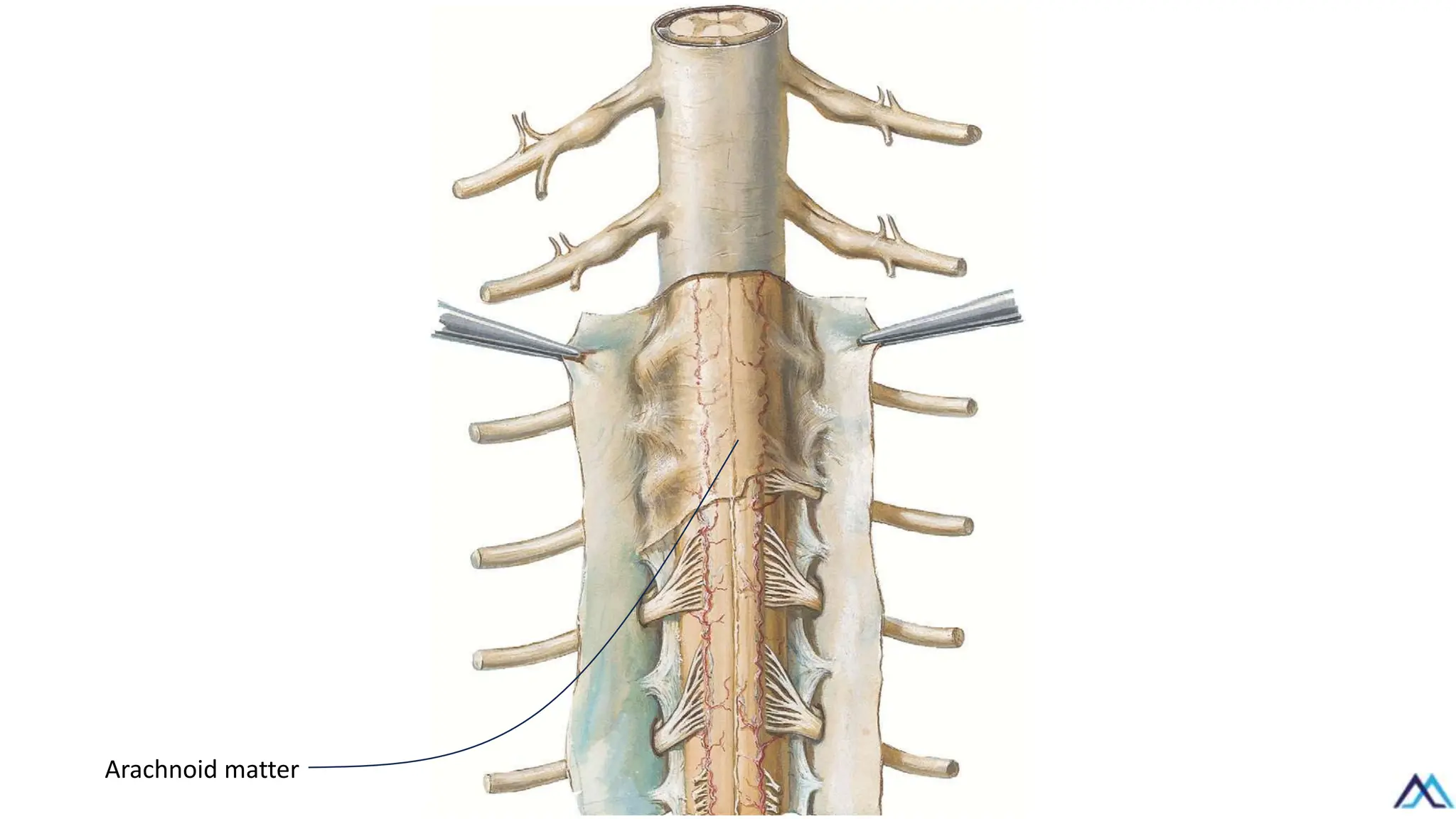
Arachnoid matter
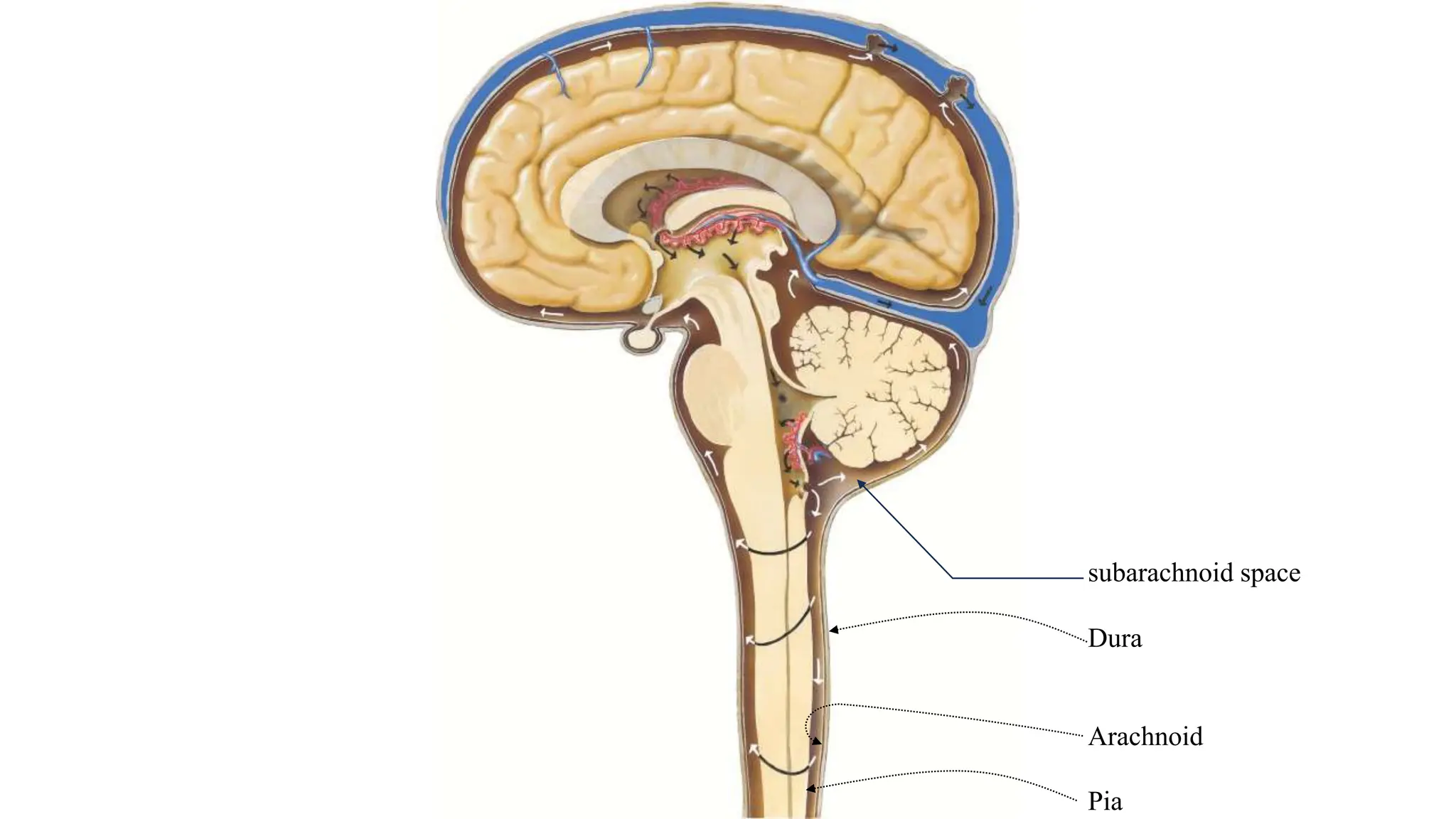
Subarachnoid
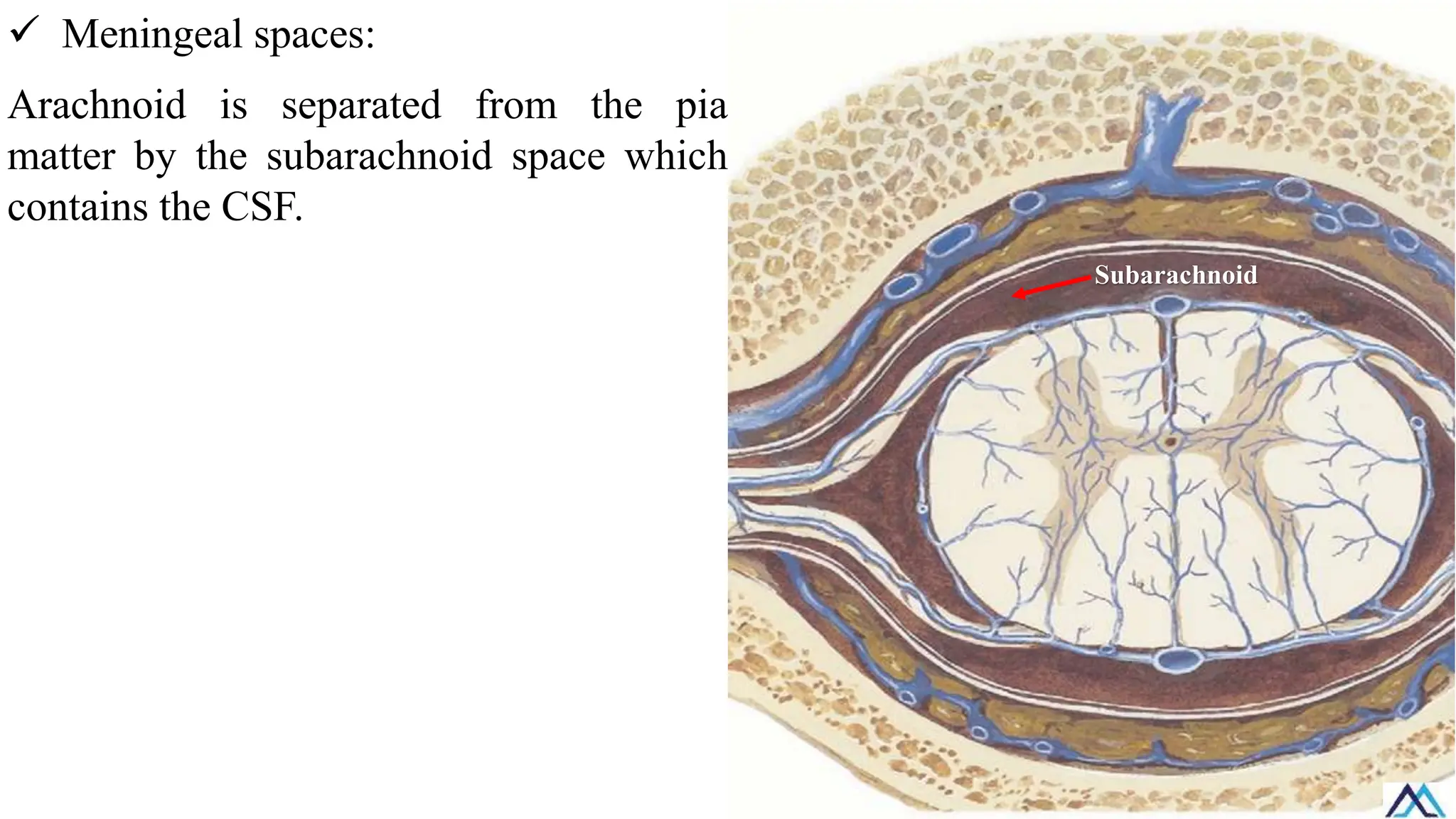
✓ Meningeal spaces:
Arachnoid is separated from the pia
matter by the subarachnoid space which
contains the CSF.
subarachnoid space
Dura
Arachnoid
Pia
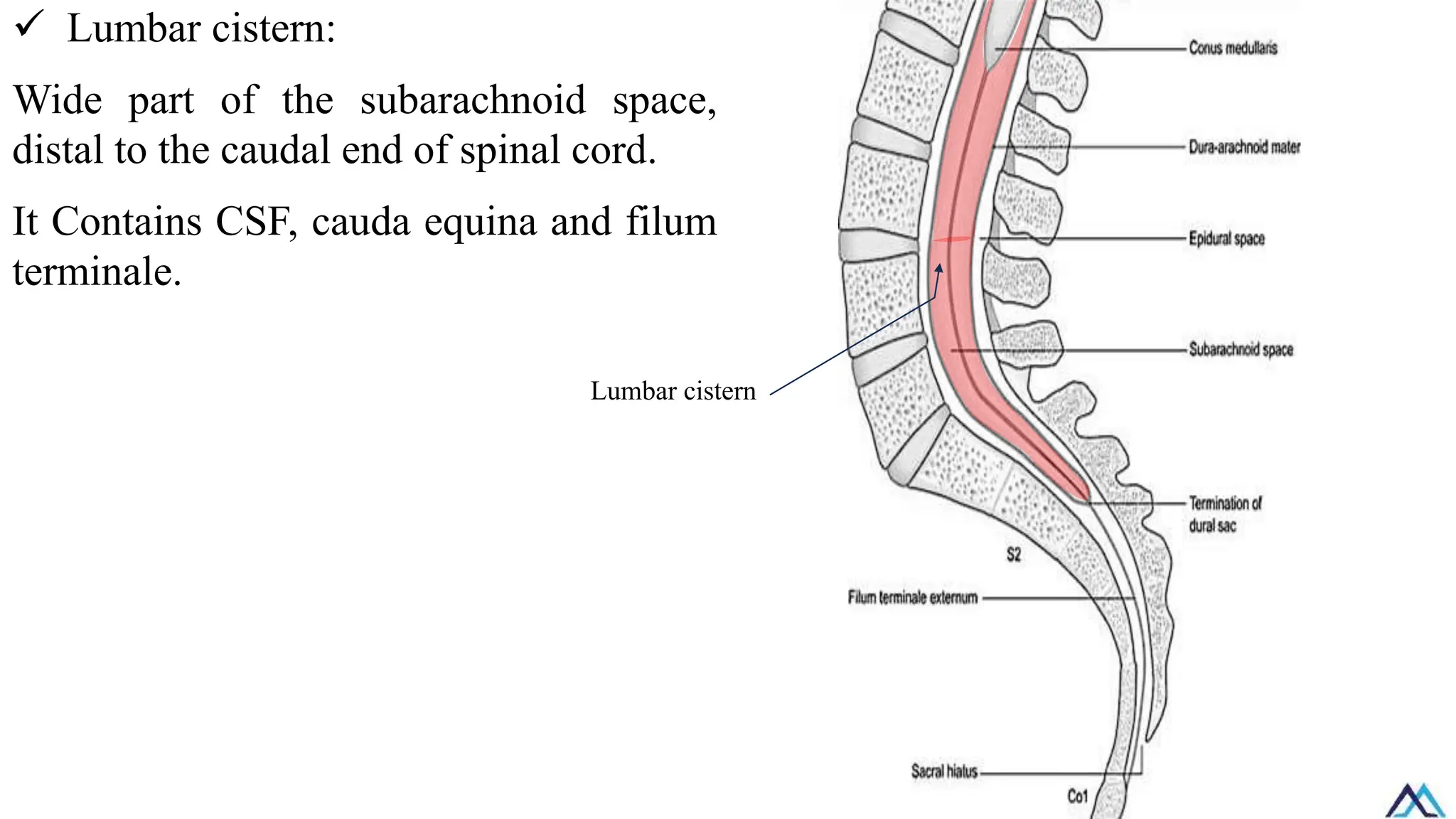
✓ Lumbar cistern:
Wide part of the subarachnoid space,
distal to the caudal end of spinal cord.
It Contains CSF, cauda equina and filum
terminale.
Lumbar cistern
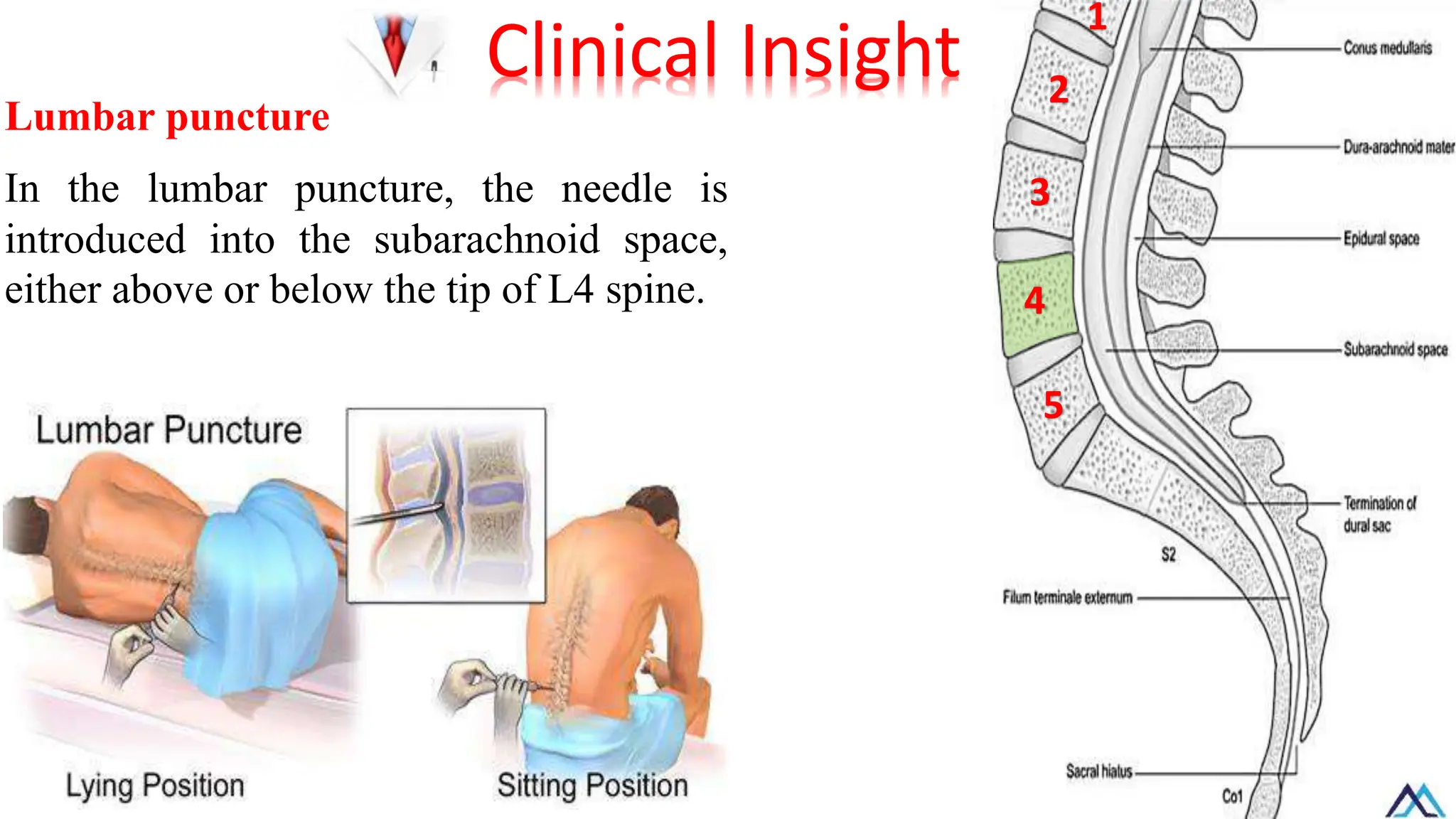
Lumbar puncture
In the lumbar puncture, the needle is
introduced into the subarachnoid space,
either above or below the tip of L4 spine.
Clinical Insight
1
2
3
5
4
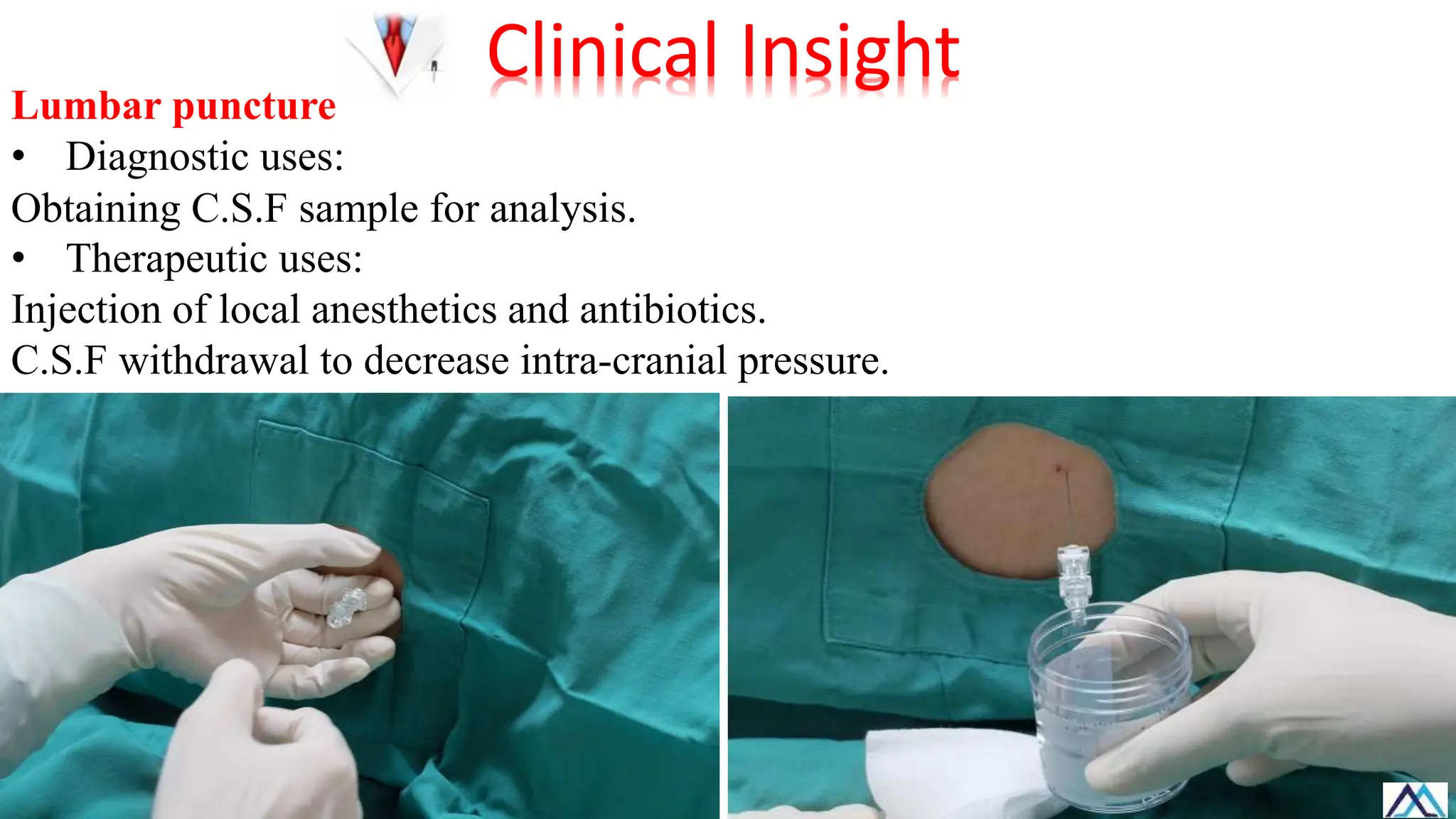
Lumbar puncture
• Diagnostic uses:
Obtaining C.S.F sample for analysis.
• Therapeutic uses:
Injection of local anesthetics and antibiotics.
C.S.F withdrawal to decrease intra-cranial pressure.
Clinical Insight
Lumbar puncture
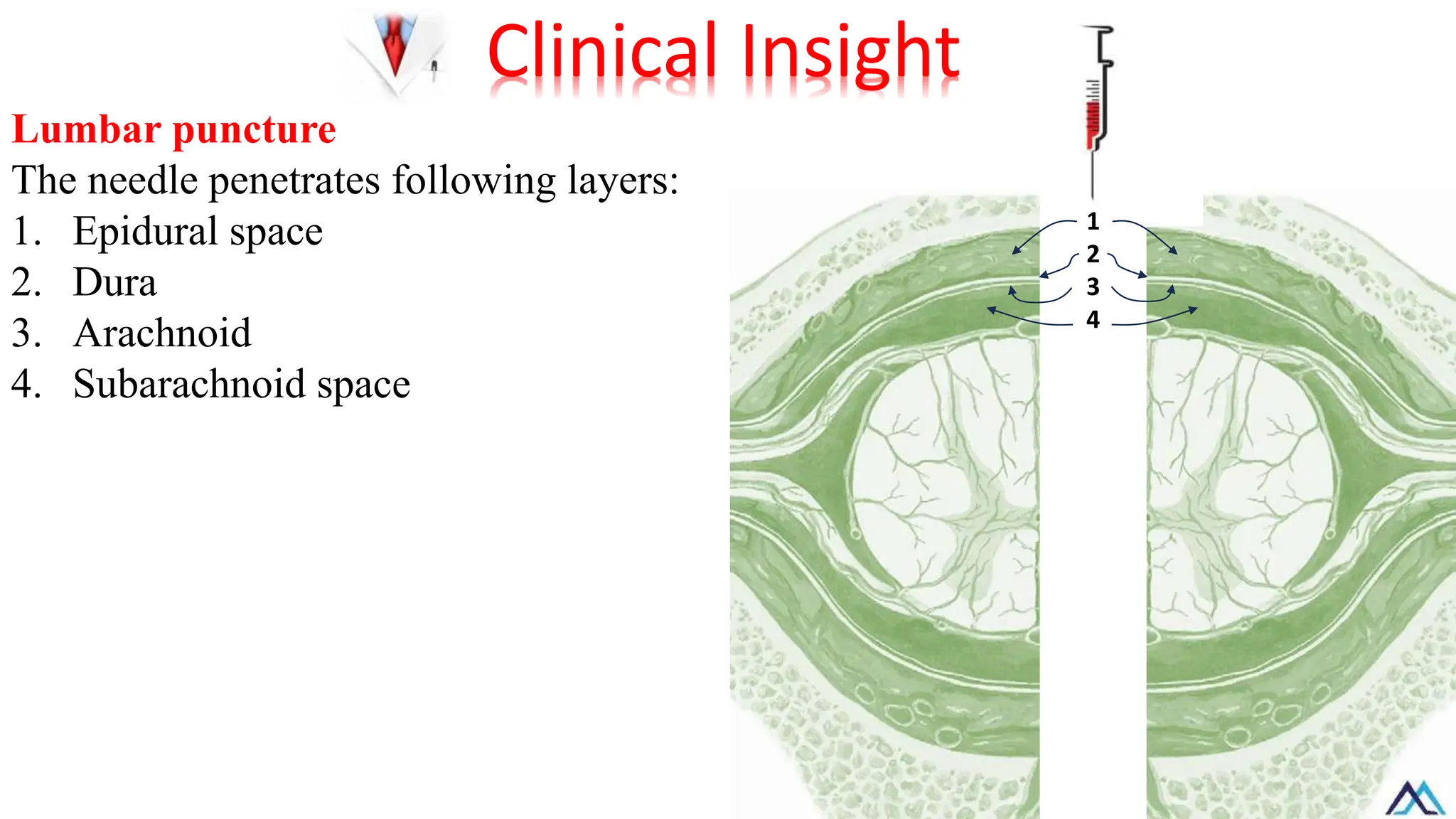
The needle penetrates following layers:
1. Epidural space
2. Dura
3. Arachnoid
4. Subarachnoid space
Clinical Insight
1
2
3
4
• Spinal Pia matter
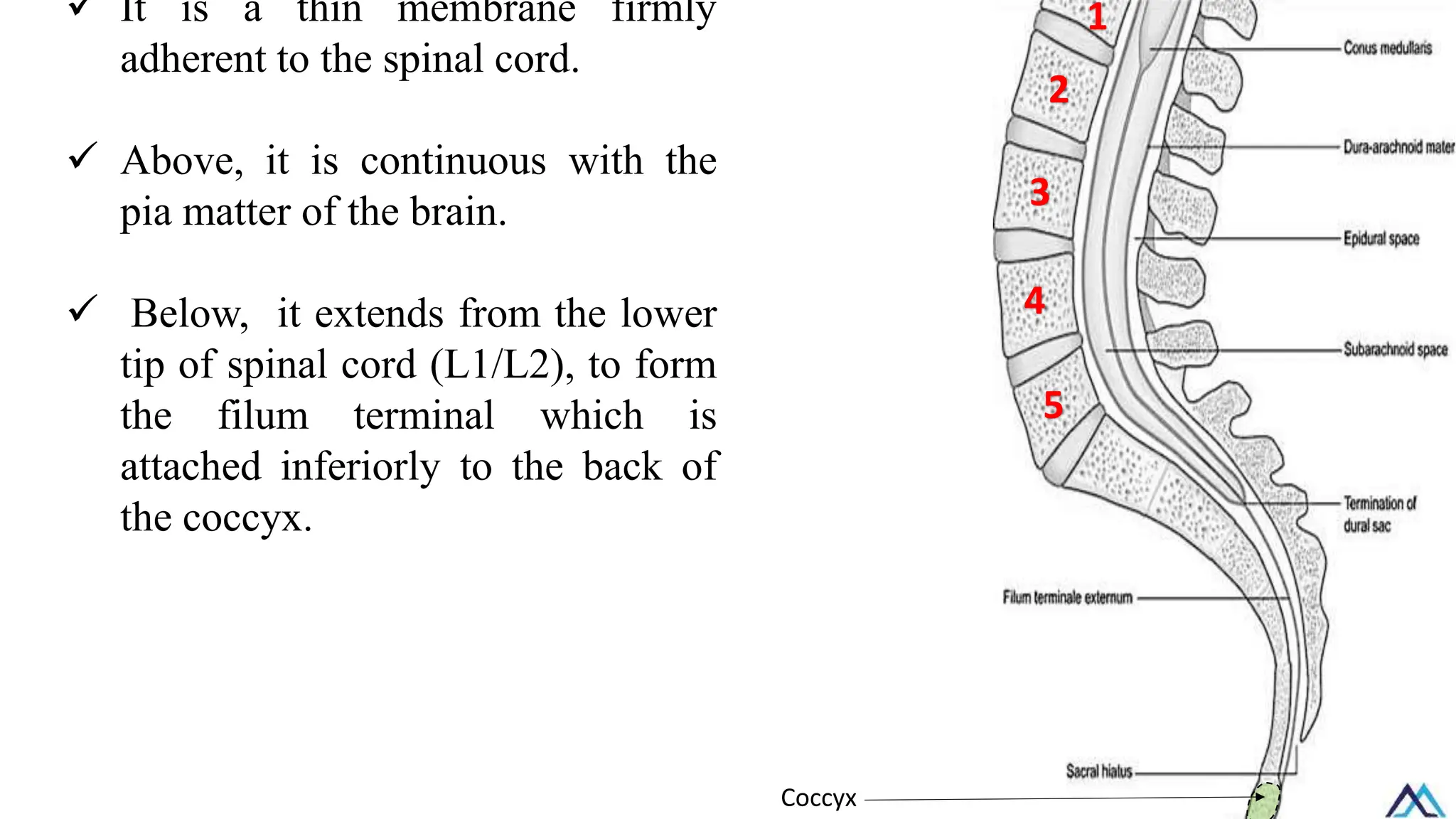
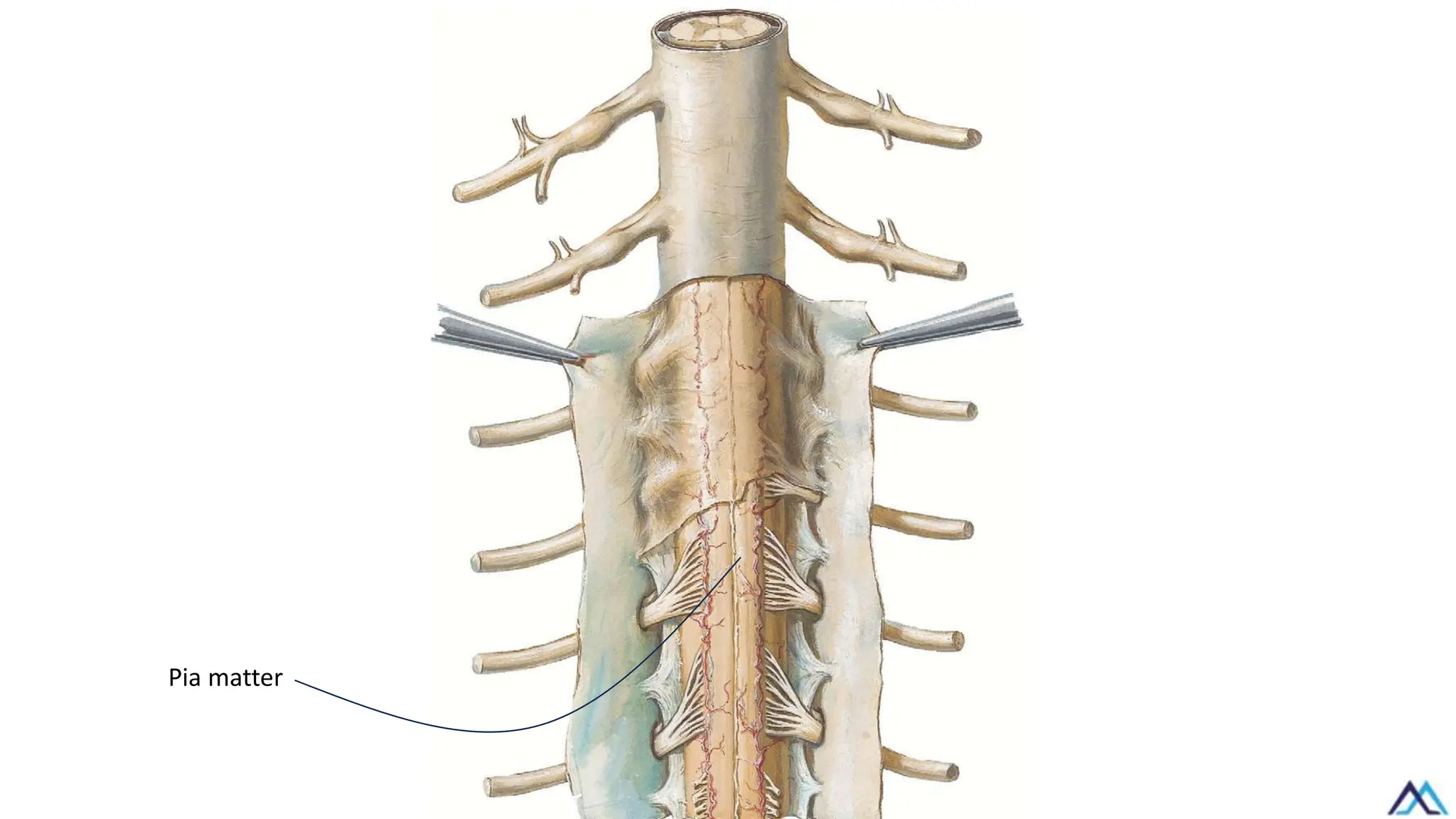
✓ It is a thin membrane firmly
adherent to the spinal cord.
✓ Above, it is continuous with the
pia matter of the brain.
✓ Below, it extends from the lower
tip of spinal cord (L1/L2), to form
the filum terminal which is
attached inferiorly to the back of
the coccyx.
1
2
3
5
4
Coccyx
Pia matter
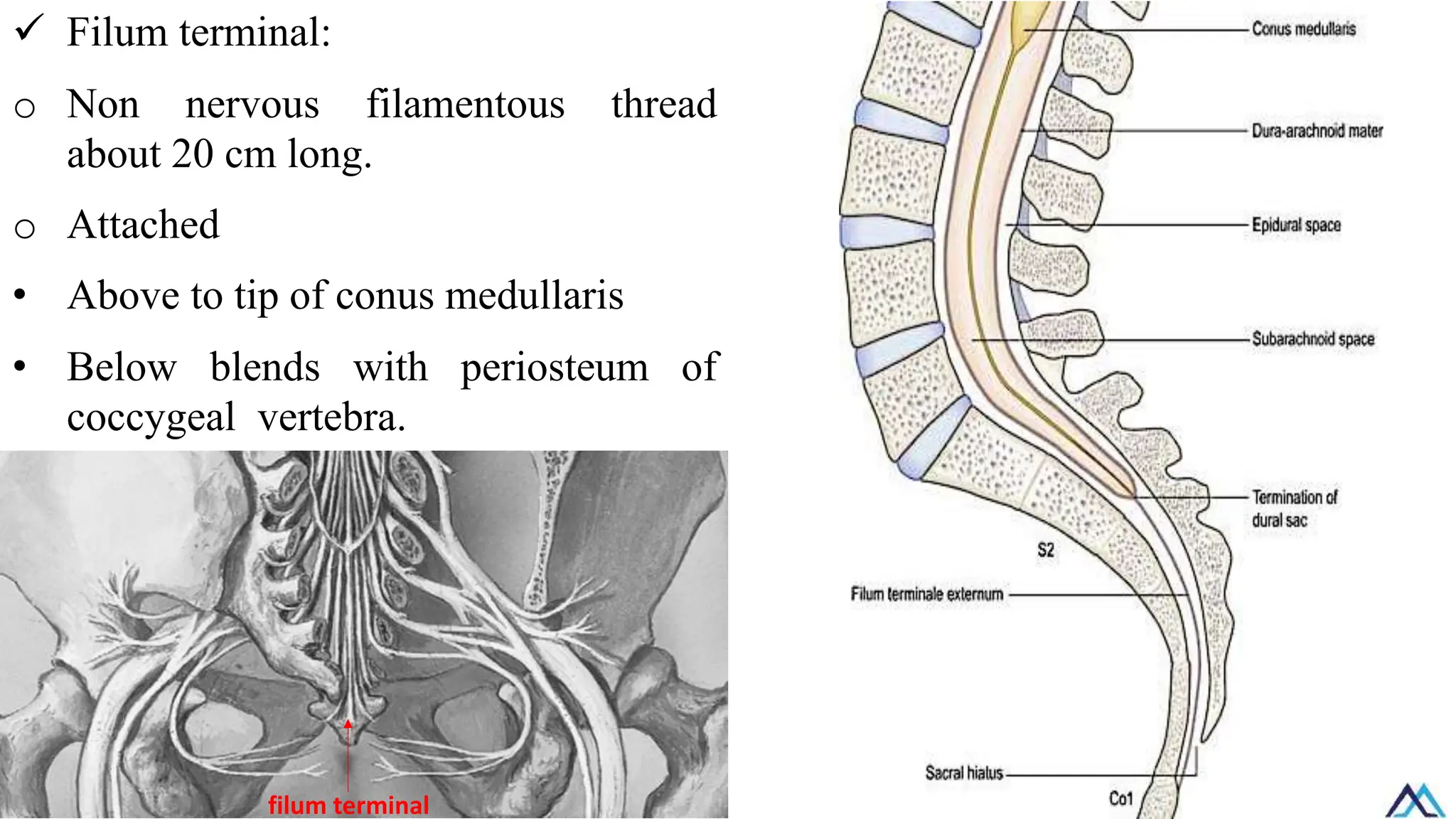
✓ Filum terminal:
o Non nervous filamentous thread
about 20 cm long.
o Attached
• Above to tip of conus medullaris
• Below blends with periosteum of
coccygeal vertebra.
filum terminal
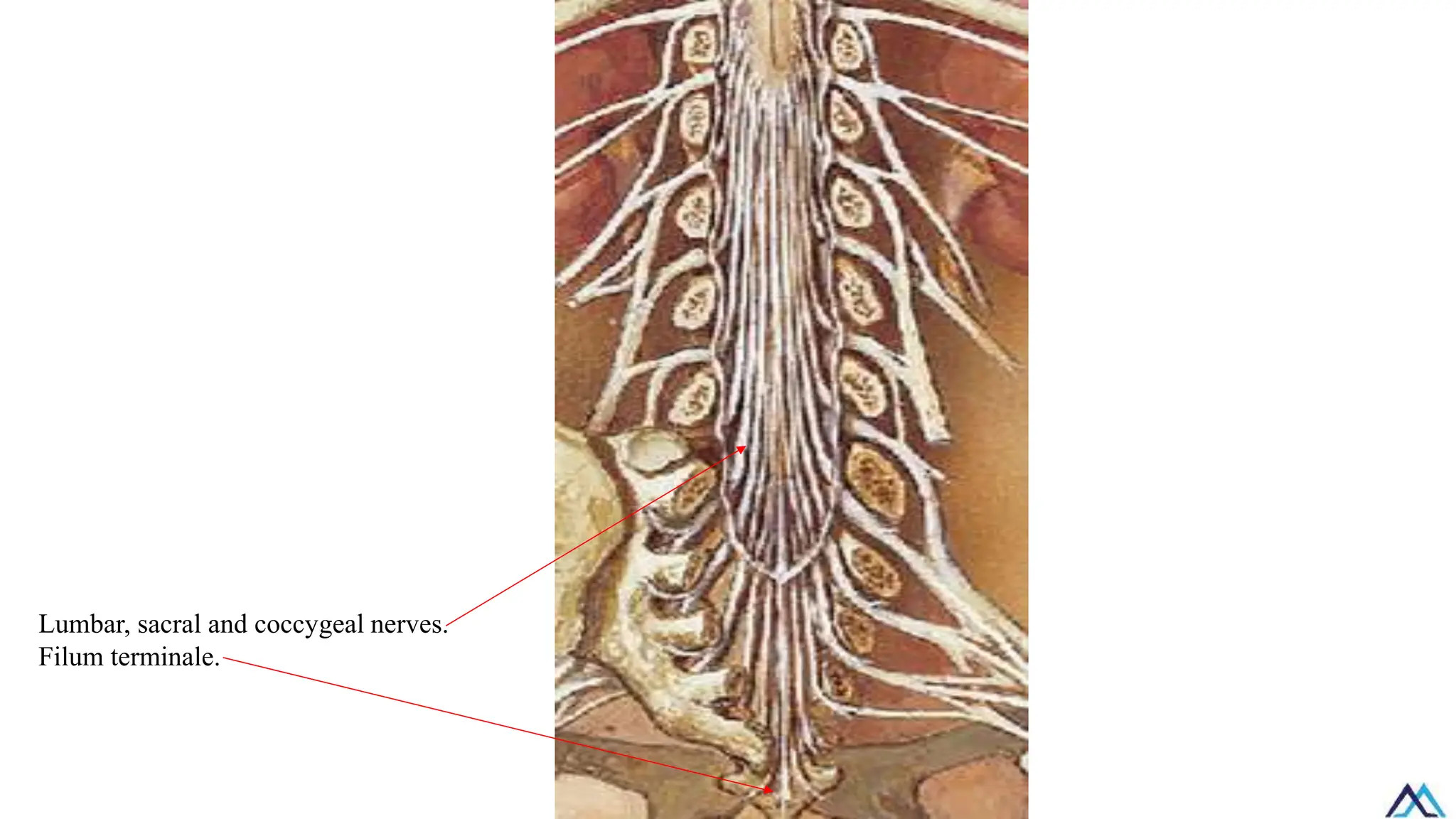
Lumbar, sacral and coccygeal nerves.
Filum terminale.
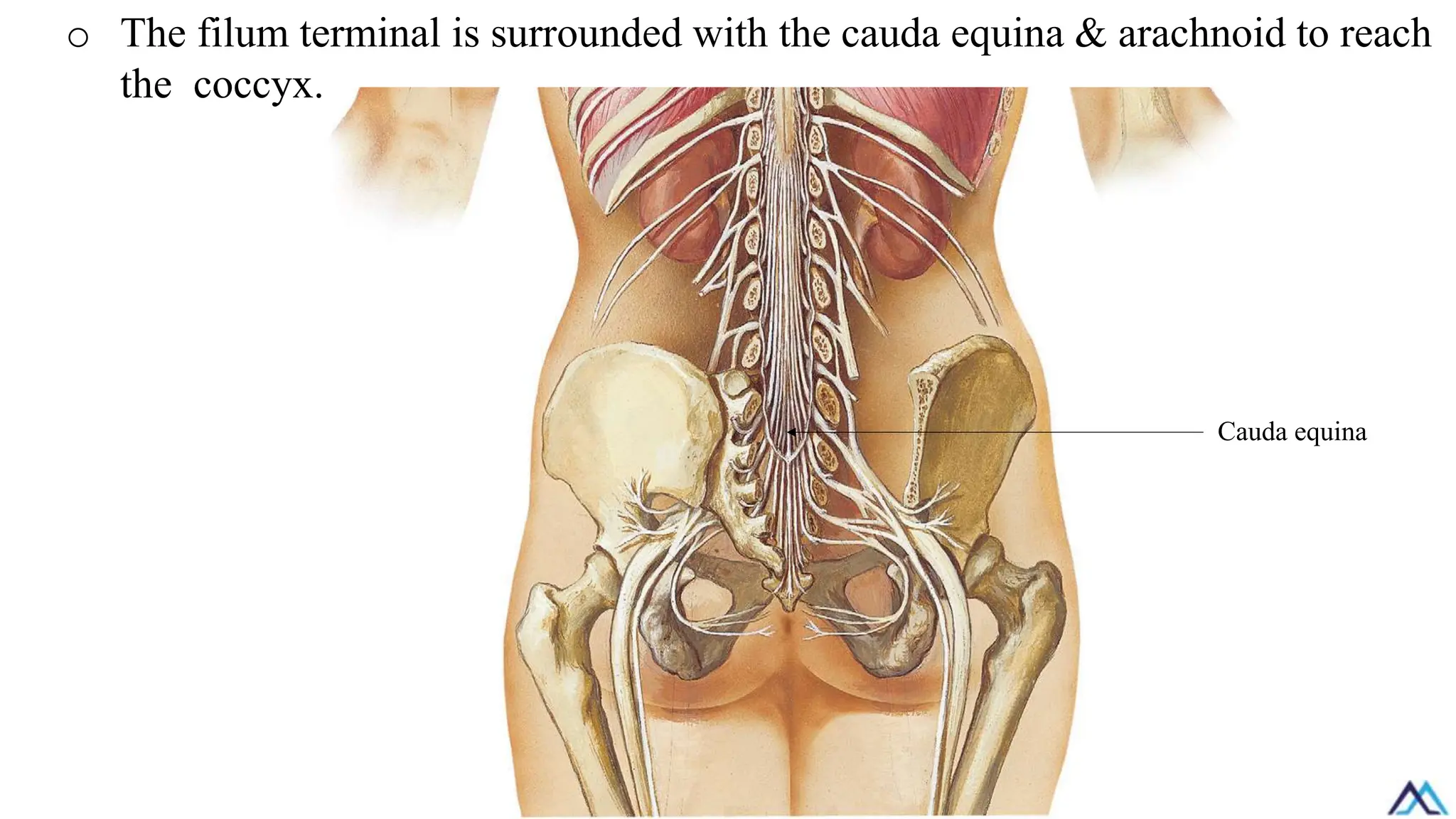
o The filum terminal is surrounded with the cauda equina & arachnoid to reach
the coccyx.
Cauda equina
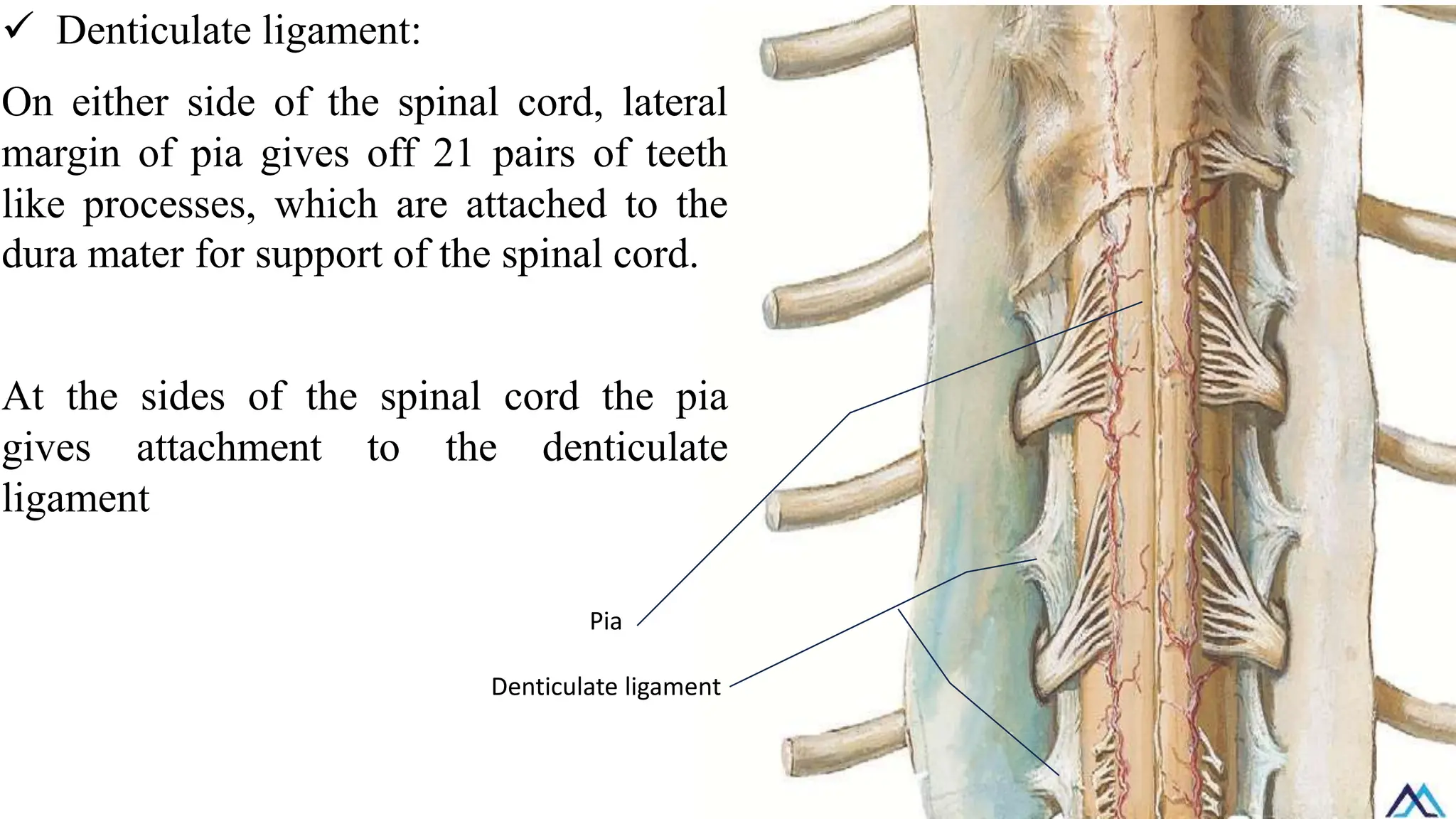
✓ Denticulate ligament:
On either side of the spinal cord, lateral
margin of pia gives off 21 pairs of teeth
like processes, which are attached to the
dura mater for support of the spinal cord.
At the sides of the spinal cord the pia
gives attachment to the denticulate
ligament
Pia
Denticulate ligament
B- Meninges of the brain
Dura matter
Arachnoid matter
Pia matter
• Cerebral Dura matter
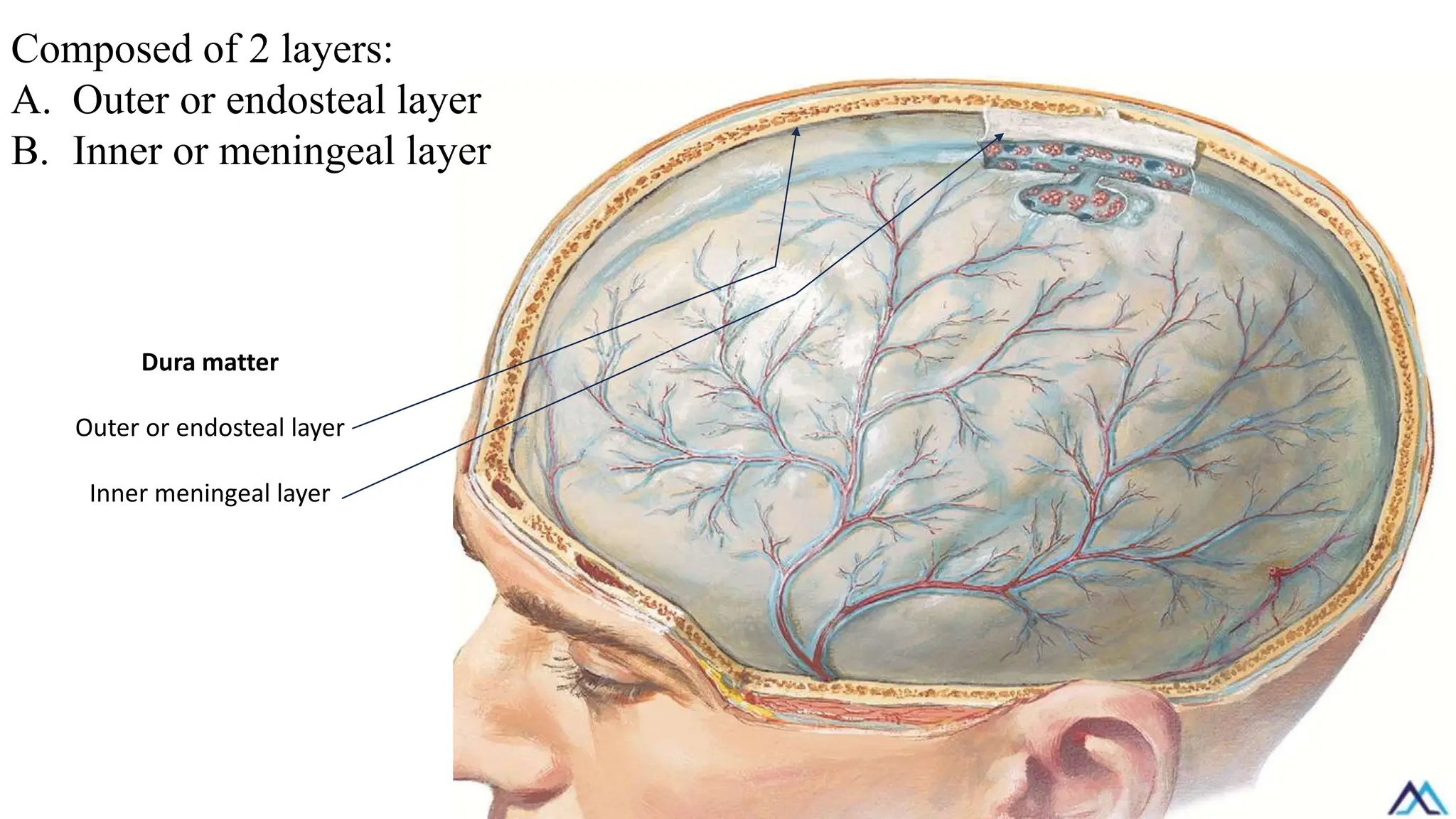
Composed of 2 layers:
A. Outer or endosteal layer
B. Inner or meningeal layer
Dura matter
Outer or endosteal layer
Inner meningeal layer
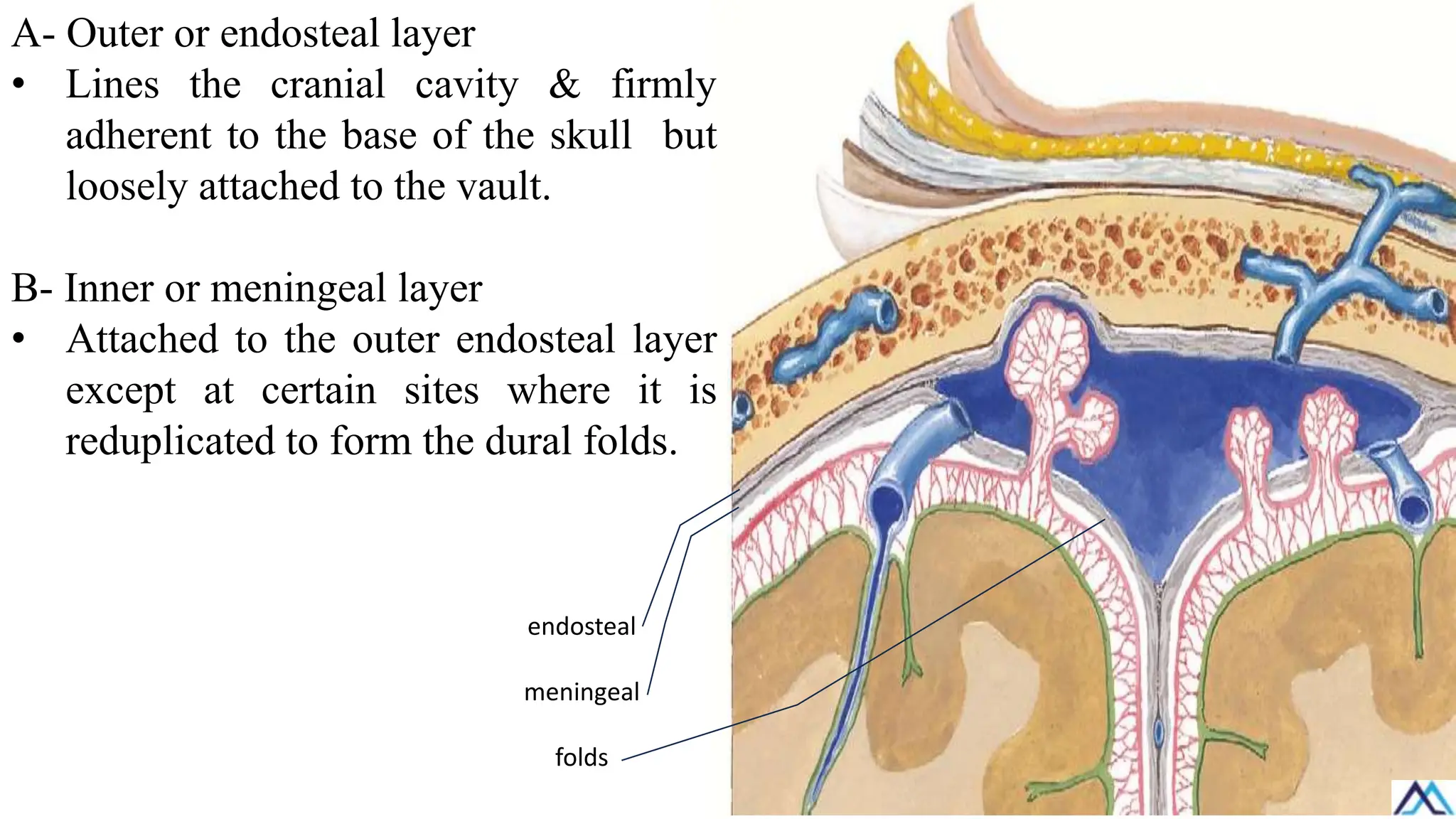
A- Outer or endosteal layer
• Lines the cranial cavity & firmly
adherent to the base of the skull but
loosely attached to the vault.
B- Inner or meningeal layer
• Attached to the outer endosteal layer
except at certain sites where it is
reduplicated to form the dural folds.
endosteal
meningeal
folds
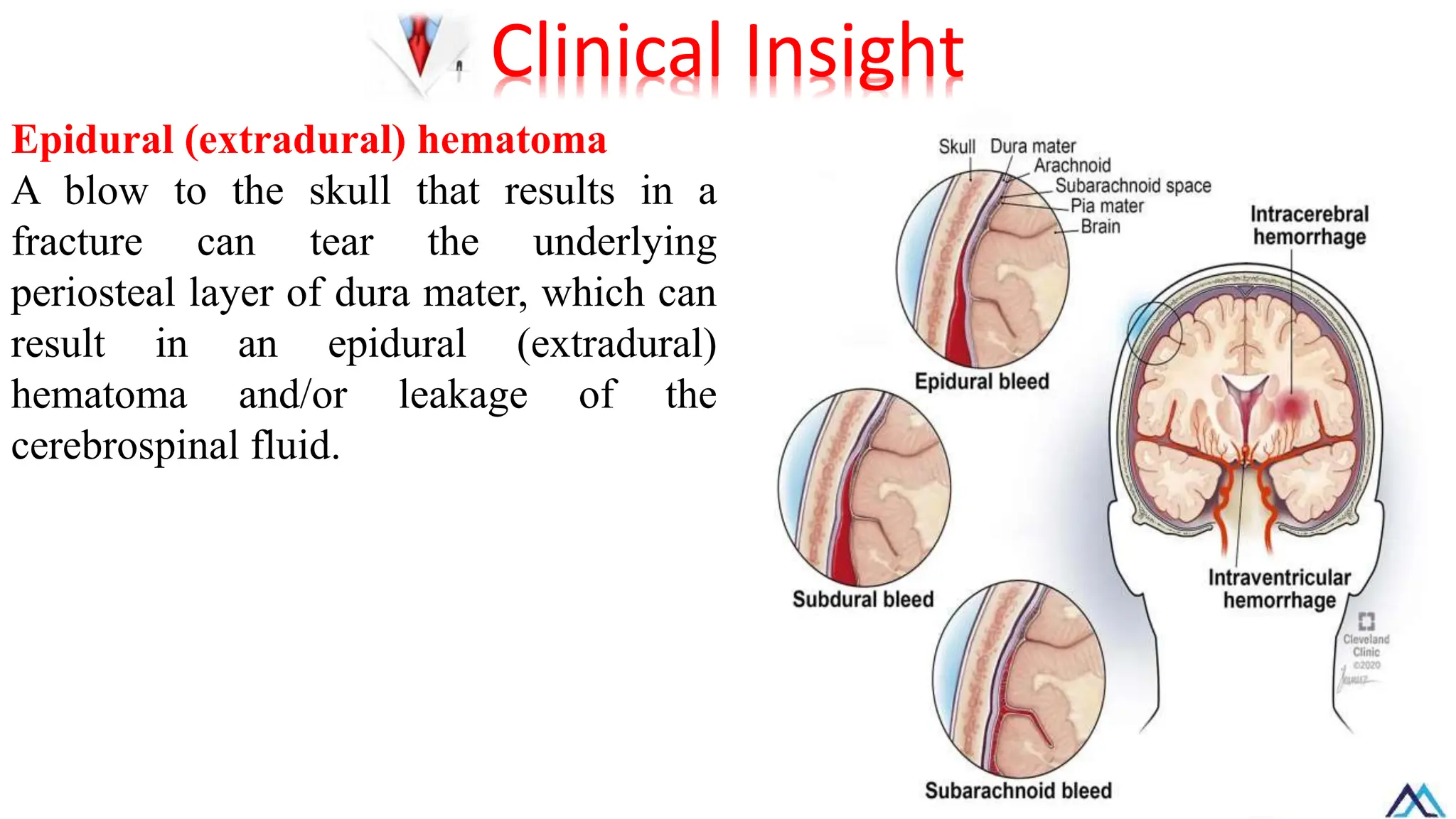
Epidural (extradural) hematoma
A blow to the skull that results in a
fracture can tear the underlying
periosteal layer of dura mater, which can
result in an epidural (extradural)
hematoma and/or leakage of the
cerebrospinal fluid.
Clinical Insight
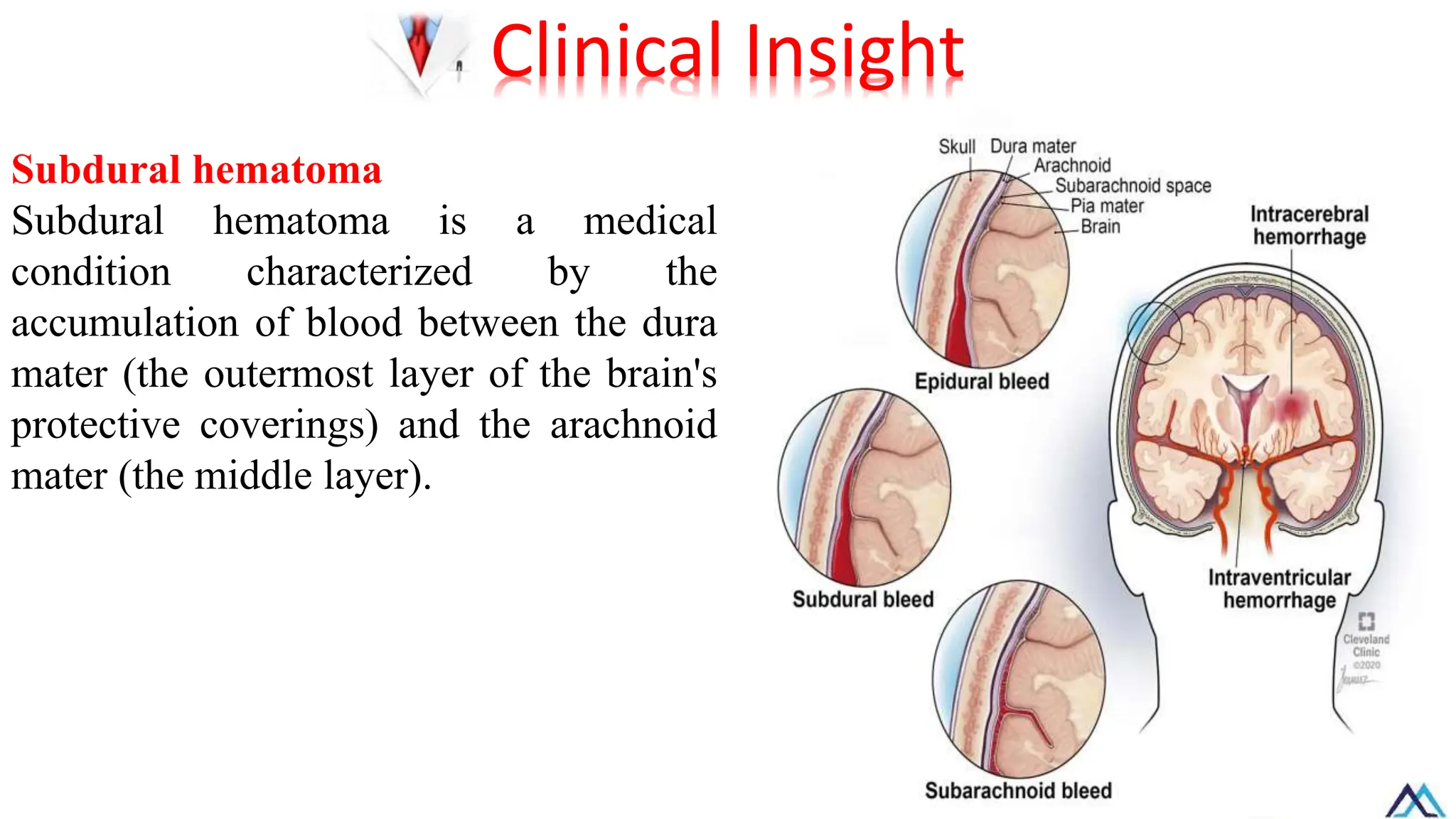
Subdural hematoma
Subdural hematoma is a medical
condition characterized by the
accumulation of blood between the dura
mater (the outermost layer of the brain's
protective coverings) and the arachnoid
mater (the middle layer).
Clinical Insight
Dural folds
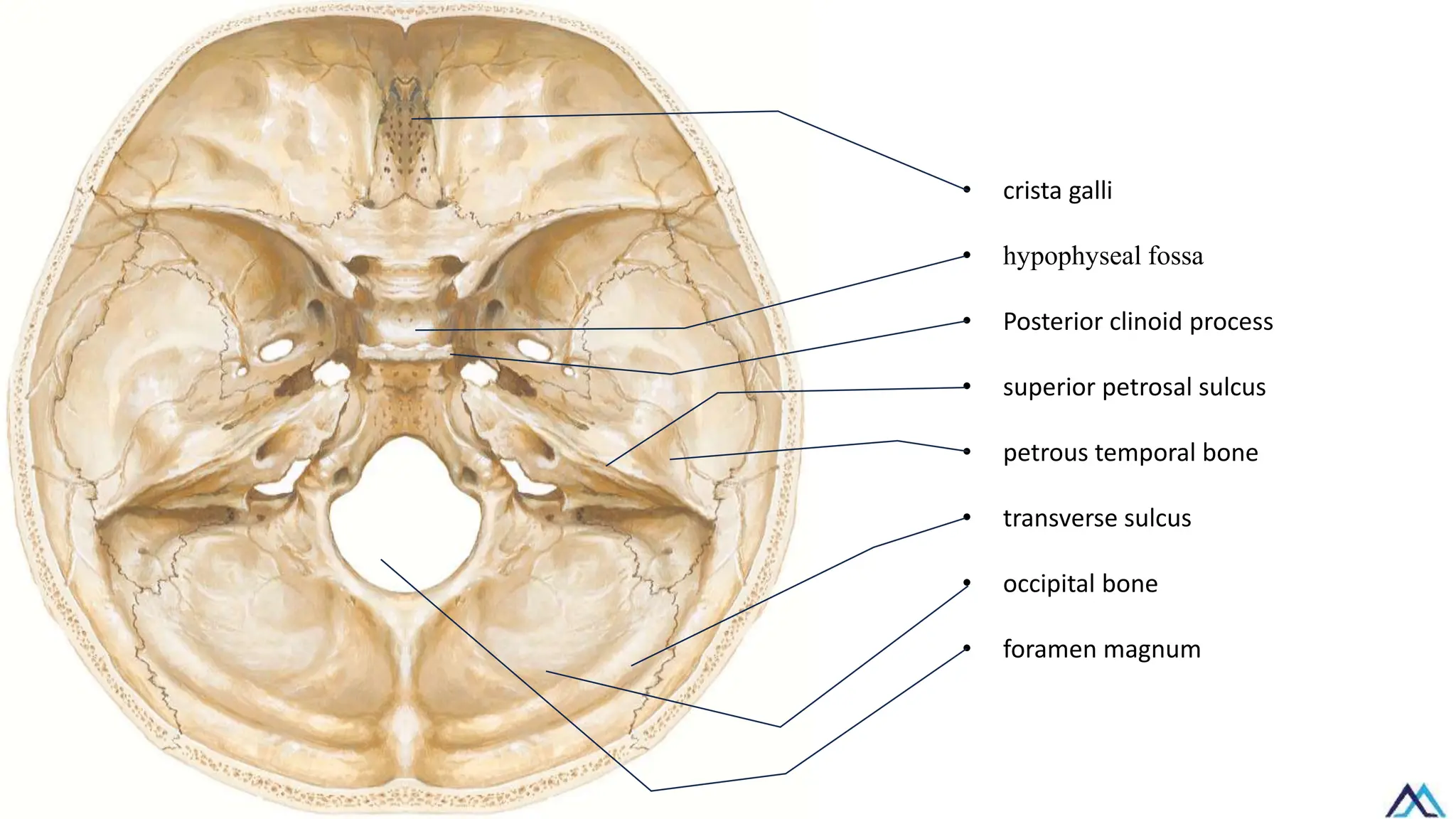
• crista galli
• hypophyseal fossa
• Posterior clinoid process
• superior petrosal sulcus
• petrous temporal bone
• transverse sulcus
• occipital bone
• foramen magnum
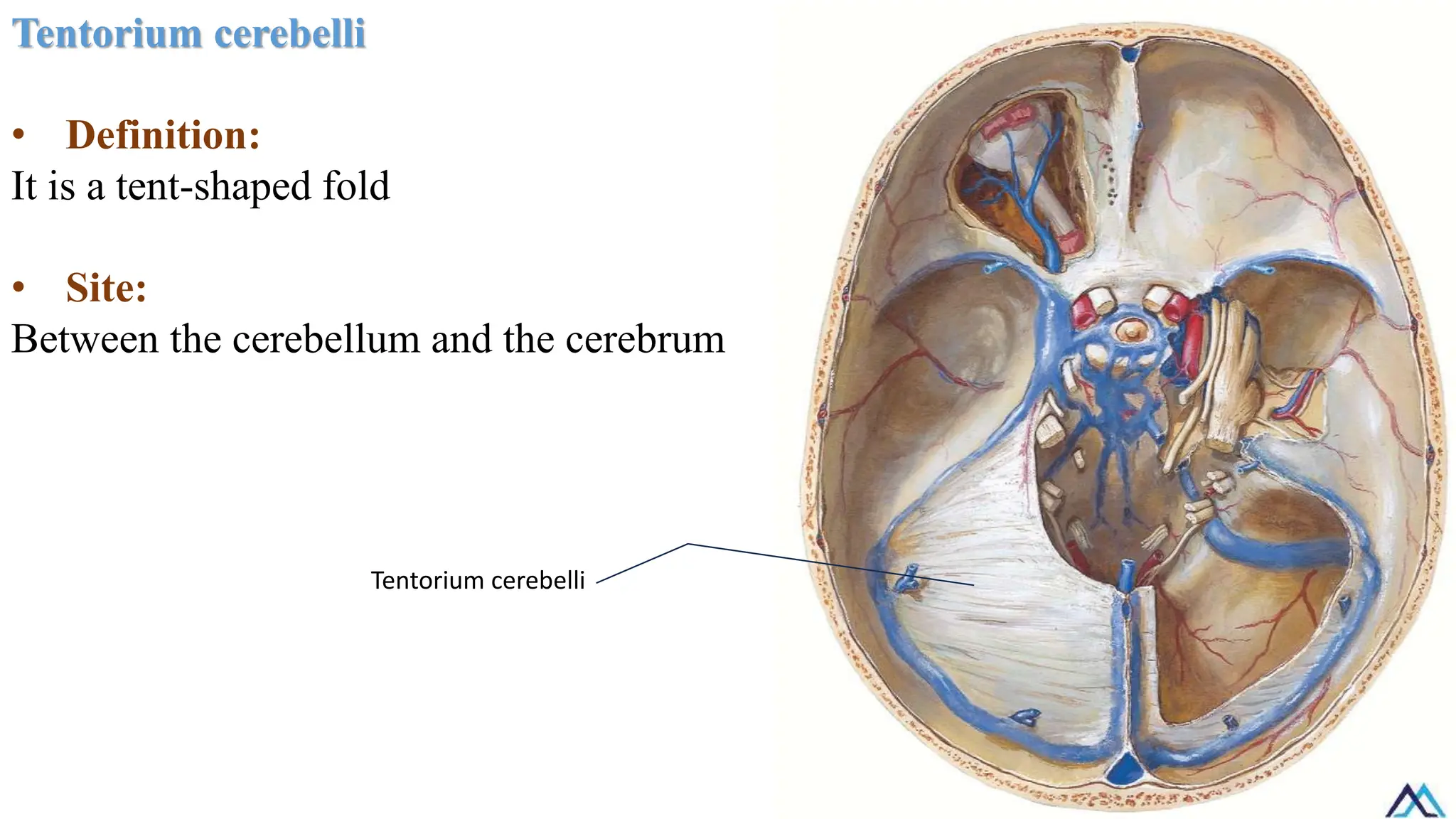
Tentorium cerebelli
• Definition:
It is a tent-shaped fold
• Site:
Between the cerebellum and the cerebrum
Tentorium cerebelli
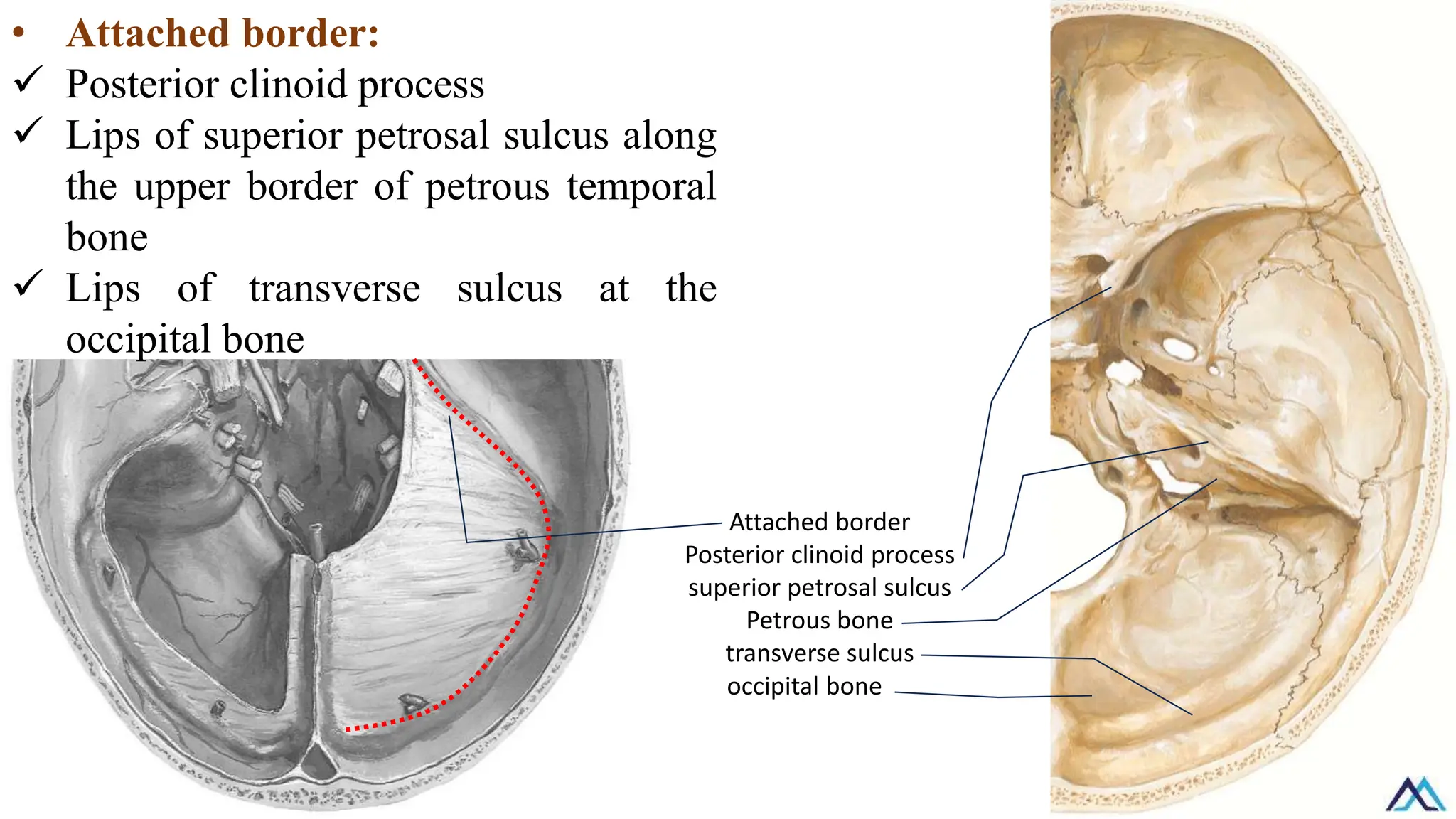
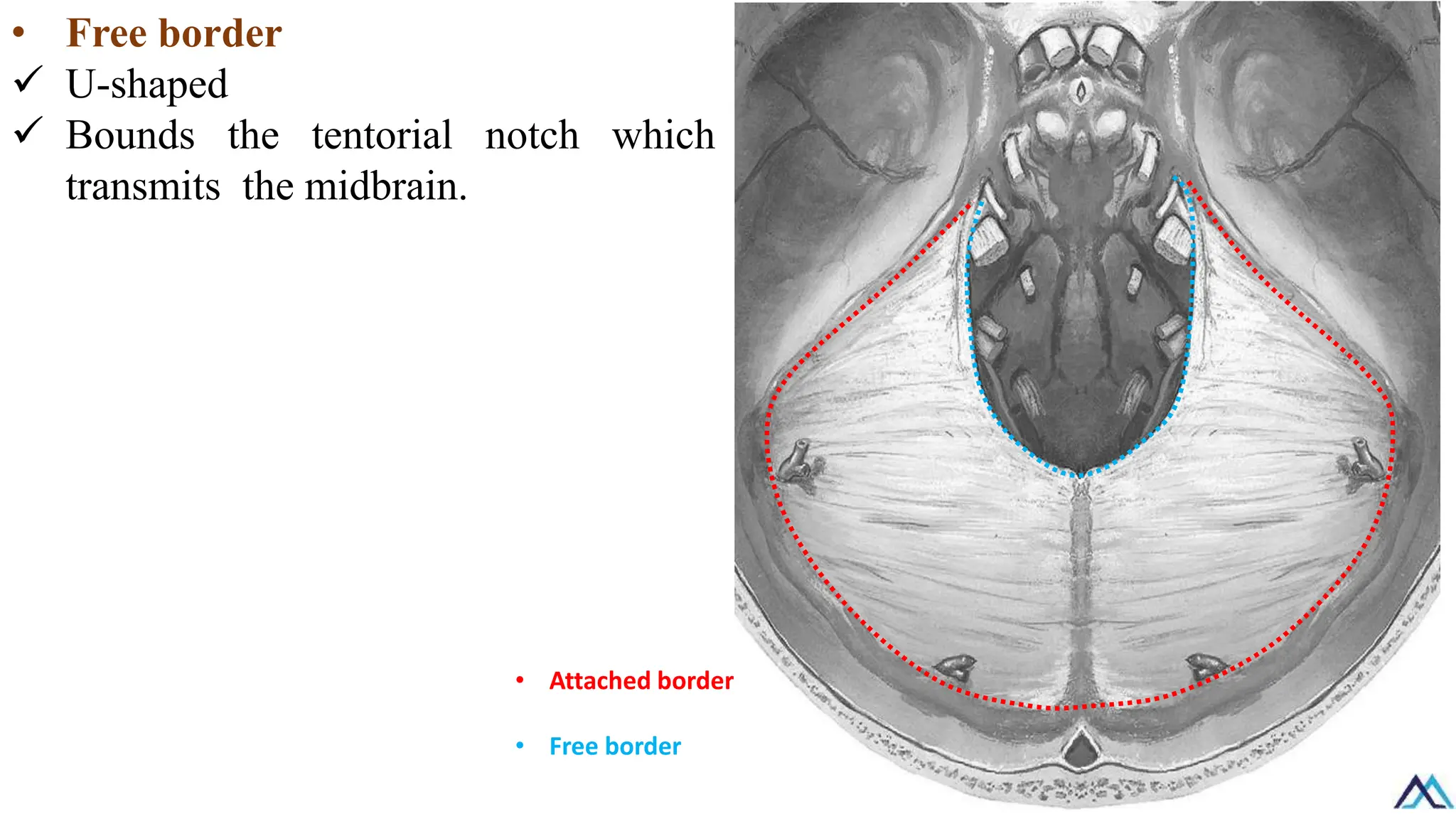
Attached border
Posterior clinoid process
superior petrosal sulcus
Petrous bone
transverse sulcus
occipital bone
• Attached border:
✓ Posterior clinoid process
✓ Lips of superior petrosal sulcus along
the upper border of petrous temporal
bone
✓ Lips of transverse sulcus at the
occipital bone
• Free border
✓ U-shaped
✓ Bounds the tentorial notch which
transmits the midbrain.
• Attached border
• Free border
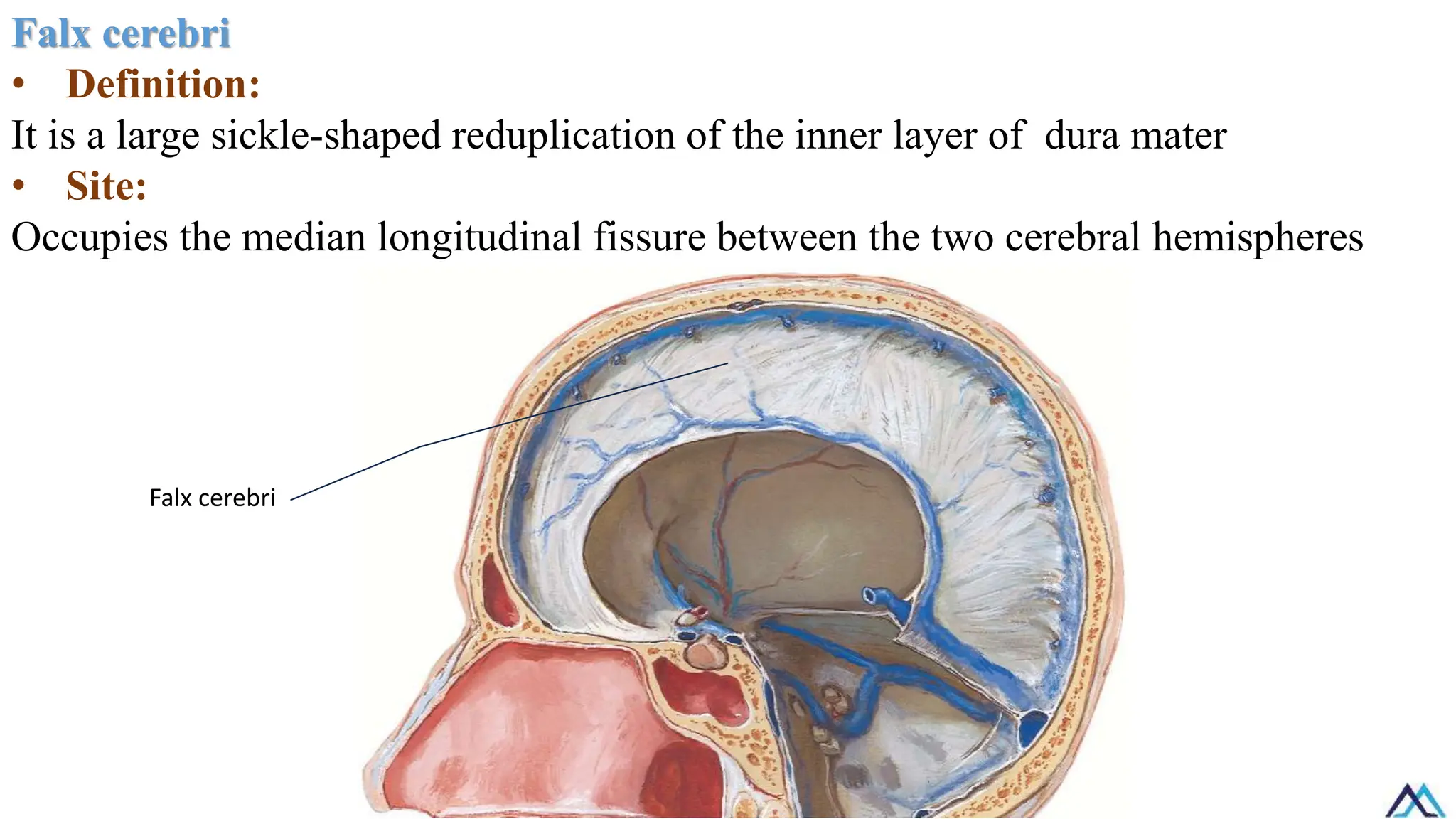
Falx cerebri
• Definition:
It is a large sickle-shaped reduplication of the inner layer of dura mater
• Site:
Occupies the median longitudinal fissure between the two cerebral hemispheres
Falx cerebri
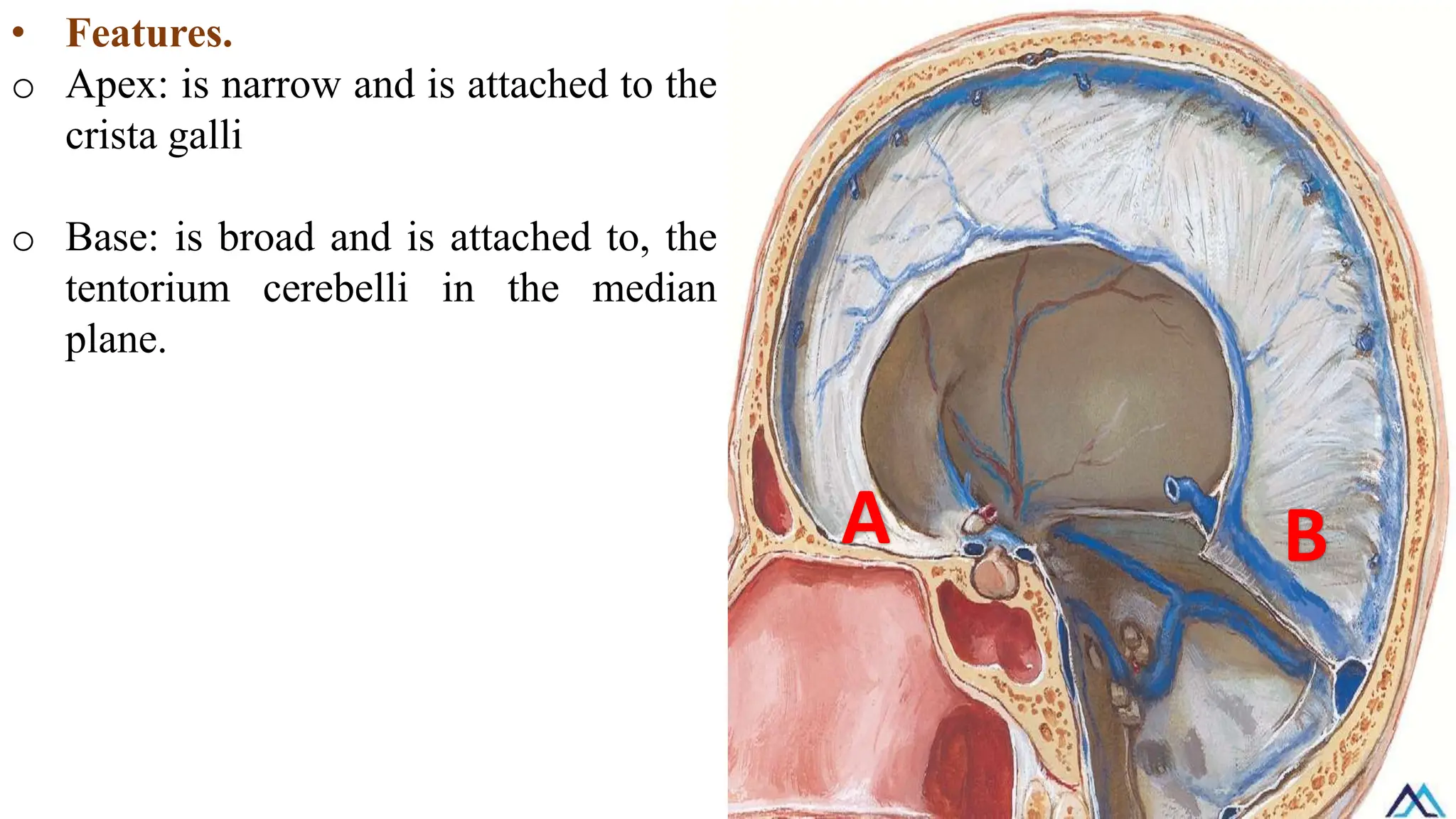
• Features.
o Apex: is narrow and is attached to the
crista galli
o Base: is broad and is attached to, the
tentorium cerebelli in the median
plane.
A B
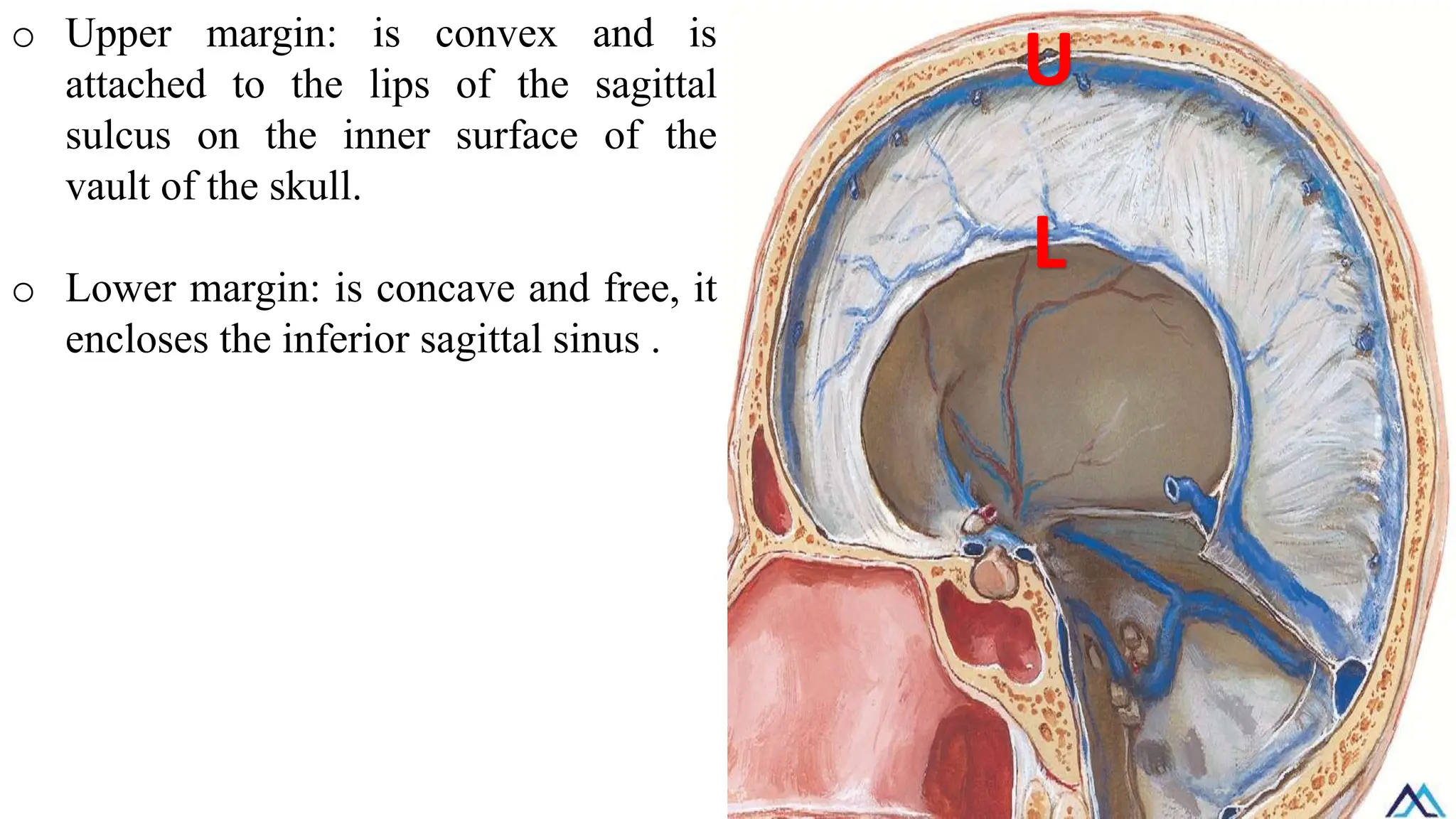
o Upper margin: is convex and is
attached to the lips of the sagittal
sulcus on the inner surface of the
vault of the skull.
o Lower margin: is concave and free, it
encloses the inferior sagittal sinus .
U
L
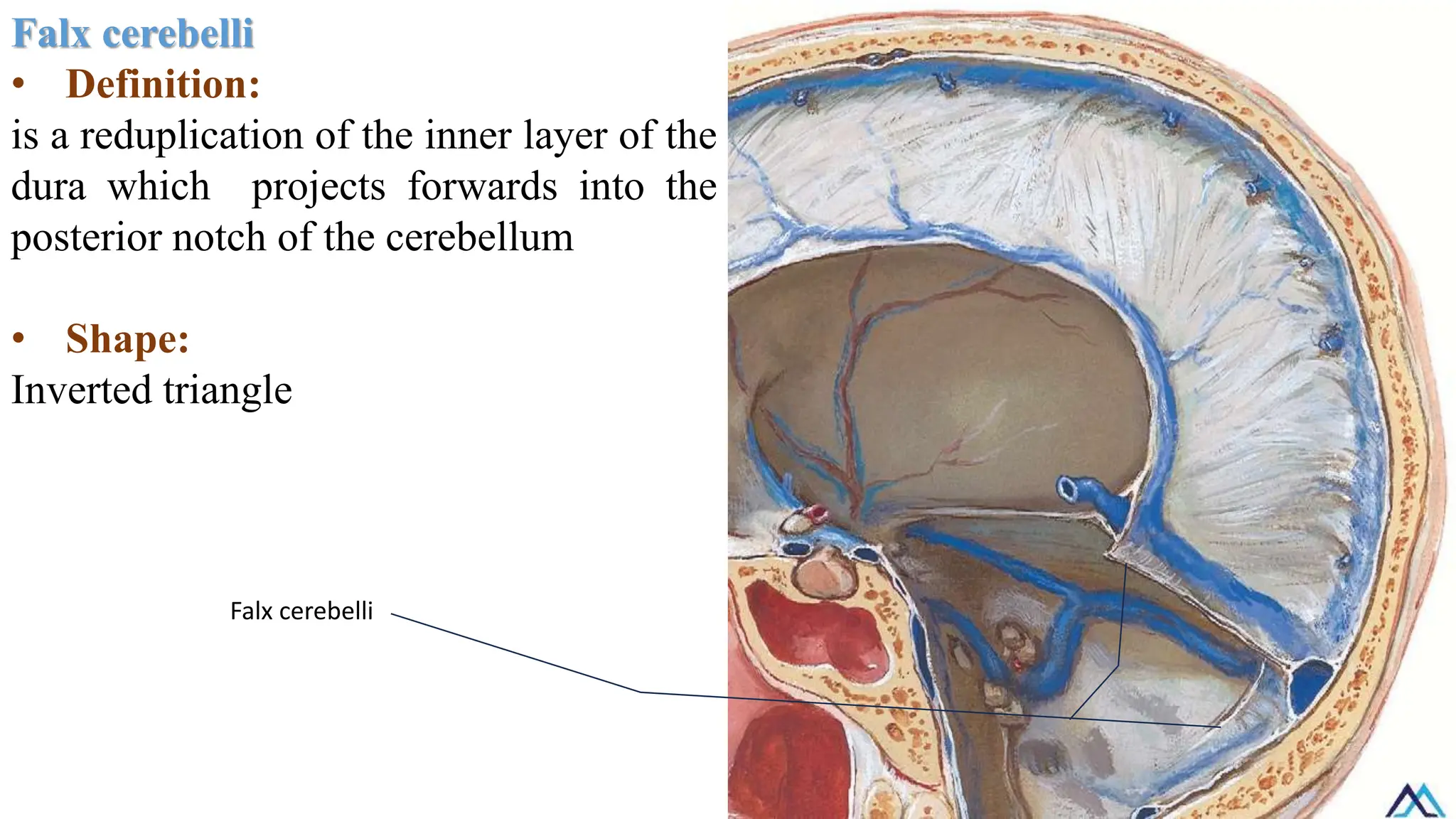
Falx cerebelli
• Definition:
is a reduplication of the inner layer of the
dura which projects forwards into the
posterior notch of the cerebellum
• Shape:
Inverted triangle
Falx cerebelli
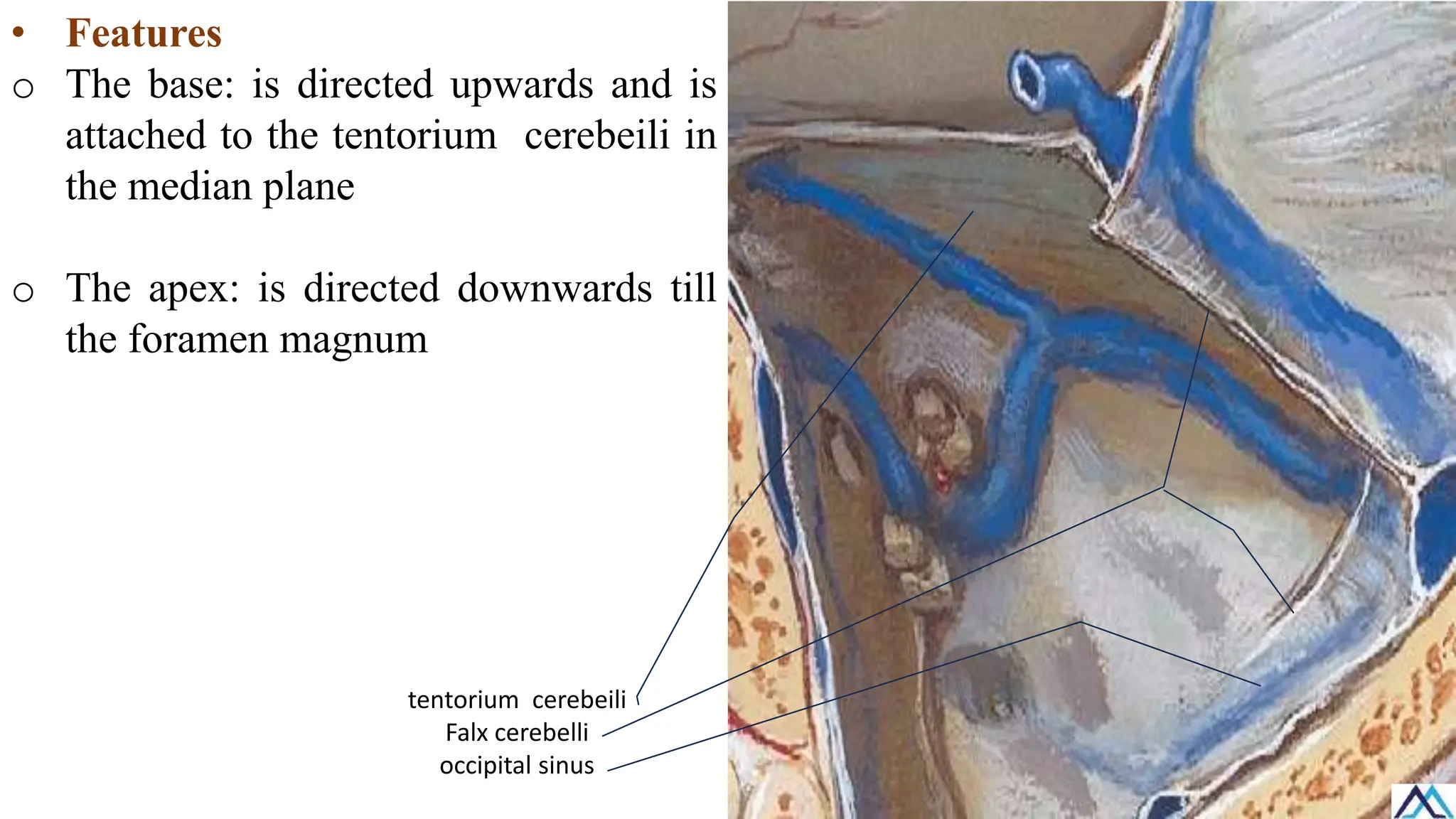
• Features
o The base: is directed upwards and is
attached to the tentorium cerebeili in
the median plane
o The apex: is directed downwards till
the foramen magnum
tentorium cerebeili
Falx cerebelli
occipital sinus
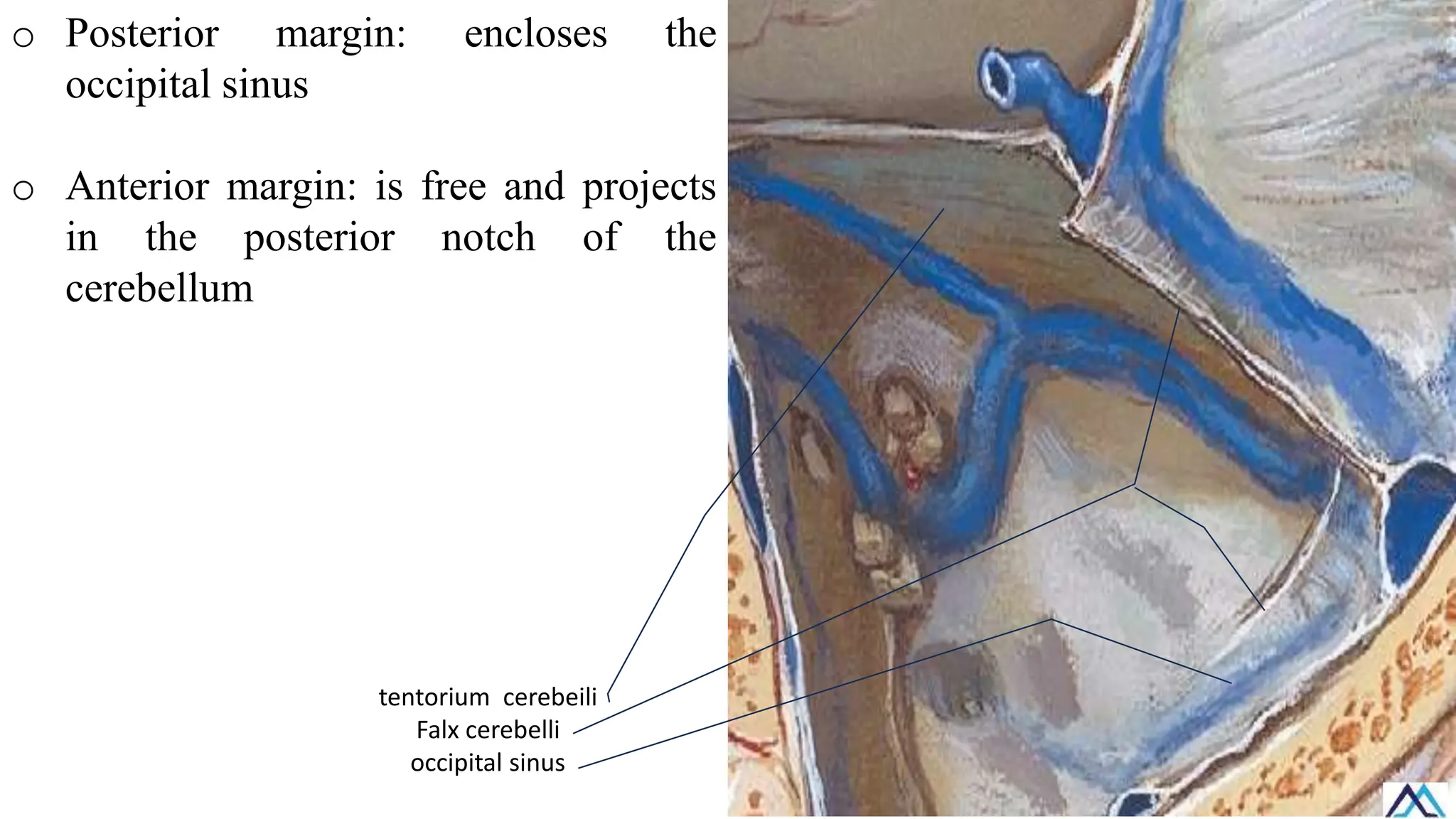
o Posterior margin: encloses the
occipital sinus
o Anterior margin: is free and projects
in the posterior notch of the
cerebellum
tentorium cerebeili
Falx cerebelli
occipital sinus
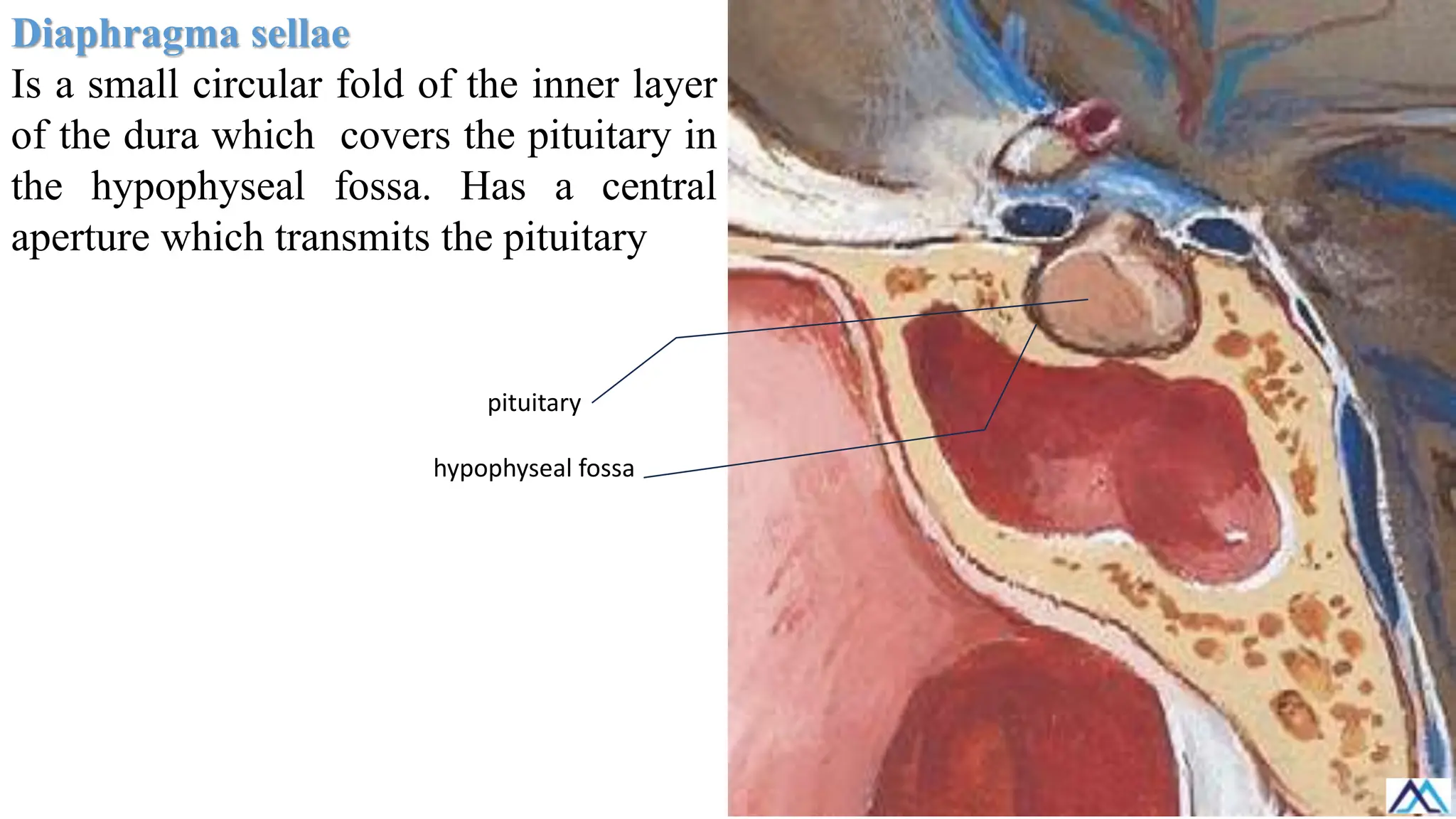
Diaphragma sellae
Is a small circular fold of the inner layer
of the dura which covers the pituitary in
the hypophyseal fossa. Has a central
aperture which transmits the pituitary
pituitary
hypophyseal fossa
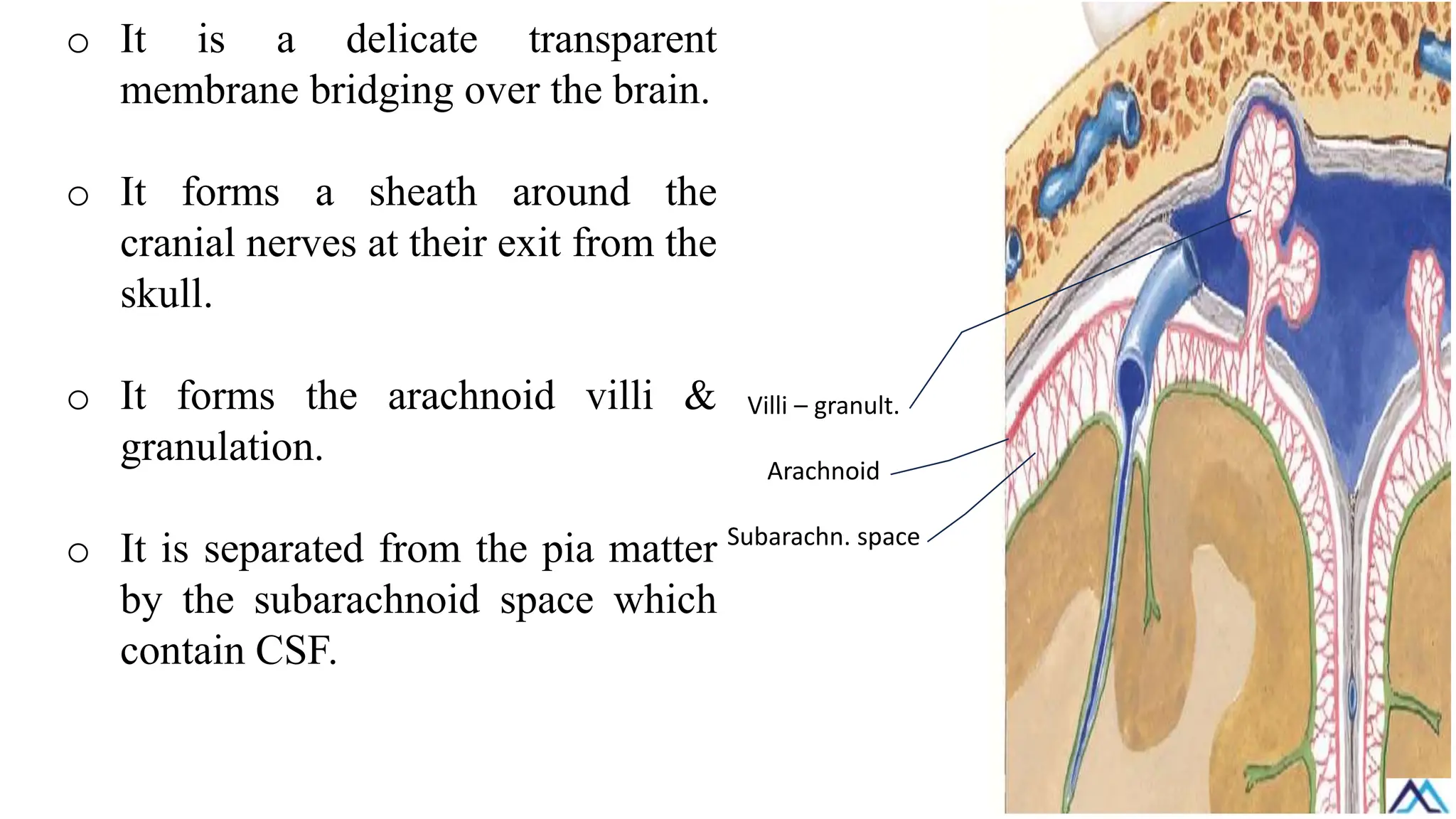
• Cerebral Arachnoid matter
o It is a delicate transparent
membrane bridging over the brain.
o It forms a sheath around the
cranial nerves at their exit from the
skull.
o It forms the arachnoid villi &
granulation.
o It is separated from the pia matter
by the subarachnoid space which
contain CSF.
Villi – granult.
Arachnoid
Subarachn. space
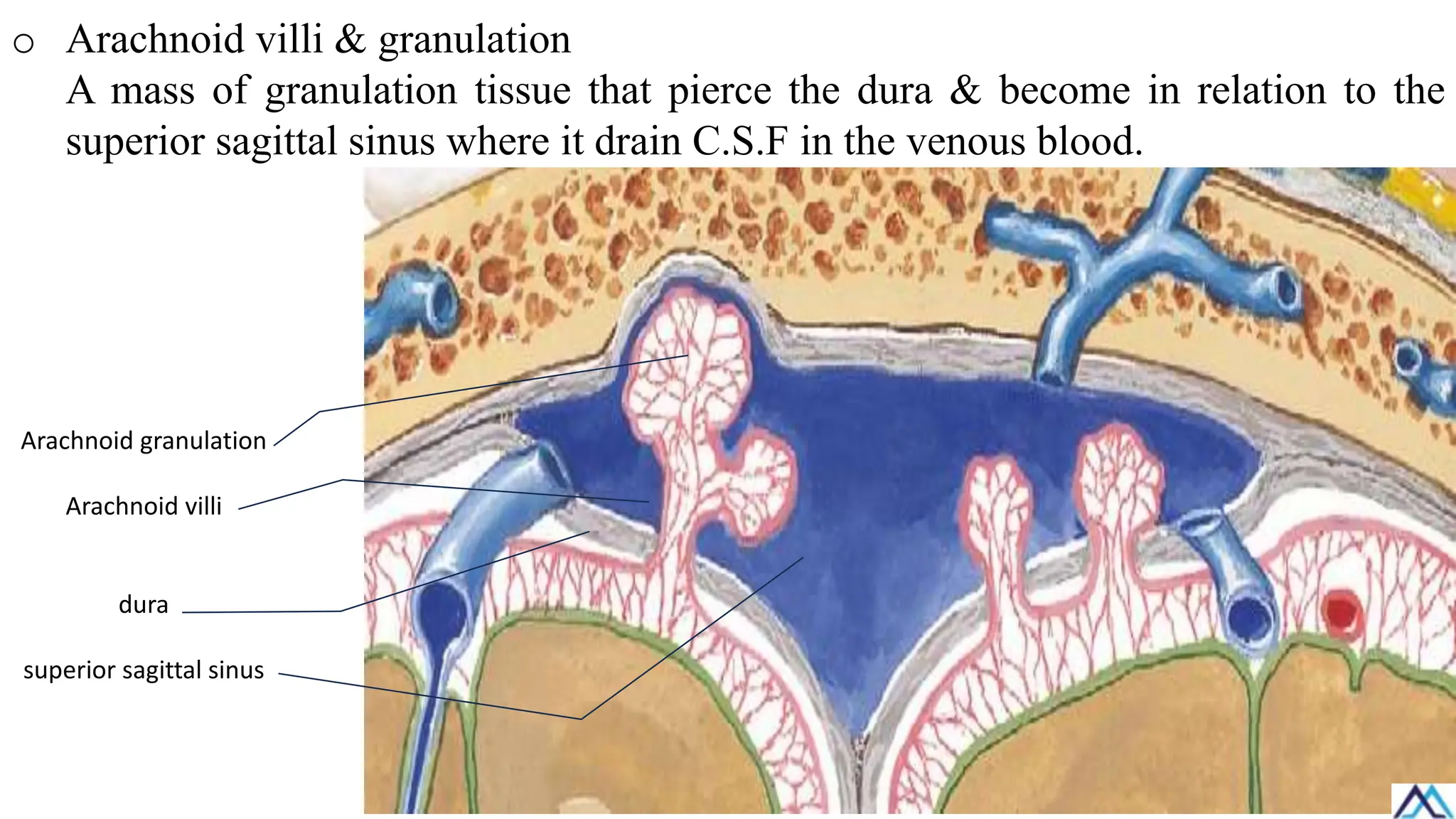
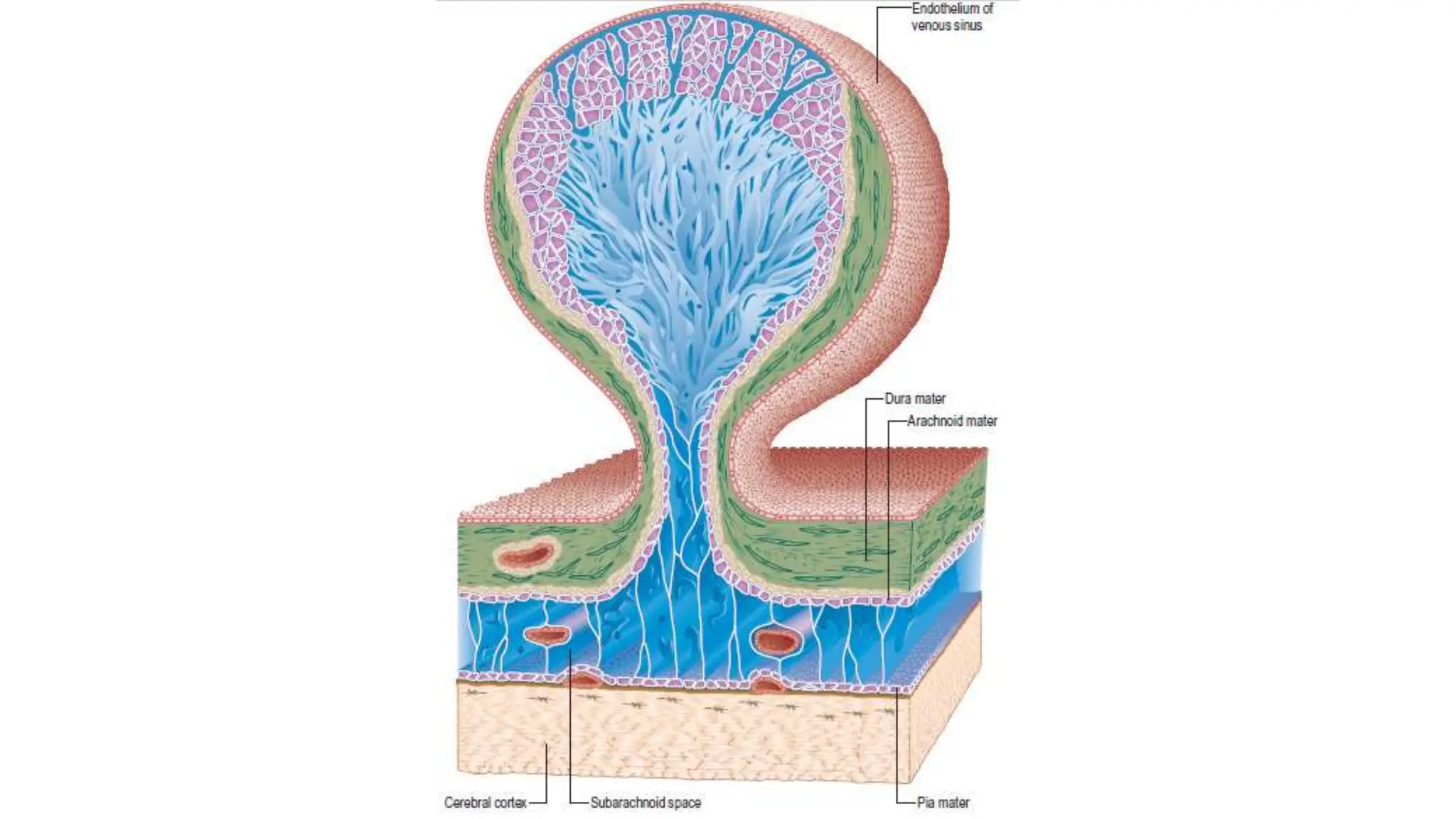
o Arachnoid villi & granulation
A mass of granulation tissue that pierce the dura & become in relation to the
superior sagittal sinus where it drain C.S.F in the venous blood.
Arachnoid granulation
Arachnoid villi
dura
superior sagittal sinus
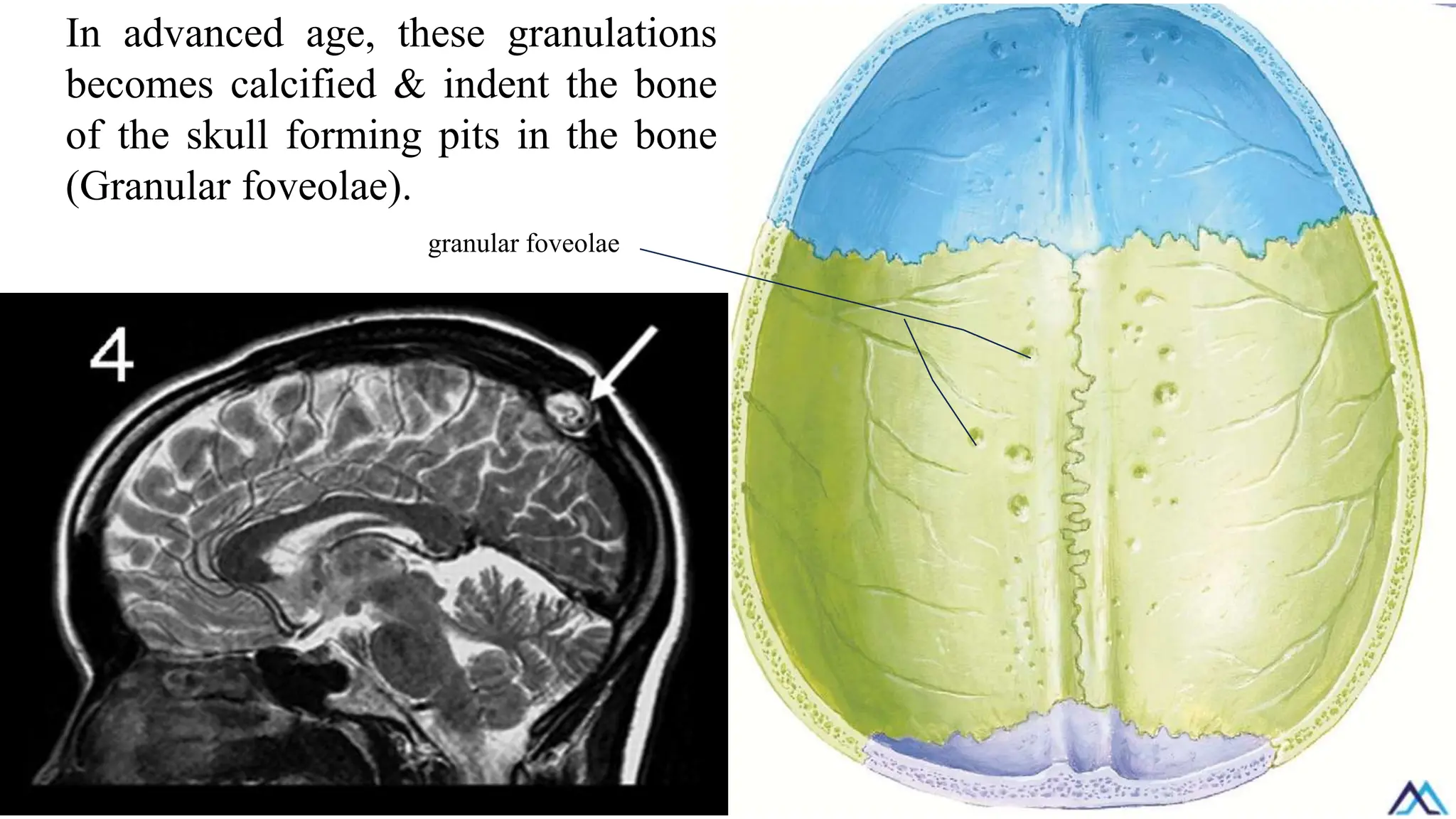
In advanced age, these granulations
becomes calcified & indent the bone
of the skull forming pits in the bone
(Granular foveolae).
granular foveolae
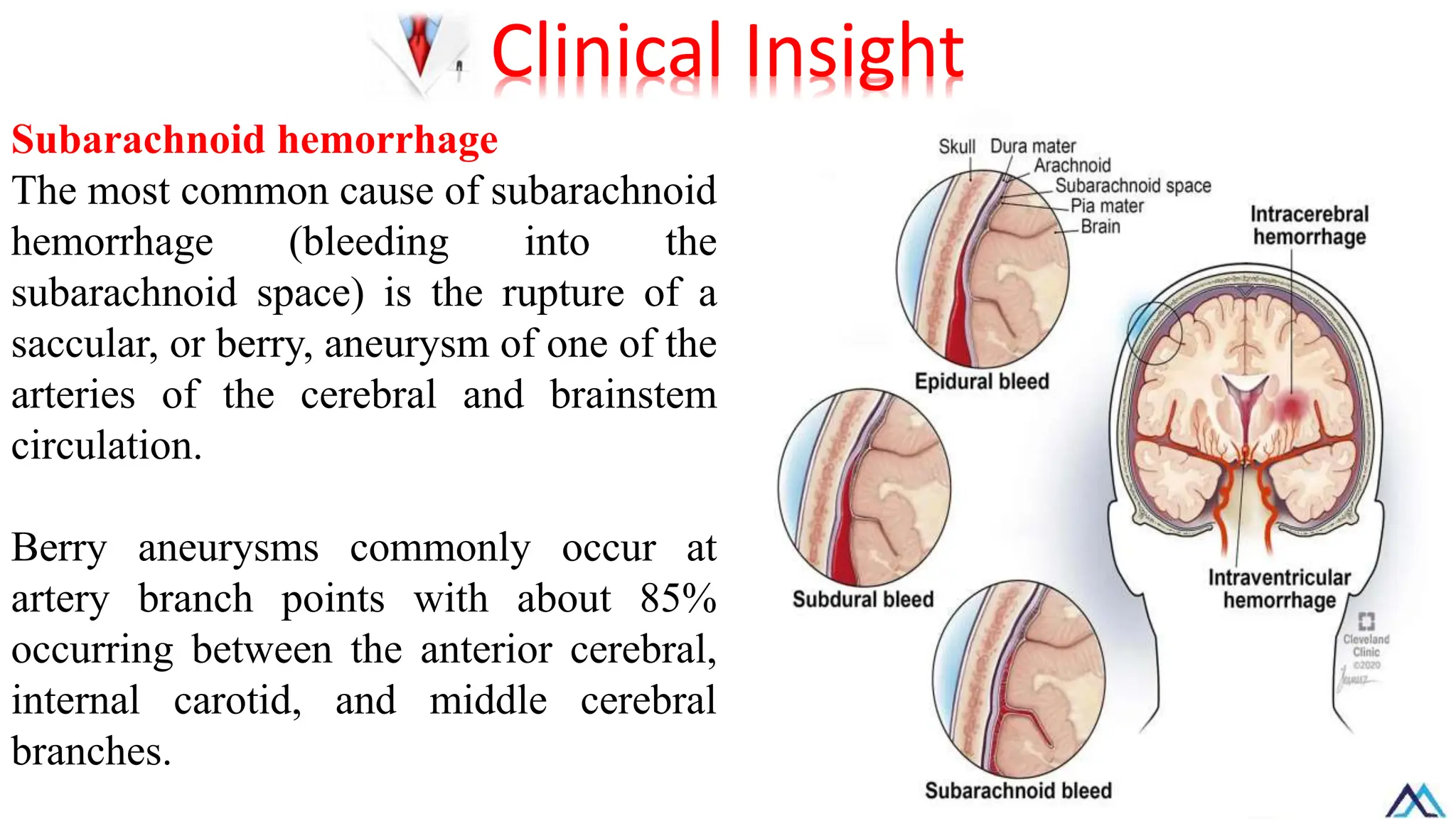
Subarachnoid hemorrhage
The most common cause of subarachnoid
hemorrhage (bleeding into the
subarachnoid space) is the rupture of a
saccular, or berry, aneurysm of one of the
arteries of the cerebral and brainstem
circulation.
Berry aneurysms commonly occur at
artery branch points with about 85%
occurring between the anterior cerebral,
internal carotid, and middle cerebral
branches.
Clinical Insight
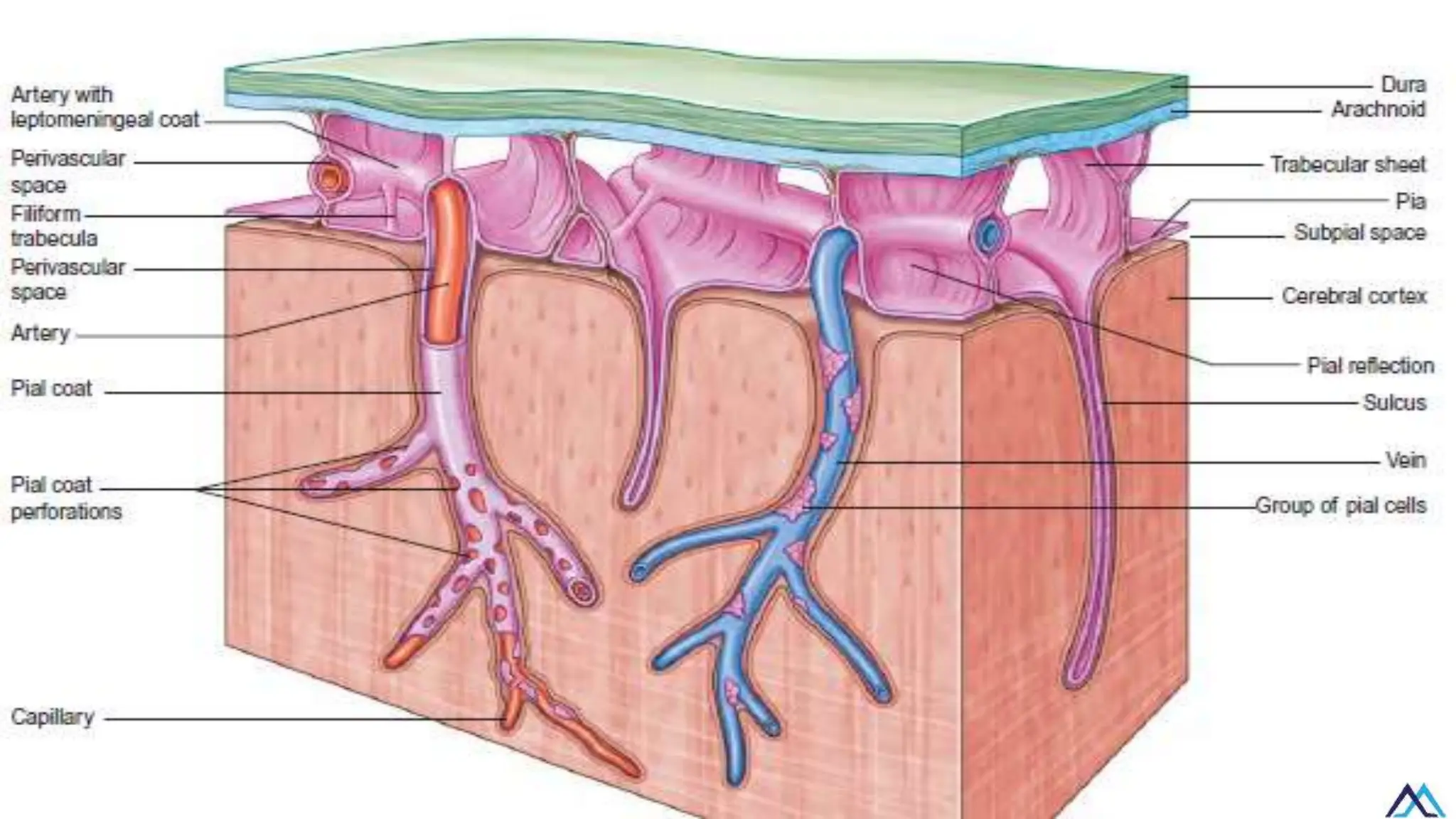
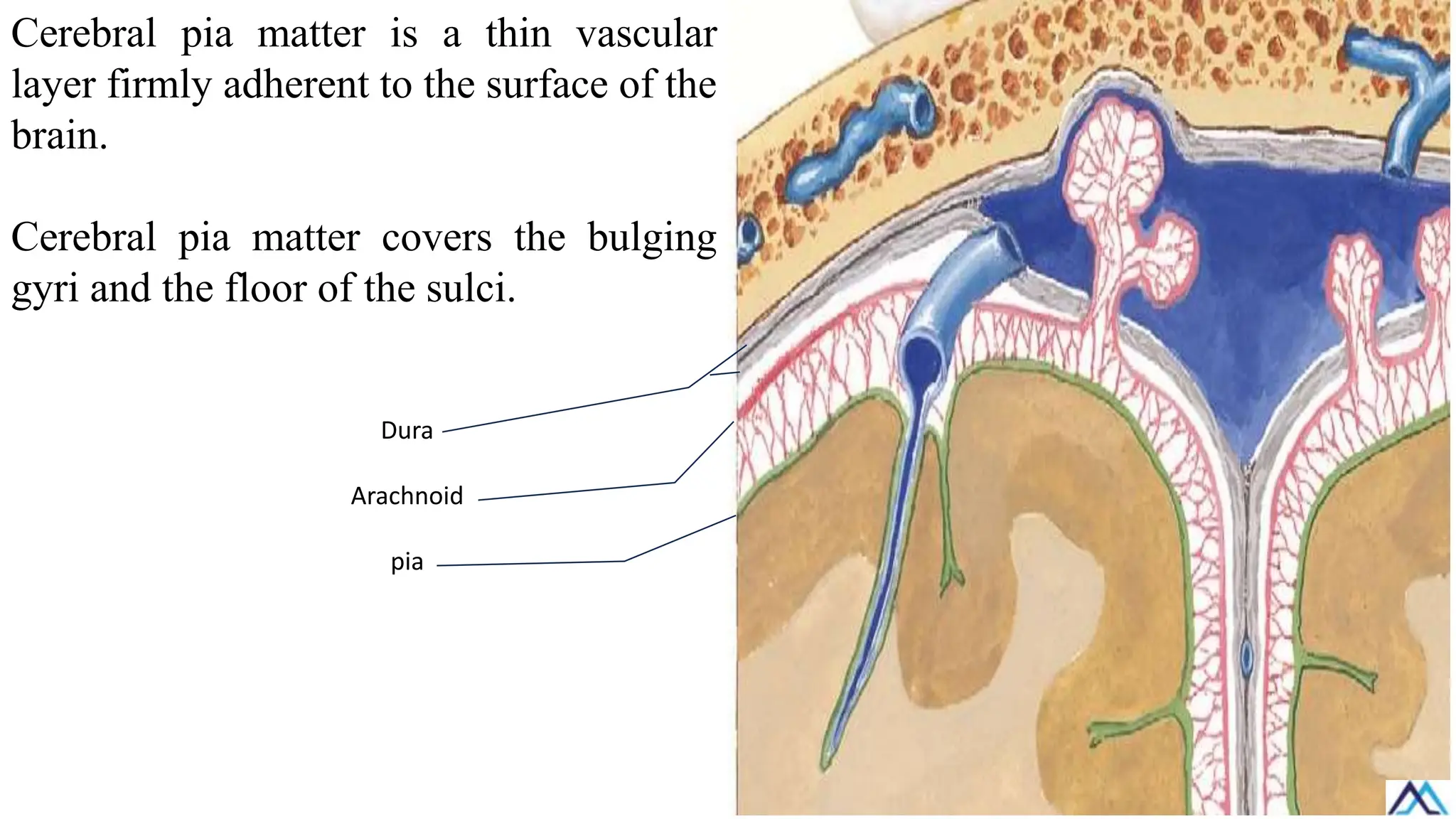
• Cerebral Pia matter
Cerebral pia matter is a thin vascular
layer firmly adherent to the surface of the
brain.
Cerebral pia matter covers the bulging
gyri and the floor of the sulci.
Dura
Arachnoid
pia
C.S.F
The volume of cerebrospinal fluid
(CSF) in the human central nervous
system is approximately 150 milliliters.
Totally replaced 3 times per day.
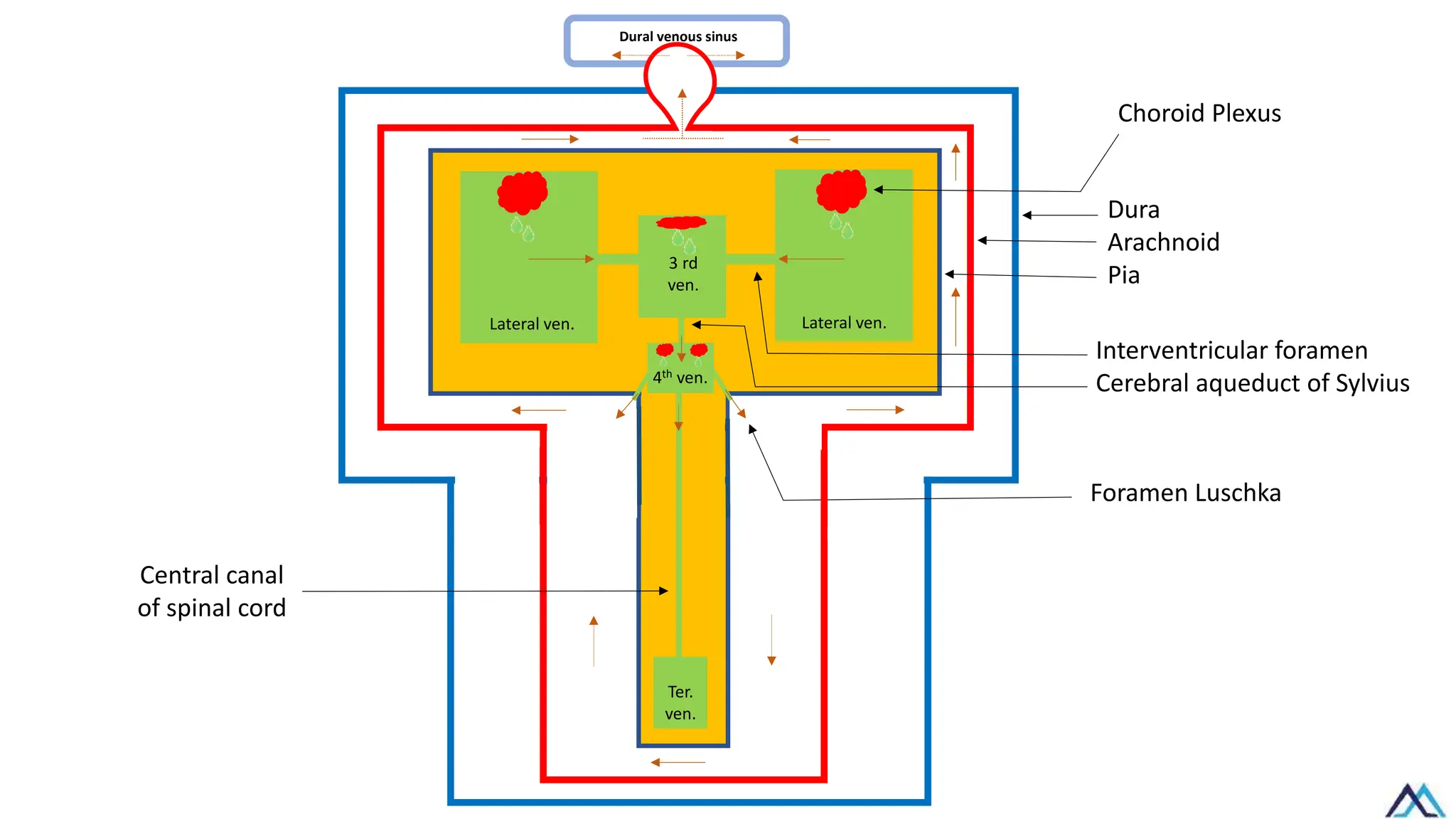
Dura
Arachnoid
Pia
3 rd
ven.
4th ven.
Ter.
ven.
Central canal
of spinal cord
Choroid Plexus
Interventricular foramen
Cerebral aqueduct of Sylvius
Foramen Luschka
Dural venous sinus
Lateral ven. Lateral ven.
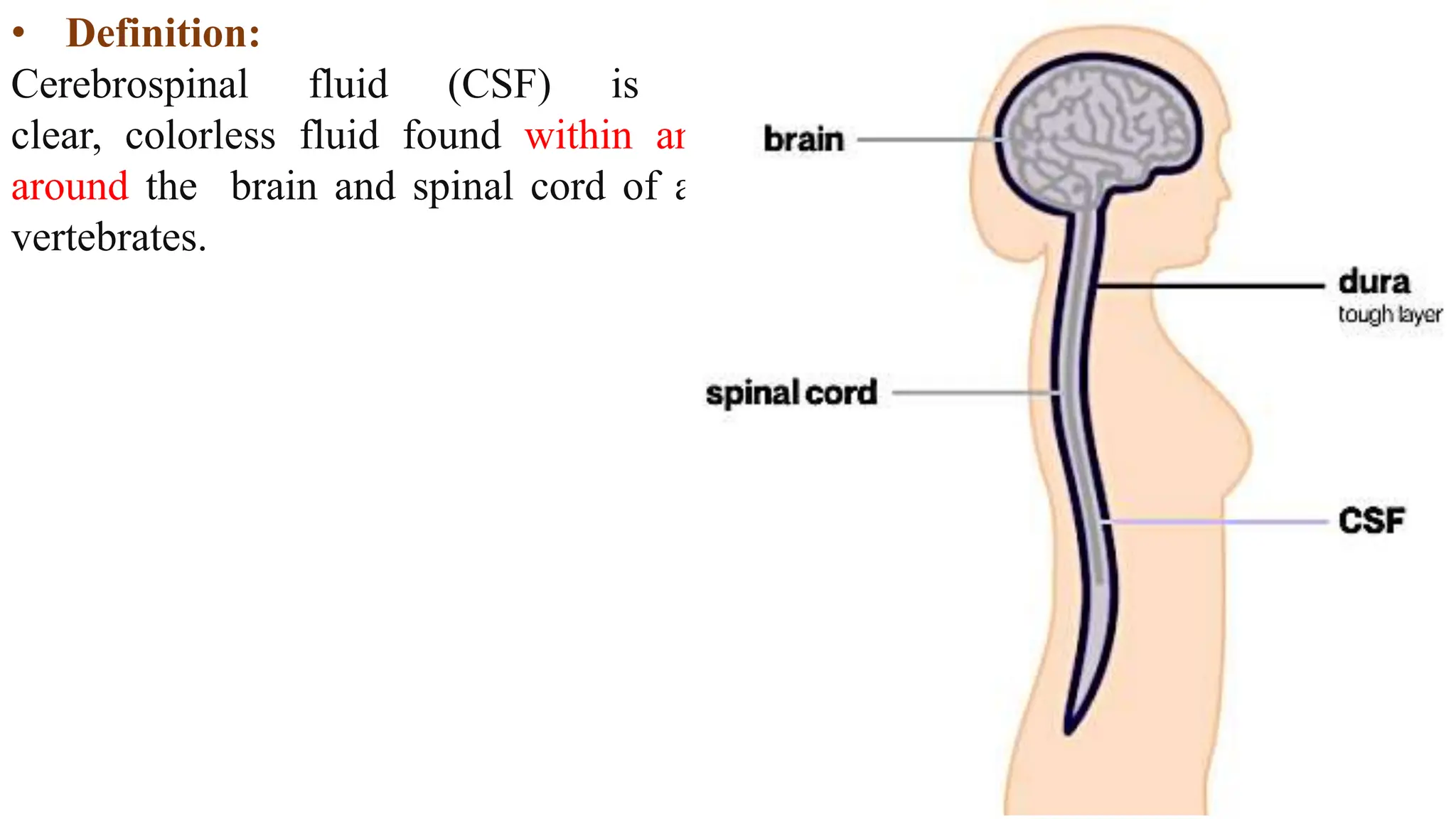
• Definition:
Cerebrospinal fluid (CSF) is a
clear, colorless fluid found within and
around the brain and spinal cord of all
vertebrates.
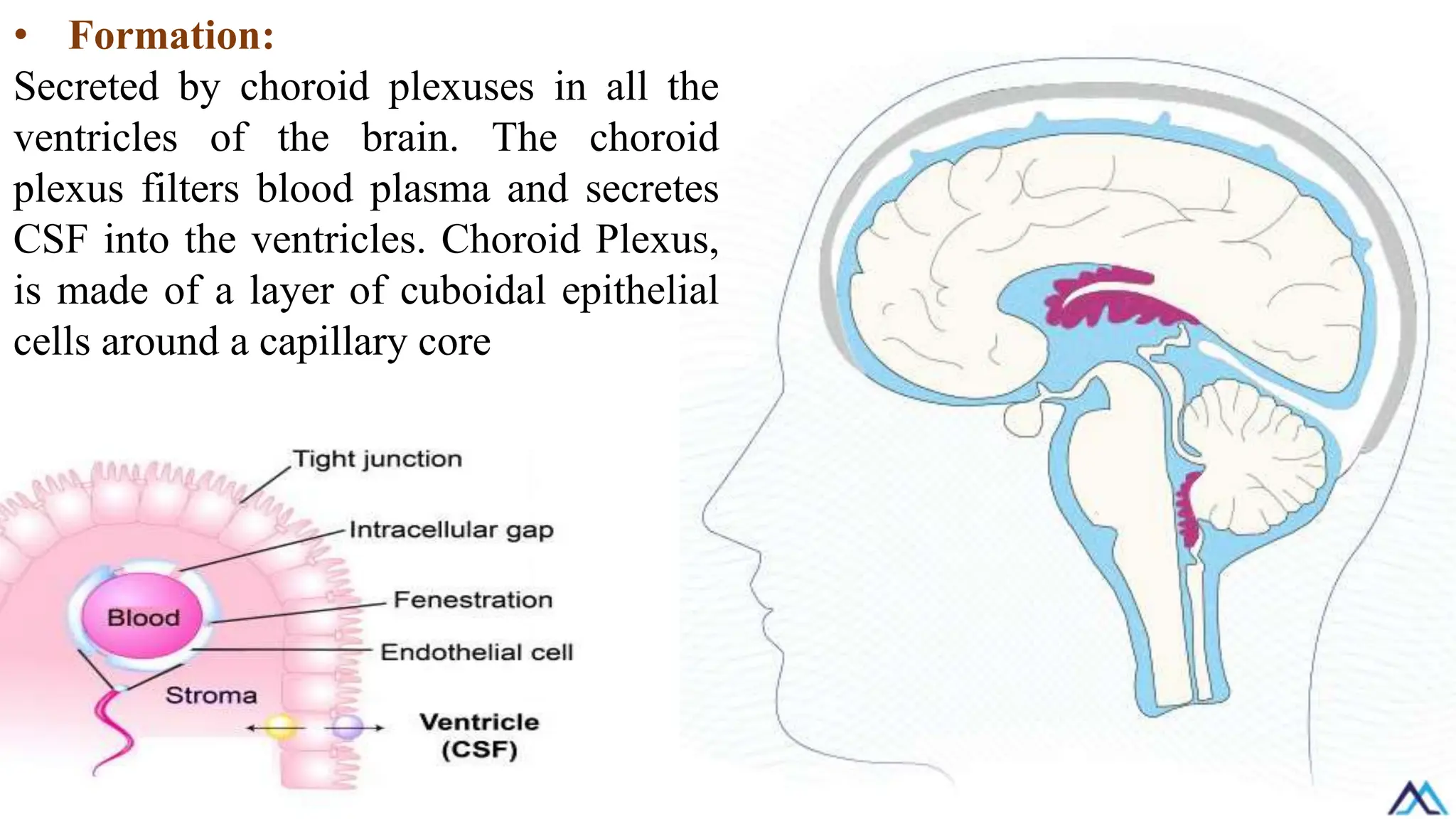
• Formation:
Secreted by choroid plexuses in all the
ventricles of the brain. The choroid
plexus filters blood plasma and secretes
CSF into the ventricles. Choroid Plexus,
is made of a layer of cuboidal epithelial
cells around a capillary core
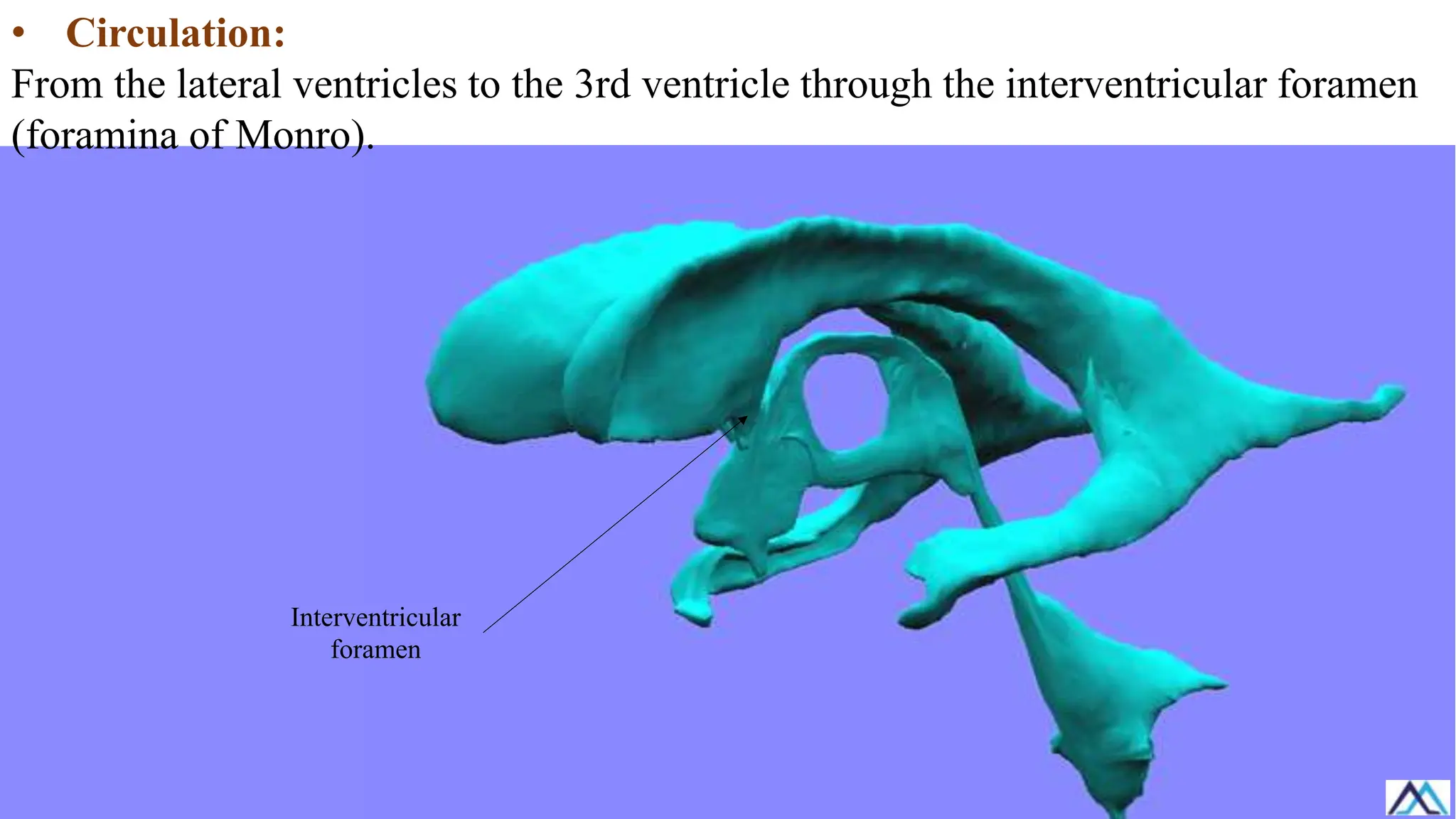
• Circulation:
From the lateral ventricles to the 3rd ventricle through the interventricular foramen
(foramina of Monro).
Interventricular
foramen
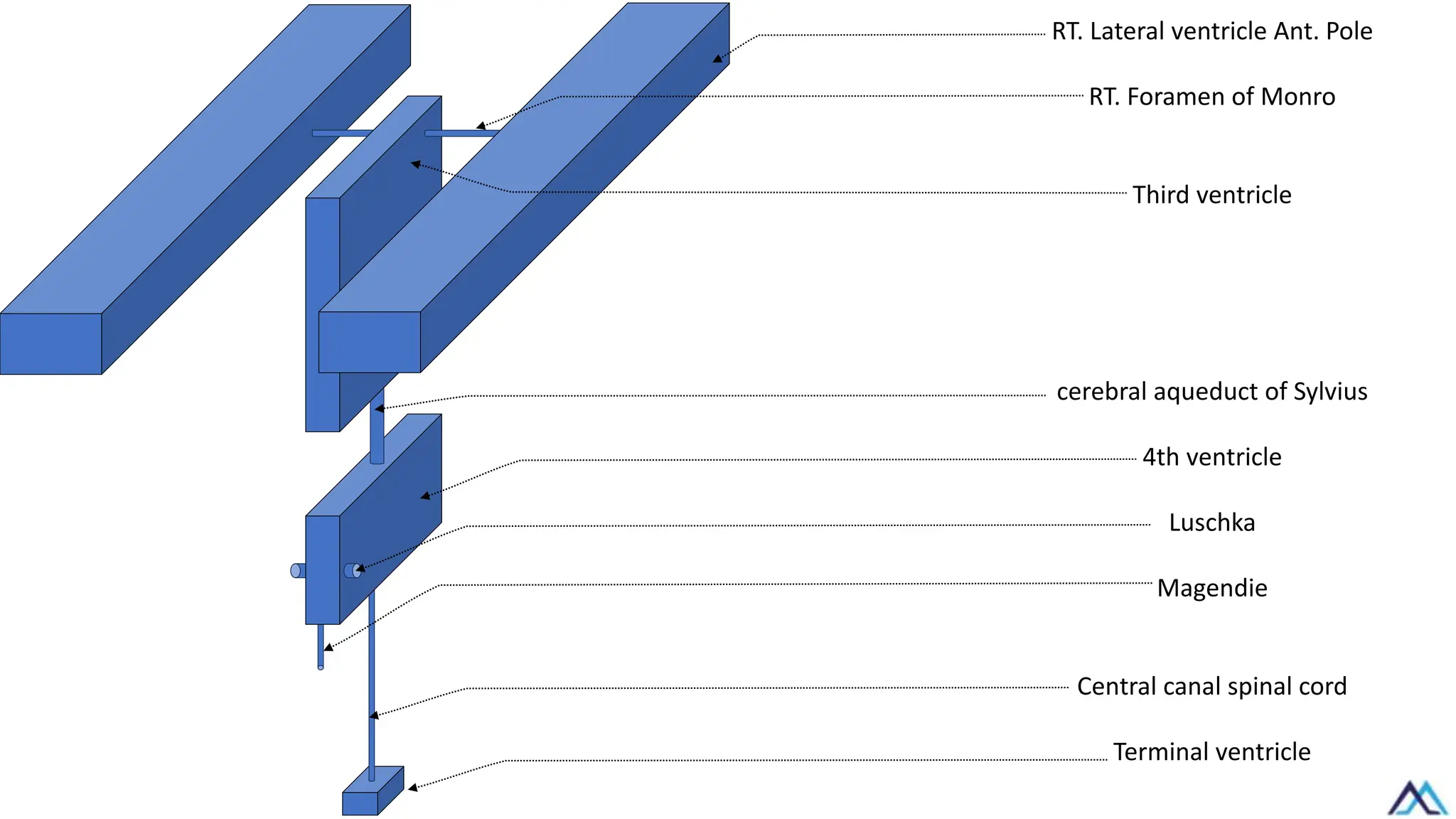
RT. Lateral ventricle Ant. Pole
RT. Foramen of Monro
Third ventricle
cerebral aqueduct of Sylvius
4th ventricle
Luschka
Magendie
Central canal spinal cord
Terminal ventricle
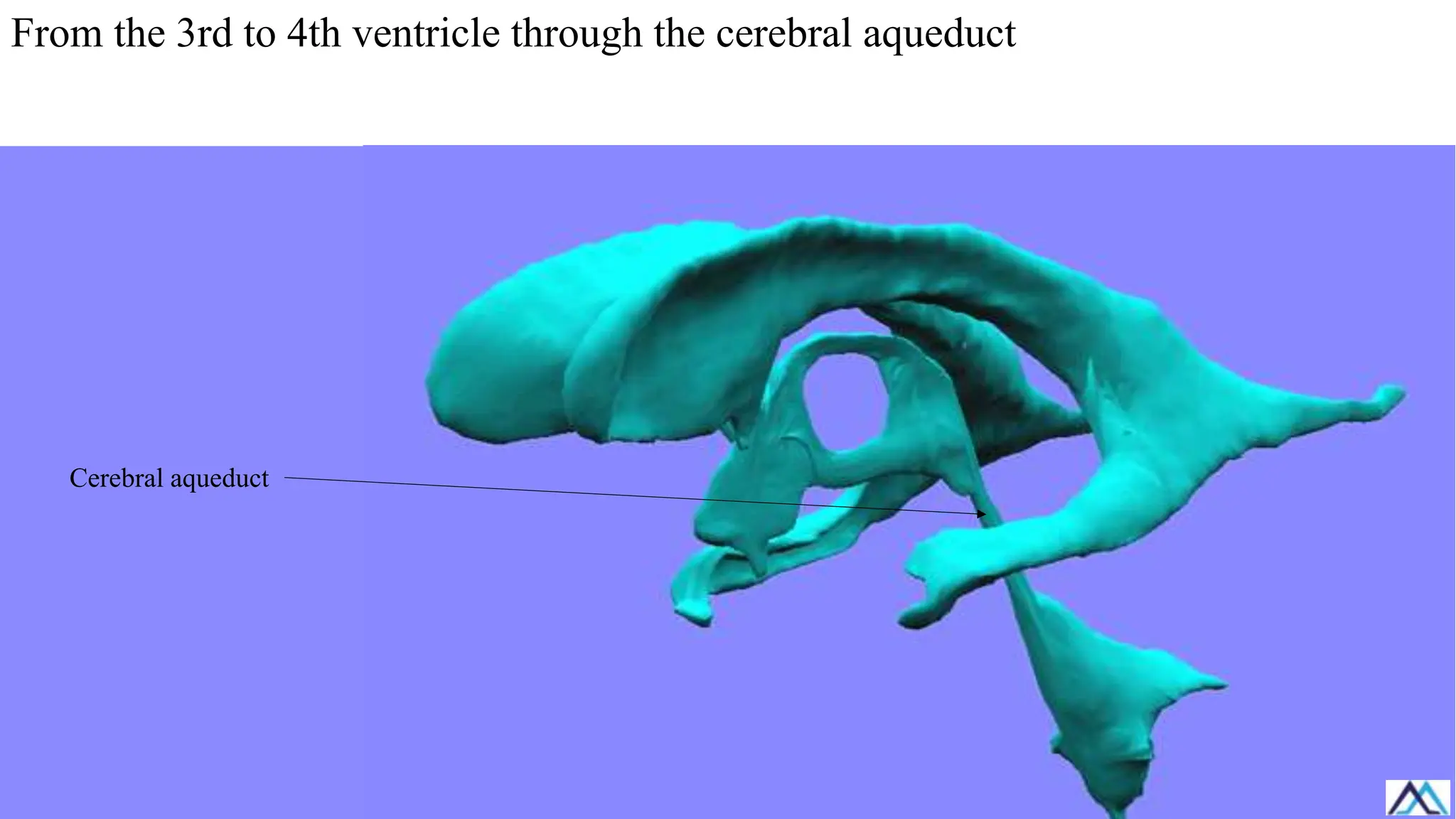
From the 3rd to 4th ventricle through the cerebral aqueduct
Cerebral aqueduct
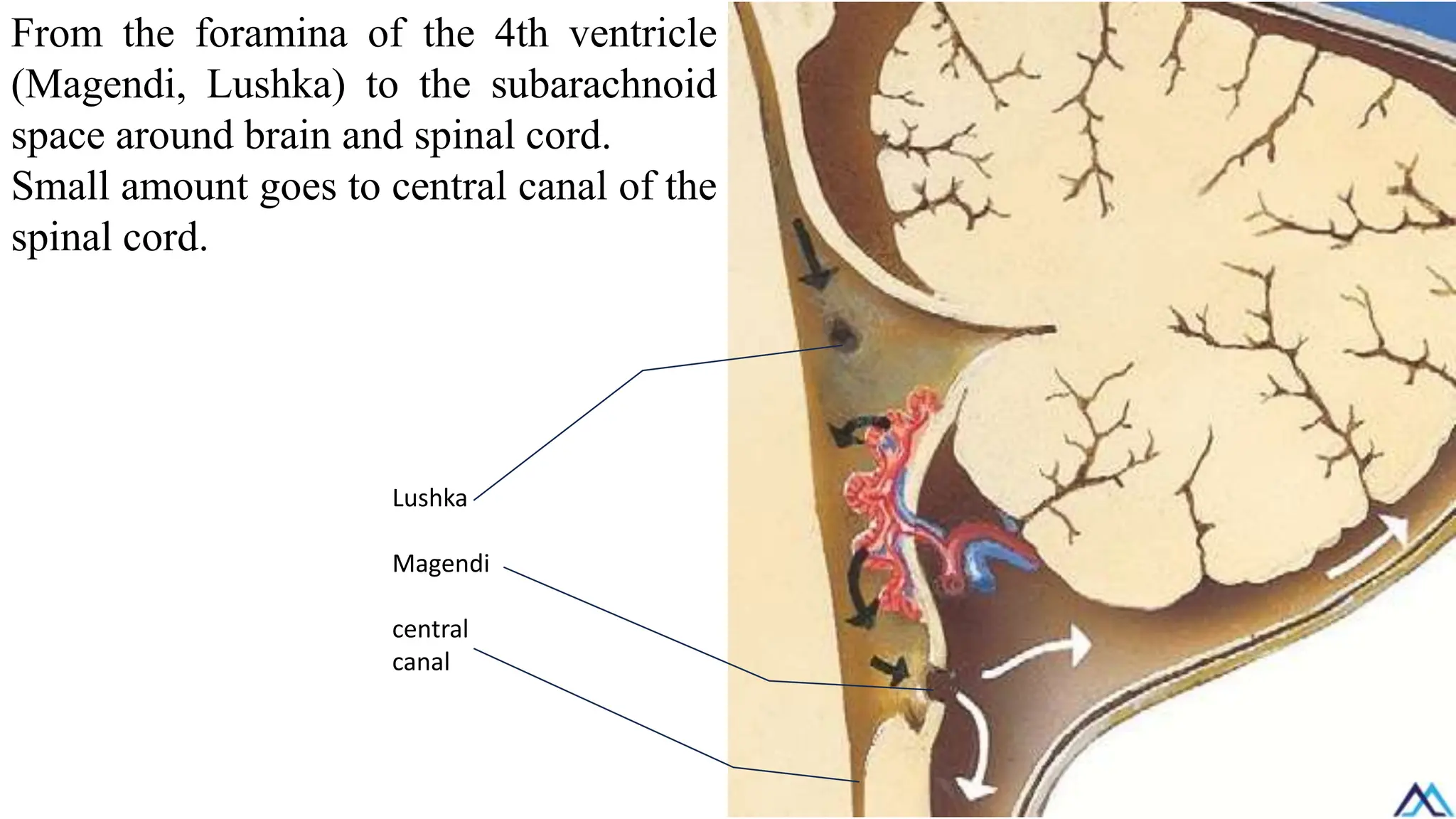
From the foramina of the 4th ventricle
(Magendi, Lushka) to the subarachnoid
space around brain and spinal cord.
Small amount goes to central canal of the
spinal cord.
Lushka
Magendi
central
canal
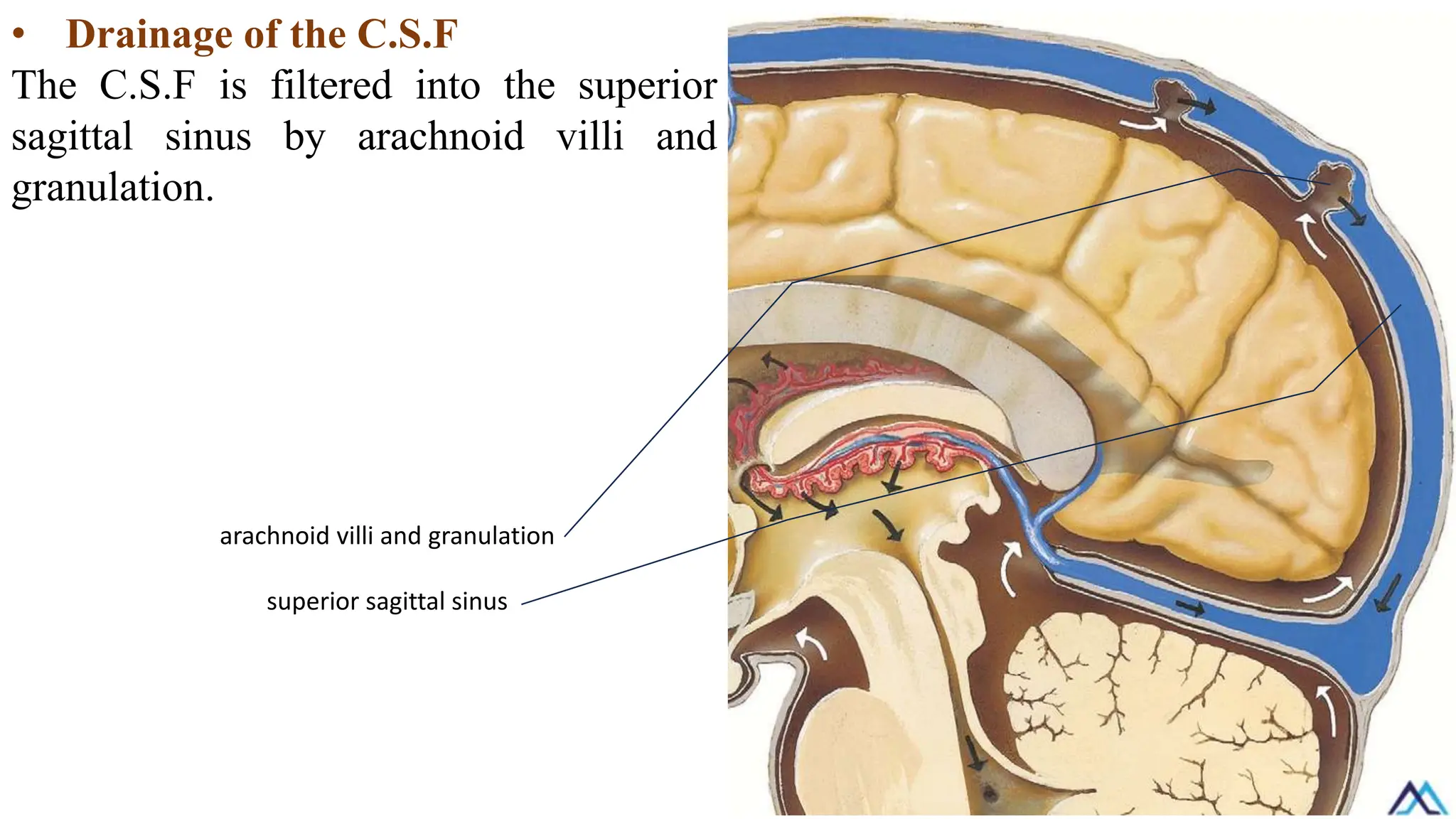
• Drainage of the C.S.F
The C.S.F is filtered into the superior
sagittal sinus by arachnoid villi and
granulation.
arachnoid villi and granulation
superior sagittal sinus
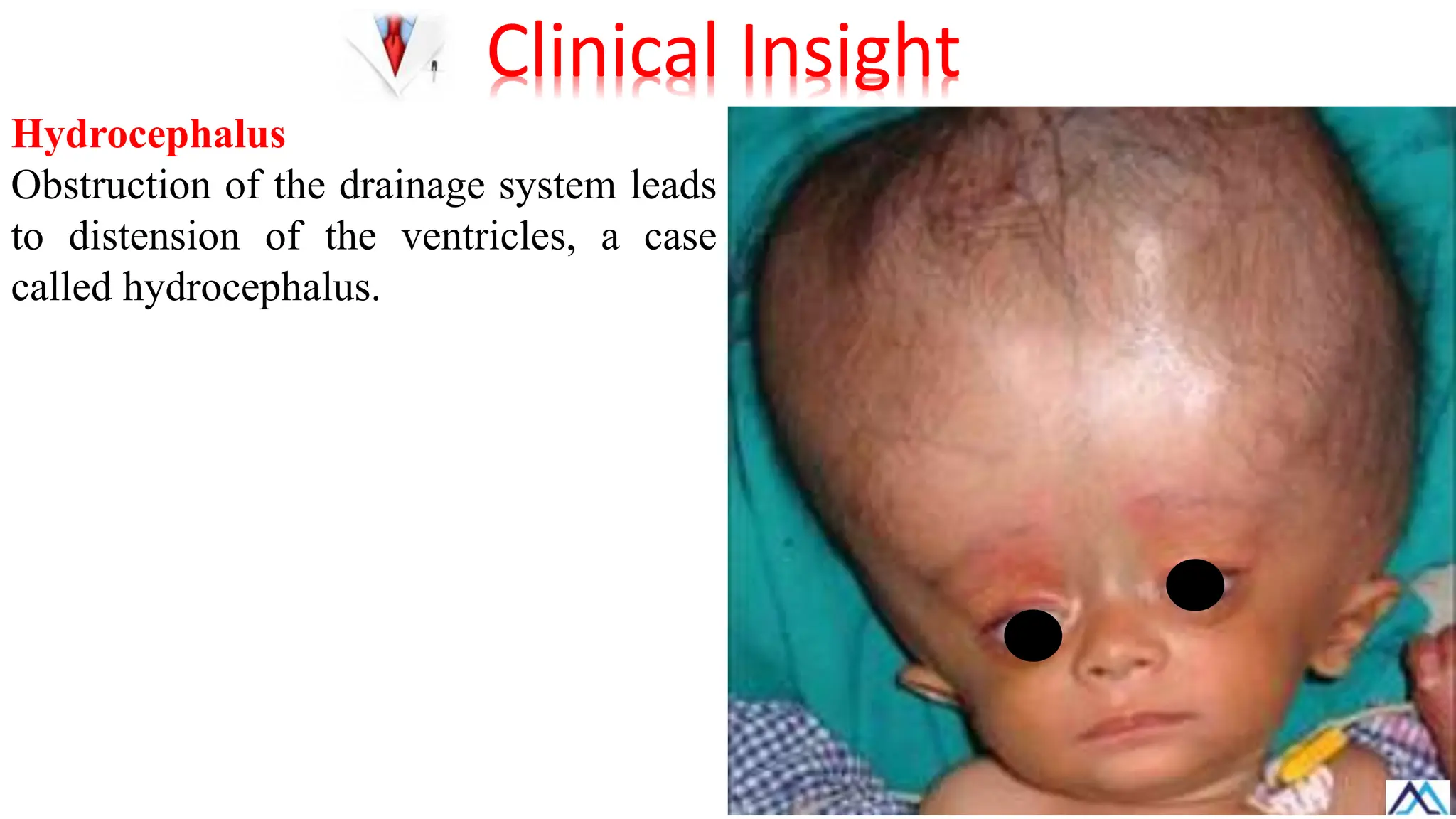
Hydrocephalus
Obstruction of the drainage system leads
to distension of the ventricles, a case
called hydrocephalus.
Clinical Insight
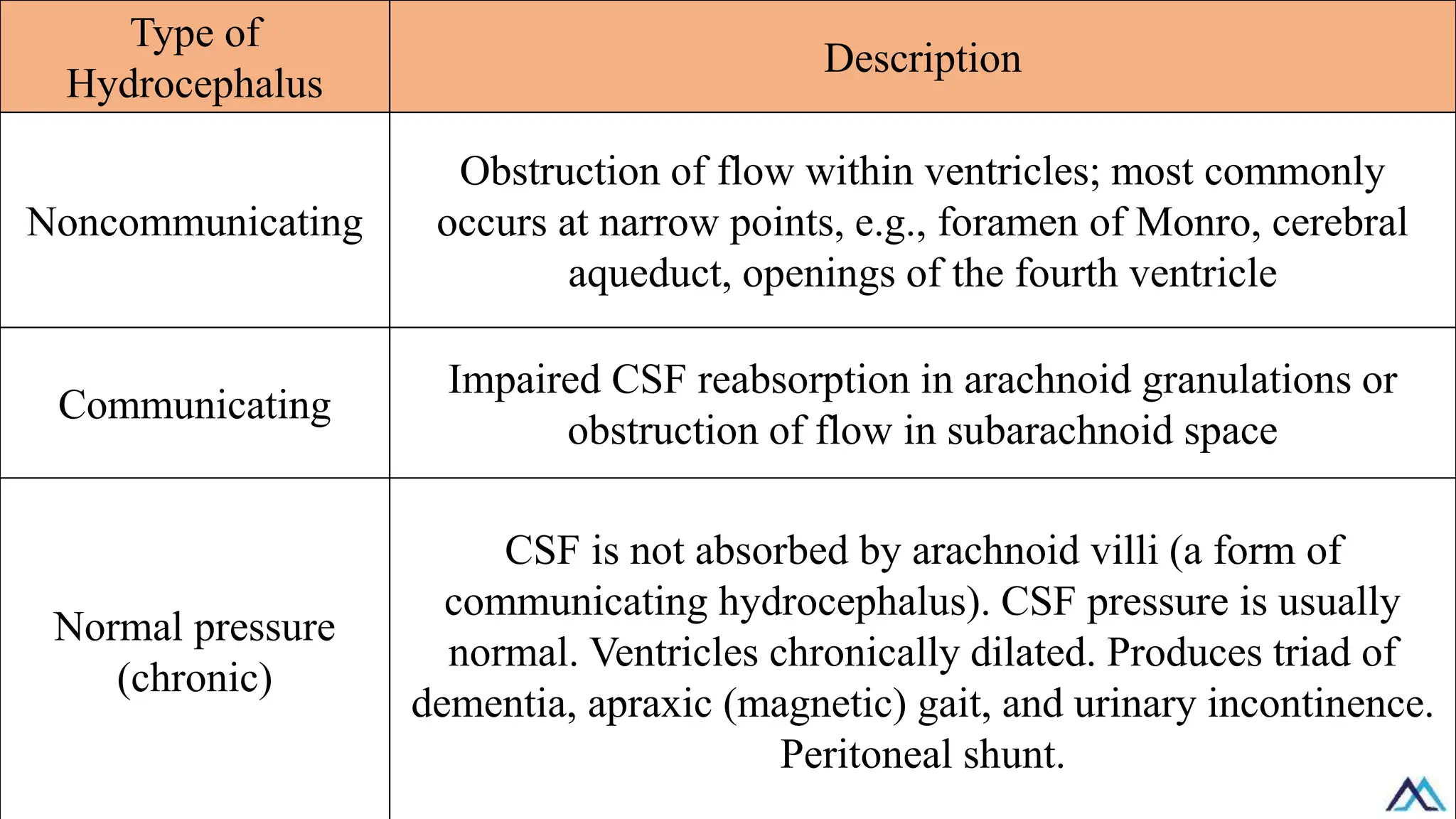
Type of
Hydrocephalus
Description
Noncommunicating
Obstruction of flow within ventricles; most commonly
occurs at narrow points, e.g., foramen of Monro, cerebral
aqueduct, openings of the fourth ventricle
Communicating
Impaired CSF reabsorption in arachnoid granulations or
obstruction of flow in subarachnoid space
Normal pressure
(chronic)
CSF is not absorbed by arachnoid villi (a form of
communicating hydrocephalus). CSF pressure is usually
normal. Ventricles chronically dilated. Produces triad of
dementia, apraxic (magnetic) gait, and urinary incontinence.
Peritoneal shunt.
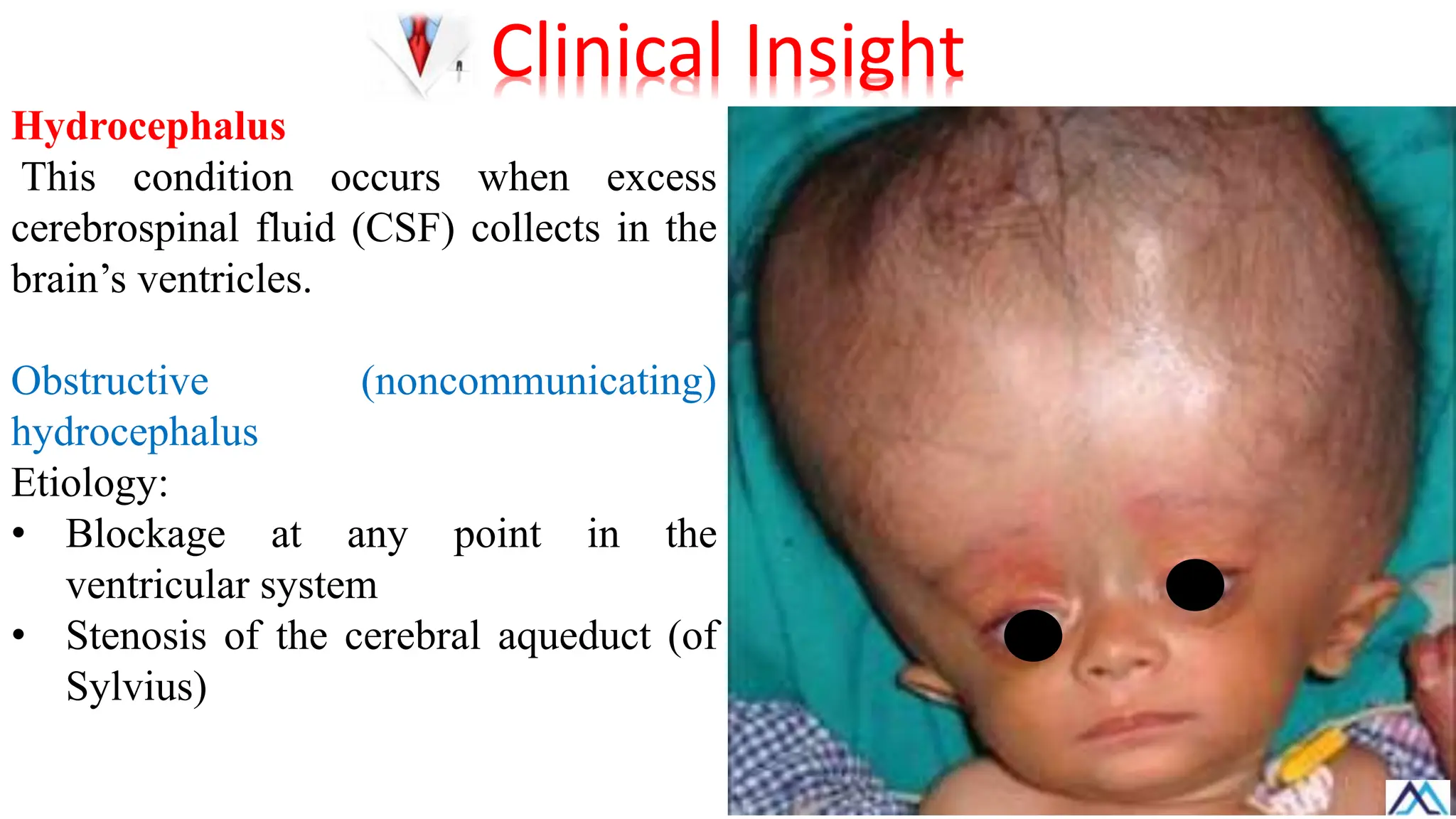
Hydrocephalus
This condition occurs when excess
cerebrospinal fluid (CSF) collects in the
brain’s ventricles.
Obstructive (noncommunicating)
hydrocephalus
Etiology:
• Blockage at any point in the
ventricular system
• Stenosis of the cerebral aqueduct (of
Sylvius)
Clinical Insight
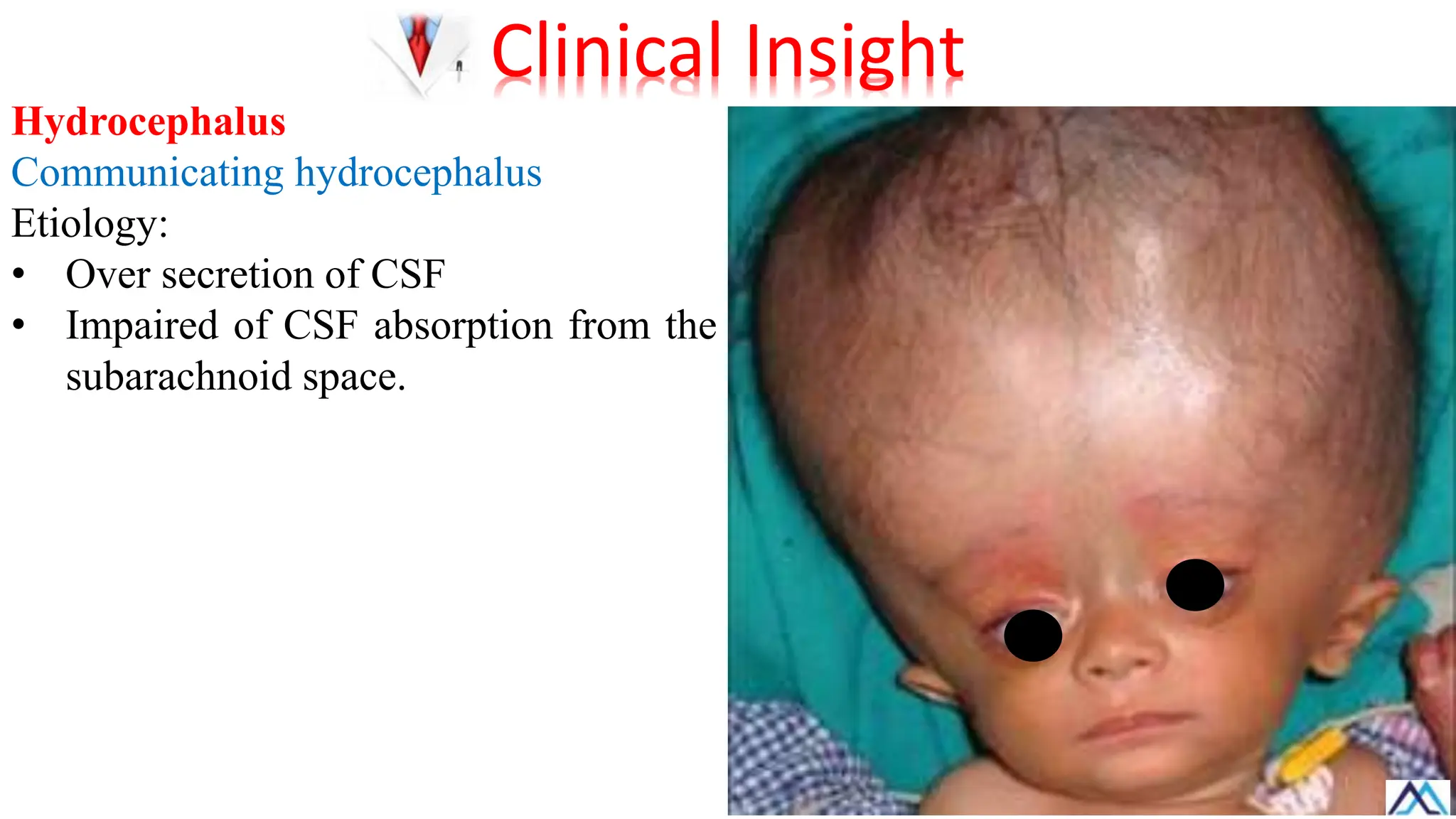
Hydrocephalus
Communicating hydrocephalus
Etiology:
• Over secretion of CSF
• Impaired of CSF absorption from the
subarachnoid space.
Clinical Insight
Normal pressure hydrocephalus
NPH is a type of communicating hydrocephalus caused by impaired cerebrospinal
fluid absorption.
It manifests with a classic triad of symptoms:
• Urinary incontinence
• Gait disturbance
• Cognitive decline.
Clinical Insight
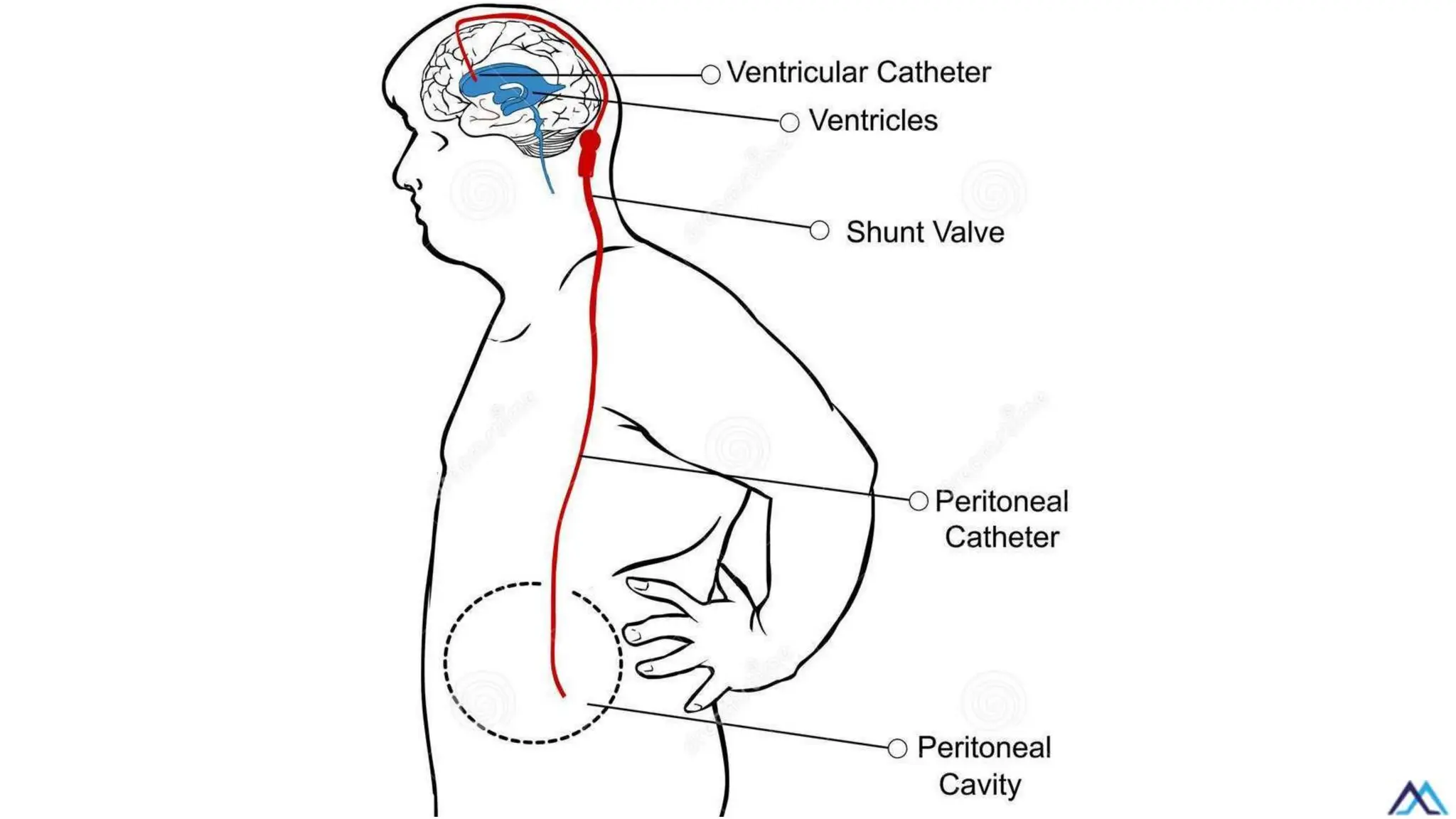
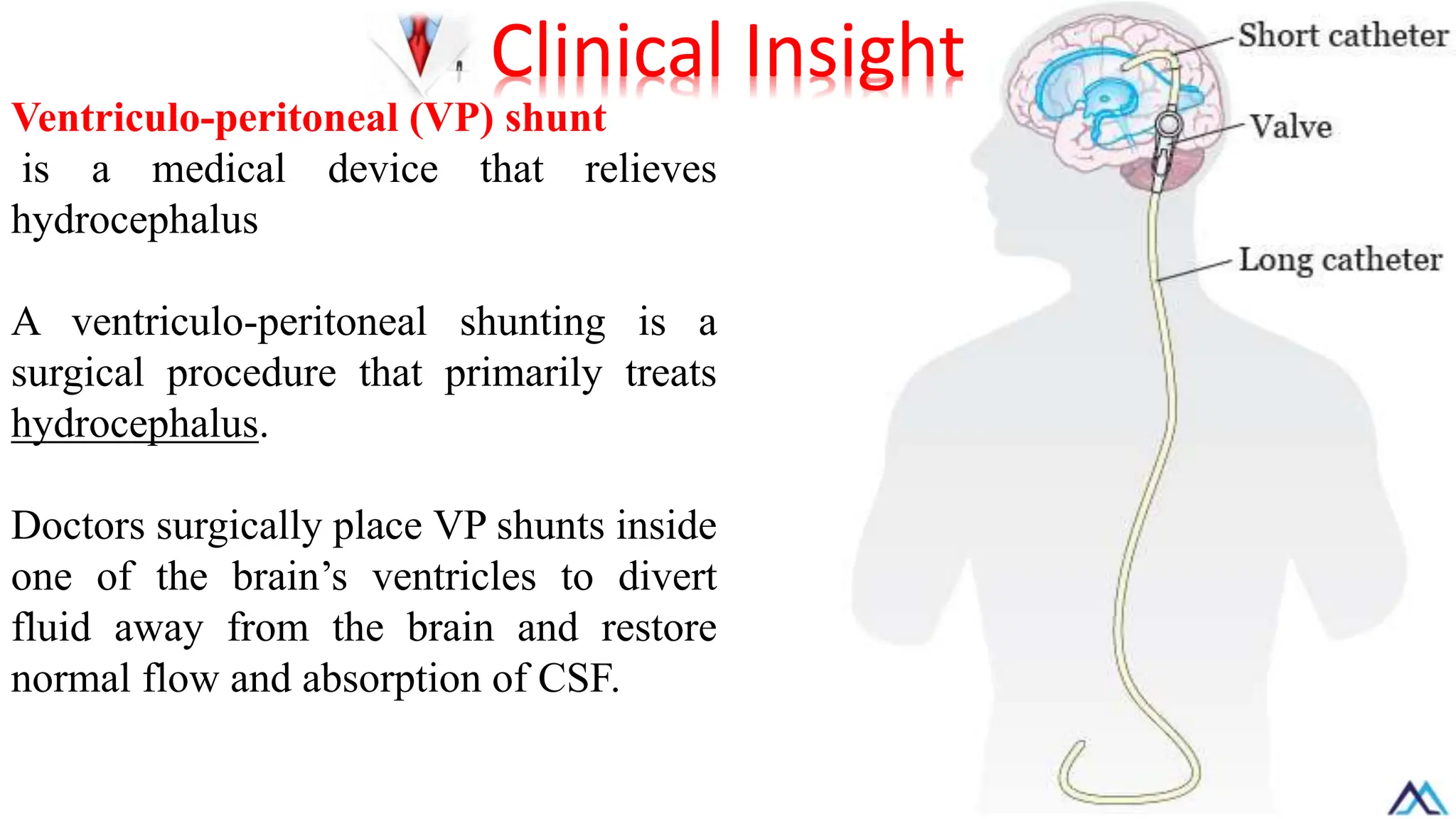
Ventriculo-peritoneal (VP) shunt
is a medical device that relieves
hydrocephalus
A ventriculo-peritoneal shunting is a
surgical procedure that primarily treats
hydrocephalus.
Doctors surgically place VP shunts inside
one of the brain’s ventricles to divert
fluid away from the brain and restore
normal flow and absorption of CSF.
Clinical Insight
Formative Quiz
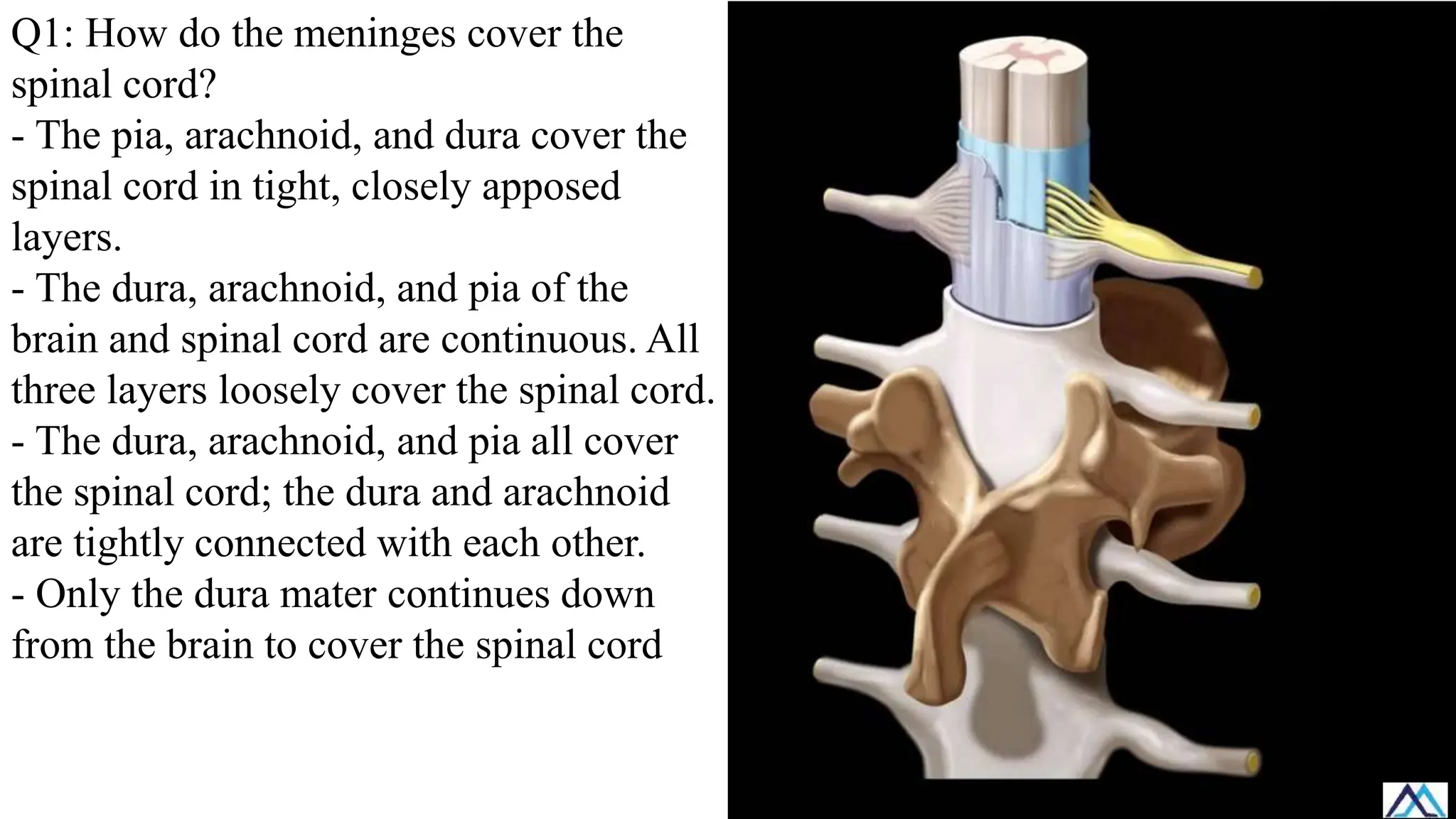
Q1: How do the meninges cover the
spinal cord?
- The pia, arachnoid, and dura cover the
spinal cord in tight, closely apposed
layers.
- The dura, arachnoid, and pia of the
brain and spinal cord are continuous. All
three layers loosely cover the spinal cord.
- The dura, arachnoid, and pia all cover
the spinal cord; the dura and arachnoid
are tightly connected with each other.
- Only the dura mater continues down
from the brain to cover the spinal cord
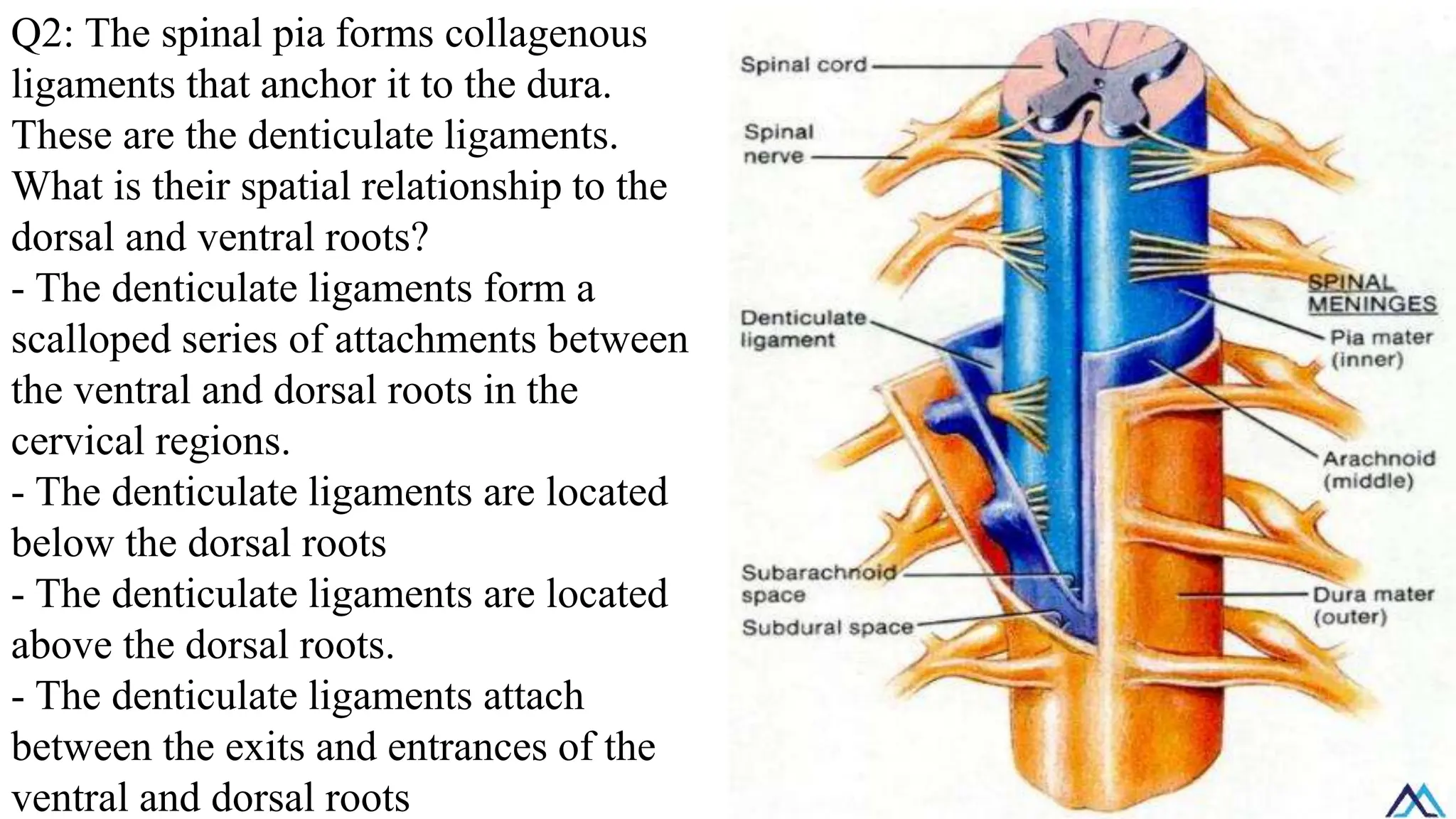
Q2: The spinal pia forms collagenous
ligaments that anchor it to the dura.
These are the denticulate ligaments.
What is their spatial relationship to the
dorsal and ventral roots?
- The denticulate ligaments form a
scalloped series of attachments between
the ventral and dorsal roots in the
cervical regions.
- The denticulate ligaments are located
below the dorsal roots
- The denticulate ligaments are located
above the dorsal roots.
- The denticulate ligaments attach
between the exits and entrances of the
ventral and dorsal roots
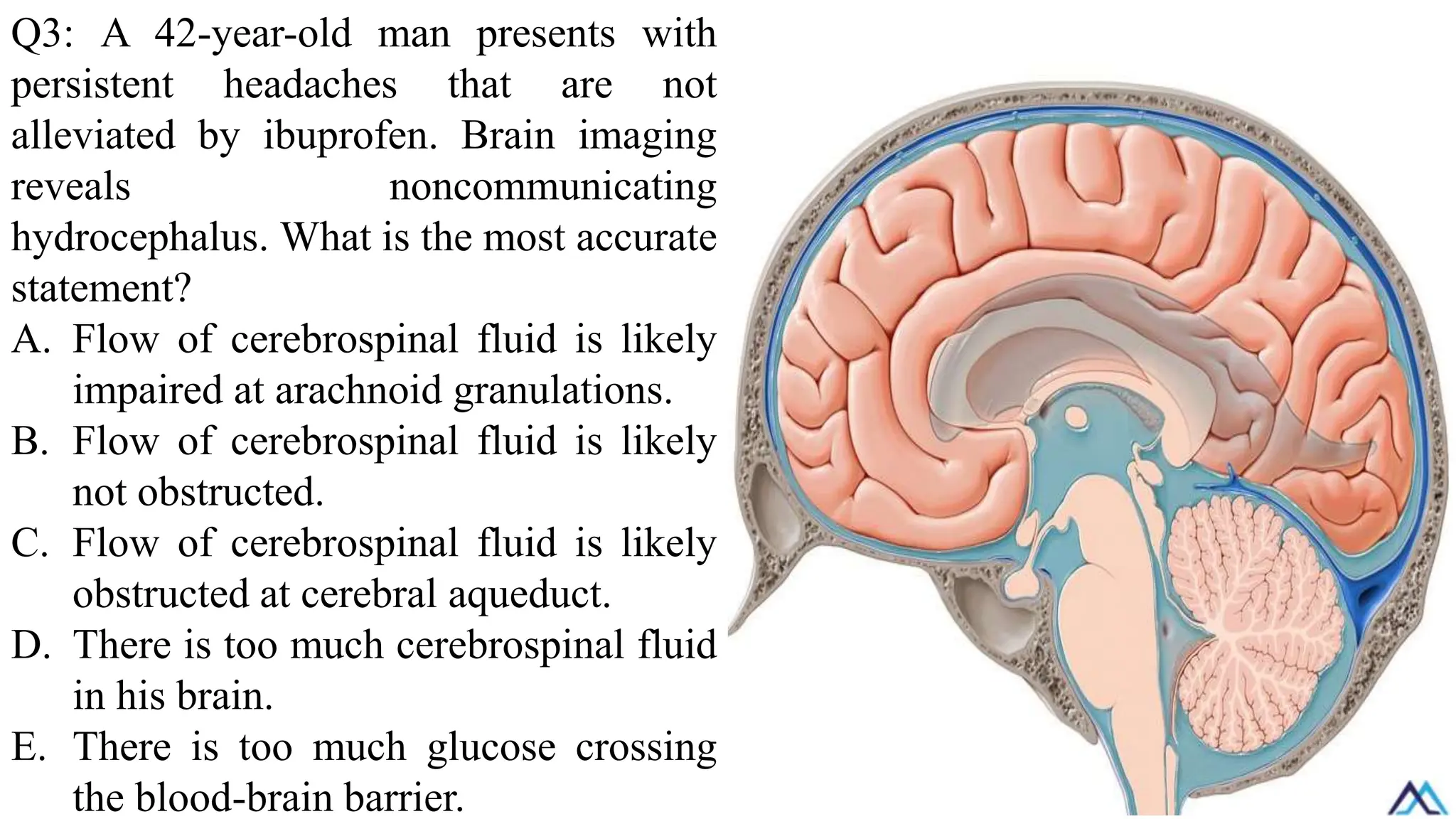
Q3: A 42-year-old man presents with
persistent headaches that are not
alleviated by ibuprofen. Brain imaging
reveals noncommunicating
hydrocephalus. What is the most accurate
statement?
A. Flow of cerebrospinal fluid is likely
impaired at arachnoid granulations.
B. Flow of cerebrospinal fluid is likely
not obstructed.
C. Flow of cerebrospinal fluid is likely
obstructed at cerebral aqueduct.
D. There is too much cerebrospinal fluid
in his brain.
E. There is too much glucose crossing
the blood-brain barrier.
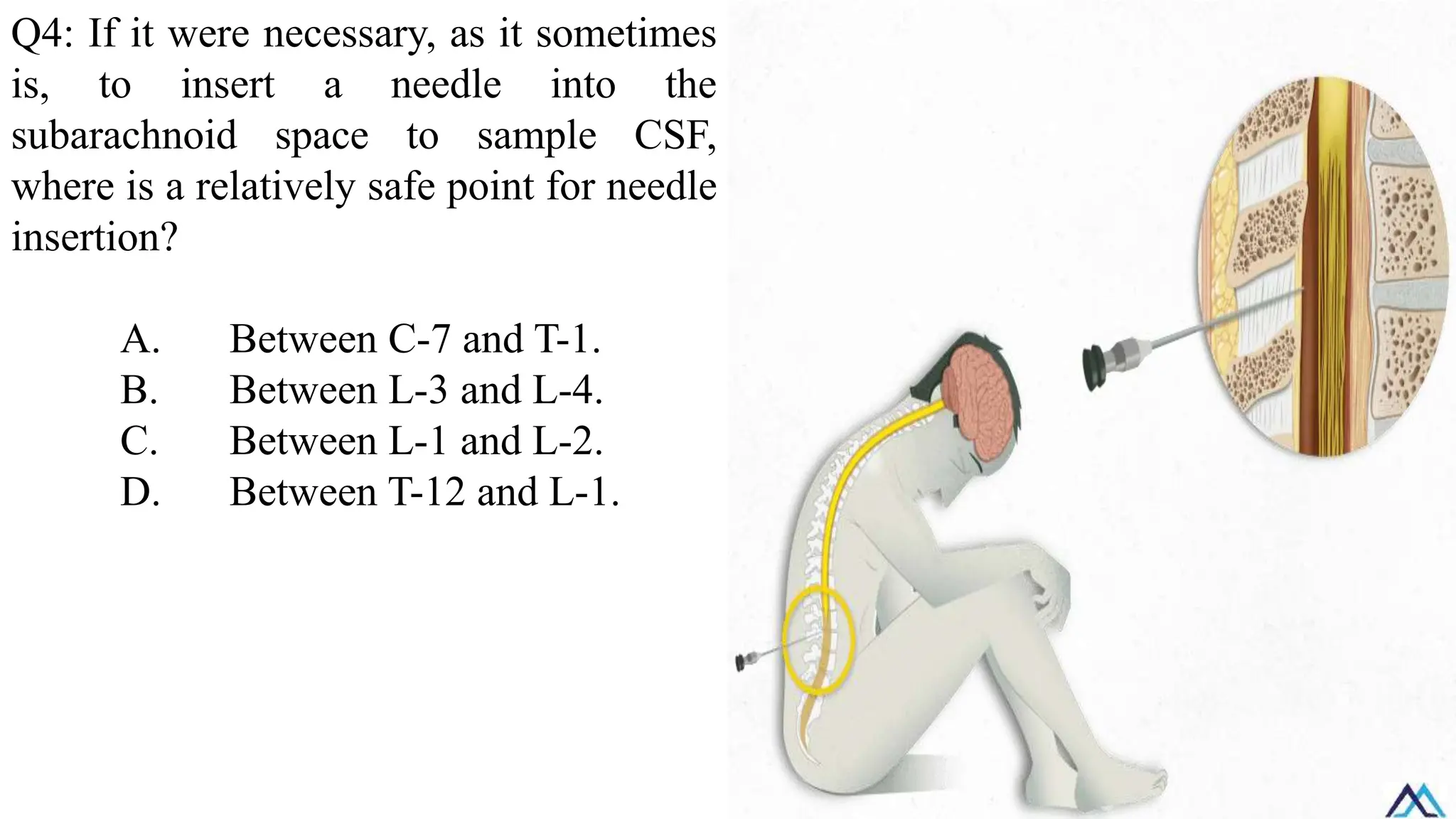
Q4: If it were necessary, as it sometimes
is, to insert a needle into the
subarachnoid space to sample CSF,
where is a relatively safe point for needle
insertion?
A. Between C-7 and T-1.
B. Between L-3 and L-4.
C. Between L-1 and L-2.
D. Between T-12 and L-1.
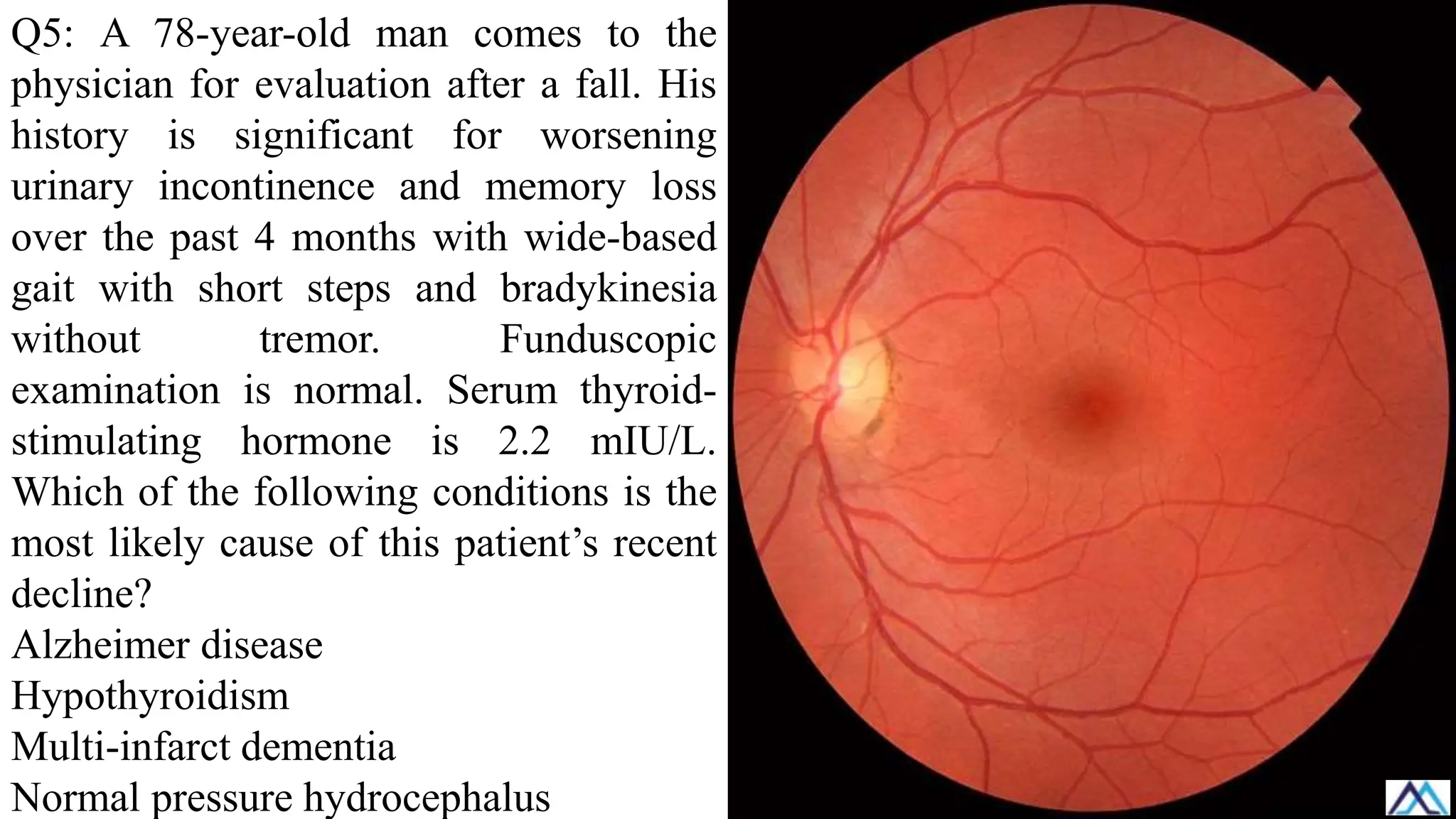
Q5: A 78-year-old man comes to the
physician for evaluation after a fall. His
history is significant for worsening
urinary incontinence and memory loss
over the past 4 months with wide-based
gait with short steps and bradykinesia
without tremor. Funduscopic
examination is normal. Serum thyroid-
stimulating hormone is 2.2 mIU/L.
Which of the following conditions is the
most likely cause of this patient’s recent
decline?
Alzheimer disease
Hypothyroidism
Multi-infarct dementia
Normal pressure hydrocephalus
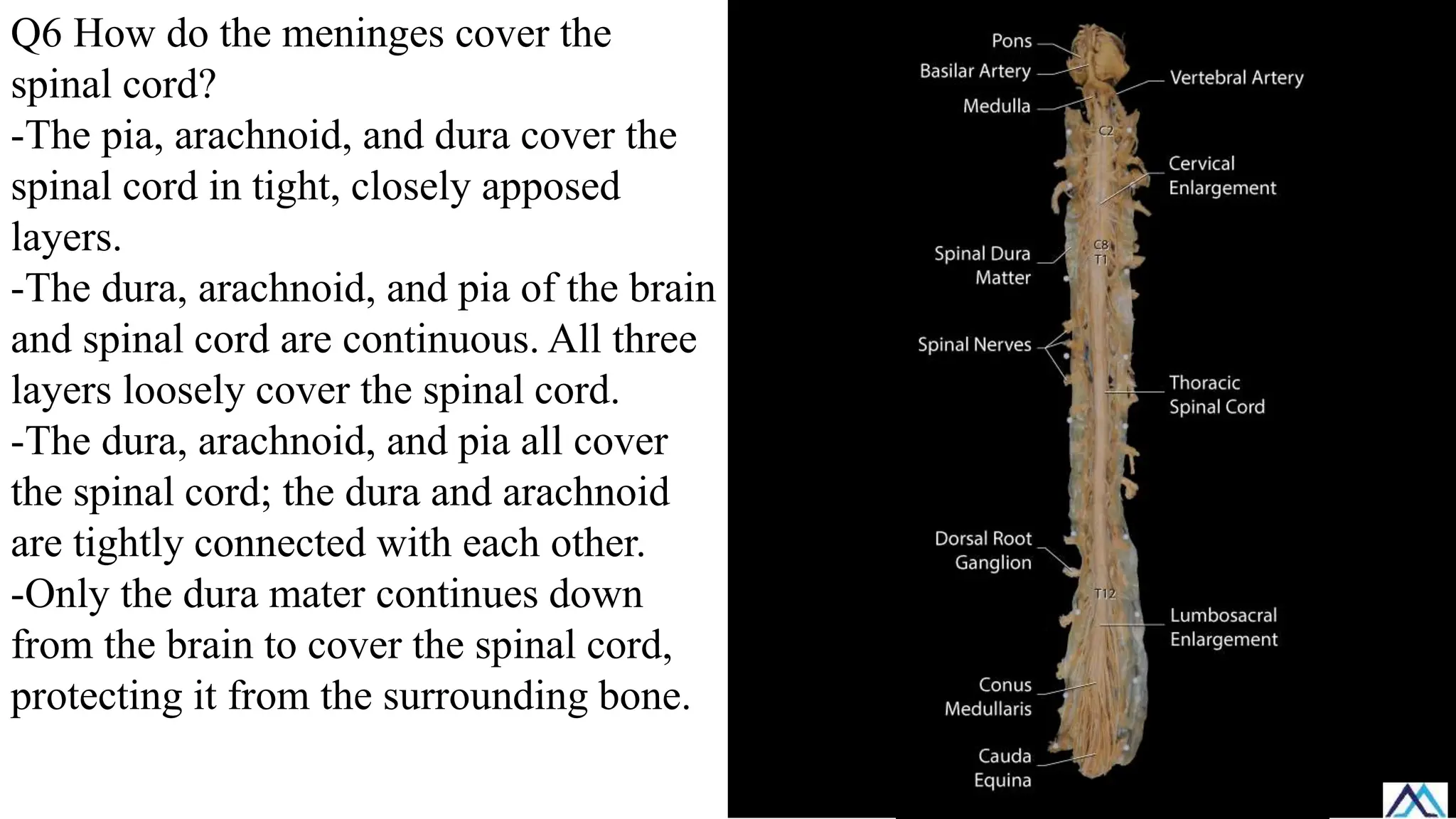
Q6 How do the meninges cover the
spinal cord?
-The pia, arachnoid, and dura cover the
spinal cord in tight, closely apposed
layers.
-The dura, arachnoid, and pia of the brain
and spinal cord are continuous. All three
layers loosely cover the spinal cord.
-The dura, arachnoid, and pia all cover
the spinal cord; the dura and arachnoid
are tightly connected with each other.
-Only the dura mater continues down
from the brain to cover the spinal cord,
protecting it from the surrounding bone.
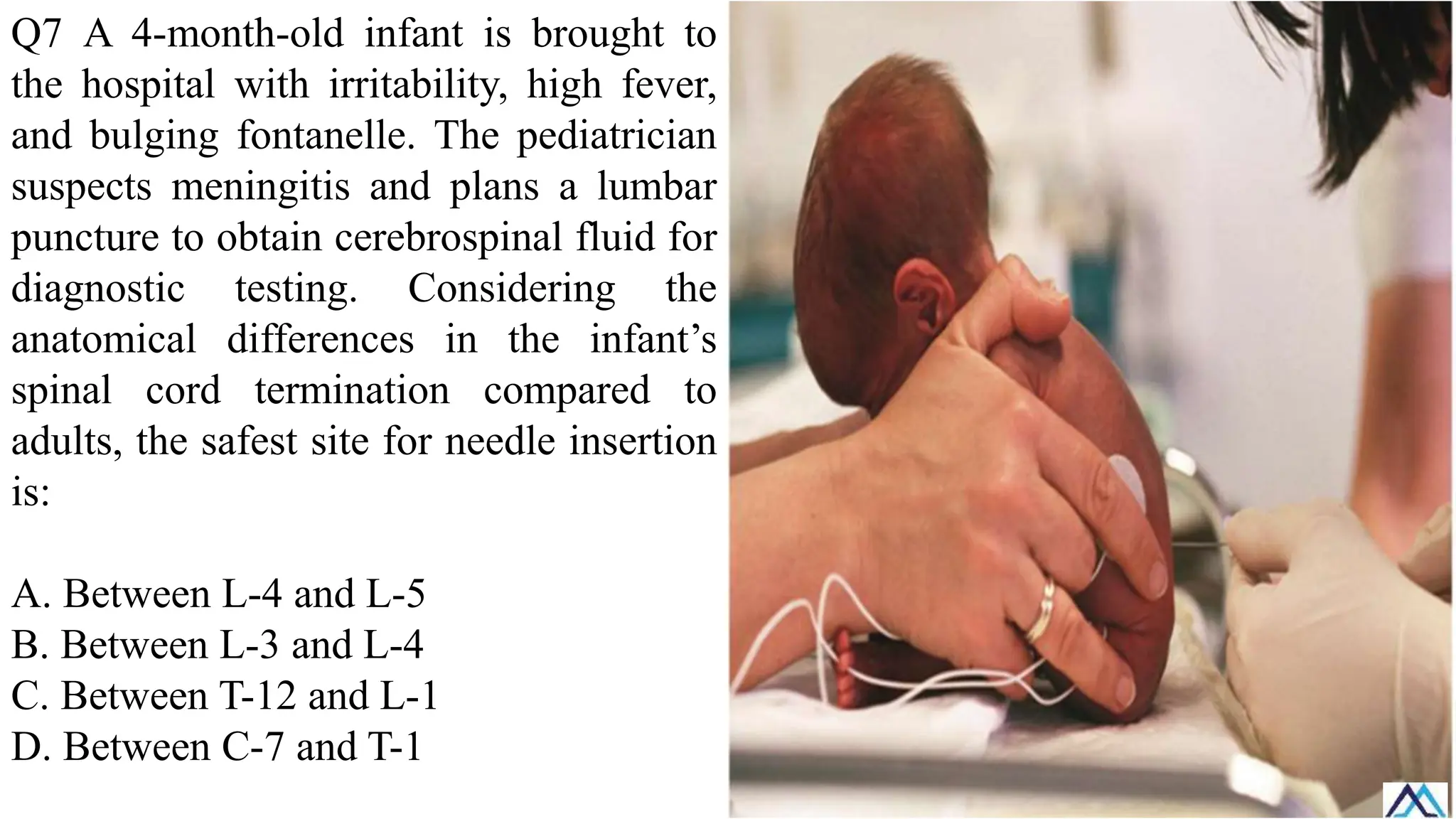
Q7 A 4-month-old infant is brought to
the hospital with irritability, high fever,
and bulging fontanelle. The pediatrician
suspects meningitis and plans a lumbar
puncture to obtain cerebrospinal fluid for
diagnostic testing. Considering the
anatomical differences in the infant’s
spinal cord termination compared to
adults, the safest site for needle insertion
is:
A. Between L-4 and L-5
B. Between L-3 and L-4
C. Between T-12 and L-1
D. Between C-7 and T-1
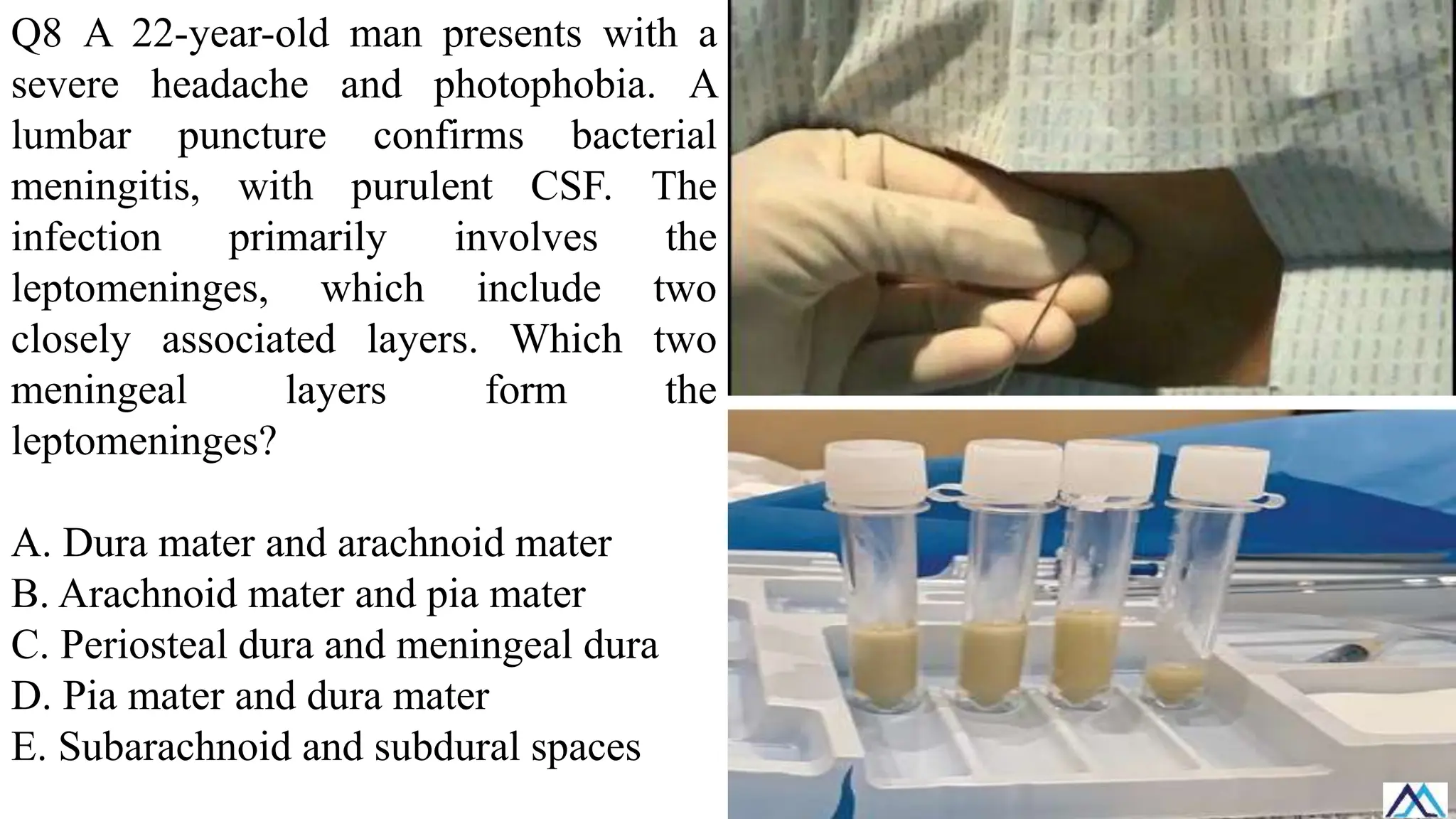
Q8 A 22-year-old man presents with a
severe headache and photophobia. A
lumbar puncture confirms bacterial
meningitis, with purulent CSF. The
infection primarily involves the
leptomeninges, which include two
closely associated layers. Which two
meningeal layers form the
leptomeninges?
A. Dura mater and arachnoid mater
B. Arachnoid mater and pia mater
C. Periosteal dura and meningeal dura
D. Pia mater and dura mater
E. Subarachnoid and subdural spaces
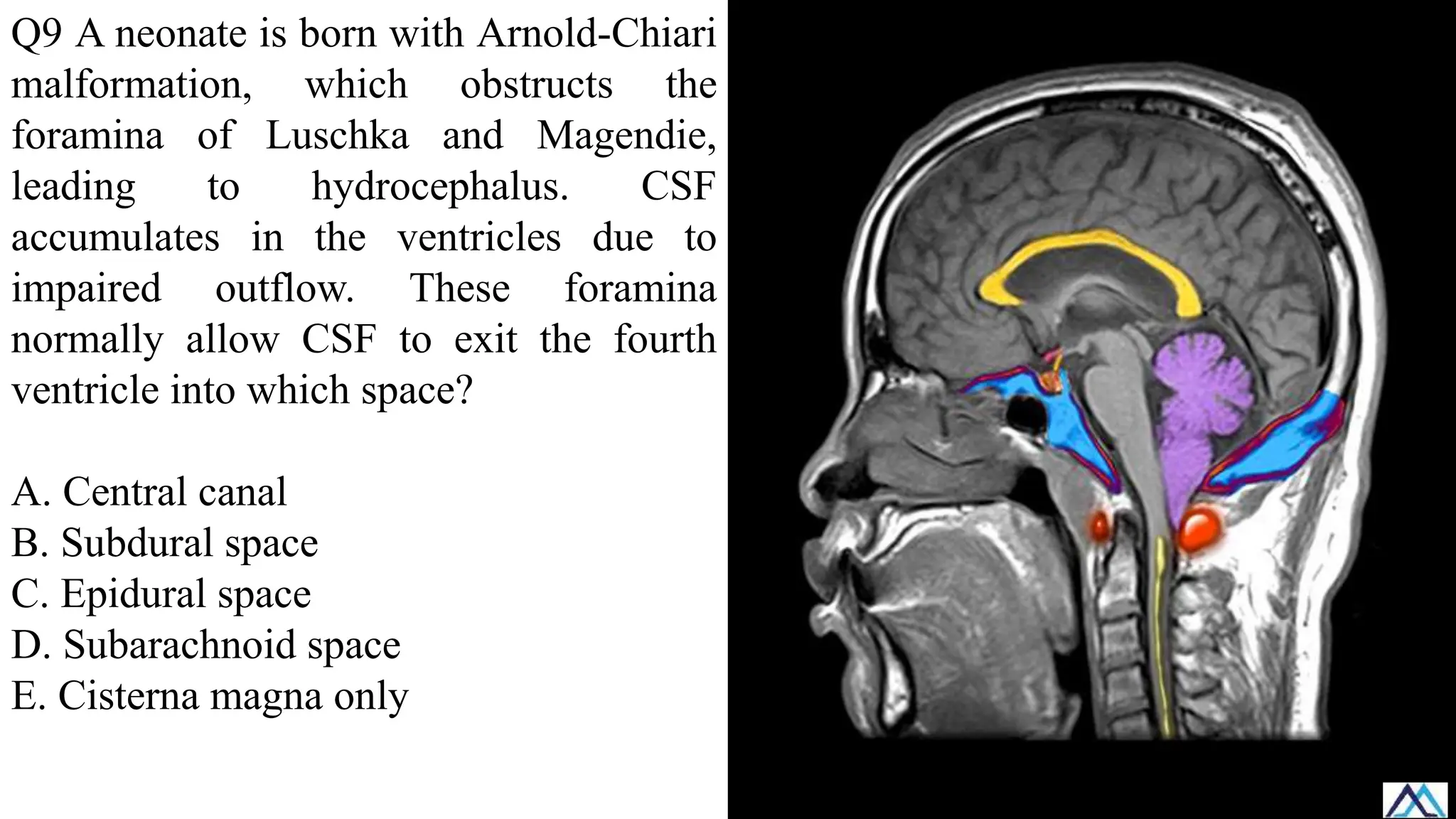
Q9 A neonate is born with Arnold-Chiari
malformation, which obstructs the
foramina of Luschka and Magendie,
leading to hydrocephalus. CSF
accumulates in the ventricles due to
impaired outflow. These foramina
normally allow CSF to exit the fourth
ventricle into which space?
A. Central canal
B. Subdural space
C. Epidural space
D. Subarachnoid space
E. Cisterna magna only
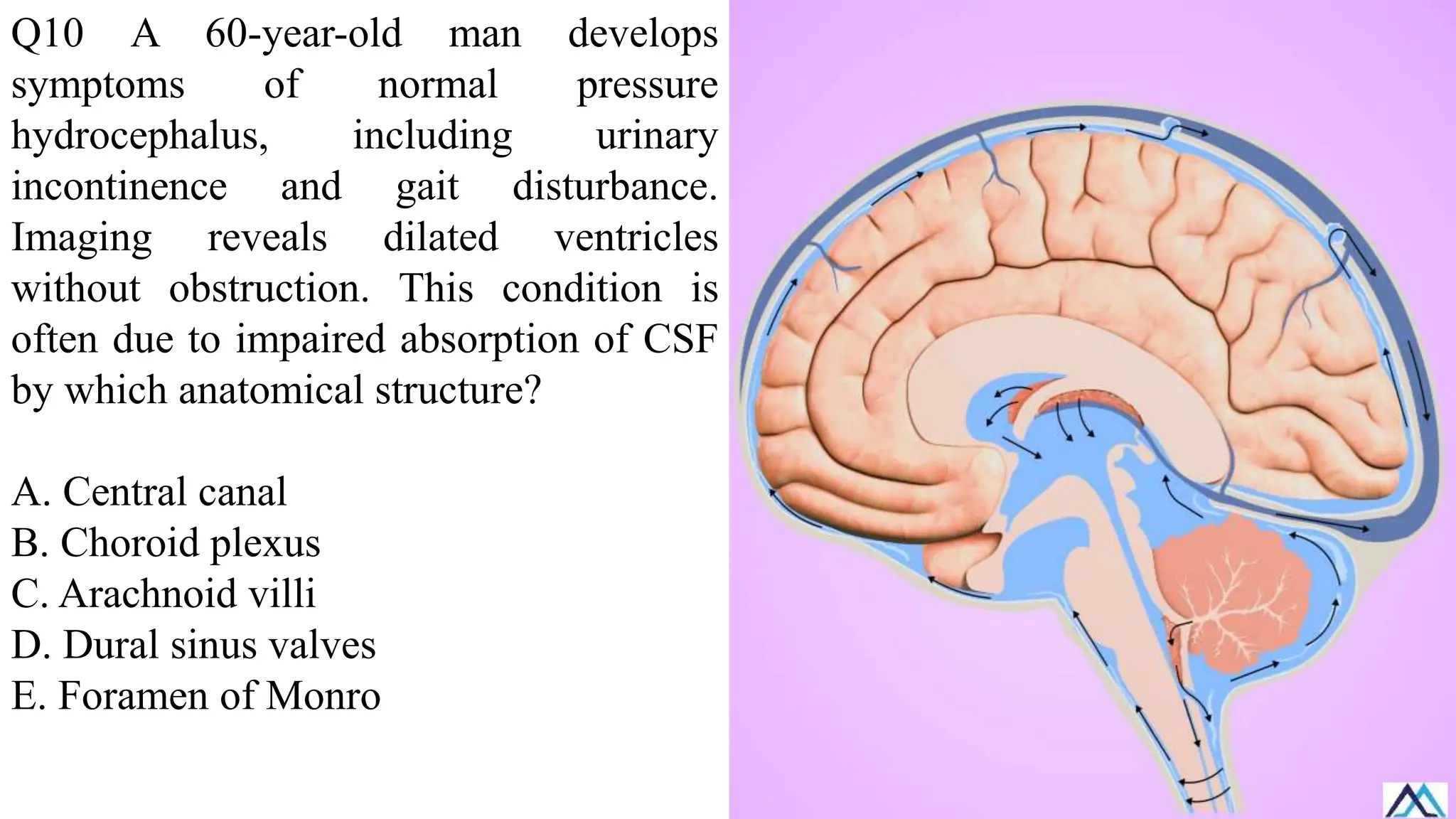
Q10 A 60-year-old man develops
symptoms of normal pressure
hydrocephalus, including urinary
incontinence and gait disturbance.
Imaging reveals dilated ventricles
without obstruction. This condition is
often due to impaired absorption of CSF
by which anatomical structure?
A. Central canal
B. Choroid plexus
C. Arachnoid villi
D. Dural sinus valves
E. Foramen of Monro
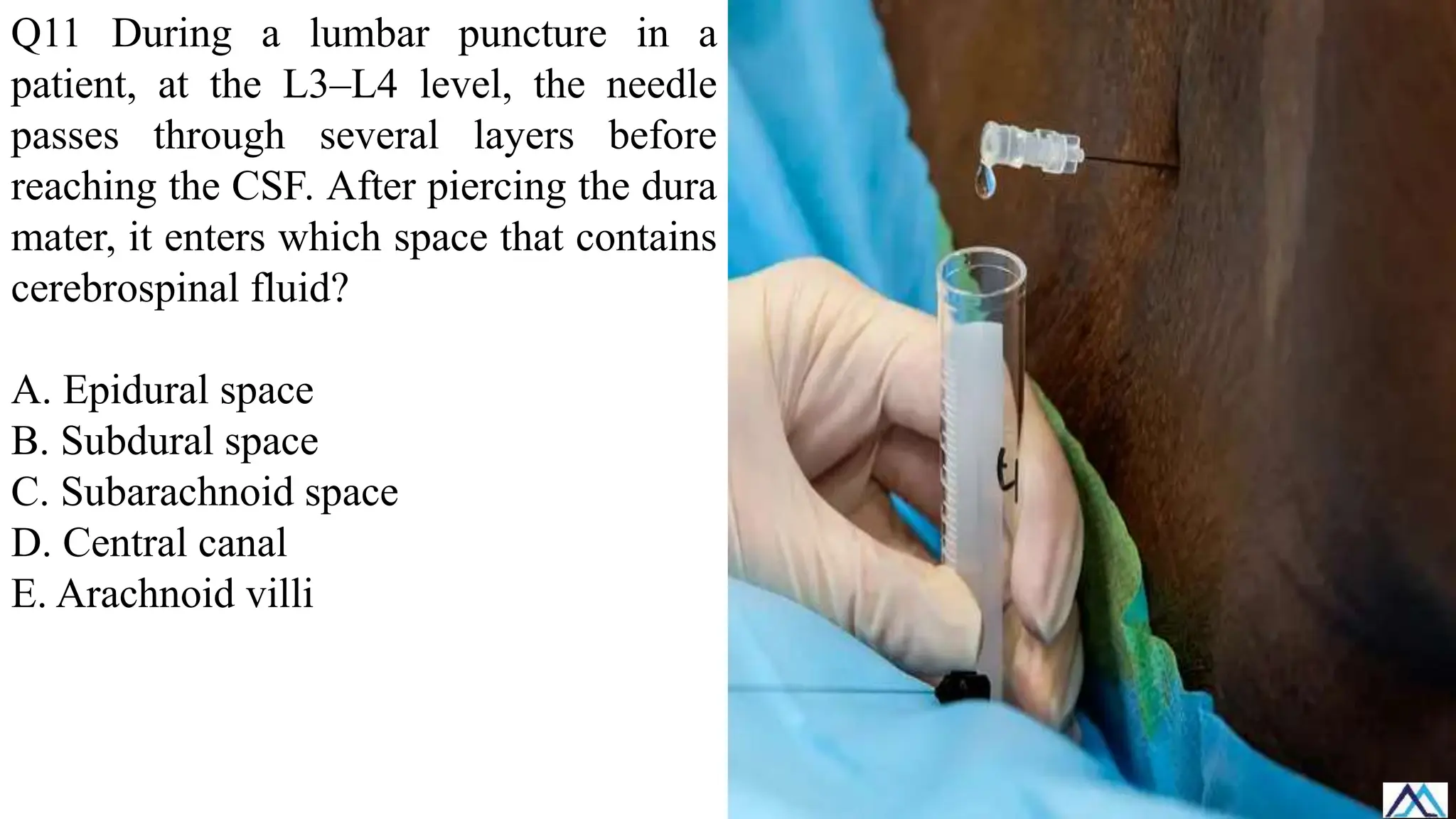
Q11 During a lumbar puncture in a
patient, at the L3–L4 level, the needle
passes through several layers before
reaching the CSF. After piercing the dura
mater, it enters which space that contains
cerebrospinal fluid?
A. Epidural space
B. Subdural space
C. Subarachnoid space
D. Central canal
E. Arachnoid villi
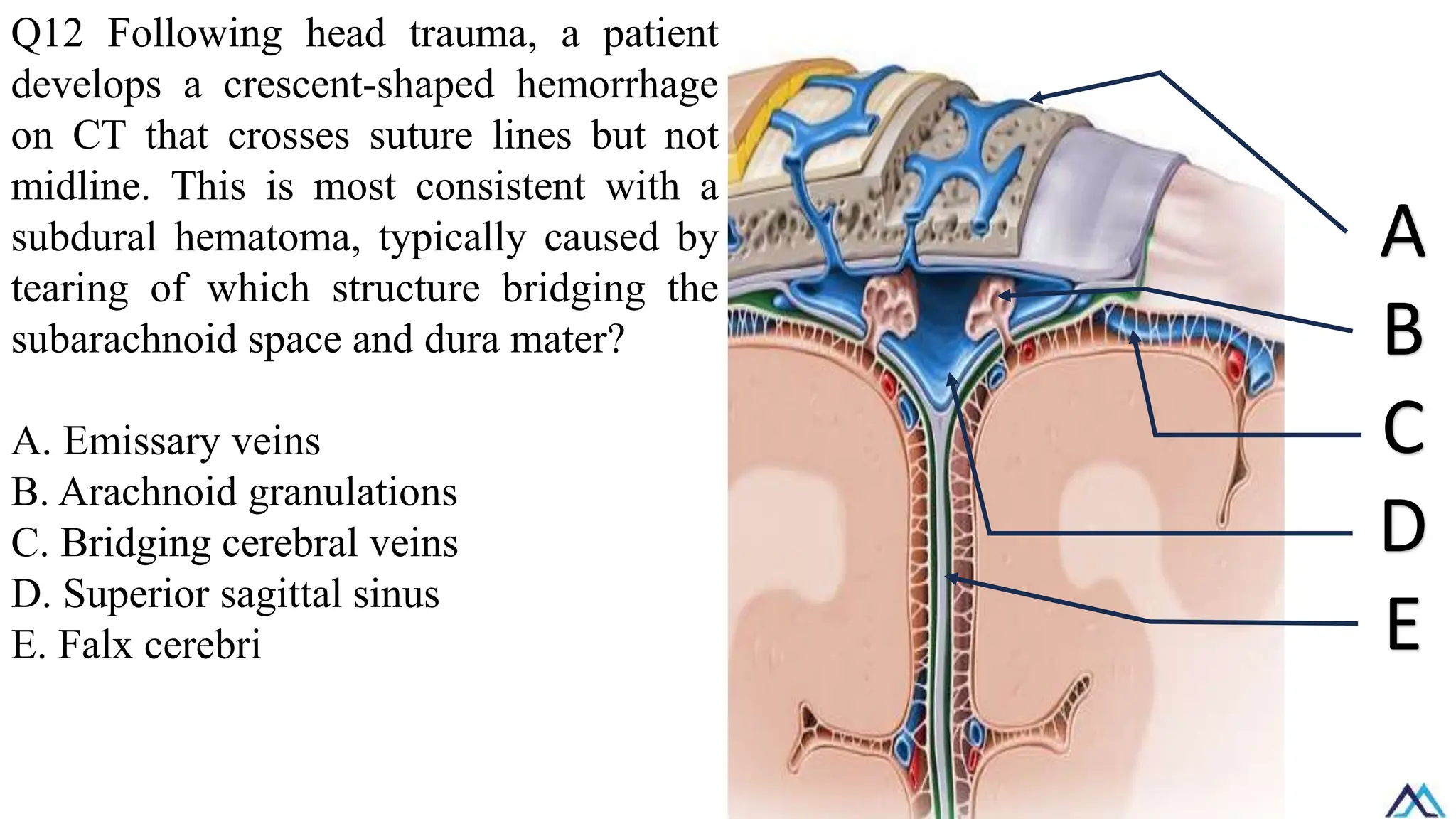
Q12 Following head trauma, a patient
develops a crescent-shaped hemorrhage
on CT that crosses suture lines but not
midline. This is most consistent with a
subdural hematoma, typically caused by
tearing of which structure bridging the
subarachnoid space and dura mater?
A. Emissary veins
B. Arachnoid granulations
C. Bridging cerebral veins
D. Superior sagittal sinus
E. Falx cerebri
A
B
C
D
E
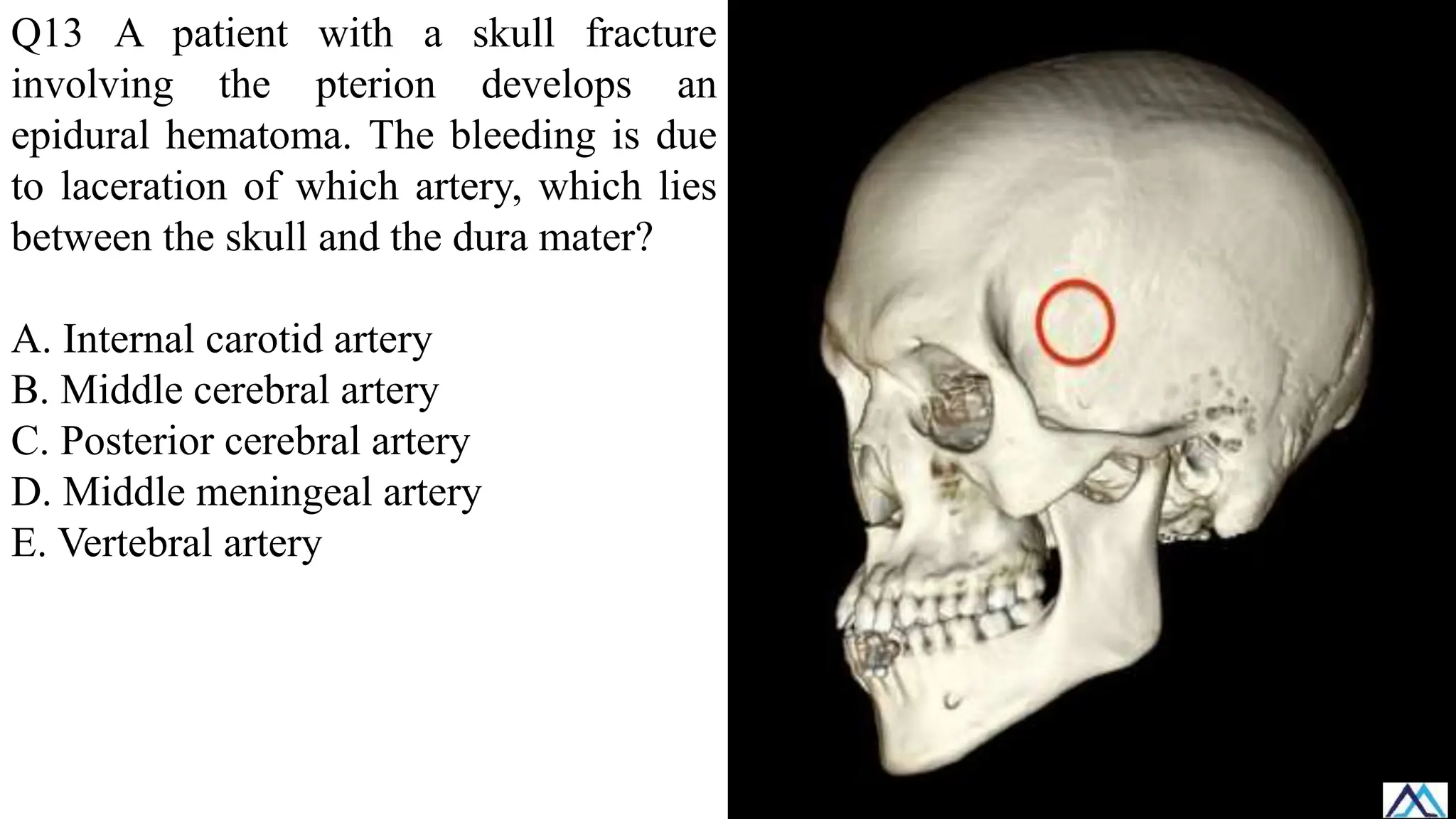
Q13 A patient with a skull fracture
involving the pterion develops an
epidural hematoma. The bleeding is due
to laceration of which artery, which lies
between the skull and the dura mater?
A. Internal carotid artery
B. Middle cerebral artery
C. Posterior cerebral artery
D. Middle meningeal artery
E. Vertebral artery
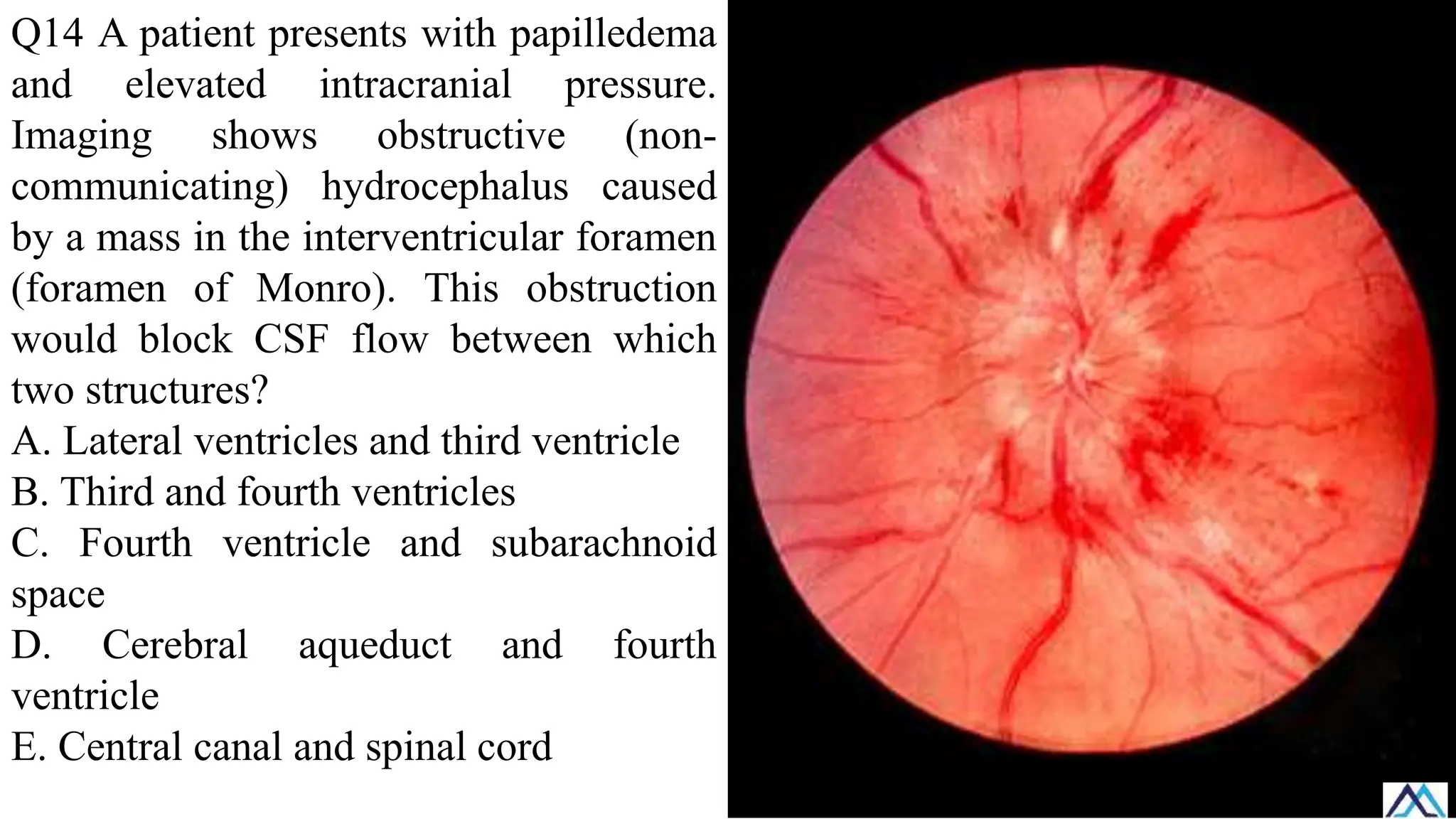
Q14 A patient presents with papilledema
and elevated intracranial pressure.
Imaging shows obstructive (non-
communicating) hydrocephalus caused
by a mass in the interventricular foramen
(foramen of Monro). This obstruction
would block CSF flow between which
two structures?
A. Lateral ventricles and third ventricle
B. Third and fourth ventricles
C. Fourth ventricle and subarachnoid
space
D. Cerebral aqueduct and fourth
ventricle
E. Central canal and spinal cord
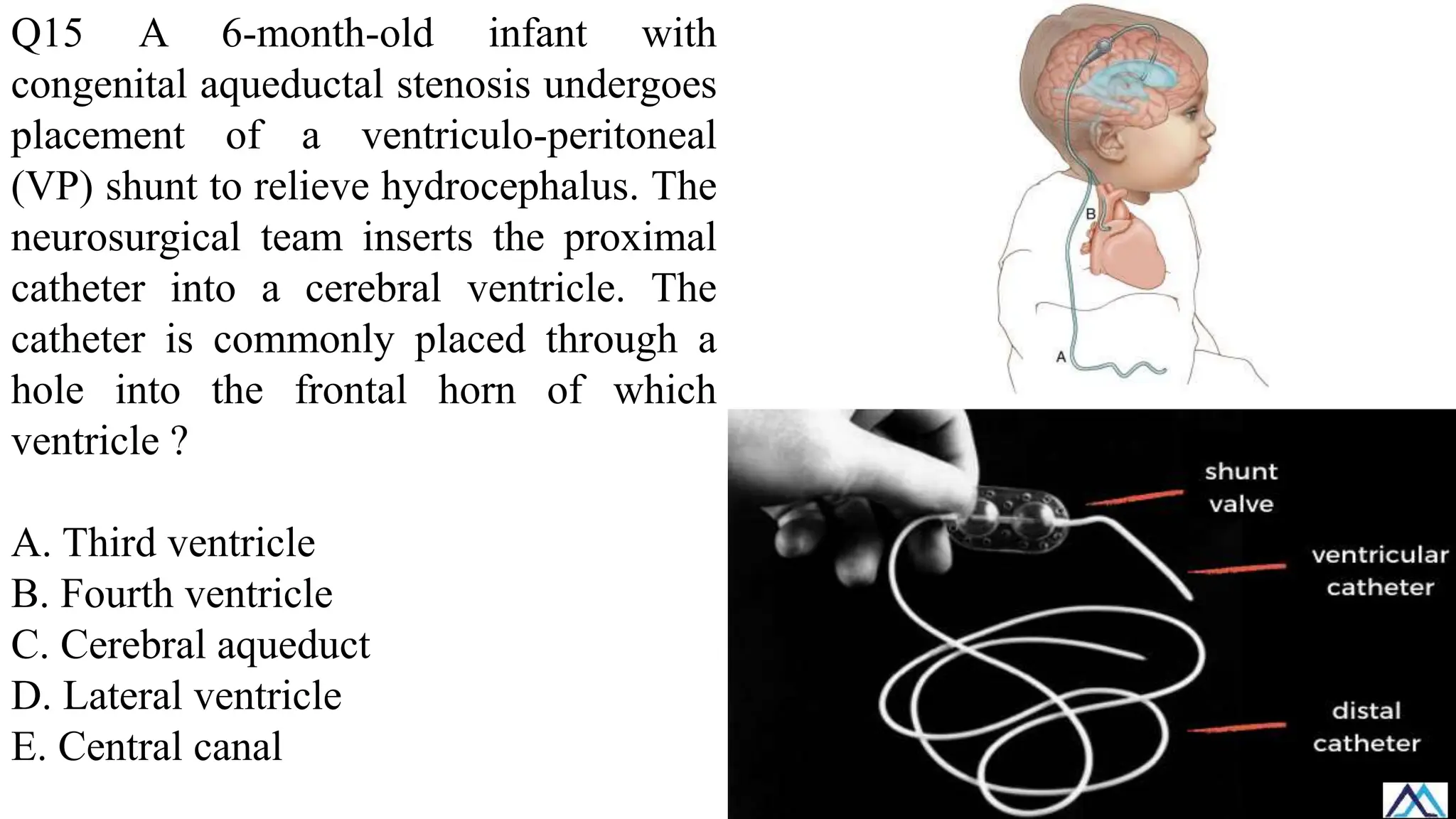
Q15 A 6-month-old infant with
congenital aqueductal stenosis undergoes
placement of a ventriculo-peritoneal
(VP) shunt to relieve hydrocephalus. The
neurosurgical team inserts the proximal
catheter into a cerebral ventricle. The
catheter is commonly placed through a
hole into the frontal horn of which
ventricle ?
A. Third ventricle
B. Fourth ventricle
C. Cerebral aqueduct
D. Lateral ventricle
E. Central canal
MCQ Answer
1
2
3
4
5
6
7
8
9
10
11
12
13
14
15
SCORE
15
Q1: The dura, arachnoid, and pia ------- are tightly connected with each other.
Q2: The denticulate ligaments attach -----entrances of the ventral and dorsal roots
Q3: Flow of cerebrospinal fluid is likely obstructed at the cerebral aqueduct.
Q4: Between L-3 and L-4.
Q5: Normal pressure hydrocephalus
Q6 The dura, arachnoid, and pia -------- tightly connected with each other.
Q7 Between L-4 and L-5
Q8 Arachnoid mater and pia mater
Q9 Subarachnoid space
Q10 Arachnoid villi
Q11 Subarachnoid space
Q12 Bridging cerebral veins
Q13 Middle meningeal artery
Q14 Lateral ventricles and third ventricle
Q15 Lateral ventricle
List of Texts and Recommended Readings
• Last's Anatomy, Regional and Applied. Chummy S. Sinnatamby. 12th edition 2011, ISBN:13 - 978 0 7020 3394 0
(Available in ClinicalKey: https://www.clinicalkey.com/#!/browse/book/3-s2.0- C2009060533X)
• Estomih Mtui, Gregory Gruener and Peter Dockery. Fitzgerald's Clinical Neuroanatomy and Neuroscience. 7th
edition; 2016, ISBN: 13 - 978-0-7020- 6727-3 (Available in ClinicalKey:
https://www.clinicalkey.com/#!/browse/book/3-s2.0- C20130134113
• Drake, Richard L. Gray's Anatomy for Students, Third Edition, Elsevier Saunders 2015. ISBN-13: 978-0702051319
(Available in ClinicalKey: https://www.clinicalkey.com/#!/browse/book/3- s2.0-C20110061707).
• Sobotta Atlas of Human Anatomy. F. Paulsen. Vol.1, 15th Edition; 2013, ISBN: 9780702052514 (Available in
ClinicalKey: https://www.clinicalkey.com/#!/content/book/3- s2.0-B9780702052514500067)
• Sobotta Atlas of Human Anatomy. F. Paulsen. Vol.2, 15th Edition; 2013, ISBN:13 - 978-0-7020-5252-1 (Available in
ClinicalKey: https://www.clinicalkey.com/#!/browse/book/3- s2.0-C20130046919)
Recap
CSF and meninges/ CSF and meninges/ CSF and meninges.pdf

CSF and meninges/ CSF and meninges/ CSF and meninges.pdf

  • 1.
    After 21 centuriesof scientific inquiry, our understanding of cellular biology has made significant progress, but the percentage of nervous system cells for which we fully understand all functions is indeed relatively low [almost 10%]. The 90%, are still under exploration.
  • 2.
    Ashour’s High YieldGuide USMLE Clinical Anatomy
  • 3.
  • 4.
    This study reportsa rare case of acute obstructive hydrocephalus following aqueductal stenosis. An 11-year-old boy admitted to the hospital with progressive headache, nausea and vomiting throughout a month.
  • 5.
    A Computerized Tomography (CT)showed an obstructive hydrocephaly. A Magnetic Resonance(MR) imaging revealed a compressing the aqueduct. The patient deteriorated in hours and an emergency ventriculo-peritoneal shunting was performed. He did well in the early postoperative period.
  • 7.
  • 8.
    ILOs A. Describe theAnatomy and Function of the Meninges: Students will be able to describe the anatomy of the meninges, including the three protective layers surrounding the brain and spinal cord: the dura mater, arachnoid mater, and pia mater. They will understand the structure and function of each layer, including how they contribute to protecting the CNS and maintaining its structural integrity. B. Explain the Production and Circulation of Cerebrospinal Fluid (CSF): Students will be able to explain how cerebrospinal fluid (CSF) is produced by the choroid plexuses in the ventricles of the brain. They will describe the pathway of CSF circulation through the ventricular system, its flow through the subarachnoid space, and its reabsorption into the venous system via the arachnoid granulations. C. Describe the Role of CSF in Maintaining CNS Homeostasis: Students will be able to describe the role of CSF in maintaining CNS homeostasis, including its functions in cushioning the brain and spinal cord, removing metabolic waste products, and providing a stable chemical environment for neural tissue. They will understand how CSF helps to protect the CNS from mechanical injury and regulate intracranial pressure. D. Identify and Interpret Clinical Procedures Related to CSF and Meninges: Students will be able to identify and interpret clinical procedures related to CSF and the meninges, such as lumbar puncture (spinal tap) and imaging techniques like CT and MRI. They will understand how these procedures are used to assess CSF composition, measure intracranial pressure, and detect conditions affecting the meninges, such as meningitis or tumors.
  • 9.
    While the meningesthemselves are not typically the direct target of surgical procedures, they play a crucial role in neurosurgery and other related interventions. The meninges are the protective layers surrounding the brain and spinal cord, consisting of the dura mater, arachnoid mater, and pia mater. The surgical importance of the meninges lies in their role as protective barriers and their involvement in certain medical conditions and procedure.
  • 11.
    MENINGES A- Meninges ofthe spinal cord B- Meninges of the brain
  • 12.
    The meninges arethree protective layers of tissue that surround and protect the central nervous system (CNS), which includes the brain and spinal cord. The three layers are: • Dura Mater: This is the tough, outermost layer. • Arachnoid Mater: Located beneath the dura, the arachnoid mater has a web- like structure. • Pia Mater: This is the innermost layer, closely adhering to the surface of the brain and spinal cord. Dura Arachnoid Pia
  • 14.
    A- Meninges ofthe spinal cord Dura matter Arachnoid matter Pia matter
  • 15.
  • 16.
    ✓ It isthe outer & hardest layer ✓ Above, it is attached to the foramen magnum and it is continuing with the cerebral dura ✓ Throughout its length, it sends out sleeves around the' trunks of the spinal nerves ✓ Below, it extends beyond the lower end of spinal cord (L1/L2), it is attached to the 2nd sacral vertebra. 1 2 3 5 4 S1 S2
  • 17.
  • 18.
    ✓ Meningeal spaces: -Extradural (epidural) space: lies between the vertebral bone & the dura (external to dura), contains vertebral plexus of veins. - Subdural space: between the dura outside & the arachnoid, contains a thin film of fluid. Extra dural Sub-dural
  • 19.
    Epidural block Anesthetic agentis injected into the extradural (epidural) space. It acts on the nerve roots and the sensation is lost inferior to the level of the block. Clinical Insight
  • 20.
  • 21.
    ✓ It isa thin transparent membrane. ✓ It lines the dura matter ✓ Above, it is attached to the foramen magnum and it is continuing with the cerebral arachnoid matter ✓ Below, it extends beyond the lower end of spinal cord (L1/L2), it is attached to the 2nd sacral vertebra. 1 2 3 5 4 S1 S2
  • 22.
  • 23.
    Subarachnoid ✓ Meningeal spaces: Arachnoidis separated from the pia matter by the subarachnoid space which contains the CSF.
  • 24.
  • 25.
    ✓ Lumbar cistern: Widepart of the subarachnoid space, distal to the caudal end of spinal cord. It Contains CSF, cauda equina and filum terminale. Lumbar cistern
  • 26.
    Lumbar puncture In thelumbar puncture, the needle is introduced into the subarachnoid space, either above or below the tip of L4 spine. Clinical Insight 1 2 3 5 4
  • 27.
    Lumbar puncture • Diagnosticuses: Obtaining C.S.F sample for analysis. • Therapeutic uses: Injection of local anesthetics and antibiotics. C.S.F withdrawal to decrease intra-cranial pressure. Clinical Insight
  • 28.
    Lumbar puncture The needlepenetrates following layers: 1. Epidural space 2. Dura 3. Arachnoid 4. Subarachnoid space Clinical Insight 1 2 3 4
  • 29.
  • 30.
    ✓ It isa thin membrane firmly adherent to the spinal cord. ✓ Above, it is continuous with the pia matter of the brain. ✓ Below, it extends from the lower tip of spinal cord (L1/L2), to form the filum terminal which is attached inferiorly to the back of the coccyx. 1 2 3 5 4 Coccyx
  • 31.
  • 32.
    ✓ Filum terminal: oNon nervous filamentous thread about 20 cm long. o Attached • Above to tip of conus medullaris • Below blends with periosteum of coccygeal vertebra. filum terminal
  • 33.
    Lumbar, sacral andcoccygeal nerves. Filum terminale.
  • 34.
    o The filumterminal is surrounded with the cauda equina & arachnoid to reach the coccyx. Cauda equina
  • 35.
    ✓ Denticulate ligament: Oneither side of the spinal cord, lateral margin of pia gives off 21 pairs of teeth like processes, which are attached to the dura mater for support of the spinal cord. At the sides of the spinal cord the pia gives attachment to the denticulate ligament Pia Denticulate ligament
  • 36.
    B- Meninges ofthe brain Dura matter Arachnoid matter Pia matter
  • 37.
  • 38.
    Composed of 2layers: A. Outer or endosteal layer B. Inner or meningeal layer Dura matter Outer or endosteal layer Inner meningeal layer
  • 39.
    A- Outer orendosteal layer • Lines the cranial cavity & firmly adherent to the base of the skull but loosely attached to the vault. B- Inner or meningeal layer • Attached to the outer endosteal layer except at certain sites where it is reduplicated to form the dural folds. endosteal meningeal folds
  • 40.
    Epidural (extradural) hematoma Ablow to the skull that results in a fracture can tear the underlying periosteal layer of dura mater, which can result in an epidural (extradural) hematoma and/or leakage of the cerebrospinal fluid. Clinical Insight
  • 41.
    Subdural hematoma Subdural hematomais a medical condition characterized by the accumulation of blood between the dura mater (the outermost layer of the brain's protective coverings) and the arachnoid mater (the middle layer). Clinical Insight
  • 42.
  • 43.
    • crista galli •hypophyseal fossa • Posterior clinoid process • superior petrosal sulcus • petrous temporal bone • transverse sulcus • occipital bone • foramen magnum
  • 44.
    Tentorium cerebelli • Definition: Itis a tent-shaped fold • Site: Between the cerebellum and the cerebrum Tentorium cerebelli
  • 45.
    Attached border Posterior clinoidprocess superior petrosal sulcus Petrous bone transverse sulcus occipital bone • Attached border: ✓ Posterior clinoid process ✓ Lips of superior petrosal sulcus along the upper border of petrous temporal bone ✓ Lips of transverse sulcus at the occipital bone
  • 46.
    • Free border ✓U-shaped ✓ Bounds the tentorial notch which transmits the midbrain. • Attached border • Free border
  • 47.
    Falx cerebri • Definition: Itis a large sickle-shaped reduplication of the inner layer of dura mater • Site: Occupies the median longitudinal fissure between the two cerebral hemispheres Falx cerebri
  • 48.
    • Features. o Apex:is narrow and is attached to the crista galli o Base: is broad and is attached to, the tentorium cerebelli in the median plane. A B
  • 49.
    o Upper margin:is convex and is attached to the lips of the sagittal sulcus on the inner surface of the vault of the skull. o Lower margin: is concave and free, it encloses the inferior sagittal sinus . U L
  • 50.
    Falx cerebelli • Definition: isa reduplication of the inner layer of the dura which projects forwards into the posterior notch of the cerebellum • Shape: Inverted triangle Falx cerebelli
  • 51.
    • Features o Thebase: is directed upwards and is attached to the tentorium cerebeili in the median plane o The apex: is directed downwards till the foramen magnum tentorium cerebeili Falx cerebelli occipital sinus
  • 52.
    o Posterior margin:encloses the occipital sinus o Anterior margin: is free and projects in the posterior notch of the cerebellum tentorium cerebeili Falx cerebelli occipital sinus
  • 53.
    Diaphragma sellae Is asmall circular fold of the inner layer of the dura which covers the pituitary in the hypophyseal fossa. Has a central aperture which transmits the pituitary pituitary hypophyseal fossa
  • 54.
  • 55.
    o It isa delicate transparent membrane bridging over the brain. o It forms a sheath around the cranial nerves at their exit from the skull. o It forms the arachnoid villi & granulation. o It is separated from the pia matter by the subarachnoid space which contain CSF. Villi – granult. Arachnoid Subarachn. space
  • 56.
    o Arachnoid villi& granulation A mass of granulation tissue that pierce the dura & become in relation to the superior sagittal sinus where it drain C.S.F in the venous blood. Arachnoid granulation Arachnoid villi dura superior sagittal sinus
  • 57.
    In advanced age,these granulations becomes calcified & indent the bone of the skull forming pits in the bone (Granular foveolae). granular foveolae
  • 58.
    Subarachnoid hemorrhage The mostcommon cause of subarachnoid hemorrhage (bleeding into the subarachnoid space) is the rupture of a saccular, or berry, aneurysm of one of the arteries of the cerebral and brainstem circulation. Berry aneurysms commonly occur at artery branch points with about 85% occurring between the anterior cerebral, internal carotid, and middle cerebral branches. Clinical Insight
  • 59.
  • 60.
    Cerebral pia matteris a thin vascular layer firmly adherent to the surface of the brain. Cerebral pia matter covers the bulging gyri and the floor of the sulci. Dura Arachnoid pia
  • 61.
  • 62.
    The volume ofcerebrospinal fluid (CSF) in the human central nervous system is approximately 150 milliliters. Totally replaced 3 times per day.
  • 63.
    Dura Arachnoid Pia 3 rd ven. 4th ven. Ter. ven. Centralcanal of spinal cord Choroid Plexus Interventricular foramen Cerebral aqueduct of Sylvius Foramen Luschka Dural venous sinus Lateral ven. Lateral ven.
  • 64.
    • Definition: Cerebrospinal fluid(CSF) is a clear, colorless fluid found within and around the brain and spinal cord of all vertebrates.
  • 65.
    • Formation: Secreted bychoroid plexuses in all the ventricles of the brain. The choroid plexus filters blood plasma and secretes CSF into the ventricles. Choroid Plexus, is made of a layer of cuboidal epithelial cells around a capillary core
  • 66.
    • Circulation: From thelateral ventricles to the 3rd ventricle through the interventricular foramen (foramina of Monro). Interventricular foramen
  • 67.
    RT. Lateral ventricleAnt. Pole RT. Foramen of Monro Third ventricle cerebral aqueduct of Sylvius 4th ventricle Luschka Magendie Central canal spinal cord Terminal ventricle
  • 68.
    From the 3rdto 4th ventricle through the cerebral aqueduct Cerebral aqueduct
  • 69.
    From the foraminaof the 4th ventricle (Magendi, Lushka) to the subarachnoid space around brain and spinal cord. Small amount goes to central canal of the spinal cord. Lushka Magendi central canal
  • 70.
    • Drainage ofthe C.S.F The C.S.F is filtered into the superior sagittal sinus by arachnoid villi and granulation. arachnoid villi and granulation superior sagittal sinus
  • 72.
    Hydrocephalus Obstruction of thedrainage system leads to distension of the ventricles, a case called hydrocephalus. Clinical Insight
  • 73.
    Type of Hydrocephalus Description Noncommunicating Obstruction offlow within ventricles; most commonly occurs at narrow points, e.g., foramen of Monro, cerebral aqueduct, openings of the fourth ventricle Communicating Impaired CSF reabsorption in arachnoid granulations or obstruction of flow in subarachnoid space Normal pressure (chronic) CSF is not absorbed by arachnoid villi (a form of communicating hydrocephalus). CSF pressure is usually normal. Ventricles chronically dilated. Produces triad of dementia, apraxic (magnetic) gait, and urinary incontinence. Peritoneal shunt.
  • 74.
    Hydrocephalus This condition occurswhen excess cerebrospinal fluid (CSF) collects in the brain’s ventricles. Obstructive (noncommunicating) hydrocephalus Etiology: • Blockage at any point in the ventricular system • Stenosis of the cerebral aqueduct (of Sylvius) Clinical Insight
  • 75.
    Hydrocephalus Communicating hydrocephalus Etiology: • Oversecretion of CSF • Impaired of CSF absorption from the subarachnoid space. Clinical Insight
  • 76.
    Normal pressure hydrocephalus NPHis a type of communicating hydrocephalus caused by impaired cerebrospinal fluid absorption. It manifests with a classic triad of symptoms: • Urinary incontinence • Gait disturbance • Cognitive decline. Clinical Insight
  • 77.
    Ventriculo-peritoneal (VP) shunt isa medical device that relieves hydrocephalus A ventriculo-peritoneal shunting is a surgical procedure that primarily treats hydrocephalus. Doctors surgically place VP shunts inside one of the brain’s ventricles to divert fluid away from the brain and restore normal flow and absorption of CSF. Clinical Insight
  • 78.
  • 79.
    Q1: How dothe meninges cover the spinal cord? - The pia, arachnoid, and dura cover the spinal cord in tight, closely apposed layers. - The dura, arachnoid, and pia of the brain and spinal cord are continuous. All three layers loosely cover the spinal cord. - The dura, arachnoid, and pia all cover the spinal cord; the dura and arachnoid are tightly connected with each other. - Only the dura mater continues down from the brain to cover the spinal cord
  • 80.
    Q2: The spinalpia forms collagenous ligaments that anchor it to the dura. These are the denticulate ligaments. What is their spatial relationship to the dorsal and ventral roots? - The denticulate ligaments form a scalloped series of attachments between the ventral and dorsal roots in the cervical regions. - The denticulate ligaments are located below the dorsal roots - The denticulate ligaments are located above the dorsal roots. - The denticulate ligaments attach between the exits and entrances of the ventral and dorsal roots
  • 81.
    Q3: A 42-year-oldman presents with persistent headaches that are not alleviated by ibuprofen. Brain imaging reveals noncommunicating hydrocephalus. What is the most accurate statement? A. Flow of cerebrospinal fluid is likely impaired at arachnoid granulations. B. Flow of cerebrospinal fluid is likely not obstructed. C. Flow of cerebrospinal fluid is likely obstructed at cerebral aqueduct. D. There is too much cerebrospinal fluid in his brain. E. There is too much glucose crossing the blood-brain barrier.
  • 82.
    Q4: If itwere necessary, as it sometimes is, to insert a needle into the subarachnoid space to sample CSF, where is a relatively safe point for needle insertion? A. Between C-7 and T-1. B. Between L-3 and L-4. C. Between L-1 and L-2. D. Between T-12 and L-1.
  • 83.
    Q5: A 78-year-oldman comes to the physician for evaluation after a fall. His history is significant for worsening urinary incontinence and memory loss over the past 4 months with wide-based gait with short steps and bradykinesia without tremor. Funduscopic examination is normal. Serum thyroid- stimulating hormone is 2.2 mIU/L. Which of the following conditions is the most likely cause of this patient’s recent decline? Alzheimer disease Hypothyroidism Multi-infarct dementia Normal pressure hydrocephalus
  • 84.
    Q6 How dothe meninges cover the spinal cord? -The pia, arachnoid, and dura cover the spinal cord in tight, closely apposed layers. -The dura, arachnoid, and pia of the brain and spinal cord are continuous. All three layers loosely cover the spinal cord. -The dura, arachnoid, and pia all cover the spinal cord; the dura and arachnoid are tightly connected with each other. -Only the dura mater continues down from the brain to cover the spinal cord, protecting it from the surrounding bone.
  • 85.
    Q7 A 4-month-oldinfant is brought to the hospital with irritability, high fever, and bulging fontanelle. The pediatrician suspects meningitis and plans a lumbar puncture to obtain cerebrospinal fluid for diagnostic testing. Considering the anatomical differences in the infant’s spinal cord termination compared to adults, the safest site for needle insertion is: A. Between L-4 and L-5 B. Between L-3 and L-4 C. Between T-12 and L-1 D. Between C-7 and T-1
  • 86.
    Q8 A 22-year-oldman presents with a severe headache and photophobia. A lumbar puncture confirms bacterial meningitis, with purulent CSF. The infection primarily involves the leptomeninges, which include two closely associated layers. Which two meningeal layers form the leptomeninges? A. Dura mater and arachnoid mater B. Arachnoid mater and pia mater C. Periosteal dura and meningeal dura D. Pia mater and dura mater E. Subarachnoid and subdural spaces
  • 87.
    Q9 A neonateis born with Arnold-Chiari malformation, which obstructs the foramina of Luschka and Magendie, leading to hydrocephalus. CSF accumulates in the ventricles due to impaired outflow. These foramina normally allow CSF to exit the fourth ventricle into which space? A. Central canal B. Subdural space C. Epidural space D. Subarachnoid space E. Cisterna magna only
  • 88.
    Q10 A 60-year-oldman develops symptoms of normal pressure hydrocephalus, including urinary incontinence and gait disturbance. Imaging reveals dilated ventricles without obstruction. This condition is often due to impaired absorption of CSF by which anatomical structure? A. Central canal B. Choroid plexus C. Arachnoid villi D. Dural sinus valves E. Foramen of Monro
  • 89.
    Q11 During alumbar puncture in a patient, at the L3–L4 level, the needle passes through several layers before reaching the CSF. After piercing the dura mater, it enters which space that contains cerebrospinal fluid? A. Epidural space B. Subdural space C. Subarachnoid space D. Central canal E. Arachnoid villi
  • 90.
    Q12 Following headtrauma, a patient develops a crescent-shaped hemorrhage on CT that crosses suture lines but not midline. This is most consistent with a subdural hematoma, typically caused by tearing of which structure bridging the subarachnoid space and dura mater? A. Emissary veins B. Arachnoid granulations C. Bridging cerebral veins D. Superior sagittal sinus E. Falx cerebri A B C D E
  • 91.
    Q13 A patientwith a skull fracture involving the pterion develops an epidural hematoma. The bleeding is due to laceration of which artery, which lies between the skull and the dura mater? A. Internal carotid artery B. Middle cerebral artery C. Posterior cerebral artery D. Middle meningeal artery E. Vertebral artery
  • 92.
    Q14 A patientpresents with papilledema and elevated intracranial pressure. Imaging shows obstructive (non- communicating) hydrocephalus caused by a mass in the interventricular foramen (foramen of Monro). This obstruction would block CSF flow between which two structures? A. Lateral ventricles and third ventricle B. Third and fourth ventricles C. Fourth ventricle and subarachnoid space D. Cerebral aqueduct and fourth ventricle E. Central canal and spinal cord
  • 93.
    Q15 A 6-month-oldinfant with congenital aqueductal stenosis undergoes placement of a ventriculo-peritoneal (VP) shunt to relieve hydrocephalus. The neurosurgical team inserts the proximal catheter into a cerebral ventricle. The catheter is commonly placed through a hole into the frontal horn of which ventricle ? A. Third ventricle B. Fourth ventricle C. Cerebral aqueduct D. Lateral ventricle E. Central canal
  • 94.
  • 95.
    Q1: The dura,arachnoid, and pia ------- are tightly connected with each other. Q2: The denticulate ligaments attach -----entrances of the ventral and dorsal roots Q3: Flow of cerebrospinal fluid is likely obstructed at the cerebral aqueduct. Q4: Between L-3 and L-4. Q5: Normal pressure hydrocephalus Q6 The dura, arachnoid, and pia -------- tightly connected with each other. Q7 Between L-4 and L-5 Q8 Arachnoid mater and pia mater Q9 Subarachnoid space Q10 Arachnoid villi Q11 Subarachnoid space Q12 Bridging cerebral veins Q13 Middle meningeal artery Q14 Lateral ventricles and third ventricle Q15 Lateral ventricle
  • 96.
    List of Textsand Recommended Readings • Last's Anatomy, Regional and Applied. Chummy S. Sinnatamby. 12th edition 2011, ISBN:13 - 978 0 7020 3394 0 (Available in ClinicalKey: https://www.clinicalkey.com/#!/browse/book/3-s2.0- C2009060533X) • Estomih Mtui, Gregory Gruener and Peter Dockery. Fitzgerald's Clinical Neuroanatomy and Neuroscience. 7th edition; 2016, ISBN: 13 - 978-0-7020- 6727-3 (Available in ClinicalKey: https://www.clinicalkey.com/#!/browse/book/3-s2.0- C20130134113 • Drake, Richard L. Gray's Anatomy for Students, Third Edition, Elsevier Saunders 2015. ISBN-13: 978-0702051319 (Available in ClinicalKey: https://www.clinicalkey.com/#!/browse/book/3- s2.0-C20110061707). • Sobotta Atlas of Human Anatomy. F. Paulsen. Vol.1, 15th Edition; 2013, ISBN: 9780702052514 (Available in ClinicalKey: https://www.clinicalkey.com/#!/content/book/3- s2.0-B9780702052514500067) • Sobotta Atlas of Human Anatomy. F. Paulsen. Vol.2, 15th Edition; 2013, ISBN:13 - 978-0-7020-5252-1 (Available in ClinicalKey: https://www.clinicalkey.com/#!/browse/book/3- s2.0-C20130046919)
  • 97.