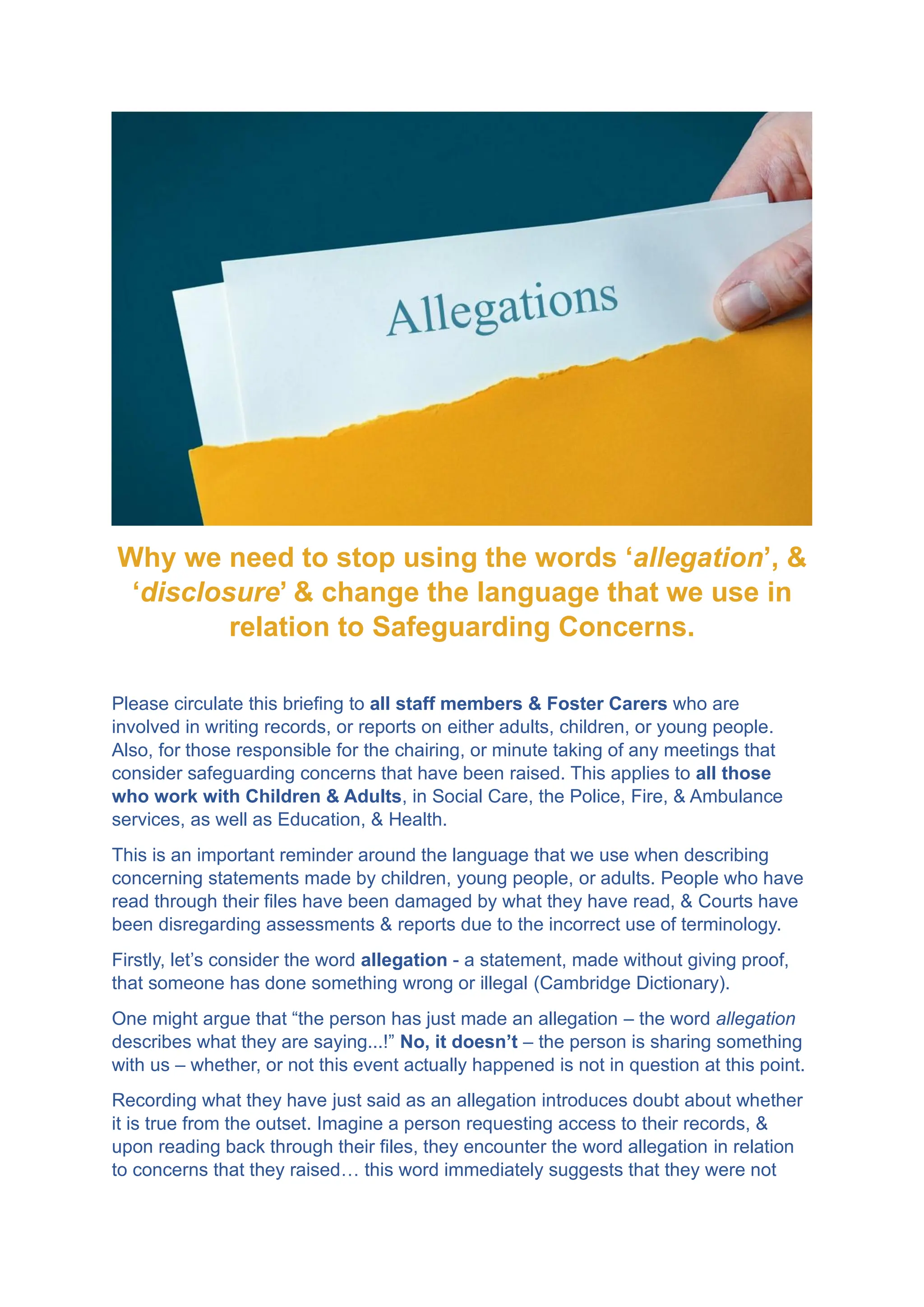
Why we need to stop using the words ‘allegation’, &
‘disclosure’ & change the language that we use in
relation to Safeguarding Concerns.
Please circulate this briefing to all staff members & Foster Carers who are
involved in writing records, or reports on either adults, children, or young people.
Also, for those responsible for the chairing, or minute taking of any meetings that
consider safeguarding concerns that have been raised. This applies to all those
who work with Children & Adults, in Social Care, the Police, Fire, & Ambulance
services, as well as Education, & Health.
This is an important reminder around the language that we use when describing
concerning statements made by children, young people, or adults. People who have
read through their files have been damaged by what they have read, & Courts have
been disregarding assessments & reports due to the incorrect use of terminology.
Firstly, let’s consider the word allegation - a statement, made without giving proof,
that someone has done something wrong or illegal (Cambridge Dictionary).
One might argue that “the person has just made an allegation – the word allegation
describes what they are saying...!” No, it doesn’t – the person is sharing something
with us – whether, or not this event actually happened is not in question at this point.
Recording what they have just said as an allegation introduces doubt about whether
it is true from the outset. Imagine a person requesting access to their records, &
upon reading back through their files, they encounter the word allegation in relation
to concerns that they raised… this word immediately suggests that they were not
believed – replace the word allegation with “they said” (followed by the actions
arising), to avoid the risk of re-traumatising them / destroying any trust that we have
worked so hard to create.
Let’s now consider another word in daily use – disclosure – the act of making
something known or the fact that is made known (Cambridge Dictionary).
We should never use the word disclosure, in a written piece of work, unless there
has been a Finding of Fact hearing conducted by a Court. We risk all our efforts
gathering evidence for proceedings to be disregarded if we (as expert witnesses)
continue to use the incorrect terminology.
Using the word 'disclosure' when what we should write is 'they said' is a gift to
defence barristers / solicitors / legal advisors who will likely challenge that a Finding
of Fact hearing has been conducted on behalf of the court by the report author.
Disclosure is a word that is used to refer to matters that have been determined as
fact by a Court. Until the court makes such a determination, the correct words to use
when describing Safeguarding Concerns are: “they said”, followed by any actions
arising.
To use the word disclosure assumes that a Finding of Fact hearing has been
conducted by the court, & usually when I see it being used, it hasn’t. Only the court
can determine whether a disclosure has been made. It also undermines our position
as an expert witness because we present as being biased – to use the word
disclosure assumes that we believe what has been said to be true before the Court
has considered the evidence. This immediately opens us up to an unpleasant cross
examination, which can so easily be avoided.
For those of us who are old enough to remember the Cleveland Report (dating back
to 1987) this issue was spelt out. It is worth revisiting as the guidance is still solid.
Following the above guidance will hopefully improve the services we provide to both
children, young people & adults, improve practice, & avoid unpleasant cross-
examination of our written work.
We must stop using the word allegation in any written
work, or in oral evidence
We must not use the word disclosure in our written work,
& especially not when we are in Court giving oral evidence
Further reading:
Language Matters – from Solihull Safeguarding Children’s Partnership has been used as a guide for
many years - https://www.safeguardingsolihull.org.uk/lscp/multi-agency-procedures-and-practice-
guidance/exploitation/language-matters/
Lemn Sissay: My name is Why (a book about his experiences of reading his files on his time in care:
https://www.waterstones.com/book/my-name-is-why/lemn-sissay/9781786892362 & a short video
interview: https://youtu.be/htei2x2SbjI
The Appropriate Language Guide, issued by the Hydrant Programme is helpful -
https://www.hydrantprogramme.co.uk/cse-taskforce/appropriate-language-guide
The Transparency Project also has a helpful article on the issue - Things children say – Disclosure,
allegations and why language matters | The Transparency Project
The BMJ summary of the Cleveland enquiry - https://www.bmj.com/content/bmj/297/6642/190.full.pdf
The Cleveland Report revisited - https://childprotectionresource.online/the-cleveland-scandal-
revisited/
The Andrew Pack article on the pitfalls of using the word “disclosure” on his legal blog
SuesspiciousMinds - Disclosure | suesspicious minds
© Alex Clapson Updated 27th November 2025
https://www.linkedin.com/in/alexclapson/

Why we need to stop using the words allegation & disclosure & change the language that we use in relation to Safeguarding Concerns.

  • 1.
    Why we needto stop using the words ‘allegation’, & ‘disclosure’ & change the language that we use in relation to Safeguarding Concerns. Please circulate this briefing to all staff members & Foster Carers who are involved in writing records, or reports on either adults, children, or young people. Also, for those responsible for the chairing, or minute taking of any meetings that consider safeguarding concerns that have been raised. This applies to all those who work with Children & Adults, in Social Care, the Police, Fire, & Ambulance services, as well as Education, & Health. This is an important reminder around the language that we use when describing concerning statements made by children, young people, or adults. People who have read through their files have been damaged by what they have read, & Courts have been disregarding assessments & reports due to the incorrect use of terminology. Firstly, let’s consider the word allegation - a statement, made without giving proof, that someone has done something wrong or illegal (Cambridge Dictionary). One might argue that “the person has just made an allegation – the word allegation describes what they are saying...!” No, it doesn’t – the person is sharing something with us – whether, or not this event actually happened is not in question at this point. Recording what they have just said as an allegation introduces doubt about whether it is true from the outset. Imagine a person requesting access to their records, & upon reading back through their files, they encounter the word allegation in relation to concerns that they raised… this word immediately suggests that they were not
  • 2.
    believed – replacethe word allegation with “they said” (followed by the actions arising), to avoid the risk of re-traumatising them / destroying any trust that we have worked so hard to create. Let’s now consider another word in daily use – disclosure – the act of making something known or the fact that is made known (Cambridge Dictionary). We should never use the word disclosure, in a written piece of work, unless there has been a Finding of Fact hearing conducted by a Court. We risk all our efforts gathering evidence for proceedings to be disregarded if we (as expert witnesses) continue to use the incorrect terminology. Using the word 'disclosure' when what we should write is 'they said' is a gift to defence barristers / solicitors / legal advisors who will likely challenge that a Finding of Fact hearing has been conducted on behalf of the court by the report author. Disclosure is a word that is used to refer to matters that have been determined as fact by a Court. Until the court makes such a determination, the correct words to use when describing Safeguarding Concerns are: “they said”, followed by any actions arising. To use the word disclosure assumes that a Finding of Fact hearing has been conducted by the court, & usually when I see it being used, it hasn’t. Only the court can determine whether a disclosure has been made. It also undermines our position as an expert witness because we present as being biased – to use the word disclosure assumes that we believe what has been said to be true before the Court has considered the evidence. This immediately opens us up to an unpleasant cross examination, which can so easily be avoided. For those of us who are old enough to remember the Cleveland Report (dating back to 1987) this issue was spelt out. It is worth revisiting as the guidance is still solid. Following the above guidance will hopefully improve the services we provide to both children, young people & adults, improve practice, & avoid unpleasant cross- examination of our written work. We must stop using the word allegation in any written work, or in oral evidence We must not use the word disclosure in our written work, & especially not when we are in Court giving oral evidence
  • 3.
    Further reading: Language Matters– from Solihull Safeguarding Children’s Partnership has been used as a guide for many years - https://www.safeguardingsolihull.org.uk/lscp/multi-agency-procedures-and-practice- guidance/exploitation/language-matters/ Lemn Sissay: My name is Why (a book about his experiences of reading his files on his time in care: https://www.waterstones.com/book/my-name-is-why/lemn-sissay/9781786892362 & a short video interview: https://youtu.be/htei2x2SbjI The Appropriate Language Guide, issued by the Hydrant Programme is helpful - https://www.hydrantprogramme.co.uk/cse-taskforce/appropriate-language-guide The Transparency Project also has a helpful article on the issue - Things children say – Disclosure, allegations and why language matters | The Transparency Project The BMJ summary of the Cleveland enquiry - https://www.bmj.com/content/bmj/297/6642/190.full.pdf The Cleveland Report revisited - https://childprotectionresource.online/the-cleveland-scandal- revisited/ The Andrew Pack article on the pitfalls of using the word “disclosure” on his legal blog SuesspiciousMinds - Disclosure | suesspicious minds © Alex Clapson Updated 27th November 2025 https://www.linkedin.com/in/alexclapson/