Web Exploit Hunting& Bug
Bounty Virtual Internship
Presented by: Arju Mehta
Focus: Web Vulnerability Detection,
Analysis & Reporting
This internship aims to provide a comprehensive understanding of real-world
web security challenges.
2.
Introduction to BugBounty & Web
Exploit Hunting
Bug Bounty Programmes
Organisations offer rewards to ethical hackers for discovering and reporting
vulnerabilities in their systems. This proactive approach significantly
enhances security for real-world applications, often providing financial
rewards, company merchandise, or recognition in a "Hall of Fame."
Web Exploit Hunting
This involves systematically identifying and exploiting weaknesses within web
applications. It encompasses reconnaissance, thorough testing, and precise
reporting. Ethical hackers play a crucial role in safeguarding digital assets
before malicious actors can exploit them.
3.
The Crucial Roleof Cybersecurity
The digital landscape faces an increasing threat from cyber-attacks, data
breaches, and ransomware. Poorly secured web systems frequently expose
sensitive information, making robust cybersecurity paramount.
Organisations must fortify:
• Login systems, ensuring secure authentication.
• Databases, protecting sensitive data from unauthorised access.
• APIs, securing communication pathways between systems.
• Web servers, safeguarding the foundational infrastructure.
Ethical hackers are indispensable in mitigating these risks, thereby protecting
both users and businesses from devastating cyber threats.
4.
Internship Objectives: MasteringWeb Security
Understanding Web Architecture & Attack Surfaces
Gain insight into how web applications are built and where vulnerabilities might exist.
IdentifyingCommon Vulnerabilities
Learn to recognise and categorise prevalent weaknesses in web systems.
Hands-onSecurity TestingTools
Acquire practical experience with industry-standard security testing utilities.
Ethical ReportingPractices
Develop skills in documenting and communicating vulnerabilities responsibly.
Problem-Solving &Analytical Skills
Hone critical thinking to dissect complex security issues.
OWASP Top 10 Standards
Achieve a comprehensive understanding of the most critical web application security risks as defined by OWASP.
5.
Essential Tools forWeb Exploit Hunting
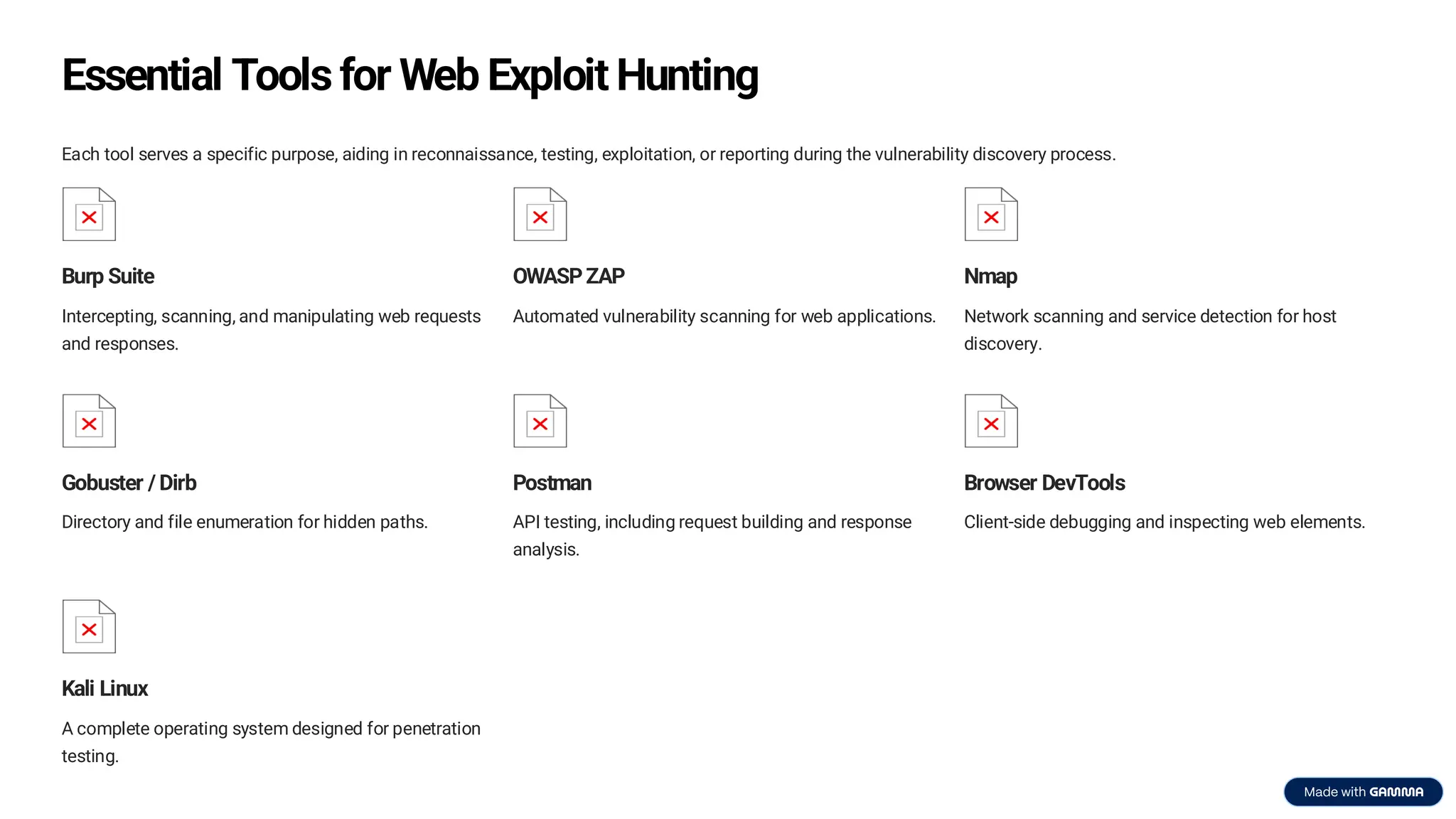
Each tool serves a specific purpose, aiding in reconnaissance, testing, exploitation, or reporting during the vulnerability discovery process.
Burp Suite
Intercepting, scanning, and manipulating web requests
and responses.
OWASP ZAP
Automated vulnerability scanning for web applications.
Nmap
Network scanning and service detection for host
discovery.
Gobuster / Dirb
Directory and file enumeration for hidden paths.
Postman
API testing, including request building and response
analysis.
Browser DevTools
Client-side debugging and inspecting web elements.
Kali Linux
A complete operating system designed for penetration
testing.
6.
OWASP Top 10:Critical Web Risks
The OWASP Top 10 serves as a global standard for web application security, highlighting the most prevalent threats.
A01Broken Access Control
Flaws leading to unauthorised access to data or functionality.
A02CryptographicFailures
Weak or absent encryption exposing sensitive information.
A03Injection
Attacks like SQL, Command, or LDAP injection.
A05Security Misconfiguration
Vulnerabilities due to default settings or open ports.
A07Authentication Failures
Weak login mechanisms that are easily bypassed.
A10SSRF
Server-Side Request Forgery forcing the server to access internal resources.
7.
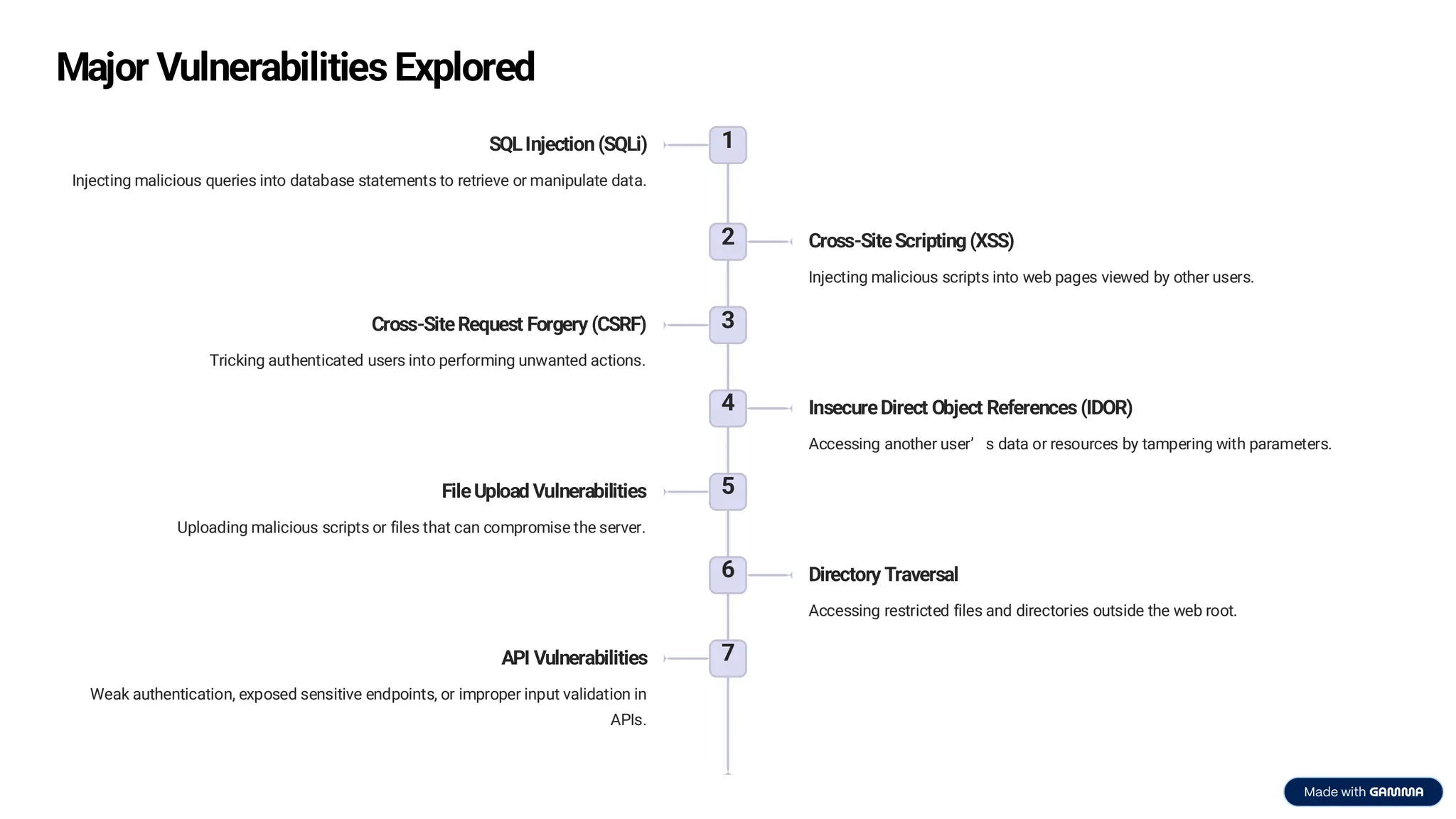
Major Vulnerabilities Explored
1
SQLInjection(SQLi)
Injecting malicious queries into database statements to retrieve or manipulate data.
2 Cross-SiteScripting (XSS)
Injecting malicious scripts into web pages viewed by other users.
3
Cross-SiteRequest Forgery (CSRF)
Tricking authenticated users into performing unwanted actions.
4 InsecureDirect Object References (IDOR)
Accessing another user’ s data or resources by tampering with parameters.
5
FileUpload Vulnerabilities
Uploading malicious scripts or files that can compromise the server.
6 Directory Traversal
Accessing restricted files and directories outside the web root.
7
API Vulnerabilities
Weak authentication, exposed sensitive endpoints, or improper input validation in
APIs.
8.
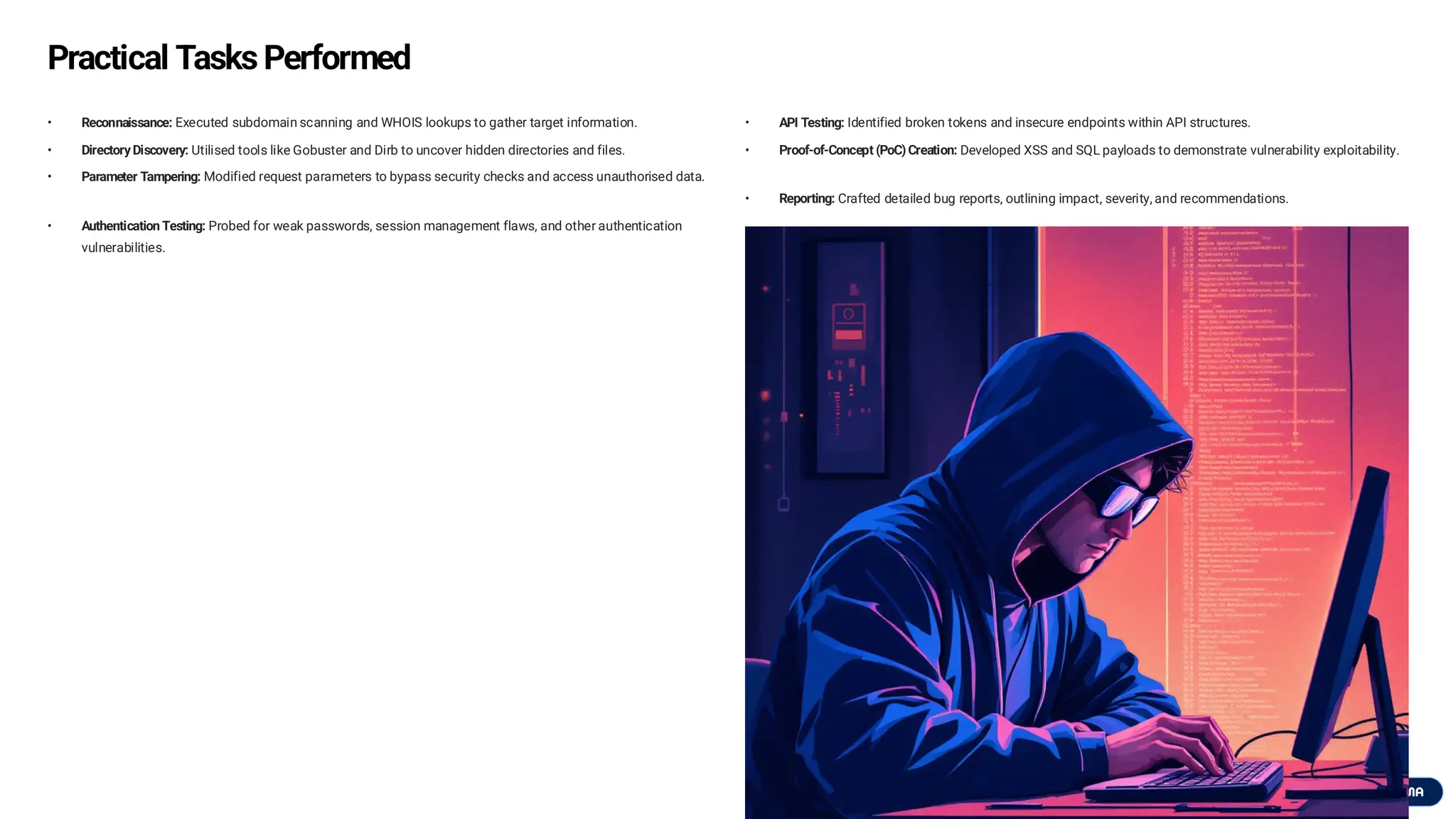
Practical Tasks Performed
•Reconnaissance: Executed subdomain scanning and WHOIS lookups to gather target information.
• Directory Discovery: Utilised tools like Gobuster and Dirb to uncover hidden directories and files.
• Parameter Tampering: Modified request parameters to bypass security checks and access unauthorised data.
• Authentication Testing: Probed for weak passwords, session management flaws, and other authentication
vulnerabilities.
• API Testing: Identified broken tokens and insecure endpoints within API structures.
• Proof-of-Concept (PoC) Creation: Developed XSS and SQL payloads to demonstrate vulnerability exploitability.
• Reporting: Crafted detailed bug reports, outlining impact, severity, and recommendations.
9.
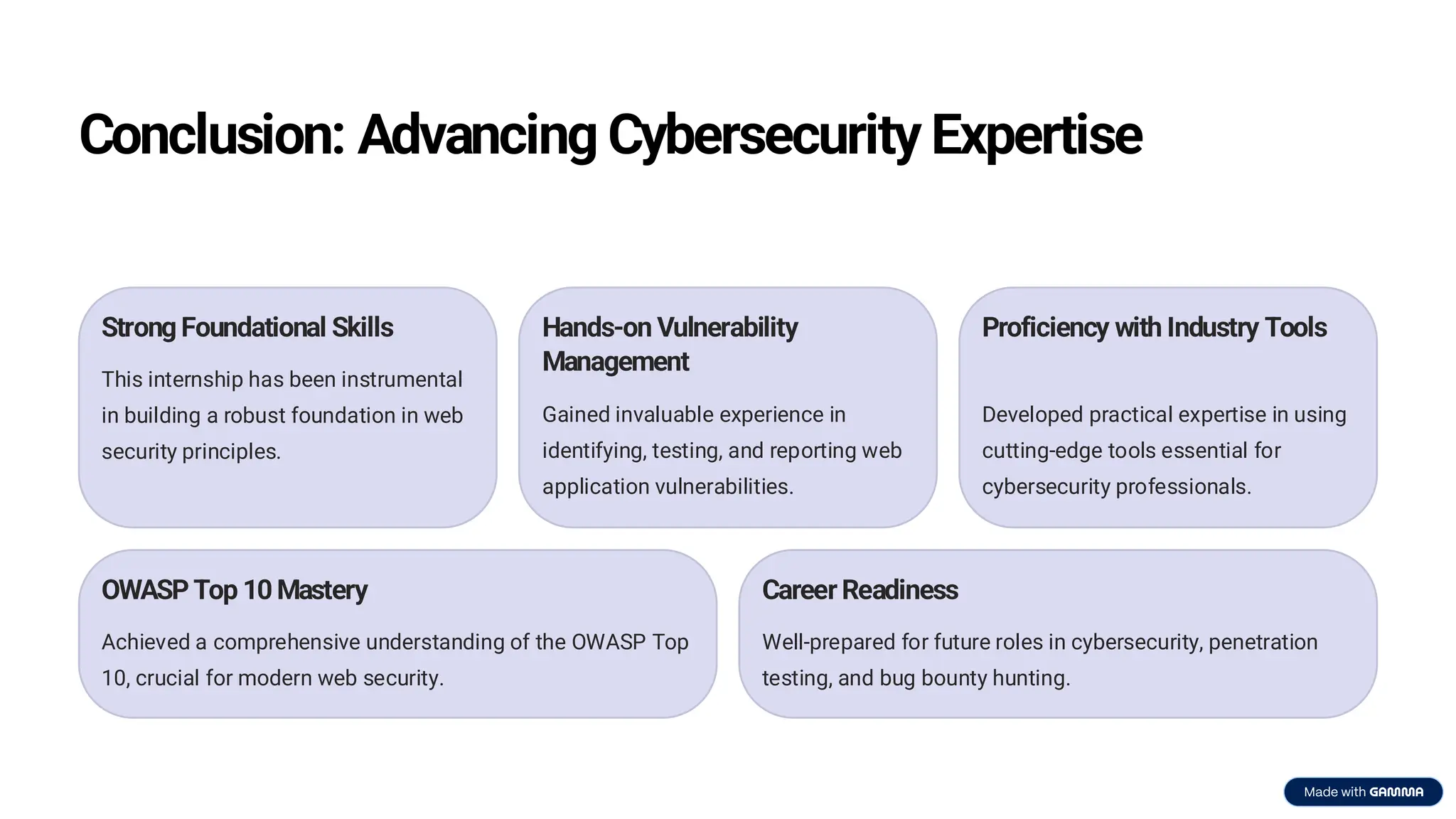
Conclusion: Advancing CybersecurityExpertise
Strong Foundational Skills
This internship has been instrumental
in building a robust foundation in web
security principles.
Hands-on Vulnerability
Management
Gained invaluable experience in
identifying, testing, and reporting web
application vulnerabilities.
Proficiency with Industry Tools
Developed practical expertise in using
cutting-edge tools essential for
cybersecurity professionals.
OWASP Top 10 Mastery
Achieved a comprehensive understanding of the OWASP Top
10, crucial for modern web security.
Career Readiness
Well-prepared for future roles in cybersecurity, penetration
testing, and bug bounty hunting.
![INTERNSHIPREVIEW-ISHAQ (1) [Recovered].pptx](https://cdn.slidesharecdn.com/ss_thumbnails/internshipreview-ishaq1recovered-230109133242-4ce6a92f-thumbnail.jpg?width=640&height=640&fit=bounds)


