Welcome!!!
2
Statements we make in this presentation may include statements which are not historical facts and are considered forward-looking within the meaning of the Private Securities Litigation Reform Act of 1995, which are usually identified
by the use of words such as “anticipates,” “believes,” “estimates,” “expects,” “intends,” “may,” “plans,” “possible,” “projects,” “outlook,” “seeks,” “should,” “will,” and variations of such words or similar expressions, including the negatives
of these words or similar expressions.
We intend these forward-looking statements to be covered by the safe harbor provisions for forward-looking statements contained in Section 27A of the Securities Act of 1933, as amended, and Section 21E of the Securities Exchange
Act of 1934, as amended, and are making this statement for purposes of complying with those safe harbor provisions.
These forward-looking statements include, but are not limited to, statements regarding: our ability to drive and accelerate future growth and operational efficiency and grow our platform, product offerings, and market opportunity; our
business strategy; plans and objectives of management for future operations; the estimated addressable market opportunity for our platform and the growth of the enterprise automation market; the success of our platform and new
releases including the incorporation of AI; the success of our collaborations with third parties; our customers’ behaviors and potential automation spend; and details of UiPath’s stock repurchase program. Forward-looking statements
involve known and unknown risks, uncertainties, and other factors that may cause our actual results, performance, or achievements to be materially different from any future results, performance, or achievements expressed or implied
by the forward-looking statements. These risks include, but are not limited to, risks and uncertainties related to: our expectations regarding our revenue, annualized renewal run-rate (ARR), expenses, and other operating results; our
ability to effectively manage our growth and achieve or sustain profitability; our ability to acquire new customers and successfully retain existing customers; the ability of the UiPath Platform to satisfy and adapt to customer demands
and our ability to increase its adoption; our ability to grow our platform and release new functionality in a timely manner; future investments in our business, our anticipated capital expenditures, and our estimates regarding our capital
requirements; the costs and success of our marketing efforts and our ability to evolve and enhance our brand; our growth strategies; the estimated addressable market opportunity for our platform and for automation in general; our
reliance on key personnel and our ability to attract, integrate, and retain highly-qualified personnel and execute management transitions; our ability to obtain, maintain, and enforce our intellectual property rights and any costs
associated therewith; the effect of significant events with macroeconomic impacts, including but not limited to military conflicts and other changes in geopolitical relationships and inflationary cost trends, on our business, industry, and
the global economy; our reliance on third-party providers of cloud-based infrastructure; our ability to compete effectively with existing competitors and new market entrants, including new, potentially disruptive technologies; the size and
growth rates of the markets in which we compete; and the price volatility of our Class A common stock.
Further information on risks that could cause actual results to differ materially from our guidance and other forward-looking statements can be found in our Annual Report on Form 10-K for the fiscal year ended January 31, 2025 filed
with the United States Securities and Exchange Commission (SEC), in our Quarterly Reports on Form 10-Q filed with the SEC, and in other filings and reports that we may file from time to time with the SEC. Any forward-looking
statements contained in this presentation are based on assumptions that we believe to be reasonable as of this date. Except as required by law, we assume no obligation to update these forward-looking statements.
Our fiscal year end is January 31, and our fiscal quarters end on April 30, July 31, and October 31. All third-party trademarks, including names, logos and brands, referenced by us in this presentation are property of their respective
owners. All references to third-party trademarks are for identification purposes only. Such use should not be construed as an endorsement of the products or services of us.
Safe Harbor
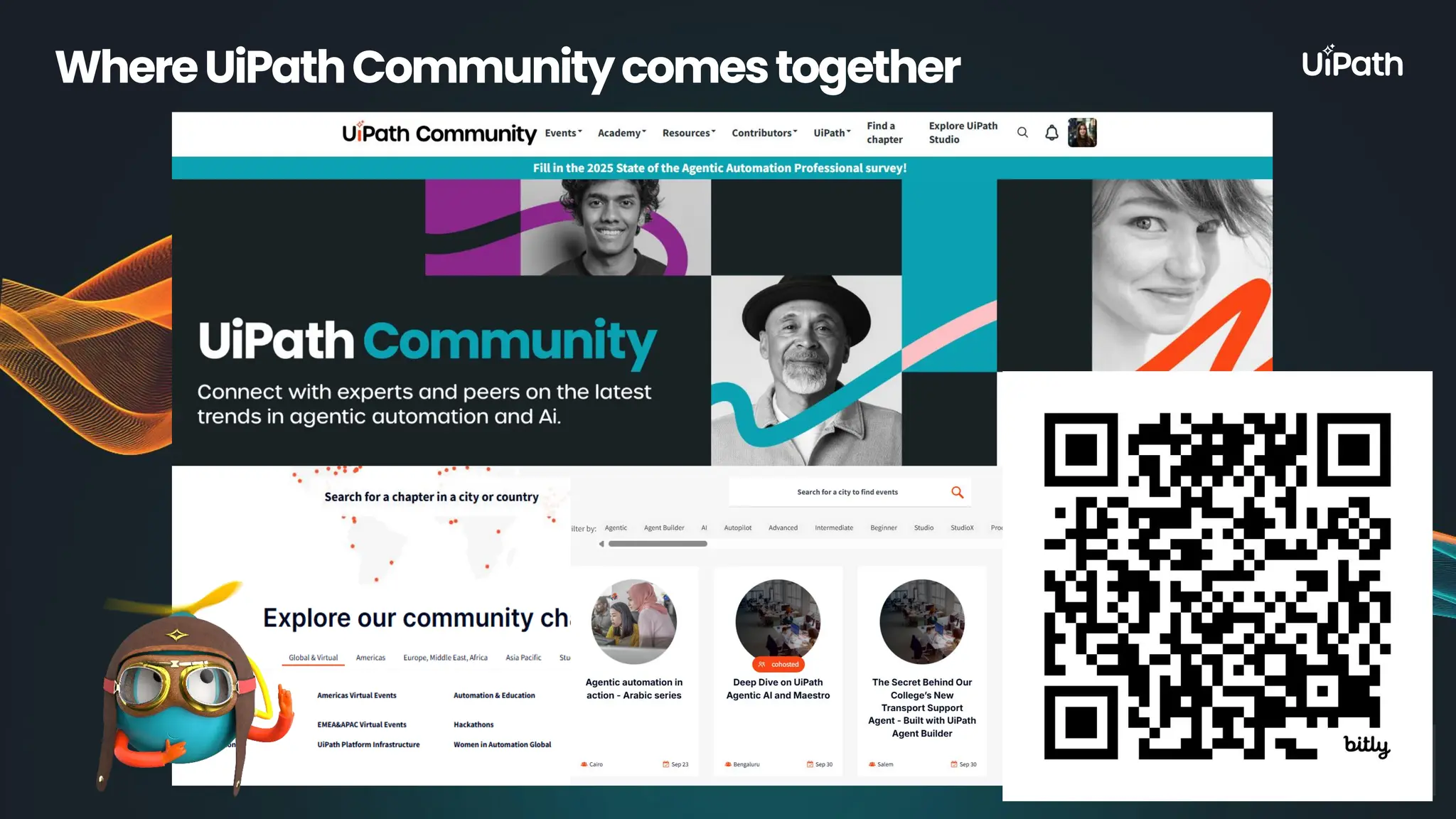
WhereUiPathCommunitycomestogether
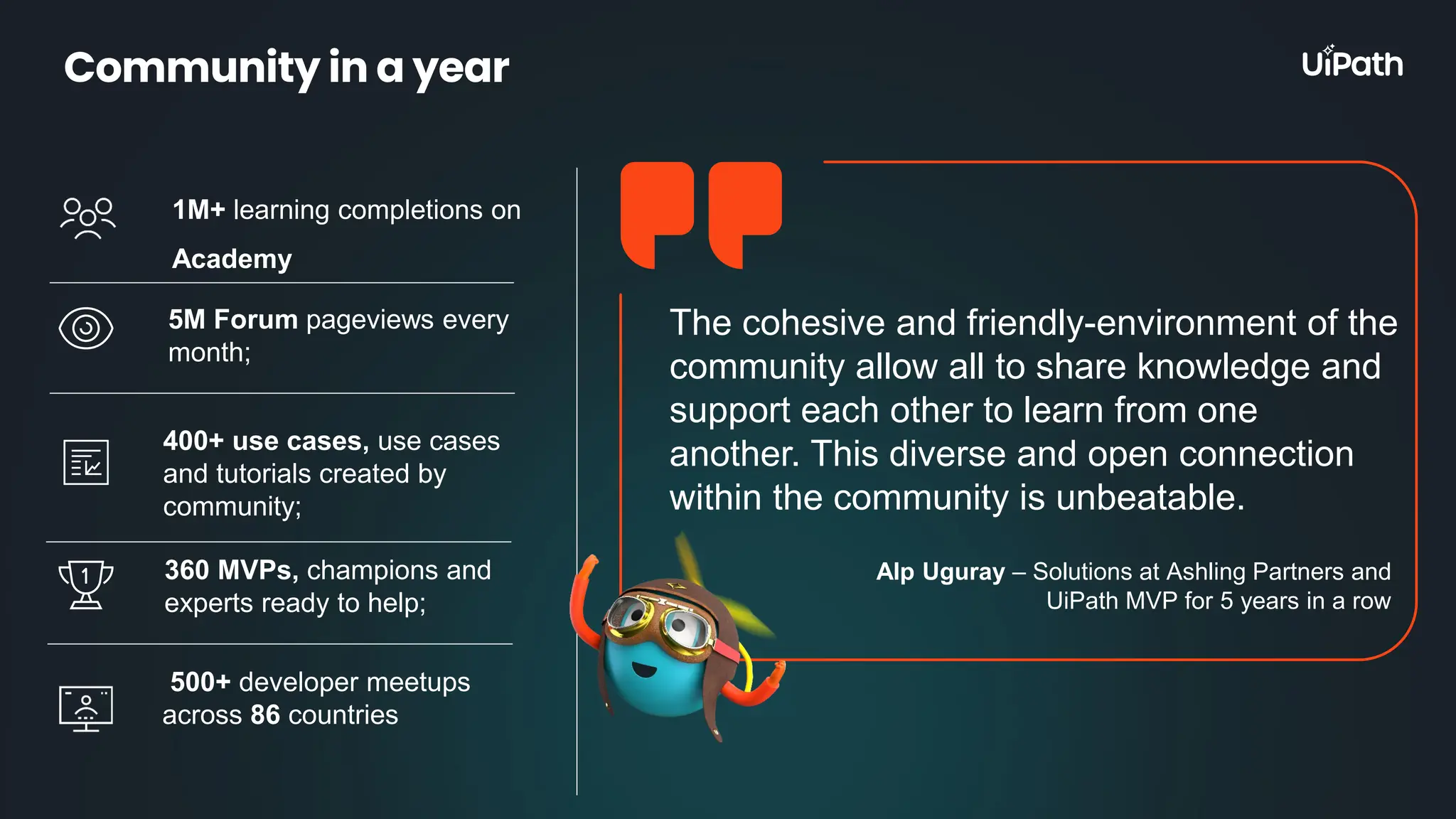
Community in a year
1M+ learning completions on
Academy
5M Forum pageviews every
month;
400+ use cases, use cases
and tutorials created by
community;
360 MVPs, champions and
experts ready to help;
500+ developer meetups
across 86 countries
The cohesive and friendly-environment of the
community allow all to share knowledge and
support each other to learn from one
another. This diverse and open connection
within the community is unbeatable.
Alp Uguray – Solutions at Ashling Partners and
UiPath MVP for 5 years in a row
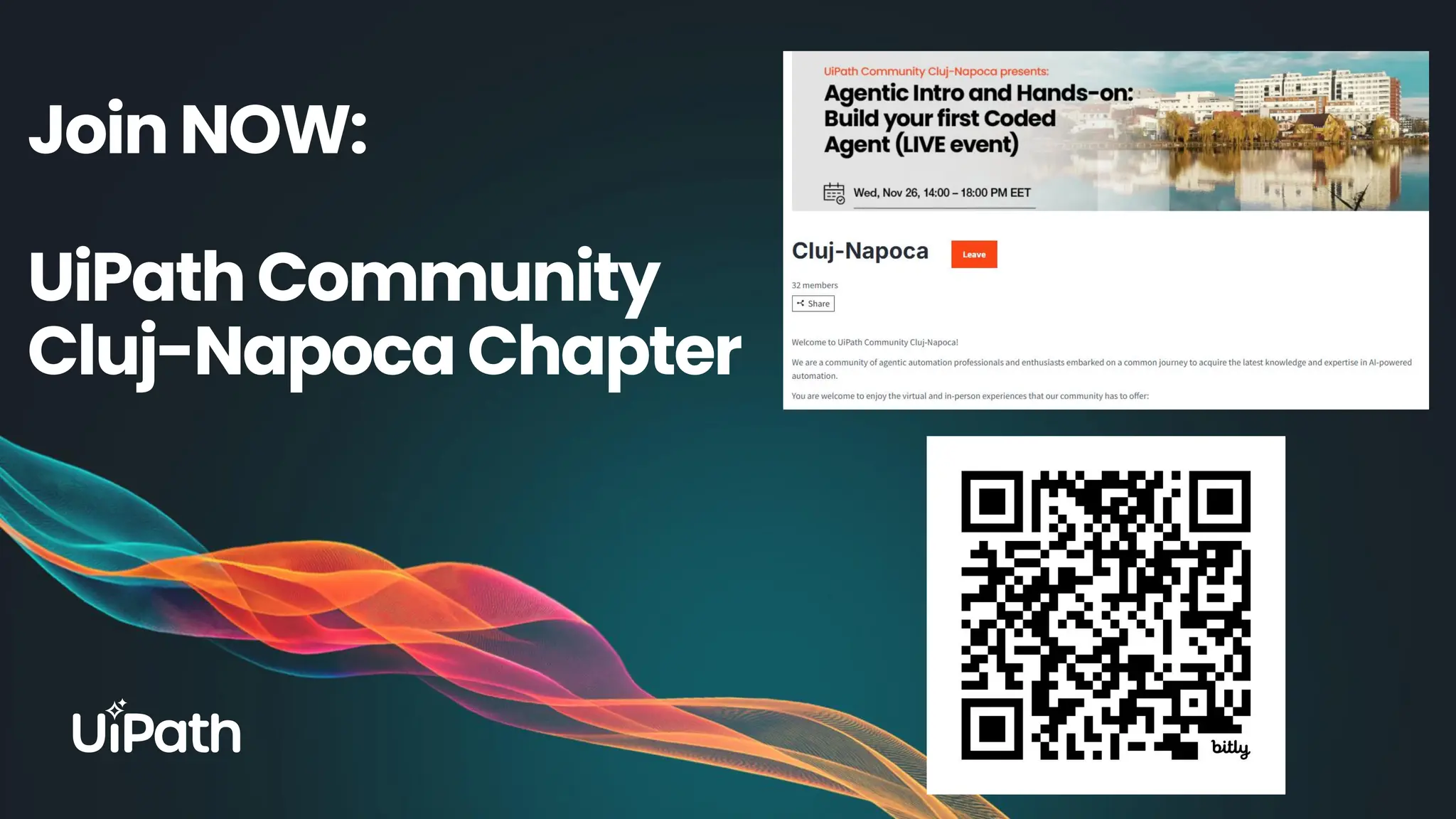
JoinNOW:
UiPathCommunity
Cluj-Napoca Chapter
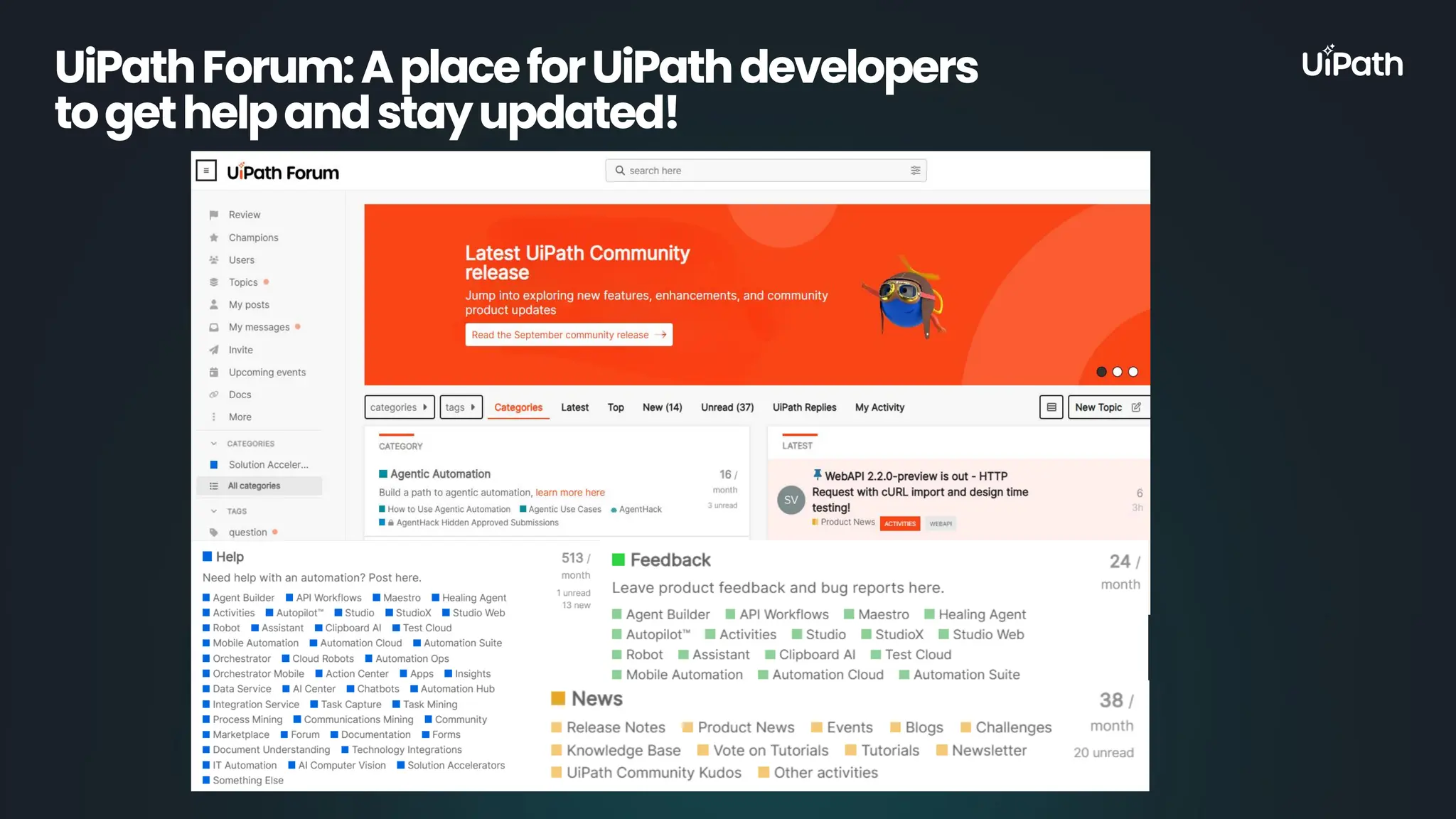
UiPathForum:AplaceforUiPathdevelopers
togethelpandstayupdated!
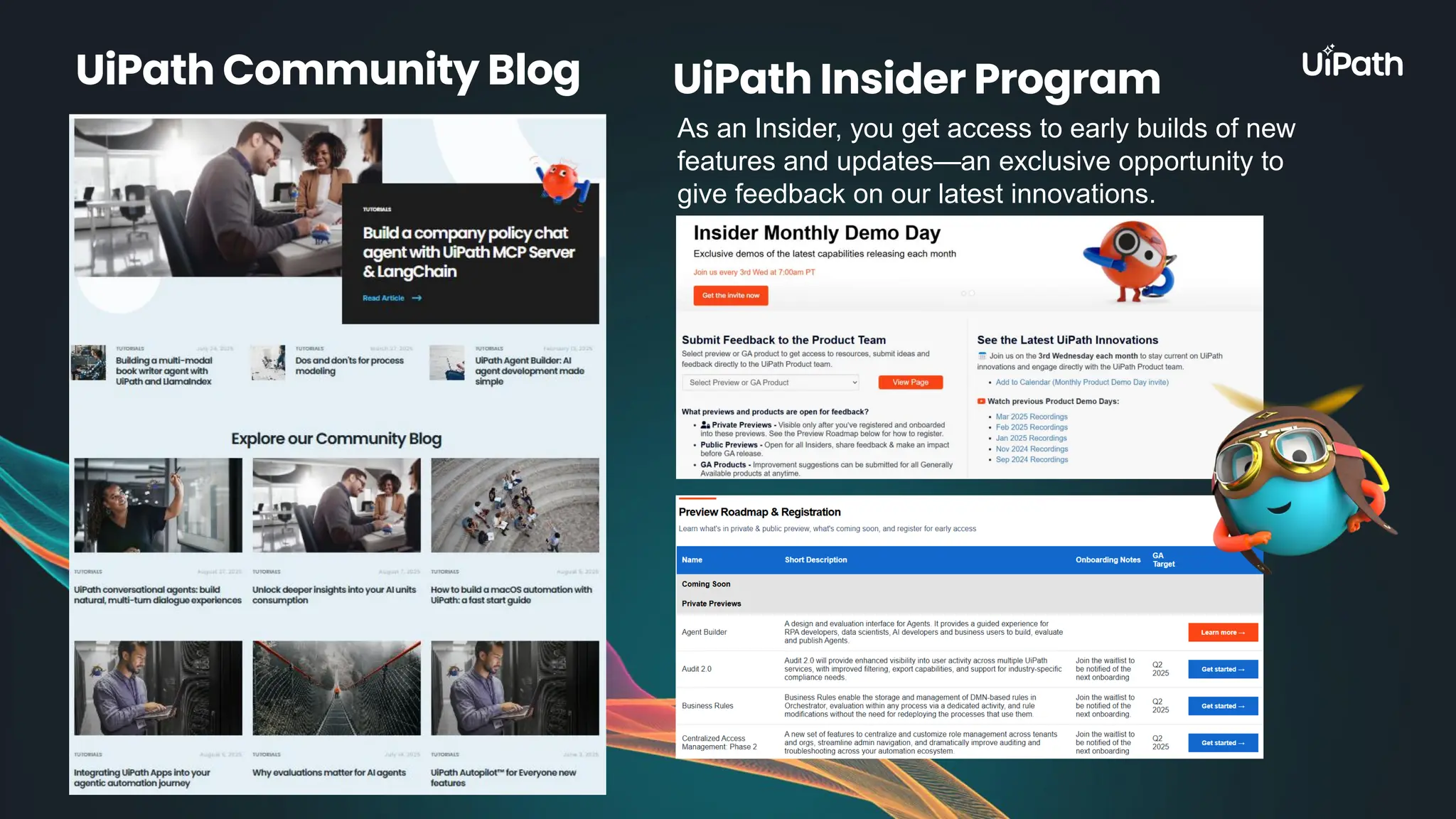
UiPath Insider Program
As an Insider, you get access to early builds of new
features and updates—an exclusive opportunity to
give feedback on our latest innovations.
UiPath Community Blog
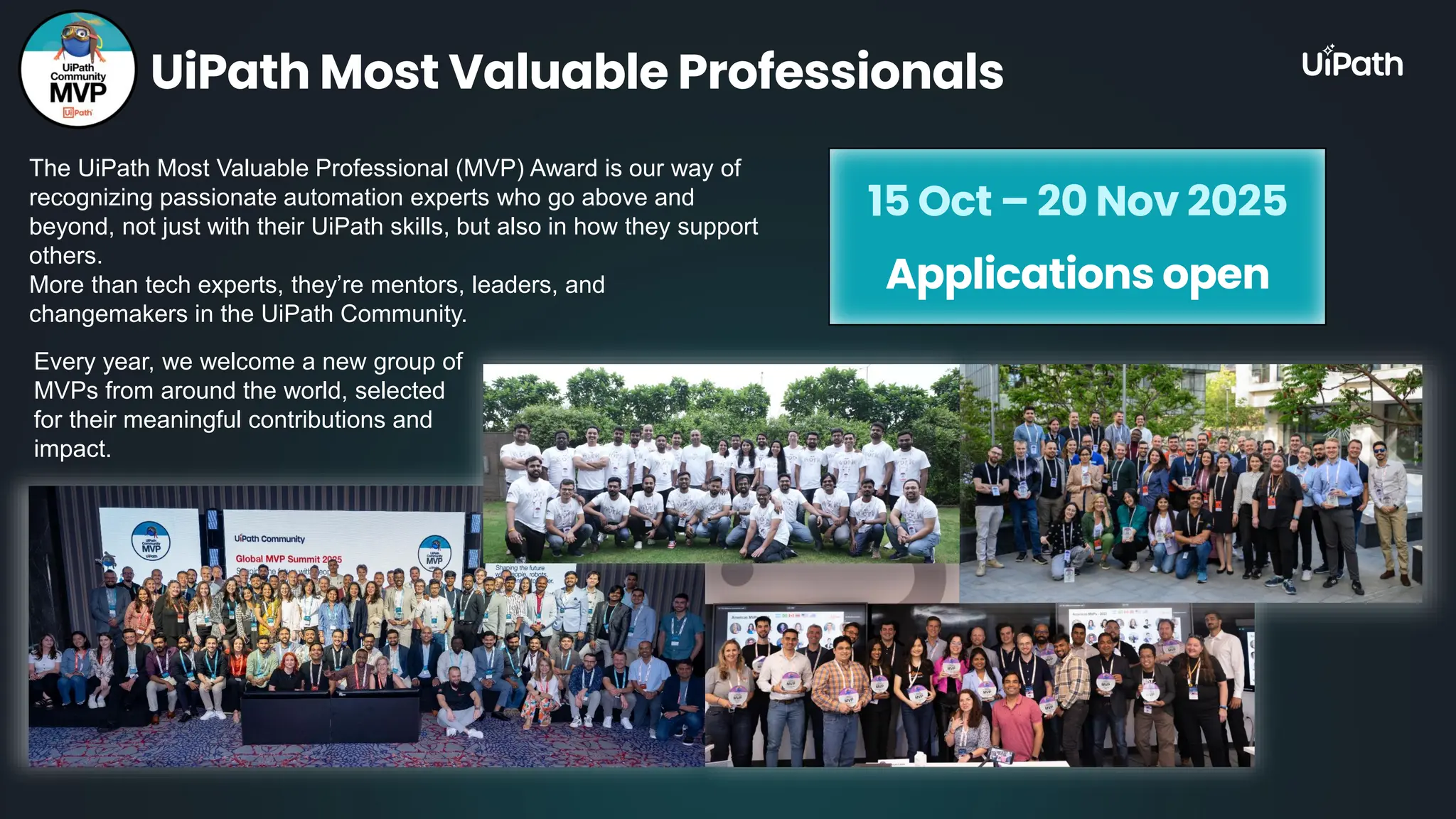
The UiPath Most Valuable Professional (MVP) Award is our way of
recognizing passionate automation experts who go above and
beyond, not just with their UiPath skills, but also in how they support
others.
More than tech experts, they’re mentors, leaders, and
changemakers in the UiPath Community.
UiPath Most Valuable Professionals
Every year, we welcome a new group of
MVPs from around the world, selected
for their meaningful contributions and
impact.
15 Oct – 20 Nov 2025
Applications open
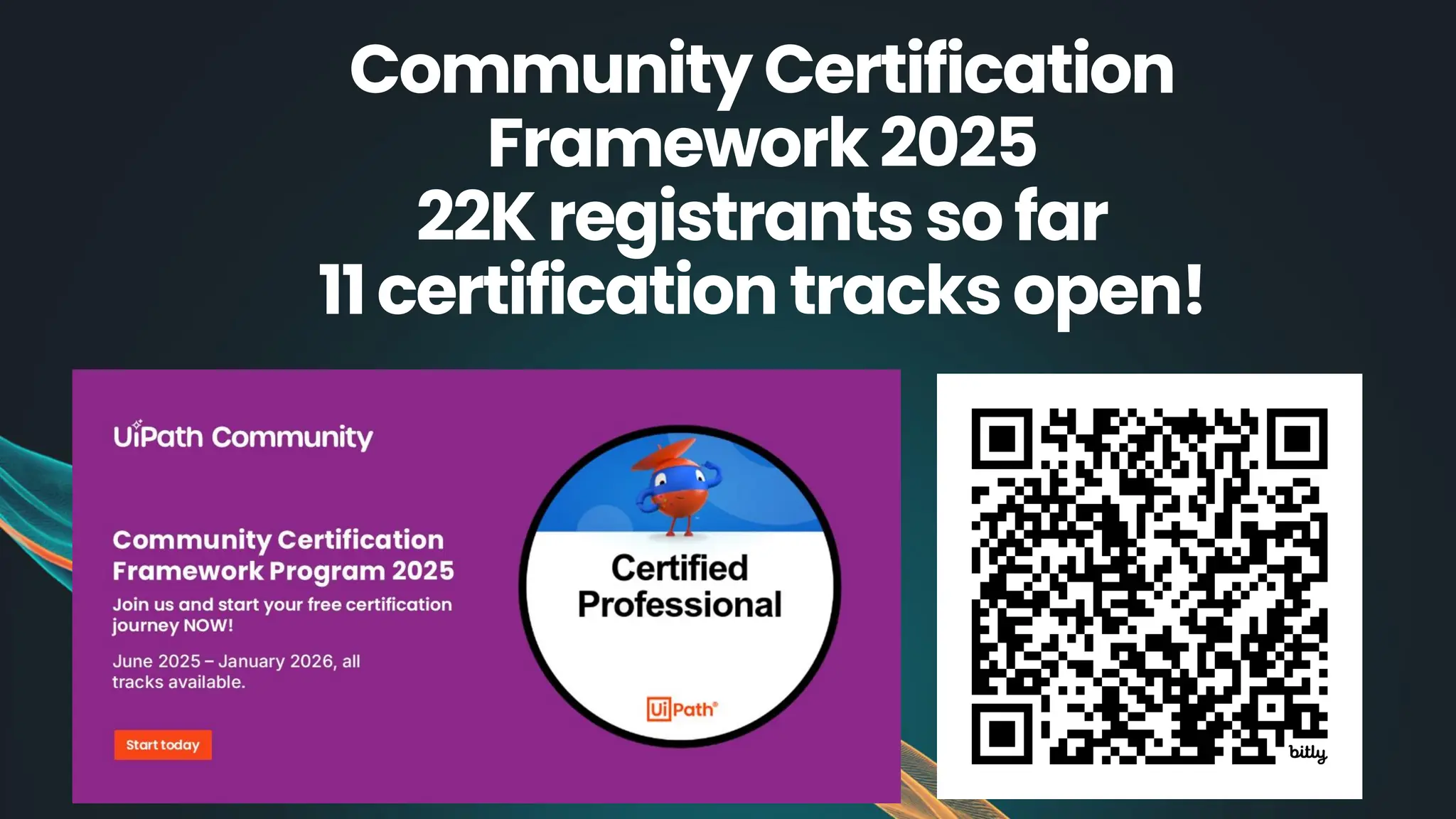
Community Certification
Framework2025
22K registrants sofar
11certification tracksopen!
Build your first
Coded Agent
The UiPath word mark, logos, and robots are registered trademarks owned by UiPath, Inc. and its affiliates. UiPath (R) is a registered
trademark in the United States and several countries across the globe. See TMEP 906. ©2025 UiPath. All rights reserved.
Enterprise grade Agents with UiPath
11
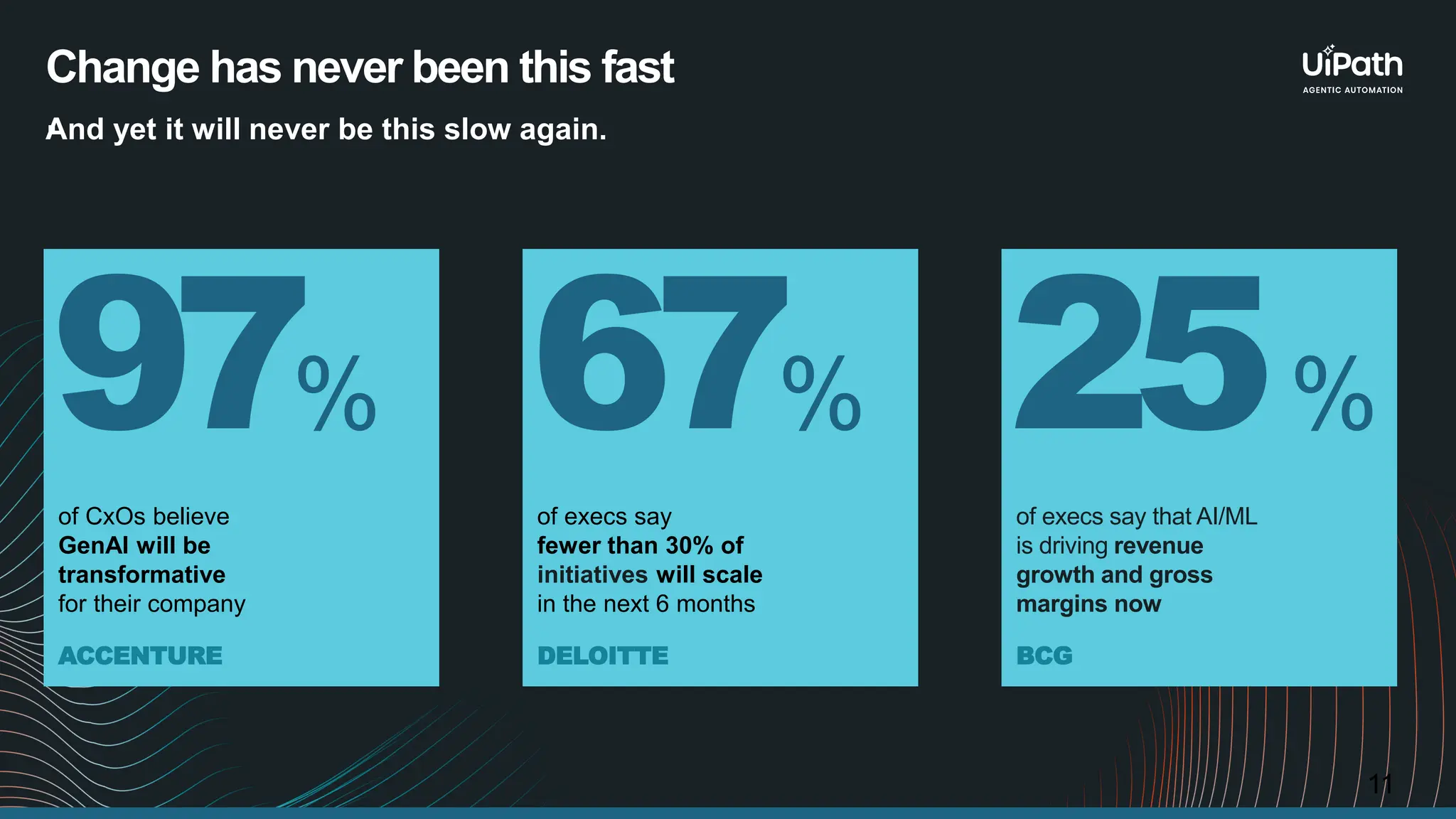
Change has never been this fast
.
And yet it will never be this slow again.
of CxOs believe
GenAI will be
transformative
for their company
ACCENTURE
97%
of execs say
fewer than 30% of
initiatives will scale
in the next 6 months
67%
DELOITTE
of execs say that AI/ML
is driving revenue
growth and gross
margins now
25%
BCG
12
12
12
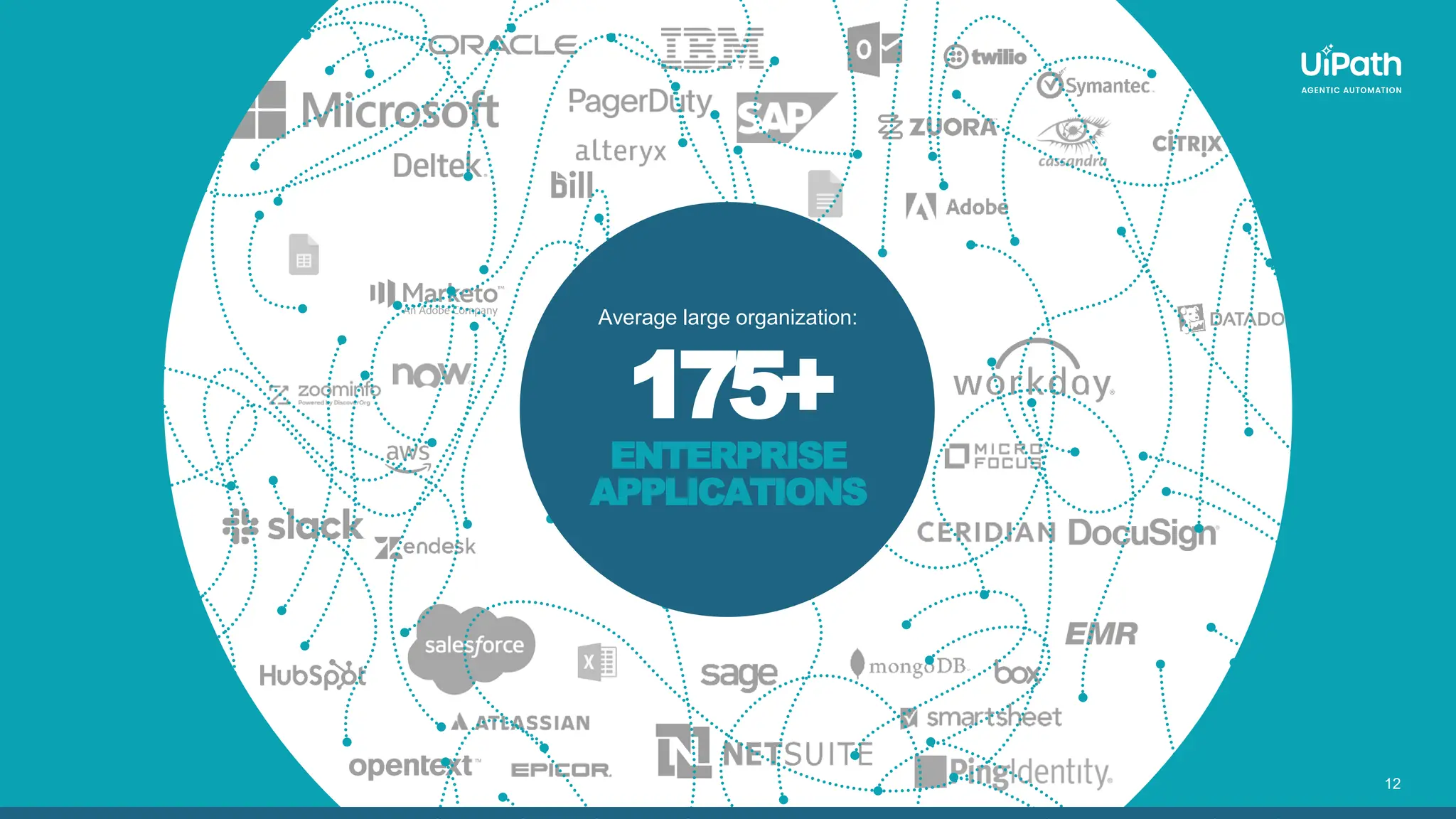
Average large organization:
175+
ENTERPRISE
APPLICATIONS
13
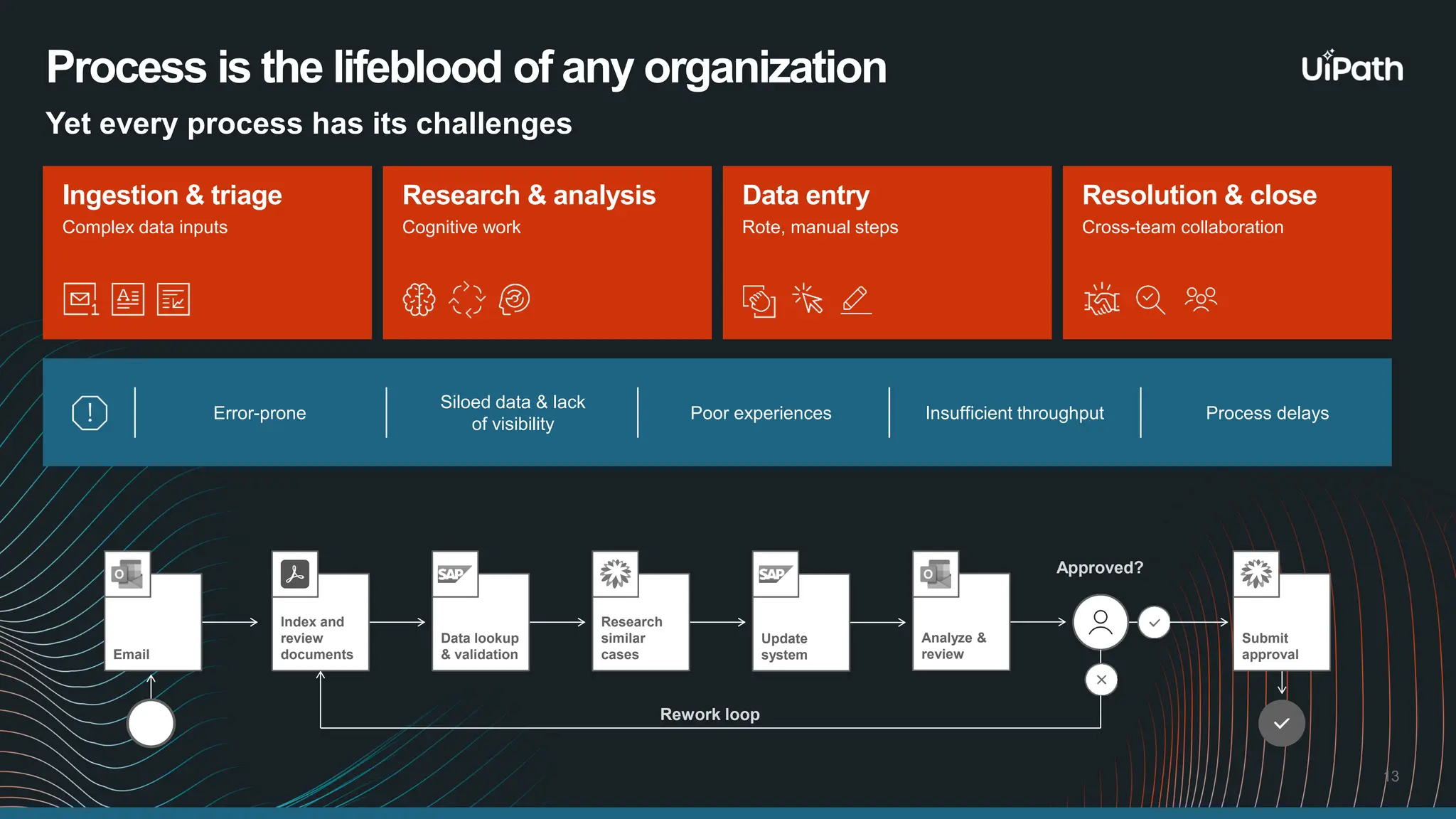
Process is the lifeblood of any organization
Yet every process has its challenges
Poor experiences Insufficient throughput Process delays
Error-prone
Siloed data & lack
of visibility
Resolution & close
Cross-team collaboration
Ingestion & triage
Complex data inputs
Research & analysis
Cognitive work
Data entry
Rote, manual steps
Approved?
Rework loop
Index and
review
documents
Data lookup
& validation
Research
similar
cases
Submit
approval
Update
system
Analyze &
review
Email
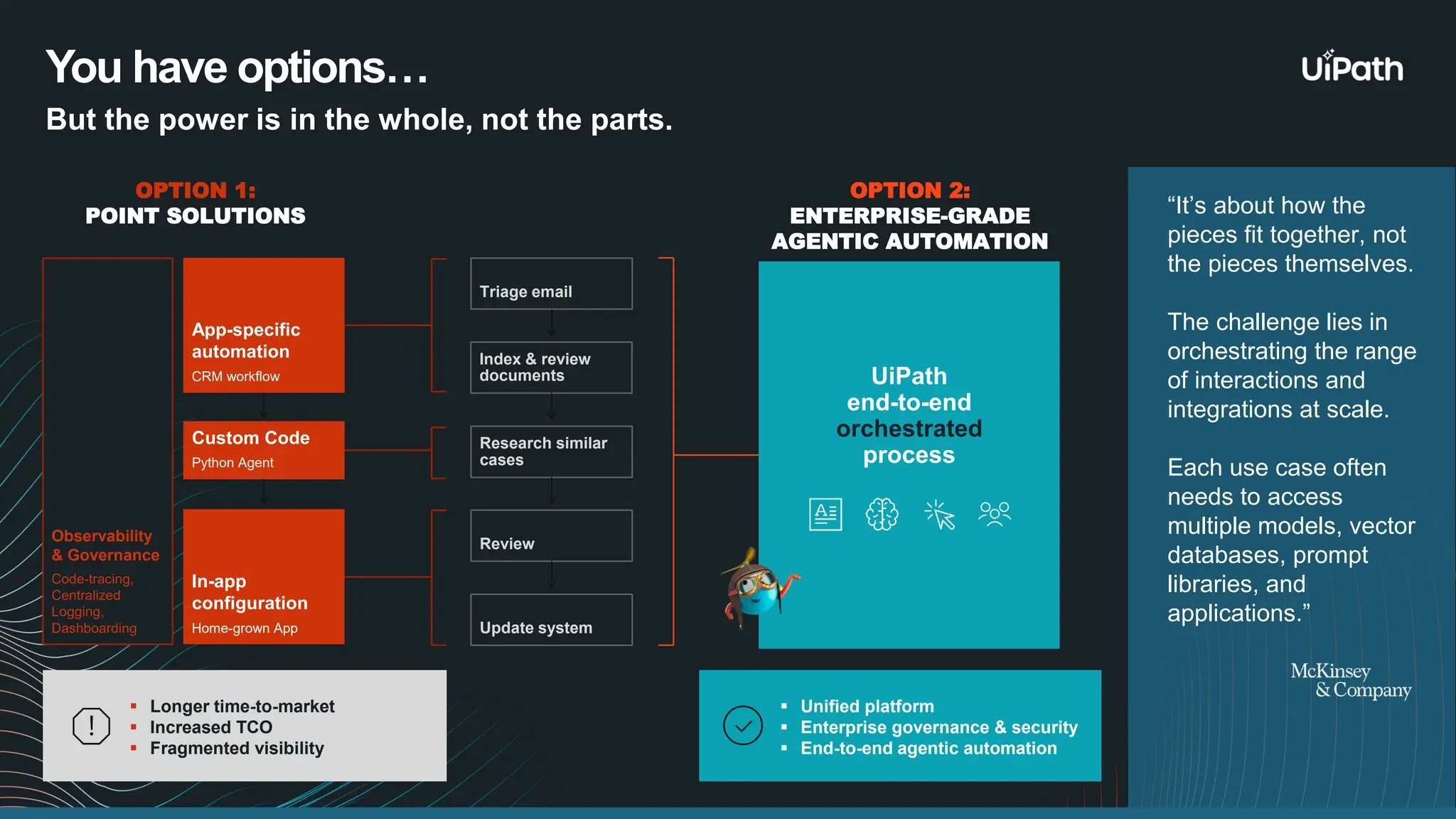
You have options

But the power is in the whole, not the parts.
OPTION 1:
POINT SOLUTIONS
OPTION 2:
ENTERPRISE-GRADE
AGENTIC AUTOMATION
â–Ș Longer time-to-market
â–Ș Increased TCO
â–Ș Fragmented visibility
App-specific
automation
CRM workflow
Custom Code
Python Agent
In-app
configuration
Home-grown App
â–Ș Unified platform
â–Ș Enterprise governance & security
â–Ș End-to-end agentic automation
Observability
& Governance
Code-tracing,
Centralized
Logging,
Dashboarding
Triage email
Index & review
documents
Research similar
cases
Review
Update system
UiPath
end-to-end
orchestrated
process
“It’s about how the
pieces fit together, not
the pieces themselves.
The challenge lies in
orchestrating the range
of interactions and
integrations at scale.
Each use case often
needs to access
multiple models, vector
databases, prompt
libraries, and
applications.”
15
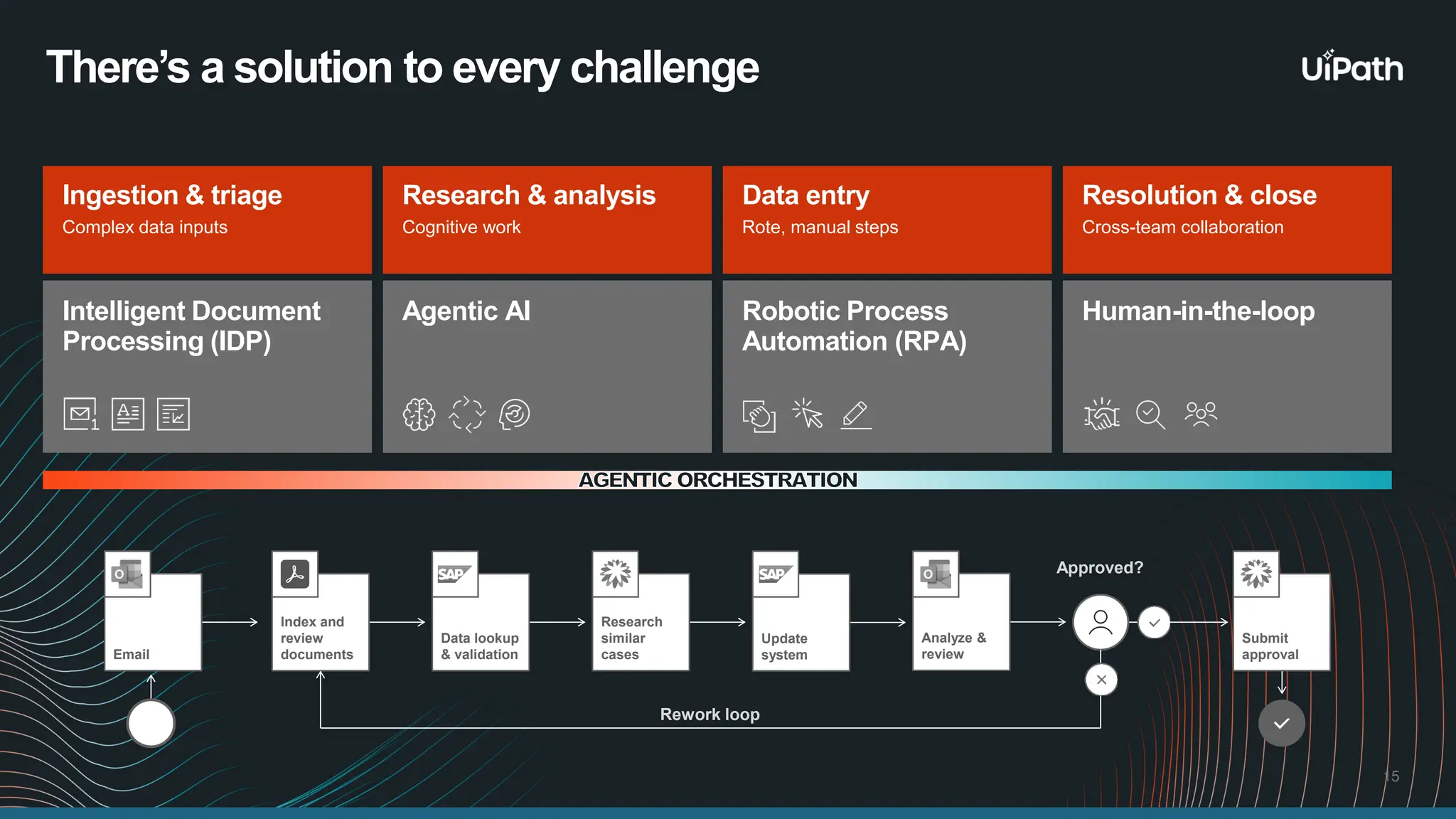
There’s a solution to every challenge
Agentic AI Human-in-the-loop
Robotic Process
Automation (RPA)
Intelligent Document
Processing (IDP)
Resolution & close
Cross-team collaboration
Ingestion & triage
Complex data inputs
Research & analysis
Cognitive work
Data entry
Rote, manual steps
Approved?
Rework loop
Index and
review
documents
Data lookup
& validation
Research
similar
cases
Submit
approval
Update
system
Analyze &
review
Email
AGENTICORCHESTRATION
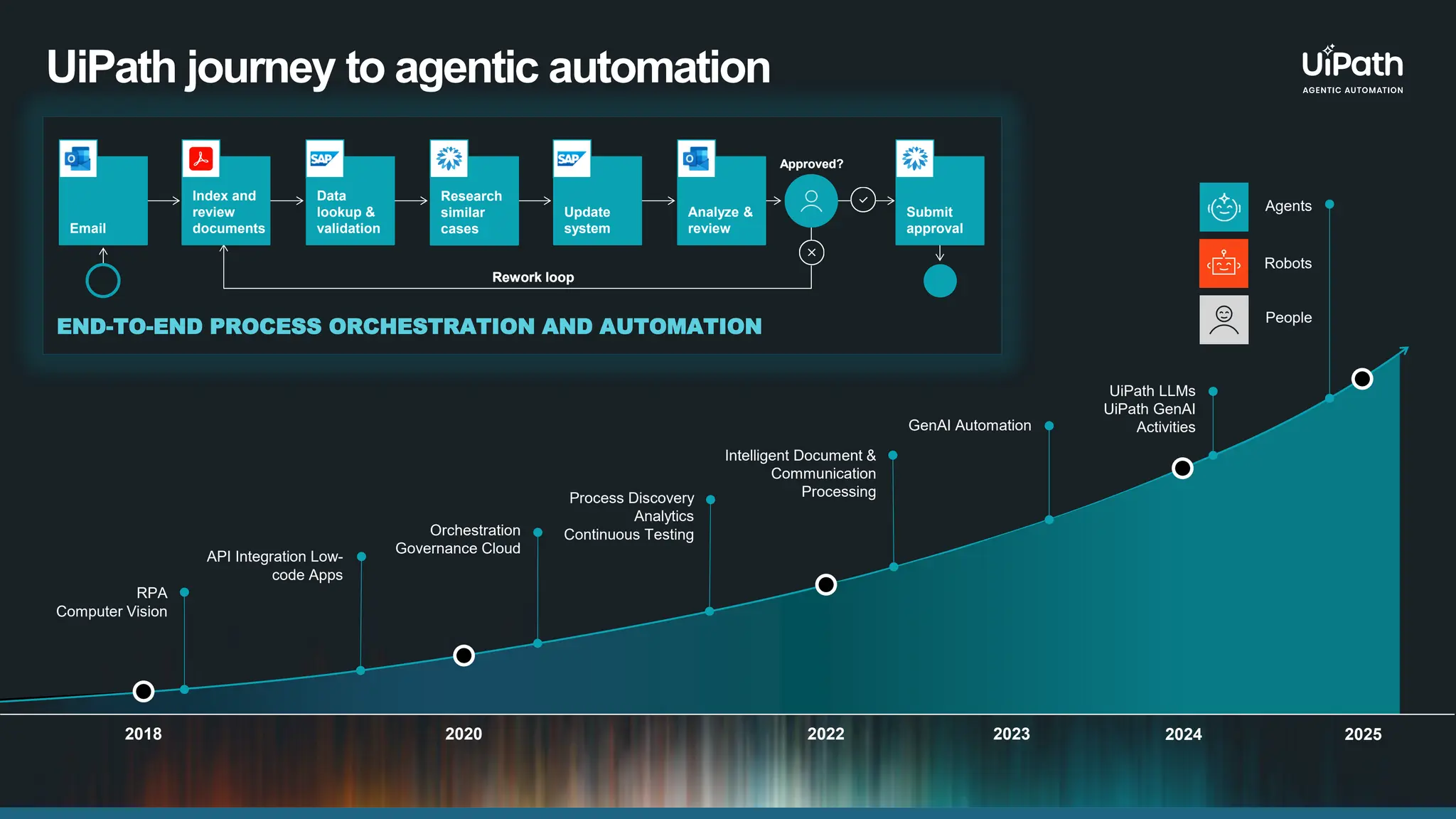
UiPath journey to agentic automation
2018
RPA
Computer Vision
API Integration Low-
code Apps
Orchestration
Governance Cloud
Process Discovery
Analytics
Continuous Testing
Intelligent Document &
Communication
Processing
GenAI Automation
UiPath LLMs
UiPath GenAI
Activities
2020 2022 2023 2024 2025
Agents
Robots
People
HUMAN-IN-THE-LOOP (HITL)
INTELLIGENT DOCUMENT PROCESSING (IDP)
AGENTIC AI
Email
Index and
review
documents
Data
lookup &
validation
Research
similar
cases
Update
system
Analyze &
review
Submit
approval
Approved?
Rework loop
Email
Index and
review
documents
Research
similar
cases
Update
system
Analyze &
review
Submit
approval
ROBOTIC PROCESS AUTOMATION (RPA)
END-TO-END PROCESS ORCHESTRATION AND AUTOMATION
Email
Index and
review
documents
Research
similar
cases
Update
system
Analyze &
review
Submit
approval
Approved?
Rework loop
Email
Index and
review
documents
Data
lookup &
validation
Research
similar
cases
Update
system
Analyze &
review
Submit
approval
Research
similar
cases
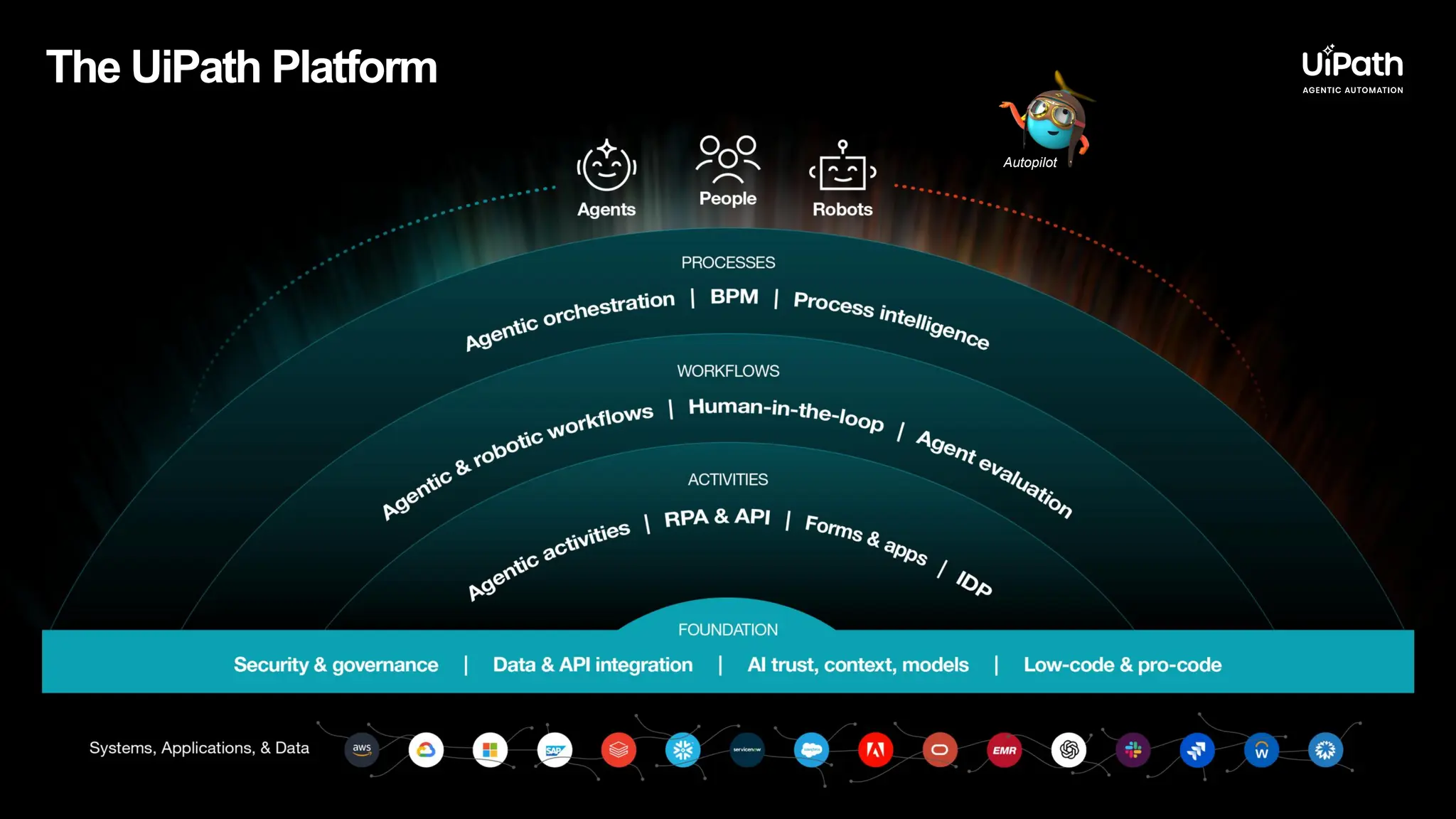
The UiPath Platform
Autopilot
Until recently, you’ve focused
on orchestrating robots and people.
ARE YOU READY TO ADD
AI AGENTS TO THE MIX?
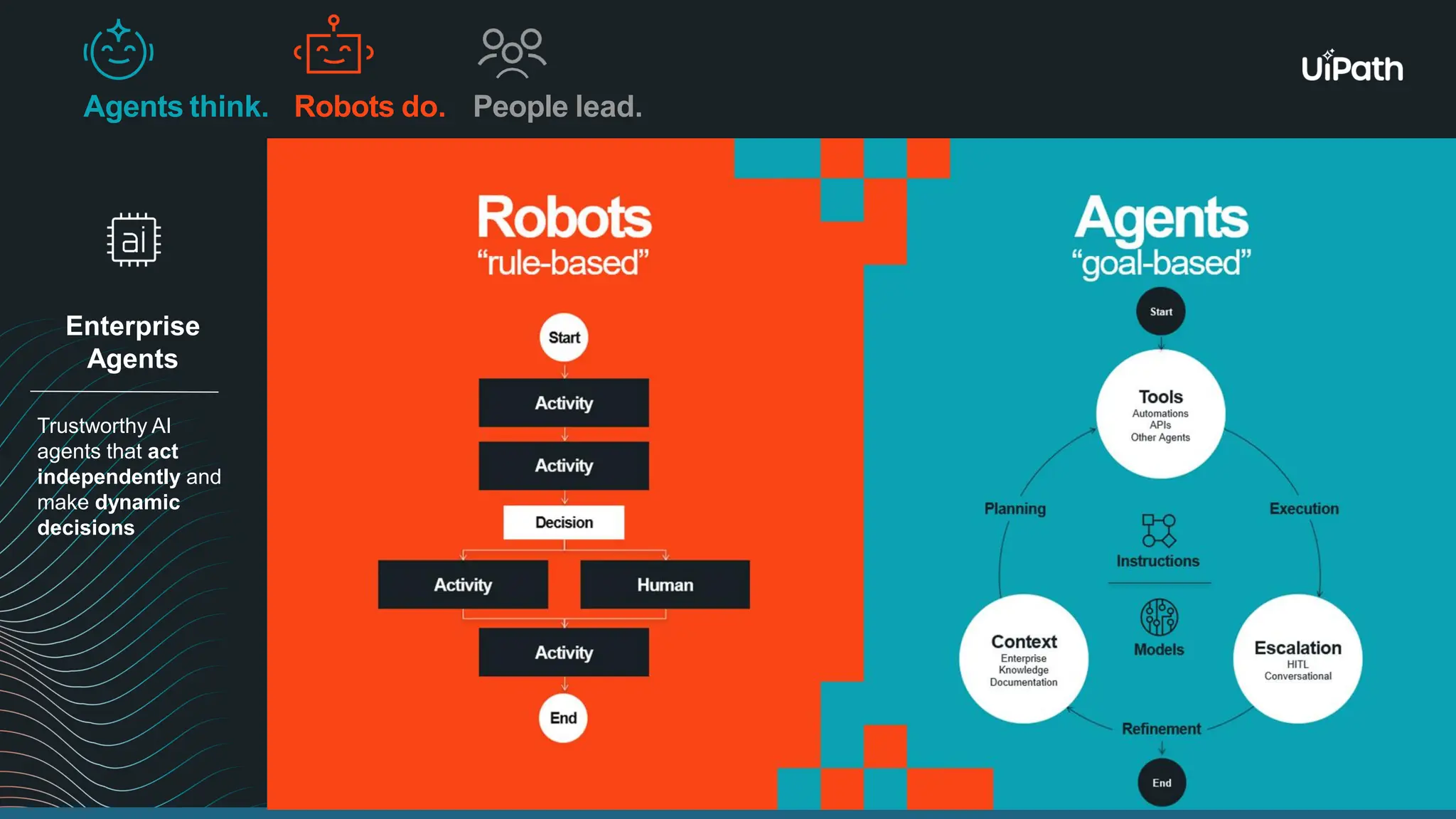
Enterprise
Agents
Trustworthy AI
agents that act
independently and
make dynamic
decisions
Agents think. Robots do. People lead.
Tools
Automations
APIs
Other Agents
Escalation
HITL
Conversational
Context
Enterprise
Knowledge
Documentation
Refinement
Execution
Planning
Prompts
Models
End
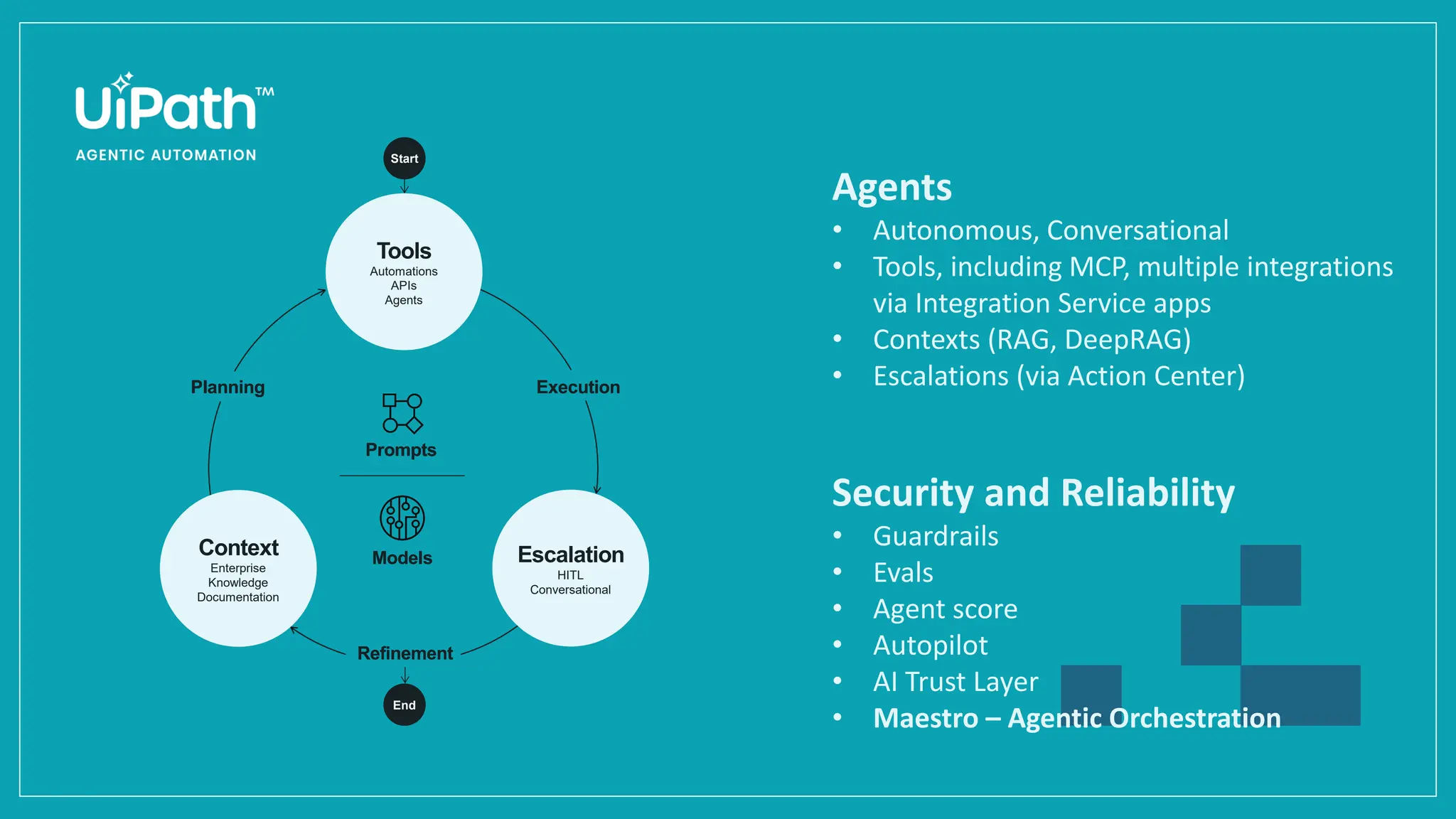
Tools
Automations
APIs
Agents
Escalation
HITL
Conversational
Context
Enterprise
Knowledge
Documentation
Refinement
Execution
Planning
Prompts
Models
End
Start
Agents
‱ Autonomous, Conversational
‱ Tools, including MCP, multiple integrations
via Integration Service apps
‱ Contexts (RAG, DeepRAG)
‱ Escalations (via Action Center)
Security and Reliability
‱ Guardrails
‱ Evals
‱ Agent score
‱ Autopilot
‱ AI Trust Layer
‱ Maestro – Agentic Orchestration
Need to supercharge the agents with full
coding control and flexibility?
UiPath Coded Agents
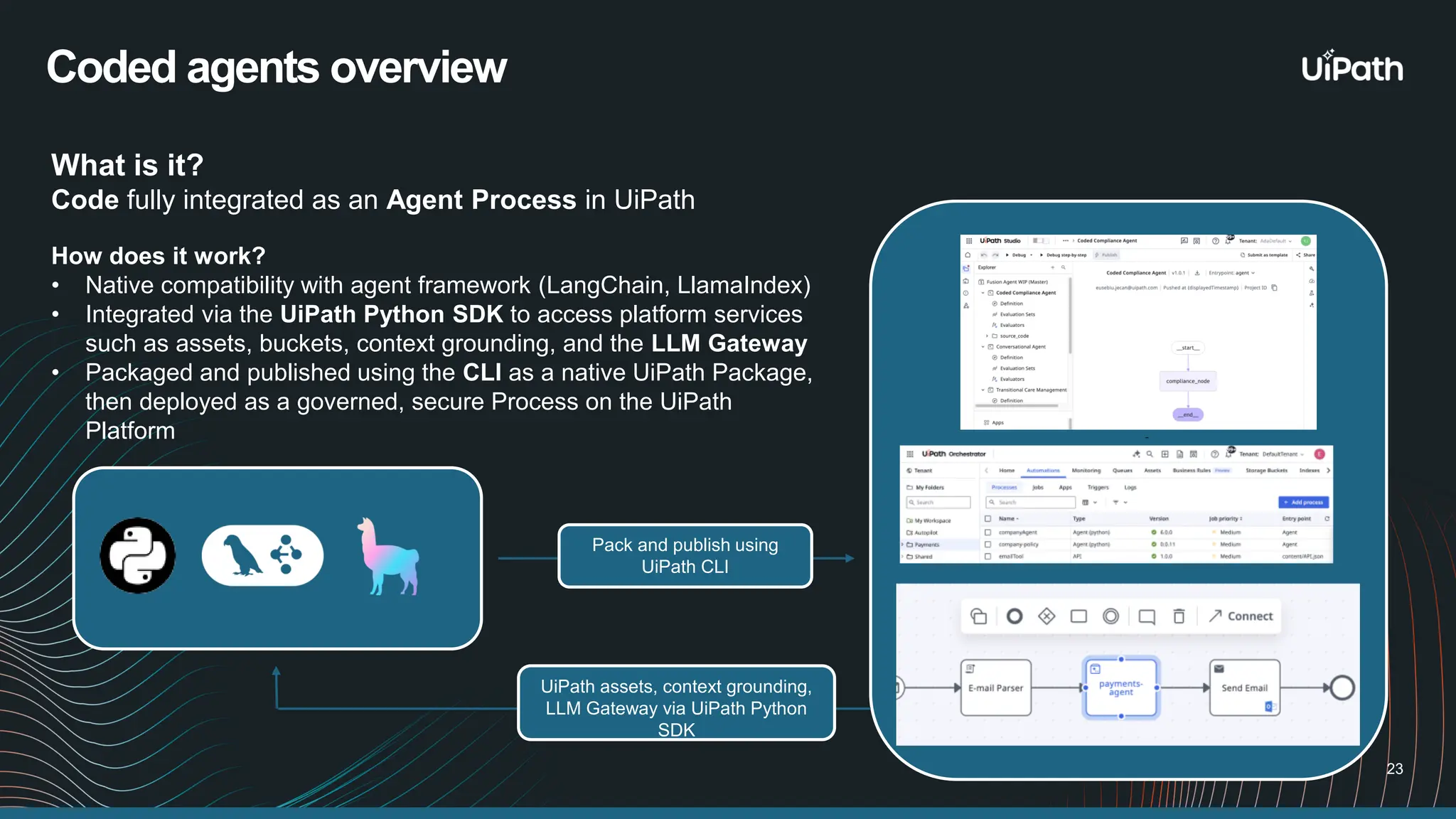
Coded agents overview
23
What is it?
Code fully integrated as an Agent Process in UiPath
How does it work?
‱ Native compatibility with agent framework (LangChain, LlamaIndex)
‱ Integrated via the UiPath Python SDK to access platform services
such as assets, buckets, context grounding, and the LLM Gateway
‱ Packaged and published using the CLI as a native UiPath Package,
then deployed as a governed, secure Process on the UiPath
Platform
Pack and publish using
UiPath CLI
UiPath assets, context grounding,
LLM Gateway via UiPath Python
SDK
5
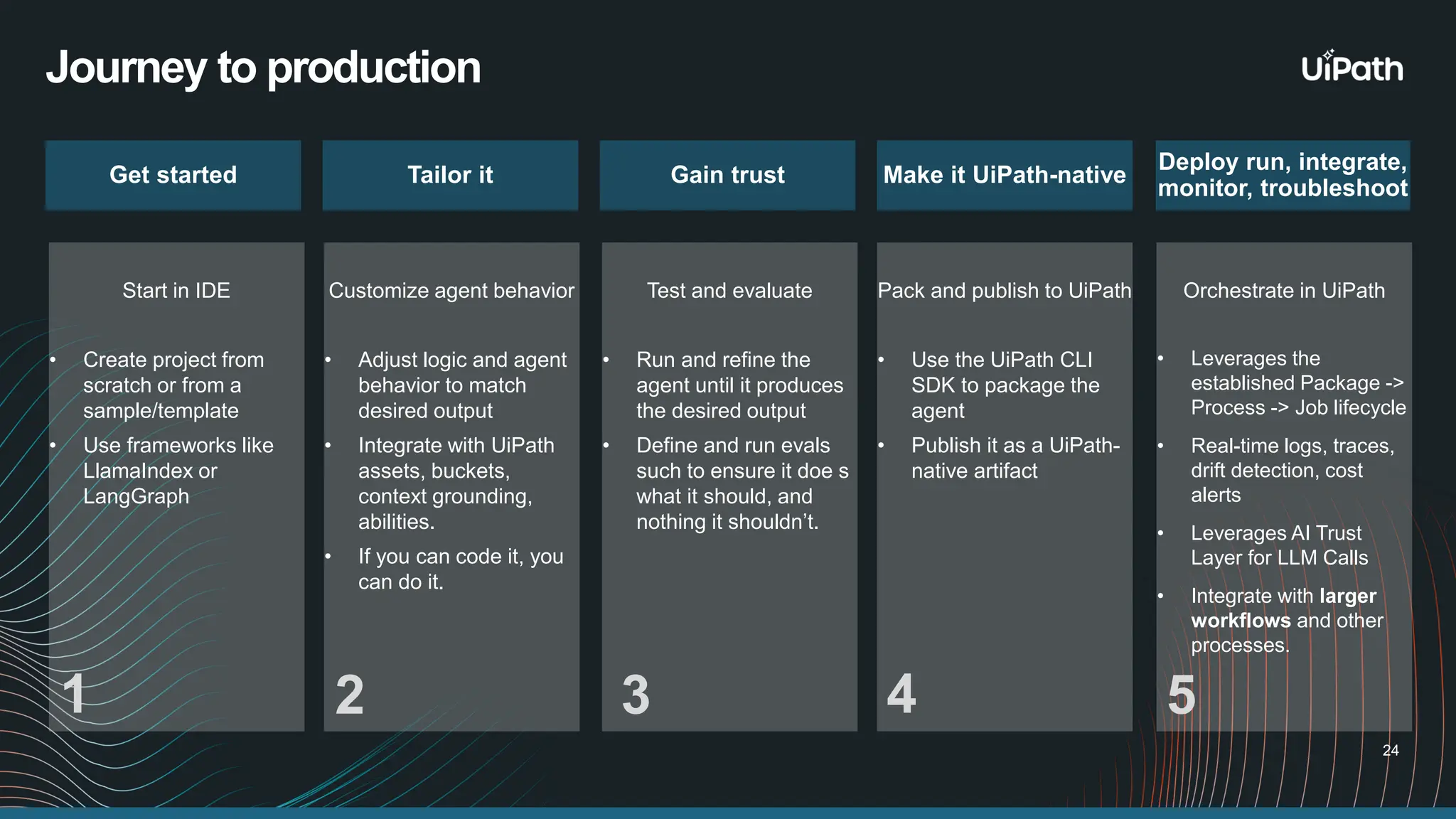
Get started Tailor it Gain trust Make it UiPath-native
Deploy run, integrate,
monitor, troubleshoot
Start in IDE
‱ Create project from
scratch or from a
sample/template
‱ Use frameworks like
LlamaIndex or
LangGraph
24
Customize agent behavior
‱ Adjust logic and agent
behavior to match
desired output
‱ Integrate with UiPath
assets, buckets,
context grounding,
abilities.
‱ If you can code it, you
can do it.
Test and evaluate
‱ Run and refine the
agent until it produces
the desired output
‱ Define and run evals
such to ensure it doe s
what it should, and
nothing it shouldn’t.
Pack and publish to UiPath
‱ Use the UiPath CLI
SDK to package the
agent
‱ Publish it as a UiPath-
native artifact
Orchestrate in UiPath
‱ Leverages the
established Package ->
Process -> Job lifecycle ​
‱ Real-time logs, traces,
drift detection, cost
alerts​
‱ Leverages AI Trust
Layer for LLM Calls​
‱ Integrate with larger
workflows and other
processes.
Journey to production
1 2 3 4
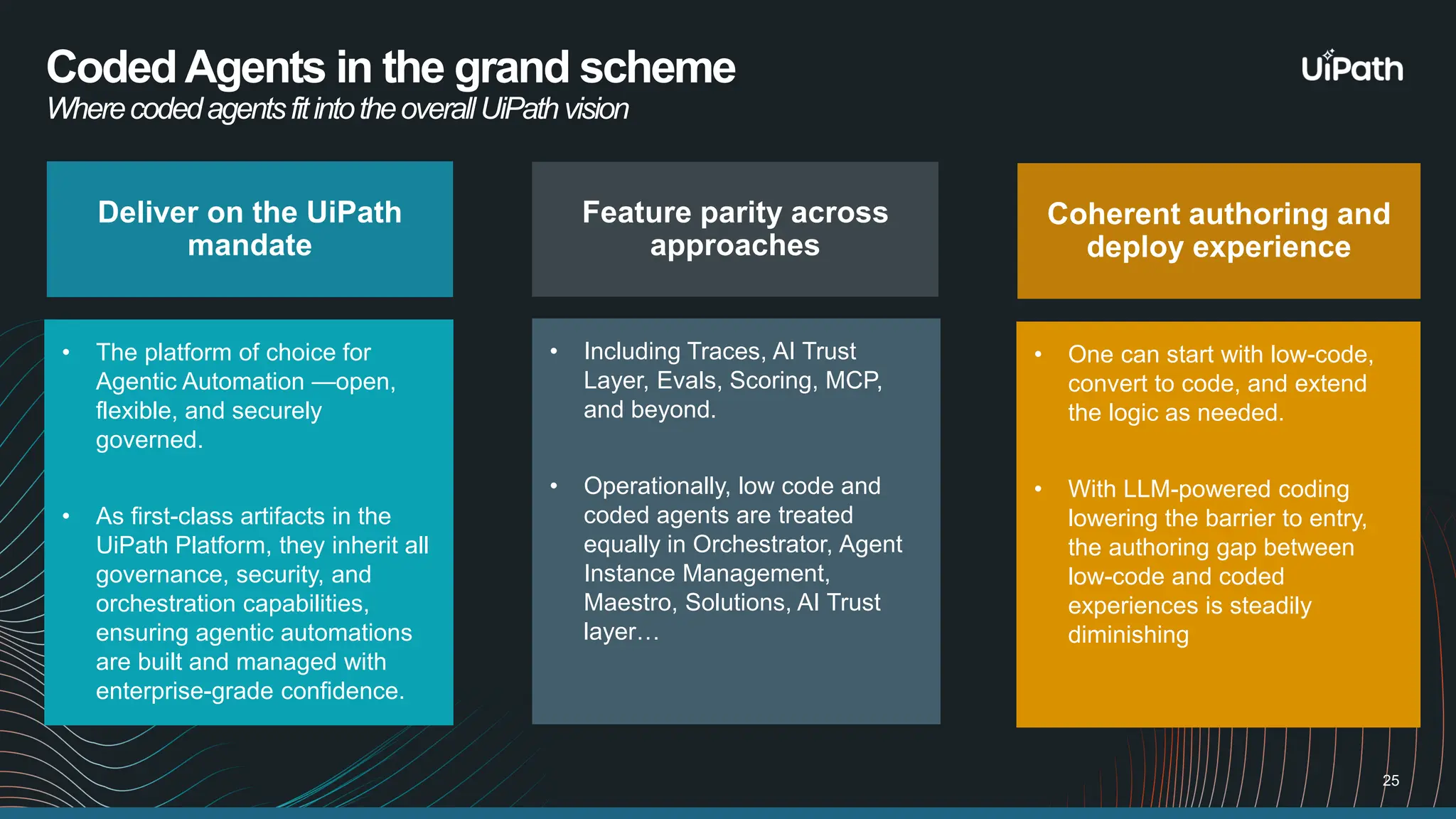
CodedAgents in the grand scheme
WherecodedagentsfitintotheoverallUiPathvision
Deliver on the UiPath
mandate
‱ The platform of choice for
Agentic Automation —open,
flexible, and securely
governed.
‱ As first-class artifacts in the
UiPath Platform, they inherit all
governance, security, and
orchestration capabilities,
ensuring agentic automations
are built and managed with
enterprise-grade confidence.
Feature parity across
approaches
‱ Including Traces, AI Trust
Layer, Evals, Scoring, MCP,
and beyond.
‱ Operationally, low code and
coded agents are treated
equally in Orchestrator, Agent
Instance Management,
Maestro, Solutions, AI Trust
layer

Coherent authoring and
deploy experience
‱ One can start with low-code,
convert to code, and extend
the logic as needed.
‱ With LLM-powered coding
lowering the barrier to entry,
the authoring gap between
low-code and coded
experiences is steadily
diminishing
25
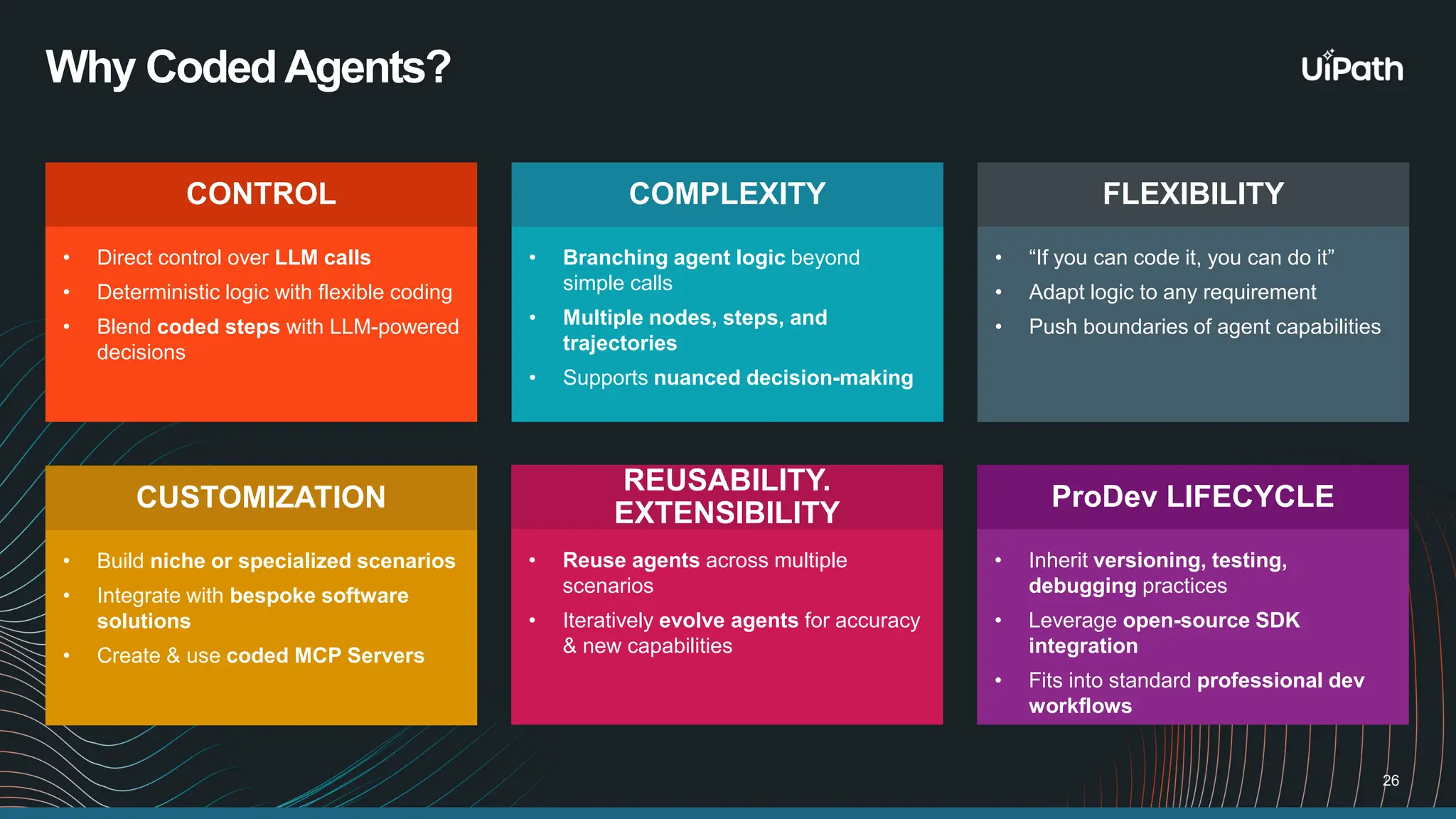
Why CodedAgents?
26
CONTROL
‱ Direct control over LLM calls
‱ Deterministic logic with flexible coding
‱ Blend coded steps with LLM-powered
decisions
FLEXIBILITY
‱ “If you can code it, you can do it”
‱ Adapt logic to any requirement
‱ Push boundaries of agent capabilities
COMPLEXITY
‱ Branching agent logic beyond
simple calls
‱ Multiple nodes, steps, and
trajectories
‱ Supports nuanced decision-making
ProDev LIFECYCLE
‱ Inherit versioning, testing,
debugging practices
‱ Leverage open-source SDK
integration
‱ Fits into standard professional dev
workflows
REUSABILITY.
EXTENSIBILITY
‱ Reuse agents across multiple
scenarios
‱ Iteratively evolve agents for accuracy
& new capabilities
CUSTOMIZATION
‱ Build niche or specialized scenarios
‱ Integrate with bespoke software
solutions
‱ Create & use coded MCP Servers
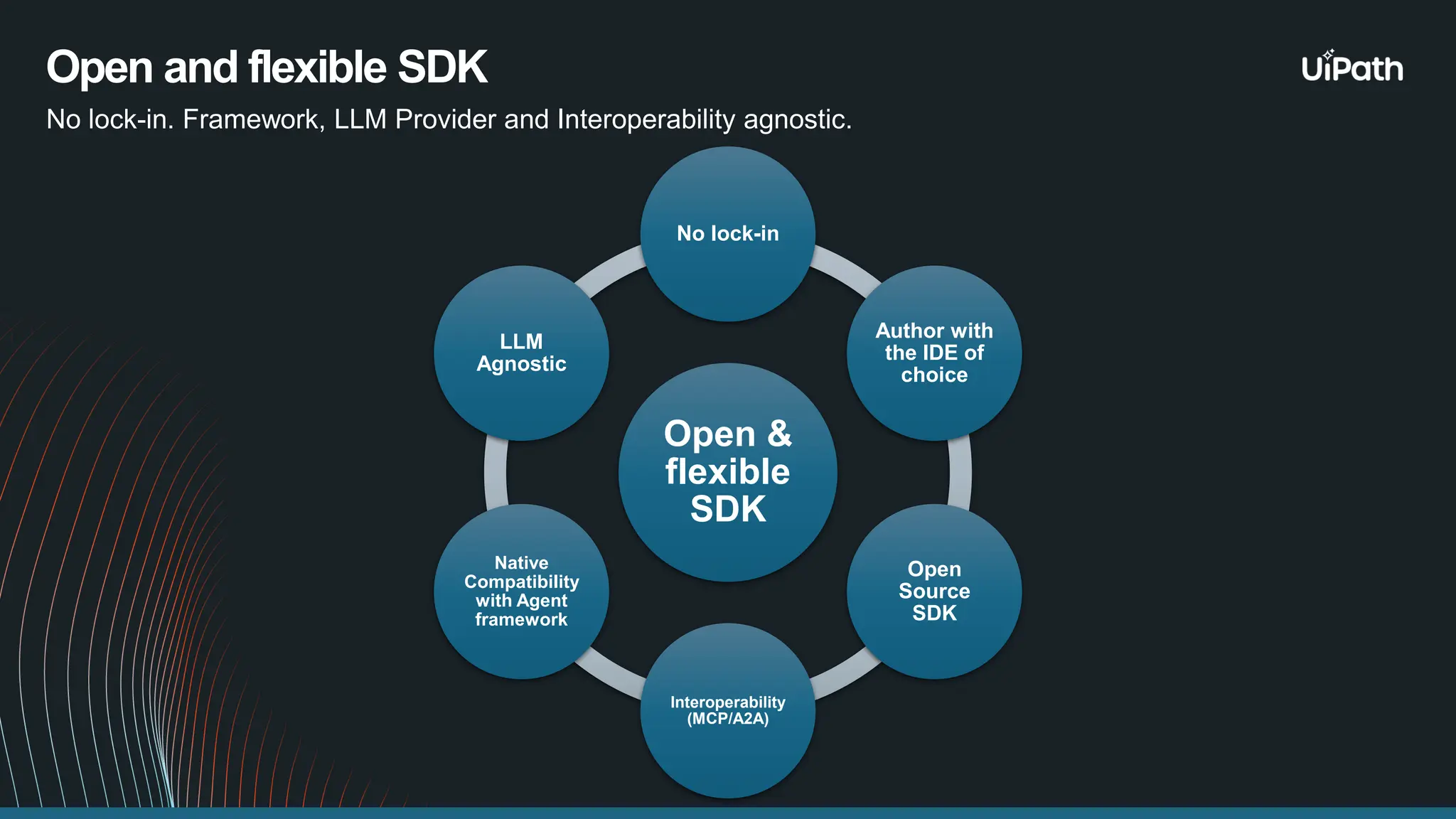
Open and flexible SDK
Open &
flexible
SDK
No lock-in
Author with
the IDE of
choice
Open
Source
SDK
Interoperability
(MCP/A2A)
Native
Compatibility
with Agent
framework
LLM
Agnostic
No lock-in. Framework, LLM Provider and Interoperability agnostic.
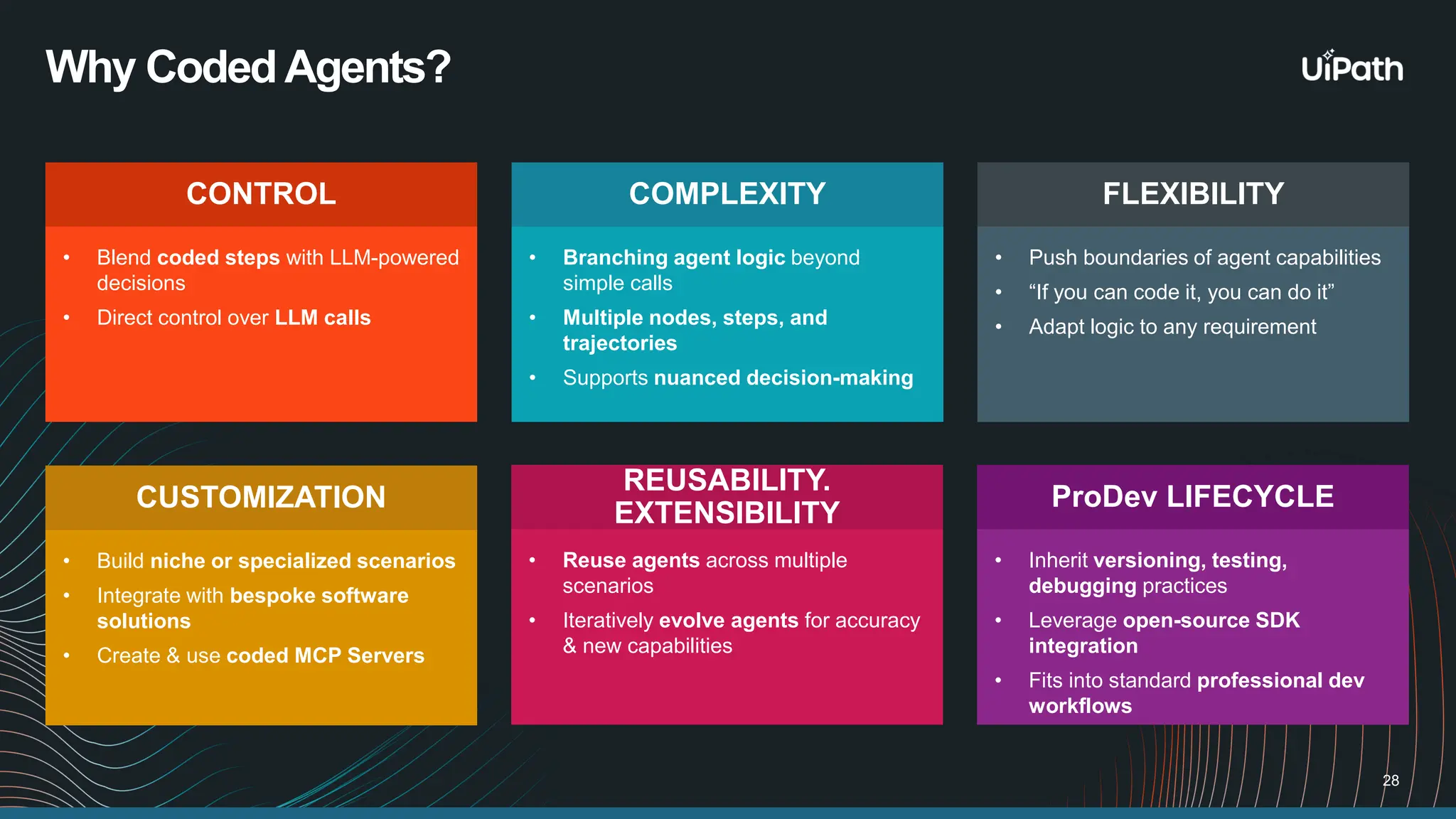
Why CodedAgents?
28
CONTROL
‱ Blend coded steps with LLM-powered
decisions
‱ Direct control over LLM calls
FLEXIBILITY
‱ Push boundaries of agent capabilities
‱ “If you can code it, you can do it”
‱ Adapt logic to any requirement
COMPLEXITY
‱ Branching agent logic beyond
simple calls
‱ Multiple nodes, steps, and
trajectories
‱ Supports nuanced decision-making
ProDev LIFECYCLE
‱ Inherit versioning, testing,
debugging practices
‱ Leverage open-source SDK
integration
‱ Fits into standard professional dev
workflows
REUSABILITY.
EXTENSIBILITY
‱ Reuse agents across multiple
scenarios
‱ Iteratively evolve agents for accuracy
& new capabilities
CUSTOMIZATION
‱ Build niche or specialized scenarios
‱ Integrate with bespoke software
solutions
‱ Create & use coded MCP Servers
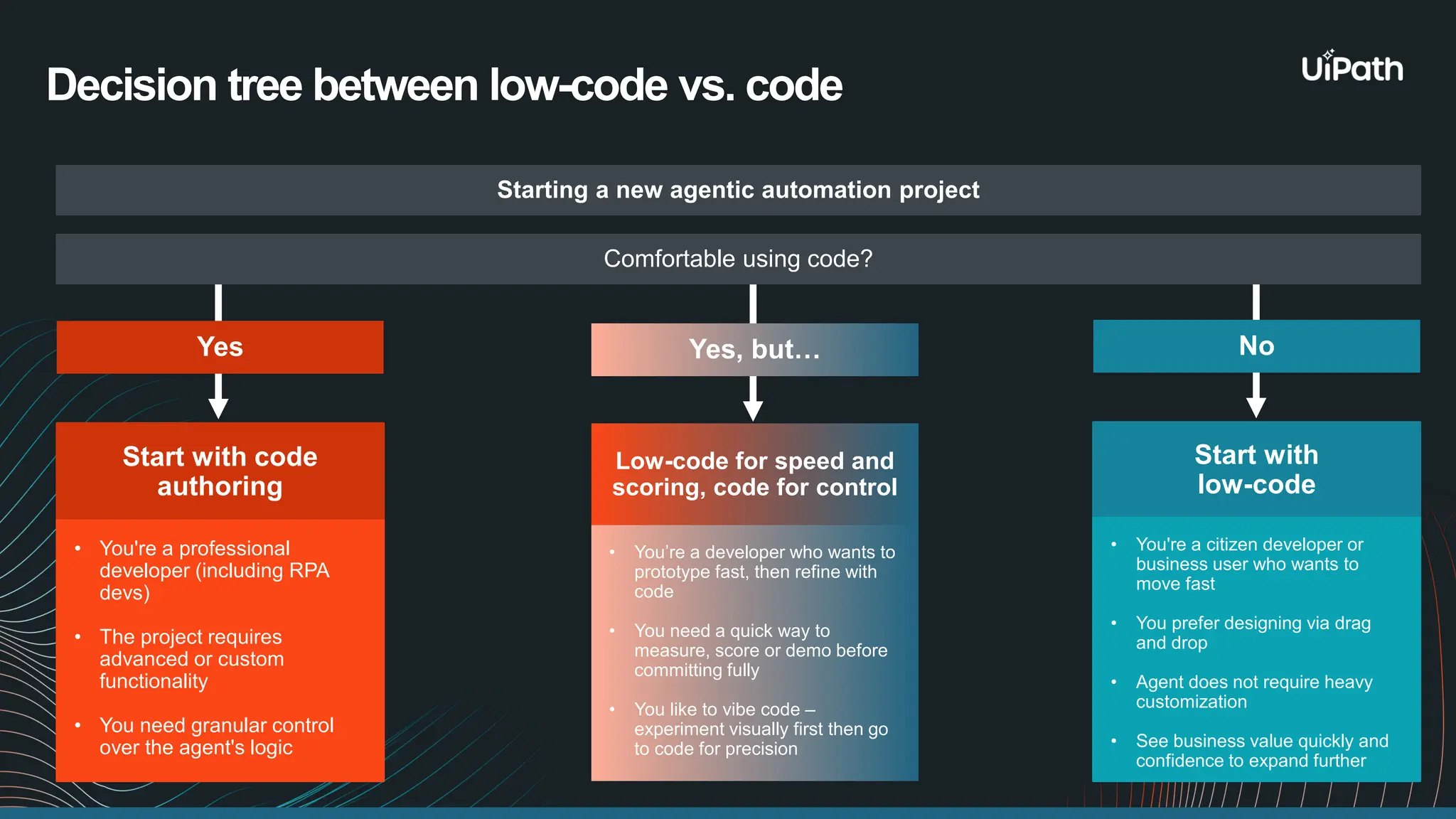
Decision tree between low-code vs. code
Comfortable using code?
Start with
low-code
‱ You're a citizen developer or
business user who wants to
move fast
‱ You prefer designing via drag
and drop
‱ Agent does not require heavy
customization
‱ See business value quickly and
confidence to expand further
Start with code
authoring
‱ You're a professional
developer (including RPA
devs)
‱ The project requires
advanced or custom
functionality
‱ You need granular control
over the agent's logic
Low-code for speed and
scoring, code for control
‱ You’re a developer who wants to
prototype fast, then refine with
code
‱ You need a quick way to
measure, score or demo before
committing fully
‱ You like to vibe code –
experiment visually first then go
to code for precision
Starting a new agentic automation project
No
Yes Yes, but

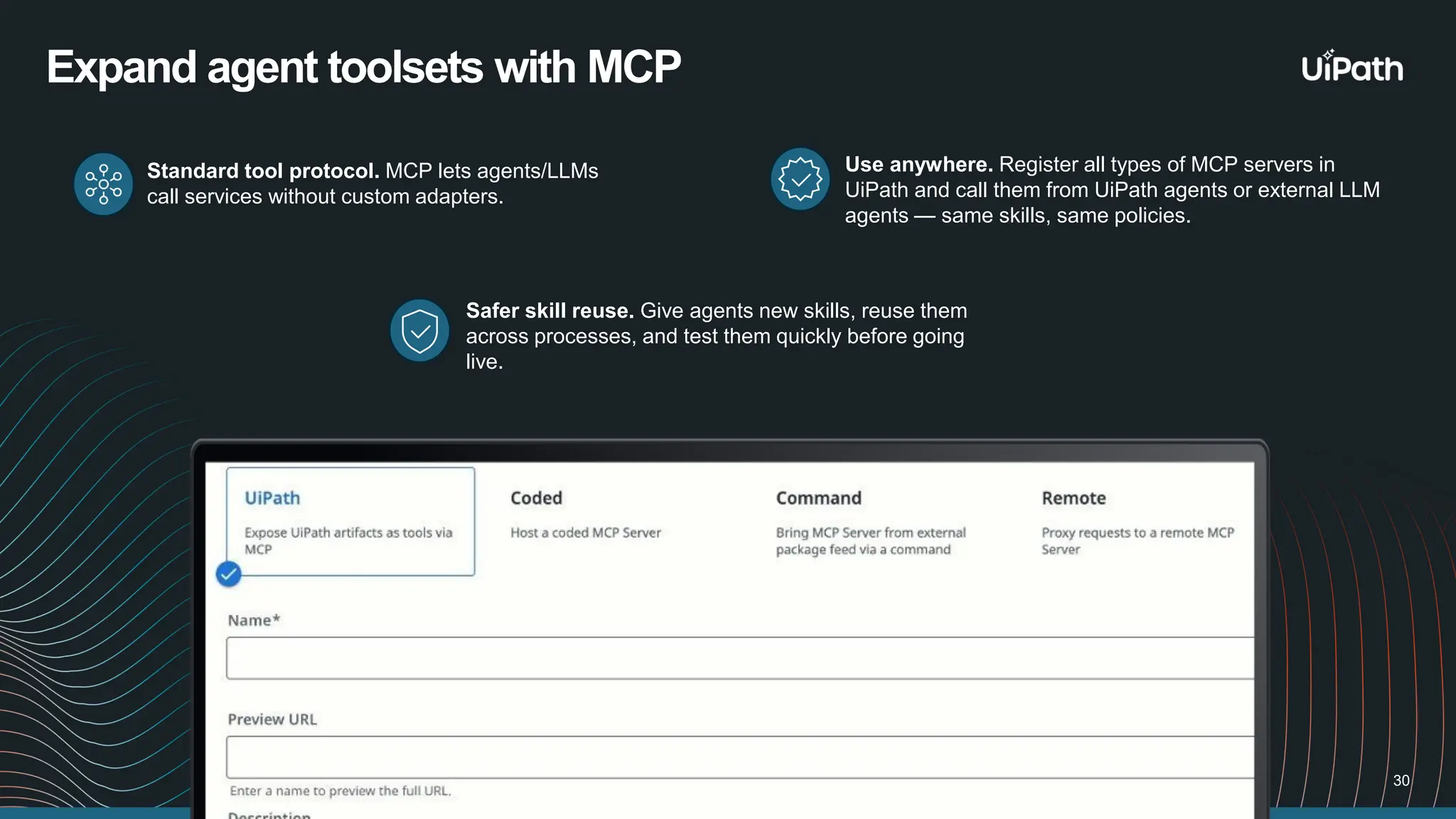
Use anywhere. Register all types of MCP servers in
UiPath and call them from UiPath agents or external LLM
agents — same skills, same policies.
30
Expand agent toolsets with MCP
Safer skill reuse. Give agents new skills, reuse them
across processes, and test them quickly before going
live.
Standard tool protocol. MCP lets agents/LLMs
call services without custom adapters.
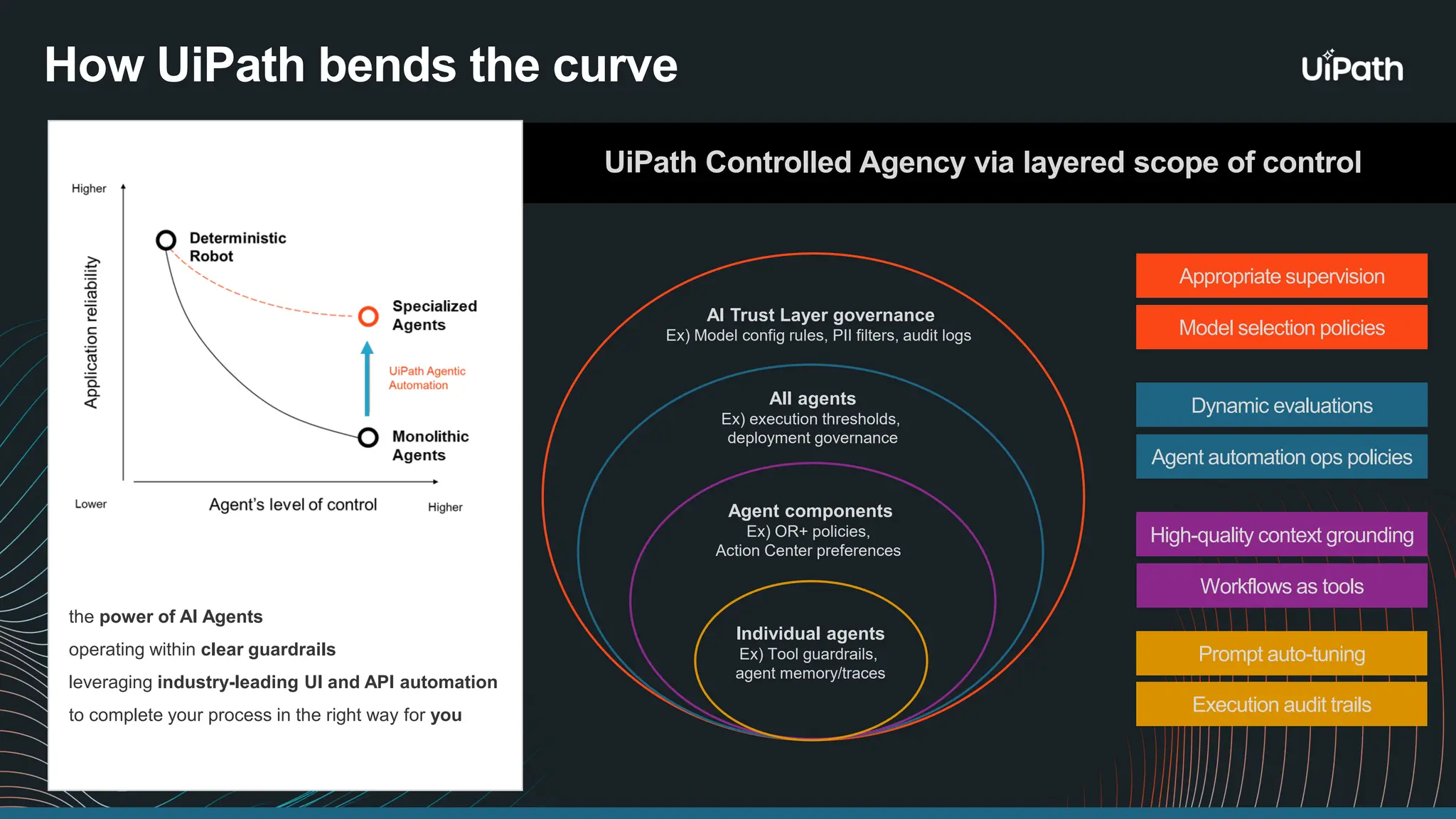
UiPath Controlled Agency via layered scope of control
How UiPath bends the curve
the power of AI Agents
operating within clear guardrails
leveraging industry-leading UI and API automation
to complete your process in the right way for you
Appropriate supervision
AI Trust Layer governance
Ex) Model config rules, PII filters, audit logs
All agents
Ex) execution thresholds,
deployment governance
Agent components
Ex) OR+ policies,
Action Center preferences
Individual agents
Ex) Tool guardrails,
agent memory/traces
Model selection policies
Dynamic evaluations
Agent automation ops policies
High-quality context grounding
Workflows as tools
Prompt auto-tuning
Execution audit trails
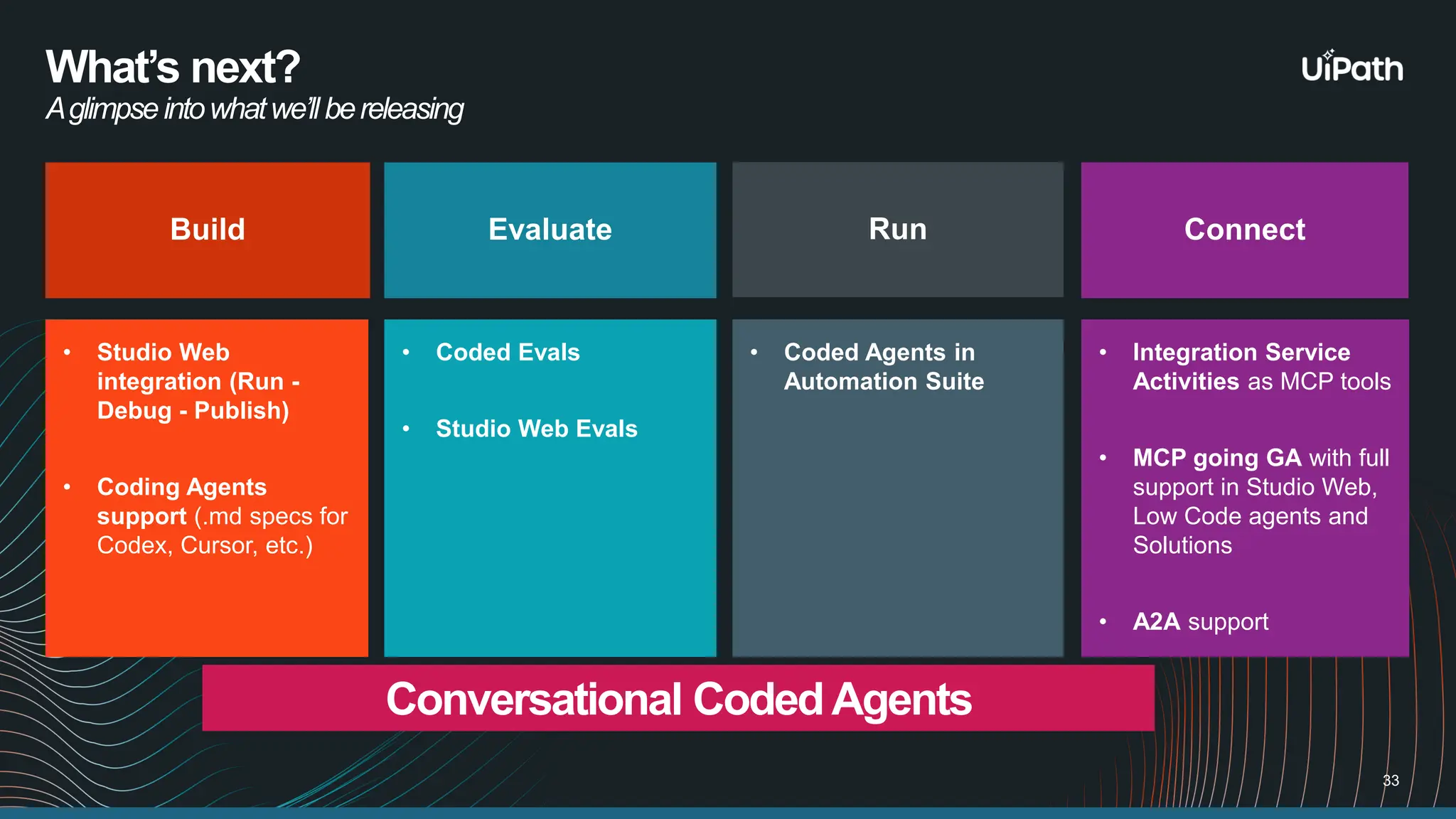
What’s next?
Aglimpseintowhatwe’llbereleasing
Build
‱ Studio Web
integration (Run -
Debug - Publish)
‱ Coding Agents
support (.md specs for
Codex, Cursor, etc.)
Evaluate
‱ Coded Evals
‱ Studio Web Evals
Run
‱ Coded Agents in
Automation Suite
Connect
‱ Integration Service
Activities as MCP tools
‱ MCP going GA with full
support in Studio Web,
Low Code agents and
Solutions
‱ A2A support
33
Conversational CodedAgents
Let’s build!
Ready?
Q&A
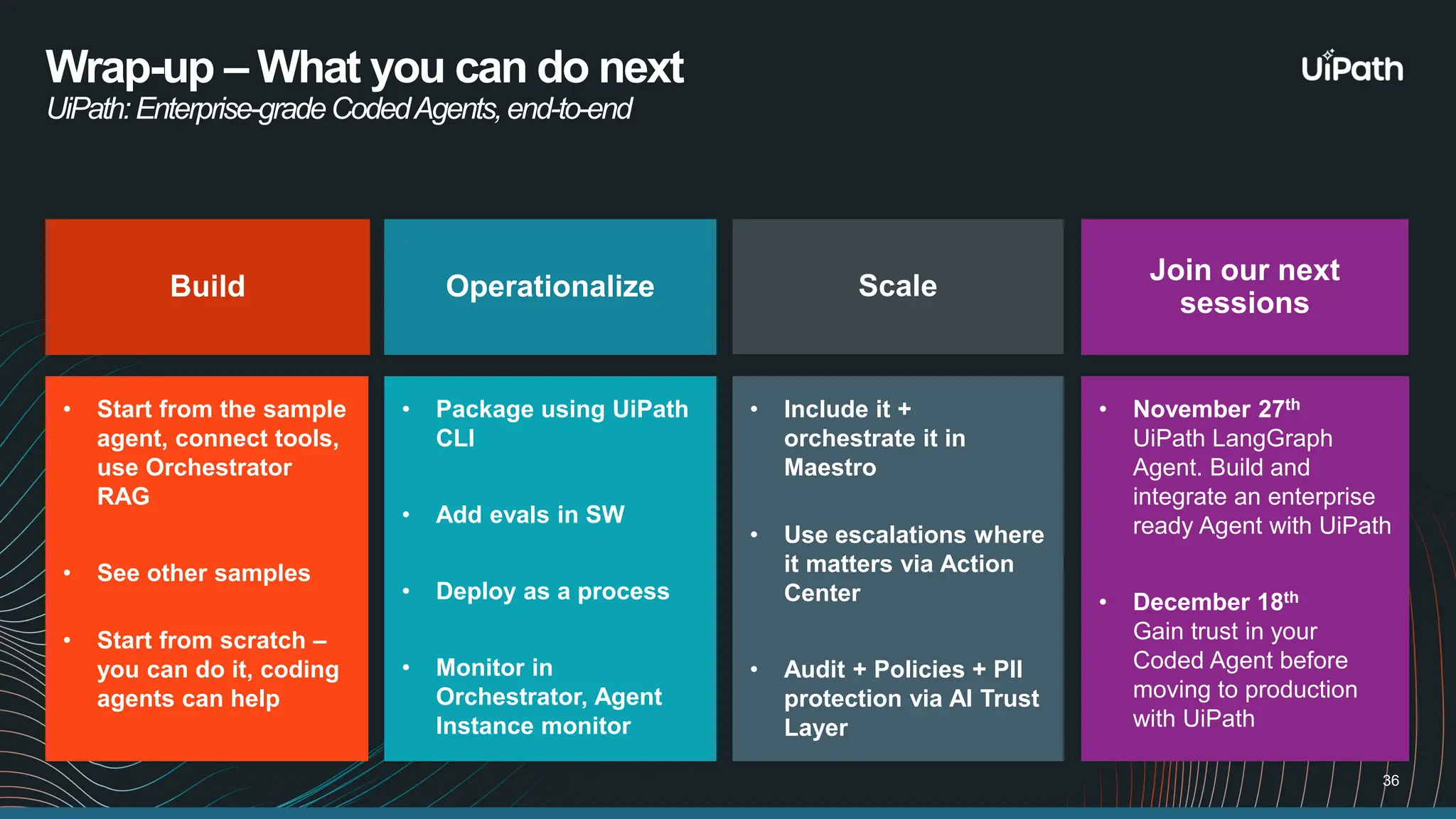
Wrap-up – What you can do next
UiPath:Enterprise-gradeCodedAgents,end-to-end
Build
‱ Start from the sample
agent, connect tools,
use Orchestrator
RAG
‱ See other samples
‱ Start from scratch –
you can do it, coding
agents can help
Operationalize
‱ Package using UiPath
CLI
‱ Add evals in SW
‱ Deploy as a process
‱ Monitor in
Orchestrator, Agent
Instance monitor
Scale
‱ Include it +
orchestrate it in
Maestro
‱ Use escalations where
it matters via Action
Center
‱ Audit + Policies + PII
protection via AI Trust
Layer
Join our next
sessions
‱ November 27th
UiPath LangGraph
Agent. Build and
integrate an enterprise
ready Agent with UiPath
‱ December 18th
Gain trust in your
Coded Agent before
moving to production
with UiPath
36
Thank
You.

and see you in the next UiPath Community
sessions!!!

Agentic Intro and Hands-on: Build your first Coded Agent

  • 1.
  • 2.
    2 Statements we makein this presentation may include statements which are not historical facts and are considered forward-looking within the meaning of the Private Securities Litigation Reform Act of 1995, which are usually identified by the use of words such as “anticipates,” “believes,” “estimates,” “expects,” “intends,” “may,” “plans,” “possible,” “projects,” “outlook,” “seeks,” “should,” “will,” and variations of such words or similar expressions, including the negatives of these words or similar expressions. We intend these forward-looking statements to be covered by the safe harbor provisions for forward-looking statements contained in Section 27A of the Securities Act of 1933, as amended, and Section 21E of the Securities Exchange Act of 1934, as amended, and are making this statement for purposes of complying with those safe harbor provisions. These forward-looking statements include, but are not limited to, statements regarding: our ability to drive and accelerate future growth and operational efficiency and grow our platform, product offerings, and market opportunity; our business strategy; plans and objectives of management for future operations; the estimated addressable market opportunity for our platform and the growth of the enterprise automation market; the success of our platform and new releases including the incorporation of AI; the success of our collaborations with third parties; our customers’ behaviors and potential automation spend; and details of UiPath’s stock repurchase program. Forward-looking statements involve known and unknown risks, uncertainties, and other factors that may cause our actual results, performance, or achievements to be materially different from any future results, performance, or achievements expressed or implied by the forward-looking statements. These risks include, but are not limited to, risks and uncertainties related to: our expectations regarding our revenue, annualized renewal run-rate (ARR), expenses, and other operating results; our ability to effectively manage our growth and achieve or sustain profitability; our ability to acquire new customers and successfully retain existing customers; the ability of the UiPath Platform to satisfy and adapt to customer demands and our ability to increase its adoption; our ability to grow our platform and release new functionality in a timely manner; future investments in our business, our anticipated capital expenditures, and our estimates regarding our capital requirements; the costs and success of our marketing efforts and our ability to evolve and enhance our brand; our growth strategies; the estimated addressable market opportunity for our platform and for automation in general; our reliance on key personnel and our ability to attract, integrate, and retain highly-qualified personnel and execute management transitions; our ability to obtain, maintain, and enforce our intellectual property rights and any costs associated therewith; the effect of significant events with macroeconomic impacts, including but not limited to military conflicts and other changes in geopolitical relationships and inflationary cost trends, on our business, industry, and the global economy; our reliance on third-party providers of cloud-based infrastructure; our ability to compete effectively with existing competitors and new market entrants, including new, potentially disruptive technologies; the size and growth rates of the markets in which we compete; and the price volatility of our Class A common stock. Further information on risks that could cause actual results to differ materially from our guidance and other forward-looking statements can be found in our Annual Report on Form 10-K for the fiscal year ended January 31, 2025 filed with the United States Securities and Exchange Commission (SEC), in our Quarterly Reports on Form 10-Q filed with the SEC, and in other filings and reports that we may file from time to time with the SEC. Any forward-looking statements contained in this presentation are based on assumptions that we believe to be reasonable as of this date. Except as required by law, we assume no obligation to update these forward-looking statements. Our fiscal year end is January 31, and our fiscal quarters end on April 30, July 31, and October 31. All third-party trademarks, including names, logos and brands, referenced by us in this presentation are property of their respective owners. All references to third-party trademarks are for identification purposes only. Such use should not be construed as an endorsement of the products or services of us. Safe Harbor
  • 3.
  • 4.
    Community in ayear 1M+ learning completions on Academy 5M Forum pageviews every month; 400+ use cases, use cases and tutorials created by community; 360 MVPs, champions and experts ready to help; 500+ developer meetups across 86 countries The cohesive and friendly-environment of the community allow all to share knowledge and support each other to learn from one another. This diverse and open connection within the community is unbeatable. Alp Uguray – Solutions at Ashling Partners and UiPath MVP for 5 years in a row
  • 5.
  • 6.
  • 7.
    UiPath Insider Program Asan Insider, you get access to early builds of new features and updates—an exclusive opportunity to give feedback on our latest innovations. UiPath Community Blog
  • 8.
    The UiPath MostValuable Professional (MVP) Award is our way of recognizing passionate automation experts who go above and beyond, not just with their UiPath skills, but also in how they support others. More than tech experts, they’re mentors, leaders, and changemakers in the UiPath Community. UiPath Most Valuable Professionals Every year, we welcome a new group of MVPs from around the world, selected for their meaningful contributions and impact. 15 Oct – 20 Nov 2025 Applications open
  • 9.
  • 10.
    Build your first CodedAgent The UiPath word mark, logos, and robots are registered trademarks owned by UiPath, Inc. and its affiliates. UiPath (R) is a registered trademark in the United States and several countries across the globe. See TMEP 906. ©2025 UiPath. All rights reserved. Enterprise grade Agents with UiPath
  • 11.
    11 Change has neverbeen this fast . And yet it will never be this slow again. of CxOs believe GenAI will be transformative for their company ACCENTURE 97% of execs say fewer than 30% of initiatives will scale in the next 6 months 67% DELOITTE of execs say that AI/ML is driving revenue growth and gross margins now 25% BCG
  • 12.
  • 13.
    13 Process is thelifeblood of any organization Yet every process has its challenges Poor experiences Insufficient throughput Process delays Error-prone Siloed data & lack of visibility Resolution & close Cross-team collaboration Ingestion & triage Complex data inputs Research & analysis Cognitive work Data entry Rote, manual steps Approved? Rework loop Index and review documents Data lookup & validation Research similar cases Submit approval Update system Analyze & review Email
  • 14.
    You have options
 Butthe power is in the whole, not the parts. OPTION 1: POINT SOLUTIONS OPTION 2: ENTERPRISE-GRADE AGENTIC AUTOMATION â–Ș Longer time-to-market â–Ș Increased TCO â–Ș Fragmented visibility App-specific automation CRM workflow Custom Code Python Agent In-app configuration Home-grown App â–Ș Unified platform â–Ș Enterprise governance & security â–Ș End-to-end agentic automation Observability & Governance Code-tracing, Centralized Logging, Dashboarding Triage email Index & review documents Research similar cases Review Update system UiPath end-to-end orchestrated process “It’s about how the pieces fit together, not the pieces themselves. The challenge lies in orchestrating the range of interactions and integrations at scale. Each use case often needs to access multiple models, vector databases, prompt libraries, and applications.”
  • 15.
    15 There’s a solutionto every challenge Agentic AI Human-in-the-loop Robotic Process Automation (RPA) Intelligent Document Processing (IDP) Resolution & close Cross-team collaboration Ingestion & triage Complex data inputs Research & analysis Cognitive work Data entry Rote, manual steps Approved? Rework loop Index and review documents Data lookup & validation Research similar cases Submit approval Update system Analyze & review Email AGENTICORCHESTRATION
  • 16.
    UiPath journey toagentic automation 2018 RPA Computer Vision API Integration Low- code Apps Orchestration Governance Cloud Process Discovery Analytics Continuous Testing Intelligent Document & Communication Processing GenAI Automation UiPath LLMs UiPath GenAI Activities 2020 2022 2023 2024 2025 Agents Robots People HUMAN-IN-THE-LOOP (HITL) INTELLIGENT DOCUMENT PROCESSING (IDP) AGENTIC AI Email Index and review documents Data lookup & validation Research similar cases Update system Analyze & review Submit approval Approved? Rework loop Email Index and review documents Research similar cases Update system Analyze & review Submit approval ROBOTIC PROCESS AUTOMATION (RPA) END-TO-END PROCESS ORCHESTRATION AND AUTOMATION Email Index and review documents Research similar cases Update system Analyze & review Submit approval Approved? Rework loop Email Index and review documents Data lookup & validation Research similar cases Update system Analyze & review Submit approval Research similar cases
  • 17.
  • 18.
    Until recently, you’vefocused on orchestrating robots and people. ARE YOU READY TO ADD AI AGENTS TO THE MIX?
  • 19.
    Enterprise Agents Trustworthy AI agents thatact independently and make dynamic decisions Agents think. Robots do. People lead.
  • 20.
    Tools Automations APIs Other Agents Escalation HITL Conversational Context Enterprise Knowledge Documentation Refinement Execution Planning Prompts Models End Tools Automations APIs Agents Escalation HITL Conversational Context Enterprise Knowledge Documentation Refinement Execution Planning Prompts Models End Start Agents ‱ Autonomous,Conversational ‱ Tools, including MCP, multiple integrations via Integration Service apps ‱ Contexts (RAG, DeepRAG) ‱ Escalations (via Action Center) Security and Reliability ‱ Guardrails ‱ Evals ‱ Agent score ‱ Autopilot ‱ AI Trust Layer ‱ Maestro – Agentic Orchestration
  • 21.
    Need to superchargethe agents with full coding control and flexibility?
  • 22.
  • 23.
    Coded agents overview 23 Whatis it? Code fully integrated as an Agent Process in UiPath How does it work? ‱ Native compatibility with agent framework (LangChain, LlamaIndex) ‱ Integrated via the UiPath Python SDK to access platform services such as assets, buckets, context grounding, and the LLM Gateway ‱ Packaged and published using the CLI as a native UiPath Package, then deployed as a governed, secure Process on the UiPath Platform Pack and publish using UiPath CLI UiPath assets, context grounding, LLM Gateway via UiPath Python SDK
  • 24.
    5 Get started Tailorit Gain trust Make it UiPath-native Deploy run, integrate, monitor, troubleshoot Start in IDE ‱ Create project from scratch or from a sample/template ‱ Use frameworks like LlamaIndex or LangGraph 24 Customize agent behavior ‱ Adjust logic and agent behavior to match desired output ‱ Integrate with UiPath assets, buckets, context grounding, abilities. ‱ If you can code it, you can do it. Test and evaluate ‱ Run and refine the agent until it produces the desired output ‱ Define and run evals such to ensure it doe s what it should, and nothing it shouldn’t. Pack and publish to UiPath ‱ Use the UiPath CLI SDK to package the agent ‱ Publish it as a UiPath- native artifact Orchestrate in UiPath ‱ Leverages the established Package -> Process -> Job lifecycle ​ ‱ Real-time logs, traces, drift detection, cost alerts​ ‱ Leverages AI Trust Layer for LLM Calls​ ‱ Integrate with larger workflows and other processes. Journey to production 1 2 3 4
  • 25.
    CodedAgents in thegrand scheme WherecodedagentsfitintotheoverallUiPathvision Deliver on the UiPath mandate ‱ The platform of choice for Agentic Automation —open, flexible, and securely governed. ‱ As first-class artifacts in the UiPath Platform, they inherit all governance, security, and orchestration capabilities, ensuring agentic automations are built and managed with enterprise-grade confidence. Feature parity across approaches ‱ Including Traces, AI Trust Layer, Evals, Scoring, MCP, and beyond. ‱ Operationally, low code and coded agents are treated equally in Orchestrator, Agent Instance Management, Maestro, Solutions, AI Trust layer
 Coherent authoring and deploy experience ‱ One can start with low-code, convert to code, and extend the logic as needed. ‱ With LLM-powered coding lowering the barrier to entry, the authoring gap between low-code and coded experiences is steadily diminishing 25
  • 26.
    Why CodedAgents? 26 CONTROL ‱ Directcontrol over LLM calls ‱ Deterministic logic with flexible coding ‱ Blend coded steps with LLM-powered decisions FLEXIBILITY ‱ “If you can code it, you can do it” ‱ Adapt logic to any requirement ‱ Push boundaries of agent capabilities COMPLEXITY ‱ Branching agent logic beyond simple calls ‱ Multiple nodes, steps, and trajectories ‱ Supports nuanced decision-making ProDev LIFECYCLE ‱ Inherit versioning, testing, debugging practices ‱ Leverage open-source SDK integration ‱ Fits into standard professional dev workflows REUSABILITY. EXTENSIBILITY ‱ Reuse agents across multiple scenarios ‱ Iteratively evolve agents for accuracy & new capabilities CUSTOMIZATION ‱ Build niche or specialized scenarios ‱ Integrate with bespoke software solutions ‱ Create & use coded MCP Servers
  • 27.
    Open and flexibleSDK Open & flexible SDK No lock-in Author with the IDE of choice Open Source SDK Interoperability (MCP/A2A) Native Compatibility with Agent framework LLM Agnostic No lock-in. Framework, LLM Provider and Interoperability agnostic.
  • 28.
    Why CodedAgents? 28 CONTROL ‱ Blendcoded steps with LLM-powered decisions ‱ Direct control over LLM calls FLEXIBILITY ‱ Push boundaries of agent capabilities ‱ “If you can code it, you can do it” ‱ Adapt logic to any requirement COMPLEXITY ‱ Branching agent logic beyond simple calls ‱ Multiple nodes, steps, and trajectories ‱ Supports nuanced decision-making ProDev LIFECYCLE ‱ Inherit versioning, testing, debugging practices ‱ Leverage open-source SDK integration ‱ Fits into standard professional dev workflows REUSABILITY. EXTENSIBILITY ‱ Reuse agents across multiple scenarios ‱ Iteratively evolve agents for accuracy & new capabilities CUSTOMIZATION ‱ Build niche or specialized scenarios ‱ Integrate with bespoke software solutions ‱ Create & use coded MCP Servers
  • 29.
    Decision tree betweenlow-code vs. code Comfortable using code? Start with low-code ‱ You're a citizen developer or business user who wants to move fast ‱ You prefer designing via drag and drop ‱ Agent does not require heavy customization ‱ See business value quickly and confidence to expand further Start with code authoring ‱ You're a professional developer (including RPA devs) ‱ The project requires advanced or custom functionality ‱ You need granular control over the agent's logic Low-code for speed and scoring, code for control ‱ You’re a developer who wants to prototype fast, then refine with code ‱ You need a quick way to measure, score or demo before committing fully ‱ You like to vibe code – experiment visually first then go to code for precision Starting a new agentic automation project No Yes Yes, but

  • 30.
    Use anywhere. Registerall types of MCP servers in UiPath and call them from UiPath agents or external LLM agents — same skills, same policies. 30 Expand agent toolsets with MCP Safer skill reuse. Give agents new skills, reuse them across processes, and test them quickly before going live. Standard tool protocol. MCP lets agents/LLMs call services without custom adapters.
  • 32.
    UiPath Controlled Agencyvia layered scope of control How UiPath bends the curve the power of AI Agents operating within clear guardrails leveraging industry-leading UI and API automation to complete your process in the right way for you Appropriate supervision AI Trust Layer governance Ex) Model config rules, PII filters, audit logs All agents Ex) execution thresholds, deployment governance Agent components Ex) OR+ policies, Action Center preferences Individual agents Ex) Tool guardrails, agent memory/traces Model selection policies Dynamic evaluations Agent automation ops policies High-quality context grounding Workflows as tools Prompt auto-tuning Execution audit trails
  • 33.
    What’s next? Aglimpseintowhatwe’llbereleasing Build ‱ StudioWeb integration (Run - Debug - Publish) ‱ Coding Agents support (.md specs for Codex, Cursor, etc.) Evaluate ‱ Coded Evals ‱ Studio Web Evals Run ‱ Coded Agents in Automation Suite Connect ‱ Integration Service Activities as MCP tools ‱ MCP going GA with full support in Studio Web, Low Code agents and Solutions ‱ A2A support 33 Conversational CodedAgents
  • 34.
  • 35.
  • 36.
    Wrap-up – Whatyou can do next UiPath:Enterprise-gradeCodedAgents,end-to-end Build ‱ Start from the sample agent, connect tools, use Orchestrator RAG ‱ See other samples ‱ Start from scratch – you can do it, coding agents can help Operationalize ‱ Package using UiPath CLI ‱ Add evals in SW ‱ Deploy as a process ‱ Monitor in Orchestrator, Agent Instance monitor Scale ‱ Include it + orchestrate it in Maestro ‱ Use escalations where it matters via Action Center ‱ Audit + Policies + PII protection via AI Trust Layer Join our next sessions ‱ November 27th UiPath LangGraph Agent. Build and integrate an enterprise ready Agent with UiPath ‱ December 18th Gain trust in your Coded Agent before moving to production with UiPath 36
  • 37.
    Thank You. 
and see youin the next UiPath Community sessions!!!