Digital Journalism Ethics 2025 materi for Regulation & Ethic Media
1.
Digital Journalism:
Regulation &Ethics
Navigating the intersection of speed, truth, and law in the Indonesian
digital landscape of 2025.
Ade Putranto Prasetyo Wijiharto Tunggali, M.A. C.PR., C.CM
2.
•Context 2025: TheState of Digital Media
•Regulatory Framework: UU ITE, UU Pers, UU PDP
•Ethical Pillars: Verification vs. Speed
•The AI Frontier: Ethics in Automation
•Case Study 1: Deepfakes in Politics
•Case Study 2: Algorithmic Bias
•Case Study 3: Data Privacy Breaches
•Future Outlook: Maintaining Integrity
Presentation Agenda
3.
The Hyper-Connected Reality
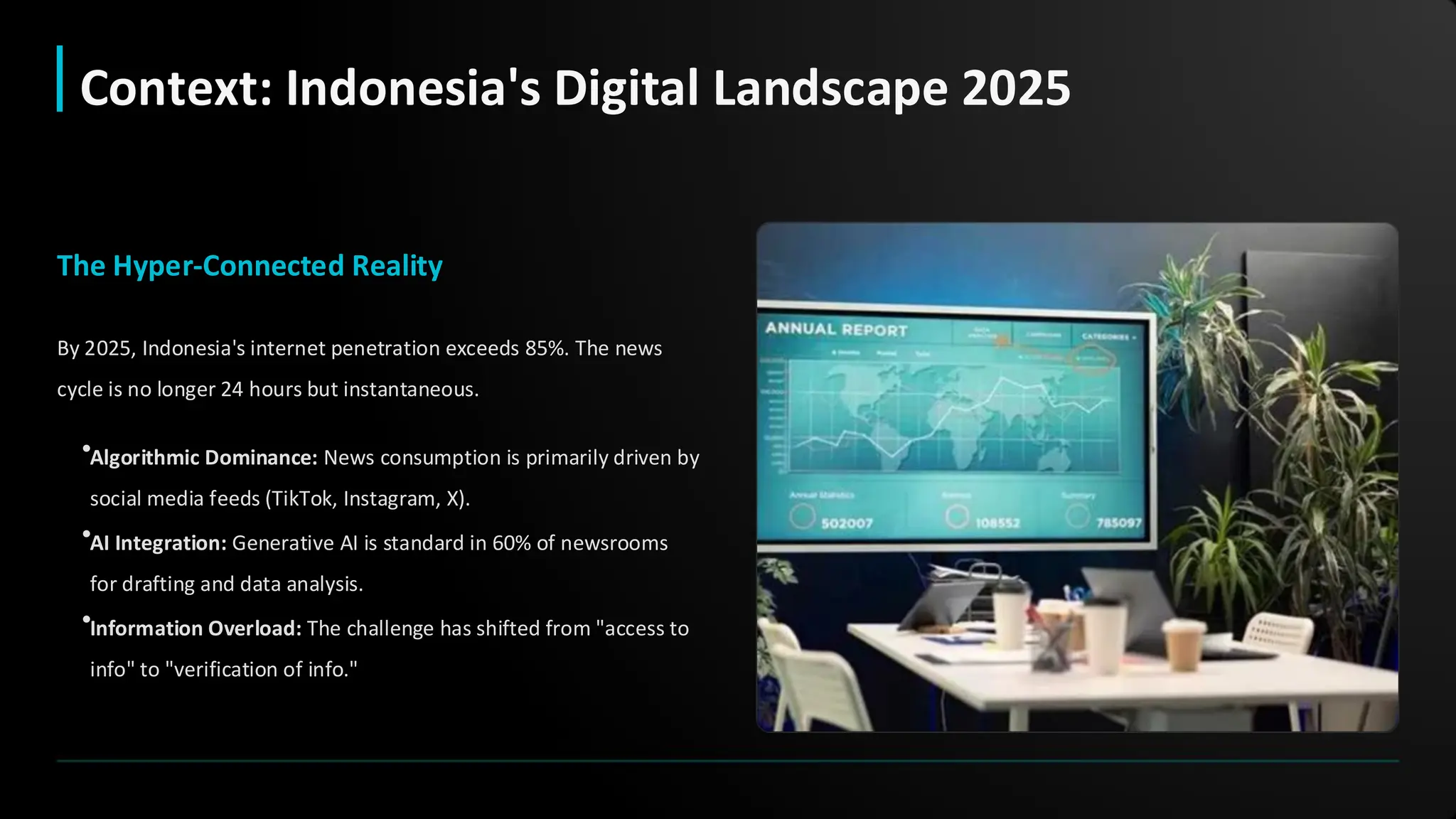
By2025, Indonesia's internet penetration exceeds 85%. The news
cycle is no longer 24 hours but instantaneous.
•Algorithmic Dominance: News consumption is primarily driven by
social media feeds (TikTok, Instagram, X).
•AI Integration: Generative AI is standard in 60% of newsrooms
for drafting and data analysis.
•Information Overload: The challenge has shifted from "access to
info" to "verification of info."
Context: Indonesia's Digital Landscape 2025
4.
Verification First
In anera of deepfakes and AI
hallucinations, verification is the
primary differentiator between
journalism and content creation. "Get
it right, not just first."
Independence
Maintaining editorial independence
from algorithmic pressures and
political owners. Refusing to write
solely for SEO or "rage-bait" clicks.
Humanity
Digital permanence means errors or
privacy violations last forever.
Minimizing harm to subjects,
especially victims of trauma or minors.
Core Pillars of Digital Ethics
5.
UU Pers No.40/1999
The "Lex Specialis" protecting press freedom. It emphasizes self-
regulation via the Press Council but is often challenged by digital
specific laws.
UU ITE (Revisions)
The Information and Electronic Transactions Law remains the
primary instrument for digital conduct. Key articles on defamation
and hate speech continue to pose risks for journalists if reporting
lacks rigorous verification.
Regulatory Framework: The Legal Bedrock
6.
A Critical Updatefor 2025
Fully enforced in 2025, the UU PDP (Undang-Undang Pelindungan
Data Pribadi) transforms investigative journalism.
•Consent is King: Publishing private data (NIK, medical records,
financial data) without consent is a criminal offense.
•Public Interest Exception: Journalists must strictly prove that
revealing any personal data serves a vital public interest, or face
heavy fines.
•Doxing Prohibition: "Doxing" is now legally defined and
punishable, protecting subjects from online mob harassment.
UU PDP: Personal Data Protection
7.
The Trap
Economic survivalin 2025 relies on programmatic ads
driven by views. This incentivizes sensational headlines,
misleading thumbnails, and "rage-farming" content that
sacrifices nuance for engagement.
The Ethical Path
Implementing "Ethical SEO." Headlines must accurately
reflect content. Building a subscription model (reader
revenue) reduces reliance on clicks and allows for higher-
quality, slower journalism.
The "Clickbait" Dilemma
8.
AI in theNewsroom
Automated but Accountable
In 2025, AI writes financial reports and sports summaries.
However, ethical lines are often blurred.
•Transparency: Any AI-generated content must be clearly
labeled for the reader.
•Hallucinations: AI can invent facts. Human oversight is
mandatory before publishing.
•Copyright: Using AI to scrape content from other creators
without credit violates intellectual property ethics.
Case Study 1:Deepfake
Politics
The Scenario
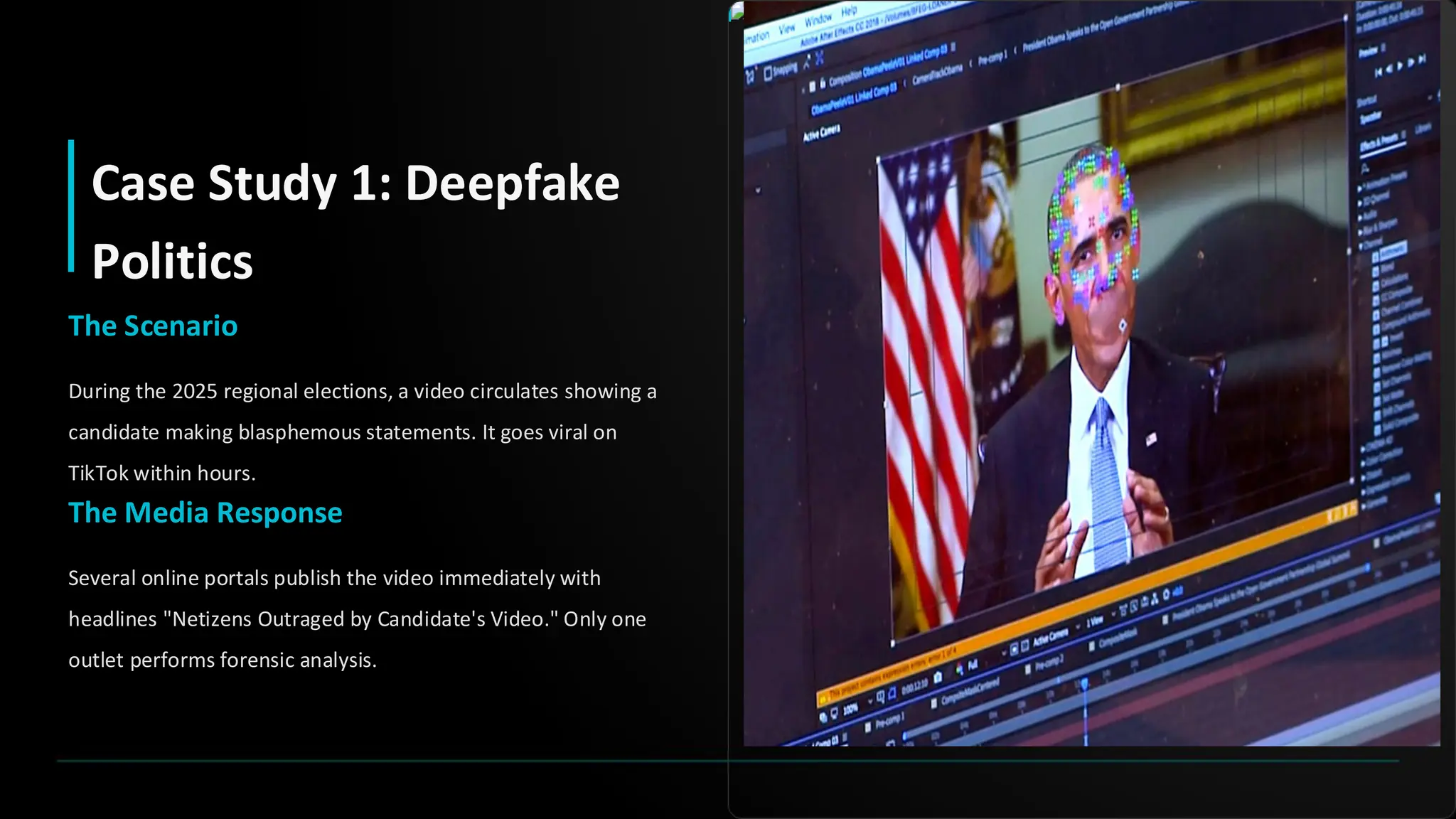
During the 2025 regional elections, a video circulates showing a
candidate making blasphemous statements. It goes viral on
TikTok within hours.
The Media Response
Several online portals publish the video immediately with
headlines "Netizens Outraged by Candidate's Video." Only one
outlet performs forensic analysis.
11.
Ethical Violation
Amplification ofFalsehoods: Media outlets that republished
without verification became complicit in disinformation. They
prioritized speed over truth (KEJ violation).
Regulatory Implication
UU ITE Violation: Spreading electronic information that
incites hatred (SARA) is punishable. Even if quoting
"netizens," the media entity bears responsibility for
dissemination.
Analysis: Deepfake Politics
12.
Case Study 2:Algorithmic
Bias
The Scenario
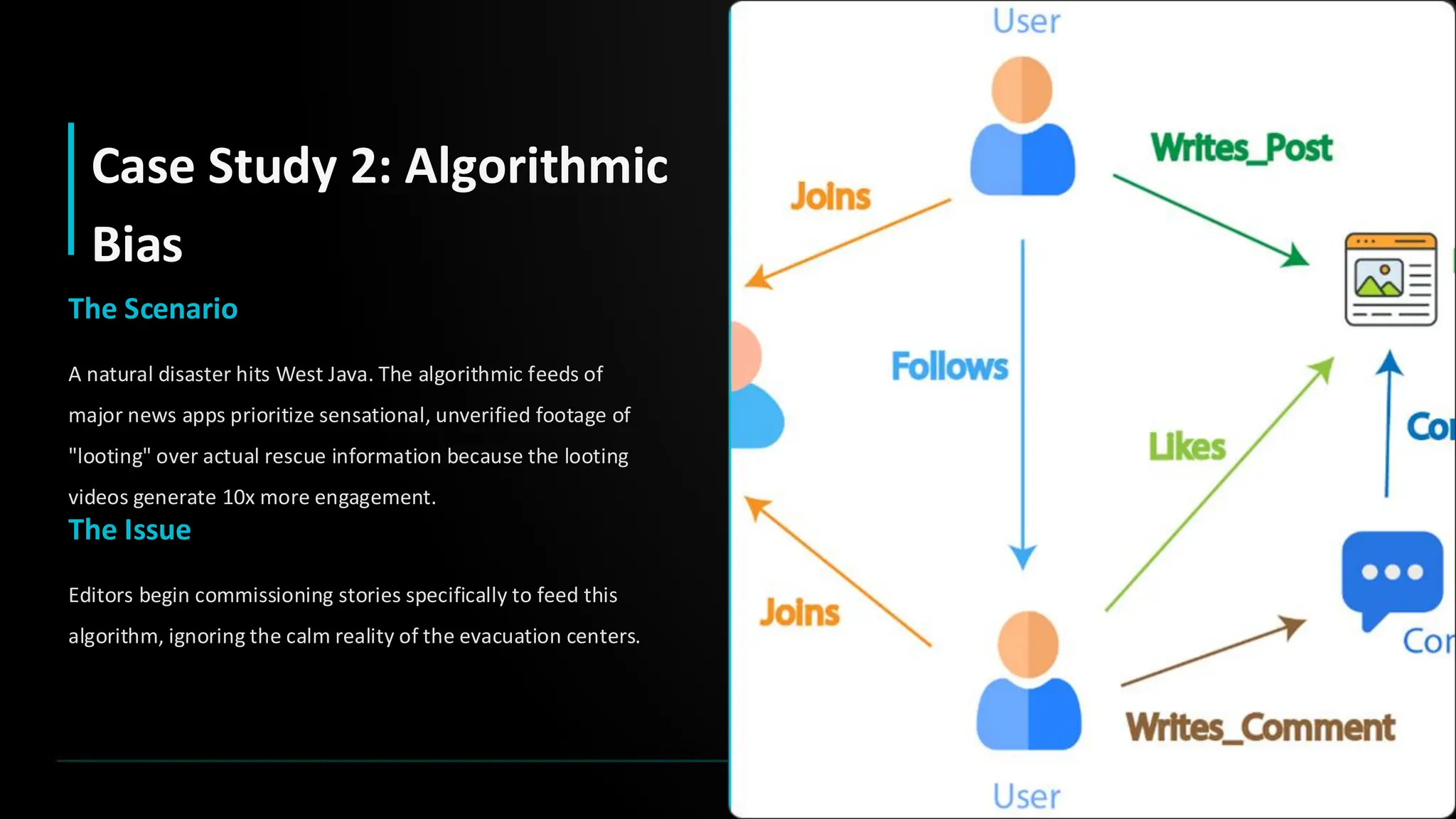
A natural disaster hits West Java. The algorithmic feeds of
major news apps prioritize sensational, unverified footage of
"looting" over actual rescue information because the looting
videos generate 10x more engagement.
The Issue
Editors begin commissioning stories specifically to feed this
algorithm, ignoring the calm reality of the evacuation centers.
13.
Sensationalism
Prioritizing engagement overpublic
service violates the core tenet of
journalism: providing citizens with the
information they need to be free and
self-governing.
Distorted Reality
By curating news based on algorithms,
the media creates a false perception
of chaos, potentially hindering rescue
efforts and causing panic.
The Solution
Editorial Override: Human editors
must intervene in automated feeds
during crises to ensure life-saving
information takes precedence over
viral content.
Analysis: Algorithmic Bias
14.
Case Study 3:Privacy
Breach
The Scenario
An investigative report on corruption exposes a politician's illicit
assets. To prove the connection, the outlet publishes the full
unredacted medical records and home addresses of the
politician's children.
The Conflict
The outlet claims "Public Interest," but the politician sues under
the newly enforced UU PDP (Personal Data Protection Law).
15.
Legal Verdict (UUPDP)
The outlet is found guilty. While exposing corruption is public
interest, the medical data of minors (the children) is irrelevant to the
crime and excessive.
Ethical Principle
Minimize Harm: Journalists must distinguish between the public
figure (the politician) and private individuals (the family). Data
minimization is a key requirement of 2025 digital ethics.
Analysis: Privacy Breach
16.
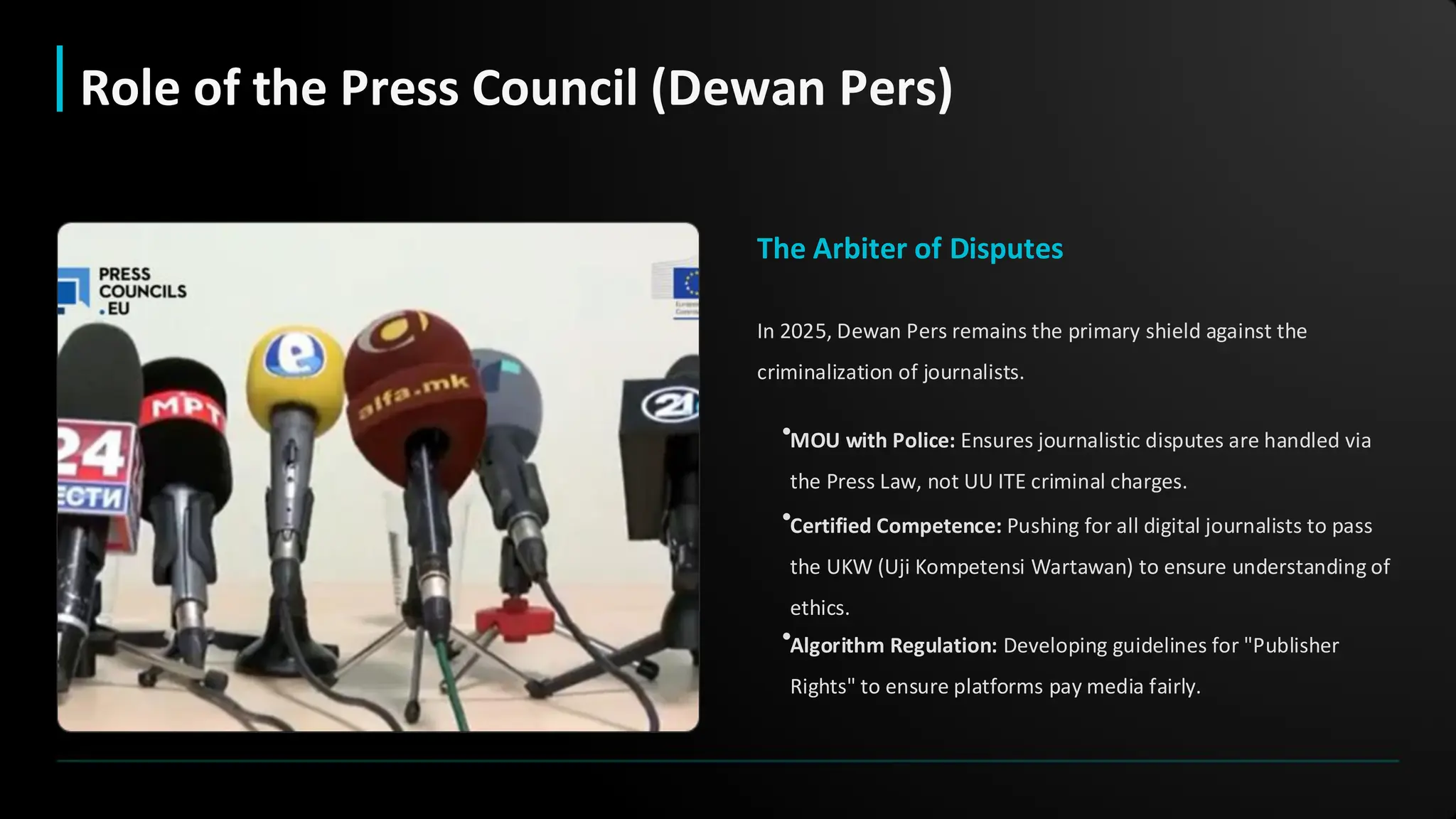
The Arbiter ofDisputes
In 2025, Dewan Pers remains the primary shield against the
criminalization of journalists.
•MOU with Police: Ensures journalistic disputes are handled via
the Press Law, not UU ITE criminal charges.
•Certified Competence: Pushing for all digital journalists to pass
the UKW (Uji Kompetensi Wartawan) to ensure understanding of
ethics.
•Algorithm Regulation: Developing guidelines for "Publisher
Rights" to ensure platforms pay media fairly.
Role of the Press Council (Dewan Pers)
17.
Digital Forensics
Every newsroommust have tools to
verify images and videos (reverse
search, metadata analysis) before
publishing.
Data Hygiene
Secure sources with encryption
(Signal, PGP) and redact unnecessary
private data to comply with UU PDP.
AI Transparency
Adopt a clear "AI Policy" in the
newsroom. Humans must take final
responsibility for every word
published.
Best Practices for 2025
18.
The future belongsto media that can slow down enough to be right, while remaining
technologically agile enough to be relevant.
"In an age of infinite information, credibility is the only
scarce resource. Trust is the currency of the future."
— Digital Journalism Summit 2025
Future Outlook
19.
•Dewan Pers. (2024).Peraturan Dewan Pers tentang Pedoman Pemberitaan Media Siber (Revisi 2024). Jakarta: Dewan Pers.
•Kovach, B., & Rosenstiel, T. (2021). The Elements of Journalism: What Newspeople Should Know and the Public Should Expect. Crown.
•Pemerintah Republik Indonesia. (2008). Undang-Undang No. 11 Tahun 2008 tentang Informasi dan Transaksi Elektronik (dan perubahannya).
•Pemerintah Republik Indonesia. (2022). Undang-Undang No. 27 Tahun 2022 tentang Pelindungan Data Pribadi.
•Ward, S. J. A. (2023). Digital Media Ethics. Center for Journalism Ethics, University of Wisconsin-Madison.
•Nugroho, Y., & Syarief, S. S. (2024). The Impact of AI on Indonesian Newsrooms: A Field Study. Jakarta: Centre for Innovation Policy and
Governance.
Bibliography
20.
Q & A
Thankyou for your attention.
Discussion Open