SECTION A
1. CAPACITY BUILDING
Capacity building: Refers to the process of developing and strengthening the
skills, abilities, resources, and structures that individuals, organizations, or
communities need to effectively perform functions, solve problems, and
achieve their goals.
This is the foundation and should include:
a. Organizational structure and culture
b. Mission, vision, and values
c. Policies, procedures, and codes of conduct
i. Organizational structure: Organizational structure refers to the formal
arrangement of roles, responsibilities, authority, and communication within
an organization. It shows how tasks are divided, coordinated, and
supervised and outlines who reports to whom and how decisions are
made.
In simple terms, it is the framework that determines how an organization is
organized and how it functions.
Key Elements of Organizational Structure
1. Hierarchy (Chain of Command)
Defines who has authority and who reports to whom.
2. Division of Work
Tasks are grouped so that similar activities fall under specific units or
departments.
3. Span of Control
The number of employees a manager directly supervises.
Workplace Etiquette & Professionalism
1. What Is Workplace Etiquette?
Workplace etiquette is the set of expected behaviors, attitudes, and communication styles that
help people work respectfully and effectively together.
It includes:
 How you speak
 How you behave
 How you treat others
 How you present yourself
Good etiquette creates a positive work culture and builds trust.
2. What Is Professionalism?
Professionalism is how you conduct yourself in a work environment—showing integrity,
reliability, respect, and competence.
Professionalism is demonstrated through:
 Your actions
 Your attitude
 Your work quality
 Your ethics
 Your communication
It reflects who you are and how seriously you take your role.
3. Core Elements of Workplace Etiquette & Professionalism
A) Communication
 Speak clearly and respectfully
 Listen actively
 Use professional language
 Keep emails and messages concise
 Maintain a positive tone
 Avoid gossip and negative talk
B) Reliability & Accountability
 Show up on time
 Meet deadlines
 Follow through on commitments
 Admit mistakes and correct them
 Take responsibility rather than shifting blame
C) Respect for Others
 Acknowledge different opinions
 Give others space to speak
 Respect cultural differences
 Honor boundaries
 Stay aware of tone and nonverbal cues
D) Professional Appearance
Depending on the workplace, this may include:
 Clean and appropriate clothing
 Good hygiene
 Neat, polished appearance
 Following company dress codes
E) Ethics & Integrity
 Be honest
 Respect confidentiality
 Avoid conflicts of interest
 Do what is right—even when no one is watching
F) Productivity & Work Quality
 Stay organized
 Prioritize tasks
 Minimize distractions
 Strive for accuracy
 Continuously improve your skills
4. Digital & Remote Workplace Etiquette
Email/Chat Etiquette
 Use clear subject lines
 Respond within reasonable time
 Keep messages professional
 Avoid typing in ALL CAPS (seen as shouting)
Virtual Meetings
 Be on time
 Mute when not speaking
 Keep your camera on when appropriate
 Stay engaged (no multitasking)
Online Presence
 Maintain professional profiles
 Keep work and personal social media separate
5. Common Barriers to Professionalism
 Poor emotional self-management
 Lack of communication skills
 Disorganization
 Personal biases
 Workplace stress
 Boundary issues
These can be improved with emotional intelligence, self-awareness, and consistent habits.
6. How to Show Professionalism Every Day
 Arrive prepared
 Demonstrate a positive attitude
 Treat everyone with courtesy—from coworkers to clients
 Ask questions when unsure
 Own your work
 Support your team
 Handle conflict respectfully
 Stay calm under pressure
Professionalism = consistency + character.
7. Workplace Behaviors to Avoid
 Gossip or drama
 Interrupting others
 Dishonesty
 Missing deadlines regularly
 Overreacting emotionally
 Inappropriate jokes or comments
 Poor hygiene or unprofessional appearance
 Being uncooperative or negative
8. Why Workplace Etiquette & Professionalism Matter
Practicing these skills leads to:
 Stronger relationships
 Better teamwork
 Increased trust
 More opportunities for growth
 A positive reputation
 A healthier work environment
 More personal confidence
Employers often value professionalism as much as technical skill.
ii. Mission, vision, and values
Vision:
“To be the Leading Provider of Affordable Housing for All.”
Talking Points
1. Commitment to Housing Accessibility
 Our vision reflects a deep commitment to ensuring that every Nigerian,
regardless of income level, has access to safe, decent, and affordable
housing.
 We aim to break down financial barriers that have traditionally prevented
many families from owning homes.
2. Leadership in the Nigerian Mortgage Industry
 Being the leading provider means we strive to set the highest standards in
mortgage financing, customer service, and innovative housing solutions.
 We seek to be the benchmark for other institutions in terms of
transparency, reliability, and effectiveness.
3. Focus on Affordability
 We prioritize affordable mortgage products, flexible repayment plans,
and interest rates that support low- and middle-income households.
 Affordability is not just a slogan—it defines how we design our products,
partnerships, and long-term strategies.
4. Inclusive Housing for All Nigerians
 “For all” reflects our belief that homeownership should not be a privilege
for a few, but a reality for all Nigerians—youth, civil servants, artisans,
professionals, and vulnerable groups.
 We aim to support both urban and rural communities through accessible
financing solutions.
Mission:
“To passionately provide outstanding real estate services and affordable homes
to our clients.”
Talking Points
1. Passion-Driven Service Delivery
 Our mission emphasizes that passion is at the heart of everything we do.
 This passion drives our dedication, responsiveness, and commitment to
helping clients achieve their dream of homeownership.
 It sets us apart in a competitive mortgage market where trust and
customer care are essential.
2. Outstanding Real Estate and Mortgage Services
 We aim to offer best-in-class real estate financing solutions, from
mortgage advisory to loan processing and property acquisition support.
 “Outstanding” means we go beyond basic service—providing excellent
customer experience, transparency, and professional guidance
throughout the home buying journey.
 Our team is equipped to offer expert insights, ensuring clients make
informed decisions.
3. Provision of Affordable Homes
 A core part of our mission is ensuring that homes are accessible and
affordable, especially for low- and middle-income earners in Nigeria.
 We design mortgage products with flexible repayment options, affordable
interest rates, and client-friendly terms.
 Affordability enables more Nigerians to transition from renting to owning
homes, supporting long-term financial empowerment.
4. Client-Centered Approach
 Our mission is rooted in serving clients first.
 We listen to their needs, understand their financial realities, and offer
personalized mortgage solutions.
 We aim to guide every client through the process with clarity, honesty,
and respect.
5. Making Homeownership Simple and Accessible
 We are committed to simplifying the mortgage process by reducing
bottlenecks, paperwork, and delays.
 Through technology, innovation, and customer education, we make
homeownership more accessible and less intimidating.
6. Building Trust Through Transparency
 Outstanding service is grounded in trust.
 We maintain transparent communication, clearly explaining terms, costs,
responsibilities, and timelines to every client.
 By being reliable and upfront, we foster long-term relationships with
clients.
7. Strategic Partnerships to Deliver Affordable Housing
 To provide affordable homes on a meaningful scale, we collaborate with:
o Real estate developers
o Government agencies
o Cooperative societies
o Financial institutions
 These partnerships help us deliver high-quality housing projects aligned
with our mission
Our Core Values
Passion
We approach everything we do with energy, enthusiasm and a
sincere desire to exceed expectations.
Professionalism
We are dedicated, considerate and responsive, always
maintaining the highest standards of conduct, quality and
performance.
Customer Centric
We prioritize the needs, wants, and experiences of our customers
above all.
iii. Policies, procedures, and codes of conduct
What Are Policies?
Policies are high-level guidelines or rules that outline an organization’s standards,
expectations, and principles. They provide direction on how the organization
should operate and how employees should behave.
In simple terms:
Policies tell you what should be done and why it should be done.
Examples of Policies
 HR policy
 Leave policy
 IT and data security policy
 Anti-corruption/bribery policy
 Health and safety policy
Why Policies Are Important
 Ensure consistency in decision-making
 Protect the organization legally and ethically
 Explain expectations to employees
 Create a safe and fair workplace
Procedures
What Are Procedures?
Procedures are step-by-step instructions describing exactly how to carry out
tasks or apply a policy. They provide detailed processes that employees must
follow.
In simple terms:
Procedures tell you how something should be done.
Examples of Procedures
 Steps for approving a loan
 Steps for reporting an incident
 Steps for processing customer complaints
 Steps for requesting leave
Why Procedures Are Important
 Ensure work is done efficiently and correctly
 Maintain quality and consistency
 Reduce errors and confusion
 Make training easier for new staff
Codes of Conduct
What Is a Code of Conduct?
A code of conduct is a set of ethical guidelines and behavioral expectations for
employees. It outlines how staff should behave in the workplace and when
representing the organization.
In simple terms:
A code of conduct tells you how you must behave.
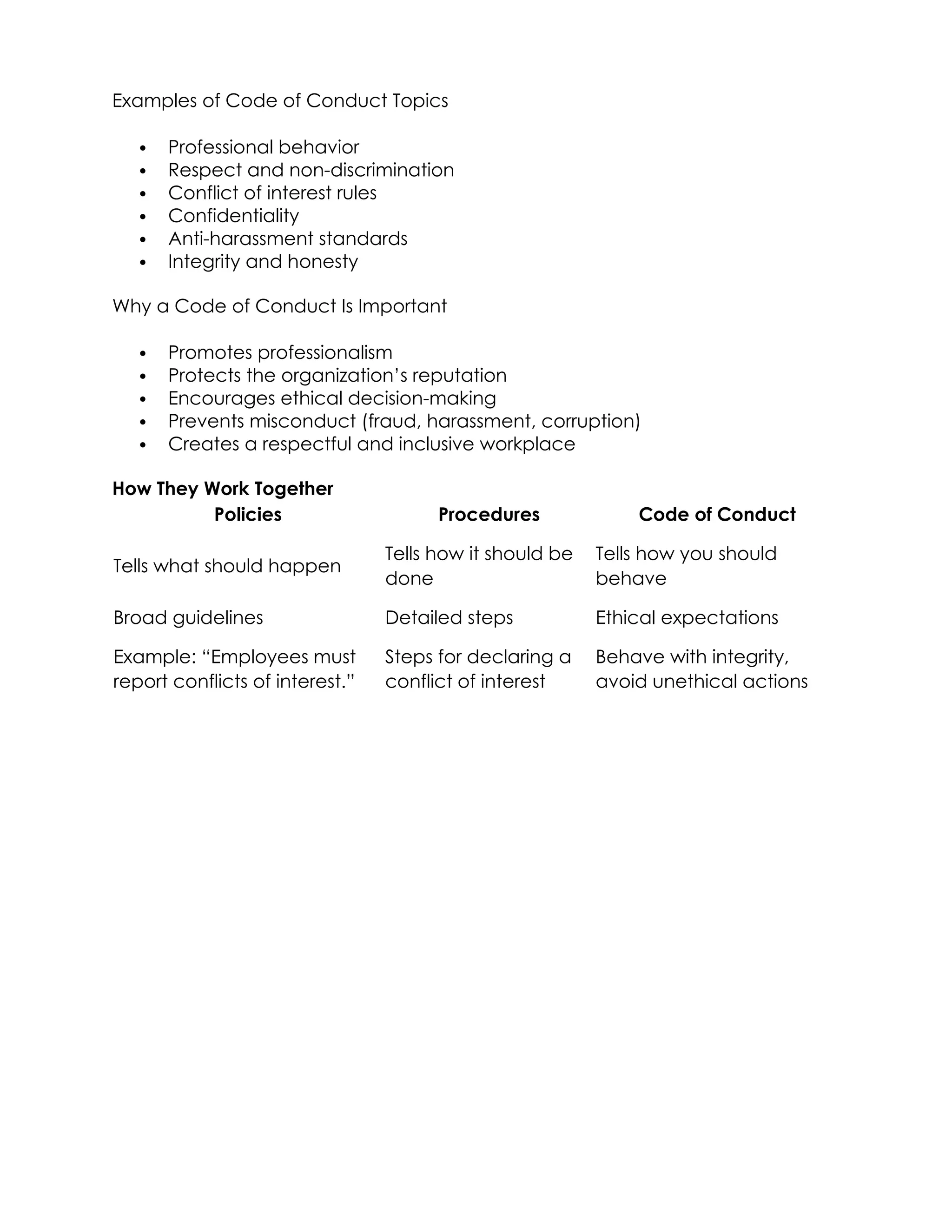
Examples of Code of Conduct Topics
 Professional behavior
 Respect and non-discrimination
 Conflict of interest rules
 Confidentiality
 Anti-harassment standards
 Integrity and honesty
Why a Code of Conduct Is Important
 Promotes professionalism
 Protects the organization’s reputation
 Encourages ethical decision-making
 Prevents misconduct (fraud, harassment, corruption)
 Creates a respectful and inclusive workplace
How They Work Together
Policies Procedures Code of Conduct
Tells what should happen
Tells how it should be
done
Tells how you should
behave
Broad guidelines Detailed steps Ethical expectations
Example: “Employees must
report conflicts of interest.”
Steps for declaring a
conflict of interest
Behave with integrity,
avoid unethical actions
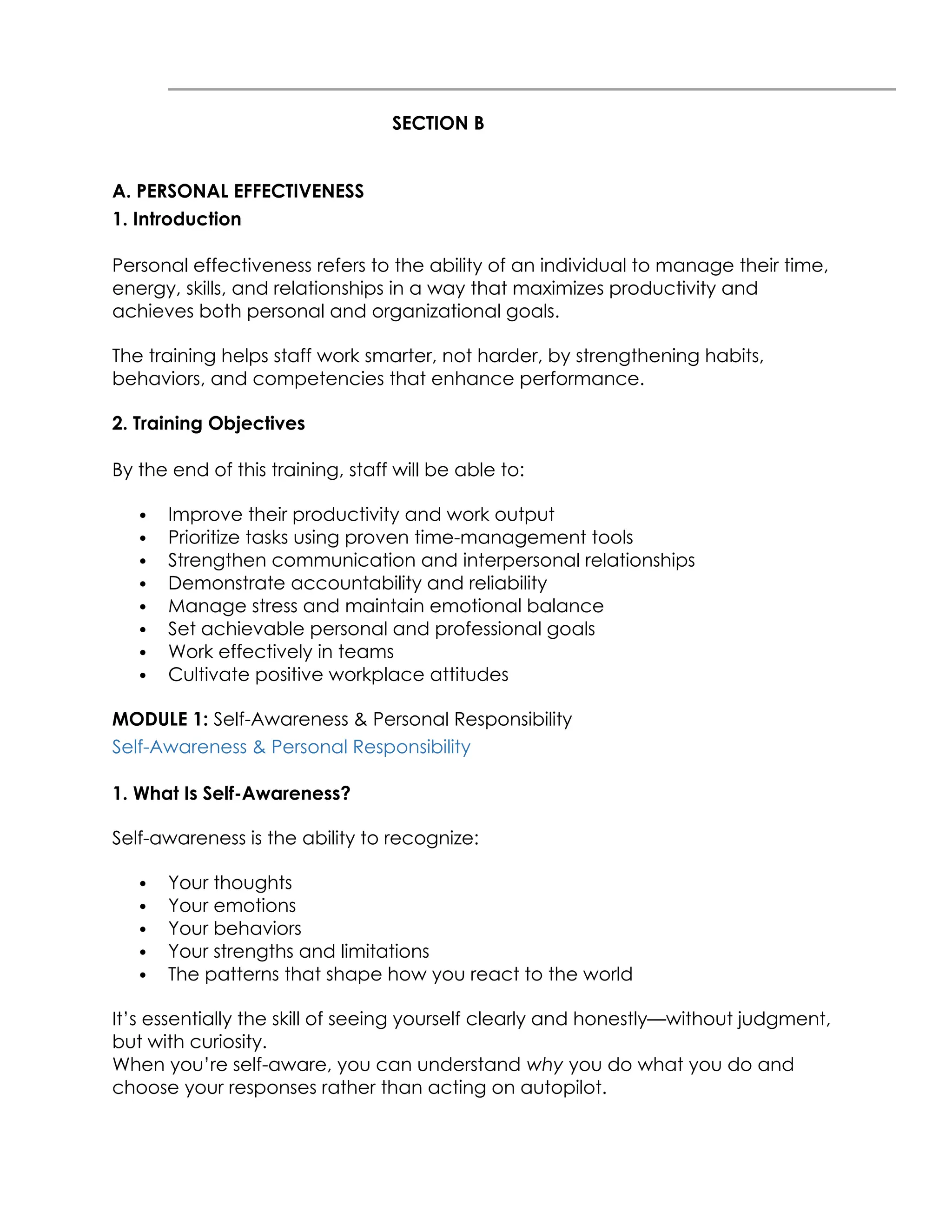
SECTION B
A. PERSONAL EFFECTIVENESS
1. Introduction
Personal effectiveness refers to the ability of an individual to manage their time,
energy, skills, and relationships in a way that maximizes productivity and
achieves both personal and organizational goals.
The training helps staff work smarter, not harder, by strengthening habits,
behaviors, and competencies that enhance performance.
2. Training Objectives
By the end of this training, staff will be able to:
 Improve their productivity and work output
 Prioritize tasks using proven time-management tools
 Strengthen communication and interpersonal relationships
 Demonstrate accountability and reliability
 Manage stress and maintain emotional balance
 Set achievable personal and professional goals
 Work effectively in teams
 Cultivate positive workplace attitudes
MODULE 1: Self-Awareness & Personal Responsibility
Self-Awareness & Personal Responsibility
1. What Is Self-Awareness?
Self-awareness is the ability to recognize:
 Your thoughts
 Your emotions
 Your behaviors
 Your strengths and limitations
 The patterns that shape how you react to the world
It’s essentially the skill of seeing yourself clearly and honestly—without judgment,
but with curiosity.
When you’re self-aware, you can understand why you do what you do and
choose your responses rather than acting on autopilot.
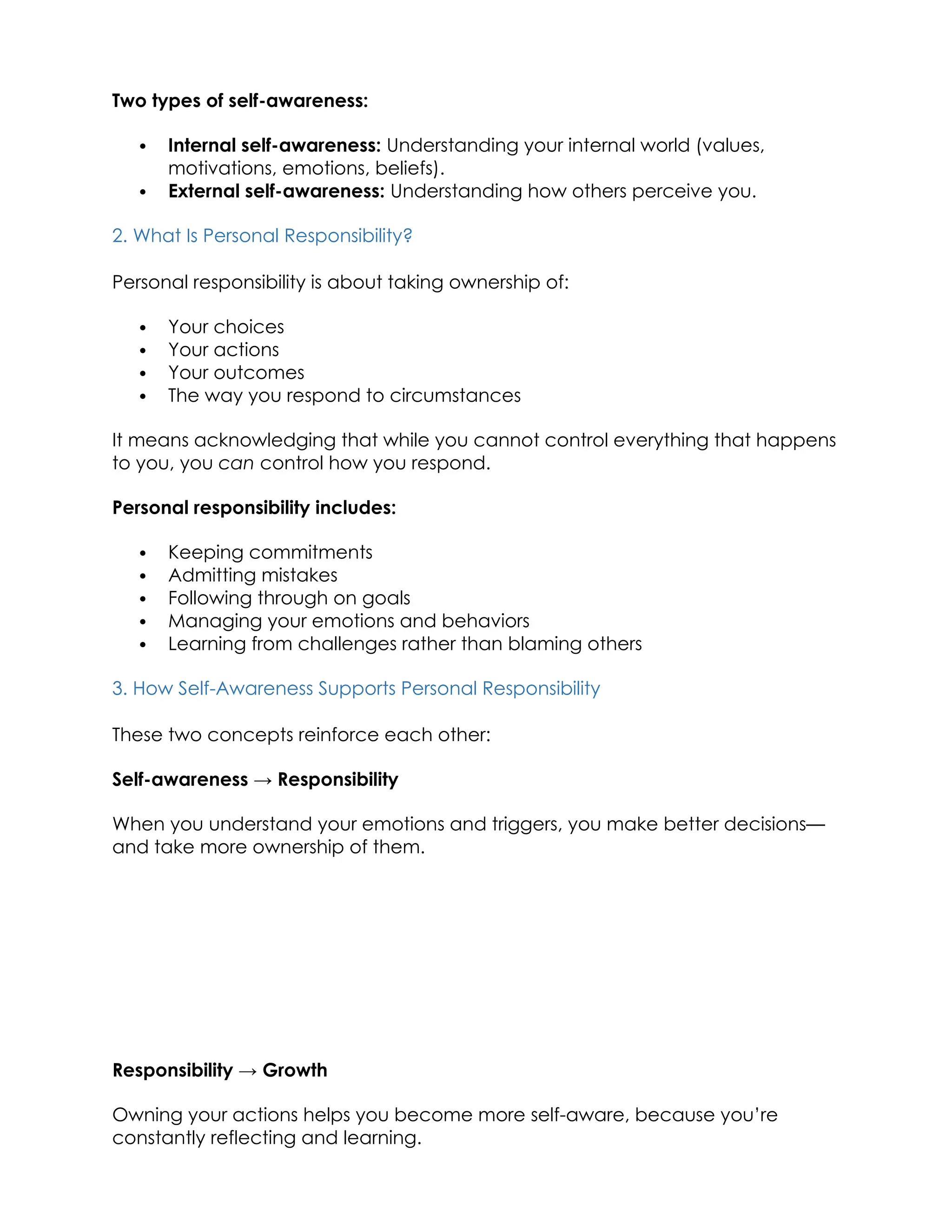
Two types of self-awareness:
 Internal self-awareness: Understanding your internal world (values,
motivations, emotions, beliefs).
 External self-awareness: Understanding how others perceive you.
2. What Is Personal Responsibility?
Personal responsibility is about taking ownership of:
 Your choices
 Your actions
 Your outcomes
 The way you respond to circumstances
It means acknowledging that while you cannot control everything that happens
to you, you can control how you respond.
Personal responsibility includes:
 Keeping commitments
 Admitting mistakes
 Following through on goals
 Managing your emotions and behaviors
 Learning from challenges rather than blaming others
3. How Self-Awareness Supports Personal Responsibility
These two concepts reinforce each other:
Self-awareness → Responsibility
When you understand your emotions and triggers, you make better decisions—
and take more ownership of them.
Responsibility → Growth
Owning your actions helps you become more self-aware, because you’re
constantly reflecting and learning.
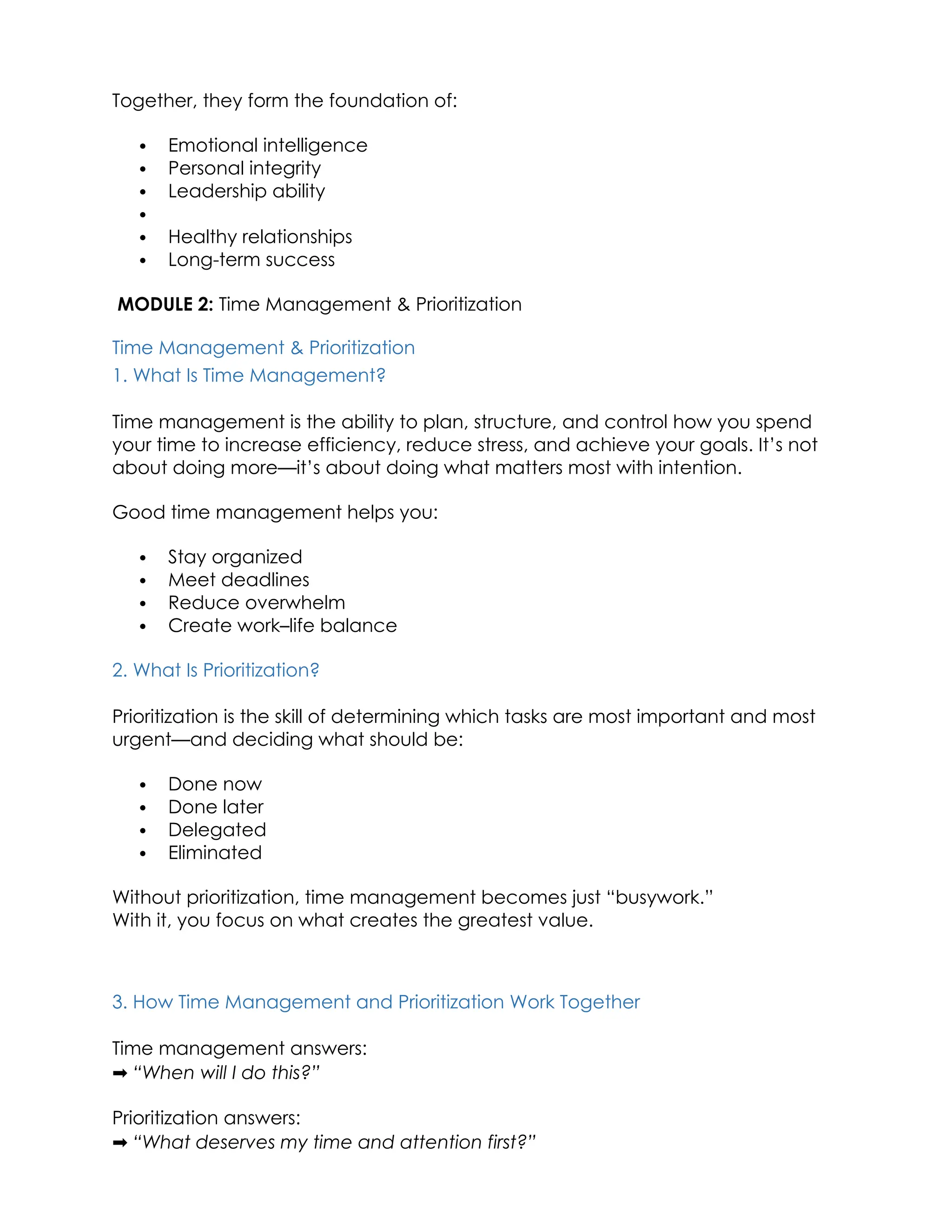
Together, they form the foundation of:
 Emotional intelligence
 Personal integrity
 Leadership ability

 Healthy relationships
 Long-term success
MODULE 2: Time Management & Prioritization
Time Management & Prioritization
1. What Is Time Management?
Time management is the ability to plan, structure, and control how you spend
your time to increase efficiency, reduce stress, and achieve your goals. It’s not
about doing more—it’s about doing what matters most with intention.
Good time management helps you:
 Stay organized
 Meet deadlines
 Reduce overwhelm
 Create work–life balance
2. What Is Prioritization?
Prioritization is the skill of determining which tasks are most important and most
urgent—and deciding what should be:
 Done now
 Done later
 Delegated
 Eliminated
Without prioritization, time management becomes just “busywork.”
With it, you focus on what creates the greatest value.
3. How Time Management and Prioritization Work Together
Time management answers:
➡️“When will I do this?”
Prioritization answers:
➡️“What deserves my time and attention first?”
Together, they help you use energy more wisely, avoid distractions, and make
accountable, goal-aligned decisions.
4. Popular Prioritization Frameworks
A) Eisenhower Matrix (Urgent vs. Important)
 Do Now: urgent + important
 Plan: not urgent + important
 Delegate: urgent + not important
 Eliminate: not urgent + not important
MODULE 3: Personal Organization & Work Habits
Topics Covered
 Organizing your workspace
 Managing documents and information
 Setting daily routines
 Discipline and consistency
 Meeting deadlines
Practical Activities
 “Desk organization challenge”
 Creating a personal productivity routine
MODULE 4: Emotional Intelligence (EQ)
Emotional Intelligence
1. What Is Emotional Intelligence?
Emotional Intelligence (EQ) is the ability to understand, use, and manage
emotions—both yours and other people’s—in positive, effective ways.
It includes skills that help you:
 Stay calm under pressure
 Communicate clearly
 Resolve conflict
 Build strong relationships
 Make thoughtful decisions
 Lead effectively
2. The 5 Core Components of Emotional Intelligence
1. Self-Awareness
Recognizing what you feel and why you feel it.
Key aspects:
 Understanding triggers
 Knowing your strengths and weaknesses
 Being honest with yourself
2. Self-Regulation
Managing your emotions instead of letting them control you.
Examples:
 Staying calm during conflict
 Thinking before reacting
 Managing stress in healthy ways
3. Motivation
Using emotions to drive you toward goals.
High motivation involves:
 Resilience
 Optimism
 Strong work ethic
 Passion for improvement
4. Empathy
Understanding other people’s emotions and perspectives.
Empathy helps you:
 Build trust
 Support others
 Communicate respectfully
 Lead people effectively
5. Social Skills
Using emotional understanding to build healthy relationships.
Includes:
 Clear communication
 Conflict management
 Collaboration
 Listening
 Influence and leadership
3. Why Emotional Intelligence Matters
High EQ improves:
 Personal relationships
 Performance at work or school
 Leadership ability
 Mental well-being
 Decision-making
 Conflict resolution
 Stress management
In many environments, EQ matters as much as—sometimes more than—IQ.
4. Signs of High Emotional Intelligence
Someone with strong EQ typically:
 Responds rather than reacts
 Listens without interrupting
 Recognizes their own emotions quickly
 Apologizes and takes accountability
 Understands how others feel
 Stays calm under stress
 Communicates clearly
 Handles conflict constructively
5. Common Barriers to Emotional Intelligence
 Impulsive reactions
 Ego and defensiveness
 Stress and overwhelm
 Poor listening habits
 Lack of self-reflection
 Unresolved emotional baggage
These barriers can be reduced with awareness and practice.
6. How to Improve Your Emotional Intelligence
A) Strengthen Self-Awareness
 Journal your emotions
 Ask for feedback
 Notice triggers and patterns
 Practice mindfulness
B) Improve Self-Regulation
 Pause before reacting
 Use breathing techniques
 Set boundaries
 Replace emotional impulsiveness with intentional choices
C) Build Motivation
 Set meaningful goals
 Reward your progress
 Reframe challenges as opportunities
D) Grow Empathy
 Listen fully before responding
 Ask open-ended questions
 Try to understand the “why” behind someone’s feelings
E) Develop Social Skills
 Practice clear communication
 Learn to give and receive feedback
 Strengthen conflict resolution skills
 Work on collaboration and teamwork
7. EQ in Real Life Examples
At work or school:
 Staying composed during criticism
 Managing disagreements politely
 Supporting teammates who are stressed
At home:
 Recognizing when you need a break
 Communicating feelings without blame
 Understanding how others feel without taking things personally
For leadership:
 Motivating others
 Building trust
 Managing diverse personalities
8. Simple Daily EQ Practices
 Name your emotions (“I feel…”)
 Ask someone how they’re doing and really listen
 Take a 3–5 second pause before tough responses
 Practice gratitude
 End the day with a quick reflection:
“What emotion did I handle well today? What could I improve next
time?”
MODULE 6: Teamwork & Collaboration
Teamwork & Collaboration
1. What Are Teamwork & Collaboration?
Teamwork
The ability of a group of people to work together toward a common goal using
Combined strengths, skills, and roles.
Collaboration
The process of actively working with others—sharing ideas, listening, problem-
solving, and creating solutions together.
In simple terms:
Teamwork = working as a group
Collaboration = working with the group
Both are essential to success in school, work, leadership, relationships, and
community life.
2. Why Teamwork & Collaboration Matter
Strong teamwork leads to:
 Better problem-solving
 Higher creativity
 Faster results
 Reduced stress
 Stronger relationships
 Increased motivation
 Better outcomes than working alone
Most major achievements—organizations, innovations, sports, community
projects—depend on teamwork.
3. Key Components of Effective Teamwork
1. Shared Goals
Everyone knows the mission, understands expectations, and commits to the
same outcome.
2. Clear Roles
Each person understands:
 Their responsibilities
 Their strengths
 How they contribute to the team
3. Communication
Open, respectful, consistent communication is the foundation of teamwork.
4. Trust
Team members must rely on one another to follow through, respect boundaries,
and support the team.
5. Accountability
Each person takes responsibility for their tasks and behaviors—no blame shifting.
6. Support & Encouragement
Team members help each other overcome challenges and celebrate progress.
4. Skills Needed for Collaboration
A) Active Listening
Paying close attention, showing understanding, and avoiding interruption.
B) Flexibility
Being willing to adjust your approach, compromise, or try new ideas.
C) Conflict Resolution
Handling disagreements respectfully, focusing on solutions instead of blame.
D) Emotional Intelligence
Understanding both your own feelings and those of others.
E) Problem-Solving
Working together to find the best outcome for the group.
F) Respect
Honoring each person’s ideas, backgrounds, and experiences.
5. Common Barriers to Teamwork
 Poor communication
 Lack of trust
 Conflicting personalities
 Unclear roles
 Dominating or disengaged members
 Fear of speaking up
 Ineffective leadership
These challenges can be improved with patience, structure, and emotional
intelligence.
6. Strategies to Improve Teamwork & Collaboration
1. Set Clear Expectations
Agree on goals, deadlines, and communication rules early.
2. Hold Regular Check-Ins
Short meetings or updates help prevent misunderstandings.
3. Encourage Equal Participation
Every team member should contribute and feel heard.
4. Use Strengths Wisely
Leverage each person’s talents and preferences.
5. Give Constructive Feedback
Focus on behavior and solutions, not criticism.
6. Build a Safe Environment
Create a culture where people feel comfortable sharing ideas and asking
questions.
MODULE 7: Workplace Etiquette & Professionalism
Workplace Etiquette & Professionalism
1. What Is Workplace Etiquette?
Workplace etiquette is the set of expected behaviors, attitudes, and
communication styles that help people work respectfully and effectively
together.
It includes:
 How you speak
 How you behave
 How you treat others
 How you present yourself
Good etiquette creates a positive work culture and builds trust.
2. What Is Professionalism?
Professionalism is how you conduct yourself in a work environment—showing
integrity, reliability, respect, and competence.
Professionalism is demonstrated through:
 Your actions
 Your attitude
 Your work quality
 Your ethics
 Your communication
It reflects who you are and how seriously you take your role.
3. Core Elements of Workplace Etiquette & Professionalism
A) Communication
 Speak clearly and respectfully
 Listen actively
 Use professional language
 Keep emails and messages concise
 Maintain a positive tone
 Avoid gossip and negative talk
B) Reliability & Accountability
 Show up on time
 Meet deadlines
 Follow through on commitments
 Admit mistakes and correct them
 Take responsibility rather than shifting blame
C) Respect for Others
 Acknowledge different opinions
 Give others space to speak
 Respect cultural differences
 Honor boundaries
 Stay aware of tone and nonverbal cues
D) Professional Appearance
Depending on the workplace, this may include:
 Clean and appropriate clothing
 Good hygiene
 Neat, polished appearance
 Following company dress codes
E) Ethics & Integrity
 Be honest
 Respect confidentiality
 Avoid conflicts of interest
 Do what is right—even when no one is watching
F) Productivity & Work Quality
 Stay organized
 Prioritize tasks
 Minimize distractions
 Strive for accuracy
 Continuously improve your skills
4. Digital & Remote Workplace Etiquette
Email/Chat Etiquette
 Use clear subject lines
 Respond within reasonable time
 Keep messages professional
 Avoid typing in ALL CAPS (seen as shouting)
Virtual Meetings
 Be on time
 Mute when not speaking
 Keep your camera on when appropriate
 Stay engaged (no multitasking)
Online Presence
 Maintain professional profiles
 Keep work and personal social media separate
5. Common Barriers to Professionalism
 Poor emotional self-management
 Lack of communication skills
 Disorganization
 Personal biases
 Workplace stress
 Boundary issues
These can be improved with emotional intelligence, self-awareness, and
consistent habits.
6. How to Show Professionalism Every Day
 Arrive prepared
 Demonstrate a positive attitude
 Treat everyone with courtesy—from coworkers to clients
 Ask questions when unsure
 Own your work
 Support your team
 Handle conflict respectfully
 Stay calm under pressure
Professionalism = consistency + character.
7. Workplace Behaviors to Avoid
 Gossip or drama
 Interrupting others
 Dishonesty
 Missing deadlines regularly
 Overreacting emotionally
 Inappropriate jokes or comments
 Poor hygiene or unprofessional appearance
 Being uncooperative or negative
8. Why Workplace Etiquette & Professionalism Matter
Practicing these skills leads to:
 Stronger relationships
 Better teamwork
 Increased trust
 More opportunities for growth
 A positive reputation
 A healthier work environment
 More personal confidence
Employers often value professionalism as much as technical skill.
SECTION C
SERVICE EXCELLENCE
1. Introduction
Service Excellence is the ability to consistently provide outstanding service that
meets or exceeds customer expectations. Staff who deliver exceptional service
not only enhance customer satisfaction but also contribute to the organization’s
reputation, growth, and profitability.
Module 1: Understanding Service Excellence
Service excellence is the consistent delivery of high-quality service that not only
meets but exceeds customer expectations. It goes beyond simply doing a job
well—it focuses on creating positive, memorable experiences that build trust,
satisfaction, and loyalty.
Key components of service excellence:
1. Understanding customer needs – knowing what customers expect and
value.
2. Consistency – delivering reliable, high-quality service every time.
3. Professionalism – being respectful, helpful, and competent.
4. Responsiveness – addressing requests or problems quickly and effectively.
5. Personalization – tailoring service to individual customers when possible.
6. Continuous improvement – regularly evaluating and improving service
processes.
Module 2: Professionalism & Customer Etiquette
Professionalism refers to the conduct, behavior, and attitude expected of
someone in a professional setting. It reflects competence, integrity, respect, and
responsibility.
Key elements of professionalism:
 Competence: Having the skills and knowledge to do the job well.
 Reliability: Being consistent, punctual, and dependable.
 Ethical behavior: Acting with honesty, integrity, and confidentiality.
 Respect: Treating colleagues and customers with courtesy.
 Accountability: Owning your actions and decisions.
 Appearance: Presenting oneself appropriately for the workplace.
 Module 3: Communication Skills
Communication skills are the abilities we use to share information, ideas,
thoughts, and feelings with others in a clear, effective, and respectful way.
These skills help us understand others and be understood—whether we are
speaking, listening, writing, or using body language.
Key Types of Communication Skills
1. Verbal Communication
Using spoken words to convey messages.
Examples: giving instructions, answering questions, presenting ideas.
2. Non-Verbal Communication
Using body language, facial expressions, gestures, posture, and eye contact to
communicate.
Example: nodding to show understanding.
3. Listening Skills
Actively paying attention to what others say, understanding their message, and
responding appropriately.
Example: repeating back key points to confirm understanding.
4. Written Communication
Using written words to communicate clearly and professionally.
Example: emails, reports, messages, forms.
5. Visual Communication
Using images, charts, symbols, or visuals to support a message.
Example: diagrams in presentations.
Key Qualities of Good Communication Skills
 Clarity: being clear and easy to understand
 Conciseness: avoiding unnecessary details
 Confidence: expressing yourself firmly but respectfully
 Empathy: understanding other people’s feelings and perspectives
 Feedback: giving and receiving constructive comments
 Respect: using polite language and tone
Why Communication Skills Matter
 Improve teamwork and relationships
 Reduce misunderstandings and conflict
 Increase customer satisfaction
 Enhance productivity
 Strengthen leadership and decision-making
Module 4: Problem Solving & Handling Complaints
Problem Solving & Handling Complaints refers to the skills and processes used to
identify issues, find effective solutions, and address customer concerns in a
professional and satisfactory way. These are essential skills for anyone working
with customers or in service-oriented roles.
2. Problem Solving
Problem solving is the ability to identify an issue, analyze its causes, and develop
effective solutions.
Steps in Problem Solving:
1. Identify the problem – understand what is wrong.
2. Gather information – listen, ask questions, and get facts.
3. Analyze options – consider possible solutions.
4. Choose the best solution – pick the most practical and effective one.
5. Implement the solution – take action.
6. Evaluate the outcome – check if the problem is resolved.
Handling Complaints
Handling complaints means responding to customer concerns calmly,
respectfully, and effectively to restore satisfaction and trust.
Key Principles of Handling Complaints:
 Listen actively – let the customer explain without interrupting.
 Stay calm and polite – even if the customer is upset.
 Show empathy – acknowledge their feelings (e.g., “I understand this is
frustrating”).
 Ask questions – to understand the real issue.
 Apologize when appropriate – even if the mistake is not your fault.
 Offer solutions – explain what you can do to help.
 Follow up – make sure the issue is fully resolved.
How They Work Together
Problem solving + handling complaints = excellent customer service.
Together they help to:
 Resolve issues quickly
 Prevent future problems
 Maintain customer trust
 Improve service quality
 Reduce conflicts
Module 5: Building Customer Relationships
Building customer relationships means creating positive, long-term connections
with customers based on trust, communication, and value. Strong customer
relationships lead to loyalty, repeat business, and positive word-of-mouth.
Here is a clear and practical guide:
How to Build Customer Relationships
1. Understand Customer Needs
 Ask questions to learn what customers truly want.
 Listen actively and pay attention to their preferences.
 Personalize your service based on what you learn.
Communicate Clearly and Regularly
 Keep customers informed about updates, delays, or new offerings.
 Use simple, respectful, and friendly language.
 Respond quickly to messages or inquiries.
Good communication builds trust.
3. Deliver Consistent Quality
 Always provide reliable and high-quality service.
 Avoid making promises you can’t keep.
 If you make a mistake, fix it quickly and professionally.
Consistency creates confidence.
4. Show Appreciation
 Say “thank you” genuinely.
 Offer loyalty rewards or small gestures of appreciation.
 Celebrate milestones (e.g., anniversaries with your company).
Customers stay where they feel valued.
5. Provide Excellent Customer Service
 Be approachable, patient, and respectful.
 Handle problems quickly and calmly.
 Go the extra mile when possible (small acts can make big impacts).
6. Build Trust Through Honesty
 Be transparent about policies, pricing, and limitations.
 Admit errors instead of making excuses.
 Keep your word—follow through on commitments.
7. Personalize the Experience
 Use the customer’s name.
 Remember past interactions.
 Customize services based on their history and preferences.
Personal touches make customers feel special.
8. Ask for Feedback and Act on It
 Encourage customers to share their opinions.
 Use feedback to improve your services.
 Let customers know when you’ve made changes based on their input.
9. Be Present on Multiple Channels
 Whether through phone, email, WhatsApp, social media, or in person—
be where your customers are.
 Make it easy for them to reach you.
10. Create Emotional Connections
 Show empathy.
 Be sincere and human.
 Connect with customers beyond just transactions.
People remember how you made them feel.
In Simple Terms
Building customer relationships means treating customers like valued partners—
not just buyers. When customers trust you, feel heard, and enjoy interacting with
you, they stay longer and support your business more.
Module 5: Communication Skills
1. What Are Communication Skills?
Communication skills are the abilities we use to share information, express ideas,
and understand others. They include how we speak, listen, write, and use body
language.
Good communication helps you:
 Build strong relationships
 Resolve conflicts
 Work effectively with others
 Express needs and boundaries
 Lead, influence, and collaborate
2. Core Types of Communication
A) Verbal Communication
What you say and how you say it.
Key elements:
 Tone
 Clarity
 Word choice
 Confidence
 Pace
B) Nonverbal Communication
Your body language, including:
 Eye contact
 Facial expressions
 Gestures
 Posture
 Personal space
Nonverbal cues often communicate more than words.
C) Written Communication
How you communicate through writing, such as:
 Texts
 Emails
 Reports
 Presentations
Good written communication is clear, concise, and structured.
D) Listening (the most important skill of all)
Listening is not passive—it’s active.
Effective listening means:
 Paying attention
 Not interrupting
 Asking questions
 Reflecting back what you heard
3. Key Skills for Effective Communication
1. Clarity
State your message simply and directly.
2. Empathy
Understanding the feelings and perspectives of others.
3. Confidence
Speaking with assurance—without being aggressive.
4. Emotional regulation
Managing your emotions so they don’t override your message.
5. Adaptability
Communicating differently depending on the audience or situation.
6. Respect
Being polite, open-minded, and considerate.
4. Common Barriers to Communication
 Assumptions and misunderstandings
 Emotional triggers
 Poor listening habits
 Cultural differences
 Multitasking or distraction
 Lack of clarity
Overcoming these requires patience, awareness, and intentional habits.
5. Effective Communication Techniques
A) “I” Statements
Reduce conflict and blame.
Example: “I feel overwhelmed when the workload increases unexpectedly.”
B) Active Listening Steps
1. Stop talking
2. Focus fully
3. Ask clarifying questions
4. Reflect what you heard
5. Respond thoughtfully
C) The 3-Second Pause
Before replying, pause 3 seconds to think → prevents reactive communication.
D) Mirroring & Validation
Show you understand the other person’s point of view.
E) Open-Ended Questions
Encourage deeper conversation.
Example: “What do you think would work best here?”
6. Professional Communication Skills
A) Presentation Skills
 Clear structure
 Visual support
 Engaging delivery
 Strong opening and close
B) Feedback Skills
 Specific
 Helpful
 Focused on behavior, not personality
C) Conflict Resolution
 Stay calm
 Listen first
 Seek win–win solutions
D) Digital Etiquette
 Respond promptly
 Be concise
 Use appropriate tone
7. How to Improve Communication Skills
Daily habits:
 Practice active listening
 Observe your body language
 Ask better questions
 Summarize what you heard in conversations
 Read, write, and speak more often
Exercises:
 Record yourself speaking
 Role-play conversations
 Use reflection journals
 Seek feedback regularly
8. Why Communication Skills Matter
Strong communication:
 Improves relationships
 Enhances teamwork
 Builds trust
 Boosts confidence
 Increases leadership effectiveness
 Helps prevent conflict and confusion
Capacity Building ,Personal Effectiveness and Service Excellence

Capacity Building ,Personal Effectiveness and Service Excellence

  • 1.
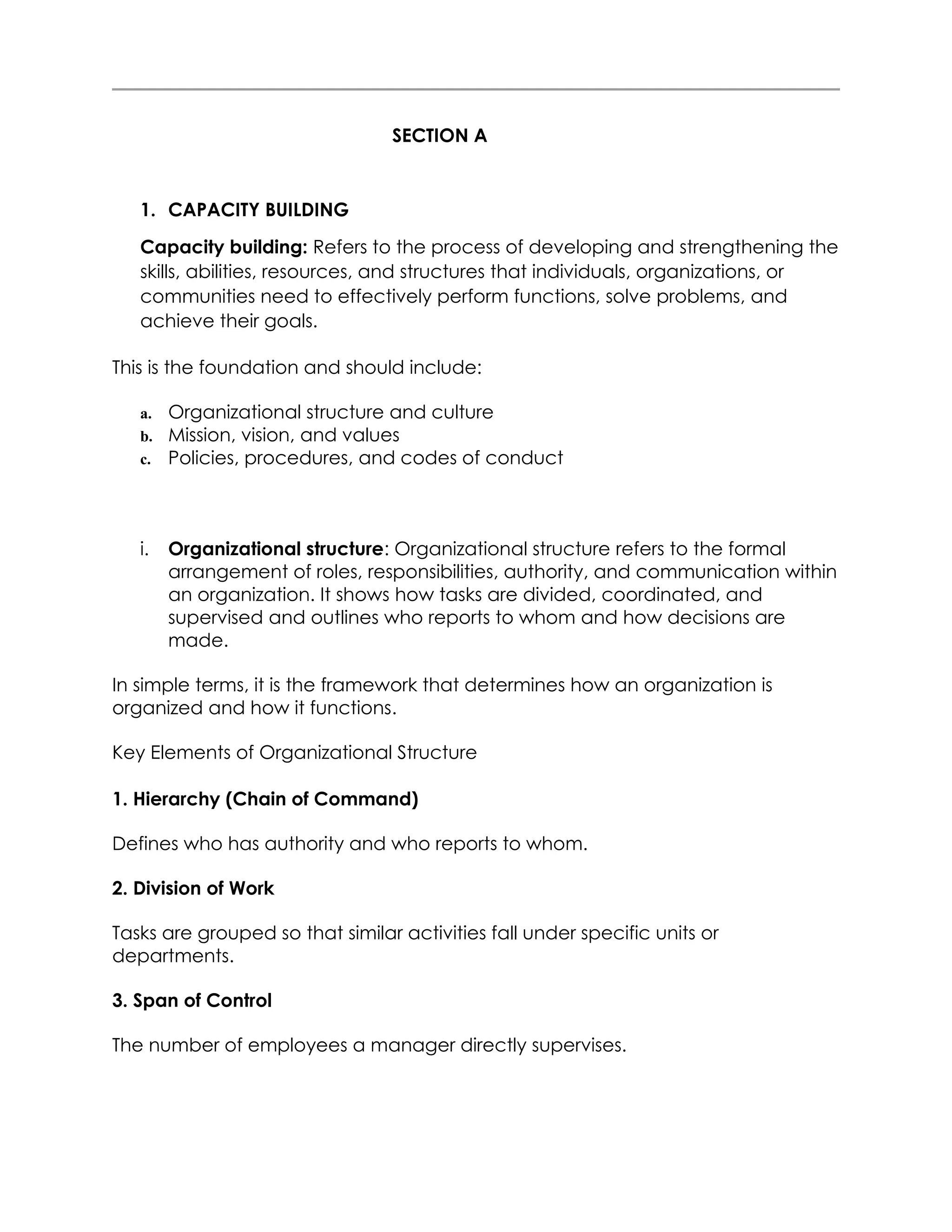
    SECTION A 1. CAPACITYBUILDING Capacity building: Refers to the process of developing and strengthening the skills, abilities, resources, and structures that individuals, organizations, or communities need to effectively perform functions, solve problems, and achieve their goals. This is the foundation and should include: a. Organizational structure and culture b. Mission, vision, and values c. Policies, procedures, and codes of conduct i. Organizational structure: Organizational structure refers to the formal arrangement of roles, responsibilities, authority, and communication within an organization. It shows how tasks are divided, coordinated, and supervised and outlines who reports to whom and how decisions are made. In simple terms, it is the framework that determines how an organization is organized and how it functions. Key Elements of Organizational Structure 1. Hierarchy (Chain of Command) Defines who has authority and who reports to whom. 2. Division of Work Tasks are grouped so that similar activities fall under specific units or departments. 3. Span of Control The number of employees a manager directly supervises.
  • 2.
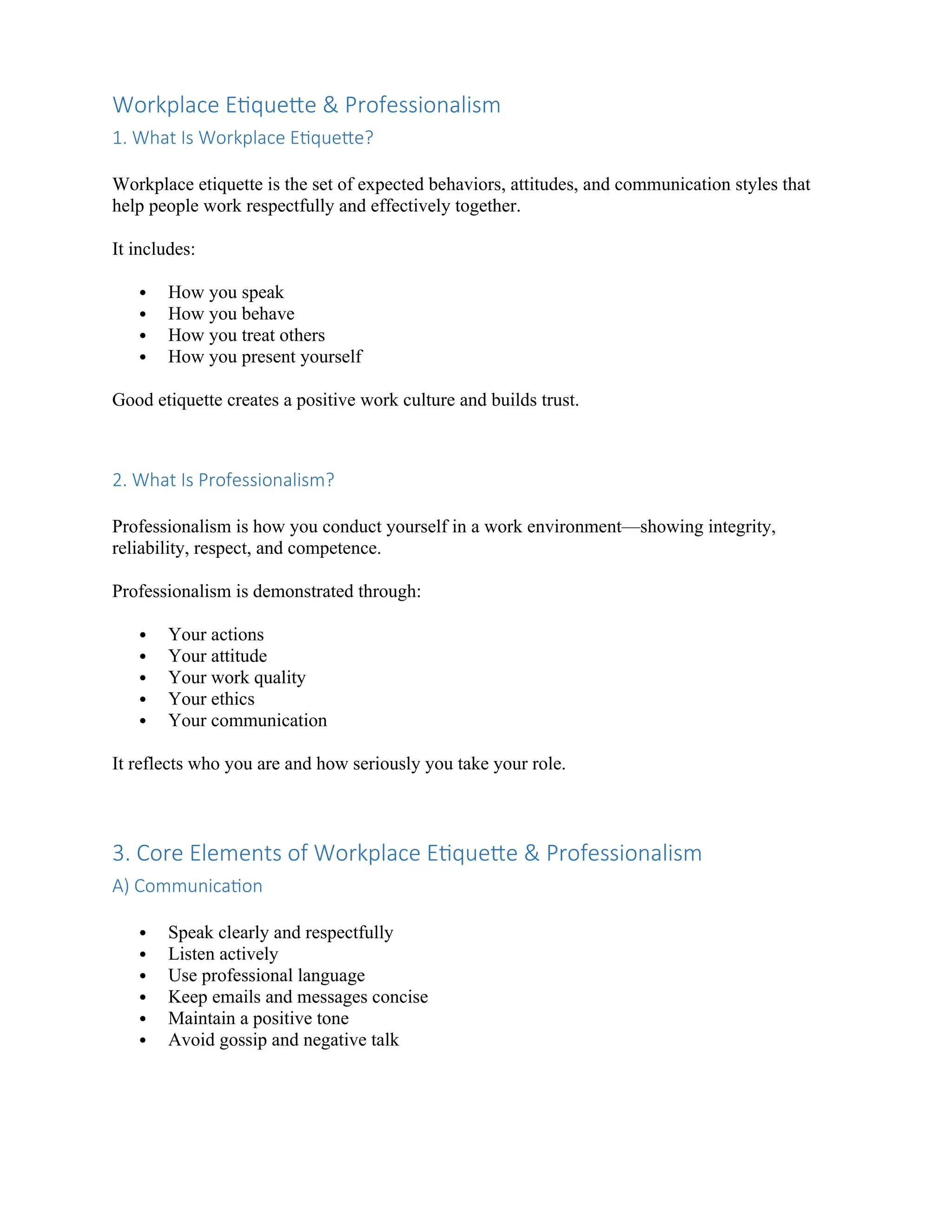
    Workplace Etiquette &Professionalism 1. What Is Workplace Etiquette? Workplace etiquette is the set of expected behaviors, attitudes, and communication styles that help people work respectfully and effectively together. It includes:  How you speak  How you behave  How you treat others  How you present yourself Good etiquette creates a positive work culture and builds trust. 2. What Is Professionalism? Professionalism is how you conduct yourself in a work environment—showing integrity, reliability, respect, and competence. Professionalism is demonstrated through:  Your actions  Your attitude  Your work quality  Your ethics  Your communication It reflects who you are and how seriously you take your role. 3. Core Elements of Workplace Etiquette & Professionalism A) Communication  Speak clearly and respectfully  Listen actively  Use professional language  Keep emails and messages concise  Maintain a positive tone  Avoid gossip and negative talk
  • 3.
    B) Reliability &Accountability  Show up on time  Meet deadlines  Follow through on commitments  Admit mistakes and correct them  Take responsibility rather than shifting blame C) Respect for Others  Acknowledge different opinions  Give others space to speak  Respect cultural differences  Honor boundaries  Stay aware of tone and nonverbal cues D) Professional Appearance Depending on the workplace, this may include:  Clean and appropriate clothing  Good hygiene  Neat, polished appearance  Following company dress codes E) Ethics & Integrity  Be honest  Respect confidentiality  Avoid conflicts of interest  Do what is right—even when no one is watching F) Productivity & Work Quality  Stay organized  Prioritize tasks  Minimize distractions  Strive for accuracy  Continuously improve your skills 4. Digital & Remote Workplace Etiquette Email/Chat Etiquette  Use clear subject lines  Respond within reasonable time  Keep messages professional
  • 4.
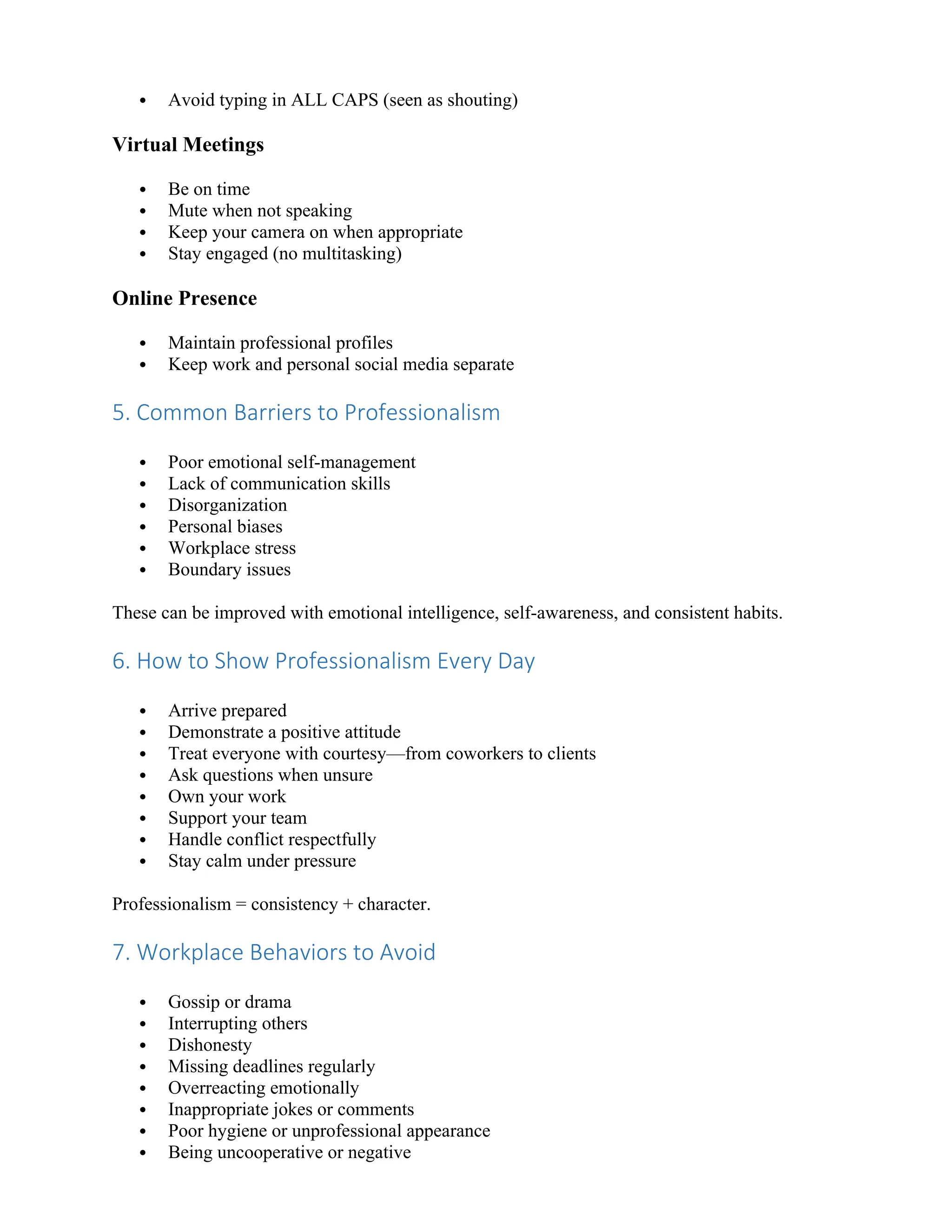
     Avoid typingin ALL CAPS (seen as shouting) Virtual Meetings  Be on time  Mute when not speaking  Keep your camera on when appropriate  Stay engaged (no multitasking) Online Presence  Maintain professional profiles  Keep work and personal social media separate 5. Common Barriers to Professionalism  Poor emotional self-management  Lack of communication skills  Disorganization  Personal biases  Workplace stress  Boundary issues These can be improved with emotional intelligence, self-awareness, and consistent habits. 6. How to Show Professionalism Every Day  Arrive prepared  Demonstrate a positive attitude  Treat everyone with courtesy—from coworkers to clients  Ask questions when unsure  Own your work  Support your team  Handle conflict respectfully  Stay calm under pressure Professionalism = consistency + character. 7. Workplace Behaviors to Avoid  Gossip or drama  Interrupting others  Dishonesty  Missing deadlines regularly  Overreacting emotionally  Inappropriate jokes or comments  Poor hygiene or unprofessional appearance  Being uncooperative or negative
  • 5.
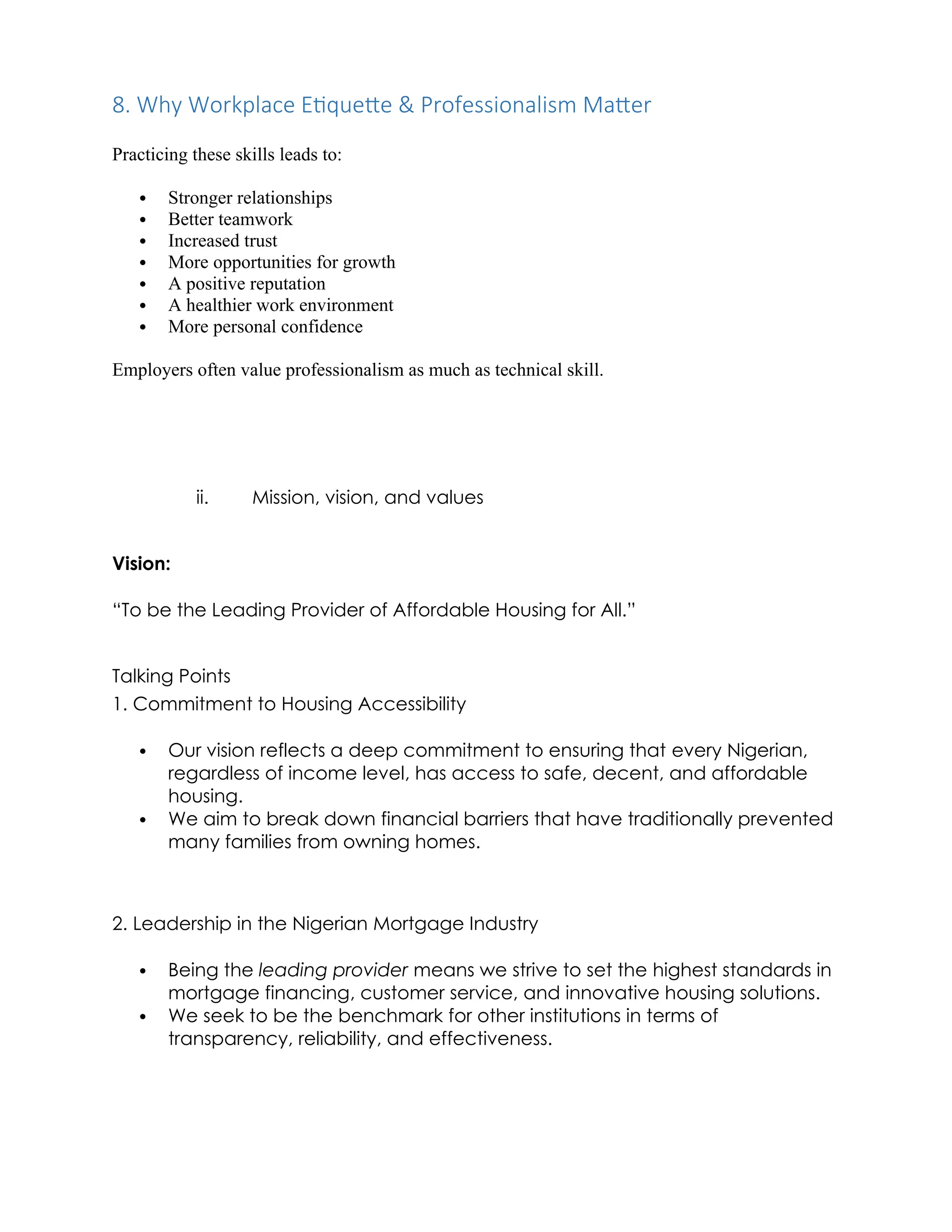
    8. Why WorkplaceEtiquette & Professionalism Matter Practicing these skills leads to:  Stronger relationships  Better teamwork  Increased trust  More opportunities for growth  A positive reputation  A healthier work environment  More personal confidence Employers often value professionalism as much as technical skill. ii. Mission, vision, and values Vision: “To be the Leading Provider of Affordable Housing for All.” Talking Points 1. Commitment to Housing Accessibility  Our vision reflects a deep commitment to ensuring that every Nigerian, regardless of income level, has access to safe, decent, and affordable housing.  We aim to break down financial barriers that have traditionally prevented many families from owning homes. 2. Leadership in the Nigerian Mortgage Industry  Being the leading provider means we strive to set the highest standards in mortgage financing, customer service, and innovative housing solutions.  We seek to be the benchmark for other institutions in terms of transparency, reliability, and effectiveness.
  • 6.
    3. Focus onAffordability  We prioritize affordable mortgage products, flexible repayment plans, and interest rates that support low- and middle-income households.  Affordability is not just a slogan—it defines how we design our products, partnerships, and long-term strategies. 4. Inclusive Housing for All Nigerians  “For all” reflects our belief that homeownership should not be a privilege for a few, but a reality for all Nigerians—youth, civil servants, artisans, professionals, and vulnerable groups.  We aim to support both urban and rural communities through accessible financing solutions. Mission: “To passionately provide outstanding real estate services and affordable homes to our clients.” Talking Points 1. Passion-Driven Service Delivery  Our mission emphasizes that passion is at the heart of everything we do.  This passion drives our dedication, responsiveness, and commitment to helping clients achieve their dream of homeownership.  It sets us apart in a competitive mortgage market where trust and customer care are essential. 2. Outstanding Real Estate and Mortgage Services  We aim to offer best-in-class real estate financing solutions, from mortgage advisory to loan processing and property acquisition support.  “Outstanding” means we go beyond basic service—providing excellent customer experience, transparency, and professional guidance throughout the home buying journey.  Our team is equipped to offer expert insights, ensuring clients make informed decisions.
  • 7.
    3. Provision ofAffordable Homes  A core part of our mission is ensuring that homes are accessible and affordable, especially for low- and middle-income earners in Nigeria.  We design mortgage products with flexible repayment options, affordable interest rates, and client-friendly terms.  Affordability enables more Nigerians to transition from renting to owning homes, supporting long-term financial empowerment. 4. Client-Centered Approach  Our mission is rooted in serving clients first.  We listen to their needs, understand their financial realities, and offer personalized mortgage solutions.  We aim to guide every client through the process with clarity, honesty, and respect. 5. Making Homeownership Simple and Accessible  We are committed to simplifying the mortgage process by reducing bottlenecks, paperwork, and delays.  Through technology, innovation, and customer education, we make homeownership more accessible and less intimidating. 6. Building Trust Through Transparency  Outstanding service is grounded in trust.  We maintain transparent communication, clearly explaining terms, costs, responsibilities, and timelines to every client.  By being reliable and upfront, we foster long-term relationships with clients. 7. Strategic Partnerships to Deliver Affordable Housing  To provide affordable homes on a meaningful scale, we collaborate with: o Real estate developers o Government agencies o Cooperative societies o Financial institutions
  • 8.
     These partnershipshelp us deliver high-quality housing projects aligned with our mission Our Core Values Passion We approach everything we do with energy, enthusiasm and a sincere desire to exceed expectations. Professionalism We are dedicated, considerate and responsive, always maintaining the highest standards of conduct, quality and performance. Customer Centric We prioritize the needs, wants, and experiences of our customers above all. iii. Policies, procedures, and codes of conduct What Are Policies? Policies are high-level guidelines or rules that outline an organization’s standards, expectations, and principles. They provide direction on how the organization should operate and how employees should behave. In simple terms: Policies tell you what should be done and why it should be done. Examples of Policies  HR policy  Leave policy  IT and data security policy  Anti-corruption/bribery policy  Health and safety policy
  • 9.
    Why Policies AreImportant  Ensure consistency in decision-making  Protect the organization legally and ethically  Explain expectations to employees  Create a safe and fair workplace Procedures What Are Procedures? Procedures are step-by-step instructions describing exactly how to carry out tasks or apply a policy. They provide detailed processes that employees must follow. In simple terms: Procedures tell you how something should be done. Examples of Procedures  Steps for approving a loan  Steps for reporting an incident  Steps for processing customer complaints  Steps for requesting leave Why Procedures Are Important  Ensure work is done efficiently and correctly  Maintain quality and consistency  Reduce errors and confusion  Make training easier for new staff Codes of Conduct What Is a Code of Conduct? A code of conduct is a set of ethical guidelines and behavioral expectations for employees. It outlines how staff should behave in the workplace and when representing the organization. In simple terms: A code of conduct tells you how you must behave.
  • 10.
    Examples of Codeof Conduct Topics  Professional behavior  Respect and non-discrimination  Conflict of interest rules  Confidentiality  Anti-harassment standards  Integrity and honesty Why a Code of Conduct Is Important  Promotes professionalism  Protects the organization’s reputation  Encourages ethical decision-making  Prevents misconduct (fraud, harassment, corruption)  Creates a respectful and inclusive workplace How They Work Together Policies Procedures Code of Conduct Tells what should happen Tells how it should be done Tells how you should behave Broad guidelines Detailed steps Ethical expectations Example: “Employees must report conflicts of interest.” Steps for declaring a conflict of interest Behave with integrity, avoid unethical actions
  • 11.
    SECTION B A. PERSONALEFFECTIVENESS 1. Introduction Personal effectiveness refers to the ability of an individual to manage their time, energy, skills, and relationships in a way that maximizes productivity and achieves both personal and organizational goals. The training helps staff work smarter, not harder, by strengthening habits, behaviors, and competencies that enhance performance. 2. Training Objectives By the end of this training, staff will be able to:  Improve their productivity and work output  Prioritize tasks using proven time-management tools  Strengthen communication and interpersonal relationships  Demonstrate accountability and reliability  Manage stress and maintain emotional balance  Set achievable personal and professional goals  Work effectively in teams  Cultivate positive workplace attitudes MODULE 1: Self-Awareness & Personal Responsibility Self-Awareness & Personal Responsibility 1. What Is Self-Awareness? Self-awareness is the ability to recognize:  Your thoughts  Your emotions  Your behaviors  Your strengths and limitations  The patterns that shape how you react to the world It’s essentially the skill of seeing yourself clearly and honestly—without judgment, but with curiosity. When you’re self-aware, you can understand why you do what you do and choose your responses rather than acting on autopilot.
  • 12.
    Two types ofself-awareness:  Internal self-awareness: Understanding your internal world (values, motivations, emotions, beliefs).  External self-awareness: Understanding how others perceive you. 2. What Is Personal Responsibility? Personal responsibility is about taking ownership of:  Your choices  Your actions  Your outcomes  The way you respond to circumstances It means acknowledging that while you cannot control everything that happens to you, you can control how you respond. Personal responsibility includes:  Keeping commitments  Admitting mistakes  Following through on goals  Managing your emotions and behaviors  Learning from challenges rather than blaming others 3. How Self-Awareness Supports Personal Responsibility These two concepts reinforce each other: Self-awareness → Responsibility When you understand your emotions and triggers, you make better decisions— and take more ownership of them. Responsibility → Growth Owning your actions helps you become more self-aware, because you’re constantly reflecting and learning.
  • 13.
    Together, they formthe foundation of:  Emotional intelligence  Personal integrity  Leadership ability   Healthy relationships  Long-term success MODULE 2: Time Management & Prioritization Time Management & Prioritization 1. What Is Time Management? Time management is the ability to plan, structure, and control how you spend your time to increase efficiency, reduce stress, and achieve your goals. It’s not about doing more—it’s about doing what matters most with intention. Good time management helps you:  Stay organized  Meet deadlines  Reduce overwhelm  Create work–life balance 2. What Is Prioritization? Prioritization is the skill of determining which tasks are most important and most urgent—and deciding what should be:  Done now  Done later  Delegated  Eliminated Without prioritization, time management becomes just “busywork.” With it, you focus on what creates the greatest value. 3. How Time Management and Prioritization Work Together Time management answers: ➡️“When will I do this?” Prioritization answers: ➡️“What deserves my time and attention first?”
  • 14.
    Together, they helpyou use energy more wisely, avoid distractions, and make accountable, goal-aligned decisions. 4. Popular Prioritization Frameworks A) Eisenhower Matrix (Urgent vs. Important)  Do Now: urgent + important  Plan: not urgent + important  Delegate: urgent + not important  Eliminate: not urgent + not important MODULE 3: Personal Organization & Work Habits Topics Covered  Organizing your workspace  Managing documents and information  Setting daily routines  Discipline and consistency  Meeting deadlines Practical Activities  “Desk organization challenge”  Creating a personal productivity routine MODULE 4: Emotional Intelligence (EQ) Emotional Intelligence 1. What Is Emotional Intelligence? Emotional Intelligence (EQ) is the ability to understand, use, and manage emotions—both yours and other people’s—in positive, effective ways. It includes skills that help you:  Stay calm under pressure  Communicate clearly  Resolve conflict  Build strong relationships  Make thoughtful decisions  Lead effectively
  • 15.
    2. The 5Core Components of Emotional Intelligence 1. Self-Awareness Recognizing what you feel and why you feel it. Key aspects:  Understanding triggers  Knowing your strengths and weaknesses  Being honest with yourself 2. Self-Regulation Managing your emotions instead of letting them control you. Examples:  Staying calm during conflict  Thinking before reacting  Managing stress in healthy ways 3. Motivation Using emotions to drive you toward goals. High motivation involves:  Resilience  Optimism  Strong work ethic  Passion for improvement 4. Empathy Understanding other people’s emotions and perspectives. Empathy helps you:  Build trust  Support others  Communicate respectfully  Lead people effectively 5. Social Skills Using emotional understanding to build healthy relationships. Includes:  Clear communication
  • 16.
     Conflict management Collaboration  Listening  Influence and leadership 3. Why Emotional Intelligence Matters High EQ improves:  Personal relationships  Performance at work or school  Leadership ability  Mental well-being  Decision-making  Conflict resolution  Stress management In many environments, EQ matters as much as—sometimes more than—IQ. 4. Signs of High Emotional Intelligence Someone with strong EQ typically:  Responds rather than reacts  Listens without interrupting  Recognizes their own emotions quickly  Apologizes and takes accountability  Understands how others feel  Stays calm under stress  Communicates clearly  Handles conflict constructively 5. Common Barriers to Emotional Intelligence  Impulsive reactions  Ego and defensiveness  Stress and overwhelm  Poor listening habits  Lack of self-reflection  Unresolved emotional baggage These barriers can be reduced with awareness and practice. 6. How to Improve Your Emotional Intelligence A) Strengthen Self-Awareness
  • 17.
     Journal youremotions  Ask for feedback  Notice triggers and patterns  Practice mindfulness B) Improve Self-Regulation  Pause before reacting  Use breathing techniques  Set boundaries  Replace emotional impulsiveness with intentional choices C) Build Motivation  Set meaningful goals  Reward your progress  Reframe challenges as opportunities D) Grow Empathy  Listen fully before responding  Ask open-ended questions  Try to understand the “why” behind someone’s feelings E) Develop Social Skills  Practice clear communication  Learn to give and receive feedback  Strengthen conflict resolution skills  Work on collaboration and teamwork 7. EQ in Real Life Examples At work or school:  Staying composed during criticism  Managing disagreements politely  Supporting teammates who are stressed At home:  Recognizing when you need a break  Communicating feelings without blame  Understanding how others feel without taking things personally For leadership:
  • 18.
     Motivating others Building trust  Managing diverse personalities 8. Simple Daily EQ Practices  Name your emotions (“I feel…”)  Ask someone how they’re doing and really listen  Take a 3–5 second pause before tough responses  Practice gratitude  End the day with a quick reflection: “What emotion did I handle well today? What could I improve next time?” MODULE 6: Teamwork & Collaboration Teamwork & Collaboration 1. What Are Teamwork & Collaboration? Teamwork The ability of a group of people to work together toward a common goal using Combined strengths, skills, and roles. Collaboration The process of actively working with others—sharing ideas, listening, problem- solving, and creating solutions together. In simple terms: Teamwork = working as a group Collaboration = working with the group Both are essential to success in school, work, leadership, relationships, and community life. 2. Why Teamwork & Collaboration Matter Strong teamwork leads to:  Better problem-solving  Higher creativity
  • 19.
     Faster results Reduced stress  Stronger relationships  Increased motivation  Better outcomes than working alone Most major achievements—organizations, innovations, sports, community projects—depend on teamwork. 3. Key Components of Effective Teamwork 1. Shared Goals Everyone knows the mission, understands expectations, and commits to the same outcome. 2. Clear Roles Each person understands:  Their responsibilities  Their strengths  How they contribute to the team 3. Communication Open, respectful, consistent communication is the foundation of teamwork. 4. Trust Team members must rely on one another to follow through, respect boundaries, and support the team. 5. Accountability Each person takes responsibility for their tasks and behaviors—no blame shifting. 6. Support & Encouragement Team members help each other overcome challenges and celebrate progress. 4. Skills Needed for Collaboration A) Active Listening Paying close attention, showing understanding, and avoiding interruption.
  • 20.
    B) Flexibility Being willingto adjust your approach, compromise, or try new ideas. C) Conflict Resolution Handling disagreements respectfully, focusing on solutions instead of blame. D) Emotional Intelligence Understanding both your own feelings and those of others. E) Problem-Solving Working together to find the best outcome for the group. F) Respect Honoring each person’s ideas, backgrounds, and experiences. 5. Common Barriers to Teamwork  Poor communication  Lack of trust  Conflicting personalities  Unclear roles  Dominating or disengaged members  Fear of speaking up  Ineffective leadership These challenges can be improved with patience, structure, and emotional intelligence. 6. Strategies to Improve Teamwork & Collaboration 1. Set Clear Expectations Agree on goals, deadlines, and communication rules early. 2. Hold Regular Check-Ins Short meetings or updates help prevent misunderstandings. 3. Encourage Equal Participation Every team member should contribute and feel heard. 4. Use Strengths Wisely
  • 21.
    Leverage each person’stalents and preferences. 5. Give Constructive Feedback Focus on behavior and solutions, not criticism. 6. Build a Safe Environment Create a culture where people feel comfortable sharing ideas and asking questions. MODULE 7: Workplace Etiquette & Professionalism Workplace Etiquette & Professionalism 1. What Is Workplace Etiquette? Workplace etiquette is the set of expected behaviors, attitudes, and communication styles that help people work respectfully and effectively together. It includes:  How you speak  How you behave  How you treat others  How you present yourself Good etiquette creates a positive work culture and builds trust. 2. What Is Professionalism? Professionalism is how you conduct yourself in a work environment—showing integrity, reliability, respect, and competence. Professionalism is demonstrated through:  Your actions  Your attitude  Your work quality  Your ethics  Your communication It reflects who you are and how seriously you take your role.
  • 22.
    3. Core Elementsof Workplace Etiquette & Professionalism A) Communication  Speak clearly and respectfully  Listen actively  Use professional language  Keep emails and messages concise  Maintain a positive tone  Avoid gossip and negative talk B) Reliability & Accountability  Show up on time  Meet deadlines  Follow through on commitments  Admit mistakes and correct them  Take responsibility rather than shifting blame C) Respect for Others  Acknowledge different opinions  Give others space to speak  Respect cultural differences  Honor boundaries  Stay aware of tone and nonverbal cues D) Professional Appearance Depending on the workplace, this may include:  Clean and appropriate clothing  Good hygiene  Neat, polished appearance  Following company dress codes E) Ethics & Integrity  Be honest  Respect confidentiality  Avoid conflicts of interest  Do what is right—even when no one is watching F) Productivity & Work Quality  Stay organized  Prioritize tasks  Minimize distractions
  • 23.
     Strive foraccuracy  Continuously improve your skills 4. Digital & Remote Workplace Etiquette Email/Chat Etiquette  Use clear subject lines  Respond within reasonable time  Keep messages professional  Avoid typing in ALL CAPS (seen as shouting) Virtual Meetings  Be on time  Mute when not speaking  Keep your camera on when appropriate  Stay engaged (no multitasking) Online Presence  Maintain professional profiles  Keep work and personal social media separate 5. Common Barriers to Professionalism  Poor emotional self-management  Lack of communication skills  Disorganization  Personal biases  Workplace stress  Boundary issues These can be improved with emotional intelligence, self-awareness, and consistent habits. 6. How to Show Professionalism Every Day  Arrive prepared  Demonstrate a positive attitude  Treat everyone with courtesy—from coworkers to clients  Ask questions when unsure  Own your work
  • 24.
     Support yourteam  Handle conflict respectfully  Stay calm under pressure Professionalism = consistency + character. 7. Workplace Behaviors to Avoid  Gossip or drama  Interrupting others  Dishonesty  Missing deadlines regularly  Overreacting emotionally  Inappropriate jokes or comments  Poor hygiene or unprofessional appearance  Being uncooperative or negative 8. Why Workplace Etiquette & Professionalism Matter Practicing these skills leads to:  Stronger relationships  Better teamwork  Increased trust  More opportunities for growth  A positive reputation  A healthier work environment  More personal confidence Employers often value professionalism as much as technical skill.
  • 25.
    SECTION C SERVICE EXCELLENCE 1.Introduction Service Excellence is the ability to consistently provide outstanding service that meets or exceeds customer expectations. Staff who deliver exceptional service not only enhance customer satisfaction but also contribute to the organization’s reputation, growth, and profitability. Module 1: Understanding Service Excellence Service excellence is the consistent delivery of high-quality service that not only meets but exceeds customer expectations. It goes beyond simply doing a job well—it focuses on creating positive, memorable experiences that build trust, satisfaction, and loyalty. Key components of service excellence: 1. Understanding customer needs – knowing what customers expect and value. 2. Consistency – delivering reliable, high-quality service every time. 3. Professionalism – being respectful, helpful, and competent. 4. Responsiveness – addressing requests or problems quickly and effectively. 5. Personalization – tailoring service to individual customers when possible. 6. Continuous improvement – regularly evaluating and improving service processes. Module 2: Professionalism & Customer Etiquette Professionalism refers to the conduct, behavior, and attitude expected of someone in a professional setting. It reflects competence, integrity, respect, and responsibility. Key elements of professionalism:  Competence: Having the skills and knowledge to do the job well.  Reliability: Being consistent, punctual, and dependable.  Ethical behavior: Acting with honesty, integrity, and confidentiality.  Respect: Treating colleagues and customers with courtesy.  Accountability: Owning your actions and decisions.  Appearance: Presenting oneself appropriately for the workplace.
  • 26.
     Module 3:Communication Skills Communication skills are the abilities we use to share information, ideas, thoughts, and feelings with others in a clear, effective, and respectful way. These skills help us understand others and be understood—whether we are speaking, listening, writing, or using body language. Key Types of Communication Skills 1. Verbal Communication Using spoken words to convey messages. Examples: giving instructions, answering questions, presenting ideas. 2. Non-Verbal Communication Using body language, facial expressions, gestures, posture, and eye contact to communicate. Example: nodding to show understanding. 3. Listening Skills Actively paying attention to what others say, understanding their message, and responding appropriately. Example: repeating back key points to confirm understanding. 4. Written Communication Using written words to communicate clearly and professionally. Example: emails, reports, messages, forms. 5. Visual Communication Using images, charts, symbols, or visuals to support a message. Example: diagrams in presentations. Key Qualities of Good Communication Skills  Clarity: being clear and easy to understand  Conciseness: avoiding unnecessary details  Confidence: expressing yourself firmly but respectfully  Empathy: understanding other people’s feelings and perspectives  Feedback: giving and receiving constructive comments  Respect: using polite language and tone
  • 27.
    Why Communication SkillsMatter  Improve teamwork and relationships  Reduce misunderstandings and conflict  Increase customer satisfaction  Enhance productivity  Strengthen leadership and decision-making Module 4: Problem Solving & Handling Complaints Problem Solving & Handling Complaints refers to the skills and processes used to identify issues, find effective solutions, and address customer concerns in a professional and satisfactory way. These are essential skills for anyone working with customers or in service-oriented roles. 2. Problem Solving Problem solving is the ability to identify an issue, analyze its causes, and develop effective solutions. Steps in Problem Solving: 1. Identify the problem – understand what is wrong. 2. Gather information – listen, ask questions, and get facts. 3. Analyze options – consider possible solutions. 4. Choose the best solution – pick the most practical and effective one. 5. Implement the solution – take action. 6. Evaluate the outcome – check if the problem is resolved. Handling Complaints Handling complaints means responding to customer concerns calmly, respectfully, and effectively to restore satisfaction and trust. Key Principles of Handling Complaints:  Listen actively – let the customer explain without interrupting.  Stay calm and polite – even if the customer is upset.  Show empathy – acknowledge their feelings (e.g., “I understand this is frustrating”).  Ask questions – to understand the real issue.  Apologize when appropriate – even if the mistake is not your fault.  Offer solutions – explain what you can do to help.  Follow up – make sure the issue is fully resolved.
  • 28.
    How They WorkTogether Problem solving + handling complaints = excellent customer service. Together they help to:  Resolve issues quickly  Prevent future problems  Maintain customer trust  Improve service quality  Reduce conflicts Module 5: Building Customer Relationships Building customer relationships means creating positive, long-term connections with customers based on trust, communication, and value. Strong customer relationships lead to loyalty, repeat business, and positive word-of-mouth. Here is a clear and practical guide: How to Build Customer Relationships 1. Understand Customer Needs  Ask questions to learn what customers truly want.  Listen actively and pay attention to their preferences.  Personalize your service based on what you learn. Communicate Clearly and Regularly  Keep customers informed about updates, delays, or new offerings.  Use simple, respectful, and friendly language.  Respond quickly to messages or inquiries. Good communication builds trust. 3. Deliver Consistent Quality  Always provide reliable and high-quality service.  Avoid making promises you can’t keep.  If you make a mistake, fix it quickly and professionally. Consistency creates confidence.
  • 29.
    4. Show Appreciation Say “thank you” genuinely.  Offer loyalty rewards or small gestures of appreciation.  Celebrate milestones (e.g., anniversaries with your company). Customers stay where they feel valued. 5. Provide Excellent Customer Service  Be approachable, patient, and respectful.  Handle problems quickly and calmly.  Go the extra mile when possible (small acts can make big impacts). 6. Build Trust Through Honesty  Be transparent about policies, pricing, and limitations.  Admit errors instead of making excuses.  Keep your word—follow through on commitments. 7. Personalize the Experience  Use the customer’s name.  Remember past interactions.  Customize services based on their history and preferences. Personal touches make customers feel special. 8. Ask for Feedback and Act on It  Encourage customers to share their opinions.  Use feedback to improve your services.  Let customers know when you’ve made changes based on their input. 9. Be Present on Multiple Channels  Whether through phone, email, WhatsApp, social media, or in person— be where your customers are.  Make it easy for them to reach you. 10. Create Emotional Connections  Show empathy.  Be sincere and human.  Connect with customers beyond just transactions. People remember how you made them feel.
  • 30.
    In Simple Terms Buildingcustomer relationships means treating customers like valued partners— not just buyers. When customers trust you, feel heard, and enjoy interacting with you, they stay longer and support your business more. Module 5: Communication Skills 1. What Are Communication Skills? Communication skills are the abilities we use to share information, express ideas, and understand others. They include how we speak, listen, write, and use body language. Good communication helps you:  Build strong relationships  Resolve conflicts  Work effectively with others  Express needs and boundaries  Lead, influence, and collaborate 2. Core Types of Communication A) Verbal Communication What you say and how you say it. Key elements:  Tone  Clarity  Word choice  Confidence  Pace B) Nonverbal Communication Your body language, including:  Eye contact  Facial expressions  Gestures
  • 31.
     Posture  Personalspace Nonverbal cues often communicate more than words. C) Written Communication How you communicate through writing, such as:  Texts  Emails  Reports  Presentations Good written communication is clear, concise, and structured. D) Listening (the most important skill of all) Listening is not passive—it’s active. Effective listening means:  Paying attention  Not interrupting  Asking questions  Reflecting back what you heard 3. Key Skills for Effective Communication 1. Clarity State your message simply and directly. 2. Empathy Understanding the feelings and perspectives of others. 3. Confidence Speaking with assurance—without being aggressive. 4. Emotional regulation Managing your emotions so they don’t override your message. 5. Adaptability Communicating differently depending on the audience or situation. 6. Respect
  • 32.
    Being polite, open-minded,and considerate. 4. Common Barriers to Communication  Assumptions and misunderstandings  Emotional triggers  Poor listening habits  Cultural differences  Multitasking or distraction  Lack of clarity Overcoming these requires patience, awareness, and intentional habits. 5. Effective Communication Techniques A) “I” Statements Reduce conflict and blame. Example: “I feel overwhelmed when the workload increases unexpectedly.” B) Active Listening Steps 1. Stop talking 2. Focus fully 3. Ask clarifying questions 4. Reflect what you heard 5. Respond thoughtfully C) The 3-Second Pause Before replying, pause 3 seconds to think → prevents reactive communication. D) Mirroring & Validation Show you understand the other person’s point of view. E) Open-Ended Questions Encourage deeper conversation. Example: “What do you think would work best here?” 6. Professional Communication Skills A) Presentation Skills  Clear structure  Visual support  Engaging delivery
  • 33.
     Strong openingand close B) Feedback Skills  Specific  Helpful  Focused on behavior, not personality C) Conflict Resolution  Stay calm  Listen first  Seek win–win solutions D) Digital Etiquette  Respond promptly  Be concise  Use appropriate tone 7. How to Improve Communication Skills Daily habits:  Practice active listening  Observe your body language  Ask better questions  Summarize what you heard in conversations  Read, write, and speak more often Exercises:  Record yourself speaking  Role-play conversations  Use reflection journals  Seek feedback regularly 8. Why Communication Skills Matter Strong communication:  Improves relationships  Enhances teamwork  Builds trust  Boosts confidence  Increases leadership effectiveness  Helps prevent conflict and confusion