A peep into the world of children with disabilities
Did you know that a staggering 19% of the world’s child population resides in India?
Currently, 440 million people in the country are under the age of 18, constituting 42% of
India’s total population — in other words, four out of every ten individuals is below the
age of 18. According to data from the National Crime Records Bureau (NCRB), a total
of 94,172 cases of crimes against children were registered in 2015, compared to 89,423
cases in 2014 — an increase of 5.3%. This is shocking, especially considering the rapid
development the country is witnessing in other areas. As per the 2011 Census, there
are more than 7.8 million children with disabilities (CWD) in India, accounting for
approximately 2% of the total child population. In today’s context — where even
able-bodied children are often not safe and struggle to protect themselves — children
with disabilities are significantly more vulnerable by comparison.
In this context, World Vision (WV) India conducted a study in 2019 to highlight the child
protection issues faced by children with disabilities (CWD). For the purpose of this
study, in-depth discussions were held with 85 CWD, aged between 6 and 18 years (both
boys and girls), from the target communities of WV India’s ‘My City Initiative Delhi’
projects. Laxmi, aged 11, was one of the children who participated in the study. She is
mentally challenged and also has a slight difficulty with walking. Her brother, Vijay, aged
16, has both physical and intellectual disabilities. Both children are extremely vulnerable
— not only because of their disabilities but also due to their dire socio-economic
situation. Their father abandoned the family many years ago, leaving their mother to
raise them alone. Their mother works as a domestic helper and struggles to support the
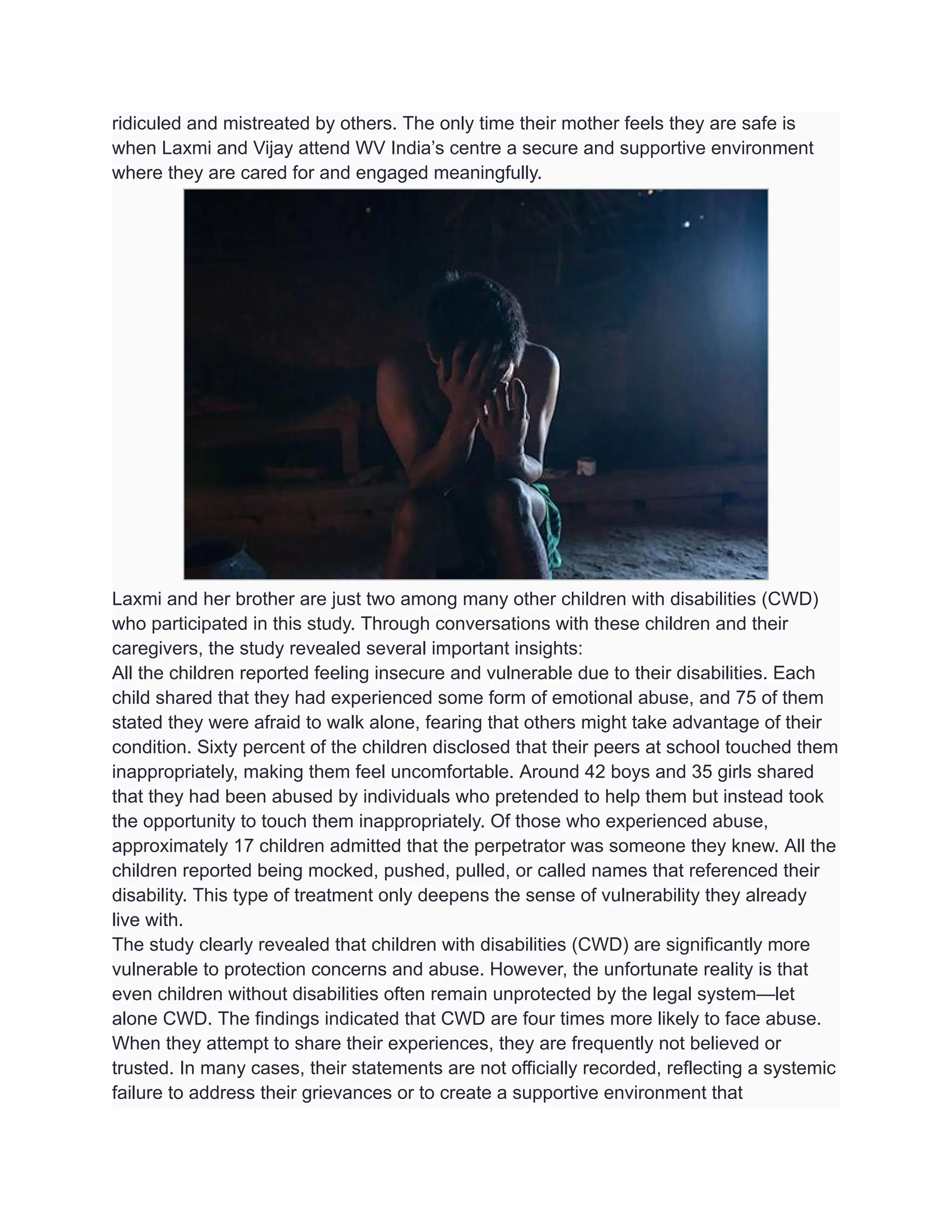
family. She is deeply concerned about her children’s safety when she is away at work. If
they are left indoors, they often damage household items; if they are outside, they are
ridiculed and mistreated by others. The only time their mother feels they are safe is
when Laxmi and Vijay attend WV India’s centre a secure and supportive environment
where they are cared for and engaged meaningfully.
Laxmi and her brother are just two among many other children with disabilities (CWD)
who participated in this study. Through conversations with these children and their
caregivers, the study revealed several important insights:
All the children reported feeling insecure and vulnerable due to their disabilities. Each
child shared that they had experienced some form of emotional abuse, and 75 of them
stated they were afraid to walk alone, fearing that others might take advantage of their
condition. Sixty percent of the children disclosed that their peers at school touched them
inappropriately, making them feel uncomfortable. Around 42 boys and 35 girls shared
that they had been abused by individuals who pretended to help them but instead took
the opportunity to touch them inappropriately. Of those who experienced abuse,
approximately 17 children admitted that the perpetrator was someone they knew. All the
children reported being mocked, pushed, pulled, or called names that referenced their
disability. This type of treatment only deepens the sense of vulnerability they already
live with.
The study clearly revealed that children with disabilities (CWD) are significantly more
vulnerable to protection concerns and abuse. However, the unfortunate reality is that
even children without disabilities often remain unprotected by the legal system—let
alone CWD. The findings indicated that CWD are four times more likely to face abuse.
When they attempt to share their experiences, they are frequently not believed or
trusted. In many cases, their statements are not officially recorded, reflecting a systemic
failure to address their grievances or to create a supportive environment that
encourages them to speak up. It is essential to address the specific challenges faced by
CWD by establishing appropriate platforms that enable them to express and share their
concerns, within the limitations of their abilities. A re-examination of how cases of
abuse—whether within the home, family, community, or legal system—are managed in
relation to CWD is urgently needed to ensure that their voices are heard and their rights
are protected.
WV India’s interventions:
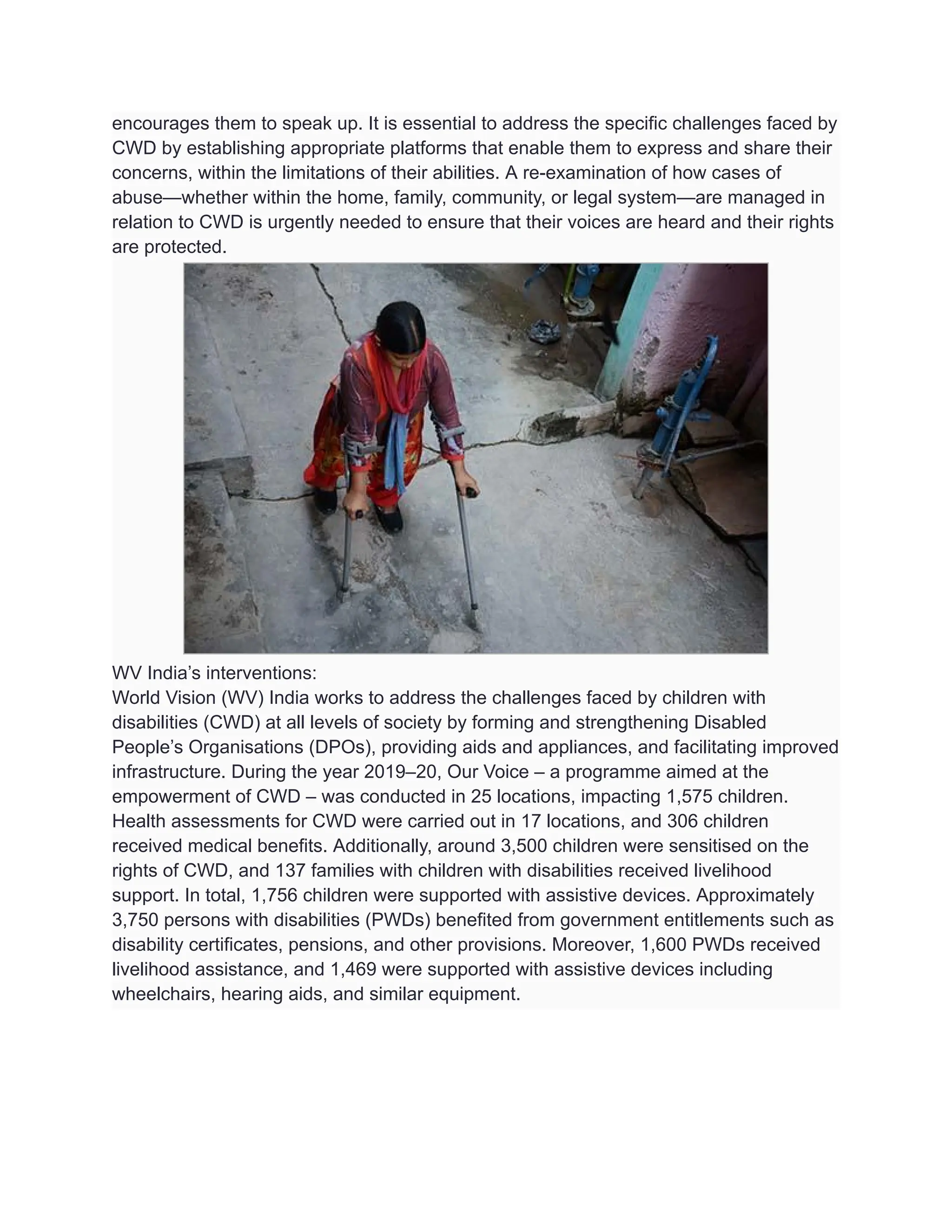
World Vision (WV) India works to address the challenges faced by children with
disabilities (CWD) at all levels of society by forming and strengthening Disabled
People’s Organisations (DPOs), providing aids and appliances, and facilitating improved
infrastructure. During the year 2019–20, Our Voice – a programme aimed at the
empowerment of CWD – was conducted in 25 locations, impacting 1,575 children.
Health assessments for CWD were carried out in 17 locations, and 306 children
received medical benefits. Additionally, around 3,500 children were sensitised on the
rights of CWD, and 137 families with children with disabilities received livelihood
support. In total, 1,756 children were supported with assistive devices. Approximately
3,750 persons with disabilities (PWDs) benefited from government entitlements such as
disability certificates, pensions, and other provisions. Moreover, 1,600 PWDs received
livelihood assistance, and 1,469 were supported with assistive devices including
wheelchairs, hearing aids, and similar equipment.

A peep into the world of children with disabilities.pdf

  • 1.
    A peep intothe world of children with disabilities Did you know that a staggering 19% of the world’s child population resides in India? Currently, 440 million people in the country are under the age of 18, constituting 42% of India’s total population — in other words, four out of every ten individuals is below the age of 18. According to data from the National Crime Records Bureau (NCRB), a total of 94,172 cases of crimes against children were registered in 2015, compared to 89,423 cases in 2014 — an increase of 5.3%. This is shocking, especially considering the rapid development the country is witnessing in other areas. As per the 2011 Census, there are more than 7.8 million children with disabilities (CWD) in India, accounting for approximately 2% of the total child population. In today’s context — where even able-bodied children are often not safe and struggle to protect themselves — children with disabilities are significantly more vulnerable by comparison. In this context, World Vision (WV) India conducted a study in 2019 to highlight the child protection issues faced by children with disabilities (CWD). For the purpose of this study, in-depth discussions were held with 85 CWD, aged between 6 and 18 years (both boys and girls), from the target communities of WV India’s ‘My City Initiative Delhi’ projects. Laxmi, aged 11, was one of the children who participated in the study. She is mentally challenged and also has a slight difficulty with walking. Her brother, Vijay, aged 16, has both physical and intellectual disabilities. Both children are extremely vulnerable — not only because of their disabilities but also due to their dire socio-economic situation. Their father abandoned the family many years ago, leaving their mother to raise them alone. Their mother works as a domestic helper and struggles to support the family. She is deeply concerned about her children’s safety when she is away at work. If they are left indoors, they often damage household items; if they are outside, they are
  • 2.
    ridiculed and mistreatedby others. The only time their mother feels they are safe is when Laxmi and Vijay attend WV India’s centre a secure and supportive environment where they are cared for and engaged meaningfully. Laxmi and her brother are just two among many other children with disabilities (CWD) who participated in this study. Through conversations with these children and their caregivers, the study revealed several important insights: All the children reported feeling insecure and vulnerable due to their disabilities. Each child shared that they had experienced some form of emotional abuse, and 75 of them stated they were afraid to walk alone, fearing that others might take advantage of their condition. Sixty percent of the children disclosed that their peers at school touched them inappropriately, making them feel uncomfortable. Around 42 boys and 35 girls shared that they had been abused by individuals who pretended to help them but instead took the opportunity to touch them inappropriately. Of those who experienced abuse, approximately 17 children admitted that the perpetrator was someone they knew. All the children reported being mocked, pushed, pulled, or called names that referenced their disability. This type of treatment only deepens the sense of vulnerability they already live with. The study clearly revealed that children with disabilities (CWD) are significantly more vulnerable to protection concerns and abuse. However, the unfortunate reality is that even children without disabilities often remain unprotected by the legal system—let alone CWD. The findings indicated that CWD are four times more likely to face abuse. When they attempt to share their experiences, they are frequently not believed or trusted. In many cases, their statements are not officially recorded, reflecting a systemic failure to address their grievances or to create a supportive environment that
  • 3.
    encourages them tospeak up. It is essential to address the specific challenges faced by CWD by establishing appropriate platforms that enable them to express and share their concerns, within the limitations of their abilities. A re-examination of how cases of abuse—whether within the home, family, community, or legal system—are managed in relation to CWD is urgently needed to ensure that their voices are heard and their rights are protected. WV India’s interventions: World Vision (WV) India works to address the challenges faced by children with disabilities (CWD) at all levels of society by forming and strengthening Disabled People’s Organisations (DPOs), providing aids and appliances, and facilitating improved infrastructure. During the year 2019–20, Our Voice – a programme aimed at the empowerment of CWD – was conducted in 25 locations, impacting 1,575 children. Health assessments for CWD were carried out in 17 locations, and 306 children received medical benefits. Additionally, around 3,500 children were sensitised on the rights of CWD, and 137 families with children with disabilities received livelihood support. In total, 1,756 children were supported with assistive devices. Approximately 3,750 persons with disabilities (PWDs) benefited from government entitlements such as disability certificates, pensions, and other provisions. Moreover, 1,600 PWDs received livelihood assistance, and 1,469 were supported with assistive devices including wheelchairs, hearing aids, and similar equipment.