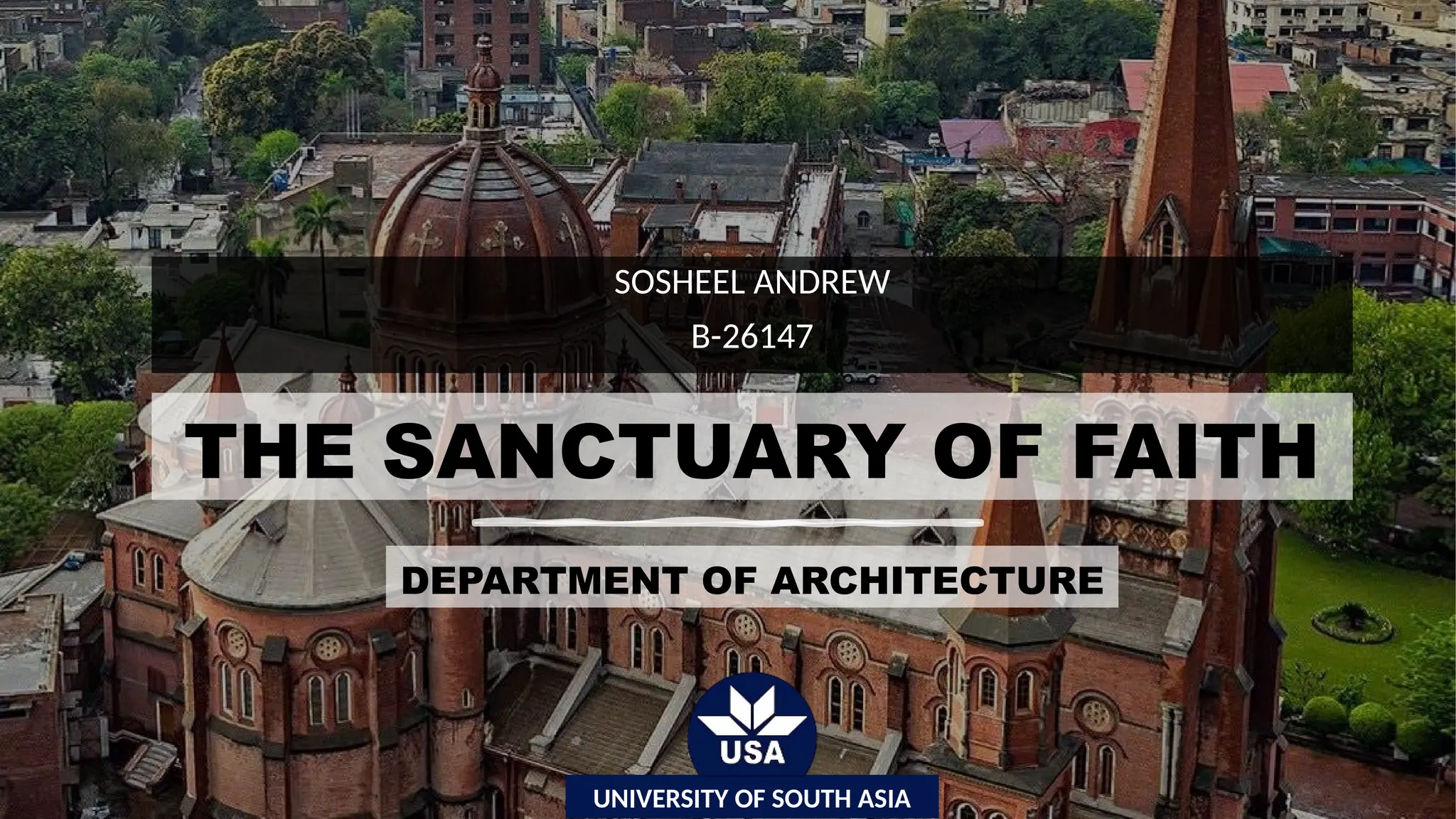
THE SANCTUARY OF FAITH
SOSHEEL ANDREW
B-26147
DEPARTMENT OF ARCHITECTURE
UNIVERSITY OF SOUTH ASIA
Introduction
Religion has long shaped human civilization, deeply
influencing art, culture, and architecture. Among its many
forms, monastic architecture uniquely embodies spirituality
and function, providing spaces for prayer, reflection, and
communal life.
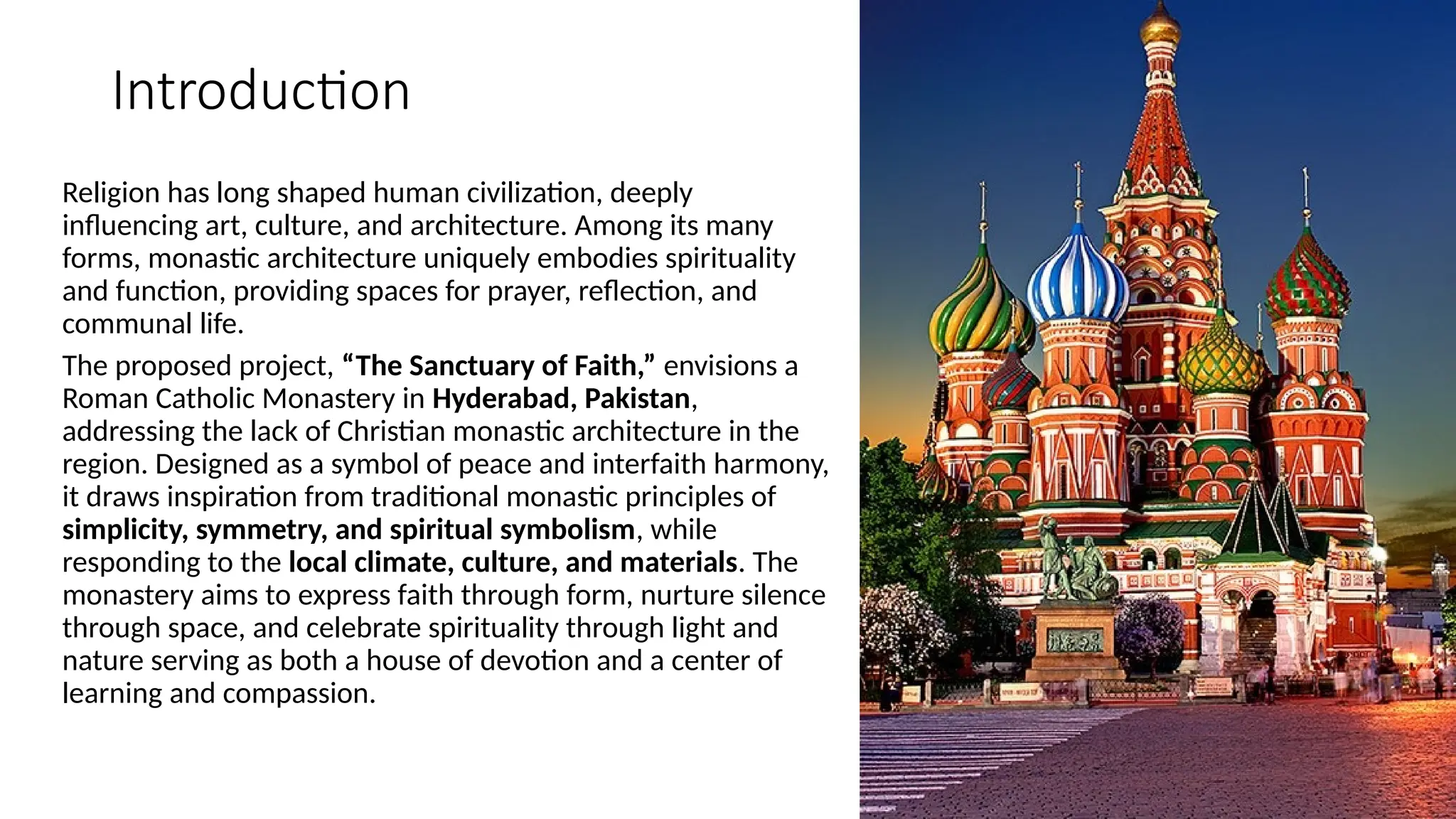
The proposed project, “The Sanctuary of Faith,” envisions a
Roman Catholic Monastery in Hyderabad, Pakistan,
addressing the lack of Christian monastic architecture in the
region. Designed as a symbol of peace and interfaith harmony,
it draws inspiration from traditional monastic principles of
simplicity, symmetry, and spiritual symbolism, while
responding to the local climate, culture, and materials. The
monastery aims to express faith through form, nurture silence
through space, and celebrate spirituality through light and
nature serving as both a house of devotion and a center of
learning and compassion.
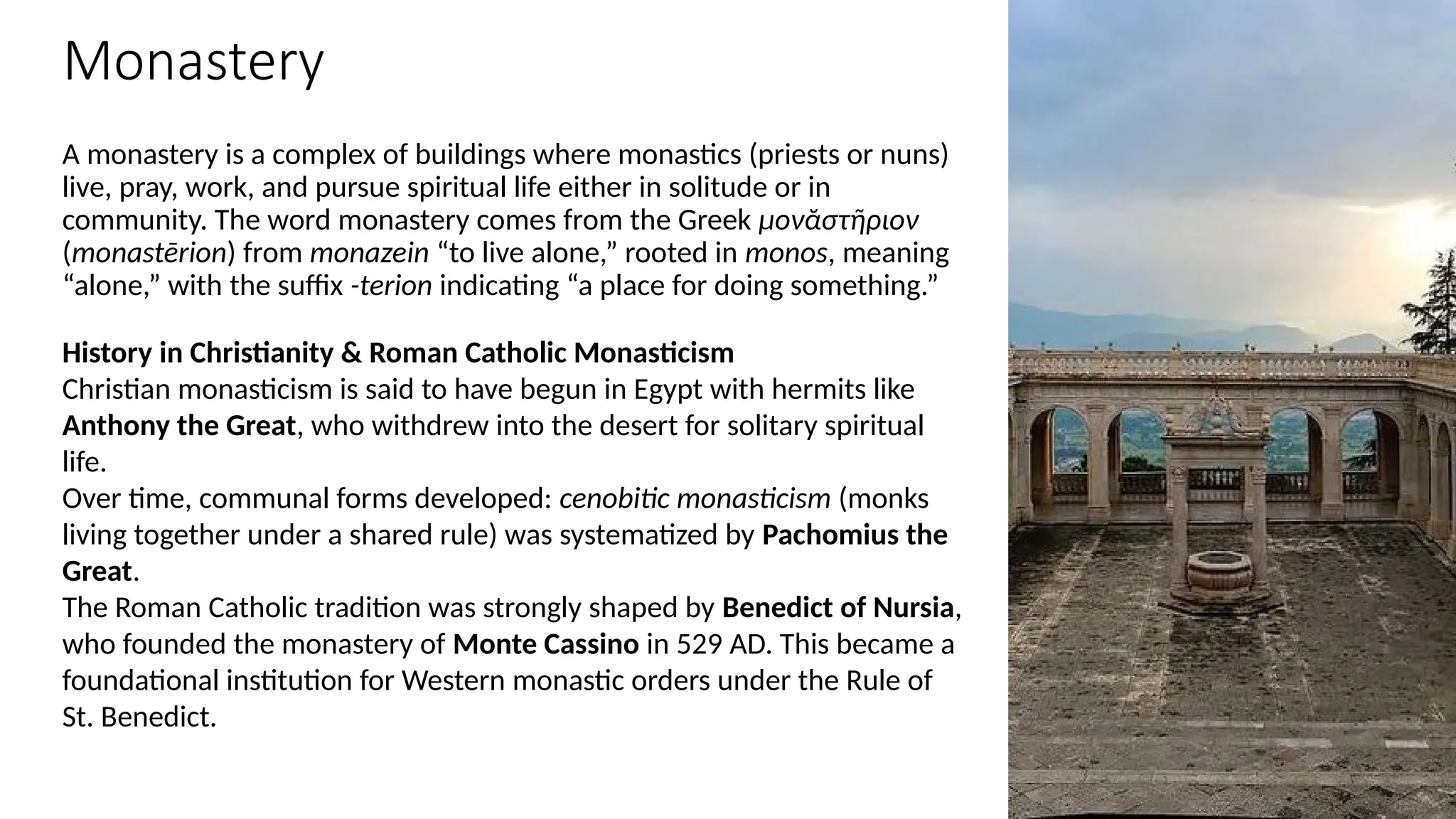
Monastery
A monastery is a complex of buildings where monastics (priests or nuns)
live, pray, work, and pursue spiritual life either in solitude or in
community. The word monastery comes from the Greek μονᾰστῆριον
(monastērion) from monazein “to live alone,” rooted in monos, meaning
“alone,” with the suffix -terion indicating “a place for doing something.”
History in Christianity & Roman Catholic Monasticism
Christian monasticism is said to have begun in Egypt with hermits like
Anthony the Great, who withdrew into the desert for solitary spiritual
life.
Over time, communal forms developed: cenobitic monasticism (monks
living together under a shared rule) was systematized by Pachomius the
Great.
The Roman Catholic tradition was strongly shaped by Benedict of Nursia,
who founded the monastery of Monte Cassino in 529 AD. This became a
foundational institution for Western monastic orders under the Rule of
St. Benedict.
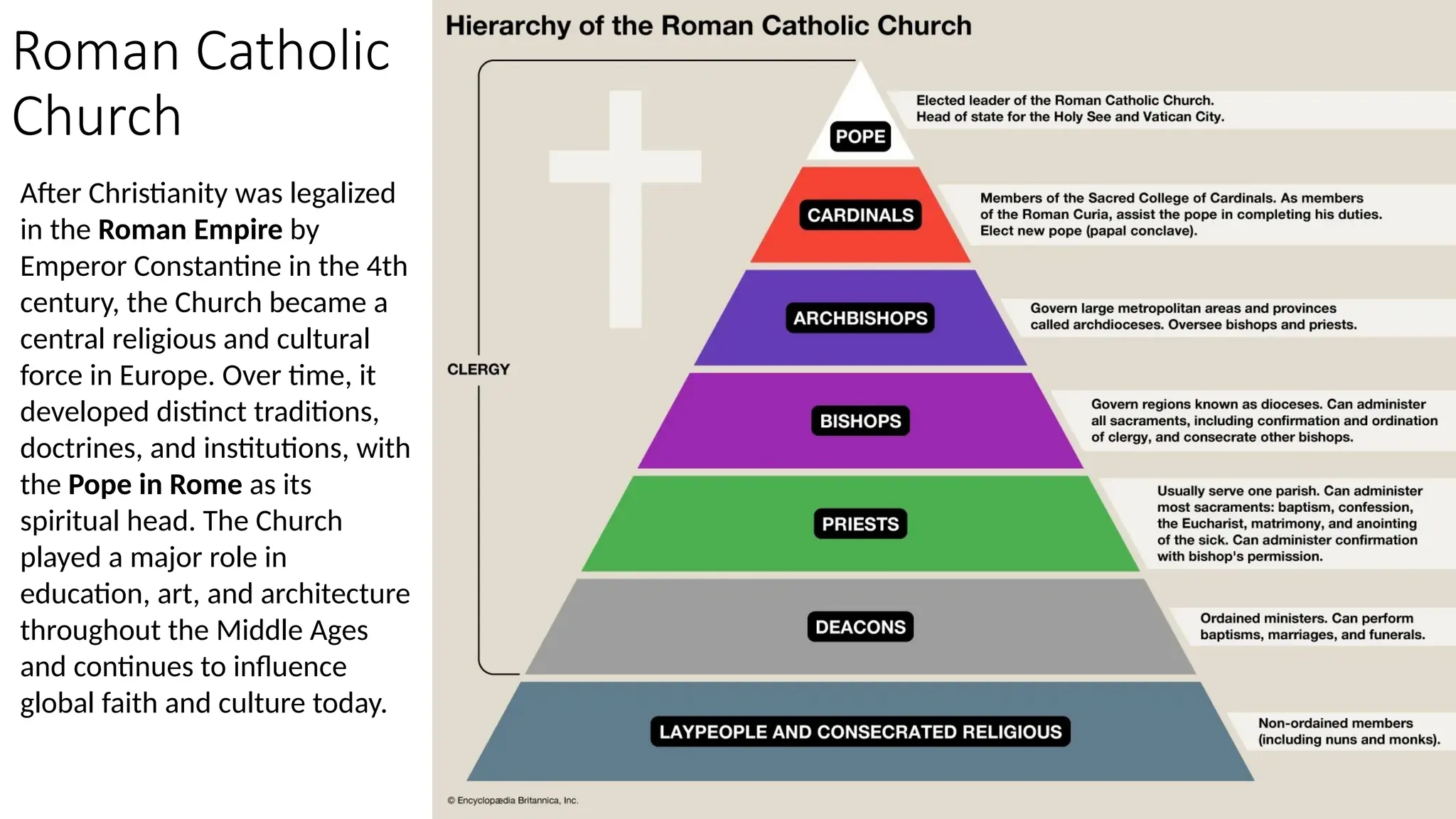
Roman Catholic
Church
After Christianity was legalized
in the Roman Empire by
Emperor Constantine in the 4th
century, the Church became a
central religious and cultural
force in Europe. Over time, it
developed distinct traditions,
doctrines, and institutions, with
the Pope in Rome as its
spiritual head. The Church
played a major role in
education, art, and architecture
throughout the Middle Ages
and continues to influence
global faith and culture today.
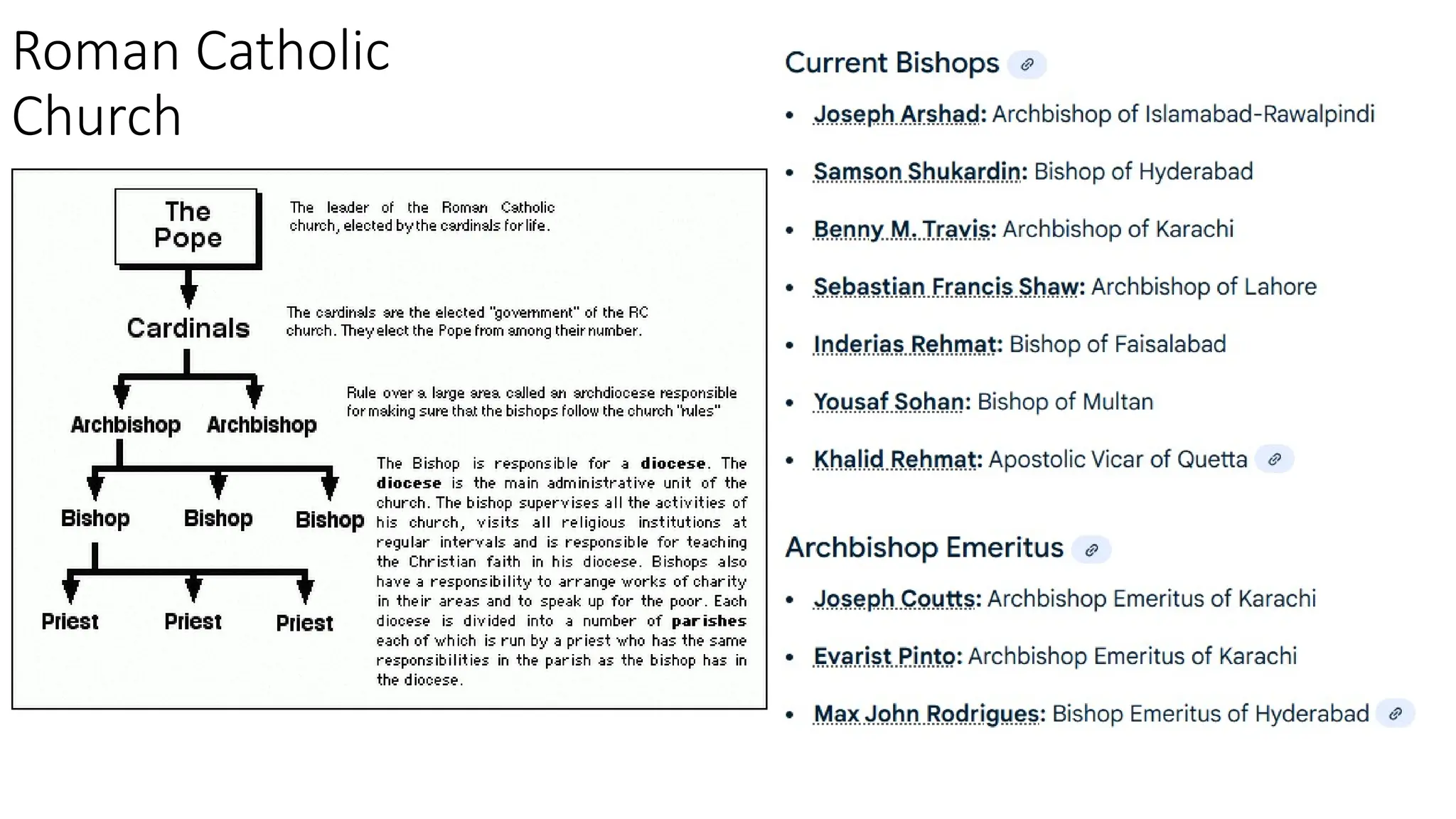
Roman Catholic
Church
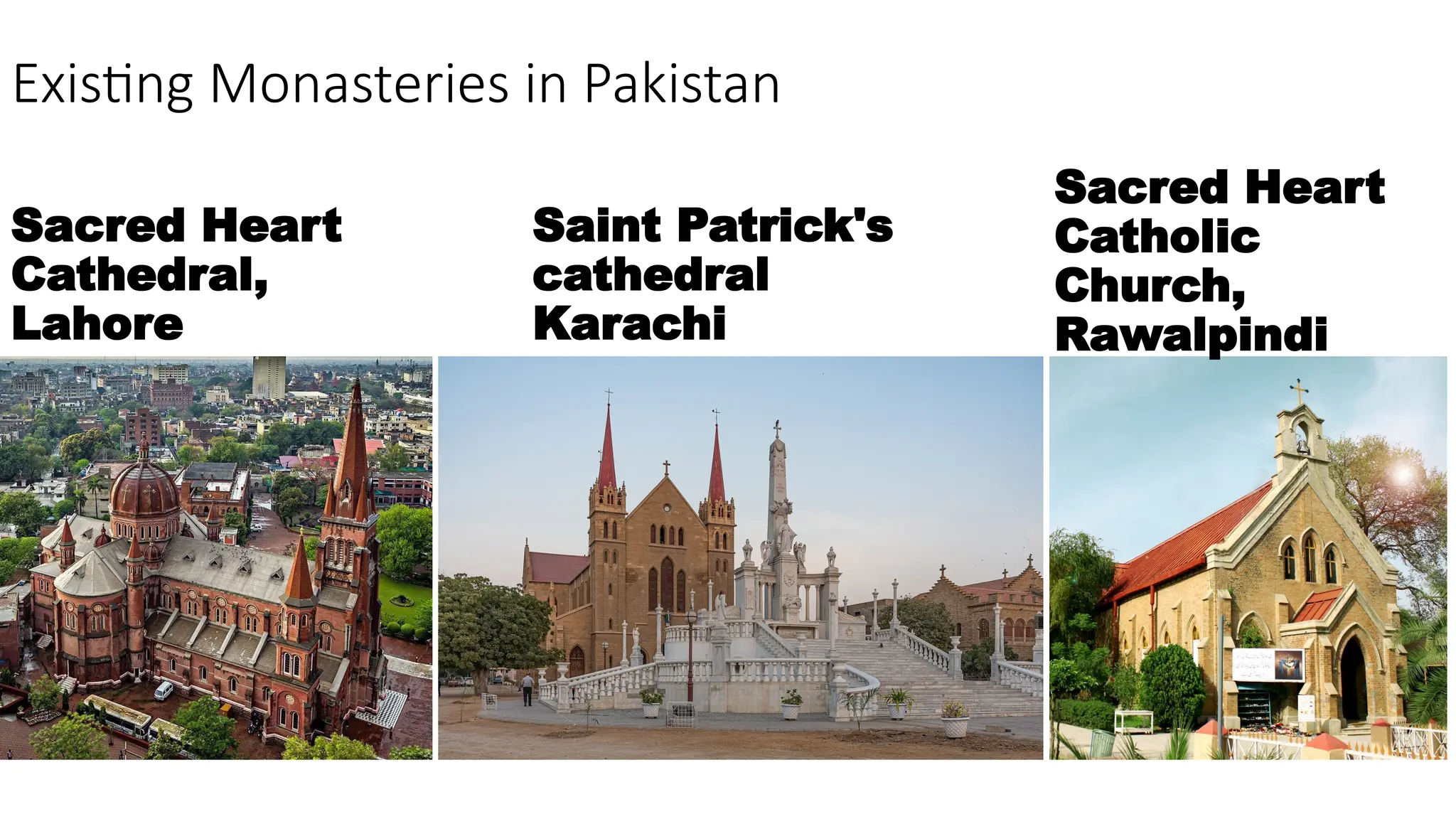
Existing Monasteries in Pakistan
Sacred Heart
Cathedral,
Lahore
Saint Patrick's
cathedral
Karachi
Sacred Heart
Catholic
Church,
Rawalpindi
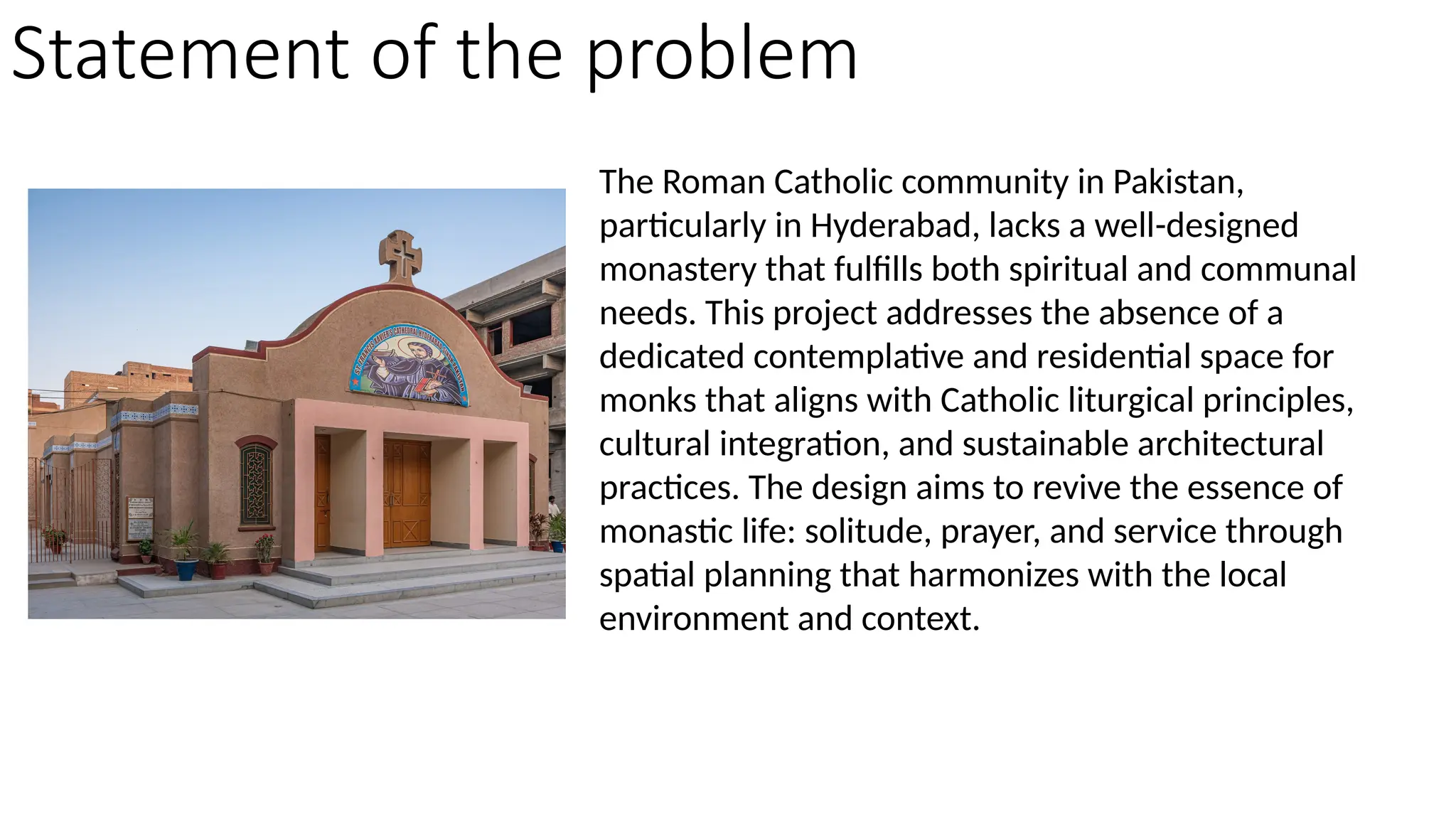
The Roman Catholic community in Pakistan,
particularly in Hyderabad, lacks a well-designed
monastery that fulfills both spiritual and communal
needs. This project addresses the absence of a
dedicated contemplative and residential space for
monks that aligns with Catholic liturgical principles,
cultural integration, and sustainable architectural
practices. The design aims to revive the essence of
monastic life: solitude, prayer, and service through
spatial planning that harmonizes with the local
environment and context.
Statement of the problem
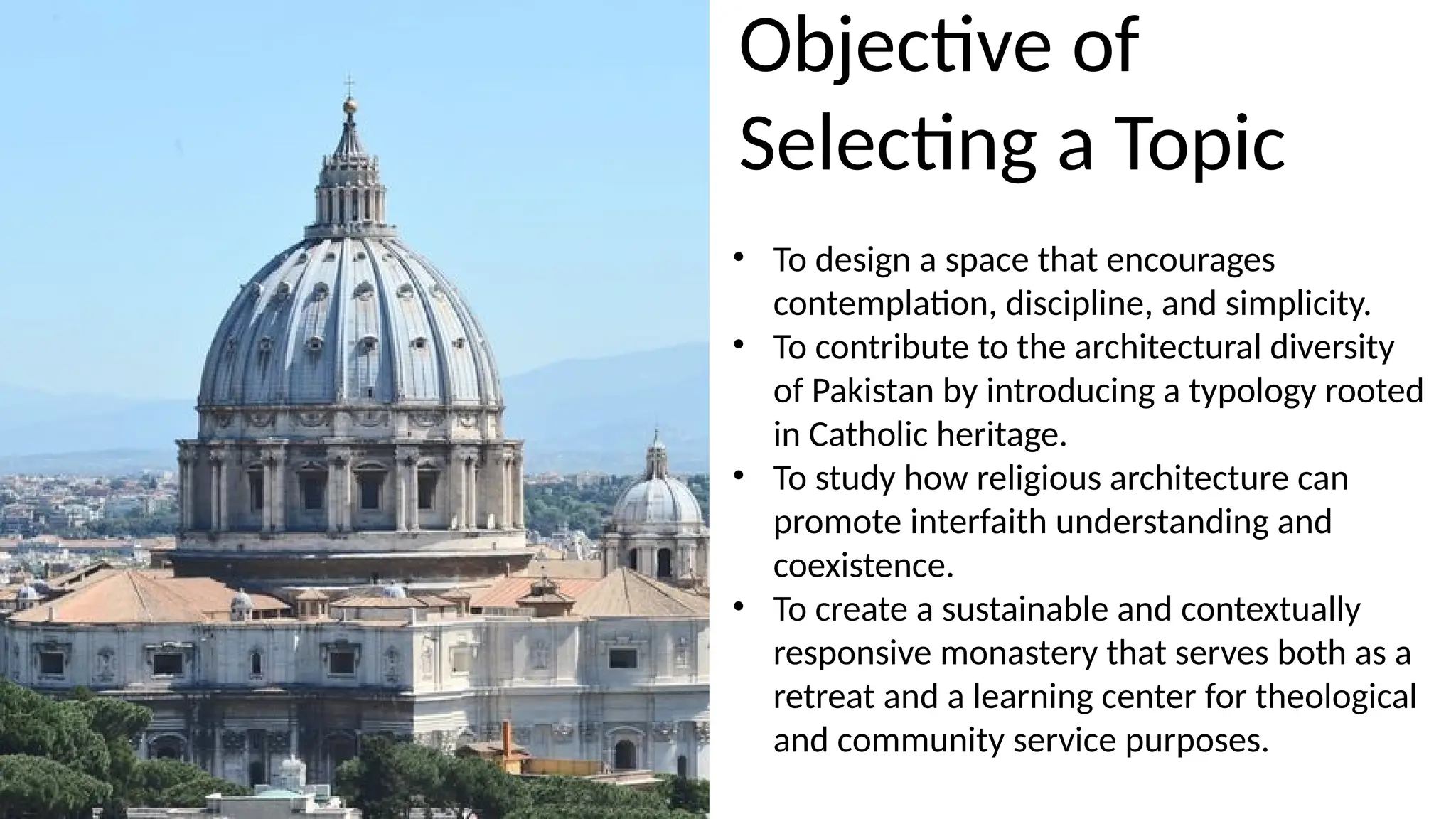
• To design a space that encourages
contemplation, discipline, and simplicity.
• To contribute to the architectural diversity
of Pakistan by introducing a typology rooted
in Catholic heritage.
• To study how religious architecture can
promote interfaith understanding and
coexistence.
• To create a sustainable and contextually
responsive monastery that serves both as a
retreat and a learning center for theological
and community service purposes.
Objective of
Selecting a Topic
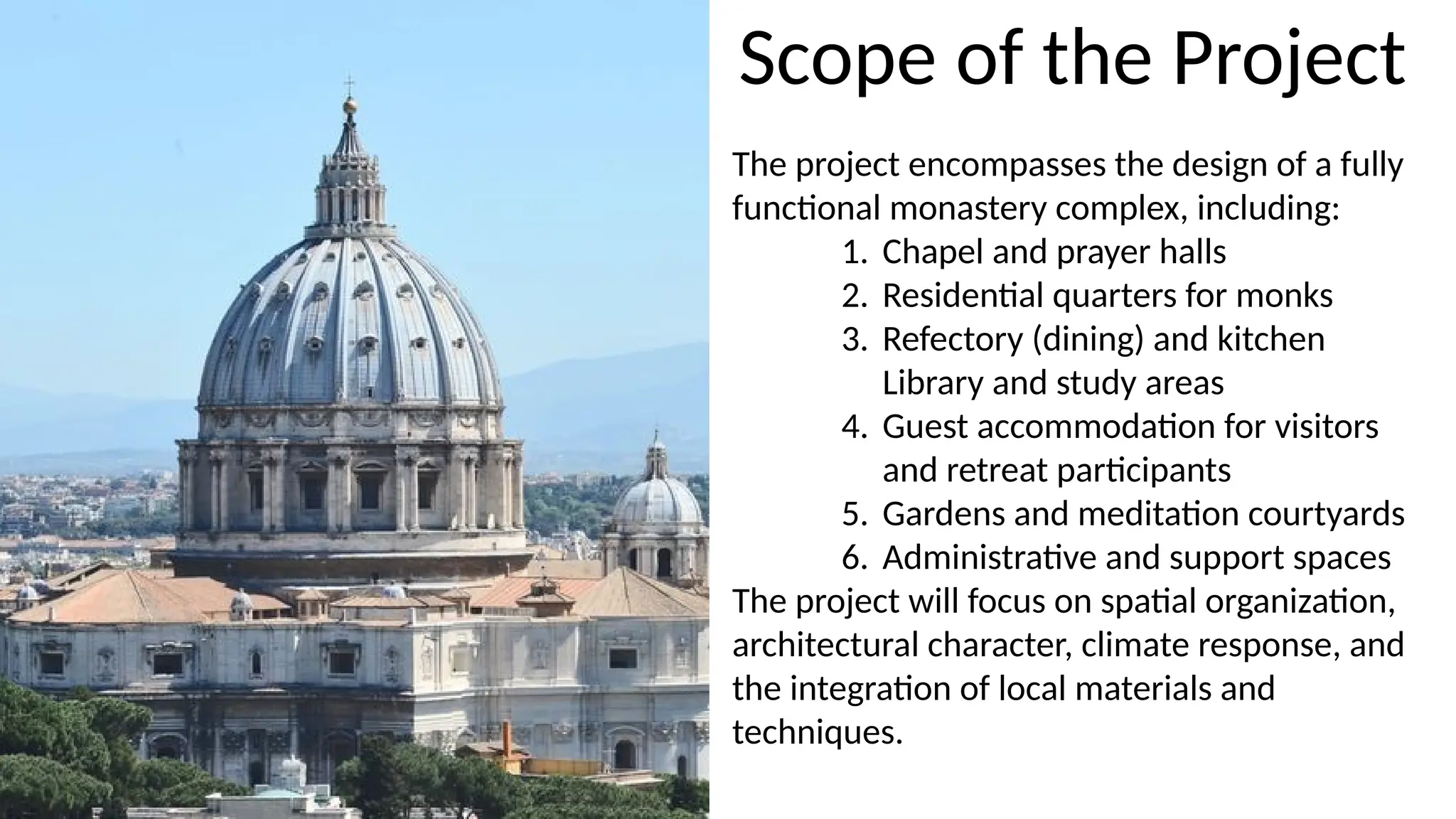
The project encompasses the design of a fully
functional monastery complex, including:
1. Chapel and prayer halls
2. Residential quarters for monks
3. Refectory (dining) and kitchen
Library and study areas
4. Guest accommodation for visitors
and retreat participants
5. Gardens and meditation courtyards
6. Administrative and support spaces
The project will focus on spatial organization,
architectural character, climate response, and
the integration of local materials and
techniques.
Scope of the Project
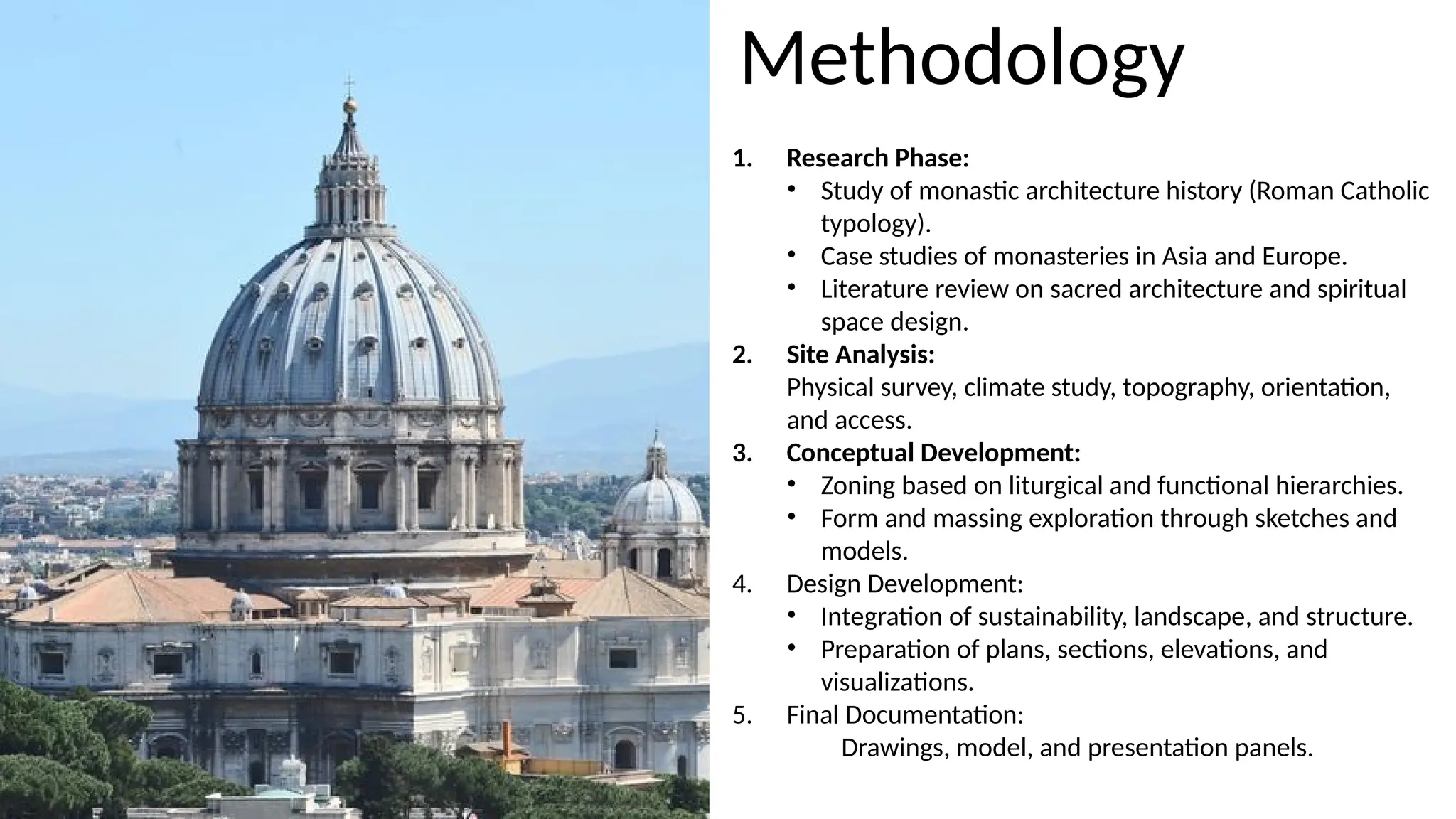
1. Research Phase:
• Study of monastic architecture history (Roman Catholic
typology).
• Case studies of monasteries in Asia and Europe.
• Literature review on sacred architecture and spiritual
space design.
2. Site Analysis:
Physical survey, climate study, topography, orientation,
and access.
3. Conceptual Development:
• Zoning based on liturgical and functional hierarchies.
• Form and massing exploration through sketches and
models.
4. Design Development:
• Integration of sustainability, landscape, and structure.
• Preparation of plans, sections, elevations, and
visualizations.
5. Final Documentation:
Drawings, model, and presentation panels.
Methodology
This research will contribute to the
understanding of religious architecture within
non-Christian-majority contexts. It will provide
a framework for designing spiritual and
contemplative spaces that are environmentally
conscious and culturally sensitive. Architecture
students and professionals may use this study
to explore new dimensions in interfaith
architectural expression, contextual design,
and modern monastic planning.
Contribution to
Others
Schedule of Project
Part-1
(Semester-09)
Phase
No.
Description Duration
Phase
1
Topic Selection, Synopsis, and Site Selection 1 Month
Phase
2
Site Surveys and Analysis 1 Month
Phase
3
Literature Review and Case Studies 1 Month
Phase
4
Conclusion & Initial Master Plan 1 Month
Part-2
(Semester-10)
Phase
5
Development of Concept & Conceptual Design 1 Month
Phase
6
Detailed Planning & Section, Elevations 1 Month
Phase
7
3d Model, Rendering or Physical Model (if needed) 1 Month
Phase
8
Design of Final Sheets along Changes in previous work and
finalize all work for Final Jury
1 Month
• Limited access to existing monasteries in
Pakistan for on-site case studies.
• Possible cultural and religious
sensitivities related to Christian
architecture.
• Time-bound academic schedule may
restrict deep technical detailing.
Constraints and
Limitations
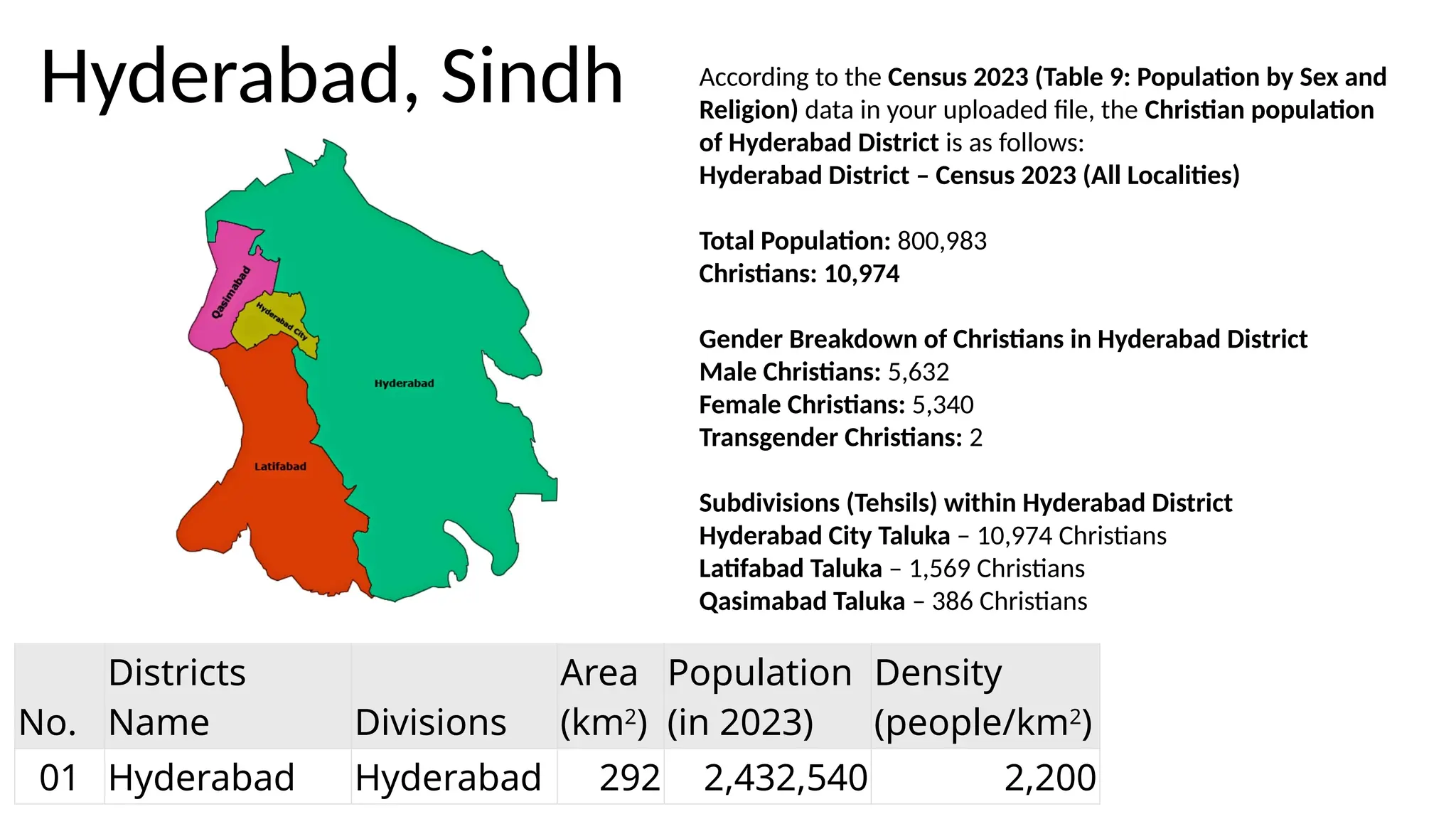
Hyderabad, Sindh
No.
Districts
Name Divisions
Area
(km2
)
Population
(in 2023)
Density
(people/km2
)
01 Hyderabad Hyderabad 292 2,432,540 2,200
According to the Census 2023 (Table 9: Population by Sex and
Religion) data in your uploaded file, the Christian population
of Hyderabad District is as follows:
Hyderabad District – Census 2023 (All Localities)
Total Population: 800,983
Christians: 10,974
Gender Breakdown of Christians in Hyderabad District
Male Christians: 5,632
Female Christians: 5,340
Transgender Christians: 2
Subdivisions (Tehsils) within Hyderabad District
Hyderabad City Taluka – 10,974 Christians
Latifabad Taluka – 1,569 Christians
Qasimabad Taluka – 386 Christians
Hyderabad, Sindh
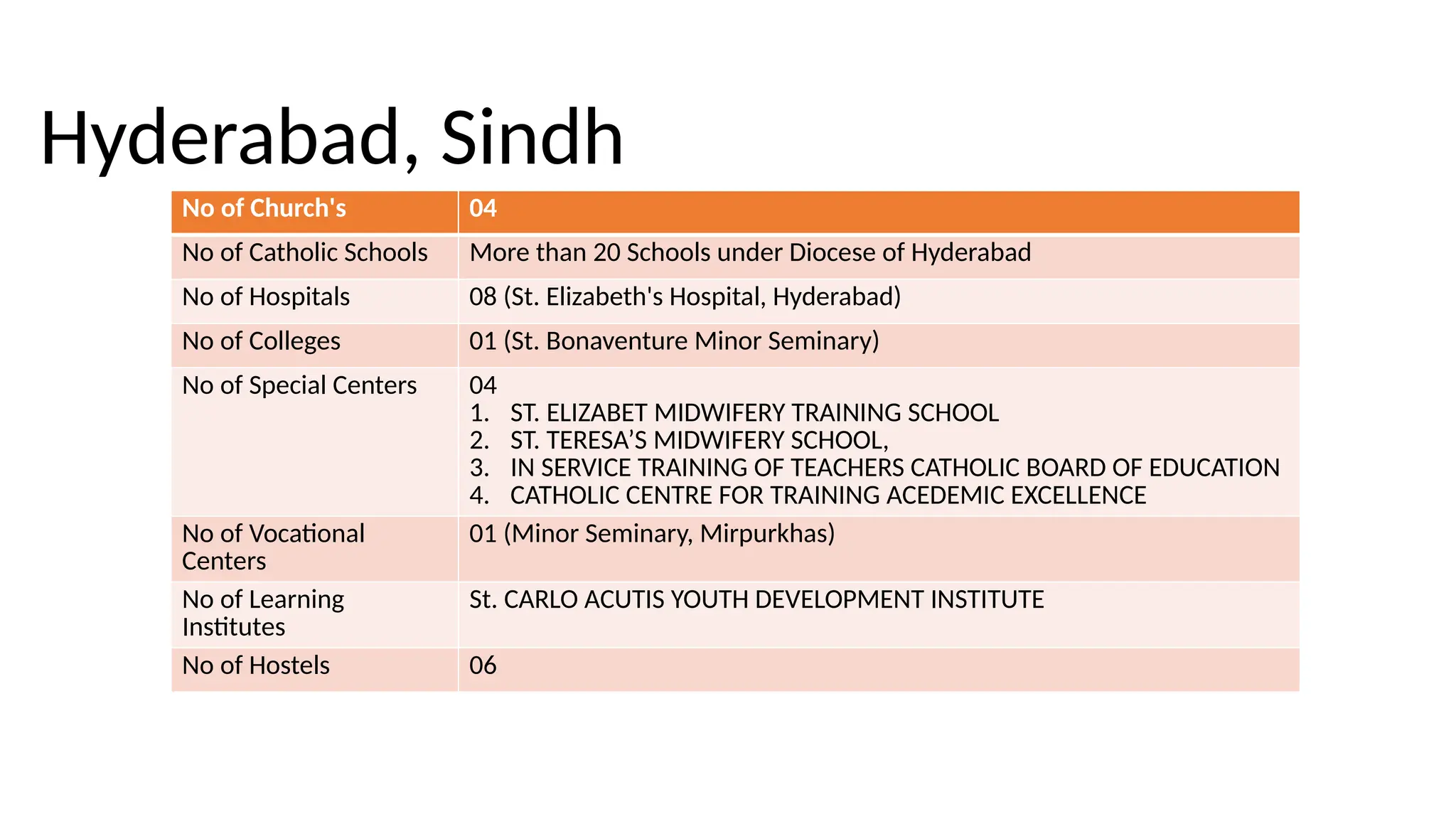
No of Church's 04
No of Catholic Schools More than 20 Schools under Diocese of Hyderabad
No of Hospitals 08 (St. Elizabeth's Hospital, Hyderabad)
No of Colleges 01 (St. Bonaventure Minor Seminary)
No of Special Centers 04
1. ST. ELIZABET MIDWIFERY TRAINING SCHOOL
2. ST. TERESA’S MIDWIFERY SCHOOL,
3. IN SERVICE TRAINING OF TEACHERS CATHOLIC BOARD OF EDUCATION
4. CATHOLIC CENTRE FOR TRAINING ACEDEMIC EXCELLENCE
No of Vocational
Centers
01 (Minor Seminary, Mirpurkhas)
No of Learning
Institutes
St. CARLO ACUTIS YOUTH DEVELOPMENT INSTITUTE
No of Hostels 06
Hyderabad, Sindh
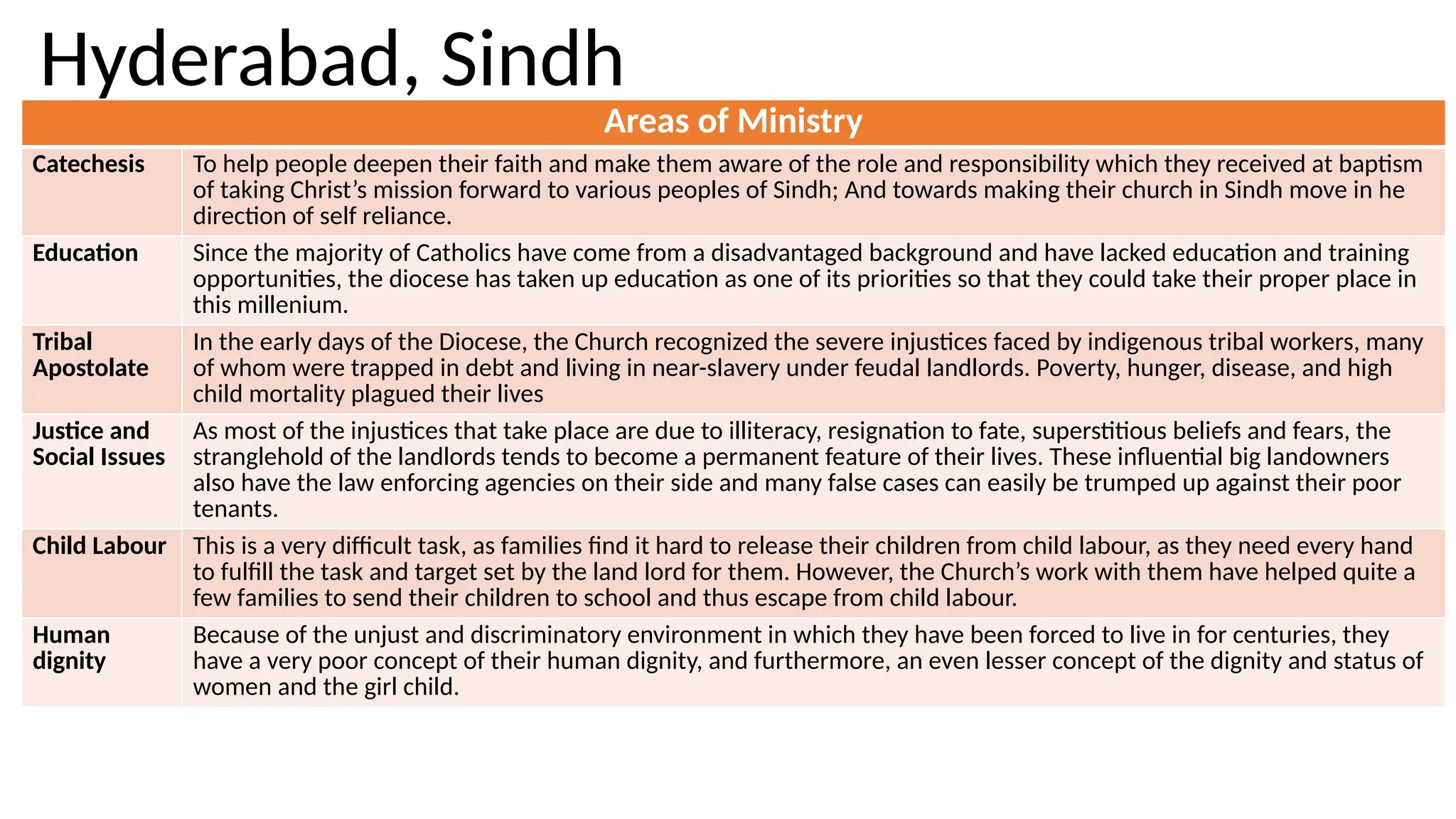
Areas of Ministry
Catechesis To help people deepen their faith and make them aware of the role and responsibility which they received at baptism
of taking Christ’s mission forward to various peoples of Sindh; And towards making their church in Sindh move in he
direction of self reliance.
Education Since the majority of Catholics have come from a disadvantaged background and have lacked education and training
opportunities, the diocese has taken up education as one of its priorities so that they could take their proper place in
this millenium.
Tribal
Apostolate
In the early days of the Diocese, the Church recognized the severe injustices faced by indigenous tribal workers, many
of whom were trapped in debt and living in near-slavery under feudal landlords. Poverty, hunger, disease, and high
child mortality plagued their lives
Justice and
Social Issues
As most of the injustices that take place are due to illiteracy, resignation to fate, superstitious beliefs and fears, the
stranglehold of the landlords tends to become a permanent feature of their lives. These influential big landowners
also have the law enforcing agencies on their side and many false cases can easily be trumped up against their poor
tenants.
Child Labour This is a very difficult task, as families find it hard to release their children from child labour, as they need every hand
to fulfill the task and target set by the land lord for them. However, the Church’s work with them have helped quite a
few families to send their children to school and thus escape from child labour.
Human
dignity
Because of the unjust and discriminatory environment in which they have been forced to live in for centuries, they
have a very poor concept of their human dignity, and furthermore, an even lesser concept of the dignity and status of
women and the girl child.
THE SANCTUARY OF FAITH is Roman Cathlic Mosantery

  • 1.
    THE SANCTUARY OFFAITH SOSHEEL ANDREW B-26147 DEPARTMENT OF ARCHITECTURE UNIVERSITY OF SOUTH ASIA
  • 2.
    Introduction Religion has longshaped human civilization, deeply influencing art, culture, and architecture. Among its many forms, monastic architecture uniquely embodies spirituality and function, providing spaces for prayer, reflection, and communal life. The proposed project, “The Sanctuary of Faith,” envisions a Roman Catholic Monastery in Hyderabad, Pakistan, addressing the lack of Christian monastic architecture in the region. Designed as a symbol of peace and interfaith harmony, it draws inspiration from traditional monastic principles of simplicity, symmetry, and spiritual symbolism, while responding to the local climate, culture, and materials. The monastery aims to express faith through form, nurture silence through space, and celebrate spirituality through light and nature serving as both a house of devotion and a center of learning and compassion.
  • 3.
    Monastery A monastery isa complex of buildings where monastics (priests or nuns) live, pray, work, and pursue spiritual life either in solitude or in community. The word monastery comes from the Greek μονᾰστῆριον (monastērion) from monazein “to live alone,” rooted in monos, meaning “alone,” with the suffix -terion indicating “a place for doing something.” History in Christianity & Roman Catholic Monasticism Christian monasticism is said to have begun in Egypt with hermits like Anthony the Great, who withdrew into the desert for solitary spiritual life. Over time, communal forms developed: cenobitic monasticism (monks living together under a shared rule) was systematized by Pachomius the Great. The Roman Catholic tradition was strongly shaped by Benedict of Nursia, who founded the monastery of Monte Cassino in 529 AD. This became a foundational institution for Western monastic orders under the Rule of St. Benedict.
  • 4.
    Roman Catholic Church After Christianitywas legalized in the Roman Empire by Emperor Constantine in the 4th century, the Church became a central religious and cultural force in Europe. Over time, it developed distinct traditions, doctrines, and institutions, with the Pope in Rome as its spiritual head. The Church played a major role in education, art, and architecture throughout the Middle Ages and continues to influence global faith and culture today.
  • 5.
  • 6.
    Existing Monasteries inPakistan Sacred Heart Cathedral, Lahore Saint Patrick's cathedral Karachi Sacred Heart Catholic Church, Rawalpindi
  • 7.
    The Roman Catholiccommunity in Pakistan, particularly in Hyderabad, lacks a well-designed monastery that fulfills both spiritual and communal needs. This project addresses the absence of a dedicated contemplative and residential space for monks that aligns with Catholic liturgical principles, cultural integration, and sustainable architectural practices. The design aims to revive the essence of monastic life: solitude, prayer, and service through spatial planning that harmonizes with the local environment and context. Statement of the problem
  • 8.
    • To designa space that encourages contemplation, discipline, and simplicity. • To contribute to the architectural diversity of Pakistan by introducing a typology rooted in Catholic heritage. • To study how religious architecture can promote interfaith understanding and coexistence. • To create a sustainable and contextually responsive monastery that serves both as a retreat and a learning center for theological and community service purposes. Objective of Selecting a Topic
  • 9.
    The project encompassesthe design of a fully functional monastery complex, including: 1. Chapel and prayer halls 2. Residential quarters for monks 3. Refectory (dining) and kitchen Library and study areas 4. Guest accommodation for visitors and retreat participants 5. Gardens and meditation courtyards 6. Administrative and support spaces The project will focus on spatial organization, architectural character, climate response, and the integration of local materials and techniques. Scope of the Project
  • 10.
    1. Research Phase: •Study of monastic architecture history (Roman Catholic typology). • Case studies of monasteries in Asia and Europe. • Literature review on sacred architecture and spiritual space design. 2. Site Analysis: Physical survey, climate study, topography, orientation, and access. 3. Conceptual Development: • Zoning based on liturgical and functional hierarchies. • Form and massing exploration through sketches and models. 4. Design Development: • Integration of sustainability, landscape, and structure. • Preparation of plans, sections, elevations, and visualizations. 5. Final Documentation: Drawings, model, and presentation panels. Methodology
  • 11.
    This research willcontribute to the understanding of religious architecture within non-Christian-majority contexts. It will provide a framework for designing spiritual and contemplative spaces that are environmentally conscious and culturally sensitive. Architecture students and professionals may use this study to explore new dimensions in interfaith architectural expression, contextual design, and modern monastic planning. Contribution to Others
  • 12.
    Schedule of Project Part-1 (Semester-09) Phase No. DescriptionDuration Phase 1 Topic Selection, Synopsis, and Site Selection 1 Month Phase 2 Site Surveys and Analysis 1 Month Phase 3 Literature Review and Case Studies 1 Month Phase 4 Conclusion & Initial Master Plan 1 Month Part-2 (Semester-10) Phase 5 Development of Concept & Conceptual Design 1 Month Phase 6 Detailed Planning & Section, Elevations 1 Month Phase 7 3d Model, Rendering or Physical Model (if needed) 1 Month Phase 8 Design of Final Sheets along Changes in previous work and finalize all work for Final Jury 1 Month
  • 13.
    • Limited accessto existing monasteries in Pakistan for on-site case studies. • Possible cultural and religious sensitivities related to Christian architecture. • Time-bound academic schedule may restrict deep technical detailing. Constraints and Limitations
  • 14.
    Hyderabad, Sindh No. Districts Name Divisions Area (km2 ) Population (in2023) Density (people/km2 ) 01 Hyderabad Hyderabad 292 2,432,540 2,200 According to the Census 2023 (Table 9: Population by Sex and Religion) data in your uploaded file, the Christian population of Hyderabad District is as follows: Hyderabad District – Census 2023 (All Localities) Total Population: 800,983 Christians: 10,974 Gender Breakdown of Christians in Hyderabad District Male Christians: 5,632 Female Christians: 5,340 Transgender Christians: 2 Subdivisions (Tehsils) within Hyderabad District Hyderabad City Taluka – 10,974 Christians Latifabad Taluka – 1,569 Christians Qasimabad Taluka – 386 Christians
  • 15.
    Hyderabad, Sindh No ofChurch's 04 No of Catholic Schools More than 20 Schools under Diocese of Hyderabad No of Hospitals 08 (St. Elizabeth's Hospital, Hyderabad) No of Colleges 01 (St. Bonaventure Minor Seminary) No of Special Centers 04 1. ST. ELIZABET MIDWIFERY TRAINING SCHOOL 2. ST. TERESA’S MIDWIFERY SCHOOL, 3. IN SERVICE TRAINING OF TEACHERS CATHOLIC BOARD OF EDUCATION 4. CATHOLIC CENTRE FOR TRAINING ACEDEMIC EXCELLENCE No of Vocational Centers 01 (Minor Seminary, Mirpurkhas) No of Learning Institutes St. CARLO ACUTIS YOUTH DEVELOPMENT INSTITUTE No of Hostels 06
  • 16.
    Hyderabad, Sindh Areas ofMinistry Catechesis To help people deepen their faith and make them aware of the role and responsibility which they received at baptism of taking Christ’s mission forward to various peoples of Sindh; And towards making their church in Sindh move in he direction of self reliance. Education Since the majority of Catholics have come from a disadvantaged background and have lacked education and training opportunities, the diocese has taken up education as one of its priorities so that they could take their proper place in this millenium. Tribal Apostolate In the early days of the Diocese, the Church recognized the severe injustices faced by indigenous tribal workers, many of whom were trapped in debt and living in near-slavery under feudal landlords. Poverty, hunger, disease, and high child mortality plagued their lives Justice and Social Issues As most of the injustices that take place are due to illiteracy, resignation to fate, superstitious beliefs and fears, the stranglehold of the landlords tends to become a permanent feature of their lives. These influential big landowners also have the law enforcing agencies on their side and many false cases can easily be trumped up against their poor tenants. Child Labour This is a very difficult task, as families find it hard to release their children from child labour, as they need every hand to fulfill the task and target set by the land lord for them. However, the Church’s work with them have helped quite a few families to send their children to school and thus escape from child labour. Human dignity Because of the unjust and discriminatory environment in which they have been forced to live in for centuries, they have a very poor concept of their human dignity, and furthermore, an even lesser concept of the dignity and status of women and the girl child.