Masterclass on
Cyber Crime, Scams
& Safety Hacks
•By
•Sathishkumar Kannan, MS (UK)
•Ethical Hacker & Cyber Security Expert
•Founder & CEO, WHY Global Services
Statistics
• Every 39 seconds, a cyberattack happens worldwide. In India alone, over 1.3
million cybercrime complaints were registered in 2024.
Have you ever
faced an online
scam?
(Phishing email,
fake call, OTP
scam, hacked
account)”
Cybercrime is any
criminal activity that
involves a
computer, network,
or digital device
either as a tool, a
target, or both.
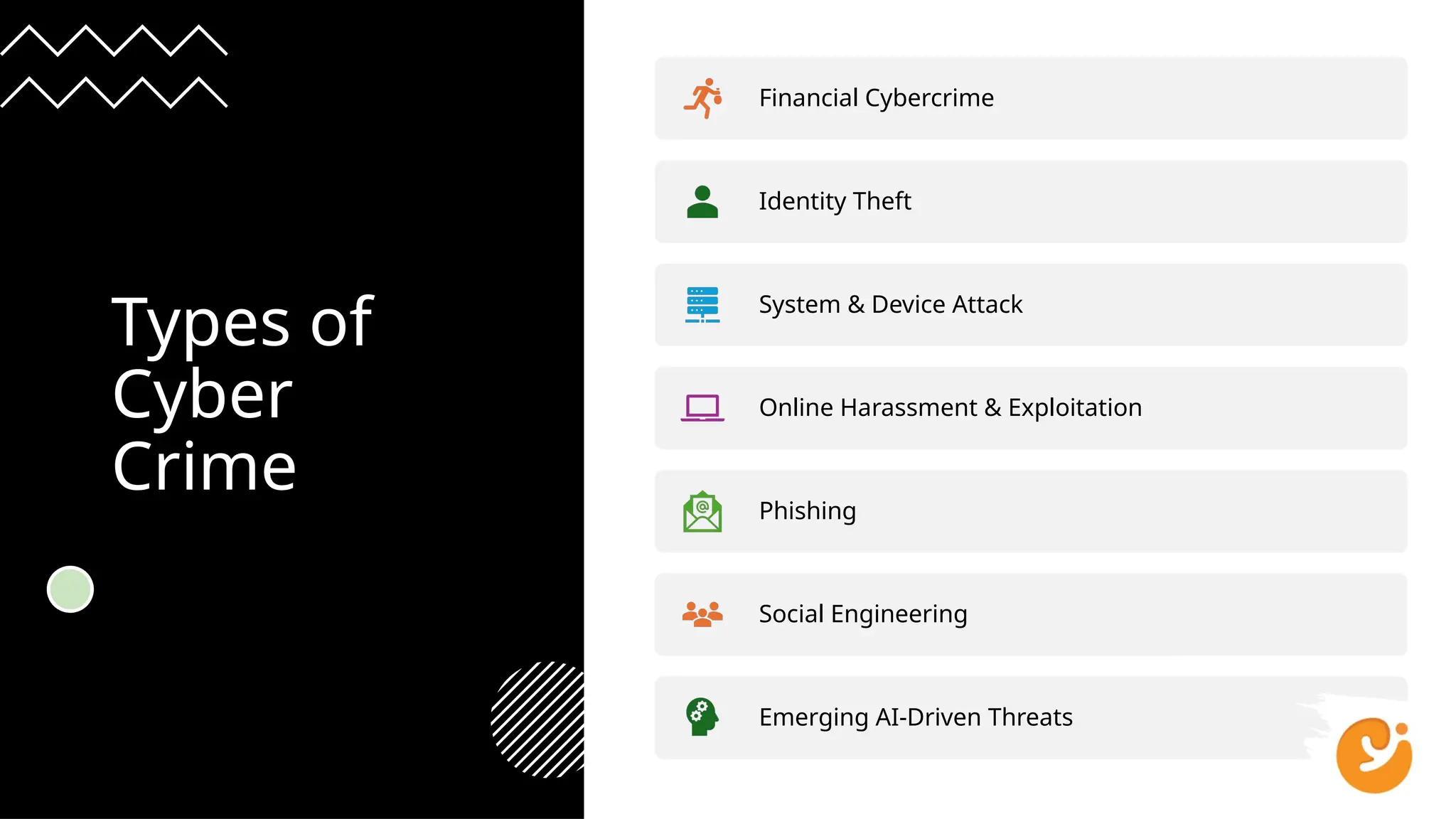
Types of
Cyber
Crime
Financial Cybercrime
Identity Theft
System & Device Attack
Online Harassment & Exploitation
Phishing
Social Engineering
Emerging AI-Driven Threats
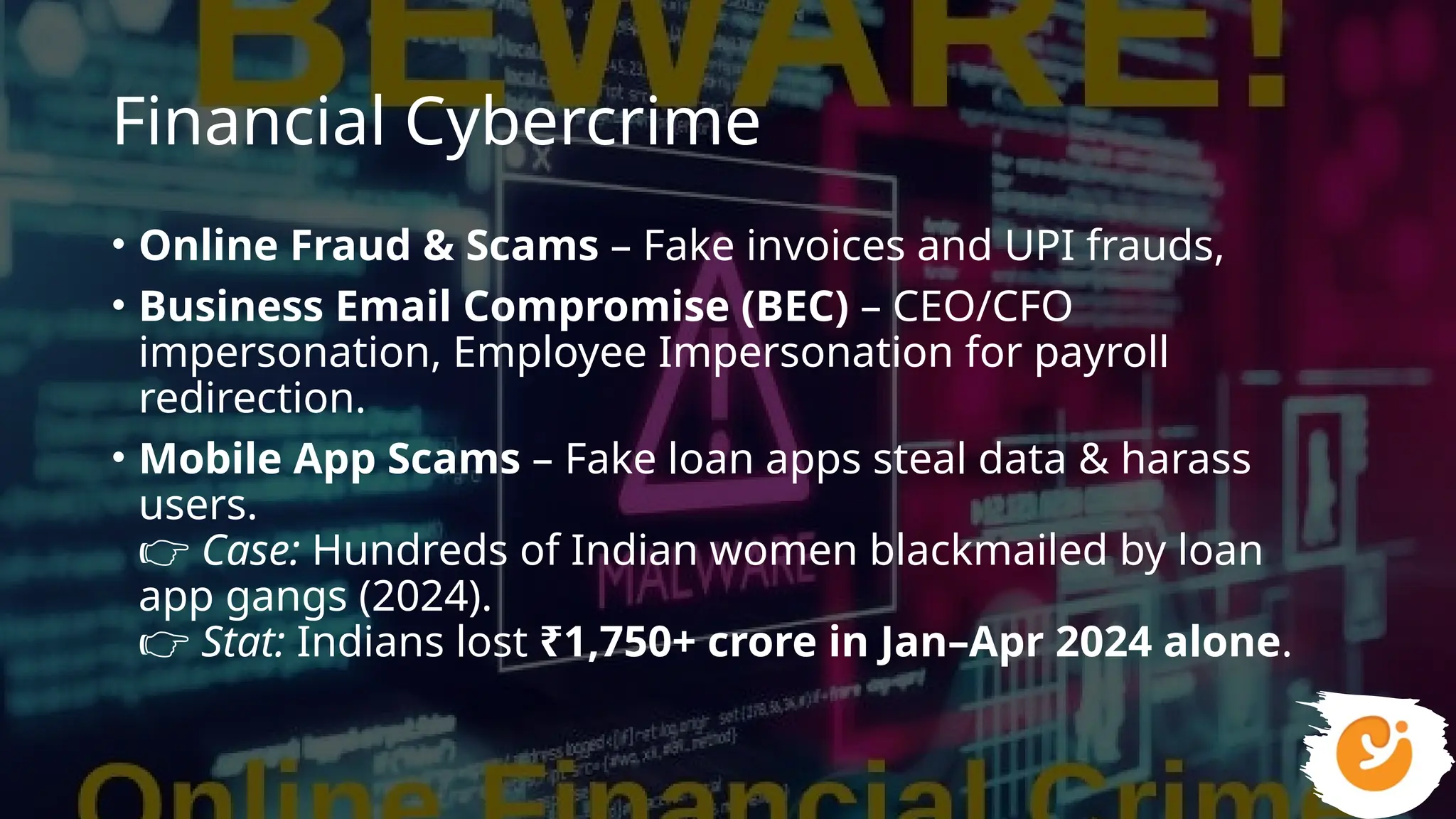
Financial Cybercrime
• Online Fraud & Scams – Fake invoices and UPI frauds,
• Business Email Compromise (BEC) – CEO/CFO
impersonation, Employee Impersonation for payroll
redirection.
• Mobile App Scams – Fake loan apps steal data & harass
users.
👉 Case: Hundreds of Indian women blackmailed by loan
app gangs (2024).
👉 Stat: Indians lost ₹1,750+ crore in Jan–Apr 2024 alone.
Most Common Online Frauds
• Phishing
• Spear-Phishing
• Whaling
• Lottery Scam
• Online Shopping Frauds
• WFH Scam
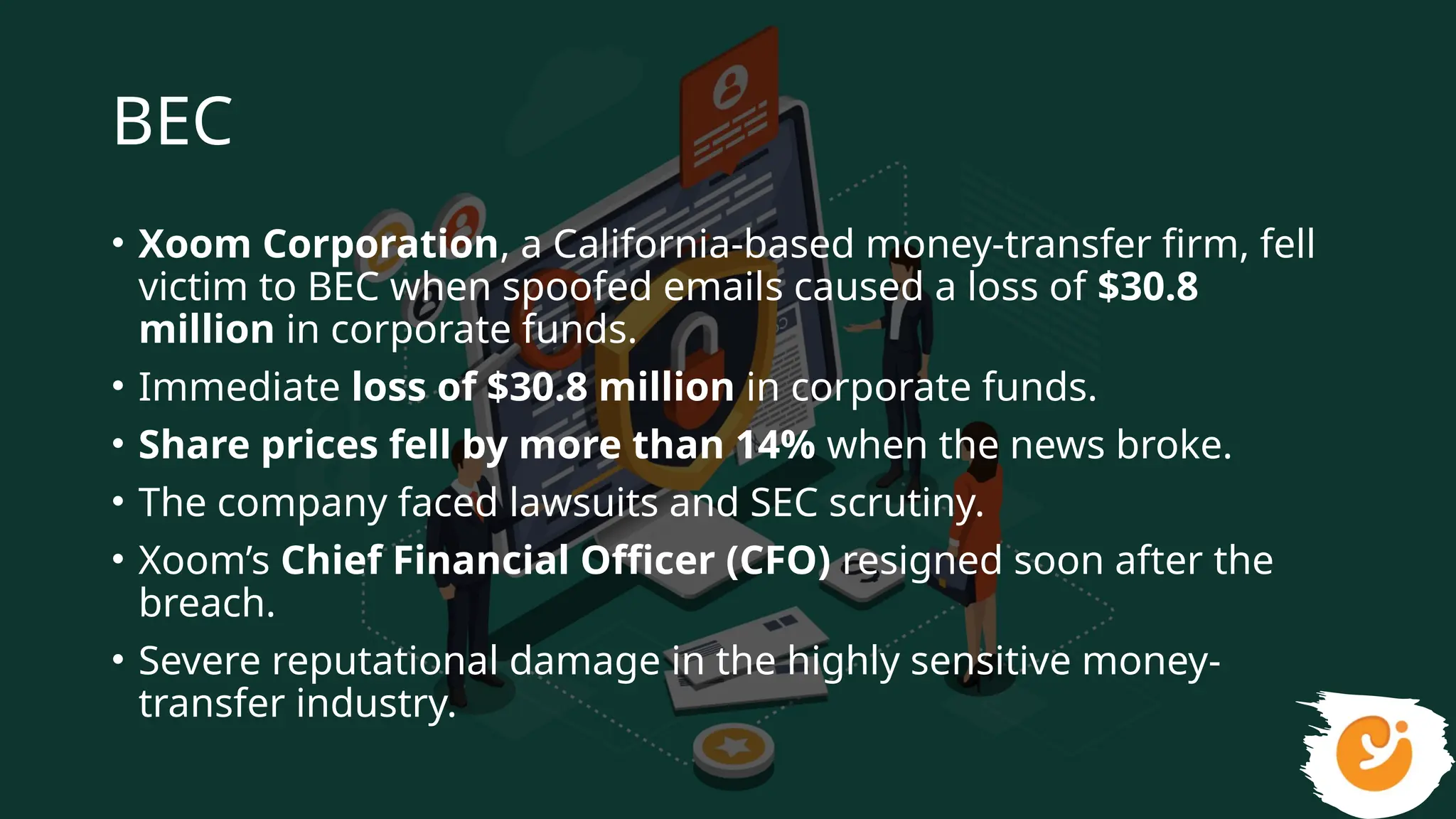
BEC
• Xoom Corporation, a California-based money-transfer firm, fell
victim to BEC when spoofed emails caused a loss of $30.8
million in corporate funds.
• Immediate loss of $30.8 million in corporate funds.
• Share prices fell by more than 14% when the news broke.
• The company faced lawsuits and SEC scrutiny.
• Xoom’s Chief Financial Officer (CFO) resigned soon after the
breach.
• Severe reputational damage in the highly sensitive money-
transfer industry.
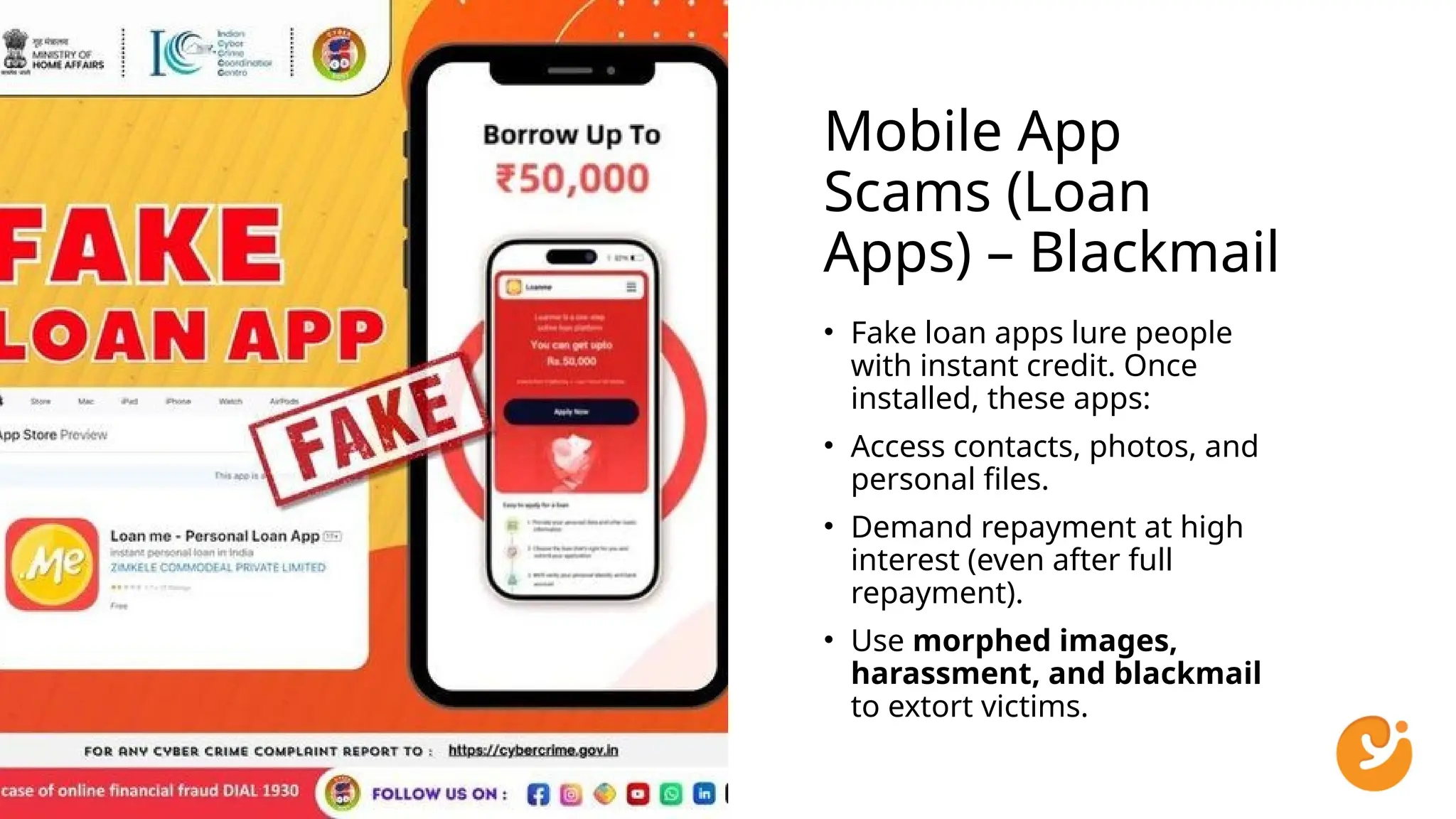
Mobile App
Scams (Loan
Apps) – Blackmail
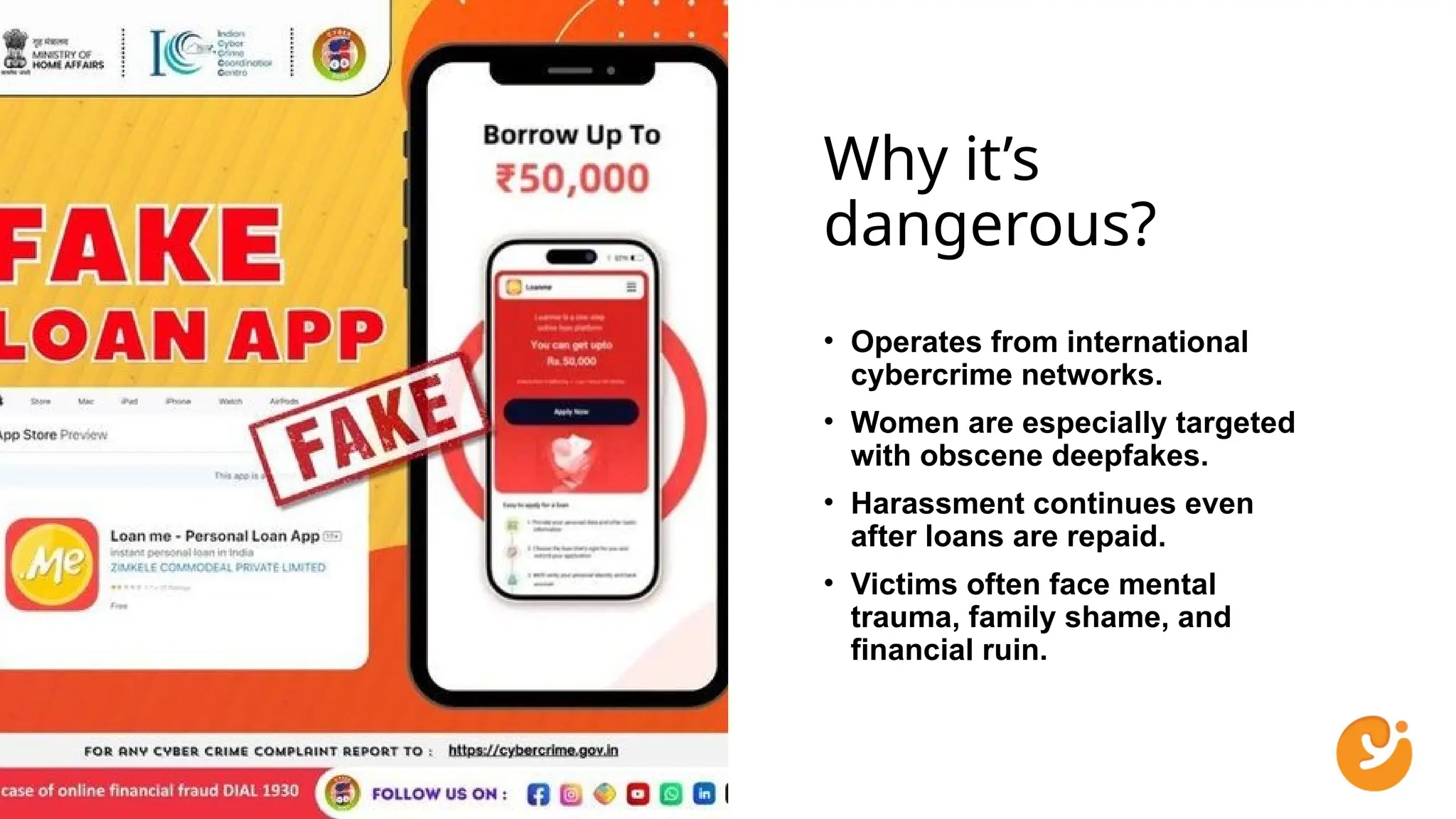
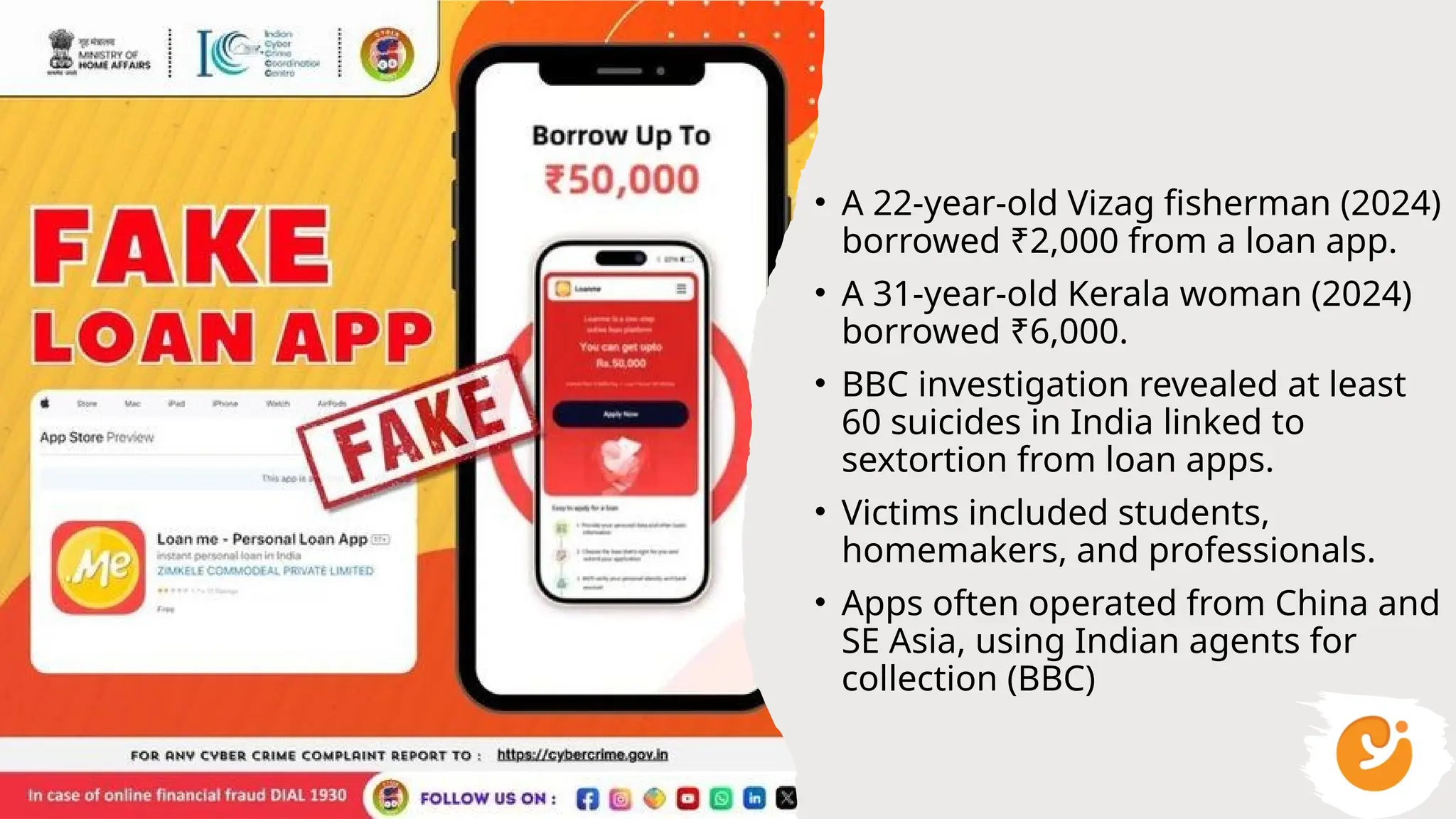
• Fake loan apps lure people
with instant credit. Once
installed, these apps:
• Access contacts, photos, and
personal files.
• Demand repayment at high
interest (even after full
repayment).
• Use morphed images,
harassment, and blackmail
to extort victims.
Why it’s
dangerous?
• Operates from international
cybercrime networks.
• Women are especially targeted
with obscene deepfakes.
• Harassment continues even
after loans are repaid.
• Victims often face mental
trauma, family shame, and
financial ruin.
• A 22-year-old Vizag fisherman (2024)
borrowed ₹2,000 from a loan app.
• A 31-year-old Kerala woman (2024)
borrowed ₹6,000.
• BBC investigation revealed at least
60 suicides in India linked to
sextortion from loan apps.
• Victims included students,
homemakers, and professionals.
• Apps often operated from China and
SE Asia, using Indian agents for
collection (BBC)
Criminals steal personal or corporate data
(like PAN, Aadhaar, bank logins, customer
databases) to commit impersonation,
fraud, or sell it on the dark web.
In 2022, a cybercriminal gang used stolen Aadhaar and PAN
details to create fake bank accounts and launder money
through them. Victims only realized when they received IT
notices for accounts they never opened.
(Source: India Today, 2022)
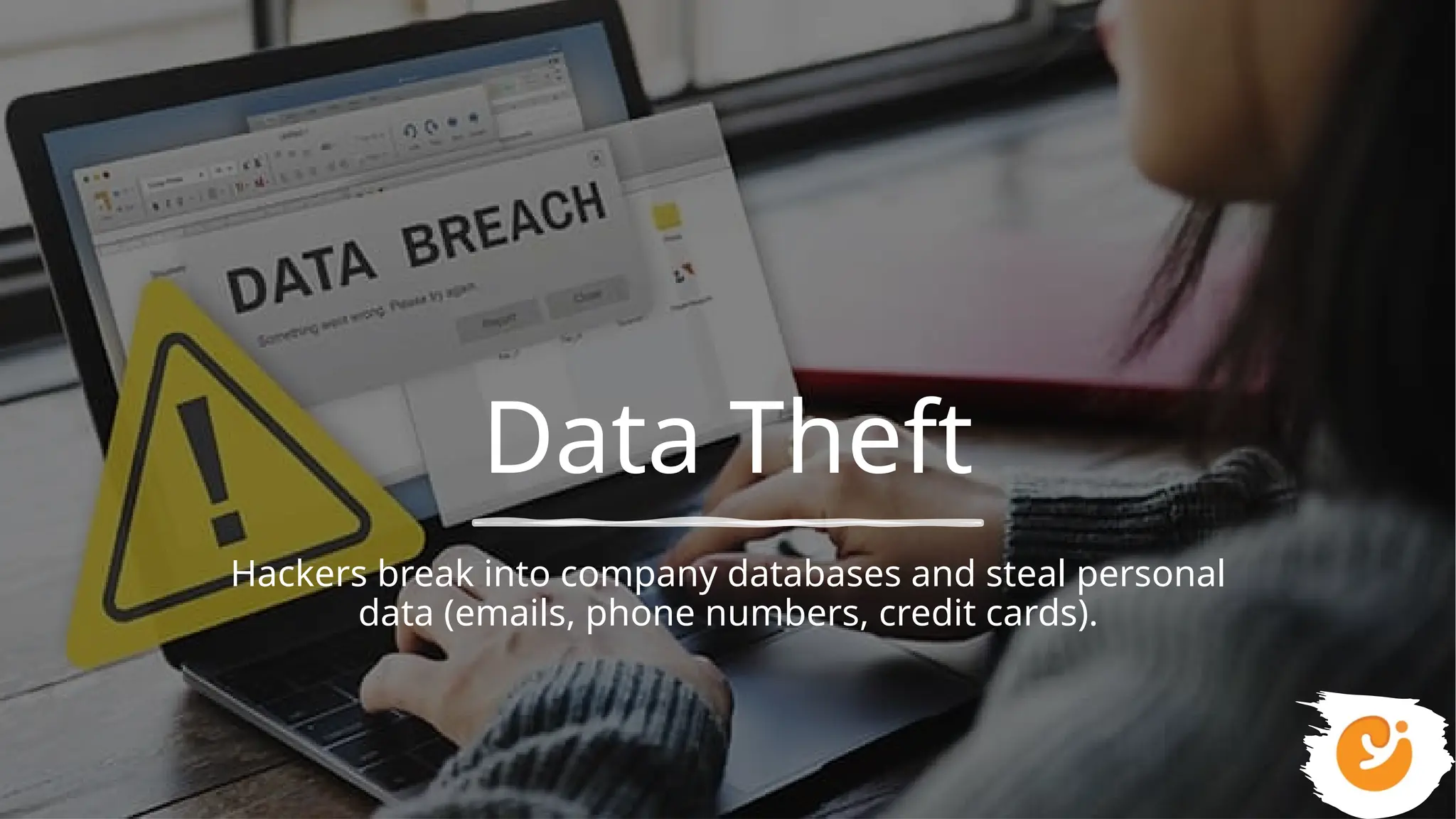
Data Theft
Hackers break into company databases and steal personal
data (emails, phone numbers, credit cards).
• Aadhaar Leak (2018): Data of over 1.1 billion Indians was
exposed via UIDAI, sold on the dark web for just ₹500.
• Air India Breach (2021): Personal data of 4.5 million
passengers leaked, including passport and credit card
details.
• Domino’s India Breach (2021): Hackers leaked 18 crore
order details (phone numbers, addresses, card details) on a
searchable portal.
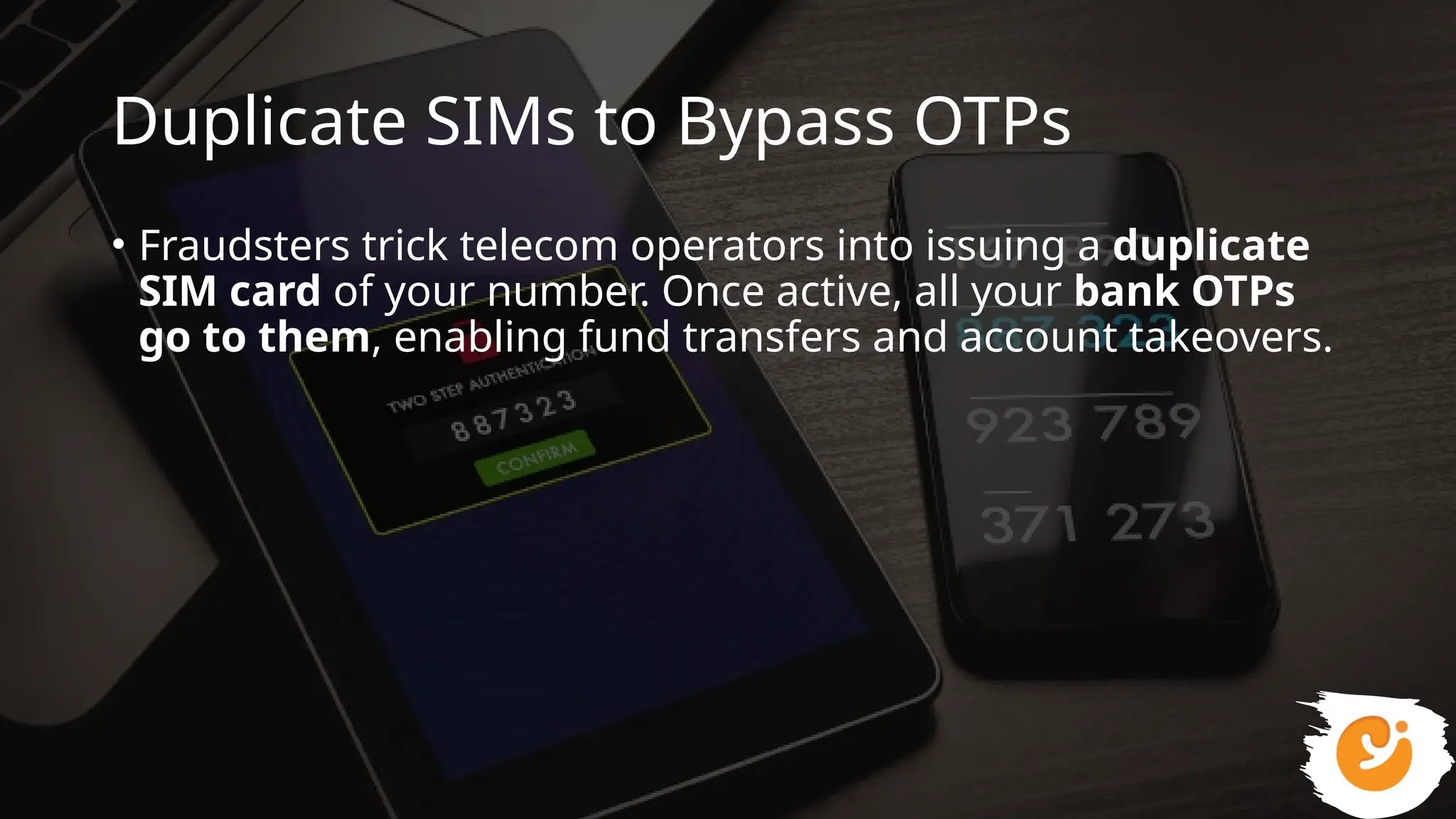
Duplicate SIMs to Bypass OTPs
• Fraudsters trick telecom operators into issuing a duplicate
SIM card of your number. Once active, all your bank OTPs
go to them, enabling fund transfers and account takeovers.
Mumbai Businessman (2023): Lost ₹40 lakh in 8
transactions after fraudsters hijacked his SIM and intercepted
OTPs. Funds were withdrawn via ATMs in West Bengal.
Steel Trading Firm (2025): Lost ₹7.5 crore in Mumbai after
SIM swap fraud gave criminals access to company accounts.
Targeting IT Infrastructure, Servers &
Devices
Cybercriminals attack the backbone of technology - servers,
networks, or personal devices to steal, lock, or disrupt critical
information systems.
Ransomware
• Malicious software that encrypts company data and
demands ransom (often in cryptocurrency).
• AIIMS Delhi (2022): Servers were hacked, paralysing
healthcare operations. Over 40M patient records were
compromised. Ransom demand: ₹200 crore in crypto.
(Source: Times of India)
Ransomware-as-a-Service
(RaaS)
Cyber gangs now sell or lease ransomware
kits on the dark web. Even low-skilled
criminals can launch advanced attacks.
LockBit Ransomware (2024): Hit 2,000+
companies worldwide, demanding millions
in ransom. LockBit is considered the “most
active ransomware group.”
(Source: Europol/Interpol reports)
Malware & Trojans
Software disguised as normal apps or attachments that
installs spyware, keyloggers, or backdoors.
“Joker” Malware on Android Apps (2023): Discovered on
Google Play, it silently subscribed victims to premium
services. Millions of users worldwide lost money.
DDoS Attacks
Distributed Denial of Service attacks overwhelm
servers/websites with fake traffic until they crash.
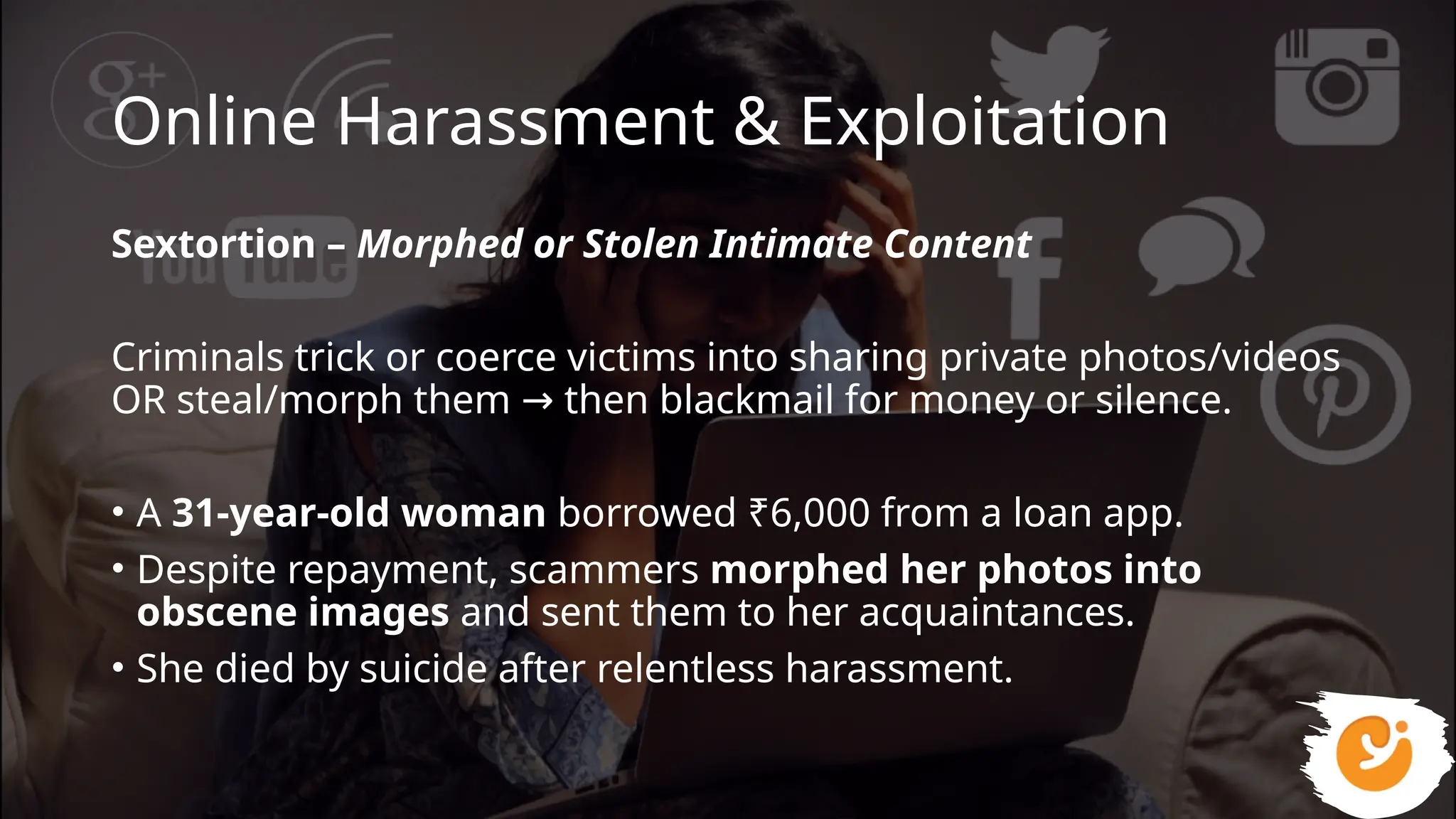
Online Harassment & Exploitation
Sextortion – Morphed or Stolen Intimate Content
Criminals trick or coerce victims into sharing private photos/videos
OR steal/morph them then blackmail for money or silence.
→
• A 31-year-old woman borrowed ₹6,000 from a loan app.
• Despite repayment, scammers morphed her photos into
obscene images and sent them to her acquaintances.
• She died by suicide after relentless harassment.
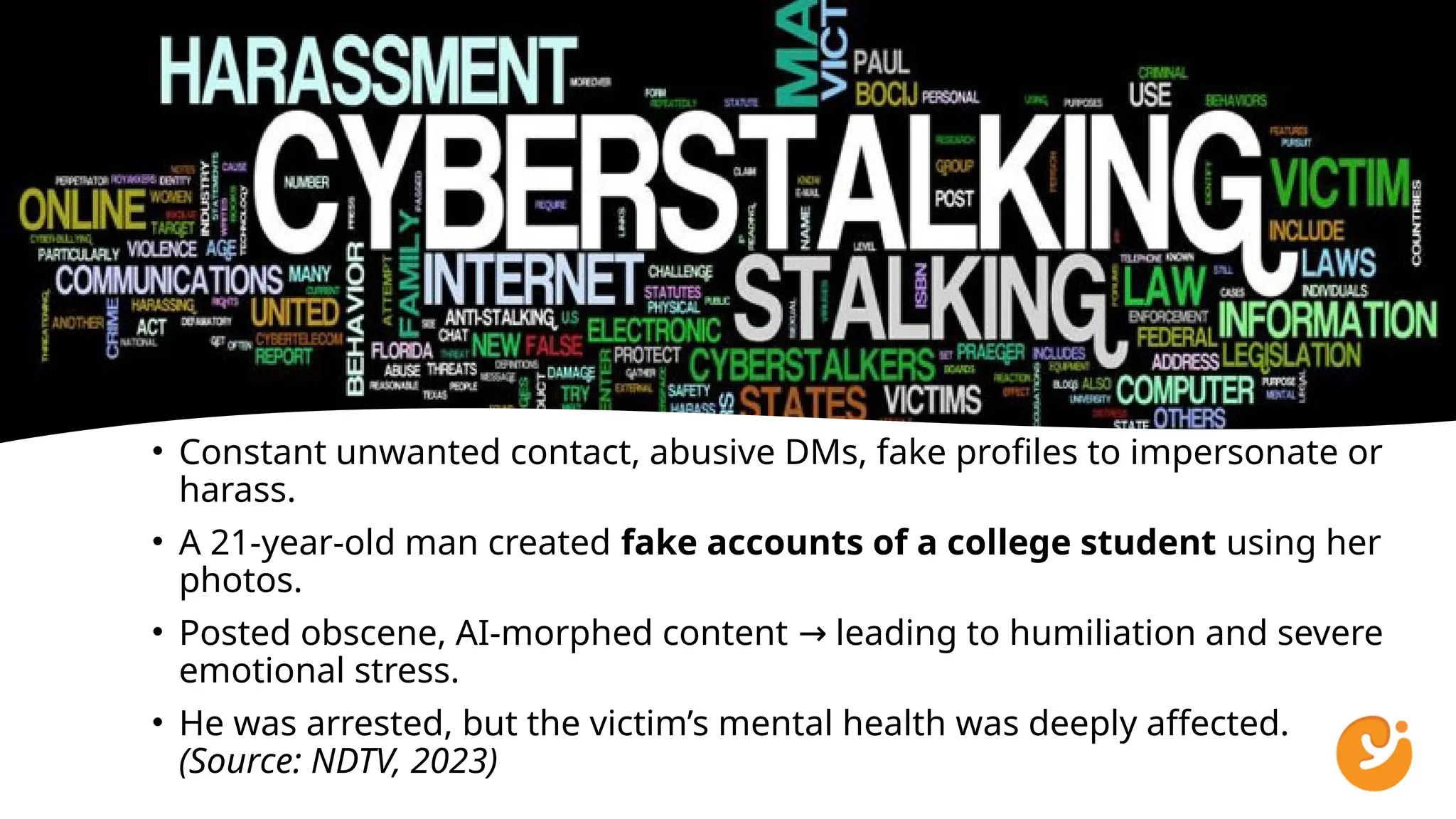
• Constant unwanted contact, abusive DMs, fake profiles to impersonate or
harass.
• A 21-year-old man created fake accounts of a college student using her
photos.
• Posted obscene, AI-morphed content leading to humiliation and severe
→
emotional stress.
• He was arrested, but the victim’s mental health was deeply affected.
(Source: NDTV, 2023)
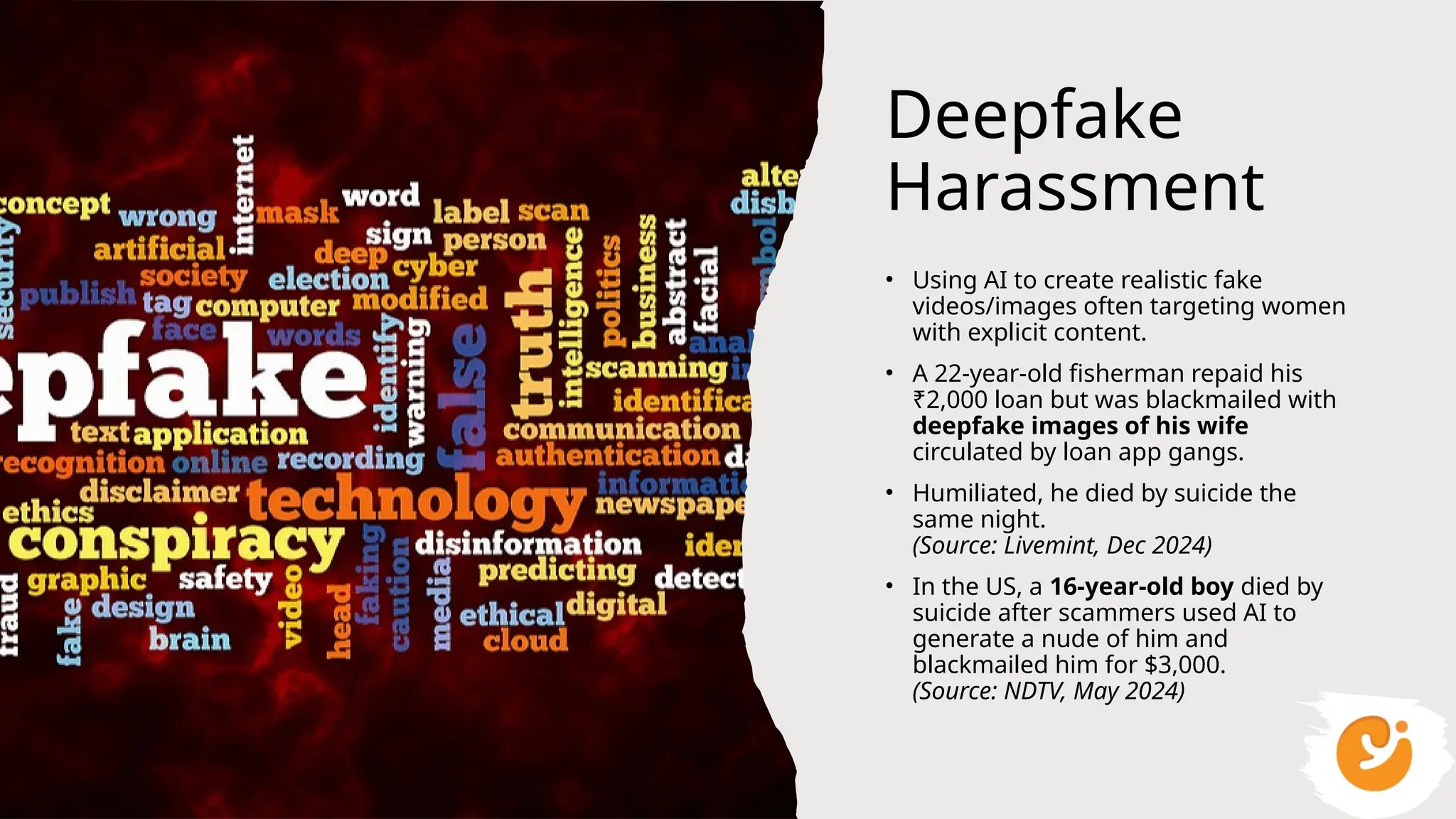
Deepfake
Harassment
• Using AI to create realistic fake
videos/images often targeting women
with explicit content.
• A 22-year-old fisherman repaid his
₹2,000 loan but was blackmailed with
deepfake images of his wife
circulated by loan app gangs.
• Humiliated, he died by suicide the
same night.
(Source: Livemint, Dec 2024)
• In the US, a 16-year-old boy died by
suicide after scammers used AI to
generate a nude of him and
blackmailed him for $3,000.
(Source: NDTV, May 2024)
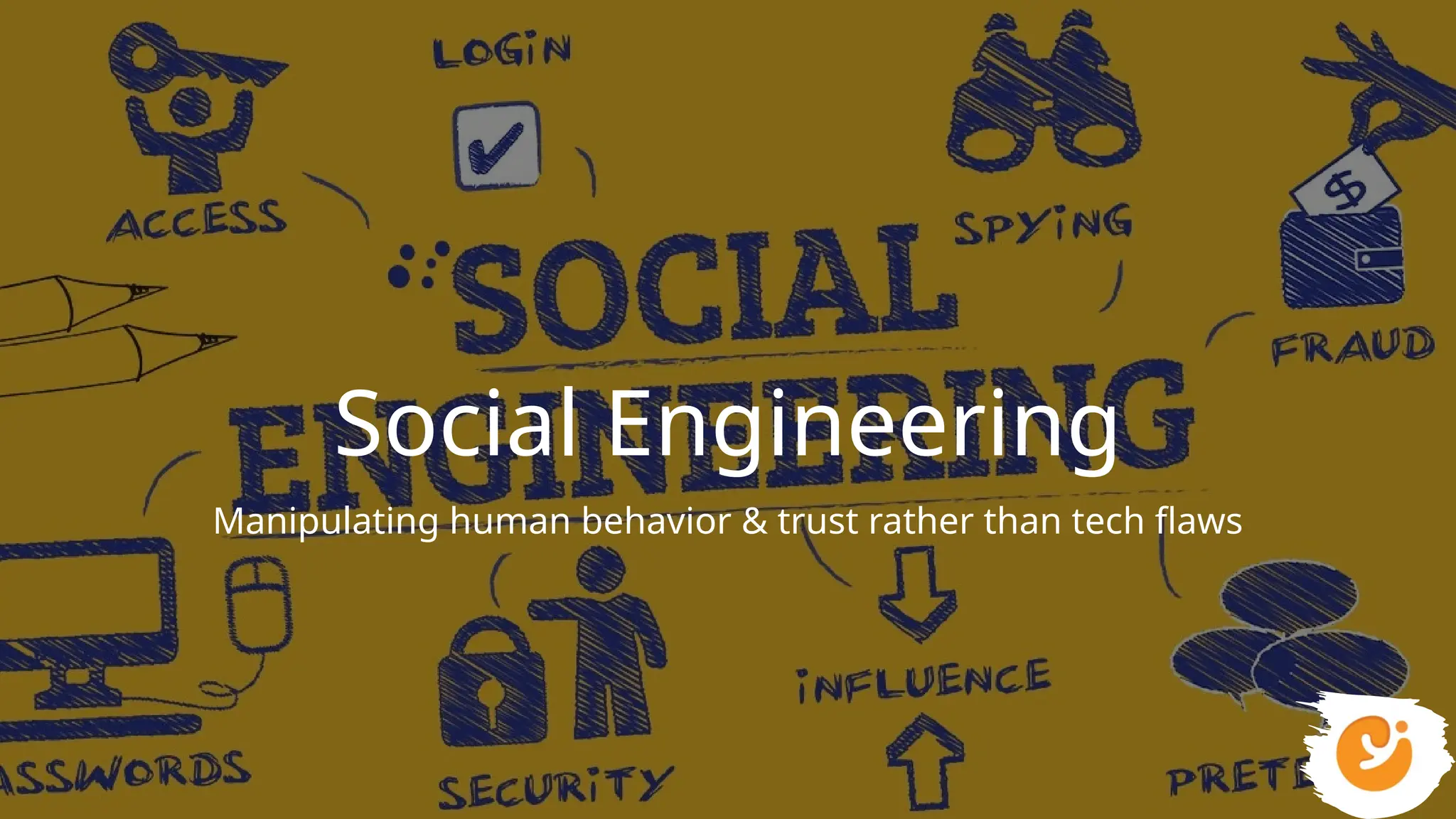
Social Engineering
Manipulating human behavior & trust rather than tech flaws
Digital Arrest
Scams
• Criminals impersonate police, CBI, or law enforcement, claiming the
victim’s accounts are linked to crimes. Victims are coerced into transferring
money to “safe accounts.”
• An elderly couple in Karnataka (2024) were tricked by fraudsters posing as
CBI officers.
• They were told their bank accounts were linked to money laundering.
• Under fear and pressure, they transferred ₹50 lakh.
• The trauma led both to die by suicide soon after.
(Source: Indian Express, Feb 2024)
Psychological Tricks:
Urgency & Panic
• Fraudsters exploit human psychology — urgency, authority, or empathy.
• “Your account will be frozen today!”
• “Mom, I’m in trouble, send money now!”
• “I’m calling from IT support, your system is hacked.”
Eg. A man in Delhi received a call: “Your electricity will be cut off in 30 minutes
unless you pay the bill online.” He clicked the provided link, entered details,
and lost ₹1.5 lakh instantly.
(Source: TOI, 2023)
Baiting / Quid
Pro Quo
• Luring victims with something attractive (USBs, free software, assistance).
• Victim unknowingly installs malware or grants access.
In 2022, hackers left infected USB drives labeled “Company Bonus Data”
outside office buildings in the US. Curious employees plugged them in →
malware spread across corporate networks.
(Source: Verizon DBIR, 2022)
Emerging AI-Driven
Threats
Deepfakes:
Fake
Videos,
Voices &
Identities
AI creates ultra-realistic fake videos,
audio, or images used for fraud,
→
harassment, or manipulation.
• A finance worker was tricked into
wiring $25 million after attending a
deepfake Zoom call where
cybercriminals impersonated the CFO
and colleagues.
• Every participant was fake, generated
by AI.
(Source: BBC, Feb 2024)
AI-
Powered
Phishing
• Criminals use AI (ChatGPT-like tools)
to craft grammatically flawless,
context-aware phishing emails.
• Unlike old scams, no spelling errors,
better targeting.
• Security researchers found AI-
generated phishing emails
impersonating Microsoft 365
support (Forbes, 2023)
• The messages were almost impossible
to detect, even by trained employees.
Social
Media
Traps
(Honeypot
s)
AI + fake identities fuel new scams on
Instagram & Facebook.
• Fake Instagram Collabs: Influencers/job
seekers get messages from “brands.”
Victims asked to pay “advance fees” for
shoots/campaigns scam.
→
• Facebook Friend Scam: Hackers take
over your friend’s account, send urgent
“I’m in trouble, send money!” messages →
victims transfer money immediately.
• A Bengaluru woman lost ₹1.2 lakh after
paying “advance booking fees” for a fake
brand collab sent via Instagram DM
(2023)
️
🛡️Safety Hacks - Financial Cybercrime
• Double-check URLs before making UPI/bank payments.
• Don’t share OTP, PIN, CVV with anyone (banks never ask).
• Verify payment requests with a call or video confirmation.
• Use official apps/websites only — avoid third-party links.
• Enable spending alerts via SMS/email for quick fraud
detection.
🛡️
Safety Hacks - Identity & Data Theft
• Never share Aadhaar/PAN scans on unknown platforms.
• Use multi-factor authentication instead of just OTP.
• Regularly check your credit report for unknown loans.
• For businesses: encrypt sensitive customer data.
• If your SIM suddenly loses network, call your telecom
provider immediately.
️
🛡️Safety Hacks – Attacks on IT
Infrastructure
• Keep all systems and software up to date.
• Regularly back up critical data (offline and cloud).
• Use antivirus, firewalls, and endpoint protection.
• Don’t download unknown apps or cracked software.
• Invest in DDoS protection (e.g., Cloudflare, Akamai) for businesses.
🛡️Safety Hacks – Attacks on Individuals
• Keep social media profiles private.
• Use reverse image search to track misuse of your photos.
• Don’t share personal media with strangers or unverified
apps.
• Report sextortion or harassment to cybercrime.gov.in (1930
helpline).
• Educate family and friends — silence helps criminals,
speaking up saves lives.
🛡️Safety Hacks - Phishing
• Never click links in emails or SMS; type the URL yourself.
• Check sender email IDs carefully (watch for tiny typos).
• Always verify urgent fund requests with a phone call.
• Companies: train staff using phishing simulations.
• Enable MFA on banking, email, and work accounts.
️
🛡️Safety Hacks – Social Engineering
• Remember: Police or CBI never ask for money over phone.
• Pause before reacting to urgent or emotional calls.
• Don’t plug in unknown USBs or install “free” software.
• Hang up and call official customer care numbers to verify.
• Teach employees and family to recognize manipulation
tactics.
• Cybercrime is no longer
about “if” it’s about “when.”
• Awareness is your strongest
shield.
• Every click, every share, every
download matters.
Stop. Think. Verify
• Report immediately at
cybercrime.gov.in
• Helpline: 1930
Thank You www.whytap.
in
Empowering Students, Empowering India

Masterclass on Cybercrime, Scams & Safety Hacks.pptx

  • 1.
    Masterclass on Cyber Crime,Scams & Safety Hacks •By •Sathishkumar Kannan, MS (UK) •Ethical Hacker & Cyber Security Expert •Founder & CEO, WHY Global Services
  • 2.
    Statistics • Every 39seconds, a cyberattack happens worldwide. In India alone, over 1.3 million cybercrime complaints were registered in 2024.
  • 3.
    Have you ever facedan online scam? (Phishing email, fake call, OTP scam, hacked account)”
  • 4.
    Cybercrime is any criminalactivity that involves a computer, network, or digital device either as a tool, a target, or both.
  • 5.
    Types of Cyber Crime Financial Cybercrime IdentityTheft System & Device Attack Online Harassment & Exploitation Phishing Social Engineering Emerging AI-Driven Threats
  • 6.
    Financial Cybercrime • OnlineFraud & Scams – Fake invoices and UPI frauds, • Business Email Compromise (BEC) – CEO/CFO impersonation, Employee Impersonation for payroll redirection. • Mobile App Scams – Fake loan apps steal data & harass users. 👉 Case: Hundreds of Indian women blackmailed by loan app gangs (2024). 👉 Stat: Indians lost ₹1,750+ crore in Jan–Apr 2024 alone.
  • 7.
    Most Common OnlineFrauds • Phishing • Spear-Phishing • Whaling • Lottery Scam • Online Shopping Frauds • WFH Scam
  • 8.
    BEC • Xoom Corporation,a California-based money-transfer firm, fell victim to BEC when spoofed emails caused a loss of $30.8 million in corporate funds. • Immediate loss of $30.8 million in corporate funds. • Share prices fell by more than 14% when the news broke. • The company faced lawsuits and SEC scrutiny. • Xoom’s Chief Financial Officer (CFO) resigned soon after the breach. • Severe reputational damage in the highly sensitive money- transfer industry.
  • 9.
    Mobile App Scams (Loan Apps)– Blackmail • Fake loan apps lure people with instant credit. Once installed, these apps: • Access contacts, photos, and personal files. • Demand repayment at high interest (even after full repayment). • Use morphed images, harassment, and blackmail to extort victims.
  • 10.
    Why it’s dangerous? • Operatesfrom international cybercrime networks. • Women are especially targeted with obscene deepfakes. • Harassment continues even after loans are repaid. • Victims often face mental trauma, family shame, and financial ruin.
  • 11.
    • A 22-year-oldVizag fisherman (2024) borrowed ₹2,000 from a loan app. • A 31-year-old Kerala woman (2024) borrowed ₹6,000. • BBC investigation revealed at least 60 suicides in India linked to sextortion from loan apps. • Victims included students, homemakers, and professionals. • Apps often operated from China and SE Asia, using Indian agents for collection (BBC)
  • 12.
    Criminals steal personalor corporate data (like PAN, Aadhaar, bank logins, customer databases) to commit impersonation, fraud, or sell it on the dark web.
  • 13.
    In 2022, acybercriminal gang used stolen Aadhaar and PAN details to create fake bank accounts and launder money through them. Victims only realized when they received IT notices for accounts they never opened. (Source: India Today, 2022)
  • 14.
    Data Theft Hackers breakinto company databases and steal personal data (emails, phone numbers, credit cards).
  • 15.
    • Aadhaar Leak(2018): Data of over 1.1 billion Indians was exposed via UIDAI, sold on the dark web for just ₹500. • Air India Breach (2021): Personal data of 4.5 million passengers leaked, including passport and credit card details. • Domino’s India Breach (2021): Hackers leaked 18 crore order details (phone numbers, addresses, card details) on a searchable portal.
  • 16.
    Duplicate SIMs toBypass OTPs • Fraudsters trick telecom operators into issuing a duplicate SIM card of your number. Once active, all your bank OTPs go to them, enabling fund transfers and account takeovers.
  • 17.
    Mumbai Businessman (2023):Lost ₹40 lakh in 8 transactions after fraudsters hijacked his SIM and intercepted OTPs. Funds were withdrawn via ATMs in West Bengal. Steel Trading Firm (2025): Lost ₹7.5 crore in Mumbai after SIM swap fraud gave criminals access to company accounts.
  • 18.
    Targeting IT Infrastructure,Servers & Devices Cybercriminals attack the backbone of technology - servers, networks, or personal devices to steal, lock, or disrupt critical information systems.
  • 19.
    Ransomware • Malicious softwarethat encrypts company data and demands ransom (often in cryptocurrency). • AIIMS Delhi (2022): Servers were hacked, paralysing healthcare operations. Over 40M patient records were compromised. Ransom demand: ₹200 crore in crypto. (Source: Times of India)
  • 20.
    Ransomware-as-a-Service (RaaS) Cyber gangs nowsell or lease ransomware kits on the dark web. Even low-skilled criminals can launch advanced attacks. LockBit Ransomware (2024): Hit 2,000+ companies worldwide, demanding millions in ransom. LockBit is considered the “most active ransomware group.” (Source: Europol/Interpol reports)
  • 21.
    Malware & Trojans Softwaredisguised as normal apps or attachments that installs spyware, keyloggers, or backdoors. “Joker” Malware on Android Apps (2023): Discovered on Google Play, it silently subscribed victims to premium services. Millions of users worldwide lost money.
  • 22.
    DDoS Attacks Distributed Denialof Service attacks overwhelm servers/websites with fake traffic until they crash.
  • 23.
    Online Harassment &Exploitation Sextortion – Morphed or Stolen Intimate Content Criminals trick or coerce victims into sharing private photos/videos OR steal/morph them then blackmail for money or silence. → • A 31-year-old woman borrowed ₹6,000 from a loan app. • Despite repayment, scammers morphed her photos into obscene images and sent them to her acquaintances. • She died by suicide after relentless harassment.
  • 24.
    • Constant unwantedcontact, abusive DMs, fake profiles to impersonate or harass. • A 21-year-old man created fake accounts of a college student using her photos. • Posted obscene, AI-morphed content leading to humiliation and severe → emotional stress. • He was arrested, but the victim’s mental health was deeply affected. (Source: NDTV, 2023)
  • 25.
    Deepfake Harassment • Using AIto create realistic fake videos/images often targeting women with explicit content. • A 22-year-old fisherman repaid his ₹2,000 loan but was blackmailed with deepfake images of his wife circulated by loan app gangs. • Humiliated, he died by suicide the same night. (Source: Livemint, Dec 2024) • In the US, a 16-year-old boy died by suicide after scammers used AI to generate a nude of him and blackmailed him for $3,000. (Source: NDTV, May 2024)
  • 26.
    Social Engineering Manipulating humanbehavior & trust rather than tech flaws
  • 27.
    Digital Arrest Scams • Criminalsimpersonate police, CBI, or law enforcement, claiming the victim’s accounts are linked to crimes. Victims are coerced into transferring money to “safe accounts.” • An elderly couple in Karnataka (2024) were tricked by fraudsters posing as CBI officers. • They were told their bank accounts were linked to money laundering. • Under fear and pressure, they transferred ₹50 lakh. • The trauma led both to die by suicide soon after. (Source: Indian Express, Feb 2024)
  • 28.
    Psychological Tricks: Urgency &Panic • Fraudsters exploit human psychology — urgency, authority, or empathy. • “Your account will be frozen today!” • “Mom, I’m in trouble, send money now!” • “I’m calling from IT support, your system is hacked.” Eg. A man in Delhi received a call: “Your electricity will be cut off in 30 minutes unless you pay the bill online.” He clicked the provided link, entered details, and lost ₹1.5 lakh instantly. (Source: TOI, 2023)
  • 29.
    Baiting / Quid ProQuo • Luring victims with something attractive (USBs, free software, assistance). • Victim unknowingly installs malware or grants access. In 2022, hackers left infected USB drives labeled “Company Bonus Data” outside office buildings in the US. Curious employees plugged them in → malware spread across corporate networks. (Source: Verizon DBIR, 2022)
  • 30.
  • 31.
    Deepfakes: Fake Videos, Voices & Identities AI createsultra-realistic fake videos, audio, or images used for fraud, → harassment, or manipulation. • A finance worker was tricked into wiring $25 million after attending a deepfake Zoom call where cybercriminals impersonated the CFO and colleagues. • Every participant was fake, generated by AI. (Source: BBC, Feb 2024)
  • 32.
    AI- Powered Phishing • Criminals useAI (ChatGPT-like tools) to craft grammatically flawless, context-aware phishing emails. • Unlike old scams, no spelling errors, better targeting. • Security researchers found AI- generated phishing emails impersonating Microsoft 365 support (Forbes, 2023) • The messages were almost impossible to detect, even by trained employees.
  • 33.
    Social Media Traps (Honeypot s) AI + fakeidentities fuel new scams on Instagram & Facebook. • Fake Instagram Collabs: Influencers/job seekers get messages from “brands.” Victims asked to pay “advance fees” for shoots/campaigns scam. → • Facebook Friend Scam: Hackers take over your friend’s account, send urgent “I’m in trouble, send money!” messages → victims transfer money immediately. • A Bengaluru woman lost ₹1.2 lakh after paying “advance booking fees” for a fake brand collab sent via Instagram DM (2023)
  • 34.
    ️ 🛡️Safety Hacks -Financial Cybercrime • Double-check URLs before making UPI/bank payments. • Don’t share OTP, PIN, CVV with anyone (banks never ask). • Verify payment requests with a call or video confirmation. • Use official apps/websites only — avoid third-party links. • Enable spending alerts via SMS/email for quick fraud detection.
  • 35.
    🛡️ Safety Hacks -Identity & Data Theft • Never share Aadhaar/PAN scans on unknown platforms. • Use multi-factor authentication instead of just OTP. • Regularly check your credit report for unknown loans. • For businesses: encrypt sensitive customer data. • If your SIM suddenly loses network, call your telecom provider immediately.
  • 36.
    ️ 🛡️Safety Hacks –Attacks on IT Infrastructure • Keep all systems and software up to date. • Regularly back up critical data (offline and cloud). • Use antivirus, firewalls, and endpoint protection. • Don’t download unknown apps or cracked software. • Invest in DDoS protection (e.g., Cloudflare, Akamai) for businesses.
  • 37.
    🛡️Safety Hacks –Attacks on Individuals • Keep social media profiles private. • Use reverse image search to track misuse of your photos. • Don’t share personal media with strangers or unverified apps. • Report sextortion or harassment to cybercrime.gov.in (1930 helpline). • Educate family and friends — silence helps criminals, speaking up saves lives.
  • 38.
    🛡️Safety Hacks -Phishing • Never click links in emails or SMS; type the URL yourself. • Check sender email IDs carefully (watch for tiny typos). • Always verify urgent fund requests with a phone call. • Companies: train staff using phishing simulations. • Enable MFA on banking, email, and work accounts.
  • 39.
    ️ 🛡️Safety Hacks –Social Engineering • Remember: Police or CBI never ask for money over phone. • Pause before reacting to urgent or emotional calls. • Don’t plug in unknown USBs or install “free” software. • Hang up and call official customer care numbers to verify. • Teach employees and family to recognize manipulation tactics.
  • 40.
    • Cybercrime isno longer about “if” it’s about “when.” • Awareness is your strongest shield. • Every click, every share, every download matters. Stop. Think. Verify • Report immediately at cybercrime.gov.in • Helpline: 1930
  • 41.
    Thank You www.whytap. in EmpoweringStudents, Empowering India