The Work and Financial
Plan (WFP): Mastering
Accomplishment
Reporting
Presented by:
Cashmir Pangandaman
Planning Officer
Bangsamoro Liaison Office in Metro Manila
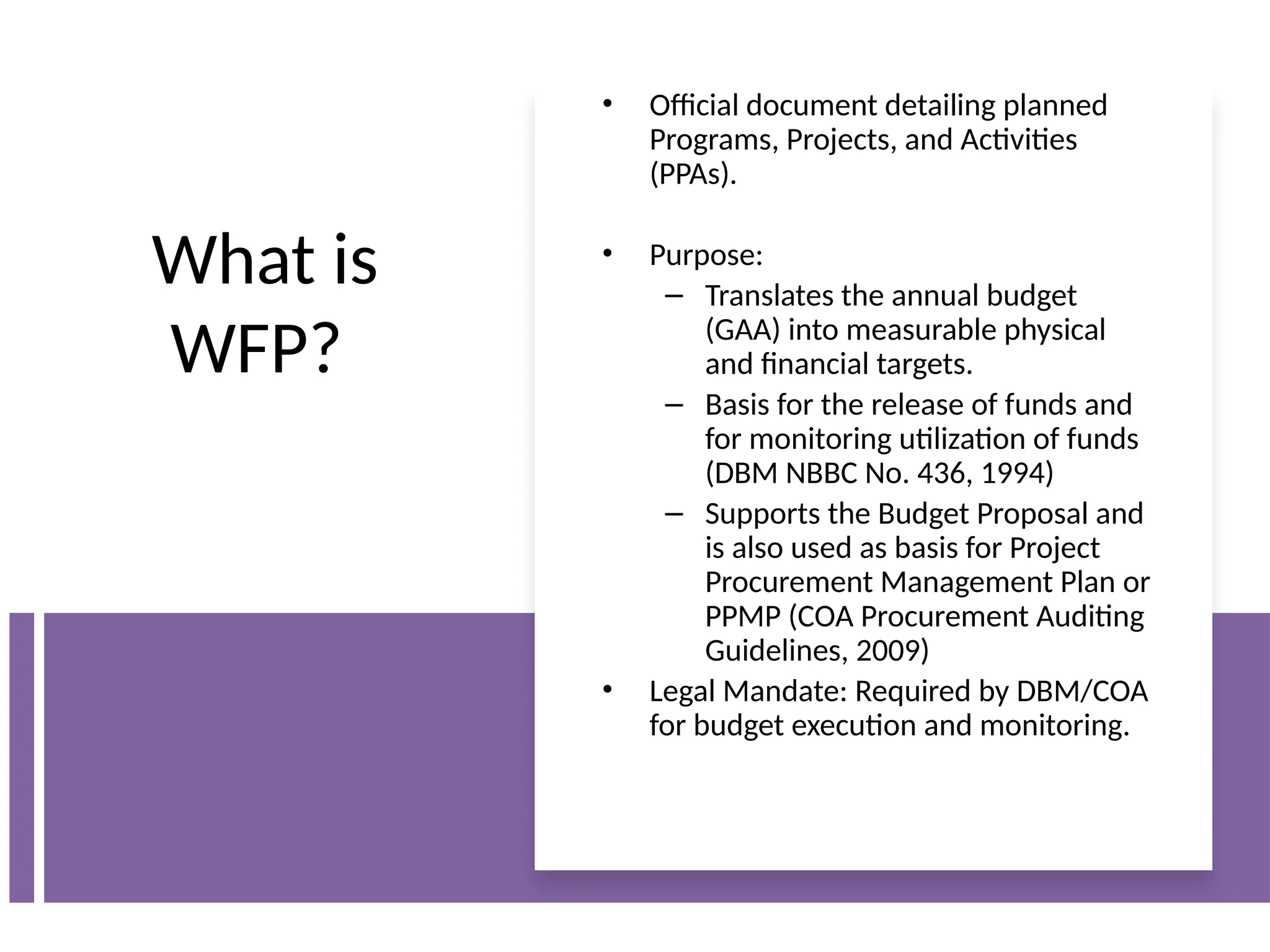
What is
WFP?
• Official document detailing planned
Programs, Projects, and Activities
(PPAs).
• Purpose:
– Translates the annual budget
(GAA) into measurable physical
and financial targets.
– Basis for the release of funds and
for monitoring utilization of funds
(DBM NBBC No. 436, 1994)
– Supports the Budget Proposal and
is also used as basis for Project
Procurement Management Plan or
PPMP (COA Procurement Auditing
Guidelines, 2009)
• Legal Mandate: Required by DBM/COA
for budget execution and monitoring.
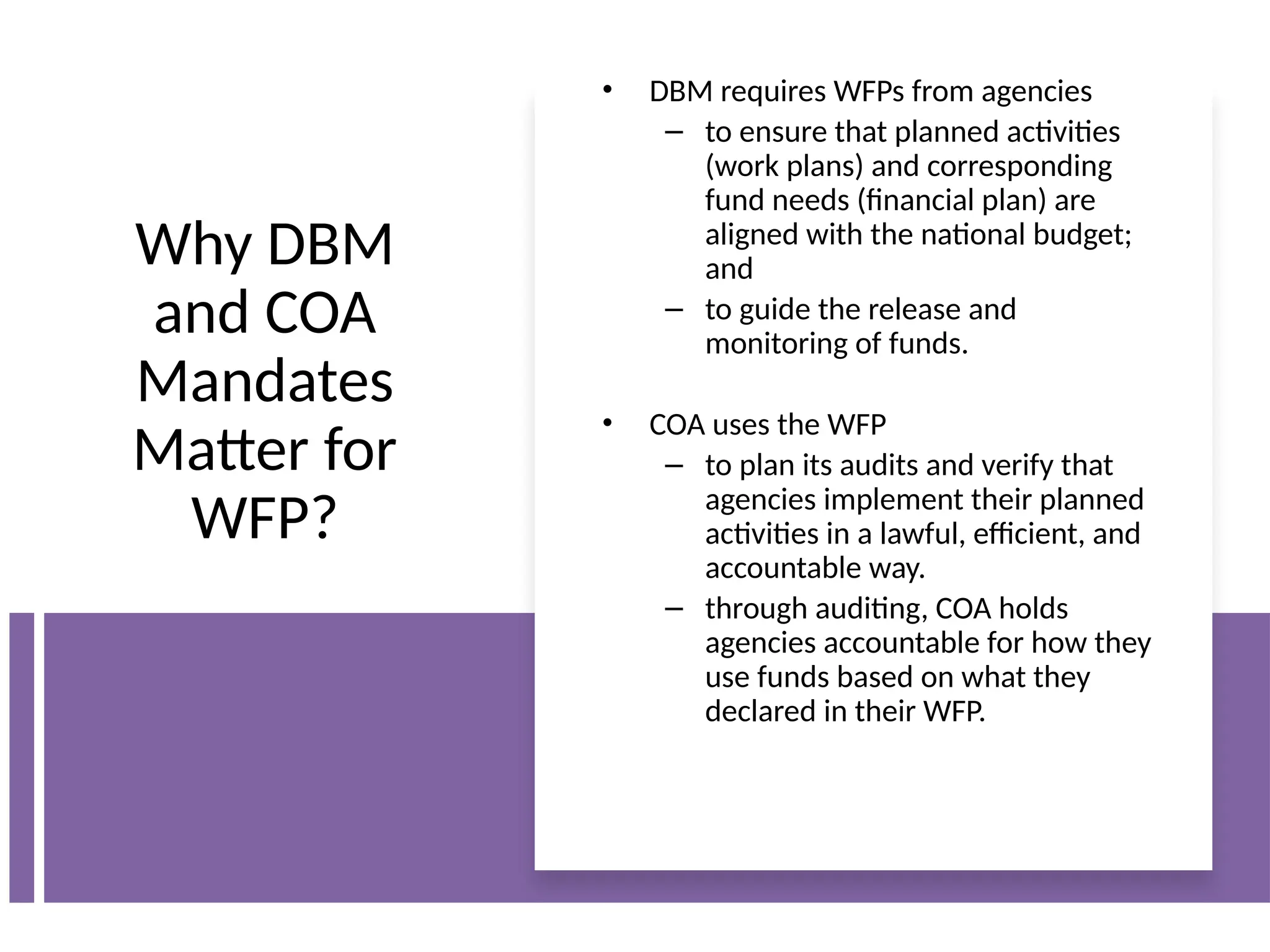
Why DBM
and COA
Mandates
Matter for
WFP?
• DBM requires WFPs from agencies
– to ensure that planned activities
(work plans) and corresponding
fund needs (financial plan) are
aligned with the national budget;
and
– to guide the release and
monitoring of funds.
• COA uses the WFP
– to plan its audits and verify that
agencies implement their planned
activities in a lawful, efficient, and
accountable way.
– through auditing, COA holds
agencies accountable for how they
use funds based on what they
declared in their WFP.
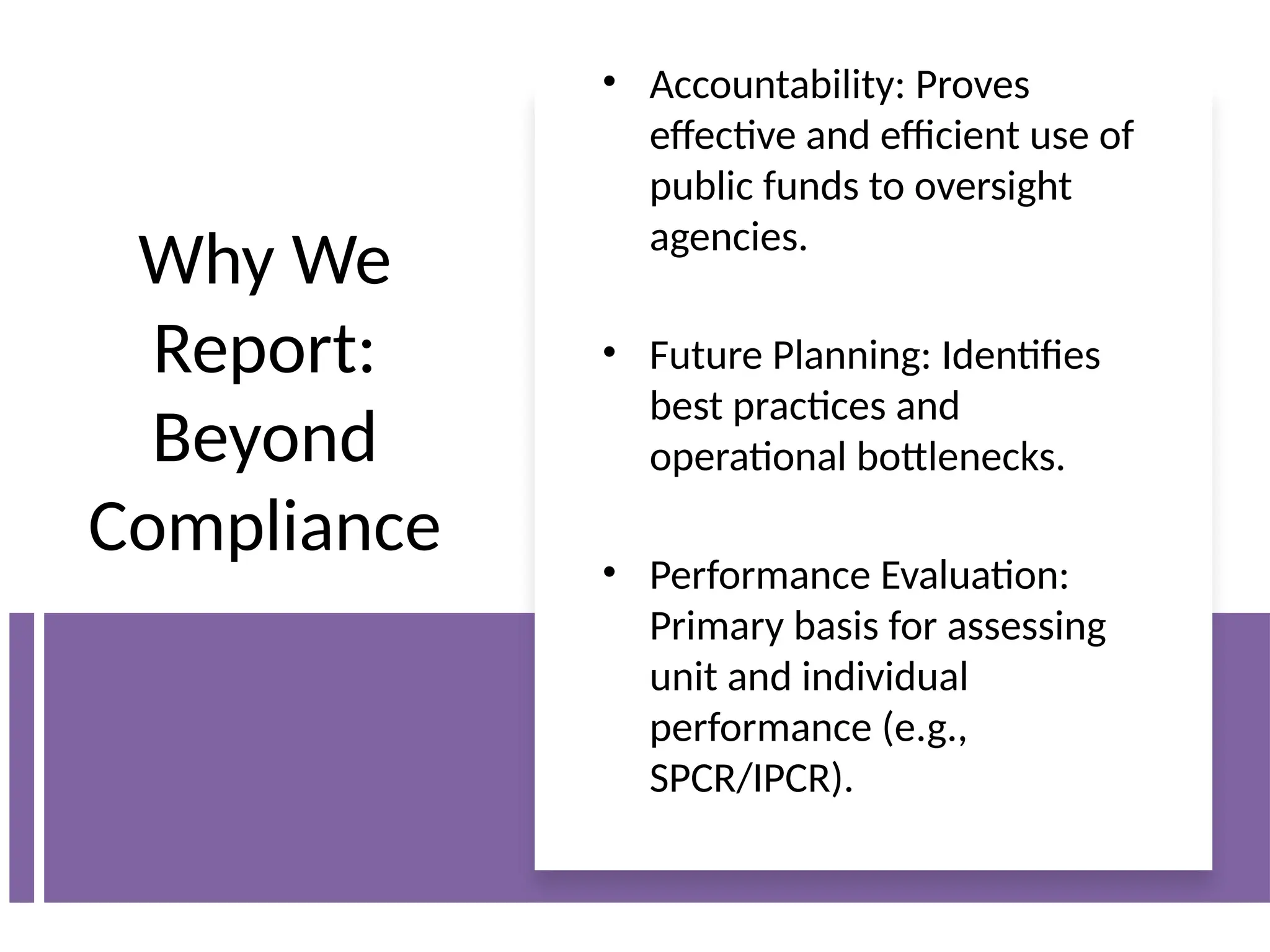
Why We
Report:
Beyond
Compliance
• Accountability: Proves
effective and efficient use of
public funds to oversight
agencies.
• Future Planning: Identifies
best practices and
operational bottlenecks.
• Performance Evaluation:
Primary basis for assessing
unit and individual
performance (e.g.,
SPCR/IPCR).
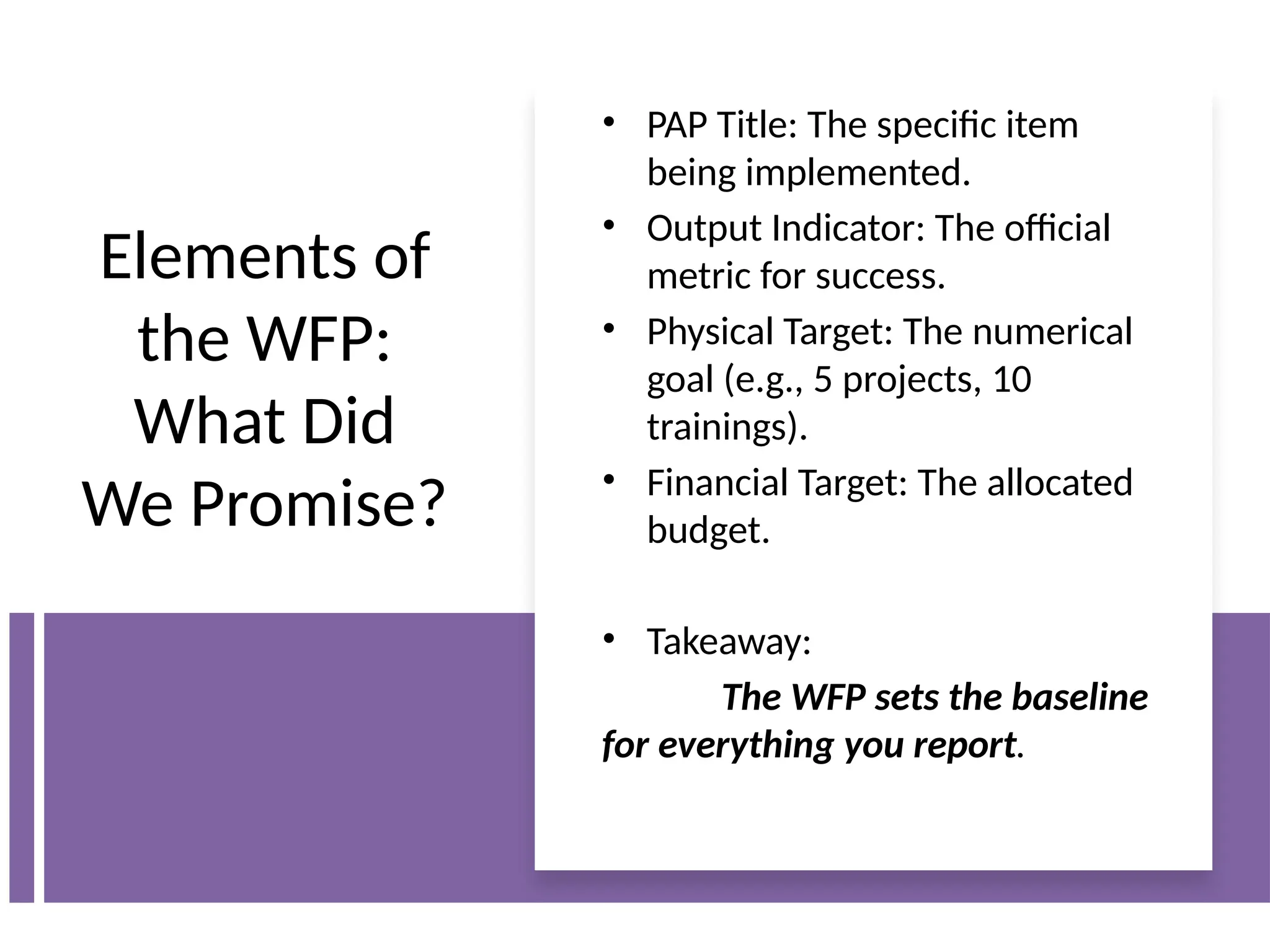
Elements of
the WFP:
What Did
We Promise?
• PAP Title: The specific item
being implemented.
• Output Indicator: The official
metric for success.
• Physical Target: The numerical
goal (e.g., 5 projects, 10
trainings).
• Financial Target: The allocated
budget.
• Takeaway:
The WFP sets the baseline
for everything you report.
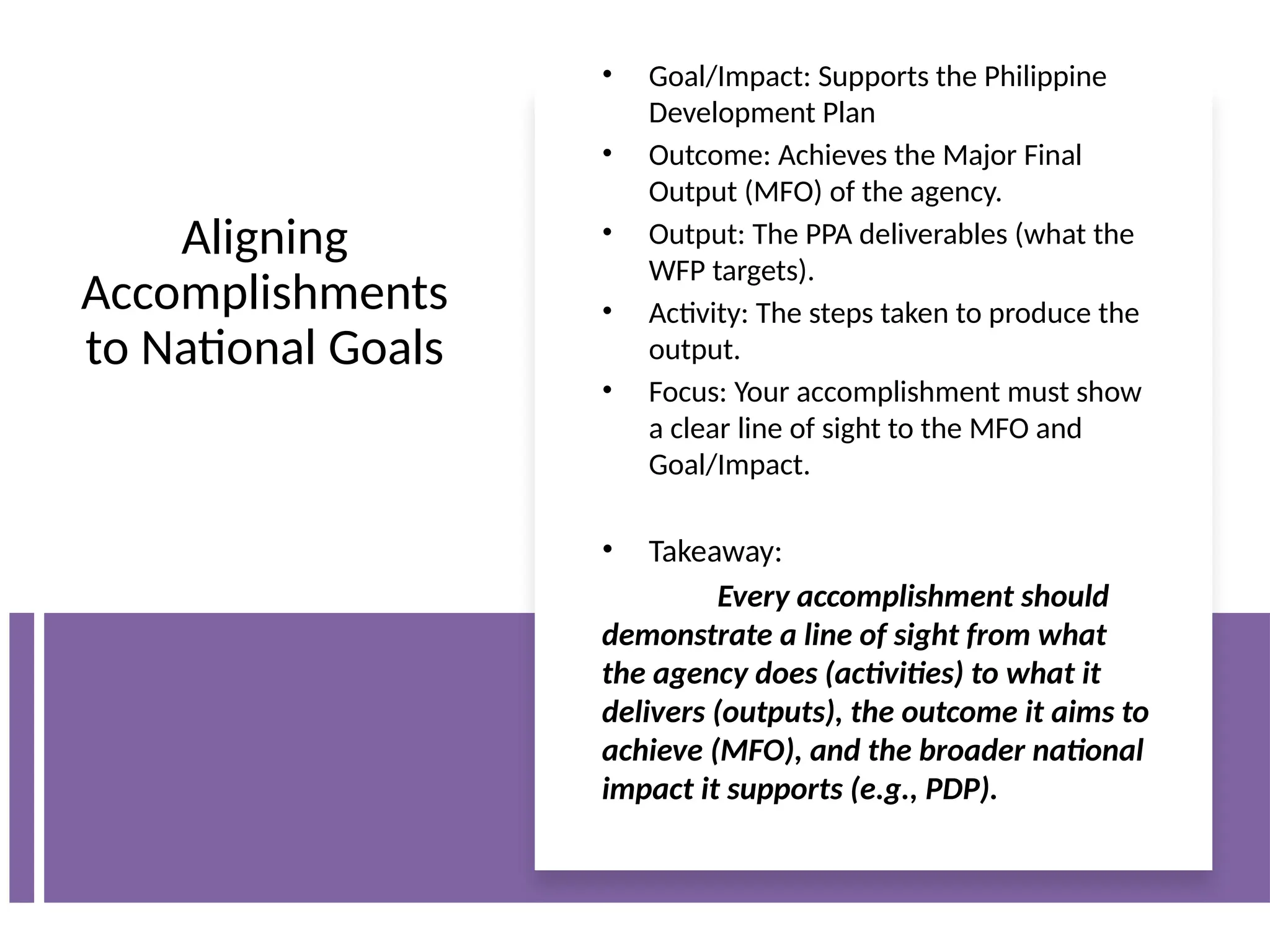
Aligning
Accomplishments
to National Goals
• Goal/Impact: Supports the Philippine
Development Plan
• Outcome: Achieves the Major Final
Output (MFO) of the agency.
• Output: The PPA deliverables (what the
WFP targets).
• Activity: The steps taken to produce the
output.
• Focus: Your accomplishment must show
a clear line of sight to the MFO and
Goal/Impact.
• Takeaway:
Every accomplishment should
demonstrate a line of sight from what
the agency does (activities) to what it
delivers (outputs), the outcome it aims to
achieve (MFO), and the broader national
impact it supports (e.g., PDP).
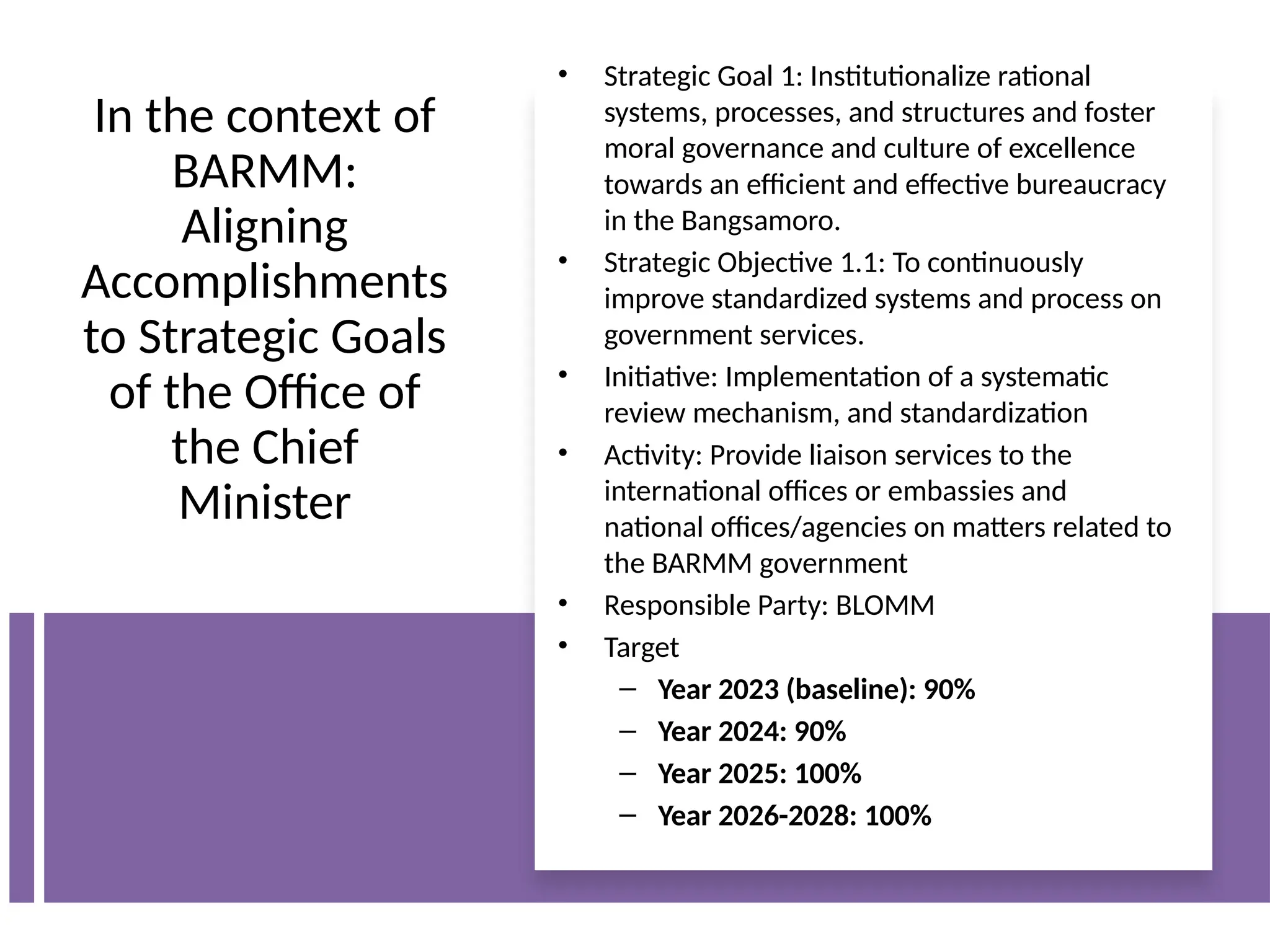
In the context of
BARMM:
Aligning
Accomplishments
to Strategic Goals
of the Office of
the Chief
Minister
• Strategic Goal 1: Institutionalize rational
systems, processes, and structures and foster
moral governance and culture of excellence
towards an efficient and effective bureaucracy
in the Bangsamoro.
• Strategic Objective 1.1: To continuously
improve standardized systems and process on
government services.
• Initiative: Implementation of a systematic
review mechanism, and standardization
• Activity: Provide liaison services to the
international offices or embassies and
national offices/agencies on matters related to
the BARMM government
• Responsible Party: BLOMM
• Target
– Year 2023 (baseline): 90%
– Year 2024: 90%
– Year 2025: 100%
– Year 2026-2028: 100%
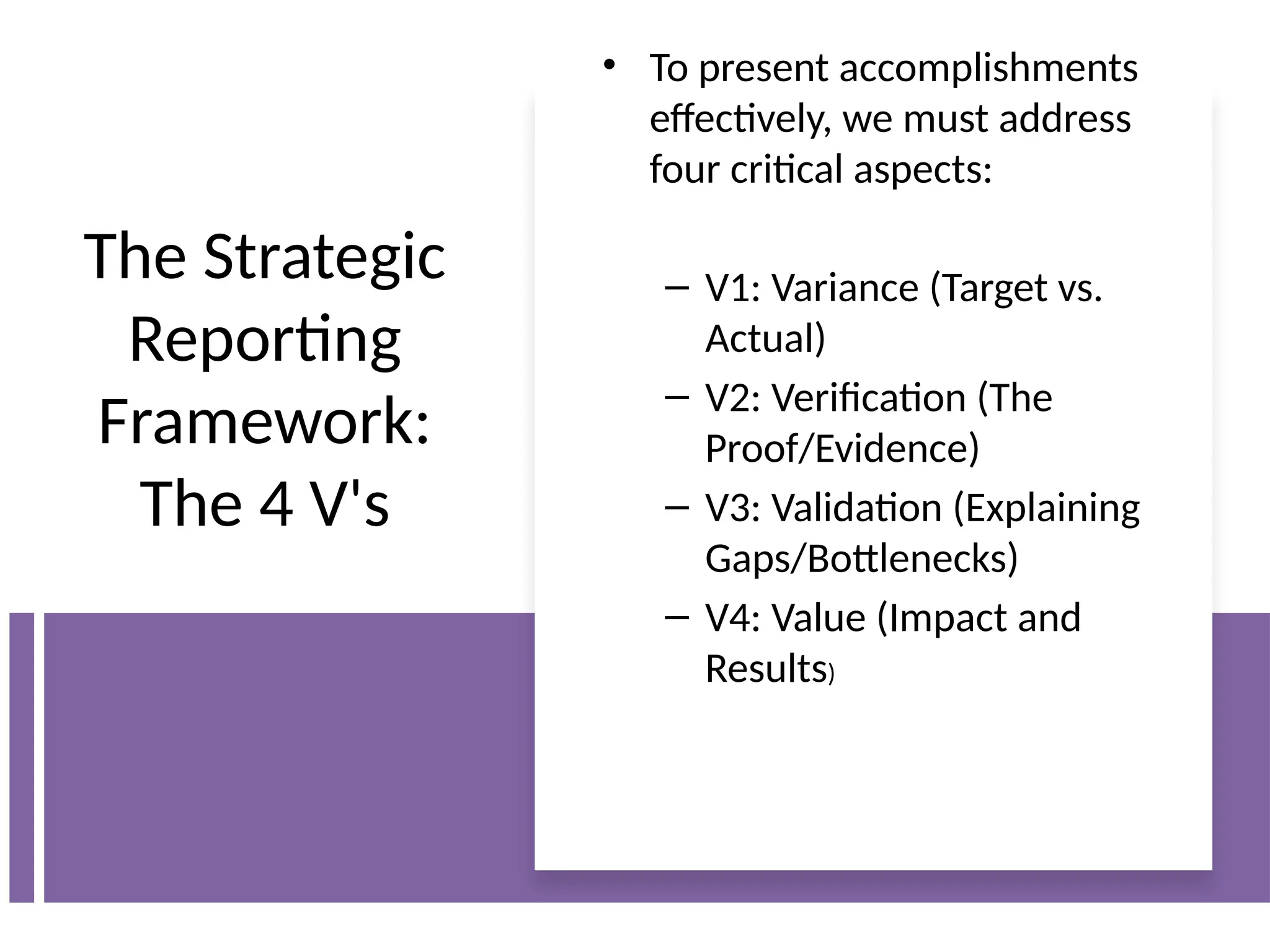
The Strategic
Reporting
Framework:
The 4 V's
• To present accomplishments
effectively, we must address
four critical aspects:
– V1: Variance (Target vs.
Actual)
– V2: Verification (The
Proof/Evidence)
– V3: Validation (Explaining
Gaps/Bottlenecks)
– V4: Value (Impact and
Results)
V1:
Variance
(Target vs.
Actual)
• Physical Accomplishment:
• Compare Actual Output vs. WFP
Target.
• Formula: Actual / Target * 100%.
• Financial Accomplishment:
• Compare Actual
Obligations/Expenses vs. WFP
Allotment.
• Metric: Budget Utilization Rate
(BUR).
• Key Message: Must be internally
consistent (e.g., 100% physical
completion should ideally align
with high BUR).
V2:
Verification
(Means of
Verification -
MOV)
• Every claim needs proof.
• Examples of MOV:
• Signed Memoranda of
Agreement (MOA) or policy
issuances.
• Attendance Sheets, Photo
Documentation, Notice of Activity,
Post L and Report, and Evaluation
Forms (for trainings).
• Inspection and Acceptance
Reports (IARs) for procured goods.
• Official Reports and Data (e.g.,
COA submission).
• Principle: If it’s not documented, it
didn’t happen (in government
reporting).
V3: Validation
(Explaining
Variances and
Gaps)
• Do not just report the numbers—
report the narrative.
• Positive Variance: Explain how you
exceeded the target (e.g.,
streamlined process, unexpected
funding).
• Negative Variance/Delay: Provide
clear reasons (e.g., procurement
issues, budget adjustments, external
factors).
• Mandatory Action: Include a
Corrective Action Plan for any
significant shortfall (e.g., 'Remaining
funds will be re-aligned/activities
consolidated in Q4.').
V4: Value
(Focus on
Outcomes,
Not Just
Outputs)
• Outputs vs. Outcomes:
• Output (WFP): 100 farmers trained.
• Outcome (Value): 15% increase in crop
yield among trained farmers.
• Narrative Reporting: Use compelling,
data-driven language to show the positive
change for the Target Beneficiaries.
• Focus: How did the PAPs make a
difference in people’s lives or the agency’s
mission?
• Output refers to the direct products or deliverables of an activity or
program. These are the tangible goods, services, or completed tasks
that result immediately from the work done. (OECD, 2002)
• Outcome refers to the effect, change, or impact that occurs because of
those outputs. Outcomes are often longer-term, less directly
controllable, and reflect broader objectives or performance goals. (
https://www.projectmanagementstation.com/outcome-vs-output)
Effective
Presentation of
Accomplishments
• Use Visual Aids: Charts, graphs, and
tables are clearer than raw numbers.
• Adhere to Format: Use the
prescribed reporting template (e.g.,
Quarterly Physical and Financial
Report/Accomplishment Report).
• Clarity: Use non-technical language
when presenting to non-specialist
audiences. (e.g, budget utilization
(technical) to use of budget (non-
technical)
• Sign-Off: Ensure proper certification
and approval from authorized
personnel. (e.g. Head of Office, Chief
of Planning, Chief of Budget, Senior
Minister)
Strategic
Focus: A
Forward
Look
• Reiterate how your accomplishments
contributed to the agency's Major Final
Output (MFO).
• Briefly summarize the lessons learned
(what worked/what didn't).
• Present your plans for the next
reporting period to show continuous
improvement and strategic thinking.
• Takeaway:
The WFP is not just a form; it's
our promise. The Accomplishment Report
is how we prove we delivered.
Questions and
Discussion
Thank you!

The Work and Financial Plan (WFP): Mastering Accomplishment Reporting

  • 1.
    The Work andFinancial Plan (WFP): Mastering Accomplishment Reporting Presented by: Cashmir Pangandaman Planning Officer Bangsamoro Liaison Office in Metro Manila
  • 2.
    What is WFP? • Officialdocument detailing planned Programs, Projects, and Activities (PPAs). • Purpose: – Translates the annual budget (GAA) into measurable physical and financial targets. – Basis for the release of funds and for monitoring utilization of funds (DBM NBBC No. 436, 1994) – Supports the Budget Proposal and is also used as basis for Project Procurement Management Plan or PPMP (COA Procurement Auditing Guidelines, 2009) • Legal Mandate: Required by DBM/COA for budget execution and monitoring.
  • 3.
    Why DBM and COA Mandates Matterfor WFP? • DBM requires WFPs from agencies – to ensure that planned activities (work plans) and corresponding fund needs (financial plan) are aligned with the national budget; and – to guide the release and monitoring of funds. • COA uses the WFP – to plan its audits and verify that agencies implement their planned activities in a lawful, efficient, and accountable way. – through auditing, COA holds agencies accountable for how they use funds based on what they declared in their WFP.
  • 4.
    Why We Report: Beyond Compliance • Accountability:Proves effective and efficient use of public funds to oversight agencies. • Future Planning: Identifies best practices and operational bottlenecks. • Performance Evaluation: Primary basis for assessing unit and individual performance (e.g., SPCR/IPCR).
  • 5.
    Elements of the WFP: WhatDid We Promise? • PAP Title: The specific item being implemented. • Output Indicator: The official metric for success. • Physical Target: The numerical goal (e.g., 5 projects, 10 trainings). • Financial Target: The allocated budget. • Takeaway: The WFP sets the baseline for everything you report.
  • 6.
    Aligning Accomplishments to National Goals •Goal/Impact: Supports the Philippine Development Plan • Outcome: Achieves the Major Final Output (MFO) of the agency. • Output: The PPA deliverables (what the WFP targets). • Activity: The steps taken to produce the output. • Focus: Your accomplishment must show a clear line of sight to the MFO and Goal/Impact. • Takeaway: Every accomplishment should demonstrate a line of sight from what the agency does (activities) to what it delivers (outputs), the outcome it aims to achieve (MFO), and the broader national impact it supports (e.g., PDP).
  • 7.
    In the contextof BARMM: Aligning Accomplishments to Strategic Goals of the Office of the Chief Minister • Strategic Goal 1: Institutionalize rational systems, processes, and structures and foster moral governance and culture of excellence towards an efficient and effective bureaucracy in the Bangsamoro. • Strategic Objective 1.1: To continuously improve standardized systems and process on government services. • Initiative: Implementation of a systematic review mechanism, and standardization • Activity: Provide liaison services to the international offices or embassies and national offices/agencies on matters related to the BARMM government • Responsible Party: BLOMM • Target – Year 2023 (baseline): 90% – Year 2024: 90% – Year 2025: 100% – Year 2026-2028: 100%
  • 8.
    The Strategic Reporting Framework: The 4V's • To present accomplishments effectively, we must address four critical aspects: – V1: Variance (Target vs. Actual) – V2: Verification (The Proof/Evidence) – V3: Validation (Explaining Gaps/Bottlenecks) – V4: Value (Impact and Results)
  • 9.
    V1: Variance (Target vs. Actual) • PhysicalAccomplishment: • Compare Actual Output vs. WFP Target. • Formula: Actual / Target * 100%. • Financial Accomplishment: • Compare Actual Obligations/Expenses vs. WFP Allotment. • Metric: Budget Utilization Rate (BUR). • Key Message: Must be internally consistent (e.g., 100% physical completion should ideally align with high BUR).
  • 10.
    V2: Verification (Means of Verification - MOV) •Every claim needs proof. • Examples of MOV: • Signed Memoranda of Agreement (MOA) or policy issuances. • Attendance Sheets, Photo Documentation, Notice of Activity, Post L and Report, and Evaluation Forms (for trainings). • Inspection and Acceptance Reports (IARs) for procured goods. • Official Reports and Data (e.g., COA submission). • Principle: If it’s not documented, it didn’t happen (in government reporting).
  • 11.
    V3: Validation (Explaining Variances and Gaps) •Do not just report the numbers— report the narrative. • Positive Variance: Explain how you exceeded the target (e.g., streamlined process, unexpected funding). • Negative Variance/Delay: Provide clear reasons (e.g., procurement issues, budget adjustments, external factors). • Mandatory Action: Include a Corrective Action Plan for any significant shortfall (e.g., 'Remaining funds will be re-aligned/activities consolidated in Q4.').
  • 12.
    V4: Value (Focus on Outcomes, NotJust Outputs) • Outputs vs. Outcomes: • Output (WFP): 100 farmers trained. • Outcome (Value): 15% increase in crop yield among trained farmers. • Narrative Reporting: Use compelling, data-driven language to show the positive change for the Target Beneficiaries. • Focus: How did the PAPs make a difference in people’s lives or the agency’s mission? • Output refers to the direct products or deliverables of an activity or program. These are the tangible goods, services, or completed tasks that result immediately from the work done. (OECD, 2002) • Outcome refers to the effect, change, or impact that occurs because of those outputs. Outcomes are often longer-term, less directly controllable, and reflect broader objectives or performance goals. ( https://www.projectmanagementstation.com/outcome-vs-output)
  • 13.
    Effective Presentation of Accomplishments • UseVisual Aids: Charts, graphs, and tables are clearer than raw numbers. • Adhere to Format: Use the prescribed reporting template (e.g., Quarterly Physical and Financial Report/Accomplishment Report). • Clarity: Use non-technical language when presenting to non-specialist audiences. (e.g, budget utilization (technical) to use of budget (non- technical) • Sign-Off: Ensure proper certification and approval from authorized personnel. (e.g. Head of Office, Chief of Planning, Chief of Budget, Senior Minister)
  • 14.
    Strategic Focus: A Forward Look • Reiteratehow your accomplishments contributed to the agency's Major Final Output (MFO). • Briefly summarize the lessons learned (what worked/what didn't). • Present your plans for the next reporting period to show continuous improvement and strategic thinking. • Takeaway: The WFP is not just a form; it's our promise. The Accomplishment Report is how we prove we delivered.
  • 15.
  • 16.