ANNUAL
ANNUAL
REPORT
REPORT
2024
2024
SIHMA
Scalabrini Institute for
Human Mobility in Africa
2
Those who would like to put a stop or
a limit to emigration for patriotic or
economic reasons and those who, because
of a mistaken idea of freedom, want
emigration left to itself, without direction
or guidance, are either not using their
heads or, in my opinion, are reasoning
egoistically and insensitively. In fact,
by blocking emigration, we are violating
a sacred human right; and by leaving
it to itself, we are making emigration
ineffectual. The former forget that human
rights are inalienable, that hence a person
can seek his fortune wherever he so
desires. The latter forget that emigration
is a centrifugal force, which, if well
directed, can also become a very powerful
centripetal force. ”
St. JOHN BAPTIST SCALABRINI
This year, 2024/25, marks a milestone in the history of our institute, with its
first ten years of activity and many achievements in our efforts to offer in-
depth and practical knowledge of the phenomenon of migration through
our research, publications, training and events. However, this report is by no
means a celebratory compilation of achievements.
We are prevented from doing so by the awareness of how much work still
needs to be done to ensure that our findings contribute to a more respectful
management of migration in terms of migrants’ rights and the empowerment
of the most vulnerable, considering the current situation.
In fact, while the topic of human mobility is increasingly at the center of
debate and media coverage, the reality around the world remains worrying
and, in some ways, discouraging: the number of forced migrants is constantly
increasing, the protection of the rights of people on the move is more and
more restricted in the name of national security (and the well-being of the
few), and the exploitation and trafficking of people, primarily minors and
women, is constantly finding new ways to develop.
Aware of the importance of our scientific and educational mission, we
continue our work with dedication and professionalism, in collaboration
with an extensive – and sometimes little-known – network of people and
organisations with whom we share this challenging but stimulating goal.
Ten years of our scientific journal African Human Mobility Review (AHMR),
which has an increasing number of contributions from authors across the
continent, the support of an extensive network of reviewers and contributors
and, most importantly, something that makes us proud, a growing readership
of scholars and students, as well as practitioners and “ordinary” users
interested in learning more about the reality we describe.
Similarly, for ten years, the pages of our website and social media have
helped us reach an ever-growing number of users with selected content
produced from rigorous research but always careful to offer concrete and
understandable language.
We wish you happy reading and ourselves many more years of good work
Message
from the director
3
Filippo Ferraro, SIHMA Executive Director
TABLE OF CONTENTS
Message from the director			 3
SIHMA ORGANISATION				4
SCALABRINI, serving people on the move		 4
SCALABRINI IN AFRICA			 5
Board of TRUSTEES				6
SIHMA Team				8
ORGANISATIONAL CHART			10
SIHMA VOLUNTEER AND INTERNSHIP PROGRAMME 12
INTERNS at SIHMA 2023/24			 13
among OUR PARTNERS			 14
NETWORK OF STUDY CENTRES			 15
SIHMA’S KEY FOCUS AREAS			 16
RESEARCH					16
RESEARCH REQUEST				19
PUBLICATIONS				19
AFRICAN HUMAN MOBILITY REVIEW (AHMR) 		 22
AFRICA ON THE MOVE 2022			 25
TRAINING AND CAPACITY BUILDING		 28
SIHMA ONLINE RESOURCES			 30
EVENTS AND COMMUNICATION			 32
SIHMA COMMUNICATION strategy 		 37
FINANCIAL OVERVIEW				38
An Africa where the human rights of people on the
move are ensured, and their dignity is promoted.
To conduct and disseminate research that contributes
to the understanding of human mobility and informs
policies that ensure the rights and dignity of migrants,
asylum seekers and refugees in Africa.
Founded in 2014, the Scalabrini Institute for Human Mobility in
Africa (SIHMA) is a research institute and non-profit organisation
advocating for the rights of migrants and refugees.
Saint John Baptist Scalabrini founded in 1887, the Missionaries of
St. Charles (Scalabrinians), a Congregation of the Catholic Church
devoted to the care of migrants, refugees, seafarers and people
on the move.
The late 20th century was the age of the huge migration of poor
people who were crossing the Atlantic to reach the Americas.
Scalabrini, impressed by that phenomenon, decided to do
something. The beginnings of the Congregation were humble and
unpretentious: just two Italian priests who made their vows in the
hands of the Founder and left.
The first mission fields were the United States and Brazil.
Subsequently, keeping pace with the evolution of the migration
flows, the mission reached other countries and continents.
Today, the Scalabrini Congregation works in South Africa and
more than 30 countries of the world, according to the Scalabrini
ethos and inspired by universal values such as respect for human
dignity and diversity. Fathers, with the invaluable help of lay
people, exercise their ministry of consecrated people in parishes,
missions, chaplaincies, reception centres, shelters for migrants,
and at seaports; they are also present in national and diocesan
Church organisms and centres of migration studies, like SIHMA.
The main areas of work of the Congregation are:
• Pastoral care and spiritual assistance of people on the move;
• Social projects, research on human mobility, promotion of
human rights;
• Activities linked with our charisma and promotion of our
spirituality.
SCALABRINI, serving
people on the move
4
Our Mission
Our Vision
SIHMA ORGANISATION
5
1994 Scalabrini Fathers are called to work in
South Africa by Archbishop of Cape Town Law-
rence Henry. They start to work in Holy Cross
Parish in District Six, with pastoral care of the
Italian community too.
2012 Opening of the new Mission in
Johannesburg (St.Patrick La Rochelle).
2013 St.Agnes Parish in Woodstock
consolidates an intercultural community,
including French-speaking refugees.
May 2014 SIHMA is started as the new research
institute of Scalabrini focused on human
mobility in Africa.
2021 Opening of new social projects
in Johannesburg at St.Patrick La Rochelle.
16 April 2005 Lawrence House, Child and Youth
Centre for Vulnerable Minors (especially mi-
grants and refugees).
1995 Chaplaincy of the Port of Cape Town (AoS)
and pastoral care of the Portuguese community.
4 June 2003 The Scalabrini Centre of Cape Town
inaugurates the new building in Commercial St.
October 2005 Scalabrini Fathers start a new
Mission in Nampula (Mozambique) for pastoral
care of refugees in Maratane Camp.
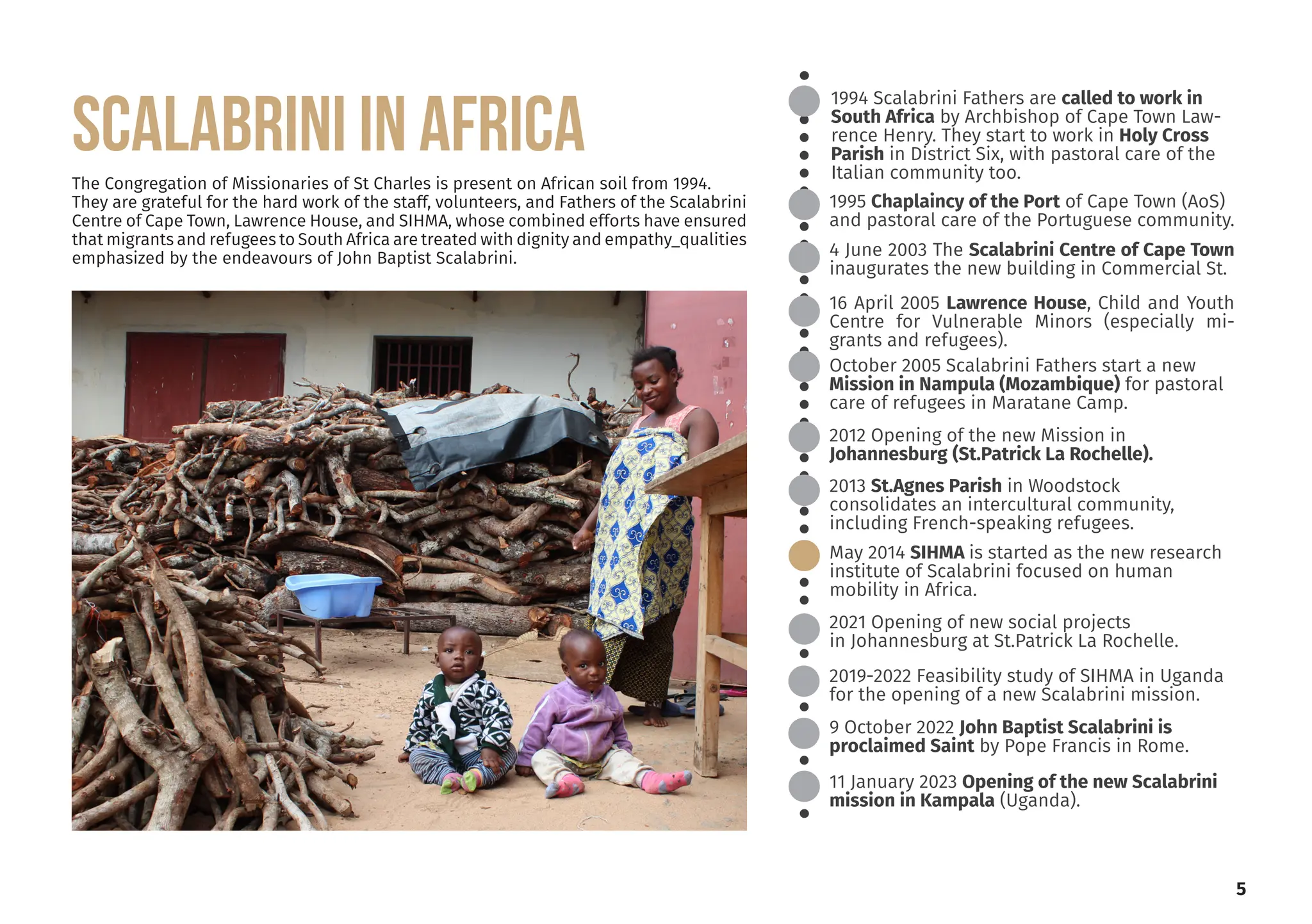
The Congregation of Missionaries of St Charles is present on African soil from 1994.
They are grateful for the hard work of the staff, volunteers, and Fathers of the Scalabrini
Centre of Cape Town, Lawrence House, and SIHMA, whose combined efforts have ensured
that migrants and refugees to South Africa are treated with dignity and empathy_qualities
emphasized by the endeavours of John Baptist Scalabrini.
2019-2022 Feasibility study of SIHMA in Uganda
for the opening of a new Scalabrini mission.
9 October 2022 John Baptist Scalabrini is
proclaimed Saint by Pope Francis in Rome.
11 January 2023 Opening of the new Scalabrini
mission in Kampala (Uganda).
SCALABRINI IN AFRICA
Board of TRUSTEES
We live in turbulent times marked by dehumanising politics, brutal wars serving the powerful,
exclusionary economics, environmental destruction, and climate change, all of which
destabilise communities and disproportionately affect the poor, becoming push factors in
global migration. As a Board operating in this context, our role is to discern the signs of the
times, empower the vulnerable, and build liberatory agency. While history bends towards
exclusion and populism, we, aligned with the Scalabrini mission, are committed to showing
how a single act can still shift history. Our faith-based roots call us to draw from tradition,
activism, and learning to chart dynamic paths of study, praxis, understanding, and hope.
As Scalabrini said, “the vulnerable are in the pupil of God’s eye.”
We therefore have a duty to protect, enhance, and honour human dignity. This discernment
also means embracing respectful discourse and responding to the legacy of Pope Francis.
His death on Easter Monday was a loss for the mobile community. Yet his enduring legacy
offers vital tools to resist narrow, securitised refugee policies. Through his writings and
actions, Pope Francis championed a rights-based approach, shifting the global conversation.
He reminded us that “migrants and refugees are no pawns on the chessboard of humanity”
but human beings with a desire not just to have and know, but to be more. These final words
“being” and “more” are crucial. His focus on dignity urges us to promote what enhances
humanity and reject what dehumanises.
SIHMA’s pride lies in its methodological shift from deductive to inductive thinking from
imposing frameworks onto reality to drawing insights from lived experiences. This grounded,
dialogical approach, aided by the sciences, fosters theory-building and evidence-based
solutions. Our publications, from peer-reviewed journals to Vatican-commissioned research,
showcase a serious intellectual commitment to real-world issues.
Quoting Albert Szent-Gyorgyi, “Research is seeing what everybody else has seen and thinking
what nobody else has thought.” In the face of complex challenges and hostile discourse,
we seek new, grounded insights. Our Africa-focused work recognises that 70% of refugees
reside in neighbouring nations, with low- and middle-income countries hosting 76% of
them. Africa, often misrepresented as a source of migration problems, is also a major host
and contributor to care. These overlooked realities challenge dominant stereotypes and
reveal a continent carrying much of the humanitarian burden. SIHMA continues to be at the
forefront of research, offering new paradigms and ground-breaking ideas. We are proud of
our achievements and optimistic about the future. As a Board, we fully support this essential
praxis in one of the world’s most contested and vital areas.
Fr. Peter John Pearson, SIHMA’s Board Member and Director of CPLO
6
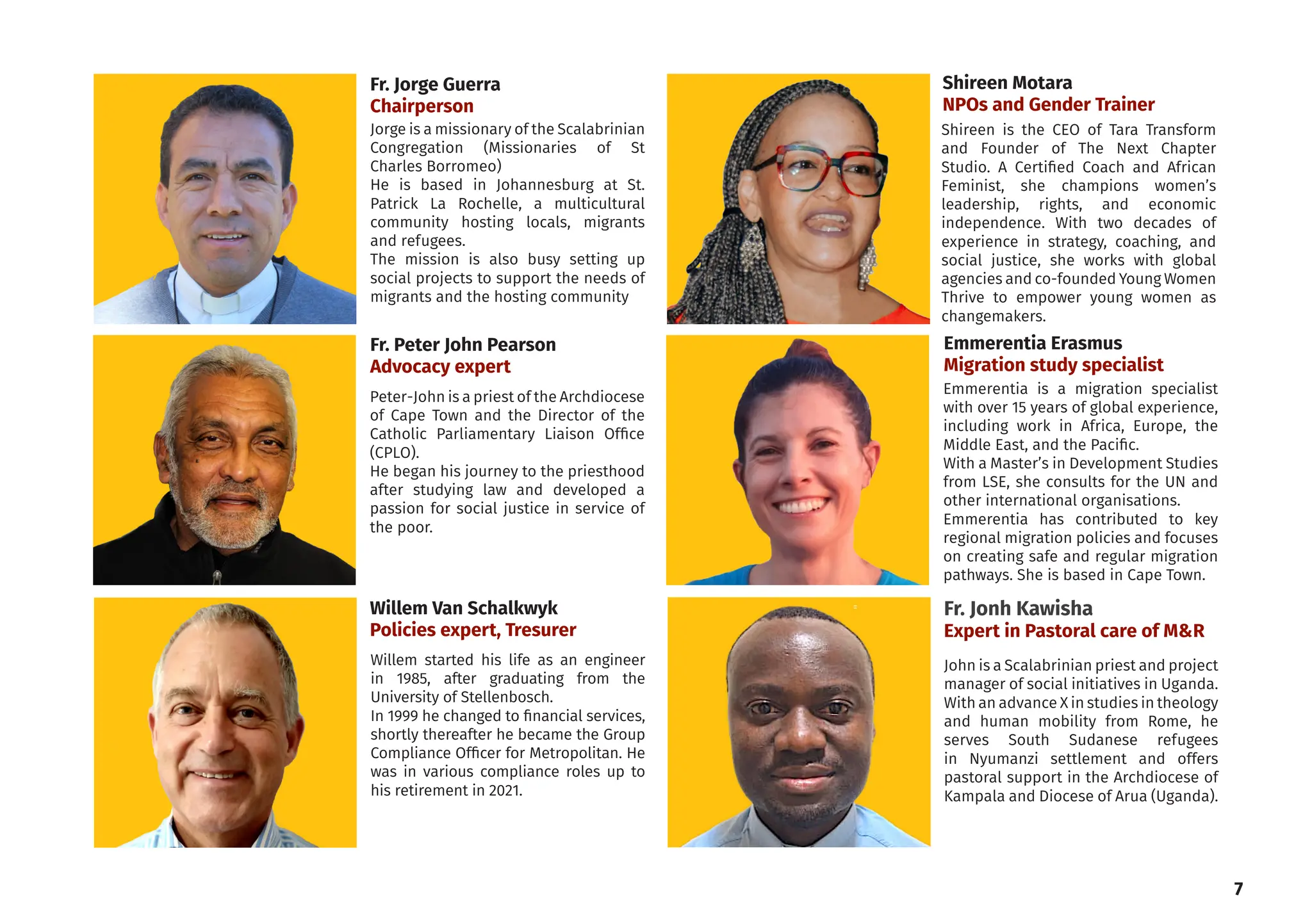
Peter-John is a priest of the Archdiocese
of Cape Town and the Director of the
Catholic Parliamentary Liaison Office
(CPLO).
He began his journey to the priesthood
after studying law and developed a
passion for social justice in service of
the poor.
Shireen is the CEO of Tara Transform
and Founder of The Next Chapter
Studio. A Certified Coach and African
Feminist, she champions women’s
leadership, rights, and economic
independence. With two decades of
experience in strategy, coaching, and
social justice, she works with global
agencies and co-founded Young Women
Thrive to empower young women as
changemakers.
Willem started his life as an engineer
in 1985, after graduating from the
University of Stellenbosch.
In 1999 he changed to financial services,
shortly thereafter he became the Group
Compliance Officer for Metropolitan. He
was in various compliance roles up to
his retirement in 2021.
Jorge is a missionary of the Scalabrinian
Congregation (Missionaries of St
Charles Borromeo)
He is based in Johannesburg at St.
Patrick La Rochelle, a multicultural
community hosting locals, migrants
and refugees.
The mission is also busy setting up
social projects to support the needs of
migrants and the hosting community
Fr. Peter John Pearson
Advocacy expert
Willem Van Schalkwyk
Policies expert, Tresurer
7
Shireen Motara
NPOs and Gender Trainer
Fr. Jorge Guerra
Chairperson
Fr. Jonh Kawisha
Expert in Pastoral care of M&R
John is a Scalabrinian priest and project
manager of social initiatives in Uganda.
With an advance X in studies in theology
and human mobility from Rome, he
serves South Sudanese refugees
in Nyumanzi settlement and offers
pastoral support in the Archdiocese of
Kampala and Diocese of Arua (Uganda).
Emmerentia Erasmus
Migration study specialist
Emmerentia is a migration specialist
with over 15 years of global experience,
including work in Africa, Europe, the
Middle East, and the Pacific.
With a Master’s in Development Studies
from LSE, she consults for the UN and
other international organisations.
Emmerentia has contributed to key
regional migration policies and focuses
on creating safe and regular migration
pathways. She is based in Cape Town.
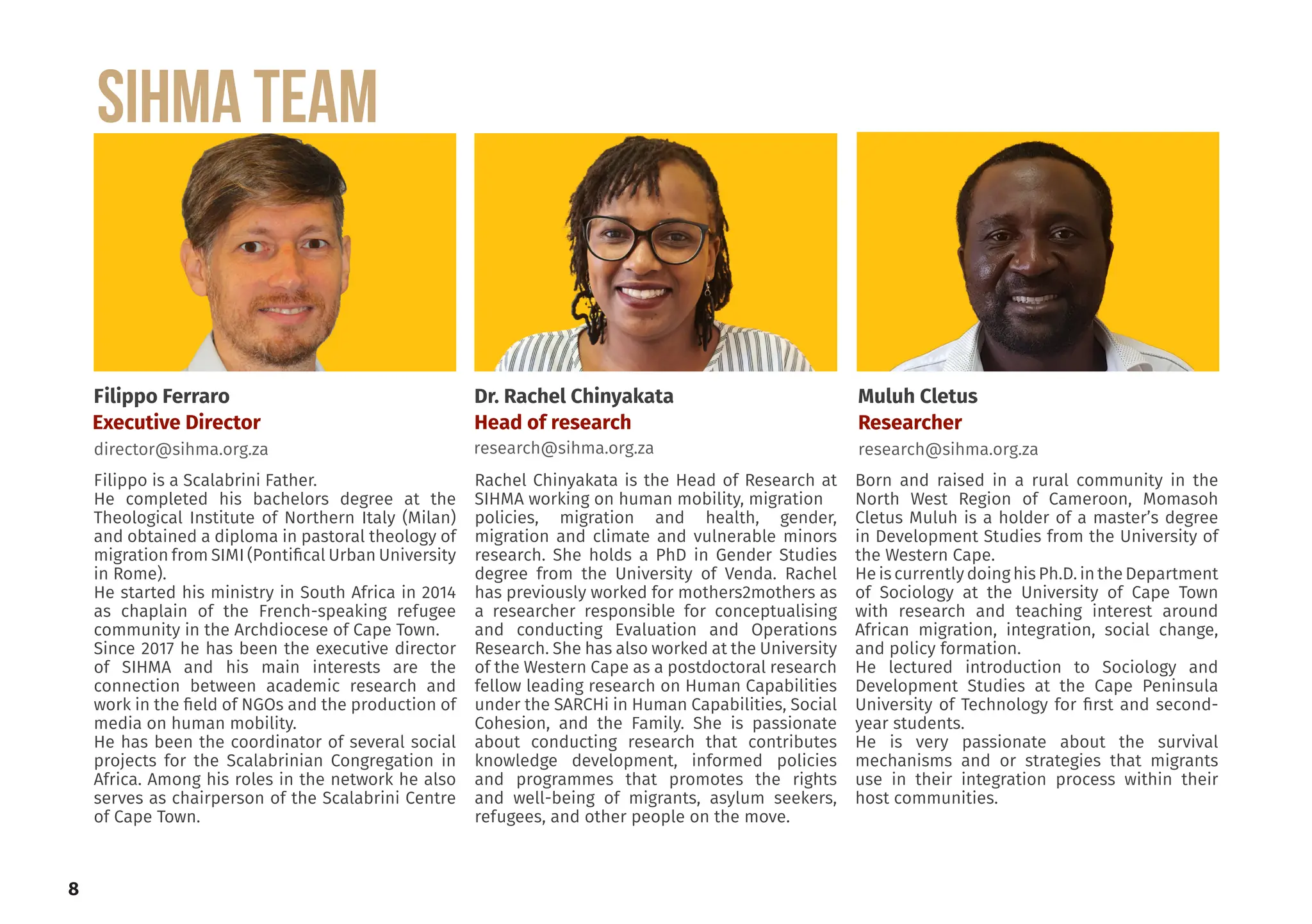
SIHMA Team
Filippo is a Scalabrini Father.
He completed his bachelors degree at the
Theological Institute of Northern Italy (Milan)
and obtained a diploma in pastoral theology of
migration from SIMI (Pontifical Urban University
in Rome).
He started his ministry in South Africa in 2014
as chaplain of the French-speaking refugee
community in the Archdiocese of Cape Town.
Since 2017 he has been the executive director
of SIHMA and his main interests are the
connection between academic research and
work in the field of NGOs and the production of
media on human mobility.
He has been the coordinator of several social
projects for the Scalabrinian Congregation in
Africa. Among his roles in the network he also
serves as chairperson of the Scalabrini Centre
of Cape Town.
Rachel Chinyakata is the Head of Research at
SIHMA working on human mobility, migration
policies, migration and health, gender,
migration and climate and vulnerable minors
research. She holds a PhD in Gender Studies
degree from the University of Venda. Rachel
has previously worked for mothers2mothers as
a researcher responsible for conceptualising
and conducting Evaluation and Operations
Research. She has also worked at the University
of the Western Cape as a postdoctoral research
fellow leading research on Human Capabilities
under the SARCHi in Human Capabilities, Social
Cohesion, and the Family. She is passionate
about conducting research that contributes
knowledge development, informed policies
and programmes that promotes the rights
and well-being of migrants, asylum seekers,
refugees, and other people on the move.
Born and raised in a rural community in the
North West Region of Cameroon, Momasoh
Cletus Muluh is a holder of a master’s degree
in Development Studies from the University of
the Western Cape.
He is currently doing his Ph.D. in the Department
of Sociology at the University of Cape Town
with research and teaching interest around
African migration, integration, social change,
and policy formation.
He lectured introduction to Sociology and
Development Studies at the Cape Peninsula
University of Technology for first and second-
year students.
He is very passionate about the survival
mechanisms and or strategies that migrants
use in their integration process within their
host communities.
Filippo Ferraro
director@sihma.org.za
Muluh Cletus
Researcher
research@sihma.org.za
Dr. Rachel Chinyakata
Head of research
research@sihma.org.za
Executive Director
8
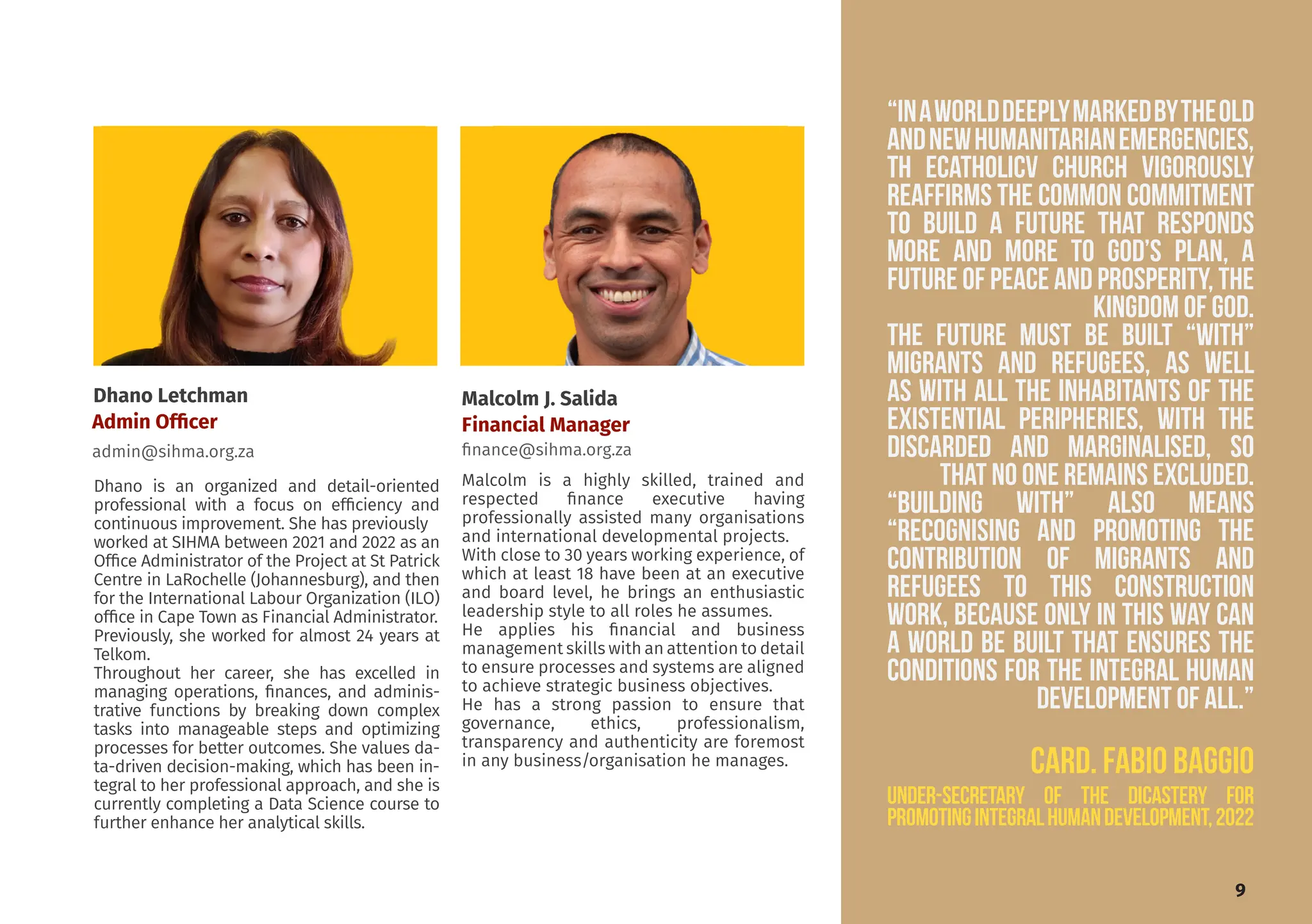
Dhano Letchman
Admin Officer
admin@sihma.org.za
Malcolm J. Salida
Financial Manager
finance@sihma.org.za
Malcolm is a highly skilled, trained and
respected finance executive having
professionally assisted many organisations
and international developmental projects.
With close to 30 years working experience, of
which at least 18 have been at an executive
and board level, he brings an enthusiastic
leadership style to all roles he assumes.
He applies his financial and business
management skills with an attention to detail
to ensure processes and systems are aligned
to achieve strategic business objectives.
He has a strong passion to ensure that
governance, ethics, professionalism,
transparency and authenticity are foremost
in any business/organisation he manages.
Dhano is an organized and detail-oriented
professional with a focus on efficiency and
continuous improvement. She has previously
worked at SIHMA between 2021 and 2022 as an
Office Administrator of the Project at St Patrick
Centre in LaRochelle (Johannesburg), and then
for the International Labour Organization (ILO)
office in Cape Town as Financial Administrator.
Previously, she worked for almost 24 years at
Telkom.
Throughout her career, she has excelled in
managing operations, finances, and adminis-
trative functions by breaking down complex
tasks into manageable steps and optimizing
processes for better outcomes. She values da-
ta-driven decision-making, which has been in-
tegral to her professional approach, and she is
currently completing a Data Science course to
further enhance her analytical skills.
“Inaworlddeeplymarkedbytheold
andnewhumanitarianemergencies,
TH ECATHOLICV CHURCH vigorously
reaffirms the common commitment
to build a future that responds
more and more to God’s plan, a
future of peace and prosperity, the
Kingdom of God.
the future must be built “with”
migrants and refugees, as well
as with all the inhabitants of the
existential peripheries, with the
discarded and marginalised, so
that no one remains excluded.
“Building with” also means
“recognising and promoting the
contribution of migrants and
refugees to this construction
work, because only in this way can
a world be built that ensures the
conditions for the integral human
development of all.”
CArd. FABIO BAGGIO
under-secretary of the Dicastery for
PromotingIntegralHumanDevelopment,2022
9
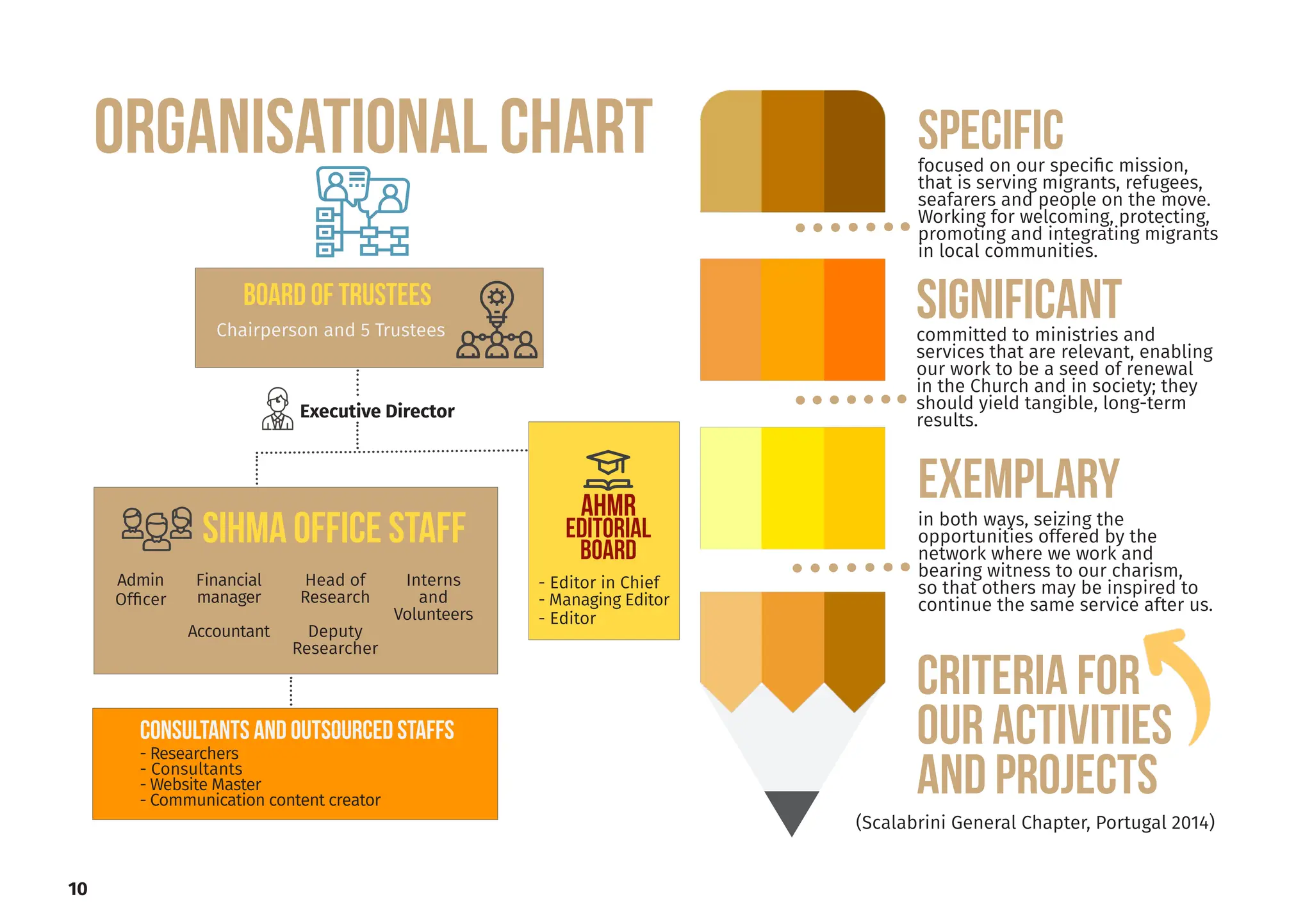
committed to ministries and
services that are relevant, enabling
our work to be a seed of renewal
in the Church and in society; they
should yield tangible, long-term
results.
Interns
and
Volunteers
SIHMA OFFICE STAFF
Financial
manager
Accountant
Head of
Research
Deputy
Researcher
BOARD OF TRUSTEES
Chairperson and 5 Trustees
AHMR
EDITORIAL
BOARD
- Editor in Chief
- Managing Editor
- Editor
Executive Director
CRITERIA FOR
OUR ACTIVITIES
AND PROJECTS
ORGANISATIONAl CHART
(Scalabrini General Chapter, Portugal 2014)
SPECIFIC
EXEMPLARY
SIGNIFICANT
focused on our specific mission,
that is serving migrants, refugees,
seafarers and people on the move.
Working for welcoming, protecting,
promoting and integrating migrants
in local communities.
in both ways, seizing the
opportunities offered by the
network where we work and
bearing witness to our charism,
so that others may be inspired to
continue the same service after us.
Admin
Officer
- Researchers
- Consultants
- Website Master
- Communication content creator
consultants and outsourced staffS
10
“it is possible to see in the migrants
of our time, as in those of every age,
a living image of God’s people on
their way to the eternal homeland.
[...] The images of the biblical
exodus and of migrants share
several similarities. Like the
people of Israel in the time of
Moses, migrants often flee from
oppression, abuse, insecurity,
discrimination, and lack of
opportunities for development. ”
POPE FRANCIS
MESSAGE FOR THE 109th WORLD DAY OF MIGRANTS AND
REFUGEES 2024
11
12
SIHMA VOLUNTEER AND
INTERNSHIP PROGRAMME
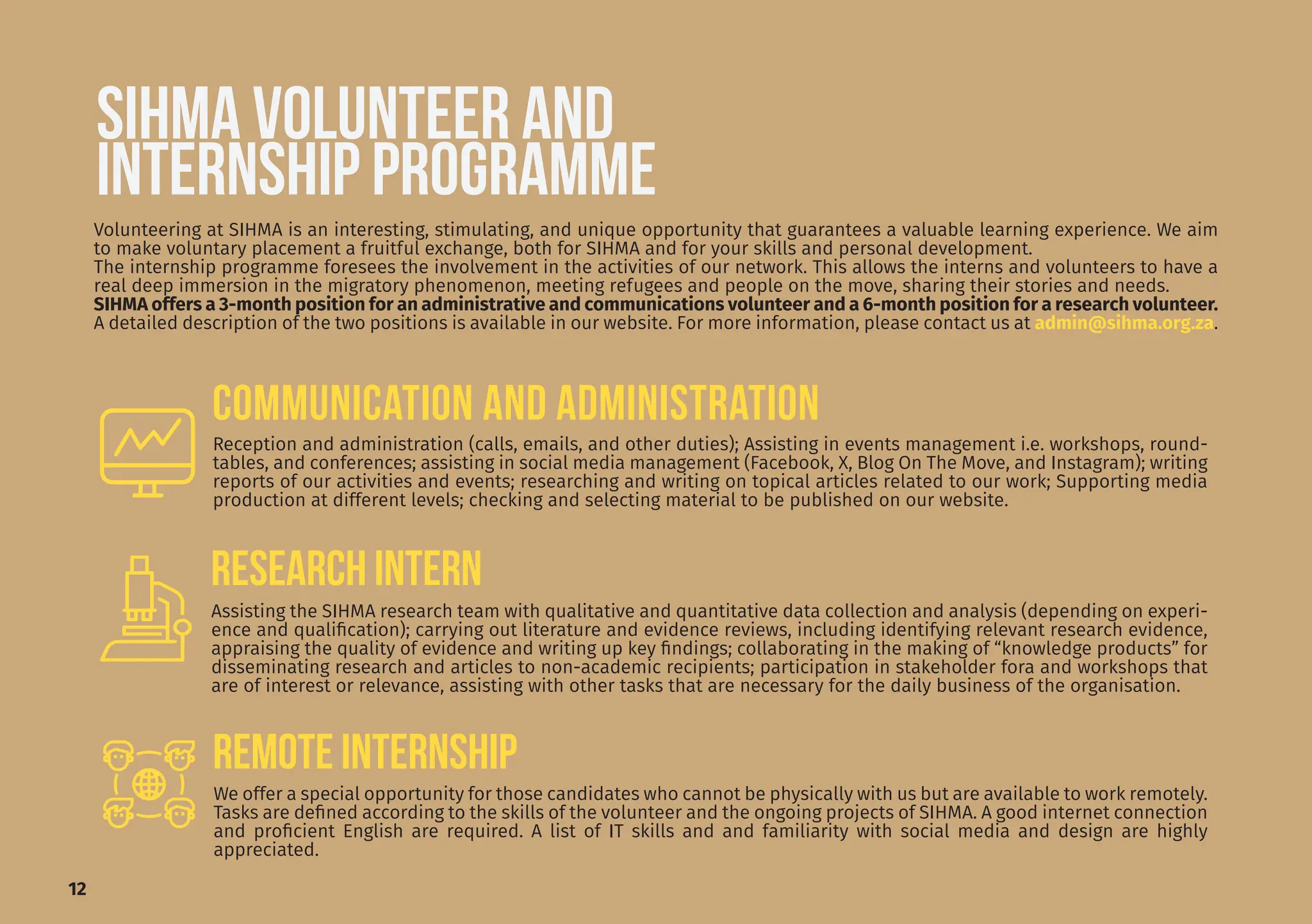
Volunteering at SIHMA is an interesting, stimulating, and unique opportunity that guarantees a valuable learning experience. We aim
to make voluntary placement a fruitful exchange, both for SIHMA and for your skills and personal development.
The internship programme foresees the involvement in the activities of our network. This allows the interns and volunteers to have a
real deep immersion in the migratory phenomenon, meeting refugees and people on the move, sharing their stories and needs.
SIHMA offers a 3-month position for an administrative and communications volunteer and a 6-month position for a research volunteer.
A detailed description of the two positions is available in our website. For more information, please contact us at admin@sihma.org.za.
Assisting the SIHMA research team with qualitative and quantitative data collection and analysis (depending on experi-
ence and qualification); carrying out literature and evidence reviews, including identifying relevant research evidence,
appraising the quality of evidence and writing up key findings; collaborating in the making of “knowledge products” for
disseminating research and articles to non-academic recipients; participation in stakeholder fora and workshops that
are of interest or relevance, assisting with other tasks that are necessary for the daily business of the organisation.
REmote INTERNship
Reception and administration (calls, emails, and other duties); Assisting in events management i.e. workshops, round-
tables, and conferences; assisting in social media management (Facebook, X, Blog On The Move, and Instagram); writing
reports of our activities and events; researching and writing on topical articles related to our work; Supporting media
production at different levels; checking and selecting material to be published on our website.
We offer a special opportunity for those candidates who cannot be physically with us but are available to work remotely.
Tasks are defined according to the skills of the volunteer and the ongoing projects of SIHMA. A good internet connection
and proficient English are required. A list of IT skills and and familiarity with social media and design are highly
appreciated.
COMMUNICATION AND ADMINISTRATION
RESEARCH INTERN
13
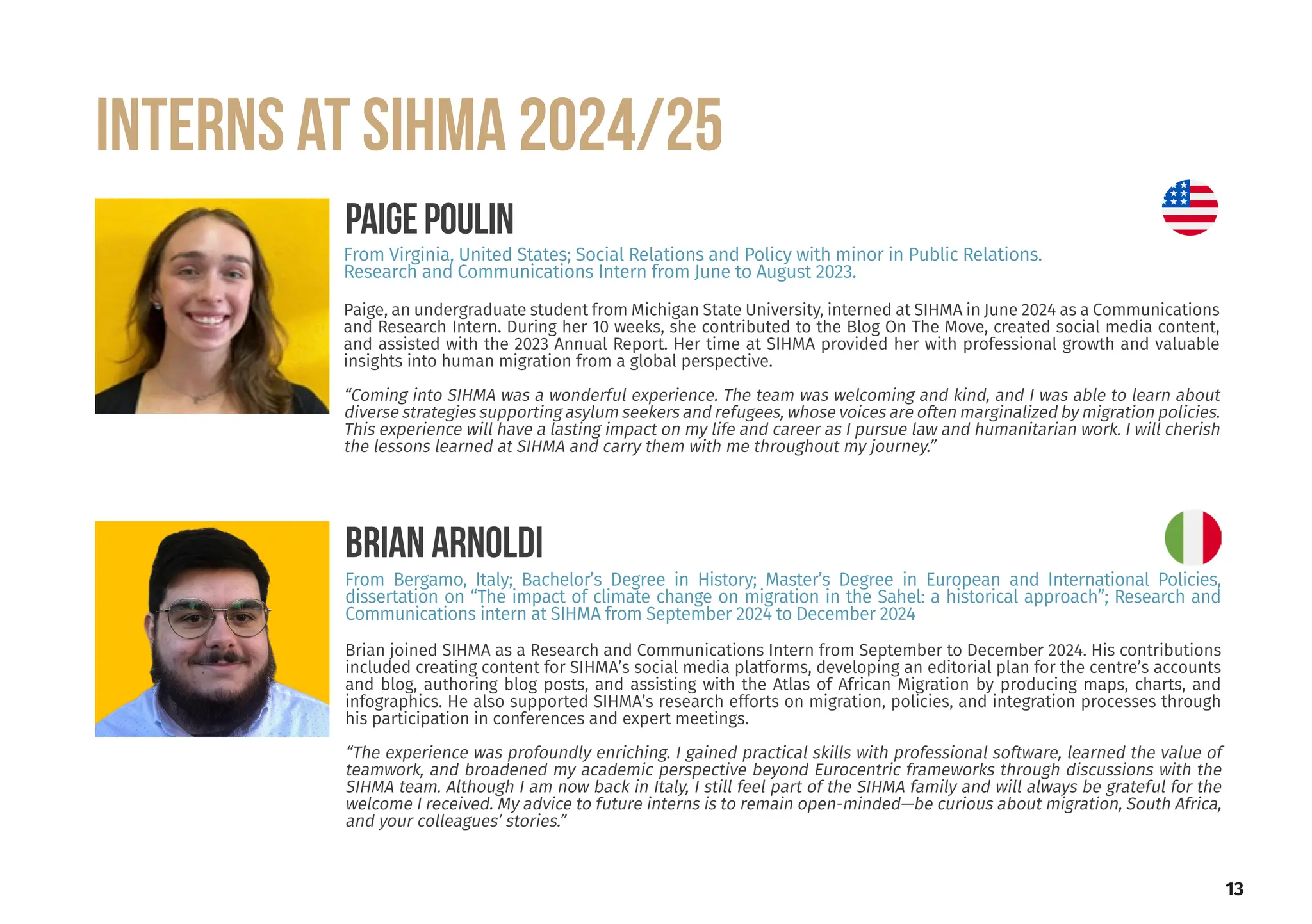
INTERNS at SIHMA 2024/25
Paige, an undergraduate student from Michigan State University, interned at SIHMA in June 2024 as a Communications
and Research Intern. During her 10 weeks, she contributed to the Blog On The Move, created social media content,
and assisted with the 2023 Annual Report. Her time at SIHMA provided her with professional growth and valuable
insights into human migration from a global perspective.
“Coming into SIHMA was a wonderful experience. The team was welcoming and kind, and I was able to learn about
diverse strategies supporting asylum seekers and refugees, whose voices are often marginalized by migration policies.
This experience will have a lasting impact on my life and career as I pursue law and humanitarian work. I will cherish
the lessons learned at SIHMA and carry them with me throughout my journey.”
PAIGEPOULIN
From Virginia, United States; Social Relations and Policy with minor in Public Relations.
Research and Communications Intern from June to August 2023.
Brian joined SIHMA as a Research and Communications Intern from September to December 2024. His contributions
included creating content for SIHMA’s social media platforms, developing an editorial plan for the centre’s accounts
and blog, authoring blog posts, and assisting with the Atlas of African Migration by producing maps, charts, and
infographics. He also supported SIHMA’s research efforts on migration, policies, and integration processes through
his participation in conferences and expert meetings.
“The experience was profoundly enriching. I gained practical skills with professional software, learned the value of
teamwork, and broadened my academic perspective beyond Eurocentric frameworks through discussions with the
SIHMA team. Although I am now back in Italy, I still feel part of the SIHMA family and will always be grateful for the
welcome I received. My advice to future interns is to remain open-minded—be curious about migration, South Africa,
and your colleagues’ stories.”
BRIAN ARNOLDI
From Bergamo, Italy; Bachelor’s Degree in History; Master’s Degree in European and International Policies,
dissertation on “The impact of climate change on migration in the Sahel: a historical approach”; Research and
Communications intern at SIHMA from September 2024 to December 2024
14
AMONG OUR PARTNERS
The Scalabrini International Migration
Network (SIMN) is an umbrella organiza-
tion established in 2007 by the Congrega-
tion of the Missionaries of Saint Charles,
Scalabrinians. SIMN encompasses more
than 250 grassroots Scalabrini entities
that serve and advocate for the dignity
and rights of migrants, refugees, internal-
ly displaced people, and seafarers around
the world. SIMN fulfils its mission through
an extensive network of think tanks, social
service centres, shelters, senior centres,
orphanages, medical clinics, kindergar-
tens, schools, employment centres, and
cultural centres. SIMN works closely with
other entities at the local, national, and
international levels, promoting compre-
hensive service programs and advocating
for the dignity and rights of migrants and
their families.
The Federation of Scalabrini Centers for
Migration Studies unites seven centres
across the world, each devoted to research
and advocacy on migration. Located in
New York, Paris, Rome, Basel, São Paulo,
Buenos Aires, and Manila, these centres
monitor the development of international
migration. All of them are organized with
similar departments, including a program
dedicated to research, another dedicated
to specialized publications—including pe-
riodicals, monographs, and academic pa-
pers—as well as programmes dedicated to
documentation, conferences, and other
educational activities.
CERAP - Centre for Research and Action
for Peace
(Abidjan, Côte d’Ivoire)
Radboud University
(Nijmegen, Netherlands)
SACBC - South African Catholic Bishops’
Conference (South Africa, Botswana
and Eswatini)
CEI - Italian Bishops’ Conference
(Rome, Italy)
Migrants & Refugees Section
Dicastery for Promoting Integral
Human Development (Vatican City)
Regional Direction of the Congrega-
tion of the Missionaries of St. Charles
- Scalabrinians (Basel, Switzerland)
ASCS - Scalabrini Agency for
Cooperation and Development
(Milan, Italy)
CPLO - Catholic Parliamentary
Liaison Office (Cape Town, South Africa
and African network)
SCCT - Scalabrini Centre of Cape Town
(Cape Town, South Africa)
CSEM - Centro Scalabriniano de
estudios migratorios (Scalabrini
Sisters - Brasilia, Brazil)
SIMI - Scalabrini International
Migration Institute (Rome, Italy)
UWC - University of the Western
Cape (Cape Town, South Africa)
Centre for Migration Study
University of Ghana (Accra, Ghana)
Cultural Video Production Africa
(Nairobi, Kenya)
AMADPOC - African Migration and
Development Policy Centre
(Nairobi, Kenya)
OSSREA - Organization for Social
Science Research in Eastern and
Southern Africa (Addis Ababa, Ethiopia)
University of Valencia
(Valencia, Spain)
JRS - Jesuit Refugee Service
(Southern Africa Region)
ACMS - African Centre for Migration and
Society (University of the Witwatersrand
- Johannesburg, South Africa)
LHR - Lawyers for Human Rights
(Pretoria, South Africa)
CTIP - Counter Trafficking in Persons
Office (Pretoria, South Africa)
UCT - University of Cape Town
(Cape Town, South Africa)
ICMC - International Catholic Migration
Commission (Geneva, Switzerland)
CoRMSA - Consortium for Refugees
and Migrants in South Africa
(Pretoria, South Africa
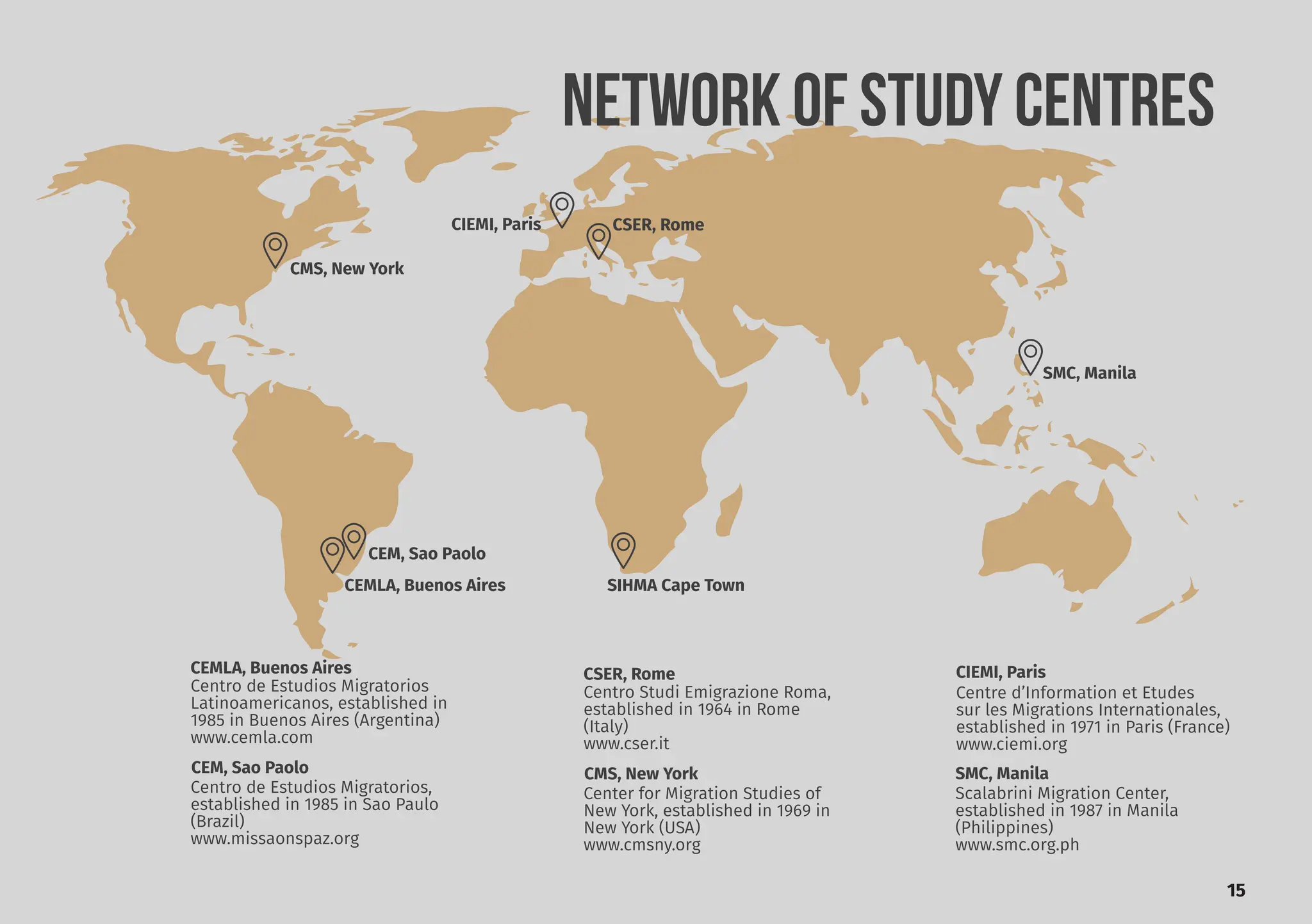
NETWORK OF STUDY CENTRES
CEMLA, Buenos Aires
CMS, New York
CIEMI, Paris
CSER, Rome
CEM, Sao Paolo SMC, Manila
Centro de Estudios Migratorios
Latinoamericanos, established in
1985 in Buenos Aires (Argentina)
www.cemla.com
Center for Migration Studies of
New York, established in 1969 in
New York (USA)
www.cmsny.org
Centro Studi Emigrazione Roma,
established in 1964 in Rome
(Italy)
www.cser.it
Centro de Estudios Migratorios,
established in 1985 in Sao Paulo
(Brazil)
www.missaonspaz.org
Centre d’Information et Etudes
sur les Migrations Internationales,
established in 1971 in Paris (France)
www.ciemi.org
Scalabrini Migration Center,
established in 1987 in Manila
(Philippines)
www.smc.org.ph
15
CEMLA, Buenos Aires
CIEMI, Paris
SMC, Manila
CSER, Rome
CEM, Sao Paolo
CMS, New York
SIHMA Cape Town
Sergio worked with the Scalabrini
Institute for Human Mobility in Af-
rica (SIHMA) since its foundation
in 2014. He previously worked in
South Africa for local NGOs and in
Italy for the United Nations High
Commissioner for Refugees. He’s
currently the Associate Director,
coordinating all the research pro-
grammes. He holds an MA Degree
in Development Studies from the
University of the Western Cape in
South Africa and an MA Degree in
Refugee Rights and Migration Stud-
ies from La Sapienza University in
Rome. One of his main focus areas
is migration policies in Southern
African countries.
Prof Dinbabo o
al Degree in D
from the Unive
Cape.
He also has tw
velopment Man
versity German
Studies (Unive
Cape).
He is the Direc
for Social Deve
ber of many b
networks. He
edge of the fiel
nomic develop
tion, modelling
He is the Chief
African Human
Dr. Mulugeta
AHMR Chief E
editor@sihma.
Sergio Carciotto
Assistant Director
sergio.carciotto79@gmail.com
16
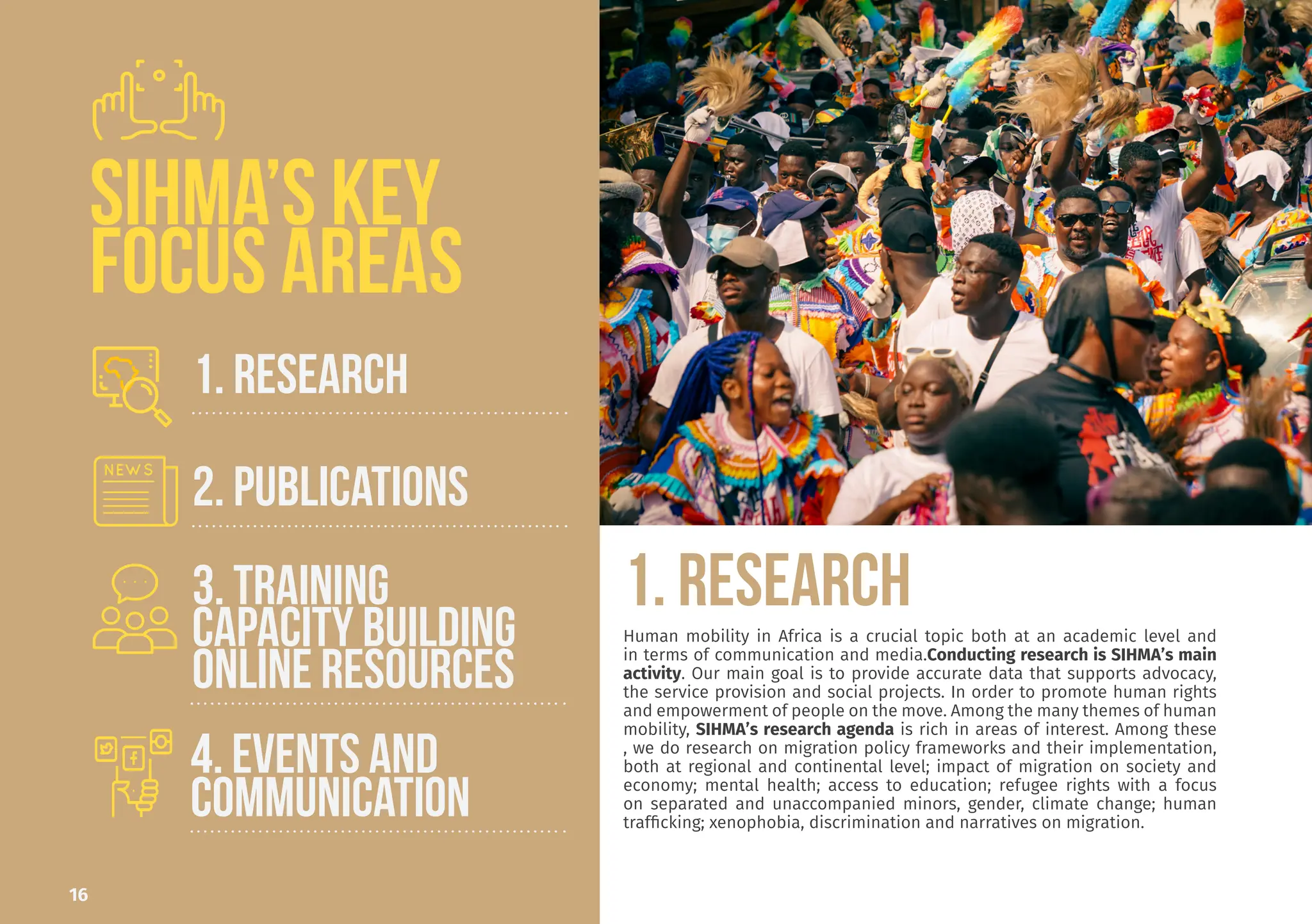
1. RESEARCH
Human mobility in Africa is a crucial topic both at an academic level and
in terms of communication and media.Conducting research is SIHMA’s main
activity. Our main goal is to provide accurate data that supports advocacy,
the service provision and social projects. In order to promote human rights
and empowerment of people on the move. Among the many themes of human
mobility, SIHMA’s research agenda is rich in areas of interest. Among these
, we do research on migration policy frameworks and their implementation,
both at regional and continental level; impact of migration on society and
economy; mental health; access to education; refugee rights with a focus
on separated and unaccompanied minors, gender, climate change; human
trafficking; xenophobia, discrimination and narratives on migration.
SIHMA’S KEY
FOCUS AREAS
1. RESEARCH
2. PUBLICATIONS
4. EVENTS AND
Communication
3. TRAINING
CAPACITY BUILDING
ONLINE RESOURCES
obtained his Doctor-
Development Studies
ersity of the Western
wo MA degrees in De-
nagement (Ruhr Uni-
ny) and Development
ersity of the Western
ctor of the Institute
elopment and mem-
boards and research
has a sound knowl-
lds of social and eco-
pment, microsimula-
g and migration.
Editor of our journal,
n Mobility Review.
a Dinbabo
Editor
.org.za
17
RESEARCH PROJECT funded by Dicastery for Promoting
Integral Human Development
Commissioned by the Dicastery for the Promotion of Integral Human
Development, since 2017, SIHMA has been compiling the Ministry Report
offering a picture of the laborious and fundamental contribution of the
Catholic Church and its organisations and congregations in protecting
the dignity of people on the move. Linked to its mission, “to conduct
and disseminate research that contributes to the understanding of
human mobility and informs policies that ensure the rights and dignity
of migrants, asylum seekers and refugees in Africa”, SIHMA compiled
the 2023 Ministry Report highlighting the role of the Catholic Church in
Africa in restoring dignity, protection, sustainability and agency to the
countless people who cross borders and seas in search of a homeland.
The Ministry Report 2023 is guided by the Pope’s message for the 110th
World Day of Migrants and Refugees under the theme “God walks with
His people”. Reminding us that God does not abandon his children,
especially in moments of suffering and despair and he encourages us
to be instruments of God’s divine mercy offering welcome and support
to those who move to seek for safety and new opportunities. The report
broadly covers geographically, all major areas of Africa, offering through
the 29 good practices a glimpse of 17 African countries. The report
emphasizes the good practices that had a positive and tangible impact
on improving the well-being of individuals and/or communities in the
immediate, medium, or longer-term, as well as those who have proven
to be sustainable and contributed to an innovation in the livelihoods
of participants. In its multifaceted prism of contributions, the report
reflects the universality of the Church, its geographic distribution
within the region concerned, and the multiplicity of charisms, orders,
congregations, organisations, and movements. The report also entails
best practices by the “Atlantic Migration Route,” a common, active and
deadly migratory route from and through West and North Africa to the
Canary Islands and Southern Europe. All previous reports published
by the Migrants and Refugees Section of Dicastery for Promoting
Integral Human Development are available on their website: https://
www.humandevelopment.va/en/sviluppo-umano-integrale/migranti-
rifugiati.html Expected date of release: June 2025
MINISTRY REPORTS 2023 a Key Performance
Indicator framework and
recommendations for
refugees integration in
Uganda
RESEARCH PROJECT by SIHMA funded by SIMN - ASCS
According to scholars, integration varies according to context, time,
interests, values, and perspectives of the people concerned. Considering
this, there is a need to consider these factors in key areas for successful
integration.
To fully integrate the refugees into the host communities and include
them in the country’s developmental plans, their needs and perspectives
need to be taken into consideration in defining what integration looks
like and the strategies that could work in achieving this.
There is also a need to take into account the voices of refugees who are
not in settlements, including those living in urban areas.
With the above background in mind, SIHMA is conducting a study to map
the presence of refugees in Uganda, understand their needs and develop
a Key Performance Indicator (KPIs) framework and recommendations
for refugee integration.
The findings of this study will be used in informing decisions around
refugees’ administration, policies and the implementation of welfare
and advocacy programs.
As SIHMA, the main goal is to inform program focused on the welfare
and integration of refugees in Uganda. Furthermore, data will be used
to provide a benchmark or indicators that organizations working with
refugees can use to ensure integration and to measure the effectiveness
of their work.
Additionally, as an outcome of this research, SIHMA, in collaboration
with the other organizations, will conduct training with organization’s
and stakeholders working with refugees on the KPI framework
developed. Also conduct a pilot implementation of the KPIs framework
in communities with refugees to further refine the framework.
This study will use a mixed methodological approach to develop a KPI
framework and recommendations for integration and wellbeing of
refugees in Uganda through an intervention mapping framework.
The methods that will be employed will include a desktop review,
interviews, Delphi study and workshops to achieve the objectives of
the study. Between December 2024 and January 2025, SIHMA conducted
field work in Kampala with stakeholders, refugees and the local people
to explore their understanding of integration, and the integration needs
for refugees. Following this will be the data analysis and report writing.
Currently data collection is almost completed and transcription of
interviews has started.
Between March and May 2025 SIHMA team will finalize the analysis and
the report, writing. A final workshop with stakeholders will be conducted
in Kampala, Uganda, to report on the findings and present the framework
developed.
Expected date of release: August 2025
Our team prepares a weekly post for the Blog on the Move containing
relevant insights on human mobility. The following are some of the
blog posts that were published in 2024-25 on our website:
🌐 Decolonization of Education and Research on Migration (DERM)
[02/04/2024]
🌐 Training Workshop for Pastoral Agents of Migration in Kampala
Uganda [28/05/2024]
🌐 Trafficking In Persons: The Case of Malawi [20/08/2024]
🌐 Identity vs. Perception: the case of Chidimma
Adetshina and South African opinion on migrants
[08/10/2024]
🌐 Migration on the Rise: Examining the South Africa-Zimbabwe
Corridor in 2024 [22.10.2024]
🌐 The Impact of International Sanctions on Zimbabwe’s Migratory
Regime [19/11/2024]
🌐 Madagascar and Djibouti Shipwrecks Highlight
Migrants’ Deadly Journeys on the East African Route
[26.11.2024]
🌐 Land, Livelihood, and Limited Resources: Uganda’s Refugee
Hosting Challenge [03.12.2024]
🌐 Migrants Exploited: Libya’s Human Rights Crisis
[18/02/2025]
🌐 DR Congo’s Displaced Families: Struggle & Uncertainty Post-M23
Takeover [25/02/2025]
BLOG ON THE MOVE!
18
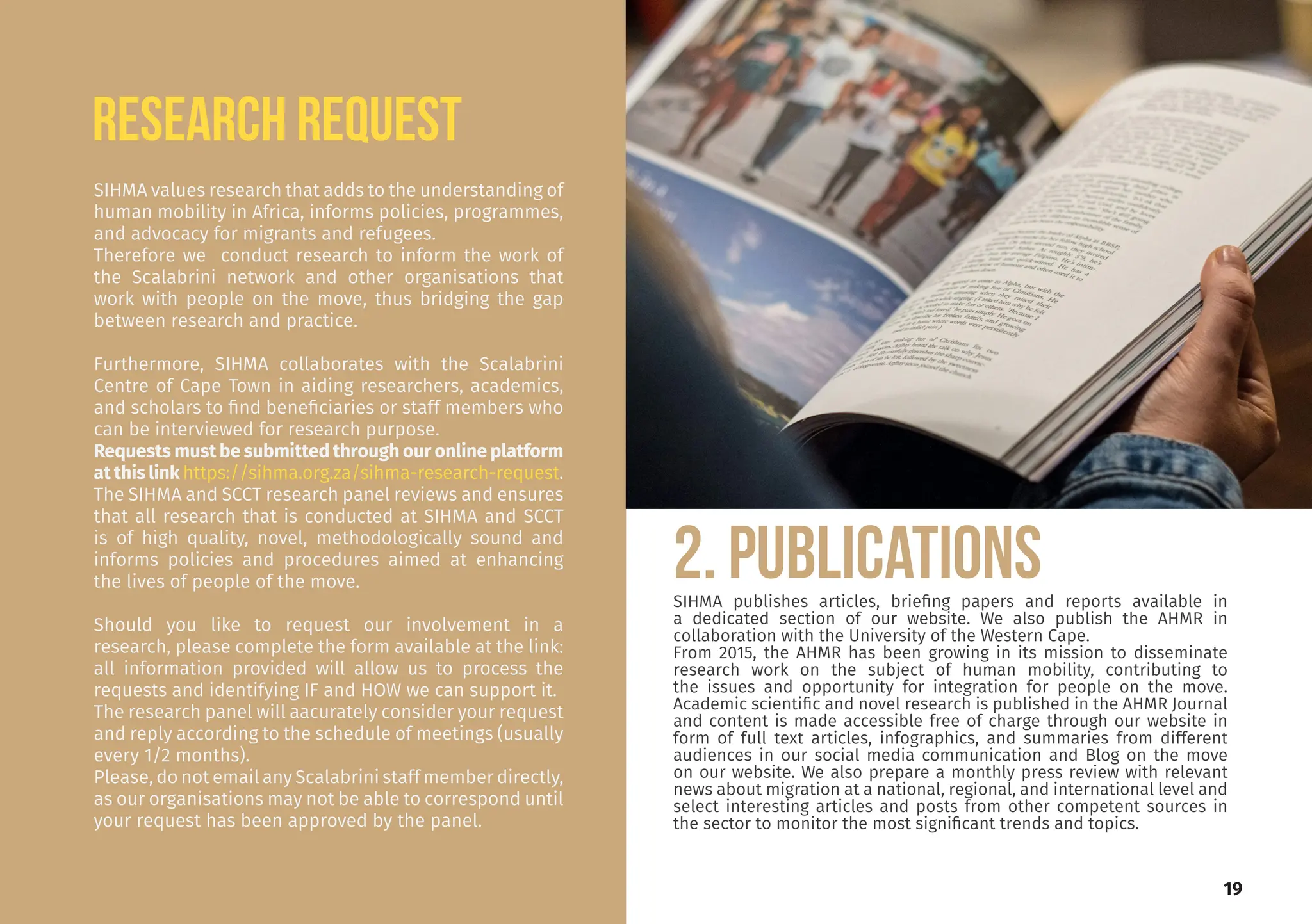
SIHMA values research that adds to the understanding of
human mobility in Africa, informs policies, programmes,
and advocacy for migrants and refugees.
Therefore we conduct research to inform the work of
the Scalabrini network and other organisations that
work with people on the move, thus bridging the gap
between research and practice.
Furthermore, SIHMA collaborates with the Scalabrini
Centre of Cape Town in aiding researchers, academics,
and scholars to find beneficiaries or staff members who
can be interviewed for research purpose.
Requests must be submitted through our online platform
at this link https://sihma.org.za/sihma-research-request.
The SIHMA and SCCT research panel reviews and ensures
that all research that is conducted at SIHMA and SCCT
is of high quality, novel, methodologically sound and
informs policies and procedures aimed at enhancing
the lives of people of the move.
Should you like to request our involvement in a
research, please complete the form available at the link:
all information provided will allow us to process the
requests and identifying IF and HOW we can support it.
The research panel will aacurately consider your request
and reply according to the schedule of meetings (usually
every 1/2 months).
Please, do not email any Scalabrini staff member directly,
as our organisations may not be able to correspond until
your request has been approved by the panel.
RESEARCH REQUEST
2. PUBLICATIONS
SIHMA publishes articles, briefing papers and reports available in
a dedicated section of our website. We also publish the AHMR in
collaboration with the University of the Western Cape.
From 2015, the AHMR has been growing in its mission to disseminate
research work on the subject of human mobility, contributing to
the issues and opportunity for integration for people on the move.
Academic scientific and novel research is published in the AHMR Journal
and content is made accessible free of charge through our website in
form of full text articles, infographics, and summaries from different
audiences in our social media communication and Blog on the move
on our website. We also prepare a monthly press review with relevant
news about migration at a national, regional, and international level and
select interesting articles and posts from other competent sources in
the sector to monitor the most significant trends and topics.
19
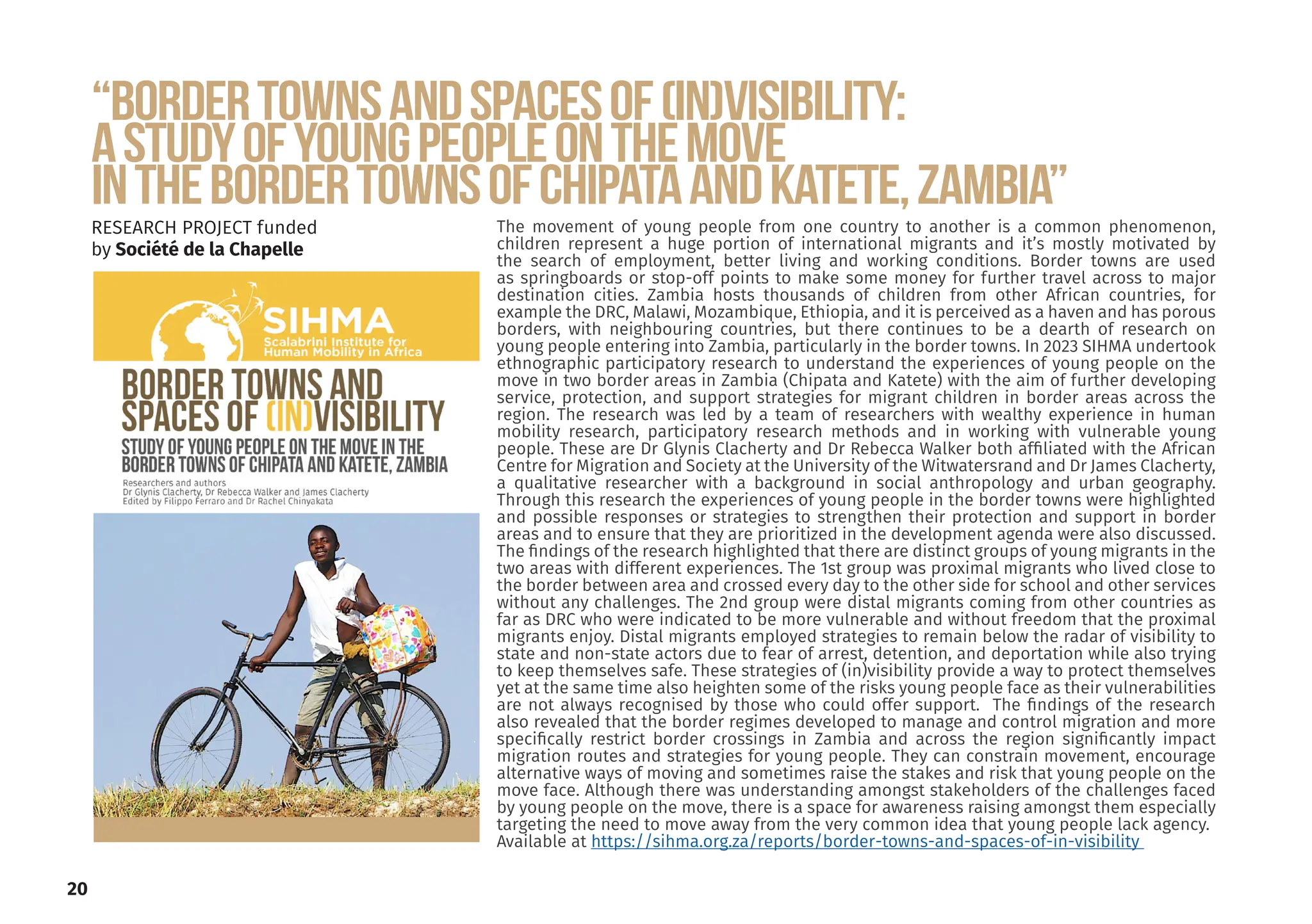
“Bordertownsandspacesof(in)visibility:
AStudyofyoungpeopleonthemove
inthebordertownsofChipataandKatete,Zambia”
RESEARCH PROJECT funded
by Société de la Chapelle
The movement of young people from one country to another is a common phenomenon,
children represent a huge portion of international migrants and it’s mostly motivated by
the search of employment, better living and working conditions. Border towns are used
as springboards or stop-off points to make some money for further travel across to major
destination cities. Zambia hosts thousands of children from other African countries, for
example the DRC, Malawi, Mozambique, Ethiopia, and it is perceived as a haven and has porous
borders, with neighbouring countries, but there continues to be a dearth of research on
young people entering into Zambia, particularly in the border towns. In 2023 SIHMA undertook
ethnographic participatory research to understand the experiences of young people on the
move in two border areas in Zambia (Chipata and Katete) with the aim of further developing
service, protection, and support strategies for migrant children in border areas across the
region. The research was led by a team of researchers with wealthy experience in human
mobility research, participatory research methods and in working with vulnerable young
people. These are Dr Glynis Clacherty and Dr Rebecca Walker both affiliated with the African
Centre for Migration and Society at the University of the Witwatersrand and Dr James Clacherty,
a qualitative researcher with a background in social anthropology and urban geography.
Through this research the experiences of young people in the border towns were highlighted
and possible responses or strategies to strengthen their protection and support in border
areas and to ensure that they are prioritized in the development agenda were also discussed.
The findings of the research highlighted that there are distinct groups of young migrants in the
two areas with different experiences. The 1st group was proximal migrants who lived close to
the border between area and crossed every day to the other side for school and other services
without any challenges. The 2nd group were distal migrants coming from other countries as
far as DRC who were indicated to be more vulnerable and without freedom that the proximal
migrants enjoy. Distal migrants employed strategies to remain below the radar of visibility to
state and non-state actors due to fear of arrest, detention, and deportation while also trying
to keep themselves safe. These strategies of (in)visibility provide a way to protect themselves
yet at the same time also heighten some of the risks young people face as their vulnerabilities
are not always recognised by those who could offer support. The findings of the research
also revealed that the border regimes developed to manage and control migration and more
specifically restrict border crossings in Zambia and across the region significantly impact
migration routes and strategies for young people. They can constrain movement, encourage
alternative ways of moving and sometimes raise the stakes and risk that young people on the
move face. Although there was understanding amongst stakeholders of the challenges faced
by young people on the move, there is a space for awareness raising amongst them especially
targeting the need to move away from the very common idea that young people lack agency.
Available at https://sihma.org.za/reports/border-towns-and-spaces-of-in-visibility
20
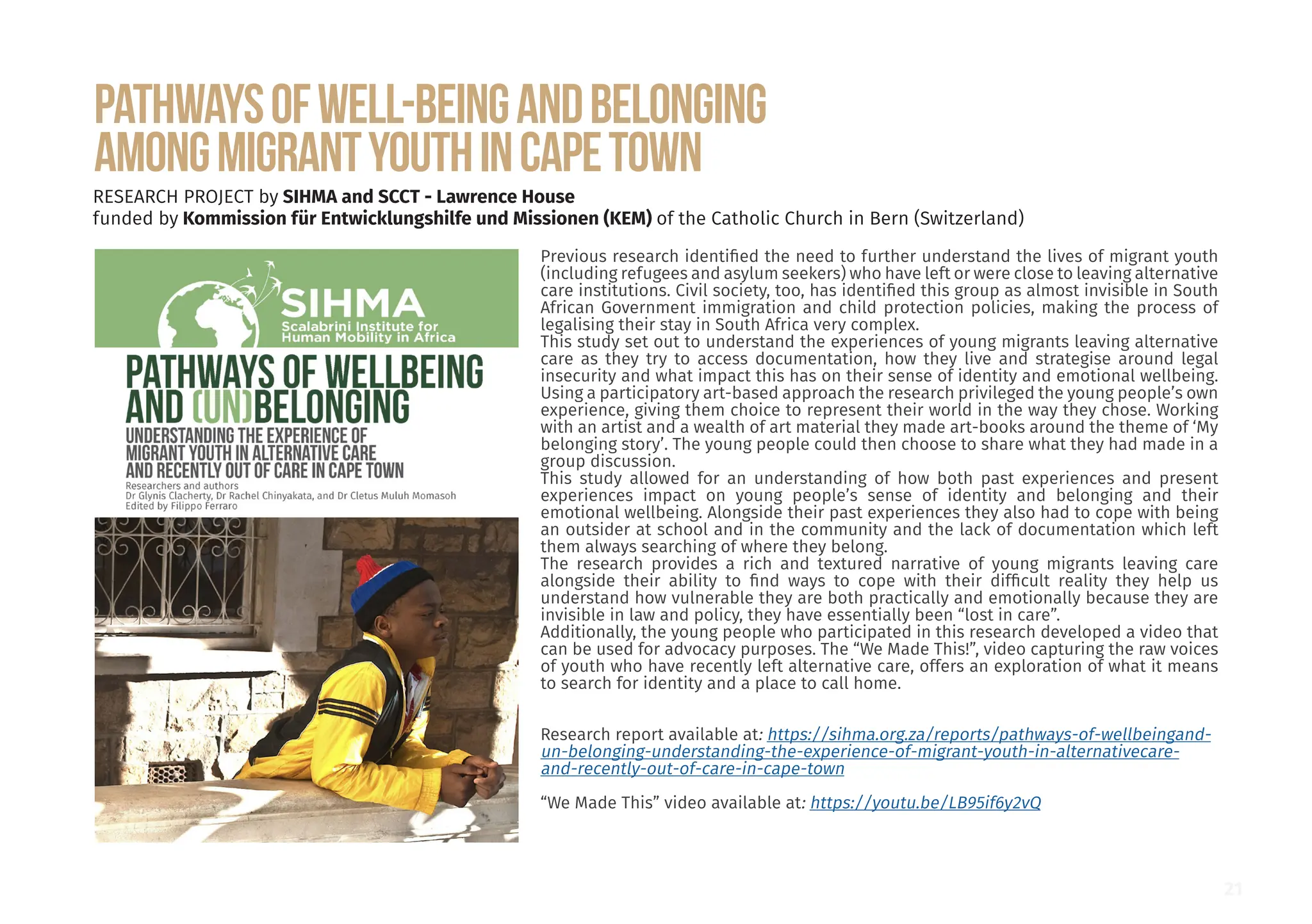
Pathwaysofwell-beingandbelonging
amongmigrantyouthinCapeTown
RESEARCH PROJECT by SIHMA and SCCT - Lawrence House
funded by Kommission für Entwicklungshilfe und Missionen (KEM) of the Catholic Church in Bern (Switzerland)
Previous research identified the need to further understand the lives of migrant youth
(including refugees and asylum seekers) who have left or were close to leaving alternative
care institutions. Civil society, too, has identified this group as almost invisible in South
African Government immigration and child protection policies, making the process of
legalising their stay in South Africa very complex.
This study set out to understand the experiences of young migrants leaving alternative
care as they try to access documentation, how they live and strategise around legal
insecurity and what impact this has on their sense of identity and emotional wellbeing.
Using a participatory art-based approach the research privileged the young people’s own
experience, giving them choice to represent their world in the way they chose. Working
with an artist and a wealth of art material they made art-books around the theme of ‘My
belonging story’. The young people could then choose to share what they had made in a
group discussion.
This study allowed for an understanding of how both past experiences and present
experiences impact on young people’s sense of identity and belonging and their
emotional wellbeing. Alongside their past experiences they also had to cope with being
an outsider at school and in the community and the lack of documentation which left
them always searching of where they belong.
The research provides a rich and textured narrative of young migrants leaving care
alongside their ability to find ways to cope with their difficult reality they help us
understand how vulnerable they are both practically and emotionally because they are
invisible in law and policy, they have essentially been “lost in care”.
Additionally, the young people who participated in this research developed a video that
can be used for advocacy purposes. The “We Made This!”, video capturing the raw voices
of youth who have recently left alternative care, offers an exploration of what it means
to search for identity and a place to call home.
Research report available at: https://sihma.org.za/reports/pathways-of-wellbeingand-
un-belonging-understanding-the-experience-of-migrant-youth-in-alternativecare-
and-recently-out-of-care-in-cape-town
“We Made This” video available at: https://youtu.be/LB95if6y2vQ
21
22
AFRICAN HUMAN
MOBILITY REVIEW
In 2024, AHMR celebrated A Decade of its original foundation. Since 2014,
AHMR, a joint collaboration between the Scalabrini Institute for Human
Mobility in Africa and the University of the Western Cape, has published
over 150 peer-reviewed articles, increasing the distribution of authorship
across the African continent. AHMR’s focus is to ensure high scientific
quality and rigorous research disseminated widely.
Therefore, to improve the quality of the work and meet the request of
contributors for high standard publications, we prioritize academic
indexing. Since 2022, AHMR is indexed online in three of the world top
general indexes: Scopus, Scielo and the Directory of Open Access Journals
(DOAJ). We believe this crucial step will increase the reach of articles
published and better serve the need of researchers. Furthermore, to
increase representation of article submissions from non-English-speaking
regions of Africa, AHMR’s editorial team is working to foster dialogue with
French-speaking researchers in Africa. The editorial team would like to
thank all board members, editors, reviewers, authors, and readers for
their continued engagement. We are confident that in the next future
the African Human Mobility Review will continue its mission towards
disseminating research and providing a significant resource for scholars,
practitioners, and students.
AHMR EDITORIAL BOARD
Our prestigious Editorial Board includes:
Prof. Vivienne Lawack
(University of the Western Cape, South Africa)
Prof. Jonathan Crush
(Balsillie School of International Affairs, Canada)
Prof. Loren Landau
(University of Oxford and University of the Witwatersrand -
African Centre for Migration & Society, South Africa)
Prof. Simon Bekker
(University of Stellenbosch, South Africa)
Prof. Thomas Faist
(Bielefeld University, Germany)
Prof. Raul Delgado Wise
(Universidad Autónoma de Zacatecas, Mexico)
Prof. Laurence Piper
(University of the Western Cape, South Africa)
Prof. Shimelis Gulema
(Stony Brook University, New York)
Prof. Wilson Majee
(University of Missouri, USA)
Prof. Razack Karriem
(University of the Western Cape, South Africa)
Prof. Pineteh E. Angu
(University of Pretoria, South Africa)
Dr. Delali Margaret Badasu
(University of Ghana, Ghana)
Dr. Edmond Agyeman
(University of Education, Winneba, Ghana)
Dr. Eria Serwajja
(Makerere University, Uganda)
Dr. Joseph Awetori Yaro
(University of Ghana, Ghana)
Dr. Linda Oucho
(African Migration and Development Policy Centre, Kenya)
Dr. Lothar Smith
(Radboud University, Netherlands)
23
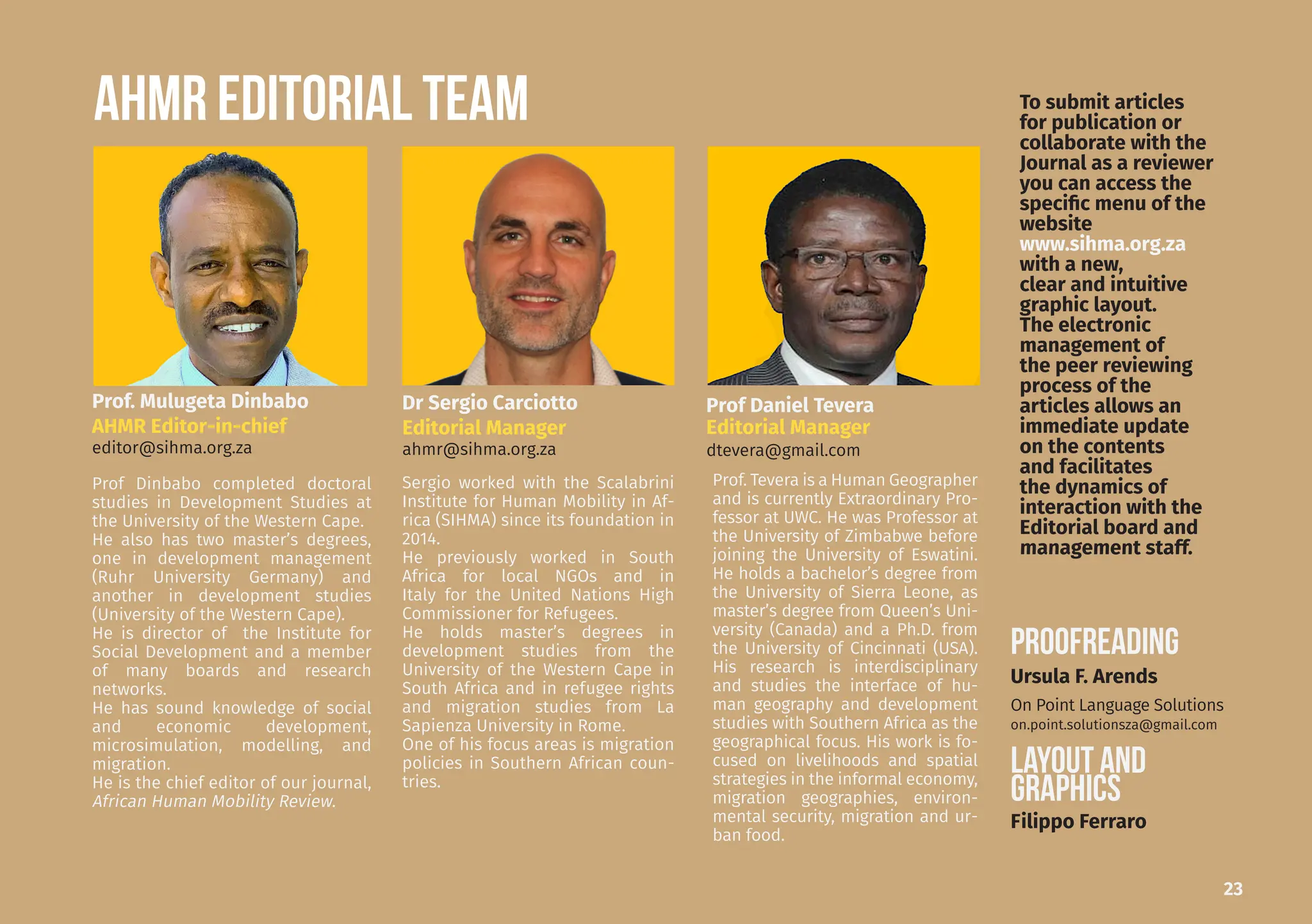
AHMR EDITORIAL TEAM
Prof. Mulugeta Dinbabo
AHMR Editor-in-chief
editor@sihma.org.za
Dr Sergio Carciotto
Editorial Manager
ahmr@sihma.org.za
Prof Daniel Tevera
Editorial Manager
dtevera@gmail.com
Sergio worked with the Scalabrini
Institute for Human Mobility in Af-
rica (SIHMA) since its foundation in
2014.
He previously worked in South
Africa for local NGOs and in
Italy for the United Nations High
Commissioner for Refugees.
He holds master’s degrees in
development studies from the
University of the Western Cape in
South Africa and in refugee rights
and migration studies from La
Sapienza University in Rome.
One of his focus areas is migration
policies in Southern African coun-
tries.
Prof Dinbabo completed doctoral
studies in Development Studies at
the University of the Western Cape.
He also has two master’s degrees,
one in development management
(Ruhr University Germany) and
another in development studies
(University of the Western Cape).
He is director of the Institute for
Social Development and a member
of many boards and research
networks.
He has sound knowledge of social
and economic development,
microsimulation, modelling, and
migration.
He is the chief editor of our journal,
African Human Mobility Review.
Prof. Tevera is a Human Geographer
and is currently Extraordinary Pro-
fessor at UWC. He was Professor at
the University of Zimbabwe before
joining the University of Eswatini.
He holds a bachelor’s degree from
the University of Sierra Leone, as
master’s degree from Queen’s Uni-
versity (Canada) and a Ph.D. from
the University of Cincinnati (USA).
His research is interdisciplinary
and studies the interface of hu-
man geography and development
studies with Southern Africa as the
geographical focus. His work is fo-
cused on livelihoods and spatial
strategies in the informal economy,
migration geographies, environ-
mental security, migration and ur-
ban food.
PROOFREADING
LAYOUT and
GRAPHICS
Filippo Ferraro
Ursula F. Arends
On Point Language Solutions
on.point.solutionsza@gmail.com
To submit articles
for publication or
collaborate with the
Journal as a reviewer
you can access the
specific menu of the
website
www.sihma.org.za
with a new,
clear and intuitive
graphic layout.
The electronic
management of
the peer reviewing
process of the
articles allows an
immediate update
on the contents
and facilitates
the dynamics of
interaction with the
Editorial board and
management staff.
24
INDEX:
Introduction.
Cities of Contagion: Pandemic Precarity, Migration, and Food Security in Urban Africa
Jonathan Crush and Zack Ahmed
1.InformalCross-BorderTradersandFoodTradeduringtheGlobalPandemicinZimbabwe
Abel Chikanda
2. Sustainable Development Goals and Food Remittances: COVID-19 Lockdowns, Digital
Transformation, Lessons, and Policy Reflections from South Africa-Zimbabwe Corridor
Sean Sithole, Mulugeta F. Dinbabo, and Daniel Tevera
3. “An Endless Cycle of Worry and Hardship”: The Impact of COVID-19 on the Food
Security of Somali Migrants and Refugees in Nairobi, Kenya Zack Ahmed, Jonathan
Crush, and Samuel Owuor
4. Pandemic Mobilities, Livelihood Disruptions, and Food Insecurities among Eastern
Cape Migrants in Cape Town and Johannesburg during COVID-19
Jonathan Crush, Godfrey Tawodzera, Maria Salamone, and Zack Ahmed
5. COVID-19’s Impact on Food Security among Urban Refugee Youth in Kenya: A
Postcolonial Feminist Perspective Cherie Enns, Samuel Owuor, Abbey Lin, Kristin
Swardh, and William Kolong
6. Refugee Protection and Food Security in Kampala, Uganda Andrea Brown
7. Translocality, Remittances, and Food Security in the Ghana-Qatar Migration Corridor
Bernard Owusu and Jonathan Crush
8. Changing Diets, Varying Food Consumption Patterns and Food Security Among
Recent Zimbabwean Migrants in Windhoek, Namibia Godfrey Tawodzera
9. Solving the Cape Town Puzzle: Class, Politics and Migration in the Informal Food
Economy
Graeme Young
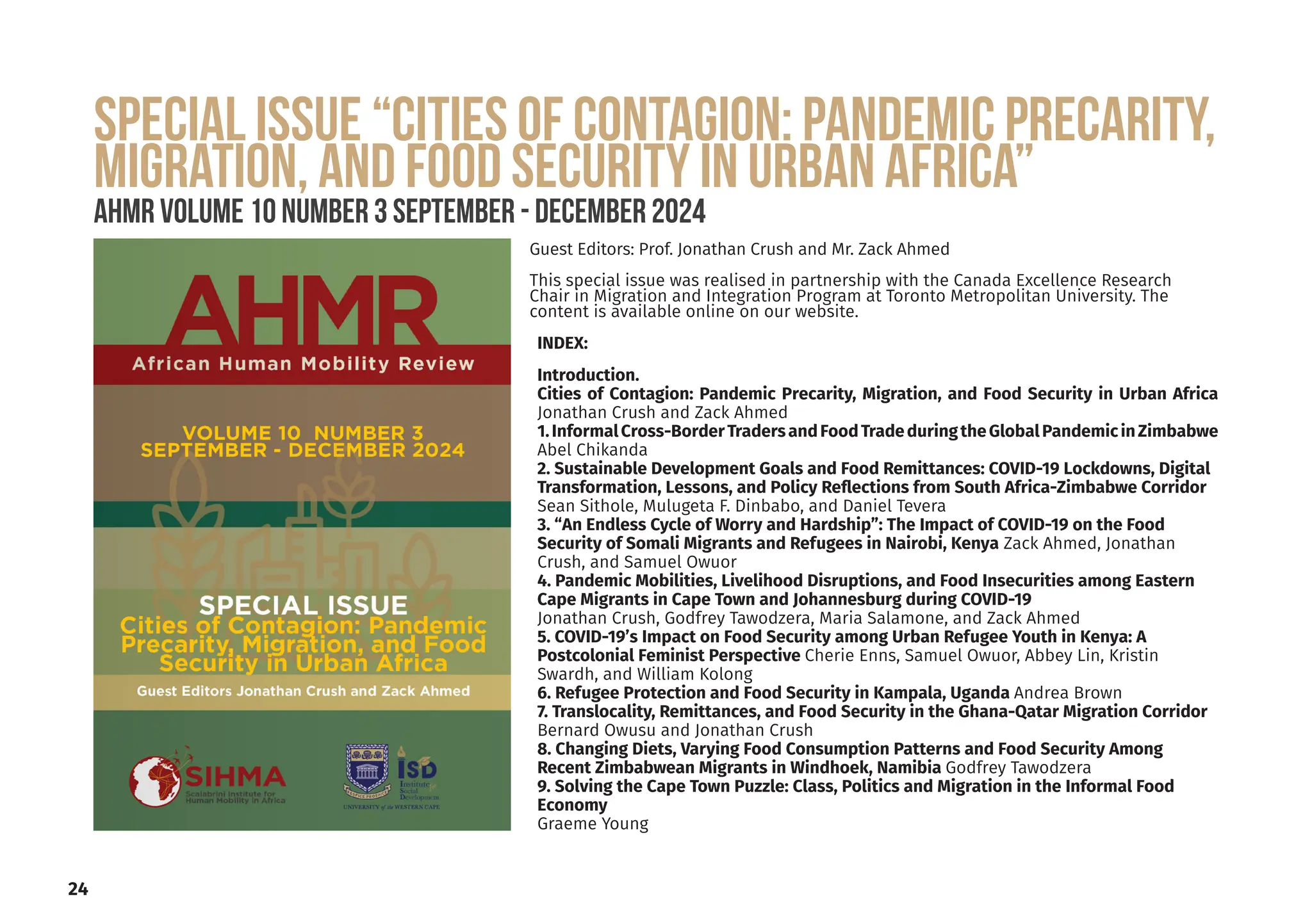
Guest Editors: Prof. Jonathan Crush and Mr. Zack Ahmed
This special issue was realised in partnership with the Canada Excellence Research
Chair in Migration and Integration Program at Toronto Metropolitan University. The
content is available online on our website.
SPECIAL ISSUE “Cities of Contagion: Pandemic Precarity,
Migration, and Food Security in Urban Africa”
AHMR Volume 10 Number 3 September - december 2024
Sergio worked with the Scalabrini
Institute for Human Mobility in Af-
rica (SIHMA) since its foundation
in 2014. He previously worked in
South Africa for local NGOs and in
Italy for the United Nations High
Commissioner for Refugees. He’s
currently the Associate Director,
coordinating all the research pro-
grammes. He holds an MA Degree
in Development Studies from the
University of the Western Cape in
South Africa and an MA Degree in
Refugee Rights and Migration Stud-
ies from La Sapienza University in
Rome. One of his main focus areas
is migration policies in Southern
African countries.
Prof Dinbabo obtained his Doctor-
al Degree in Development Studies
from the University of the Western
Cape.
He also has two MA degrees in De-
velopment Management (Ruhr Uni-
versity Germany) and Development
Studies (University of the Western
Cape).
He is the Director of the Institute
for Social Development and mem-
ber of many boards and research
networks. He has a sound knowl-
edge of the fields of social and eco-
nomic development, microsimula-
tion, modelling and migration.
He is the Chief Editor of our journal,
African Human Mobility Review.
Dr. Mulugeta Dinbabo
AHMR Chief Editor
editor@sihma.org.za
Sergio Carciotto
Assistant Director
sergio.carciotto79@gmail.com
25
AFRICA ON THE MOVE 2024
123.2
MILLION
304MILLION
WORLD’S POPULATION
LIVING OUTSIDE
THEIR COUNTRY OF
NATIONALITY in 2024
Source: UN DESA, 2025
TOTAL FORCIBLY DISPLACED
POPULATIONS IN THE WORLD
All graphics by SIHMA
3.7% of total population worldwide
Source:
UNHCR Global Trends Report, 2024
(a 6.2% increase from the previous year
and a 52% increase over the past decade)
34.5 million Internally Displaced Women &
Girls (53% of all IDPs)
50 million Forcibly Displaced Children
BY THE END OF 2024 (49% of all forcibly
displaced people)
86% of international migrants in
Africa originated from within the
African region
Africa hosted 29.2 million
international migrants in 2024
(5% increase from 2020)
Source: UN DESA, 2025
Source:
UNHCR, 2025a
Source: UNICEF, 2025
IDPs
73,5 MILLION
GLOBAL
Refugees
42,7 MILLION
Stateless PeRSONS
4,4 MILLION
OTHERPEOPLEINNEED
OFINTERNATIONAL
PROTECTIONS5,875
MILLION
ReTURNED REFUGEES
1,6 MILLIOn
ASYLUM
SEEKERS
12.2 Million
ReTURNED IDP
s 8,219 MILLIOn
26
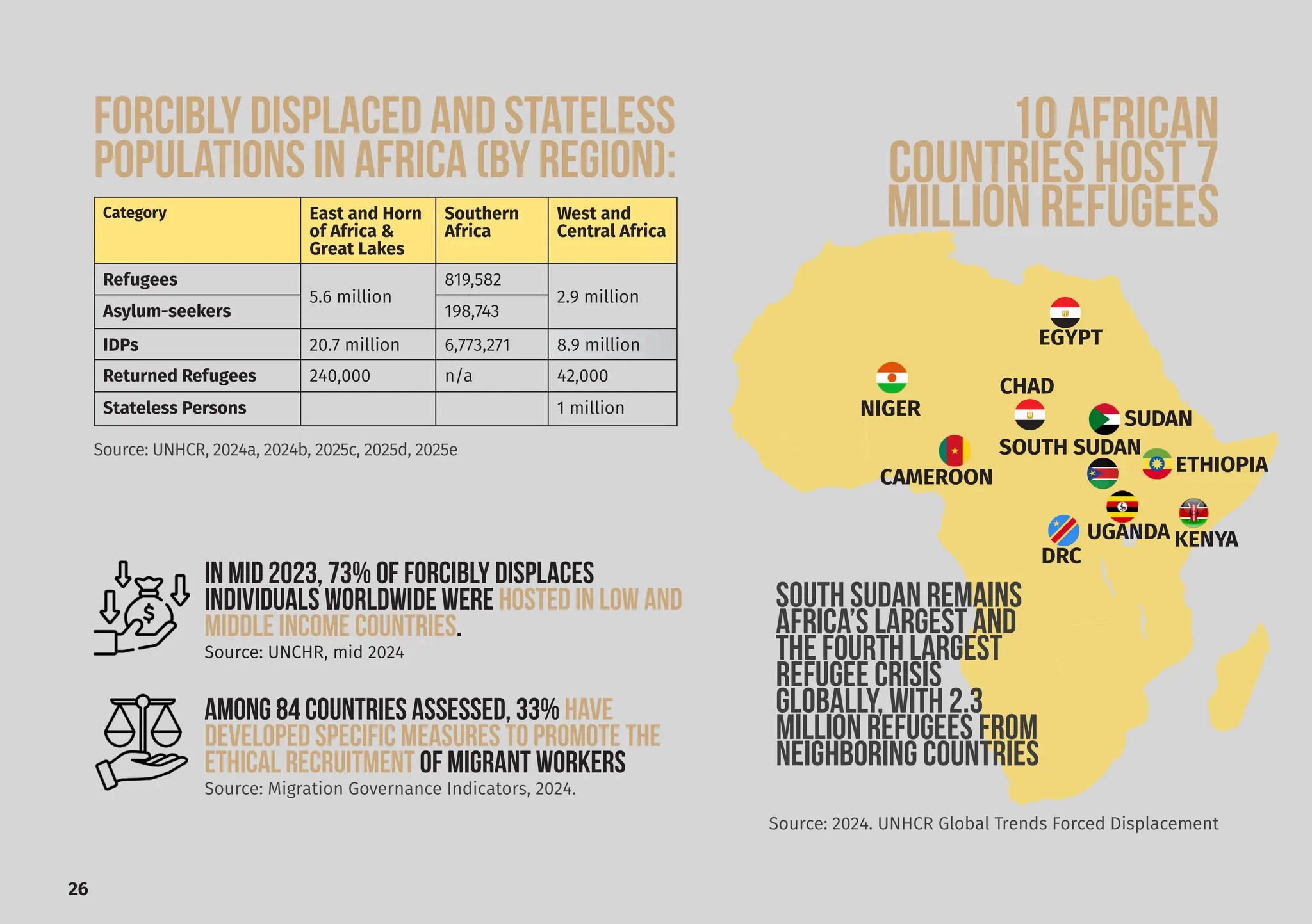
Forcibly Displaced and Stateless
Populations in Africa (by region):
Category East and Horn
of Africa &
Great Lakes
Southern
Africa
West and
Central Africa
Refugees
5.6 million
819,582
2.9 million
Asylum-seekers 198,743
IDPs 20.7 million 6,773,271 8.9 million
Returned Refugees 240,000 n/a 42,000
Stateless Persons 1 million
Source: 2024. UNHCR Global Trends Forced Displacement
Among 84 countries assessed, 33% have
developed specific measures to promote the
ethical recruitment of migrant workers
Source: Migration Governance Indicators, 2024.
Source: UNHCR, 2024a, 2024b, 2025c, 2025d, 2025e
In mid 2023, 73% of forcibly displaces
individuals worldwide were hosted in low AND
middle income countries.
Source: UNCHR, mid 2024
10 AFRICAN
COUNTRIES HOST 7
MILLION REFUGEES
UGANDA
CAMEROON
CHAD
EGYPT
SUDAN
SOUTH SUDAN
KENYA
DRC
ETHIOPIA
NIGER
South Sudan remains
Africa’s largest and
the FOURTH largest
refugee crisis
globally, with 2.3
million refugees from
neighboring countries
27
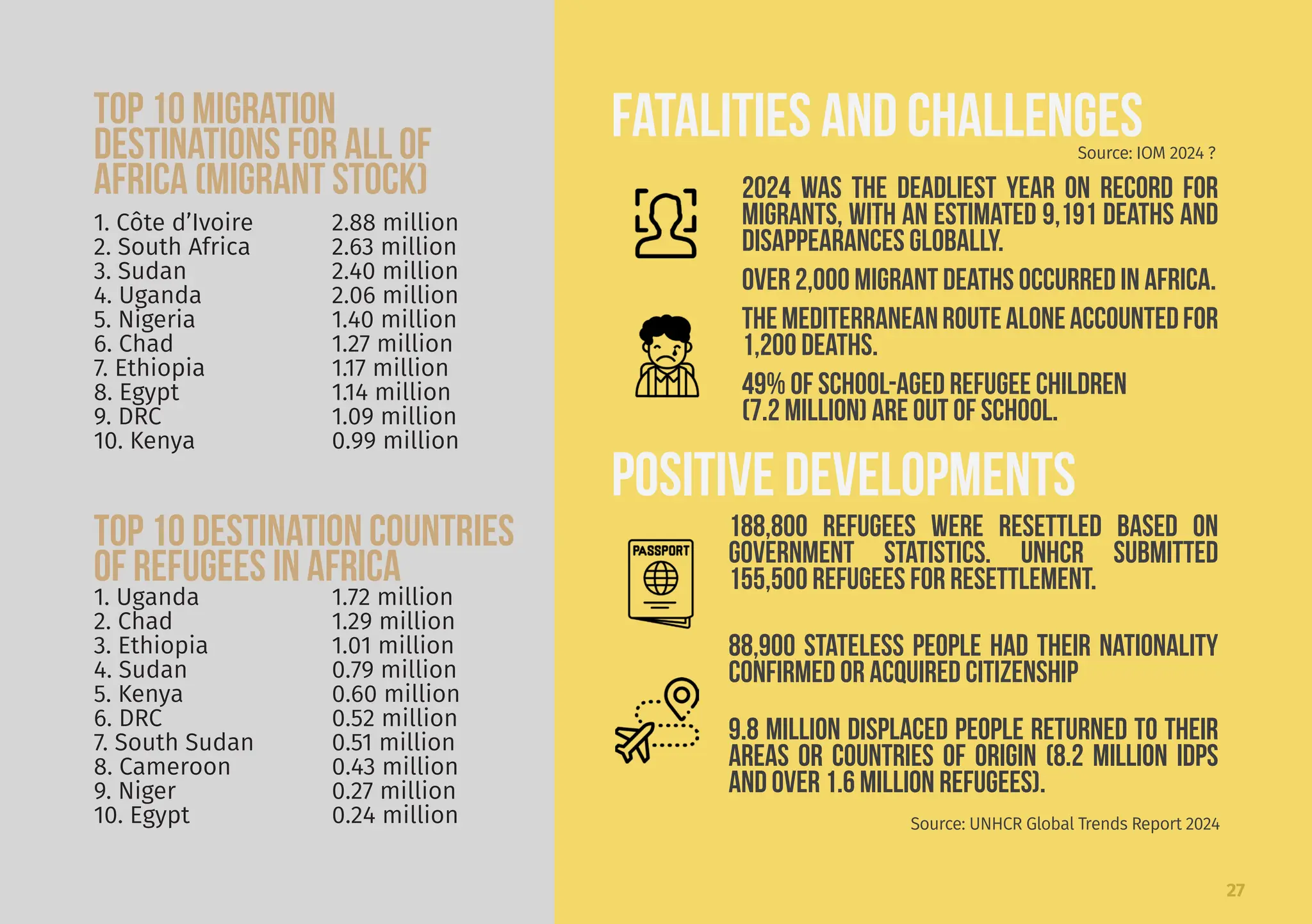
9.8 million displaced people returned to their
areas or countries of origin (8.2 million IDPs
and over 1.6 million refugees).
188,800 refugees were resettled based on
government statistics. UNHCR submitted
155,500 refugees for resettlement.
88,900 stateless people had their nationality
confirmed or acquired citizenship
POSITIVE DEVELOPMENTS
Source: UNHCR Global Trends Report 2024
2024 was the deadliest year on record for
migrants, with an estimated 9,191 deaths and
disappearances globally.
Over 2,000 migrant deaths occurred in Africa.
TheMediterraneanroutealoneaccountedfor
1,200 deaths.
49% of school-aged refugee children
(7.2 million) are out of school.
Fatalities and CHALLENGES
Source: IOM 2024 ?
TOP 10 MIGRATION
DESTINATIONS FOR ALL OF
AFRICA (MIGRANT STOCK)
1. Côte d’Ivoire 2.88 million
2. South Africa		 2.63 million
3. Sudan		 2.40 million
4. Uganda		 2.06 million
5. Nigeria		 1.40 million
6. Chad		 1.27 million
7. Ethiopia		 1.17 million
8. Egypt		 1.14 million
9. DRC			 1.09 million
10. Kenya		 0.99 million
TOP 10 DESTINATION COUNTRIES
OF REFUGEES IN AFRICA
1. Uganda		 1.72 million
2. Chad		 1.29 million
3. Ethiopia		 1.01 million
4. Sudan		 0.79 million
5. Kenya		 0.60 million
6. DRC			 0.52 million
7. South Sudan 0.51 million
8. Cameroon		 0.43 million
9. Niger		 0.27 million
10. Egypt		 0.24 million
28
3.TRAINING,
CAPACITYBUILDING
ANDONLINERESOURCES
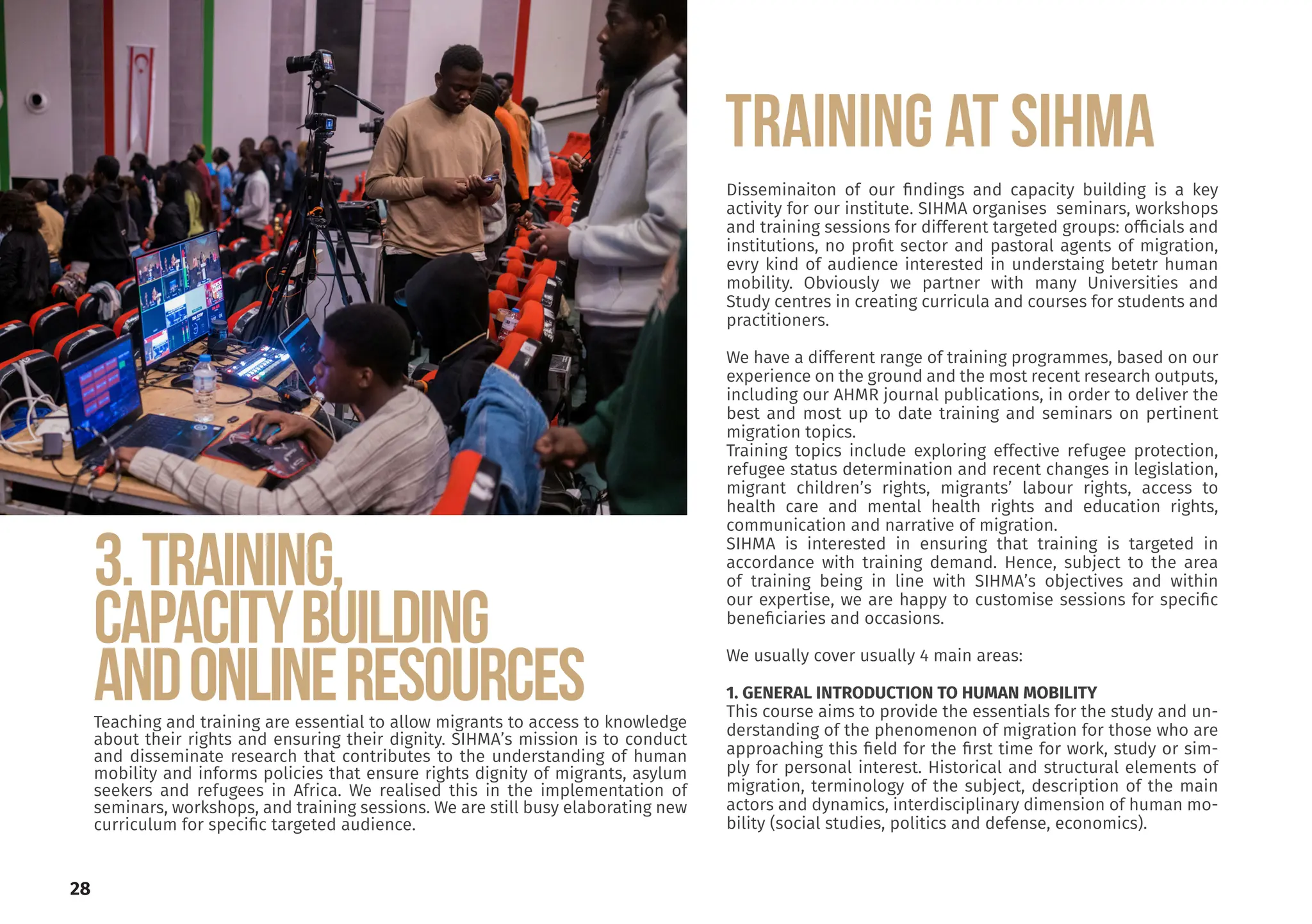
Teaching and training are essential to allow migrants to access to knowledge
about their rights and ensuring their dignity. SIHMA’s mission is to conduct
and disseminate research that contributes to the understanding of human
mobility and informs policies that ensure rights dignity of migrants, asylum
seekers and refugees in Africa. We realised this in the implementation of
seminars, workshops, and training sessions. We are still busy elaborating new
curriculum for specific targeted audience.
Disseminaiton of our findings and capacity building is a key
activity for our institute. SIHMA organises seminars, workshops
and training sessions for different targeted groups: officials and
institutions, no profit sector and pastoral agents of migration,
evry kind of audience interested in understaing betetr human
mobility. Obviously we partner with many Universities and
Study centres in creating curricula and courses for students and
practitioners.
We have a different range of training programmes, based on our
experience on the ground and the most recent research outputs,
including our AHMR journal publications, in order to deliver the
best and most up to date training and seminars on pertinent
migration topics.
Training topics include exploring effective refugee protection,
refugee status determination and recent changes in legislation,
migrant children’s rights, migrants’ labour rights, access to
health care and mental health rights and education rights,
communication and narrative of migration.
SIHMA is interested in ensuring that training is targeted in
accordance with training demand. Hence, subject to the area
of training being in line with SIHMA’s objectives and within
our expertise, we are happy to customise sessions for specific
beneficiaries and occasions.
We usually cover usually 4 main areas:
1. GENERAL INTRODUCTION TO HUMAN MOBILITY
This course aims to provide the essentials for the study and un-
derstanding of the phenomenon of migration for those who are
approaching this field for the first time for work, study or sim-
ply for personal interest. Historical and structural elements of
migration, terminology of the subject, description of the main
actors and dynamics, interdisciplinary dimension of human mo-
bility (social studies, politics and defense, economics).
TRAINING AT SIHMA
29
2. TRAINING OF PASTORAL AGENTS OF HUMAN MOBILITY
This course is particularly aimed at all those, religious or lay,
who work in the field of migration and directly or indirectly assist
individual migrants or ethnic or linguistic communities. It aims to
provide the basic elements for addressing the topic of migration
and at the same time offers a biblical and theological framework
for supporting pastoral ministry with migrants in the light of the
teaching and practice of the Catholic Church. In addition to the
more traditional presentations and lectures, the course offers
multimedia material and practical workshops in which participants
can interact with each other and with the facilitators.
3. Training for governments and local administrations
This course is intended for government officials, civil servants and
staff working in the field of migration who directly or indirectly
assist individual migrants or ethnic or linguistic communities in
the public arena or within governmental and non-governmental
organisations. It aims to provide the basic elements of human
mobility from a legal, policy and administrative perspective. Areas
of interest include: the defence and protection of the human rights
of migrants and refugees, international legislation, the national
legal framework, detention, and the relationship between public
bodies and non-governmental organisations. It consists of several
modules including lectures, multimedia contributions, group work
and case studies.
4. COMMUNICATION, MEDIA AND THE NARRATIVE OF HUMAN
MOBILITY
This course is designed for people involved in communication
within organisations or offices dealing with migration issues. It
provides an orientation framework for those who want to know
more about the reality of migrants and refugees on the African
continent, beyond the stereotypes or biased information that is
often conveyed in society or in the media. Among the tools offered
are numerous multimedia contributions (in collaboration with
other partners) for personal and group analysis and comparison
with other experts in communication, art, and video production.
17-20 July 2024
TRAINING COURSE ON PASTORAL CARE
OFMIGRANTSANDREFUGEESINUGANDA
Workshop by SIHMA and SIMI, Aru Centre Kampala (Uganda)
The Scalabrini Institute for Human Mobility in Africa (SIHMA) in collaboration
with Scalabrini International Migration Institute (SIMI) and the Missionaries
of St Charles Scalabrini, Uganda conducted a training workshop for pastoral
agents of migrants and refugees in Kampala, Uganda.
The training workshop was conducted at the ARU Centre from the 17th to the
20th of July 2024. The purpose of the training workshop was to equip pastoral
agents of migration with an understanding of human mobility in Africa, skills
and knowledge to work with migrants and refugees that they serve in their
organisations, dioceses and districts.
The workshop was facilitated by a team of experts who have experience and
skills in the field of migration. These include researchers, Scalabrini priests
working with and on issues of migrants, lawyers or advocates and other
experts that work with migrants and refugees in Uganda and other regions
globally. The list of presenters included Fr Filippo Ferraro (SIHMA), Dr Rachel
Chinyakata (SIHMA), Br Gioacchino Campese (SIMI), Fr Aldo Skoda (SIMI), Fr
John Kawisha (Missionaries of St Charles Scalabrini), Dr Fredrick Ssemwanga,
Fr Walter Diaz (Missionaries of St Charles Scalabrini) and Sr Linah Siabana
(Missionary Sisters of our Lady of Africa).
The main topics that were covered in the programme of the workshop included:
1. Introduction to the fundaments of migration;
2. Understanding human mobility in Africa;
3. The complex impact of migration on policies, society, and economy;
4. The Christian perspective on migration;
5. The response of the church to the challenges of migration;
6. The teaching of the church: a path of Justice and Inclusion; Serving People
on the move in Africa;
7. Cases about documentation of urban refugees and migrants;
8. The impact of migration on the mental health of migrants and refugees;
9. Journeys of reconciliation;
10. Mapping the access to social services for migrants and refugees.
30
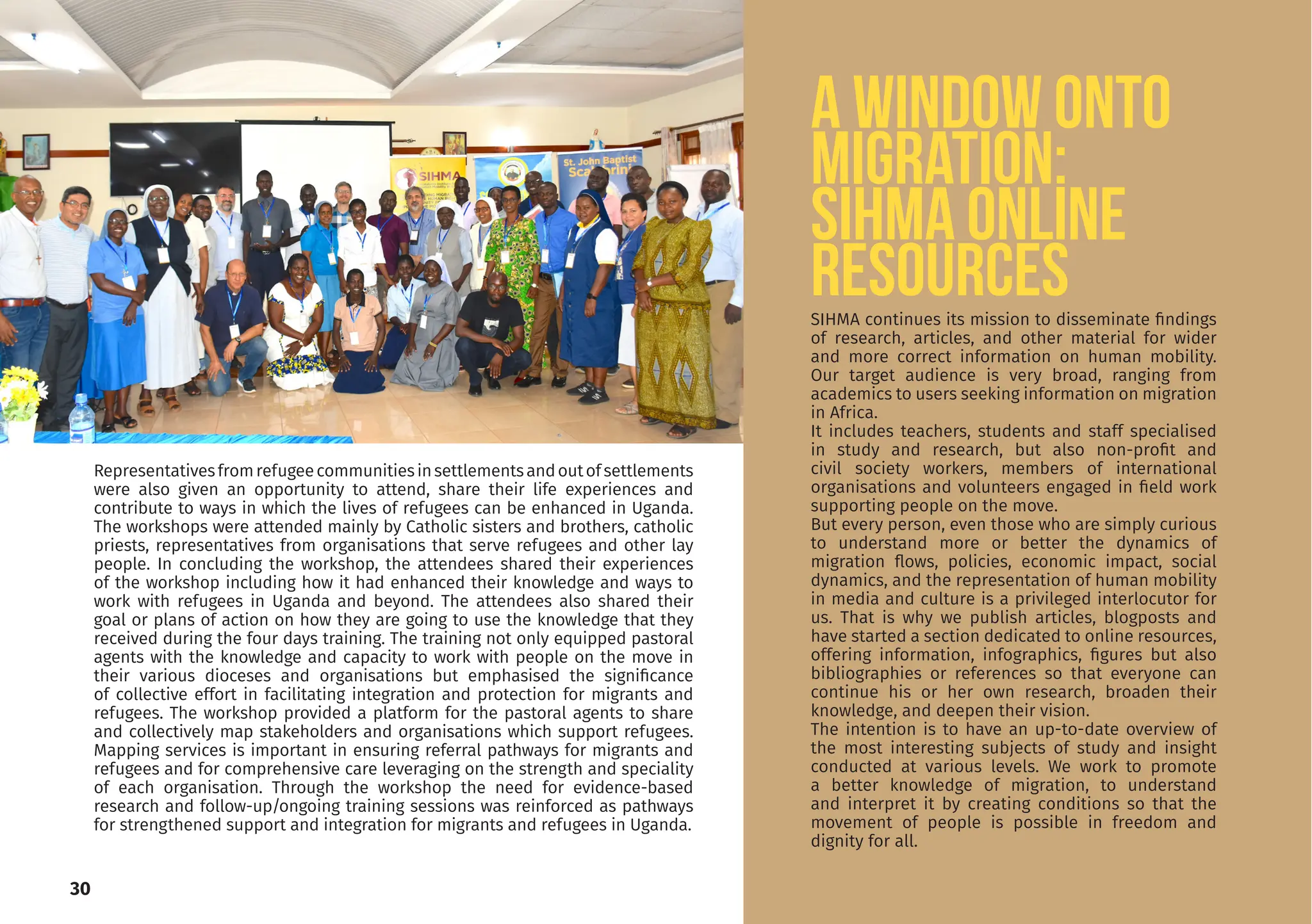
Representativesfromrefugeecommunitiesinsettlementsandoutofsettlements
were also given an opportunity to attend, share their life experiences and
contribute to ways in which the lives of refugees can be enhanced in Uganda.
The workshops were attended mainly by Catholic sisters and brothers, catholic
priests, representatives from organisations that serve refugees and other lay
people. In concluding the workshop, the attendees shared their experiences
of the workshop including how it had enhanced their knowledge and ways to
work with refugees in Uganda and beyond. The attendees also shared their
goal or plans of action on how they are going to use the knowledge that they
received during the four days training. The training not only equipped pastoral
agents with the knowledge and capacity to work with people on the move in
their various dioceses and organisations but emphasised the significance
of collective effort in facilitating integration and protection for migrants and
refugees. The workshop provided a platform for the pastoral agents to share
and collectively map stakeholders and organisations which support refugees.
Mapping services is important in ensuring referral pathways for migrants and
refugees and for comprehensive care leveraging on the strength and speciality
of each organisation. Through the workshop the need for evidence-based
research and follow-up/ongoing training sessions was reinforced as pathways
for strengthened support and integration for migrants and refugees in Uganda.
A window onto
migration:
SIHMA ONLINE
RESOURCES
SIHMA continues its mission to disseminate findings
of research, articles, and other material for wider
and more correct information on human mobility.
Our target audience is very broad, ranging from
academics to users seeking information on migration
in Africa.
It includes teachers, students and staff specialised
in study and research, but also non-profit and
civil society workers, members of international
organisations and volunteers engaged in field work
supporting people on the move.
But every person, even those who are simply curious
to understand more or better the dynamics of
migration flows, policies, economic impact, social
dynamics, and the representation of human mobility
in media and culture is a privileged interlocutor for
us. That is why we publish articles, blogposts and
have started a section dedicated to online resources,
offering information, infographics, figures but also
bibliographies or references so that everyone can
continue his or her own research, broaden their
knowledge, and deepen their vision.
The intention is to have an up-to-date overview of
the most interesting subjects of study and insight
conducted at various levels. We work to promote
a better knowledge of migration, to understand
and interpret it by creating conditions so that the
movement of people is possible in freedom and
dignity for all.
31
This new section aims to dispel harmful myths about migration. In the media,
migrants are often misunderstood and defamed. By providing a different context
and first-hand accounts of migration, the project aims to offer a different and more
realistic view of the dynamics and subjects of human mobility. By making the direct
voices of the protagonists accessible and more understandable, we want to provide
the reader with a more objective and comprehensive picture of migration in Africa.
The project includes reviews of books and films (by African authors), media products
from different platforms, cultural events, and videos of migrants, refugees, and
asylum seekers telling their stories of travel and their communities. The collection
of stories will highlight the wide variety of backgrounds, circumstances, difficulties,
and hopes of people on the move and offer their perspective on human mobility.
This is the third part of our project on African
migration narratives, through which we aim
to provide readers with tools for direct in-
depth analysis. We are working on a series of
articles focusing on historical events or periods
that have had an impact on the movement of
people across the continent: from wars to great
discoveries, from colonisation to independence
processes, from climatic events to major
economic and social changes. Presented as
a fluid timeline, it will offer information from
various historical sources, commentary and
news, and documents from the period to show
the evolution of migration in Africa, thanks also
to a series of infographics, images and videos.
2.NARRATIVESON
HUMANMOBILITY
(FROMJUNE2025)
3. VISUAL HISTORY OF
MIGRATION (IN PROGRESS)
This online portal, housed in our website, will provide the migration profile of the majority of the 54 countries in the continent.
Using a rigorous desk-top research method based on the existing literature and data we aim at providing an understanding of the
complex movement, made of specific patterns: mixed migration, regional and internal migration, South-South migration, rural to urban
migration, returnees. A total of 25 country profiles have been developed and will be uploaded on the SIHMA website by April 2025.
Beside a geographical and historical context that provides basic information of the country, we analized the main pull and push
factors, the legal framework of policies and their many actors (governments, institutions, legislation) and the main component of the
movement of people to-from-within the country. Info about conflict and disaster-related displacement, statistics of immigrants and
emigrants, gender and minors, labour migration, statistics of asylum seekers and refugees are available as a starting point to deepen
the understanding and awareness about this topic. Concise overviews on displacement, human trafficking, remittances, return and
returnees and migration-related international organizations within the country are also available. You can find the sources of all
findings, a list of references and links to other sources.
A customised series of infographics makes reading and understanding the text and topics smooth and intuitive. As a guarantee of the
reliability and transparency of our work, all data is updated periodically and the site always indicates the last date on which the text
was modified.
1. ATLAS OF AFRICAN MIGRATION (ONLINE FROM MAY 2025)
32
4. EVENTS AND
COMMUNICATION
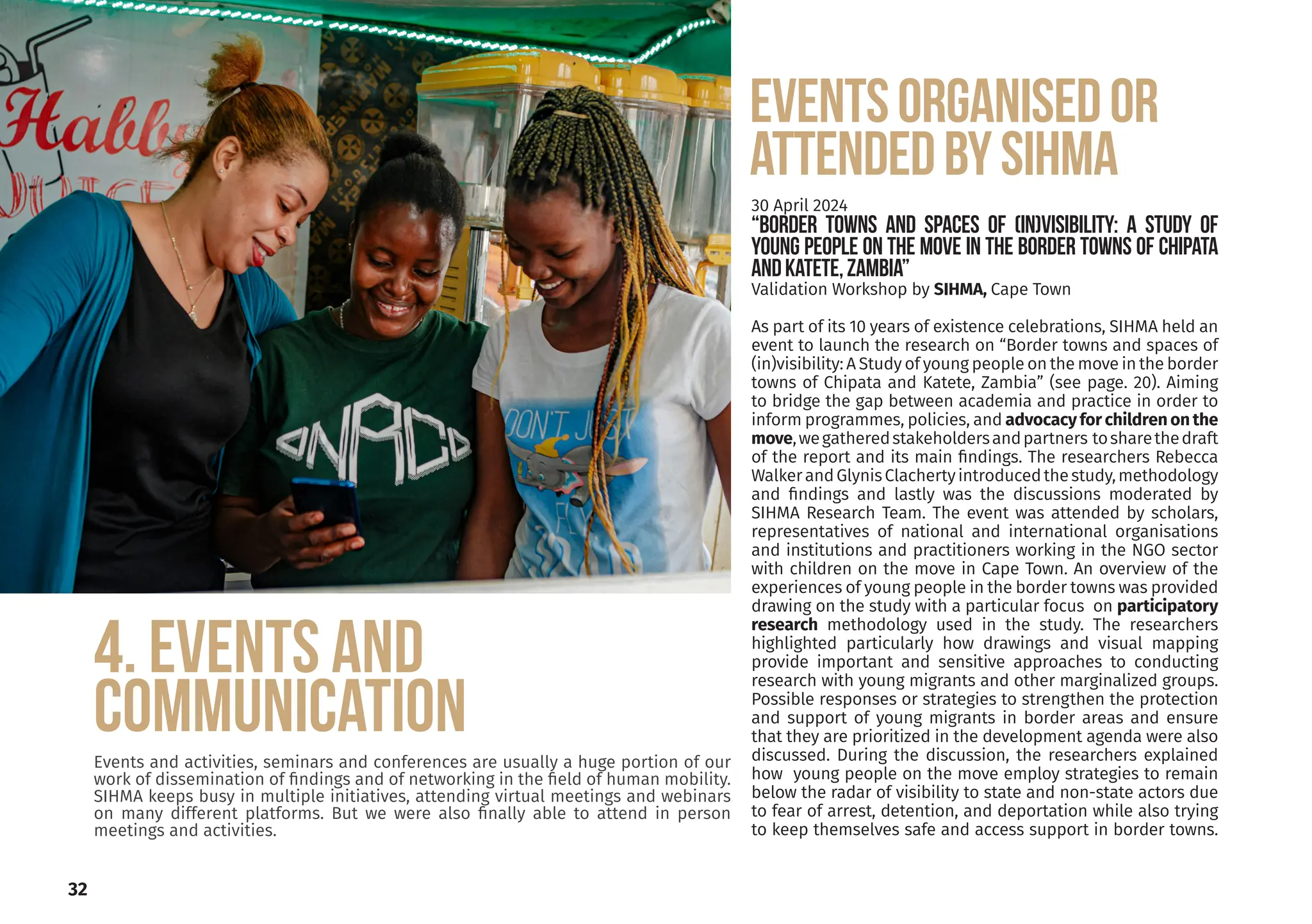
Events and activities, seminars and conferences are usually a huge portion of our
work of dissemination of findings and of networking in the field of human mobility.
SIHMA keeps busy in multiple initiatives, attending virtual meetings and webinars
on many different platforms. But we were also finally able to attend in person
meetings and activities.
EVENTsORGANISEDOR
ATTENDEDBYSIHMA
30 April 2024
“Border towns and spaces of (in)visibility: A Study of
young people on the move in the border towns of Chipata
andKatete,Zambia”
Validation Workshop by SIHMA, Cape Town
As part of its 10 years of existence celebrations, SIHMA held an
event to launch the research on “Border towns and spaces of
(in)visibility: A Study of young people on the move in the border
towns of Chipata and Katete, Zambia” (see page. 20). Aiming
to bridge the gap between academia and practice in order to
inform programmes, policies, and advocacy for children on the
move,wegatheredstakeholdersandpartners tosharethedraft
of the report and its main findings. The researchers Rebecca
WalkerandGlynisClachertyintroducedthestudy,methodology
and findings and lastly was the discussions moderated by
SIHMA Research Team. The event was attended by scholars,
representatives of national and international organisations
and institutions and practitioners working in the NGO sector
with children on the move in Cape Town. An overview of the
experiences of young people in the border towns was provided
drawing on the study with a particular focus on participatory
research methodology used in the study. The researchers
highlighted particularly how drawings and visual mapping
provide important and sensitive approaches to conducting
research with young migrants and other marginalized groups.
Possible responses or strategies to strengthen the protection
and support of young migrants in border areas and ensure
that they are prioritized in the development agenda were also
discussed. During the discussion, the researchers explained
how young people on the move employ strategies to remain
below the radar of visibility to state and non-state actors due
to fear of arrest, detention, and deportation while also trying
to keep themselves safe and access support in border towns.
These strategies of (in)visibility provide a way to protect themselves yet,
at the same time also heighten some of the risks young people face, as
their vulnerabilities are not always recognised by those who could offer
support. Furthermore, findings showed that the realities and challenges
of life and migration in the SADC region and in Zambia need to be better
understoodforsupporttobestrengthenedandtunedtomeetthespecific
needs of young people on the move. This includes understanding the
role of state and non-state stakeholders, the impact of laws and policies
and, critically, the experiences of the young people themselves. During
the discussion with the various stakeholders who were attending this
event, recommendations for immediate action, programming to support
young people on the move in the two towns to reduce the vulnerability
and exposure to risk for young people in this area, and recommendations
for longer term policy advocacy were discussed. The event was video
recorded and will be available as an Online resource on our website,
as a tool for advocating for change. Following this event, SIHMA will
continue to engage with other stakeholders in the SADC region on how
young people on the move especially the ones that are invisible can be
protected.
1 June 2024
ScalabriniDayEvent
Annual Workshop by SIHMA, SCCT and Lawrence House, Cape Town
Scalabrini Day is traditionally held on the 1st of June to celebrate the
teaching and vision of Saint John Baptist Scalabrini, founder of the
Missionaries of St Charles, who advocated for the welfare of migrants. On
the 3rd of June, staff members and board members from the Scalabrini
Institute for Human Mobility in Africa (SIHMA), the Scalabrini Centre of
Cape Town and Lawrence House, and the Scalabrini Fathers gathered
together to engage in different activities as a way to reflect on his vision
and mission. It’s a precious opportunity to strengthen our work with
people on the move. The initial presentation provided some information
on the history of the Scalabrini network and how it has managed to grow
and expand, seeking to increasingly meet the needs of migrants and
refugees in different areas and throughout different historical periods.
Then, all staff members of our organisations offered an overview of
their activities, showcasing the work that their different platforms/
departments do in relation to the mission of “welcoming, protecting,
promoting and integrating people on the move into local communities.”
In particular, the Lawrence house team showed how they “welcome”
young people into their facility and use the circle of courage to ensure
belonging and empowerment. SCCT Advocacy through a documentary
showed ways in which they “protect” migrants, ensuring them access
to their rights and protection from detention and deportation. The
Wellbeing and Development team highlighted how they “promote”
development through the trauma informed approach and skills
development. The Integration Pathways shared their initiatives (develop,
CVs, English classes, IT skills, tertiary qualification and recognition). Also,
Operations gave a summary of how they make our clients feel welcomed
and supported, in the spirit and ethos of St John Scalabrini’s tradition.
SIHMA presented the different projects that have been completed and
those still on progress, especially the Atlas for African Migration. The
research team explained the goal of this tool and how it’s relevance also
for our clients and for all people working directly with people on the
move, a solid understanding of human mobility in Africa.
FinallyFrFilippoFerraro(ExecutiveDirectorofSIHMAandtheChairperson
of the Scalabrini Centre Board), shared the importance of spirituality
as a core mission for the work that is done with migrants who are
served by the Scalabrini network. He also highlighted the importance
of viewing migration from the immigrant’s perspective. Scalabrini Day
confirmed how it is crucial, when working in the field of human mobility,
to understand the fundamental impact of migration on everybody’s life.
11-12 July 2024
“MIGRATIONSTUDIES:THESTATEOFART”
Conference by CSER, Rome (Italy)
Centro Studi Emigrazione (CSER) in Rome organised an international
conference attended also by the other members of the network of the
Scalabrini International Migration Study Centres: Centre for Migration
Studies (CMS) in New York, Centro De Estudos Migratorios (CEM) in
Sao Paulo, Centro de Estudios Migratorios Latinoamericanos (CEMLA)
in Argentina, Centre d’information et d’études sur les migrations
internationals (CIEMI) in Paris, Scalabrini Migration Center in Manila and
SIHMA. The meeting was attended by the directors of the study centres
and the experts from each study centre. The purpose of the gathering was
to discuss the state of research on migration in the geographical areas
where each study centre operates: data, trend and topics, networks, all
relevant aspects for the development of the strategy of our study centres,
33
and their possible role. The meeting also gave the opportunity for the
study centre directors to discuss strategies to revitalize the study centre
network and to share some strategies that the study centre is pursuing.
The meeting was opened by a welcome address by the Superior General
Fr. Leonir Chiarello, followed by several sessions of presentation by
international speakers. The meeting focused on the nature, profile,
advantages, opportunities and challenges of the Scalabrini centres in
their environments, as well about their scientific journals and libraries.
In the second day the programme offered the opportunity to listen to
the migration experts chosen by each centre to present the situation of
migration research in their areas of operation. The various presentations
provided an interesting overview of the situation, highlighting both the
relevant issues common to the different continents and the specific
features linked to the different social, political and economic situations.
The attendees concluded that there is a need to continue to study and
deepen the migratory phenomenon, sharing more databases, good
practices, reports and opportunities for networking. The network of
Scalabrini study centres should continue in the line with the vision of
the Founder, investigating migration as a reality that structurally belongs
to human co-existence, stressing how to migrate is a human right that
contributes to the transformation of society and require appropriate
management by governments.
15 October 2021
LectureonHUMANMOBILITYINAFRICA
Online event by Catholic University of Milan, Italy
SIHMA has been invited again this year to talk to the students of the
courses related to human mobility. Prof Laura Zanfrini, Director of the
WWELL Research Centre (Work, Welfare, Enterprise, Lifelong Learning)
at the Department of Sociology, Catholic University asked for this
overview on the main dynamics of voluntary and forced migration in
the continent, the push/pull factors, the links to gender, climate change,
family networks and migratory industry, human trafficking.
Our director offered a specific approach to all these components, linked
to the ethos and spirituality of the Scalabrini network, to the holistic
approach to the person of migrants and refugees, showing how this can
be translated in research, social projects and active advocacy.
The interesting Q&A time after the initial keynote has been a fruitful
opportunity to interact among students and experts, on some of the
main issues concerning A correct approach to the complicated reality of
human mobility in Africa. In line with the main activities of SIHMA some
time was spent also to reflect on the importance of combining evidence
based scientific research (through our Journal AHMR and Blog posts)
and the work on the ground of practitioners, as well as on the key role of
media and other narratives in portraying migrants and refugees.
1-2 August 2024
AfricanUnionFreeMovementProtocol(FMP)Consultation
EXPERTMeeting
Conference by African Union, Zanzibar (Tanzania)
On August 1st-2nd, SIHMA took part in the Free Movement Protocol (FMP)
Consultation Meeting, a conference organized by the African Union and
funded by the European Union about the implementation of the Free
Movement Protocol, which was officially adopted by the community in
2018. The main discussions of the conference focused on the challenges
and opportunities for the ratification and the implementation for FMP
in the regions whose countries have already signed it, as well as the
strategies to advance the ratification and the technical implementation
of the protocol in countries that have not approved it yet.
34
IN 2006 the AU Executive Council adopted the Migration Policy Framework
and the African Common Position on Migration and Development,
aligning AU Member States on a shared goal of cross-border movement.
By 2012, the AU had initiated the Continental Free Trade Area (CFTA) to
encourage labour mobility across borders. Further emphasizing this
commitment, the AU adopted the Solemn Declaration in 2013 on the 50th
anniversary of the OAU, pledging to promote African citizenship, pan-
Africanism, and an African Renaissance through free movement. Efforts
to streamline cross-border travel continued, with the AU Assembly’s 2015
decision to accelerate the process for free movement and develop an
African passport. In 2016, this passport was launched at the AU Summit,
symbolizing a new era for travel across Africa. Subsequently, the AU
ExecutiveCouncilpushedforwardbycallingforrelaxedvisarequirements,
facilitating Africans’ unrestricted movement. This led to the development
of the FMP, which was officially adopted by the AU Assembly in January
2018. Through the FMP, the AU has formalized the right of residence and
establishment across member states, signifying a major step in African
integration. The protocol serves as a milestone towards making Africa a
unified space where movement, trade, and social exchange transcend
borders, promoting pan-African unity and growth.
The benefits of the FMP for African countries and migrants would be
multiple. The draft Protocol on Free Movement of Persons, Right of
Residence, and Right of Establishment in Africa promises increased
intra-African trade and investment, a crucial area for growth as current
intra-African trade levels account for just 10% of total continental trade
— a figure that lags significantly behind those of other regions such as
Latin America (22%) and East Asia (50%). By enabling easier movement
across borders, Africa can unlock substantial opportunities for trade and
investment, allowing for a more robust economic integration. Second, the
protocol promotes enhanced access to quality education and healthcare.
Experts emphasize that the movement of individuals, particularly
students, across African borders for education is key to developing the
human capital needed for the continent’s economic transformation.
Given that over 60% of Africa’s population is youth, investing in education
and training through the free movement of people will be essential for
nations to harness their demographic potential. Additionally, enhanced
movement supports access to healthcare by facilitating mobility from
primary care to specialized health services, fostering a stronger health
infrastructure across regions. Another benefit of free movement is
the facilitation of labour mobility, which will bridge skills imbalances
between countries. By promoting labour migration, AU member states
can address both surpluses and deficits in skilled labour, stimulate
regional economic development, and enable the optimal use of Africa’s
human resources. This mobility will allow for the transfer of essential and
specialized skills, reduce regional inequalities, and promote economic
growth by increasing remittances among African workers. Studies show
that migrant workers contribute significantly to both high-skilled and
low-skilled labour markets, helping to balance labour needs across
countries and boost productivity. Finally, free movement of persons
is expected to increase tourism, enhance continental integration, and
strengthen pan-Africanism. Data from AU Member States such as Ghana,
Mauritius, Rwanda, Senegal, and Seychelles, which have implemented
relaxed visa policies or visa-on-arrival for African nationals, show
positive outcomes. These policies have supported intra-African tourism,
bolstered integration, and fostered a collective sense of African identity.
By reducing travel restrictions, the protocol not only promotes tourism
but also encourages cross-border skill sharing, entrepreneurship, and
35
36
innovation, thereby enhancing Africa’s economic competitiveness
and fostering a unified continental identity. There are challenges and
problems, but the development of a possible road map for the ratification
and implementation of the FMP has been placed as an important item
on the African Union’s agenda, supported by the opinion of experts who
have highlighted the possibilities and advantages. However, given that
the positions of the various delegations remain so varied and sometimes
opposed, it remains to be seen on what common ground this dialogue
and cooperation can begin.
26 September 2024
“TheNeedtobelong:PathwaysTowardsDurableSolutions”CHILDREN
ONTHEMOVEconferenceinCapeTown
2nd
Children on the move Conference in Cape Town
By Scalabrini Centre of Cape Town, Cape Town
Between the 25-27 September SCCT held the conference “The need to
belong: pathways towards durable solutions”, focusing on the integration
and documentation processes for young migrants and Children on the
Move. The event highlighted the challenges related to social and school
integration, as well as the acquisition of South African citizenship
for unaccompanied minors. On behalf of SIHMA, Dr. Glynis Clacherty
presented the findings and recommandations of the “Pathways of well-
being and (un)belonging” report. Many youth bravely shared their stories
with us, opening up about their personal experiences, emotions, and
challenges they faced along the difficult journey of family reunification,
citizenship acquisition, or integration into South African society.
Among the main areas of interest and intervention for Children on the
move we stressed:
• Research on Mental Health (pressing need for further research
focused on the mental health conditions of minors, particularly regarding
the emotional impact of migration and the processes of integration - ) to
understand and developing effective support systems.
• Evaluation of Best Practices (research and documentation are
necessary to identify and evaluate existing best practices that aim to
foster a sense of belonging), including a wide range of stakeholders.
• Review of the Children’s Act (it is crucial to initiate a dialogue
between policymakers and relevant stakeholder platforms, focusing
on reviewing the programs and standards outlined in the legislative
framework that pertains to the documentation and integration).
• Methods of Integration (special attention should be given to
innovative and creative approaches that foster relationships among
young people and enhance the mental health of vulnerable children).
• Alternative Care Research (feasibility of alternative care
placements for Children on the Move in their countries of origin; primary
challenge for social workers in reuniting minors with their families is
parental dishonesty).
• Advocacy for Citizenship Pathways (to educate individuals about
the correct pathways to citizenship, particularly concerning the specific
requirements associated with each pathway), elucidating the legal
processes that migrants, refugees, asylum seekers, and unaccompanied
minors must navigate (including timeframes for accessing citizenship).
SIHMA presented also the short movie We Made This! This was created
by th eyoung participants of the research project, translating into a video
their shared experience about belonging. It is available on the SIHMA
Youtube channel and here on our website.
5 November 2024
“ConflictandHumanDisplacement”
Webinar by University of Olso Faculty of Theology, Oslo (Norway)
On Monday, October 28th, the SIHMA director presented a keynote
address at the “Conflict and Human Displacement” conference organized
by the Faculty of Theology at the University of Oslo. The event was part
of the “Migration, Ethics, and Theology” webinar series, a collaboration
between the Scalabrini International Migration Institute (SIMI) in
Rome and scholars involved in the Nordhost project on migration and
hospitality within a Nordic context. The webinar series aims to foster
networks among scholars and Christian organizations to deepen the
understanding of migration issues. Specifically, this initiative provides
a platform for dialogue and exchange of practices and lessons learned
within Christian communities, facilitating ongoing conversations on
migration issues among theologians, scholars, refugees, activists, and
leaders from church and civic spheres. The main focus of Fr. Ferraro’s
presentation was the significant impact of conflict, violence, and war
on migration in Sub-Saharan Africa. His speech highlighted that the
conflicts in Western Sahel have led to an increase in displaced persons,
and a consequent worsening of the conditions and human rights. The
content is available in the Online resources section of our website.
39
SIHMA COMMUNICATION STRATEGY
37
Our blog is an easy and quick way to know more
about news and events concerning migration on
the African continent and worldwide, through
interesting articles, summaries of academic
research, press and media reviews, and much
more. Blog posts offer an in-depth look at
migration issues and are posted every week on
Tuesday.
All subscribers who want to keep in touch with
us can receive our quarterly newsletter, with
insights from the latest issue of our journal,
news form our communication team, upcoming
events promoted or supported by SIHMA and
our partner network.
It is generally sent 3 times a year, in
correspondence with the release of our journal.
We disseminate the findings of our research, publications, events and news about migration through different channels and media:
You can easily navigate our website www.
sihma.org.za, finding all you search about
research, publications and reports, our online
journal AHMR, resources concerning training
and capacity building, events, and news on
human mobility.
Facebook SIHMA Scalabrini Institute for Human
Mobility in Africa - SIHMA @sihmacapetown
X @SIHMA_africa
YouTube channel SIHMA Scalabrini
LinkedIn SIHMA - Scalabrini Institute for Human
Mobility in Africa
Instagram SIHMA Scalabrini Institute for Human
WEBSITE
BLOG ON THE MOVE
NEWSLETTER
SOCIAL NETWORKS
Thisisourmonthlycompilationofrecentarticles
and news from various press products, such as
newspapers, magazines and increasingly, also
online publications. All articles are related to
human mobility in Africa and offer an overview
at national, regional, and continental level.
It is published in the first week of the month.
MONTHLY PRESS REVIEW
Despite the end of the financial year 2024-25 bringing painful surprises for the non-profit sector, especially those dedicated to serving the most
vulnerable, with radical and unexpected funding cuts to various organisations around the world and particularly in South Africa, SIHMA presents a
stable financial situation. Of course, the general increase in costs and the desire to pursue new opportunities and growth projects on the continent
would require the search for additional funding (from both foreign and local sources).
This is both to enable the Study Centre to guarantee the high quality standards of its work (in terms of research, publications and training) and to
ensure the serious and controlled management of its financial operations. This accuracy has enabled SIHMA to achieve excellent levels of reliability
and financial transparency, so that donors and funders are satisfied and confident about the use of resources and the timely completion of funded
activities. This year, SIHMA has also optimised its procedures to be increasingly active and efficient in various areas of the African continent, where
our work is increasingly in demand and appreciated at different levels.
a SPECIAL
THANKs
to our donors,
funders, and
supporters
FINANCIAL OVERVIEW
38
PROFIT & LOSS STATEMENT 2023-24 2024-25
Support from Headquarters 707,288 897,462
Grant Income - Local 36,000 8,000
Grant Income - Overseas 32,982 615,97
Income Generating Projects 857,494 607,991
Other Income 26,627 11,551
Interest Earnings 78,002 91,338
TOTAL INCOME 1,738,394 2,232,312
Research & Publications 401,822 367,366
Operational Expenses 345,426 385,235
Website & Communications 39,350 54,542
Project Expenses 399,963 490,415
Staff Costs 822,620 851,757
TOTAL EXPENDITURES 2,009,180 2,149,314
Funding remaining (ring-fenced) (270,787) 82,998
BALANCE SHEET 2023-24 2024-25
Cash on Hand 1,193,527 1,226,269
Fixed Assets 12,477 9,173
Liabilities 397,433 362,45
Equity 811,195 894,193
Numbers in ZA Rands Compiled by Malcolm Salida (10 August2025)
39
Design by SIHMA Communication Staff
All photos from SIHMA Media Archive except:
Photo by Annie Sprout on Unsplash (cover)
Photo by Ingeborg Korme on Unsplash (pag.6)
Photo by Chidi Young on Unsplash (pag. 11)
Photo by Jay BTW on Unsplash (pag.16)
Photo by Blair Fraser on Unsplash (pag.19)
Photo by Emediong Umoh on Unsplash (pag. 28)
Photo by Ali-Mkumbwa on Unsplash (pagv. 32)
Photo by Samuel Rega Asante on Unsplash (pag.38)
Icons from www.flaticon.com (Freepik, Afian Rochmah
Afif, mim_studio, Smashicons, yoyonpujiono)
and www.VectorFlags.com
Physical Address
Scalabrini Centre Building
47 Commercial Street
8001 Cape Town
South Africa
SIHMA E-mails
For any info and requests
admin@sihma.org.za
For proposals and fundraising
director@sihma.org.za
For research purposes
research@sihma.org.za
For communications and media
communications@sihma.org.za
For our journal AHMR
ahmr@sihma.org.za
New number for calls and WhatsApp
+ 27 82 555 2066
Website
www.sihma.org.za
CONTACTS
PEOPLE BEHIND THE FIGURES

SIHMA Scalabrini Institute for Human Mobility in Africa(SIHMA) - Annual Report 2024-25

  • 1.
  • 2.
    2 Those who wouldlike to put a stop or a limit to emigration for patriotic or economic reasons and those who, because of a mistaken idea of freedom, want emigration left to itself, without direction or guidance, are either not using their heads or, in my opinion, are reasoning egoistically and insensitively. In fact, by blocking emigration, we are violating a sacred human right; and by leaving it to itself, we are making emigration ineffectual. The former forget that human rights are inalienable, that hence a person can seek his fortune wherever he so desires. The latter forget that emigration is a centrifugal force, which, if well directed, can also become a very powerful centripetal force. ” St. JOHN BAPTIST SCALABRINI
  • 3.
    This year, 2024/25,marks a milestone in the history of our institute, with its first ten years of activity and many achievements in our efforts to offer in- depth and practical knowledge of the phenomenon of migration through our research, publications, training and events. However, this report is by no means a celebratory compilation of achievements. We are prevented from doing so by the awareness of how much work still needs to be done to ensure that our findings contribute to a more respectful management of migration in terms of migrants’ rights and the empowerment of the most vulnerable, considering the current situation. In fact, while the topic of human mobility is increasingly at the center of debate and media coverage, the reality around the world remains worrying and, in some ways, discouraging: the number of forced migrants is constantly increasing, the protection of the rights of people on the move is more and more restricted in the name of national security (and the well-being of the few), and the exploitation and trafficking of people, primarily minors and women, is constantly finding new ways to develop. Aware of the importance of our scientific and educational mission, we continue our work with dedication and professionalism, in collaboration with an extensive – and sometimes little-known – network of people and organisations with whom we share this challenging but stimulating goal. Ten years of our scientific journal African Human Mobility Review (AHMR), which has an increasing number of contributions from authors across the continent, the support of an extensive network of reviewers and contributors and, most importantly, something that makes us proud, a growing readership of scholars and students, as well as practitioners and “ordinary” users interested in learning more about the reality we describe. Similarly, for ten years, the pages of our website and social media have helped us reach an ever-growing number of users with selected content produced from rigorous research but always careful to offer concrete and understandable language. We wish you happy reading and ourselves many more years of good work Message from the director 3 Filippo Ferraro, SIHMA Executive Director TABLE OF CONTENTS Message from the director 3 SIHMA ORGANISATION 4 SCALABRINI, serving people on the move 4 SCALABRINI IN AFRICA 5 Board of TRUSTEES 6 SIHMA Team 8 ORGANISATIONAL CHART 10 SIHMA VOLUNTEER AND INTERNSHIP PROGRAMME 12 INTERNS at SIHMA 2023/24 13 among OUR PARTNERS 14 NETWORK OF STUDY CENTRES 15 SIHMA’S KEY FOCUS AREAS 16 RESEARCH 16 RESEARCH REQUEST 19 PUBLICATIONS 19 AFRICAN HUMAN MOBILITY REVIEW (AHMR) 22 AFRICA ON THE MOVE 2022 25 TRAINING AND CAPACITY BUILDING 28 SIHMA ONLINE RESOURCES 30 EVENTS AND COMMUNICATION 32 SIHMA COMMUNICATION strategy 37 FINANCIAL OVERVIEW 38
  • 4.
    An Africa wherethe human rights of people on the move are ensured, and their dignity is promoted. To conduct and disseminate research that contributes to the understanding of human mobility and informs policies that ensure the rights and dignity of migrants, asylum seekers and refugees in Africa. Founded in 2014, the Scalabrini Institute for Human Mobility in Africa (SIHMA) is a research institute and non-profit organisation advocating for the rights of migrants and refugees. Saint John Baptist Scalabrini founded in 1887, the Missionaries of St. Charles (Scalabrinians), a Congregation of the Catholic Church devoted to the care of migrants, refugees, seafarers and people on the move. The late 20th century was the age of the huge migration of poor people who were crossing the Atlantic to reach the Americas. Scalabrini, impressed by that phenomenon, decided to do something. The beginnings of the Congregation were humble and unpretentious: just two Italian priests who made their vows in the hands of the Founder and left. The first mission fields were the United States and Brazil. Subsequently, keeping pace with the evolution of the migration flows, the mission reached other countries and continents. Today, the Scalabrini Congregation works in South Africa and more than 30 countries of the world, according to the Scalabrini ethos and inspired by universal values such as respect for human dignity and diversity. Fathers, with the invaluable help of lay people, exercise their ministry of consecrated people in parishes, missions, chaplaincies, reception centres, shelters for migrants, and at seaports; they are also present in national and diocesan Church organisms and centres of migration studies, like SIHMA. The main areas of work of the Congregation are: • Pastoral care and spiritual assistance of people on the move; • Social projects, research on human mobility, promotion of human rights; • Activities linked with our charisma and promotion of our spirituality. SCALABRINI, serving people on the move 4 Our Mission Our Vision SIHMA ORGANISATION
  • 5.
    5 1994 Scalabrini Fathersare called to work in South Africa by Archbishop of Cape Town Law- rence Henry. They start to work in Holy Cross Parish in District Six, with pastoral care of the Italian community too. 2012 Opening of the new Mission in Johannesburg (St.Patrick La Rochelle). 2013 St.Agnes Parish in Woodstock consolidates an intercultural community, including French-speaking refugees. May 2014 SIHMA is started as the new research institute of Scalabrini focused on human mobility in Africa. 2021 Opening of new social projects in Johannesburg at St.Patrick La Rochelle. 16 April 2005 Lawrence House, Child and Youth Centre for Vulnerable Minors (especially mi- grants and refugees). 1995 Chaplaincy of the Port of Cape Town (AoS) and pastoral care of the Portuguese community. 4 June 2003 The Scalabrini Centre of Cape Town inaugurates the new building in Commercial St. October 2005 Scalabrini Fathers start a new Mission in Nampula (Mozambique) for pastoral care of refugees in Maratane Camp. The Congregation of Missionaries of St Charles is present on African soil from 1994. They are grateful for the hard work of the staff, volunteers, and Fathers of the Scalabrini Centre of Cape Town, Lawrence House, and SIHMA, whose combined efforts have ensured that migrants and refugees to South Africa are treated with dignity and empathy_qualities emphasized by the endeavours of John Baptist Scalabrini. 2019-2022 Feasibility study of SIHMA in Uganda for the opening of a new Scalabrini mission. 9 October 2022 John Baptist Scalabrini is proclaimed Saint by Pope Francis in Rome. 11 January 2023 Opening of the new Scalabrini mission in Kampala (Uganda). SCALABRINI IN AFRICA
  • 6.
    Board of TRUSTEES Welive in turbulent times marked by dehumanising politics, brutal wars serving the powerful, exclusionary economics, environmental destruction, and climate change, all of which destabilise communities and disproportionately affect the poor, becoming push factors in global migration. As a Board operating in this context, our role is to discern the signs of the times, empower the vulnerable, and build liberatory agency. While history bends towards exclusion and populism, we, aligned with the Scalabrini mission, are committed to showing how a single act can still shift history. Our faith-based roots call us to draw from tradition, activism, and learning to chart dynamic paths of study, praxis, understanding, and hope. As Scalabrini said, “the vulnerable are in the pupil of God’s eye.” We therefore have a duty to protect, enhance, and honour human dignity. This discernment also means embracing respectful discourse and responding to the legacy of Pope Francis. His death on Easter Monday was a loss for the mobile community. Yet his enduring legacy offers vital tools to resist narrow, securitised refugee policies. Through his writings and actions, Pope Francis championed a rights-based approach, shifting the global conversation. He reminded us that “migrants and refugees are no pawns on the chessboard of humanity” but human beings with a desire not just to have and know, but to be more. These final words “being” and “more” are crucial. His focus on dignity urges us to promote what enhances humanity and reject what dehumanises. SIHMA’s pride lies in its methodological shift from deductive to inductive thinking from imposing frameworks onto reality to drawing insights from lived experiences. This grounded, dialogical approach, aided by the sciences, fosters theory-building and evidence-based solutions. Our publications, from peer-reviewed journals to Vatican-commissioned research, showcase a serious intellectual commitment to real-world issues. Quoting Albert Szent-Gyorgyi, “Research is seeing what everybody else has seen and thinking what nobody else has thought.” In the face of complex challenges and hostile discourse, we seek new, grounded insights. Our Africa-focused work recognises that 70% of refugees reside in neighbouring nations, with low- and middle-income countries hosting 76% of them. Africa, often misrepresented as a source of migration problems, is also a major host and contributor to care. These overlooked realities challenge dominant stereotypes and reveal a continent carrying much of the humanitarian burden. SIHMA continues to be at the forefront of research, offering new paradigms and ground-breaking ideas. We are proud of our achievements and optimistic about the future. As a Board, we fully support this essential praxis in one of the world’s most contested and vital areas. Fr. Peter John Pearson, SIHMA’s Board Member and Director of CPLO 6
  • 7.
    Peter-John is apriest of the Archdiocese of Cape Town and the Director of the Catholic Parliamentary Liaison Office (CPLO). He began his journey to the priesthood after studying law and developed a passion for social justice in service of the poor. Shireen is the CEO of Tara Transform and Founder of The Next Chapter Studio. A Certified Coach and African Feminist, she champions women’s leadership, rights, and economic independence. With two decades of experience in strategy, coaching, and social justice, she works with global agencies and co-founded Young Women Thrive to empower young women as changemakers. Willem started his life as an engineer in 1985, after graduating from the University of Stellenbosch. In 1999 he changed to financial services, shortly thereafter he became the Group Compliance Officer for Metropolitan. He was in various compliance roles up to his retirement in 2021. Jorge is a missionary of the Scalabrinian Congregation (Missionaries of St Charles Borromeo) He is based in Johannesburg at St. Patrick La Rochelle, a multicultural community hosting locals, migrants and refugees. The mission is also busy setting up social projects to support the needs of migrants and the hosting community Fr. Peter John Pearson Advocacy expert Willem Van Schalkwyk Policies expert, Tresurer 7 Shireen Motara NPOs and Gender Trainer Fr. Jorge Guerra Chairperson Fr. Jonh Kawisha Expert in Pastoral care of M&R John is a Scalabrinian priest and project manager of social initiatives in Uganda. With an advance X in studies in theology and human mobility from Rome, he serves South Sudanese refugees in Nyumanzi settlement and offers pastoral support in the Archdiocese of Kampala and Diocese of Arua (Uganda). Emmerentia Erasmus Migration study specialist Emmerentia is a migration specialist with over 15 years of global experience, including work in Africa, Europe, the Middle East, and the Pacific. With a Master’s in Development Studies from LSE, she consults for the UN and other international organisations. Emmerentia has contributed to key regional migration policies and focuses on creating safe and regular migration pathways. She is based in Cape Town.
  • 8.
    SIHMA Team Filippo isa Scalabrini Father. He completed his bachelors degree at the Theological Institute of Northern Italy (Milan) and obtained a diploma in pastoral theology of migration from SIMI (Pontifical Urban University in Rome). He started his ministry in South Africa in 2014 as chaplain of the French-speaking refugee community in the Archdiocese of Cape Town. Since 2017 he has been the executive director of SIHMA and his main interests are the connection between academic research and work in the field of NGOs and the production of media on human mobility. He has been the coordinator of several social projects for the Scalabrinian Congregation in Africa. Among his roles in the network he also serves as chairperson of the Scalabrini Centre of Cape Town. Rachel Chinyakata is the Head of Research at SIHMA working on human mobility, migration policies, migration and health, gender, migration and climate and vulnerable minors research. She holds a PhD in Gender Studies degree from the University of Venda. Rachel has previously worked for mothers2mothers as a researcher responsible for conceptualising and conducting Evaluation and Operations Research. She has also worked at the University of the Western Cape as a postdoctoral research fellow leading research on Human Capabilities under the SARCHi in Human Capabilities, Social Cohesion, and the Family. She is passionate about conducting research that contributes knowledge development, informed policies and programmes that promotes the rights and well-being of migrants, asylum seekers, refugees, and other people on the move. Born and raised in a rural community in the North West Region of Cameroon, Momasoh Cletus Muluh is a holder of a master’s degree in Development Studies from the University of the Western Cape. He is currently doing his Ph.D. in the Department of Sociology at the University of Cape Town with research and teaching interest around African migration, integration, social change, and policy formation. He lectured introduction to Sociology and Development Studies at the Cape Peninsula University of Technology for first and second- year students. He is very passionate about the survival mechanisms and or strategies that migrants use in their integration process within their host communities. Filippo Ferraro director@sihma.org.za Muluh Cletus Researcher research@sihma.org.za Dr. Rachel Chinyakata Head of research research@sihma.org.za Executive Director 8
  • 9.
    Dhano Letchman Admin Officer admin@sihma.org.za MalcolmJ. Salida Financial Manager finance@sihma.org.za Malcolm is a highly skilled, trained and respected finance executive having professionally assisted many organisations and international developmental projects. With close to 30 years working experience, of which at least 18 have been at an executive and board level, he brings an enthusiastic leadership style to all roles he assumes. He applies his financial and business management skills with an attention to detail to ensure processes and systems are aligned to achieve strategic business objectives. He has a strong passion to ensure that governance, ethics, professionalism, transparency and authenticity are foremost in any business/organisation he manages. Dhano is an organized and detail-oriented professional with a focus on efficiency and continuous improvement. She has previously worked at SIHMA between 2021 and 2022 as an Office Administrator of the Project at St Patrick Centre in LaRochelle (Johannesburg), and then for the International Labour Organization (ILO) office in Cape Town as Financial Administrator. Previously, she worked for almost 24 years at Telkom. Throughout her career, she has excelled in managing operations, finances, and adminis- trative functions by breaking down complex tasks into manageable steps and optimizing processes for better outcomes. She values da- ta-driven decision-making, which has been in- tegral to her professional approach, and she is currently completing a Data Science course to further enhance her analytical skills. “Inaworlddeeplymarkedbytheold andnewhumanitarianemergencies, TH ECATHOLICV CHURCH vigorously reaffirms the common commitment to build a future that responds more and more to God’s plan, a future of peace and prosperity, the Kingdom of God. the future must be built “with” migrants and refugees, as well as with all the inhabitants of the existential peripheries, with the discarded and marginalised, so that no one remains excluded. “Building with” also means “recognising and promoting the contribution of migrants and refugees to this construction work, because only in this way can a world be built that ensures the conditions for the integral human development of all.” CArd. FABIO BAGGIO under-secretary of the Dicastery for PromotingIntegralHumanDevelopment,2022 9
  • 10.
    committed to ministriesand services that are relevant, enabling our work to be a seed of renewal in the Church and in society; they should yield tangible, long-term results. Interns and Volunteers SIHMA OFFICE STAFF Financial manager Accountant Head of Research Deputy Researcher BOARD OF TRUSTEES Chairperson and 5 Trustees AHMR EDITORIAL BOARD - Editor in Chief - Managing Editor - Editor Executive Director CRITERIA FOR OUR ACTIVITIES AND PROJECTS ORGANISATIONAl CHART (Scalabrini General Chapter, Portugal 2014) SPECIFIC EXEMPLARY SIGNIFICANT focused on our specific mission, that is serving migrants, refugees, seafarers and people on the move. Working for welcoming, protecting, promoting and integrating migrants in local communities. in both ways, seizing the opportunities offered by the network where we work and bearing witness to our charism, so that others may be inspired to continue the same service after us. Admin Officer - Researchers - Consultants - Website Master - Communication content creator consultants and outsourced staffS 10
  • 11.
    “it is possibleto see in the migrants of our time, as in those of every age, a living image of God’s people on their way to the eternal homeland. [...] The images of the biblical exodus and of migrants share several similarities. Like the people of Israel in the time of Moses, migrants often flee from oppression, abuse, insecurity, discrimination, and lack of opportunities for development. ” POPE FRANCIS MESSAGE FOR THE 109th WORLD DAY OF MIGRANTS AND REFUGEES 2024 11
  • 12.
    12 SIHMA VOLUNTEER AND INTERNSHIPPROGRAMME Volunteering at SIHMA is an interesting, stimulating, and unique opportunity that guarantees a valuable learning experience. We aim to make voluntary placement a fruitful exchange, both for SIHMA and for your skills and personal development. The internship programme foresees the involvement in the activities of our network. This allows the interns and volunteers to have a real deep immersion in the migratory phenomenon, meeting refugees and people on the move, sharing their stories and needs. SIHMA offers a 3-month position for an administrative and communications volunteer and a 6-month position for a research volunteer. A detailed description of the two positions is available in our website. For more information, please contact us at admin@sihma.org.za. Assisting the SIHMA research team with qualitative and quantitative data collection and analysis (depending on experi- ence and qualification); carrying out literature and evidence reviews, including identifying relevant research evidence, appraising the quality of evidence and writing up key findings; collaborating in the making of “knowledge products” for disseminating research and articles to non-academic recipients; participation in stakeholder fora and workshops that are of interest or relevance, assisting with other tasks that are necessary for the daily business of the organisation. REmote INTERNship Reception and administration (calls, emails, and other duties); Assisting in events management i.e. workshops, round- tables, and conferences; assisting in social media management (Facebook, X, Blog On The Move, and Instagram); writing reports of our activities and events; researching and writing on topical articles related to our work; Supporting media production at different levels; checking and selecting material to be published on our website. We offer a special opportunity for those candidates who cannot be physically with us but are available to work remotely. Tasks are defined according to the skills of the volunteer and the ongoing projects of SIHMA. A good internet connection and proficient English are required. A list of IT skills and and familiarity with social media and design are highly appreciated. COMMUNICATION AND ADMINISTRATION RESEARCH INTERN
  • 13.
    13 INTERNS at SIHMA2024/25 Paige, an undergraduate student from Michigan State University, interned at SIHMA in June 2024 as a Communications and Research Intern. During her 10 weeks, she contributed to the Blog On The Move, created social media content, and assisted with the 2023 Annual Report. Her time at SIHMA provided her with professional growth and valuable insights into human migration from a global perspective. “Coming into SIHMA was a wonderful experience. The team was welcoming and kind, and I was able to learn about diverse strategies supporting asylum seekers and refugees, whose voices are often marginalized by migration policies. This experience will have a lasting impact on my life and career as I pursue law and humanitarian work. I will cherish the lessons learned at SIHMA and carry them with me throughout my journey.” PAIGEPOULIN From Virginia, United States; Social Relations and Policy with minor in Public Relations. Research and Communications Intern from June to August 2023. Brian joined SIHMA as a Research and Communications Intern from September to December 2024. His contributions included creating content for SIHMA’s social media platforms, developing an editorial plan for the centre’s accounts and blog, authoring blog posts, and assisting with the Atlas of African Migration by producing maps, charts, and infographics. He also supported SIHMA’s research efforts on migration, policies, and integration processes through his participation in conferences and expert meetings. “The experience was profoundly enriching. I gained practical skills with professional software, learned the value of teamwork, and broadened my academic perspective beyond Eurocentric frameworks through discussions with the SIHMA team. Although I am now back in Italy, I still feel part of the SIHMA family and will always be grateful for the welcome I received. My advice to future interns is to remain open-minded—be curious about migration, South Africa, and your colleagues’ stories.” BRIAN ARNOLDI From Bergamo, Italy; Bachelor’s Degree in History; Master’s Degree in European and International Policies, dissertation on “The impact of climate change on migration in the Sahel: a historical approach”; Research and Communications intern at SIHMA from September 2024 to December 2024
  • 14.
    14 AMONG OUR PARTNERS TheScalabrini International Migration Network (SIMN) is an umbrella organiza- tion established in 2007 by the Congrega- tion of the Missionaries of Saint Charles, Scalabrinians. SIMN encompasses more than 250 grassroots Scalabrini entities that serve and advocate for the dignity and rights of migrants, refugees, internal- ly displaced people, and seafarers around the world. SIMN fulfils its mission through an extensive network of think tanks, social service centres, shelters, senior centres, orphanages, medical clinics, kindergar- tens, schools, employment centres, and cultural centres. SIMN works closely with other entities at the local, national, and international levels, promoting compre- hensive service programs and advocating for the dignity and rights of migrants and their families. The Federation of Scalabrini Centers for Migration Studies unites seven centres across the world, each devoted to research and advocacy on migration. Located in New York, Paris, Rome, Basel, São Paulo, Buenos Aires, and Manila, these centres monitor the development of international migration. All of them are organized with similar departments, including a program dedicated to research, another dedicated to specialized publications—including pe- riodicals, monographs, and academic pa- pers—as well as programmes dedicated to documentation, conferences, and other educational activities. CERAP - Centre for Research and Action for Peace (Abidjan, Côte d’Ivoire) Radboud University (Nijmegen, Netherlands) SACBC - South African Catholic Bishops’ Conference (South Africa, Botswana and Eswatini) CEI - Italian Bishops’ Conference (Rome, Italy) Migrants & Refugees Section Dicastery for Promoting Integral Human Development (Vatican City) Regional Direction of the Congrega- tion of the Missionaries of St. Charles - Scalabrinians (Basel, Switzerland) ASCS - Scalabrini Agency for Cooperation and Development (Milan, Italy) CPLO - Catholic Parliamentary Liaison Office (Cape Town, South Africa and African network) SCCT - Scalabrini Centre of Cape Town (Cape Town, South Africa) CSEM - Centro Scalabriniano de estudios migratorios (Scalabrini Sisters - Brasilia, Brazil) SIMI - Scalabrini International Migration Institute (Rome, Italy) UWC - University of the Western Cape (Cape Town, South Africa) Centre for Migration Study University of Ghana (Accra, Ghana) Cultural Video Production Africa (Nairobi, Kenya) AMADPOC - African Migration and Development Policy Centre (Nairobi, Kenya) OSSREA - Organization for Social Science Research in Eastern and Southern Africa (Addis Ababa, Ethiopia) University of Valencia (Valencia, Spain) JRS - Jesuit Refugee Service (Southern Africa Region) ACMS - African Centre for Migration and Society (University of the Witwatersrand - Johannesburg, South Africa) LHR - Lawyers for Human Rights (Pretoria, South Africa) CTIP - Counter Trafficking in Persons Office (Pretoria, South Africa) UCT - University of Cape Town (Cape Town, South Africa) ICMC - International Catholic Migration Commission (Geneva, Switzerland) CoRMSA - Consortium for Refugees and Migrants in South Africa (Pretoria, South Africa
  • 15.
    NETWORK OF STUDYCENTRES CEMLA, Buenos Aires CMS, New York CIEMI, Paris CSER, Rome CEM, Sao Paolo SMC, Manila Centro de Estudios Migratorios Latinoamericanos, established in 1985 in Buenos Aires (Argentina) www.cemla.com Center for Migration Studies of New York, established in 1969 in New York (USA) www.cmsny.org Centro Studi Emigrazione Roma, established in 1964 in Rome (Italy) www.cser.it Centro de Estudios Migratorios, established in 1985 in Sao Paulo (Brazil) www.missaonspaz.org Centre d’Information et Etudes sur les Migrations Internationales, established in 1971 in Paris (France) www.ciemi.org Scalabrini Migration Center, established in 1987 in Manila (Philippines) www.smc.org.ph 15 CEMLA, Buenos Aires CIEMI, Paris SMC, Manila CSER, Rome CEM, Sao Paolo CMS, New York SIHMA Cape Town
  • 16.
    Sergio worked withthe Scalabrini Institute for Human Mobility in Af- rica (SIHMA) since its foundation in 2014. He previously worked in South Africa for local NGOs and in Italy for the United Nations High Commissioner for Refugees. He’s currently the Associate Director, coordinating all the research pro- grammes. He holds an MA Degree in Development Studies from the University of the Western Cape in South Africa and an MA Degree in Refugee Rights and Migration Stud- ies from La Sapienza University in Rome. One of his main focus areas is migration policies in Southern African countries. Prof Dinbabo o al Degree in D from the Unive Cape. He also has tw velopment Man versity German Studies (Unive Cape). He is the Direc for Social Deve ber of many b networks. He edge of the fiel nomic develop tion, modelling He is the Chief African Human Dr. Mulugeta AHMR Chief E editor@sihma. Sergio Carciotto Assistant Director sergio.carciotto79@gmail.com 16 1. RESEARCH Human mobility in Africa is a crucial topic both at an academic level and in terms of communication and media.Conducting research is SIHMA’s main activity. Our main goal is to provide accurate data that supports advocacy, the service provision and social projects. In order to promote human rights and empowerment of people on the move. Among the many themes of human mobility, SIHMA’s research agenda is rich in areas of interest. Among these , we do research on migration policy frameworks and their implementation, both at regional and continental level; impact of migration on society and economy; mental health; access to education; refugee rights with a focus on separated and unaccompanied minors, gender, climate change; human trafficking; xenophobia, discrimination and narratives on migration. SIHMA’S KEY FOCUS AREAS 1. RESEARCH 2. PUBLICATIONS 4. EVENTS AND Communication 3. TRAINING CAPACITY BUILDING ONLINE RESOURCES
  • 17.
    obtained his Doctor- DevelopmentStudies ersity of the Western wo MA degrees in De- nagement (Ruhr Uni- ny) and Development ersity of the Western ctor of the Institute elopment and mem- boards and research has a sound knowl- lds of social and eco- pment, microsimula- g and migration. Editor of our journal, n Mobility Review. a Dinbabo Editor .org.za 17 RESEARCH PROJECT funded by Dicastery for Promoting Integral Human Development Commissioned by the Dicastery for the Promotion of Integral Human Development, since 2017, SIHMA has been compiling the Ministry Report offering a picture of the laborious and fundamental contribution of the Catholic Church and its organisations and congregations in protecting the dignity of people on the move. Linked to its mission, “to conduct and disseminate research that contributes to the understanding of human mobility and informs policies that ensure the rights and dignity of migrants, asylum seekers and refugees in Africa”, SIHMA compiled the 2023 Ministry Report highlighting the role of the Catholic Church in Africa in restoring dignity, protection, sustainability and agency to the countless people who cross borders and seas in search of a homeland. The Ministry Report 2023 is guided by the Pope’s message for the 110th World Day of Migrants and Refugees under the theme “God walks with His people”. Reminding us that God does not abandon his children, especially in moments of suffering and despair and he encourages us to be instruments of God’s divine mercy offering welcome and support to those who move to seek for safety and new opportunities. The report broadly covers geographically, all major areas of Africa, offering through the 29 good practices a glimpse of 17 African countries. The report emphasizes the good practices that had a positive and tangible impact on improving the well-being of individuals and/or communities in the immediate, medium, or longer-term, as well as those who have proven to be sustainable and contributed to an innovation in the livelihoods of participants. In its multifaceted prism of contributions, the report reflects the universality of the Church, its geographic distribution within the region concerned, and the multiplicity of charisms, orders, congregations, organisations, and movements. The report also entails best practices by the “Atlantic Migration Route,” a common, active and deadly migratory route from and through West and North Africa to the Canary Islands and Southern Europe. All previous reports published by the Migrants and Refugees Section of Dicastery for Promoting Integral Human Development are available on their website: https:// www.humandevelopment.va/en/sviluppo-umano-integrale/migranti- rifugiati.html Expected date of release: June 2025 MINISTRY REPORTS 2023 a Key Performance Indicator framework and recommendations for refugees integration in Uganda RESEARCH PROJECT by SIHMA funded by SIMN - ASCS According to scholars, integration varies according to context, time, interests, values, and perspectives of the people concerned. Considering this, there is a need to consider these factors in key areas for successful integration. To fully integrate the refugees into the host communities and include them in the country’s developmental plans, their needs and perspectives need to be taken into consideration in defining what integration looks like and the strategies that could work in achieving this. There is also a need to take into account the voices of refugees who are not in settlements, including those living in urban areas. With the above background in mind, SIHMA is conducting a study to map the presence of refugees in Uganda, understand their needs and develop a Key Performance Indicator (KPIs) framework and recommendations for refugee integration. The findings of this study will be used in informing decisions around refugees’ administration, policies and the implementation of welfare and advocacy programs. As SIHMA, the main goal is to inform program focused on the welfare and integration of refugees in Uganda. Furthermore, data will be used to provide a benchmark or indicators that organizations working with refugees can use to ensure integration and to measure the effectiveness of their work. Additionally, as an outcome of this research, SIHMA, in collaboration with the other organizations, will conduct training with organization’s and stakeholders working with refugees on the KPI framework developed. Also conduct a pilot implementation of the KPIs framework in communities with refugees to further refine the framework.
  • 18.
    This study willuse a mixed methodological approach to develop a KPI framework and recommendations for integration and wellbeing of refugees in Uganda through an intervention mapping framework. The methods that will be employed will include a desktop review, interviews, Delphi study and workshops to achieve the objectives of the study. Between December 2024 and January 2025, SIHMA conducted field work in Kampala with stakeholders, refugees and the local people to explore their understanding of integration, and the integration needs for refugees. Following this will be the data analysis and report writing. Currently data collection is almost completed and transcription of interviews has started. Between March and May 2025 SIHMA team will finalize the analysis and the report, writing. A final workshop with stakeholders will be conducted in Kampala, Uganda, to report on the findings and present the framework developed. Expected date of release: August 2025 Our team prepares a weekly post for the Blog on the Move containing relevant insights on human mobility. The following are some of the blog posts that were published in 2024-25 on our website: 🌐 Decolonization of Education and Research on Migration (DERM) [02/04/2024] 🌐 Training Workshop for Pastoral Agents of Migration in Kampala Uganda [28/05/2024] 🌐 Trafficking In Persons: The Case of Malawi [20/08/2024] 🌐 Identity vs. Perception: the case of Chidimma Adetshina and South African opinion on migrants [08/10/2024] 🌐 Migration on the Rise: Examining the South Africa-Zimbabwe Corridor in 2024 [22.10.2024] 🌐 The Impact of International Sanctions on Zimbabwe’s Migratory Regime [19/11/2024] 🌐 Madagascar and Djibouti Shipwrecks Highlight Migrants’ Deadly Journeys on the East African Route [26.11.2024] 🌐 Land, Livelihood, and Limited Resources: Uganda’s Refugee Hosting Challenge [03.12.2024] 🌐 Migrants Exploited: Libya’s Human Rights Crisis [18/02/2025] 🌐 DR Congo’s Displaced Families: Struggle & Uncertainty Post-M23 Takeover [25/02/2025] BLOG ON THE MOVE! 18
  • 19.
    SIHMA values researchthat adds to the understanding of human mobility in Africa, informs policies, programmes, and advocacy for migrants and refugees. Therefore we conduct research to inform the work of the Scalabrini network and other organisations that work with people on the move, thus bridging the gap between research and practice. Furthermore, SIHMA collaborates with the Scalabrini Centre of Cape Town in aiding researchers, academics, and scholars to find beneficiaries or staff members who can be interviewed for research purpose. Requests must be submitted through our online platform at this link https://sihma.org.za/sihma-research-request. The SIHMA and SCCT research panel reviews and ensures that all research that is conducted at SIHMA and SCCT is of high quality, novel, methodologically sound and informs policies and procedures aimed at enhancing the lives of people of the move. Should you like to request our involvement in a research, please complete the form available at the link: all information provided will allow us to process the requests and identifying IF and HOW we can support it. The research panel will aacurately consider your request and reply according to the schedule of meetings (usually every 1/2 months). Please, do not email any Scalabrini staff member directly, as our organisations may not be able to correspond until your request has been approved by the panel. RESEARCH REQUEST 2. PUBLICATIONS SIHMA publishes articles, briefing papers and reports available in a dedicated section of our website. We also publish the AHMR in collaboration with the University of the Western Cape. From 2015, the AHMR has been growing in its mission to disseminate research work on the subject of human mobility, contributing to the issues and opportunity for integration for people on the move. Academic scientific and novel research is published in the AHMR Journal and content is made accessible free of charge through our website in form of full text articles, infographics, and summaries from different audiences in our social media communication and Blog on the move on our website. We also prepare a monthly press review with relevant news about migration at a national, regional, and international level and select interesting articles and posts from other competent sources in the sector to monitor the most significant trends and topics. 19
  • 20.
    “Bordertownsandspacesof(in)visibility: AStudyofyoungpeopleonthemove inthebordertownsofChipataandKatete,Zambia” RESEARCH PROJECT funded bySociété de la Chapelle The movement of young people from one country to another is a common phenomenon, children represent a huge portion of international migrants and it’s mostly motivated by the search of employment, better living and working conditions. Border towns are used as springboards or stop-off points to make some money for further travel across to major destination cities. Zambia hosts thousands of children from other African countries, for example the DRC, Malawi, Mozambique, Ethiopia, and it is perceived as a haven and has porous borders, with neighbouring countries, but there continues to be a dearth of research on young people entering into Zambia, particularly in the border towns. In 2023 SIHMA undertook ethnographic participatory research to understand the experiences of young people on the move in two border areas in Zambia (Chipata and Katete) with the aim of further developing service, protection, and support strategies for migrant children in border areas across the region. The research was led by a team of researchers with wealthy experience in human mobility research, participatory research methods and in working with vulnerable young people. These are Dr Glynis Clacherty and Dr Rebecca Walker both affiliated with the African Centre for Migration and Society at the University of the Witwatersrand and Dr James Clacherty, a qualitative researcher with a background in social anthropology and urban geography. Through this research the experiences of young people in the border towns were highlighted and possible responses or strategies to strengthen their protection and support in border areas and to ensure that they are prioritized in the development agenda were also discussed. The findings of the research highlighted that there are distinct groups of young migrants in the two areas with different experiences. The 1st group was proximal migrants who lived close to the border between area and crossed every day to the other side for school and other services without any challenges. The 2nd group were distal migrants coming from other countries as far as DRC who were indicated to be more vulnerable and without freedom that the proximal migrants enjoy. Distal migrants employed strategies to remain below the radar of visibility to state and non-state actors due to fear of arrest, detention, and deportation while also trying to keep themselves safe. These strategies of (in)visibility provide a way to protect themselves yet at the same time also heighten some of the risks young people face as their vulnerabilities are not always recognised by those who could offer support. The findings of the research also revealed that the border regimes developed to manage and control migration and more specifically restrict border crossings in Zambia and across the region significantly impact migration routes and strategies for young people. They can constrain movement, encourage alternative ways of moving and sometimes raise the stakes and risk that young people on the move face. Although there was understanding amongst stakeholders of the challenges faced by young people on the move, there is a space for awareness raising amongst them especially targeting the need to move away from the very common idea that young people lack agency. Available at https://sihma.org.za/reports/border-towns-and-spaces-of-in-visibility 20
  • 21.
    Pathwaysofwell-beingandbelonging amongmigrantyouthinCapeTown RESEARCH PROJECT bySIHMA and SCCT - Lawrence House funded by Kommission für Entwicklungshilfe und Missionen (KEM) of the Catholic Church in Bern (Switzerland) Previous research identified the need to further understand the lives of migrant youth (including refugees and asylum seekers) who have left or were close to leaving alternative care institutions. Civil society, too, has identified this group as almost invisible in South African Government immigration and child protection policies, making the process of legalising their stay in South Africa very complex. This study set out to understand the experiences of young migrants leaving alternative care as they try to access documentation, how they live and strategise around legal insecurity and what impact this has on their sense of identity and emotional wellbeing. Using a participatory art-based approach the research privileged the young people’s own experience, giving them choice to represent their world in the way they chose. Working with an artist and a wealth of art material they made art-books around the theme of ‘My belonging story’. The young people could then choose to share what they had made in a group discussion. This study allowed for an understanding of how both past experiences and present experiences impact on young people’s sense of identity and belonging and their emotional wellbeing. Alongside their past experiences they also had to cope with being an outsider at school and in the community and the lack of documentation which left them always searching of where they belong. The research provides a rich and textured narrative of young migrants leaving care alongside their ability to find ways to cope with their difficult reality they help us understand how vulnerable they are both practically and emotionally because they are invisible in law and policy, they have essentially been “lost in care”. Additionally, the young people who participated in this research developed a video that can be used for advocacy purposes. The “We Made This!”, video capturing the raw voices of youth who have recently left alternative care, offers an exploration of what it means to search for identity and a place to call home. Research report available at: https://sihma.org.za/reports/pathways-of-wellbeingand- un-belonging-understanding-the-experience-of-migrant-youth-in-alternativecare- and-recently-out-of-care-in-cape-town “We Made This” video available at: https://youtu.be/LB95if6y2vQ 21
  • 22.
    22 AFRICAN HUMAN MOBILITY REVIEW In2024, AHMR celebrated A Decade of its original foundation. Since 2014, AHMR, a joint collaboration between the Scalabrini Institute for Human Mobility in Africa and the University of the Western Cape, has published over 150 peer-reviewed articles, increasing the distribution of authorship across the African continent. AHMR’s focus is to ensure high scientific quality and rigorous research disseminated widely. Therefore, to improve the quality of the work and meet the request of contributors for high standard publications, we prioritize academic indexing. Since 2022, AHMR is indexed online in three of the world top general indexes: Scopus, Scielo and the Directory of Open Access Journals (DOAJ). We believe this crucial step will increase the reach of articles published and better serve the need of researchers. Furthermore, to increase representation of article submissions from non-English-speaking regions of Africa, AHMR’s editorial team is working to foster dialogue with French-speaking researchers in Africa. The editorial team would like to thank all board members, editors, reviewers, authors, and readers for their continued engagement. We are confident that in the next future the African Human Mobility Review will continue its mission towards disseminating research and providing a significant resource for scholars, practitioners, and students. AHMR EDITORIAL BOARD Our prestigious Editorial Board includes: Prof. Vivienne Lawack (University of the Western Cape, South Africa) Prof. Jonathan Crush (Balsillie School of International Affairs, Canada) Prof. Loren Landau (University of Oxford and University of the Witwatersrand - African Centre for Migration & Society, South Africa) Prof. Simon Bekker (University of Stellenbosch, South Africa) Prof. Thomas Faist (Bielefeld University, Germany) Prof. Raul Delgado Wise (Universidad Autónoma de Zacatecas, Mexico) Prof. Laurence Piper (University of the Western Cape, South Africa) Prof. Shimelis Gulema (Stony Brook University, New York) Prof. Wilson Majee (University of Missouri, USA) Prof. Razack Karriem (University of the Western Cape, South Africa) Prof. Pineteh E. Angu (University of Pretoria, South Africa) Dr. Delali Margaret Badasu (University of Ghana, Ghana) Dr. Edmond Agyeman (University of Education, Winneba, Ghana) Dr. Eria Serwajja (Makerere University, Uganda) Dr. Joseph Awetori Yaro (University of Ghana, Ghana) Dr. Linda Oucho (African Migration and Development Policy Centre, Kenya) Dr. Lothar Smith (Radboud University, Netherlands)
  • 23.
    23 AHMR EDITORIAL TEAM Prof.Mulugeta Dinbabo AHMR Editor-in-chief editor@sihma.org.za Dr Sergio Carciotto Editorial Manager ahmr@sihma.org.za Prof Daniel Tevera Editorial Manager dtevera@gmail.com Sergio worked with the Scalabrini Institute for Human Mobility in Af- rica (SIHMA) since its foundation in 2014. He previously worked in South Africa for local NGOs and in Italy for the United Nations High Commissioner for Refugees. He holds master’s degrees in development studies from the University of the Western Cape in South Africa and in refugee rights and migration studies from La Sapienza University in Rome. One of his focus areas is migration policies in Southern African coun- tries. Prof Dinbabo completed doctoral studies in Development Studies at the University of the Western Cape. He also has two master’s degrees, one in development management (Ruhr University Germany) and another in development studies (University of the Western Cape). He is director of the Institute for Social Development and a member of many boards and research networks. He has sound knowledge of social and economic development, microsimulation, modelling, and migration. He is the chief editor of our journal, African Human Mobility Review. Prof. Tevera is a Human Geographer and is currently Extraordinary Pro- fessor at UWC. He was Professor at the University of Zimbabwe before joining the University of Eswatini. He holds a bachelor’s degree from the University of Sierra Leone, as master’s degree from Queen’s Uni- versity (Canada) and a Ph.D. from the University of Cincinnati (USA). His research is interdisciplinary and studies the interface of hu- man geography and development studies with Southern Africa as the geographical focus. His work is fo- cused on livelihoods and spatial strategies in the informal economy, migration geographies, environ- mental security, migration and ur- ban food. PROOFREADING LAYOUT and GRAPHICS Filippo Ferraro Ursula F. Arends On Point Language Solutions on.point.solutionsza@gmail.com To submit articles for publication or collaborate with the Journal as a reviewer you can access the specific menu of the website www.sihma.org.za with a new, clear and intuitive graphic layout. The electronic management of the peer reviewing process of the articles allows an immediate update on the contents and facilitates the dynamics of interaction with the Editorial board and management staff.
  • 24.
    24 INDEX: Introduction. Cities of Contagion:Pandemic Precarity, Migration, and Food Security in Urban Africa Jonathan Crush and Zack Ahmed 1.InformalCross-BorderTradersandFoodTradeduringtheGlobalPandemicinZimbabwe Abel Chikanda 2. Sustainable Development Goals and Food Remittances: COVID-19 Lockdowns, Digital Transformation, Lessons, and Policy Reflections from South Africa-Zimbabwe Corridor Sean Sithole, Mulugeta F. Dinbabo, and Daniel Tevera 3. “An Endless Cycle of Worry and Hardship”: The Impact of COVID-19 on the Food Security of Somali Migrants and Refugees in Nairobi, Kenya Zack Ahmed, Jonathan Crush, and Samuel Owuor 4. Pandemic Mobilities, Livelihood Disruptions, and Food Insecurities among Eastern Cape Migrants in Cape Town and Johannesburg during COVID-19 Jonathan Crush, Godfrey Tawodzera, Maria Salamone, and Zack Ahmed 5. COVID-19’s Impact on Food Security among Urban Refugee Youth in Kenya: A Postcolonial Feminist Perspective Cherie Enns, Samuel Owuor, Abbey Lin, Kristin Swardh, and William Kolong 6. Refugee Protection and Food Security in Kampala, Uganda Andrea Brown 7. Translocality, Remittances, and Food Security in the Ghana-Qatar Migration Corridor Bernard Owusu and Jonathan Crush 8. Changing Diets, Varying Food Consumption Patterns and Food Security Among Recent Zimbabwean Migrants in Windhoek, Namibia Godfrey Tawodzera 9. Solving the Cape Town Puzzle: Class, Politics and Migration in the Informal Food Economy Graeme Young Guest Editors: Prof. Jonathan Crush and Mr. Zack Ahmed This special issue was realised in partnership with the Canada Excellence Research Chair in Migration and Integration Program at Toronto Metropolitan University. The content is available online on our website. SPECIAL ISSUE “Cities of Contagion: Pandemic Precarity, Migration, and Food Security in Urban Africa” AHMR Volume 10 Number 3 September - december 2024
  • 25.
    Sergio worked withthe Scalabrini Institute for Human Mobility in Af- rica (SIHMA) since its foundation in 2014. He previously worked in South Africa for local NGOs and in Italy for the United Nations High Commissioner for Refugees. He’s currently the Associate Director, coordinating all the research pro- grammes. He holds an MA Degree in Development Studies from the University of the Western Cape in South Africa and an MA Degree in Refugee Rights and Migration Stud- ies from La Sapienza University in Rome. One of his main focus areas is migration policies in Southern African countries. Prof Dinbabo obtained his Doctor- al Degree in Development Studies from the University of the Western Cape. He also has two MA degrees in De- velopment Management (Ruhr Uni- versity Germany) and Development Studies (University of the Western Cape). He is the Director of the Institute for Social Development and mem- ber of many boards and research networks. He has a sound knowl- edge of the fields of social and eco- nomic development, microsimula- tion, modelling and migration. He is the Chief Editor of our journal, African Human Mobility Review. Dr. Mulugeta Dinbabo AHMR Chief Editor editor@sihma.org.za Sergio Carciotto Assistant Director sergio.carciotto79@gmail.com 25 AFRICA ON THE MOVE 2024 123.2 MILLION 304MILLION WORLD’S POPULATION LIVING OUTSIDE THEIR COUNTRY OF NATIONALITY in 2024 Source: UN DESA, 2025 TOTAL FORCIBLY DISPLACED POPULATIONS IN THE WORLD All graphics by SIHMA 3.7% of total population worldwide Source: UNHCR Global Trends Report, 2024 (a 6.2% increase from the previous year and a 52% increase over the past decade) 34.5 million Internally Displaced Women & Girls (53% of all IDPs) 50 million Forcibly Displaced Children BY THE END OF 2024 (49% of all forcibly displaced people) 86% of international migrants in Africa originated from within the African region Africa hosted 29.2 million international migrants in 2024 (5% increase from 2020) Source: UN DESA, 2025 Source: UNHCR, 2025a Source: UNICEF, 2025 Source: UNICEF, 2025 IDPs 73,5 MILLION GLOBAL Refugees 42,7 MILLION Stateless PeRSONS 4,4 MILLION OTHERPEOPLEINNEED OFINTERNATIONAL PROTECTIONS5,875 MILLION ReTURNED REFUGEES 1,6 MILLIOn ASYLUM SEEKERS 12.2 Million ReTURNED IDP s 8,219 MILLIOn
  • 26.
    26 Forcibly Displaced andStateless Populations in Africa (by region): Category East and Horn of Africa & Great Lakes Southern Africa West and Central Africa Refugees 5.6 million 819,582 2.9 million Asylum-seekers 198,743 IDPs 20.7 million 6,773,271 8.9 million Returned Refugees 240,000 n/a 42,000 Stateless Persons 1 million Source: 2024. UNHCR Global Trends Forced Displacement Among 84 countries assessed, 33% have developed specific measures to promote the ethical recruitment of migrant workers Source: Migration Governance Indicators, 2024. Source: UNHCR, 2024a, 2024b, 2025c, 2025d, 2025e In mid 2023, 73% of forcibly displaces individuals worldwide were hosted in low AND middle income countries. Source: UNCHR, mid 2024 10 AFRICAN COUNTRIES HOST 7 MILLION REFUGEES UGANDA CAMEROON CHAD EGYPT SUDAN SOUTH SUDAN KENYA DRC ETHIOPIA NIGER South Sudan remains Africa’s largest and the FOURTH largest refugee crisis globally, with 2.3 million refugees from neighboring countries
  • 27.
    27 9.8 million displacedpeople returned to their areas or countries of origin (8.2 million IDPs and over 1.6 million refugees). 188,800 refugees were resettled based on government statistics. UNHCR submitted 155,500 refugees for resettlement. 88,900 stateless people had their nationality confirmed or acquired citizenship POSITIVE DEVELOPMENTS Source: UNHCR Global Trends Report 2024 2024 was the deadliest year on record for migrants, with an estimated 9,191 deaths and disappearances globally. Over 2,000 migrant deaths occurred in Africa. TheMediterraneanroutealoneaccountedfor 1,200 deaths. 49% of school-aged refugee children (7.2 million) are out of school. Fatalities and CHALLENGES Source: IOM 2024 ? TOP 10 MIGRATION DESTINATIONS FOR ALL OF AFRICA (MIGRANT STOCK) 1. Côte d’Ivoire 2.88 million 2. South Africa 2.63 million 3. Sudan 2.40 million 4. Uganda 2.06 million 5. Nigeria 1.40 million 6. Chad 1.27 million 7. Ethiopia 1.17 million 8. Egypt 1.14 million 9. DRC 1.09 million 10. Kenya 0.99 million TOP 10 DESTINATION COUNTRIES OF REFUGEES IN AFRICA 1. Uganda 1.72 million 2. Chad 1.29 million 3. Ethiopia 1.01 million 4. Sudan 0.79 million 5. Kenya 0.60 million 6. DRC 0.52 million 7. South Sudan 0.51 million 8. Cameroon 0.43 million 9. Niger 0.27 million 10. Egypt 0.24 million
  • 28.
    28 3.TRAINING, CAPACITYBUILDING ANDONLINERESOURCES Teaching and trainingare essential to allow migrants to access to knowledge about their rights and ensuring their dignity. SIHMA’s mission is to conduct and disseminate research that contributes to the understanding of human mobility and informs policies that ensure rights dignity of migrants, asylum seekers and refugees in Africa. We realised this in the implementation of seminars, workshops, and training sessions. We are still busy elaborating new curriculum for specific targeted audience. Disseminaiton of our findings and capacity building is a key activity for our institute. SIHMA organises seminars, workshops and training sessions for different targeted groups: officials and institutions, no profit sector and pastoral agents of migration, evry kind of audience interested in understaing betetr human mobility. Obviously we partner with many Universities and Study centres in creating curricula and courses for students and practitioners. We have a different range of training programmes, based on our experience on the ground and the most recent research outputs, including our AHMR journal publications, in order to deliver the best and most up to date training and seminars on pertinent migration topics. Training topics include exploring effective refugee protection, refugee status determination and recent changes in legislation, migrant children’s rights, migrants’ labour rights, access to health care and mental health rights and education rights, communication and narrative of migration. SIHMA is interested in ensuring that training is targeted in accordance with training demand. Hence, subject to the area of training being in line with SIHMA’s objectives and within our expertise, we are happy to customise sessions for specific beneficiaries and occasions. We usually cover usually 4 main areas: 1. GENERAL INTRODUCTION TO HUMAN MOBILITY This course aims to provide the essentials for the study and un- derstanding of the phenomenon of migration for those who are approaching this field for the first time for work, study or sim- ply for personal interest. Historical and structural elements of migration, terminology of the subject, description of the main actors and dynamics, interdisciplinary dimension of human mo- bility (social studies, politics and defense, economics). TRAINING AT SIHMA
  • 29.
    29 2. TRAINING OFPASTORAL AGENTS OF HUMAN MOBILITY This course is particularly aimed at all those, religious or lay, who work in the field of migration and directly or indirectly assist individual migrants or ethnic or linguistic communities. It aims to provide the basic elements for addressing the topic of migration and at the same time offers a biblical and theological framework for supporting pastoral ministry with migrants in the light of the teaching and practice of the Catholic Church. In addition to the more traditional presentations and lectures, the course offers multimedia material and practical workshops in which participants can interact with each other and with the facilitators. 3. Training for governments and local administrations This course is intended for government officials, civil servants and staff working in the field of migration who directly or indirectly assist individual migrants or ethnic or linguistic communities in the public arena or within governmental and non-governmental organisations. It aims to provide the basic elements of human mobility from a legal, policy and administrative perspective. Areas of interest include: the defence and protection of the human rights of migrants and refugees, international legislation, the national legal framework, detention, and the relationship between public bodies and non-governmental organisations. It consists of several modules including lectures, multimedia contributions, group work and case studies. 4. COMMUNICATION, MEDIA AND THE NARRATIVE OF HUMAN MOBILITY This course is designed for people involved in communication within organisations or offices dealing with migration issues. It provides an orientation framework for those who want to know more about the reality of migrants and refugees on the African continent, beyond the stereotypes or biased information that is often conveyed in society or in the media. Among the tools offered are numerous multimedia contributions (in collaboration with other partners) for personal and group analysis and comparison with other experts in communication, art, and video production. 17-20 July 2024 TRAINING COURSE ON PASTORAL CARE OFMIGRANTSANDREFUGEESINUGANDA Workshop by SIHMA and SIMI, Aru Centre Kampala (Uganda) The Scalabrini Institute for Human Mobility in Africa (SIHMA) in collaboration with Scalabrini International Migration Institute (SIMI) and the Missionaries of St Charles Scalabrini, Uganda conducted a training workshop for pastoral agents of migrants and refugees in Kampala, Uganda. The training workshop was conducted at the ARU Centre from the 17th to the 20th of July 2024. The purpose of the training workshop was to equip pastoral agents of migration with an understanding of human mobility in Africa, skills and knowledge to work with migrants and refugees that they serve in their organisations, dioceses and districts. The workshop was facilitated by a team of experts who have experience and skills in the field of migration. These include researchers, Scalabrini priests working with and on issues of migrants, lawyers or advocates and other experts that work with migrants and refugees in Uganda and other regions globally. The list of presenters included Fr Filippo Ferraro (SIHMA), Dr Rachel Chinyakata (SIHMA), Br Gioacchino Campese (SIMI), Fr Aldo Skoda (SIMI), Fr John Kawisha (Missionaries of St Charles Scalabrini), Dr Fredrick Ssemwanga, Fr Walter Diaz (Missionaries of St Charles Scalabrini) and Sr Linah Siabana (Missionary Sisters of our Lady of Africa). The main topics that were covered in the programme of the workshop included: 1. Introduction to the fundaments of migration; 2. Understanding human mobility in Africa; 3. The complex impact of migration on policies, society, and economy; 4. The Christian perspective on migration; 5. The response of the church to the challenges of migration; 6. The teaching of the church: a path of Justice and Inclusion; Serving People on the move in Africa; 7. Cases about documentation of urban refugees and migrants; 8. The impact of migration on the mental health of migrants and refugees; 9. Journeys of reconciliation; 10. Mapping the access to social services for migrants and refugees.
  • 30.
    30 Representativesfromrefugeecommunitiesinsettlementsandoutofsettlements were also givenan opportunity to attend, share their life experiences and contribute to ways in which the lives of refugees can be enhanced in Uganda. The workshops were attended mainly by Catholic sisters and brothers, catholic priests, representatives from organisations that serve refugees and other lay people. In concluding the workshop, the attendees shared their experiences of the workshop including how it had enhanced their knowledge and ways to work with refugees in Uganda and beyond. The attendees also shared their goal or plans of action on how they are going to use the knowledge that they received during the four days training. The training not only equipped pastoral agents with the knowledge and capacity to work with people on the move in their various dioceses and organisations but emphasised the significance of collective effort in facilitating integration and protection for migrants and refugees. The workshop provided a platform for the pastoral agents to share and collectively map stakeholders and organisations which support refugees. Mapping services is important in ensuring referral pathways for migrants and refugees and for comprehensive care leveraging on the strength and speciality of each organisation. Through the workshop the need for evidence-based research and follow-up/ongoing training sessions was reinforced as pathways for strengthened support and integration for migrants and refugees in Uganda. A window onto migration: SIHMA ONLINE RESOURCES SIHMA continues its mission to disseminate findings of research, articles, and other material for wider and more correct information on human mobility. Our target audience is very broad, ranging from academics to users seeking information on migration in Africa. It includes teachers, students and staff specialised in study and research, but also non-profit and civil society workers, members of international organisations and volunteers engaged in field work supporting people on the move. But every person, even those who are simply curious to understand more or better the dynamics of migration flows, policies, economic impact, social dynamics, and the representation of human mobility in media and culture is a privileged interlocutor for us. That is why we publish articles, blogposts and have started a section dedicated to online resources, offering information, infographics, figures but also bibliographies or references so that everyone can continue his or her own research, broaden their knowledge, and deepen their vision. The intention is to have an up-to-date overview of the most interesting subjects of study and insight conducted at various levels. We work to promote a better knowledge of migration, to understand and interpret it by creating conditions so that the movement of people is possible in freedom and dignity for all.
  • 31.
    31 This new sectionaims to dispel harmful myths about migration. In the media, migrants are often misunderstood and defamed. By providing a different context and first-hand accounts of migration, the project aims to offer a different and more realistic view of the dynamics and subjects of human mobility. By making the direct voices of the protagonists accessible and more understandable, we want to provide the reader with a more objective and comprehensive picture of migration in Africa. The project includes reviews of books and films (by African authors), media products from different platforms, cultural events, and videos of migrants, refugees, and asylum seekers telling their stories of travel and their communities. The collection of stories will highlight the wide variety of backgrounds, circumstances, difficulties, and hopes of people on the move and offer their perspective on human mobility. This is the third part of our project on African migration narratives, through which we aim to provide readers with tools for direct in- depth analysis. We are working on a series of articles focusing on historical events or periods that have had an impact on the movement of people across the continent: from wars to great discoveries, from colonisation to independence processes, from climatic events to major economic and social changes. Presented as a fluid timeline, it will offer information from various historical sources, commentary and news, and documents from the period to show the evolution of migration in Africa, thanks also to a series of infographics, images and videos. 2.NARRATIVESON HUMANMOBILITY (FROMJUNE2025) 3. VISUAL HISTORY OF MIGRATION (IN PROGRESS) This online portal, housed in our website, will provide the migration profile of the majority of the 54 countries in the continent. Using a rigorous desk-top research method based on the existing literature and data we aim at providing an understanding of the complex movement, made of specific patterns: mixed migration, regional and internal migration, South-South migration, rural to urban migration, returnees. A total of 25 country profiles have been developed and will be uploaded on the SIHMA website by April 2025. Beside a geographical and historical context that provides basic information of the country, we analized the main pull and push factors, the legal framework of policies and their many actors (governments, institutions, legislation) and the main component of the movement of people to-from-within the country. Info about conflict and disaster-related displacement, statistics of immigrants and emigrants, gender and minors, labour migration, statistics of asylum seekers and refugees are available as a starting point to deepen the understanding and awareness about this topic. Concise overviews on displacement, human trafficking, remittances, return and returnees and migration-related international organizations within the country are also available. You can find the sources of all findings, a list of references and links to other sources. A customised series of infographics makes reading and understanding the text and topics smooth and intuitive. As a guarantee of the reliability and transparency of our work, all data is updated periodically and the site always indicates the last date on which the text was modified. 1. ATLAS OF AFRICAN MIGRATION (ONLINE FROM MAY 2025)
  • 32.
    32 4. EVENTS AND COMMUNICATION Eventsand activities, seminars and conferences are usually a huge portion of our work of dissemination of findings and of networking in the field of human mobility. SIHMA keeps busy in multiple initiatives, attending virtual meetings and webinars on many different platforms. But we were also finally able to attend in person meetings and activities. EVENTsORGANISEDOR ATTENDEDBYSIHMA 30 April 2024 “Border towns and spaces of (in)visibility: A Study of young people on the move in the border towns of Chipata andKatete,Zambia” Validation Workshop by SIHMA, Cape Town As part of its 10 years of existence celebrations, SIHMA held an event to launch the research on “Border towns and spaces of (in)visibility: A Study of young people on the move in the border towns of Chipata and Katete, Zambia” (see page. 20). Aiming to bridge the gap between academia and practice in order to inform programmes, policies, and advocacy for children on the move,wegatheredstakeholdersandpartners tosharethedraft of the report and its main findings. The researchers Rebecca WalkerandGlynisClachertyintroducedthestudy,methodology and findings and lastly was the discussions moderated by SIHMA Research Team. The event was attended by scholars, representatives of national and international organisations and institutions and practitioners working in the NGO sector with children on the move in Cape Town. An overview of the experiences of young people in the border towns was provided drawing on the study with a particular focus on participatory research methodology used in the study. The researchers highlighted particularly how drawings and visual mapping provide important and sensitive approaches to conducting research with young migrants and other marginalized groups. Possible responses or strategies to strengthen the protection and support of young migrants in border areas and ensure that they are prioritized in the development agenda were also discussed. During the discussion, the researchers explained how young people on the move employ strategies to remain below the radar of visibility to state and non-state actors due to fear of arrest, detention, and deportation while also trying to keep themselves safe and access support in border towns.
  • 33.
    These strategies of(in)visibility provide a way to protect themselves yet, at the same time also heighten some of the risks young people face, as their vulnerabilities are not always recognised by those who could offer support. Furthermore, findings showed that the realities and challenges of life and migration in the SADC region and in Zambia need to be better understoodforsupporttobestrengthenedandtunedtomeetthespecific needs of young people on the move. This includes understanding the role of state and non-state stakeholders, the impact of laws and policies and, critically, the experiences of the young people themselves. During the discussion with the various stakeholders who were attending this event, recommendations for immediate action, programming to support young people on the move in the two towns to reduce the vulnerability and exposure to risk for young people in this area, and recommendations for longer term policy advocacy were discussed. The event was video recorded and will be available as an Online resource on our website, as a tool for advocating for change. Following this event, SIHMA will continue to engage with other stakeholders in the SADC region on how young people on the move especially the ones that are invisible can be protected. 1 June 2024 ScalabriniDayEvent Annual Workshop by SIHMA, SCCT and Lawrence House, Cape Town Scalabrini Day is traditionally held on the 1st of June to celebrate the teaching and vision of Saint John Baptist Scalabrini, founder of the Missionaries of St Charles, who advocated for the welfare of migrants. On the 3rd of June, staff members and board members from the Scalabrini Institute for Human Mobility in Africa (SIHMA), the Scalabrini Centre of Cape Town and Lawrence House, and the Scalabrini Fathers gathered together to engage in different activities as a way to reflect on his vision and mission. It’s a precious opportunity to strengthen our work with people on the move. The initial presentation provided some information on the history of the Scalabrini network and how it has managed to grow and expand, seeking to increasingly meet the needs of migrants and refugees in different areas and throughout different historical periods. Then, all staff members of our organisations offered an overview of their activities, showcasing the work that their different platforms/ departments do in relation to the mission of “welcoming, protecting, promoting and integrating people on the move into local communities.” In particular, the Lawrence house team showed how they “welcome” young people into their facility and use the circle of courage to ensure belonging and empowerment. SCCT Advocacy through a documentary showed ways in which they “protect” migrants, ensuring them access to their rights and protection from detention and deportation. The Wellbeing and Development team highlighted how they “promote” development through the trauma informed approach and skills development. The Integration Pathways shared their initiatives (develop, CVs, English classes, IT skills, tertiary qualification and recognition). Also, Operations gave a summary of how they make our clients feel welcomed and supported, in the spirit and ethos of St John Scalabrini’s tradition. SIHMA presented the different projects that have been completed and those still on progress, especially the Atlas for African Migration. The research team explained the goal of this tool and how it’s relevance also for our clients and for all people working directly with people on the move, a solid understanding of human mobility in Africa. FinallyFrFilippoFerraro(ExecutiveDirectorofSIHMAandtheChairperson of the Scalabrini Centre Board), shared the importance of spirituality as a core mission for the work that is done with migrants who are served by the Scalabrini network. He also highlighted the importance of viewing migration from the immigrant’s perspective. Scalabrini Day confirmed how it is crucial, when working in the field of human mobility, to understand the fundamental impact of migration on everybody’s life. 11-12 July 2024 “MIGRATIONSTUDIES:THESTATEOFART” Conference by CSER, Rome (Italy) Centro Studi Emigrazione (CSER) in Rome organised an international conference attended also by the other members of the network of the Scalabrini International Migration Study Centres: Centre for Migration Studies (CMS) in New York, Centro De Estudos Migratorios (CEM) in Sao Paulo, Centro de Estudios Migratorios Latinoamericanos (CEMLA) in Argentina, Centre d’information et d’études sur les migrations internationals (CIEMI) in Paris, Scalabrini Migration Center in Manila and SIHMA. The meeting was attended by the directors of the study centres and the experts from each study centre. The purpose of the gathering was to discuss the state of research on migration in the geographical areas where each study centre operates: data, trend and topics, networks, all relevant aspects for the development of the strategy of our study centres, 33
  • 34.
    and their possiblerole. The meeting also gave the opportunity for the study centre directors to discuss strategies to revitalize the study centre network and to share some strategies that the study centre is pursuing. The meeting was opened by a welcome address by the Superior General Fr. Leonir Chiarello, followed by several sessions of presentation by international speakers. The meeting focused on the nature, profile, advantages, opportunities and challenges of the Scalabrini centres in their environments, as well about their scientific journals and libraries. In the second day the programme offered the opportunity to listen to the migration experts chosen by each centre to present the situation of migration research in their areas of operation. The various presentations provided an interesting overview of the situation, highlighting both the relevant issues common to the different continents and the specific features linked to the different social, political and economic situations. The attendees concluded that there is a need to continue to study and deepen the migratory phenomenon, sharing more databases, good practices, reports and opportunities for networking. The network of Scalabrini study centres should continue in the line with the vision of the Founder, investigating migration as a reality that structurally belongs to human co-existence, stressing how to migrate is a human right that contributes to the transformation of society and require appropriate management by governments. 15 October 2021 LectureonHUMANMOBILITYINAFRICA Online event by Catholic University of Milan, Italy SIHMA has been invited again this year to talk to the students of the courses related to human mobility. Prof Laura Zanfrini, Director of the WWELL Research Centre (Work, Welfare, Enterprise, Lifelong Learning) at the Department of Sociology, Catholic University asked for this overview on the main dynamics of voluntary and forced migration in the continent, the push/pull factors, the links to gender, climate change, family networks and migratory industry, human trafficking. Our director offered a specific approach to all these components, linked to the ethos and spirituality of the Scalabrini network, to the holistic approach to the person of migrants and refugees, showing how this can be translated in research, social projects and active advocacy. The interesting Q&A time after the initial keynote has been a fruitful opportunity to interact among students and experts, on some of the main issues concerning A correct approach to the complicated reality of human mobility in Africa. In line with the main activities of SIHMA some time was spent also to reflect on the importance of combining evidence based scientific research (through our Journal AHMR and Blog posts) and the work on the ground of practitioners, as well as on the key role of media and other narratives in portraying migrants and refugees. 1-2 August 2024 AfricanUnionFreeMovementProtocol(FMP)Consultation EXPERTMeeting Conference by African Union, Zanzibar (Tanzania) On August 1st-2nd, SIHMA took part in the Free Movement Protocol (FMP) Consultation Meeting, a conference organized by the African Union and funded by the European Union about the implementation of the Free Movement Protocol, which was officially adopted by the community in 2018. The main discussions of the conference focused on the challenges and opportunities for the ratification and the implementation for FMP in the regions whose countries have already signed it, as well as the strategies to advance the ratification and the technical implementation of the protocol in countries that have not approved it yet. 34
  • 35.
    IN 2006 theAU Executive Council adopted the Migration Policy Framework and the African Common Position on Migration and Development, aligning AU Member States on a shared goal of cross-border movement. By 2012, the AU had initiated the Continental Free Trade Area (CFTA) to encourage labour mobility across borders. Further emphasizing this commitment, the AU adopted the Solemn Declaration in 2013 on the 50th anniversary of the OAU, pledging to promote African citizenship, pan- Africanism, and an African Renaissance through free movement. Efforts to streamline cross-border travel continued, with the AU Assembly’s 2015 decision to accelerate the process for free movement and develop an African passport. In 2016, this passport was launched at the AU Summit, symbolizing a new era for travel across Africa. Subsequently, the AU ExecutiveCouncilpushedforwardbycallingforrelaxedvisarequirements, facilitating Africans’ unrestricted movement. This led to the development of the FMP, which was officially adopted by the AU Assembly in January 2018. Through the FMP, the AU has formalized the right of residence and establishment across member states, signifying a major step in African integration. The protocol serves as a milestone towards making Africa a unified space where movement, trade, and social exchange transcend borders, promoting pan-African unity and growth. The benefits of the FMP for African countries and migrants would be multiple. The draft Protocol on Free Movement of Persons, Right of Residence, and Right of Establishment in Africa promises increased intra-African trade and investment, a crucial area for growth as current intra-African trade levels account for just 10% of total continental trade — a figure that lags significantly behind those of other regions such as Latin America (22%) and East Asia (50%). By enabling easier movement across borders, Africa can unlock substantial opportunities for trade and investment, allowing for a more robust economic integration. Second, the protocol promotes enhanced access to quality education and healthcare. Experts emphasize that the movement of individuals, particularly students, across African borders for education is key to developing the human capital needed for the continent’s economic transformation. Given that over 60% of Africa’s population is youth, investing in education and training through the free movement of people will be essential for nations to harness their demographic potential. Additionally, enhanced movement supports access to healthcare by facilitating mobility from primary care to specialized health services, fostering a stronger health infrastructure across regions. Another benefit of free movement is the facilitation of labour mobility, which will bridge skills imbalances between countries. By promoting labour migration, AU member states can address both surpluses and deficits in skilled labour, stimulate regional economic development, and enable the optimal use of Africa’s human resources. This mobility will allow for the transfer of essential and specialized skills, reduce regional inequalities, and promote economic growth by increasing remittances among African workers. Studies show that migrant workers contribute significantly to both high-skilled and low-skilled labour markets, helping to balance labour needs across countries and boost productivity. Finally, free movement of persons is expected to increase tourism, enhance continental integration, and strengthen pan-Africanism. Data from AU Member States such as Ghana, Mauritius, Rwanda, Senegal, and Seychelles, which have implemented relaxed visa policies or visa-on-arrival for African nationals, show positive outcomes. These policies have supported intra-African tourism, bolstered integration, and fostered a collective sense of African identity. By reducing travel restrictions, the protocol not only promotes tourism but also encourages cross-border skill sharing, entrepreneurship, and 35
  • 36.
    36 innovation, thereby enhancingAfrica’s economic competitiveness and fostering a unified continental identity. There are challenges and problems, but the development of a possible road map for the ratification and implementation of the FMP has been placed as an important item on the African Union’s agenda, supported by the opinion of experts who have highlighted the possibilities and advantages. However, given that the positions of the various delegations remain so varied and sometimes opposed, it remains to be seen on what common ground this dialogue and cooperation can begin. 26 September 2024 “TheNeedtobelong:PathwaysTowardsDurableSolutions”CHILDREN ONTHEMOVEconferenceinCapeTown 2nd Children on the move Conference in Cape Town By Scalabrini Centre of Cape Town, Cape Town Between the 25-27 September SCCT held the conference “The need to belong: pathways towards durable solutions”, focusing on the integration and documentation processes for young migrants and Children on the Move. The event highlighted the challenges related to social and school integration, as well as the acquisition of South African citizenship for unaccompanied minors. On behalf of SIHMA, Dr. Glynis Clacherty presented the findings and recommandations of the “Pathways of well- being and (un)belonging” report. Many youth bravely shared their stories with us, opening up about their personal experiences, emotions, and challenges they faced along the difficult journey of family reunification, citizenship acquisition, or integration into South African society. Among the main areas of interest and intervention for Children on the move we stressed: • Research on Mental Health (pressing need for further research focused on the mental health conditions of minors, particularly regarding the emotional impact of migration and the processes of integration - ) to understand and developing effective support systems. • Evaluation of Best Practices (research and documentation are necessary to identify and evaluate existing best practices that aim to foster a sense of belonging), including a wide range of stakeholders. • Review of the Children’s Act (it is crucial to initiate a dialogue between policymakers and relevant stakeholder platforms, focusing on reviewing the programs and standards outlined in the legislative framework that pertains to the documentation and integration). • Methods of Integration (special attention should be given to innovative and creative approaches that foster relationships among young people and enhance the mental health of vulnerable children). • Alternative Care Research (feasibility of alternative care placements for Children on the Move in their countries of origin; primary challenge for social workers in reuniting minors with their families is parental dishonesty). • Advocacy for Citizenship Pathways (to educate individuals about the correct pathways to citizenship, particularly concerning the specific requirements associated with each pathway), elucidating the legal processes that migrants, refugees, asylum seekers, and unaccompanied minors must navigate (including timeframes for accessing citizenship). SIHMA presented also the short movie We Made This! This was created by th eyoung participants of the research project, translating into a video their shared experience about belonging. It is available on the SIHMA Youtube channel and here on our website. 5 November 2024 “ConflictandHumanDisplacement” Webinar by University of Olso Faculty of Theology, Oslo (Norway) On Monday, October 28th, the SIHMA director presented a keynote address at the “Conflict and Human Displacement” conference organized by the Faculty of Theology at the University of Oslo. The event was part of the “Migration, Ethics, and Theology” webinar series, a collaboration between the Scalabrini International Migration Institute (SIMI) in Rome and scholars involved in the Nordhost project on migration and hospitality within a Nordic context. The webinar series aims to foster networks among scholars and Christian organizations to deepen the understanding of migration issues. Specifically, this initiative provides a platform for dialogue and exchange of practices and lessons learned within Christian communities, facilitating ongoing conversations on migration issues among theologians, scholars, refugees, activists, and leaders from church and civic spheres. The main focus of Fr. Ferraro’s presentation was the significant impact of conflict, violence, and war on migration in Sub-Saharan Africa. His speech highlighted that the conflicts in Western Sahel have led to an increase in displaced persons, and a consequent worsening of the conditions and human rights. The content is available in the Online resources section of our website.
  • 37.
    39 SIHMA COMMUNICATION STRATEGY 37 Ourblog is an easy and quick way to know more about news and events concerning migration on the African continent and worldwide, through interesting articles, summaries of academic research, press and media reviews, and much more. Blog posts offer an in-depth look at migration issues and are posted every week on Tuesday. All subscribers who want to keep in touch with us can receive our quarterly newsletter, with insights from the latest issue of our journal, news form our communication team, upcoming events promoted or supported by SIHMA and our partner network. It is generally sent 3 times a year, in correspondence with the release of our journal. We disseminate the findings of our research, publications, events and news about migration through different channels and media: You can easily navigate our website www. sihma.org.za, finding all you search about research, publications and reports, our online journal AHMR, resources concerning training and capacity building, events, and news on human mobility. Facebook SIHMA Scalabrini Institute for Human Mobility in Africa - SIHMA @sihmacapetown X @SIHMA_africa YouTube channel SIHMA Scalabrini LinkedIn SIHMA - Scalabrini Institute for Human Mobility in Africa Instagram SIHMA Scalabrini Institute for Human WEBSITE BLOG ON THE MOVE NEWSLETTER SOCIAL NETWORKS Thisisourmonthlycompilationofrecentarticles and news from various press products, such as newspapers, magazines and increasingly, also online publications. All articles are related to human mobility in Africa and offer an overview at national, regional, and continental level. It is published in the first week of the month. MONTHLY PRESS REVIEW
  • 38.
    Despite the endof the financial year 2024-25 bringing painful surprises for the non-profit sector, especially those dedicated to serving the most vulnerable, with radical and unexpected funding cuts to various organisations around the world and particularly in South Africa, SIHMA presents a stable financial situation. Of course, the general increase in costs and the desire to pursue new opportunities and growth projects on the continent would require the search for additional funding (from both foreign and local sources). This is both to enable the Study Centre to guarantee the high quality standards of its work (in terms of research, publications and training) and to ensure the serious and controlled management of its financial operations. This accuracy has enabled SIHMA to achieve excellent levels of reliability and financial transparency, so that donors and funders are satisfied and confident about the use of resources and the timely completion of funded activities. This year, SIHMA has also optimised its procedures to be increasingly active and efficient in various areas of the African continent, where our work is increasingly in demand and appreciated at different levels. a SPECIAL THANKs to our donors, funders, and supporters FINANCIAL OVERVIEW 38
  • 39.
    PROFIT & LOSSSTATEMENT 2023-24 2024-25 Support from Headquarters 707,288 897,462 Grant Income - Local 36,000 8,000 Grant Income - Overseas 32,982 615,97 Income Generating Projects 857,494 607,991 Other Income 26,627 11,551 Interest Earnings 78,002 91,338 TOTAL INCOME 1,738,394 2,232,312 Research & Publications 401,822 367,366 Operational Expenses 345,426 385,235 Website & Communications 39,350 54,542 Project Expenses 399,963 490,415 Staff Costs 822,620 851,757 TOTAL EXPENDITURES 2,009,180 2,149,314 Funding remaining (ring-fenced) (270,787) 82,998 BALANCE SHEET 2023-24 2024-25 Cash on Hand 1,193,527 1,226,269 Fixed Assets 12,477 9,173 Liabilities 397,433 362,45 Equity 811,195 894,193 Numbers in ZA Rands Compiled by Malcolm Salida (10 August2025) 39 Design by SIHMA Communication Staff All photos from SIHMA Media Archive except: Photo by Annie Sprout on Unsplash (cover) Photo by Ingeborg Korme on Unsplash (pag.6) Photo by Chidi Young on Unsplash (pag. 11) Photo by Jay BTW on Unsplash (pag.16) Photo by Blair Fraser on Unsplash (pag.19) Photo by Emediong Umoh on Unsplash (pag. 28) Photo by Ali-Mkumbwa on Unsplash (pagv. 32) Photo by Samuel Rega Asante on Unsplash (pag.38) Icons from www.flaticon.com (Freepik, Afian Rochmah Afif, mim_studio, Smashicons, yoyonpujiono) and www.VectorFlags.com Physical Address Scalabrini Centre Building 47 Commercial Street 8001 Cape Town South Africa SIHMA E-mails For any info and requests admin@sihma.org.za For proposals and fundraising director@sihma.org.za For research purposes research@sihma.org.za For communications and media communications@sihma.org.za For our journal AHMR ahmr@sihma.org.za New number for calls and WhatsApp + 27 82 555 2066 Website www.sihma.org.za CONTACTS
  • 40.