INTRODUCTION TO PSYCHOLOGY PART 1.pptx FOR Bsc I SEMESTER BY Mrs.Shilpa Hotakar
INTRODUCTION TO PSYCHOLOGY FOR BSC NURSING SEMESTER BATCH STUDENTS
Introduction,Scope of psychology,Branches of psychology,Methods of psychology and applications of psychology in everyday life
MEANING OF PSYCHOLOGY
Psychology is the scientific study of human behaviours
and mental processes.
It aims to understand how and why people think, feel, and
behave in different situations.
Key points
“Psyche” = mind/soul
“Logos” = study/science
Psychology studies both overt behaviour (observable
actions) and covert behaviour (thinking, emotions,
motives).
3.
MEANING OF PSYCHOLOGY
Behavior
Behavior is the observable actions of a person, such as what
they do or how they act in different situations.
Mental Processes
Mental processes are the internal activities of the mind, such as
thinking, feeling, learning, and remembering, which cannot be
directly seen.
4.
DEVELOPMENT OF PSYCHOLOGY
Psychologyevolved from philosophy to a scientific discipline.
A. Philosophical Roots
Before 1879, mind and behavior were studied by philosophers like
Plato, Aristotle, Descartes.
Concepts of consciousness, memory, mind–body relationship were
discussed.
B. Emergence as a Science (1879)
Wilhelm Wundt founded the first psychology laboratory in Leipzig,
Germany.
Considered the Father of Psychology.
Used scientific experiments to study the mind.
5.
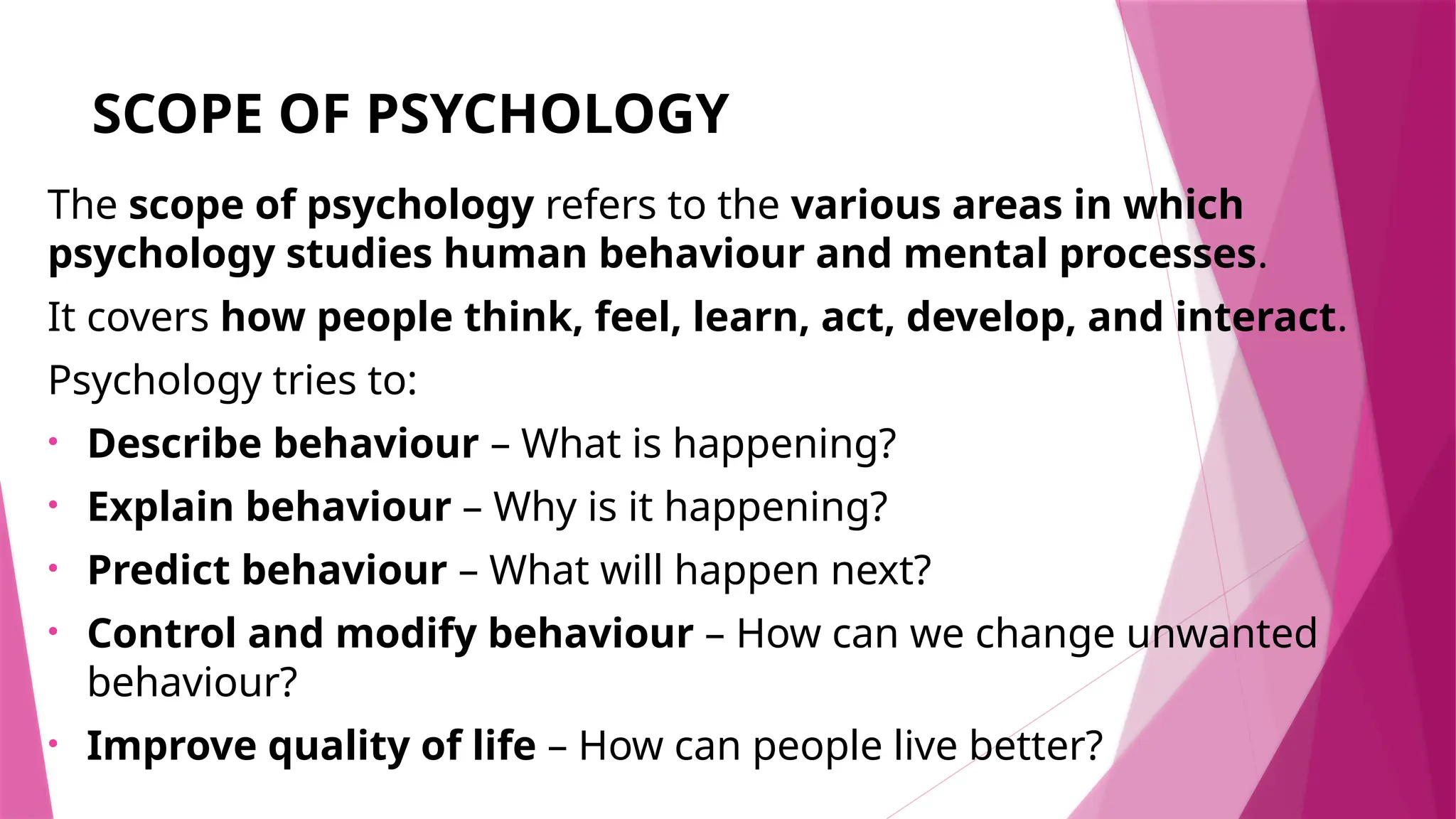
SCOPE OF PSYCHOLOGY
Thescope of psychology refers to the various areas in which
psychology studies human behaviour and mental processes.
It covers how people think, feel, learn, act, develop, and interact.
Psychology tries to:
• Describe behaviour – What is happening?
• Explain behaviour – Why is it happening?
• Predict behaviour – What will happen next?
• Control and modify behaviour – How can we change unwanted
behaviour?
• Improve quality of life – How can people live better?
6.
SCOPE OF PSYCHOLOGY
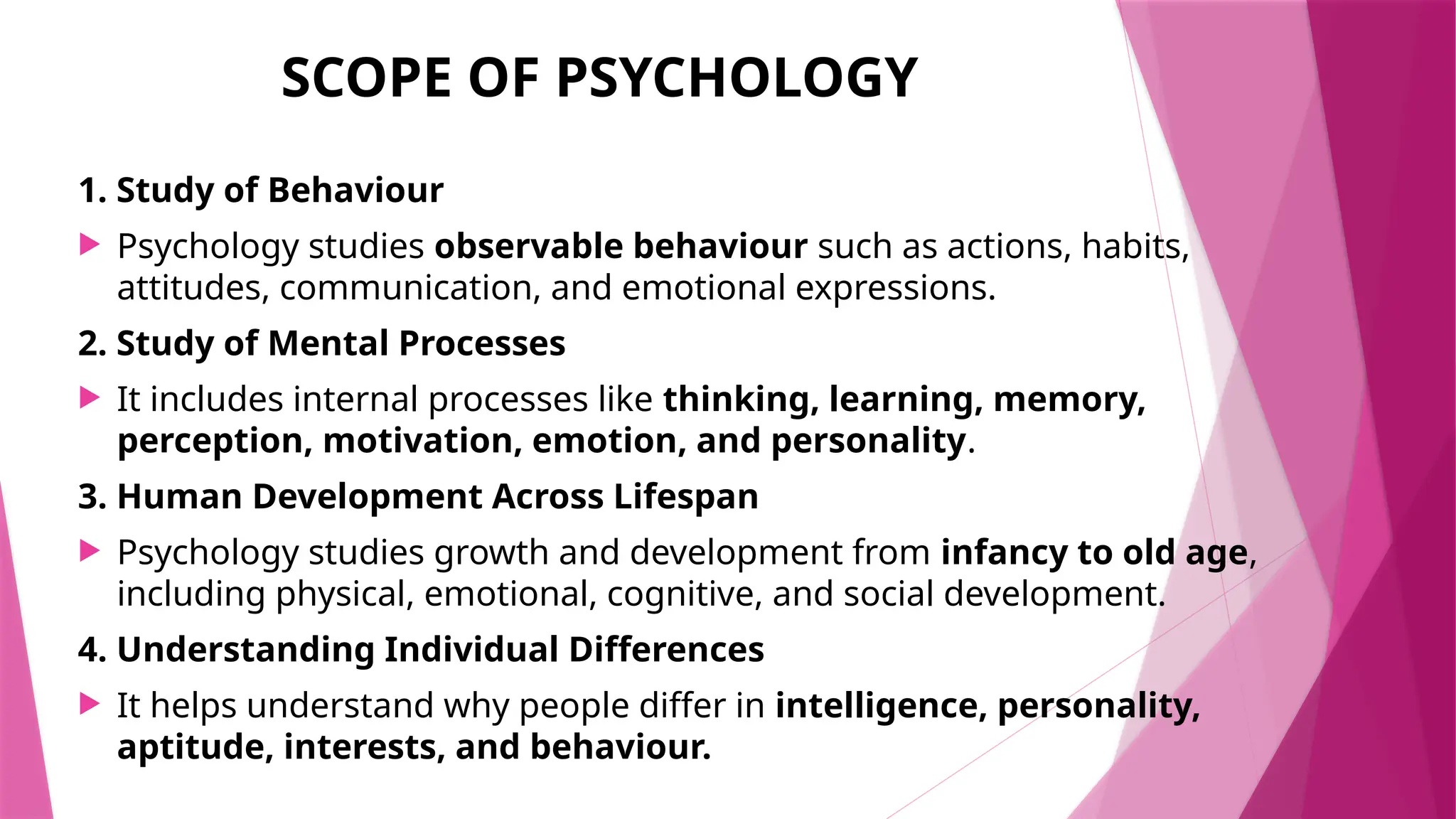
1.Study of Behaviour
Psychology studies observable behaviour such as actions, habits,
attitudes, communication, and emotional expressions.
2. Study of Mental Processes
It includes internal processes like thinking, learning, memory,
perception, motivation, emotion, and personality.
3. Human Development Across Lifespan
Psychology studies growth and development from infancy to old age,
including physical, emotional, cognitive, and social development.
4. Understanding Individual Differences
It helps understand why people differ in intelligence, personality,
aptitude, interests, and behaviour.
7.
SCOPE OF PSYCHOLOGY
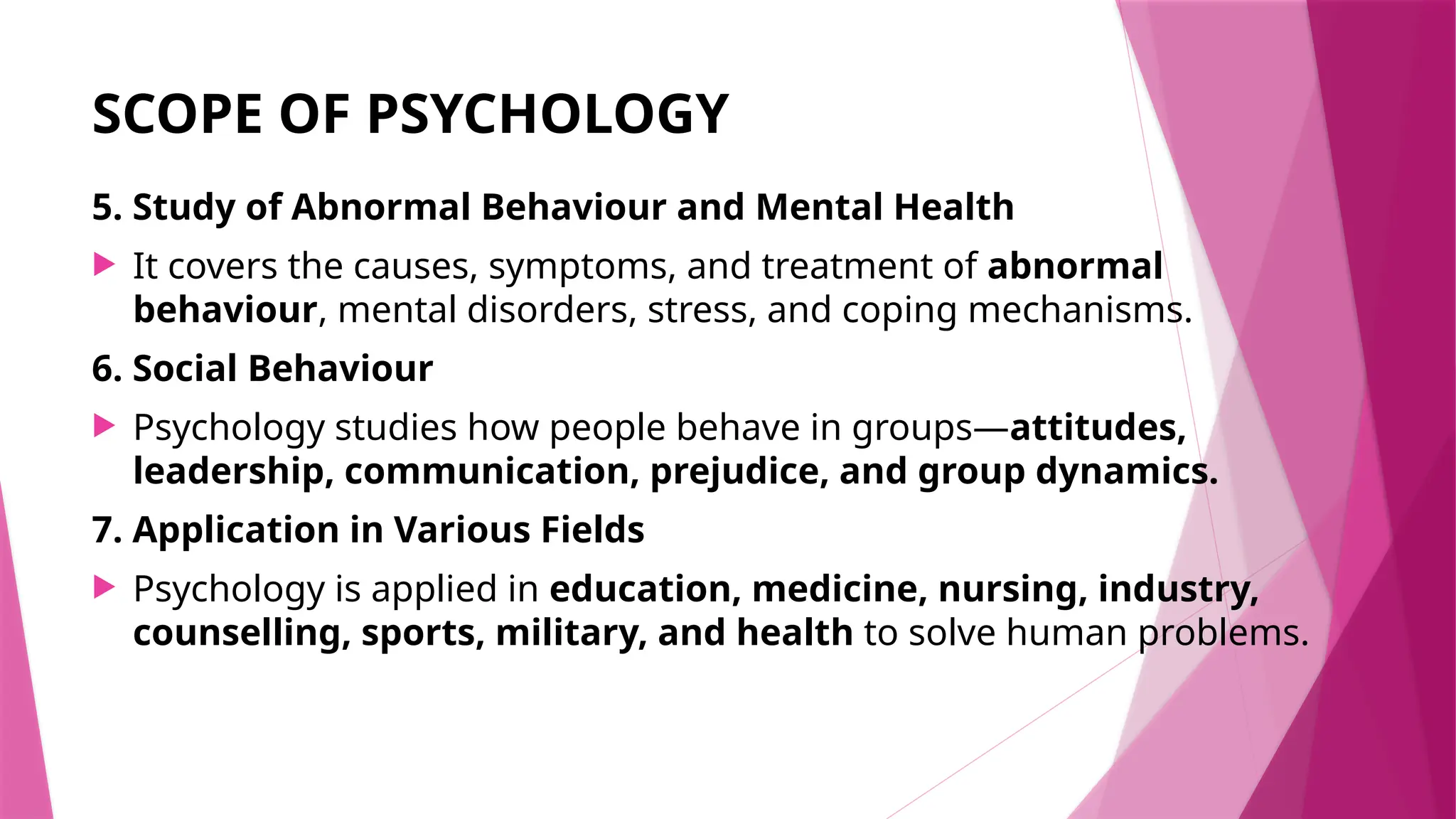
5.Study of Abnormal Behaviour and Mental Health
It covers the causes, symptoms, and treatment of abnormal
behaviour, mental disorders, stress, and coping mechanisms.
6. Social Behaviour
Psychology studies how people behave in groups—attitudes,
leadership, communication, prejudice, and group dynamics.
7. Application in Various Fields
Psychology is applied in education, medicine, nursing, industry,
counselling, sports, military, and health to solve human problems.
BRANCHES OF PSYCHOLOGY
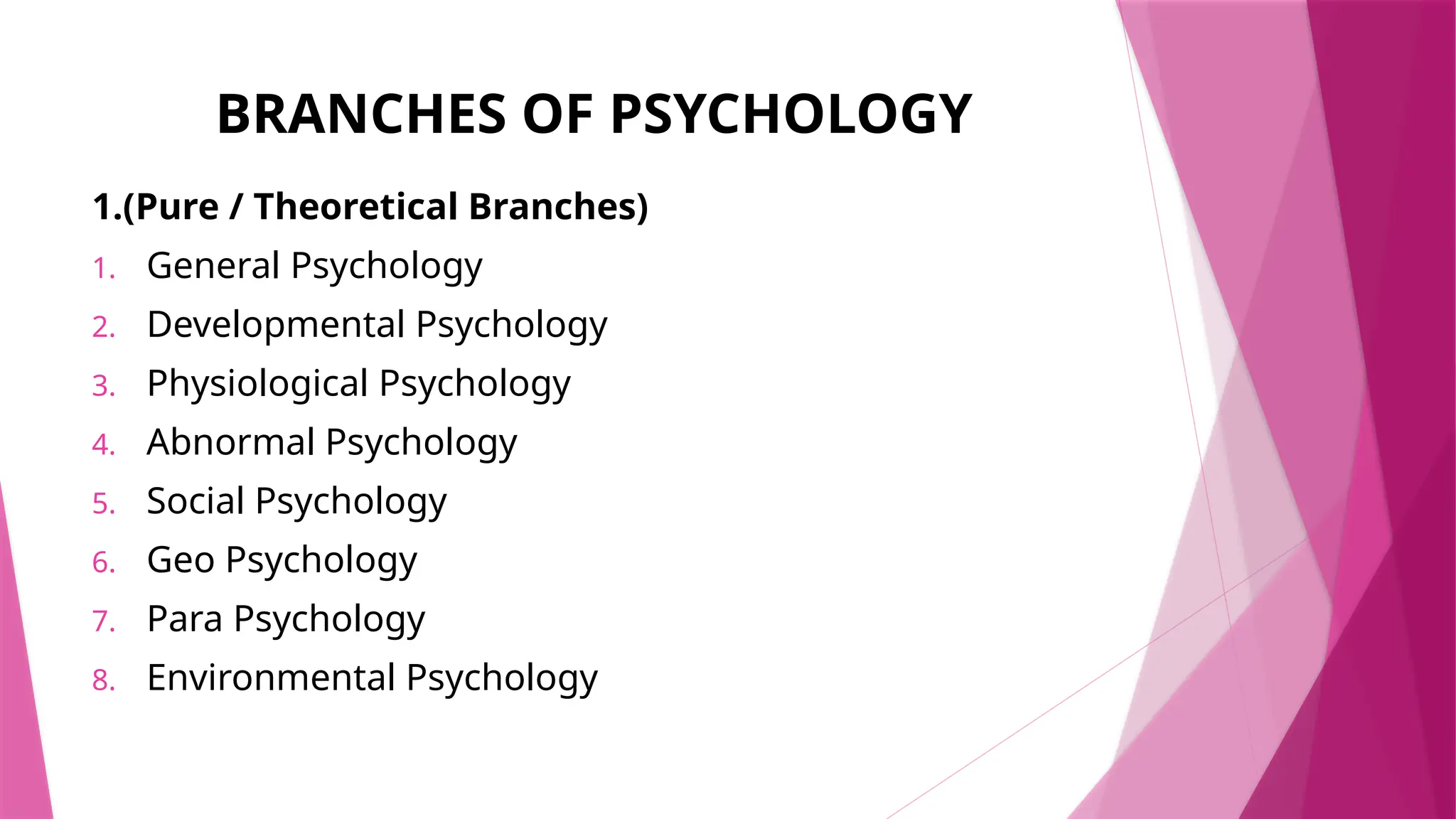
1.(Pure/ Theoretical Branches)
1. General Psychology
2. Developmental Psychology
3. Physiological Psychology
4. Abnormal Psychology
5. Social Psychology
6. Geo Psychology
7. Para Psychology
8. Environmental Psychology
10.
BRANCHES OF PSYCHOLOGY
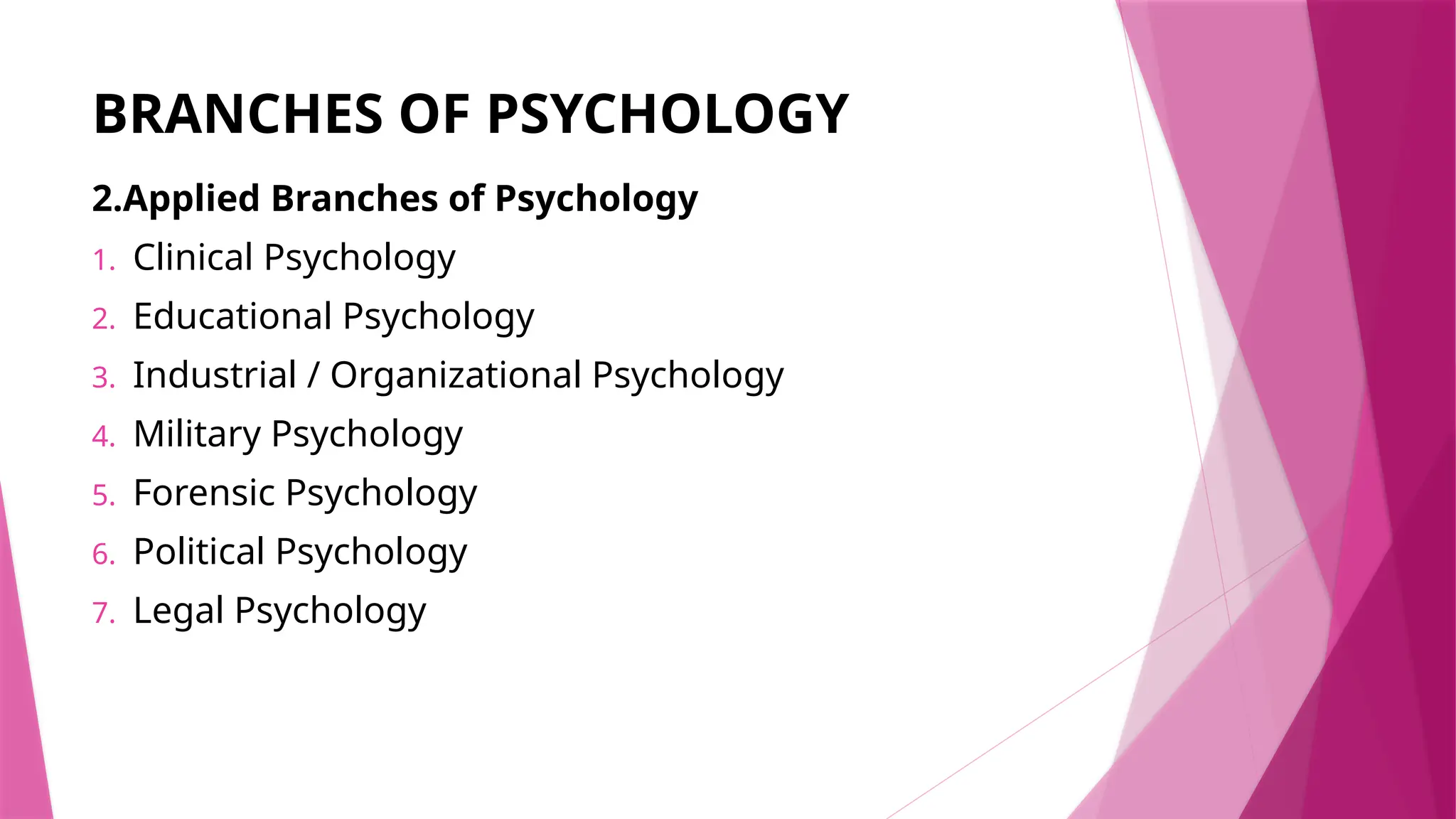
2.AppliedBranches of Psychology
1. Clinical Psychology
2. Educational Psychology
3. Industrial / Organizational Psychology
4. Military Psychology
5. Forensic Psychology
6. Political Psychology
7. Legal Psychology
11.
BRANCHES OF PSYCHOLOGY
1.GeneralPsychology
General psychology is the basic and foundational branch of
psychology that studies human behaviour and mental processes in
a broad and general manner.
It explains how people think, feel, learn, perceive, remember,
and behave in different situations.
This branch provides the basic principles, theories, and concepts
that form the foundation for all other branches of psychology.
12.
BRANCHES OF PSYCHOLOGY
2.Developmental Psychology
This branch studies growth and development from conception to old
age, covering physical, emotional, social, and cognitive changes across
each life stage.
3. Social Psychology
Social psychology studies how individual behaviour is influenced by
groups, social situations, culture, and relationships, including
attitudes, leadership, and group behaviour.
4. Physiological / Biological Psychology
It studies the biological basis of behaviour, including the functions of
the brain, nervous system, hormones, neurotransmitters, and genetics.
13.
BRANCHES OF PSYCHOLOGY
5.Abnormal Psychology
Abnormal psychology deals with deviant or maladaptive behaviours and
mental disorders.
It studies the causes, symptoms, diagnosis, and treatment of
psychological illnesses.
6. Geo Psychology
Geo-psychology is the study of how the geographical environment
(place, climate, land, surroundings) affects human behaviour,
personality, emotions, and thinking.
It explains how where people live influences how they behave.
14.
BRANCHES OF PSYCHOLOGY
7.Para Psychology
Parapsychology is the branch of psychology that studies extraordinary or
unexplained experiences that cannot be understood through normal
scientific principles.
It deals with phenomena beyond the known laws of nature, also called
psychic phenomena.
8. Environmental Psychology
Environmental psychology studies how the physical environment—such
as noise, crowding, climate, pollution, and architecture—affects human
behaviour and well-being. It also focuses on creating healthy and
supportive environments.
15.
BRANCHES OF PSYCHOLOGY
1.Clinical Psychology
Clinical psychology deals with the assessment, diagnosis, and treatment
of mental illnesses and emotional problems.
It uses psychological tests, therapy, and counselling to help individuals
overcome psychological distress.
2. Educational Psychology
Educational psychology studies how people learn and helps improve
teaching–learning processes.
It deals with motivation, memory, learning styles, classroom management,
and supports teachers in improving student performance.
16.
BRANCHES OF PSYCHOLOGY
3.Industrial / Organizational Psychology
I/O psychology applies psychological principles to the workplace.
It deals with employee selection, training, motivation, leadership,
job satisfaction, and improving productivity and workplace well-
being.
4. Military Psychology
Military psychology applies psychology to defense and armed
forces.
It focuses on soldier selection, mental resilience, stress
management, trauma care, leadership training, and improving
performance in high-stress environments.
17.
BRANCHES OF PSYCHOLOGY
5.Forensic Psychology
Forensic psychology links psychology with the legal and criminal justice
system. It includes criminal behaviour analysis, eyewitness testimony, offender
profiling, victim counseling, and helping courts understand psychological factors.
6. Political Psychology
Political psychology is the study of how people think, feel, and behave in political
situations.
It explains why people support a leader, vote for a party, join protests, or have certain
political opinions.
7. Legal Psychology
Legal psychology is a branch of psychology that studies how human behaviour and
mental processes are related to the law and legal system.
It helps understand how people think, feel, and behave in situations involving crime,
courts, justice, and legal decisions.
18.
METHODS OF PSYCHOLOGY
1.IntrospectionMethod
2.Observation Method
3.Experimental Method
4.Clinical or Case History Method
5.Survey Method
6.Genetic Method or Developmental Method
19.
1. Introspection Method
Introspectionmeans “looking within.” The person observes and reports
their own thoughts, feelings, and mental processes.
Merits:
Simple and direct method.
Helps understand inner experiences.
Useful for studying emotions.
Demerits:
Highly subjective.
Cannot be used on children or mentally ill patients.
Results are not scientifically reliable.
20.
2. Observation Method
Inthis method, behaviour is watched and recorded in natural or
controlled settings.
Merits:
Simple and natural.
Useful for children and patients.
More reliable than introspection.
Demerits:
Observer bias may occur.
Time-consuming.
Some behaviours cannot be observed directly.
21.
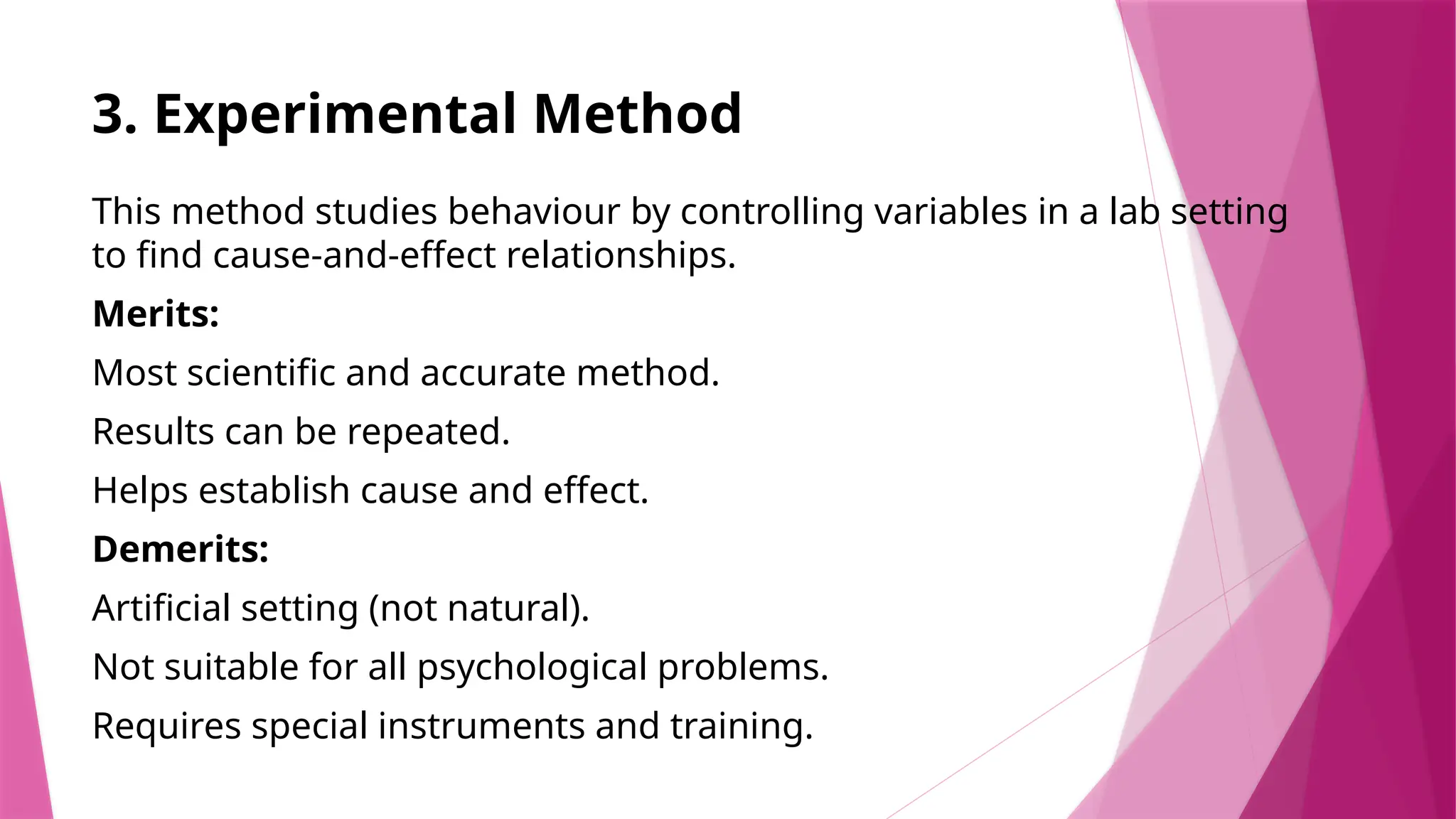
3. Experimental Method
Thismethod studies behaviour by controlling variables in a lab setting
to find cause-and-effect relationships.
Merits:
Most scientific and accurate method.
Results can be repeated.
Helps establish cause and effect.
Demerits:
Artificial setting (not natural).
Not suitable for all psychological problems.
Requires special instruments and training.
22.
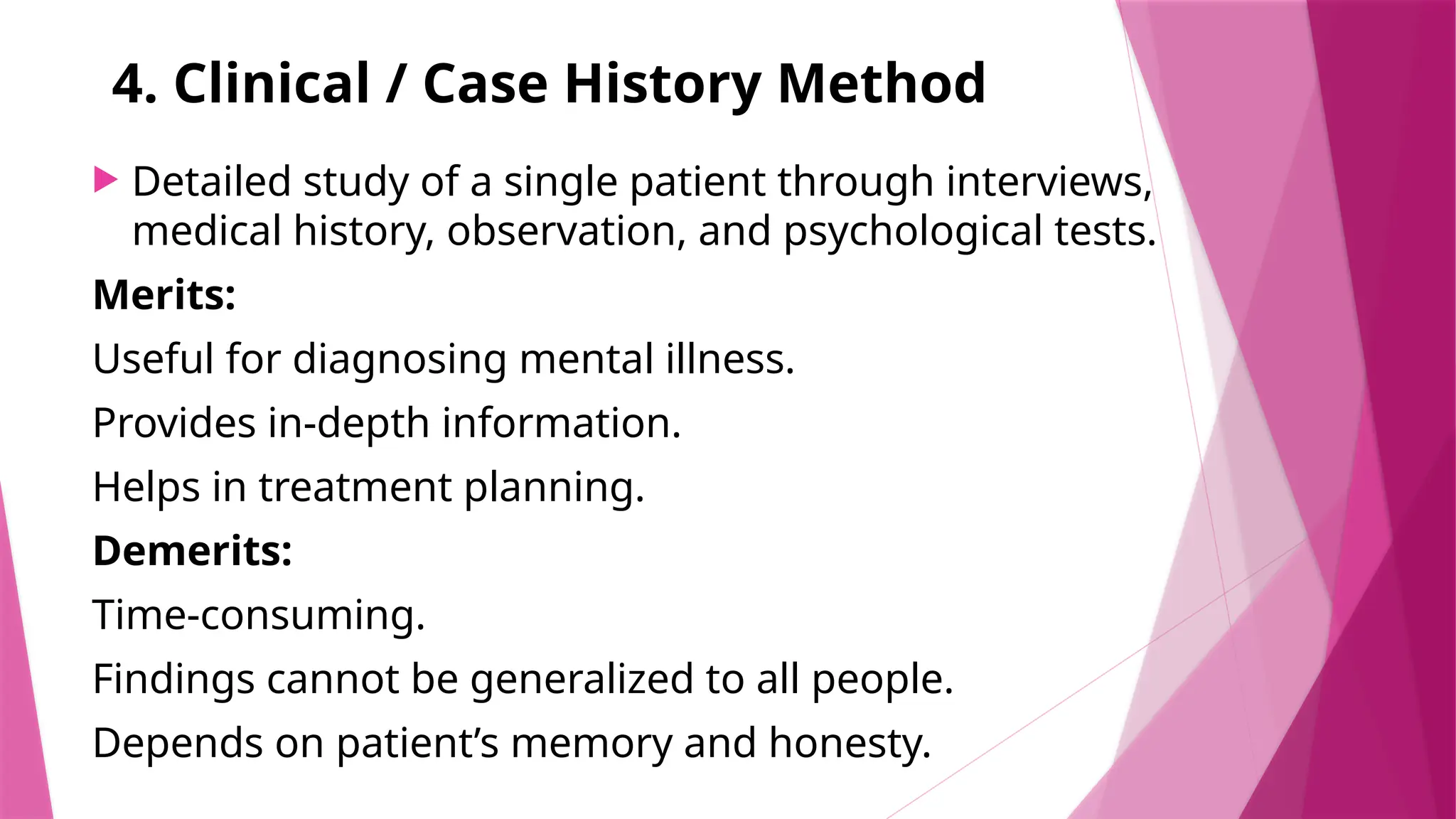
4. Clinical /Case History Method
Detailed study of a single patient through interviews,
medical history, observation, and psychological tests.
Merits:
Useful for diagnosing mental illness.
Provides in-depth information.
Helps in treatment planning.
Demerits:
Time-consuming.
Findings cannot be generalized to all people.
Depends on patient’s memory and honesty.
23.
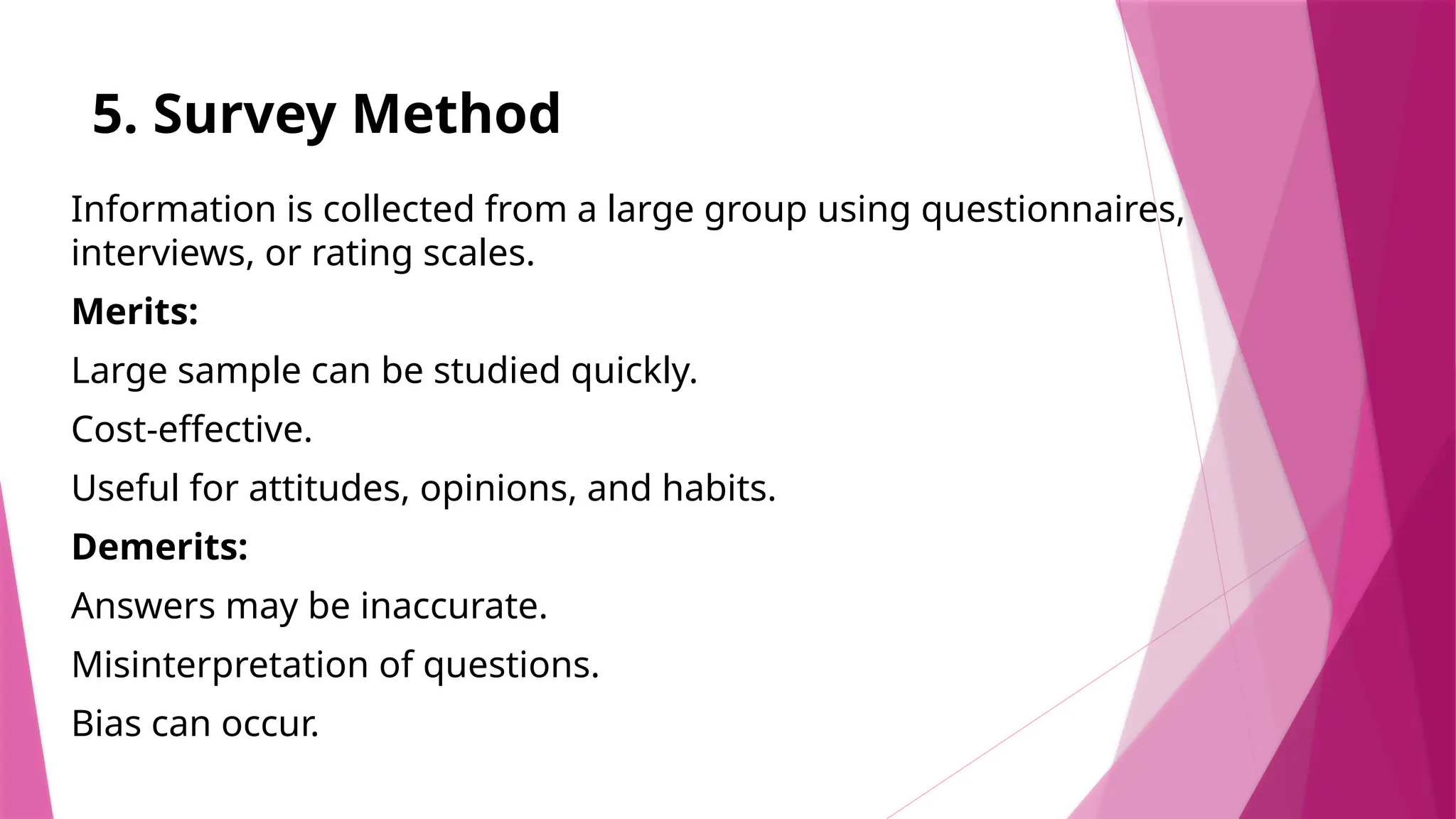
5. Survey Method
Informationis collected from a large group using questionnaires,
interviews, or rating scales.
Merits:
Large sample can be studied quickly.
Cost-effective.
Useful for attitudes, opinions, and habits.
Demerits:
Answers may be inaccurate.
Misinterpretation of questions.
Bias can occur.
24.
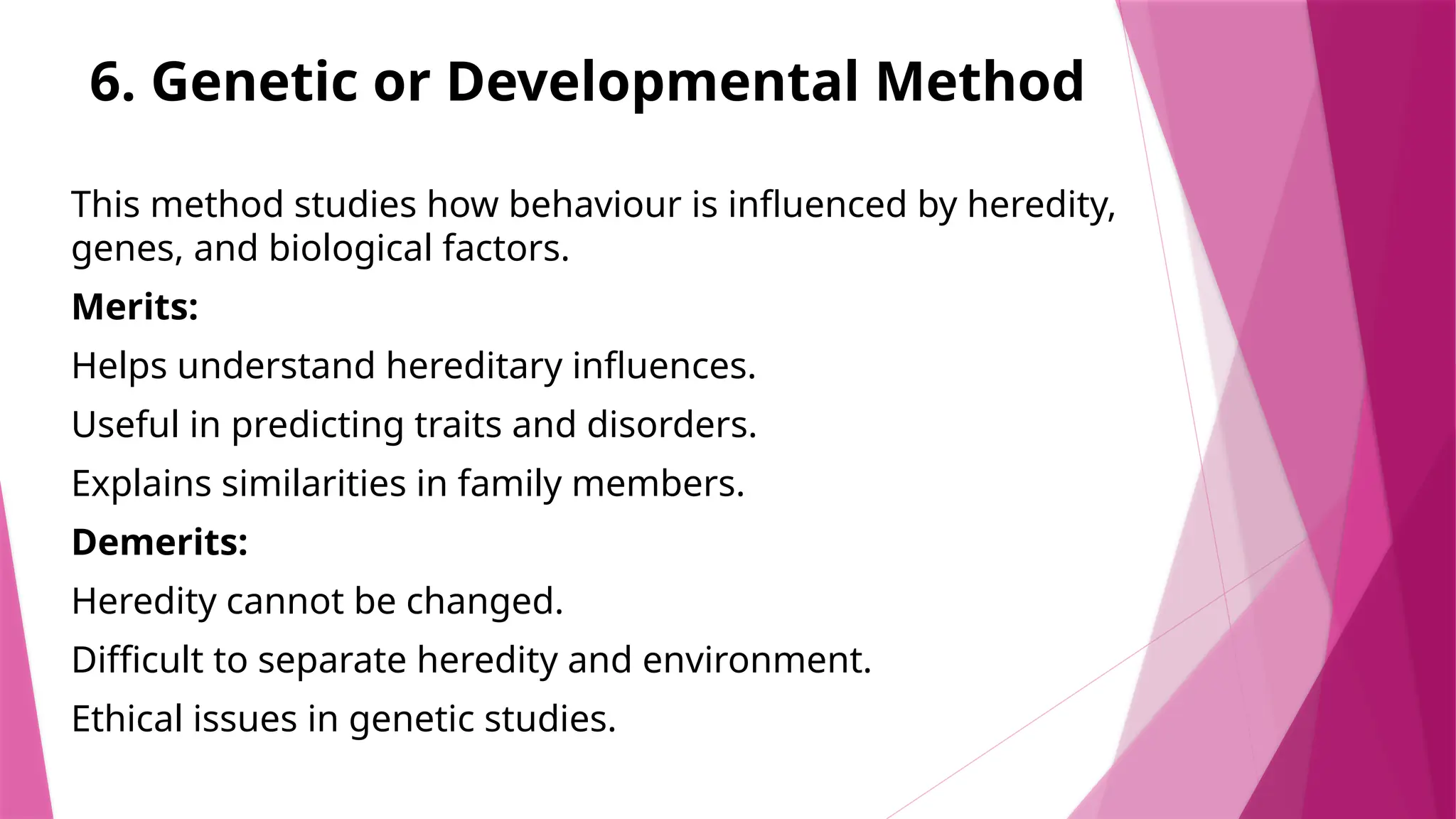
6. Genetic orDevelopmental Method
This method studies how behaviour is influenced by heredity,
genes, and biological factors.
Merits:
Helps understand hereditary influences.
Useful in predicting traits and disorders.
Explains similarities in family members.
Demerits:
Heredity cannot be changed.
Difficult to separate heredity and environment.
Ethical issues in genetic studies.