MEANING OF SPORTS
PHYSIOLOGY
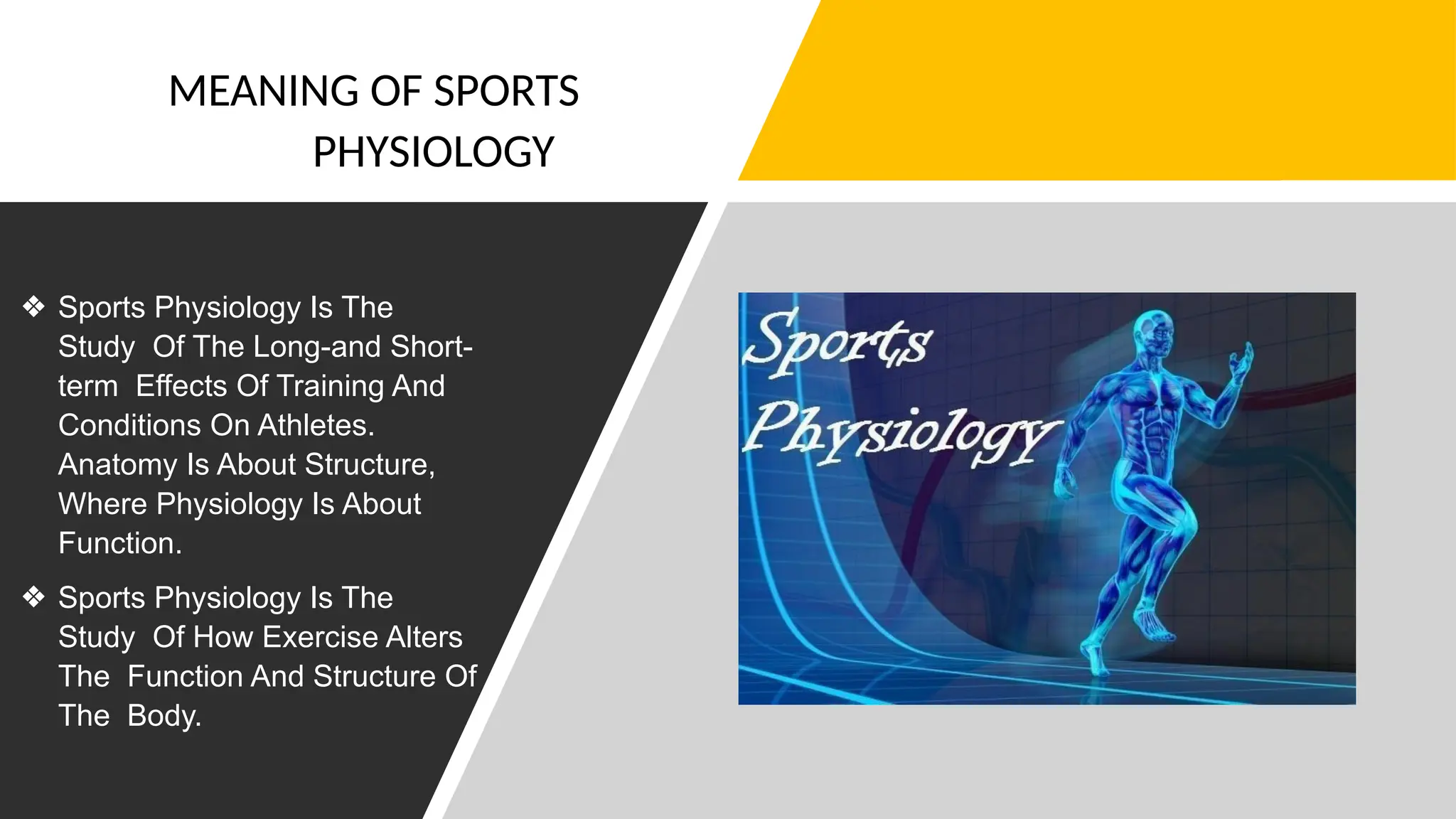
❖Sports Physiology Is The
Study Of The Long-and Short-
term Effects Of Training And
Conditions On Athletes.
Anatomy Is About Structure,
Where Physiology Is About
Function.
❖ Sports Physiology Is The
Study Of How Exercise Alters
The Function And Structure Of
The Body.
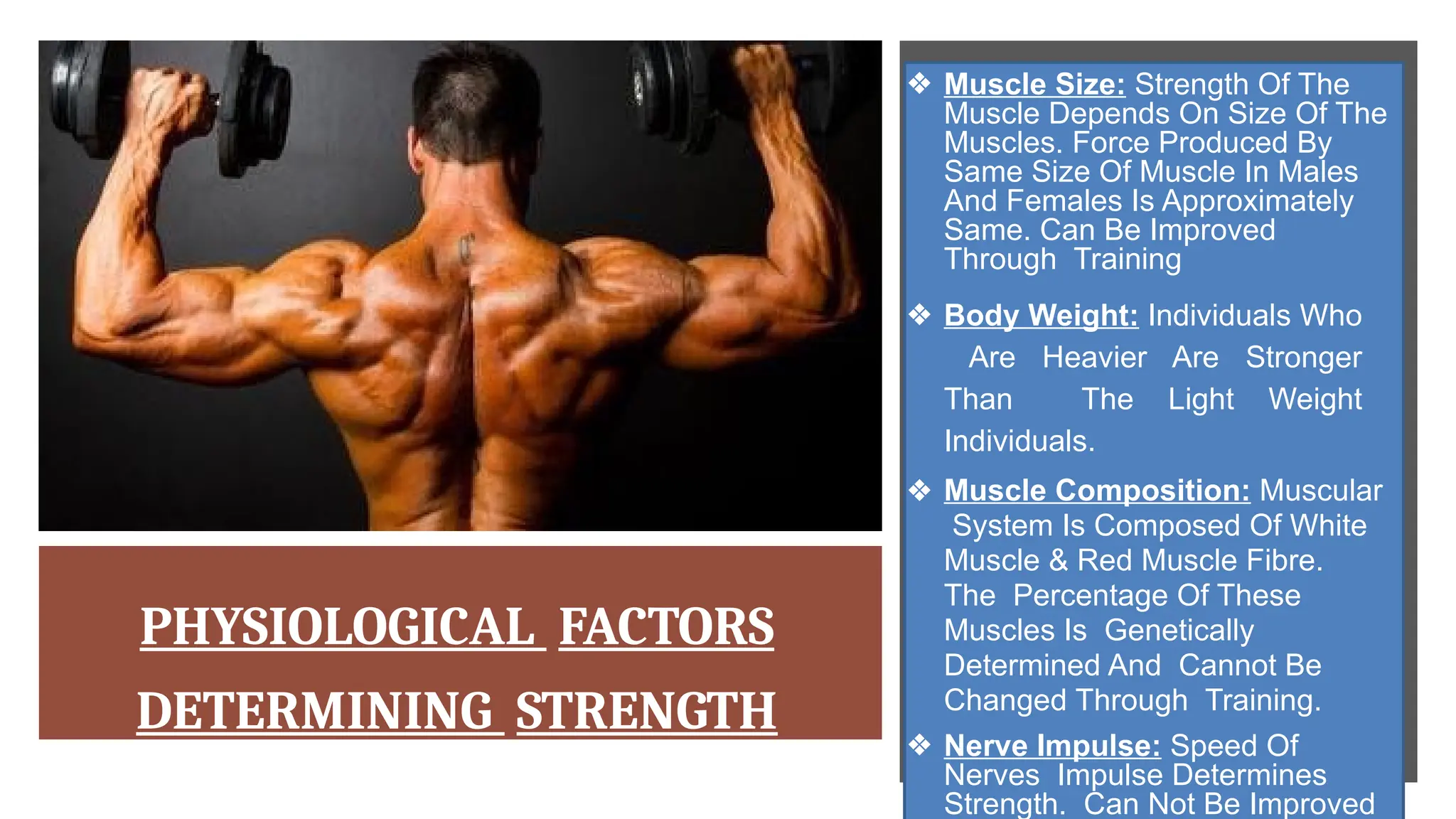
PHYSIOLOGICAL FACTORS
DETERMINING STRENGTH
❖Muscle Size: Strength Of The
Muscle Depends On Size Of The
Muscles. Force Produced By
Same Size Of Muscle In Males
And Females Is Approximately
Same. Can Be Improved
Through Training
❖ Body Weight: Individuals Who
Are Heavier Are Stronger
Than The Light Weight
Individuals.
❖ Muscle Composition: Muscular
System Is Composed Of White
Muscle & Red Muscle Fibre.
The Percentage Of These
Muscles Is Genetically
Determined And Cannot Be
Changed Through Training.
❖ Nerve Impulse: Speed Of
Nerves Impulse Determines
Strength. Can Not Be Improved
5.
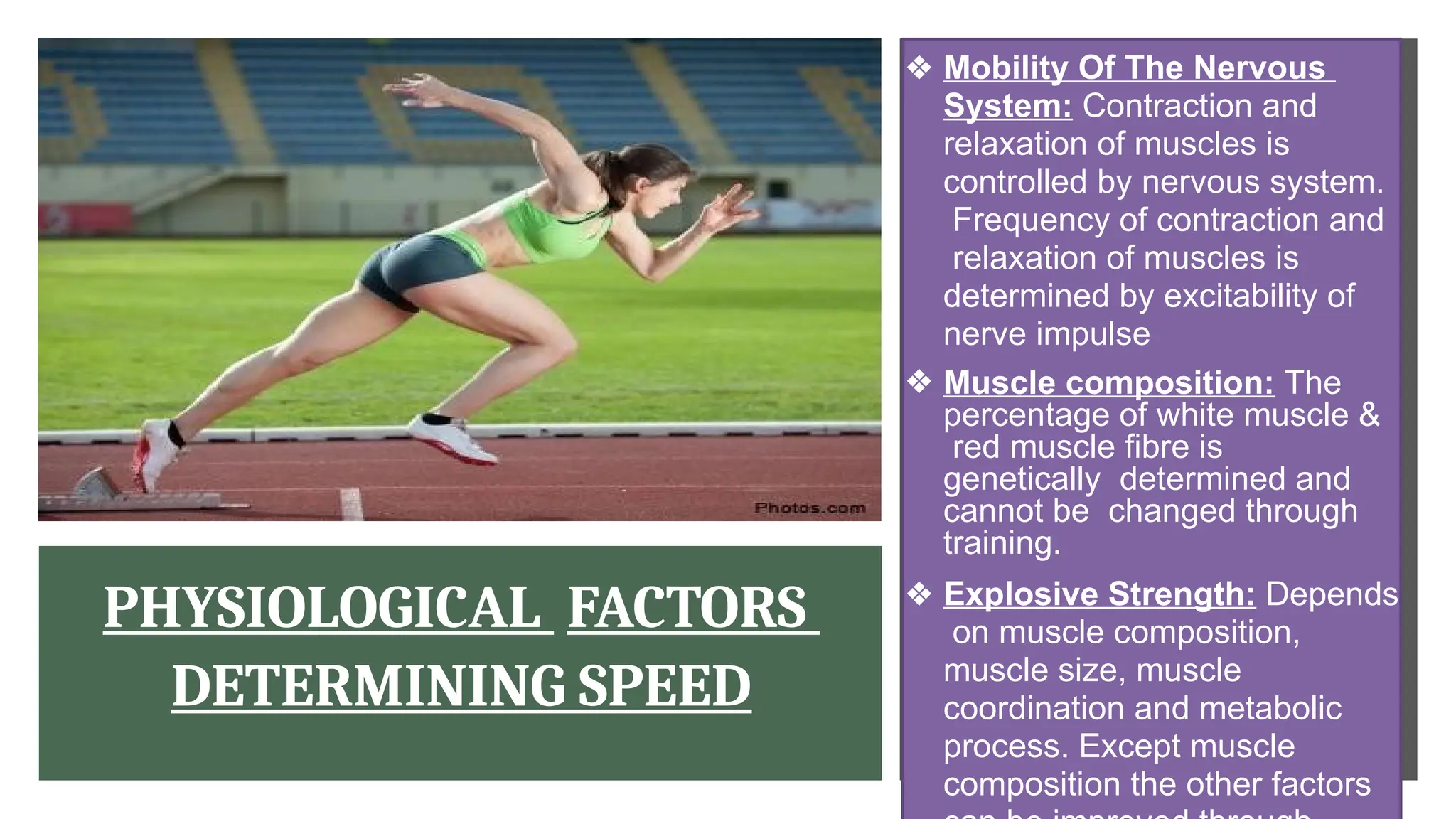
PHYSIOLOGICAL FACTORS
DETERMINING SPEED
❖Mobility Of The Nervous
System: Contraction and
relaxation of muscles is
controlled by nervous system.
Frequency of contraction and
relaxation of muscles is
determined by excitability of
nerve impulse
❖ Muscle composition: The
percentage of white muscle &
red muscle fibre is
genetically determined and
cannot be changed through
training.
❖ Explosive Strength: Depends
on muscle composition,
muscle size, muscle
coordination and metabolic
process. Except muscle
composition the other factors
6.
PHYSIOLOGICAL FACTORS
DETERMINING SPEED(CONT.)
❖ Flexibility: Maximum range of
movement of any muscle or
joint. Freedom of movement
enables muscles to move at
faster rate & complete
utilization of explosive
strength.
❖ Bio Chemical Reserves And
Metabolic Power: For
maximum speed performance
the muscles require more
amount of energy at a very
high rate of consumption. For
this purpose ATP and CP
stores should be enough. If the
store is less the muscle
contractions due to insufficient
7.
PHYSIOLOGICAL FACTORS
DETERMINING ENDURANCE
❖AEROBIC CAPACITY: Energy
Required By The Muscles Can Be
Supplied In The Presence Of
Oxygen. Hence Supply Of Oxygen
To Working Muscles Is Important For
Endurance Performance.
✔ Oxygen Intake: It Is The
Amount Of The Oxygen Which
Can Be Taken By The Lungs
From Atmosphere.
✔ Oxygen Transport : The
Amount Of Oxygen Taken Into
The Blood From Lungs Has To
Be Transported To The Working
Muscles
✔ Oxygen Uptake: The Amount Of
Oxygen Which Can Be Observed
And Consumed By The Working
Muscles From The Blood.
✔ Energy Reserves: Depends
Upon The Availability Of Fuel To
Muscles From Which Energy For
The Activity Is Derived. The
Aerobic Capacity Depends Upon
The Muscle Glycogen And
8.
PHYSIOLOGICAL FACTORS
DETERMINING ENDURANCE
(CONT.)
❖Lactic Acid Tolerance: It Is
Important For Activities
Lasting > 40 Seconds &
Determines Anaerobic
Capacity. Can Be Improved
Through Training.
❖ Movement Economy: For
Apex Performance, Body
Movements Should Be
Economical. Good
Technique Saves Energy &
Improve Endurance.
❖ Muscle Composition: The
Percentage Of White
Muscle & Red Muscle Fibre
Is Genetically Determined
And Cannot Be Changed
Through Training
9.
PHYSIOLOGICAL FACTORS
DETERMINING FLEXIBILITY
❖Muscle Strength: Weak
Muscles Cannot Exert
Sufficient Force To
Achieve Full
Range Of Movement.
Muscle Strength Is
Highly Trainable.
❖ Joint Structure: Structure
Of Joint Is A Limiting Factor
For Flexibility. Some Of
The Joints Intrinsically
Have A Greater Range Of
Motion Than Others.
❖ Age And Gender: Flexibility
Is Maximum During
Childhood And Decreases
With The Advancement Of
Age. It Can Be Enhanced
With Training. Females
Tend To Be More Flexible
10.
PHYSIOLOGICAL FACTORS
DETERMINING FLEXIBILITY
(CONT.)
❖Stretchability Of
Muscles: Limits The
Range Of Movements.
Stretchability Can Be
Improved By Training.
❖ Body Temperature: Has A
Positive Correlation With
Body Flexibility. Warm Up
Before Any Sports Activity Is
Highly Advisable.
❖ Previous Injury: Injuries To
Connective Tissues And
Muscles Can Lead To
Thickening On The Affected
Area Leading To Reduced
Flexibility. Rehabilitation
Exercises Are Must After
Healing Of Injury.
11.
❖ INCREASE INTHE SIZE OF HEART:Muscles Of The Heart
Increase In Size And Strength. The Left Ventricle Adapts To The
Greatest Extent. Heart Walls Grow Stronger And Thicker.
❖ DECREASE IN RESTING HEART RATE: Regular Exercise
Decreases The Resting Heart Rate. Resting Heart Rate 72
Beat/Min Can Go Down To 40 To 50 Beat/Minute In Highly
Conditioned Athlete.
❖ STROKE VOLUME INCREASES AT REST: In An Untrained
Individual Stroke Volume At Rest Is 50 To70 Ml / Beat Which
Increases To 70 To 90 Ml / Beat As An Effect Of Regular Exercise.
❖ Increase In Cardiac Output Cardiac Output = Stroke Volume X
Heart Rate
❖ INCREASED BLOOD FLOW: To Supply The Muscles With Extra
Oxygen During Exercise, The Body Increases Its Number Of Capillaries.
Existing Capillaries Open Wider. The Blood Redistribution More Efficient
& Effective.
7.2 EFFECT OF EXERCISE ON
CARDIO
RESPIRATORY SYSTEM
12.
EFFECT OF EXERCISEON CARDIO
RESPIRATORY
SYSTEM (CONT.)
❖ DECREASE IN BLOOD PRESSURE: Decreases BP By Up To 10 Mmhg At
Rest.
❖ INCREASE IN BLOOD VOLUME: Increases The Blood Volume Due
To Increase In Plasma Volume. Body Produces More RBC To Supply
Extra Oxygen To Muscles During Intensive Exercise
❖ QUICKER RECOVERY RATE: Quickens The Recovery Rate. Rate Of
Respiration Also Becomes Normal Quickly.
❖ INCREASE IN TIDAL AIR CAPACITY: It Is The Amount Of Air That Flows In
And Out Of The Lungs In Each Quiet Respiratory Movement.
❖ DECREASE IN RATE OF RESPIRATION: If The Individual Perform The
Exercise On Daily Basis, His/ Her Respiration At Rest Decreases In
Comparison To The Earlier Stage.
❖ UNUSED ALVEOLES BECOME ACTIVE: Regular Exercise Activates The
Unused Alveoles, Because Much Amount Of Oxygen Is Required In Vigorous
And Prolonged Exercises. The Passive Alveloes Also Become Active.
13.
❖ INCREASE INENDURANCE: if exercise is
performed regularly and for a longer
period, it increases endurance
❖ INCREASE IN RESIDUAL AIR VOLUME: it
is that amount of air, which is left in the lungs
after exhalation.
❖ INCREASE IN VITAL AIR CAPACITY: it is the
amount of air which an individual can inhale
and exhale with maximum effort.
❖ Increase in maximum oxygen uptake(VO2
max).
EFFECT OF EXERCISE ON
CARDIO RESPIRATORY SYSTEM
(CONT.)
14.
7.3 EFFECT OFEXERCISE
ON
MUSCULAR SYSTEM
❖ Change In Shape And
Size Of Muscle
❖ Formation Of More Capillaries
❖ Muscles Remains In Tone Position
❖ Controls Extra Fat
❖ Change In The
Connective Tissues
❖ Efficiency In The Movement
15.
EFFECT OF EXERCISEON
MUSCULAR
SYSTEM (CONT.)
❖ Delays Fatigue
❖ Increase Food Storage
❖ Exercise And Its Health
Benefits
❖Non Functioning Fibres
Become Active
❖ Body Posture Remains Correct
❖ Improves Reaction Time
16.
7.5 SPORTS INJURIES:
CLASSIFICATION,CAUSES
AND PREVENTION
MEANING OF SPORTS INJURIES
❖ Injuries Which Are Common In
The Field Of Games And Sports
❖ Happen During Practice,
Training Or Competition
❖ If Appropriate Steps Are Taken By The
Sports Person.The Chance Of
Getting Injuries Can Be Reduced.
17.
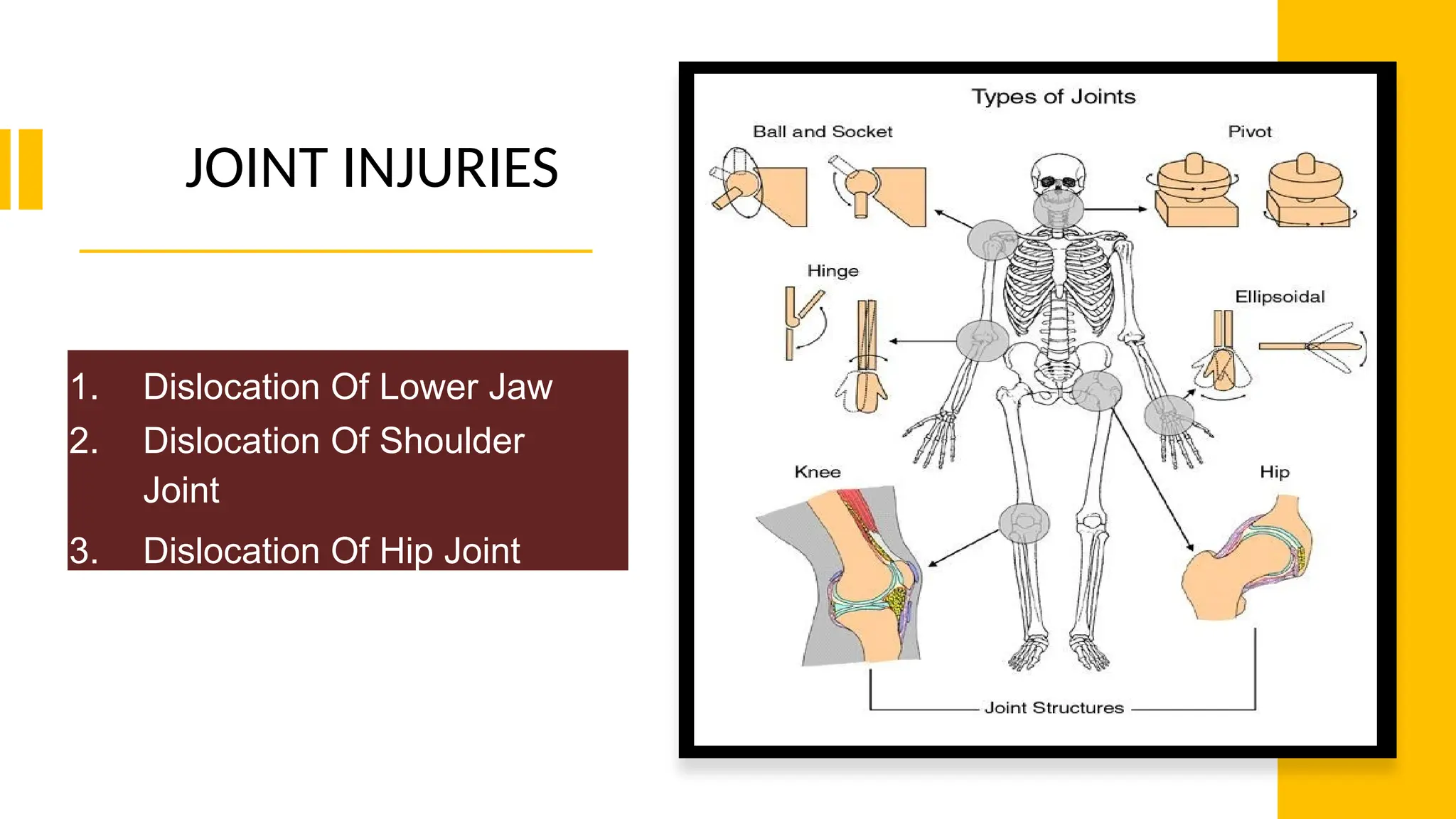
Soft Tissue InjuriesBone Injuries Joint Injuries
CLASSIFICATION OF SPORTS INJURIES
Sports Injuries Can Be Classified As Under
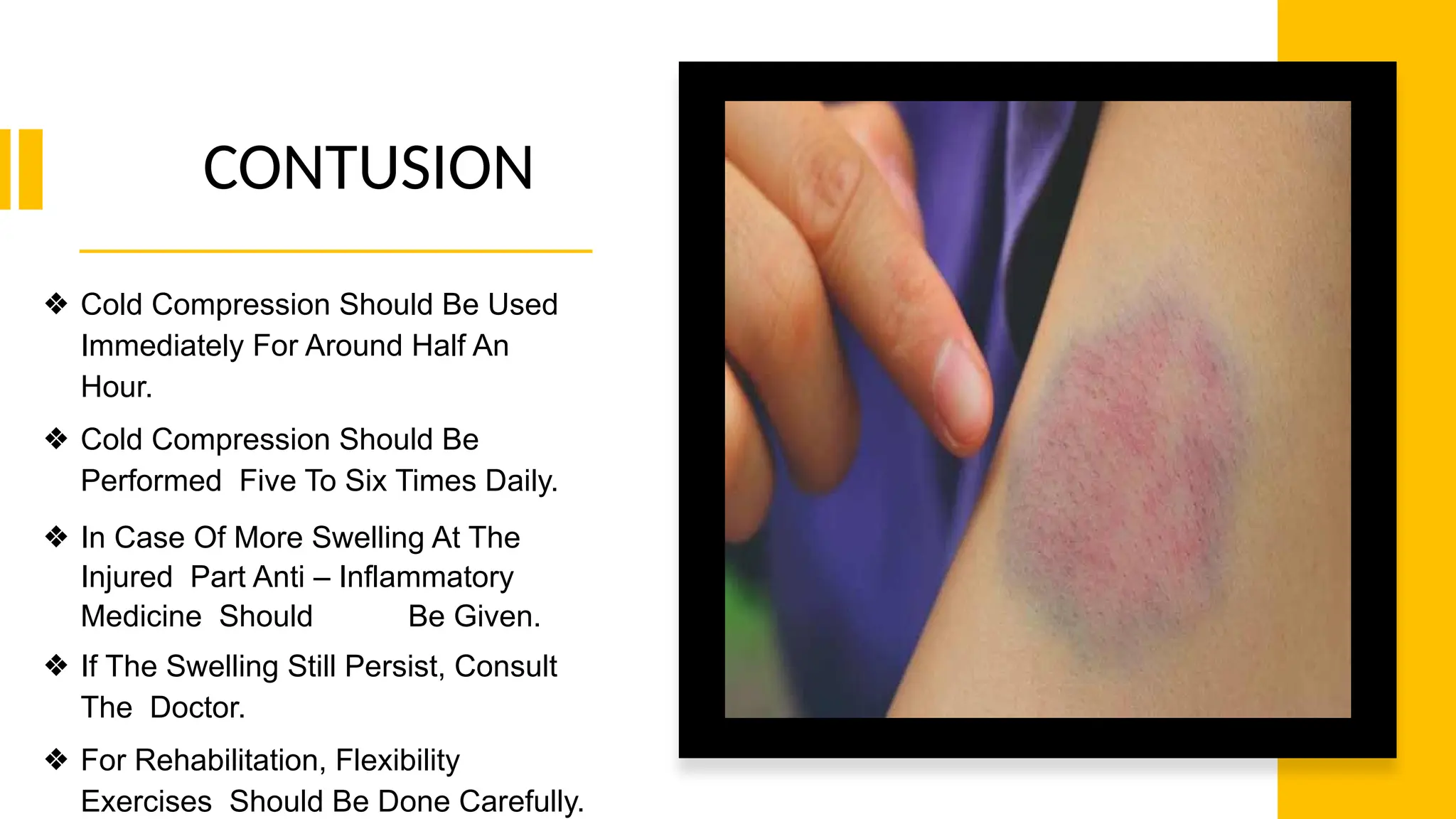
1. CONTUSION
❖ MuscleInjury Occurs Due To
Direct Hit, With Or Without Any
Sports Equipment.
❖ Blood Vessels In The Muscles Are
Broken, Bleeding May Occur In
The Muscles .
❖ Stiffness & Swelling Common Sign.
❖ Muscle May Not Respond Or
May Become Totally Inactive.
❖ Common In : Boxing,
Wrestling, Kabaddi.
20.
2. STRAIN
❖ MildOr Severe Muscle Injury.
❖ strain is the injury on muscle/group of muscle
due to sudden twist/over stretch at particular
part of body
❖ In Severe Case, Muscle May Rupture.
❖ In Case Of Complete Rupture Movement Of
Limb Is Not Possible move Due To Severe
Pain.
❖ May Happen During Practice Or Clash.
21.
3. SPRAIN
❖ LigamentInjury.
❖ May Occur Due To Over
Stretching Or Tearing Of
Ligament.
❖ Occurs At Wrist Joint And Ankle Joint.
❖ Some Time Fracture Is
Possible Along With Sprain.
❖ Swelling, Inflammation, Severe
Pain & Tenderness Are Common
Symptoms.
22.
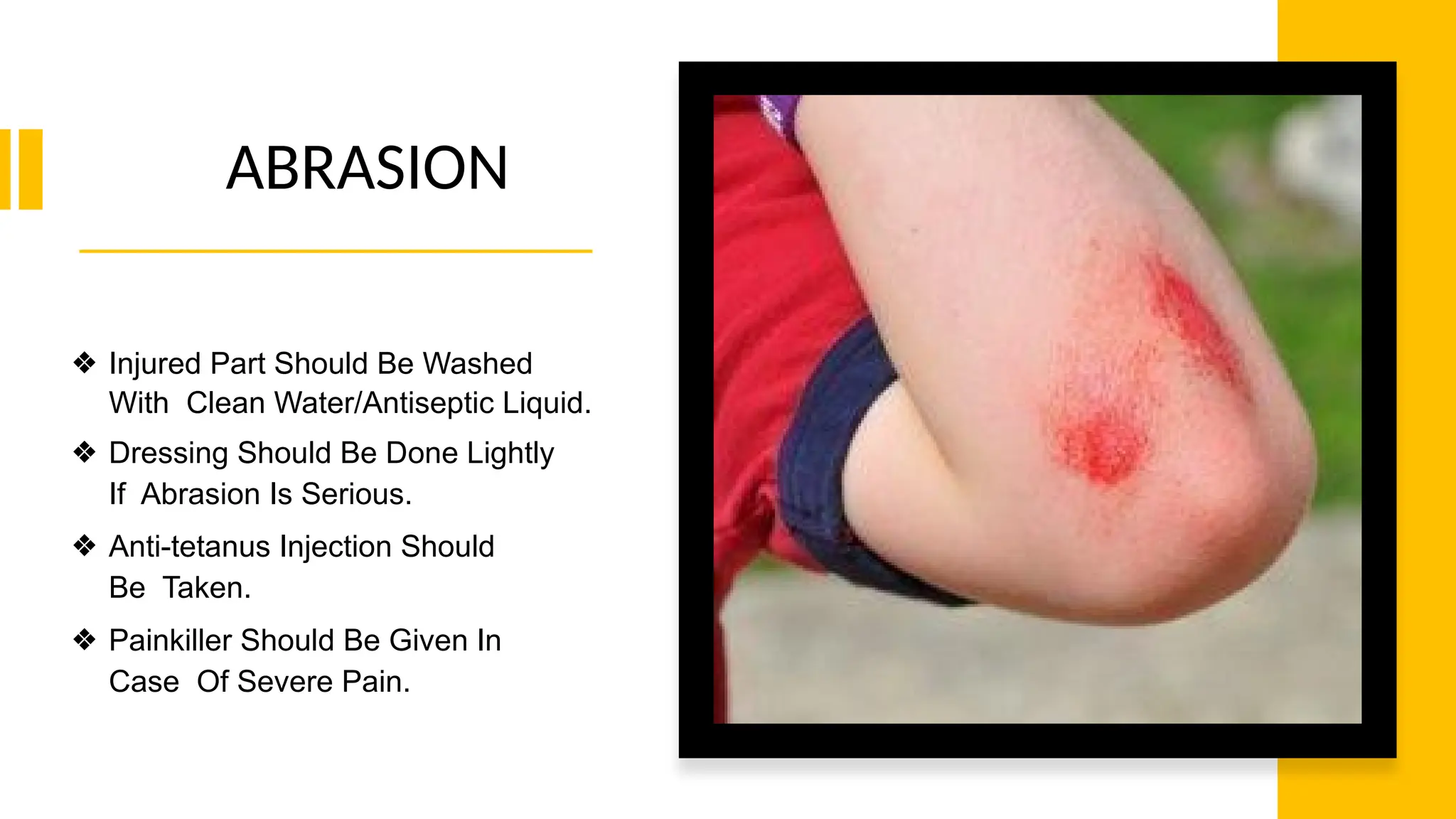
4. ABRASION
❖ SkinInjury.
❖Occurs Due To Friction
With Any Equipment Or A
Fall Over The Area
Where The Bone Is
Close To Skin.
❖Occurs At Upper
Layer Of Skin.
23.
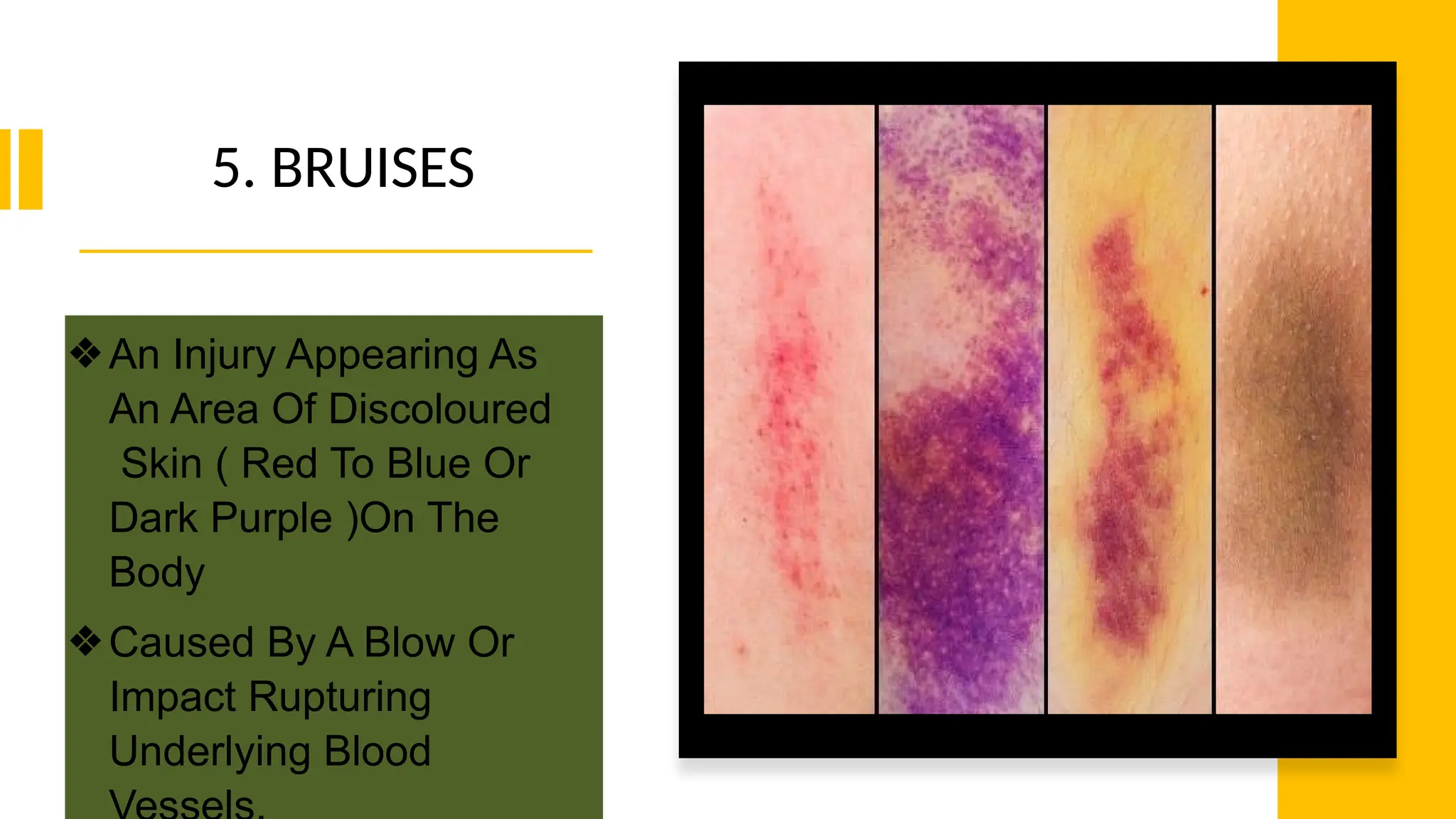
5. BRUISES
❖An InjuryAppearing As
An Area Of Discoloured
Skin ( Red To Blue Or
Dark Purple )On The
Body
❖Caused By A Blow Or
Impact Rupturing
Underlying Blood
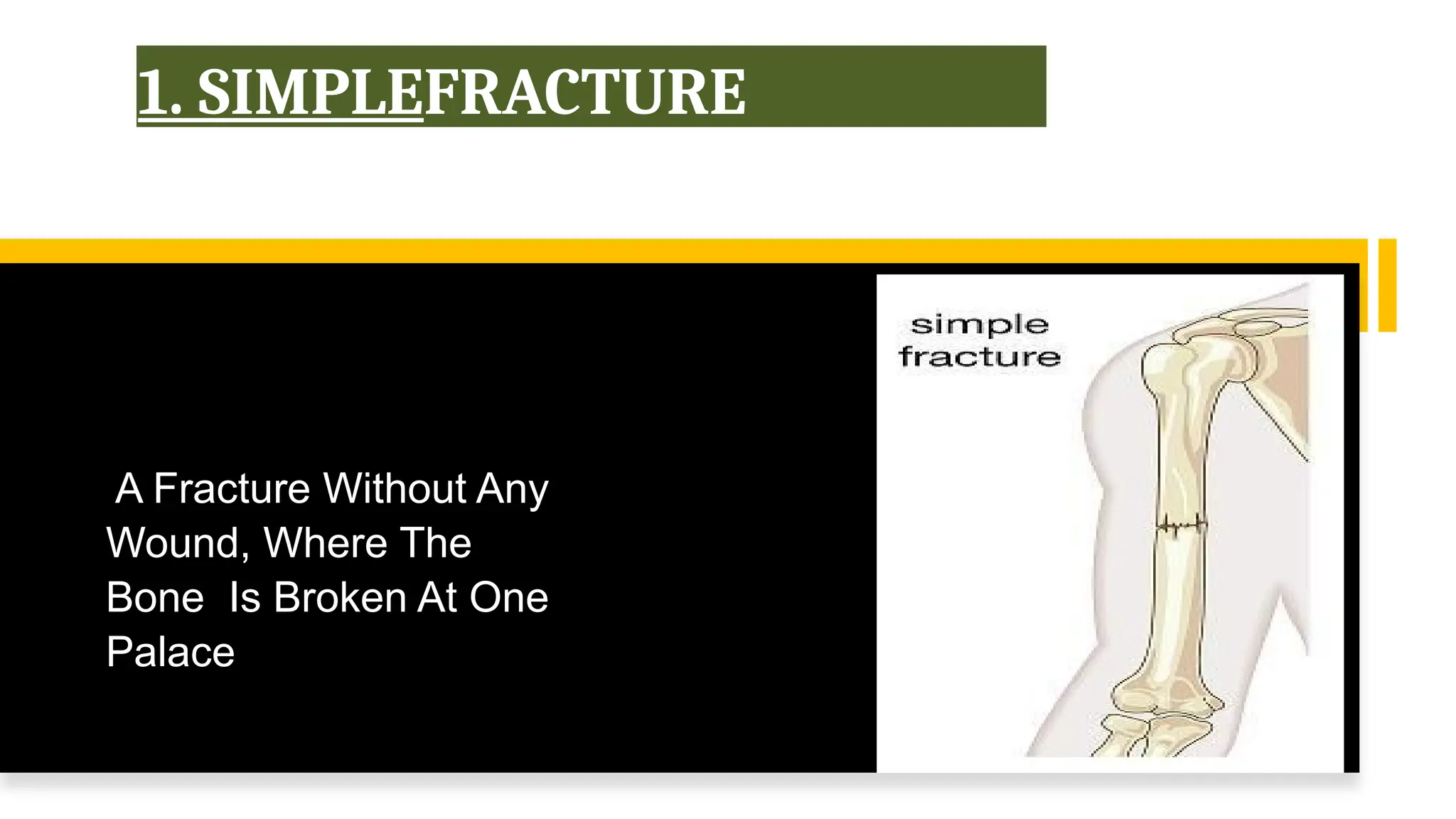
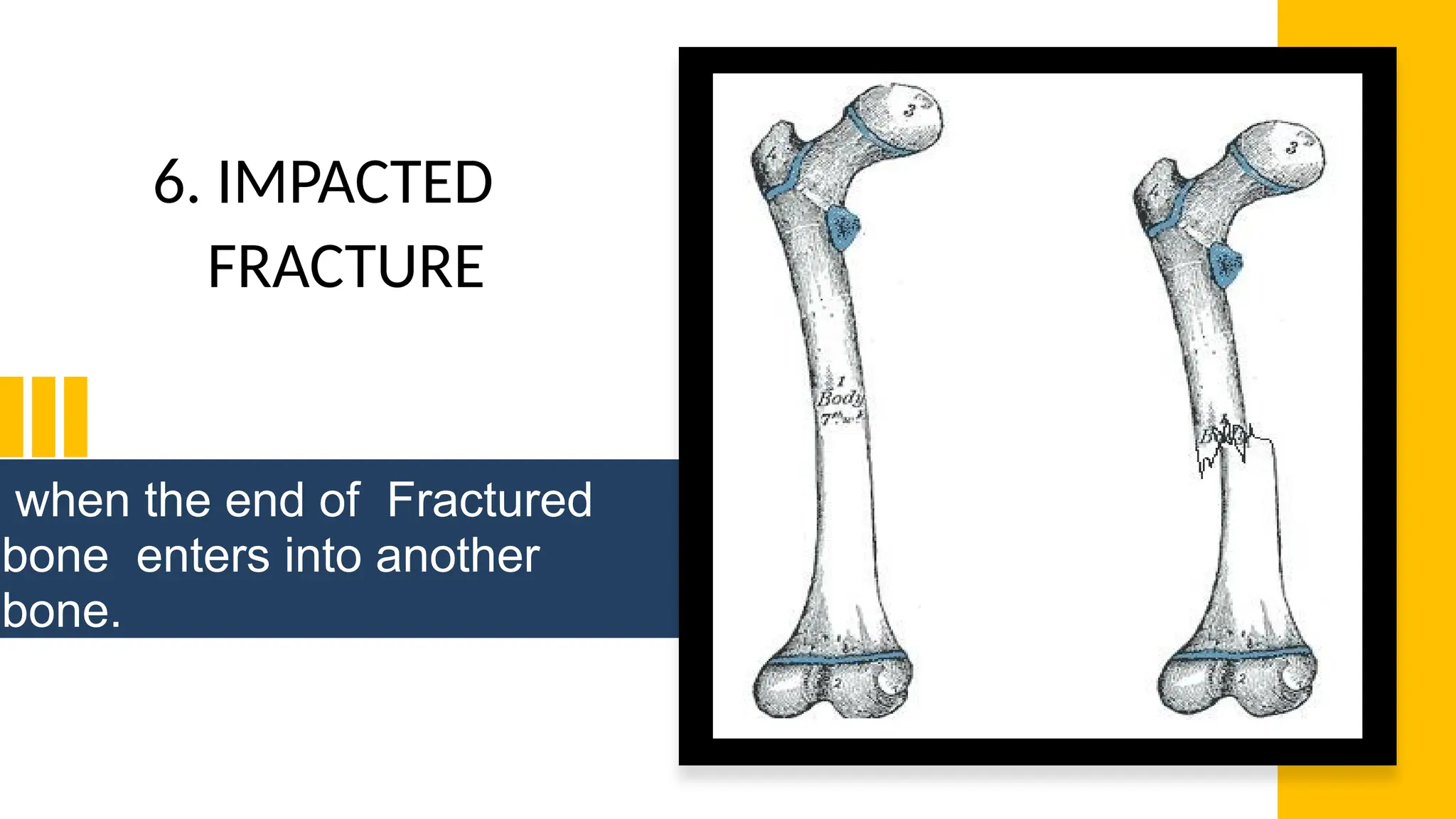
. COMPOUND
FRACTURE
❖Along WithFracture, Skin And
Muscles Are Also Damaged.
Generally, The Broken Bones
Comes Outside Tearing The
Skin.
27.
3. COMPLICATED
FRACTURE
❖ AlongWith Fracture, Internal Organs
Like
Tissues, Nerves Or Arteries Are
Damaged.
❖ Such Fractures Are Dangerous And Common
In
High Jump And Pole Vault
28.
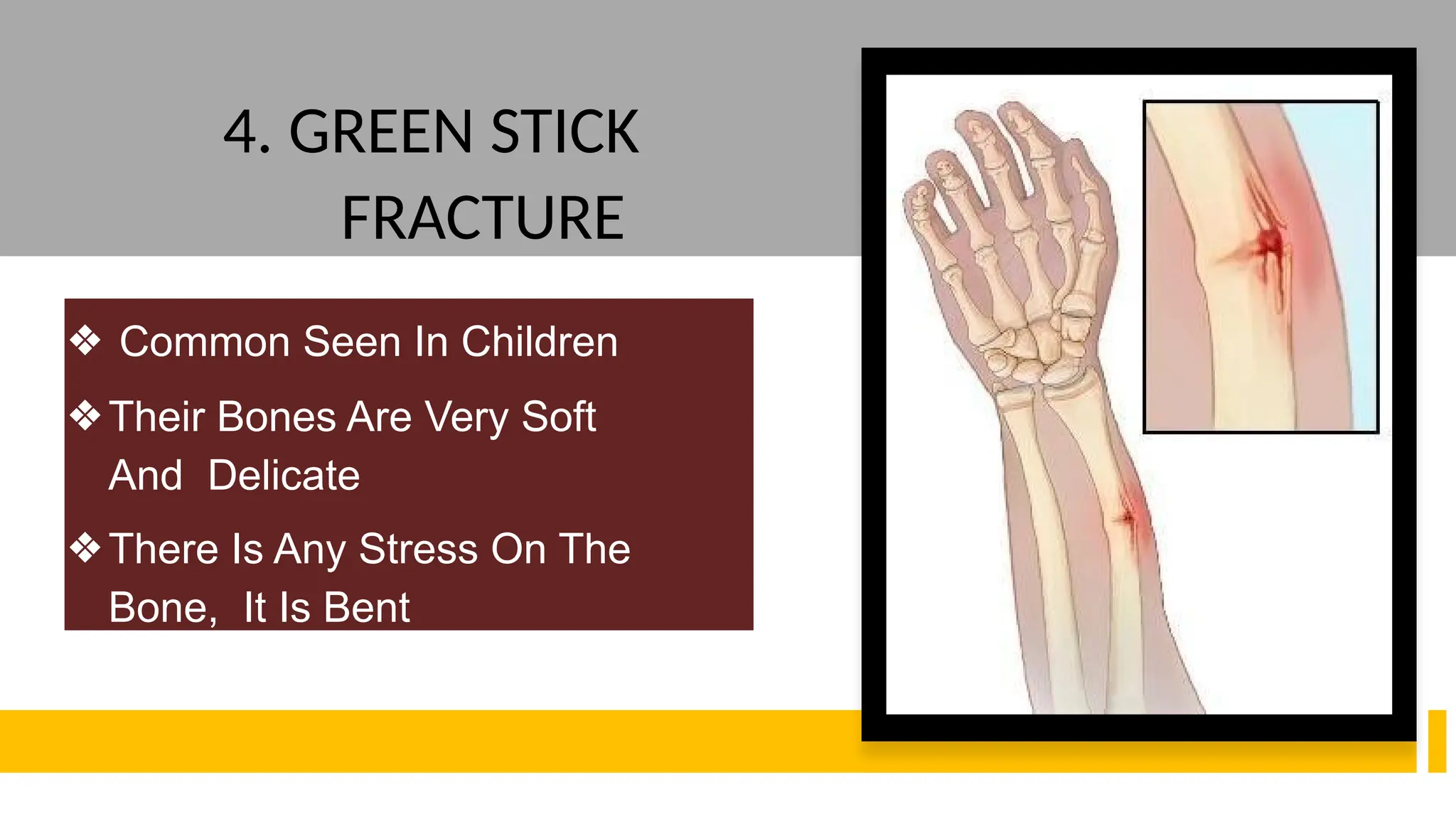
4. GREEN STICK
FRACTURE
❖Common Seen In Children
❖Their Bones Are Very Soft
And Delicate
❖There Is Any Stress On The
Bone, It Is Bent
CAUSES OF FRACTURE
InSuch Sports Event Where There Is A High
Impact. Traumatic, Forceful And Unnatural
Movements.
Prolonged Long Distance Walking Or Running.
Sudden Fall On Hard Surface.
Direct Strike Or Hit With Any Solid Sports
Equipment.
Osteoporosis
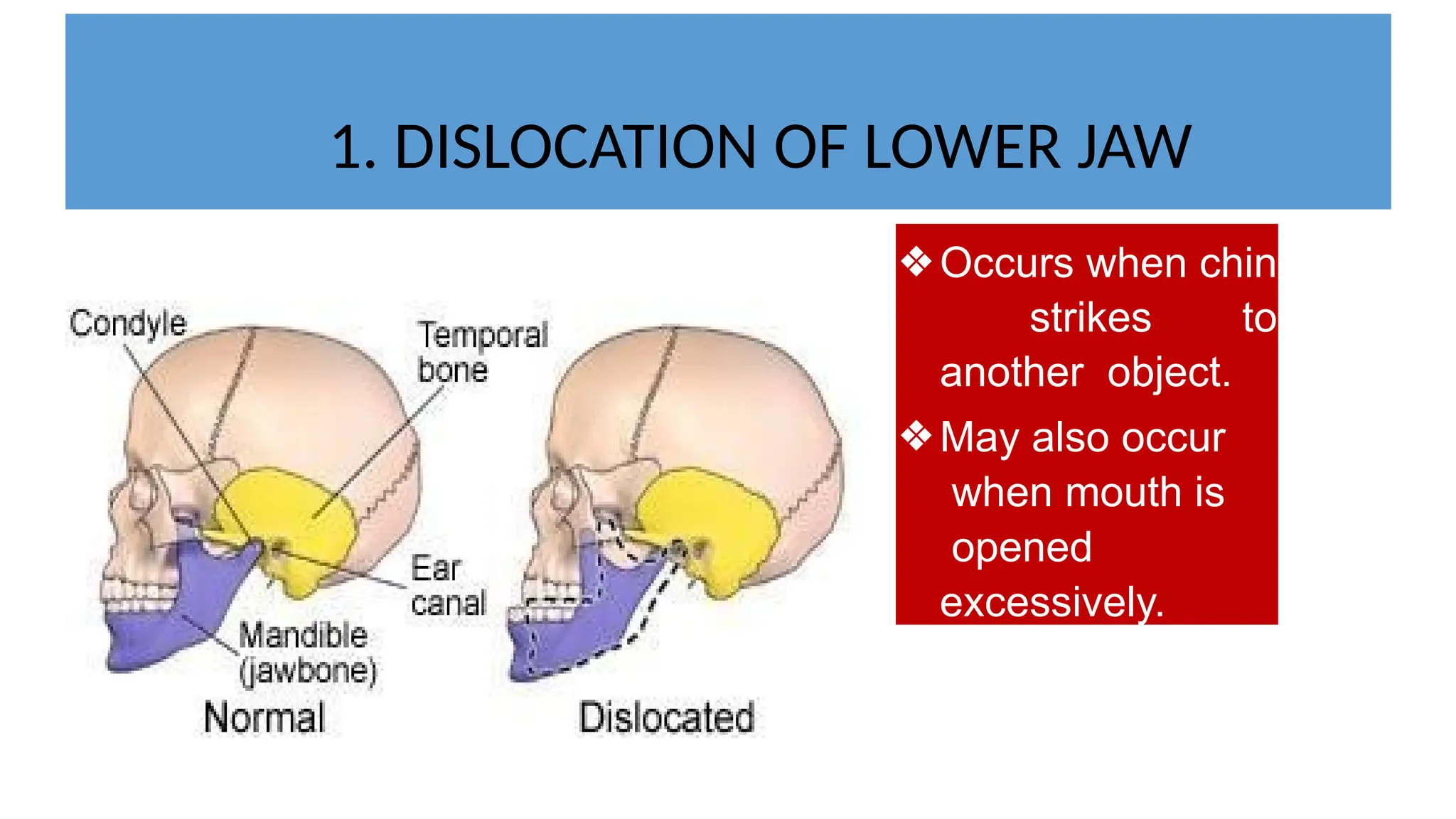
1. DISLOCATION OFLOWER JAW
❖Occurs when chin
strikes to
another object.
❖May also occur
when mouth is
opened
excessively.
35.
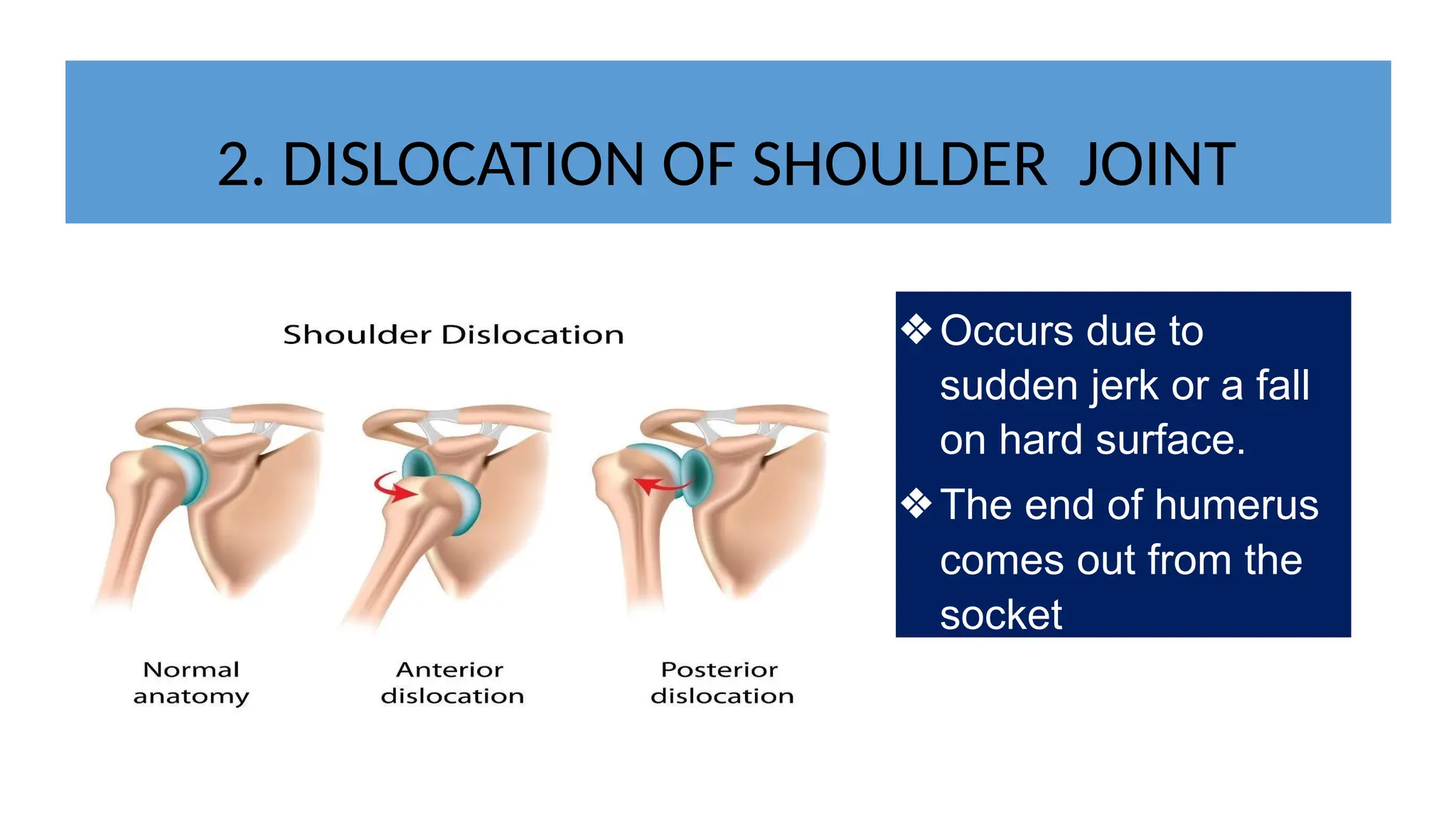
2. DISLOCATION OFSHOULDER JOINT
❖Occurs due to
sudden jerk or a fall
on hard surface.
❖The end of humerus
comes out from the
socket
36.
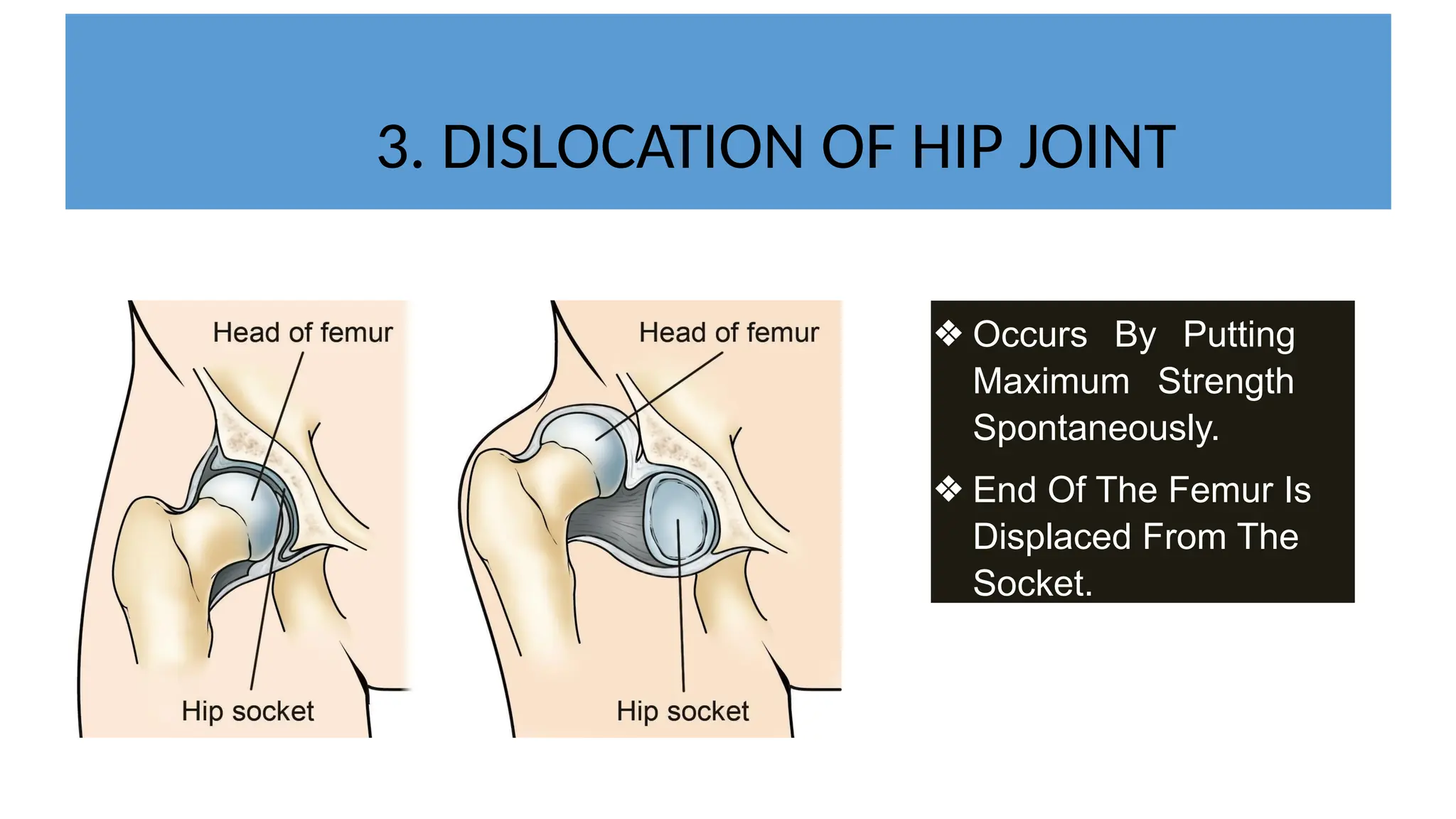
3. DISLOCATION OFHIP JOINT
❖ Occurs By Putting
Maximum Strength
Spontaneously.
❖ End Of The Femur Is
Displaced From The
Socket.
37.
CAUSES OF SPORTSINJURIES
Improper
Conditioning
Improper Warming-up
Unscientific Way Of
TrainingLack Of Fitness
Nutritional Inadequacy
Lack Of Sports
Facilities
Injudicious
38.
CAUSES OF SPORTSINJURIES (CONT.)
No Use Of Protective Equipment
Practice During The Stage Of
Fatigue Pressure Of Competition
Carelessness During The
Game Recurrence Of Injury
Improper Sports
Equipment Overuse Of
Muscles
39.
PREVENTION OF SPORTSINJURIES
Proper
Warm-
up
Proper
Conditioning
Balanced Diet
Proper
Knowledge Of
Sports Skills
Use Of
Protective
Equipment’
s
Proper
Sports
Facilities
Unbiased
Officiating
Don’t Do
Overtraining
Use Of Proper
Technique
Obeying
The
Rules
Proper Cooling
Down
40.
1. PROPER WARM-UP
❖Essential before training and competition.
❖ Tones up muscles for training and
competitions.
❖ Reduces chances of injuries.
❖ Routine should be of minimum of 10
minutes.
❖ Start with gentle exercises to brisk
exercises.
❖ Put more emphasis on muscles which will
be used in the training or competition.
41.
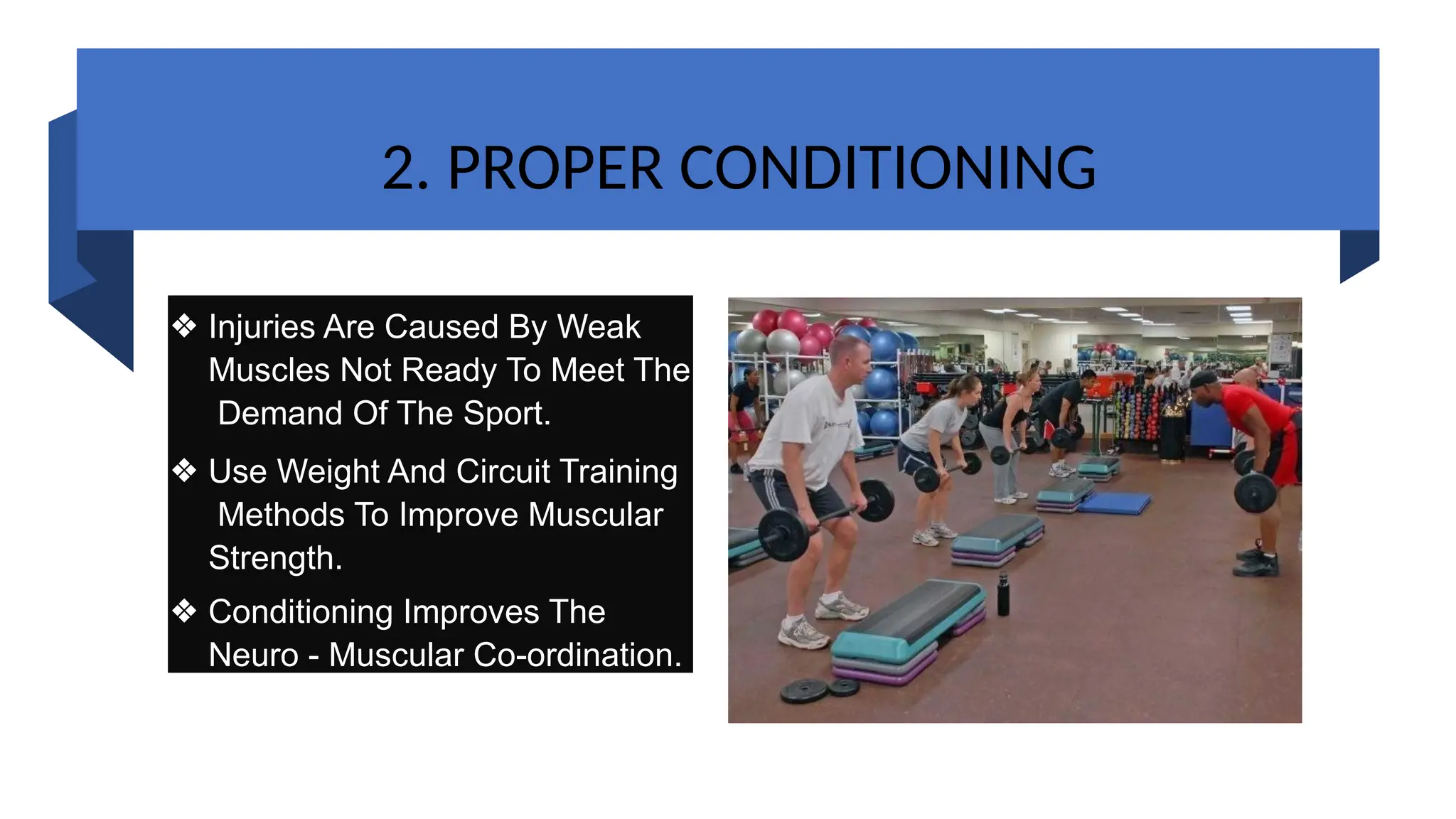
2. PROPER CONDITIONING
❖Injuries Are Caused By Weak
Muscles Not Ready To Meet The
Demand Of The Sport.
❖ Use Weight And Circuit Training
Methods To Improve Muscular
Strength.
❖ Conditioning Improves The
Neuro - Muscular Co-ordination.
42.
3. BALANCED DIET
❖Lack Of Essential
Minerals And Vitamins
Such As Calcium,
Phosphorus And Vitamin D
Etc. Make Bones Weak.
❖ Weak Bones
Lead To Sports
Injuries.
43.
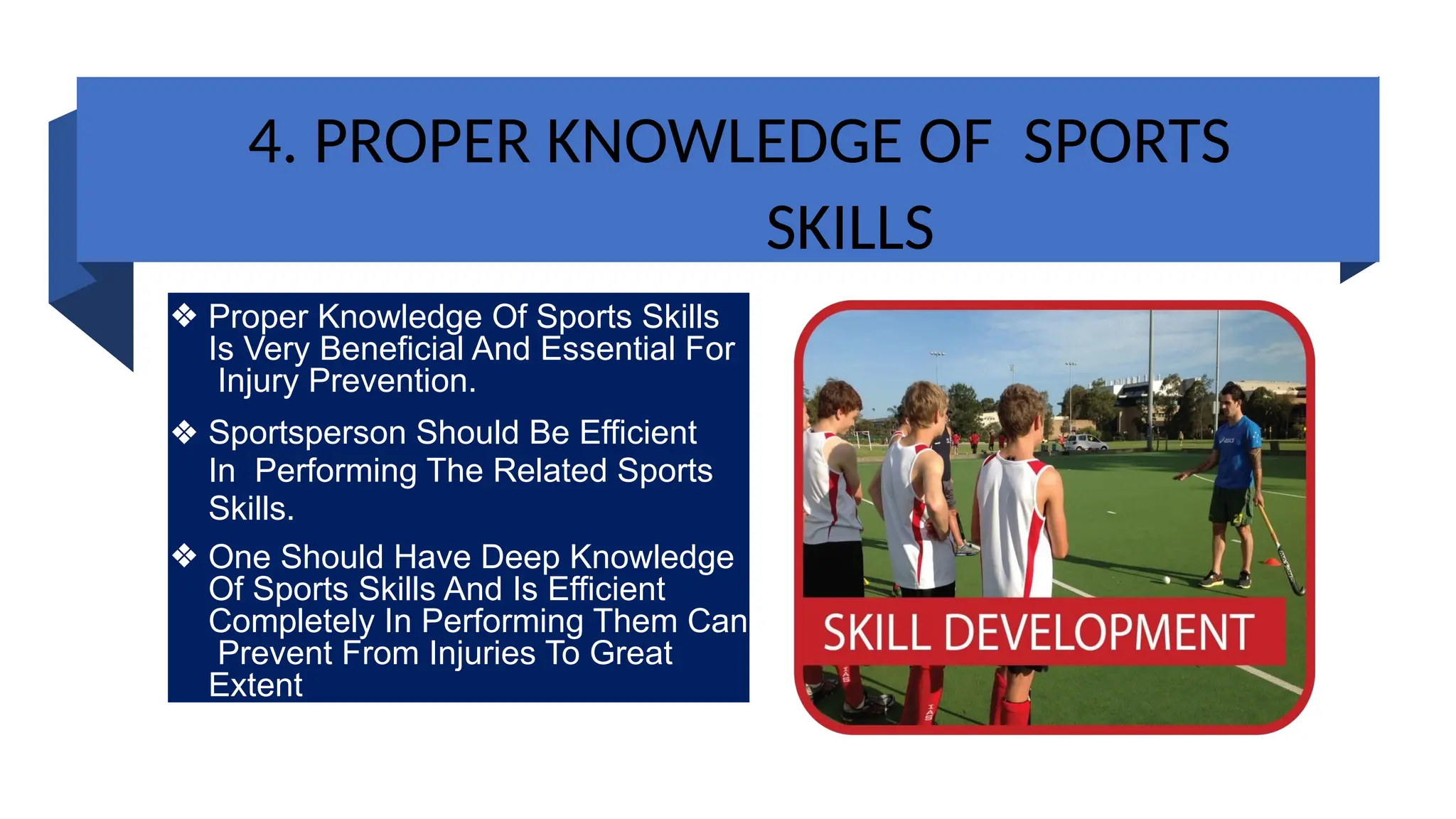
4. PROPER KNOWLEDGEOF SPORTS
SKILLS
❖ Proper Knowledge Of Sports Skills
Is Very Beneficial And Essential For
Injury Prevention.
❖ Sportsperson Should Be Efficient
In Performing The Related Sports
Skills.
❖ One Should Have Deep Knowledge
Of Sports Skills And Is Efficient
Completely In Performing Them Can
Prevent From Injuries To Great
Extent
44.
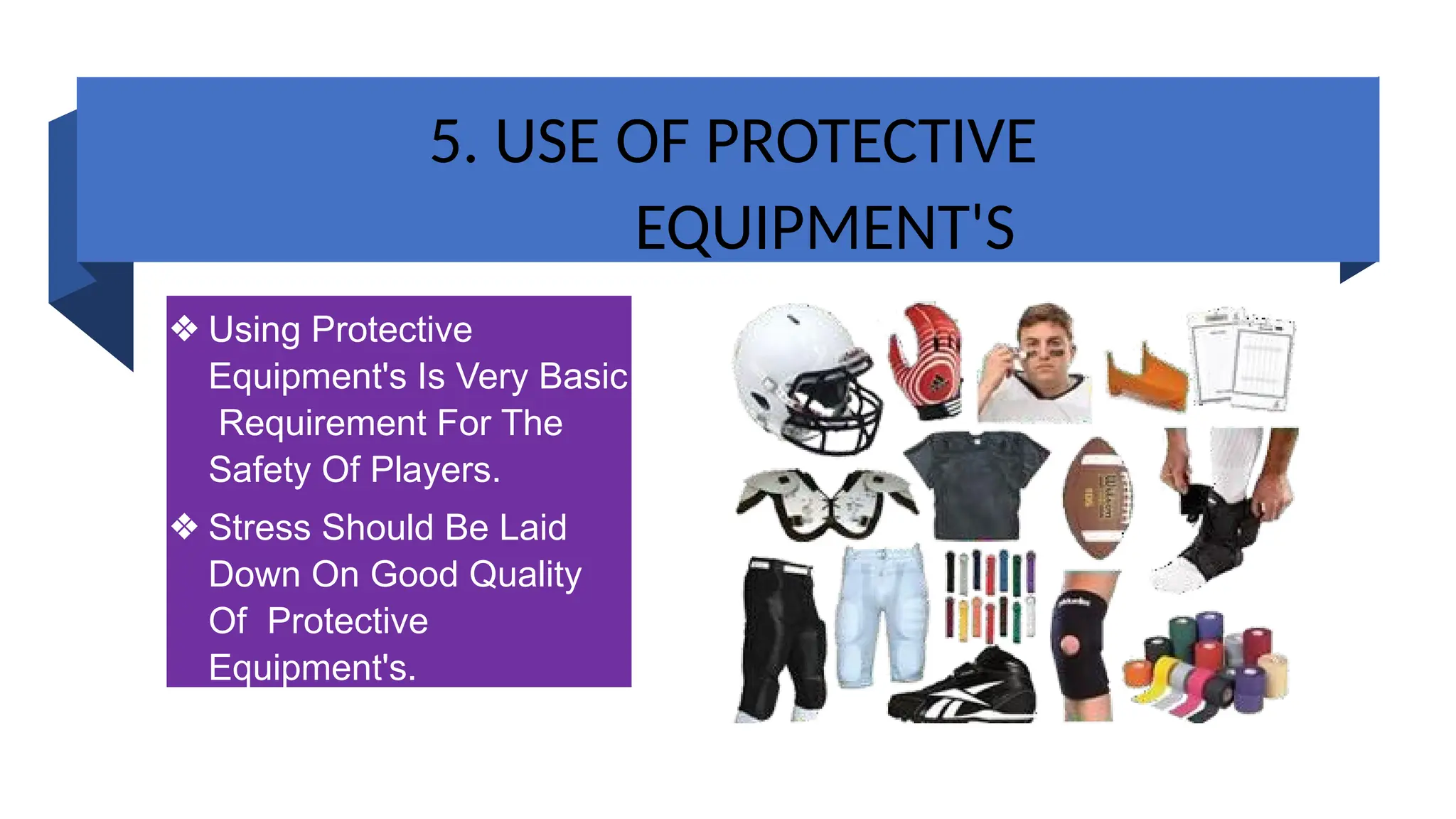
5. USE OFPROTECTIVE
EQUIPMENT'S
❖ Using Protective
Equipment's Is Very Basic
Requirement For The
Safety Of Players.
❖ Stress Should Be Laid
Down On Good Quality
Of Protective
Equipment's.
45.
6. PROPER SPORTSFACILITIES
❖ With Proper Warm-up And Skills
Etc., Proper Facilities For The
Training And Competitions Is Also
Very Important For Prevention
From Injuries.
❖ Outdoor Grounds Or Indoor Halls
Should Be Maintained Properly For
The Training.
❖ Specially Surface, For The Particular
Sport Should Be Maintained(example
Landing Pit For High Jumpers).
46.
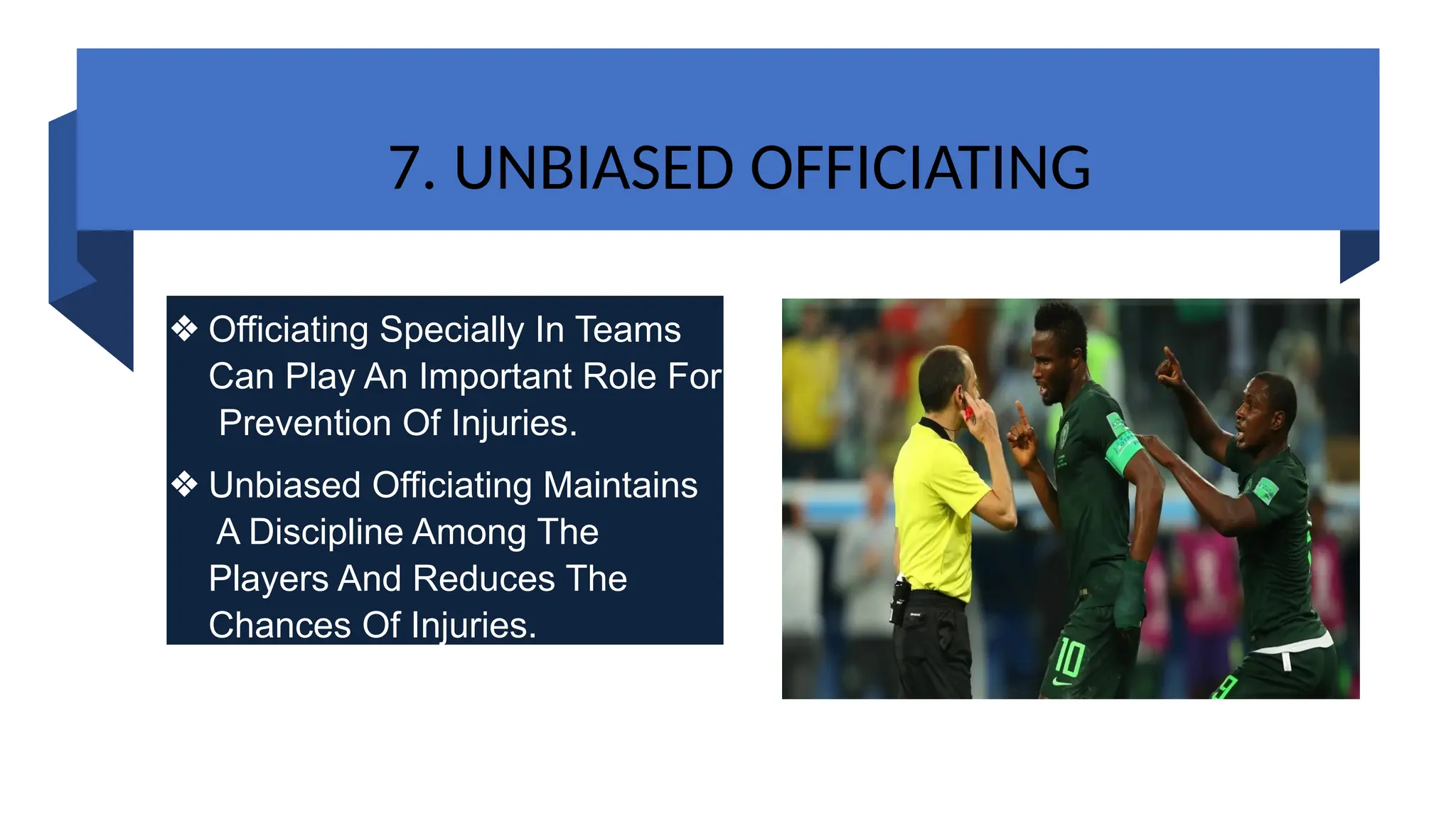
7. UNBIASED OFFICIATING
❖Officiating Specially In Teams
Can Play An Important Role For
Prevention Of Injuries.
❖ Unbiased Officiating Maintains
A Discipline Among The
Players And Reduces The
Chances Of Injuries.
47.
8. DON’T DOOVERTRAINING
❖ Over Training In The Beginning
For The Beginners Causes Sports
Injury.
❖ Beginners Should Avoid Doing Too
Much Too Soon.
❖ If One Is Training After A Long Gap
Of Time, It Should Be Increased
Wisely Otherwise There Are More
Chances Of Injuries.
48.
9. USE OFPROPER TECHNIQUE
❖ Using Right Technique In Training
And Playing Of Particular Sport,
Prevent From Injuries .
❖ Wrong Techniques May
Cause Tendonitis Or
Fractures.
❖ One Should Always Train
Under Expert Guidance And
Supervision.
49.
10. OBEYING THERULES
❖ Obeying The Rules Of Particular
Game During Training And
Competition Prevents From
Injuries.
❖ On The Other Hand If Player Is
Not Obeying The Rules Of The
Game, He Is More Likely To Get
Injured .
50.
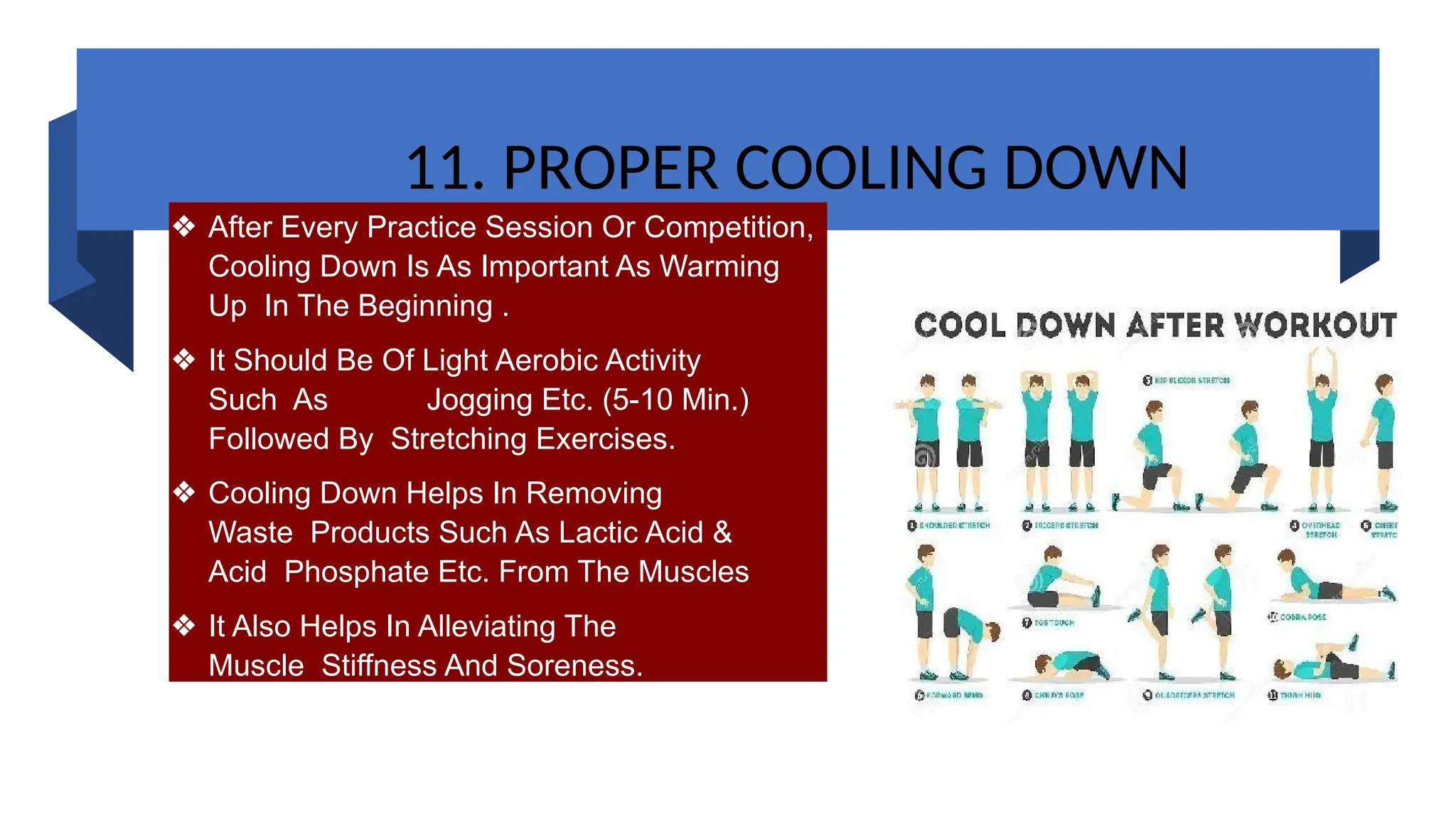
11. PROPER COOLINGDOWN
❖ After Every Practice Session Or Competition,
Cooling Down Is As Important As Warming
Up In The Beginning .
❖ It Should Be Of Light Aerobic Activity
Such As Jogging Etc. (5-10 Min.)
Followed By Stretching Exercises.
❖ Cooling Down Helps In Removing
Waste Products Such As Lactic Acid &
Acid Phosphate Etc. From The Muscles
❖ It Also Helps In Alleviating The
Muscle Stiffness And Soreness.
51.
TIPS FOR PREVENTINGSPORTS INJURIES
1. Avoid Training When You Are Tired.
2. Have More Carbohydrates When Under Going Rigorous Training.
3. Increase Resting Time If Training Time Is Increased.
4. Increase In Training Should Be Preceded By Increase In
Conditioning (Strengthening).
5. Don’t Ignore Minor Injuries As They Tend To Become Major Injuries .
6. If Pain Is Felt During Training, Stop Training Session Immediately.
7. Never Train Hard If Stiffness From The Previous Session Still Exists.
52.
TIPS FOR PREVENTINGSPORTS INJURIES
(CONT.)
8. Pay Attention To Hydration And Nutrition.
9. Use Appropriate Training Surface.
10. Training And Competition Area Should Be Free Of Hazards.
11. Use Safe And Appropriate Equipment's.
12. Introduce New Activities Gradually.
13. Allow Lot Of Time For Warming Up And Cooling Down.
14. Check Training And Competition Schedules Beforehand.
53.
TIPS FOR PREVENTINGSPORTS INJURIES
(CONT.)
15. When Training On Different Surfaces , Use The Proper Footwear.
16. Change To Dry Clothes After Cooling Down.
17. Aim For Maximum Comfort When Travelling.
18. Stay Away From Infectious Area When Training.
19. Be More Vigilant About Hygiene In Hot Weather.
20. If Any Sign Of Fatigue Before Training Session, Ease Off.
21. Have Regular Sports Massage.
ABRASION
❖ Injured PartShould Be Washed
With Clean Water/Antiseptic Liquid.
❖ Dressing Should Be Done Lightly
If Abrasion Is Serious.
❖ Anti-tetanus Injection Should
Be Taken.
❖ Painkiller Should Be Given In
Case Of Severe Pain.
56.
CONTUSION
❖ Cold CompressionShould Be Used
Immediately For Around Half An
Hour.
❖ Cold Compression Should Be
Performed Five To Six Times Daily.
❖ In Case Of More Swelling At The
Injured Part Anti – Inflammatory
Medicine Should Be Given.
❖ If The Swelling Still Persist, Consult
The Doctor.
❖ For Rehabilitation, Flexibility
Exercises Should Be Done Carefully.
57.
LACERATION
MEANING
❖ A Lacerationis an
irregular cut in
the skin from a
sharp object or
sharp edged
sports
equipment.
❖ Bleeding is less but
these wounds are more
dangerous.
TREATMENT
❖ Stop The Flow Of Blood By Applying Firm Pressure To The Laceration With A Clean Cloth Or
Gauze. A Small Amount Of Blood Is Advantageous In Cleansing The Wound, But Large Amounts
Of Blood Loss Can Be Dangerous.
❖ Properly Clean The Wound. Remove All Dirt And Debris By First Running Cool Water Over The
Area, And Then Clean With A Sterile Cloth, Warm Water, And Mild Soap.
❖ Apply Antibiotic Ointment, And Then Cover The Wound Area With A Sterile Gauze Bandage And
First-aid Tape.
❖ Clean The Wound Area Daily With Soap And Water And Apply A Fresh Sterile Bandage.
❖ For A Minor Laceration, Remove The Bandage After A Couple Of Days To Promote Healing.
❖ If The Affected Person Requires Stitches, Take Him/Her To The Doctor.
58.
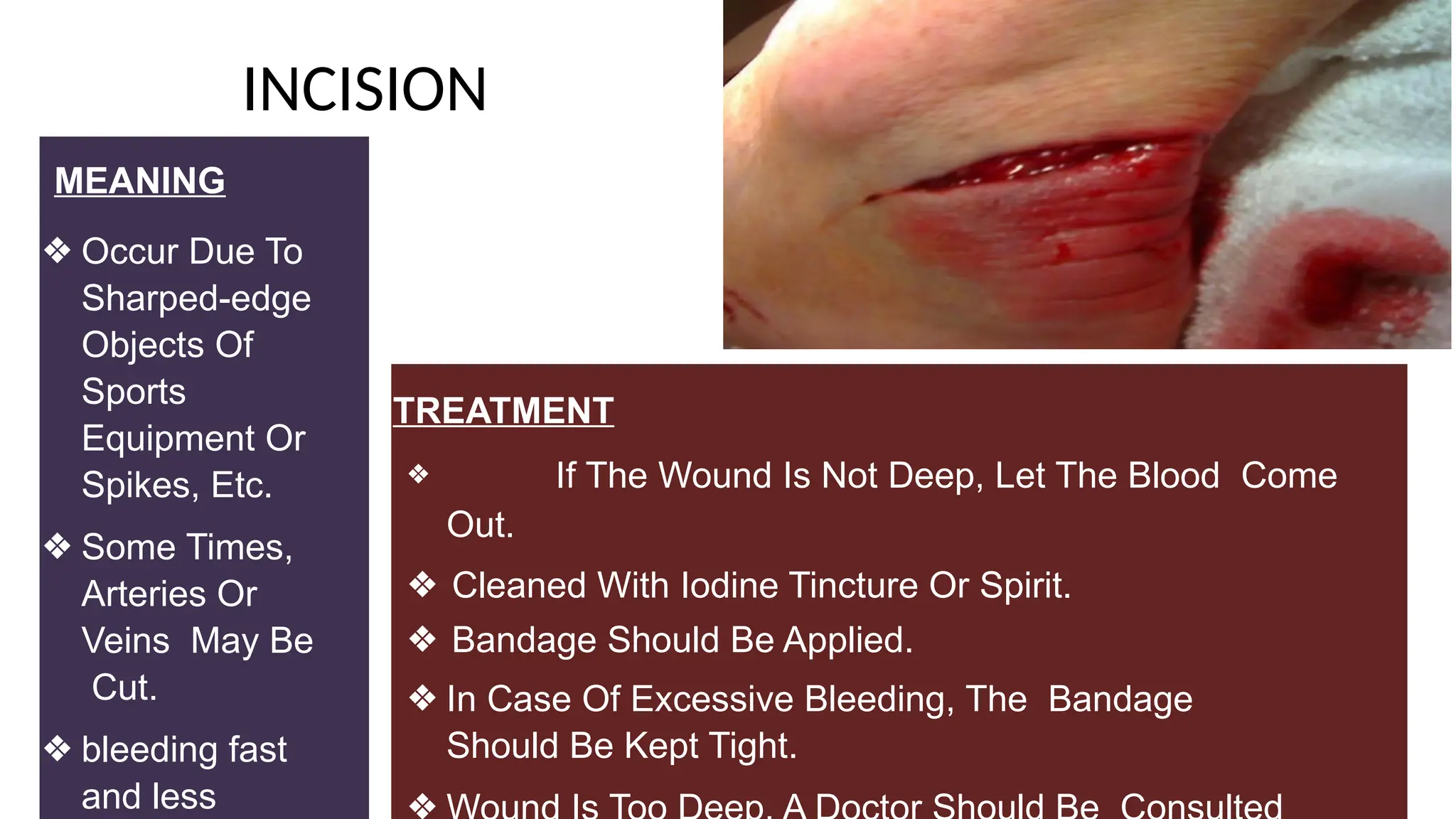
INCISION
MEANING
❖ Occur DueTo
Sharped-edge
Objects Of
Sports
Equipment Or
Spikes, Etc.
❖ Some Times,
Arteries Or
Veins May Be
Cut.
❖ bleeding fast
and less
TREATMENT
❖ If The Wound Is Not Deep, Let The Blood Come
Out.
❖ Cleaned With Iodine Tincture Or Spirit.
❖ Bandage Should Be Applied.
❖ In Case Of Excessive Bleeding, The Bandage
Should Be Kept Tight.
59.
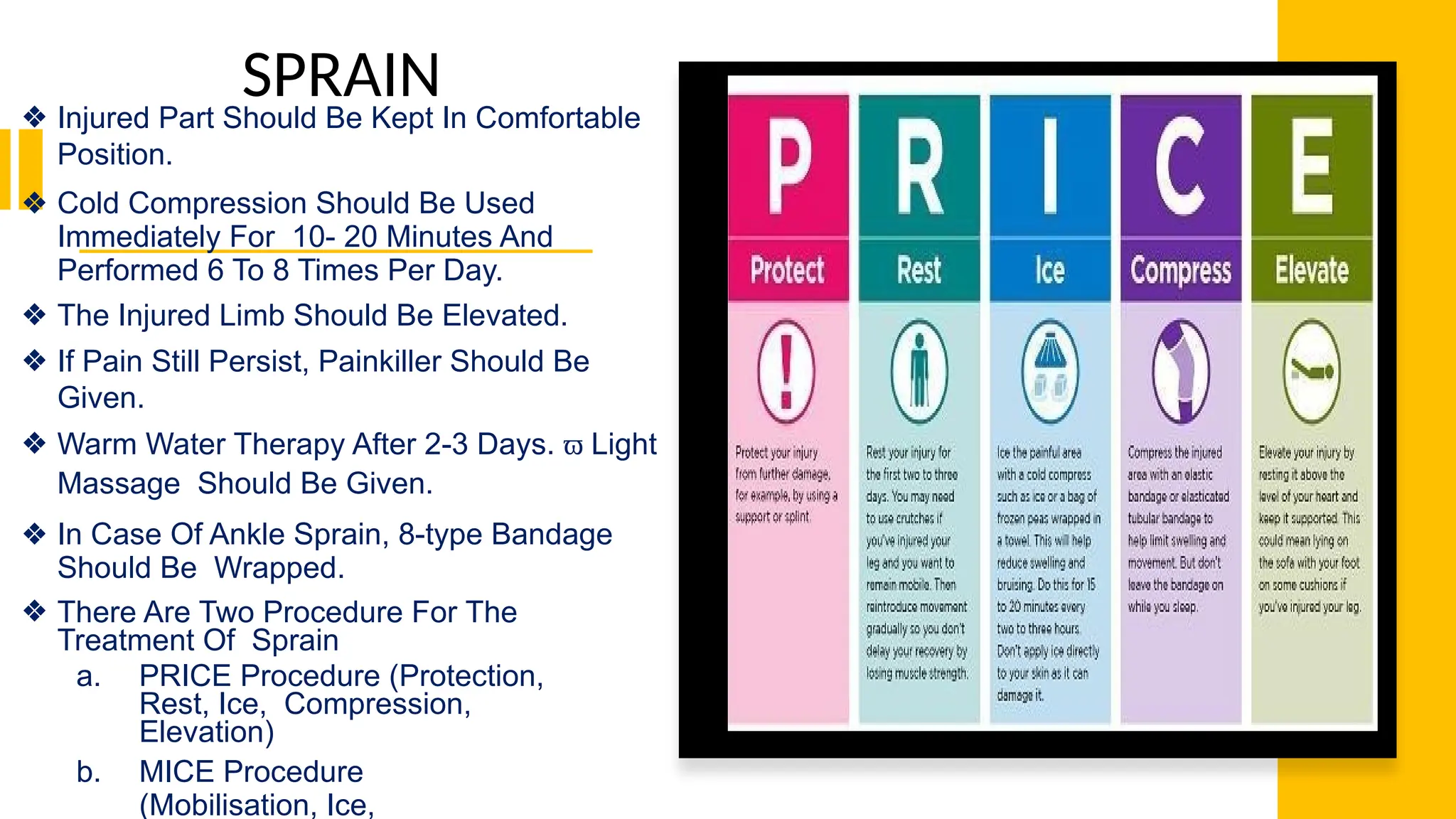
SPRAIN
❖ Injured PartShould Be Kept In Comfortable
Position.
❖ Cold Compression Should Be Used
Immediately For 10- 20 Minutes And
Performed 6 To 8 Times Per Day.
❖ The Injured Limb Should Be Elevated.
❖ If Pain Still Persist, Painkiller Should Be
Given.
❖ Warm Water Therapy After 2-3 Days. ϖ Light
Massage Should Be Given.
❖ In Case Of Ankle Sprain, 8-type Bandage
Should Be Wrapped.
❖ There Are Two Procedure For The
Treatment Of Sprain
a. PRICE Procedure (Protection,
Rest, Ice, Compression,
Elevation)
b. MICE Procedure
(Mobilisation, Ice,
60.
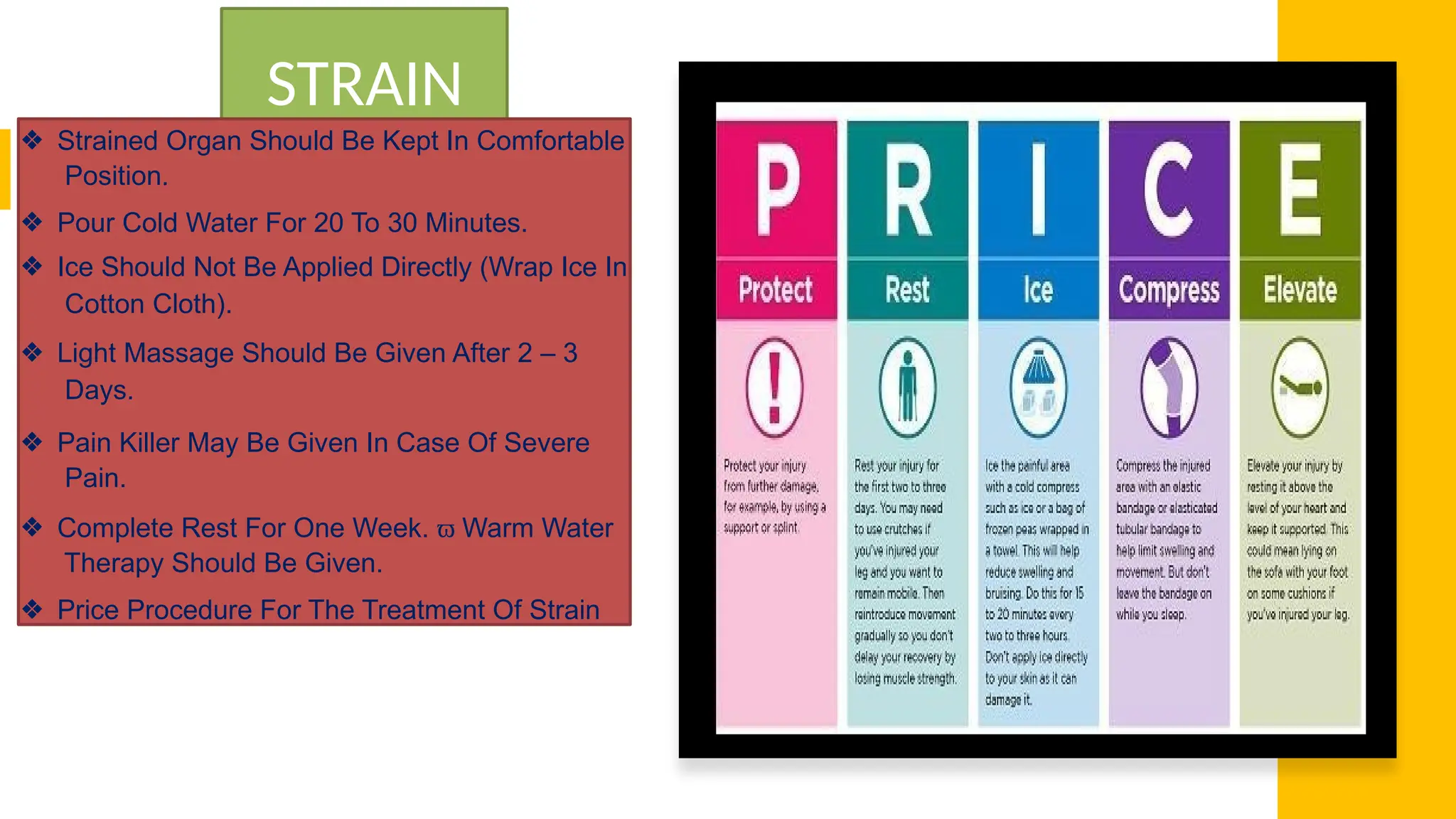
STRAIN
❖ Strained OrganShould Be Kept In Comfortable
Position.
❖ Pour Cold Water For 20 To 30 Minutes.
❖ Ice Should Not Be Applied Directly (Wrap Ice In
Cotton Cloth).
❖ Light Massage Should Be Given After 2 – 3
Days.
❖ Pain Killer May Be Given In Case Of Severe
Pain.
❖ Complete Rest For One Week. ϖ Warm Water
Therapy Should Be Given.
❖ Price Procedure For The Treatment Of Strain
61.
TREATMENT OF
DISLOCATION
❖ CallMedical Help Immediately.
❖ Don’t Try To Move The Joint Or To Place It Back
In The Socket.
❖ Keep Ice On The Spot Of Dislocation To Control
Swelling.
❖ Sling Or Splint The Affected Joint Into Fixed
Position.
❖ Immobilize The Affected Limb By Bandage.
❖ Don’t Try To Adjust The Dislocated Limb Without
A Doctor.
❖ Athlete Should Be Taken To Hospital On
Stretcher.
62.
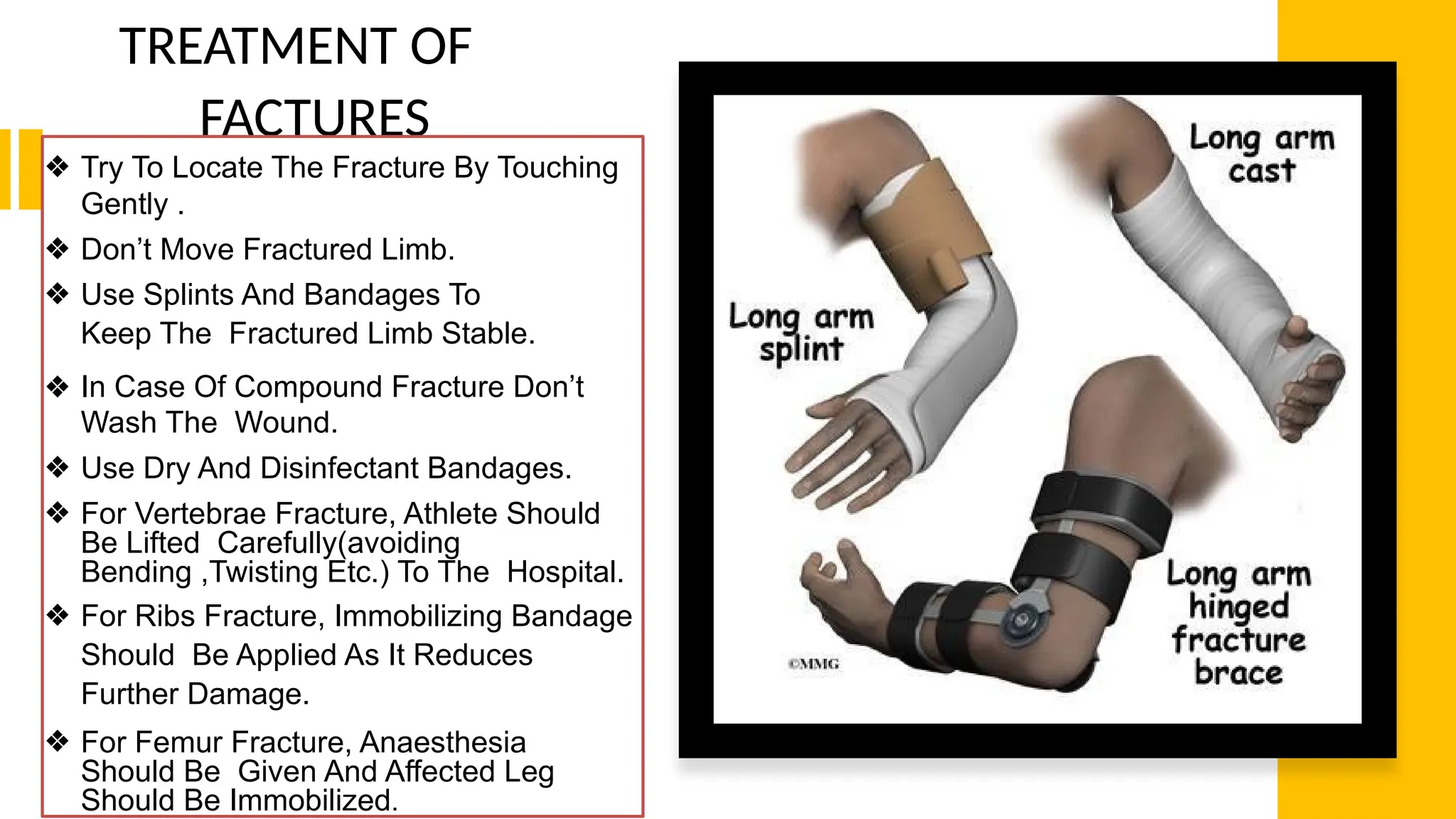
TREATMENT OF
FACTURES
❖ TryTo Locate The Fracture By Touching
Gently .
❖ Don’t Move Fractured Limb.
❖ Use Splints And Bandages To
Keep The Fractured Limb Stable.
❖ In Case Of Compound Fracture Don’t
Wash The Wound.
❖ Use Dry And Disinfectant Bandages.
❖ For Vertebrae Fracture, Athlete Should
Be Lifted Carefully(avoiding
Bending ,Twisting Etc.) To The Hospital.
❖ For Ribs Fracture, Immobilizing Bandage
Should Be Applied As It Reduces
Further Damage.
❖ For Femur Fracture, Anaesthesia
Should Be Given And Affected Leg
Should Be Immobilized.
63.
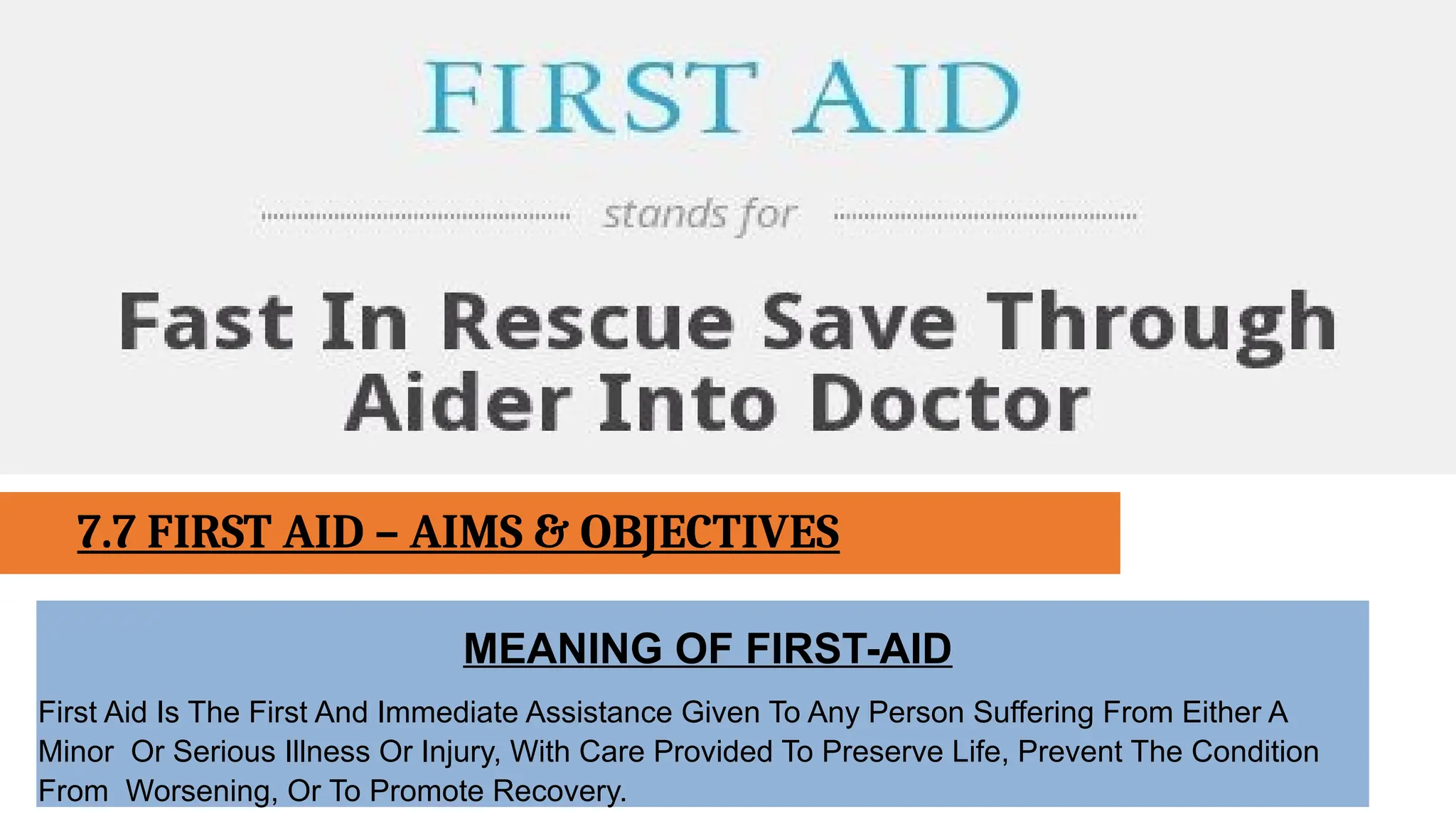
7.7 FIRST AID– AIMS & OBJECTIVES
MEANING OF FIRST-AID
First Aid Is The First And Immediate Assistance Given To Any Person Suffering From Either A
Minor Or Serious Illness Or Injury, With Care Provided To Preserve Life, Prevent The Condition
From Worsening, Or To Promote Recovery.
64.
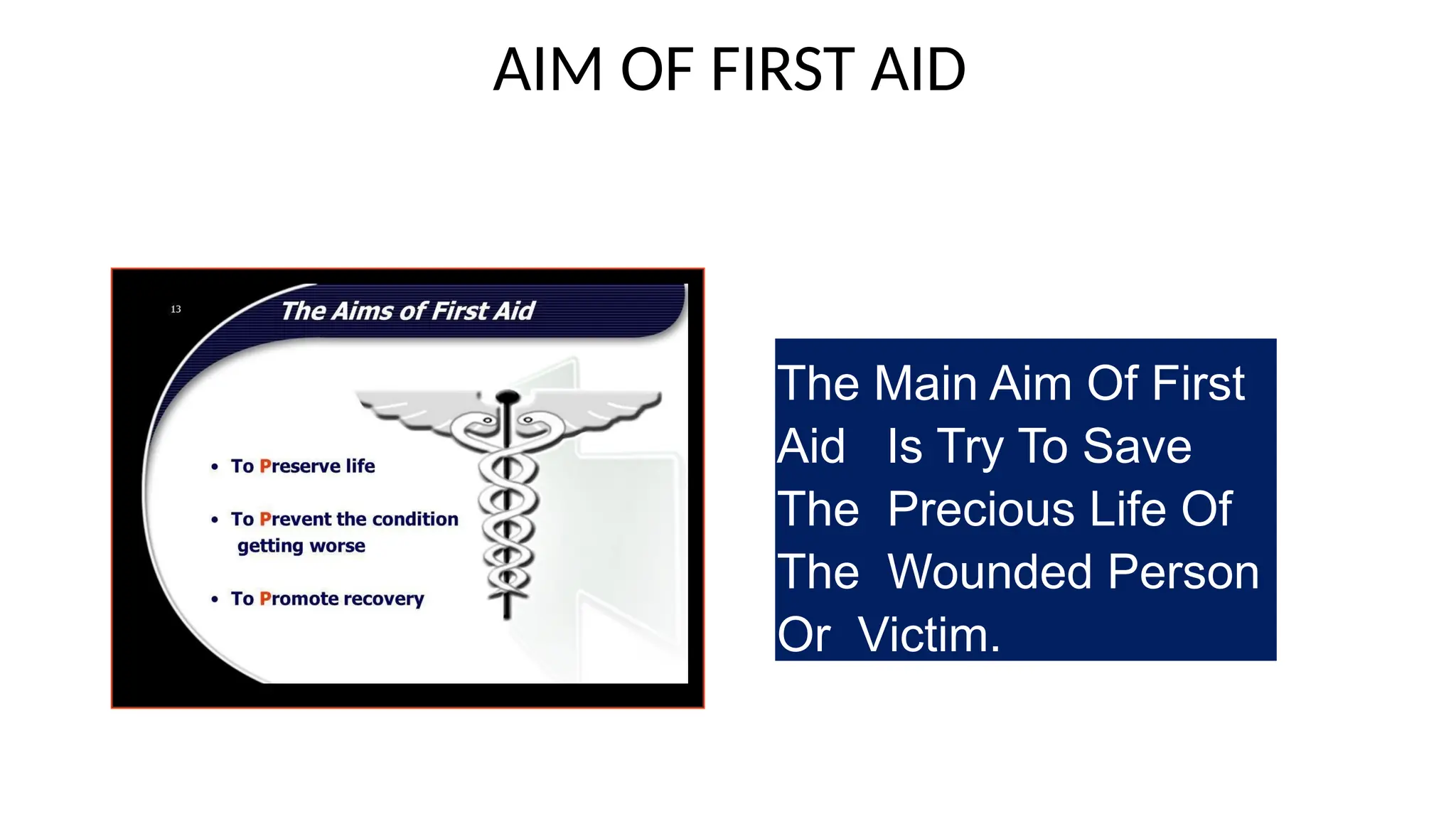
AIM OF FIRSTAID
The Main Aim Of First
Aid Is Try To Save
The Precious Life Of
The Wounded Person
Or Victim.
65.
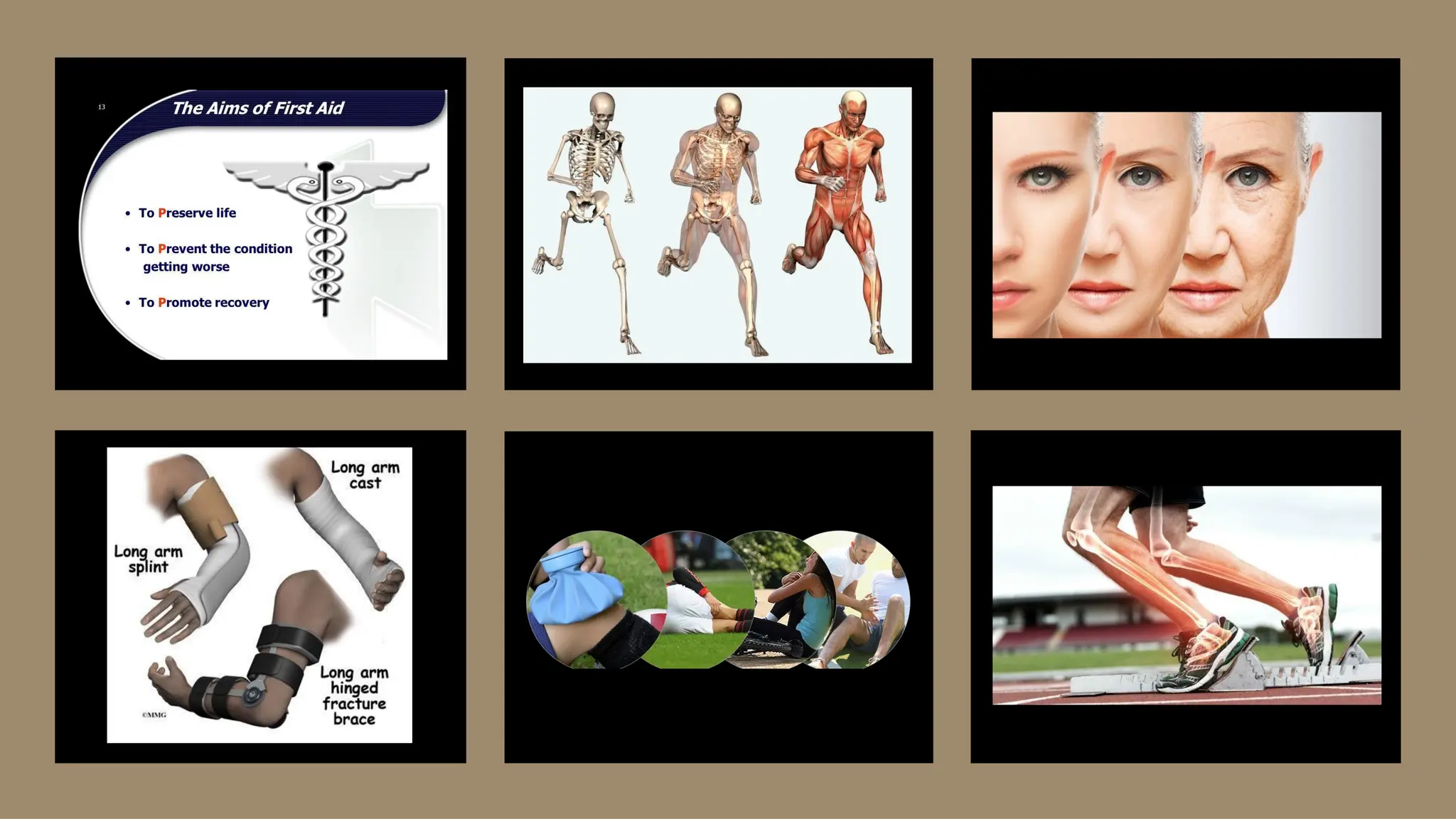
❖ To PreserveLife
❖ To Alleviate Pain And Suffering
❖ To Prevent The Condition From Worsening
❖ To Promote Recovery
❖ To Procure Early Medical Aid
OBJECTIVES OF FIRST AID