Civil Engineering Department
Soran University
Building Material Science
Fall 2021
This slide is only used for the classes at Soran University and not for distribution
In the Name of Allah
Chapter 5 (Gypsum and Lime)
Seventh Week
Fall 2021
Chapter five,
Rizgar A. Omar, MSC
Email:
rizgar.omar@soran.edu.iq
This slide is only used for the classes at Soran University and not for distribution
1. Gypsum
This slide is only used for the classes at Soran University and not for distribution
 Introduction
 Classification
 Manufacturing
 Technical Requirements of Building Gypsum
 Characteristics of Building Gypsum
 Applications of Building Gypsum
This slide is only used for the classes at Soran University and not for distribution
 Introduction
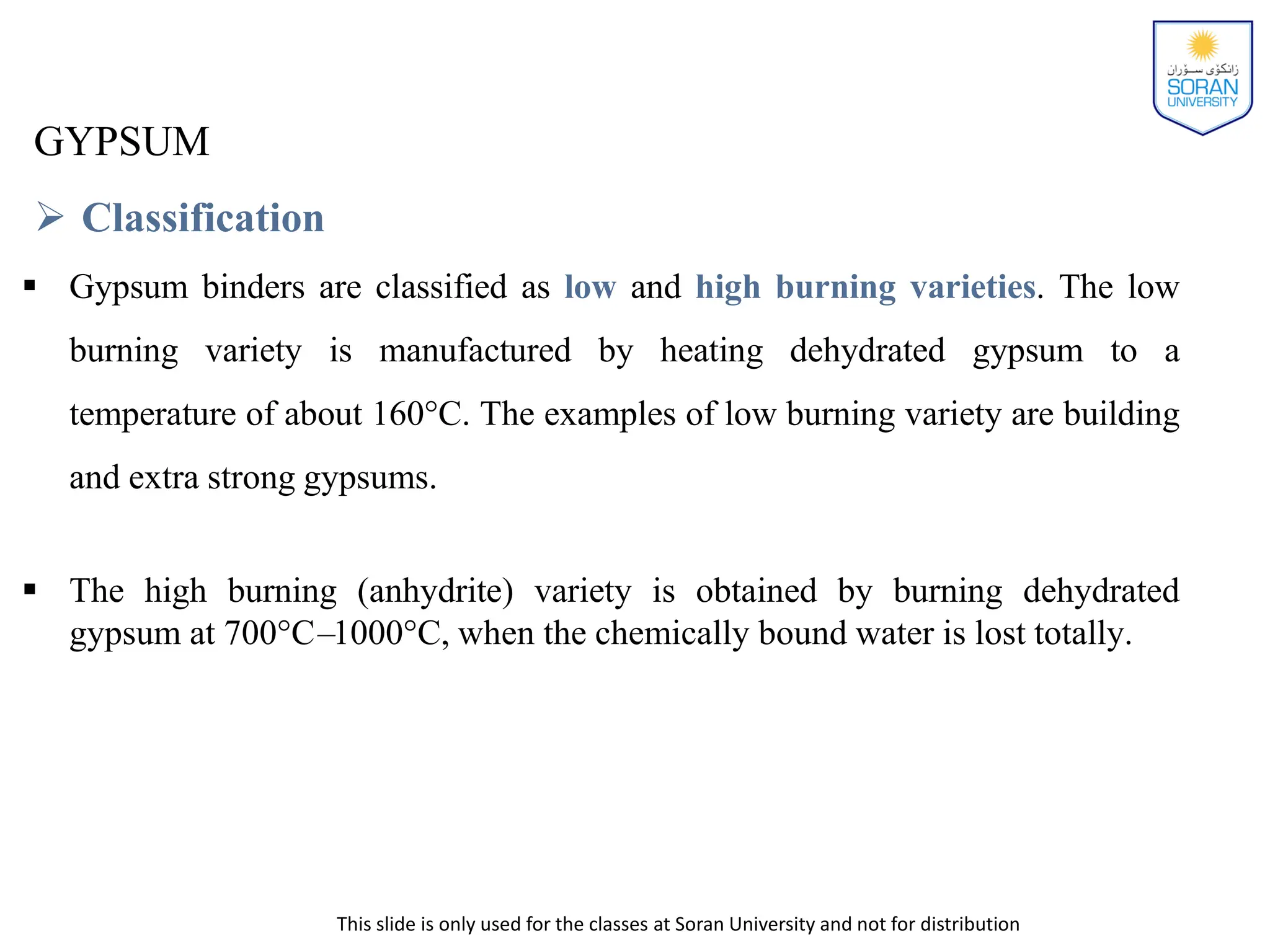
 Gypsum is a non-hydraulic binder occurring naturally as a soft crystalline rock
or sand. Pure gypsum is a white translucent crystalline mineral and is so soft
that it can be scratched by a finger nail.
 Gypsum has a unique property of moulding. When heated it gives up
combined water and easily turns into powder. On adding water to the powder
it can easily be shaped and moulded, and in a short time it hardens again and
becomes similar to what it was in its natural state.
 Building gypsum is an air-setting binder composed mainly of semihydrate
gypsum and obtained by processing gypsum at temperatures 150°C– 160°C.
This slide is only used for the classes at Soran University and not for distribution
GYPSUM
 Classification
 Gypsum binders are classified as low and high burning varieties. The low
burning variety is manufactured by heating dehydrated gypsum to a
temperature of about 160°C. The examples of low burning variety are building
and extra strong gypsums.
 The high burning (anhydrite) variety is obtained by burning dehydrated
gypsum at 700°C–1000°C, when the chemically bound water is lost totally.
This slide is only used for the classes at Soran University and not for distribution
 Manufacture
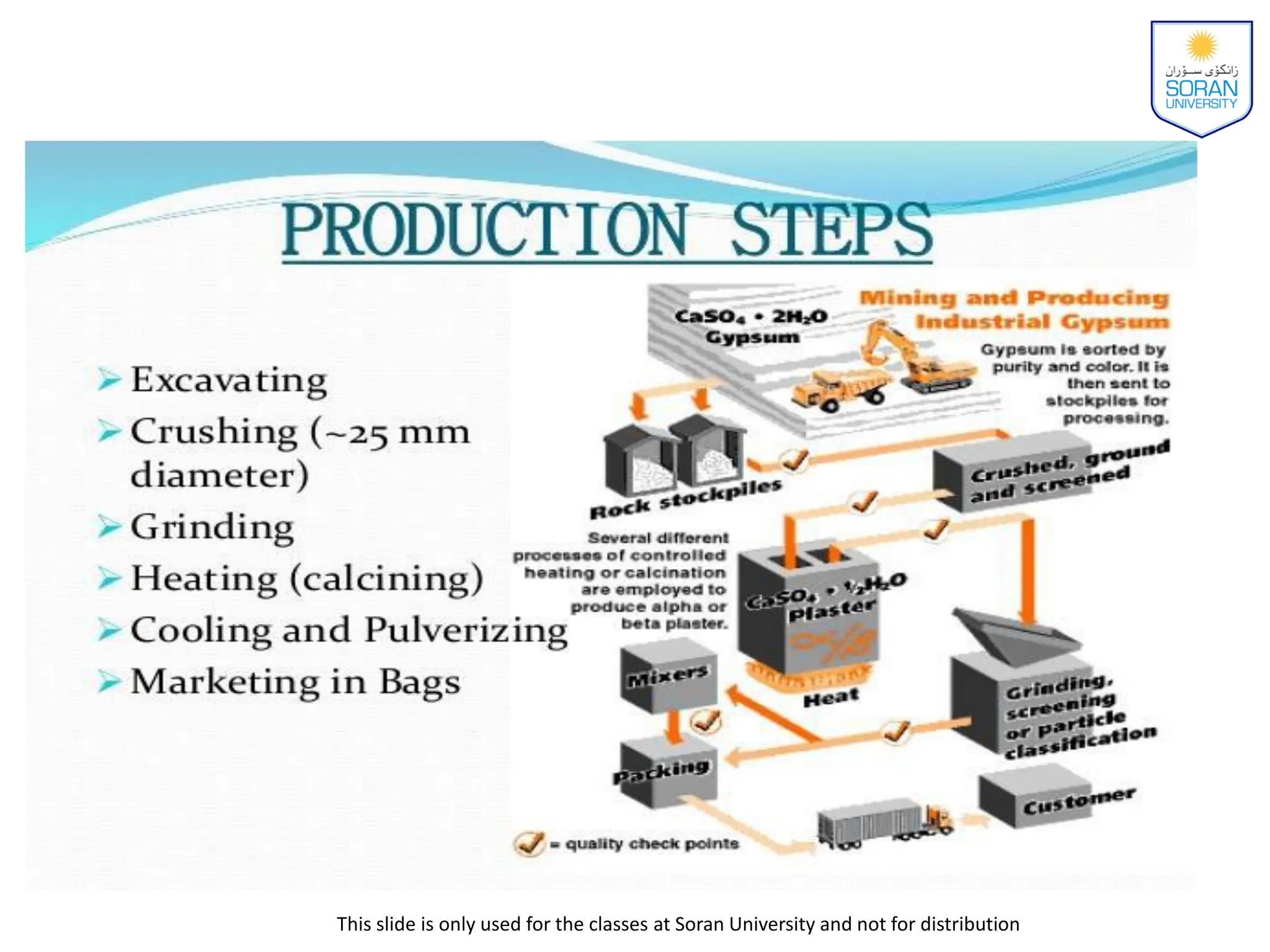
 The raw materials to produce gypsum cement materials are natural dihydrate
gypsum (CaSO4*2H2O), natural anhydrite (CaSO4), and chemical by-products
composed of CaSO4*2H2O or CaSO4.
 The gypsum used in construction is semi-hydrated gypsum (CaSO4*-
1
2
H2O)
 processed by natural dihydrate gypsum, also known as calcined gypsum.
Varieties of gypsum will be produced when the natural dihydrate gypsum is
processed with the change of heating methods and temperatures. The main
production procedures are breaking, heating and grinding.
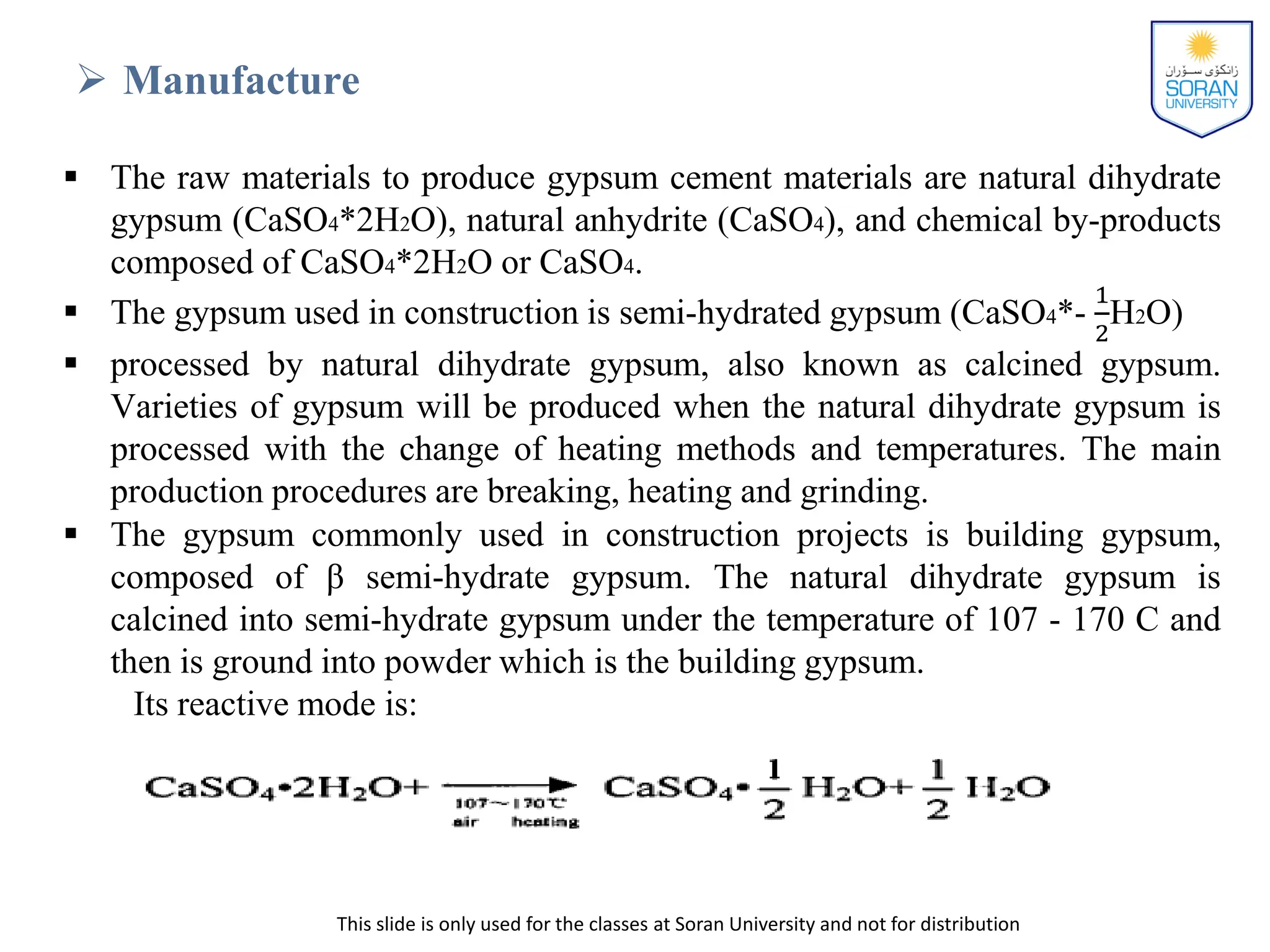
 The gypsum commonly used in construction projects is building gypsum,
composed of β semi-hydrate gypsum. The natural dihydrate gypsum is
calcined into semi-hydrate gypsum under the temperature of 107 - 170 C and
then is ground into powder which is the building gypsum.
Its reactive mode is:
This slide is only used for the classes at Soran University and not for distribution
GYPSUM
 Technical Requirements of Building Gypsum
 Building gypsum is white and of 2.6-2.75 g/cm3 density and 800-1000 kg/m3
bulk density.
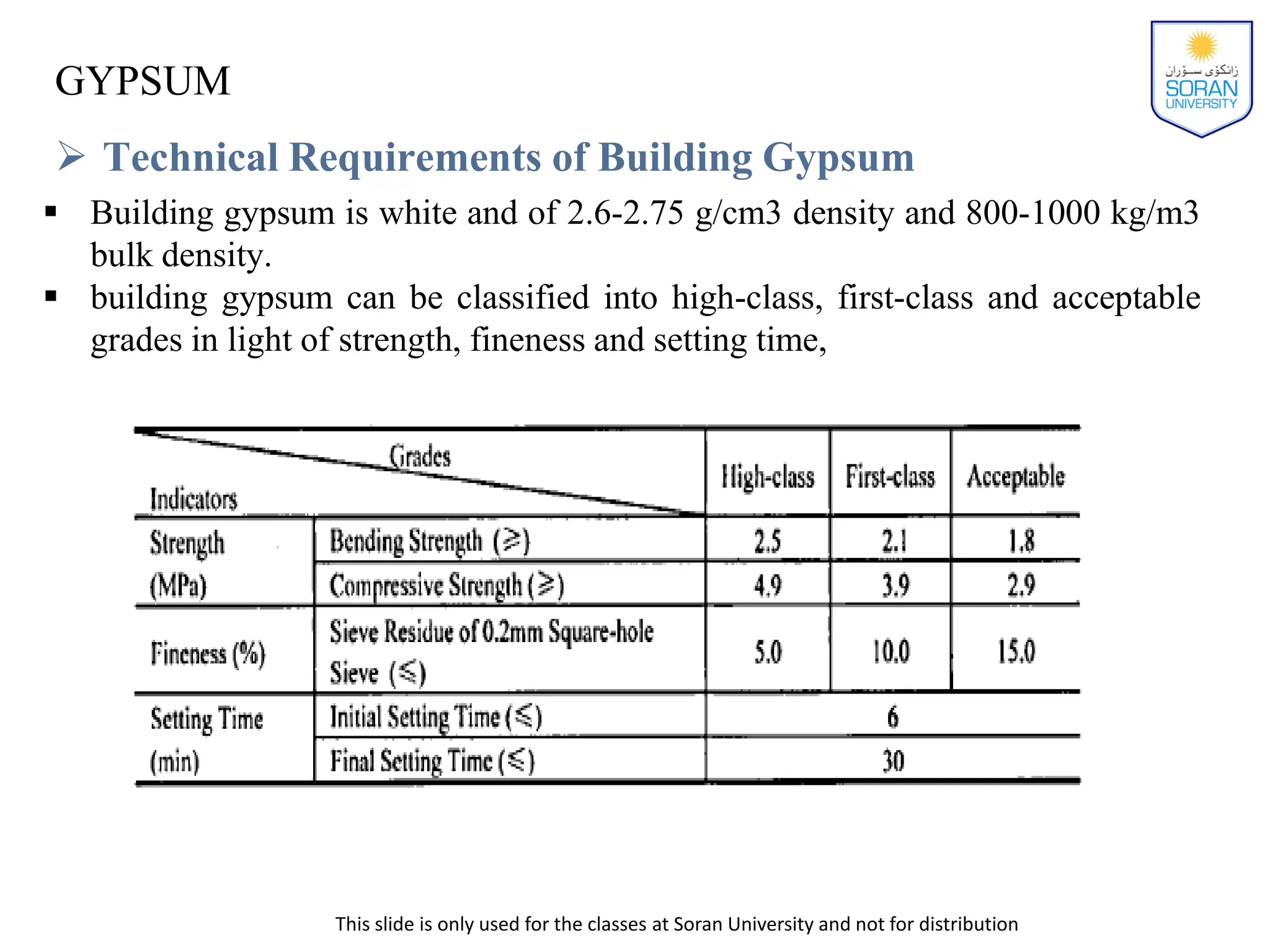
 building gypsum can be classified into high-class, first-class and acceptable
grades in light of strength, fineness and setting time,
This slide is only used for the classes at Soran University and not for distribution
 The excess water gradually evaporates in the hardening process, which leads
to a large number of pores left in the hardened gypsum, with the porosity of
50%-60%.
 In the process of storage and transport, building gypsum should not be
exposed to moisture and mixed with sundries.
 The general storage period is three months. And the strength will reduce by
30% over 3 months.
This slide is only used for the classes at Soran University and not for distribution
 Characteristics of Building Gypsum
 Compared with other binding materials, building gypsum has the following
characteristics:
1. Fast Setting and Hardening
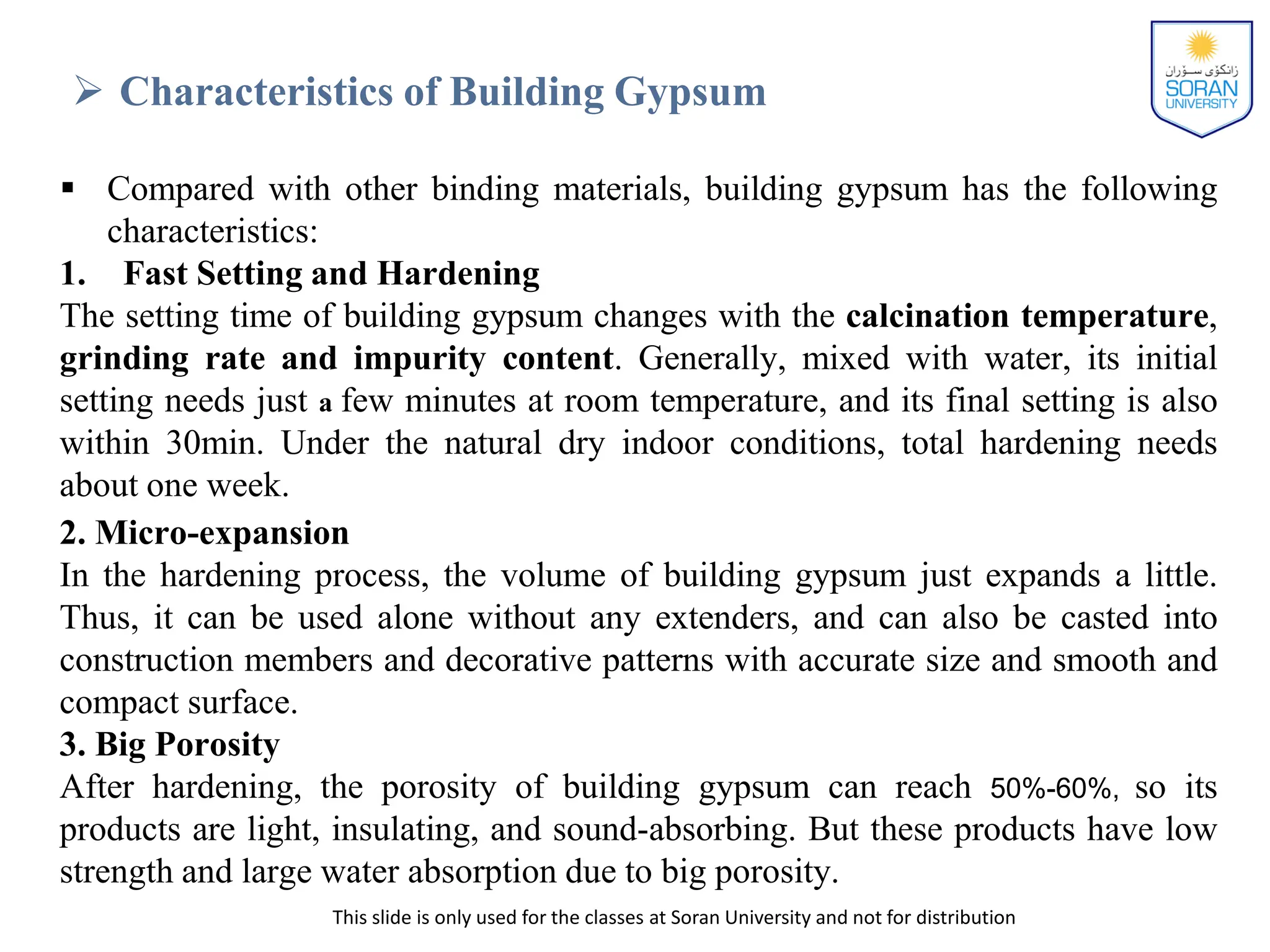
The setting time of building gypsum changes with the calcination temperature,
grinding rate and impurity content. Generally, mixed with water, its initial
setting needs just a few minutes at room temperature, and its final setting is also
within 30min. Under the natural dry indoor conditions, total hardening needs
about one week.
2. Micro-expansion
In the hardening process, the volume of building gypsum just expands a little.
Thus, it can be used alone without any extenders, and can also be casted into
construction members and decorative patterns with accurate size and smooth and
compact surface.
3. Big Porosity
After hardening, the porosity of building gypsum can reach 50%-60%, so its
products are light, insulating, and sound-absorbing. But these products have low
strength and large water absorption due to big porosity.
This slide is only used for the classes at Soran University and not for distribution
4. Poor Water Resistance
Building gypsum has low softening coefficient (about 0.2-0.3) and poor water
resistance. Absorbing water, it.wil1 break up with the freeze of water.
5. Good Fire Resistance
The main component of building gypsum after hardening is CaSO4*2H2O. When
it contacts with fire, the evaporation of crystal water will absorb heat and generate
anhydrous gypsum which has good thermal insulation.
6. Large Plastic Deformation
Gypsum and its products have an obvious performance of plastic deformation.
Creep becomes more serious especially under bending load. Thus, it is not used
for load-bearing structures normally.
This slide is only used for the classes at Soran University and not for distribution
GYPSUM
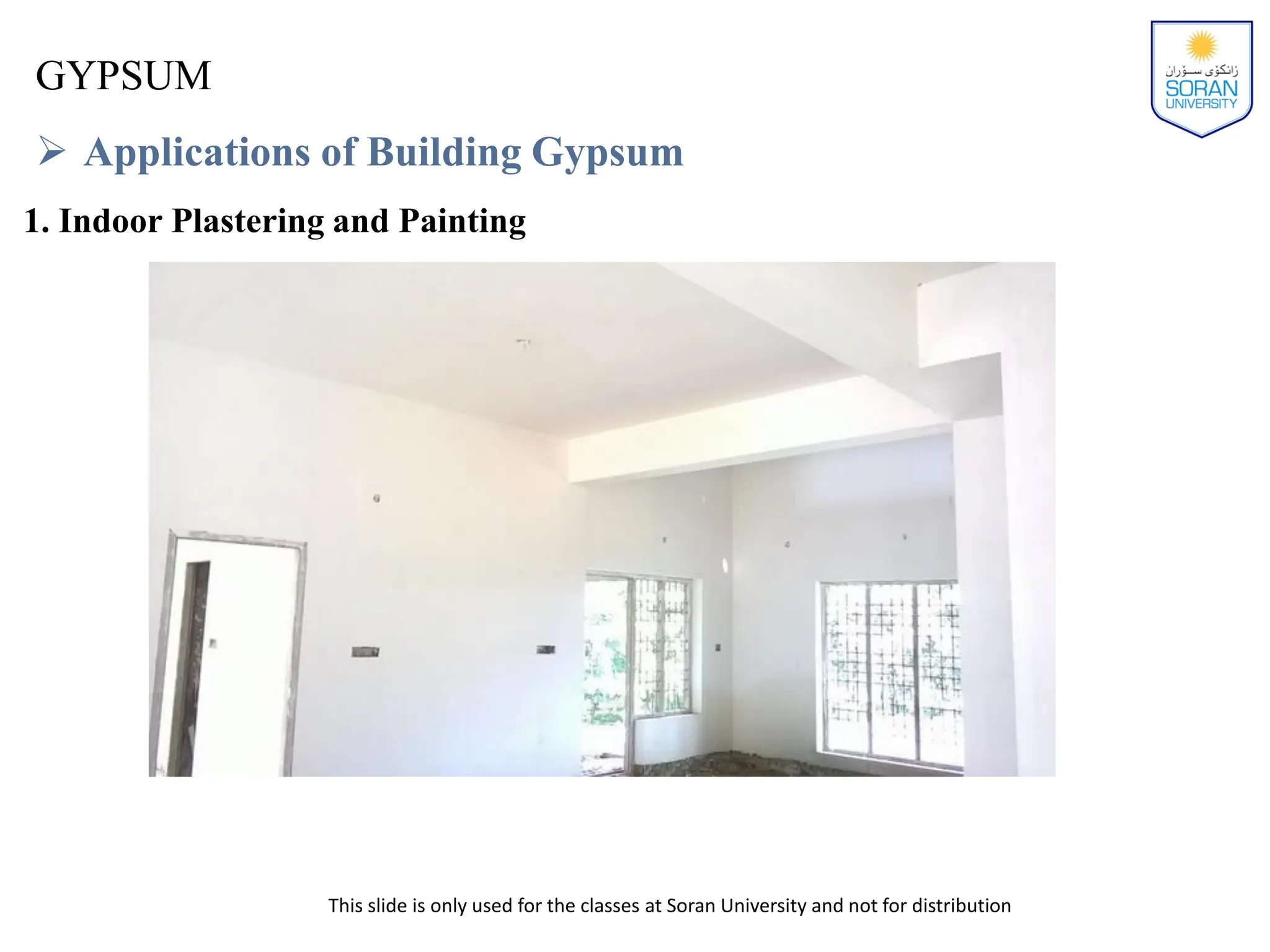
 Applications of Building Gypsum
1. Indoor Plastering and Painting
This slide is only used for the classes at Soran University and not for distribution
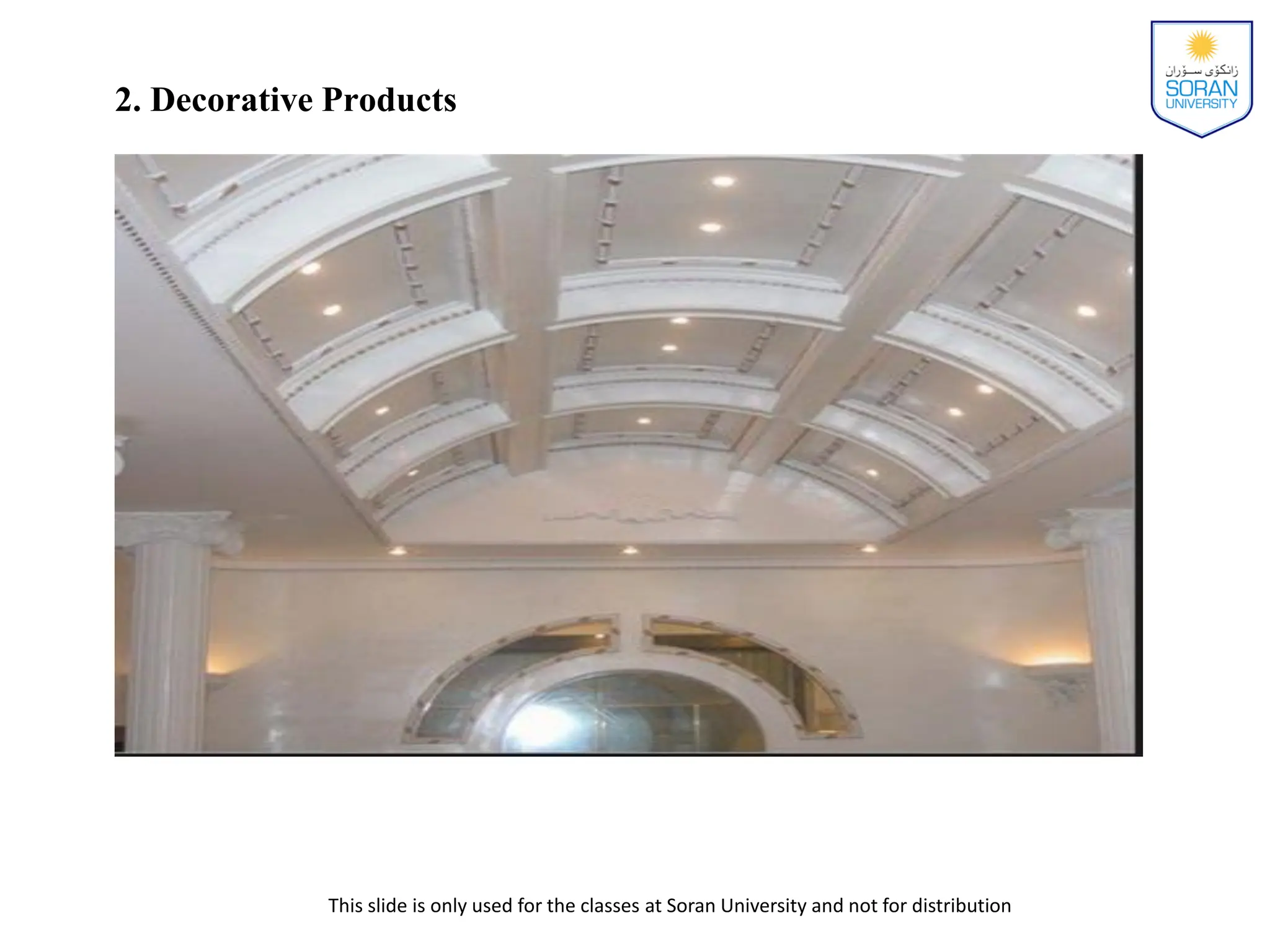
2. Decorative Products
This slide is only used for the classes at Soran University and not for distribution
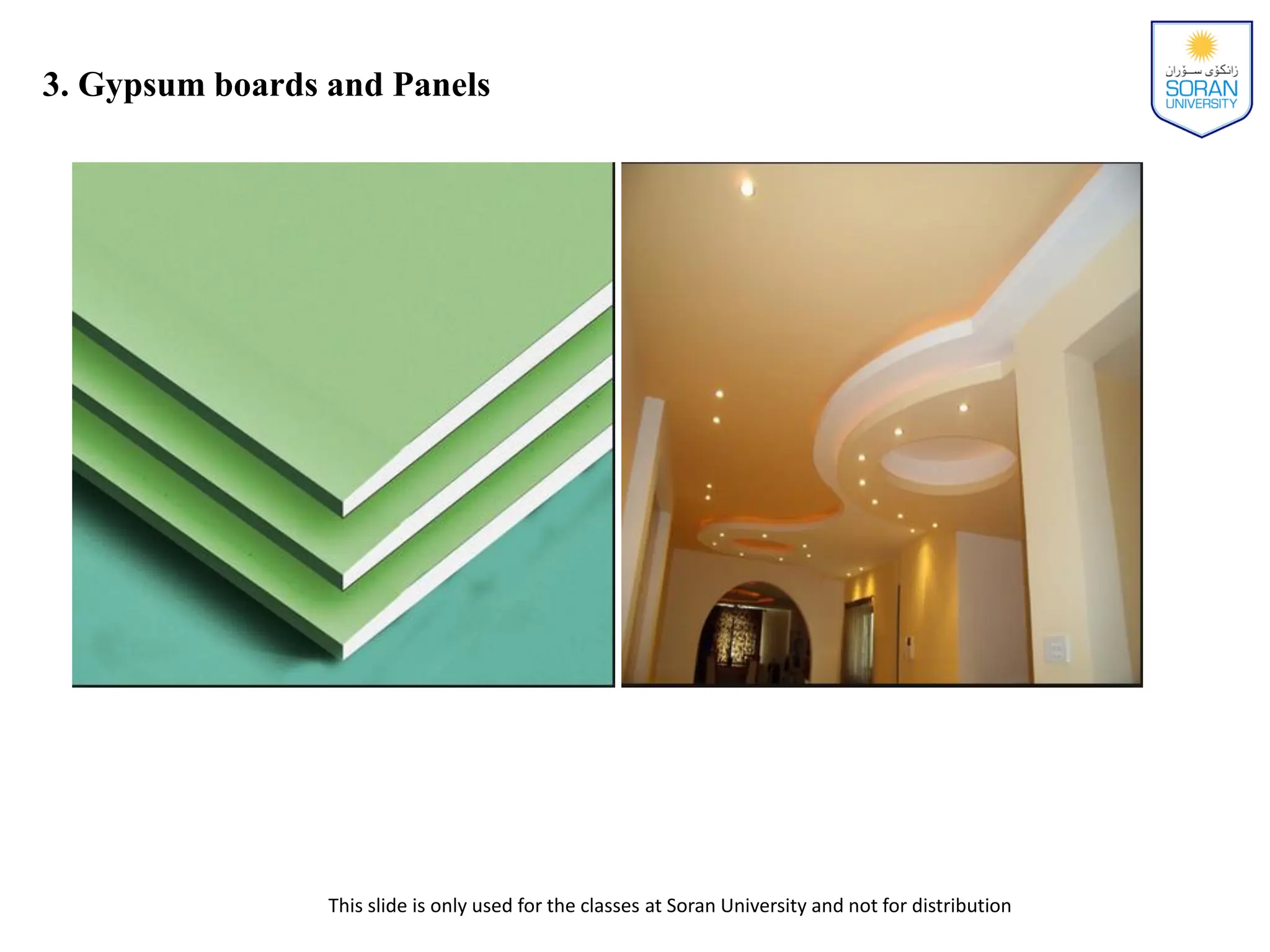
3. Gypsum boards and Panels
This slide is only used for the classes at Soran University and not for distribution
 Introduction
 Raw Materials of Lime
 Production of Lime
 Characteristics of Lime
 The Application of Lime in Building
2. Lime
This slide is only used for the classes at Soran University and not for distribution
Introduction
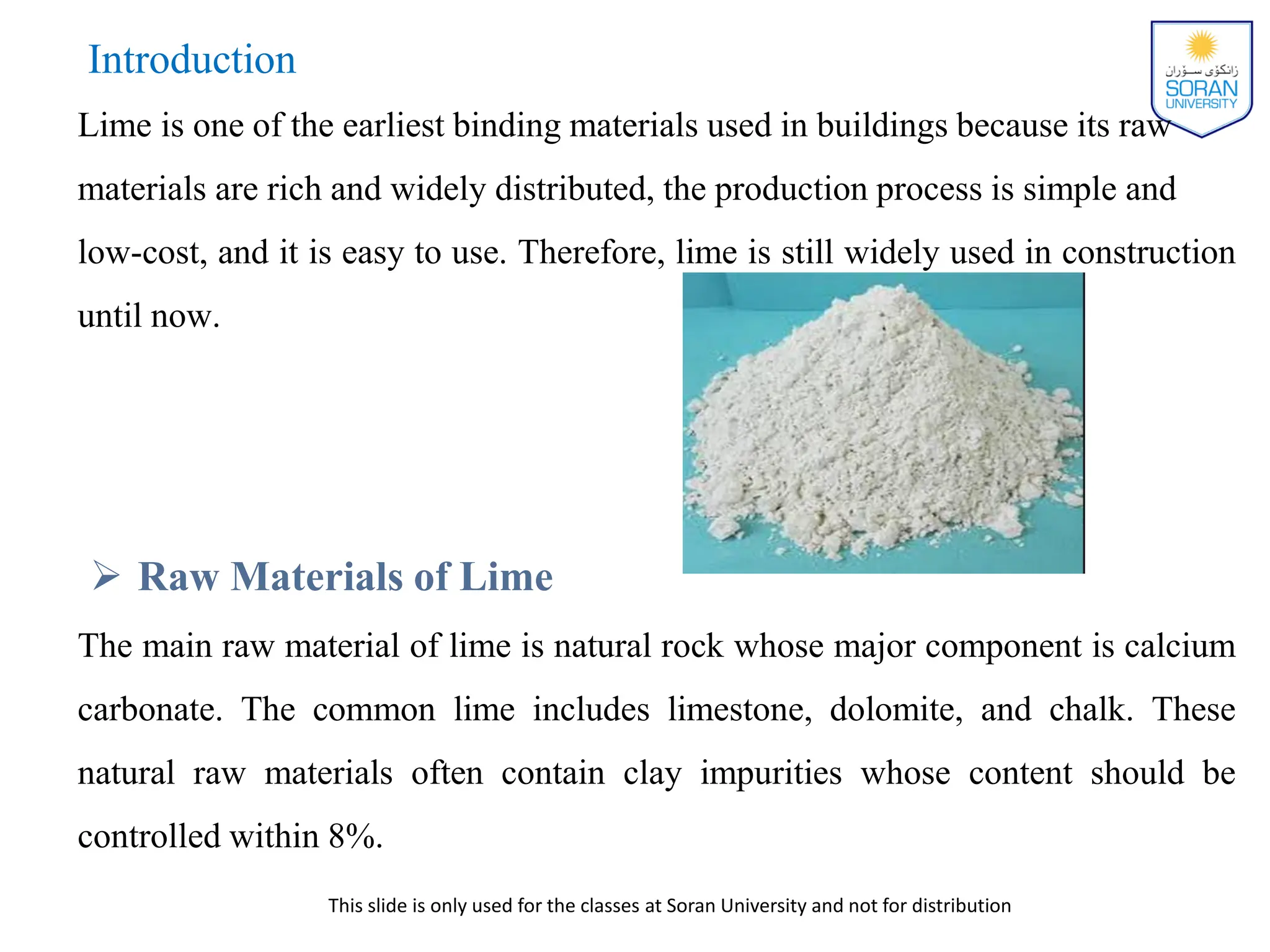
Lime is one of the earliest binding materials used in buildings because its raw
materials are rich and widely distributed, the production process is simple and
low-cost, and it is easy to use. Therefore, lime is still widely used in construction
until now.
 Raw Materials of Lime
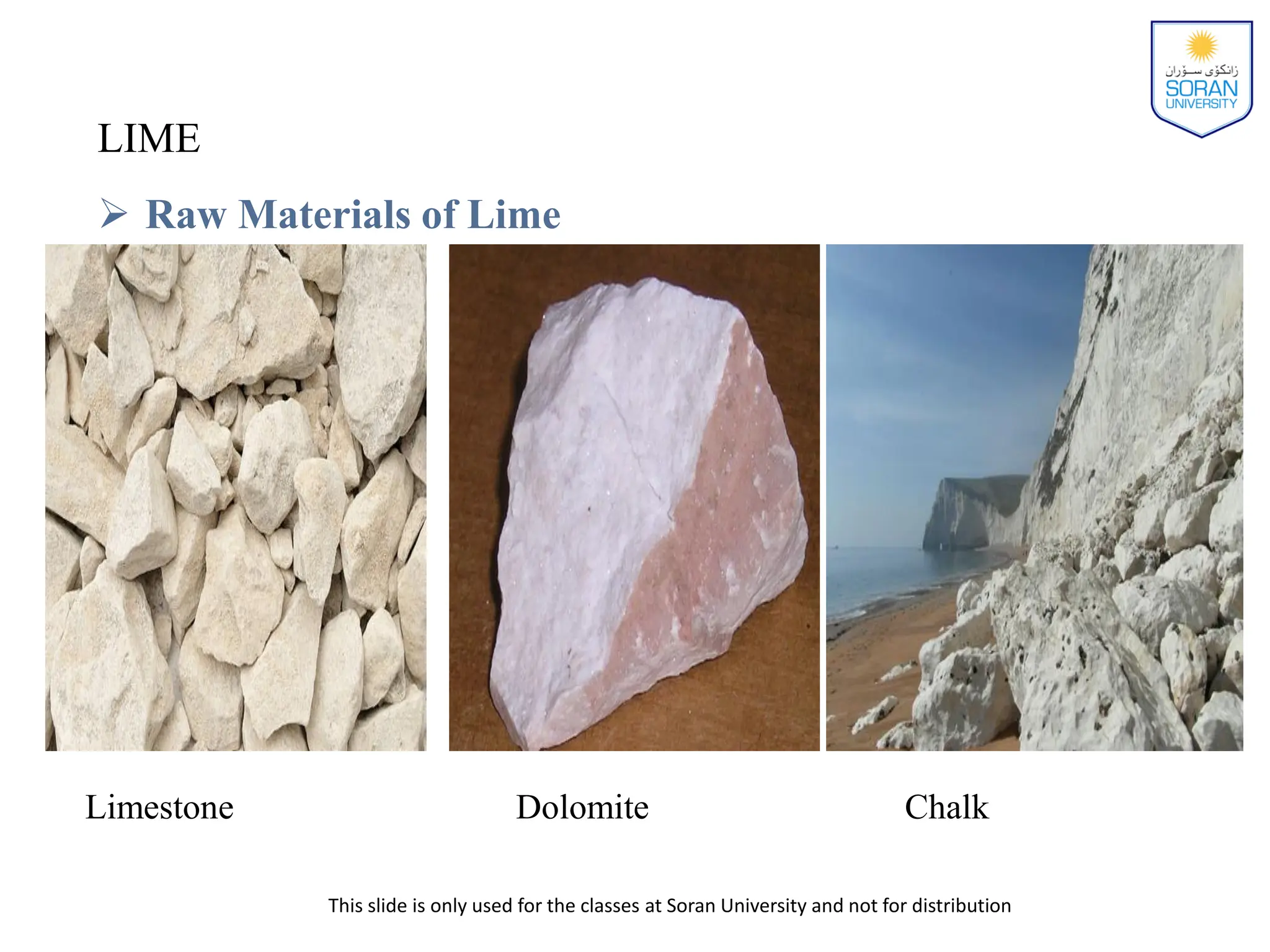
The main raw material of lime is natural rock whose major component is calcium
carbonate. The common lime includes limestone, dolomite, and chalk. These
natural raw materials often contain clay impurities whose content should be
controlled within 8%.
This slide is only used for the classes at Soran University and not for distribution
LIME
 Raw Materials of Lime
Limestone Dolomite Chalk
This slide is only used for the classes at Soran University and not for distribution
 Production of Lime
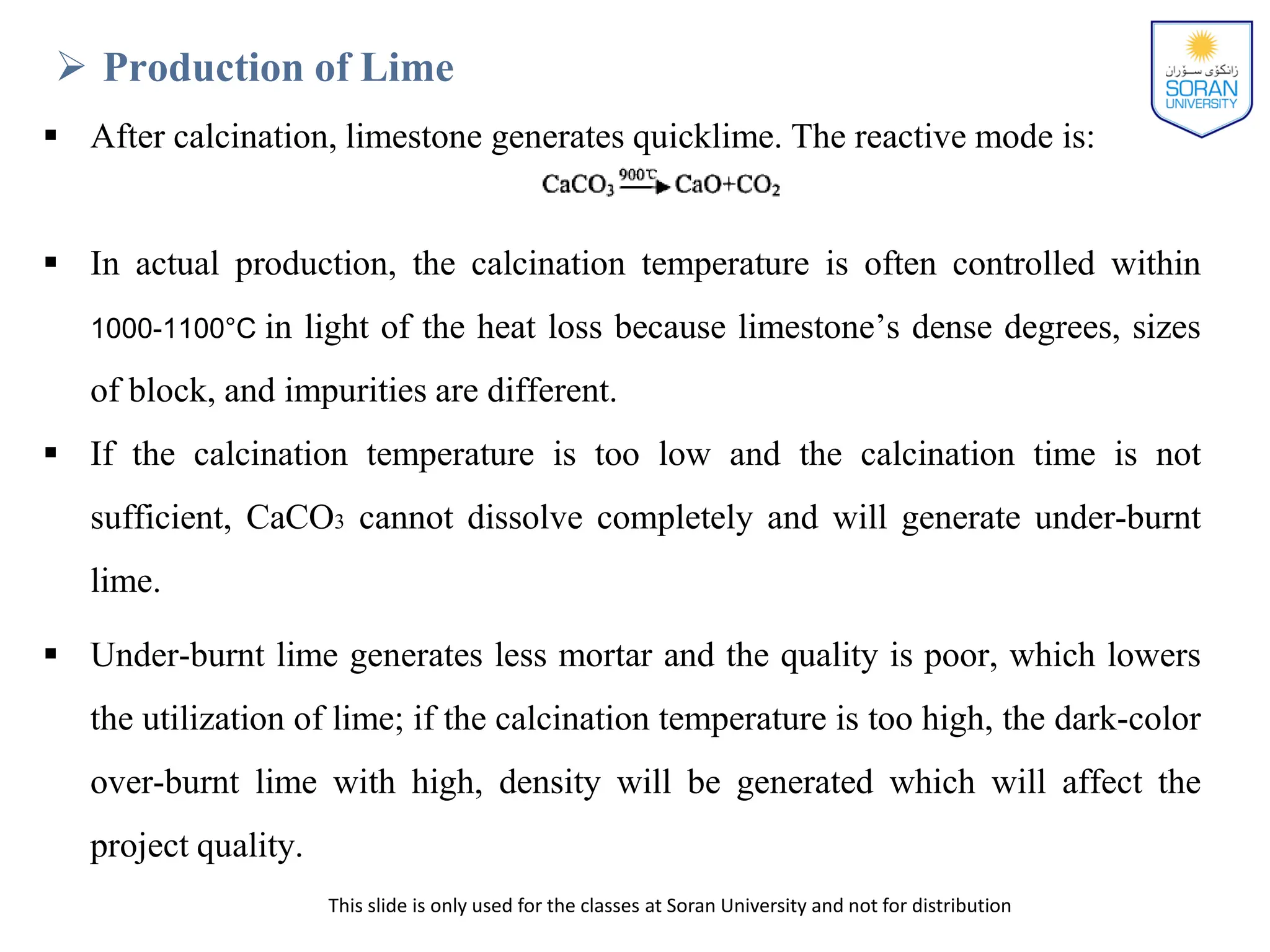
 After calcination, limestone generates quicklime. The reactive mode is:
 In actual production, the calcination temperature is often controlled within
1000-1100°C in light of the heat loss because limestone’s dense degrees, sizes
of block, and impurities are different.
 If the calcination temperature is too low and the calcination time is not
sufficient, CaCO3 cannot dissolve completely and will generate under-burnt
lime.
 Under-burnt lime generates less mortar and the quality is poor, which lowers
the utilization of lime; if the calcination temperature is too high, the dark-color
over-burnt lime with high, density will be generated which will affect the
project quality.
This slide is only used for the classes at Soran University and not for distribution
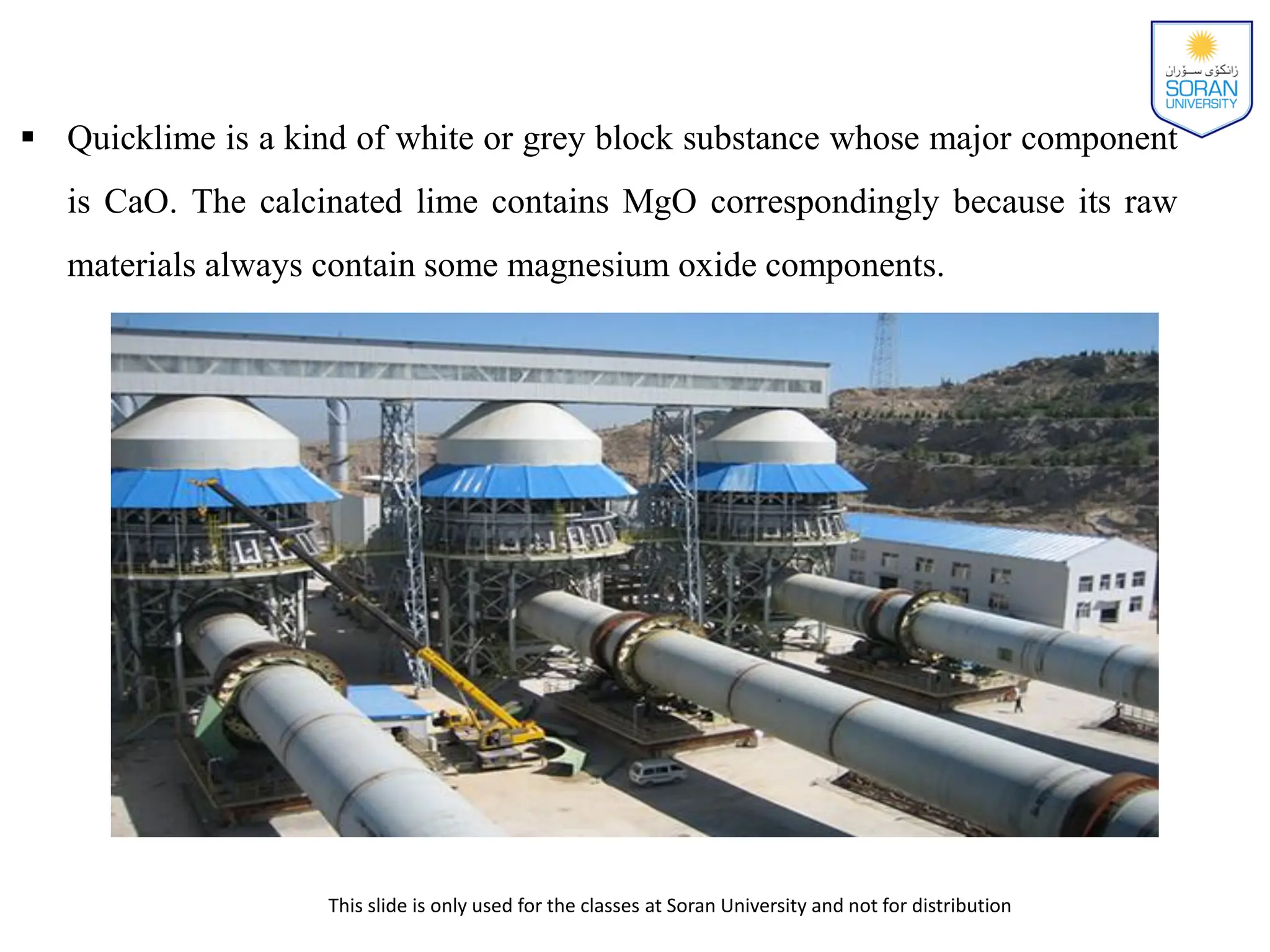
 Quicklime is a kind of white or grey block substance whose major component
is CaO. The calcinated lime contains MgO correspondingly because its raw
materials always contain some magnesium oxide components.
This slide is only used for the classes at Soran University and not for distribution
 Characteristics of Lime
1. Good Water Retention
The lime mortar generated by the aging of lime has good water retention, so it can
be mixed in cement mortar to improve the water retention of mortar to facilitate
construction.
2. Slow Setting and Hardening, Low Strength
Because the carbonization of lime mortar in the air is very slow, the production of
calcium carbonate and calcium hydroxide is a little and quite slow. And thus, the
strength of hardened lime is low. According to tests, 1 : 3 lime mortar of 28d has
only 0.2-0.5 MPa strength which should not be the basis for important buildings.
This slide is only used for the classes at Soran University and not for distribution
3. Poor Water Resistance
Calcium hydroxide is soluble in water, so if it is exposed to moisture or immerses
in water for a long time, the hardened lime will scatter. If lime mortar is in humid
environment before complete hardening, the water in lime cannot evaporate, and
the hardening will be hindered. Therefore, lime should not be applied in humid
environment.
4. Large Shrinkage
In the hardening process of lime mortar, a large amount of water evaporates,
which cause the shrinkage of volume. And desiccation cracks will appear. Thus,
lime mortar should not be used alone except for the lime cream for thin painting.
This slide is only used for the classes at Soran University and not for distribution
 The Application of Lime in Building
 Lime putty
 Lime mortar: this is lime putty mixed with sand. This can be used to bed in
masonry, and is also used in pointing or rendering brickwork, and for general
plastering use.
 Lime wash: this is lime putty diluted in water. This is used to paint internal
and external walls. A pigment can be added to create a color wash
Chapter 5, Gypsum and lime.kljahdijsjcjjkdsnkpdf

  • 1.
    Civil Engineering Department SoranUniversity Building Material Science Fall 2021 This slide is only used for the classes at Soran University and not for distribution In the Name of Allah
  • 2.
    Chapter 5 (Gypsumand Lime) Seventh Week Fall 2021 Chapter five, Rizgar A. Omar, MSC Email: rizgar.omar@soran.edu.iq This slide is only used for the classes at Soran University and not for distribution
  • 3.
    1. Gypsum This slideis only used for the classes at Soran University and not for distribution  Introduction  Classification  Manufacturing  Technical Requirements of Building Gypsum  Characteristics of Building Gypsum  Applications of Building Gypsum
  • 4.
    This slide isonly used for the classes at Soran University and not for distribution  Introduction  Gypsum is a non-hydraulic binder occurring naturally as a soft crystalline rock or sand. Pure gypsum is a white translucent crystalline mineral and is so soft that it can be scratched by a finger nail.  Gypsum has a unique property of moulding. When heated it gives up combined water and easily turns into powder. On adding water to the powder it can easily be shaped and moulded, and in a short time it hardens again and becomes similar to what it was in its natural state.  Building gypsum is an air-setting binder composed mainly of semihydrate gypsum and obtained by processing gypsum at temperatures 150°C– 160°C.
  • 5.
    This slide isonly used for the classes at Soran University and not for distribution GYPSUM  Classification  Gypsum binders are classified as low and high burning varieties. The low burning variety is manufactured by heating dehydrated gypsum to a temperature of about 160°C. The examples of low burning variety are building and extra strong gypsums.  The high burning (anhydrite) variety is obtained by burning dehydrated gypsum at 700°C–1000°C, when the chemically bound water is lost totally.
  • 6.
    This slide isonly used for the classes at Soran University and not for distribution  Manufacture  The raw materials to produce gypsum cement materials are natural dihydrate gypsum (CaSO4*2H2O), natural anhydrite (CaSO4), and chemical by-products composed of CaSO4*2H2O or CaSO4.  The gypsum used in construction is semi-hydrated gypsum (CaSO4*- 1 2 H2O)  processed by natural dihydrate gypsum, also known as calcined gypsum. Varieties of gypsum will be produced when the natural dihydrate gypsum is processed with the change of heating methods and temperatures. The main production procedures are breaking, heating and grinding.  The gypsum commonly used in construction projects is building gypsum, composed of β semi-hydrate gypsum. The natural dihydrate gypsum is calcined into semi-hydrate gypsum under the temperature of 107 - 170 C and then is ground into powder which is the building gypsum. Its reactive mode is:
  • 7.
    This slide isonly used for the classes at Soran University and not for distribution
  • 8.
    This slide isonly used for the classes at Soran University and not for distribution GYPSUM  Technical Requirements of Building Gypsum  Building gypsum is white and of 2.6-2.75 g/cm3 density and 800-1000 kg/m3 bulk density.  building gypsum can be classified into high-class, first-class and acceptable grades in light of strength, fineness and setting time,
  • 9.
    This slide isonly used for the classes at Soran University and not for distribution  The excess water gradually evaporates in the hardening process, which leads to a large number of pores left in the hardened gypsum, with the porosity of 50%-60%.  In the process of storage and transport, building gypsum should not be exposed to moisture and mixed with sundries.  The general storage period is three months. And the strength will reduce by 30% over 3 months.
  • 10.
    This slide isonly used for the classes at Soran University and not for distribution  Characteristics of Building Gypsum  Compared with other binding materials, building gypsum has the following characteristics: 1. Fast Setting and Hardening The setting time of building gypsum changes with the calcination temperature, grinding rate and impurity content. Generally, mixed with water, its initial setting needs just a few minutes at room temperature, and its final setting is also within 30min. Under the natural dry indoor conditions, total hardening needs about one week. 2. Micro-expansion In the hardening process, the volume of building gypsum just expands a little. Thus, it can be used alone without any extenders, and can also be casted into construction members and decorative patterns with accurate size and smooth and compact surface. 3. Big Porosity After hardening, the porosity of building gypsum can reach 50%-60%, so its products are light, insulating, and sound-absorbing. But these products have low strength and large water absorption due to big porosity.
  • 11.
    This slide isonly used for the classes at Soran University and not for distribution 4. Poor Water Resistance Building gypsum has low softening coefficient (about 0.2-0.3) and poor water resistance. Absorbing water, it.wil1 break up with the freeze of water. 5. Good Fire Resistance The main component of building gypsum after hardening is CaSO4*2H2O. When it contacts with fire, the evaporation of crystal water will absorb heat and generate anhydrous gypsum which has good thermal insulation. 6. Large Plastic Deformation Gypsum and its products have an obvious performance of plastic deformation. Creep becomes more serious especially under bending load. Thus, it is not used for load-bearing structures normally.
  • 12.
    This slide isonly used for the classes at Soran University and not for distribution GYPSUM  Applications of Building Gypsum 1. Indoor Plastering and Painting
  • 13.
    This slide isonly used for the classes at Soran University and not for distribution 2. Decorative Products
  • 14.
    This slide isonly used for the classes at Soran University and not for distribution 3. Gypsum boards and Panels
  • 15.
    This slide isonly used for the classes at Soran University and not for distribution  Introduction  Raw Materials of Lime  Production of Lime  Characteristics of Lime  The Application of Lime in Building 2. Lime
  • 16.
    This slide isonly used for the classes at Soran University and not for distribution Introduction Lime is one of the earliest binding materials used in buildings because its raw materials are rich and widely distributed, the production process is simple and low-cost, and it is easy to use. Therefore, lime is still widely used in construction until now.  Raw Materials of Lime The main raw material of lime is natural rock whose major component is calcium carbonate. The common lime includes limestone, dolomite, and chalk. These natural raw materials often contain clay impurities whose content should be controlled within 8%.
  • 17.
    This slide isonly used for the classes at Soran University and not for distribution LIME  Raw Materials of Lime Limestone Dolomite Chalk
  • 18.
    This slide isonly used for the classes at Soran University and not for distribution  Production of Lime  After calcination, limestone generates quicklime. The reactive mode is:  In actual production, the calcination temperature is often controlled within 1000-1100°C in light of the heat loss because limestone’s dense degrees, sizes of block, and impurities are different.  If the calcination temperature is too low and the calcination time is not sufficient, CaCO3 cannot dissolve completely and will generate under-burnt lime.  Under-burnt lime generates less mortar and the quality is poor, which lowers the utilization of lime; if the calcination temperature is too high, the dark-color over-burnt lime with high, density will be generated which will affect the project quality.
  • 19.
    This slide isonly used for the classes at Soran University and not for distribution  Quicklime is a kind of white or grey block substance whose major component is CaO. The calcinated lime contains MgO correspondingly because its raw materials always contain some magnesium oxide components.
  • 20.
    This slide isonly used for the classes at Soran University and not for distribution  Characteristics of Lime 1. Good Water Retention The lime mortar generated by the aging of lime has good water retention, so it can be mixed in cement mortar to improve the water retention of mortar to facilitate construction. 2. Slow Setting and Hardening, Low Strength Because the carbonization of lime mortar in the air is very slow, the production of calcium carbonate and calcium hydroxide is a little and quite slow. And thus, the strength of hardened lime is low. According to tests, 1 : 3 lime mortar of 28d has only 0.2-0.5 MPa strength which should not be the basis for important buildings.
  • 21.
    This slide isonly used for the classes at Soran University and not for distribution 3. Poor Water Resistance Calcium hydroxide is soluble in water, so if it is exposed to moisture or immerses in water for a long time, the hardened lime will scatter. If lime mortar is in humid environment before complete hardening, the water in lime cannot evaporate, and the hardening will be hindered. Therefore, lime should not be applied in humid environment. 4. Large Shrinkage In the hardening process of lime mortar, a large amount of water evaporates, which cause the shrinkage of volume. And desiccation cracks will appear. Thus, lime mortar should not be used alone except for the lime cream for thin painting.
  • 22.
    This slide isonly used for the classes at Soran University and not for distribution  The Application of Lime in Building  Lime putty  Lime mortar: this is lime putty mixed with sand. This can be used to bed in masonry, and is also used in pointing or rendering brickwork, and for general plastering use.  Lime wash: this is lime putty diluted in water. This is used to paint internal and external walls. A pigment can be added to create a color wash