Government college of pharmacy Amravati
Guided By: Yogesh Daga sir
Presented by: Komal Wagh, Yash Ghorpade, Rani Konde, Harshit Shende
Declaration of Helsinki
Content
1.Introduction: Declaration of Helsinki
2.History and scope
3.Basic principle of all medical research
4.Additional principle for medical research combined
with medical care
5.Advantages and uses
6.Conclusion
Introduction
WHAT IS HELSINKI ?
 Helsinki It is a set of principles basically used in clinical trials.
 Followed in medical research (human subject).
 Some ethical principles are developed by World Health Association for the guidance of
medical doctors in biomedical research involving humans.
 Duty of a doctor or a physician in research is to. Protect the life, health, privacy and dignity
of the subject.
 Consent in writing
 Independently reviewed
 Protocol must be followed
 Caution if investigation are treating their patients
 Best proven diagnostic and therapeutic method
The Declaration of Helsinki
History
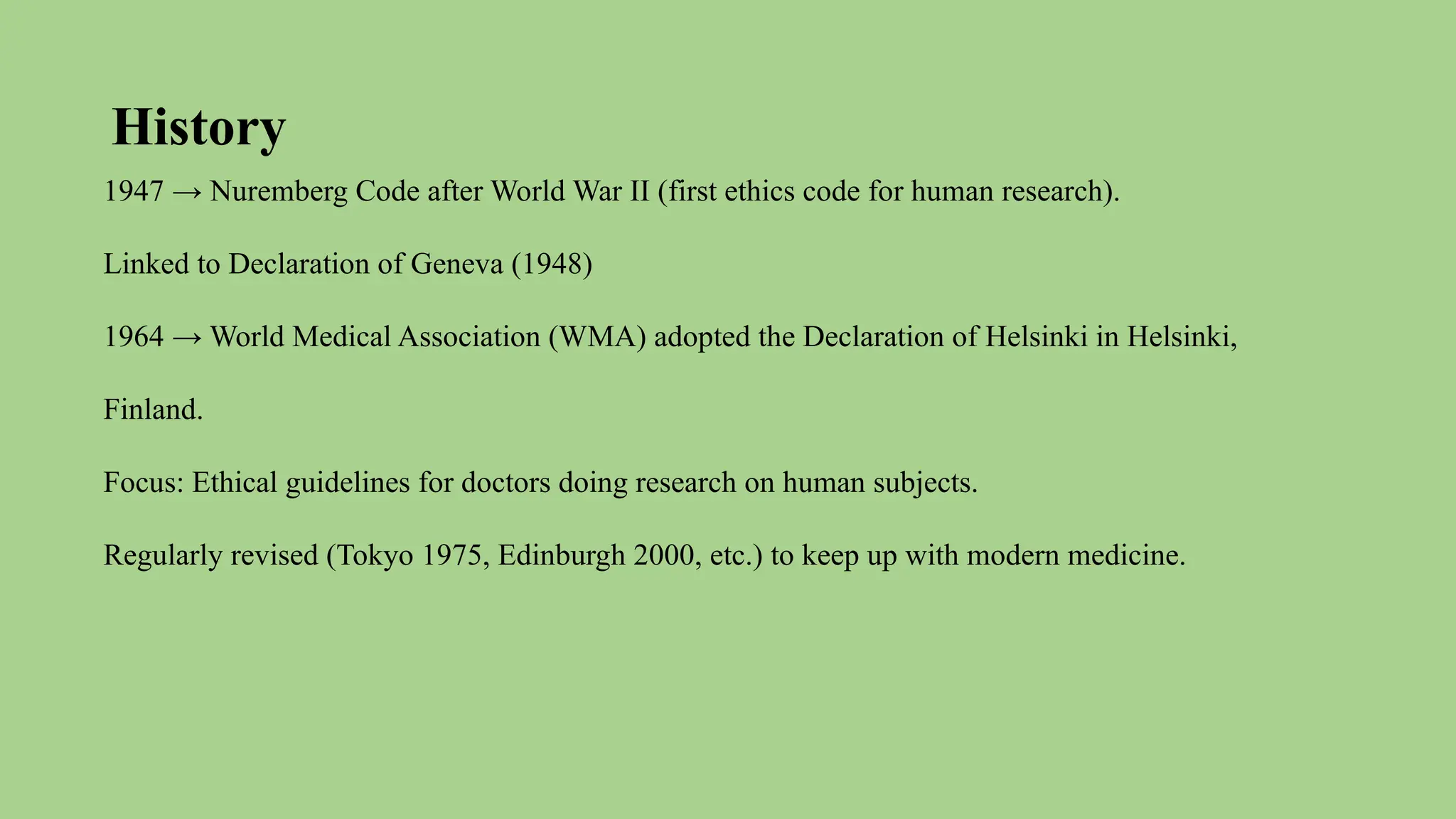
1947 → Nuremberg Code after World War II (first ethics code for human research).
Linked to Declaration of Geneva (1948)
1964 → World Medical Association (WMA) adopted the Declaration of Helsinki in Helsinki,
Finland.
Focus: Ethical guidelines for doctors doing research on human subjects.
Regularly revised (Tokyo 1975, Edinburgh 2000, etc.) to keep up with modern medicine.
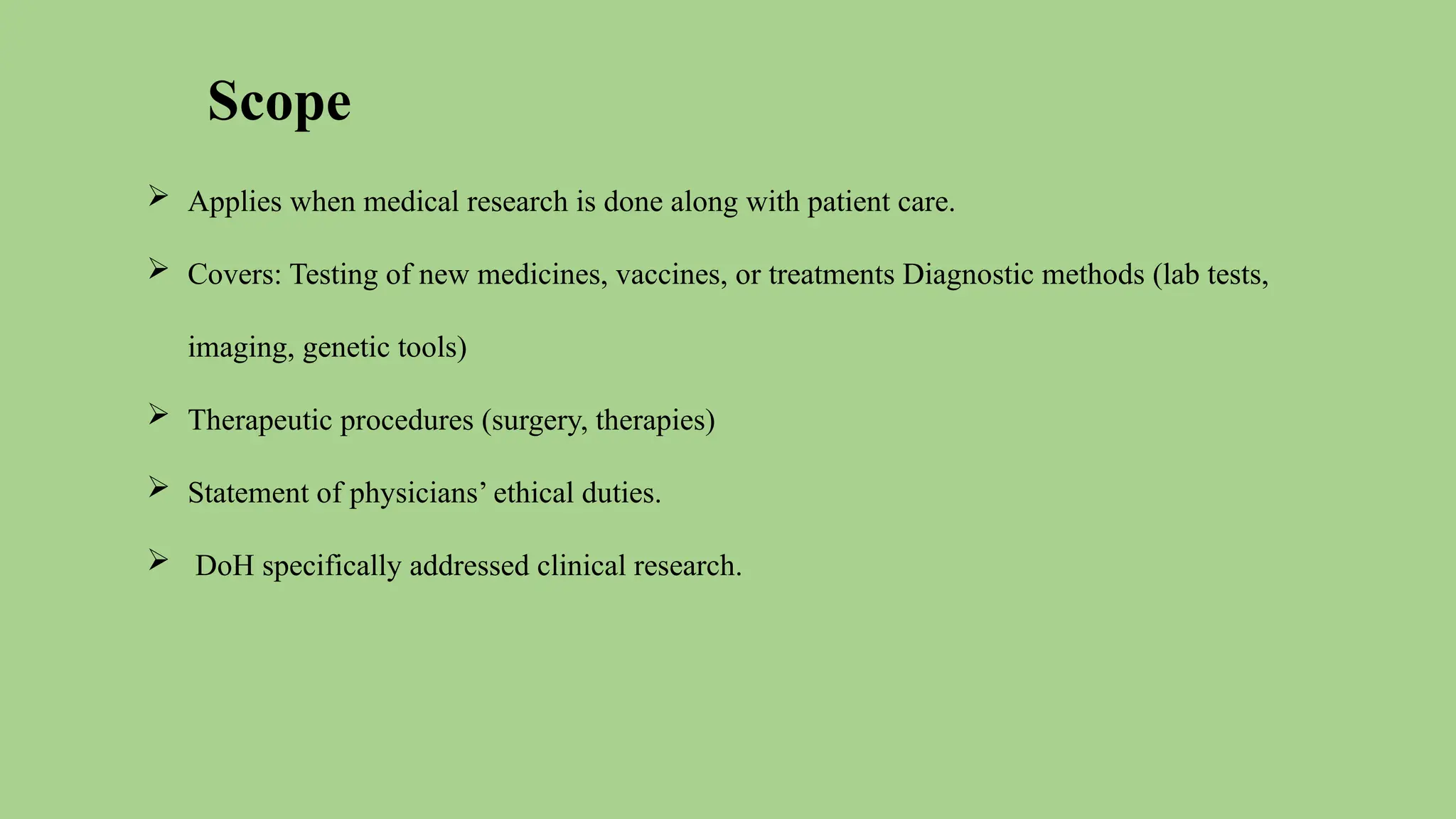
Scope
 Applies when medical research is done along with patient care.
 Covers: Testing of new medicines, vaccines, or treatments Diagnostic methods (lab tests,
imaging, genetic tools)
 Therapeutic procedures (surgery, therapies)
 Statement of physicians’ ethical duties.
 DoH specifically addressed clinical research.
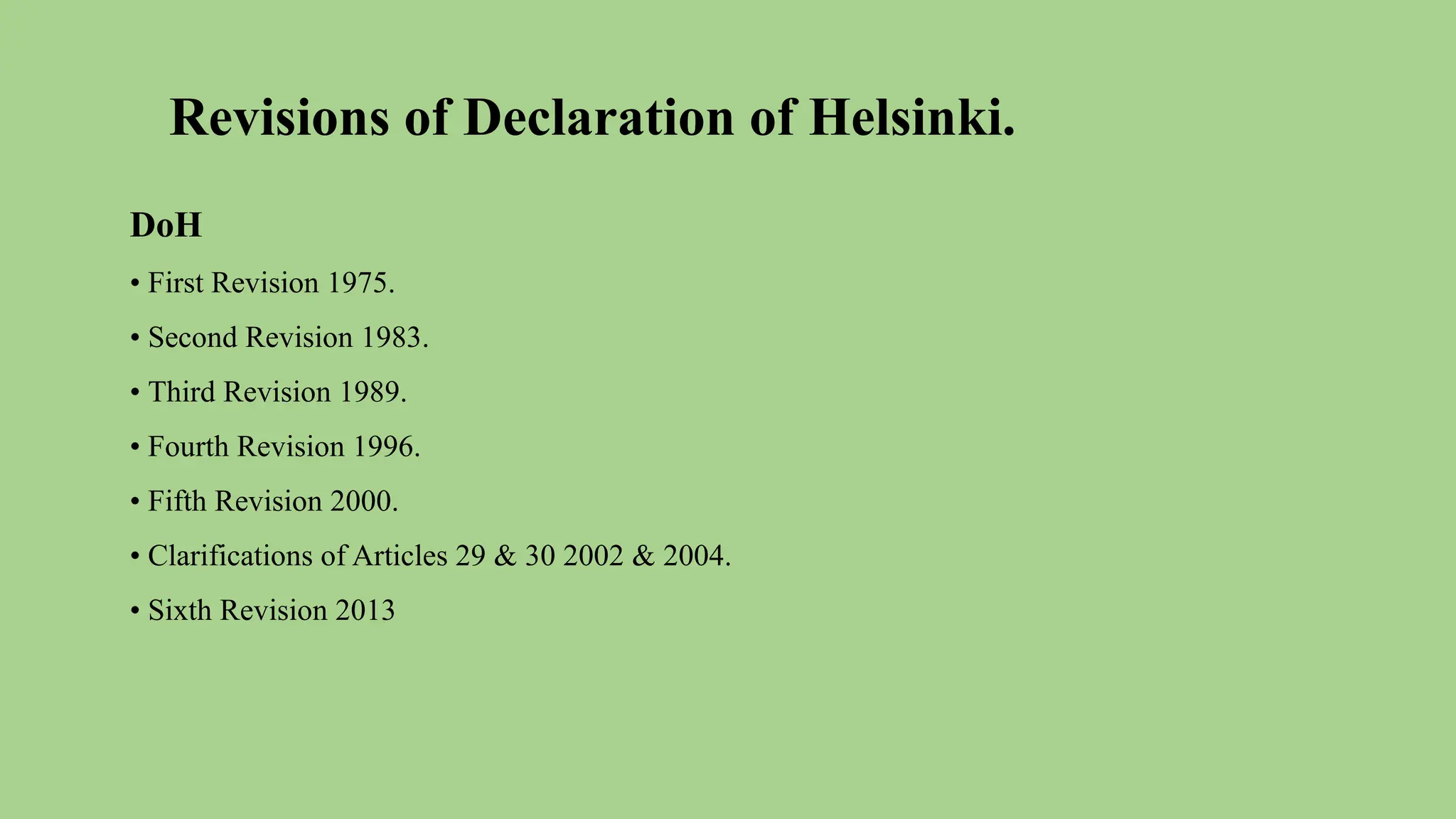
Revisions of Declaration of Helsinki.
DoH
• First Revision 1975.
• Second Revision 1983.
• Third Revision 1989.
• Fourth Revision 1996.
• Fifth Revision 2000.
• Clarifications of Articles 29 & 30 2002 & 2004.
• Sixth Revision 2013
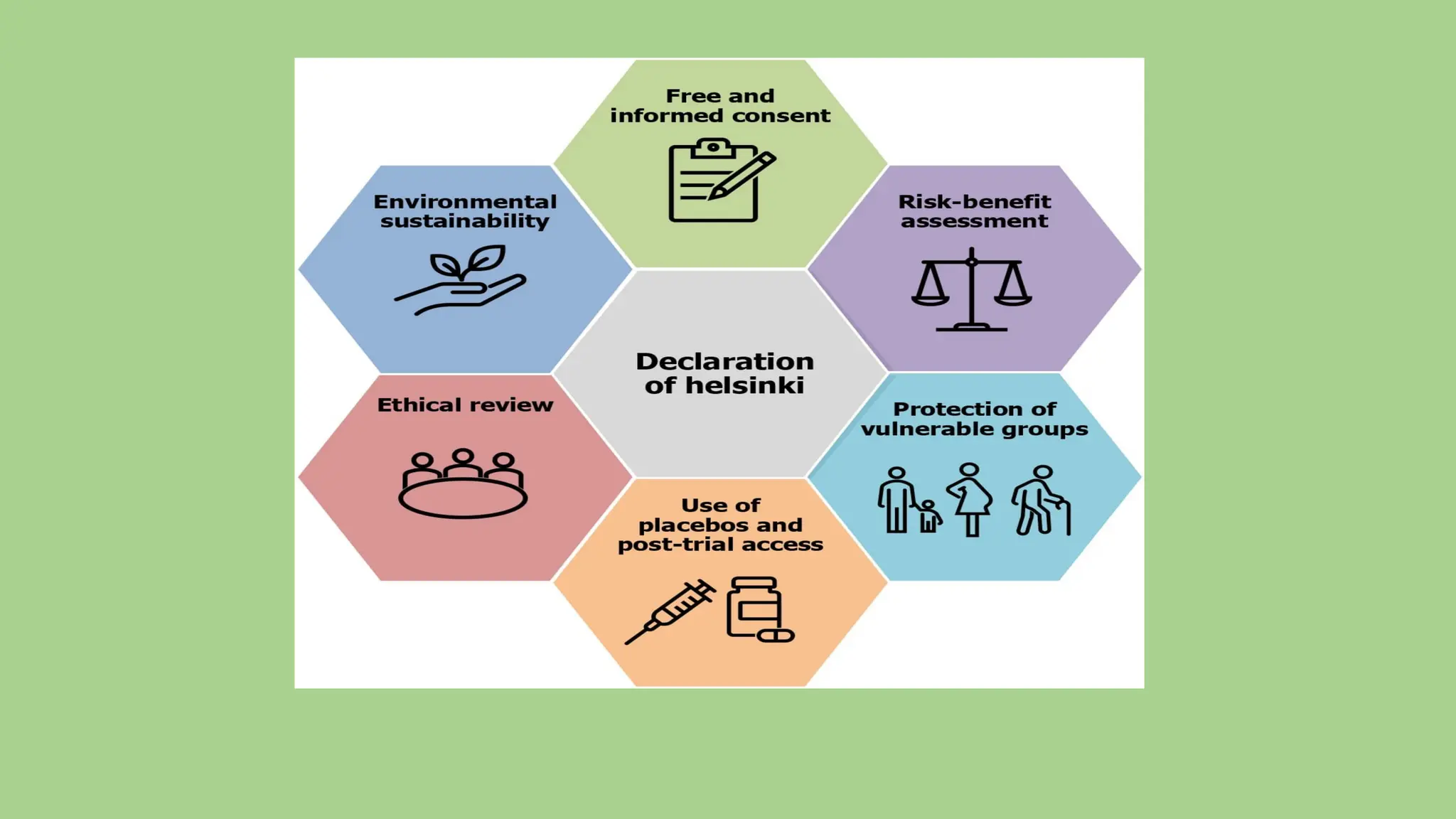
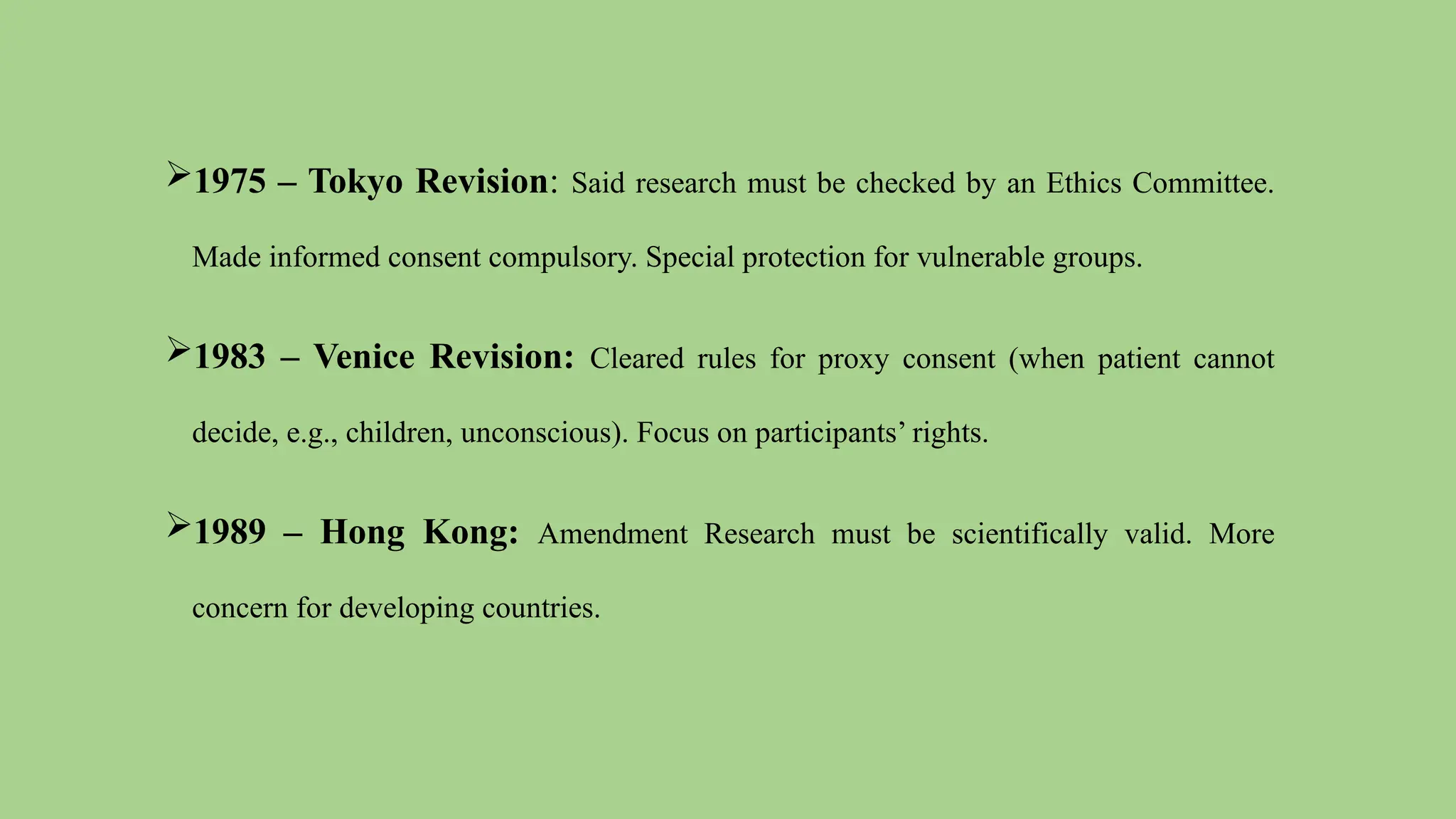
1975 – Tokyo Revision: Said research must be checked by an Ethics Committee.
Made informed consent compulsory. Special protection for vulnerable groups.
1983 – Venice Revision: Cleared rules for proxy consent (when patient cannot
decide, e.g., children, unconscious). Focus on participants’ rights.
1989 – Hong Kong: Amendment Research must be scientifically valid. More
concern for developing countries.
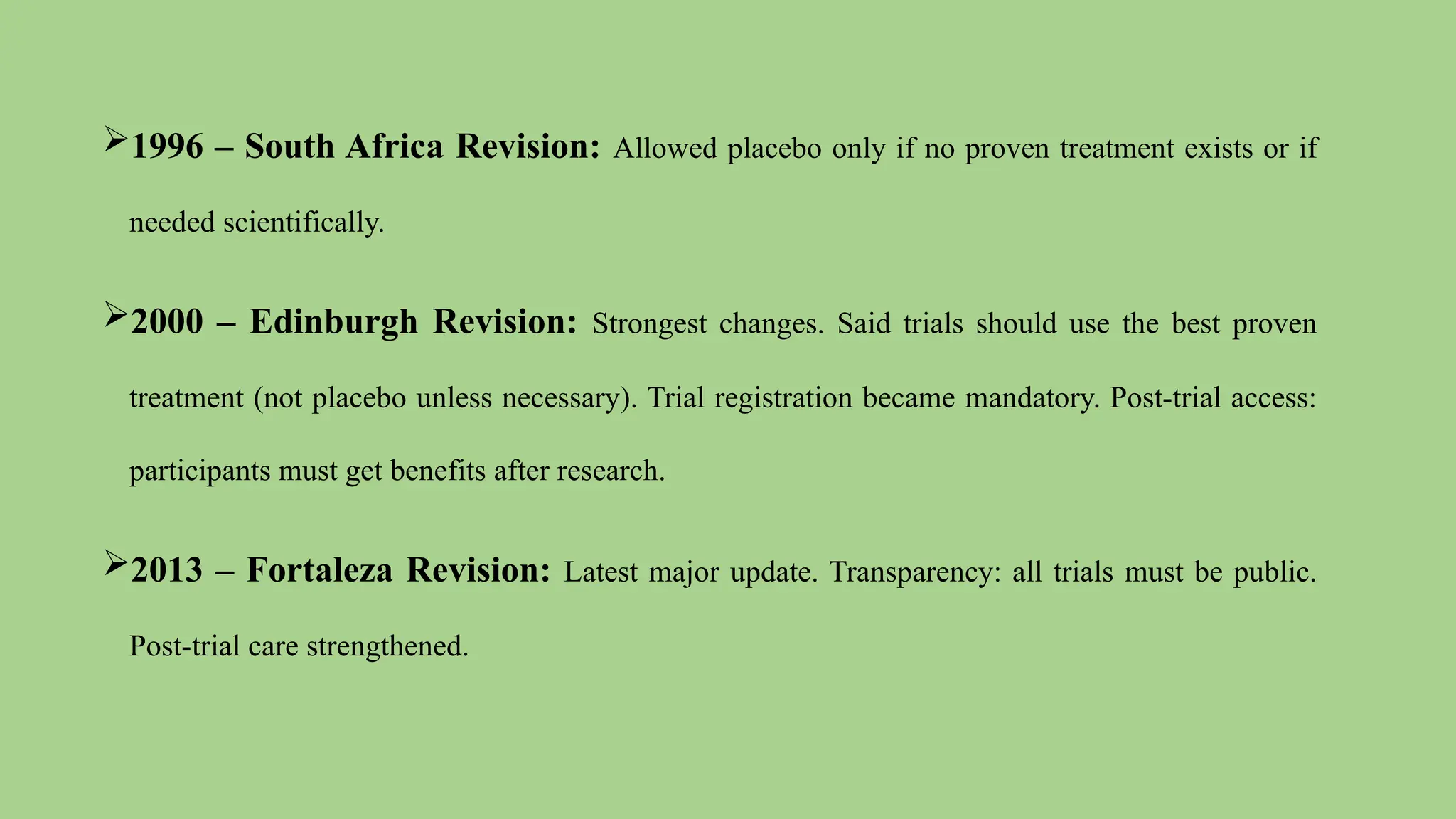
1996 – South Africa Revision: Allowed placebo only if no proven treatment exists or if
needed scientifically.
2000 – Edinburgh Revision: Strongest changes. Said trials should use the best proven
treatment (not placebo unless necessary). Trial registration became mandatory. Post-trial access:
participants must get benefits after research.
2013 – Fortaleza Revision: Latest major update. Transparency: all trials must be public.
Post-trial care strengthened.
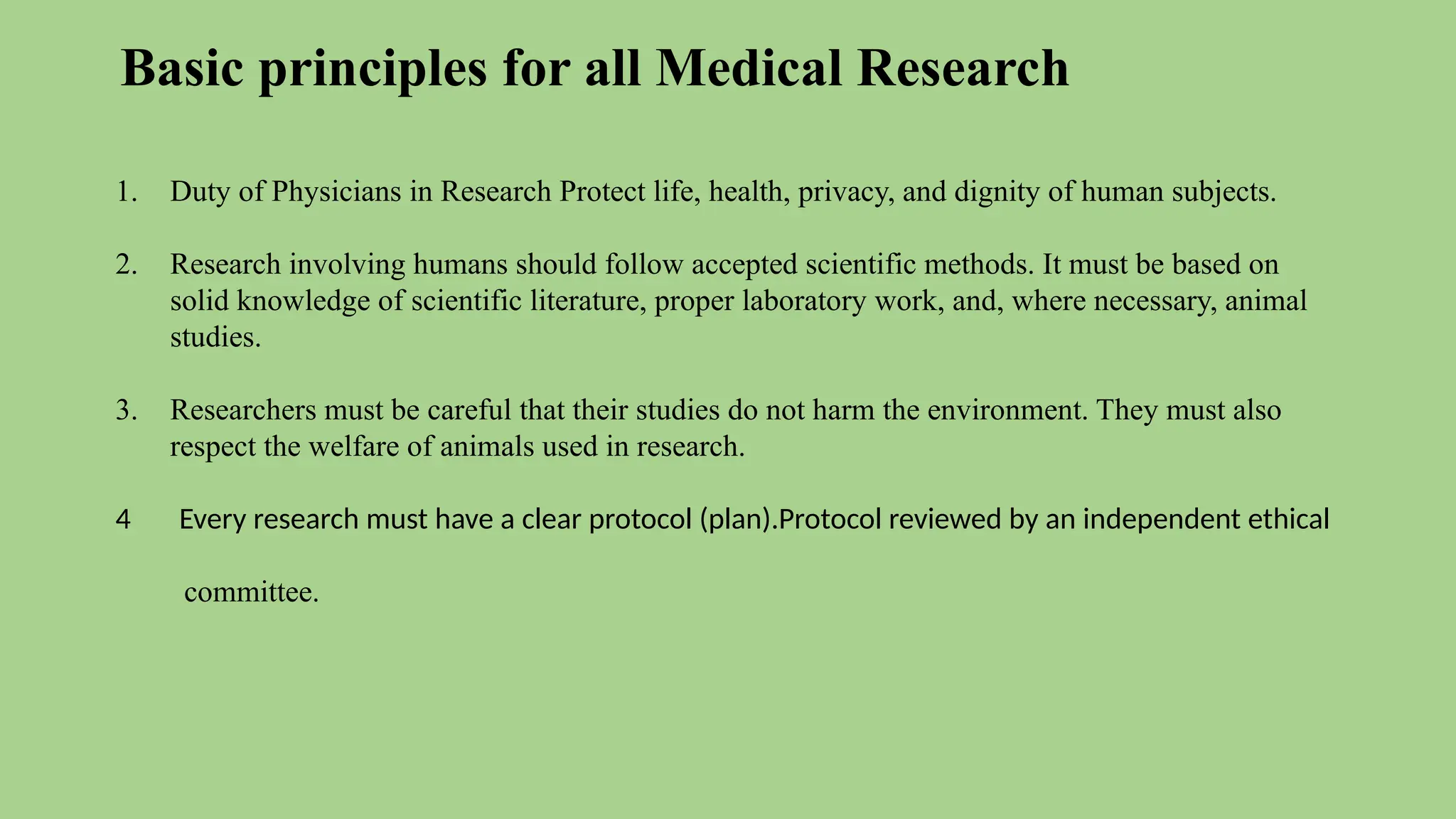
Basic principles for all Medical Research
1. Duty of Physicians in Research Protect life, health, privacy, and dignity of human subjects.
2. Research involving humans should follow accepted scientific methods. It must be based on
solid knowledge of scientific literature, proper laboratory work, and, where necessary, animal
studies.
3. Researchers must be careful that their studies do not harm the environment. They must also
respect the welfare of animals used in research.
4 Every research must have a clear protocol (plan).Protocol reviewed by an independent ethical
committee.
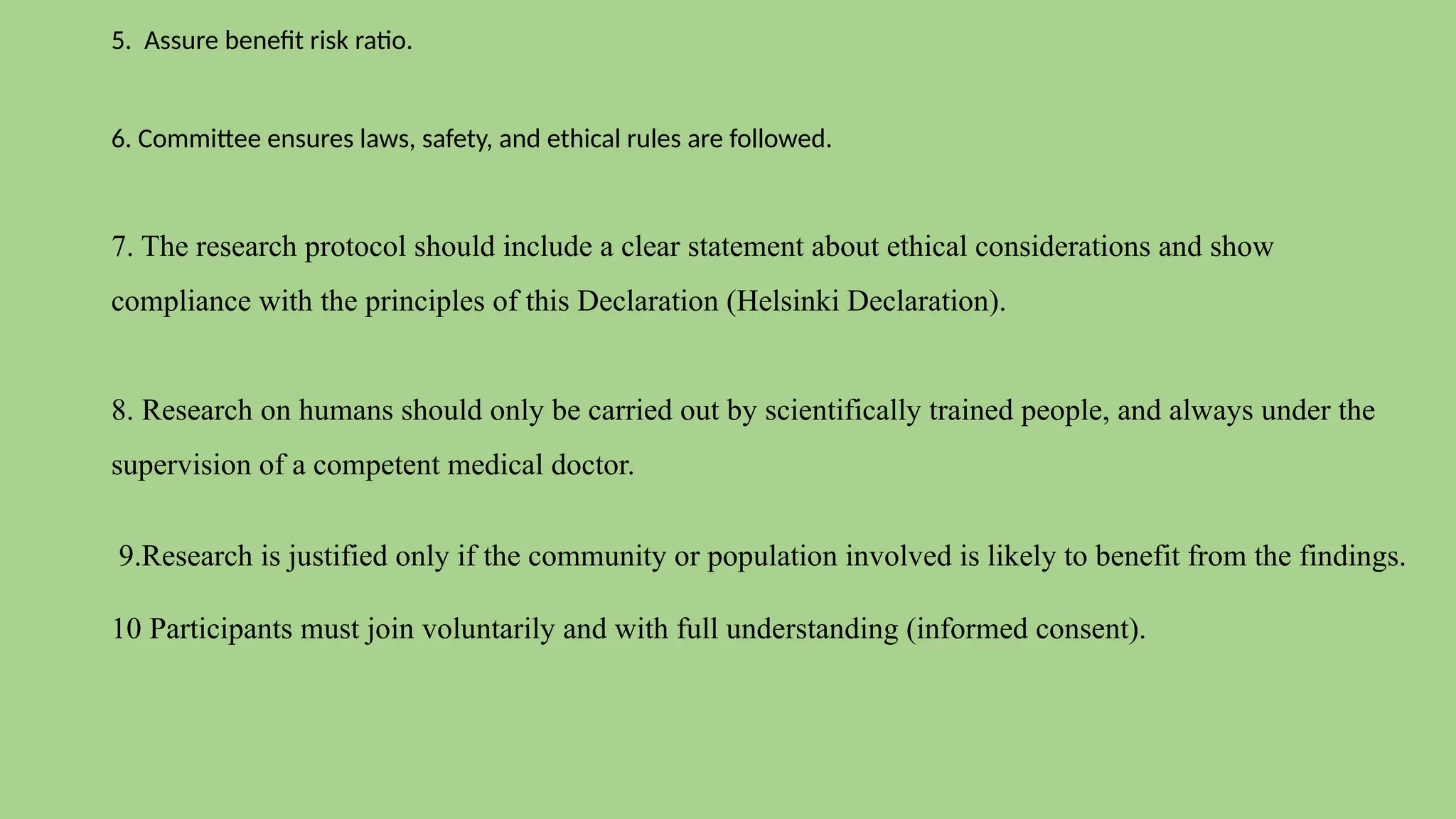
5. Assure benefit risk ratio.
6. Committee ensures laws, safety, and ethical rules are followed.
7. The research protocol should include a clear statement about ethical considerations and show
compliance with the principles of this Declaration (Helsinki Declaration).
8. Research on humans should only be carried out by scientifically trained people, and always under the
supervision of a competent medical doctor.
9.Research is justified only if the community or population involved is likely to benefit from the findings.
10 Participants must join voluntarily and with full understanding (informed consent).
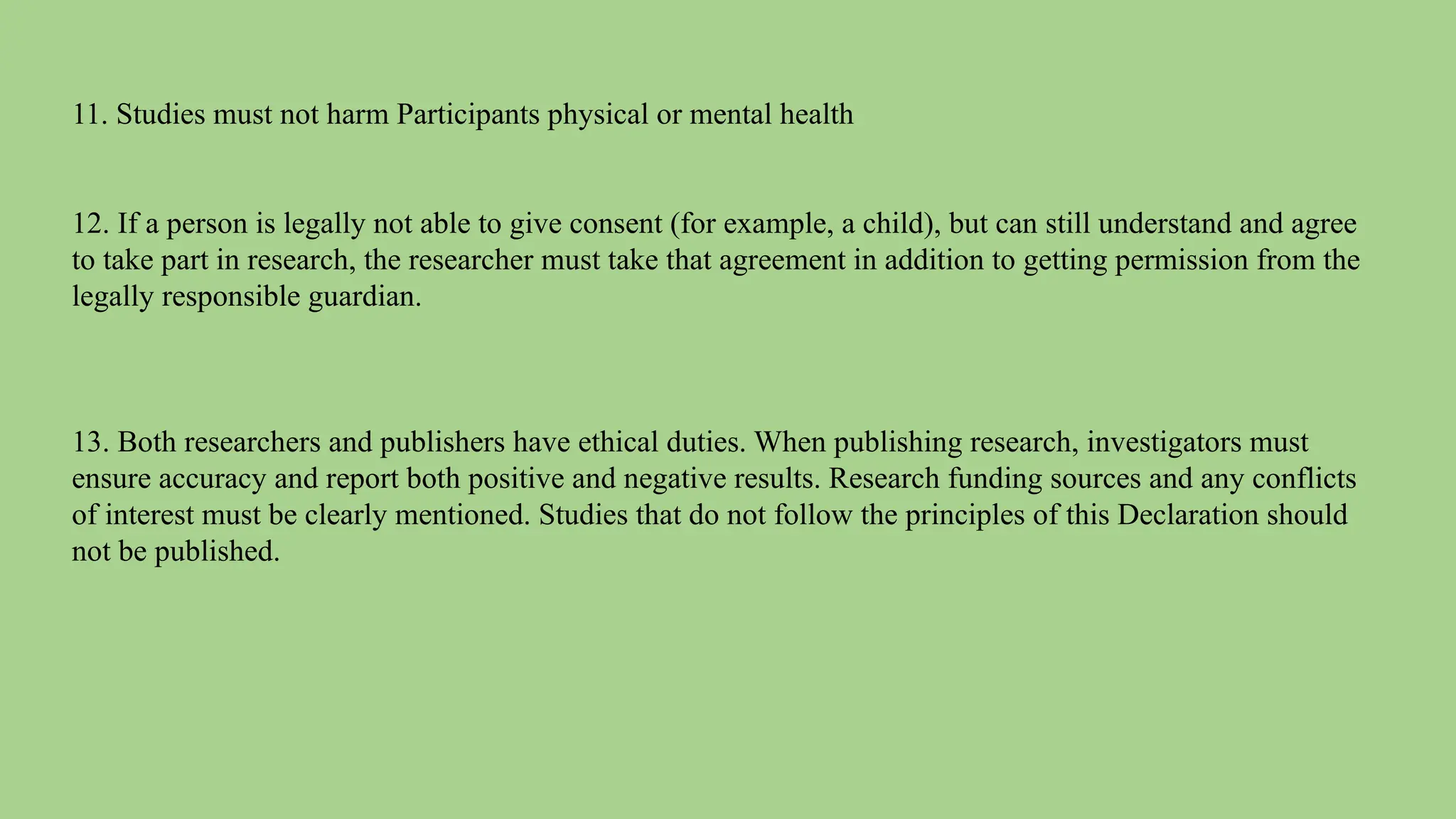
11. Studies must not harm Participants physical or mental health
12. If a person is legally not able to give consent (for example, a child), but can still understand and agree
to take part in research, the researcher must take that agreement in addition to getting permission from the
legally responsible guardian.
13. Both researchers and publishers have ethical duties. When publishing research, investigators must
ensure accuracy and report both positive and negative results. Research funding sources and any conflicts
of interest must be clearly mentioned. Studies that do not follow the principles of this Declaration should
not be published.
Additional Principles for Medical Research Combined
with Medical Care
Testing New Methods:
New methods must be tested against the best current treatments.
Placebo or no treatment is allowed only if no proven method exists.
Patient Rights After Study:
Patients should get access to the best treatments found in the study.
Ensures that participants benefit from the research.
Patient Consent & Care:
Patients must be told clearly what part of care is research-based.
Refusal does not affect normal doctor–patient relationship.
Using Unproven Methods:
If proven methods don’t exist or fail: Doctors can use new/unproven methods with patient’s
consent. Only if it gives hope to save life or reduce suffering.
Research Responsibility:
New methods should be studied for safety and effectiveness.
Follows ethical principles to protect patients.
Advantages
Helps in faster medical progress.
Gives patients access to new treatments.
Ensures ethical protection of patients.
Builds trust between doctors, patients, and researchers.
Uses / Applications
 Development of new medicines.
 Improving methods for diseases.
 Providing care where no proven treatment exists.
 Helps in global health improvement.
Conclusion
 Patient safety is first priority.
 Patients must have rights and consent.
 Balance between science advancement and human care.
Reference
1. WMA - Declaration of Helsinki – 2000 version (including notes of
clarification 2002 & 2004).
2. Human D, Fluss S (July 2001) “The world medical association’s
declaration of Helsinki: Historical and contemporary perspectives.”
3. The social medicine portal (1st June 2008) "FDA abandons declaration
of Helsinki for international clinical trials".
4. WMA –Declaration of Helsinki – 2000 version (including notes
of clarification 2002 & 2004).
5. WMA – Declaration of Helsinki – 2008 version. 8. Human, D. &
Fluss, S. (July 2001) “The World Medical Association’s Declaration
of Helsinki: Historical and Contemporary PerspPerspective
6. The Social Medicine Portal (1st
June 2008) “FDA Abandons
Declaration of Helsinki for international clinical trials”. 7. 7. 7.
http://www.socialmedicine.org/2008/06/01/ethics (accessed 20
Feb 2009) 24
Thank you

Declaration of Helsinki Basic principles in medical research ppt.pptx

  • 1.
    Government college ofpharmacy Amravati Guided By: Yogesh Daga sir Presented by: Komal Wagh, Yash Ghorpade, Rani Konde, Harshit Shende Declaration of Helsinki
  • 2.
    Content 1.Introduction: Declaration ofHelsinki 2.History and scope 3.Basic principle of all medical research 4.Additional principle for medical research combined with medical care 5.Advantages and uses 6.Conclusion
  • 3.
    Introduction WHAT IS HELSINKI?  Helsinki It is a set of principles basically used in clinical trials.  Followed in medical research (human subject).  Some ethical principles are developed by World Health Association for the guidance of medical doctors in biomedical research involving humans.  Duty of a doctor or a physician in research is to. Protect the life, health, privacy and dignity of the subject.
  • 5.
     Consent inwriting  Independently reviewed  Protocol must be followed  Caution if investigation are treating their patients  Best proven diagnostic and therapeutic method The Declaration of Helsinki
  • 6.
    History 1947 → NurembergCode after World War II (first ethics code for human research). Linked to Declaration of Geneva (1948) 1964 → World Medical Association (WMA) adopted the Declaration of Helsinki in Helsinki, Finland. Focus: Ethical guidelines for doctors doing research on human subjects. Regularly revised (Tokyo 1975, Edinburgh 2000, etc.) to keep up with modern medicine.
  • 7.
    Scope  Applies whenmedical research is done along with patient care.  Covers: Testing of new medicines, vaccines, or treatments Diagnostic methods (lab tests, imaging, genetic tools)  Therapeutic procedures (surgery, therapies)  Statement of physicians’ ethical duties.  DoH specifically addressed clinical research.
  • 8.
    Revisions of Declarationof Helsinki. DoH • First Revision 1975. • Second Revision 1983. • Third Revision 1989. • Fourth Revision 1996. • Fifth Revision 2000. • Clarifications of Articles 29 & 30 2002 & 2004. • Sixth Revision 2013
  • 9.
    1975 – TokyoRevision: Said research must be checked by an Ethics Committee. Made informed consent compulsory. Special protection for vulnerable groups. 1983 – Venice Revision: Cleared rules for proxy consent (when patient cannot decide, e.g., children, unconscious). Focus on participants’ rights. 1989 – Hong Kong: Amendment Research must be scientifically valid. More concern for developing countries.
  • 10.
    1996 – SouthAfrica Revision: Allowed placebo only if no proven treatment exists or if needed scientifically. 2000 – Edinburgh Revision: Strongest changes. Said trials should use the best proven treatment (not placebo unless necessary). Trial registration became mandatory. Post-trial access: participants must get benefits after research. 2013 – Fortaleza Revision: Latest major update. Transparency: all trials must be public. Post-trial care strengthened.
  • 11.
    Basic principles forall Medical Research 1. Duty of Physicians in Research Protect life, health, privacy, and dignity of human subjects. 2. Research involving humans should follow accepted scientific methods. It must be based on solid knowledge of scientific literature, proper laboratory work, and, where necessary, animal studies. 3. Researchers must be careful that their studies do not harm the environment. They must also respect the welfare of animals used in research. 4 Every research must have a clear protocol (plan).Protocol reviewed by an independent ethical committee.
  • 12.
    5. Assure benefitrisk ratio. 6. Committee ensures laws, safety, and ethical rules are followed. 7. The research protocol should include a clear statement about ethical considerations and show compliance with the principles of this Declaration (Helsinki Declaration). 8. Research on humans should only be carried out by scientifically trained people, and always under the supervision of a competent medical doctor. 9.Research is justified only if the community or population involved is likely to benefit from the findings. 10 Participants must join voluntarily and with full understanding (informed consent).
  • 13.
    11. Studies mustnot harm Participants physical or mental health 12. If a person is legally not able to give consent (for example, a child), but can still understand and agree to take part in research, the researcher must take that agreement in addition to getting permission from the legally responsible guardian. 13. Both researchers and publishers have ethical duties. When publishing research, investigators must ensure accuracy and report both positive and negative results. Research funding sources and any conflicts of interest must be clearly mentioned. Studies that do not follow the principles of this Declaration should not be published.
  • 14.
    Additional Principles forMedical Research Combined with Medical Care Testing New Methods: New methods must be tested against the best current treatments. Placebo or no treatment is allowed only if no proven method exists. Patient Rights After Study: Patients should get access to the best treatments found in the study. Ensures that participants benefit from the research. Patient Consent & Care: Patients must be told clearly what part of care is research-based. Refusal does not affect normal doctor–patient relationship. Using Unproven Methods: If proven methods don’t exist or fail: Doctors can use new/unproven methods with patient’s consent. Only if it gives hope to save life or reduce suffering. Research Responsibility: New methods should be studied for safety and effectiveness. Follows ethical principles to protect patients.
  • 15.
    Advantages Helps in fastermedical progress. Gives patients access to new treatments. Ensures ethical protection of patients. Builds trust between doctors, patients, and researchers.
  • 16.
    Uses / Applications Development of new medicines.  Improving methods for diseases.  Providing care where no proven treatment exists.  Helps in global health improvement. Conclusion  Patient safety is first priority.  Patients must have rights and consent.  Balance between science advancement and human care.
  • 17.
    Reference 1. WMA -Declaration of Helsinki – 2000 version (including notes of clarification 2002 & 2004). 2. Human D, Fluss S (July 2001) “The world medical association’s declaration of Helsinki: Historical and contemporary perspectives.” 3. The social medicine portal (1st June 2008) "FDA abandons declaration of Helsinki for international clinical trials". 4. WMA –Declaration of Helsinki – 2000 version (including notes of clarification 2002 & 2004). 5. WMA – Declaration of Helsinki – 2008 version. 8. Human, D. & Fluss, S. (July 2001) “The World Medical Association’s Declaration of Helsinki: Historical and Contemporary PerspPerspective 6. The Social Medicine Portal (1st June 2008) “FDA Abandons Declaration of Helsinki for international clinical trials”. 7. 7. 7. http://www.socialmedicine.org/2008/06/01/ethics (accessed 20 Feb 2009) 24
  • 18.