Inteligência Artificial, Éticae Universidade:
Por que precisamos de regras?
Virgílio Almeida
Departamento de Ciência da Computaão
Universidade Federal de Minas Gerais
Berkman Klein Center, Harvard University
Belo Horizonte, 10 de novembro de 2025
2.
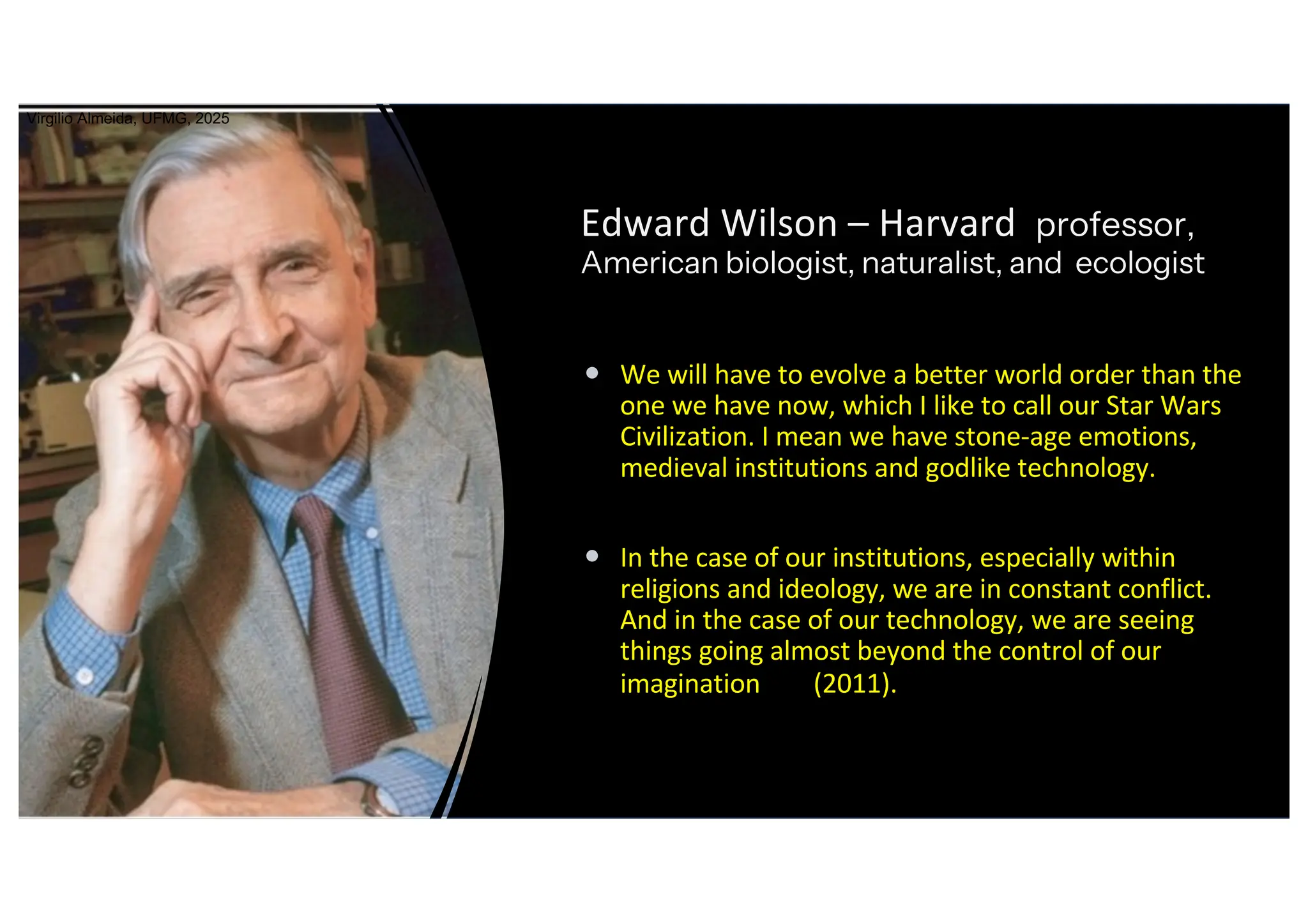
Edward Wilson –Harvard professor,
American biologist, naturalist, and ecologist
• We will have to evolve a better world order than the
one we have now, which I like to call our Star Wars
Civilization. I mean we have stone-age emotions,
medieval institutions and godlike technology.
• In the case of our institutions, especially within
religions and ideology, we are in constant conflict.
And in the case of our technology, we are seeing
things going almost beyond the control of our
imagination (2011).
Virgilio Almeida, UFMG, 2025
3.
Digital Future inthe
Age of Uncertainties
• Technological advances bring
enormous possibilities but also
deepen inequalities.
• Technological advances bring
enormous possibilities but pose
profound risks to democracy.
• Technological advances bring
enormous possibilities but demand
ethical and political responsibility.
• Technological advances bring
enormous possibilities but may
outpace our capacity to govern
them.
3
Virgilio Almeida
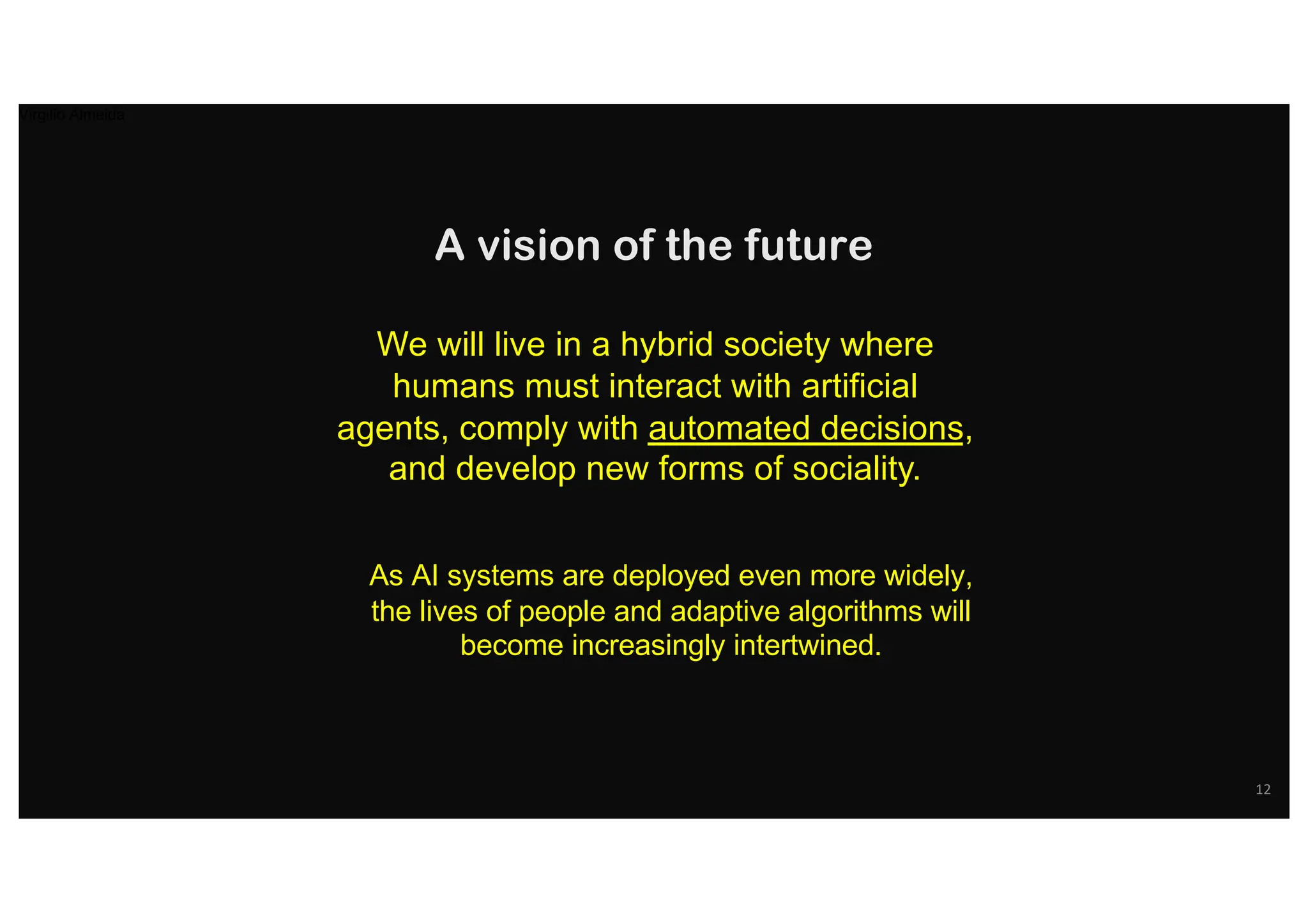
We will livein a hybrid society where
humans must interact with artificial
agents, comply with automated decisions,
and develop new forms of sociality.
A vision of the future
As AI systems are deployed even more widely,
the lives of people and adaptive algorithms will
become increasingly intertwined.
12
Virgilio Almeida
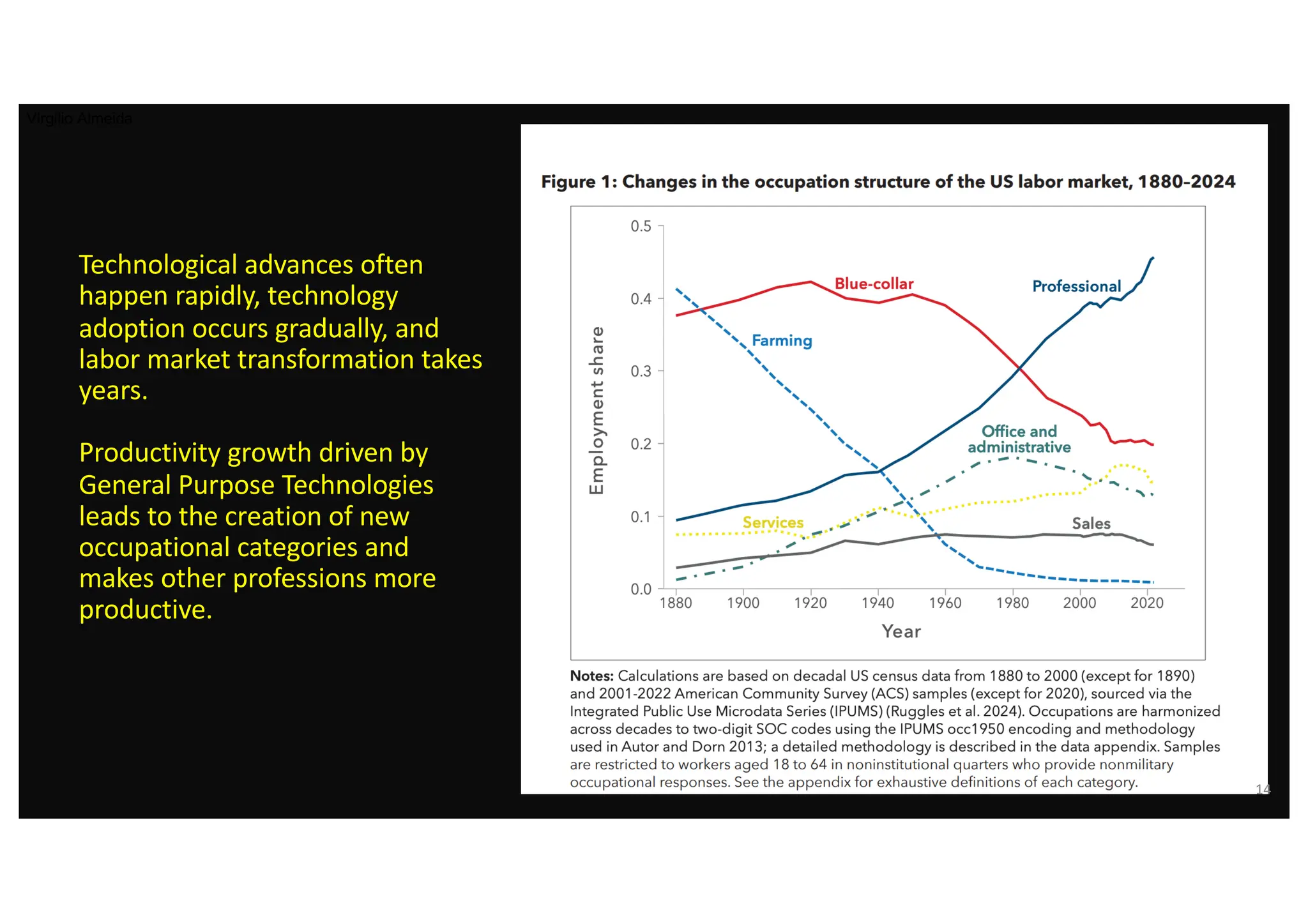
Technological advances often
happenrapidly, technology
adoption occurs gradually, and
labor market transformation takes
years.
Productivity growth driven by
General Purpose Technologies
leads to the creation of new
occupational categories and
makes other professions more
productive.
Virgilio Almeida
14
10 Priorities forAI
Research & Policy
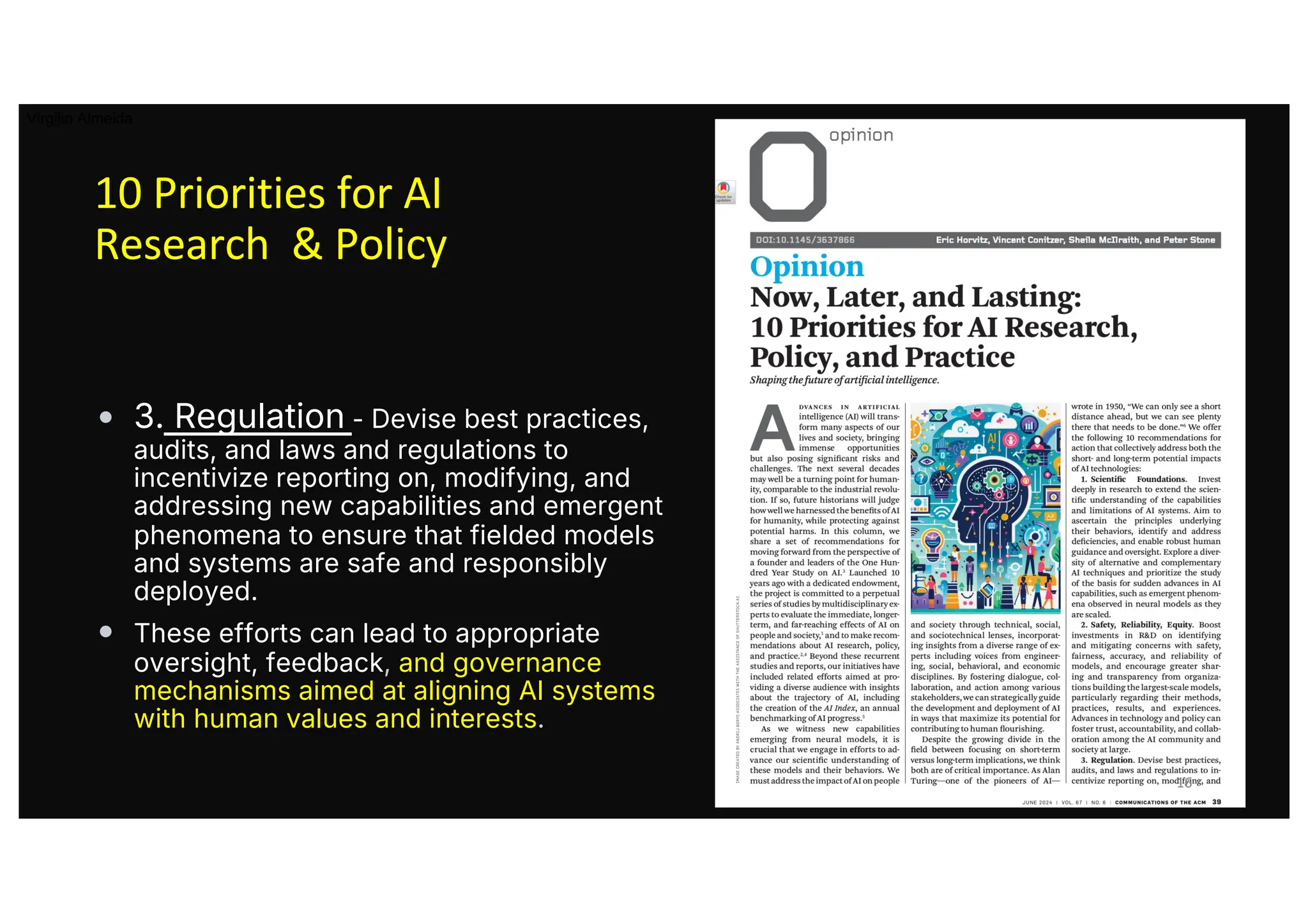
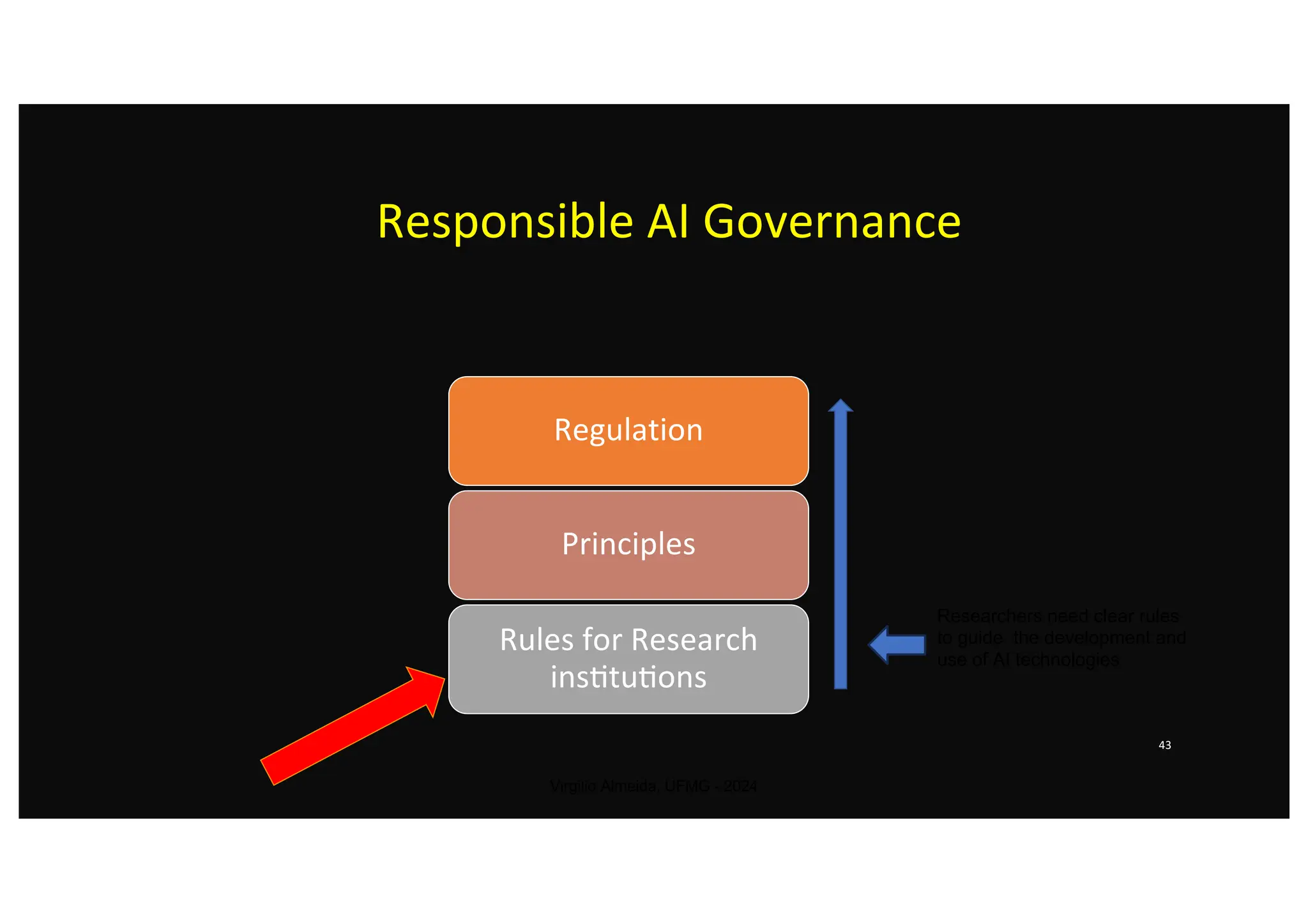
• 3. Regulation - Devise best practices,
audits, and laws and regulations to
incentivize reporting on, modifying, and
addressing new capabilities and emergent
phenomena to ensure that fielded models
and systems are safe and responsibly
deployed.
• These efforts can lead to appropriate
oversight, feedback, and governance
mechanisms aimed at aligning AI systems
with human values and interests.
16
Virgilio Almeida
Three fundamental quesCons:
•Why is AI regulation and governance a
hard problem?
• Why is AI regulation and governance an
even harder problem in the Global
South?
• What are promising areas for research?
18
Virgilio Almeida
19.
Widely Distributed Harms
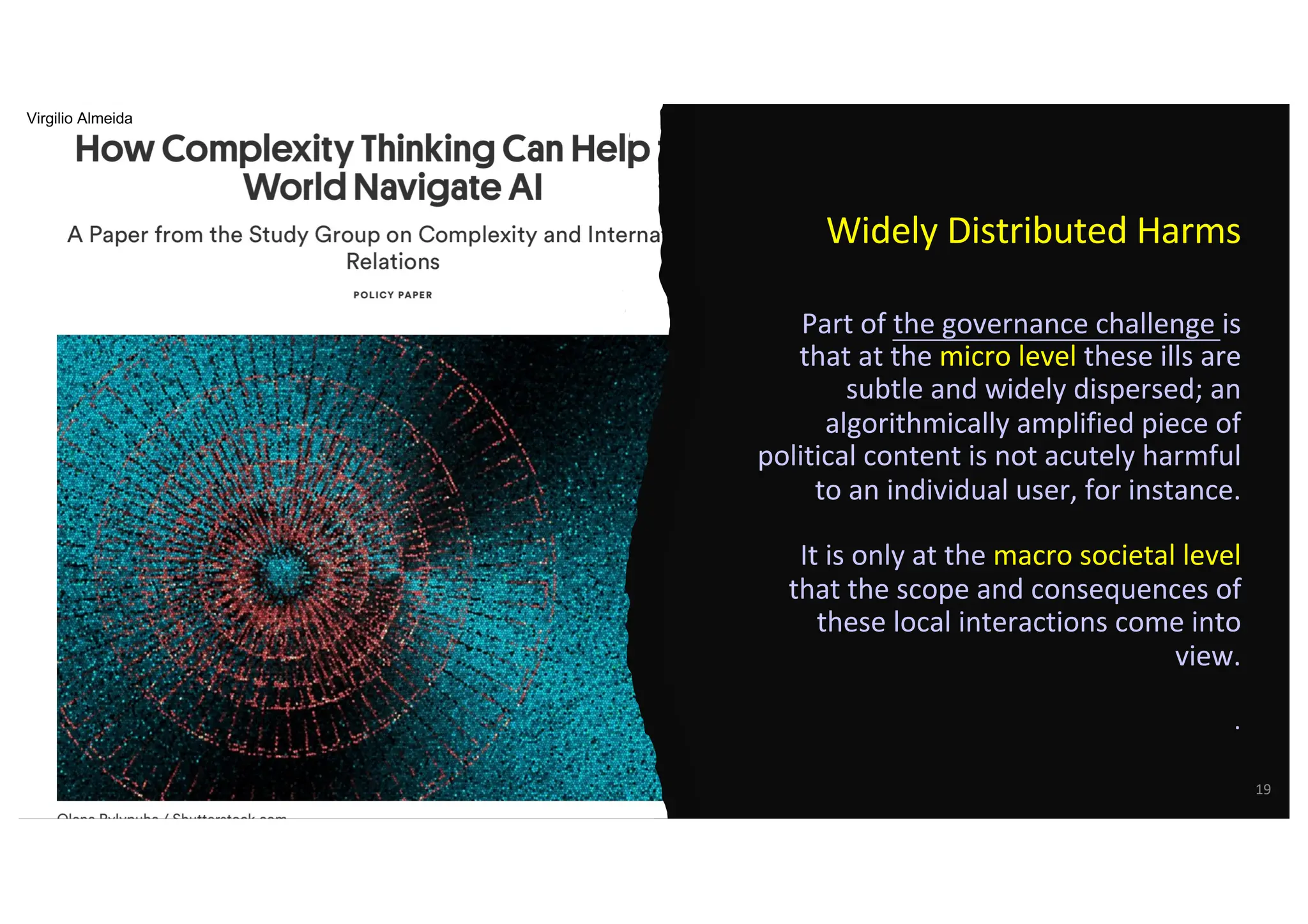
Partof the governance challenge is
that at the micro level these ills are
subtle and widely dispersed; an
algorithmically amplified piece of
political content is not acutely harmful
to an individual user, for instance.
It is only at the macro societal level
that the scope and consequences of
these local interactions come into
view.
.
19
Virgilio Almeida
20.
AI Governance challenges
1.Pace Gap ()mescale mismatch): AI evolves fast, policy
lags behind
2. Uncertainty: AI’s impacts remain unpredictable
3. Monopoly Power: AI dominated by few big firms
4. Rising Inequality: AI deepens global digital divides
5. Widespread Harms: While AI offers benefits, it may
worsen issues like mental health crises, societal trust
erosion, and poli)cal polariza)on.
20
Virgilio Almeida
LaForge, Gordon, et al. Complexity and the Global
Governance of AI. Washington, DC: New America, 2023.
21.
AI Governance inthe Global South
additional challenges
1. Limited digital infrastructure and tech readiness
2. Weak ins)tu)ons and regulatory capacity
3. Tensions between foreign investment and local policy goals
4. Global imbalances in tech and governance power
5. Shortage of skilled STEM professionals
6. AI governance challenged by deep social and economic
inequali)es
Virgilio Almeida 21
22.
Virgilio Almeida
22
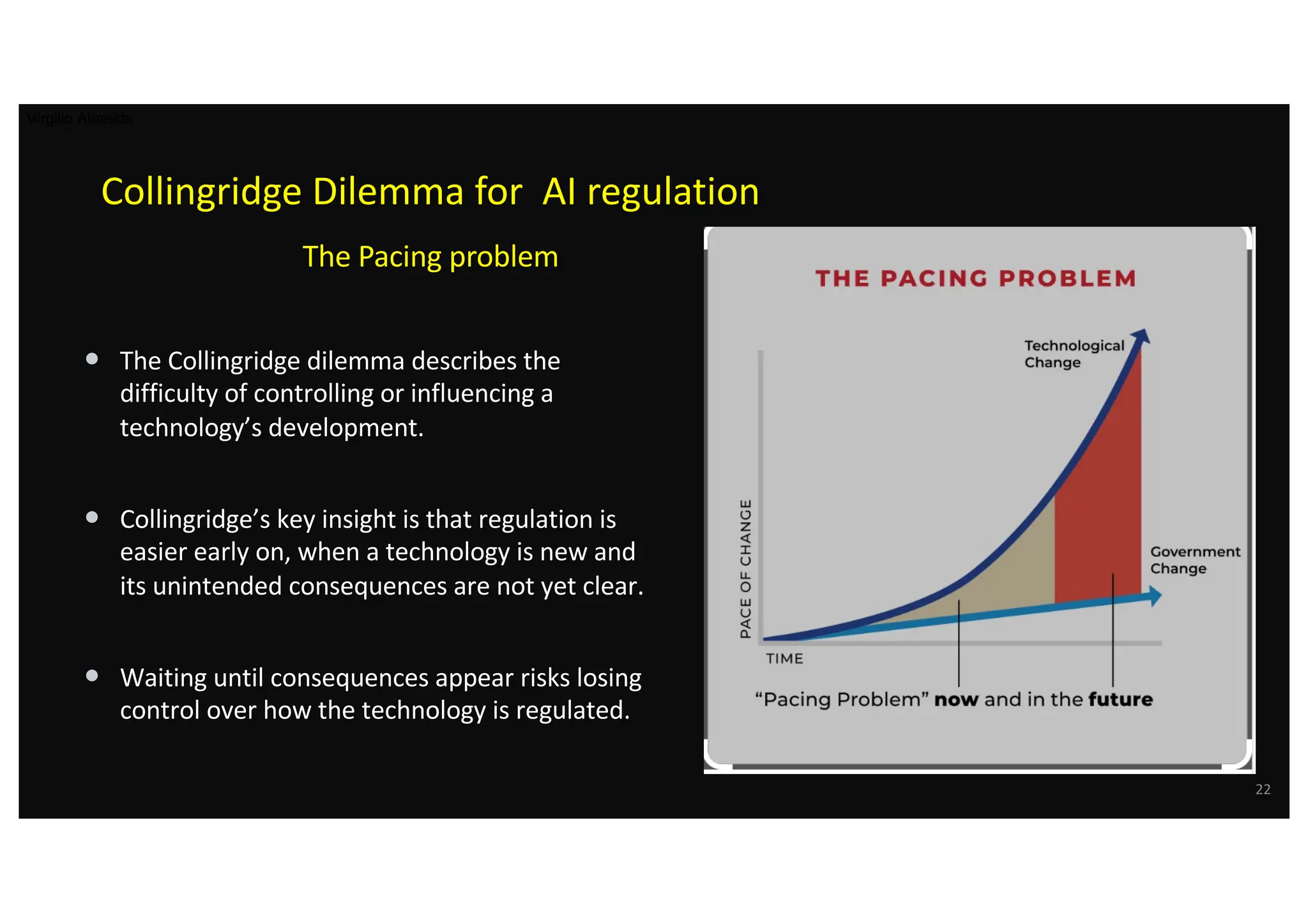
Collingridge Dilemmafor AI regulation
The Pacing problem
• The Collingridge dilemma describes the
difficulty of controlling or influencing a
technology’s development.
• Collingridge’s key insight is that regulation is
easier early on, when a technology is new and
its unintended consequences are not yet clear.
• Waiting until consequences appear risks losing
control over how the technology is regulated.
23.
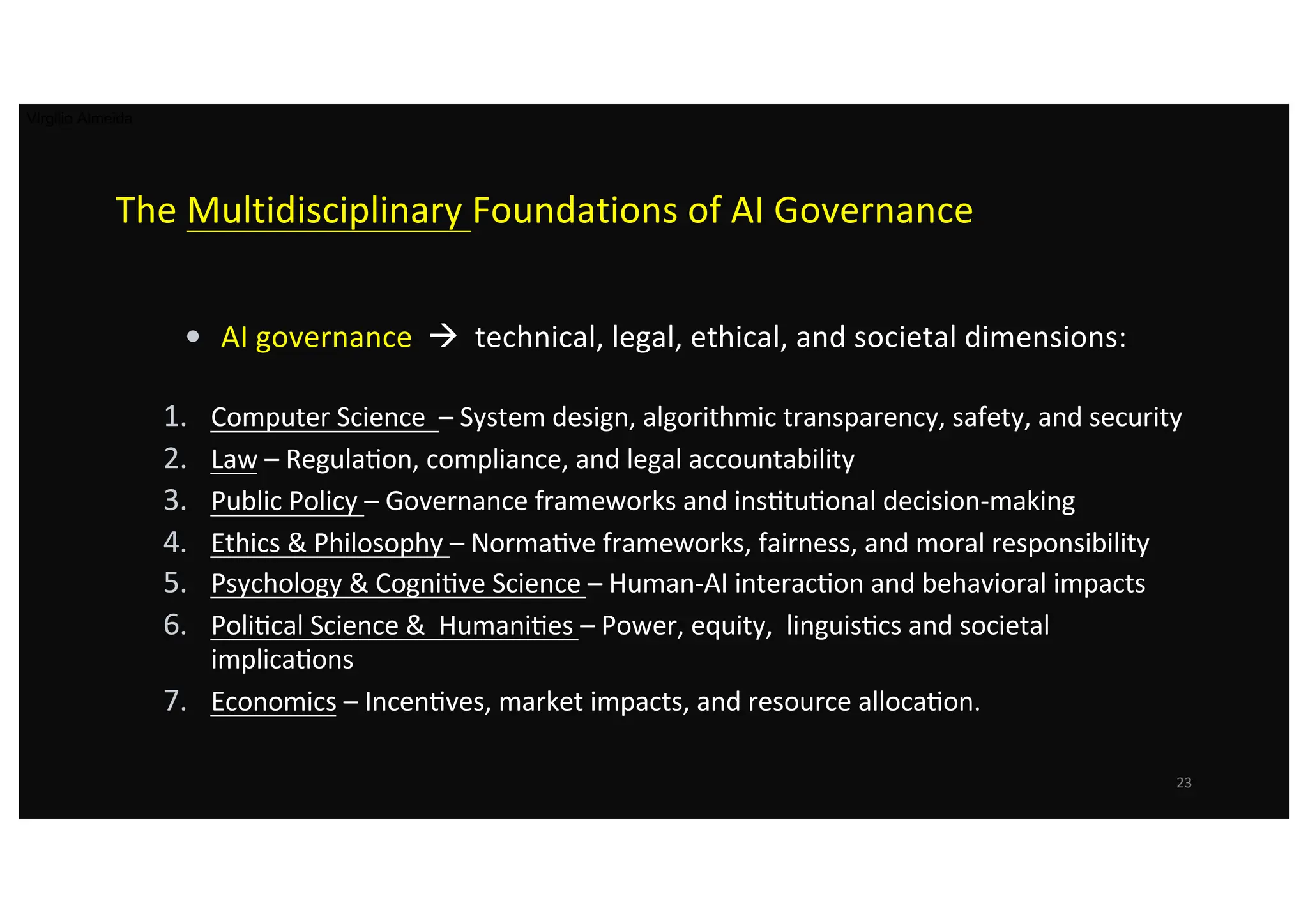
The Multidisciplinary Foundationsof AI Governance
• AI governance à technical, legal, ethical, and societal dimensions:
1. Computer Science – System design, algorithmic transparency, safety, and security
2. Law – RegulaLon, compliance, and legal accountability
3. Public Policy – Governance frameworks and insLtuLonal decision-making
4. Ethics & Philosophy – NormaLve frameworks, fairness, and moral responsibility
5. Psychology & CogniLve Science – Human-AI interacLon and behavioral impacts
6. PoliLcal Science & HumaniLes – Power, equity, linguisLcs and societal
implicaLons
7. Economics – IncenLves, market impacts, and resource allocaLon.
23
Virgilio Almeida
Algorithmic Societies
§ Wedepend on algorithms for a growing
number of activities – decision-making
ü Urban Mobility
ü Relationships
ü Definition on what you see in social platforms
ü Access to social policies and benefits
ü Medical Decision
ü Policing and Criminal Dosimetry
25
Virgilio Almeida
26.
Algorithmic systems have
alreadyshaped
economies, politics,
geopolitical power,
culture, and communities
26
q Algorithmic systems are made of mul@ple
algorithms, models, data, applica@ons,
hardware, goals, people, and networks.
q● Algorithmic systems are sociotechnical
systems, where technology and social
actors are deeply intertwined.
q Examples of global algorithmic services:
• ● Uber Dynamic Pricing System
• ● Waze Route Op@miza@on
• ● Recommenda@on Algorithms –
Instagram, TikTok For You Page, Spo@fy…
• ● Social Welfare Eligibility Systems
Virgilio Almeida
27.
New ideas forseeking an understanding of
the profound social and political
transformation brought about by the
algorithmizing of society.
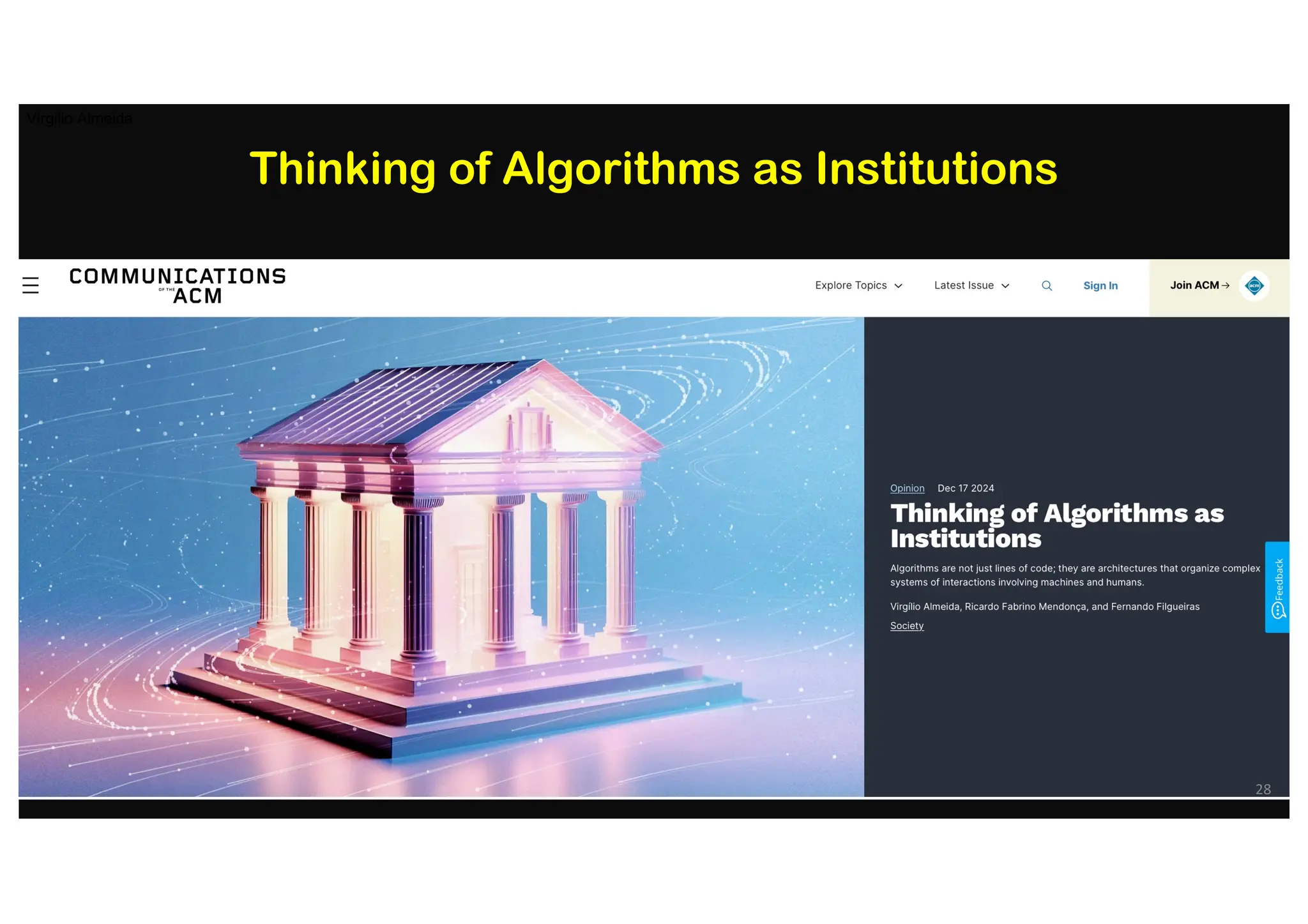
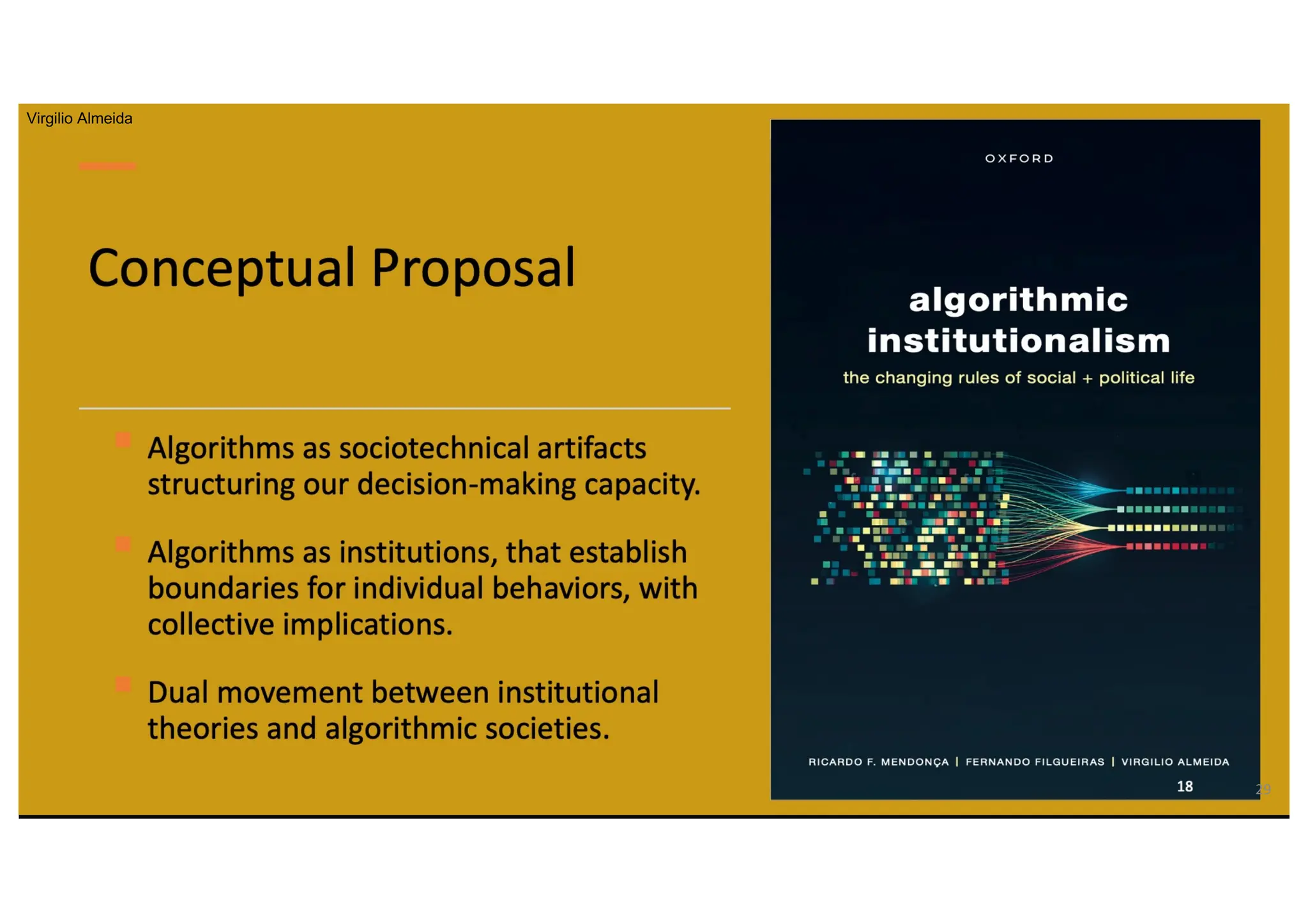
Thinking of algorithms as institutions
Virgilio
Almeida
27
Política dos algoritmos
UBUEditora
Ricardo Mendonça
Fernando Filgueiras
Virgilio Almeida
Com a difusão da inteligência
artificial, sistemas algorítmicos
passam a atuar como instituições
que moldam normas e rotinas
sociais e políticas
Outubro 2025
30
Virgilio Almeida
31.
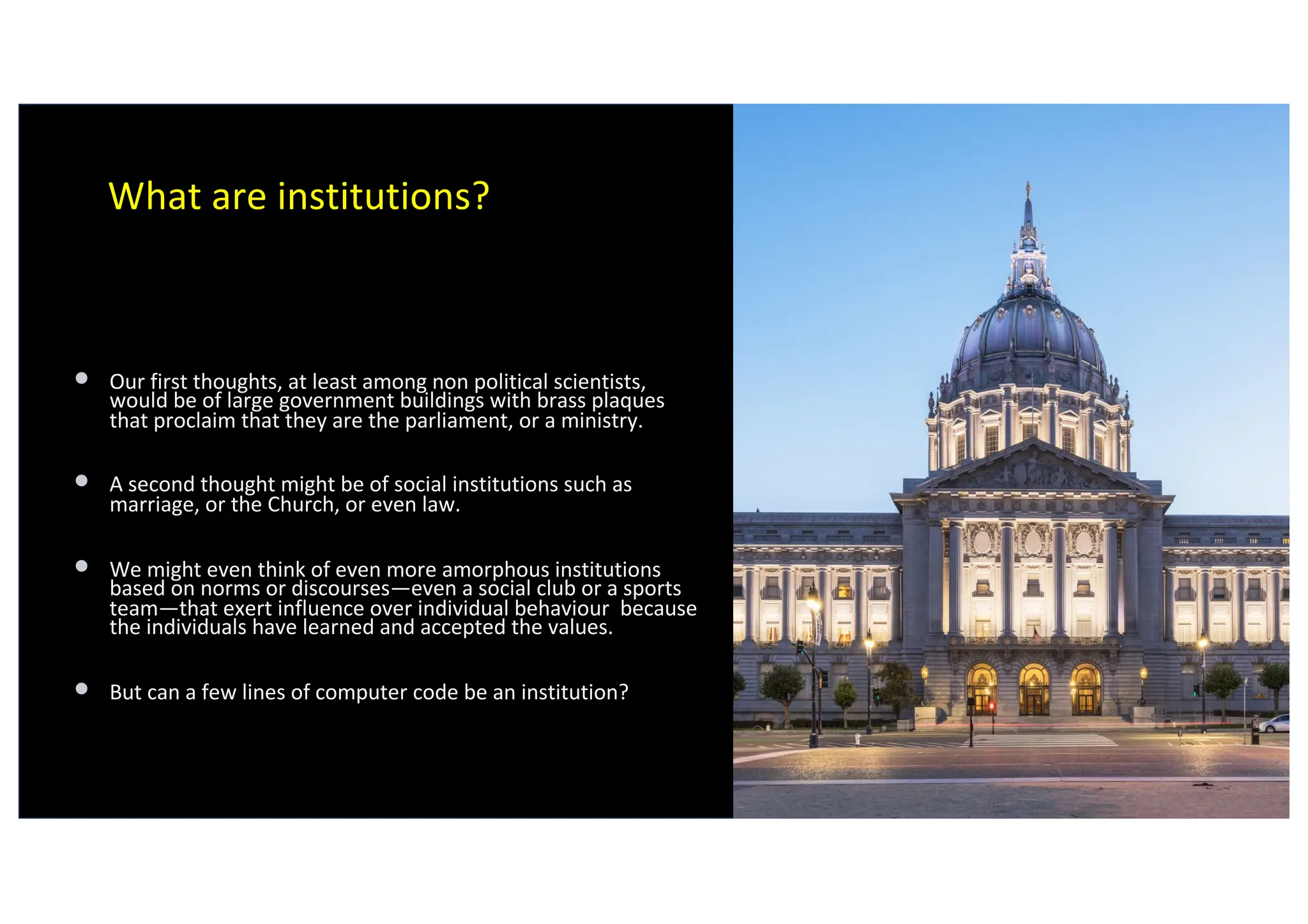
What are institutions?
•Our first thoughts, at least among non political scientists,
would be of large government buildings with brass plaques
that proclaim that they are the parliament, or a ministry.
• A second thought might be of social institutions such as
marriage, or the Church, or even law.
• We might even think of even more amorphous institutions
based on norms or discourses—even a social club or a sports
team—that exert influence over individual behaviour because
the individuals have learned and accepted the values.
• But can a few lines of computer code be an institution?
31
Virgilio Almeida
32.
• Like socialand political institutions, algorithms are devices
that structure our decision-making and problem-solving
capacity. As any other device, algorithms must be evaluated
in terms of their social and political foundations, as well as
in terms of their legitimacy and functionality.
• What should be the forms of democratic
governance of algorithms?
• How to think about public forms of regulation and
management not only of algorithmic production
but also of its consequences?
• How to democratize these institutions that govern
a large part of our collective experience.
Algorithmic
Institutionalism
32
Virgilio Almeida
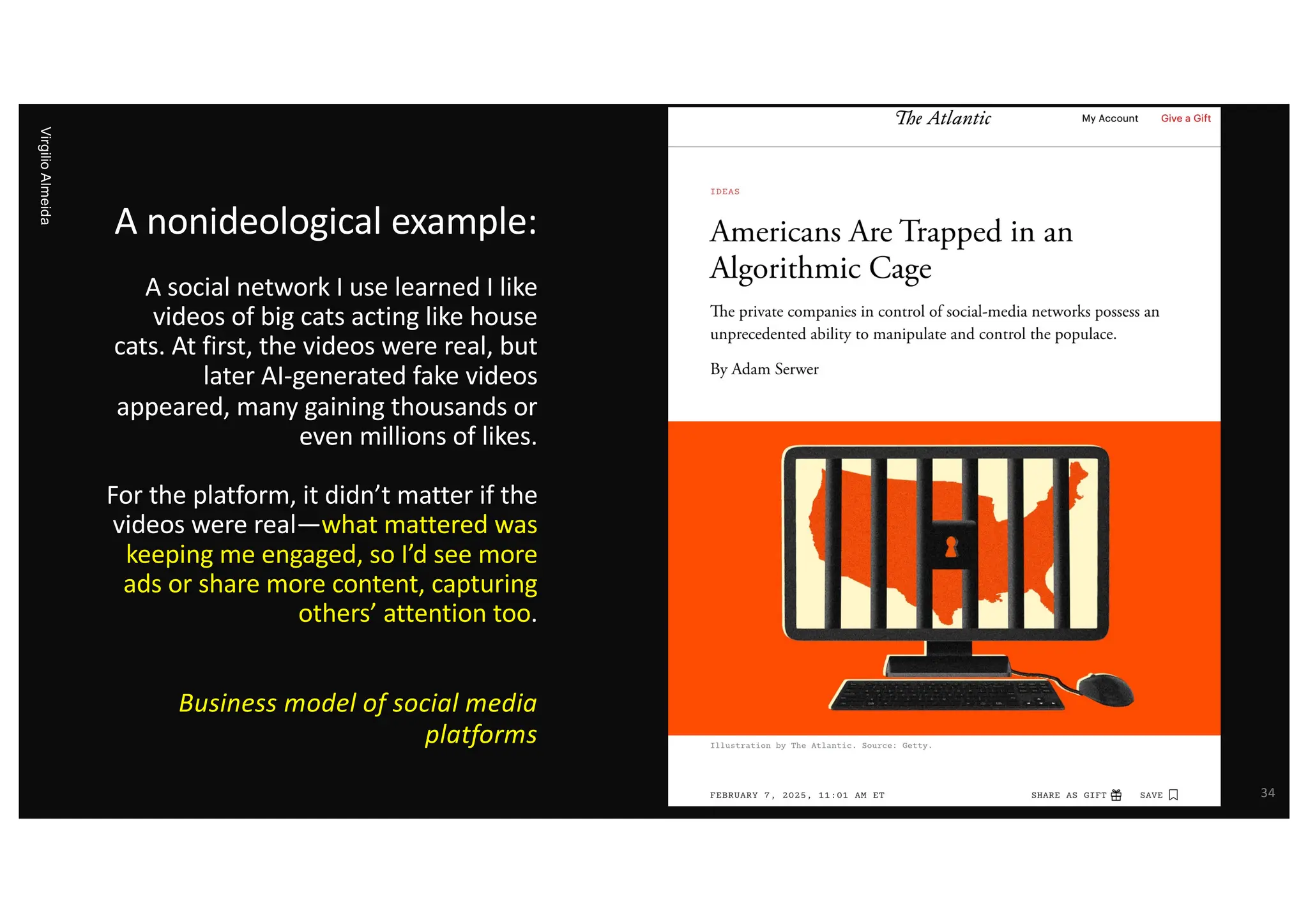
A nonideological example:
Asocial network I use learned I like
videos of big cats acting like house
cats. At first, the videos were real, but
later AI-generated fake videos
appeared, many gaining thousands or
even millions of likes.
For the platform, it didn’t matter if the
videos were real—what mattered was
keeping me engaged, so I’d see more
ads or share more content, capturing
others’ attention too.
Business model of social media
platforms
Virgilio
Almeida
34
35.
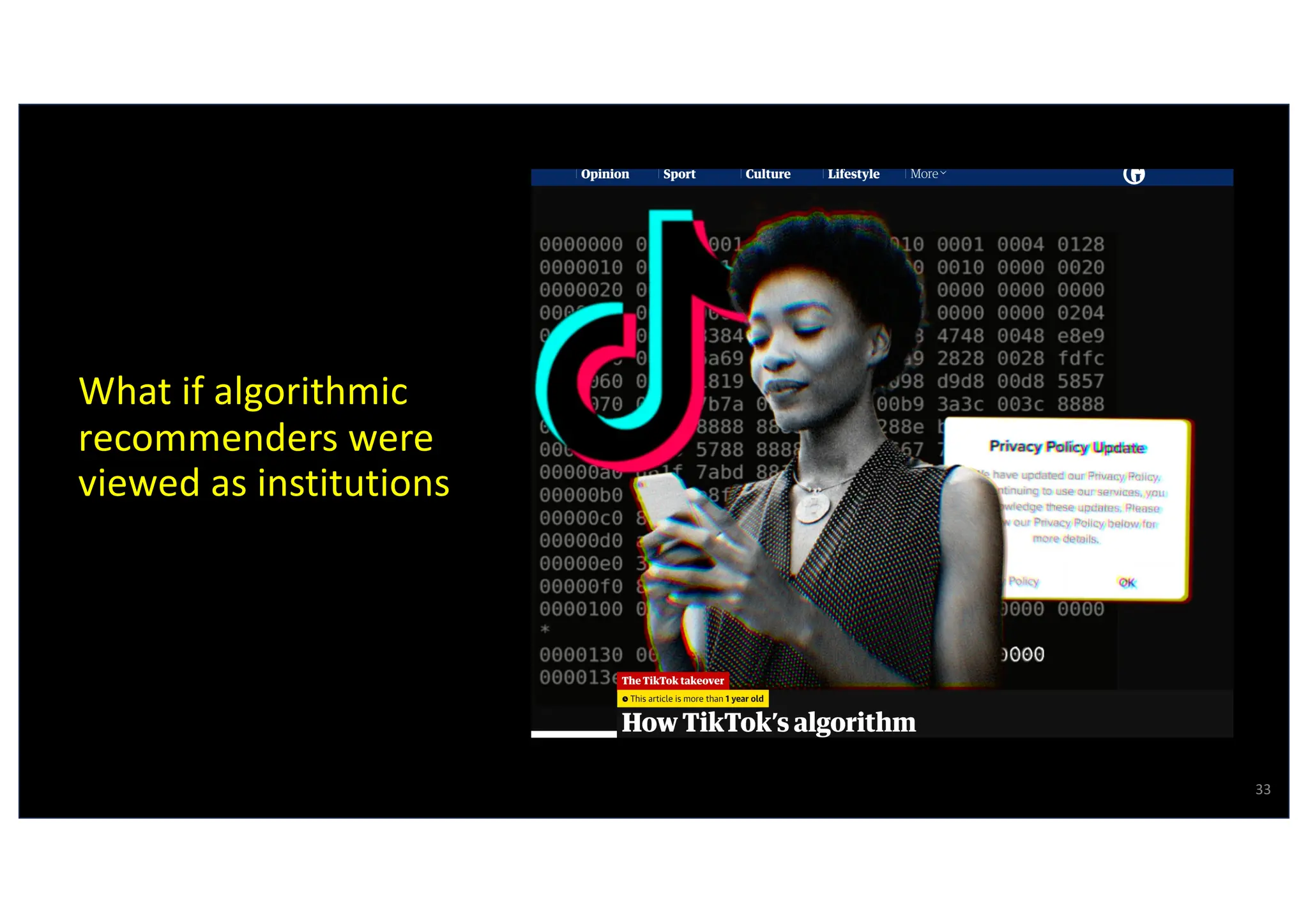
Viewing recommendation algorithmsas institution
• Algorithmic recommenders are key in the aRen@on economy, widely used in industry,
markets, and governments, classifying informa@on, crea@ng biases, and changing how we
communicate publicly.
• Recommenda@on algorithms, like ins@tu@ons, use rules to shape what users believe and
value.
• Da@ng algorithms shape social and cultural specifici@es through informal rules that
establish what is allowed or prohibited in a social rela@onship. e.g.: on Tinder, everyone
can make the first move, while, on Bumble, only women can ini@ate communica@on.
• The mix of desire, convenience, and efficiency makes algorithmic recommenders
powerful in shaping what gets no@ced. They act as ins@tu@ons, seVng limits on individual
choices.
35
Virgilio Almeida
36.
Governing the digitalspace: new ins@tu@ons
• Platforms as Institutions
• Platforms function like institutions, organizing contexts where people,
businesses, and governments interact.
• As intermediaries, they reshape how we work, communicate, consume, and
relate—driving the re-institutionalization of existing structures.
• Streaming Platforms and the Music Industry
• Apple, Spotify, and YouTube have redefined the music industry—transforming artist
revenue models, shaping listening habits through algorithms, and altering relationships
among artists, labels, and listeners by acting as institutions.
• Media Platforms and the Public Sphere
• Algorithmic platforms, like TikTok, Instagram, Facebook, and X, function as institutions,
reshaping how media structures the public sphere.
Virgilio Almeida 36
37.
Why Multidisciplinarity
Matters forthe
Advancement of AI
• Understanding compu@ng concepts in real-world
contexts requires;
• Ethical impact of AI;
• Social impacts of AI;
• Poli@cal impact of AI;
• Economic impact of Ai;
• Knowledge disciplines: the founda@on for informed
engagement with AI;
• The role of the humani@es as specialists in the crea@on
of meaning.
• New heuris@cs inspired by theore@cal aspects of social
sciences.
• Math and physics: Interpre@ng complex systems;
37
Virgilio Almeida
38.
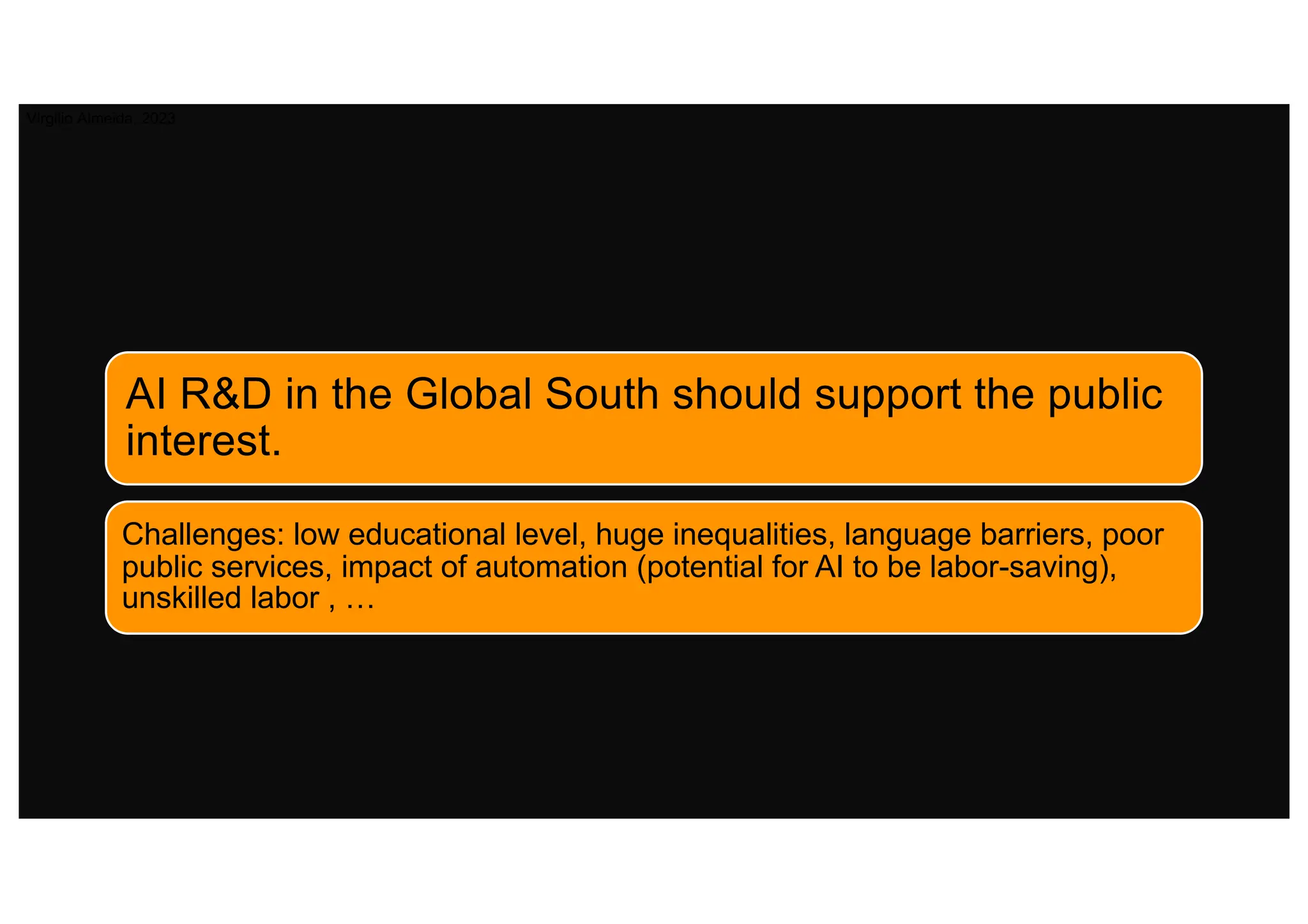
AI R&D inthe Global South should support the public
interest.
Challenges: low educational level, huge inequalities, language barriers, poor
public services, impact of automation (potential for AI to be labor-saving),
unskilled labor , …
Virgilio Almeida, 2023
39.
Digital transformation inthe Global
South: A Call for Research
• Studying collective human behavior across disciplines is
difficult but essential, especially as technology
increasingly shapes how societies function.
• Algorithmic systems and tech companies already
influence global behavior for profit, making inaction
risky.
• Large language models (LLMs) act as powerful drivers of
information flow, shaping behavior on a global scale.
39
Virgilio Almeida
40.
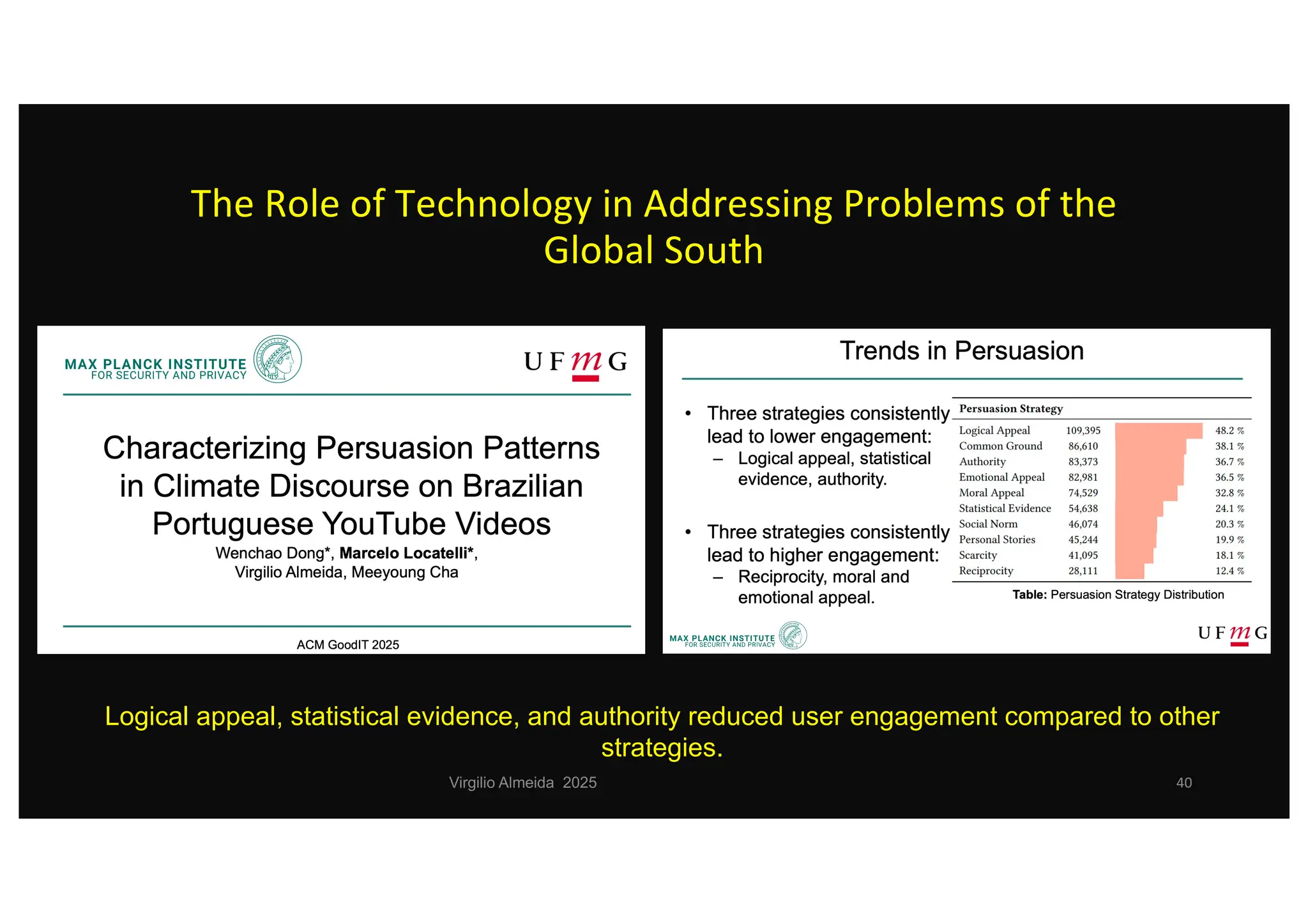
The Role ofTechnology in Addressing Problems of the
Global South
Virgilio Almeida 2025 40
Logical appeal, statistical evidence, and authority reduced user engagement compared to other
strategies.
41.
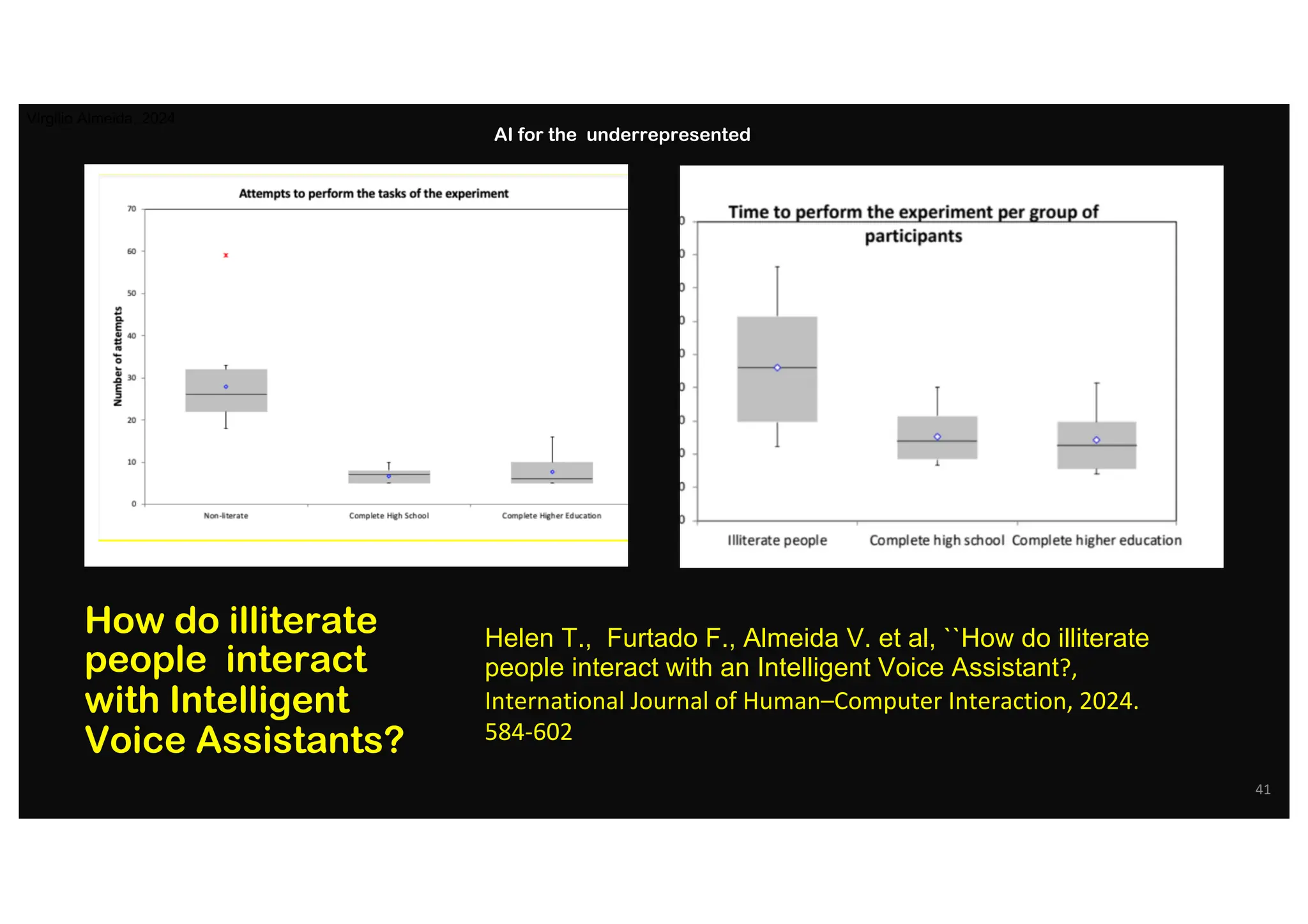
How do illiterate
peopleinteract
with Intelligent
Voice Assistants?
Helen T., Furtado F., Almeida V. et al, ``How do illiterate
people interact with an Intelligent Voice Assistant?,
International Journal of Human–Computer Interaction, 2024.
584-602
41
AI for the underrepresented
Virgilio Almeida, 2024
42.
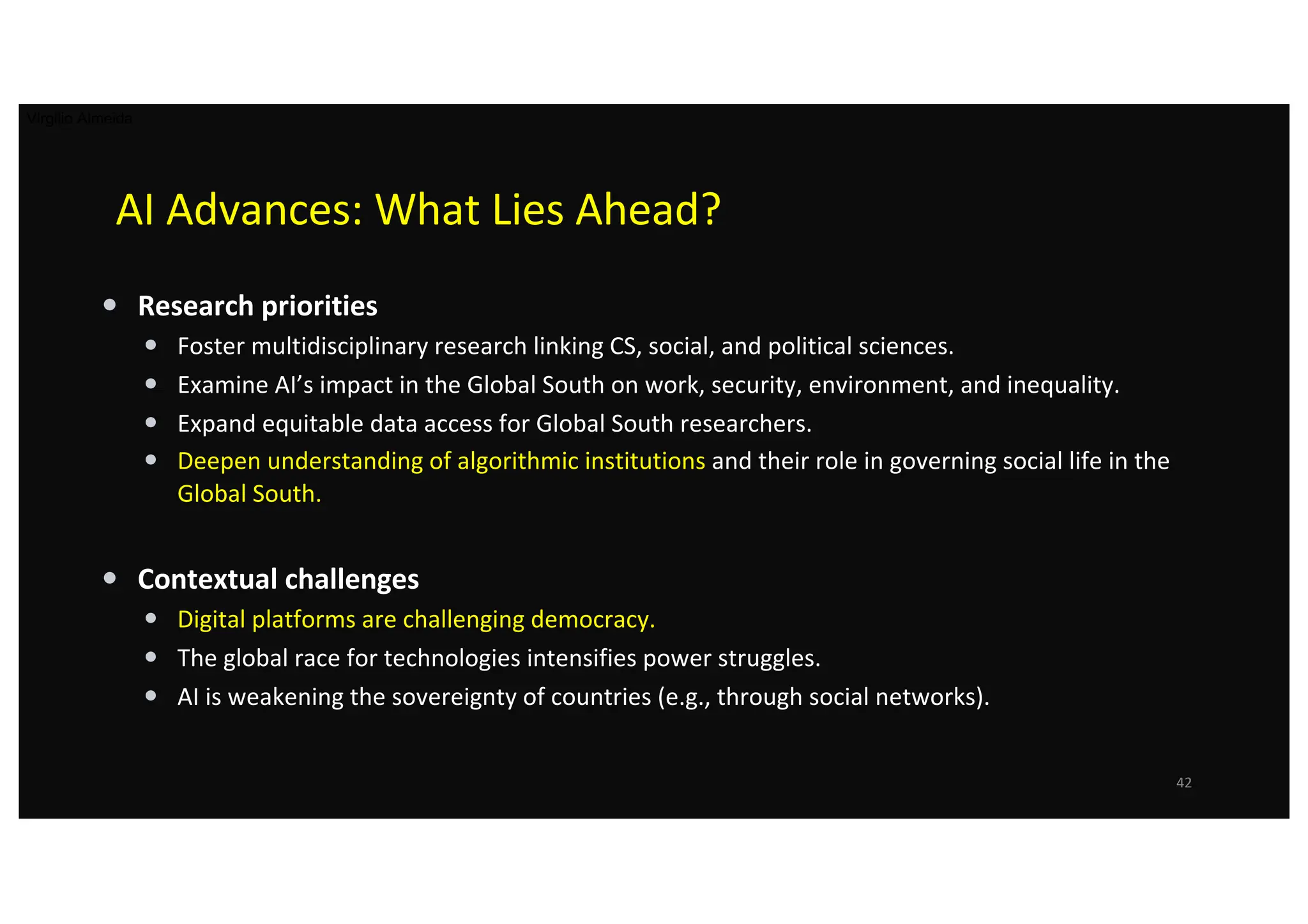
AI Advances: WhatLies Ahead?
• Research priorities
• Foster multidisciplinary research linking CS, social, and political sciences.
• Examine AI’s impact in the Global South on work, security, environment, and inequality.
• Expand equitable data access for Global South researchers.
• Deepen understanding of algorithmic institutions and their role in governing social life in the
Global South.
• Contextual challenges
• Digital platforms are challenging democracy.
• The global race for technologies intensifies power struggles.
• AI is weakening the sovereignty of countries (e.g., through social networks).
42
Virgilio Almeida
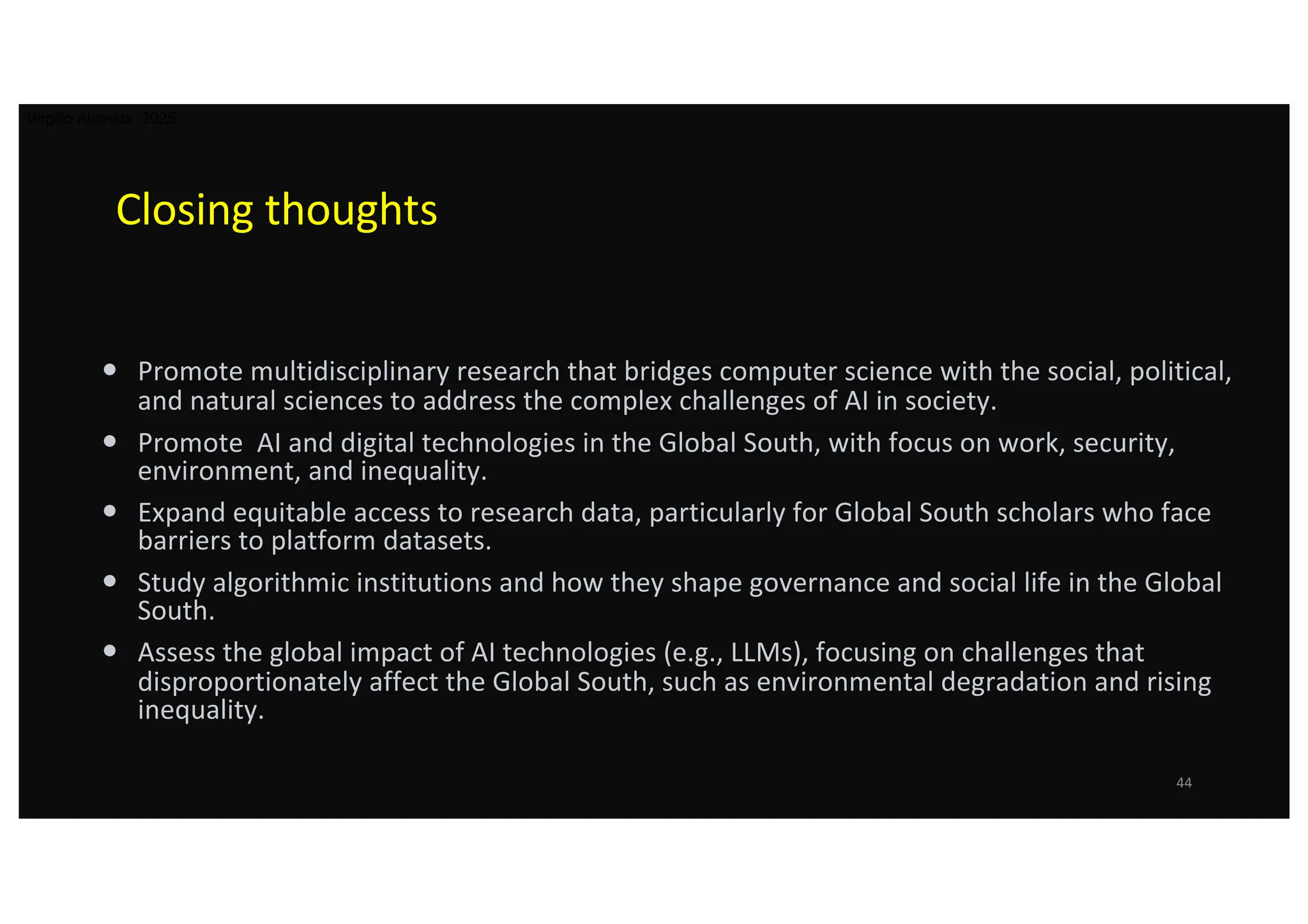
Closing thoughts
• Promotemultidisciplinary research that bridges computer science with the social, political,
and natural sciences to address the complex challenges of AI in society.
• Promote AI and digital technologies in the Global South, with focus on work, security,
environment, and inequality.
• Expand equitable access to research data, particularly for Global South scholars who face
barriers to platform datasets.
• Study algorithmic institutions and how they shape governance and social life in the Global
South.
• Assess the global impact of AI technologies (e.g., LLMs), focusing on challenges that
disproportionately affect the Global South, such as environmental degradation and rising
inequality.
44
Virgilio Almeida 2025