Understanding the differences, publication process, impact
factor, and how to search for articles
Presented by:
Dr. Ankit P. Kinge
(Doctor of Pharmacy)
REVIEW VS RESEARCH
ARTICLE
What is a Research Article?
• Reports original findings, data, and experiments.
• Based on systematic investigation or study of materials
and sources.
• Contains: Abstract, Introduction, Methodology, Results,
Discussion, Conclusion.
• Used to communicate new discoveries or advancements
in a specific field.
What is a Review Article?
• Summarizes existing literature on a specific topic.
• Does not present new experimental data.
• Provides critical analysis, comparison, and synthesis of
existing studies.
• Helps readers understand the current state of knowledge
and research gaps.
Structure of a Review Article
1. Title – Clear and specific
2. Abstract – 150–250 words summary
3. Keywords – 4–6 important terms
4. Introduction – Explain background
5. Literature Review – Summarize findings
6. Discussion – Compare and highlight gaps
7. Future Perspective – Suggest future research
8. Conclusion – Final remarks
9. References – Cite all sources (APA/Vancouver)
Structure of a Research Article
1. Title & Abstract – State objective, brief results
2. Introduction – Problem background
3. Materials & Methods – Experimental or survey
design
4. Results – Tables, graphs, and observations
5. Discussion – Compare with other studies
6. Conclusion – Key findings summary
7. References
What is an Impact Factor?
Definition:
A measure of how influential a journal is, calculated by how often
its articles are cited.
• Formula:
• Impact Factor = (Citations in a year) / (Articles published in
previous 2 years)
• High IF = More prestigious journal
• Examples:
• The Lancet (IF ≈ 150)
• IJPER (IF ≈ 0.7)
Impact Factor (IF)
• A measure of the frequency an average article in a journal
is cited in a particular year.
• Indicates journal reputation and influence in the field.
• Calculated by Clarivate (Journal Citation Reports).
Formula: IF = Citations in year X to articles published in X-1
and X-2 ÷ Number of articles published in X-1 and X-2.
• Higher IF → greater visibility and impact.
Key Differences
• Research Article: Original study, primary data,
experimental design.
• Review Article: Secondary data, summarizes multiple
studies.
• Research Article follows IMRAD structure (Introduction,
Methods, Results, Discussion).
• Review Articles may have narrative or systematic
structure.
• Research articles advance knowledge; reviews evaluate
and interpret it.
Types of Publications
• Original Research Articles: Report new findings.
• Review Articles: Summarize and analyze previous work.
• Case Reports: Describe unique patient or event cases.
• Short Communications: Brief reports of new data.
• Conference Papers: Presented at academic meetings.
• Preprints: Unreviewed drafts shared online for feedback.
Steps to Publish a Review or Research
Article
1. Select a unique topic.
2. Do a detailed literature search (PubMed, ScienceDirect,
Google Scholar).
3. Prepare manuscript as per journal format.
4. Check for plagiarism (<10% preferred).
5. Submit via journal’s online portal (e.g., Elsevier, IJPER).
6. Peer Review → Corrections → Acceptance → Publication.
Where to Publish?
• Peer-reviewed journals (indexed in PubMed, Scopus, Web
of Science).
• Open-access journals for wider visibility.
• Conference proceedings for short reports.
• Preprint servers like arXiv, bioRxiv, medRxiv.
• Institutional repositories or digital libraries.
Choosing the Right Journal
• Match journal scope with your topic.
• Check impact factor, acceptance rate, and audience.
• Verify indexing and authenticity (avoid predatory
journals).
• Read 'Author Guidelines' carefully before submission.
• Consider open access vs. subscription model.
How to Search Articles
1. Use Google Scholar (https://scholar.google.com).
2. Enter keywords or exact phrases using quotes (“climate
change”).
3. Use Boolean operators: AND, OR, NOT.
4. Sort by relevance or date.
5. Use filters (year, author, journal).
6. Other databases: PubMed, Scopus, Web of Science,
DOAJ.
Steps Before Writing an Article
• Choose a clear research topic or question.
• Conduct detailed literature review.
• Define objectives and hypothesis.
• Collect or summarize data systematically.
• Follow ethical guidelines and citation rules.
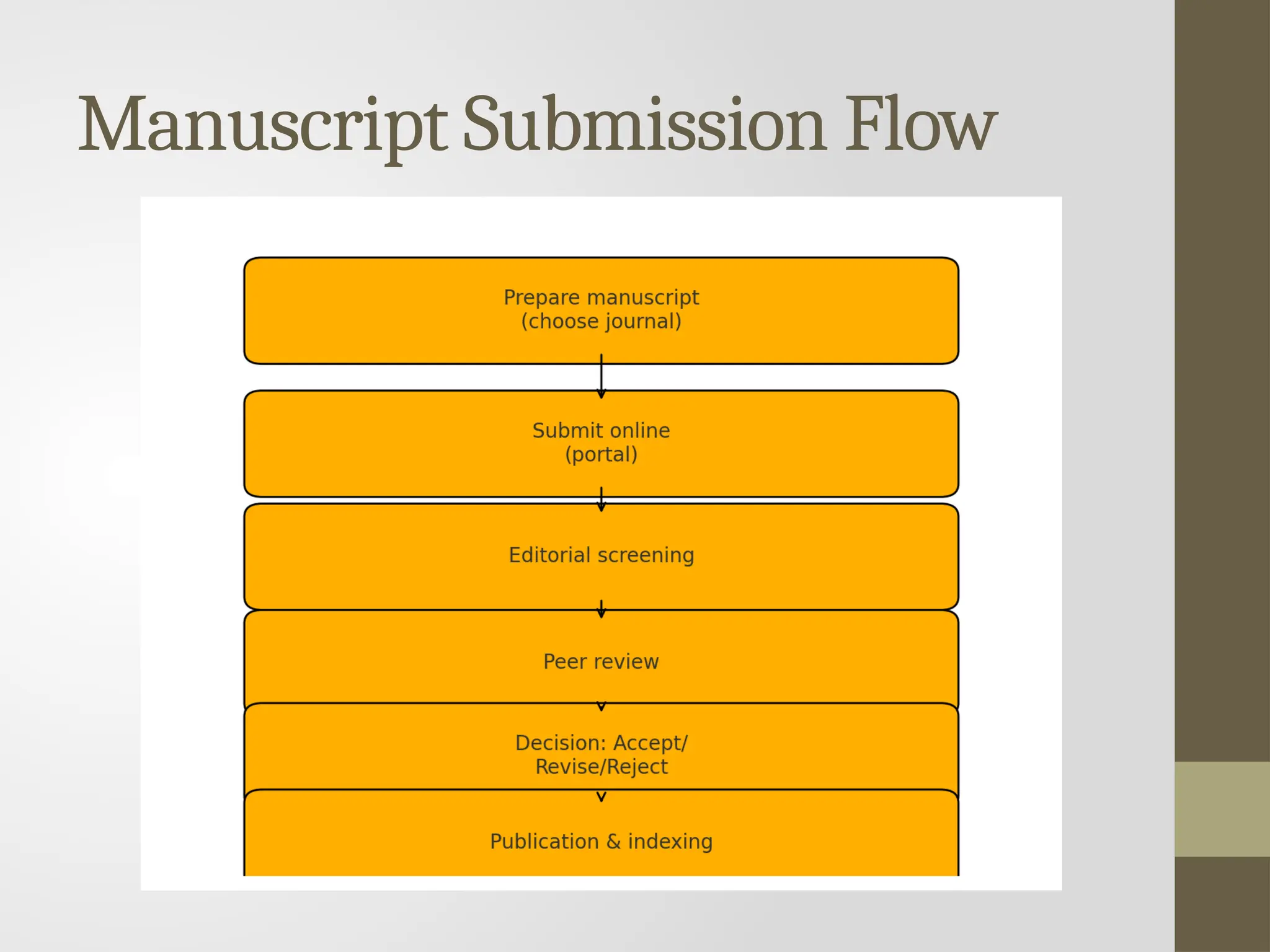
Publication Process
1. Prepare manuscript according to journal format.
2. Submit via online portal (journal submission system).
3. Editorial screening for scope and quality.
4. Peer review by experts in the field.
5. Revision and resubmission (if required).
6. Acceptance and publication (online/print).
Manuscript Submission Flow
Summary
• Research articles present original findings.
• Review articles summarize and analyze existing
knowledge.
• Impact factor measures journal influence.
• Choose reputable journals indexed in trusted databases.
• Always conduct proper literature search and follow
publication ethics.
Thank You

Review and Research Article_Ankit .pptx

  • 1.
    Understanding the differences,publication process, impact factor, and how to search for articles Presented by: Dr. Ankit P. Kinge (Doctor of Pharmacy) REVIEW VS RESEARCH ARTICLE
  • 2.
    What is aResearch Article? • Reports original findings, data, and experiments. • Based on systematic investigation or study of materials and sources. • Contains: Abstract, Introduction, Methodology, Results, Discussion, Conclusion. • Used to communicate new discoveries or advancements in a specific field.
  • 3.
    What is aReview Article? • Summarizes existing literature on a specific topic. • Does not present new experimental data. • Provides critical analysis, comparison, and synthesis of existing studies. • Helps readers understand the current state of knowledge and research gaps.
  • 4.
    Structure of aReview Article 1. Title – Clear and specific 2. Abstract – 150–250 words summary 3. Keywords – 4–6 important terms 4. Introduction – Explain background 5. Literature Review – Summarize findings 6. Discussion – Compare and highlight gaps 7. Future Perspective – Suggest future research 8. Conclusion – Final remarks 9. References – Cite all sources (APA/Vancouver)
  • 5.
    Structure of aResearch Article 1. Title & Abstract – State objective, brief results 2. Introduction – Problem background 3. Materials & Methods – Experimental or survey design 4. Results – Tables, graphs, and observations 5. Discussion – Compare with other studies 6. Conclusion – Key findings summary 7. References
  • 6.
    What is anImpact Factor? Definition: A measure of how influential a journal is, calculated by how often its articles are cited. • Formula: • Impact Factor = (Citations in a year) / (Articles published in previous 2 years) • High IF = More prestigious journal • Examples: • The Lancet (IF ≈ 150) • IJPER (IF ≈ 0.7)
  • 7.
    Impact Factor (IF) •A measure of the frequency an average article in a journal is cited in a particular year. • Indicates journal reputation and influence in the field. • Calculated by Clarivate (Journal Citation Reports). Formula: IF = Citations in year X to articles published in X-1 and X-2 ÷ Number of articles published in X-1 and X-2. • Higher IF → greater visibility and impact.
  • 8.
    Key Differences • ResearchArticle: Original study, primary data, experimental design. • Review Article: Secondary data, summarizes multiple studies. • Research Article follows IMRAD structure (Introduction, Methods, Results, Discussion). • Review Articles may have narrative or systematic structure. • Research articles advance knowledge; reviews evaluate and interpret it.
  • 9.
    Types of Publications •Original Research Articles: Report new findings. • Review Articles: Summarize and analyze previous work. • Case Reports: Describe unique patient or event cases. • Short Communications: Brief reports of new data. • Conference Papers: Presented at academic meetings. • Preprints: Unreviewed drafts shared online for feedback.
  • 10.
    Steps to Publisha Review or Research Article 1. Select a unique topic. 2. Do a detailed literature search (PubMed, ScienceDirect, Google Scholar). 3. Prepare manuscript as per journal format. 4. Check for plagiarism (<10% preferred). 5. Submit via journal’s online portal (e.g., Elsevier, IJPER). 6. Peer Review → Corrections → Acceptance → Publication.
  • 11.
    Where to Publish? •Peer-reviewed journals (indexed in PubMed, Scopus, Web of Science). • Open-access journals for wider visibility. • Conference proceedings for short reports. • Preprint servers like arXiv, bioRxiv, medRxiv. • Institutional repositories or digital libraries.
  • 12.
    Choosing the RightJournal • Match journal scope with your topic. • Check impact factor, acceptance rate, and audience. • Verify indexing and authenticity (avoid predatory journals). • Read 'Author Guidelines' carefully before submission. • Consider open access vs. subscription model.
  • 13.
    How to SearchArticles 1. Use Google Scholar (https://scholar.google.com). 2. Enter keywords or exact phrases using quotes (“climate change”). 3. Use Boolean operators: AND, OR, NOT. 4. Sort by relevance or date. 5. Use filters (year, author, journal). 6. Other databases: PubMed, Scopus, Web of Science, DOAJ.
  • 14.
    Steps Before Writingan Article • Choose a clear research topic or question. • Conduct detailed literature review. • Define objectives and hypothesis. • Collect or summarize data systematically. • Follow ethical guidelines and citation rules.
  • 15.
    Publication Process 1. Preparemanuscript according to journal format. 2. Submit via online portal (journal submission system). 3. Editorial screening for scope and quality. 4. Peer review by experts in the field. 5. Revision and resubmission (if required). 6. Acceptance and publication (online/print).
  • 16.
  • 17.
    Summary • Research articlespresent original findings. • Review articles summarize and analyze existing knowledge. • Impact factor measures journal influence. • Choose reputable journals indexed in trusted databases. • Always conduct proper literature search and follow publication ethics.
  • 18.