Unit 1: Introduction to Entrepreneurship
1. Define Entrepreneurship. Explain its meaning and concept
Entrepreneurship is the process of identifying an opportunity, organizing
resources, taking calculated risks, and creating a new product, service, or
business to generate value and profit.
An entrepreneur converts an idea into a successful venture through
innovation, planning, and leadership.
Exam-Ready Explanation
1. Opportunity Identification:
Entrepreneurs observe problems or gaps in the market and find innovative
solutions.
2. Innovation:
Entrepreneurship always involves doing something new, better, or cheaper—
either by creating a new product or improving an existing one.
3. Risk-Taking:
Entrepreneurs take calculated risks—not blind risks—to convert ideas into
reality.
4. Resource Organization:
They arrange finance, manpower, technology, raw materials, and use them
efficiently.
5. Value Creation:
The final goal is to create economic value, employment, and benefit society.
6. Profit & Growth Orientation:
Entrepreneurship aims at sustainable growth of the business and long-term
profit.
In short: Entrepreneurship is a creative and risk-taking activity through
which ideas become reality.
Real-Life Example (Exam Friendly)
Example – Flipkart:
Sachin and Binny Bansal noticed that India lacked a reliable online bookstore.
They identified the opportunity, started Flipkart in a small house, arranged
limited resources, took major risks, and gradually expanded into multiple
products.
Today it is one of India’s biggest e-commerce companies.
This clearly shows entrepreneurship as:
• Opportunity finding
• Innovation
• Risk-taking
• Resource management
• Value creation
Funny Analogy (For Easy Memory)
Entrepreneurship is like proposing to your crush.
• You identify the opportunity (she smiled today → chance!).
• You organize resources (new shirt, perfume, confidence).
• You take a risk (50% chance of yes, 50% chance of emotional damage).
• You innovate (unique dialogue: not just “Will you go out with me?” but “Let’s
build a startup of love ”).
• If she says yes → value creation (happiness, dopamine).
• If she says no → market research for next opportunity
2. Discuss the relationship between Innovation and Entrepreneurship. (INNOVATION :
MAKING SOMETHING NEW)
Innovation and entrepreneurship are closely linked and mutually dependent.
Entrepreneurship uses innovation as its core tool to create new products,
services, or business models.
Without innovation, entrepreneurship becomes routine trade; and without
entrepreneurship, innovations cannot reach the market or society.
Key Points (Exam-Perfect)
1. Innovation drives Entrepreneurship (this can be come in exam how
innovation drive entrepreneurship)
Entrepreneurs depend on innovative ideas to enter the market or solve
problems differently.
2. Entrepreneurship commercializes Innovation
An innovation becomes useful only when an entrepreneur converts it into a
marketable product or service.
3. Mutual Support
Innovation provides creativity; entrepreneurship provides risk-taking,
resources, and execution.
4. Economic Growth
Together they generate new industries, employment, and technological
advancement.
5. Sustainable Competitive Advantage
Entrepreneurs stay ahead of competitors through continuous innovation (new
features, lower cost, better quality).
6. Foundation of Startups
All successful startups are built on innovative thinking—either product
innovation, process innovation, or business model innovation.
Real-Life Example (Exam Friendly)
Example – OYO Rooms (Ritesh Agarwal)
Ritesh introduced an innovative idea: organizing budget hotels under one brand
with standardized service.
This innovation (standardizing an unorganized segment) was transformed into a
successful business through entrepreneurship (planning, funding, marketing,
expansion).
This shows the relationship clearly:
• Innovation = Concept
• Entrepreneurship = Execution
3. Describe the contributions of entrepreneurs to society.
Entrepreneurs play a vital role in the development of society.
They introduce innovation, generate income, create employment, and uplift the
overall quality of life.
Their actions lead to economic growth, social improvement, and technological
progress.
Key Contributions (Exam-Perfect Points)
1. Job Creation
Entrepreneurs start new ventures that create direct and indirect
employment.
This reduces unemployment and improves living standards.
2. Innovation & Technology Advancement
Entrepreneurs introduce new products, services, and technologies that
improve daily life.
3. Economic Growth
Their businesses contribute to GDP, increase national income, and boost
industrial development.
4. Improved Standard of Living
By providing better goods and services at affordable prices, they uplift
society’s quality of life.
5. Wealth Creation & Distribution
They generate wealth for themselves and others—employees, suppliers,
investors, and government (through taxes).
6. Regional Development
Entrepreneurs set up industries in backward or rural areas, reducing regional
disparities.
7. Social Change
Many entrepreneurs (eco-friendly startups, EdTech, HealthTech) work to
solve societal problems and bring positive change.
8. Export Promotion
Their innovative products increase foreign exchange earnings and build
global recognition.
9. Encouraging Research & Development (R&D)
Entrepreneurs invest in R&D that leads to continuous improvement and long-
term growth.
Real-Life Example (Exam Friendly)
Example – Narayana Murthy (Infosys)
N. R. Narayana Murthy created Infosys, which not only generated thousands of IT
jobs but also transformed India into a global tech hub.
His entrepreneurship led to:
• Massive employment
• Technological advancement
• Global recognition for India
• Inspiration for countless startups
This shows how a single entrepreneur can uplift an entire society.
4. Explain the risk-opportunity perspective in entrepreneurship.
Exam-Ready Answer
The risk–opportunity perspective in entrepreneurship refers to the idea that
every business opportunity comes with certain risks, and entrepreneurs must
evaluate, balance, and manage these risks to convert the opportunity into a
successful venture.
Entrepreneurs do not avoid risk; instead, they take calculated risks after
analyzing the potential returns, challenges, and uncertainties.
This perspective highlights that entrepreneurship is the ability to see
opportunities where others see problems, and to take risks to capitalize on them.
Key Points (Exam-Perfect)
1. Opportunity Recognition
Entrepreneurs identify gaps, needs, or problems in the market that others
overlook.
2. Risk Evaluation
Every opportunity comes with uncertainties—market demand, competition,
costs, technology, etc.
3. Calculated Risk-Taking
Entrepreneurs make decisions based on data, planning, and foresight, not
blind risk.
4. Risk–Reward Trade-off
Higher opportunities often involve higher risks, but also higher potential
rewards.
5. Resource Commitment
Entrepreneurs allocate time, money, effort and take responsibility for the
outcome.
6. Innovation as an Opportunity Tool
Innovation helps reduce risks and maximize benefits.
7. Strategic Decision Making
Selecting the right opportunity while minimizing risk is the core of
entrepreneurship.
Real-Life Example (Exam Friendly)
Example – Paytm (Vijay Shekhar Sharma)
When digital payments were not popular, Vijay Shekhar Sharma identified an
opportunity for mobile wallets.
But the risk was huge:
• low smartphone penetration
• people afraid of online transactions
• no guarantee of success
However, he took the calculated risk, invested heavily, and today Paytm is one of
India’s major fintech companies.
This shows how risks and opportunities go together.
Funny Analogy (Easy Memory)
Entrepreneurship risk-opportunity perspective is like eating street momos.
• Opportunity: They smell amazing, cheap, and instantly make you happy
• Risk: You don’t know whether it's real chicken or “surprise material”
But a true entrepreneur says:
“Taste ke liye risk toh banta hai!”
Just like this, entrepreneurs take calculated risks to enjoy big rewards.
Types of risk
Risk in entrepreneurship refers to the uncertainty involved in starting and running
a business.
It is the possibility that actual outcomes may differ from expected outcomes,
leading to loss of money, time, reputation, or resources.
Entrepreneurs face risk because:
• Future demand is uncertain
• Competition may increase
• Financial returns are not guaranteed
• Market conditions can change suddenly
Entrepreneurs take calculated risks, not blind risks.
📌 Types of Risks in Entrepreneurship (Exam-Perfect List)
1. Financial Risk
Risk of losing invested money or facing cash flow problems.
E.g., loan repayment issues, low revenue.
2. Market Risk
Risk that customers may not accept the product or market demand may fall.
3. Competitive Risk
Risk from existing or new competitors offering better or cheaper products.
4. Technological Risk
Risk due to rapid changes in technology, product becoming outdated, or technical
failures.
5. Operational Risk
Risks arising from day-to-day operations like supply chain issues, production
failures, staff problems.
6. Legal & Regulatory Risk
Risk due to changes in government policies, new laws, taxes, compliances, or
lawsuits.
7. Strategic Risk
Risk of wrong decisions regarding pricing, business model, location, partners, etc.
8. Human Resource Risk
Risk related to hiring, training, employee turnover, lack of skilled staff.
9. Environmental/Natural Risk
Risks from natural disasters, floods, fire, pandemic, etc.
10. Reputational Risk
Risk of losing customer trust due to poor quality, controversies, or negative
publicity.
📌 Real-Life Example (Easy to Write)
When Uber entered India, it faced:
• Market risk (will Indians prefer ride-sharing?)
• Legal risk (state govt taxi rules)
• Competitive risk (Ola already strong)
• Tech risk (app failures, GPS issues)
Despite these risks, the opportunity was huge—so Uber took calculated risk and
grew.
😂 Funny Analogy (Easy Memory)
Entrepreneurial risks are like going on a first date:
• Financial risk: Bill bohot aayega 😭
• Market risk: She might not like your perfume.
• Competitive risk: Someone better-looking may already be there 😭
• Reputational risk: If the date goes bad, your friends will roast you.
• Strategic risk: Wrong restaurant choice → Disaster.
But still you go…
Because “Opportunity bhi toh milega!” 😁💘
5. What are the methods for mitigation of entrepreneurial risks?
Method (8 Key Points) Explanation (Short & Clear)
1. Market Research
Understand customer needs, demand, and competitors
to avoid product failure.
2. Business Planning
Prepare a detailed plan with goals, budgeting, and
strategies to reduce uncertainty.
3. Financial Management
Maintain cash reserves, control expenses, and avoid
excessive loans.
4. Diversification
Spread risk by offering multiple products, markets, or
suppliers.
5. Insurance Coverage
Use insurance to protect against accidents, liability,
fire, and natural disasters.
6. Technology
Upgradation
Use modern tools, cybersecurity, and updated
machinery to avoid tech-related failures.
7. Legal Compliance
Follow laws, tax rules, labour regulations, and licensing
to avoid penalties.
8. Skilled Workforce &
Training
Hire capable employees and provide training to reduce
operational errors.
Unit 2
1. Explain why entrepreneurship is considered an innovation.
Exam-Ready Answer
Entrepreneurship is considered an innovation because it involves creating new
ideas, new products, new methods, or new ways of doing business.
An entrepreneur does not simply start a business—he introduces something
different, better, unique, or more efficient, which adds value to society.
Innovation is the core tool of entrepreneurship.
Without innovation, entrepreneurship is only trading or routine business.
With innovation, it becomes a creative activity that changes markets and solves
problems.
Key Points (Exam-Perfect)
1. Introduction of New Products/Services
Entrepreneurs bring new products that never existed before or improve existing
ones.
This creative offering itself is innovation.
2. New Methods of Production
Entrepreneurs innovate by using better technology, automation, or efficient
processes, reducing cost and increasing quality.
3. New Business Models
Entrepreneurs innovate not only products but also the way business is done—like e-
commerce, subscription models, or app-based services.
4. Solving Problems Creatively
Entrepreneurship finds innovative solutions to real problems—faster delivery,
safer payments, cheaper services, etc.
5. Use of Technology & Knowledge
Modern entrepreneurs use technology creatively (AI, apps, data) to bring
innovative changes in markets.
6. Creating Value in New Ways
Innovative entrepreneurship creates value by making things:
• easier
• faster
• cheaper
• more accessible
7. Continuous Improvement
Entrepreneurs keep updating their products and services through continuous
innovation to stay competitive.
8. Driving Economic & Social Change
Innovation-led entrepreneurship changes how people live, work, travel, shop, and
communicate.
Real-Life Example (Exam Friendly)
Example – Swiggy
Swiggy didn’t just deliver food—it innovated by:
• offering real-time tracking
• creating cloud kitchens
• promising fast deliveries
• using AI for route optimization
This is why entrepreneurship is innovation—Swiggy changed the entire food
delivery market by doing something new and unique.
2. Discuss the challenges of innovation faced by entrepreneurs.
Entrepreneurs face several difficulties while trying to innovate.
Innovation needs money, knowledge, technology, skilled people, market acceptance,
and time.
Because of these barriers, converting a new idea into a useful product becomes
challenging.
These challenges slow down innovation and increase the risk of failure for new
ventures.
Key Challenges (Exam-Perfect Points)
1. High Cost of Innovation
Developing new products, using new technology, and research work require heavy
investment.
Startups often lack funds, making innovation financially difficult.
2. Lack of Skilled Workforce
Innovation needs talented engineers, designers, developers, and researchers.
Small entrepreneurs struggle to hire or retain such skilled people.
3. Uncertain Market Demand
New innovative products may not be accepted by customers immediately.
Entrepreneurs face uncertainty about whether the product will succeed or fail.
4. Technological Barriers
Rapid changes in technology make it difficult for entrepreneurs to keep pace.
Old ideas quickly become outdated.
5. Legal and Regulatory Challenges
New innovations may face:
• licensing issues
• safety standards
• government rules
• patent and copyright problems
These slow down innovation.
6. Risk of Failure
Innovation involves experimentation.
There is always a chance that the idea may not work.
Entrepreneurs fear failure, especially when money is limited.
7. Competition Pressure
Large companies with more resources may copy the idea, improve it, and launch it
faster.
This makes it tough for small entrepreneurs to sustain innovation.
8. Resistance to Change
Customers, employees, or even suppliers may resist new ideas.
People prefer comfort zones, and innovation often disrupts old habits.
Real-Life Example (Exam Friendly)
Example – Electric Vehicles in India
Entrepreneurs entering the EV market faced:
• High cost of battery technology
• Limited charging stations
• Customers afraid of low range
• Government regulations
• Strong competition from petrol-based vehicle companies
Yet companies like Ather, Ola Electric, and Tata EV overcame these hurdles with
continuous innovation.
Funny Analogy (Easy Memory)
Innovating as an entrepreneur is like trying to make a new recipe for Maggi.
• You need ingredients → resources
• You need skill → skilled workforce
• You don’t know how it will taste → market uncertainty
• Family might say “don’t experiment, make simple Maggi!” → resistance to
change
• If it tastes bad → failure risk
• If neighbor copies and makes better Maggi → competition
But if it succeeds →
You become the MasterChef of Innovation
2. Explain the steps of innovation management/idea management
Step Explanation (Short & Clear)
1. Idea Generation
Collecting new ideas from employees,
customers, brainstorming, and market
trends.
2. Idea Screening &
Evaluation
Filtering ideas based on feasibility,
cost, resources, risk, and market
demand.
3. Concept Development
Converting the selected idea into a clear
concept with features, target market,
and benefits.
Step Explanation (Short & Clear)
4. Prototype
Development
Creating a sample model or beta version
to test the idea practically.
5. Testing & Feedback
Testing the prototype with real users,
collecting feedback, and making
improvements.
6. Commercialization
Launching the final product in the
market with proper marketing, pricing,
and distribution.
7. Monitoring &
Continuous Improvement
Tracking product performance and
updating it based on customer feedback
and market trends.
Apple follows clear innovation management:
1. Collect ideas from R&D and user behavior
2. Screen ideas based on trends and feasibility
3. Develop concept (features, design, price)
4. Build prototypes
5. Test internally and with focus groups
6. Launch globally
7. Continuously update models (iPhone 12 → 13 → 14 → 15)
This is a perfect example of systematic innovation management.
3. What is an Idea Management System and how does it work?
Step Explanation
1. Idea Collection
Ideas submitted by employees or customers
through a system/platform.
2. Categorization
Ideas are grouped into relevant categories
for easy evaluation.
3. Evaluation
Experts judge ideas based on feasibility,
cost, and benefits.
4. Collaboration Teams discuss and improve selected ideas.
5. Selection
Management approves the most promising
ideas.
6. Prototype
Development
A small model of the idea is created and
tested.
7. Implementation The final idea is executed in real operations.
8. Feedback &
Rewards
Feedback is collected and idea contributors
are rewarded.
An Idea Management System (IMS) is a structured process or digital platform
used by organizations to collect, evaluate, improve, and implement ideas from
employees, customers, or stakeholders.
It helps companies manage innovation in an organized and systematic way.
IMS ensures that good ideas are not lost, weak ideas are refined, and the best
ideas become successful innovations.
5. Differentiate between divergent and convergent thinking.
Divergent and convergent thinking are two opposite styles of thinking used in
creativity and problem-solving.
• Divergent thinking → generating many ideas
• Convergent thinking → selecting the best idea
Entrepreneurs use both: first to create ideas, then to choose the best one.
Chart: Difference Between Divergent and Convergent Thinking
Basis Divergent Thinking Convergent Thinking
Meaning
Thinking that explores many
possible solutions to a problem.
Thinking that narrows down ideas to
choose the best single solution.
Approach
Creative, free-flowing,
imaginative.
Logical, analytical, structured.
Goal To generate multiple ideas.
To find one correct/most effective
idea.
Used In
Brainstorming, innovation,
product design.
Decision-making, final selection,
problem-solving.
Thinking
Style
“What are all the ways this can
be done?”
“Which way is the best?”
Nature Open-ended thinking. Close-ended thinking.
Outcome Many possibilities. One accurate solution.
Risk Level
More risk-taking and
experimental.
Less risk, more evaluation and
judgement.
Examples
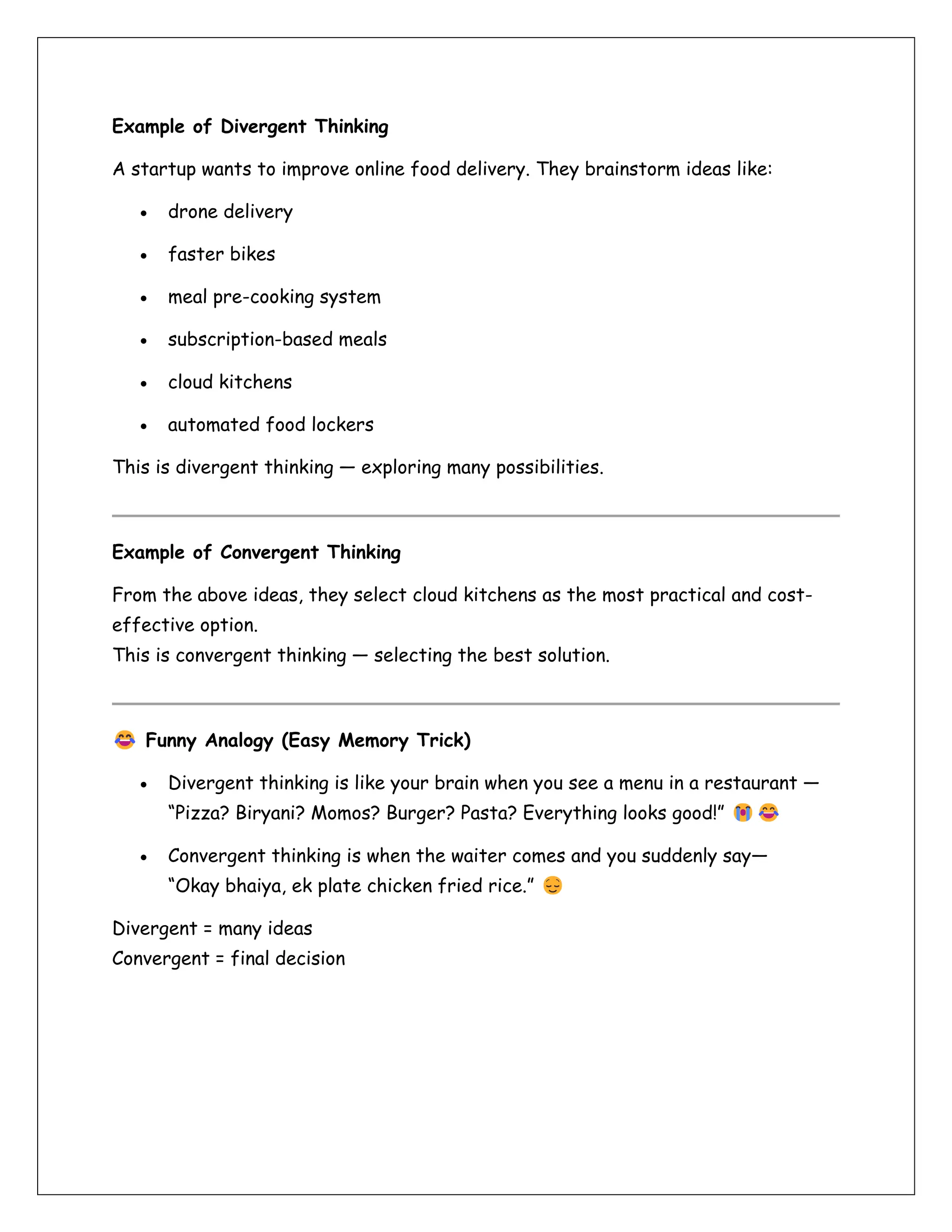
Example of Divergent Thinking
A startup wants to improve online food delivery. They brainstorm ideas like:
• drone delivery
• faster bikes
• meal pre-cooking system
• subscription-based meals
• cloud kitchens
• automated food lockers
This is divergent thinking — exploring many possibilities.
Example of Convergent Thinking
From the above ideas, they select cloud kitchens as the most practical and cost-
effective option.
This is convergent thinking — selecting the best solution.
Funny Analogy (Easy Memory Trick)
• Divergent thinking is like your brain when you see a menu in a restaurant —
“Pizza? Biryani? Momos? Burger? Pasta? Everything looks good!”
• Convergent thinking is when the waiter comes and you suddenly say—
“Okay bhaiya, ek plate chicken fried rice.”
Divergent = many ideas
Convergent = final decision
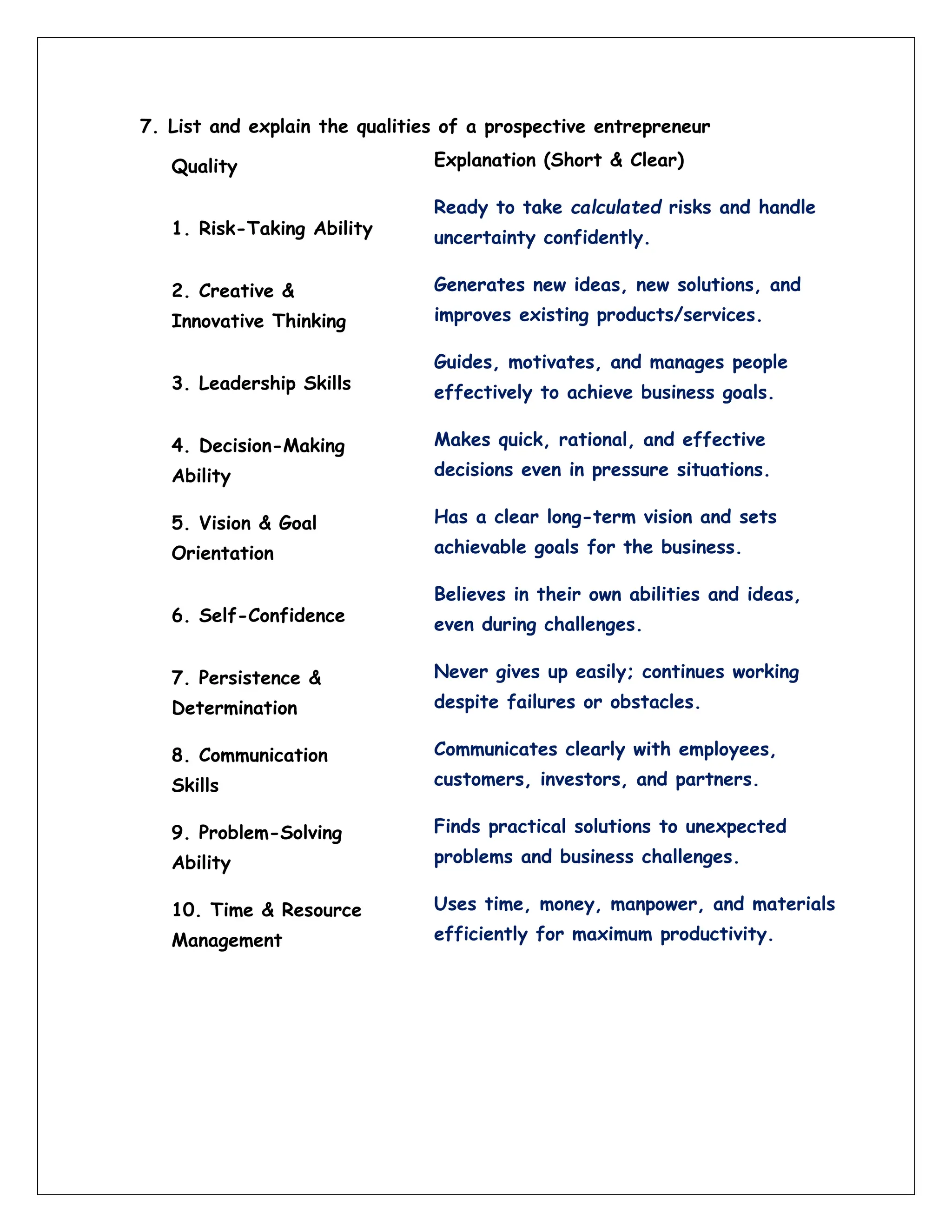
7. List and explain the qualities of a prospective entrepreneur
Quality Explanation (Short & Clear)
1. Risk-Taking Ability
Ready to take calculated risks and handle
uncertainty confidently.
2. Creative &
Innovative Thinking
Generates new ideas, new solutions, and
improves existing products/services.
3. Leadership Skills
Guides, motivates, and manages people
effectively to achieve business goals.
4. Decision-Making
Ability
Makes quick, rational, and effective
decisions even in pressure situations.
5. Vision & Goal
Orientation
Has a clear long-term vision and sets
achievable goals for the business.
6. Self-Confidence
Believes in their own abilities and ideas,
even during challenges.
7. Persistence &
Determination
Never gives up easily; continues working
despite failures or obstacles.
8. Communication
Skills
Communicates clearly with employees,
customers, investors, and partners.
9. Problem-Solving
Ability
Finds practical solutions to unexpected
problems and business challenges.
10. Time & Resource
Management
Uses time, money, manpower, and materials
efficiently for maximum productivity.
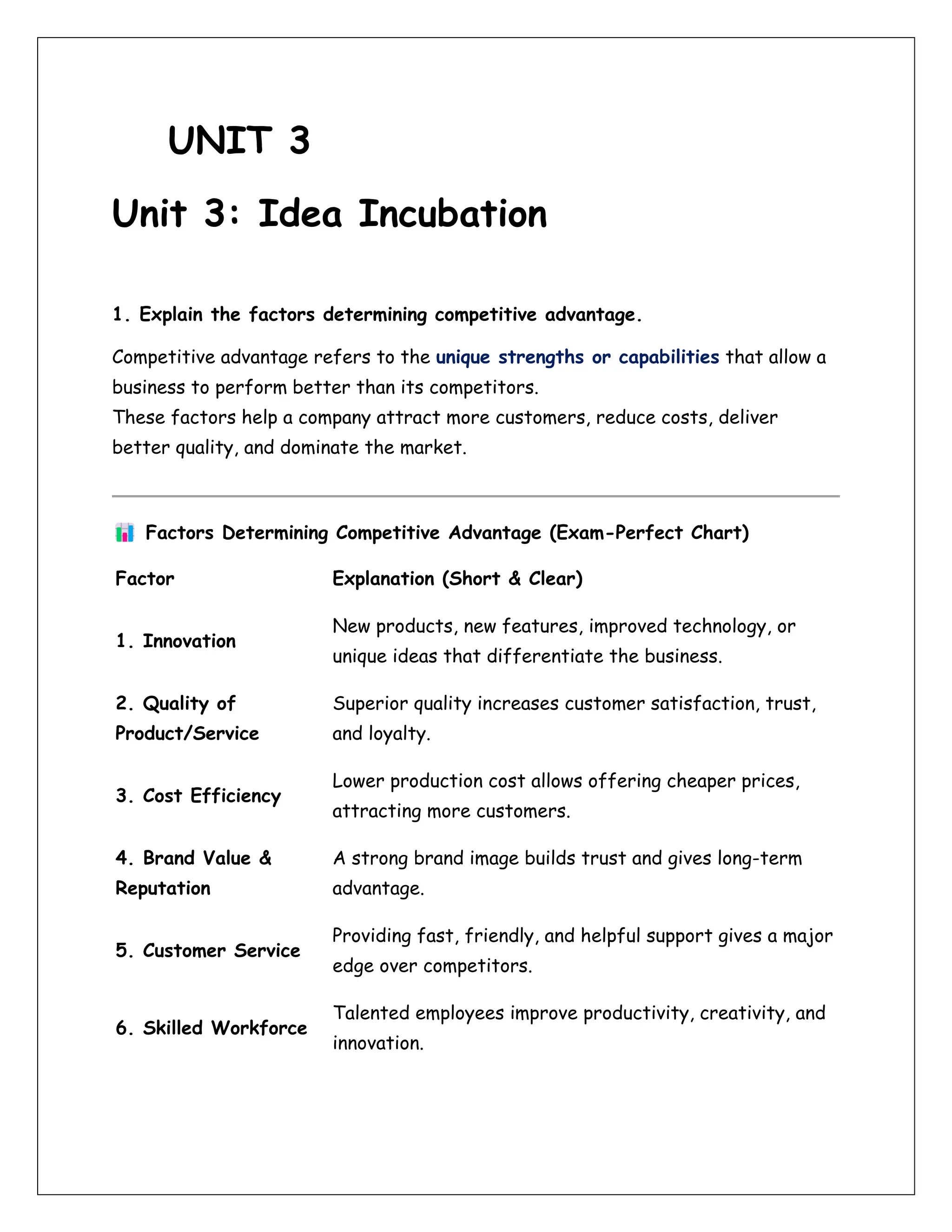
UNIT 3
Unit 3: Idea Incubation
1. Explain the factors determining competitive advantage.
Competitive advantage refers to the unique strengths or capabilities that allow a
business to perform better than its competitors.
These factors help a company attract more customers, reduce costs, deliver
better quality, and dominate the market.
Factors Determining Competitive Advantage (Exam-Perfect Chart)
Factor Explanation (Short & Clear)
1. Innovation
New products, new features, improved technology, or
unique ideas that differentiate the business.
2. Quality of
Product/Service
Superior quality increases customer satisfaction, trust,
and loyalty.
3. Cost Efficiency
Lower production cost allows offering cheaper prices,
attracting more customers.
4. Brand Value &
Reputation
A strong brand image builds trust and gives long-term
advantage.
5. Customer Service
Providing fast, friendly, and helpful support gives a major
edge over competitors.
6. Skilled Workforce
Talented employees improve productivity, creativity, and
innovation.
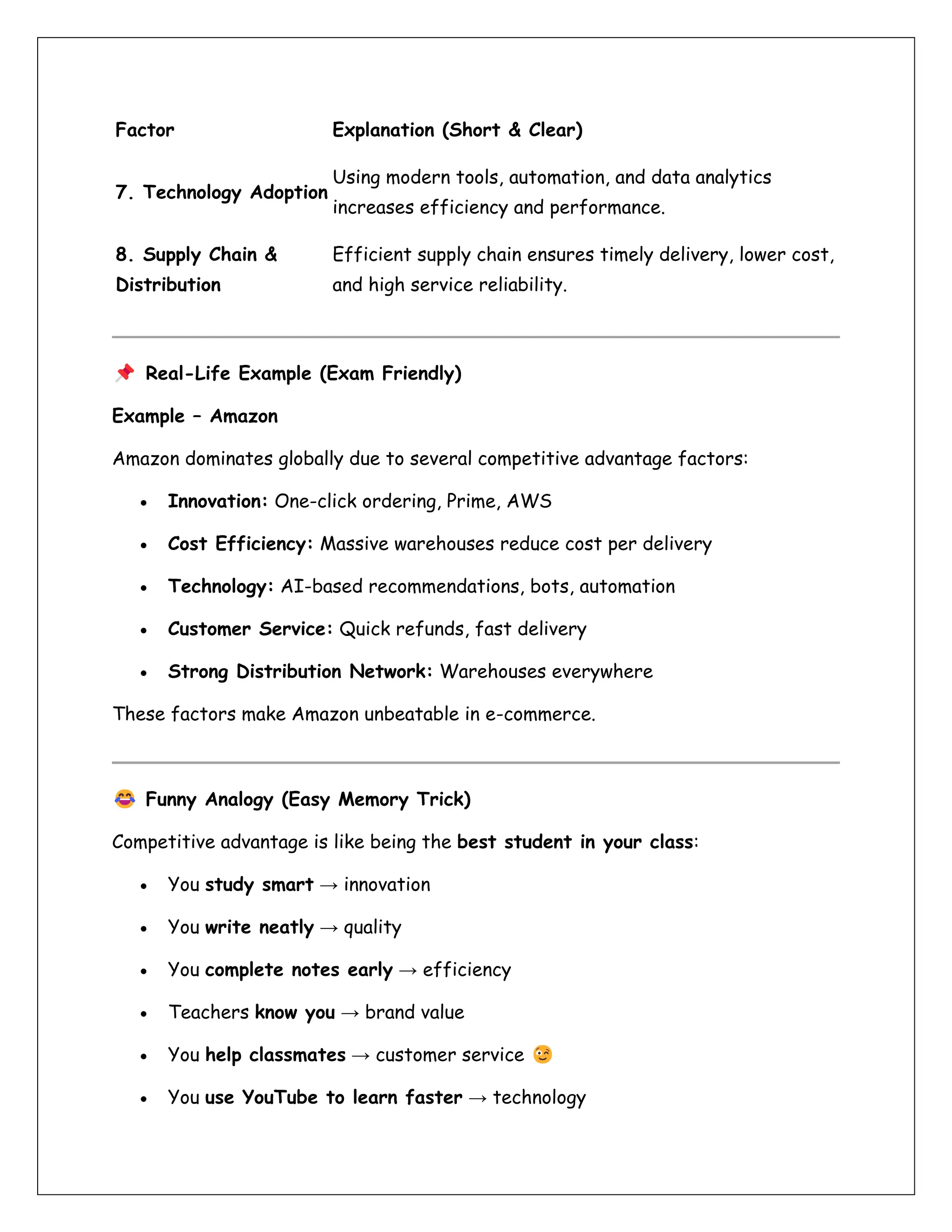
Factor Explanation (Short & Clear)
7. Technology Adoption
Using modern tools, automation, and data analytics
increases efficiency and performance.
8. Supply Chain &
Distribution
Efficient supply chain ensures timely delivery, lower cost,
and high service reliability.
Real-Life Example (Exam Friendly)
Example – Amazon
Amazon dominates globally due to several competitive advantage factors:
• Innovation: One-click ordering, Prime, AWS
• Cost Efficiency: Massive warehouses reduce cost per delivery
• Technology: AI-based recommendations, bots, automation
• Customer Service: Quick refunds, fast delivery
• Strong Distribution Network: Warehouses everywhere
These factors make Amazon unbeatable in e-commerce.
Funny Analogy (Easy Memory Trick)
Competitive advantage is like being the best student in your class:
• You study smart → innovation
• You write neatly → quality
• You complete notes early → efficiency
• Teachers know you → brand value
• You help classmates → customer service
• You use YouTube to learn faster → technology
• You never miss classes → strong process
Because of all this,
you always stay ahead of your competitors (other students)
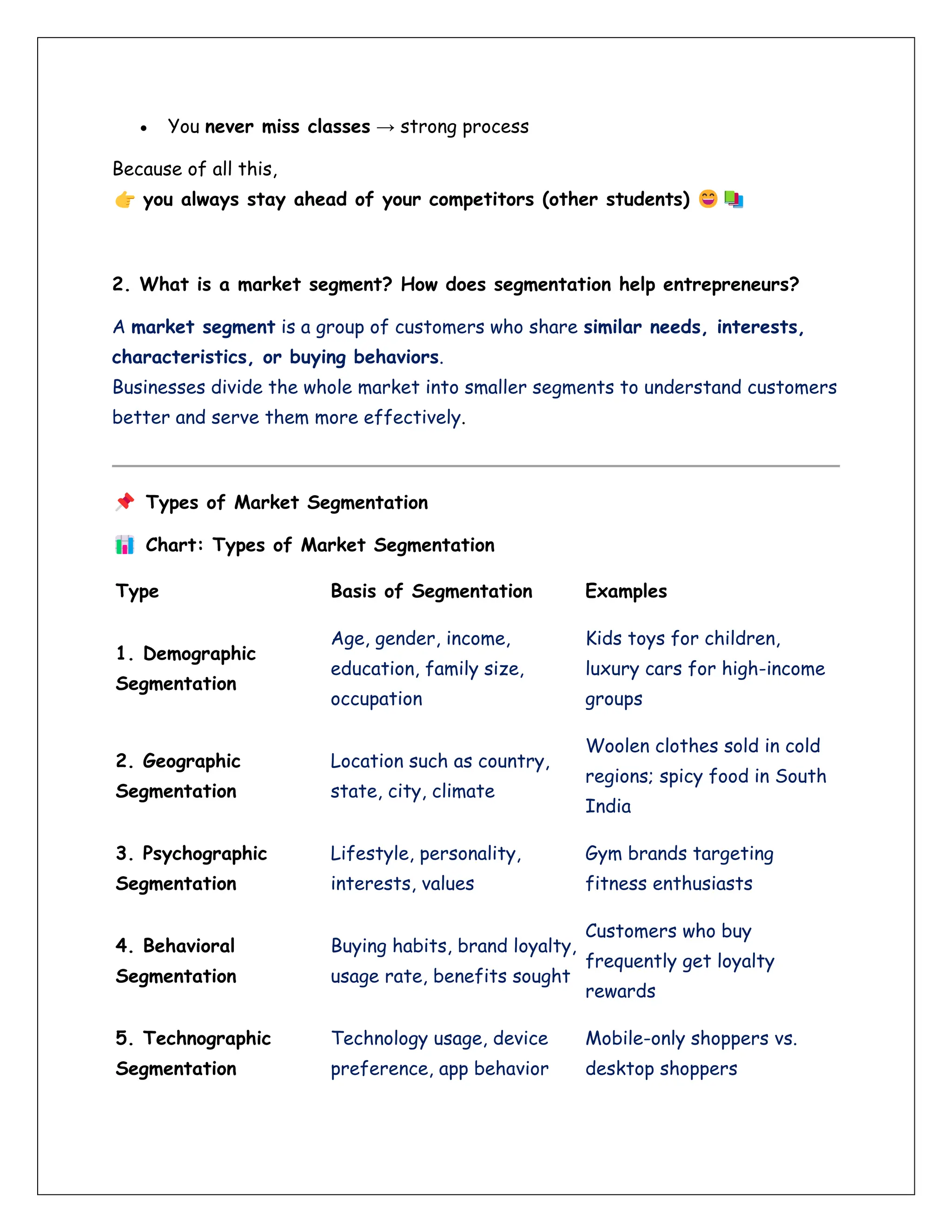
2. What is a market segment? How does segmentation help entrepreneurs?
A market segment is a group of customers who share similar needs, interests,
characteristics, or buying behaviors.
Businesses divide the whole market into smaller segments to understand customers
better and serve them more effectively.
Types of Market Segmentation
Chart: Types of Market Segmentation
Type Basis of Segmentation Examples
1. Demographic
Segmentation
Age, gender, income,
education, family size,
occupation
Kids toys for children,
luxury cars for high-income
groups
2. Geographic
Segmentation
Location such as country,
state, city, climate
Woolen clothes sold in cold
regions; spicy food in South
India
3. Psychographic
Segmentation
Lifestyle, personality,
interests, values
Gym brands targeting
fitness enthusiasts
4. Behavioral
Segmentation
Buying habits, brand loyalty,
usage rate, benefits sought
Customers who buy
frequently get loyalty
rewards
5. Technographic
Segmentation
Technology usage, device
preference, app behavior
Mobile-only shoppers vs.
desktop shoppers
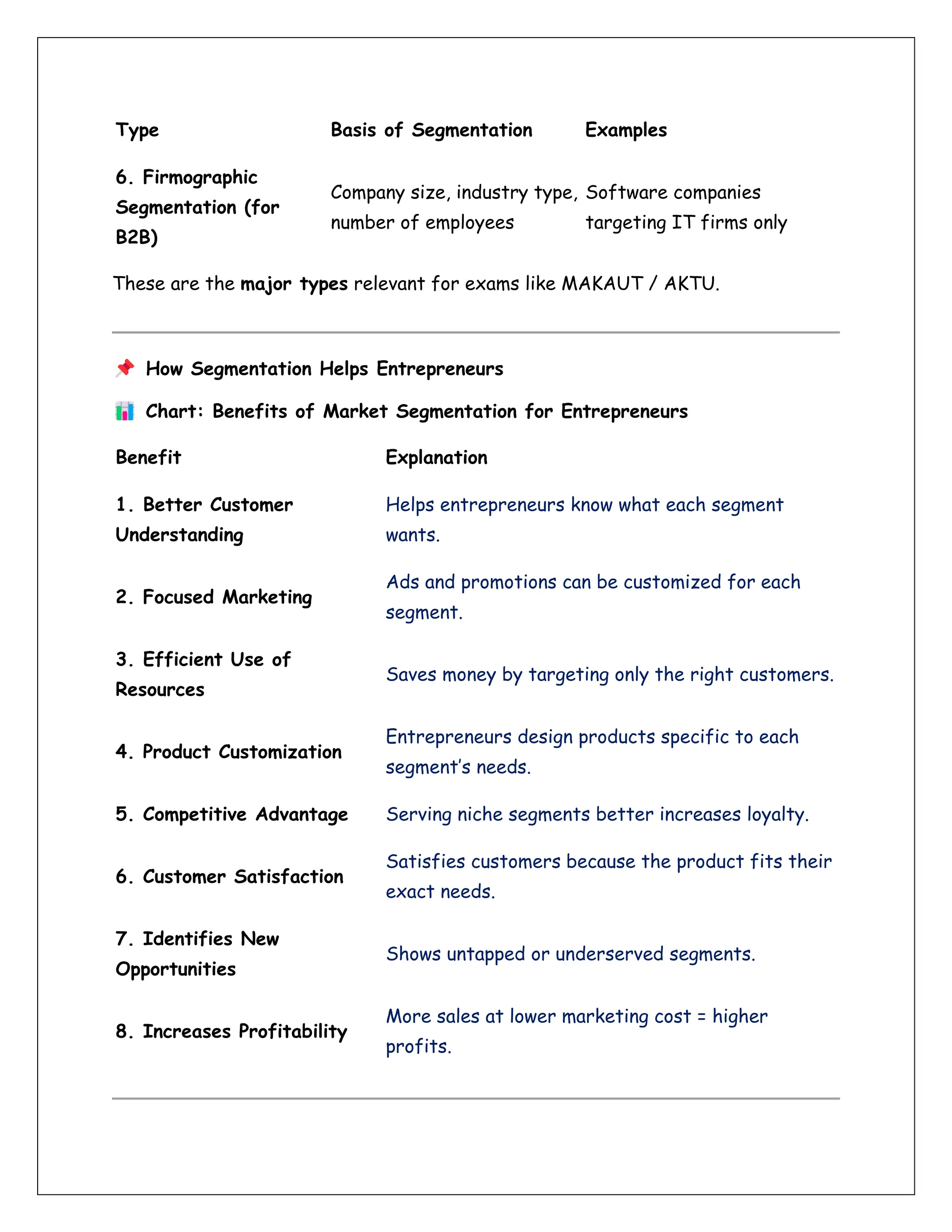
Type Basis of Segmentation Examples
6. Firmographic
Segmentation (for
B2B)
Company size, industry type,
number of employees
Software companies
targeting IT firms only
These are the major types relevant for exams like MAKAUT / AKTU.
How Segmentation Helps Entrepreneurs
Chart: Benefits of Market Segmentation for Entrepreneurs
Benefit Explanation
1. Better Customer
Understanding
Helps entrepreneurs know what each segment
wants.
2. Focused Marketing
Ads and promotions can be customized for each
segment.
3. Efficient Use of
Resources
Saves money by targeting only the right customers.
4. Product Customization
Entrepreneurs design products specific to each
segment’s needs.
5. Competitive Advantage Serving niche segments better increases loyalty.
6. Customer Satisfaction
Satisfies customers because the product fits their
exact needs.
7. Identifies New
Opportunities
Shows untapped or underserved segments.
8. Increases Profitability
More sales at lower marketing cost = higher
profits.
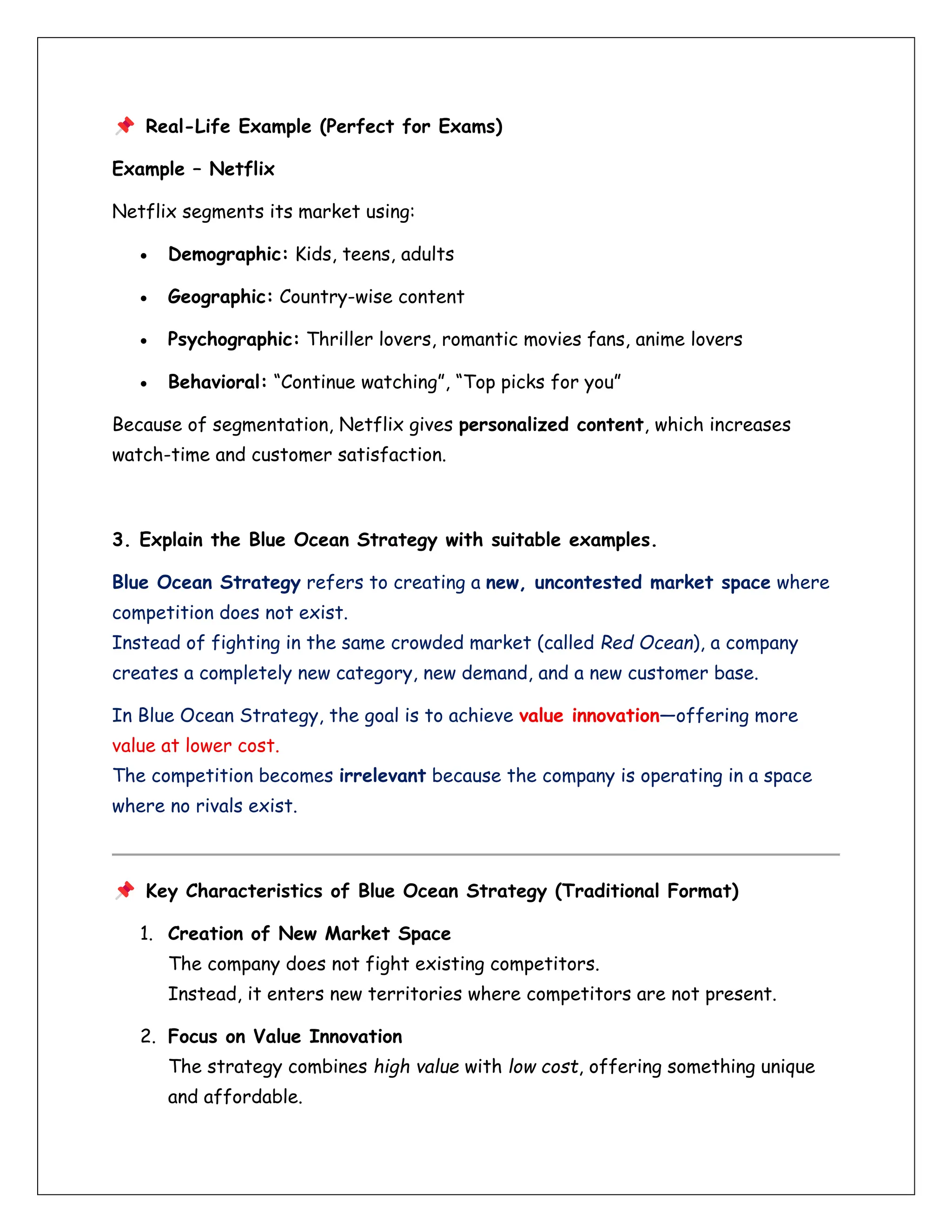
Real-Life Example (Perfect for Exams)
Example – Netflix
Netflix segments its market using:
• Demographic: Kids, teens, adults
• Geographic: Country-wise content
• Psychographic: Thriller lovers, romantic movies fans, anime lovers
• Behavioral: “Continue watching”, “Top picks for you”
Because of segmentation, Netflix gives personalized content, which increases
watch-time and customer satisfaction.
3. Explain the Blue Ocean Strategy with suitable examples.
Blue Ocean Strategy refers to creating a new, uncontested market space where
competition does not exist.
Instead of fighting in the same crowded market (called Red Ocean), a company
creates a completely new category, new demand, and a new customer base.
In Blue Ocean Strategy, the goal is to achieve value innovation—offering more
value at lower cost.
The competition becomes irrelevant because the company is operating in a space
where no rivals exist.
Key Characteristics of Blue Ocean Strategy (Traditional Format)
1. Creation of New Market Space
The company does not fight existing competitors.
Instead, it enters new territories where competitors are not present.
2. Focus on Value Innovation
The strategy combines high value with low cost, offering something unique
and affordable.
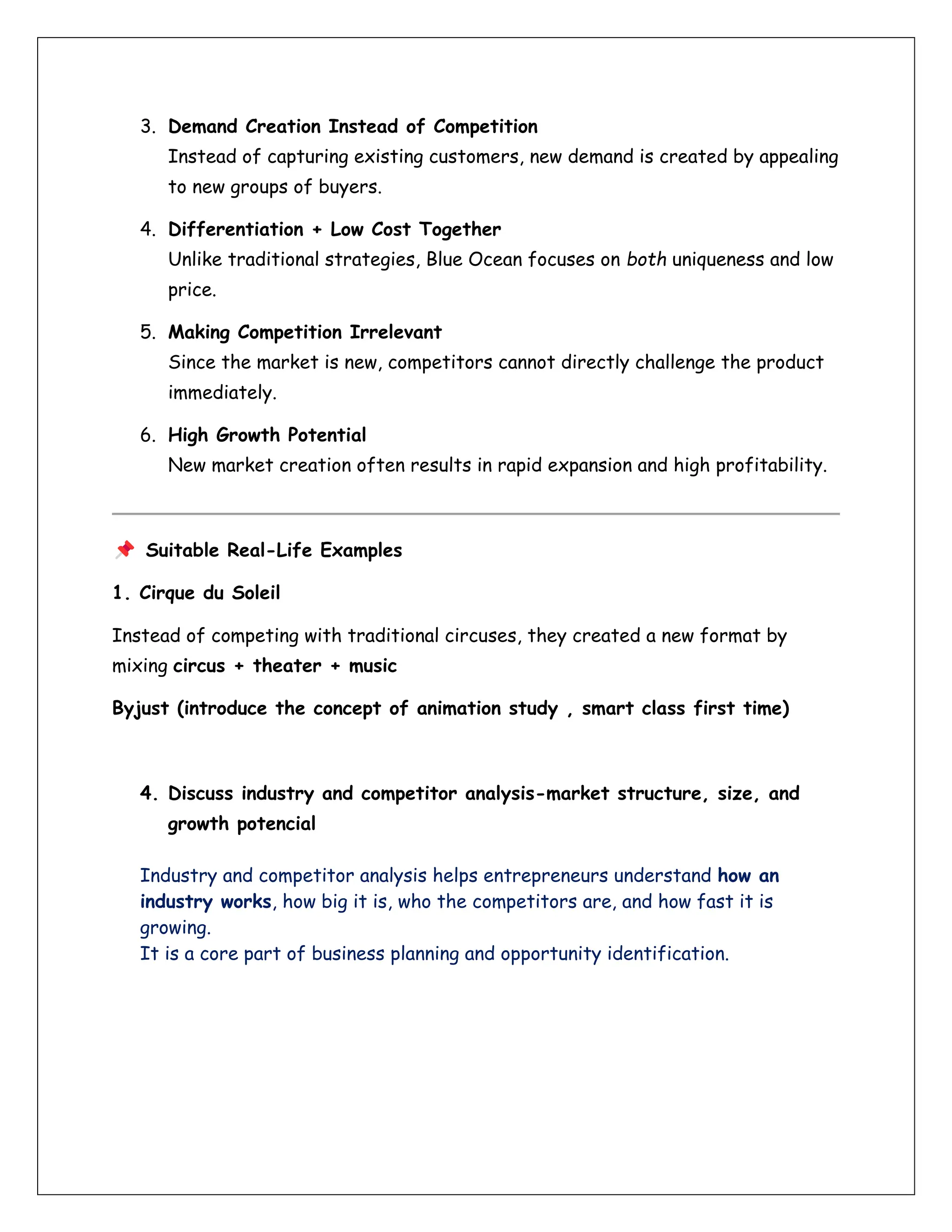
3. Demand Creation Instead of Competition
Instead of capturing existing customers, new demand is created by appealing
to new groups of buyers.
4. Differentiation + Low Cost Together
Unlike traditional strategies, Blue Ocean focuses on both uniqueness and low
price.
5. Making Competition Irrelevant
Since the market is new, competitors cannot directly challenge the product
immediately.
6. High Growth Potential
New market creation often results in rapid expansion and high profitability.
Suitable Real-Life Examples
1. Cirque du Soleil
Instead of competing with traditional circuses, they created a new format by
mixing circus + theater + music
Byjust (introduce the concept of animation study , smart class first time)
4. Discuss industry and competitor analysis-market structure, size, and
growth potencial
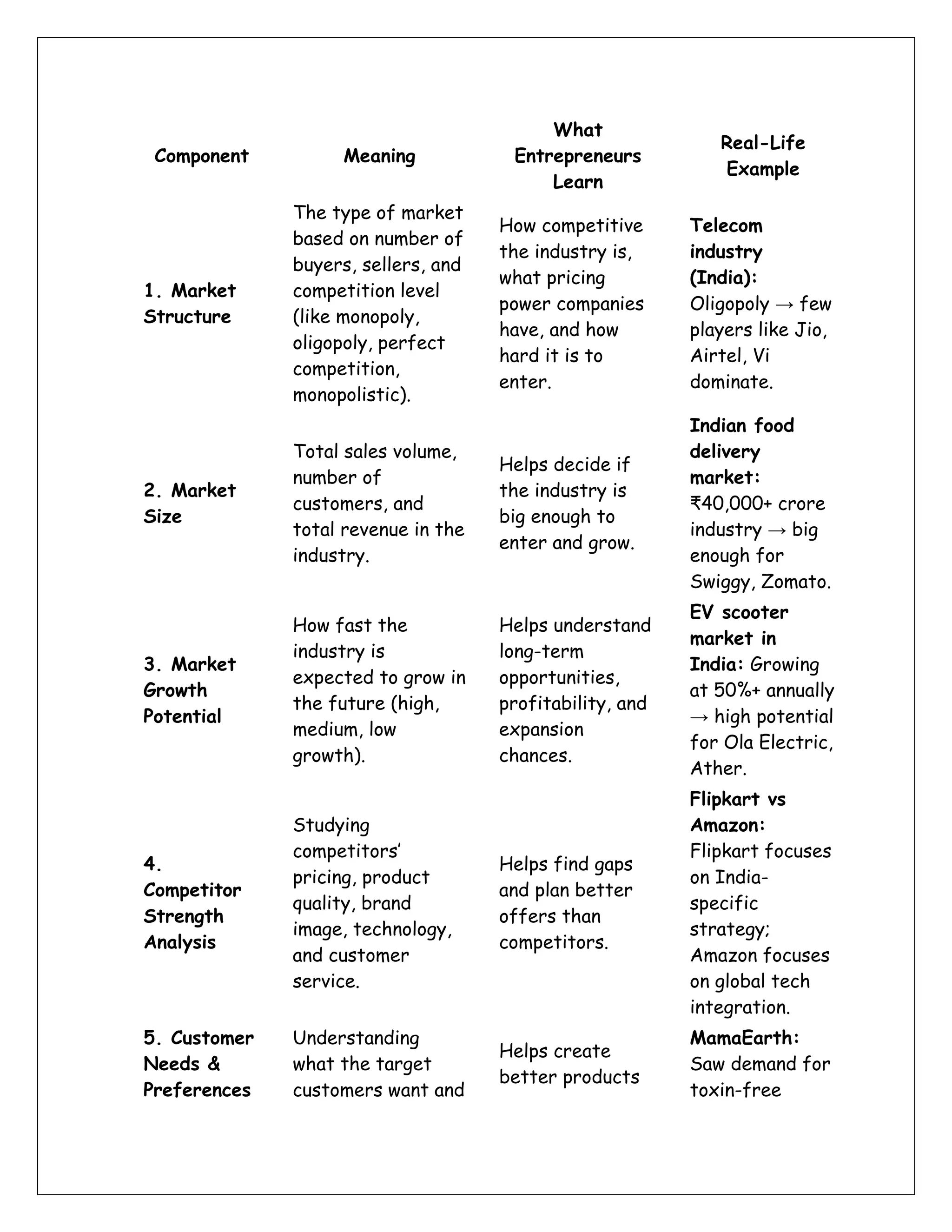
Industry and competitor analysis helps entrepreneurs understand how an
industry works, how big it is, who the competitors are, and how fast it is
growing.
It is a core part of business planning and opportunity identification.
Component Meaning
What
Entrepreneurs
Learn
Real-Life
Example
1. Market
Structure
The type of market
based on number of
buyers, sellers, and
competition level
(like monopoly,
oligopoly, perfect
competition,
monopolistic).
How competitive
the industry is,
what pricing
power companies
have, and how
hard it is to
enter.
Telecom
industry
(India):
Oligopoly → few
players like Jio,
Airtel, Vi
dominate.
2. Market
Size
Total sales volume,
number of
customers, and
total revenue in the
industry.
Helps decide if
the industry is
big enough to
enter and grow.
Indian food
delivery
market:
₹40,000+ crore
industry → big
enough for
Swiggy, Zomato.
3. Market
Growth
Potential
How fast the
industry is
expected to grow in
the future (high,
medium, low
growth).
Helps understand
long-term
opportunities,
profitability, and
expansion
chances.
EV scooter
market in
India: Growing
at 50%+ annually
→ high potential
for Ola Electric,
Ather.
4.
Competitor
Strength
Analysis
Studying
competitors’
pricing, product
quality, brand
image, technology,
and customer
service.
Helps find gaps
and plan better
offers than
competitors.
Flipkart vs
Amazon:
Flipkart focuses
on India-
specific
strategy;
Amazon focuses
on global tech
integration.
5. Customer
Needs &
Preferences
Understanding
what the target
customers want and
Helps create
better products
MamaEarth:
Saw demand for
toxin-free
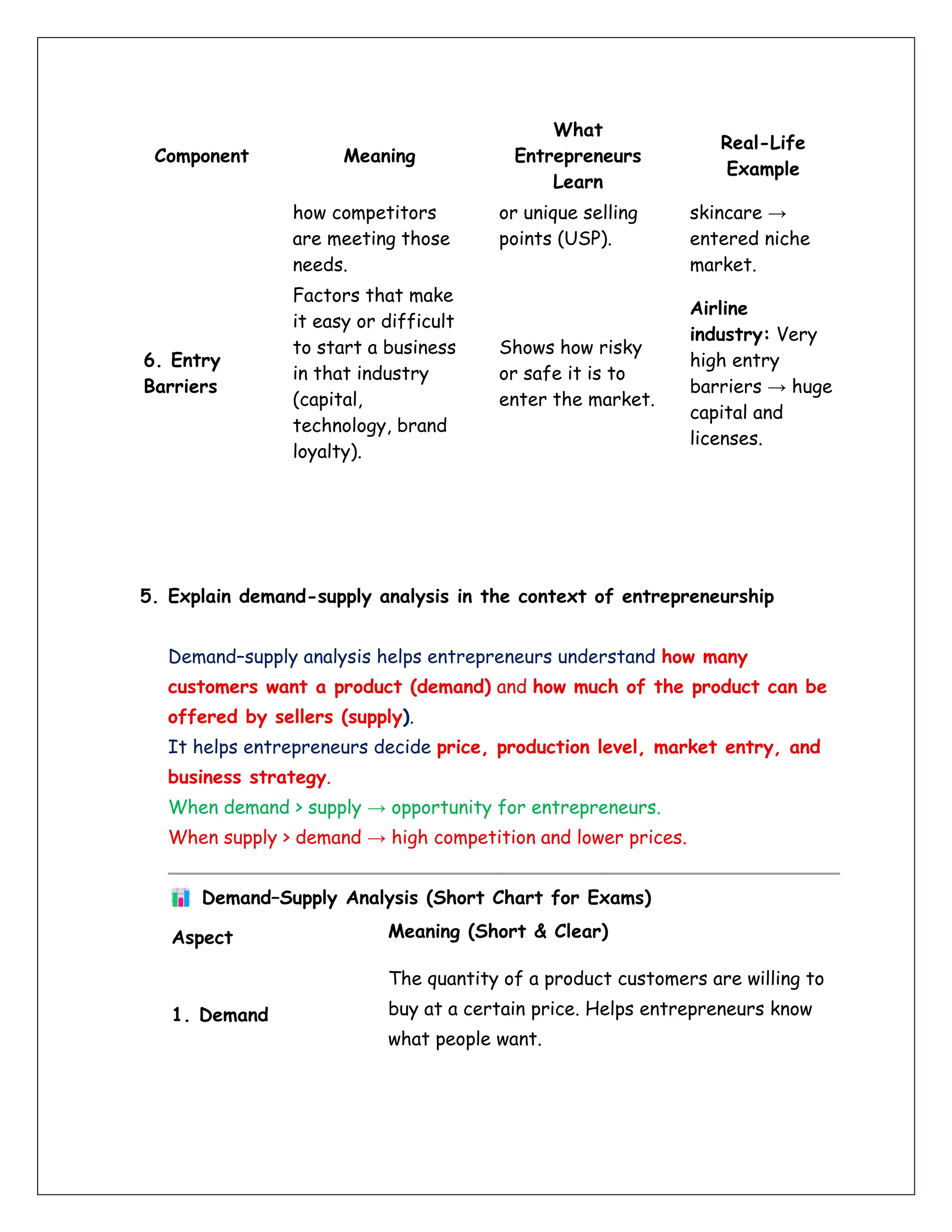
Component Meaning
What
Entrepreneurs
Learn
Real-Life
Example
how competitors
are meeting those
needs.
or unique selling
points (USP).
skincare →
entered niche
market.
6. Entry
Barriers
Factors that make
it easy or difficult
to start a business
in that industry
(capital,
technology, brand
loyalty).
Shows how risky
or safe it is to
enter the market.
Airline
industry: Very
high entry
barriers → huge
capital and
licenses.
5. Explain demand-supply analysis in the context of entrepreneurship
Demand–supply analysis helps entrepreneurs understand how many
customers want a product (demand) and how much of the product can be
offered by sellers (supply).
It helps entrepreneurs decide price, production level, market entry, and
business strategy.
When demand > supply → opportunity for entrepreneurs.
When supply > demand → high competition and lower prices.
Demand–Supply Analysis (Short Chart for Exams)
Aspect Meaning (Short & Clear)
1. Demand
The quantity of a product customers are willing to
buy at a certain price. Helps entrepreneurs know
what people want.
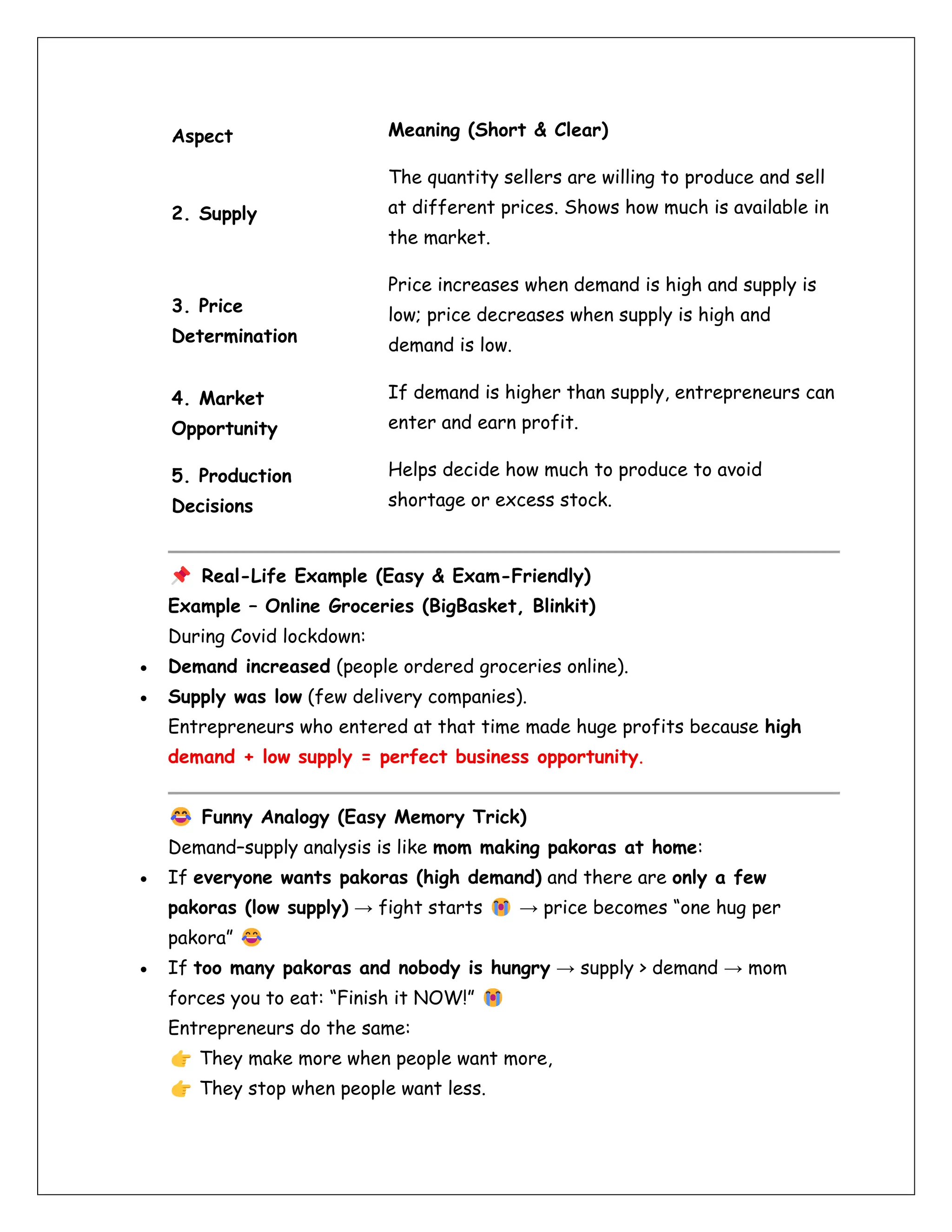
Aspect Meaning (Short & Clear)
2. Supply
The quantity sellers are willing to produce and sell
at different prices. Shows how much is available in
the market.
3. Price
Determination
Price increases when demand is high and supply is
low; price decreases when supply is high and
demand is low.
4. Market
Opportunity
If demand is higher than supply, entrepreneurs can
enter and earn profit.
5. Production
Decisions
Helps decide how much to produce to avoid
shortage or excess stock.
Real-Life Example (Easy & Exam-Friendly)
Example – Online Groceries (BigBasket, Blinkit)
During Covid lockdown:
• Demand increased (people ordered groceries online).
• Supply was low (few delivery companies).
Entrepreneurs who entered at that time made huge profits because high
demand + low supply = perfect business opportunity.
Funny Analogy (Easy Memory Trick)
Demand–supply analysis is like mom making pakoras at home:
• If everyone wants pakoras (high demand) and there are only a few
pakoras (low supply) → fight starts → price becomes “one hug per
pakora”
• If too many pakoras and nobody is hungry → supply > demand → mom
forces you to eat: “Finish it NOW!”
Entrepreneurs do the same:
They make more when people want more,
They stop when people want less.
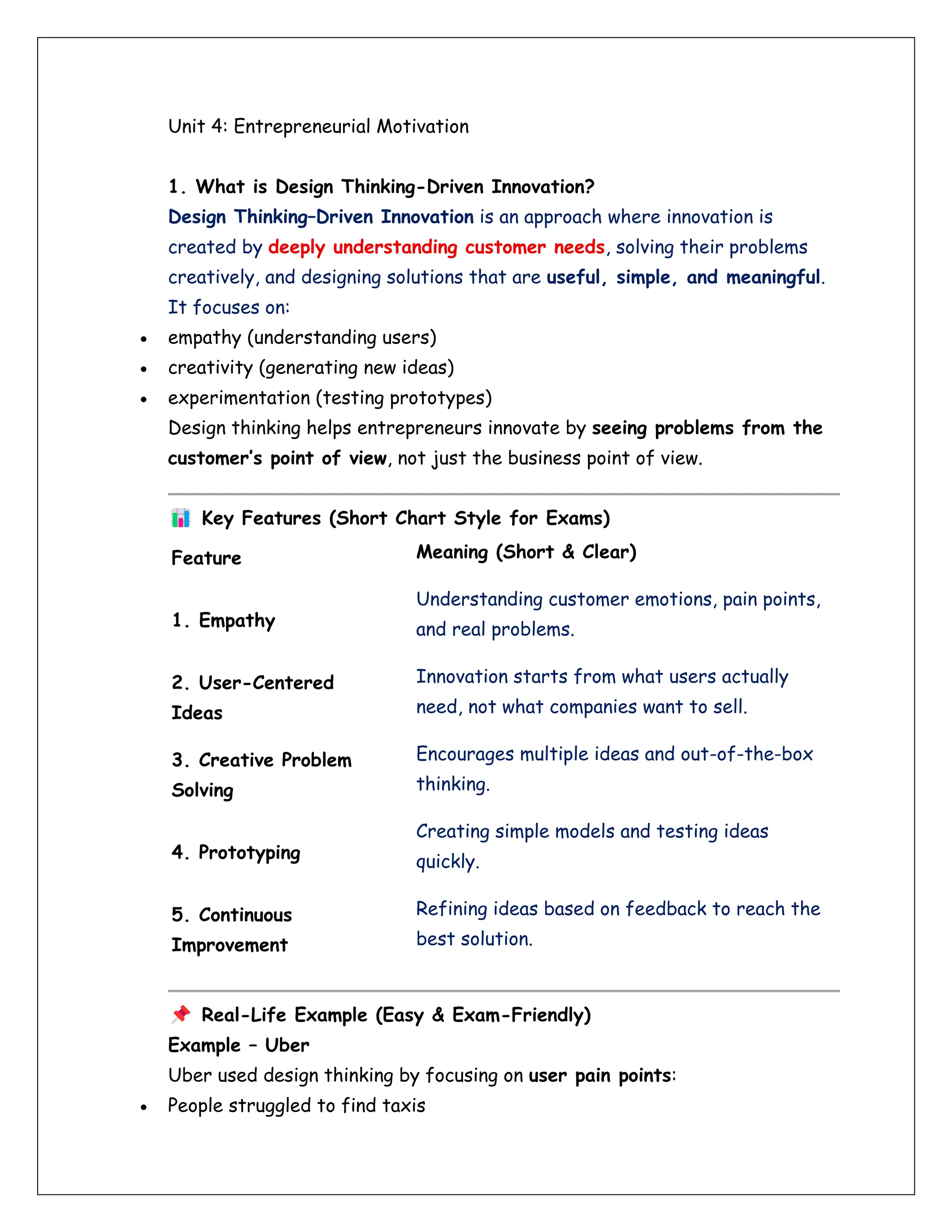
Unit 4: Entrepreneurial Motivation
1. What is Design Thinking-Driven Innovation?
Design Thinking–Driven Innovation is an approach where innovation is
created by deeply understanding customer needs, solving their problems
creatively, and designing solutions that are useful, simple, and meaningful.
It focuses on:
• empathy (understanding users)
• creativity (generating new ideas)
• experimentation (testing prototypes)
Design thinking helps entrepreneurs innovate by seeing problems from the
customer’s point of view, not just the business point of view.
Key Features (Short Chart Style for Exams)
Feature Meaning (Short & Clear)
1. Empathy
Understanding customer emotions, pain points,
and real problems.
2. User-Centered
Ideas
Innovation starts from what users actually
need, not what companies want to sell.
3. Creative Problem
Solving
Encourages multiple ideas and out-of-the-box
thinking.
4. Prototyping
Creating simple models and testing ideas
quickly.
5. Continuous
Improvement
Refining ideas based on feedback to reach the
best solution.
Real-Life Example (Easy & Exam-Friendly)
Example – Uber
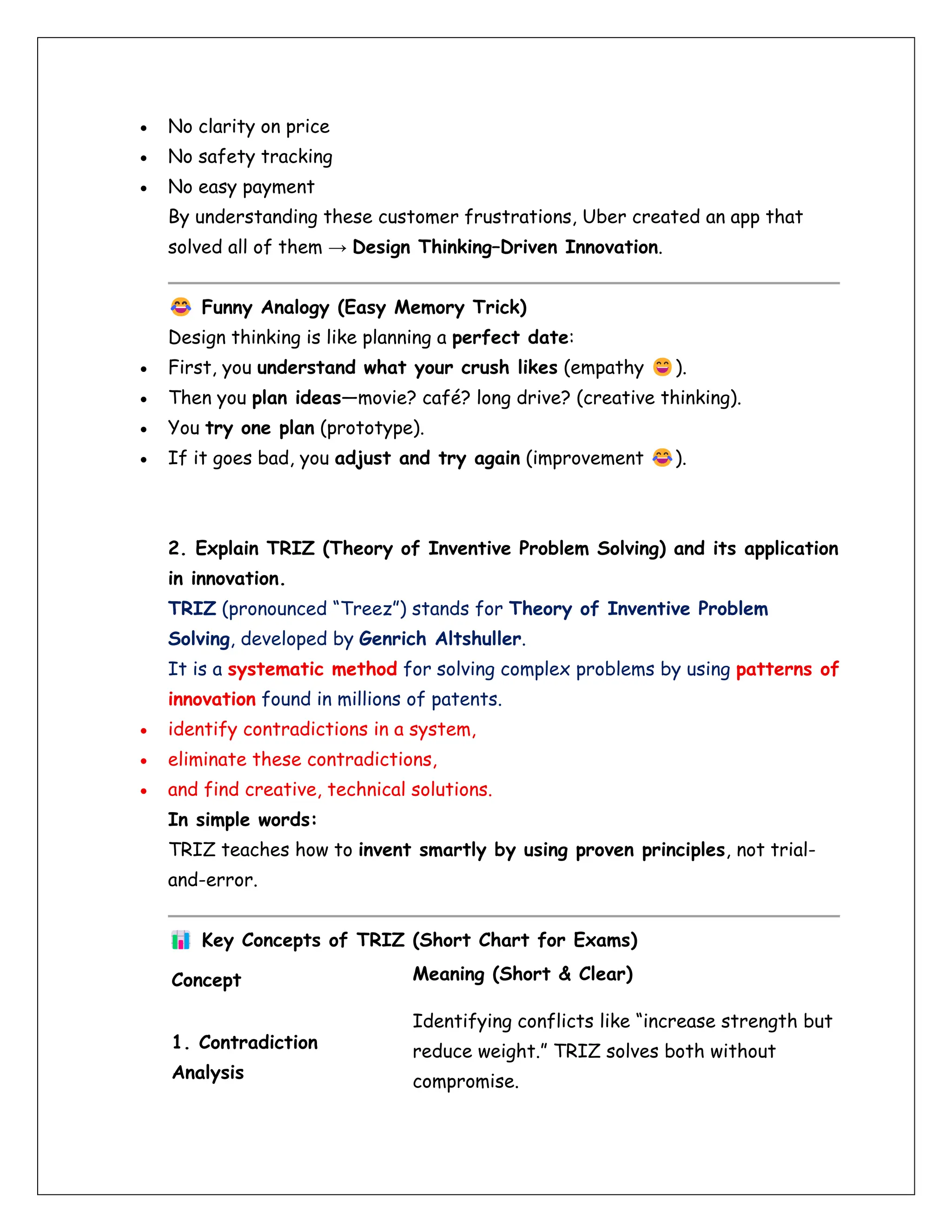
Uber used design thinking by focusing on user pain points:
• People struggled to find taxis
• No clarity on price
• No safety tracking
• No easy payment
By understanding these customer frustrations, Uber created an app that
solved all of them → Design Thinking–Driven Innovation.
Funny Analogy (Easy Memory Trick)
Design thinking is like planning a perfect date:
• First, you understand what your crush likes (empathy ).
• Then you plan ideas—movie? café? long drive? (creative thinking).
• You try one plan (prototype).
• If it goes bad, you adjust and try again (improvement ).
2. Explain TRIZ (Theory of Inventive Problem Solving) and its application
in innovation.
TRIZ (pronounced “Treez”) stands for Theory of Inventive Problem
Solving, developed by Genrich Altshuller.
It is a systematic method for solving complex problems by using patterns of
innovation found in millions of patents.
• identify contradictions in a system,
• eliminate these contradictions,
• and find creative, technical solutions.
In simple words:
TRIZ teaches how to invent smartly by using proven principles, not trial-
and-error.
Key Concepts of TRIZ (Short Chart for Exams)
Concept Meaning (Short & Clear)
1. Contradiction
Analysis
Identifying conflicts like “increase strength but
reduce weight.” TRIZ solves both without
compromise.
Concept Meaning (Short & Clear)
2. 40 Inventive
Principles
Ready-made creative strategies (e.g.,
segmentation, inversion, combining, automation)
used to generate solutions.
3. Ideal Final
Result (IFR)
Imagining the perfect solution with no
drawbacks. Helps think beyond limitations.
4. Resources
Utilization
Using available materials, energy, and space to
solve problems cheaply and effectively.
5. Trends of
Technological
Evolution
Predicting how products/technologies naturally
evolve over time.
Application of TRIZ in Innovation (Short Points)
Application How TRIZ Helps
1. Product
Improvement
TRIZ principles help make products lighter,
faster, safer, cheaper.
2. Reducing Cost
Eliminating contradictions reduces waste
and increases efficiency.
3. Technical Problem
Solving
Helps engineers solve complex design or
manufacturing challenges.
4. Creating
Breakthrough Ideas
TRIZ pushes thinking beyond traditional
brainstorming.
5. Process Optimization
Improves workflow by removing bottlenecks
and inefficiencies.
Real-Life Example (Easy for Exams)
Example – Smartphone Camera Innovation
Phone companies needed better zoom (increase quality) without making
phones bulky (reduce size).
This is a contradiction:
increase performance + reduce size
Using TRIZ principles like segmentation and inversion, companies invented:
• periscope zoom lenses
• multiple small lenses instead of one big lens
This solved both requirements → TRIZ in action.
Funny Analogy (Easy Memory Trick)
TRIZ is like when your mom says:
“Study more… but don’t get stressed!”
This is a contradiction
To solve it:
• You listen to music while studying
• Take small breaks
• Use smart notes
That’s exactly what TRIZ does—
solves contradictions with smart, inventive ideas.
3. Describe the Achievement Motivation Theory of Entrepreneurship
(McClelland's Theory).
Achievement Motivation Theory, developed by David McClelland, explains
that people become entrepreneurs because they have a high need for
achievement (nAch).
Such individuals want to do things better, set challenging goals, and take
responsibility for their success.
According to McClelland, three key needs influence human behavior, but the
need for achievement is the strongest driver of entrepreneurship.
McClelland’s Three Needs (Short Chart for Exams)
Need Meaning Role in Entrepreneurship
1. Need for
Achievement
(nAch)
Desire to
accomplish difficult
tasks, excel, and
achieve goals.
Encourages
entrepreneurs to
innovate, take calculated
risks, and work hard.
2. Need for
Power (nPow)
Desire to influence,
lead, and control
others.
Helps in leadership, team
management, and
decision-making.
3. Need for
Affiliation
(nAff)
Desire for friendly
relationships and
social approval.
Helps entrepreneurs build
networks and
partnerships.
But need for achievement is the strongest motivator for starting and
growing a business.
Key Characteristics of High Achievement Individuals
• Set challenging but realistic goals
• Take calculated risks
• Prefer feedback to improve
McClelland said that people with high achievement motivation become
successful entrepreneurs.
Real-Life Example (Simple for Exam)
Example – Elon Musk
Elon Musk shows high achievement motivation:
• Wanted to revolutionize cars → built Tesla
• Wanted to reduce space travel cost → SpaceX
• Takes huge calculated risks, sets big goals, works obsessively
• Constantly tries to improve products
This perfectly matches McClelland’s theory that achievement-driven people
become innovative entrepreneurs.
4. What are harvesting strategies in entrepreneurship?
Harvesting strategies are the methods used by entrepreneurs to exit a
business and convert their ownership into cash or other benefits.
It is the process of “harvesting the rewards” after years of building the
business.
In simple words:
👉 Harvesting = How an entrepreneur leaves the business and collects
profit.
These strategies help entrepreneurs:
• recover investment
• earn profit
• shift to new ventures
• reduce involvement
• retire safely
Chart: Types of Harvesting Strategies (Short & Exam-Friendly)
Strategy Explanation (Short & Clear)
1. Selling the Business
(Trade Sale)
Entrepreneur sells the entire business to
another company for cash or shares.
2. Initial Public Offering
(IPO)
Company sells its shares to the public
through the stock market to raise large
funds.
3. Management Buyout
(MBO)
The company’s managers purchase the
business from the entrepreneur.
4. Family Succession
Business is handed over to family
members or next generation.
5. Liquidation
Closing the business and selling off all
assets to recover money.
Strategy Explanation (Short & Clear)
6. Acquisition/Merger
Another company buys or merges with the
business, giving payout to the founder.
Real-Life Examples (Easy for Exams)
1. Flipkart – Acquisition (Harvested by Founders)
Walmart bought Flipkart for $16 billion.
Founders Sachin & Binny Bansal received huge payouts.
This is a harvesting strategy through acquisition.
2. Zomato IPO
Zomato listed its shares on the stock market.
Founders and early investors got large returns.
This is harvesting through IPO.
Unit 5: Information and Government Initiatives
1. Describe the government incentives available for entrepreneurs.
Government incentives are supportive measures provided by the government
to encourage entrepreneurship.
These incentives help reduce financial burden, promote innovation, support
startups, and make it easier to start and grow a business.
They include subsidies, tax benefits, grants, loans, training, and
infrastructure support.
Chart: Government Incentives for Entrepreneurs (Short & Clear)
Type of Incentive Explanation Example (India)
1. Financial
Subsidies
Government pays part
of the cost to reduce
business expenses.
MSME Subsidy,
Machinery
Subsidy under
PMEGP
2. Tax Benefits &
Exemptions
Reduction or
exemption from taxes
in early years to
support growth.
Startup India
offers 3-year tax
holiday
3. Low-Interest &
Collateral-Free
Loans
Loans at low interest
without security to
support new
businesses.
MUDRA Loan
(Shishu, Kishore,
Tarun)
4. Grants for
Innovation
Free financial support
to develop new
products, research, or
technology.
Atal Innovation
Mission (AIM)
5. Incubation
Support
Provides workspace,
mentorship, labs, and
Startup
Incubators at
Type of Incentive Explanation Example (India)
networking for
startups.
IITs, NITs,
MSME tech
centers
6. Skill
Development &
Training
Government provides
technical training to
improve
entrepreneurial skills.
PMKVY (Pradhan
Mantri Kaushal
Vikas Yojana)
7. Export
Incentives
Support for
entrepreneurs selling
products outside India.
MEIS/SEIS
schemes under
Foreign Trade
Policy
8. Infrastructure
Support
Special industrial
parks, SEZs, power
supply, transport
support.
Software
Technology Parks
of India (STPI)
9. Women
Entrepreneurship
Schemes
Special loans and
subsidies for women-
led businesses.
Udyogini Scheme,
Mahila Udyam
Nidhi
10. Digital &
Technology Support
Tools, platforms, and
digital training for
startups.
Digital India,
Startup India
Hub
Simple Real-Life Examples
1. MUDRA Loan – Cafe Owner
A young entrepreneur starts a small café using a ₹5 lakh MUDRA loan under
“Tarun” category—no collateral needed.
2. What are incubation and acceleration programs?
Introduction
Incubation and acceleration programs are support systems provided to
startups to help them grow.
They offer mentoring, workspace, funding, and expert guidance to improve
success and reduce failure risk.
Entrepreneurs use these programs to develop ideas, build prototypes, grow
faster, and reach investors.
Incubation Programs (Short & Clear)
Incubation programs support early-stage startups in developing their idea
into a workable product or business.
Key Features
• Provide workspace, labs, and office support
• Offer mentorship and basic training
• Give access to technical support
• Help startups create prototypes/MVP
• Provide small grants or seed funding
• Long-term support (typically 6–18 months)
Purpose
To help new startups survive, experiment, and build a solid foundation.
Real-World Example (Perfect for Exams)
Ather Energy – IIT Madras Incubation Cell
Ather started as a student project and received:
• lab access
• workspace
• mentors
• seed funding
This incubation support helped them build India’s top electric scooter brand.
Acceleration Programs (Short & Clear)
Meaning
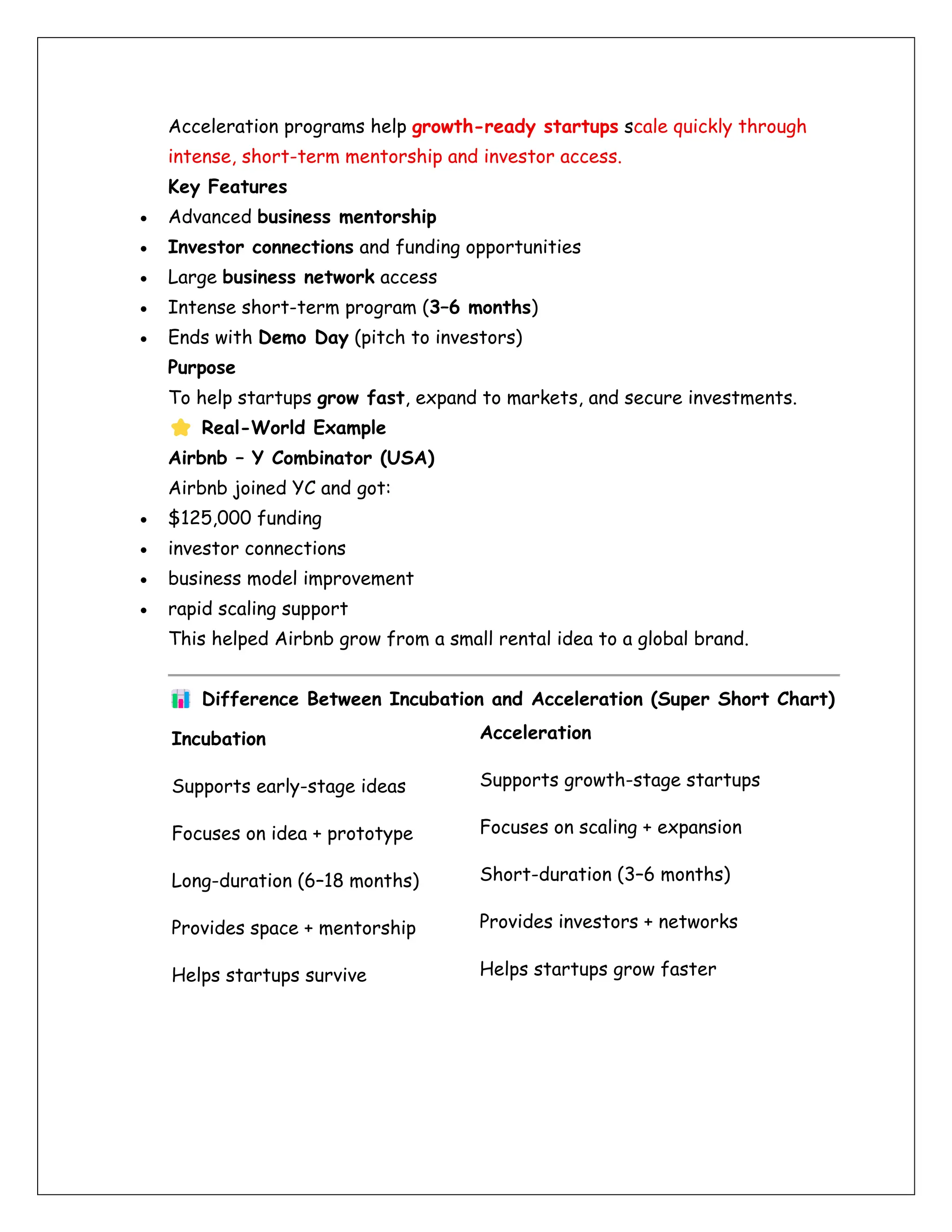
Acceleration programs help growth-ready startups scale quickly through
intense, short-term mentorship and investor access.
Key Features
• Advanced business mentorship
• Investor connections and funding opportunities
• Large business network access
• Intense short-term program (3–6 months)
• Ends with Demo Day (pitch to investors)
Purpose
To help startups grow fast, expand to markets, and secure investments.
Real-World Example
Airbnb – Y Combinator (USA)
Airbnb joined YC and got:
• $125,000 funding
• investor connections
• business model improvement
• rapid scaling support
This helped Airbnb grow from a small rental idea to a global brand.
Difference Between Incubation and Acceleration (Super Short Chart)
Incubation Acceleration
Supports early-stage ideas Supports growth-stage startups
Focuses on idea + prototype Focuses on scaling + expansion
Long-duration (6–18 months) Short-duration (3–6 months)
Provides space + mentorship Provides investors + networks
Helps startups survive Helps startups grow faster
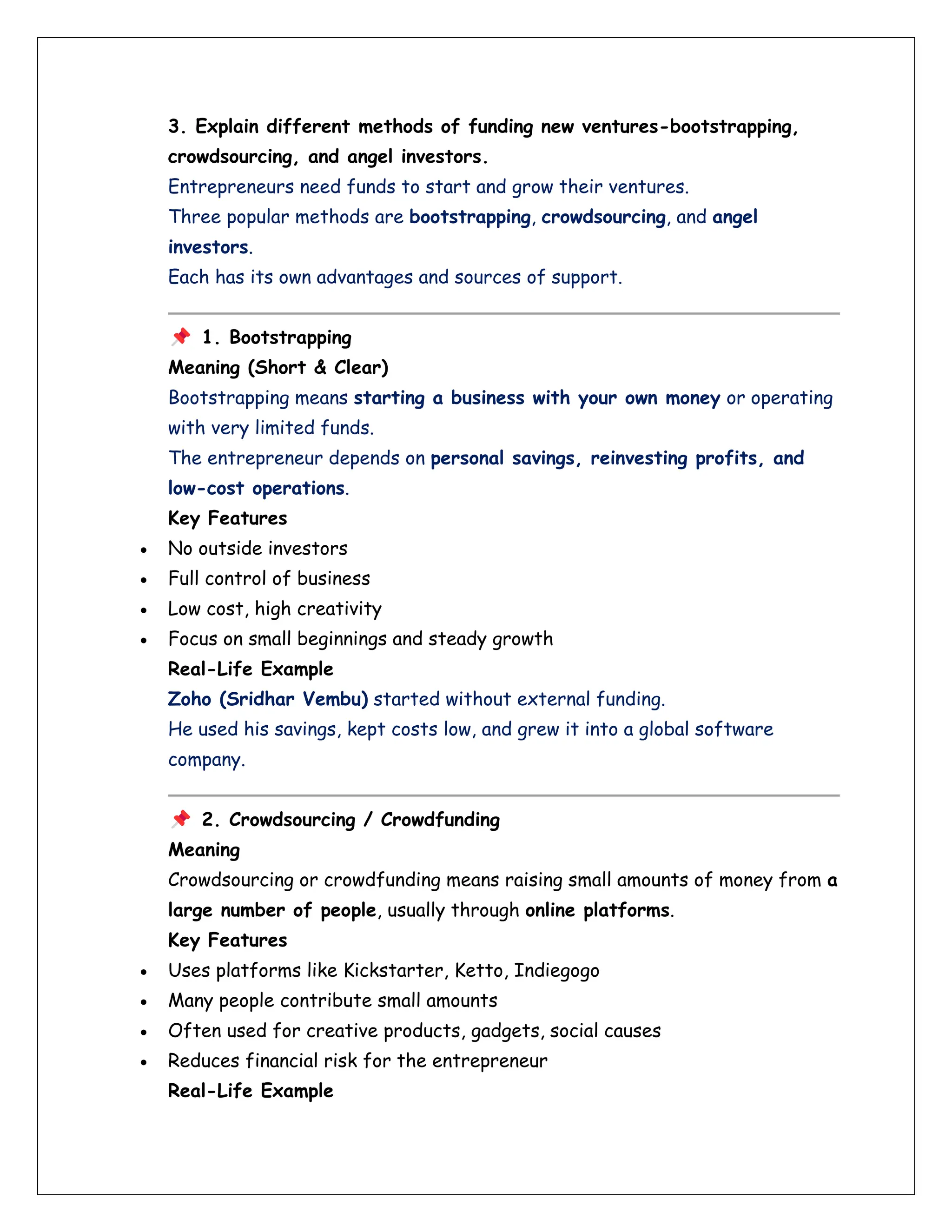
3. Explain different methods of funding new ventures-bootstrapping,
crowdsourcing, and angel investors.
Entrepreneurs need funds to start and grow their ventures.
Three popular methods are bootstrapping, crowdsourcing, and angel
investors.
Each has its own advantages and sources of support.
1. Bootstrapping
Meaning (Short & Clear)
Bootstrapping means starting a business with your own money or operating
with very limited funds.
The entrepreneur depends on personal savings, reinvesting profits, and
low-cost operations.
Key Features
• No outside investors
• Full control of business
• Low cost, high creativity
• Focus on small beginnings and steady growth
Real-Life Example
Zoho (Sridhar Vembu) started without external funding.
He used his savings, kept costs low, and grew it into a global software
company.
2. Crowdsourcing / Crowdfunding
Meaning
Crowdsourcing or crowdfunding means raising small amounts of money from a
large number of people, usually through online platforms.
Key Features
• Uses platforms like Kickstarter, Ketto, Indiegogo
• Many people contribute small amounts
• Often used for creative products, gadgets, social causes
• Reduces financial risk for the entrepreneur
Real-Life Example
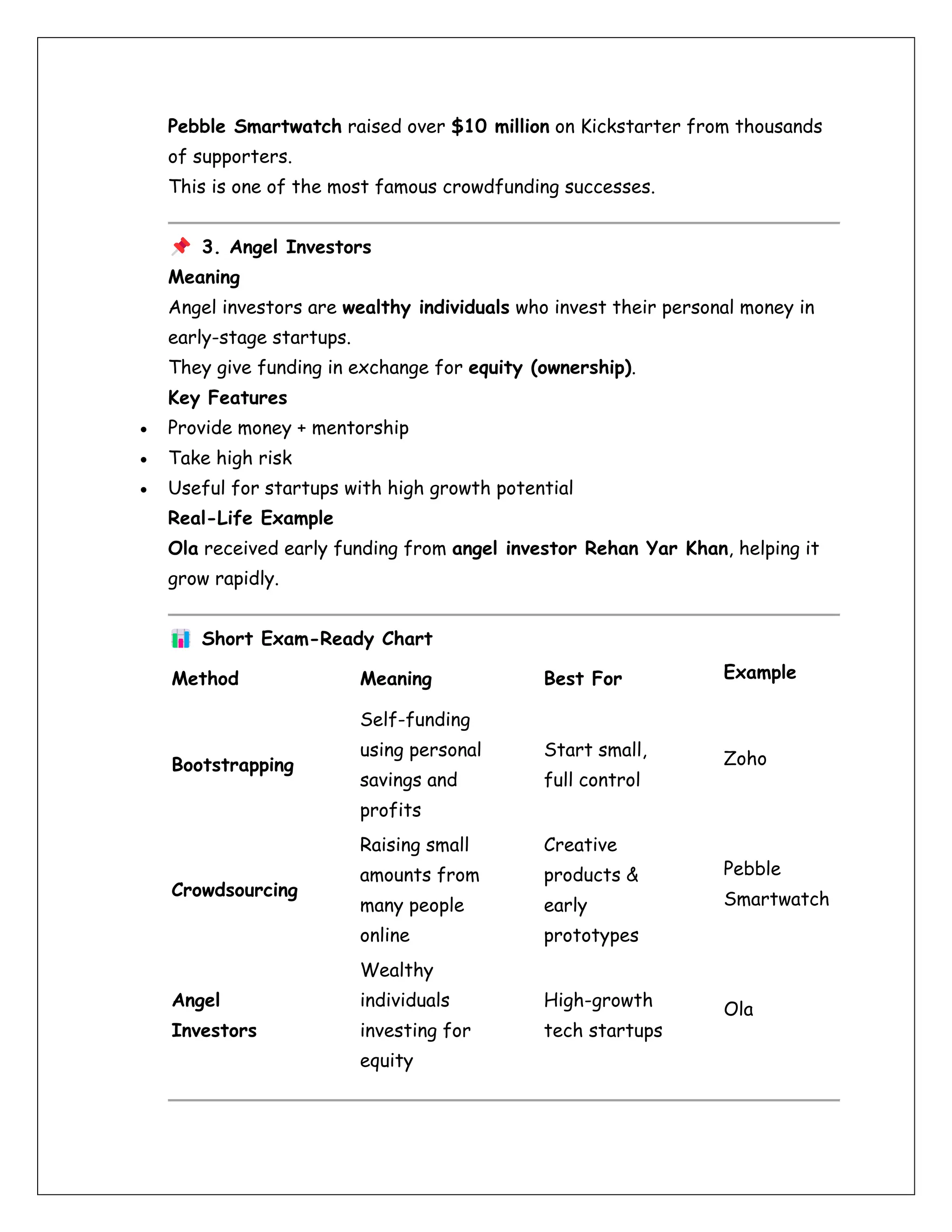
Pebble Smartwatch raised over $10 million on Kickstarter from thousands
of supporters.
This is one of the most famous crowdfunding successes.
3. Angel Investors
Meaning
Angel investors are wealthy individuals who invest their personal money in
early-stage startups.
They give funding in exchange for equity (ownership).
Key Features
• Provide money + mentorship
• Take high risk
• Useful for startups with high growth potential
Real-Life Example
Ola received early funding from angel investor Rehan Yar Khan, helping it
grow rapidly.
Short Exam-Ready Chart
Method Meaning Best For Example
Bootstrapping
Self-funding
using personal
savings and
profits
Start small,
full control
Zoho
Crowdsourcing
Raising small
amounts from
many people
online
Creative
products &
early
prototypes
Pebble
Smartwatch
Angel
Investors
Wealthy
individuals
investing for
equity
High-growth
tech startups
Ola
Funny Analogy (Easy Memory Trick)
Funding methods are like arranging money for a birthday party:
• Bootstrapping: You use your own pocket money to buy cake
• Crowdsourcing: You ask friends to contribute ₹50 each
• Angel Investor: Your rich uncle gives you ₹2000 and says,
“Beta, just invite me to the party!”
Exactly like startups get their funds!
4. Discuss the Government of India's efforts to promote entrepreneurship
and innovation through organizations such as: SISI, KVIC, DGFT, SIDBI,
Defense, and Railways.
1. SISI (Small Industries Service Institute / MSME–DI)
• Provides technical guidance, project reports, and consultancy to new
entrepreneurs.
• Conducts Entrepreneurship Development Programs (EDPs) and skill-training
workshops.
• Helps MSMEs with technology upgradation, quality improvement, and
marketing support.
• Supports small-scale manufacturers through industrial training and cluster
development.
2. KVIC (Khadi and Village Industries Commission)
• Promotes rural entrepreneurship through Khadi, handloom, and village
industries.
• Provides subsidies, raw materials, training, and marketing assistance.
• Implements PMEGP, giving up to 35% subsidy for new micro-enterprises.
• Encourages employment generation in rural and semi-urban areas.
3. DGFT (Directorate General of Foreign Trade)
• Facilitates exports by issuing export licenses, EPCG benefits, and duty
exemptions.
• Provides incentives under Foreign Trade Policy like MEIS/SEIS.
• Helps MSMEs enter global markets by simplifying export procedures.
• Supports exporters with schemes promoting international competitiveness.
4. SIDBI (Small Industries Development Bank of India)
• Offers low-interest loans, refinancing, and credit guarantees to MSMEs.
• Supports startups under schemes like SMILE and Fund of Funds for
Startups.
• Finances innovation-driven businesses and manufacturing units.
• Works with incubators and state governments to support small industries.
5. Defence Sector (DRDO, iDEX, Make-II Program)
• Promotes innovation through iDEX – supports startups working on defence
technologies.
• Provides funding and testing facilities for drones, robotics, AI,
cybersecurity, etc.
• Encourages private participation under Make in India (Defence
Manufacturing).
• DRDO collaborates with academic institutes and startups to develop
advanced technologies.
6. Indian Railways
• Runs Startup for Railways to solve real railway problems with innovative
solutions.
• Provides funding, procurement opportunities, and testing support for
startups.
• Encourages innovation in safety systems, sensors, signalling, energy
efficiency, etc.
• Supports development of systems like the Kavach Rail Safety System.
Unit 6: Closing the Window I
1. Explain the concept of sustaining competitiveness.
Sustaining competitiveness means a company’s ability to continue
performing better than its competitors over a long period of time.
It focuses on maintaining customer loyalty, innovation, quality, efficiency,
and market strength so that the business does not lose its position in the
industry.
In simple words:
Sustaining competitiveness = staying ahead of rivals consistently.
Pointwise Explanation
1. Continuous Innovation
Businesses must regularly improve products, services, and processes to stay
relevant and competitive.
2. Maintaining Quality
Consistently delivering high-quality products builds customer trust and long-
term loyalty.
3. Cost Efficiency
Reducing waste, improving productivity, and managing costs help offer
competitive prices.
4. Strong Customer Relationships
Understanding customer needs and providing good service helps retain
customers for the long term.
5. Adapting to Market Changes
Companies must respond quickly to new trends, technology, and changing
customer preferences.
6. Skilled Workforce
Trained and motivated employees contribute to innovation, productivity, and
overall performance.
7. Strong Branding & Reputation
A trustworthy brand helps sustain competitiveness even in crowded markets.
8. Strategic Use of Technology
Using modern tools like automation, AI, and data analytics enhances
efficiency and decision-making.
Real-Life Example
Example – Apple
Apple sustains competitiveness by:
• launching new product innovations
• maintaining high-quality standards
• building a strong brand
• using advanced technology
• delivering excellent customer service
This helps Apple stay ahead of Samsung, Xiaomi, and others globally.
2. How can an entrepreneur maintain competitive advantage over time?
To maintain competitive advantage, an entrepreneur must continuously
improve, innovate, and adapt.
Competitive advantage can only be sustained when a business keeps offering
better value than its competitors consistently, not just once.
Pointwise Answer (Short, Clear, Perfect for Exams)
1. Continuous Innovation
Entrepreneurs must keep introducing new features, ideas, or services to
stay ahead of competitors.
2. Consistent Quality Improvement
Maintaining and improving product or service quality builds customer trust
and loyalty.
3. Strong Customer Relationships
Understanding customer needs, taking feedback, and providing excellent
service helps keep customers for life.
4. Cost Efficiency & Productivity
Reducing waste, optimizing operations, and controlling costs allow
competitive pricing.
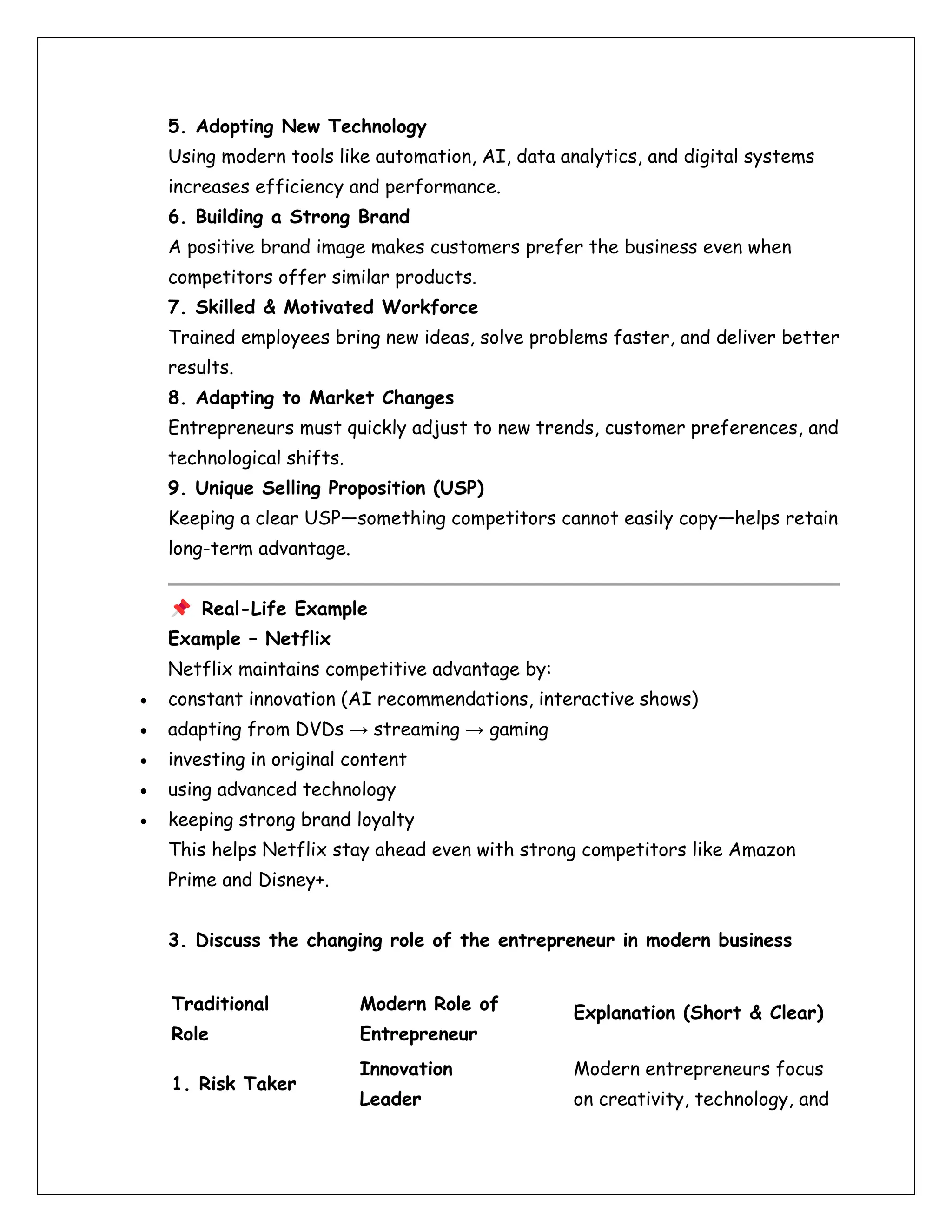
5. Adopting New Technology
Using modern tools like automation, AI, data analytics, and digital systems
increases efficiency and performance.
6. Building a Strong Brand
A positive brand image makes customers prefer the business even when
competitors offer similar products.
7. Skilled & Motivated Workforce
Trained employees bring new ideas, solve problems faster, and deliver better
results.
8. Adapting to Market Changes
Entrepreneurs must quickly adjust to new trends, customer preferences, and
technological shifts.
9. Unique Selling Proposition (USP)
Keeping a clear USP—something competitors cannot easily copy—helps retain
long-term advantage.
Real-Life Example
Example – Netflix
Netflix maintains competitive advantage by:
• constant innovation (AI recommendations, interactive shows)
• adapting from DVDs → streaming → gaming
• investing in original content
• using advanced technology
• keeping strong brand loyalty
This helps Netflix stay ahead even with strong competitors like Amazon
Prime and Disney+.
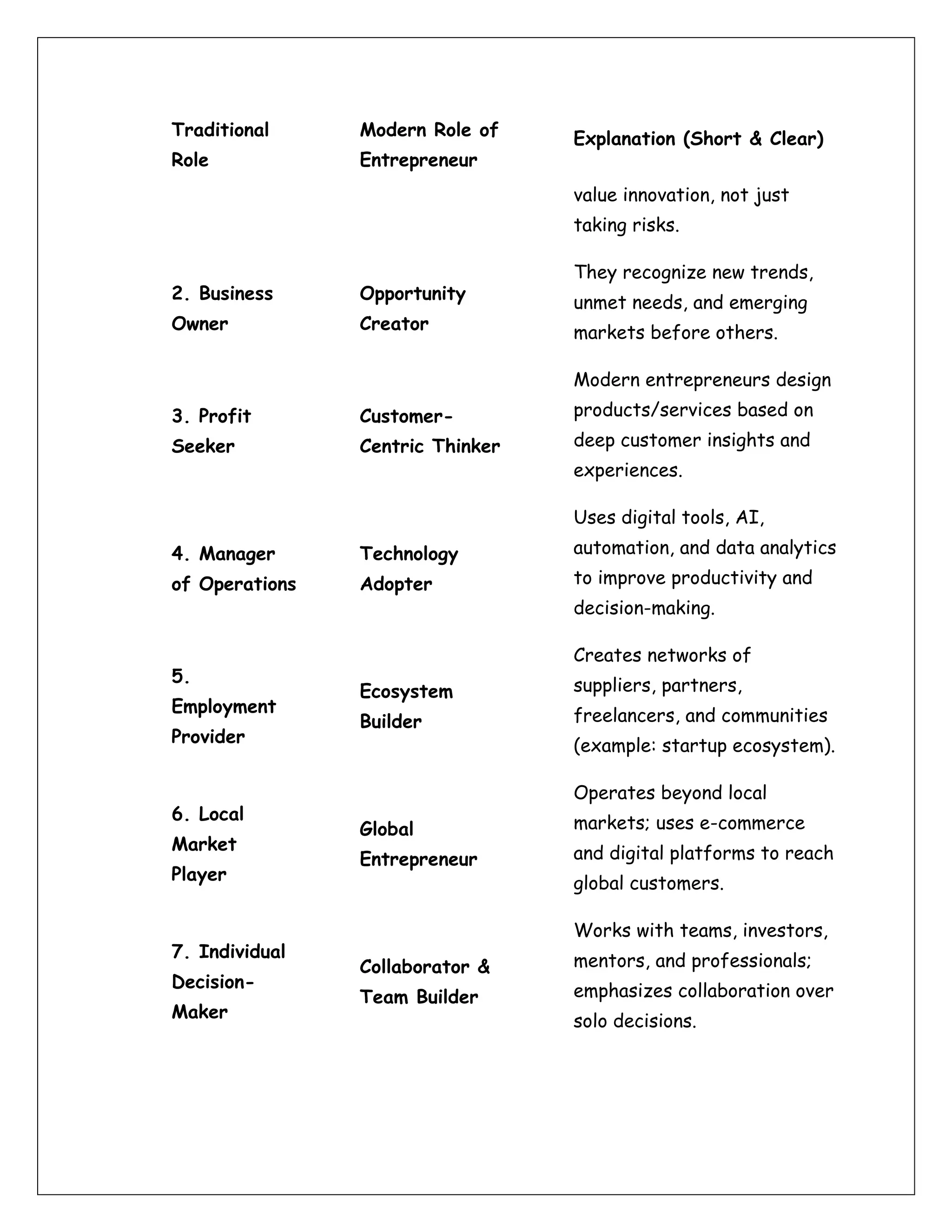
3. Discuss the changing role of the entrepreneur in modern business
Traditional
Role
Modern Role of
Entrepreneur
Explanation (Short & Clear)
1. Risk Taker
Innovation
Leader
Modern entrepreneurs focus
on creativity, technology, and
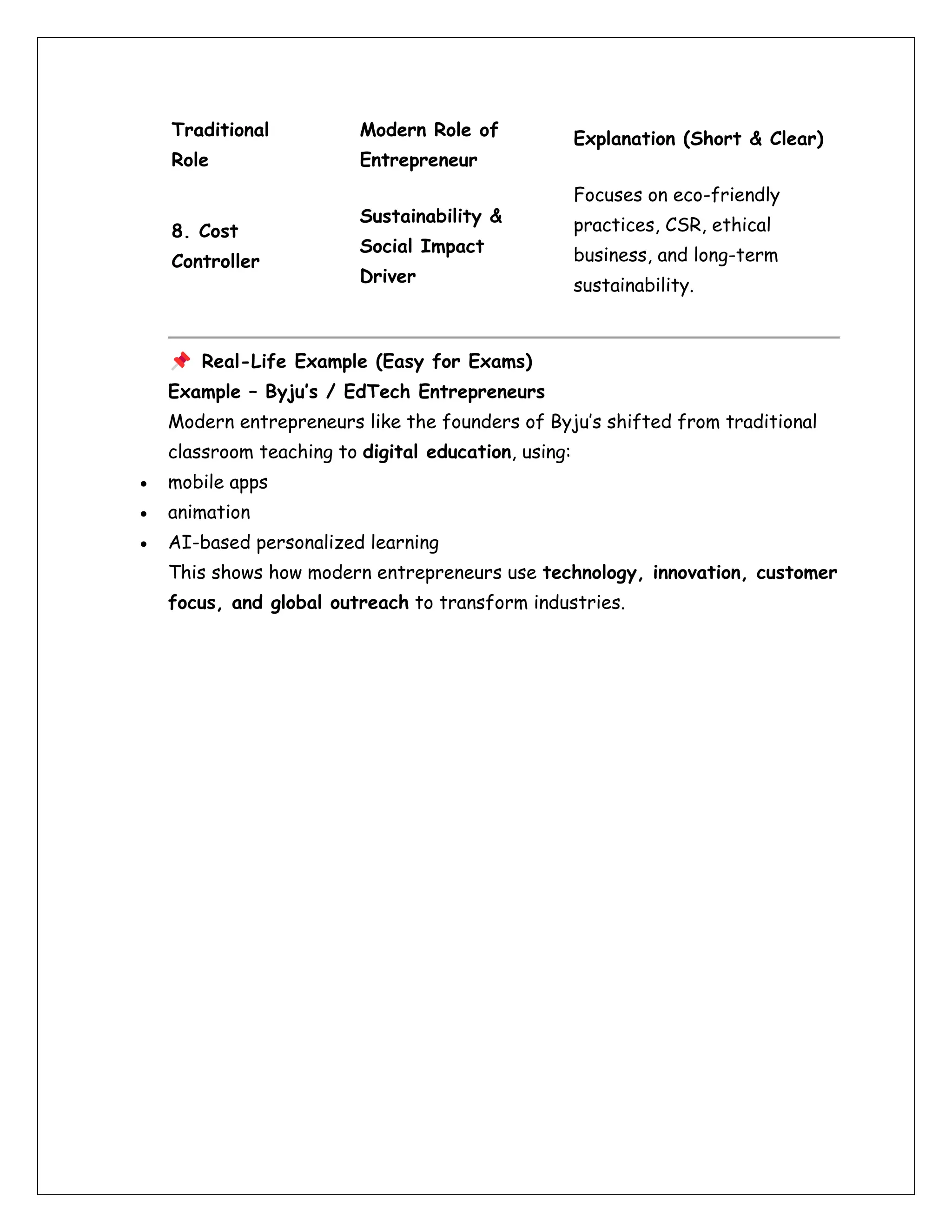
Traditional
Role
Modern Role of
Entrepreneur
Explanation (Short & Clear)
value innovation, not just
taking risks.
2. Business
Owner
Opportunity
Creator
They recognize new trends,
unmet needs, and emerging
markets before others.
3. Profit
Seeker
Customer-
Centric Thinker
Modern entrepreneurs design
products/services based on
deep customer insights and
experiences.
4. Manager
of Operations
Technology
Adopter
Uses digital tools, AI,
automation, and data analytics
to improve productivity and
decision-making.
5.
Employment
Provider
Ecosystem
Builder
Creates networks of
suppliers, partners,
freelancers, and communities
(example: startup ecosystem).
6. Local
Market
Player
Global
Entrepreneur
Operates beyond local
markets; uses e-commerce
and digital platforms to reach
global customers.
7. Individual
Decision-
Maker
Collaborator &
Team Builder
Works with teams, investors,
mentors, and professionals;
emphasizes collaboration over
solo decisions.
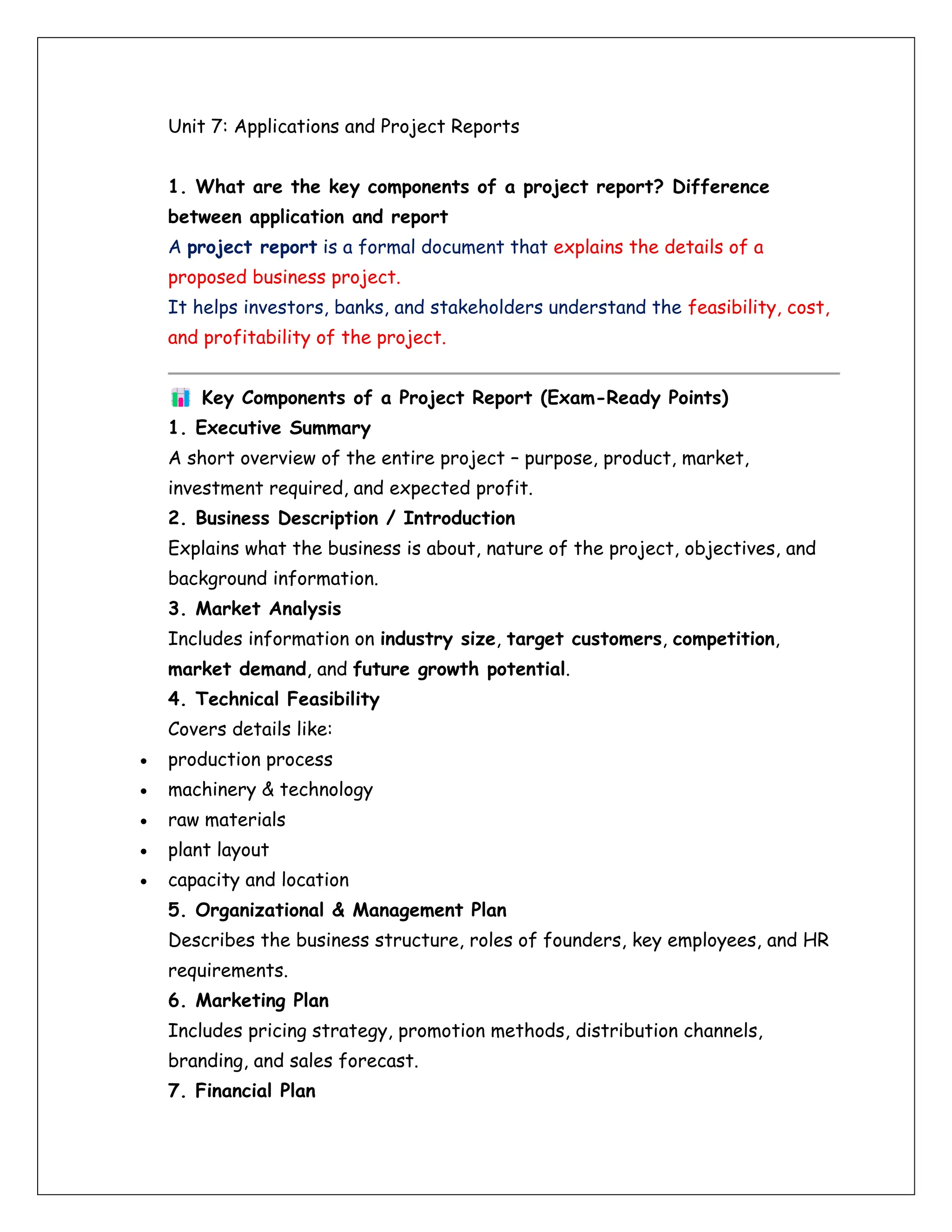
Traditional
Role
Modern Role of
Entrepreneur
Explanation (Short & Clear)
8. Cost
Controller
Sustainability &
Social Impact
Driver
Focuses on eco-friendly
practices, CSR, ethical
business, and long-term
sustainability.
Real-Life Example (Easy for Exams)
Example – Byju’s / EdTech Entrepreneurs
Modern entrepreneurs like the founders of Byju’s shifted from traditional
classroom teaching to digital education, using:
• mobile apps
• animation
• AI-based personalized learning
This shows how modern entrepreneurs use technology, innovation, customer
focus, and global outreach to transform industries.
Unit 7: Applications and Project Reports
1. What are the key components of a project report? Difference
between application and report
A project report is a formal document that explains the details of a
proposed business project.
It helps investors, banks, and stakeholders understand the feasibility, cost,
and profitability of the project.
Key Components of a Project Report (Exam-Ready Points)
1. Executive Summary
A short overview of the entire project – purpose, product, market,
investment required, and expected profit.
2. Business Description / Introduction
Explains what the business is about, nature of the project, objectives, and
background information.
3. Market Analysis
Includes information on industry size, target customers, competition,
market demand, and future growth potential.
4. Technical Feasibility
Covers details like:
• production process
• machinery & technology
• raw materials
• plant layout
• capacity and location
5. Organizational & Management Plan
Describes the business structure, roles of founders, key employees, and HR
requirements.
6. Marketing Plan
Includes pricing strategy, promotion methods, distribution channels,
branding, and sales forecast.
7. Financial Plan
Shows cost of the project, capital required, revenue forecast, break-even
point, profit-loss estimate, and cash flow.
8. Project Implementation Schedule
Timeline of activities like construction, machinery installation, hiring,
production, and launch.
9. Risk Analysis
Identifies potential risks such as financial, market, operational, and legal
risks, along with mitigation strategies.
10. Conclusion / Recommendations
Final justification showing why the project is feasible and profitable.
Real-Life Example (Easy to Write)
Example – Project Report for a Juice Manufacturing Unit
1. Executive Summary:
The project aims to produce packaged fruit juice for the local market with
an investment of ₹15 lakhs.
2. Business Description:
The unit will produce mango, orange, and mixed fruit juices under the brand
“FreshSip.”
3. Market Analysis:
Demand for healthy beverages is rising. Competitors include Tropicana and
Real, but local brands have strong market potential.
4. Technical Feasibility:
Requires juice extractor, pasteurizer, filling machine, and packaging unit.
Location: Industrial area near Siliguri.
5. Management Plan:
Founder manages operations; 6 workers for production and 2 for sales.
6. Marketing Plan:
Selling through local shops, supermarkets, schools, and online delivery apps.
Pricing: ₹20 per 200 ml pack.
7. Financial Plan:
Project cost: ₹15 lakh.
Expected revenue: ₹30 lakh in first year.
Break-even in 18 months.
8. Implementation Schedule:
Setup in 3 months → trial production → launch in month 4.
9. Risk Analysis:
Seasonal raw material availability; can be solved by buying during peak
season and storing pulp.
10. Conclusion:
The project is profitable, has growing demand, and is suitable for bank loan
approval.
Funny Analogy (Easy Memory Trick)
A project report is like planning a wedding:
• Summary → what the wedding is about
• Market study → guest list
• Technical plan → food, lights, venue
• Marketing → invitations
• Financials → total budget
• Risk → “What if baarish?”
• Implementation → timeline of functions
Just like a wedding plan convinces the family,
a project report convinces banks & investors!
2. Discuss the applications of entrepreneurship in various sectors.
Sector
How Entrepreneurship is
Applied
Real-Life Example
1. Agriculture
Use of modern farming
techniques, agri-tech
startups, food
processing, supply chain
innovation.
DeHaat, Ninjacart
(connecting
farmers to
markets).
Sector
How Entrepreneurship is
Applied
Real-Life Example
2.
Manufacturing
Automation, new product
development, MSME
units, “Make in India”
manufacturing startups.
Boat (electronics
manufacturing),
Lenskart.
3. Service
Sector
Online platforms, delivery
services, hospitality,
education, healthcare
innovation.
Zomato, Practo,
Byju’s.
4. Information
Technology (IT)
Software development,
AI, cloud computing, IT
services, cybersecurity.
TCS, Zoho,
Freshworks.
5. Retail & E-
Commerce
Online shopping, logistics
innovation, fast delivery
models, customized
products.
Flipkart, Amazon
India, Meesho.
6. Tourism &
Hospitality
Travel apps, hotel booking
platforms, adventure
tourism, homestay
services.
OYO Rooms,
MakeMyTrip.
7. Healthcare
& Biotech
Telemedicine, diagnostics,
biotech research, medical
equipment startups.
1mg, PharmEasy,
Biocon.
8. Education
(EdTech)
Online learning platforms,
tutoring apps, virtual
classrooms, skill-based
labs.
Byju’s, Unacademy,
Vedantu.
9. Finance &
FinTech
Digital payments, online
banking, UPI apps,
personal finance
solutions.
Paytm, PhonePe,
Razorpay.
Sector
How Entrepreneurship is
Applied
Real-Life Example
10. Renewable
Energy
Solar startups, EV
technology, battery
innovation, clean energy
solutions.
Ola Electric, Ather
Energy.
3. Explain the steps involved in preparing a project report.
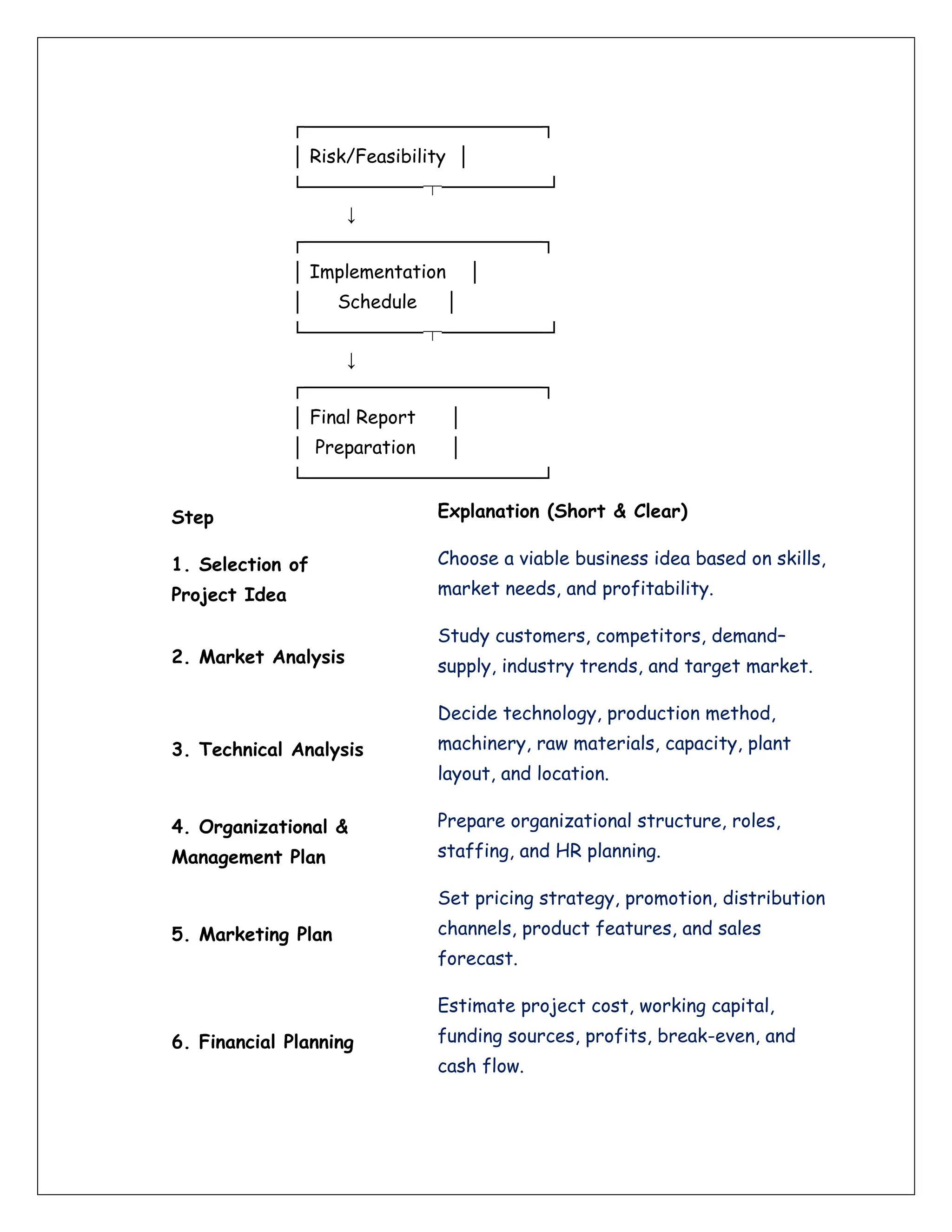
STEPS IN PREPARING A PROJECT REPORT
-----------------------------------
┌──────────────────┐
│ Project Idea │
└─────────┬────────┘
↓
┌──────────────────┐
│ Market Analysis │
└─────────┬────────┘
↓
┌──────────────────┐
│ Technical Study │
└─────────┬────────┘
↓
┌──────────────────┐
│ Management Plan │
└─────────┬────────┘
↓
┌──────────────────┐
│ Marketing Plan │
└─────────┬────────┘
↓
┌──────────────────┐
│ Financial Plan │
└─────────┬────────┘
↓
┌──────────────────┐
│ Risk/Feasibility │
└─────────┬────────┘
↓
┌──────────────────┐
│ Implementation │
│ Schedule │
└─────────┬────────┘
↓
┌──────────────────┐
│ Final Report │
│ Preparation │
└──────────────────┘
Step Explanation (Short & Clear)
1. Selection of
Project Idea
Choose a viable business idea based on skills,
market needs, and profitability.
2. Market Analysis
Study customers, competitors, demand–
supply, industry trends, and target market.
3. Technical Analysis
Decide technology, production method,
machinery, raw materials, capacity, plant
layout, and location.
4. Organizational &
Management Plan
Prepare organizational structure, roles,
staffing, and HR planning.
5. Marketing Plan
Set pricing strategy, promotion, distribution
channels, product features, and sales
forecast.
6. Financial Planning
Estimate project cost, working capital,
funding sources, profits, break-even, and
cash flow.
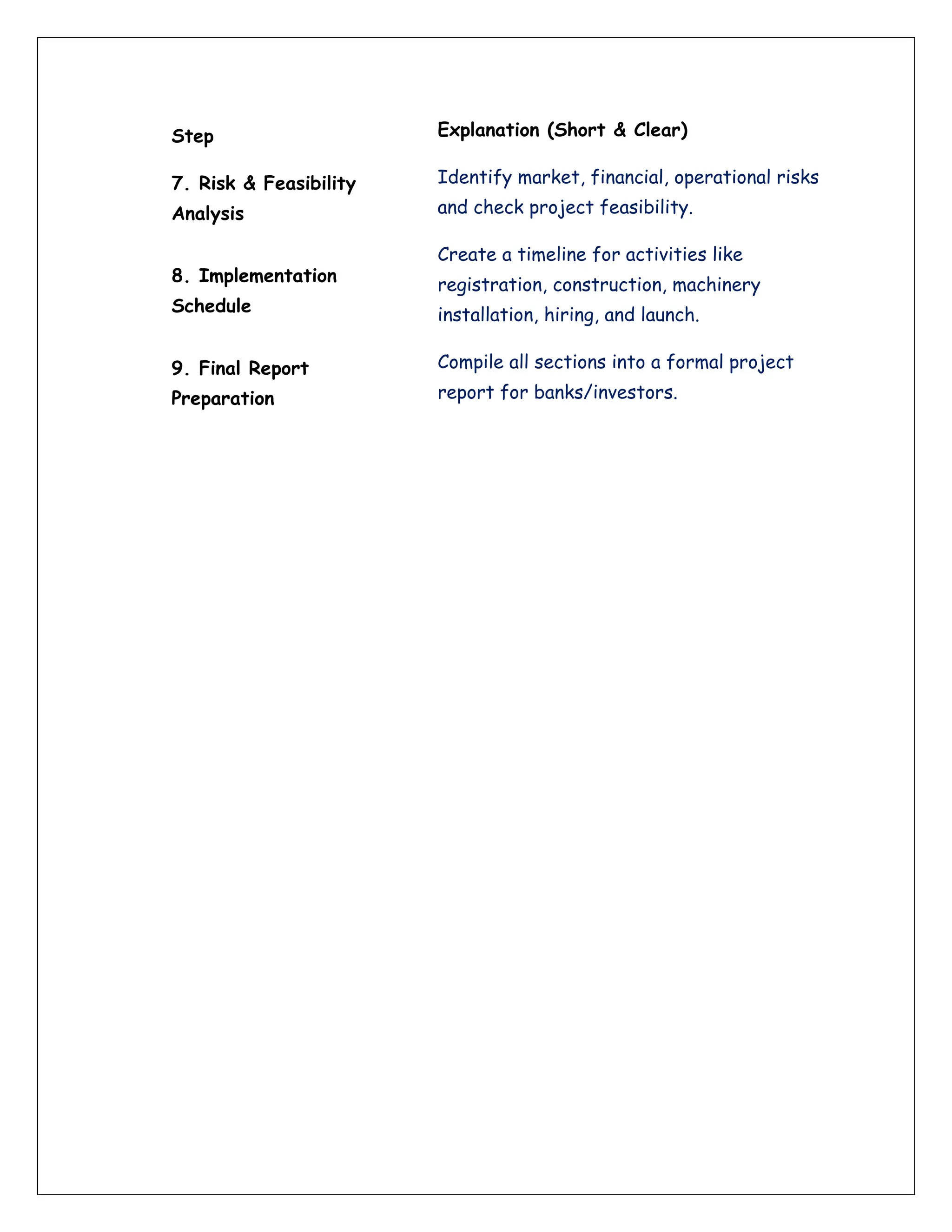
Step Explanation (Short & Clear)
7. Risk & Feasibility
Analysis
Identify market, financial, operational risks
and check project feasibility.
8. Implementation
Schedule
Create a timeline for activities like
registration, construction, machinery
installation, hiring, and launch.
9. Final Report
Preparation
Compile all sections into a formal project
report for banks/investors.
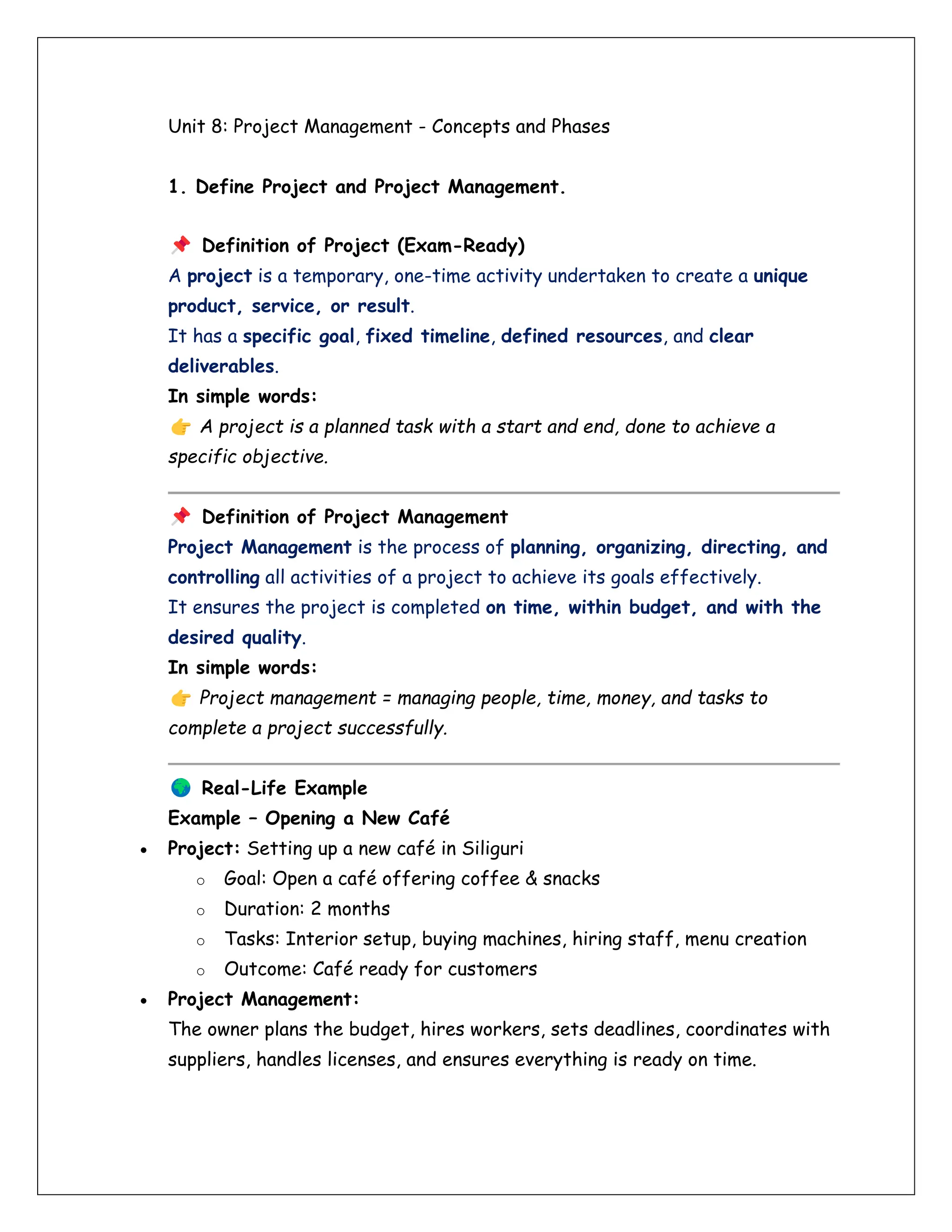
Unit 8: Project Management - Concepts and Phases
1. Define Project and Project Management.
Definition of Project (Exam-Ready)
A project is a temporary, one-time activity undertaken to create a unique
product, service, or result.
It has a specific goal, fixed timeline, defined resources, and clear
deliverables.
In simple words:
A project is a planned task with a start and end, done to achieve a
specific objective.
Definition of Project Management
Project Management is the process of planning, organizing, directing, and
controlling all activities of a project to achieve its goals effectively.
It ensures the project is completed on time, within budget, and with the
desired quality.
In simple words:
Project management = managing people, time, money, and tasks to
complete a project successfully.
Real-Life Example
Example – Opening a New Café
• Project: Setting up a new café in Siliguri
o Goal: Open a café offering coffee & snacks
o Duration: 2 months
o Tasks: Interior setup, buying machines, hiring staff, menu creation
o Outcome: Café ready for customers
• Project Management:
The owner plans the budget, hires workers, sets deadlines, coordinates with
suppliers, handles licenses, and ensures everything is ready on time.
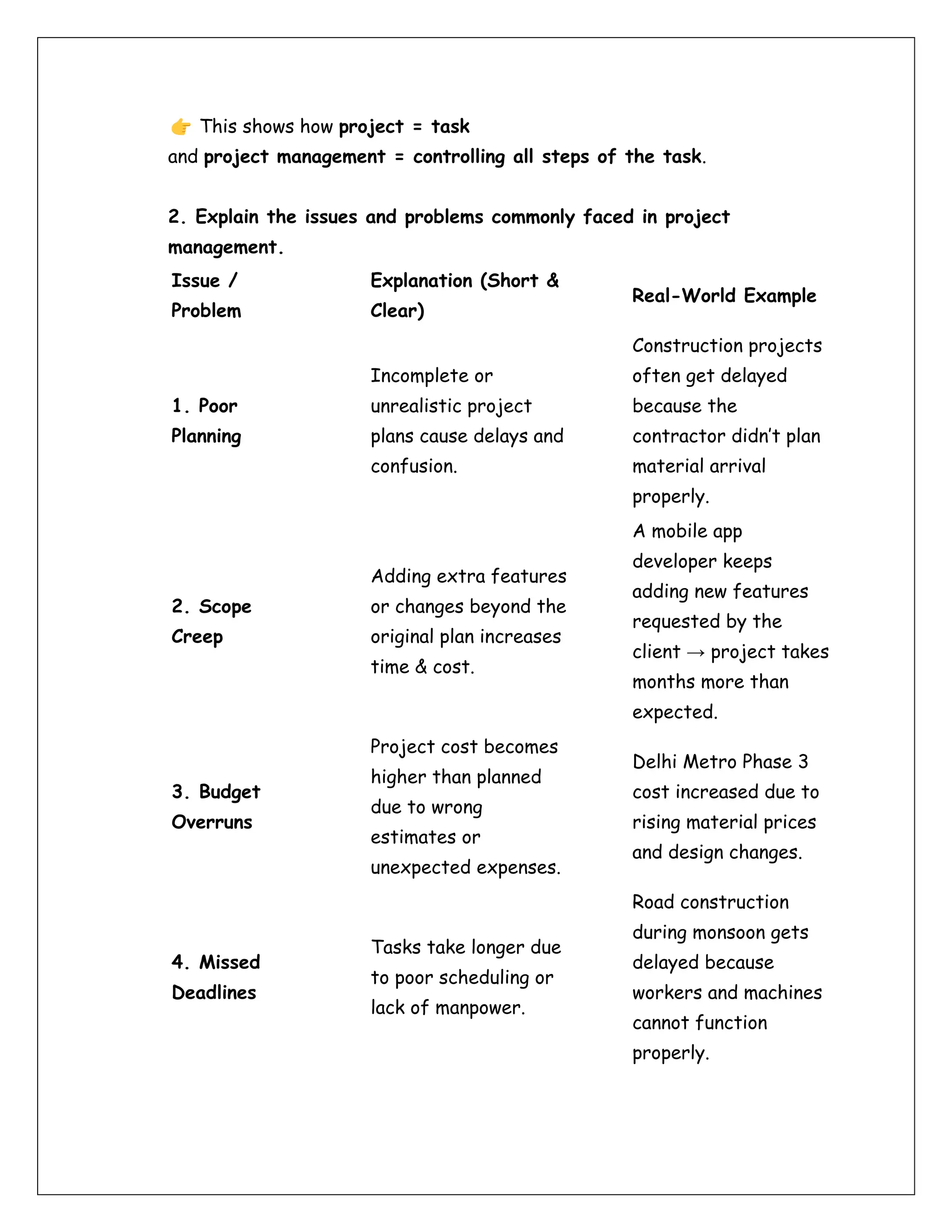
This shows how project = task
and project management = controlling all steps of the task.
2. Explain the issues and problems commonly faced in project
management.
Issue /
Problem
Explanation (Short &
Clear)
Real-World Example
1. Poor
Planning
Incomplete or
unrealistic project
plans cause delays and
confusion.
Construction projects
often get delayed
because the
contractor didn’t plan
material arrival
properly.
2. Scope
Creep
Adding extra features
or changes beyond the
original plan increases
time & cost.
A mobile app
developer keeps
adding new features
requested by the
client → project takes
months more than
expected.
3. Budget
Overruns
Project cost becomes
higher than planned
due to wrong
estimates or
unexpected expenses.
Delhi Metro Phase 3
cost increased due to
rising material prices
and design changes.
4. Missed
Deadlines
Tasks take longer due
to poor scheduling or
lack of manpower.
Road construction
during monsoon gets
delayed because
workers and machines
cannot function
properly.
Issue /
Problem
Explanation (Short &
Clear)
Real-World Example
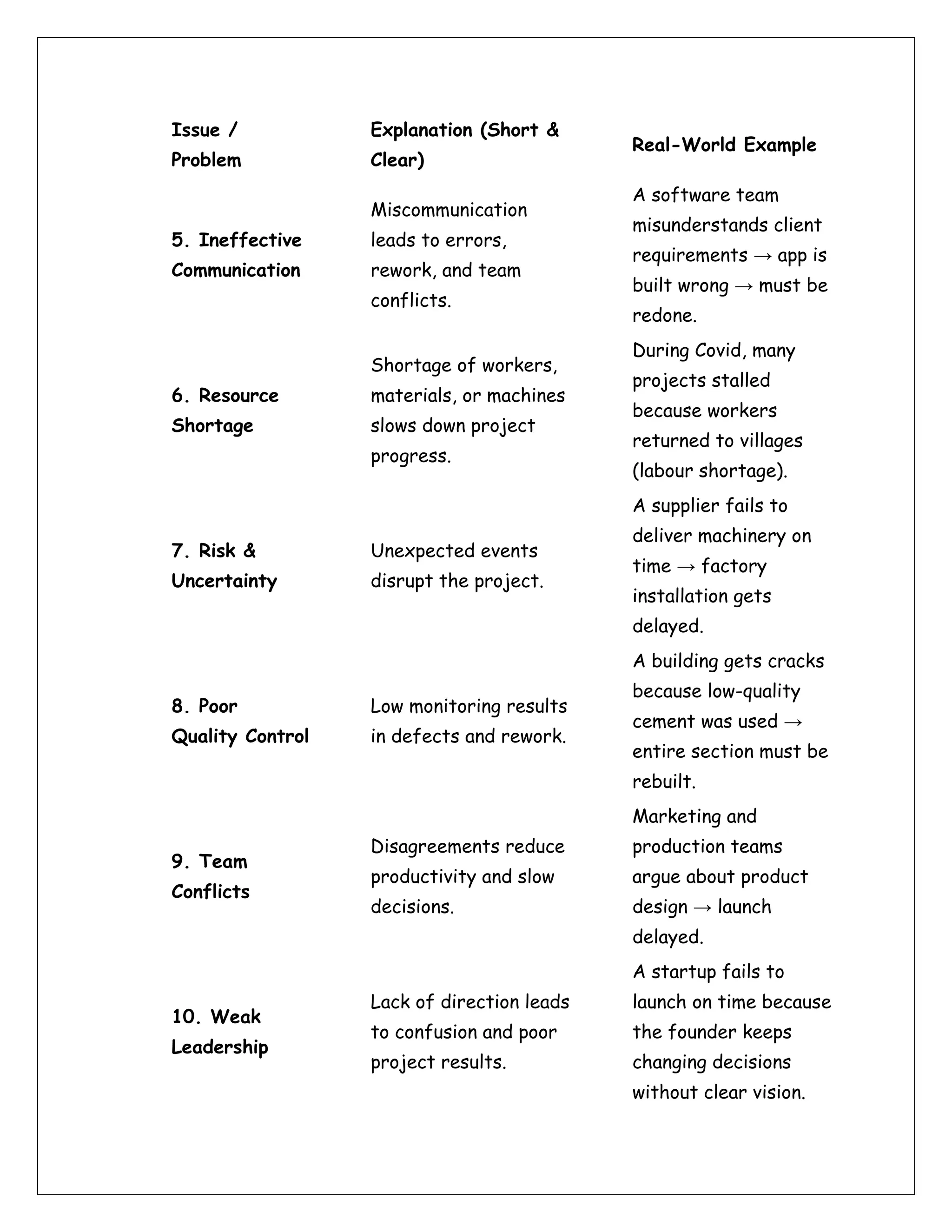
5. Ineffective
Communication
Miscommunication
leads to errors,
rework, and team
conflicts.
A software team
misunderstands client
requirements → app is
built wrong → must be
redone.
6. Resource
Shortage
Shortage of workers,
materials, or machines
slows down project
progress.
During Covid, many
projects stalled
because workers
returned to villages
(labour shortage).
7. Risk &
Uncertainty
Unexpected events
disrupt the project.
A supplier fails to
deliver machinery on
time → factory
installation gets
delayed.
8. Poor
Quality Control
Low monitoring results
in defects and rework.
A building gets cracks
because low-quality
cement was used →
entire section must be
rebuilt.
9. Team
Conflicts
Disagreements reduce
productivity and slow
decisions.
Marketing and
production teams
argue about product
design → launch
delayed.
10. Weak
Leadership
Lack of direction leads
to confusion and poor
project results.
A startup fails to
launch on time because
the founder keeps
changing decisions
without clear vision.
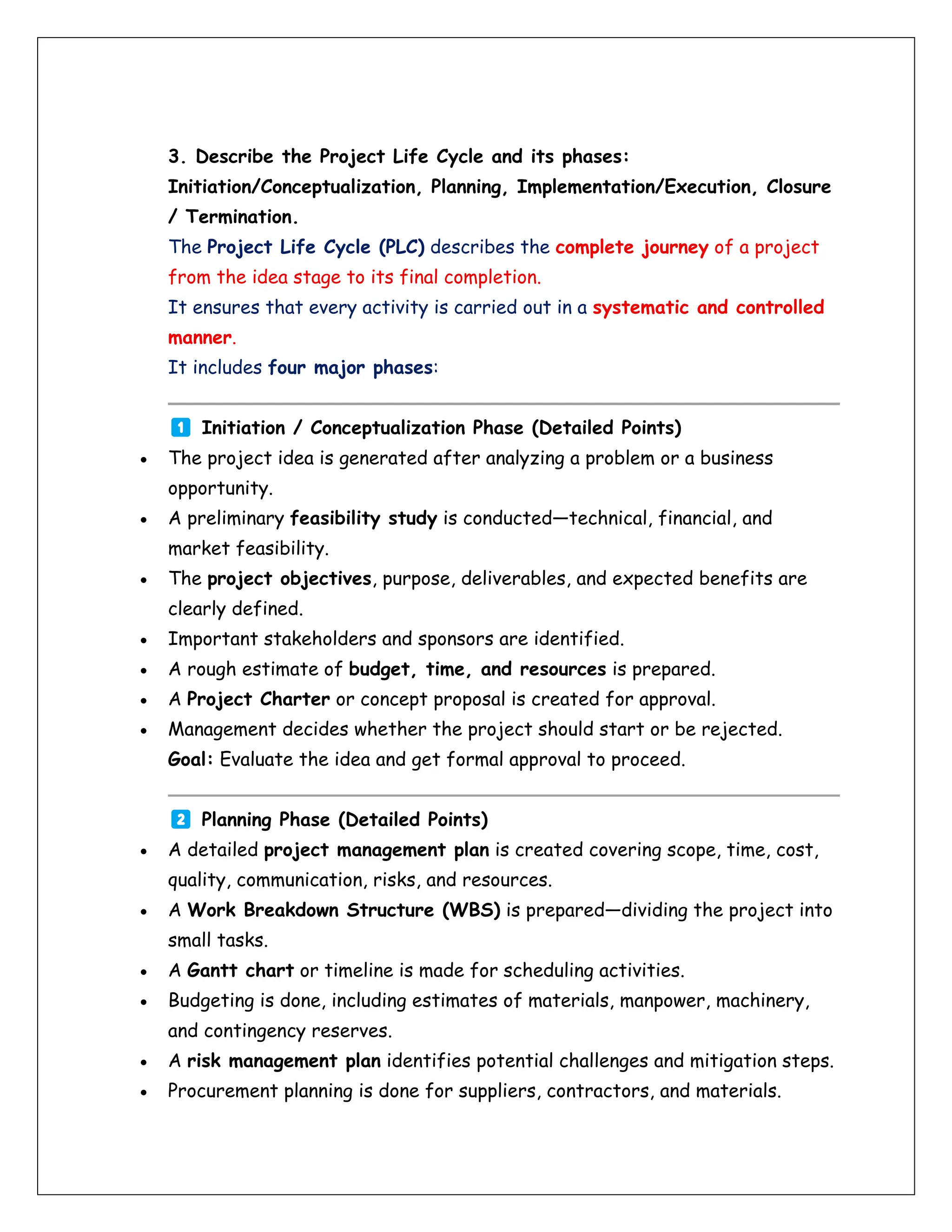
3. Describe the Project Life Cycle and its phases:
Initiation/Conceptualization, Planning, Implementation/Execution, Closure
/ Termination.
The Project Life Cycle (PLC) describes the complete journey of a project
from the idea stage to its final completion.
It ensures that every activity is carried out in a systematic and controlled
manner.
It includes four major phases:
Initiation / Conceptualization Phase (Detailed Points)
• The project idea is generated after analyzing a problem or a business
opportunity.
• A preliminary feasibility study is conducted—technical, financial, and
market feasibility.
• The project objectives, purpose, deliverables, and expected benefits are
clearly defined.
• Important stakeholders and sponsors are identified.
• A rough estimate of budget, time, and resources is prepared.
• A Project Charter or concept proposal is created for approval.
• Management decides whether the project should start or be rejected.
Goal: Evaluate the idea and get formal approval to proceed.
Planning Phase (Detailed Points)
• A detailed project management plan is created covering scope, time, cost,
quality, communication, risks, and resources.
• A Work Breakdown Structure (WBS) is prepared—dividing the project into
small tasks.
• A Gantt chart or timeline is made for scheduling activities.
• Budgeting is done, including estimates of materials, manpower, machinery,
and contingency reserves.
• A risk management plan identifies potential challenges and mitigation steps.
• Procurement planning is done for suppliers, contractors, and materials.
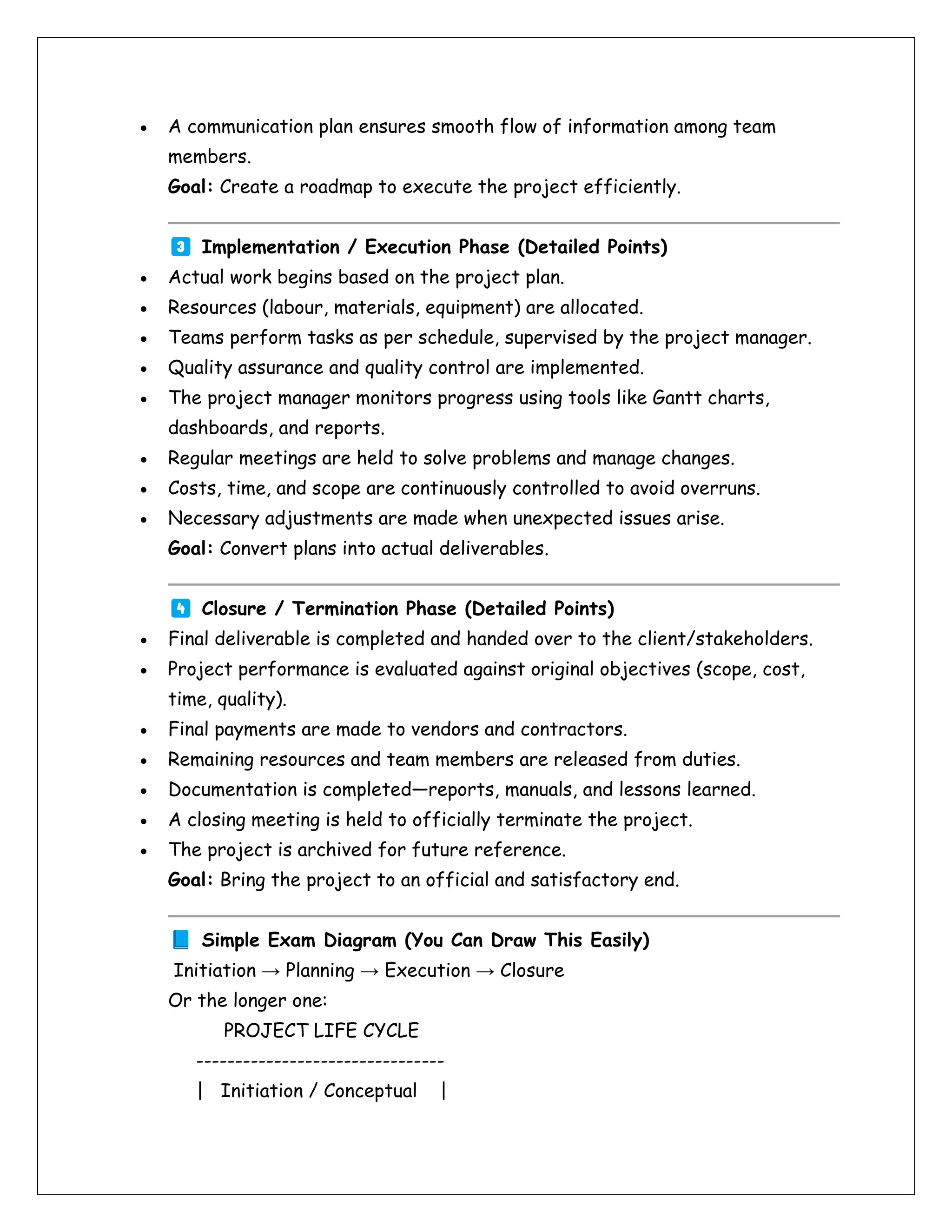
• A communication plan ensures smooth flow of information among team
members.
Goal: Create a roadmap to execute the project efficiently.
Implementation / Execution Phase (Detailed Points)
• Actual work begins based on the project plan.
• Resources (labour, materials, equipment) are allocated.
• Teams perform tasks as per schedule, supervised by the project manager.
• Quality assurance and quality control are implemented.
• The project manager monitors progress using tools like Gantt charts,
dashboards, and reports.
• Regular meetings are held to solve problems and manage changes.
• Costs, time, and scope are continuously controlled to avoid overruns.
• Necessary adjustments are made when unexpected issues arise.
Goal: Convert plans into actual deliverables.
Closure / Termination Phase (Detailed Points)
• Final deliverable is completed and handed over to the client/stakeholders.
• Project performance is evaluated against original objectives (scope, cost,
time, quality).
• Final payments are made to vendors and contractors.
• Remaining resources and team members are released from duties.
• Documentation is completed—reports, manuals, and lessons learned.
• A closing meeting is held to officially terminate the project.
• The project is archived for future reference.
Goal: Bring the project to an official and satisfactory end.
Simple Exam Diagram (You Can Draw This Easily)
Initiation → Planning → Execution → Closure
Or the longer one:
PROJECT LIFE CYCLE
--------------------------------
| Initiation / Conceptual |
| ↓ |
| Planning |
| ↓ |
| Implementation/Execution |
| ↓ |
| Closure/Termination |
--------------------------------
Real-Life Example (More Detailed)
Example – Opening a New Restaurant
Initiation:
You see demand for a café in your area. You check feasibility: location,
budget, customers, competition → idea approved.
Planning:
You create a detailed plan for interior design, menu, raw materials, budget,
staff, licenses, timeline, marketing, risk management.
Execution:
Construction begins, kitchen equipment is installed, staff is hired, cooking
trials happen, suppliers are finalized.
Closure:
Café opens to the public. Final bills paid, documentation completed, and
project officially closed.
Unit 9: Project Feasibility Studies
1. Differentiate between pre-feasibility and feasibility studies.
A business idea is examined in two stages before starting a project:
Pre-feasibility study (initial check) and Feasibility study (detailed final
evaluation).
Difference Between Pre-Feasibility and Feasibility Study (Exam-
Ready Chart)
Basis
Pre-Feasibility
Study
Feasibility Study
Purpose
To quickly check if
the idea is worth
studying further.
To make the final
decision whether to
implement the project.
Detail Level
Basic and preliminary;
overview-level study.
Deep, detailed, and
comprehensive analysis.
Cost & Time
Cheaper and faster
to conduct.
More expensive and
time-consuming.
Data Used
Rough estimates,
assumptions, general
information.
Accurate calculations,
market surveys,
technical designs.
Focus
To identify major
risks and reject weak
ideas early.
To evaluate full viability
— technical, financial,
market, legal.
Outcome
“Go / No-Go” decision
for detailed
feasibility.
Final “Go / No-Go”
decision for starting
the project.
Basis
Pre-Feasibility
Study
Feasibility Study
Who Conducts
It?
Usually done by
entrepreneur or small
internal team.
Done by experts,
consultants, engineers,
and financial analysts.
Documentation
Short report
(summary).
Full project report for
banks, investors, and
approvals.
Real-World Example (Easy for Exams)
Example – Setting Up a Packaged Juice Factory
Pre-Feasibility Study:
• You check local demand for juice.
• Rough idea of budget (₹10–₹15 lakhs).
• Basic assessment of machinery cost (approx).
• You see some competition but demand is good.
• You decide: “Yes, let's explore deeper.”
This stage is quick, cheap, and helps decide whether to proceed.
Feasibility Study:
• Conduct detailed market survey (age groups, preferences, competitors).
• Finalize exact machinery, suppliers, and production capacity.
• Calculate total project cost (e.g., ₹17.5 lakhs).
• Conduct break-even analysis, cash flow, and profitability.
• Check legal requirements: FSSAI license, pollution control norms.
• Prepare a final project report for bank loan.
This study confirms whether the project should be executed.
2. What are the steps in preparing a Detailed Project Report (DPR)?
(please also read the content of it from chatgpt)
A Detailed Project Report (DPR) is a comprehensive document that provides
complete technical, financial, managerial, and market-related details of a
project.
It is mainly used for bank loans, investor approval, and government
clearances.
Steps in Preparing a Detailed Project Report (DPR) — Exam-Ready
Points
1. Identifying the Project Idea
Select the project based on market need, demand, resources, and business
opportunity.
2. Conducting Market Analysis
Study target customers, demand–supply situation, competitor analysis,
pricing trends, and future growth.
3. Technical Analysis
Decide:
• manufacturing process
• machinery & technology
• plant location
• capacity
• raw materials
• layout plan
4. Financial Analysis
Prepare:
• investment cost
• working capital
• revenue forecast
• profitability
• cash flow
• break-even analysis
• funding sources
5. Organizational & Management Planning
Define management structure, staffing pattern, roles, HR plan, and
administrative setup.
6. Project Implementation Schedule
Prepare a timeline covering:
• land purchase
• construction
• machinery installation
• recruitment
• trial production
• final launch
7. Risk Assessment & Feasibility Study
Identify risks (market, technical, financial, operational) and provide
mitigation plans.
Evaluate technical and financial viability.
8. Preparation of the Final DPR Document
Compile all sections in a formal report for submission to banks, investors, or
government bodies.
3. Explain technical, economic, and financial appraisals of a project.
Before starting a project, different appraisals are conducted to check
whether the project is practical, beneficial, and profitable.
Technical Appraisal
Technical appraisal evaluates whether the project is technically feasible.
It examines the technology, machinery, plant layout, production process,
raw material availability, and skilled manpower.
If the technical setup is not possible, the project cannot operate efficiently.
Example:
A water bottling plant must ensure continuous water supply, RO system,
hygienic layout, and proper equipment.
Economic Appraisal
Economic appraisal studies the economic and social benefits of the project.
It checks employment generation, local development, use of resources,
environmental impact, and overall contribution to the economy.
This helps determine whether the project adds value to society.
Example:
A food-processing unit increases rural employment and supports farmers →
positive economic impact.
Financial Appraisal
Financial appraisal examines whether the project is financially viable.
It includes estimation of project cost, working capital, profitability, cash
flow, break-even point, and return on investment (ROI).
A project is approved only if it ensures stable revenue and profits.
Example:
A bakery project must show that expected revenue covers costs and
generates profit within a reasonable time.
One-Line Summary:
Technical appraisal checks can we produce it?
Economic appraisal checks is it beneficial?
Financial appraisal checks will it make profit?
4. Discuss the process of capital budgeting.
Capital budgeting is the process of evaluating and selecting long-term
investment projects such as new machines, new factories, new products, or
expansion.
Its purpose is to decide whether a project is financially profitable and
worth investing in.
Chart: Steps in the Capital Budgeting Process
Step Explanation (Short & Clear)
1. Project
Identification
Search for viable investment opportunities
(new product, new machine, expansion, etc.).
2. Project Screening
Reject unprofitable or unrealistic ideas and
shortlist feasible ones.
3. Cash Flow
Estimation
Estimate initial investment, operating costs,
expected revenue, and future cash inflows.
4. Selection of
Evaluation Technique
Use methods like Payback Period, NPV,
IRR, Profitability Index to evaluate
profitability.
5. Project Evaluation &
Selection
Choose the best project based on returns,
risks, and long-term goals.
6. Project Financing
Decide the sources of funds – loans, equity,
retained earnings, government schemes.
7. Project
Implementation
Purchase machinery, set up plant, hire
workers, start production.
8. Performance Review
Compare actual results with expected cash
flows; evaluate success and improvements.
Real-World Example (Easy for Exams)
Example – Opening a New Manufacturing Unit (Chocolate Factory)
1. Project Identification:
Company identifies an opportunity to enter the premium chocolate market.
2. Screening:
Management compares multiple ideas (candy line, chocolate line) and selects
“premium chocolates” as feasible.
3. Cash Flow Estimation:
o Initial investment: ₹50 lakh
o Expected annual revenue: ₹30 lakh
o Annual profit: ₹12 lakh
o Operating cost: ₹18 lakh
4. Evaluation Technique:
The company uses NPV and Payback Period.
o NPV is positive
o Payback period is 4 years
→ project looks profitable.
5. Selection:
Management approves the chocolate factory project.
6. Financing:
Required funds obtained through bank loan + owner’s capital.
7. Implementation:
Machines are installed, workers hired, trial batch produced.
8. Review:
After six months, company compares actual profits with expected profits
and adjusts production.
This is how real companies make investment decisions.
5. Explain Social Cost-Benefit Analysis with examples.
Social Cost–Benefit Analysis (SCBA) is a method used to evaluate a project
based on its overall impact on society, not just its financial profitability.
It measures both social costs (negative effects) and social benefits
(positive effects) to determine whether a project is socially desirable.
Key Components of SCBA
1. Social Costs
These are the negative impacts of a project on society:
• Pollution and noise
• Land use and displacement
• Traffic disturbance
• Environmental damage
• Use of scarce natural resources
2. Social Benefits
These are positive outcomes for society:
• Employment and income generation
• Better infrastructure
• Time savings
• Improved quality of life
• Environmental improvements
• Economic development
3. Purpose of SCBA
• Helps the government allocate money to socially useful projects
• Ensures long-term benefits outweigh short-term costs
• Used mainly in public sector projects like roads, hospitals, schools, and
metro rails
Real-World Example (Government School Project)
Government Building a New School in a Rural Area
Social Benefits:
• Free and quality education for children
• Increase in literacy rate
• Employment for teachers and staff
• Reduced travel distance and improved safety for children
• Long-term economic development due to educated youth
Social Costs:
• Construction cost for buildings/labs
• Use of land which could be for other purposes
• Temporary noise and dust during construction
Even though there are some costs, the benefits to society (education,
jobs, literacy) are far greater.
Thus, SCBA shows the project is socially valuable and should be
approved.
Unit 10: Project Planning
1. Explain the importance of project planning.
1. Provides Clear Direction
Project planning defines goals, tasks, and responsibilities, ensuring everyone
knows what to do and how to do it.
2. Improves Time Management
It creates schedules and deadlines, helping the project finish on time and
avoiding unnecessary delays.
3. Ensures Efficient Resource Allocation
Resources like manpower, money, materials, and machines are used wisely
without wastage.
4. Helps in Budget Control
Planning estimates the total cost accurately, preventing overspending and
financial problems.
5. Reduces Risks and Uncertainty
Possible risks are identified early, and backup plans are created, reducing
chances of project failure.
6. Enhances Coordination and Communication
A clear plan improves communication between team members, departments,
suppliers, and clients.
7. Improves Quality of Work
With proper planning, quality standards are defined, monitored, and
maintained throughout the project.
8. Helps Monitor and Control Progress
Project managers can track progress, compare actual work with plans, and
take corrective actions.
9. Increases Customer and Stakeholder Satisfaction
When projects are delivered on time, within budget, and with good quality,
stakeholders remain satisfied.
10. Ensures Successful Project Completion
Overall, planning increases the chances of completing the project smoothly
and achieving the desired goals.
2. Describe the steps of project planning.
Step Explanation (Short & Clear)
1. Define Project
Objectives
Clearly state what the project aims to
achieve (goals, scope, deliverables, success
criteria).
2. Identify Project
Activities
Break the project into smaller tasks and
activities needed to complete the work.
3. Develop Work
Breakdown Structure
(WBS)
Organize activities into logical groups to
understand the structure and order of work.
4. Estimate Time &
Resources
Calculate time required for each activity and
identify manpower, materials, machines, and
tools needed.
5. Prepare Project
Schedule
Arrange tasks in sequence using Gantt
charts or timelines and set deadlines.
6. Estimate Project
Cost
Prepare the budget by estimating costs for
materials, labour, equipment, and
contingencies.
7. Risk Identification
& Planning
Identify possible risks (delay, shortage,
cost increase) and create mitigation plans.
8. Communication &
Coordination Plan
Decide how information will flow between
team members, clients, suppliers, etc.
9. Prepare Resource
Allocation Plan
Assign specific tasks to team members and
allocate materials/equipment properly.
Step Explanation (Short & Clear)
10. Create the Final
Project Plan Document
Combine all schedules, budgets, risks, and
resources into a formal project plan ready
for execution.
3. What is Project Scope and how is it defined?
Meaning of Project Scope (Exam-Ready Definition)
Project Scope refers to the exact boundaries of a project — what the
project will include and what it will not include.
It defines the objectives, deliverables, tasks, resources, timelines, and
expected outcomes of the project.
In simple words:
👉 Project Scope = What work must be done + what results must be
delivered.
Importance of Project Scope
• Avoids confusion and misunderstandings
• Helps in accurate planning and budgeting
• Prevents “scope creep” (unwanted changes)
• Ensures everyone knows their responsibilities
4. Explain Work Breakdown Structure (WBS) and Organization Breakdown
Structure (OBS).
1. Work Breakdown Structure (WBS)
Definition
A Work Breakdown Structure (WBS) is a hierarchical breakdown of the
entire project into smaller, manageable tasks.
It shows what work needs to be done.
Features
• Decomposes project into sub-tasks
• Helps in planning, scheduling, budgeting
• Gives clarity about all activities
• Ensures no important task is missed
Example (School Website Project)
• Level 1: School Website
o Level 2: Design
o Level 2: Development
o Level 2: Testing
o Level 2: Deployment
This shows work-based classification.
2. Organization Breakdown Structure (OBS)
Definition
An Organization Breakdown Structure (OBS) shows the roles,
responsibilities, and reporting hierarchy of people involved in the project.
It shows who will do the work.
Features
• Represents project team structure
• Shows reporting lines
• Helps assign responsibility for tasks
• Supports communication and coordination
Example (School Website Project)
• Project Manager
o Web Designer
o Developer
o Tester
o Content Writer
This shows people-based classification.
Difference Between WBS and OBS (Chart)
Basis
WBS (Work
Breakdown
Structure)
OBS (Organization
Breakdown Structure)
Meaning
Breaks project into
tasks (WHAT to do).
Shows team structure and
responsibilities (WHO will
do).
Focus
Activities, tasks,
deliverables
People, teams, reporting
hierarchy
Purpose
Helps plan and
manage work
Helps assign responsibility
for work
Structure
Task-oriented,
hierarchical
Organization-oriented,
hierarchical
Use
Scheduling,
budgeting, progress
tracking
Defining roles, accountability,
communication
Example
Design → Develop →
Test → Deploy
Designer → Developer →
Tester → Manager
Real-Life Example (Construction Project)
WBS:
• Building Construction
o Foundation Work
o Wall Construction
o Electrical Work
o Painting
o Final Finishing
OBS:
• Project Manager
o Civil Engineer
o Electrical Engineer
o Labour Supervisor
o Safety Officer
WBS = work hierarchy
OBS = responsibility hierarchy
6. Discuss the concept of Phased Project Planning.
Exam-Ready Definition
Phased Project Planning refers to dividing the entire project into separate, well-
defined phases, where each phase is planned, reviewed, and approved before
moving to the next stage.
This ensures better control, reduces risks, and improves the success rate of the
project.
In simple words:
You plan the project step-by-step instead of planning everything at once.
Key Features (Pointwise)
1. Project Divided into Phases
The project is broken into multiple stages such as initiation, planning, execution,
monitoring, and closure.
2. Better Control & Monitoring
Each phase has specific outcomes (deliverables) which must be checked before the
project moves forward.
3. Reduces Risks
Problems are identified early in each phase, preventing major failures later.
4. Easier Decision Making
Managers can decide whether to continue, change, or stop the project after each
phase (“Go/No-Go decision”).
5. Improves Resource Allocation
Resources, money, and manpower are allocated phase-wise, avoiding wastage.
6. Ensures Quality
Each phase ends with review and quality checks, improving overall project results.
7. Enhances Communication
Since phases are clearly defined, teamwork, reporting, and communication become
smoother.
Real-Life Example (Easy for Exams)
Example – Building a Shopping Mall
1. Phase 1: Concept Planning
Demand study, selecting location, basic design.
2. Phase 2: Detailed Planning
Architectural design, cost estimation, legal approvals.
3. Phase 3: Construction Phase
Foundation → structure → finishing.
4. Phase 4: Interior & Branding
Shops layout, lighting, branding, aesthetic work.
5. Phase 5: Operations & Launch
Leasing shops, opening ceremony, full functioning.
Each phase is reviewed and approved before moving ahead.
Unit 11: Project Scheduling and Costing
1. Explain the use of Gantt charts in project scheduling.
A Gantt chart is a visual project scheduling tool that shows the timeline of
activities in the form of a horizontal bar chart.
It helps project managers plan, coordinate, and track tasks over time.
Uses of Gantt Charts in Project Scheduling (Pointwise)
1. Visual Timeline of Tasks
A Gantt chart shows when each task starts and ends, making the entire project
timeline easy to understand.
2. Shows Task Duration
Each bar represents how long a task will take, helping estimate total project time
accurately.
3. Helps Identify Task Dependencies
Some tasks depend on others. Gantt charts clearly show which tasks must be
completed first and which can run parallel.
4. Improves Work Coordination
Team members know exactly what they need to do and when, improving
coordination and teamwork.
5. Tracks Project Progress
Project managers can compare planned vs actual progress, identify delays, and take
corrective actions.
6. Resource Allocation
It helps determine which resources (people, machines, materials) are needed at
each stage.
7. Prevents Overlapping or Missing Tasks
By visualizing the entire schedule, Gantt charts ensure no task is forgotten or
unnecessarily delayed.
Real-Life Example (Easy for Exams)
Example – Event Management (College Fest)
A Gantt chart helps schedule:
• Booking venue
• Stage setup
• Decorations
• Sound check
• Guest invitations
• Event rehearsal
• Final program
Each task is shown with a start and end date, ensuring the event happens smoothly
without delays.
Funny Analogy (Easy Memory Trick)
A Gantt chart is like a timetable for a wedding:
• Mehendi → Sangeet → Haldi → Wedding
• Saree shopping happens parallel to invitation printing
• Groom entrance starts only after baraat arrival
Just like that, Gantt charts organize events so nothing gets mixed up!
2. Describe CPM (Critical Path Method) and PERT (Program Evaluation and
Review Technique)
CPM and PERT are two important network techniques used in project planning,
scheduling, and control.
They help managers complete projects on time by analyzing tasks, timelines, and
dependencies.
1. CPM (Critical Path Method)
Meaning
CPM is a project scheduling technique used to identify the longest path of
activities in a project called the critical path.
These activities cannot be delayed, or else the entire project will be delayed.
Key Features (Pointwise)
• Used for projects with predictable and fixed activities (deterministic).
• Time required for each activity is known and certain.
• Identifies critical activities that affect the total project time.
• Shows slack/float time for non-critical activities.
• Helps in scheduling, monitoring, and controlling large
construction/manufacturing projects.
Example
Building a house: foundation → walls → roof → wiring → painting.
If roofing is delayed, the whole project gets delayed. That is a critical activity.
2. PERT (Program Evaluation and Review Technique)
Meaning
PERT is a planning and scheduling technique used for projects where activity
times are uncertain.
It uses three time estimates — Optimistic, Pessimistic, and Most Likely — to
calculate expected time.
Key Features (Pointwise)
• Suitable for research, development, and new product projects (uncertain
tasks).
• Uses probabilistic time estimates.
• Helps in predicting project completion time using statistics.
• Useful when activities are not repetitive and time estimation is difficult.
• Focuses more on time, less on cost.
Example
Developing a new mobile app: coding, UI design, testing—each stage has variable
time due to uncertainty.
PERT helps estimate total project completion time.
Difference Between CPM and PERT (Easy Chart)
Basis CPM PERT
Nature of
Activities
Predictable, repetitive
(construction, manufacturing)
Uncertain, research-oriented
(R&D, innovation)
Time
Estimates
One fixed time estimate
Three time estimates (O, M,
P)
Focus Time + Cost Mostly Time
Use
Identifying critical activities &
reducing project time
Estimating project duration
under uncertainty
Basis CPM PERT
Type Deterministic Probabilistic
3. How is the critical path identified and why is it significant?
📌 A. How the Critical Path Is Identified (Step-by-Step)
1. List All Project Activities
Write all tasks involved in the project along with their durations.
2. Determine Activity Sequence
Identify which tasks depend on others (predecessors and successors).
3. Draw a Network Diagram
Create a PERT/CPM network showing the logical order of activities.
4. Calculate Earliest Start (ES) and Earliest Finish (EF)
Forward pass calculation → earliest time each activity can start and finish.
5. Calculate Latest Start (LS) and Latest Finish (LF)
Backward pass calculation → latest time each activity can start and finish without
delaying the project.
6. Find Slack/Float for Each Activity
Slack = LS – ES (or) LF – EF
• Slack = 0 → Critical Activity
• Slack > 0 → Non-Critical Activity
7. Identify the Longest Path
The path with zero slack and highest total duration is the Critical Path.
This path determines the minimum time required to complete the project.
B. Why the Critical Path Is Significant (Pointwise)
1. Determines Total Project Duration
Project cannot finish earlier than the time of the critical path.
2. Identifies Activities That Cannot Be Delayed
Any delay in a critical activity results in a delay of the entire project.
3. Helps in Prioritizing Resources
Managers allot more manpower, materials, and funds to critical tasks.
4. Useful for Monitoring and Control
Managers closely track critical activities to avoid delays.
5. Supports Project Acceleration (Crashing)
If the project must finish earlier, tasks on the critical path are shortened first.
6. Improves Decision Making
Helps managers understand where risks are highest and where attention is needed.
Real-Life Example (Easy for Exams)
Example – Building a House
Activities:
1. Foundation (10 days)
2. Walls (15 days)
3. Roof (8 days)
4. Wiring (5 days)
5. Painting (7 days)
The path:
Foundation → Walls → Roof → Painting
has zero slack and the longest duration → this becomes the critical path.
4. Explain the calculation of floats and slacks in project management.
5. What is crashing in project scheduling?
Exam-Ready Definition
Crashing is a project scheduling technique used to reduce the total project
duration by adding extra resources (like manpower, machines, overtime, or money)
to critical path activities.
In simple words:
👉 Crashing = finishing the project faster by spending more resources.
Why Crashing Is Done?
• To meet deadlines
• To avoid penalties
• To deliver project sooner for competitive advantage
• To adjust for delays in earlier stages
• To complete urgent client orders
Key Features of Crashing (Pointwise)
1. Applied only to Critical Path Activities
Shortens the activities that directly affect project completion time.
2. Involves Additional Cost
More workers, overtime, faster machinery → cost increases.
3. Reduces Project Duration
Lowers the total time by compressing task duration.
4. Done Through Cost–Time Trade-Off
Manager compares additional cost vs. time saved to find the optimal solution.
Real-World Example (Easy for Exams)
Example – Road Construction Project
A highway project is delayed due to heavy rains.
The government must complete it before a festival season.
To crash the project, the contractor:
• hires 40 additional workers
• uses two more bulldozers
• runs night shifts
• works on weekends
Result →
The project that needed 30 days gets completed in 20 days, but with higher cost.
Time reduced, cost increased: classic crashing.
Funny Analogy (Easy Memory Trick)
Crashing is like studying the night before an exam:
• You normally study 3 hours daily.
• But when you realize exam is tomorrow,
you add more resources → chai, coffee, snacks
you pull an all-nighter,
call a friend for help,
and study double speed.
You finish the syllabus faster,
but your energy cost increases like crazy
That’s exactly what crashing is!
6. Discuss time-cost trade-off analysis.
Time–Cost Trade-Off Analysis is the process of studying the relationship
between project duration and project cost.
It helps managers decide whether reducing project time (by adding resources) is
worth the extra cost.
In simple words:
👉 If you want to finish a project faster, you must spend more.
Time decreases → cost increases.
This analysis helps find the optimal balance between minimum project time and
minimum project cost.
7. Explain project cost reduction methods.
Real-Life Example (Easy for Exams)
Example – Apartment Construction Project
A builder reduces cost by:
• buying cement and steel in bulk at discount
• using ready-mix concrete to save labour cost
• using project management software for scheduling
• outsourcing painting work to a subcontractor
• preventing rework with regular quality checks
Total construction cost is reduced by 10–15%.
Funny Analogy (Easy Memory Trick)
Cost reduction is like saving pocket money:
• You avoid unnecessary expenses (junk food )
• You buy things in offers
• You use electricity carefully at home
• You plan your month wisely
• Project cost reduction refers to techniques used to reduce unnecessary
expenses, improve efficiency, and complete the project within or below
budget, without compromising quality.
• Here are the main cost-saving methods:
Unit 12: Project Monitoring and Control
1. What is the role of a project manager in project execution?
Role / Responsibility Explanation (Short & Clear)
1. Planning and
Scheduling
Prepares detailed schedules, assigns tasks, and
ensures activities start and finish on time.
2. Resource Allocation
Distributes manpower, materials, machines, and budget
effectively to avoid wastage.
3. Team Leadership
Motivates the team, resolves conflicts, and ensures
smooth coordination among members.
4. Communication
Management
Ensures proper communication between team, clients,
vendors, and stakeholders.
5. Monitoring and
Controlling Progress
Tracks actual progress vs planned schedule using
reports, charts, and meetings.
6. Risk Management
Identifies potential risks and takes
preventive/corrective actions to avoid delays.
7. Quality Assurance
Ensures activities meet required standards and quality
specifications.
8. Problem Solving &
Decision Making
Handles unexpected issues, makes quick decisions, and
keeps the project on track.
9. Cost Control
Monitors expenses, prevents budget overrun, and
ensures cost-efficient operations.
10. Documentation &
Reporting
Prepares progress reports, maintains records, and
updates stakeholders regularly.
2. Explain the use of Management Information Systems (MIS) in project
monitoring.
A Management Information System (MIS) is a computer-based system that
collects, stores, and processes project data to help managers monitor progress,
make decisions, and control project activities effectively.
It ensures that the project stays on schedule, within budget, and meets quality
standards.
Uses of MIS in Project Monitoring (Pointwise)
1. Tracks Project Progress in Real Time
MIS shows updated information on task completion, deadlines, delays, and work
status using dashboards and charts.
2. Helps in Budget and Cost Control
Managers can monitor actual vs planned expenses.
MIS alerts when costs exceed the budget, preventing financial overruns.
3. Improves Decision Making
MIS provides accurate data (reports, graphs) that help managers make quick,
data-driven decisions.
4. Enhances Communication and Coordination
Team members and stakeholders get instant updates, reducing confusion and
miscommunication.
5. Identifies Risks and Delays Early
MIS highlights bottlenecks, slow tasks, and potential risks so corrective action can
be taken on time.
6. Stores and Organizes Project Documents
All schedules, reports, designs, approvals, and changes are stored in one system for
easy access.
7. Provides Performance Reports
MIS generates weekly/monthly reports showing productivity, quality, and work
efficiency.
8. Supports Quality Control
MIS monitors quality parameters and highlights deviations from standards.
Real-Life Example (Easy for Exams)
Example – Construction Project Using MIS
A builder uses MIS to track:
• progress of foundation, walls, wiring, painting
• actual daily labour cost vs planned cost
• material availability
• delays caused by weather or supplier issues
MIS sends alerts when:
• cement stock is low
• a task is behind schedule
• cost crosses the approved limit
This helps the project finish on time and within budget.
Funny Analogy (Memory Trick)
MIS in project monitoring is like your Google Classroom or college portal:
• You see assignments (tasks)
• See deadlines (schedule)
• Get marks and feedback (progress report)
• Get alerts for due work (risk warning)
Exactly how project managers monitor every task!
3. What is a project audit and why is it necessary?
A Project Audit is a systematic and independent examination of a project to
evaluate its progress, performance, processes, and results.
It checks whether the project is being carried out as per the plan, budget,
timeline, and quality standards.
In simple words:
Project audit = Checking if the project is on the right track and being managed
properly.
Why a Project Audit Is Necessary:
1. Ensures Project Progress Is on Track
Audit compares planned vs actual performance and identifies delays or deviations.
2. Helps Control Costs and Budget
It checks whether money is being spent correctly and highlights unnecessary
expenses.
3. Identifies Problems Early
Audits reveal issues in scheduling, quality, team performance, or resources before
they become big failures.
4. Improves Quality and Standards
Ensures all tasks follow required quality norms, safety rules, and technical
specifications.
5. Enhances Accountability
Team members become more responsible as their work is periodically reviewed.
6. Provides Transparency for Stakeholders
Clients, sponsors, and management get clear, unbiased information about project
status.
7. Supports Better Decision Making
Audit findings help managers take corrective actions—reschedule work, allocate
more resources, or change strategies.
8. Evaluates Final Project Success
A final project audit checks whether objectives were achieved and documents
“lessons learned” for future projects.
Real-Life Example (Easy for Exams)
Example – Government Road Construction Project
The Public Works Department (PWD) conducts an audit:
• checks if the contractor used proper quality materials
• verifies if expenses match the approved budget
• examines delays due to labour or weather
• ensures safety and environmental compliance
Based on audit results, the government may approve payments, demand corrections,
or impose penalties.
Funny Analogy (Easy Memory Trick)
A project audit is like your teacher checking your assignment:
• Did you follow instructions?
• Did you finish on time?
• Did you copy from someone else?
• What mistakes to fix next time?
Exactly the same way, a project audit checks the project’s discipline, quality, and
progress!
Unit 13: Case Studies and Practical Training
1. Discuss case studies related to entrepreneurship and innovation.
Case Study
Entrepreneur /
Startup
Type of
Innovation
Key Idea /
Innovation
Real-World
Impact
1. Digital
Payments
Revolution
Paytm (Vijay
Shekhar
Sharma)
Business
Model
Innovation
Created a mobile
wallet & QR
payment system
used nationwide.
Enabled
cashless
economy;
millions of small
shops started
using QR
payments.
2. Affordable
Electric
Vehicles
Ola Electric
(Bhavish
Aggarwal)
Product &
Technology
Innovation
Designed
affordable
electric scooters
with fast
charging tech.
Boosted India’s
EV adoption;
reduced fuel
cost for
commuters.
3. Rural Supply
Chain
Innovation
Ninjacart
Supply
Chain
Innovation
Directly connects
farmers to
retailers via a
tech-based
platform.
Farmers earn
more; wastage
reduced; fresh
produce
delivered
faster.
4. EdTech
Transformation
Byju’s (Byju
Raveendran)
Digital
Learning
Innovation
App-based video
learning with
personalized
teaching modules.
Millions of
students got
quality
education using
mobile phones.
Case Study
Entrepreneur /
Startup
Type of
Innovation
Key Idea /
Innovation
Real-World
Impact
5. Online
Hospitality
Disruption
OYO Rooms
(Ritesh
Agarwal)
Service
Innovation
Standardized
budget hotels
using an app +
franchise model.
Created India’s
largest hotel
network;
improved low-
cost travel
experience.
6. Healthcare
Innovation
Practo
Process &
Platform
Innovation
Online doctor
appointments,
telemedicine, and
digital health
records.
Improved
access to
healthcare,
especially during
COVID-19.
7. Khadi
Innovation for
Youth
Khadi & Village
Industries
Startups
(KVIC-
supported)
Social &
Product
Innovation
Modernizing
Khadi products—
organic soap,
herbal cosmetics,
designer Khadi
wear.
Increased rural
employment and
revived
traditional
handloom
industry.
8. Food
Delivery
Revolution
Zomato /
Swiggy
Platform
Innovation
Online food
ordering with
real-time tracking
& cloud kitchens.
Created lakhs of
delivery jobs
and
transformed
eating habits.
2. Explain the use of MS Project software for project planning and scheduling.
MS Project is a project management software developed by Microsoft.
It helps project managers plan, schedule, allocate resources, track progress,
control costs, and manage workload effectively.
It is widely used in construction, IT, manufacturing, event management, and
engineering projects.
Uses of MS Project in Planning and Scheduling (Pointwise)
1. Creating Project Plans Easily
Managers can prepare a complete project plan with tasks, duration, start–end
dates, and milestones in a structured manner.
2. Work Breakdown Structure (WBS) Creation
MS Project allows dividing the entire project into phases → tasks → subtasks,
making planning organized and clear.
3. Gantt Chart Preparation
It automatically generates Gantt charts showing the project timeline, task
duration, and progress visually.
4. Scheduling Tasks and Dependencies
You can set relationships between tasks (Finish-to-Start, Start-to-Start, Finish-
to-Finish).
This helps identify dependencies and prevent scheduling conflicts.
5. Resource Allocation & Leveling
Assign manpower, machines, and materials to tasks.
MS Project detects overallocation and helps redistribute workload efficiently.
6. Critical Path Identification
The software automatically highlights critical tasks that directly affect project
duration.
This helps managers focus on important activities.
7. Budgeting and Cost Tracking
MS Project stores cost data (labour, materials, equipment) and helps track actual
vs planned costs to avoid overruns.
8. Progress Monitoring & Reporting
It provides charts, dashboards, and reports showing percentage completion,
delays, remaining work, and performance.
9. Risk & Change Management
Any change in schedule automatically updates dependent tasks and identifies risks
due to delays.
10. Collaboration & Communication
Team members can share schedules, updates, and files, improving coordination and
transparency.
3. Describe how hands-on training with MS Project enhances project
management skills
Skill Area
How MS Project Training
Enhances It
Real-World Impact
1. Project Planning
Trainees learn to create tasks,
phases, WBS, milestones, and
duration.
Plans become more accurate
and structured.
2. Scheduling Skills
Helps set dependencies,
timelines, Gantt charts, and
auto-scheduling.
Projects run on time with
fewer delays.
3. Resource
Management
Users learn to assign labour,
equipment, and materials;
detect over-allocation.
Prevents workload imbalance
and resource shortages.
4. Budgeting & Cost
Control
Teaches how to enter cost
rates, track expenses, and
compare planned vs actual
cost.
Avoids cost overruns and
improves financial discipline.
5. Critical Path
Analysis
MS Project highlights critical
tasks automatically; trainees
learn how to focus on them.
Ensures faster completion
and better monitoring of key
activities.
6. Risk & Change
Management
Any schedule change updates
all dependent tasks, teaching
real-time risk assessment.
Reduces chances of project
failure due to unexpected
delays.
7. Performance
Monitoring
Trainees use dashboards,
reports, and progress bars to
track percentage completion.
Improves decision-making
and transparency with
stakeholders.
Skill Area
How MS Project Training
Enhances It
Real-World Impact
8. Team
Communication &
Coordination
MS Project files can be shared
and updated by team members.
Enhances teamwork, reduces
miscommunication.
9. Documentation
Skills
Students learn to generate
reports like resource usage,
cost reports, Gantt charts.
Professional-quality
documentation for clients
and managers.
10. Practical
Confidence
Hands-on practice builds
confidence in handling real
projects with software tools.
Makes trainees industry-
ready and increases
employability.
Project Management and Entrepreneurship notes

  • 1.
    Unit 1: Introductionto Entrepreneurship 1. Define Entrepreneurship. Explain its meaning and concept Entrepreneurship is the process of identifying an opportunity, organizing resources, taking calculated risks, and creating a new product, service, or business to generate value and profit. An entrepreneur converts an idea into a successful venture through innovation, planning, and leadership. Exam-Ready Explanation 1. Opportunity Identification: Entrepreneurs observe problems or gaps in the market and find innovative solutions. 2. Innovation: Entrepreneurship always involves doing something new, better, or cheaper— either by creating a new product or improving an existing one. 3. Risk-Taking: Entrepreneurs take calculated risks—not blind risks—to convert ideas into reality. 4. Resource Organization: They arrange finance, manpower, technology, raw materials, and use them efficiently. 5. Value Creation: The final goal is to create economic value, employment, and benefit society. 6. Profit & Growth Orientation: Entrepreneurship aims at sustainable growth of the business and long-term profit. In short: Entrepreneurship is a creative and risk-taking activity through which ideas become reality. Real-Life Example (Exam Friendly) Example – Flipkart: Sachin and Binny Bansal noticed that India lacked a reliable online bookstore.
  • 2.
    They identified theopportunity, started Flipkart in a small house, arranged limited resources, took major risks, and gradually expanded into multiple products. Today it is one of India’s biggest e-commerce companies. This clearly shows entrepreneurship as: • Opportunity finding • Innovation • Risk-taking • Resource management • Value creation Funny Analogy (For Easy Memory) Entrepreneurship is like proposing to your crush. • You identify the opportunity (she smiled today → chance!). • You organize resources (new shirt, perfume, confidence). • You take a risk (50% chance of yes, 50% chance of emotional damage). • You innovate (unique dialogue: not just “Will you go out with me?” but “Let’s build a startup of love ”). • If she says yes → value creation (happiness, dopamine). • If she says no → market research for next opportunity 2. Discuss the relationship between Innovation and Entrepreneurship. (INNOVATION : MAKING SOMETHING NEW) Innovation and entrepreneurship are closely linked and mutually dependent. Entrepreneurship uses innovation as its core tool to create new products, services, or business models. Without innovation, entrepreneurship becomes routine trade; and without entrepreneurship, innovations cannot reach the market or society. Key Points (Exam-Perfect) 1. Innovation drives Entrepreneurship (this can be come in exam how innovation drive entrepreneurship)
  • 3.
    Entrepreneurs depend oninnovative ideas to enter the market or solve problems differently. 2. Entrepreneurship commercializes Innovation An innovation becomes useful only when an entrepreneur converts it into a marketable product or service. 3. Mutual Support Innovation provides creativity; entrepreneurship provides risk-taking, resources, and execution. 4. Economic Growth Together they generate new industries, employment, and technological advancement. 5. Sustainable Competitive Advantage Entrepreneurs stay ahead of competitors through continuous innovation (new features, lower cost, better quality). 6. Foundation of Startups All successful startups are built on innovative thinking—either product innovation, process innovation, or business model innovation. Real-Life Example (Exam Friendly) Example – OYO Rooms (Ritesh Agarwal) Ritesh introduced an innovative idea: organizing budget hotels under one brand with standardized service. This innovation (standardizing an unorganized segment) was transformed into a successful business through entrepreneurship (planning, funding, marketing, expansion). This shows the relationship clearly: • Innovation = Concept • Entrepreneurship = Execution
  • 4.
    3. Describe thecontributions of entrepreneurs to society. Entrepreneurs play a vital role in the development of society. They introduce innovation, generate income, create employment, and uplift the overall quality of life. Their actions lead to economic growth, social improvement, and technological progress. Key Contributions (Exam-Perfect Points) 1. Job Creation Entrepreneurs start new ventures that create direct and indirect employment. This reduces unemployment and improves living standards. 2. Innovation & Technology Advancement Entrepreneurs introduce new products, services, and technologies that improve daily life. 3. Economic Growth Their businesses contribute to GDP, increase national income, and boost industrial development. 4. Improved Standard of Living By providing better goods and services at affordable prices, they uplift society’s quality of life. 5. Wealth Creation & Distribution They generate wealth for themselves and others—employees, suppliers, investors, and government (through taxes). 6. Regional Development Entrepreneurs set up industries in backward or rural areas, reducing regional disparities.
  • 5.
    7. Social Change Manyentrepreneurs (eco-friendly startups, EdTech, HealthTech) work to solve societal problems and bring positive change. 8. Export Promotion Their innovative products increase foreign exchange earnings and build global recognition. 9. Encouraging Research & Development (R&D) Entrepreneurs invest in R&D that leads to continuous improvement and long- term growth. Real-Life Example (Exam Friendly) Example – Narayana Murthy (Infosys) N. R. Narayana Murthy created Infosys, which not only generated thousands of IT jobs but also transformed India into a global tech hub. His entrepreneurship led to: • Massive employment • Technological advancement • Global recognition for India • Inspiration for countless startups This shows how a single entrepreneur can uplift an entire society. 4. Explain the risk-opportunity perspective in entrepreneurship. Exam-Ready Answer The risk–opportunity perspective in entrepreneurship refers to the idea that every business opportunity comes with certain risks, and entrepreneurs must evaluate, balance, and manage these risks to convert the opportunity into a successful venture.
  • 6.
    Entrepreneurs do notavoid risk; instead, they take calculated risks after analyzing the potential returns, challenges, and uncertainties. This perspective highlights that entrepreneurship is the ability to see opportunities where others see problems, and to take risks to capitalize on them. Key Points (Exam-Perfect) 1. Opportunity Recognition Entrepreneurs identify gaps, needs, or problems in the market that others overlook. 2. Risk Evaluation Every opportunity comes with uncertainties—market demand, competition, costs, technology, etc. 3. Calculated Risk-Taking Entrepreneurs make decisions based on data, planning, and foresight, not blind risk. 4. Risk–Reward Trade-off Higher opportunities often involve higher risks, but also higher potential rewards. 5. Resource Commitment Entrepreneurs allocate time, money, effort and take responsibility for the outcome. 6. Innovation as an Opportunity Tool Innovation helps reduce risks and maximize benefits. 7. Strategic Decision Making Selecting the right opportunity while minimizing risk is the core of entrepreneurship. Real-Life Example (Exam Friendly)
  • 7.
    Example – Paytm(Vijay Shekhar Sharma) When digital payments were not popular, Vijay Shekhar Sharma identified an opportunity for mobile wallets. But the risk was huge: • low smartphone penetration • people afraid of online transactions • no guarantee of success However, he took the calculated risk, invested heavily, and today Paytm is one of India’s major fintech companies. This shows how risks and opportunities go together. Funny Analogy (Easy Memory) Entrepreneurship risk-opportunity perspective is like eating street momos. • Opportunity: They smell amazing, cheap, and instantly make you happy • Risk: You don’t know whether it's real chicken or “surprise material” But a true entrepreneur says: “Taste ke liye risk toh banta hai!” Just like this, entrepreneurs take calculated risks to enjoy big rewards. Types of risk Risk in entrepreneurship refers to the uncertainty involved in starting and running a business. It is the possibility that actual outcomes may differ from expected outcomes, leading to loss of money, time, reputation, or resources. Entrepreneurs face risk because: • Future demand is uncertain
  • 8.
    • Competition mayincrease • Financial returns are not guaranteed • Market conditions can change suddenly Entrepreneurs take calculated risks, not blind risks. 📌 Types of Risks in Entrepreneurship (Exam-Perfect List) 1. Financial Risk Risk of losing invested money or facing cash flow problems. E.g., loan repayment issues, low revenue. 2. Market Risk Risk that customers may not accept the product or market demand may fall. 3. Competitive Risk Risk from existing or new competitors offering better or cheaper products. 4. Technological Risk Risk due to rapid changes in technology, product becoming outdated, or technical failures. 5. Operational Risk Risks arising from day-to-day operations like supply chain issues, production failures, staff problems. 6. Legal & Regulatory Risk Risk due to changes in government policies, new laws, taxes, compliances, or lawsuits. 7. Strategic Risk Risk of wrong decisions regarding pricing, business model, location, partners, etc. 8. Human Resource Risk
  • 9.
    Risk related tohiring, training, employee turnover, lack of skilled staff. 9. Environmental/Natural Risk Risks from natural disasters, floods, fire, pandemic, etc. 10. Reputational Risk Risk of losing customer trust due to poor quality, controversies, or negative publicity. 📌 Real-Life Example (Easy to Write) When Uber entered India, it faced: • Market risk (will Indians prefer ride-sharing?) • Legal risk (state govt taxi rules) • Competitive risk (Ola already strong) • Tech risk (app failures, GPS issues) Despite these risks, the opportunity was huge—so Uber took calculated risk and grew. 😂 Funny Analogy (Easy Memory) Entrepreneurial risks are like going on a first date: • Financial risk: Bill bohot aayega 😭 • Market risk: She might not like your perfume. • Competitive risk: Someone better-looking may already be there 😭 • Reputational risk: If the date goes bad, your friends will roast you. • Strategic risk: Wrong restaurant choice → Disaster.
  • 10.
    But still yougo… Because “Opportunity bhi toh milega!” 😁💘 5. What are the methods for mitigation of entrepreneurial risks? Method (8 Key Points) Explanation (Short & Clear) 1. Market Research Understand customer needs, demand, and competitors to avoid product failure. 2. Business Planning Prepare a detailed plan with goals, budgeting, and strategies to reduce uncertainty. 3. Financial Management Maintain cash reserves, control expenses, and avoid excessive loans. 4. Diversification Spread risk by offering multiple products, markets, or suppliers. 5. Insurance Coverage Use insurance to protect against accidents, liability, fire, and natural disasters. 6. Technology Upgradation Use modern tools, cybersecurity, and updated machinery to avoid tech-related failures. 7. Legal Compliance Follow laws, tax rules, labour regulations, and licensing to avoid penalties. 8. Skilled Workforce & Training Hire capable employees and provide training to reduce operational errors.
  • 11.
    Unit 2 1. Explainwhy entrepreneurship is considered an innovation. Exam-Ready Answer Entrepreneurship is considered an innovation because it involves creating new ideas, new products, new methods, or new ways of doing business. An entrepreneur does not simply start a business—he introduces something different, better, unique, or more efficient, which adds value to society. Innovation is the core tool of entrepreneurship. Without innovation, entrepreneurship is only trading or routine business. With innovation, it becomes a creative activity that changes markets and solves problems. Key Points (Exam-Perfect) 1. Introduction of New Products/Services Entrepreneurs bring new products that never existed before or improve existing ones. This creative offering itself is innovation. 2. New Methods of Production Entrepreneurs innovate by using better technology, automation, or efficient processes, reducing cost and increasing quality. 3. New Business Models Entrepreneurs innovate not only products but also the way business is done—like e- commerce, subscription models, or app-based services. 4. Solving Problems Creatively Entrepreneurship finds innovative solutions to real problems—faster delivery, safer payments, cheaper services, etc.
  • 12.
    5. Use ofTechnology & Knowledge Modern entrepreneurs use technology creatively (AI, apps, data) to bring innovative changes in markets. 6. Creating Value in New Ways Innovative entrepreneurship creates value by making things: • easier • faster • cheaper • more accessible 7. Continuous Improvement Entrepreneurs keep updating their products and services through continuous innovation to stay competitive. 8. Driving Economic & Social Change Innovation-led entrepreneurship changes how people live, work, travel, shop, and communicate. Real-Life Example (Exam Friendly) Example – Swiggy Swiggy didn’t just deliver food—it innovated by: • offering real-time tracking • creating cloud kitchens • promising fast deliveries • using AI for route optimization This is why entrepreneurship is innovation—Swiggy changed the entire food delivery market by doing something new and unique.
  • 13.
    2. Discuss thechallenges of innovation faced by entrepreneurs. Entrepreneurs face several difficulties while trying to innovate. Innovation needs money, knowledge, technology, skilled people, market acceptance, and time. Because of these barriers, converting a new idea into a useful product becomes challenging. These challenges slow down innovation and increase the risk of failure for new ventures. Key Challenges (Exam-Perfect Points) 1. High Cost of Innovation Developing new products, using new technology, and research work require heavy investment. Startups often lack funds, making innovation financially difficult. 2. Lack of Skilled Workforce Innovation needs talented engineers, designers, developers, and researchers. Small entrepreneurs struggle to hire or retain such skilled people. 3. Uncertain Market Demand New innovative products may not be accepted by customers immediately. Entrepreneurs face uncertainty about whether the product will succeed or fail. 4. Technological Barriers Rapid changes in technology make it difficult for entrepreneurs to keep pace. Old ideas quickly become outdated. 5. Legal and Regulatory Challenges New innovations may face:
  • 14.
    • licensing issues •safety standards • government rules • patent and copyright problems These slow down innovation. 6. Risk of Failure Innovation involves experimentation. There is always a chance that the idea may not work. Entrepreneurs fear failure, especially when money is limited. 7. Competition Pressure Large companies with more resources may copy the idea, improve it, and launch it faster. This makes it tough for small entrepreneurs to sustain innovation. 8. Resistance to Change Customers, employees, or even suppliers may resist new ideas. People prefer comfort zones, and innovation often disrupts old habits. Real-Life Example (Exam Friendly) Example – Electric Vehicles in India Entrepreneurs entering the EV market faced: • High cost of battery technology • Limited charging stations • Customers afraid of low range • Government regulations • Strong competition from petrol-based vehicle companies
  • 15.
    Yet companies likeAther, Ola Electric, and Tata EV overcame these hurdles with continuous innovation. Funny Analogy (Easy Memory) Innovating as an entrepreneur is like trying to make a new recipe for Maggi. • You need ingredients → resources • You need skill → skilled workforce • You don’t know how it will taste → market uncertainty • Family might say “don’t experiment, make simple Maggi!” → resistance to change • If it tastes bad → failure risk • If neighbor copies and makes better Maggi → competition But if it succeeds → You become the MasterChef of Innovation 2. Explain the steps of innovation management/idea management Step Explanation (Short & Clear) 1. Idea Generation Collecting new ideas from employees, customers, brainstorming, and market trends. 2. Idea Screening & Evaluation Filtering ideas based on feasibility, cost, resources, risk, and market demand. 3. Concept Development Converting the selected idea into a clear concept with features, target market, and benefits.
  • 16.
    Step Explanation (Short& Clear) 4. Prototype Development Creating a sample model or beta version to test the idea practically. 5. Testing & Feedback Testing the prototype with real users, collecting feedback, and making improvements. 6. Commercialization Launching the final product in the market with proper marketing, pricing, and distribution. 7. Monitoring & Continuous Improvement Tracking product performance and updating it based on customer feedback and market trends. Apple follows clear innovation management: 1. Collect ideas from R&D and user behavior 2. Screen ideas based on trends and feasibility 3. Develop concept (features, design, price) 4. Build prototypes 5. Test internally and with focus groups 6. Launch globally 7. Continuously update models (iPhone 12 → 13 → 14 → 15) This is a perfect example of systematic innovation management. 3. What is an Idea Management System and how does it work?
  • 17.
    Step Explanation 1. IdeaCollection Ideas submitted by employees or customers through a system/platform. 2. Categorization Ideas are grouped into relevant categories for easy evaluation. 3. Evaluation Experts judge ideas based on feasibility, cost, and benefits. 4. Collaboration Teams discuss and improve selected ideas. 5. Selection Management approves the most promising ideas. 6. Prototype Development A small model of the idea is created and tested. 7. Implementation The final idea is executed in real operations. 8. Feedback & Rewards Feedback is collected and idea contributors are rewarded. An Idea Management System (IMS) is a structured process or digital platform used by organizations to collect, evaluate, improve, and implement ideas from employees, customers, or stakeholders. It helps companies manage innovation in an organized and systematic way. IMS ensures that good ideas are not lost, weak ideas are refined, and the best ideas become successful innovations.
  • 18.
    5. Differentiate betweendivergent and convergent thinking. Divergent and convergent thinking are two opposite styles of thinking used in creativity and problem-solving. • Divergent thinking → generating many ideas • Convergent thinking → selecting the best idea Entrepreneurs use both: first to create ideas, then to choose the best one. Chart: Difference Between Divergent and Convergent Thinking Basis Divergent Thinking Convergent Thinking Meaning Thinking that explores many possible solutions to a problem. Thinking that narrows down ideas to choose the best single solution. Approach Creative, free-flowing, imaginative. Logical, analytical, structured. Goal To generate multiple ideas. To find one correct/most effective idea. Used In Brainstorming, innovation, product design. Decision-making, final selection, problem-solving. Thinking Style “What are all the ways this can be done?” “Which way is the best?” Nature Open-ended thinking. Close-ended thinking. Outcome Many possibilities. One accurate solution. Risk Level More risk-taking and experimental. Less risk, more evaluation and judgement. Examples
  • 19.
    Example of DivergentThinking A startup wants to improve online food delivery. They brainstorm ideas like: • drone delivery • faster bikes • meal pre-cooking system • subscription-based meals • cloud kitchens • automated food lockers This is divergent thinking — exploring many possibilities. Example of Convergent Thinking From the above ideas, they select cloud kitchens as the most practical and cost- effective option. This is convergent thinking — selecting the best solution. Funny Analogy (Easy Memory Trick) • Divergent thinking is like your brain when you see a menu in a restaurant — “Pizza? Biryani? Momos? Burger? Pasta? Everything looks good!” • Convergent thinking is when the waiter comes and you suddenly say— “Okay bhaiya, ek plate chicken fried rice.” Divergent = many ideas Convergent = final decision
  • 20.
    7. List andexplain the qualities of a prospective entrepreneur Quality Explanation (Short & Clear) 1. Risk-Taking Ability Ready to take calculated risks and handle uncertainty confidently. 2. Creative & Innovative Thinking Generates new ideas, new solutions, and improves existing products/services. 3. Leadership Skills Guides, motivates, and manages people effectively to achieve business goals. 4. Decision-Making Ability Makes quick, rational, and effective decisions even in pressure situations. 5. Vision & Goal Orientation Has a clear long-term vision and sets achievable goals for the business. 6. Self-Confidence Believes in their own abilities and ideas, even during challenges. 7. Persistence & Determination Never gives up easily; continues working despite failures or obstacles. 8. Communication Skills Communicates clearly with employees, customers, investors, and partners. 9. Problem-Solving Ability Finds practical solutions to unexpected problems and business challenges. 10. Time & Resource Management Uses time, money, manpower, and materials efficiently for maximum productivity.
  • 21.
    UNIT 3 Unit 3:Idea Incubation 1. Explain the factors determining competitive advantage. Competitive advantage refers to the unique strengths or capabilities that allow a business to perform better than its competitors. These factors help a company attract more customers, reduce costs, deliver better quality, and dominate the market. Factors Determining Competitive Advantage (Exam-Perfect Chart) Factor Explanation (Short & Clear) 1. Innovation New products, new features, improved technology, or unique ideas that differentiate the business. 2. Quality of Product/Service Superior quality increases customer satisfaction, trust, and loyalty. 3. Cost Efficiency Lower production cost allows offering cheaper prices, attracting more customers. 4. Brand Value & Reputation A strong brand image builds trust and gives long-term advantage. 5. Customer Service Providing fast, friendly, and helpful support gives a major edge over competitors. 6. Skilled Workforce Talented employees improve productivity, creativity, and innovation.
  • 22.
    Factor Explanation (Short& Clear) 7. Technology Adoption Using modern tools, automation, and data analytics increases efficiency and performance. 8. Supply Chain & Distribution Efficient supply chain ensures timely delivery, lower cost, and high service reliability. Real-Life Example (Exam Friendly) Example – Amazon Amazon dominates globally due to several competitive advantage factors: • Innovation: One-click ordering, Prime, AWS • Cost Efficiency: Massive warehouses reduce cost per delivery • Technology: AI-based recommendations, bots, automation • Customer Service: Quick refunds, fast delivery • Strong Distribution Network: Warehouses everywhere These factors make Amazon unbeatable in e-commerce. Funny Analogy (Easy Memory Trick) Competitive advantage is like being the best student in your class: • You study smart → innovation • You write neatly → quality • You complete notes early → efficiency • Teachers know you → brand value • You help classmates → customer service • You use YouTube to learn faster → technology
  • 23.
    • You nevermiss classes → strong process Because of all this, you always stay ahead of your competitors (other students) 2. What is a market segment? How does segmentation help entrepreneurs? A market segment is a group of customers who share similar needs, interests, characteristics, or buying behaviors. Businesses divide the whole market into smaller segments to understand customers better and serve them more effectively. Types of Market Segmentation Chart: Types of Market Segmentation Type Basis of Segmentation Examples 1. Demographic Segmentation Age, gender, income, education, family size, occupation Kids toys for children, luxury cars for high-income groups 2. Geographic Segmentation Location such as country, state, city, climate Woolen clothes sold in cold regions; spicy food in South India 3. Psychographic Segmentation Lifestyle, personality, interests, values Gym brands targeting fitness enthusiasts 4. Behavioral Segmentation Buying habits, brand loyalty, usage rate, benefits sought Customers who buy frequently get loyalty rewards 5. Technographic Segmentation Technology usage, device preference, app behavior Mobile-only shoppers vs. desktop shoppers
  • 24.
    Type Basis ofSegmentation Examples 6. Firmographic Segmentation (for B2B) Company size, industry type, number of employees Software companies targeting IT firms only These are the major types relevant for exams like MAKAUT / AKTU. How Segmentation Helps Entrepreneurs Chart: Benefits of Market Segmentation for Entrepreneurs Benefit Explanation 1. Better Customer Understanding Helps entrepreneurs know what each segment wants. 2. Focused Marketing Ads and promotions can be customized for each segment. 3. Efficient Use of Resources Saves money by targeting only the right customers. 4. Product Customization Entrepreneurs design products specific to each segment’s needs. 5. Competitive Advantage Serving niche segments better increases loyalty. 6. Customer Satisfaction Satisfies customers because the product fits their exact needs. 7. Identifies New Opportunities Shows untapped or underserved segments. 8. Increases Profitability More sales at lower marketing cost = higher profits.
  • 25.
    Real-Life Example (Perfectfor Exams) Example – Netflix Netflix segments its market using: • Demographic: Kids, teens, adults • Geographic: Country-wise content • Psychographic: Thriller lovers, romantic movies fans, anime lovers • Behavioral: “Continue watching”, “Top picks for you” Because of segmentation, Netflix gives personalized content, which increases watch-time and customer satisfaction. 3. Explain the Blue Ocean Strategy with suitable examples. Blue Ocean Strategy refers to creating a new, uncontested market space where competition does not exist. Instead of fighting in the same crowded market (called Red Ocean), a company creates a completely new category, new demand, and a new customer base. In Blue Ocean Strategy, the goal is to achieve value innovation—offering more value at lower cost. The competition becomes irrelevant because the company is operating in a space where no rivals exist. Key Characteristics of Blue Ocean Strategy (Traditional Format) 1. Creation of New Market Space The company does not fight existing competitors. Instead, it enters new territories where competitors are not present. 2. Focus on Value Innovation The strategy combines high value with low cost, offering something unique and affordable.
  • 26.
    3. Demand CreationInstead of Competition Instead of capturing existing customers, new demand is created by appealing to new groups of buyers. 4. Differentiation + Low Cost Together Unlike traditional strategies, Blue Ocean focuses on both uniqueness and low price. 5. Making Competition Irrelevant Since the market is new, competitors cannot directly challenge the product immediately. 6. High Growth Potential New market creation often results in rapid expansion and high profitability. Suitable Real-Life Examples 1. Cirque du Soleil Instead of competing with traditional circuses, they created a new format by mixing circus + theater + music Byjust (introduce the concept of animation study , smart class first time) 4. Discuss industry and competitor analysis-market structure, size, and growth potencial Industry and competitor analysis helps entrepreneurs understand how an industry works, how big it is, who the competitors are, and how fast it is growing. It is a core part of business planning and opportunity identification.
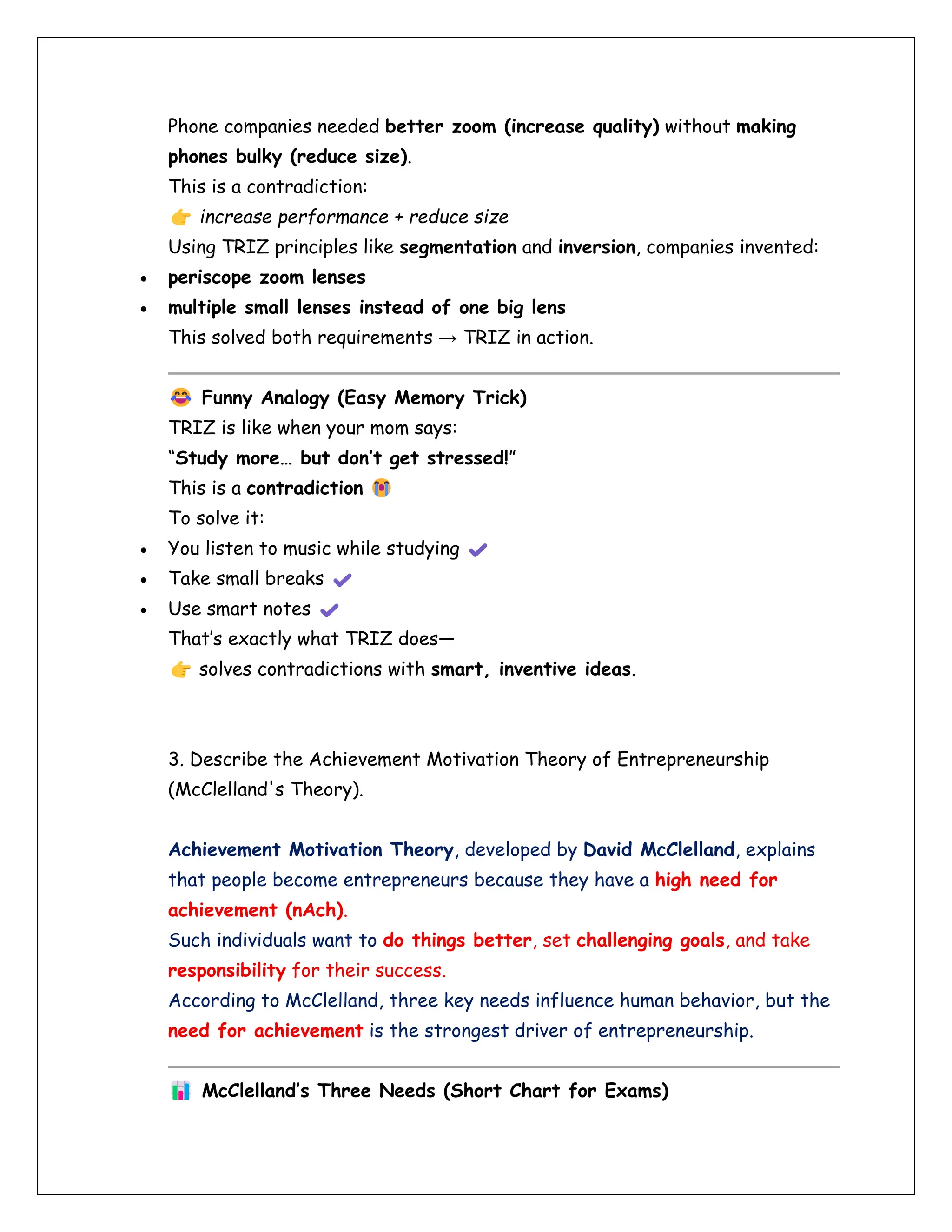
  • 27.
    Component Meaning What Entrepreneurs Learn Real-Life Example 1. Market Structure Thetype of market based on number of buyers, sellers, and competition level (like monopoly, oligopoly, perfect competition, monopolistic). How competitive the industry is, what pricing power companies have, and how hard it is to enter. Telecom industry (India): Oligopoly → few players like Jio, Airtel, Vi dominate. 2. Market Size Total sales volume, number of customers, and total revenue in the industry. Helps decide if the industry is big enough to enter and grow. Indian food delivery market: ₹40,000+ crore industry → big enough for Swiggy, Zomato. 3. Market Growth Potential How fast the industry is expected to grow in the future (high, medium, low growth). Helps understand long-term opportunities, profitability, and expansion chances. EV scooter market in India: Growing at 50%+ annually → high potential for Ola Electric, Ather. 4. Competitor Strength Analysis Studying competitors’ pricing, product quality, brand image, technology, and customer service. Helps find gaps and plan better offers than competitors. Flipkart vs Amazon: Flipkart focuses on India- specific strategy; Amazon focuses on global tech integration. 5. Customer Needs & Preferences Understanding what the target customers want and Helps create better products MamaEarth: Saw demand for toxin-free
  • 28.
    Component Meaning What Entrepreneurs Learn Real-Life Example how competitors aremeeting those needs. or unique selling points (USP). skincare → entered niche market. 6. Entry Barriers Factors that make it easy or difficult to start a business in that industry (capital, technology, brand loyalty). Shows how risky or safe it is to enter the market. Airline industry: Very high entry barriers → huge capital and licenses. 5. Explain demand-supply analysis in the context of entrepreneurship Demand–supply analysis helps entrepreneurs understand how many customers want a product (demand) and how much of the product can be offered by sellers (supply). It helps entrepreneurs decide price, production level, market entry, and business strategy. When demand > supply → opportunity for entrepreneurs. When supply > demand → high competition and lower prices. Demand–Supply Analysis (Short Chart for Exams) Aspect Meaning (Short & Clear) 1. Demand The quantity of a product customers are willing to buy at a certain price. Helps entrepreneurs know what people want.
  • 29.
    Aspect Meaning (Short& Clear) 2. Supply The quantity sellers are willing to produce and sell at different prices. Shows how much is available in the market. 3. Price Determination Price increases when demand is high and supply is low; price decreases when supply is high and demand is low. 4. Market Opportunity If demand is higher than supply, entrepreneurs can enter and earn profit. 5. Production Decisions Helps decide how much to produce to avoid shortage or excess stock. Real-Life Example (Easy & Exam-Friendly) Example – Online Groceries (BigBasket, Blinkit) During Covid lockdown: • Demand increased (people ordered groceries online). • Supply was low (few delivery companies). Entrepreneurs who entered at that time made huge profits because high demand + low supply = perfect business opportunity. Funny Analogy (Easy Memory Trick) Demand–supply analysis is like mom making pakoras at home: • If everyone wants pakoras (high demand) and there are only a few pakoras (low supply) → fight starts → price becomes “one hug per pakora” • If too many pakoras and nobody is hungry → supply > demand → mom forces you to eat: “Finish it NOW!” Entrepreneurs do the same: They make more when people want more, They stop when people want less.
  • 30.
    Unit 4: EntrepreneurialMotivation 1. What is Design Thinking-Driven Innovation? Design Thinking–Driven Innovation is an approach where innovation is created by deeply understanding customer needs, solving their problems creatively, and designing solutions that are useful, simple, and meaningful. It focuses on: • empathy (understanding users) • creativity (generating new ideas) • experimentation (testing prototypes) Design thinking helps entrepreneurs innovate by seeing problems from the customer’s point of view, not just the business point of view. Key Features (Short Chart Style for Exams) Feature Meaning (Short & Clear) 1. Empathy Understanding customer emotions, pain points, and real problems. 2. User-Centered Ideas Innovation starts from what users actually need, not what companies want to sell. 3. Creative Problem Solving Encourages multiple ideas and out-of-the-box thinking. 4. Prototyping Creating simple models and testing ideas quickly. 5. Continuous Improvement Refining ideas based on feedback to reach the best solution. Real-Life Example (Easy & Exam-Friendly) Example – Uber Uber used design thinking by focusing on user pain points: • People struggled to find taxis
  • 31.
    • No clarityon price • No safety tracking • No easy payment By understanding these customer frustrations, Uber created an app that solved all of them → Design Thinking–Driven Innovation. Funny Analogy (Easy Memory Trick) Design thinking is like planning a perfect date: • First, you understand what your crush likes (empathy ). • Then you plan ideas—movie? café? long drive? (creative thinking). • You try one plan (prototype). • If it goes bad, you adjust and try again (improvement ). 2. Explain TRIZ (Theory of Inventive Problem Solving) and its application in innovation. TRIZ (pronounced “Treez”) stands for Theory of Inventive Problem Solving, developed by Genrich Altshuller. It is a systematic method for solving complex problems by using patterns of innovation found in millions of patents. • identify contradictions in a system, • eliminate these contradictions, • and find creative, technical solutions. In simple words: TRIZ teaches how to invent smartly by using proven principles, not trial- and-error. Key Concepts of TRIZ (Short Chart for Exams) Concept Meaning (Short & Clear) 1. Contradiction Analysis Identifying conflicts like “increase strength but reduce weight.” TRIZ solves both without compromise.
  • 32.
    Concept Meaning (Short& Clear) 2. 40 Inventive Principles Ready-made creative strategies (e.g., segmentation, inversion, combining, automation) used to generate solutions. 3. Ideal Final Result (IFR) Imagining the perfect solution with no drawbacks. Helps think beyond limitations. 4. Resources Utilization Using available materials, energy, and space to solve problems cheaply and effectively. 5. Trends of Technological Evolution Predicting how products/technologies naturally evolve over time. Application of TRIZ in Innovation (Short Points) Application How TRIZ Helps 1. Product Improvement TRIZ principles help make products lighter, faster, safer, cheaper. 2. Reducing Cost Eliminating contradictions reduces waste and increases efficiency. 3. Technical Problem Solving Helps engineers solve complex design or manufacturing challenges. 4. Creating Breakthrough Ideas TRIZ pushes thinking beyond traditional brainstorming. 5. Process Optimization Improves workflow by removing bottlenecks and inefficiencies. Real-Life Example (Easy for Exams) Example – Smartphone Camera Innovation
  • 33.
    Phone companies neededbetter zoom (increase quality) without making phones bulky (reduce size). This is a contradiction: increase performance + reduce size Using TRIZ principles like segmentation and inversion, companies invented: • periscope zoom lenses • multiple small lenses instead of one big lens This solved both requirements → TRIZ in action. Funny Analogy (Easy Memory Trick) TRIZ is like when your mom says: “Study more… but don’t get stressed!” This is a contradiction To solve it: • You listen to music while studying • Take small breaks • Use smart notes That’s exactly what TRIZ does— solves contradictions with smart, inventive ideas. 3. Describe the Achievement Motivation Theory of Entrepreneurship (McClelland's Theory). Achievement Motivation Theory, developed by David McClelland, explains that people become entrepreneurs because they have a high need for achievement (nAch). Such individuals want to do things better, set challenging goals, and take responsibility for their success. According to McClelland, three key needs influence human behavior, but the need for achievement is the strongest driver of entrepreneurship. McClelland’s Three Needs (Short Chart for Exams)
  • 34.
    Need Meaning Rolein Entrepreneurship 1. Need for Achievement (nAch) Desire to accomplish difficult tasks, excel, and achieve goals. Encourages entrepreneurs to innovate, take calculated risks, and work hard. 2. Need for Power (nPow) Desire to influence, lead, and control others. Helps in leadership, team management, and decision-making. 3. Need for Affiliation (nAff) Desire for friendly relationships and social approval. Helps entrepreneurs build networks and partnerships. But need for achievement is the strongest motivator for starting and growing a business. Key Characteristics of High Achievement Individuals • Set challenging but realistic goals • Take calculated risks • Prefer feedback to improve McClelland said that people with high achievement motivation become successful entrepreneurs. Real-Life Example (Simple for Exam) Example – Elon Musk Elon Musk shows high achievement motivation: • Wanted to revolutionize cars → built Tesla • Wanted to reduce space travel cost → SpaceX • Takes huge calculated risks, sets big goals, works obsessively • Constantly tries to improve products This perfectly matches McClelland’s theory that achievement-driven people become innovative entrepreneurs.
  • 35.
    4. What areharvesting strategies in entrepreneurship? Harvesting strategies are the methods used by entrepreneurs to exit a business and convert their ownership into cash or other benefits. It is the process of “harvesting the rewards” after years of building the business. In simple words: 👉 Harvesting = How an entrepreneur leaves the business and collects profit. These strategies help entrepreneurs: • recover investment • earn profit • shift to new ventures • reduce involvement • retire safely Chart: Types of Harvesting Strategies (Short & Exam-Friendly) Strategy Explanation (Short & Clear) 1. Selling the Business (Trade Sale) Entrepreneur sells the entire business to another company for cash or shares. 2. Initial Public Offering (IPO) Company sells its shares to the public through the stock market to raise large funds. 3. Management Buyout (MBO) The company’s managers purchase the business from the entrepreneur. 4. Family Succession Business is handed over to family members or next generation. 5. Liquidation Closing the business and selling off all assets to recover money.
  • 36.
    Strategy Explanation (Short& Clear) 6. Acquisition/Merger Another company buys or merges with the business, giving payout to the founder. Real-Life Examples (Easy for Exams) 1. Flipkart – Acquisition (Harvested by Founders) Walmart bought Flipkart for $16 billion. Founders Sachin & Binny Bansal received huge payouts. This is a harvesting strategy through acquisition. 2. Zomato IPO Zomato listed its shares on the stock market. Founders and early investors got large returns. This is harvesting through IPO.
  • 37.
    Unit 5: Informationand Government Initiatives 1. Describe the government incentives available for entrepreneurs. Government incentives are supportive measures provided by the government to encourage entrepreneurship. These incentives help reduce financial burden, promote innovation, support startups, and make it easier to start and grow a business. They include subsidies, tax benefits, grants, loans, training, and infrastructure support. Chart: Government Incentives for Entrepreneurs (Short & Clear) Type of Incentive Explanation Example (India) 1. Financial Subsidies Government pays part of the cost to reduce business expenses. MSME Subsidy, Machinery Subsidy under PMEGP 2. Tax Benefits & Exemptions Reduction or exemption from taxes in early years to support growth. Startup India offers 3-year tax holiday 3. Low-Interest & Collateral-Free Loans Loans at low interest without security to support new businesses. MUDRA Loan (Shishu, Kishore, Tarun) 4. Grants for Innovation Free financial support to develop new products, research, or technology. Atal Innovation Mission (AIM) 5. Incubation Support Provides workspace, mentorship, labs, and Startup Incubators at
  • 38.
    Type of IncentiveExplanation Example (India) networking for startups. IITs, NITs, MSME tech centers 6. Skill Development & Training Government provides technical training to improve entrepreneurial skills. PMKVY (Pradhan Mantri Kaushal Vikas Yojana) 7. Export Incentives Support for entrepreneurs selling products outside India. MEIS/SEIS schemes under Foreign Trade Policy 8. Infrastructure Support Special industrial parks, SEZs, power supply, transport support. Software Technology Parks of India (STPI) 9. Women Entrepreneurship Schemes Special loans and subsidies for women- led businesses. Udyogini Scheme, Mahila Udyam Nidhi 10. Digital & Technology Support Tools, platforms, and digital training for startups. Digital India, Startup India Hub Simple Real-Life Examples 1. MUDRA Loan – Cafe Owner A young entrepreneur starts a small café using a ₹5 lakh MUDRA loan under “Tarun” category—no collateral needed.
  • 39.
    2. What areincubation and acceleration programs? Introduction Incubation and acceleration programs are support systems provided to startups to help them grow. They offer mentoring, workspace, funding, and expert guidance to improve success and reduce failure risk. Entrepreneurs use these programs to develop ideas, build prototypes, grow faster, and reach investors. Incubation Programs (Short & Clear) Incubation programs support early-stage startups in developing their idea into a workable product or business. Key Features • Provide workspace, labs, and office support • Offer mentorship and basic training • Give access to technical support • Help startups create prototypes/MVP • Provide small grants or seed funding • Long-term support (typically 6–18 months) Purpose To help new startups survive, experiment, and build a solid foundation. Real-World Example (Perfect for Exams) Ather Energy – IIT Madras Incubation Cell Ather started as a student project and received: • lab access • workspace • mentors • seed funding This incubation support helped them build India’s top electric scooter brand. Acceleration Programs (Short & Clear) Meaning
  • 40.
    Acceleration programs helpgrowth-ready startups scale quickly through intense, short-term mentorship and investor access. Key Features • Advanced business mentorship • Investor connections and funding opportunities • Large business network access • Intense short-term program (3–6 months) • Ends with Demo Day (pitch to investors) Purpose To help startups grow fast, expand to markets, and secure investments. Real-World Example Airbnb – Y Combinator (USA) Airbnb joined YC and got: • $125,000 funding • investor connections • business model improvement • rapid scaling support This helped Airbnb grow from a small rental idea to a global brand. Difference Between Incubation and Acceleration (Super Short Chart) Incubation Acceleration Supports early-stage ideas Supports growth-stage startups Focuses on idea + prototype Focuses on scaling + expansion Long-duration (6–18 months) Short-duration (3–6 months) Provides space + mentorship Provides investors + networks Helps startups survive Helps startups grow faster
  • 41.
    3. Explain differentmethods of funding new ventures-bootstrapping, crowdsourcing, and angel investors. Entrepreneurs need funds to start and grow their ventures. Three popular methods are bootstrapping, crowdsourcing, and angel investors. Each has its own advantages and sources of support. 1. Bootstrapping Meaning (Short & Clear) Bootstrapping means starting a business with your own money or operating with very limited funds. The entrepreneur depends on personal savings, reinvesting profits, and low-cost operations. Key Features • No outside investors • Full control of business • Low cost, high creativity • Focus on small beginnings and steady growth Real-Life Example Zoho (Sridhar Vembu) started without external funding. He used his savings, kept costs low, and grew it into a global software company. 2. Crowdsourcing / Crowdfunding Meaning Crowdsourcing or crowdfunding means raising small amounts of money from a large number of people, usually through online platforms. Key Features • Uses platforms like Kickstarter, Ketto, Indiegogo • Many people contribute small amounts • Often used for creative products, gadgets, social causes • Reduces financial risk for the entrepreneur Real-Life Example
  • 42.
    Pebble Smartwatch raisedover $10 million on Kickstarter from thousands of supporters. This is one of the most famous crowdfunding successes. 3. Angel Investors Meaning Angel investors are wealthy individuals who invest their personal money in early-stage startups. They give funding in exchange for equity (ownership). Key Features • Provide money + mentorship • Take high risk • Useful for startups with high growth potential Real-Life Example Ola received early funding from angel investor Rehan Yar Khan, helping it grow rapidly. Short Exam-Ready Chart Method Meaning Best For Example Bootstrapping Self-funding using personal savings and profits Start small, full control Zoho Crowdsourcing Raising small amounts from many people online Creative products & early prototypes Pebble Smartwatch Angel Investors Wealthy individuals investing for equity High-growth tech startups Ola
  • 43.
    Funny Analogy (EasyMemory Trick) Funding methods are like arranging money for a birthday party: • Bootstrapping: You use your own pocket money to buy cake • Crowdsourcing: You ask friends to contribute ₹50 each • Angel Investor: Your rich uncle gives you ₹2000 and says, “Beta, just invite me to the party!” Exactly like startups get their funds! 4. Discuss the Government of India's efforts to promote entrepreneurship and innovation through organizations such as: SISI, KVIC, DGFT, SIDBI, Defense, and Railways. 1. SISI (Small Industries Service Institute / MSME–DI) • Provides technical guidance, project reports, and consultancy to new entrepreneurs. • Conducts Entrepreneurship Development Programs (EDPs) and skill-training workshops. • Helps MSMEs with technology upgradation, quality improvement, and marketing support. • Supports small-scale manufacturers through industrial training and cluster development. 2. KVIC (Khadi and Village Industries Commission) • Promotes rural entrepreneurship through Khadi, handloom, and village industries. • Provides subsidies, raw materials, training, and marketing assistance. • Implements PMEGP, giving up to 35% subsidy for new micro-enterprises. • Encourages employment generation in rural and semi-urban areas. 3. DGFT (Directorate General of Foreign Trade) • Facilitates exports by issuing export licenses, EPCG benefits, and duty exemptions.
  • 44.
    • Provides incentivesunder Foreign Trade Policy like MEIS/SEIS. • Helps MSMEs enter global markets by simplifying export procedures. • Supports exporters with schemes promoting international competitiveness. 4. SIDBI (Small Industries Development Bank of India) • Offers low-interest loans, refinancing, and credit guarantees to MSMEs. • Supports startups under schemes like SMILE and Fund of Funds for Startups. • Finances innovation-driven businesses and manufacturing units. • Works with incubators and state governments to support small industries. 5. Defence Sector (DRDO, iDEX, Make-II Program) • Promotes innovation through iDEX – supports startups working on defence technologies. • Provides funding and testing facilities for drones, robotics, AI, cybersecurity, etc. • Encourages private participation under Make in India (Defence Manufacturing). • DRDO collaborates with academic institutes and startups to develop advanced technologies. 6. Indian Railways • Runs Startup for Railways to solve real railway problems with innovative solutions. • Provides funding, procurement opportunities, and testing support for startups. • Encourages innovation in safety systems, sensors, signalling, energy efficiency, etc. • Supports development of systems like the Kavach Rail Safety System.
  • 45.
    Unit 6: Closingthe Window I 1. Explain the concept of sustaining competitiveness. Sustaining competitiveness means a company’s ability to continue performing better than its competitors over a long period of time. It focuses on maintaining customer loyalty, innovation, quality, efficiency, and market strength so that the business does not lose its position in the industry. In simple words: Sustaining competitiveness = staying ahead of rivals consistently. Pointwise Explanation 1. Continuous Innovation Businesses must regularly improve products, services, and processes to stay relevant and competitive. 2. Maintaining Quality Consistently delivering high-quality products builds customer trust and long- term loyalty. 3. Cost Efficiency Reducing waste, improving productivity, and managing costs help offer competitive prices. 4. Strong Customer Relationships Understanding customer needs and providing good service helps retain customers for the long term. 5. Adapting to Market Changes Companies must respond quickly to new trends, technology, and changing customer preferences. 6. Skilled Workforce Trained and motivated employees contribute to innovation, productivity, and overall performance. 7. Strong Branding & Reputation A trustworthy brand helps sustain competitiveness even in crowded markets. 8. Strategic Use of Technology
  • 46.
    Using modern toolslike automation, AI, and data analytics enhances efficiency and decision-making. Real-Life Example Example – Apple Apple sustains competitiveness by: • launching new product innovations • maintaining high-quality standards • building a strong brand • using advanced technology • delivering excellent customer service This helps Apple stay ahead of Samsung, Xiaomi, and others globally. 2. How can an entrepreneur maintain competitive advantage over time? To maintain competitive advantage, an entrepreneur must continuously improve, innovate, and adapt. Competitive advantage can only be sustained when a business keeps offering better value than its competitors consistently, not just once. Pointwise Answer (Short, Clear, Perfect for Exams) 1. Continuous Innovation Entrepreneurs must keep introducing new features, ideas, or services to stay ahead of competitors. 2. Consistent Quality Improvement Maintaining and improving product or service quality builds customer trust and loyalty. 3. Strong Customer Relationships Understanding customer needs, taking feedback, and providing excellent service helps keep customers for life. 4. Cost Efficiency & Productivity Reducing waste, optimizing operations, and controlling costs allow competitive pricing.
  • 47.
    5. Adopting NewTechnology Using modern tools like automation, AI, data analytics, and digital systems increases efficiency and performance. 6. Building a Strong Brand A positive brand image makes customers prefer the business even when competitors offer similar products. 7. Skilled & Motivated Workforce Trained employees bring new ideas, solve problems faster, and deliver better results. 8. Adapting to Market Changes Entrepreneurs must quickly adjust to new trends, customer preferences, and technological shifts. 9. Unique Selling Proposition (USP) Keeping a clear USP—something competitors cannot easily copy—helps retain long-term advantage. Real-Life Example Example – Netflix Netflix maintains competitive advantage by: • constant innovation (AI recommendations, interactive shows) • adapting from DVDs → streaming → gaming • investing in original content • using advanced technology • keeping strong brand loyalty This helps Netflix stay ahead even with strong competitors like Amazon Prime and Disney+. 3. Discuss the changing role of the entrepreneur in modern business Traditional Role Modern Role of Entrepreneur Explanation (Short & Clear) 1. Risk Taker Innovation Leader Modern entrepreneurs focus on creativity, technology, and
  • 48.
    Traditional Role Modern Role of Entrepreneur Explanation(Short & Clear) value innovation, not just taking risks. 2. Business Owner Opportunity Creator They recognize new trends, unmet needs, and emerging markets before others. 3. Profit Seeker Customer- Centric Thinker Modern entrepreneurs design products/services based on deep customer insights and experiences. 4. Manager of Operations Technology Adopter Uses digital tools, AI, automation, and data analytics to improve productivity and decision-making. 5. Employment Provider Ecosystem Builder Creates networks of suppliers, partners, freelancers, and communities (example: startup ecosystem). 6. Local Market Player Global Entrepreneur Operates beyond local markets; uses e-commerce and digital platforms to reach global customers. 7. Individual Decision- Maker Collaborator & Team Builder Works with teams, investors, mentors, and professionals; emphasizes collaboration over solo decisions.
  • 49.
    Traditional Role Modern Role of Entrepreneur Explanation(Short & Clear) 8. Cost Controller Sustainability & Social Impact Driver Focuses on eco-friendly practices, CSR, ethical business, and long-term sustainability. Real-Life Example (Easy for Exams) Example – Byju’s / EdTech Entrepreneurs Modern entrepreneurs like the founders of Byju’s shifted from traditional classroom teaching to digital education, using: • mobile apps • animation • AI-based personalized learning This shows how modern entrepreneurs use technology, innovation, customer focus, and global outreach to transform industries.
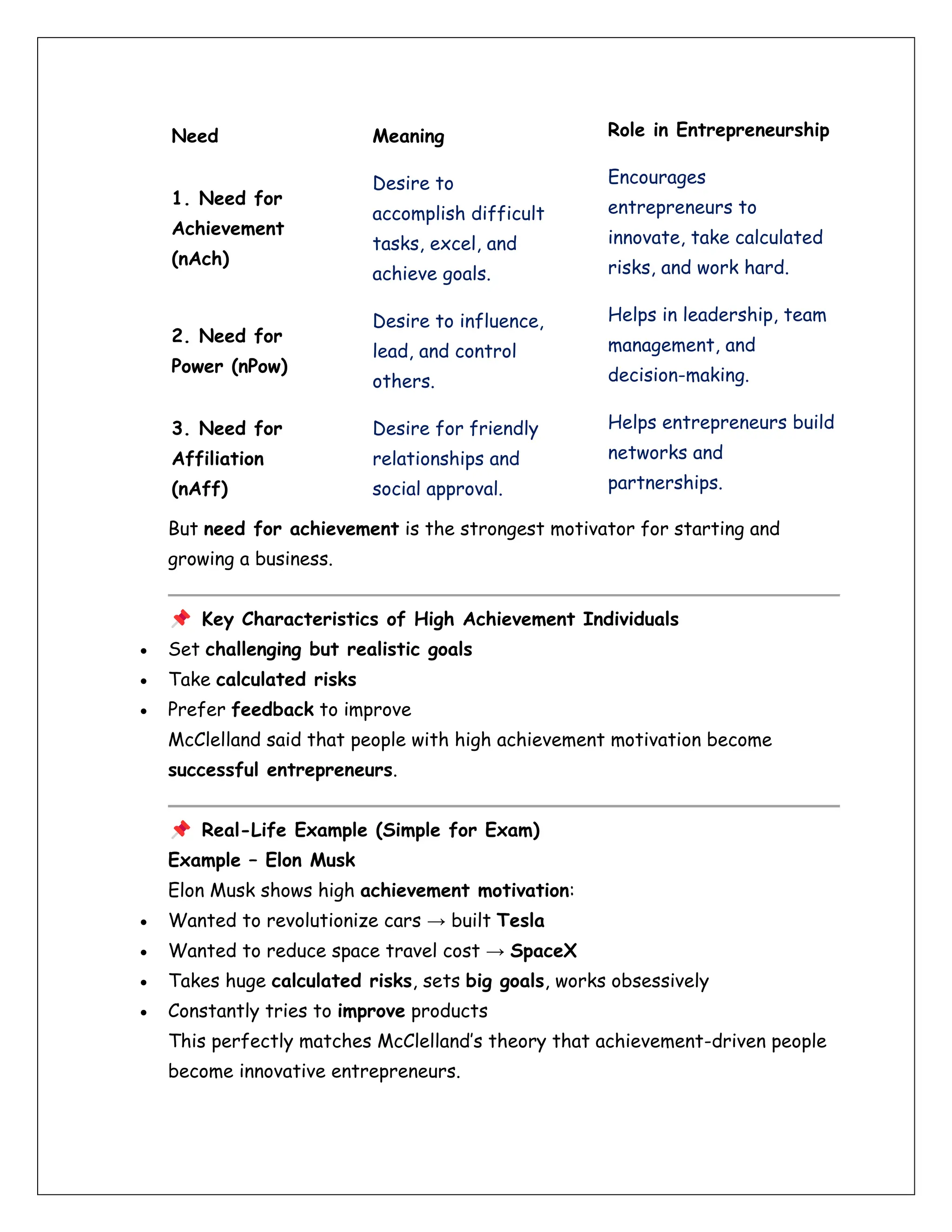
  • 50.
    Unit 7: Applicationsand Project Reports 1. What are the key components of a project report? Difference between application and report A project report is a formal document that explains the details of a proposed business project. It helps investors, banks, and stakeholders understand the feasibility, cost, and profitability of the project. Key Components of a Project Report (Exam-Ready Points) 1. Executive Summary A short overview of the entire project – purpose, product, market, investment required, and expected profit. 2. Business Description / Introduction Explains what the business is about, nature of the project, objectives, and background information. 3. Market Analysis Includes information on industry size, target customers, competition, market demand, and future growth potential. 4. Technical Feasibility Covers details like: • production process • machinery & technology • raw materials • plant layout • capacity and location 5. Organizational & Management Plan Describes the business structure, roles of founders, key employees, and HR requirements. 6. Marketing Plan Includes pricing strategy, promotion methods, distribution channels, branding, and sales forecast. 7. Financial Plan
  • 51.
    Shows cost ofthe project, capital required, revenue forecast, break-even point, profit-loss estimate, and cash flow. 8. Project Implementation Schedule Timeline of activities like construction, machinery installation, hiring, production, and launch. 9. Risk Analysis Identifies potential risks such as financial, market, operational, and legal risks, along with mitigation strategies. 10. Conclusion / Recommendations Final justification showing why the project is feasible and profitable. Real-Life Example (Easy to Write) Example – Project Report for a Juice Manufacturing Unit 1. Executive Summary: The project aims to produce packaged fruit juice for the local market with an investment of ₹15 lakhs. 2. Business Description: The unit will produce mango, orange, and mixed fruit juices under the brand “FreshSip.” 3. Market Analysis: Demand for healthy beverages is rising. Competitors include Tropicana and Real, but local brands have strong market potential. 4. Technical Feasibility: Requires juice extractor, pasteurizer, filling machine, and packaging unit. Location: Industrial area near Siliguri. 5. Management Plan: Founder manages operations; 6 workers for production and 2 for sales. 6. Marketing Plan: Selling through local shops, supermarkets, schools, and online delivery apps. Pricing: ₹20 per 200 ml pack. 7. Financial Plan: Project cost: ₹15 lakh.
  • 52.
    Expected revenue: ₹30lakh in first year. Break-even in 18 months. 8. Implementation Schedule: Setup in 3 months → trial production → launch in month 4. 9. Risk Analysis: Seasonal raw material availability; can be solved by buying during peak season and storing pulp. 10. Conclusion: The project is profitable, has growing demand, and is suitable for bank loan approval. Funny Analogy (Easy Memory Trick) A project report is like planning a wedding: • Summary → what the wedding is about • Market study → guest list • Technical plan → food, lights, venue • Marketing → invitations • Financials → total budget • Risk → “What if baarish?” • Implementation → timeline of functions Just like a wedding plan convinces the family, a project report convinces banks & investors! 2. Discuss the applications of entrepreneurship in various sectors. Sector How Entrepreneurship is Applied Real-Life Example 1. Agriculture Use of modern farming techniques, agri-tech startups, food processing, supply chain innovation. DeHaat, Ninjacart (connecting farmers to markets).
  • 53.
    Sector How Entrepreneurship is Applied Real-LifeExample 2. Manufacturing Automation, new product development, MSME units, “Make in India” manufacturing startups. Boat (electronics manufacturing), Lenskart. 3. Service Sector Online platforms, delivery services, hospitality, education, healthcare innovation. Zomato, Practo, Byju’s. 4. Information Technology (IT) Software development, AI, cloud computing, IT services, cybersecurity. TCS, Zoho, Freshworks. 5. Retail & E- Commerce Online shopping, logistics innovation, fast delivery models, customized products. Flipkart, Amazon India, Meesho. 6. Tourism & Hospitality Travel apps, hotel booking platforms, adventure tourism, homestay services. OYO Rooms, MakeMyTrip. 7. Healthcare & Biotech Telemedicine, diagnostics, biotech research, medical equipment startups. 1mg, PharmEasy, Biocon. 8. Education (EdTech) Online learning platforms, tutoring apps, virtual classrooms, skill-based labs. Byju’s, Unacademy, Vedantu. 9. Finance & FinTech Digital payments, online banking, UPI apps, personal finance solutions. Paytm, PhonePe, Razorpay.
  • 54.
    Sector How Entrepreneurship is Applied Real-LifeExample 10. Renewable Energy Solar startups, EV technology, battery innovation, clean energy solutions. Ola Electric, Ather Energy. 3. Explain the steps involved in preparing a project report. STEPS IN PREPARING A PROJECT REPORT ----------------------------------- ┌──────────────────┐ │ Project Idea │ └─────────┬────────┘ ↓ ┌──────────────────┐ │ Market Analysis │ └─────────┬────────┘ ↓ ┌──────────────────┐ │ Technical Study │ └─────────┬────────┘ ↓ ┌──────────────────┐ │ Management Plan │ └─────────┬────────┘ ↓ ┌──────────────────┐ │ Marketing Plan │ └─────────┬────────┘ ↓ ┌──────────────────┐ │ Financial Plan │ └─────────┬────────┘ ↓
  • 55.
    ┌──────────────────┐ │ Risk/Feasibility │ └─────────┬────────┘ ↓ ┌──────────────────┐ │Implementation │ │ Schedule │ └─────────┬────────┘ ↓ ┌──────────────────┐ │ Final Report │ │ Preparation │ └──────────────────┘ Step Explanation (Short & Clear) 1. Selection of Project Idea Choose a viable business idea based on skills, market needs, and profitability. 2. Market Analysis Study customers, competitors, demand– supply, industry trends, and target market. 3. Technical Analysis Decide technology, production method, machinery, raw materials, capacity, plant layout, and location. 4. Organizational & Management Plan Prepare organizational structure, roles, staffing, and HR planning. 5. Marketing Plan Set pricing strategy, promotion, distribution channels, product features, and sales forecast. 6. Financial Planning Estimate project cost, working capital, funding sources, profits, break-even, and cash flow.
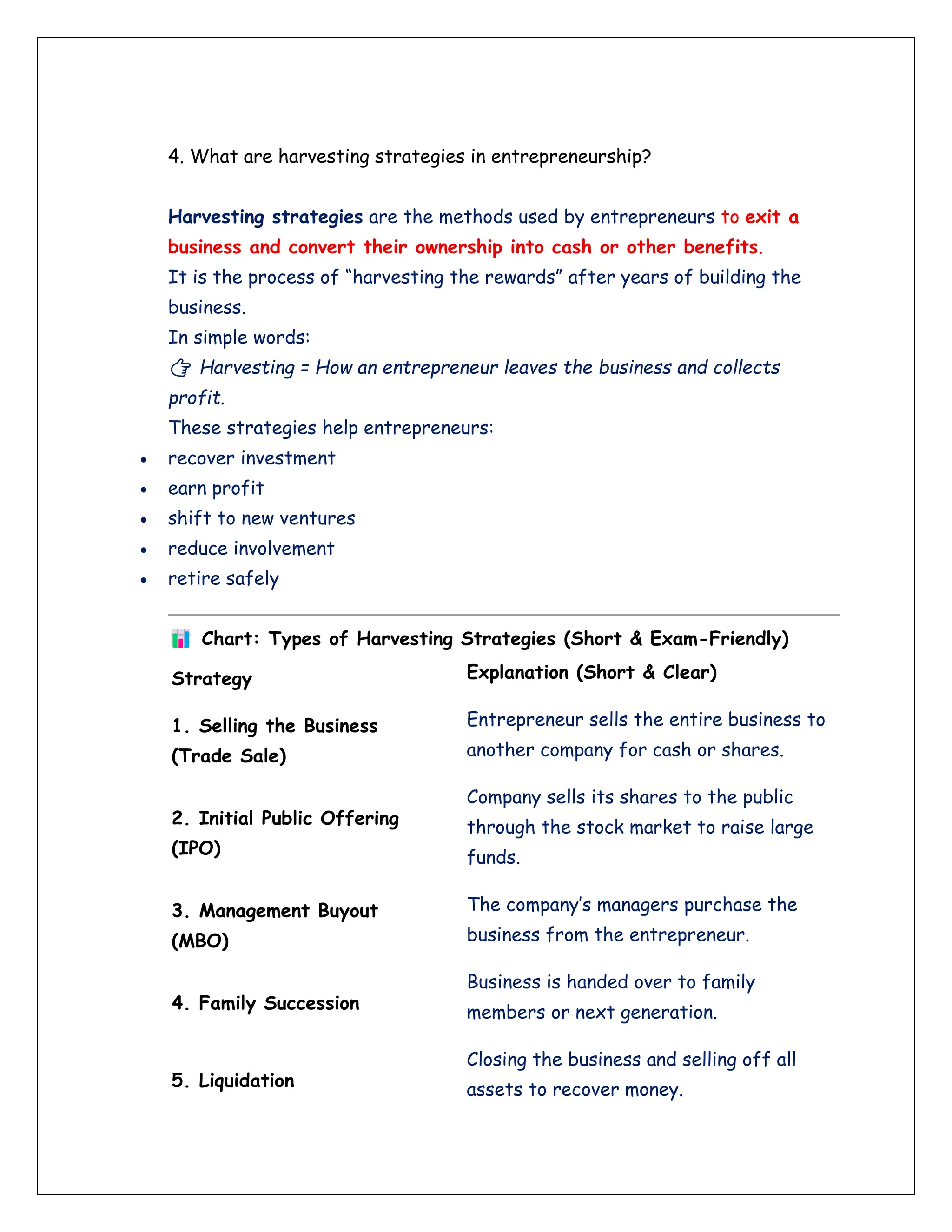
  • 56.
    Step Explanation (Short& Clear) 7. Risk & Feasibility Analysis Identify market, financial, operational risks and check project feasibility. 8. Implementation Schedule Create a timeline for activities like registration, construction, machinery installation, hiring, and launch. 9. Final Report Preparation Compile all sections into a formal project report for banks/investors.
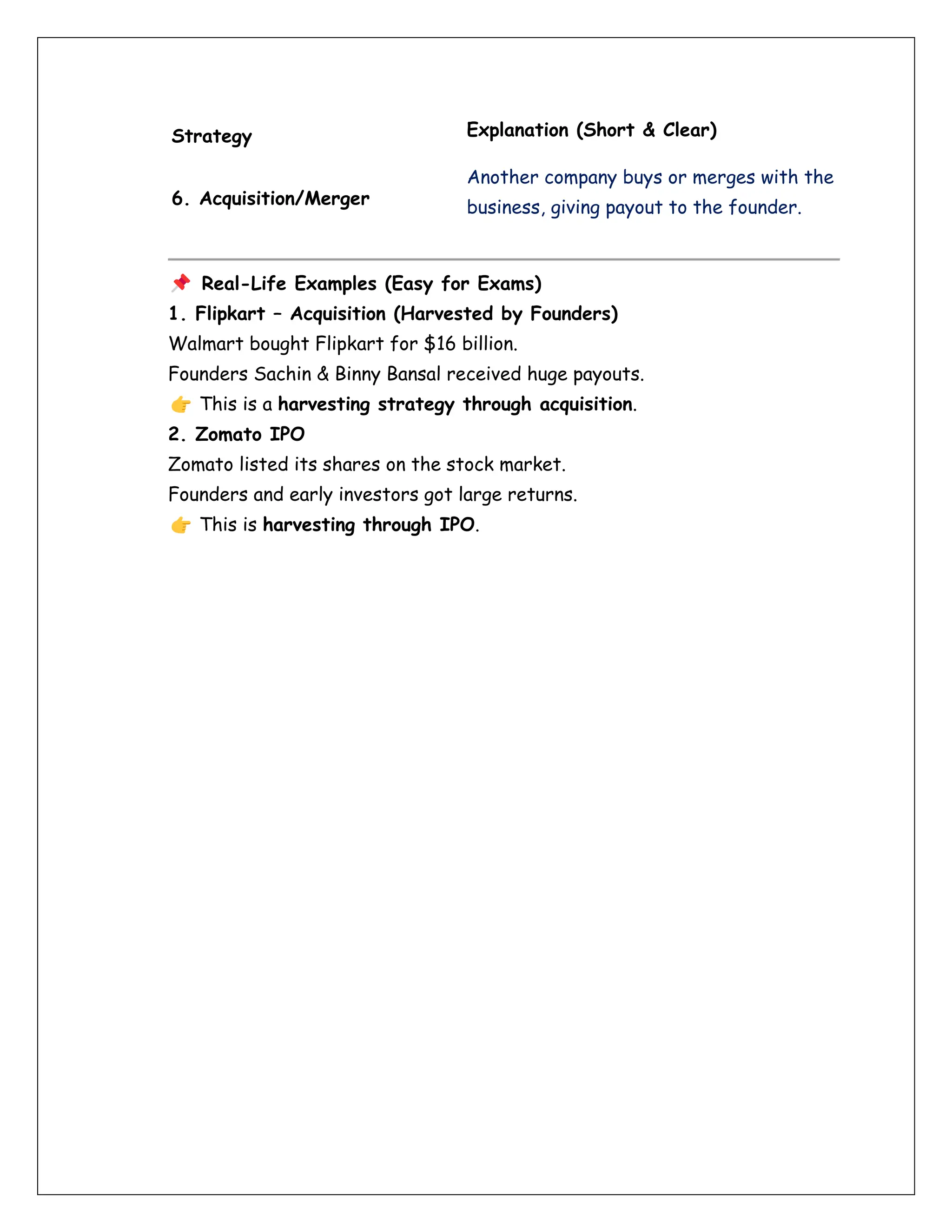
  • 57.
    Unit 8: ProjectManagement - Concepts and Phases 1. Define Project and Project Management. Definition of Project (Exam-Ready) A project is a temporary, one-time activity undertaken to create a unique product, service, or result. It has a specific goal, fixed timeline, defined resources, and clear deliverables. In simple words: A project is a planned task with a start and end, done to achieve a specific objective. Definition of Project Management Project Management is the process of planning, organizing, directing, and controlling all activities of a project to achieve its goals effectively. It ensures the project is completed on time, within budget, and with the desired quality. In simple words: Project management = managing people, time, money, and tasks to complete a project successfully. Real-Life Example Example – Opening a New Café • Project: Setting up a new café in Siliguri o Goal: Open a café offering coffee & snacks o Duration: 2 months o Tasks: Interior setup, buying machines, hiring staff, menu creation o Outcome: Café ready for customers • Project Management: The owner plans the budget, hires workers, sets deadlines, coordinates with suppliers, handles licenses, and ensures everything is ready on time.
  • 58.
    This shows howproject = task and project management = controlling all steps of the task. 2. Explain the issues and problems commonly faced in project management. Issue / Problem Explanation (Short & Clear) Real-World Example 1. Poor Planning Incomplete or unrealistic project plans cause delays and confusion. Construction projects often get delayed because the contractor didn’t plan material arrival properly. 2. Scope Creep Adding extra features or changes beyond the original plan increases time & cost. A mobile app developer keeps adding new features requested by the client → project takes months more than expected. 3. Budget Overruns Project cost becomes higher than planned due to wrong estimates or unexpected expenses. Delhi Metro Phase 3 cost increased due to rising material prices and design changes. 4. Missed Deadlines Tasks take longer due to poor scheduling or lack of manpower. Road construction during monsoon gets delayed because workers and machines cannot function properly.
  • 59.
    Issue / Problem Explanation (Short& Clear) Real-World Example 5. Ineffective Communication Miscommunication leads to errors, rework, and team conflicts. A software team misunderstands client requirements → app is built wrong → must be redone. 6. Resource Shortage Shortage of workers, materials, or machines slows down project progress. During Covid, many projects stalled because workers returned to villages (labour shortage). 7. Risk & Uncertainty Unexpected events disrupt the project. A supplier fails to deliver machinery on time → factory installation gets delayed. 8. Poor Quality Control Low monitoring results in defects and rework. A building gets cracks because low-quality cement was used → entire section must be rebuilt. 9. Team Conflicts Disagreements reduce productivity and slow decisions. Marketing and production teams argue about product design → launch delayed. 10. Weak Leadership Lack of direction leads to confusion and poor project results. A startup fails to launch on time because the founder keeps changing decisions without clear vision.
  • 60.
    3. Describe theProject Life Cycle and its phases: Initiation/Conceptualization, Planning, Implementation/Execution, Closure / Termination. The Project Life Cycle (PLC) describes the complete journey of a project from the idea stage to its final completion. It ensures that every activity is carried out in a systematic and controlled manner. It includes four major phases: Initiation / Conceptualization Phase (Detailed Points) • The project idea is generated after analyzing a problem or a business opportunity. • A preliminary feasibility study is conducted—technical, financial, and market feasibility. • The project objectives, purpose, deliverables, and expected benefits are clearly defined. • Important stakeholders and sponsors are identified. • A rough estimate of budget, time, and resources is prepared. • A Project Charter or concept proposal is created for approval. • Management decides whether the project should start or be rejected. Goal: Evaluate the idea and get formal approval to proceed. Planning Phase (Detailed Points) • A detailed project management plan is created covering scope, time, cost, quality, communication, risks, and resources. • A Work Breakdown Structure (WBS) is prepared—dividing the project into small tasks. • A Gantt chart or timeline is made for scheduling activities. • Budgeting is done, including estimates of materials, manpower, machinery, and contingency reserves. • A risk management plan identifies potential challenges and mitigation steps. • Procurement planning is done for suppliers, contractors, and materials.
  • 61.
    • A communicationplan ensures smooth flow of information among team members. Goal: Create a roadmap to execute the project efficiently. Implementation / Execution Phase (Detailed Points) • Actual work begins based on the project plan. • Resources (labour, materials, equipment) are allocated. • Teams perform tasks as per schedule, supervised by the project manager. • Quality assurance and quality control are implemented. • The project manager monitors progress using tools like Gantt charts, dashboards, and reports. • Regular meetings are held to solve problems and manage changes. • Costs, time, and scope are continuously controlled to avoid overruns. • Necessary adjustments are made when unexpected issues arise. Goal: Convert plans into actual deliverables. Closure / Termination Phase (Detailed Points) • Final deliverable is completed and handed over to the client/stakeholders. • Project performance is evaluated against original objectives (scope, cost, time, quality). • Final payments are made to vendors and contractors. • Remaining resources and team members are released from duties. • Documentation is completed—reports, manuals, and lessons learned. • A closing meeting is held to officially terminate the project. • The project is archived for future reference. Goal: Bring the project to an official and satisfactory end. Simple Exam Diagram (You Can Draw This Easily) Initiation → Planning → Execution → Closure Or the longer one: PROJECT LIFE CYCLE -------------------------------- | Initiation / Conceptual |
  • 62.
    | ↓ | |Planning | | ↓ | | Implementation/Execution | | ↓ | | Closure/Termination | -------------------------------- Real-Life Example (More Detailed) Example – Opening a New Restaurant Initiation: You see demand for a café in your area. You check feasibility: location, budget, customers, competition → idea approved. Planning: You create a detailed plan for interior design, menu, raw materials, budget, staff, licenses, timeline, marketing, risk management. Execution: Construction begins, kitchen equipment is installed, staff is hired, cooking trials happen, suppliers are finalized. Closure: Café opens to the public. Final bills paid, documentation completed, and project officially closed.
  • 63.
    Unit 9: ProjectFeasibility Studies 1. Differentiate between pre-feasibility and feasibility studies. A business idea is examined in two stages before starting a project: Pre-feasibility study (initial check) and Feasibility study (detailed final evaluation). Difference Between Pre-Feasibility and Feasibility Study (Exam- Ready Chart) Basis Pre-Feasibility Study Feasibility Study Purpose To quickly check if the idea is worth studying further. To make the final decision whether to implement the project. Detail Level Basic and preliminary; overview-level study. Deep, detailed, and comprehensive analysis. Cost & Time Cheaper and faster to conduct. More expensive and time-consuming. Data Used Rough estimates, assumptions, general information. Accurate calculations, market surveys, technical designs. Focus To identify major risks and reject weak ideas early. To evaluate full viability — technical, financial, market, legal. Outcome “Go / No-Go” decision for detailed feasibility. Final “Go / No-Go” decision for starting the project.
  • 64.
    Basis Pre-Feasibility Study Feasibility Study Who Conducts It? Usuallydone by entrepreneur or small internal team. Done by experts, consultants, engineers, and financial analysts. Documentation Short report (summary). Full project report for banks, investors, and approvals. Real-World Example (Easy for Exams) Example – Setting Up a Packaged Juice Factory Pre-Feasibility Study: • You check local demand for juice. • Rough idea of budget (₹10–₹15 lakhs). • Basic assessment of machinery cost (approx). • You see some competition but demand is good. • You decide: “Yes, let's explore deeper.” This stage is quick, cheap, and helps decide whether to proceed. Feasibility Study: • Conduct detailed market survey (age groups, preferences, competitors). • Finalize exact machinery, suppliers, and production capacity. • Calculate total project cost (e.g., ₹17.5 lakhs). • Conduct break-even analysis, cash flow, and profitability. • Check legal requirements: FSSAI license, pollution control norms. • Prepare a final project report for bank loan. This study confirms whether the project should be executed.
  • 65.
    2. What arethe steps in preparing a Detailed Project Report (DPR)? (please also read the content of it from chatgpt) A Detailed Project Report (DPR) is a comprehensive document that provides complete technical, financial, managerial, and market-related details of a project. It is mainly used for bank loans, investor approval, and government clearances. Steps in Preparing a Detailed Project Report (DPR) — Exam-Ready Points 1. Identifying the Project Idea Select the project based on market need, demand, resources, and business opportunity. 2. Conducting Market Analysis Study target customers, demand–supply situation, competitor analysis, pricing trends, and future growth. 3. Technical Analysis Decide: • manufacturing process • machinery & technology • plant location • capacity • raw materials • layout plan 4. Financial Analysis Prepare: • investment cost • working capital • revenue forecast • profitability • cash flow • break-even analysis • funding sources
  • 66.
    5. Organizational &Management Planning Define management structure, staffing pattern, roles, HR plan, and administrative setup. 6. Project Implementation Schedule Prepare a timeline covering: • land purchase • construction • machinery installation • recruitment • trial production • final launch 7. Risk Assessment & Feasibility Study Identify risks (market, technical, financial, operational) and provide mitigation plans. Evaluate technical and financial viability. 8. Preparation of the Final DPR Document Compile all sections in a formal report for submission to banks, investors, or government bodies. 3. Explain technical, economic, and financial appraisals of a project. Before starting a project, different appraisals are conducted to check whether the project is practical, beneficial, and profitable. Technical Appraisal Technical appraisal evaluates whether the project is technically feasible. It examines the technology, machinery, plant layout, production process, raw material availability, and skilled manpower. If the technical setup is not possible, the project cannot operate efficiently. Example: A water bottling plant must ensure continuous water supply, RO system, hygienic layout, and proper equipment.

  • 67.
    Economic Appraisal Economic appraisalstudies the economic and social benefits of the project. It checks employment generation, local development, use of resources, environmental impact, and overall contribution to the economy. This helps determine whether the project adds value to society. Example: A food-processing unit increases rural employment and supports farmers → positive economic impact. Financial Appraisal Financial appraisal examines whether the project is financially viable. It includes estimation of project cost, working capital, profitability, cash flow, break-even point, and return on investment (ROI). A project is approved only if it ensures stable revenue and profits. Example: A bakery project must show that expected revenue covers costs and generates profit within a reasonable time. One-Line Summary: Technical appraisal checks can we produce it? Economic appraisal checks is it beneficial? Financial appraisal checks will it make profit? 4. Discuss the process of capital budgeting. Capital budgeting is the process of evaluating and selecting long-term investment projects such as new machines, new factories, new products, or expansion. Its purpose is to decide whether a project is financially profitable and worth investing in. Chart: Steps in the Capital Budgeting Process
  • 68.
    Step Explanation (Short& Clear) 1. Project Identification Search for viable investment opportunities (new product, new machine, expansion, etc.). 2. Project Screening Reject unprofitable or unrealistic ideas and shortlist feasible ones. 3. Cash Flow Estimation Estimate initial investment, operating costs, expected revenue, and future cash inflows. 4. Selection of Evaluation Technique Use methods like Payback Period, NPV, IRR, Profitability Index to evaluate profitability. 5. Project Evaluation & Selection Choose the best project based on returns, risks, and long-term goals. 6. Project Financing Decide the sources of funds – loans, equity, retained earnings, government schemes. 7. Project Implementation Purchase machinery, set up plant, hire workers, start production. 8. Performance Review Compare actual results with expected cash flows; evaluate success and improvements. Real-World Example (Easy for Exams) Example – Opening a New Manufacturing Unit (Chocolate Factory) 1. Project Identification: Company identifies an opportunity to enter the premium chocolate market. 2. Screening: Management compares multiple ideas (candy line, chocolate line) and selects “premium chocolates” as feasible. 3. Cash Flow Estimation: o Initial investment: ₹50 lakh
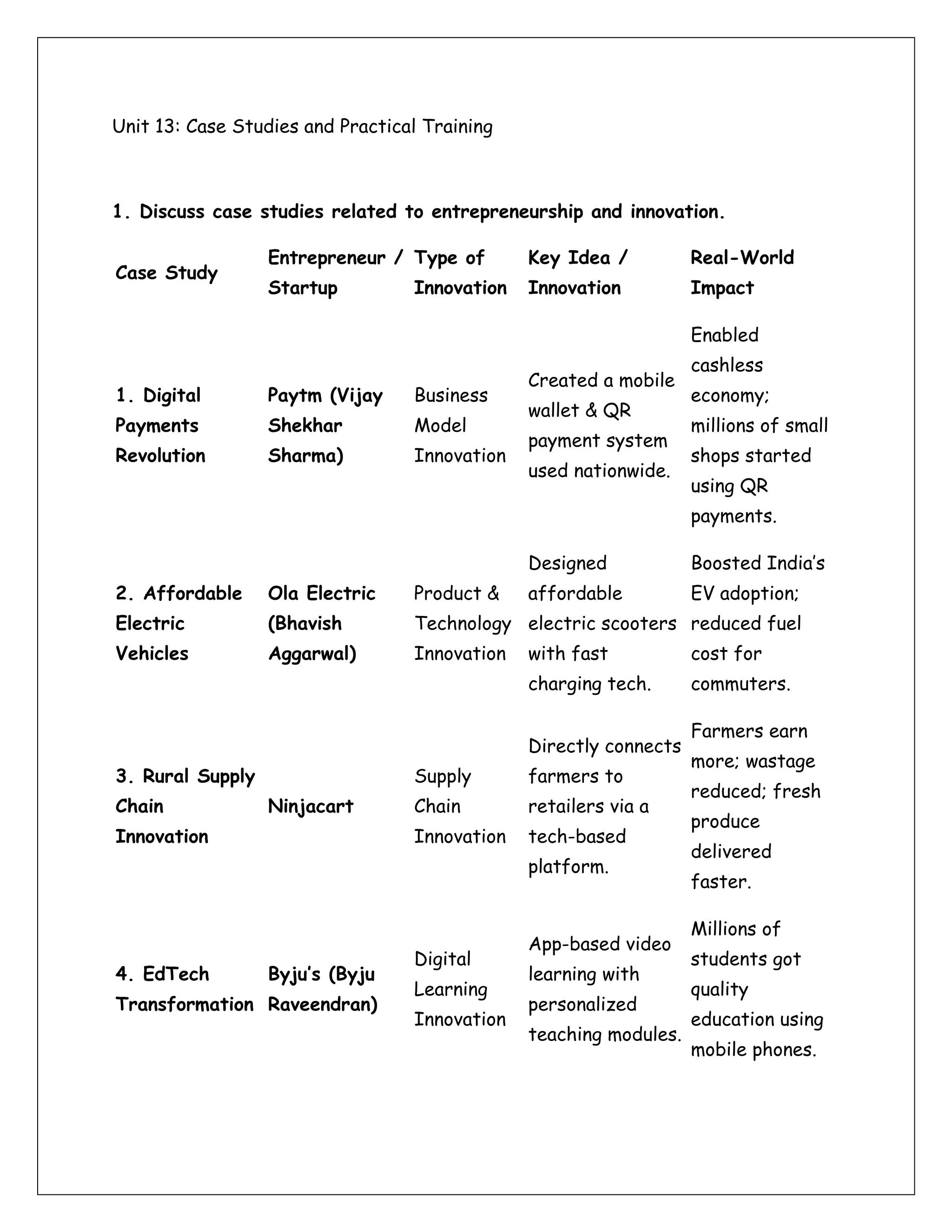
  • 69.
    o Expected annualrevenue: ₹30 lakh o Annual profit: ₹12 lakh o Operating cost: ₹18 lakh 4. Evaluation Technique: The company uses NPV and Payback Period. o NPV is positive o Payback period is 4 years → project looks profitable. 5. Selection: Management approves the chocolate factory project. 6. Financing: Required funds obtained through bank loan + owner’s capital. 7. Implementation: Machines are installed, workers hired, trial batch produced. 8. Review: After six months, company compares actual profits with expected profits and adjusts production. This is how real companies make investment decisions. 5. Explain Social Cost-Benefit Analysis with examples. Social Cost–Benefit Analysis (SCBA) is a method used to evaluate a project based on its overall impact on society, not just its financial profitability. It measures both social costs (negative effects) and social benefits (positive effects) to determine whether a project is socially desirable. Key Components of SCBA 1. Social Costs These are the negative impacts of a project on society: • Pollution and noise • Land use and displacement • Traffic disturbance • Environmental damage
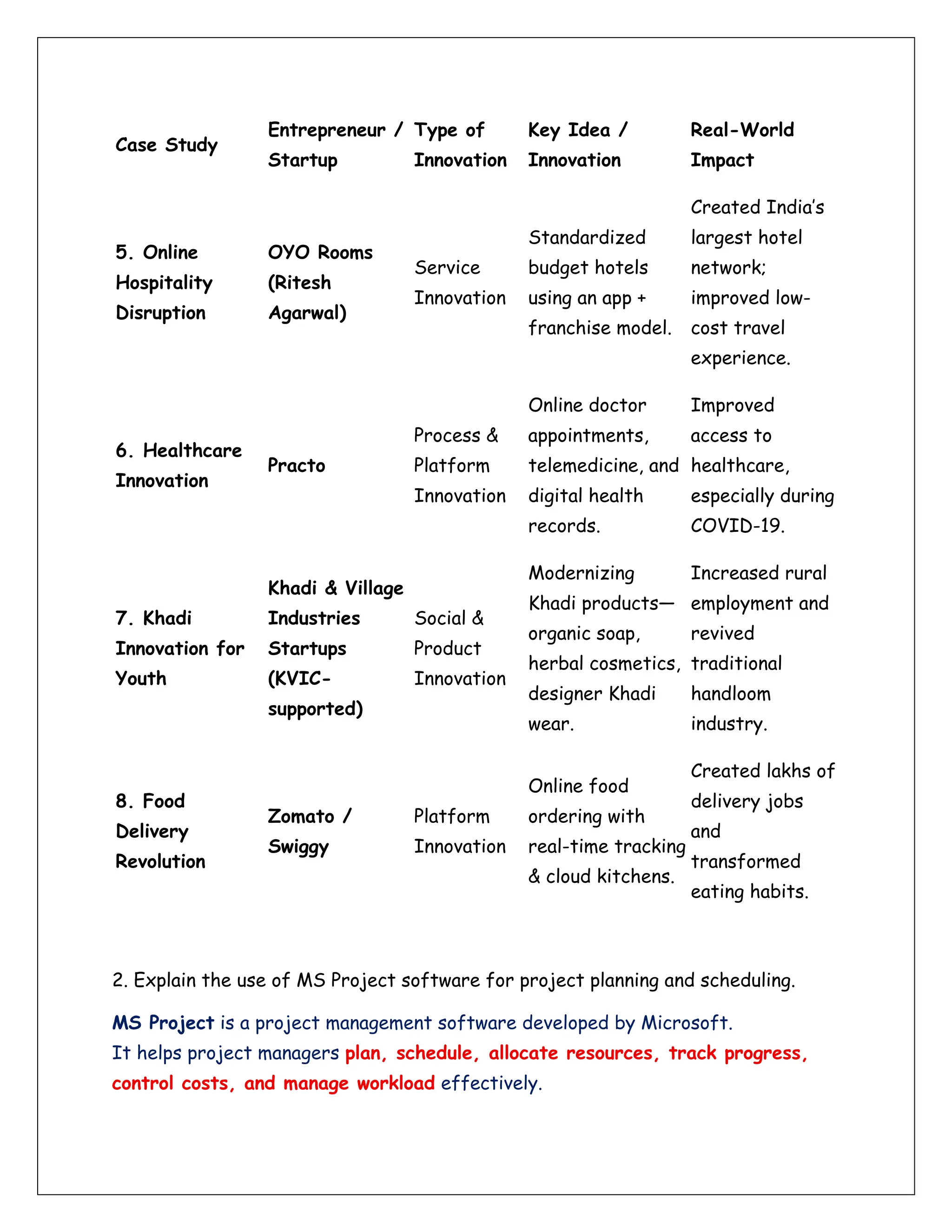
  • 70.
    • Use ofscarce natural resources 2. Social Benefits These are positive outcomes for society: • Employment and income generation • Better infrastructure • Time savings • Improved quality of life • Environmental improvements • Economic development 3. Purpose of SCBA • Helps the government allocate money to socially useful projects • Ensures long-term benefits outweigh short-term costs • Used mainly in public sector projects like roads, hospitals, schools, and metro rails Real-World Example (Government School Project) Government Building a New School in a Rural Area Social Benefits: • Free and quality education for children • Increase in literacy rate • Employment for teachers and staff • Reduced travel distance and improved safety for children • Long-term economic development due to educated youth Social Costs: • Construction cost for buildings/labs • Use of land which could be for other purposes • Temporary noise and dust during construction Even though there are some costs, the benefits to society (education, jobs, literacy) are far greater. Thus, SCBA shows the project is socially valuable and should be approved.
  • 71.
    Unit 10: ProjectPlanning 1. Explain the importance of project planning. 1. Provides Clear Direction Project planning defines goals, tasks, and responsibilities, ensuring everyone knows what to do and how to do it. 2. Improves Time Management It creates schedules and deadlines, helping the project finish on time and avoiding unnecessary delays. 3. Ensures Efficient Resource Allocation Resources like manpower, money, materials, and machines are used wisely without wastage. 4. Helps in Budget Control Planning estimates the total cost accurately, preventing overspending and financial problems. 5. Reduces Risks and Uncertainty Possible risks are identified early, and backup plans are created, reducing chances of project failure. 6. Enhances Coordination and Communication A clear plan improves communication between team members, departments, suppliers, and clients. 7. Improves Quality of Work With proper planning, quality standards are defined, monitored, and maintained throughout the project. 8. Helps Monitor and Control Progress Project managers can track progress, compare actual work with plans, and take corrective actions. 9. Increases Customer and Stakeholder Satisfaction When projects are delivered on time, within budget, and with good quality, stakeholders remain satisfied. 10. Ensures Successful Project Completion
  • 72.
    Overall, planning increasesthe chances of completing the project smoothly and achieving the desired goals. 2. Describe the steps of project planning. Step Explanation (Short & Clear) 1. Define Project Objectives Clearly state what the project aims to achieve (goals, scope, deliverables, success criteria). 2. Identify Project Activities Break the project into smaller tasks and activities needed to complete the work. 3. Develop Work Breakdown Structure (WBS) Organize activities into logical groups to understand the structure and order of work. 4. Estimate Time & Resources Calculate time required for each activity and identify manpower, materials, machines, and tools needed. 5. Prepare Project Schedule Arrange tasks in sequence using Gantt charts or timelines and set deadlines. 6. Estimate Project Cost Prepare the budget by estimating costs for materials, labour, equipment, and contingencies. 7. Risk Identification & Planning Identify possible risks (delay, shortage, cost increase) and create mitigation plans. 8. Communication & Coordination Plan Decide how information will flow between team members, clients, suppliers, etc. 9. Prepare Resource Allocation Plan Assign specific tasks to team members and allocate materials/equipment properly.
  • 73.
    Step Explanation (Short& Clear) 10. Create the Final Project Plan Document Combine all schedules, budgets, risks, and resources into a formal project plan ready for execution. 3. What is Project Scope and how is it defined? Meaning of Project Scope (Exam-Ready Definition) Project Scope refers to the exact boundaries of a project — what the project will include and what it will not include. It defines the objectives, deliverables, tasks, resources, timelines, and expected outcomes of the project. In simple words: 👉 Project Scope = What work must be done + what results must be delivered. Importance of Project Scope • Avoids confusion and misunderstandings • Helps in accurate planning and budgeting • Prevents “scope creep” (unwanted changes) • Ensures everyone knows their responsibilities 4. Explain Work Breakdown Structure (WBS) and Organization Breakdown Structure (OBS). 1. Work Breakdown Structure (WBS) Definition A Work Breakdown Structure (WBS) is a hierarchical breakdown of the entire project into smaller, manageable tasks. It shows what work needs to be done. Features • Decomposes project into sub-tasks • Helps in planning, scheduling, budgeting
  • 74.
    • Gives clarityabout all activities • Ensures no important task is missed Example (School Website Project) • Level 1: School Website o Level 2: Design o Level 2: Development o Level 2: Testing o Level 2: Deployment This shows work-based classification. 2. Organization Breakdown Structure (OBS) Definition An Organization Breakdown Structure (OBS) shows the roles, responsibilities, and reporting hierarchy of people involved in the project. It shows who will do the work. Features • Represents project team structure • Shows reporting lines • Helps assign responsibility for tasks • Supports communication and coordination Example (School Website Project) • Project Manager o Web Designer o Developer o Tester o Content Writer This shows people-based classification. Difference Between WBS and OBS (Chart)
  • 75.
    Basis WBS (Work Breakdown Structure) OBS (Organization BreakdownStructure) Meaning Breaks project into tasks (WHAT to do). Shows team structure and responsibilities (WHO will do). Focus Activities, tasks, deliverables People, teams, reporting hierarchy Purpose Helps plan and manage work Helps assign responsibility for work Structure Task-oriented, hierarchical Organization-oriented, hierarchical Use Scheduling, budgeting, progress tracking Defining roles, accountability, communication Example Design → Develop → Test → Deploy Designer → Developer → Tester → Manager Real-Life Example (Construction Project) WBS: • Building Construction o Foundation Work o Wall Construction o Electrical Work o Painting o Final Finishing OBS: • Project Manager o Civil Engineer o Electrical Engineer
  • 76.
    o Labour Supervisor oSafety Officer WBS = work hierarchy OBS = responsibility hierarchy 6. Discuss the concept of Phased Project Planning. Exam-Ready Definition Phased Project Planning refers to dividing the entire project into separate, well- defined phases, where each phase is planned, reviewed, and approved before moving to the next stage. This ensures better control, reduces risks, and improves the success rate of the project. In simple words: You plan the project step-by-step instead of planning everything at once. Key Features (Pointwise) 1. Project Divided into Phases The project is broken into multiple stages such as initiation, planning, execution, monitoring, and closure. 2. Better Control & Monitoring Each phase has specific outcomes (deliverables) which must be checked before the project moves forward. 3. Reduces Risks Problems are identified early in each phase, preventing major failures later. 4. Easier Decision Making Managers can decide whether to continue, change, or stop the project after each phase (“Go/No-Go decision”).
  • 77.
    5. Improves ResourceAllocation Resources, money, and manpower are allocated phase-wise, avoiding wastage. 6. Ensures Quality Each phase ends with review and quality checks, improving overall project results. 7. Enhances Communication Since phases are clearly defined, teamwork, reporting, and communication become smoother. Real-Life Example (Easy for Exams) Example – Building a Shopping Mall 1. Phase 1: Concept Planning Demand study, selecting location, basic design. 2. Phase 2: Detailed Planning Architectural design, cost estimation, legal approvals. 3. Phase 3: Construction Phase Foundation → structure → finishing. 4. Phase 4: Interior & Branding Shops layout, lighting, branding, aesthetic work. 5. Phase 5: Operations & Launch Leasing shops, opening ceremony, full functioning. Each phase is reviewed and approved before moving ahead.
  • 78.
    Unit 11: ProjectScheduling and Costing 1. Explain the use of Gantt charts in project scheduling. A Gantt chart is a visual project scheduling tool that shows the timeline of activities in the form of a horizontal bar chart. It helps project managers plan, coordinate, and track tasks over time. Uses of Gantt Charts in Project Scheduling (Pointwise) 1. Visual Timeline of Tasks A Gantt chart shows when each task starts and ends, making the entire project timeline easy to understand. 2. Shows Task Duration Each bar represents how long a task will take, helping estimate total project time accurately. 3. Helps Identify Task Dependencies Some tasks depend on others. Gantt charts clearly show which tasks must be completed first and which can run parallel. 4. Improves Work Coordination Team members know exactly what they need to do and when, improving coordination and teamwork. 5. Tracks Project Progress Project managers can compare planned vs actual progress, identify delays, and take corrective actions. 6. Resource Allocation It helps determine which resources (people, machines, materials) are needed at each stage.
  • 79.
    7. Prevents Overlappingor Missing Tasks By visualizing the entire schedule, Gantt charts ensure no task is forgotten or unnecessarily delayed. Real-Life Example (Easy for Exams) Example – Event Management (College Fest) A Gantt chart helps schedule: • Booking venue • Stage setup • Decorations • Sound check • Guest invitations • Event rehearsal • Final program Each task is shown with a start and end date, ensuring the event happens smoothly without delays. Funny Analogy (Easy Memory Trick) A Gantt chart is like a timetable for a wedding: • Mehendi → Sangeet → Haldi → Wedding • Saree shopping happens parallel to invitation printing • Groom entrance starts only after baraat arrival Just like that, Gantt charts organize events so nothing gets mixed up!
  • 80.
    2. Describe CPM(Critical Path Method) and PERT (Program Evaluation and Review Technique) CPM and PERT are two important network techniques used in project planning, scheduling, and control. They help managers complete projects on time by analyzing tasks, timelines, and dependencies. 1. CPM (Critical Path Method) Meaning CPM is a project scheduling technique used to identify the longest path of activities in a project called the critical path. These activities cannot be delayed, or else the entire project will be delayed. Key Features (Pointwise) • Used for projects with predictable and fixed activities (deterministic). • Time required for each activity is known and certain. • Identifies critical activities that affect the total project time. • Shows slack/float time for non-critical activities. • Helps in scheduling, monitoring, and controlling large construction/manufacturing projects. Example Building a house: foundation → walls → roof → wiring → painting. If roofing is delayed, the whole project gets delayed. That is a critical activity. 2. PERT (Program Evaluation and Review Technique) Meaning
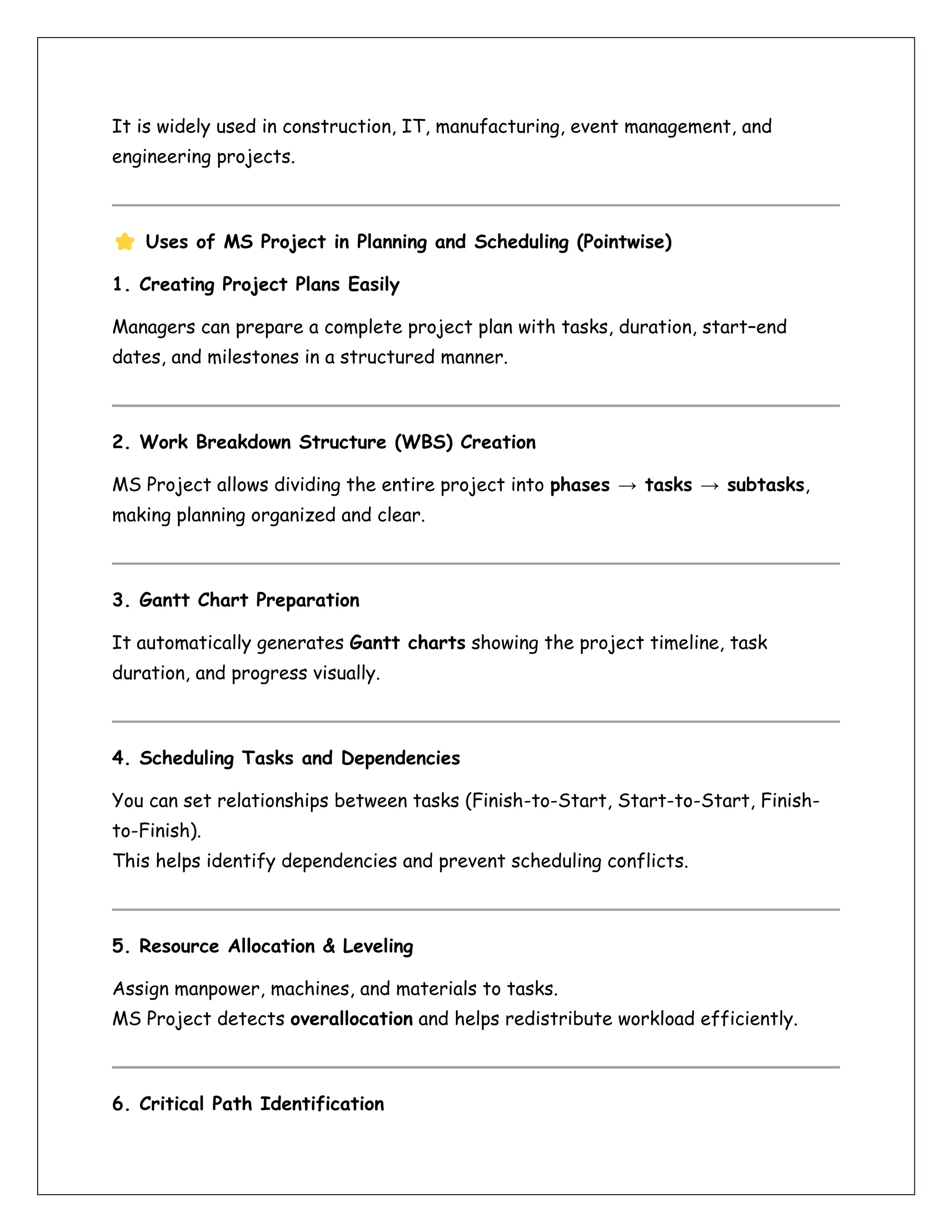
  • 81.
    PERT is aplanning and scheduling technique used for projects where activity times are uncertain. It uses three time estimates — Optimistic, Pessimistic, and Most Likely — to calculate expected time. Key Features (Pointwise) • Suitable for research, development, and new product projects (uncertain tasks). • Uses probabilistic time estimates. • Helps in predicting project completion time using statistics. • Useful when activities are not repetitive and time estimation is difficult. • Focuses more on time, less on cost. Example Developing a new mobile app: coding, UI design, testing—each stage has variable time due to uncertainty. PERT helps estimate total project completion time. Difference Between CPM and PERT (Easy Chart) Basis CPM PERT Nature of Activities Predictable, repetitive (construction, manufacturing) Uncertain, research-oriented (R&D, innovation) Time Estimates One fixed time estimate Three time estimates (O, M, P) Focus Time + Cost Mostly Time Use Identifying critical activities & reducing project time Estimating project duration under uncertainty
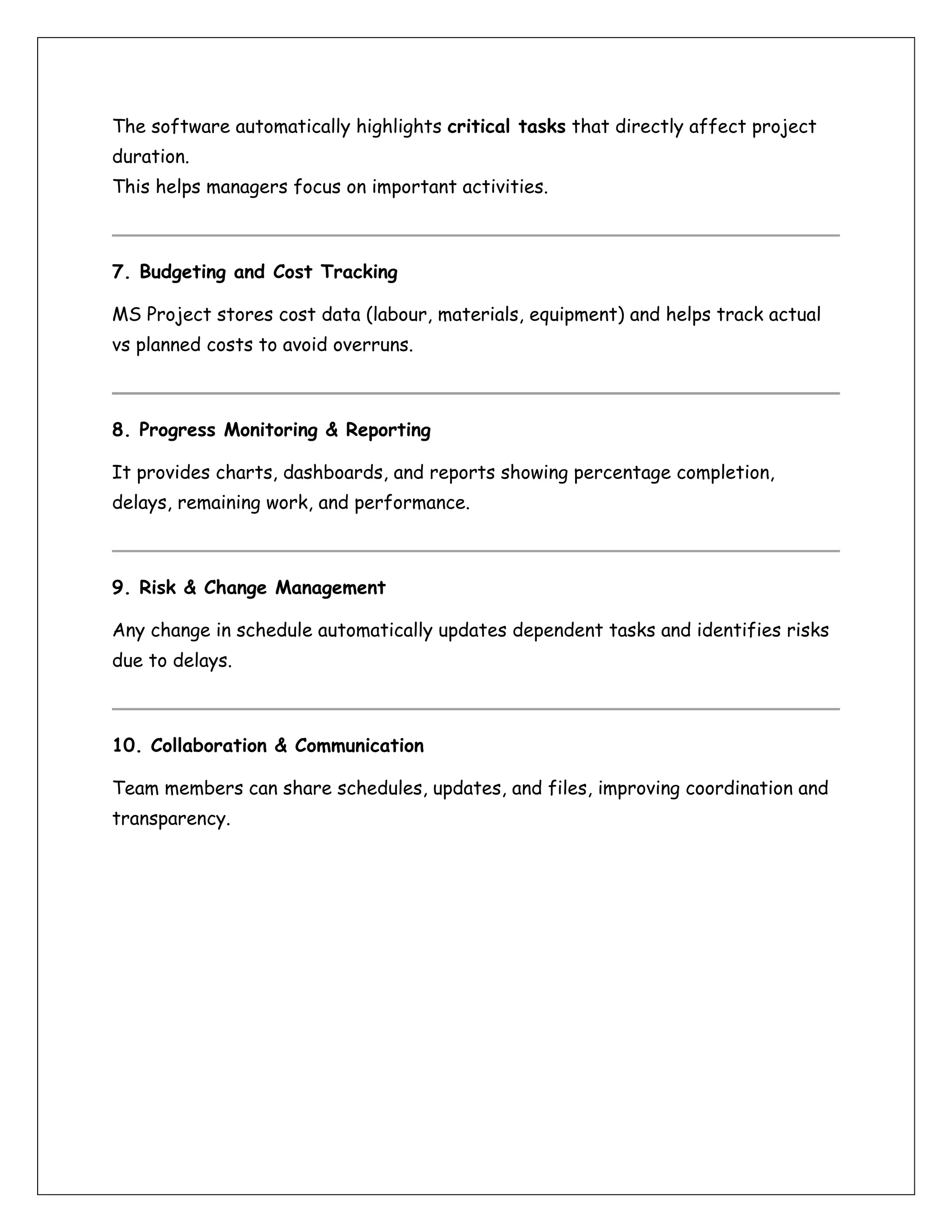
  • 82.
    Basis CPM PERT TypeDeterministic Probabilistic 3. How is the critical path identified and why is it significant? 📌 A. How the Critical Path Is Identified (Step-by-Step) 1. List All Project Activities Write all tasks involved in the project along with their durations. 2. Determine Activity Sequence Identify which tasks depend on others (predecessors and successors). 3. Draw a Network Diagram Create a PERT/CPM network showing the logical order of activities. 4. Calculate Earliest Start (ES) and Earliest Finish (EF) Forward pass calculation → earliest time each activity can start and finish. 5. Calculate Latest Start (LS) and Latest Finish (LF) Backward pass calculation → latest time each activity can start and finish without delaying the project. 6. Find Slack/Float for Each Activity Slack = LS – ES (or) LF – EF • Slack = 0 → Critical Activity • Slack > 0 → Non-Critical Activity 7. Identify the Longest Path The path with zero slack and highest total duration is the Critical Path. This path determines the minimum time required to complete the project.
  • 83.
    B. Why theCritical Path Is Significant (Pointwise) 1. Determines Total Project Duration Project cannot finish earlier than the time of the critical path. 2. Identifies Activities That Cannot Be Delayed Any delay in a critical activity results in a delay of the entire project. 3. Helps in Prioritizing Resources Managers allot more manpower, materials, and funds to critical tasks. 4. Useful for Monitoring and Control Managers closely track critical activities to avoid delays. 5. Supports Project Acceleration (Crashing) If the project must finish earlier, tasks on the critical path are shortened first. 6. Improves Decision Making Helps managers understand where risks are highest and where attention is needed. Real-Life Example (Easy for Exams) Example – Building a House Activities: 1. Foundation (10 days) 2. Walls (15 days) 3. Roof (8 days) 4. Wiring (5 days) 5. Painting (7 days)
  • 84.
    The path: Foundation →Walls → Roof → Painting has zero slack and the longest duration → this becomes the critical path. 4. Explain the calculation of floats and slacks in project management. 5. What is crashing in project scheduling? Exam-Ready Definition Crashing is a project scheduling technique used to reduce the total project duration by adding extra resources (like manpower, machines, overtime, or money) to critical path activities. In simple words: 👉 Crashing = finishing the project faster by spending more resources. Why Crashing Is Done? • To meet deadlines • To avoid penalties • To deliver project sooner for competitive advantage • To adjust for delays in earlier stages • To complete urgent client orders Key Features of Crashing (Pointwise) 1. Applied only to Critical Path Activities Shortens the activities that directly affect project completion time.
  • 85.
    2. Involves AdditionalCost More workers, overtime, faster machinery → cost increases. 3. Reduces Project Duration Lowers the total time by compressing task duration. 4. Done Through Cost–Time Trade-Off Manager compares additional cost vs. time saved to find the optimal solution. Real-World Example (Easy for Exams) Example – Road Construction Project A highway project is delayed due to heavy rains. The government must complete it before a festival season. To crash the project, the contractor: • hires 40 additional workers • uses two more bulldozers • runs night shifts • works on weekends Result → The project that needed 30 days gets completed in 20 days, but with higher cost. Time reduced, cost increased: classic crashing. Funny Analogy (Easy Memory Trick) Crashing is like studying the night before an exam: • You normally study 3 hours daily.
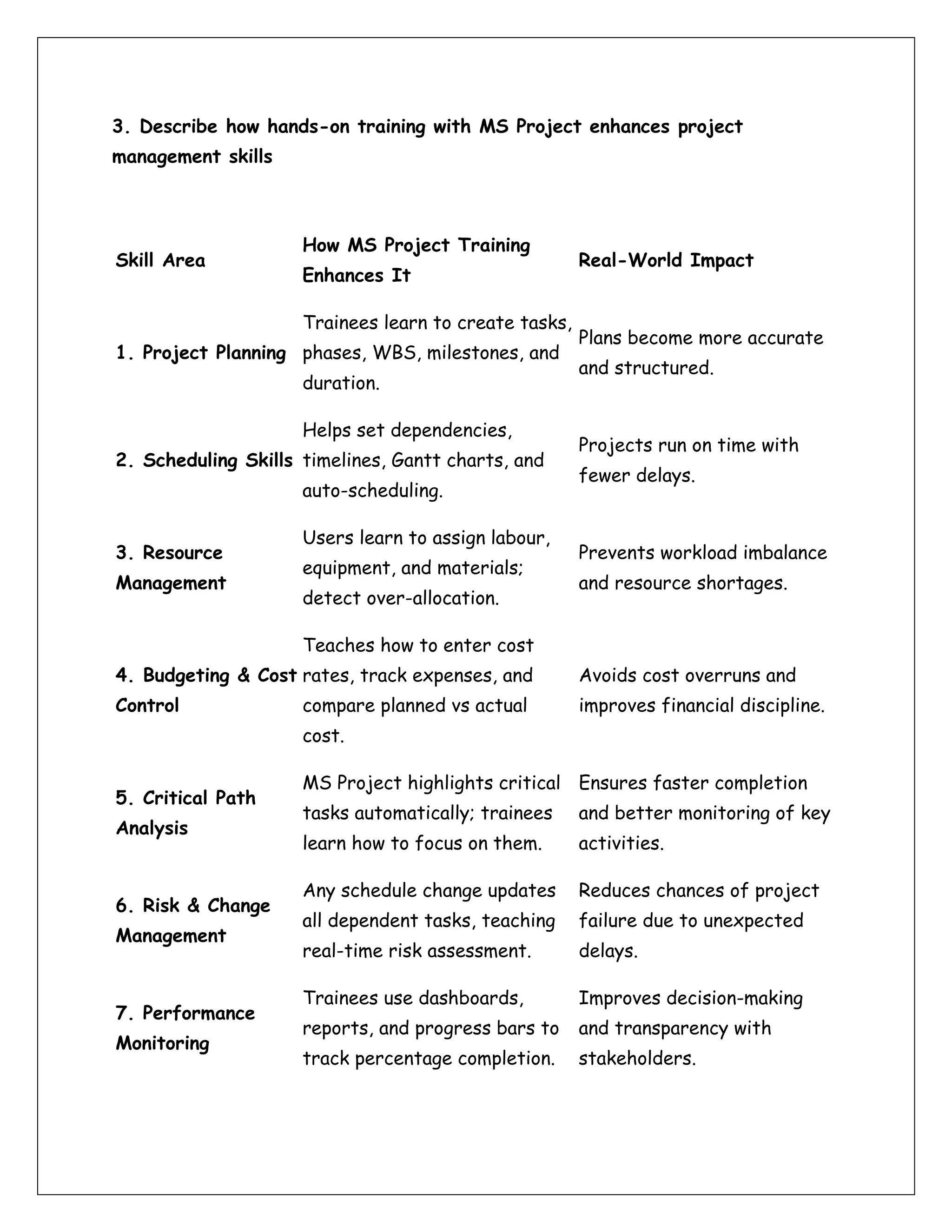
  • 86.
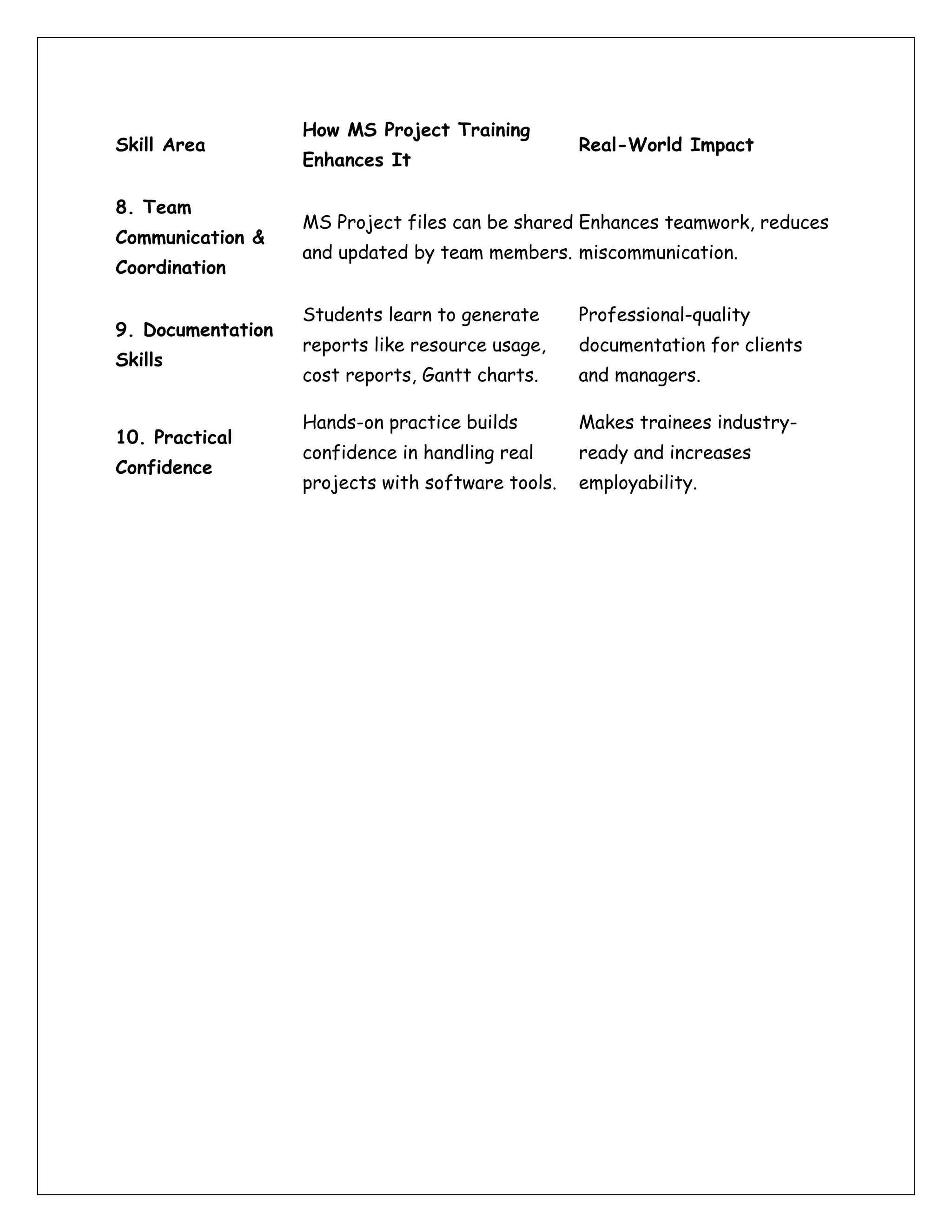
    • But whenyou realize exam is tomorrow, you add more resources → chai, coffee, snacks you pull an all-nighter, call a friend for help, and study double speed. You finish the syllabus faster, but your energy cost increases like crazy That’s exactly what crashing is! 6. Discuss time-cost trade-off analysis. Time–Cost Trade-Off Analysis is the process of studying the relationship between project duration and project cost. It helps managers decide whether reducing project time (by adding resources) is worth the extra cost. In simple words: 👉 If you want to finish a project faster, you must spend more. Time decreases → cost increases. This analysis helps find the optimal balance between minimum project time and minimum project cost. 7. Explain project cost reduction methods. Real-Life Example (Easy for Exams) Example – Apartment Construction Project A builder reduces cost by: • buying cement and steel in bulk at discount • using ready-mix concrete to save labour cost • using project management software for scheduling
  • 87.
    • outsourcing paintingwork to a subcontractor • preventing rework with regular quality checks Total construction cost is reduced by 10–15%. Funny Analogy (Easy Memory Trick) Cost reduction is like saving pocket money: • You avoid unnecessary expenses (junk food ) • You buy things in offers • You use electricity carefully at home • You plan your month wisely • Project cost reduction refers to techniques used to reduce unnecessary expenses, improve efficiency, and complete the project within or below budget, without compromising quality. • Here are the main cost-saving methods:
  • 88.
    Unit 12: ProjectMonitoring and Control 1. What is the role of a project manager in project execution? Role / Responsibility Explanation (Short & Clear) 1. Planning and Scheduling Prepares detailed schedules, assigns tasks, and ensures activities start and finish on time. 2. Resource Allocation Distributes manpower, materials, machines, and budget effectively to avoid wastage. 3. Team Leadership Motivates the team, resolves conflicts, and ensures smooth coordination among members. 4. Communication Management Ensures proper communication between team, clients, vendors, and stakeholders. 5. Monitoring and Controlling Progress Tracks actual progress vs planned schedule using reports, charts, and meetings. 6. Risk Management Identifies potential risks and takes preventive/corrective actions to avoid delays. 7. Quality Assurance Ensures activities meet required standards and quality specifications. 8. Problem Solving & Decision Making Handles unexpected issues, makes quick decisions, and keeps the project on track. 9. Cost Control Monitors expenses, prevents budget overrun, and ensures cost-efficient operations. 10. Documentation & Reporting Prepares progress reports, maintains records, and updates stakeholders regularly.
  • 89.
    2. Explain theuse of Management Information Systems (MIS) in project monitoring. A Management Information System (MIS) is a computer-based system that collects, stores, and processes project data to help managers monitor progress, make decisions, and control project activities effectively. It ensures that the project stays on schedule, within budget, and meets quality standards. Uses of MIS in Project Monitoring (Pointwise) 1. Tracks Project Progress in Real Time MIS shows updated information on task completion, deadlines, delays, and work status using dashboards and charts. 2. Helps in Budget and Cost Control Managers can monitor actual vs planned expenses. MIS alerts when costs exceed the budget, preventing financial overruns. 3. Improves Decision Making MIS provides accurate data (reports, graphs) that help managers make quick, data-driven decisions. 4. Enhances Communication and Coordination Team members and stakeholders get instant updates, reducing confusion and miscommunication. 5. Identifies Risks and Delays Early MIS highlights bottlenecks, slow tasks, and potential risks so corrective action can be taken on time. 6. Stores and Organizes Project Documents All schedules, reports, designs, approvals, and changes are stored in one system for easy access.
  • 90.
    7. Provides PerformanceReports MIS generates weekly/monthly reports showing productivity, quality, and work efficiency. 8. Supports Quality Control MIS monitors quality parameters and highlights deviations from standards. Real-Life Example (Easy for Exams) Example – Construction Project Using MIS A builder uses MIS to track: • progress of foundation, walls, wiring, painting • actual daily labour cost vs planned cost • material availability • delays caused by weather or supplier issues MIS sends alerts when: • cement stock is low • a task is behind schedule • cost crosses the approved limit This helps the project finish on time and within budget. Funny Analogy (Memory Trick) MIS in project monitoring is like your Google Classroom or college portal: • You see assignments (tasks) • See deadlines (schedule) • Get marks and feedback (progress report)
  • 91.
    • Get alertsfor due work (risk warning) Exactly how project managers monitor every task! 3. What is a project audit and why is it necessary? A Project Audit is a systematic and independent examination of a project to evaluate its progress, performance, processes, and results. It checks whether the project is being carried out as per the plan, budget, timeline, and quality standards. In simple words: Project audit = Checking if the project is on the right track and being managed properly. Why a Project Audit Is Necessary: 1. Ensures Project Progress Is on Track Audit compares planned vs actual performance and identifies delays or deviations. 2. Helps Control Costs and Budget It checks whether money is being spent correctly and highlights unnecessary expenses. 3. Identifies Problems Early Audits reveal issues in scheduling, quality, team performance, or resources before they become big failures. 4. Improves Quality and Standards Ensures all tasks follow required quality norms, safety rules, and technical specifications. 5. Enhances Accountability Team members become more responsible as their work is periodically reviewed.
  • 92.
    6. Provides Transparencyfor Stakeholders Clients, sponsors, and management get clear, unbiased information about project status. 7. Supports Better Decision Making Audit findings help managers take corrective actions—reschedule work, allocate more resources, or change strategies. 8. Evaluates Final Project Success A final project audit checks whether objectives were achieved and documents “lessons learned” for future projects. Real-Life Example (Easy for Exams) Example – Government Road Construction Project The Public Works Department (PWD) conducts an audit: • checks if the contractor used proper quality materials • verifies if expenses match the approved budget • examines delays due to labour or weather • ensures safety and environmental compliance Based on audit results, the government may approve payments, demand corrections, or impose penalties. Funny Analogy (Easy Memory Trick) A project audit is like your teacher checking your assignment: • Did you follow instructions? • Did you finish on time? • Did you copy from someone else?
  • 93.
    • What mistakesto fix next time? Exactly the same way, a project audit checks the project’s discipline, quality, and progress!
  • 94.
    Unit 13: CaseStudies and Practical Training 1. Discuss case studies related to entrepreneurship and innovation. Case Study Entrepreneur / Startup Type of Innovation Key Idea / Innovation Real-World Impact 1. Digital Payments Revolution Paytm (Vijay Shekhar Sharma) Business Model Innovation Created a mobile wallet & QR payment system used nationwide. Enabled cashless economy; millions of small shops started using QR payments. 2. Affordable Electric Vehicles Ola Electric (Bhavish Aggarwal) Product & Technology Innovation Designed affordable electric scooters with fast charging tech. Boosted India’s EV adoption; reduced fuel cost for commuters. 3. Rural Supply Chain Innovation Ninjacart Supply Chain Innovation Directly connects farmers to retailers via a tech-based platform. Farmers earn more; wastage reduced; fresh produce delivered faster. 4. EdTech Transformation Byju’s (Byju Raveendran) Digital Learning Innovation App-based video learning with personalized teaching modules. Millions of students got quality education using mobile phones.
  • 95.
    Case Study Entrepreneur / Startup Typeof Innovation Key Idea / Innovation Real-World Impact 5. Online Hospitality Disruption OYO Rooms (Ritesh Agarwal) Service Innovation Standardized budget hotels using an app + franchise model. Created India’s largest hotel network; improved low- cost travel experience. 6. Healthcare Innovation Practo Process & Platform Innovation Online doctor appointments, telemedicine, and digital health records. Improved access to healthcare, especially during COVID-19. 7. Khadi Innovation for Youth Khadi & Village Industries Startups (KVIC- supported) Social & Product Innovation Modernizing Khadi products— organic soap, herbal cosmetics, designer Khadi wear. Increased rural employment and revived traditional handloom industry. 8. Food Delivery Revolution Zomato / Swiggy Platform Innovation Online food ordering with real-time tracking & cloud kitchens. Created lakhs of delivery jobs and transformed eating habits. 2. Explain the use of MS Project software for project planning and scheduling. MS Project is a project management software developed by Microsoft. It helps project managers plan, schedule, allocate resources, track progress, control costs, and manage workload effectively.
  • 96.
    It is widelyused in construction, IT, manufacturing, event management, and engineering projects. Uses of MS Project in Planning and Scheduling (Pointwise) 1. Creating Project Plans Easily Managers can prepare a complete project plan with tasks, duration, start–end dates, and milestones in a structured manner. 2. Work Breakdown Structure (WBS) Creation MS Project allows dividing the entire project into phases → tasks → subtasks, making planning organized and clear. 3. Gantt Chart Preparation It automatically generates Gantt charts showing the project timeline, task duration, and progress visually. 4. Scheduling Tasks and Dependencies You can set relationships between tasks (Finish-to-Start, Start-to-Start, Finish- to-Finish). This helps identify dependencies and prevent scheduling conflicts. 5. Resource Allocation & Leveling Assign manpower, machines, and materials to tasks. MS Project detects overallocation and helps redistribute workload efficiently. 6. Critical Path Identification
  • 97.
    The software automaticallyhighlights critical tasks that directly affect project duration. This helps managers focus on important activities. 7. Budgeting and Cost Tracking MS Project stores cost data (labour, materials, equipment) and helps track actual vs planned costs to avoid overruns. 8. Progress Monitoring & Reporting It provides charts, dashboards, and reports showing percentage completion, delays, remaining work, and performance. 9. Risk & Change Management Any change in schedule automatically updates dependent tasks and identifies risks due to delays. 10. Collaboration & Communication Team members can share schedules, updates, and files, improving coordination and transparency.
  • 98.
    3. Describe howhands-on training with MS Project enhances project management skills Skill Area How MS Project Training Enhances It Real-World Impact 1. Project Planning Trainees learn to create tasks, phases, WBS, milestones, and duration. Plans become more accurate and structured. 2. Scheduling Skills Helps set dependencies, timelines, Gantt charts, and auto-scheduling. Projects run on time with fewer delays. 3. Resource Management Users learn to assign labour, equipment, and materials; detect over-allocation. Prevents workload imbalance and resource shortages. 4. Budgeting & Cost Control Teaches how to enter cost rates, track expenses, and compare planned vs actual cost. Avoids cost overruns and improves financial discipline. 5. Critical Path Analysis MS Project highlights critical tasks automatically; trainees learn how to focus on them. Ensures faster completion and better monitoring of key activities. 6. Risk & Change Management Any schedule change updates all dependent tasks, teaching real-time risk assessment. Reduces chances of project failure due to unexpected delays. 7. Performance Monitoring Trainees use dashboards, reports, and progress bars to track percentage completion. Improves decision-making and transparency with stakeholders.
  • 99.
    Skill Area How MSProject Training Enhances It Real-World Impact 8. Team Communication & Coordination MS Project files can be shared and updated by team members. Enhances teamwork, reduces miscommunication. 9. Documentation Skills Students learn to generate reports like resource usage, cost reports, Gantt charts. Professional-quality documentation for clients and managers. 10. Practical Confidence Hands-on practice builds confidence in handling real projects with software tools. Makes trainees industry- ready and increases employability.