Weighted (Unequal) Moving
Average Method
Sundar B. N.
Assistant Professor
Methods of Moving Average
Equal Weight(Simple)Moving
Average Method
Weighted (unequal) Moving
Average Method
Weighted (Unequal) Moving Average Method
 The simple moving average method is not
generally recommended for measuring trend
although it can be useful for removing seasonal
variation.
 It may also not lie close to the latest values.
Therefore, the weighted (unequal) moving
averages method is used.
 In this method, instead of giving equal weights
to all values, unequal weights are given in such
a way that all the weights are positive and their
sum is equal to 1.
Formula
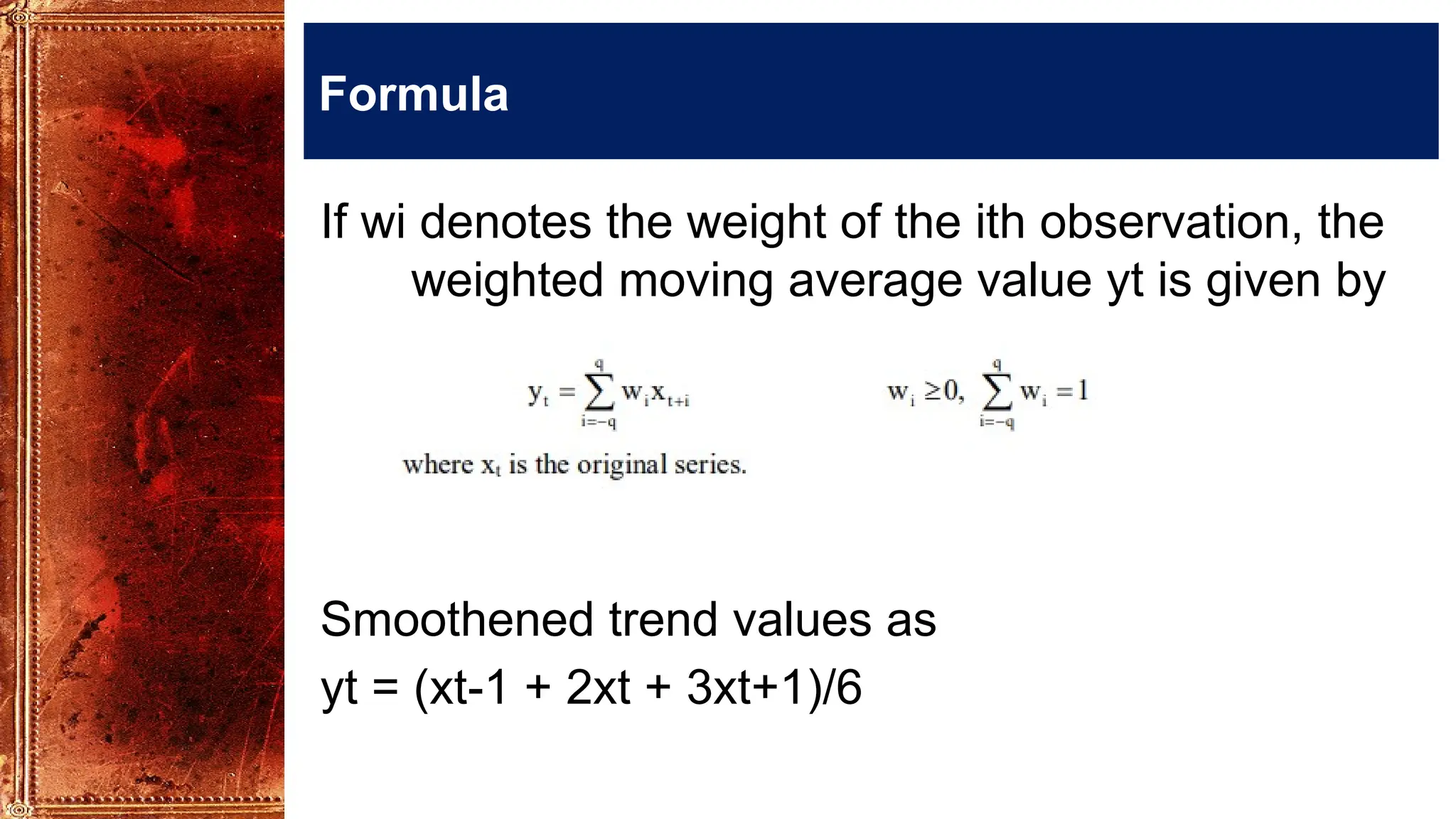
If wi denotes the weight of the ith observation, the
weighted moving average value yt is given by
Smoothened trend values as
yt = (xt-1 + 2xt + 3xt+1)/6
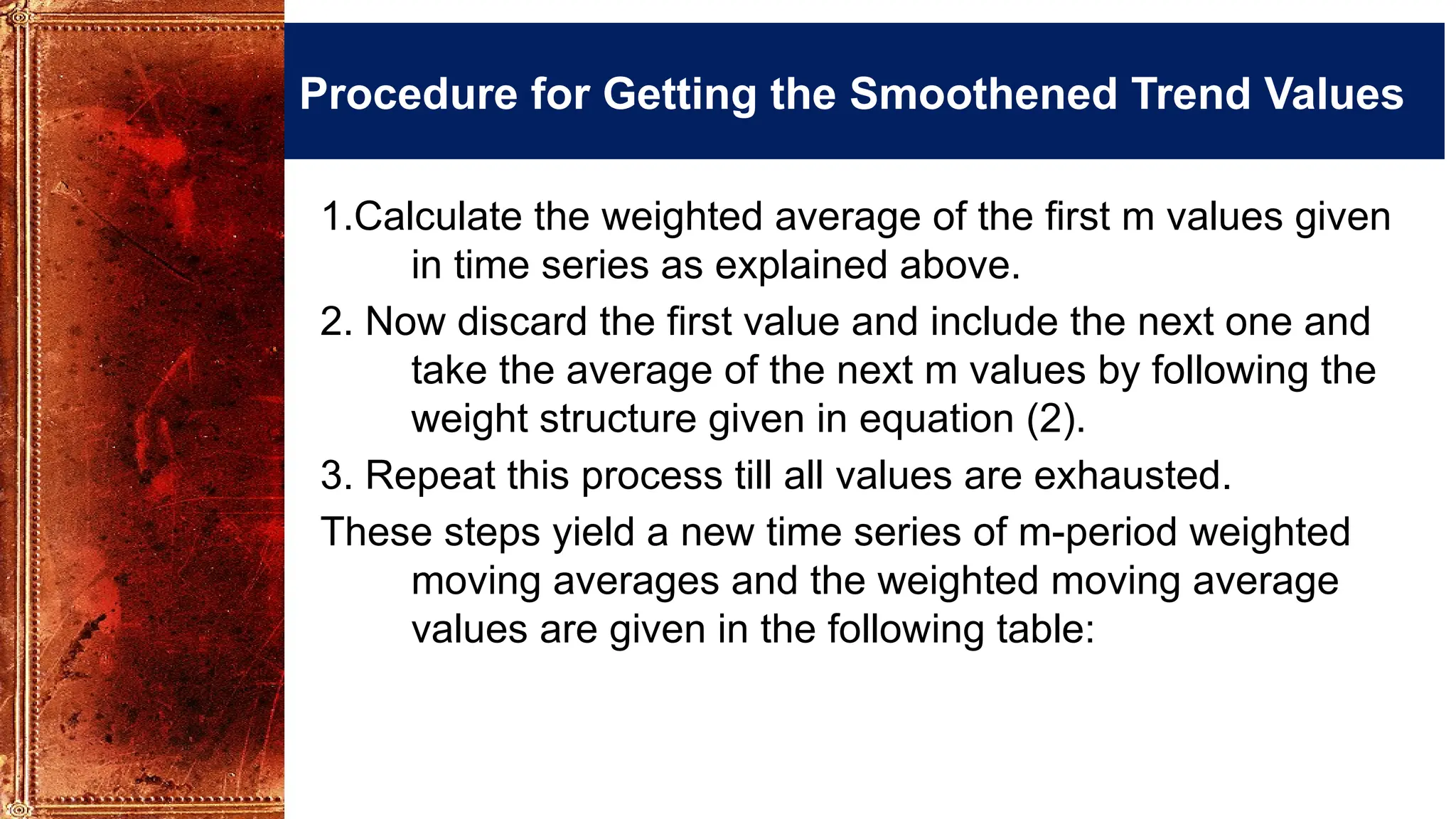
Procedure for Getting the Smoothened Trend Values
1.Calculate the weighted average of the first m values given
in time series as explained above.
2. Now discard the first value and include the next one and
take the average of the next m values by following the
weight structure given in equation (2).
3. Repeat this process till all values are exhausted.
These steps yield a new time series of m-period weighted
moving averages and the weighted moving average
values are given in the following table:
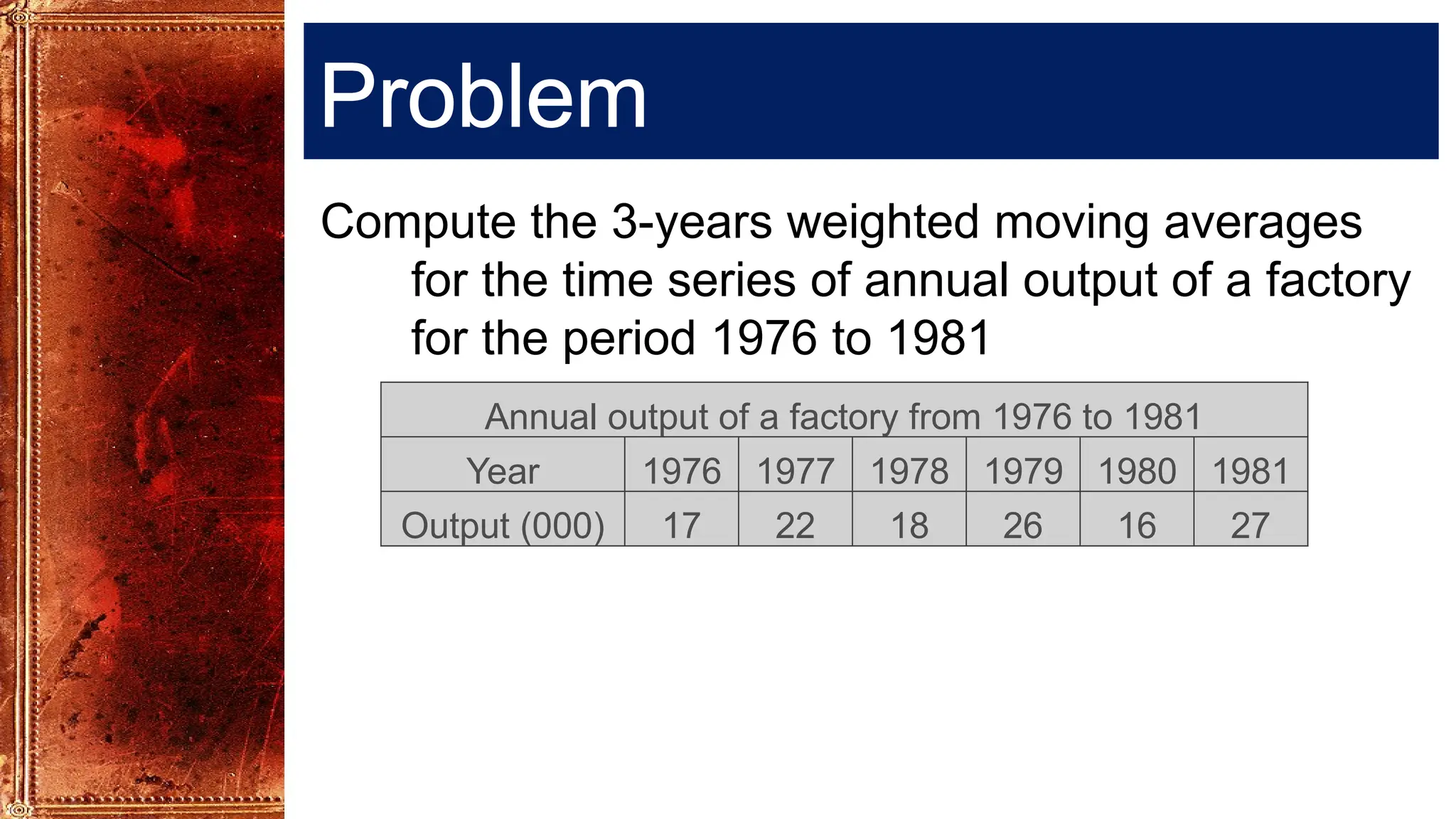
Problem
Compute the 3-years weighted moving averages
for the time series of annual output of a factory
for the period 1976 to 1981
Annual output of a factory from 1976 to 1981
Year 1976 1977 1978 1979 1980 1981
Output (000) 17 22 18 26 16 27
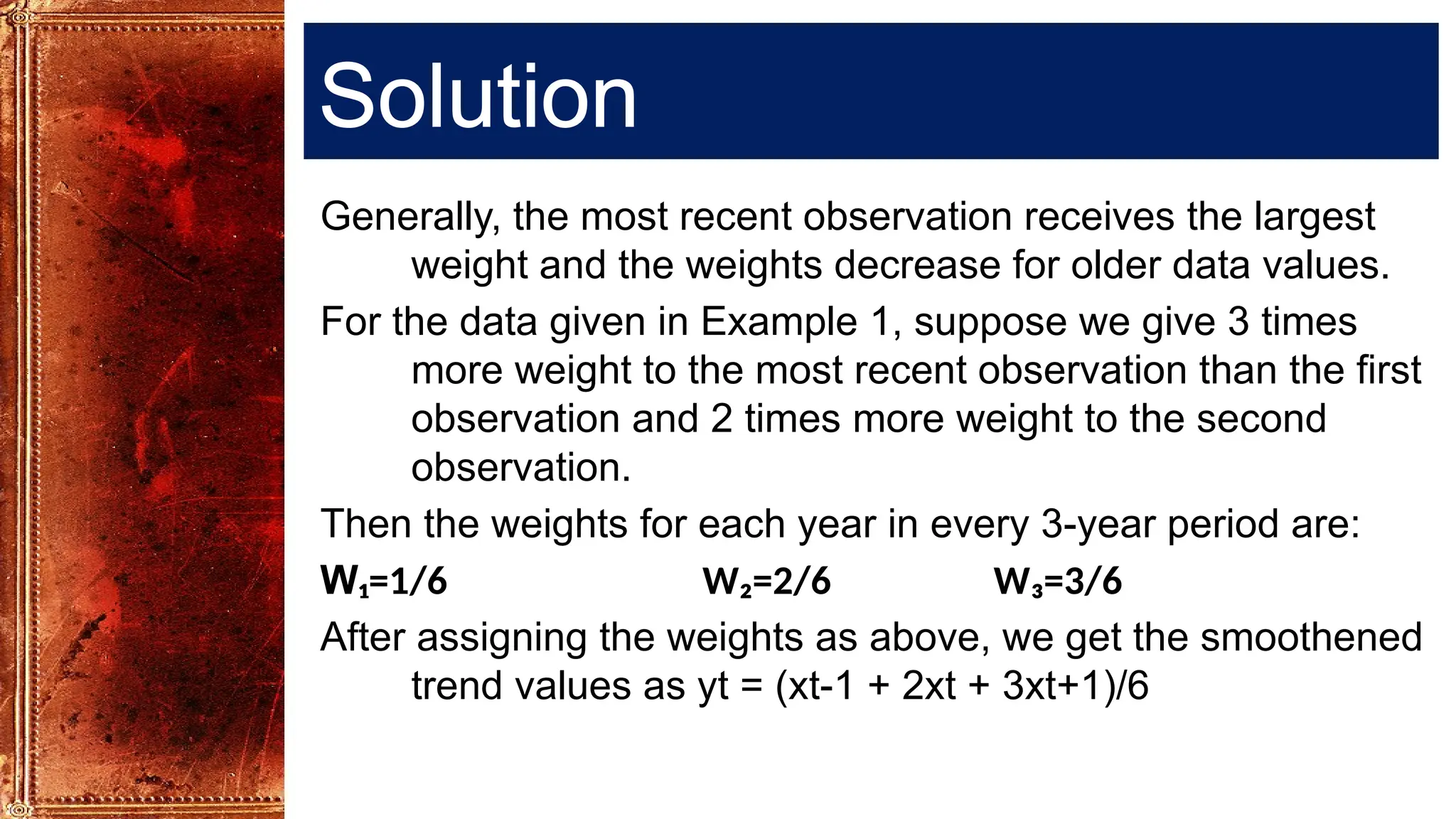
Solution
Generally, the most recent observation receives the largest
weight and the weights decrease for older data values.
For the data given in Example 1, suppose we give 3 times
more weight to the most recent observation than the first
observation and 2 times more weight to the second
observation.
Then the weights for each year in every 3-year period are:
W₁=1/6 W₂=2/6 W₃=3/6
After assigning the weights as above, we get the smoothened
trend values as yt = (xt-1 + 2xt + 3xt+1)/6
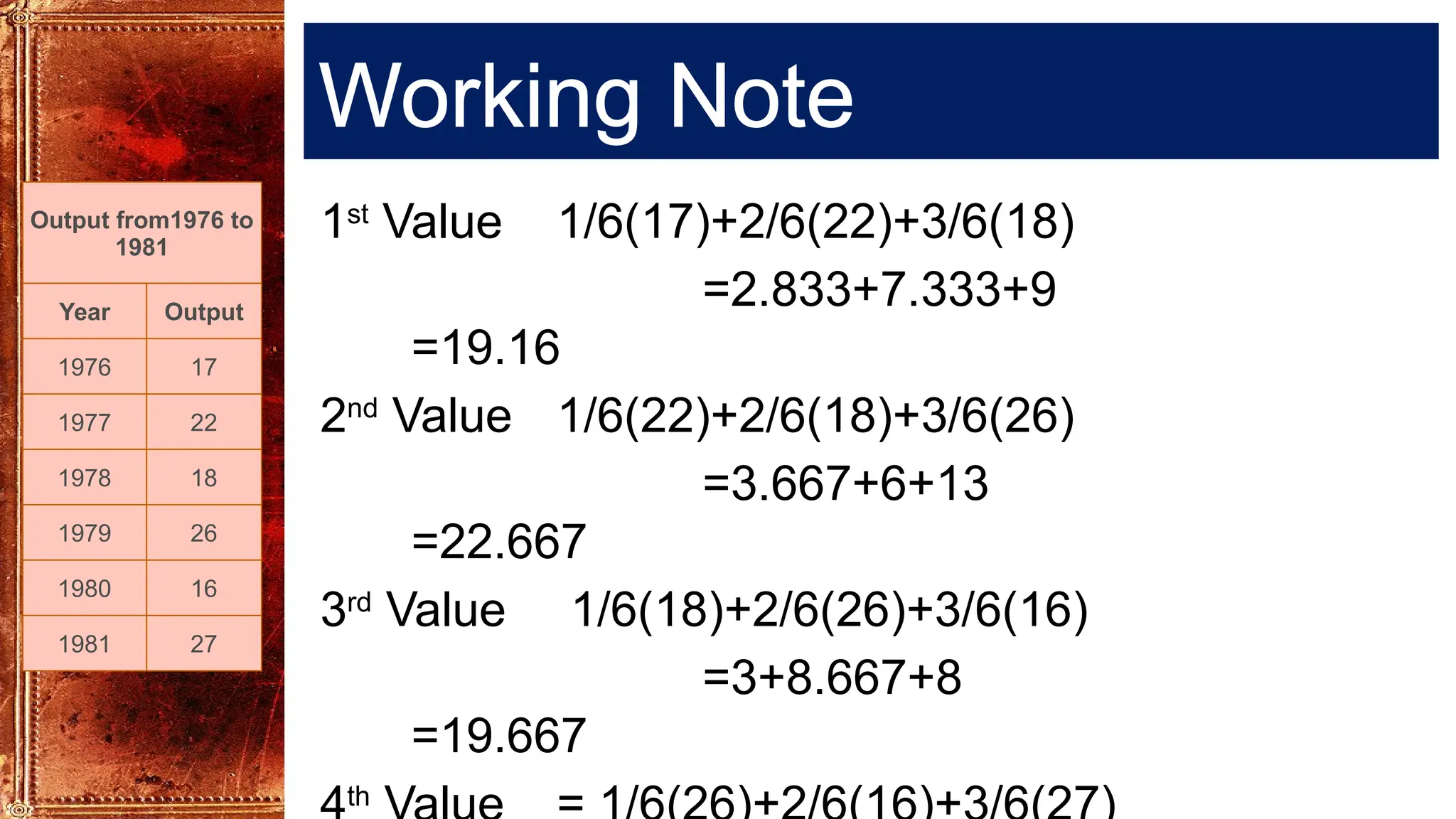
Working Note
1st
Value 1/6(17)+2/6(22)+3/6(18)
=2.833+7.333+9
=19.16
2nd
Value 1/6(22)+2/6(18)+3/6(26)
=3.667+6+13
=22.667
3rd
Value 1/6(18)+2/6(26)+3/6(16)
=3+8.667+8
=19.667
th
Output from1976 to
1981
Year Output
1976 17
1977 22
1978 18
1979 26
1980 16
1981 27
Working Note
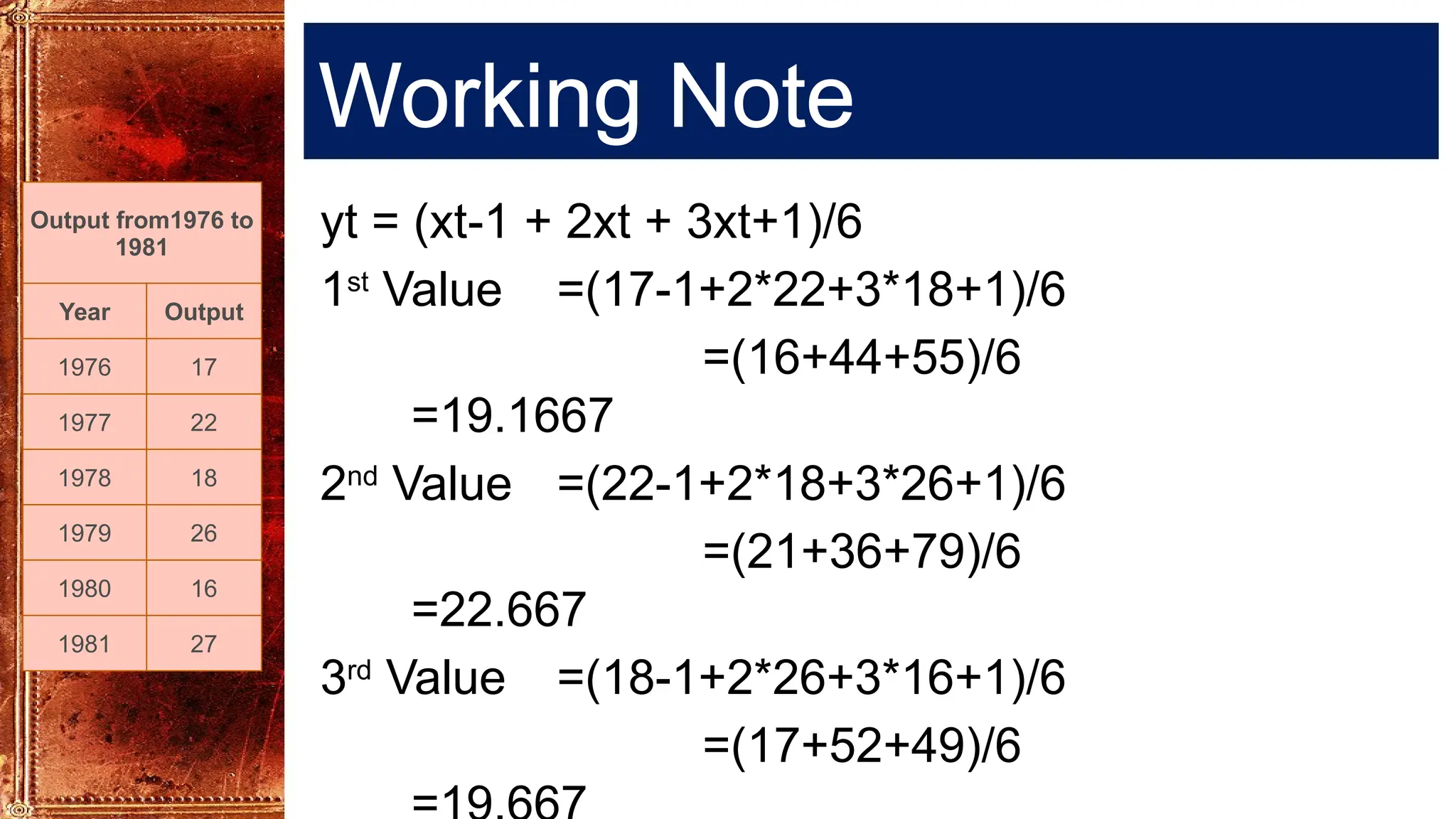
yt = (xt-1 + 2xt + 3xt+1)/6
1st
Value =(17-1+2*22+3*18+1)/6
=(16+44+55)/6
=19.1667
2nd
Value =(22-1+2*18+3*26+1)/6
=(21+36+79)/6
=22.667
3rd
Value =(18-1+2*26+3*16+1)/6
=(17+52+49)/6
Output from1976 to
1981
Year Output
1976 17
1977 22
1978 18
1979 26
1980 16
1981 27
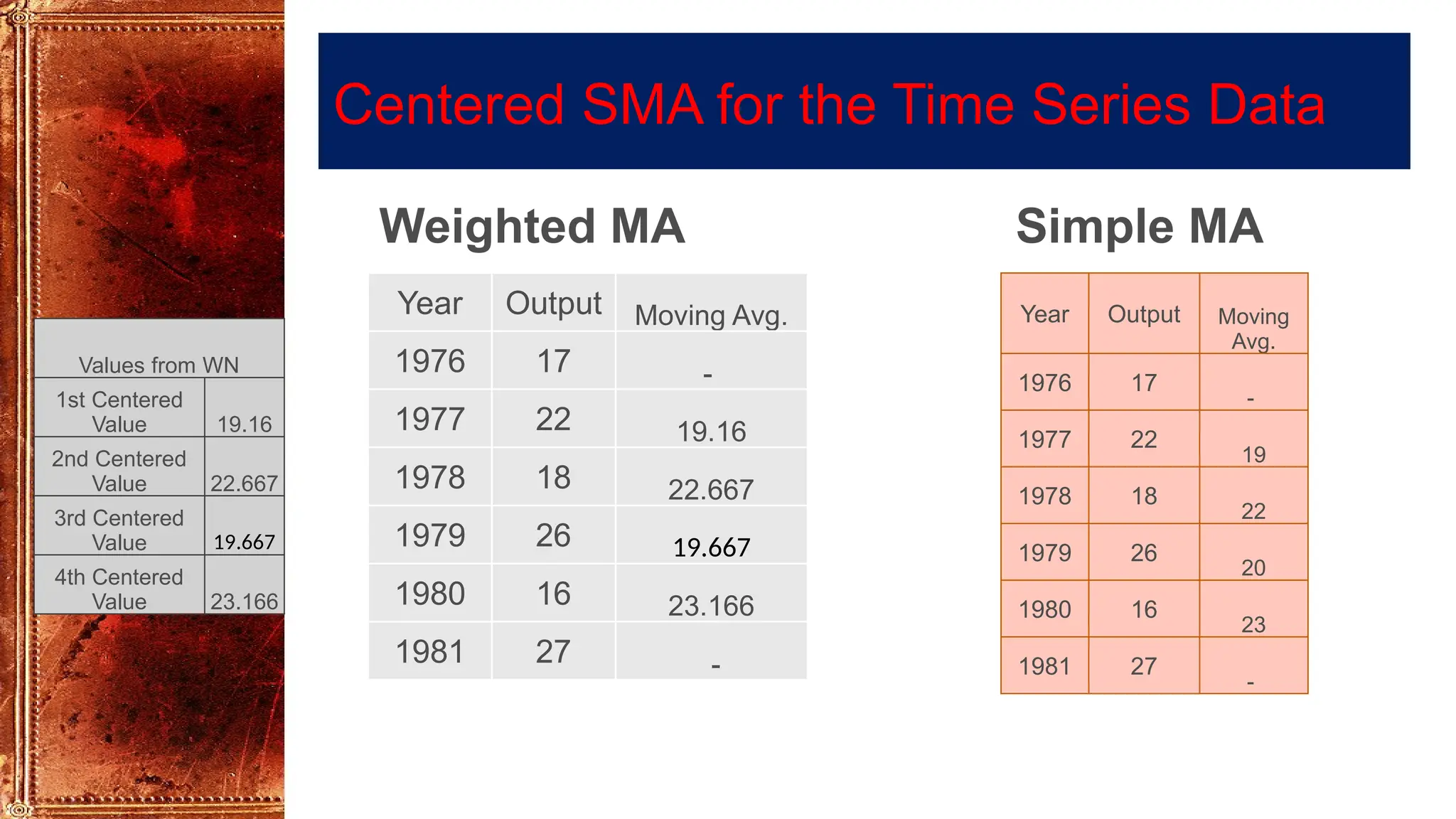
Centered SMA for the Time Series Data
Weighted MA Simple MA
Year Output Moving Avg.
1976 17 -
1977 22 19.16
1978 18 22.667
1979 26 19.667
1980 16 23.166
1981 27 -
Values from WN
1st Centered
Value 19.16
2nd Centered
Value 22.667
3rd Centered
Value 19.667
4th Centered
Value 23.166
Year Output Moving
Avg.
1976 17
-
1977 22
19
1978 18
22
1979 26
20
1980 16
23
1981 27
-
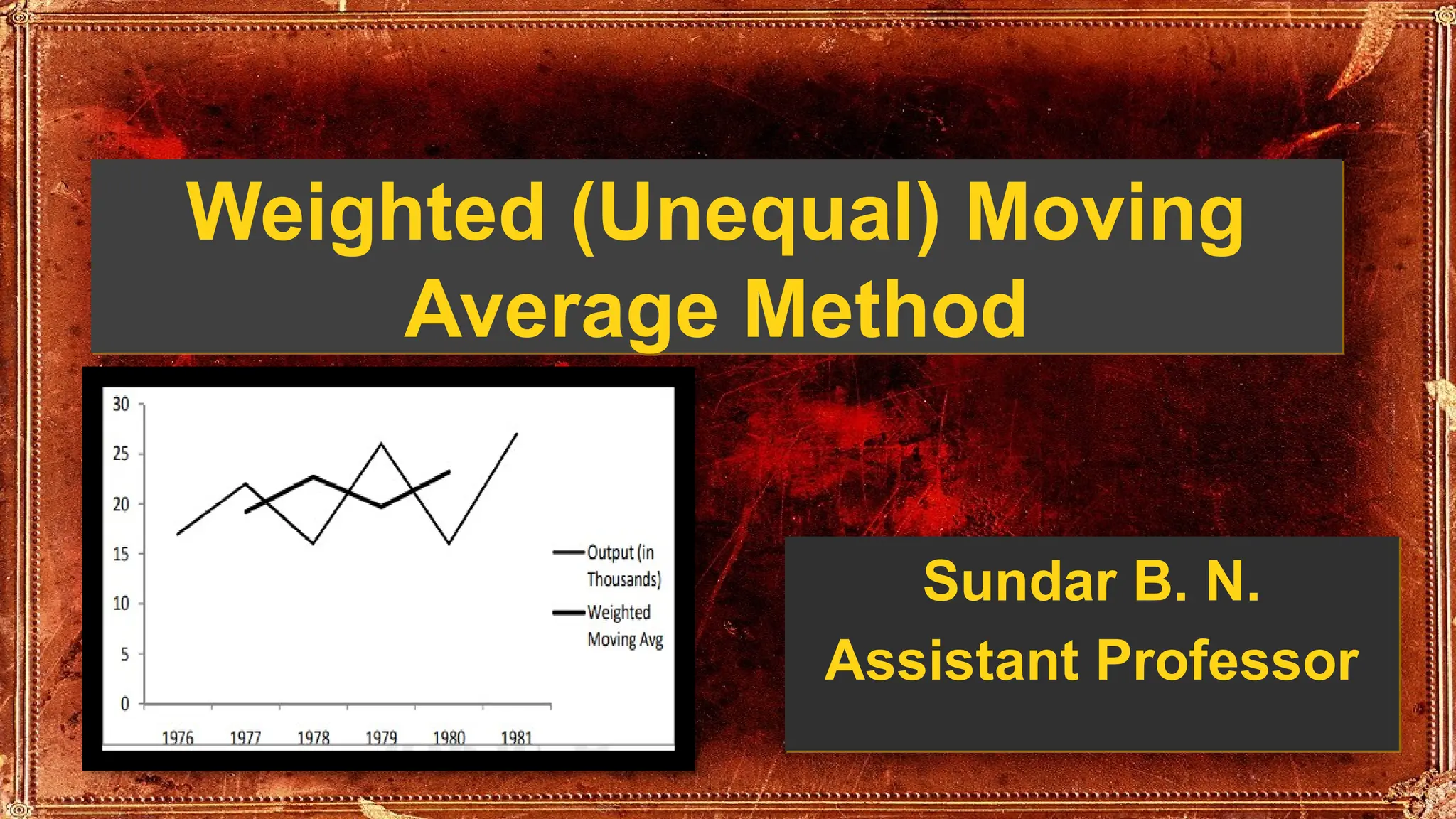
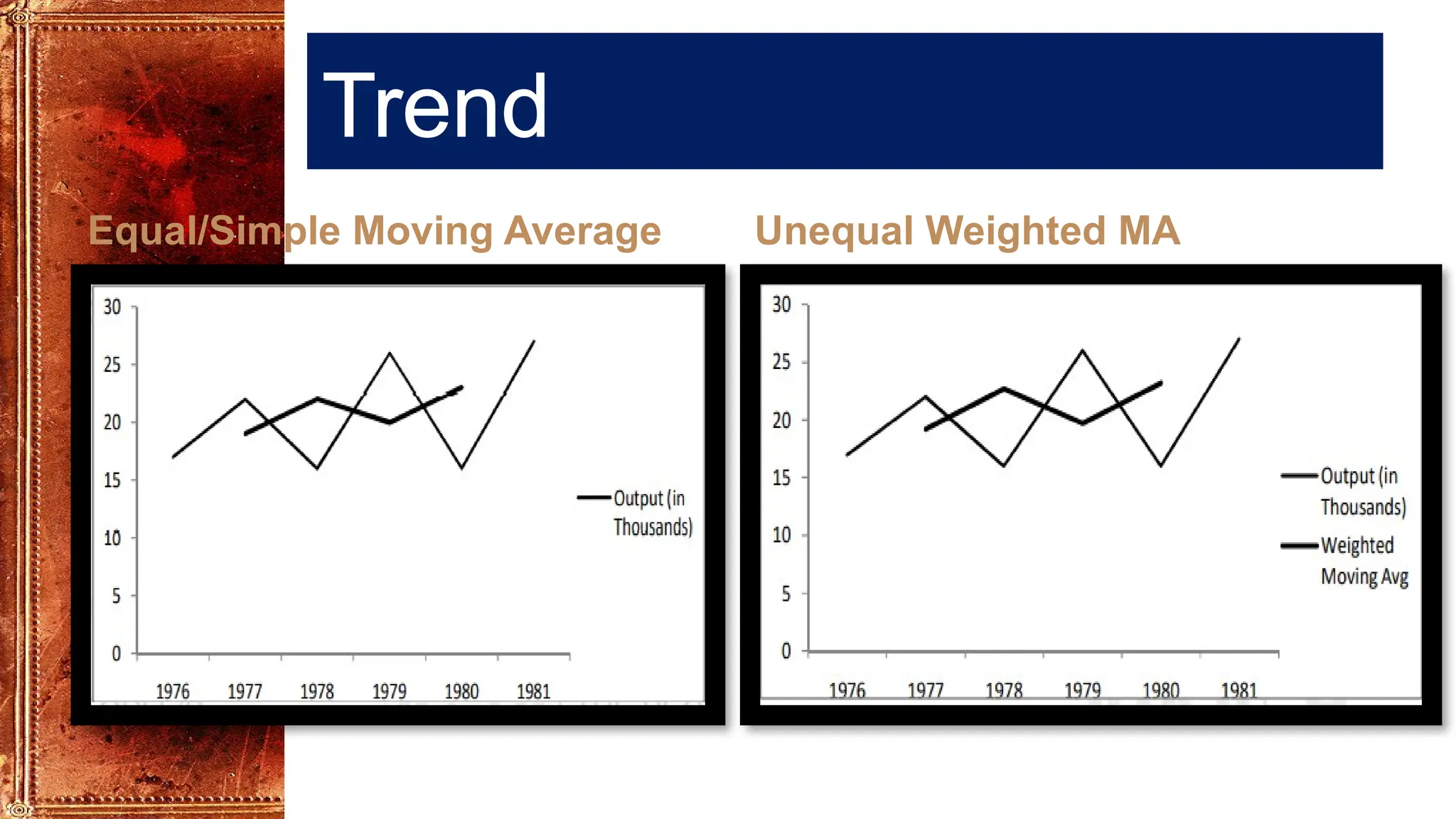
Trend
Equal/Simple Moving Average Unequal Weighted MA
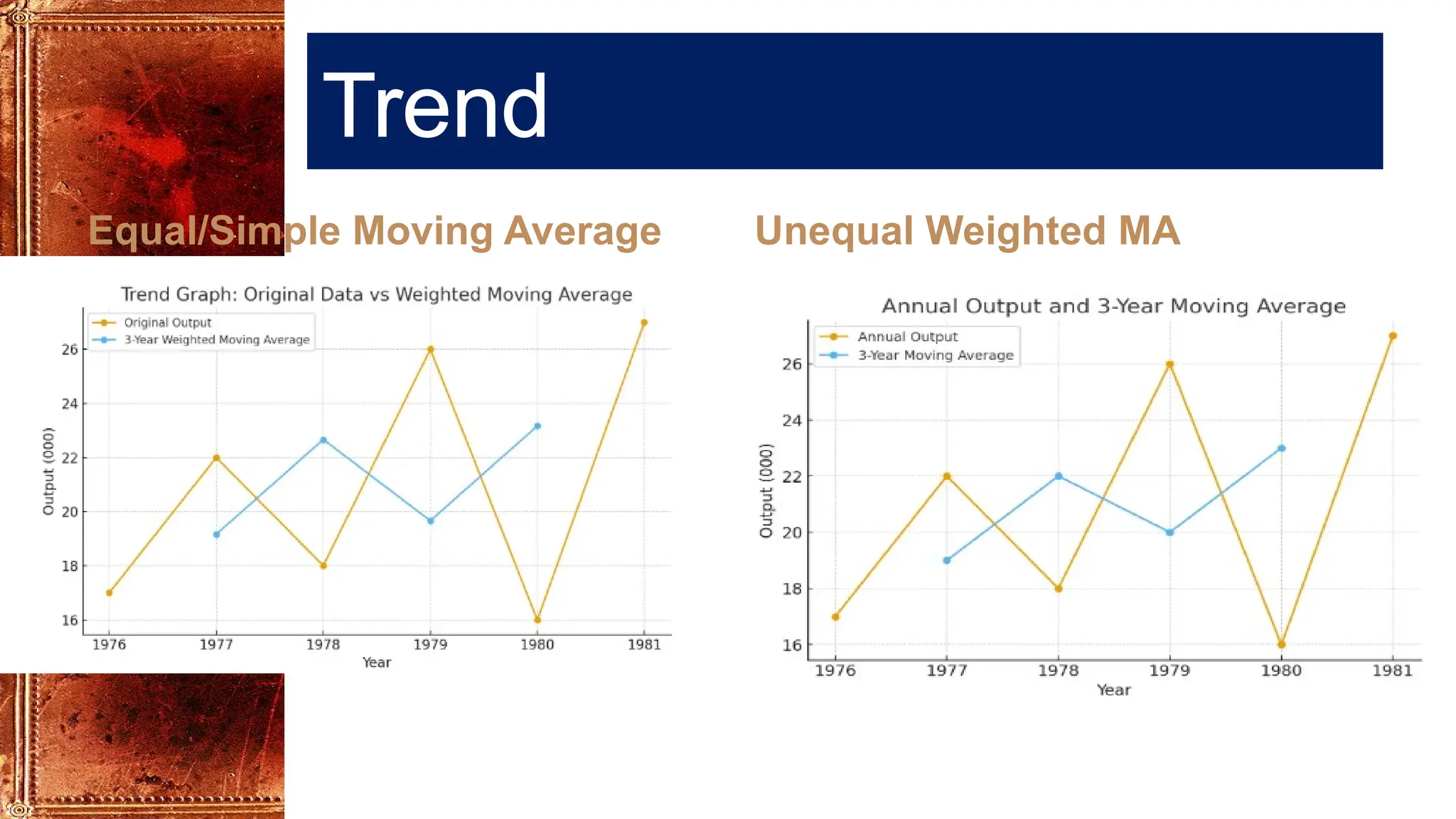
Trend
Equal/Simple Moving Average Unequal Weighted MA
Reference
 Bhardwaj, R. S. (2009). Business Statistics.
Excel Books India.
 Shukla, G. K.; Trivedi, Manish (2017). “Unit-
13 Trend Component Analysis. IGNOU

Time Series Analysis - Weighted (Unequal) Moving Average Method

  • 1.
    Weighted (Unequal) Moving AverageMethod Sundar B. N. Assistant Professor
  • 2.
    Methods of MovingAverage Equal Weight(Simple)Moving Average Method Weighted (unequal) Moving Average Method
  • 3.
    Weighted (Unequal) MovingAverage Method  The simple moving average method is not generally recommended for measuring trend although it can be useful for removing seasonal variation.  It may also not lie close to the latest values. Therefore, the weighted (unequal) moving averages method is used.  In this method, instead of giving equal weights to all values, unequal weights are given in such a way that all the weights are positive and their sum is equal to 1.
  • 4.
    Formula If wi denotesthe weight of the ith observation, the weighted moving average value yt is given by Smoothened trend values as yt = (xt-1 + 2xt + 3xt+1)/6
  • 5.
    Procedure for Gettingthe Smoothened Trend Values 1.Calculate the weighted average of the first m values given in time series as explained above. 2. Now discard the first value and include the next one and take the average of the next m values by following the weight structure given in equation (2). 3. Repeat this process till all values are exhausted. These steps yield a new time series of m-period weighted moving averages and the weighted moving average values are given in the following table:
  • 6.
    Problem Compute the 3-yearsweighted moving averages for the time series of annual output of a factory for the period 1976 to 1981 Annual output of a factory from 1976 to 1981 Year 1976 1977 1978 1979 1980 1981 Output (000) 17 22 18 26 16 27
  • 7.
    Solution Generally, the mostrecent observation receives the largest weight and the weights decrease for older data values. For the data given in Example 1, suppose we give 3 times more weight to the most recent observation than the first observation and 2 times more weight to the second observation. Then the weights for each year in every 3-year period are: W₁=1/6 W₂=2/6 W₃=3/6 After assigning the weights as above, we get the smoothened trend values as yt = (xt-1 + 2xt + 3xt+1)/6
  • 8.
    Working Note 1st Value 1/6(17)+2/6(22)+3/6(18) =2.833+7.333+9 =19.16 2nd Value1/6(22)+2/6(18)+3/6(26) =3.667+6+13 =22.667 3rd Value 1/6(18)+2/6(26)+3/6(16) =3+8.667+8 =19.667 th Output from1976 to 1981 Year Output 1976 17 1977 22 1978 18 1979 26 1980 16 1981 27
  • 9.
    Working Note yt =(xt-1 + 2xt + 3xt+1)/6 1st Value =(17-1+2*22+3*18+1)/6 =(16+44+55)/6 =19.1667 2nd Value =(22-1+2*18+3*26+1)/6 =(21+36+79)/6 =22.667 3rd Value =(18-1+2*26+3*16+1)/6 =(17+52+49)/6 Output from1976 to 1981 Year Output 1976 17 1977 22 1978 18 1979 26 1980 16 1981 27
  • 10.
    Centered SMA forthe Time Series Data Weighted MA Simple MA Year Output Moving Avg. 1976 17 - 1977 22 19.16 1978 18 22.667 1979 26 19.667 1980 16 23.166 1981 27 - Values from WN 1st Centered Value 19.16 2nd Centered Value 22.667 3rd Centered Value 19.667 4th Centered Value 23.166 Year Output Moving Avg. 1976 17 - 1977 22 19 1978 18 22 1979 26 20 1980 16 23 1981 27 -
  • 11.
  • 12.
  • 13.
    Reference  Bhardwaj, R.S. (2009). Business Statistics. Excel Books India.  Shukla, G. K.; Trivedi, Manish (2017). “Unit- 13 Trend Component Analysis. IGNOU