Method of Simple Moving Average
3 Year and 4 Year Moving Average
Sundar B. N.
Assistant Professor
Meaning of Moving Average
 In the method of moving average, successive arithmetic
averages are computed from overlapping groups of
successive values of a time series.
 Each group includes all the observations in a given time
interval, termed as the period of moving average.
 The next group is obtained by replacing the oldest value
by the next value in the series.
 The averages of such groups are known as the moving
averages.
 The moving averages of a group are always shown at
the centre of its period.
Merits of Moving Average
1. This method is easy to understand and easy to use because
there are no mathematical complexities involved.
2. It is an objective method in the sense that anybody working on
a problem with the method will get the same trend values. It is
in this respect better than the free hand curve method.
3. It is a flexible method in the sense that if a few more
observations are added, the entire calculations are not
changed. This not with the case of semi-average method.
4. When the period of oscillatory movements is equal to the
period of moving average, these movements are completely
eliminated.
5. By the indirect use of this method, it is also possible to isolate
seasonal, cyclical and random components.
Demerits of Moving Average
1. It is not possible to calculate trend values for all the items of the series.
Some information is always lost at its ends.
2. This method can determine accurate values of trend only if the oscillatory
and the random fluctuations are uniform in terms of period and amplitude
and the trend is, at least, approximately linear. However, these conditions
are rarely met in practice. When the trend is not linear, the moving
averages will not give correct values of the trend.
3. The trend values obtained by moving averages may not follow any
mathematical pattern i.e. fails in setting up a functional relationship
between the values of X(time) and Y(values) and thus, cannot be used for
forecasting which perhaps is the main task of any time series analysis.
4. The selection of period of moving average is a difficult task and a great
deal of care is needed to determine it.
5. Like arithmetic mean, the moving averages are too much affected by
extreme values.
Methods of Moving Average
Equal Weight(Simple)Moving
Average Method
Weighted (unequal) Moving
Average Method
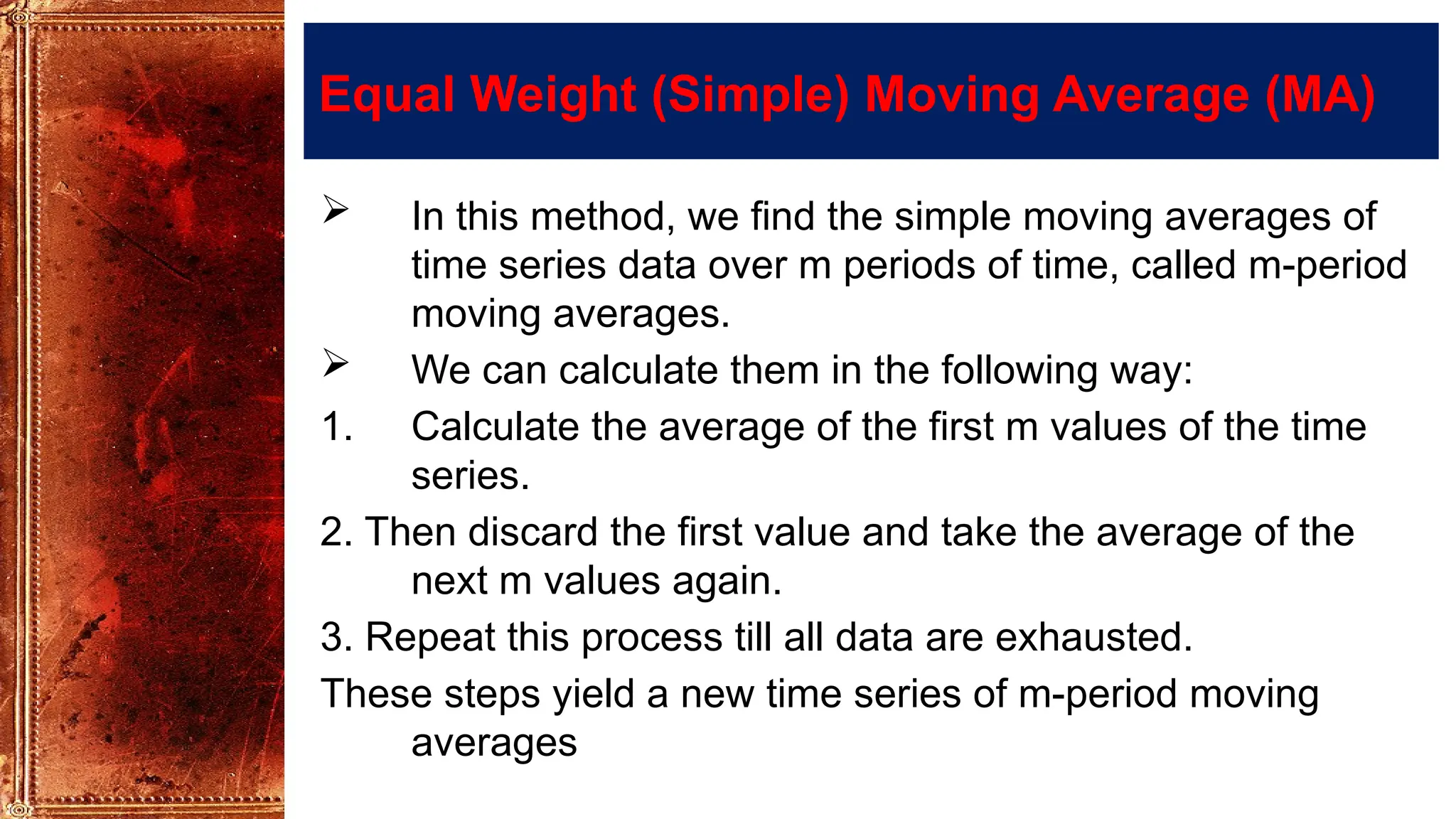
Equal Weight (Simple) Moving Average (MA)
 In this method, we find the simple moving averages of
time series data over m periods of time, called m-period
moving averages.
 We can calculate them in the following way:
1. Calculate the average of the first m values of the time
series.
2. Then discard the first value and take the average of the
next m values again.
3. Repeat this process till all data are exhausted.
These steps yield a new time series of m-period moving
averages
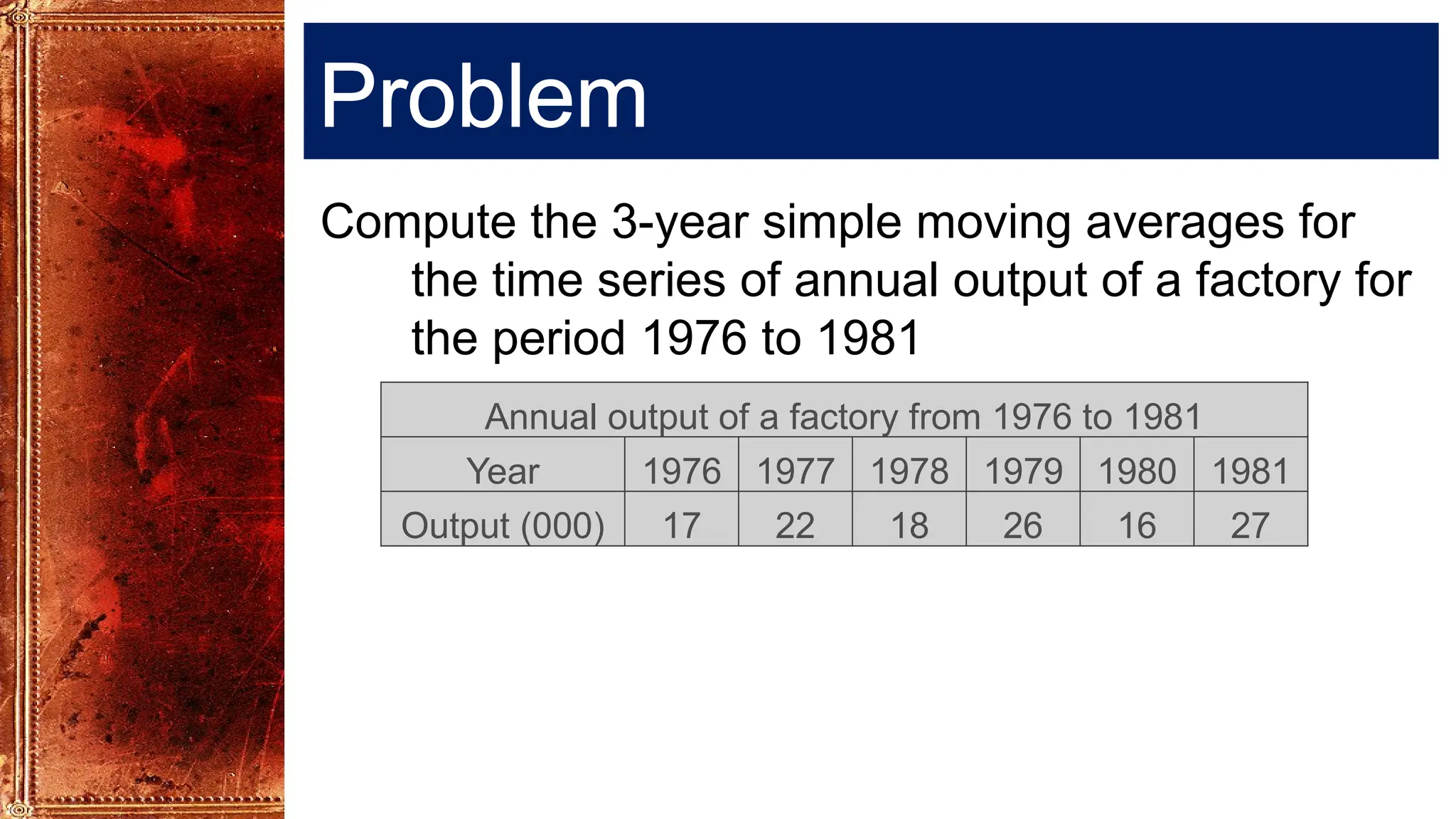
Problem
Compute the 3-year simple moving averages for
the time series of annual output of a factory for
the period 1976 to 1981
Annual output of a factory from 1976 to 1981
Year 1976 1977 1978 1979 1980 1981
Output (000) 17 22 18 26 16 27
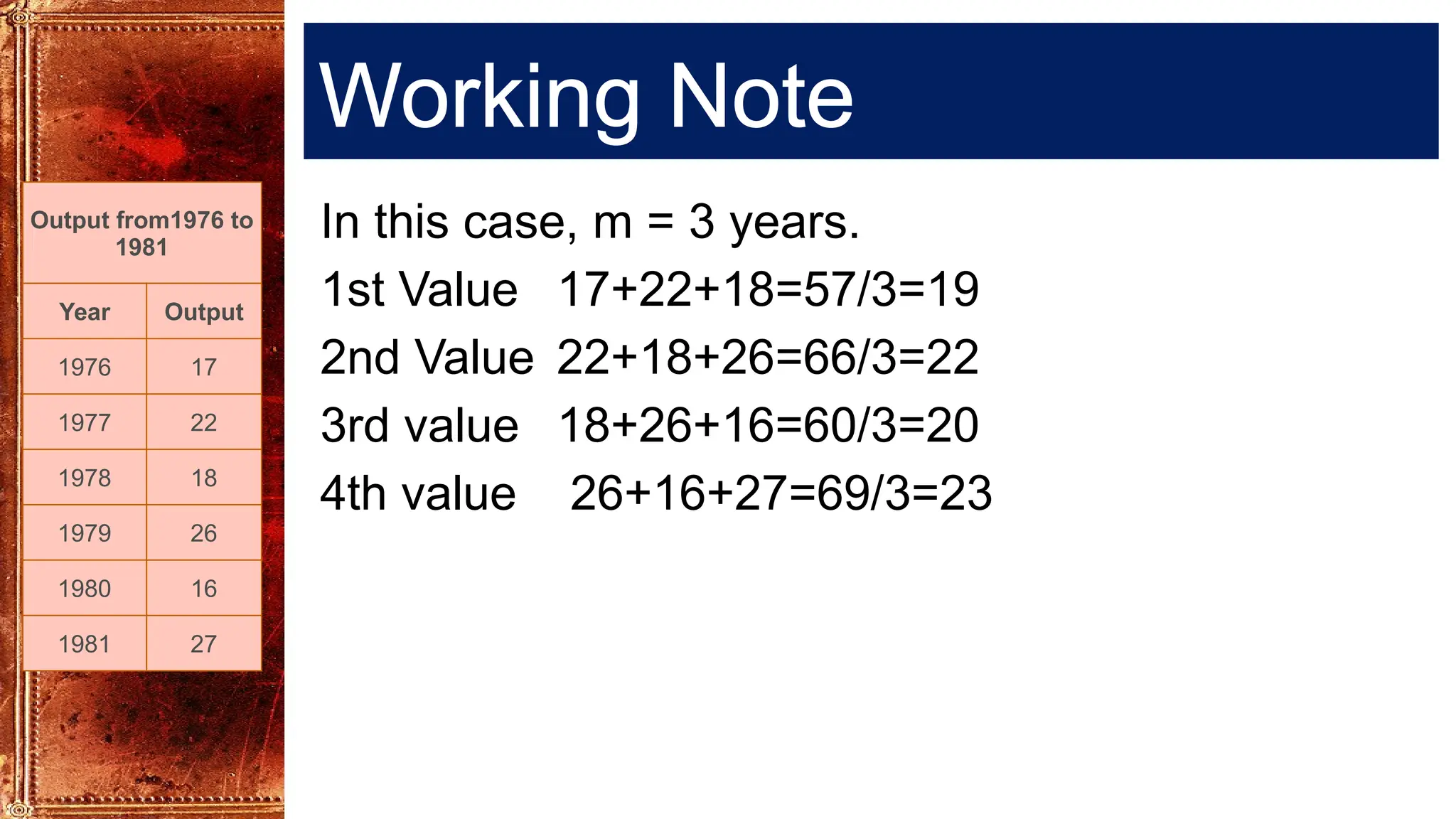
Working Note
In this case, m = 3 years.
1st Value 17+22+18=57/3=19
2nd Value 22+18+26=66/3=22
3rd value 18+26+16=60/3=20
4th value 26+16+27=69/3=23
Output from1976 to
1981
Year Output
1976 17
1977 22
1978 18
1979 26
1980 16
1981 27
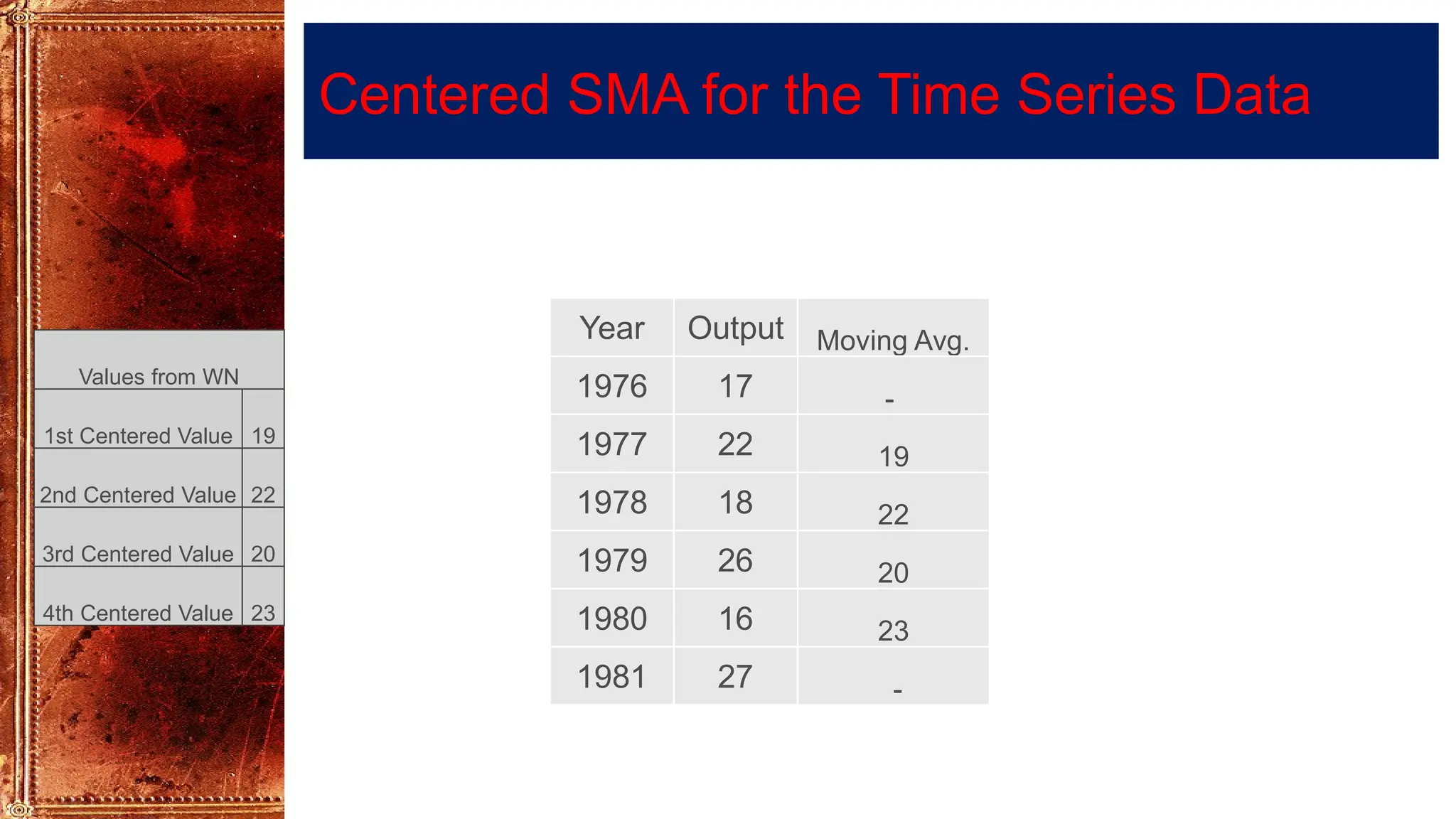
Centered SMA for the Time Series Data
Year Output Moving Avg.
1976 17 -
1977 22 19
1978 18 22
1979 26 20
1980 16 23
1981 27 -
Values from WN
1st Centered Value 19
2nd Centered Value 22
3rd Centered Value 20
4th Centered Value 23
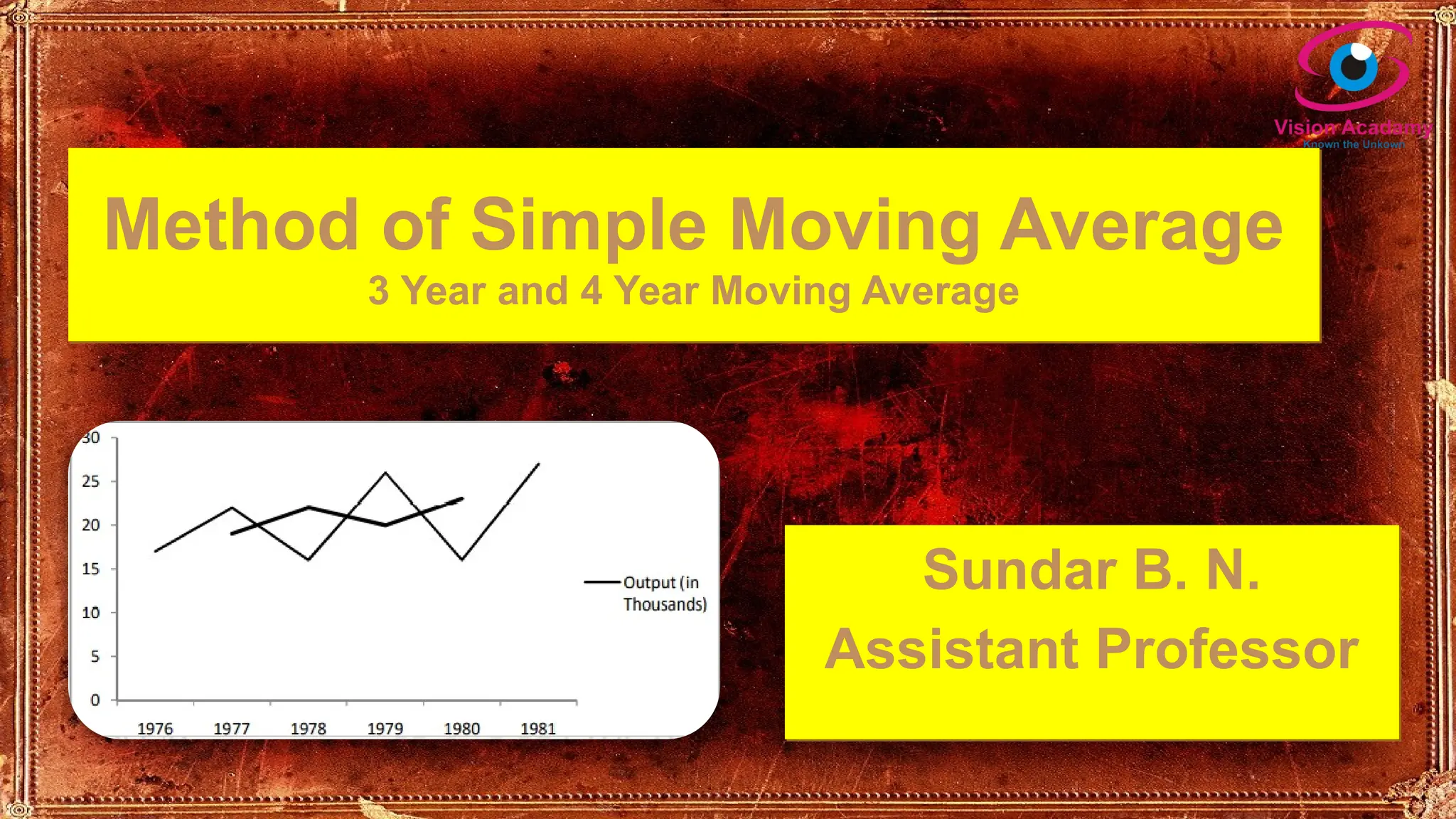
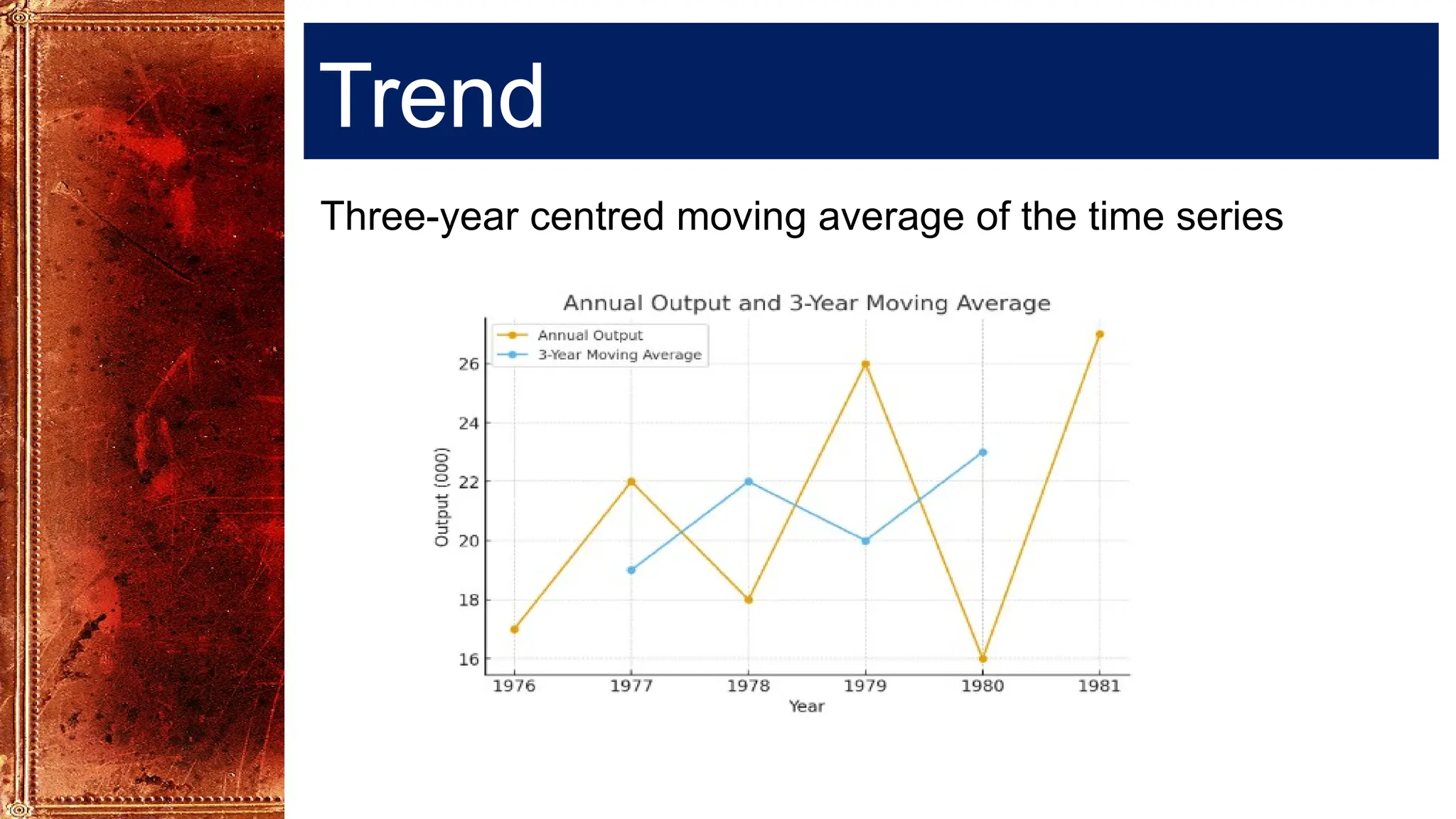
Trend
Three-year centred moving average of the time series
Conclusion
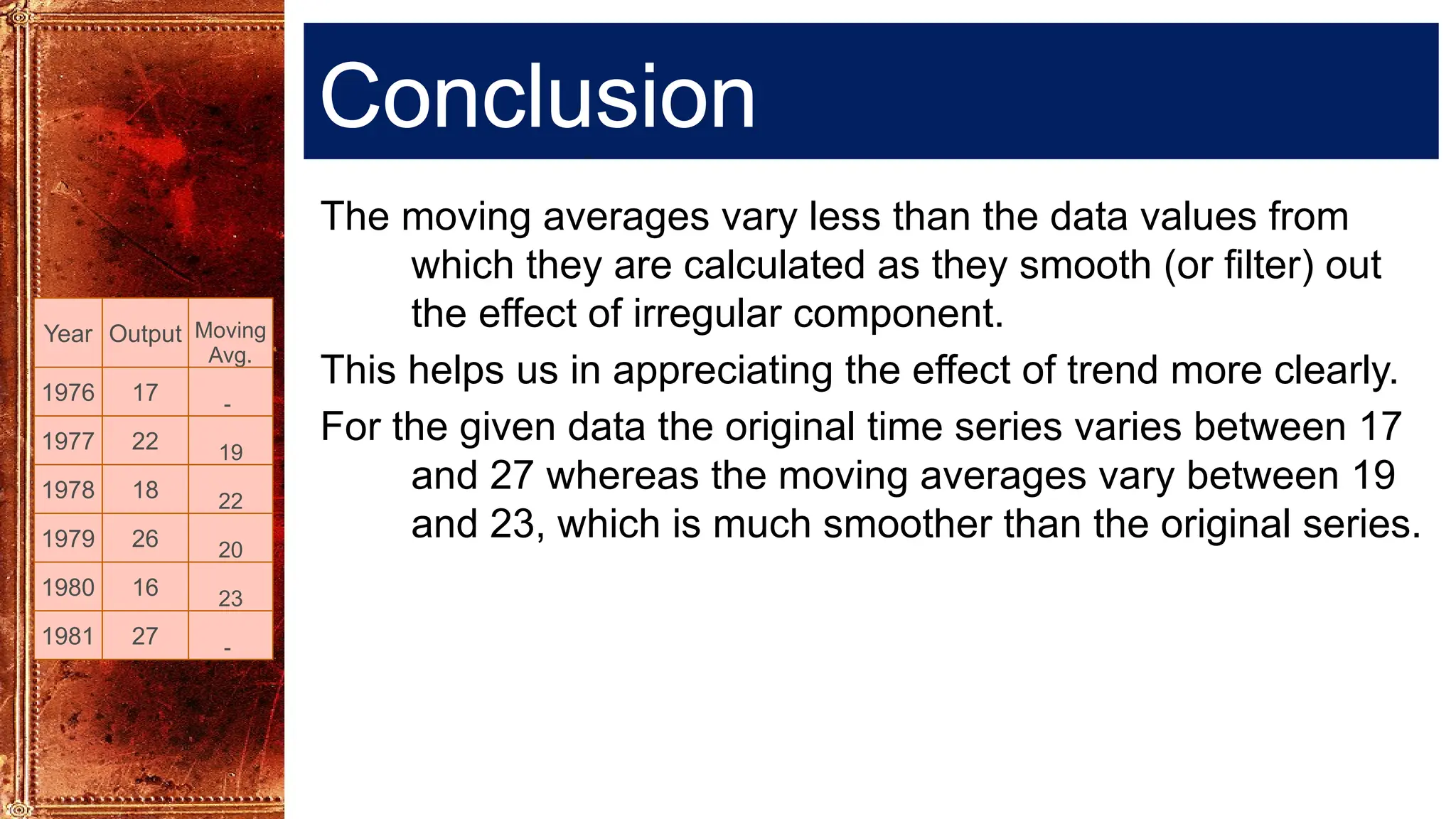
The moving averages vary less than the data values from
which they are calculated as they smooth (or filter) out
the effect of irregular component.
This helps us in appreciating the effect of trend more clearly.
For the given data the original time series varies between 17
and 27 whereas the moving averages vary between 19
and 23, which is much smoother than the original series.
Year Output Moving
Avg.
1976 17 -
1977 22 19
1978 18 22
1979 26 20
1980 16 23
1981 27 -
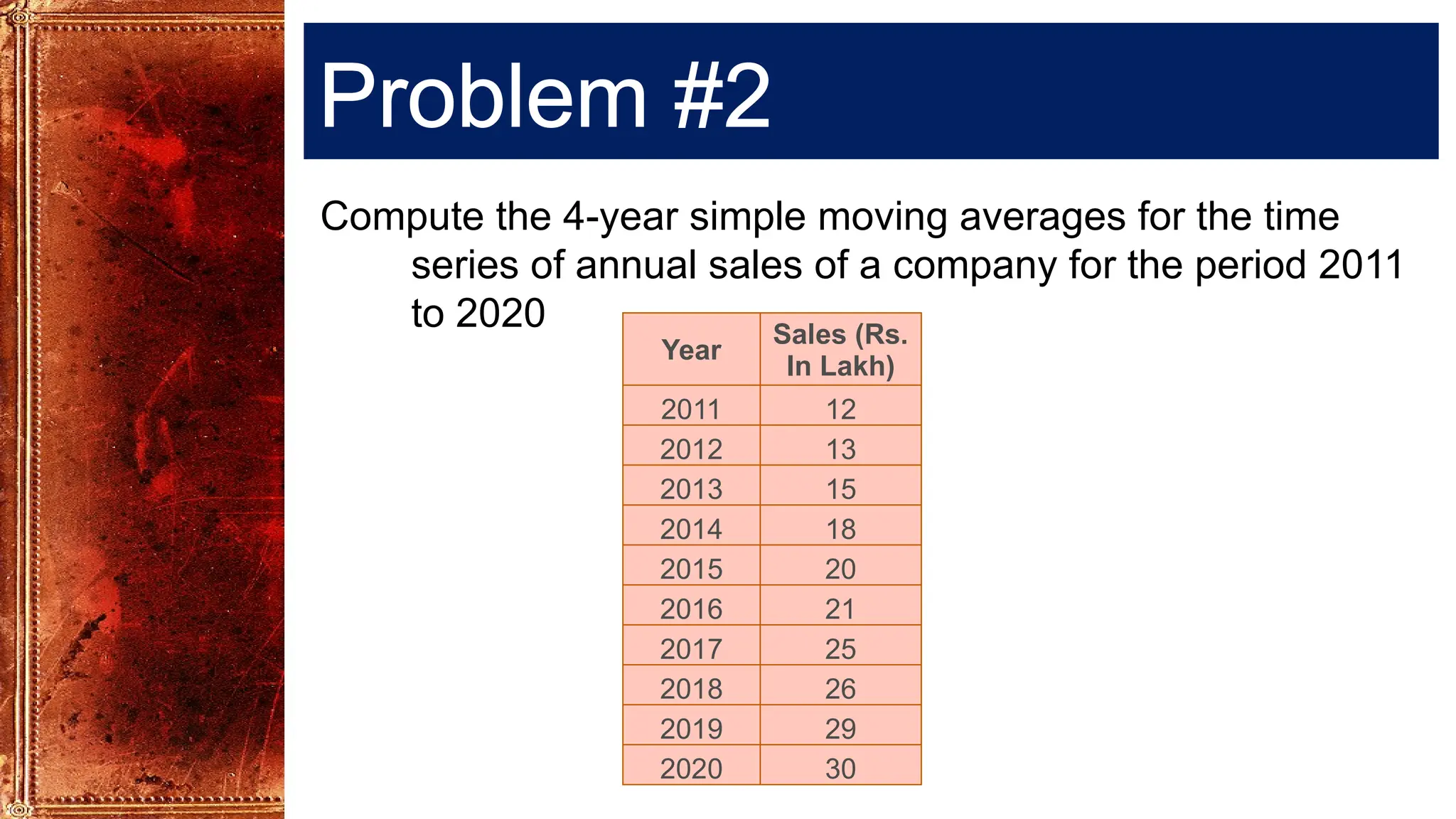
Problem #2
Compute the 4-year simple moving averages for the time
series of annual sales of a company for the period 2011
to 2020
Year
Sales (Rs.
In Lakh)
2011 12
2012 13
2013 15
2014 18
2015 20
2016 21
2017 25
2018 26
2019 29
2020 30
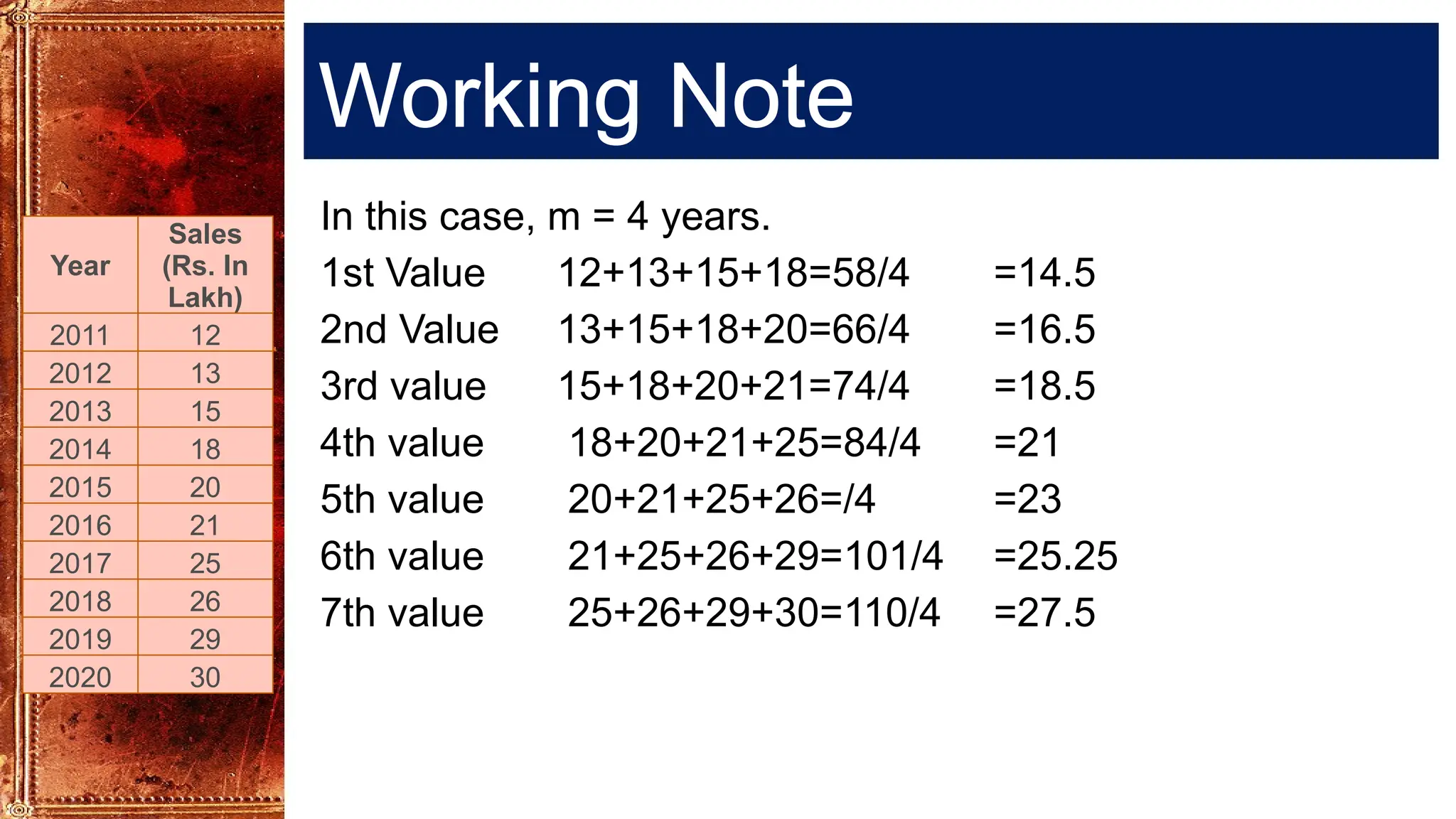
Working Note
In this case, m = 4 years.
1st Value 12+13+15+18=58/4 =14.5
2nd Value 13+15+18+20=66/4 =16.5
3rd value 15+18+20+21=74/4 =18.5
4th value 18+20+21+25=84/4 =21
5th value 20+21+25+26=/4 =23
6th value 21+25+26+29=101/4 =25.25
7th value 25+26+29+30=110/4 =27.5
Year
Sales
(Rs. In
Lakh)
2011 12
2012 13
2013 15
2014 18
2015 20
2016 21
2017 25
2018 26
2019 29
2020 30
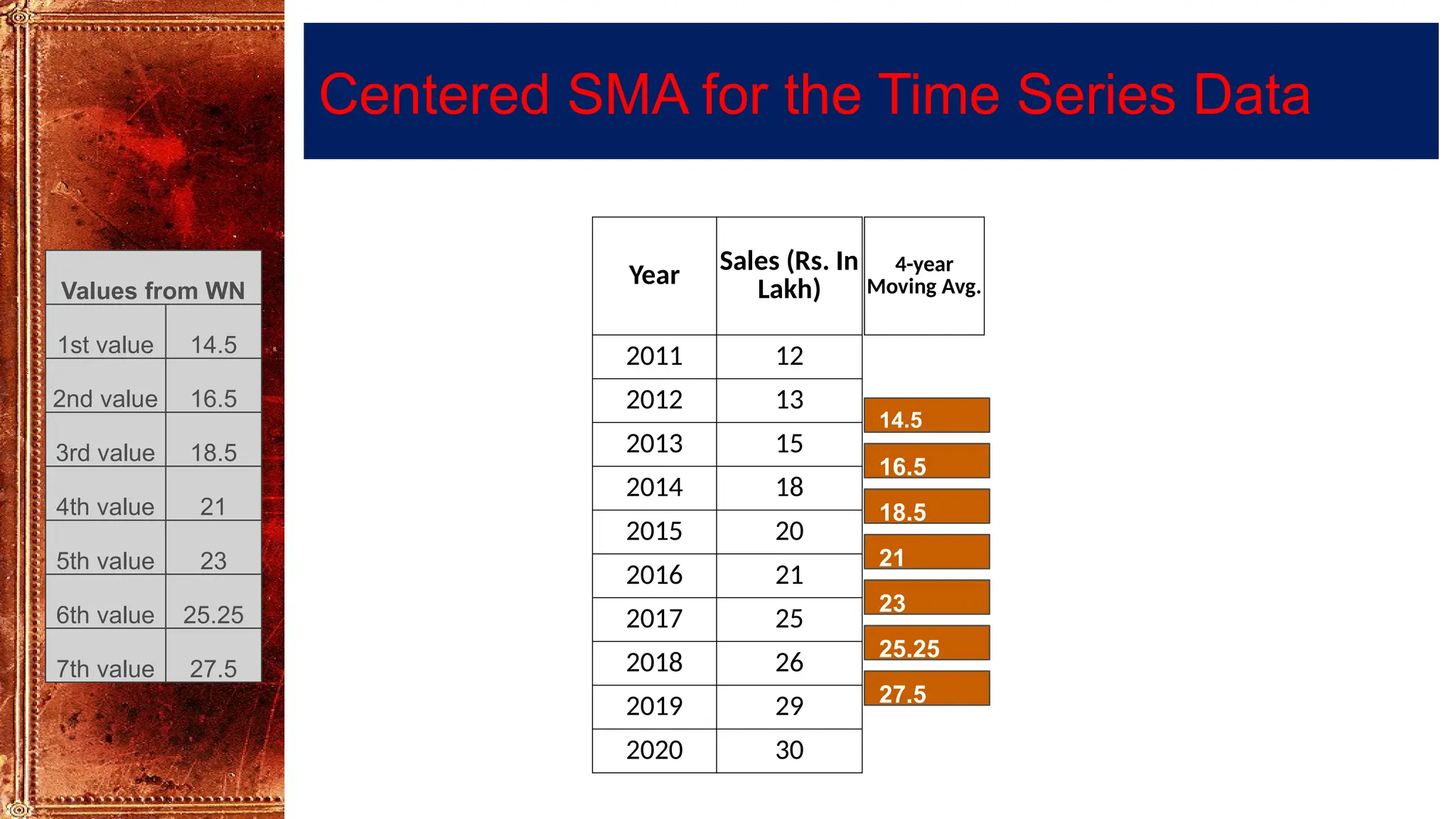
Centered SMA for the Time Series Data
Values from WN
1st value 14.5
2nd value 16.5
3rd value 18.5
4th value 21
5th value 23
6th value 25.25
7th value 27.5
Year
Sales (Rs. In
Lakh)
2011 12
2012 13
2013 15
2014 18
2015 20
2016 21
2017 25
2018 26
2019 29
2020 30
4-year
Moving Avg.
14.5
16.5
18.5
27.5
21
23
25.25
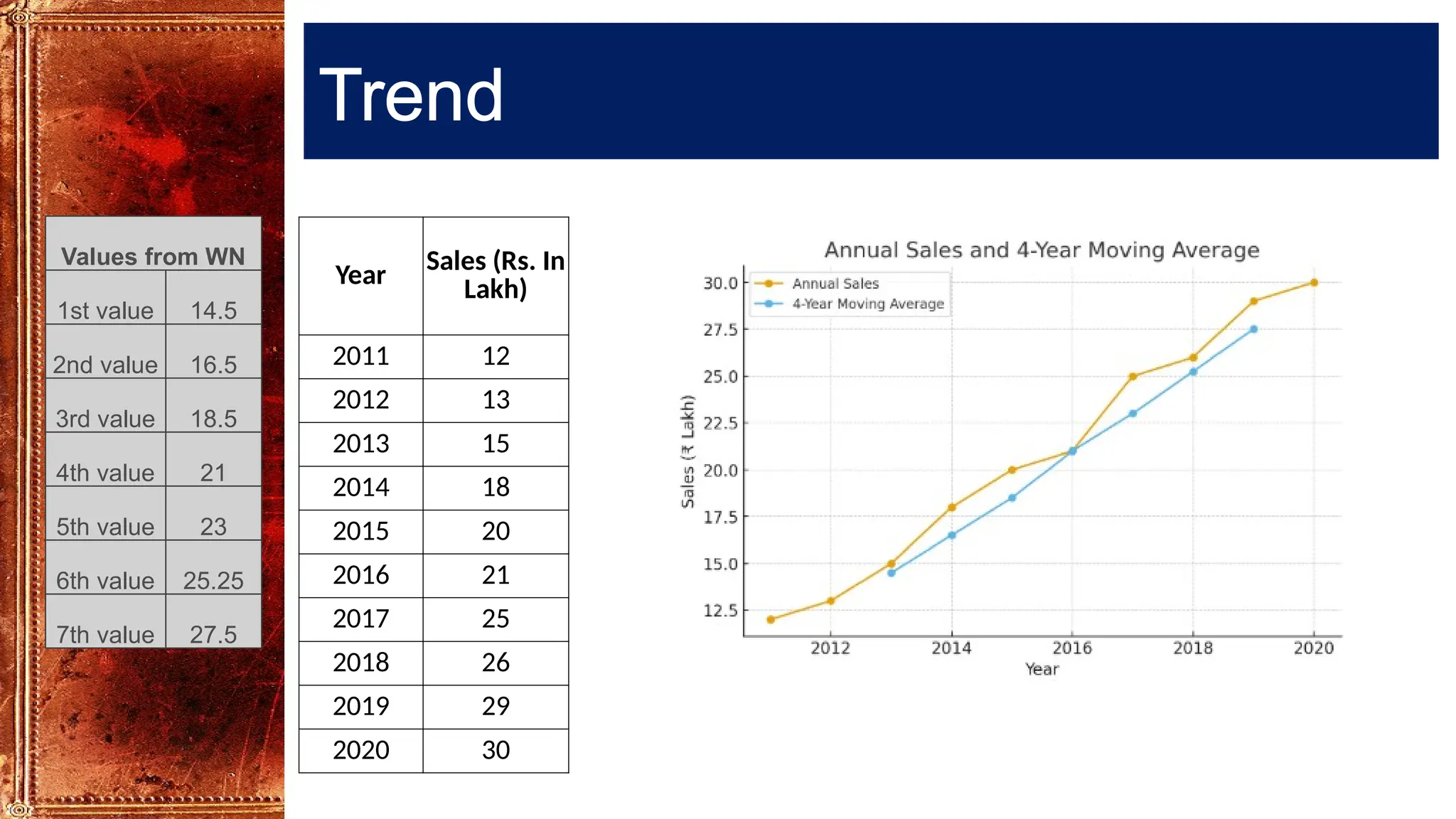
Trend
Values from WN
1st value 14.5
2nd value 16.5
3rd value 18.5
4th value 21
5th value 23
6th value 25.25
7th value 27.5
Year
Sales (Rs. In
Lakh)
2011 12
2012 13
2013 15
2014 18
2015 20
2016 21
2017 25
2018 26
2019 29
2020 30
Reference
 Bhardwaj, R. S. (2009). Business Statistics.
Excel Books India.
 Shukla, G. K.; Trivedi, Manish (2017). “Unit-
13 Trend Component Analysis. IGNOU

Time Series Analysis - Method of Simple Moving Average 3 Year and 4 Year Moving Average

  • 1.
    Method of SimpleMoving Average 3 Year and 4 Year Moving Average Sundar B. N. Assistant Professor
  • 2.
    Meaning of MovingAverage  In the method of moving average, successive arithmetic averages are computed from overlapping groups of successive values of a time series.  Each group includes all the observations in a given time interval, termed as the period of moving average.  The next group is obtained by replacing the oldest value by the next value in the series.  The averages of such groups are known as the moving averages.  The moving averages of a group are always shown at the centre of its period.
  • 3.
    Merits of MovingAverage 1. This method is easy to understand and easy to use because there are no mathematical complexities involved. 2. It is an objective method in the sense that anybody working on a problem with the method will get the same trend values. It is in this respect better than the free hand curve method. 3. It is a flexible method in the sense that if a few more observations are added, the entire calculations are not changed. This not with the case of semi-average method. 4. When the period of oscillatory movements is equal to the period of moving average, these movements are completely eliminated. 5. By the indirect use of this method, it is also possible to isolate seasonal, cyclical and random components.
  • 4.
    Demerits of MovingAverage 1. It is not possible to calculate trend values for all the items of the series. Some information is always lost at its ends. 2. This method can determine accurate values of trend only if the oscillatory and the random fluctuations are uniform in terms of period and amplitude and the trend is, at least, approximately linear. However, these conditions are rarely met in practice. When the trend is not linear, the moving averages will not give correct values of the trend. 3. The trend values obtained by moving averages may not follow any mathematical pattern i.e. fails in setting up a functional relationship between the values of X(time) and Y(values) and thus, cannot be used for forecasting which perhaps is the main task of any time series analysis. 4. The selection of period of moving average is a difficult task and a great deal of care is needed to determine it. 5. Like arithmetic mean, the moving averages are too much affected by extreme values.
  • 5.
    Methods of MovingAverage Equal Weight(Simple)Moving Average Method Weighted (unequal) Moving Average Method
  • 6.
    Equal Weight (Simple)Moving Average (MA)  In this method, we find the simple moving averages of time series data over m periods of time, called m-period moving averages.  We can calculate them in the following way: 1. Calculate the average of the first m values of the time series. 2. Then discard the first value and take the average of the next m values again. 3. Repeat this process till all data are exhausted. These steps yield a new time series of m-period moving averages
  • 7.
    Problem Compute the 3-yearsimple moving averages for the time series of annual output of a factory for the period 1976 to 1981 Annual output of a factory from 1976 to 1981 Year 1976 1977 1978 1979 1980 1981 Output (000) 17 22 18 26 16 27
  • 8.
    Working Note In thiscase, m = 3 years. 1st Value 17+22+18=57/3=19 2nd Value 22+18+26=66/3=22 3rd value 18+26+16=60/3=20 4th value 26+16+27=69/3=23 Output from1976 to 1981 Year Output 1976 17 1977 22 1978 18 1979 26 1980 16 1981 27
  • 9.
    Centered SMA forthe Time Series Data Year Output Moving Avg. 1976 17 - 1977 22 19 1978 18 22 1979 26 20 1980 16 23 1981 27 - Values from WN 1st Centered Value 19 2nd Centered Value 22 3rd Centered Value 20 4th Centered Value 23
  • 10.
    Trend Three-year centred movingaverage of the time series
  • 11.
    Conclusion The moving averagesvary less than the data values from which they are calculated as they smooth (or filter) out the effect of irregular component. This helps us in appreciating the effect of trend more clearly. For the given data the original time series varies between 17 and 27 whereas the moving averages vary between 19 and 23, which is much smoother than the original series. Year Output Moving Avg. 1976 17 - 1977 22 19 1978 18 22 1979 26 20 1980 16 23 1981 27 -
  • 12.
    Problem #2 Compute the4-year simple moving averages for the time series of annual sales of a company for the period 2011 to 2020 Year Sales (Rs. In Lakh) 2011 12 2012 13 2013 15 2014 18 2015 20 2016 21 2017 25 2018 26 2019 29 2020 30
  • 13.
    Working Note In thiscase, m = 4 years. 1st Value 12+13+15+18=58/4 =14.5 2nd Value 13+15+18+20=66/4 =16.5 3rd value 15+18+20+21=74/4 =18.5 4th value 18+20+21+25=84/4 =21 5th value 20+21+25+26=/4 =23 6th value 21+25+26+29=101/4 =25.25 7th value 25+26+29+30=110/4 =27.5 Year Sales (Rs. In Lakh) 2011 12 2012 13 2013 15 2014 18 2015 20 2016 21 2017 25 2018 26 2019 29 2020 30
  • 14.
    Centered SMA forthe Time Series Data Values from WN 1st value 14.5 2nd value 16.5 3rd value 18.5 4th value 21 5th value 23 6th value 25.25 7th value 27.5 Year Sales (Rs. In Lakh) 2011 12 2012 13 2013 15 2014 18 2015 20 2016 21 2017 25 2018 26 2019 29 2020 30 4-year Moving Avg. 14.5 16.5 18.5 27.5 21 23 25.25
  • 15.
    Trend Values from WN 1stvalue 14.5 2nd value 16.5 3rd value 18.5 4th value 21 5th value 23 6th value 25.25 7th value 27.5 Year Sales (Rs. In Lakh) 2011 12 2012 13 2013 15 2014 18 2015 20 2016 21 2017 25 2018 26 2019 29 2020 30
  • 16.
    Reference  Bhardwaj, R.S. (2009). Business Statistics. Excel Books India.  Shukla, G. K.; Trivedi, Manish (2017). “Unit- 13 Trend Component Analysis. IGNOU