Time Series Analysis
Meaning, Definition, Components and Application
Sundar B. N.
Assistant Professor
Meaning of Time Series Analysis
 A time series (TS) is a collection of observations
made sequentially over a period of time.
 Time series is set of data collected and arranged in
accordance of time.
 In other words, the data on any characteristic
collected with respect to time over a span of time is
called a time series.
 Normally, we assume that observations are available
at equal intervals of time, e.g., on an hourly, daily,
monthly or yearly basis. Some time series cover a
period of several years.
Definition of Time Series Analysis
According to Croxton and Cowdon
”A Time series consists of data
arranged chronologically.” Such
data may be series of temperature
of patients, series showing number
of suicides in different months of
year etc.
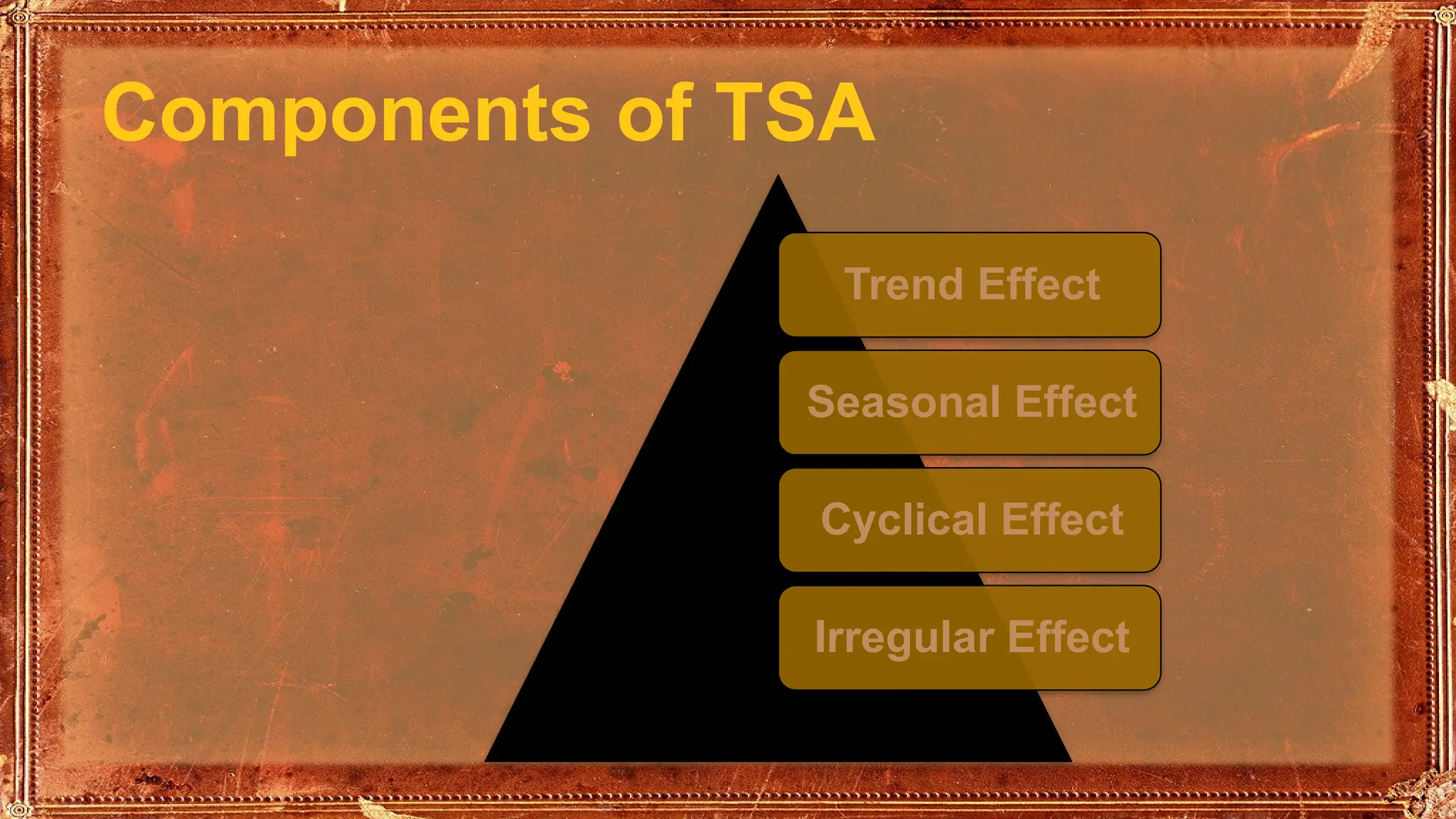
Components of TSA
Trend Effect
Seasonal Effect
Cyclical Effect
Irregular Effect
Trend Effect
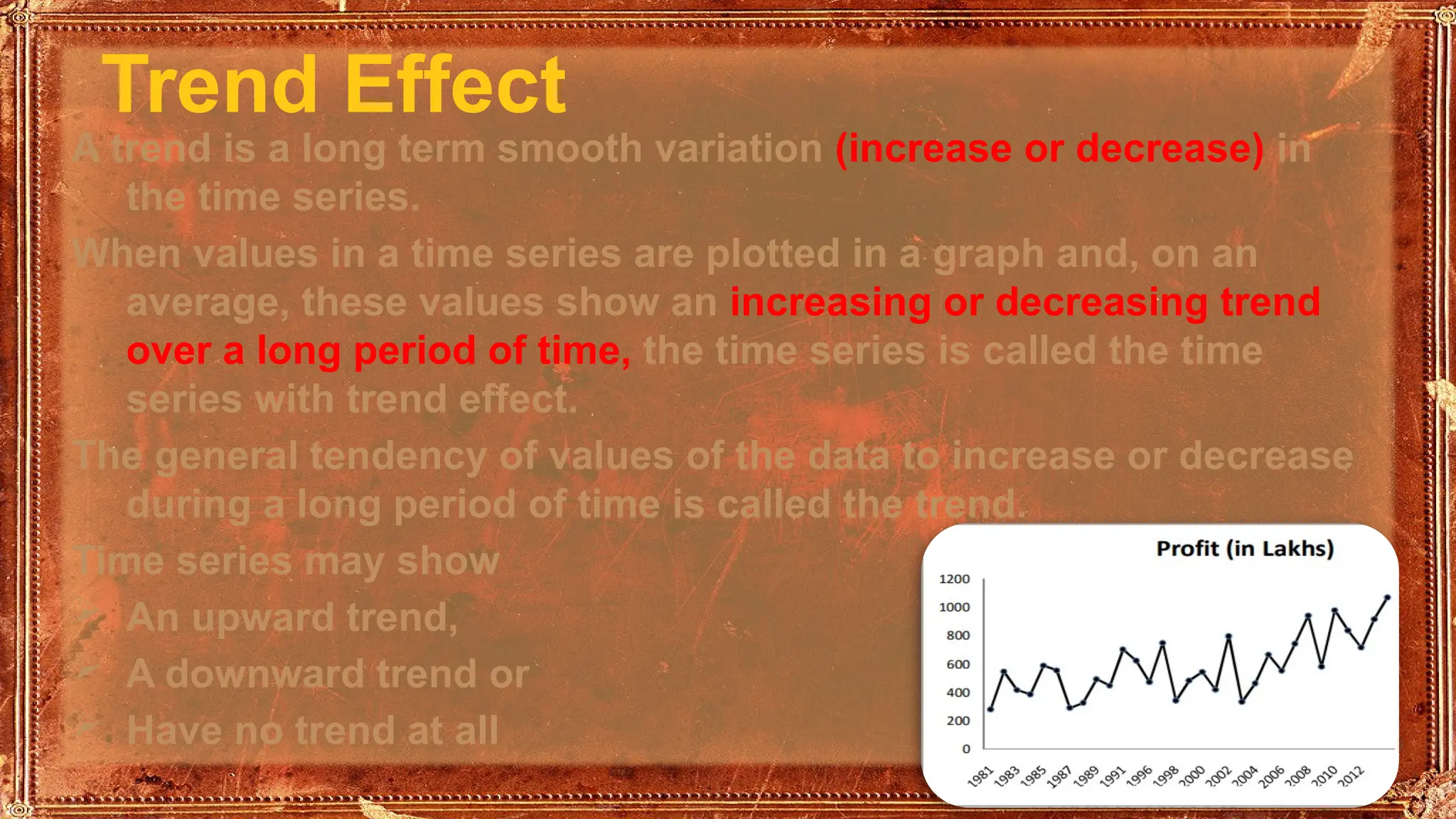
A trend is a long term smooth variation (increase or decrease) in
the time series.
When values in a time series are plotted in a graph and, on an
average, these values show an increasing or decreasing trend
over a long period of time, the time series is called the time
series with trend effect.
The general tendency of values of the data to increase or decrease
during a long period of time is called the trend.
Time series may show
 An upward trend,
 A downward trend or
 Have no trend at all
Components of Trend Effect
i.) Freehand curve Method (Graphical Method)
ii.) Method of selected points
iii.) Method of semi-averages
iv.) Method of moving averages
v.) Method of Least Squares
Seasonal Effect
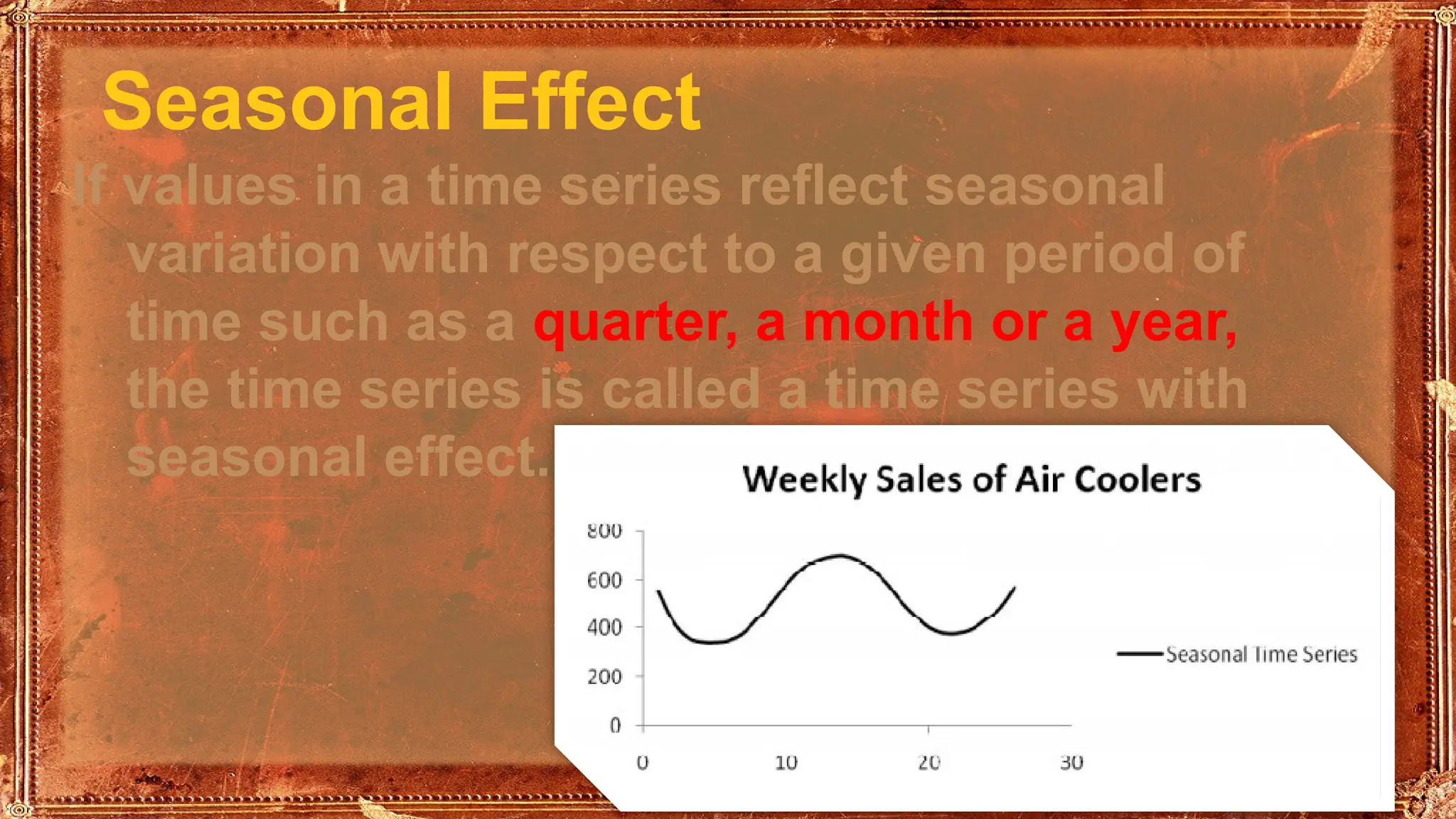
If values in a time series reflect seasonal
variation with respect to a given period of
time such as a quarter, a month or a year,
the time series is called a time series with
seasonal effect.
Components of Seasonal Effect
i. Method of Simple Average
ii. Ratio to Trend Method
iii. Ratio to Moving Average Method
iv. Method of Link Relatives
Cyclical Effect
If the time plot of data in a time series
exhibits a cyclic trend, the time series is
called a time series with cyclic effect.
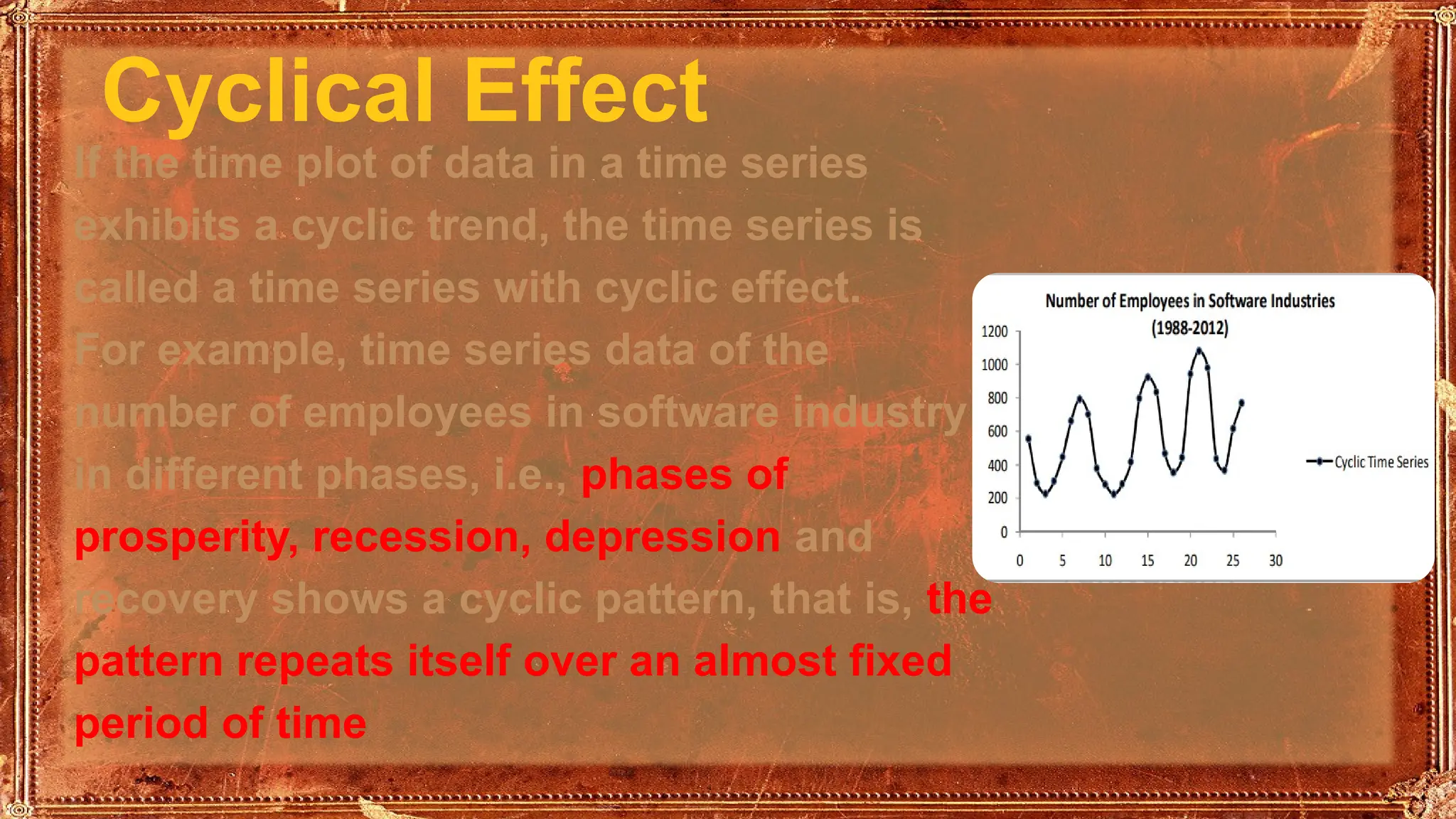
For example, time series data of the
number of employees in software industry
in different phases, i.e., phases of
prosperity, recession, depression and
recovery shows a cyclic pattern, that is, the
pattern repeats itself over an almost fixed
period of time
Irregular Effect
The random variations are also known as irregular variations.
Because of their nature, it is very difficult to devise a formula for
their direct computation.
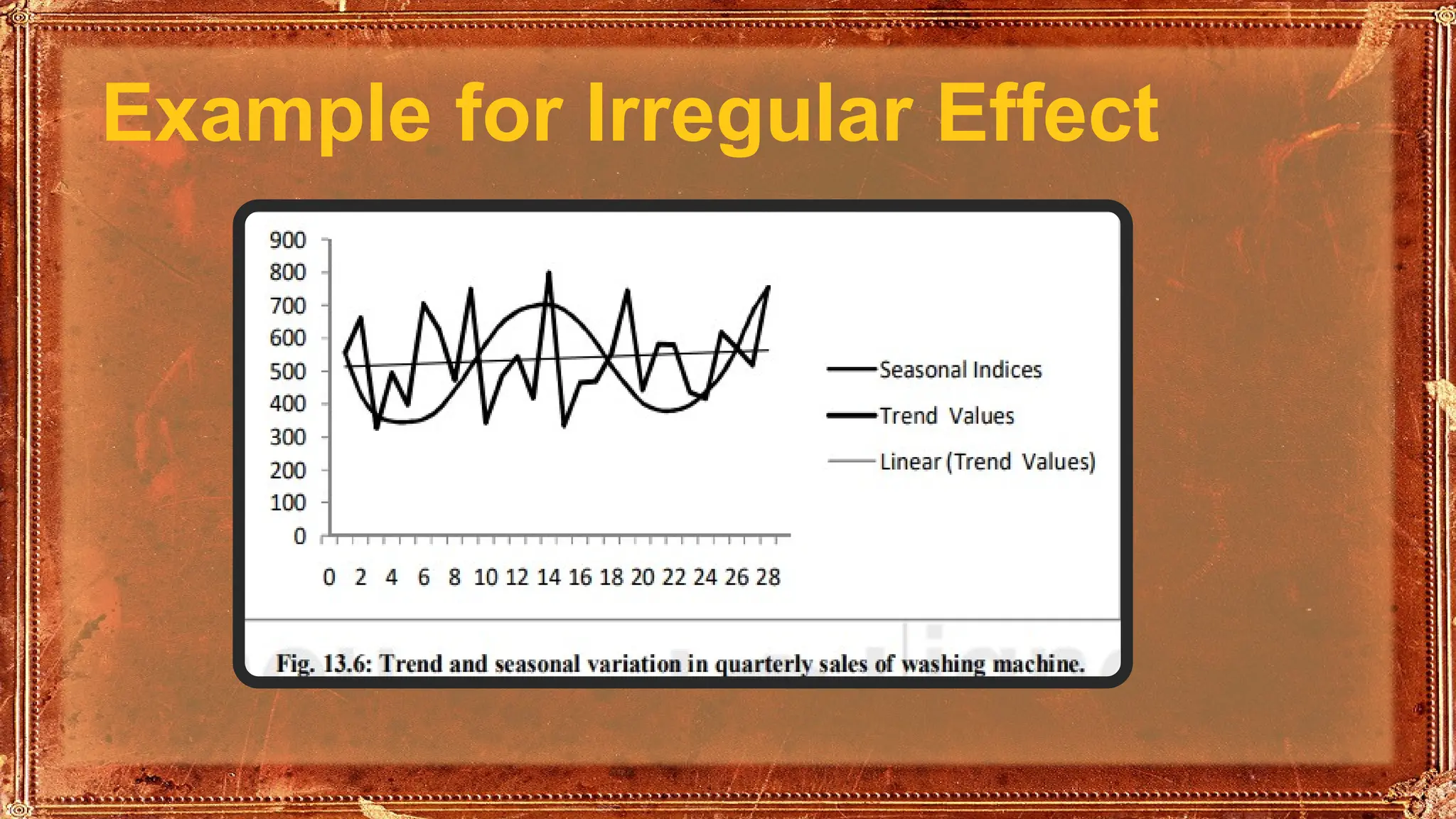
Like the cyclical variations, this component can also be obtained
as a residue after eliminating the effects of other components.
The long term variations, i.e., the trend component and short term
variations, i.e., the seasonal and cyclic component are known
as regular variations.
Apart from these regular variations, random or irregular variations,
which are not accounted for by trend, seasonal or cyclic
components, exist in almost all time series.
Example for Irregular Effect
Advantages of TSA
 It helps in identifying the pattern – Peak,
Boom, Recession
 It creates an opportunity to clean the data –
missing values, gap etc.
 Useful for predicting the future – upward or
downward
Time Series Analysis and Its Applicability
The Time Series Analysis is applied for various
purposes, such as:
• Stock Market Analysis
• Economic Forecasting
• Inventory studies
• Budgetary Analysis
• Census Analysis
• Yield Projection
• Sales Forecasting
Reference
 Bhardwaj, R. S. (2009). Business Statistics.
Excel Books India.
 Shukla, G. K.; Trivedi, Manish (2017). “Unit-
13 Trend Component Analysis. IGNOU
 Time Series Analysis for Better Decision Ma
king in Business (researchoptimus.com)
 https://tessellationtech.io/3-advantages-to-t
ime-series-analysis-and-forcasting/

Time Series Analysis - Meaning, Definition, Components and Application

  • 1.
    Time Series Analysis Meaning,Definition, Components and Application Sundar B. N. Assistant Professor
  • 2.
    Meaning of TimeSeries Analysis  A time series (TS) is a collection of observations made sequentially over a period of time.  Time series is set of data collected and arranged in accordance of time.  In other words, the data on any characteristic collected with respect to time over a span of time is called a time series.  Normally, we assume that observations are available at equal intervals of time, e.g., on an hourly, daily, monthly or yearly basis. Some time series cover a period of several years.
  • 3.
    Definition of TimeSeries Analysis According to Croxton and Cowdon ”A Time series consists of data arranged chronologically.” Such data may be series of temperature of patients, series showing number of suicides in different months of year etc.
  • 4.
    Components of TSA TrendEffect Seasonal Effect Cyclical Effect Irregular Effect
  • 5.
    Trend Effect A trendis a long term smooth variation (increase or decrease) in the time series. When values in a time series are plotted in a graph and, on an average, these values show an increasing or decreasing trend over a long period of time, the time series is called the time series with trend effect. The general tendency of values of the data to increase or decrease during a long period of time is called the trend. Time series may show  An upward trend,  A downward trend or  Have no trend at all
  • 6.
    Components of TrendEffect i.) Freehand curve Method (Graphical Method) ii.) Method of selected points iii.) Method of semi-averages iv.) Method of moving averages v.) Method of Least Squares
  • 7.
    Seasonal Effect If valuesin a time series reflect seasonal variation with respect to a given period of time such as a quarter, a month or a year, the time series is called a time series with seasonal effect.
  • 8.
    Components of SeasonalEffect i. Method of Simple Average ii. Ratio to Trend Method iii. Ratio to Moving Average Method iv. Method of Link Relatives
  • 9.
    Cyclical Effect If thetime plot of data in a time series exhibits a cyclic trend, the time series is called a time series with cyclic effect. For example, time series data of the number of employees in software industry in different phases, i.e., phases of prosperity, recession, depression and recovery shows a cyclic pattern, that is, the pattern repeats itself over an almost fixed period of time
  • 10.
    Irregular Effect The randomvariations are also known as irregular variations. Because of their nature, it is very difficult to devise a formula for their direct computation. Like the cyclical variations, this component can also be obtained as a residue after eliminating the effects of other components. The long term variations, i.e., the trend component and short term variations, i.e., the seasonal and cyclic component are known as regular variations. Apart from these regular variations, random or irregular variations, which are not accounted for by trend, seasonal or cyclic components, exist in almost all time series.
  • 11.
  • 12.
    Advantages of TSA It helps in identifying the pattern – Peak, Boom, Recession  It creates an opportunity to clean the data – missing values, gap etc.  Useful for predicting the future – upward or downward
  • 13.
    Time Series Analysisand Its Applicability The Time Series Analysis is applied for various purposes, such as: • Stock Market Analysis • Economic Forecasting • Inventory studies • Budgetary Analysis • Census Analysis • Yield Projection • Sales Forecasting
  • 14.
    Reference  Bhardwaj, R.S. (2009). Business Statistics. Excel Books India.  Shukla, G. K.; Trivedi, Manish (2017). “Unit- 13 Trend Component Analysis. IGNOU  Time Series Analysis for Better Decision Ma king in Business (researchoptimus.com)  https://tessellationtech.io/3-advantages-to-t ime-series-analysis-and-forcasting/