Guiding your crew from Storming to Performing
DISC as GPS for a
TEAMLEAD
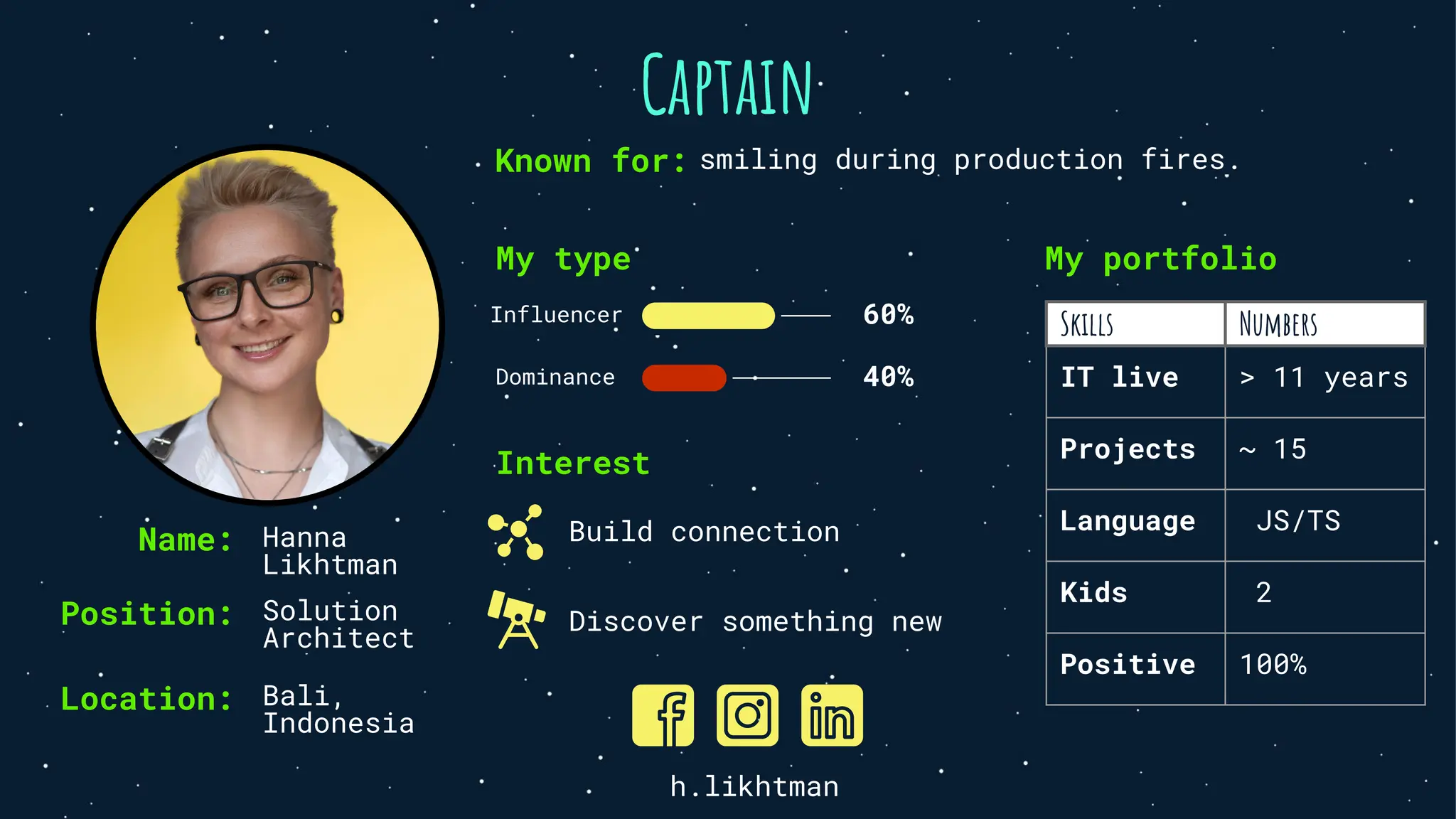
Captain
Position: Solution
Architect
Location: Bali,
Indonesia
My type
Influencer 60%
Dominance 40%
Interest
Build connection
Discover something new
My portfolio
Skills Numbers
IT live > 11 years
Projects ~ 15
Language JS/TS
Kids 2
Positive 100%
h.likhtman
Name: Hanna
Likhtman
Known for: smiling during production fires.
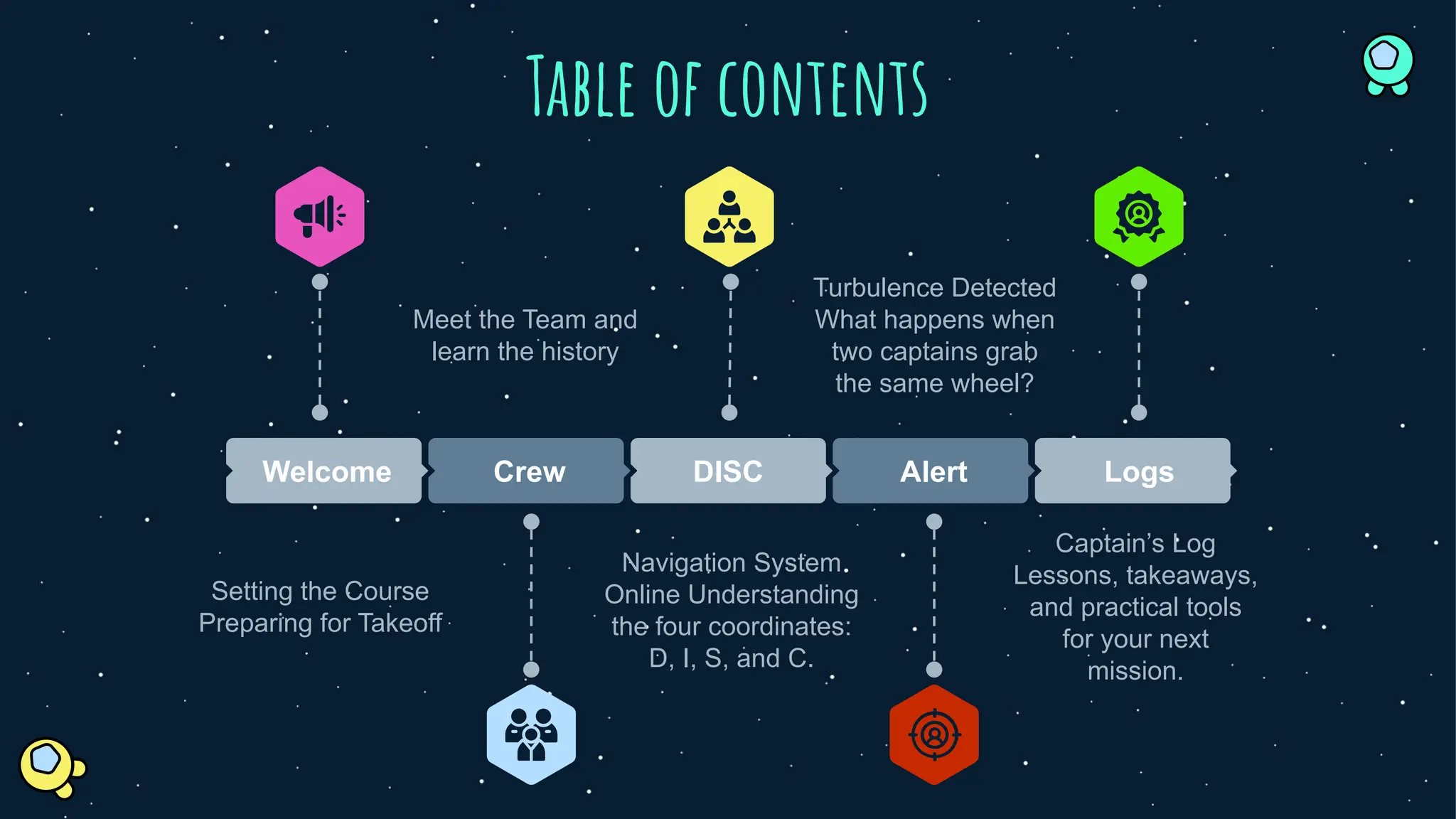
Table of contents
04
Welcome Crew DISC Alert Logs
Turbulence Detected
What happens when
two captains grab
the same wheel?
Meet the Team and
learn the history
Navigation System
Online Understanding
the four coordinates:
D, I, S, and C.
Captain’s Log
Lessons, takeaways,
and practical tools
for your next
mission.
Setting the Course
Preparing for Takeoff
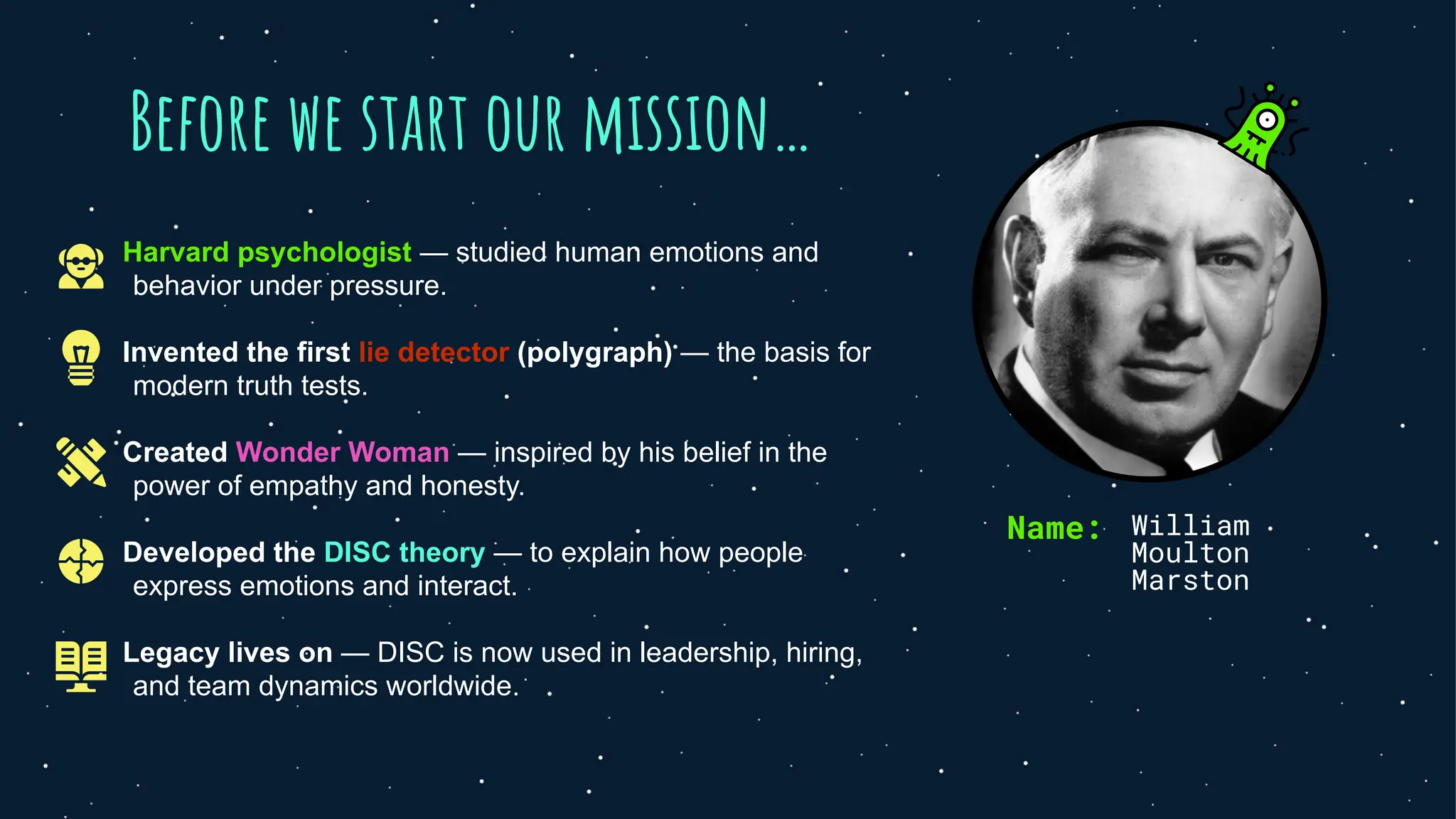
Before we start our mission…
Harvard psychologist — studied human emotions and
behavior under pressure.
Invented the first lie detector (polygraph) — the basis for
modern truth tests.
Created Wonder Woman — inspired by his belief in the
power of empathy and honesty.
Developed the DISC theory — to explain how people
express emotions and interact.
Legacy lives on — DISC is now used in leadership, hiring,
and team dynamics worldwide.
Name: William
Moulton
Marston
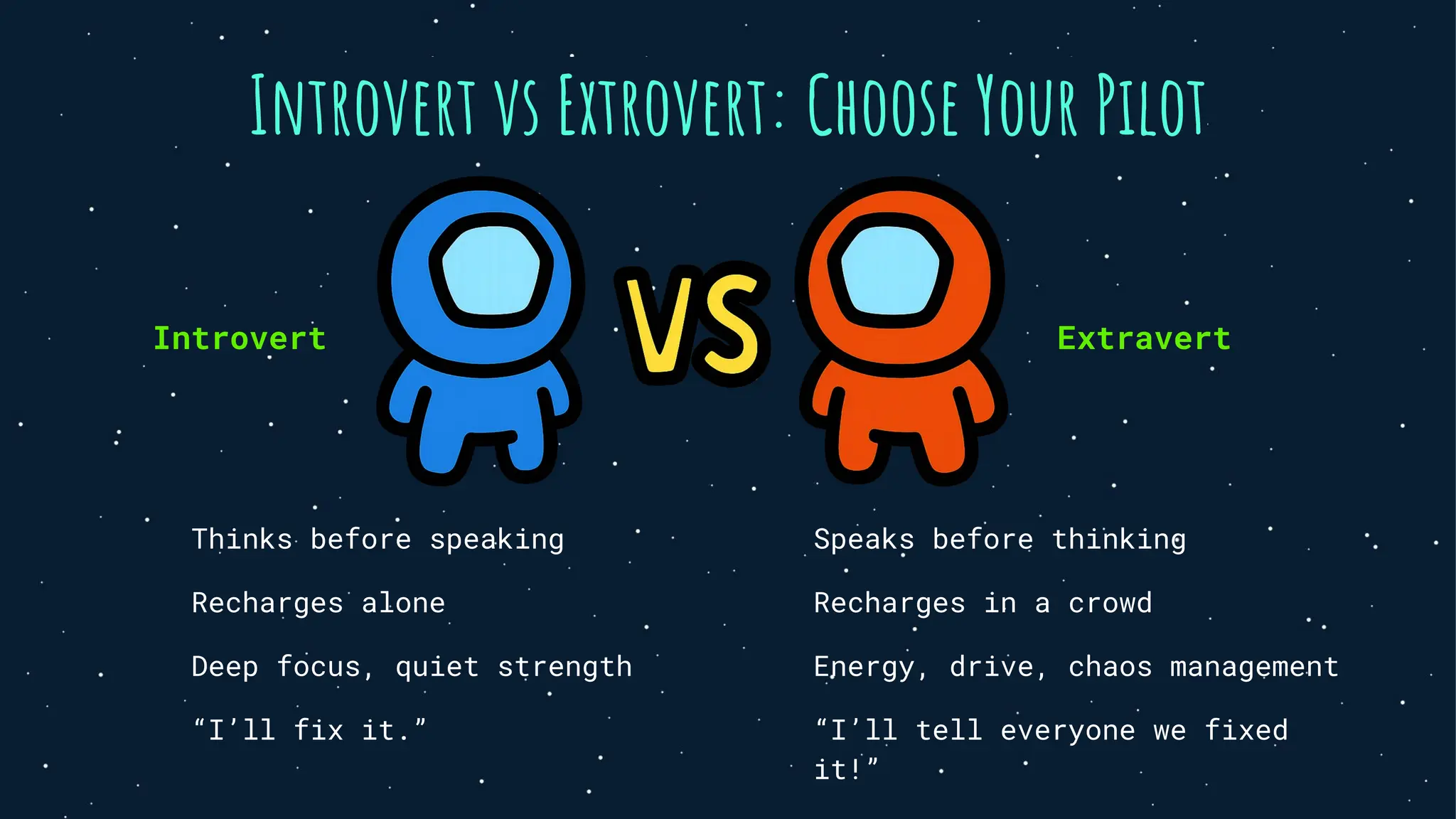
Introvert vs Extrovert: Choose Your Pilot
Introvert Extravert
Speaks before thinking
Recharges in a crowd
Energy, drive, chaos management
“I’ll tell everyone we fixed
it!”
Thinks before speaking
Recharges alone
Deep focus, quiet strength
“I’ll fix it.”
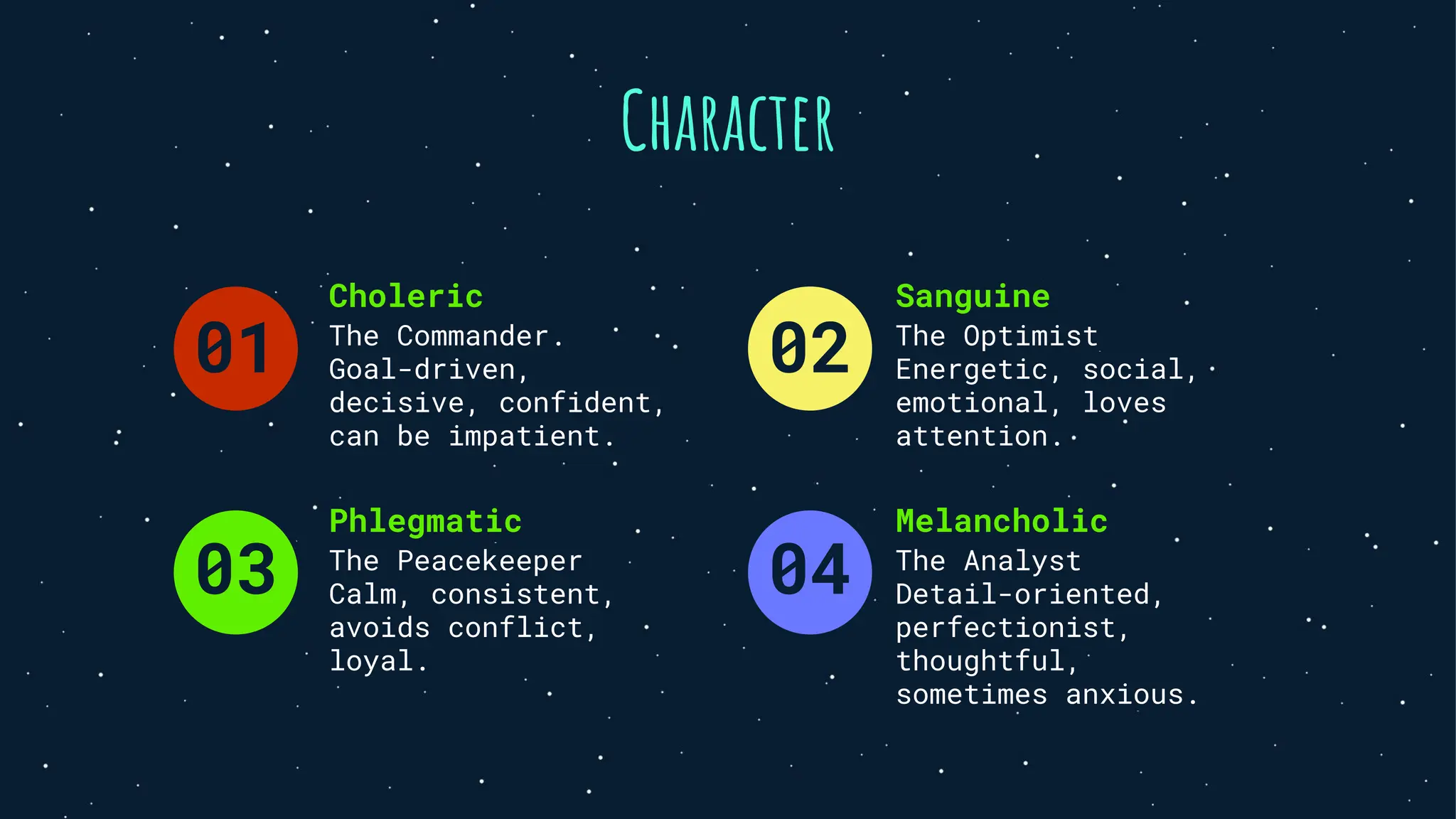
Character
Choleric Sanguine
The Optimist
Energetic, social,
emotional, loves
attention.
The Commander.
Goal-driven,
decisive, confident,
can be impatient.
Phlegmatic Melancholic
The Analyst
Detail-oriented,
perfectionist,
thoughtful,
sometimes anxious.
The Peacekeeper
Calm, consistent,
avoids conflict,
loyal.
01 02
03 04
Let’s combine
What if we take type and
character?
01
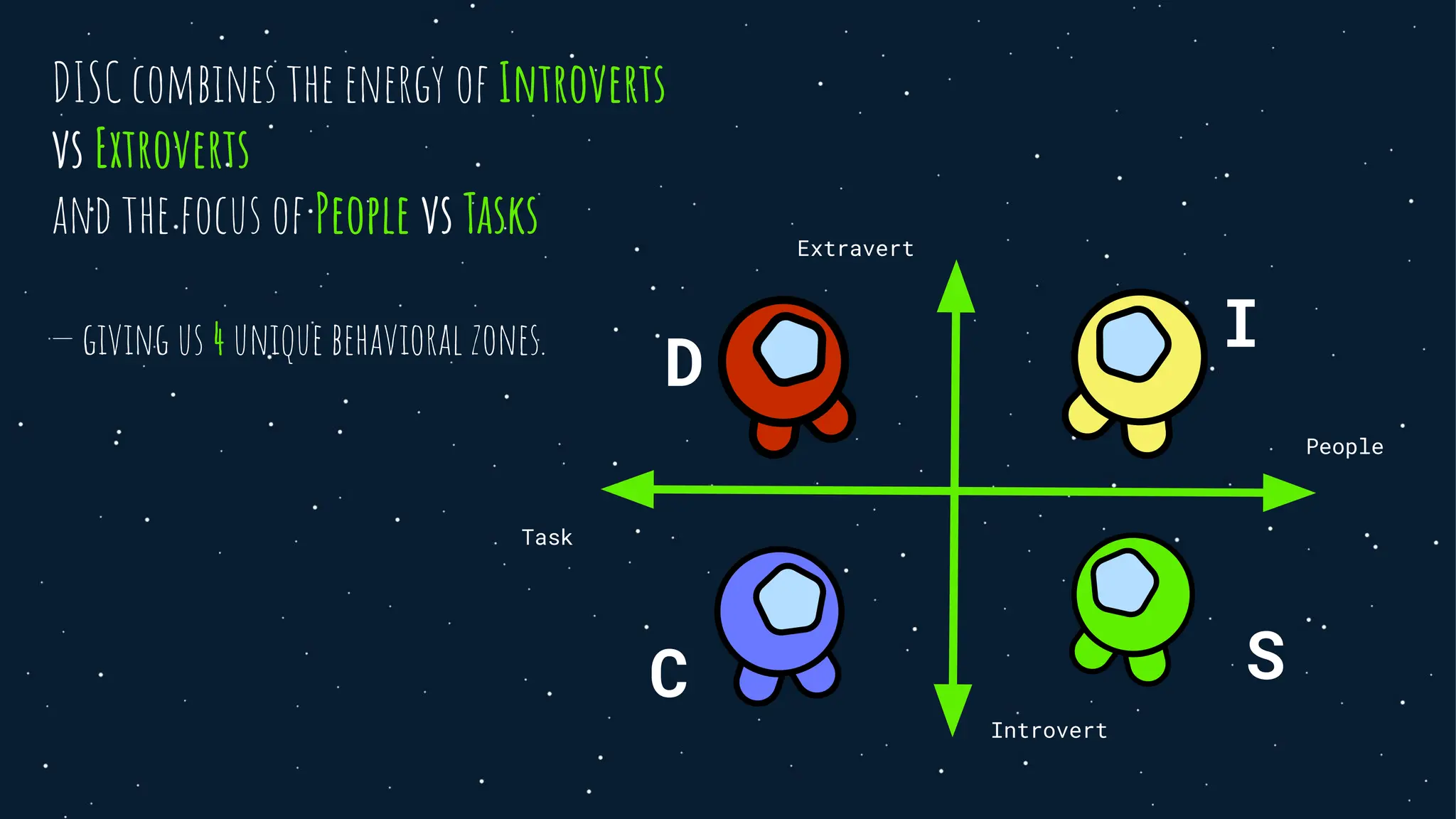
Extravert
Introvert
Task
People
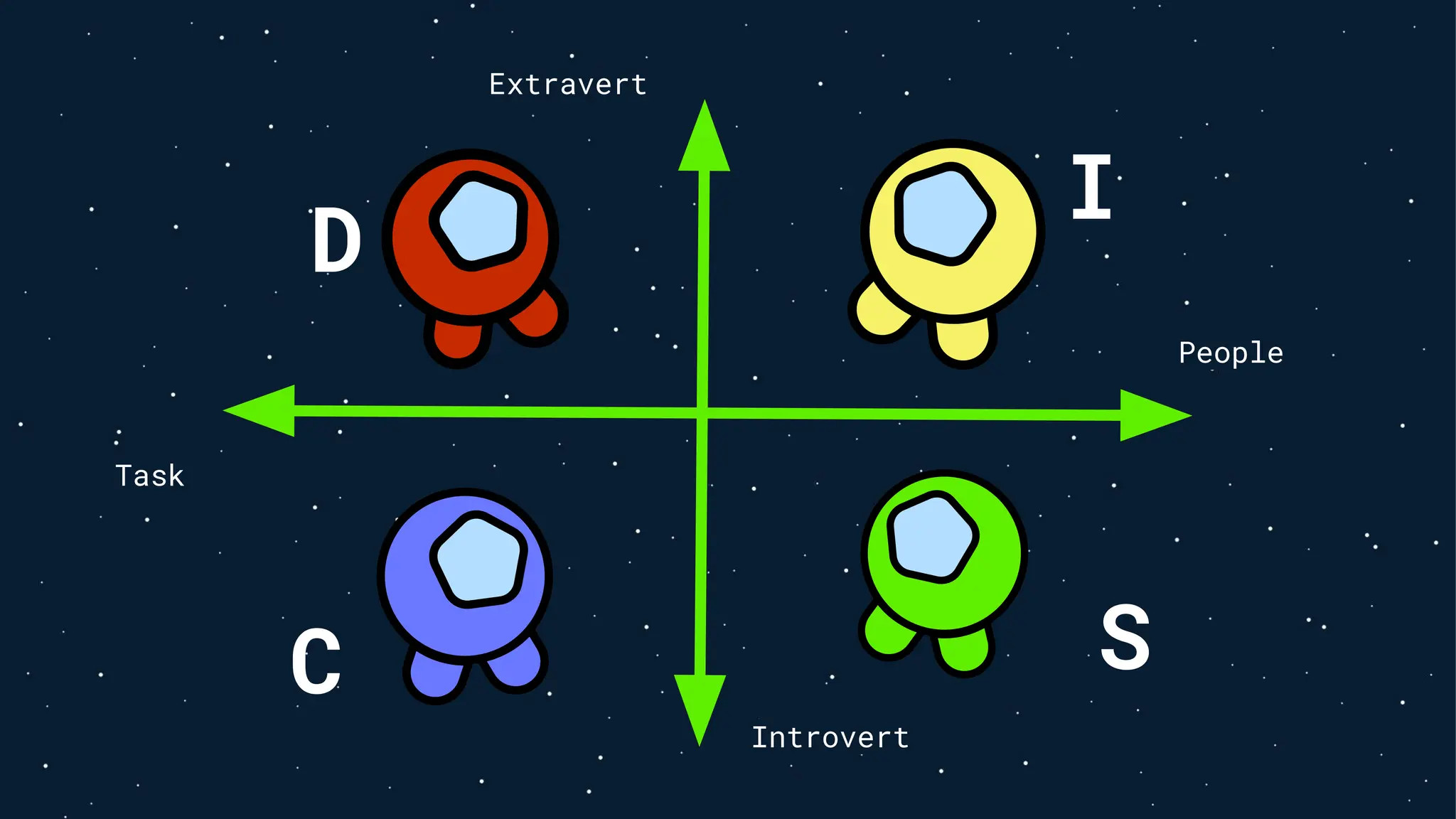
DISC combines the energy of Introverts
vs Extroverts
and the focus of People vs Tasks
— giving us 4 unique behavioral zones.
D
I
C S
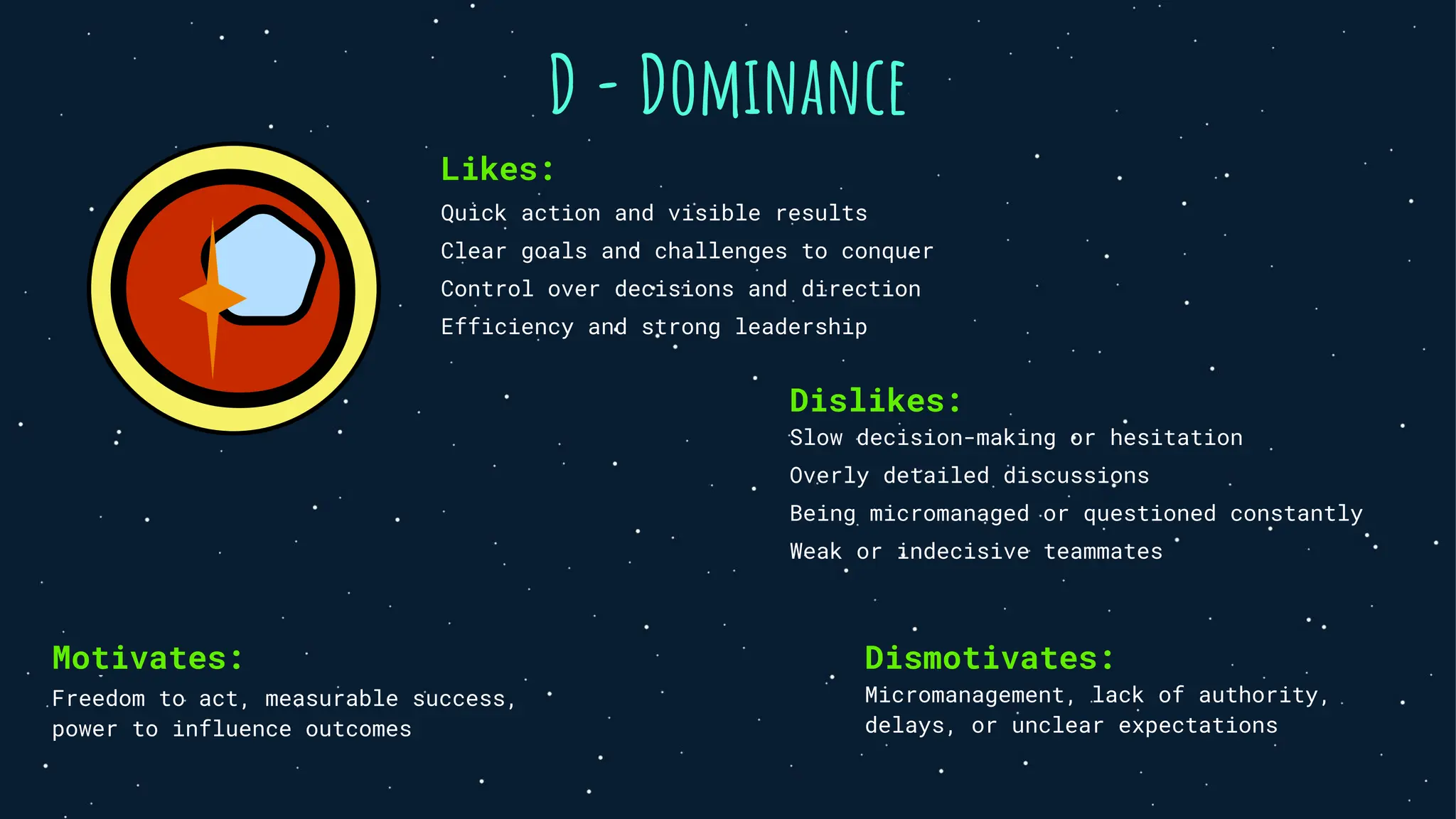
D - Dominance
Likes:
Quick action and visible results
Clear goals and challenges to conquer
Control over decisions and direction
Efficiency and strong leadership
Dislikes:
Slow decision-making or hesitation
Overly detailed discussions
Being micromanaged or questioned constantly
Weak or indecisive teammates
Motivates:
Freedom to act, measurable success,
power to influence outcomes
Dismotivates:
Micromanagement, lack of authority,
delays, or unclear expectations
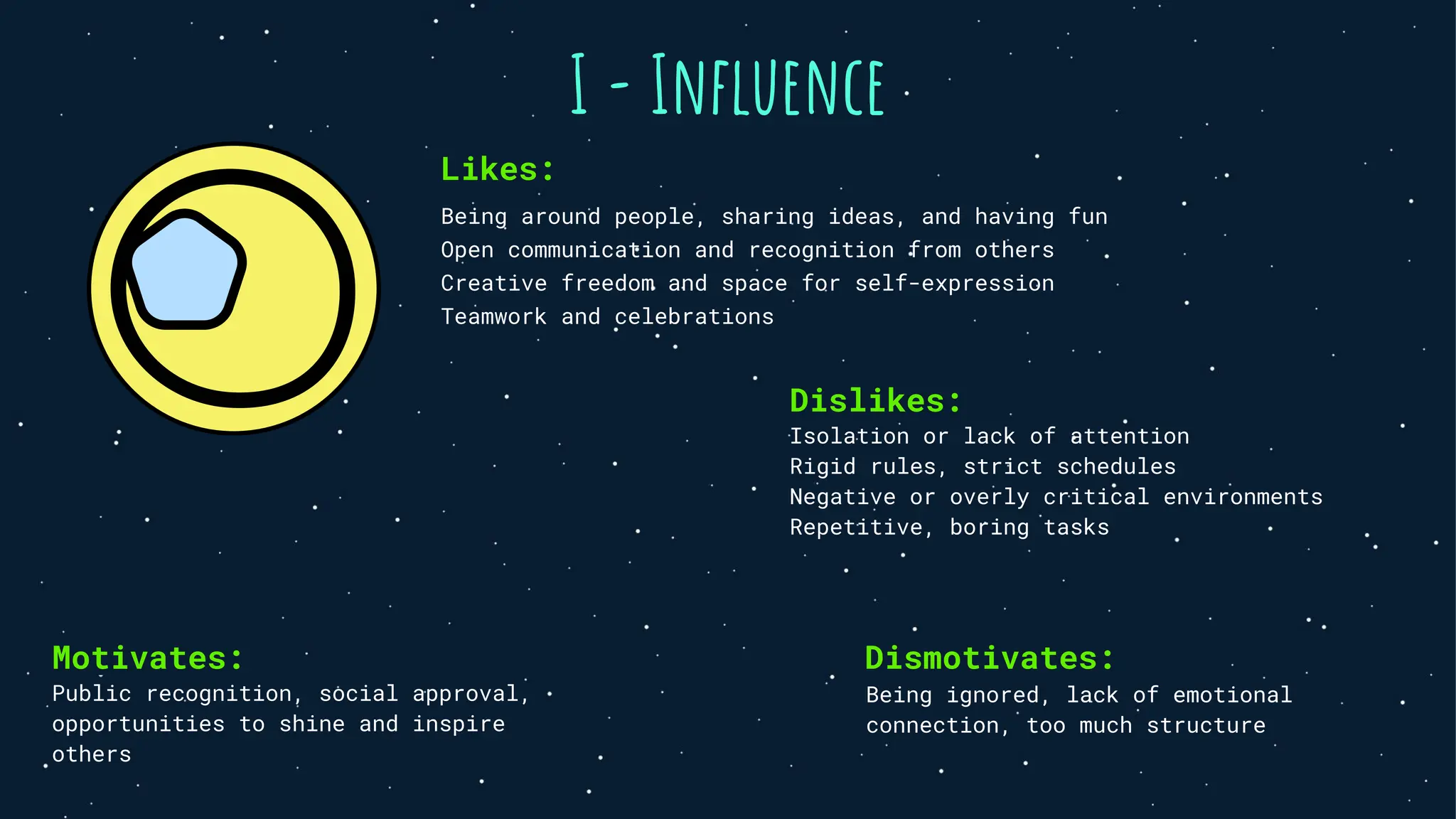
I - Influence
Likes:
Being around people, sharing ideas, and having fun
Open communication and recognition from others
Creative freedom and space for self-expression
Teamwork and celebrations
Dislikes:
Isolation or lack of attention
Rigid rules, strict schedules
Negative or overly critical environments
Repetitive, boring tasks
Motivates:
Public recognition, social approval,
opportunities to shine and inspire
others
Dismotivates:
Being ignored, lack of emotional
connection, too much structure
Extravert
Introvert
Task
People
D
I
C S
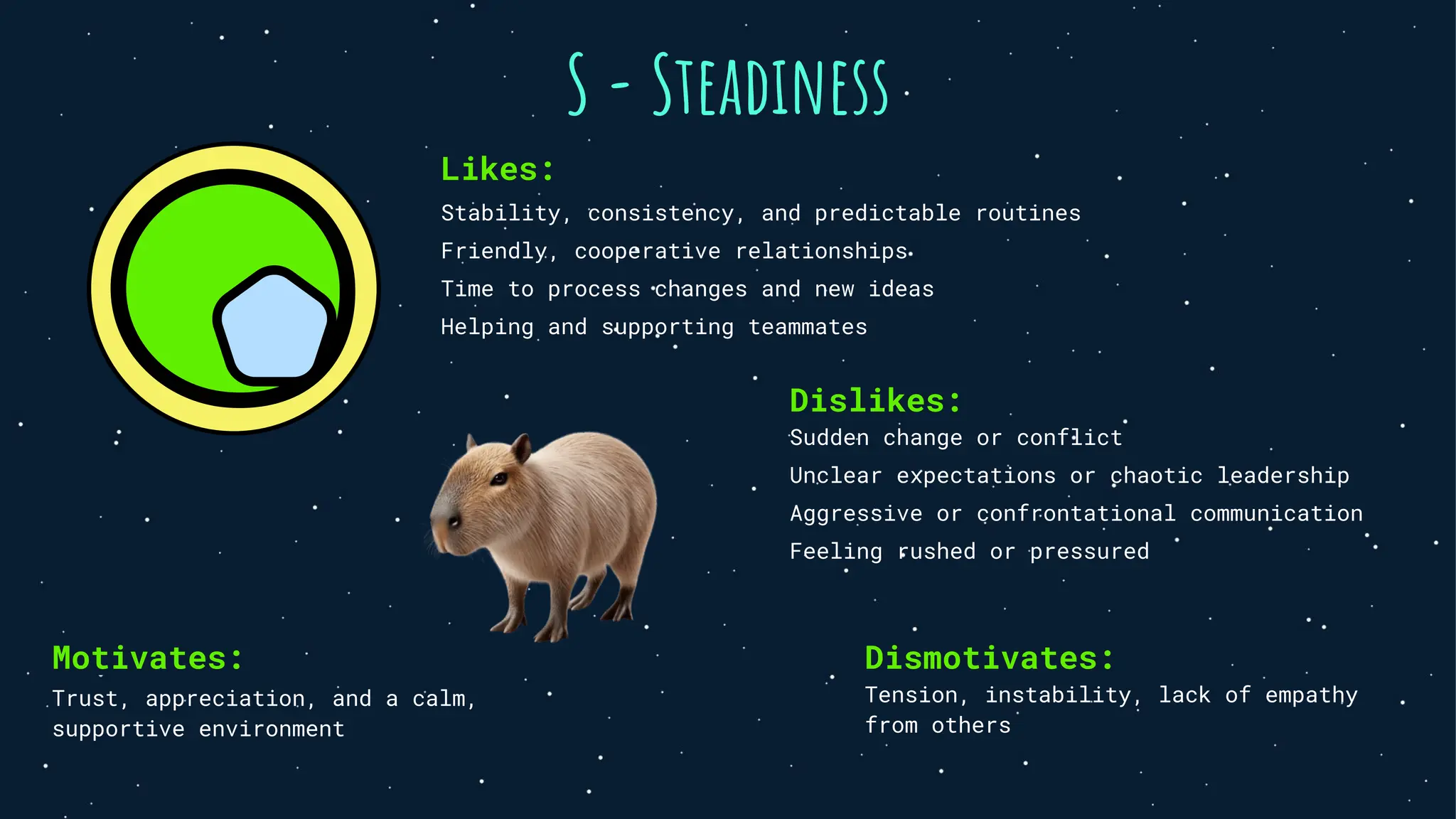
S - Steadiness
Likes:
Stability, consistency, and predictable routines
Friendly, cooperative relationships
Time to process changes and new ideas
Helping and supporting teammates
Dislikes:
Sudden change or conflict
Unclear expectations or chaotic leadership
Aggressive or confrontational communication
Feeling rushed or pressured
Motivates:
Trust, appreciation, and a calm,
supportive environment
Dismotivates:
Tension, instability, lack of empathy
from others
C - Conscientiousness
Likes:
Clear standards, data, and structure
Time to analyze and plan before acting
Working independently on complex tasks
Well-documented processes and logical reasoning
Dislikes:
Chaos, last-minute changes, or unclear goals
Emotional outbursts or unprofessional behavior
Being rushed or forced to improvise
Vague or inconsistent instructions
Motivates:
Precision, logical systems, and
recognition for quality work
Dismotivates:
Ambiguity, sloppy execution, and
emotional pressure
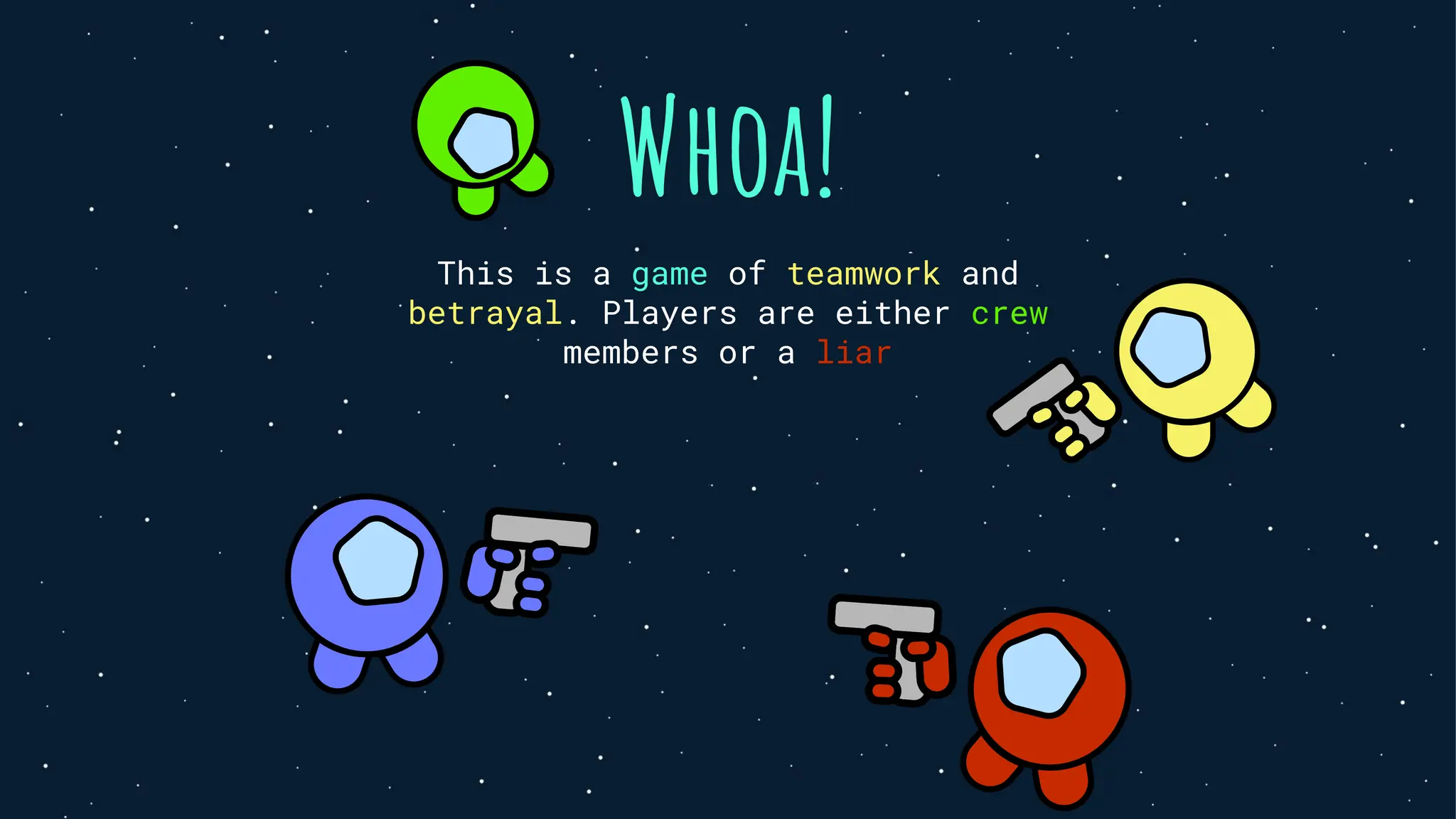
Whoa!
This is a game of
teamwork and betrayal.
Players are either crew
members or a liar
Compatible Pairs — The Perfect Crew Matches
🔴 D + 🟢 S — The Pilot & the Copilot
Why it works:
● D leads, S supports — clear dynamic without
power struggle.
● D pushes forward, S keeps the flight smooth.
● D brings direction, S brings stability and
empathy.
Example:
“D says: ‘Let’s launch on Monday!’
S quietly replies: ‘Already prepared the
checklist so we don’t explode.’”
💬 Balance of ambition and calm.
🟡 I + 🟢 S — The Voice & the Heart
Why it works:
● I spreads enthusiasm and builds energy.
● S maintains harmony and keeps everyone grounded.
● Both are people-oriented — one loud, one warm.
Example:
“I plans the team party,
S makes sure everyone got home safely.”
💬 Energy grounded in kindness.
Compatible Pairs — The Perfect Crew Matches
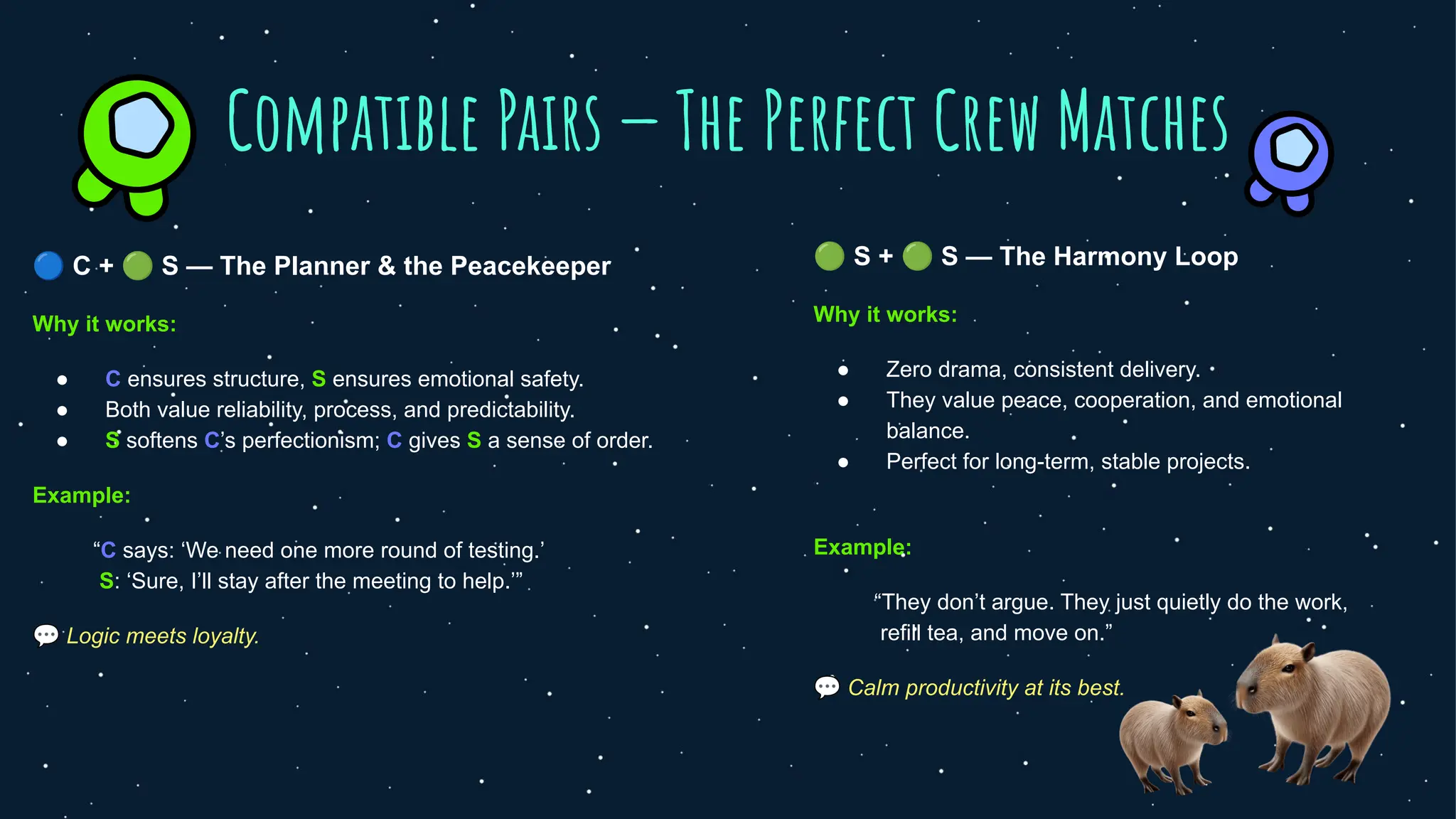
🔵 C + 🟢 S — The Planner & the Peacekeeper
Why it works:
● C ensures structure, S ensures emotional safety.
● Both value reliability, process, and predictability.
● S softens C’s perfectionism; C gives S a sense of order.
Example:
“C says: ‘We need one more round of testing.’
S: ‘Sure, I’ll stay after the meeting to help.’”
💬 Logic meets loyalty.
🟢 S + 🟢 S — The Harmony Loop
Why it works:
● Zero drama, consistent delivery.
● They value peace, cooperation, and emotional
balance.
● Perfect for long-term, stable projects.
Example:
“They don’t argue. They just quietly do the work,
refill tea, and move on.”
💬 Calm productivity at its best.
Compatible Pairs — The Perfect Crew Matches
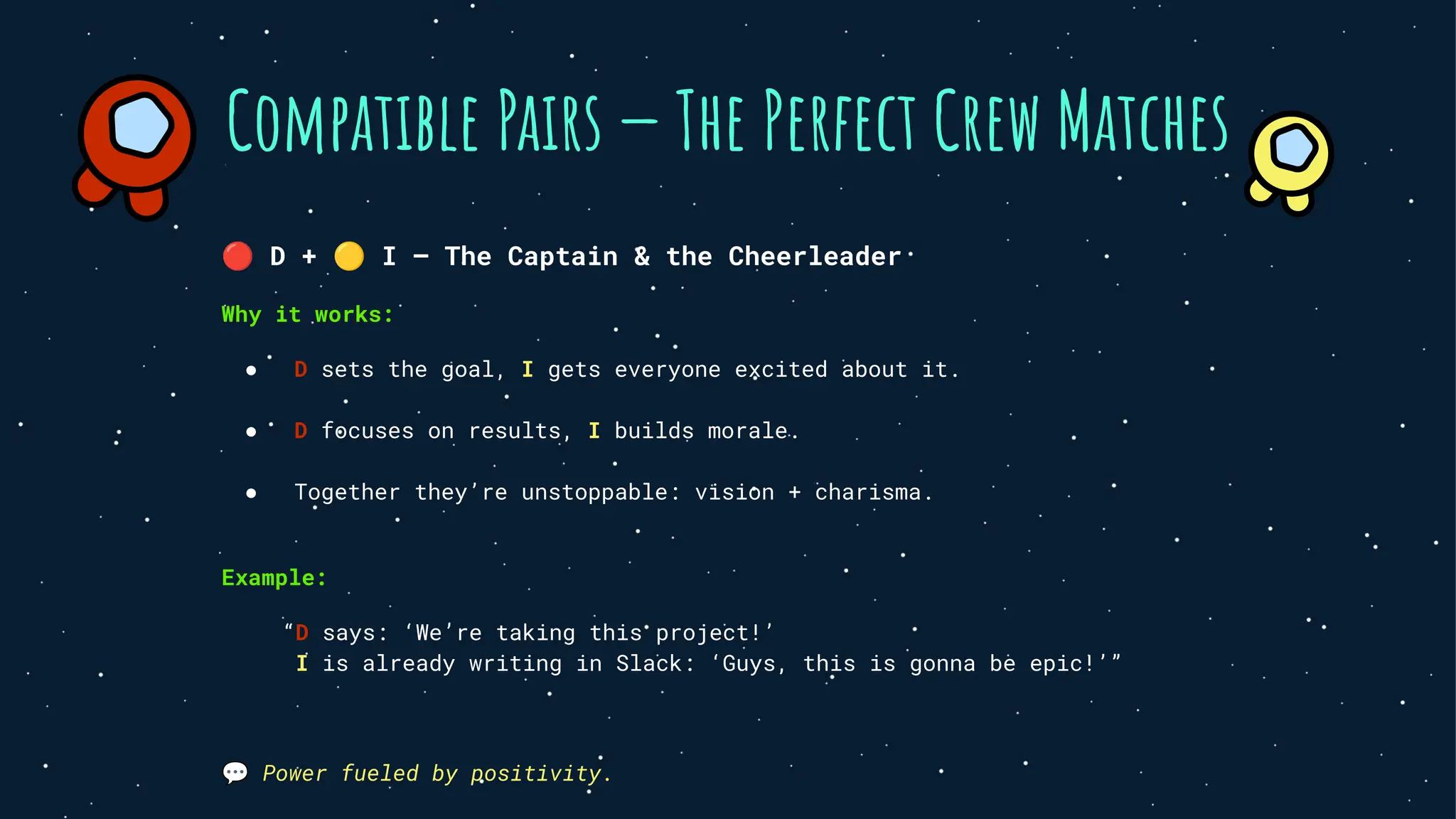
🔴 D + 🟡 I — The Captain & the Cheerleader
Why it works:
● D sets the goal, I gets everyone excited about it.
● D focuses on results, I builds morale.
● Together they’re unstoppable: vision + charisma.
Example:
“D says: ‘We’re taking this project!’
I is already writing in Slack: ‘Guys, this is gonna be epic!’”
💬 Power fueled by positivity.
Whoa!
This is a game of teamwork and
betrayal. Players are either crew
members or a liar
Compatible Pairs — But need maturity
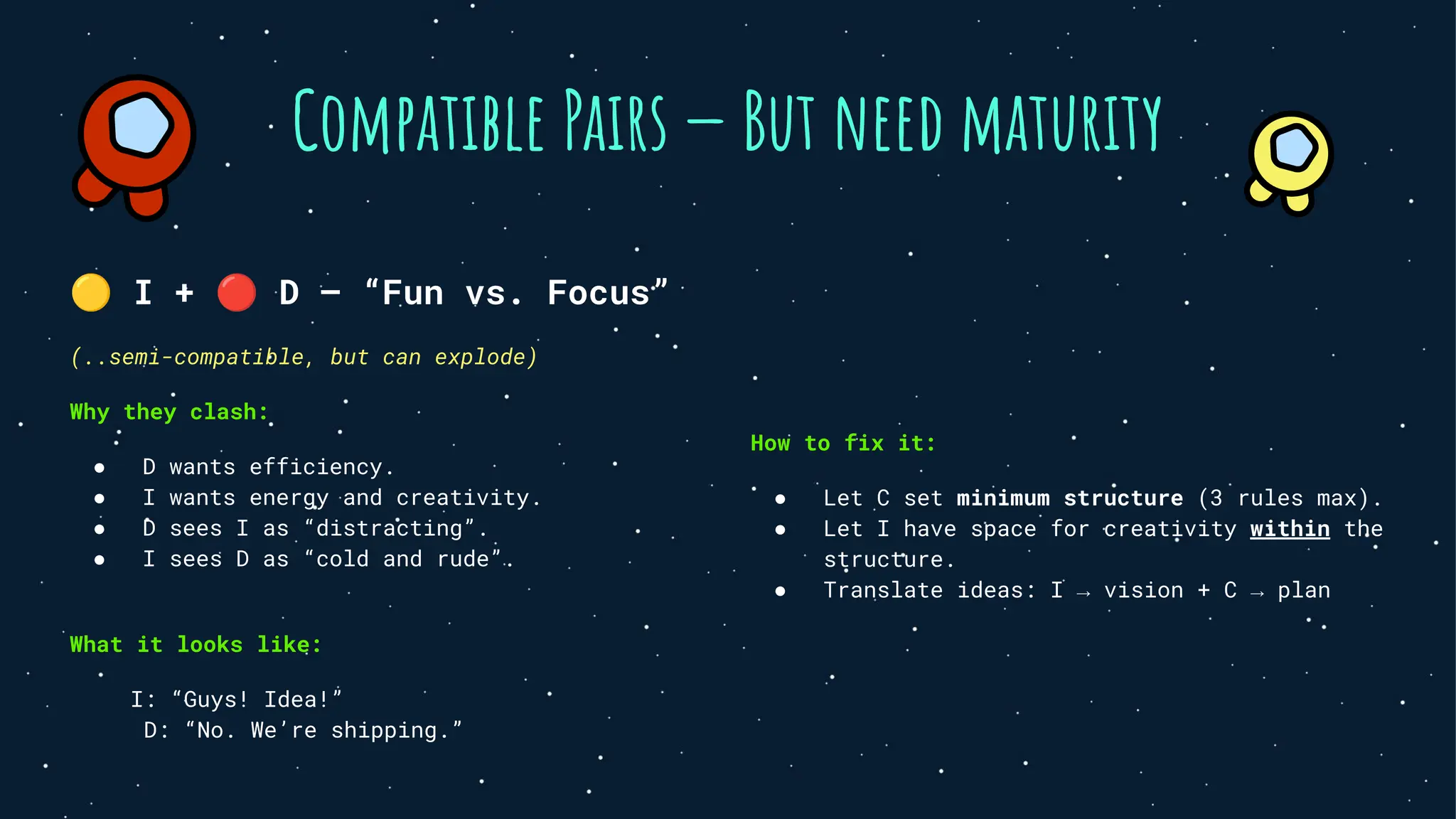
🟡 I + 🔴 D — “Fun vs. Focus”
(..semi-compatible, but can explode)
Why they clash:
● D wants efficiency.
● I wants energy and creativity.
● D sees I as “distracting”.
● I sees D as “cold and rude”.
What it looks like:
I: “Guys! Idea!”
D: “No. We’re shipping.”
How to fix it:
● Let C set minimum structure (3 rules max).
● Let I have space for creativity within the
structure.
● Translate ideas: I → vision + C → plan
Compatible Pairs — But need maturity
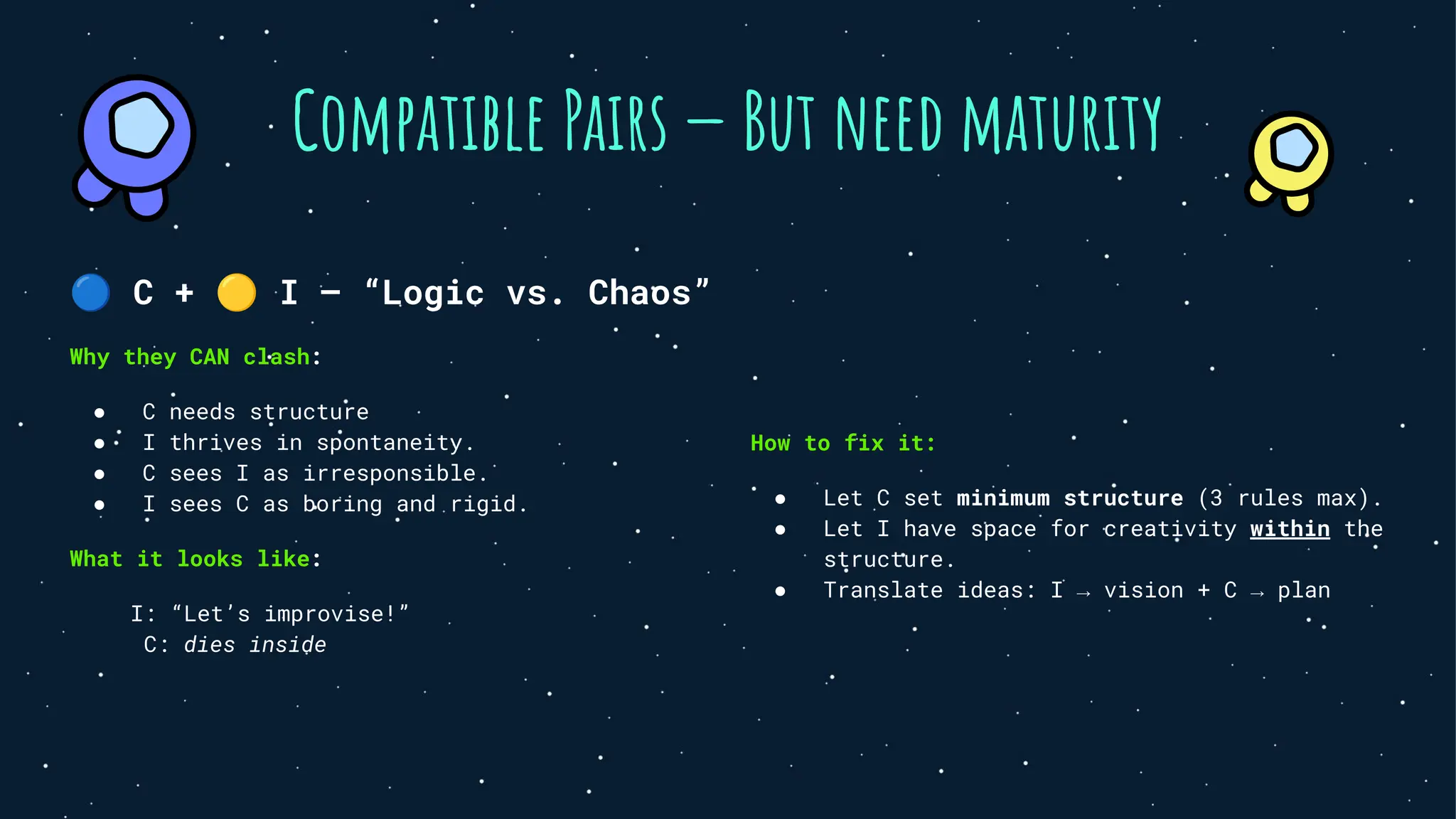
🔵 C + 🟡 I — “Logic vs. Chaos”
Why they CAN clash:
● C needs structure
● I thrives in spontaneity.
● C sees I as irresponsible.
● I sees C as boring and rigid.
What it looks like:
I: “Let’s improvise!”
C: dies inside
How to fix it:
● Let C set minimum structure (3 rules max).
● Let I have space for creativity within the
structure.
● Translate ideas: I → vision + C → plan
Compatible Pairs — But need maturity
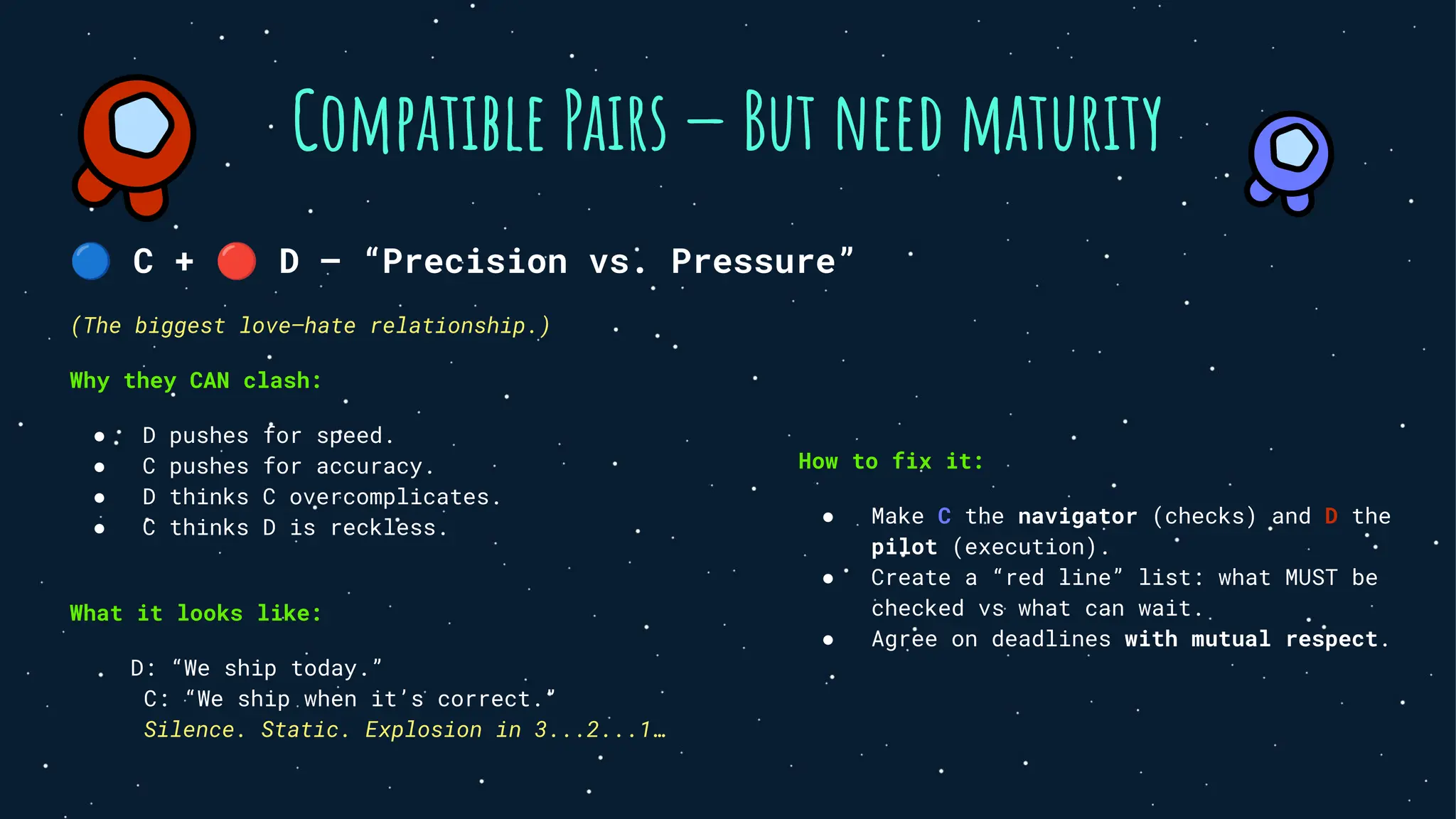
🔵 C + 🔴 D — “Precision vs. Pressure”
(The biggest love–hate relationship.)
Why they CAN clash:
● D pushes for speed.
● C pushes for accuracy.
● D thinks C overcomplicates.
● C thinks D is reckless.
What it looks like:
D: “We ship today.”
C: “We ship when it’s correct.”
Silence. Static. Explosion in 3...2...1…
How to fix it:
● Make C the navigator (checks) and D the
pilot (execution).
● Create a “red line” list: what MUST be
checked vs what can wait.
● Agree on deadlines with mutual respect.
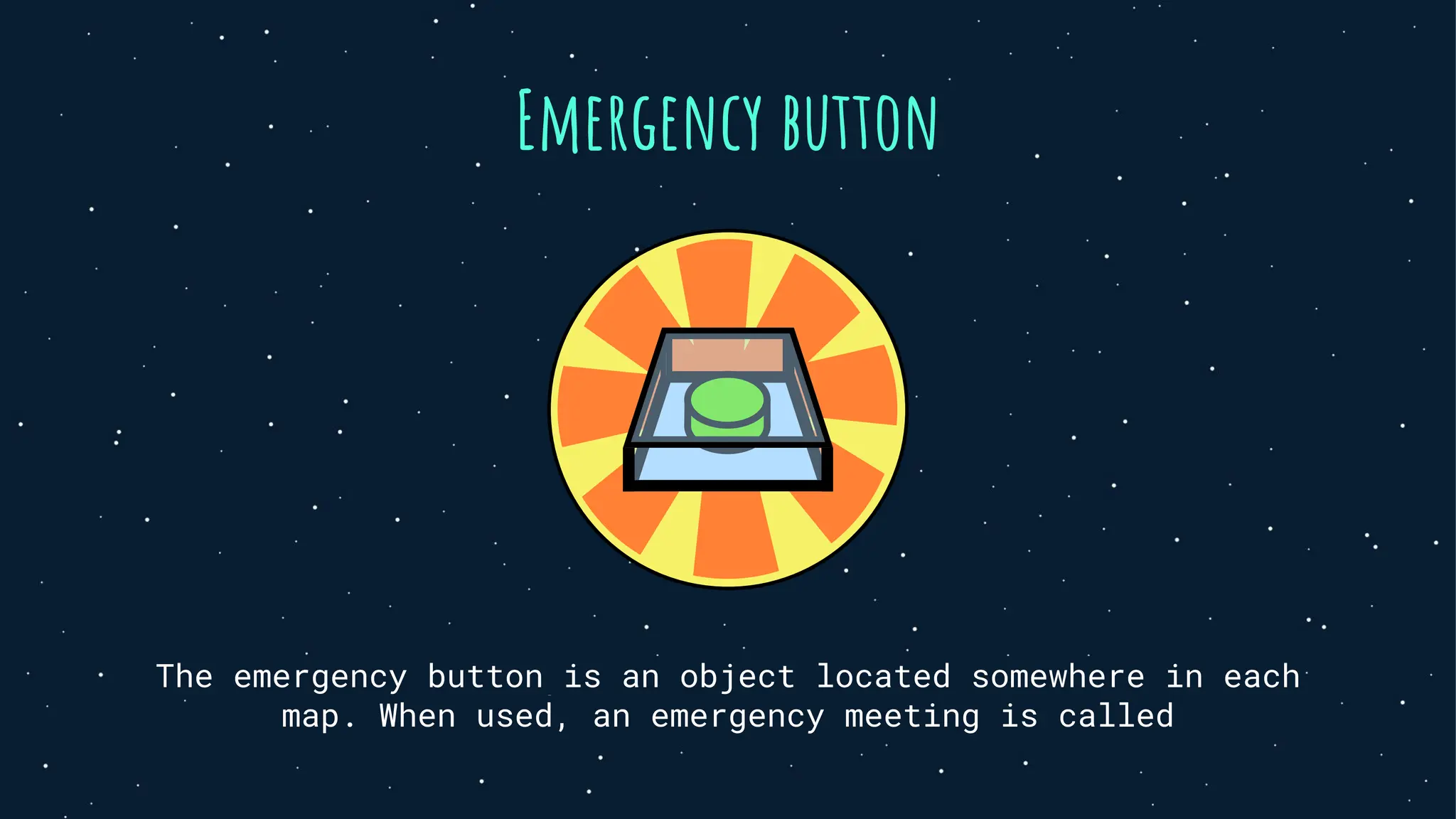
Emergency button
The emergency button is an object located somewhere in each
map. When used, an emergency meeting is called
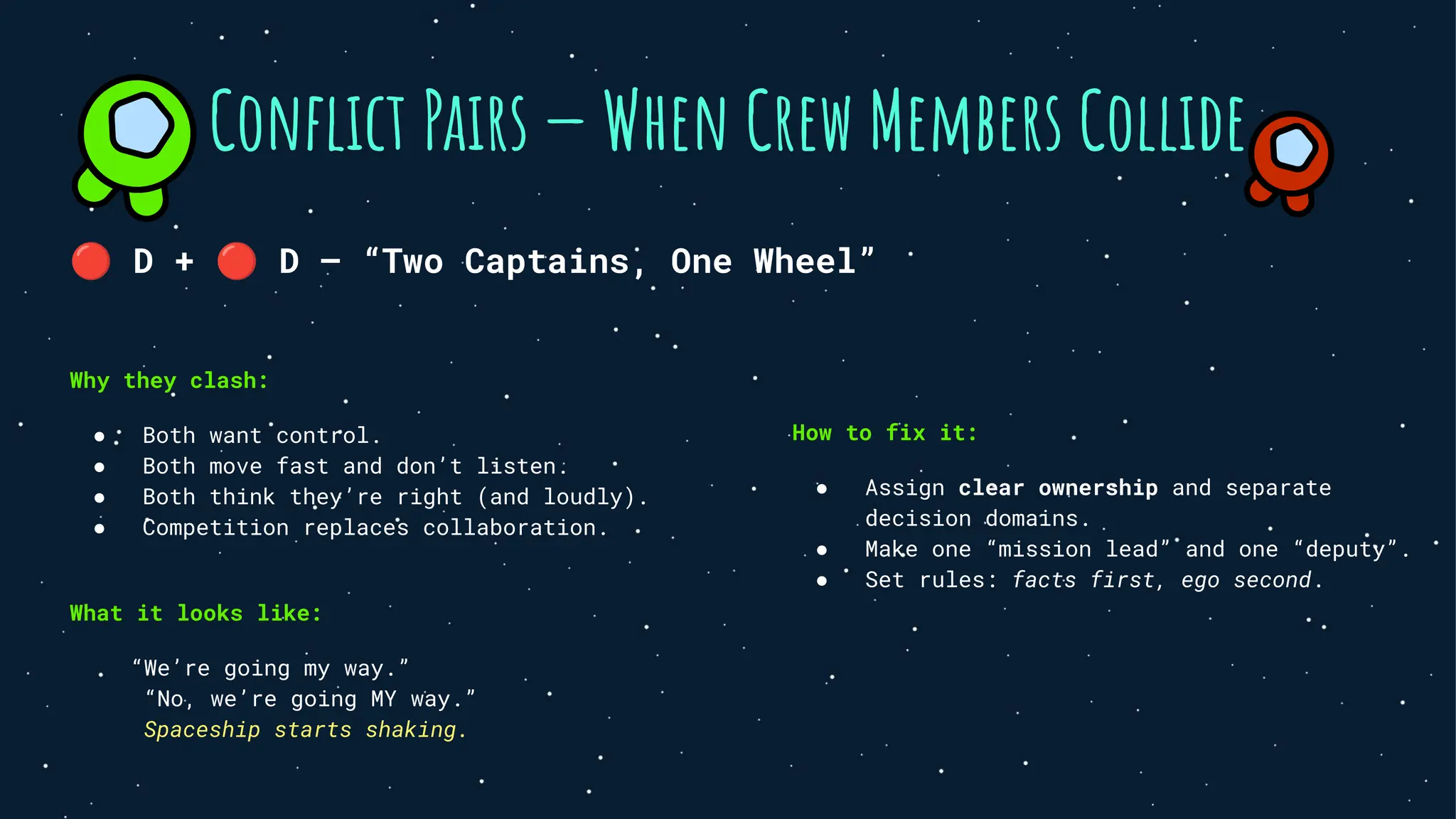
🔴 D + 🔴 D — “Two Captains, One Wheel”
Why they clash:
● Both want control.
● Both move fast and don’t listen.
● Both think they’re right (and loudly).
● Competition replaces collaboration.
What it looks like:
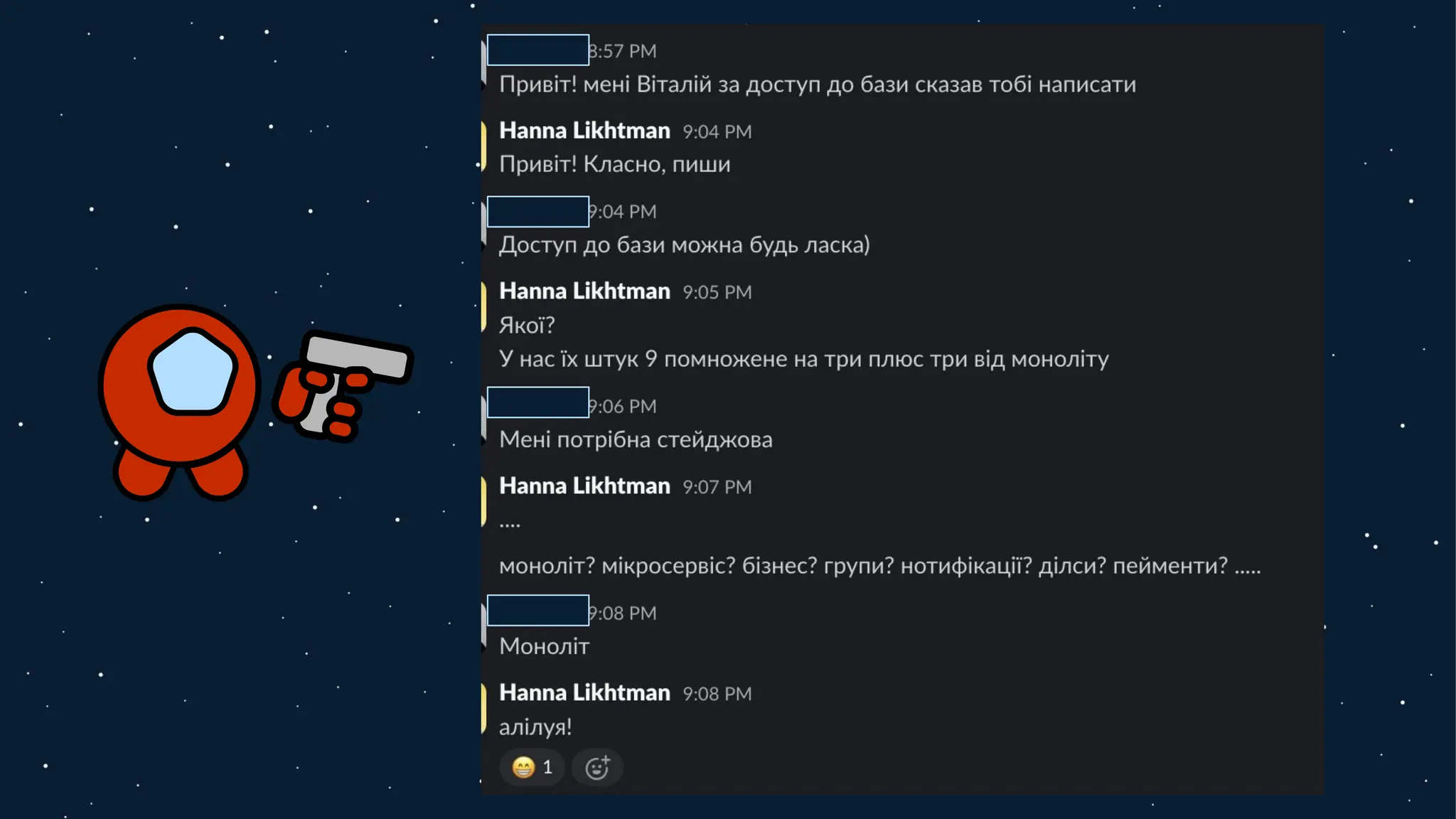
“We’re going my way.”
“No, we’re going MY way.”
Spaceship starts shaking.
Conflict Pairs — When Crew Members Collide
How to fix it:
● Assign clear ownership and separate
decision domains.
● Make one “mission lead” and one “deputy”.
● Set rules: facts first, ego second.
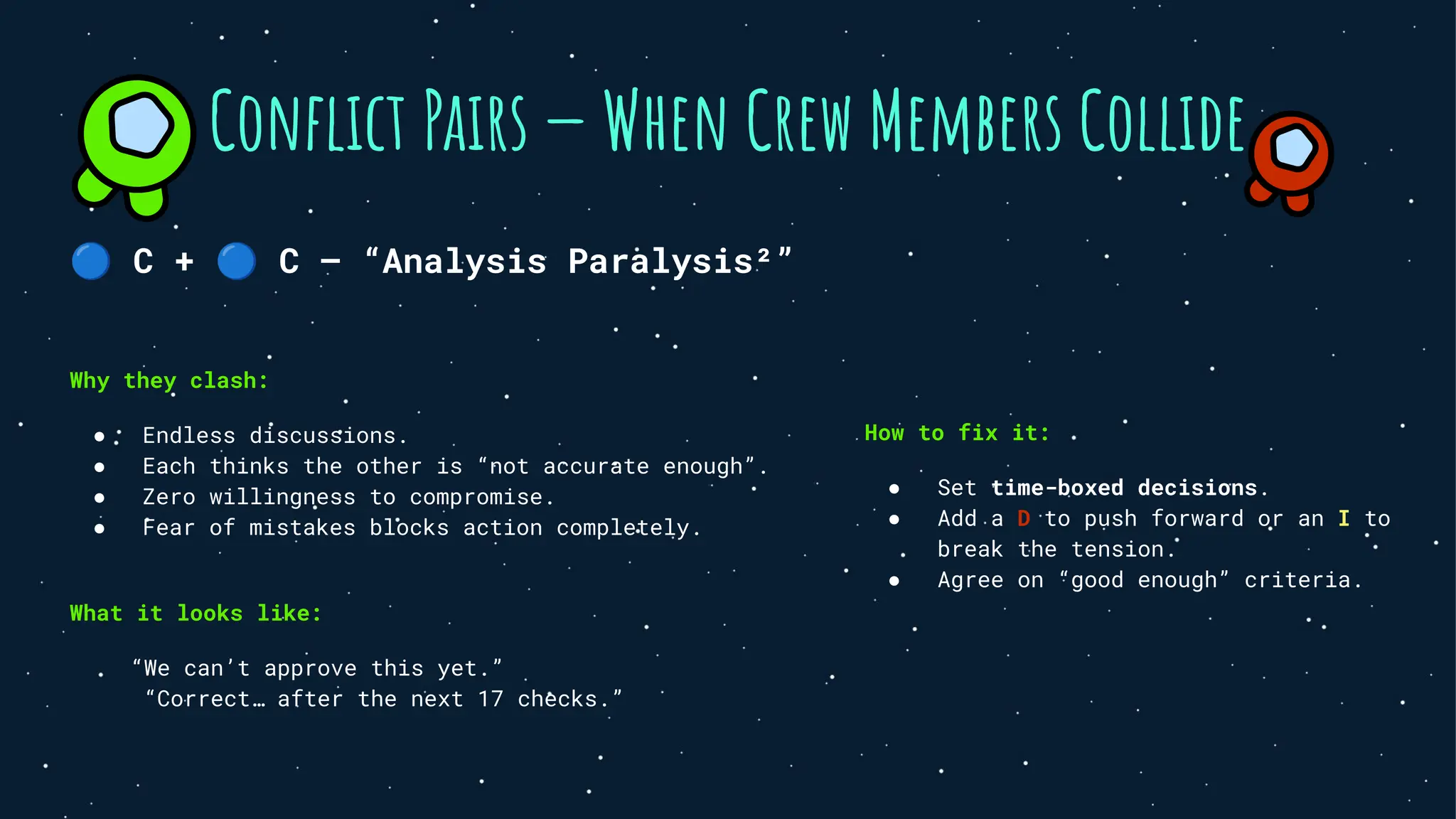
🔵 C + 🔵 C — “Analysis Paralysis²”
Why they clash:
● Endless discussions.
● Each thinks the other is “not accurate enough”.
● Zero willingness to compromise.
● Fear of mistakes blocks action completely.
What it looks like:
“We can’t approve this yet.”
“Correct… after the next 17 checks.”
Conflict Pairs — When Crew Members Collide
How to fix it:
● Set time-boxed decisions.
● Add a D to push forward or an I to
break the tension.
● Agree on “good enough” criteria.
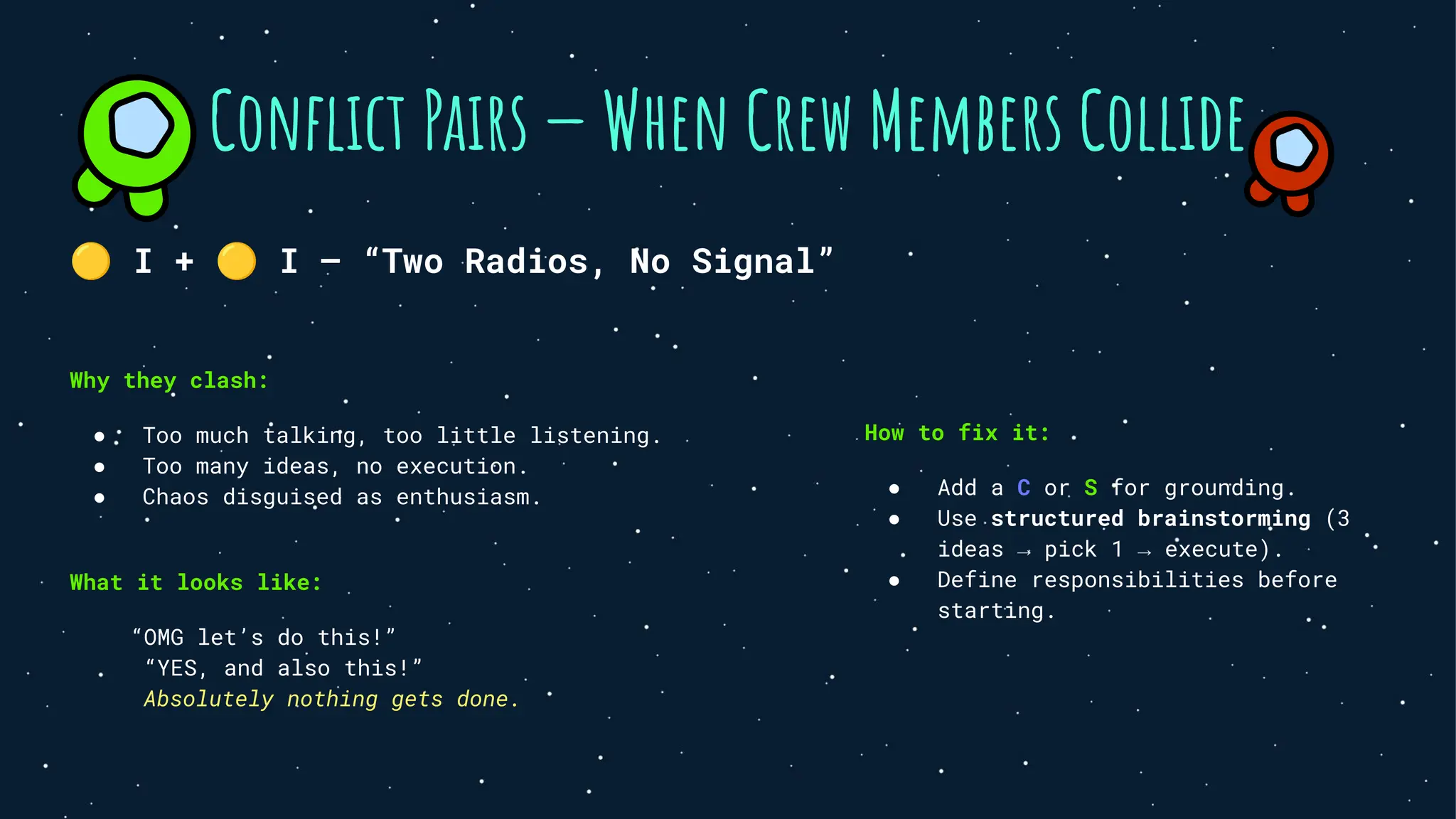
🟡 I + 🟡 I — “Two Radios, No Signal”
Why they clash:
● Too much talking, too little listening.
● Too many ideas, no execution.
● Chaos disguised as enthusiasm.
What it looks like:
“OMG let’s do this!”
“YES, and also this!”
Absolutely nothing gets done.
Conflict Pairs — When Crew Members Collide
How to fix it:
● Add a C or S for grounding.
● Use structured brainstorming (3
ideas → pick 1 → execute).
● Define responsibilities before
starting.
Sabotages
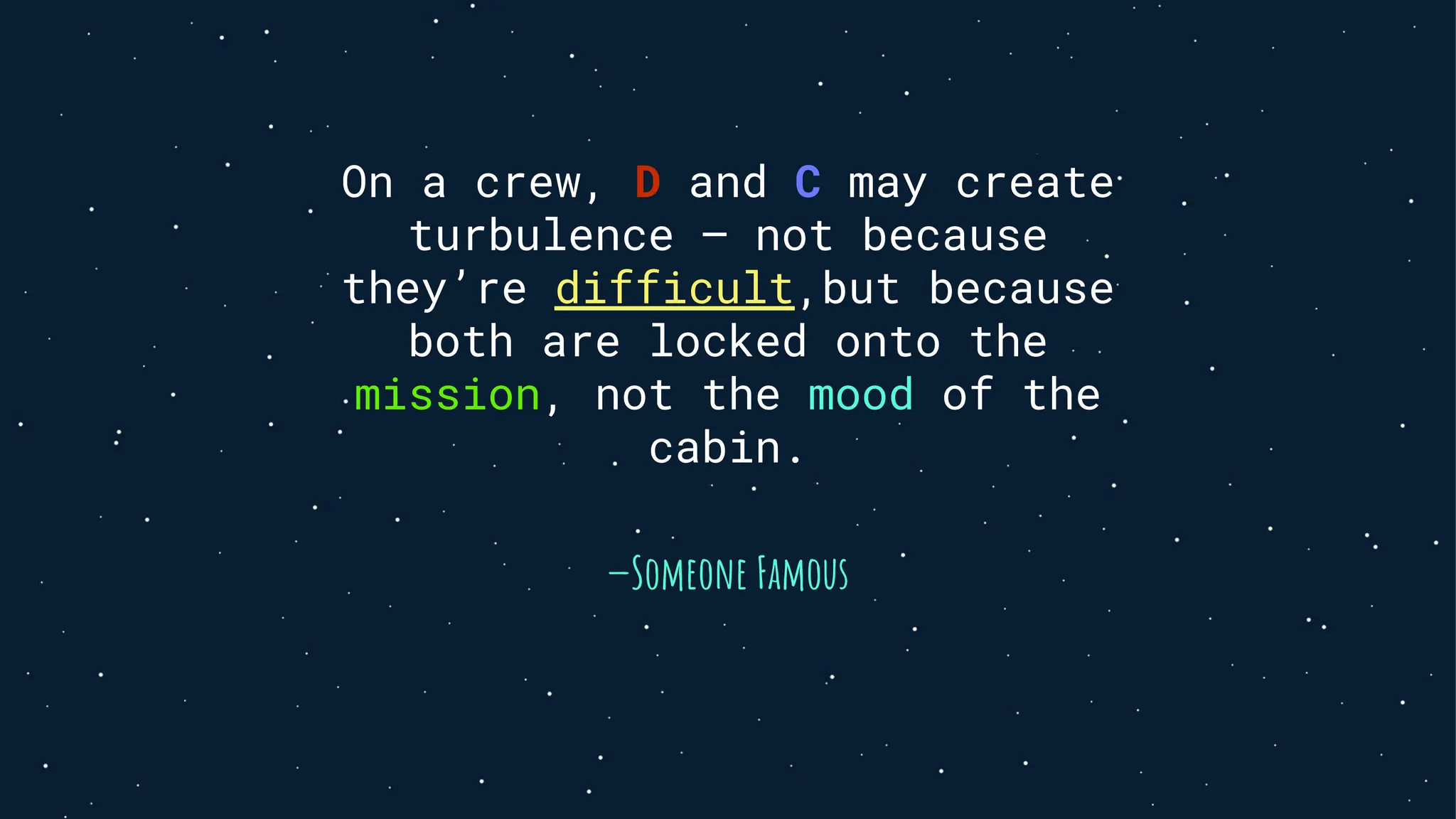
—Someone Famous
On a crew, D and C may create
turbulence — not because
they’re difficult,but because
both are locked onto the
mission, not the mood of the
cabin.
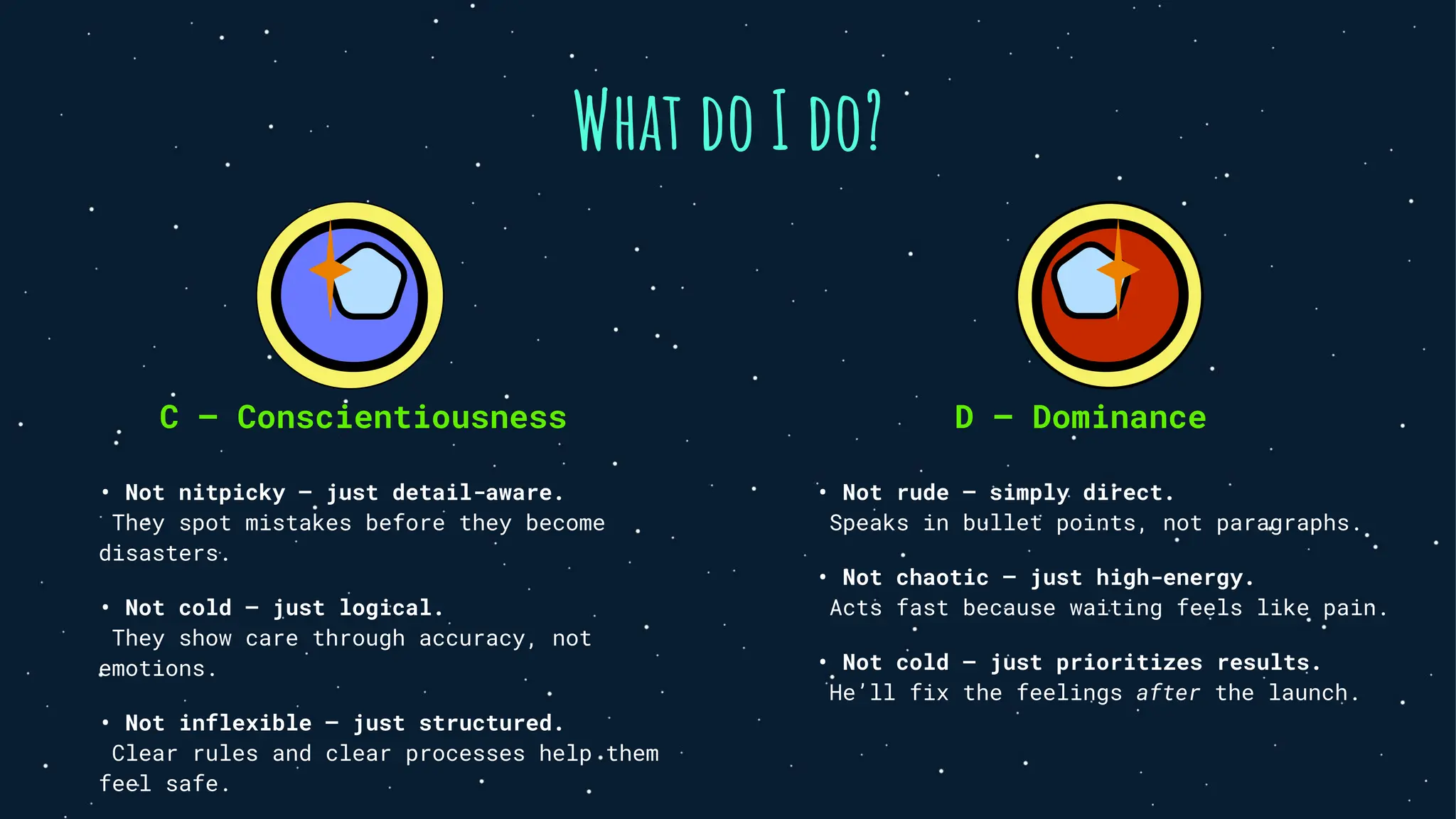
What do I do?
C — Conscientiousness
• Not nitpicky — just detail-aware.
They spot mistakes before they become
disasters.
• Not cold — just logical.
They show care through accuracy, not
emotions.
• Not inflexible — just structured.
Clear rules and clear processes help them
feel safe.
D — Dominance
• Not rude — simply direct.
Speaks in bullet points, not paragraphs.
• Not chaotic — just high-energy.
Acts fast because waiting feels like pain.
• Not cold — just prioritizes results.
He’ll fix the feelings after the launch.
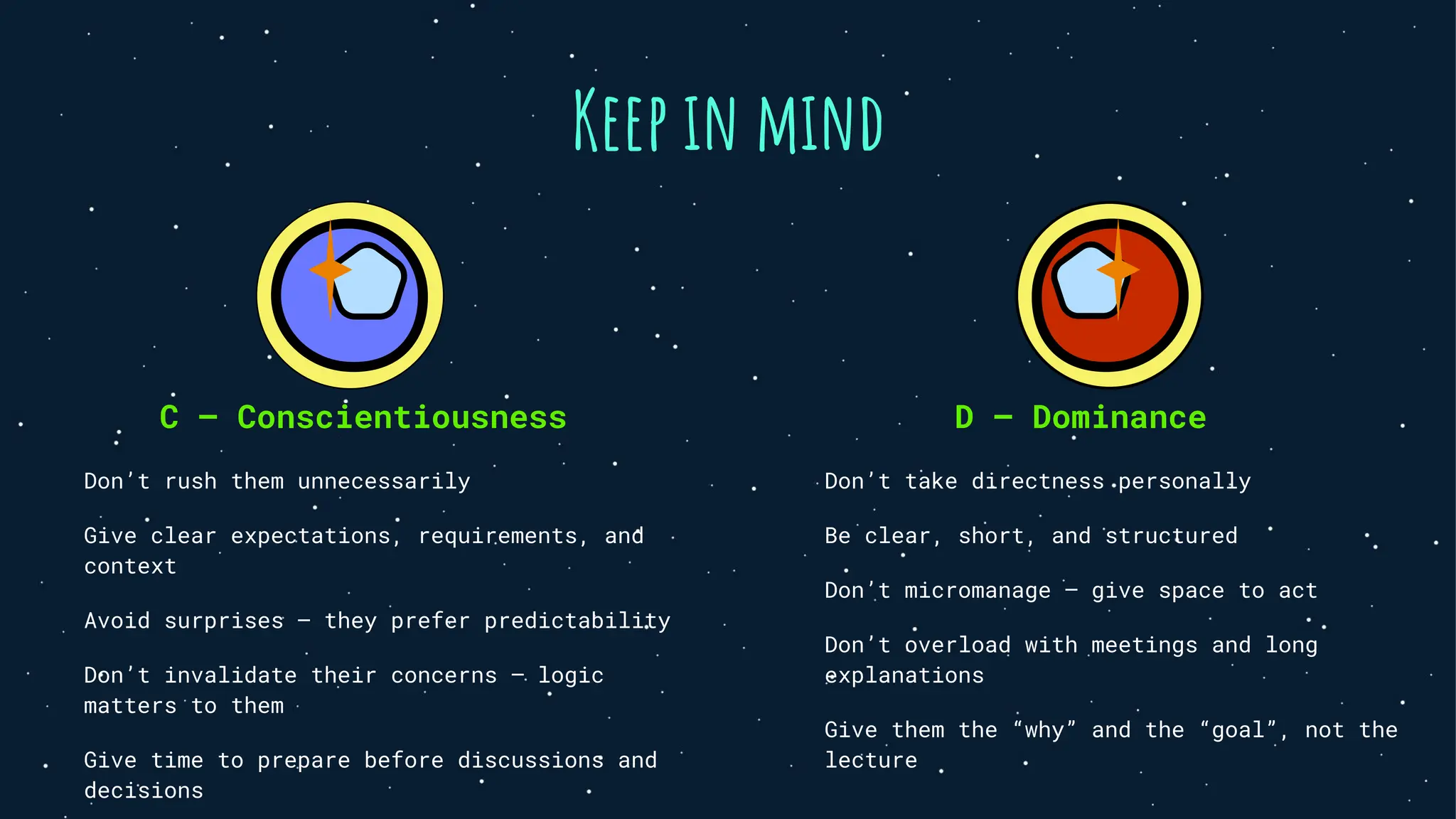
Keep in mind
C — Conscientiousness
Don’t rush them unnecessarily
Give clear expectations, requirements, and
context
Avoid surprises — they prefer predictability
Don’t invalidate their concerns — logic
matters to them
Give time to prepare before discussions and
decisions
D — Dominance
Don’t take directness personally
Be clear, short, and structured
Don’t micromanage — give space to act
Don’t overload with meetings and long
explanations
Give them the “why” and the “goal”, not the
lecture
Captain’s Insight — What Really Matters
● People don’t fail because of skills —
they fail because they don’t
understand each other.
● Your job as a leader is not to change
personalities.
Your job is to align trajectories.
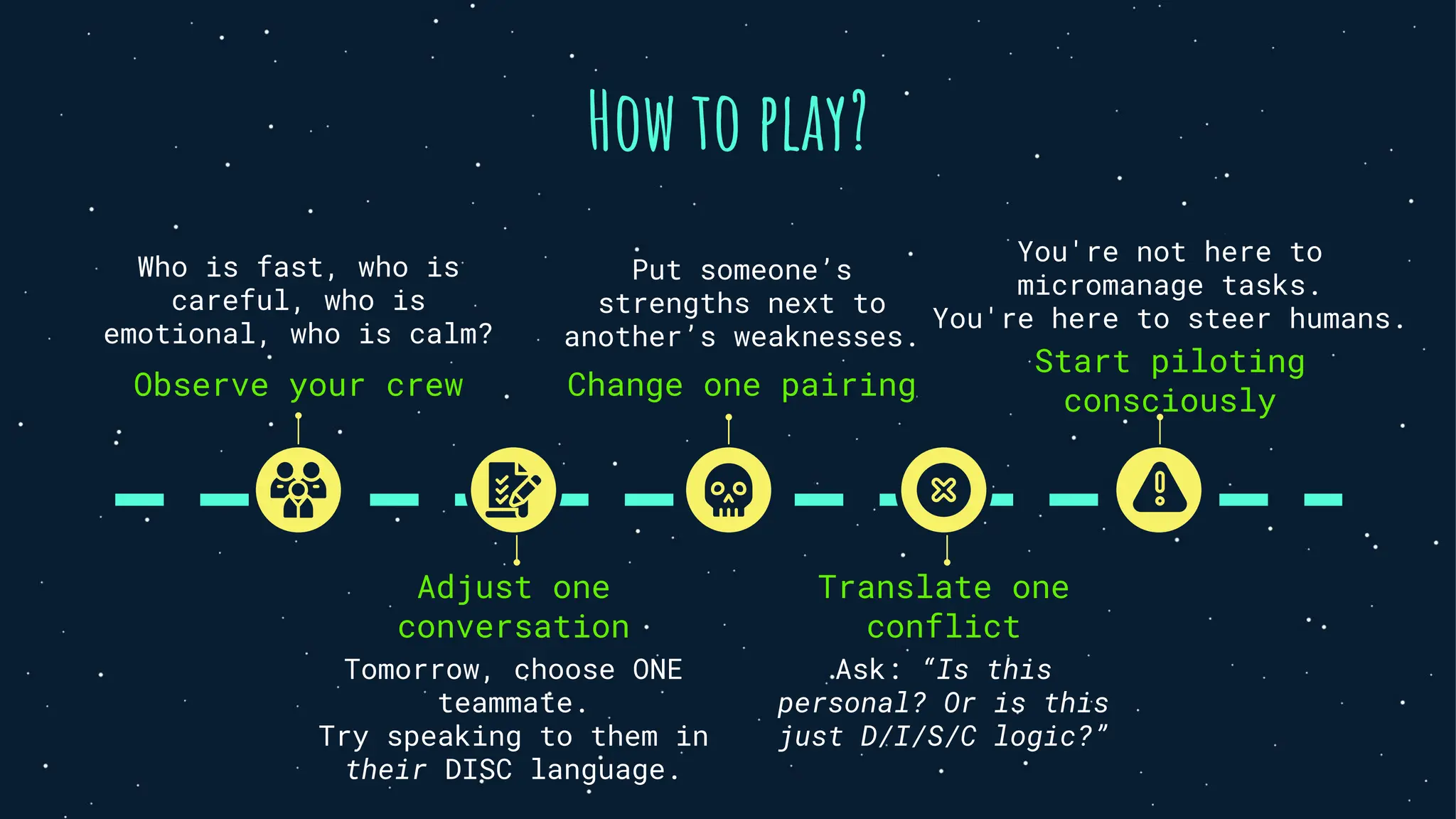
How to play?
Change one pairing
Put someone’s
strengths next to
another’s weaknesses.
Observe your crew
Who is fast, who is
careful, who is
emotional, who is calm?
Translate one
conflict
Ask: “Is this
personal? Or is this
just D/I/S/C logic?”
Adjust one
conversation
Tomorrow, choose ONE
teammate.
Try speaking to them in
their DISC language.
Start piloting
consciously
You're not here to
micromanage tasks.
You're here to steer humans.
Your Crew Awaits
DISC is not about fixing people.
It’s about understanding them —
so the D can fly,
the I can inspire,
the S can support,
and the C can protect the mission.
A great team doesn’t need a
perfect captain
It needs a captain who knows the crew.
Storming is normal.
Turbulence is expected.
But with the right navigation
system…
…every crew can reach the
stars.
Thanks
Fly them well, Captain.
Q&A

"DISC as GPS for team leaders: how to lead a team from storming to performing", Hanna Likhtman.pdf

  • 1.
    Guiding your crewfrom Storming to Performing DISC as GPS for a TEAMLEAD
  • 2.
    Captain Position: Solution Architect Location: Bali, Indonesia Mytype Influencer 60% Dominance 40% Interest Build connection Discover something new My portfolio Skills Numbers IT live > 11 years Projects ~ 15 Language JS/TS Kids 2 Positive 100% h.likhtman Name: Hanna Likhtman Known for: smiling during production fires.
  • 3.
    Table of contents 04 WelcomeCrew DISC Alert Logs Turbulence Detected What happens when two captains grab the same wheel? Meet the Team and learn the history Navigation System Online Understanding the four coordinates: D, I, S, and C. Captain’s Log Lessons, takeaways, and practical tools for your next mission. Setting the Course Preparing for Takeoff
  • 4.
    Before we startour mission… Harvard psychologist — studied human emotions and behavior under pressure. Invented the first lie detector (polygraph) — the basis for modern truth tests. Created Wonder Woman — inspired by his belief in the power of empathy and honesty. Developed the DISC theory — to explain how people express emotions and interact. Legacy lives on — DISC is now used in leadership, hiring, and team dynamics worldwide. Name: William Moulton Marston
  • 5.
    Introvert vs Extrovert:Choose Your Pilot Introvert Extravert Speaks before thinking Recharges in a crowd Energy, drive, chaos management “I’ll tell everyone we fixed it!” Thinks before speaking Recharges alone Deep focus, quiet strength “I’ll fix it.”
  • 6.
    Character Choleric Sanguine The Optimist Energetic,social, emotional, loves attention. The Commander. Goal-driven, decisive, confident, can be impatient. Phlegmatic Melancholic The Analyst Detail-oriented, perfectionist, thoughtful, sometimes anxious. The Peacekeeper Calm, consistent, avoids conflict, loyal. 01 02 03 04
  • 7.
    Let’s combine What ifwe take type and character? 01
  • 8.
    Extravert Introvert Task People DISC combines theenergy of Introverts vs Extroverts and the focus of People vs Tasks — giving us 4 unique behavioral zones. D I C S
  • 9.
    D - Dominance Likes: Quickaction and visible results Clear goals and challenges to conquer Control over decisions and direction Efficiency and strong leadership Dislikes: Slow decision-making or hesitation Overly detailed discussions Being micromanaged or questioned constantly Weak or indecisive teammates Motivates: Freedom to act, measurable success, power to influence outcomes Dismotivates: Micromanagement, lack of authority, delays, or unclear expectations
  • 11.
    I - Influence Likes: Beingaround people, sharing ideas, and having fun Open communication and recognition from others Creative freedom and space for self-expression Teamwork and celebrations Dislikes: Isolation or lack of attention Rigid rules, strict schedules Negative or overly critical environments Repetitive, boring tasks Motivates: Public recognition, social approval, opportunities to shine and inspire others Dismotivates: Being ignored, lack of emotional connection, too much structure
  • 12.
  • 13.
    S - Steadiness Likes: Stability,consistency, and predictable routines Friendly, cooperative relationships Time to process changes and new ideas Helping and supporting teammates Dislikes: Sudden change or conflict Unclear expectations or chaotic leadership Aggressive or confrontational communication Feeling rushed or pressured Motivates: Trust, appreciation, and a calm, supportive environment Dismotivates: Tension, instability, lack of empathy from others
  • 14.
    C - Conscientiousness Likes: Clearstandards, data, and structure Time to analyze and plan before acting Working independently on complex tasks Well-documented processes and logical reasoning Dislikes: Chaos, last-minute changes, or unclear goals Emotional outbursts or unprofessional behavior Being rushed or forced to improvise Vague or inconsistent instructions Motivates: Precision, logical systems, and recognition for quality work Dismotivates: Ambiguity, sloppy execution, and emotional pressure
  • 15.
    Whoa! This is agame of teamwork and betrayal. Players are either crew members or a liar
  • 16.
    Compatible Pairs —The Perfect Crew Matches 🔴 D + 🟢 S — The Pilot & the Copilot Why it works: ● D leads, S supports — clear dynamic without power struggle. ● D pushes forward, S keeps the flight smooth. ● D brings direction, S brings stability and empathy. Example: “D says: ‘Let’s launch on Monday!’ S quietly replies: ‘Already prepared the checklist so we don’t explode.’” 💬 Balance of ambition and calm. 🟡 I + 🟢 S — The Voice & the Heart Why it works: ● I spreads enthusiasm and builds energy. ● S maintains harmony and keeps everyone grounded. ● Both are people-oriented — one loud, one warm. Example: “I plans the team party, S makes sure everyone got home safely.” 💬 Energy grounded in kindness.
  • 17.
    Compatible Pairs —The Perfect Crew Matches 🔵 C + 🟢 S — The Planner & the Peacekeeper Why it works: ● C ensures structure, S ensures emotional safety. ● Both value reliability, process, and predictability. ● S softens C’s perfectionism; C gives S a sense of order. Example: “C says: ‘We need one more round of testing.’ S: ‘Sure, I’ll stay after the meeting to help.’” 💬 Logic meets loyalty. 🟢 S + 🟢 S — The Harmony Loop Why it works: ● Zero drama, consistent delivery. ● They value peace, cooperation, and emotional balance. ● Perfect for long-term, stable projects. Example: “They don’t argue. They just quietly do the work, refill tea, and move on.” 💬 Calm productivity at its best.
  • 18.
    Compatible Pairs —The Perfect Crew Matches 🔴 D + 🟡 I — The Captain & the Cheerleader Why it works: ● D sets the goal, I gets everyone excited about it. ● D focuses on results, I builds morale. ● Together they’re unstoppable: vision + charisma. Example: “D says: ‘We’re taking this project!’ I is already writing in Slack: ‘Guys, this is gonna be epic!’” 💬 Power fueled by positivity.
  • 19.
    Whoa! This is agame of teamwork and betrayal. Players are either crew members or a liar
  • 20.
    Compatible Pairs —But need maturity 🟡 I + 🔴 D — “Fun vs. Focus” (..semi-compatible, but can explode) Why they clash: ● D wants efficiency. ● I wants energy and creativity. ● D sees I as “distracting”. ● I sees D as “cold and rude”. What it looks like: I: “Guys! Idea!” D: “No. We’re shipping.” How to fix it: ● Let C set minimum structure (3 rules max). ● Let I have space for creativity within the structure. ● Translate ideas: I → vision + C → plan
  • 21.
    Compatible Pairs —But need maturity 🔵 C + 🟡 I — “Logic vs. Chaos” Why they CAN clash: ● C needs structure ● I thrives in spontaneity. ● C sees I as irresponsible. ● I sees C as boring and rigid. What it looks like: I: “Let’s improvise!” C: dies inside How to fix it: ● Let C set minimum structure (3 rules max). ● Let I have space for creativity within the structure. ● Translate ideas: I → vision + C → plan
  • 22.
    Compatible Pairs —But need maturity 🔵 C + 🔴 D — “Precision vs. Pressure” (The biggest love–hate relationship.) Why they CAN clash: ● D pushes for speed. ● C pushes for accuracy. ● D thinks C overcomplicates. ● C thinks D is reckless. What it looks like: D: “We ship today.” C: “We ship when it’s correct.” Silence. Static. Explosion in 3...2...1… How to fix it: ● Make C the navigator (checks) and D the pilot (execution). ● Create a “red line” list: what MUST be checked vs what can wait. ● Agree on deadlines with mutual respect.
  • 23.
    Emergency button The emergencybutton is an object located somewhere in each map. When used, an emergency meeting is called
  • 24.
    🔴 D +🔴 D — “Two Captains, One Wheel” Why they clash: ● Both want control. ● Both move fast and don’t listen. ● Both think they’re right (and loudly). ● Competition replaces collaboration. What it looks like: “We’re going my way.” “No, we’re going MY way.” Spaceship starts shaking. Conflict Pairs — When Crew Members Collide How to fix it: ● Assign clear ownership and separate decision domains. ● Make one “mission lead” and one “deputy”. ● Set rules: facts first, ego second.
  • 25.
    🔵 C +🔵 C — “Analysis Paralysis²” Why they clash: ● Endless discussions. ● Each thinks the other is “not accurate enough”. ● Zero willingness to compromise. ● Fear of mistakes blocks action completely. What it looks like: “We can’t approve this yet.” “Correct… after the next 17 checks.” Conflict Pairs — When Crew Members Collide How to fix it: ● Set time-boxed decisions. ● Add a D to push forward or an I to break the tension. ● Agree on “good enough” criteria.
  • 26.
    🟡 I +🟡 I — “Two Radios, No Signal” Why they clash: ● Too much talking, too little listening. ● Too many ideas, no execution. ● Chaos disguised as enthusiasm. What it looks like: “OMG let’s do this!” “YES, and also this!” Absolutely nothing gets done. Conflict Pairs — When Crew Members Collide How to fix it: ● Add a C or S for grounding. ● Use structured brainstorming (3 ideas → pick 1 → execute). ● Define responsibilities before starting.
  • 27.
  • 28.
    —Someone Famous On acrew, D and C may create turbulence — not because they’re difficult,but because both are locked onto the mission, not the mood of the cabin.
  • 29.
    What do Ido? C — Conscientiousness • Not nitpicky — just detail-aware. They spot mistakes before they become disasters. • Not cold — just logical. They show care through accuracy, not emotions. • Not inflexible — just structured. Clear rules and clear processes help them feel safe. D — Dominance • Not rude — simply direct. Speaks in bullet points, not paragraphs. • Not chaotic — just high-energy. Acts fast because waiting feels like pain. • Not cold — just prioritizes results. He’ll fix the feelings after the launch.
  • 30.
    Keep in mind C— Conscientiousness Don’t rush them unnecessarily Give clear expectations, requirements, and context Avoid surprises — they prefer predictability Don’t invalidate their concerns — logic matters to them Give time to prepare before discussions and decisions D — Dominance Don’t take directness personally Be clear, short, and structured Don’t micromanage — give space to act Don’t overload with meetings and long explanations Give them the “why” and the “goal”, not the lecture
  • 31.
    Captain’s Insight —What Really Matters ● People don’t fail because of skills — they fail because they don’t understand each other. ● Your job as a leader is not to change personalities. Your job is to align trajectories.
  • 32.
    How to play? Changeone pairing Put someone’s strengths next to another’s weaknesses. Observe your crew Who is fast, who is careful, who is emotional, who is calm? Translate one conflict Ask: “Is this personal? Or is this just D/I/S/C logic?” Adjust one conversation Tomorrow, choose ONE teammate. Try speaking to them in their DISC language. Start piloting consciously You're not here to micromanage tasks. You're here to steer humans.
  • 33.
    Your Crew Awaits DISCis not about fixing people. It’s about understanding them — so the D can fly, the I can inspire, the S can support, and the C can protect the mission. A great team doesn’t need a perfect captain It needs a captain who knows the crew.
  • 34.
    Storming is normal. Turbulenceis expected. But with the right navigation system… …every crew can reach the stars.
  • 35.
  • 36.