7 Surprising Ways Metaverse Development Solutions Are
Transforming Online Business
The metaverse is no longer just a buzzword and it's a practical toolkit for businesses
wanting richer customer experiences, new revenue paths, and smarter remote workflows.
Metaverse development solutions integrate XR, cloud streaming, AI, and digital asset
ecosystems to bring these possibilities to life. Below are seven surprising ways these
solutions are already changing how companies operate, sell, and innovate with examples
and simple steps you can apply.
Introduction
Businesses that once saw the metaverse as “optional” now recognize its strategic value.
Better cross-device rendering, cloud-powered delivery, AI-generated content, and modular
service platforms allow companies to build metaverse applications faster and with lower
cost. The question is no longer if to explore it but how to apply metaverse development
solutions for real business outcomes.
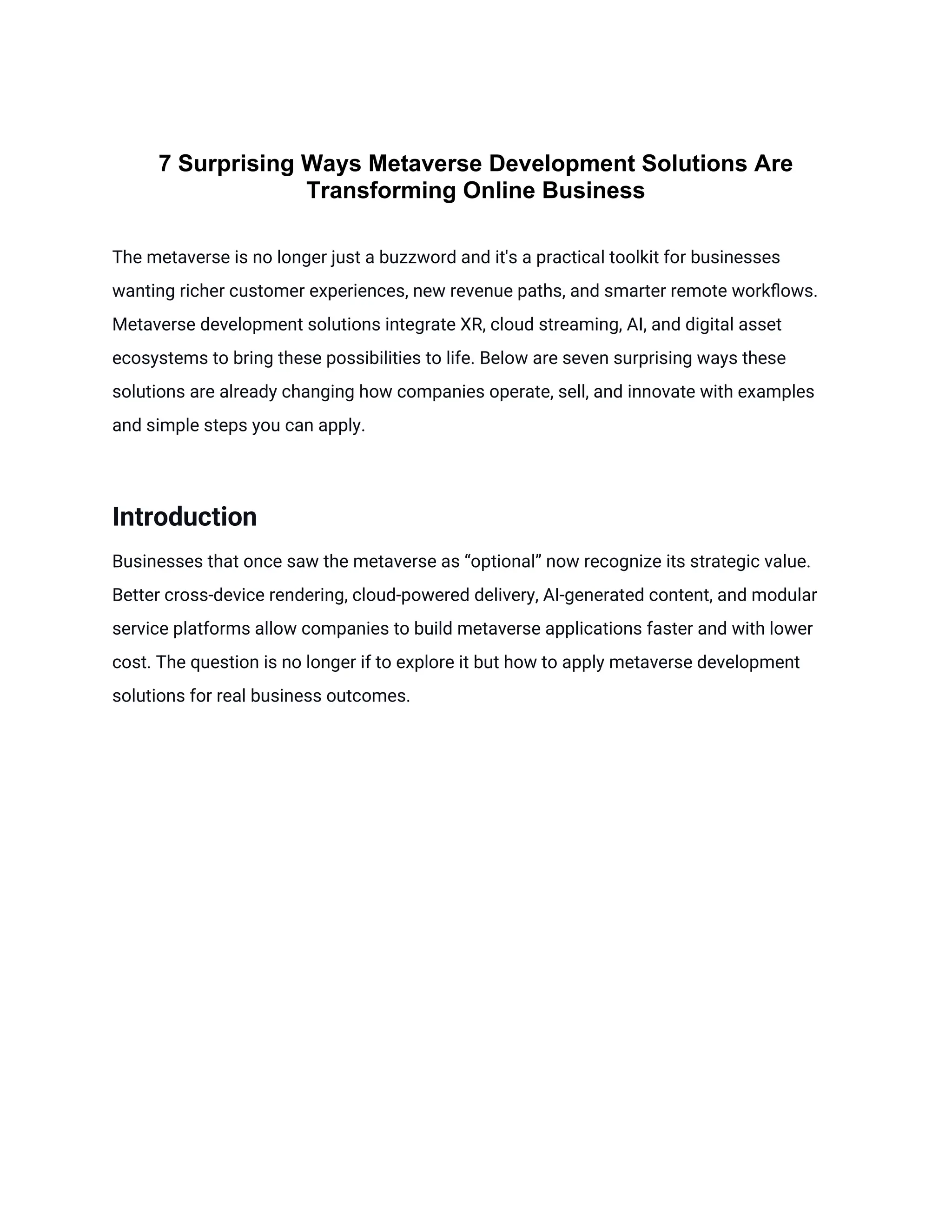
Here are the 7 surprising ways metaverse development solutions are transforming online
business and what they mean for your strategy.
1) Enhancing Online Shopping With 3D Confidence-Builders
Traditional product pages offer photos and specs. Metaverse-ready experiences let buyers
interact with items in 3D, rotate them, customize them, and visualize scale.
Why is it surprising
● Better conversion rates come from interaction, not aesthetics.
● Previewing items in 3D reduces return rates by validating fit, size, and expectations.
What to do next
● Digitize 3–5 flagship products with lightweight 3D models.
● Use a metaverse solution that embeds 3D previews directly on your website.
● Track time-in-view and add-to-cart lift.
2) Turning Company Training Into Results-Driven Simulations
Training becomes more effective when employees practice scenarios inside virtual replicas.
whether it’s machinery handling, customer service, or safety operations.
Why is it surprising
● XR-based learning consistently beats standard e-learning in retention.
● Businesses replace costly physical training setups with digital replicas.
What to do next
● Start with one repetitive training workflow.
● Build a short, goal-based simulation with measurable outcomes.
● Use analytics to refine difficulty and improve results.
3) Opening New Revenue Streams Through Virtual-First Products
Metaverse development solutions offer digital goods, limited assets, tokenized items, and
virtual services. These can all create new income.
Why is it surprising
● Digital items are cheap to make, but they can be valuable due to their scarcity and
usefulness.
● Integrating these assets into your commerce backend makes revenue instant and
trackable.
What to do next
● Create a utility-focused digital item (e.g., avatar wearables unlocking access).
● Use standard token formats for easy interoperability.
● Test with a small group before launching it widely.
4) Making Remote Collaboration Feel More Hands-On
Teams now use shared 3D environments instead of static video calls. They can review
designs, manipulate objects, and solve problems together.
Why is it surprising
● Complex decisions are made faster when teams can “step into” a model or
workspace.
● Metaverse platforms can connect with tools like CAD, Figma, and project
management software.
What to do next
● Identify collaboration bottlenecks (slow design reviews, unclear feedback).
● Introduce a lightweight 3D workspace with shared tools.
● Measure the time saved per meeting and project cycle reductions.
5) Speeding Up Prototyping with AI-Powered Worldbuilding
Creating virtual worlds once demanded massive 3D teams. Now, artificial intelligence
handles the heavy lifting, crafting environments, objects, textures, and even the actions of
non-player characters.
Why is it surprising
● MVPs that once required months can now be created in days.
● This accelerates experiment cycles and reduces upfront investment.
What to do next
● Choose a metaverse platform with AI scene-generation tools.
● Start with templates and refine them based on early user feedback.
● Add human review before final output for quality control.
6) Enabling Richer Campaigns and Community Engagement
Brands are venturing into the metaverse, unveiling new products and cultivating dedicated
fan communities. They’re also crafting interactive narratives and providing exclusive
experiences for their members a clear sign of how the metaverse future is reshaping brand
engagement.
Why is it surprising
● Communities in virtual spaces often stay more active than followers on social
media.
● Story-based environments convert fans into long-term customers.
What to do next
● Create a small event or themed world tied to a campaign.
● Offer exclusive rewards, like access passes or collectible items.
● Track sentiment and participation metrics.
7) Reducing Long-Term Tech Burden Through Modular Architecture
Modern metaverse development uses modular parts. These include identity systems,
payments, avatars, physics, and asset libraries.
Why is it surprising
● Modular design avoids vendor lock-in and reduces maintenance overhead.
● Companies can modernize legacy systems gradually without shutting down
operations.
What to do next
● Check platforms for plug-in support and compatibility with your current tech stack.
● Prefer solutions with exportable formats and open APIs.
● Plan phased rollouts to cut disruption.
Practical Adoption Roadmap: A Simple 5-Step Plan
1. Define one measurable business goal: conversion lift, training results, or workflow
efficiency.
2. Prototype fast—aim for an MVP in 4–8 weeks.
3. Measure performance — track KPIs tied to your selected use case.
4. Iterate based on analytics — adjust content, flow, or interaction.
5. Scale modularly—add features only when needed.
Risks and Governance | What to Watch For
● Privacy & data protection — new interaction data needs transparent handling.
● Interoperability gaps — avoid platforms that trap you in closed ecosystems.
● Economic design risks—virtual economies need careful planning to prevent misuse
or confusion.
Final Thought
Metaverse development solutions are not magic. But they are very powerful when used for
specific business goals. The metaverse is now a useful tool. It boosts shopping confidence,
improves training, accelerates prototype development, and reduces tech costs. It’s no
longer a futuristic dream.

7 Surprising Ways Metaverse Development Solutions Are Transforming Online Business

  • 1.
    7 Surprising WaysMetaverse Development Solutions Are Transforming Online Business The metaverse is no longer just a buzzword and it's a practical toolkit for businesses wanting richer customer experiences, new revenue paths, and smarter remote workflows. Metaverse development solutions integrate XR, cloud streaming, AI, and digital asset ecosystems to bring these possibilities to life. Below are seven surprising ways these solutions are already changing how companies operate, sell, and innovate with examples and simple steps you can apply. Introduction Businesses that once saw the metaverse as “optional” now recognize its strategic value. Better cross-device rendering, cloud-powered delivery, AI-generated content, and modular service platforms allow companies to build metaverse applications faster and with lower cost. The question is no longer if to explore it but how to apply metaverse development solutions for real business outcomes.
  • 2.
    Here are the7 surprising ways metaverse development solutions are transforming online business and what they mean for your strategy. 1) Enhancing Online Shopping With 3D Confidence-Builders Traditional product pages offer photos and specs. Metaverse-ready experiences let buyers interact with items in 3D, rotate them, customize them, and visualize scale. Why is it surprising ● Better conversion rates come from interaction, not aesthetics. ● Previewing items in 3D reduces return rates by validating fit, size, and expectations.
  • 3.
    What to donext ● Digitize 3–5 flagship products with lightweight 3D models. ● Use a metaverse solution that embeds 3D previews directly on your website. ● Track time-in-view and add-to-cart lift. 2) Turning Company Training Into Results-Driven Simulations Training becomes more effective when employees practice scenarios inside virtual replicas. whether it’s machinery handling, customer service, or safety operations. Why is it surprising ● XR-based learning consistently beats standard e-learning in retention. ● Businesses replace costly physical training setups with digital replicas. What to do next ● Start with one repetitive training workflow. ● Build a short, goal-based simulation with measurable outcomes. ● Use analytics to refine difficulty and improve results. 3) Opening New Revenue Streams Through Virtual-First Products Metaverse development solutions offer digital goods, limited assets, tokenized items, and virtual services. These can all create new income. Why is it surprising ● Digital items are cheap to make, but they can be valuable due to their scarcity and usefulness. ● Integrating these assets into your commerce backend makes revenue instant and trackable.
  • 4.
    What to donext ● Create a utility-focused digital item (e.g., avatar wearables unlocking access). ● Use standard token formats for easy interoperability. ● Test with a small group before launching it widely. 4) Making Remote Collaboration Feel More Hands-On Teams now use shared 3D environments instead of static video calls. They can review designs, manipulate objects, and solve problems together. Why is it surprising ● Complex decisions are made faster when teams can “step into” a model or workspace. ● Metaverse platforms can connect with tools like CAD, Figma, and project management software. What to do next ● Identify collaboration bottlenecks (slow design reviews, unclear feedback). ● Introduce a lightweight 3D workspace with shared tools. ● Measure the time saved per meeting and project cycle reductions. 5) Speeding Up Prototyping with AI-Powered Worldbuilding Creating virtual worlds once demanded massive 3D teams. Now, artificial intelligence handles the heavy lifting, crafting environments, objects, textures, and even the actions of non-player characters. Why is it surprising ● MVPs that once required months can now be created in days.
  • 5.
    ● This acceleratesexperiment cycles and reduces upfront investment. What to do next ● Choose a metaverse platform with AI scene-generation tools. ● Start with templates and refine them based on early user feedback. ● Add human review before final output for quality control. 6) Enabling Richer Campaigns and Community Engagement Brands are venturing into the metaverse, unveiling new products and cultivating dedicated fan communities. They’re also crafting interactive narratives and providing exclusive experiences for their members a clear sign of how the metaverse future is reshaping brand engagement. Why is it surprising ● Communities in virtual spaces often stay more active than followers on social media. ● Story-based environments convert fans into long-term customers. What to do next ● Create a small event or themed world tied to a campaign. ● Offer exclusive rewards, like access passes or collectible items. ● Track sentiment and participation metrics. 7) Reducing Long-Term Tech Burden Through Modular Architecture
  • 6.
    Modern metaverse developmentuses modular parts. These include identity systems, payments, avatars, physics, and asset libraries. Why is it surprising ● Modular design avoids vendor lock-in and reduces maintenance overhead. ● Companies can modernize legacy systems gradually without shutting down operations. What to do next ● Check platforms for plug-in support and compatibility with your current tech stack. ● Prefer solutions with exportable formats and open APIs. ● Plan phased rollouts to cut disruption. Practical Adoption Roadmap: A Simple 5-Step Plan 1. Define one measurable business goal: conversion lift, training results, or workflow efficiency. 2. Prototype fast—aim for an MVP in 4–8 weeks. 3. Measure performance — track KPIs tied to your selected use case. 4. Iterate based on analytics — adjust content, flow, or interaction. 5. Scale modularly—add features only when needed. Risks and Governance | What to Watch For ● Privacy & data protection — new interaction data needs transparent handling. ● Interoperability gaps — avoid platforms that trap you in closed ecosystems. ● Economic design risks—virtual economies need careful planning to prevent misuse or confusion. Final Thought
  • 7.
    Metaverse development solutionsare not magic. But they are very powerful when used for specific business goals. The metaverse is now a useful tool. It boosts shopping confidence, improves training, accelerates prototype development, and reduces tech costs. It’s no longer a futuristic dream.