[BDD 2025 - Artificial Intelligence] AI for the Underdogs: Innovation for Small Businesses
1.
BDD
AI for theUnderdogs:
Innovation for Small
Businesses
Vina Sari Yosephine, Ph.D. | Dosen UPNVJ
2.
BDD
AI for theUnderdogs:
Innovation for Small
Businesses
Vina Sari Yosephine, Ph.D. | Dosen UPNVJ
3.
BDD
AI for theUnderdogs:
Innovation for Small
Businesses
Vina Sari Yosephine, Ph.D. | Dosen UPNVJ
4.
Education
Vina Sari Yosephine
WorkExperiences
● Logistics Analyst, HI
● PostDoctoral Researcher,
KAIST
● KAIST, Doctor of Industrial & Systems Eng.
● KAIST, Master of Industrial & Systems Eng.
● ITB, Bachelor of Engineering
Dosen UPN Veteran Jakarta, System Engineering, Practical AI, Project Based Learning
5.
The Generative AILeap
Multimodal Growth Rapid Evolution Global Impact
The AI landscape is evolving rapidly,
diverse modalities like text, image, and
video.
New advancements in AI are enabling
unimaginable creativity across various
media and formats.
.
The implications of this AI evolution
extend worldwide, transforming
industries and everyday life.
6.
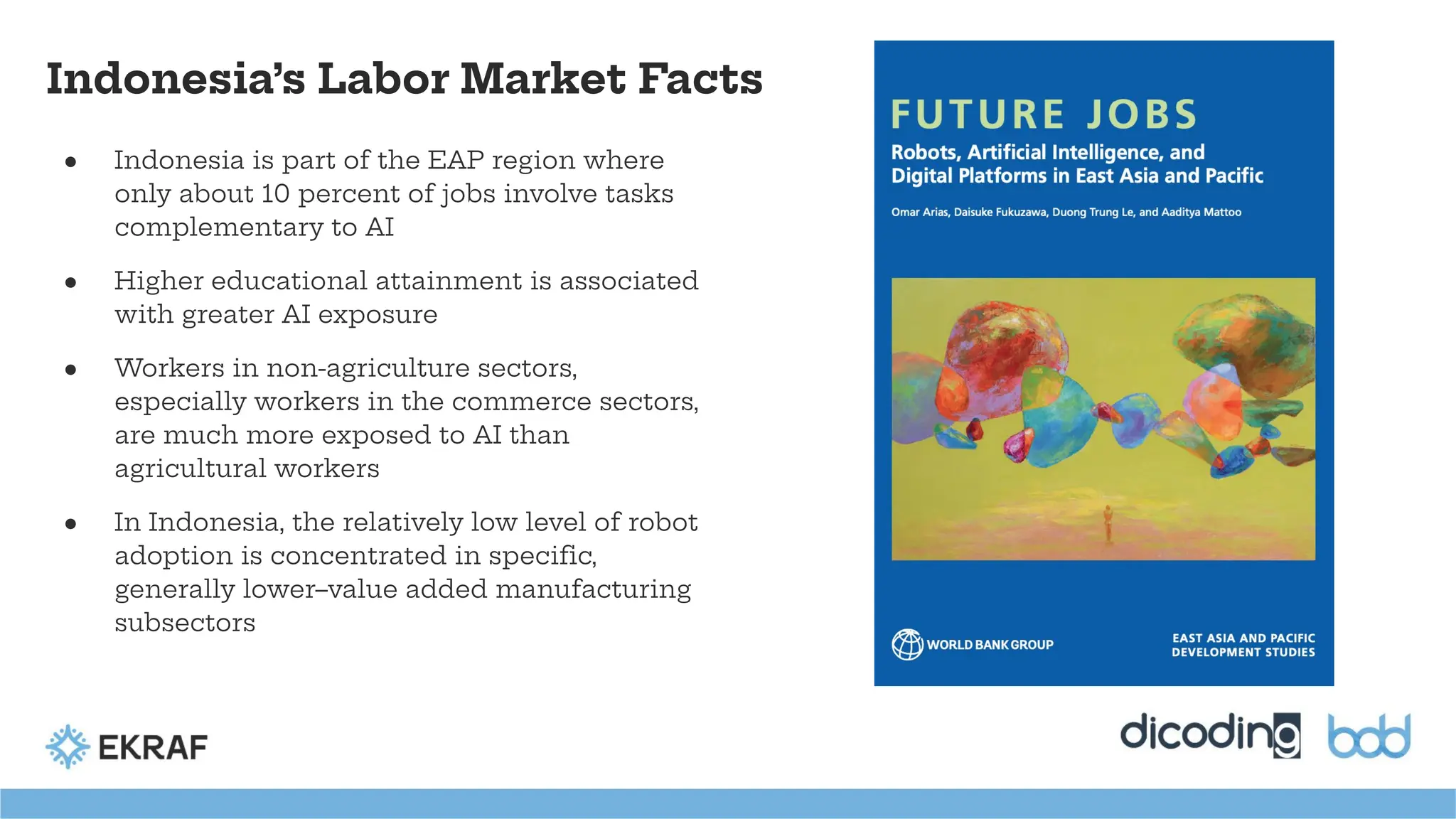
Indonesia’s Labor MarketFacts
● Indonesia is part of the EAP region where
only about 10 percent of jobs involve tasks
complementary to AI
● Higher educational attainment is associated
with greater AI exposure
● Workers in non-agriculture sectors,
especially workers in the commerce sectors,
are much more exposed to AI than
agricultural workers
● In Indonesia, the relatively low level of robot
adoption is concentrated in specific,
generally lower–value added manufacturing
subsectors
7.
In the ageof
algorithms,
PURPOSE is our
greatest parameter.
8.
The Engine ofIndonesia Economy
± 65 million UMKM
≈ 99% of businesses
Contribute ~60–61% of
Indonesia’s GDP
Employ ~117 million people
≈ 97% of total jobs
9.
The Engine ofIndonesia Economy
But only ~15–16% of non-oil & gas exports
● Don’t meet international quality consistency, manual
QC, high variability
● No digital records or traceability (needed for export
compliance)
● No automated production planning
● Cannot scale production (small factories struggle with
bottlenecks)
● No logistics or supply chain integration (where AI and
IoT tools can help)
● Manual communication in data formats required by
importers
± 65 million UMKM ≈
99% of businesses
Contribute ~60–61% of
Indonesia’s GDP
Employ ~117 million people
≈ 97% of total jobs
10.
The Reality ofAI in Indonesia SME
Low operational
efficiency
Significant barriers
to AI Adoption
Manual processes
and fragmented
11.
Practical AI
Our economydepends on AI that SMEs can actually use.
Big AI inspires us. Practical AI transforms us
65M UMKM - 99% of all businesses - 60% of GDP - 117M workers
Small Business Needs
Not Big AI
Practical AI
When SMEs adopt AI,
Indonesia adopt AI
“
How do we build AI that SMEs can actually use?
12.
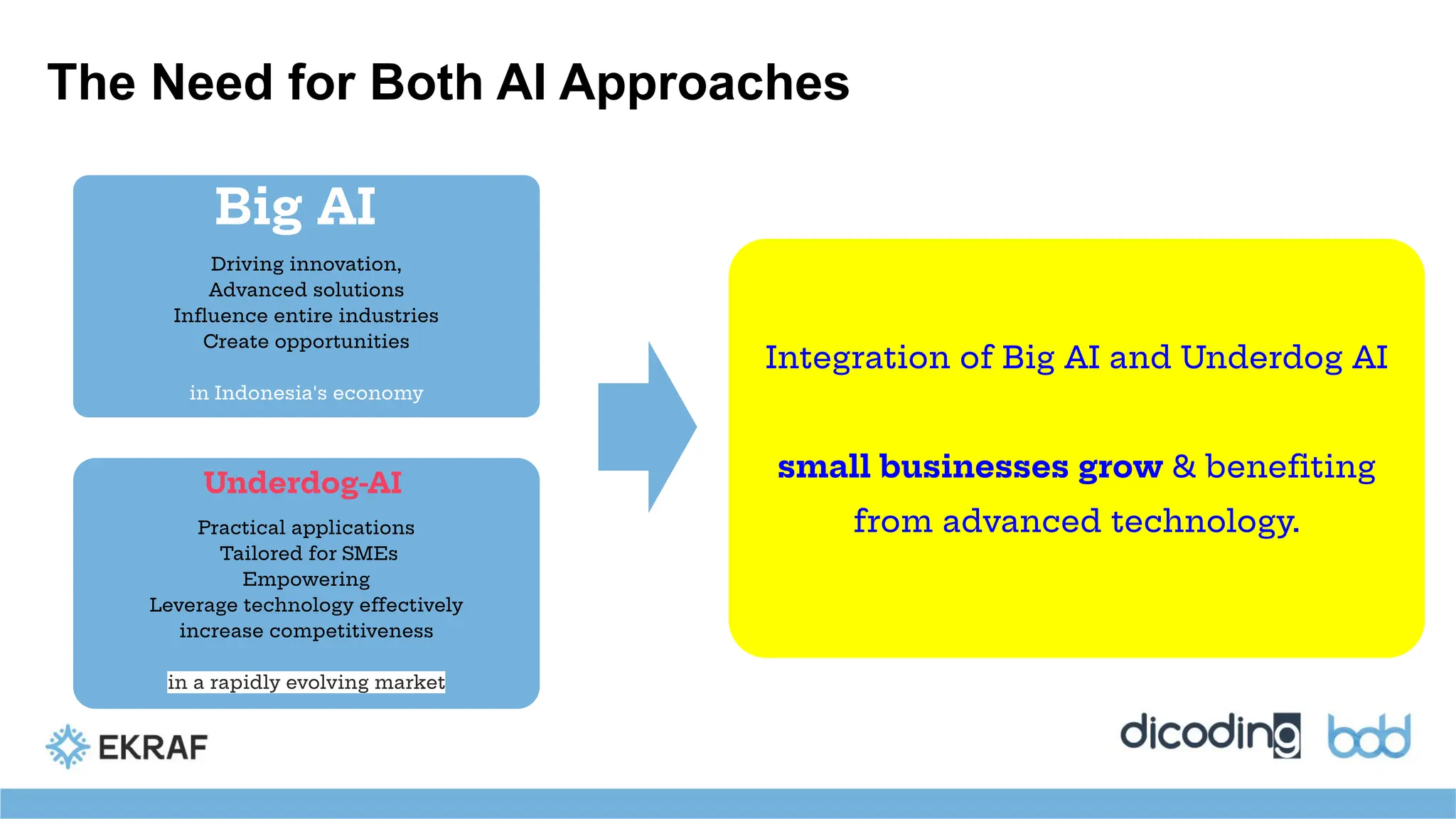
The Need forBoth AI Approaches
Driving innovation,
Advanced solutions
Influence entire industries
Create opportunities
in Indonesia's economy
Practical applications
Tailored for SMEs
Empowering
Leverage technology effectively
increase competitiveness
in a rapidly evolving market
Integration of Big AI and Underdog AI
small businesses grow & benefiting
from advanced technology.
Big AI
Underdog-AI
13.
How This Looksin the Real World
● SMEs operate with uncertainty
● They have small datasets
● They need interpretable decisions
● They need fast deployment
Case Study: TextileQuality Control
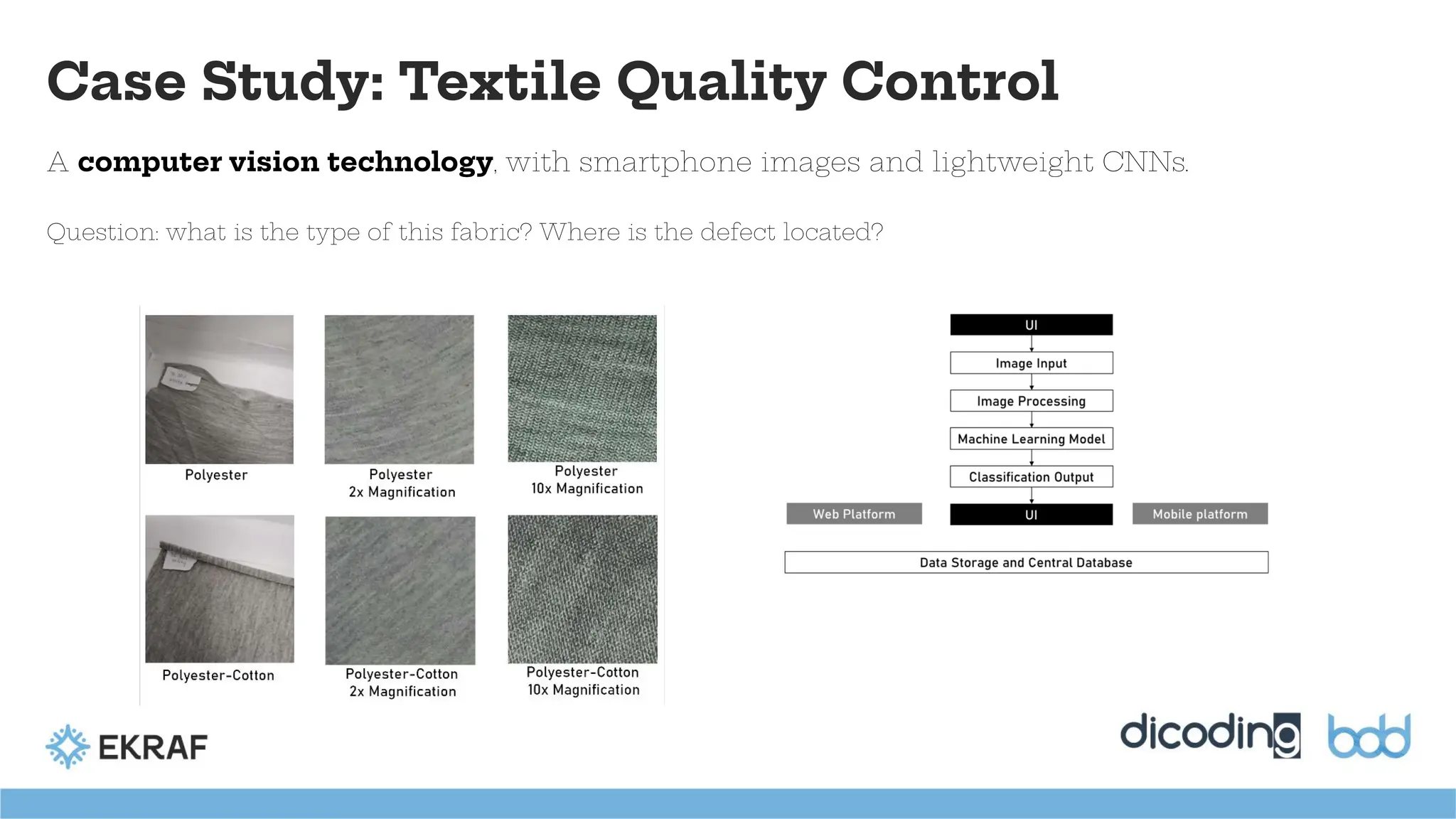
A computer vision technology, with smartphone images and lightweight CNNs.
Question: what is the type of this fabric? Where is the defect located?
16.
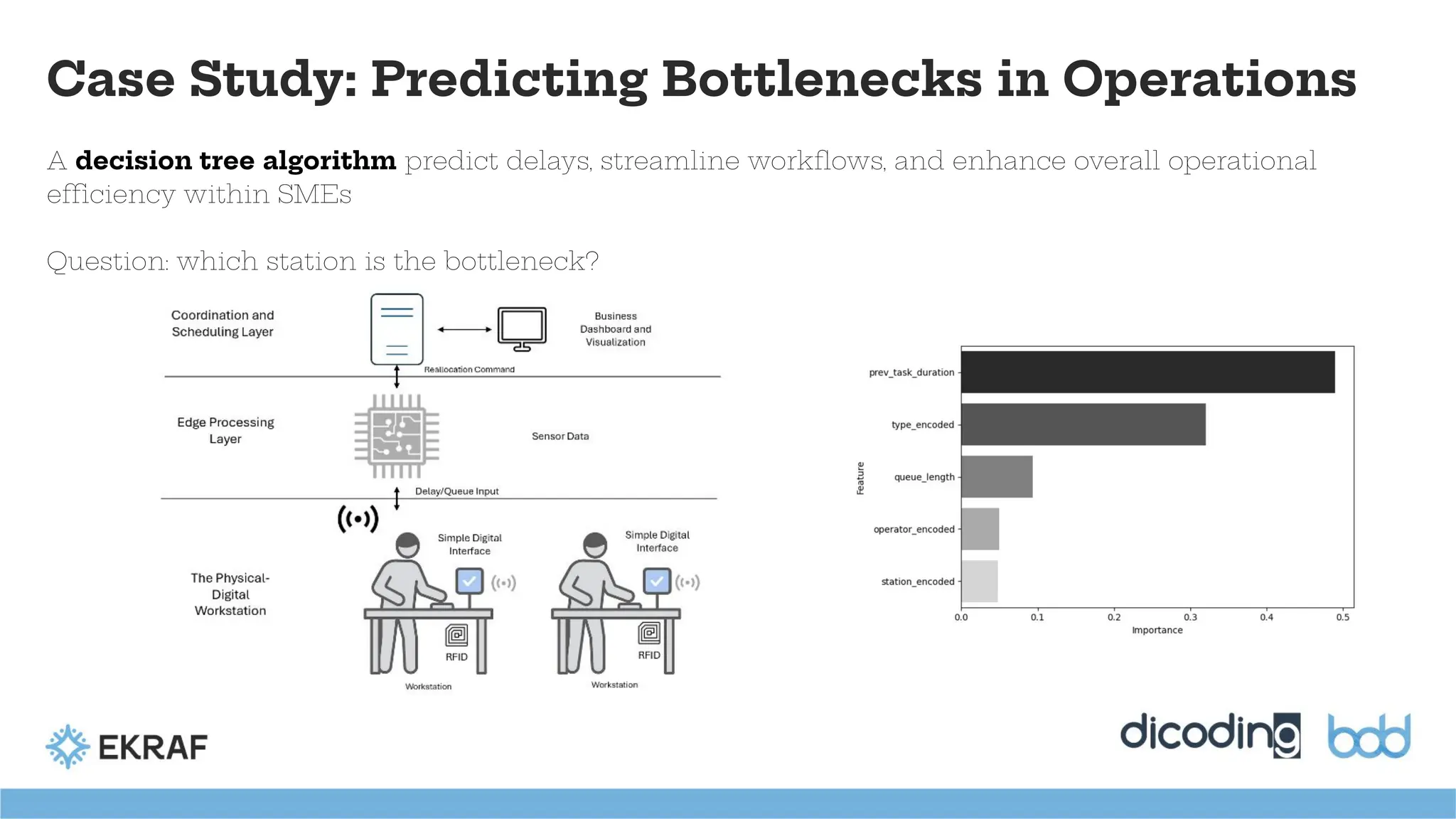
Case Study: PredictingBottlenecks in Operations
A decision tree algorithm predict delays, streamline workflows, and enhance overall operational
efficiency within SMEs
Question: which station is the bottleneck?
17.
Case Study: AILite Inventory Control
Inventory of a typical big warung or toko grosir
18.
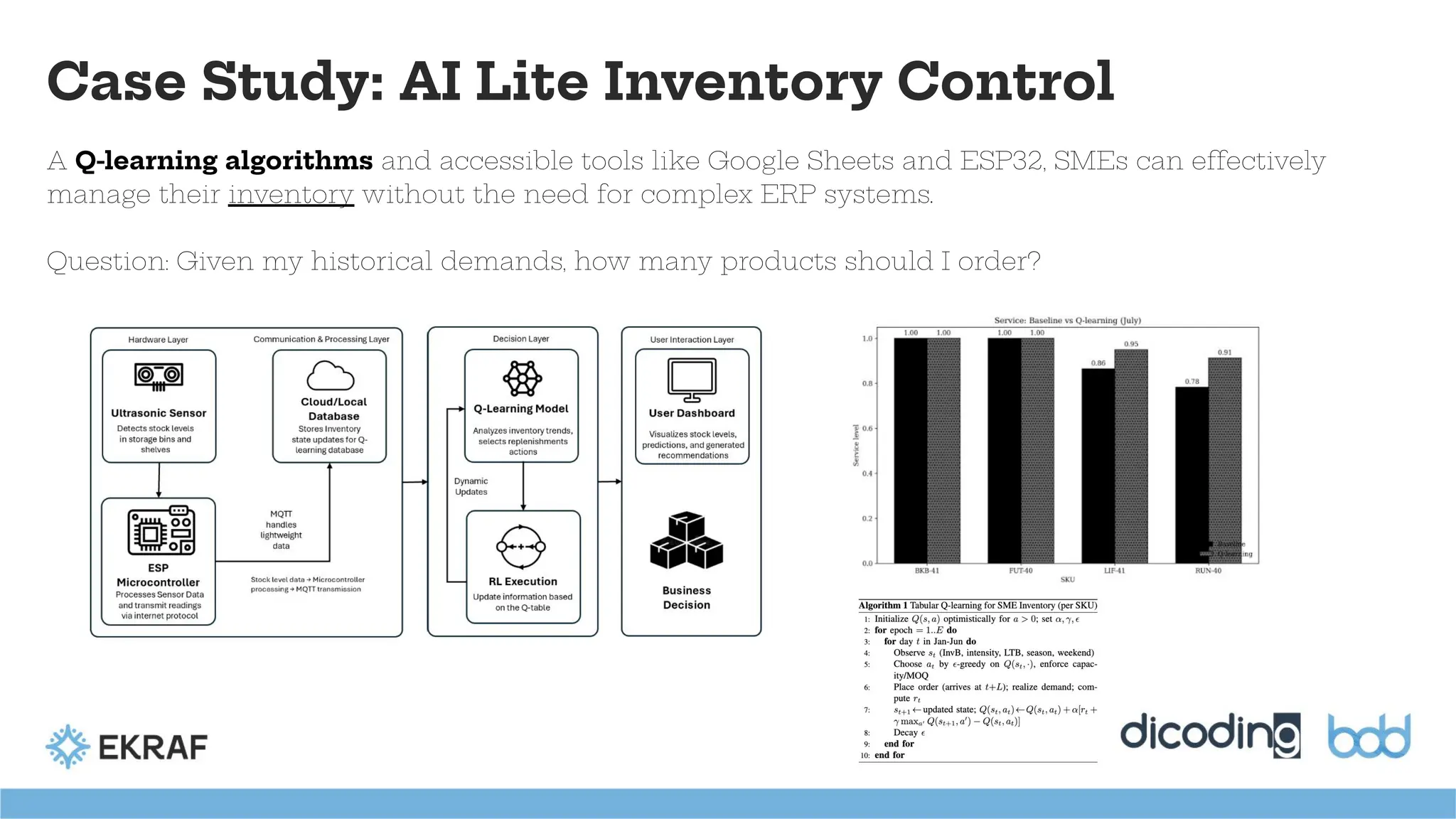
Case Study: AILite Inventory Control
A Q-learning algorithms and accessible tools like Google Sheets and ESP32, SMEs can effectively
manage their inventory without the need for complex ERP systems.
Question: Given my historical demands, how many products should I order?
19.
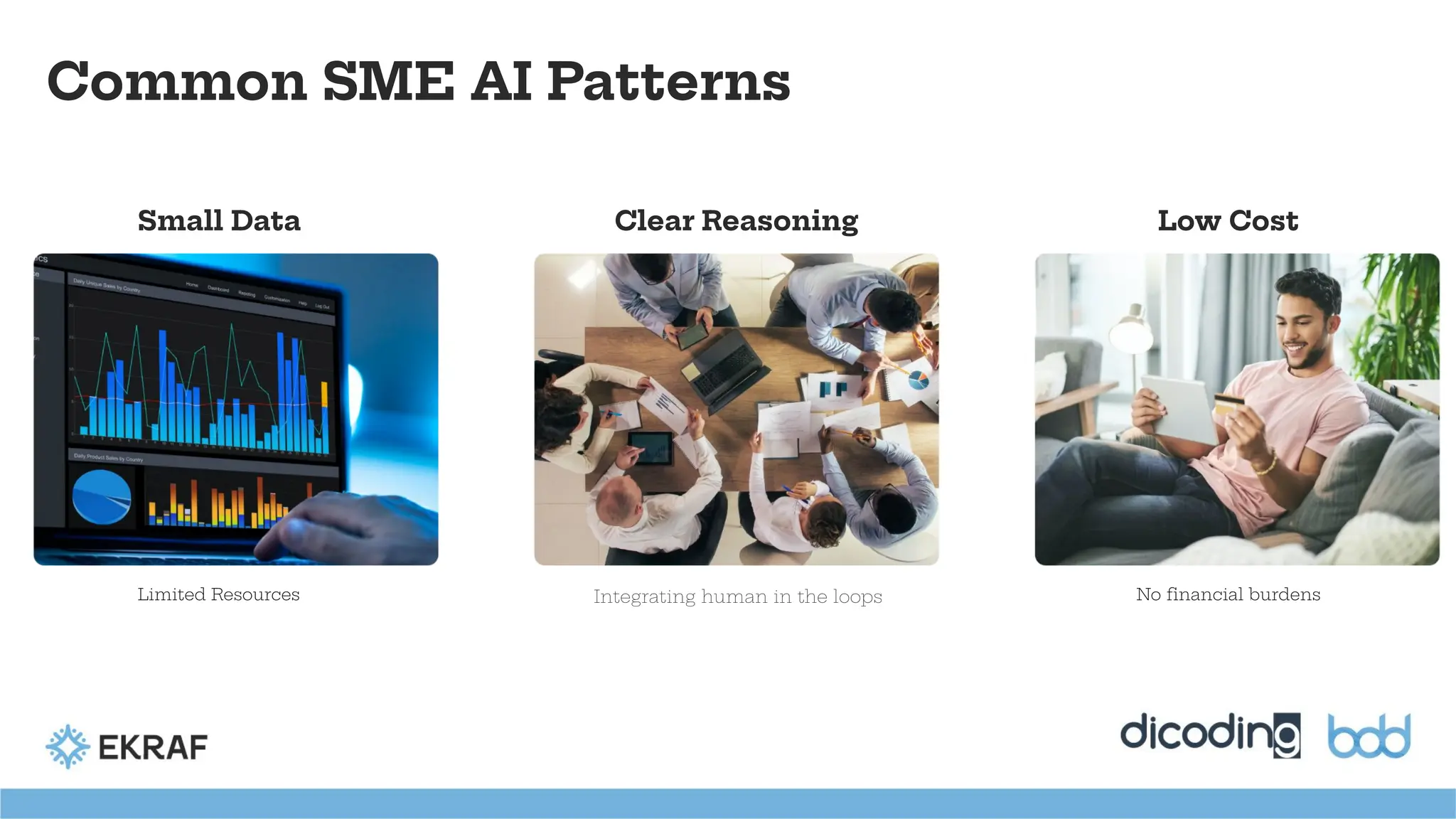
Common SME AIPatterns
Small Data Clear Reasoning Low Cost
Limited Resources Integrating human in the loops No financial burdens
20.
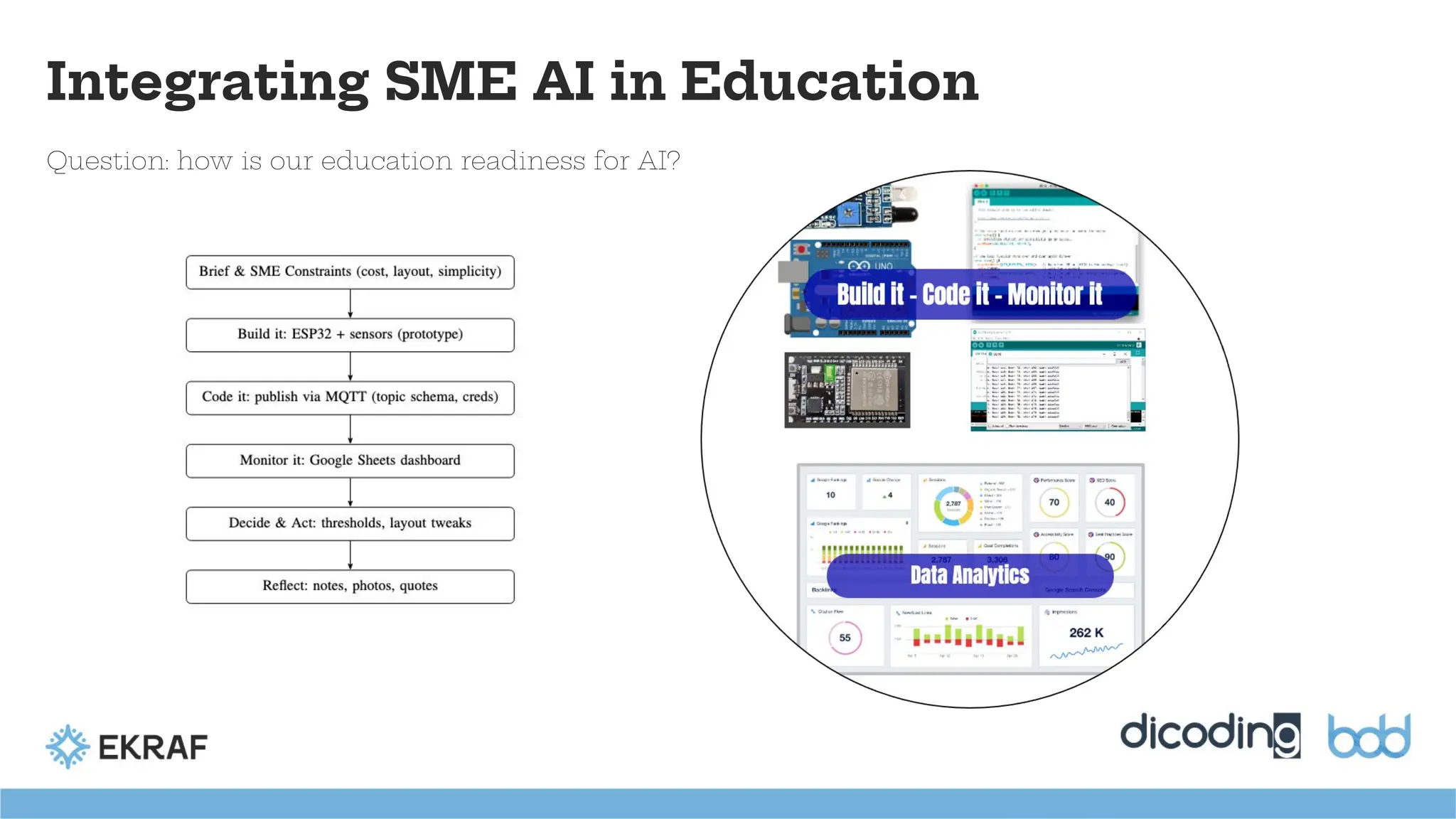
Integrating SME AIin Education
Question: how is our education readiness for AI?
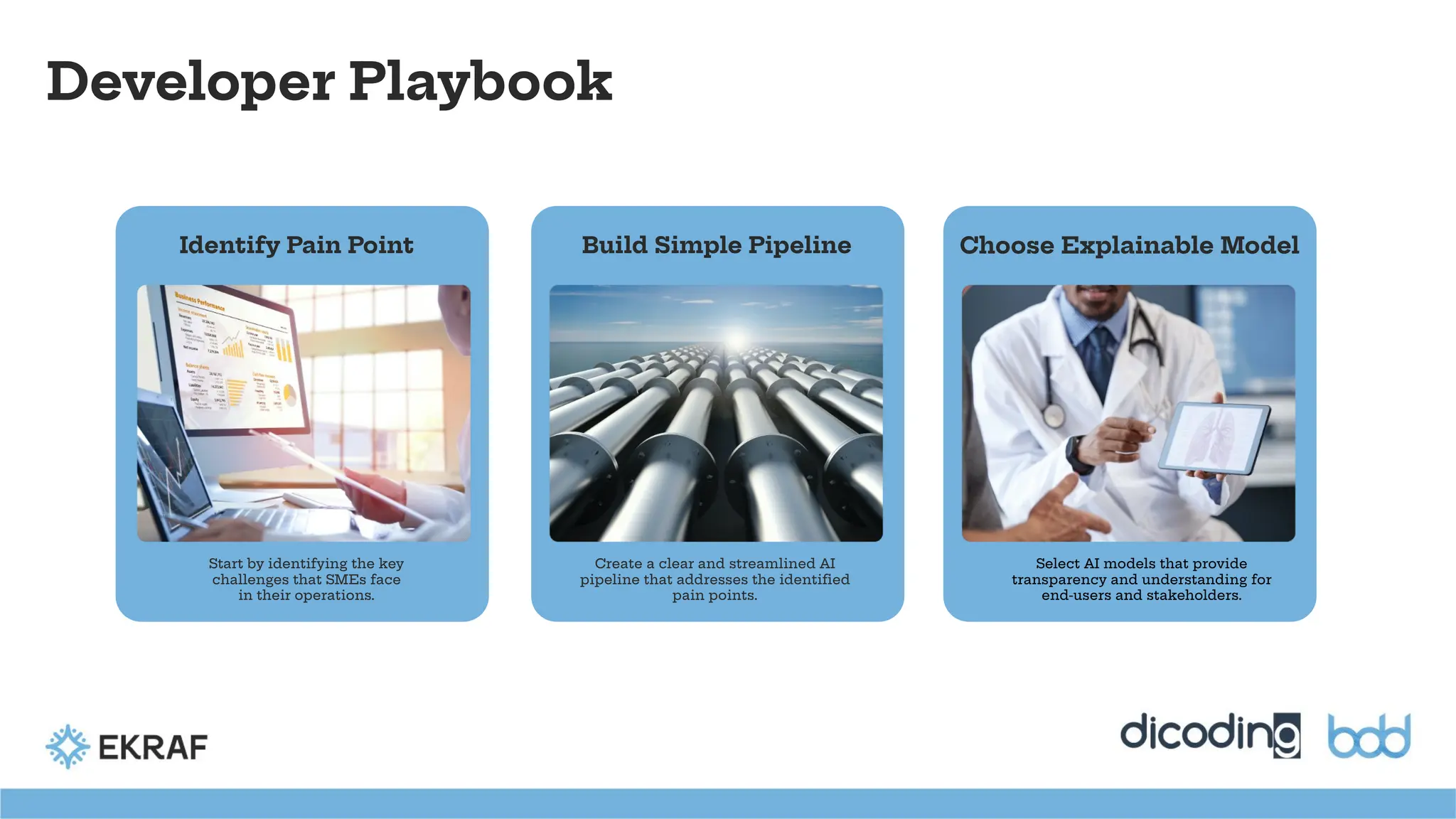
Developer Playbook
Identify PainPoint Build Simple Pipeline Choose Explainable Model
Start by identifying the key
challenges that SMEs face
in their operations.
Create a clear and streamlined AI
pipeline that addresses the identified
pain points.
Select AI models that provide
transparency and understanding for
end-users and stakeholders.
23.
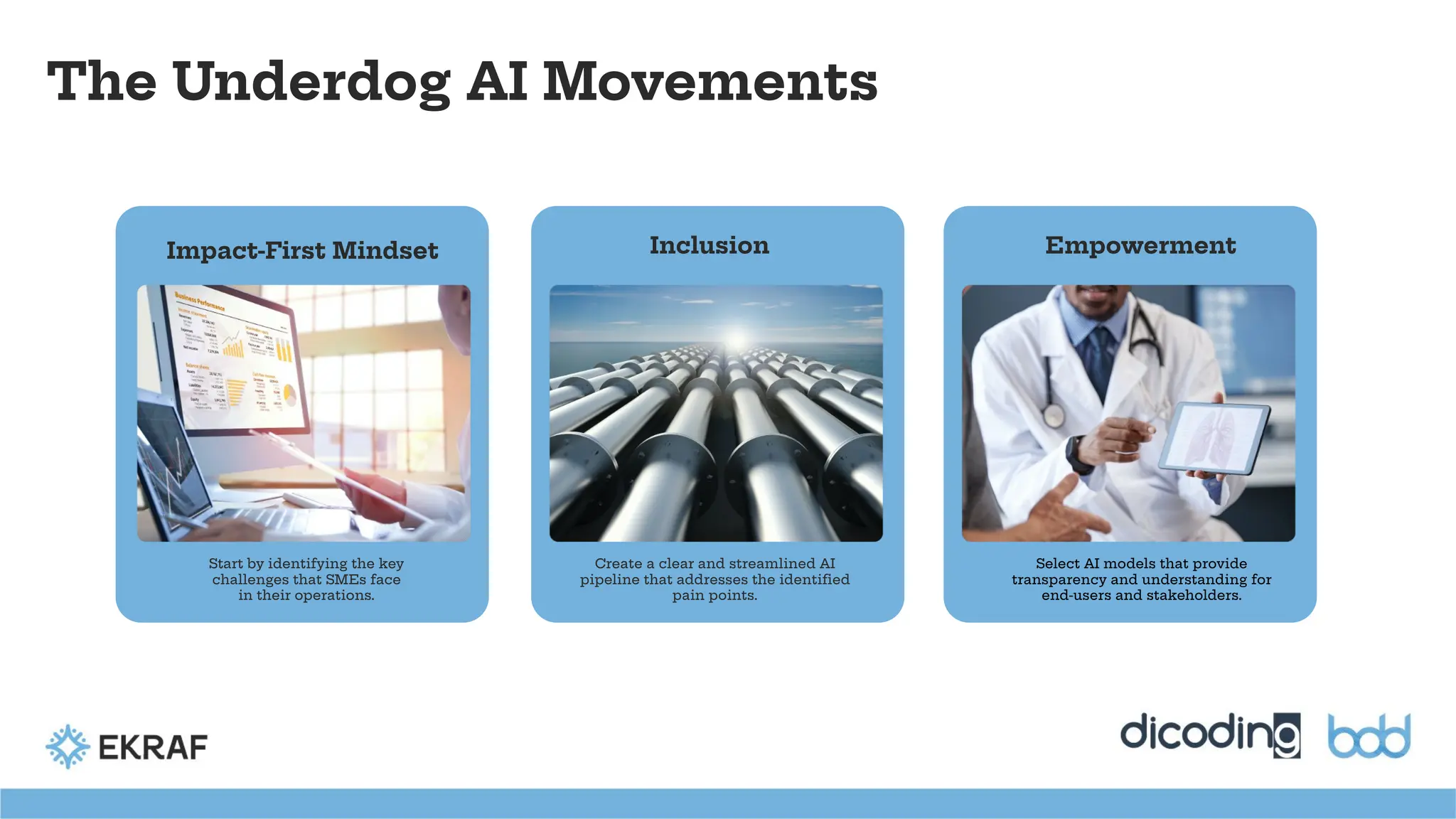
The Underdog AIMovements
Impact-First Mindset Inclusion Empowerment
Start by identifying the key
challenges that SMEs face
in their operations.
Create a clear and streamlined AI
pipeline that addresses the identified
pain points.
Select AI models that provide
transparency and understanding for
end-users and stakeholders.
24.
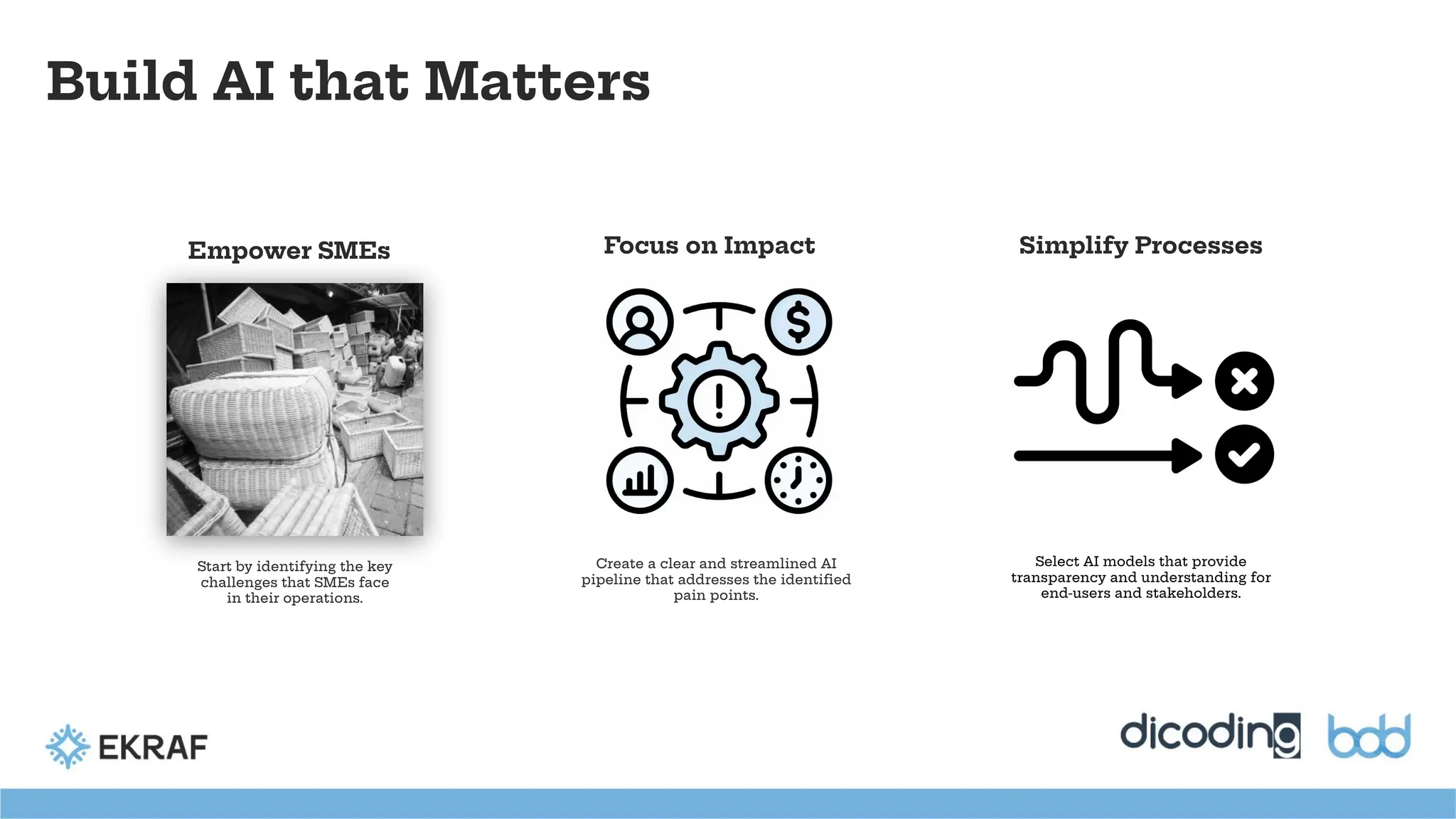
Build AI thatMatters
Empower SMEs Focus on Impact Simplify Processes
Start by identifying the key
challenges that SMEs face
in their operations.
Create a clear and streamlined AI
pipeline that addresses the identified
pain points.
Select AI models that provide
transparency and understanding for
end-users and stakeholders.








![[Datanest] AI startup in Indonesia - March 2018](https://cdn.slidesharecdn.com/ss_thumbnails/datanestaistartupinindonesia-march20181-180315041932-thumbnail.jpg?width=640&height=640&fit=bounds)


![[Fórum 2020 - Global Edition] Dados e Al - A galinha dos ovos de ouro no E-Co...](https://cdn.slidesharecdn.com/ss_thumbnails/dadoseai-agalinhadosovosdeouronoe-commerce-200811153626-thumbnail.jpg?width=640&height=640&fit=bounds)
![[Mindslab] Success stories and use cases of artificial intelligence of MindsLab.](https://cdn.slidesharecdn.com/ss_thumbnails/mindslabmaumbooken20190709light-190709235541-thumbnail.jpg?width=640&height=640&fit=bounds)


![[BDD 2025 - Artificial Intelligence] Building AI Systems That Users (and Comp...](https://cdn.slidesharecdn.com/ss_thumbnails/ai-buildingaisystemsthatusersandcompanieslove-251124030845-038f7732-thumbnail.jpg?width=640&height=640&fit=bounds)
![[BDD 2025 - Artificial Intelligence] Beyond 'It Works': A Case Study on Real-...](https://cdn.slidesharecdn.com/ss_thumbnails/ai-beyonditworksacasestudyonreal-worldairisk-251124030839-684bec68-thumbnail.jpg?width=640&height=640&fit=bounds)
![[BDD 2025 - Mobile Development] Exploring Apple’s On-Device FoundationModels](https://cdn.slidesharecdn.com/ss_thumbnails/md-exploringappleson-devicefoundationmodels-251124030840-d690542c-thumbnail.jpg?width=640&height=640&fit=bounds)
![[BDD 2025 - Full-Stack Development] PHP in AI Age: The Laravel Way. (Rizqy Hi...](https://cdn.slidesharecdn.com/ss_thumbnails/fs-phpinaiagethelaravelway-251125012602-ef9d330e-thumbnail.jpg?width=640&height=640&fit=bounds)
![[BDD 2025 - Mobile Development] Crafting Immersive UI with E2E and AGSL Shade...](https://cdn.slidesharecdn.com/ss_thumbnails/md-craftingimmersiveuiwithe2eandagslshaderveronicaputrianggraini-251124030840-0c677f44-thumbnail.jpg?width=640&height=640&fit=bounds)
![[BDD 2025 - Full-Stack Development] Agentic AI Architecture: Redefining Syste...](https://cdn.slidesharecdn.com/ss_thumbnails/fs-agenticaiarchitectureredefiningsystemcommunication-251124030838-e6c70cc2-thumbnail.jpg?width=640&height=640&fit=bounds)
![[BDD 2025 - Artificial Intelligence] Building a Data Architecture for Sub-Sec...](https://cdn.slidesharecdn.com/ss_thumbnails/ai-buildingadataarchitectureforsub-secondanalysis-251124030841-2110604d-thumbnail.jpg?width=640&height=640&fit=bounds)
![[BDD 2025 - Full-Stack Development] The Modern Stack: Building Web & AI Appli...](https://cdn.slidesharecdn.com/ss_thumbnails/fs-themodernstackbuildingwebaiapplicationswithserverless-251124030844-388cf04f-thumbnail.jpg?width=640&height=640&fit=bounds)


![[BDD 2025 - Full-Stack Development] Digital Accessibility: Why Developers nee...](https://cdn.slidesharecdn.com/ss_thumbnails/fs-digitalaccessibilitywhydevelopersneedtoknowandcarein2025-251127011019-0674441d-thumbnail.jpg?width=640&height=640&fit=bounds)


