VDD324 - History of Gaming Design - Week 6-8- Fall 2025.pdf
1.
VDD324 History ofGaming Design
Dr. Mohamed Osama
History of Gaming Design
VDD324 - Fall 2025 - Third Level
2.
Lecture 1 -Week 1
Course Information
00
History of Gaming Design
VDD324 - Fall 2025 - Third Level
3.
This course coversthe history of gaming in the 21st century and the relationship between culture and the evolution of
gaming concepts, design, and strategy.
In addition to the effect of technology in developing and games production.
The course will focus especially on the digital age gaming and how the availability of internet, mobiles,
communication devices, interactivity, high-definition image, and screens allowed the gaming industry to rapidly grow
and improve.
Course Description
History of Gaming Design
VDD324 - Fall 2025 - Third Level
4.
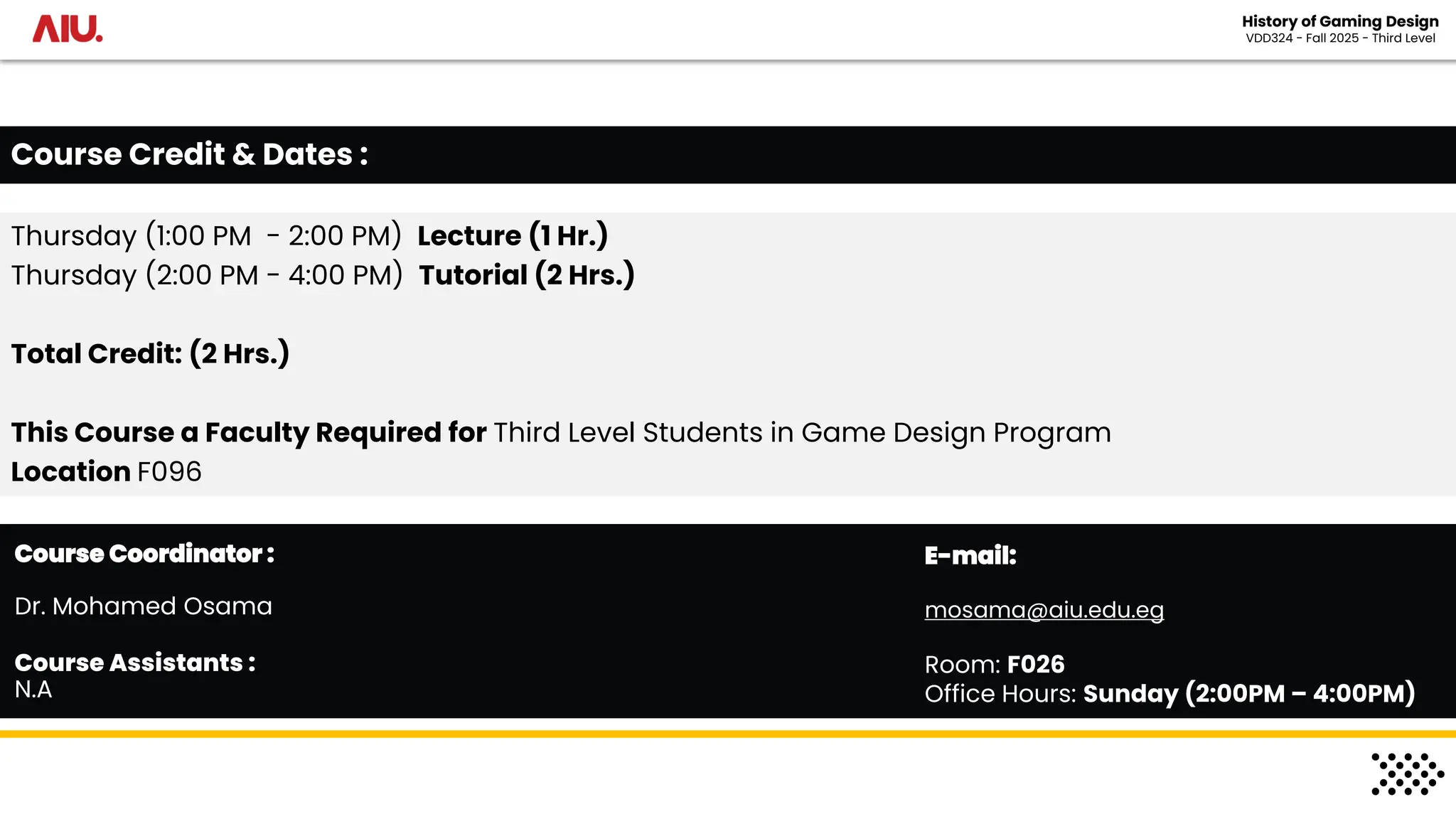
Thursday (1:00 PM- 2:00 PM) Lecture (1 Hr.)
Thursday (2:00 PM - 4:00 PM) Tutorial (2 Hrs.)
Total Credit: (2 Hrs.)
This Course a Faculty Required for Third Level Students in Game Design Program
Location F096
Course Credit & Dates :
Course Assistants :
N.A
Course Coordinator :
Dr. Mohamed Osama
E-mail:
mosama@aiu.edu.eg
Room: F026
Office Hours: Sunday (2:00PM – 4:00PM)
History of Gaming Design
VDD324 - Fall 2025 - Third Level
5.
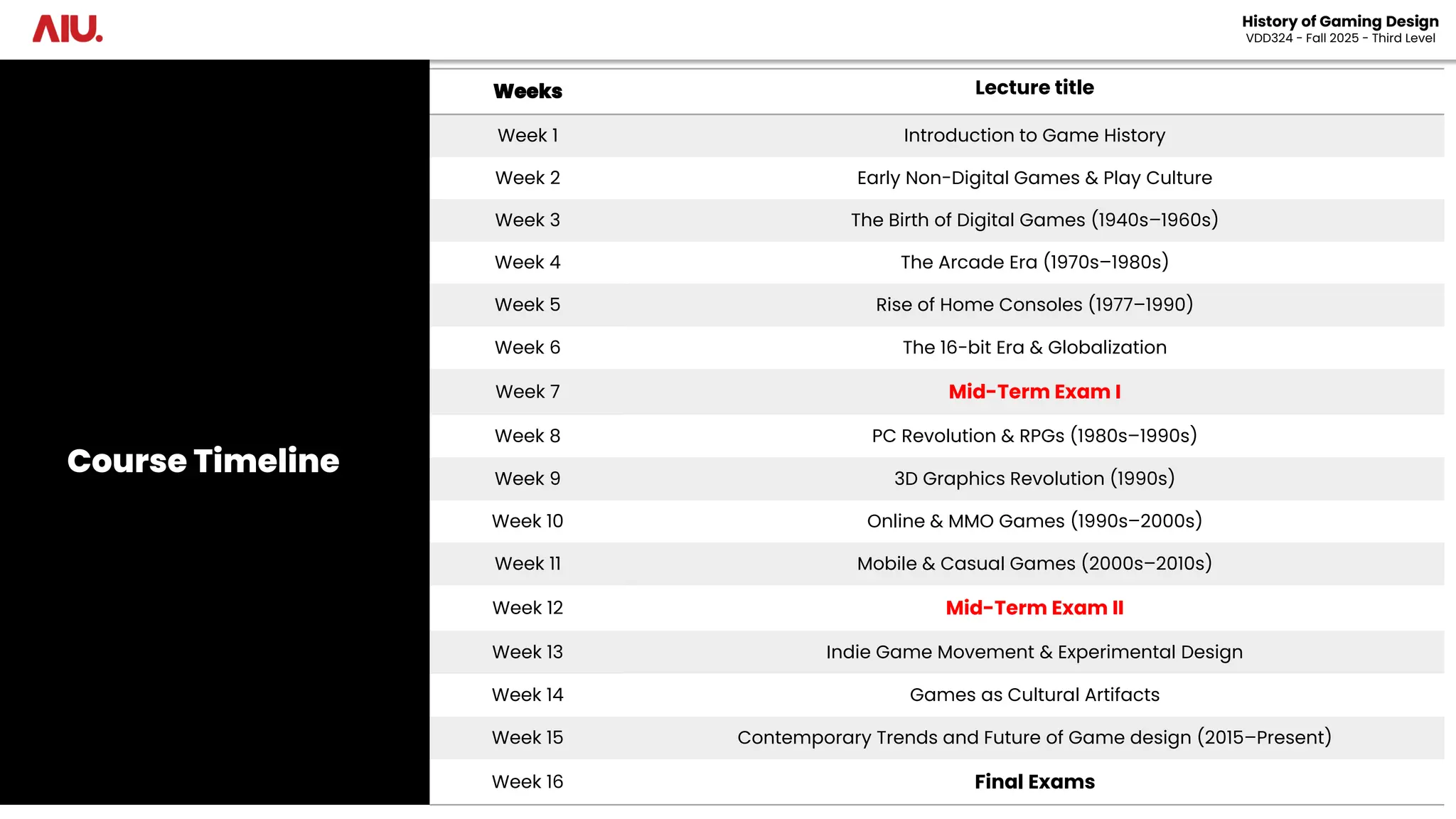
Course Timeline
Weeks Lecturetitle
Week 1 Introduction to Game History
Week 2 Early Non-Digital Games & Play Culture
Week 3 The Birth of Digital Games (1940s–1960s)
Week 4 The Arcade Era (1970s–1980s)
Week 5 Rise of Home Consoles (1977–1990)
Week 6 The 16-bit Era & Globalization
Week 7 Mid-Term Exam I
Week 8 PC Revolution & RPGs (1980s–1990s)
Week 9 3D Graphics Revolution (1990s)
Week 10 Online & MMO Games (1990s–2000s)
Week 11 Mobile & Casual Games (2000s–2010s)
Week 12 Mid-Term Exam II
Week 13 Indie Game Movement & Experimental Design
Week 14 Games as Cultural Artifacts
Week 15 Contemporary Trends and Future of Game design (2015–Present)
Week 16 Final Exams
History of Gaming Design
VDD324 - Fall 2025 - Third Level
6.
Course evaluation
The courseWeight is divided into
Final exam
40 %
Coursework Portfolio
60 %
Formative assessment
0 %
Presentation of
• A portfolio of work (Mid-Terms Exams,
assignments, Projects and quizzes)
created throughout the module.
Presentation of
• A body of work in progress. sheets,
Tasks.
Final Evaluation Exam
Final Exam
Qualifying from 60%
Course Evaluation:
Qualifying from 60%
History of Gaming Design
VDD324 - Fall 2025 - Third Level
7.
Course evaluation
The courseWeight is divided into
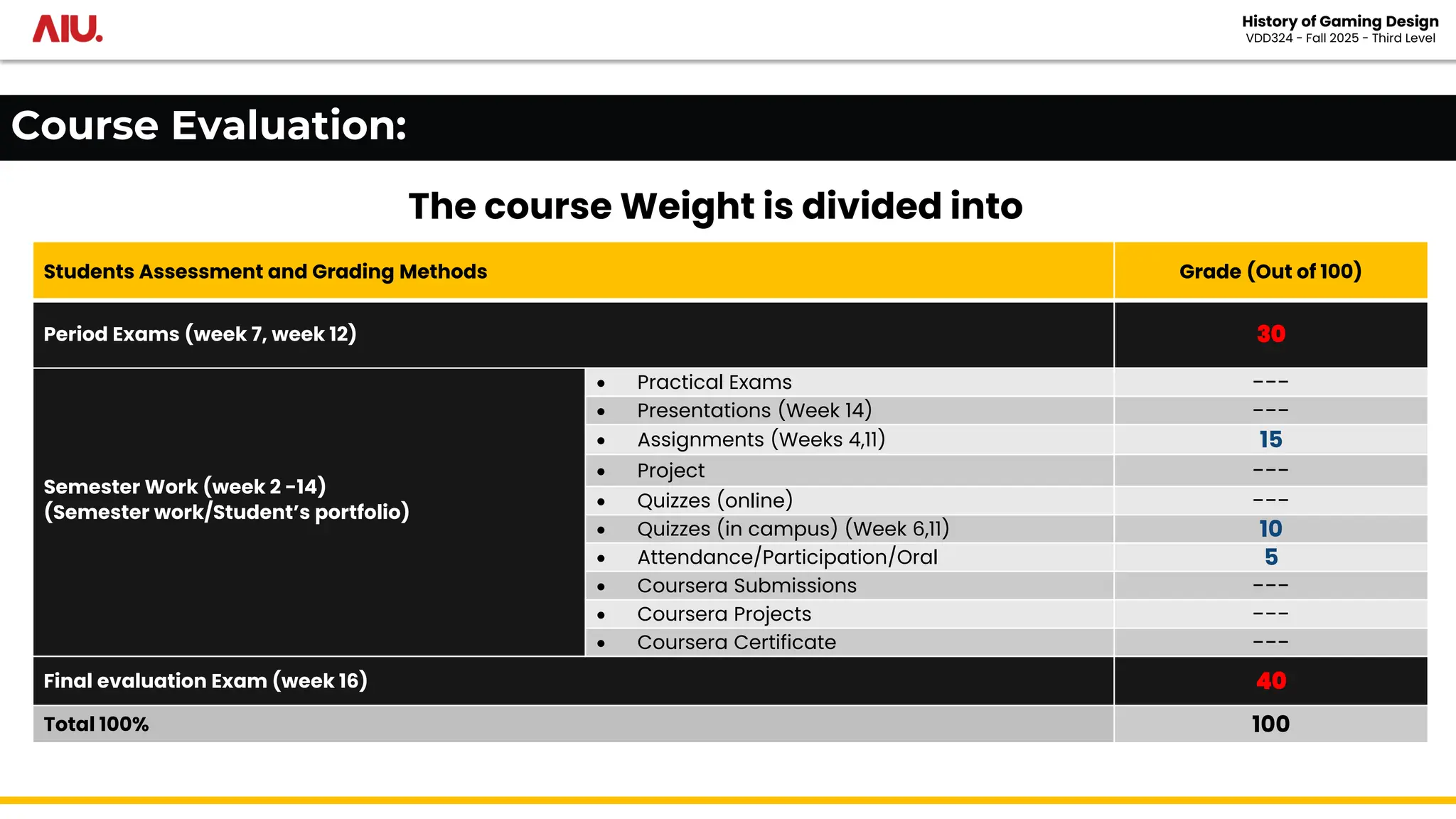
Course Evaluation:
Students Assessment and Grading Methods Grade (Out of 100)
Period Exams (week 7, week 12) 30
Semester Work (week 2 -14)
(Semester work/Student’s portfolio)
• Practical Exams ---
• Presentations (Week 14) ---
• Assignments (Weeks 4,11) 15
• Project ---
• Quizzes (online) ---
• Quizzes (in campus) (Week 6,11) 10
• Attendance/Participation/Oral 5
• Coursera Submissions ---
• Coursera Projects ---
• Coursera Certificate ---
Final evaluation Exam (week 16) 40
Total 100% 100
History of Gaming Design
VDD324 - Fall 2025 - Third Level
8.
الـ وألعاب الشخصيالحاسوب ثورة
RPGs (1980s–1990s)
08
History of Gaming Design
VDD324 - Fall 2025 - Third Level
(PC Revolution & RPGs)
Lecture 8 - Week 8
How the Personal Computer (PC) created a market for games demanding greater depth, artistic ambition, and player
freedom beyond the arcade model
9.
The Defining Decade:1980s
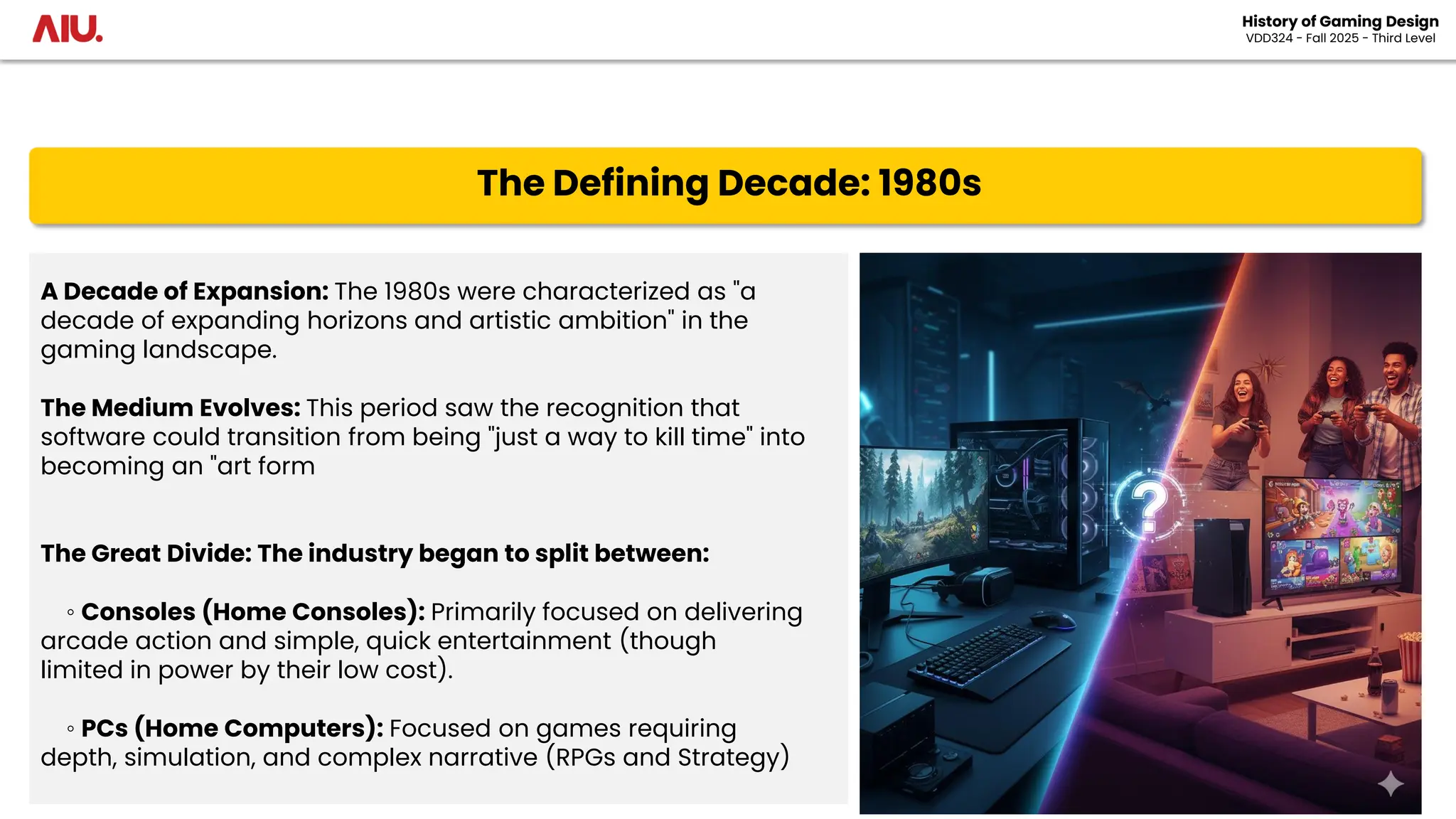
A Decade of Expansion: The 1980s were characterized as "a
decade of expanding horizons and artistic ambition" in the
gaming landscape.
The Medium Evolves: This period saw the recognition that
software could transition from being "just a way to kill time" into
becoming an "art form
The Great Divide: The industry began to split between:
◦ Consoles (Home Consoles): Primarily focused on delivering
arcade action and simple, quick entertainment (though
limited in power by their low cost).
◦ PCs (Home Computers): Focused on games requiring
depth, simulation, and complex narrative (RPGs and Strategy)
History of Gaming Design
VDD324 - Fall 2025 - Third Level
10.
Technical Constraints andOpportunities
History of Gaming Design
VDD324 - Fall 2025 - Third Level
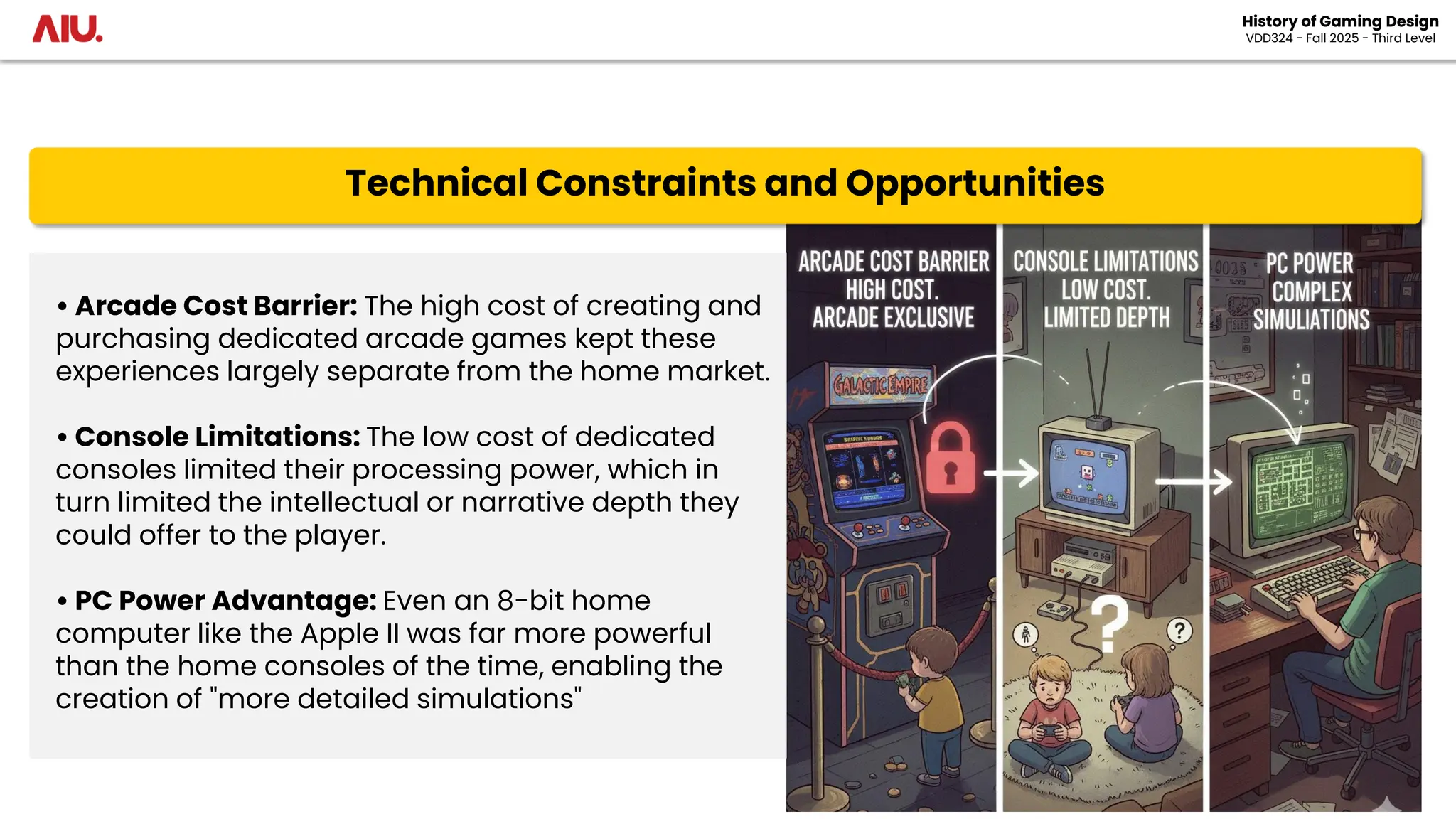
• Arcade Cost Barrier: The high cost of creating and
purchasing dedicated arcade games kept these
experiences largely separate from the home market.
• Console Limitations: The low cost of dedicated
consoles limited their processing power, which in
turn limited the intellectual or narrative depth they
could offer to the player.
• PC Power Advantage: Even an 8-bit home
computer like the Apple II was far more powerful
than the home consoles of the time, enabling the
creation of "more detailed simulations"
11.
The Push forAffordable Home Computers
History of Gaming Design
VDD324 - Fall 2025 - Third Level
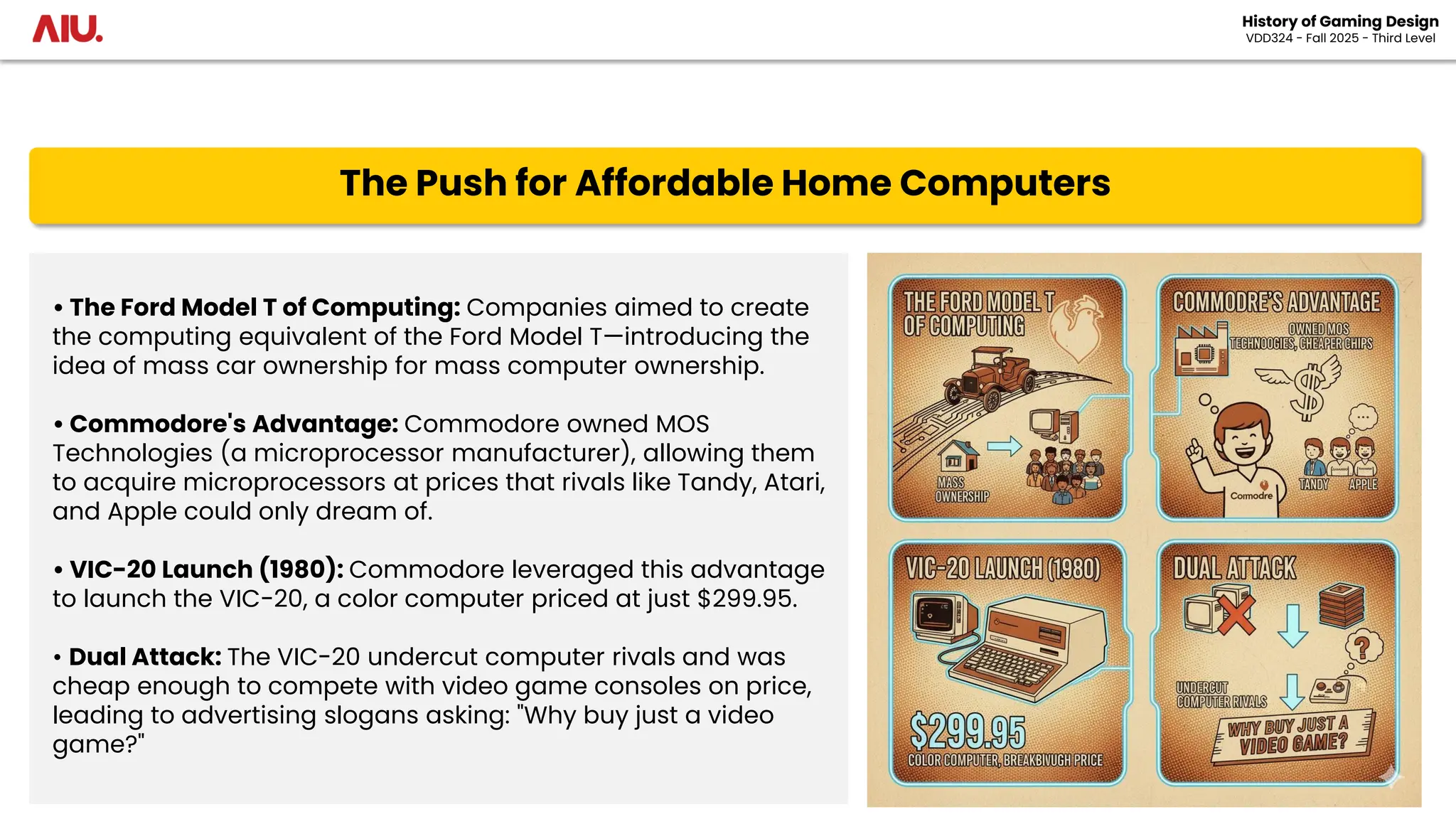
• The Ford Model T of Computing: Companies aimed to create
the computing equivalent of the Ford Model T—introducing the
idea of mass car ownership for mass computer ownership.
• Commodore's Advantage: Commodore owned MOS
Technologies (a microprocessor manufacturer), allowing them
to acquire microprocessors at prices that rivals like Tandy, Atari,
and Apple could only dream of.
• VIC-20 Launch (1980): Commodore leveraged this advantage
to launch the VIC-20, a color computer priced at just $299.95.
• Dual Attack: The VIC-20 undercut computer rivals and was
cheap enough to compete with video game consoles on price,
leading to advertising slogans asking: "Why buy just a video
game?"
12.
The Push forAffordable Home Computers
History of Gaming Design
VDD324 - Fall 2025 - Third Level
13.
The Financial Successof Early PCs
History of Gaming Design
VDD324 - Fall 2025 - Third Level
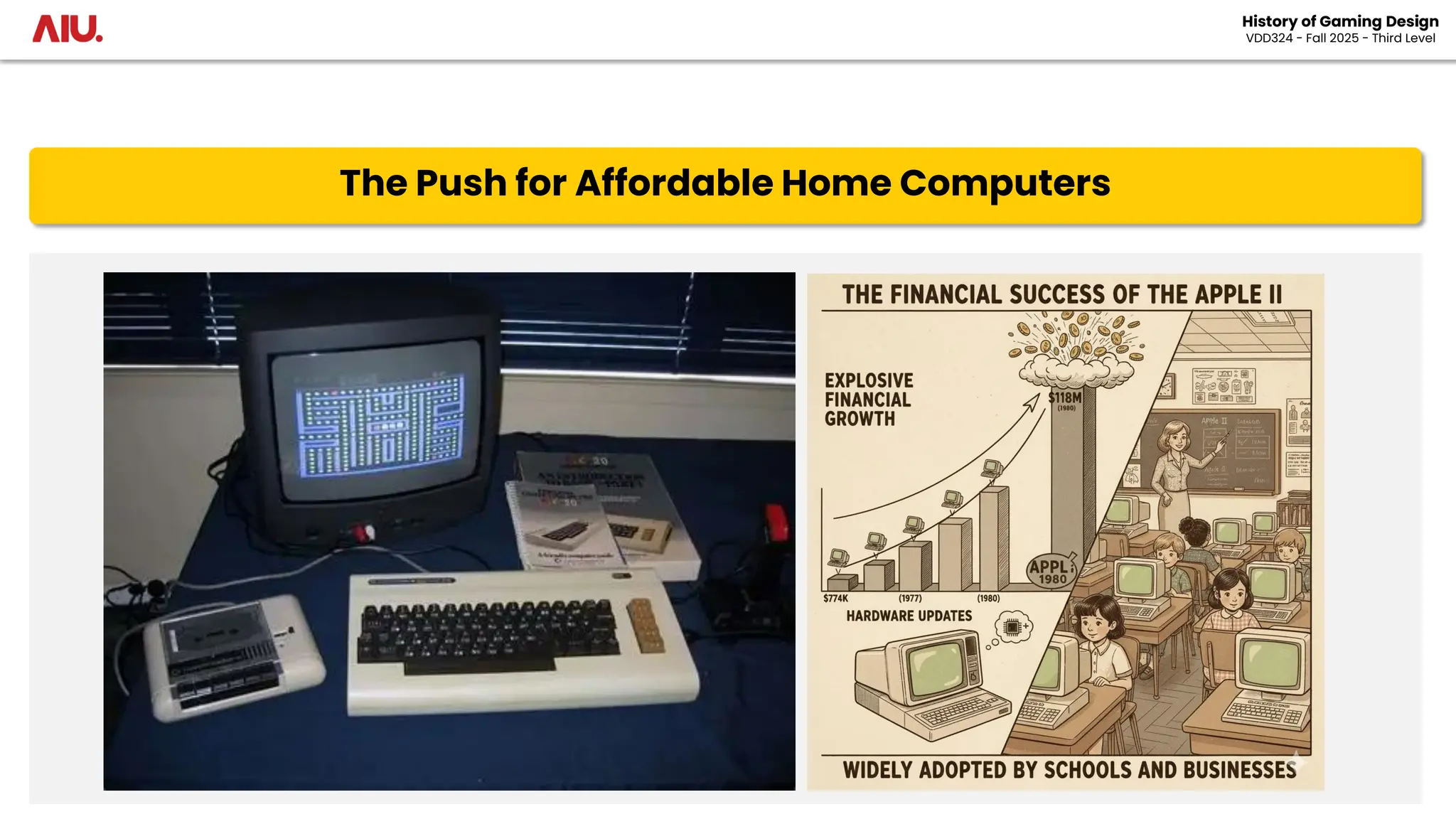
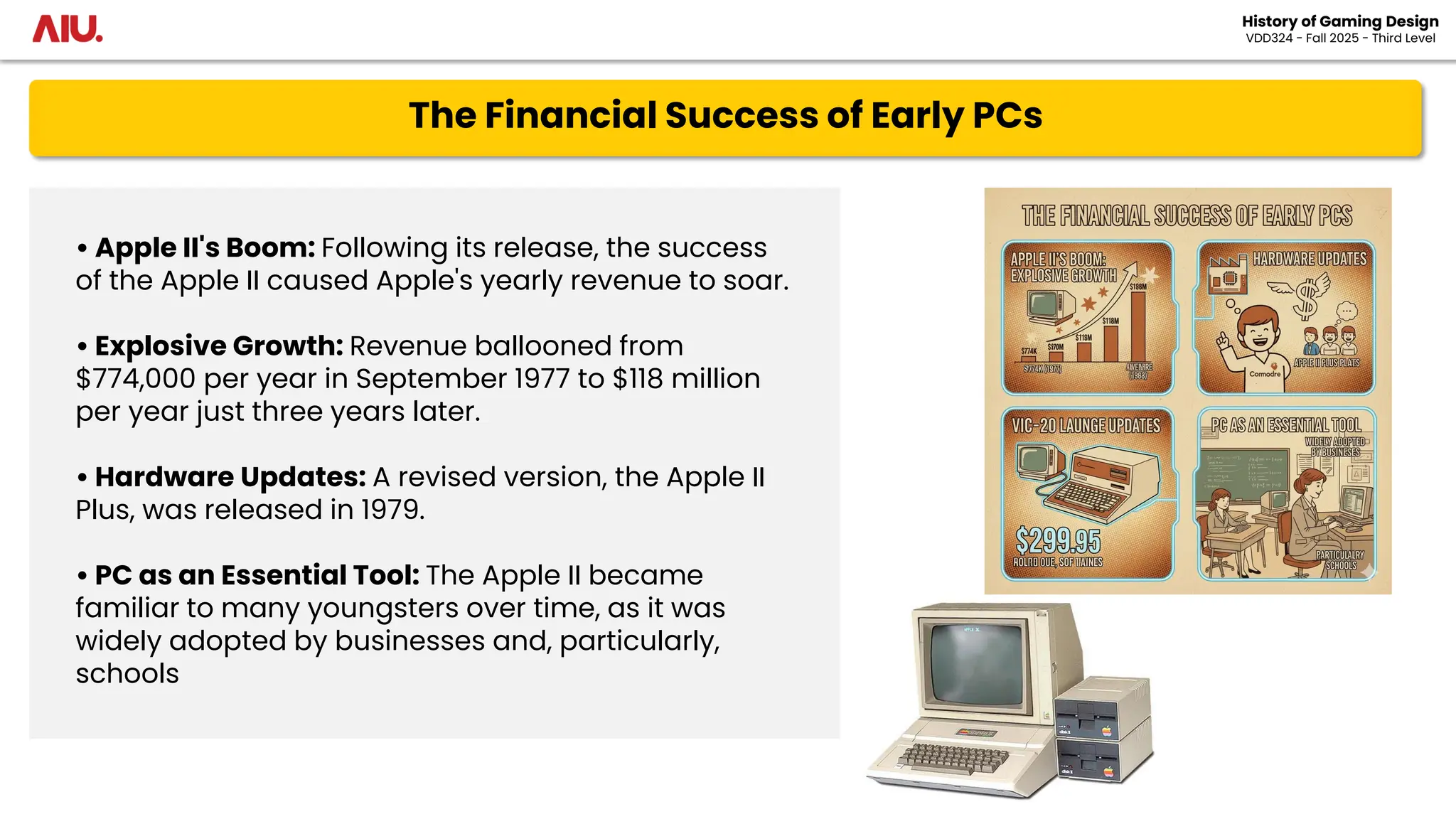
• Apple II's Boom: Following its release, the success
of the Apple II caused Apple's yearly revenue to soar.
• Explosive Growth: Revenue ballooned from
$774,000 per year in September 1977 to $118 million
per year just three years later.
• Hardware Updates: A revised version, the Apple II
Plus, was released in 1979.
• PC as an Essential Tool: The Apple II became
familiar to many youngsters over time, as it was
widely adopted by businesses and, particularly,
schools
14.
Commodore 64 andthe Price War
History of Gaming Design
VDD324 - Fall 2025 - Third Level
Commodore 64 and the Price War
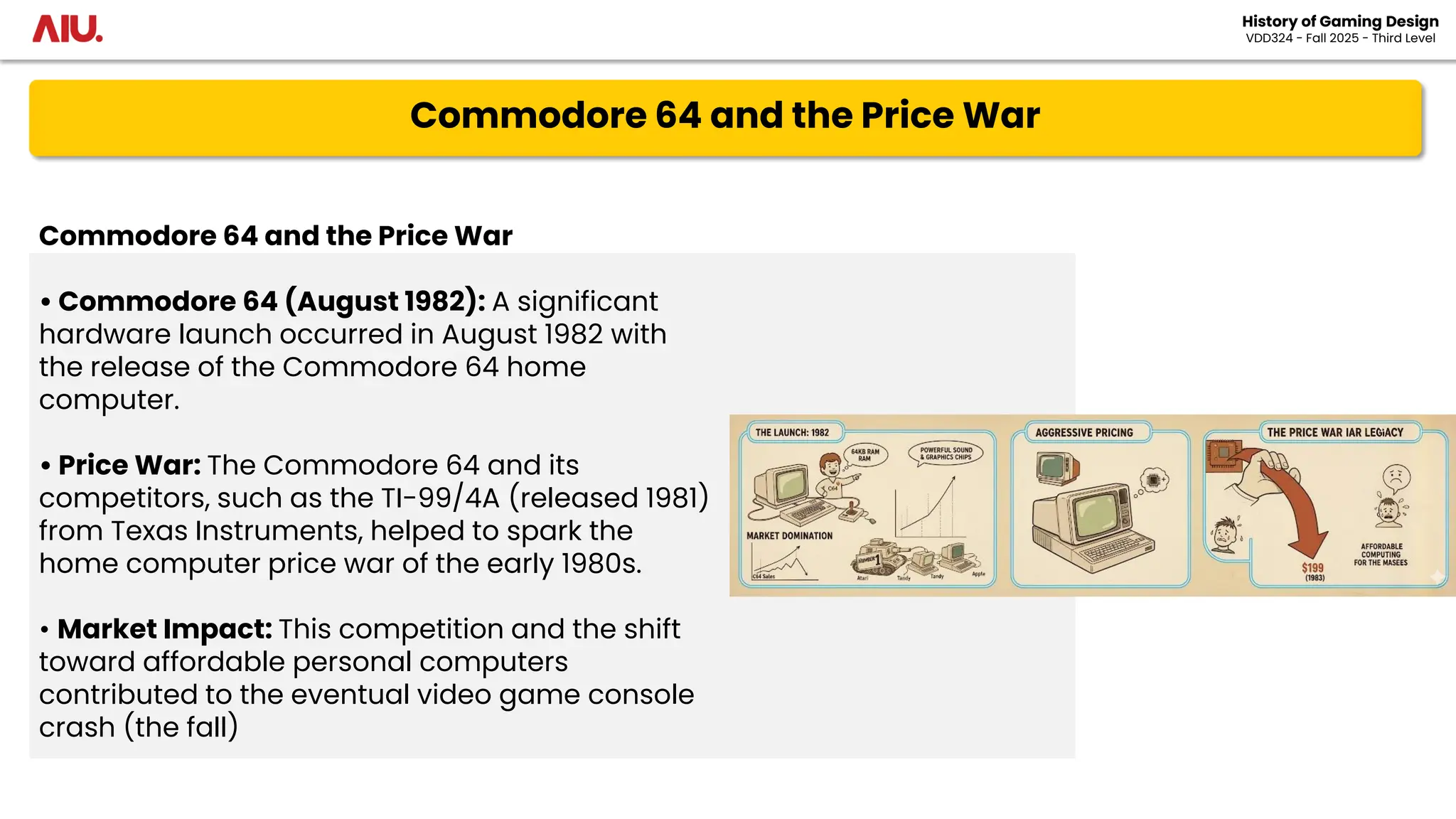
• Commodore 64 (August 1982): A significant
hardware launch occurred in August 1982 with
the release of the Commodore 64 home
computer.
• Price War: The Commodore 64 and its
competitors, such as the TI-99/4A (released 1981)
from Texas Instruments, helped to spark the
home computer price war of the early 1980s.
• Market Impact: This competition and the shift
toward affordable personal computers
contributed to the eventual video game console
crash (the fall)
15.
Designing for theMasses
History of Gaming Design
VDD324 - Fall 2025 - Third Level
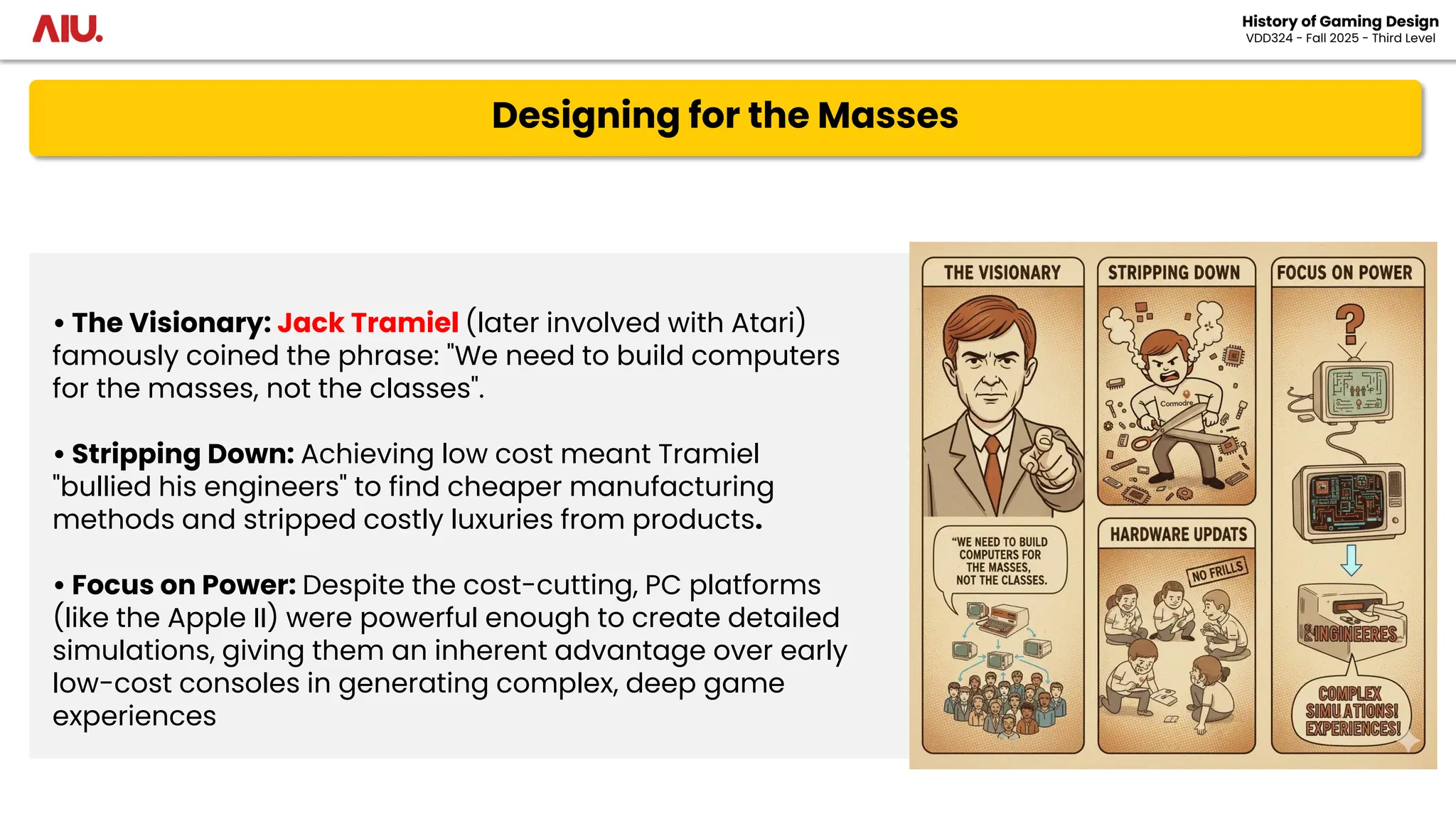
• The Visionary: Jack Tramiel (later involved with Atari)
famously coined the phrase: "We need to build computers
for the masses, not the classes".
• Stripping Down: Achieving low cost meant Tramiel
"bullied his engineers" to find cheaper manufacturing
methods and stripped costly luxuries from products.
• Focus on Power: Despite the cost-cutting, PC platforms
(like the Apple II) were powerful enough to create detailed
simulations, giving them an inherent advantage over early
low-cost consoles in generating complex, deep game
experiences
16.
The Vision ofSoftware as Art
History of Gaming Design
VDD324 - Fall 2025 - Third Level
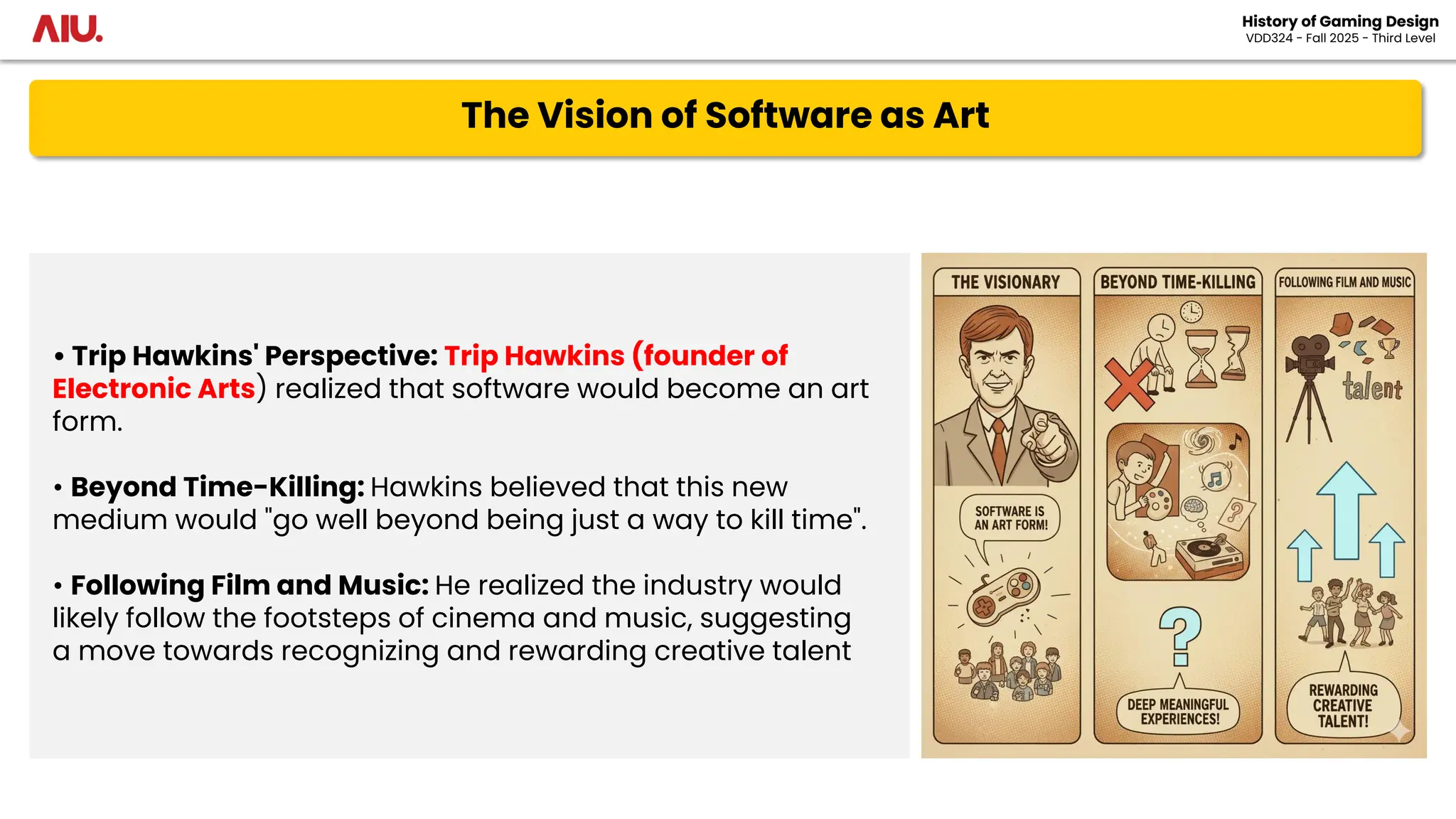
• Trip Hawkins' Perspective: Trip Hawkins (founder of
Electronic Arts) realized that software would become an art
form.
• Beyond Time-Killing: Hawkins believed that this new
medium would "go well beyond being just a way to kill time".
• Following Film and Music: He realized the industry would
likely follow the footsteps of cinema and music, suggesting
a move towards recognizing and rewarding creative talent
17.
Elevating the GameDesigner
History of Gaming Design
VDD324 - Fall 2025 - Third Level
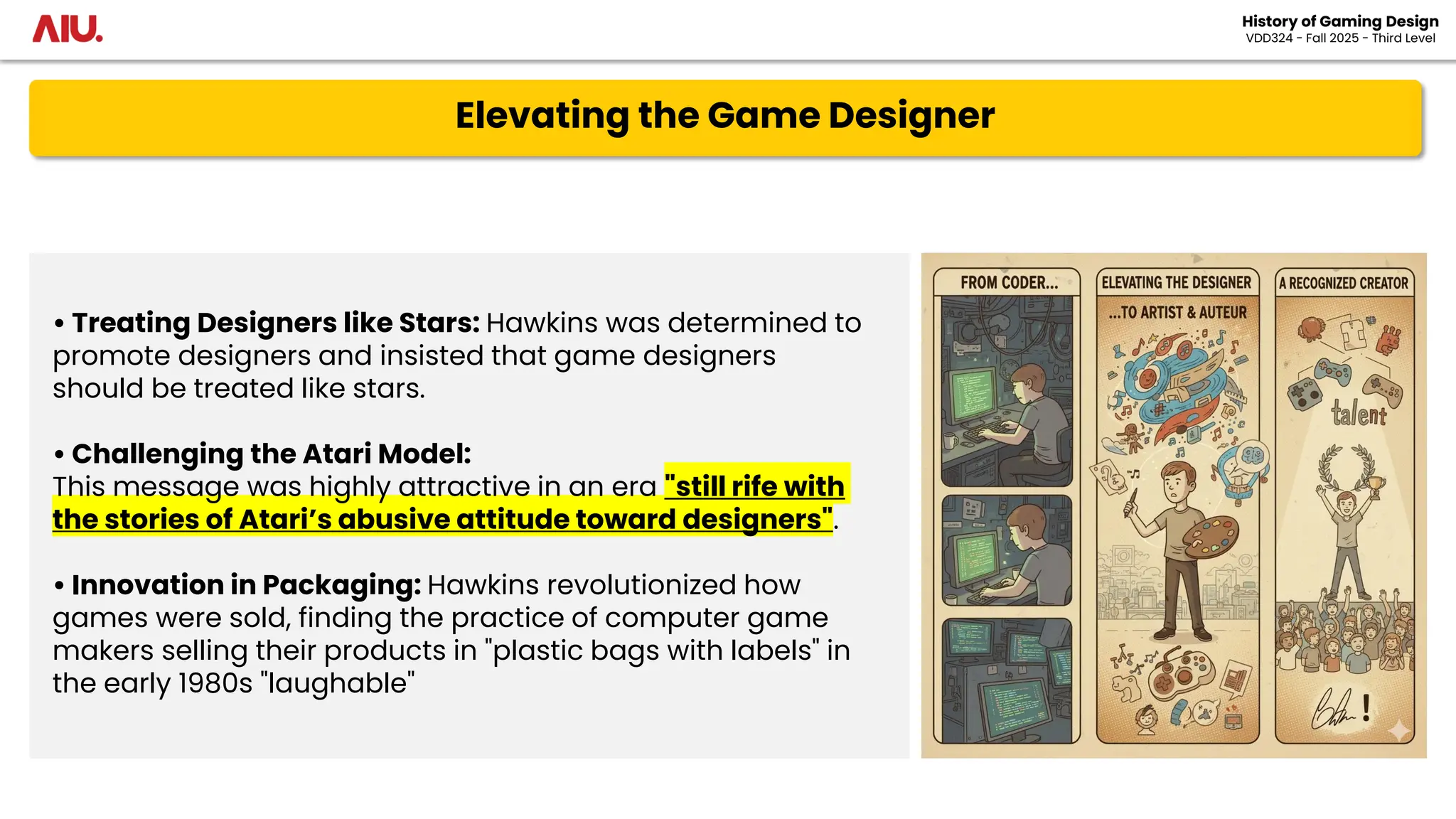
• Treating Designers like Stars: Hawkins was determined to
promote designers and insisted that game designers
should be treated like stars.
• Challenging the Atari Model:
This message was highly attractive in an era "still rife with
the stories of Atari’s abusive attitude toward designers".
• Innovation in Packaging: Hawkins revolutionized how
games were sold, finding the practice of computer game
makers selling their products in "plastic bags with labels" in
the early 1980s "laughable"
18.
The Need forNew Genres
History of Gaming Design
VDD324 - Fall 2025 - Third Level
Consoles/Arcades: Emphasizing reflexes, fast action, and
score (like Defender).
◦ PCs: Emphasizing deep strategy, exploration, and long-
form narrative (like RPGs).
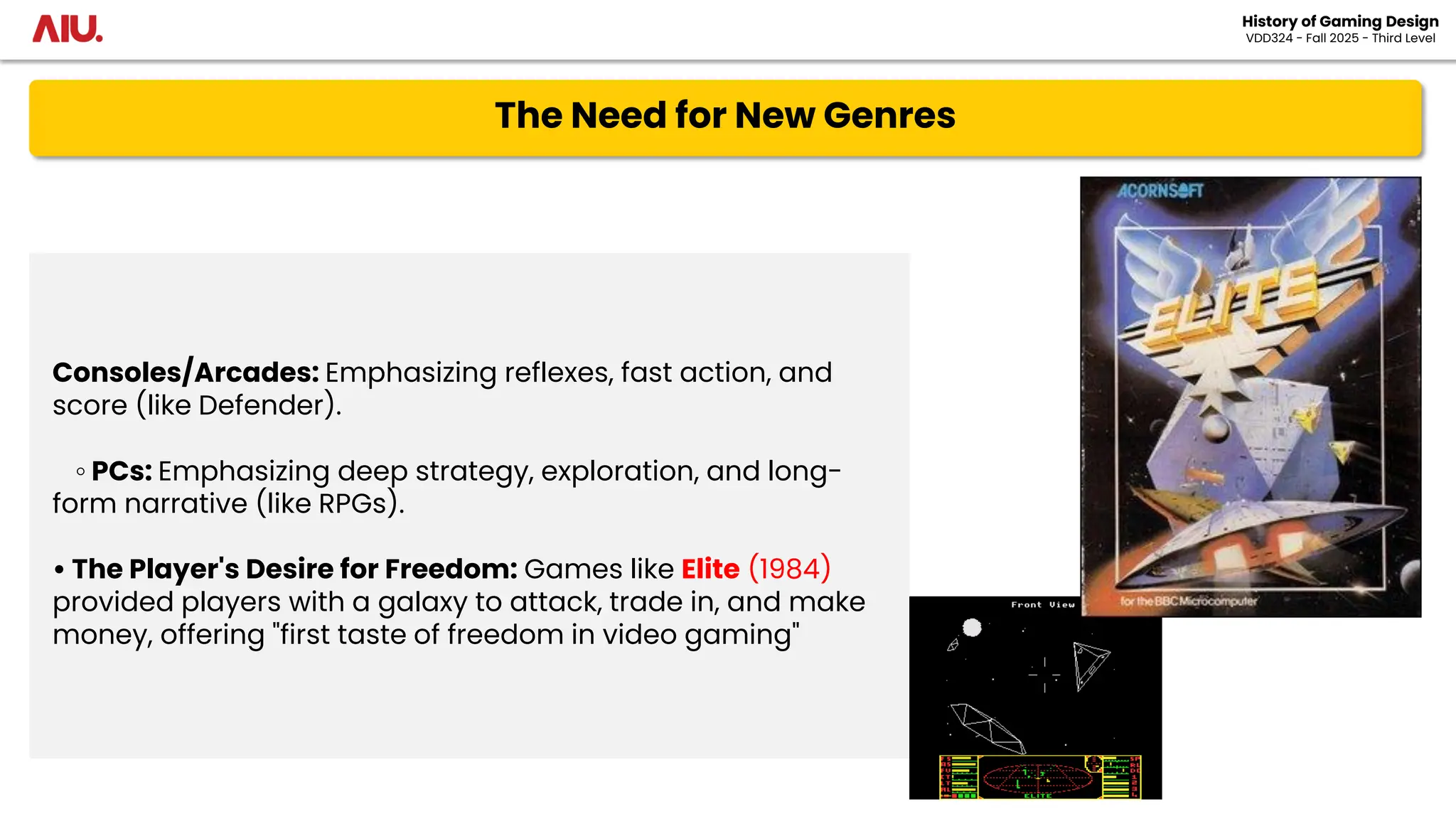
• The Player's Desire for Freedom: Games like Elite (1984)
provided players with a galaxy to attack, trade in, and make
money, offering "first taste of freedom in video gaming"
19.
The Birth ofRole-Playing Games (RPGs)
History of Gaming Design
VDD324 - Fall 2025 - Third Level
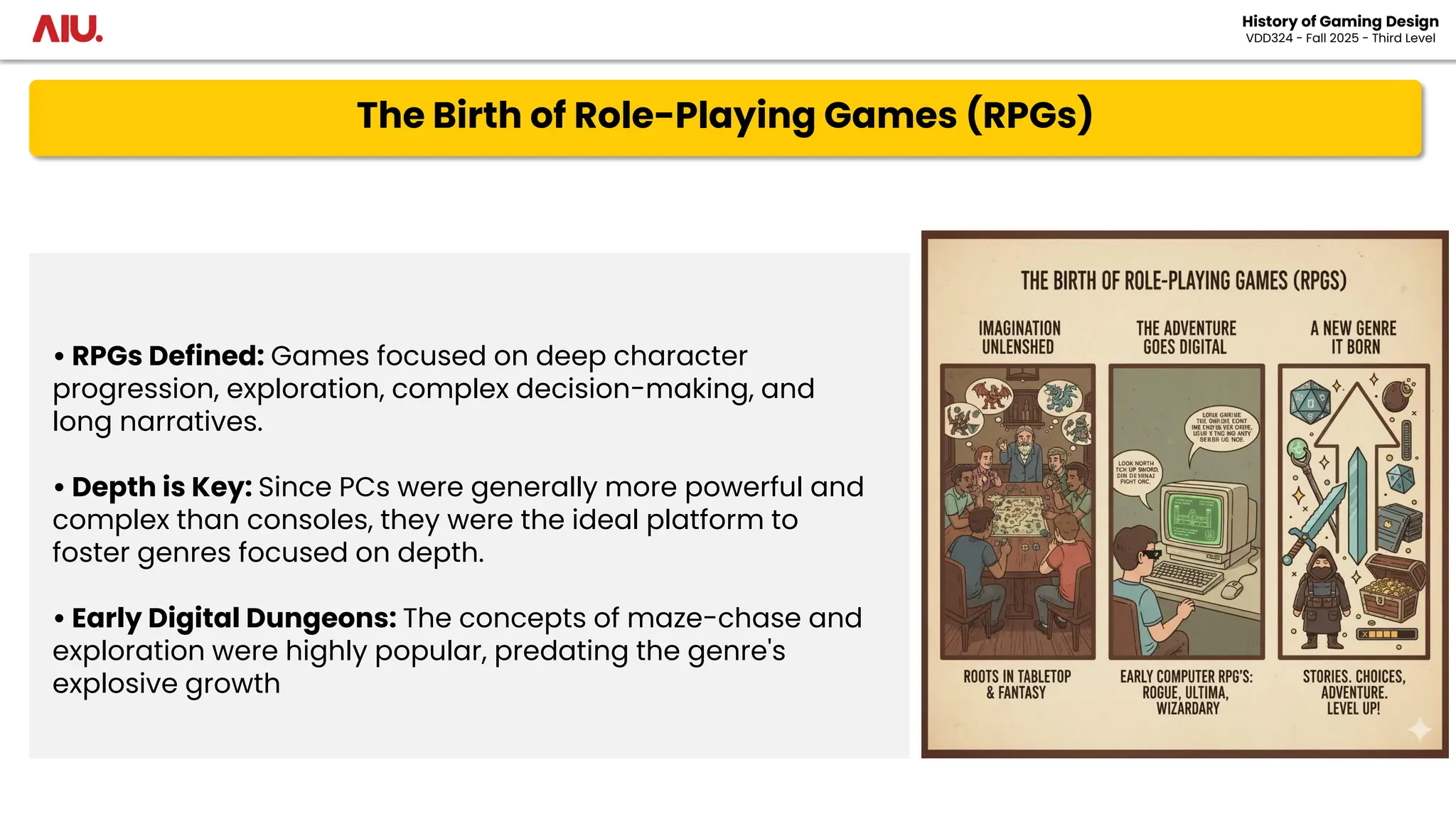
• RPGs Defined: Games focused on deep character
progression, exploration, complex decision-making, and
long narratives.
• Depth is Key: Since PCs were generally more powerful and
complex than consoles, they were the ideal platform to
foster genres focused on depth.
• Early Digital Dungeons: The concepts of maze-chase and
exploration were highly popular, predating the genre's
explosive growth
20.
Ancestors of theRPG
History of Gaming Design
VDD324 - Fall 2025 - Third Level
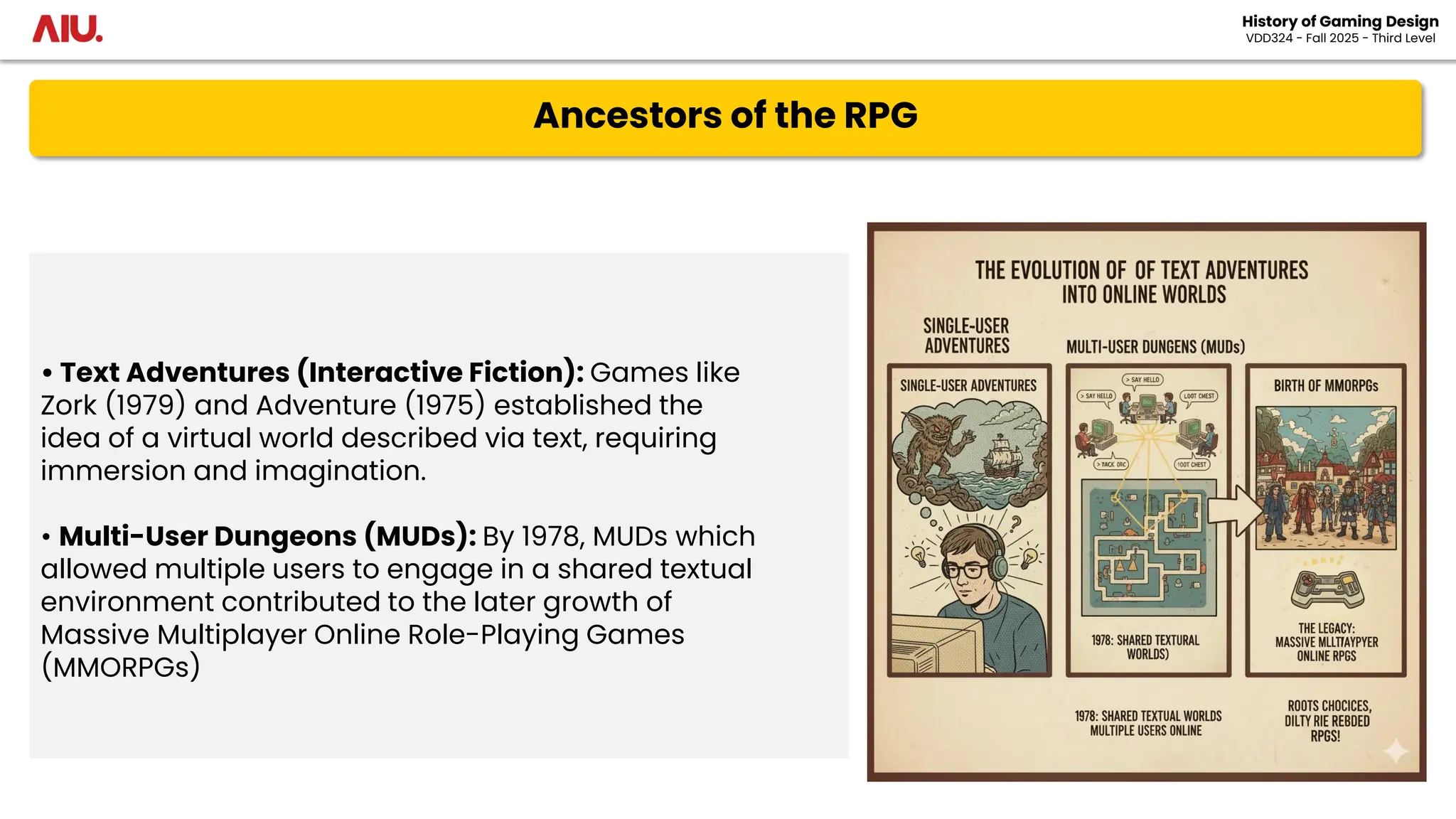
• Text Adventures (Interactive Fiction): Games like
Zork (1979) and Adventure (1975) established the
idea of a virtual world described via text, requiring
immersion and imagination.
• Multi-User Dungeons (MUDs): By 1978, MUDs which
allowed multiple users to engage in a shared textual
environment contributed to the later growth of
Massive Multiplayer Online Role-Playing Games
(MMORPGs)
21.
Temple of Apshai(1979)
History of Gaming Design
VDD324 - Fall 2025 - Third Level
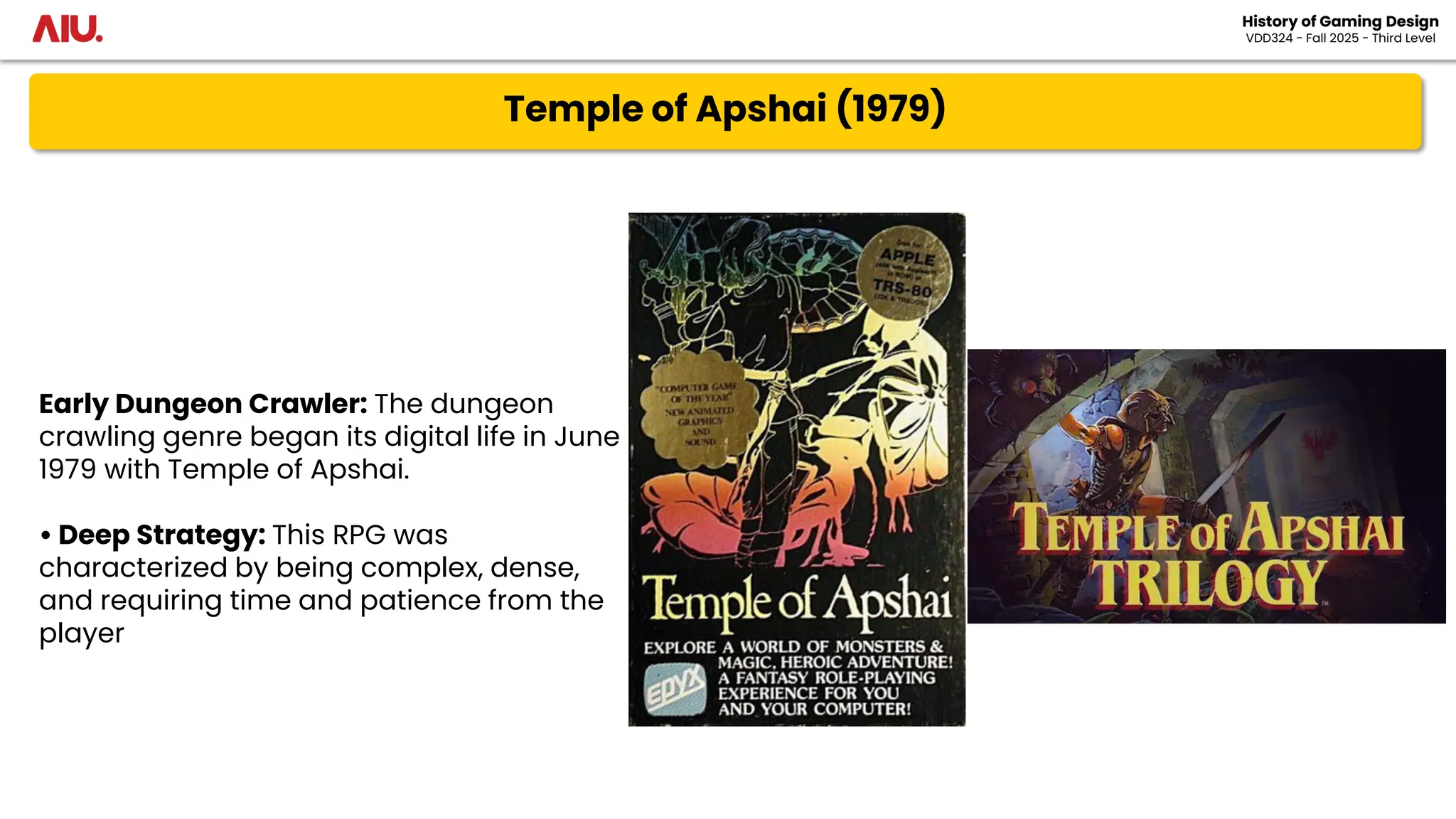
Early Dungeon Crawler: The dungeon
crawling genre began its digital life in June
1979 with Temple of Apshai.
• Deep Strategy: This RPG was
characterized by being complex, dense,
and requiring time and patience from the
player
22.
Ultima (1981)
History ofGaming Design
VDD324 - Fall 2025 - Third Level
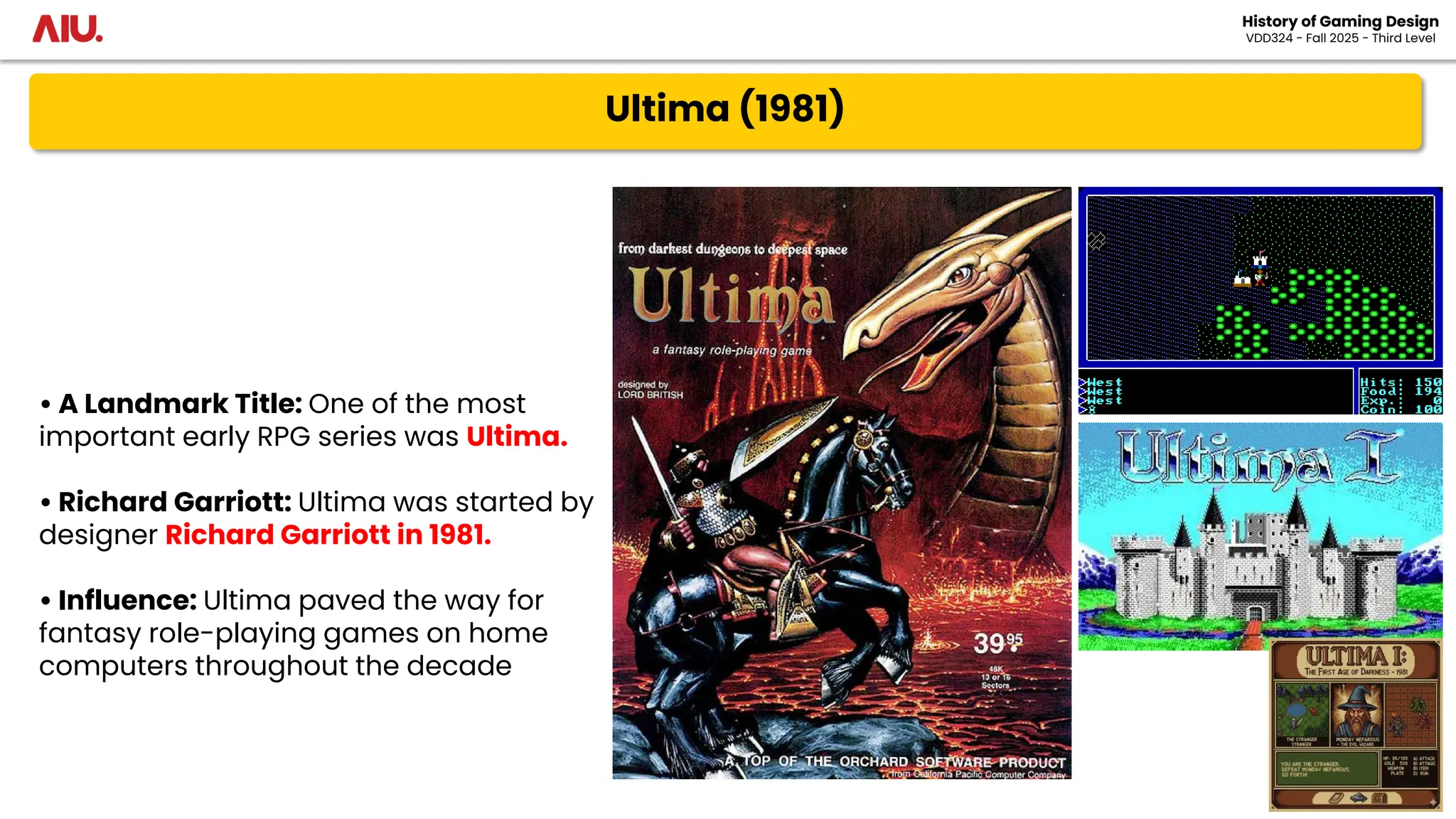
• A Landmark Title: One of the most
important early RPG series was Ultima.
• Richard Garriott: Ultima was started by
designer Richard Garriott in 1981.
• Influence: Ultima paved the way for
fantasy role-playing games on home
computers throughout the decade
23.
The Importance ofFinal Fantasy (1987)
History of Gaming Design
VDD324 - Fall 2025 - Third Level
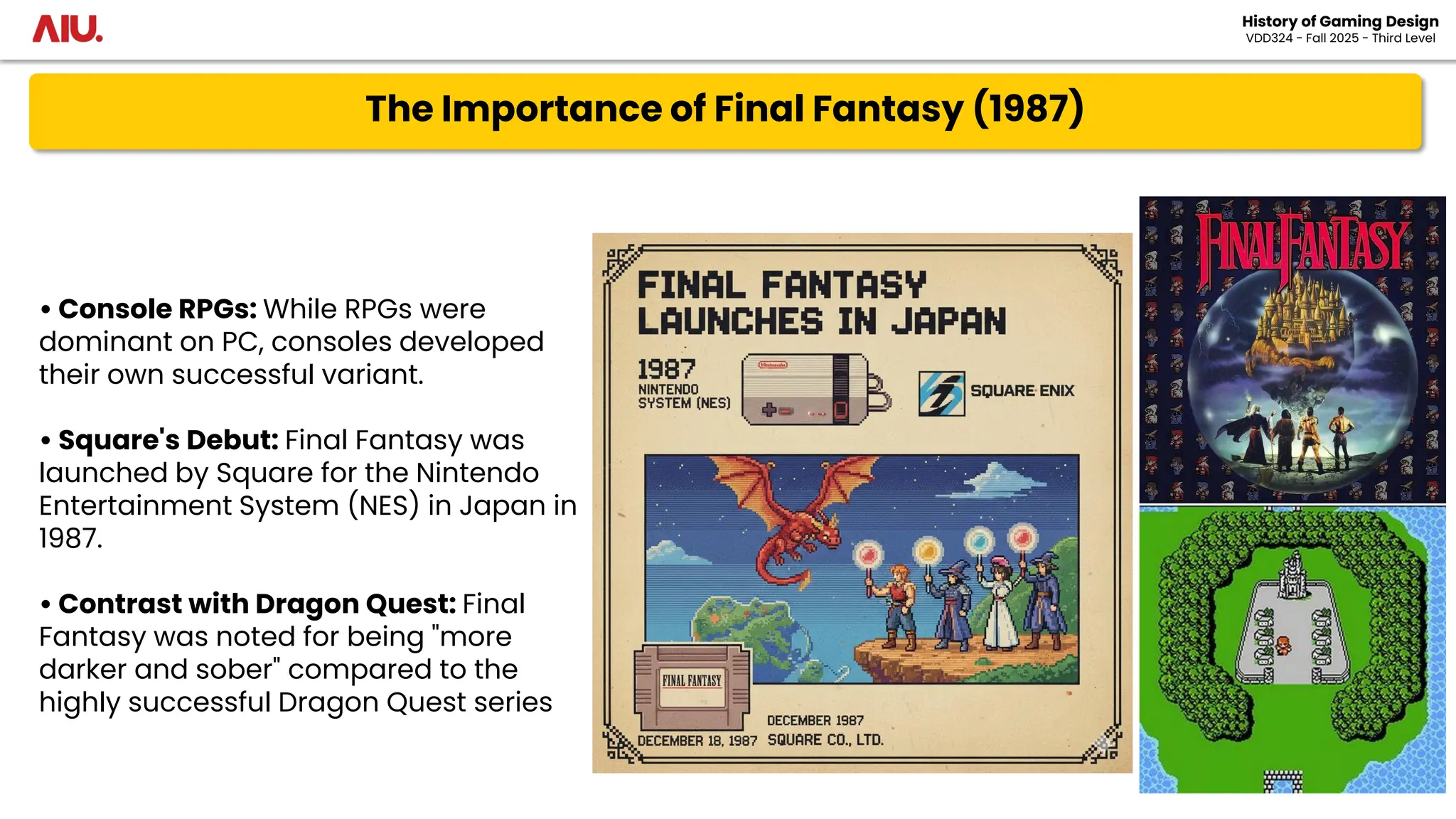
• Console RPGs: While RPGs were
dominant on PC, consoles developed
their own successful variant.
• Square's Debut: Final Fantasy was
launched by Square for the Nintendo
Entertainment System (NES) in Japan in
1987.
• Contrast with Dragon Quest: Final
Fantasy was noted for being "more
darker and sober" compared to the
highly successful Dragon Quest series
24.
Dungeon Master (1987)
Historyof Gaming Design
VDD324 - Fall 2025 - Third Level
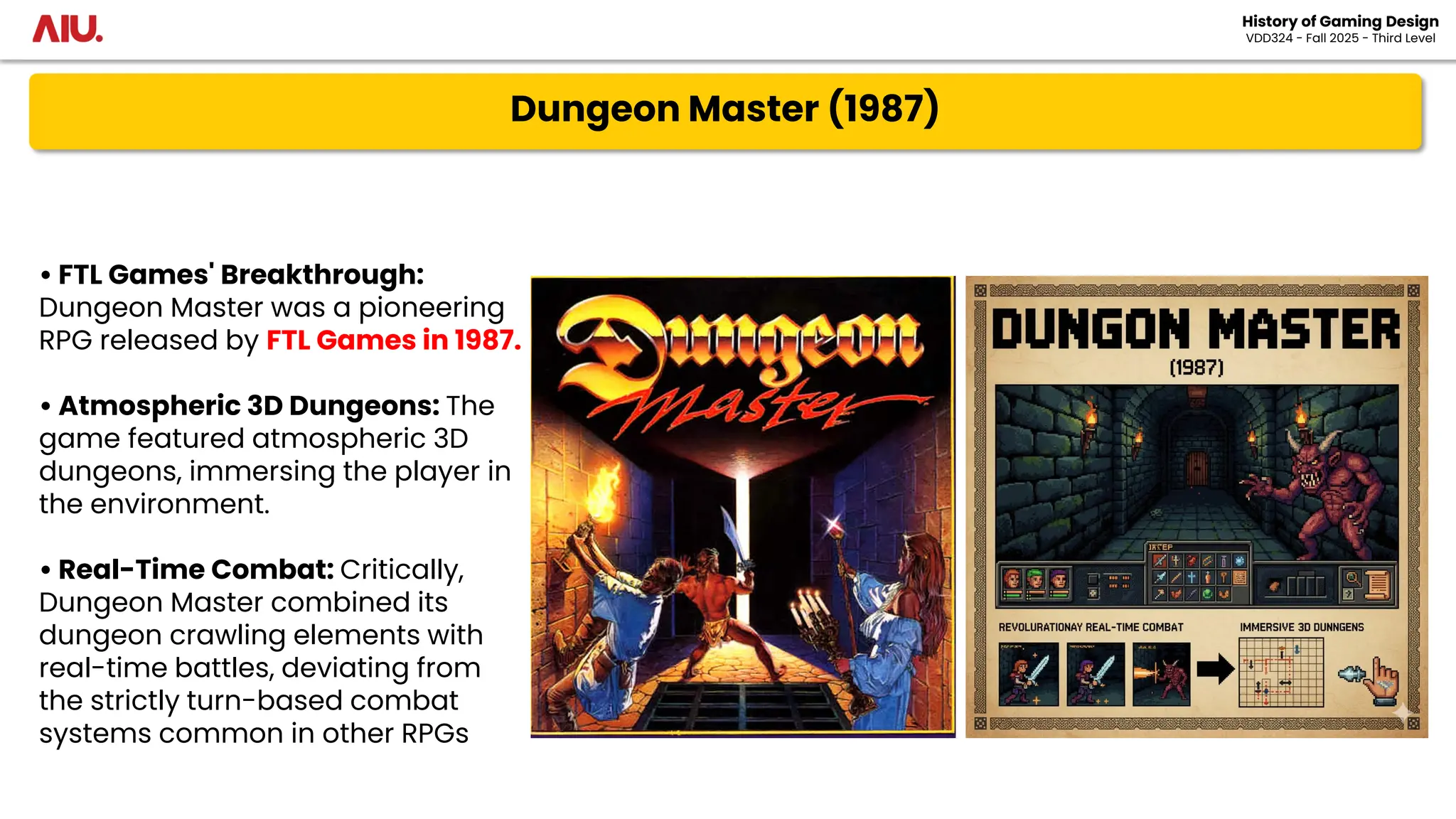
• FTL Games' Breakthrough:
Dungeon Master was a pioneering
RPG released by FTL Games in 1987.
• Atmospheric 3D Dungeons: The
game featured atmospheric 3D
dungeons, immersing the player in
the environment.
• Real-Time Combat: Critically,
Dungeon Master combined its
dungeon crawling elements with
real-time battles, deviating from
the strictly turn-based combat
systems common in other RPGs
25.
Dungeon Master's Legacy
Historyof Gaming Design
VDD324 - Fall 2025 - Third Level
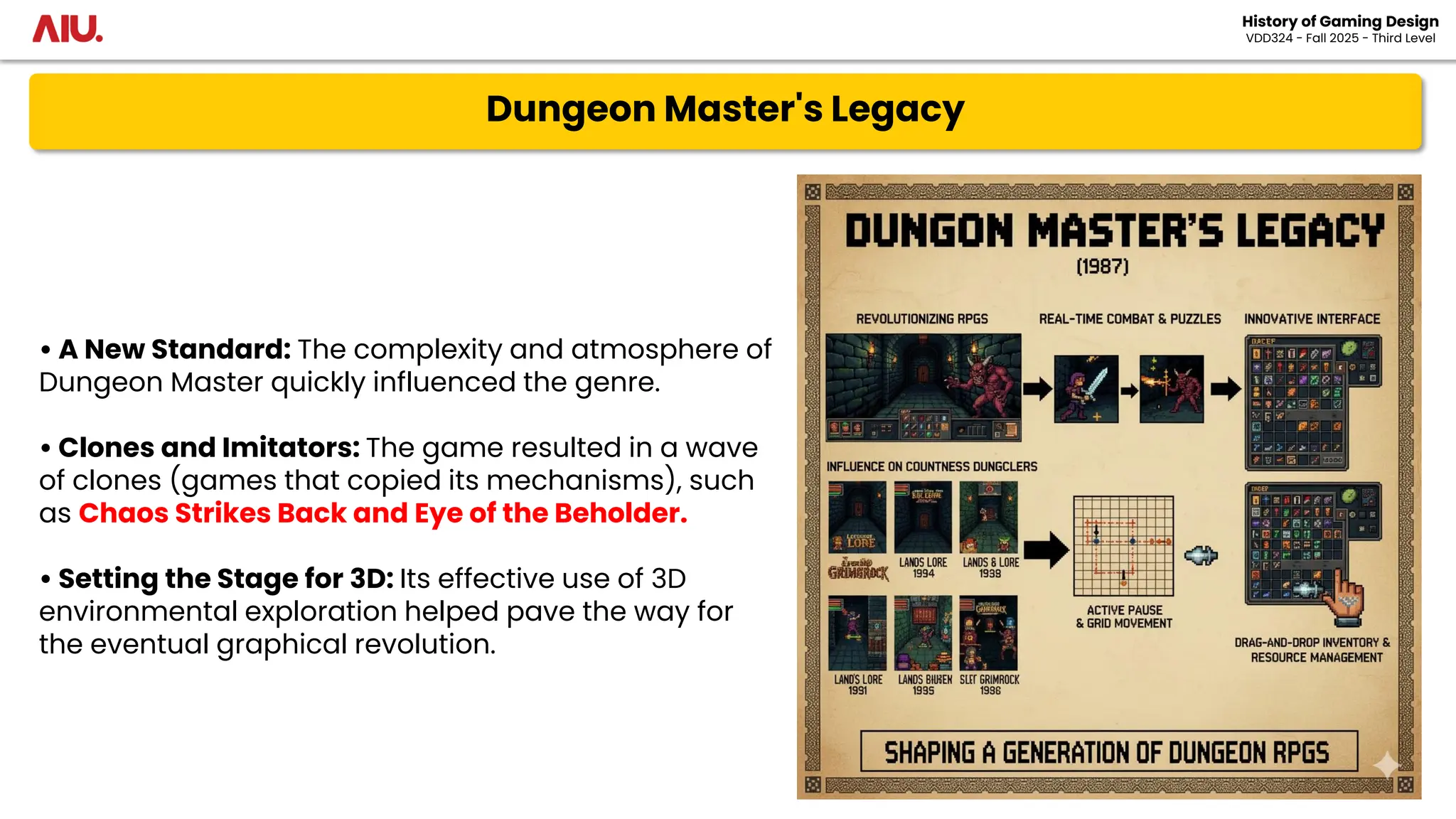
• A New Standard: The complexity and atmosphere of
Dungeon Master quickly influenced the genre.
• Clones and Imitators: The game resulted in a wave
of clones (games that copied its mechanisms), such
as Chaos Strikes Back and Eye of the Beholder.
• Setting the Stage for 3D: Its effective use of 3D
environmental exploration helped pave the way for
the eventual graphical revolution.
26.
Simulators and Non-ConflictGames
History of Gaming Design
VDD324 - Fall 2025 - Third Level
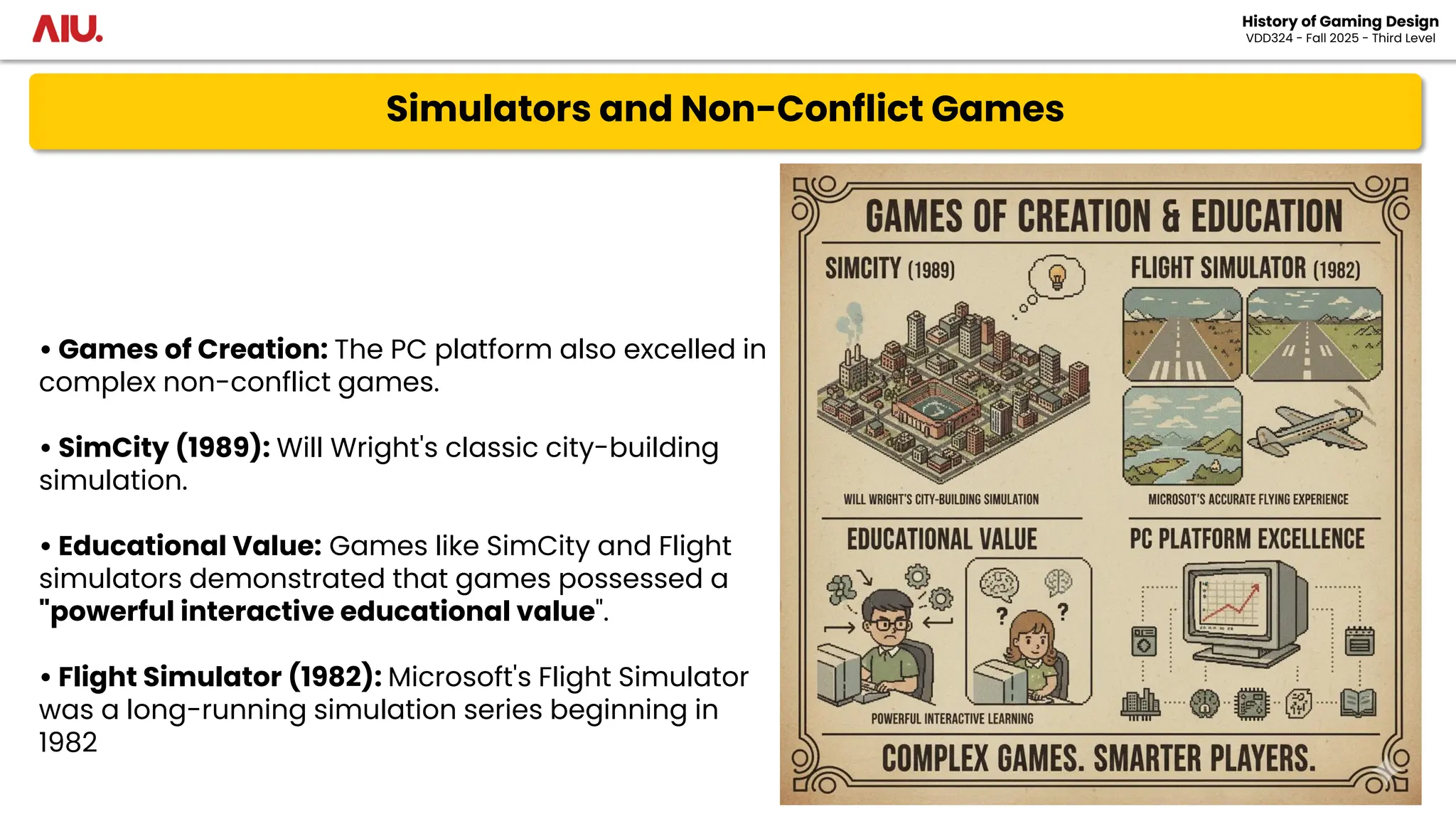
• Games of Creation: The PC platform also excelled in
complex non-conflict games.
• SimCity (1989): Will Wright's classic city-building
simulation.
• Educational Value: Games like SimCity and Flight
simulators demonstrated that games possessed a
"powerful interactive educational value".
• Flight Simulator (1982): Microsoft's Flight Simulator
was a long-running simulation series beginning in
1982
27.
The Creative Player
Historyof Gaming Design
VDD324 - Fall 2025 - Third Level
• Creative Focus: Early PC games celebrated artistic
ambition and provided room for players to engage
creatively.
• Player-Generated Content: Although the idea of
seamless user-generated content was largely unmet
for mainstream games later on (like Spore), the PC
culture encouraged modding and creativity (e.g.,
Minecraft later became a symbol for indie creation).
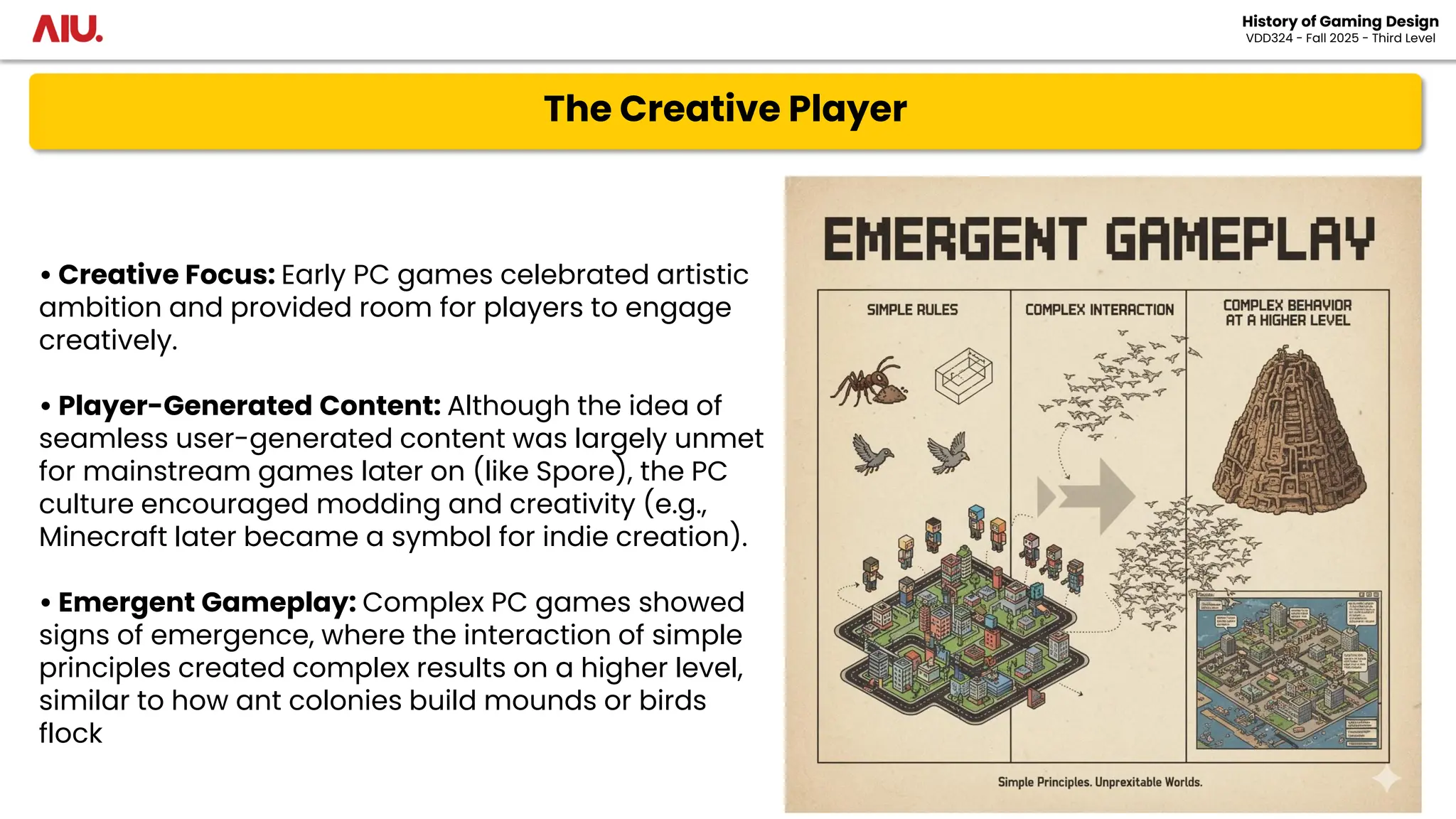
• Emergent Gameplay: Complex PC games showed
signs of emergence, where the interaction of simple
principles created complex results on a higher level,
similar to how ant colonies build mounds or birds
flock
28.
PC Games vs.Arcade Aesthetics
History of Gaming Design
VDD324 - Fall 2025 - Third Level
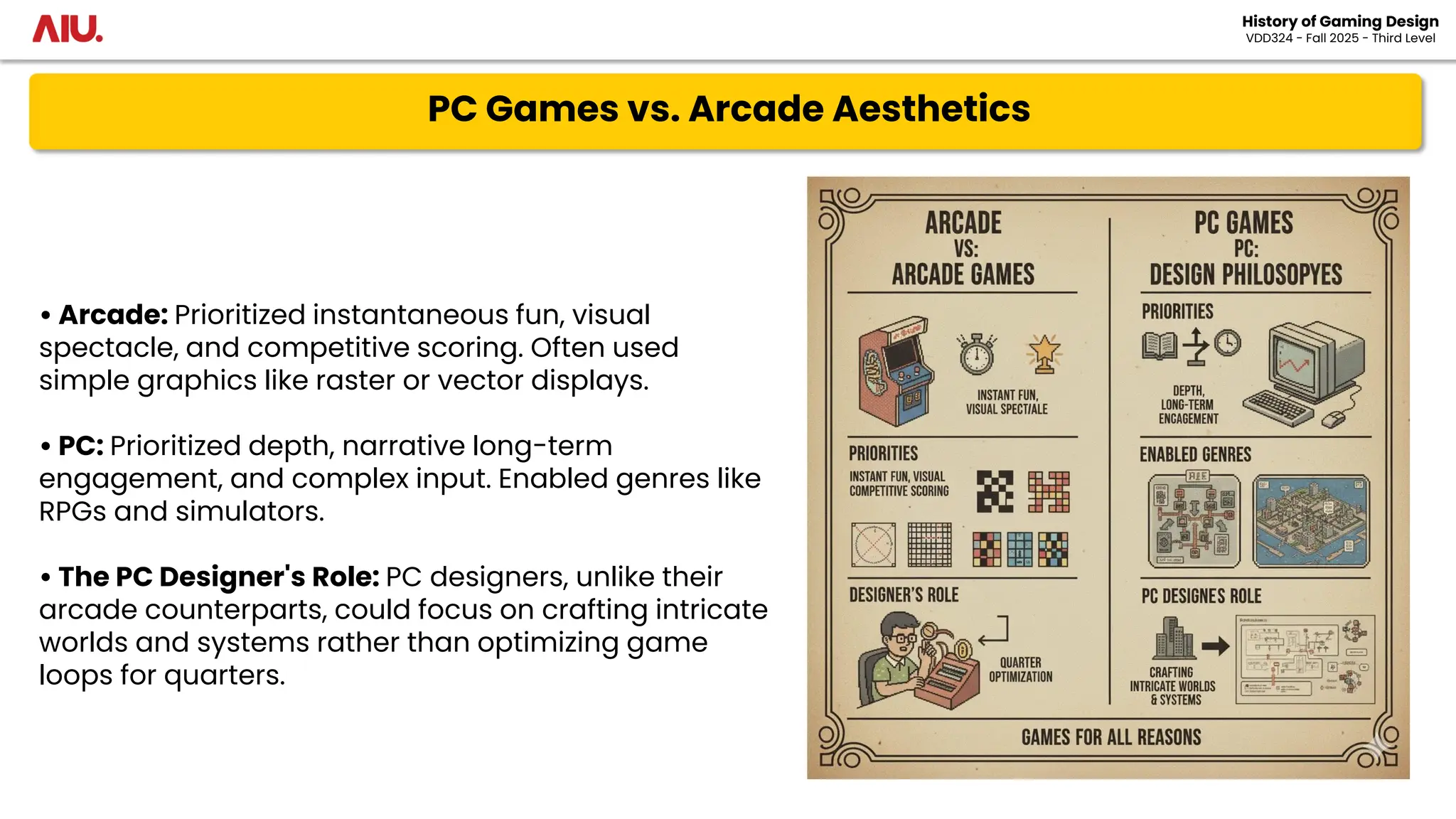
• Arcade: Prioritized instantaneous fun, visual
spectacle, and competitive scoring. Often used
simple graphics like raster or vector displays.
• PC: Prioritized depth, narrative long-term
engagement, and complex input. Enabled genres like
RPGs and simulators.
• The PC Designer's Role: PC designers, unlike their
arcade counterparts, could focus on crafting intricate
worlds and systems rather than optimizing game
loops for quarters.
29.
Summary of 80’sMilestones
History of Gaming Design
VDD324 - Fall 2025 - Third Level
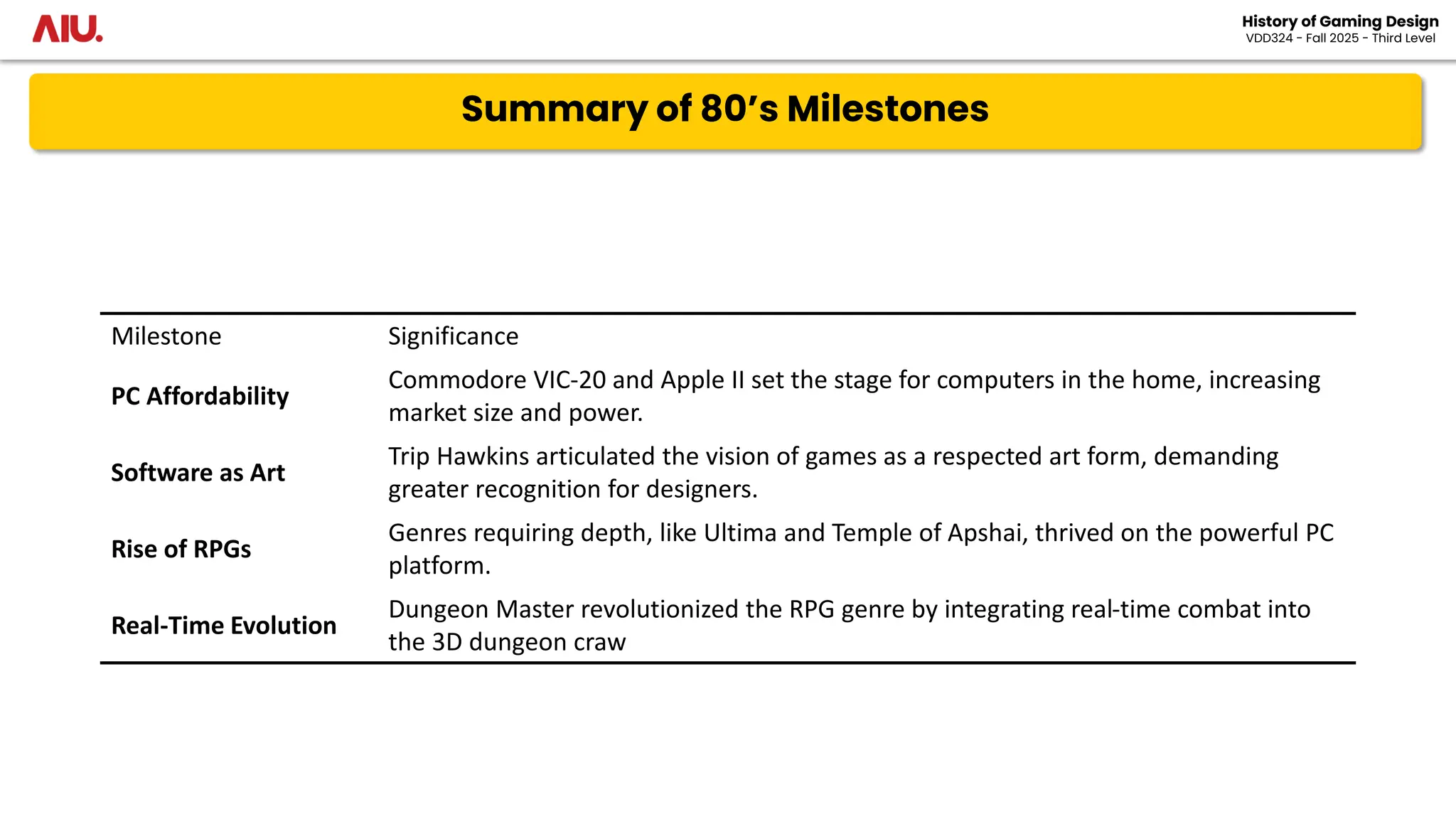
Milestone Significance
PC Affordability
Commodore VIC-20 and Apple II set the stage for computers in the home, increasing
market size and power.
Software as Art
Trip Hawkins articulated the vision of games as a respected art form, demanding
greater recognition for designers.
Rise of RPGs
Genres requiring depth, like Ultima and Temple of Apshai, thrived on the powerful PC
platform.
Real-Time Evolution
Dungeon Master revolutionized the RPG genre by integrating real-time combat into
the 3D dungeon craw
30.
The Road Ahead:Approaching 3D
History of Gaming Design
VDD324 - Fall 2025 - Third Level
• The Next Challenge: By the late 1980s, games were
achieving greater depth and complexity, but the
next frontier was graphical fidelity.
• From 2D Depth to 3D Immersion: Games like
Dungeon Master used atmospheric 3D illusions, but
the industry was about to embrace true three-
dimensional polygonal graphics.
The shift to the PC in the 1980s was like moving from performing a rapid, intense sprint (the
arcade) to constructing a complex, detailed novel (the RPG).
This change wasn't about speed; it was about laying the foundation for narrative freedom and
immersive worlds that could only be built on the PC platform.
31.
The Road Ahead:Approaching 3D
History of Gaming Design
VDD324 - Fall 2025 - Third Level
32.
Lecture 8 -Week 8
Assignment
05
History of Gaming Design
VDD324 - Fall 2025 - Third Level
33.
History of GamingDesign
VDD324 - Fall 2025 - Third Level
Assignment (3)
Part 1: Short Answer & Identification
Answer the following questions concisely based on the lecture slides.
• The "Ford Model T" of Computing: Which computer launched in 1980 with a price tag of $299.95, aiming to
bring "mass computer ownership" to the public? What was the famous advertising slogan used to attack
game consoles?
34.
History of GamingDesign
VDD324 - Fall 2025 - Third Level
Assignment (3)
Part 1: Short Answer & Identification
Answer the following questions concisely based on the lecture slides.
• Jack Tramiel’s Philosophy: Complete the quote by Jack Tramiel: "We need to build computers for the
________, not the ________." Briefly explain how he achieved the low costs necessary to make this
happen.
35.
History of GamingDesign
VDD324 - Fall 2025 - Third Level
Assignment (3)
Part 1: Short Answer & Identification
Answer the following questions concisely based on the lecture slides.
• Apple II Success: How did the revenue for Apple change between September 1977 and three years later?
Aside from businesses, what other institution widely adopted the Apple II, making it an "essential tool"?
36.
History of GamingDesign
VDD324 - Fall 2025 - Third Level
Assignment (3)
Part 1: Short Answer & Identification
Answer the following questions concisely based on the lecture slides.
• Trip Hawkins’ Vision: How did Trip Hawkins (founder of EA) believe game designers should be treated
compared to how Atari treated them? What did he compare the future of software to?
37.
History of GamingDesign
VDD324 - Fall 2025 - Third Level
Assignment (3)
Part 1: Short Answer & Identification
Answer the following questions concisely based on the lecture slides.
• Defining Dungeon Master: Dungeon Master (1987) is called a pioneer for two specific reasons regarding its
gameplay and visual presentation. What were they?
38.
History of GamingDesign
VDD324 - Fall 2025 - Third Level
Assignment (3)
Part 2: Comparative Analysis
Write a short paragraph (4-6 sentences) for each topic.
1. The Great Divide: Arcade/Console vs. PC Contrast the design priorities of Arcade
games with PC games in the 1980s. Why did the PC platform become the home for
RPGs and Simulations (like SimCity) while consoles focused on action? Refer to
"Technical Constraints" and "Designer Roles" in your answer.
2. The Evolution of the RPG Trace the lineage of the Role-Playing Game from its text-
based ancestors to graphical realization. Mention the contributions of Text
Adventures (Interactive Fiction) and MUDs, and explain how Ultima and Final
Fantasy represented different evolutions of the genre on different hardware.
39.
History of GamingDesign
VDD324 - Fall 2025 - Third Level
Assignment (3)
Part 3: Creative Scenario: "The Pitch"
Imagine it is 1983. You are a game designer trying to get your new game published by Trip Hawkins at his
new company, Electronic Arts.
Based on what you learned in Slides 8, 9, and 19, write a "Pitch Letter" to Mr. Hawkins.
Your pitch must include:
• The Concept: A brief description of a game that fits the "PC style" (Deep strategy, simulation, or RPG). It
cannot be a simple arcade clone.
• The "Art Form" Argument: Explain why this game is "more than just a way to kill time." How does it offer
narrative depth or creative freedom?
• Packaging & Credit: Make a specific request regarding how your name should appear on the box and
how the game should be packaged (referencing Hawkins' dislike of "plastic bags").