History in
History in
making two
making two
Novels
Novels
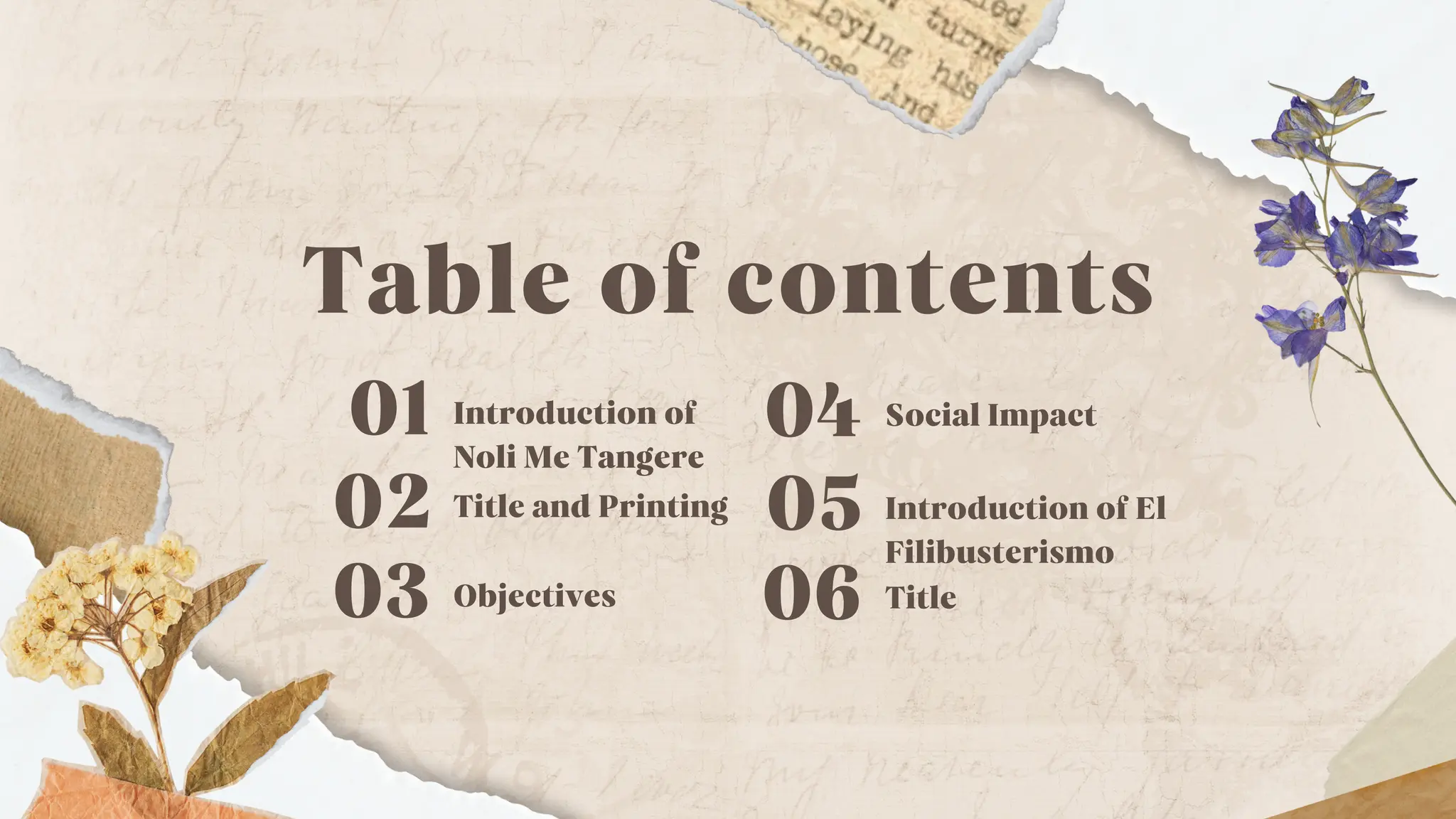
Table of contents
Introduction of
Noli Me Tangere
01
Title and Printing
02
03 Objectives
Social Impact
04
Introduction of El
Filibusterismo
05
06 Title
Introduction
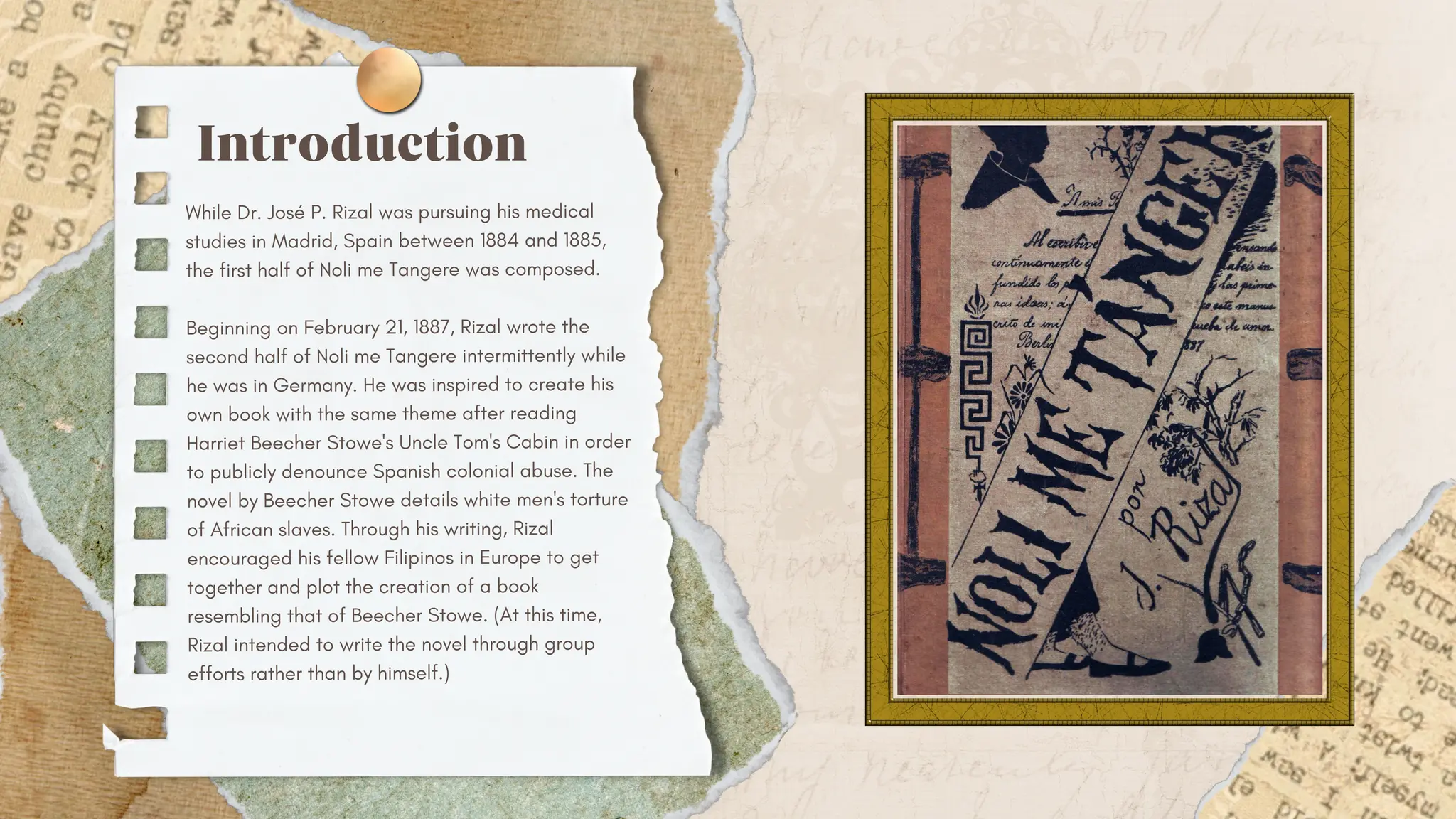
While Dr. José P. Rizal was pursuing his medical
studies in Madrid, Spain between 1884 and 1885,
the first half of Noli me Tangere was composed.
Beginning on February 21, 1887, Rizal wrote the
second half of Noli me Tangere intermittently while
he was in Germany. He was inspired to create his
own book with the same theme after reading
Harriet Beecher Stowe's Uncle Tom's Cabin in order
to publicly denounce Spanish colonial abuse. The
novel by Beecher Stowe details white men's torture
of African slaves. Through his writing, Rizal
encouraged his fellow Filipinos in Europe to get
together and plot the creation of a book
resembling that of Beecher Stowe. (At this time,
Rizal intended to write the novel through group
efforts rather than by himself.)
Title and Printing
Latin, not Spanish or Tagalog, is the language of Noli Me Tangere's title. In
a letter to his good friend and fellow scientist Ferdinand Blumentritt, Rizal
acknowledged that the title was taken from the Bible. When Mary
Magdalene discovers Jesus after his resurrection, he tells her, "Don't
touch Me!" in the Bible's narrative from John 20:17. The passage is
equivalent to Noli me tangere when translated into Latin.
He ran out of money just as the book was ready for printing. He got in
touch with Maximo Viola, a friend, and got a loan for publishing. According
to legend, Rizal was going to burn the Noli manuscripts when he got
Viola's telegram offering to lend him the books.
Objectives
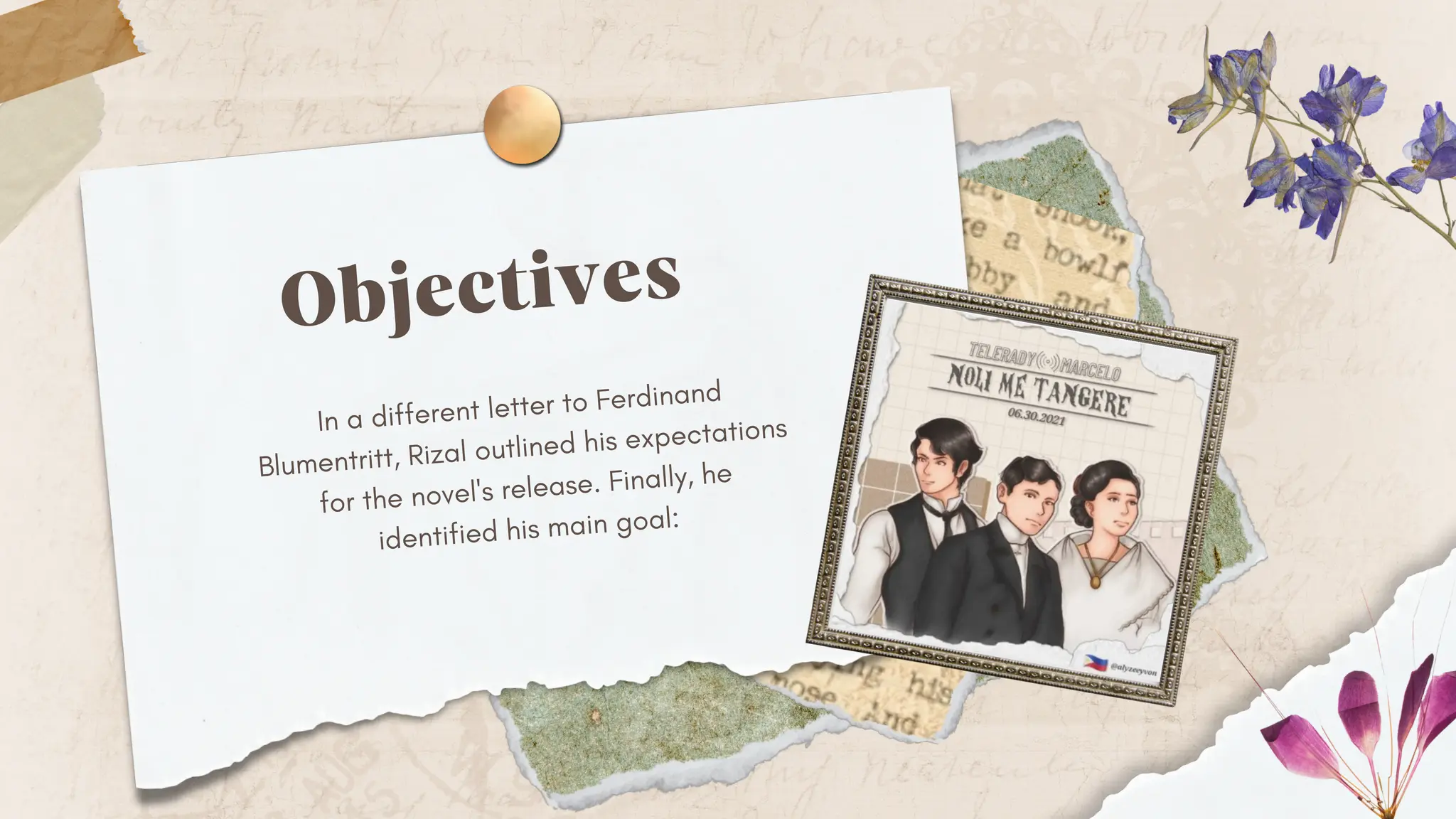
In a different letter to Ferdinand
Blumentritt, Rizal outlined his expectations
for the novel's release. Finally, he
identified his main goal:
•to defend Filipino people from foreign
accusations of foolishness and lack of knowledge;
•to show how the Filipino people lives during
Spanish colonial period and the cries and woes of
his countrymen against abusive officials;
•to discuss what religion and belief can really do to
everyday lives; and
•to expose the cruelties, graft, and corruption of
the false government at honestly show the
wrongdoings of Filipinos that led to further failure.
Social Impact
Noli me Tangere was regarded as one of the
catalysts for Filipino nationalism that led to the
1896 Philippine Revolution after its publication.
The book not only awoke a slumbering Filipino
consciousness, but it also laid the foundation
for aspirations toward independence.
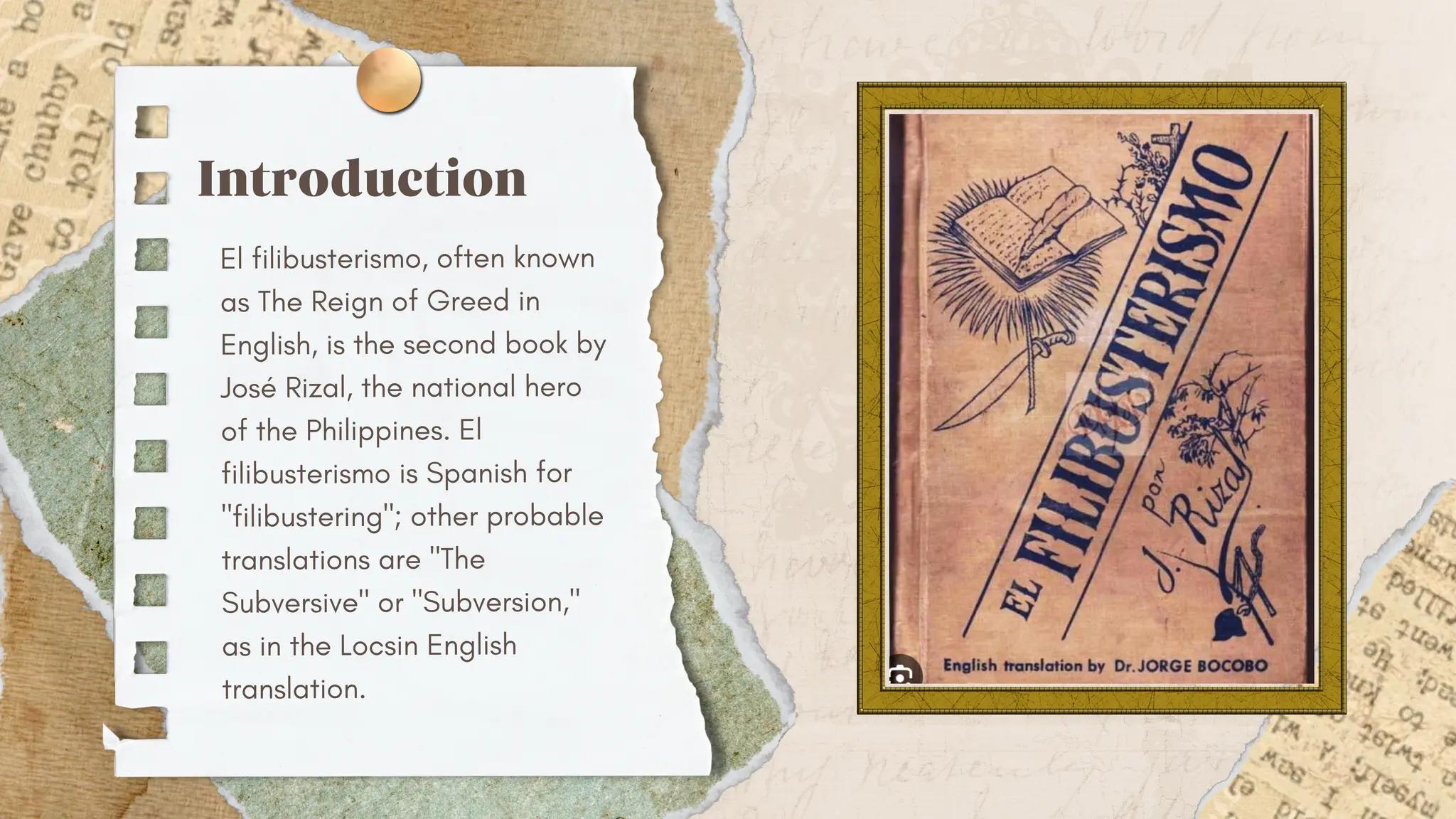
Introduction
El filibusterismo, often known
as The Reign of Greed in
English, is the second book by
José Rizal, the national hero
of the Philippines. El
filibusterismo is Spanish for
"filibustering"; other probable
translations are "The
Subversive" or "Subversion,"
as in the Locsin English
translation.
El Filibusterismo (Reign of Greed), Dr. Jose
Rizal's second book and the sequel to Noli Me
Tangere, was published in Ghent, Belgium, on
September 18, 1891. It was written in Spanish.
El Filibusterismo was started by Rizal in
Calamba, Laguna, in October 1887. He
updated a few chapters when he was in
London and finished the work on March 29,
1891.
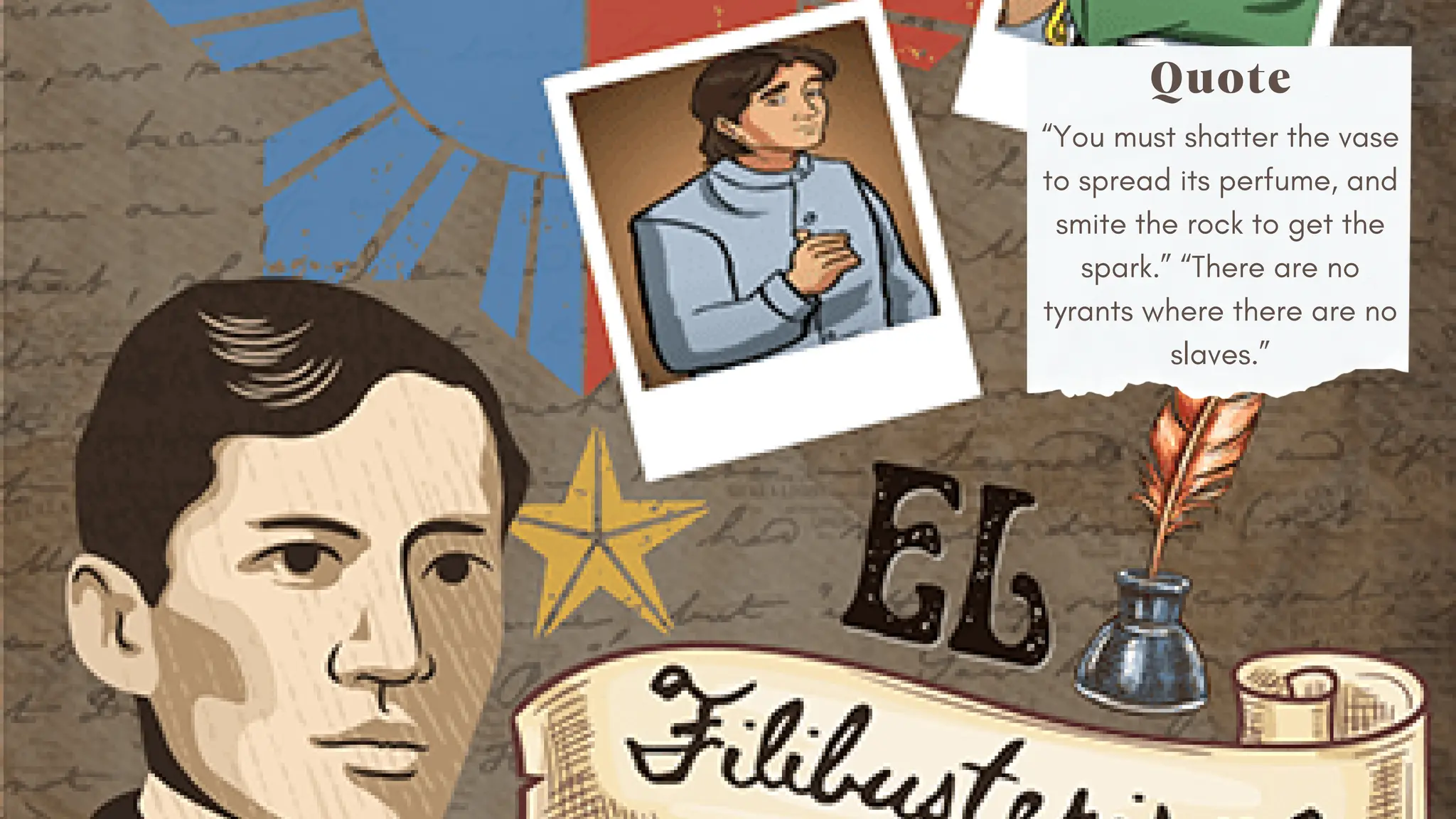
Quote
“You must shatter the vase
to spread its perfume, and
smite the rock to get the
spark.” “There are no
tyrants where there are no
slaves.”
The book's message is quite clear:
the present system of governing the
Philippines through corrupt and self-
seeking officials,who are controlled by
the friars and are subject to their
interests in one way or another.
Lucas, Jerica Mae
Lumasag, Camille
Sapnay, Angela
Valle, Jenny Rose
Caranto, Joana
Estapia, Jocelyn
Lapuz, Josephine
Babila, Liniemae
Castillo, Lovely
Tenio, Mary Grace
Reyes, Shaira Mae
Meru, John Carl
Ponte, Jake Lawrence
Bido, Mark Angelo
Group 3
Group 3 Rizal Presentation _20230917_111316_0000.pdf

  • 1.
    History in History in makingtwo making two Novels Novels
  • 2.
    Table of contents Introductionof Noli Me Tangere 01 Title and Printing 02 03 Objectives Social Impact 04 Introduction of El Filibusterismo 05 06 Title
  • 3.
    Introduction While Dr. JoséP. Rizal was pursuing his medical studies in Madrid, Spain between 1884 and 1885, the first half of Noli me Tangere was composed. Beginning on February 21, 1887, Rizal wrote the second half of Noli me Tangere intermittently while he was in Germany. He was inspired to create his own book with the same theme after reading Harriet Beecher Stowe's Uncle Tom's Cabin in order to publicly denounce Spanish colonial abuse. The novel by Beecher Stowe details white men's torture of African slaves. Through his writing, Rizal encouraged his fellow Filipinos in Europe to get together and plot the creation of a book resembling that of Beecher Stowe. (At this time, Rizal intended to write the novel through group efforts rather than by himself.)
  • 4.
    Title and Printing Latin,not Spanish or Tagalog, is the language of Noli Me Tangere's title. In a letter to his good friend and fellow scientist Ferdinand Blumentritt, Rizal acknowledged that the title was taken from the Bible. When Mary Magdalene discovers Jesus after his resurrection, he tells her, "Don't touch Me!" in the Bible's narrative from John 20:17. The passage is equivalent to Noli me tangere when translated into Latin. He ran out of money just as the book was ready for printing. He got in touch with Maximo Viola, a friend, and got a loan for publishing. According to legend, Rizal was going to burn the Noli manuscripts when he got Viola's telegram offering to lend him the books.
  • 5.
    Objectives In a differentletter to Ferdinand Blumentritt, Rizal outlined his expectations for the novel's release. Finally, he identified his main goal:
  • 6.
    •to defend Filipinopeople from foreign accusations of foolishness and lack of knowledge; •to show how the Filipino people lives during Spanish colonial period and the cries and woes of his countrymen against abusive officials; •to discuss what religion and belief can really do to everyday lives; and •to expose the cruelties, graft, and corruption of the false government at honestly show the wrongdoings of Filipinos that led to further failure.
  • 7.
    Social Impact Noli meTangere was regarded as one of the catalysts for Filipino nationalism that led to the 1896 Philippine Revolution after its publication. The book not only awoke a slumbering Filipino consciousness, but it also laid the foundation for aspirations toward independence.
  • 8.
    Introduction El filibusterismo, oftenknown as The Reign of Greed in English, is the second book by José Rizal, the national hero of the Philippines. El filibusterismo is Spanish for "filibustering"; other probable translations are "The Subversive" or "Subversion," as in the Locsin English translation.
  • 9.
    El Filibusterismo (Reignof Greed), Dr. Jose Rizal's second book and the sequel to Noli Me Tangere, was published in Ghent, Belgium, on September 18, 1891. It was written in Spanish. El Filibusterismo was started by Rizal in Calamba, Laguna, in October 1887. He updated a few chapters when he was in London and finished the work on March 29, 1891.
  • 10.
    Quote “You must shatterthe vase to spread its perfume, and smite the rock to get the spark.” “There are no tyrants where there are no slaves.”
  • 11.
    The book's messageis quite clear: the present system of governing the Philippines through corrupt and self- seeking officials,who are controlled by the friars and are subject to their interests in one way or another.
  • 12.
    Lucas, Jerica Mae Lumasag,Camille Sapnay, Angela Valle, Jenny Rose Caranto, Joana Estapia, Jocelyn Lapuz, Josephine Babila, Liniemae Castillo, Lovely Tenio, Mary Grace Reyes, Shaira Mae Meru, John Carl Ponte, Jake Lawrence Bido, Mark Angelo Group 3