
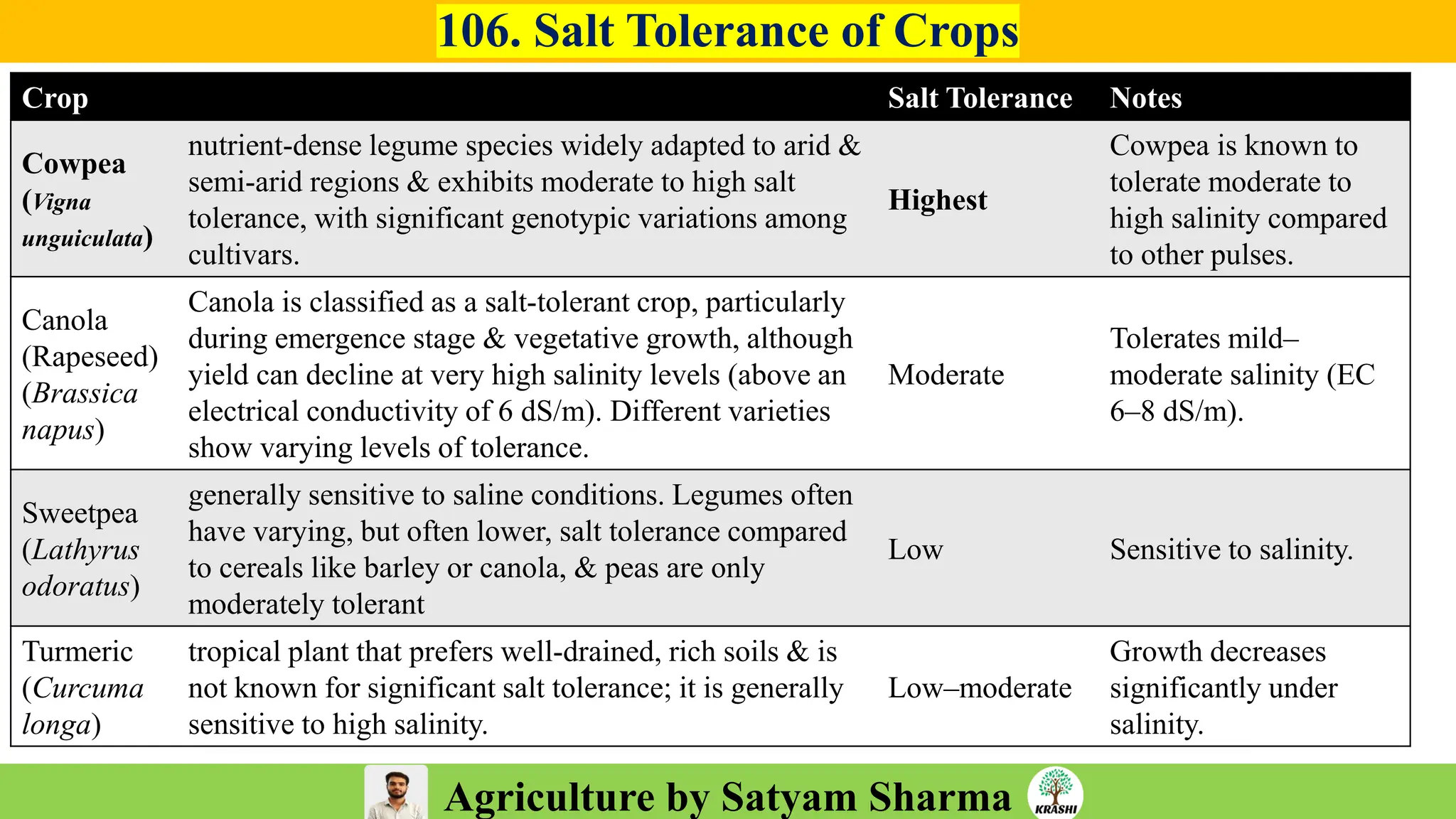






Agriculture by Satyam Sharma
ASRB NET 2025
QUESTION PAPER
GENETICS & PLANT BREEDING
Agriculture by Satyam Sharma
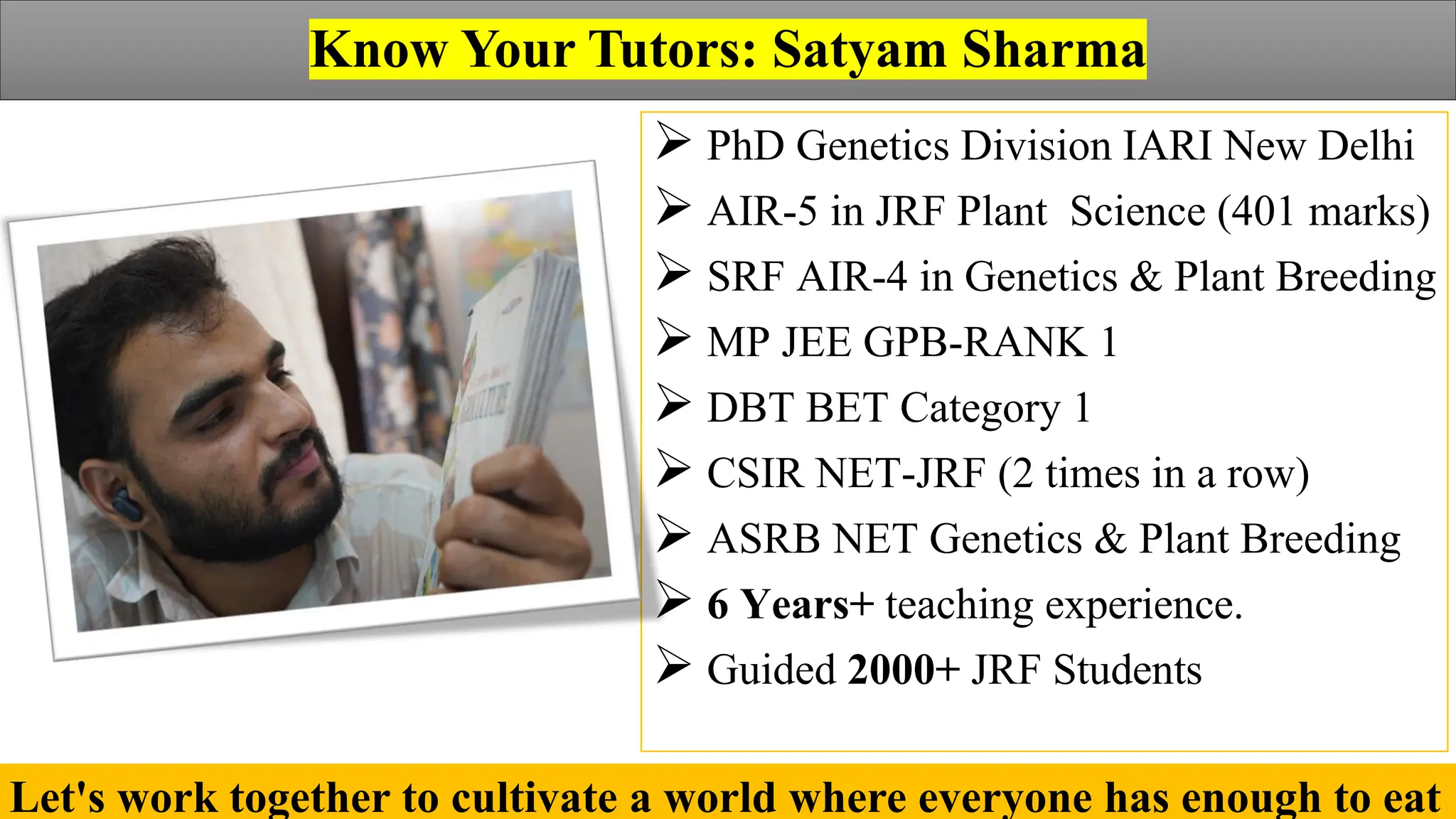
Know Your Tutors: Satyam Sharma
➢ PhD Genetics Division IARI New Delhi
➢ AIR-5 in JRF Plant Science (401 marks)
➢ SRF AIR-4 in Genetics & Plant Breeding
➢ MP JEE GPB-RANK 1
➢ DBT BET Category 1
➢ CSIR NET-JRF (2 times in a row)
➢ ASRB NET Genetics & Plant Breeding
➢ 6 Years+ teaching experience.
➢ Guided 2000+ JRF Students
Let's work together to cultivate a world where everyone has enough to eat
Agriculture by Satyam Sharma
1. When fertility gradient of l& is in TWO directions, correct block design to use is:
❖When l& has a fertility gradient in two perpendicular
directions appropriate block design to use is Latin
Square Design (LSD).
❖LSD simultaneously controls variation in two
directions by arranging experimental units in a square
grid of rows & columns.
❖Latin square experiment a three factor experiment
(rows, columns & treatments) & no interaction
between rows, columns & treatments (rows = columns
= treatments=all be equal to a single value m.)
❖Treatments (represented by Latin letters like A, B, C)
assigned to grid such that each treatment appears:
❖Exactly once in each row.
❖Exactly once in each column.
❖ Advantages :
❖ LSD is more efficient than RBD & CRD.
❖ Experimental error small
❖ Analysis simple even with missing plots.
❖ Allows statistical elimination of variability
caused by both row-wise & column-wise fertility
gradients from experimental error, resulting in
more accurate & efficient results compared to
designs that only account for one gradient.
❖ experimental units are grouped in blocks in two
different ways, by rows & columns.
❖ RBD: only suitable for controlling a fertility
gradient that runs in a single direction.
Disadvantages:
•Number of treatments is limited to number of replicates
which seldom exceeds 12.
•If have less than 5 treatments, df for controlling random
variation is relatively large & df for error is small.
Agriculture by Satyam Sharma
❖2.Design used when fertility gradients are perpendicular to each other
❖1. Answer: (d) LSD (Latin Square Design).
Explanation: LSD controls two orthogonal (perpendicular) gradients — rows &
columns. experimental design used to manage variability when fertility gradients
are perpendicular to each other is Latin Square Design (LSD).
❖Latin Square Design is specifically effective in situations where two known
sources of variation (such as fertility gradients in two perpendicular directions,
often referred to as rows & columns) need to be simultaneously controlled or
eliminated from experimental error.
Agriculture by Satyam Sharma
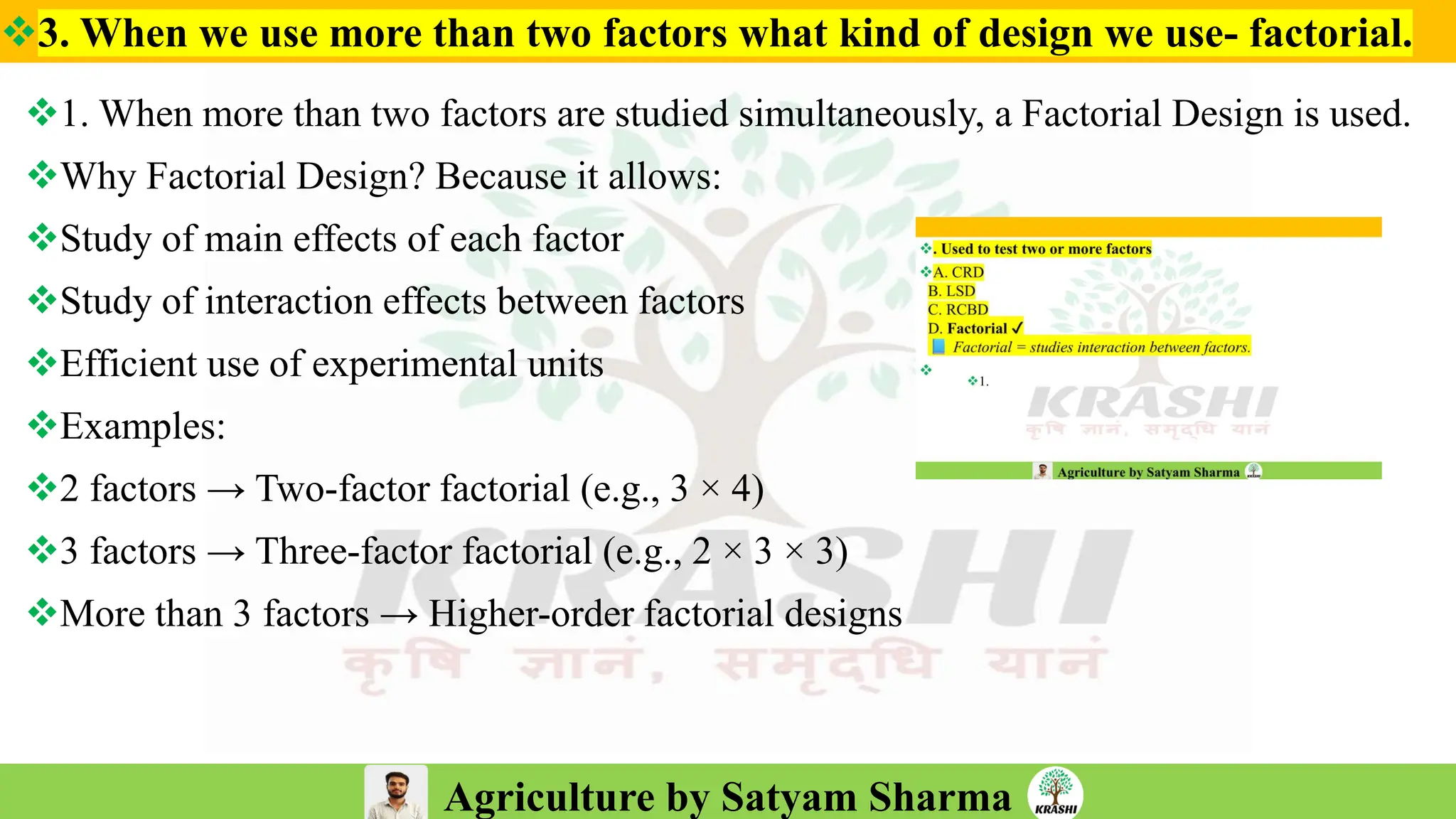
❖3. When we use more than two factors what kind of design we use- factorial.
❖1. When more than two factors are studied simultaneously, a Factorial Design is used.
❖Why Factorial Design? Because it allows:
❖Study of main effects of each factor
❖Study of interaction effects between factors
❖Efficient use of experimental units
❖Examples:
❖2 factors → Two-factor factorial (e.g., 3 × 4)
❖3 factors → Three-factor factorial (e.g., 2 × 3 × 3)
❖More than 3 factors → Higher-order factorial designs
Agriculture by Satyam Sharma
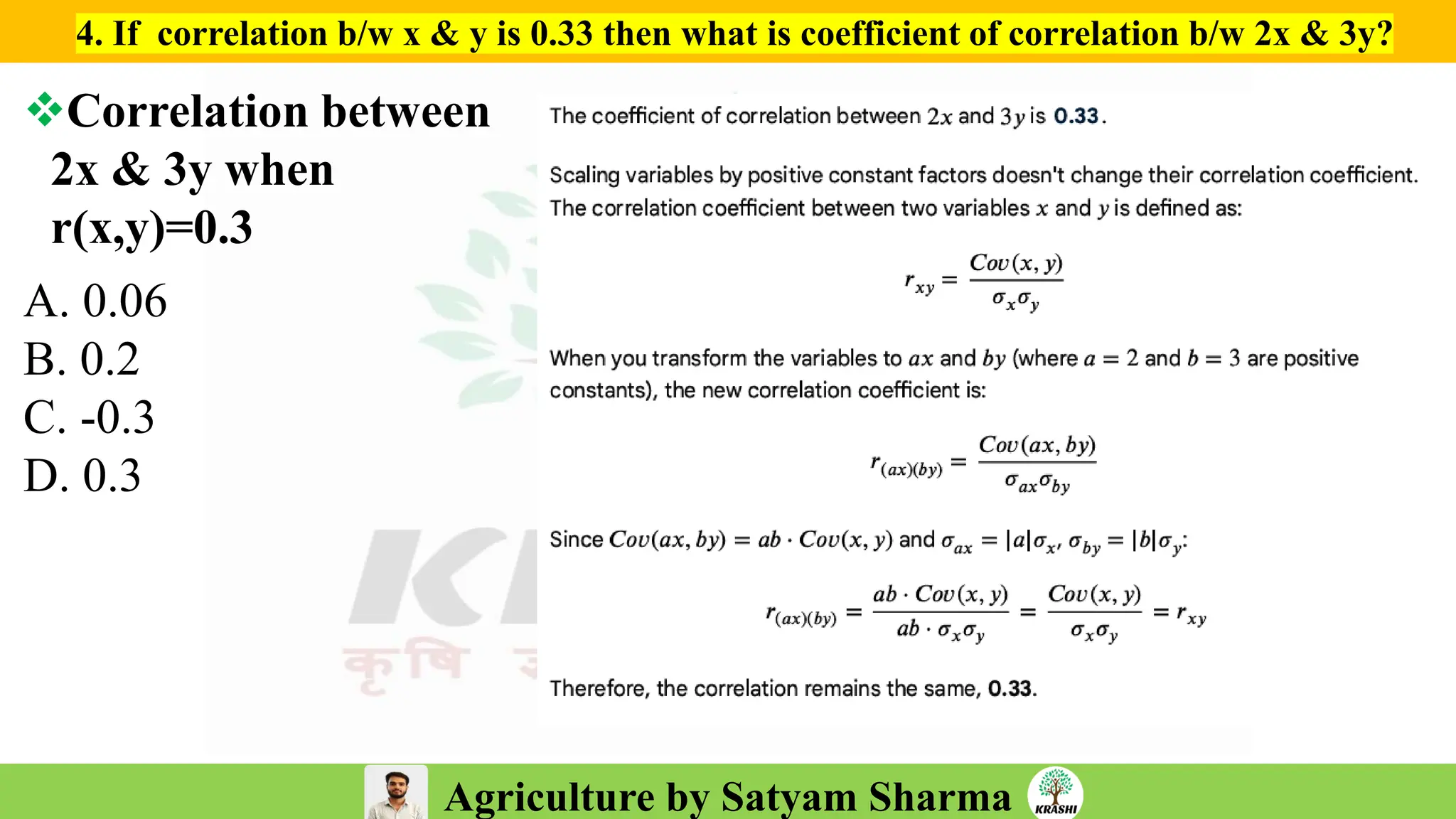
4. If correlation b/w x & y is 0.33 then what is coefficient of correlation b/w 2x & 3y?
❖Correlation between
2x & 3y when
r(x,y)=0.3
A. 0.06
B. 0.2
C. -0.3
D. 0.3
Agriculture by Satyam Sharma
5. Triallel & Quadriallel analysis given by
A. Rowlings & Cockerham
B. Jinks & Perkins
C. Kempthorne
D. Hayman
❖Development of triallel & quadriallel analysis J. O. Rawlings & C. Cockerham
❖Their work on topic was published in a paper titled "Triallel Analysis 1" in 1962.
❖These methods are used in quantitative genetics & plant breeding to analyze
genetic components of variance & assess general combining ability (GCA) &
specific combining ability (SCA) of parent lines.
Agriculture by Satyam Sharma
7. Eberhart & Russell model — which statement is correct?
(i) It provides independent estimation of mean performance
(ii) A stable variety has minimum deviation from regression line
Agriculture by Satyam Sharma
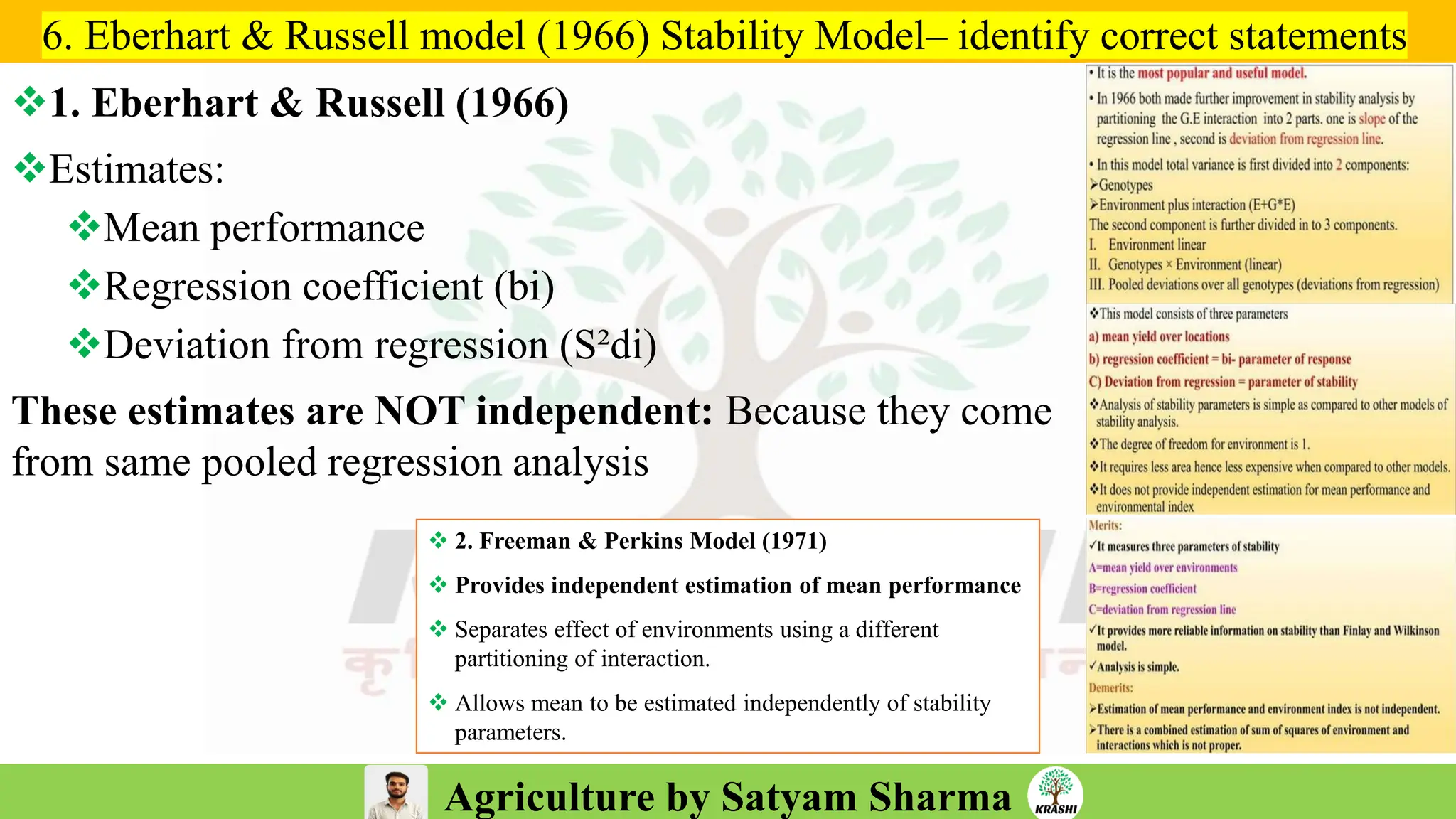
❖1. Eberhart & Russell (1966)
❖Estimates:
❖Mean performance
❖Regression coefficient (bi)
❖Deviation from regression (S²di)
These estimates are NOT independent: Because they come
from same pooled regression analysis
6. Eberhart & Russell model (1966) Stability Model– identify correct statements
❖ 2. Freeman & Perkins Model (1971)
❖ Provides independent estimation of mean performance
❖ Separates effect of environments using a different
partitioning of interaction.
❖ Allows mean to be estimated independently of stability
parameters.
Agriculture by Satyam Sharma
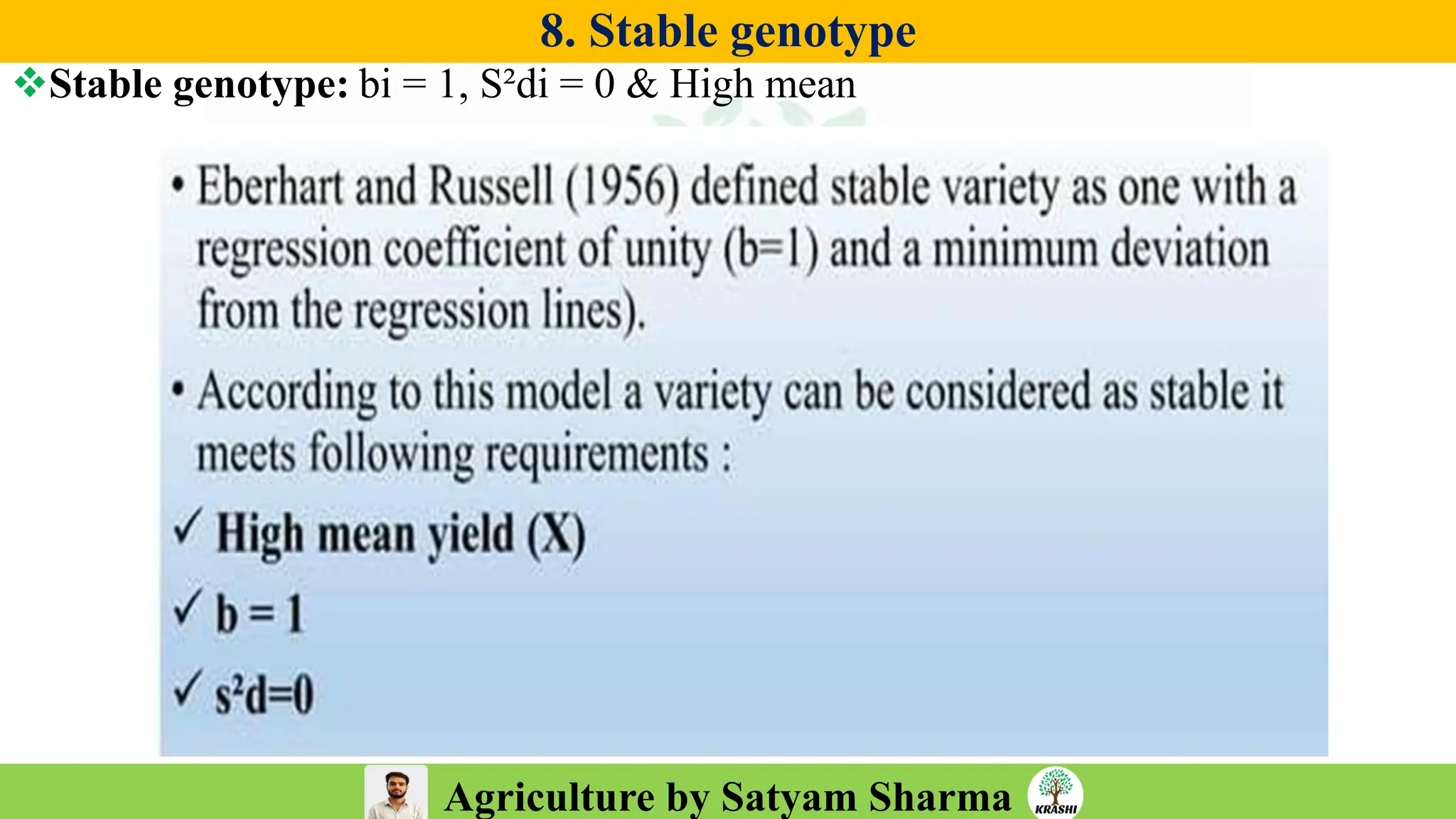
8. Stable genotype
❖Stable genotype: bi = 1, S²di = 0 & High mean
Agriculture by Satyam Sharma
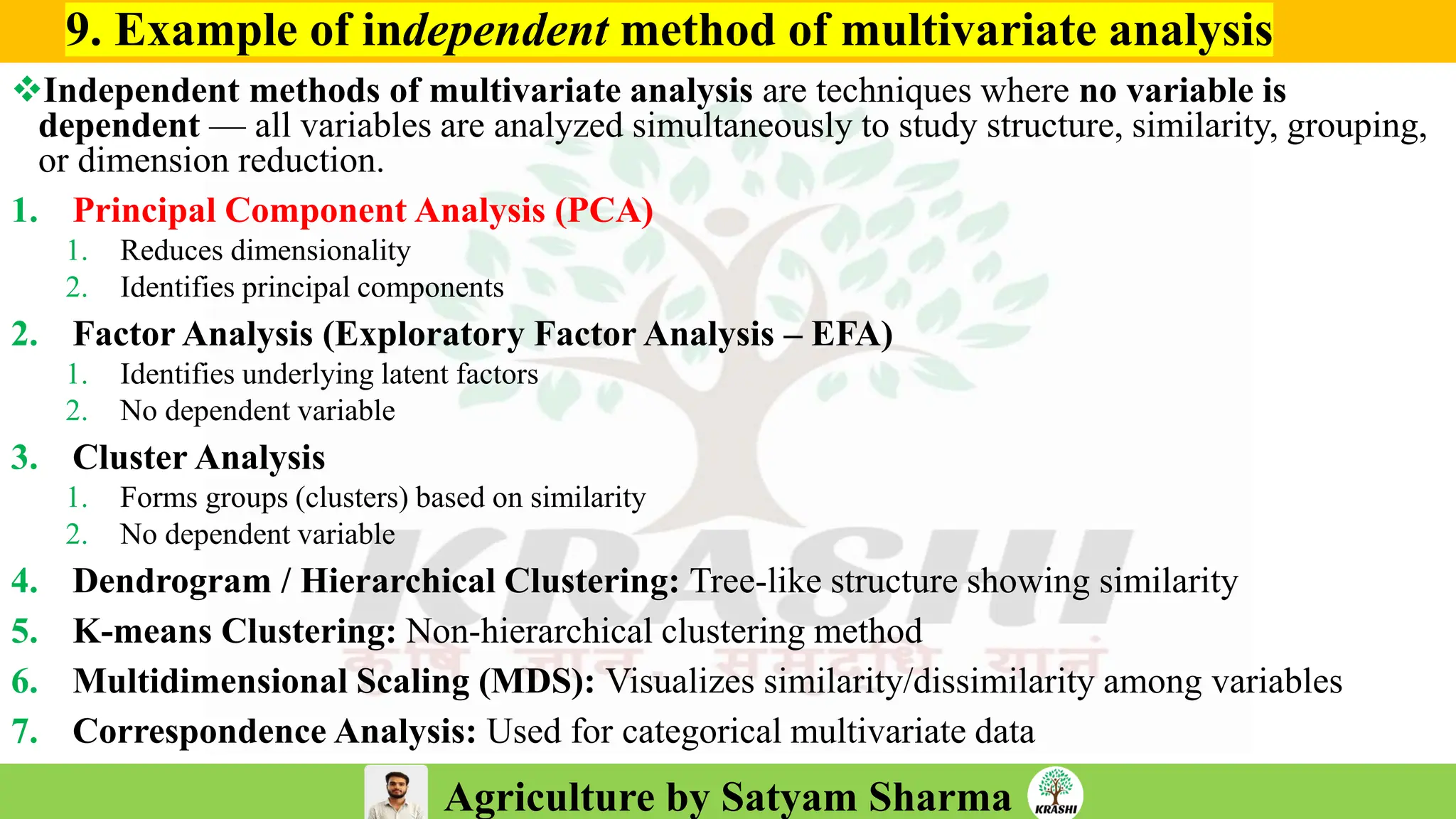
9. Example of independent method of multivariate analysis
❖Independent methods of multivariate analysis are techniques where no variable is
dependent — all variables are analyzed simultaneously to study structure, similarity, grouping,
or dimension reduction.
1. Principal Component Analysis (PCA)
1. Reduces dimensionality
2. Identifies principal components
2. Factor Analysis (Exploratory Factor Analysis – EFA)
1. Identifies underlying latent factors
2. No dependent variable
3. Cluster Analysis
1. Forms groups (clusters) based on similarity
2. No dependent variable
4. Dendrogram / Hierarchical Clustering: Tree-like structure showing similarity
5. K-means Clustering: Non-hierarchical clustering method
6. Multidimensional Scaling (MDS): Visualizes similarity/dissimilarity among variables
7. Correspondence Analysis: Used for categorical multivariate data
Agriculture by Satyam Sharma
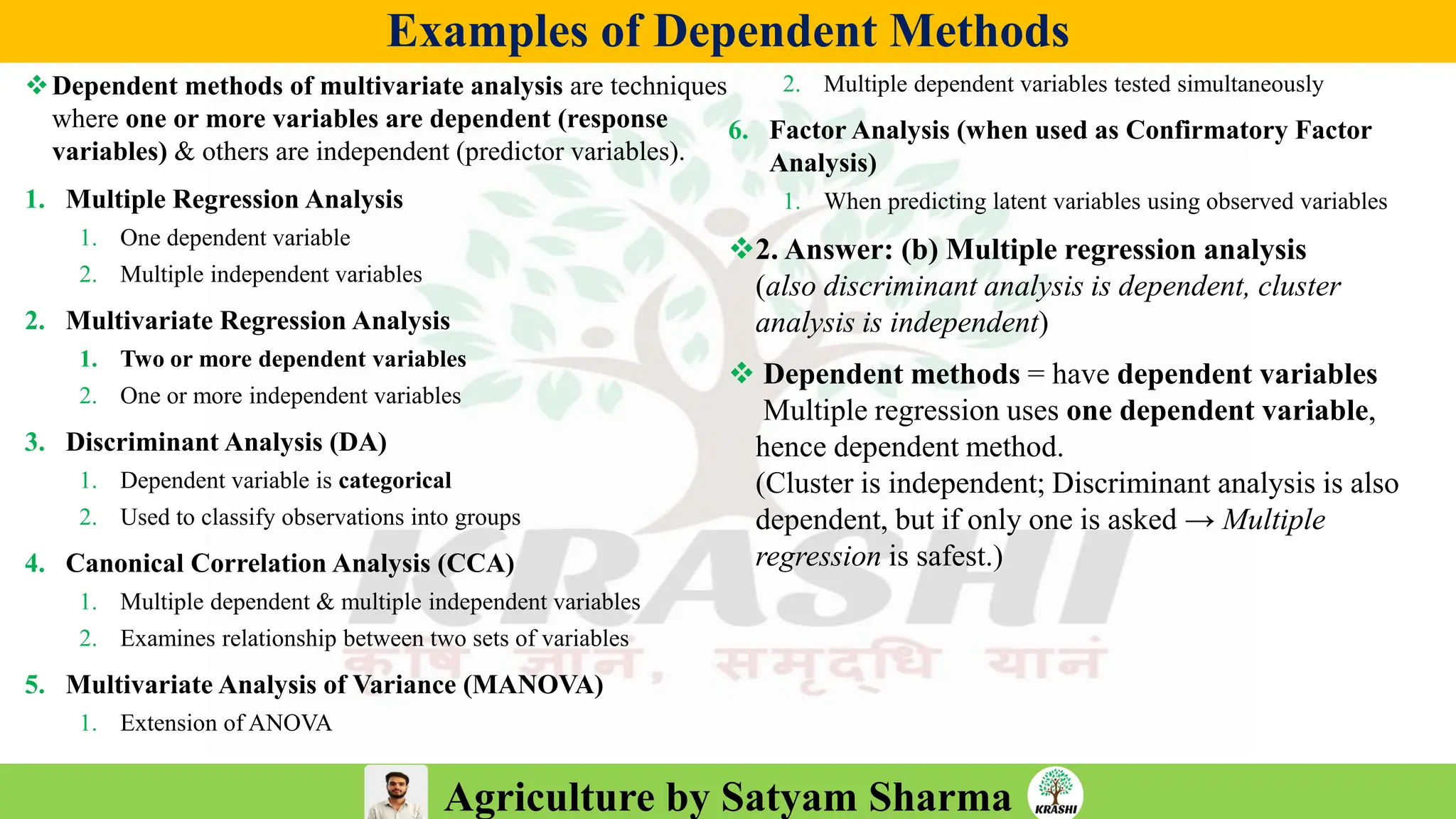
Examples of Dependent Methods
❖Dependent methods of multivariate analysis are techniques
where one or more variables are dependent (response
variables) & others are independent (predictor variables).
1. Multiple Regression Analysis
1. One dependent variable
2. Multiple independent variables
2. Multivariate Regression Analysis
1. Two or more dependent variables
2. One or more independent variables
3. Discriminant Analysis (DA)
1. Dependent variable is categorical
2. Used to classify observations into groups
4. Canonical Correlation Analysis (CCA)
1. Multiple dependent & multiple independent variables
2. Examines relationship between two sets of variables
5. Multivariate Analysis of Variance (MANOVA)
1. Extension of ANOVA
2. Multiple dependent variables tested simultaneously
6. Factor Analysis (when used as Confirmatory Factor
Analysis)
1. When predicting latent variables using observed variables
❖2. Answer: (b) Multiple regression analysis
(also discriminant analysis is dependent, cluster
analysis is independent)
❖ Dependent methods = have dependent variables
Multiple regression uses one dependent variable,
hence dependent method.
(Cluster is independent; Discriminant analysis is also
dependent, but if only one is asked → Multiple
regression is safest.)
Agriculture by Satyam Sharma
❖In experimental design, local control means blocking, i.e.,
grouping homogeneous units to reduce experimental error.
❖Grouping homogeneous experimental units into blocks is known as local control.
❖This technique reduces experimental error by dividing a heterogeneous area into homogeneous
groups (blocks), ensuring that variation within each block is minimized & variation between
blocks is accounted for.
❖Local control: process of reducing experimental error by grouping experimental units.
❖It is used to account for factors that cause heterogeneity, such as a gradient in soil fertility, by
creating blocks that are homogeneous within themselves.
❖10. Grouping of homogeneous experimental units into blocks is known as
Agriculture by Satyam Sharma
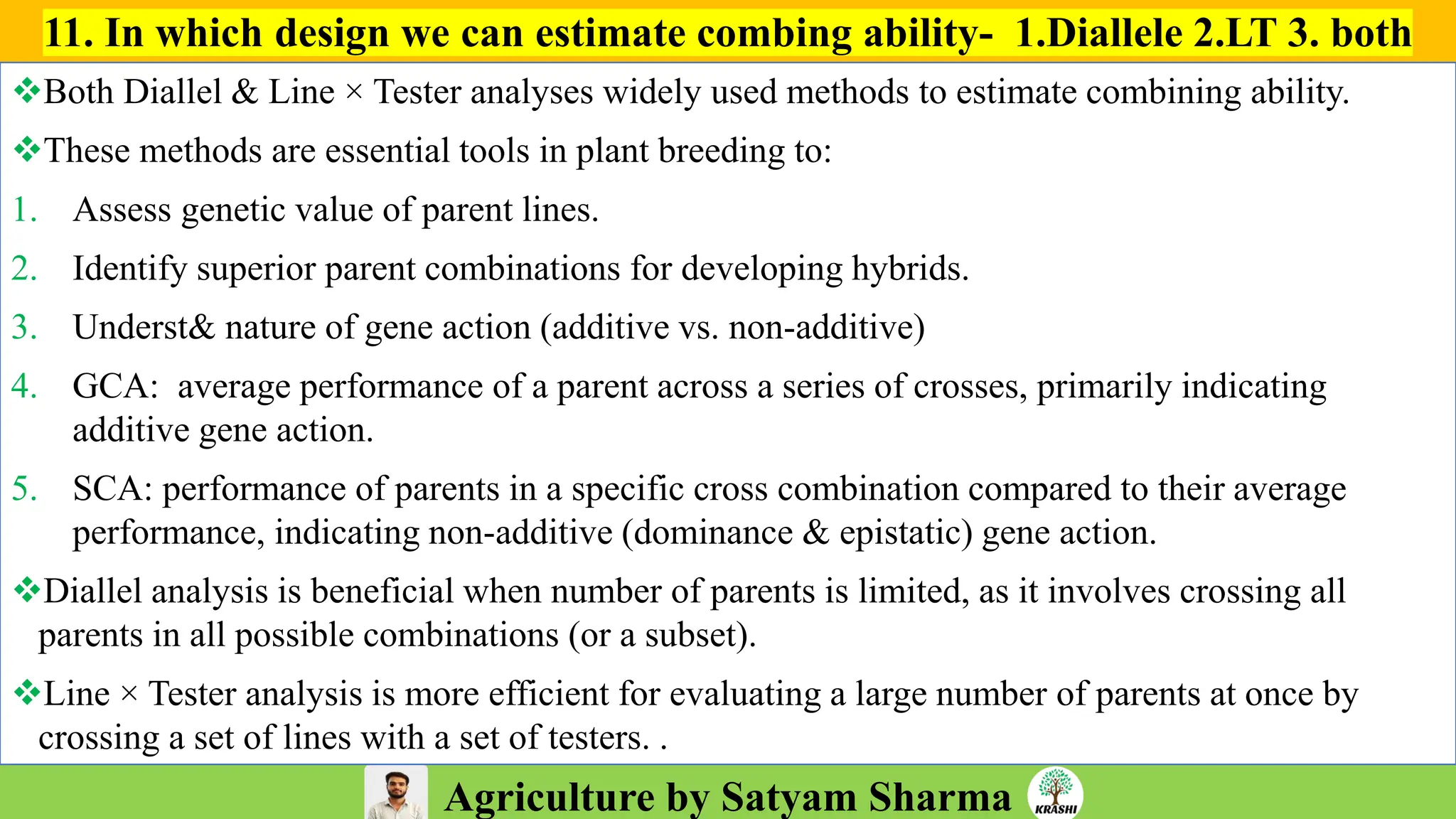
11. In which design we can estimate combing ability- 1.Diallele 2.LT 3. both
❖Both Diallel & Line × Tester analyses widely used methods to estimate combining ability.
❖These methods are essential tools in plant breeding to:
1. Assess genetic value of parent lines.
2. Identify superior parent combinations for developing hybrids.
3. Underst& nature of gene action (additive vs. non-additive)
4. GCA: average performance of a parent across a series of crosses, primarily indicating
additive gene action.
5. SCA: performance of parents in a specific cross combination compared to their average
performance, indicating non-additive (dominance & epistatic) gene action.
❖Diallel analysis is beneficial when number of parents is limited, as it involves crossing all
parents in all possible combinations (or a subset).
❖Line × Tester analysis is more efficient for evaluating a large number of parents at once by
crossing a set of lines with a set of testers. .
Agriculture by Satyam Sharma
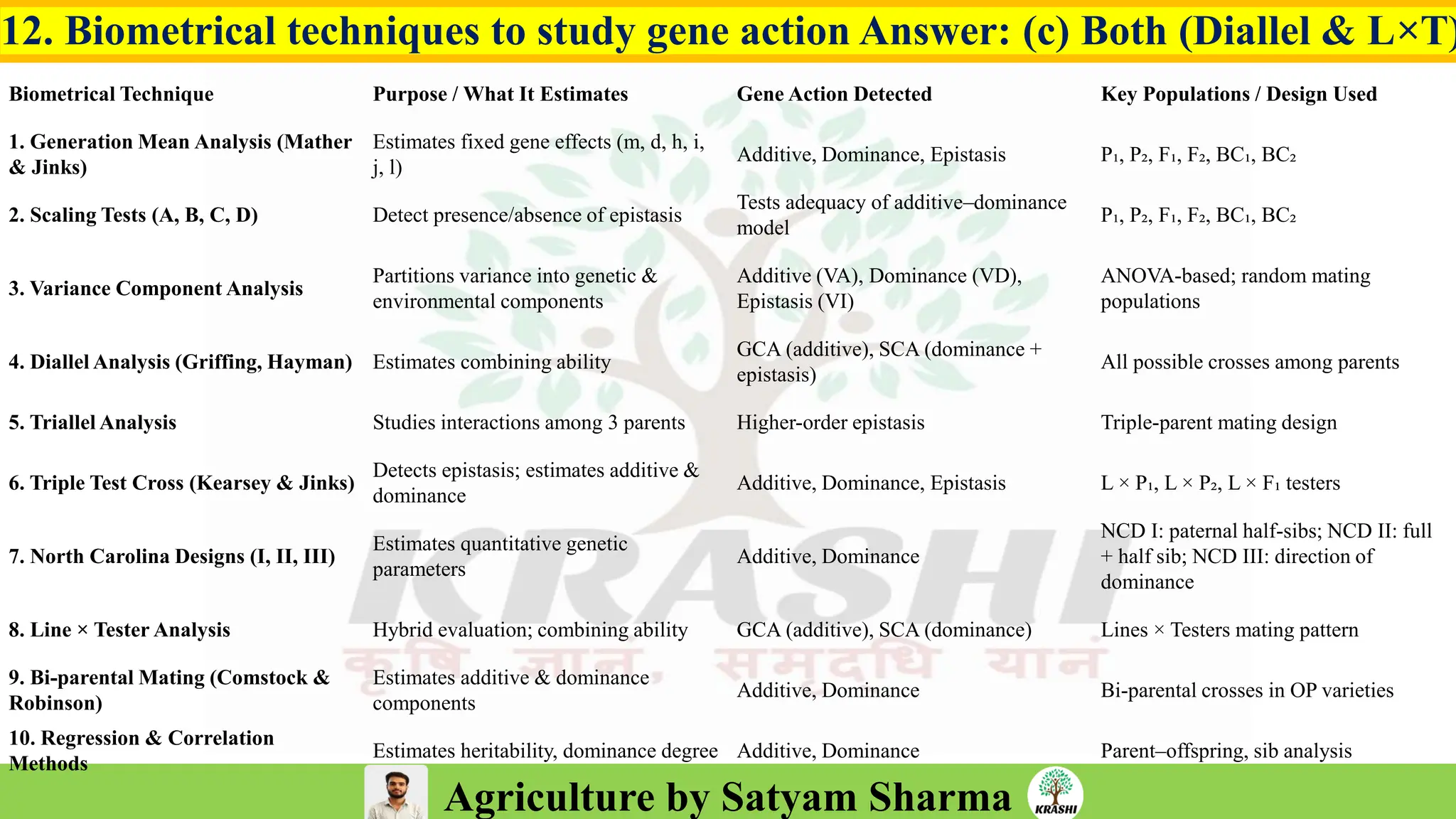
Biometrical Technique Purpose / What It Estimates Gene Action Detected Key Populations / Design Used
1. Generation Mean Analysis (Mather
& Jinks)
Estimates fixed gene effects (m, d, h, i,
j, l)
Additive, Dominance, Epistasis P₁, P₂, F₁, F₂, BC₁, BC₂
2. Scaling Tests (A, B, C, D) Detect presence/absence of epistasis
Tests adequacy of additive–dominance
model
P₁, P₂, F₁, F₂, BC₁, BC₂
3. Variance Component Analysis
Partitions variance into genetic &
environmental components
Additive (VA), Dominance (VD),
Epistasis (VI)
ANOVA-based; random mating
populations
4. Diallel Analysis (Griffing, Hayman) Estimates combining ability
GCA (additive), SCA (dominance +
epistasis)
All possible crosses among parents
5. Triallel Analysis Studies interactions among 3 parents Higher-order epistasis Triple-parent mating design
6. Triple Test Cross (Kearsey & Jinks)
Detects epistasis; estimates additive &
dominance
Additive, Dominance, Epistasis L × P₁, L × P₂, L × F₁ testers
7. North Carolina Designs (I, II, III)
Estimates quantitative genetic
parameters
Additive, Dominance
NCD I: paternal half-sibs; NCD II: full
+ half sib; NCD III: direction of
dominance
8. Line × Tester Analysis Hybrid evaluation; combining ability GCA (additive), SCA (dominance) Lines × Testers mating pattern
9. Bi-parental Mating (Comstock &
Robinson)
Estimates additive & dominance
components
Additive, Dominance Bi-parental crosses in OP varieties
10. Regression & Correlation
Methods
Estimates heritability, dominance degree Additive, Dominance Parent–offspring, sib analysis
12. Biometrical techniques to study gene action Answer: (c) Both (Diallel & L×T)
Agriculture by Satyam Sharma
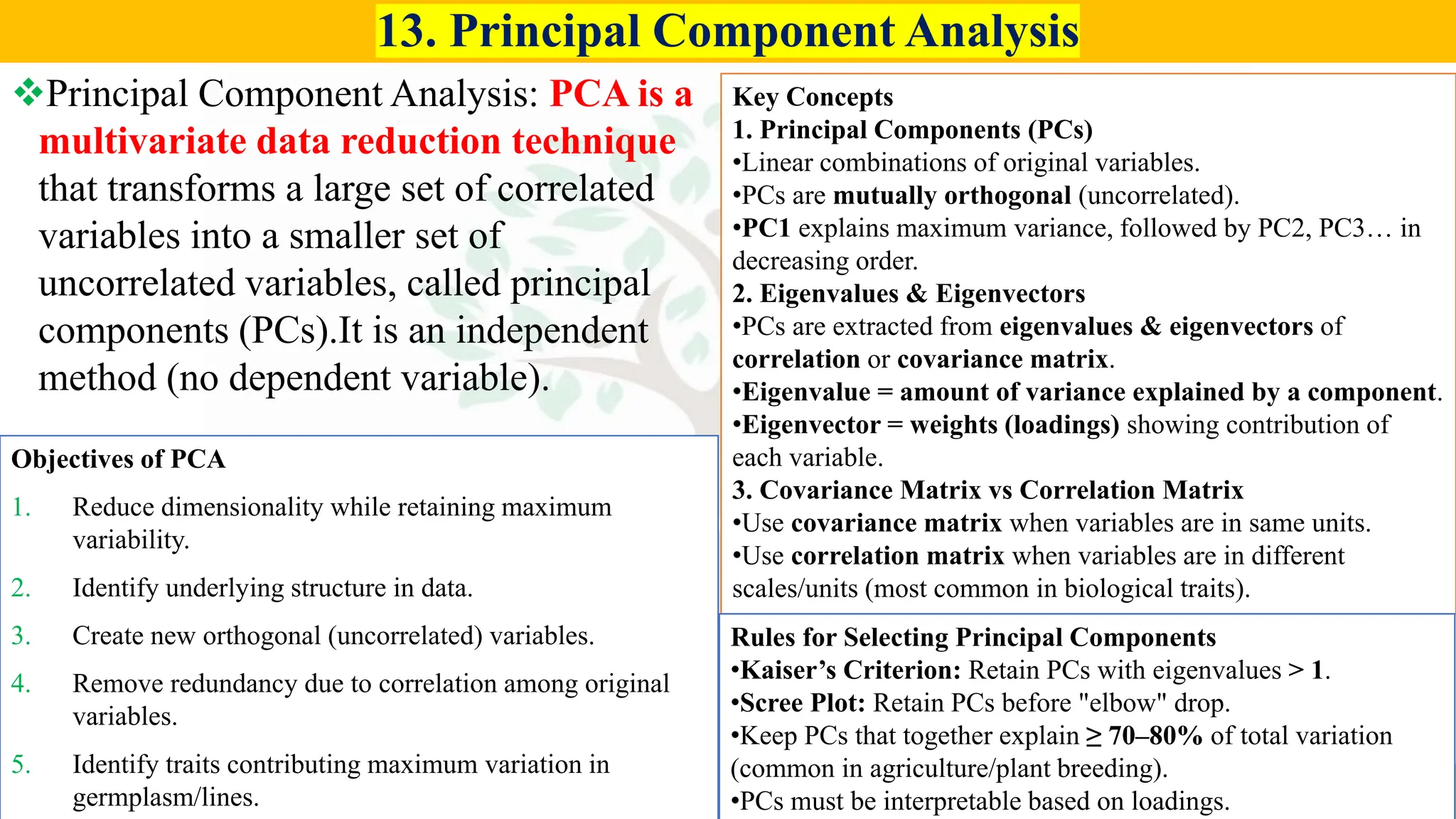
13. Principal Component Analysis
❖Principal Component Analysis: PCA is a
multivariate data reduction technique
that transforms a large set of correlated
variables into a smaller set of
uncorrelated variables, called principal
components (PCs).It is an independent
method (no dependent variable).
Objectives of PCA
1. Reduce dimensionality while retaining maximum
variability.
2. Identify underlying structure in data.
3. Create new orthogonal (uncorrelated) variables.
4. Remove redundancy due to correlation among original
variables.
5. Identify traits contributing maximum variation in
germplasm/lines.
Key Concepts
1. Principal Components (PCs)
•Linear combinations of original variables.
•PCs are mutually orthogonal (uncorrelated).
•PC1 explains maximum variance, followed by PC2, PC3… in
decreasing order.
2. Eigenvalues & Eigenvectors
•PCs are extracted from eigenvalues & eigenvectors of
correlation or covariance matrix.
•Eigenvalue = amount of variance explained by a component.
•Eigenvector = weights (loadings) showing contribution of
each variable.
3. Covariance Matrix vs Correlation Matrix
•Use covariance matrix when variables are in same units.
•Use correlation matrix when variables are in different
scales/units (most common in biological traits).
Rules for Selecting Principal Components
•Kaiser’s Criterion: Retain PCs with eigenvalues > 1.
•Scree Plot: Retain PCs before "elbow" drop.
•Keep PCs that together explain ≥ 70–80% of total variation
(common in agriculture/plant breeding).
•PCs must be interpretable based on loadings.
Agriculture by Satyam Sharma
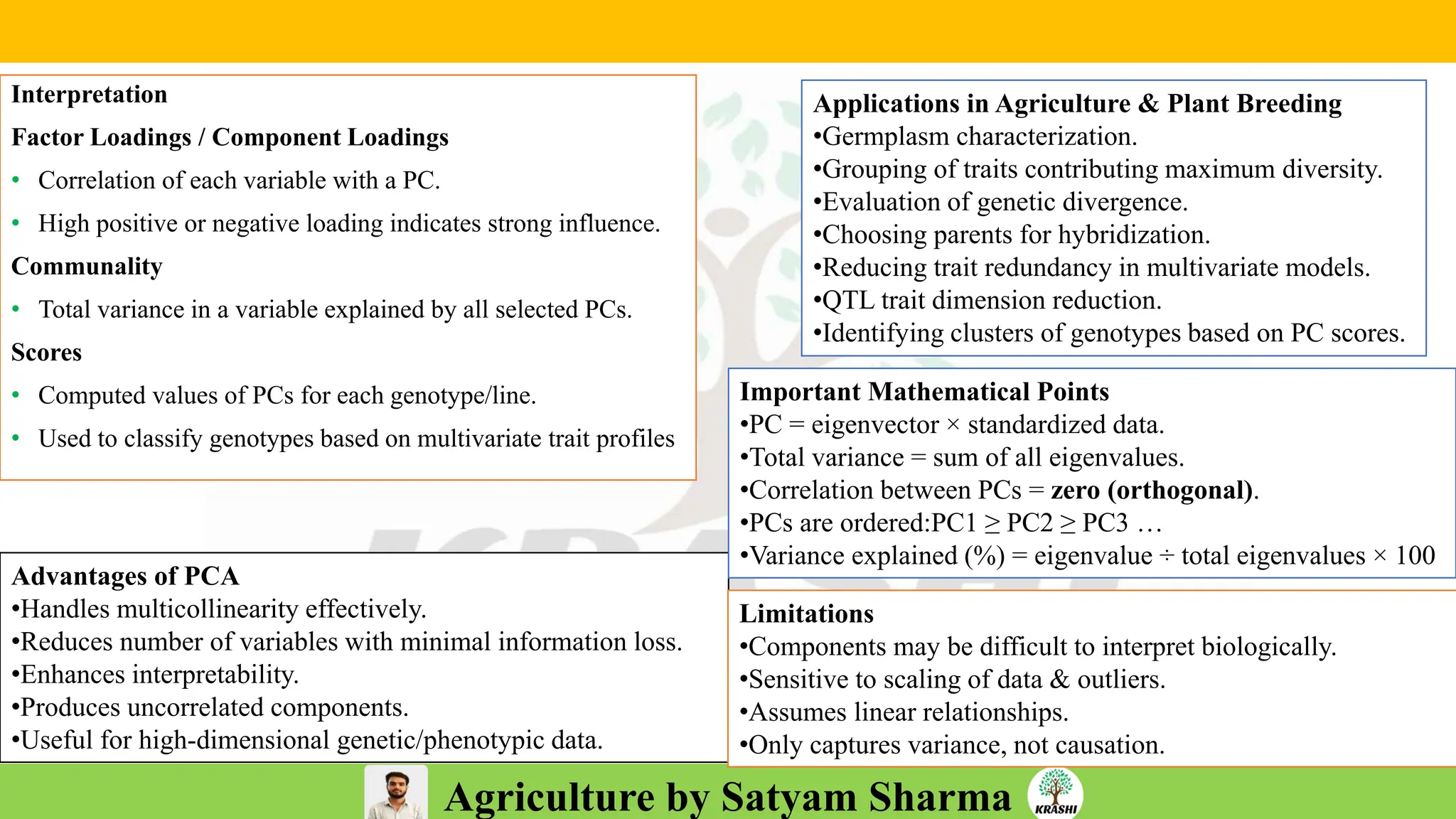
Interpretation
Factor Loadings / Component Loadings
• Correlation of each variable with a PC.
• High positive or negative loading indicates strong influence.
Communality
• Total variance in a variable explained by all selected PCs.
Scores
• Computed values of PCs for each genotype/line.
• Used to classify genotypes based on multivariate trait profiles
Applications in Agriculture & Plant Breeding
•Germplasm characterization.
•Grouping of traits contributing maximum diversity.
•Evaluation of genetic divergence.
•Choosing parents for hybridization.
•Reducing trait redundancy in multivariate models.
•QTL trait dimension reduction.
•Identifying clusters of genotypes based on PC scores.
Advantages of PCA
•Handles multicollinearity effectively.
•Reduces number of variables with minimal information loss.
•Enhances interpretability.
•Produces uncorrelated components.
•Useful for high-dimensional genetic/phenotypic data.
Limitations
•Components may be difficult to interpret biologically.
•Sensitive to scaling of data & outliers.
•Assumes linear relationships.
•Only captures variance, not causation.
Important Mathematical Points
•PC = eigenvector × standardized data.
•Total variance = sum of all eigenvalues.
•Correlation between PCs = zero (orthogonal).
•PCs are ordered:PC1 ≥ PC2 ≥ PC3 …
•Variance explained (%) = eigenvalue ÷ total eigenvalues × 100
Agriculture by Satyam Sharma
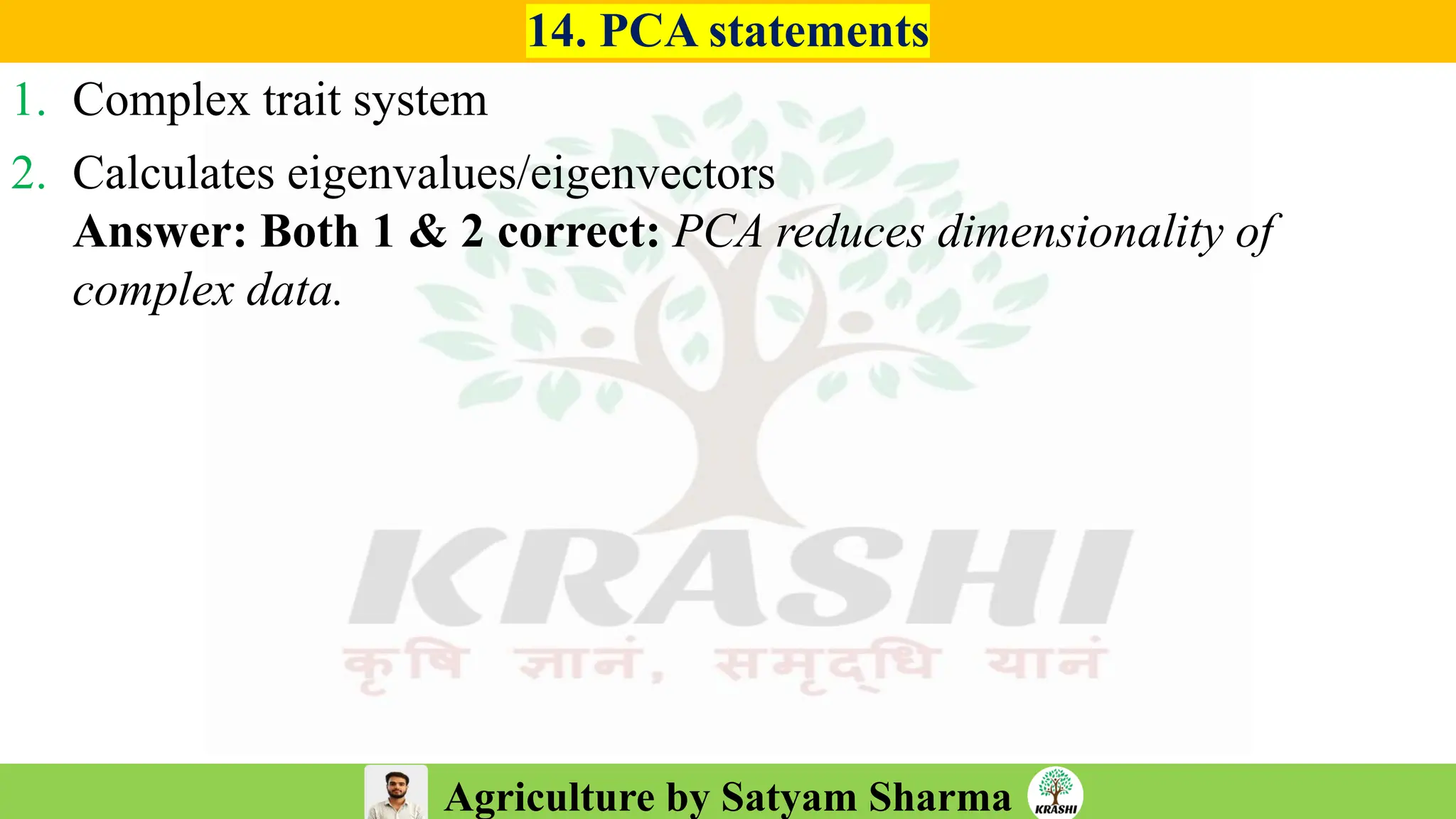
14. PCA statements
1. Complex trait system
2. Calculates eigenvalues/eigenvectors
Answer: Both 1 & 2 correct: PCA reduces dimensionality of
complex data.
Agriculture by Satyam Sharma
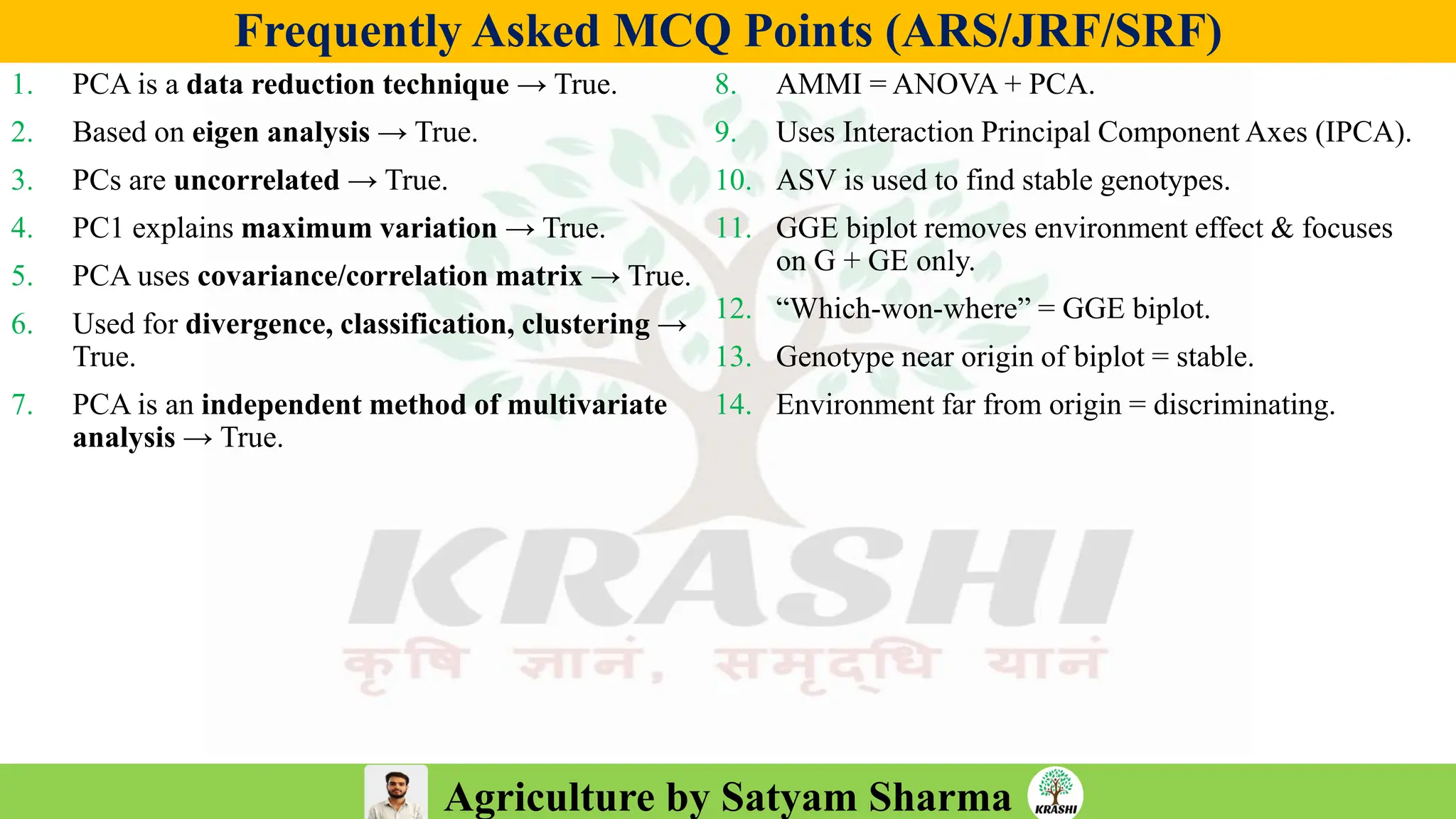
Frequently Asked MCQ Points (ARS/JRF/SRF)
1. PCA is a data reduction technique → True.
2. Based on eigen analysis → True.
3. PCs are uncorrelated → True.
4. PC1 explains maximum variation → True.
5. PCA uses covariance/correlation matrix → True.
6. Used for divergence, classification, clustering →
True.
7. PCA is an independent method of multivariate
analysis → True.
8. AMMI = ANOVA + PCA.
9. Uses Interaction Principal Component Axes (IPCA).
10. ASV is used to find stable genotypes.
11. GGE biplot removes environment effect & focuses
on G + GE only.
12. “Which-won-where” = GGE biplot.
13. Genotype near origin of biplot = stable.
14. Environment far from origin = discriminating.
Agriculture by Satyam Sharma
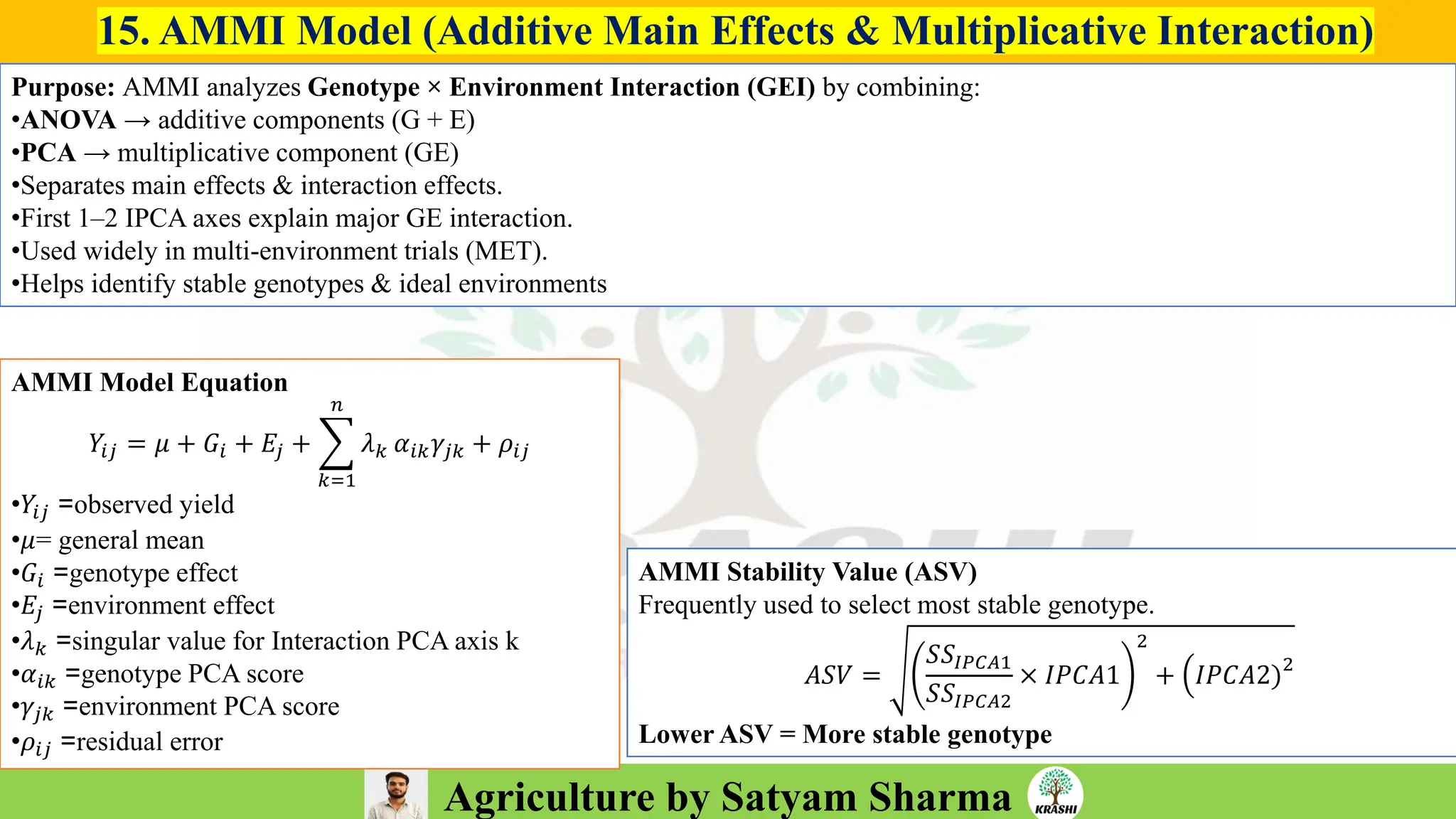
15. AMMI Model (Additive Main Effects & Multiplicative Interaction)
Purpose: AMMI analyzes Genotype × Environment Interaction (GEI) by combining:
•ANOVA → additive components (G + E)
•PCA → multiplicative component (GE)
•Separates main effects & interaction effects.
•First 1–2 IPCA axes explain major GE interaction.
•Used widely in multi-environment trials (MET).
•Helps identify stable genotypes & ideal environments
AMMI Model Equation
𝑌𝑖𝑗 = 𝜇 + 𝐺𝑖 + 𝐸𝑗 + ෍
𝑘=1
𝑛
𝜆𝑘 𝛼𝑖𝑘𝛾𝑗𝑘 + 𝜌𝑖𝑗
•𝑌𝑖𝑗 =observed yield
•𝜇= general mean
•𝐺𝑖 =genotype effect
•𝐸𝑗 =environment effect
•𝜆𝑘 =singular value for Interaction PCA axis k
•𝛼𝑖𝑘 =genotype PCA score
•𝛾𝑗𝑘 =environment PCA score
•𝜌𝑖𝑗 =residual error
AMMI Stability Value (ASV)
Frequently used to select most stable genotype.
𝐴𝑆𝑉 =
𝑆𝑆𝐼𝑃𝐶𝐴1
𝑆𝑆𝐼𝑃𝐶𝐴2
× 𝐼𝑃𝐶𝐴1
2
+ ቀ𝐼𝑃𝐶𝐴2)2
Lower ASV = More stable genotype
Agriculture by Satyam Sharma
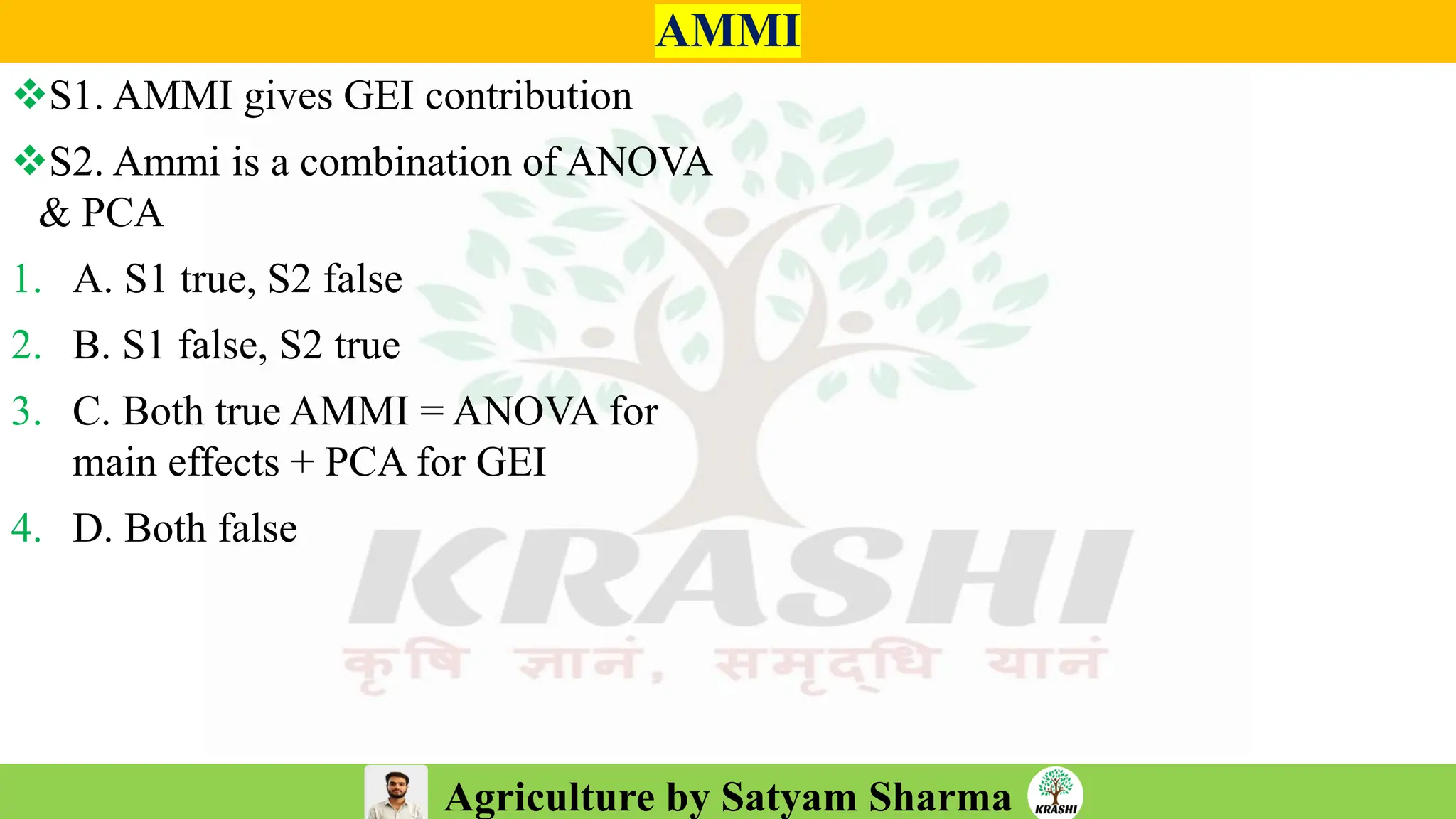
AMMI
❖S1. AMMI gives GEI contribution
❖S2. Ammi is a combination of ANOVA
& PCA
1. A. S1 true, S2 false
2. B. S1 false, S2 true
3. C. Both true AMMI = ANOVA for
main effects + PCA for GEI
4. D. Both false
Agriculture by Satyam Sharma
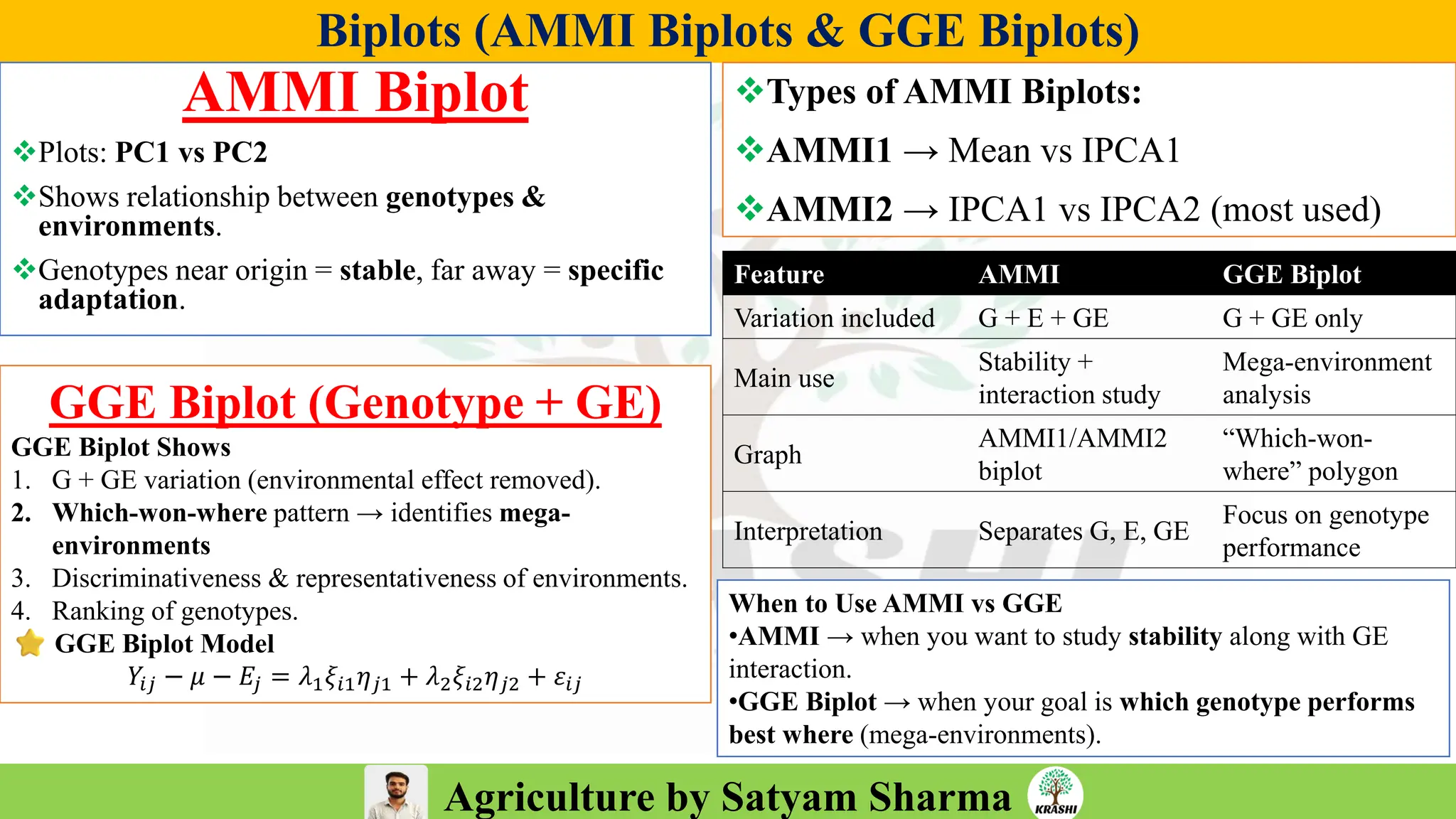
Biplots (AMMI Biplots & GGE Biplots)
AMMI Biplot
❖Plots: PC1 vs PC2
❖Shows relationship between genotypes &
environments.
❖Genotypes near origin = stable, far away = specific
adaptation.
❖Types of AMMI Biplots:
❖AMMI1 → Mean vs IPCA1
❖AMMI2 → IPCA1 vs IPCA2 (most used)
GGE Biplot (Genotype + GE)
GGE Biplot Shows
1. G + GE variation (environmental effect removed).
2. Which-won-where pattern → identifies mega-
environments
3. Discriminativeness & representativeness of environments.
4. Ranking of genotypes.
GGE Biplot Model
𝑌𝑖𝑗 − 𝜇 − 𝐸𝑗 = 𝜆1𝜉𝑖1𝜂𝑗1 + 𝜆2𝜉𝑖2𝜂𝑗2 + 𝜀𝑖𝑗
Feature AMMI GGE Biplot
Variation included G + E + GE G + GE only
Main use
Stability +
interaction study
Mega-environment
analysis
Graph
AMMI1/AMMI2
biplot
“Which-won-
where” polygon
Interpretation Separates G, E, GE
Focus on genotype
performance
When to Use AMMI vs GGE
•AMMI → when you want to study stability along with GE
interaction.
•GGE Biplot → when your goal is which genotype performs
best where (mega-environments).
Agriculture by Satyam Sharma
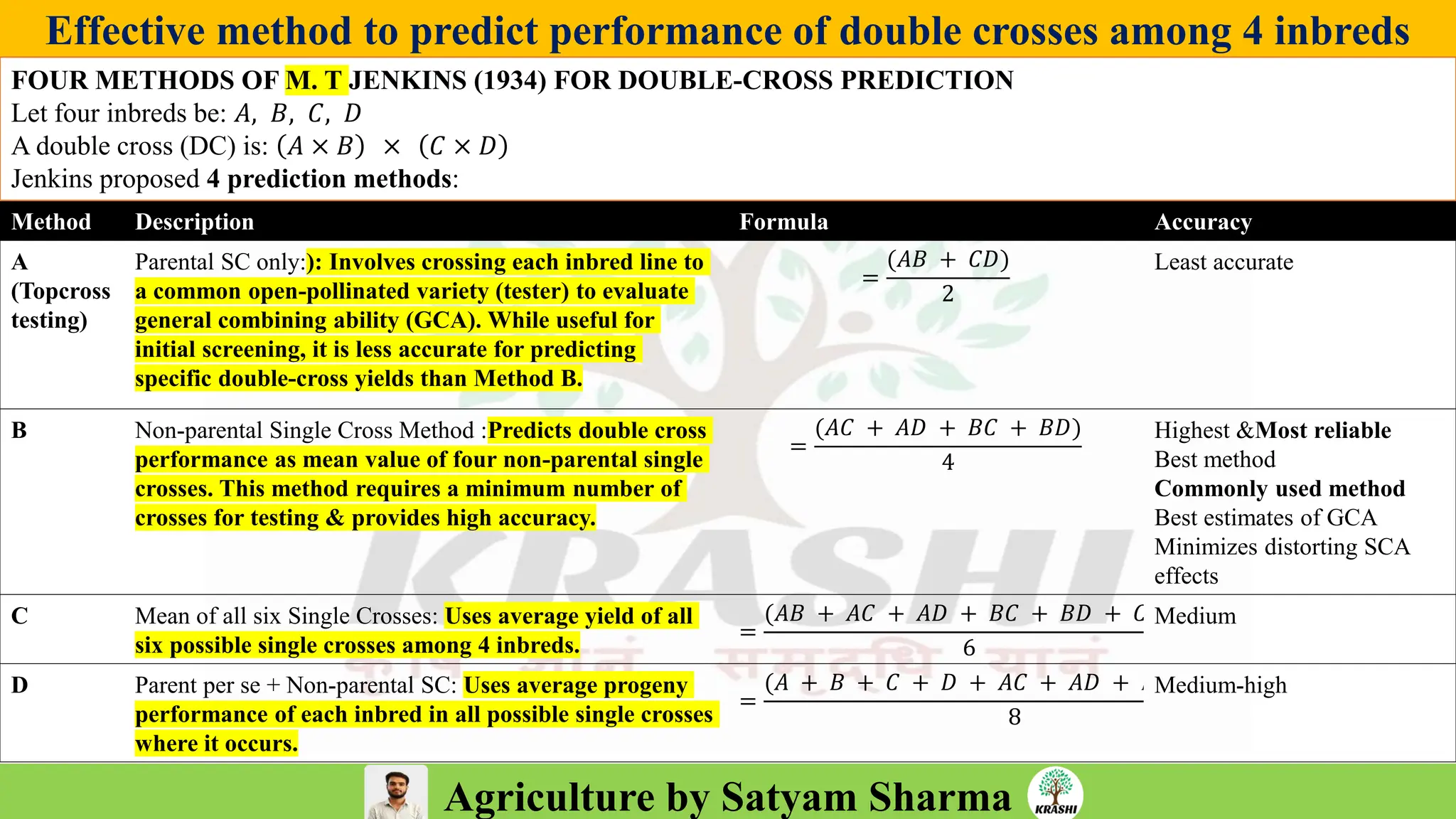
Effective method to predict performance of double crosses among 4 inbreds
Method Description Formula Accuracy
A
(Topcross
testing)
Parental SC only:): Involves crossing each inbred line to
a common open-pollinated variety (tester) to evaluate
general combining ability (GCA). While useful for
initial screening, it is less accurate for predicting
specific double-cross yields than Method B.
=
(𝐴𝐵 + 𝐶𝐷)
2
Least accurate
B Non-parental Single Cross Method :Predicts double cross
performance as mean value of four non-parental single
crosses. This method requires a minimum number of
crosses for testing & provides high accuracy.
=
(𝐴𝐶 + 𝐴𝐷 + 𝐵𝐶 + 𝐵𝐷)
4
Highest &Most reliable
Best method
Commonly used method
Best estimates of GCA
Minimizes distorting SCA
effects
C Mean of all six Single Crosses: Uses average yield of all
six possible single crosses among 4 inbreds.
=
(𝐴𝐵 + 𝐴𝐶 + 𝐴𝐷 + 𝐵𝐶 + 𝐵𝐷 + 𝐶𝐷
6
Medium
D Parent per se + Non-parental SC: Uses average progeny
performance of each inbred in all possible single crosses
where it occurs.
=
(𝐴 + 𝐵 + 𝐶 + 𝐷 + 𝐴𝐶 + 𝐴𝐷 + 𝐵𝐶
8
Medium-high
FOUR METHODS OF M. T JENKINS (1934) FOR DOUBLE-CROSS PREDICTION
Let four inbreds be: 𝐴, 𝐵, 𝐶, 𝐷
A double cross (DC) is: 𝐴 × 𝐵 × 𝐶 × 𝐷
Jenkins proposed 4 prediction methods:
Agriculture by Satyam Sharma
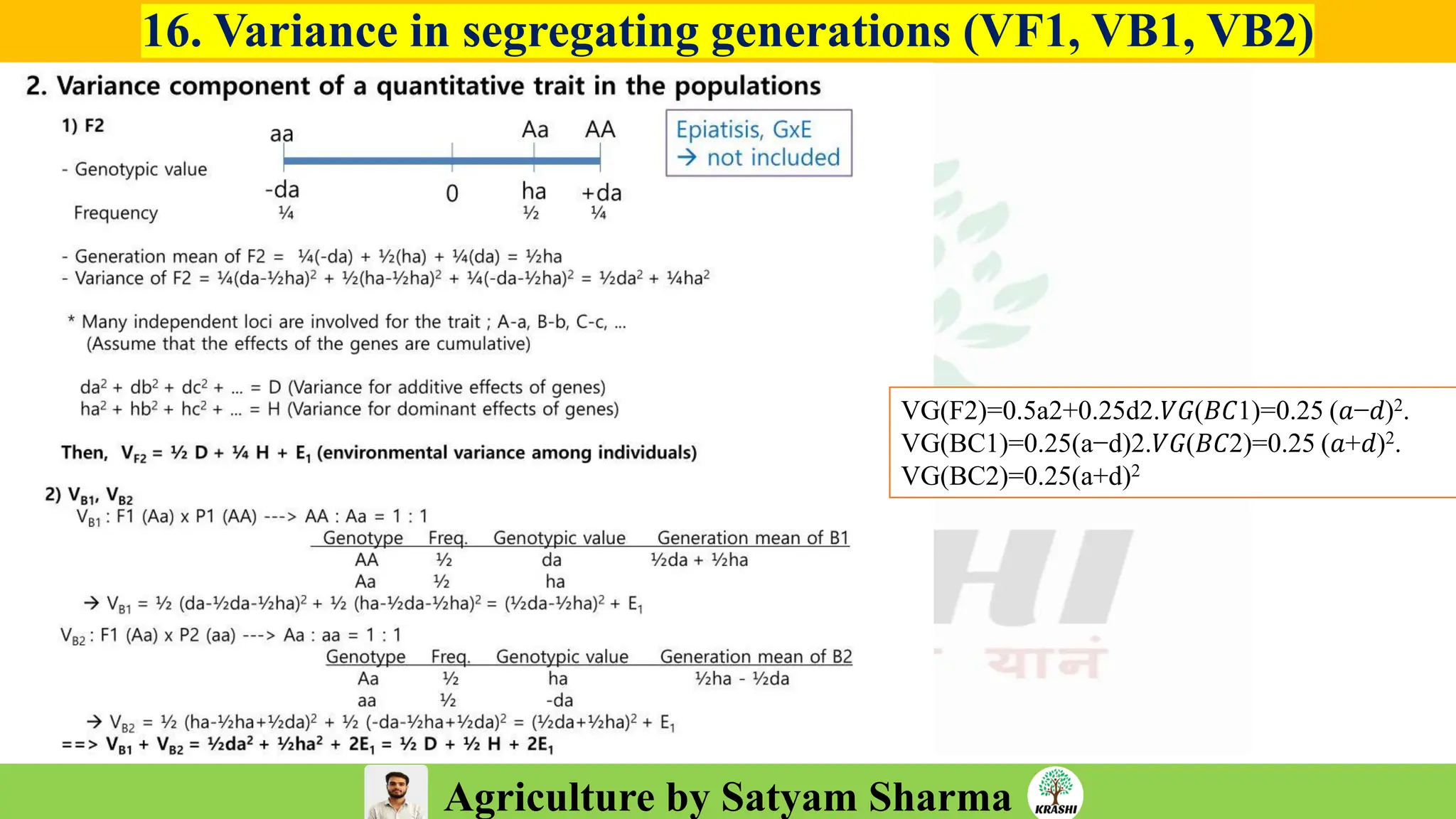
16. Variance in segregating generations (VF1, VB1, VB2)
VG​(F2)=0.5a2+0.25d2.𝑉𝐺(𝐵𝐶1)=0.25 (𝑎−𝑑)2.
VG(BC1)=0.25(a−d)2.𝑉𝐺(𝐵𝐶2)=0.25 (𝑎+𝑑)2.
VG(BC2​)=0.25(a+d)2
Agriculture by Satyam Sharma
17. Cannot be estimated by Generation Mean Analysis
A. GCA & SCA effect (Combining
ability effects)
B. Additive effects
C. Dominance effects
D. Epistasis
Generation Mean Analysis (GMA) is used to estimate: A, D, & Epistasis
•Additive effects (A)
•Dominance effects (D)
•Epistatic effects (i, j, l) → additive × additive, additive × dominance, dominance × dominance
•Combining Ability effects (GCA & SCA) cant be estimated using GMA
Agriculture by Satyam Sharma
18. You have 2 variables (A & B), & you measure a trait using 20 observations
Regression line = functional relationship
between variables, not between observations.
Number of observations affects accuracy, not
number of regression lines.
Number of Regression Lines Depends on
Number of Variables (Not Sample Size)
With 2 variables, you can form ONLY two
regression equations:
Regression of B on A: 𝐵 = 𝑎 + 𝑏𝐴
Regression of A on B: 𝐴 = 𝑎′ + 𝑏′𝐵
These are only two possible regression lines,
regardless of whether your sample size is (20,
or 200 or 20,000 observations)
If you have 2 variables:
•A = predictor
•B = response
•20 observations (sample size)
With 2 variables, you get exactly TWO
regression lines — NOT 20.
More observations only give better estimates,
not more regression lines.
Agriculture by Satyam Sharma
19. Regression model – condition for perfect prediction
❖A regression model achieves perfect prediction when coefficient of determination (R2)) is equal
to 1 indicating that model explains 100% of variance in outcome variable. This occurs when
relationship between predictor(s) & outcome is perfectly linear, & errors (residuals) are zero for
all observations. In practice, this is rare, but it represents a model where predicted values are
exactly equal to observed values.
Conditions for perfect prediction
❖R2= 1: most direct measure is that coefficient of determination, which represents proportion of
variance in dependent variable that is predictable from independent variable(s), must be exactly
1.
❖Perfect Linear Relationship: relationship between independent variables & dependent
variable must be perfectly linear. For simple linear regression, this means all data points fall
exactly on regression line. There is no scatter around line.
❖Zero Error (Residuals): difference between observed & predicted values (error or residual)
must be zero for every data point. Standard Error of Estimate (SEE) = 0, No deviation of
observed values from regression line.
❖Perfect Correlation: If there is only one predictor, a perfect prediction implies correlation
coefficient r is either 1 perfect positive correlation or -1 perfect negative correlation.
Agriculture by Satyam Sharma
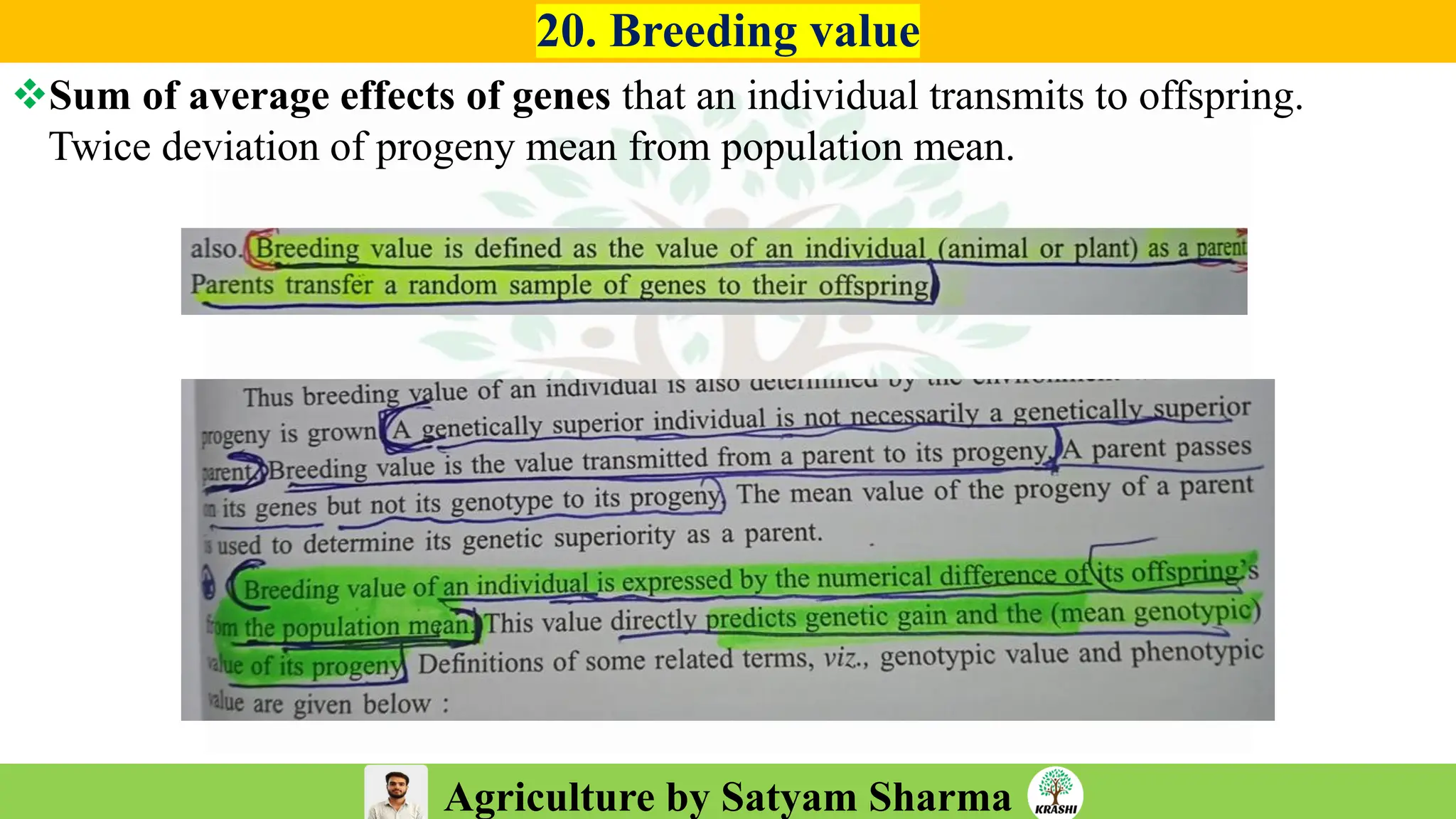
20. Breeding value
❖Sum of average effects of genes that an individual transmits to offspring.
Twice deviation of progeny mean from population mean.
Agriculture by Satyam Sharma
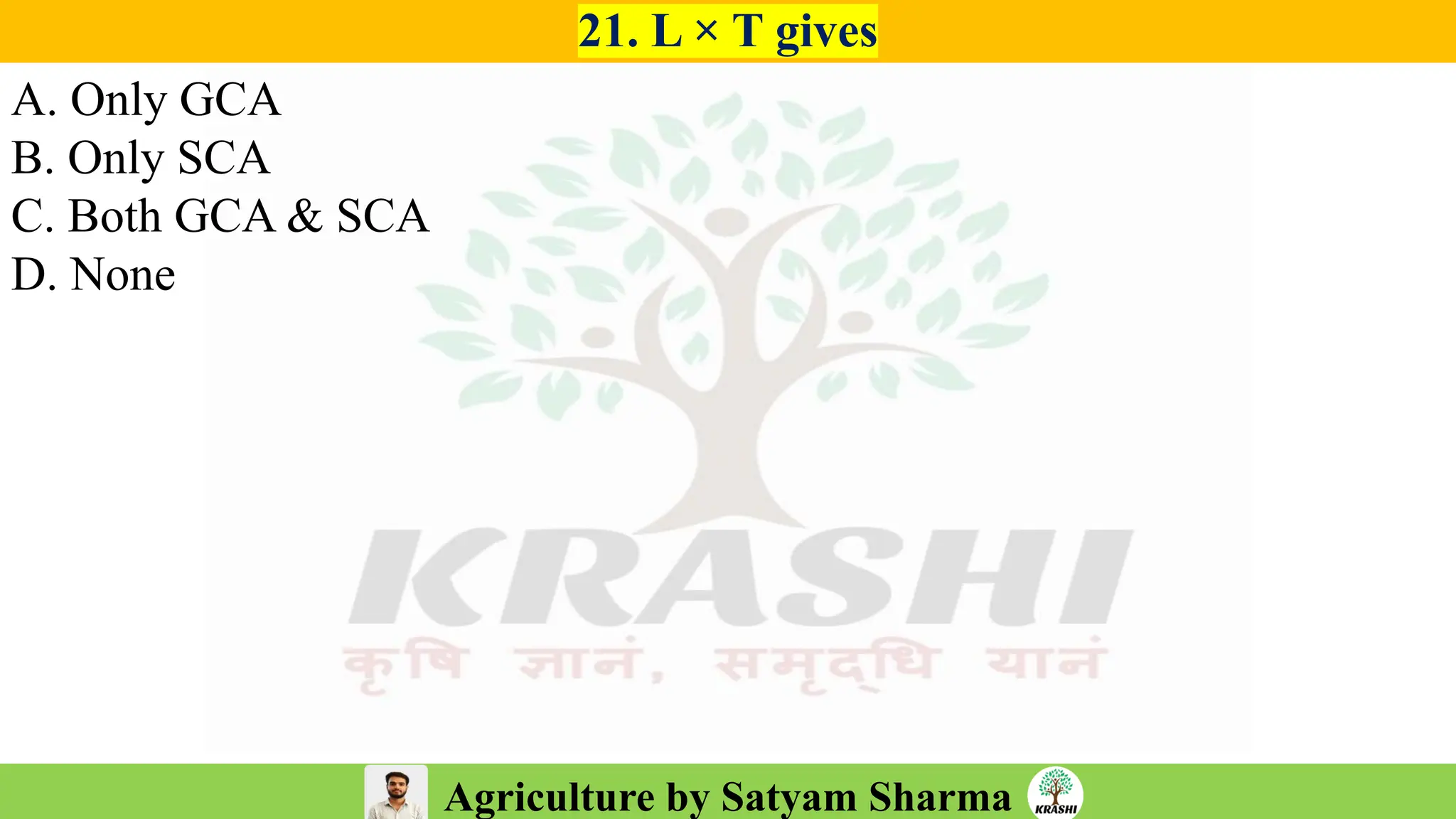
21. L × T gives
A. Only GCA
B. Only SCA
C. Both GCA & SCA
D. None
Agriculture by Satyam Sharma
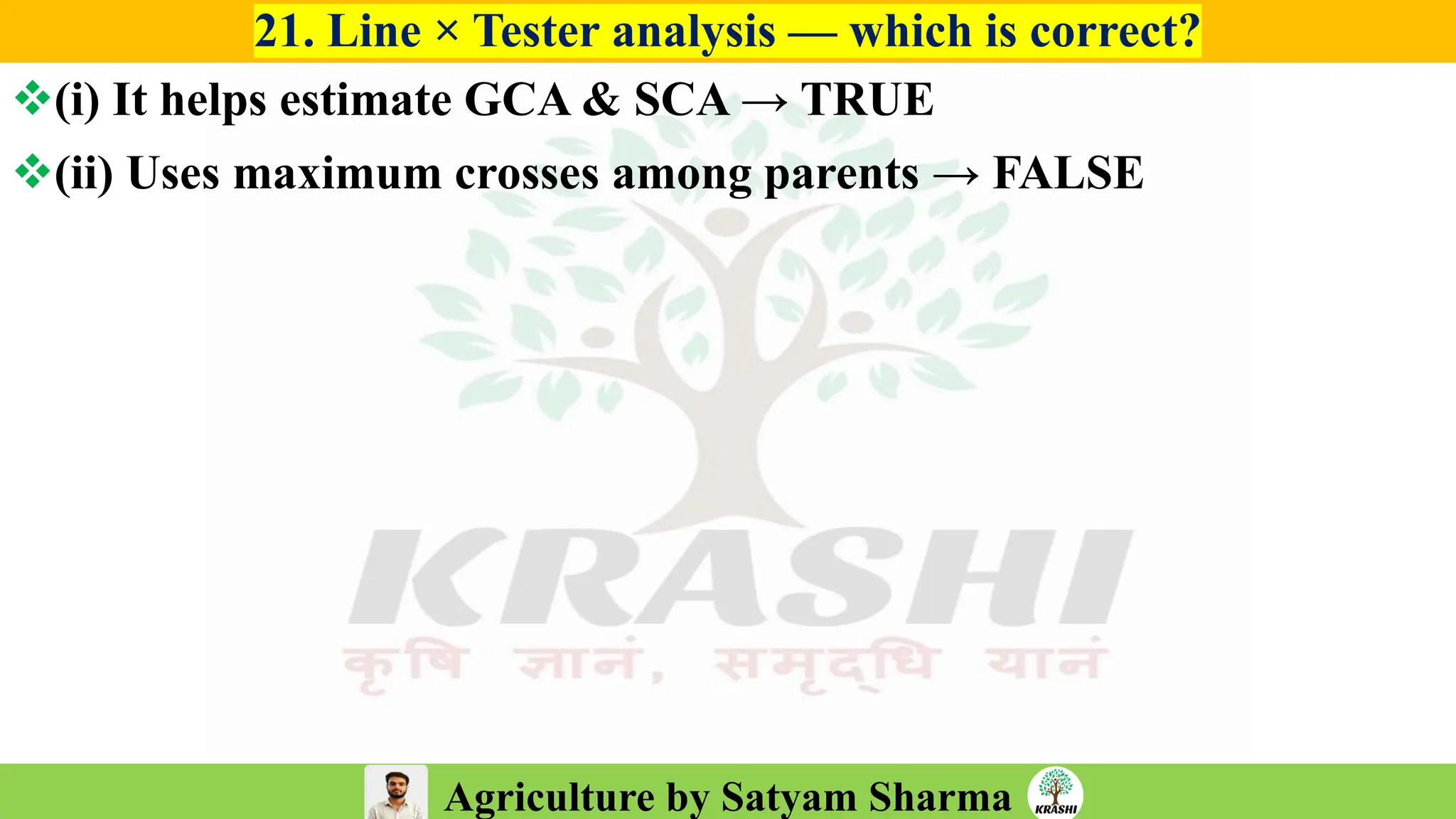
21. Line × Tester analysis — which is correct?
❖(i) It helps estimate GCA & SCA → TRUE
❖(ii) Uses maximum crosses among parents → FALSE
Agriculture by Satyam Sharma
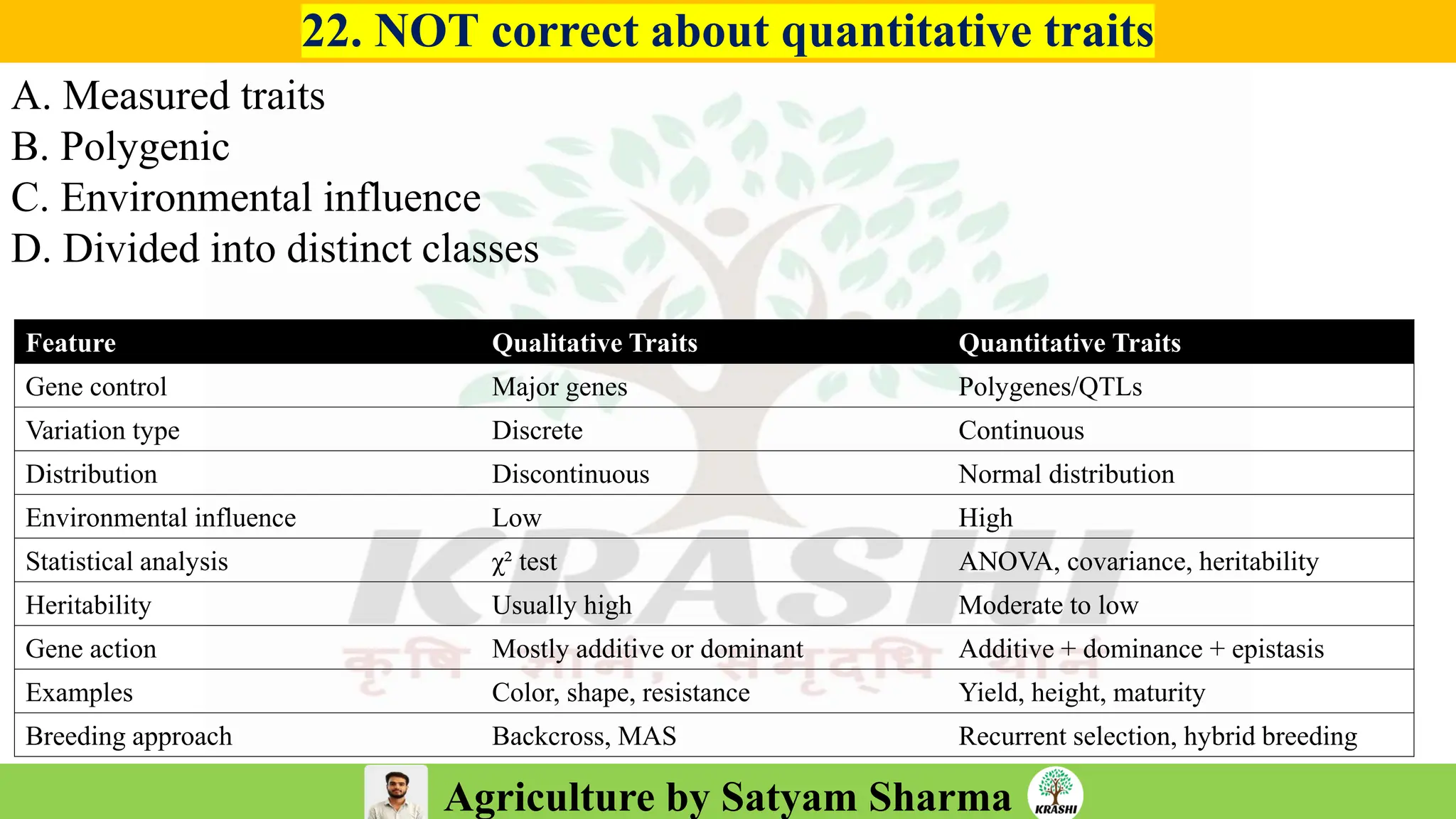
Feature Qualitative Traits Quantitative Traits
Gene control Major genes Polygenes/QTLs
Variation type Discrete Continuous
Distribution Discontinuous Normal distribution
Environmental influence Low High
Statistical analysis χ² test ANOVA, covariance, heritability
Heritability Usually high Moderate to low
Gene action Mostly additive or dominant Additive + dominance + epistasis
Examples Color, shape, resistance Yield, height, maturity
Breeding approach Backcross, MAS Recurrent selection, hybrid breeding
22. NOT correct about quantitative traits
A. Measured traits
B. Polygenic
C. Environmental influence
D. Divided into distinct classes
Agriculture by Satyam Sharma
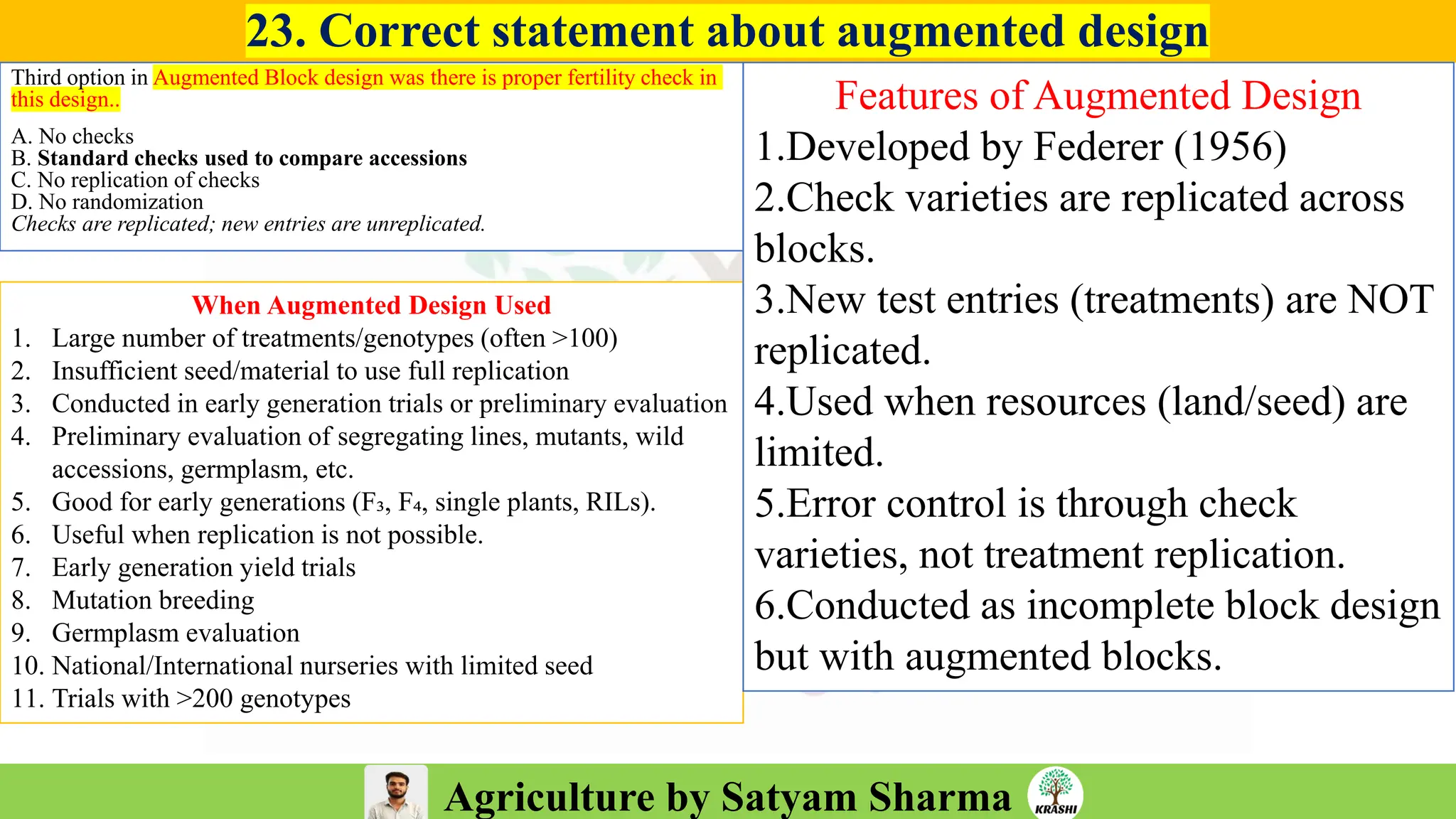
23. Correct statement about augmented design
Third option in Augmented Block design was there is proper fertility check in
this design..
A. No checks
B. Standard checks used to compare accessions
C. No replication of checks
D. No randomization
Checks are replicated; new entries are unreplicated.
When Augmented Design Used
1. Large number of treatments/genotypes (often >100)
2. Insufficient seed/material to use full replication
3. Conducted in early generation trials or preliminary evaluation
4. Preliminary evaluation of segregating lines, mutants, wild
accessions, germplasm, etc.
5. Good for early generations (F₃, F₄, single plants, RILs).
6. Useful when replication is not possible.
7. Early generation yield trials
8. Mutation breeding
9. Germplasm evaluation
10. National/International nurseries with limited seed
11. Trials with >200 genotypes
Features of Augmented Design
1.Developed by Federer (1956)
2.Check varieties are replicated across
blocks.
3.New test entries (treatments) are NOT
replicated.
4.Used when resources (land/seed) are
limited.
5.Error control is through check
varieties, not treatment replication.
6.Conducted as incomplete block design
but with augmented blocks.
Agriculture by Satyam Sharma
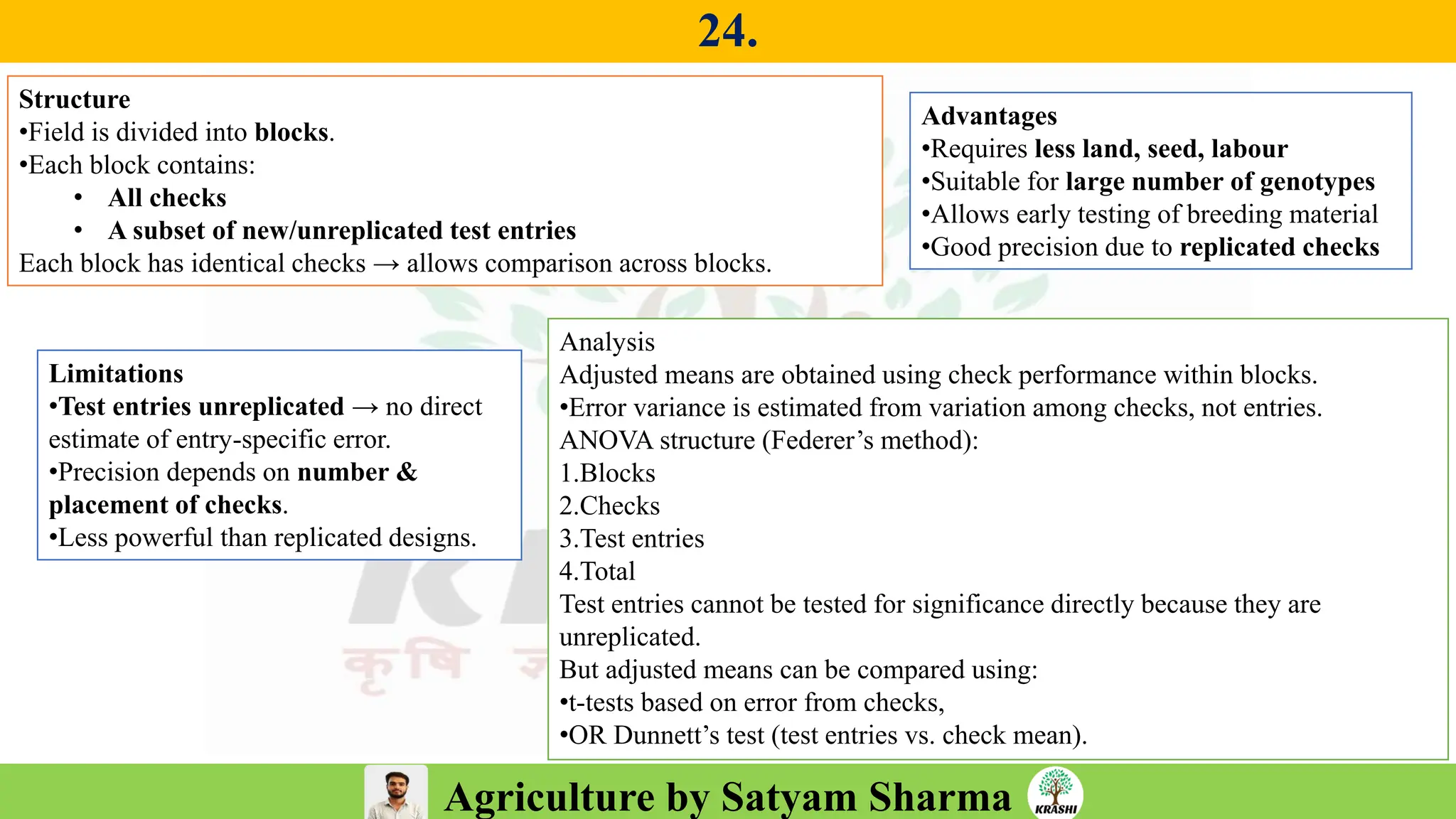
24.
Analysis
Adjusted means are obtained using check performance within blocks.
•Error variance is estimated from variation among checks, not entries.
ANOVA structure (Federer’s method):
1.Blocks
2.Checks
3.Test entries
4.Total
Test entries cannot be tested for significance directly because they are
unreplicated.
But adjusted means can be compared using:
•t-tests based on error from checks,
•OR Dunnett’s test (test entries vs. check mean).
Structure
•Field is divided into blocks.
•Each block contains:
• All checks
• A subset of new/unreplicated test entries
Each block has identical checks → allows comparison across blocks.
Advantages
•Requires less land, seed, labour
•Suitable for large number of genotypes
•Allows early testing of breeding material
•Good precision due to replicated checks
Limitations
•Test entries unreplicated → no direct
estimate of entry-specific error.
•Precision depends on number &
placement of checks.
•Less powerful than replicated designs.
Agriculture by Satyam Sharma
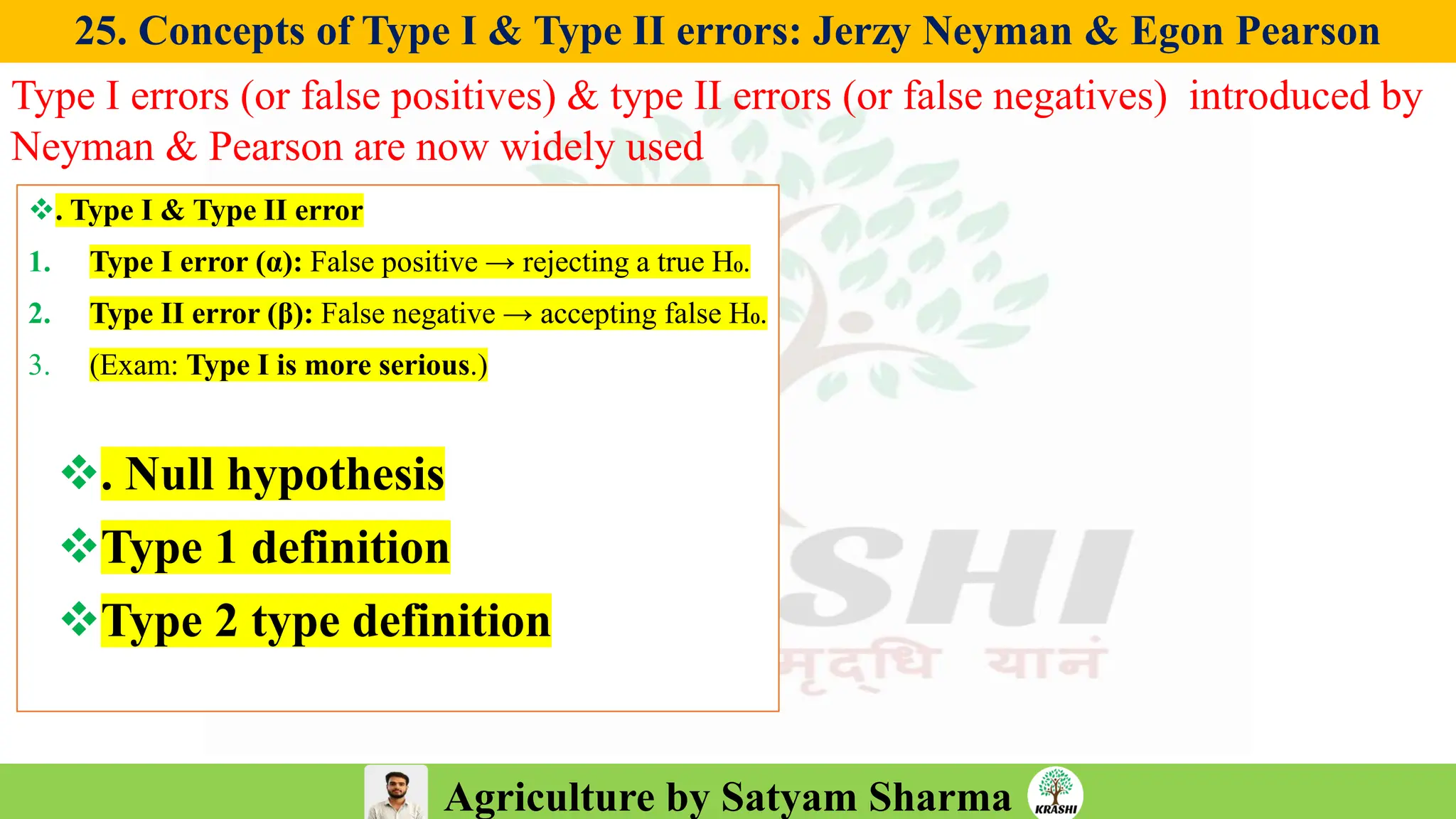
25. Concepts of Type I & Type II errors: Jerzy Neyman & Egon Pearson
Type I errors (or false positives) & type II errors (or false negatives) introduced by
Neyman & Pearson are now widely used
❖. Type I & Type II error
1. Type I error (α): False positive → rejecting a true H₀.
2. Type II error (β): False negative → accepting false H₀.
3. (Exam: Type I is more serious.)
❖. Null hypothesis
❖Type 1 definition
❖Type 2 type definition
Agriculture by Satyam Sharma
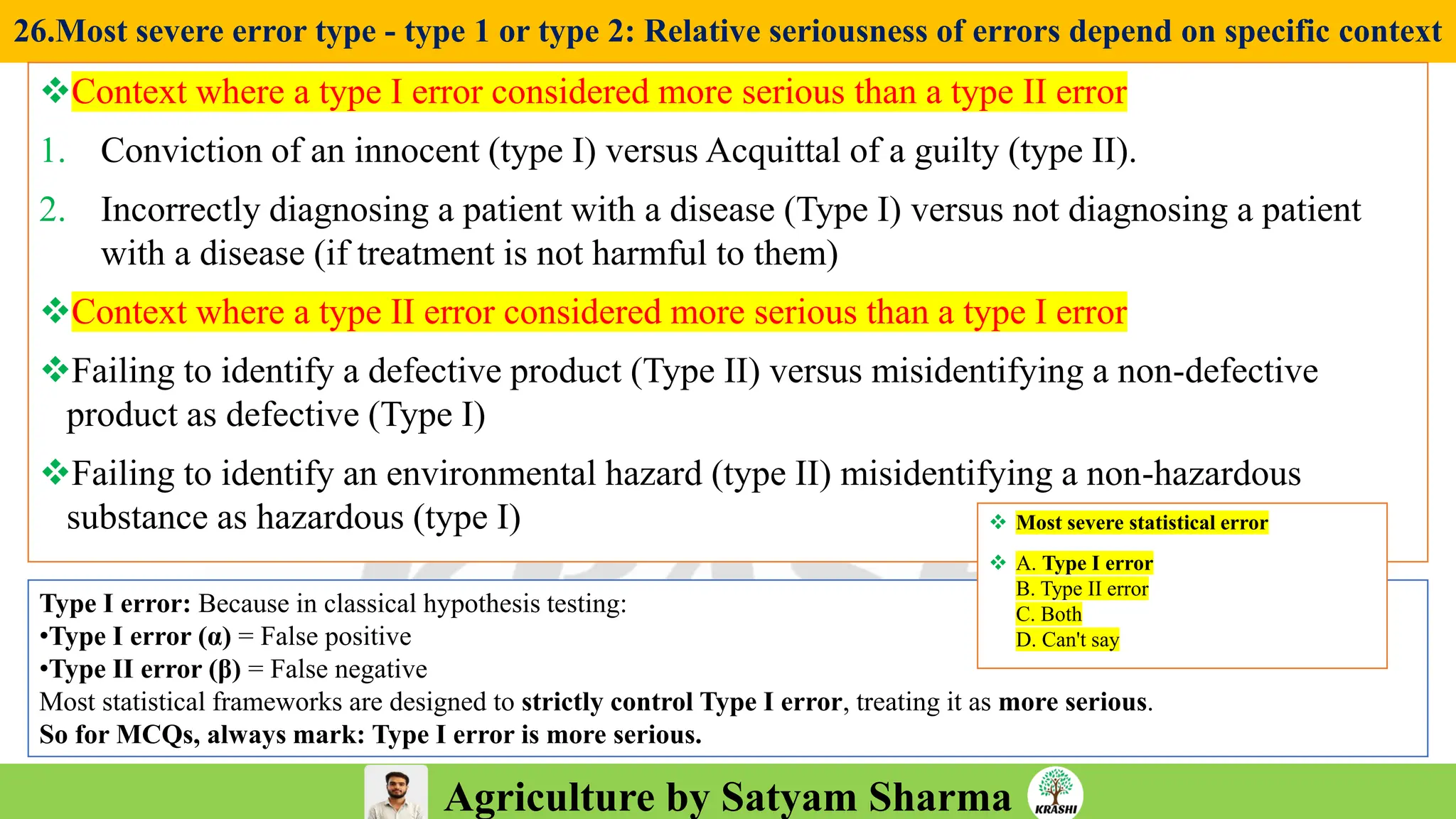
26.Most severe error type - type 1 or type 2: Relative seriousness of errors depend on specific context
❖Context where a type I error considered more serious than a type II error
1. Conviction of an innocent (type I) versus Acquittal of a guilty (type II).
2. Incorrectly diagnosing a patient with a disease (Type I) versus not diagnosing a patient
with a disease (if treatment is not harmful to them)
❖Context where a type II error considered more serious than a type I error
❖Failing to identify a defective product (Type II) versus misidentifying a non-defective
product as defective (Type I)
❖Failing to identify an environmental hazard (type II) misidentifying a non-hazardous
substance as hazardous (type I)
Type I error: Because in classical hypothesis testing:
•Type I error (α) = False positive
•Type II error (β) = False negative
Most statistical frameworks are designed to strictly control Type I error, treating it as more serious.
So for MCQs, always mark: Type I error is more serious.
❖ Most severe statistical error
❖ A. Type I error
B. Type II error
C. Both
D. Can't say
Agriculture by Satyam Sharma
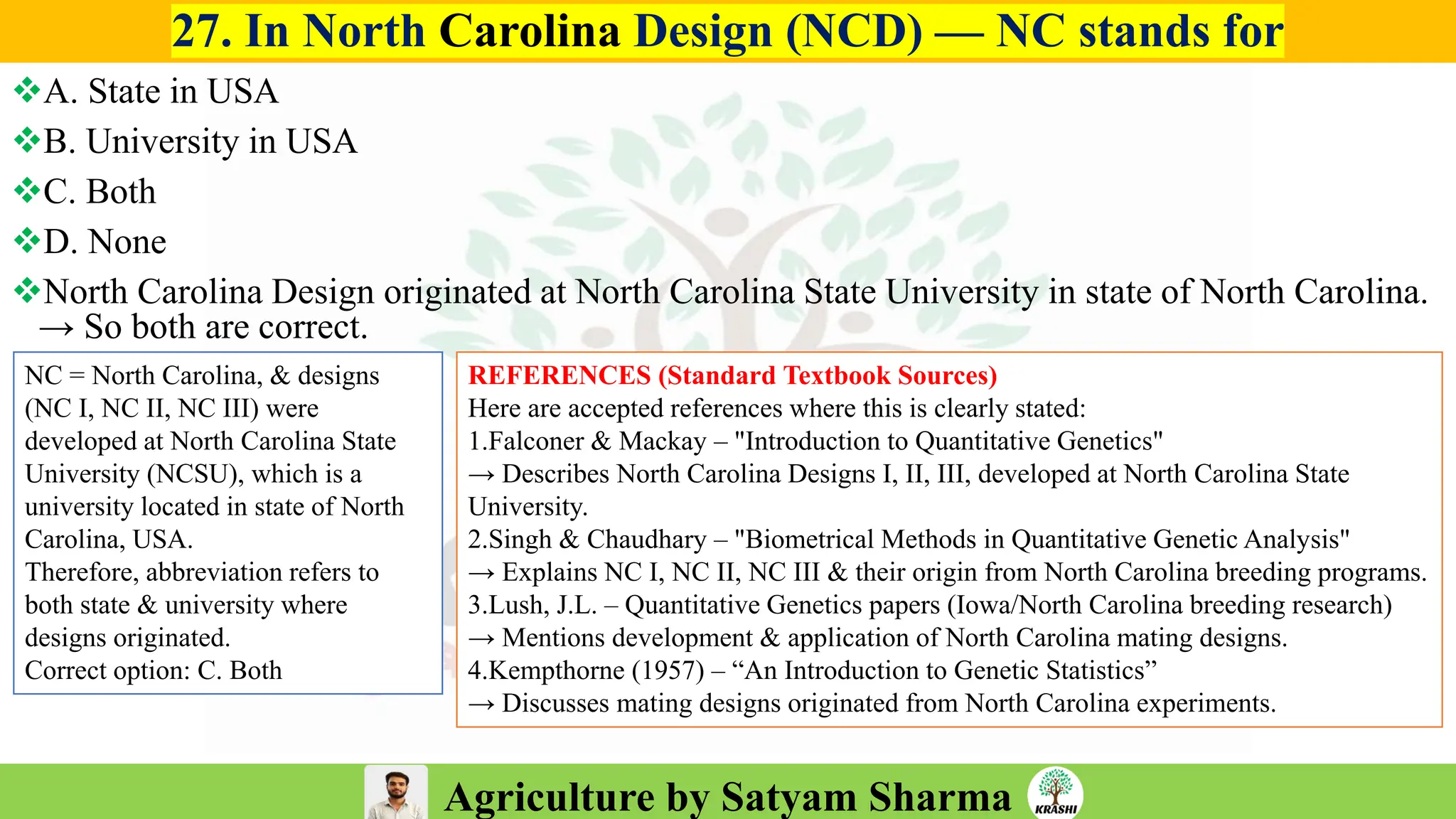
27. In North Carolina Design (NCD) — NC stands for
❖A. State in USA
❖B. University in USA
❖C. Both
❖D. None
❖North Carolina Design originated at North Carolina State University in state of North Carolina.
→ So both are correct.
REFERENCES (Standard Textbook Sources)
Here are accepted references where this is clearly stated:
1.Falconer & Mackay – "Introduction to Quantitative Genetics"
→ Describes North Carolina Designs I, II, III, developed at North Carolina State
University.
2.Singh & Chaudhary – "Biometrical Methods in Quantitative Genetic Analysis"
→ Explains NC I, NC II, NC III & their origin from North Carolina breeding programs.
3.Lush, J.L. – Quantitative Genetics papers (Iowa/North Carolina breeding research)
→ Mentions development & application of North Carolina mating designs.
4.Kempthorne (1957) – “An Introduction to Genetic Statistics”
→ Discusses mating designs originated from North Carolina experiments.
NC = North Carolina, & designs
(NC I, NC II, NC III) were
developed at North Carolina State
University (NCSU), which is a
university located in state of North
Carolina, USA.
Therefore, abbreviation refers to
both state & university where
designs originated.
Correct option: C. Both
Agriculture by Satyam Sharma
28. In simple regression, which variable is marked on X axis
In simple regression, variable placed on X-axis is:
Independent variable (Predictor / Regressor)
•X-axis → Independent variable (cause/input)
•Y-axis → Dependent variable (effect/output)
Example:
If you study effect of fertilizer (X) on yield (Y):
•Fertilizer amount = X-axis
•Crop yield = Y-axis
Agriculture by Satyam Sharma
29. Best methods used to estimate regression lines by
❖Least Squares & Maximum Likelihood give SAME
regression line. BUT ONLY when errors are normally
distributed.
❖ Least Squares Method
1. Minimizes sum of squared errors
2. Standard method for regression
3. Gives Best Linear Unbiased Estimator (BLUE)
❖Maximum Likelihood Method (MLM)
❖Finds parameter values that maximize probability of
observing data
❖When error terms normally distributed➝ ML estimates
= Least Squares estimates
❖Best regression line is obtained by Least Squares
method, which is equivalent to Maximum Likelihood
method under normal error distribution
1. Least Squares Method (LSM): Standard method → best linear unbiased estimator (BLUE).
2. Maximum Likelihood Method (MLM): Same as least squares when residuals are normally distributed.
3. Method of Moments: Estimates parameters by equating sample moments to population moments &
Less efficient than LSM & MLM.
4. Robust Regression Methods: Used when data has outliers or non-normal errors: Least Absolute
Deviations (LAD) / L1 regression, Minimizes sum of absolute errors instead of squared errors.
Huber M-estimator, Reduces influence of outliers & Tukey’s biweight regression
5. Ridge Regression: Used when: Predictor variables are highly correlated (multicollinearity) Adds a
penalty term λβ²
6. LASSO Regression: Performs variable selection: Shrinks some coefficients to zero: Useful for high-
dimensional data.
7. Elastic Net Regression: Combination of Ridge + LASSO.
8. Bayesian Regression: Uses priors + data likelihood to estimate parameters.
9. Principal Component Regression (PCR): First reduces dimensionality, then fits regression on PCs.
Useful when predictors are highly correlated.
10. Partial Least Squares Regression (PLSR): Similar to PCR but maximizes covariance between
predictors & response.
11. Quantile Regression: Estimates regression lines for different quantiles (e.g., median regression, 75th
percentile regression).
12. Nonlinear Regression Used when relationship is not linear.
13. Spline Regression / Polynomial Regression
Agriculture by Satyam Sharma
Regression analysis is used in
1. Prediction → predicting value of one variable based on another
2. Estimation → estimating unknown parameters
3. Measuring relationship between two or more variables
4. Quantifying rate of change (slope)
5. Breeding value estimation (in plant & animal breeding)
6. Selection index construction
7. Yield prediction in crops
8. Economics & biometrics → forecasting trends
9. Genetic studies → parent–offspring regression for heritability estimation
Agriculture by Satyam Sharma
30. What is appropriate Cryo preservation temperature for long-term storage
❖-196°
❖Appropriate temperature cryopreservation is typically -196°C (or 77 K) for
liquid nitrogen, most commonly used cryogenic agent for preserving biological
materials.
❖Cryo- preservation, from Ancient Greek (kríos, “icy cold, chill, frost”).
❖Cryopreservation is a process that preserves organelles, cells, tissues, or any
other biological constructs by cooling samples to very low temperatures.
❖Typically -80 using CO₂ or -196 using liquid nitrogen.
❖At enough low temperature, any enzymatic or biological activity which might
cause damage to cell is effectively stopped.
Agriculture by Satyam Sharma
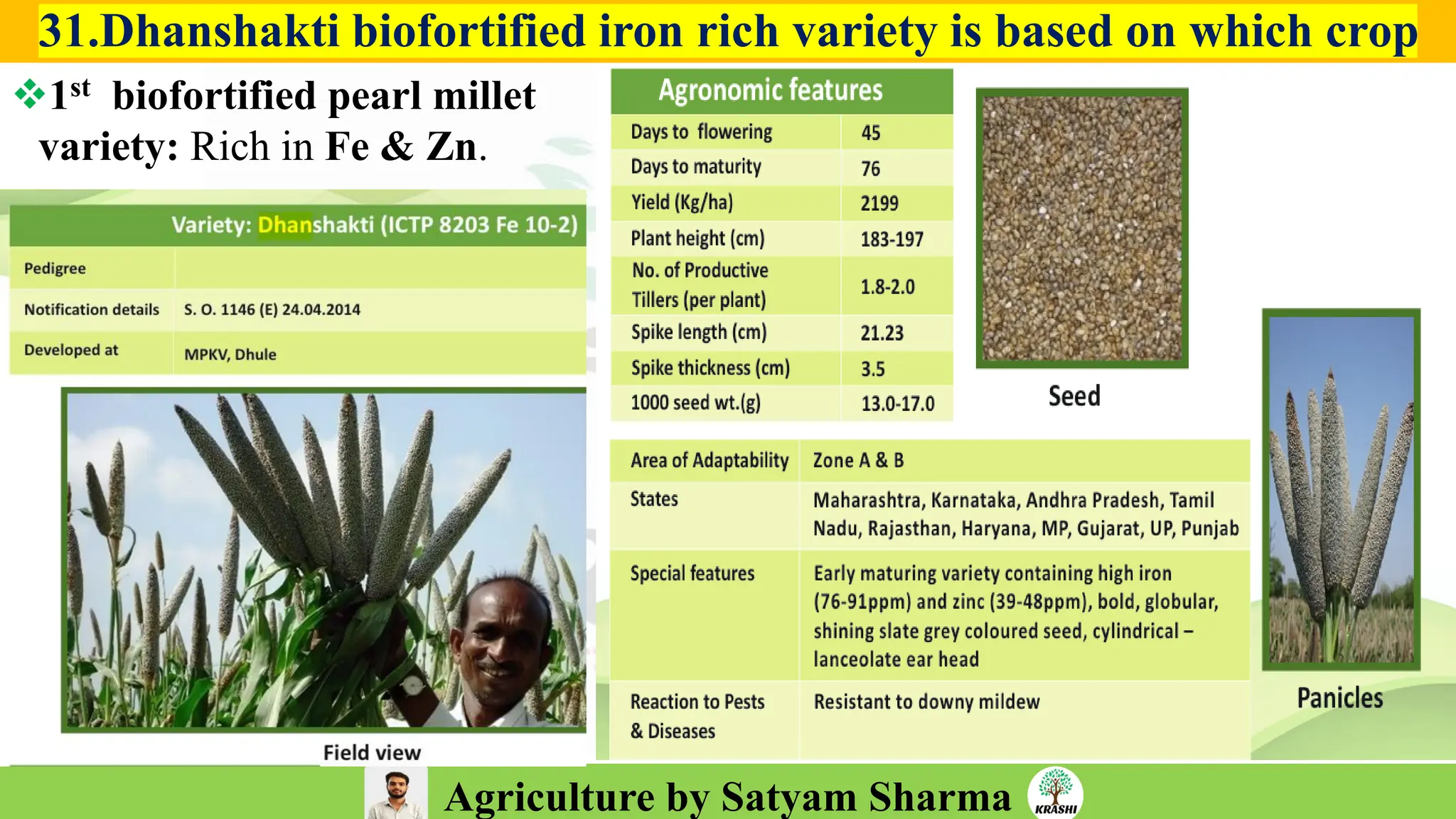
❖1st biofortified pearl millet
variety: Rich in Fe & Zn.
31.Dhanshakti biofortified iron rich variety is based on which crop
❖1.
Agriculture by Satyam Sharma
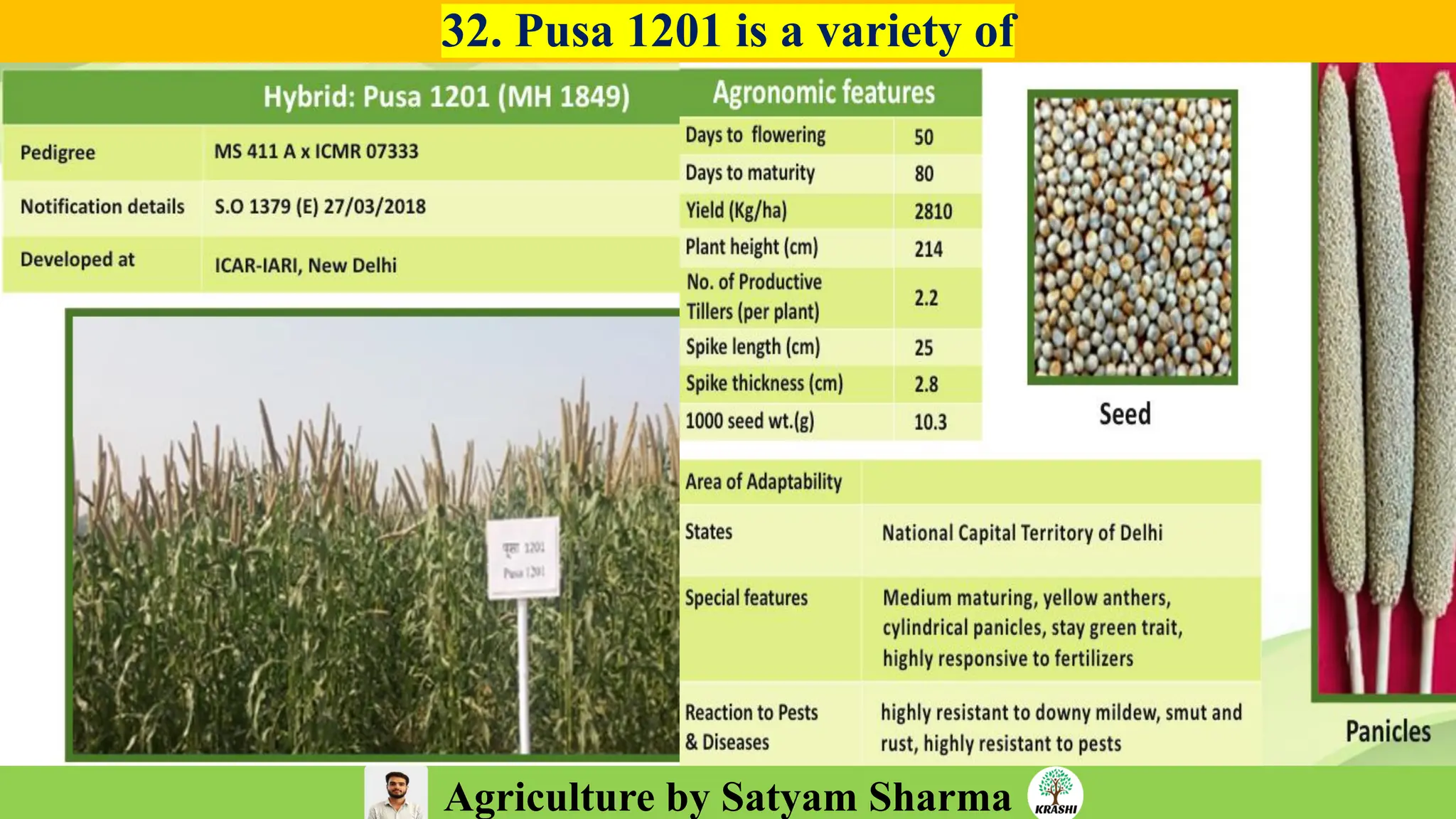
32. Pusa 1201 is a variety of
Agriculture by Satyam Sharma
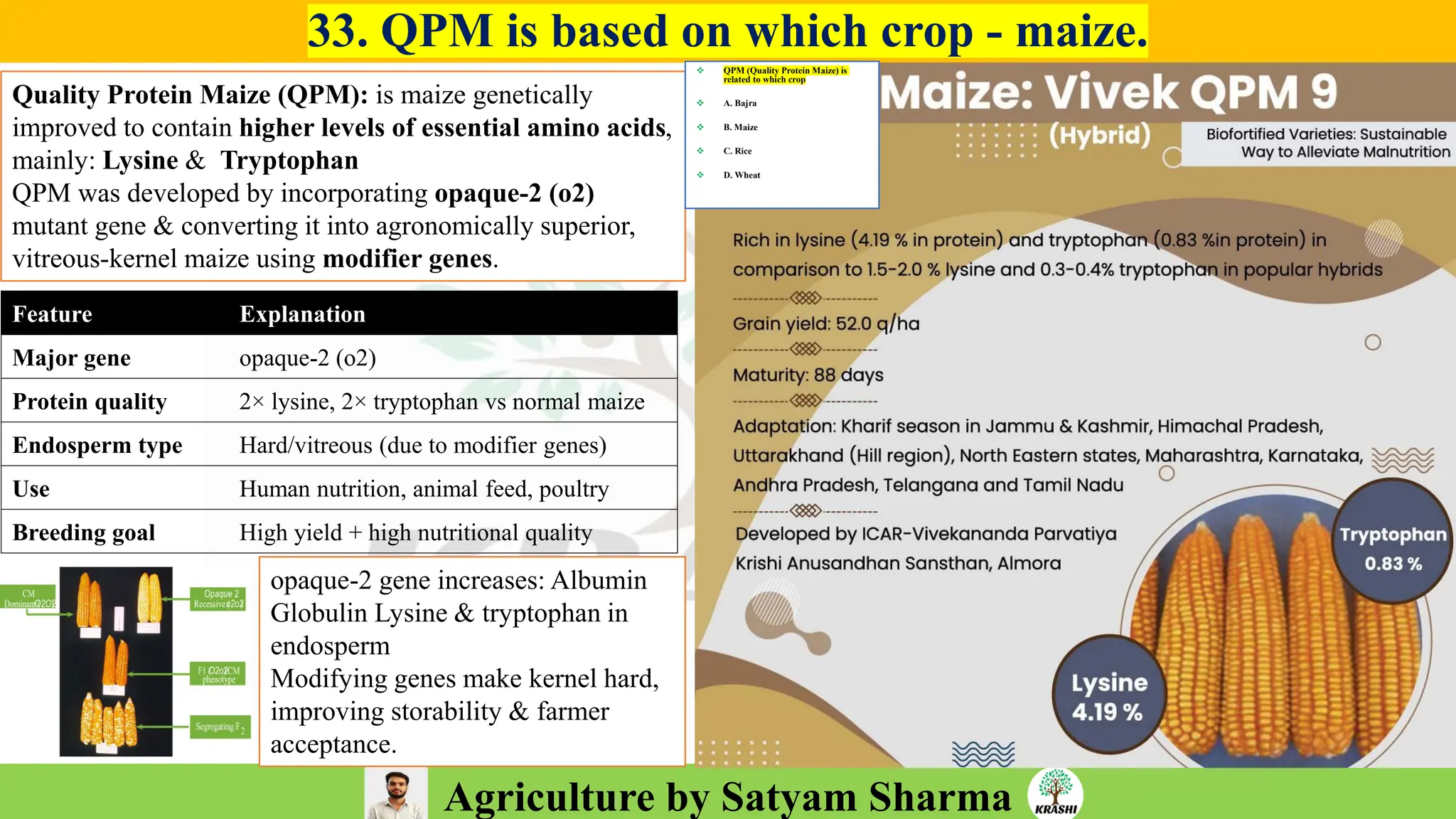
Feature Explanation
Major gene opaque-2 (o2)
Protein quality 2× lysine, 2× tryptophan vs normal maize
Endosperm type Hard/vitreous (due to modifier genes)
Use Human nutrition, animal feed, poultry
Breeding goal High yield + high nutritional quality
33. QPM is based on which crop - maize.
Quality Protein Maize (QPM): is maize genetically
improved to contain higher levels of essential amino acids,
mainly: Lysine & Tryptophan
QPM was developed by incorporating opaque-2 (o2)
mutant gene & converting it into agronomically superior,
vitreous-kernel maize using modifier genes.
opaque-2 gene increases: Albumin
Globulin Lysine & tryptophan in
endosperm
Modifying genes make kernel hard,
improving storability & farmer
acceptance.
❖ QPM (Quality Protein Maize) is
related to which crop
❖ A. Bajra
❖ B. Maize
❖ C. Rice
❖ D. Wheat
Agriculture by Satyam Sharma
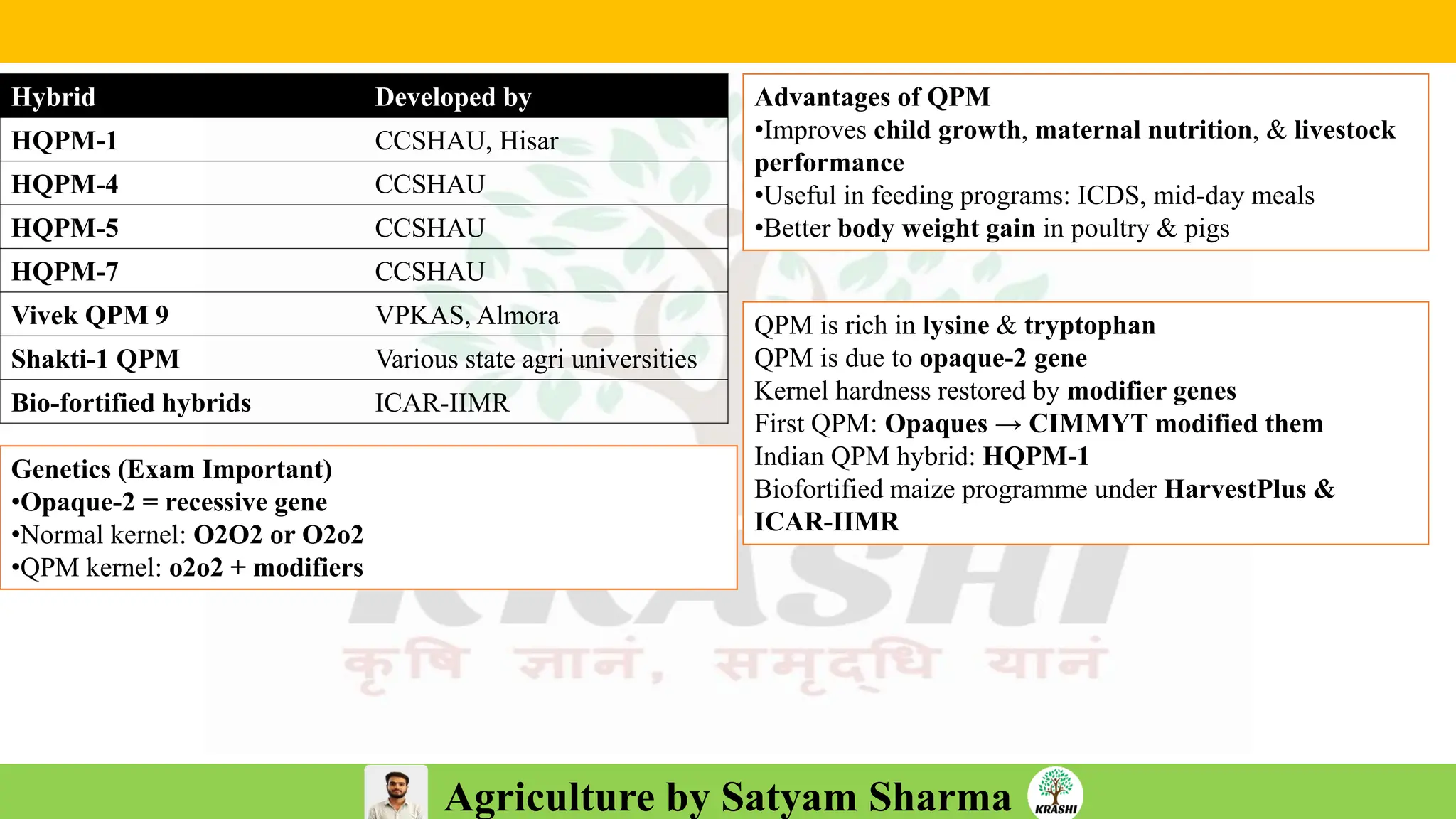
Hybrid Developed by
HQPM-1 CCSHAU, Hisar
HQPM-4 CCSHAU
HQPM-5 CCSHAU
HQPM-7 CCSHAU
Vivek QPM 9 VPKAS, Almora
Shakti-1 QPM Various state agri universities
Bio-fortified hybrids ICAR-IIMR
Advantages of QPM
•Improves child growth, maternal nutrition, & livestock
performance
•Useful in feeding programs: ICDS, mid-day meals
•Better body weight gain in poultry & pigs
Genetics (Exam Important)
•Opaque-2 = recessive gene
•Normal kernel: O2O2 or O2o2
•QPM kernel: o2o2 + modifiers
QPM is rich in lysine & tryptophan
QPM is due to opaque-2 gene
Kernel hardness restored by modifier genes
First QPM: Opaques → CIMMYT modified them
Indian QPM hybrid: HQPM-1
Biofortified maize programme under HarvestPlus &
ICAR-IIMR
Agriculture by Satyam Sharma
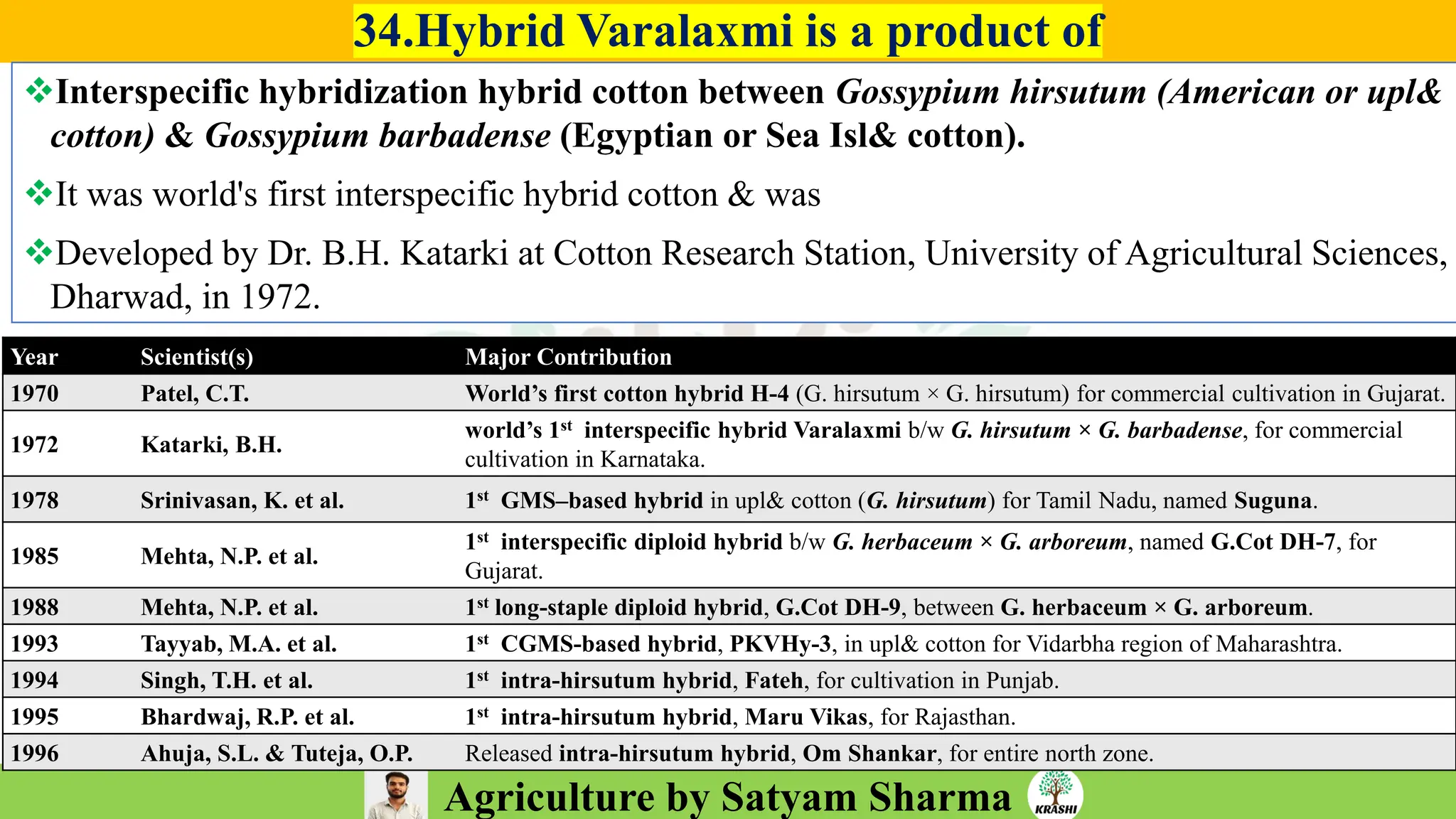
34.Hybrid Varalaxmi is a product of
❖Interspecific hybridization hybrid cotton between Gossypium hirsutum (American or upl&
cotton) & Gossypium barbadense (Egyptian or Sea Isl& cotton).
❖It was world's first interspecific hybrid cotton & was
❖Developed by Dr. B.H. Katarki at Cotton Research Station, University of Agricultural Sciences,
Dharwad, in 1972.
Year Scientist(s) Major Contribution
1970 Patel, C.T. World’s first cotton hybrid H-4 (G. hirsutum × G. hirsutum) for commercial cultivation in Gujarat.
1972 Katarki, B.H.
world’s 1st interspecific hybrid Varalaxmi b/w G. hirsutum × G. barbadense, for commercial
cultivation in Karnataka.
1978 Srinivasan, K. et al. 1st GMS–based hybrid in upl& cotton (G. hirsutum) for Tamil Nadu, named Suguna.
1985 Mehta, N.P. et al.
1st interspecific diploid hybrid b/w G. herbaceum × G. arboreum, named G.Cot DH-7, for
Gujarat.
1988 Mehta, N.P. et al. 1st long-staple diploid hybrid, G.Cot DH-9, between G. herbaceum × G. arboreum.
1993 Tayyab, M.A. et al. 1st CGMS-based hybrid, PKVHy-3, in upl& cotton for Vidarbha region of Maharashtra.
1994 Singh, T.H. et al. 1st intra-hirsutum hybrid, Fateh, for cultivation in Punjab.
1995 Bhardwaj, R.P. et al. 1st intra-hirsutum hybrid, Maru Vikas, for Rajasthan.
1996 Ahuja, S.L. & Tuteja, O.P. Released intra-hirsutum hybrid, Om Shankar, for entire north zone.
Agriculture by Satyam Sharma
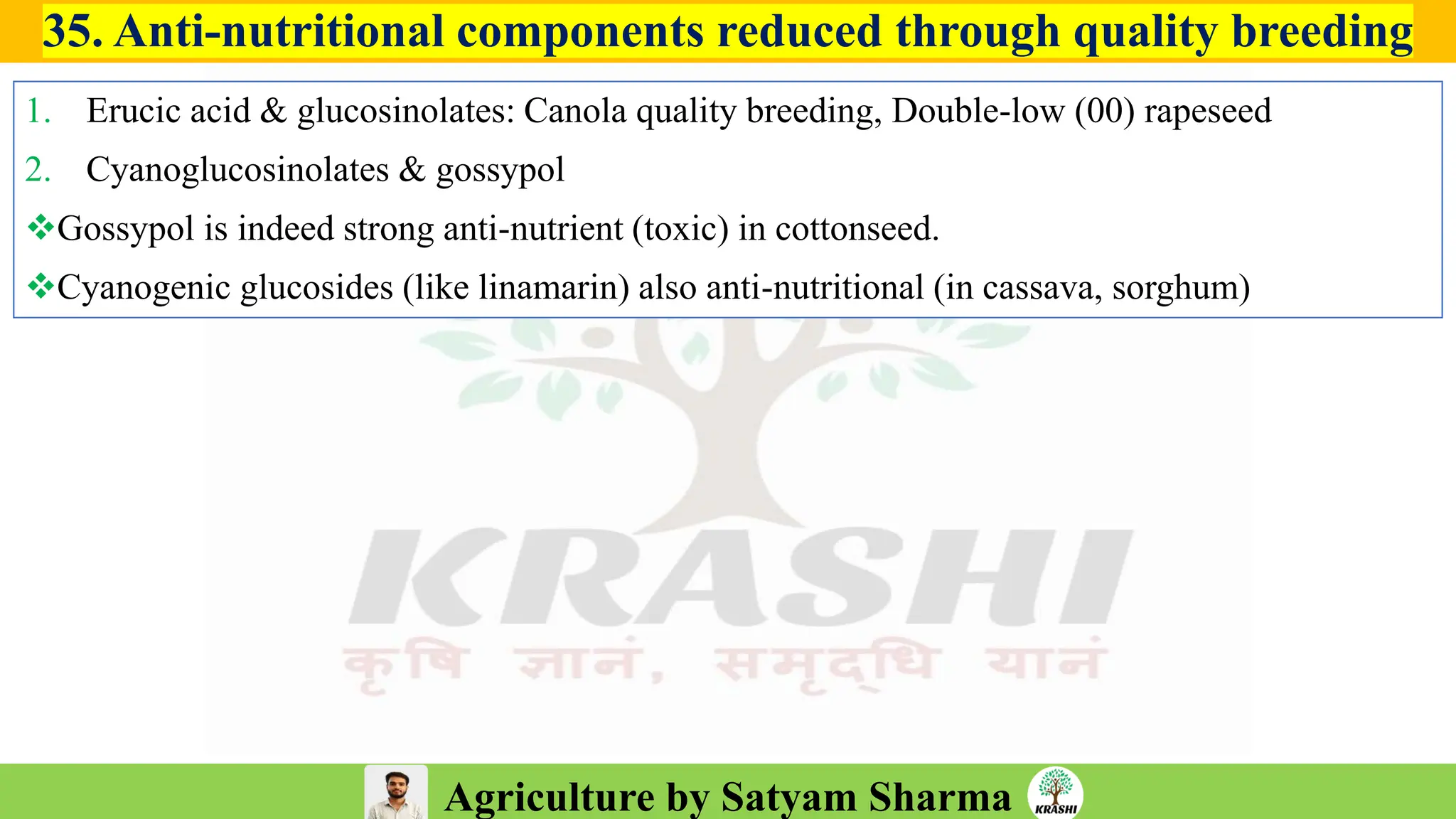
35. Anti-nutritional components reduced through quality breeding
1. Erucic acid & glucosinolates: Canola quality breeding, Double-low (00) rapeseed
2. Cyanoglucosinolates & gossypol
❖Gossypol is indeed strong anti-nutrient (toxic) in cottonseed.
❖Cyanogenic glucosides (like linamarin) also anti-nutritional (in cassava, sorghum)
Agriculture by Satyam Sharma
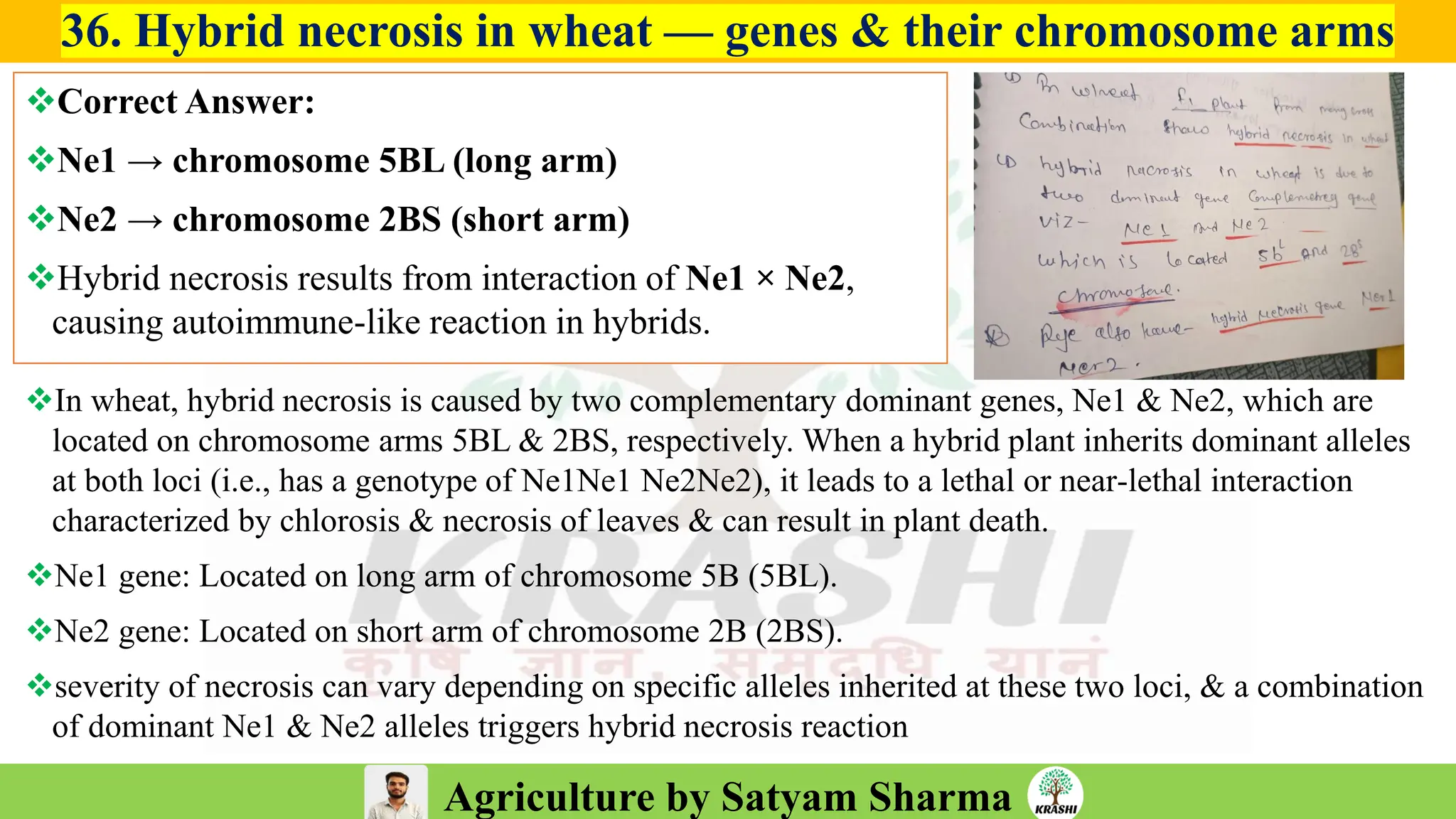
36. Hybrid necrosis in wheat — genes & their chromosome arms
❖Correct Answer:
❖Ne1 → chromosome 5BL (long arm)
❖Ne2 → chromosome 2BS (short arm)
❖Hybrid necrosis results from interaction of Ne1 × Ne2,
causing autoimmune-like reaction in hybrids.
❖In wheat, hybrid necrosis is caused by two complementary dominant genes, Ne1 & Ne2, which are
located on chromosome arms 5BL & 2BS, respectively. When a hybrid plant inherits dominant alleles
at both loci (i.e., has a genotype of Ne1Ne1 Ne2Ne2), it leads to a lethal or near-lethal interaction
characterized by chlorosis & necrosis of leaves & can result in plant death.
❖Ne1 gene: Located on long arm of chromosome 5B (5BL).
❖Ne2 gene: Located on short arm of chromosome 2B (2BS).
❖severity of necrosis can vary depending on specific alleles inherited at these two loci, & a combination
of dominant Ne1 & Ne2 alleles triggers hybrid necrosis reaction
Agriculture by Satyam Sharma
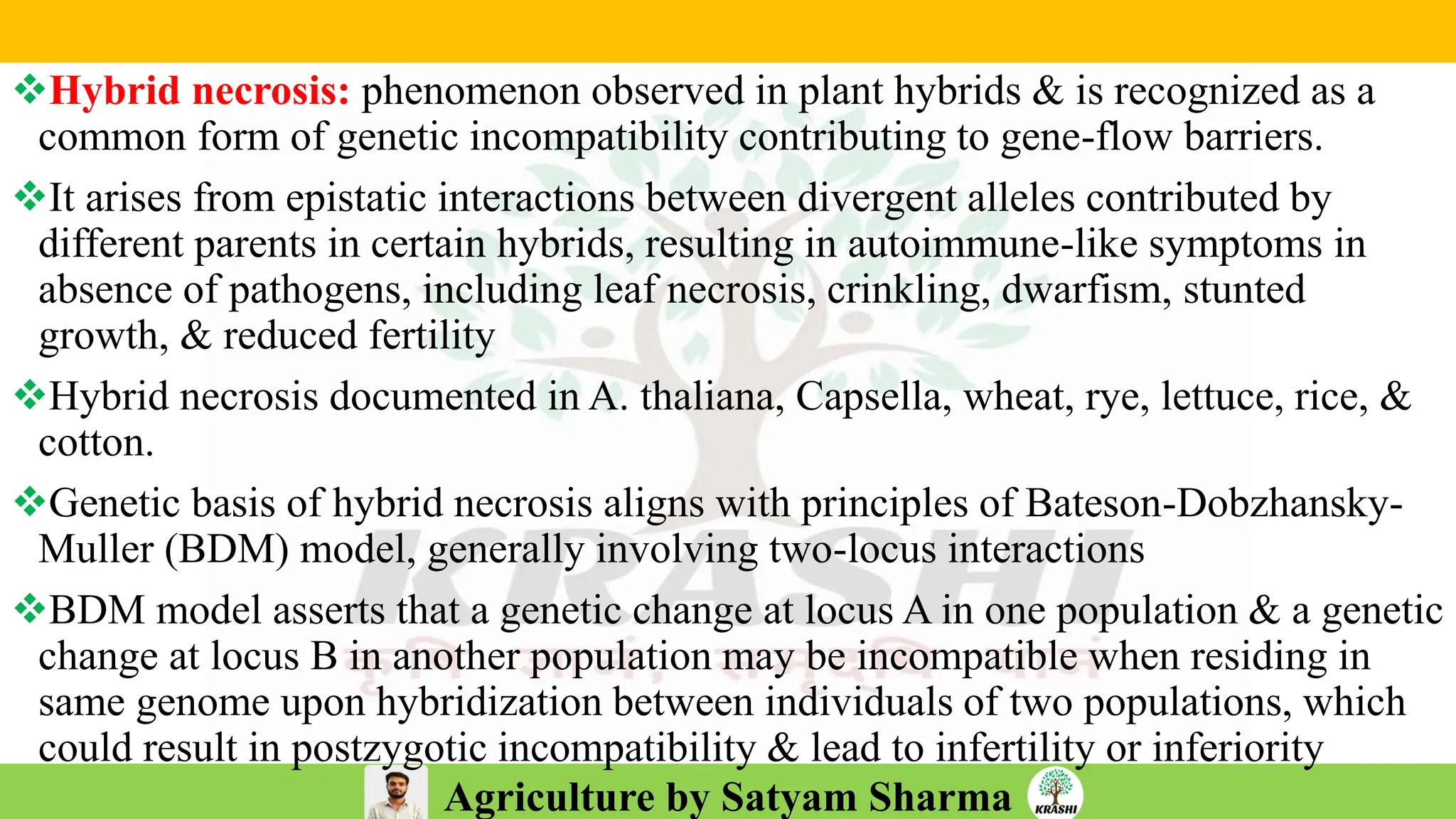
❖Hybrid necrosis: phenomenon observed in plant hybrids & is recognized as a
common form of genetic incompatibility contributing to gene-flow barriers.
❖It arises from epistatic interactions between divergent alleles contributed by
different parents in certain hybrids, resulting in autoimmune-like symptoms in
absence of pathogens, including leaf necrosis, crinkling, dwarfism, stunted
growth, & reduced fertility
❖Hybrid necrosis documented in A. thaliana, Capsella, wheat, rye, lettuce, rice, &
cotton.
❖Genetic basis of hybrid necrosis aligns with principles of Bateson-Dobzhansky-
Muller (BDM) model, generally involving two-locus interactions
❖BDM model asserts that a genetic change at locus A in one population & a genetic
change at locus B in another population may be incompatible when residing in
same genome upon hybridization between individuals of two populations, which
could result in postzygotic incompatibility & lead to infertility or inferiority
Agriculture by Satyam Sharma
❖Hybrid necrosis is closely linked to plant immune responses.
❖Numerous causal genes associated with hybrid necrosis have been identified, majority
of which encode proteins related to immunity.
❖Arabidopsis hybrid necrosis genes, Dangerous Mix 1 (DM1) & DM3d, & cotton hybrid
lethality gene Le4 are known to encode nucleotide-binding leucine-rich repeat (NLR)
immune receptor proteins
❖Arabidopsis DM3 protein, a member of ABH family, interacts with NLR protein DM2 is
associated with hybrid necrosis
❖In lettuce, hybrid necrosis is governed by specific isoforms of Rin4, which is recognized
for its interactions with various resistance (R) genes
❖Epistatic interactions between NPR1 & RPP5 orthologues result in genetic
incompatibility within Capsella species
❖Rice Hwi1 & Hwi2, which encode an LRR-RLK immune receptor & a subtilisin-like
protease, respectively, activate autoimmune response in interspecific hybrids
Agriculture by Satyam Sharma
Crop / Species Gene(s) Involved
Gene Type / Protein
Encoded
Role in Hybrid Necrosis /
Incompatibility
Arabidopsis DM1 & DM3d
NLR (Nucleotide-binding
Leucine-rich Repeat) immune
receptor proteins
Cause hybrid necrosis due to
autoimmune activation in
incompatible crosses
Arabidopsis
DM3 (ABH family)
interacting with DM2
(NLR)
DM3 = ABH family protein;
DM2 = NLR receptor
DM3–DM2 interaction
triggers hybrid necrosis
Lettuce (Lactuca spp.) Specific isoforms of Rin4
Immune regulator interacting
with multiple R genes
Certain Rin4 variants cause
hybrid necrosis when
recognized by resistance
genes
Capsella species NPR1 & RPP5 orthologues
NPR1: immune signaling
regulator; RPP5: NLR
immune receptor
Epistatic interaction leads to
hybrid genetic
incompatibility
Rice (Oryza spp.) Hwi1 & Hwi2
Hwi1: LRR-RLK (Receptor-
Like Kinase) Hwi2:
Subtilisin-like protease
Together trigger autoimmune
response causing interspecific
hybrid weakness
Agriculture by Satyam Sharma
❖Structural variations, including copy number variations (CNVs) &
chromosomal rearrangements, exert substantial influence on genomic
landscape of plants
❖In particular, CNVs have been recognized as potent drivers of genetic
diversity by instigating alterations in gene dosage & expression levels
❖For example, CNVs contribute to grain size diversity in rice & enhance
nematode resistance in soybean.
❖In addition, genomic structural changes & copy number variation at Sc locus
confer japonica–indica hybrid male sterility in rice
Agriculture by Satyam Sharma
❖Hybrid necrosis in wheat documented by Sax
❖Hybrid necrosis reported in both intraspecific crosses of common wheat &
interspecific crosses between tetraploid wheat & Aegilops tauschii
❖Hybrid necrosis impedes genetic improvement of wheat, acting as a barrier to both
integration of desirable traits from diverse common wheat genotypes & introgression
of genes from related species into commercial cultivars
❖Hybrid necrosis in common wheat is controlled by complementary dominant genes
Ne1 & Ne2, which are located on chromosome arms 5BL & 2BS, respectively
❖Ne2 cloned & characterized, which encodes an NLR protein
❖Ne2 is same gene as wheat leaf rust resistance gene Lr13 & allelic to wheat stripe
rust resistance gene Yr27, exhibits pleiotropic effects against rust & hybrid
necrosis23,25. However, causal gene for Ne1 has yet to be determined, despite
development of high-density genetic maps by three separate teams26,27,28.
Agriculture by Satyam Sharma
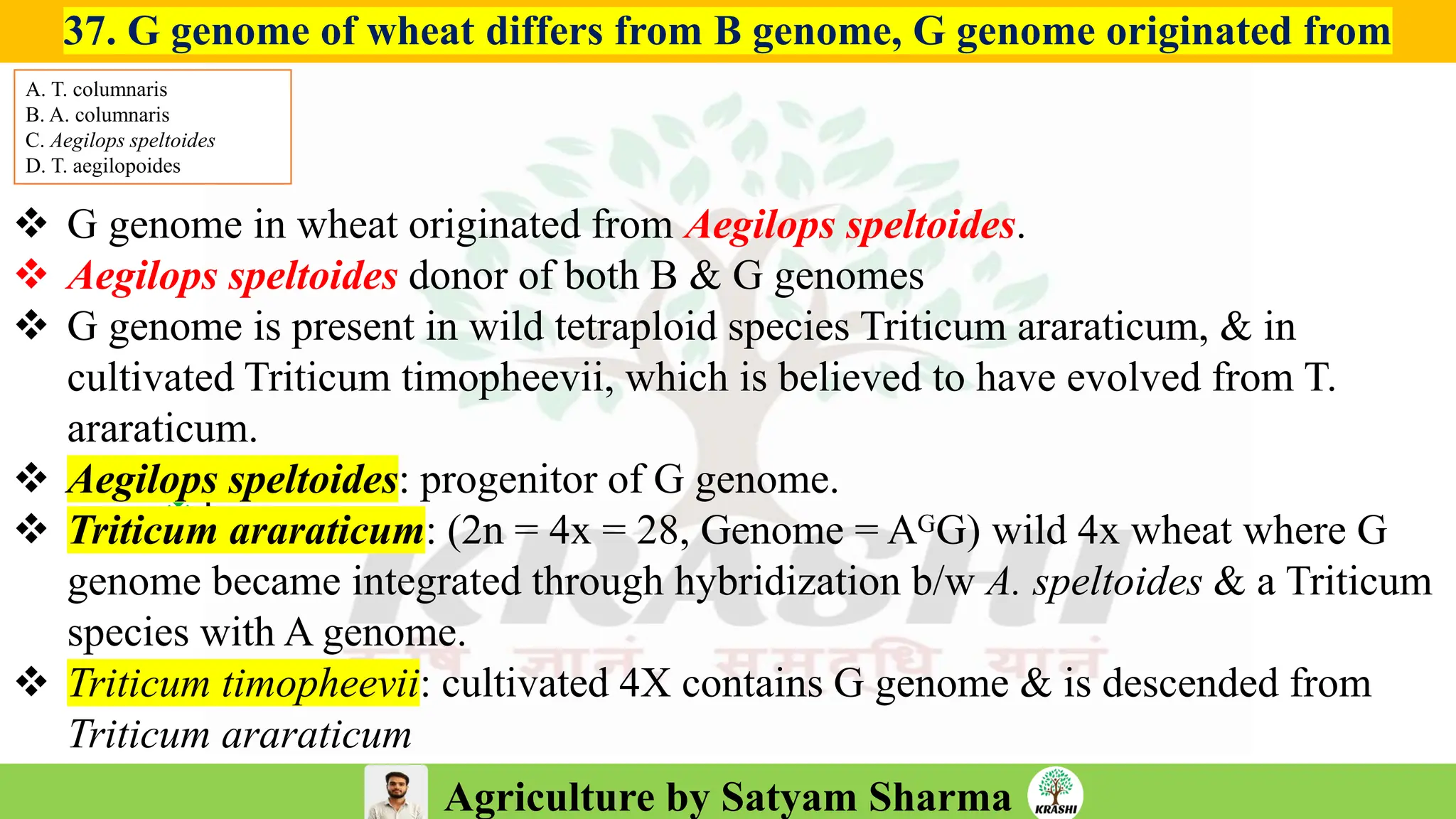
37. G genome of wheat differs from B genome, G genome originated from
❖1.
❖ G genome in wheat originated from Aegilops speltoides.
❖ Aegilops speltoides donor of both B & G genomes
❖ G genome is present in wild tetraploid species Triticum araraticum, & in
cultivated Triticum timopheevii, which is believed to have evolved from T.
araraticum.
❖ Aegilops speltoides: progenitor of G genome.
❖ Triticum araraticum: (2n = 4x = 28, Genome = AᴳG) wild 4x wheat where G
genome became integrated through hybridization b/w A. speltoides & a Triticum
species with A genome.
❖ Triticum timopheevii: cultivated 4X contains G genome & is descended from
Triticum araraticum
A. T. columnaris
B. A. columnaris
C. Aegilops speltoides
D. T. aegilopoides
Agriculture by Satyam Sharma
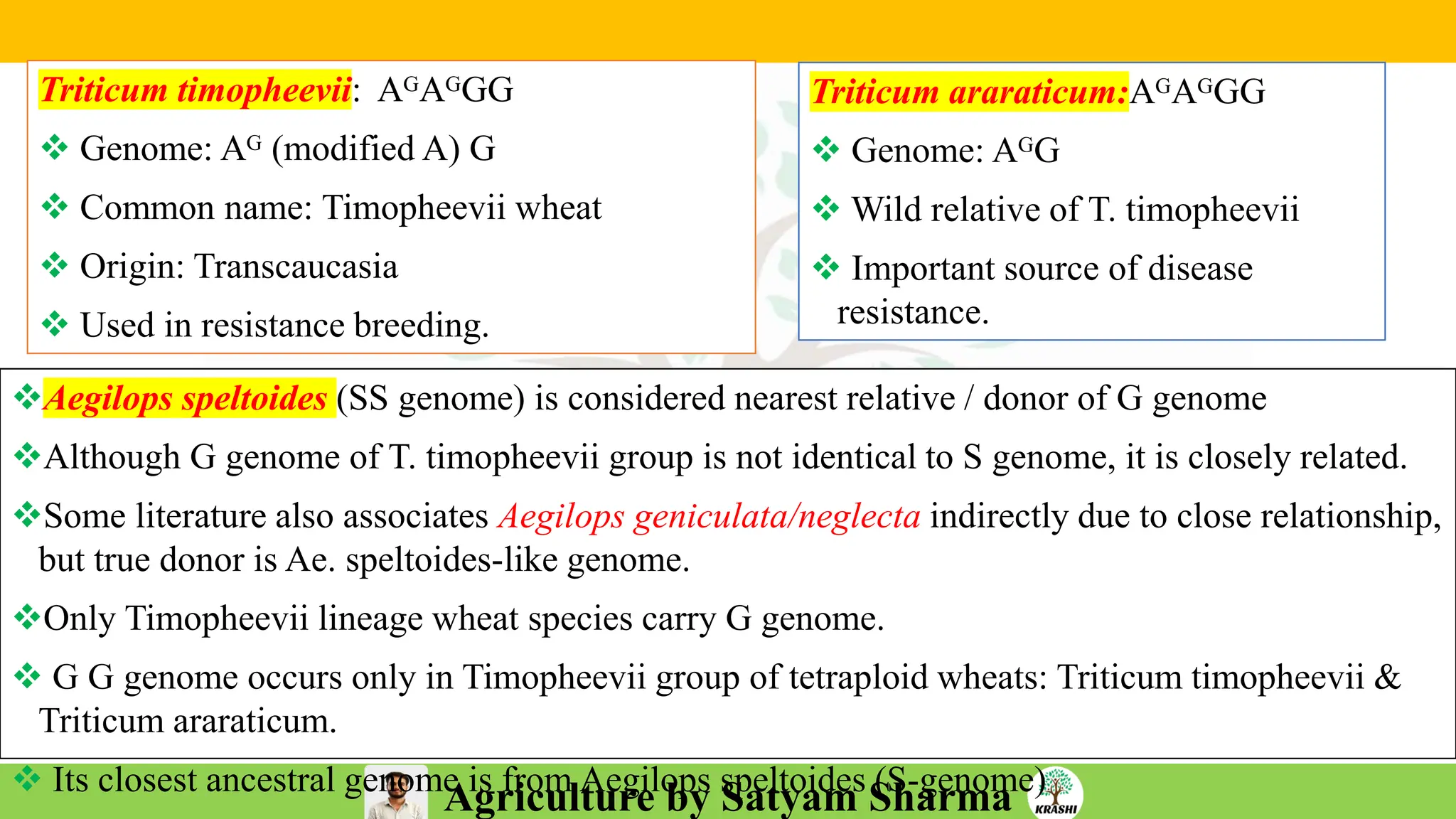
❖Aegilops speltoides (SS genome) is considered nearest relative / donor of G genome
❖Although G genome of T. timopheevii group is not identical to S genome, it is closely related.
❖Some literature also associates Aegilops geniculata/neglecta indirectly due to close relationship,
but true donor is Ae. speltoides-like genome.
❖Only Timopheevii lineage wheat species carry G genome.
❖ G G genome occurs only in Timopheevii group of tetraploid wheats: Triticum timopheevii &
Triticum araraticum.
❖ Its closest ancestral genome is from Aegilops speltoides (S-genome)
Triticum timopheevii: AᴳAᴳGG
❖ Genome: Aᴳ (modified A) G
❖ Common name: Timopheevii wheat
❖ Origin: Transcaucasia
❖ Used in resistance breeding.
Triticum araraticum:AᴳAᴳGG
❖ Genome: AᴳG
❖ Wild relative of T. timopheevii
❖ Important source of disease
resistance.
Agriculture by Satyam Sharma
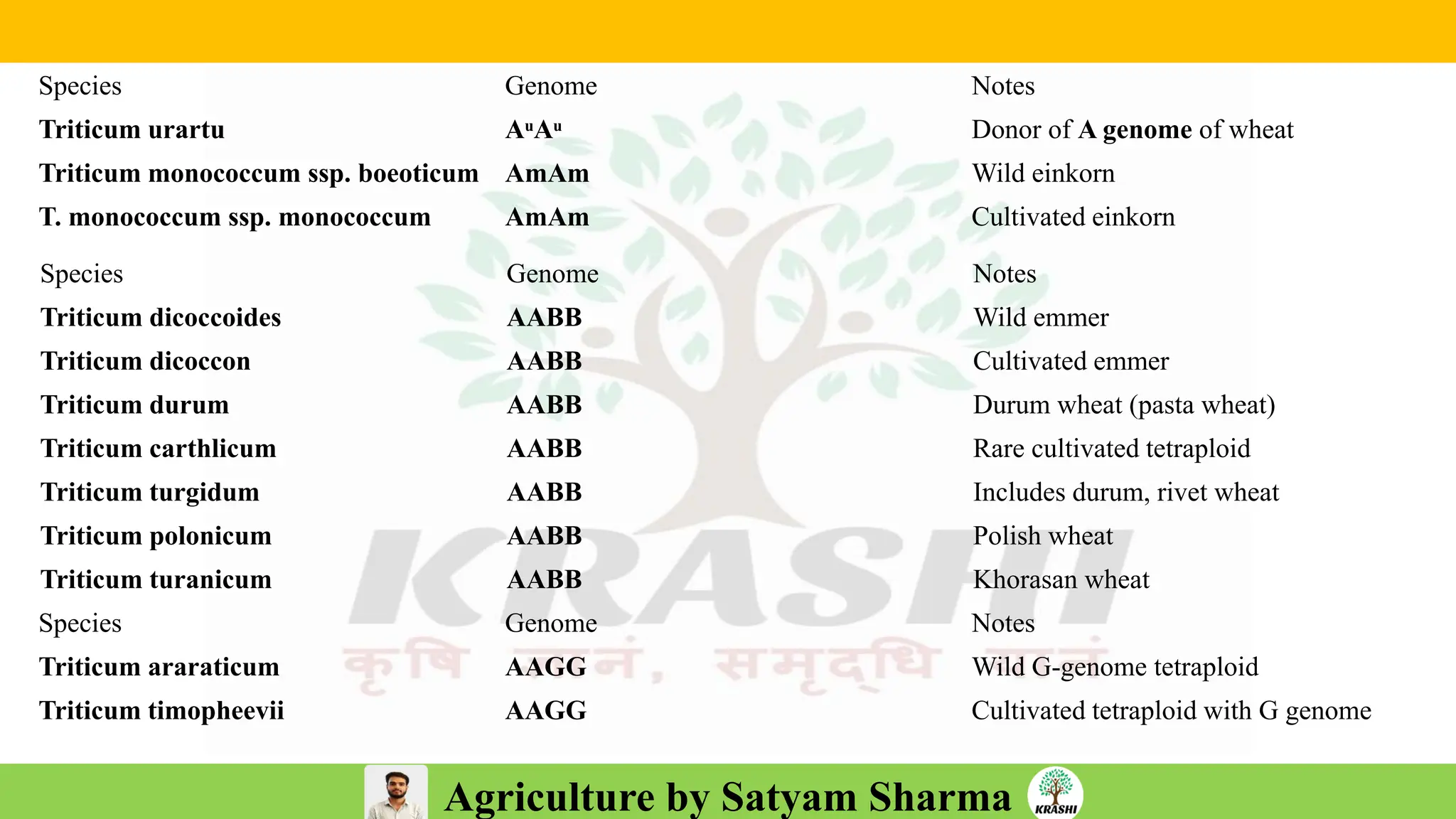
Species Genome Notes
Triticum urartu AᵘAᵘ Donor of A genome of wheat
Triticum monococcum ssp. boeoticum AmAm Wild einkorn
T. monococcum ssp. monococcum AmAm Cultivated einkorn
Species Genome Notes
Triticum dicoccoides AABB Wild emmer
Triticum dicoccon AABB Cultivated emmer
Triticum durum AABB Durum wheat (pasta wheat)
Triticum carthlicum AABB Rare cultivated tetraploid
Triticum turgidum AABB Includes durum, rivet wheat
Triticum polonicum AABB Polish wheat
Triticum turanicum AABB Khorasan wheat
Species Genome Notes
Triticum araraticum AAGG Wild G-genome tetraploid
Triticum timopheevii AAGG Cultivated tetraploid with G genome
Agriculture by Satyam Sharma
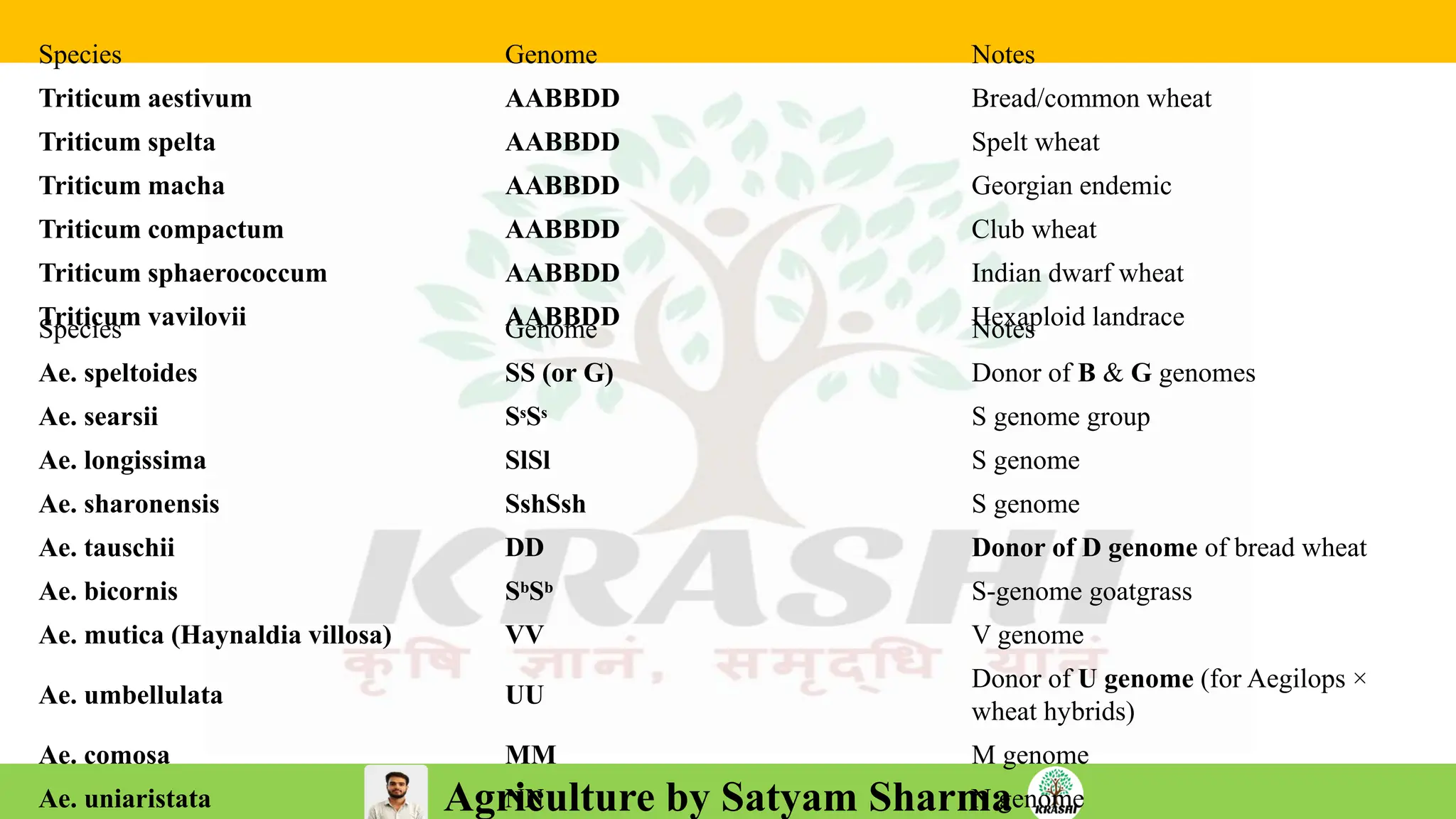
Species Genome Notes
Triticum aestivum AABBDD Bread/common wheat
Triticum spelta AABBDD Spelt wheat
Triticum macha AABBDD Georgian endemic
Triticum compactum AABBDD Club wheat
Triticum sphaerococcum AABBDD Indian dwarf wheat
Triticum vavilovii AABBDD Hexaploid landrace
Species Genome Notes
Ae. speltoides SS (or G) Donor of B & G genomes
Ae. searsii SˢSˢ S genome group
Ae. longissima SlSl S genome
Ae. sharonensis SshSsh S genome
Ae. tauschii DD Donor of D genome of bread wheat
Ae. bicornis SᵇSᵇ S-genome goatgrass
Ae. mutica (Haynaldia villosa) VV V genome
Ae. umbellulata UU
Donor of U genome (for Aegilops ×
wheat hybrids)
Ae. comosa MM M genome
Ae. uniaristata NN N genome
Agriculture by Satyam Sharma
Species Genome Notes
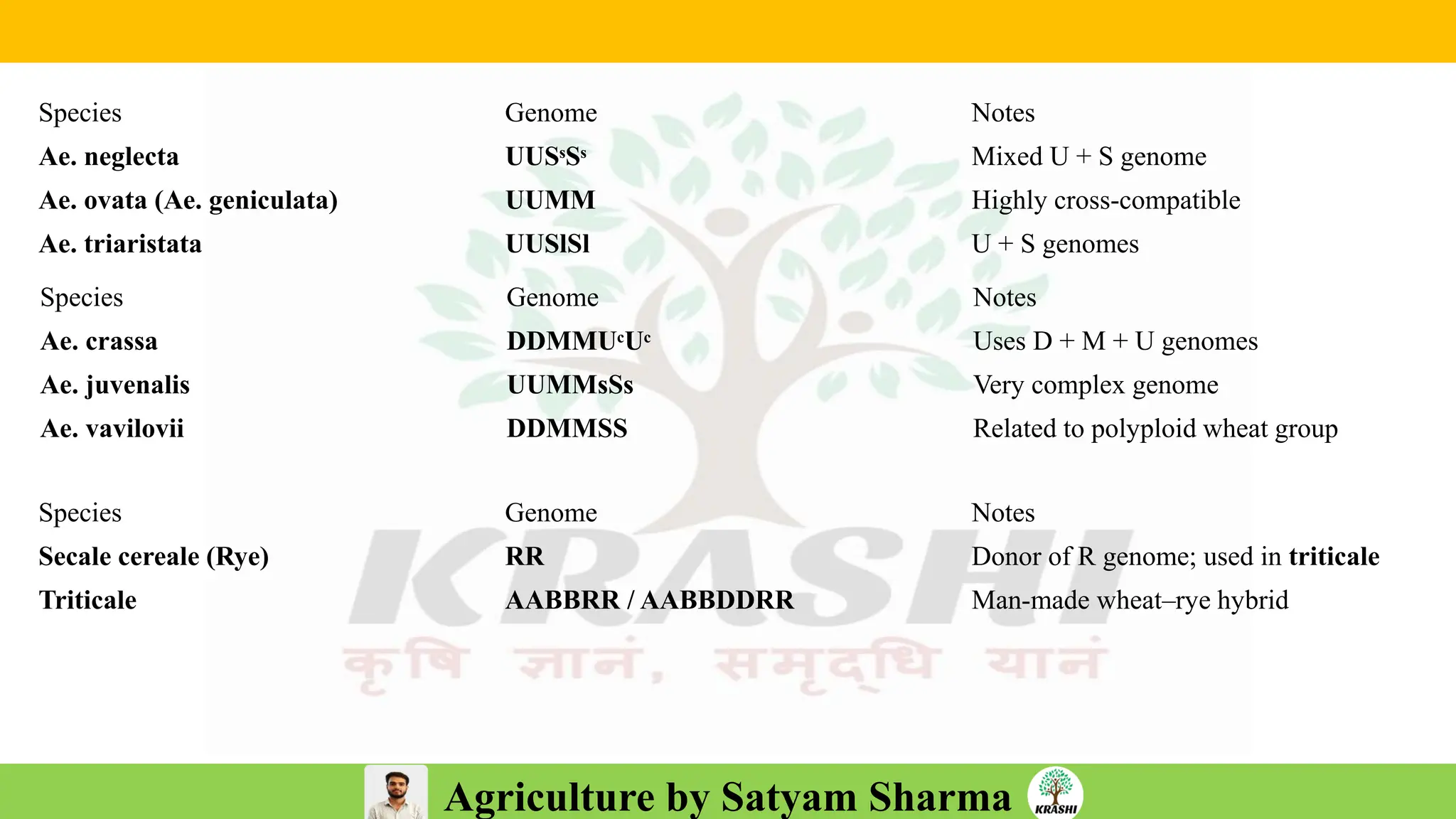
Ae. neglecta UUSˢSˢ Mixed U + S genome
Ae. ovata (Ae. geniculata) UUMM Highly cross-compatible
Ae. triaristata UUSlSl U + S genomes
Species Genome Notes
Ae. crassa DDMMUᶜUᶜ Uses D + M + U genomes
Ae. juvenalis UUMMsSs Very complex genome
Ae. vavilovii DDMMSS Related to polyploid wheat group
Species Genome Notes
Secale cereale (Rye) RR Donor of R genome; used in triticale
Triticale AABBRR / AABBDDRR Man-made wheat–rye hybrid
Agriculture by Satyam Sharma
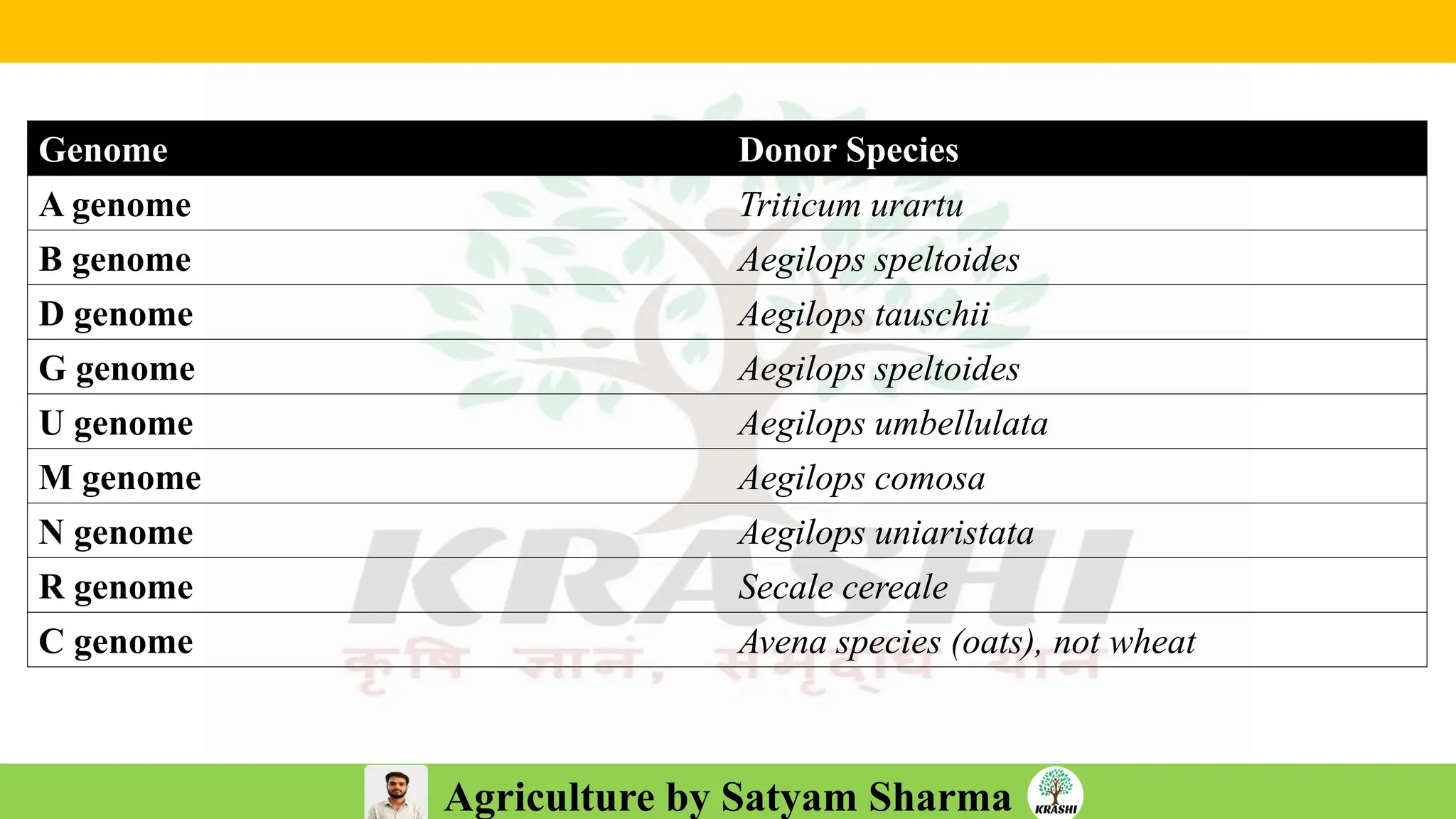
Genome Donor Species
A genome Triticum urartu
B genome Aegilops speltoides
D genome Aegilops tauschii
G genome Aegilops speltoides
U genome Aegilops umbellulata
M genome Aegilops comosa
N genome Aegilops uniaristata
R genome Secale cereale
C genome Avena species (oats), not wheat
Agriculture by Satyam Sharma
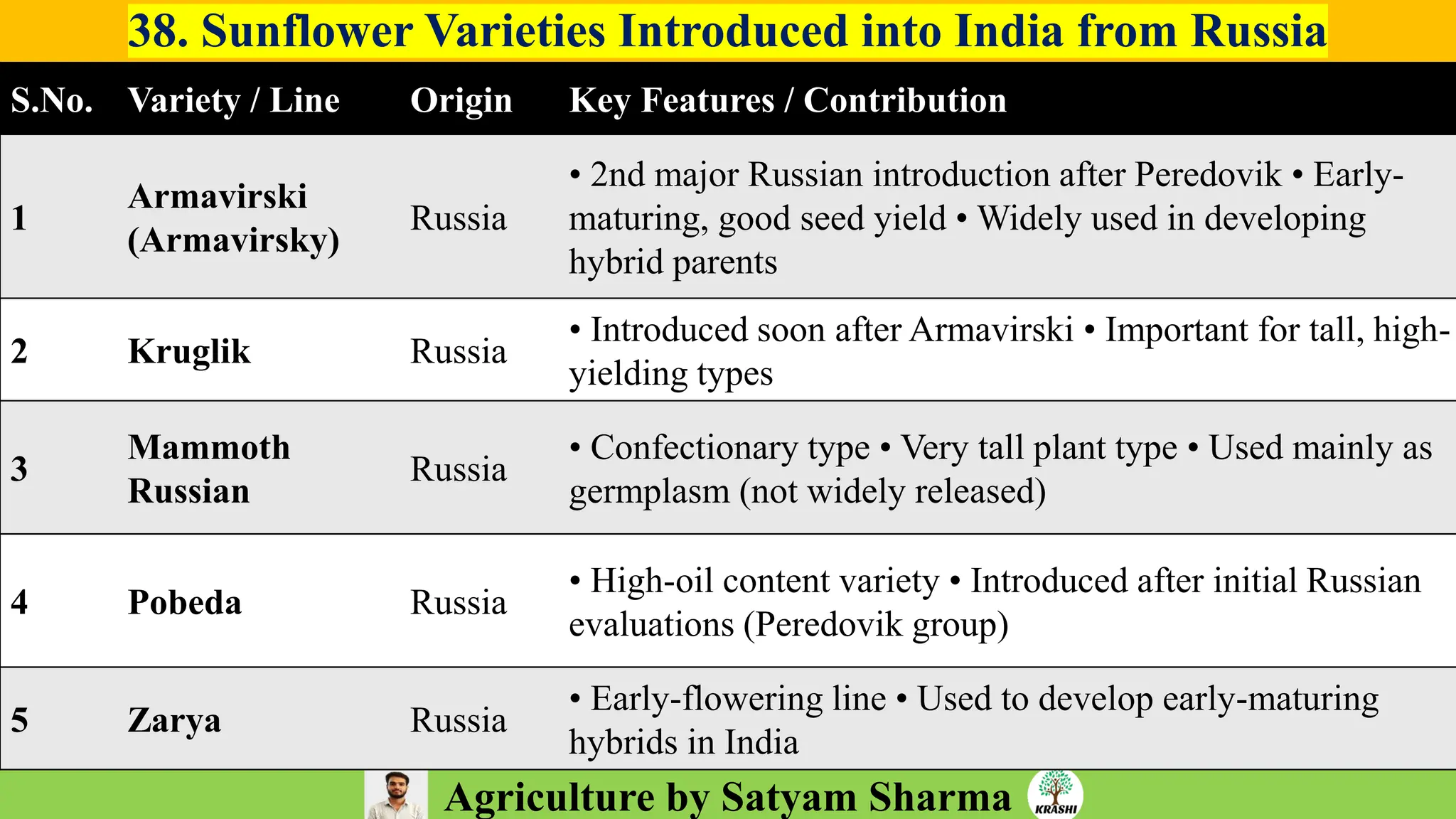
S.No. Variety / Line Origin Key Features / Contribution
1
Armavirski
(Armavirsky)
Russia
• 2nd major Russian introduction after Peredovik • Early-
maturing, good seed yield • Widely used in developing
hybrid parents
2 Kruglik Russia
• Introduced soon after Armavirski • Important for tall, high-
yielding types
3
Mammoth
Russian
Russia
• Confectionary type • Very tall plant type • Used mainly as
germplasm (not widely released)
4 Pobeda Russia
• High-oil content variety • Introduced after initial Russian
evaluations (Peredovik group)
5 Zarya Russia
• Early-flowering line • Used to develop early-maturing
hybrids in India
38. Sunflower Varieties Introduced into India from Russia
Agriculture by Satyam Sharma
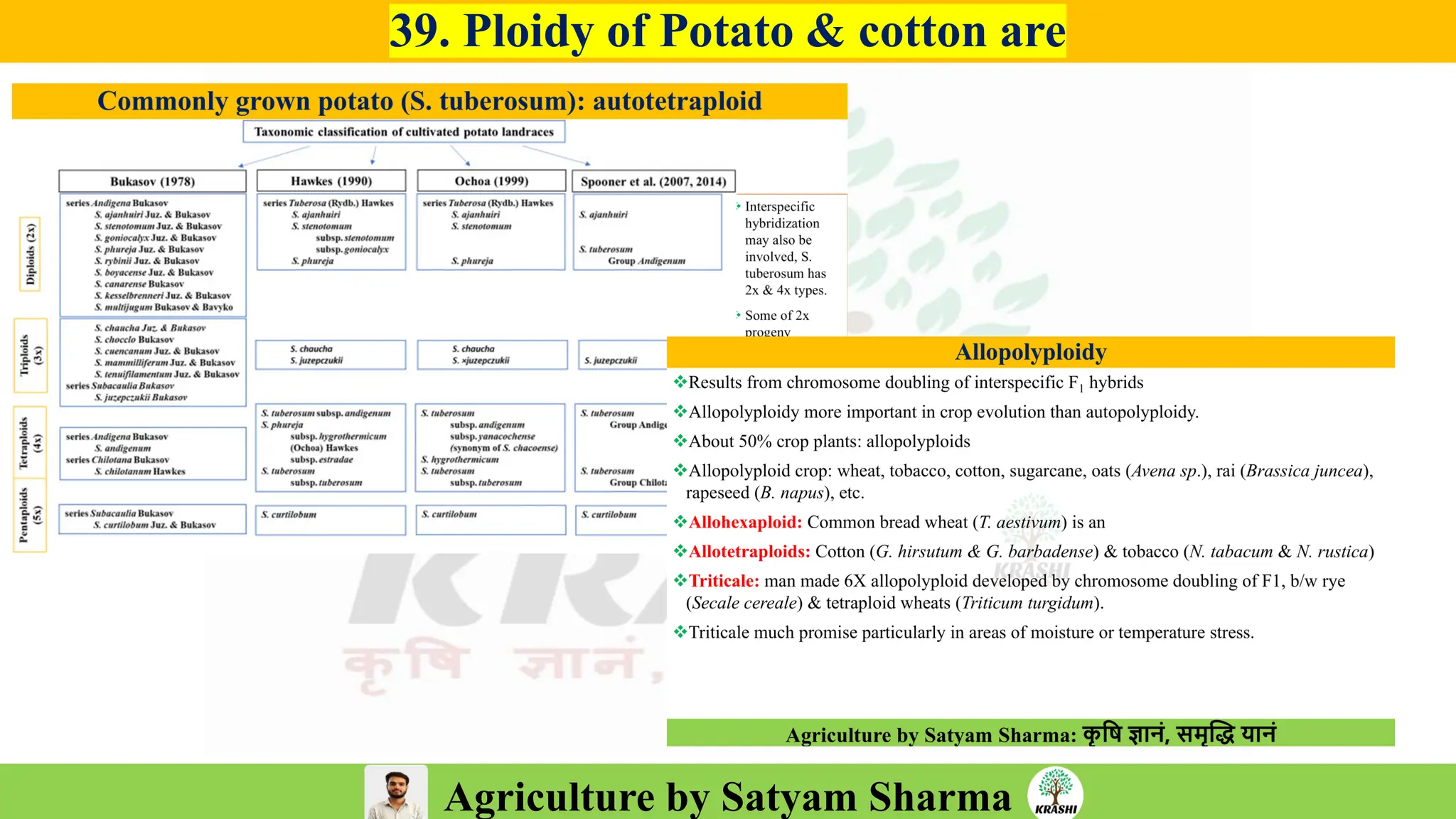
39. Ploidy of Potato & cotton are
Agriculture by Satyam Sharma
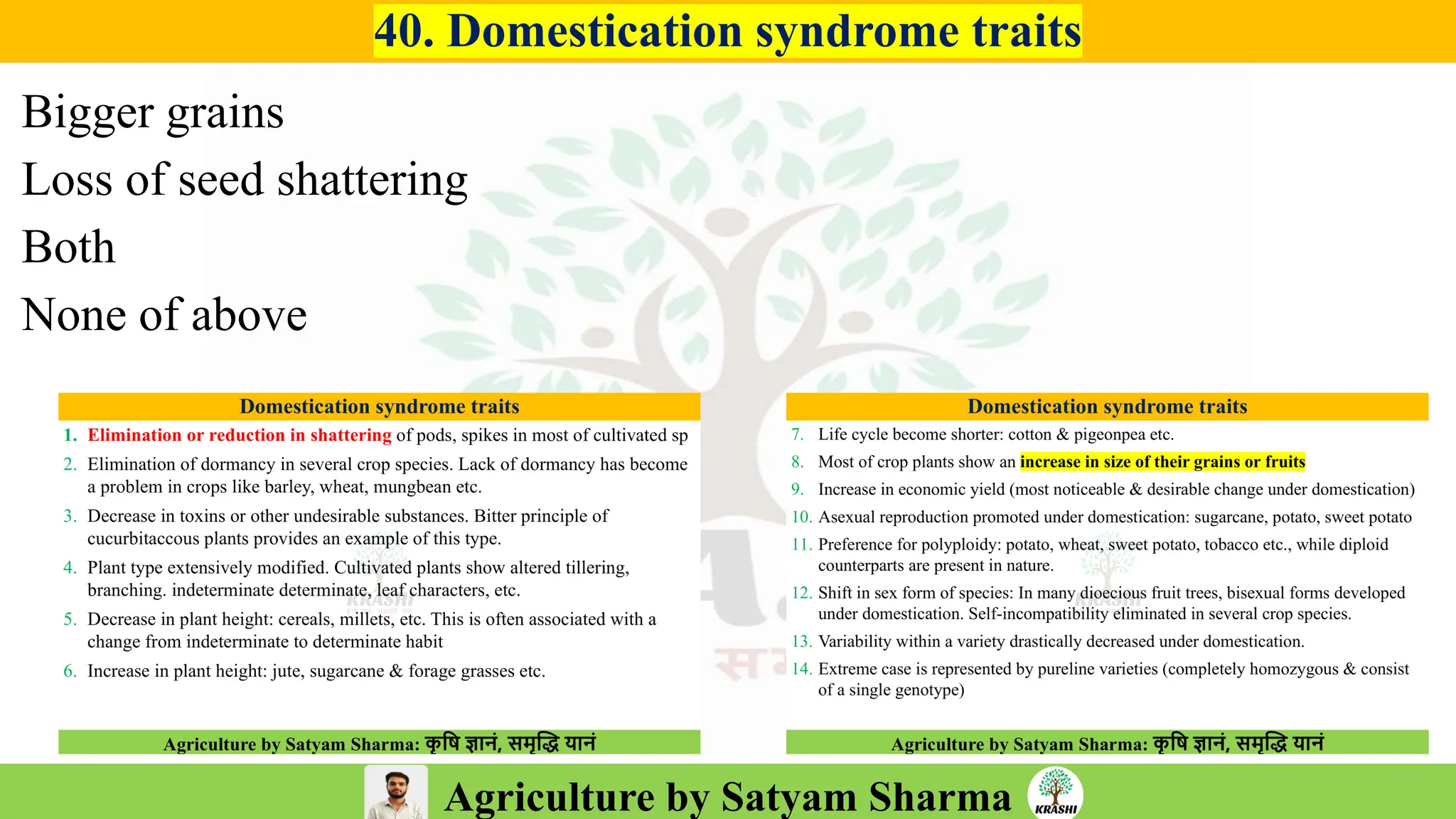
40. Domestication syndrome traits
Bigger grains
Loss of seed shattering
Both
None of above
Agriculture by Satyam Sharma
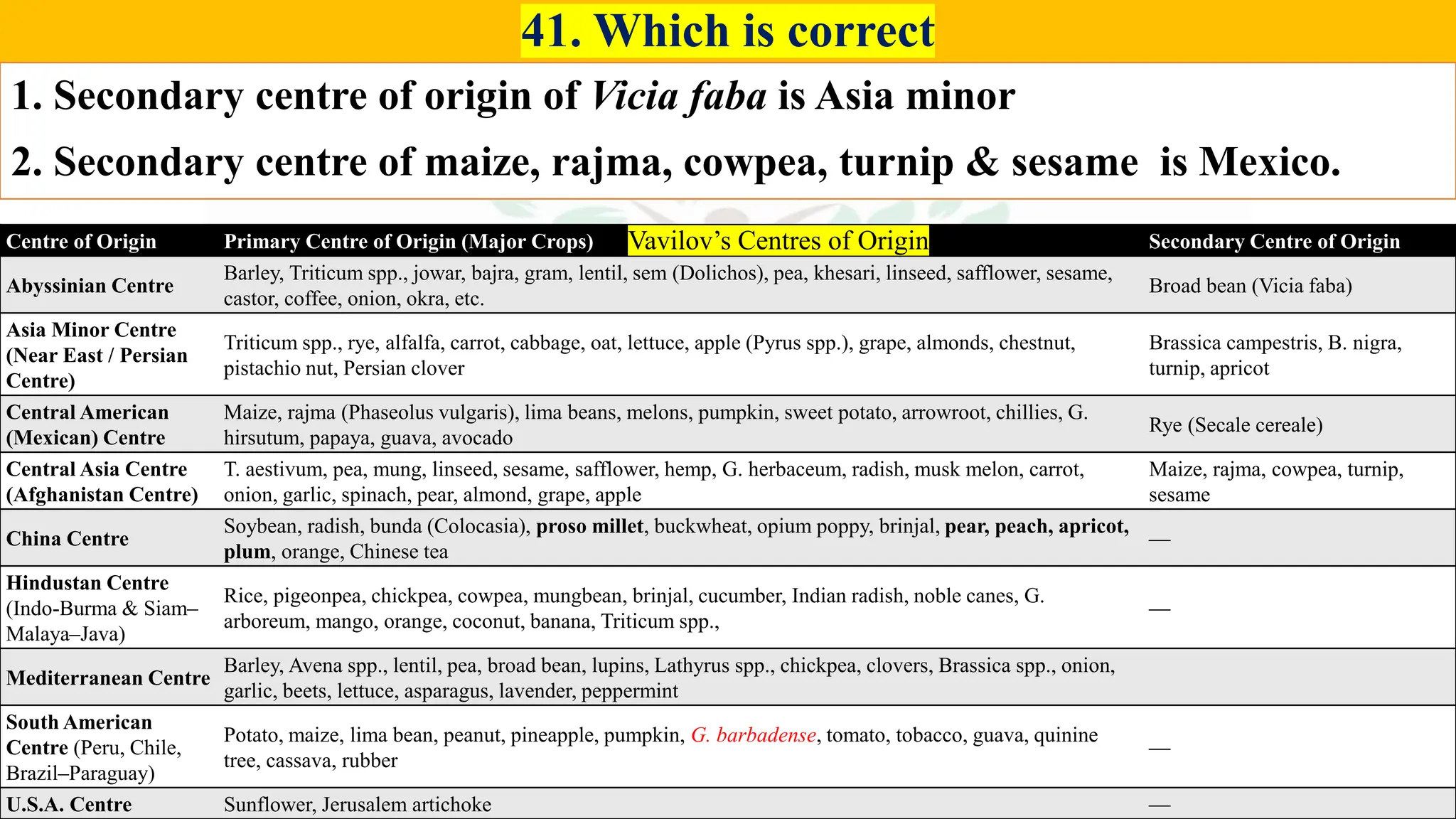
41. Which is correct
1. Secondary centre of origin of Vicia faba is Asia minor
2. Secondary centre of maize, rajma, cowpea, turnip & sesame is Mexico.
Centre of Origin Primary Centre of Origin (Major Crops) Secondary Centre of Origin
Abyssinian Centre
Barley, Triticum spp., jowar, bajra, gram, lentil, sem (Dolichos), pea, khesari, linseed, safflower, sesame,
castor, coffee, onion, okra, etc.
Broad bean (Vicia faba)
Asia Minor Centre
(Near East / Persian
Centre)
Triticum spp., rye, alfalfa, carrot, cabbage, oat, lettuce, apple (Pyrus spp.), grape, almonds, chestnut,
pistachio nut, Persian clover
Brassica campestris, B. nigra,
turnip, apricot
Central American
(Mexican) Centre
Maize, rajma (Phaseolus vulgaris), lima beans, melons, pumpkin, sweet potato, arrowroot, chillies, G.
hirsutum, papaya, guava, avocado
Rye (Secale cereale)
Central Asia Centre
(Afghanistan Centre)
T. aestivum, pea, mung, linseed, sesame, safflower, hemp, G. herbaceum, radish, musk melon, carrot,
onion, garlic, spinach, pear, almond, grape, apple
Maize, rajma, cowpea, turnip,
sesame
China Centre
Soybean, radish, bunda (Colocasia), proso millet, buckwheat, opium poppy, brinjal, pear, peach, apricot,
plum, orange, Chinese tea
—
Hindustan Centre
(Indo-Burma & Siam–
Malaya–Java)
Rice, pigeonpea, chickpea, cowpea, mungbean, brinjal, cucumber, Indian radish, noble canes, G.
arboreum, mango, orange, coconut, banana, Triticum spp.,
—
Mediterranean Centre
Barley, Avena spp., lentil, pea, broad bean, lupins, Lathyrus spp., chickpea, clovers, Brassica spp., onion,
garlic, beets, lettuce, asparagus, lavender, peppermint
South American
Centre (Peru, Chile,
Brazil–Paraguay)
Potato, maize, lima bean, peanut, pineapple, pumpkin, G. barbadense, tomato, tobacco, guava, quinine
tree, cassava, rubber
—
U.S.A. Centre Sunflower, Jerusalem artichoke —
Vavilov’s Centres of Origin
Agriculture by Satyam Sharma
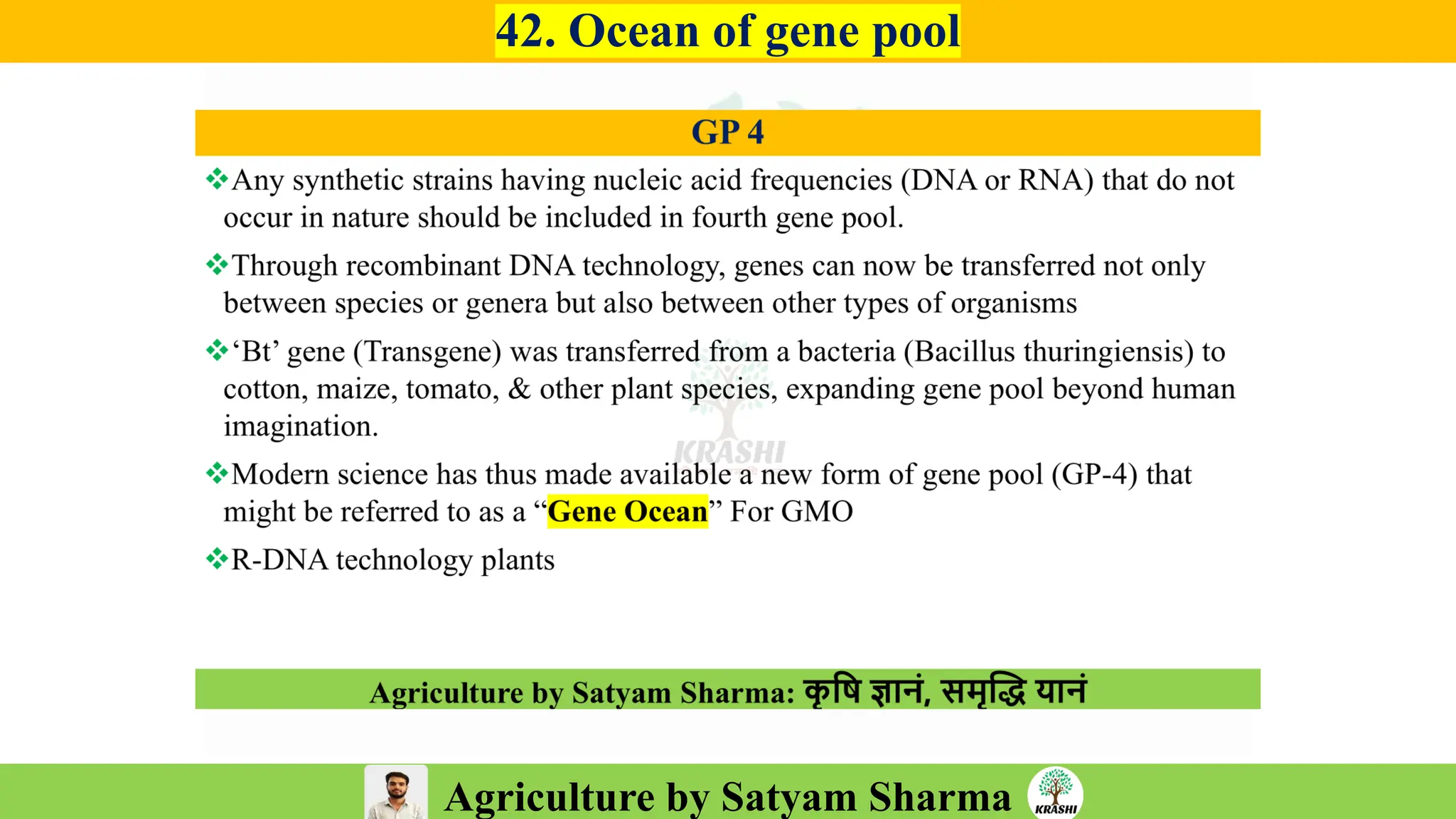
42. Ocean of gene pool
Agriculture by Satyam Sharma
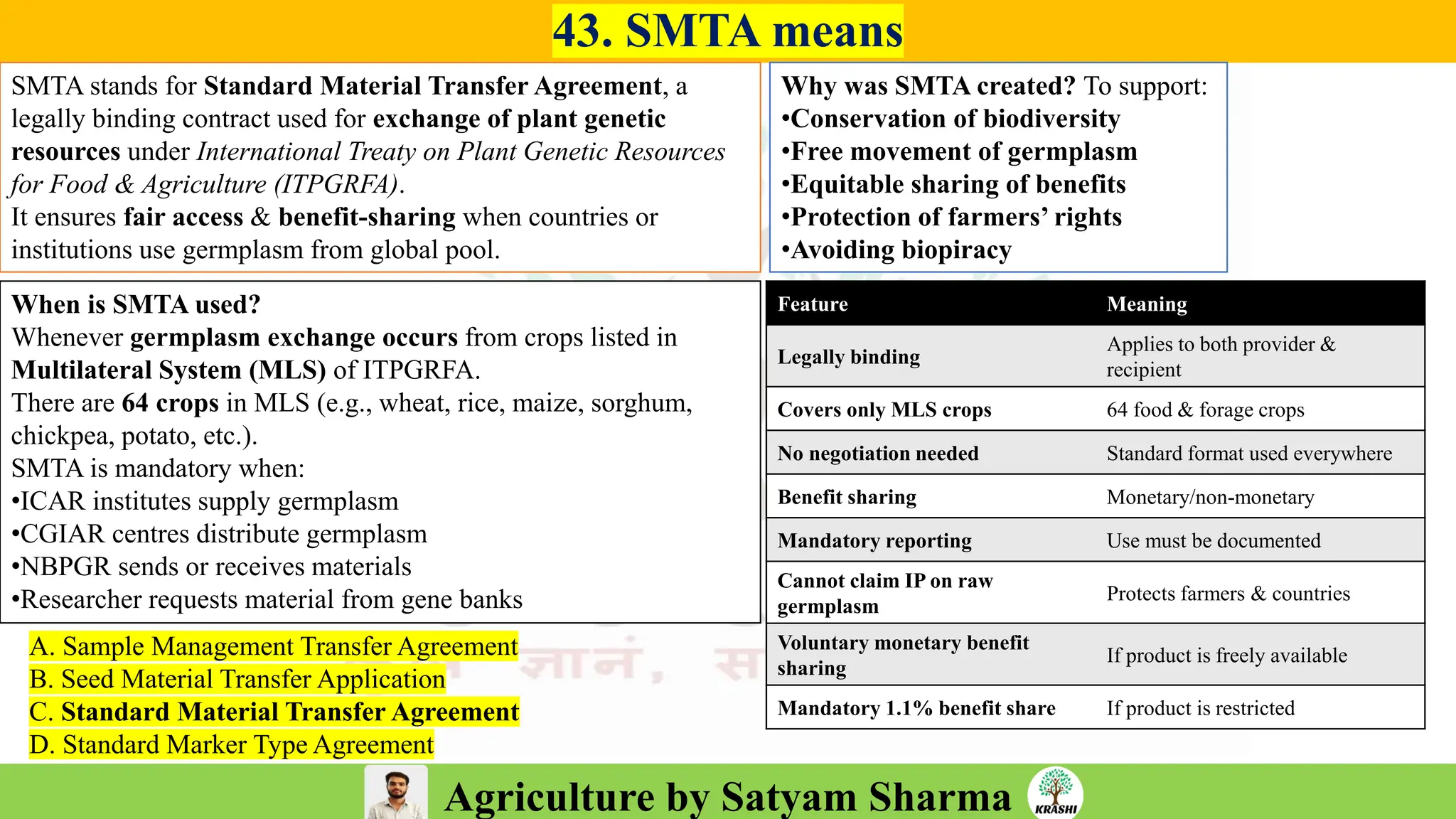
43. SMTA means
A. Sample Management Transfer Agreement
B. Seed Material Transfer Application
C. Standard Material Transfer Agreement
D. Standard Marker Type Agreement
SMTA stands for Standard Material Transfer Agreement, a
legally binding contract used for exchange of plant genetic
resources under International Treaty on Plant Genetic Resources
for Food & Agriculture (ITPGRFA).
It ensures fair access & benefit-sharing when countries or
institutions use germplasm from global pool.
Why was SMTA created? To support:
•Conservation of biodiversity
•Free movement of germplasm
•Equitable sharing of benefits
•Protection of farmers’ rights
•Avoiding biopiracy
When is SMTA used?
Whenever germplasm exchange occurs from crops listed in
Multilateral System (MLS) of ITPGRFA.
There are 64 crops in MLS (e.g., wheat, rice, maize, sorghum,
chickpea, potato, etc.).
SMTA is mandatory when:
•ICAR institutes supply germplasm
•CGIAR centres distribute germplasm
•NBPGR sends or receives materials
•Researcher requests material from gene banks
Feature Meaning
Legally binding
Applies to both provider &
recipient
Covers only MLS crops 64 food & forage crops
No negotiation needed Standard format used everywhere
Benefit sharing Monetary/non-monetary
Mandatory reporting Use must be documented
Cannot claim IP on raw
germplasm
Protects farmers & countries
Voluntary monetary benefit
sharing
If product is freely available
Mandatory 1.1% benefit share If product is restricted
Agriculture by Satyam Sharma
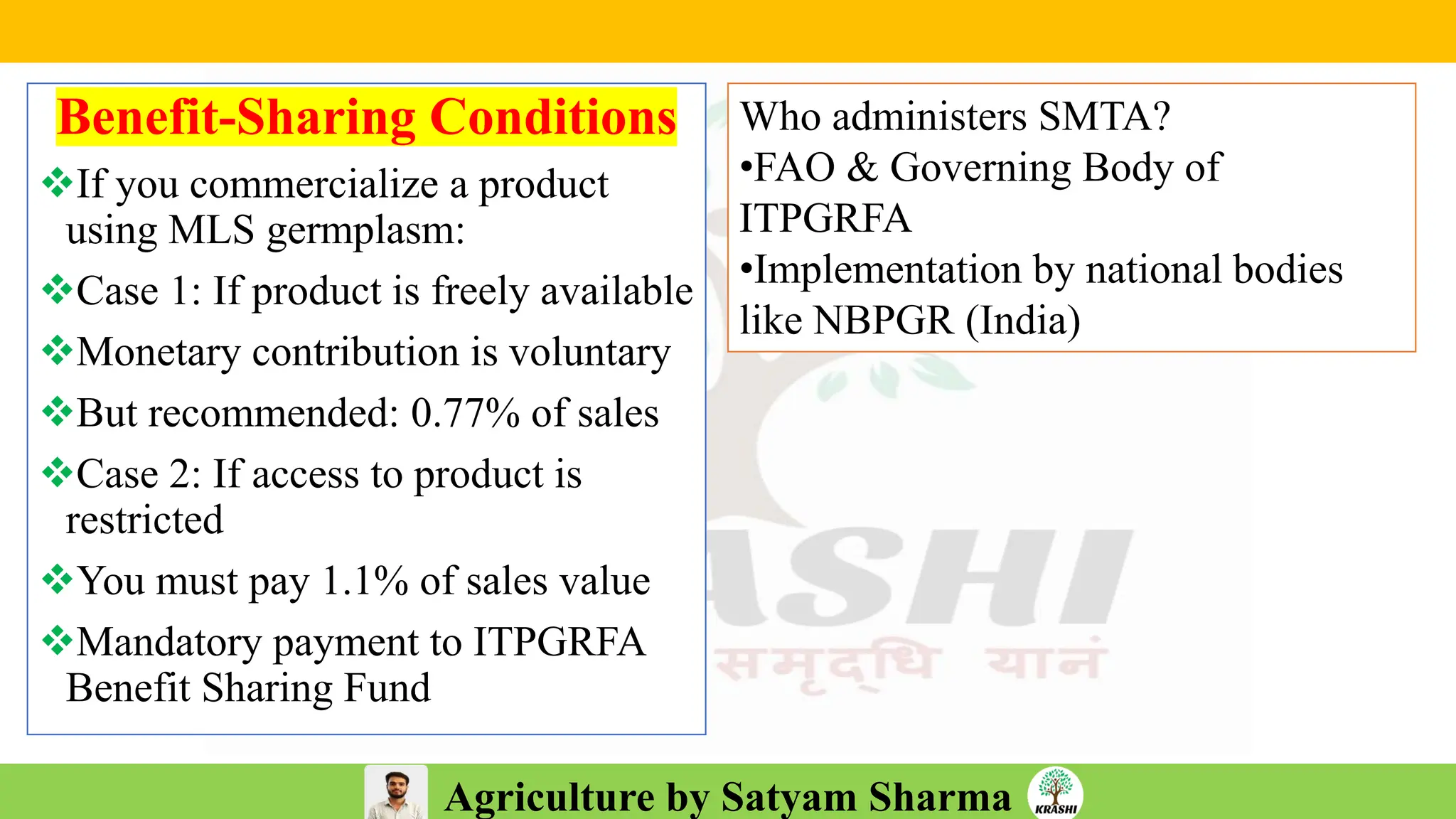
Benefit-Sharing Conditions
❖If you commercialize a product
using MLS germplasm:
❖Case 1: If product is freely available
❖Monetary contribution is voluntary
❖But recommended: 0.77% of sales
❖Case 2: If access to product is
restricted
❖You must pay 1.1% of sales value
❖Mandatory payment to ITPGRFA
Benefit Sharing Fund
Who administers SMTA?
•FAO & Governing Body of
ITPGRFA
•Implementation by national bodies
like NBPGR (India)
Agriculture by Satyam Sharma
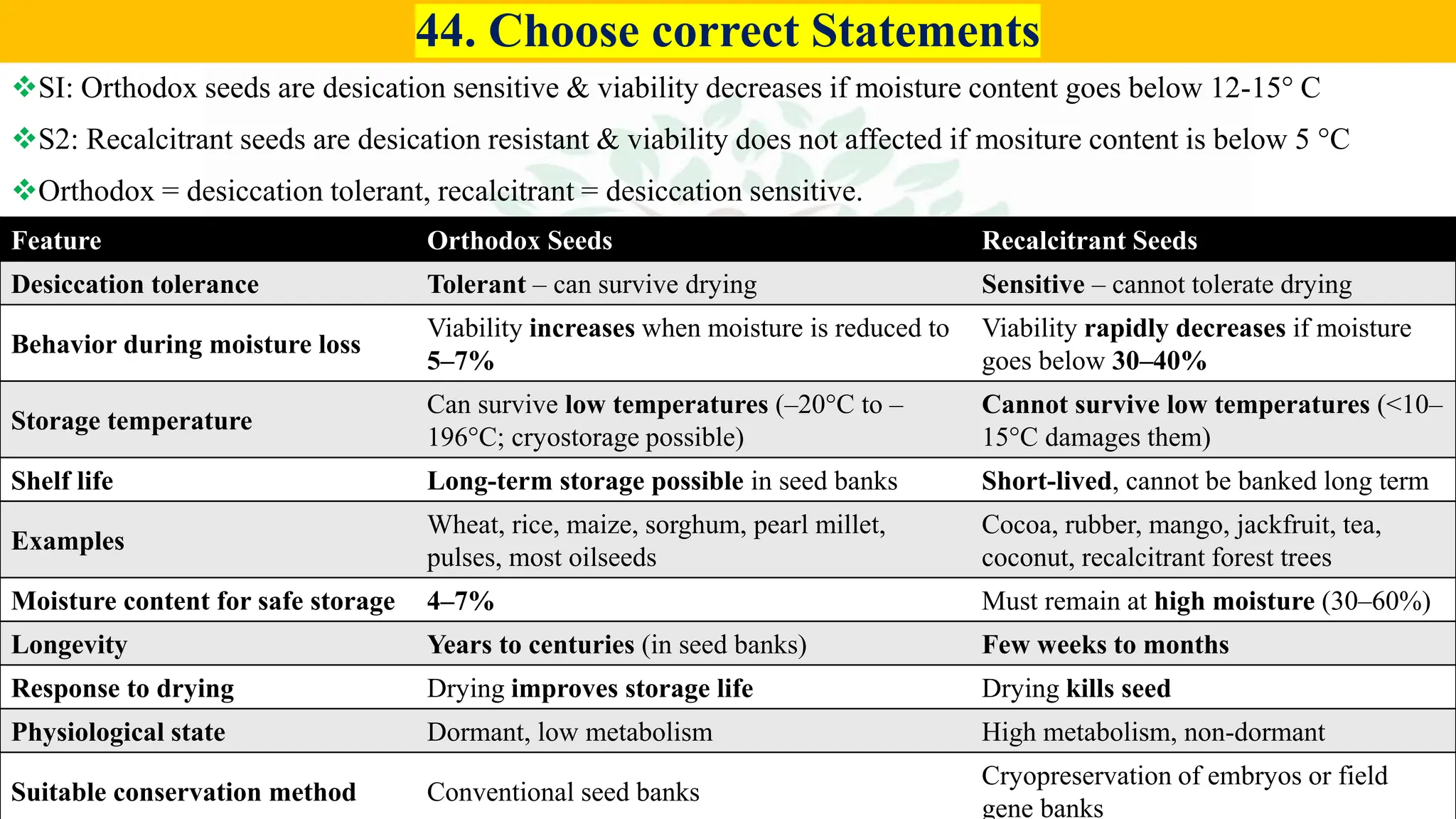
44. Choose correct Statements
❖SI: Orthodox seeds are desication sensitive & viability decreases if moisture content goes below 12-15° C
❖S2: Recalcitrant seeds are desication resistant & viability does not affected if mositure content is below 5 °C
❖Orthodox = desiccation tolerant, recalcitrant = desiccation sensitive.
Feature Orthodox Seeds Recalcitrant Seeds
Desiccation tolerance Tolerant – can survive drying Sensitive – cannot tolerate drying
Behavior during moisture loss
Viability increases when moisture is reduced to
5–7%
Viability rapidly decreases if moisture
goes below 30–40%
Storage temperature
Can survive low temperatures (–20°C to –
196°C; cryostorage possible)
Cannot survive low temperatures (<10–
15°C damages them)
Shelf life Long-term storage possible in seed banks Short-lived, cannot be banked long term
Examples
Wheat, rice, maize, sorghum, pearl millet,
pulses, most oilseeds
Cocoa, rubber, mango, jackfruit, tea,
coconut, recalcitrant forest trees
Moisture content for safe storage 4–7% Must remain at high moisture (30–60%)
Longevity Years to centuries (in seed banks) Few weeks to months
Response to drying Drying improves storage life Drying kills seed
Physiological state Dormant, low metabolism High metabolism, non-dormant
Suitable conservation method Conventional seed banks
Cryopreservation of embryos or field
gene banks
Agriculture by Satyam Sharma
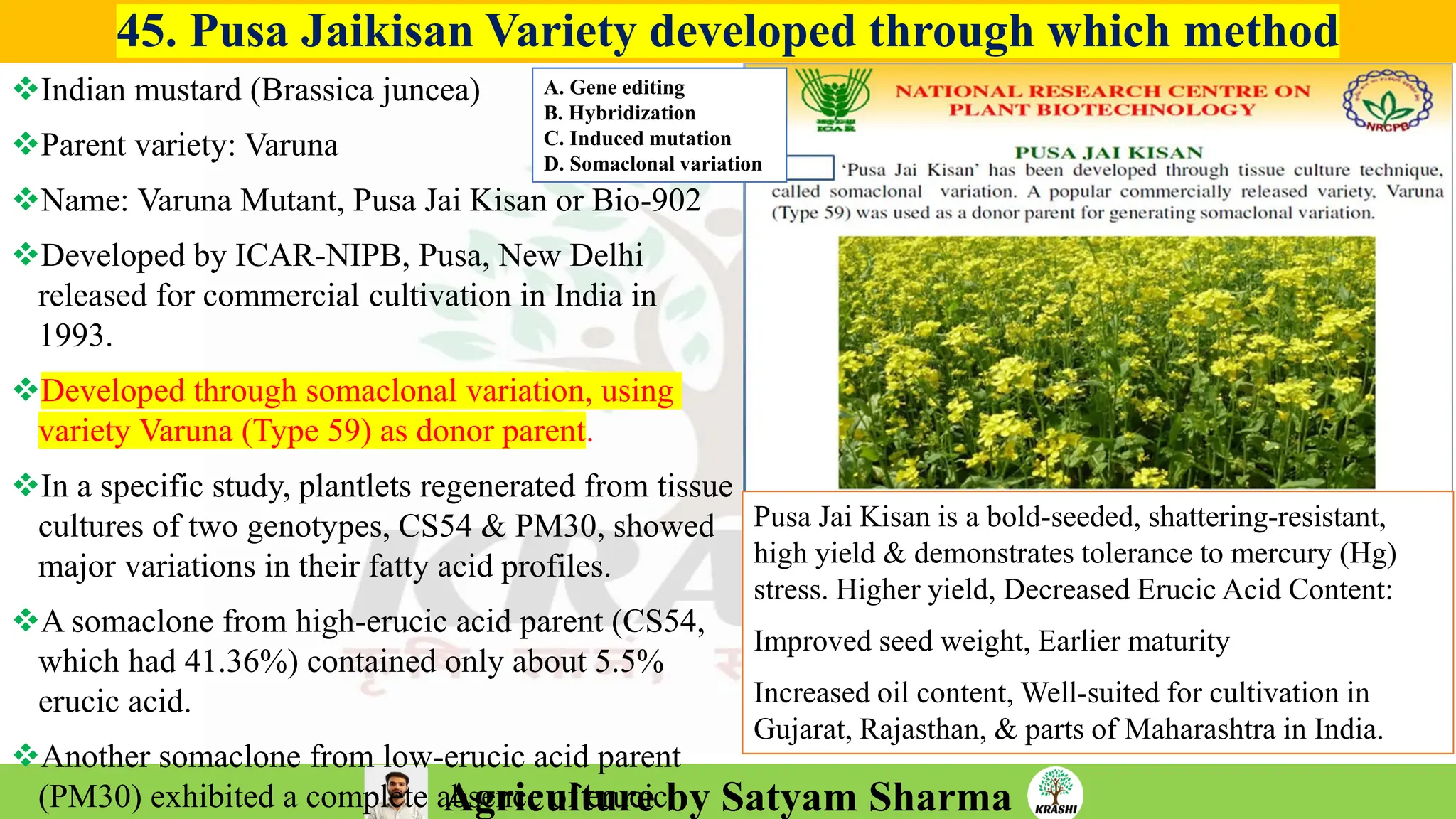
45. Pusa Jaikisan Variety developed through which method
❖Indian mustard (Brassica juncea)
❖Parent variety: Varuna
❖Name: Varuna Mutant, Pusa Jai Kisan or Bio-902
❖Developed by ICAR-NIPB, Pusa, New Delhi
released for commercial cultivation in India in
1993.
❖Developed through somaclonal variation, using
variety Varuna (Type 59) as donor parent.
❖In a specific study, plantlets regenerated from tissue
cultures of two genotypes, CS54 & PM30, showed
major variations in their fatty acid profiles.
❖A somaclone from high-erucic acid parent (CS54,
which had 41.36%) contained only about 5.5%
erucic acid.
❖Another somaclone from low-erucic acid parent
(PM30) exhibited a complete absence of erucic
Pusa Jai Kisan is a bold-seeded, shattering-resistant,
high yield & demonstrates tolerance to mercury (Hg)
stress. Higher yield, Decreased Erucic Acid Content:
Improved seed weight, Earlier maturity
Increased oil content, Well-suited for cultivation in
Gujarat, Rajasthan, & parts of Maharashtra in India.
A. Gene editing
B. Hybridization
C. Induced mutation
D. Somaclonal variation
Agriculture by Satyam Sharma
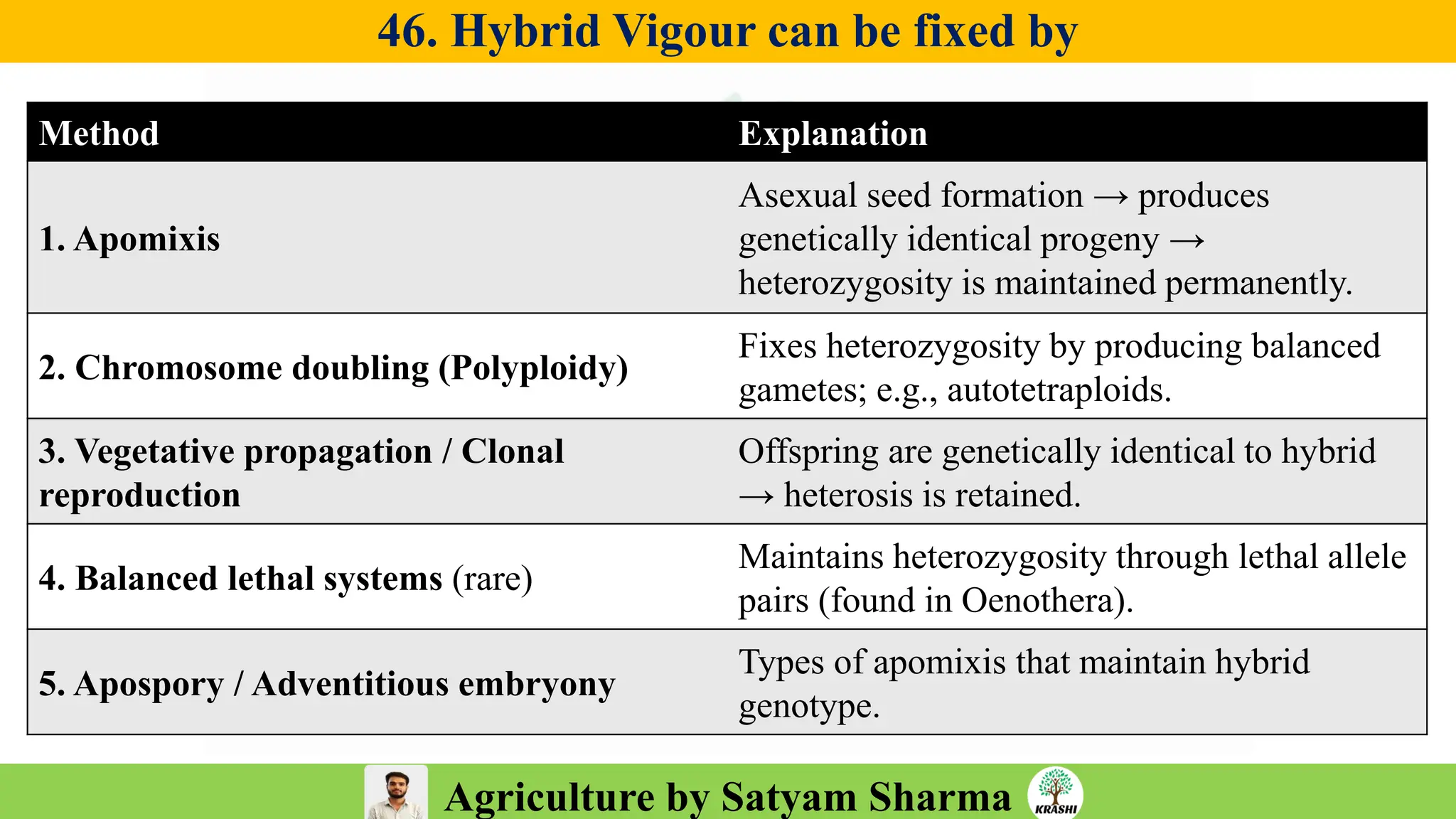
46. Hybrid Vigour can be fixed by
Method Explanation
1. Apomixis
Asexual seed formation → produces
genetically identical progeny →
heterozygosity is maintained permanently.
2. Chromosome doubling (Polyploidy)
Fixes heterozygosity by producing balanced
gametes; e.g., autotetraploids.
3. Vegetative propagation / Clonal
reproduction
Offspring are genetically identical to hybrid
→ heterosis is retained.
4. Balanced lethal systems (rare)
Maintains heterozygosity through lethal allele
pairs (found in Oenothera).
5. Apospory / Adventitious embryony
Types of apomixis that maintain hybrid
genotype.
Agriculture by Satyam Sharma
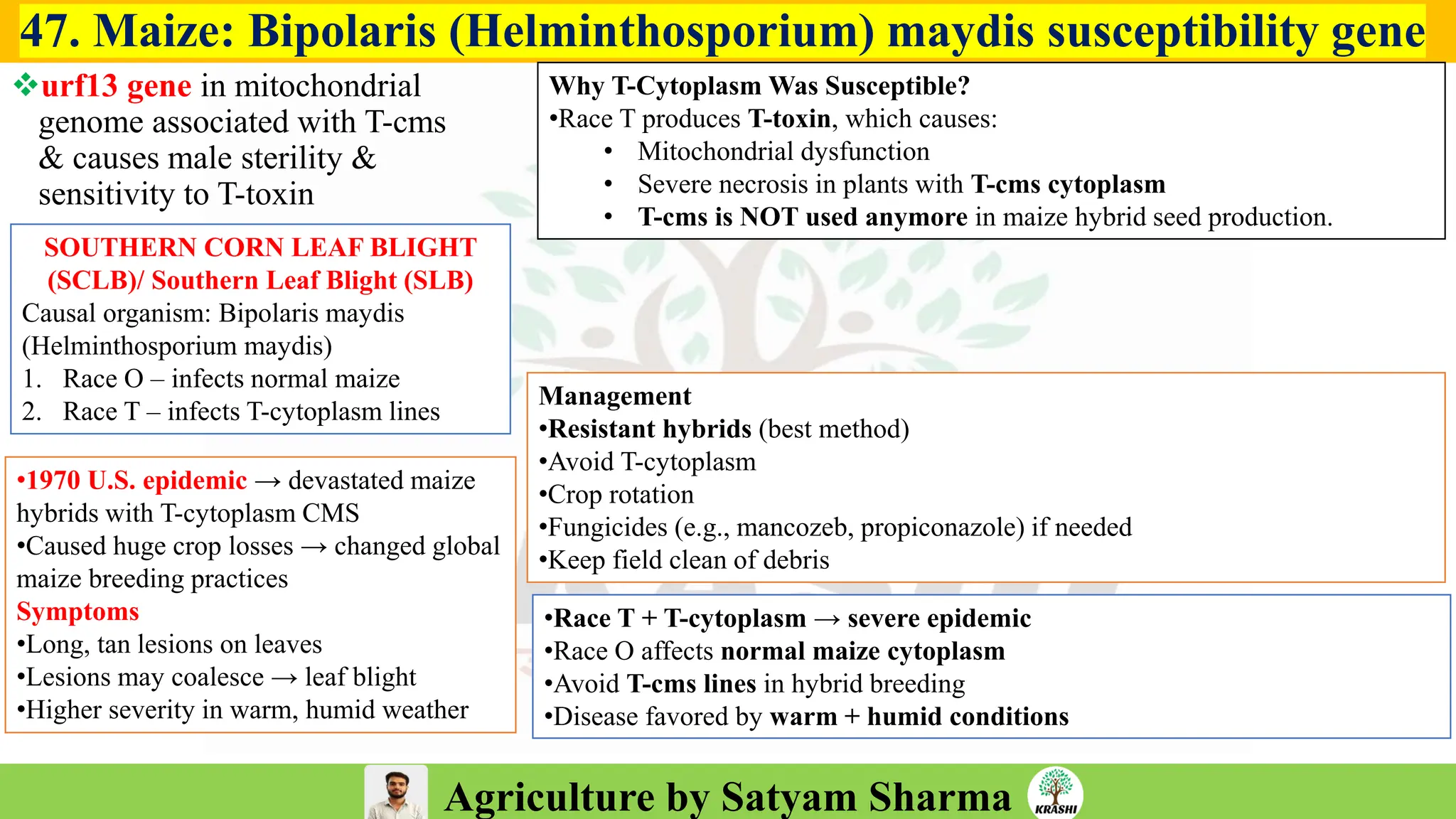
47. Maize: Bipolaris (Helminthosporium) maydis susceptibility gene
❖urf13 gene in mitochondrial
genome associated with T-cms
& causes male sterility &
sensitivity to T-toxin
Why T-Cytoplasm Was Susceptible?
•Race T produces T-toxin, which causes:
• Mitochondrial dysfunction
• Severe necrosis in plants with T-cms cytoplasm
• T-cms is NOT used anymore in maize hybrid seed production.
SOUTHERN CORN LEAF BLIGHT
(SCLB)/ Southern Leaf Blight (SLB)
Causal organism: Bipolaris maydis
(Helminthosporium maydis)
1. Race O – infects normal maize
2. Race T – infects T-cytoplasm lines
•1970 U.S. epidemic → devastated maize
hybrids with T-cytoplasm CMS
•Caused huge crop losses → changed global
maize breeding practices
Symptoms
•Long, tan lesions on leaves
•Lesions may coalesce → leaf blight
•Higher severity in warm, humid weather
•Race T + T-cytoplasm → severe epidemic
•Race O affects normal maize cytoplasm
•Avoid T-cms lines in hybrid breeding
•Disease favored by warm + humid conditions
Management
•Resistant hybrids (best method)
•Avoid T-cytoplasm
•Crop rotation
•Fungicides (e.g., mancozeb, propiconazole) if needed
•Keep field clean of debris
Agriculture by Satyam Sharma
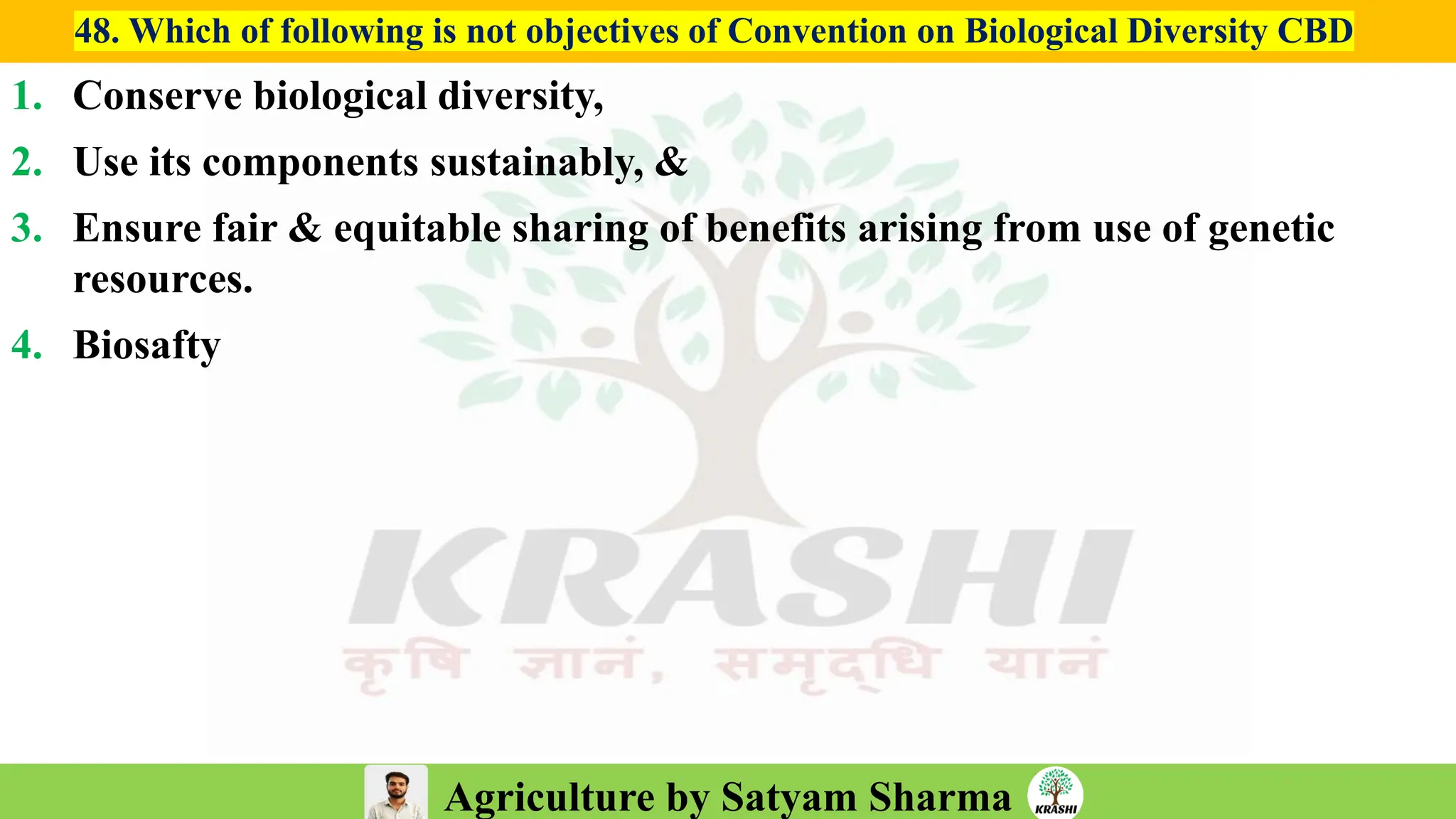
48. Which of following is not objectives of Convention on Biological Diversity CBD
1. Conserve biological diversity,
2. Use its components sustainably, &
3. Ensure fair & equitable sharing of benefits arising from use of genetic
resources.
4. Biosafty
Agriculture by Satyam Sharma
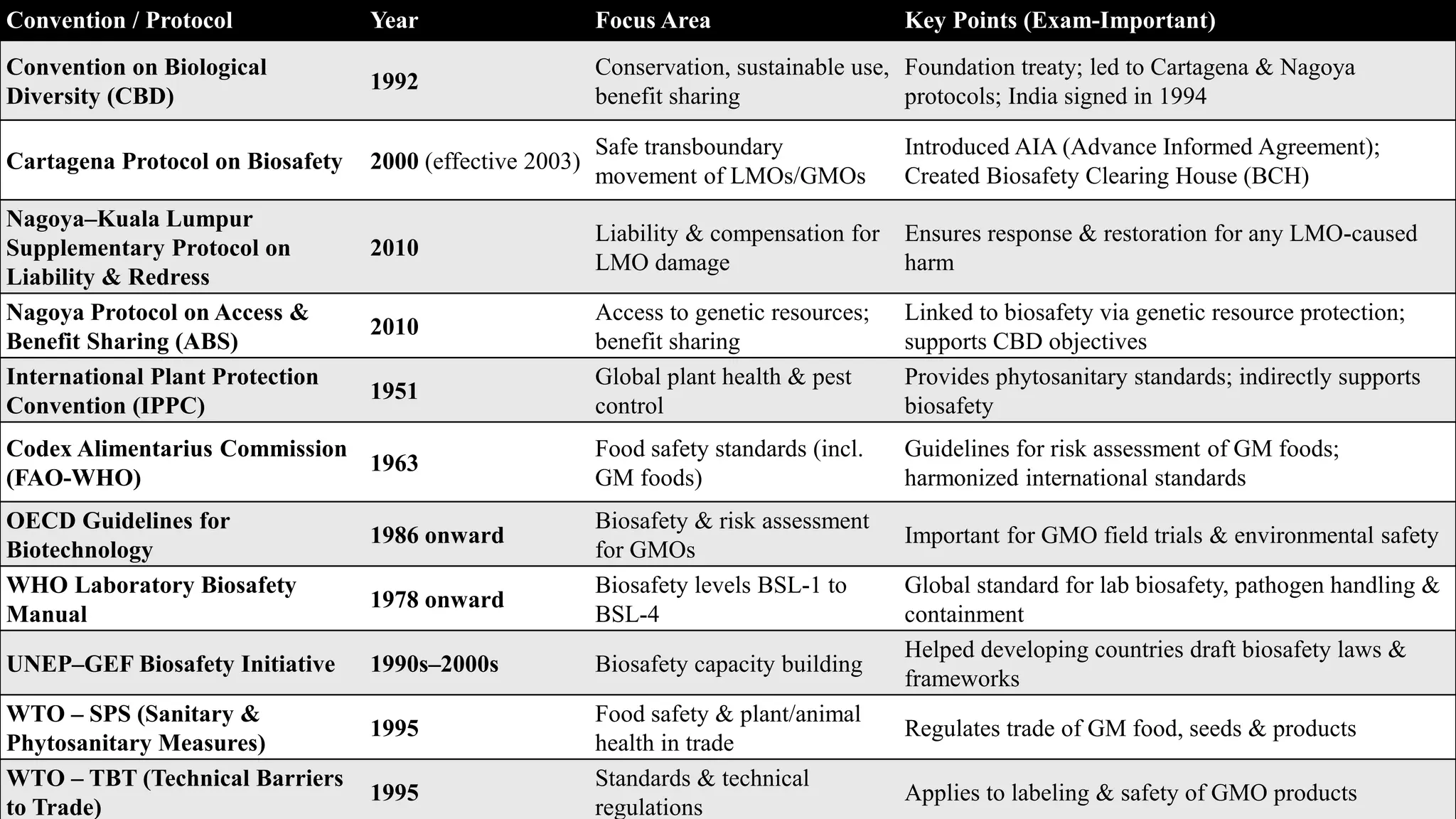
Convention / Protocol Year Focus Area Key Points (Exam-Important)
Convention on Biological
Diversity (CBD)
1992
Conservation, sustainable use,
benefit sharing
Foundation treaty; led to Cartagena & Nagoya
protocols; India signed in 1994
Cartagena Protocol on Biosafety 2000 (effective 2003)
Safe transboundary
movement of LMOs/GMOs
Introduced AIA (Advance Informed Agreement);
Created Biosafety Clearing House (BCH)
Nagoya–Kuala Lumpur
Supplementary Protocol on
Liability & Redress
2010
Liability & compensation for
LMO damage
Ensures response & restoration for any LMO-caused
harm
Nagoya Protocol on Access &
Benefit Sharing (ABS)
2010
Access to genetic resources;
benefit sharing
Linked to biosafety via genetic resource protection;
supports CBD objectives
International Plant Protection
Convention (IPPC)
1951
Global plant health & pest
control
Provides phytosanitary standards; indirectly supports
biosafety
Codex Alimentarius Commission
(FAO-WHO)
1963
Food safety standards (incl.
GM foods)
Guidelines for risk assessment of GM foods;
harmonized international standards
OECD Guidelines for
Biotechnology
1986 onward
Biosafety & risk assessment
for GMOs
Important for GMO field trials & environmental safety
WHO Laboratory Biosafety
Manual
1978 onward
Biosafety levels BSL-1 to
BSL-4
Global standard for lab biosafety, pathogen handling &
containment
UNEP–GEF Biosafety Initiative 1990s–2000s Biosafety capacity building
Helped developing countries draft biosafety laws &
frameworks
WTO – SPS (Sanitary &
Phytosanitary Measures)
1995
Food safety & plant/animal
health in trade
Regulates trade of GM food, seeds & products
WTO – TBT (Technical Barriers
to Trade)
1995
Standards & technical
regulations
Applies to labeling & safety of GMO products
Agriculture by Satyam Sharma
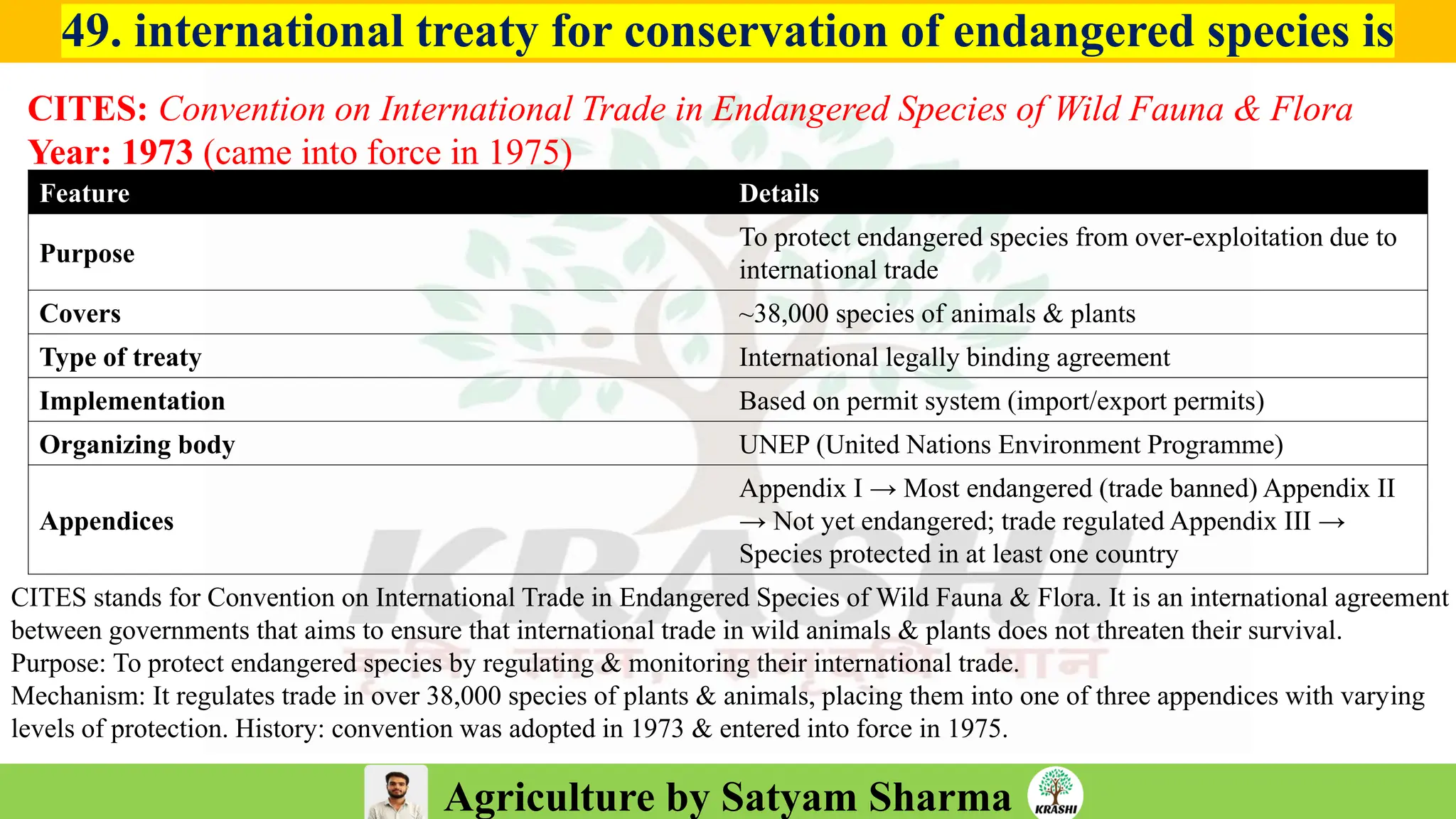
49. international treaty for conservation of endangered species is
Feature Details
Purpose
To protect endangered species from over-exploitation due to
international trade
Covers ~38,000 species of animals & plants
Type of treaty International legally binding agreement
Implementation Based on permit system (import/export permits)
Organizing body UNEP (United Nations Environment Programme)
Appendices
Appendix I → Most endangered (trade banned) Appendix II
→ Not yet endangered; trade regulated Appendix III →
Species protected in at least one country
CITES: Convention on International Trade in Endangered Species of Wild Fauna & Flora
Year: 1973 (came into force in 1975)
CITES stands for Convention on International Trade in Endangered Species of Wild Fauna & Flora. It is an international agreement
between governments that aims to ensure that international trade in wild animals & plants does not threaten their survival.
Purpose: To protect endangered species by regulating & monitoring their international trade.
Mechanism: It regulates trade in over 38,000 species of plants & animals, placing them into one of three appendices with varying
levels of protection. History: convention was adopted in 1973 & entered into force in 1975.
Agriculture by Satyam Sharma
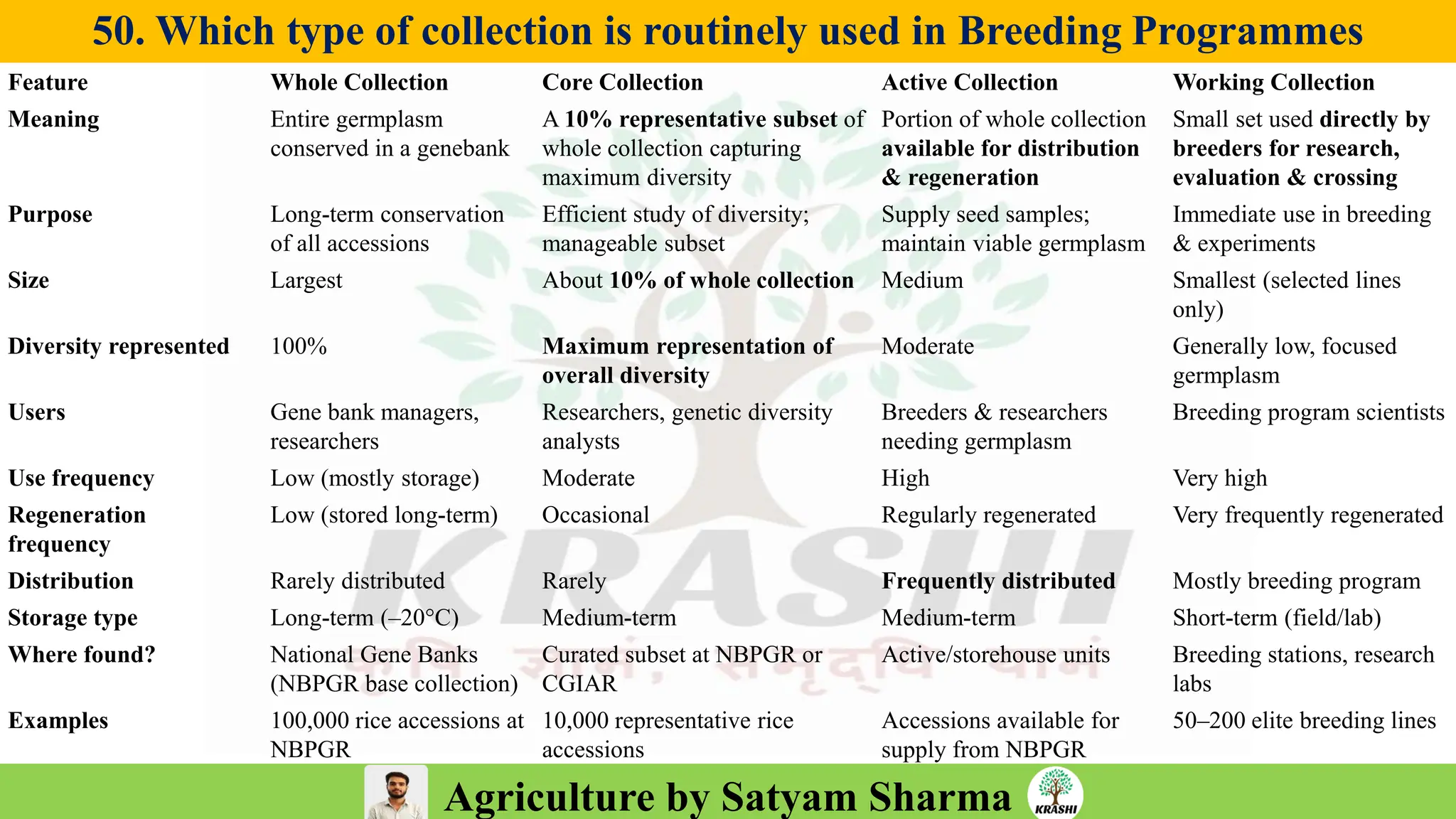
50. Which type of collection is routinely used in Breeding Programmes
Feature Whole Collection Core Collection Active Collection Working Collection
Meaning Entire germplasm
conserved in a genebank
A 10% representative subset of
whole collection capturing
maximum diversity
Portion of whole collection
available for distribution
& regeneration
Small set used directly by
breeders for research,
evaluation & crossing
Purpose Long-term conservation
of all accessions
Efficient study of diversity;
manageable subset
Supply seed samples;
maintain viable germplasm
Immediate use in breeding
& experiments
Size Largest About 10% of whole collection Medium Smallest (selected lines
only)
Diversity represented 100% Maximum representation of
overall diversity
Moderate Generally low, focused
germplasm
Users Gene bank managers,
researchers
Researchers, genetic diversity
analysts
Breeders & researchers
needing germplasm
Breeding program scientists
Use frequency Low (mostly storage) Moderate High Very high
Regeneration
frequency
Low (stored long-term) Occasional Regularly regenerated Very frequently regenerated
Distribution Rarely distributed Rarely Frequently distributed Mostly breeding program
Storage type Long-term (–20°C) Medium-term Medium-term Short-term (field/lab)
Where found? National Gene Banks
(NBPGR base collection)
Curated subset at NBPGR or
CGIAR
Active/storehouse units Breeding stations, research
labs
Examples 100,000 rice accessions at
NBPGR
10,000 representative rice
accessions
Accessions available for
supply from NBPGR
50–200 elite breeding lines
Agriculture by Satyam Sharma
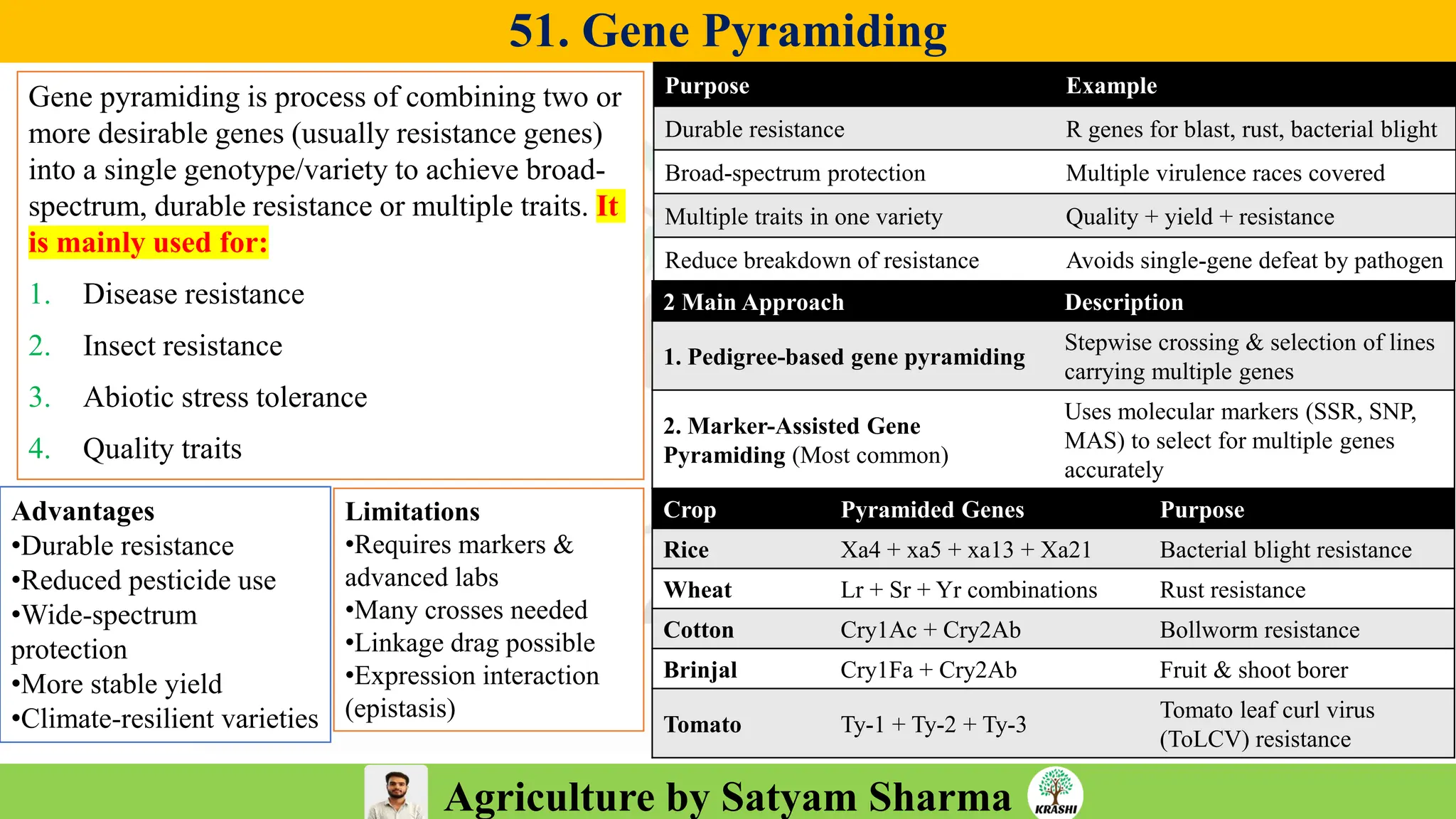
51. Gene Pyramiding
Gene pyramiding is process of combining two or
more desirable genes (usually resistance genes)
into a single genotype/variety to achieve broad-
spectrum, durable resistance or multiple traits. It
is mainly used for:
1. Disease resistance
2. Insect resistance
3. Abiotic stress tolerance
4. Quality traits
Crop Pyramided Genes Purpose
Rice Xa4 + xa5 + xa13 + Xa21 Bacterial blight resistance
Wheat Lr + Sr + Yr combinations Rust resistance
Cotton Cry1Ac + Cry2Ab Bollworm resistance
Brinjal Cry1Fa + Cry2Ab Fruit & shoot borer
Tomato Ty-1 + Ty-2 + Ty-3
Tomato leaf curl virus
(ToLCV) resistance
2 Main Approach Description
1. Pedigree-based gene pyramiding
Stepwise crossing & selection of lines
carrying multiple genes
2. Marker-Assisted Gene
Pyramiding (Most common)
Uses molecular markers (SSR, SNP,
MAS) to select for multiple genes
accurately
Purpose Example
Durable resistance R genes for blast, rust, bacterial blight
Broad-spectrum protection Multiple virulence races covered
Multiple traits in one variety Quality + yield + resistance
Reduce breakdown of resistance Avoids single-gene defeat by pathogen
Advantages
•Durable resistance
•Reduced pesticide use
•Wide-spectrum
protection
•More stable yield
•Climate-resilient varieties
Limitations
•Requires markers &
advanced labs
•Many crosses needed
•Linkage drag possible
•Expression interaction
(epistasis)
Agriculture by Satyam Sharma
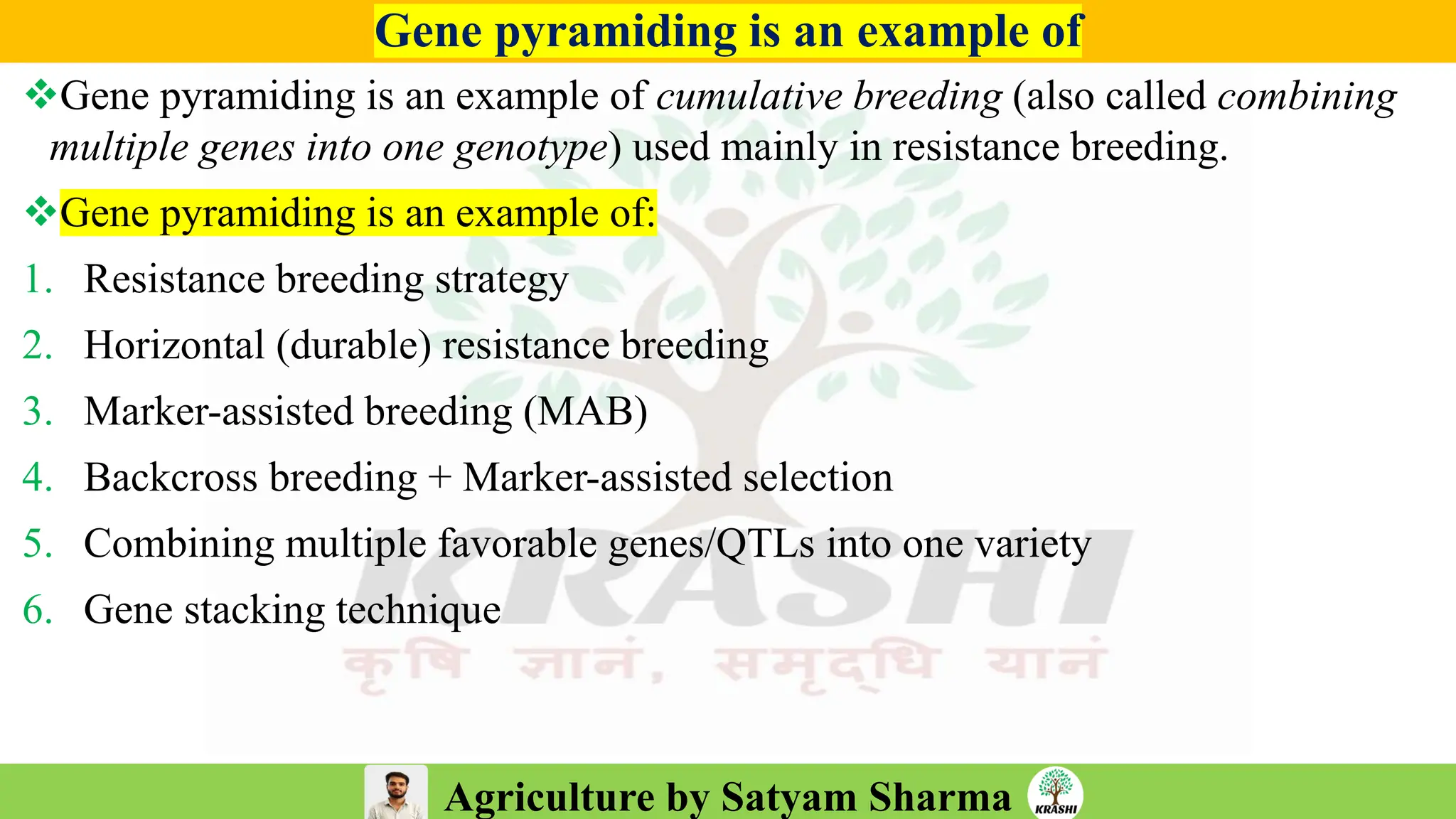
Gene pyramiding is an example of
❖Gene pyramiding is an example of cumulative breeding (also called combining
multiple genes into one genotype) used mainly in resistance breeding.
❖Gene pyramiding is an example of:
1. Resistance breeding strategy
2. Horizontal (durable) resistance breeding
3. Marker-assisted breeding (MAB)
4. Backcross breeding + Marker-assisted selection
5. Combining multiple favorable genes/QTLs into one variety
6. Gene stacking technique
Agriculture by Satyam Sharma
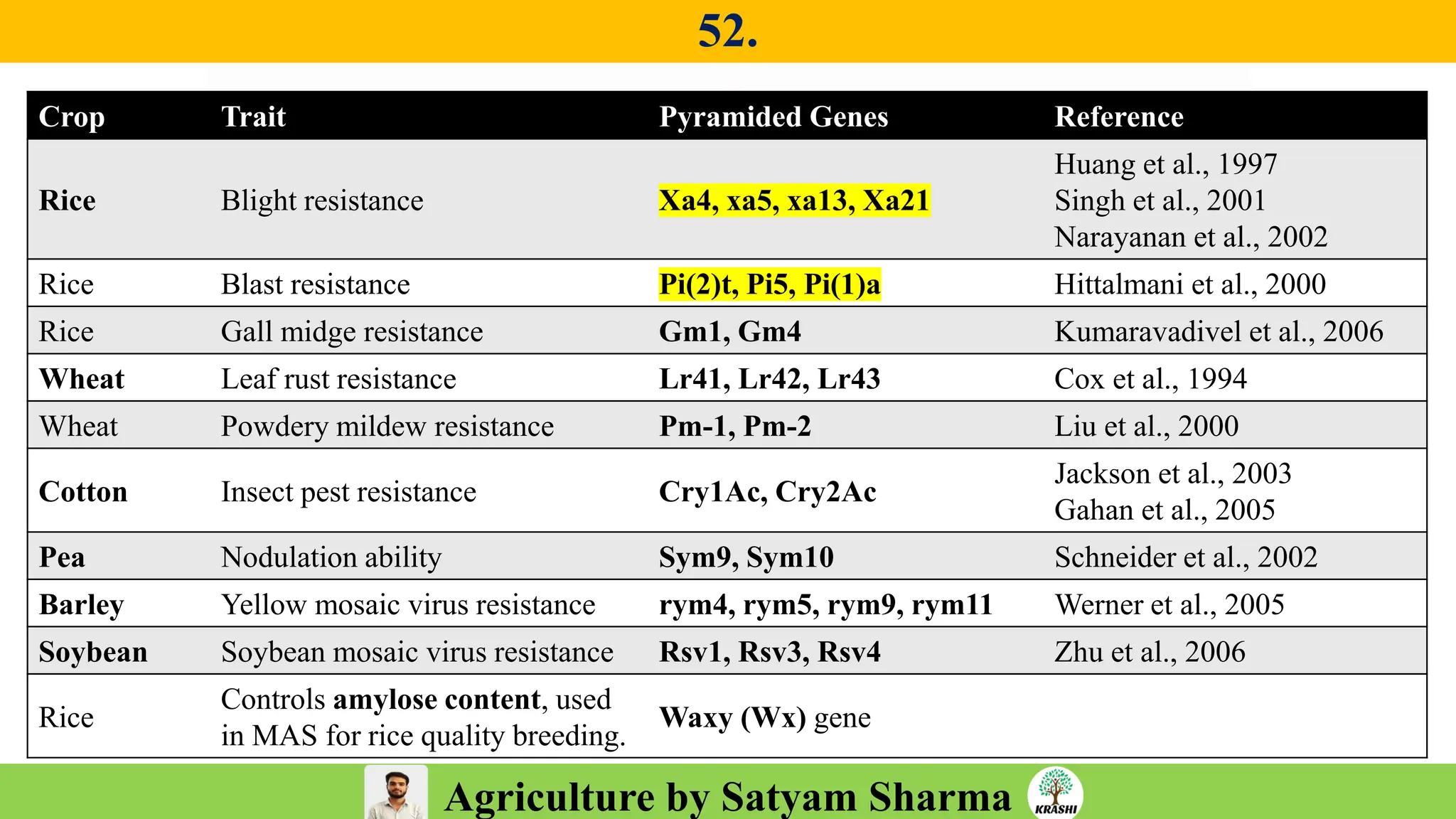
52.
Crop Trait Pyramided Genes Reference
Rice Blight resistance Xa4, xa5, xa13, Xa21
Huang et al., 1997
Singh et al., 2001
Narayanan et al., 2002
Rice Blast resistance Pi(2)t, Pi5, Pi(1)a Hittalmani et al., 2000
Rice Gall midge resistance Gm1, Gm4 Kumaravadivel et al., 2006
Wheat Leaf rust resistance Lr41, Lr42, Lr43 Cox et al., 1994
Wheat Powdery mildew resistance Pm-1, Pm-2 Liu et al., 2000
Cotton Insect pest resistance Cry1Ac, Cry2Ac
Jackson et al., 2003
Gahan et al., 2005
Pea Nodulation ability Sym9, Sym10 Schneider et al., 2002
Barley Yellow mosaic virus resistance rym4, rym5, rym9, rym11 Werner et al., 2005
Soybean Soybean mosaic virus resistance Rsv1, Rsv3, Rsv4 Zhu et al., 2006
Rice
Controls amylose content, used
in MAS for rice quality breeding.
Waxy (Wx) gene
Agriculture by Satyam Sharma
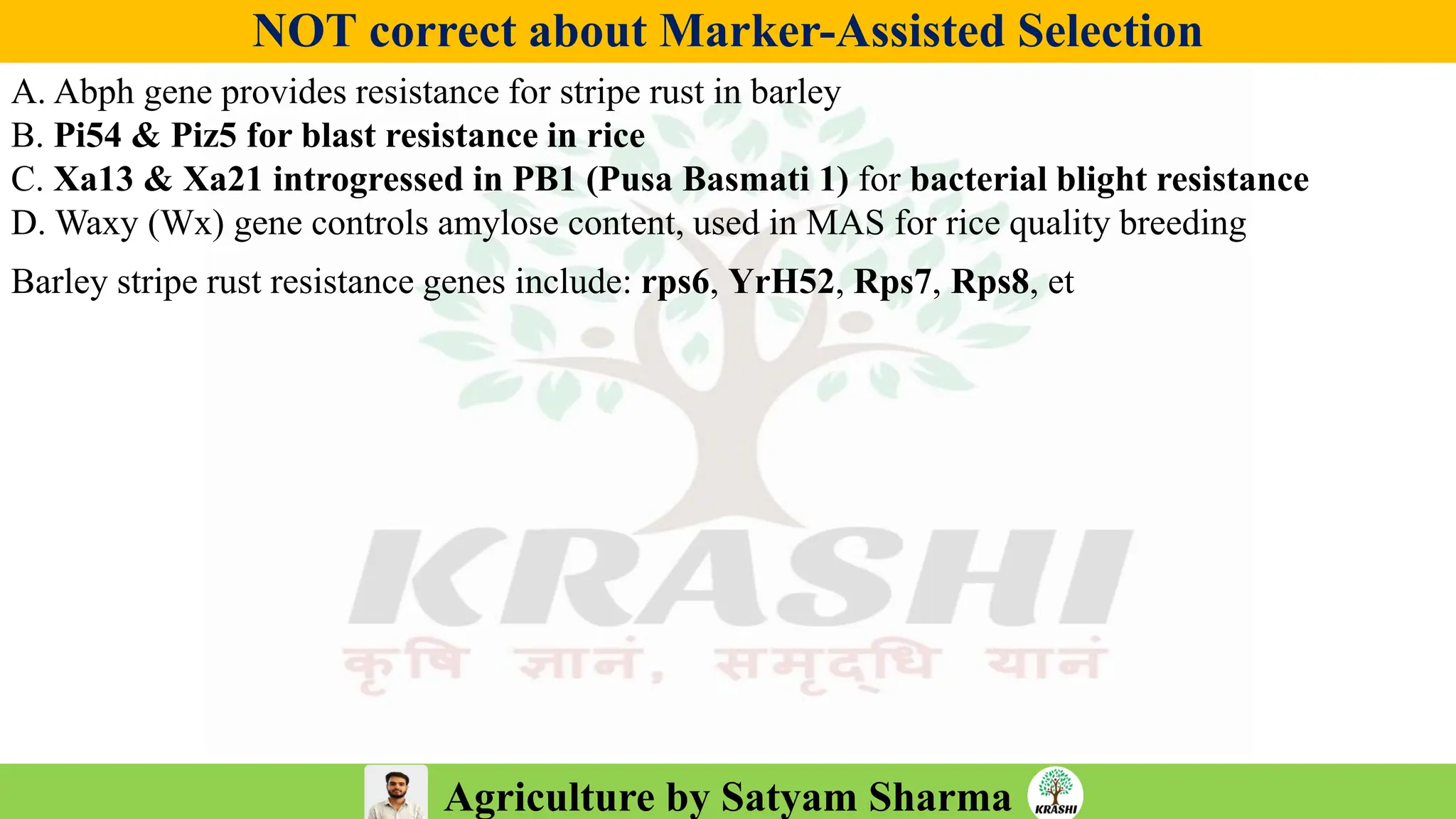
NOT correct about Marker-Assisted Selection
A. Abph gene provides resistance for stripe rust in barley
B. Pi54 & Piz5 for blast resistance in rice
C. Xa13 & Xa21 introgressed in PB1 (Pusa Basmati 1) for bacterial blight resistance
D. Waxy (Wx) gene controls amylose content, used in MAS for rice quality breeding
Barley stripe rust resistance genes include: rps6, YrH52, Rps7, Rps8, et
Agriculture by Satyam Sharma
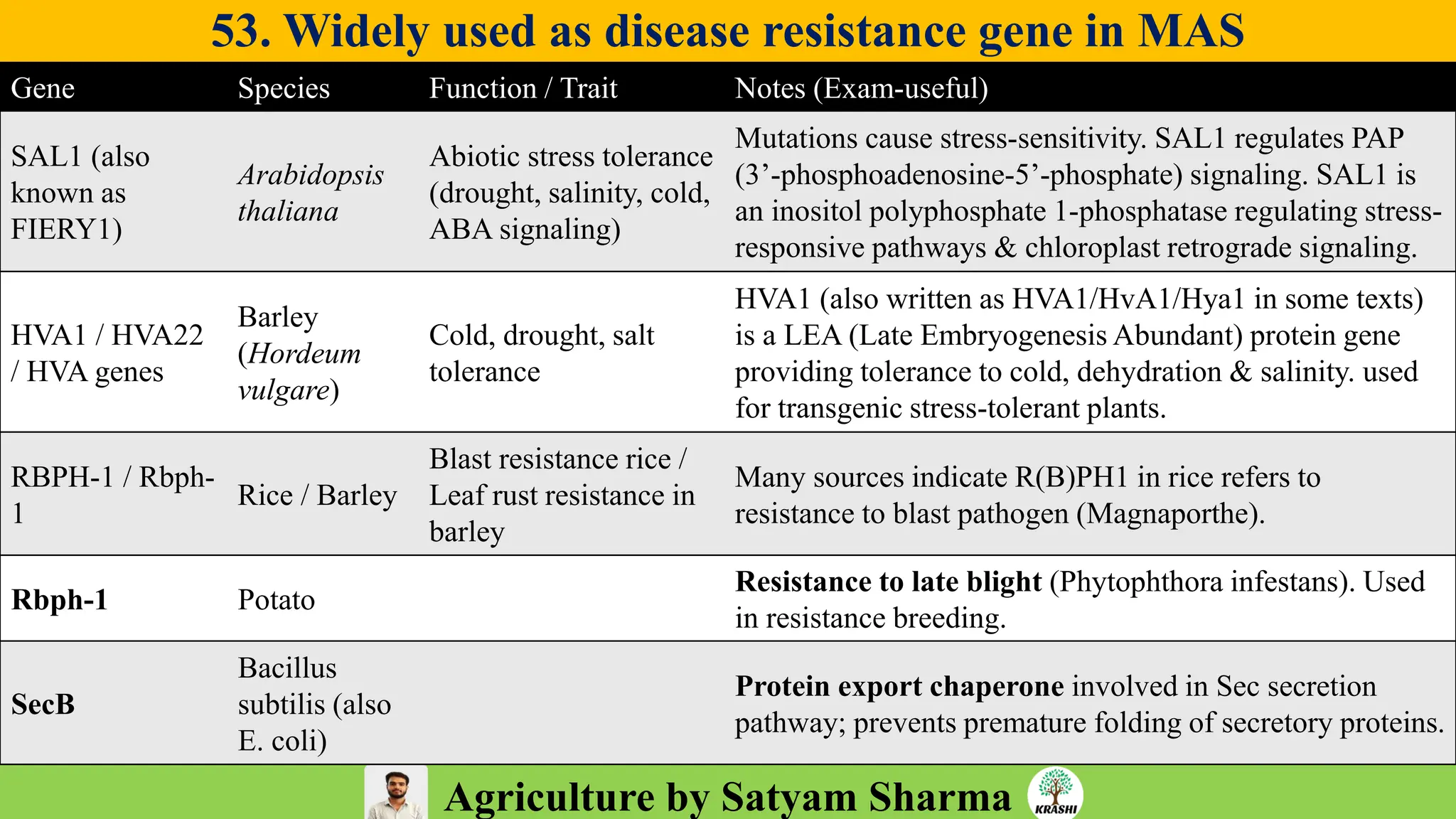
53. Widely used as disease resistance gene in MAS
❖1.
Gene Species Function / Trait Notes (Exam-useful)
SAL1 (also
known as
FIERY1)
Arabidopsis
thaliana
Abiotic stress tolerance
(drought, salinity, cold,
ABA signaling)
Mutations cause stress-sensitivity. SAL1 regulates PAP
(3’-phosphoadenosine-5’-phosphate) signaling. SAL1 is
an inositol polyphosphate 1-phosphatase regulating stress-
responsive pathways & chloroplast retrograde signaling.
HVA1 / HVA22
/ HVA genes
Barley
(Hordeum
vulgare)
Cold, drought, salt
tolerance
HVA1 (also written as HVA1/HvA1/Hya1 in some texts)
is a LEA (Late Embryogenesis Abundant) protein gene
providing tolerance to cold, dehydration & salinity. used
for transgenic stress-tolerant plants.
RBPH-1 / Rbph-
1
Rice / Barley
Blast resistance rice /
Leaf rust resistance in
barley
Many sources indicate R(B)PH1 in rice refers to
resistance to blast pathogen (Magnaporthe).
Rbph-1 Potato
Resistance to late blight (Phytophthora infestans). Used
in resistance breeding.
SecB
Bacillus
subtilis (also
E. coli)
Protein export chaperone involved in Sec secretion
pathway; prevents premature folding of secretory proteins.
Agriculture by Satyam Sharma
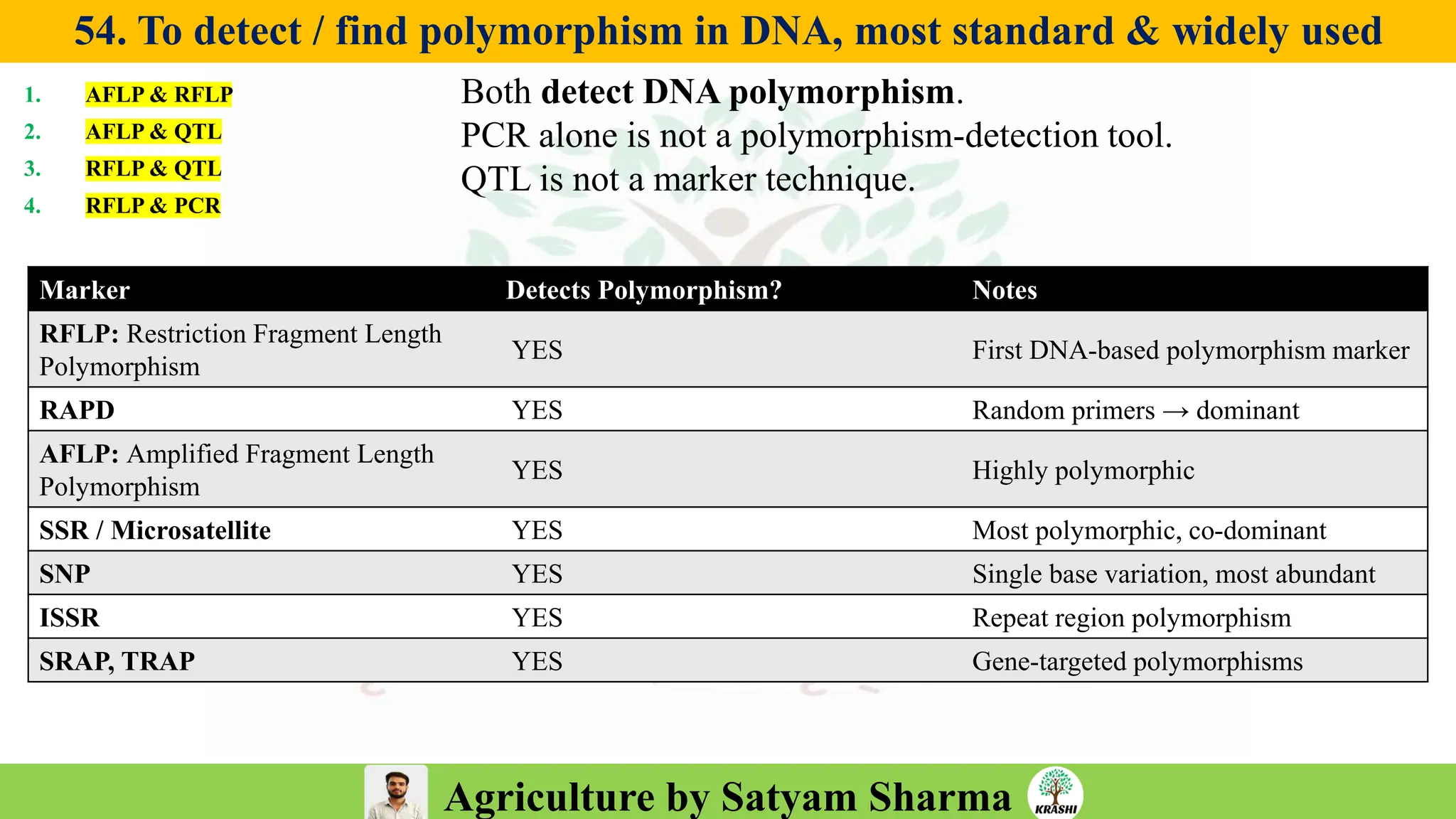
54. To detect / find polymorphism in DNA, most standard & widely used
1. AFLP & RFLP
2. AFLP & QTL
3. RFLP & QTL
4. RFLP & PCR
Marker Detects Polymorphism? Notes
RFLP: Restriction Fragment Length
Polymorphism
YES First DNA-based polymorphism marker
RAPD YES Random primers → dominant
AFLP: Amplified Fragment Length
Polymorphism
YES Highly polymorphic
SSR / Microsatellite YES Most polymorphic, co-dominant
SNP YES Single base variation, most abundant
ISSR YES Repeat region polymorphism
SRAP, TRAP YES Gene-targeted polymorphisms
Both detect DNA polymorphism.
PCR alone is not a polymorphism-detection tool.
QTL is not a marker technique.
Agriculture by Satyam Sharma
55. Which of following is used for mapping studies
❖RFLP & PCR
❖AFLP & RAPD
❖AFLP & PCR
❖None
Agriculture by Satyam Sharma
56. Which is third generation sequencing technology
❖ Single molecule technology
❖ TGS = real-time long-read & Single-Molecule Sequencing
platforms.
❖ It sequences long reads directly from single DNA molecules
without amplification.
Examples of TGS
❖ PacBio SMRT sequencing (Single Molecule Real-Time)
❖ Oxford Nanopore sequencing
Why others are wrong:
❖ B. Next Generation Sequencing (NGS) → 2nd generation
❖ C. Microarray → NOT a sequencing technology
❖ Final Answer: a. Single molecule technology
❖A. Single molecule
technology
❖B. Next generation
sequencing
❖C. Micro array technology
❖D. RNA seq
Agriculture by Satyam Sharma
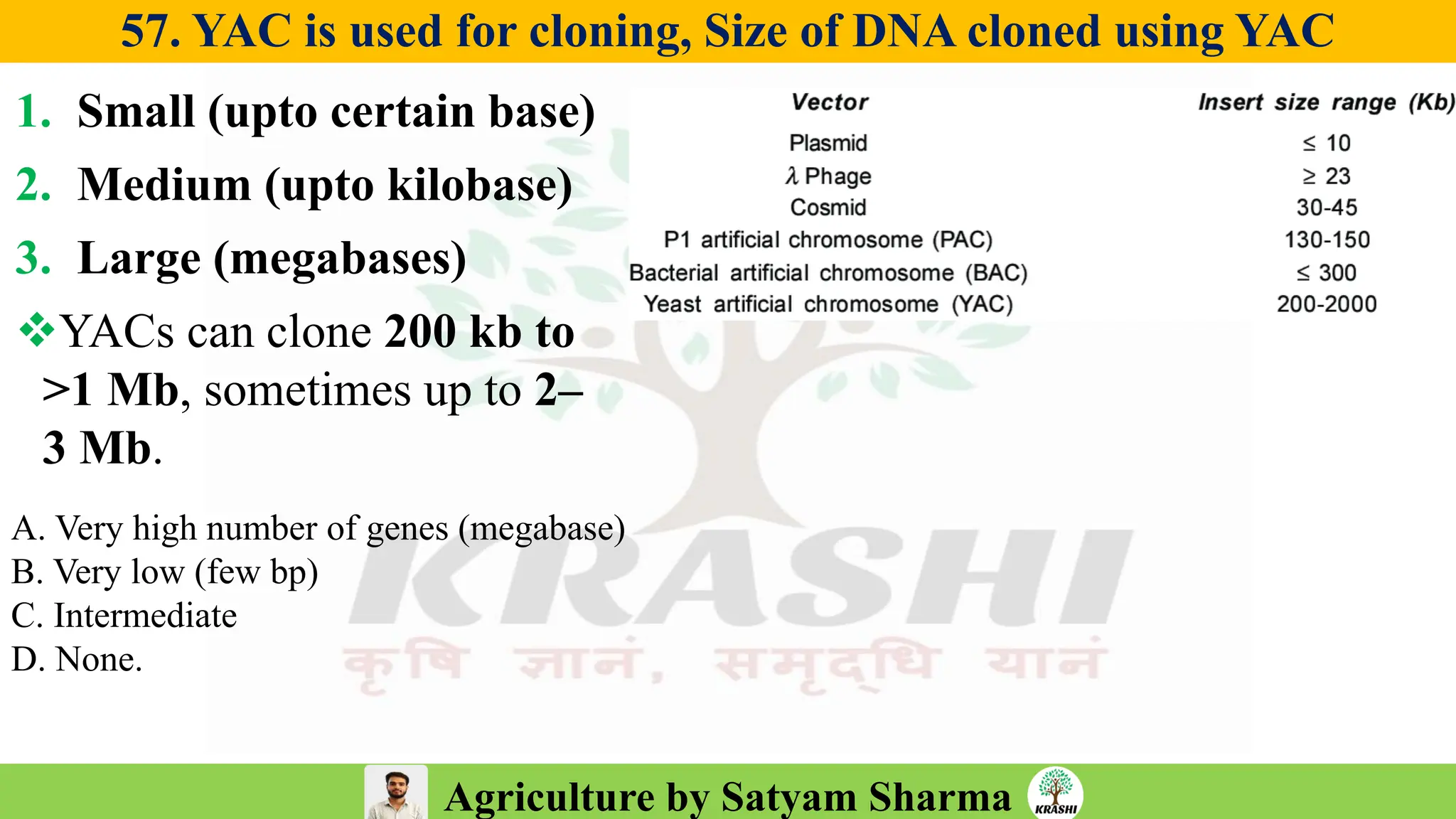
57. YAC is used for cloning, Size of DNA cloned using YAC
1. Small (upto certain base)
2. Medium (upto kilobase)
3. Large (megabases)
❖YACs can clone 200 kb to
>1 Mb, sometimes up to 2–
3 Mb.
A. Very high number of genes (megabase)
B. Very low (few bp)
C. Intermediate
D. None.
Agriculture by Satyam Sharma
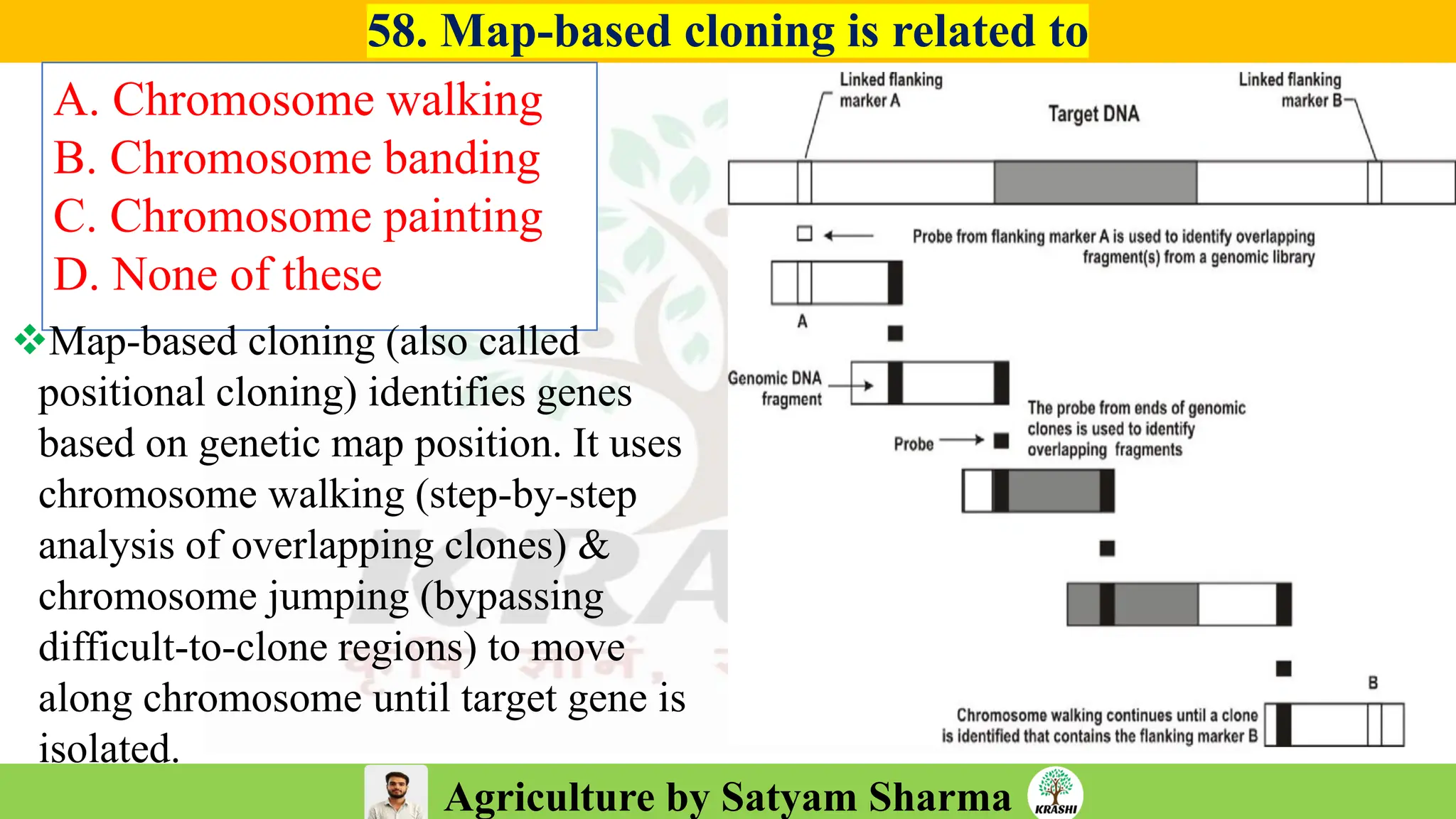
58. Map-based cloning is related to
A. Chromosome walking
B. Chromosome banding
C. Chromosome painting
D. None of these
❖Map-based cloning (also called
positional cloning) identifies genes
based on genetic map position. It uses
chromosome walking (step-by-step
analysis of overlapping clones) &
chromosome jumping (bypassing
difficult-to-clone regions) to move
along chromosome until target gene is
isolated.
Agriculture by Satyam Sharma
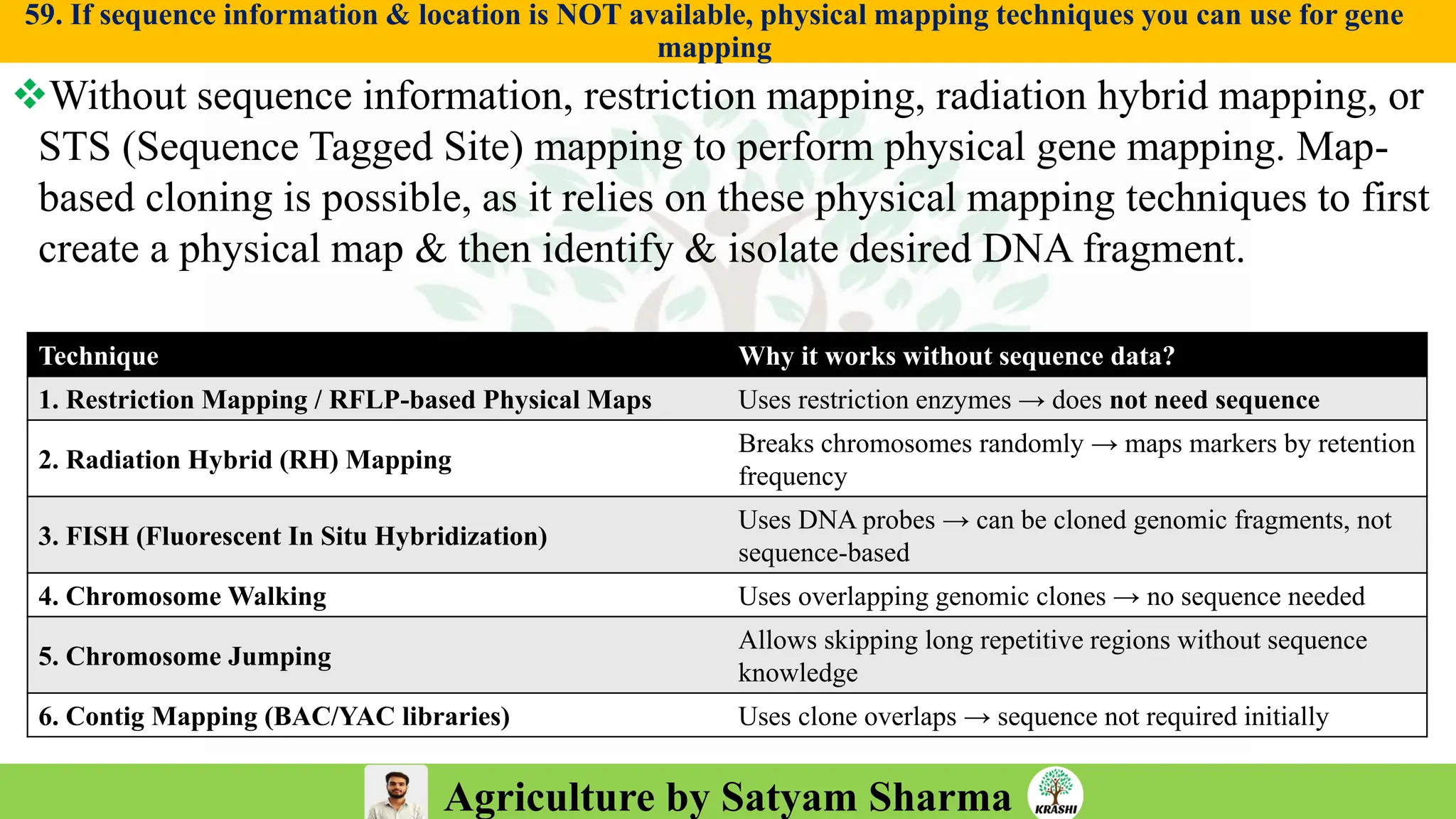
59. If sequence information & location is NOT available, physical mapping techniques you can use for gene
mapping
❖Without sequence information, restriction mapping, radiation hybrid mapping, or
STS (Sequence Tagged Site) mapping to perform physical gene mapping. Map-
based cloning is possible, as it relies on these physical mapping techniques to first
create a physical map & then identify & isolate desired DNA fragment.
Technique Why it works without sequence data?
1. Restriction Mapping / RFLP-based Physical Maps Uses restriction enzymes → does not need sequence
2. Radiation Hybrid (RH) Mapping
Breaks chromosomes randomly → maps markers by retention
frequency
3. FISH (Fluorescent In Situ Hybridization)
Uses DNA probes → can be cloned genomic fragments, not
sequence-based
4. Chromosome Walking Uses overlapping genomic clones → no sequence needed
5. Chromosome Jumping
Allows skipping long repetitive regions without sequence
knowledge
6. Contig Mapping (BAC/YAC libraries) Uses clone overlaps → sequence not required initially
Agriculture by Satyam Sharma
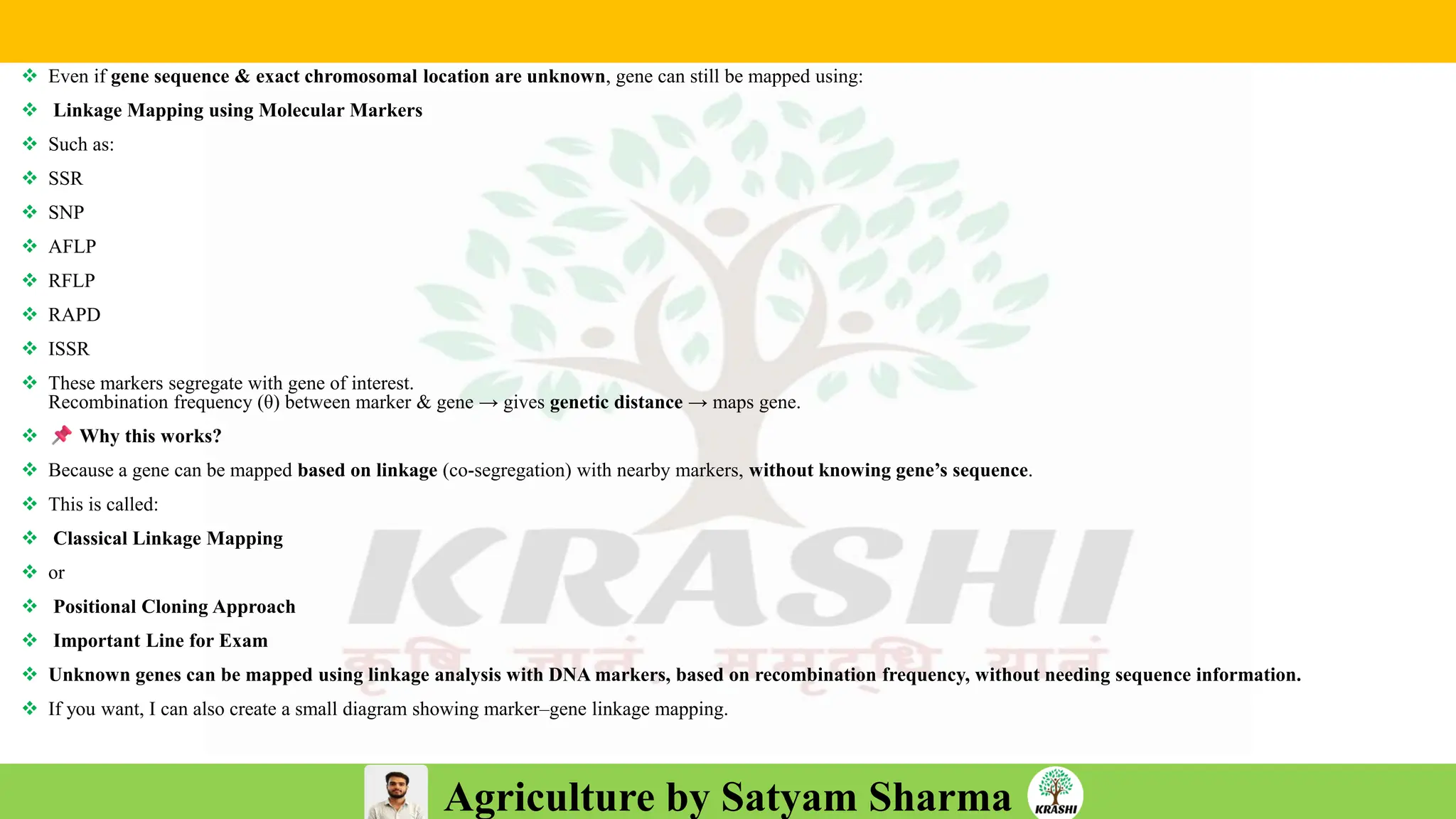
❖ Even if gene sequence & exact chromosomal location are unknown, gene can still be mapped using:
❖ Linkage Mapping using Molecular Markers
❖ Such as:
❖ SSR
❖ SNP
❖ AFLP
❖ RFLP
❖ RAPD
❖ ISSR
❖ These markers segregate with gene of interest.
Recombination frequency (θ) between marker & gene → gives genetic distance → maps gene.
❖ Why this works?
❖ Because a gene can be mapped based on linkage (co-segregation) with nearby markers, without knowing gene’s sequence.
❖ This is called:
❖ Classical Linkage Mapping
❖ or
❖ Positional Cloning Approach
❖ Important Line for Exam
❖ Unknown genes can be mapped using linkage analysis with DNA markers, based on recombination frequency, without needing sequence information.
❖ If you want, I can also create a small diagram showing marker–gene linkage mapping.
Agriculture by Satyam Sharma
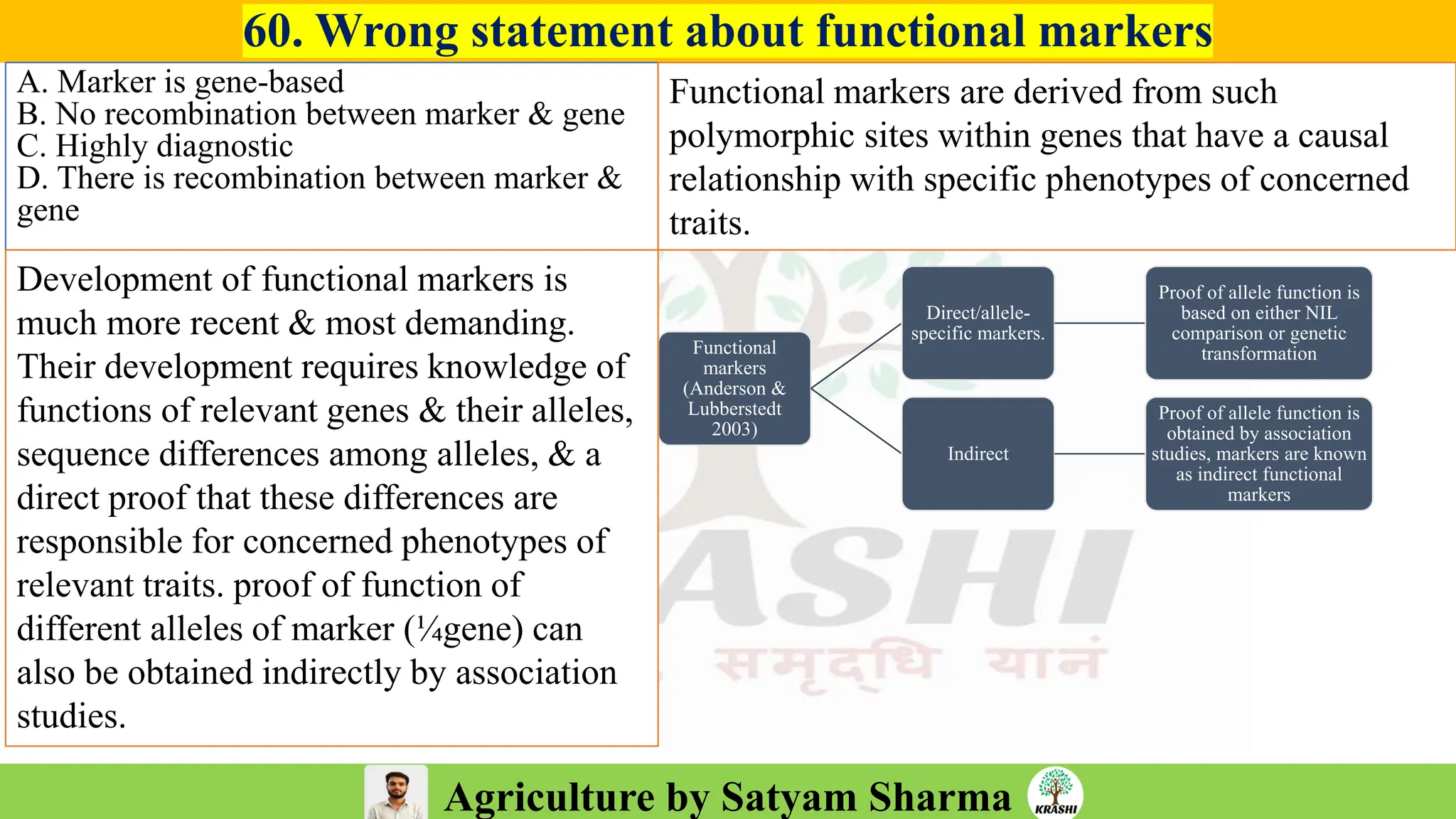
60. Wrong statement about functional markers
A. Marker is gene-based
B. No recombination between marker & gene
C. Highly diagnostic
D. There is recombination between marker &
gene
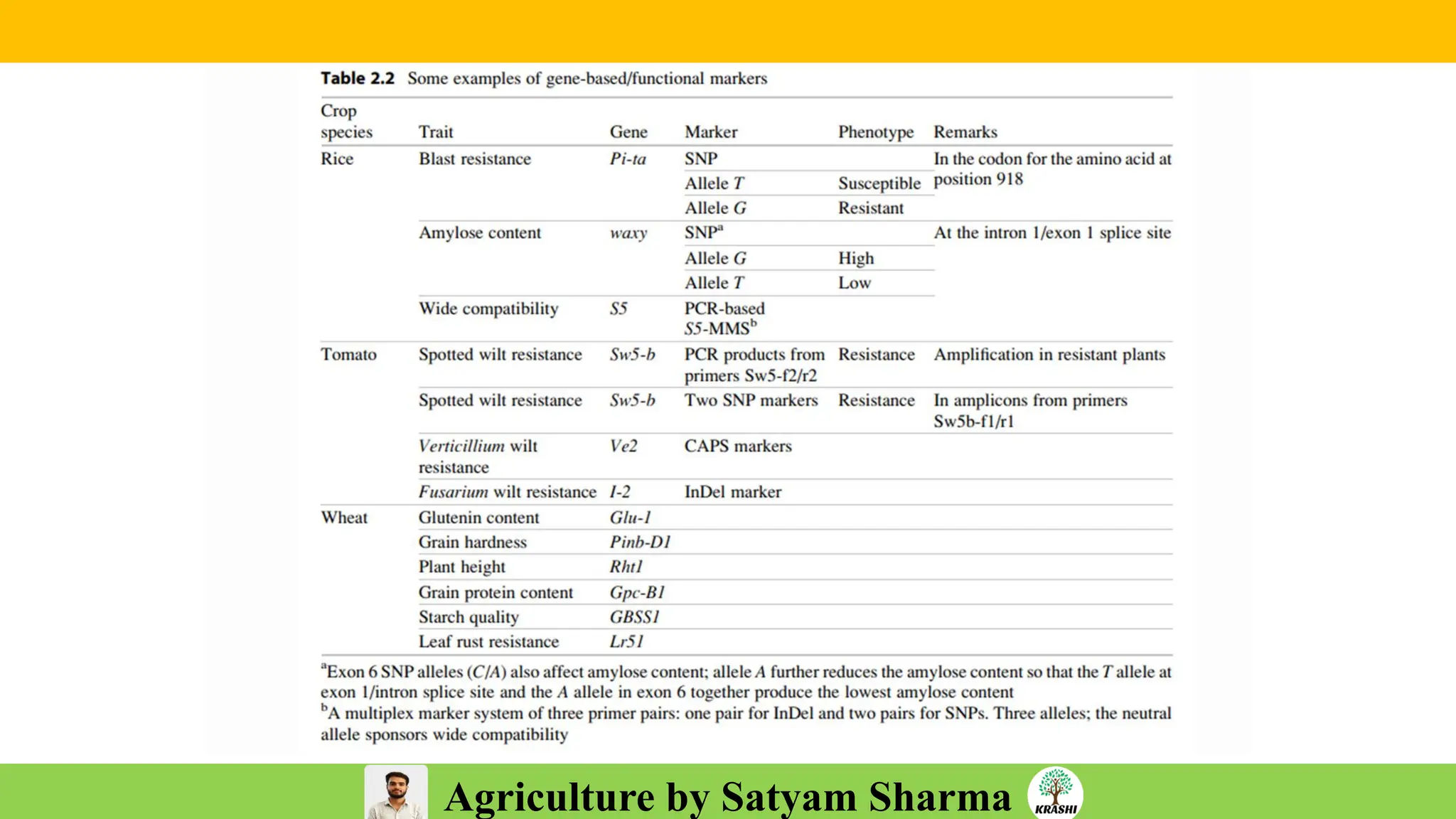
Functional markers are derived from such
polymorphic sites within genes that have a causal
relationship with specific phenotypes of concerned
traits.
Functional
markers
(Anderson &
Lubberstedt
2003)
Direct/allele-
specific markers.
Proof of allele function is
based on either NIL
comparison or genetic
transformation
Indirect
Proof of allele function is
obtained by association
studies, markers are known
as indirect functional
markers
Development of functional markers is
much more recent & most demanding.
Their development requires knowledge of
functions of relevant genes & their alleles,
sequence differences among alleles, & a
direct proof that these differences are
responsible for concerned phenotypes of
relevant traits. proof of function of
different alleles of marker (¼gene) can
also be obtained indirectly by association
studies.
Agriculture by Satyam Sharma
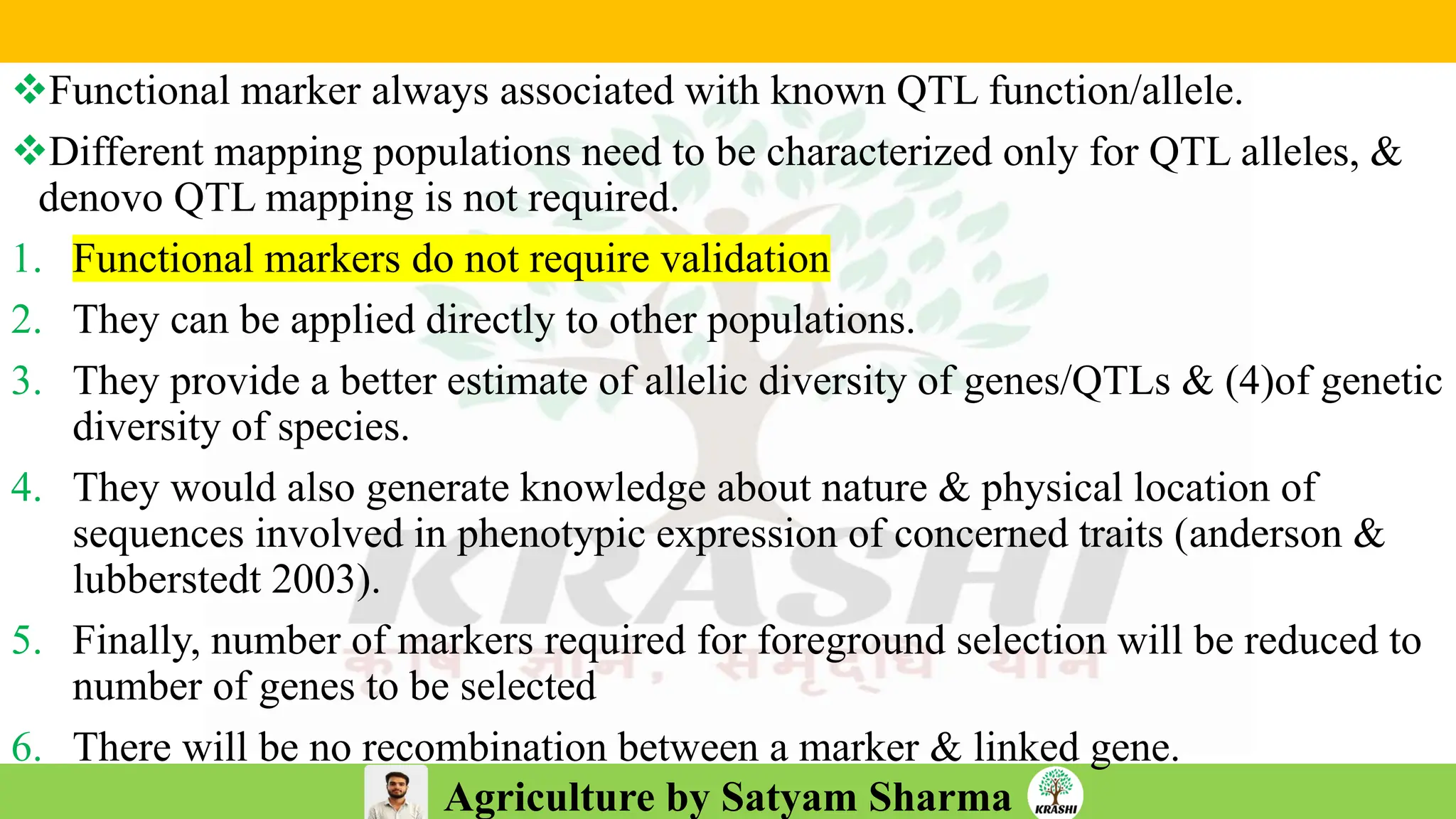
❖Functional marker always associated with known QTL function/allele.
❖Different mapping populations need to be characterized only for QTL alleles, &
denovo QTL mapping is not required.
1. Functional markers do not require validation
2. They can be applied directly to other populations.
3. They provide a better estimate of allelic diversity of genes/QTLs & (4)of genetic
diversity of species.
4. They would also generate knowledge about nature & physical location of
sequences involved in phenotypic expression of concerned traits (anderson &
lubberstedt 2003).
5. Finally, number of markers required for foreground selection will be reduced to
number of genes to be selected
6. There will be no recombination between a marker & linked gene.
Agriculture by Satyam Sharma
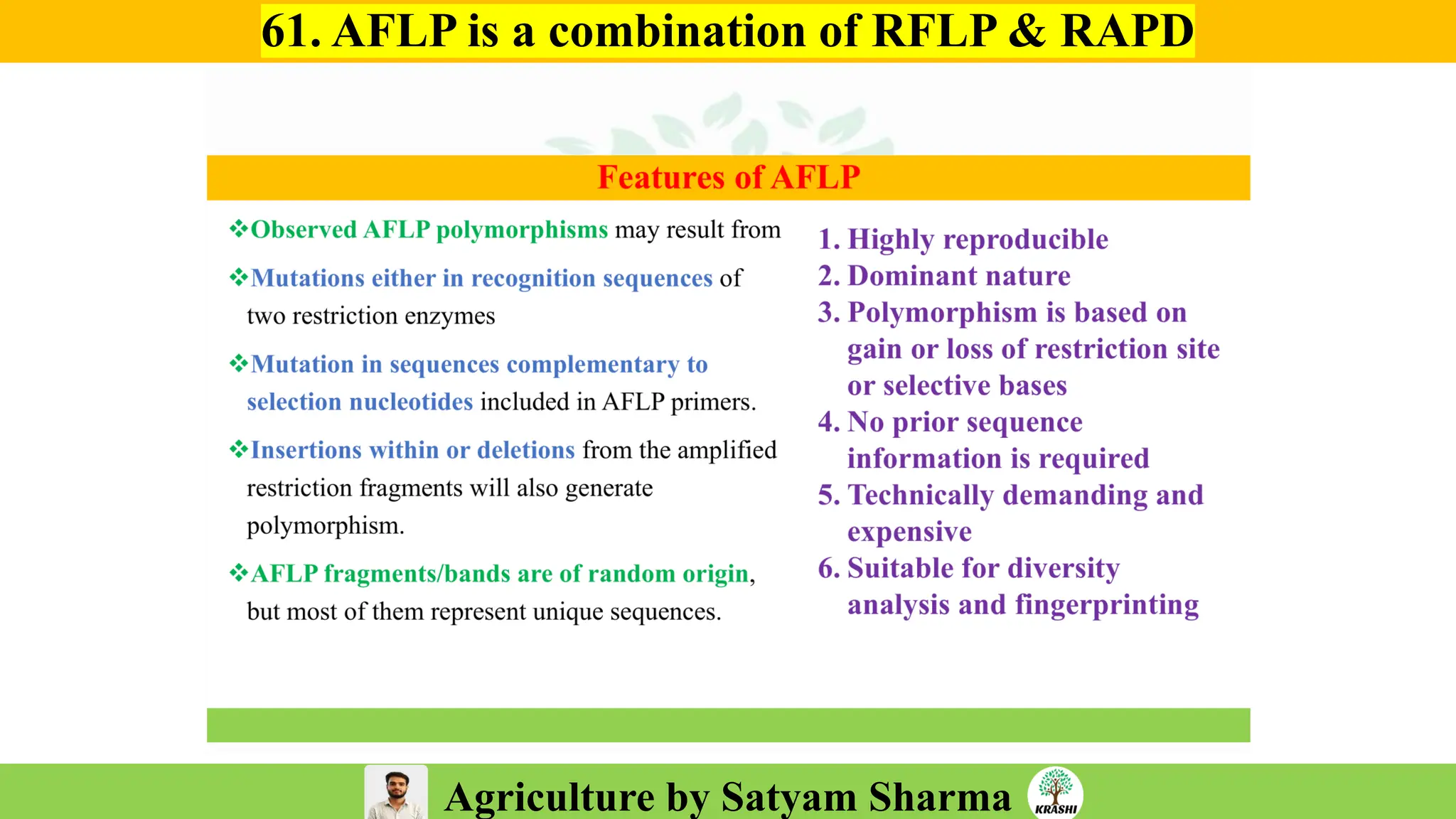
61. AFLP is a combination of RFLP & RAPD
Agriculture by Satyam Sharma
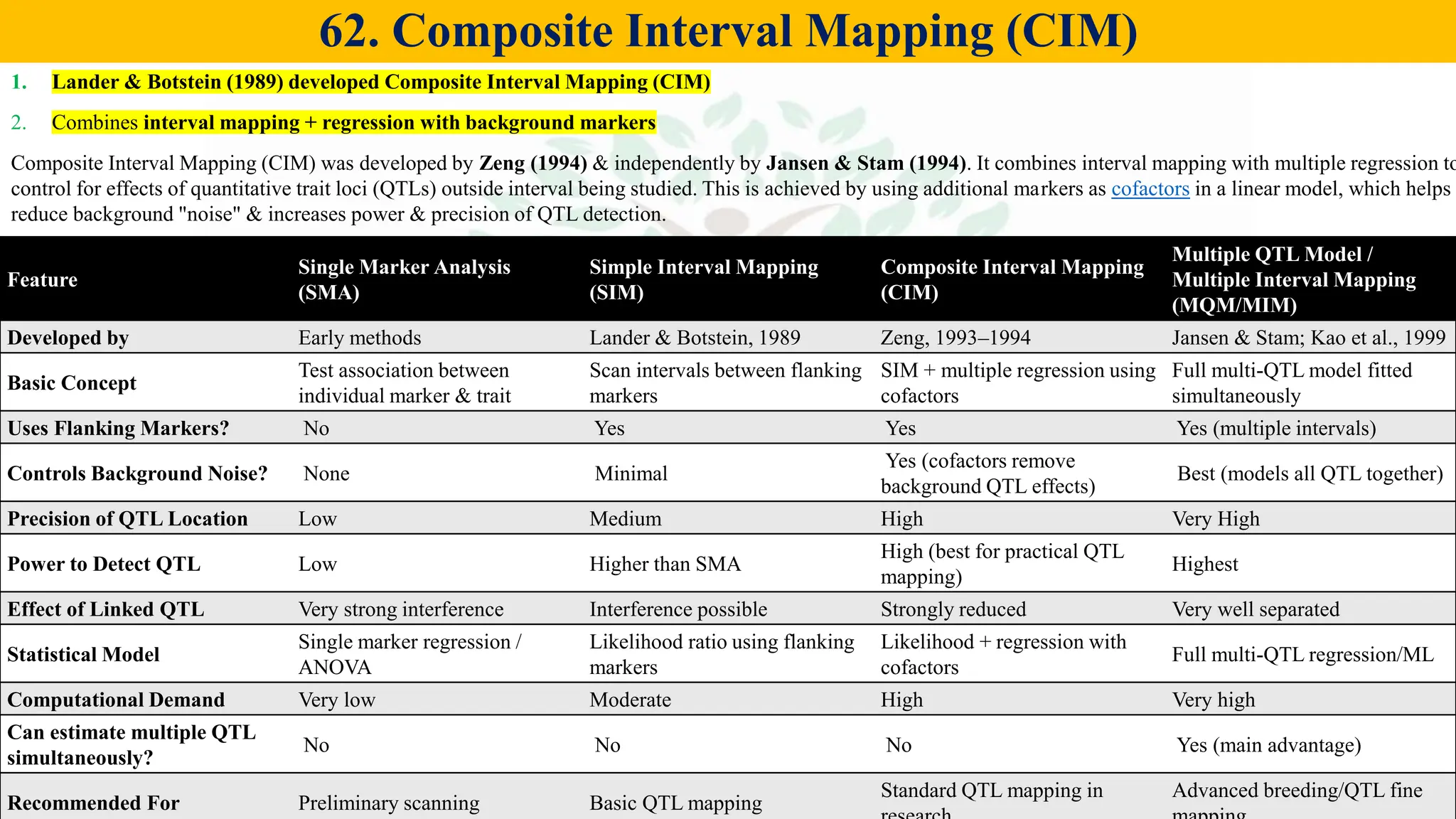
62. Composite Interval Mapping (CIM)
Feature
Single Marker Analysis
(SMA)
Simple Interval Mapping
(SIM)
Composite Interval Mapping
(CIM)
Multiple QTL Model /
Multiple Interval Mapping
(MQM/MIM)
Developed by Early methods Lander & Botstein, 1989 Zeng, 1993–1994 Jansen & Stam; Kao et al., 1999
Basic Concept
Test association between
individual marker & trait
Scan intervals between flanking
markers
SIM + multiple regression using
cofactors
Full multi-QTL model fitted
simultaneously
Uses Flanking Markers? No Yes Yes Yes (multiple intervals)
Controls Background Noise? None Minimal
Yes (cofactors remove
background QTL effects)
Best (models all QTL together)
Precision of QTL Location Low Medium High Very High
Power to Detect QTL Low Higher than SMA
High (best for practical QTL
mapping)
Highest
Effect of Linked QTL Very strong interference Interference possible Strongly reduced Very well separated
Statistical Model
Single marker regression /
ANOVA
Likelihood ratio using flanking
markers
Likelihood + regression with
cofactors
Full multi-QTL regression/ML
Computational Demand Very low Moderate High Very high
Can estimate multiple QTL
simultaneously?
No No No Yes (main advantage)
Recommended For Preliminary scanning Basic QTL mapping
Standard QTL mapping in Advanced breeding/QTL fine
1. Lander & Botstein (1989) developed Composite Interval Mapping (CIM)
2. Combines interval mapping + regression with background markers
Composite Interval Mapping (CIM) was developed by Zeng (1994) & independently by Jansen & Stam (1994). It combines interval mapping with multiple regression to
control for effects of quantitative trait loci (QTLs) outside interval being studied. This is achieved by using additional markers as cofactors in a linear model, which helps
reduce background "noise" & increases power & precision of QTL detection.
Agriculture by Satyam Sharma
63. Which system is advantageous for expression of eukaryotic genes?
❖Answer: (b) Yeast
❖Yeast has: Eukaryotic post-
translational modifications
❖Fast growth like bacteria
❖Easy genetic manipulation
→ Perfect for eukaryotic
protein expression.
Agriculture by Satyam Sharma
64. Herbicide resistance
❖Statement1-
Herbicide resistance is
used to solve weed
problem
❖Statement 2-
Glyphosate kills
plants by inhibiting
EPSPS (5-
enolpyruvylshikimate-
3-phosphate synthase)
in shikimate pathway.
Agriculture by Satyam Sharma
65. RIL & DH lines used as
❖Parents
❖Marker–trait association
❖QTL validation
❖All of these
Agriculture by Satyam Sharma
66. NILs (Near-Isogenic Lines)
❖NILs (Near-Isogenic Lines) can be produced from heterogeneous inbred populations
❖A heterogeneous inbred population (HIP) is genetically fixed within individuals but variable
between individuals
❖Each plant is homozygous, but population contains many different homozygous genotypes.
❖By selecting plants with target allele & backcrossing repeatedly to a recurrent parent, you can
create Near-Isogenic Lines (NILs).
❖NIL can be obtained through: Donor parent carrying a specific gene (resistance gene) is
crossed with a recurrent parent.
❖progeny is repeatedly backcrossed to recurrent parent for 5–6 generations.
❖At each generation, plants carrying target gene from donor are selected.
❖Get a line that is almost identical (~99%) to recurrent parent except for target gene.
Agriculture by Satyam Sharma
67. CRISPR-Cas9 Gene editing tool using originated from
CRISPR – Clustered Regularly Interspaced Short Palindromic
Repeats
Cas – CRISPR-associated proteins (endonucleases)
Discovered in bacteria & archaea — acts as adaptive immune
system. First observed in E. coli (1987, Ishino). Role in
immunity identified by Mojica (2000).Gene editing power
demonstrated by Doudna & Charpentier (2012) → Nobel Prize
2020.
Natural Mechanism (3 Stages)
(A)Adaptation (Spacer acquisition)Viral DNA fragments inserted
into CRISPR array.
(B) Expression CRISPR array → transcribed into pre-crRNA →
crRNA.
(C) Interferencecr RNA guides Cas enzyme to matching viral
DNA → cleavage.
Component Function
Cas9 nuclease Makes double-stranded cut
sgRNA (single guide RNA)
= crRNA + tracrRNA
Targets Cas9 to specific
DNA sequence
PAM sequence
Short motif required next to
target site
PAM SequenceEssential recognition site for Cas enzyme.
For SpCas9 (most used): 5′-NGG-3′Without PAM → Cas9 will
NOT cut.
Method Type of Cut Effect
Cas9
Double-str& break
(DSB)
Indels, knockouts
Cas12a/Cpf1 Staggered cut
Sticky ends, better
editing
Cas13
Cuts RNA, not
DNA
Viral/RNA
targeting
Repair Pathways
After Cas9 cut:
(1) NHEJ – Non-Homologous End Joining
•Error-prone
•Causes insertions/deletions
•Used for gene knockouts
(2) HDR – Homology Directed Repair
•High precision
•Requires donor template
•Used for gene knock-in / correction
Agriculture by Satyam Sharma
Variant Feature Uses
Cas9 DSB cutter Knockouts/knock-ins
dCas9 (dead Cas9) No cutting Gene regulation (CRISPRi, CRISPRa)
Cas12a (Cpf1) Sticky ends, T-rich PAM Crop editing
Cas13 RNA editing Virus detection (SHERLOCK)
Prime Editing (2020) No DSB, no donor needed Precise changes
Base Editing Converts one base to another A→G, C→T editing
Applications (Plant Breeding + Medical)
A. Agricultural / Plant Breeding
•Disease resistance (rice blast, BB)
•Herbicide tolerance
•Hybrid seed production (male sterility)
•Quality improvement
•Stress tolerance (heat, drought)
B. Medical / Biotech
•Gene therapy
•Cancer research
•Diagnostics (CRISPR-SHERLOCK, DETECTR)
•Viral disease detection (COVID-19)
Advantages
•Highly precise
•Fast & cheap
•Multiplex gene editing possible
•Works in almost all organisms
Limitations / Risks
•Off-target effects
•PAM dependency
•Ethical issues (germline editing)
•Delivery challenges in some organisms
Agriculture by Satyam Sharma
Important Points
❖CRISPR is based on bacterial immune
system.
❖PAM is NGG for Cas9 (SpCas9).
❖Cas9 makes double-stranded breaks.
❖Cas13 cuts RNA.
❖Cpf1/Cas12a uses TTTV PAM & creates
sticky ends.
❖dCas9 used for gene activation/inhibition
(CRISPRa/CRISPRi).
❖Prime editing changes DNA without DSB.
❖Base editing modifies single bases
1. CRISPR system provides immunity to
bacteria by: Adaptive immunity
2. PAM sequence for Cas9 is: NGG
3. CRISPR gene editing is performed by:
sgRNA + Cas9
4. Cas13 targets: RNA
5. Prime editing was discovered by: David
Liu’s team
6. Cas12a differs from Cas9 because it:
Produces staggered ends & requires T-rich
PAM
7. CRISPR-i uses: dCas9 (no cut)
8. CRISPR 1st discovered in: E. coli (1987)
Agriculture by Satyam Sharma
68. Particle gun method/ Gene gun or Biolistics
❖Direct gene transfer technique used to insert foreign DNA into cells.
❖It works by coating microscopic gold or tungsten particles with DNA & propelling them at high
velocity into target cells, which allows DNA to be delivered & potentially integrated into cell's
genome. technique is widely used for genetic engineering in plants & has also been adapted for
use in other organisms like bacteria, fungi, & mammalian cells.
❖Coating particles: Tiny, heavy metal particles, typically gold or tungsten, are coated with
foreign DNA.
❖Acceleration: DNA-coated particles loaded into gene gun & propelled at a high velocity using a
burst of compressed gas, usually helium.
❖Penetration: microprojectiles fired through a stopping screen, which prevents
macrocarrier from passing through, & then bombard target cells.
❖Gene delivery: DNA-coated particles penetrate cell walls & membranes, with some of DNA
dissociating from particles inside cell.
❖Integration & expression: Once inside cell, foreign DNA can be expressed by cell's machinery.
A marker gene is often included to help identify cells that have been successfully transformed.
Agriculture by Satyam Sharma
❖Applications
1. Plant transformation: initially developed for plants & is now a standard
method for creating genetically modified crops.
2. Mammalian cells: It has been used to introduce genetic material into
mammalian cells for research purposes.
3. DNA vaccines: method can be used to deliver DNA vaccines to living
animals.
4. Other organisms: It can be used to transform a variety of cells, including
bacteria, fungi, & even organelles.
Agriculture by Satyam Sharma
69. Multiplex Polymerase Chain Reaction (PCR
❖Multiplexing in sequencing refers to technique of sequencing multiple DNA samples
simultaneously in a single run by assigning each sample a unique barcode/index sequence.
Steps
1. Barcode / Index Assignment
Each sample is ligated or PCR-amplified with a unique index
sequence (6–12 bp).
These are called Index 1 (i7) & Index 2 (i5) in Illumina
platforms.
2. Pooling of Samples: All indexed samples mixed/pool together
3. Sequencing: sequencing machine reads:
•Actual DNA sequence, and
•Index/barcode sequence
4. Demultiplexing: After sequencing, software separates pooled
sequences back into individual samples using index sequences.
Technology Multiplexing Method
Illumina Dual indexing (i5 + i7)
Ion Torrent Sample barcode adapters
PacBio Barcoded SMRTbell adapters
Oxford Nanopore Native barcoding kits
Types of Multiplexing
1. Sample Multiplexing
Multiple samples pooled together → each with unique
barcodes.
2. Target Multiplexing
Many genomic regions amplified in one reaction &
sequenced together.
3. Index (Barcode) Multiplexing
Two indexes used: Dual indexing → reduces index hopping.
One index: Single indexing (less accurate).
Multi PCR is used for
1. Many markers for one gene
2. Many marker for more than one gene
3. Both
4. None
Agriculture by Satyam Sharma
Used to amplify multiple DNA markers or genes (which often correspond to specific traits)
simultaneously within a single reaction tube.
This approach saves time, effort, & cost compared to performing separate single (uniplex) PCR
reactions for each target.
❖Multiple Markers/Genes: core principle of multiplex PCR is using multiple primer sets,
each designed to amplify a specific target sequence, in same reaction mixture. This allows
researchers to analyze several different loci in a single test.
❖Targeting Traits: amplified markers or genes often correspond to specific traits or
characteristics. For example, in plant breeding, multiplex PCR is used to screen for genes
associated with disease resistance or quality traits (e.g., amylose content or fragrance in rice).
In medical diagnostics, it can identify virulence markers in pathogens (e.g., in E. coli or H.
pylori).
❖Differentiation: various amplified DNA fragments (amplicons) are designed to be of
different lengths so they can be easily separated & identified, typically through gel
electrophoresis or capillary electrophoresis, based on size. Alternatively, different fluorescent
dyes can be used to label primers for detection in automated systems.
Agriculture by Satyam Sharma
Advantages
1. Very cost-effective
2. Allows high sample throughput
3. Reduces lane usage on sequencing flow cells
4. Minimizes batch variation
5. Useful in RNA-seq, WGS, GBS, amplicon-
seq, metagenomics
Disadvantages / Issues
1. Index hopping (wrong sample assignment)
2. Requires careful barcode design
3. If samples vary in concentration → uneven
sequencing depth
4. Demultiplexing errors if barcodes too similar
Applications of Multiplex
Sequencing
1. Genotyping-by-Sequencing
(GBS)
2. RNA-Seq (multiple
samples/lane)
3. Metagenomics
4. Amplicon sequencing (16S
rRNA, ITS)
5. SNP discovery
6. Clinical diagnostics
Agriculture by Satyam Sharma
70. Techniques used for separation of Protein Molecules
❖Pulsed electrophoresis is a technique for separating large proteins by
applying an electric field that periodically changes direction, which
helps larger molecules navigate gel matrix.
❖Pulsed-Field Gel Electrophoresis (PFGE) is most commonly used
for large DNA molecules, it can be adapted for separating very large
proteins
❖In capillary electrophoresis (CE), pulsed electric fields have also been
used to improve separation of large proteins, showing promising
results for separating proteins sized from 44 kDa to 200 kDa.
Agriculture by Satyam Sharma
71. BLAST is used for
❖(c) Both nucleotide &
protein
Agriculture by Satyam Sharma
72. If recombination frequency between genes A & B is
12%, between A & C is 4%, & between B & C is 8%, what
is correct gene order on chromosome?
To determine gene order, compare recombination frequencies: Given:
•A–B = 12 cM
•A–C = 4 cM
•B–C = 8 cM
1.smallest distance is A–C = 4% → A & C are closest.
2.Check if B fits linearly:
1. A–C = 4
2. C–B = 8
3. So A–B should = 4 + 8 = 12, which matches exactly.
Correct Gene Order A – C – B
1. A – B – C
2. A – C – B
3. C – A – B
4. B – A – C
Agriculture by Satyam Sharma
73. Degeneracy of genetic code is due to
Wobble hypothesis: 3rd codon base pairing flexibility → multiple codons for one amino acid.
✓ Wobble Hypothesis (Francis Crick, 1966):
explains how one tRNA can recognize multiple
codons due to flexible (non-standard) base pairing
at 3rd position of codon.
✓ Wobble occurs at the:
1. 3rd base of codon (mRNA)
2. 1st base of anticodon (tRNA)
Because this position is less spatially constrained
→ allows non-Watson–Crick pairing.
Anticodon Base (tRNA) Can pair with Codon Base (mRNA)
G U or C
U A or G
I (Inosine) A, U, or C (MOST WOBBLE)
C G
A U
Wobble Base Pairing Rules
Purpose of Wobble: Reduces number of tRNA
molecules needed.
Although 61 codons code for amino acids, cells typically
have ~32–40 tRNAs, not 61. Inosine (I) is MOST
flexible (found at 1st anticodon position).
Significance
•Increases translation efficiency.
•Explains degeneracy of genetic code → multiple
codons for same amino acid.
•Ensures faster, accurate protein synthesis.
Codons for Alanine: GCU, GCC, GCA, GCG
A single tRNA with anticodon CGI can pair with:
•GCU (A–U)
•GCC (A–C)
•GCA (I–A)
Exam-Friendly Definition
Wobble hypothesis states that base pairing between
3rd codon base & 1st anticodon base is flexible,
allowing a single tRNA to recognize multiple
codons.
Agriculture by Satyam Sharma
❖ Coefficient of fitness: Used in population genetics to
describe fitness relative to wild type.
❖Reduction in gametic contribution of a genotype compared to a standard is
called selective disadvantage or selection coefficient
❖Selection coefficient, often denoted by s, quantifies difference in relative fitness
between a given genotype & most fit genotype in population
❖Fitness (W), is a measure of reproductive success of a genotype, i.e., its
contribution to next generation's gene pool
❖Relationship b/w fitness (W) & selection coefficient (s): W=1-s
❖A genotype with maximum fitness has W=1 & s=0
❖A genotype with a reduced gametic contribution will have W<1 & s>0.
❖Higher value of s, greater reduction in fitness & stronger selective disadvantage.
74. Reduction in gametic contribution of a genotype compared to standard is
Agriculture by Satyam Sharma
75. Inversions
❖S1. Inversions are called crossover suppresors
❖S2. crossing over in inversion heterozygotes creates dicentric & acentric
chromatids (paracentric) or duplication–deficiency chromatids (pericentric)
❖Inversions are called crossover
suppressors
❖Inversions (especially paracentric &
pericentric) do not prevent crossing over,
but They prevent recovery of
recombinant gametes, because
recombination inside inversion loops
produces non-viable or unbalanced
gametes.→ Hence they behave as
crossover suppressors.
❖ Inversions do reduce recovered crossovers
❖ Reason is: crossing over in inversion
heterozygotes creates dicentric & acentric
chromatids (paracentric) or duplication–
deficiency chromatids (pericentric)
❖ These lead to unbalanced gametes, which
are non-viable → therefore recombinants
are not recovered.
Paracentric inversion k/as crossover suppresent
Agriculture by Satyam Sharma
76. Pseudodominance is due to: deletion
❖Pseudodominance is a phenomenon where a
recessive trait appears to be inherited in a dominant
manner.
❖This occurs when a recessive allele, typically only
expressed when paired with another identical
recessive allele, is expressed in a heterozygote (an
individual with one copy of recessive allele & one
copy of a dominant allele).
❖This can happen due to various reasons, including
deletion of dominant allele, or high carrier
frequency of recessive allele in population.
❖Recessive Inheritance: recessive trait requires two
copies of recessive allele for trait expression
❖In pseudodominance, recessive allele's effect is
visible even when only one copy is present, making
it appear dominant.
A. Inversion
B. Translocation
C. Deletion
D. Duplication
Causes of Pseudodominance:
1. Deletion of dominant allele: If dominant
allele is deleted, recessive allele on other
chromosome will be expressed, as if it
were dominant.
2. High carrier frequency: When a
recessive allele is common in population,
there's a higher chance that two carriers
will reproduce, leading to offspring with
two copies of recessive allele & therefore
expressing trait.
3. Other genetic or environmental factors
can influence expression of a recessive
allele, mimicking dominance.
Agriculture by Satyam Sharma
Pseudodominance Examples
❖Congenital stationary night blindness
(CSNB): by mutations in GRM6 gene & may
appear to be dominant inherited due to
pseudodominance.
❖Friedreich Ataxia: an autosomal recessive
disorder, resembles dominant inheritance due
to pseudodominance.
❖Pseudoxanthoma elasticum (PXE): PXE is
typically recessive, but in some families, it
can appear to be inherited in a dominant
pattern due to pseudodominance.
❖Atrichia with papular lesions: exhibit
pseudodominant inheritance.
Pseudodominance Importance:
❖ Recognizing pseudodominance is
crucial for accurate genetic counseling.
❖ If a recessive condition is mistaken for
a dominant one, it can lead to incorrect
predictions about risk of recurrence in
future offspring.
❖In pseudodominance is a situation
where pattern of inheritance appears to
be dominant, but is actually due to
unusual expression of a recessive allele.
Agriculture by Satyam Sharma
77. Enzyme synthesis by
❖Ribosome ❖ Enzymes, which are proteins, are
synthesized by ribosomes in cell.
❖ For enzymes that will be secreted or sent
to organelles like lysosomes, synthesis
occurs on ribosomes located on rough
endoplasmic reticulum (RER).
❖ Ribosomes translate messenger RNA
(mRNA) into amino acid chains that then
fold into functional enzyme.
Agriculture by Satyam Sharma
78. Nulli-tetrasomic compensation (2n–2+2)
A. Homeologous
B. Homologous
C. Hemizygous
D. Autopolyploid
Chromosome pair replaced by homeologous pair.
Chinese Spring (CS) is a cultivated bread wheat in which
many aneuploid stocks including nullisomic-tetrasomic
(nulli-tetra or NT) stocks developed by E. R. Sears 1952
Based on resemblances between different nullisomic stocks,
in homoeologous groups 1–7 of three subgenomes, all of 42
possible NT combinations within groups have synthesized
❖Condition 2n + 2 – 2 represents: In substitution lines, extra
chromosome added is not true homolog, it comes from a
related species (alien genome)
❖Chromosome that replaces missing one must be homeologous,
not homologous
❖Homologous → same genome, identical gene order (AA)
❖Homeologous → related but not identical chromosomes (A vs
B or A vs D genome)
❖Condition 2n + 2 – 2 used in: Alien addition lines, Alien
substitution lines
✓ Nulli-tetrasomic compensation (2n-2 + 2) in wheat (&
other polyploids) showing homeologous chromosome
compensation
✓ In hexaploid Triticum aestivum (wheat) nulli-
tetrasomic lines lack both copies of one chromosome
(nullisomic) & have two extra copies of a
homeologous chromosome (tetrasomic) from another
sub-genome.
✓ Substituted chromosome is a homeologous
chromosome (from a different sub-genome) that
replaces missing one, relationship is homeologous,
not strictly homologous.
✓ Chromosome pair replaced by homeologous pair
Agriculture by Satyam Sharma
79. ROBERTSONIAN TRANSLOCATION
• ROBERTSONIAN TRANSLOCATION Also called: Whole-
arm translocation / Centric fusion)
• First described by Robertson in 1916.
• Fusion of two acrocentric/telocentric chromosomes at or near
centromere → forms one large metacentric chromosome +
loss of short arms.
• Reduces chromosome number by 1.
Feature Explanation
Chromosome
type
Only acrocentric/telocentric chromosomes
participate
Products
(a) One large metacentric chromosome
(b) One tiny p-arm fragment (usually lost)
Genetic
balance
Individuals are usually phenotypically normal
Meiosis
effect
Causes unbalanced gametes → non-viable
zygotes
Evolution
Common mechanism for descending dysploidy
(reduction in chromosome number)
Cytogenetic Behavior: Robertsonian heterozygotes show
trivalent formation or chain configurations during meiosis.
•Segregation patterns may produce:
• Balanced gametes
• Unbalanced gametes (→ monosomy/trisomy in
offspring)
Uses in crop improvement:
Transfer of entire chromosome arms from wild species
Useful for introgression of disease resistance genes
Used to create compensating translocations
Examples (ResearchGate papers)
•Wheat–Thinopyrum translocations: Used for Sr44
•Wheat–Agropyron fusions: Used in wheat improvement.
•ROBs in Triticum, Aegilops, Thinopyrum.
Consequence Notes
Chromosome number ↓ Karyotype evolution (e.g., Grass family)
Balanced carriers Generally normal phenotype
Unbalanced gametes Cause reduced fertility
Reproductive isolation Mechanism of speciation
Agriculture by Satyam Sharma
How is it detected?
1. Karyotyping
2. GISH/FISH (most common in ResearchGate papers)
3. C-banding
4. Molecular cytogenetics
Why does it occur? (Mechanism)
1. Double-str& break repair errors
2. Centromeric breakage & fusion
3. Loss of short arms that contain highly repetitive, nonessential rDNA
Agriculture by Satyam Sharma
Pseudoisochromosome condition occurs due to misdivision of
centromere during meiosis.
❖Pseudoisochromosomes are formed when centromere undergoes transverse (horizontal)
misdivision instead of normal longitudinal division, causing formation of two identical arms
(isochromosomes).
❖ Normally
❖Centromere divides longitudinally → two sister chromatids separate normally.
❖ In pseudoisochromosome formation
❖Centromere divides transversely / horizontally / misdivides → producing a chromosome with
two identical arms (mirror-image).
❖This abnormal chromosome is called a pseudoisochromosome (isochromosome-like structure).
❖Causes
❖Centromere misdivision (primary cause)
❖Abnormal spindle fiber attachment
❖Chromosome breakage near centromere
❖Structural chromosomal abnormalities during meios
Agriculture by Satyam Sharma
80. 1BL/1RS Translocation
BL/1RS TRANSLOCATION (Most Important Wheat Translocation)
A wheat–rye (Triticum–Secale) chromosomal translocation involving
wheat chromosome 1B long arm & rye chromosome 1R short arm.
1BL/1RS Translocation: A centric translocation where short arm of rye
chromosome 1R (1RS) replaces short arm of wheat chromosome 1B (1BS)
•Final structure: wheat chromosome = 1BL.1RS
1BL (wheat long arm)
+ 1RS (rye short arm)
Why was 1RS introgressed into wheat?
Because rye carries strong disease resistance genes, especially for foliar
rusts & powdery mildew.
Gene Major Resistance Genes on 1RS Resistance Provided
Lr26 Leaf rust
Sr31 Stem rust
Yr9 Stripe rust
Pm8 Powdery mildew
Scm1/Scm2 Greenbug / aphid resistance
Advantages of 1BL/1RS Translocation
1. Wide adaptation
2. Increased biomass
3. High tillering
4. Better water-use efficiency
5. Strong disease resistance (Lr26 / Sr31 / Yr9 / Pm8)
6. Improved early vigour & root strength
7. High yield
Disadvantages
1. Poor bread-making quality due to rye secalins
2. Reduced gluten strength
3. Stickiness & low dough elasticity
4. Causes "sticky dough" or "weak dough" problems
in bakeries
5. Negative epistasis with wheat grain quality genes
Cytogenetic Nature
•It is a compensating translocation→ wheat long
arm (1BL) compensates for missing 1BS
•Introduced via ph1b mutant genetics,
homoeologous recombination, & backcrossing.
Agriculture by Satyam Sharma
81. If maternal inheritance is present (controlled by cytoplasmic genes), then
A. All offspring will carry this gene
B. Only male
C. Only female
❖Explanation:
❖Cytoplasmic genes (mitochondrial or chloroplast inherited only from mother.
❖So both sons & daughters inherit maternal cytoplasm → therefore:
❖All offspring from a maternal parent show trait.
Agriculture by Satyam Sharma
82. During process of reductional division
❖S1: Sister chromatids move to same pole
❖S2: Non-sister chromatids move to different poles
During Reductional Division (Meiosis I)
Statement 1: Sister chromatids move to same pole: TRUE
•In Meiosis I, homologous chromosomes separate.
•Sister chromatids remain attached at centromere because cohesin at centromeres is
protected by shugoshin.
•Therefore, both sister chromatids of a chromosome move together to same pole.
This is why Meiosis I = reductional division.
Statement 2: Non-sister chromatids move to different poles: TRUE
•Non-sister chromatids = one chromatid from each homolog.
•In Meiosis I, homologous chromosomes segregate → each goes to opposite poles.
•So, non-sister chromatids are separated & move to different poles.
Agriculture by Satyam Sharma
83. Mendels character that shows linkages
❖Mendel found linkage in which chromosome & traits
❖In Mendel's pea plant experiments, genes for flower position, pod shape,
& plant height are located on chromosome 4.
❖If these genes are closely situated on same chromosome, they are linked,
meaning they tend to be inherited together.
❖This linkage would cause these traits to deviate from Mendel's Law of
Independent Assortment, as linked genes do not assort independently
during gamete formation.
❖Out of three characters on chromosomes no. 4, two characters indicate
linkage & not mentioned by Mendel. These characters were- Pod form -
stem length
Agriculture by Satyam Sharma
84. Law of segregation can be seen in which stage of cell division of Meiosis
1. Anaphase-I
2. Metaohase-I
3. Prophase-1
4. None of Above
❖During Anaphase-I, two alleles
(present on homologous
chromosomes) are separated &
pulled to opposite poles.
❖This physical separation of alleles
is exactly what Mendel described
as segregation.
Agriculture by Satyam Sharma
85. Which stage of cell cycle ends with chromosomes having 2 chromatids?
❖G1
❖G2
❖G3
❖S
Stage Chromatid number at END
G1 1 chromatid per chromosome
S
DNA replication occurs → by END of S, each chromosome
has 2 sister chromatids
G2 Still 2 chromatids per chromosome
G3 No such stage in cell cycle
At end of S phase (DNA synthesis phase), each
chromosome has two sister chromatids joined at
centromere.
This continues through G2, but question asks
which stage ends with two chromatids? → S
phase.
Agriculture by Satyam Sharma
86. Comparison table between interrupted genes & uninterrupted genes
Feature Interrupted Genes (Split Genes) Uninterrupted Genes (Continuous Genes)
Definition Genes containing introns + exons
Genes without introns (only coding
sequence)
Structure Exons interrupted by introns Continuous coding sequence (no interruption)
Location (common) Mostly eukaryotes Mostly prokaryotes (bacteria)
Primary transcript hnRNA (pre-mRNA) with introns present mRNA directly → no introns
Processing requirement Requires RNA splicing, 5' capping, poly-A tail No splicing required
Presence of introns Present Absent
Gene length Long (due to introns) Short & compact
Regulation complexity
Highly complex (alternative splicing → multiple
proteins)
Simple, one gene → one protein
Protein diversity High (alternative splicing increases diversity) Limited
Speed of expression Slower (processing required) Fast (direct translation after transcription)
Examples Eukaryotic genes (HBB, actin, tubulin, etc.)
Bacterial operons (lac operon, trp operon),
mitochondrial genes
Evolutionary advantage
Allows exon shuffling, alternative splicing → more
adaptability
Faster growth & replication
Mutation impact Mutations in intron–exon boundary can affect splicing
Any mutation directly affects protein
sequence
Agriculture by Satyam Sharma
❖Uninterrupted genes = Prokaryotic genes (NO introns)
❖They lack introns.
❖So transcription → mRNA is produced without splicing.
❖Therefore, mRNA length = gene length (almost same, minus promoter region)
❖Prokaryotes → uninterrupted genes → direct mRNA = same length as coding
region
❖Eukaryotes → interrupted genes → introns removed → shorter mRNA
❖Exam line:Uninterrupted genes produce mRNA of same length as their gene
sequence because they lack introns.
Agriculture by Satyam Sharma
Point Detail
Proposed by Woese, Crick, Orgel (1960s)
Term coined by Walter Gilbert (1986)
Ribozymes are Catalytic RNAs
Discovery of ribozymes by Sidney Altman & Thomas Cech (1980s)
Nobel Prize 1989 (Altman & Cech)
Reason RNA came before DNA RNA can store information + catalyze reactions
Why life shifted to DNA + Proteins DNA is more stable; Proteins are better catalysts
87. Ribozyme
❖S1: RNA molecule acting as an enzyme
❖S2: Catalytic RNA (e.g., self-splicing introns)
Agriculture by Satyam Sharma
88. Haploid ring chromosomes are produced mainly by
1. Deletion
2. Duplication
3. Both addition & Duplication
4. Non of above
1.Duplications in addition to terminal deletions are present in
a proportion of ring chromosomes: Clues to mechanisms of
formation — Rossi E., Riegel M., Messa J., Zuffardi O.
1. Found that ring chromosomes often show both
terminal deletions & duplications (inverted
duplications) at breakpoint regions. ResearchGate
2. Suggests mechanism: deletion + duplication events
produce ring chromosomes.
2.Ring chromosomes: from formation to clinical potential —
Pristyazhnyuk I., Menzorov A.
1. Reviews ring chromosome formation mechanisms:
telomere-telomere fusion, double-str& breaks,
inverted duplications with terminal deletions.
ResearchGate+1
2. Concludes that deletion of terminal segments is
common; duplications may also accompany.
Agriculture by Satyam Sharma
89.
❖Scientists: Matthew Meselson & Franklin Stahl (1958)
❖ Organism: E. coli
❖ Technique used:
❖Separates DNA based on density differences between heavy
(¹⁵N) & light (¹⁴N) nitrogen-labeled DNA.
❖This experiment showed that after replication:
❖Each daughter DNA molecule has one old (parental) strand
❖& one newly synthesized strand→ confirming
semiconservative replication.
1. DNA replication is semiconservative was proved by Meselson–Stahl experiment using
Density Centrifugation Method
2. Equilibrium density gradient centrifugation in Cesium chloride (CsCl)
3. Density Gradient Centrifugation Method Uses CsCl ❖CsCl Equilibrium Density Gradient
Centrifugation
❖This method separates DNA based
on buoyant density, which allowed
them to distinguish:
❖Heavy DNA (¹⁵N-labeled)
❖Light DNA (¹⁴N-labeled)
❖Hybrid DNA (¹⁵N–¹⁴N)
❖That is how they proved
semiconservative replication.
Agriculture by Satyam Sharma
90. Lethal genes
❖Statement 1: Lethal genes may reduce viability in heterozygotes (semilethal).
❖Statement 2: Epiloia in humans is an example.
❖Epiloia = Tuberous sclerosis → caused by dominant
lethal allele (expression in heterozygotes).
Answer: Both TRUE & S2 is correct example.
Agriculture by Satyam Sharma
91. Drought hardening is achieved through
❖Gradual & repeated exposure of plants/seeds/seedlings to drought
(water stress)
❖This controlled stress increases their tolerance to future drought.
❖Two main methods of drought hardening
❖1. Seed Hardening (Before sowing)
❖Seed is exposed to:
❖Hydration → partial dehydration cycles
❖Chemicals like: KCl, CaCl₂ & KH₂PO₄, PEG
(Polyethylene glycol)
❖Hardens embryo → better drought tolerance
after germination.
❖2. Seedling/Plant Hardening (After germination)
❖Achieved by:
❖Gradual reduction of irrigation
❖Exposure to mild drought stress
❖Alternate wetting & drying
❖Controlled soil moisture deficit
❖Root pruning / limiting water supply
❖Antitranspirants (ABA, Kaolin, PMA)
Agriculture by Satyam Sharma
92. Correct statement about PPV&FRAAct — farmers’ rights
❖Farmers can save, use, sow, resow, exchange, share or sell
unbranded seeds of protected varieties.
❖They cannot sell any type of seed seed.
❖Farmers can save, use, sow, resow, exchange, but cannot sell seeds
Agriculture by Satyam Sharma
93. Limiting amino acid in pulses
❖Methionine
❖Lysine
❖Methionine, cysteine, & tryptophan.
❖Non of above
Agriculture by Satyam Sharma
94. Antibody that catalyzes a chemical reaction functions as: Catalytic antibodies
A. Abzymes
B. Ribozymes
C. Extremozymes
D. None
Abzymes act as catalyst-like antibodies, catalytic antibodies =
abzymes (not ribozymes or extremozymes).
Agriculture by Satyam Sharma
95. Escape of disease through avoidance of vector is known as
❖A. Resistance
❖B. Tolerance
❖C. Immunity
❖D. Klenducity
Agriculture by Satyam Sharma
96. Host avoids contact/infection due to its properties or environment
❖(a) Escape: avoids pathogen exposure due to environment or growth
habit.
❖
❖1.
Agriculture by Satyam Sharma
97. Mechanisms to reduce yield loss due to drought are grouped as
❖A. Resistance
❖B. Tolerance
❖C. Immunity
❖D. Klenducity
Agriculture by Satyam Sharma
98. Genetic Purity of Foundation Seed
❖100
❖99%
❖99.5%
❖98
Seed Class Minimum Genetic Purity (%)
Foundation Seed 99.5%
Certified Seed 98.0%
Genetic Purity Standards of Foundation Seed (as per Indian
Minimum Seed Certification Standards – IMSCS)
Agriculture by Satyam Sharma
99. Heterosis is fixed in F₁ hybrids by
1. Apomixis
2. Vegetatively propagatation
3. Both (apomixis & clonal propagation)
4. None of Above
Agriculture by Satyam Sharma
100. Biofortification affected by
1. Agronomy
2. Processing
3. Cooking
4. All
❖Nutrient retention depends on farming & post-harvest handling.
Agriculture by Satyam Sharma
101. INCORRECT statement about supercoiling of DNA
❖Follows folded fibre model
❖Nucleosome core consists of H2A, H2B, H3, H4
❖DNA coils supercoils using nucleosome as a basic unit
❖By DNA twisting & coiling
❖Histon protein & DNA
Folded fibre model” of chromatin organisation was proposed to explain higher order folding of 30 nm fibre into loops &
coils.
•However, supercoiling is a property of DNA topology (twist/writhe) & while contributes to chromatin compaction, it does
not rely solely on “folded fibre model” as exclusive mechanism of DNA supercoiling in chromatin.
•So saying supercoiling “follows folded fibre model correctly” is questionable or over-simplified.
Statement (ii): “Nucleosome core consists of H2A, H2B, H3, H4”
•This is correct: nucleosome core particle has an octamer of histones: 2×H2A, 2×H2B, 2×H3, 2×H4.
•Research & textbooks confirm this fundamental feature.
Agriculture by Satyam Sharma
102. Salivary glands – choose INCORRECT statement
1. Bands of giant chromosomes in drosophila cannot be
seen without staining
2. Polytene chromosomes 1st discovered by E.G.
Balbiani in 1881 in salivary glands dipteran insect
3. Giant chromosomes are found in human oocytes
4. Polytene chromosomes are found in Dipteran insect
larvae (Drosophila).
Selected References
1.Polytene chromosome banding patterns in Drosophila
melanogaster — Byers & Levin, Chromosoma (1981).
1. Banding is visible in giant polytene chromosomes
without typical staining.
2. Shows relationship between bands & chromatin
loops.
2.Visible banding on arthropod giant chromosomes — Smith
& Purdom, Genetica (1994).
1. Reviews naturally occurring banding patterns in
insect larval salivary gl& chromosomes, seen under
phase-contrast or dark-field without additional
chemical staining.
3.Cytology of amphibian giant chromosomes of Xenopus
laevis— Davies et al., Chromosoma (1985).
1. Notes that large amphibian chromosomes show
visible banding under light microscopy even without
differential staining techniques.
Some giant chromosomes (polytene chromosomes of insects) show bands & interbands naturally, due to
chromatin structure, DNA packing differences, & differential optical refractive index—visible without
specialized chemical stains.
These bands correspond to groups of chromomeres or loops.
In polytene chromosomes of Drosophila, banding pattern is visible even in unstained chromosomes
(bright-field or phase contrast).
It is true that bands of giant chromosomes can be seen without staining in certain systems (especially
polytene or giant chromosomes).
Agriculture by Satyam Sharma
❖Salivary gl& chromosome statement not correct
1. Giant chromosomes found in salivary glands of Dipterans (Drosophila).
2. Formed by endomitosis (chromosome replication without cell division)
3. Highly polyploid (up to 2,000–5,000 DNA copies).
4. Show distinct dark & light bands (chromomeres & interbands).
5. Puffs (Balbiani rings) indicate active transcription.
6. Used for gene mapping, cytogenetics, transcription studies.
7. Contain sister chromatids in tight parallel alignment.
Agriculture by Satyam Sharma
103. Interferons
❖Antiviral glycoproteins
produced by vertebrate cells
❖Types: IFN-α, IFN-β, IFN-γ
❖Activate immune response,
used in therapy
Agriculture by Satyam Sharma
104. Plant disease resistance involves
1. Antibiosis: Antibiosis harms pathogen directly through toxic compounds,
reducing pest population
2. Antixenosis: Antixenosis prevents attraction by using physical or chemical
deterrents that make plant a poor host
3. Tolerance: allows plant to withst& & recover from damage with
minimal yield loss.
Agriculture by Satyam Sharma
105. SAR (Systemic Acquired Resistance) & cross protection
Feature SAR (Systemic Acquired Resistance) Cross Protection
Definition
Whole-plant, long-lasting resistance activated after initial pathogen
attack
Protection of a plant by intentionally infecting it with a mild strain of a
virus to prevent infection by a severe strain
Type of Response Induced immune response Biological control method
Trigger Infection by pathogens (fungi, bacteria, viruses), chemicals, elicitors Infection with mild viral strain
Nature of Response Systemic – spreads throughout entire plant Localized/systemic, depending on virus movement
Mediating Molecules
Salicylic acid (SA), PR proteins (Pathogenesis-Related proteins),
NPR1 gene
Viral interference, competition for replication sites
Key Gene/Protein Involved NPR1, PR-1, PR-2, PR-5 Coat protein-mediated interference
Duration Long-lasting but not permanent Short-lasting; depends on virus strain
Effective Against Broad-spectrum pathogens: bacteria, fungi, viruses Only viruses, mainly same or closely related strains
How It Works Strengthens entire plant defense by activating PR genes
Mild virus prevents severe strain replication through competition or
RNA silencing
Induced By SA, jasmonates (partial), environmental stress, biological agents Pre-inoculation with mild virus
Used in Agriculture? Yes – but mostly experimental; SAR inducers used Yes – widely used in papaya, citrus, tomato viruses
Example
Tobacco infected by TMV activates SAR → resistance to multiple
pathogens
Papaya mild PRSV strain protects against severe PRSV
Inheritance Not inherited (physiological response) Not inherited (requires inoculation each season)
Cost Low (chemical inducers) Depends on virus strain availability
Limitation Slow onset; partial protection Works only against similar virus strains
Concept Generic / Broad-spectrum? Specific / Special? Why?
Systemic Acquired Resistance (SAR) Generic Not specific
Works against many pathogens (fungi,
bacteria, viruses). Salicylic acid + PR
proteins activate general immunity.
Cross Protection Not generic Specific / Special
Works only against same virus or closely
related strains. Mild strain blocks severe
strain → high specificity.
Agriculture by Satyam Sharma
106. Salt Tolerance of Crops
Crop Salt Tolerance Notes
Cowpea
(Vigna
unguiculata)
nutrient-dense legume species widely adapted to arid &
semi-arid regions & exhibits moderate to high salt
tolerance, with significant genotypic variations among
cultivars.
Highest
Cowpea is known to
tolerate moderate to
high salinity compared
to other pulses.
Canola
(Rapeseed)
(Brassica
napus)
Canola is classified as a salt-tolerant crop, particularly
during emergence stage & vegetative growth, although
yield can decline at very high salinity levels (above an
electrical conductivity of 6 dS/m). Different varieties
show varying levels of tolerance.
Moderate
Tolerates mild–
moderate salinity (EC
6–8 dS/m).
Sweetpea
(Lathyrus
odoratus)
generally sensitive to saline conditions. Legumes often
have varying, but often lower, salt tolerance compared
to cereals like barley or canola, & peas are only
moderately tolerant
Low Sensitive to salinity.
Turmeric
(Curcuma
longa)
tropical plant that prefers well-drained, rich soils & is
not known for significant salt tolerance; it is generally
sensitive to high salinity.
Low–moderate
Growth decreases
significantly under
salinity.
Agriculture by Satyam Sharma
107. Grid selection strategy
❖Field divided into grids, best plant from each grid chosen to maintain
diversity + broad adaptation.
Agriculture by Satyam Sharma
108. Dee-geo-woo-gen (DGWG) dwarfing gene derived from
A. O. sativa indica
B. Javanica
C. Japonica
D. None
❖DGWG is a japonica landrace from Taiwan. It
carries sd1 gene.
❖ Dee-gee-woo-gen (d g w g) gene
❖It is a semidwarfing gene in rice.
❖It originated from japonica cultivar ‘Dee-geo-
woo-gen’ (DGWG) of Taiwan.
❖This gene is also known as sd1 (semi-dwarf
1).
❖It was used in developing IR8, famous
“Miracle Rice.”
Agriculture by Satyam Sharma
109. UPOV
1. International Union for Protection of New Varieties of Plants
2. Provides plant breeder’s rights (PBR) globally
❖PPV& FR Act, 2001 in India grants IPRs to breeders, researchers, & farmers for new & existing plant varieties. This
protection covers a variety of crops & is based on criteria of distinctiveness, uniformity, & stability (DUS).
❖How variety release works under PPV&FR
❖Eligibility: A plant variety must be novel, distinct, uniform, & stable to be eligible for registration.
❖Application: An application must be submitted to Plant Variety Registry with required fee & seeds.
❖DUS Testing: After initial application is processed, variety is sent for DUS (Distinctiveness, Uniformity, & Stability)
testing at crop-specific centers.
❖Registration: Once DUS test is satisfactory, variety is registered, & owner is granted Intellectual Property Rights.
❖Farmer's role: Farmers who have bred or conserved a new variety are entitled to registration & protection just like a
breeder.
❖Farmer compensation: Farmers who conserve genetic resources of traditional varieties can also file claims for
recognition & reward from National Gene Fund for their contribution.
❖Key benefit: This protection prevents others from producing, selling, & distributing variety without permission of
registered owner.
Agriculture by Satyam Sharma
110. According to official guidelines for Variety Release & Notification in
India is mandatory for a variety? (ICAR, CVRC, PPV&FRA)
1. DUS Testing (Distinctness, Uniformity,
Stability)
•Mandatory for registration under PPV&FRA.
•Also essential for release & notification as traits
must be stable & uniform.
2. Regeneration (Seed Multiplication
Feasibility)
•A variety can be released only if adequate
breeder seed can be regenerated & multiplied
reliably.
•Seed chain must be maintainable → CRUCIAL
for variety release.
3. Quarantine Clearance
•Required for imported germplasm, breeding
material, & hybrids used in variety development.
•Mandatory before multilocation testing or release.
Final MCQ Answer: ALL OFABOVE
DUS, Regeneration, Quarantine → Which one is
compulsory?
Correct Answer: DUS (Mandatory)
Reason:
•For variety release & notification, variety MUST be:
Distinct + Uniform + Stable (DUS requirement)
•This is explicitly required by ICAR–CVRC & PPV&FRA
guidelines.
Regeneration (Seed Multiplication)
•Essential but NOT legally mandatory
•Required to ensure that breeder/foundation seed can be
produced
•Without it, variety cannot be commercially used, but it is not a
compulsory statutory requirement like DUS.
Quarantine
•Mandatory only when imported material is used,
NOT mandatory for all varieties.
•Indian-origin varieties do NOT need quarantine clearance.
Final Answer (Mandatory Requirement): DUS Testing
Agriculture by Satyam Sharma
111. Pharmaceutical biotechnology
❖Apply biotechnology to development & production of biopharmaceuticals: drugs, vaccines, &
other therapeutics recombinant proteins, antibodies, & DNA-based vaccines, for treating
diseases like cancer, AIDS, & genetic disorders.
❖Key areas: genetic engineering, molecular biology, & pharmacogenomics to design
personalized & more effective treatments.
1. Drug development: Designing & producing biopharmaceuticals, including antibodies,
proteins, & nucleic acid products.
2. Personalized medicine: Using pharmacogenomics to develop drugs that are tailored to an
individual's genetic makeup for maximum therapeutic effect.
3. Vaccine creation: Developing new vaccines, including recombinant DNA vaccines.
4. Disease treatment: Creating new therapeutic agents for genetic diseases, cancer, autoimmune
diseases, & other conditions.
5. Bioprocess engineering: Developing & optimizing large-scale production of
biopharmaceuticals using protein expression systems
Agriculture by Satyam Sharma
112. Not a mechanism of drought tolerance drought,
Mechanism Description Key Traits / Features
1. Drought Escape
Plant completes its life cycle before drought
occurs.
• Early flowering
• Early maturity
• Rapid growth rate • FT (Flowering time gene)
• Early maturing varieties
2. Drought Avoidance
Plant maintains high tissue water potential
under drought by reducing water loss or
enhancing water uptake.
A. Root traits:
• Deep root system
• High root length density
• More root:shoot ratio
B. Water-saving traits:
• Reduced leaf area
• Leaf rolling
• Waxiness
• Stomatal closure • DREB, NAC, ROS genes
• High root density QTLs (e.g., qDTY in rice)
3. Drought Tolerance
Plant sustains cellular function at low water
levels by physiological or biochemical
adjustments.
A. Osmotic adjustment:
• Proline, glycine betaine, sugars
B. Membrane stability:
• Heat shock proteins
• Lipid stability
C. Antioxidant activity:
• SOD, CAT, POD • P5CS (Proline synthesis)
• HSP genes
• APX, CAT, SOD
4. Water-use Efficiency (WUE)
Producing more biomass per unit of water
used.
• High photosynthetic efficiency
• Lower transpiration rate
• High harvest index • Stay-green (Stg) genes in sorghum
• Carbon isotope discrimination (Δ13C) marker
Agriculture by Satyam Sharma
5. Osmotic Adjustment (OA) Accumulation of compatible solutes to maintain turgor. • Proline
• Glycine betaine
• Mannitol
• Sorbitol
• Sugars • BADH1 (betaine synthesis)
• P5CS (proline synthesis)
6. Cellular Dehydration Tolerance Maintaining cell integrity under dehydration. • LEA proteins
• Late embryogenesis genes
• Aquaporins
• Membrane stability index (MSI) • LEA, Dehydrin, Aquaporin (PIP) genes
7. Antioxidant Defense Mechanism Detoxifies ROS produced under drought stress. • High SOD
• High CAT
• High APX
• Low H₂O₂ levels • SOD, CAT, APX genes
8. Hormonal Regulation Hormonal changes induce adaptive responses. ABA: Stomatal closure
Ethylene: Growth regulation
Cytokinin: Delays senescence • NCED (ABA synthesis)
• AREB transcription factors
9. Stay-Green Mechanism
Delayed leaf senescence under drought; ensures continued
photosynthesis.
• High chlorophyll retention
• Slow senescence rate
• High grain filling under drought • Stg1, Stg2, Stg3 (Sorghum)
• NAC transcription factors
Agriculture by Satyam Sharma
113. Composite Maize Varieties
❖1.
Category Composite Variety Origin / Institution Notes / Importance
National Composite Varieties Vijay Composite India Widely used OPV
Amber Composite India Popular early composite
Kisan Composite India Stable, adaptable
Jawahar Composite JNKVV Multiple versions released
Composite Nalini India High yielding
Composite Paragh India Drought tolerance
Composite Navin India Widely cultivated OPV
Composite Jayanthi India Good stability
Composite Jagrati India Medium maturity
Composite Shakti India Adapted to rainfed areas
Composite Vikram India High yield population
Composite Ratna India Multi-environment fit
Composite Surya India Heat tolerant
Trishul Composite India Used in breeding programmes
Ganga Safed-2 Composite India White-grain composite
Sharad Mani (Composite) India Popular OPV in some states
State-wise Composite Varieties Jawahar Composite 4 JNKVV (MP) MP region composite
Jawahar Composite 5 JNKVV (MP) Improved version
Jawahar Composite 116 JNKVV (MP) High adaptation
Composite Ageti PAU Early composite
Composite Punjab PAU State-released OPV
Composite Paras PAU Good grain quality
Navjot Composite OUAT (Odisha) Rainfed areas
Swarna Composite OUAT (Odisha) High yielding
Vivek Composite 9 IARI / VPKAS Hill regions
Vivek Maize Composite 15 IARI / VPKAS All-India adaptation
Vivek Maize Composite 27 IARI / VPKAS High yield OPV
COH(M) 4 Composite TNAU Heat tolerant
CO Composite 5 TNAU Widely used in TN
RHM-1 Composite MPKV (Rahuri) Maharashtra
RHM-2 Composite MPKV (Rahuri) Maharashtra
Nithyashree Composite UAS Bengaluru Popular OPV
Ganga Yellow Composite UAS Bengaluru Local adaptation
Category
Composite
Variety
Origin /
Institution
Notes /
Importance
International
Composite
Maize
Varieties
Tuxpeño
Composite
Mexico
Base population
for breeding
Flint Composite
Population
Europe / Latin
America
Important in
global breeding
Cuba
Composite
Cuba
Used in tropical
breeding
Reid Yellow
Dent Composite
USA
Foundation
germplasm
Kenya
Composite
(KCM series)
Kenya
African
breeding
programs
Ecuadorian
Composite
Ecuador
Tropical
adaptation
Suwan-1
Composite
Thailand
Major donor for
tropical maize
breeding
Kitale
Composite
Africa
Drought
tolerant
Agriculture by Satyam Sharma
Parameter Composite Variety Synthetic Variety Hybrid Variety
Basic Definition
A population developed by mixing
several inbred/open-pollinated lines with
similar phenotype & allowing open
pollination
A variety developed by intercrossing
selected inbred lines & then
maintaining through random mating
Result of crossing two genetically
distinct parents (inbreds)
Genetic Diversity High (heterogeneous) Moderate Low within variety (uniform)
Breeding Objective
Improve population mean; maintain
broad adaptation
Exploit some heterosis & improve
population
Maximize heterosis (hybrid vigour)
Development Method
(1) Select several good lines → (2) Mix
in equal number of kernels → (3)
Random mate for generations
Controlled inter-cross of selected
inbreds → Random mating
Controlled cross of two inbreds or lines
Uniformity Low Moderate High
Heterosis Expression Low to moderate Moderate Highest
Seed Production Simple, farmers can reuse seed Simple
Complicated (must buy fresh seed every
season)
Yield Level Moderate Higher than composite Highest
Stability / Adaptation High (broad adaptation) Good Medium to low (specific adaptation)
Cost of Seed Low Low to moderate High
Examples (Maize)
Vijay, Jawahar Composite, Navin,
Amber, Kisan, Composite Nalini
Suwan-1 Synthetic, Ganga-5 Synthetic Ganga-1, Ganga-5, Deccan Hybrid
Agriculture by Satyam Sharma
114. DSM is commonly used in used in which crops
❖SELF & CROSS POLLINATED
❖ DSM is used in both self-pollinated &
cross-pollinated crops to accumulate
favorable genes, but its application is limited
in self-pollinated crops compared to cross-
pollinated crops because former can more
easily be improved using other methods like
pure-line selection. In contrast, cross-
pollinated crops are generally improved
using population improvement methods,
where focus is on increasing frequency of
desirable genes in population, & DSM is an
effective strategy for this purpose.
DSM is a method of population improvement of autogamous (self-
pollinated) species, especially small-grain crops like wheat, barley,
rice.
DSM is one of “population improvement” methods & lists that
such methods are used in self-pollinated species
diallel selective mating for use in breeding of self-pollinated crops
was proposed many years ago (Allard 1960; Jensen 1970)”.
original article by Jensen (1970) titled “A diallel selective mating
system for cereal breeding” is focused on cereal breeding (which
mostly includes self-pollinated cereal crops like wheat & barley).
DSM was developed & is especially recommended for
autogamous (self-pollinated) crops (e.g., wheat, barley, rice).
Cross-pollinated crops are less frequently mentioned in DSM
context; their usual population improvement methods are recurrent
selection, mass selection, etc.
Therefore correct answer to “Diallel Selective Mating is most
commonly used in which crops: Self-pollinated or Cross-
pollinated or Both?” is: Self-pollinated (autogamous) crops.
Diallel mating design
used for Self
pollinated Cross
pollinated Both
Agriculture by Satyam Sharma
115. PATHOTYPE & PATOLOGICAL RACES
Feature Pathotype Pathological Race / Physiological Race
Basic Definition
A group of pathogen isolates differentiated based
on virulence on a single differential host
genotype or very few genes.
A group differentiated based on reaction on a complete set of
differential hosts, each carrying different resistance genes.
Host Differential Requirement Few differentials (sometimes only 1). Many differential hosts needed to classify races accurately.
Difficulty / Complexity Easy to identify (less number of virulence tests). Difficult & time-consuming (needs full differential set analysis).
Precision
Less detailed; represents virulence pattern on 1
gene or limited genes.
More detailed; classifies pathogen biologically based on many host–
pathogen interactions.
Use in Breeding
Quick screening for virulence against specific R-
genes.
Used for designating races for large screening programs.
Reproducibility
High, because fewer hosts used & reaction is
clear.
Lower, as reactions vary across multiple hosts → more chance of
error.
Example
PgT-TTR Race Pathotype “TTRU” (based on a
few major wheat genes).
Wheat rust race “21C”, “77–5”, “46S119” (based on full differential
sets).
Terminology Used In
Plant pathology, virulence testing, gene-for-gene
studies.
Epidemiology, national & international pathogen surveillance.
Time Required Fast (easier to screen) Longer (requires multiple host tests)
Agriculture by Satyam Sharma
116. Double reduction is generally associated with organisms that are
❖Double reduction occurs in autotetraploids
(autopolyploids with tetrasomic inheritance)
❖Double reduction happens when:A bivalent or
quadrivalent forms in an autotetraploid, & Sister
chromatids (normally separated) end up in same gamete.
❖This requires tetrasomic pairing, which diploids,
haploids, hyperploids, & hypoploids do NOT have.
❖Double reduction can occur in polyploid organisms,
specifically those that are autopolyploid.
❖This is because polyploids have more than two sets of
chromosomes, & during meiosis, these multiple sets can
pair & segregate in a complex manner (multivalent
pairing) which occasionally leads to production of these
homozygous gametes.
❖Therefore, polyploid, not hyperploid, hypoploid, diploid,
or haploid.
❖Double reduction is a meiotic phenomenon
that produces progeny with genotypes not
possible through standard Mendelian
segregation. This phenomenon leads to
formation of gametes that are completely
homozygous for one or more genes in a parent
that was heterozygous for those same genes.
Agriculture by Satyam Sharma
Double reduction
Feature Description
Definition
Production of gametes that contain two identical alleles (sister chromatids) due to crossing over between
locus & centromere in autopolyploids.
Occurs in Autopolyploids only (mainly autotetraploids, sometimes in autohexaploids).
Does NOT occur in Diploids, allopolyploids (because chromosomes pair strictly as bivalents).
Cytological reason
When a quadrivalent forms & crossing over occurs between a gene & centromere, sister chromatids may
segregate into same gamete.
Gametes produced Gametes with two identical alleles (double-dose alleles), increasing homozygosity.
Effect on genotype frequencies Deviations from Mendelian ratios; increases homozygotes beyond expected.
Genetic consequence Reduction of heterozygosity; affects segregation, linkage estimates, & breeding behavior.
Double reduction frequency symbol α (alpha)
Range of α 0 ≤ α ≤ 1/6 (Maximum = 1/6 in autotetraploids).
When α = 0 No double reduction → random bivalent pairing only.
When α = 1/6 Maximum double reduction → strong multivalent formation.
Implication on breeding
Causes unexpected segregation in autopolyploids → must be accounted for in genetic models & selection
schemes.
Examples of crops double reduction Autotetraploid potato, alfalfa, sweet potato (partial), some autotetraploid forages.
Key formula Freq(homozygote gametes) = (1/4) + (α/2) in autotetraploids.
Marker mapping effect Double reduction complicates linkage mapping due to non-random allele transmission.
Important for Distinguishing auto- vs allopolyploids; only autopolyploids show double reduction.
Agriculture by Satyam Sharma
117. Nesser wheat variety is a Triticum aestivum cultivar
❖Known for its drought tolerance & stable performance in semi-arid & non-irrigated conditions.
❖Originally released in Jordan in 1990, it is also known by its synonym 'Cham 6' in Syria.
❖Nesser is recognized as a drought-tolerant check variety
❖Exhibits stable performance & high mean yields under both irrigated & non-irrigated conditions
❖Nesser lacks certain slow-rusting gene complexes (like Yr29/Lr46 & Sr2/Lr27), which is a
consideration for breeders working on rust resistance.
❖Developed by CIMMYT & released in Jordan.
❖Nesser is drought‐tolerant compared with a sensitive variety (Opata), & exhibits higher ABA
responsive proteome changes in roots under stress.
❖Nesser showed good general combining ability (GCA) for spike density & biological yield
Agriculture by Satyam Sharma
Category Details
Name of Variety Nesser (Bread Wheat) – Widely used CIMMYT heat-tolerant donor line
Crop Bread Wheat (Triticum aestivum L.)
Country of Origin Mexico (CIMMYT)
Developed At International Maize & Wheat Improvement Center (CIMMYT), El Batán
Year of Development / Use Developed during late 1980s–early 1990s breeding cycle; introduced into South Asia during mid-1990s
Parentage / Pedigree
From Kauz / Inia family lines (CIMMYT heat-tolerant germplasm). Known background lineage:KAUZ × (Attila / Opata derivatives)
(exact pedigree varies by distribution record)
Breeders / Scientists CIMMYT Wheat Program: Dr. Ravi Singh, Dr. Sanjaya Rajaram, Dr. Matthew Reynolds (associated with heat-tolerant breeding pool)
Method of Development International hybridization → selection for stress tolerance → multilocation screening under heat & drought
Purpose of Release / Use
For heat-stressed regions, As a donor parent for developing:
heat tolerance drought tolerance biomass improvement stability under stress
Adaptation Region South Asia, West Asia–North Africa (WANA), & other heat-prone wheat belts
Maturity Group Early to medium duration – suitable for late planting
Yield Performance 45–55 q/ha (under heat-stress trials) – stable across environments
Grain Type Medium-sized, amber-coloured, good test weight
Special Agronomic Traits
Strong early vigor, Tolerant to terminal heat stress, Moderate drought tolerance & Good canopy temperature depression (CTD) under
heat
Disease Resistance Moderate resistance to foliar diseases. Not specifically strong for rusts → used mainly for stress traits, not disease traits
Lodging Resistance Good – semi-dwarf stature provides structural stability
Oil / Quality Parameters Normal bread wheat quality; valued more for stress adaptation than processing traits
Importance in Breeding
One of most widely used heat-tolerant lines in CIMMYT × Indian collaborations. Contributes to Indian elite lines such as HD 2967 &
HD 3086 through heat-tolerant donor pools.
Special Notes
Nesser is a “donor germplasm”, not a formally released Indian variety. Extensively used in Indian & global breeding because of its
exceptional heat tolerance & yield stability. Forms part of pedigree foundation for many modern high-yielding, heat-resilient wheat
varieties
Agriculture by Satyam Sharma
Variety Type Origin Parentage Special Traits Importance in Breeding
Hidra
Bread wheat
line
CIMMYT
Derivative of Attila /
Kauz family germplasm
Heat tolerance, drought
tolerance
Used widely as a donor for abiotic stress
tolerance in South Asian programs
Nesser
Bread wheat
line
CIMMYT
Kauz × Attila / Opata
background
Strong heat tolerance, early
vigor, stable yield
Major heat tolerance donor, part of
pedigrees of modern Indian wheats
Kauz
Elite bread
wheat line
CIMMYT
Opata × Kauz family;
pedigree complex
High yield potential, rust
resistance, adaptation
Parent of many global varieties including
PBW-343 background
Attila
CIMMYT
mega-variety
CIMMYT
ND/VG9144//Kauz/Attil
a background
High yield, wide adaptation,
drought tolerance
Parent of >200 released varieties
worldwide; contributed to HD-2967
lineage
PBW-343
(Kalyansona
type)
Mega variety
PAU, Ludhiana
(India)
Kauz / Attila derivative
(CIMMYT material)
Highly adaptable, high
yielding, good grain quality
India’s most widely grown wheat (1995–
2010); replaced later due to stripe rust
susceptibility
HD-2967
High-yielding
bread wheat
IARI, India
KAUZ / ATTILA
germplasm contributions
via crossing
High yield, lodging
tolerance, leaf rust tolerance,
wide adaptation
One of most popular North-West Plain
Zone (NWPZ) varieties; 2011 release
HD-3086
(Pusa
Gautami)
High-yielding,
rust-resistant
wheat
IARI, India
Derived from PBW-343
× (CIMMYT heat-
tolerant line)
Stripe rust resistance (Yr),
good grain size, high yield
Replaced PBW-343 & HD-2967 in many
areas; top NWPZ variety
Agriculture by Satyam Sharma
Hawkeye (Soybean)
Category Details
Name of Variety Hawkeye (Soybean) one of classic, widely used U.S. soybean varieties
Crop Soybean (Glycine max)
Country of Origin United States of America
Developed At Iowa Agricultural Experiment Station, USA
Year of Release 1947 in northern Corn Belt
Parentage ‘Mukden’ × ‘Richland’
Breeder / Scientist Martin G. Weiss, Iowa AES in collaboration with U.S. Regional Soybean Laboratory
Method of Development Cross breeding (1938) → Pure-line selection → Multi-year evaluation
Purpose of Release For cultivation in northern half of Iowa & northern Corn Belt states
Adaptation Region Northern Corn Belt (USA)
Maturity Group Early maturity (MG II class)
Yield Performance High yielding (~6 bushels per acre more than parents)
Oil Content High oil—comparable to variety Lincoln
Lodging Resistance Strong lodging resistance inherited from ‘Richland’
Special Notes
One of most widely used U.S. soybean varieties of 1940s–50s. Selection: Many strains from this cross were
selected & studied over several years. development process involved pure-line selection & breeding
crosses to find desirable traits.
Agriculture by Satyam Sharma
118. Process of selecting individuals with extreme genotypes & mating them is known as
1. Disruptive selection
2. Directional selection
3. Stabilizing selectio
4. Cyclic selection
❖Cyclic selection (also called Bidirectional selection )
❖Disruptive selection is natural selection, not a breeding
method. It favors extremes in nature, not by mating chosen
extremes.
❖Directional selection selects one extreme only, not both.
❖Cyclic (Bidirectional) selection is breeding method where:
In one cycle you select individuals with one extreme
❖In next cycle you select individuals with opposite extreme
❖This results in alternating (“cyclic”) selection for extremes
& you mate selected extreme individualsThis matches your
statement exactly:
process of selecting individuals with extreme genotypes & mating
them best fits disruptive selection.
Agriculture by Satyam Sharma
119. common methods related to insect resistance & methods NOT related.
❖ 1. Antixenosis (Non-preference): Plant characters that prevent insect attack.
❖ 2. Antibiosis: Plant produces compounds that harm insects (e.g., Bt toxin).
❖ 3. Tolerance: Plant tolerates insect damage without major yield loss.
❖ 4. Bt gene introduction: Cry genes like Cry1Ac, Cry2Ab.
❖ 5. Hairiness / Glossy leaves / Tough tissues: Morphological traits.
❖ 6. Rapid growth / Escape: Plant avoids insect damage stage.
❖ 7. Transgenic resistance: RNAi, protease inhibitors, lectins, etc.
Agriculture by Satyam Sharma
120. UPOV 1978 & 1991 DIFFERENCE
Agriculture by Satyam Sharma
121. Species occurring mainly in one region, but also minimally beyond its borders.
Type of Endemism Meaning / Definition Distribution Key Examples Exam Pointers
Mono-endemic
Species endemic to only one
specific geographic area or
single locality.
Restricted to one zone /
region only, exact single
habitat.
Abies koreana (Korean fir),
certain island-restricted
plants.
“Mono = single”; most
restricted type of
endemism.
Micro-endemic
(Point endemic / Spot
endemic)
Species with extremely tiny
distribution, often <100 km²; to
confined to a few hectares.
Highly local, occurs at one
mountain peak, valley, or
patch.
Nepenthes khasiana
(Shillong plateau),
Pseudophilautus spp. in Sri
Lanka.
Highest extinction risk; very
narrow ecological
amplitude.
Steno-endemic
Species restricted due to narrow
ecological tolerance (steno =
narrow).
Limited by habitat
specificity—soil type,
altitude, climate.
Many orchid species,
Cycas beddomei.
Opposite of eury-endemic
(wide tolerance).
Semi-endemic
Species occurring mainly in one
region, but also minimally
beyond its borders.
Mostly endemic but a small
population exists outside.
Many Turkish Orthoptera
species (per RG
references).
Important in biogeography;
partly endemic.
Holo-endemic
Species entirely restricted to a
single region for a very long
time (millions of years).
Long-term, stable presence
in one region only.
Many cichlids in African
Rift Lakes.
Often ancient lineages; high
conservation priority.
Neo-endemic
Recently evolved species
undergoing active speciation,
restricted because they are
young.
Small, new distributions.
California serpentine flora,
Darwin’s finches (recent
radiations).
Result of recent
evolutionary divergence.
Paleo-endemic
Ancient species that were once
widespread but are now restricted
to small areas.
Small modern range but
ancient lineage.
Ginkgo biloba, Wollemia
nobilis.
“Living fossils”; relic
species that survived
extinction.
Agriculture by Satyam Sharma
122. Biparental mating design (BIP)
❖ Biparental mating design (BIP) is not used for population
improvement.
❖ Why? (Exam-oriented explanation) • Biparental
mating design = crossing two selected parents from a segregating
population. • Objective: Estimate genetic
parameters (additive variance, dominance variance) Study gene
action Partition variance components • NOT used for:
Recurrent selection Increasing population mean Improving overall
population performance
Use & Advantages of Biparental Mating Design
1. Increases genetic variability: By inter-mating
individuals (often from F₂) you release rare
recombinants & break down linkage disequilibrium.
2. Estimates genetic variance components: Allows
precise estimation of additive (δ²A) & dominance
(δ²D) variance & heritability in segregating
populations. & increasing recombinant frequency.
3. Applicable to self- & cross-pollinated crops: Useful
even in self-pollinated crops where conventional
methods may reduce variability quickly.
4. Helps choose breeding strategy: Based on variance
components one can decide whether to use selection
(additive variance high) or heterosis/hybrid breeding
(dominance variance high). ResearchGateBreak
undesirable linkages: Useful for breaking repulsion
phase linkages or undesirable gene complexes by
forced recombination in early segregating generation
Biparental mating design (BIP) is not used for population
improvement.”
references show that biparental mating is indeed used for
population improvement, especially to create variability,
break linkage groups, & develop improved populations.
Therefore statement is incorrect.
Agriculture by Satyam Sharma
123. Extant Variety according to PPV&FRA – Plant
Variety Protection & Farmers’ Rights Act, 2001
❖An "extant variety" under PPV&FRA, 2001 is a variety that is either notified under Seeds Act,
1966, a farmers' variety, or is in common public knowledge or public domain. For a variety to
be considered for registration as extant, it must be distinct, uniform, & stable, & once registered,
it is subject to protections & rights granted under Act.
❖Definitions of Extant Variety
❖Notified variety: A variety that has been officially notified under section 5 of Seeds Act, 1966.
❖Farmers' Variety: A variety that has been traditionally cultivated & evolved by farmers, or is a
wild relative or l& race of a variety for which farmers have common knowledge.
❖Common knowledge: A variety that is widely known or is in public domain.
Agriculture by Satyam Sharma
124. If nucleus seed is required in bulk, which stage is used
Stage / Type Definition How Maintained Purpose / Use When Used
NS-I (Nucleus Seed–1)
Initial nucleus seed
derived from a single
best true-to-type
plant
Very small, highly
purified material
Base seed for breeder
seed production
Used when highest
genetic purity is needed
NS-II (Nucleus Seed–2)
Seed multiplied from
NS-I plants
Maintained as
individual plant
progenies
Ensures purity &
uniformity before bulk
multiplication
Used when moderate
quantity required,
maintaining pedigree
lines
NS-III (Nucleus Seed–3)
Seed multiplied from
NS-II
Can be maintained as
progenies or small
composite groups
Acts as an intermediate
step before composite
nucleus
Used before bulk
production or before
forming composite
nucleus
Composite Nucleus Seed
Bulked seed from
many true-to-type
selected plants (20–
200)
Maintained as a
population/bulk, not as
single plant lines
Provides large quantity
of Nucleus Seed
Used when Nucleus
Seed is required in bulk
Agriculture by Satyam Sharma
Type
What It Means
(Authentic Definition)
Purpose Quantity
Nucleus-I
Seed harvested from
single selected true-to-
type plants grown under
strict isolation.
Base material to ensure
maximum genetic
purity.
Very small (handful of
ears/panicles).
Nucleus-II
Derived from Nucleus-I
by growing progeny
rows (plant-to-row
system). Off-types
removed.
To verify uniformity &
eliminate off-types.
Limited quantity (rows).
Nucleus-III
Seed multiplied from
Nucleus-II after passing
progeny tests.
For pre-bulk increase
before forming
composite nucleus or
breeder seed.
Moderate quantity.
Composite Nucleus
Bulked seed from
many true-to-type
Nucleus-II or Nucleus-
III progenies (30–300
rows).
Used when large
amount of nucleus seed
is required for breeder
seed. Maintains genetic
base of variety.
Large bulk. (This is
answer when asked
“Which nucleus seed
used in bulk?” →
Composite Nucleus).
Agriculture by Satyam Sharma
❖ Because breeder seed production requires more seed than tiny Nucleus-I/II/III plots can supply.
❖ So ICAR breeders bulk many true-to-type rows → forming Composite Nucleus → then use it to produce Breeder Seed Stage-I.
❖ Where These Terms Appear (Authentic Sources)
❖ These Internal nucleus-seed stages appear in:
❖ 1. ICAR-IIWBR Wheat Seed Production Manual (Breeder Seed Protocol)
❖ Describes:
❖ Single plant selection → Nucleus-I
❖ Progeny rows → Nucleus-II
❖ Multiplication plots → Nucleus-III
❖ Bulked true-to-type rows → Composite Nucleus
❖ 2. ICAR - Directorate of Rice Research (DRR) “Rice Seed Production Technology Manual”
❖ Uses similar internal breeder terms:
❖ “Primary nucleus”
❖ “Secondary nucleus”
❖ “Bulk nucleus/composite nucleus”
❖ 3. AICRP Maize & Sorghum Seed Production Guidelines Uses:
❖ “Nucleus Increase Stage-I”
❖ “Nucleus Increase Stage-II”
❖ “Bulk nucleus for Breeder Seed”
❖ These manuals are not publicly open-access PDFs online but are provided in SAU/ICAR breeder seed training & AICRP instructions.
Agriculture by Satyam Sharma
125. Sunflower Primary Gene Pool (GP1)
Gene Pool Included Species / Examples Hybridization
Ability
Differentiation
Level
Special
Requirements /
Notes
Primary
Gene Pool
• Cultivated H. annuus
• Wild H. annuus
• Winter sunflower (H. winteri)
Readily
hybridize
Low
differentiation
Most commonly
used; easy gene
transfer
Secondary
Gene Pool
• H. anomalus
• H. paradoxus
• H. petiolaris
• H. deserticola
Partial
hybridization;
meiotic
difficulties
Moderate
differentiation
Some
reproductive
barriers; may
require controlled
hybridization
Tertiary
Gene Pool
• H. hirsutus
• H. tuberosus
• H. divaricatus
Difficult
hybridization
High
differentiation
Requires embryo
rescue or other
advanced
techniques
Agriculture by Satyam Sharma
Differentiation
Measurement Methods
Molecular, cytological,
morphological bases
— —
Wild species usability
decreases from
primary → tertiary
due to ploidy & growt
habit differences
Introgression Speed
• Fastest: within same
ploidy level (diploid ×
diploid) • Intermediate:
diploid × tetraploid •
Slowest: diploid ×
hexaploid
Influenced by ploidy
compatibility
—
Extra chromosome
removal via
backcrossing is time-
consuming
Chromosome
Restoration Strategy
Use polyploid species as
male parent
Helps faster restoration
to 2n = 34
—
Reduces negative
interactions of wild
cytoplasm
Agriculture by Satyam Sharma
126. Ogura cytoplasm of Brassica comes from Radish
Parameter Details (ASRB-Level Explanation)
Source Species Raphanus sativus (Radish)
Crop Introduced Into Brassica oleracea & Brassica napus (rape, cabbage, cauliflower, mustard relatives)
Type of Cytoplasm Ogura cytoplasm (Ogu Cytoplasm) causing Cytoplasmic Male Sterility (CMS)
Gene Causing Male Sterility Mitochondrial gene orf138 (also called orf125 in modified versions)
Transfer Method Interspecific hybridization followed by protoplast fusion, backcrossing, & selection for stable CMS
Restoration Gene (Rf Gene) Rfo / Rfk1 from radish restores fertility in hybrids
Mechanism of CMS Sterility arises due to abnormal mitochondrial protein ORF138, which disrupts anther/pollen development
Advantages
• Enables large-scale hybrid seed production without manual emasculation • High stability of male sterility •
Compatible with many Brassica genotypes • Good seed set when restorer (Rfo) is used
Disadvantages
• Original Ogu CMS caused poor plant vigor in Brassica • Chlorosis & low seed yield in early versions •
Sometimes fertility restoration incomplete in some genetic backgrounds
Improved Version
Ogu-INRA CMS (France) – nuclear substitution lines created to reduce chlorosis & improve agronomic
performance
Key Applications in Breeding
• Hybrid mustard (Bn) production • Hybrid cabbage, cauliflower, broccoli • Male sterile lines for heterosis
breeding
Why Ogura CMS Needed? Brassica lacked efficient natural CMS systems; radish cytoplasm provided a stable, robust alternative
Cytoplasmic-Nuclear Interaction CMS expressed only when Ogura cytoplasm is present & no restorer gene (Rfo) is in nucleus
Exam Keywords Ogura CMS, orf138, radish cytoplasm, Rfo, protoplast fusion, heterosis breeding, Brassica CMS system
Agriculture by Satyam Sharma
127. Correct statements about Selection
❖Differential rate of reproduction
means superior genotypes
contribute more offspring to
next generation than inferior
ones
Statement I: Differential rates of reproduction
This is most accurate scientific definition of selection.
Selection = genotypes reproduce at different rates →
superior ones contribute more to next generation.
This is classical definition used in genetics, evolution, &
plant breeding.
Statement II: Rejecting plants to go toward next
generation
This is also correct.
Selection in plant breeding also means:
•Choosing desirable plants
•Rejecting undesirable ones
•Allowing only selected plants to produce next generation
This is practical plant breeding definition of selection.
Agriculture by Satyam Sharma
128. Formula =
𝟐𝒎
−𝟏 𝒏
𝟐𝒎 represents in plant breeding
Agriculture by Satyam Sharma
129. Genetic vulnerability
Definition
Increased susceptibility of a crop to pests, diseases, or environmental stress due to genetic uniformity in
cultivated varieties.
Cause Over-dependence on few varieties, narrow genetic base, use of same cytoplasm or elite parents repeatedly.
Major Factors
• Monoculture • Repeated use of few parents in breeding • Uniform cytoplasmic male sterility (CMS) • Replacing
diverse landraces with modern varieties
Consequences • Epidemics of pests/diseases • Large-scale crop failure • Economic loss • Threat to food security
Famous Examples
• 1970 US Maize epidemic – Helminthosporium maydis (Southern corn leaf blight) due to Texas male-sterile
cytoplasm (T-cytoplasm). • Irish Potato Famine (1845) – Genetic uniformity of potato (cv. Lumper). • Wheat stem
rust outbreaks – Frequent planting of PBW-343 & HD-2967 in India. • Rice grassy stunt virus epidemic in Asia due
to lack of resistance.
Indicators of
vulnerability
• Low genetic diversity • High uniformity across large area • Common cytoplasm • Frequent pest/disease outbreaks
How to reduce
vulnerability
• Diversified breeding • Use of landraces, wild relatives, and synthetics • Deployment of varietal mixtures • Avoid
monoculture • Crop rotation • Using multiple CMS sources
Role in breeding Guides breeders to develop broad-based, stress-resilient varieties to avoid catastrophic epidemics.
Relation to Genetic
Erosion
Genetic erosion = loss of diversity; Genetic vulnerability = risk arising from low diversity.
Related Terms • Genetic base • Genetic buffering • Varietal diversification
ARS Mains 1-line answer
“Genetic vulnerability is the increased risk of widespread crop loss due to genetic uniformity among cultivated
varieties.”
Agriculture by Satyam Sharma
130. Genetic wipe-out is complete or near-complete disappearance of
genetic diversity in a population or species, often caused by
catastrophic events such as disease epidemics, climate disasters,
severe habitat loss, or total replacement by genetically uniform
cultivars.
1. Genetic erosion
2. Gene erosion
3. Genetic wipe out
Agriculture by Satyam Sharma
131. Multiple factors can be studied.....
❖Additive quantitative
❖Multiple qualitative & quantitative aese option esme to
Agriculture by Satyam Sharma
132. Correlation & covariance
is used fir estimation of
Simple regression
D2 Analysis
Both
None
Agriculture by Satyam Sharma
133. Co heritability
Aspect Details (ARS-Oriented Points)
Definition Co-heritability refers to the proportion of the phenotypic correlation between two traits that is due to genetic causes.
Formula (General) Co-heritability=
Genetic covariance (Covg)
𝑃ℎ𝑒𝑛𝑜𝑡𝑦𝑝𝑖𝑐 𝑐𝑜𝑣𝑎𝑟𝑖𝑎𝑛𝑐𝑒 (𝐶𝑜𝑣𝑝)
Alternative Formula
( Co-heritability =
𝑟𝑔 ℎ1
2
.ℎ2
2
𝑟𝑝
rg = genetic correlation, rp= phenotypic correlation ( h12, h22 = ) heritability of trait 1 and trait 2
Range 0 to 1
Indicates How much of the observed association between traits is inherited genetically.
If Co-heritability is High Strong genetic basis of association; selection for one trait will improve the other.
If Co-heritability is Low Phenotypic association is mostly environmental; indirect selection ineffective.
Use in Plant Breeding - Helps understand correlated response to selection - Useful in improving complex traits - Guides indirect selection strategies
Key Requirement Traits must be measured on the same individuals.
Example (Concept) High co-heritability between plant height and biomass → selecting taller plants increases biomass.
Difference from Genetic Correlation Genetic correlation measures genetic association; co-heritability quantifies how much of phenotypic correlation is genetic.
Agriculture by Satyam Sharma
134. Heterosis exploited in which crop
❖Seed
❖Clonal
❖Both
Agriculture by Satyam Sharma
135. Diallel can be used in
❖Self pollinated crops
❖Cross pollinated crops
❖Both self n cross pollinated crops
Agriculture by Satyam Sharma
136. MAS
❖Not hazardous for lab workers
❖No environmental effect
Agriculture by Satyam Sharma
137
❖Male sterility can be used for hybrid seed production
❖SI can not be used for hybrid seed production
Agriculture by Satyam Sharma
138. Grid Method is used in which type of crops?
❖Cross-pollinated crops
❖Grid method is a selection method used mainly in cross-pollinated crops,
especially where:
❖natural cross-pollination occurs,
❖a large heterogeneous population is present,
❖plant-to-plant variability is high.
❖It is often used for: Maize, Sorghum, Pearl millet, Forage grasses & Other highly
cross-pollinated crops
Why Grid: helps breeders to evaluate & select plants uniformly across field &
reduces effect of soil heterogeneity by dividing field into small grids.
Agriculture by Satyam Sharma
139. Key Additional Features of Seeds Bill 2004 (Compared to Seeds Act 1966)
Feature / Provision Seeds Act 1966 Seeds Bill 2004 (Additional Provisions)
Variety registration Not required
Compulsory registration of all varieties (including hybrids,
GM, imported)
VCU testing (performance testing) Not included
Minimum performance standards (VCU) required before
registration
Regulation of GM seeds Not covered
Transgenic (GM) seeds regulated, require GEAC approval +
registration
Farmers’ rights Not explicitly stated Farmers can save, use, exchange, sell non-branded seeds
Licensing of producers/processors Only seed dealers licensed
Licensing mandatory for seed producers, seed processors, &
dealers
Seed label requirements Basic labeling
Stricter labeling (genetic purity, germination %, origin,
performance)
Compensation to farmers No provision
Farmers can claim compensation for seed failure based on
registered claims
Import regulations Weak
Imported seed must undergo trials under Indian conditions &
be registered
Seed certification Optional Still optional, but certification linked with registered varieties
Seed testing standards Basic Enhanced standards; notified labs; improved enforcement
Enforcement authority Seed Inspectors Seed Inspectors + Seed Analysts + Registration Committee
Penalty structure Lower penalties Higher penalties for misbranding, substandard seed, false claims
Agriculture by Satyam Sharma
Seeds Bill 2004 introduced major new provisions that were NOT present in Seeds Act 1966
1. Compulsory Registration of All Varieties (NEW in Seed Bill 2004)
❖ All varieties — including hybrids, GM varieties, & imported varieties
— must be registered before sale.
❖ Seeds Act 1966 had only voluntary notification, not compulsory
registration.
2. Seed Testing for Minimum Performance Standards
❖ Varieties must meet minimum standards of VCU (Value for Cultivation &
Use).
❖ Not required under Seeds Act 1966.
3. Regulation of Transgenic (GM) Varieties
❖ GM seeds require special clearance (GEAC approval + registration).
❖ Seeds Act 1966 did not address GM at all.
4. Farmers' Rights Protection Clause
❖ Farmers can: Save , Use, Exchange & Sell non-branded seeds
(But cannot sell “branded seeds” of registered varieties.)
❖ Seeds Act 1966 did not include this explicit protection.
5. Seed Producer, Seed Processor & Seed Dealer Licensing
❖ 2004 Bill requires mandatory licensing of:
Seed producer
Seed processor
Seed dealer
❖ Act 1966 required licensing only for dealers, not producers or processors.
6. Seed Traceability & Labeling Enhancement
1. Stricter labeling, including:
Genetic purity
Germination
Performance data
Origin of seed
❖ Act 1966 had minimal label requirements.
7. Compensation to Farmers
❖ If a seed fails to perform up to registered claim, farmer can claim
compensation.
❖ Seeds Act 1966 had no compensation provision.
8. Imported Seeds Strict Regulation
❖ Prior trial under Indian conditions mandatory.
❖ Registration required.
❖ Act 1966 had weak regulations for import.
❖ Seed Bill 2004 added: compulsory variety registration, VCU testing,
GM seed regulation, farmers’ rights, licensing of all seed chain actors,
strict labeling, & compensation—none of which were present in Seeds
Act 1966.
Agriculture by Satyam Sharma
140. Characteristic Feature of Bulk Method
❖In Bulk Method, natural selection operates during early segregating
generations while population is grown without artificial selection.
Agriculture by Satyam Sharma
141. Mutant protein can be obtained through
Method How Mutation is Created Where Change Occurs Example / Key Point
Site-directed mutagenesis
Specific nucleotide change
introduced using primers
DNA sequence of target gene
Used to create point mutations,
amino acid substitutions
Random mutagenesis (Error-
prone PCR)
Polymerase errors induce random
mutations
Entire gene Used for directed evolution
Chemical mutagenesis
Chemicals (e.g., EMS, nitrous
acid) alter bases
Genomic DNA or plasmid DNA
Produces GC→AT transitions
etc.
Physical mutagenesis
Gamma rays, X-rays, UV light
cause lesions
DNA of organism/cells
Causes insertions, deletions,
breaks
CRISPR/Cas9 genome editing
Cas9 cuts DNA & repair
introduces mutation
Chromosomal DNA
Used for knock-in, knock-out,
precise edits
Transposon mutagenesis Mobile elements insert randomly Gene disruption in genome Creates loss-of-function mutants
Recombinant DNA cloning of a
mutated gene
Mutated gene is cloned into
expression vector
Plasmid DNA → host expression
Allows production of mutant
protein in bacteria/yeast
In vitro synthetic gene design
Entire gene synthesized with
desired changes
Fully synthetic DNA
Used for multiple mutations at
once
PCR-based deletion/insertion
mutagenesis
Primers add or delete nucleotides Target gene during PCR
Used for domain deletion or tag
fusion mutants
Agriculture by Satyam Sharma
142. Drought tolerant traits
Category Trait Description / Importance
Morphological Traits Deep root system Accesses deeper soil moisture; key trait in cereals & legumes
Increased root length density Enhances water extraction under stress
Root:shoot ratio (high) More investment in roots improves drought survival
Reduced leaf area Lowers transpiration loss
Leaf rolling Reduces exposed surface area to minimize water loss
Leaf waxiness (cuticular wax) Lowers non-stomatal water loss
Stay-green foliage Maintains photosynthesis during terminal drought
Smaller stomatal size Controls transpiration efficiently
Leaf orientation change Vertical orientation reduces radiation load
Early ground cover Better soil moisture conservation
Physiological Traits Osmotic adjustment Accumulation of solutes (proline, sugars) to maintain turgor
High relative water content (RWC) Indicator of plant water status
Stomatal regulation Controls transpiration under stress
High water-use efficiency (WUE) More biomass per unit water used
Membrane stability index Stress tolerance indicator
Chlorophyll stability index Represents ability to maintain chlorophyll under stress
Canopy temperature depression (CTD) Cooler canopy = better transpiration efficiency
ABA accumulation Induces stomatal closure during drought
Efficient photosynthesis under stress Improves yield stability
Biochemical Traits Accumulation of osmoprotectants Proline, glycine betaine, trehalose for drought protection
Antioxidant enzyme activity SOD, CAT, POD reduce oxidative stress
Reduced lipid peroxidation Indicates lower membrane damage
High nitrate reductase activity Stable metabolism during stress
Reproductive Traits Early flowering / maturity Escapes terminal drought
Maintenance of pollen viability Improves fertilization under stress
Flower retention Ensures better pod/seed setting
Spikelet fertility under stress Key trait in rice & wheat
Short anthesis-silking interval (ASI) Critical for maize drought tolerance
Yield-Linked Traits Stable grain filling rate Maintains yield under late stress
Harvest index stability Efficient partitioning under drought
Thous& grain weight Less reduction = better tolerance
Agriculture by Satyam Sharma
143. Drawback of bulk method of selection
❖Long cycle due to natural selection
Feature Details (Correct & Exam-Oriented)
Proposed by H. Nilsson-Ehle (1908)
Used in Self-pollinated crops
Principle
Large segregating population advanced in bulk; natural selection operates in early generations, artificial
selection in later generations
Generations bulked F₂ → F₅/F₆
When selection is applied Later generations (F₅/F₆) after homozygosity increases
Population handling Entire population harvested → mixed → planted as one bulk
Natural selection acts on Vigour, competition, disease resistance, drought, lodging
Advantages Simple, cheap, large population, natural selection effective, requires less record-keeping
Limitations Loss of rare superior genotypes, slow progress, no early artificial selection control
Best suited crops Wheat, barley, oats, rice
Output Pure lines selected in later generations
Best use scenario Stress-prone environments where natural selection is useful
Difference vs Pedigree Pedigree = early selection; Bulk = late selection
Difference vs SSD SSD = rapid inbreeding; Bulk = natural selection + slow inbreeding
Agriculture by Satyam Sharma
144. Molecular, cytological & physiological basis of overdominace of maize
Molecular Basis
Key Mechanism
Explanation (ARS-level) Examples / Notes (Maize-specific)
Allelic interaction
leading to superior
heterozygote
Two different alleles at a locus complement each
other → heterozygote has greater enzyme activity,
broader metabolic range, & reduced expression of
harmful recessive alleles.
Classic single-locus overdominance
model of maize (Jones, 1917);
Heterozygosity increases enzyme
diversity.
Enzyme
complementation
(biochemical heterosis)
Heterozygotes produce multiple enzyme isoforms
→ higher catalytic efficiency, stability, & broader
substrate affinity.
Observed in ADH1, MDH, IDH
isozyme loci in maize.
Gene dosage balance /
optimal heterozygous
expression
Heterozygotes maintain balanced gene
expression; homozygotes over- or under-express
critical genes.
Explains vigour in hybrids such as
Maize single-cross hybrids.
Masking of deleterious
recessives (pseudo-
overdominance)
Closely linked loci with complementary
deleterious recessives appear as “true”
overdominance.
Due to tight linkage around
centromeric regions in maize.
Agriculture by Satyam Sharma
Cytological Basis Key Mechanism Explanation (ARS-level)
Examples / Notes
(Maize-specific)
Chromosome pairing
efficiency
Heterozygotes maintain
more effective
chromosome pairing →
improved meiotic stability.
Reduces meiotic errors,
increases gamete viability.
Linked regions showing
tight linkage heterosis in
maize.
Structural
heterozygosity
Presence of
inversions/duplications in
heterozygous form
increases stability, masks
deleterious genes.
Structural rearrangements
prevent recombination,
preserve favorable allele
combinations.
Some maize heterotic
groups show stable blocks
due to suppressed
recombination.
Chromatin organization
differences
Heterozygotes show
optimized chromatin
structure for gene
expression.
Increased transcription
efficiency in hybrids.
Observed in B73 × Mo17
hybrid studies.
Agriculture by Satyam Sharma
Physiological Basis Key Mechanism Explanation (ARS-level)
Examples / Notes (Maize-
specific)
Higher photosynthetic rate
Hybrids show increased CO₂
fixation, chlorophyll content,
RuBPCase activity.
Leads to greater biomass,
growth rate & yield.
High-performing maize
hybrids (e.g., DHM-103).
Improved nutrient & water
use efficiency
Heterozygotes have superior
root architecture & nutrient
absorption capacity.
Increased uptake of N, P, K
→ better vigour.
Noted in QTL studies on
hybrid maize.
Greater metabolic
efficiency
Superior respiration balance,
enzyme activity, ATP
generation.
Supports rapid growth &
stress resilience.
Maize hybrids show lower
ROS accumulation.
Enhanced hormonal
balance
Optimal levels of IAA, GA,
cytokinin in heterozygotes.
Promotes vigour, early
growth, & yield traits.
Hybrid maize exhibits higher
cytokinin in developing
kernels.
Stress tolerance
Heterozygotes maintain
better homeostasis & osmotic
regulation.
Enhances tolerance to
drought, heat, & disease.
Heterosis for drought
tolerance in maize hybrids.
Agriculture by Satyam Sharma
145. Hardy–Weinberg questions based on parental allele frequency & progeny genotype frequency
Hardy–Weinberg Law (Key
Formula)
If p = frequency of allele A
and
q = frequency of allele a
❖ Then: p + q = 1
❖ p² + 2pq + q² = 1
Genotype Frequency
AA p²
Aa 2pq
aa q²
Hardy–Weinberg applies only when population satisfies:
•Random mating
•No mutation
•No selection
•No migration
•Large population
•No genetic drift
Component Description / Formula Key Points
Basic Assumption
Gene & genotype frequencies remain constant from
generation to generation
Applies only under ideal conditions
Allele Frequencies
p = frequency of dominant allele (A) q = frequency of
recessive allele (a)
p + q = 1
Genotype Frequencies AA = p² Aa = 2pq aa = q² p² + 2pq + q² = 1
Equilibrium Condition p & q remain constant
Hardy–Weinberg Equilibrium
(HWE)
Assumptions of HWE
1. Large population 2. Random mating 3. No mutation 4.
No migration 5. No selection
Any violation → evolution occurs
Test for Equilibrium
Compare observed vs expected (p², 2pq, q²) using χ²
test
χ² = Σ (O–E)² / E
Use in Plant Breeding
Measures allele frequency stability, predicts genetic
structure, used in population improvement
Useful in recurrent selection & base
population genetics
Example If q² =aa = 0.16 → q = 0.4 → p = 0.6 → 2pq = 0.48 Always start from recessive genotype
Meaning
Population is not evolving; only segregation &
recombination operate
Genetic variation is stable
Violation Indicating Evolution Mutation, selection, migration, drift, non-random mating Causes changes in p & q
Agriculture by Satyam Sharma
146. From D2 Statistics what can be measured
Introduced by P. C. Mahalanobis (1936)
Purpose To measure genetic divergence between genotypes using multiple traits simultaneously.
Type of Analysis Multivariate analysis
Distance Used Generalized squared distance (D²)
Formula D² = (Xᵢ – Xⱼ)’ S⁻¹ (Xᵢ – Xⱼ)
Where Xᵢ, Xⱼ = mean vectors of two genotypes; S⁻¹ = inverse pooled variance–covariance matrix.
Clustering Method Tocher’s method (most used), Ward’s method, hierarchical clustering.
Basis of Grouping Minimum average intra-cluster distance & maximum inter-cluster distance.
Interpretation Larger D² = greater genetic divergence between genotypes.
Use in Breeding Helps in selecting divergent parents for hybridization to create more heterosis & transgressive segregants.
Important Assumptions - Traits are normally distributed- Traits are independent- Covariance matrix is positive definite
Data Required Multivariate data (means of traits for each genotype).
Intra-cluster Distance Should be low (genotypes similar).
Inter-cluster Distance Should be high (genotypes divergent).
Common Software R, SAS, SPSS, Minitab, OPSTAT.
Applications in ARS - Genetic divergence- Parent selection- Hybrid breeding- Heterotic grouping
Limitations Sensitive to correlated traits, environmental effects, & trait scaling.
Agriculture by Satyam Sharma
147. Speed Breeding
Definition
Technique that accelerates plant growth & generation advancement using extended photoperiod, controlled temperature, &
optimized light.
Purpose Reduce generation time; achieve 4–6+ generations per year instead of 1–2.
Key Principle Manipulation of photoperiod, light intensity, temperature, humidity, & CO₂ to induce rapid growth & early flowering.
Photoperiod Used 20–22 hours light + 2–4 hours dark (extended photoperiod).
Light Source LED (blue + red), sodium vapor lamps, glasshouse supplementary lighting.
Temperature Day: 22–24°C Night: 17–20°C
Humidity 60–70% (optimal for vegetative + reproductive growth).
CO₂ Level Elevated CO₂ (~400–600 ppm) enhances growth rate.
Generations per Year Wheat: 4–6, Barley: 4–6, Chickpea: 3–4, Pea: 3–4, Canola: 4–5
Traits Favoured Early flowering, rapid cycle, high seed set.
Applications
Rapid generation advancement (RGA), accelerated backcrossing, mutation breeding, genomic selection, gene editing (CRISPR),
speed × single-seed descent.
Advantages Time-saving, increases breeding speed, fast fixation of homozygous lines, quick evaluation of crosses, supports offseason nurseries.
Limitations High energy/light cost, some crops sensitive to extended photoperiod, may affect phenotype expression, requires controlled facility.
Crops Commonly Used Wheat, barley, rice, chickpea, pea, canola, quinoa, B. napus.
Inventors / Developers Developed & standardized by Watson et al., 2018 (University of Queensland).
Key Concept Combine long photoperiod + LED light + optimized environment → shorter time to flowering + seed maturity.
Associated Techniques Speed × SSD, Speed × Doubled Haploid, Speed × Gene Editing, Shuttle Breeding.
Outcome Faster varietal development, reduced breeding cycle from 8–12 years to ~3–4 years.
Agriculture by Satyam Sharma
148. Epidemics are most commonly seen in -
1. Viruses
2. Soil borne
3. Seed borne
pathogens
4. Air borne.
Pathogen
Type
Are Epidemics
Common?
Reason / Key Points Examples
Air-borne
Pathogens
Very common
(Most epidemics
occur here)
Spread rapidly over long
distances by wind; high
dispersal efficiency; fast
infection cycles.
Rusts (Puccinia), Powdery
mildew, Late blight (under
favorable conditions).
Seed-borne
Pathogens
Moderately
common
(localized
epidemics)
Infection spreads widely
through contaminated seeds;
initial infection foci can be high.
Loose smut, Bunt of
wheat, Tomato mosaic
virus (seed transmission).
Soil-borne
Pathogens
Least common
(epidemics rare)
Limited movement in soil;
spread is slow; mostly causes
localized patches, not large
epidemics.
Fusarium wilt, Root rot,
Club root.
Viruses
Epidemics
frequent when
vector-borne or
mechanically
transmitted
Rapid spread through insect
vectors (aphids, whiteflies);
high efficiency of transmission;
secondary spread very fast.
Yellow mosaic virus, Leaf
curl virus, Rice tungro
virus.
Agriculture by Satyam Sharma
149. Endoreduplication
Parameter Details
Definition DNA replication without mitosis or cell division, resulte increased nuclear DNA content (polyploid nucleus)
Other Name Endoreplication / Endocycling
Process Involved Repeated S-phase without M-phase; nucleus becomes polytene/polyploid.
Chromosome Status Chromosome number not increase, but DNA content multiplies (e.g., 2C → 4C → 8C → 16C)
Cellular Outcome Large-sized nucleus, enlarged cell, enhanced metabolic capacity.
Occurs In Plant tissues with high metabolic activity: endosperm, suspensor cells, trichomes, root hairs, fruit tissues.
Examples in Plants Arabidopsis trichomes, maize endosperm (up to 96C), tomato fruit tissues.
Function / Importance Increases cell size, gene expression, biosynthesis, growth rate, stress tolerance.
Regulation Controlled by cyclin-dependent kinases (CDKs), APC/C, E2F transcription factors.
Role in Development Fruit enlargement, seed filling, secondary metabolite production, organ growth.
Role in Stress Enhances survival under drought, salinity, nutrient stress by boosting metabolic output.
Difference from
Polyploidy
Polyploidy = duplication of complete chromosome sets & cell division; Endoreduplication = DNA replication
without mitosis.
Difference from
Endomitosis
Endomitosis involves partial mitosis (nuclear envelope breakdown); Endoreduplication skips mitosis
completely.
Special Structure
Formed
Polytene chromosomes (in some species).
Relevance in Breeding Important for seed size, fruit size, biomass accumulation; used in mutation breeding research.
Agriculture by Satyam Sharma
150. DUS full form
❖D – Distinctness
❖U – Uniformity
❖S – Stability
Agriculture by Satyam Sharma
❖For populations that are not normally distributed, we use non-parametric tests in statistics. These tests do
not assume normality and are suitable for skewed data, ordinal data, or small sample sizes. Common
Non-Parametric Tests
❖1. Mann–Whitney U Test: Compares two independent groups Non-parametric equivalent of independent
t-test
❖2. Wilcoxon Signed-Rank TestCompares paired or matched samplesEquivalent of paired t-test
❖3. Kruskal–Wallis H TestCompares more than two independent groupsEquivalent of one-way ANOVA
❖4. Friedman TestRepeated-measures for more than two related groupsEquivalent of repeated-measures
ANOVA
❖5. Chi-Square TestFor categorical data, tests independence or goodness of fit
❖6. Spearman’s Rank CorrelationNon-parametric equivalent of Pearson correlation
❖7. Kolmogorov–Smirnov Test (K–S Test)Compares distribution of sample vs. another sample or
population8. Sign TestTests median differences in paired samples
❖When population is not normally distributed, non-parametric tests are used such as:Mann-
Whitney U test, Wilcoxon signed-rank test, Kruskal–Wallis test, Friedman test, Chi-square test,
Spearman rank correlation.
Agriculture by Satyam Sharma
ASRB NET
QUESTION PAPER
GENETICS & PLANT BREEDING
Agriculture by Satyam Sharma
These slides are designed for:
1. Undergraduate & postgraduate students of Agriculture, Botany, or Life Sciences
2. ICAR JRF / SRF aspirants in Plant Science & Genetics & Plant Breeding
3. Teachers, educators, & researchers preparing lecture materials
4. Ph.D. scholars revising core breeding & genetics concepts
5. Competitive exam candidates (ARS, NET, ICAR, DBT, CSIR, etc.)
What you will Learn
❖Underst& fundamental & advanced concepts of Plant Breeding & Genetics
❖Gain clarity on key terminologies & examples asked in exams
❖Strengthen their conceptual understanding through diagrams & simplified notes
❖Develop exam-oriented preparation strategies for JRF/SRF/ARS
❖Get a research-based perspective from practical examples & case studies
Agriculture by Satyam Sharma
❖For Agriculture students preparing for ICAR, ARS, JRF, SRF & State Agriculture
Exams to get proper notes, live class updates, guidance to connect, share
information, & discussion.
Connect with Me
Agriculture by Satyam YouTube Channel: https://youtube.com/@krashi_coaching?si=0ULwrunX52Nou6SM
Satyam_agriculture on Instagram: https://www.instagram.com/satyam_agriculture?igsh=ZnZyZXFqNTVmdmJ4&utm_source=qr
JRF Plant Science Batch: https://krashicoaching.graphy.com/courses/Plant-Sciences-Master-Course-2026-for-ICAR-AIEEA-PG-EXAM-68d56d22e30ffb252c9bcfb4
Krashi Application: https://play.google.com/store/apps/details?id=com.krashicoaching.learners&pcampaignid=web_share
Let’s grow together in field of Agriculture
Follow me on SlideShare for more
Agriculture by Satyam Sharma
Agriculture
Plant Breeding
Genetics
Domestication
Germplasm
Conservation
Hybridization
ICAR JRF
ICAR SRF
Plant Science
Agriculture
Genetic Resources
Crop Improvement
Biotechnology
Plant Genetic Resources
Mutation Breeding
Quantitative Genetics
Self Pollination
Cross Pollination
Heterosis
Selection Methods
Pure Line Selection
Mass Selection
Recurrent Selection
Polyploidy
Cytogenetics
Gene Action
Breeding Techniques
Plant Reproduction
Crop Diversity
Genetic Load
Cytoplasmic Inheritance
Plant Evolution
Crop Domestication
Molecular Breeding
Marker Assisted
Selection
Breeding for Stress
Tolerance
Crop Genetics
Agricultural Research
ICAR Preparation
JRF Plant Science
SRF Plant Breeding
IARI Genetics
Agricultural Education
Genetic Variability
Heritability
Genetic Advance
Ph.D. Entrance
Preparation
Plant Genetic
Improvement
Breeding Methods
Germplasm Evaluation
Crop Biotechnology
Agriculture by Satyam Sharma
References
❖ Singh, B. D. (2023). Genetics (4th ed.). Ludhiana, India: Kalyani
Publishers.
❖ Singh, P. (2021). Genetics. Ludhiana, India: Kalyani Publishers.
❖ Snustad, D. P., & Simmons, M. J. (2019). Principles of Genetics
(7th ed.). Hoboken, NJ: John Wiley & Sons.
❖ Watson, J. D., et al. (2018). Molecular Biology of Gene. Pearson.
❖ Lodish, H., et al. (2021). Molecular Cell Biology. W. H. Freeman
❖ Acquaah, G. (2012). Principles of Plant Genetics & Breeding.
Wiley-Blackwell
❖ Pierce, B. A. (2020). Genetics: A Conceptual Approach. W. H.
Freeman.
❖ Griffiths, A. J. F., et al. (2015). Introduction to Genetic Analysis.
W. H. Freeman
❖ Allard, R. W. (1999). Principles of Plant Breeding. Wiley
❖ Singh, B. D., & Singh, A. K. (2021). Plant Breeding: Principles &
Methods. Kalyani Publishers.
❖ Cytogenetics by PK Gupta
❖ Genetics, BD Singh
❖ Plant Breeding, BD Singh
❖ Biometrical Genetics BD Singh
❖ MARKER ASSISTED SELECTION BD Singh & AK Singh
❖ https://www.slideshare.net/slideshow/backcross-breeding-
method/249039828
❖ https://www.britannica.com/science/biometrics
❖ https://www.researchgate.net/figure/Genetic-linkage-map-of-
maize-derived-from-Shen137Huangzao4-Dashed-boxes-indicate-
the_fig3_283031870
❖ https://www.drishtiias.com/current-affairs-news-analysis-
editorials/news-analysis/21-12-2022
❖ http://www.knowledgebank.irri.org/training/fact-sheets/pest-
management/diseases/item/brown-spot
❖ https://course.cutm.ac.in/wp-content/uploads/2021/03/classes-of-
seeds.pdf
❖ https://www.slideshare.net/slideshow/vr-wr-graph/76119846
❖ Internet/Google
Agriculture by Satyam Sharma
Genetics Booklist for Beginner to Expert: Genetics Books You Should Read
Title Author Link
The Double Helix: A Personal Account
of the Discovery of Structure of DNA
by James D. Watson Ph.D. https://amzn.to/43I0KAD
Fundamentals Of Genetics 6Ed (Pb
2023)
Dr. B. D. Singh https://amzn.to/48bPFsZ
Genetics: A Conceptual Approach by Benjamin A. Pierce https://amzn.to/3Kga87Y
Gentetics 4Ed (Pb 2023) by B.D. Singh https://amzn.to/4oWuiTu
Principles of Genetics by D. Peter Snustad Michael J. Simmons https://amzn.to/4p7AN5W
Objective Genetics by BD Singh BK Prasad https://amzn.to/4ifCtb3
Concepts of Genetics, Global Edition
by William Klug, Michael Cummings,
Charlotte Spencer, Michael Palladino, Darrell
Killian
https://amzn.to/49zyIer
Genetics Made Easy by C Mahadevaiah C Gireesh,Kr Yathish https://amzn.to/4oe2OHZ
Molecular Biology of the GENE by JAMES D WATSON, WATSON https://amzn.to/48u2Oim
Principles of Genetics by Gardner , Simmons, et al. https://amzn.to/4oWvO8j
Lewin's Genes X by Jocelyn E Krebs https://amzn.to/4oZDmqS
FUNDAMENTALS OF GENETICS By By Phundan Singh Aakash https://amzn.to/4oXYIVC
Objective Genetics And Plant Breeding by Phundan Singh (Author) https://amzn.to/4iqslfJ
The Origin of Species by Charles Darwin https://amzn.to/4obEoP8
Agriculture by Satyam Sharma
Reference Books for Medical, Human, Agri & Microbial Genetics
Title Author Link
Introduction to Genetics: A Molecular Approach by T A Brown https://amzn.to/48hJ5Bb
Gentetics 4Ed (Pb 2025) by Veer Bala Rastogi https://amzn.to/48cFVyK
Genetics: Analysis and Principles (WCB CELL
& MOLECULAR BIOLOGY)
by Robert J. Brooker https://amzn.to/48cCNTc
Introduction to Genetic Analysis by Anthony J. F. Griffiths https://amzn.to/48sydSe
Concepts of Genetics (Masteringgenetics)
by William Klug, Michael Cummings, Charlotte
Spencer, Michael Palladino, Darrell Killian
https://amzn.to/3X8Pd9T
Introduction to Genetics: A Molecular Approach by T A Brown https://amzn.to/4oWdHiJ
A Crack in Creation: Gene Editing and the
Unthinkable Power to Control Evolution
by Jennifer A. Doudna (Author), Samuel H.
Sternberg
https://amzn.to/4ig53cc
Gene, The: An Intimate History by SIDDHARTHA MUKHERJEE https://amzn.to/4pst16K
The Selfish Gene by Richard Dawkins https://amzn.to/48hIq2F
Human Genetics: Concepts and Applications by Ricki Lewis https://amzn.to/3LTXc8i
genetics objective books Genetics objective books https://amzn.to/4obuz3W
The Immortal Life of Henrietta Lacks by Rebecca Skloot https://amzn.to/44sTed4
A Handbook of PCR by Manish Kumar Dwivedi https://amzn.to/4ikgwaW
Epigenetics Revolution : How Modern Bio by Nessa Carey https://amzn.to/48eyAib
Agriculture by Satyam Sharma
Basics of Genetics Books (Beginner Level)
Title Link
Genetics — Strickberger https://amzn.to/4rikaWL
Concepts of Genetics — Klug & Cummings https://amzn.to/480vvDy
Principles of Genetics — Snustad & Simmons https://amzn.to/448bKHR
Introduction to Genetics — Griffiths https://amzn.to/48w0oQ8
Essential Genetics — Hartl & Jones https://amzn.to/47XVF9V
Why important?
Builds foundation
Easy to understand
Perfect for UG & PG beginners
Agriculture by Satyam Sharma
Classical & Mendelian Genetics Books
Title Link
Mendelian Genetics — Falconer https://amzn.to/4if1nYx
Principles of Plant Genetics — Allard https://amzn.to/4oUn2Yd
Principles of Plant Breeding Hardcover -
Robert W. Allard
https://amzn.to/4oW3lzh
Elements of Genetics — Monroe W.
Strickberger
https://amzn.to/4o6mMUR
Agriculture by Satyam Sharma
Molecular Genetics Book List
Book Name Author Link
Molecular Biology of the Gene Watson https://amzn.to/48tSBCp
Molecular Cell Biology Lodish https://amzn.to/3Xg7CS7
GENES XII Lewin
https://amzn.to/4oZDmqS
Principles of Gene Manipulation Primrose https://amzn.to/4ik2GFF
Recombinant DNA Technology Jogdand https://amzn.to/3KgNtbE
Agriculture by Satyam Sharma
Genomics & Biotechnology Book List
Book Name Author Link
Introduction to Genomics Arthur Lesk https://amzn.to/4pgfXBP
Plant Biotechnology Slater, Scott & Fowler https://amzn.to/4oeIOou
Plant Genomics &
Breeding
Kole https://amzn.to/4ihtJB7
Functional Genomics Weigel https://amzn.to/4ron7p1
Agriculture by Satyam Sharma
Plant Breeding & Quantitative Genetics Book List
Book Name Author Link
Principles of Plant Breeding Allard https://amzn.to/47XWbET
Plant Breeding: Principles &
Methods
B.D. Singh https://amzn.to/47XW7VF
Quantitative Genetics in
Maize Breeding
Hallauer https://amzn.to/4iktu8A
Genetical Theory of Natural
Selection
R.A. Fisher https://amzn.to/3Kaz8gX
Introduction to Plant Breeding Acquaah https://amzn.to/488kQFr
Agriculture by Satyam Sharma
Human & Medical Genetics
Book Name Author Link
Human Genetics Ricki Lewis https://amzn.to/48ilf8p
Thompson & Thompson
Genetics in Medicine
Thompson & Thompson https://amzn.to/4oosXnGb
Emery's Elements of Medical
Genetics
Emery https://amzn.to/49vqRyp
Human Molecular Genetics Strachan & Read https://amzn.to/3XdpgpC
Agriculture by Satyam Sharma
Population & Evolutionary Genetics Book List
Book Name Author Link
Principles of Population
Genetics
Falconer & Mackay https://amzn.to/49Ac5Xh
Introduction to Quantitative
Genetics
Falconer https://amzn.to/4pvh6VD
Evolutionary Genetics Mark Ridley https://amzn.to/488l4MN
Molecular Evolution Nei https://amzn.to/44ksYl7
Agriculture by Satyam Sharma
Competitive Exam Books of Genetics
Book Name Author Link
GATEWAY TO ICAR-JRF PLANT
SCIENCE
by Ashutosh Singh https://amzn.to/3M0ACuE
ICAR NET IN GENETICS &
PLANT BREEDING
by ANIL KUMAR CHAUDHARY
& RAHUL SINGH RAJPUT
https://amzn.to/49wX1cV
Pathfinder’s Life Sciences,
Fundamentals and Practice, Part 1
and 2
by Pranav Kumar, Usha Mina https://amzn.to/4ikU0Pc
DBT-BET JRF Competition Book
Solved Papers with Complete
Explanation
by Adeel Ahmad Khan https://amzn.to/4ogzSPn
Agriculture by Satyam Sharma
Books for Research Scholars
Book Name Author Link
Bioinformatics Mount https://amzn.to/3M55Fpb
Statistical Methods Snedecor & Cochran https://amzn.to/4o92eLt
R Programming for Data
Analysis
Tillman https://amzn.to/44twFoC
Experimental Designs Cochran & Cox https://amzn.to/4aasrWF
Agriculture by Satyam Sharma
How to Use This Booklist
Start with basic textbooks
Next read molecular genetics books
Follow with advanced & specialized books
Use exam-focused books for revision
Always solve practice questions after each chapter
Agriculture by Satyam Sharma
My recommendation for a starter path
❖Start with Concepts of Genetics (Klug) — gives a good foundation and is
manageable.
❖Parallelly read The Gene: An Intimate History to reinforce your interest and see
the real-world context.
❖Once comfortable, move to Genetics: From Genes to Genomes or Genetics:
Analysis of Genes and Genomes for deeper topics (genomics, gene mapping, etc.).
❖Use the Indian-market textbooks (like A Textbook of Genetics) for syllabus
alignment, exam preparation and local examples.
❖If your course includes assignments/problems, pick a textbook with good
exercises and online resources (e.g., access code edition).
Agriculture by Satyam Sharma
Why Study Genetics Books
Helps in
competitive exams
(ICAR, CSIR,
DBT, ICMR,
ASRB NET)
GENETICS
BOOK
Agriculture by Satyam Sharma
Genetics Book List
Title Author(s) Type Notes / Features
Genetics: Analysis of Genes
and Genomes (8th Ed.)
Daniel L. Hartl & Bruce
Cochrane
Advanced Textbook
Comprehensive, strong
molecular & genome focus
Genetics: From Genes to
Genomes (ISE)
Leland Hartwell et al. Advanced Textbook
Modern genomics approach;
excellent for higher studies
Concepts of Genetics Klug, Cummings, Spencer Core Textbook
Best undergraduate genetics
introduction
A Textbook of Genetics Indian Authors (varies) Indian Textbook
Budget-friendly, syllabus-
aligned
Genetics: Analysis of Genes
and Genomes (with Access
Code)
Hartl & Cochrane Textbook + Online Resources Includes digital learning tools
Textbook of Genetics Indian Authors (varies) Indian Textbook Good for exams; concise
Concepts of Genetics (with
CD)
Klug et al. Textbook + CD
Additional digital material;
older edition
The Gene: An Intimate
History
Siddhartha Mukherjee Popular Science
Story of genetics; excellent
for inspiration &
understanding history
Agriculture by Satyam Sharma
Final Recommended Master List
1. Strickberger
2. Snustad
3. Griffiths
4. Lewin GENES
5. Allard
6. B.D. Singh
7. Watson
8. Lesk
9. Falconer
10. Ricki Lewis
These 10 books
cover 90% of
Genetics
Agriculture by Satyam Sharma
❖Top Genetics Textbooks (Beginner to Advanced)
❖Classical, Molecular & Population Genetics Books
❖Plant Breeding & Genomics Booklist
❖Recommended Books for Research Scholars
❖Exam-Focused Books for Competitive Exams
❖Must-read Titles Suggested by Toppers & Experts
Agriculture by Satyam Sharma
Know Your Tutors: Satyam Sharma
➢ PhD Genetics Division IARI New Delhi
➢ AIR-5 in JRF Plant Science (401 marks)
➢ SRF AIR-4 in Genetics & Plant Breeding
➢ MP JEE GPB-RANK 1
➢ DBT BET Category 1
➢ CSIR NET-JRF (2 times in a row)
➢ ASRB NET Genetics & Plant Breeding
➢ 6 Years+ teaching experience.
➢ Guided 2000+ JRF Students
Let's work together to cultivate a world where everyone has enough to eat
Agriculture by Satyam Sharma
These slides are designed for:
1. Undergraduate and postgraduate students of Agriculture, Botany, or Life Sciences
2. ICAR JRF / SRF aspirants in Plant Science and Genetics & Plant Breeding
3. Teachers, educators, and researchers preparing lecture materials
4. Ph.D. scholars revising core breeding and genetics concepts
5. Competitive exam candidates (ARS, NET, ICAR, DBT, CSIR, etc.)
What you will Learn
❖Understand fundamental and advanced concepts of Plant Breeding & Genetics
❖Gain clarity on key terminologies and examples asked in exams
❖Strengthen their conceptual understanding through diagrams and simplified notes
❖Develop exam-oriented preparation strategies for JRF/SRF/ARS
❖Get a research-based perspective from practical examples and case studies
Agriculture by Satyam Sharma
❖For Agriculture students preparing for ICAR, ARS, JRF, SRF & State Agriculture
Exams to get proper notes, live class updates, guidance to connect, share
information, and discussion.
Connect with Me
Agriculture by Satyam YouTube Channel: https://youtube.com/@krashi_coaching?si=0ULwrunX52Nou6SM
Satyam_agriculture on Instagram: https://www.instagram.com/satyam_agriculture?igsh=ZnZyZXFqNTVmdmJ4&utm_source=qr
JRF Plant Science Batch: https://krashicoaching.graphy.com/courses/Plant-Sciences-Master-Course-2026-for-ICAR-AIEEA-PG-EXAM-68d56d22e30ffb252c9bcfb4
Krashi Application: https://play.google.com/store/apps/details?id=com.krashicoaching.learners&pcampaignid=web_share
Let’s grow together in the field of Agriculture
Follow me on SlideShare for more
Agriculture by Satyam Sharma
Agriculture
Plant Breeding
Genetics
Domestication
Germplasm
Conservation
Hybridization
ICAR JRF
ICAR SRF
Plant Science
Agriculture
Genetic Resources
Crop Improvement
Biotechnology
Plant Genetic Resources
Mutation Breeding
Quantitative Genetics
Self Pollination
Cross Pollination
Heterosis
Selection Methods
Pure Line Selection
Mass Selection
Recurrent Selection
Polyploidy
Cytogenetics
Gene Action
Breeding Techniques
Plant Reproduction
Crop Diversity
Genetic Load
Cytoplasmic Inheritance
Plant Evolution
Crop Domestication
Molecular Breeding
Marker Assisted
Selection
Breeding for Stress
Tolerance
Crop Genetics
Agricultural Research
ICAR Preparation
JRF Plant Science
SRF Plant Breeding
IARI Genetics
Agricultural Education
Genetic Variability
Heritability
Genetic Advance
Ph.D. Entrance
Preparation
Plant Genetic
Improvement
Breeding Methods
Germplasm Evaluation
Crop Biotechnology
Agriculture by Satyam Sharma
References
❖Singh, B. D. (2023). Genetics (4th ed.). Ludhiana, India: Kalyani Publishers.
❖Singh, P. (2021). Genetics. Ludhiana, India: Kalyani Publishers.
❖Snustad, D. P., & Simmons, M. J. (2019). Principles of Genetics (7th ed.). Hoboken, NJ: John Wiley & Sons.
❖Watson, J. D., et al. (2018). Molecular Biology of the Gene. Pearson.
❖Lodish, H., et al. (2021). Molecular Cell Biology. W. H. Freeman
❖Acquaah, G. (2012). Principles of Plant Genetics and Breeding. Wiley-Blackwell
❖Pierce, B. A. (2020). Genetics: A Conceptual Approach. W. H. Freeman.
❖Griffiths, A. J. F., et al. (2015). Introduction to Genetic Analysis. W. H. Freeman
❖Allard, R. W. (1999). Principles of Plant Breeding. Wiley
❖Singh, B. D., & Singh, A. K. (2021). Plant Breeding: Principles and Methods. Kalyani Publishers.
Agriculture by Satyam Sharma

ASRB NET 2025 Paper GENETICS AND PLANT BREEDING ARS, SMS & STODiscussion | Complete Answer Key, Difficulty Level, Cutoff Prediction Satyam Sir2025 asrb net Presentation1.pdf

  • 1.
  • 2.
    ASRB NET 2025 QUESTIONPAPER GENETICS & PLANT BREEDING
  • 3.
    Agriculture by SatyamSharma Know Your Tutors: Satyam Sharma ➢ PhD Genetics Division IARI New Delhi ➢ AIR-5 in JRF Plant Science (401 marks) ➢ SRF AIR-4 in Genetics & Plant Breeding ➢ MP JEE GPB-RANK 1 ➢ DBT BET Category 1 ➢ CSIR NET-JRF (2 times in a row) ➢ ASRB NET Genetics & Plant Breeding ➢ 6 Years+ teaching experience. ➢ Guided 2000+ JRF Students Let's work together to cultivate a world where everyone has enough to eat
  • 4.
    Agriculture by SatyamSharma 1. When fertility gradient of l& is in TWO directions, correct block design to use is: ❖When l& has a fertility gradient in two perpendicular directions appropriate block design to use is Latin Square Design (LSD). ❖LSD simultaneously controls variation in two directions by arranging experimental units in a square grid of rows & columns. ❖Latin square experiment a three factor experiment (rows, columns & treatments) & no interaction between rows, columns & treatments (rows = columns = treatments=all be equal to a single value m.) ❖Treatments (represented by Latin letters like A, B, C) assigned to grid such that each treatment appears: ❖Exactly once in each row. ❖Exactly once in each column. ❖ Advantages : ❖ LSD is more efficient than RBD & CRD. ❖ Experimental error small ❖ Analysis simple even with missing plots. ❖ Allows statistical elimination of variability caused by both row-wise & column-wise fertility gradients from experimental error, resulting in more accurate & efficient results compared to designs that only account for one gradient. ❖ experimental units are grouped in blocks in two different ways, by rows & columns. ❖ RBD: only suitable for controlling a fertility gradient that runs in a single direction. Disadvantages: •Number of treatments is limited to number of replicates which seldom exceeds 12. •If have less than 5 treatments, df for controlling random variation is relatively large & df for error is small.
  • 5.
    Agriculture by SatyamSharma ❖2.Design used when fertility gradients are perpendicular to each other ❖1. Answer: (d) LSD (Latin Square Design). Explanation: LSD controls two orthogonal (perpendicular) gradients — rows & columns. experimental design used to manage variability when fertility gradients are perpendicular to each other is Latin Square Design (LSD). ❖Latin Square Design is specifically effective in situations where two known sources of variation (such as fertility gradients in two perpendicular directions, often referred to as rows & columns) need to be simultaneously controlled or eliminated from experimental error.
  • 6.
    Agriculture by SatyamSharma ❖3. When we use more than two factors what kind of design we use- factorial. ❖1. When more than two factors are studied simultaneously, a Factorial Design is used. ❖Why Factorial Design? Because it allows: ❖Study of main effects of each factor ❖Study of interaction effects between factors ❖Efficient use of experimental units ❖Examples: ❖2 factors → Two-factor factorial (e.g., 3 × 4) ❖3 factors → Three-factor factorial (e.g., 2 × 3 × 3) ❖More than 3 factors → Higher-order factorial designs
  • 7.
    Agriculture by SatyamSharma 4. If correlation b/w x & y is 0.33 then what is coefficient of correlation b/w 2x & 3y? ❖Correlation between 2x & 3y when r(x,y)=0.3 A. 0.06 B. 0.2 C. -0.3 D. 0.3
  • 8.
    Agriculture by SatyamSharma 5. Triallel & Quadriallel analysis given by A. Rowlings & Cockerham B. Jinks & Perkins C. Kempthorne D. Hayman ❖Development of triallel & quadriallel analysis J. O. Rawlings & C. Cockerham ❖Their work on topic was published in a paper titled "Triallel Analysis 1" in 1962. ❖These methods are used in quantitative genetics & plant breeding to analyze genetic components of variance & assess general combining ability (GCA) & specific combining ability (SCA) of parent lines.
  • 9.
    Agriculture by SatyamSharma 7. Eberhart & Russell model — which statement is correct? (i) It provides independent estimation of mean performance (ii) A stable variety has minimum deviation from regression line
  • 10.
    Agriculture by SatyamSharma ❖1. Eberhart & Russell (1966) ❖Estimates: ❖Mean performance ❖Regression coefficient (bi) ❖Deviation from regression (S²di) These estimates are NOT independent: Because they come from same pooled regression analysis 6. Eberhart & Russell model (1966) Stability Model– identify correct statements ❖ 2. Freeman & Perkins Model (1971) ❖ Provides independent estimation of mean performance ❖ Separates effect of environments using a different partitioning of interaction. ❖ Allows mean to be estimated independently of stability parameters.
  • 11.
    Agriculture by SatyamSharma 8. Stable genotype ❖Stable genotype: bi = 1, S²di = 0 & High mean
  • 12.
    Agriculture by SatyamSharma 9. Example of independent method of multivariate analysis ❖Independent methods of multivariate analysis are techniques where no variable is dependent — all variables are analyzed simultaneously to study structure, similarity, grouping, or dimension reduction. 1. Principal Component Analysis (PCA) 1. Reduces dimensionality 2. Identifies principal components 2. Factor Analysis (Exploratory Factor Analysis – EFA) 1. Identifies underlying latent factors 2. No dependent variable 3. Cluster Analysis 1. Forms groups (clusters) based on similarity 2. No dependent variable 4. Dendrogram / Hierarchical Clustering: Tree-like structure showing similarity 5. K-means Clustering: Non-hierarchical clustering method 6. Multidimensional Scaling (MDS): Visualizes similarity/dissimilarity among variables 7. Correspondence Analysis: Used for categorical multivariate data
  • 13.
    Agriculture by SatyamSharma Examples of Dependent Methods ❖Dependent methods of multivariate analysis are techniques where one or more variables are dependent (response variables) & others are independent (predictor variables). 1. Multiple Regression Analysis 1. One dependent variable 2. Multiple independent variables 2. Multivariate Regression Analysis 1. Two or more dependent variables 2. One or more independent variables 3. Discriminant Analysis (DA) 1. Dependent variable is categorical 2. Used to classify observations into groups 4. Canonical Correlation Analysis (CCA) 1. Multiple dependent & multiple independent variables 2. Examines relationship between two sets of variables 5. Multivariate Analysis of Variance (MANOVA) 1. Extension of ANOVA 2. Multiple dependent variables tested simultaneously 6. Factor Analysis (when used as Confirmatory Factor Analysis) 1. When predicting latent variables using observed variables ❖2. Answer: (b) Multiple regression analysis (also discriminant analysis is dependent, cluster analysis is independent) ❖ Dependent methods = have dependent variables Multiple regression uses one dependent variable, hence dependent method. (Cluster is independent; Discriminant analysis is also dependent, but if only one is asked → Multiple regression is safest.)
  • 14.
    Agriculture by SatyamSharma ❖In experimental design, local control means blocking, i.e., grouping homogeneous units to reduce experimental error. ❖Grouping homogeneous experimental units into blocks is known as local control. ❖This technique reduces experimental error by dividing a heterogeneous area into homogeneous groups (blocks), ensuring that variation within each block is minimized & variation between blocks is accounted for. ❖Local control: process of reducing experimental error by grouping experimental units. ❖It is used to account for factors that cause heterogeneity, such as a gradient in soil fertility, by creating blocks that are homogeneous within themselves. ❖10. Grouping of homogeneous experimental units into blocks is known as
  • 15.
    Agriculture by SatyamSharma 11. In which design we can estimate combing ability- 1.Diallele 2.LT 3. both ❖Both Diallel & Line × Tester analyses widely used methods to estimate combining ability. ❖These methods are essential tools in plant breeding to: 1. Assess genetic value of parent lines. 2. Identify superior parent combinations for developing hybrids. 3. Underst& nature of gene action (additive vs. non-additive) 4. GCA: average performance of a parent across a series of crosses, primarily indicating additive gene action. 5. SCA: performance of parents in a specific cross combination compared to their average performance, indicating non-additive (dominance & epistatic) gene action. ❖Diallel analysis is beneficial when number of parents is limited, as it involves crossing all parents in all possible combinations (or a subset). ❖Line × Tester analysis is more efficient for evaluating a large number of parents at once by crossing a set of lines with a set of testers. .
  • 16.
    Agriculture by SatyamSharma Biometrical Technique Purpose / What It Estimates Gene Action Detected Key Populations / Design Used 1. Generation Mean Analysis (Mather & Jinks) Estimates fixed gene effects (m, d, h, i, j, l) Additive, Dominance, Epistasis P₁, P₂, F₁, F₂, BC₁, BC₂ 2. Scaling Tests (A, B, C, D) Detect presence/absence of epistasis Tests adequacy of additive–dominance model P₁, P₂, F₁, F₂, BC₁, BC₂ 3. Variance Component Analysis Partitions variance into genetic & environmental components Additive (VA), Dominance (VD), Epistasis (VI) ANOVA-based; random mating populations 4. Diallel Analysis (Griffing, Hayman) Estimates combining ability GCA (additive), SCA (dominance + epistasis) All possible crosses among parents 5. Triallel Analysis Studies interactions among 3 parents Higher-order epistasis Triple-parent mating design 6. Triple Test Cross (Kearsey & Jinks) Detects epistasis; estimates additive & dominance Additive, Dominance, Epistasis L × P₁, L × P₂, L × F₁ testers 7. North Carolina Designs (I, II, III) Estimates quantitative genetic parameters Additive, Dominance NCD I: paternal half-sibs; NCD II: full + half sib; NCD III: direction of dominance 8. Line × Tester Analysis Hybrid evaluation; combining ability GCA (additive), SCA (dominance) Lines × Testers mating pattern 9. Bi-parental Mating (Comstock & Robinson) Estimates additive & dominance components Additive, Dominance Bi-parental crosses in OP varieties 10. Regression & Correlation Methods Estimates heritability, dominance degree Additive, Dominance Parent–offspring, sib analysis 12. Biometrical techniques to study gene action Answer: (c) Both (Diallel & L×T)
  • 17.
    Agriculture by SatyamSharma 13. Principal Component Analysis ❖Principal Component Analysis: PCA is a multivariate data reduction technique that transforms a large set of correlated variables into a smaller set of uncorrelated variables, called principal components (PCs).It is an independent method (no dependent variable). Objectives of PCA 1. Reduce dimensionality while retaining maximum variability. 2. Identify underlying structure in data. 3. Create new orthogonal (uncorrelated) variables. 4. Remove redundancy due to correlation among original variables. 5. Identify traits contributing maximum variation in germplasm/lines. Key Concepts 1. Principal Components (PCs) •Linear combinations of original variables. •PCs are mutually orthogonal (uncorrelated). •PC1 explains maximum variance, followed by PC2, PC3… in decreasing order. 2. Eigenvalues & Eigenvectors •PCs are extracted from eigenvalues & eigenvectors of correlation or covariance matrix. •Eigenvalue = amount of variance explained by a component. •Eigenvector = weights (loadings) showing contribution of each variable. 3. Covariance Matrix vs Correlation Matrix •Use covariance matrix when variables are in same units. •Use correlation matrix when variables are in different scales/units (most common in biological traits). Rules for Selecting Principal Components •Kaiser’s Criterion: Retain PCs with eigenvalues > 1. •Scree Plot: Retain PCs before "elbow" drop. •Keep PCs that together explain ≥ 70–80% of total variation (common in agriculture/plant breeding). •PCs must be interpretable based on loadings.
  • 18.
    Agriculture by SatyamSharma Interpretation Factor Loadings / Component Loadings • Correlation of each variable with a PC. • High positive or negative loading indicates strong influence. Communality • Total variance in a variable explained by all selected PCs. Scores • Computed values of PCs for each genotype/line. • Used to classify genotypes based on multivariate trait profiles Applications in Agriculture & Plant Breeding •Germplasm characterization. •Grouping of traits contributing maximum diversity. •Evaluation of genetic divergence. •Choosing parents for hybridization. •Reducing trait redundancy in multivariate models. •QTL trait dimension reduction. •Identifying clusters of genotypes based on PC scores. Advantages of PCA •Handles multicollinearity effectively. •Reduces number of variables with minimal information loss. •Enhances interpretability. •Produces uncorrelated components. •Useful for high-dimensional genetic/phenotypic data. Limitations •Components may be difficult to interpret biologically. •Sensitive to scaling of data & outliers. •Assumes linear relationships. •Only captures variance, not causation. Important Mathematical Points •PC = eigenvector × standardized data. •Total variance = sum of all eigenvalues. •Correlation between PCs = zero (orthogonal). •PCs are ordered:PC1 ≥ PC2 ≥ PC3 … •Variance explained (%) = eigenvalue ÷ total eigenvalues × 100
  • 19.
    Agriculture by SatyamSharma 14. PCA statements 1. Complex trait system 2. Calculates eigenvalues/eigenvectors Answer: Both 1 & 2 correct: PCA reduces dimensionality of complex data.
  • 20.
    Agriculture by SatyamSharma Frequently Asked MCQ Points (ARS/JRF/SRF) 1. PCA is a data reduction technique → True. 2. Based on eigen analysis → True. 3. PCs are uncorrelated → True. 4. PC1 explains maximum variation → True. 5. PCA uses covariance/correlation matrix → True. 6. Used for divergence, classification, clustering → True. 7. PCA is an independent method of multivariate analysis → True. 8. AMMI = ANOVA + PCA. 9. Uses Interaction Principal Component Axes (IPCA). 10. ASV is used to find stable genotypes. 11. GGE biplot removes environment effect & focuses on G + GE only. 12. “Which-won-where” = GGE biplot. 13. Genotype near origin of biplot = stable. 14. Environment far from origin = discriminating.
  • 21.
    Agriculture by SatyamSharma 15. AMMI Model (Additive Main Effects & Multiplicative Interaction) Purpose: AMMI analyzes Genotype × Environment Interaction (GEI) by combining: •ANOVA → additive components (G + E) •PCA → multiplicative component (GE) •Separates main effects & interaction effects. •First 1–2 IPCA axes explain major GE interaction. •Used widely in multi-environment trials (MET). •Helps identify stable genotypes & ideal environments AMMI Model Equation 𝑌𝑖𝑗 = 𝜇 + 𝐺𝑖 + 𝐸𝑗 + ෍ 𝑘=1 𝑛 𝜆𝑘 𝛼𝑖𝑘𝛾𝑗𝑘 + 𝜌𝑖𝑗 •𝑌𝑖𝑗 =observed yield •𝜇= general mean •𝐺𝑖 =genotype effect •𝐸𝑗 =environment effect •𝜆𝑘 =singular value for Interaction PCA axis k •𝛼𝑖𝑘 =genotype PCA score •𝛾𝑗𝑘 =environment PCA score •𝜌𝑖𝑗 =residual error AMMI Stability Value (ASV) Frequently used to select most stable genotype. 𝐴𝑆𝑉 = 𝑆𝑆𝐼𝑃𝐶𝐴1 𝑆𝑆𝐼𝑃𝐶𝐴2 × 𝐼𝑃𝐶𝐴1 2 + ቀ𝐼𝑃𝐶𝐴2)2 Lower ASV = More stable genotype
  • 22.
    Agriculture by SatyamSharma AMMI ❖S1. AMMI gives GEI contribution ❖S2. Ammi is a combination of ANOVA & PCA 1. A. S1 true, S2 false 2. B. S1 false, S2 true 3. C. Both true AMMI = ANOVA for main effects + PCA for GEI 4. D. Both false
  • 23.
    Agriculture by SatyamSharma Biplots (AMMI Biplots & GGE Biplots) AMMI Biplot ❖Plots: PC1 vs PC2 ❖Shows relationship between genotypes & environments. ❖Genotypes near origin = stable, far away = specific adaptation. ❖Types of AMMI Biplots: ❖AMMI1 → Mean vs IPCA1 ❖AMMI2 → IPCA1 vs IPCA2 (most used) GGE Biplot (Genotype + GE) GGE Biplot Shows 1. G + GE variation (environmental effect removed). 2. Which-won-where pattern → identifies mega- environments 3. Discriminativeness & representativeness of environments. 4. Ranking of genotypes. GGE Biplot Model 𝑌𝑖𝑗 − 𝜇 − 𝐸𝑗 = 𝜆1𝜉𝑖1𝜂𝑗1 + 𝜆2𝜉𝑖2𝜂𝑗2 + 𝜀𝑖𝑗 Feature AMMI GGE Biplot Variation included G + E + GE G + GE only Main use Stability + interaction study Mega-environment analysis Graph AMMI1/AMMI2 biplot “Which-won- where” polygon Interpretation Separates G, E, GE Focus on genotype performance When to Use AMMI vs GGE •AMMI → when you want to study stability along with GE interaction. •GGE Biplot → when your goal is which genotype performs best where (mega-environments).
  • 24.
    Agriculture by SatyamSharma Effective method to predict performance of double crosses among 4 inbreds Method Description Formula Accuracy A (Topcross testing) Parental SC only:): Involves crossing each inbred line to a common open-pollinated variety (tester) to evaluate general combining ability (GCA). While useful for initial screening, it is less accurate for predicting specific double-cross yields than Method B. = (𝐴𝐵 + 𝐶𝐷) 2 Least accurate B Non-parental Single Cross Method :Predicts double cross performance as mean value of four non-parental single crosses. This method requires a minimum number of crosses for testing & provides high accuracy. = (𝐴𝐶 + 𝐴𝐷 + 𝐵𝐶 + 𝐵𝐷) 4 Highest &Most reliable Best method Commonly used method Best estimates of GCA Minimizes distorting SCA effects C Mean of all six Single Crosses: Uses average yield of all six possible single crosses among 4 inbreds. = (𝐴𝐵 + 𝐴𝐶 + 𝐴𝐷 + 𝐵𝐶 + 𝐵𝐷 + 𝐶𝐷 6 Medium D Parent per se + Non-parental SC: Uses average progeny performance of each inbred in all possible single crosses where it occurs. = (𝐴 + 𝐵 + 𝐶 + 𝐷 + 𝐴𝐶 + 𝐴𝐷 + 𝐵𝐶 8 Medium-high FOUR METHODS OF M. T JENKINS (1934) FOR DOUBLE-CROSS PREDICTION Let four inbreds be: 𝐴, 𝐵, 𝐶, 𝐷 A double cross (DC) is: 𝐴 × 𝐵 × 𝐶 × 𝐷 Jenkins proposed 4 prediction methods:
  • 25.
    Agriculture by SatyamSharma 16. Variance in segregating generations (VF1, VB1, VB2) VG​(F2)=0.5a2+0.25d2.𝑉𝐺(𝐵𝐶1)=0.25 (𝑎−𝑑)2. VG(BC1)=0.25(a−d)2.𝑉𝐺(𝐵𝐶2)=0.25 (𝑎+𝑑)2. VG(BC2​)=0.25(a+d)2
  • 26.
    Agriculture by SatyamSharma 17. Cannot be estimated by Generation Mean Analysis A. GCA & SCA effect (Combining ability effects) B. Additive effects C. Dominance effects D. Epistasis Generation Mean Analysis (GMA) is used to estimate: A, D, & Epistasis •Additive effects (A) •Dominance effects (D) •Epistatic effects (i, j, l) → additive × additive, additive × dominance, dominance × dominance •Combining Ability effects (GCA & SCA) cant be estimated using GMA
  • 27.
    Agriculture by SatyamSharma 18. You have 2 variables (A & B), & you measure a trait using 20 observations Regression line = functional relationship between variables, not between observations. Number of observations affects accuracy, not number of regression lines. Number of Regression Lines Depends on Number of Variables (Not Sample Size) With 2 variables, you can form ONLY two regression equations: Regression of B on A: 𝐵 = 𝑎 + 𝑏𝐴 Regression of A on B: 𝐴 = 𝑎′ + 𝑏′𝐵 These are only two possible regression lines, regardless of whether your sample size is (20, or 200 or 20,000 observations) If you have 2 variables: •A = predictor •B = response •20 observations (sample size) With 2 variables, you get exactly TWO regression lines — NOT 20. More observations only give better estimates, not more regression lines.
  • 28.
    Agriculture by SatyamSharma 19. Regression model – condition for perfect prediction ❖A regression model achieves perfect prediction when coefficient of determination (R2)) is equal to 1 indicating that model explains 100% of variance in outcome variable. This occurs when relationship between predictor(s) & outcome is perfectly linear, & errors (residuals) are zero for all observations. In practice, this is rare, but it represents a model where predicted values are exactly equal to observed values. Conditions for perfect prediction ❖R2= 1: most direct measure is that coefficient of determination, which represents proportion of variance in dependent variable that is predictable from independent variable(s), must be exactly 1. ❖Perfect Linear Relationship: relationship between independent variables & dependent variable must be perfectly linear. For simple linear regression, this means all data points fall exactly on regression line. There is no scatter around line. ❖Zero Error (Residuals): difference between observed & predicted values (error or residual) must be zero for every data point. Standard Error of Estimate (SEE) = 0, No deviation of observed values from regression line. ❖Perfect Correlation: If there is only one predictor, a perfect prediction implies correlation coefficient r is either 1 perfect positive correlation or -1 perfect negative correlation.
  • 29.
    Agriculture by SatyamSharma 20. Breeding value ❖Sum of average effects of genes that an individual transmits to offspring. Twice deviation of progeny mean from population mean.
  • 30.
    Agriculture by SatyamSharma 21. L × T gives A. Only GCA B. Only SCA C. Both GCA & SCA D. None
  • 31.
    Agriculture by SatyamSharma 21. Line × Tester analysis — which is correct? ❖(i) It helps estimate GCA & SCA → TRUE ❖(ii) Uses maximum crosses among parents → FALSE
  • 32.
    Agriculture by SatyamSharma Feature Qualitative Traits Quantitative Traits Gene control Major genes Polygenes/QTLs Variation type Discrete Continuous Distribution Discontinuous Normal distribution Environmental influence Low High Statistical analysis χ² test ANOVA, covariance, heritability Heritability Usually high Moderate to low Gene action Mostly additive or dominant Additive + dominance + epistasis Examples Color, shape, resistance Yield, height, maturity Breeding approach Backcross, MAS Recurrent selection, hybrid breeding 22. NOT correct about quantitative traits A. Measured traits B. Polygenic C. Environmental influence D. Divided into distinct classes
  • 33.
    Agriculture by SatyamSharma 23. Correct statement about augmented design Third option in Augmented Block design was there is proper fertility check in this design.. A. No checks B. Standard checks used to compare accessions C. No replication of checks D. No randomization Checks are replicated; new entries are unreplicated. When Augmented Design Used 1. Large number of treatments/genotypes (often >100) 2. Insufficient seed/material to use full replication 3. Conducted in early generation trials or preliminary evaluation 4. Preliminary evaluation of segregating lines, mutants, wild accessions, germplasm, etc. 5. Good for early generations (F₃, F₄, single plants, RILs). 6. Useful when replication is not possible. 7. Early generation yield trials 8. Mutation breeding 9. Germplasm evaluation 10. National/International nurseries with limited seed 11. Trials with >200 genotypes Features of Augmented Design 1.Developed by Federer (1956) 2.Check varieties are replicated across blocks. 3.New test entries (treatments) are NOT replicated. 4.Used when resources (land/seed) are limited. 5.Error control is through check varieties, not treatment replication. 6.Conducted as incomplete block design but with augmented blocks.
  • 34.
    Agriculture by SatyamSharma 24. Analysis Adjusted means are obtained using check performance within blocks. •Error variance is estimated from variation among checks, not entries. ANOVA structure (Federer’s method): 1.Blocks 2.Checks 3.Test entries 4.Total Test entries cannot be tested for significance directly because they are unreplicated. But adjusted means can be compared using: •t-tests based on error from checks, •OR Dunnett’s test (test entries vs. check mean). Structure •Field is divided into blocks. •Each block contains: • All checks • A subset of new/unreplicated test entries Each block has identical checks → allows comparison across blocks. Advantages •Requires less land, seed, labour •Suitable for large number of genotypes •Allows early testing of breeding material •Good precision due to replicated checks Limitations •Test entries unreplicated → no direct estimate of entry-specific error. •Precision depends on number & placement of checks. •Less powerful than replicated designs.
  • 35.
    Agriculture by SatyamSharma 25. Concepts of Type I & Type II errors: Jerzy Neyman & Egon Pearson Type I errors (or false positives) & type II errors (or false negatives) introduced by Neyman & Pearson are now widely used ❖. Type I & Type II error 1. Type I error (α): False positive → rejecting a true H₀. 2. Type II error (β): False negative → accepting false H₀. 3. (Exam: Type I is more serious.) ❖. Null hypothesis ❖Type 1 definition ❖Type 2 type definition
  • 36.
    Agriculture by SatyamSharma 26.Most severe error type - type 1 or type 2: Relative seriousness of errors depend on specific context ❖Context where a type I error considered more serious than a type II error 1. Conviction of an innocent (type I) versus Acquittal of a guilty (type II). 2. Incorrectly diagnosing a patient with a disease (Type I) versus not diagnosing a patient with a disease (if treatment is not harmful to them) ❖Context where a type II error considered more serious than a type I error ❖Failing to identify a defective product (Type II) versus misidentifying a non-defective product as defective (Type I) ❖Failing to identify an environmental hazard (type II) misidentifying a non-hazardous substance as hazardous (type I) Type I error: Because in classical hypothesis testing: •Type I error (α) = False positive •Type II error (β) = False negative Most statistical frameworks are designed to strictly control Type I error, treating it as more serious. So for MCQs, always mark: Type I error is more serious. ❖ Most severe statistical error ❖ A. Type I error B. Type II error C. Both D. Can't say
  • 37.
    Agriculture by SatyamSharma 27. In North Carolina Design (NCD) — NC stands for ❖A. State in USA ❖B. University in USA ❖C. Both ❖D. None ❖North Carolina Design originated at North Carolina State University in state of North Carolina. → So both are correct. REFERENCES (Standard Textbook Sources) Here are accepted references where this is clearly stated: 1.Falconer & Mackay – "Introduction to Quantitative Genetics" → Describes North Carolina Designs I, II, III, developed at North Carolina State University. 2.Singh & Chaudhary – "Biometrical Methods in Quantitative Genetic Analysis" → Explains NC I, NC II, NC III & their origin from North Carolina breeding programs. 3.Lush, J.L. – Quantitative Genetics papers (Iowa/North Carolina breeding research) → Mentions development & application of North Carolina mating designs. 4.Kempthorne (1957) – “An Introduction to Genetic Statistics” → Discusses mating designs originated from North Carolina experiments. NC = North Carolina, & designs (NC I, NC II, NC III) were developed at North Carolina State University (NCSU), which is a university located in state of North Carolina, USA. Therefore, abbreviation refers to both state & university where designs originated. Correct option: C. Both
  • 38.
    Agriculture by SatyamSharma 28. In simple regression, which variable is marked on X axis In simple regression, variable placed on X-axis is: Independent variable (Predictor / Regressor) •X-axis → Independent variable (cause/input) •Y-axis → Dependent variable (effect/output) Example: If you study effect of fertilizer (X) on yield (Y): •Fertilizer amount = X-axis •Crop yield = Y-axis
  • 39.
    Agriculture by SatyamSharma 29. Best methods used to estimate regression lines by ❖Least Squares & Maximum Likelihood give SAME regression line. BUT ONLY when errors are normally distributed. ❖ Least Squares Method 1. Minimizes sum of squared errors 2. Standard method for regression 3. Gives Best Linear Unbiased Estimator (BLUE) ❖Maximum Likelihood Method (MLM) ❖Finds parameter values that maximize probability of observing data ❖When error terms normally distributed➝ ML estimates = Least Squares estimates ❖Best regression line is obtained by Least Squares method, which is equivalent to Maximum Likelihood method under normal error distribution 1. Least Squares Method (LSM): Standard method → best linear unbiased estimator (BLUE). 2. Maximum Likelihood Method (MLM): Same as least squares when residuals are normally distributed. 3. Method of Moments: Estimates parameters by equating sample moments to population moments & Less efficient than LSM & MLM. 4. Robust Regression Methods: Used when data has outliers or non-normal errors: Least Absolute Deviations (LAD) / L1 regression, Minimizes sum of absolute errors instead of squared errors. Huber M-estimator, Reduces influence of outliers & Tukey’s biweight regression 5. Ridge Regression: Used when: Predictor variables are highly correlated (multicollinearity) Adds a penalty term λβ² 6. LASSO Regression: Performs variable selection: Shrinks some coefficients to zero: Useful for high- dimensional data. 7. Elastic Net Regression: Combination of Ridge + LASSO. 8. Bayesian Regression: Uses priors + data likelihood to estimate parameters. 9. Principal Component Regression (PCR): First reduces dimensionality, then fits regression on PCs. Useful when predictors are highly correlated. 10. Partial Least Squares Regression (PLSR): Similar to PCR but maximizes covariance between predictors & response. 11. Quantile Regression: Estimates regression lines for different quantiles (e.g., median regression, 75th percentile regression). 12. Nonlinear Regression Used when relationship is not linear. 13. Spline Regression / Polynomial Regression
  • 40.
    Agriculture by SatyamSharma Regression analysis is used in 1. Prediction → predicting value of one variable based on another 2. Estimation → estimating unknown parameters 3. Measuring relationship between two or more variables 4. Quantifying rate of change (slope) 5. Breeding value estimation (in plant & animal breeding) 6. Selection index construction 7. Yield prediction in crops 8. Economics & biometrics → forecasting trends 9. Genetic studies → parent–offspring regression for heritability estimation
  • 41.
    Agriculture by SatyamSharma 30. What is appropriate Cryo preservation temperature for long-term storage ❖-196° ❖Appropriate temperature cryopreservation is typically -196°C (or 77 K) for liquid nitrogen, most commonly used cryogenic agent for preserving biological materials. ❖Cryo- preservation, from Ancient Greek (kríos, “icy cold, chill, frost”). ❖Cryopreservation is a process that preserves organelles, cells, tissues, or any other biological constructs by cooling samples to very low temperatures. ❖Typically -80 using CO₂ or -196 using liquid nitrogen. ❖At enough low temperature, any enzymatic or biological activity which might cause damage to cell is effectively stopped.
  • 42.
    Agriculture by SatyamSharma ❖1st biofortified pearl millet variety: Rich in Fe & Zn. 31.Dhanshakti biofortified iron rich variety is based on which crop ❖1.
  • 43.
    Agriculture by SatyamSharma 32. Pusa 1201 is a variety of
  • 44.
    Agriculture by SatyamSharma Feature Explanation Major gene opaque-2 (o2) Protein quality 2× lysine, 2× tryptophan vs normal maize Endosperm type Hard/vitreous (due to modifier genes) Use Human nutrition, animal feed, poultry Breeding goal High yield + high nutritional quality 33. QPM is based on which crop - maize. Quality Protein Maize (QPM): is maize genetically improved to contain higher levels of essential amino acids, mainly: Lysine & Tryptophan QPM was developed by incorporating opaque-2 (o2) mutant gene & converting it into agronomically superior, vitreous-kernel maize using modifier genes. opaque-2 gene increases: Albumin Globulin Lysine & tryptophan in endosperm Modifying genes make kernel hard, improving storability & farmer acceptance. ❖ QPM (Quality Protein Maize) is related to which crop ❖ A. Bajra ❖ B. Maize ❖ C. Rice ❖ D. Wheat
  • 45.
    Agriculture by SatyamSharma Hybrid Developed by HQPM-1 CCSHAU, Hisar HQPM-4 CCSHAU HQPM-5 CCSHAU HQPM-7 CCSHAU Vivek QPM 9 VPKAS, Almora Shakti-1 QPM Various state agri universities Bio-fortified hybrids ICAR-IIMR Advantages of QPM •Improves child growth, maternal nutrition, & livestock performance •Useful in feeding programs: ICDS, mid-day meals •Better body weight gain in poultry & pigs Genetics (Exam Important) •Opaque-2 = recessive gene •Normal kernel: O2O2 or O2o2 •QPM kernel: o2o2 + modifiers QPM is rich in lysine & tryptophan QPM is due to opaque-2 gene Kernel hardness restored by modifier genes First QPM: Opaques → CIMMYT modified them Indian QPM hybrid: HQPM-1 Biofortified maize programme under HarvestPlus & ICAR-IIMR
  • 46.
    Agriculture by SatyamSharma 34.Hybrid Varalaxmi is a product of ❖Interspecific hybridization hybrid cotton between Gossypium hirsutum (American or upl& cotton) & Gossypium barbadense (Egyptian or Sea Isl& cotton). ❖It was world's first interspecific hybrid cotton & was ❖Developed by Dr. B.H. Katarki at Cotton Research Station, University of Agricultural Sciences, Dharwad, in 1972. Year Scientist(s) Major Contribution 1970 Patel, C.T. World’s first cotton hybrid H-4 (G. hirsutum × G. hirsutum) for commercial cultivation in Gujarat. 1972 Katarki, B.H. world’s 1st interspecific hybrid Varalaxmi b/w G. hirsutum × G. barbadense, for commercial cultivation in Karnataka. 1978 Srinivasan, K. et al. 1st GMS–based hybrid in upl& cotton (G. hirsutum) for Tamil Nadu, named Suguna. 1985 Mehta, N.P. et al. 1st interspecific diploid hybrid b/w G. herbaceum × G. arboreum, named G.Cot DH-7, for Gujarat. 1988 Mehta, N.P. et al. 1st long-staple diploid hybrid, G.Cot DH-9, between G. herbaceum × G. arboreum. 1993 Tayyab, M.A. et al. 1st CGMS-based hybrid, PKVHy-3, in upl& cotton for Vidarbha region of Maharashtra. 1994 Singh, T.H. et al. 1st intra-hirsutum hybrid, Fateh, for cultivation in Punjab. 1995 Bhardwaj, R.P. et al. 1st intra-hirsutum hybrid, Maru Vikas, for Rajasthan. 1996 Ahuja, S.L. & Tuteja, O.P. Released intra-hirsutum hybrid, Om Shankar, for entire north zone.
  • 47.
    Agriculture by SatyamSharma 35. Anti-nutritional components reduced through quality breeding 1. Erucic acid & glucosinolates: Canola quality breeding, Double-low (00) rapeseed 2. Cyanoglucosinolates & gossypol ❖Gossypol is indeed strong anti-nutrient (toxic) in cottonseed. ❖Cyanogenic glucosides (like linamarin) also anti-nutritional (in cassava, sorghum)
  • 48.
    Agriculture by SatyamSharma 36. Hybrid necrosis in wheat — genes & their chromosome arms ❖Correct Answer: ❖Ne1 → chromosome 5BL (long arm) ❖Ne2 → chromosome 2BS (short arm) ❖Hybrid necrosis results from interaction of Ne1 × Ne2, causing autoimmune-like reaction in hybrids. ❖In wheat, hybrid necrosis is caused by two complementary dominant genes, Ne1 & Ne2, which are located on chromosome arms 5BL & 2BS, respectively. When a hybrid plant inherits dominant alleles at both loci (i.e., has a genotype of Ne1Ne1 Ne2Ne2), it leads to a lethal or near-lethal interaction characterized by chlorosis & necrosis of leaves & can result in plant death. ❖Ne1 gene: Located on long arm of chromosome 5B (5BL). ❖Ne2 gene: Located on short arm of chromosome 2B (2BS). ❖severity of necrosis can vary depending on specific alleles inherited at these two loci, & a combination of dominant Ne1 & Ne2 alleles triggers hybrid necrosis reaction
  • 49.
    Agriculture by SatyamSharma ❖Hybrid necrosis: phenomenon observed in plant hybrids & is recognized as a common form of genetic incompatibility contributing to gene-flow barriers. ❖It arises from epistatic interactions between divergent alleles contributed by different parents in certain hybrids, resulting in autoimmune-like symptoms in absence of pathogens, including leaf necrosis, crinkling, dwarfism, stunted growth, & reduced fertility ❖Hybrid necrosis documented in A. thaliana, Capsella, wheat, rye, lettuce, rice, & cotton. ❖Genetic basis of hybrid necrosis aligns with principles of Bateson-Dobzhansky- Muller (BDM) model, generally involving two-locus interactions ❖BDM model asserts that a genetic change at locus A in one population & a genetic change at locus B in another population may be incompatible when residing in same genome upon hybridization between individuals of two populations, which could result in postzygotic incompatibility & lead to infertility or inferiority
  • 50.
    Agriculture by SatyamSharma ❖Hybrid necrosis is closely linked to plant immune responses. ❖Numerous causal genes associated with hybrid necrosis have been identified, majority of which encode proteins related to immunity. ❖Arabidopsis hybrid necrosis genes, Dangerous Mix 1 (DM1) & DM3d, & cotton hybrid lethality gene Le4 are known to encode nucleotide-binding leucine-rich repeat (NLR) immune receptor proteins ❖Arabidopsis DM3 protein, a member of ABH family, interacts with NLR protein DM2 is associated with hybrid necrosis ❖In lettuce, hybrid necrosis is governed by specific isoforms of Rin4, which is recognized for its interactions with various resistance (R) genes ❖Epistatic interactions between NPR1 & RPP5 orthologues result in genetic incompatibility within Capsella species ❖Rice Hwi1 & Hwi2, which encode an LRR-RLK immune receptor & a subtilisin-like protease, respectively, activate autoimmune response in interspecific hybrids
  • 51.
    Agriculture by SatyamSharma Crop / Species Gene(s) Involved Gene Type / Protein Encoded Role in Hybrid Necrosis / Incompatibility Arabidopsis DM1 & DM3d NLR (Nucleotide-binding Leucine-rich Repeat) immune receptor proteins Cause hybrid necrosis due to autoimmune activation in incompatible crosses Arabidopsis DM3 (ABH family) interacting with DM2 (NLR) DM3 = ABH family protein; DM2 = NLR receptor DM3–DM2 interaction triggers hybrid necrosis Lettuce (Lactuca spp.) Specific isoforms of Rin4 Immune regulator interacting with multiple R genes Certain Rin4 variants cause hybrid necrosis when recognized by resistance genes Capsella species NPR1 & RPP5 orthologues NPR1: immune signaling regulator; RPP5: NLR immune receptor Epistatic interaction leads to hybrid genetic incompatibility Rice (Oryza spp.) Hwi1 & Hwi2 Hwi1: LRR-RLK (Receptor- Like Kinase) Hwi2: Subtilisin-like protease Together trigger autoimmune response causing interspecific hybrid weakness
  • 52.
    Agriculture by SatyamSharma ❖Structural variations, including copy number variations (CNVs) & chromosomal rearrangements, exert substantial influence on genomic landscape of plants ❖In particular, CNVs have been recognized as potent drivers of genetic diversity by instigating alterations in gene dosage & expression levels ❖For example, CNVs contribute to grain size diversity in rice & enhance nematode resistance in soybean. ❖In addition, genomic structural changes & copy number variation at Sc locus confer japonica–indica hybrid male sterility in rice
  • 53.
    Agriculture by SatyamSharma ❖Hybrid necrosis in wheat documented by Sax ❖Hybrid necrosis reported in both intraspecific crosses of common wheat & interspecific crosses between tetraploid wheat & Aegilops tauschii ❖Hybrid necrosis impedes genetic improvement of wheat, acting as a barrier to both integration of desirable traits from diverse common wheat genotypes & introgression of genes from related species into commercial cultivars ❖Hybrid necrosis in common wheat is controlled by complementary dominant genes Ne1 & Ne2, which are located on chromosome arms 5BL & 2BS, respectively ❖Ne2 cloned & characterized, which encodes an NLR protein ❖Ne2 is same gene as wheat leaf rust resistance gene Lr13 & allelic to wheat stripe rust resistance gene Yr27, exhibits pleiotropic effects against rust & hybrid necrosis23,25. However, causal gene for Ne1 has yet to be determined, despite development of high-density genetic maps by three separate teams26,27,28.
  • 54.
    Agriculture by SatyamSharma 37. G genome of wheat differs from B genome, G genome originated from ❖1. ❖ G genome in wheat originated from Aegilops speltoides. ❖ Aegilops speltoides donor of both B & G genomes ❖ G genome is present in wild tetraploid species Triticum araraticum, & in cultivated Triticum timopheevii, which is believed to have evolved from T. araraticum. ❖ Aegilops speltoides: progenitor of G genome. ❖ Triticum araraticum: (2n = 4x = 28, Genome = AᴳG) wild 4x wheat where G genome became integrated through hybridization b/w A. speltoides & a Triticum species with A genome. ❖ Triticum timopheevii: cultivated 4X contains G genome & is descended from Triticum araraticum A. T. columnaris B. A. columnaris C. Aegilops speltoides D. T. aegilopoides
  • 55.
    Agriculture by SatyamSharma ❖Aegilops speltoides (SS genome) is considered nearest relative / donor of G genome ❖Although G genome of T. timopheevii group is not identical to S genome, it is closely related. ❖Some literature also associates Aegilops geniculata/neglecta indirectly due to close relationship, but true donor is Ae. speltoides-like genome. ❖Only Timopheevii lineage wheat species carry G genome. ❖ G G genome occurs only in Timopheevii group of tetraploid wheats: Triticum timopheevii & Triticum araraticum. ❖ Its closest ancestral genome is from Aegilops speltoides (S-genome) Triticum timopheevii: AᴳAᴳGG ❖ Genome: Aᴳ (modified A) G ❖ Common name: Timopheevii wheat ❖ Origin: Transcaucasia ❖ Used in resistance breeding. Triticum araraticum:AᴳAᴳGG ❖ Genome: AᴳG ❖ Wild relative of T. timopheevii ❖ Important source of disease resistance.
  • 56.
    Agriculture by SatyamSharma Species Genome Notes Triticum urartu AᵘAᵘ Donor of A genome of wheat Triticum monococcum ssp. boeoticum AmAm Wild einkorn T. monococcum ssp. monococcum AmAm Cultivated einkorn Species Genome Notes Triticum dicoccoides AABB Wild emmer Triticum dicoccon AABB Cultivated emmer Triticum durum AABB Durum wheat (pasta wheat) Triticum carthlicum AABB Rare cultivated tetraploid Triticum turgidum AABB Includes durum, rivet wheat Triticum polonicum AABB Polish wheat Triticum turanicum AABB Khorasan wheat Species Genome Notes Triticum araraticum AAGG Wild G-genome tetraploid Triticum timopheevii AAGG Cultivated tetraploid with G genome
  • 57.
    Agriculture by SatyamSharma Species Genome Notes Triticum aestivum AABBDD Bread/common wheat Triticum spelta AABBDD Spelt wheat Triticum macha AABBDD Georgian endemic Triticum compactum AABBDD Club wheat Triticum sphaerococcum AABBDD Indian dwarf wheat Triticum vavilovii AABBDD Hexaploid landrace Species Genome Notes Ae. speltoides SS (or G) Donor of B & G genomes Ae. searsii SˢSˢ S genome group Ae. longissima SlSl S genome Ae. sharonensis SshSsh S genome Ae. tauschii DD Donor of D genome of bread wheat Ae. bicornis SᵇSᵇ S-genome goatgrass Ae. mutica (Haynaldia villosa) VV V genome Ae. umbellulata UU Donor of U genome (for Aegilops × wheat hybrids) Ae. comosa MM M genome Ae. uniaristata NN N genome
  • 58.
    Agriculture by SatyamSharma Species Genome Notes Ae. neglecta UUSˢSˢ Mixed U + S genome Ae. ovata (Ae. geniculata) UUMM Highly cross-compatible Ae. triaristata UUSlSl U + S genomes Species Genome Notes Ae. crassa DDMMUᶜUᶜ Uses D + M + U genomes Ae. juvenalis UUMMsSs Very complex genome Ae. vavilovii DDMMSS Related to polyploid wheat group Species Genome Notes Secale cereale (Rye) RR Donor of R genome; used in triticale Triticale AABBRR / AABBDDRR Man-made wheat–rye hybrid
  • 59.
    Agriculture by SatyamSharma Genome Donor Species A genome Triticum urartu B genome Aegilops speltoides D genome Aegilops tauschii G genome Aegilops speltoides U genome Aegilops umbellulata M genome Aegilops comosa N genome Aegilops uniaristata R genome Secale cereale C genome Avena species (oats), not wheat
  • 60.
    Agriculture by SatyamSharma S.No. Variety / Line Origin Key Features / Contribution 1 Armavirski (Armavirsky) Russia • 2nd major Russian introduction after Peredovik • Early- maturing, good seed yield • Widely used in developing hybrid parents 2 Kruglik Russia • Introduced soon after Armavirski • Important for tall, high- yielding types 3 Mammoth Russian Russia • Confectionary type • Very tall plant type • Used mainly as germplasm (not widely released) 4 Pobeda Russia • High-oil content variety • Introduced after initial Russian evaluations (Peredovik group) 5 Zarya Russia • Early-flowering line • Used to develop early-maturing hybrids in India 38. Sunflower Varieties Introduced into India from Russia
  • 61.
    Agriculture by SatyamSharma 39. Ploidy of Potato & cotton are
  • 62.
    Agriculture by SatyamSharma 40. Domestication syndrome traits Bigger grains Loss of seed shattering Both None of above
  • 63.
    Agriculture by SatyamSharma 41. Which is correct 1. Secondary centre of origin of Vicia faba is Asia minor 2. Secondary centre of maize, rajma, cowpea, turnip & sesame is Mexico. Centre of Origin Primary Centre of Origin (Major Crops) Secondary Centre of Origin Abyssinian Centre Barley, Triticum spp., jowar, bajra, gram, lentil, sem (Dolichos), pea, khesari, linseed, safflower, sesame, castor, coffee, onion, okra, etc. Broad bean (Vicia faba) Asia Minor Centre (Near East / Persian Centre) Triticum spp., rye, alfalfa, carrot, cabbage, oat, lettuce, apple (Pyrus spp.), grape, almonds, chestnut, pistachio nut, Persian clover Brassica campestris, B. nigra, turnip, apricot Central American (Mexican) Centre Maize, rajma (Phaseolus vulgaris), lima beans, melons, pumpkin, sweet potato, arrowroot, chillies, G. hirsutum, papaya, guava, avocado Rye (Secale cereale) Central Asia Centre (Afghanistan Centre) T. aestivum, pea, mung, linseed, sesame, safflower, hemp, G. herbaceum, radish, musk melon, carrot, onion, garlic, spinach, pear, almond, grape, apple Maize, rajma, cowpea, turnip, sesame China Centre Soybean, radish, bunda (Colocasia), proso millet, buckwheat, opium poppy, brinjal, pear, peach, apricot, plum, orange, Chinese tea — Hindustan Centre (Indo-Burma & Siam– Malaya–Java) Rice, pigeonpea, chickpea, cowpea, mungbean, brinjal, cucumber, Indian radish, noble canes, G. arboreum, mango, orange, coconut, banana, Triticum spp., — Mediterranean Centre Barley, Avena spp., lentil, pea, broad bean, lupins, Lathyrus spp., chickpea, clovers, Brassica spp., onion, garlic, beets, lettuce, asparagus, lavender, peppermint South American Centre (Peru, Chile, Brazil–Paraguay) Potato, maize, lima bean, peanut, pineapple, pumpkin, G. barbadense, tomato, tobacco, guava, quinine tree, cassava, rubber — U.S.A. Centre Sunflower, Jerusalem artichoke — Vavilov’s Centres of Origin
  • 64.
    Agriculture by SatyamSharma 42. Ocean of gene pool
  • 65.
    Agriculture by SatyamSharma 43. SMTA means A. Sample Management Transfer Agreement B. Seed Material Transfer Application C. Standard Material Transfer Agreement D. Standard Marker Type Agreement SMTA stands for Standard Material Transfer Agreement, a legally binding contract used for exchange of plant genetic resources under International Treaty on Plant Genetic Resources for Food & Agriculture (ITPGRFA). It ensures fair access & benefit-sharing when countries or institutions use germplasm from global pool. Why was SMTA created? To support: •Conservation of biodiversity •Free movement of germplasm •Equitable sharing of benefits •Protection of farmers’ rights •Avoiding biopiracy When is SMTA used? Whenever germplasm exchange occurs from crops listed in Multilateral System (MLS) of ITPGRFA. There are 64 crops in MLS (e.g., wheat, rice, maize, sorghum, chickpea, potato, etc.). SMTA is mandatory when: •ICAR institutes supply germplasm •CGIAR centres distribute germplasm •NBPGR sends or receives materials •Researcher requests material from gene banks Feature Meaning Legally binding Applies to both provider & recipient Covers only MLS crops 64 food & forage crops No negotiation needed Standard format used everywhere Benefit sharing Monetary/non-monetary Mandatory reporting Use must be documented Cannot claim IP on raw germplasm Protects farmers & countries Voluntary monetary benefit sharing If product is freely available Mandatory 1.1% benefit share If product is restricted
  • 66.
    Agriculture by SatyamSharma Benefit-Sharing Conditions ❖If you commercialize a product using MLS germplasm: ❖Case 1: If product is freely available ❖Monetary contribution is voluntary ❖But recommended: 0.77% of sales ❖Case 2: If access to product is restricted ❖You must pay 1.1% of sales value ❖Mandatory payment to ITPGRFA Benefit Sharing Fund Who administers SMTA? •FAO & Governing Body of ITPGRFA •Implementation by national bodies like NBPGR (India)
  • 67.
    Agriculture by SatyamSharma 44. Choose correct Statements ❖SI: Orthodox seeds are desication sensitive & viability decreases if moisture content goes below 12-15° C ❖S2: Recalcitrant seeds are desication resistant & viability does not affected if mositure content is below 5 °C ❖Orthodox = desiccation tolerant, recalcitrant = desiccation sensitive. Feature Orthodox Seeds Recalcitrant Seeds Desiccation tolerance Tolerant – can survive drying Sensitive – cannot tolerate drying Behavior during moisture loss Viability increases when moisture is reduced to 5–7% Viability rapidly decreases if moisture goes below 30–40% Storage temperature Can survive low temperatures (–20°C to – 196°C; cryostorage possible) Cannot survive low temperatures (<10– 15°C damages them) Shelf life Long-term storage possible in seed banks Short-lived, cannot be banked long term Examples Wheat, rice, maize, sorghum, pearl millet, pulses, most oilseeds Cocoa, rubber, mango, jackfruit, tea, coconut, recalcitrant forest trees Moisture content for safe storage 4–7% Must remain at high moisture (30–60%) Longevity Years to centuries (in seed banks) Few weeks to months Response to drying Drying improves storage life Drying kills seed Physiological state Dormant, low metabolism High metabolism, non-dormant Suitable conservation method Conventional seed banks Cryopreservation of embryos or field gene banks
  • 68.
    Agriculture by SatyamSharma 45. Pusa Jaikisan Variety developed through which method ❖Indian mustard (Brassica juncea) ❖Parent variety: Varuna ❖Name: Varuna Mutant, Pusa Jai Kisan or Bio-902 ❖Developed by ICAR-NIPB, Pusa, New Delhi released for commercial cultivation in India in 1993. ❖Developed through somaclonal variation, using variety Varuna (Type 59) as donor parent. ❖In a specific study, plantlets regenerated from tissue cultures of two genotypes, CS54 & PM30, showed major variations in their fatty acid profiles. ❖A somaclone from high-erucic acid parent (CS54, which had 41.36%) contained only about 5.5% erucic acid. ❖Another somaclone from low-erucic acid parent (PM30) exhibited a complete absence of erucic Pusa Jai Kisan is a bold-seeded, shattering-resistant, high yield & demonstrates tolerance to mercury (Hg) stress. Higher yield, Decreased Erucic Acid Content: Improved seed weight, Earlier maturity Increased oil content, Well-suited for cultivation in Gujarat, Rajasthan, & parts of Maharashtra in India. A. Gene editing B. Hybridization C. Induced mutation D. Somaclonal variation
  • 69.
    Agriculture by SatyamSharma 46. Hybrid Vigour can be fixed by Method Explanation 1. Apomixis Asexual seed formation → produces genetically identical progeny → heterozygosity is maintained permanently. 2. Chromosome doubling (Polyploidy) Fixes heterozygosity by producing balanced gametes; e.g., autotetraploids. 3. Vegetative propagation / Clonal reproduction Offspring are genetically identical to hybrid → heterosis is retained. 4. Balanced lethal systems (rare) Maintains heterozygosity through lethal allele pairs (found in Oenothera). 5. Apospory / Adventitious embryony Types of apomixis that maintain hybrid genotype.
  • 70.
    Agriculture by SatyamSharma 47. Maize: Bipolaris (Helminthosporium) maydis susceptibility gene ❖urf13 gene in mitochondrial genome associated with T-cms & causes male sterility & sensitivity to T-toxin Why T-Cytoplasm Was Susceptible? •Race T produces T-toxin, which causes: • Mitochondrial dysfunction • Severe necrosis in plants with T-cms cytoplasm • T-cms is NOT used anymore in maize hybrid seed production. SOUTHERN CORN LEAF BLIGHT (SCLB)/ Southern Leaf Blight (SLB) Causal organism: Bipolaris maydis (Helminthosporium maydis) 1. Race O – infects normal maize 2. Race T – infects T-cytoplasm lines •1970 U.S. epidemic → devastated maize hybrids with T-cytoplasm CMS •Caused huge crop losses → changed global maize breeding practices Symptoms •Long, tan lesions on leaves •Lesions may coalesce → leaf blight •Higher severity in warm, humid weather •Race T + T-cytoplasm → severe epidemic •Race O affects normal maize cytoplasm •Avoid T-cms lines in hybrid breeding •Disease favored by warm + humid conditions Management •Resistant hybrids (best method) •Avoid T-cytoplasm •Crop rotation •Fungicides (e.g., mancozeb, propiconazole) if needed •Keep field clean of debris
  • 71.
    Agriculture by SatyamSharma 48. Which of following is not objectives of Convention on Biological Diversity CBD 1. Conserve biological diversity, 2. Use its components sustainably, & 3. Ensure fair & equitable sharing of benefits arising from use of genetic resources. 4. Biosafty
  • 72.
    Agriculture by SatyamSharma Convention / Protocol Year Focus Area Key Points (Exam-Important) Convention on Biological Diversity (CBD) 1992 Conservation, sustainable use, benefit sharing Foundation treaty; led to Cartagena & Nagoya protocols; India signed in 1994 Cartagena Protocol on Biosafety 2000 (effective 2003) Safe transboundary movement of LMOs/GMOs Introduced AIA (Advance Informed Agreement); Created Biosafety Clearing House (BCH) Nagoya–Kuala Lumpur Supplementary Protocol on Liability & Redress 2010 Liability & compensation for LMO damage Ensures response & restoration for any LMO-caused harm Nagoya Protocol on Access & Benefit Sharing (ABS) 2010 Access to genetic resources; benefit sharing Linked to biosafety via genetic resource protection; supports CBD objectives International Plant Protection Convention (IPPC) 1951 Global plant health & pest control Provides phytosanitary standards; indirectly supports biosafety Codex Alimentarius Commission (FAO-WHO) 1963 Food safety standards (incl. GM foods) Guidelines for risk assessment of GM foods; harmonized international standards OECD Guidelines for Biotechnology 1986 onward Biosafety & risk assessment for GMOs Important for GMO field trials & environmental safety WHO Laboratory Biosafety Manual 1978 onward Biosafety levels BSL-1 to BSL-4 Global standard for lab biosafety, pathogen handling & containment UNEP–GEF Biosafety Initiative 1990s–2000s Biosafety capacity building Helped developing countries draft biosafety laws & frameworks WTO – SPS (Sanitary & Phytosanitary Measures) 1995 Food safety & plant/animal health in trade Regulates trade of GM food, seeds & products WTO – TBT (Technical Barriers to Trade) 1995 Standards & technical regulations Applies to labeling & safety of GMO products
  • 73.
    Agriculture by SatyamSharma 49. international treaty for conservation of endangered species is Feature Details Purpose To protect endangered species from over-exploitation due to international trade Covers ~38,000 species of animals & plants Type of treaty International legally binding agreement Implementation Based on permit system (import/export permits) Organizing body UNEP (United Nations Environment Programme) Appendices Appendix I → Most endangered (trade banned) Appendix II → Not yet endangered; trade regulated Appendix III → Species protected in at least one country CITES: Convention on International Trade in Endangered Species of Wild Fauna & Flora Year: 1973 (came into force in 1975) CITES stands for Convention on International Trade in Endangered Species of Wild Fauna & Flora. It is an international agreement between governments that aims to ensure that international trade in wild animals & plants does not threaten their survival. Purpose: To protect endangered species by regulating & monitoring their international trade. Mechanism: It regulates trade in over 38,000 species of plants & animals, placing them into one of three appendices with varying levels of protection. History: convention was adopted in 1973 & entered into force in 1975.
  • 74.
    Agriculture by SatyamSharma 50. Which type of collection is routinely used in Breeding Programmes Feature Whole Collection Core Collection Active Collection Working Collection Meaning Entire germplasm conserved in a genebank A 10% representative subset of whole collection capturing maximum diversity Portion of whole collection available for distribution & regeneration Small set used directly by breeders for research, evaluation & crossing Purpose Long-term conservation of all accessions Efficient study of diversity; manageable subset Supply seed samples; maintain viable germplasm Immediate use in breeding & experiments Size Largest About 10% of whole collection Medium Smallest (selected lines only) Diversity represented 100% Maximum representation of overall diversity Moderate Generally low, focused germplasm Users Gene bank managers, researchers Researchers, genetic diversity analysts Breeders & researchers needing germplasm Breeding program scientists Use frequency Low (mostly storage) Moderate High Very high Regeneration frequency Low (stored long-term) Occasional Regularly regenerated Very frequently regenerated Distribution Rarely distributed Rarely Frequently distributed Mostly breeding program Storage type Long-term (–20°C) Medium-term Medium-term Short-term (field/lab) Where found? National Gene Banks (NBPGR base collection) Curated subset at NBPGR or CGIAR Active/storehouse units Breeding stations, research labs Examples 100,000 rice accessions at NBPGR 10,000 representative rice accessions Accessions available for supply from NBPGR 50–200 elite breeding lines
  • 75.
    Agriculture by SatyamSharma 51. Gene Pyramiding Gene pyramiding is process of combining two or more desirable genes (usually resistance genes) into a single genotype/variety to achieve broad- spectrum, durable resistance or multiple traits. It is mainly used for: 1. Disease resistance 2. Insect resistance 3. Abiotic stress tolerance 4. Quality traits Crop Pyramided Genes Purpose Rice Xa4 + xa5 + xa13 + Xa21 Bacterial blight resistance Wheat Lr + Sr + Yr combinations Rust resistance Cotton Cry1Ac + Cry2Ab Bollworm resistance Brinjal Cry1Fa + Cry2Ab Fruit & shoot borer Tomato Ty-1 + Ty-2 + Ty-3 Tomato leaf curl virus (ToLCV) resistance 2 Main Approach Description 1. Pedigree-based gene pyramiding Stepwise crossing & selection of lines carrying multiple genes 2. Marker-Assisted Gene Pyramiding (Most common) Uses molecular markers (SSR, SNP, MAS) to select for multiple genes accurately Purpose Example Durable resistance R genes for blast, rust, bacterial blight Broad-spectrum protection Multiple virulence races covered Multiple traits in one variety Quality + yield + resistance Reduce breakdown of resistance Avoids single-gene defeat by pathogen Advantages •Durable resistance •Reduced pesticide use •Wide-spectrum protection •More stable yield •Climate-resilient varieties Limitations •Requires markers & advanced labs •Many crosses needed •Linkage drag possible •Expression interaction (epistasis)
  • 76.
    Agriculture by SatyamSharma Gene pyramiding is an example of ❖Gene pyramiding is an example of cumulative breeding (also called combining multiple genes into one genotype) used mainly in resistance breeding. ❖Gene pyramiding is an example of: 1. Resistance breeding strategy 2. Horizontal (durable) resistance breeding 3. Marker-assisted breeding (MAB) 4. Backcross breeding + Marker-assisted selection 5. Combining multiple favorable genes/QTLs into one variety 6. Gene stacking technique
  • 77.
    Agriculture by SatyamSharma 52. Crop Trait Pyramided Genes Reference Rice Blight resistance Xa4, xa5, xa13, Xa21 Huang et al., 1997 Singh et al., 2001 Narayanan et al., 2002 Rice Blast resistance Pi(2)t, Pi5, Pi(1)a Hittalmani et al., 2000 Rice Gall midge resistance Gm1, Gm4 Kumaravadivel et al., 2006 Wheat Leaf rust resistance Lr41, Lr42, Lr43 Cox et al., 1994 Wheat Powdery mildew resistance Pm-1, Pm-2 Liu et al., 2000 Cotton Insect pest resistance Cry1Ac, Cry2Ac Jackson et al., 2003 Gahan et al., 2005 Pea Nodulation ability Sym9, Sym10 Schneider et al., 2002 Barley Yellow mosaic virus resistance rym4, rym5, rym9, rym11 Werner et al., 2005 Soybean Soybean mosaic virus resistance Rsv1, Rsv3, Rsv4 Zhu et al., 2006 Rice Controls amylose content, used in MAS for rice quality breeding. Waxy (Wx) gene
  • 78.
    Agriculture by SatyamSharma NOT correct about Marker-Assisted Selection A. Abph gene provides resistance for stripe rust in barley B. Pi54 & Piz5 for blast resistance in rice C. Xa13 & Xa21 introgressed in PB1 (Pusa Basmati 1) for bacterial blight resistance D. Waxy (Wx) gene controls amylose content, used in MAS for rice quality breeding Barley stripe rust resistance genes include: rps6, YrH52, Rps7, Rps8, et
  • 79.
    Agriculture by SatyamSharma 53. Widely used as disease resistance gene in MAS ❖1. Gene Species Function / Trait Notes (Exam-useful) SAL1 (also known as FIERY1) Arabidopsis thaliana Abiotic stress tolerance (drought, salinity, cold, ABA signaling) Mutations cause stress-sensitivity. SAL1 regulates PAP (3’-phosphoadenosine-5’-phosphate) signaling. SAL1 is an inositol polyphosphate 1-phosphatase regulating stress- responsive pathways & chloroplast retrograde signaling. HVA1 / HVA22 / HVA genes Barley (Hordeum vulgare) Cold, drought, salt tolerance HVA1 (also written as HVA1/HvA1/Hya1 in some texts) is a LEA (Late Embryogenesis Abundant) protein gene providing tolerance to cold, dehydration & salinity. used for transgenic stress-tolerant plants. RBPH-1 / Rbph- 1 Rice / Barley Blast resistance rice / Leaf rust resistance in barley Many sources indicate R(B)PH1 in rice refers to resistance to blast pathogen (Magnaporthe). Rbph-1 Potato Resistance to late blight (Phytophthora infestans). Used in resistance breeding. SecB Bacillus subtilis (also E. coli) Protein export chaperone involved in Sec secretion pathway; prevents premature folding of secretory proteins.
  • 80.
  • 81.
    Agriculture by SatyamSharma 54. To detect / find polymorphism in DNA, most standard & widely used 1. AFLP & RFLP 2. AFLP & QTL 3. RFLP & QTL 4. RFLP & PCR Marker Detects Polymorphism? Notes RFLP: Restriction Fragment Length Polymorphism YES First DNA-based polymorphism marker RAPD YES Random primers → dominant AFLP: Amplified Fragment Length Polymorphism YES Highly polymorphic SSR / Microsatellite YES Most polymorphic, co-dominant SNP YES Single base variation, most abundant ISSR YES Repeat region polymorphism SRAP, TRAP YES Gene-targeted polymorphisms Both detect DNA polymorphism. PCR alone is not a polymorphism-detection tool. QTL is not a marker technique.
  • 82.
    Agriculture by SatyamSharma 55. Which of following is used for mapping studies ❖RFLP & PCR ❖AFLP & RAPD ❖AFLP & PCR ❖None
  • 83.
    Agriculture by SatyamSharma 56. Which is third generation sequencing technology ❖ Single molecule technology ❖ TGS = real-time long-read & Single-Molecule Sequencing platforms. ❖ It sequences long reads directly from single DNA molecules without amplification. Examples of TGS ❖ PacBio SMRT sequencing (Single Molecule Real-Time) ❖ Oxford Nanopore sequencing Why others are wrong: ❖ B. Next Generation Sequencing (NGS) → 2nd generation ❖ C. Microarray → NOT a sequencing technology ❖ Final Answer: a. Single molecule technology ❖A. Single molecule technology ❖B. Next generation sequencing ❖C. Micro array technology ❖D. RNA seq
  • 84.
    Agriculture by SatyamSharma 57. YAC is used for cloning, Size of DNA cloned using YAC 1. Small (upto certain base) 2. Medium (upto kilobase) 3. Large (megabases) ❖YACs can clone 200 kb to >1 Mb, sometimes up to 2– 3 Mb. A. Very high number of genes (megabase) B. Very low (few bp) C. Intermediate D. None.
  • 85.
    Agriculture by SatyamSharma 58. Map-based cloning is related to A. Chromosome walking B. Chromosome banding C. Chromosome painting D. None of these ❖Map-based cloning (also called positional cloning) identifies genes based on genetic map position. It uses chromosome walking (step-by-step analysis of overlapping clones) & chromosome jumping (bypassing difficult-to-clone regions) to move along chromosome until target gene is isolated.
  • 86.
    Agriculture by SatyamSharma 59. If sequence information & location is NOT available, physical mapping techniques you can use for gene mapping ❖Without sequence information, restriction mapping, radiation hybrid mapping, or STS (Sequence Tagged Site) mapping to perform physical gene mapping. Map- based cloning is possible, as it relies on these physical mapping techniques to first create a physical map & then identify & isolate desired DNA fragment. Technique Why it works without sequence data? 1. Restriction Mapping / RFLP-based Physical Maps Uses restriction enzymes → does not need sequence 2. Radiation Hybrid (RH) Mapping Breaks chromosomes randomly → maps markers by retention frequency 3. FISH (Fluorescent In Situ Hybridization) Uses DNA probes → can be cloned genomic fragments, not sequence-based 4. Chromosome Walking Uses overlapping genomic clones → no sequence needed 5. Chromosome Jumping Allows skipping long repetitive regions without sequence knowledge 6. Contig Mapping (BAC/YAC libraries) Uses clone overlaps → sequence not required initially
  • 87.
    Agriculture by SatyamSharma ❖ Even if gene sequence & exact chromosomal location are unknown, gene can still be mapped using: ❖ Linkage Mapping using Molecular Markers ❖ Such as: ❖ SSR ❖ SNP ❖ AFLP ❖ RFLP ❖ RAPD ❖ ISSR ❖ These markers segregate with gene of interest. Recombination frequency (θ) between marker & gene → gives genetic distance → maps gene. ❖ Why this works? ❖ Because a gene can be mapped based on linkage (co-segregation) with nearby markers, without knowing gene’s sequence. ❖ This is called: ❖ Classical Linkage Mapping ❖ or ❖ Positional Cloning Approach ❖ Important Line for Exam ❖ Unknown genes can be mapped using linkage analysis with DNA markers, based on recombination frequency, without needing sequence information. ❖ If you want, I can also create a small diagram showing marker–gene linkage mapping.
  • 88.
  • 89.
    Agriculture by SatyamSharma 60. Wrong statement about functional markers A. Marker is gene-based B. No recombination between marker & gene C. Highly diagnostic D. There is recombination between marker & gene Functional markers are derived from such polymorphic sites within genes that have a causal relationship with specific phenotypes of concerned traits. Functional markers (Anderson & Lubberstedt 2003) Direct/allele- specific markers. Proof of allele function is based on either NIL comparison or genetic transformation Indirect Proof of allele function is obtained by association studies, markers are known as indirect functional markers Development of functional markers is much more recent & most demanding. Their development requires knowledge of functions of relevant genes & their alleles, sequence differences among alleles, & a direct proof that these differences are responsible for concerned phenotypes of relevant traits. proof of function of different alleles of marker (¼gene) can also be obtained indirectly by association studies.
  • 90.
    Agriculture by SatyamSharma ❖Functional marker always associated with known QTL function/allele. ❖Different mapping populations need to be characterized only for QTL alleles, & denovo QTL mapping is not required. 1. Functional markers do not require validation 2. They can be applied directly to other populations. 3. They provide a better estimate of allelic diversity of genes/QTLs & (4)of genetic diversity of species. 4. They would also generate knowledge about nature & physical location of sequences involved in phenotypic expression of concerned traits (anderson & lubberstedt 2003). 5. Finally, number of markers required for foreground selection will be reduced to number of genes to be selected 6. There will be no recombination between a marker & linked gene.
  • 91.
  • 92.
    Agriculture by SatyamSharma 61. AFLP is a combination of RFLP & RAPD
  • 93.
    Agriculture by SatyamSharma 62. Composite Interval Mapping (CIM) Feature Single Marker Analysis (SMA) Simple Interval Mapping (SIM) Composite Interval Mapping (CIM) Multiple QTL Model / Multiple Interval Mapping (MQM/MIM) Developed by Early methods Lander & Botstein, 1989 Zeng, 1993–1994 Jansen & Stam; Kao et al., 1999 Basic Concept Test association between individual marker & trait Scan intervals between flanking markers SIM + multiple regression using cofactors Full multi-QTL model fitted simultaneously Uses Flanking Markers? No Yes Yes Yes (multiple intervals) Controls Background Noise? None Minimal Yes (cofactors remove background QTL effects) Best (models all QTL together) Precision of QTL Location Low Medium High Very High Power to Detect QTL Low Higher than SMA High (best for practical QTL mapping) Highest Effect of Linked QTL Very strong interference Interference possible Strongly reduced Very well separated Statistical Model Single marker regression / ANOVA Likelihood ratio using flanking markers Likelihood + regression with cofactors Full multi-QTL regression/ML Computational Demand Very low Moderate High Very high Can estimate multiple QTL simultaneously? No No No Yes (main advantage) Recommended For Preliminary scanning Basic QTL mapping Standard QTL mapping in Advanced breeding/QTL fine 1. Lander & Botstein (1989) developed Composite Interval Mapping (CIM) 2. Combines interval mapping + regression with background markers Composite Interval Mapping (CIM) was developed by Zeng (1994) & independently by Jansen & Stam (1994). It combines interval mapping with multiple regression to control for effects of quantitative trait loci (QTLs) outside interval being studied. This is achieved by using additional markers as cofactors in a linear model, which helps reduce background "noise" & increases power & precision of QTL detection.
  • 94.
    Agriculture by SatyamSharma 63. Which system is advantageous for expression of eukaryotic genes? ❖Answer: (b) Yeast ❖Yeast has: Eukaryotic post- translational modifications ❖Fast growth like bacteria ❖Easy genetic manipulation → Perfect for eukaryotic protein expression.
  • 95.
    Agriculture by SatyamSharma 64. Herbicide resistance ❖Statement1- Herbicide resistance is used to solve weed problem ❖Statement 2- Glyphosate kills plants by inhibiting EPSPS (5- enolpyruvylshikimate- 3-phosphate synthase) in shikimate pathway.
  • 96.
    Agriculture by SatyamSharma 65. RIL & DH lines used as ❖Parents ❖Marker–trait association ❖QTL validation ❖All of these
  • 97.
    Agriculture by SatyamSharma 66. NILs (Near-Isogenic Lines) ❖NILs (Near-Isogenic Lines) can be produced from heterogeneous inbred populations ❖A heterogeneous inbred population (HIP) is genetically fixed within individuals but variable between individuals ❖Each plant is homozygous, but population contains many different homozygous genotypes. ❖By selecting plants with target allele & backcrossing repeatedly to a recurrent parent, you can create Near-Isogenic Lines (NILs). ❖NIL can be obtained through: Donor parent carrying a specific gene (resistance gene) is crossed with a recurrent parent. ❖progeny is repeatedly backcrossed to recurrent parent for 5–6 generations. ❖At each generation, plants carrying target gene from donor are selected. ❖Get a line that is almost identical (~99%) to recurrent parent except for target gene.
  • 98.
    Agriculture by SatyamSharma 67. CRISPR-Cas9 Gene editing tool using originated from CRISPR – Clustered Regularly Interspaced Short Palindromic Repeats Cas – CRISPR-associated proteins (endonucleases) Discovered in bacteria & archaea — acts as adaptive immune system. First observed in E. coli (1987, Ishino). Role in immunity identified by Mojica (2000).Gene editing power demonstrated by Doudna & Charpentier (2012) → Nobel Prize 2020. Natural Mechanism (3 Stages) (A)Adaptation (Spacer acquisition)Viral DNA fragments inserted into CRISPR array. (B) Expression CRISPR array → transcribed into pre-crRNA → crRNA. (C) Interferencecr RNA guides Cas enzyme to matching viral DNA → cleavage. Component Function Cas9 nuclease Makes double-stranded cut sgRNA (single guide RNA) = crRNA + tracrRNA Targets Cas9 to specific DNA sequence PAM sequence Short motif required next to target site PAM SequenceEssential recognition site for Cas enzyme. For SpCas9 (most used): 5′-NGG-3′Without PAM → Cas9 will NOT cut. Method Type of Cut Effect Cas9 Double-str& break (DSB) Indels, knockouts Cas12a/Cpf1 Staggered cut Sticky ends, better editing Cas13 Cuts RNA, not DNA Viral/RNA targeting Repair Pathways After Cas9 cut: (1) NHEJ – Non-Homologous End Joining •Error-prone •Causes insertions/deletions •Used for gene knockouts (2) HDR – Homology Directed Repair •High precision •Requires donor template •Used for gene knock-in / correction
  • 99.
    Agriculture by SatyamSharma Variant Feature Uses Cas9 DSB cutter Knockouts/knock-ins dCas9 (dead Cas9) No cutting Gene regulation (CRISPRi, CRISPRa) Cas12a (Cpf1) Sticky ends, T-rich PAM Crop editing Cas13 RNA editing Virus detection (SHERLOCK) Prime Editing (2020) No DSB, no donor needed Precise changes Base Editing Converts one base to another A→G, C→T editing Applications (Plant Breeding + Medical) A. Agricultural / Plant Breeding •Disease resistance (rice blast, BB) •Herbicide tolerance •Hybrid seed production (male sterility) •Quality improvement •Stress tolerance (heat, drought) B. Medical / Biotech •Gene therapy •Cancer research •Diagnostics (CRISPR-SHERLOCK, DETECTR) •Viral disease detection (COVID-19) Advantages •Highly precise •Fast & cheap •Multiplex gene editing possible •Works in almost all organisms Limitations / Risks •Off-target effects •PAM dependency •Ethical issues (germline editing) •Delivery challenges in some organisms
  • 100.
    Agriculture by SatyamSharma Important Points ❖CRISPR is based on bacterial immune system. ❖PAM is NGG for Cas9 (SpCas9). ❖Cas9 makes double-stranded breaks. ❖Cas13 cuts RNA. ❖Cpf1/Cas12a uses TTTV PAM & creates sticky ends. ❖dCas9 used for gene activation/inhibition (CRISPRa/CRISPRi). ❖Prime editing changes DNA without DSB. ❖Base editing modifies single bases 1. CRISPR system provides immunity to bacteria by: Adaptive immunity 2. PAM sequence for Cas9 is: NGG 3. CRISPR gene editing is performed by: sgRNA + Cas9 4. Cas13 targets: RNA 5. Prime editing was discovered by: David Liu’s team 6. Cas12a differs from Cas9 because it: Produces staggered ends & requires T-rich PAM 7. CRISPR-i uses: dCas9 (no cut) 8. CRISPR 1st discovered in: E. coli (1987)
  • 101.
    Agriculture by SatyamSharma 68. Particle gun method/ Gene gun or Biolistics ❖Direct gene transfer technique used to insert foreign DNA into cells. ❖It works by coating microscopic gold or tungsten particles with DNA & propelling them at high velocity into target cells, which allows DNA to be delivered & potentially integrated into cell's genome. technique is widely used for genetic engineering in plants & has also been adapted for use in other organisms like bacteria, fungi, & mammalian cells. ❖Coating particles: Tiny, heavy metal particles, typically gold or tungsten, are coated with foreign DNA. ❖Acceleration: DNA-coated particles loaded into gene gun & propelled at a high velocity using a burst of compressed gas, usually helium. ❖Penetration: microprojectiles fired through a stopping screen, which prevents macrocarrier from passing through, & then bombard target cells. ❖Gene delivery: DNA-coated particles penetrate cell walls & membranes, with some of DNA dissociating from particles inside cell. ❖Integration & expression: Once inside cell, foreign DNA can be expressed by cell's machinery. A marker gene is often included to help identify cells that have been successfully transformed.
  • 102.
    Agriculture by SatyamSharma ❖Applications 1. Plant transformation: initially developed for plants & is now a standard method for creating genetically modified crops. 2. Mammalian cells: It has been used to introduce genetic material into mammalian cells for research purposes. 3. DNA vaccines: method can be used to deliver DNA vaccines to living animals. 4. Other organisms: It can be used to transform a variety of cells, including bacteria, fungi, & even organelles.
  • 103.
  • 104.
    Agriculture by SatyamSharma 69. Multiplex Polymerase Chain Reaction (PCR ❖Multiplexing in sequencing refers to technique of sequencing multiple DNA samples simultaneously in a single run by assigning each sample a unique barcode/index sequence. Steps 1. Barcode / Index Assignment Each sample is ligated or PCR-amplified with a unique index sequence (6–12 bp). These are called Index 1 (i7) & Index 2 (i5) in Illumina platforms. 2. Pooling of Samples: All indexed samples mixed/pool together 3. Sequencing: sequencing machine reads: •Actual DNA sequence, and •Index/barcode sequence 4. Demultiplexing: After sequencing, software separates pooled sequences back into individual samples using index sequences. Technology Multiplexing Method Illumina Dual indexing (i5 + i7) Ion Torrent Sample barcode adapters PacBio Barcoded SMRTbell adapters Oxford Nanopore Native barcoding kits Types of Multiplexing 1. Sample Multiplexing Multiple samples pooled together → each with unique barcodes. 2. Target Multiplexing Many genomic regions amplified in one reaction & sequenced together. 3. Index (Barcode) Multiplexing Two indexes used: Dual indexing → reduces index hopping. One index: Single indexing (less accurate). Multi PCR is used for 1. Many markers for one gene 2. Many marker for more than one gene 3. Both 4. None
  • 105.
    Agriculture by SatyamSharma Used to amplify multiple DNA markers or genes (which often correspond to specific traits) simultaneously within a single reaction tube. This approach saves time, effort, & cost compared to performing separate single (uniplex) PCR reactions for each target. ❖Multiple Markers/Genes: core principle of multiplex PCR is using multiple primer sets, each designed to amplify a specific target sequence, in same reaction mixture. This allows researchers to analyze several different loci in a single test. ❖Targeting Traits: amplified markers or genes often correspond to specific traits or characteristics. For example, in plant breeding, multiplex PCR is used to screen for genes associated with disease resistance or quality traits (e.g., amylose content or fragrance in rice). In medical diagnostics, it can identify virulence markers in pathogens (e.g., in E. coli or H. pylori). ❖Differentiation: various amplified DNA fragments (amplicons) are designed to be of different lengths so they can be easily separated & identified, typically through gel electrophoresis or capillary electrophoresis, based on size. Alternatively, different fluorescent dyes can be used to label primers for detection in automated systems.
  • 106.
    Agriculture by SatyamSharma Advantages 1. Very cost-effective 2. Allows high sample throughput 3. Reduces lane usage on sequencing flow cells 4. Minimizes batch variation 5. Useful in RNA-seq, WGS, GBS, amplicon- seq, metagenomics Disadvantages / Issues 1. Index hopping (wrong sample assignment) 2. Requires careful barcode design 3. If samples vary in concentration → uneven sequencing depth 4. Demultiplexing errors if barcodes too similar Applications of Multiplex Sequencing 1. Genotyping-by-Sequencing (GBS) 2. RNA-Seq (multiple samples/lane) 3. Metagenomics 4. Amplicon sequencing (16S rRNA, ITS) 5. SNP discovery 6. Clinical diagnostics
  • 107.
    Agriculture by SatyamSharma 70. Techniques used for separation of Protein Molecules ❖Pulsed electrophoresis is a technique for separating large proteins by applying an electric field that periodically changes direction, which helps larger molecules navigate gel matrix. ❖Pulsed-Field Gel Electrophoresis (PFGE) is most commonly used for large DNA molecules, it can be adapted for separating very large proteins ❖In capillary electrophoresis (CE), pulsed electric fields have also been used to improve separation of large proteins, showing promising results for separating proteins sized from 44 kDa to 200 kDa.
  • 108.
    Agriculture by SatyamSharma 71. BLAST is used for ❖(c) Both nucleotide & protein
  • 109.
    Agriculture by SatyamSharma 72. If recombination frequency between genes A & B is 12%, between A & C is 4%, & between B & C is 8%, what is correct gene order on chromosome? To determine gene order, compare recombination frequencies: Given: •A–B = 12 cM •A–C = 4 cM •B–C = 8 cM 1.smallest distance is A–C = 4% → A & C are closest. 2.Check if B fits linearly: 1. A–C = 4 2. C–B = 8 3. So A–B should = 4 + 8 = 12, which matches exactly. Correct Gene Order A – C – B 1. A – B – C 2. A – C – B 3. C – A – B 4. B – A – C
  • 110.
    Agriculture by SatyamSharma 73. Degeneracy of genetic code is due to Wobble hypothesis: 3rd codon base pairing flexibility → multiple codons for one amino acid. ✓ Wobble Hypothesis (Francis Crick, 1966): explains how one tRNA can recognize multiple codons due to flexible (non-standard) base pairing at 3rd position of codon. ✓ Wobble occurs at the: 1. 3rd base of codon (mRNA) 2. 1st base of anticodon (tRNA) Because this position is less spatially constrained → allows non-Watson–Crick pairing. Anticodon Base (tRNA) Can pair with Codon Base (mRNA) G U or C U A or G I (Inosine) A, U, or C (MOST WOBBLE) C G A U Wobble Base Pairing Rules Purpose of Wobble: Reduces number of tRNA molecules needed. Although 61 codons code for amino acids, cells typically have ~32–40 tRNAs, not 61. Inosine (I) is MOST flexible (found at 1st anticodon position). Significance •Increases translation efficiency. •Explains degeneracy of genetic code → multiple codons for same amino acid. •Ensures faster, accurate protein synthesis. Codons for Alanine: GCU, GCC, GCA, GCG A single tRNA with anticodon CGI can pair with: •GCU (A–U) •GCC (A–C) •GCA (I–A) Exam-Friendly Definition Wobble hypothesis states that base pairing between 3rd codon base & 1st anticodon base is flexible, allowing a single tRNA to recognize multiple codons.
  • 111.
    Agriculture by SatyamSharma ❖ Coefficient of fitness: Used in population genetics to describe fitness relative to wild type. ❖Reduction in gametic contribution of a genotype compared to a standard is called selective disadvantage or selection coefficient ❖Selection coefficient, often denoted by s, quantifies difference in relative fitness between a given genotype & most fit genotype in population ❖Fitness (W), is a measure of reproductive success of a genotype, i.e., its contribution to next generation's gene pool ❖Relationship b/w fitness (W) & selection coefficient (s): W=1-s ❖A genotype with maximum fitness has W=1 & s=0 ❖A genotype with a reduced gametic contribution will have W<1 & s>0. ❖Higher value of s, greater reduction in fitness & stronger selective disadvantage. 74. Reduction in gametic contribution of a genotype compared to standard is
  • 112.
  • 113.
    Agriculture by SatyamSharma 75. Inversions ❖S1. Inversions are called crossover suppresors ❖S2. crossing over in inversion heterozygotes creates dicentric & acentric chromatids (paracentric) or duplication–deficiency chromatids (pericentric) ❖Inversions are called crossover suppressors ❖Inversions (especially paracentric & pericentric) do not prevent crossing over, but They prevent recovery of recombinant gametes, because recombination inside inversion loops produces non-viable or unbalanced gametes.→ Hence they behave as crossover suppressors. ❖ Inversions do reduce recovered crossovers ❖ Reason is: crossing over in inversion heterozygotes creates dicentric & acentric chromatids (paracentric) or duplication– deficiency chromatids (pericentric) ❖ These lead to unbalanced gametes, which are non-viable → therefore recombinants are not recovered. Paracentric inversion k/as crossover suppresent
  • 114.
    Agriculture by SatyamSharma 76. Pseudodominance is due to: deletion ❖Pseudodominance is a phenomenon where a recessive trait appears to be inherited in a dominant manner. ❖This occurs when a recessive allele, typically only expressed when paired with another identical recessive allele, is expressed in a heterozygote (an individual with one copy of recessive allele & one copy of a dominant allele). ❖This can happen due to various reasons, including deletion of dominant allele, or high carrier frequency of recessive allele in population. ❖Recessive Inheritance: recessive trait requires two copies of recessive allele for trait expression ❖In pseudodominance, recessive allele's effect is visible even when only one copy is present, making it appear dominant. A. Inversion B. Translocation C. Deletion D. Duplication Causes of Pseudodominance: 1. Deletion of dominant allele: If dominant allele is deleted, recessive allele on other chromosome will be expressed, as if it were dominant. 2. High carrier frequency: When a recessive allele is common in population, there's a higher chance that two carriers will reproduce, leading to offspring with two copies of recessive allele & therefore expressing trait. 3. Other genetic or environmental factors can influence expression of a recessive allele, mimicking dominance.
  • 115.
    Agriculture by SatyamSharma Pseudodominance Examples ❖Congenital stationary night blindness (CSNB): by mutations in GRM6 gene & may appear to be dominant inherited due to pseudodominance. ❖Friedreich Ataxia: an autosomal recessive disorder, resembles dominant inheritance due to pseudodominance. ❖Pseudoxanthoma elasticum (PXE): PXE is typically recessive, but in some families, it can appear to be inherited in a dominant pattern due to pseudodominance. ❖Atrichia with papular lesions: exhibit pseudodominant inheritance. Pseudodominance Importance: ❖ Recognizing pseudodominance is crucial for accurate genetic counseling. ❖ If a recessive condition is mistaken for a dominant one, it can lead to incorrect predictions about risk of recurrence in future offspring. ❖In pseudodominance is a situation where pattern of inheritance appears to be dominant, but is actually due to unusual expression of a recessive allele.
  • 116.
    Agriculture by SatyamSharma 77. Enzyme synthesis by ❖Ribosome ❖ Enzymes, which are proteins, are synthesized by ribosomes in cell. ❖ For enzymes that will be secreted or sent to organelles like lysosomes, synthesis occurs on ribosomes located on rough endoplasmic reticulum (RER). ❖ Ribosomes translate messenger RNA (mRNA) into amino acid chains that then fold into functional enzyme.
  • 117.
    Agriculture by SatyamSharma 78. Nulli-tetrasomic compensation (2n–2+2) A. Homeologous B. Homologous C. Hemizygous D. Autopolyploid Chromosome pair replaced by homeologous pair. Chinese Spring (CS) is a cultivated bread wheat in which many aneuploid stocks including nullisomic-tetrasomic (nulli-tetra or NT) stocks developed by E. R. Sears 1952 Based on resemblances between different nullisomic stocks, in homoeologous groups 1–7 of three subgenomes, all of 42 possible NT combinations within groups have synthesized ❖Condition 2n + 2 – 2 represents: In substitution lines, extra chromosome added is not true homolog, it comes from a related species (alien genome) ❖Chromosome that replaces missing one must be homeologous, not homologous ❖Homologous → same genome, identical gene order (AA) ❖Homeologous → related but not identical chromosomes (A vs B or A vs D genome) ❖Condition 2n + 2 – 2 used in: Alien addition lines, Alien substitution lines ✓ Nulli-tetrasomic compensation (2n-2 + 2) in wheat (& other polyploids) showing homeologous chromosome compensation ✓ In hexaploid Triticum aestivum (wheat) nulli- tetrasomic lines lack both copies of one chromosome (nullisomic) & have two extra copies of a homeologous chromosome (tetrasomic) from another sub-genome. ✓ Substituted chromosome is a homeologous chromosome (from a different sub-genome) that replaces missing one, relationship is homeologous, not strictly homologous. ✓ Chromosome pair replaced by homeologous pair
  • 118.
    Agriculture by SatyamSharma 79. ROBERTSONIAN TRANSLOCATION • ROBERTSONIAN TRANSLOCATION Also called: Whole- arm translocation / Centric fusion) • First described by Robertson in 1916. • Fusion of two acrocentric/telocentric chromosomes at or near centromere → forms one large metacentric chromosome + loss of short arms. • Reduces chromosome number by 1. Feature Explanation Chromosome type Only acrocentric/telocentric chromosomes participate Products (a) One large metacentric chromosome (b) One tiny p-arm fragment (usually lost) Genetic balance Individuals are usually phenotypically normal Meiosis effect Causes unbalanced gametes → non-viable zygotes Evolution Common mechanism for descending dysploidy (reduction in chromosome number) Cytogenetic Behavior: Robertsonian heterozygotes show trivalent formation or chain configurations during meiosis. •Segregation patterns may produce: • Balanced gametes • Unbalanced gametes (→ monosomy/trisomy in offspring) Uses in crop improvement: Transfer of entire chromosome arms from wild species Useful for introgression of disease resistance genes Used to create compensating translocations Examples (ResearchGate papers) •Wheat–Thinopyrum translocations: Used for Sr44 •Wheat–Agropyron fusions: Used in wheat improvement. •ROBs in Triticum, Aegilops, Thinopyrum. Consequence Notes Chromosome number ↓ Karyotype evolution (e.g., Grass family) Balanced carriers Generally normal phenotype Unbalanced gametes Cause reduced fertility Reproductive isolation Mechanism of speciation
  • 119.
    Agriculture by SatyamSharma How is it detected? 1. Karyotyping 2. GISH/FISH (most common in ResearchGate papers) 3. C-banding 4. Molecular cytogenetics Why does it occur? (Mechanism) 1. Double-str& break repair errors 2. Centromeric breakage & fusion 3. Loss of short arms that contain highly repetitive, nonessential rDNA
  • 120.
    Agriculture by SatyamSharma Pseudoisochromosome condition occurs due to misdivision of centromere during meiosis. ❖Pseudoisochromosomes are formed when centromere undergoes transverse (horizontal) misdivision instead of normal longitudinal division, causing formation of two identical arms (isochromosomes). ❖ Normally ❖Centromere divides longitudinally → two sister chromatids separate normally. ❖ In pseudoisochromosome formation ❖Centromere divides transversely / horizontally / misdivides → producing a chromosome with two identical arms (mirror-image). ❖This abnormal chromosome is called a pseudoisochromosome (isochromosome-like structure). ❖Causes ❖Centromere misdivision (primary cause) ❖Abnormal spindle fiber attachment ❖Chromosome breakage near centromere ❖Structural chromosomal abnormalities during meios
  • 121.
    Agriculture by SatyamSharma 80. 1BL/1RS Translocation BL/1RS TRANSLOCATION (Most Important Wheat Translocation) A wheat–rye (Triticum–Secale) chromosomal translocation involving wheat chromosome 1B long arm & rye chromosome 1R short arm. 1BL/1RS Translocation: A centric translocation where short arm of rye chromosome 1R (1RS) replaces short arm of wheat chromosome 1B (1BS) •Final structure: wheat chromosome = 1BL.1RS 1BL (wheat long arm) + 1RS (rye short arm) Why was 1RS introgressed into wheat? Because rye carries strong disease resistance genes, especially for foliar rusts & powdery mildew. Gene Major Resistance Genes on 1RS Resistance Provided Lr26 Leaf rust Sr31 Stem rust Yr9 Stripe rust Pm8 Powdery mildew Scm1/Scm2 Greenbug / aphid resistance Advantages of 1BL/1RS Translocation 1. Wide adaptation 2. Increased biomass 3. High tillering 4. Better water-use efficiency 5. Strong disease resistance (Lr26 / Sr31 / Yr9 / Pm8) 6. Improved early vigour & root strength 7. High yield Disadvantages 1. Poor bread-making quality due to rye secalins 2. Reduced gluten strength 3. Stickiness & low dough elasticity 4. Causes "sticky dough" or "weak dough" problems in bakeries 5. Negative epistasis with wheat grain quality genes Cytogenetic Nature •It is a compensating translocation→ wheat long arm (1BL) compensates for missing 1BS •Introduced via ph1b mutant genetics, homoeologous recombination, & backcrossing.
  • 122.
    Agriculture by SatyamSharma 81. If maternal inheritance is present (controlled by cytoplasmic genes), then A. All offspring will carry this gene B. Only male C. Only female ❖Explanation: ❖Cytoplasmic genes (mitochondrial or chloroplast inherited only from mother. ❖So both sons & daughters inherit maternal cytoplasm → therefore: ❖All offspring from a maternal parent show trait.
  • 123.
    Agriculture by SatyamSharma 82. During process of reductional division ❖S1: Sister chromatids move to same pole ❖S2: Non-sister chromatids move to different poles During Reductional Division (Meiosis I) Statement 1: Sister chromatids move to same pole: TRUE •In Meiosis I, homologous chromosomes separate. •Sister chromatids remain attached at centromere because cohesin at centromeres is protected by shugoshin. •Therefore, both sister chromatids of a chromosome move together to same pole. This is why Meiosis I = reductional division. Statement 2: Non-sister chromatids move to different poles: TRUE •Non-sister chromatids = one chromatid from each homolog. •In Meiosis I, homologous chromosomes segregate → each goes to opposite poles. •So, non-sister chromatids are separated & move to different poles.
  • 124.
    Agriculture by SatyamSharma 83. Mendels character that shows linkages ❖Mendel found linkage in which chromosome & traits ❖In Mendel's pea plant experiments, genes for flower position, pod shape, & plant height are located on chromosome 4. ❖If these genes are closely situated on same chromosome, they are linked, meaning they tend to be inherited together. ❖This linkage would cause these traits to deviate from Mendel's Law of Independent Assortment, as linked genes do not assort independently during gamete formation. ❖Out of three characters on chromosomes no. 4, two characters indicate linkage & not mentioned by Mendel. These characters were- Pod form - stem length
  • 125.
    Agriculture by SatyamSharma 84. Law of segregation can be seen in which stage of cell division of Meiosis 1. Anaphase-I 2. Metaohase-I 3. Prophase-1 4. None of Above ❖During Anaphase-I, two alleles (present on homologous chromosomes) are separated & pulled to opposite poles. ❖This physical separation of alleles is exactly what Mendel described as segregation.
  • 126.
    Agriculture by SatyamSharma 85. Which stage of cell cycle ends with chromosomes having 2 chromatids? ❖G1 ❖G2 ❖G3 ❖S Stage Chromatid number at END G1 1 chromatid per chromosome S DNA replication occurs → by END of S, each chromosome has 2 sister chromatids G2 Still 2 chromatids per chromosome G3 No such stage in cell cycle At end of S phase (DNA synthesis phase), each chromosome has two sister chromatids joined at centromere. This continues through G2, but question asks which stage ends with two chromatids? → S phase.
  • 127.
    Agriculture by SatyamSharma 86. Comparison table between interrupted genes & uninterrupted genes Feature Interrupted Genes (Split Genes) Uninterrupted Genes (Continuous Genes) Definition Genes containing introns + exons Genes without introns (only coding sequence) Structure Exons interrupted by introns Continuous coding sequence (no interruption) Location (common) Mostly eukaryotes Mostly prokaryotes (bacteria) Primary transcript hnRNA (pre-mRNA) with introns present mRNA directly → no introns Processing requirement Requires RNA splicing, 5' capping, poly-A tail No splicing required Presence of introns Present Absent Gene length Long (due to introns) Short & compact Regulation complexity Highly complex (alternative splicing → multiple proteins) Simple, one gene → one protein Protein diversity High (alternative splicing increases diversity) Limited Speed of expression Slower (processing required) Fast (direct translation after transcription) Examples Eukaryotic genes (HBB, actin, tubulin, etc.) Bacterial operons (lac operon, trp operon), mitochondrial genes Evolutionary advantage Allows exon shuffling, alternative splicing → more adaptability Faster growth & replication Mutation impact Mutations in intron–exon boundary can affect splicing Any mutation directly affects protein sequence
  • 128.
    Agriculture by SatyamSharma ❖Uninterrupted genes = Prokaryotic genes (NO introns) ❖They lack introns. ❖So transcription → mRNA is produced without splicing. ❖Therefore, mRNA length = gene length (almost same, minus promoter region) ❖Prokaryotes → uninterrupted genes → direct mRNA = same length as coding region ❖Eukaryotes → interrupted genes → introns removed → shorter mRNA ❖Exam line:Uninterrupted genes produce mRNA of same length as their gene sequence because they lack introns.
  • 129.
    Agriculture by SatyamSharma Point Detail Proposed by Woese, Crick, Orgel (1960s) Term coined by Walter Gilbert (1986) Ribozymes are Catalytic RNAs Discovery of ribozymes by Sidney Altman & Thomas Cech (1980s) Nobel Prize 1989 (Altman & Cech) Reason RNA came before DNA RNA can store information + catalyze reactions Why life shifted to DNA + Proteins DNA is more stable; Proteins are better catalysts 87. Ribozyme ❖S1: RNA molecule acting as an enzyme ❖S2: Catalytic RNA (e.g., self-splicing introns)
  • 130.
    Agriculture by SatyamSharma 88. Haploid ring chromosomes are produced mainly by 1. Deletion 2. Duplication 3. Both addition & Duplication 4. Non of above 1.Duplications in addition to terminal deletions are present in a proportion of ring chromosomes: Clues to mechanisms of formation — Rossi E., Riegel M., Messa J., Zuffardi O. 1. Found that ring chromosomes often show both terminal deletions & duplications (inverted duplications) at breakpoint regions. ResearchGate 2. Suggests mechanism: deletion + duplication events produce ring chromosomes. 2.Ring chromosomes: from formation to clinical potential — Pristyazhnyuk I., Menzorov A. 1. Reviews ring chromosome formation mechanisms: telomere-telomere fusion, double-str& breaks, inverted duplications with terminal deletions. ResearchGate+1 2. Concludes that deletion of terminal segments is common; duplications may also accompany.
  • 131.
    Agriculture by SatyamSharma 89. ❖Scientists: Matthew Meselson & Franklin Stahl (1958) ❖ Organism: E. coli ❖ Technique used: ❖Separates DNA based on density differences between heavy (¹⁵N) & light (¹⁴N) nitrogen-labeled DNA. ❖This experiment showed that after replication: ❖Each daughter DNA molecule has one old (parental) strand ❖& one newly synthesized strand→ confirming semiconservative replication. 1. DNA replication is semiconservative was proved by Meselson–Stahl experiment using Density Centrifugation Method 2. Equilibrium density gradient centrifugation in Cesium chloride (CsCl) 3. Density Gradient Centrifugation Method Uses CsCl ❖CsCl Equilibrium Density Gradient Centrifugation ❖This method separates DNA based on buoyant density, which allowed them to distinguish: ❖Heavy DNA (¹⁵N-labeled) ❖Light DNA (¹⁴N-labeled) ❖Hybrid DNA (¹⁵N–¹⁴N) ❖That is how they proved semiconservative replication.
  • 132.
    Agriculture by SatyamSharma 90. Lethal genes ❖Statement 1: Lethal genes may reduce viability in heterozygotes (semilethal). ❖Statement 2: Epiloia in humans is an example. ❖Epiloia = Tuberous sclerosis → caused by dominant lethal allele (expression in heterozygotes). Answer: Both TRUE & S2 is correct example.
  • 133.
    Agriculture by SatyamSharma 91. Drought hardening is achieved through ❖Gradual & repeated exposure of plants/seeds/seedlings to drought (water stress) ❖This controlled stress increases their tolerance to future drought. ❖Two main methods of drought hardening ❖1. Seed Hardening (Before sowing) ❖Seed is exposed to: ❖Hydration → partial dehydration cycles ❖Chemicals like: KCl, CaCl₂ & KH₂PO₄, PEG (Polyethylene glycol) ❖Hardens embryo → better drought tolerance after germination. ❖2. Seedling/Plant Hardening (After germination) ❖Achieved by: ❖Gradual reduction of irrigation ❖Exposure to mild drought stress ❖Alternate wetting & drying ❖Controlled soil moisture deficit ❖Root pruning / limiting water supply ❖Antitranspirants (ABA, Kaolin, PMA)
  • 134.
    Agriculture by SatyamSharma 92. Correct statement about PPV&FRAAct — farmers’ rights ❖Farmers can save, use, sow, resow, exchange, share or sell unbranded seeds of protected varieties. ❖They cannot sell any type of seed seed. ❖Farmers can save, use, sow, resow, exchange, but cannot sell seeds
  • 135.
    Agriculture by SatyamSharma 93. Limiting amino acid in pulses ❖Methionine ❖Lysine ❖Methionine, cysteine, & tryptophan. ❖Non of above
  • 136.
    Agriculture by SatyamSharma 94. Antibody that catalyzes a chemical reaction functions as: Catalytic antibodies A. Abzymes B. Ribozymes C. Extremozymes D. None Abzymes act as catalyst-like antibodies, catalytic antibodies = abzymes (not ribozymes or extremozymes).
  • 137.
    Agriculture by SatyamSharma 95. Escape of disease through avoidance of vector is known as ❖A. Resistance ❖B. Tolerance ❖C. Immunity ❖D. Klenducity
  • 138.
    Agriculture by SatyamSharma 96. Host avoids contact/infection due to its properties or environment ❖(a) Escape: avoids pathogen exposure due to environment or growth habit. ❖ ❖1.
  • 139.
    Agriculture by SatyamSharma 97. Mechanisms to reduce yield loss due to drought are grouped as ❖A. Resistance ❖B. Tolerance ❖C. Immunity ❖D. Klenducity
  • 140.
    Agriculture by SatyamSharma 98. Genetic Purity of Foundation Seed ❖100 ❖99% ❖99.5% ❖98 Seed Class Minimum Genetic Purity (%) Foundation Seed 99.5% Certified Seed 98.0% Genetic Purity Standards of Foundation Seed (as per Indian Minimum Seed Certification Standards – IMSCS)
  • 141.
    Agriculture by SatyamSharma 99. Heterosis is fixed in F₁ hybrids by 1. Apomixis 2. Vegetatively propagatation 3. Both (apomixis & clonal propagation) 4. None of Above
  • 142.
    Agriculture by SatyamSharma 100. Biofortification affected by 1. Agronomy 2. Processing 3. Cooking 4. All ❖Nutrient retention depends on farming & post-harvest handling.
  • 143.
    Agriculture by SatyamSharma 101. INCORRECT statement about supercoiling of DNA ❖Follows folded fibre model ❖Nucleosome core consists of H2A, H2B, H3, H4 ❖DNA coils supercoils using nucleosome as a basic unit ❖By DNA twisting & coiling ❖Histon protein & DNA Folded fibre model” of chromatin organisation was proposed to explain higher order folding of 30 nm fibre into loops & coils. •However, supercoiling is a property of DNA topology (twist/writhe) & while contributes to chromatin compaction, it does not rely solely on “folded fibre model” as exclusive mechanism of DNA supercoiling in chromatin. •So saying supercoiling “follows folded fibre model correctly” is questionable or over-simplified. Statement (ii): “Nucleosome core consists of H2A, H2B, H3, H4” •This is correct: nucleosome core particle has an octamer of histones: 2×H2A, 2×H2B, 2×H3, 2×H4. •Research & textbooks confirm this fundamental feature.
  • 144.
  • 145.
    Agriculture by SatyamSharma 102. Salivary glands – choose INCORRECT statement 1. Bands of giant chromosomes in drosophila cannot be seen without staining 2. Polytene chromosomes 1st discovered by E.G. Balbiani in 1881 in salivary glands dipteran insect 3. Giant chromosomes are found in human oocytes 4. Polytene chromosomes are found in Dipteran insect larvae (Drosophila). Selected References 1.Polytene chromosome banding patterns in Drosophila melanogaster — Byers & Levin, Chromosoma (1981). 1. Banding is visible in giant polytene chromosomes without typical staining. 2. Shows relationship between bands & chromatin loops. 2.Visible banding on arthropod giant chromosomes — Smith & Purdom, Genetica (1994). 1. Reviews naturally occurring banding patterns in insect larval salivary gl& chromosomes, seen under phase-contrast or dark-field without additional chemical staining. 3.Cytology of amphibian giant chromosomes of Xenopus laevis— Davies et al., Chromosoma (1985). 1. Notes that large amphibian chromosomes show visible banding under light microscopy even without differential staining techniques. Some giant chromosomes (polytene chromosomes of insects) show bands & interbands naturally, due to chromatin structure, DNA packing differences, & differential optical refractive index—visible without specialized chemical stains. These bands correspond to groups of chromomeres or loops. In polytene chromosomes of Drosophila, banding pattern is visible even in unstained chromosomes (bright-field or phase contrast). It is true that bands of giant chromosomes can be seen without staining in certain systems (especially polytene or giant chromosomes).
  • 146.
    Agriculture by SatyamSharma ❖Salivary gl& chromosome statement not correct 1. Giant chromosomes found in salivary glands of Dipterans (Drosophila). 2. Formed by endomitosis (chromosome replication without cell division) 3. Highly polyploid (up to 2,000–5,000 DNA copies). 4. Show distinct dark & light bands (chromomeres & interbands). 5. Puffs (Balbiani rings) indicate active transcription. 6. Used for gene mapping, cytogenetics, transcription studies. 7. Contain sister chromatids in tight parallel alignment.
  • 147.
    Agriculture by SatyamSharma 103. Interferons ❖Antiviral glycoproteins produced by vertebrate cells ❖Types: IFN-α, IFN-β, IFN-γ ❖Activate immune response, used in therapy
  • 148.
    Agriculture by SatyamSharma 104. Plant disease resistance involves 1. Antibiosis: Antibiosis harms pathogen directly through toxic compounds, reducing pest population 2. Antixenosis: Antixenosis prevents attraction by using physical or chemical deterrents that make plant a poor host 3. Tolerance: allows plant to withst& & recover from damage with minimal yield loss.
  • 149.
    Agriculture by SatyamSharma 105. SAR (Systemic Acquired Resistance) & cross protection Feature SAR (Systemic Acquired Resistance) Cross Protection Definition Whole-plant, long-lasting resistance activated after initial pathogen attack Protection of a plant by intentionally infecting it with a mild strain of a virus to prevent infection by a severe strain Type of Response Induced immune response Biological control method Trigger Infection by pathogens (fungi, bacteria, viruses), chemicals, elicitors Infection with mild viral strain Nature of Response Systemic – spreads throughout entire plant Localized/systemic, depending on virus movement Mediating Molecules Salicylic acid (SA), PR proteins (Pathogenesis-Related proteins), NPR1 gene Viral interference, competition for replication sites Key Gene/Protein Involved NPR1, PR-1, PR-2, PR-5 Coat protein-mediated interference Duration Long-lasting but not permanent Short-lasting; depends on virus strain Effective Against Broad-spectrum pathogens: bacteria, fungi, viruses Only viruses, mainly same or closely related strains How It Works Strengthens entire plant defense by activating PR genes Mild virus prevents severe strain replication through competition or RNA silencing Induced By SA, jasmonates (partial), environmental stress, biological agents Pre-inoculation with mild virus Used in Agriculture? Yes – but mostly experimental; SAR inducers used Yes – widely used in papaya, citrus, tomato viruses Example Tobacco infected by TMV activates SAR → resistance to multiple pathogens Papaya mild PRSV strain protects against severe PRSV Inheritance Not inherited (physiological response) Not inherited (requires inoculation each season) Cost Low (chemical inducers) Depends on virus strain availability Limitation Slow onset; partial protection Works only against similar virus strains Concept Generic / Broad-spectrum? Specific / Special? Why? Systemic Acquired Resistance (SAR) Generic Not specific Works against many pathogens (fungi, bacteria, viruses). Salicylic acid + PR proteins activate general immunity. Cross Protection Not generic Specific / Special Works only against same virus or closely related strains. Mild strain blocks severe strain → high specificity.
  • 150.
    Agriculture by SatyamSharma 106. Salt Tolerance of Crops Crop Salt Tolerance Notes Cowpea (Vigna unguiculata) nutrient-dense legume species widely adapted to arid & semi-arid regions & exhibits moderate to high salt tolerance, with significant genotypic variations among cultivars. Highest Cowpea is known to tolerate moderate to high salinity compared to other pulses. Canola (Rapeseed) (Brassica napus) Canola is classified as a salt-tolerant crop, particularly during emergence stage & vegetative growth, although yield can decline at very high salinity levels (above an electrical conductivity of 6 dS/m). Different varieties show varying levels of tolerance. Moderate Tolerates mild– moderate salinity (EC 6–8 dS/m). Sweetpea (Lathyrus odoratus) generally sensitive to saline conditions. Legumes often have varying, but often lower, salt tolerance compared to cereals like barley or canola, & peas are only moderately tolerant Low Sensitive to salinity. Turmeric (Curcuma longa) tropical plant that prefers well-drained, rich soils & is not known for significant salt tolerance; it is generally sensitive to high salinity. Low–moderate Growth decreases significantly under salinity.
  • 151.
    Agriculture by SatyamSharma 107. Grid selection strategy ❖Field divided into grids, best plant from each grid chosen to maintain diversity + broad adaptation.
  • 152.
    Agriculture by SatyamSharma 108. Dee-geo-woo-gen (DGWG) dwarfing gene derived from A. O. sativa indica B. Javanica C. Japonica D. None ❖DGWG is a japonica landrace from Taiwan. It carries sd1 gene. ❖ Dee-gee-woo-gen (d g w g) gene ❖It is a semidwarfing gene in rice. ❖It originated from japonica cultivar ‘Dee-geo- woo-gen’ (DGWG) of Taiwan. ❖This gene is also known as sd1 (semi-dwarf 1). ❖It was used in developing IR8, famous “Miracle Rice.”
  • 153.
    Agriculture by SatyamSharma 109. UPOV 1. International Union for Protection of New Varieties of Plants 2. Provides plant breeder’s rights (PBR) globally ❖PPV& FR Act, 2001 in India grants IPRs to breeders, researchers, & farmers for new & existing plant varieties. This protection covers a variety of crops & is based on criteria of distinctiveness, uniformity, & stability (DUS). ❖How variety release works under PPV&FR ❖Eligibility: A plant variety must be novel, distinct, uniform, & stable to be eligible for registration. ❖Application: An application must be submitted to Plant Variety Registry with required fee & seeds. ❖DUS Testing: After initial application is processed, variety is sent for DUS (Distinctiveness, Uniformity, & Stability) testing at crop-specific centers. ❖Registration: Once DUS test is satisfactory, variety is registered, & owner is granted Intellectual Property Rights. ❖Farmer's role: Farmers who have bred or conserved a new variety are entitled to registration & protection just like a breeder. ❖Farmer compensation: Farmers who conserve genetic resources of traditional varieties can also file claims for recognition & reward from National Gene Fund for their contribution. ❖Key benefit: This protection prevents others from producing, selling, & distributing variety without permission of registered owner.
  • 154.
    Agriculture by SatyamSharma 110. According to official guidelines for Variety Release & Notification in India is mandatory for a variety? (ICAR, CVRC, PPV&FRA) 1. DUS Testing (Distinctness, Uniformity, Stability) •Mandatory for registration under PPV&FRA. •Also essential for release & notification as traits must be stable & uniform. 2. Regeneration (Seed Multiplication Feasibility) •A variety can be released only if adequate breeder seed can be regenerated & multiplied reliably. •Seed chain must be maintainable → CRUCIAL for variety release. 3. Quarantine Clearance •Required for imported germplasm, breeding material, & hybrids used in variety development. •Mandatory before multilocation testing or release. Final MCQ Answer: ALL OFABOVE DUS, Regeneration, Quarantine → Which one is compulsory? Correct Answer: DUS (Mandatory) Reason: •For variety release & notification, variety MUST be: Distinct + Uniform + Stable (DUS requirement) •This is explicitly required by ICAR–CVRC & PPV&FRA guidelines. Regeneration (Seed Multiplication) •Essential but NOT legally mandatory •Required to ensure that breeder/foundation seed can be produced •Without it, variety cannot be commercially used, but it is not a compulsory statutory requirement like DUS. Quarantine •Mandatory only when imported material is used, NOT mandatory for all varieties. •Indian-origin varieties do NOT need quarantine clearance. Final Answer (Mandatory Requirement): DUS Testing
  • 155.
    Agriculture by SatyamSharma 111. Pharmaceutical biotechnology ❖Apply biotechnology to development & production of biopharmaceuticals: drugs, vaccines, & other therapeutics recombinant proteins, antibodies, & DNA-based vaccines, for treating diseases like cancer, AIDS, & genetic disorders. ❖Key areas: genetic engineering, molecular biology, & pharmacogenomics to design personalized & more effective treatments. 1. Drug development: Designing & producing biopharmaceuticals, including antibodies, proteins, & nucleic acid products. 2. Personalized medicine: Using pharmacogenomics to develop drugs that are tailored to an individual's genetic makeup for maximum therapeutic effect. 3. Vaccine creation: Developing new vaccines, including recombinant DNA vaccines. 4. Disease treatment: Creating new therapeutic agents for genetic diseases, cancer, autoimmune diseases, & other conditions. 5. Bioprocess engineering: Developing & optimizing large-scale production of biopharmaceuticals using protein expression systems
  • 156.
  • 157.
    Agriculture by SatyamSharma 112. Not a mechanism of drought tolerance drought, Mechanism Description Key Traits / Features 1. Drought Escape Plant completes its life cycle before drought occurs. • Early flowering • Early maturity • Rapid growth rate • FT (Flowering time gene) • Early maturing varieties 2. Drought Avoidance Plant maintains high tissue water potential under drought by reducing water loss or enhancing water uptake. A. Root traits: • Deep root system • High root length density • More root:shoot ratio B. Water-saving traits: • Reduced leaf area • Leaf rolling • Waxiness • Stomatal closure • DREB, NAC, ROS genes • High root density QTLs (e.g., qDTY in rice) 3. Drought Tolerance Plant sustains cellular function at low water levels by physiological or biochemical adjustments. A. Osmotic adjustment: • Proline, glycine betaine, sugars B. Membrane stability: • Heat shock proteins • Lipid stability C. Antioxidant activity: • SOD, CAT, POD • P5CS (Proline synthesis) • HSP genes • APX, CAT, SOD 4. Water-use Efficiency (WUE) Producing more biomass per unit of water used. • High photosynthetic efficiency • Lower transpiration rate • High harvest index • Stay-green (Stg) genes in sorghum • Carbon isotope discrimination (Δ13C) marker
  • 158.
    Agriculture by SatyamSharma 5. Osmotic Adjustment (OA) Accumulation of compatible solutes to maintain turgor. • Proline • Glycine betaine • Mannitol • Sorbitol • Sugars • BADH1 (betaine synthesis) • P5CS (proline synthesis) 6. Cellular Dehydration Tolerance Maintaining cell integrity under dehydration. • LEA proteins • Late embryogenesis genes • Aquaporins • Membrane stability index (MSI) • LEA, Dehydrin, Aquaporin (PIP) genes 7. Antioxidant Defense Mechanism Detoxifies ROS produced under drought stress. • High SOD • High CAT • High APX • Low H₂O₂ levels • SOD, CAT, APX genes 8. Hormonal Regulation Hormonal changes induce adaptive responses. ABA: Stomatal closure Ethylene: Growth regulation Cytokinin: Delays senescence • NCED (ABA synthesis) • AREB transcription factors 9. Stay-Green Mechanism Delayed leaf senescence under drought; ensures continued photosynthesis. • High chlorophyll retention • Slow senescence rate • High grain filling under drought • Stg1, Stg2, Stg3 (Sorghum) • NAC transcription factors
  • 159.
    Agriculture by SatyamSharma 113. Composite Maize Varieties ❖1. Category Composite Variety Origin / Institution Notes / Importance National Composite Varieties Vijay Composite India Widely used OPV Amber Composite India Popular early composite Kisan Composite India Stable, adaptable Jawahar Composite JNKVV Multiple versions released Composite Nalini India High yielding Composite Paragh India Drought tolerance Composite Navin India Widely cultivated OPV Composite Jayanthi India Good stability Composite Jagrati India Medium maturity Composite Shakti India Adapted to rainfed areas Composite Vikram India High yield population Composite Ratna India Multi-environment fit Composite Surya India Heat tolerant Trishul Composite India Used in breeding programmes Ganga Safed-2 Composite India White-grain composite Sharad Mani (Composite) India Popular OPV in some states State-wise Composite Varieties Jawahar Composite 4 JNKVV (MP) MP region composite Jawahar Composite 5 JNKVV (MP) Improved version Jawahar Composite 116 JNKVV (MP) High adaptation Composite Ageti PAU Early composite Composite Punjab PAU State-released OPV Composite Paras PAU Good grain quality Navjot Composite OUAT (Odisha) Rainfed areas Swarna Composite OUAT (Odisha) High yielding Vivek Composite 9 IARI / VPKAS Hill regions Vivek Maize Composite 15 IARI / VPKAS All-India adaptation Vivek Maize Composite 27 IARI / VPKAS High yield OPV COH(M) 4 Composite TNAU Heat tolerant CO Composite 5 TNAU Widely used in TN RHM-1 Composite MPKV (Rahuri) Maharashtra RHM-2 Composite MPKV (Rahuri) Maharashtra Nithyashree Composite UAS Bengaluru Popular OPV Ganga Yellow Composite UAS Bengaluru Local adaptation Category Composite Variety Origin / Institution Notes / Importance International Composite Maize Varieties Tuxpeño Composite Mexico Base population for breeding Flint Composite Population Europe / Latin America Important in global breeding Cuba Composite Cuba Used in tropical breeding Reid Yellow Dent Composite USA Foundation germplasm Kenya Composite (KCM series) Kenya African breeding programs Ecuadorian Composite Ecuador Tropical adaptation Suwan-1 Composite Thailand Major donor for tropical maize breeding Kitale Composite Africa Drought tolerant
  • 160.
    Agriculture by SatyamSharma Parameter Composite Variety Synthetic Variety Hybrid Variety Basic Definition A population developed by mixing several inbred/open-pollinated lines with similar phenotype & allowing open pollination A variety developed by intercrossing selected inbred lines & then maintaining through random mating Result of crossing two genetically distinct parents (inbreds) Genetic Diversity High (heterogeneous) Moderate Low within variety (uniform) Breeding Objective Improve population mean; maintain broad adaptation Exploit some heterosis & improve population Maximize heterosis (hybrid vigour) Development Method (1) Select several good lines → (2) Mix in equal number of kernels → (3) Random mate for generations Controlled inter-cross of selected inbreds → Random mating Controlled cross of two inbreds or lines Uniformity Low Moderate High Heterosis Expression Low to moderate Moderate Highest Seed Production Simple, farmers can reuse seed Simple Complicated (must buy fresh seed every season) Yield Level Moderate Higher than composite Highest Stability / Adaptation High (broad adaptation) Good Medium to low (specific adaptation) Cost of Seed Low Low to moderate High Examples (Maize) Vijay, Jawahar Composite, Navin, Amber, Kisan, Composite Nalini Suwan-1 Synthetic, Ganga-5 Synthetic Ganga-1, Ganga-5, Deccan Hybrid
  • 161.
    Agriculture by SatyamSharma 114. DSM is commonly used in used in which crops ❖SELF & CROSS POLLINATED ❖ DSM is used in both self-pollinated & cross-pollinated crops to accumulate favorable genes, but its application is limited in self-pollinated crops compared to cross- pollinated crops because former can more easily be improved using other methods like pure-line selection. In contrast, cross- pollinated crops are generally improved using population improvement methods, where focus is on increasing frequency of desirable genes in population, & DSM is an effective strategy for this purpose. DSM is a method of population improvement of autogamous (self- pollinated) species, especially small-grain crops like wheat, barley, rice. DSM is one of “population improvement” methods & lists that such methods are used in self-pollinated species diallel selective mating for use in breeding of self-pollinated crops was proposed many years ago (Allard 1960; Jensen 1970)”. original article by Jensen (1970) titled “A diallel selective mating system for cereal breeding” is focused on cereal breeding (which mostly includes self-pollinated cereal crops like wheat & barley). DSM was developed & is especially recommended for autogamous (self-pollinated) crops (e.g., wheat, barley, rice). Cross-pollinated crops are less frequently mentioned in DSM context; their usual population improvement methods are recurrent selection, mass selection, etc. Therefore correct answer to “Diallel Selective Mating is most commonly used in which crops: Self-pollinated or Cross- pollinated or Both?” is: Self-pollinated (autogamous) crops. Diallel mating design used for Self pollinated Cross pollinated Both
  • 162.
    Agriculture by SatyamSharma 115. PATHOTYPE & PATOLOGICAL RACES Feature Pathotype Pathological Race / Physiological Race Basic Definition A group of pathogen isolates differentiated based on virulence on a single differential host genotype or very few genes. A group differentiated based on reaction on a complete set of differential hosts, each carrying different resistance genes. Host Differential Requirement Few differentials (sometimes only 1). Many differential hosts needed to classify races accurately. Difficulty / Complexity Easy to identify (less number of virulence tests). Difficult & time-consuming (needs full differential set analysis). Precision Less detailed; represents virulence pattern on 1 gene or limited genes. More detailed; classifies pathogen biologically based on many host– pathogen interactions. Use in Breeding Quick screening for virulence against specific R- genes. Used for designating races for large screening programs. Reproducibility High, because fewer hosts used & reaction is clear. Lower, as reactions vary across multiple hosts → more chance of error. Example PgT-TTR Race Pathotype “TTRU” (based on a few major wheat genes). Wheat rust race “21C”, “77–5”, “46S119” (based on full differential sets). Terminology Used In Plant pathology, virulence testing, gene-for-gene studies. Epidemiology, national & international pathogen surveillance. Time Required Fast (easier to screen) Longer (requires multiple host tests)
  • 163.
    Agriculture by SatyamSharma 116. Double reduction is generally associated with organisms that are ❖Double reduction occurs in autotetraploids (autopolyploids with tetrasomic inheritance) ❖Double reduction happens when:A bivalent or quadrivalent forms in an autotetraploid, & Sister chromatids (normally separated) end up in same gamete. ❖This requires tetrasomic pairing, which diploids, haploids, hyperploids, & hypoploids do NOT have. ❖Double reduction can occur in polyploid organisms, specifically those that are autopolyploid. ❖This is because polyploids have more than two sets of chromosomes, & during meiosis, these multiple sets can pair & segregate in a complex manner (multivalent pairing) which occasionally leads to production of these homozygous gametes. ❖Therefore, polyploid, not hyperploid, hypoploid, diploid, or haploid. ❖Double reduction is a meiotic phenomenon that produces progeny with genotypes not possible through standard Mendelian segregation. This phenomenon leads to formation of gametes that are completely homozygous for one or more genes in a parent that was heterozygous for those same genes.
  • 164.
    Agriculture by SatyamSharma Double reduction Feature Description Definition Production of gametes that contain two identical alleles (sister chromatids) due to crossing over between locus & centromere in autopolyploids. Occurs in Autopolyploids only (mainly autotetraploids, sometimes in autohexaploids). Does NOT occur in Diploids, allopolyploids (because chromosomes pair strictly as bivalents). Cytological reason When a quadrivalent forms & crossing over occurs between a gene & centromere, sister chromatids may segregate into same gamete. Gametes produced Gametes with two identical alleles (double-dose alleles), increasing homozygosity. Effect on genotype frequencies Deviations from Mendelian ratios; increases homozygotes beyond expected. Genetic consequence Reduction of heterozygosity; affects segregation, linkage estimates, & breeding behavior. Double reduction frequency symbol α (alpha) Range of α 0 ≤ α ≤ 1/6 (Maximum = 1/6 in autotetraploids). When α = 0 No double reduction → random bivalent pairing only. When α = 1/6 Maximum double reduction → strong multivalent formation. Implication on breeding Causes unexpected segregation in autopolyploids → must be accounted for in genetic models & selection schemes. Examples of crops double reduction Autotetraploid potato, alfalfa, sweet potato (partial), some autotetraploid forages. Key formula Freq(homozygote gametes) = (1/4) + (α/2) in autotetraploids. Marker mapping effect Double reduction complicates linkage mapping due to non-random allele transmission. Important for Distinguishing auto- vs allopolyploids; only autopolyploids show double reduction.
  • 165.
    Agriculture by SatyamSharma 117. Nesser wheat variety is a Triticum aestivum cultivar ❖Known for its drought tolerance & stable performance in semi-arid & non-irrigated conditions. ❖Originally released in Jordan in 1990, it is also known by its synonym 'Cham 6' in Syria. ❖Nesser is recognized as a drought-tolerant check variety ❖Exhibits stable performance & high mean yields under both irrigated & non-irrigated conditions ❖Nesser lacks certain slow-rusting gene complexes (like Yr29/Lr46 & Sr2/Lr27), which is a consideration for breeders working on rust resistance. ❖Developed by CIMMYT & released in Jordan. ❖Nesser is drought‐tolerant compared with a sensitive variety (Opata), & exhibits higher ABA responsive proteome changes in roots under stress. ❖Nesser showed good general combining ability (GCA) for spike density & biological yield
  • 166.
    Agriculture by SatyamSharma Category Details Name of Variety Nesser (Bread Wheat) – Widely used CIMMYT heat-tolerant donor line Crop Bread Wheat (Triticum aestivum L.) Country of Origin Mexico (CIMMYT) Developed At International Maize & Wheat Improvement Center (CIMMYT), El Batán Year of Development / Use Developed during late 1980s–early 1990s breeding cycle; introduced into South Asia during mid-1990s Parentage / Pedigree From Kauz / Inia family lines (CIMMYT heat-tolerant germplasm). Known background lineage:KAUZ × (Attila / Opata derivatives) (exact pedigree varies by distribution record) Breeders / Scientists CIMMYT Wheat Program: Dr. Ravi Singh, Dr. Sanjaya Rajaram, Dr. Matthew Reynolds (associated with heat-tolerant breeding pool) Method of Development International hybridization → selection for stress tolerance → multilocation screening under heat & drought Purpose of Release / Use For heat-stressed regions, As a donor parent for developing: heat tolerance drought tolerance biomass improvement stability under stress Adaptation Region South Asia, West Asia–North Africa (WANA), & other heat-prone wheat belts Maturity Group Early to medium duration – suitable for late planting Yield Performance 45–55 q/ha (under heat-stress trials) – stable across environments Grain Type Medium-sized, amber-coloured, good test weight Special Agronomic Traits Strong early vigor, Tolerant to terminal heat stress, Moderate drought tolerance & Good canopy temperature depression (CTD) under heat Disease Resistance Moderate resistance to foliar diseases. Not specifically strong for rusts → used mainly for stress traits, not disease traits Lodging Resistance Good – semi-dwarf stature provides structural stability Oil / Quality Parameters Normal bread wheat quality; valued more for stress adaptation than processing traits Importance in Breeding One of most widely used heat-tolerant lines in CIMMYT × Indian collaborations. Contributes to Indian elite lines such as HD 2967 & HD 3086 through heat-tolerant donor pools. Special Notes Nesser is a “donor germplasm”, not a formally released Indian variety. Extensively used in Indian & global breeding because of its exceptional heat tolerance & yield stability. Forms part of pedigree foundation for many modern high-yielding, heat-resilient wheat varieties
  • 167.
    Agriculture by SatyamSharma Variety Type Origin Parentage Special Traits Importance in Breeding Hidra Bread wheat line CIMMYT Derivative of Attila / Kauz family germplasm Heat tolerance, drought tolerance Used widely as a donor for abiotic stress tolerance in South Asian programs Nesser Bread wheat line CIMMYT Kauz × Attila / Opata background Strong heat tolerance, early vigor, stable yield Major heat tolerance donor, part of pedigrees of modern Indian wheats Kauz Elite bread wheat line CIMMYT Opata × Kauz family; pedigree complex High yield potential, rust resistance, adaptation Parent of many global varieties including PBW-343 background Attila CIMMYT mega-variety CIMMYT ND/VG9144//Kauz/Attil a background High yield, wide adaptation, drought tolerance Parent of >200 released varieties worldwide; contributed to HD-2967 lineage PBW-343 (Kalyansona type) Mega variety PAU, Ludhiana (India) Kauz / Attila derivative (CIMMYT material) Highly adaptable, high yielding, good grain quality India’s most widely grown wheat (1995– 2010); replaced later due to stripe rust susceptibility HD-2967 High-yielding bread wheat IARI, India KAUZ / ATTILA germplasm contributions via crossing High yield, lodging tolerance, leaf rust tolerance, wide adaptation One of most popular North-West Plain Zone (NWPZ) varieties; 2011 release HD-3086 (Pusa Gautami) High-yielding, rust-resistant wheat IARI, India Derived from PBW-343 × (CIMMYT heat- tolerant line) Stripe rust resistance (Yr), good grain size, high yield Replaced PBW-343 & HD-2967 in many areas; top NWPZ variety
  • 168.
    Agriculture by SatyamSharma Hawkeye (Soybean) Category Details Name of Variety Hawkeye (Soybean) one of classic, widely used U.S. soybean varieties Crop Soybean (Glycine max) Country of Origin United States of America Developed At Iowa Agricultural Experiment Station, USA Year of Release 1947 in northern Corn Belt Parentage ‘Mukden’ × ‘Richland’ Breeder / Scientist Martin G. Weiss, Iowa AES in collaboration with U.S. Regional Soybean Laboratory Method of Development Cross breeding (1938) → Pure-line selection → Multi-year evaluation Purpose of Release For cultivation in northern half of Iowa & northern Corn Belt states Adaptation Region Northern Corn Belt (USA) Maturity Group Early maturity (MG II class) Yield Performance High yielding (~6 bushels per acre more than parents) Oil Content High oil—comparable to variety Lincoln Lodging Resistance Strong lodging resistance inherited from ‘Richland’ Special Notes One of most widely used U.S. soybean varieties of 1940s–50s. Selection: Many strains from this cross were selected & studied over several years. development process involved pure-line selection & breeding crosses to find desirable traits.
  • 169.
  • 170.
    Agriculture by SatyamSharma 118. Process of selecting individuals with extreme genotypes & mating them is known as 1. Disruptive selection 2. Directional selection 3. Stabilizing selectio 4. Cyclic selection ❖Cyclic selection (also called Bidirectional selection ) ❖Disruptive selection is natural selection, not a breeding method. It favors extremes in nature, not by mating chosen extremes. ❖Directional selection selects one extreme only, not both. ❖Cyclic (Bidirectional) selection is breeding method where: In one cycle you select individuals with one extreme ❖In next cycle you select individuals with opposite extreme ❖This results in alternating (“cyclic”) selection for extremes & you mate selected extreme individualsThis matches your statement exactly: process of selecting individuals with extreme genotypes & mating them best fits disruptive selection.
  • 171.
    Agriculture by SatyamSharma 119. common methods related to insect resistance & methods NOT related. ❖ 1. Antixenosis (Non-preference): Plant characters that prevent insect attack. ❖ 2. Antibiosis: Plant produces compounds that harm insects (e.g., Bt toxin). ❖ 3. Tolerance: Plant tolerates insect damage without major yield loss. ❖ 4. Bt gene introduction: Cry genes like Cry1Ac, Cry2Ab. ❖ 5. Hairiness / Glossy leaves / Tough tissues: Morphological traits. ❖ 6. Rapid growth / Escape: Plant avoids insect damage stage. ❖ 7. Transgenic resistance: RNAi, protease inhibitors, lectins, etc.
  • 172.
    Agriculture by SatyamSharma 120. UPOV 1978 & 1991 DIFFERENCE
  • 173.
    Agriculture by SatyamSharma 121. Species occurring mainly in one region, but also minimally beyond its borders. Type of Endemism Meaning / Definition Distribution Key Examples Exam Pointers Mono-endemic Species endemic to only one specific geographic area or single locality. Restricted to one zone / region only, exact single habitat. Abies koreana (Korean fir), certain island-restricted plants. “Mono = single”; most restricted type of endemism. Micro-endemic (Point endemic / Spot endemic) Species with extremely tiny distribution, often <100 km²; to confined to a few hectares. Highly local, occurs at one mountain peak, valley, or patch. Nepenthes khasiana (Shillong plateau), Pseudophilautus spp. in Sri Lanka. Highest extinction risk; very narrow ecological amplitude. Steno-endemic Species restricted due to narrow ecological tolerance (steno = narrow). Limited by habitat specificity—soil type, altitude, climate. Many orchid species, Cycas beddomei. Opposite of eury-endemic (wide tolerance). Semi-endemic Species occurring mainly in one region, but also minimally beyond its borders. Mostly endemic but a small population exists outside. Many Turkish Orthoptera species (per RG references). Important in biogeography; partly endemic. Holo-endemic Species entirely restricted to a single region for a very long time (millions of years). Long-term, stable presence in one region only. Many cichlids in African Rift Lakes. Often ancient lineages; high conservation priority. Neo-endemic Recently evolved species undergoing active speciation, restricted because they are young. Small, new distributions. California serpentine flora, Darwin’s finches (recent radiations). Result of recent evolutionary divergence. Paleo-endemic Ancient species that were once widespread but are now restricted to small areas. Small modern range but ancient lineage. Ginkgo biloba, Wollemia nobilis. “Living fossils”; relic species that survived extinction.
  • 174.
    Agriculture by SatyamSharma 122. Biparental mating design (BIP) ❖ Biparental mating design (BIP) is not used for population improvement. ❖ Why? (Exam-oriented explanation) • Biparental mating design = crossing two selected parents from a segregating population. • Objective: Estimate genetic parameters (additive variance, dominance variance) Study gene action Partition variance components • NOT used for: Recurrent selection Increasing population mean Improving overall population performance Use & Advantages of Biparental Mating Design 1. Increases genetic variability: By inter-mating individuals (often from F₂) you release rare recombinants & break down linkage disequilibrium. 2. Estimates genetic variance components: Allows precise estimation of additive (δ²A) & dominance (δ²D) variance & heritability in segregating populations. & increasing recombinant frequency. 3. Applicable to self- & cross-pollinated crops: Useful even in self-pollinated crops where conventional methods may reduce variability quickly. 4. Helps choose breeding strategy: Based on variance components one can decide whether to use selection (additive variance high) or heterosis/hybrid breeding (dominance variance high). ResearchGateBreak undesirable linkages: Useful for breaking repulsion phase linkages or undesirable gene complexes by forced recombination in early segregating generation Biparental mating design (BIP) is not used for population improvement.” references show that biparental mating is indeed used for population improvement, especially to create variability, break linkage groups, & develop improved populations. Therefore statement is incorrect.
  • 175.
    Agriculture by SatyamSharma 123. Extant Variety according to PPV&FRA – Plant Variety Protection & Farmers’ Rights Act, 2001 ❖An "extant variety" under PPV&FRA, 2001 is a variety that is either notified under Seeds Act, 1966, a farmers' variety, or is in common public knowledge or public domain. For a variety to be considered for registration as extant, it must be distinct, uniform, & stable, & once registered, it is subject to protections & rights granted under Act. ❖Definitions of Extant Variety ❖Notified variety: A variety that has been officially notified under section 5 of Seeds Act, 1966. ❖Farmers' Variety: A variety that has been traditionally cultivated & evolved by farmers, or is a wild relative or l& race of a variety for which farmers have common knowledge. ❖Common knowledge: A variety that is widely known or is in public domain.
  • 176.
    Agriculture by SatyamSharma 124. If nucleus seed is required in bulk, which stage is used Stage / Type Definition How Maintained Purpose / Use When Used NS-I (Nucleus Seed–1) Initial nucleus seed derived from a single best true-to-type plant Very small, highly purified material Base seed for breeder seed production Used when highest genetic purity is needed NS-II (Nucleus Seed–2) Seed multiplied from NS-I plants Maintained as individual plant progenies Ensures purity & uniformity before bulk multiplication Used when moderate quantity required, maintaining pedigree lines NS-III (Nucleus Seed–3) Seed multiplied from NS-II Can be maintained as progenies or small composite groups Acts as an intermediate step before composite nucleus Used before bulk production or before forming composite nucleus Composite Nucleus Seed Bulked seed from many true-to-type selected plants (20– 200) Maintained as a population/bulk, not as single plant lines Provides large quantity of Nucleus Seed Used when Nucleus Seed is required in bulk
  • 177.
    Agriculture by SatyamSharma Type What It Means (Authentic Definition) Purpose Quantity Nucleus-I Seed harvested from single selected true-to- type plants grown under strict isolation. Base material to ensure maximum genetic purity. Very small (handful of ears/panicles). Nucleus-II Derived from Nucleus-I by growing progeny rows (plant-to-row system). Off-types removed. To verify uniformity & eliminate off-types. Limited quantity (rows). Nucleus-III Seed multiplied from Nucleus-II after passing progeny tests. For pre-bulk increase before forming composite nucleus or breeder seed. Moderate quantity. Composite Nucleus Bulked seed from many true-to-type Nucleus-II or Nucleus- III progenies (30–300 rows). Used when large amount of nucleus seed is required for breeder seed. Maintains genetic base of variety. Large bulk. (This is answer when asked “Which nucleus seed used in bulk?” → Composite Nucleus).
  • 178.
    Agriculture by SatyamSharma ❖ Because breeder seed production requires more seed than tiny Nucleus-I/II/III plots can supply. ❖ So ICAR breeders bulk many true-to-type rows → forming Composite Nucleus → then use it to produce Breeder Seed Stage-I. ❖ Where These Terms Appear (Authentic Sources) ❖ These Internal nucleus-seed stages appear in: ❖ 1. ICAR-IIWBR Wheat Seed Production Manual (Breeder Seed Protocol) ❖ Describes: ❖ Single plant selection → Nucleus-I ❖ Progeny rows → Nucleus-II ❖ Multiplication plots → Nucleus-III ❖ Bulked true-to-type rows → Composite Nucleus ❖ 2. ICAR - Directorate of Rice Research (DRR) “Rice Seed Production Technology Manual” ❖ Uses similar internal breeder terms: ❖ “Primary nucleus” ❖ “Secondary nucleus” ❖ “Bulk nucleus/composite nucleus” ❖ 3. AICRP Maize & Sorghum Seed Production Guidelines Uses: ❖ “Nucleus Increase Stage-I” ❖ “Nucleus Increase Stage-II” ❖ “Bulk nucleus for Breeder Seed” ❖ These manuals are not publicly open-access PDFs online but are provided in SAU/ICAR breeder seed training & AICRP instructions.
  • 179.
    Agriculture by SatyamSharma 125. Sunflower Primary Gene Pool (GP1) Gene Pool Included Species / Examples Hybridization Ability Differentiation Level Special Requirements / Notes Primary Gene Pool • Cultivated H. annuus • Wild H. annuus • Winter sunflower (H. winteri) Readily hybridize Low differentiation Most commonly used; easy gene transfer Secondary Gene Pool • H. anomalus • H. paradoxus • H. petiolaris • H. deserticola Partial hybridization; meiotic difficulties Moderate differentiation Some reproductive barriers; may require controlled hybridization Tertiary Gene Pool • H. hirsutus • H. tuberosus • H. divaricatus Difficult hybridization High differentiation Requires embryo rescue or other advanced techniques
  • 180.
    Agriculture by SatyamSharma Differentiation Measurement Methods Molecular, cytological, morphological bases — — Wild species usability decreases from primary → tertiary due to ploidy & growt habit differences Introgression Speed • Fastest: within same ploidy level (diploid × diploid) • Intermediate: diploid × tetraploid • Slowest: diploid × hexaploid Influenced by ploidy compatibility — Extra chromosome removal via backcrossing is time- consuming Chromosome Restoration Strategy Use polyploid species as male parent Helps faster restoration to 2n = 34 — Reduces negative interactions of wild cytoplasm
  • 181.
    Agriculture by SatyamSharma 126. Ogura cytoplasm of Brassica comes from Radish Parameter Details (ASRB-Level Explanation) Source Species Raphanus sativus (Radish) Crop Introduced Into Brassica oleracea & Brassica napus (rape, cabbage, cauliflower, mustard relatives) Type of Cytoplasm Ogura cytoplasm (Ogu Cytoplasm) causing Cytoplasmic Male Sterility (CMS) Gene Causing Male Sterility Mitochondrial gene orf138 (also called orf125 in modified versions) Transfer Method Interspecific hybridization followed by protoplast fusion, backcrossing, & selection for stable CMS Restoration Gene (Rf Gene) Rfo / Rfk1 from radish restores fertility in hybrids Mechanism of CMS Sterility arises due to abnormal mitochondrial protein ORF138, which disrupts anther/pollen development Advantages • Enables large-scale hybrid seed production without manual emasculation • High stability of male sterility • Compatible with many Brassica genotypes • Good seed set when restorer (Rfo) is used Disadvantages • Original Ogu CMS caused poor plant vigor in Brassica • Chlorosis & low seed yield in early versions • Sometimes fertility restoration incomplete in some genetic backgrounds Improved Version Ogu-INRA CMS (France) – nuclear substitution lines created to reduce chlorosis & improve agronomic performance Key Applications in Breeding • Hybrid mustard (Bn) production • Hybrid cabbage, cauliflower, broccoli • Male sterile lines for heterosis breeding Why Ogura CMS Needed? Brassica lacked efficient natural CMS systems; radish cytoplasm provided a stable, robust alternative Cytoplasmic-Nuclear Interaction CMS expressed only when Ogura cytoplasm is present & no restorer gene (Rfo) is in nucleus Exam Keywords Ogura CMS, orf138, radish cytoplasm, Rfo, protoplast fusion, heterosis breeding, Brassica CMS system
  • 182.
    Agriculture by SatyamSharma 127. Correct statements about Selection ❖Differential rate of reproduction means superior genotypes contribute more offspring to next generation than inferior ones Statement I: Differential rates of reproduction This is most accurate scientific definition of selection. Selection = genotypes reproduce at different rates → superior ones contribute more to next generation. This is classical definition used in genetics, evolution, & plant breeding. Statement II: Rejecting plants to go toward next generation This is also correct. Selection in plant breeding also means: •Choosing desirable plants •Rejecting undesirable ones •Allowing only selected plants to produce next generation This is practical plant breeding definition of selection.
  • 183.
    Agriculture by SatyamSharma 128. Formula = 𝟐𝒎 −𝟏 𝒏 𝟐𝒎 represents in plant breeding
  • 184.
    Agriculture by SatyamSharma 129. Genetic vulnerability Definition Increased susceptibility of a crop to pests, diseases, or environmental stress due to genetic uniformity in cultivated varieties. Cause Over-dependence on few varieties, narrow genetic base, use of same cytoplasm or elite parents repeatedly. Major Factors • Monoculture • Repeated use of few parents in breeding • Uniform cytoplasmic male sterility (CMS) • Replacing diverse landraces with modern varieties Consequences • Epidemics of pests/diseases • Large-scale crop failure • Economic loss • Threat to food security Famous Examples • 1970 US Maize epidemic – Helminthosporium maydis (Southern corn leaf blight) due to Texas male-sterile cytoplasm (T-cytoplasm). • Irish Potato Famine (1845) – Genetic uniformity of potato (cv. Lumper). • Wheat stem rust outbreaks – Frequent planting of PBW-343 & HD-2967 in India. • Rice grassy stunt virus epidemic in Asia due to lack of resistance. Indicators of vulnerability • Low genetic diversity • High uniformity across large area • Common cytoplasm • Frequent pest/disease outbreaks How to reduce vulnerability • Diversified breeding • Use of landraces, wild relatives, and synthetics • Deployment of varietal mixtures • Avoid monoculture • Crop rotation • Using multiple CMS sources Role in breeding Guides breeders to develop broad-based, stress-resilient varieties to avoid catastrophic epidemics. Relation to Genetic Erosion Genetic erosion = loss of diversity; Genetic vulnerability = risk arising from low diversity. Related Terms • Genetic base • Genetic buffering • Varietal diversification ARS Mains 1-line answer “Genetic vulnerability is the increased risk of widespread crop loss due to genetic uniformity among cultivated varieties.”
  • 185.
    Agriculture by SatyamSharma 130. Genetic wipe-out is complete or near-complete disappearance of genetic diversity in a population or species, often caused by catastrophic events such as disease epidemics, climate disasters, severe habitat loss, or total replacement by genetically uniform cultivars. 1. Genetic erosion 2. Gene erosion 3. Genetic wipe out
  • 186.
    Agriculture by SatyamSharma 131. Multiple factors can be studied..... ❖Additive quantitative ❖Multiple qualitative & quantitative aese option esme to
  • 187.
    Agriculture by SatyamSharma 132. Correlation & covariance is used fir estimation of Simple regression D2 Analysis Both None
  • 188.
    Agriculture by SatyamSharma 133. Co heritability Aspect Details (ARS-Oriented Points) Definition Co-heritability refers to the proportion of the phenotypic correlation between two traits that is due to genetic causes. Formula (General) Co-heritability= Genetic covariance (Covg) 𝑃ℎ𝑒𝑛𝑜𝑡𝑦𝑝𝑖𝑐 𝑐𝑜𝑣𝑎𝑟𝑖𝑎𝑛𝑐𝑒 (𝐶𝑜𝑣𝑝) Alternative Formula ( Co-heritability = 𝑟𝑔 ℎ1 2 .ℎ2 2 𝑟𝑝 rg = genetic correlation, rp= phenotypic correlation ( h12, h22 = ) heritability of trait 1 and trait 2 Range 0 to 1 Indicates How much of the observed association between traits is inherited genetically. If Co-heritability is High Strong genetic basis of association; selection for one trait will improve the other. If Co-heritability is Low Phenotypic association is mostly environmental; indirect selection ineffective. Use in Plant Breeding - Helps understand correlated response to selection - Useful in improving complex traits - Guides indirect selection strategies Key Requirement Traits must be measured on the same individuals. Example (Concept) High co-heritability between plant height and biomass → selecting taller plants increases biomass. Difference from Genetic Correlation Genetic correlation measures genetic association; co-heritability quantifies how much of phenotypic correlation is genetic.
  • 189.
    Agriculture by SatyamSharma 134. Heterosis exploited in which crop ❖Seed ❖Clonal ❖Both
  • 190.
    Agriculture by SatyamSharma 135. Diallel can be used in ❖Self pollinated crops ❖Cross pollinated crops ❖Both self n cross pollinated crops
  • 191.
    Agriculture by SatyamSharma 136. MAS ❖Not hazardous for lab workers ❖No environmental effect
  • 192.
    Agriculture by SatyamSharma 137 ❖Male sterility can be used for hybrid seed production ❖SI can not be used for hybrid seed production
  • 193.
    Agriculture by SatyamSharma 138. Grid Method is used in which type of crops? ❖Cross-pollinated crops ❖Grid method is a selection method used mainly in cross-pollinated crops, especially where: ❖natural cross-pollination occurs, ❖a large heterogeneous population is present, ❖plant-to-plant variability is high. ❖It is often used for: Maize, Sorghum, Pearl millet, Forage grasses & Other highly cross-pollinated crops Why Grid: helps breeders to evaluate & select plants uniformly across field & reduces effect of soil heterogeneity by dividing field into small grids.
  • 194.
    Agriculture by SatyamSharma 139. Key Additional Features of Seeds Bill 2004 (Compared to Seeds Act 1966) Feature / Provision Seeds Act 1966 Seeds Bill 2004 (Additional Provisions) Variety registration Not required Compulsory registration of all varieties (including hybrids, GM, imported) VCU testing (performance testing) Not included Minimum performance standards (VCU) required before registration Regulation of GM seeds Not covered Transgenic (GM) seeds regulated, require GEAC approval + registration Farmers’ rights Not explicitly stated Farmers can save, use, exchange, sell non-branded seeds Licensing of producers/processors Only seed dealers licensed Licensing mandatory for seed producers, seed processors, & dealers Seed label requirements Basic labeling Stricter labeling (genetic purity, germination %, origin, performance) Compensation to farmers No provision Farmers can claim compensation for seed failure based on registered claims Import regulations Weak Imported seed must undergo trials under Indian conditions & be registered Seed certification Optional Still optional, but certification linked with registered varieties Seed testing standards Basic Enhanced standards; notified labs; improved enforcement Enforcement authority Seed Inspectors Seed Inspectors + Seed Analysts + Registration Committee Penalty structure Lower penalties Higher penalties for misbranding, substandard seed, false claims
  • 195.
    Agriculture by SatyamSharma Seeds Bill 2004 introduced major new provisions that were NOT present in Seeds Act 1966 1. Compulsory Registration of All Varieties (NEW in Seed Bill 2004) ❖ All varieties — including hybrids, GM varieties, & imported varieties — must be registered before sale. ❖ Seeds Act 1966 had only voluntary notification, not compulsory registration. 2. Seed Testing for Minimum Performance Standards ❖ Varieties must meet minimum standards of VCU (Value for Cultivation & Use). ❖ Not required under Seeds Act 1966. 3. Regulation of Transgenic (GM) Varieties ❖ GM seeds require special clearance (GEAC approval + registration). ❖ Seeds Act 1966 did not address GM at all. 4. Farmers' Rights Protection Clause ❖ Farmers can: Save , Use, Exchange & Sell non-branded seeds (But cannot sell “branded seeds” of registered varieties.) ❖ Seeds Act 1966 did not include this explicit protection. 5. Seed Producer, Seed Processor & Seed Dealer Licensing ❖ 2004 Bill requires mandatory licensing of: Seed producer Seed processor Seed dealer ❖ Act 1966 required licensing only for dealers, not producers or processors. 6. Seed Traceability & Labeling Enhancement 1. Stricter labeling, including: Genetic purity Germination Performance data Origin of seed ❖ Act 1966 had minimal label requirements. 7. Compensation to Farmers ❖ If a seed fails to perform up to registered claim, farmer can claim compensation. ❖ Seeds Act 1966 had no compensation provision. 8. Imported Seeds Strict Regulation ❖ Prior trial under Indian conditions mandatory. ❖ Registration required. ❖ Act 1966 had weak regulations for import. ❖ Seed Bill 2004 added: compulsory variety registration, VCU testing, GM seed regulation, farmers’ rights, licensing of all seed chain actors, strict labeling, & compensation—none of which were present in Seeds Act 1966.
  • 196.
    Agriculture by SatyamSharma 140. Characteristic Feature of Bulk Method ❖In Bulk Method, natural selection operates during early segregating generations while population is grown without artificial selection.
  • 197.
    Agriculture by SatyamSharma 141. Mutant protein can be obtained through Method How Mutation is Created Where Change Occurs Example / Key Point Site-directed mutagenesis Specific nucleotide change introduced using primers DNA sequence of target gene Used to create point mutations, amino acid substitutions Random mutagenesis (Error- prone PCR) Polymerase errors induce random mutations Entire gene Used for directed evolution Chemical mutagenesis Chemicals (e.g., EMS, nitrous acid) alter bases Genomic DNA or plasmid DNA Produces GC→AT transitions etc. Physical mutagenesis Gamma rays, X-rays, UV light cause lesions DNA of organism/cells Causes insertions, deletions, breaks CRISPR/Cas9 genome editing Cas9 cuts DNA & repair introduces mutation Chromosomal DNA Used for knock-in, knock-out, precise edits Transposon mutagenesis Mobile elements insert randomly Gene disruption in genome Creates loss-of-function mutants Recombinant DNA cloning of a mutated gene Mutated gene is cloned into expression vector Plasmid DNA → host expression Allows production of mutant protein in bacteria/yeast In vitro synthetic gene design Entire gene synthesized with desired changes Fully synthetic DNA Used for multiple mutations at once PCR-based deletion/insertion mutagenesis Primers add or delete nucleotides Target gene during PCR Used for domain deletion or tag fusion mutants
  • 198.
    Agriculture by SatyamSharma 142. Drought tolerant traits Category Trait Description / Importance Morphological Traits Deep root system Accesses deeper soil moisture; key trait in cereals & legumes Increased root length density Enhances water extraction under stress Root:shoot ratio (high) More investment in roots improves drought survival Reduced leaf area Lowers transpiration loss Leaf rolling Reduces exposed surface area to minimize water loss Leaf waxiness (cuticular wax) Lowers non-stomatal water loss Stay-green foliage Maintains photosynthesis during terminal drought Smaller stomatal size Controls transpiration efficiently Leaf orientation change Vertical orientation reduces radiation load Early ground cover Better soil moisture conservation Physiological Traits Osmotic adjustment Accumulation of solutes (proline, sugars) to maintain turgor High relative water content (RWC) Indicator of plant water status Stomatal regulation Controls transpiration under stress High water-use efficiency (WUE) More biomass per unit water used Membrane stability index Stress tolerance indicator Chlorophyll stability index Represents ability to maintain chlorophyll under stress Canopy temperature depression (CTD) Cooler canopy = better transpiration efficiency ABA accumulation Induces stomatal closure during drought Efficient photosynthesis under stress Improves yield stability Biochemical Traits Accumulation of osmoprotectants Proline, glycine betaine, trehalose for drought protection Antioxidant enzyme activity SOD, CAT, POD reduce oxidative stress Reduced lipid peroxidation Indicates lower membrane damage High nitrate reductase activity Stable metabolism during stress Reproductive Traits Early flowering / maturity Escapes terminal drought Maintenance of pollen viability Improves fertilization under stress Flower retention Ensures better pod/seed setting Spikelet fertility under stress Key trait in rice & wheat Short anthesis-silking interval (ASI) Critical for maize drought tolerance Yield-Linked Traits Stable grain filling rate Maintains yield under late stress Harvest index stability Efficient partitioning under drought Thous& grain weight Less reduction = better tolerance
  • 199.
    Agriculture by SatyamSharma 143. Drawback of bulk method of selection ❖Long cycle due to natural selection Feature Details (Correct & Exam-Oriented) Proposed by H. Nilsson-Ehle (1908) Used in Self-pollinated crops Principle Large segregating population advanced in bulk; natural selection operates in early generations, artificial selection in later generations Generations bulked F₂ → F₅/F₆ When selection is applied Later generations (F₅/F₆) after homozygosity increases Population handling Entire population harvested → mixed → planted as one bulk Natural selection acts on Vigour, competition, disease resistance, drought, lodging Advantages Simple, cheap, large population, natural selection effective, requires less record-keeping Limitations Loss of rare superior genotypes, slow progress, no early artificial selection control Best suited crops Wheat, barley, oats, rice Output Pure lines selected in later generations Best use scenario Stress-prone environments where natural selection is useful Difference vs Pedigree Pedigree = early selection; Bulk = late selection Difference vs SSD SSD = rapid inbreeding; Bulk = natural selection + slow inbreeding
  • 200.
    Agriculture by SatyamSharma 144. Molecular, cytological & physiological basis of overdominace of maize Molecular Basis Key Mechanism Explanation (ARS-level) Examples / Notes (Maize-specific) Allelic interaction leading to superior heterozygote Two different alleles at a locus complement each other → heterozygote has greater enzyme activity, broader metabolic range, & reduced expression of harmful recessive alleles. Classic single-locus overdominance model of maize (Jones, 1917); Heterozygosity increases enzyme diversity. Enzyme complementation (biochemical heterosis) Heterozygotes produce multiple enzyme isoforms → higher catalytic efficiency, stability, & broader substrate affinity. Observed in ADH1, MDH, IDH isozyme loci in maize. Gene dosage balance / optimal heterozygous expression Heterozygotes maintain balanced gene expression; homozygotes over- or under-express critical genes. Explains vigour in hybrids such as Maize single-cross hybrids. Masking of deleterious recessives (pseudo- overdominance) Closely linked loci with complementary deleterious recessives appear as “true” overdominance. Due to tight linkage around centromeric regions in maize.
  • 201.
    Agriculture by SatyamSharma Cytological Basis Key Mechanism Explanation (ARS-level) Examples / Notes (Maize-specific) Chromosome pairing efficiency Heterozygotes maintain more effective chromosome pairing → improved meiotic stability. Reduces meiotic errors, increases gamete viability. Linked regions showing tight linkage heterosis in maize. Structural heterozygosity Presence of inversions/duplications in heterozygous form increases stability, masks deleterious genes. Structural rearrangements prevent recombination, preserve favorable allele combinations. Some maize heterotic groups show stable blocks due to suppressed recombination. Chromatin organization differences Heterozygotes show optimized chromatin structure for gene expression. Increased transcription efficiency in hybrids. Observed in B73 × Mo17 hybrid studies.
  • 202.
    Agriculture by SatyamSharma Physiological Basis Key Mechanism Explanation (ARS-level) Examples / Notes (Maize- specific) Higher photosynthetic rate Hybrids show increased CO₂ fixation, chlorophyll content, RuBPCase activity. Leads to greater biomass, growth rate & yield. High-performing maize hybrids (e.g., DHM-103). Improved nutrient & water use efficiency Heterozygotes have superior root architecture & nutrient absorption capacity. Increased uptake of N, P, K → better vigour. Noted in QTL studies on hybrid maize. Greater metabolic efficiency Superior respiration balance, enzyme activity, ATP generation. Supports rapid growth & stress resilience. Maize hybrids show lower ROS accumulation. Enhanced hormonal balance Optimal levels of IAA, GA, cytokinin in heterozygotes. Promotes vigour, early growth, & yield traits. Hybrid maize exhibits higher cytokinin in developing kernels. Stress tolerance Heterozygotes maintain better homeostasis & osmotic regulation. Enhances tolerance to drought, heat, & disease. Heterosis for drought tolerance in maize hybrids.
  • 203.
    Agriculture by SatyamSharma 145. Hardy–Weinberg questions based on parental allele frequency & progeny genotype frequency Hardy–Weinberg Law (Key Formula) If p = frequency of allele A and q = frequency of allele a ❖ Then: p + q = 1 ❖ p² + 2pq + q² = 1 Genotype Frequency AA p² Aa 2pq aa q² Hardy–Weinberg applies only when population satisfies: •Random mating •No mutation •No selection •No migration •Large population •No genetic drift Component Description / Formula Key Points Basic Assumption Gene & genotype frequencies remain constant from generation to generation Applies only under ideal conditions Allele Frequencies p = frequency of dominant allele (A) q = frequency of recessive allele (a) p + q = 1 Genotype Frequencies AA = p² Aa = 2pq aa = q² p² + 2pq + q² = 1 Equilibrium Condition p & q remain constant Hardy–Weinberg Equilibrium (HWE) Assumptions of HWE 1. Large population 2. Random mating 3. No mutation 4. No migration 5. No selection Any violation → evolution occurs Test for Equilibrium Compare observed vs expected (p², 2pq, q²) using χ² test χ² = Σ (O–E)² / E Use in Plant Breeding Measures allele frequency stability, predicts genetic structure, used in population improvement Useful in recurrent selection & base population genetics Example If q² =aa = 0.16 → q = 0.4 → p = 0.6 → 2pq = 0.48 Always start from recessive genotype Meaning Population is not evolving; only segregation & recombination operate Genetic variation is stable Violation Indicating Evolution Mutation, selection, migration, drift, non-random mating Causes changes in p & q
  • 204.
    Agriculture by SatyamSharma 146. From D2 Statistics what can be measured Introduced by P. C. Mahalanobis (1936) Purpose To measure genetic divergence between genotypes using multiple traits simultaneously. Type of Analysis Multivariate analysis Distance Used Generalized squared distance (D²) Formula D² = (Xᵢ – Xⱼ)’ S⁻¹ (Xᵢ – Xⱼ) Where Xᵢ, Xⱼ = mean vectors of two genotypes; S⁻¹ = inverse pooled variance–covariance matrix. Clustering Method Tocher’s method (most used), Ward’s method, hierarchical clustering. Basis of Grouping Minimum average intra-cluster distance & maximum inter-cluster distance. Interpretation Larger D² = greater genetic divergence between genotypes. Use in Breeding Helps in selecting divergent parents for hybridization to create more heterosis & transgressive segregants. Important Assumptions - Traits are normally distributed- Traits are independent- Covariance matrix is positive definite Data Required Multivariate data (means of traits for each genotype). Intra-cluster Distance Should be low (genotypes similar). Inter-cluster Distance Should be high (genotypes divergent). Common Software R, SAS, SPSS, Minitab, OPSTAT. Applications in ARS - Genetic divergence- Parent selection- Hybrid breeding- Heterotic grouping Limitations Sensitive to correlated traits, environmental effects, & trait scaling.
  • 205.
    Agriculture by SatyamSharma 147. Speed Breeding Definition Technique that accelerates plant growth & generation advancement using extended photoperiod, controlled temperature, & optimized light. Purpose Reduce generation time; achieve 4–6+ generations per year instead of 1–2. Key Principle Manipulation of photoperiod, light intensity, temperature, humidity, & CO₂ to induce rapid growth & early flowering. Photoperiod Used 20–22 hours light + 2–4 hours dark (extended photoperiod). Light Source LED (blue + red), sodium vapor lamps, glasshouse supplementary lighting. Temperature Day: 22–24°C Night: 17–20°C Humidity 60–70% (optimal for vegetative + reproductive growth). CO₂ Level Elevated CO₂ (~400–600 ppm) enhances growth rate. Generations per Year Wheat: 4–6, Barley: 4–6, Chickpea: 3–4, Pea: 3–4, Canola: 4–5 Traits Favoured Early flowering, rapid cycle, high seed set. Applications Rapid generation advancement (RGA), accelerated backcrossing, mutation breeding, genomic selection, gene editing (CRISPR), speed × single-seed descent. Advantages Time-saving, increases breeding speed, fast fixation of homozygous lines, quick evaluation of crosses, supports offseason nurseries. Limitations High energy/light cost, some crops sensitive to extended photoperiod, may affect phenotype expression, requires controlled facility. Crops Commonly Used Wheat, barley, rice, chickpea, pea, canola, quinoa, B. napus. Inventors / Developers Developed & standardized by Watson et al., 2018 (University of Queensland). Key Concept Combine long photoperiod + LED light + optimized environment → shorter time to flowering + seed maturity. Associated Techniques Speed × SSD, Speed × Doubled Haploid, Speed × Gene Editing, Shuttle Breeding. Outcome Faster varietal development, reduced breeding cycle from 8–12 years to ~3–4 years.
  • 206.
    Agriculture by SatyamSharma 148. Epidemics are most commonly seen in - 1. Viruses 2. Soil borne 3. Seed borne pathogens 4. Air borne. Pathogen Type Are Epidemics Common? Reason / Key Points Examples Air-borne Pathogens Very common (Most epidemics occur here) Spread rapidly over long distances by wind; high dispersal efficiency; fast infection cycles. Rusts (Puccinia), Powdery mildew, Late blight (under favorable conditions). Seed-borne Pathogens Moderately common (localized epidemics) Infection spreads widely through contaminated seeds; initial infection foci can be high. Loose smut, Bunt of wheat, Tomato mosaic virus (seed transmission). Soil-borne Pathogens Least common (epidemics rare) Limited movement in soil; spread is slow; mostly causes localized patches, not large epidemics. Fusarium wilt, Root rot, Club root. Viruses Epidemics frequent when vector-borne or mechanically transmitted Rapid spread through insect vectors (aphids, whiteflies); high efficiency of transmission; secondary spread very fast. Yellow mosaic virus, Leaf curl virus, Rice tungro virus.
  • 207.
    Agriculture by SatyamSharma 149. Endoreduplication Parameter Details Definition DNA replication without mitosis or cell division, resulte increased nuclear DNA content (polyploid nucleus) Other Name Endoreplication / Endocycling Process Involved Repeated S-phase without M-phase; nucleus becomes polytene/polyploid. Chromosome Status Chromosome number not increase, but DNA content multiplies (e.g., 2C → 4C → 8C → 16C) Cellular Outcome Large-sized nucleus, enlarged cell, enhanced metabolic capacity. Occurs In Plant tissues with high metabolic activity: endosperm, suspensor cells, trichomes, root hairs, fruit tissues. Examples in Plants Arabidopsis trichomes, maize endosperm (up to 96C), tomato fruit tissues. Function / Importance Increases cell size, gene expression, biosynthesis, growth rate, stress tolerance. Regulation Controlled by cyclin-dependent kinases (CDKs), APC/C, E2F transcription factors. Role in Development Fruit enlargement, seed filling, secondary metabolite production, organ growth. Role in Stress Enhances survival under drought, salinity, nutrient stress by boosting metabolic output. Difference from Polyploidy Polyploidy = duplication of complete chromosome sets & cell division; Endoreduplication = DNA replication without mitosis. Difference from Endomitosis Endomitosis involves partial mitosis (nuclear envelope breakdown); Endoreduplication skips mitosis completely. Special Structure Formed Polytene chromosomes (in some species). Relevance in Breeding Important for seed size, fruit size, biomass accumulation; used in mutation breeding research.
  • 208.
    Agriculture by SatyamSharma 150. DUS full form ❖D – Distinctness ❖U – Uniformity ❖S – Stability
  • 209.
    Agriculture by SatyamSharma ❖For populations that are not normally distributed, we use non-parametric tests in statistics. These tests do not assume normality and are suitable for skewed data, ordinal data, or small sample sizes. Common Non-Parametric Tests ❖1. Mann–Whitney U Test: Compares two independent groups Non-parametric equivalent of independent t-test ❖2. Wilcoxon Signed-Rank TestCompares paired or matched samplesEquivalent of paired t-test ❖3. Kruskal–Wallis H TestCompares more than two independent groupsEquivalent of one-way ANOVA ❖4. Friedman TestRepeated-measures for more than two related groupsEquivalent of repeated-measures ANOVA ❖5. Chi-Square TestFor categorical data, tests independence or goodness of fit ❖6. Spearman’s Rank CorrelationNon-parametric equivalent of Pearson correlation ❖7. Kolmogorov–Smirnov Test (K–S Test)Compares distribution of sample vs. another sample or population8. Sign TestTests median differences in paired samples ❖When population is not normally distributed, non-parametric tests are used such as:Mann- Whitney U test, Wilcoxon signed-rank test, Kruskal–Wallis test, Friedman test, Chi-square test, Spearman rank correlation.
  • 210.
  • 211.
  • 212.
    Agriculture by SatyamSharma These slides are designed for: 1. Undergraduate & postgraduate students of Agriculture, Botany, or Life Sciences 2. ICAR JRF / SRF aspirants in Plant Science & Genetics & Plant Breeding 3. Teachers, educators, & researchers preparing lecture materials 4. Ph.D. scholars revising core breeding & genetics concepts 5. Competitive exam candidates (ARS, NET, ICAR, DBT, CSIR, etc.) What you will Learn ❖Underst& fundamental & advanced concepts of Plant Breeding & Genetics ❖Gain clarity on key terminologies & examples asked in exams ❖Strengthen their conceptual understanding through diagrams & simplified notes ❖Develop exam-oriented preparation strategies for JRF/SRF/ARS ❖Get a research-based perspective from practical examples & case studies
  • 213.
    Agriculture by SatyamSharma Agriculture by Satyam Sharma ❖For Agriculture students preparing for ICAR, ARS, JRF, SRF & State Agriculture Exams to get proper notes, live class updates, guidance to connect, share information, & discussion. Connect with Me Agriculture by Satyam YouTube Channel: https://youtube.com/@krashi_coaching?si=0ULwrunX52Nou6SM Satyam_agriculture on Instagram: https://www.instagram.com/satyam_agriculture?igsh=ZnZyZXFqNTVmdmJ4&utm_source=qr JRF Plant Science Batch: https://krashicoaching.graphy.com/courses/Plant-Sciences-Master-Course-2026-for-ICAR-AIEEA-PG-EXAM-68d56d22e30ffb252c9bcfb4 Krashi Application: https://play.google.com/store/apps/details?id=com.krashicoaching.learners&pcampaignid=web_share Let’s grow together in field of Agriculture Follow me on SlideShare for more
  • 214.
    Agriculture by SatyamSharma Agriculture Plant Breeding Genetics Domestication Germplasm Conservation Hybridization ICAR JRF ICAR SRF Plant Science Agriculture Genetic Resources Crop Improvement Biotechnology Plant Genetic Resources Mutation Breeding Quantitative Genetics Self Pollination Cross Pollination Heterosis Selection Methods Pure Line Selection Mass Selection Recurrent Selection Polyploidy Cytogenetics Gene Action Breeding Techniques Plant Reproduction Crop Diversity Genetic Load Cytoplasmic Inheritance Plant Evolution Crop Domestication Molecular Breeding Marker Assisted Selection Breeding for Stress Tolerance Crop Genetics Agricultural Research ICAR Preparation JRF Plant Science SRF Plant Breeding IARI Genetics Agricultural Education Genetic Variability Heritability Genetic Advance Ph.D. Entrance Preparation Plant Genetic Improvement Breeding Methods Germplasm Evaluation Crop Biotechnology
  • 215.
  • 216.
    Agriculture by SatyamSharma References ❖ Singh, B. D. (2023). Genetics (4th ed.). Ludhiana, India: Kalyani Publishers. ❖ Singh, P. (2021). Genetics. Ludhiana, India: Kalyani Publishers. ❖ Snustad, D. P., & Simmons, M. J. (2019). Principles of Genetics (7th ed.). Hoboken, NJ: John Wiley & Sons. ❖ Watson, J. D., et al. (2018). Molecular Biology of Gene. Pearson. ❖ Lodish, H., et al. (2021). Molecular Cell Biology. W. H. Freeman ❖ Acquaah, G. (2012). Principles of Plant Genetics & Breeding. Wiley-Blackwell ❖ Pierce, B. A. (2020). Genetics: A Conceptual Approach. W. H. Freeman. ❖ Griffiths, A. J. F., et al. (2015). Introduction to Genetic Analysis. W. H. Freeman ❖ Allard, R. W. (1999). Principles of Plant Breeding. Wiley ❖ Singh, B. D., & Singh, A. K. (2021). Plant Breeding: Principles & Methods. Kalyani Publishers. ❖ Cytogenetics by PK Gupta ❖ Genetics, BD Singh ❖ Plant Breeding, BD Singh ❖ Biometrical Genetics BD Singh ❖ MARKER ASSISTED SELECTION BD Singh & AK Singh ❖ https://www.slideshare.net/slideshow/backcross-breeding- method/249039828 ❖ https://www.britannica.com/science/biometrics ❖ https://www.researchgate.net/figure/Genetic-linkage-map-of- maize-derived-from-Shen137Huangzao4-Dashed-boxes-indicate- the_fig3_283031870 ❖ https://www.drishtiias.com/current-affairs-news-analysis- editorials/news-analysis/21-12-2022 ❖ http://www.knowledgebank.irri.org/training/fact-sheets/pest- management/diseases/item/brown-spot ❖ https://course.cutm.ac.in/wp-content/uploads/2021/03/classes-of- seeds.pdf ❖ https://www.slideshare.net/slideshow/vr-wr-graph/76119846 ❖ Internet/Google
  • 217.
  • 218.
  • 219.
    Agriculture by SatyamSharma Genetics Booklist for Beginner to Expert: Genetics Books You Should Read Title Author Link The Double Helix: A Personal Account of the Discovery of Structure of DNA by James D. Watson Ph.D. https://amzn.to/43I0KAD Fundamentals Of Genetics 6Ed (Pb 2023) Dr. B. D. Singh https://amzn.to/48bPFsZ Genetics: A Conceptual Approach by Benjamin A. Pierce https://amzn.to/3Kga87Y Gentetics 4Ed (Pb 2023) by B.D. Singh https://amzn.to/4oWuiTu Principles of Genetics by D. Peter Snustad Michael J. Simmons https://amzn.to/4p7AN5W Objective Genetics by BD Singh BK Prasad https://amzn.to/4ifCtb3 Concepts of Genetics, Global Edition by William Klug, Michael Cummings, Charlotte Spencer, Michael Palladino, Darrell Killian https://amzn.to/49zyIer Genetics Made Easy by C Mahadevaiah C Gireesh,Kr Yathish https://amzn.to/4oe2OHZ Molecular Biology of the GENE by JAMES D WATSON, WATSON https://amzn.to/48u2Oim Principles of Genetics by Gardner , Simmons, et al. https://amzn.to/4oWvO8j Lewin's Genes X by Jocelyn E Krebs https://amzn.to/4oZDmqS FUNDAMENTALS OF GENETICS By By Phundan Singh Aakash https://amzn.to/4oXYIVC Objective Genetics And Plant Breeding by Phundan Singh (Author) https://amzn.to/4iqslfJ The Origin of Species by Charles Darwin https://amzn.to/4obEoP8
  • 220.
    Agriculture by SatyamSharma Reference Books for Medical, Human, Agri & Microbial Genetics Title Author Link Introduction to Genetics: A Molecular Approach by T A Brown https://amzn.to/48hJ5Bb Gentetics 4Ed (Pb 2025) by Veer Bala Rastogi https://amzn.to/48cFVyK Genetics: Analysis and Principles (WCB CELL & MOLECULAR BIOLOGY) by Robert J. Brooker https://amzn.to/48cCNTc Introduction to Genetic Analysis by Anthony J. F. Griffiths https://amzn.to/48sydSe Concepts of Genetics (Masteringgenetics) by William Klug, Michael Cummings, Charlotte Spencer, Michael Palladino, Darrell Killian https://amzn.to/3X8Pd9T Introduction to Genetics: A Molecular Approach by T A Brown https://amzn.to/4oWdHiJ A Crack in Creation: Gene Editing and the Unthinkable Power to Control Evolution by Jennifer A. Doudna (Author), Samuel H. Sternberg https://amzn.to/4ig53cc Gene, The: An Intimate History by SIDDHARTHA MUKHERJEE https://amzn.to/4pst16K The Selfish Gene by Richard Dawkins https://amzn.to/48hIq2F Human Genetics: Concepts and Applications by Ricki Lewis https://amzn.to/3LTXc8i genetics objective books Genetics objective books https://amzn.to/4obuz3W The Immortal Life of Henrietta Lacks by Rebecca Skloot https://amzn.to/44sTed4 A Handbook of PCR by Manish Kumar Dwivedi https://amzn.to/4ikgwaW Epigenetics Revolution : How Modern Bio by Nessa Carey https://amzn.to/48eyAib
  • 221.
    Agriculture by SatyamSharma Basics of Genetics Books (Beginner Level) Title Link Genetics — Strickberger https://amzn.to/4rikaWL Concepts of Genetics — Klug & Cummings https://amzn.to/480vvDy Principles of Genetics — Snustad & Simmons https://amzn.to/448bKHR Introduction to Genetics — Griffiths https://amzn.to/48w0oQ8 Essential Genetics — Hartl & Jones https://amzn.to/47XVF9V Why important? Builds foundation Easy to understand Perfect for UG & PG beginners
  • 222.
    Agriculture by SatyamSharma Classical & Mendelian Genetics Books Title Link Mendelian Genetics — Falconer https://amzn.to/4if1nYx Principles of Plant Genetics — Allard https://amzn.to/4oUn2Yd Principles of Plant Breeding Hardcover - Robert W. Allard https://amzn.to/4oW3lzh Elements of Genetics — Monroe W. Strickberger https://amzn.to/4o6mMUR
  • 223.
    Agriculture by SatyamSharma Molecular Genetics Book List Book Name Author Link Molecular Biology of the Gene Watson https://amzn.to/48tSBCp Molecular Cell Biology Lodish https://amzn.to/3Xg7CS7 GENES XII Lewin https://amzn.to/4oZDmqS Principles of Gene Manipulation Primrose https://amzn.to/4ik2GFF Recombinant DNA Technology Jogdand https://amzn.to/3KgNtbE
  • 224.
    Agriculture by SatyamSharma Genomics & Biotechnology Book List Book Name Author Link Introduction to Genomics Arthur Lesk https://amzn.to/4pgfXBP Plant Biotechnology Slater, Scott & Fowler https://amzn.to/4oeIOou Plant Genomics & Breeding Kole https://amzn.to/4ihtJB7 Functional Genomics Weigel https://amzn.to/4ron7p1
  • 225.
    Agriculture by SatyamSharma Plant Breeding & Quantitative Genetics Book List Book Name Author Link Principles of Plant Breeding Allard https://amzn.to/47XWbET Plant Breeding: Principles & Methods B.D. Singh https://amzn.to/47XW7VF Quantitative Genetics in Maize Breeding Hallauer https://amzn.to/4iktu8A Genetical Theory of Natural Selection R.A. Fisher https://amzn.to/3Kaz8gX Introduction to Plant Breeding Acquaah https://amzn.to/488kQFr
  • 226.
    Agriculture by SatyamSharma Human & Medical Genetics Book Name Author Link Human Genetics Ricki Lewis https://amzn.to/48ilf8p Thompson & Thompson Genetics in Medicine Thompson & Thompson https://amzn.to/4oosXnGb Emery's Elements of Medical Genetics Emery https://amzn.to/49vqRyp Human Molecular Genetics Strachan & Read https://amzn.to/3XdpgpC
  • 227.
    Agriculture by SatyamSharma Population & Evolutionary Genetics Book List Book Name Author Link Principles of Population Genetics Falconer & Mackay https://amzn.to/49Ac5Xh Introduction to Quantitative Genetics Falconer https://amzn.to/4pvh6VD Evolutionary Genetics Mark Ridley https://amzn.to/488l4MN Molecular Evolution Nei https://amzn.to/44ksYl7
  • 228.
    Agriculture by SatyamSharma Competitive Exam Books of Genetics Book Name Author Link GATEWAY TO ICAR-JRF PLANT SCIENCE by Ashutosh Singh https://amzn.to/3M0ACuE ICAR NET IN GENETICS & PLANT BREEDING by ANIL KUMAR CHAUDHARY & RAHUL SINGH RAJPUT https://amzn.to/49wX1cV Pathfinder’s Life Sciences, Fundamentals and Practice, Part 1 and 2 by Pranav Kumar, Usha Mina https://amzn.to/4ikU0Pc DBT-BET JRF Competition Book Solved Papers with Complete Explanation by Adeel Ahmad Khan https://amzn.to/4ogzSPn
  • 229.
    Agriculture by SatyamSharma Books for Research Scholars Book Name Author Link Bioinformatics Mount https://amzn.to/3M55Fpb Statistical Methods Snedecor & Cochran https://amzn.to/4o92eLt R Programming for Data Analysis Tillman https://amzn.to/44twFoC Experimental Designs Cochran & Cox https://amzn.to/4aasrWF
  • 230.
    Agriculture by SatyamSharma How to Use This Booklist Start with basic textbooks Next read molecular genetics books Follow with advanced & specialized books Use exam-focused books for revision Always solve practice questions after each chapter
  • 231.
  • 232.
    Agriculture by SatyamSharma My recommendation for a starter path ❖Start with Concepts of Genetics (Klug) — gives a good foundation and is manageable. ❖Parallelly read The Gene: An Intimate History to reinforce your interest and see the real-world context. ❖Once comfortable, move to Genetics: From Genes to Genomes or Genetics: Analysis of Genes and Genomes for deeper topics (genomics, gene mapping, etc.). ❖Use the Indian-market textbooks (like A Textbook of Genetics) for syllabus alignment, exam preparation and local examples. ❖If your course includes assignments/problems, pick a textbook with good exercises and online resources (e.g., access code edition).
  • 233.
    Agriculture by SatyamSharma Why Study Genetics Books Helps in competitive exams (ICAR, CSIR, DBT, ICMR, ASRB NET) GENETICS BOOK
  • 234.
    Agriculture by SatyamSharma Genetics Book List Title Author(s) Type Notes / Features Genetics: Analysis of Genes and Genomes (8th Ed.) Daniel L. Hartl & Bruce Cochrane Advanced Textbook Comprehensive, strong molecular & genome focus Genetics: From Genes to Genomes (ISE) Leland Hartwell et al. Advanced Textbook Modern genomics approach; excellent for higher studies Concepts of Genetics Klug, Cummings, Spencer Core Textbook Best undergraduate genetics introduction A Textbook of Genetics Indian Authors (varies) Indian Textbook Budget-friendly, syllabus- aligned Genetics: Analysis of Genes and Genomes (with Access Code) Hartl & Cochrane Textbook + Online Resources Includes digital learning tools Textbook of Genetics Indian Authors (varies) Indian Textbook Good for exams; concise Concepts of Genetics (with CD) Klug et al. Textbook + CD Additional digital material; older edition The Gene: An Intimate History Siddhartha Mukherjee Popular Science Story of genetics; excellent for inspiration & understanding history
  • 235.
    Agriculture by SatyamSharma Final Recommended Master List 1. Strickberger 2. Snustad 3. Griffiths 4. Lewin GENES 5. Allard 6. B.D. Singh 7. Watson 8. Lesk 9. Falconer 10. Ricki Lewis These 10 books cover 90% of Genetics
  • 236.
    Agriculture by SatyamSharma ❖Top Genetics Textbooks (Beginner to Advanced) ❖Classical, Molecular & Population Genetics Books ❖Plant Breeding & Genomics Booklist ❖Recommended Books for Research Scholars ❖Exam-Focused Books for Competitive Exams ❖Must-read Titles Suggested by Toppers & Experts
  • 237.
  • 238.
    Agriculture by SatyamSharma Know Your Tutors: Satyam Sharma ➢ PhD Genetics Division IARI New Delhi ➢ AIR-5 in JRF Plant Science (401 marks) ➢ SRF AIR-4 in Genetics & Plant Breeding ➢ MP JEE GPB-RANK 1 ➢ DBT BET Category 1 ➢ CSIR NET-JRF (2 times in a row) ➢ ASRB NET Genetics & Plant Breeding ➢ 6 Years+ teaching experience. ➢ Guided 2000+ JRF Students Let's work together to cultivate a world where everyone has enough to eat
  • 239.
    Agriculture by SatyamSharma These slides are designed for: 1. Undergraduate and postgraduate students of Agriculture, Botany, or Life Sciences 2. ICAR JRF / SRF aspirants in Plant Science and Genetics & Plant Breeding 3. Teachers, educators, and researchers preparing lecture materials 4. Ph.D. scholars revising core breeding and genetics concepts 5. Competitive exam candidates (ARS, NET, ICAR, DBT, CSIR, etc.) What you will Learn ❖Understand fundamental and advanced concepts of Plant Breeding & Genetics ❖Gain clarity on key terminologies and examples asked in exams ❖Strengthen their conceptual understanding through diagrams and simplified notes ❖Develop exam-oriented preparation strategies for JRF/SRF/ARS ❖Get a research-based perspective from practical examples and case studies
  • 240.
    Agriculture by SatyamSharma Agriculture by Satyam Sharma ❖For Agriculture students preparing for ICAR, ARS, JRF, SRF & State Agriculture Exams to get proper notes, live class updates, guidance to connect, share information, and discussion. Connect with Me Agriculture by Satyam YouTube Channel: https://youtube.com/@krashi_coaching?si=0ULwrunX52Nou6SM Satyam_agriculture on Instagram: https://www.instagram.com/satyam_agriculture?igsh=ZnZyZXFqNTVmdmJ4&utm_source=qr JRF Plant Science Batch: https://krashicoaching.graphy.com/courses/Plant-Sciences-Master-Course-2026-for-ICAR-AIEEA-PG-EXAM-68d56d22e30ffb252c9bcfb4 Krashi Application: https://play.google.com/store/apps/details?id=com.krashicoaching.learners&pcampaignid=web_share Let’s grow together in the field of Agriculture Follow me on SlideShare for more
  • 241.
    Agriculture by SatyamSharma Agriculture Plant Breeding Genetics Domestication Germplasm Conservation Hybridization ICAR JRF ICAR SRF Plant Science Agriculture Genetic Resources Crop Improvement Biotechnology Plant Genetic Resources Mutation Breeding Quantitative Genetics Self Pollination Cross Pollination Heterosis Selection Methods Pure Line Selection Mass Selection Recurrent Selection Polyploidy Cytogenetics Gene Action Breeding Techniques Plant Reproduction Crop Diversity Genetic Load Cytoplasmic Inheritance Plant Evolution Crop Domestication Molecular Breeding Marker Assisted Selection Breeding for Stress Tolerance Crop Genetics Agricultural Research ICAR Preparation JRF Plant Science SRF Plant Breeding IARI Genetics Agricultural Education Genetic Variability Heritability Genetic Advance Ph.D. Entrance Preparation Plant Genetic Improvement Breeding Methods Germplasm Evaluation Crop Biotechnology
  • 242.
  • 243.
    Agriculture by SatyamSharma References ❖Singh, B. D. (2023). Genetics (4th ed.). Ludhiana, India: Kalyani Publishers. ❖Singh, P. (2021). Genetics. Ludhiana, India: Kalyani Publishers. ❖Snustad, D. P., & Simmons, M. J. (2019). Principles of Genetics (7th ed.). Hoboken, NJ: John Wiley & Sons. ❖Watson, J. D., et al. (2018). Molecular Biology of the Gene. Pearson. ❖Lodish, H., et al. (2021). Molecular Cell Biology. W. H. Freeman ❖Acquaah, G. (2012). Principles of Plant Genetics and Breeding. Wiley-Blackwell ❖Pierce, B. A. (2020). Genetics: A Conceptual Approach. W. H. Freeman. ❖Griffiths, A. J. F., et al. (2015). Introduction to Genetic Analysis. W. H. Freeman ❖Allard, R. W. (1999). Principles of Plant Breeding. Wiley ❖Singh, B. D., & Singh, A. K. (2021). Plant Breeding: Principles and Methods. Kalyani Publishers.
  • 244.
  • 245.