IIIPT PRESENTATION
UNDERSTANDING VARNA AND JATI’S
PRESENTED BY
VANSH BHATI (25/945)
RIDHAM DAHALIYA (25/972)
BA POLITICAL SCIENCE HONOURS 1ST
SEMESTER
Understanding Varna and
Jati: India's Ancient Social
Framework
Exploring two interconnected yet distinct systems that have shaped
Indian society for millennia—from sacred texts to lived experience.
Historical Origins of the Varna System in Vedic Literature
The varna system first appears in the Rigveda, particularly in the famous Purusha Sukta
hymn (c. 1500-1200 BCE). This sacred text describes the cosmic origin of social divisions
through the sacrifice of the primordial being, Purusha.
From his body emerged four distinct social categories, each associated with specific
functions essential to maintaining cosmic and social order. The system was initially conceived
as a flexible, functional division rather than a rigid hierarchy.
The Four Varnas: Social Functions and Sacred Roles
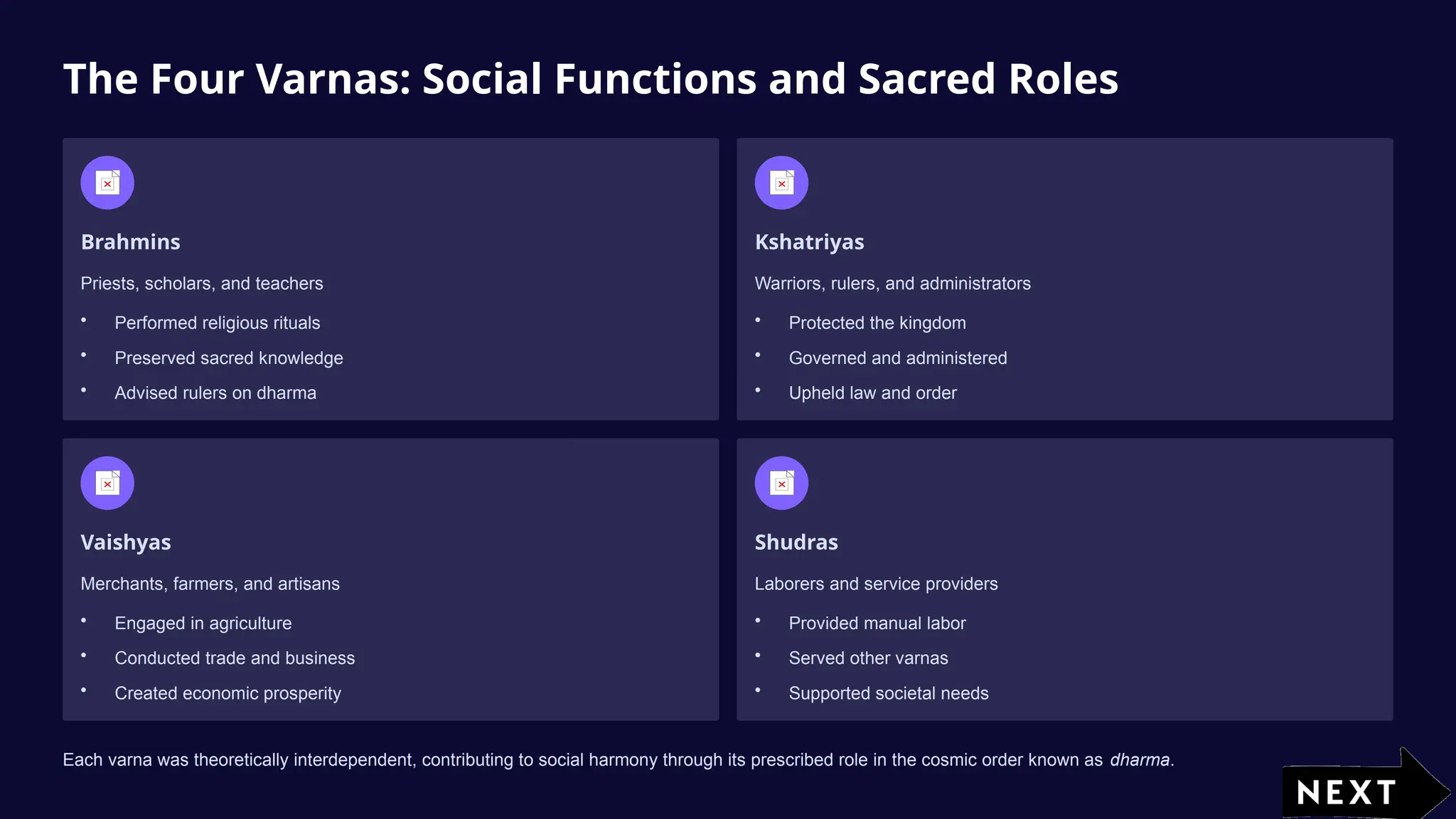
Brahmins
Priests, scholars, and teachers
• Performed religious rituals
• Preserved sacred knowledge
• Advised rulers on dharma
Kshatriyas
Warriors, rulers, and administrators
• Protected the kingdom
• Governed and administered
• Upheld law and order
Vaishyas
Merchants, farmers, and artisans
• Engaged in agriculture
• Conducted trade and business
• Created economic prosperity
Shudras
Laborers and service providers
• Provided manual labor
• Served other varnas
• Supported societal needs
Each varna was theoretically interdependent, contributing to social harmony through its prescribed role in the cosmic order known as dharma.
Jati: The Complex Reality of Hereditary
Communities
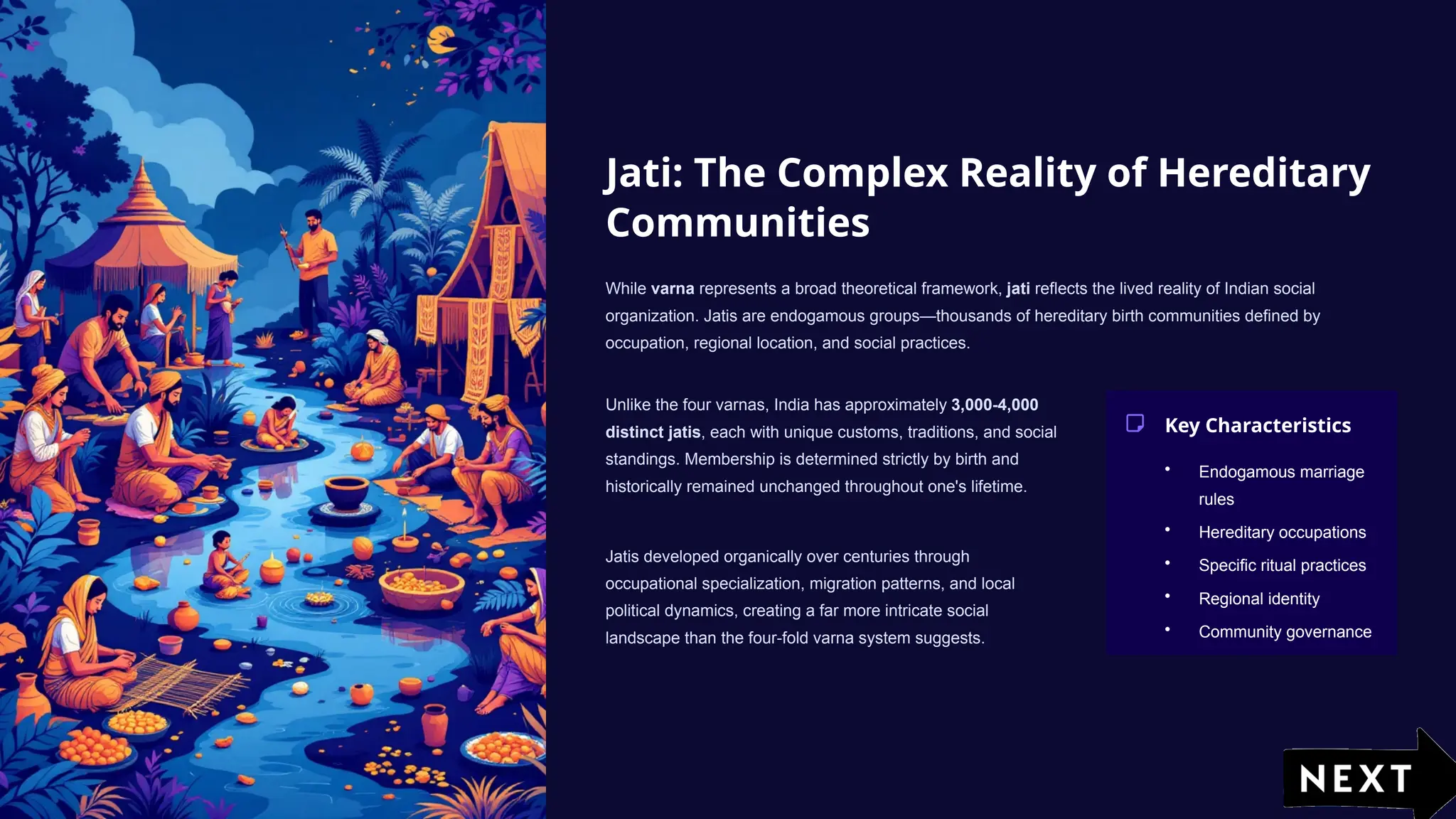
While varna represents a broad theoretical framework, jati reflects the lived reality of Indian social
organization. Jatis are endogamous groups—thousands of hereditary birth communities defined by
occupation, regional location, and social practices.
Unlike the four varnas, India has approximately 3,000-4,000
distinct jatis, each with unique customs, traditions, and social
standings. Membership is determined strictly by birth and
historically remained unchanged throughout one's lifetime.
Jatis developed organically over centuries through
occupational specialization, migration patterns, and local
political dynamics, creating a far more intricate social
landscape than the four-fold varna system suggests.
Key Characteristics
• Endogamous marriage
rules
• Hereditary occupations
• Specific ritual practices
• Regional identity
• Community governance
Varna Theory vs. Jati Practice: Critical
Distinctions
Textual vs. Practical
Varna is a Sanskrit textual concept found in religious scriptures, while jati is the practical,
everyday social reality experienced by communities across India.
Four vs. Thousands
Varna consists of only four broad categories, whereas jati encompasses thousands of
specific, localized birth groups with distinct identities and customs.
Ideal vs. Actual
Varna represents an idealized cosmic order and theoretical social function, while jati reflects
the actual, complex hierarchy shaped by history, economy, and regional politics.
Flexibility vs. Rigidity
The relationship between jati and varna is ambiguous—many jatis claim different varna status
in different contexts, revealing the fluidity beneath apparent rigidity.
Regional Variations and Local Jati Hierarchies
North India
Jati hierarchies emphasize ritual purity
and pollution, with significant gaps
between groups. Agriculture-based
jatis like Jats and Rajputs hold
considerable power.
South India
Non-Brahmin movements challenged
traditional hierarchies. Dominant
agricultural castes like Reddys,
Kammas, and Vokkalingas wield
substantial influence.
Western India
Maritime trade created unique jati
formations. Groups like Patidars in
Gujarat and Marathas in Maharashtra
developed powerful regional identities.
The same jati can occupy different positions in local hierarchies depending on regional economic power, numerical strength, and
historical circumstances. A jati considered "lower" in one village might be dominant in another.
Even the correlation between jati and varna varies dramatically—some jatis claim Kshatriya status in one region and Vaishya
status in another, demonstrating the constructed nature of these categories.
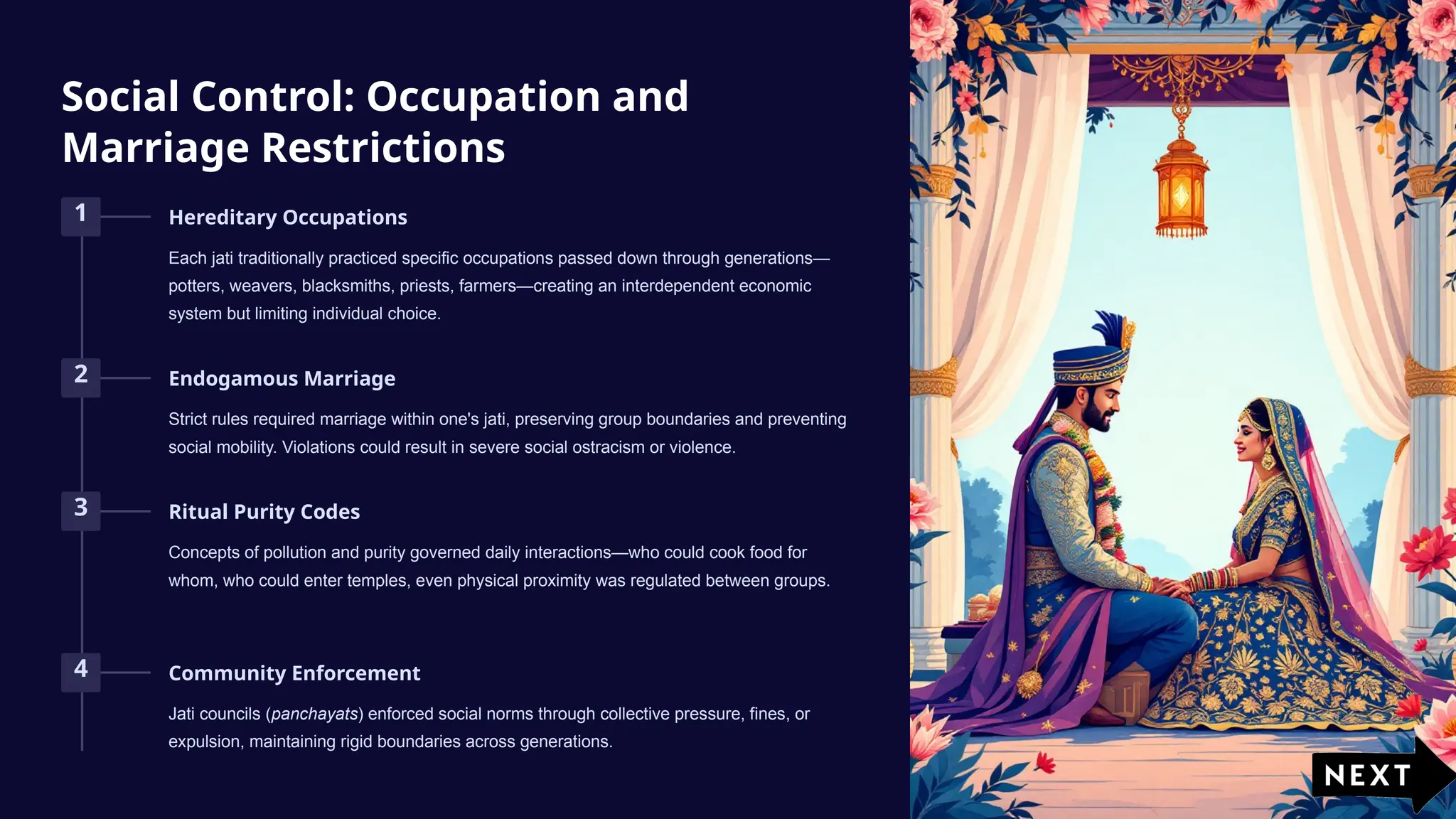
Social Control: Occupation and
Marriage Restrictions
1 Hereditary Occupations
Each jati traditionally practiced specific occupations passed down through generations—
potters, weavers, blacksmiths, priests, farmers—creating an interdependent economic
system but limiting individual choice.
2 Endogamous Marriage
Strict rules required marriage within one's jati, preserving group boundaries and preventing
social mobility. Violations could result in severe social ostracism or violence.
3 Ritual Purity Codes
Concepts of pollution and purity governed daily interactions—who could cook food for
whom, who could enter temples, even physical proximity was regulated between groups.
4 Community Enforcement
Jati councils (panchayats) enforced social norms through collective pressure, fines, or
expulsion, maintaining rigid boundaries across generations.
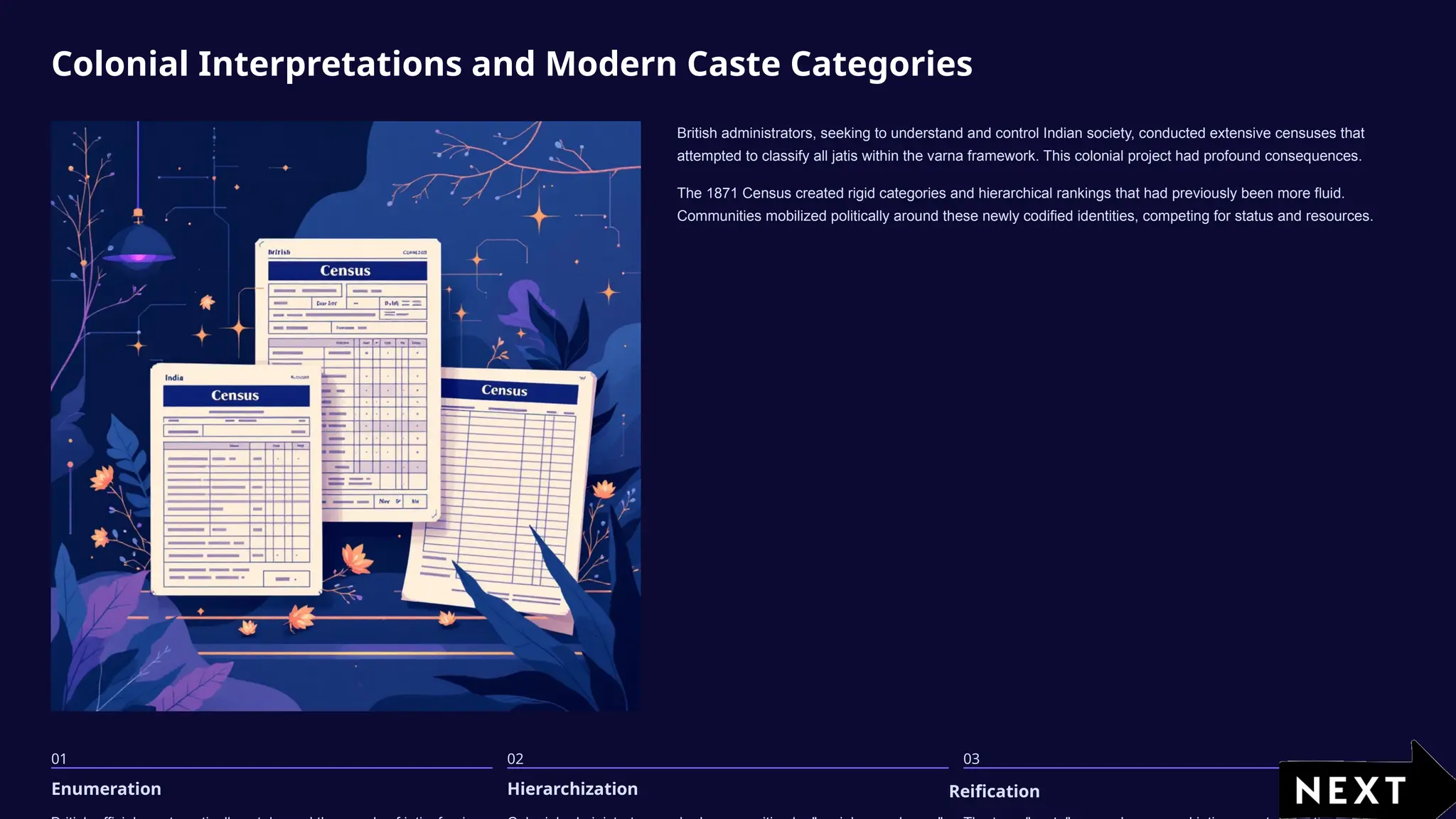
Colonial Interpretations and Modern Caste Categories
British administrators, seeking to understand and control Indian society, conducted extensive censuses that
attempted to classify all jatis within the varna framework. This colonial project had profound consequences.
The 1871 Census created rigid categories and hierarchical rankings that had previously been more fluid.
Communities mobilized politically around these newly codified identities, competing for status and resources.
01
Enumeration
02
Hierarchization
03
Reification
Contemporary Challenges: Reservation and Mobility
India's Constitution abolished untouchability and established affirmative action policies called reservations—quotas in education,
employment, and politics for historically disadvantaged groups.
22.5%
Scheduled Castes
Reservation quota for communities
historically excluded as "untouchables"
27%
Other Backward Classes
Additional reservation for socially and
educationally disadvantaged groups
10%
Economically Weaker
Recent quota for economically
disadvantaged upper castes
These policies remain deeply controversial. Supporters argue they address historical injustices and improve representation. Critics claim they
perpetuate caste consciousness, create reverse discrimination, and benefit elite members of reserved categories while neglecting the most
marginalized.
Despite legal protections, caste-based discrimination persists—in rural areas, in urban housing markets, in marriage preferences, and even in
online spaces, revealing the enduring legacy of these ancient social divisions.
Moving Forward: Equality and Social Justice
Ongoing Debates
Indian society grapples with fundamental questions about identity, justice, and modernity:
• Should affirmative action continue indefinitely, or are there alternative approaches?
• Can caste identity be preserved culturally while eliminating hierarchy?
• How do urbanization and technology transform traditional social boundaries?
• What role should the state play in regulating private discrimination?
THANK YOU

Understanding-Varna-and-Jati-Indias-Ancient-Social-Framework.pptx

  • 1.
    IIIPT PRESENTATION UNDERSTANDING VARNAAND JATI’S PRESENTED BY VANSH BHATI (25/945) RIDHAM DAHALIYA (25/972) BA POLITICAL SCIENCE HONOURS 1ST SEMESTER
  • 2.
    Understanding Varna and Jati:India's Ancient Social Framework Exploring two interconnected yet distinct systems that have shaped Indian society for millennia—from sacred texts to lived experience.
  • 3.
    Historical Origins ofthe Varna System in Vedic Literature The varna system first appears in the Rigveda, particularly in the famous Purusha Sukta hymn (c. 1500-1200 BCE). This sacred text describes the cosmic origin of social divisions through the sacrifice of the primordial being, Purusha. From his body emerged four distinct social categories, each associated with specific functions essential to maintaining cosmic and social order. The system was initially conceived as a flexible, functional division rather than a rigid hierarchy.
  • 4.
    The Four Varnas:Social Functions and Sacred Roles Brahmins Priests, scholars, and teachers • Performed religious rituals • Preserved sacred knowledge • Advised rulers on dharma Kshatriyas Warriors, rulers, and administrators • Protected the kingdom • Governed and administered • Upheld law and order Vaishyas Merchants, farmers, and artisans • Engaged in agriculture • Conducted trade and business • Created economic prosperity Shudras Laborers and service providers • Provided manual labor • Served other varnas • Supported societal needs Each varna was theoretically interdependent, contributing to social harmony through its prescribed role in the cosmic order known as dharma.
  • 5.
    Jati: The ComplexReality of Hereditary Communities While varna represents a broad theoretical framework, jati reflects the lived reality of Indian social organization. Jatis are endogamous groups—thousands of hereditary birth communities defined by occupation, regional location, and social practices. Unlike the four varnas, India has approximately 3,000-4,000 distinct jatis, each with unique customs, traditions, and social standings. Membership is determined strictly by birth and historically remained unchanged throughout one's lifetime. Jatis developed organically over centuries through occupational specialization, migration patterns, and local political dynamics, creating a far more intricate social landscape than the four-fold varna system suggests. Key Characteristics • Endogamous marriage rules • Hereditary occupations • Specific ritual practices • Regional identity • Community governance
  • 6.
    Varna Theory vs.Jati Practice: Critical Distinctions Textual vs. Practical Varna is a Sanskrit textual concept found in religious scriptures, while jati is the practical, everyday social reality experienced by communities across India. Four vs. Thousands Varna consists of only four broad categories, whereas jati encompasses thousands of specific, localized birth groups with distinct identities and customs. Ideal vs. Actual Varna represents an idealized cosmic order and theoretical social function, while jati reflects the actual, complex hierarchy shaped by history, economy, and regional politics. Flexibility vs. Rigidity The relationship between jati and varna is ambiguous—many jatis claim different varna status in different contexts, revealing the fluidity beneath apparent rigidity.
  • 7.
    Regional Variations andLocal Jati Hierarchies North India Jati hierarchies emphasize ritual purity and pollution, with significant gaps between groups. Agriculture-based jatis like Jats and Rajputs hold considerable power. South India Non-Brahmin movements challenged traditional hierarchies. Dominant agricultural castes like Reddys, Kammas, and Vokkalingas wield substantial influence. Western India Maritime trade created unique jati formations. Groups like Patidars in Gujarat and Marathas in Maharashtra developed powerful regional identities. The same jati can occupy different positions in local hierarchies depending on regional economic power, numerical strength, and historical circumstances. A jati considered "lower" in one village might be dominant in another. Even the correlation between jati and varna varies dramatically—some jatis claim Kshatriya status in one region and Vaishya status in another, demonstrating the constructed nature of these categories.
  • 8.
    Social Control: Occupationand Marriage Restrictions 1 Hereditary Occupations Each jati traditionally practiced specific occupations passed down through generations— potters, weavers, blacksmiths, priests, farmers—creating an interdependent economic system but limiting individual choice. 2 Endogamous Marriage Strict rules required marriage within one's jati, preserving group boundaries and preventing social mobility. Violations could result in severe social ostracism or violence. 3 Ritual Purity Codes Concepts of pollution and purity governed daily interactions—who could cook food for whom, who could enter temples, even physical proximity was regulated between groups. 4 Community Enforcement Jati councils (panchayats) enforced social norms through collective pressure, fines, or expulsion, maintaining rigid boundaries across generations.
  • 9.
    Colonial Interpretations andModern Caste Categories British administrators, seeking to understand and control Indian society, conducted extensive censuses that attempted to classify all jatis within the varna framework. This colonial project had profound consequences. The 1871 Census created rigid categories and hierarchical rankings that had previously been more fluid. Communities mobilized politically around these newly codified identities, competing for status and resources. 01 Enumeration 02 Hierarchization 03 Reification
  • 10.
    Contemporary Challenges: Reservationand Mobility India's Constitution abolished untouchability and established affirmative action policies called reservations—quotas in education, employment, and politics for historically disadvantaged groups. 22.5% Scheduled Castes Reservation quota for communities historically excluded as "untouchables" 27% Other Backward Classes Additional reservation for socially and educationally disadvantaged groups 10% Economically Weaker Recent quota for economically disadvantaged upper castes These policies remain deeply controversial. Supporters argue they address historical injustices and improve representation. Critics claim they perpetuate caste consciousness, create reverse discrimination, and benefit elite members of reserved categories while neglecting the most marginalized. Despite legal protections, caste-based discrimination persists—in rural areas, in urban housing markets, in marriage preferences, and even in online spaces, revealing the enduring legacy of these ancient social divisions.
  • 11.
    Moving Forward: Equalityand Social Justice Ongoing Debates Indian society grapples with fundamental questions about identity, justice, and modernity: • Should affirmative action continue indefinitely, or are there alternative approaches? • Can caste identity be preserved culturally while eliminating hierarchy? • How do urbanization and technology transform traditional social boundaries? • What role should the state play in regulating private discrimination?
  • 12.