LEGAL BASIS
•Presidential Decree965
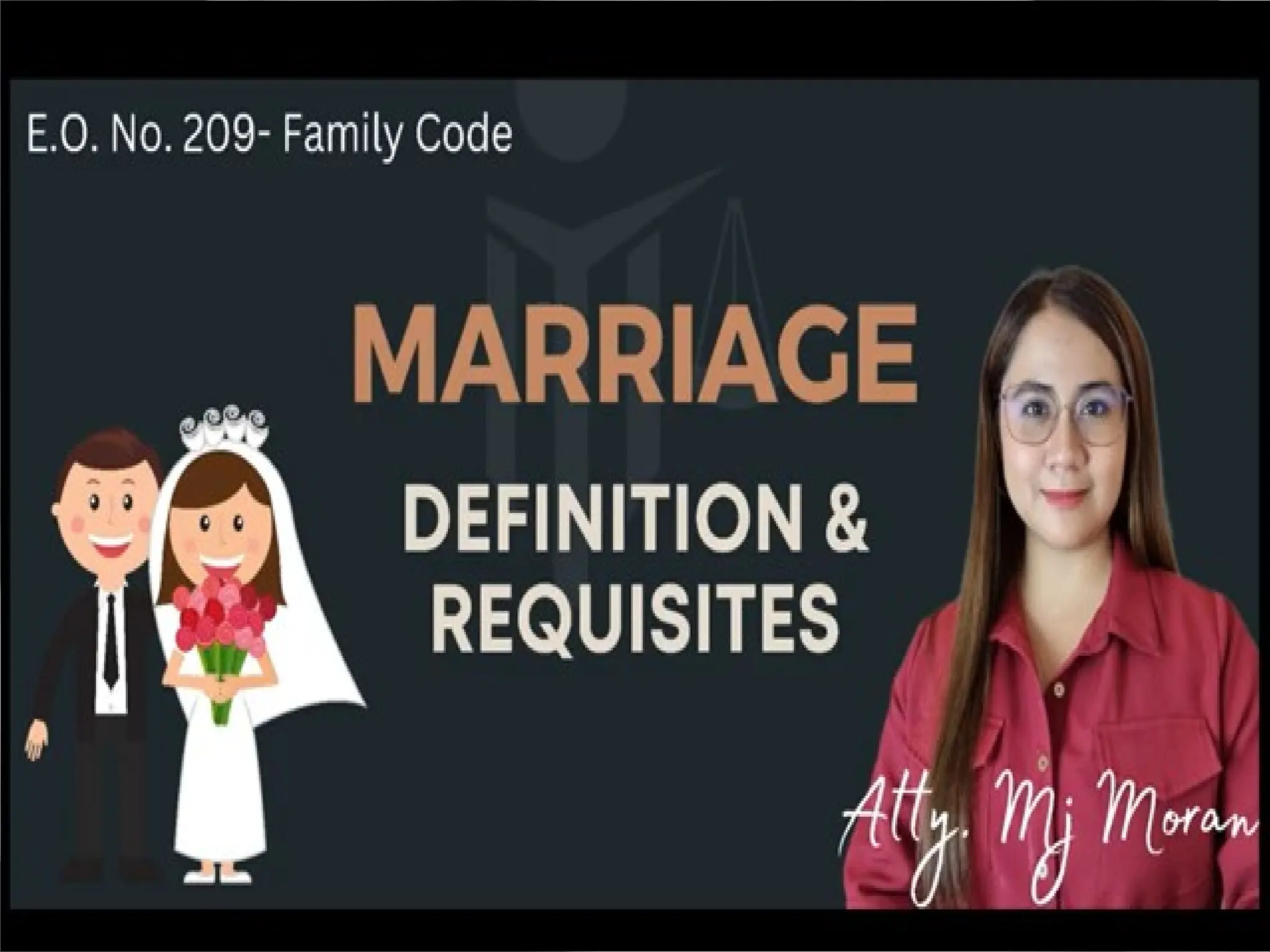
•Executive Order No. 209, s. 1987
•Local Government Code
•Responsible Parenthood and
Reproductive Health (RPRH) Law
3.
PURPOSE
• The purposeof PMOC is to provide would-
be couples with information they will need
in preparation for the challenges of married
life, along with their responsibilities as
spouses, family members, and future
parents. It will also give them a better
understanding of marriage so they can
affirm their decision to get married based
on sufficient knowledge and clear
expectations.
4.
THE PMOC SESSION
•Pre-MarriageOrientation
•All couple applicants for marriage
license have to undergo the Pre-
marriage Orientation (PMO)
•Pre-Marriage Counseling
• All couples with one or both partners who
are 18-25 years old
TopicOne:MarriageandRelationships
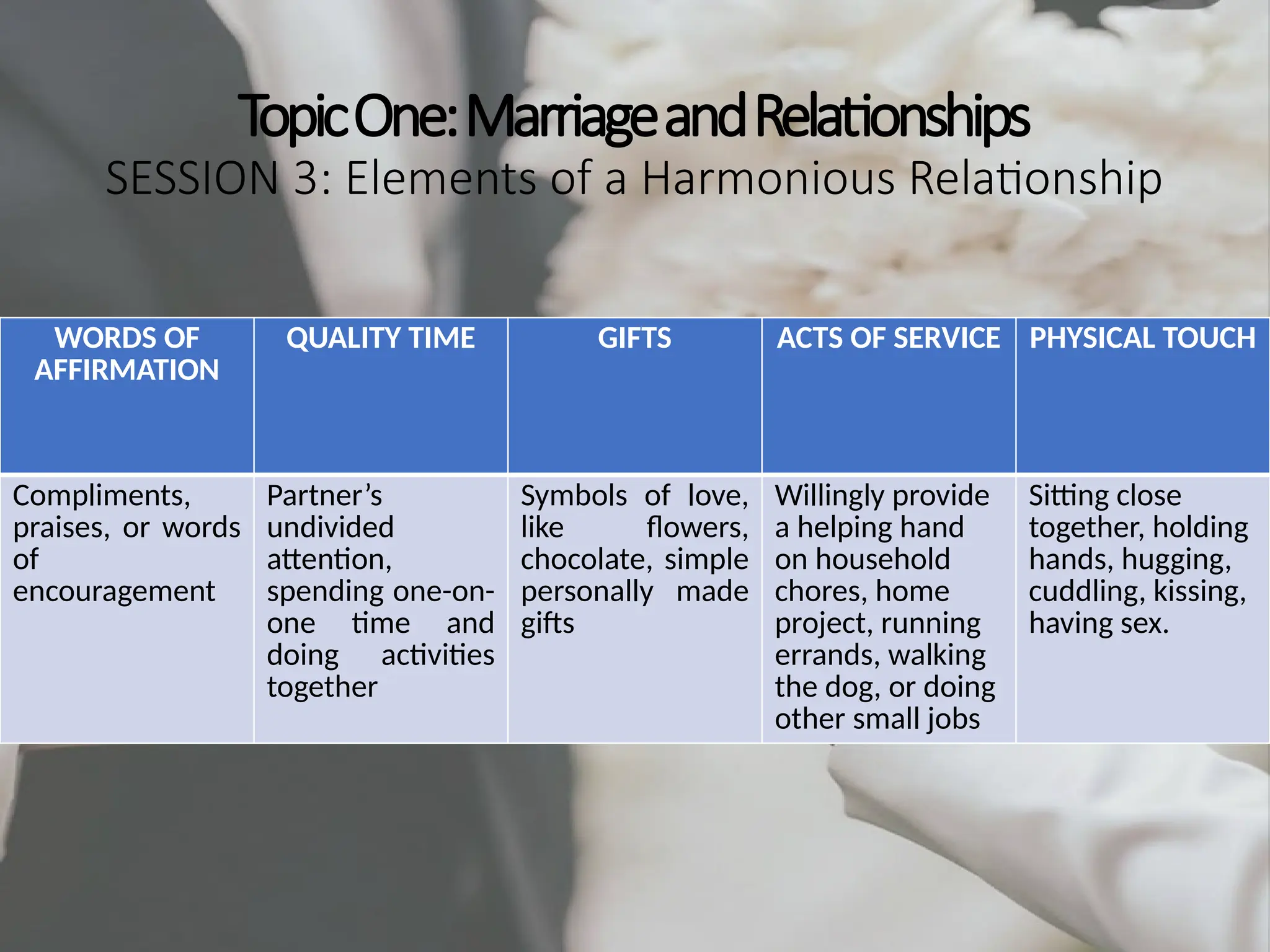
SESSION 3: Elementsof a Harmonious Relationship
WORDS OF
AFFIRMATION
QUALITY TIME GIFTS ACTS OF SERVICE PHYSICAL TOUCH
Compliments,
praises, or words
of
encouragement
Partner’s
undivided
attention,
spending one-on-
one time and
doing activities
together
Symbols of love,
like flowers,
chocolate, simple
personally made
gifts
Willingly provide
a helping hand
on household
chores, home
project, running
errands, walking
the dog, or doing
other small jobs
Sitting close
together, holding
hands, hugging,
cuddling, kissing,
having sex.
TopicOne:MarriageandRelationships
SESSION 4: OtherRelated Laws on Marriage
•The Philippine Constitution and
the Family Code recognize that
marriage, as an inviolable social
institution, is the foundation of
the family and shall be protected
by the State.
15.
TopicOne:MarriageandRelationships
SESSION 4: OtherRelated Laws on Marriage
• Further, Republic Act 10354 also known as the
Responsible Parenthood and Reproductive Health
Law, affirms the roles of the State in protecting the
family. This law also promotes the rights of the
couples to exercise their reproductive rights,
particularly their right to have their desired
number, timing, and spacing of children within the
demands of responsible parenthood through
universal access to reproductive health information
and services, including family planning.
16.
TopicOne:MarriageandRelationships
SESSION 4: OtherRelated Laws on Marriage
•In addition, there are other laws in
the Philippines that protect and
nurture marriage, and which can be
resorted to in case of violence or
abuse in the home. Married couples
should know and observe these
laws.
17.
TopicOne:MarriageandRelationships
SESSION 4: OtherRelated Laws on Marriage
•Republic Act No. 9262: Anti-Violence
Against Women and their Children Act
of 2004 (Promulgated March 8, 2004)
• Physical Abuse
• Sexual Abuse
• Psychological Abuse
• Economic Abuse
TopicTwo:ResponsibleParenthood
SESSION 2: Dutiesand Responsibilities of Parents
•What are the duties and responsibilities
of a parents?
1. Providing physical care, love and basic need
2. Inculcating in them the right values, good conduct, and discipline
3. Teaching them their roles and responsibilities
4. Developing their social competence
5. Education
6. Citizenship training
7. Educating children in age-appropriate aspects of human sexuality
and gender sensitivity
8. Spiritual and value formation
TopicTwo:ResponsibleParenthood
Session 3: EffectiveParent-Child Communication
• Let the child know that you are interested and
involved and that you will help when needed+ Give
full attention when your child wants to talk to you.
• Unless other people need to be part of the discussion,
hold conversations in private.
• The best communication between you and the child
will occur when others are not around.
• Embarrassing the child or putting him on the spot in
front of others will lead only to resentment and
hostility, not good communication.
25.
TopicTwo:ResponsibleParenthood
Session 3: EffectiveParent-Child Communication
• Do not tower over your child, Physically get down
to the child’s level, then talk.
• If you are angry about a behavior or an incident, do
not attempt to communicate until you regain your
cool because you cannot be objective. It is better to
stop, settle down and talk to the child later.
• If you are very tired, you will have to make an extra
effort to be an active listener. Genuine active
listening is hard work and is very difficult when your
mind and body are already tired.
26.
TopicTwo:ResponsibleParenthood
Session 3: EffectiveParent-Child Communication
• Listen carefully and politely, Do not interrupt the child when he is
trying to tell his/her story, Be as courteous to your child as you
would be to your best friend.
• Do not ask why but do ask what happened+ Do not be
judgmental; let the child explain
• If you have a knowledge of the situation, tell the child the
information that you know or have been told. Then let him tell
you his/her own version
• Adult talking – “You’ll talk when I’m finished,” “I know what’s best
for you,” “Just do what I say and that will solve the problem” –
does not work. Keep adult talking, preaching, and moralizing to a
minimum because they are not helpful in getting, and keeping
communication open.
27.
TopicTwo:ResponsibleParenthood
Session 3: EffectiveParent-Child Communication
• Do not use put-down words (like dumb, stupid, lazy) or
derogatory statements (like “Stupid, that makes no
sense at all” or “What do you know, you’re just a child”).
• Assist the child in planning some specific steps to the
solution.
• Show that you accept the child, regardless of what
he/she has or has not done.
• Reinforce the child for keeping communication open. Do
this by accepting him and praising his efforts to
communicate.
TopicTwo:ResponsibleParenthood
SESSION 4: Rightsof the Child
1. Children have the right to be born well once they
are conceived.
2. Children have the right to a wholesome family life.
3. Children have the right to develop into a happy,
useful and active member of society.
4. Children have the right to a healthy and vigorous
life
5. Children have the right to enrich and strengthen
their character through a moral and upright life
30.
TopicTwo:ResponsibleParenthood
SESSION 4: Rightsof the Child
6. Children have the right to education and skills
development
7. Children have the right to safe and wholesome
recreational activities.
8. Children have the right to be protected from
anything that will negatively affect their
development and growth.
9. Children have the right to live in an environment
that will positively affect their growth and
development
31.
TopicTwo:ResponsibleParenthood
SESSION 4: Rightsof the Child
10. Children have the right to the care, assistance,
and protection of the State
11. Children have the right to an efficient and honest
government.
12. Children have the right to grow up as free and
responsible individuals.
13. Children have the right to a name and nationality
TopicTwo:ResponsibleParenthood
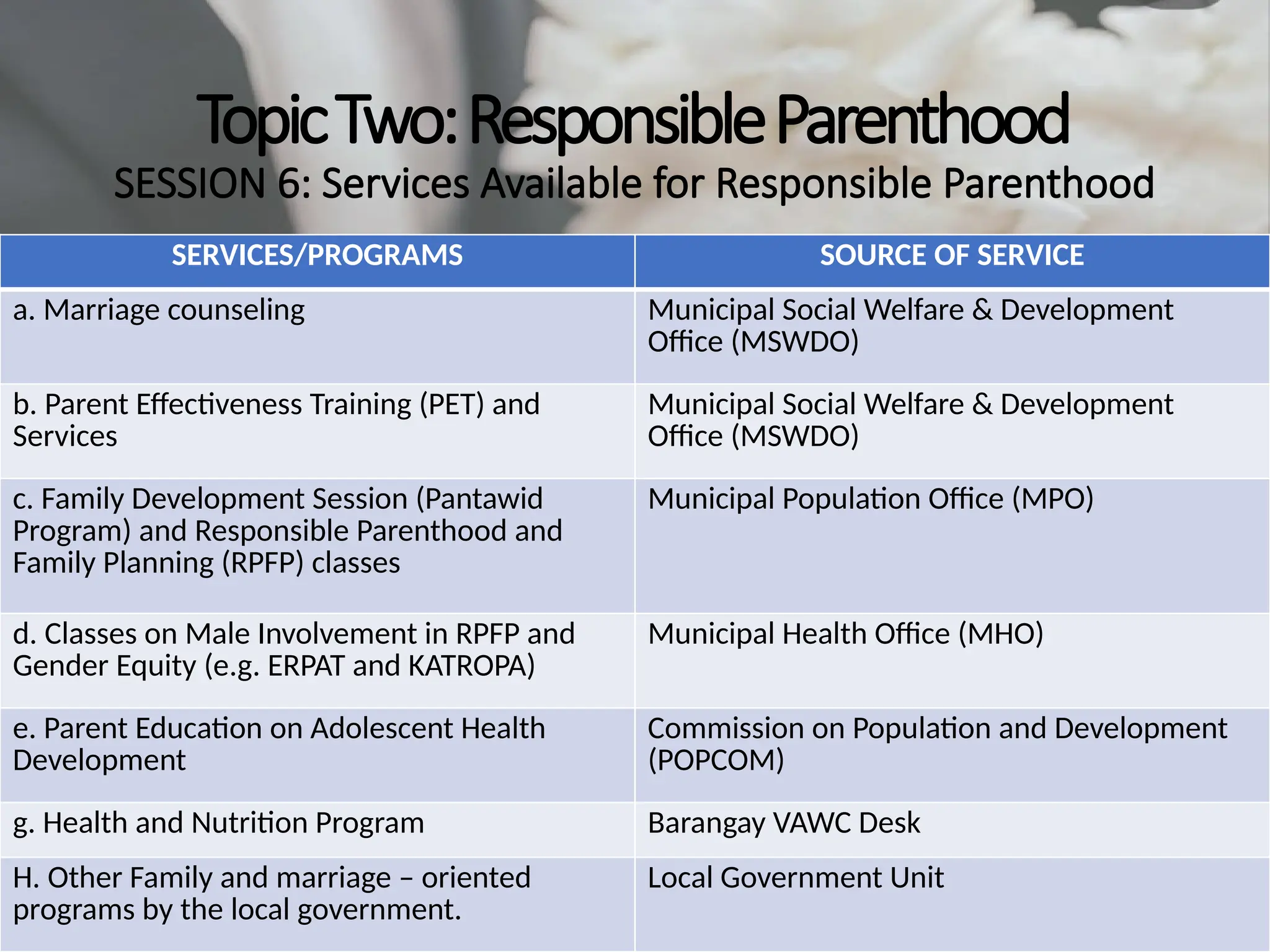
SESSION 6: ServicesAvailable for Responsible Parenthood
SERVICES/PROGRAMS SOURCE OF SERVICE
a. Marriage counseling Municipal Social Welfare & Development
Office (MSWDO)
b. Parent Effectiveness Training (PET) and
Services
Municipal Social Welfare & Development
Office (MSWDO)
c. Family Development Session (Pantawid
Program) and Responsible Parenthood and
Family Planning (RPFP) classes
Municipal Population Office (MPO)
d. Classes on Male Involvement in RPFP and
Gender Equity (e.g. ERPAT and KATROPA)
Municipal Health Office (MHO)
e. Parent Education on Adolescent Health
Development
Commission on Population and Development
(POPCOM)
g. Health and Nutrition Program Barangay VAWC Desk
H. Other Family and marriage – oriented
programs by the local government.
Local Government Unit
Editor's Notes
#2 A decree requiring applicant for marriage license to receive instructions on family planning and responsible parenthood.
The Family Code of The Philippines
All couples applying for a marriage license in the Philippines are required to attend the Pre-marriage Orientation and Counseling (PMOC) Session before they can be issued a license
#3 Marriage is a major life decision and a lifetime commitment. It is a legal contract that will bind a man and a woman not only for a life of togetherness but also for sharing resources and forming a family. Marriage not only establishes the lives of the couple but also the lives of the children and future generations.
The decision to get married, therefore, must be well thought out, and must be jointly made by the couple after careful consideration, thorough understanding, and ample preparation. This is why the PMOC is a crucial first step prior to getting married.
#4 and those whom the PMOC team may find, based on the couples’ responses on the Marriage Expectations Inventory to have issues that need to be addressed more closely, have to undergo the Pre-Marriage Counseling (PMC) session.
Couples who voluntarily want to get counseling may also attend the PMC session.
#8 Art. 2. No marriage shall be valid, unless these essential requisites are present:
(1) Legal capacity of the contracting parties who must be a male and a female; and
(2) Consent freely given in the presence of the solemnizing officer. (53a)
Art. 3. The formal requisites of marriage are:
(1) Authority of the solemnizing officer;
(2) A valid marriage license except in the cases provided for in Chapter 2 of this Title; and
(3) A marriage ceremony which takes place with the appearance of the contracting parties before the solemnizing officer and their personal declaration that they take each other as husband and wife in the presence of not less than two witnesses of legal age. (53a, 55a)
Marriage is a legal contract between husband and wife, but at the same time, a social institution. Therefore, a couple should know fully well what marriage is, its requirements, and the responsibilities that come with it before getting married+ This is because marriage is a life-long commitment that cannot be easily dissolved without legal grounds.
Marriage is entered into for two (2) main reasons: to satisfy a man’s and a woman’s need for love and intimacy; and to provide a foundation for the formation of a family.
#17 Violence against women and their children refers to any act or a series of acts committed by any person against a woman who is his wife, former wife, or against a woman with whom the person has or had a sexual or dating relationship, or with whom he has a common child, or against her child whether legitimate or illegitimate, within or without the family abode, which result in or is likely to result in physical, sexual, psychological harm or suffering, or economic abuse including threats of such acts, battery, assault, coercion, harassment or arbitrary deprivation of liberty.
#18 The Magna Carta of Women provides for women’s protection from all forms of violence, including those committed by the State and defense of women against gender-based violence (including domestic violence).
It also provides equal rights in all matters relating to marriage and family relations. The State shall ensure the same rights for women and men to: enter into and leave marriages, freely choose a spouse, decide on the number and spacing of their children, enjoy personal rights including the choice of a profession, own, acquire, and administer their property, and acquire, change, or retain their nationality+ It also states that the betrothal and marriage of a child shall have no legal effect.
#19 The law states that rape is committed by a man who shall have carnal knowledge of a woman and uses force, threat, or intimidation.
The Supreme Court recognizes the lawmakers intended to include and penalize marital rape under the definition of rape. As such, forced sex between married couples is still rape and cannot be excused under the guise of marriage. (Acosta, 2015).
#20 Responsible parenthood is the ability of a couple to raise a strong and stable family, and make the family a reliable source of emotional, mental, social, economic and moral support for the children. Part of responsible parenthood is the ability to provide for the needs of the children and support them to achieve their aspirations throughout their development. This includes keeping them healthy, well-educated, socially secure and well-adjusted.
Responsible parenting is a joint responsibility of a couple. This joint responsibility starts from the decision on how many children they want and when to have them up to the decisions and actions they take as they raise their children from babyhood to adulthood. The proper development of children depends a lot on how well parents perform their joint parenting responsibilities.
#21 AUTHORITARIAN - Parents have full authority of their child’s aspect of life
PERMISSIVE - Parents do not set standards for their children
NEGLECTFUL - Parents are not interested with their children’s affairs
AUTHORITATIVE - Parents balance demands and responsiveness
#22 The New Family Code and the Child and Youth Welfare Code of the Philippines enumerate the duties and responsibilities of parents toward their children. It is important that, before getting married, couples know what these responsibilities are and be able to determine how ready they are to assume these responsibilities or what they need to do to prepare themselves for the task of parenting that lies before them.
When couples decide on the number of children they want to have, they should be aware that they have responsibilities to every child, and as the size of their family increases, these responsibilities also increase. Thus, as they plan for the future of their family, they should also plan for providing time and resources to respond to each child’s needs, and be ready to make necessary life improvements accordingly. The couple should be able to care for and relate well with their children as the members of the family increase.
#24 Communication between parents and children and other members of the family is a vital element of good family relationships. Communication between parents and children sometimes can be a bit more complicated considering the age gap and the differences in interests and orientations, and sometimes even in the language.
#32 Home management is the process of planning, controlling and evaluating family resources to achieve family goals. It is a decision-making activity shared by the couple. It helps families and couples make maximum use of what they have to attain their goals and aspirations.
Proper and wise management of time, energy and family finances, and the ability to foresee and prepare for future eventualities are key elements to effective home management.