20 FROM 25
THE BEST BUSINESS BOOKS OF 2025
thebusiness500.com
 A library of over 500 books
 A blog
 A series of printed books
 One-page summaries
 One-sentence summaries
 Training programmes
 Motivational speeches
 A fertile source of new ideas
 Search thebusiness500.com
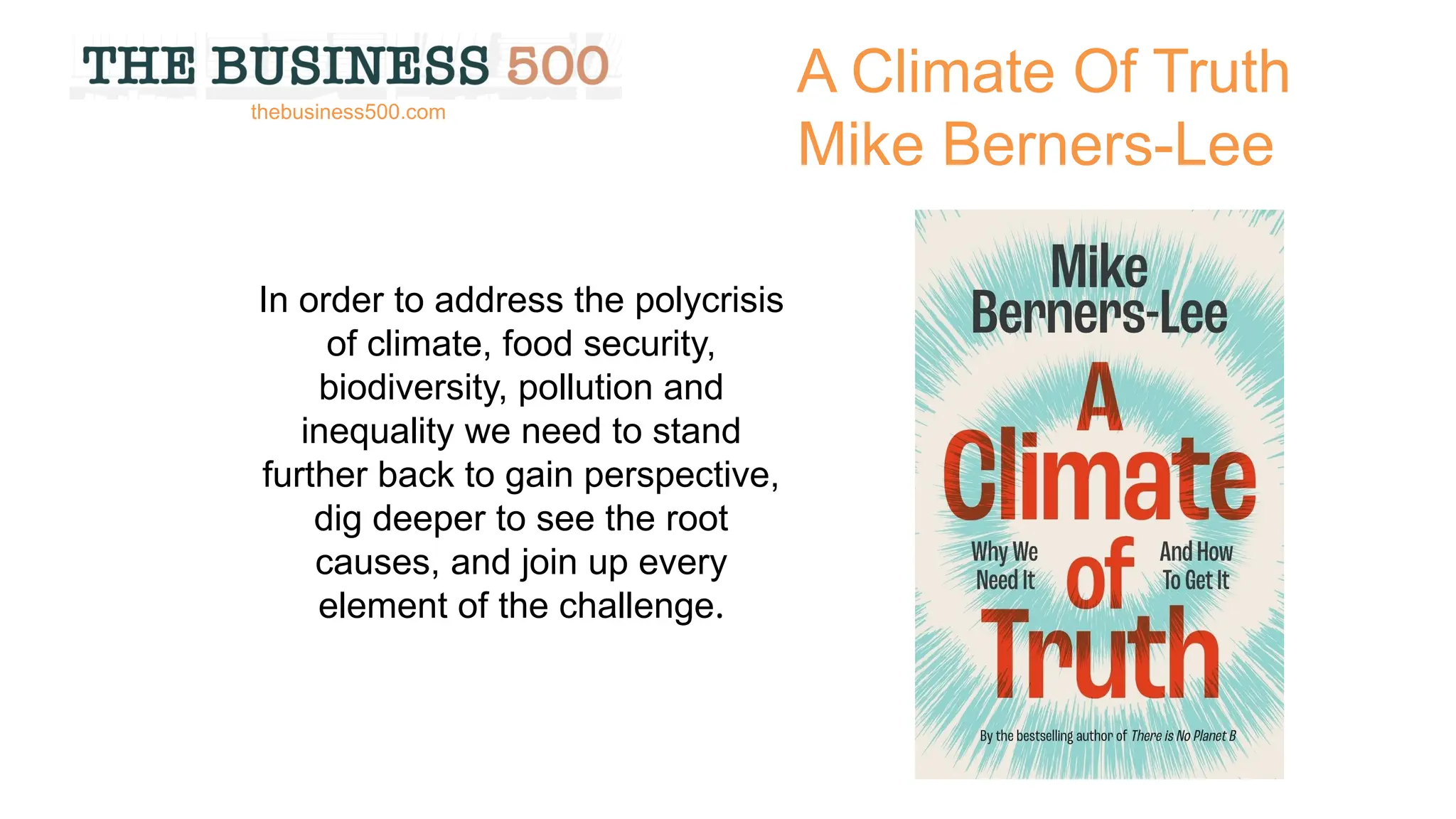
A Climate Of Truth
Mike Berners-Lee
In order to address the polycrisis
of climate, food security,
biodiversity, pollution and
inequality we need to stand
further back to gain perspective,
dig deeper to see the root
causes, and join up every
element of the challenge.
thebusiness500.com
• The book maps out the challenge ahead and explains that we need to gain agency at the
Global System Level. Energy efficiency is often cited as a form of progress, but because of the
Jevons Paradox, it actually makes it worse. This is named after William Stanley Jevons who,
in the 19th
century, noticed that as coal efficiency improved it led to rising, not falling demand
and use.
• This is also called the rebound effect. It is one of the most critically important and under-
appreciated concepts for all climate strategists and politicians to understand. Only when the
inputs are constrained do efficiency improvements stand to make quality of life and the
environment better rather than worse, but the oil companies resist this, which is why we need
a high enough and universal carbon price.
• The polycrisis has three layers. The outer layer contains the elements that are easiest to see
and will be the direct cause of problems if they can’t be sorted out. They include climate,
energy, population, food, biodiversity, pollution and disease. Positive feedback loops and
tipping points are particularly concerning here, because once set in train they can’t be
reversed. They even reinforce each other as cascading tipping points.
• The middle layer of the polycrisis is all about politics, media, business, inequality, economics
and growth, technology and education. Techno-optimism is a problem here, claiming that
technology will drive change and that we are making progress, but this abdicates responsibility
and creates a misleading narrative of no behavioural change. To address it, we need more
honest, transparent and joined-up political discourse, a media and business community to
match, an economic framework connected to the wellbeing of people and the planet, ecocide
laws that have teeth, and a shrinking gap in equality.
• The core of the polycrisis is all about thinking and values.
A Climate Of Truth
Mike Berners-Lee
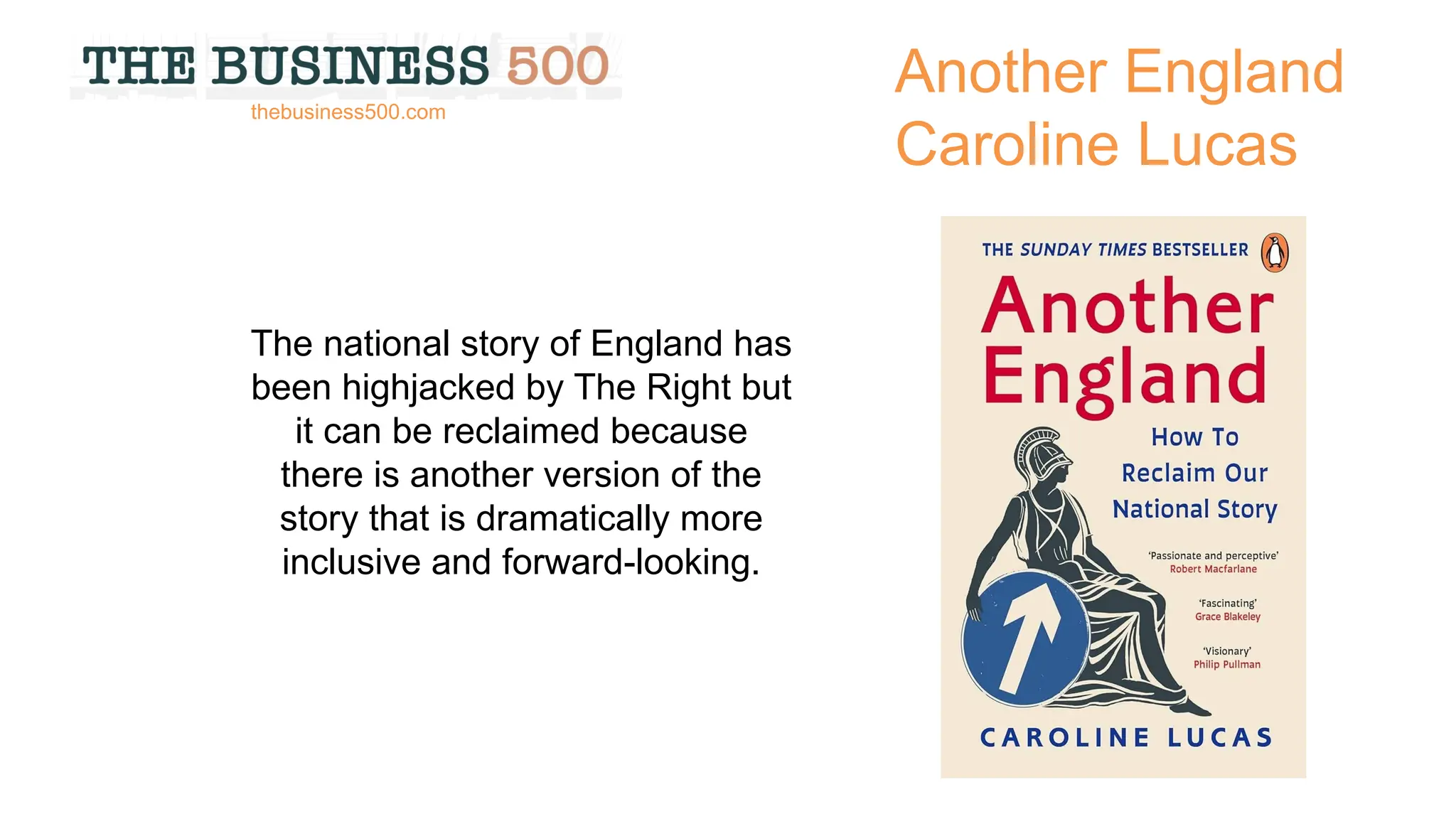
Another England
Caroline Lucas
The national story of England has
been highjacked by The Right but
it can be reclaimed because
there is another version of the
story that is dramatically more
inclusive and forward-looking.
thebusiness500.com
• The author was the UK’s first Green Party MP in 2010 and served as party leader from 2008 to
2012, serving for 25 years until standing down by the 2024 election.
• Having gained a PhD in English Literature, she delves deep into England’s literary history to
sketch out alternative stories of who we are – ones that we can all embrace to build a greener,
fairer future. She believes that by engaging with literature we can open up new possibilities.
• Today, the only people who dare speak of Englishness are cheerleaders for Brexit,
exceptionalism and imperial nostalgia. But there is another England hiding in plain sight.
• First, we need to consider the distinction between England, Britain, Great Britain and the United
Kingdom. In many discussions, the four descriptions are used interchangeably, but this disguises
many issues. For example, what is England if Northern Ireland, Scotland and Wales are removed
from the equation – something that the author refers to as Nixit, Sexit and Wexit? All three
scenarios are possible, so what would England be?
• Literature can shed a new light on our three greatest challenges:
1. How to reform our political system so that accountability, fairness and respect are at the
heart of how we govern ourselves.
2. How we can all live well within the constraints of a finite planet.
3. How we can be a more open and confident nation, celebrating difference rather than seeking
to repress it.
• Our national identity has always been a story as much as a reality, and it has been rewritten
many times over the centuries to create all the myths that make up our conception of
‘Englishness’. Everything from Robin Hood to the Armada to Dunkirk can be packaged up to
suggest that England might somehow be better off by isolating itself, whilst peddling fantasies
about recreating the Empire.
Another England
Caroline Lucas
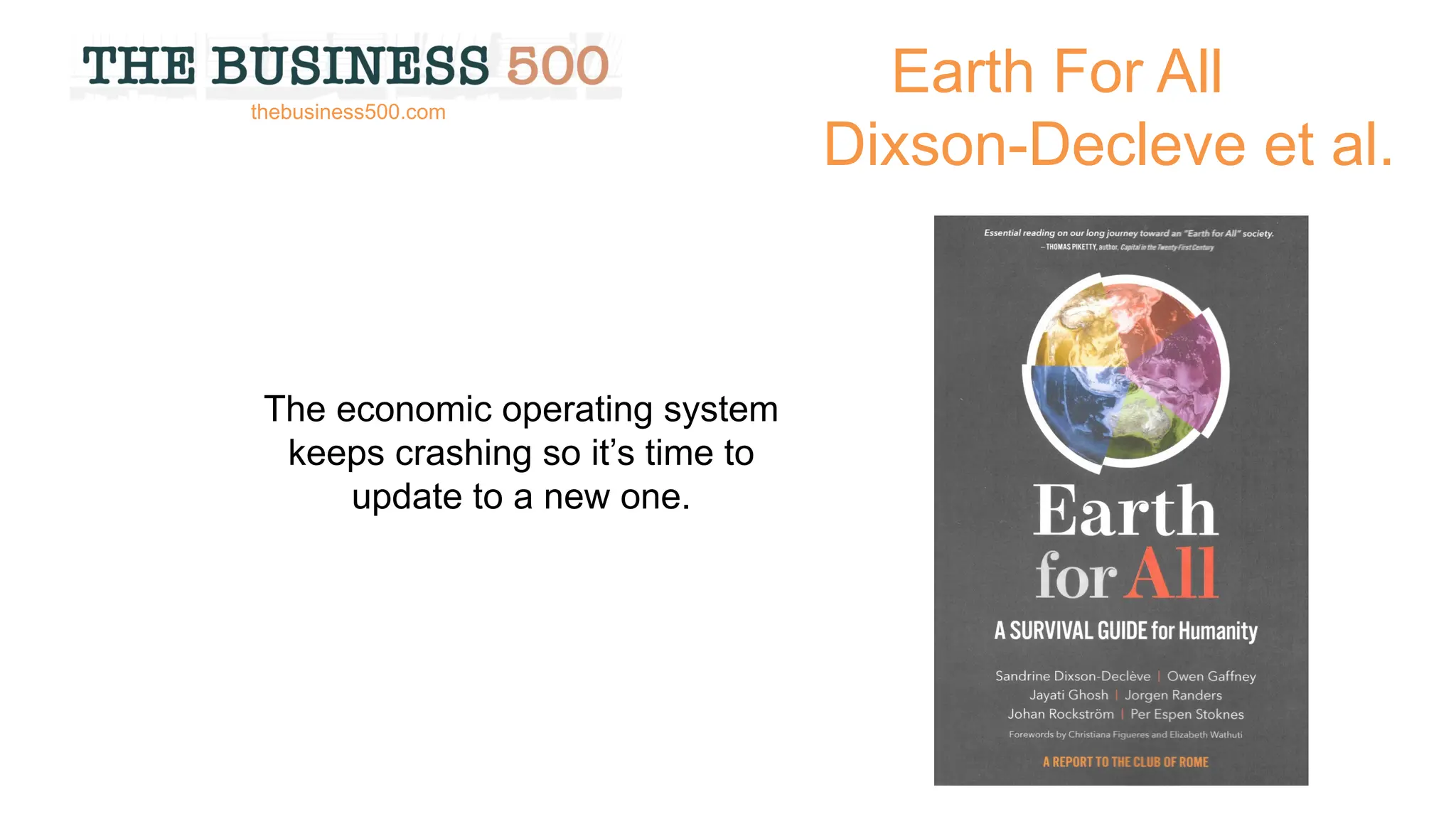
Earth For All
Dixson-Decleve et al.
The economic operating system
keeps crashing so it’s time to
update to a new one.
thebusiness500.com
• This is a survival guide for humanity written by six authors as a report to the Club of Rome. It
asserts that earth has crossed multiple planetary boundaries and is now at the cliff edge. On top
of that, widespread inequality is causing deep social instabilities, making it even more difficult to
resolve our crises.
• The book outlines for the first time what system change really means for civilization - an
antidote to despair and a roadmap to a better future. It uses computer modelling to show how
five turnarounds are needed urgently to achieve prosperity for all within planetary limits within a
single generation. These cover poverty, inequality, empowerment, food and energy, and are
interlinked so that together they create a whole system transformation called Earth4All.
• The poverty turnaround involves dramatic expansion in the policy space along with trade re-
regionalization and a new economic model that allows the growth in low-income nations to
reduce poverty rapidly in a green and fair way.
• The inequality turnaround uses progressive taxation to distribute income more fairly, re-
unionization to empower workers, and a Citizen Fund to provide universal basic dividends so
that citizens can benefit from shared resources.
• The empowerment turnaround brings gender equity to the fore with education for all, female
leadership and jobs, and a new pension system for old age.
• The food turnaround uses regenerative agriculture and sustainable intensification to create
healthier soils and ecosystems, new farming techniques and food-system efficiency to shift from
grain-fed red meat to nourishing healthier diets.
• The energy turnaround creates new energy system efficiency to transform consumption in heat,
industrial processes and transport by moving to abundant renewables.
Earth For All
Dixson-Decleve et al.
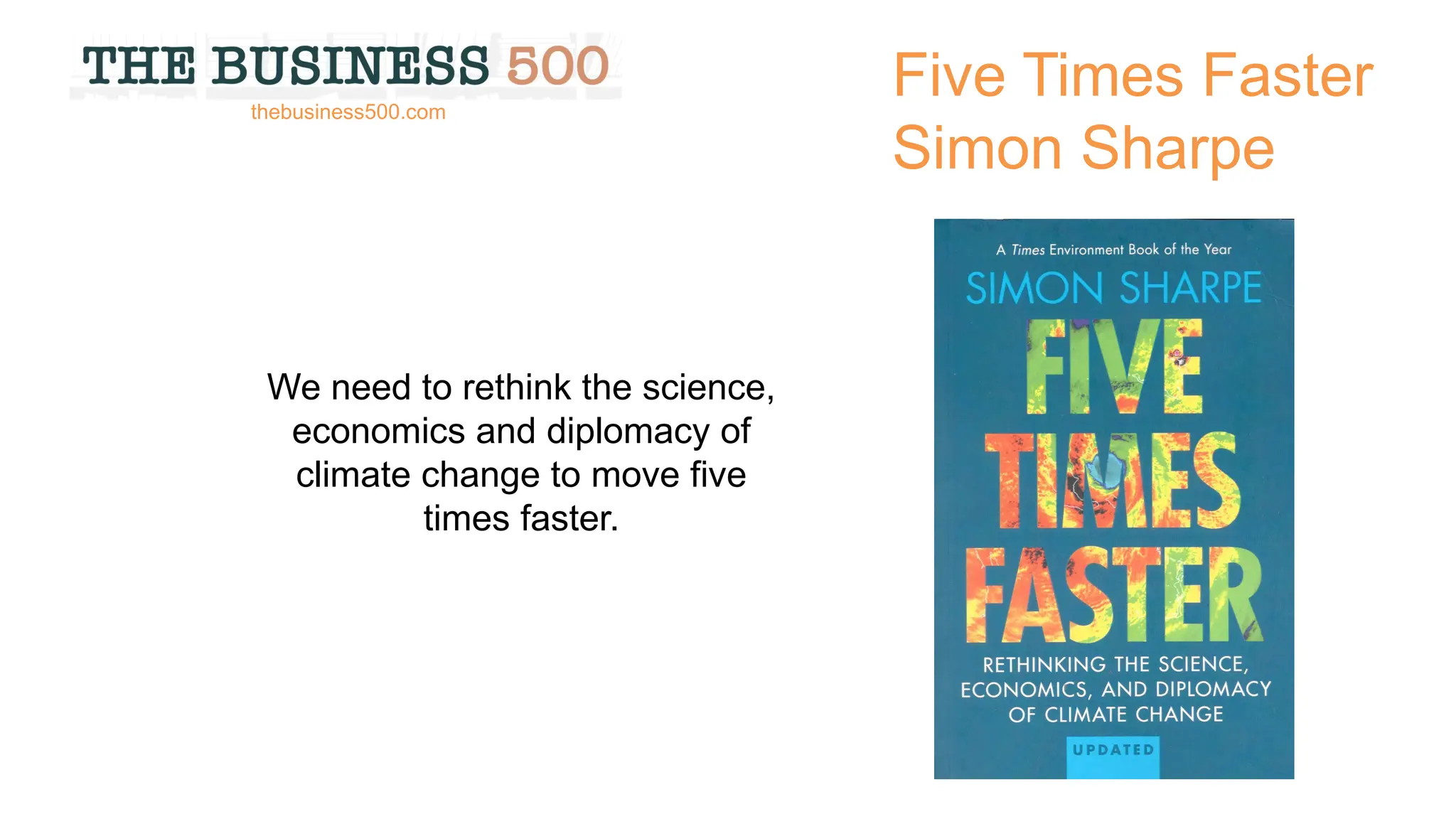
Five Times Faster
Simon Sharpe
We need to rethink the science,
economics and diplomacy of
climate change to move five
times faster.
thebusiness500.com
• Experts are not properly examining risk assessments related to climate change, nor even asking
the right questions. We seem to know the least about the things that matter most. When the
author asked scientists, research funders, and those in government who receive research
intended for policy makers why this was, they offered three reasons.
• 1. Wilful ignorance. Researchers have been discouraged from looking at global warming
scenarios over 2 degrees celsius in case they were seen to be giving up on the target.
• 2. More confidence than relevance. Scientists don’t like to make predictions unless they are
completely confident, which means politicians are rarely presented with the possibly of
catastrophic outcomes whilst there is still a tiny chance that they may not happen.
• 3. A preference for novelty over relevance. This is a fundamental ambiguity about what science
is for. People, including scientists, get bored with the same old stuff, so they often get excited
about so-called ‘original’ studies whilst ignoring more fundamental, but possibly important, work.
• Thresholds of impact demonstrate risks that can be found if we go looking for them. These
include temperatures being too hot for humans and crops, and there being too much sea for
cities. The author calls this telling the boiling frog what he needs to know.
• Because of reinforcing feedback loops, there are tipping points of no return, and they are
irreversible. When all three of these phenomena come together, it’s bad news, as in melting ice
caps, hotter temperatures and rising sea levels.
• Scientists have two different ways of being wrong. One is to believe your hypothesis is correct
when it is not (called a false positive or type I error), and the other is to believe your hypothesis
is wrong when in fact it is true (a false negative or type II error). Scientists have a strong
aversion to type I but are relatively tolerant of type II. There is no standard practice for checking
if you have thrown out a finding that was actually true.
Five Times Faster
Simon Sharpe
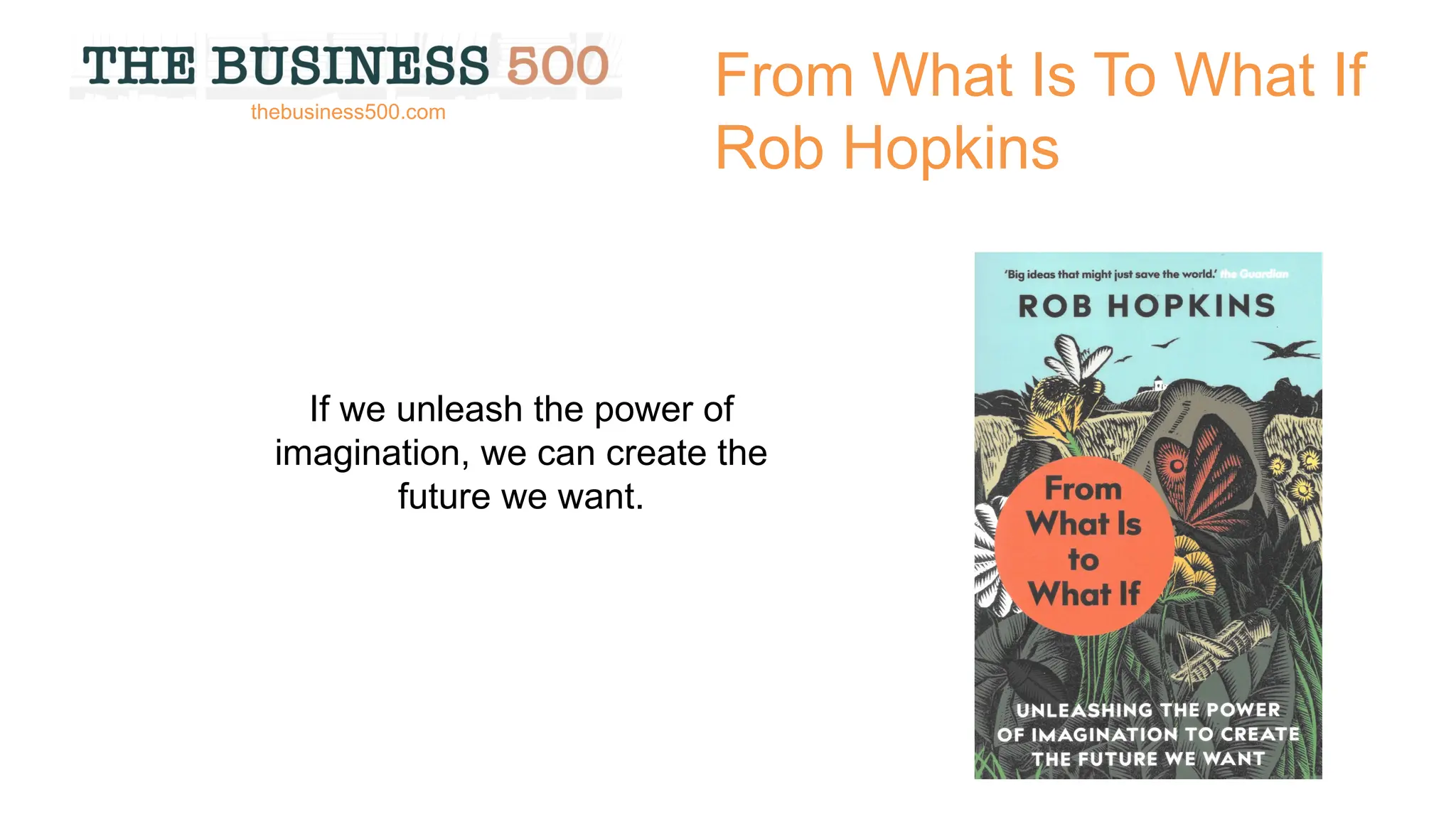
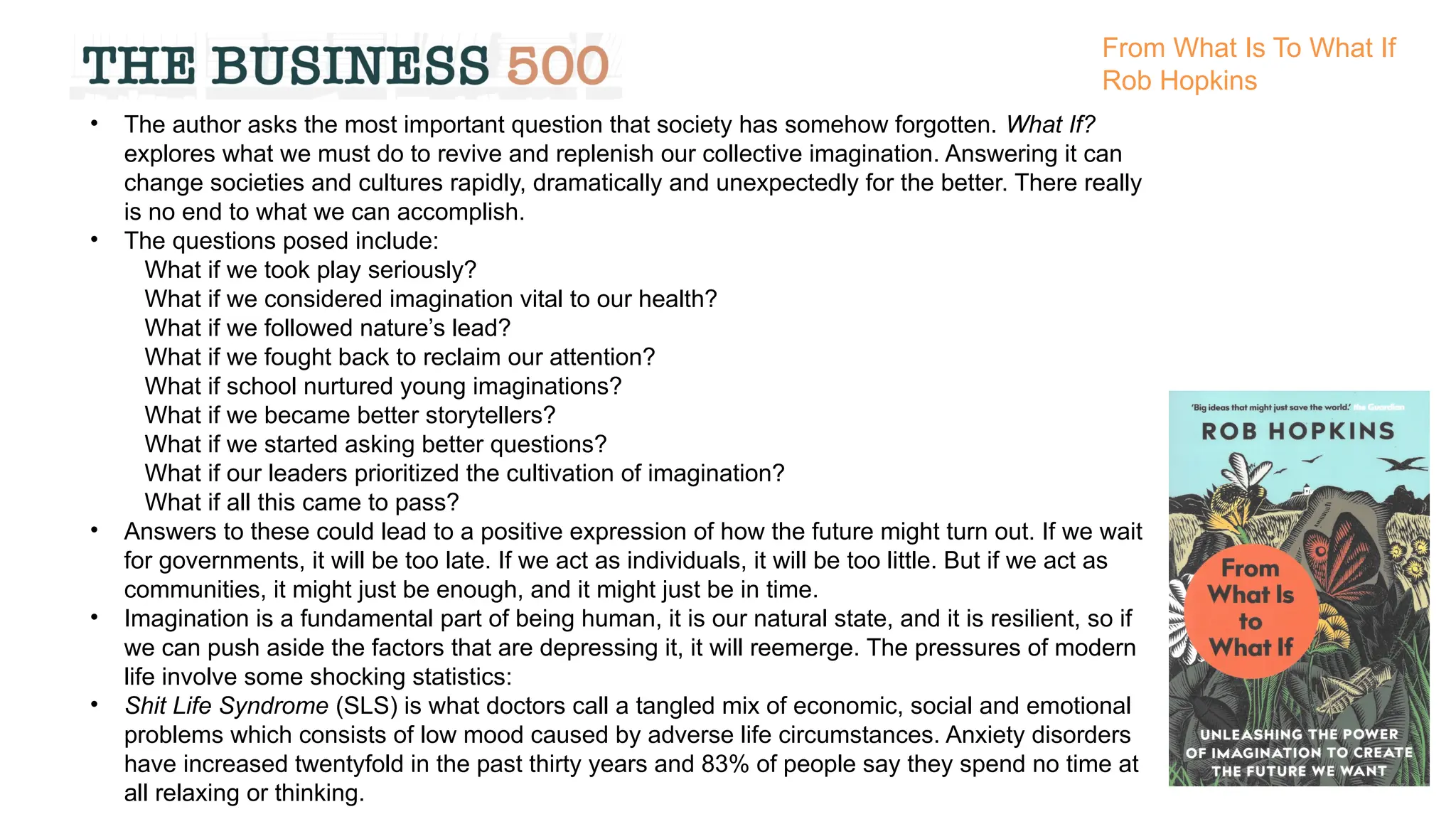
From What Is To What If
Rob Hopkins
If we unleash the power of
imagination, we can create the
future we want.
thebusiness500.com
• The author asks the most important question that society has somehow forgotten. What If?
explores what we must do to revive and replenish our collective imagination. Answering it can
change societies and cultures rapidly, dramatically and unexpectedly for the better. There really
is no end to what we can accomplish.
• The questions posed include:
What if we took play seriously?
What if we considered imagination vital to our health?
What if we followed nature’s lead?
What if we fought back to reclaim our attention?
What if school nurtured young imaginations?
What if we became better storytellers?
What if we started asking better questions?
What if our leaders prioritized the cultivation of imagination?
What if all this came to pass?
• Answers to these could lead to a positive expression of how the future might turn out. If we wait
for governments, it will be too late. If we act as individuals, it will be too little. But if we act as
communities, it might just be enough, and it might just be in time.
• Imagination is a fundamental part of being human, it is our natural state, and it is resilient, so if
we can push aside the factors that are depressing it, it will reemerge. The pressures of modern
life involve some shocking statistics:
• Shit Life Syndrome (SLS) is what doctors call a tangled mix of economic, social and emotional
problems which consists of low mood caused by adverse life circumstances. Anxiety disorders
have increased twentyfold in the past thirty years and 83% of people say they spend no time at
all relaxing or thinking.
From What Is To What If
Rob Hopkins
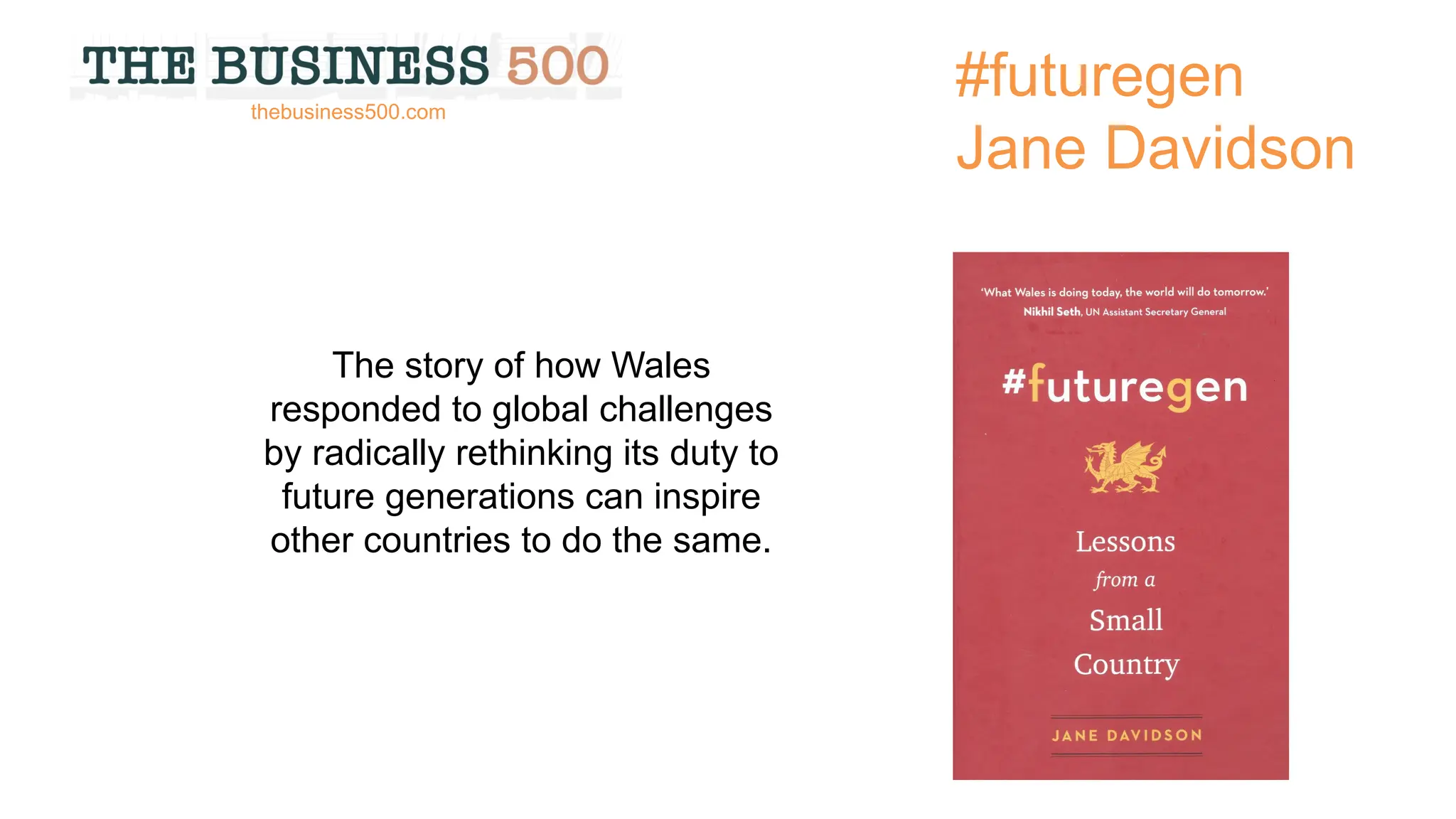
#futuregen
Jane Davidson
The story of how Wales
responded to global challenges
by radically rethinking its duty to
future generations can inspire
other countries to do the same.
thebusiness500.com
• When the author was Minister for Environment, Sustainability and Housing in Wales, she
proposed what became the Well-being of Future Generations Act 2015 – the first piece of
legislation in history to place regenerative and sustainable practice at the heart of government.
The act connects social, environmental, economic and cultural well-being, and looks to solve
complex issues through better decision-making.
• It is revolutionary because it enshrines into law that the well-being of the current and future
people of Wales is explicitly the core purpose of the government. It created seven goals for living
within our environmental limits in the areas of health, prosperity, resilience, communities,
language and heritage, equality, and Wales’s role in the world. It then directs five ways of working
to reach decisions: prevention, long-termism, collaboration, participation, and integrating
activities to reach positive outcomes for as many of the goals as possible.
• A series of epiphanies led to the development of the author’s views:
1. Agenda 21. This was a commitment made by 178 countries at the Earth Summit in Rio de
Janeiro in 1992 to create a global action plan for sustainable development into the 21st
century,
hence the name.
2. Donella Meadows and systems thinking. In 1972 she and her colleagues published The
Limits To Growth, after a Club of Rome study looked at the consequences of unchecked growth
on a finite planet.
3. We have only one planet. In 2007 a report entitled ‘One Planet Wales’ concluded that if
everyone in the world consumed natural resources and generated carbon dioxide at the rate of
Wales, they would need three planets to support themselves.
4. Incrementalism doesn’t work. Things must be done at scale otherwise change is too slow.
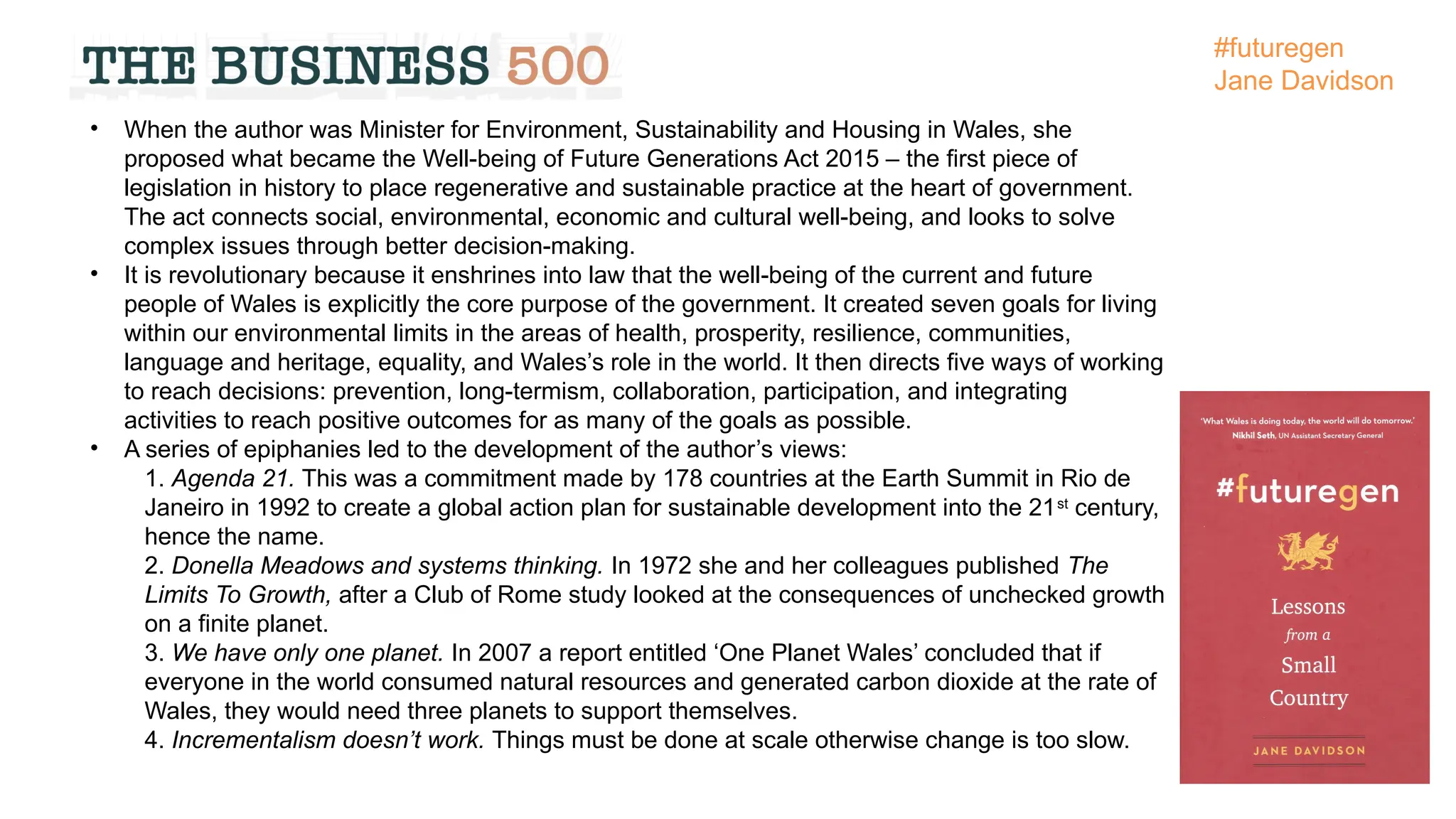
#futuregen
Jane Davidson
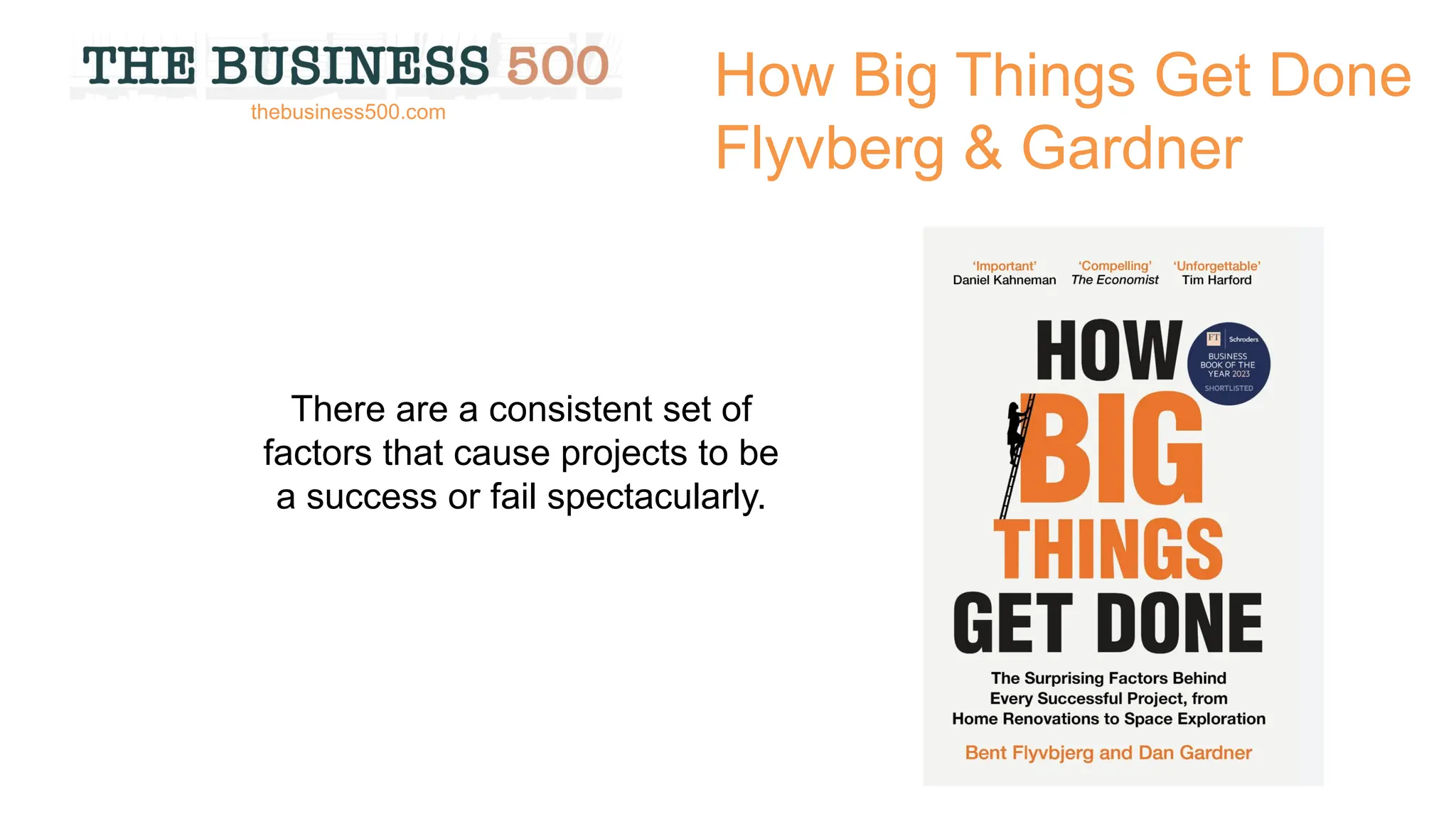
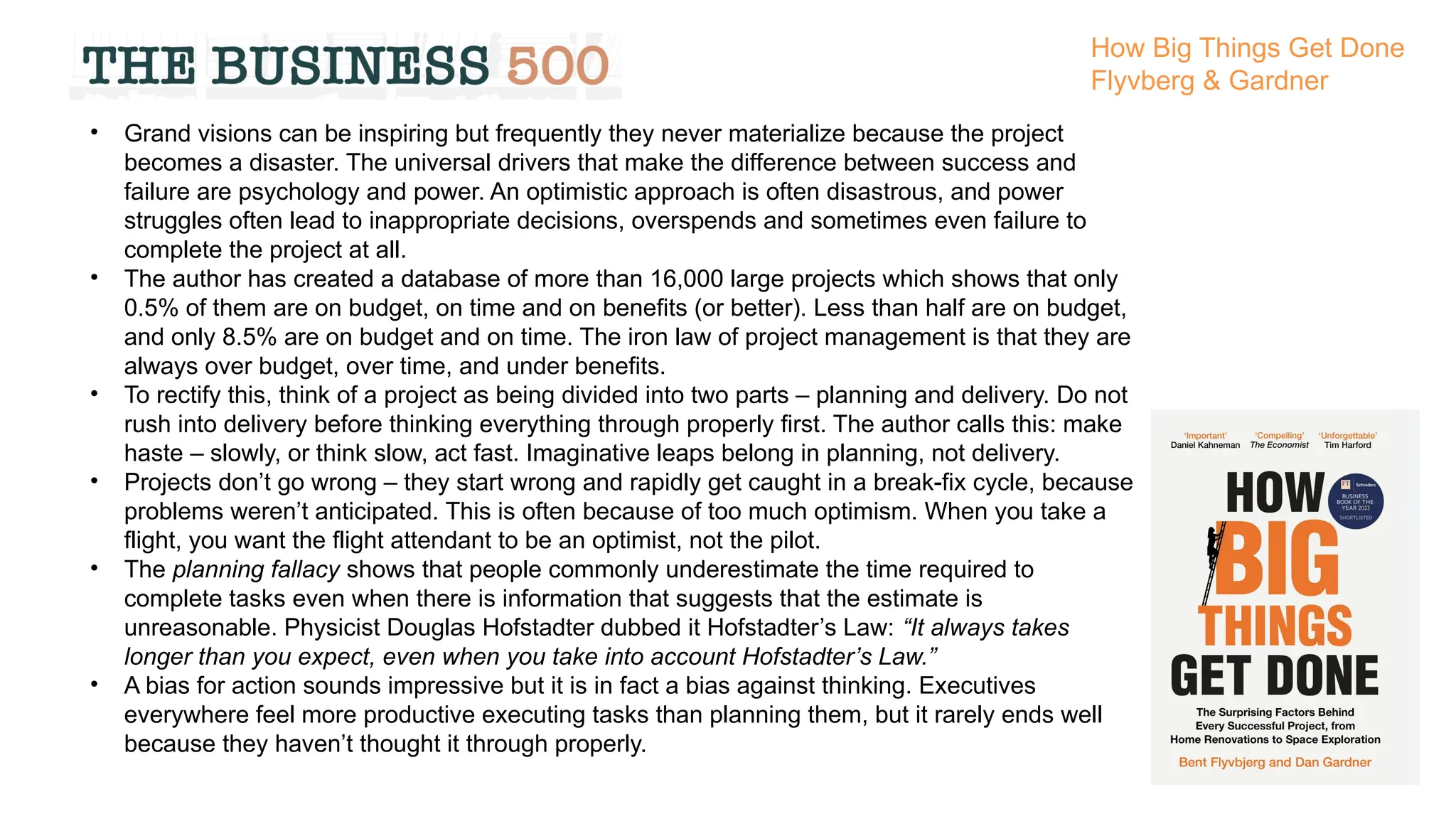
How Big Things Get Done
Flyvberg & Gardner
There are a consistent set of
factors that cause projects to be
a success or fail spectacularly.
thebusiness500.com
• Grand visions can be inspiring but frequently they never materialize because the project
becomes a disaster. The universal drivers that make the difference between success and
failure are psychology and power. An optimistic approach is often disastrous, and power
struggles often lead to inappropriate decisions, overspends and sometimes even failure to
complete the project at all.
• The author has created a database of more than 16,000 large projects which shows that only
0.5% of them are on budget, on time and on benefits (or better). Less than half are on budget,
and only 8.5% are on budget and on time. The iron law of project management is that they are
always over budget, over time, and under benefits.
• To rectify this, think of a project as being divided into two parts – planning and delivery. Do not
rush into delivery before thinking everything through properly first. The author calls this: make
haste – slowly, or think slow, act fast. Imaginative leaps belong in planning, not delivery.
• Projects don’t go wrong – they start wrong and rapidly get caught in a break-fix cycle, because
problems weren’t anticipated. This is often because of too much optimism. When you take a
flight, you want the flight attendant to be an optimist, not the pilot.
• The planning fallacy shows that people commonly underestimate the time required to
complete tasks even when there is information that suggests that the estimate is
unreasonable. Physicist Douglas Hofstadter dubbed it Hofstadter’s Law: “It always takes
longer than you expect, even when you take into account Hofstadter’s Law.”
• A bias for action sounds impressive but it is in fact a bias against thinking. Executives
everywhere feel more productive executing tasks than planning them, but it rarely ends well
because they haven’t thought it through properly.
How Big Things Get Done
Flyvberg & Gardner
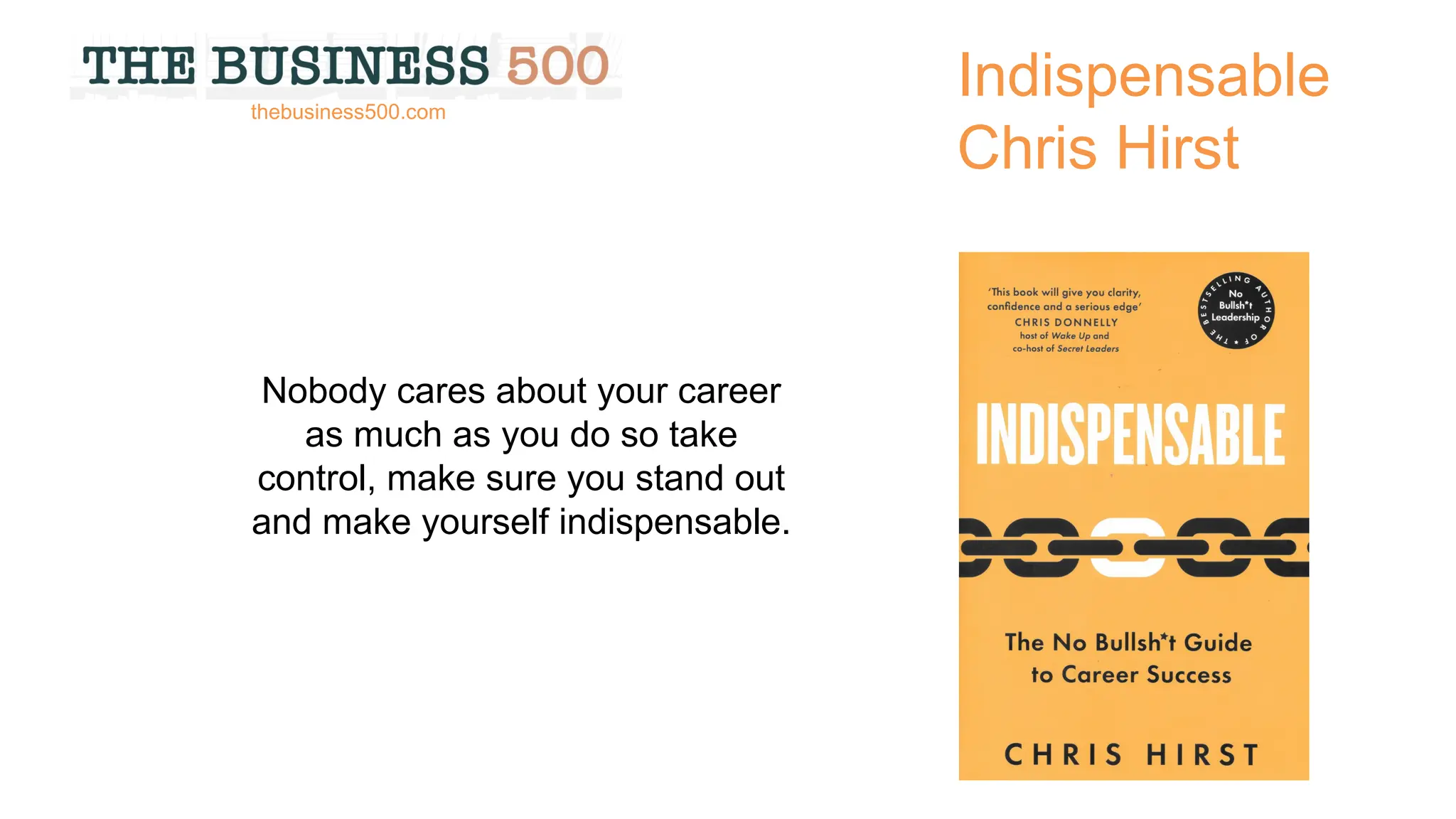
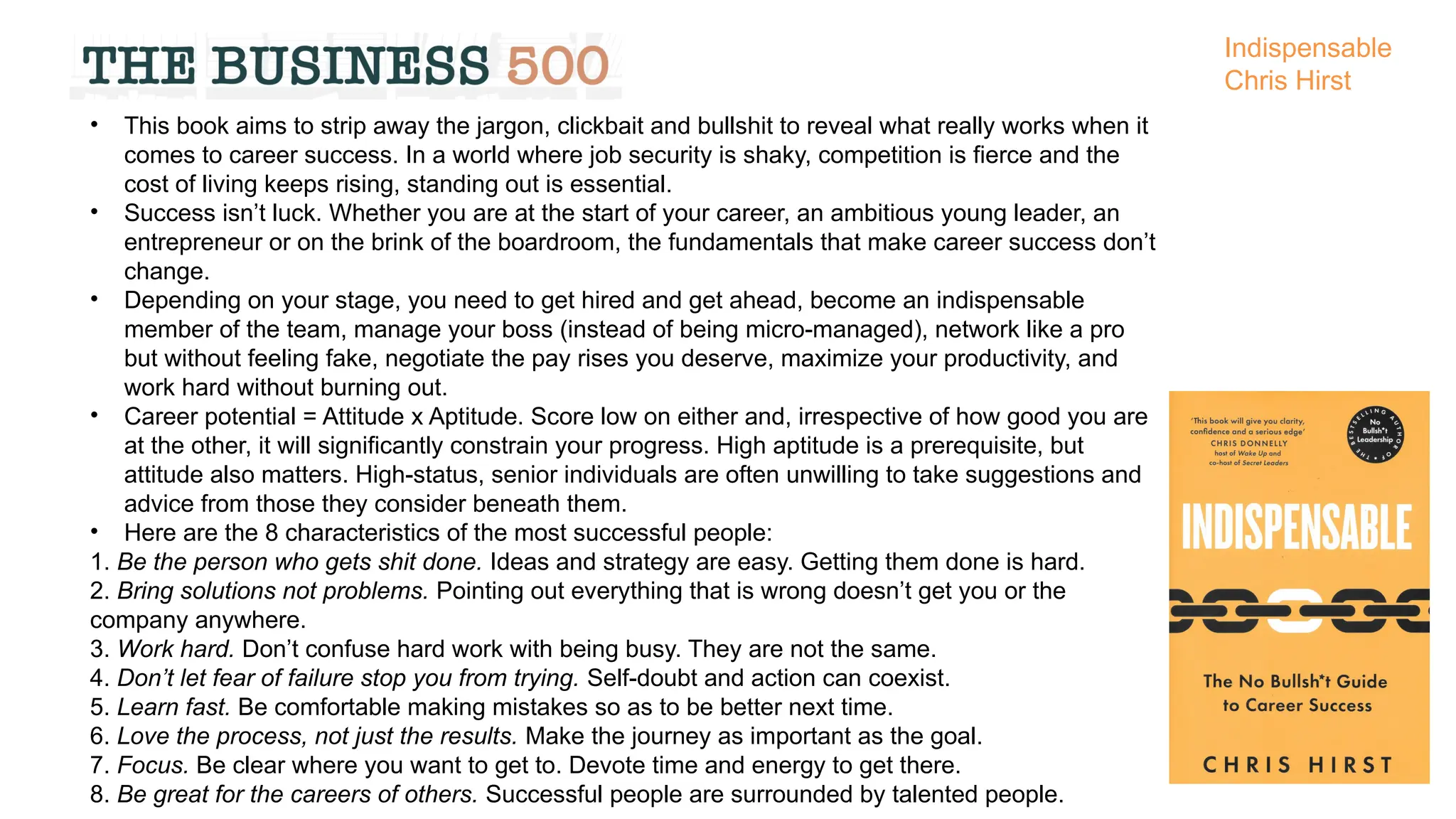
Indispensable
Chris Hirst
Nobody cares about your career
as much as you do so take
control, make sure you stand out
and make yourself indispensable.
thebusiness500.com
• This book aims to strip away the jargon, clickbait and bullshit to reveal what really works when it
comes to career success. In a world where job security is shaky, competition is fierce and the
cost of living keeps rising, standing out is essential.
• Success isn’t luck. Whether you are at the start of your career, an ambitious young leader, an
entrepreneur or on the brink of the boardroom, the fundamentals that make career success don’t
change.
• Depending on your stage, you need to get hired and get ahead, become an indispensable
member of the team, manage your boss (instead of being micro-managed), network like a pro
but without feeling fake, negotiate the pay rises you deserve, maximize your productivity, and
work hard without burning out.
• Career potential = Attitude x Aptitude. Score low on either and, irrespective of how good you are
at the other, it will significantly constrain your progress. High aptitude is a prerequisite, but
attitude also matters. High-status, senior individuals are often unwilling to take suggestions and
advice from those they consider beneath them.
• Here are the 8 characteristics of the most successful people:
1. Be the person who gets shit done. Ideas and strategy are easy. Getting them done is hard.
2. Bring solutions not problems. Pointing out everything that is wrong doesn’t get you or the
company anywhere.
3. Work hard. Don’t confuse hard work with being busy. They are not the same.
4. Don’t let fear of failure stop you from trying. Self-doubt and action can coexist.
5. Learn fast. Be comfortable making mistakes so as to be better next time.
6. Love the process, not just the results. Make the journey as important as the goal.
7. Focus. Be clear where you want to get to. Devote time and energy to get there.
8. Be great for the careers of others. Successful people are surrounded by talented people.
Indispensable
Chris Hirst
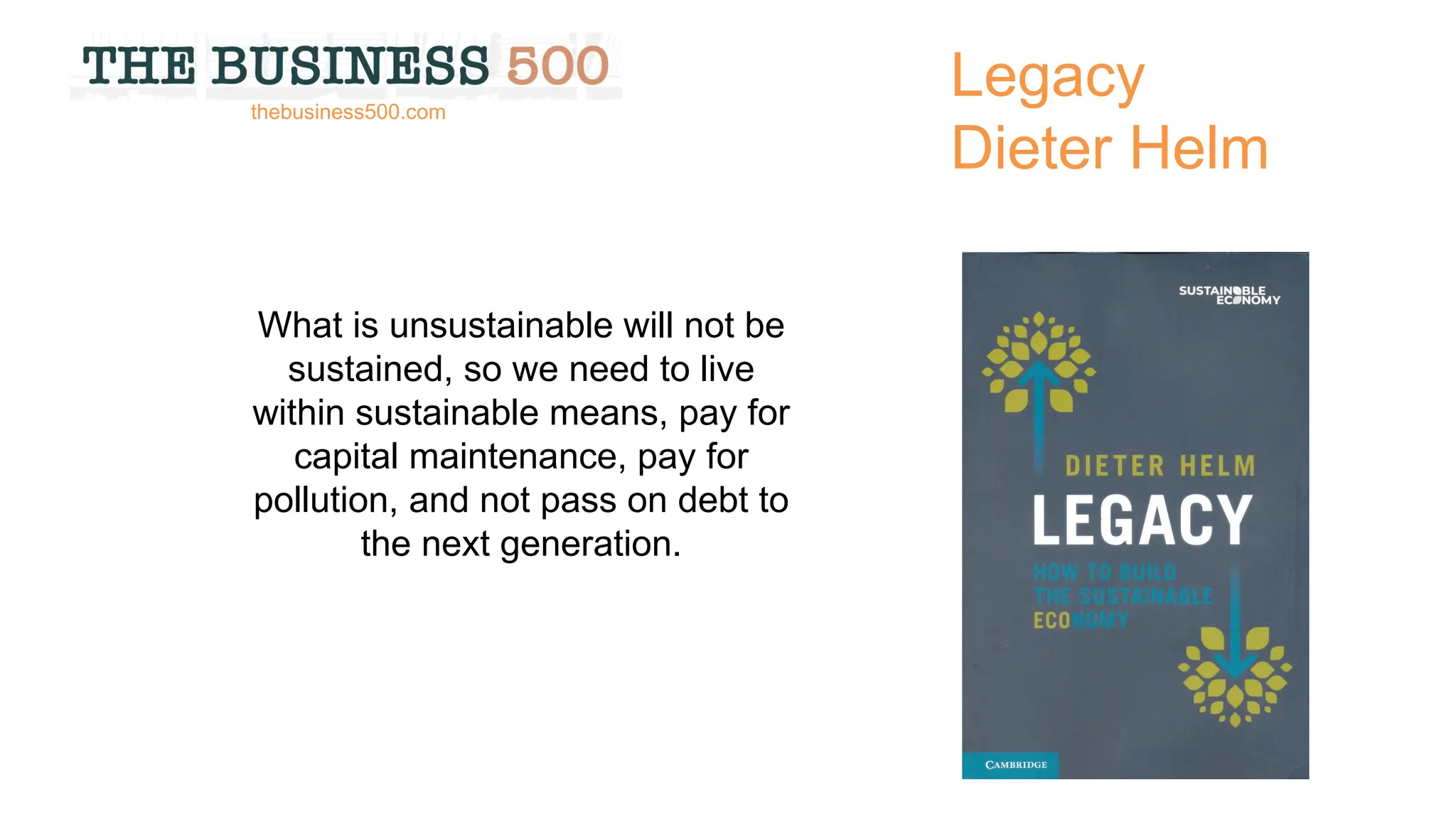
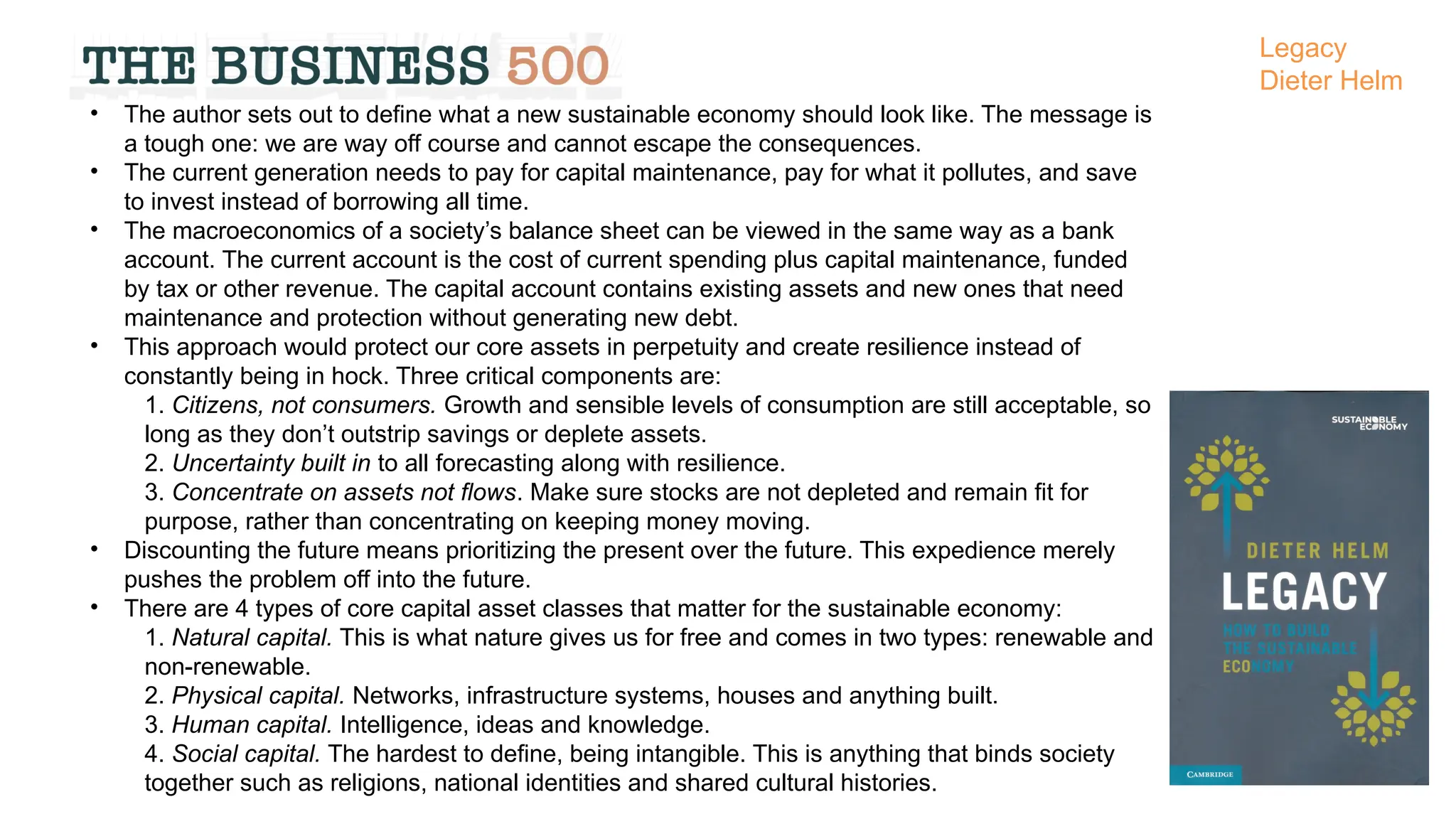
Legacy
Dieter Helm
What is unsustainable will not be
sustained, so we need to live
within sustainable means, pay for
capital maintenance, pay for
pollution, and not pass on debt to
the next generation.
thebusiness500.com
• The author sets out to define what a new sustainable economy should look like. The message is
a tough one: we are way off course and cannot escape the consequences.
• The current generation needs to pay for capital maintenance, pay for what it pollutes, and save
to invest instead of borrowing all time.
• The macroeconomics of a society’s balance sheet can be viewed in the same way as a bank
account. The current account is the cost of current spending plus capital maintenance, funded
by tax or other revenue. The capital account contains existing assets and new ones that need
maintenance and protection without generating new debt.
• This approach would protect our core assets in perpetuity and create resilience instead of
constantly being in hock. Three critical components are:
1. Citizens, not consumers. Growth and sensible levels of consumption are still acceptable, so
long as they don’t outstrip savings or deplete assets.
2. Uncertainty built in to all forecasting along with resilience.
3. Concentrate on assets not flows. Make sure stocks are not depleted and remain fit for
purpose, rather than concentrating on keeping money moving.
• Discounting the future means prioritizing the present over the future. This expedience merely
pushes the problem off into the future.
• There are 4 types of core capital asset classes that matter for the sustainable economy:
1. Natural capital. This is what nature gives us for free and comes in two types: renewable and
non-renewable.
2. Physical capital. Networks, infrastructure systems, houses and anything built.
3. Human capital. Intelligence, ideas and knowledge.
4. Social capital. The hardest to define, being intangible. This is anything that binds society
together such as religions, national identities and shared cultural histories.
Legacy
Dieter Helm
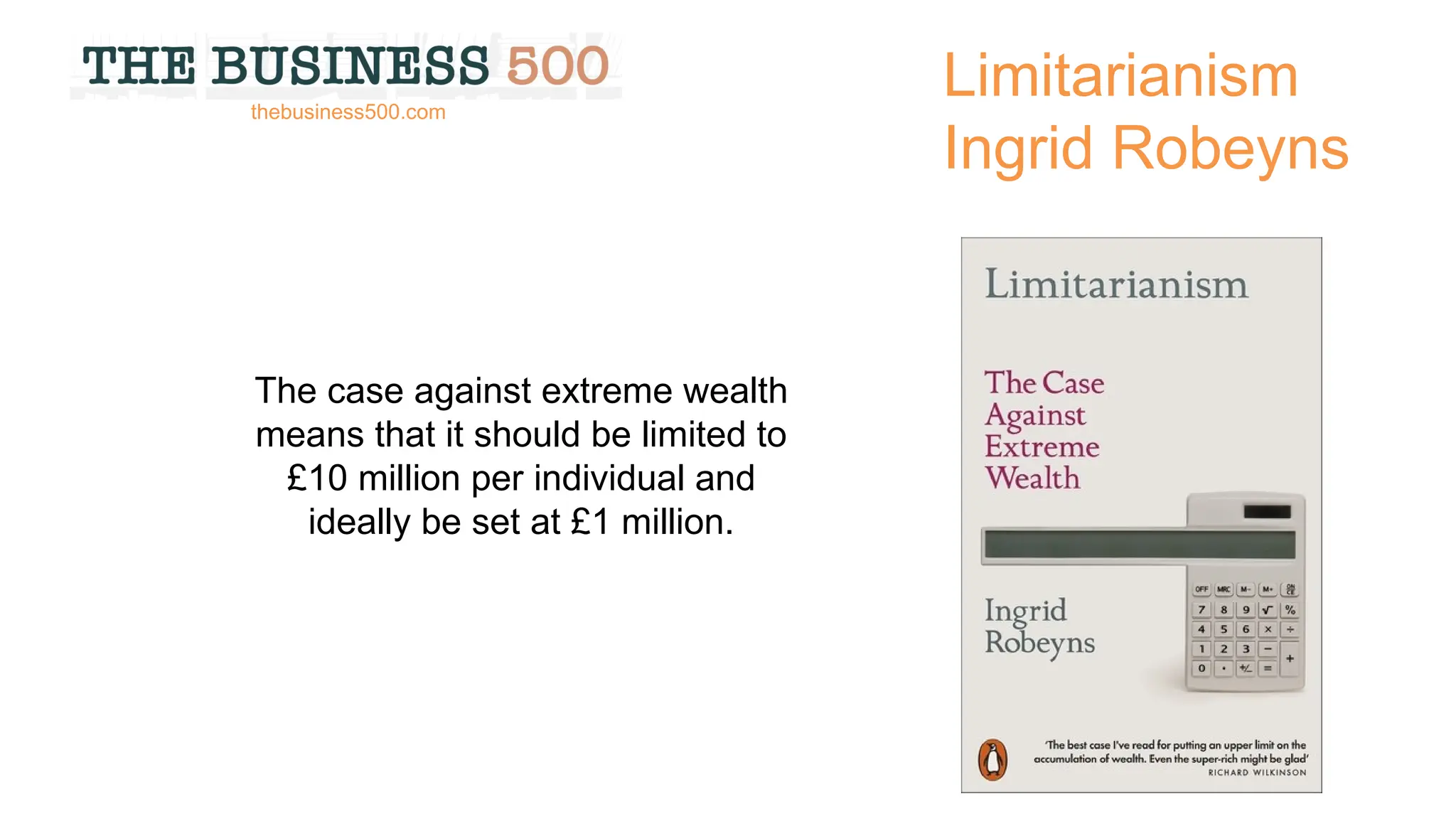
Limitarianism
Ingrid Robeyns
The case against extreme wealth
means that it should be limited to
£10 million per individual and
ideally be set at £1 million.
thebusiness500.com
• We all notice when the poor get poorer: when there are more rough sleepers and food bank
queues start to grow. But if the rich become richer, there is nothing to show for it. Or is there?
The true extent of our wealth problem has been silently spiralling out of control for the last 50
years, and it is harmful to all – including the extreme rich.
• Limitarianism is the proposed antidote to the problems posed by neoliberal capitalism – placing
a hard limit on the wealth that one person can accumulate, because no one deserves to be a
millionaire. It is a regulative ideal – an outcome to strive for, but not one that can necessarily be
legislated. It calls for three kinds of action: structural (designing our economies to provide
equitable distribution of wealth for all), fiscal (balancing tax and the benefits system) and ethical
(embracing a limitarian ethos). There should be no decamillionaires, and the ethical limit should
be one million dollars, pounds or euros.
• Limitarianism makes a distinction between three thresholds: the riches line, the ethical limit and
the political limit. The riches line is the level at which additional money cannot increase your
standard of living. The ethical limit is the maximum level of money we can own on moral lines.
The political limit is the ultimate limit on a person’s wealth that the state should use as a goal
when setting up its social and fiscal systems.
• Actions to instigate limitarianism include dismantling neoliberal ideology, reducing class
segregation, establishing a balance of economic power, restoring the fiscal agency of
governments, making international economic architecture fair, and halting the intergenerational
transmission of wealth.
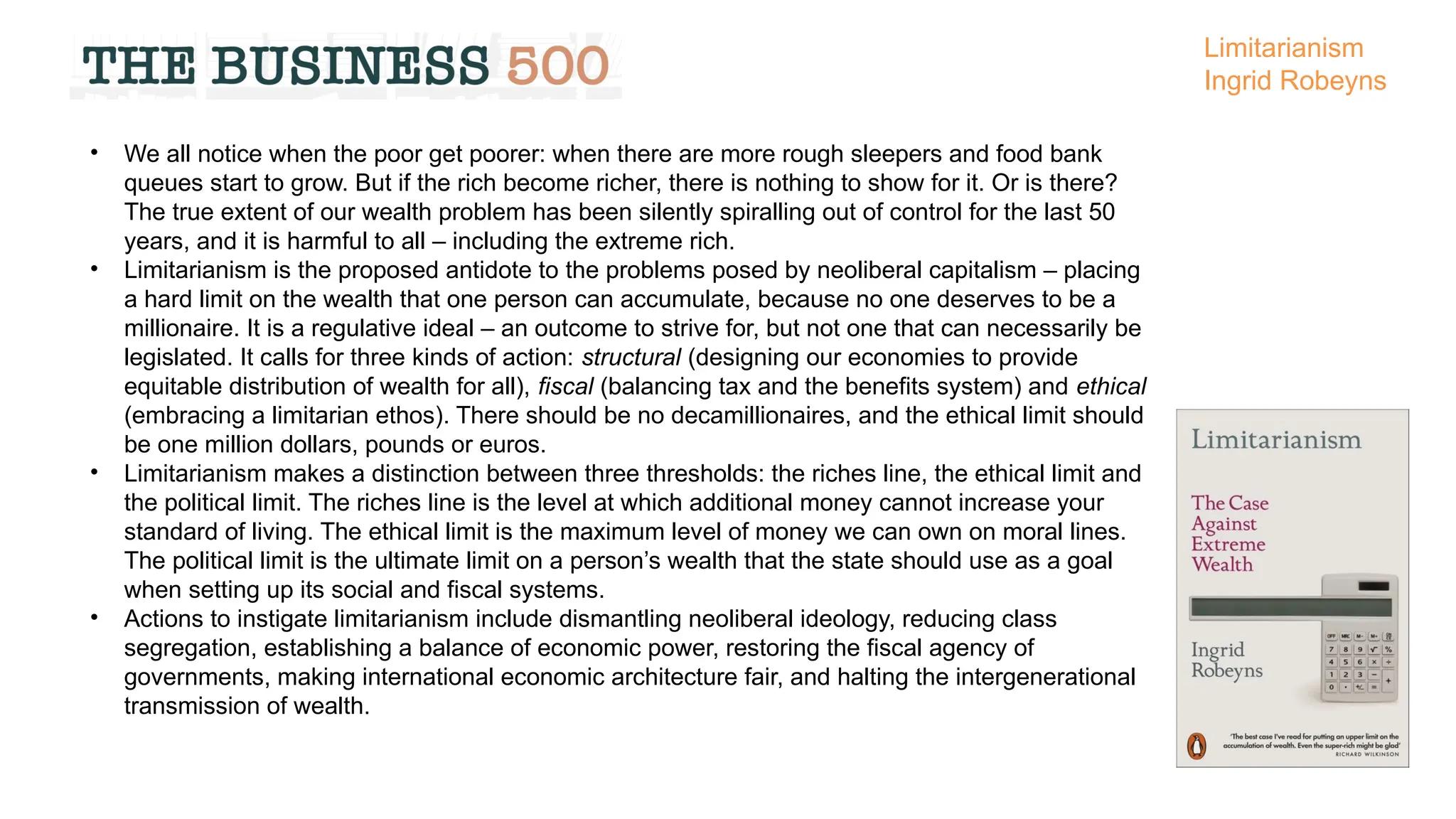
Limitarianism
Ingrid Robeyns
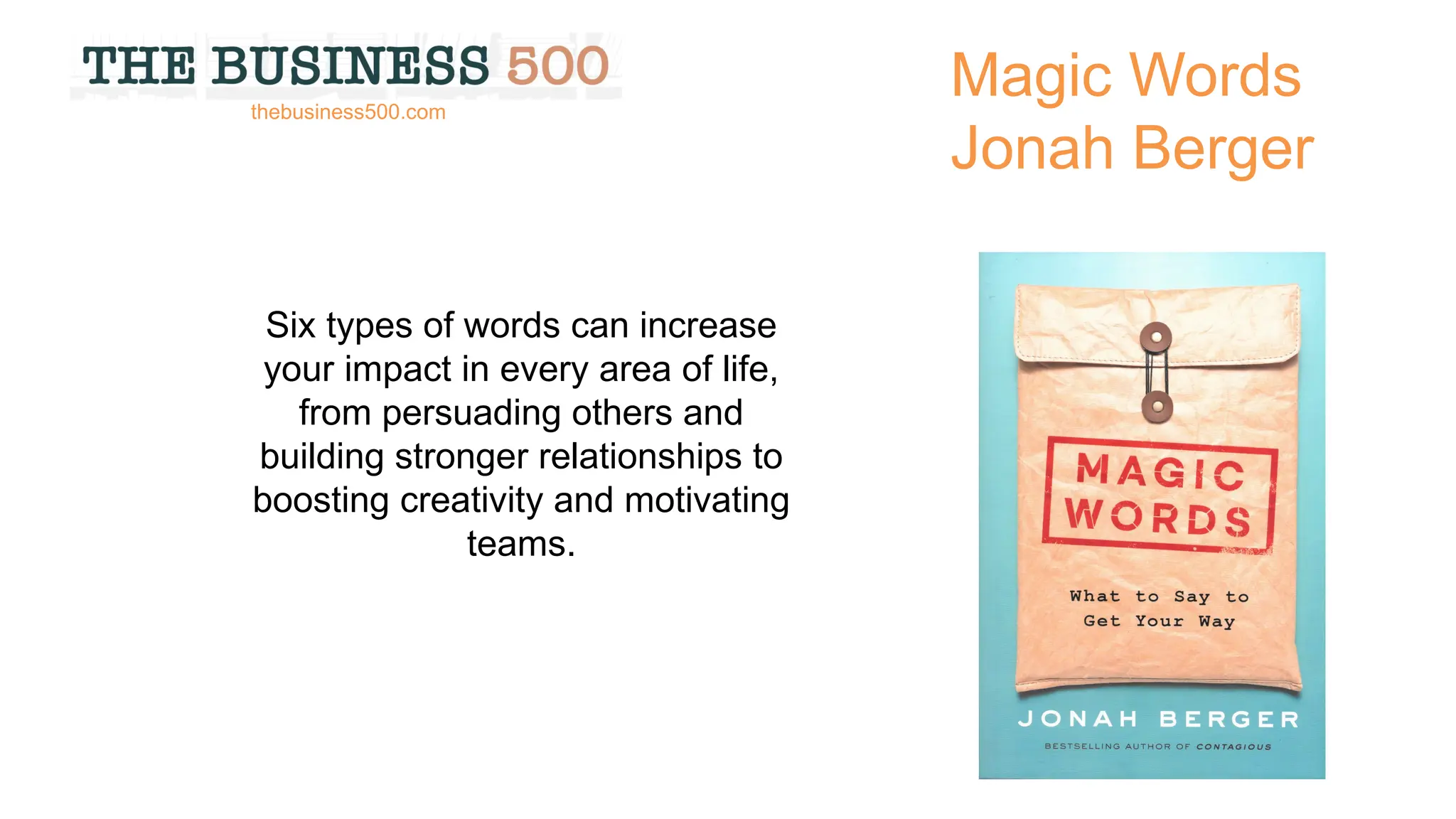
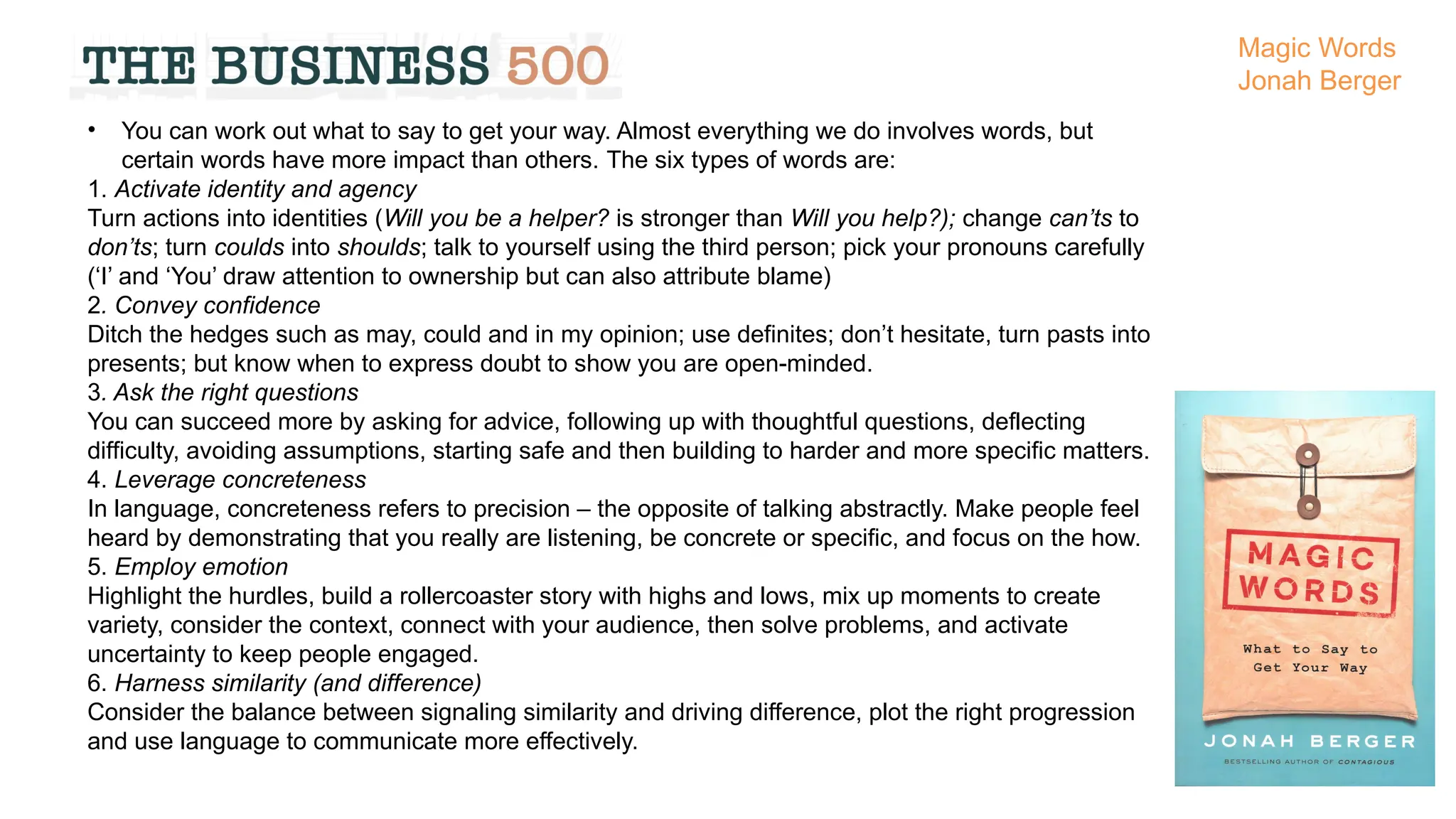
Magic Words
Jonah Berger
Six types of words can increase
your impact in every area of life,
from persuading others and
building stronger relationships to
boosting creativity and motivating
teams.
thebusiness500.com
• You can work out what to say to get your way. Almost everything we do involves words, but
certain words have more impact than others. The six types of words are:
1. Activate identity and agency
Turn actions into identities (Will you be a helper? is stronger than Will you help?); change can’ts to
don’ts; turn coulds into shoulds; talk to yourself using the third person; pick your pronouns carefully
(‘I’ and ‘You’ draw attention to ownership but can also attribute blame)
2. Convey confidence
Ditch the hedges such as may, could and in my opinion; use definites; don’t hesitate, turn pasts into
presents; but know when to express doubt to show you are open-minded.
3. Ask the right questions
You can succeed more by asking for advice, following up with thoughtful questions, deflecting
difficulty, avoiding assumptions, starting safe and then building to harder and more specific matters.
4. Leverage concreteness
In language, concreteness refers to precision – the opposite of talking abstractly. Make people feel
heard by demonstrating that you really are listening, be concrete or specific, and focus on the how.
5. Employ emotion
Highlight the hurdles, build a rollercoaster story with highs and lows, mix up moments to create
variety, consider the context, connect with your audience, then solve problems, and activate
uncertainty to keep people engaged.
6. Harness similarity (and difference)
Consider the balance between signaling similarity and driving difference, plot the right progression
and use language to communicate more effectively.
Magic Words
Jonah Berger
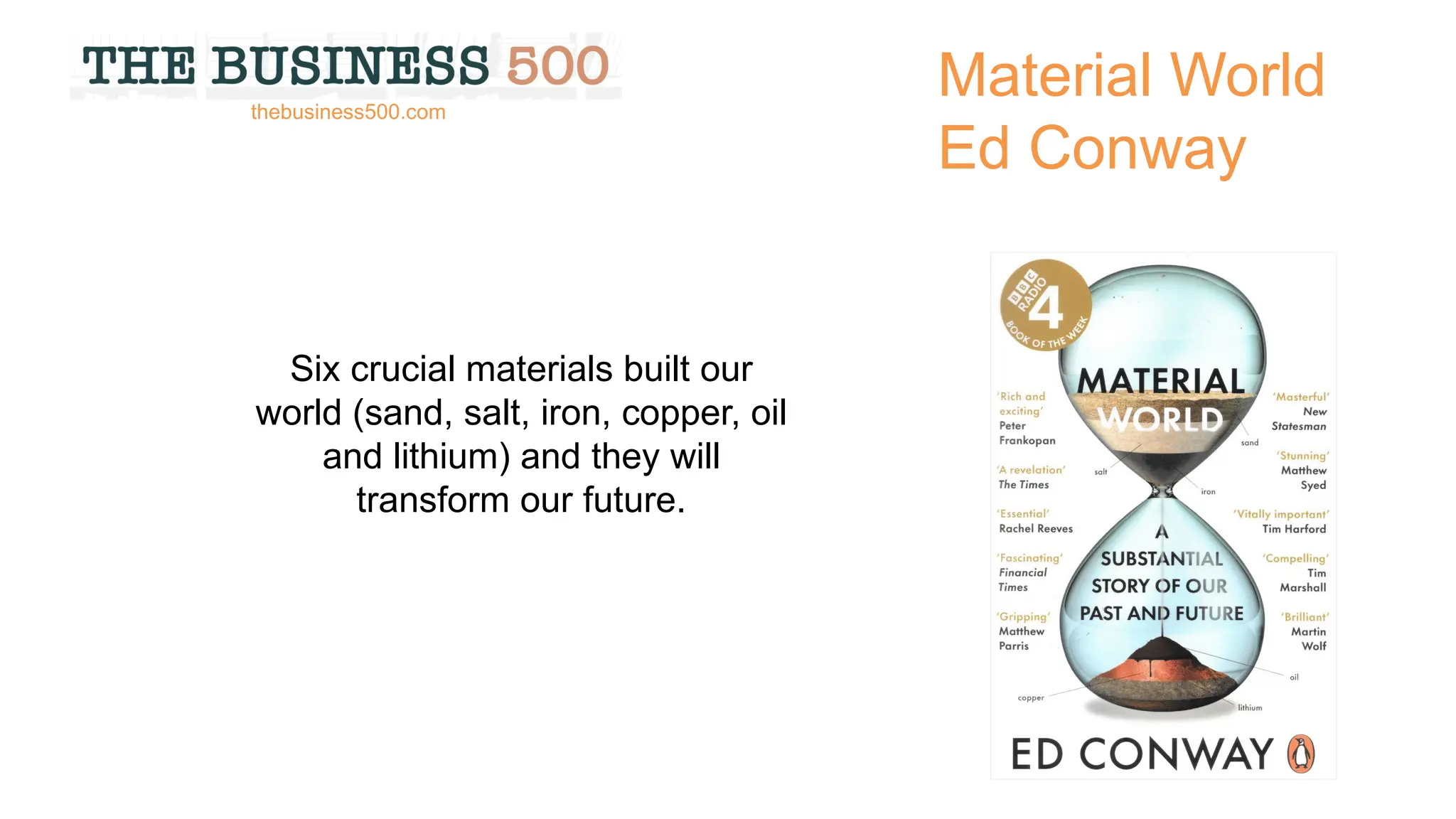
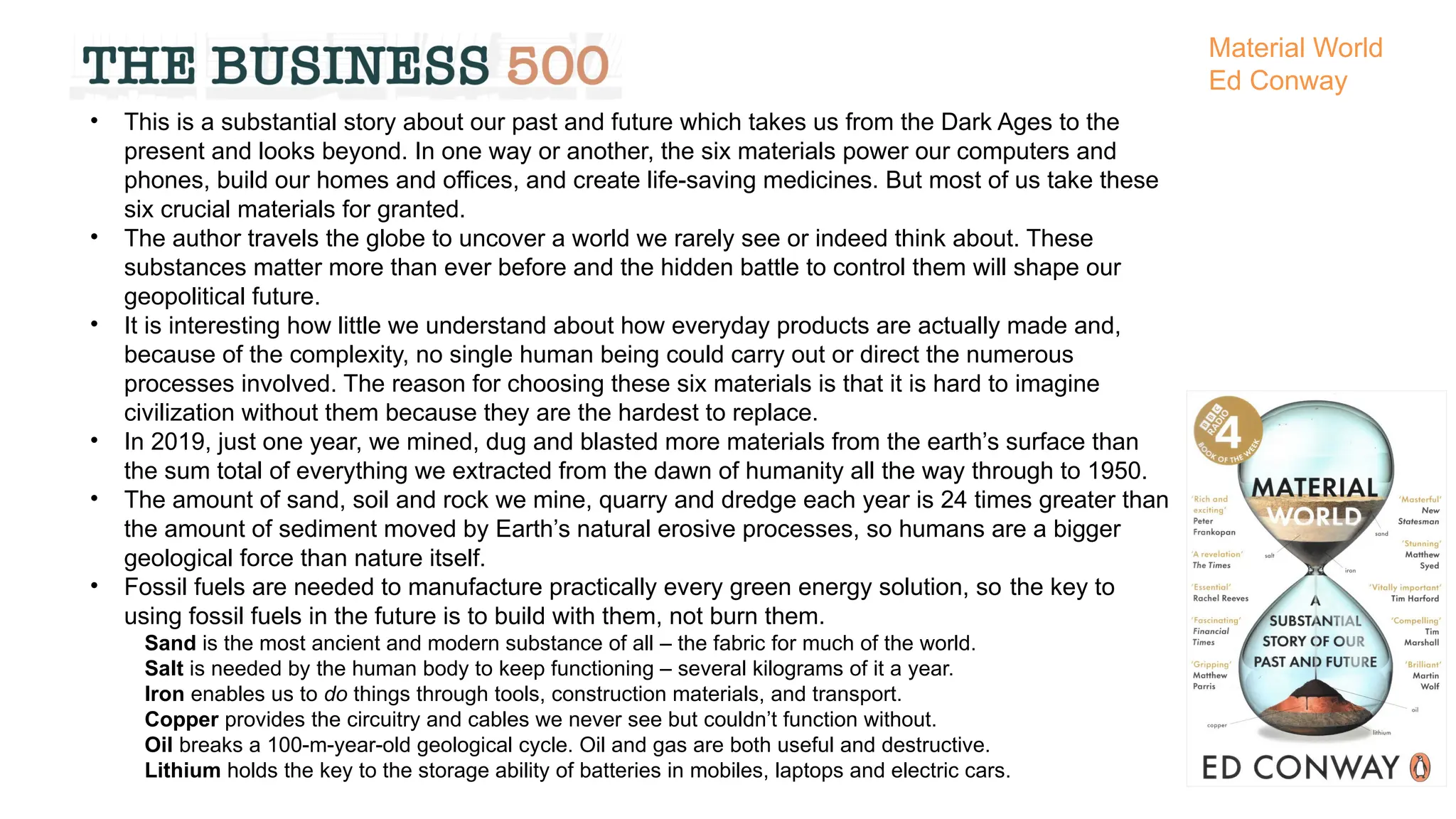
Material World
Ed Conway
Six crucial materials built our
world (sand, salt, iron, copper, oil
and lithium) and they will
transform our future.
thebusiness500.com
• This is a substantial story about our past and future which takes us from the Dark Ages to the
present and looks beyond. In one way or another, the six materials power our computers and
phones, build our homes and offices, and create life-saving medicines. But most of us take these
six crucial materials for granted.
• The author travels the globe to uncover a world we rarely see or indeed think about. These
substances matter more than ever before and the hidden battle to control them will shape our
geopolitical future.
• It is interesting how little we understand about how everyday products are actually made and,
because of the complexity, no single human being could carry out or direct the numerous
processes involved. The reason for choosing these six materials is that it is hard to imagine
civilization without them because they are the hardest to replace.
• In 2019, just one year, we mined, dug and blasted more materials from the earth’s surface than
the sum total of everything we extracted from the dawn of humanity all the way through to 1950.
• The amount of sand, soil and rock we mine, quarry and dredge each year is 24 times greater than
the amount of sediment moved by Earth’s natural erosive processes, so humans are a bigger
geological force than nature itself.
• Fossil fuels are needed to manufacture practically every green energy solution, so the key to
using fossil fuels in the future is to build with them, not burn them.
Sand is the most ancient and modern substance of all – the fabric for much of the world.
Salt is needed by the human body to keep functioning – several kilograms of it a year.
Iron enables us to do things through tools, construction materials, and transport.
Copper provides the circuitry and cables we never see but couldn’t function without.
Oil breaks a 100-m-year-old geological cycle. Oil and gas are both useful and destructive.
Lithium holds the key to the storage ability of batteries in mobiles, laptops and electric cars.
Material World
Ed Conway
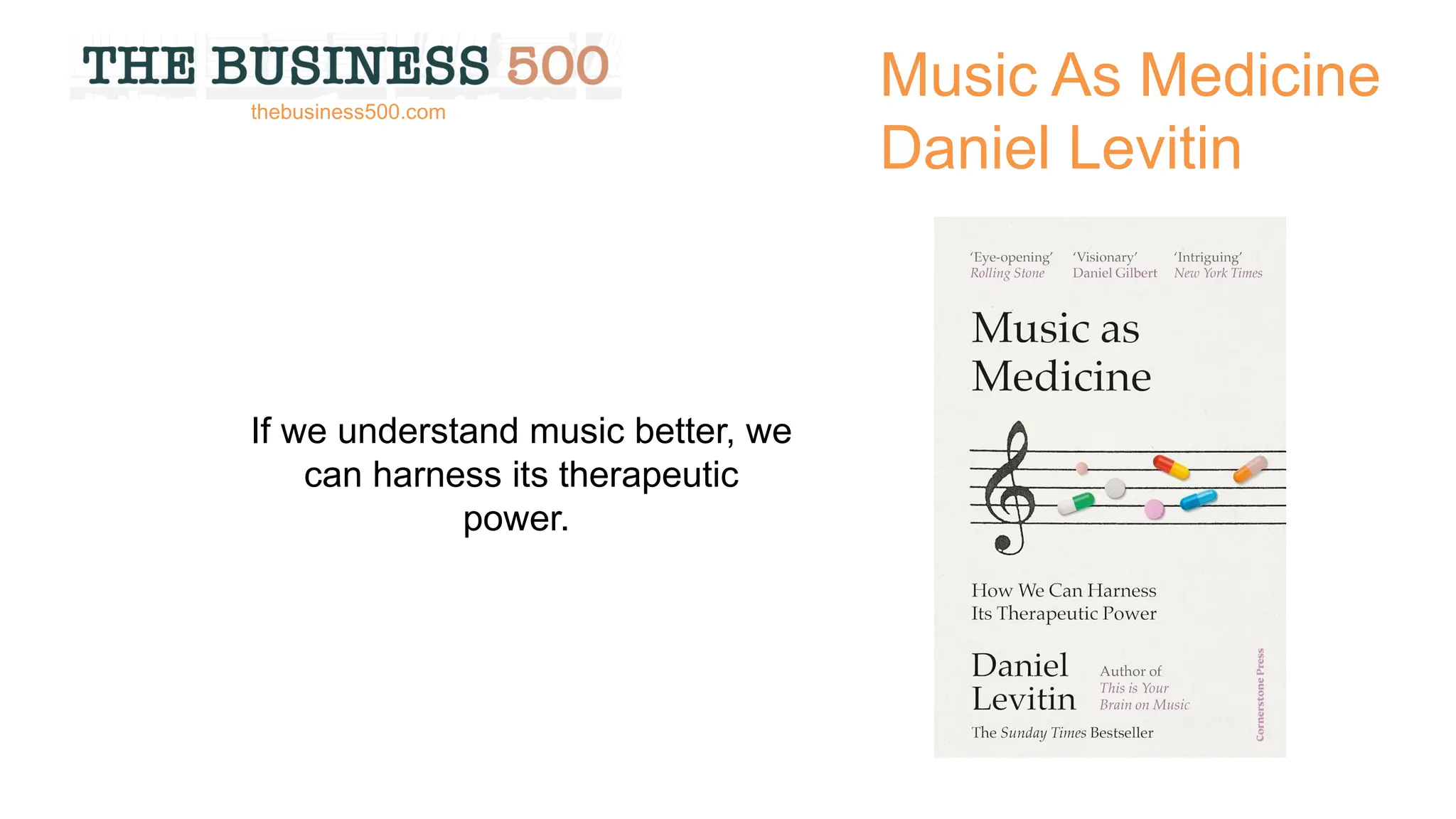
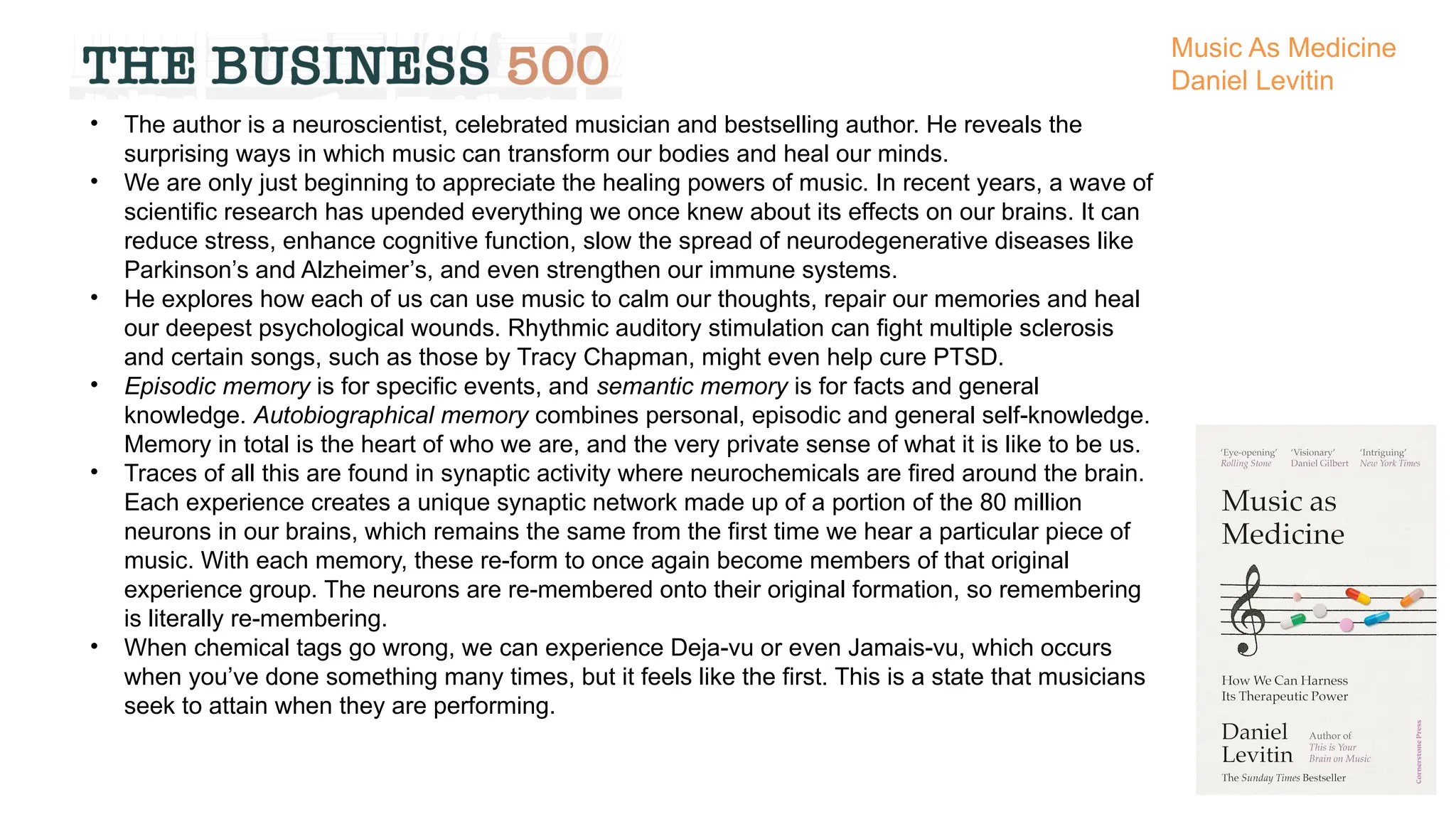
Music As Medicine
Daniel Levitin
If we understand music better, we
can harness its therapeutic
power.
thebusiness500.com
• The author is a neuroscientist, celebrated musician and bestselling author. He reveals the
surprising ways in which music can transform our bodies and heal our minds.
• We are only just beginning to appreciate the healing powers of music. In recent years, a wave of
scientific research has upended everything we once knew about its effects on our brains. It can
reduce stress, enhance cognitive function, slow the spread of neurodegenerative diseases like
Parkinson’s and Alzheimer’s, and even strengthen our immune systems.
• He explores how each of us can use music to calm our thoughts, repair our memories and heal
our deepest psychological wounds. Rhythmic auditory stimulation can fight multiple sclerosis
and certain songs, such as those by Tracy Chapman, might even help cure PTSD.
• Episodic memory is for specific events, and semantic memory is for facts and general
knowledge. Autobiographical memory combines personal, episodic and general self-knowledge.
Memory in total is the heart of who we are, and the very private sense of what it is like to be us.
• Traces of all this are found in synaptic activity where neurochemicals are fired around the brain.
Each experience creates a unique synaptic network made up of a portion of the 80 million
neurons in our brains, which remains the same from the first time we hear a particular piece of
music. With each memory, these re-form to once again become members of that original
experience group. The neurons are re-membered onto their original formation, so remembering
is literally re-membering.
• When chemical tags go wrong, we can experience Deja-vu or even Jamais-vu, which occurs
when you’ve done something many times, but it feels like the first. This is a state that musicians
seek to attain when they are performing.
Music As Medicine
Daniel Levitin
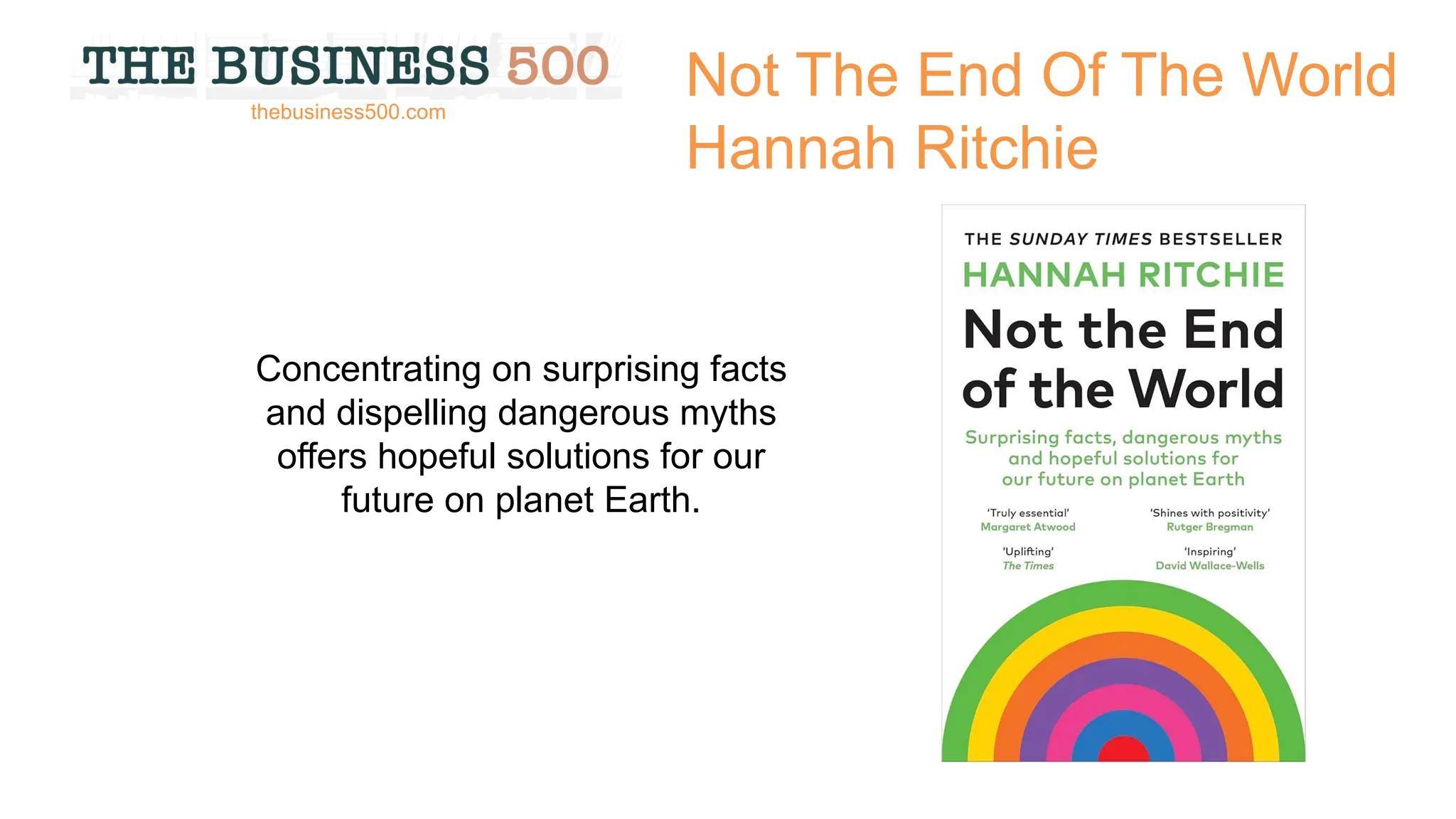
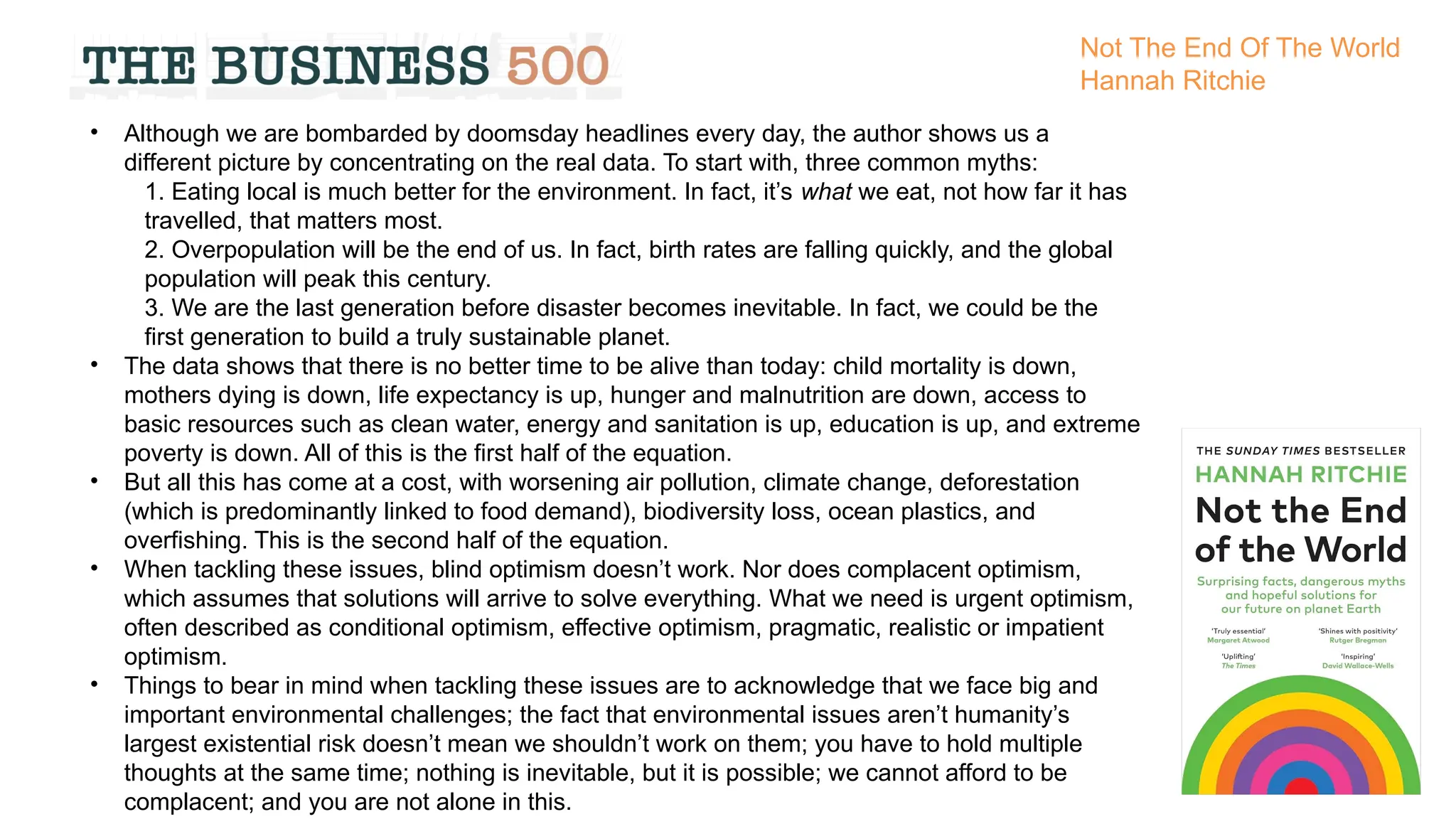
Not The End Of The World
Hannah Ritchie
Concentrating on surprising facts
and dispelling dangerous myths
offers hopeful solutions for our
future on planet Earth.
thebusiness500.com
• Although we are bombarded by doomsday headlines every day, the author shows us a
different picture by concentrating on the real data. To start with, three common myths:
1. Eating local is much better for the environment. In fact, it’s what we eat, not how far it has
travelled, that matters most.
2. Overpopulation will be the end of us. In fact, birth rates are falling quickly, and the global
population will peak this century.
3. We are the last generation before disaster becomes inevitable. In fact, we could be the
first generation to build a truly sustainable planet.
• The data shows that there is no better time to be alive than today: child mortality is down,
mothers dying is down, life expectancy is up, hunger and malnutrition are down, access to
basic resources such as clean water, energy and sanitation is up, education is up, and extreme
poverty is down. All of this is the first half of the equation.
• But all this has come at a cost, with worsening air pollution, climate change, deforestation
(which is predominantly linked to food demand), biodiversity loss, ocean plastics, and
overfishing. This is the second half of the equation.
• When tackling these issues, blind optimism doesn’t work. Nor does complacent optimism,
which assumes that solutions will arrive to solve everything. What we need is urgent optimism,
often described as conditional optimism, effective optimism, pragmatic, realistic or impatient
optimism.
• Things to bear in mind when tackling these issues are to acknowledge that we face big and
important environmental challenges; the fact that environmental issues aren’t humanity’s
largest existential risk doesn’t mean we shouldn’t work on them; you have to hold multiple
thoughts at the same time; nothing is inevitable, but it is possible; we cannot afford to be
complacent; and you are not alone in this.
Not The End Of The World
Hannah Ritchie
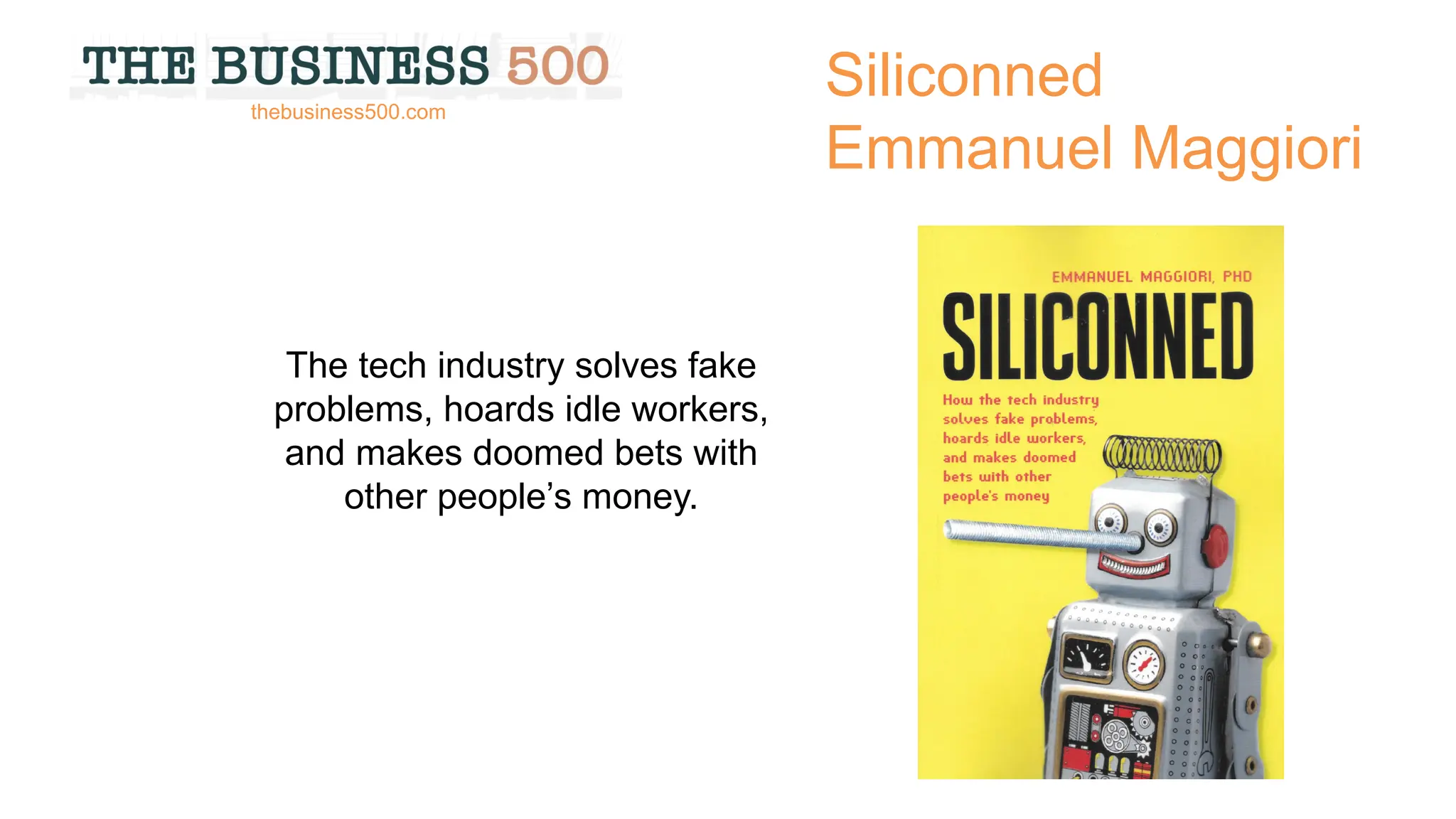
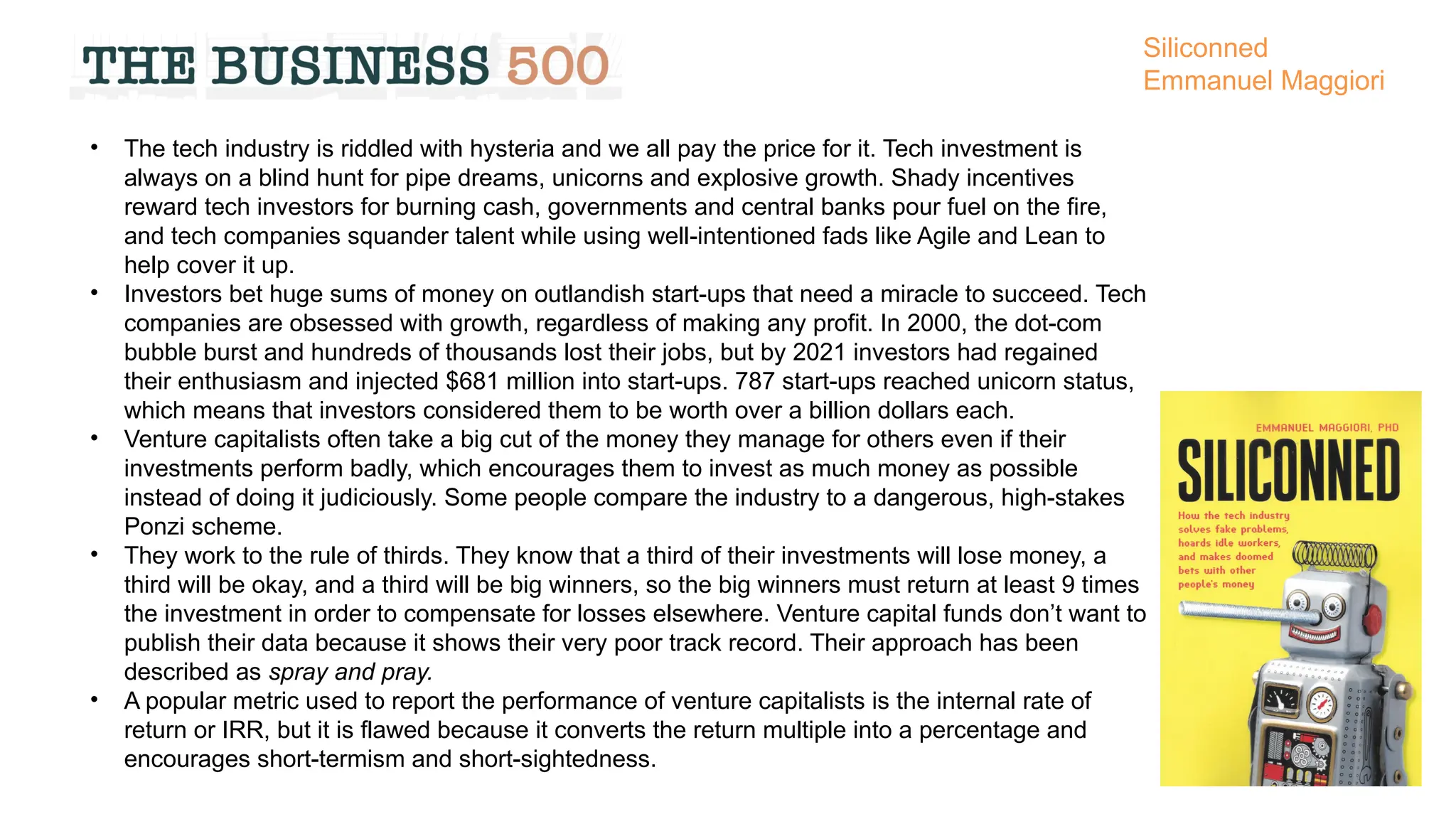
Siliconned
Emmanuel Maggiori
The tech industry solves fake
problems, hoards idle workers,
and makes doomed bets with
other people’s money.
thebusiness500.com
• The tech industry is riddled with hysteria and we all pay the price for it. Tech investment is
always on a blind hunt for pipe dreams, unicorns and explosive growth. Shady incentives
reward tech investors for burning cash, governments and central banks pour fuel on the fire,
and tech companies squander talent while using well-intentioned fads like Agile and Lean to
help cover it up.
• Investors bet huge sums of money on outlandish start-ups that need a miracle to succeed. Tech
companies are obsessed with growth, regardless of making any profit. In 2000, the dot-com
bubble burst and hundreds of thousands lost their jobs, but by 2021 investors had regained
their enthusiasm and injected $681 million into start-ups. 787 start-ups reached unicorn status,
which means that investors considered them to be worth over a billion dollars each.
• Venture capitalists often take a big cut of the money they manage for others even if their
investments perform badly, which encourages them to invest as much money as possible
instead of doing it judiciously. Some people compare the industry to a dangerous, high-stakes
Ponzi scheme.
• They work to the rule of thirds. They know that a third of their investments will lose money, a
third will be okay, and a third will be big winners, so the big winners must return at least 9 times
the investment in order to compensate for losses elsewhere. Venture capital funds don’t want to
publish their data because it shows their very poor track record. Their approach has been
described as spray and pray.
• A popular metric used to report the performance of venture capitalists is the internal rate of
return or IRR, but it is flawed because it converts the return multiple into a percentage and
encourages short-termism and short-sightedness.
Siliconned
Emmanuel Maggiori
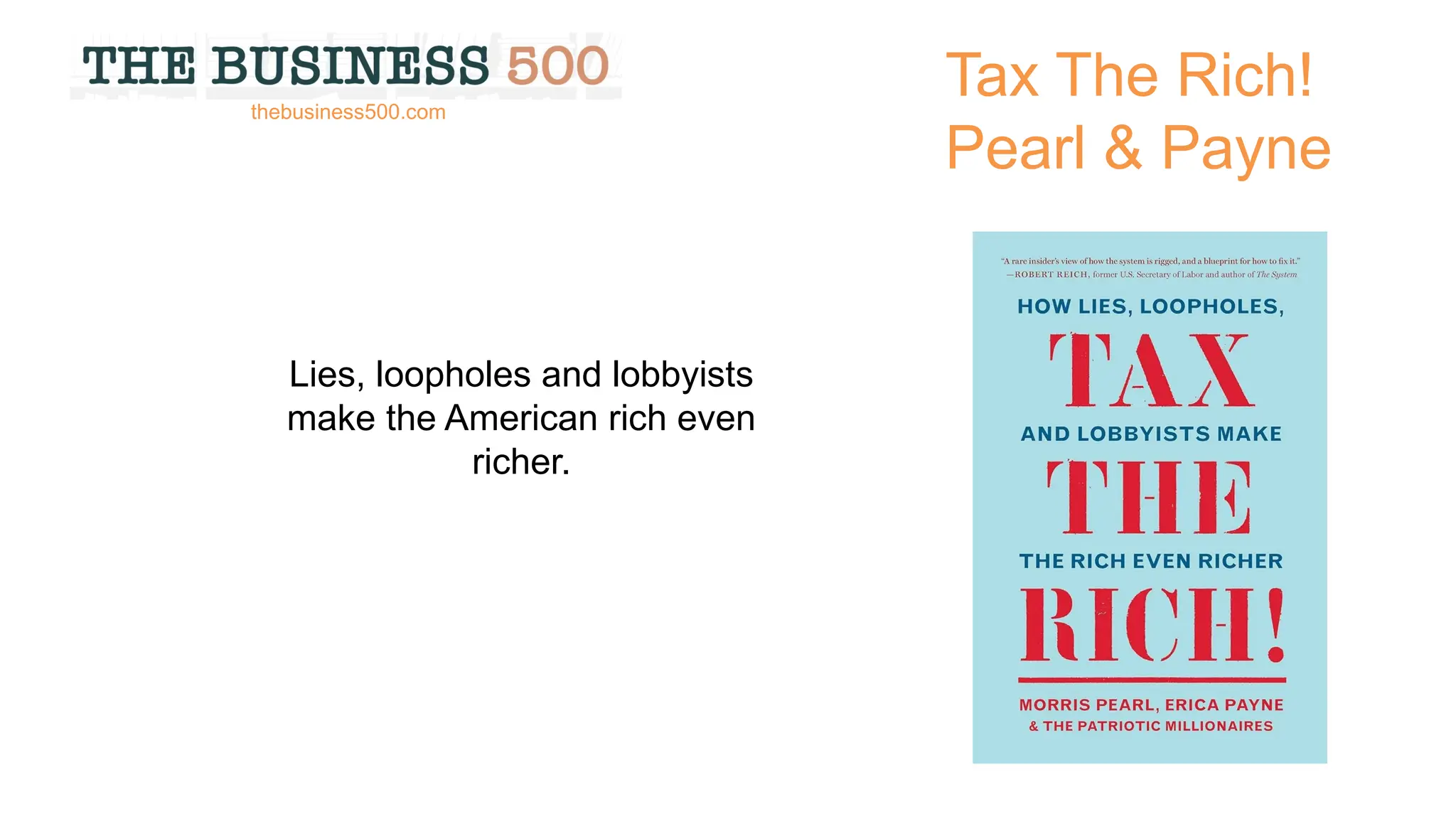
Tax The Rich!
Pearl & Payne
Lies, loopholes and lobbyists
make the American rich even
richer.
thebusiness500.com
• An unusual book written by two American millionaires who are part of a group called the Patriotic
Millionaires and dissatisfied with the USA taxation system and actively want to pay more tax.
They explain how lies, loopholes and lobbyists make the rich even richer.
• The vast majority of Americans believe that the economy is rigged in favour of the rich, and they
are right. The way this is done is predominantly through the tax code, which virtually guarantees
destabilizing levels of inequality and consequent social unrest.
• Rich means different things to different people. Many rich people think they are poor. The
wealthiest three Americans now have more wealth than the bottom half of the whole country
combined. There are tax tricks that make rich people richer:
1. The billionaire’s loophole: you pay lower tax on capital you invest than money you have to work
for.
2. The estate tax: 35-45% of American wealth is inherited, and they pay little or no tax on it or the
income from it.
3. Sidestepping taxes: most rich people have huge assets that never have been and never will be
taxed.
4. Annuity trusts: the estate tax is supposed to tax the transfer of intergenerational wealth, but by
cycling it through a GRAT (Grantor-retained annuity trust) most avoid any tax at all.
5. Switch and swap: real estate owners don’t pay any tax on assets so long as they reinvest it on
another building.
6. Pretend to help the poor: investors avoid paying taxes on profits from any past investment for up
to 7 years, so long as they invest an equal amount in an Opportunity Zone.
7. Pass-through deduction: pass-throughs are a category of legal entities such as limited liability
companies that qualify for a 20% reduction in tax. 85% of pass-through income goes to the top 20%
and 50% of it goes to the top 1%.
Tax The Rich!
Pearl & Payne
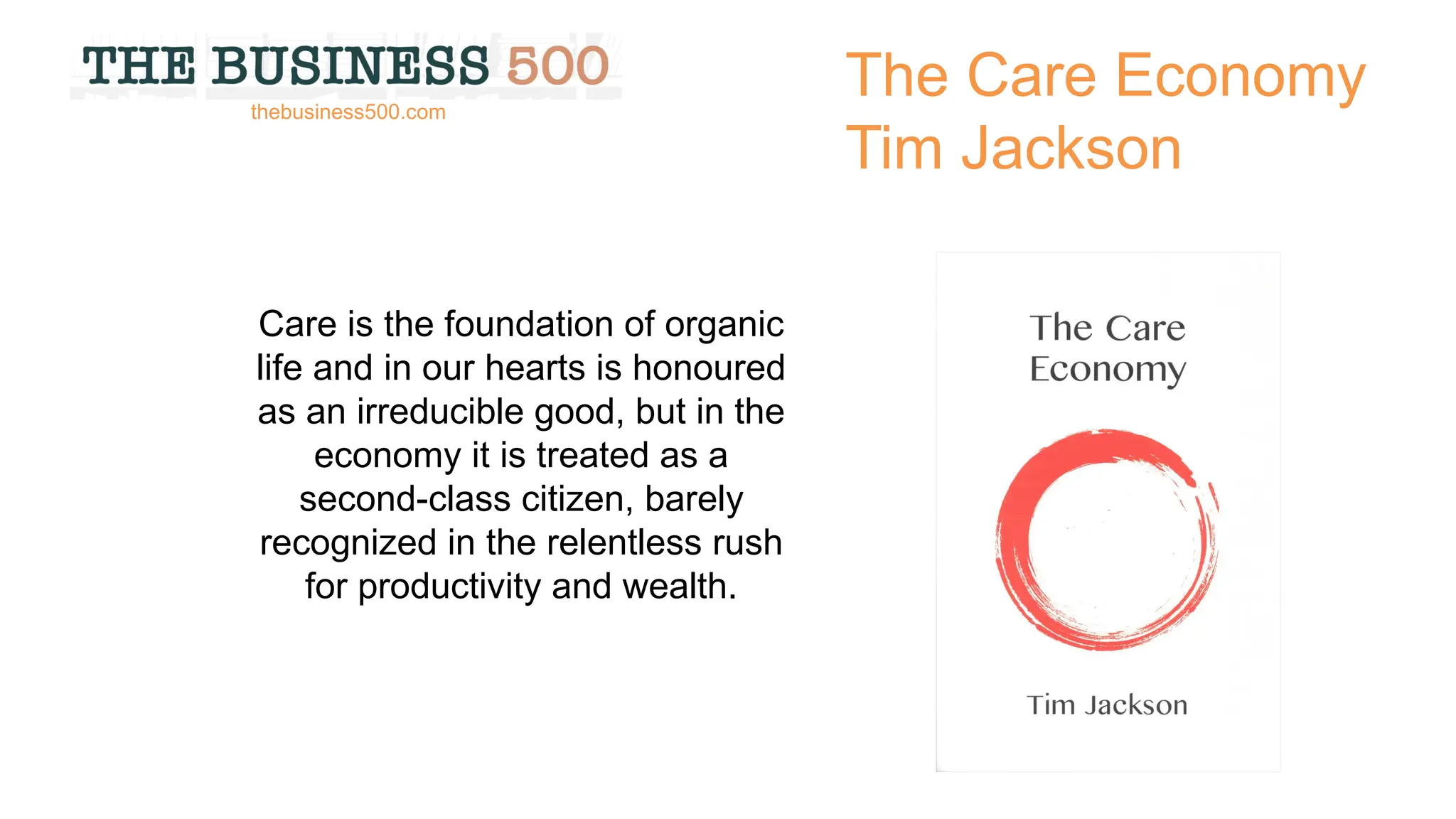
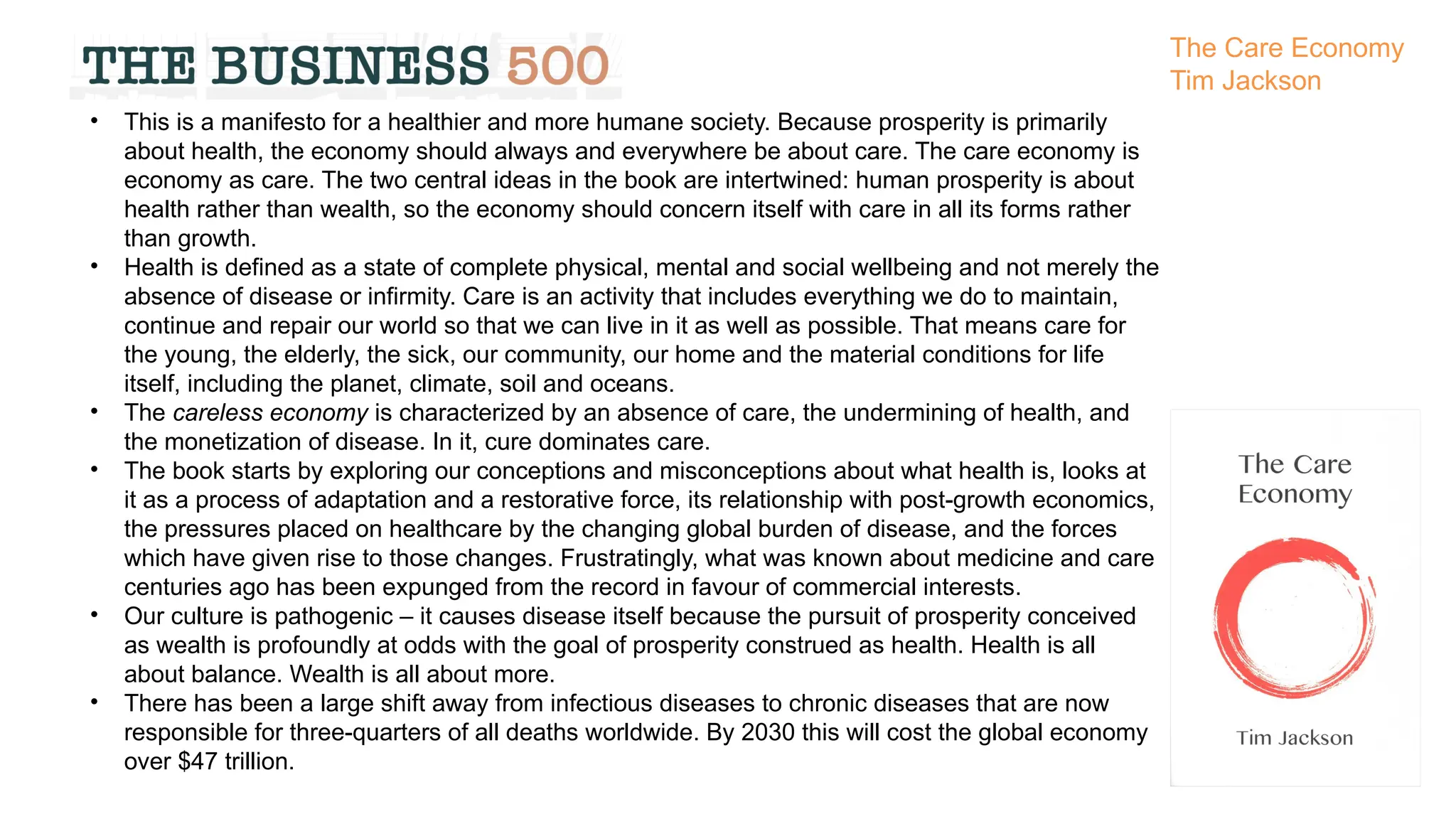
The Care Economy
Tim Jackson
Care is the foundation of organic
life and in our hearts is honoured
as an irreducible good, but in the
economy it is treated as a
second-class citizen, barely
recognized in the relentless rush
for productivity and wealth.
thebusiness500.com
• This is a manifesto for a healthier and more humane society. Because prosperity is primarily
about health, the economy should always and everywhere be about care. The care economy is
economy as care. The two central ideas in the book are intertwined: human prosperity is about
health rather than wealth, so the economy should concern itself with care in all its forms rather
than growth.
• Health is defined as a state of complete physical, mental and social wellbeing and not merely the
absence of disease or infirmity. Care is an activity that includes everything we do to maintain,
continue and repair our world so that we can live in it as well as possible. That means care for
the young, the elderly, the sick, our community, our home and the material conditions for life
itself, including the planet, climate, soil and oceans.
• The careless economy is characterized by an absence of care, the undermining of health, and
the monetization of disease. In it, cure dominates care.
• The book starts by exploring our conceptions and misconceptions about what health is, looks at
it as a process of adaptation and a restorative force, its relationship with post-growth economics,
the pressures placed on healthcare by the changing global burden of disease, and the forces
which have given rise to those changes. Frustratingly, what was known about medicine and care
centuries ago has been expunged from the record in favour of commercial interests.
• Our culture is pathogenic – it causes disease itself because the pursuit of prosperity conceived
as wealth is profoundly at odds with the goal of prosperity construed as health. Health is all
about balance. Wealth is all about more.
• There has been a large shift away from infectious diseases to chronic diseases that are now
responsible for three-quarters of all deaths worldwide. By 2030 this will cost the global economy
over $47 trillion.
The Care Economy
Tim Jackson
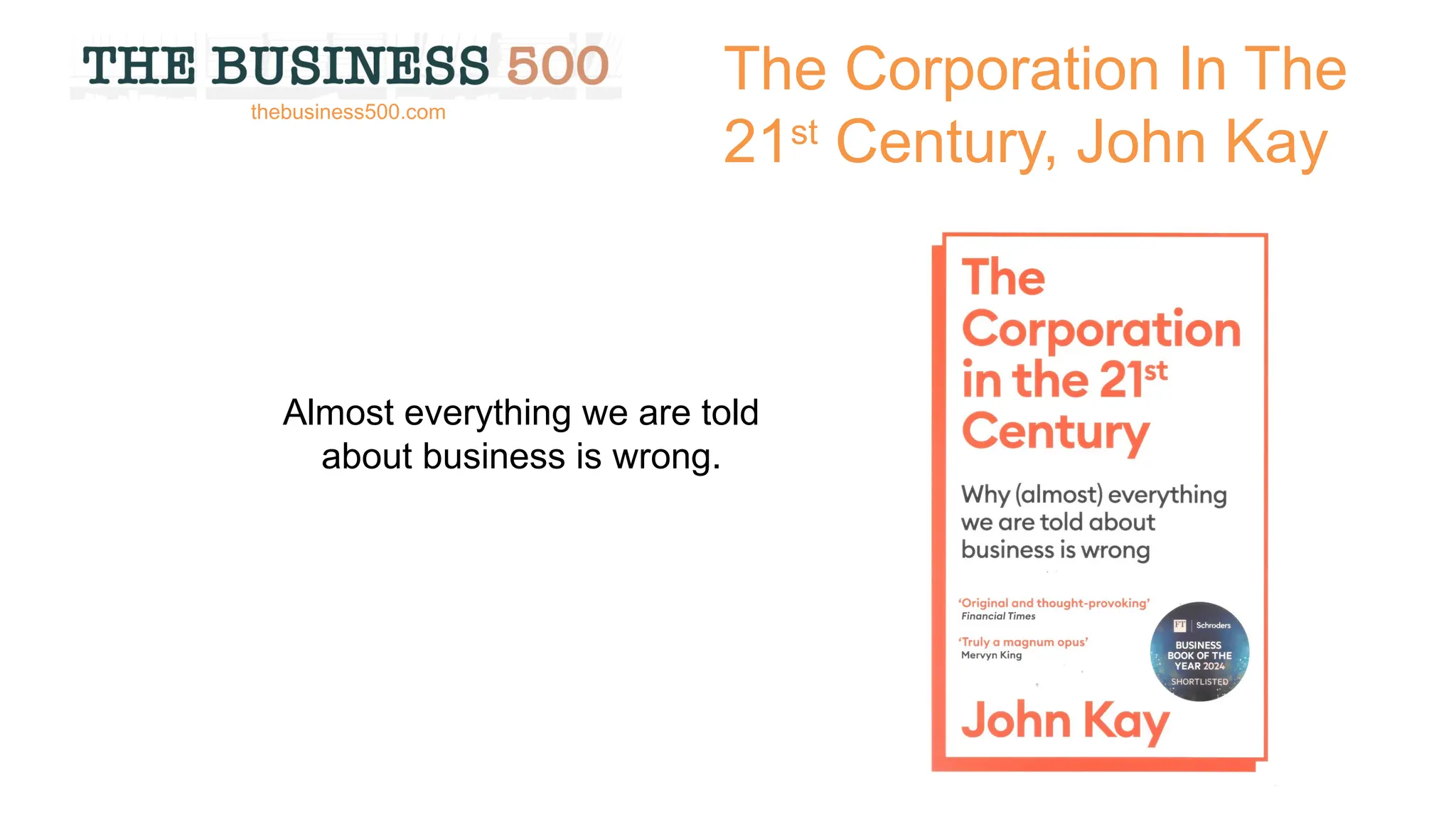
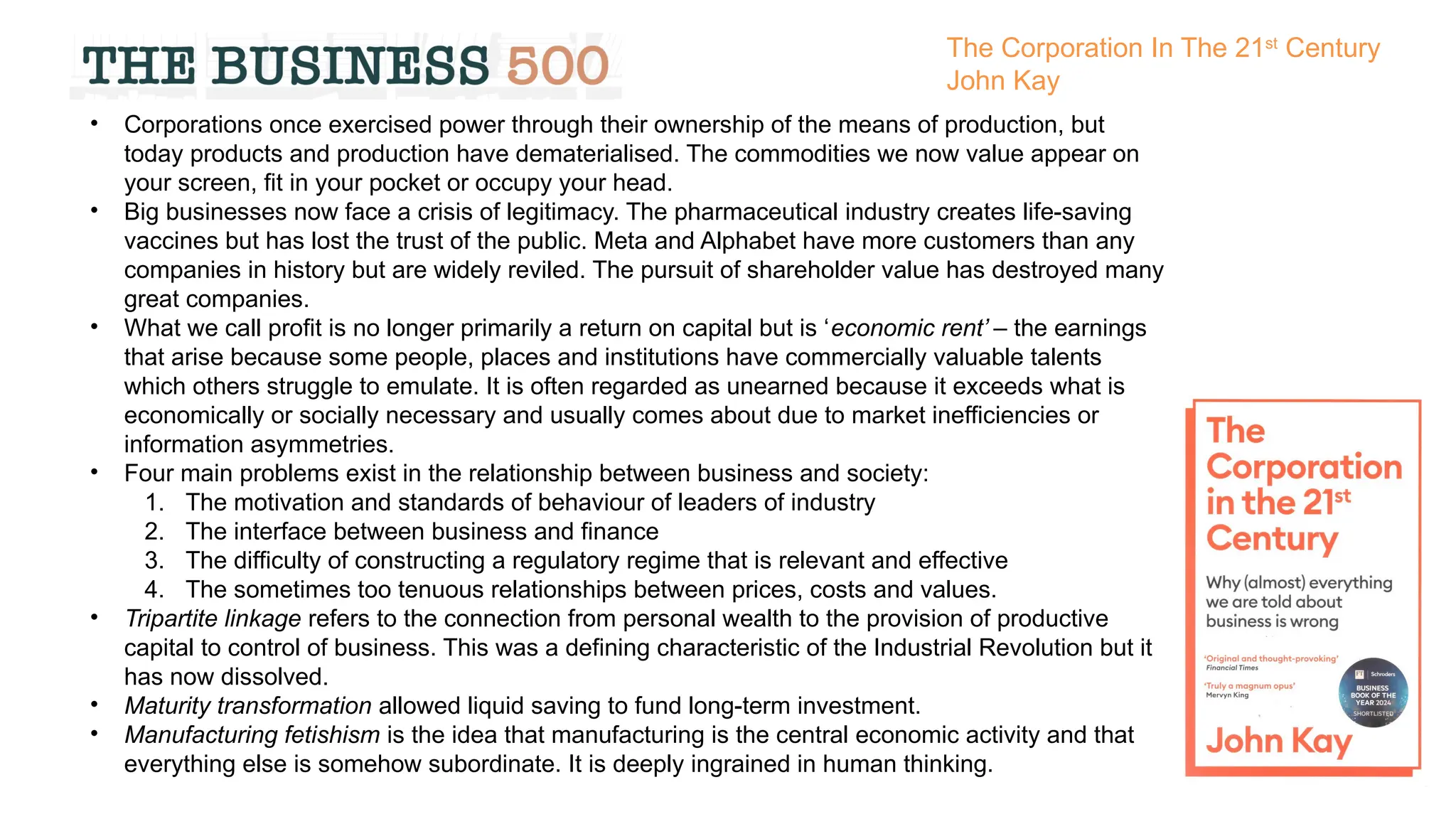
The Corporation In The
21st
Century, John Kay
Almost everything we are told
about business is wrong.
thebusiness500.com
• Corporations once exercised power through their ownership of the means of production, but
today products and production have dematerialised. The commodities we now value appear on
your screen, fit in your pocket or occupy your head.
• Big businesses now face a crisis of legitimacy. The pharmaceutical industry creates life-saving
vaccines but has lost the trust of the public. Meta and Alphabet have more customers than any
companies in history but are widely reviled. The pursuit of shareholder value has destroyed many
great companies.
• What we call profit is no longer primarily a return on capital but is ‘economic rent’ – the earnings
that arise because some people, places and institutions have commercially valuable talents
which others struggle to emulate. It is often regarded as unearned because it exceeds what is
economically or socially necessary and usually comes about due to market inefficiencies or
information asymmetries.
• Four main problems exist in the relationship between business and society:
1. The motivation and standards of behaviour of leaders of industry
2. The interface between business and finance
3. The difficulty of constructing a regulatory regime that is relevant and effective
4. The sometimes too tenuous relationships between prices, costs and values.
• Tripartite linkage refers to the connection from personal wealth to the provision of productive
capital to control of business. This was a defining characteristic of the Industrial Revolution but it
has now dissolved.
• Maturity transformation allowed liquid saving to fund long-term investment.
• Manufacturing fetishism is the idea that manufacturing is the central economic activity and that
everything else is somehow subordinate. It is deeply ingrained in human thinking.
The Corporation In The 21st
Century
John Kay
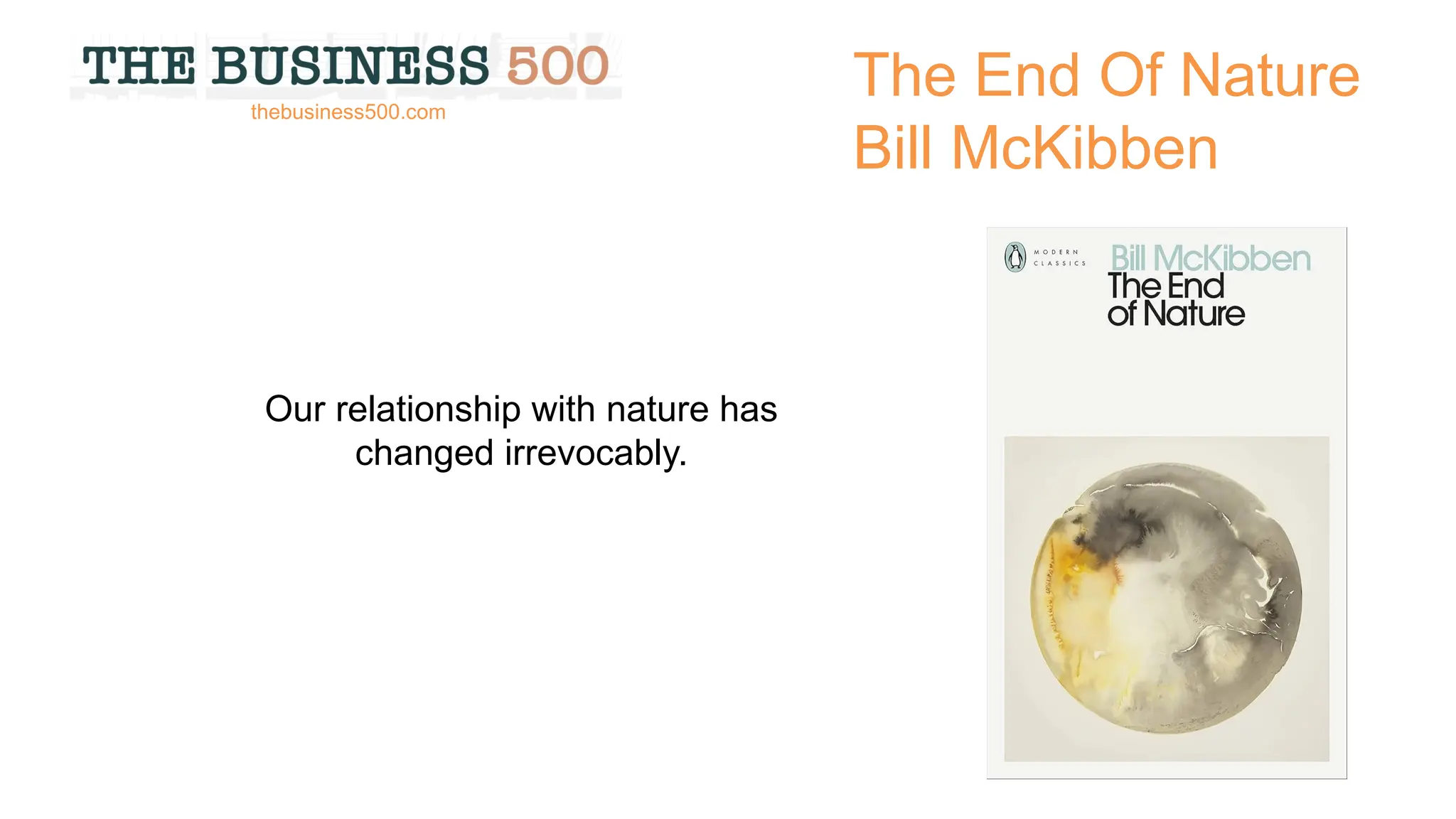
The End Of Nature
Bill McKibben
Our relationship with nature has
changed irrevocably.
thebusiness500.com
• This book, first published in 1989, is regarded as a classic in the world of environmental thought.
It was one of the first to articulate early warnings about climate for a broad audience.
• In 1957, the scientists Revelle and Suess published a paper that showed that most of the carbon
dioxide pumped into the air would stay in the air and warm the planet. They concluded that
‘human beings are now carrying out a large-scale geophysical experiment of a kind that could
not have happened in the past, nor be repeated in the future.’
• While the story gradually built to include the depletion of the ozone layer, acid rain, and genetic
engineering, the story of the end of nature begins with this greenhouse experiment and what will
happen to the weather.
• In 1988, the American drought caused the senate committee on Energy and Natural Resources
to hold a hearing on the greenhouse effect. The main witness was Dr. James Hansen who ran
the NASA computer programs that predicted weather patterns. He stated emphatically that there
was now only a 1% chance that the temperature increases seen in the last few years were
accidental. He told the hearing: ‘It’s time to stop waffling so much. It’s time to say the earth is
getting warmer.’
• Since then, nothing has been done, partly because the people doing the polluting are removed
from the pollution as the wind carries emissions thousands of miles and turns the problem into a
global rather than local one.
• An idea or relationship can go extinct just like an animal or plant. The idea in this case is ‘nature’.
It is the end of nature because the temperature and rainfall are no longer entirely the work of
some separate uncivilizable force, but are in part a product of our habits, economies and ways of
life. We have ended the thing that has defined nature for us – its separation from human society.
The End Of Nature
Bill McKibben
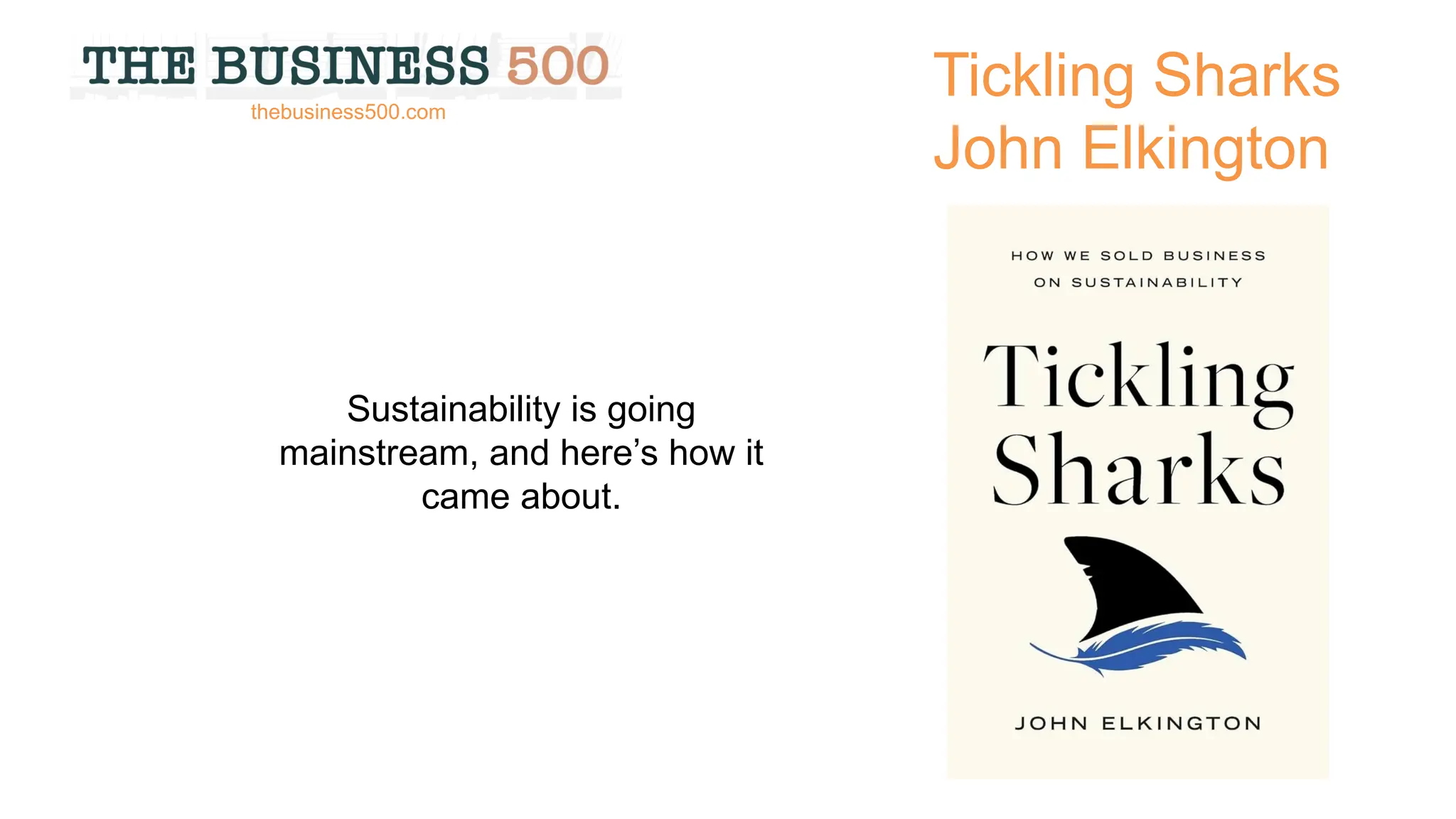
Tickling Sharks
John Elkington
Sustainability is going
mainstream, and here’s how it
came about.
thebusiness500.com
• This is a history of how the author and his colleagues sold business on sustainability. The author
is often described as the godfather of sustainability, although he prefers to say that he is one of a
number of godparents. It has been his self-appointed task to tell powerful people things they
don’t want to hear, and he has a reputation for speaking tomorrow’s truth to power.
• The title is his metaphor for encouraging the human sharks of the corporate world to address
new social, economic, and environmental priorities. These people need to step up or get out of
the way.
• Not all sharks are the same and each one needs different handling, particularly when they are so
rich and powerful, so the skill of persuading them to accept or pursue change has been evolved
over decades, making up the rules as he went along. Often this involves humour and teasing, so
that senior people can see that they are not in the presence of a preaching missionary, thereby
relaxing their normal defensiveness.
• Once you have earned a reputation for dealing with tricky sharks, the dynamic changes when a
client approaches you, rather than vice versa because you can negotiate on values, not just
value.
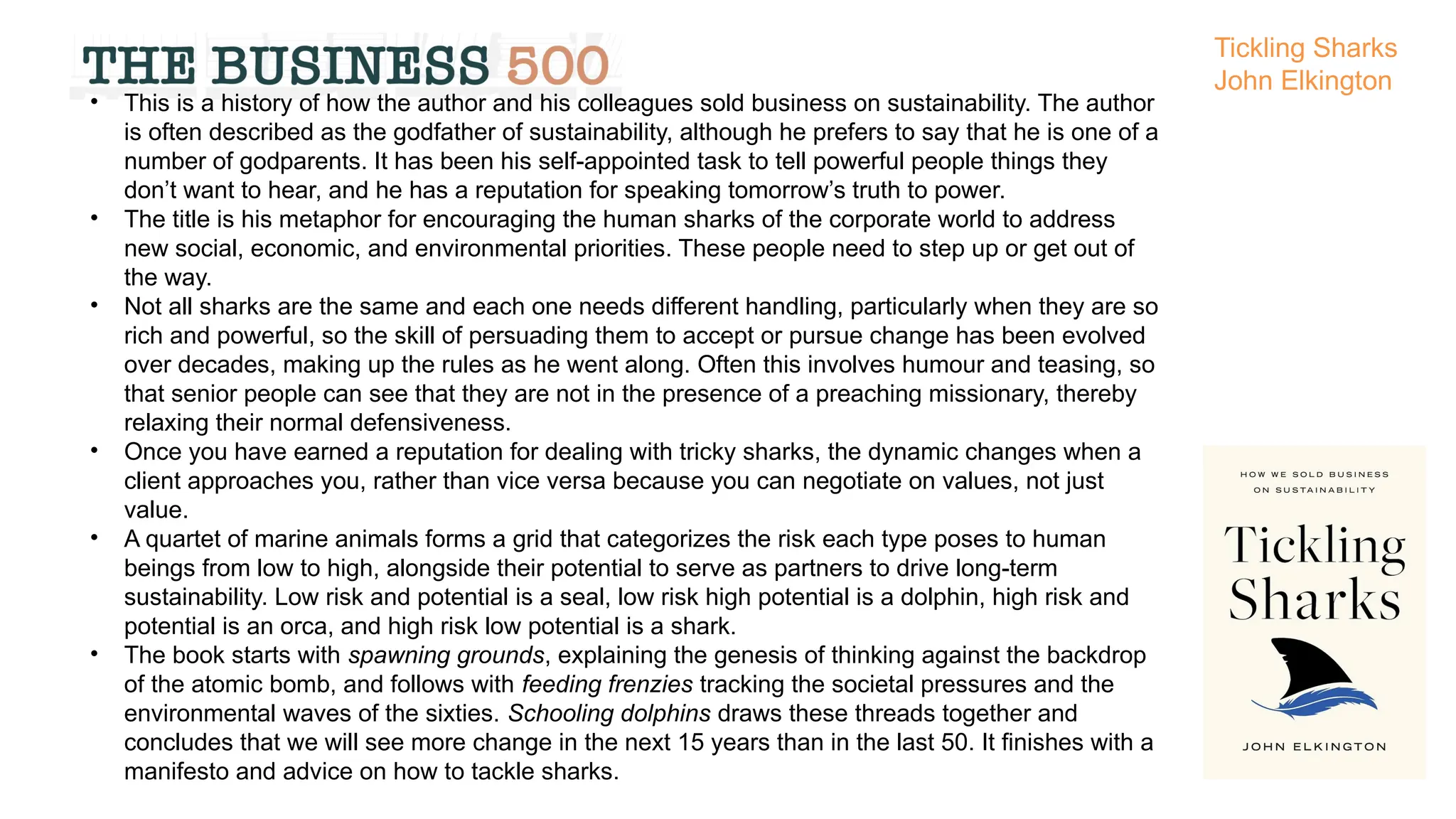
• A quartet of marine animals forms a grid that categorizes the risk each type poses to human
beings from low to high, alongside their potential to serve as partners to drive long-term
sustainability. Low risk and potential is a seal, low risk high potential is a dolphin, high risk and
potential is an orca, and high risk low potential is a shark.
• The book starts with spawning grounds, explaining the genesis of thinking against the backdrop
of the atomic bomb, and follows with feeding frenzies tracking the societal pressures and the
environmental waves of the sixties. Schooling dolphins draws these threads together and
concludes that we will see more change in the next 15 years than in the last 50. It finishes with a
manifesto and advice on how to tackle sharks.
Tickling Sharks
John Elkington
Summaries of the 20 best business books of 2025.

  • 1.
    20 FROM 25 THEBEST BUSINESS BOOKS OF 2025 thebusiness500.com
  • 2.
     A libraryof over 500 books  A blog  A series of printed books  One-page summaries  One-sentence summaries  Training programmes  Motivational speeches  A fertile source of new ideas  Search thebusiness500.com
  • 3.
    A Climate OfTruth Mike Berners-Lee In order to address the polycrisis of climate, food security, biodiversity, pollution and inequality we need to stand further back to gain perspective, dig deeper to see the root causes, and join up every element of the challenge. thebusiness500.com
  • 4.
    • The bookmaps out the challenge ahead and explains that we need to gain agency at the Global System Level. Energy efficiency is often cited as a form of progress, but because of the Jevons Paradox, it actually makes it worse. This is named after William Stanley Jevons who, in the 19th century, noticed that as coal efficiency improved it led to rising, not falling demand and use. • This is also called the rebound effect. It is one of the most critically important and under- appreciated concepts for all climate strategists and politicians to understand. Only when the inputs are constrained do efficiency improvements stand to make quality of life and the environment better rather than worse, but the oil companies resist this, which is why we need a high enough and universal carbon price. • The polycrisis has three layers. The outer layer contains the elements that are easiest to see and will be the direct cause of problems if they can’t be sorted out. They include climate, energy, population, food, biodiversity, pollution and disease. Positive feedback loops and tipping points are particularly concerning here, because once set in train they can’t be reversed. They even reinforce each other as cascading tipping points. • The middle layer of the polycrisis is all about politics, media, business, inequality, economics and growth, technology and education. Techno-optimism is a problem here, claiming that technology will drive change and that we are making progress, but this abdicates responsibility and creates a misleading narrative of no behavioural change. To address it, we need more honest, transparent and joined-up political discourse, a media and business community to match, an economic framework connected to the wellbeing of people and the planet, ecocide laws that have teeth, and a shrinking gap in equality. • The core of the polycrisis is all about thinking and values. A Climate Of Truth Mike Berners-Lee
  • 5.
    Another England Caroline Lucas Thenational story of England has been highjacked by The Right but it can be reclaimed because there is another version of the story that is dramatically more inclusive and forward-looking. thebusiness500.com
  • 6.
    • The authorwas the UK’s first Green Party MP in 2010 and served as party leader from 2008 to 2012, serving for 25 years until standing down by the 2024 election. • Having gained a PhD in English Literature, she delves deep into England’s literary history to sketch out alternative stories of who we are – ones that we can all embrace to build a greener, fairer future. She believes that by engaging with literature we can open up new possibilities. • Today, the only people who dare speak of Englishness are cheerleaders for Brexit, exceptionalism and imperial nostalgia. But there is another England hiding in plain sight. • First, we need to consider the distinction between England, Britain, Great Britain and the United Kingdom. In many discussions, the four descriptions are used interchangeably, but this disguises many issues. For example, what is England if Northern Ireland, Scotland and Wales are removed from the equation – something that the author refers to as Nixit, Sexit and Wexit? All three scenarios are possible, so what would England be? • Literature can shed a new light on our three greatest challenges: 1. How to reform our political system so that accountability, fairness and respect are at the heart of how we govern ourselves. 2. How we can all live well within the constraints of a finite planet. 3. How we can be a more open and confident nation, celebrating difference rather than seeking to repress it. • Our national identity has always been a story as much as a reality, and it has been rewritten many times over the centuries to create all the myths that make up our conception of ‘Englishness’. Everything from Robin Hood to the Armada to Dunkirk can be packaged up to suggest that England might somehow be better off by isolating itself, whilst peddling fantasies about recreating the Empire. Another England Caroline Lucas
  • 7.
    Earth For All Dixson-Decleveet al. The economic operating system keeps crashing so it’s time to update to a new one. thebusiness500.com
  • 8.
    • This isa survival guide for humanity written by six authors as a report to the Club of Rome. It asserts that earth has crossed multiple planetary boundaries and is now at the cliff edge. On top of that, widespread inequality is causing deep social instabilities, making it even more difficult to resolve our crises. • The book outlines for the first time what system change really means for civilization - an antidote to despair and a roadmap to a better future. It uses computer modelling to show how five turnarounds are needed urgently to achieve prosperity for all within planetary limits within a single generation. These cover poverty, inequality, empowerment, food and energy, and are interlinked so that together they create a whole system transformation called Earth4All. • The poverty turnaround involves dramatic expansion in the policy space along with trade re- regionalization and a new economic model that allows the growth in low-income nations to reduce poverty rapidly in a green and fair way. • The inequality turnaround uses progressive taxation to distribute income more fairly, re- unionization to empower workers, and a Citizen Fund to provide universal basic dividends so that citizens can benefit from shared resources. • The empowerment turnaround brings gender equity to the fore with education for all, female leadership and jobs, and a new pension system for old age. • The food turnaround uses regenerative agriculture and sustainable intensification to create healthier soils and ecosystems, new farming techniques and food-system efficiency to shift from grain-fed red meat to nourishing healthier diets. • The energy turnaround creates new energy system efficiency to transform consumption in heat, industrial processes and transport by moving to abundant renewables. Earth For All Dixson-Decleve et al.
  • 9.
    Five Times Faster SimonSharpe We need to rethink the science, economics and diplomacy of climate change to move five times faster. thebusiness500.com
  • 10.
    • Experts arenot properly examining risk assessments related to climate change, nor even asking the right questions. We seem to know the least about the things that matter most. When the author asked scientists, research funders, and those in government who receive research intended for policy makers why this was, they offered three reasons. • 1. Wilful ignorance. Researchers have been discouraged from looking at global warming scenarios over 2 degrees celsius in case they were seen to be giving up on the target. • 2. More confidence than relevance. Scientists don’t like to make predictions unless they are completely confident, which means politicians are rarely presented with the possibly of catastrophic outcomes whilst there is still a tiny chance that they may not happen. • 3. A preference for novelty over relevance. This is a fundamental ambiguity about what science is for. People, including scientists, get bored with the same old stuff, so they often get excited about so-called ‘original’ studies whilst ignoring more fundamental, but possibly important, work. • Thresholds of impact demonstrate risks that can be found if we go looking for them. These include temperatures being too hot for humans and crops, and there being too much sea for cities. The author calls this telling the boiling frog what he needs to know. • Because of reinforcing feedback loops, there are tipping points of no return, and they are irreversible. When all three of these phenomena come together, it’s bad news, as in melting ice caps, hotter temperatures and rising sea levels. • Scientists have two different ways of being wrong. One is to believe your hypothesis is correct when it is not (called a false positive or type I error), and the other is to believe your hypothesis is wrong when in fact it is true (a false negative or type II error). Scientists have a strong aversion to type I but are relatively tolerant of type II. There is no standard practice for checking if you have thrown out a finding that was actually true. Five Times Faster Simon Sharpe
  • 11.
    From What IsTo What If Rob Hopkins If we unleash the power of imagination, we can create the future we want. thebusiness500.com
  • 12.
    • The authorasks the most important question that society has somehow forgotten. What If? explores what we must do to revive and replenish our collective imagination. Answering it can change societies and cultures rapidly, dramatically and unexpectedly for the better. There really is no end to what we can accomplish. • The questions posed include: What if we took play seriously? What if we considered imagination vital to our health? What if we followed nature’s lead? What if we fought back to reclaim our attention? What if school nurtured young imaginations? What if we became better storytellers? What if we started asking better questions? What if our leaders prioritized the cultivation of imagination? What if all this came to pass? • Answers to these could lead to a positive expression of how the future might turn out. If we wait for governments, it will be too late. If we act as individuals, it will be too little. But if we act as communities, it might just be enough, and it might just be in time. • Imagination is a fundamental part of being human, it is our natural state, and it is resilient, so if we can push aside the factors that are depressing it, it will reemerge. The pressures of modern life involve some shocking statistics: • Shit Life Syndrome (SLS) is what doctors call a tangled mix of economic, social and emotional problems which consists of low mood caused by adverse life circumstances. Anxiety disorders have increased twentyfold in the past thirty years and 83% of people say they spend no time at all relaxing or thinking. From What Is To What If Rob Hopkins
  • 13.
    #futuregen Jane Davidson The storyof how Wales responded to global challenges by radically rethinking its duty to future generations can inspire other countries to do the same. thebusiness500.com
  • 14.
    • When theauthor was Minister for Environment, Sustainability and Housing in Wales, she proposed what became the Well-being of Future Generations Act 2015 – the first piece of legislation in history to place regenerative and sustainable practice at the heart of government. The act connects social, environmental, economic and cultural well-being, and looks to solve complex issues through better decision-making. • It is revolutionary because it enshrines into law that the well-being of the current and future people of Wales is explicitly the core purpose of the government. It created seven goals for living within our environmental limits in the areas of health, prosperity, resilience, communities, language and heritage, equality, and Wales’s role in the world. It then directs five ways of working to reach decisions: prevention, long-termism, collaboration, participation, and integrating activities to reach positive outcomes for as many of the goals as possible. • A series of epiphanies led to the development of the author’s views: 1. Agenda 21. This was a commitment made by 178 countries at the Earth Summit in Rio de Janeiro in 1992 to create a global action plan for sustainable development into the 21st century, hence the name. 2. Donella Meadows and systems thinking. In 1972 she and her colleagues published The Limits To Growth, after a Club of Rome study looked at the consequences of unchecked growth on a finite planet. 3. We have only one planet. In 2007 a report entitled ‘One Planet Wales’ concluded that if everyone in the world consumed natural resources and generated carbon dioxide at the rate of Wales, they would need three planets to support themselves. 4. Incrementalism doesn’t work. Things must be done at scale otherwise change is too slow. #futuregen Jane Davidson
  • 15.
    How Big ThingsGet Done Flyvberg & Gardner There are a consistent set of factors that cause projects to be a success or fail spectacularly. thebusiness500.com
  • 16.
    • Grand visionscan be inspiring but frequently they never materialize because the project becomes a disaster. The universal drivers that make the difference between success and failure are psychology and power. An optimistic approach is often disastrous, and power struggles often lead to inappropriate decisions, overspends and sometimes even failure to complete the project at all. • The author has created a database of more than 16,000 large projects which shows that only 0.5% of them are on budget, on time and on benefits (or better). Less than half are on budget, and only 8.5% are on budget and on time. The iron law of project management is that they are always over budget, over time, and under benefits. • To rectify this, think of a project as being divided into two parts – planning and delivery. Do not rush into delivery before thinking everything through properly first. The author calls this: make haste – slowly, or think slow, act fast. Imaginative leaps belong in planning, not delivery. • Projects don’t go wrong – they start wrong and rapidly get caught in a break-fix cycle, because problems weren’t anticipated. This is often because of too much optimism. When you take a flight, you want the flight attendant to be an optimist, not the pilot. • The planning fallacy shows that people commonly underestimate the time required to complete tasks even when there is information that suggests that the estimate is unreasonable. Physicist Douglas Hofstadter dubbed it Hofstadter’s Law: “It always takes longer than you expect, even when you take into account Hofstadter’s Law.” • A bias for action sounds impressive but it is in fact a bias against thinking. Executives everywhere feel more productive executing tasks than planning them, but it rarely ends well because they haven’t thought it through properly. How Big Things Get Done Flyvberg & Gardner
  • 17.
    Indispensable Chris Hirst Nobody caresabout your career as much as you do so take control, make sure you stand out and make yourself indispensable. thebusiness500.com
  • 18.
    • This bookaims to strip away the jargon, clickbait and bullshit to reveal what really works when it comes to career success. In a world where job security is shaky, competition is fierce and the cost of living keeps rising, standing out is essential. • Success isn’t luck. Whether you are at the start of your career, an ambitious young leader, an entrepreneur or on the brink of the boardroom, the fundamentals that make career success don’t change. • Depending on your stage, you need to get hired and get ahead, become an indispensable member of the team, manage your boss (instead of being micro-managed), network like a pro but without feeling fake, negotiate the pay rises you deserve, maximize your productivity, and work hard without burning out. • Career potential = Attitude x Aptitude. Score low on either and, irrespective of how good you are at the other, it will significantly constrain your progress. High aptitude is a prerequisite, but attitude also matters. High-status, senior individuals are often unwilling to take suggestions and advice from those they consider beneath them. • Here are the 8 characteristics of the most successful people: 1. Be the person who gets shit done. Ideas and strategy are easy. Getting them done is hard. 2. Bring solutions not problems. Pointing out everything that is wrong doesn’t get you or the company anywhere. 3. Work hard. Don’t confuse hard work with being busy. They are not the same. 4. Don’t let fear of failure stop you from trying. Self-doubt and action can coexist. 5. Learn fast. Be comfortable making mistakes so as to be better next time. 6. Love the process, not just the results. Make the journey as important as the goal. 7. Focus. Be clear where you want to get to. Devote time and energy to get there. 8. Be great for the careers of others. Successful people are surrounded by talented people. Indispensable Chris Hirst
  • 19.
    Legacy Dieter Helm What isunsustainable will not be sustained, so we need to live within sustainable means, pay for capital maintenance, pay for pollution, and not pass on debt to the next generation. thebusiness500.com
  • 20.
    • The authorsets out to define what a new sustainable economy should look like. The message is a tough one: we are way off course and cannot escape the consequences. • The current generation needs to pay for capital maintenance, pay for what it pollutes, and save to invest instead of borrowing all time. • The macroeconomics of a society’s balance sheet can be viewed in the same way as a bank account. The current account is the cost of current spending plus capital maintenance, funded by tax or other revenue. The capital account contains existing assets and new ones that need maintenance and protection without generating new debt. • This approach would protect our core assets in perpetuity and create resilience instead of constantly being in hock. Three critical components are: 1. Citizens, not consumers. Growth and sensible levels of consumption are still acceptable, so long as they don’t outstrip savings or deplete assets. 2. Uncertainty built in to all forecasting along with resilience. 3. Concentrate on assets not flows. Make sure stocks are not depleted and remain fit for purpose, rather than concentrating on keeping money moving. • Discounting the future means prioritizing the present over the future. This expedience merely pushes the problem off into the future. • There are 4 types of core capital asset classes that matter for the sustainable economy: 1. Natural capital. This is what nature gives us for free and comes in two types: renewable and non-renewable. 2. Physical capital. Networks, infrastructure systems, houses and anything built. 3. Human capital. Intelligence, ideas and knowledge. 4. Social capital. The hardest to define, being intangible. This is anything that binds society together such as religions, national identities and shared cultural histories. Legacy Dieter Helm
  • 21.
    Limitarianism Ingrid Robeyns The caseagainst extreme wealth means that it should be limited to £10 million per individual and ideally be set at £1 million. thebusiness500.com
  • 22.
    • We allnotice when the poor get poorer: when there are more rough sleepers and food bank queues start to grow. But if the rich become richer, there is nothing to show for it. Or is there? The true extent of our wealth problem has been silently spiralling out of control for the last 50 years, and it is harmful to all – including the extreme rich. • Limitarianism is the proposed antidote to the problems posed by neoliberal capitalism – placing a hard limit on the wealth that one person can accumulate, because no one deserves to be a millionaire. It is a regulative ideal – an outcome to strive for, but not one that can necessarily be legislated. It calls for three kinds of action: structural (designing our economies to provide equitable distribution of wealth for all), fiscal (balancing tax and the benefits system) and ethical (embracing a limitarian ethos). There should be no decamillionaires, and the ethical limit should be one million dollars, pounds or euros. • Limitarianism makes a distinction between three thresholds: the riches line, the ethical limit and the political limit. The riches line is the level at which additional money cannot increase your standard of living. The ethical limit is the maximum level of money we can own on moral lines. The political limit is the ultimate limit on a person’s wealth that the state should use as a goal when setting up its social and fiscal systems. • Actions to instigate limitarianism include dismantling neoliberal ideology, reducing class segregation, establishing a balance of economic power, restoring the fiscal agency of governments, making international economic architecture fair, and halting the intergenerational transmission of wealth. Limitarianism Ingrid Robeyns
  • 23.
    Magic Words Jonah Berger Sixtypes of words can increase your impact in every area of life, from persuading others and building stronger relationships to boosting creativity and motivating teams. thebusiness500.com
  • 24.
    • You canwork out what to say to get your way. Almost everything we do involves words, but certain words have more impact than others. The six types of words are: 1. Activate identity and agency Turn actions into identities (Will you be a helper? is stronger than Will you help?); change can’ts to don’ts; turn coulds into shoulds; talk to yourself using the third person; pick your pronouns carefully (‘I’ and ‘You’ draw attention to ownership but can also attribute blame) 2. Convey confidence Ditch the hedges such as may, could and in my opinion; use definites; don’t hesitate, turn pasts into presents; but know when to express doubt to show you are open-minded. 3. Ask the right questions You can succeed more by asking for advice, following up with thoughtful questions, deflecting difficulty, avoiding assumptions, starting safe and then building to harder and more specific matters. 4. Leverage concreteness In language, concreteness refers to precision – the opposite of talking abstractly. Make people feel heard by demonstrating that you really are listening, be concrete or specific, and focus on the how. 5. Employ emotion Highlight the hurdles, build a rollercoaster story with highs and lows, mix up moments to create variety, consider the context, connect with your audience, then solve problems, and activate uncertainty to keep people engaged. 6. Harness similarity (and difference) Consider the balance between signaling similarity and driving difference, plot the right progression and use language to communicate more effectively. Magic Words Jonah Berger
  • 25.
    Material World Ed Conway Sixcrucial materials built our world (sand, salt, iron, copper, oil and lithium) and they will transform our future. thebusiness500.com
  • 26.
    • This isa substantial story about our past and future which takes us from the Dark Ages to the present and looks beyond. In one way or another, the six materials power our computers and phones, build our homes and offices, and create life-saving medicines. But most of us take these six crucial materials for granted. • The author travels the globe to uncover a world we rarely see or indeed think about. These substances matter more than ever before and the hidden battle to control them will shape our geopolitical future. • It is interesting how little we understand about how everyday products are actually made and, because of the complexity, no single human being could carry out or direct the numerous processes involved. The reason for choosing these six materials is that it is hard to imagine civilization without them because they are the hardest to replace. • In 2019, just one year, we mined, dug and blasted more materials from the earth’s surface than the sum total of everything we extracted from the dawn of humanity all the way through to 1950. • The amount of sand, soil and rock we mine, quarry and dredge each year is 24 times greater than the amount of sediment moved by Earth’s natural erosive processes, so humans are a bigger geological force than nature itself. • Fossil fuels are needed to manufacture practically every green energy solution, so the key to using fossil fuels in the future is to build with them, not burn them. Sand is the most ancient and modern substance of all – the fabric for much of the world. Salt is needed by the human body to keep functioning – several kilograms of it a year. Iron enables us to do things through tools, construction materials, and transport. Copper provides the circuitry and cables we never see but couldn’t function without. Oil breaks a 100-m-year-old geological cycle. Oil and gas are both useful and destructive. Lithium holds the key to the storage ability of batteries in mobiles, laptops and electric cars. Material World Ed Conway
  • 27.
    Music As Medicine DanielLevitin If we understand music better, we can harness its therapeutic power. thebusiness500.com
  • 28.
    • The authoris a neuroscientist, celebrated musician and bestselling author. He reveals the surprising ways in which music can transform our bodies and heal our minds. • We are only just beginning to appreciate the healing powers of music. In recent years, a wave of scientific research has upended everything we once knew about its effects on our brains. It can reduce stress, enhance cognitive function, slow the spread of neurodegenerative diseases like Parkinson’s and Alzheimer’s, and even strengthen our immune systems. • He explores how each of us can use music to calm our thoughts, repair our memories and heal our deepest psychological wounds. Rhythmic auditory stimulation can fight multiple sclerosis and certain songs, such as those by Tracy Chapman, might even help cure PTSD. • Episodic memory is for specific events, and semantic memory is for facts and general knowledge. Autobiographical memory combines personal, episodic and general self-knowledge. Memory in total is the heart of who we are, and the very private sense of what it is like to be us. • Traces of all this are found in synaptic activity where neurochemicals are fired around the brain. Each experience creates a unique synaptic network made up of a portion of the 80 million neurons in our brains, which remains the same from the first time we hear a particular piece of music. With each memory, these re-form to once again become members of that original experience group. The neurons are re-membered onto their original formation, so remembering is literally re-membering. • When chemical tags go wrong, we can experience Deja-vu or even Jamais-vu, which occurs when you’ve done something many times, but it feels like the first. This is a state that musicians seek to attain when they are performing. Music As Medicine Daniel Levitin
  • 29.
    Not The EndOf The World Hannah Ritchie Concentrating on surprising facts and dispelling dangerous myths offers hopeful solutions for our future on planet Earth. thebusiness500.com
  • 30.
    • Although weare bombarded by doomsday headlines every day, the author shows us a different picture by concentrating on the real data. To start with, three common myths: 1. Eating local is much better for the environment. In fact, it’s what we eat, not how far it has travelled, that matters most. 2. Overpopulation will be the end of us. In fact, birth rates are falling quickly, and the global population will peak this century. 3. We are the last generation before disaster becomes inevitable. In fact, we could be the first generation to build a truly sustainable planet. • The data shows that there is no better time to be alive than today: child mortality is down, mothers dying is down, life expectancy is up, hunger and malnutrition are down, access to basic resources such as clean water, energy and sanitation is up, education is up, and extreme poverty is down. All of this is the first half of the equation. • But all this has come at a cost, with worsening air pollution, climate change, deforestation (which is predominantly linked to food demand), biodiversity loss, ocean plastics, and overfishing. This is the second half of the equation. • When tackling these issues, blind optimism doesn’t work. Nor does complacent optimism, which assumes that solutions will arrive to solve everything. What we need is urgent optimism, often described as conditional optimism, effective optimism, pragmatic, realistic or impatient optimism. • Things to bear in mind when tackling these issues are to acknowledge that we face big and important environmental challenges; the fact that environmental issues aren’t humanity’s largest existential risk doesn’t mean we shouldn’t work on them; you have to hold multiple thoughts at the same time; nothing is inevitable, but it is possible; we cannot afford to be complacent; and you are not alone in this. Not The End Of The World Hannah Ritchie
  • 31.
    Siliconned Emmanuel Maggiori The techindustry solves fake problems, hoards idle workers, and makes doomed bets with other people’s money. thebusiness500.com
  • 32.
    • The techindustry is riddled with hysteria and we all pay the price for it. Tech investment is always on a blind hunt for pipe dreams, unicorns and explosive growth. Shady incentives reward tech investors for burning cash, governments and central banks pour fuel on the fire, and tech companies squander talent while using well-intentioned fads like Agile and Lean to help cover it up. • Investors bet huge sums of money on outlandish start-ups that need a miracle to succeed. Tech companies are obsessed with growth, regardless of making any profit. In 2000, the dot-com bubble burst and hundreds of thousands lost their jobs, but by 2021 investors had regained their enthusiasm and injected $681 million into start-ups. 787 start-ups reached unicorn status, which means that investors considered them to be worth over a billion dollars each. • Venture capitalists often take a big cut of the money they manage for others even if their investments perform badly, which encourages them to invest as much money as possible instead of doing it judiciously. Some people compare the industry to a dangerous, high-stakes Ponzi scheme. • They work to the rule of thirds. They know that a third of their investments will lose money, a third will be okay, and a third will be big winners, so the big winners must return at least 9 times the investment in order to compensate for losses elsewhere. Venture capital funds don’t want to publish their data because it shows their very poor track record. Their approach has been described as spray and pray. • A popular metric used to report the performance of venture capitalists is the internal rate of return or IRR, but it is flawed because it converts the return multiple into a percentage and encourages short-termism and short-sightedness. Siliconned Emmanuel Maggiori
  • 33.
    Tax The Rich! Pearl& Payne Lies, loopholes and lobbyists make the American rich even richer. thebusiness500.com
  • 34.
    • An unusualbook written by two American millionaires who are part of a group called the Patriotic Millionaires and dissatisfied with the USA taxation system and actively want to pay more tax. They explain how lies, loopholes and lobbyists make the rich even richer. • The vast majority of Americans believe that the economy is rigged in favour of the rich, and they are right. The way this is done is predominantly through the tax code, which virtually guarantees destabilizing levels of inequality and consequent social unrest. • Rich means different things to different people. Many rich people think they are poor. The wealthiest three Americans now have more wealth than the bottom half of the whole country combined. There are tax tricks that make rich people richer: 1. The billionaire’s loophole: you pay lower tax on capital you invest than money you have to work for. 2. The estate tax: 35-45% of American wealth is inherited, and they pay little or no tax on it or the income from it. 3. Sidestepping taxes: most rich people have huge assets that never have been and never will be taxed. 4. Annuity trusts: the estate tax is supposed to tax the transfer of intergenerational wealth, but by cycling it through a GRAT (Grantor-retained annuity trust) most avoid any tax at all. 5. Switch and swap: real estate owners don’t pay any tax on assets so long as they reinvest it on another building. 6. Pretend to help the poor: investors avoid paying taxes on profits from any past investment for up to 7 years, so long as they invest an equal amount in an Opportunity Zone. 7. Pass-through deduction: pass-throughs are a category of legal entities such as limited liability companies that qualify for a 20% reduction in tax. 85% of pass-through income goes to the top 20% and 50% of it goes to the top 1%. Tax The Rich! Pearl & Payne
  • 35.
    The Care Economy TimJackson Care is the foundation of organic life and in our hearts is honoured as an irreducible good, but in the economy it is treated as a second-class citizen, barely recognized in the relentless rush for productivity and wealth. thebusiness500.com
  • 36.
    • This isa manifesto for a healthier and more humane society. Because prosperity is primarily about health, the economy should always and everywhere be about care. The care economy is economy as care. The two central ideas in the book are intertwined: human prosperity is about health rather than wealth, so the economy should concern itself with care in all its forms rather than growth. • Health is defined as a state of complete physical, mental and social wellbeing and not merely the absence of disease or infirmity. Care is an activity that includes everything we do to maintain, continue and repair our world so that we can live in it as well as possible. That means care for the young, the elderly, the sick, our community, our home and the material conditions for life itself, including the planet, climate, soil and oceans. • The careless economy is characterized by an absence of care, the undermining of health, and the monetization of disease. In it, cure dominates care. • The book starts by exploring our conceptions and misconceptions about what health is, looks at it as a process of adaptation and a restorative force, its relationship with post-growth economics, the pressures placed on healthcare by the changing global burden of disease, and the forces which have given rise to those changes. Frustratingly, what was known about medicine and care centuries ago has been expunged from the record in favour of commercial interests. • Our culture is pathogenic – it causes disease itself because the pursuit of prosperity conceived as wealth is profoundly at odds with the goal of prosperity construed as health. Health is all about balance. Wealth is all about more. • There has been a large shift away from infectious diseases to chronic diseases that are now responsible for three-quarters of all deaths worldwide. By 2030 this will cost the global economy over $47 trillion. The Care Economy Tim Jackson
  • 37.
    The Corporation InThe 21st Century, John Kay Almost everything we are told about business is wrong. thebusiness500.com
  • 38.
    • Corporations onceexercised power through their ownership of the means of production, but today products and production have dematerialised. The commodities we now value appear on your screen, fit in your pocket or occupy your head. • Big businesses now face a crisis of legitimacy. The pharmaceutical industry creates life-saving vaccines but has lost the trust of the public. Meta and Alphabet have more customers than any companies in history but are widely reviled. The pursuit of shareholder value has destroyed many great companies. • What we call profit is no longer primarily a return on capital but is ‘economic rent’ – the earnings that arise because some people, places and institutions have commercially valuable talents which others struggle to emulate. It is often regarded as unearned because it exceeds what is economically or socially necessary and usually comes about due to market inefficiencies or information asymmetries. • Four main problems exist in the relationship between business and society: 1. The motivation and standards of behaviour of leaders of industry 2. The interface between business and finance 3. The difficulty of constructing a regulatory regime that is relevant and effective 4. The sometimes too tenuous relationships between prices, costs and values. • Tripartite linkage refers to the connection from personal wealth to the provision of productive capital to control of business. This was a defining characteristic of the Industrial Revolution but it has now dissolved. • Maturity transformation allowed liquid saving to fund long-term investment. • Manufacturing fetishism is the idea that manufacturing is the central economic activity and that everything else is somehow subordinate. It is deeply ingrained in human thinking. The Corporation In The 21st Century John Kay
  • 39.
    The End OfNature Bill McKibben Our relationship with nature has changed irrevocably. thebusiness500.com
  • 40.
    • This book,first published in 1989, is regarded as a classic in the world of environmental thought. It was one of the first to articulate early warnings about climate for a broad audience. • In 1957, the scientists Revelle and Suess published a paper that showed that most of the carbon dioxide pumped into the air would stay in the air and warm the planet. They concluded that ‘human beings are now carrying out a large-scale geophysical experiment of a kind that could not have happened in the past, nor be repeated in the future.’ • While the story gradually built to include the depletion of the ozone layer, acid rain, and genetic engineering, the story of the end of nature begins with this greenhouse experiment and what will happen to the weather. • In 1988, the American drought caused the senate committee on Energy and Natural Resources to hold a hearing on the greenhouse effect. The main witness was Dr. James Hansen who ran the NASA computer programs that predicted weather patterns. He stated emphatically that there was now only a 1% chance that the temperature increases seen in the last few years were accidental. He told the hearing: ‘It’s time to stop waffling so much. It’s time to say the earth is getting warmer.’ • Since then, nothing has been done, partly because the people doing the polluting are removed from the pollution as the wind carries emissions thousands of miles and turns the problem into a global rather than local one. • An idea or relationship can go extinct just like an animal or plant. The idea in this case is ‘nature’. It is the end of nature because the temperature and rainfall are no longer entirely the work of some separate uncivilizable force, but are in part a product of our habits, economies and ways of life. We have ended the thing that has defined nature for us – its separation from human society. The End Of Nature Bill McKibben
  • 41.
    Tickling Sharks John Elkington Sustainabilityis going mainstream, and here’s how it came about. thebusiness500.com
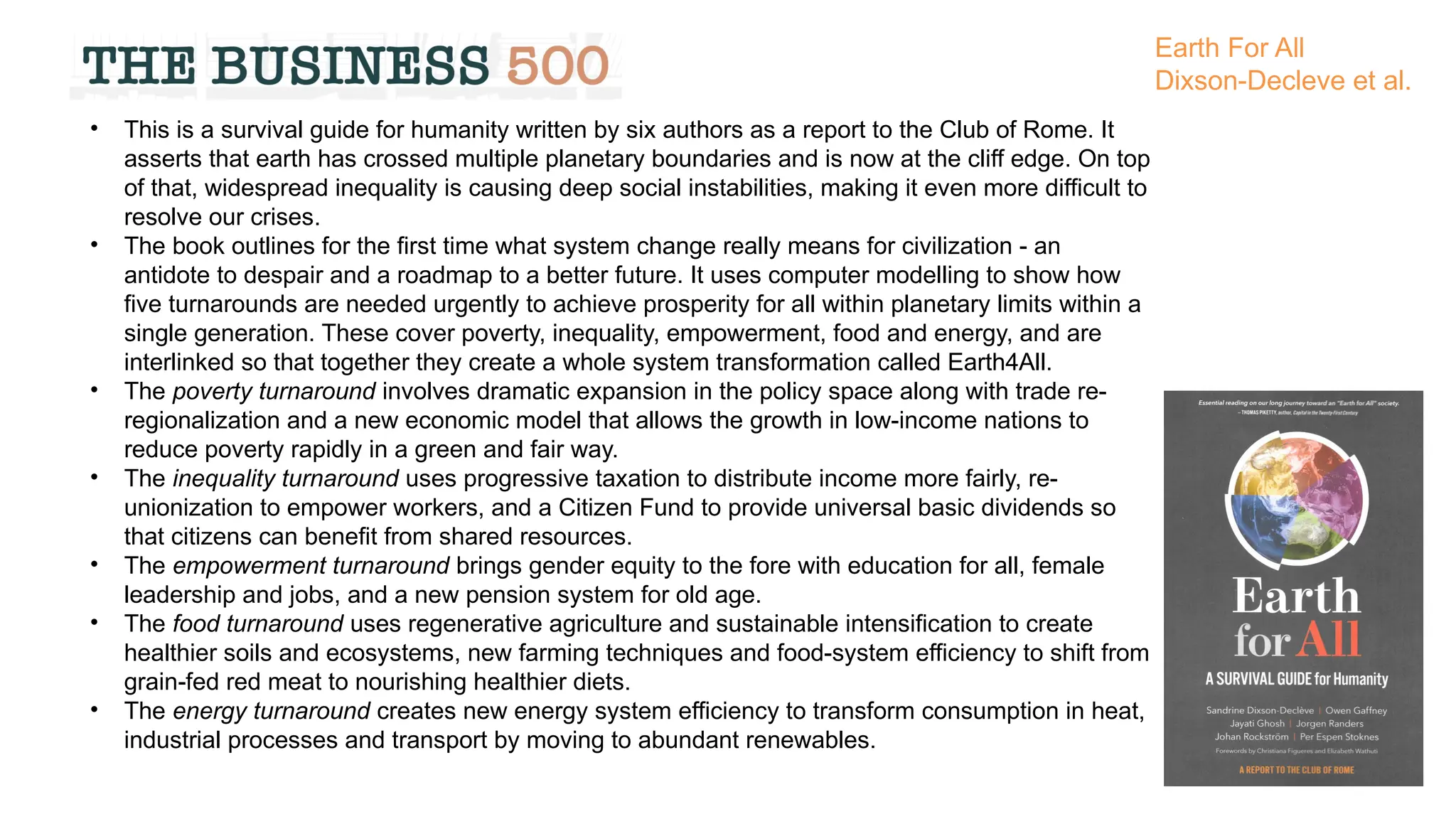
  • 42.
    • This isa history of how the author and his colleagues sold business on sustainability. The author is often described as the godfather of sustainability, although he prefers to say that he is one of a number of godparents. It has been his self-appointed task to tell powerful people things they don’t want to hear, and he has a reputation for speaking tomorrow’s truth to power. • The title is his metaphor for encouraging the human sharks of the corporate world to address new social, economic, and environmental priorities. These people need to step up or get out of the way. • Not all sharks are the same and each one needs different handling, particularly when they are so rich and powerful, so the skill of persuading them to accept or pursue change has been evolved over decades, making up the rules as he went along. Often this involves humour and teasing, so that senior people can see that they are not in the presence of a preaching missionary, thereby relaxing their normal defensiveness. • Once you have earned a reputation for dealing with tricky sharks, the dynamic changes when a client approaches you, rather than vice versa because you can negotiate on values, not just value. • A quartet of marine animals forms a grid that categorizes the risk each type poses to human beings from low to high, alongside their potential to serve as partners to drive long-term sustainability. Low risk and potential is a seal, low risk high potential is a dolphin, high risk and potential is an orca, and high risk low potential is a shark. • The book starts with spawning grounds, explaining the genesis of thinking against the backdrop of the atomic bomb, and follows with feeding frenzies tracking the societal pressures and the environmental waves of the sixties. Schooling dolphins draws these threads together and concludes that we will see more change in the next 15 years than in the last 50. It finishes with a manifesto and advice on how to tackle sharks. Tickling Sharks John Elkington