TOPOLOGY
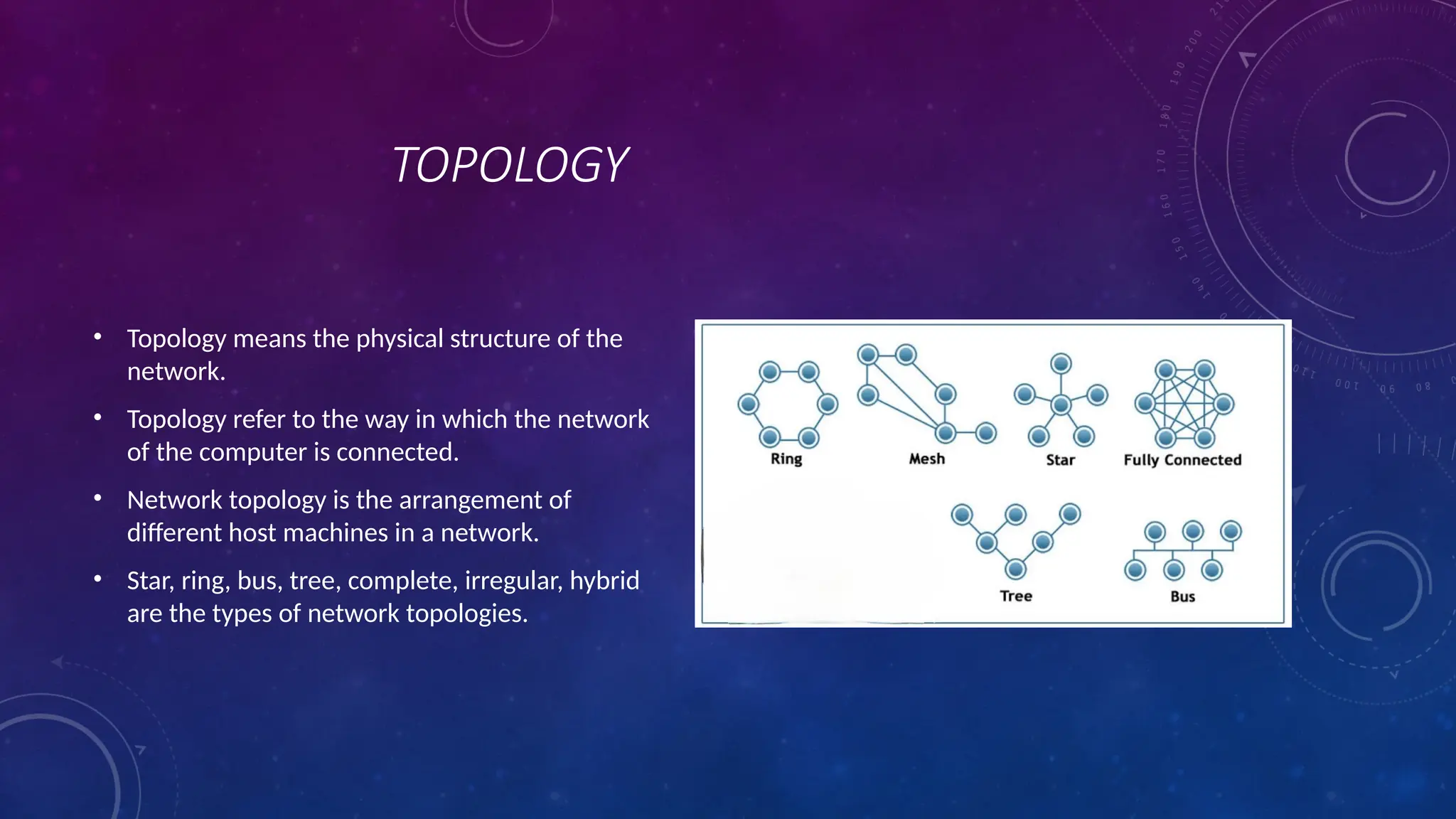
• Topology means the physical structure of the
network.
• Topology refer to the way in which the network
of the computer is connected.
• Network topology is the arrangement of
different host machines in a network.
• Star, ring, bus, tree, complete, irregular, hybrid
are the types of network topologies.
STAR TOPOLOGY
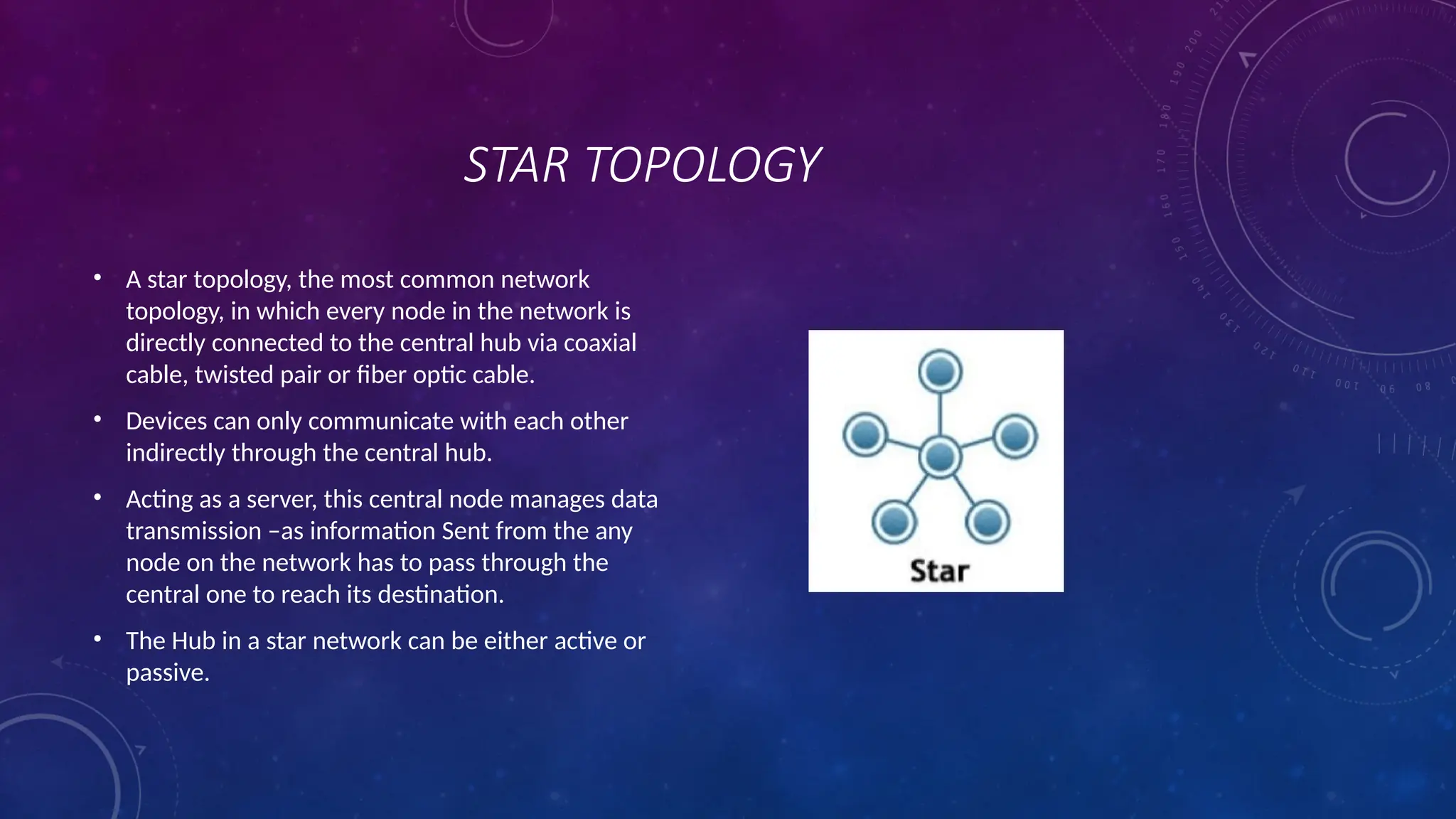
• A star topology, the most common network
topology, in which every node in the network is
directly connected to the central hub via coaxial
cable, twisted pair or fiber optic cable.
• Devices can only communicate with each other
indirectly through the central hub.
• Acting as a server, this central node manages data
transmission –as information Sent from the any
node on the network has to pass through the
central one to reach its destination.
• The Hub in a star network can be either active or
passive.
BUS TOPOLOGY
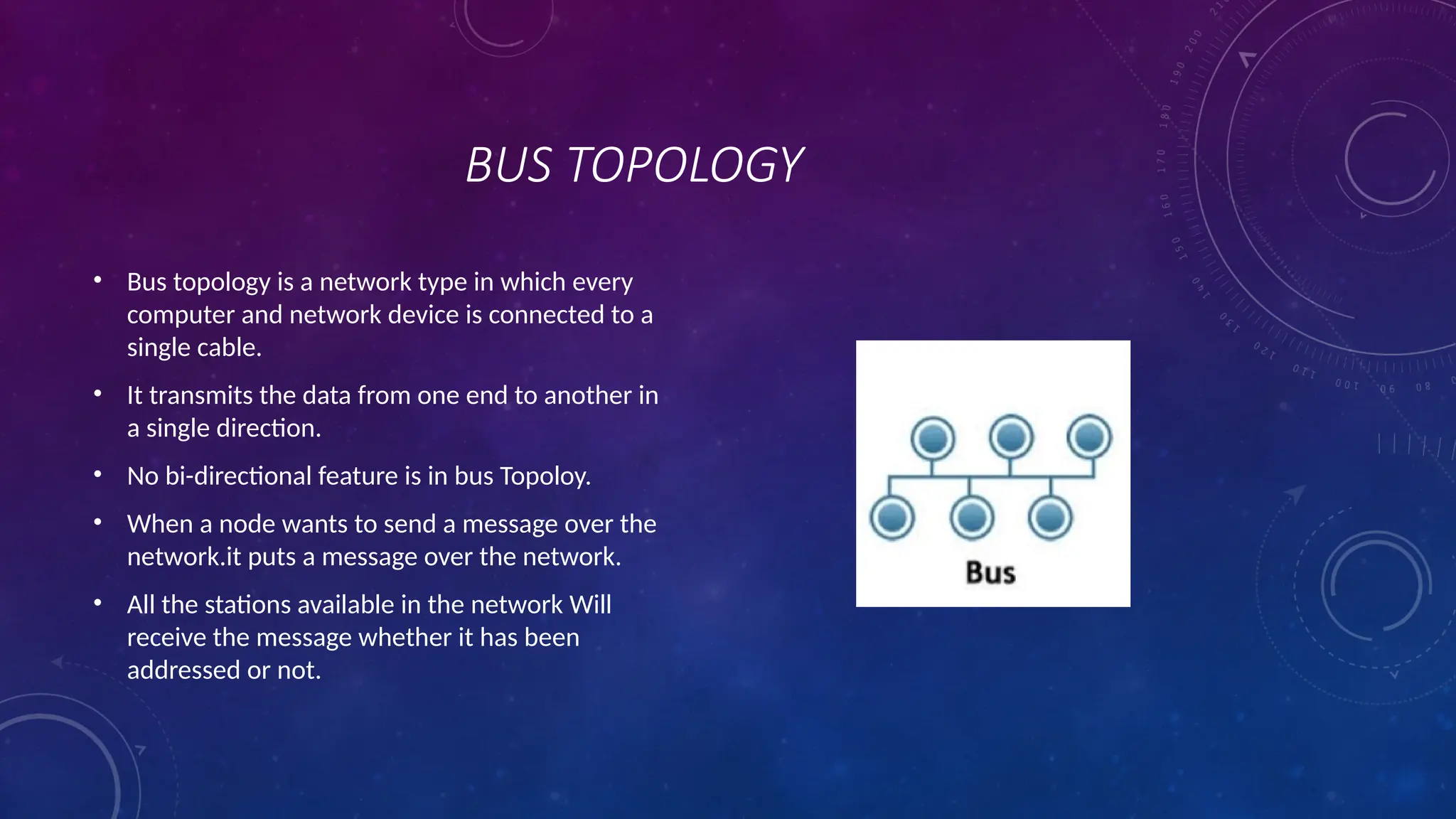
• Bus topology is a network type in which every
computer and network device is connected to a
single cable.
• It transmits the data from one end to another in
a single direction.
• No bi-directional feature is in bus Topoloy.
• When a node wants to send a message over the
network.it puts a message over the network.
• All the stations available in the network Will
receive the message whether it has been
addressed or not.
RING TOPOLOGY
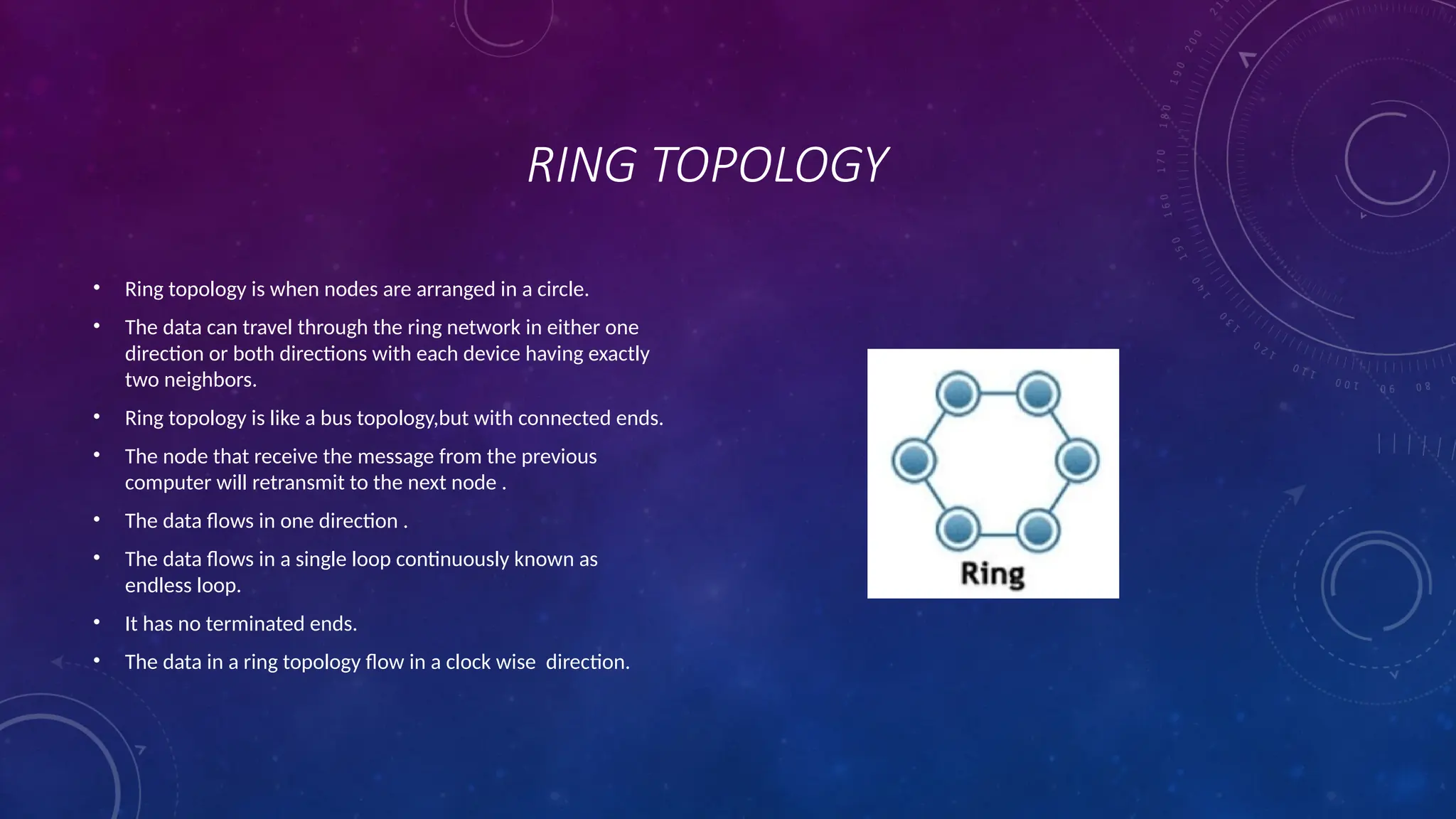
• Ring topology is when nodes are arranged in a circle.
• The data can travel through the ring network in either one
direction or both directions with each device having exactly
two neighbors.
• Ring topology is like a bus topology,but with connected ends.
• The node that receive the message from the previous
computer will retransmit to the next node .
• The data flows in one direction .
• The data flows in a single loop continuously known as
endless loop.
• It has no terminated ends.
• The data in a ring topology flow in a clock wise direction.
TREE TOPOLOGY
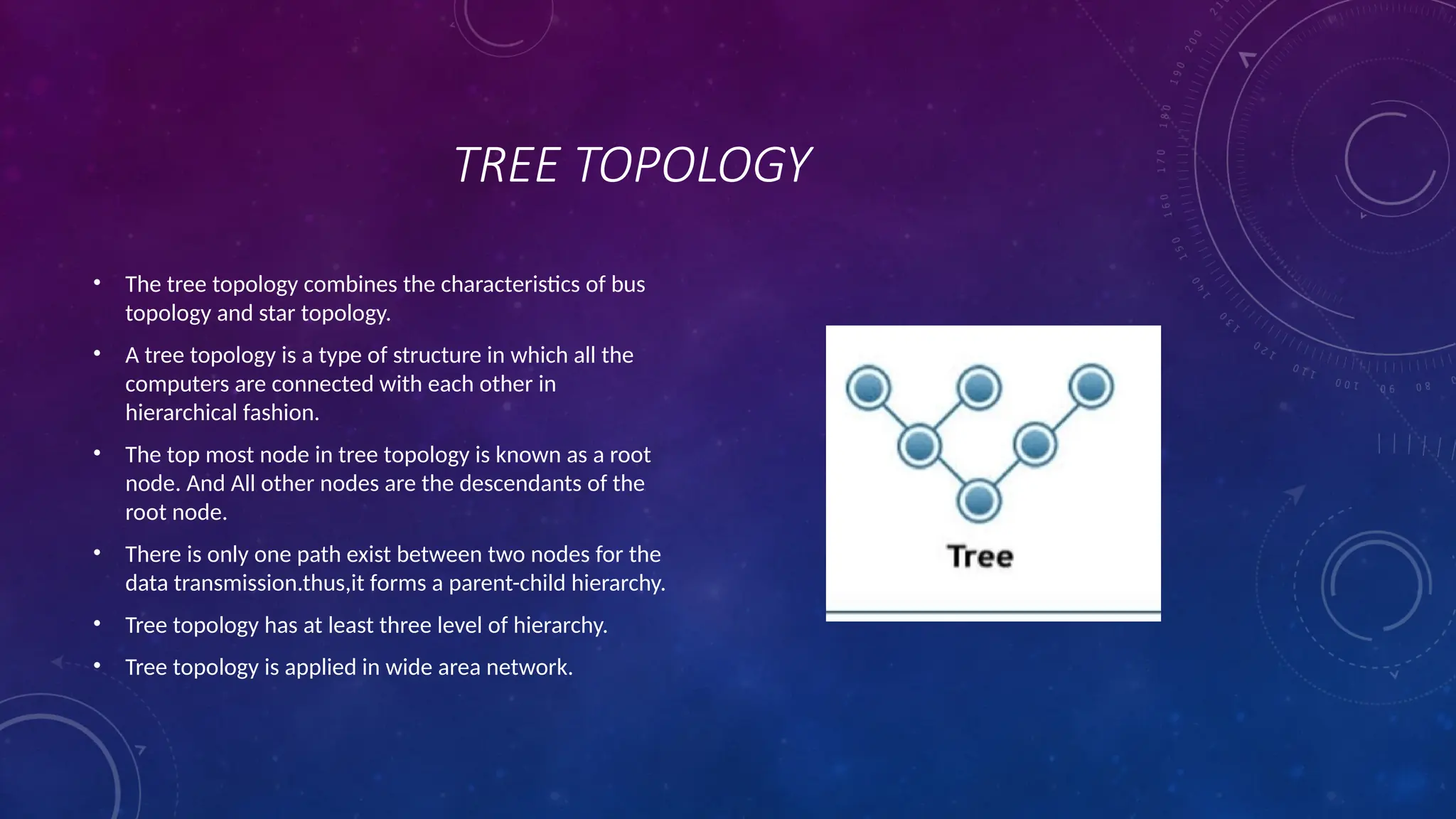
• The tree topology combines the characteristics of bus
topology and star topology.
• A tree topology is a type of structure in which all the
computers are connected with each other in
hierarchical fashion.
• The top most node in tree topology is known as a root
node. And All other nodes are the descendants of the
root node.
• There is only one path exist between two nodes for the
data transmission.thus,it forms a parent-child hierarchy.
• Tree topology has at least three level of hierarchy.
• Tree topology is applied in wide area network.
COMPLETE TOPOLOGY/MESH TOPOLOGY
• Complete topology is also known as mesh topology.
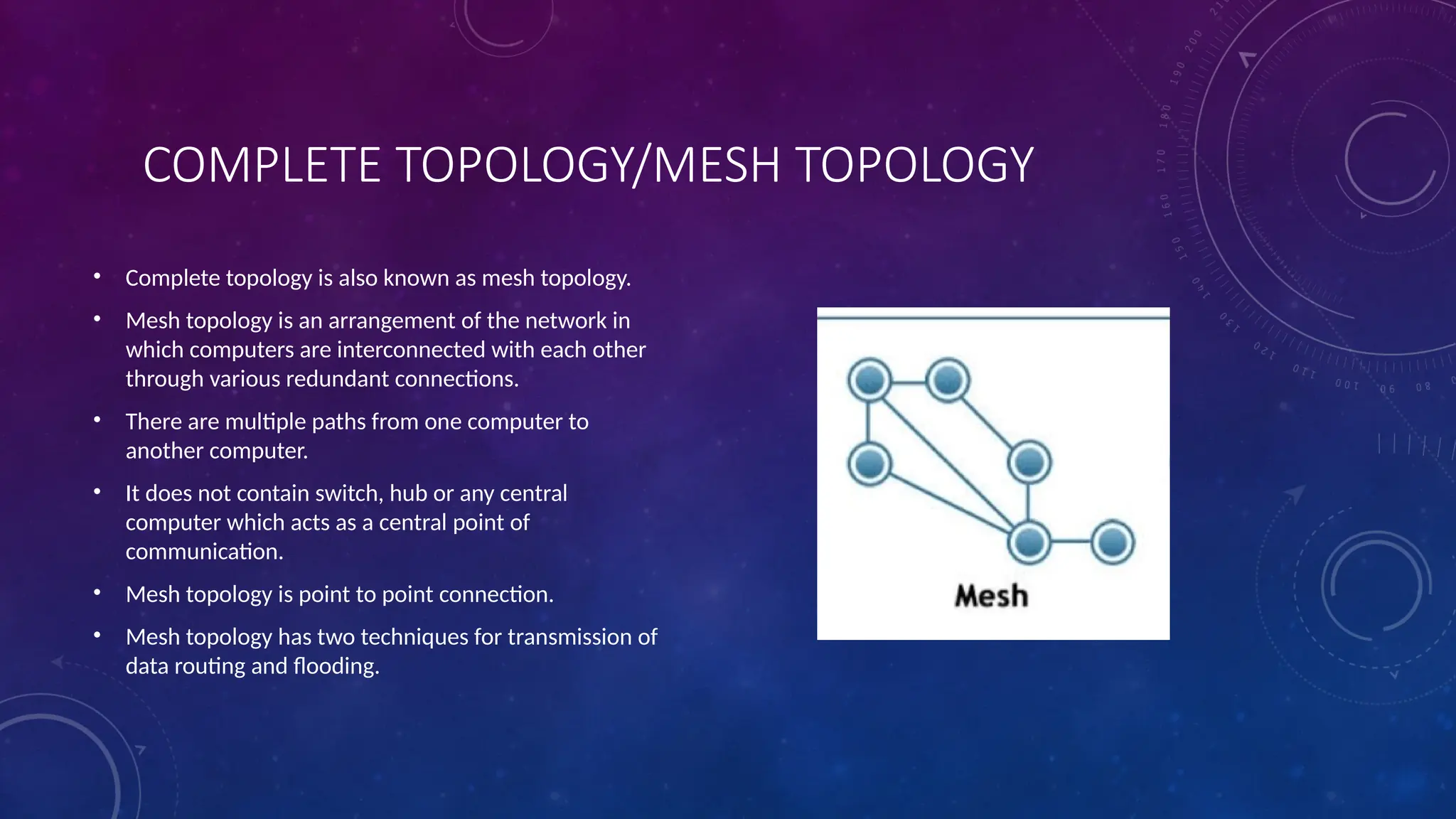
• Mesh topology is an arrangement of the network in
which computers are interconnected with each other
through various redundant connections.
• There are multiple paths from one computer to
another computer.
• It does not contain switch, hub or any central
computer which acts as a central point of
communication.
• Mesh topology is point to point connection.
• Mesh topology has two techniques for transmission of
data routing and flooding.
IRREGULAR TOPOLOGY
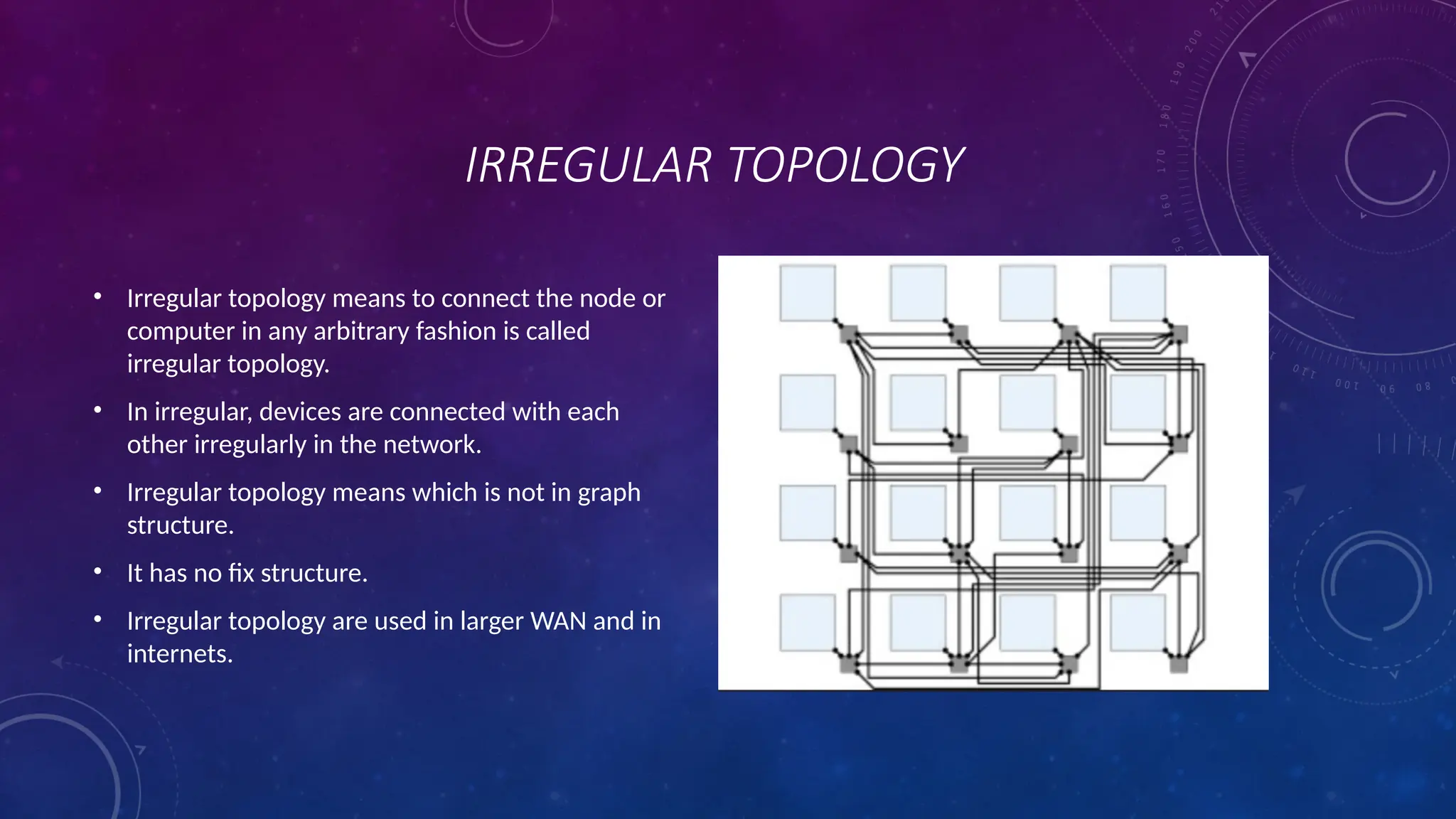
• Irregular topology means to connect the node or
computer in any arbitrary fashion is called
irregular topology.
• In irregular, devices are connected with each
other irregularly in the network.
• Irregular topology means which is not in graph
structure.
• It has no fix structure.
• Irregular topology are used in larger WAN and in
internets.
HYBRID TOPOLOGY
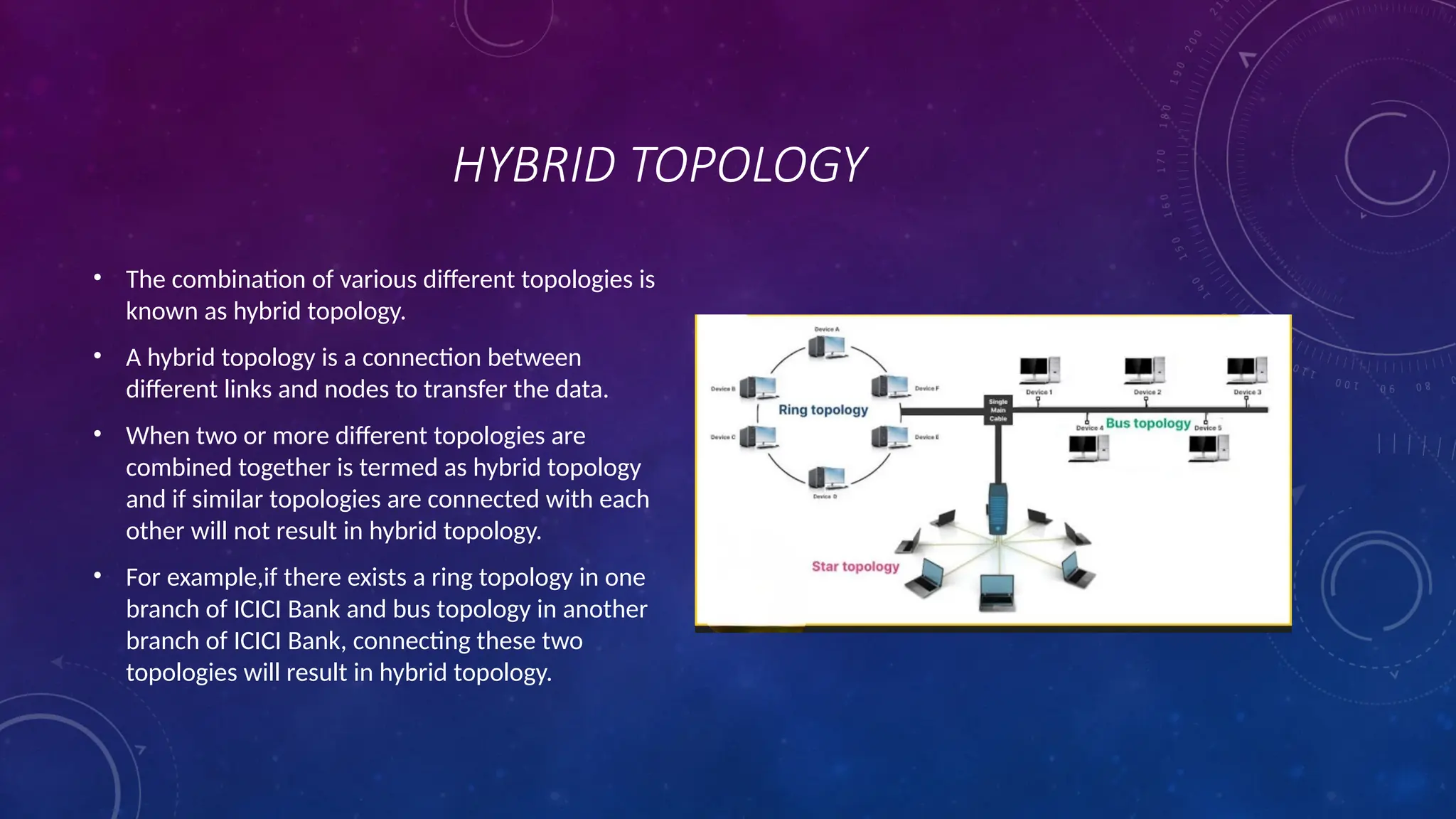
• The combination of various different topologies is
known as hybrid topology.
• A hybrid topology is a connection between
different links and nodes to transfer the data.
• When two or more different topologies are
combined together is termed as hybrid topology
and if similar topologies are connected with each
other will not result in hybrid topology.
• For example,if there exists a ring topology in one
branch of ICICI Bank and bus topology in another
branch of ICICI Bank, connecting these two
topologies will result in hybrid topology.

All types of topology presentation .pptx

  • 1.
    TOPOLOGY • Topology meansthe physical structure of the network. • Topology refer to the way in which the network of the computer is connected. • Network topology is the arrangement of different host machines in a network. • Star, ring, bus, tree, complete, irregular, hybrid are the types of network topologies.
  • 2.
    STAR TOPOLOGY • Astar topology, the most common network topology, in which every node in the network is directly connected to the central hub via coaxial cable, twisted pair or fiber optic cable. • Devices can only communicate with each other indirectly through the central hub. • Acting as a server, this central node manages data transmission –as information Sent from the any node on the network has to pass through the central one to reach its destination. • The Hub in a star network can be either active or passive.
  • 3.
    BUS TOPOLOGY • Bustopology is a network type in which every computer and network device is connected to a single cable. • It transmits the data from one end to another in a single direction. • No bi-directional feature is in bus Topoloy. • When a node wants to send a message over the network.it puts a message over the network. • All the stations available in the network Will receive the message whether it has been addressed or not.
  • 4.
    RING TOPOLOGY • Ringtopology is when nodes are arranged in a circle. • The data can travel through the ring network in either one direction or both directions with each device having exactly two neighbors. • Ring topology is like a bus topology,but with connected ends. • The node that receive the message from the previous computer will retransmit to the next node . • The data flows in one direction . • The data flows in a single loop continuously known as endless loop. • It has no terminated ends. • The data in a ring topology flow in a clock wise direction.
  • 5.
    TREE TOPOLOGY • Thetree topology combines the characteristics of bus topology and star topology. • A tree topology is a type of structure in which all the computers are connected with each other in hierarchical fashion. • The top most node in tree topology is known as a root node. And All other nodes are the descendants of the root node. • There is only one path exist between two nodes for the data transmission.thus,it forms a parent-child hierarchy. • Tree topology has at least three level of hierarchy. • Tree topology is applied in wide area network.
  • 6.
    COMPLETE TOPOLOGY/MESH TOPOLOGY •Complete topology is also known as mesh topology. • Mesh topology is an arrangement of the network in which computers are interconnected with each other through various redundant connections. • There are multiple paths from one computer to another computer. • It does not contain switch, hub or any central computer which acts as a central point of communication. • Mesh topology is point to point connection. • Mesh topology has two techniques for transmission of data routing and flooding.
  • 7.
    IRREGULAR TOPOLOGY • Irregulartopology means to connect the node or computer in any arbitrary fashion is called irregular topology. • In irregular, devices are connected with each other irregularly in the network. • Irregular topology means which is not in graph structure. • It has no fix structure. • Irregular topology are used in larger WAN and in internets.
  • 8.
    HYBRID TOPOLOGY • Thecombination of various different topologies is known as hybrid topology. • A hybrid topology is a connection between different links and nodes to transfer the data. • When two or more different topologies are combined together is termed as hybrid topology and if similar topologies are connected with each other will not result in hybrid topology. • For example,if there exists a ring topology in one branch of ICICI Bank and bus topology in another branch of ICICI Bank, connecting these two topologies will result in hybrid topology.