• ALL TYPES OF
TOPOLOGY
PRESENTATION
NETWORK TOPOLOGY
WHAT IS TOPOLOGY
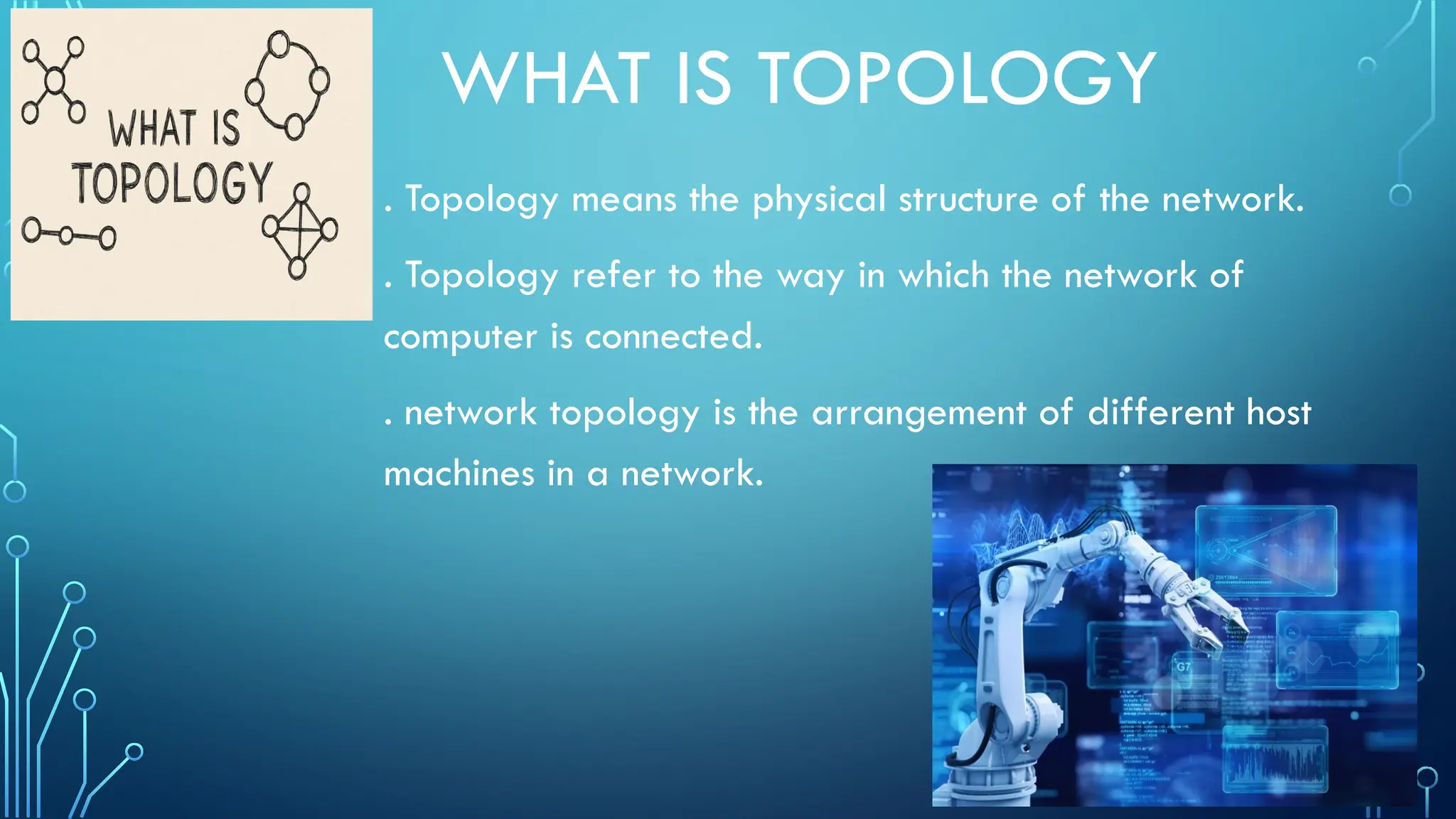
. Topology means the physical structure of the network.
. Topology refer to the way in which the network of
computer is connected.
. network topology is the arrangement of different host
machines in a network.
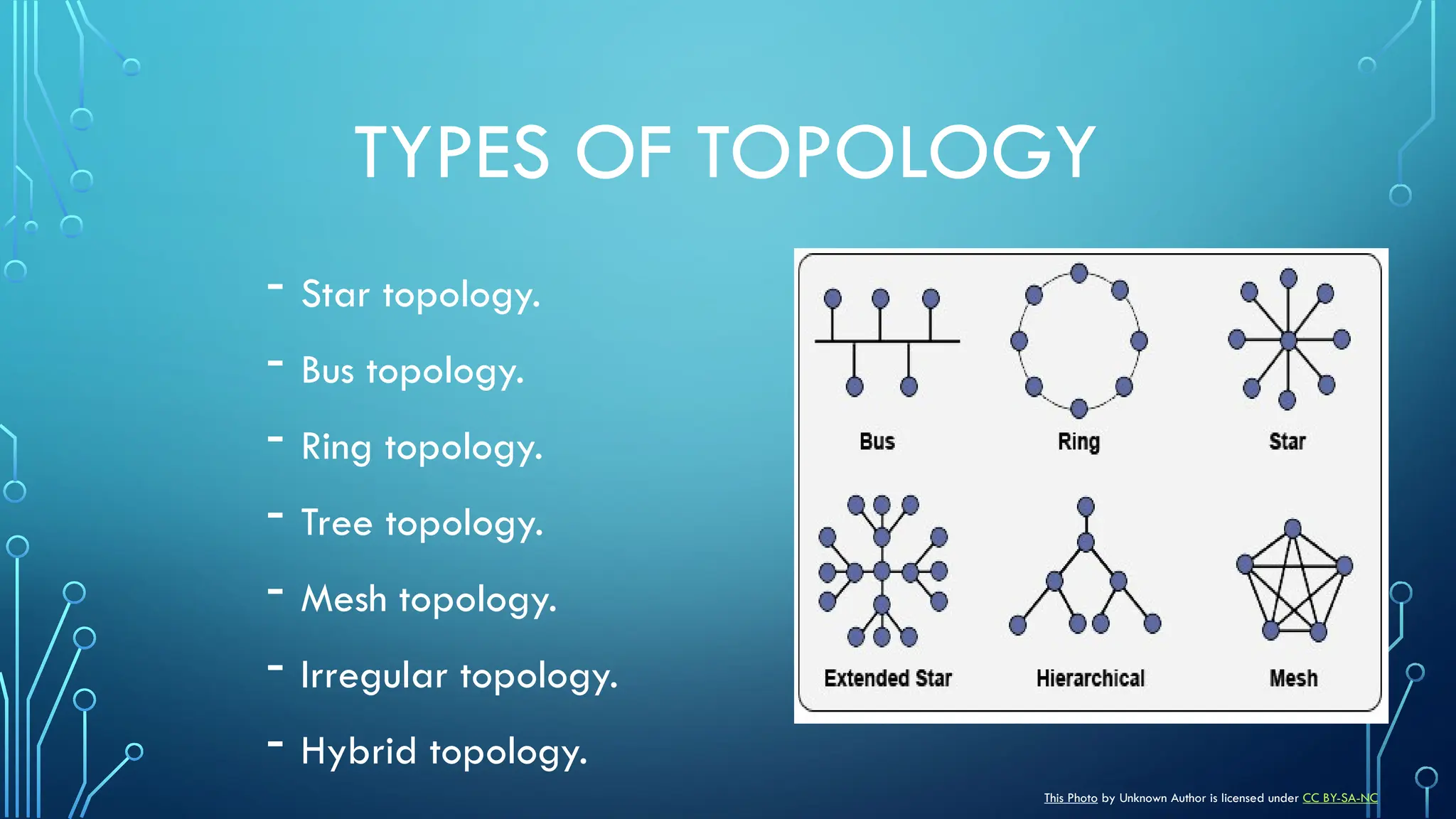
TYPES OF TOPOLOGY
- Star topology.
- Bus topology.
- Ring topology.
- Tree topology.
- Mesh topology.
- Irregular topology.
- Hybrid topology.
This Photo by Unknown Author is licensed under CC BY-SA-NC
STAR TOPOLOGY
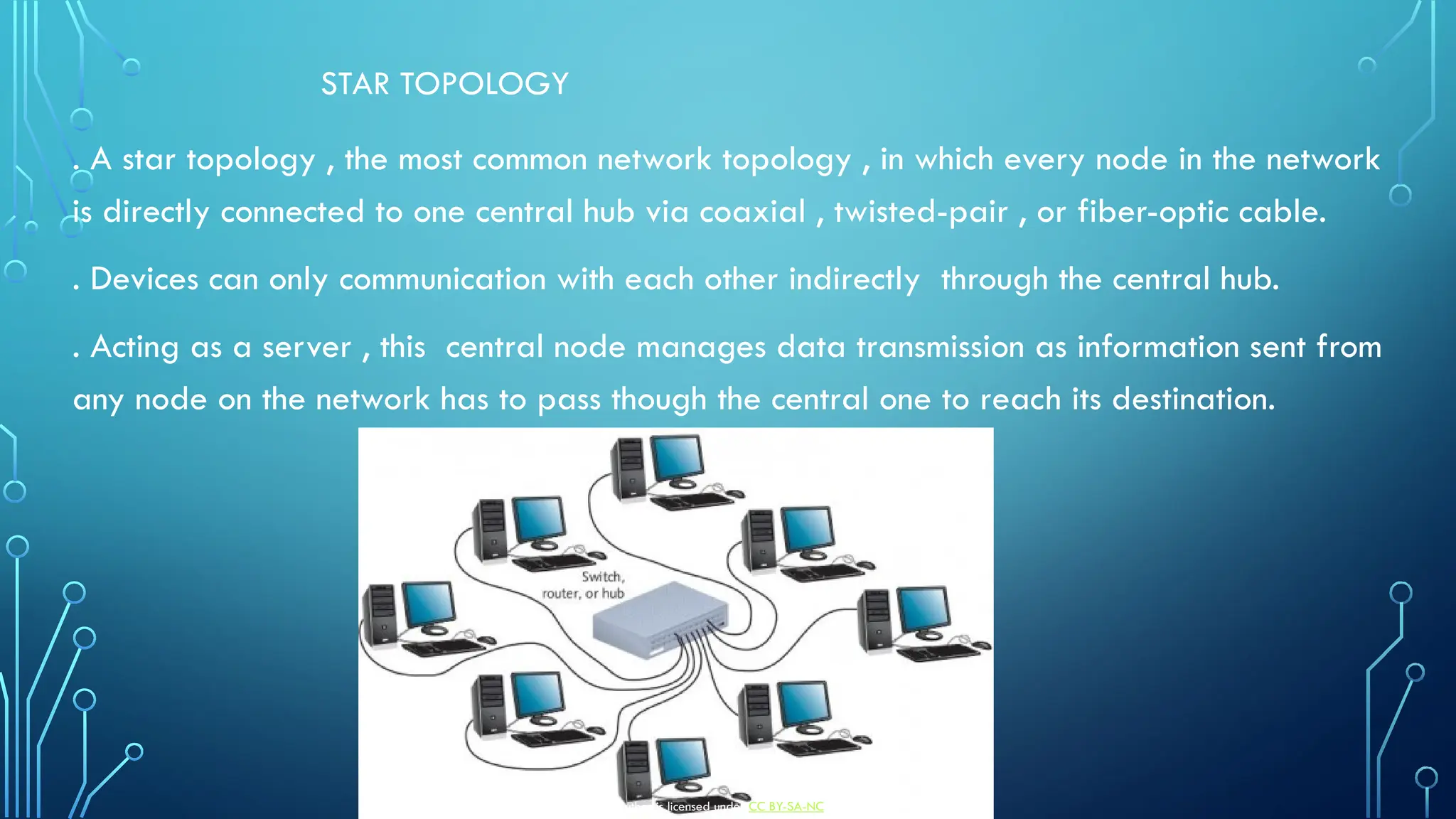
. A star topology , the most common network topology , in which every node in the network
is directly connected to one central hub via coaxial , twisted-pair , or fiber-optic cable.
. Devices can only communication with each other indirectly through the central hub.
. Acting as a server , this central node manages data transmission as information sent from
any node on the network has to pass though the central one to reach its destination.
This Photo by Unknown Author is licensed under CC BY-SA-NC
ADVANTAGE AND DISADVANTAGE OF STAR TOPOLOGY
ADVANTAGES OF STAR TOPOLOGY
• It is easy to upgrade the hub as and
when required.
• It is easy to identify network error.
• Setup can be done easily and can
be easily modified as well
DISADVANTAGE OF STAR TOPOLOGY
• The installation cost is extreme, and it is costly
to use because all the computers are connected
with central hub.
• All the node are dependent on the hub so if the
central hub fails, the whole star network
become fail.
BUS TOPOLOGY
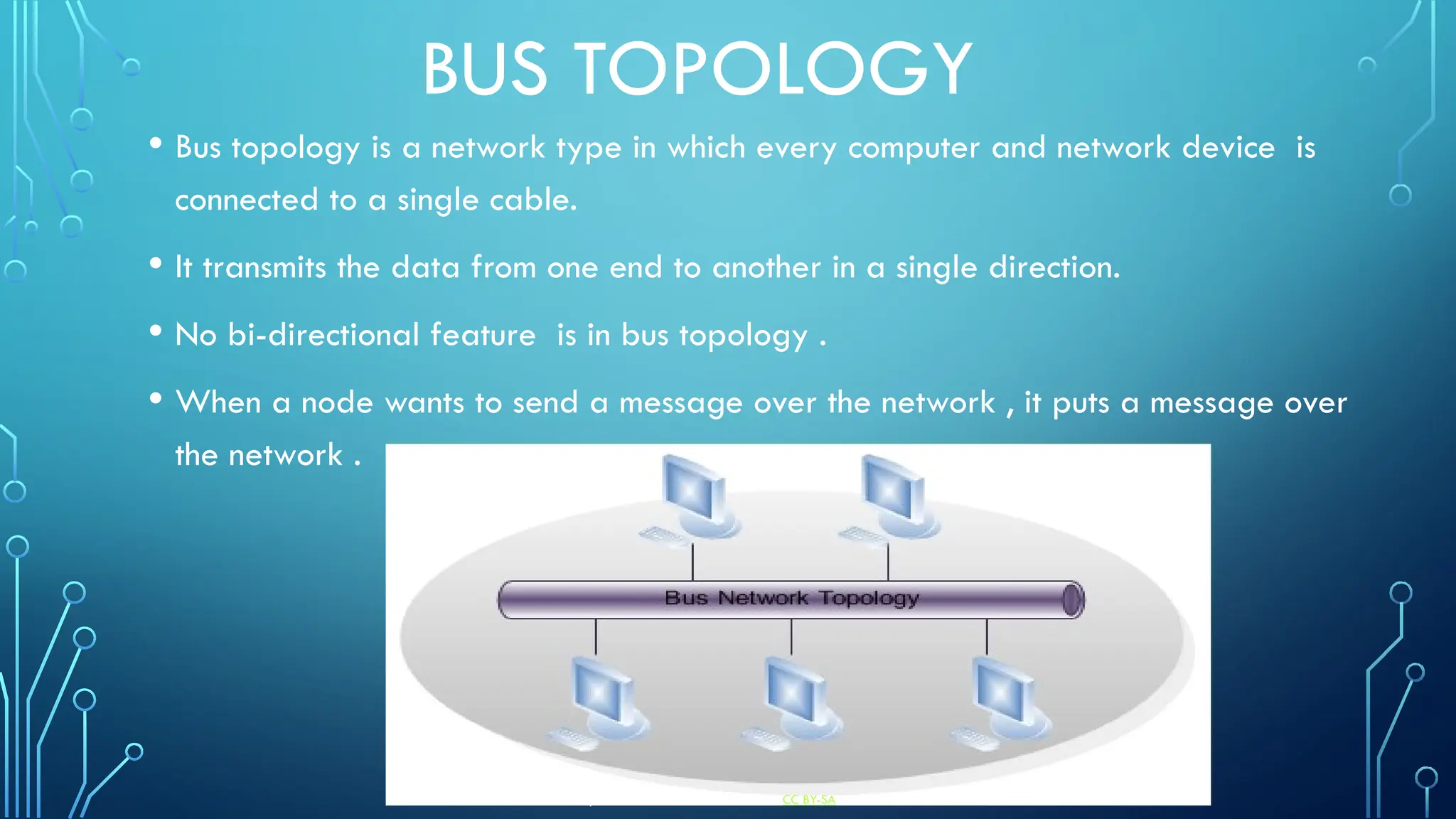
• Bus topology is a network type in which every computer and network device is
connected to a single cable.
• It transmits the data from one end to another in a single direction.
• No bi-directional feature is in bus topology .
• When a node wants to send a message over the network , it puts a message over
the network .
This Photo by Unknown Author is licensed under CC BY-SA
ADVANTAGE AND DISADVANTAGE OF BUS TOPOLOGY
ADVANTAGES OF BUS TOPOLOGY
• It is less expensive than other
topology.
• The cable length required is the
least in comparison to other
topology.
• The working of this topology is easy
to understand.
DISADVANTAGES OF BUS TOPOLOGY
• If the main cable collapse, the
complete network collapses.
• Only one computer can send a
message at a time.
RING TOPOLOGY
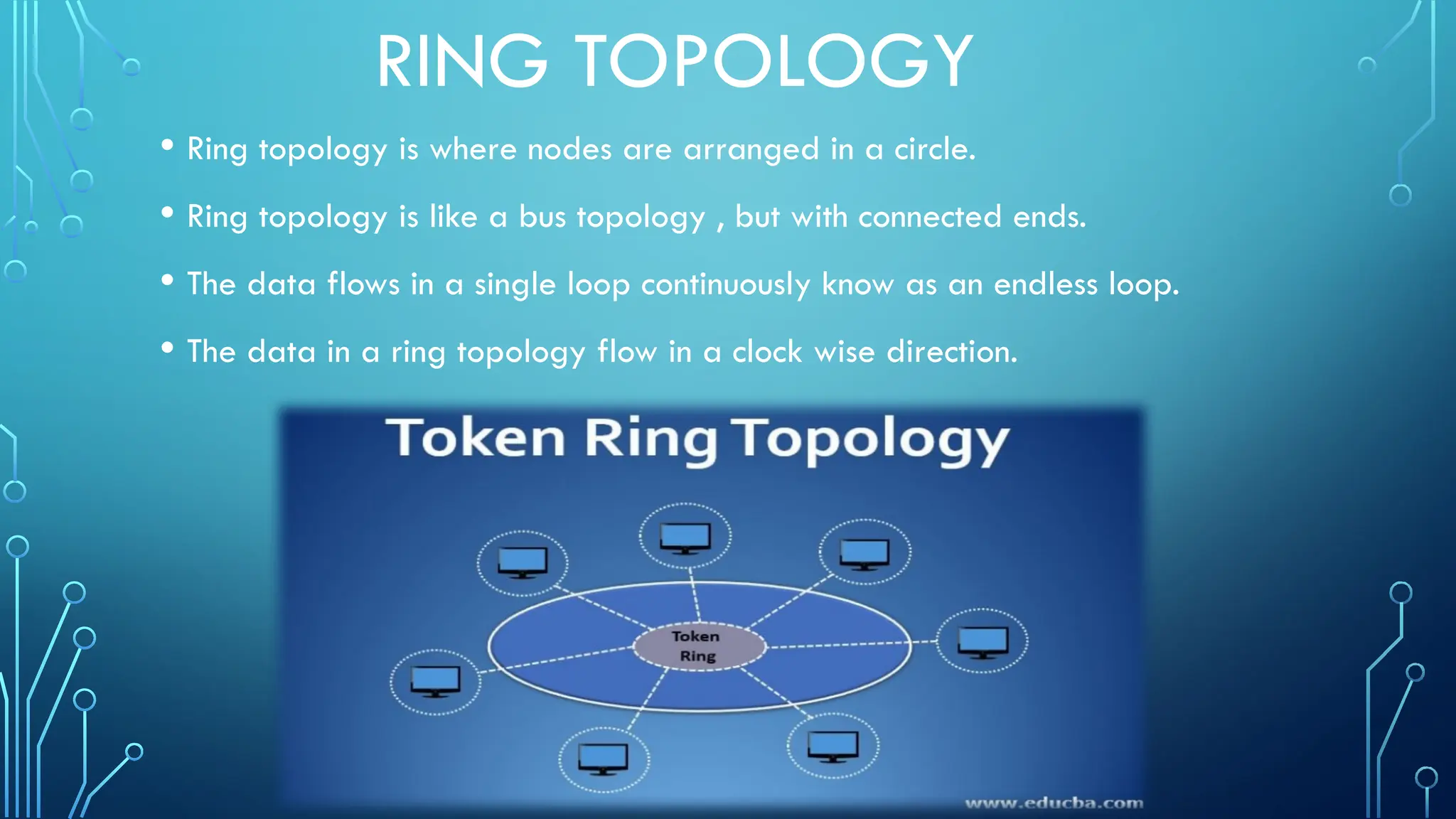
• Ring topology is where nodes are arranged in a circle.
• Ring topology is like a bus topology , but with connected ends.
• The data flows in a single loop continuously know as an endless loop.
• The data in a ring topology flow in a clock wise direction.
ADVANTAGE AND DISADVANTAGE OF RING TOPOLOGY
ADVANTAGES OF RING TOPOLOGY
• Ring topology provide faster
performance.
• Echa node can perform on some speed.
• The sharing of files and data are
become easy.
DISADVANTAGES OF RING TOPOLOGY
• It is difficult to solve the problems .
• Adding or removing computer
disturbs the network.
• Failure of one computer on the ring
topology can entire network.
TREE TOPOLOGY
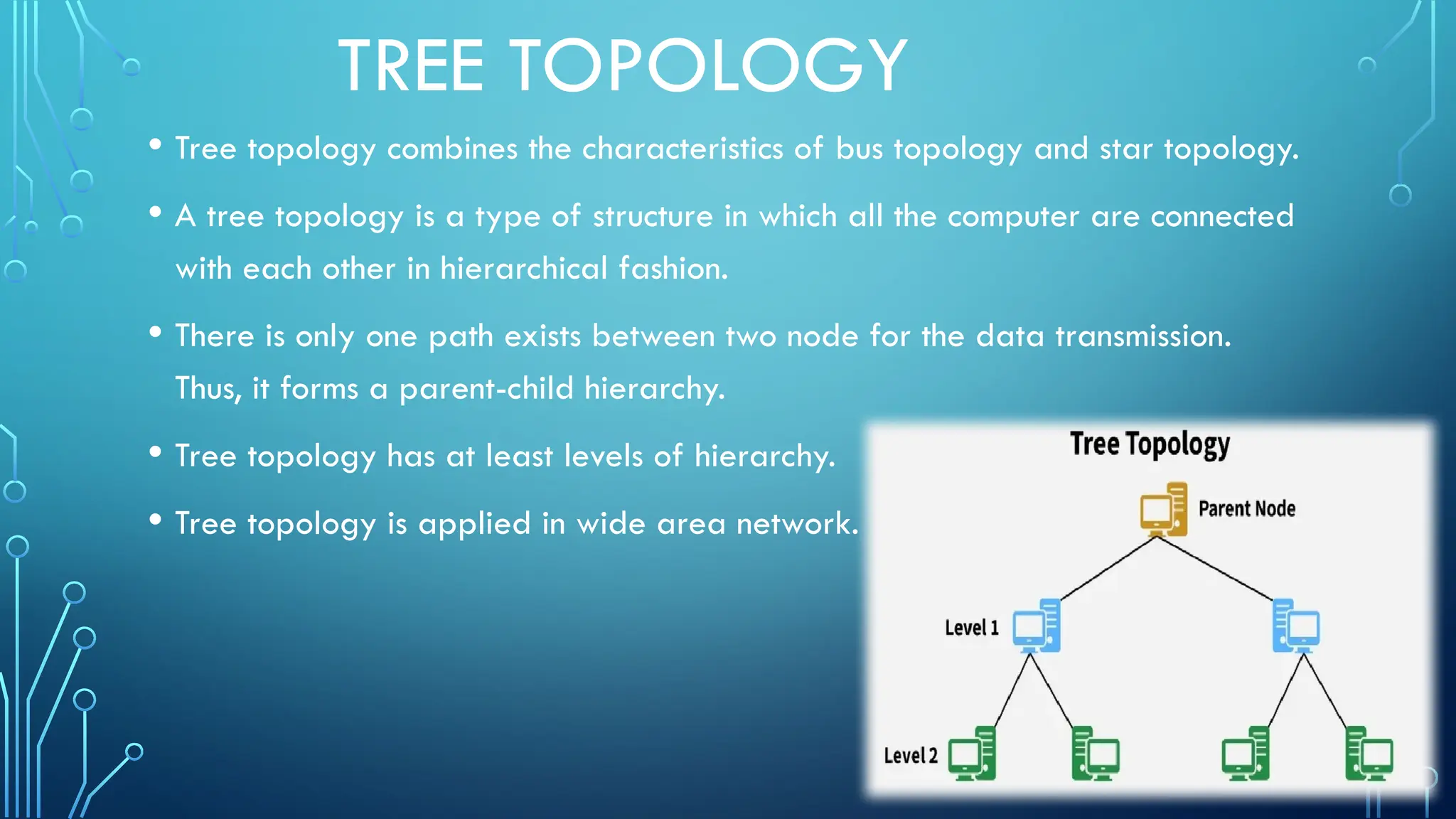
• Tree topology combines the characteristics of bus topology and star topology.
• A tree topology is a type of structure in which all the computer are connected
with each other in hierarchical fashion.
• There is only one path exists between two node for the data transmission.
Thus, it forms a parent-child hierarchy.
• Tree topology has at least levels of hierarchy.
• Tree topology is applied in wide area network.
ADVANTAGE AND DISADVANTAGE OF TREE TOPOLOGY
ADVANTAGES OF TREE TOPOLOGY
• It is easy to expand the network with
more nodes
• It is easy to maintain and manage.
• It is easy to detect an error in the
network.
DISADVANTAGES OF TREE TOPOLOGY
• It is expensive when compared to
other topology.
• If the root node collapses, the
network will also collapse.
MESH TOPOLOGY
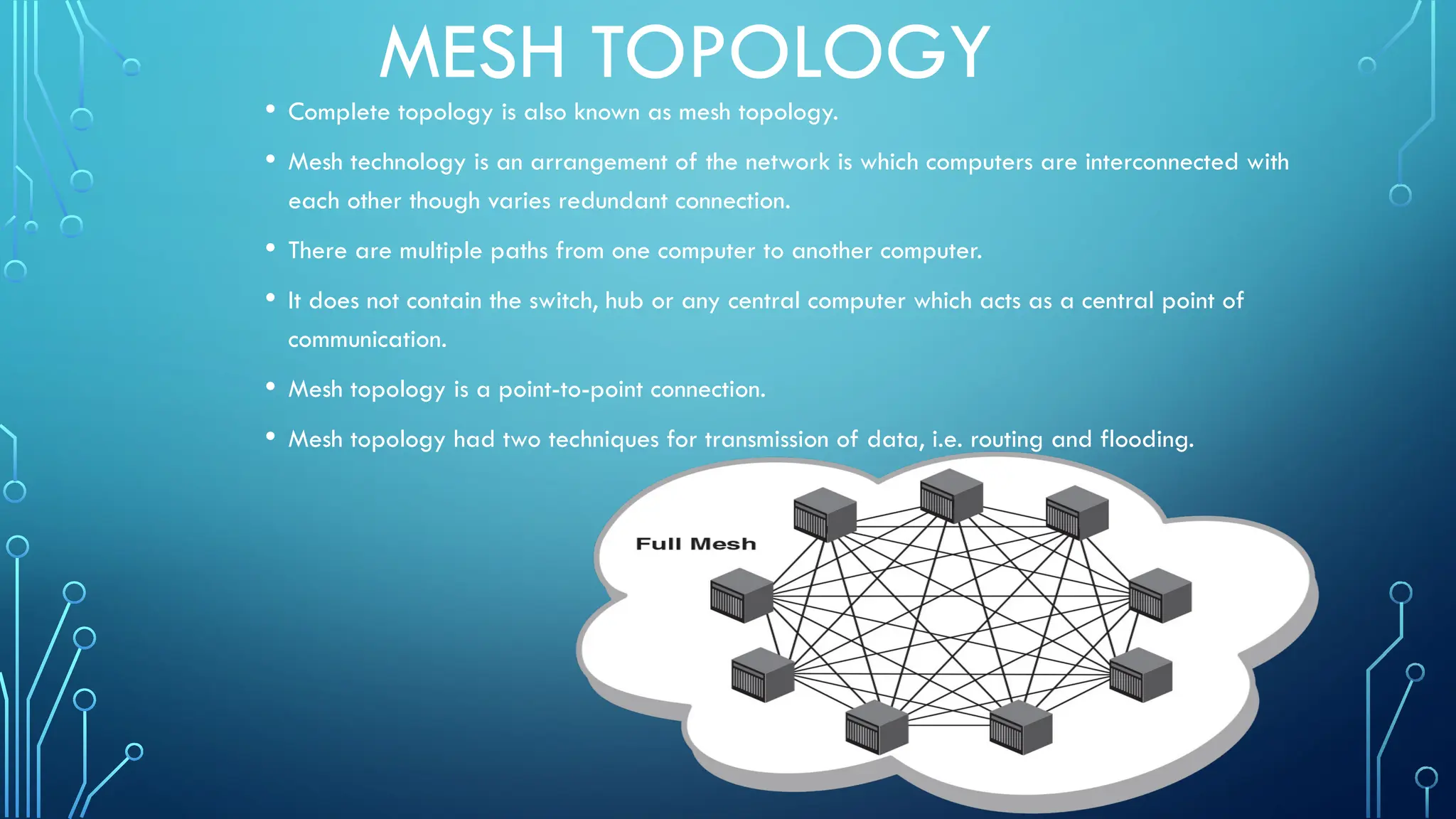
• Complete topology is also known as mesh topology.
• Mesh technology is an arrangement of the network is which computers are interconnected with
each other though varies redundant connection.
• There are multiple paths from one computer to another computer.
• It does not contain the switch, hub or any central computer which acts as a central point of
communication.
• Mesh topology is a point-to-point connection.
• Mesh topology had two techniques for transmission of data, i.e. routing and flooding.
ADVANTAGE AND DISADVANTAGE OF MESH TOPOLOGY
ADVANTAGES OF MESH TOPOLOGY
• Communication is very fast between the
nodes.
• Every connection has the ability to carry
its particular data load.
• Mesh topology is very robust.
• It is easy to identify faults.
DISADVANTAGES OF MESH TOPOLOGY
• Mesh topology is challenging to
install and configure.
• As all the nodes are connected with
each other, cabling is costly.
• Difficult to manage.
IRREGULAR TOPOLOGY
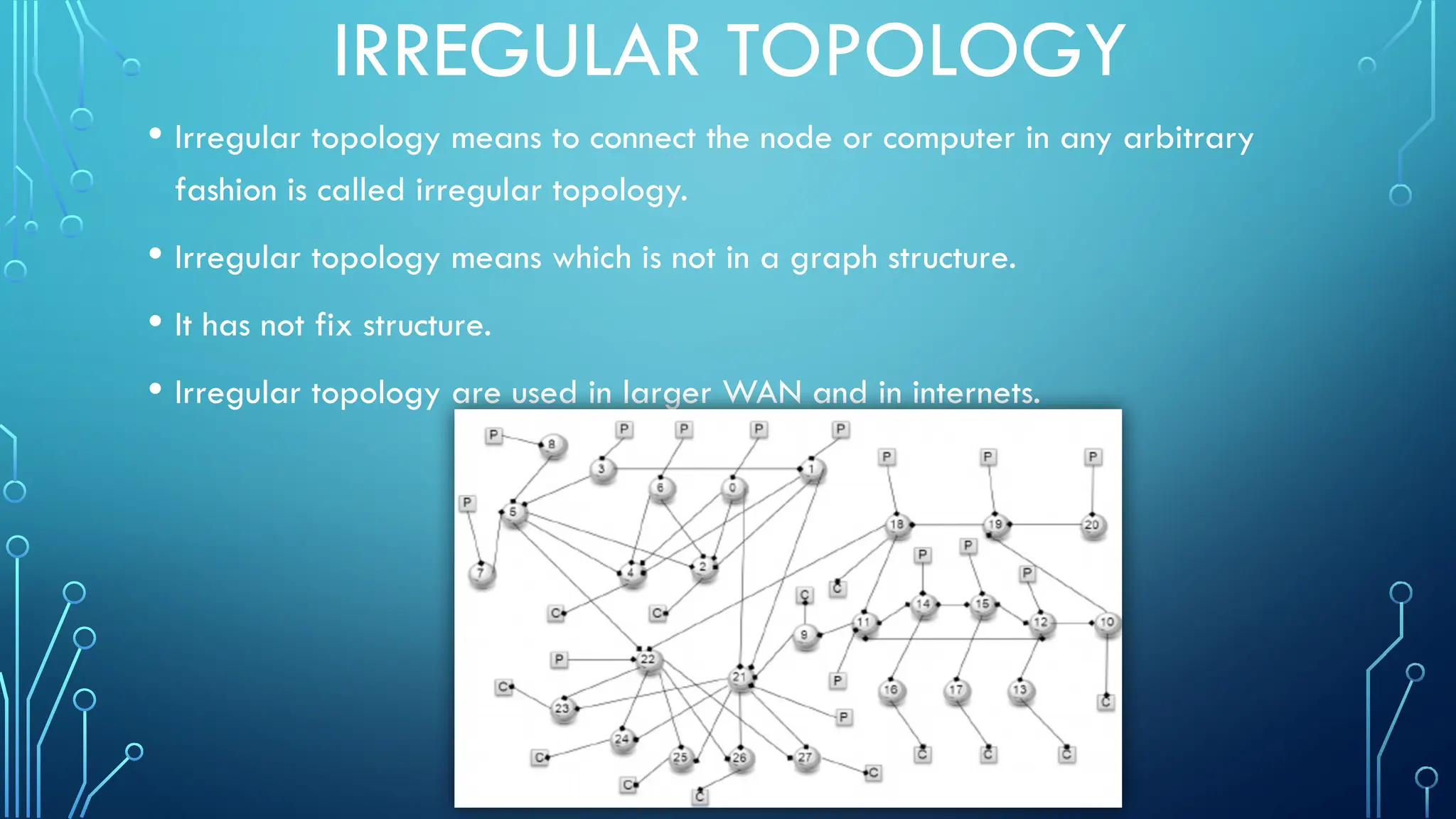
• Irregular topology means to connect the node or computer in any arbitrary
fashion is called irregular topology.
• Irregular topology means which is not in a graph structure.
• It has not fix structure.
• Irregular topology are used in larger WAN and in internets.
ADVANTAGE AND DISADVANTAGE OF IRREGULAR
TOPOLOGY
ADVANTAGES OF IRREGULAR TOPOLOGY
• No rule for adding any computer to the
network.
DISADVANTAGES OF IRREGULAR TOPOLOGY
• It is difficult to install and reconfigure but
useful in WAN.
• It becomes difficult to maintain and
troubleshoot this kind of network.
• It may be costly.
HYBRID TOPOLOGY
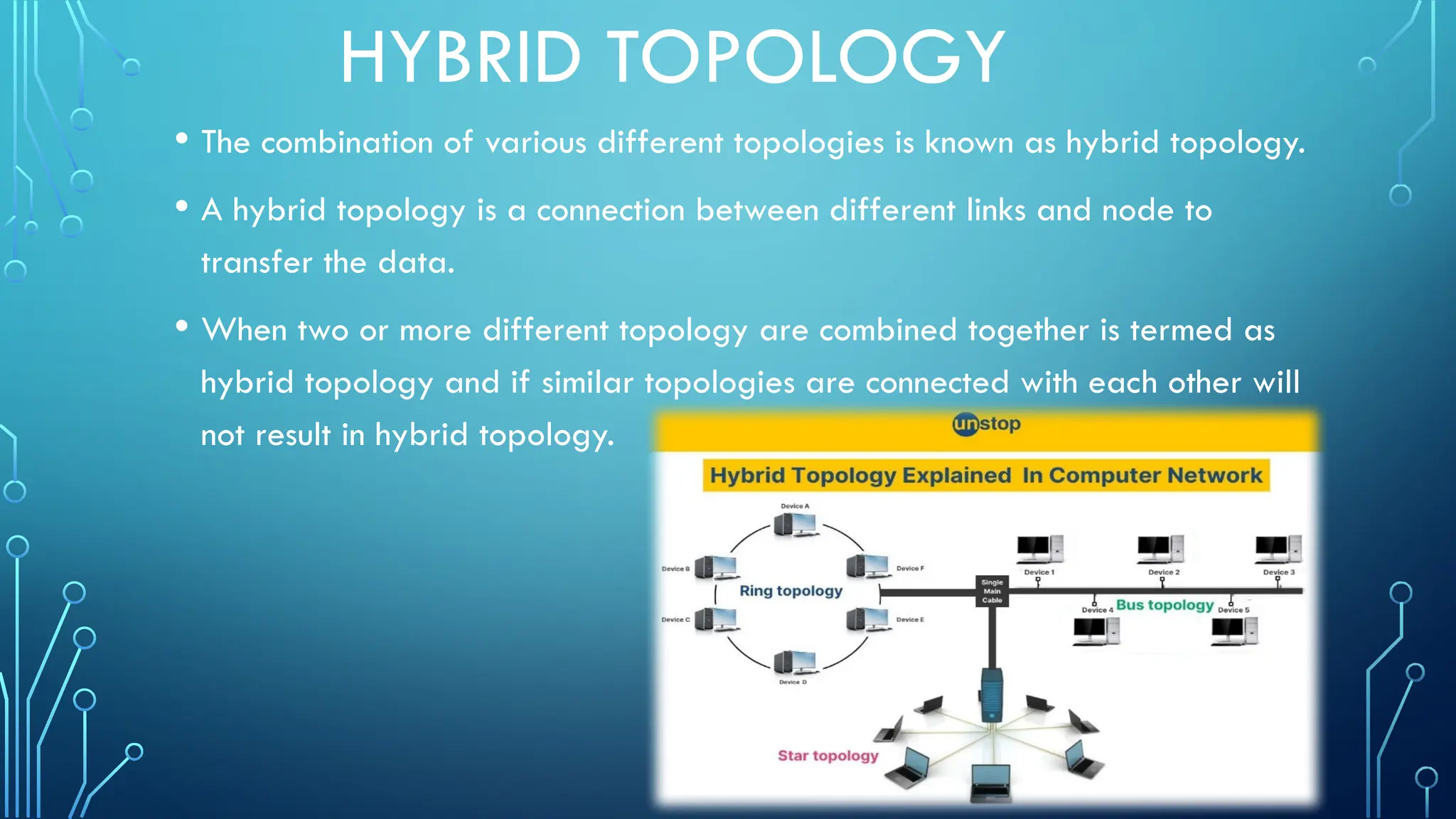
• The combination of various different topologies is known as hybrid topology.
• A hybrid topology is a connection between different links and node to
transfer the data.
• When two or more different topology are combined together is termed as
hybrid topology and if similar topologies are connected with each other will
not result in hybrid topology.
ADVANTAGE AND DISADVANTAGE OF HYBRID TOPOLOGY
ADVANTAGES OF HYBRID TOPOLOGY
• If a fault occurs in any part of the
network will not affect the functioning of
the rest of the network.
• Size of the network can be easily
expanded by adding new devices
without affecting the functionality of the
existing network.
DISADVANTAGES OF HYBRID TOPOLOGY
• It isn’t very easy to design it.
• It is costly, as it involves more then
one topologies.
All types of topology presentation. PPTX

All types of topology presentation. PPTX

  • 1.
    • ALL TYPESOF TOPOLOGY PRESENTATION
  • 2.
  • 3.
    WHAT IS TOPOLOGY .Topology means the physical structure of the network. . Topology refer to the way in which the network of computer is connected. . network topology is the arrangement of different host machines in a network.
  • 4.
    TYPES OF TOPOLOGY -Star topology. - Bus topology. - Ring topology. - Tree topology. - Mesh topology. - Irregular topology. - Hybrid topology. This Photo by Unknown Author is licensed under CC BY-SA-NC
  • 5.
    STAR TOPOLOGY . Astar topology , the most common network topology , in which every node in the network is directly connected to one central hub via coaxial , twisted-pair , or fiber-optic cable. . Devices can only communication with each other indirectly through the central hub. . Acting as a server , this central node manages data transmission as information sent from any node on the network has to pass though the central one to reach its destination. This Photo by Unknown Author is licensed under CC BY-SA-NC
  • 6.
    ADVANTAGE AND DISADVANTAGEOF STAR TOPOLOGY ADVANTAGES OF STAR TOPOLOGY • It is easy to upgrade the hub as and when required. • It is easy to identify network error. • Setup can be done easily and can be easily modified as well DISADVANTAGE OF STAR TOPOLOGY • The installation cost is extreme, and it is costly to use because all the computers are connected with central hub. • All the node are dependent on the hub so if the central hub fails, the whole star network become fail.
  • 7.
    BUS TOPOLOGY • Bustopology is a network type in which every computer and network device is connected to a single cable. • It transmits the data from one end to another in a single direction. • No bi-directional feature is in bus topology . • When a node wants to send a message over the network , it puts a message over the network . This Photo by Unknown Author is licensed under CC BY-SA
  • 8.
    ADVANTAGE AND DISADVANTAGEOF BUS TOPOLOGY ADVANTAGES OF BUS TOPOLOGY • It is less expensive than other topology. • The cable length required is the least in comparison to other topology. • The working of this topology is easy to understand. DISADVANTAGES OF BUS TOPOLOGY • If the main cable collapse, the complete network collapses. • Only one computer can send a message at a time.
  • 9.
    RING TOPOLOGY • Ringtopology is where nodes are arranged in a circle. • Ring topology is like a bus topology , but with connected ends. • The data flows in a single loop continuously know as an endless loop. • The data in a ring topology flow in a clock wise direction.
  • 10.
    ADVANTAGE AND DISADVANTAGEOF RING TOPOLOGY ADVANTAGES OF RING TOPOLOGY • Ring topology provide faster performance. • Echa node can perform on some speed. • The sharing of files and data are become easy. DISADVANTAGES OF RING TOPOLOGY • It is difficult to solve the problems . • Adding or removing computer disturbs the network. • Failure of one computer on the ring topology can entire network.
  • 11.
    TREE TOPOLOGY • Treetopology combines the characteristics of bus topology and star topology. • A tree topology is a type of structure in which all the computer are connected with each other in hierarchical fashion. • There is only one path exists between two node for the data transmission. Thus, it forms a parent-child hierarchy. • Tree topology has at least levels of hierarchy. • Tree topology is applied in wide area network.
  • 12.
    ADVANTAGE AND DISADVANTAGEOF TREE TOPOLOGY ADVANTAGES OF TREE TOPOLOGY • It is easy to expand the network with more nodes • It is easy to maintain and manage. • It is easy to detect an error in the network. DISADVANTAGES OF TREE TOPOLOGY • It is expensive when compared to other topology. • If the root node collapses, the network will also collapse.
  • 13.
    MESH TOPOLOGY • Completetopology is also known as mesh topology. • Mesh technology is an arrangement of the network is which computers are interconnected with each other though varies redundant connection. • There are multiple paths from one computer to another computer. • It does not contain the switch, hub or any central computer which acts as a central point of communication. • Mesh topology is a point-to-point connection. • Mesh topology had two techniques for transmission of data, i.e. routing and flooding.
  • 14.
    ADVANTAGE AND DISADVANTAGEOF MESH TOPOLOGY ADVANTAGES OF MESH TOPOLOGY • Communication is very fast between the nodes. • Every connection has the ability to carry its particular data load. • Mesh topology is very robust. • It is easy to identify faults. DISADVANTAGES OF MESH TOPOLOGY • Mesh topology is challenging to install and configure. • As all the nodes are connected with each other, cabling is costly. • Difficult to manage.
  • 15.
    IRREGULAR TOPOLOGY • Irregulartopology means to connect the node or computer in any arbitrary fashion is called irregular topology. • Irregular topology means which is not in a graph structure. • It has not fix structure. • Irregular topology are used in larger WAN and in internets.
  • 16.
    ADVANTAGE AND DISADVANTAGEOF IRREGULAR TOPOLOGY ADVANTAGES OF IRREGULAR TOPOLOGY • No rule for adding any computer to the network. DISADVANTAGES OF IRREGULAR TOPOLOGY • It is difficult to install and reconfigure but useful in WAN. • It becomes difficult to maintain and troubleshoot this kind of network. • It may be costly.
  • 17.
    HYBRID TOPOLOGY • Thecombination of various different topologies is known as hybrid topology. • A hybrid topology is a connection between different links and node to transfer the data. • When two or more different topology are combined together is termed as hybrid topology and if similar topologies are connected with each other will not result in hybrid topology.
  • 18.
    ADVANTAGE AND DISADVANTAGEOF HYBRID TOPOLOGY ADVANTAGES OF HYBRID TOPOLOGY • If a fault occurs in any part of the network will not affect the functioning of the rest of the network. • Size of the network can be easily expanded by adding new devices without affecting the functionality of the existing network. DISADVANTAGES OF HYBRID TOPOLOGY • It isn’t very easy to design it. • It is costly, as it involves more then one topologies.