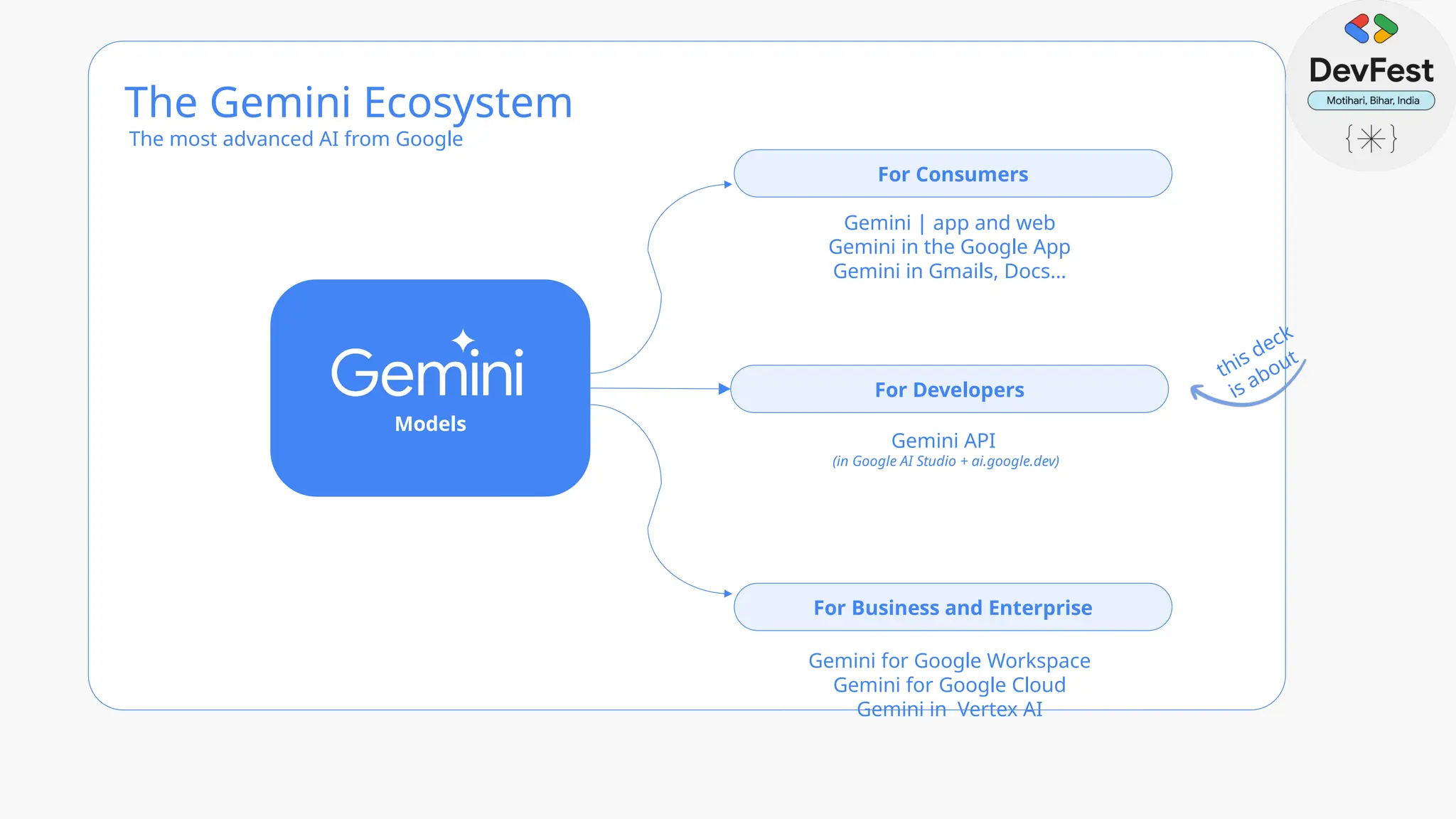
The Gemini Ecosystem
Themost advanced AI from Google
For Developers
For Consumers
For Business and Enterprise
Models
Gemini API
(in Google AI Studio + ai.google.dev)
Gemini for Google Workspace
Gemini for Google Cloud
Gemini in Vertex AI
Gemini | app and web
Gemini in the Google App
Gemini in Gmails, Docs…
this deck
is about
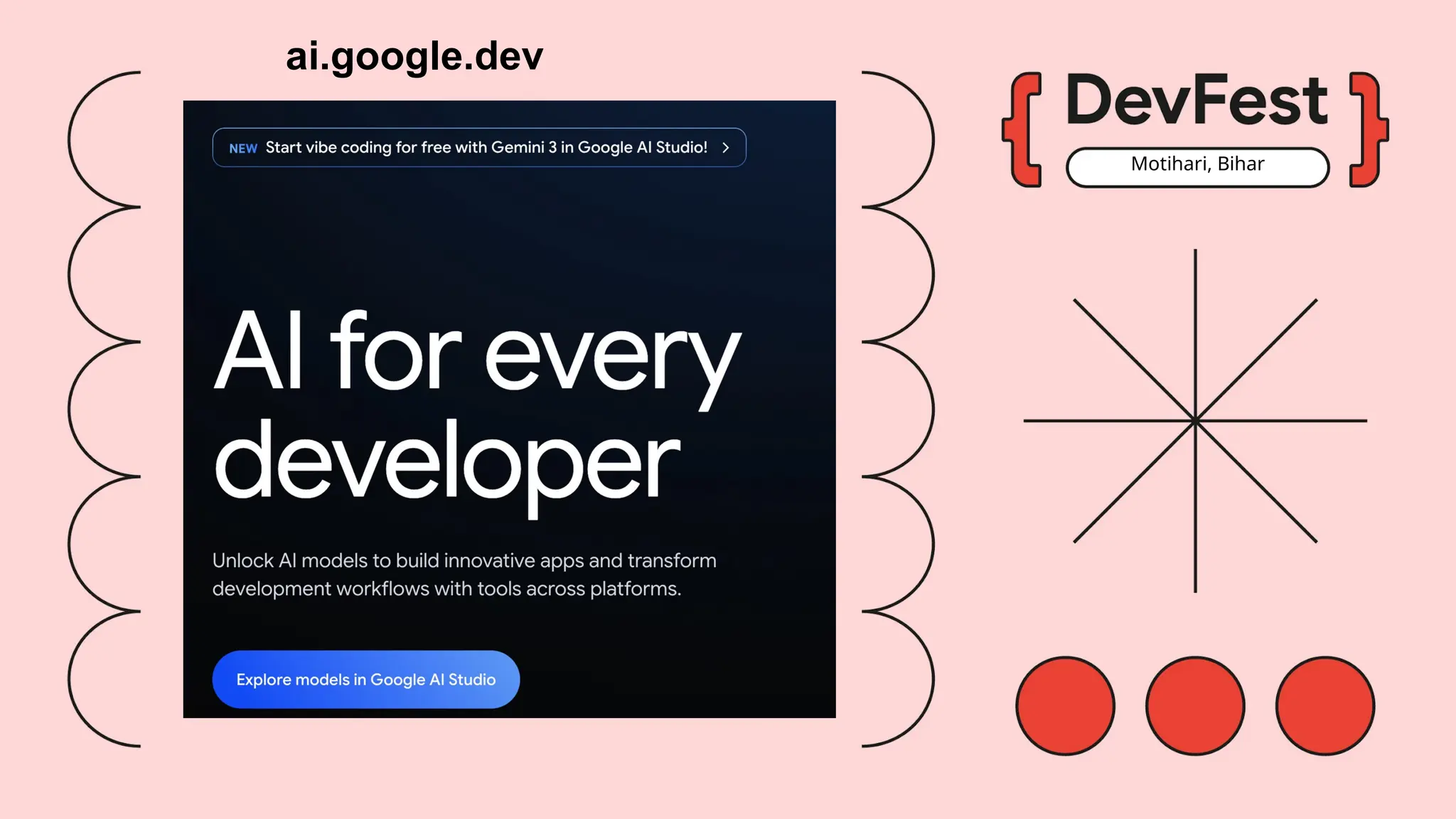
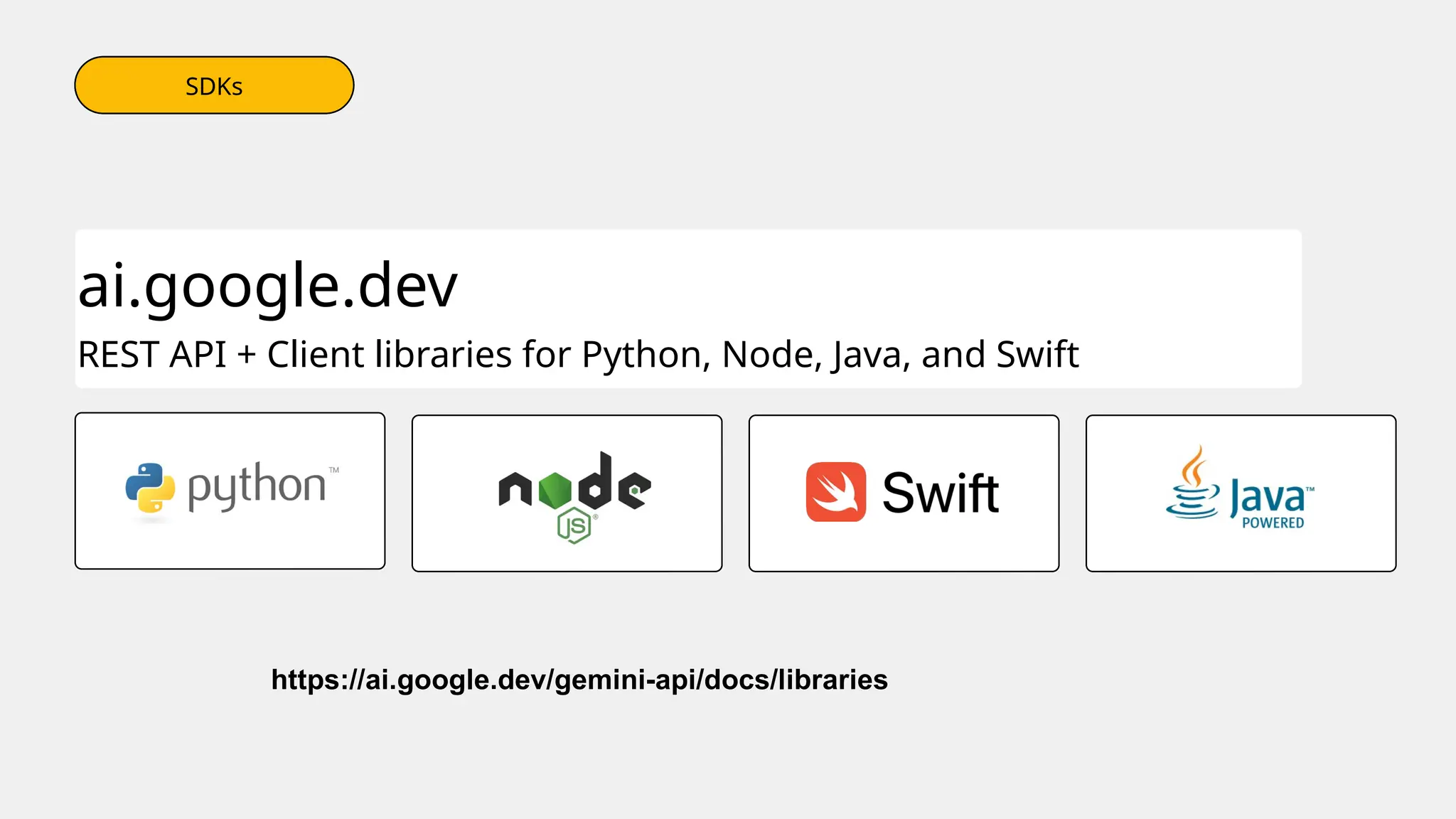
ai.google.dev
REST API +Client libraries for Python, Node, Java, and Swift
Libraries
Libraries
SDKs
https://ai.google.dev/gemini-api/docs/libraries
28.
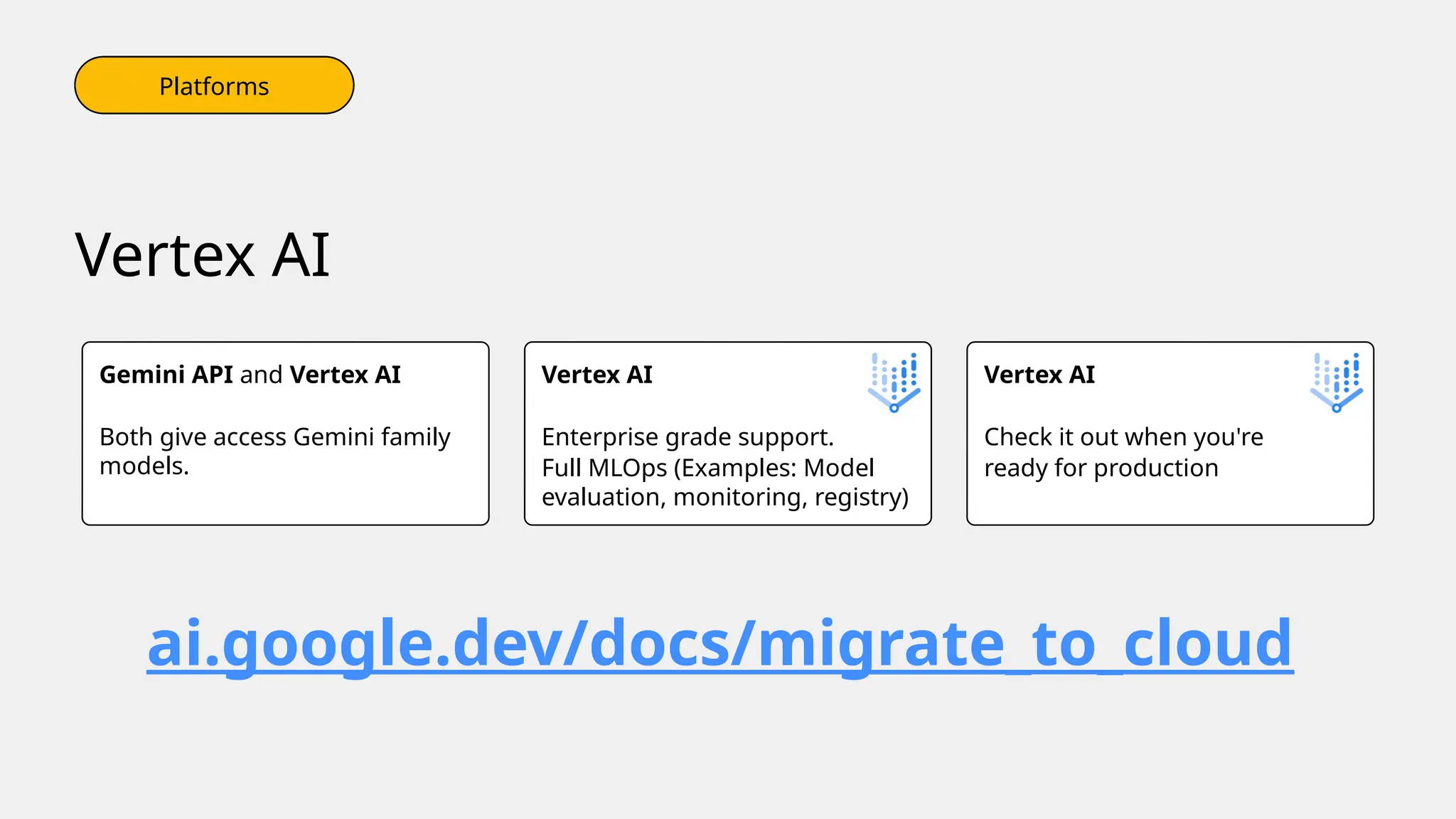
Vertex AI
Enterprise gradesupport.
Full MLOps (Examples: Model
evaluation, monitoring, registry)
Vertex AI
Check it out when you're
ready for production
Gemini API and Vertex AI
Both give access Gemini family
models.
Vertex AI
Cloud Production
ai.google.dev/docs/migrate_to_cloud
PlatfoEndpoints
rms
Platforms
Platforms
29.
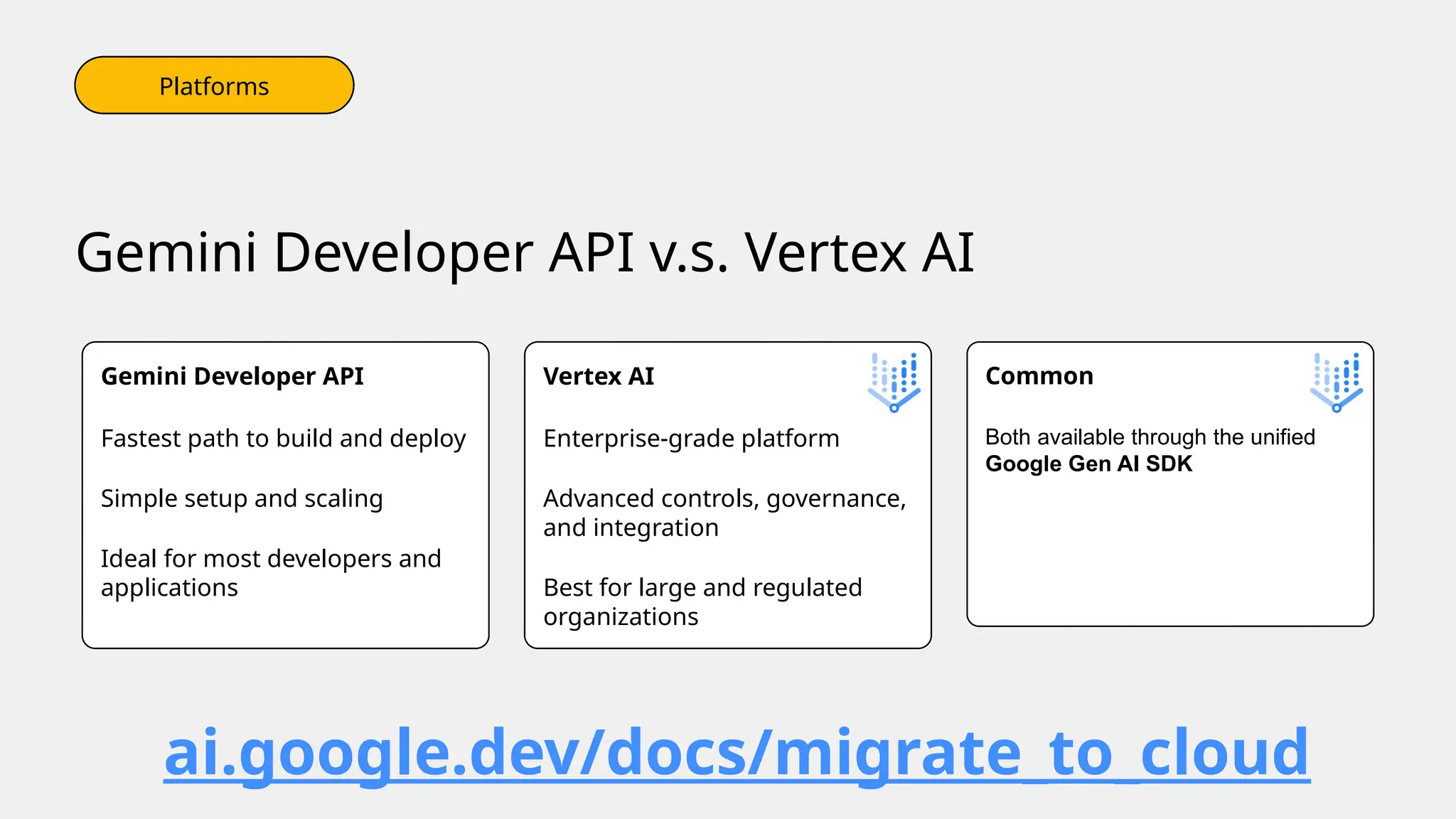
Vertex AI
Enterprise-grade platform
Advancedcontrols, governance,
and integration
Best for large and regulated
organizations
Common
Both available through the unified
Google Gen AI SDK
Gemini Developer API
Fastest path to build and deploy
Simple setup and scaling
Ideal for most developers and
applications
Gemini Developer API v.s. Vertex AI
Cloud Production
ai.google.dev/docs/migrate_to_cloud
PlatfoEndpoints
rms
Platforms
Platforms
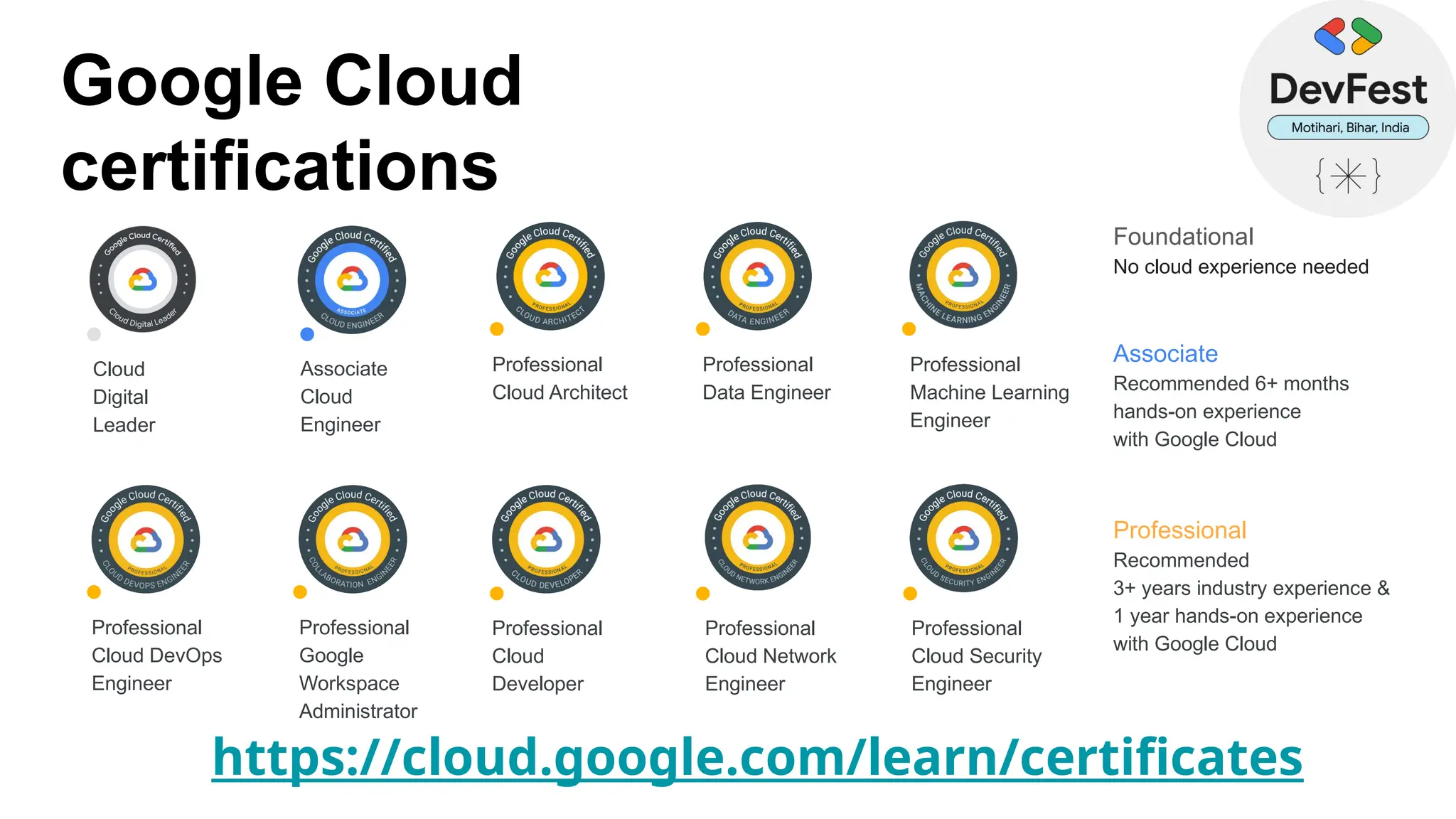
Professional
Cloud DevOps
Engineer
Professional
Google
Workspace
Administrator
Professional
Cloud Architect
Professional
DataEngineer
Foundational
No cloud experience needed
Associate
Recommended 6+ months
hands-on experience
with Google Cloud
Associate
Cloud
Engineer
Professional
Cloud
Developer
Professional
Cloud Network
Engineer
Professional
Cloud Security
Engineer
Professional
Recommended
3+ years industry experience &
1 year hands-on experience
with Google Cloud
Professional
Machine Learning
Engineer
Cloud
Digital
Leader
Google Cloud
certifications
https://cloud.google.com/learn/certificates
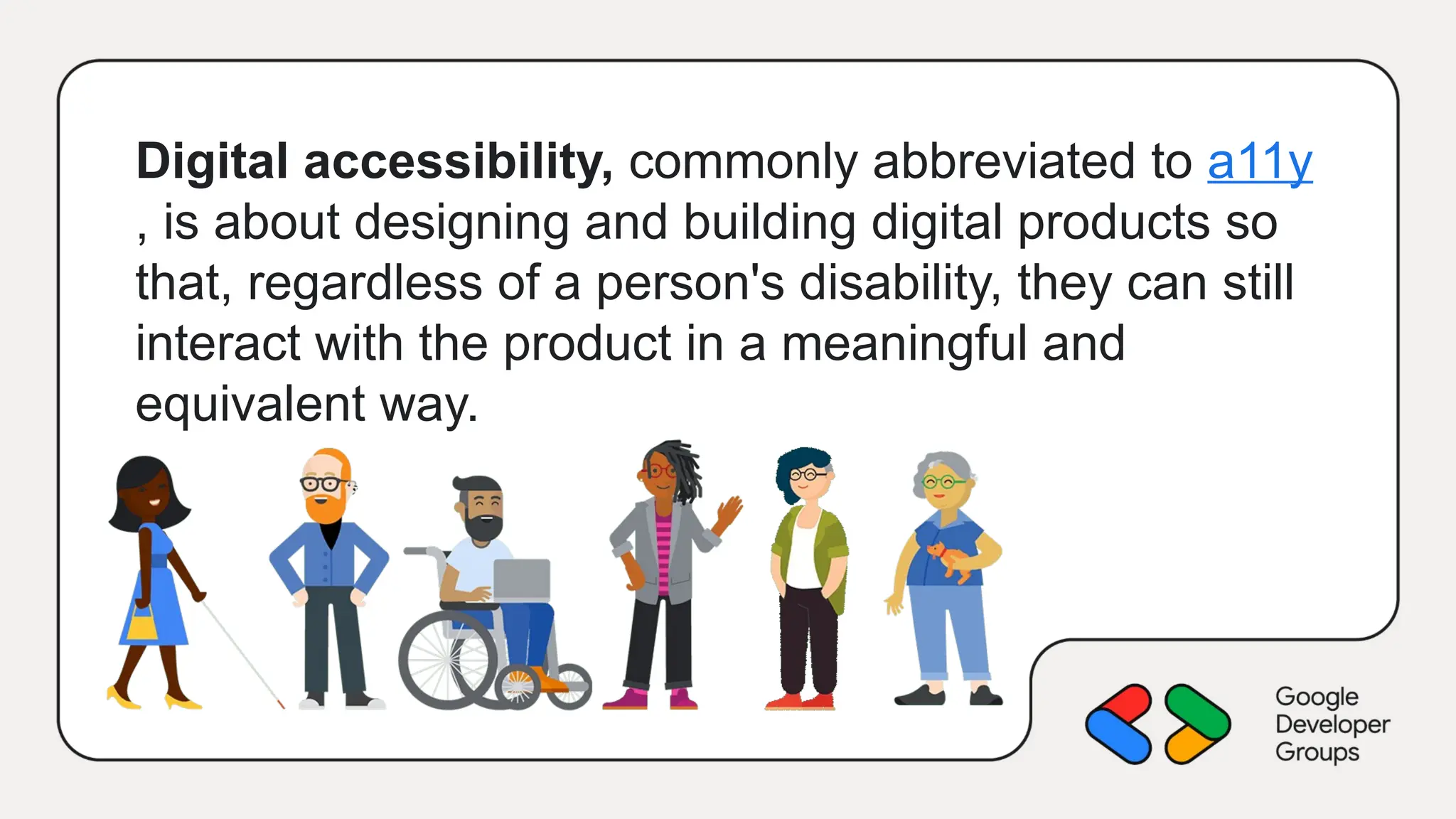
Digital accessibility, commonlyabbreviated to a11y
, is about designing and building digital products so
that, regardless of a person's disability, they can still
interact with the product in a meaningful and
equivalent way.
48.
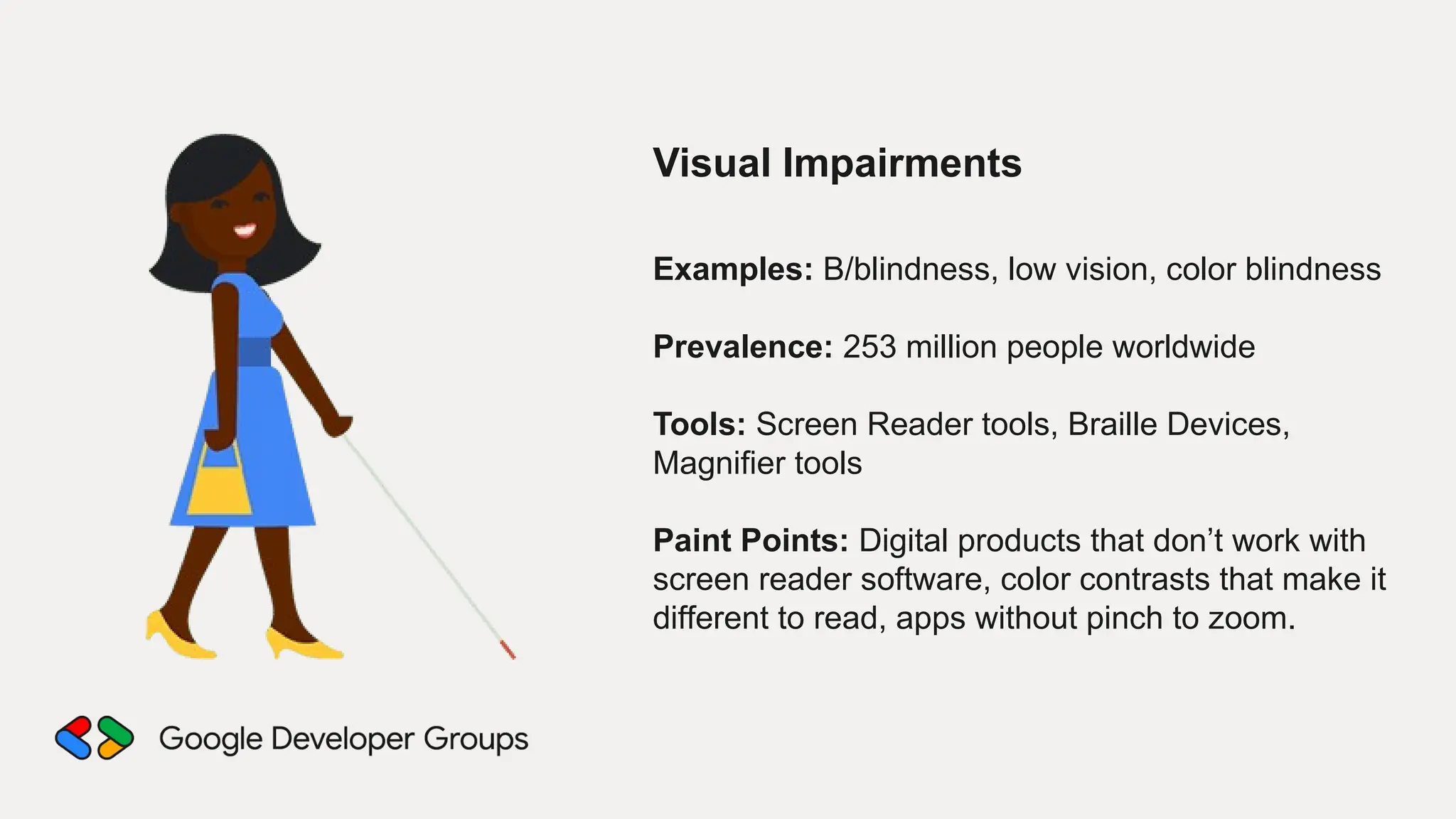
Visual Impairments
Examples: B/blindness,low vision, color blindness
Prevalence: 253 million people worldwide
Tools: Screen Reader tools, Braille Devices,
Magnifier tools
Paint Points: Digital products that don’t work with
screen reader software, color contrasts that make it
different to read, apps without pinch to zoom.
49.
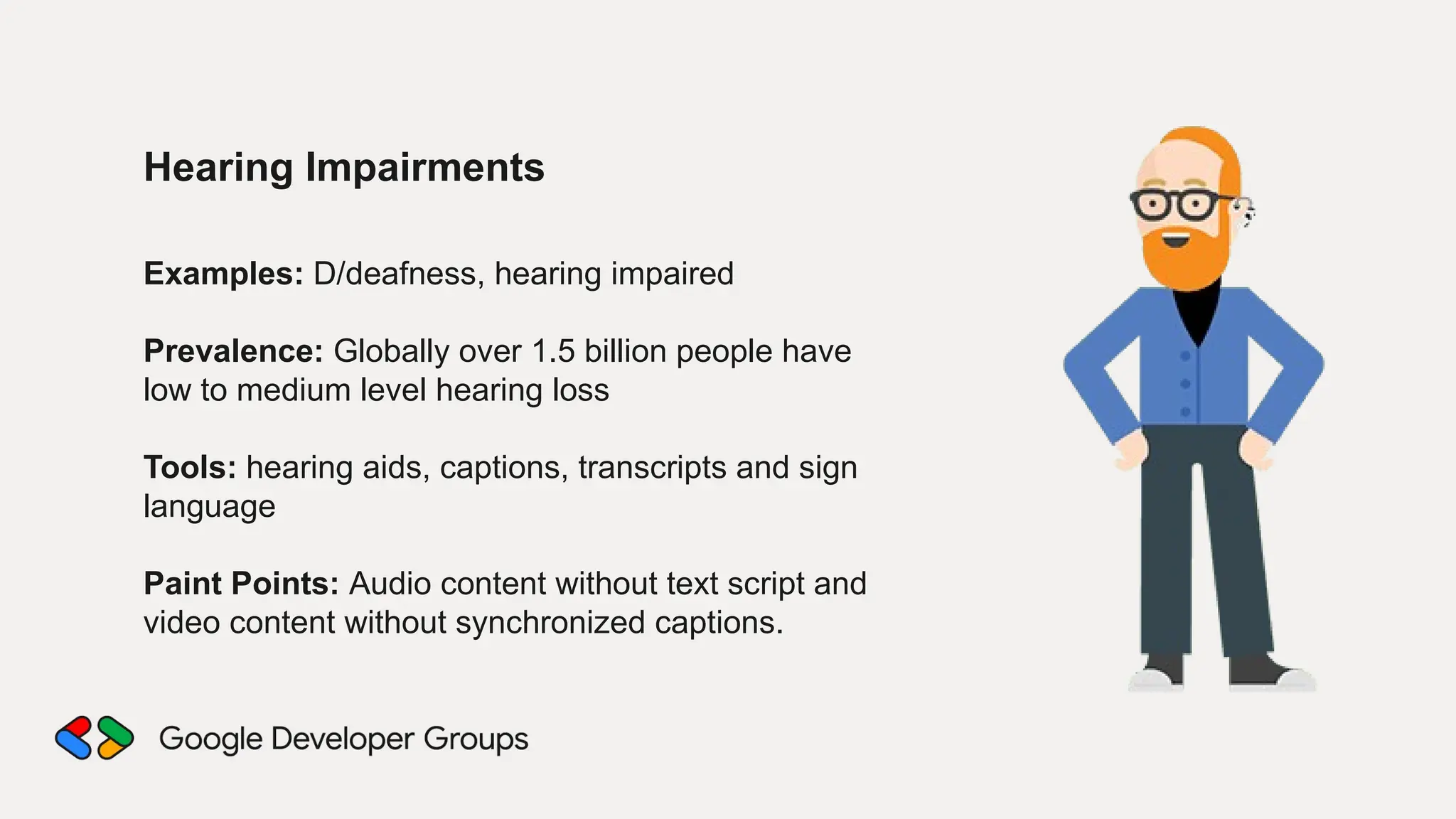
Hearing Impairments
Examples: D/deafness,hearing impaired
Prevalence: Globally over 1.5 billion people have
low to medium level hearing loss
Tools: hearing aids, captions, transcripts and sign
language
Paint Points: Audio content without text script and
video content without synchronized captions.
50.
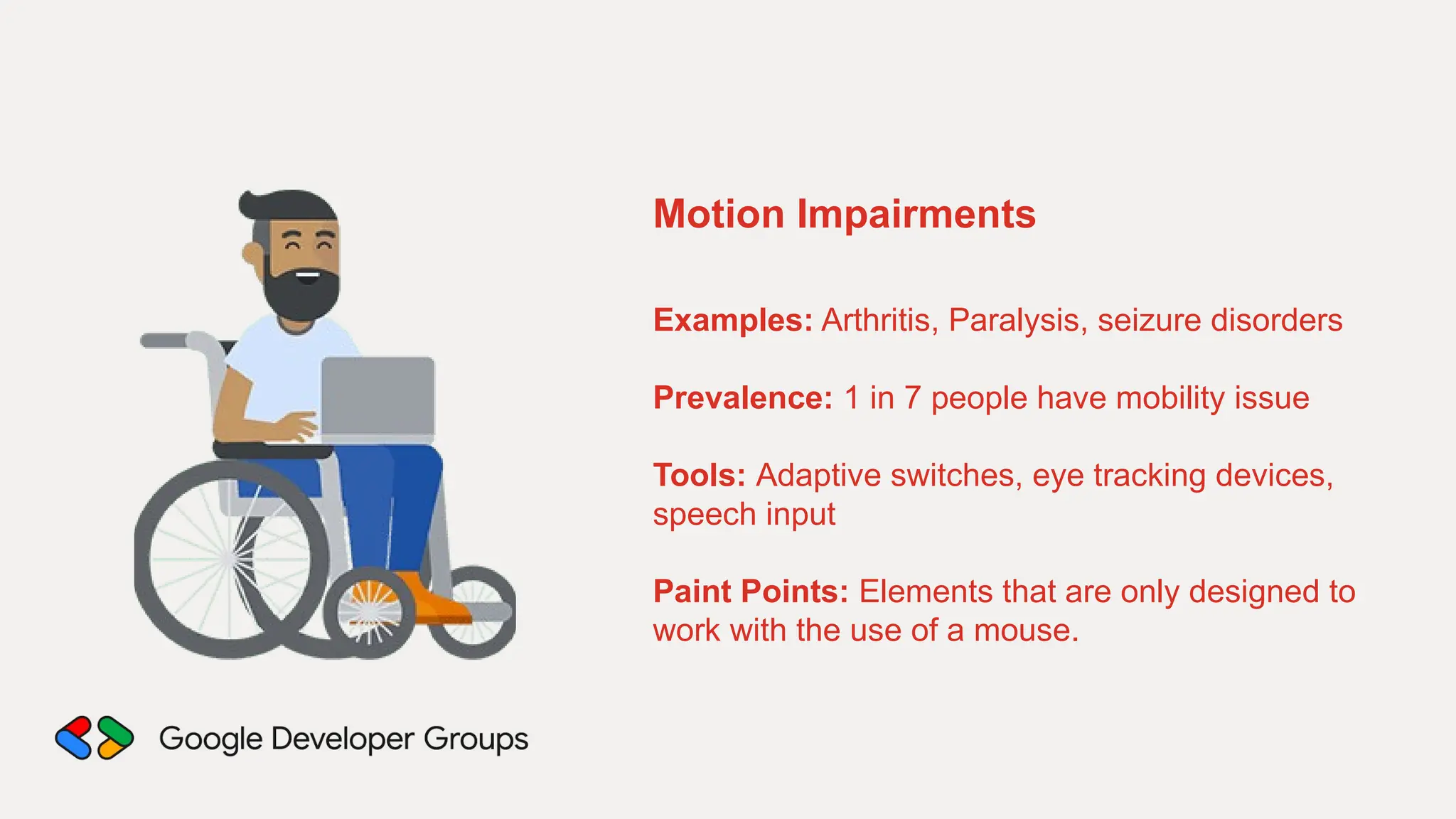
Motion Impairments
Examples: Arthritis,Paralysis, seizure disorders
Prevalence: 1 in 7 people have mobility issue
Tools: Adaptive switches, eye tracking devices,
speech input
Paint Points: Elements that are only designed to
work with the use of a mouse.
51.
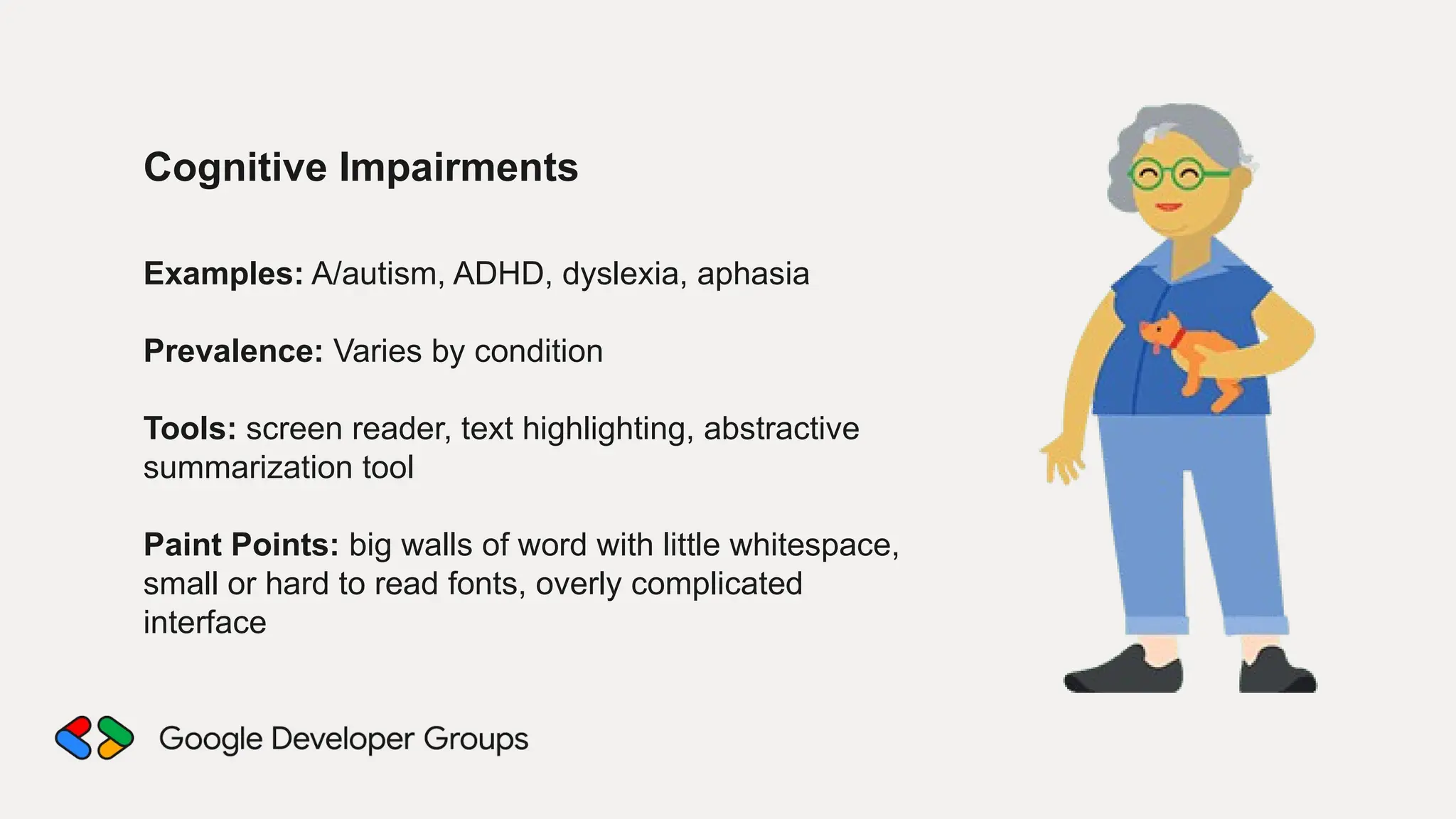
Cognitive Impairments
Examples: A/autism,ADHD, dyslexia, aphasia
Prevalence: Varies by condition
Tools: screen reader, text highlighting, abstractive
summarization tool
Paint Points: big walls of word with little whitespace,
small or hard to read fonts, overly complicated
interface
Motihari
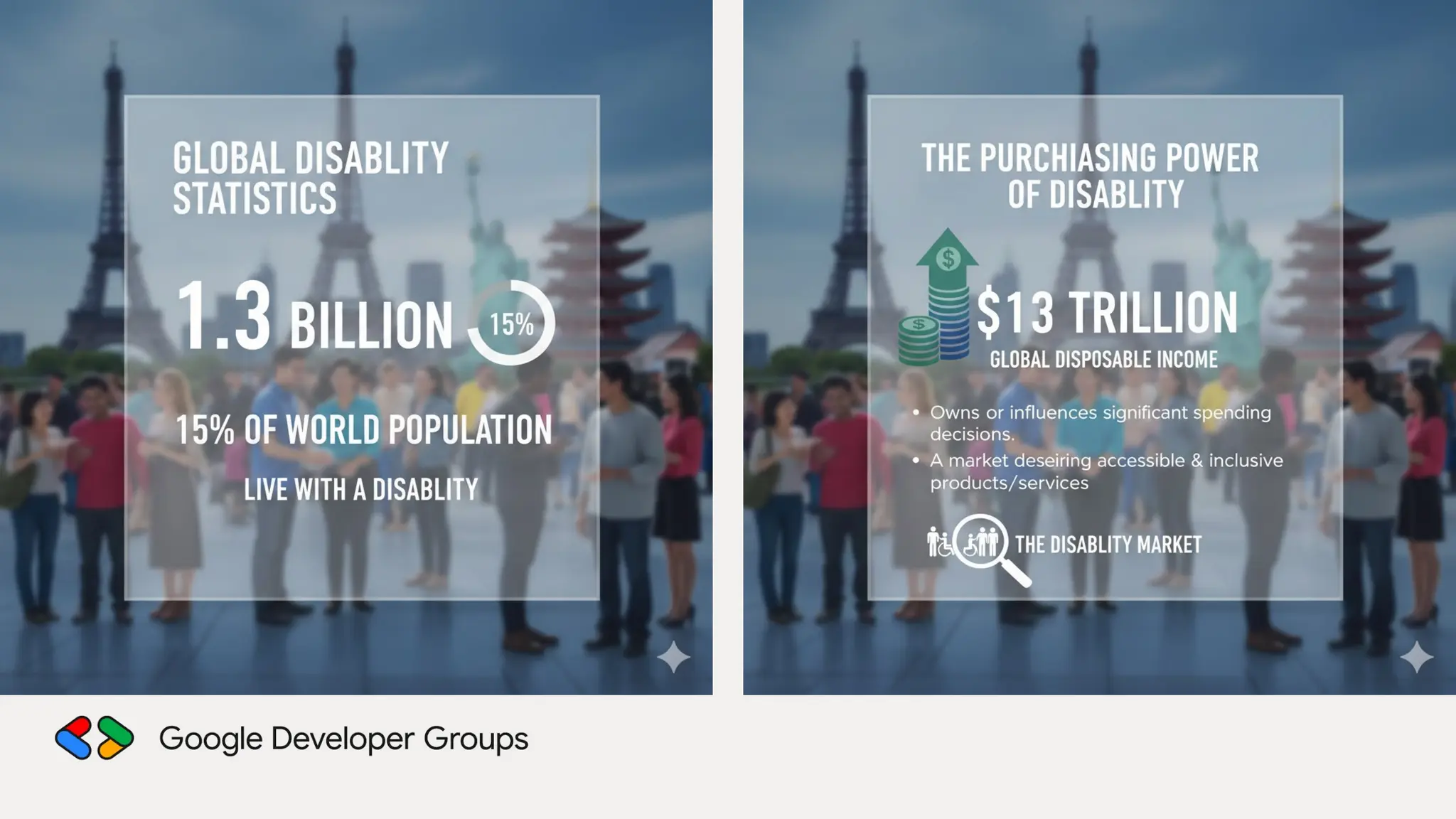
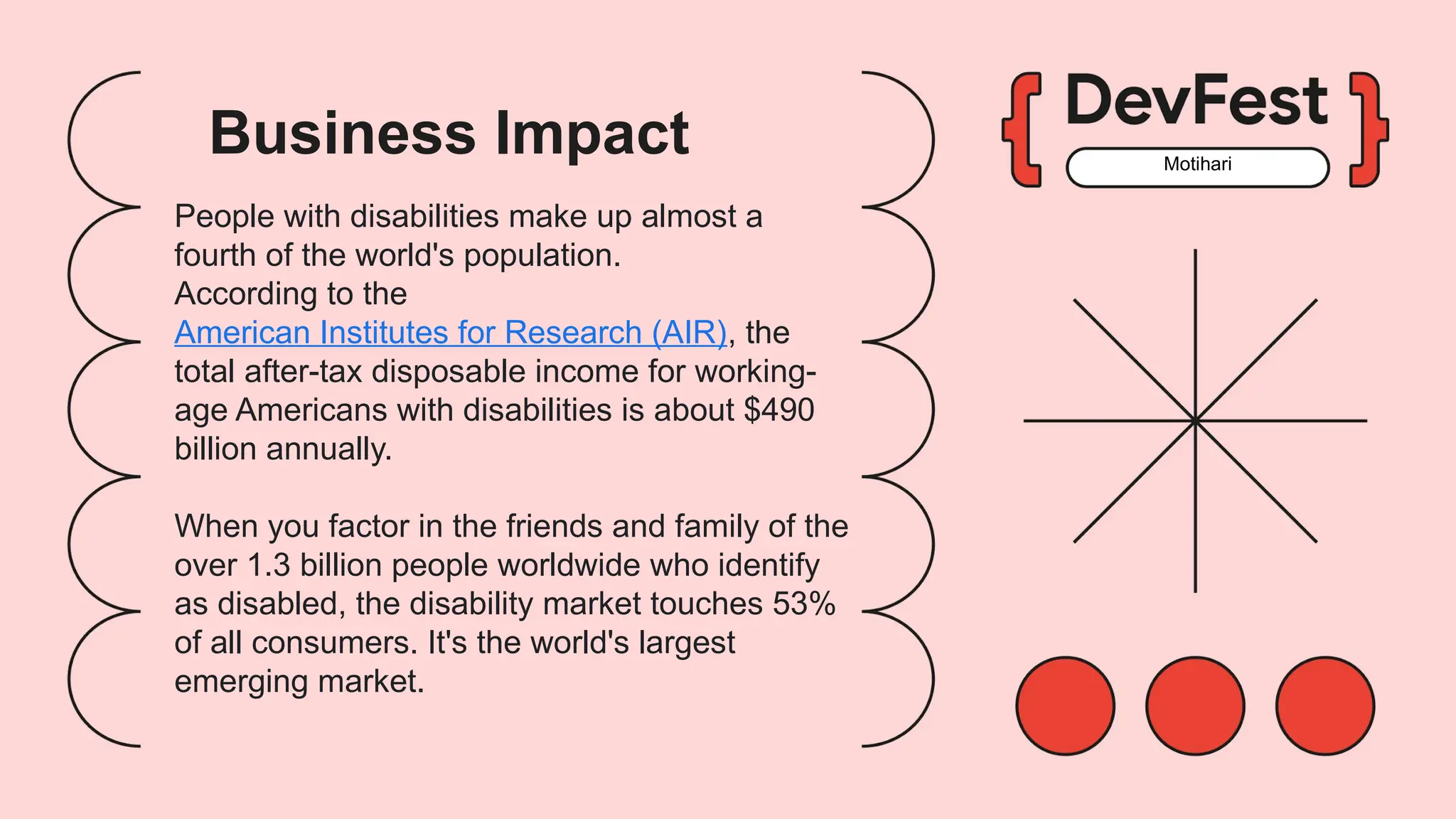
People with disabilitiesmake up almost a
fourth of the world's population.
According to the
American Institutes for Research (AIR), the
total after-tax disposable income for working-
age Americans with disabilities is about $490
billion annually.
When you factor in the friends and family of the
over 1.3 billion people worldwide who identify
as disabled, the disability market touches 53%
of all consumers. It's the world's largest
emerging market.
Business Impact
55.
Motihari
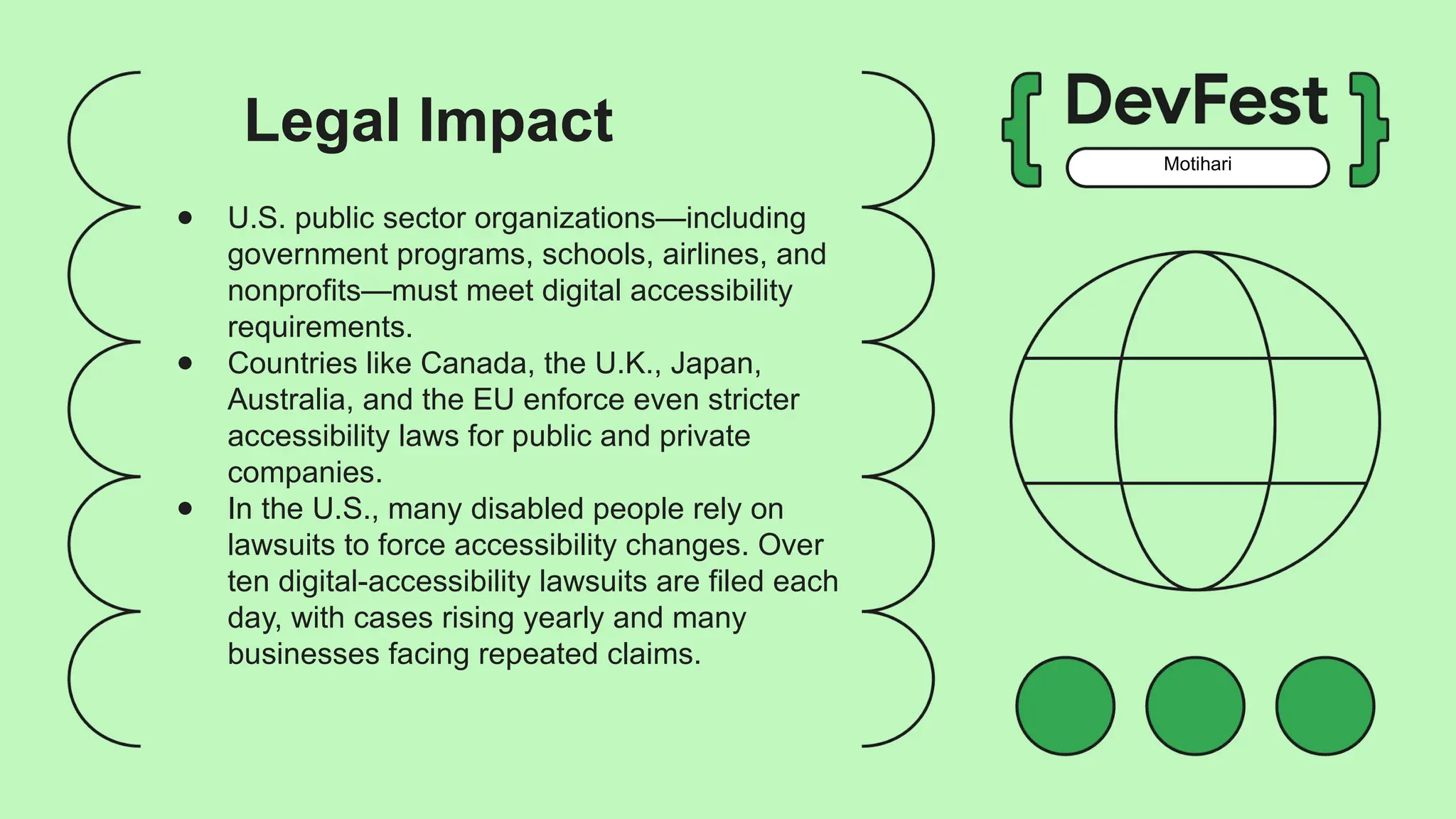
● U.S. publicsector organizations—including
government programs, schools, airlines, and
nonprofits—must meet digital accessibility
requirements.
● Countries like Canada, the U.K., Japan,
Australia, and the EU enforce even stricter
accessibility laws for public and private
companies.
● In the U.S., many disabled people rely on
lawsuits to force accessibility changes. Over
ten digital-accessibility lawsuits are filed each
day, with cases rising yearly and many
businesses facing repeated claims.
Legal Impact
56.
Motihari
Of the top500 ecommerce
sites, 412 have been served
with a lawsuit within the past
four years. Often, the first
lawsuit is for the company's
website and the second for
their mobile app.
57.
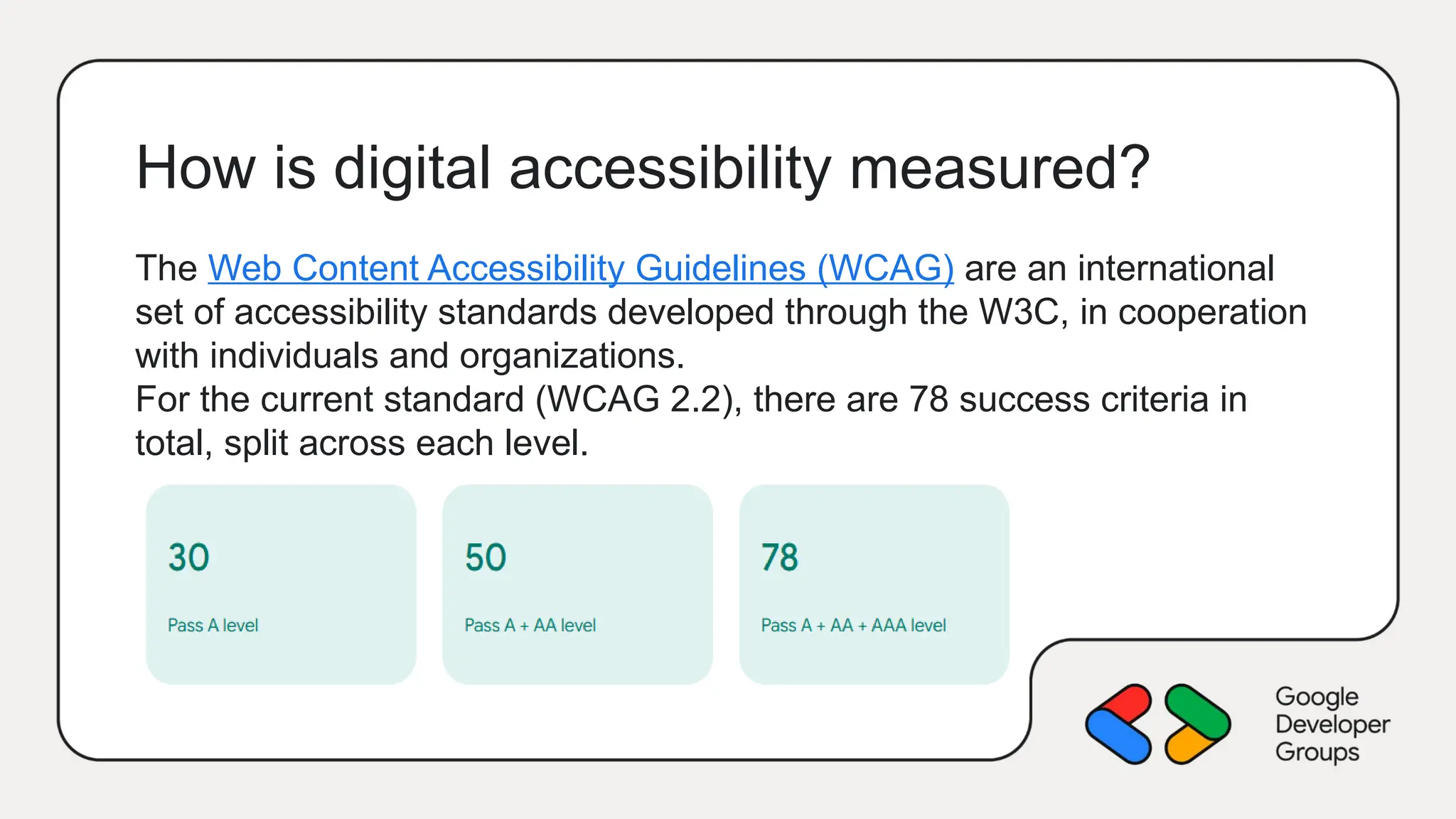
How is digitalaccessibility measured?
The Web Content Accessibility Guidelines (WCAG) are an international
set of accessibility standards developed through the W3C, in cooperation
with individuals and organizations.
For the current standard (WCAG 2.2), there are 78 success criteria in
total, split across each level.
#27 The Gemini API is a REST API, you can call directly or using one of the user friendly client libraries in Python, JS, Swift, Java, Go or Flutter.
This presentation uses the Python SDK as it is the most popular language, but everything should be possible using the API directly.
Speaker note: Making a language-specific version of this deck would be great :)
#28 The content I’m going to cover will be on what we call the “Gemini API”. I am referring to the API that is available through ai.google.dev, but it’s important to be aware that we also have a Gemini API available through Vertex AI in Google Cloud.
Vertex AI’s Generative Studio gives the same access to models like Gemini, and we’ve kept the APIs as close as possible to make migration to the Cloud as easy as possible.
We expect individual developers to start with Gemini API and move to Vertex when they need access to commercial support and higher rate limits. If you’re already Cloud-friendly or Cloud-native, then you can get started in Vertex straight away.
#29 The content I’m going to cover will be on what we call the “Gemini API”. I am referring to the API that is available through ai.google.dev, but it’s important to be aware that we also have a Gemini API available through Vertex AI in Google Cloud.
Vertex AI’s Generative Studio gives the same access to models like Gemini, and we’ve kept the APIs as close as possible to make migration to the Cloud as easy as possible.
We expect individual developers to start with Gemini API and move to Vertex when they need access to commercial support and higher rate limits. If you’re already Cloud-friendly or Cloud-native, then you can get started in Vertex straight away.