

gatherup.com
How American Consumers Use Reviews to
Choose Local Businesses GatherUp Local
Business Review Survey — Q3 2025
Beyond The
Stars, 2025
Agenda:
Beyond
the Stars,
2025
How American Consumers
Use Reviews to Choose
Local Businesses
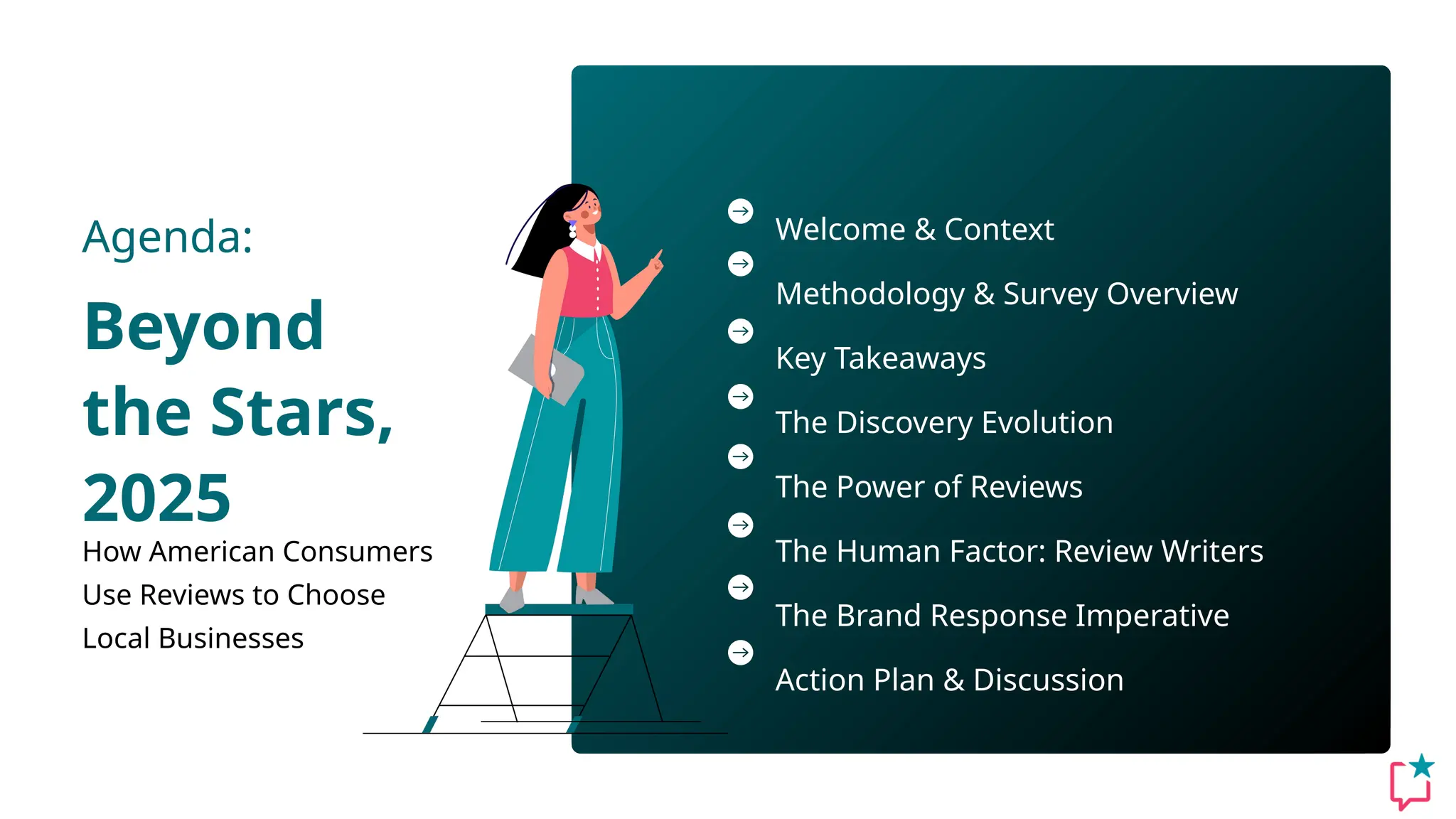
Welcome & Context
Methodology & Survey Overview
Key Takeaways
The Discovery Evolution
The Power of Reviews
The Human Factor: Review Writers
The Brand Response Imperative
Action Plan & Discussion
Your Presenter
Matt Saeger
VP of CX
Why This
Matters
Reviews drive local choice
AI reshapes discovery
Trust = growth currency
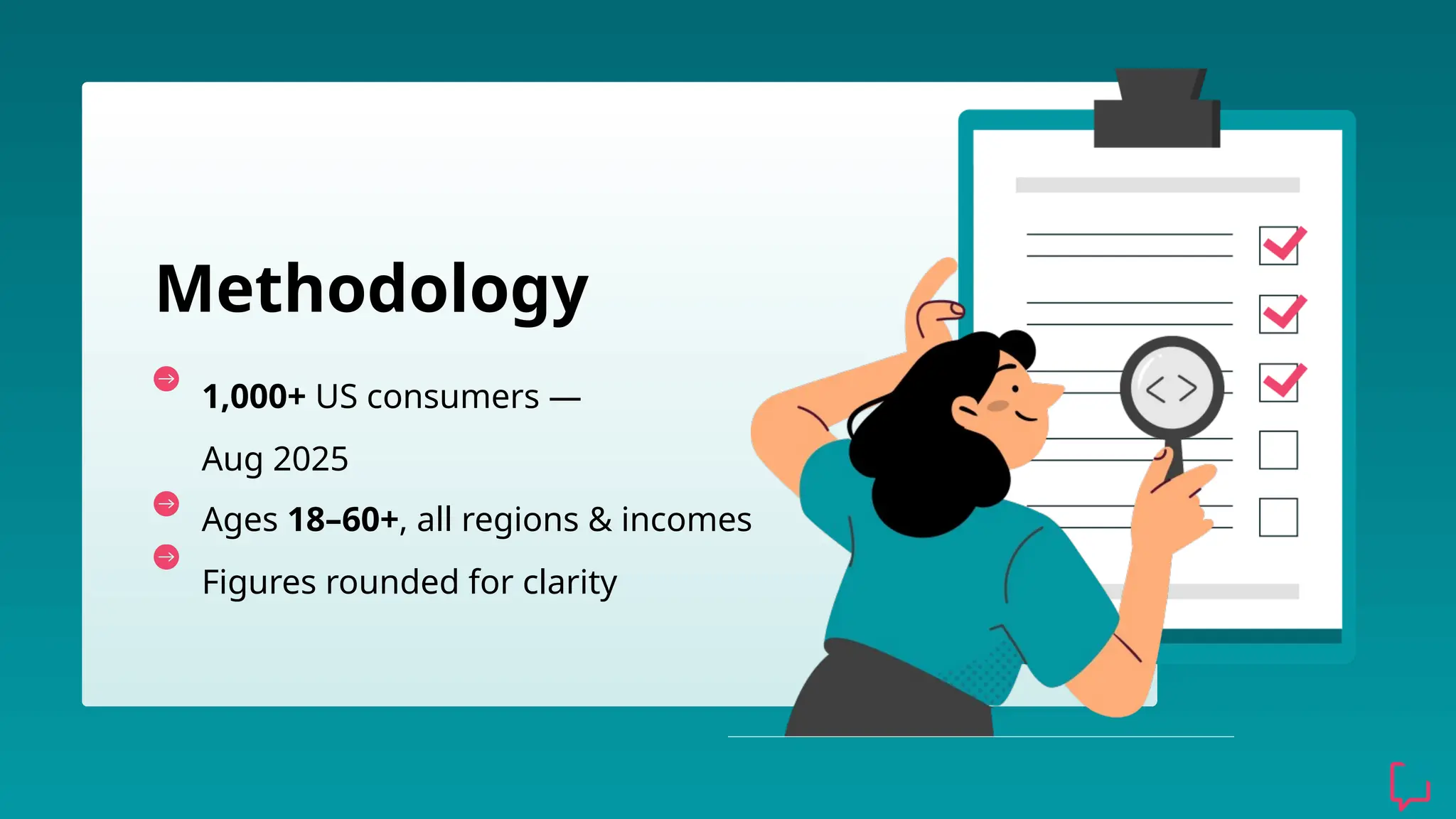
1,000+ US consumers —
Aug 2025
Ages 18–60+, all regions & incomes
Figures rounded for clarity
Methodology
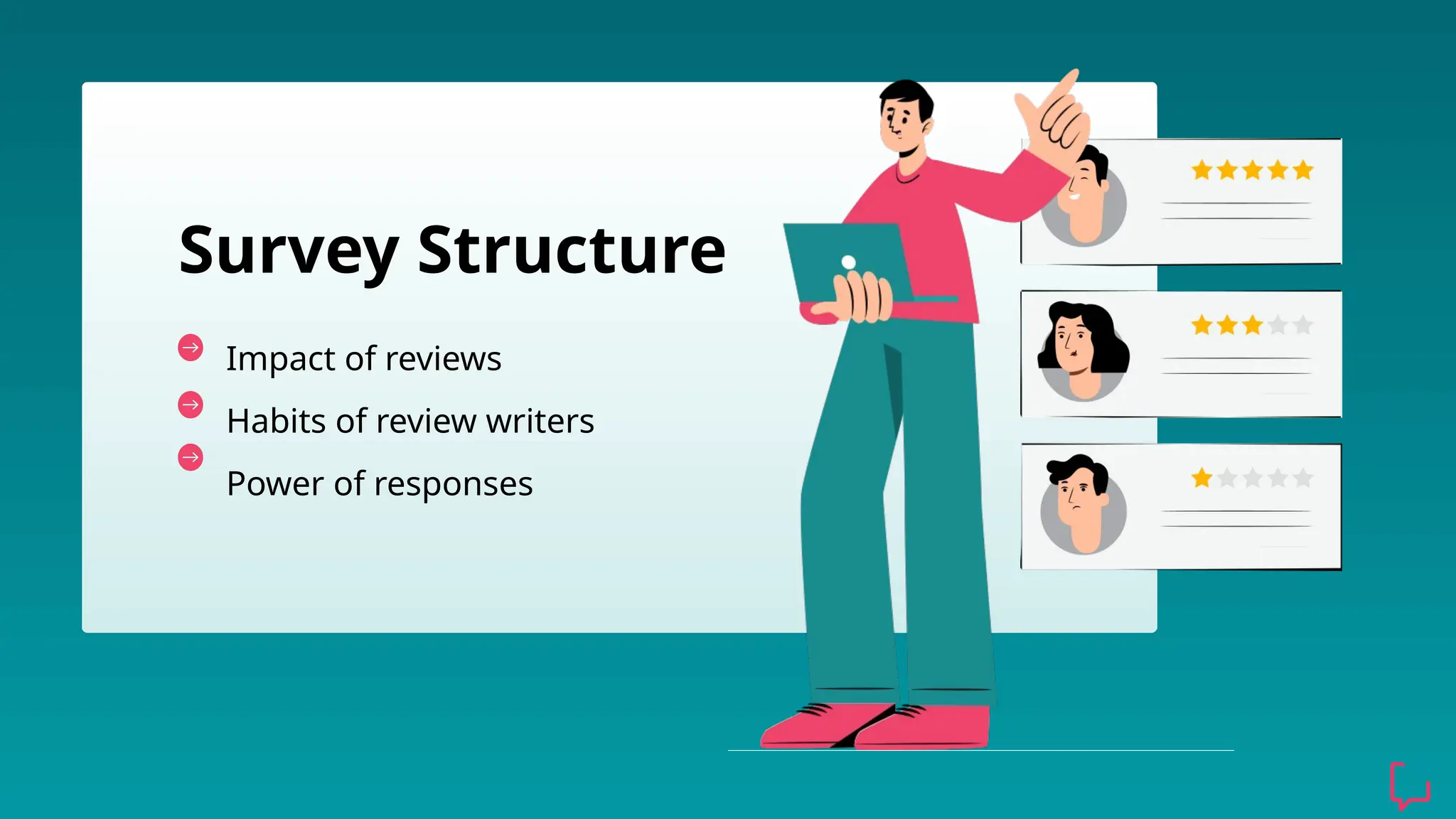
Impact of reviews
Habits of review writers
Power of responses
Survey Structure
Top Takeaways
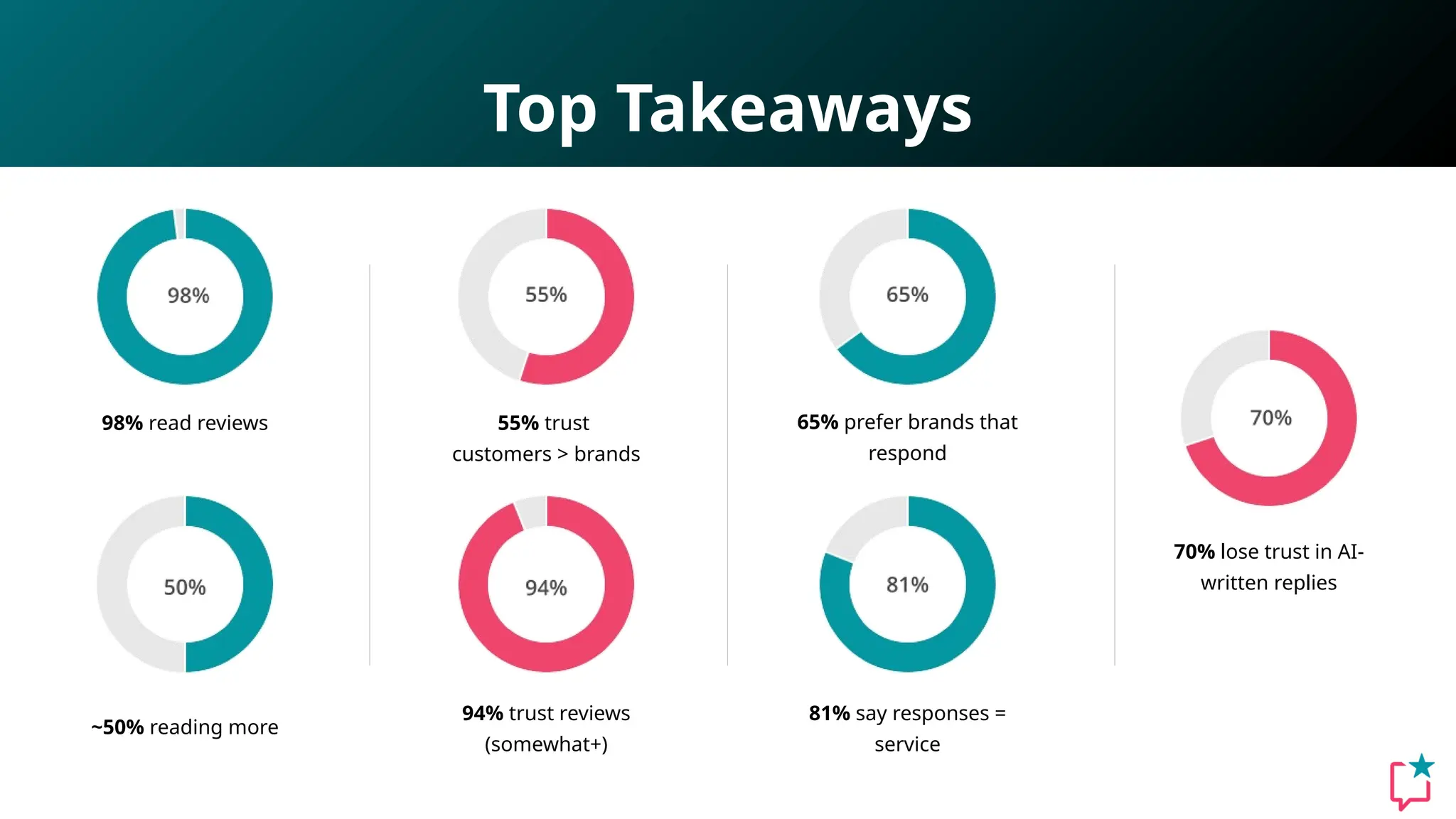
98% read reviews 55% trust
customers > brands
65% prefer brands that
respond
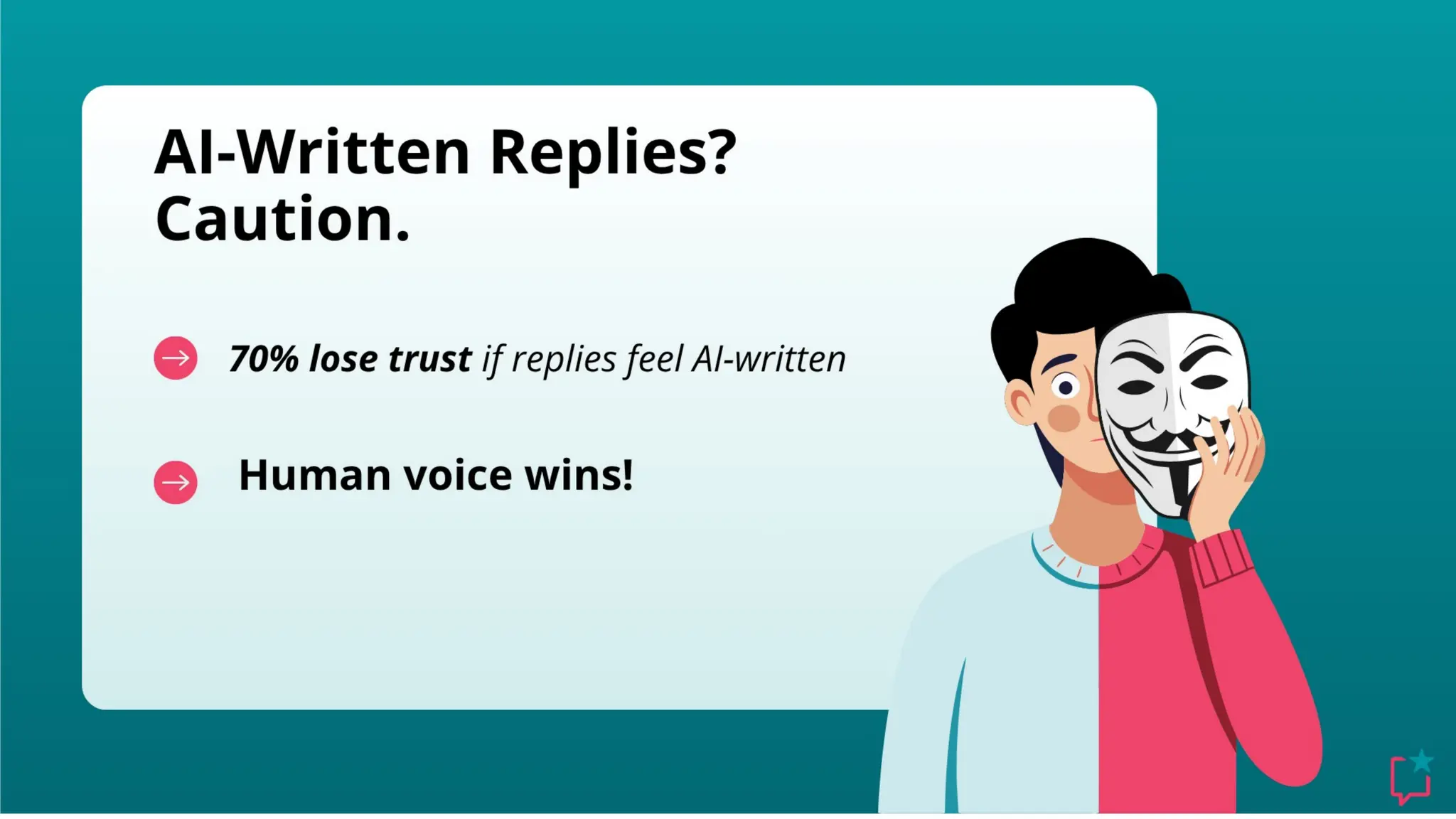
70% lose trust in AI-
written replies
81% say responses =
service
94% trust reviews
(somewhat+)
~50% reading more
Discovery Is Changing
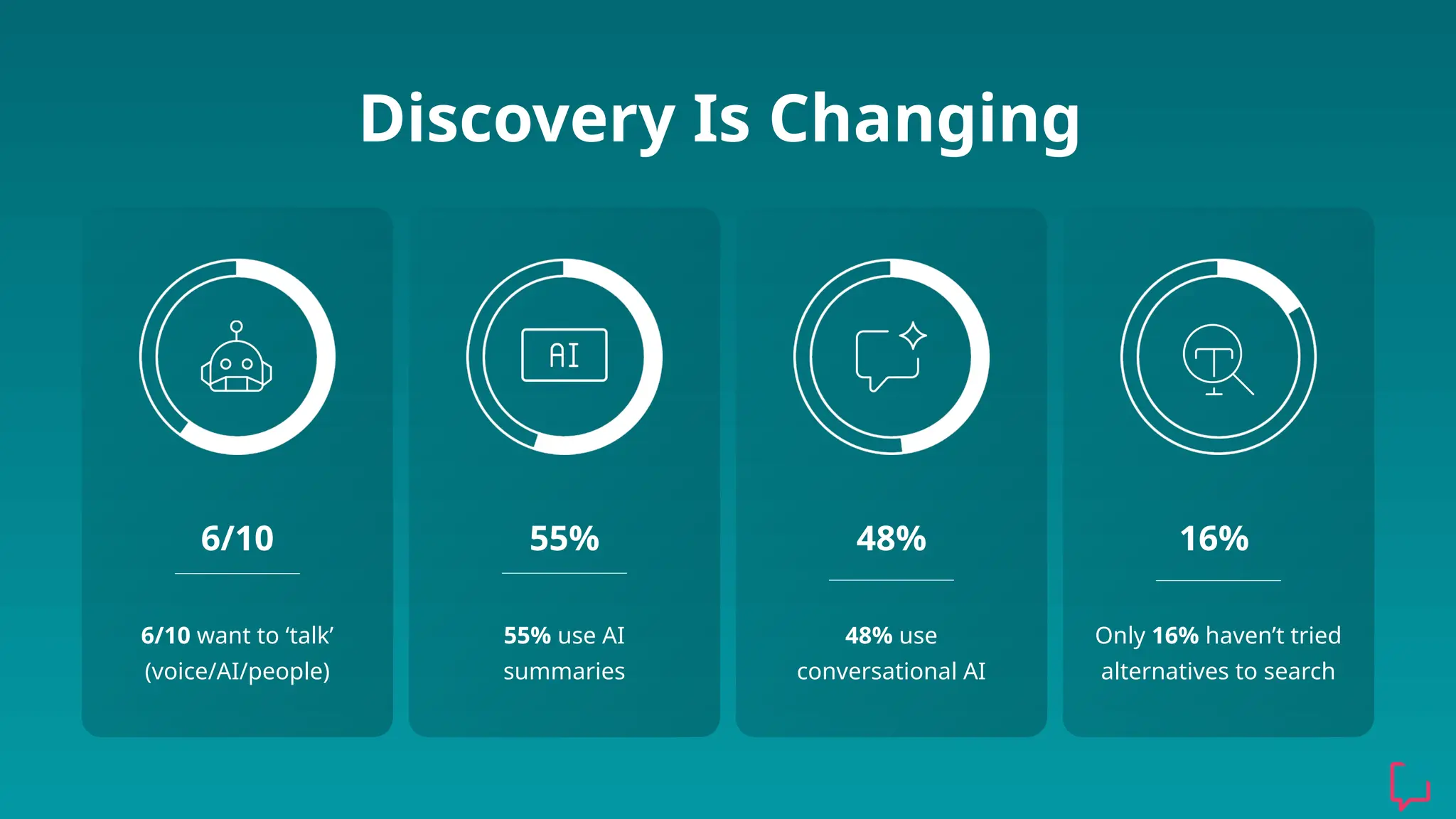
6/10 want to ‘talk’
(voice/AI/people)
6/10 55% 48% 16%
48% use
conversational AI
Only 16% haven’t tried
alternatives to search
55% use AI
summaries
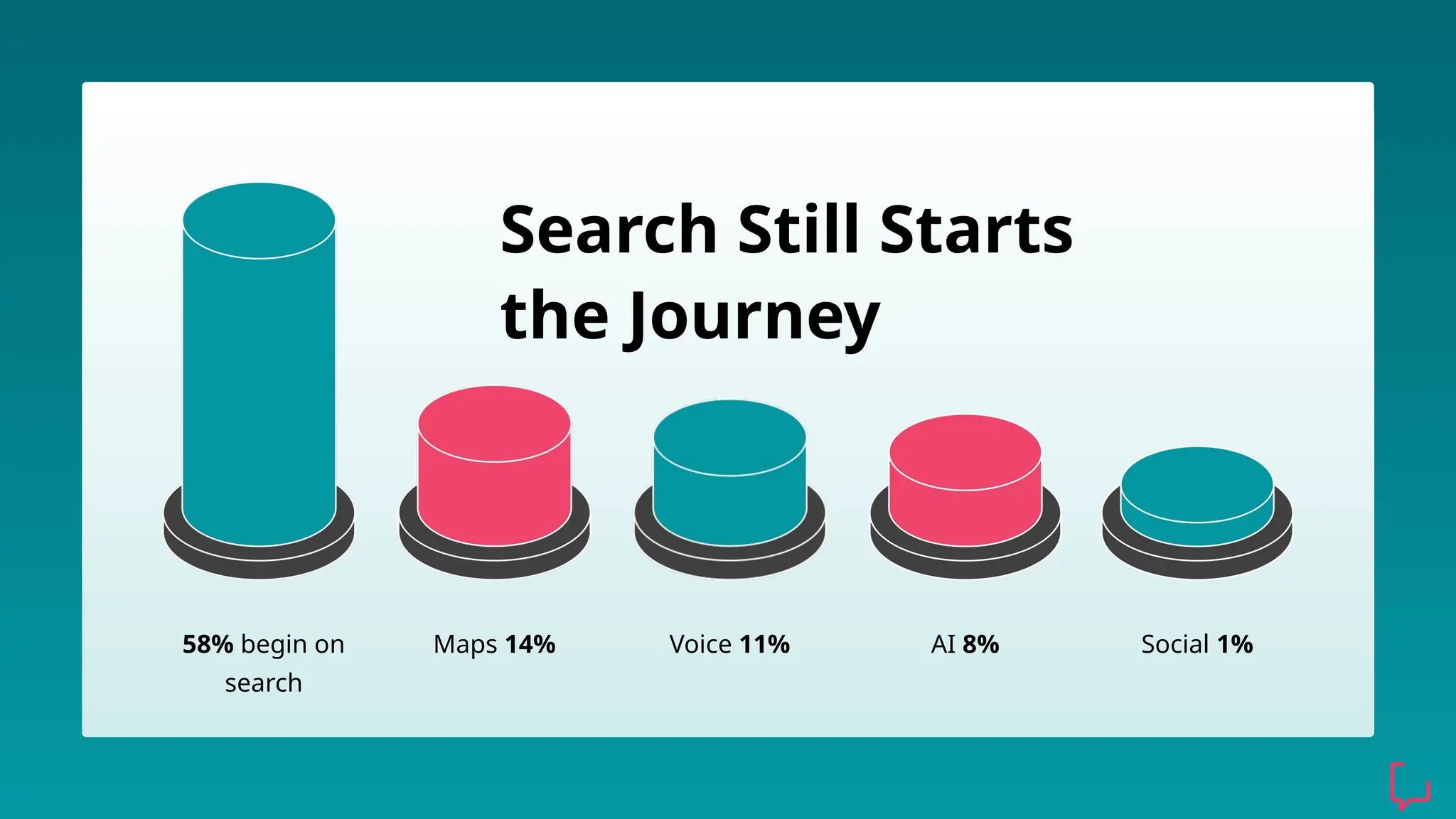
Search Still Starts
the Journey
58% begin on
search
Maps 14% Voice 11% AI 8% Social 1%
Search Still Starts
the Journey
58% begin on
search
Maps 14% Voice 11% AI 8% Social 1%
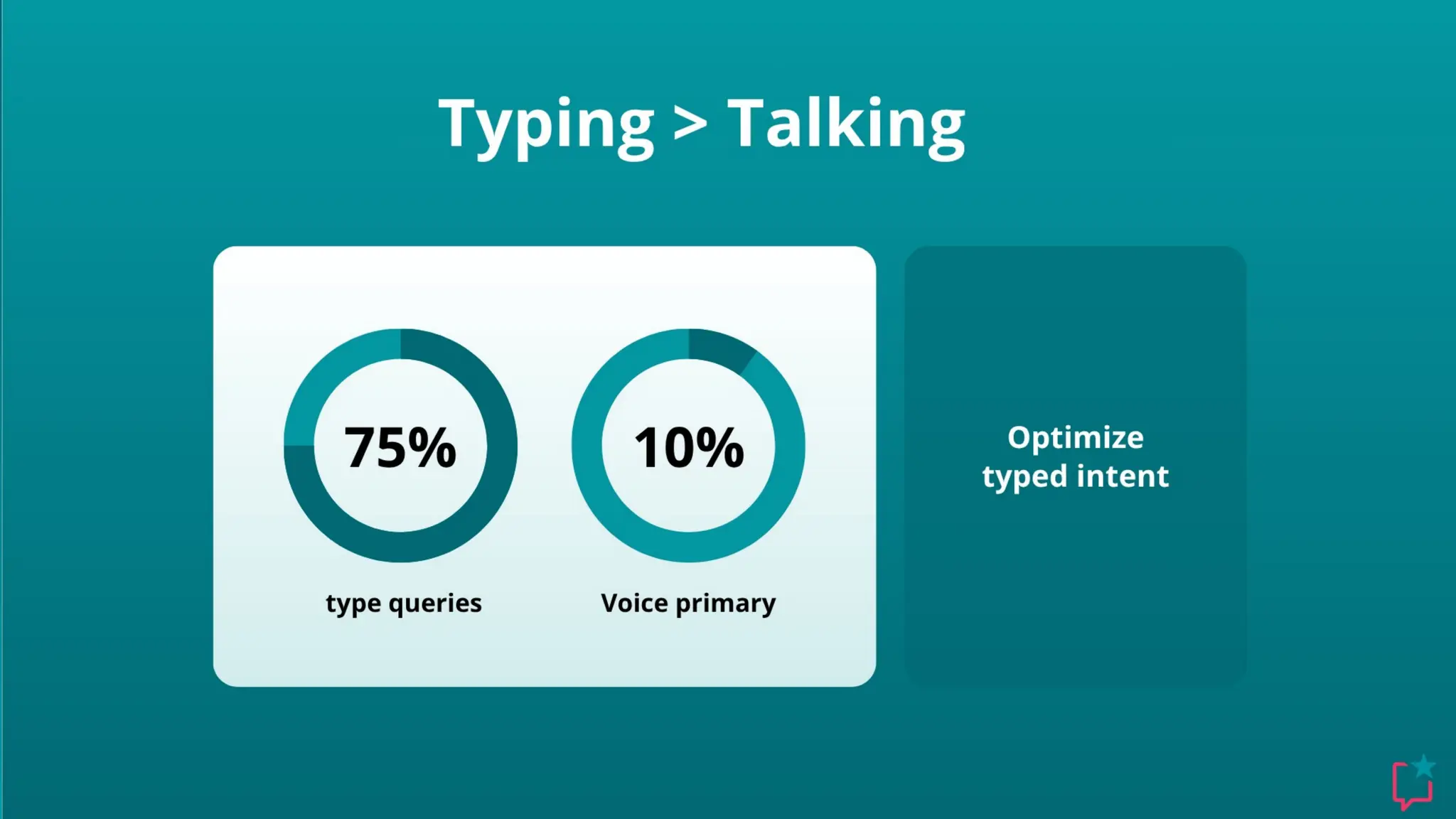
Typing > Talking
type queries Voice primary
Optimize
typed intent
Beyond Just the Stars: Proven AI, Trust & Review Tactics That Boost Google Visibility

Beyond Just the Stars: Proven AI, Trust & Review Tactics That Boost Google Visibility

Editor's Notes

  • #3 “Thank you for joining me for Beyond the Stars 2025. This is one of my favorite sessions each year. It’s where we look at how consumers use reviews, how behavior is changing, and what that means for your business moving forward.” “Here’s what we’ll cover today.” “We’ll discuss how people are finding local businesses today” “We’ll go into what consumers told us drives trust” “And what actually works when it comes to asking customers for feedback” “Finally, I’ll close with five concrete steps you can take right now to improve your reputation strategy and grow through reviews in 2025.” “My goal is to make this practical. You’ll leave today with clear, data-backed takeaways you can use immediately — not just ideas, but actions to strengthen your brand’s trust and visibility.”
  • #4 “Before we dive into the research, let me quickly introduce myself and tell you why this topic matters so much to me.” “My name is Matt Saeger, and I’m the Vice President of Customer Experience here at GatherUp. I’ve spent my career helping businesses connect the dots between feedback, service, and growth — because when you understand what your customers are saying, you can turn that insight into opportunity.” “At GatherUp, I have the privilege of working with agencies and local businesses that use reviews not just as a measurement of performance, but as a growth engine. And that’s really what today is about — understanding how reviews, responses, and authenticity drive customer choice in a world where technology and AI are changing discovery faster than ever.” So my goal today is to share real data, practical takeaways, and a few examples you can take back to your own teams right away.”
  • #5 “So, let’s start with the bigger picture — why this research matters. Why are we still talking about reviews after all these years, and why are they more important than ever in 2025?” “The short answer is: because trust is changing. Consumers used to find businesses through ads, referrals, or even just walking by the door. Today, that discovery starts — and often ends — with what other people say online. A review has become a digital first impression. “And that matters because trust drives choice. Customers don’t just want to know what you sell — they want to know how you treat people. They read reviews to see proof of your service, not just your promises.” “What’s different in 2025 is how reviews interact with everything else. They don’t just influence people — they influence algorithms. AI, maps, and search engines are all reading and summarizing your reviews. That means your reputation isn’t just visible — it’s being interpreted, condensed, and shared back to customers in ways you can’t always control.” “So, if your business isn’t actively collecting, managing, and responding to reviews, you’re essentially letting AI write your story for you. That’s why this work is foundational to growth.” “Reviews aren’t just feedback. They are your brand’s most trusted form of marketing — and the most visible proof of how you deliver on your promises.”
  • #6 “For Beyond the Stars 2025, we surveyed over 1,000 American consumers across all major regions and age groups” The goal was simple: to understand how people are using reviews to find, evaluate, and choose local businesses — and how those habits are changing as AI becomes part of everyday search and discovery.” “The survey was conducted in August to capture the most current behavior in an environment where AI summaries, voice search, and map results are influencing customer decisions faster than ever before. “So the data you’ll see today is drawn directly from how consumers are behaving right now.
  • #7 “Our research focused on three main pillars, each revealing a different part of how reviews influence both customers and businesses.” “First, we looked at the impact of reviews — how they shape consumer decisions, how much trust they carry, and how people use them to choose one business over another. “Second, we studied the habits of reviewers themselves. When and why do customers leave feedback? How often are they writing reviews? And what motivates them to share their experience “And third, we focused on the power of responses. Because reviews might start the conversation, but how a business replies determines how the story ends. “Together, these three pillars — the impact of reviews, the habits of reviewers, and the power of responses — give us a complete view of how trust is built, lost, and earned again in today’s marketplace.”
  • #8 “Alright — let’s jump into the key findings. Here are the headline takeaways that really capture what’s happening with consumer behavior around reviews right now.” 1. 98% of consumers read reviews. “That’s almost everyone. Reviews are still universal. Before visiting a business, booking a service, or making a purchase — consumers check what others say first.” And. ~50% are reading more reviews than last year. “Review engagement is actually increasing. Even with AI summaries and snippets available, consumers still want to see real experiences in full context before they decide.” 55% trust other customers more than brands. “This is a big one. People believe people That’s why the most authentic and unfiltered reviews are now worth more.” and 94% say they trust reviews at least somewhat. “Even with skepticism and fake review concerns, consumers still put their faith in peer feedback. The trust factor is still incredibly high — it’s just more nuanced now.” 4. 65% prefer brands that respond. “When they see a business take time to reply it signals attentiveness, care, and accountability. To 81% of responders, a response equals service.” 5. Lastly, 70% lose trust when a reply sounds AI-written. “This is new, but it’s critical. Consumers can spot automation instantly. If a response feels robotic or generic, it breaks the human connection. We’ll dig into this more later — but authenticity now matters as much as speed.” “So, if we zoom out: reviews remain the most influential trust signal in local search and digital decision-making — but expectations are evolving. Consumers don’t just read reviews anymore; they analyze them. They notice tone, timing, and authenticity — both from the reviewer and from the business’s response.”
  • #9 “So consumers are reading and trusting reviews — but let’s walk through this journey to trust from beginning to end. Discovery looks very different today than it did even a year ago.” “Traditionally, discovery started in one place — a typed search. But now, consumers are using a wider mix of tools to find local businesses, ask questions, and make decisions.” Key behaviors from the data “Six in ten consumers say they want to talk their way to answers — whether that’s through voice search, AI chat, or direct messaging. People want natural, conversational interactions.” “55% of consumers use AI summaries — those bite-sized overviews at the top of search results that condense reviews and details.” “48% have used conversational AI tools — like ChatGPT or Gemini — to help decide where to go or what to buy.” “And only 16% say they haven’t tried alternatives to traditional search yet — which means 84% of consumers are already exploring something beyond the search bar.” “So what does that mean for businesses? It means discovery is no longer linear — it’s layered. Consumers might start a query in Google, see an AI summary, click into Maps, and then confirm their choice by reading reviews — all in one flow. They’re not replacing search; they’re expanding how they search.” “This shift also means your reputation needs to be visible and consistent wherever discovery happens — because reviews are showing up in new places, often summarized by AI or voice tools before the customer ever lands on your site.”
  • #10 “So while discovery is definitely changing — and consumers are experimenting with new ways to find answers — one thing hasn’t changed yet: most journeys still start with search.” “When we asked consumers where their search for a local business begins, the results were clear: 58% still start on a traditional search engine like Google or Bing. It’s still the front door to discovery.” “From there, other tools come into play: 14% begin directly in Maps, 11% start through voice assistants like Alexa or Siri, 8% are starting with AI tools, and just 1% begin their discovery on social media. So, search still dominates the starting line — but now, it’s surrounded by new options that branch off from that same starting point.” “The takeaway for local businesses and agencies is that SEO isn’t dead — it’s evolving. You still need to optimize for typed intent — those specific keywords and questions — but you also need to think about what comes after that search: the AI summary, the reviews, and the responses that reinforce trust.” If you want to win discovery, you need to win the review layer that sits on top of search results.”
  • #11 “Typing remains the default behavior because it gives people control. They can phrase things precisely, skim results faster, and refine their search instantly. Even with the rise of voice assistants and conversational AI, most consumers still prefer to type — especially when they’re comparing local options or reading reviews.” “This is an important insight for local businesses because your review content, responses, and listings for typed phrasing still gives you the greatest visibility.” “Reviews play into this too. Typed search results are often where reviews appear first — in map packs, knowledge panels, and snippets. So the words your customers use in their reviews actually influence which searches you show up for.”
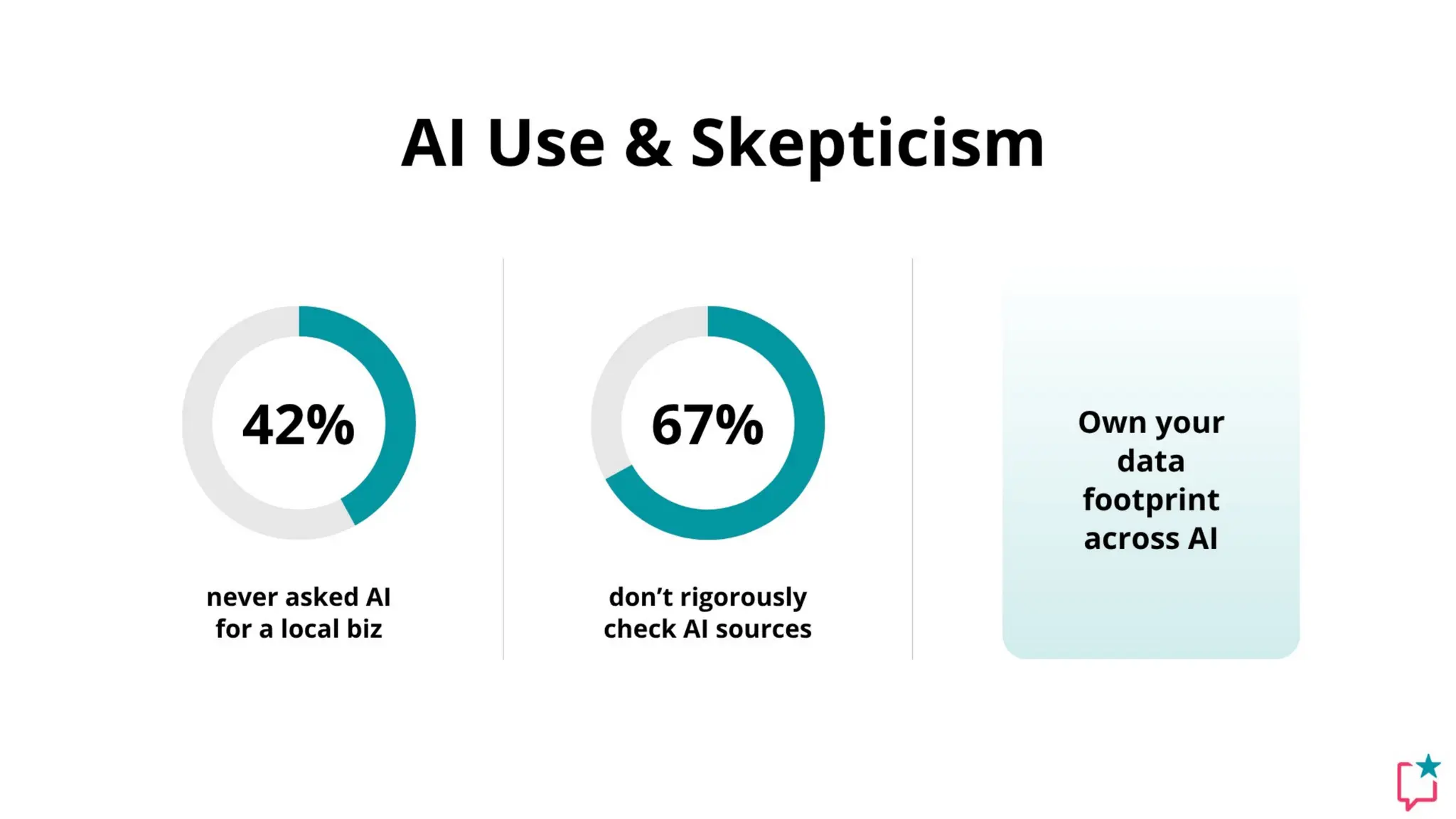
  • #12 “We’ve seen how people start searches and that typed intent still rules. Now let’s look at how AI fits into the discovery journey—and where consumers are cautious.” “AI is clearly part of the toolkit, but many consumers are still testing the waters. 42% have never asked AI for a local business. That’s changing as people learn how to use these tools day-to-day.” “When people do use AI, most aren’t validating what it shows them: 67% don’t rigorously check the sources behind AI summaries. This raises a big operational point—if your listings and profiles aren’t consistent across the web, AI may assemble a version of your business you don’t control.” “AI helps surface options, but reviews still seal the decision. Your job is to keep your digital footprint consistent and your reviews fresh so AI and humans both see the same, authentic story.”
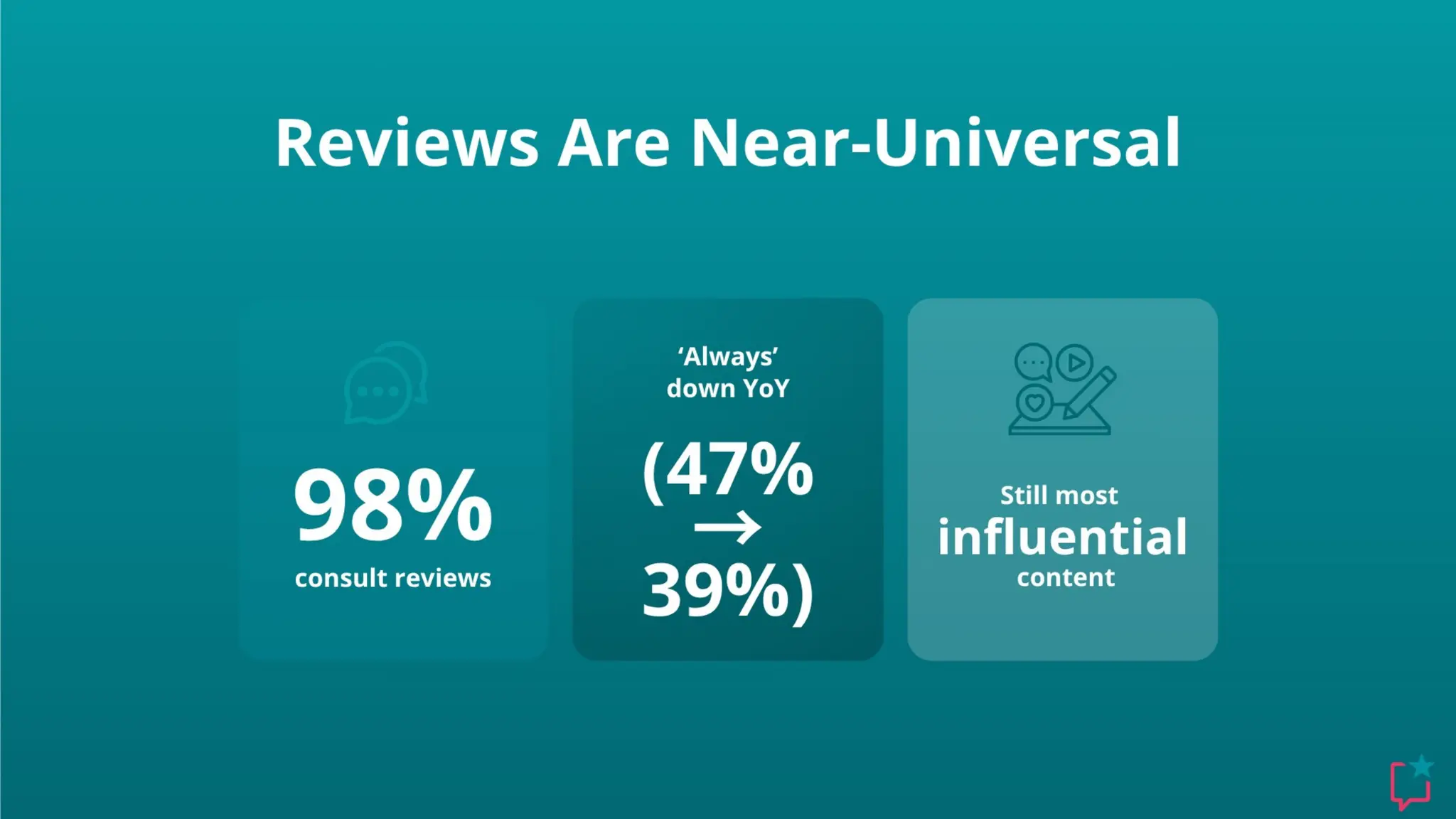
  • #13 “So while AI is changing how people search, one thing hasn’t changed — nearly everyone still relies on reviews to make decisions.” “Our data shows that 98% of consumers read reviews before making a purchase or visiting a business. That’s essentially everyone — reviews have become a universal part of the buying journey.” “And this habit is growing deeper: half of consumers say they’re reading more reviews than they did last year. People aren’t just glancing at star ratings anymore — they’re analyzing tone, detail, and how businesses respond.” “Why? Because reviews remain one of the last, authentic trust signals in an increasingly AI-driven discovery world.” “They also influence both pre- and post-sale trust — helping customers feel confident that if something goes wrong, a business will make it right.” One possible explanation for the decrease of ‘Always’ from 47% to 39% could be the users driven to AI search results and are not a deep dive into the AI results like we saw on the previous slide. Key takeaway “Reviews aren’t going anywhere. In fact, as AI summarizes and aggregates information, reviews have become the data source behind the summaries. Keeping them fresh, authentic, and visible is critical — for both people and algorithms.”
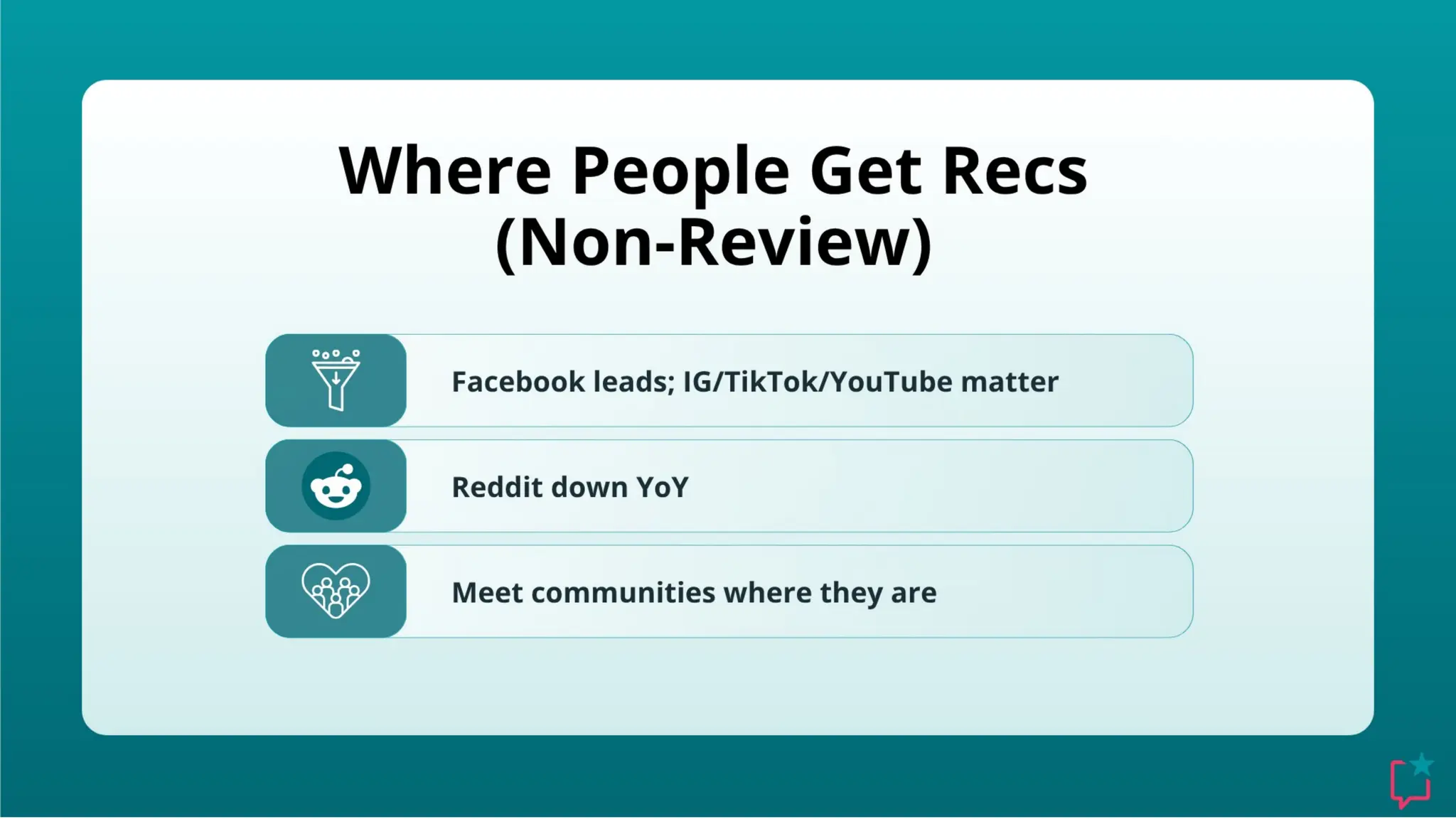
  • #14 So another important question is: where are they actually getting their recommendations if they are not turning to traditional reviews? “Social media and local groups are growing, but they still trail reviews and personal referrals by a wide margin. They’re more for discovery than decision-making.” “What this shows is that consumer recommendations have gone digital. Reviews have become the modern version of word-of-mouth — faster, broader, and always accessible. It reinforces what we’ve already discussed: your reviews don’t just support discovery; they drive recommendations at scale.” “When people look for a trusted business, they don’t just ask friends anymore — they ask the internet. And the voices they trust most are the ones inside your reviews.”
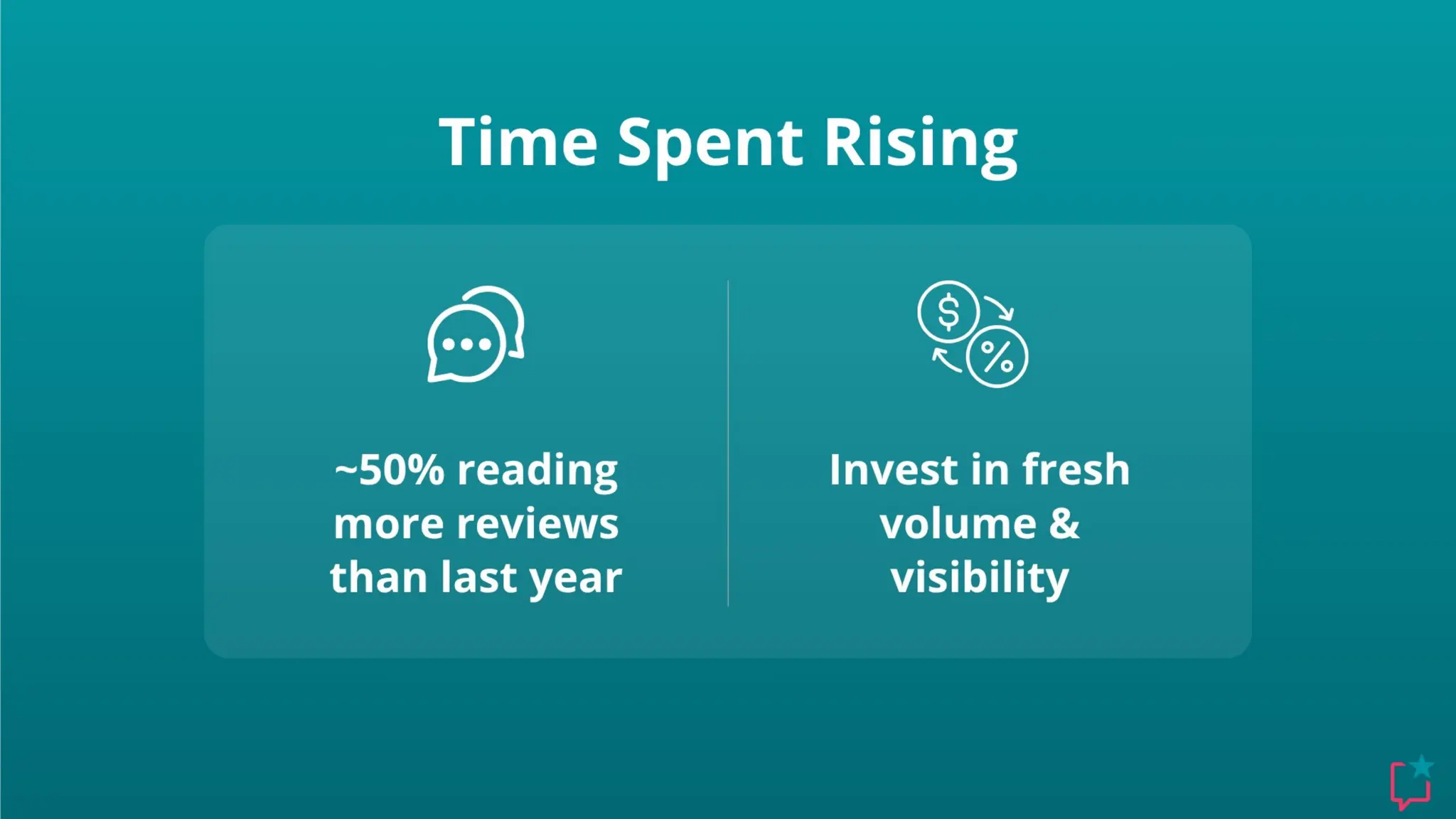
  • #15 “But it’s not just that people are reading them. They’re spending more time doing it.” “Consumers today are digging deeper before they decide. Nearly half of all consumers say they’re reading more reviews than they did a year ago — and they’re not just scanning star ratings anymore. They’re scrolling through detailed feedback, comparing experiences, and looking for patterns or authenticity in what other customers share.” “That shift tells us something powerful: Trust now takes more than just a quick glance. Customers are doing their homework — and they’re using reviews to validate whether a business consistently delivers what it promises.” “This ties directly to what we discussed earlier about discovery. Search still starts the journey — but the decision is made in the reviews. That extra time consumers spend reading is where trust is built or lost.” “And this shift in behavior sets up an even bigger opportunity — because as consumers spend more time reading, they’re rewarding businesses that keep their feedback fresh and visible. We’ll talk more about that later — but for now, think of it this way: Fresh activity isn’t just nice to have anymore — it’s what signals that your business is current, responsive, and real.”
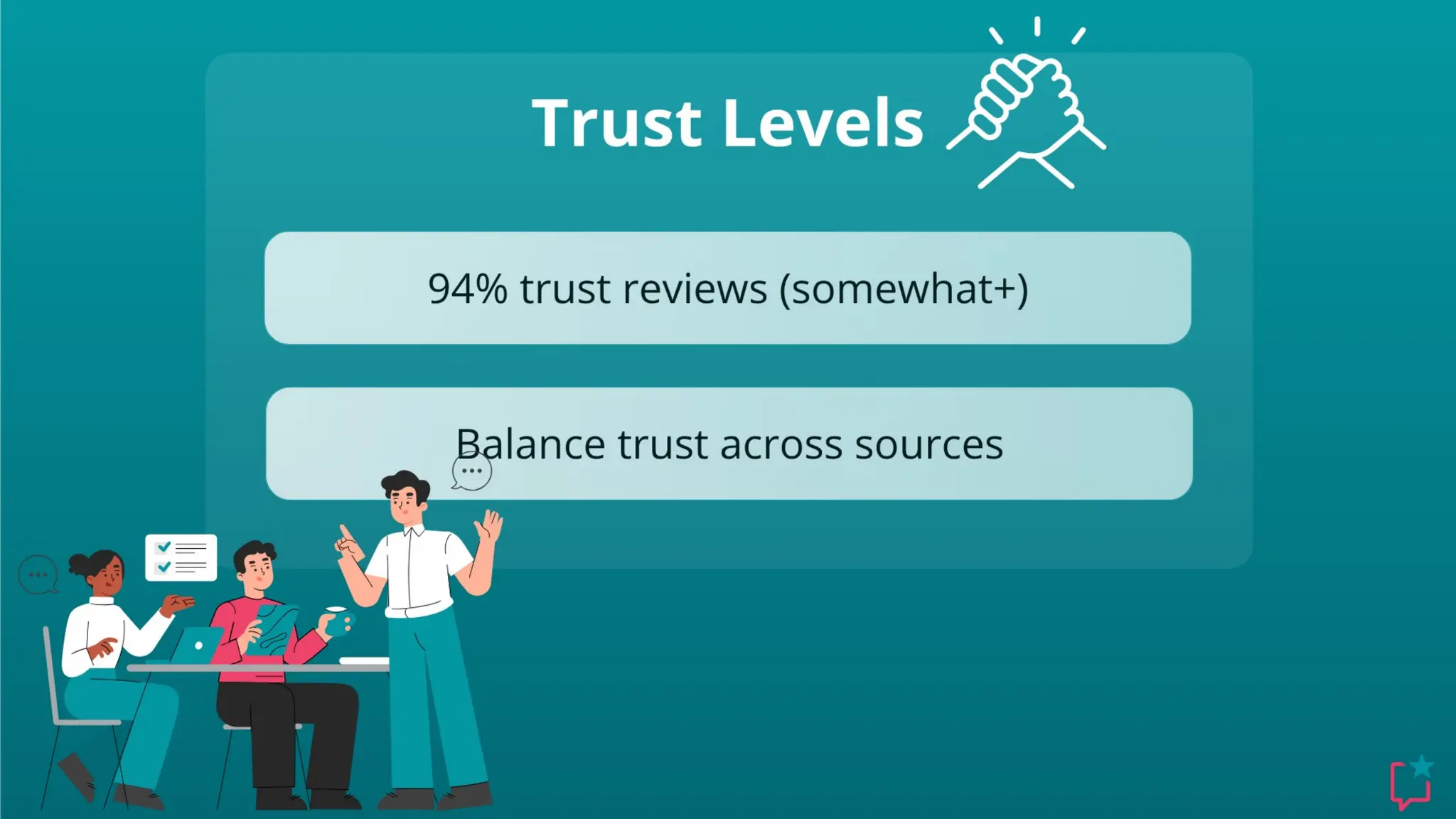
  • #16 “And the reason people spend more time is simple — they’re trying to decide who they can really trust.” “94% of consumers say they trust reviews at least somewhat. That’s nearly universal — reviews have become the primary trust signal for local businesses. But this trust isn’t static or automatic anymore — it’s earned and verified across multiple touchpoints.” “As AI and conversational search continue to grow, the way consumers encounter your reputation is changing. AI tools are now pulling review content and business data from everywhere to summarize your brand story for the customer. That means if your information isn’t consistent across those sources, AI might end up telling an incomplete version of your business. Consistency across the web — names, hours, categories, services — has quietly become a new foundation of trust.” “So this 94% figure isn’t just about believing reviews. It’s about believing what’s consistent across the internet. “Over the next few slides, we’ll look at the details behind that trust: What people actually notice when they evaluate reviews, How different review thresholds shape decision-making, And how visibility across channels reinforces credibility. Each of these metrics gives us insight into how to maintain trust in this new AI-driven landscape.”
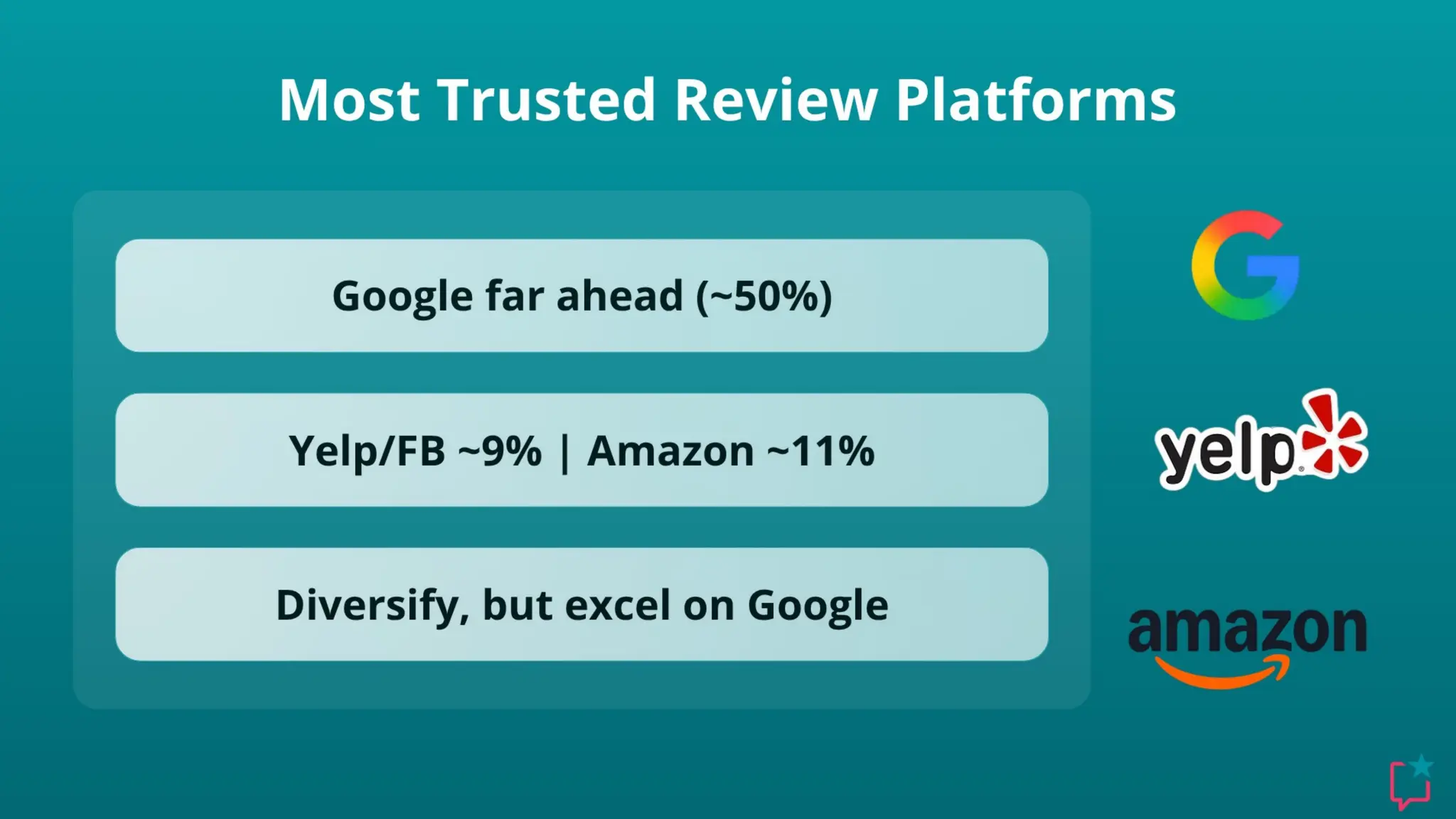
  • #17 “When we asked consumers which platforms they trust most for reviews, Google continues to dominate — by a wide margin. It’s the first stop for most people, not just because of habit, but because Google integrates reviews directly into the discovery experience — maps, search, and even AI summaries. Right behind Google, we see Yelp and Facebook still holding meaningful trust with consumers, especially in service industries and local community-based businesses. Then there’s Amazon, which remains a powerhouse for product reviews — though its influence in local service decisions is lower.” “And now, with AI pulling data from all these platforms, that consistency we talked about becomes even more critical. If your reviews say one thing on Google and another somewhere else, AI and customers both notice. Inconsistency introduces doubt — and doubt costs conversions.” “So, when we talk about ‘managing your reputation,’ we’re not just talking about Google — we’re talking about the ecosystem of reviews. Each platform serves a different purpose, but together, they tell one story about your business.” The goal isn’t to be everywhere — it’s to be consistent everywhere.”
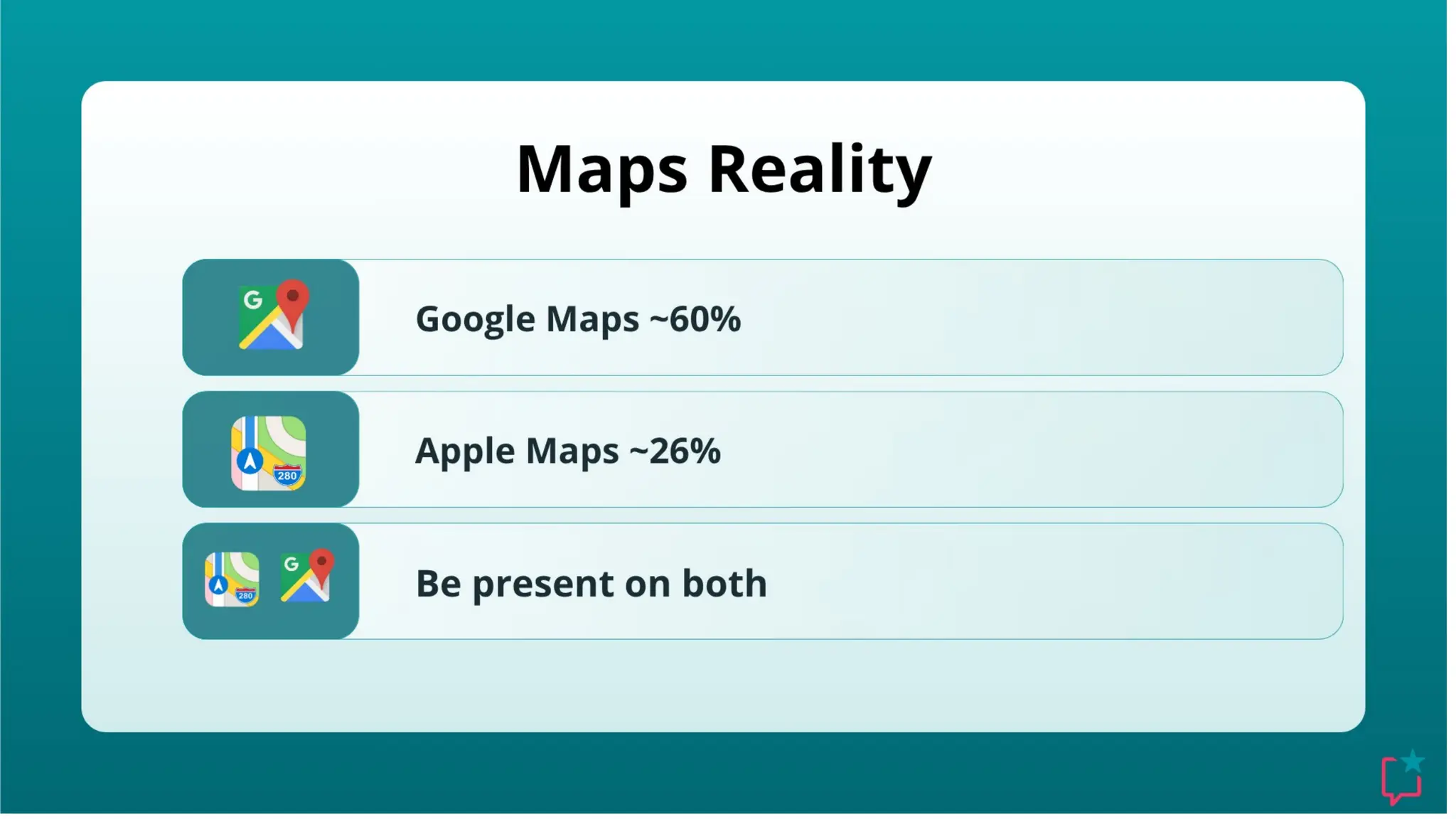
  • #18 “Maps continue to play a major role in local discovery. When consumers start their search, 58% still begin with a traditional search engine, but maps are now the second most common entry point — with 14% starting their journey directly inside map apps.” “And when we break that down further, Google Maps accounts for about 60% of that traffic, while Apple Maps represents roughly 26%.” “Again, what’s important here is consistency. AI, search engines, and consumers all cross-check your listings. So if your hours, services, or categories differ across Google and Apple Maps — or across directories like Facebook — it can cause confusion or even lower your visibility.” “Think of this as digital hygiene: ensuring that every version of your business online is consistent, current, and complete.” “Maps are not just navigation tools — they are also discovery engines. If your information isn’t correct there, you’re not just missing directions — you’re missing customers.”
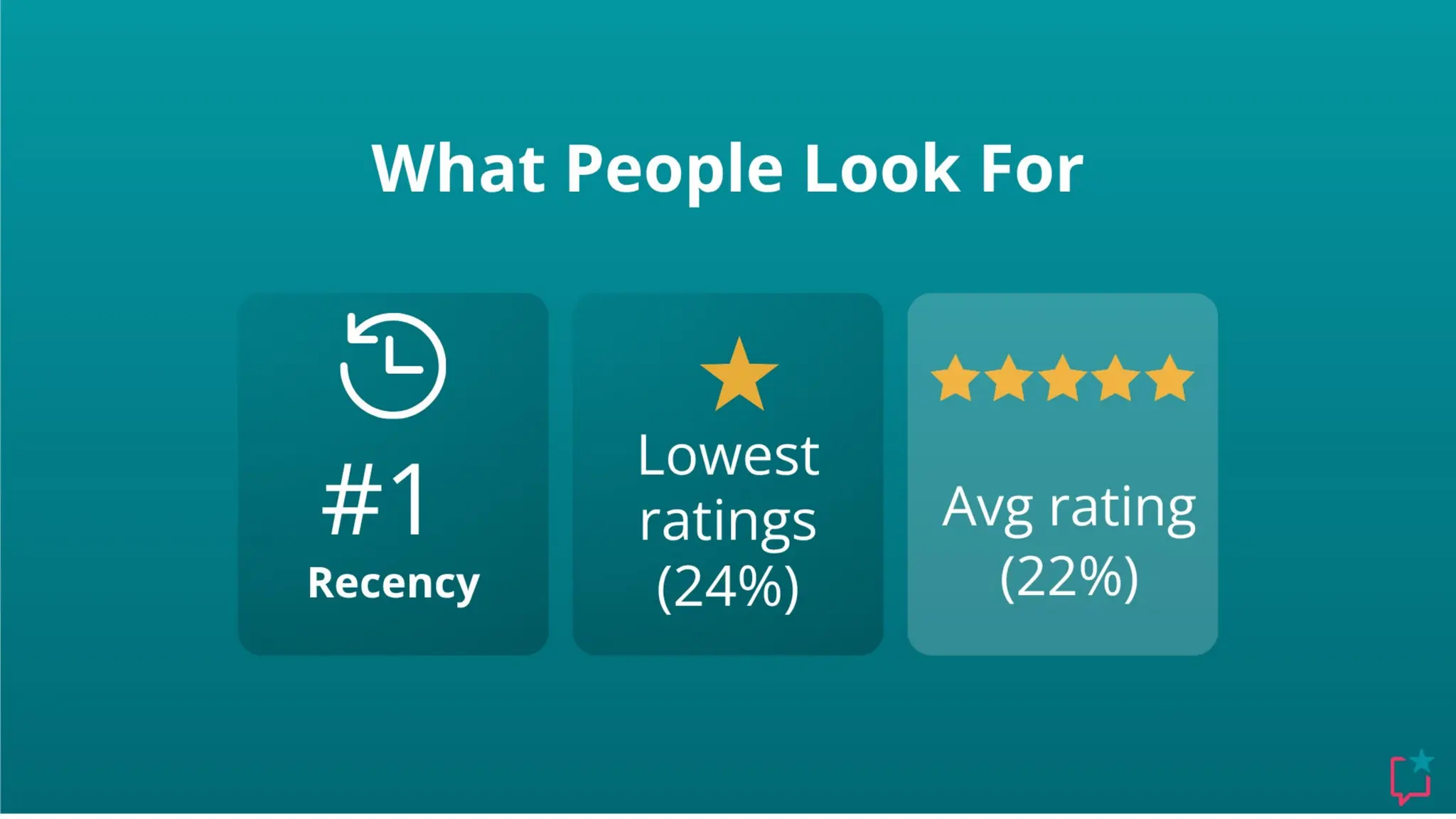
  • #19 On this journey we have gone through discovery, but “What exactly are they looking for in those reviews once they get there? “The data here is pretty revealing. When consumers land on a review profile, their top priority is recency. They want to see what’s happening right now. “Next, they’re checking for low ratings and how businesses respond to them. People know that no company is perfect — but what matters most is how you handle imperfection. Do you reply? Do you make it right? A thoughtful response can completely flip perception.” “And of course, average rating still plays a big role. So while a perfect 5.0 may look suspicious, falling below four stars can quickly affect conversions.” “What’s interesting here is that consumers are pattern-spotting. They’re looking for signs of authenticity that helps them build confidence.” “Recency, responsiveness, and rating — those are the three R’s of trust. Keep your reviews fresh, reply thoughtfully, and protect your average rating. Together, those elements drive purchase intent.”
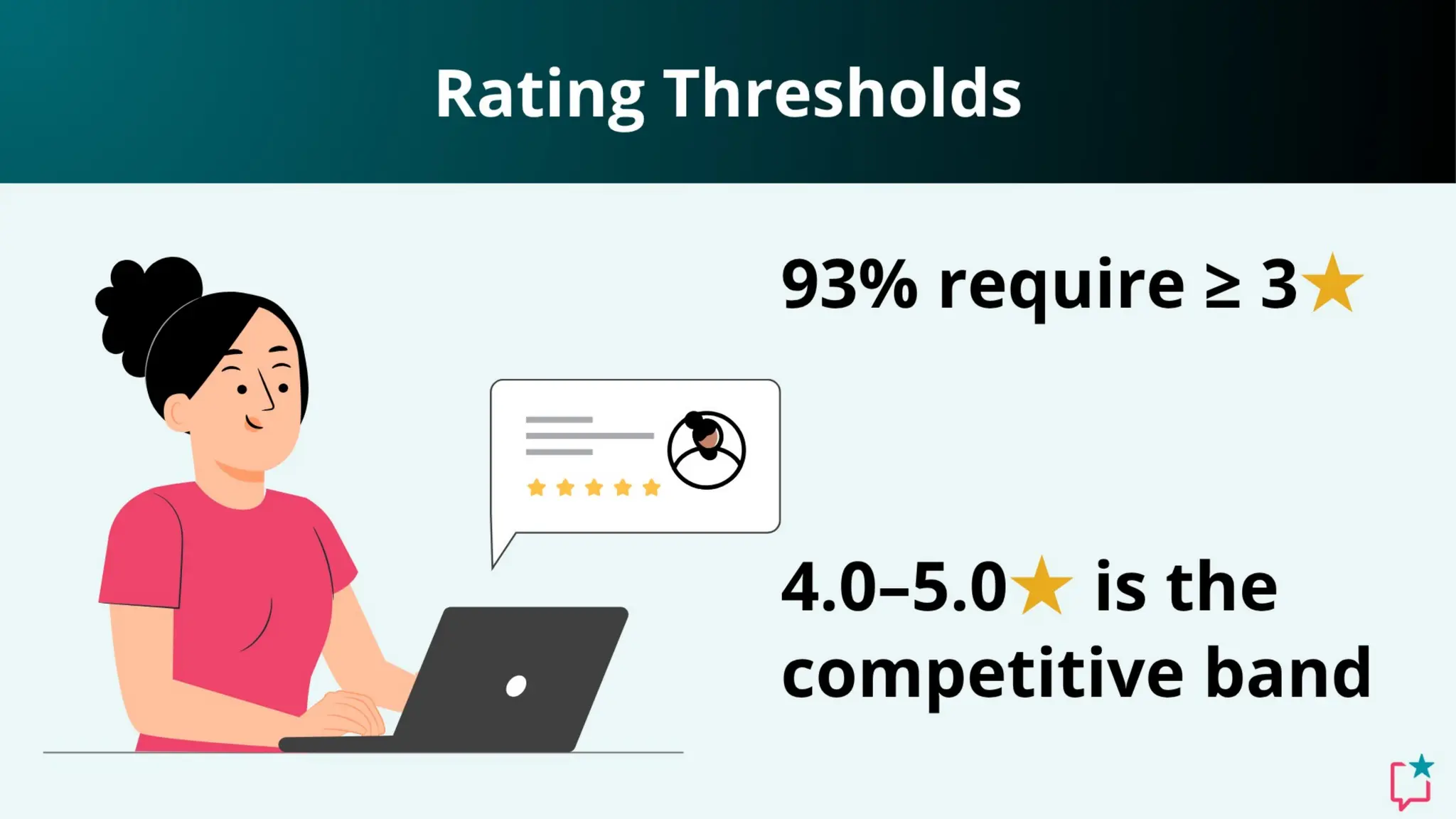
  • #20 “Let’s break those down a little further into those trust signals within reviews” “When we asked consumers how star ratings influence their decisions, 93% said they require at least a three-star rating before they’ll even consider a business. That’s essentially the baseline for credibility.” “But to compete, you need to be in the four-to-five-star range. That’s where the majority of purchase decisions are made and where trust is cemented.” “Anything below four stars signals uncertainty — not necessarily failure, but a lack of consistency that makes people hesitate. And in a world where every click counts, hesitation can cost you the lead.” “What’s important to remember here is that consumers aren’t expecting perfection. In fact, too many flawless five-star reviews can sometimes feel not authentic. What they’re looking for is a credible average supported by authentic responses and recent engagement. That’s what convinces them you’re a trustworthy business.” “So when you see a dip in your rating, don’t panic — see it as an opportunity to strengthen your response strategy, address trends, and demonstrate care. The way you manage reviews below five stars can actually drive more loyalty than the perfect ones.” “Ratings matter, but credibility matters more. A steady stream of honest four- and five-star reviews — with consistent, human responses — is far more powerful than chasing perfection.”
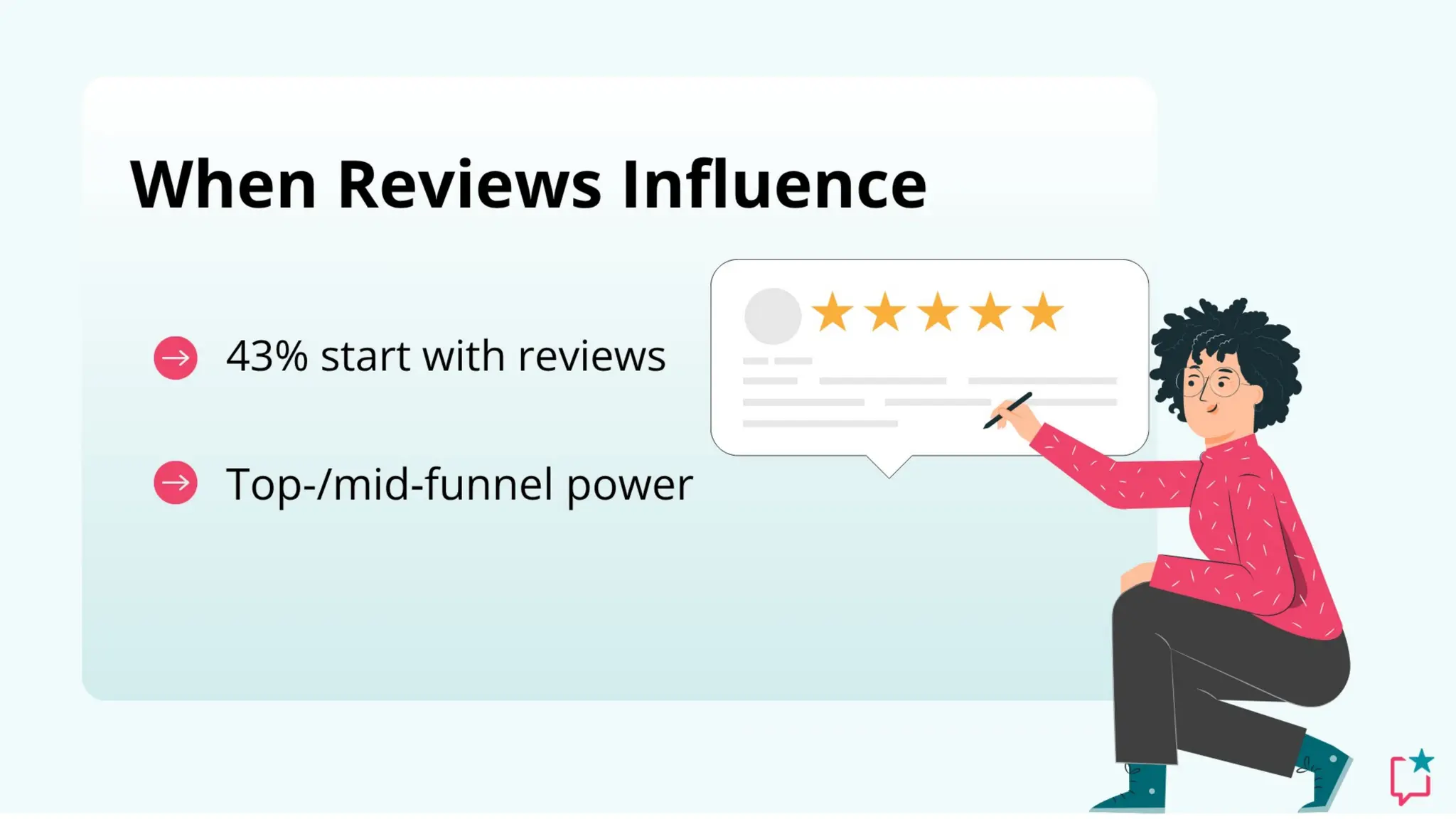
  • #21 “When we asked consumers about when reviews come into play in their buying process, nearly half — 43% — said they start with reviews right away. Before looking at a website, before calling the business, before comparing prices — they’re scanning reviews to answer two key questions: Can I trust the product or service? Can I trust the company behind it?” Reviews are no longer the last step in validating a choice — they’re the first filter in deciding who even makes the shortlist. That means your reputation is influencing leads before you ever have the chance to make a pitch.”
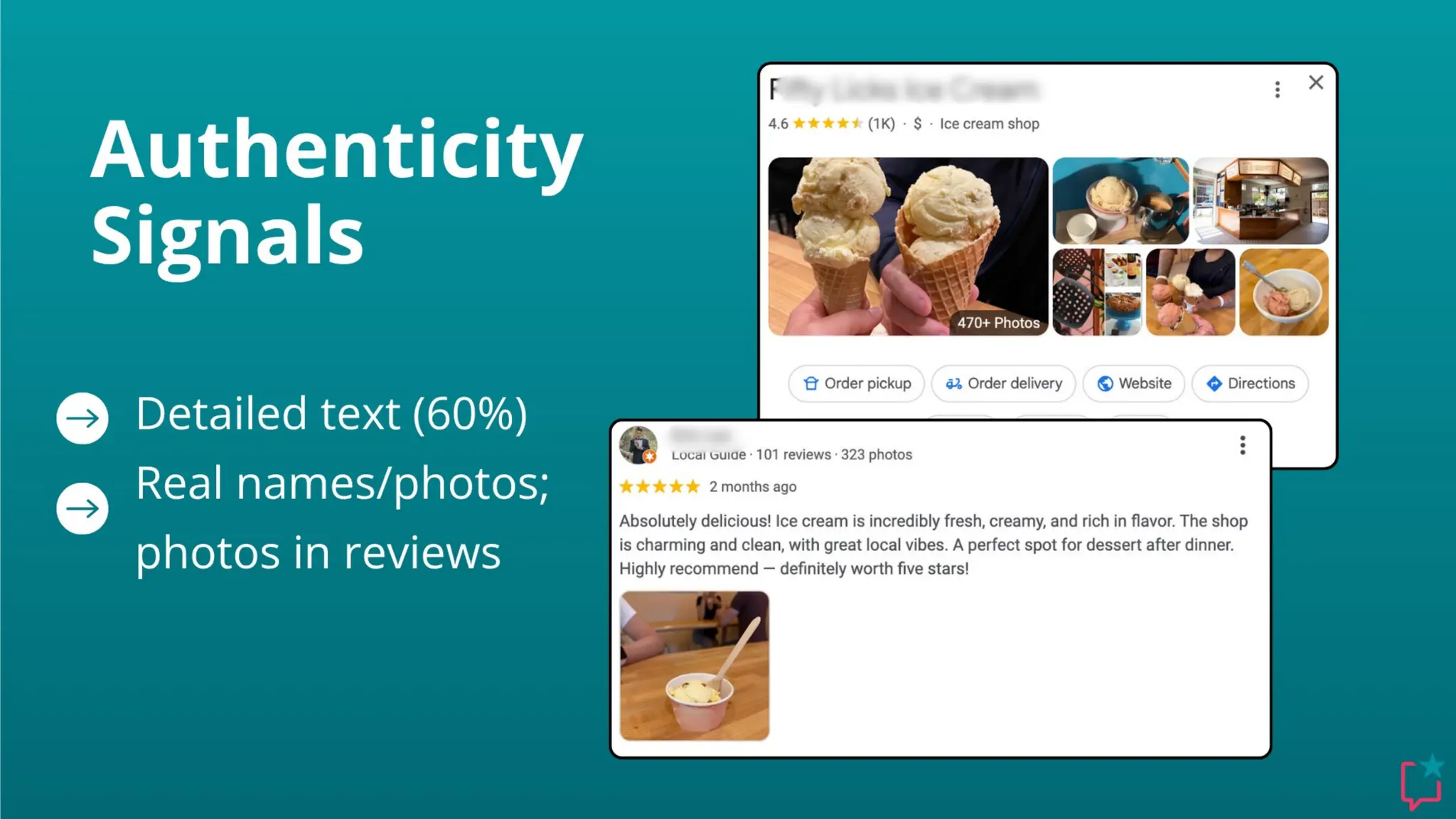
  • #22 “When people dive into reviews, they’re not just skimming star counts. They’re reading for authenticity signals. 60% of responders were looking for detailed text — descriptions of real experiences. Photos or names — which help validate that the review came from a real person. And consistency in tone — a mix of praise and constructive feedback that feels believable.”
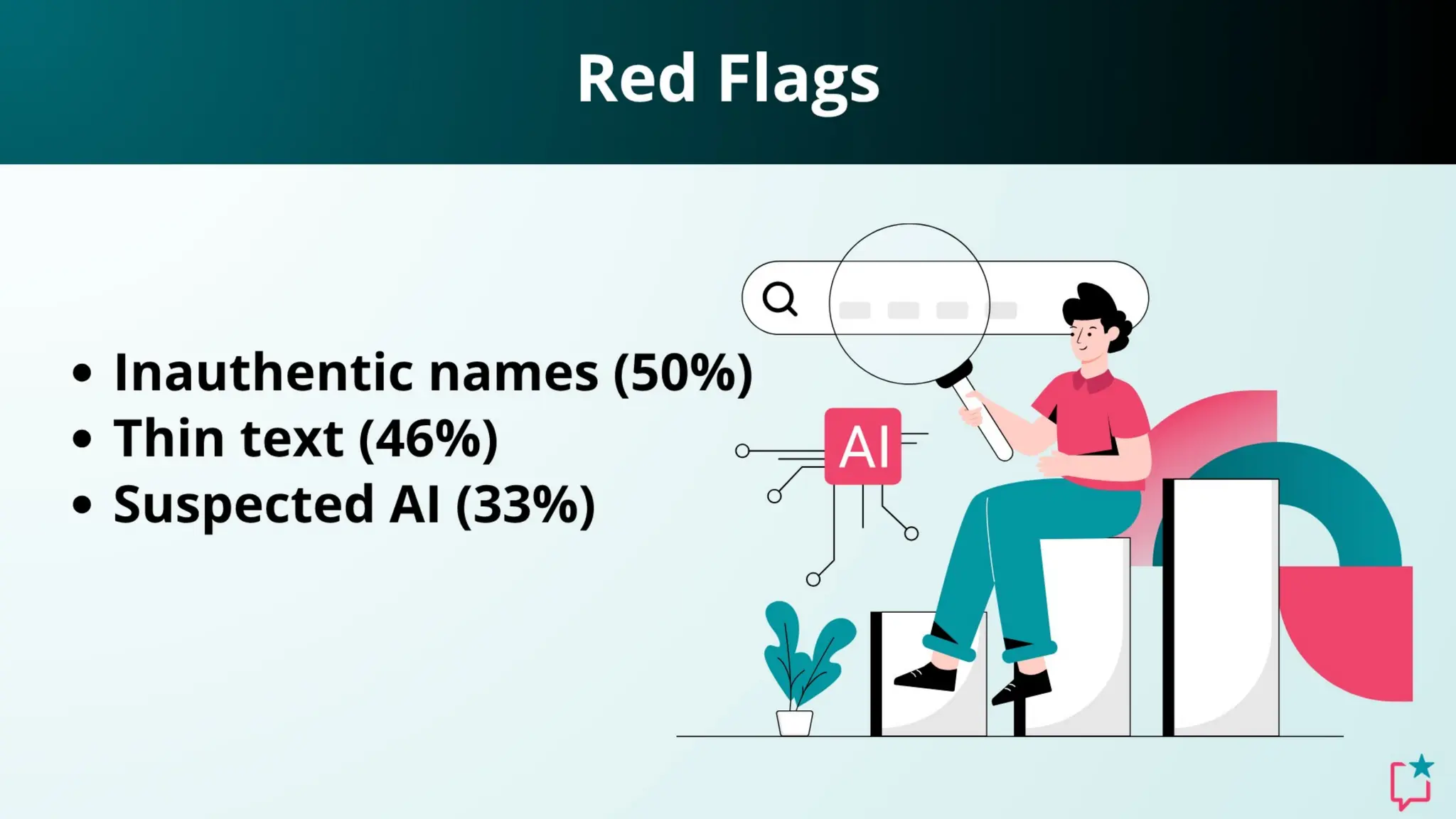
  • #23 “We also heard something that should make every business sit up straight: consumers are highly sensitive to anything that feels fake. If reviews seem AI-written, overly generic, or repetitive, they start to doubt” “This reinforces a key theme of this year’s study: authenticity builds trust. The content and tone of your reviews — not just the score — determine how much trust you earn.” “It also means that encouraging detailed, story-driven reviews is more valuable than collecting a pile of short, repetitive five-star posts.”
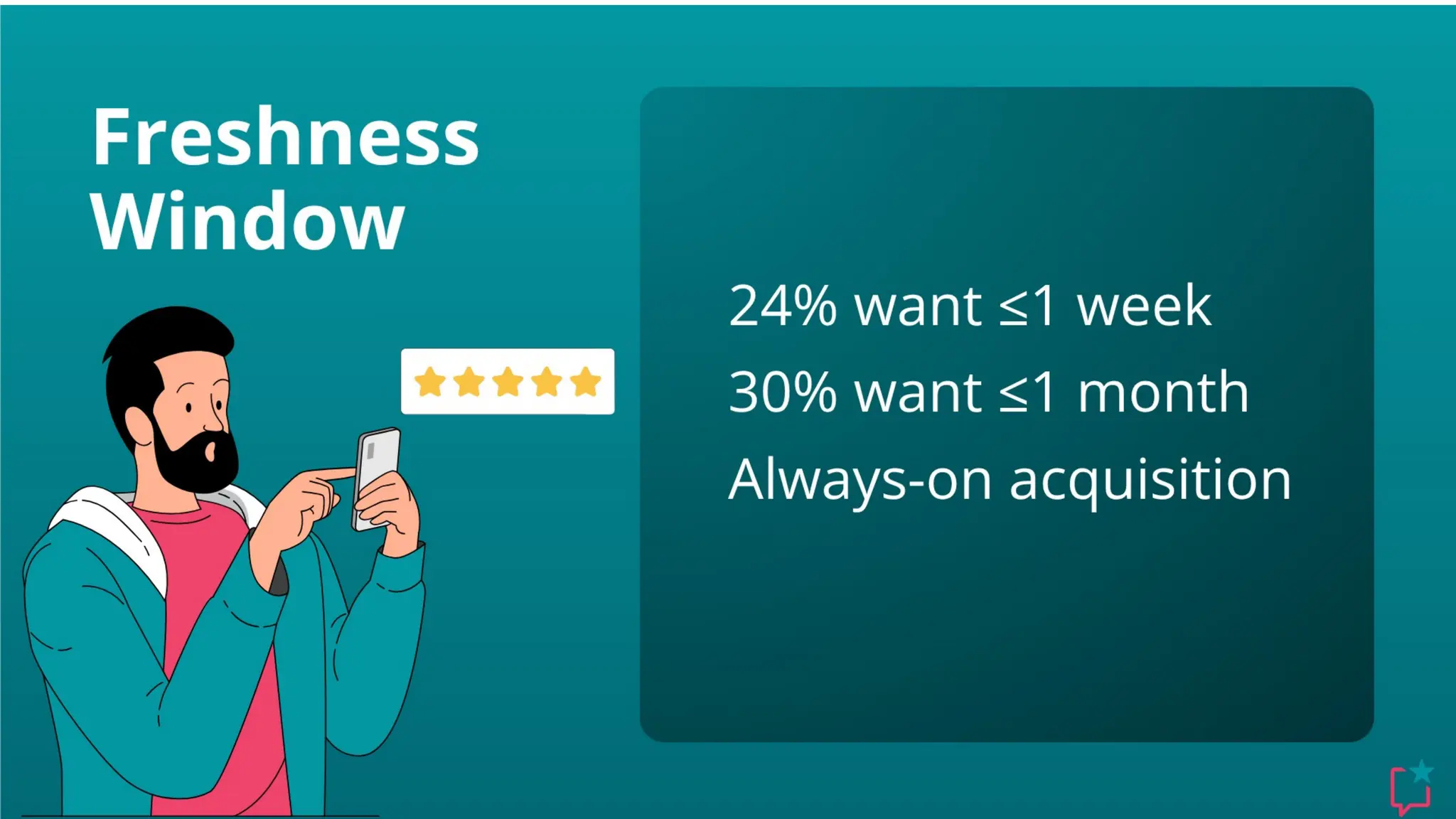
  • #24 “So if reviews influence trust, the next question is what kind of reviews earn it fastest.” “From our survey, consumers told us the most important factor when reading reviews is recency. 24% want to see reviews less than a week old, and 30% want to see reviews less than a month old. That means over half of consumers are judging credibility by what’s happened in the last 30 days.” “They’re also scanning for authenticity markers — real names, specific details, natural tone, and photos. Anything that looks thin, vague, or AI-generated triggers skepticism. Consumers are savvier than ever — they can spot automation in a heartbeat.”
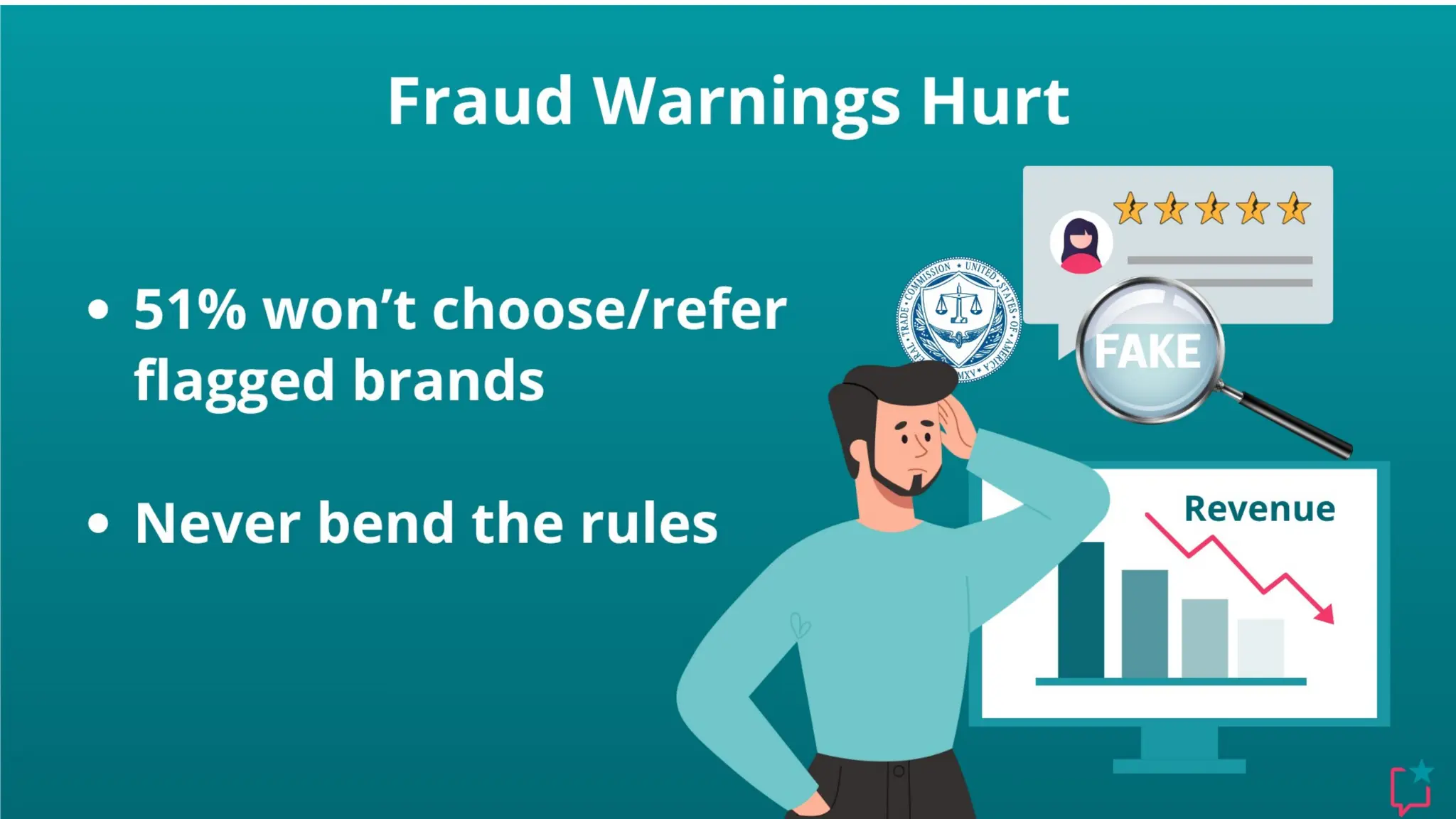
  • #25 And bending the rules only leads to further distrust. “And here’s a big one: 51% of people say they won’t choose a brand that’s been flagged for fake reviews. Google has already started labeling businesses when it detects patterns of fake feedback. Those warnings are highly visible — and incredibly damaging.” You can’t let a single fake or suspicious review go unchecked.
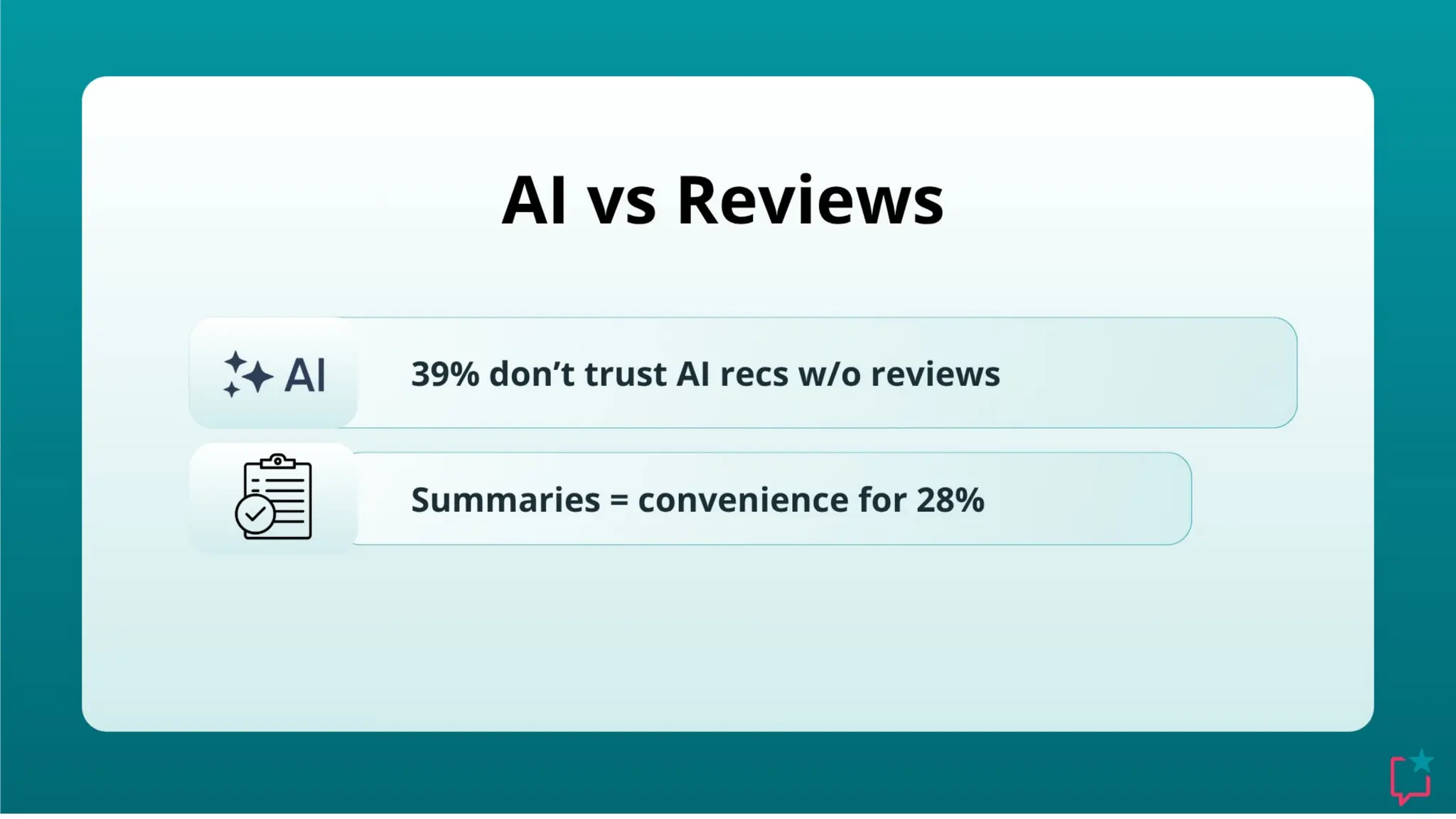
  • #26 “When we asked consumers about their comfort level with AI summaries and suggestions, the results were clear: 39% said they don’t trust AI recommendations if they’re not backed by real reviews. 28% said they love the convenience of AI summaries — fast, simple overviews that help them narrow choices quickly. This tells us something powerful: consumers appreciate AI’s efficiency, but they still rely on reviews for validation.” “And remember, 67% of consumers don’t rigorously check AI’s sources. That means AI may be pulling and summarizing outdated or inconsistent data about your business. If your listings, website, and reviews aren’t aligned, you’re letting the algorithm write your brand story for you.” “This is why owning your digital footprint is more important than ever. Every inconsistency — a mismatched business name, an outdated photo, missing reviews — introduces noise into how AI describes you.”
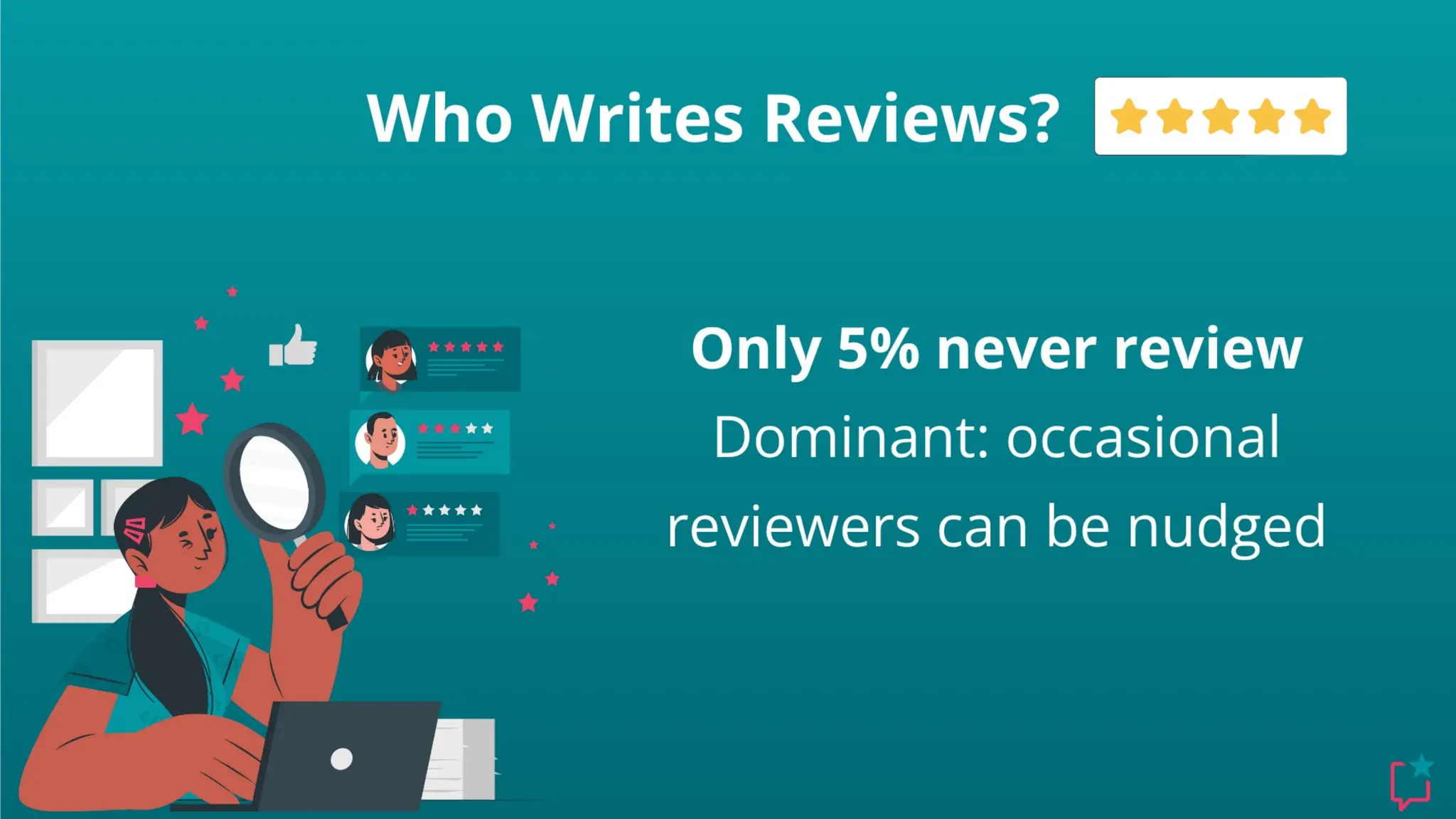
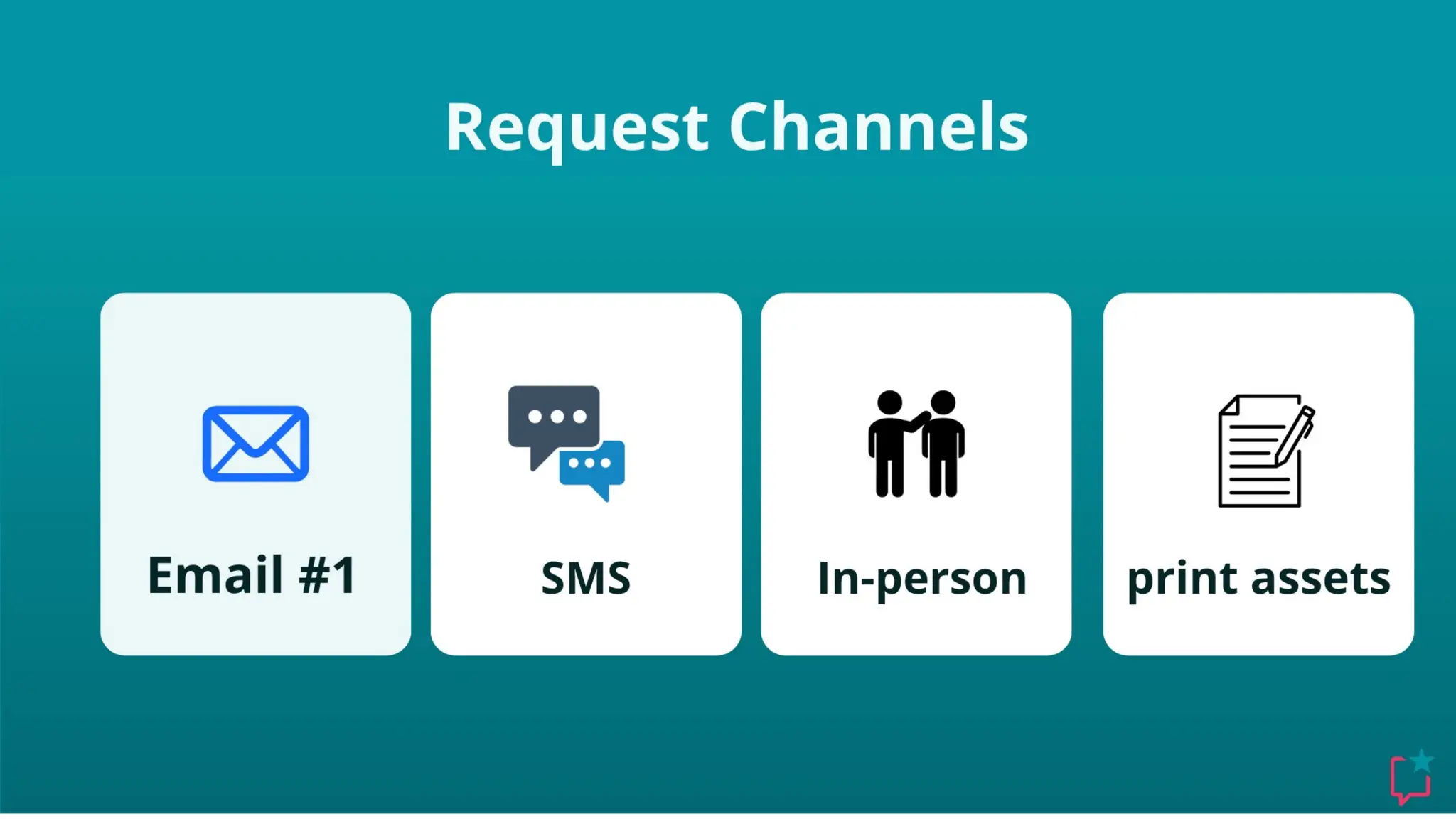
  • #27 “So now that we know how reviews shape trust — and how AI amplifies that reputation — let’s talk about the part that’s completely within your control: asking for reviews.” “Our survey found that only 5% of consumers said they would never leave a review. That means 95% of people are open to giving feedback — you just have to ask.” “So when asking meet customers where they are — by email, SMS, or in person. If you’re a service business, verbal requests work great. If you’re brick-and-mortar, QR codes at checkout are simple and powerful. For recurring services, even printed handouts or follow-up cards can help.” “The key is frictionless access. One click, one tap, one scan — and they’re right where they need to be to leave a review.” “Asking is free but forgetting to ask is expensive.”
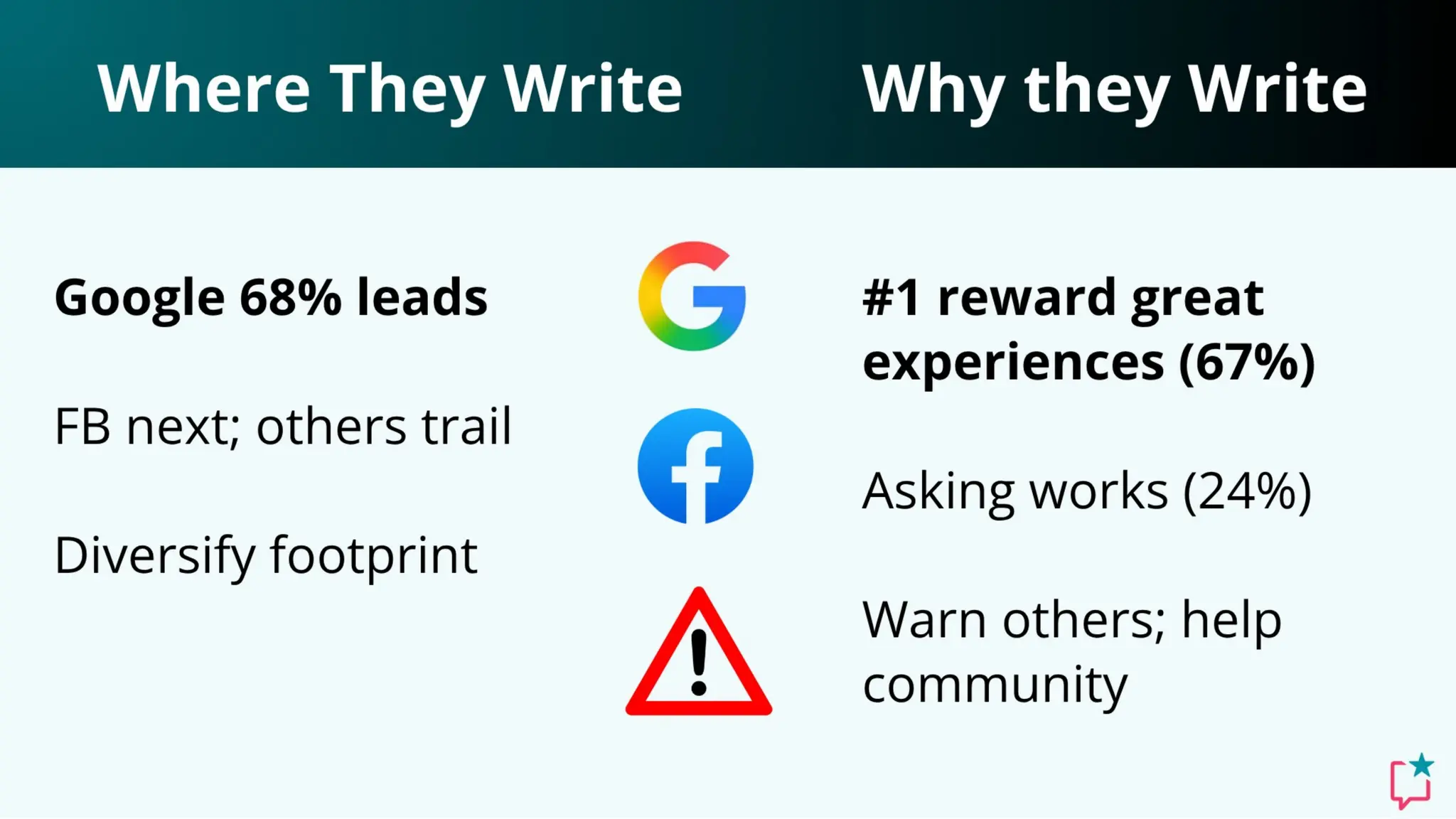
  • #28 “So what motivates someone to actually follow through. First, to reward a great experience. When someone feels genuinely appreciated or impressed, they want to pay that forward — it’s a moment of emotional reciprocity. A simple, heartfelt ‘thank you’ moment where the customer becomes your advocate. Second, they write reviews because they were asked. It’s easy to forget that many customers simply need permission or a prompt. When you ask sincerely — not as a transaction, but as part of the relationship — people are surprisingly willing to help. And third, they write to help others — or to warn them. Consumers see themselves as contributors to a shared network of trust. They want to inform, protect, or guide others in their community. What this tells us is that reviews are as much about belonging and connection as they are about feedback. When we treat customers like participants in our story — not just data points — we get richer, more authentic responses.”
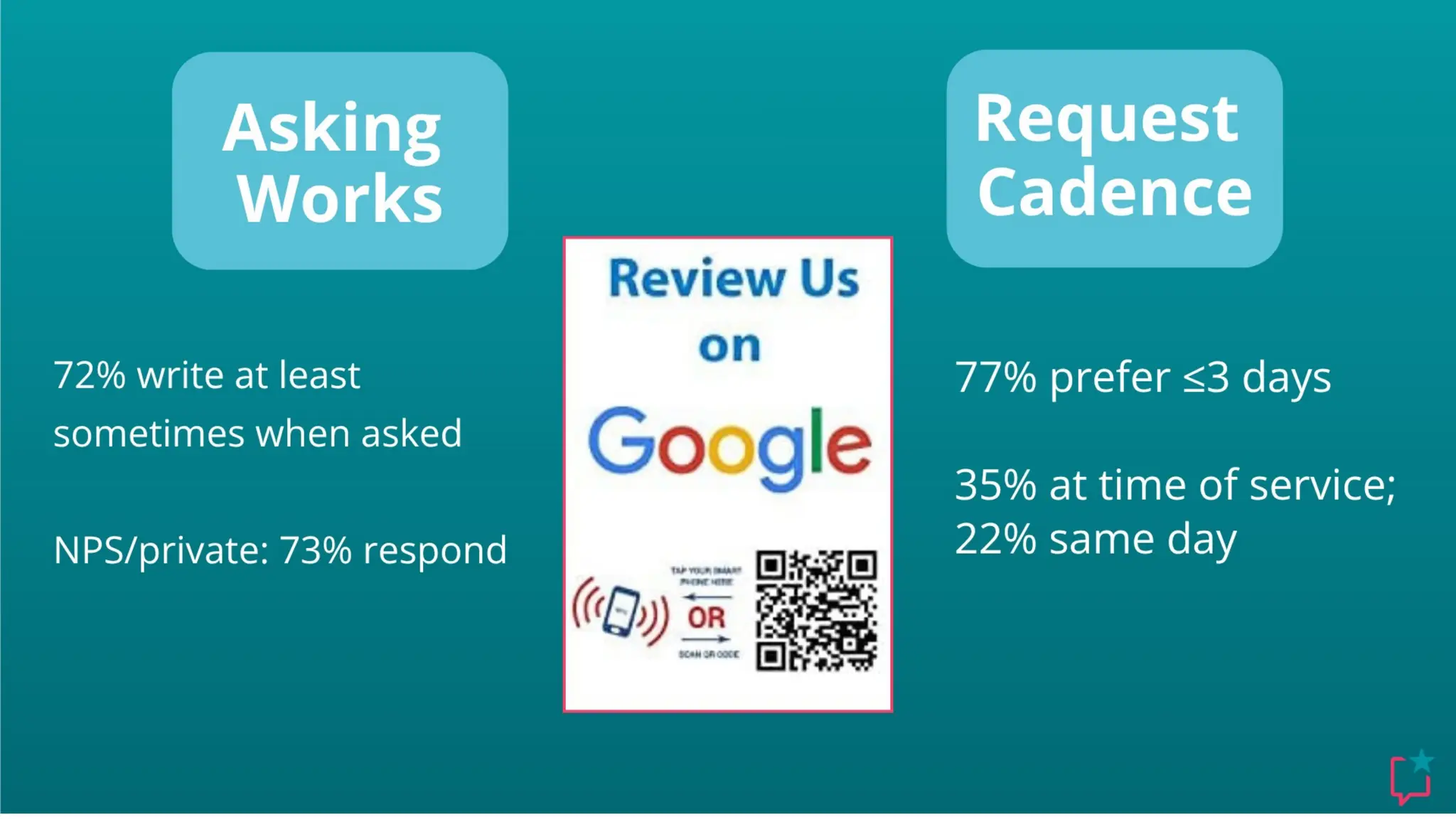
  • #29 “Let’s move from the request to the results: does asking actually work, and when do customers want you to ask?” Why asking works “It does. 72% of consumers will write a review when a business asks, and 73% will respond to simple rating prompts like NPS or stars.” “A meaningful slice (~24%) say they’ll leave a review simply because they were asked.” “and remember only ~5% say they’d never leave a review.” When to ask “Timing is clear: 77% prefer the request within three days of the experience.” “There’s also appetite for speed: 35% like it at time of service, and 22% prefer same day.” What this means for you “Make the ask part of your standard flow, not an afterthought.”
  • #30 “So, we know asking works — and we know timing matters. But the channel you use to ask can be just as important as when you ask.” “Different customers respond to different kinds of outreach. Some will answer a text within minutes; others only check their email once a day. That’s why the most effective review strategies use multiple channels to reach people naturally, in the ways they already communicate. Start with email — it’s reliable and familiar. It gives customers a chance to reflect and respond when it’s convenient for them. Add SMS — it’s quick, direct, and perfect for service-based experiences where you’ve just wrapped up the interaction. For in-person moments — like a checkout counter, front desk, or field visit — verbal requests backed by a QR code or small printed card make the ask feel personal and immediate. And don’t forget print or signage — something simple that customers can scan later if they’re in a hurry. The key is to reduce friction; one tap or one scan should take them straight to the review page.” “The goal isn’t to overwhelm customers with choices — it’s to make leaving a review effortless, wherever they are and however they prefer to engage. When you show up across channels consistently, you multiply your chances of collecting authentic feedback without sounding pushy.”
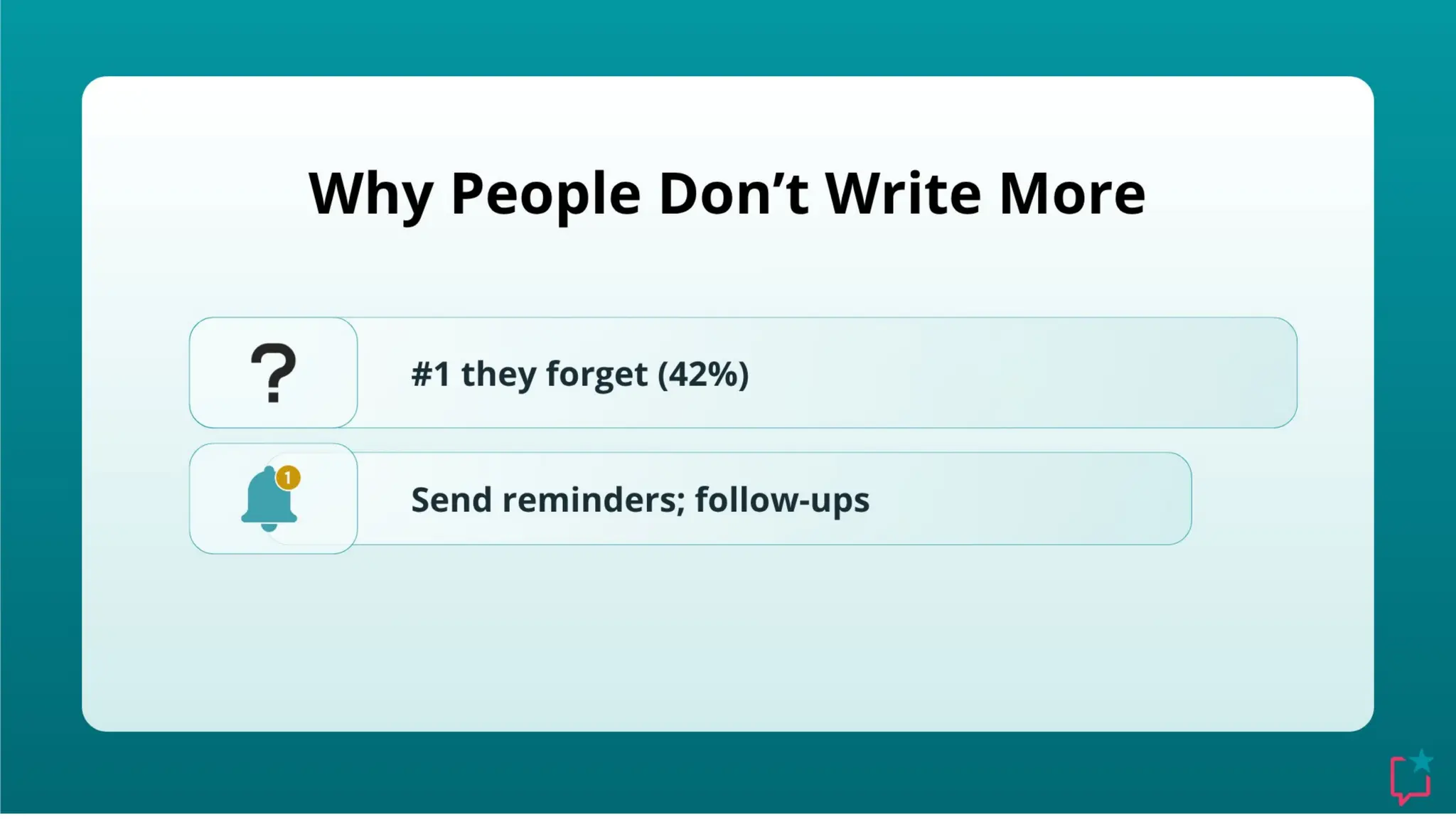
  • #31 But here’s the reality: most people still won’t respond the first time. Not because they don’t want to — they just forget.” “That’s where reminders come in. Reminders aren’t pressure; They’re a friendly nudge that says, ‘Hey, we’d still love to hear how we did.’ Think of them as part of the customer experience. When done right, reminders feel helpful, respectful, and personal.” “Start with timing. A gentle follow-up a few days after the initial ask is often all it takes. If your customers have recurring visits, you can space those reminders further apart — maybe once a month or quarterly — depending on your business type. Mix up your channels. If the first ask went out by email, try a text for the reminder. If you asked in person, follow up digitally. Keep the tone simple: friendly, brief, and authentic. ‘We’d love your feedback — it helps us improve and keeps our team motivated.’” When reminders are part of your process, you capture honest, timely feedback you’d otherwise lose.
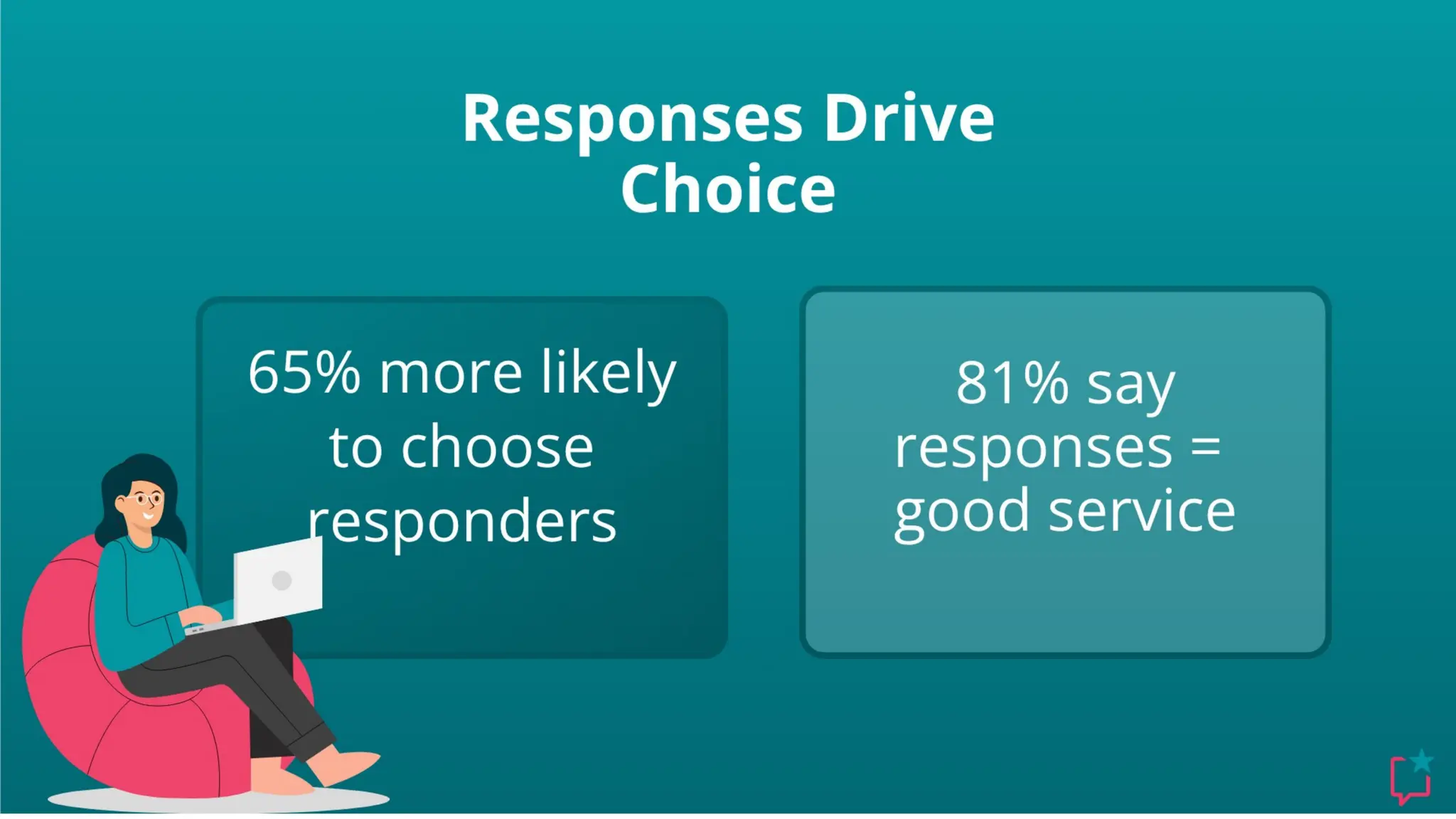
  • #32 Now lets round out the journey to building trust with the final step of responding to reviews” “Our data shows that how you respond to reviews directly impacts whether someone chooses your business. In fact, 65% of consumers say they’re more likely to choose a business that responds to reviews, and 81% say that seeing responses is a sign of good service. That means your replies are no longer just courtesy — they’re conversion drivers. Every response you write is a public proofpoint of how your business treats people.” “When someone’s researching where to spend their money, they’re not just reading the stars — they’re reading the tone. They want to see empathy, accountability, and gratitude. A simple ‘thank you’ for a positive review makes a customer feel valued. A thoughtful response to a negative review shows professionalism and integrity. Both build confidence in the next potential buyer.” “So, think of your review responses as your frontline of customer experience. You’re not just replying to the person who wrote the review — you’re speaking to everyone else who will read it later. And in many cases, that’s hundreds or thousands of people making decisions based on how you handle feedback.” “Responses aren’t just reactive — they’re reputation marketing. Each one reinforces your brand’s voice, your values, and your commitment to service.”
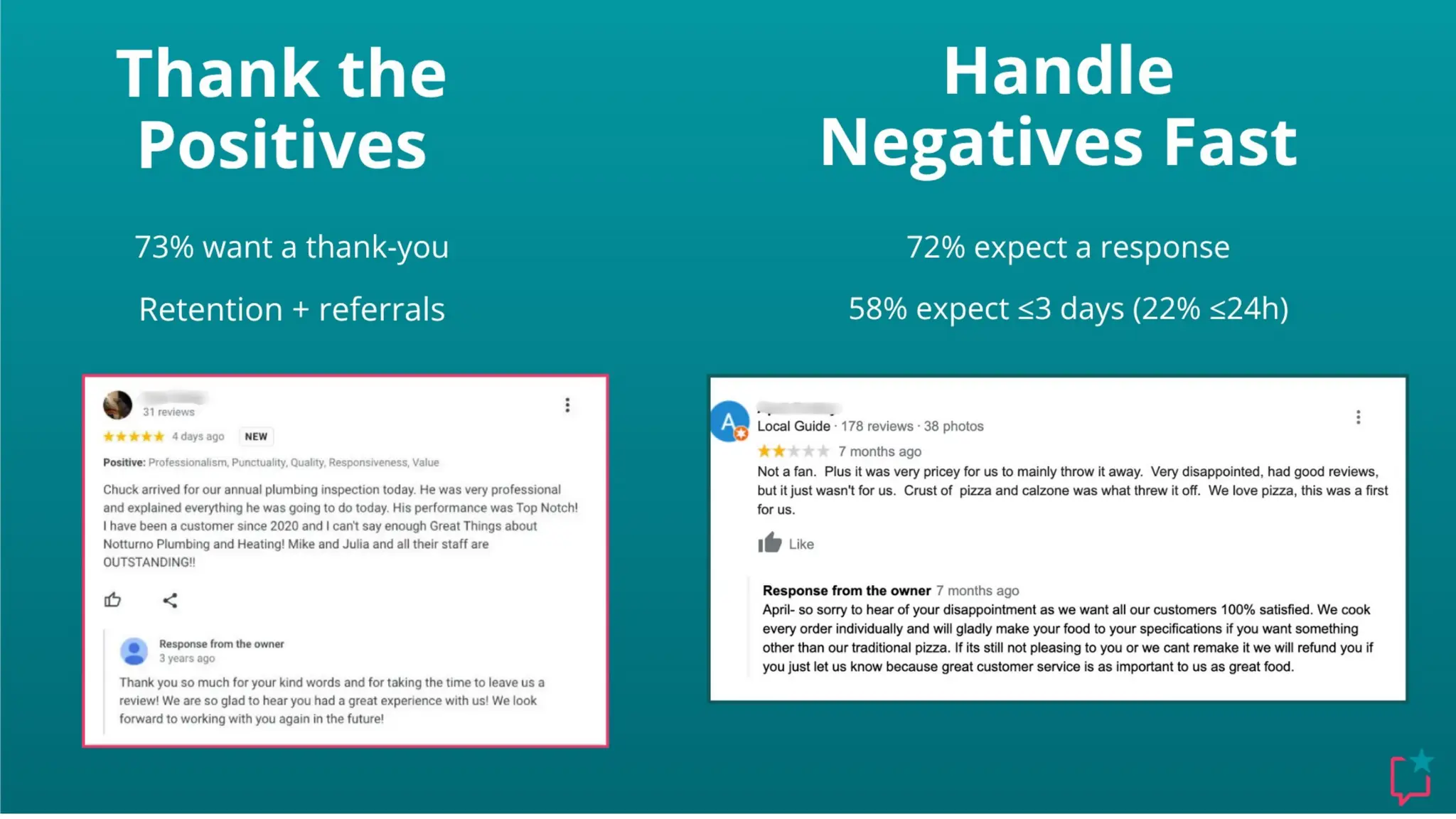
  • #33 “And how you respond is just as important as the fact that you do.” “There are really two kinds of review moments — the thank-you moments and the make-it-right moments. And both deserve intention.” Responding to the Positives “When you get a positive review, it’s tempting to just move on — but that’s a missed opportunity. 73% are looking for a short, sincere ‘thank you”. Use it to reinforce what’s working: Mention the service, product, or team member they appreciated. Use their name if it’s visible — it personalizes the reply. Keep it conversational: warm, grateful, and human. It tells future customers that you notice and appreciate your clients, not just the complaints.” Responding to the Negatives “Now, for the tougher ones — negative reviews. This is where you can truly stand out. A calm, empathetic response can completely change perception. The goal isn’t to defend — it’s to acknowledge and act. Quickly. 72% expect a response and 58% expect in within 3 days. Remember a lot of times people will leave a negative review to warn others especially if they don't think they will get a response. Show you are responsive and you will still likely get negative feedback but it may come directly instead of posted online.
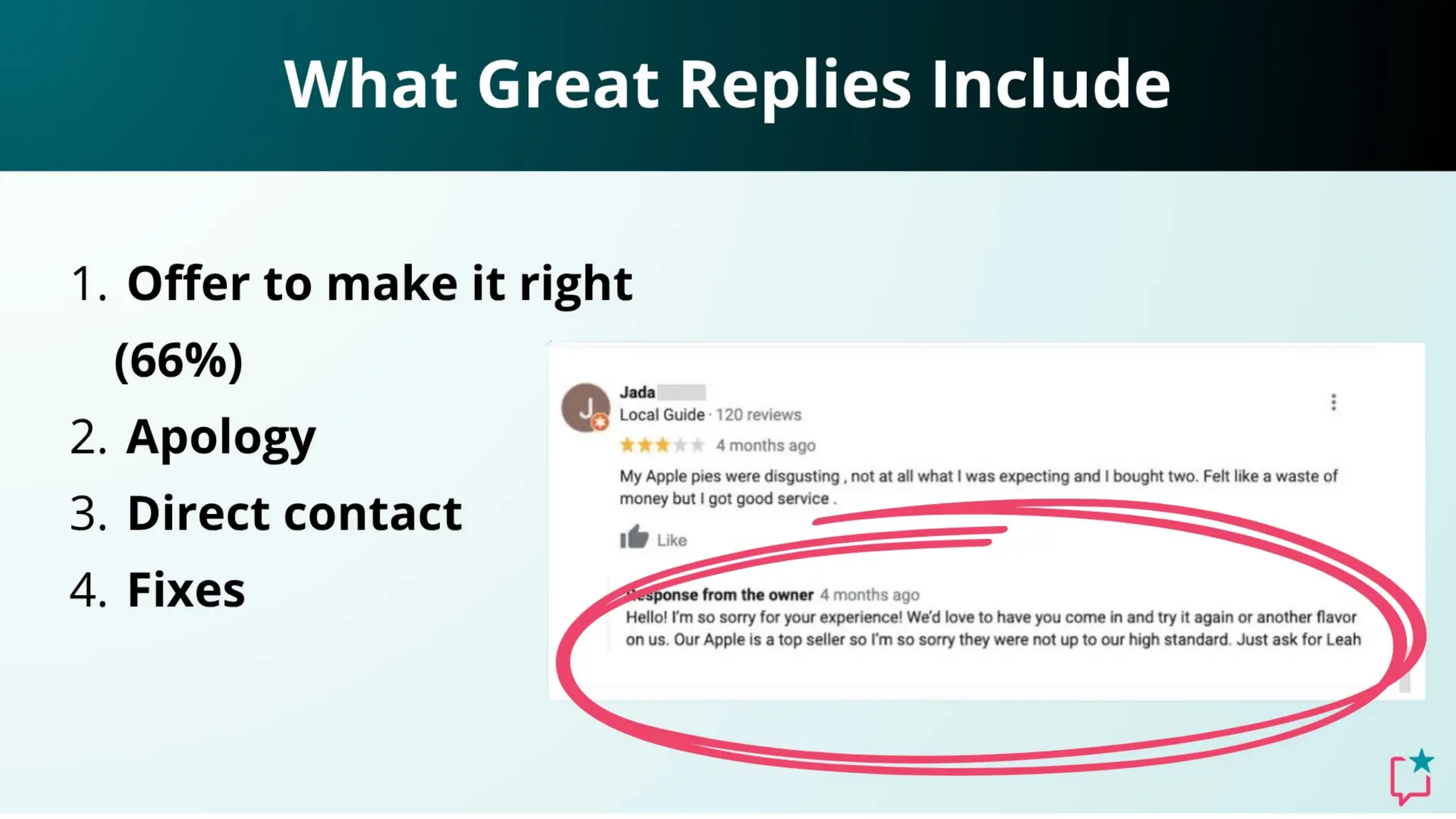
  • #34 “And when someone takes the time to share a negative experience, they’re giving you a second chance in public. And consumers have clear expectations for how businesses should handle that. And our responders have given us great insight into what a great response to a negative review includes. Four things: rich detail, an apology, direct contact, and a fix. Let’s walk through those.” 1. Offer to make it right 66% “Generic replies don’t work. ‘We’re sorry you had a bad experience’ might check the box, but it doesn’t build trust. Consumers want to see that you’ve read their review and understand what went wrong. Reference what they shared — without repeating private details — to show you’re listening and taking it seriously.” 2. A Real Apology A sincere ‘I’m sorry we missed the mark’ or ‘I understand how that felt’ humanizes your business and diffuses tension immediately. You can’t argue with someone’s experience — but you can validate it.” 3. Direct Contact “Invite the reviewer to connect with you personally to resolve it. ‘Please reach out to me directly at [contact info] so we can make this right.’ That does two things: it protects privacy and it shows the public that you’re committed to resolution — not just words.” 4. The Fix “Finally, always include the action where possible — what you’re doing to prevent it from happening again. This ‘we fixed it’ moment closes the loop and turns a negative review into proof of accountability.” “Responding to negative reviews isn’t about defending your business — it’s about demonstrating your values. That’s what today’s consumers expect — and reward.”
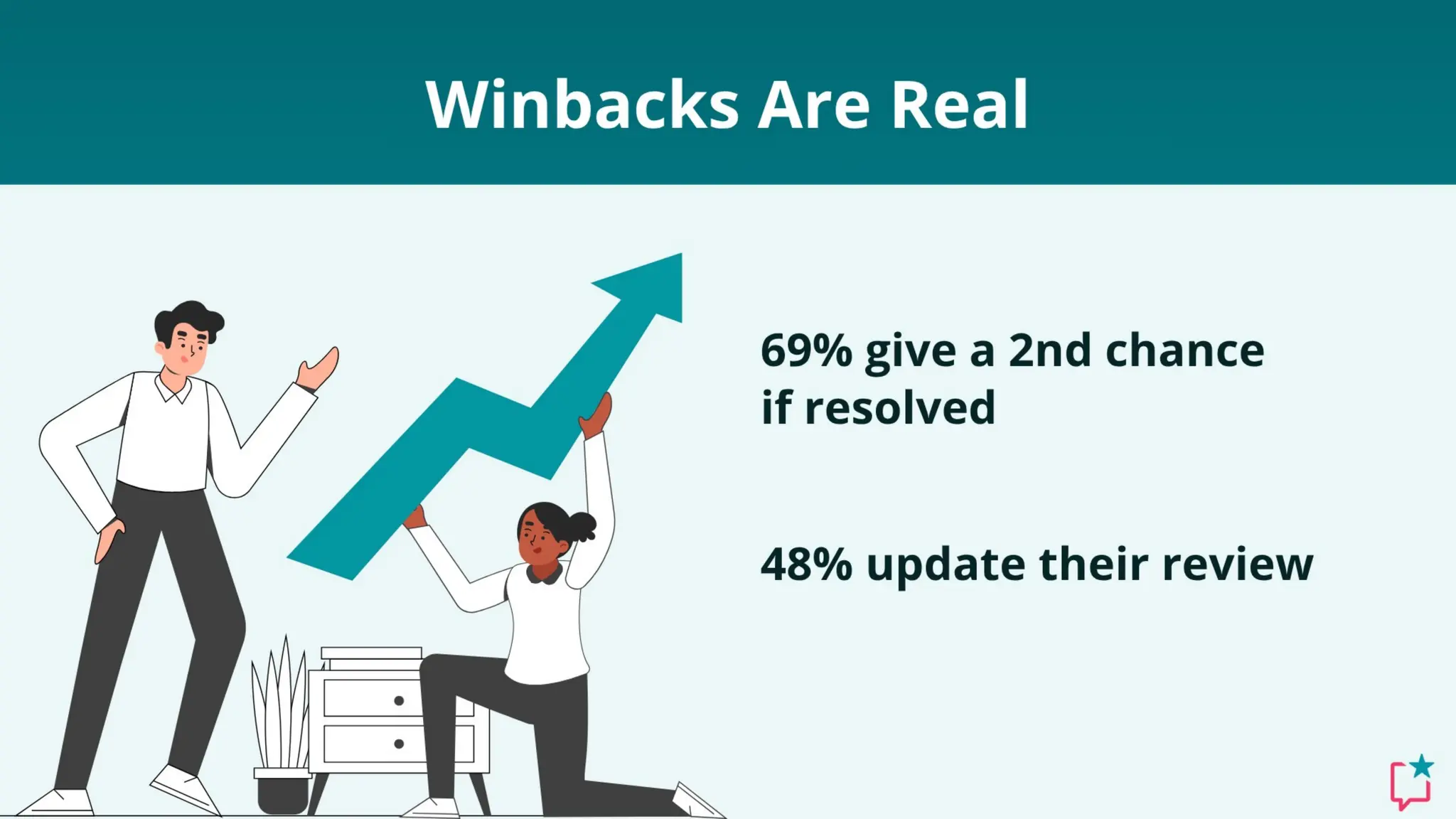
  • #35 And how do they reward you? “Our study found that 69% of consumers will give a business a second chance if their issue is handled well, and 48% will actually update their review after seeing the business make it right. That’s huge. Because it means every bad review has the potential to become a public turnaround story — one that not only wins back a customer but shows everyone else that you care enough to fix problems.” “When you respond with empathy and accountability, you’re doing two powerful things at once: You’re bringing a customer back — turning a one-time critic into a repeat buyer. You’re preventing dozens or even hundreds of future customers from being scared away by that same review. That’s the double win. You’re recovering lost revenue and protecting future business — all with one thoughtful reply.” “This is the moment to remember: reviews aren’t just feedback. They’re growth drivers. Your replies don’t live in customer service silos — they live in search results, on maps, in AI summaries, and social feeds. They’re influencing decisions before your ads ever have a chance to. That’s why review management isn’t optional anymore — it’s one of the most visible, high-impact parts of your brand strategy.” “So when you think about the time you spend responding to reviews — even the tough ones — realize that you’re not just repairing relationships. You’re actively driving business growth, protecting reputation equity, and building trust that multiplies over time.”
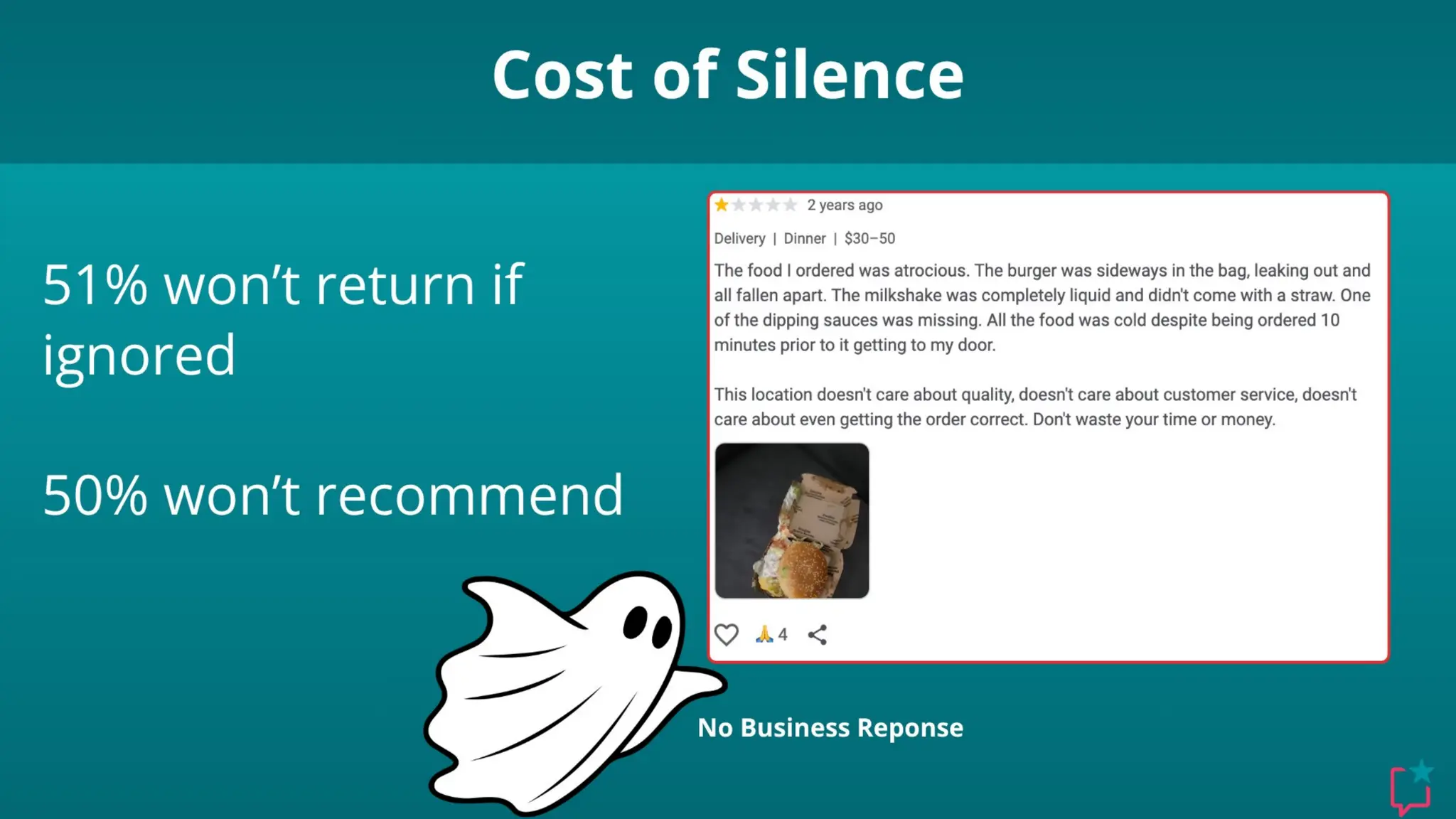
  • #36 But what happens when we don’t respond? When we stay silent?” “Let’s be clear - silence is a response but it just says the wrong thing. It tells potential customers, ‘We’re not paying attention,’ or worse, ‘We don’t care.’ And consumers notice. Half of them say they won’t choose a business that ignores reviews — especially the negative ones. When you stay quiet, you’re not just losing the reviewer. You’re losing every future customer who reads that comment and assumes you’d treat them the same way.” “The cost of silence is lost trust — and lost trust is lost business. Responding is free and silence is expensive.”
  • #37 “Great responses can win customers back and drive real business growth. But not all responses build trust. To reiterate some, unintentionally, undermine it.” “Consumers today are paying attention not just to if you respond, but how you respond. A reply can either strengthen your credibility or slowly erode it. “Over 70% of consumers say they lose trust if a response sounds like it was written by AI. People can spot automation instantly — stiff phrasing, vague empathy, repeated language. Even if AI helps you draft responses, make sure the final message sounds human, personal, and specific.”
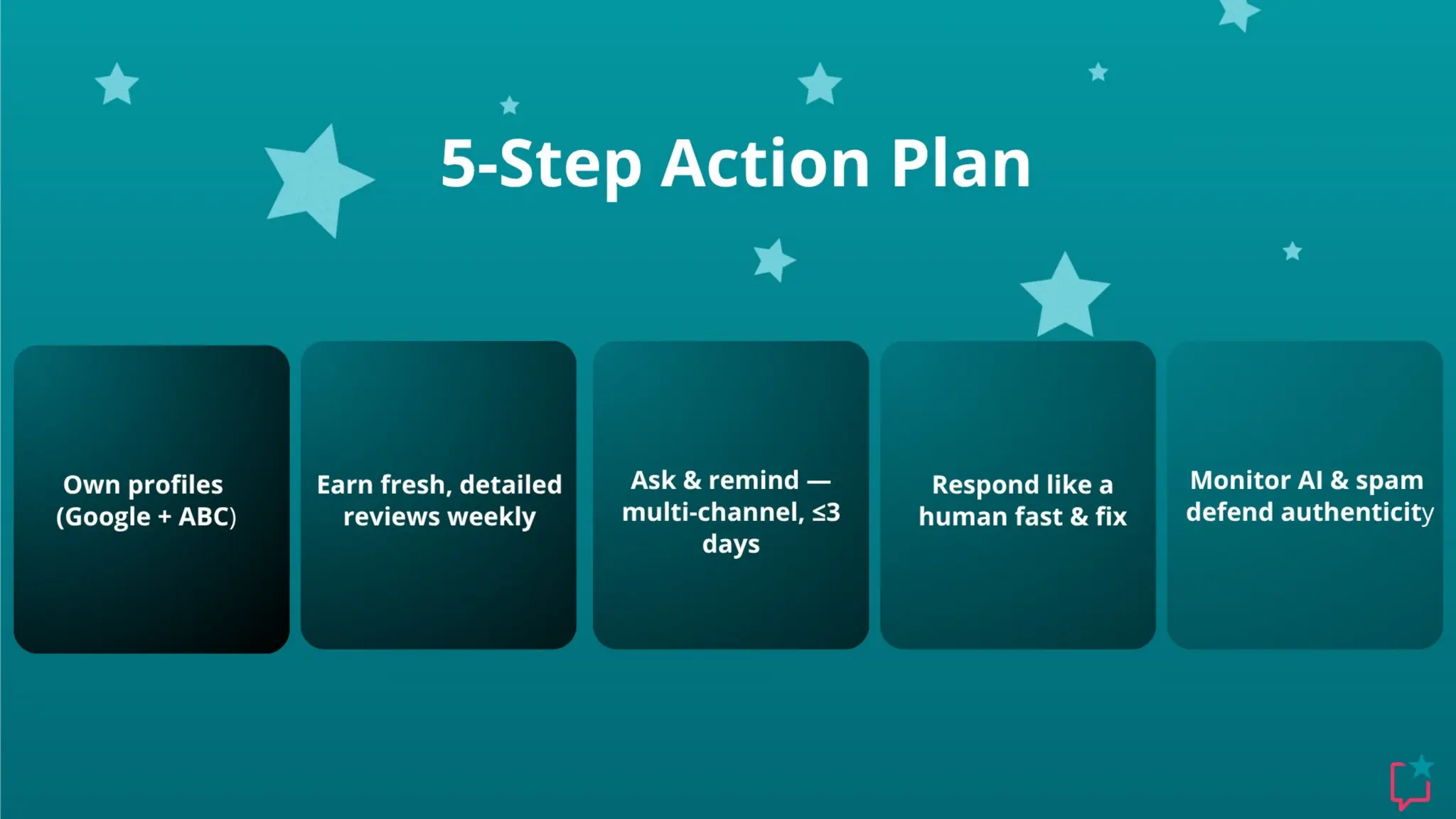
  • #38 “So, we’ve talked about how reviews build trust, how responses influence choice, and even how the wrong approach can erode credibility. Let’s wrap things up with a clear, simple plan — five steps you can take right now to strengthen your reputation strategy.” “These five steps are how you move from reactive review management to proactive reputation growth. Each one connects directly to what consumers told us they expect — and what actually drives business.” The Five-Step Action Plan Step 1: Own your profiles. “Claim and update every profile that represents your business — Google, Facebook, Bing, Apple Maps, Yelp, and industry directories. Consistency builds credibility, and it ensures that customers — and AI — are seeing the same story everywhere.” Step 2: Earn fresh, detailed reviews. “Recency is key. Encourage customers to share their experiences often and in detail. A steady stream of authentic, specific reviews signals reliability and keeps your business top of mind — both with people and algorithms.” Step 3: Ask and remind. “Make asking for reviews part of your process, not an afterthought. Use email, SMS, in-person requests, and even printed QR codes to make it easy. And if they don’t respond right away, a friendly reminder helps close the loop. It’s not pressure — it’s partnership.” Step 4: Respond like a human — and fast. “Your responses are your reputation in motion. Be prompt, be personal, and be empathetic. Thank people for the positives, own the negatives, and always make it sound like it came from a real person — not a template.” Step 5: Monitor and defend authenticity. “Keep an eye on your profiles to catch fake reviews or spam before they damage trust. Authenticity isn’t just a value — it’s a ranking factor and a conversion signal. Protect it like it’s part of your brand assets, because it is.” Bring It Home “When you do these five things consistently, your reviews stop being just a rating — they become your most powerful marketing channel. You’ll earn trust faster, rank higher, and close more customers — all by showing up authentically and consistently.” Key takeaway (say clearly) “Reputation is no longer a byproduct of good service — it is the service. This is the framework that moves you and your business beyond the stars.”
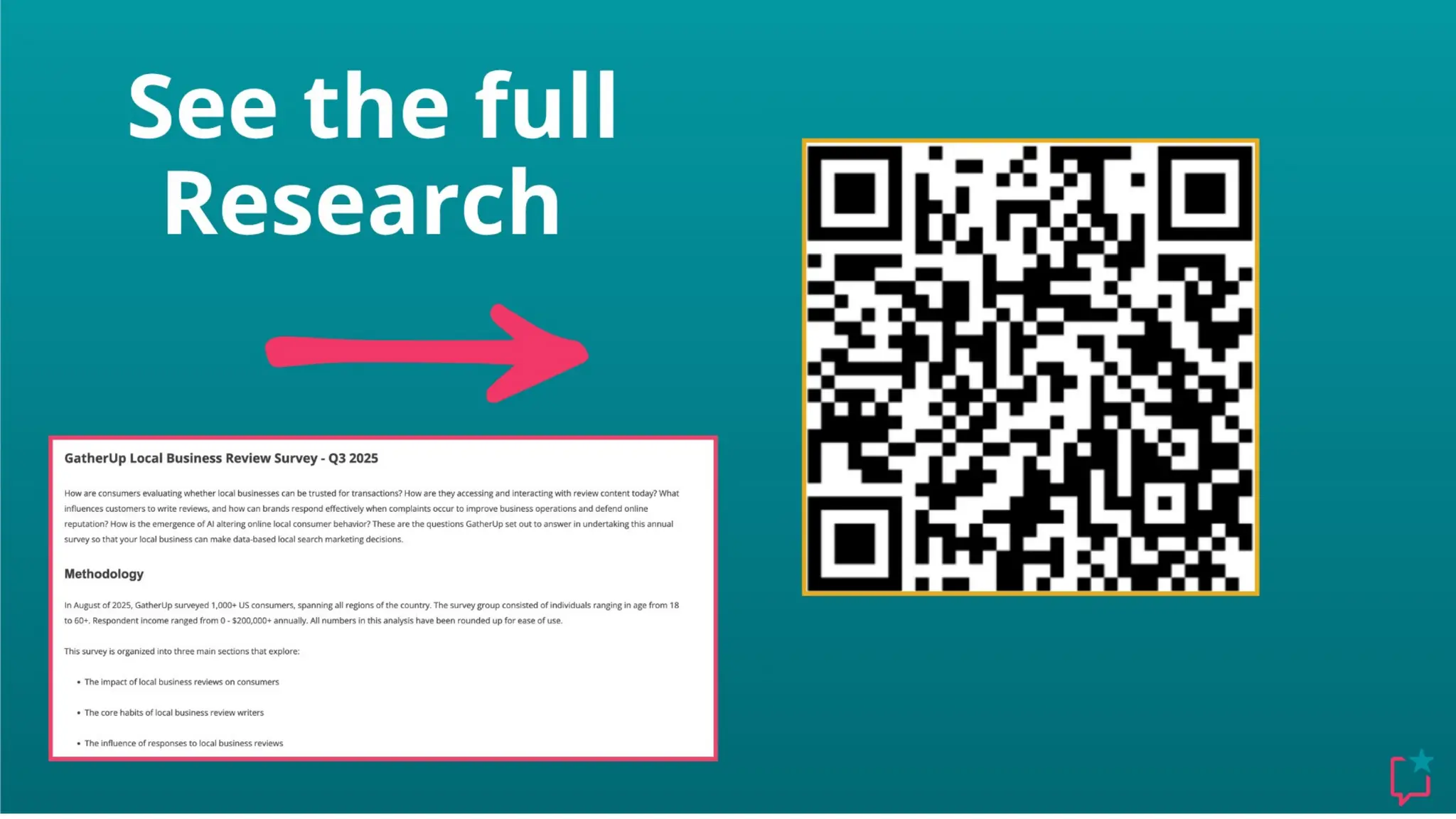
  • #39 “So that brings us to the close of our findings today — a look into how consumers are thinking, searching, and trusting differently in 2025.” “This study was a comprehensive look at how reviews shape the modern customer journey — from discovery, to trust, to the decision to engage. We’ve seen how authenticity, recency, and visibility drive trust, how responses create connection, and how AI is reshaping the landscape of discovery itself. But what we’ve shared today is just a snapshot — a high-level overview of an incredibly deep dataset.” “You can download the full research report using the QR code on screen. “Thank you for spending time with us today and for your engagement throughout. Whether you’re already a GatherUp customer or exploring what we do, we’d love to help you apply these findings — to build trust faster, create more consistent visibility, and drive measurable growth through reputation.” “As we move into 2026, one thing is clear: The businesses that win will be going beyond the stars and managing the story behind them. Consistency, authenticity, and proactive engagement are what separate trusted brands from the rest.” “So again, use the QR code to access the full Beyond the Stars 2025 Report, and please reach out if you’d like to talk more about how we can help you build, manage, and defend your reputation online. Thank you all — and we’ll stay on for a few minutes to answer any final questions.”