F l a s h c a r d s
C a n d l e R a n g e T h e o r y ( C R T )
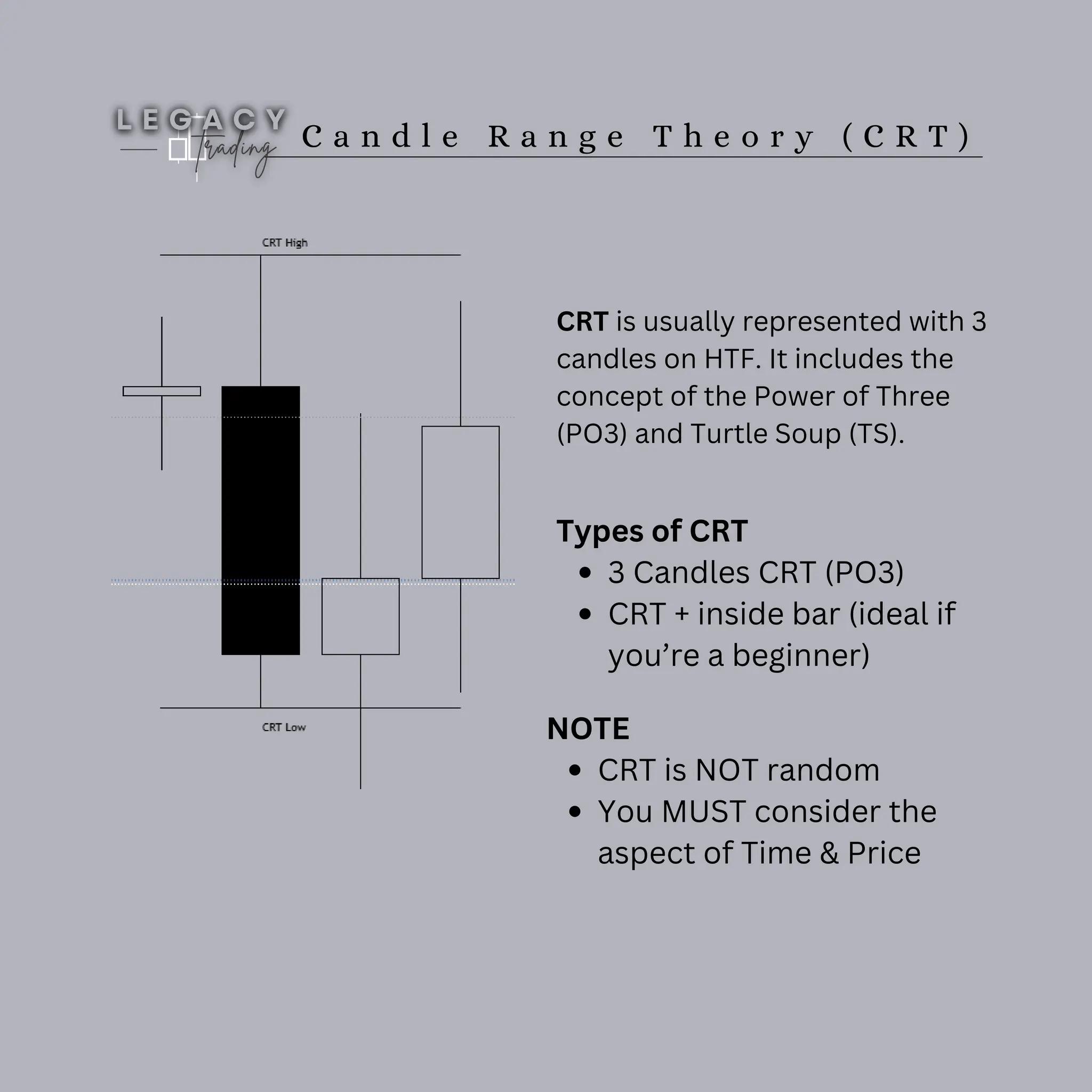
CRT is usually represented with 3
candles on HTF. It includes the
concept of the Power of Three
(PO3) and Turtle Soup (TS).
Types of CRT
3 Candles CRT (PO3)
CRT + inside bar (ideal if
you’re a beginner)
NOTE
CRT is NOT random
You MUST consider the
aspect of Time & Price
C a n d l e R a n g e T h e o r y ( C R T )
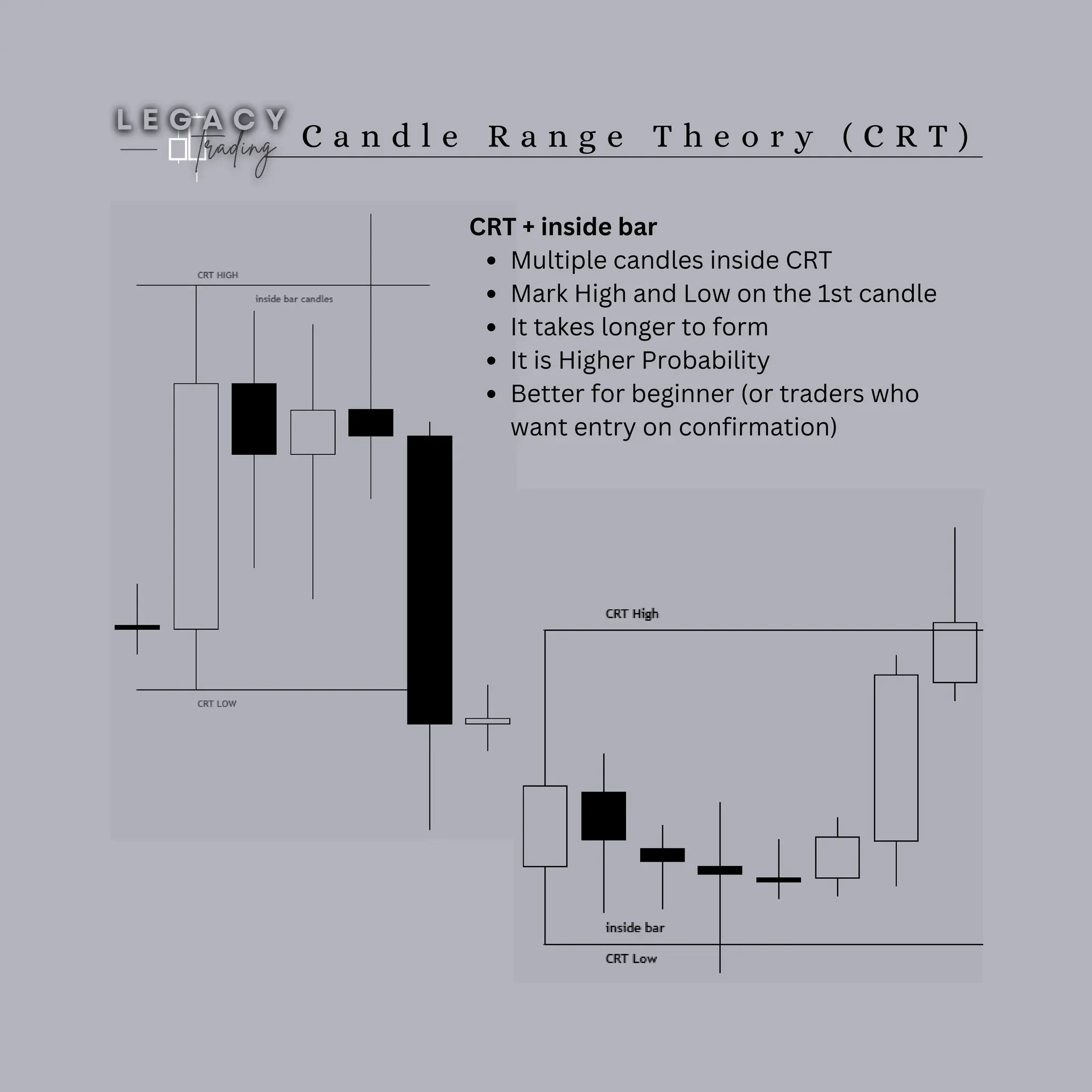
CRT + inside bar
Multiple candles inside CRT
Mark High and Low on the 1st candle
It takes longer to form
It is Higher Probability
Better for beginner (or traders who
want entry on confirmation)
C a n d l e R a n g e T h e o r y ( C R T )
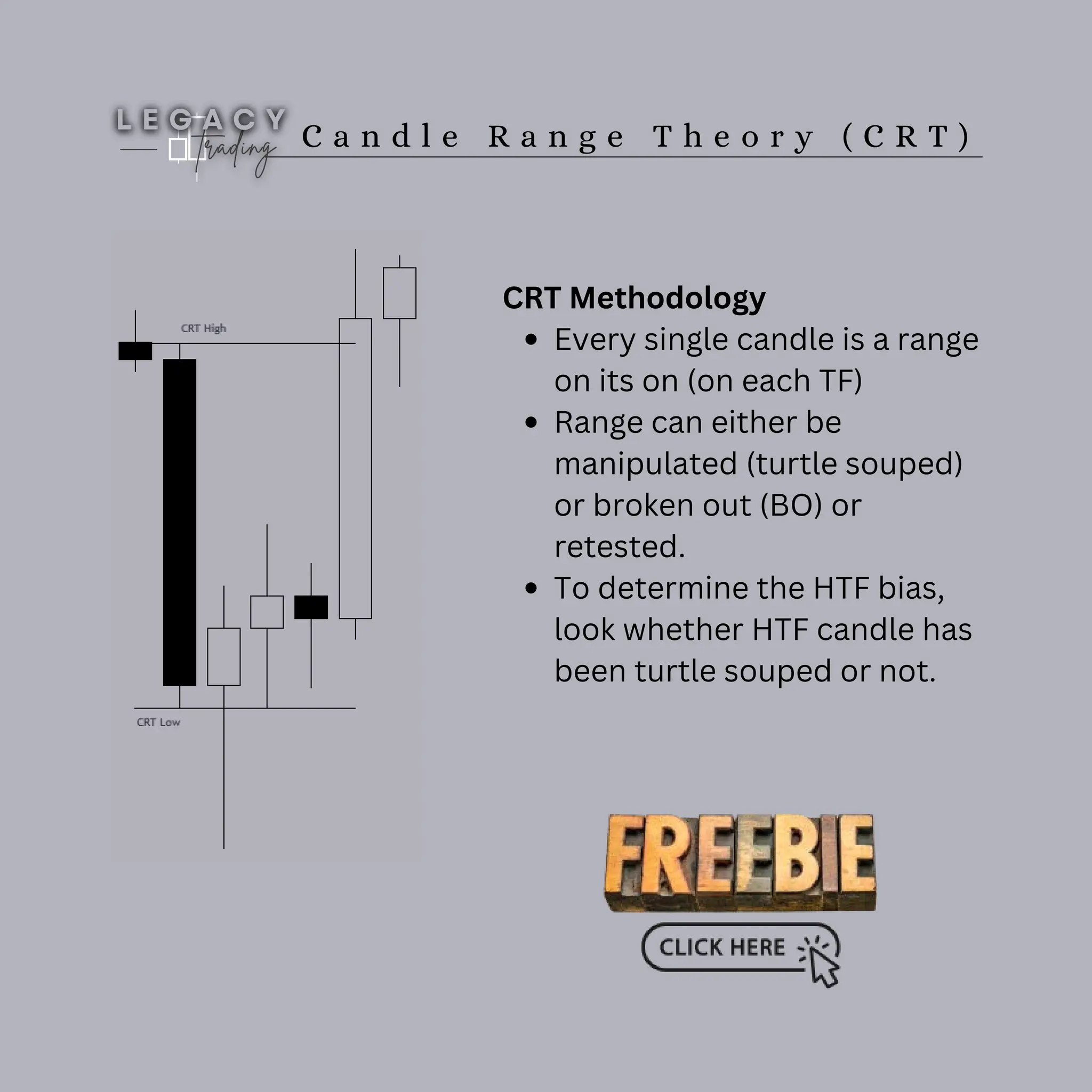
CRT Methodology
Every single candle is a range
on its on (on each TF)
Range can either be
manipulated (turtle souped)
or broken out (BO) or
retested.
To determine the HTF bias,
look whether HTF candle has
been turtle souped or not.
C a n d l e R a n g e T h e o r y ( C R T )
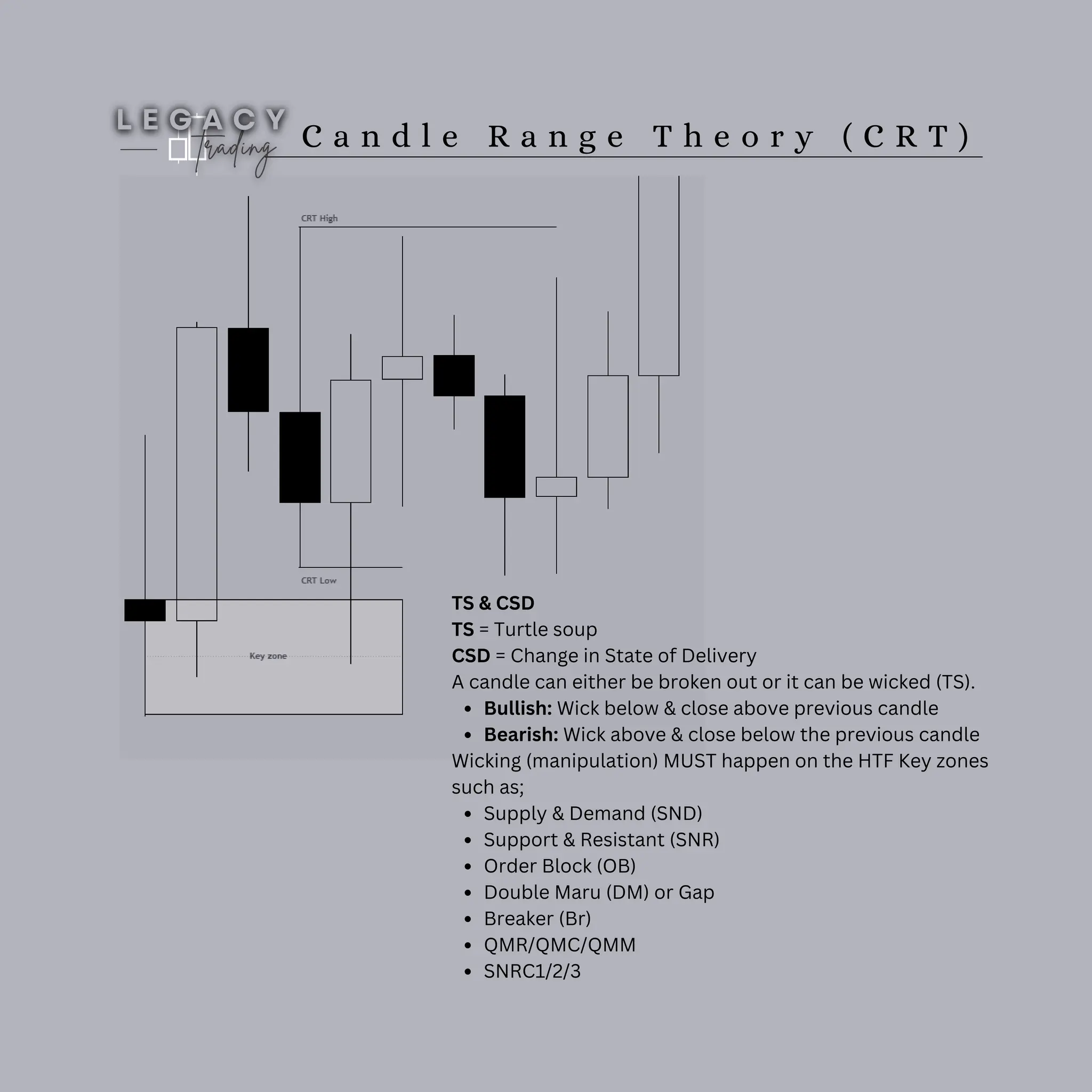
TS & CSD
TS = Turtle soup
CSD = Change in State of Delivery
A candle can either be broken out or it can be wicked (TS).
Bullish: Wick below & close above previous candle
Bearish: Wick above & close below the previous candle
Wicking (manipulation) MUST happen on the HTF Key zones
such as;
Supply & Demand (SND)
Support & Resistant (SNR)
Order Block (OB)
Double Maru (DM) or Gap
Breaker (Br)
QMR/QMC/QMM
SNRC1/2/3
C a n d l e R a n g e T h e o r y ( C R T )
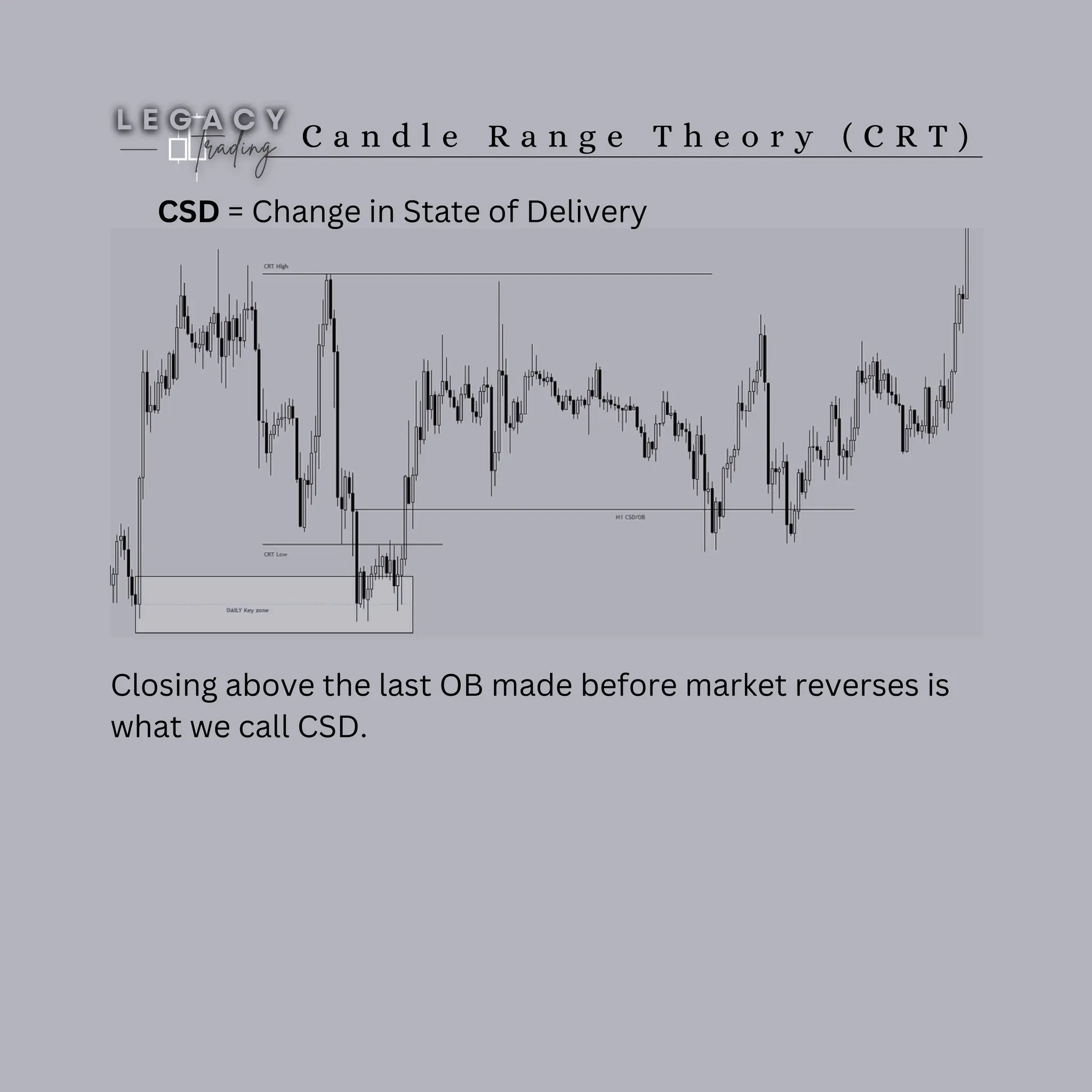
CSD = Change in State of Delivery
Closing above the last OB made before market reverses is
what we call CSD.
C a n d l e R a n g e T h e o r y ( C R T )
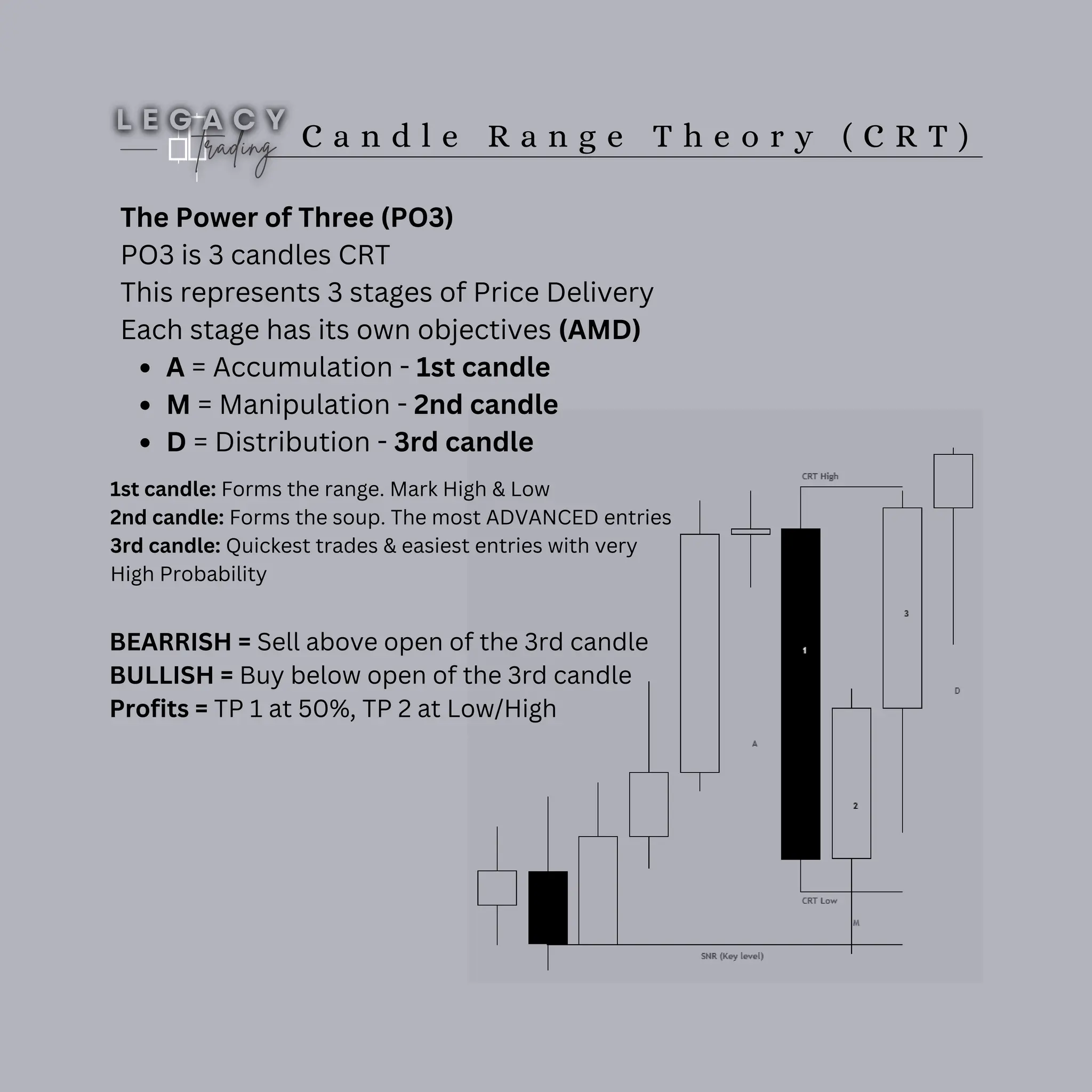
The Power of Three (PO3)
PO3 is 3 candles CRT
This represents 3 stages of Price Delivery
Each stage has its own objectives (AMD)
A = Accumulation - 1st candle
M = Manipulation - 2nd candle
D = Distribution - 3rd candle
1st candle: Forms the range. Mark High & Low
2nd candle: Forms the soup. The most ADVANCED entries
3rd candle: Quickest trades & easiest entries with very
High Probability
BEARRISH = Sell above open of the 3rd candle
BULLISH = Buy below open of the 3rd candle
Profits = TP 1 at 50%, TP 2 at Low/High
C a n d l e R a n g e T h e o r y ( C R T )
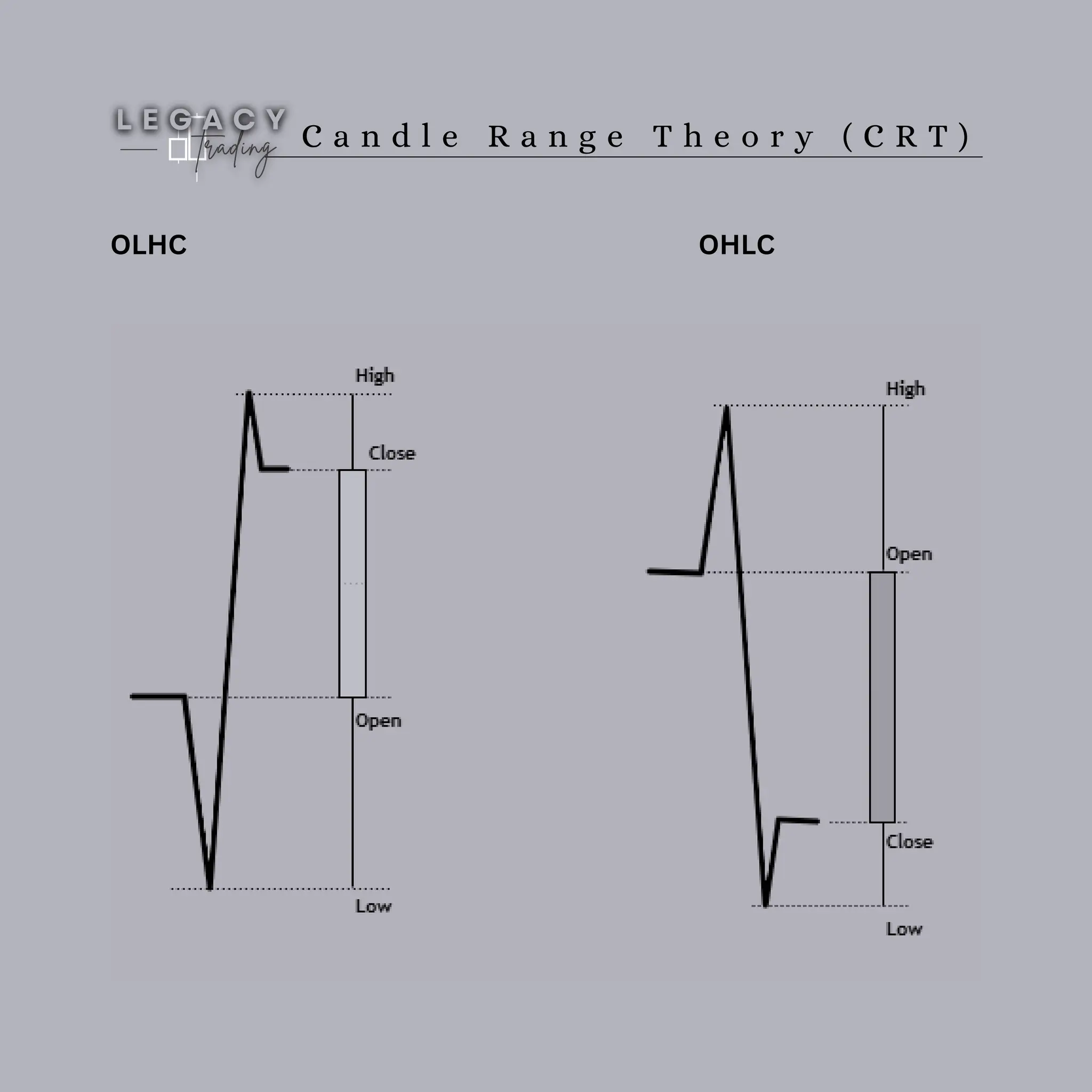
OLHC OHLC
C a n d l e R a n g e T h e o r y ( C R T )
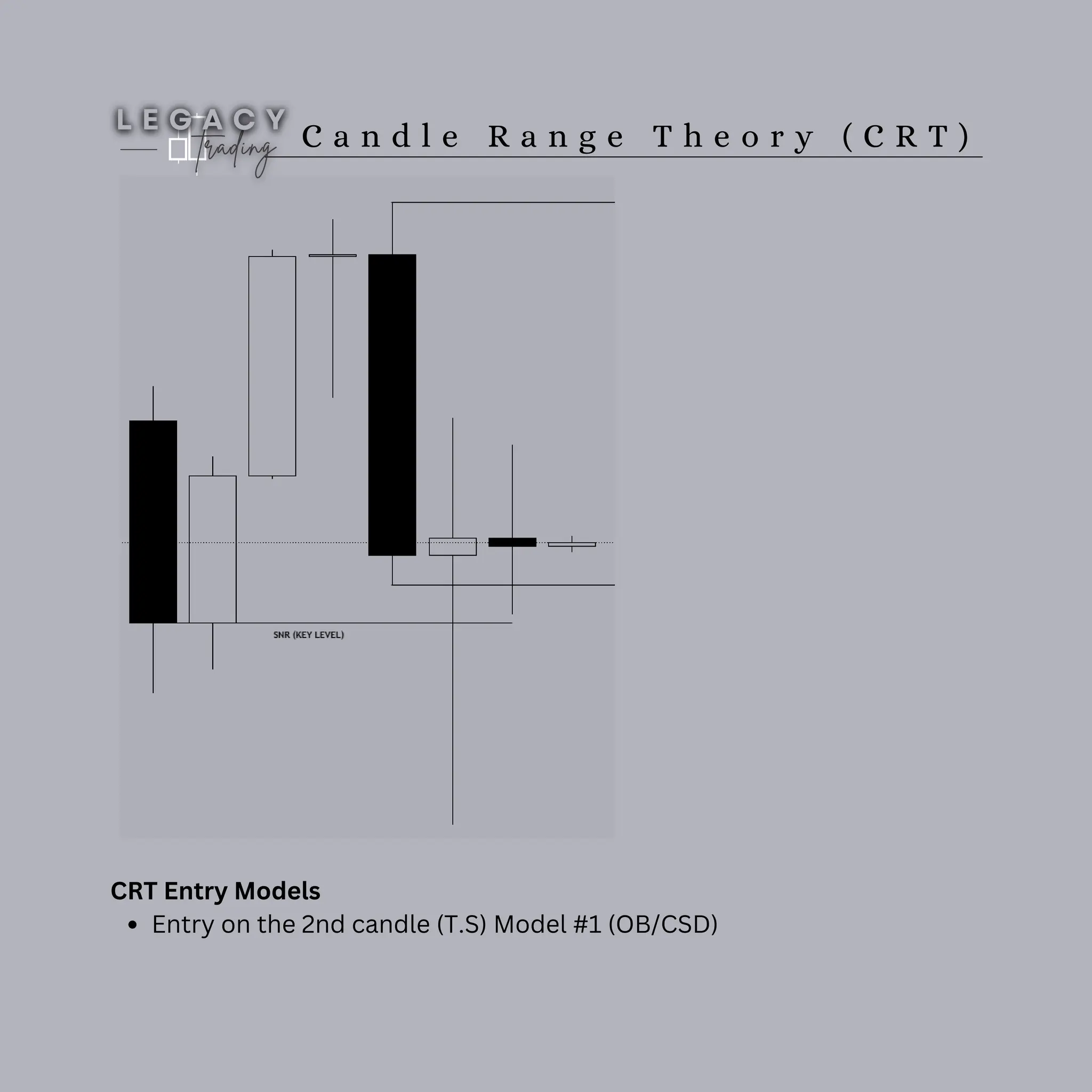
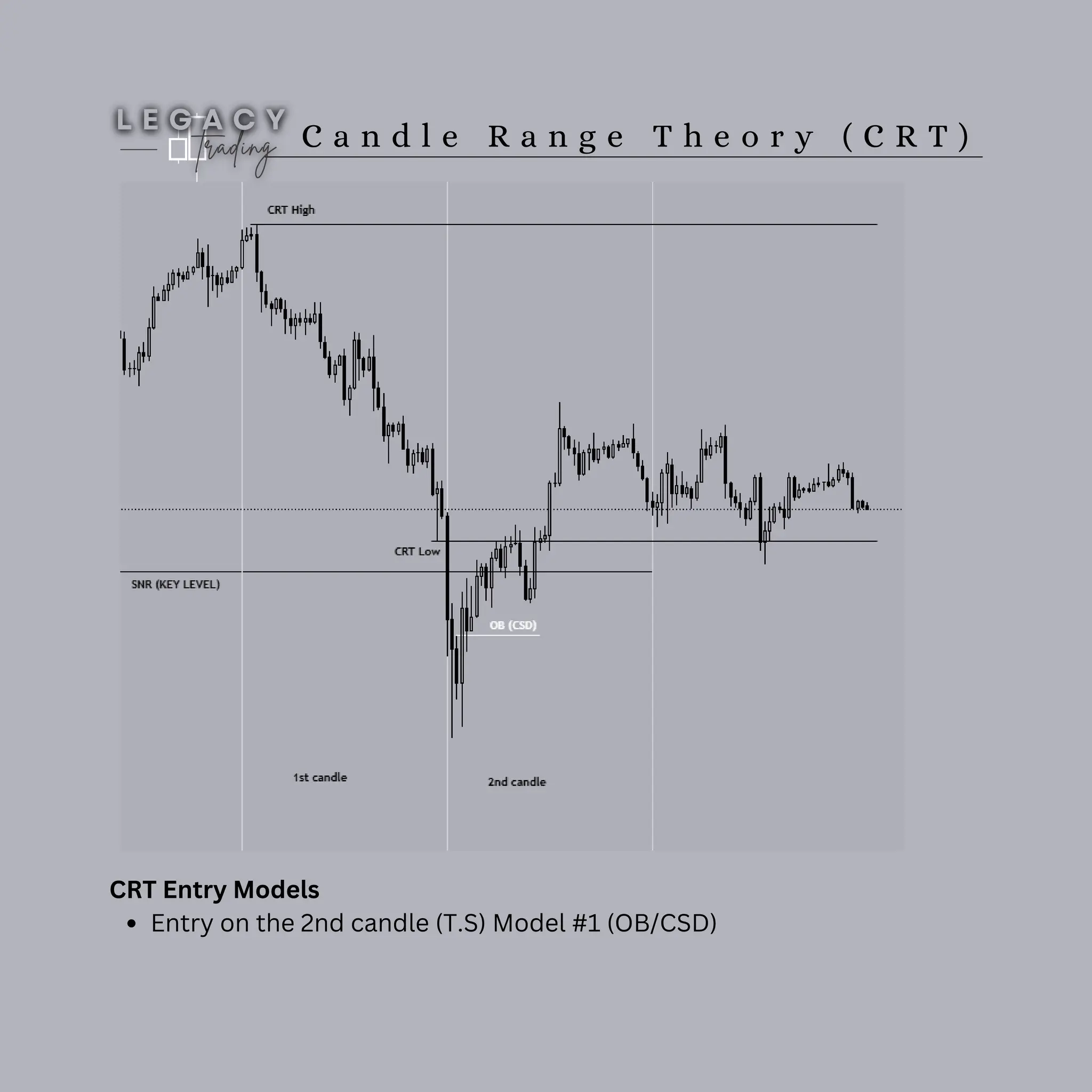
CRT Entry Models
Entry on the 2nd candle (T.S) Model #1 (OB/CSD)
C a n d l e R a n g e T h e o r y ( C R T )
CRT Entry Models
Entry on the 2nd candle (T.S) Model #1 (OB/CSD)
C a n d l e R a n g e T h e o r y ( C R T )
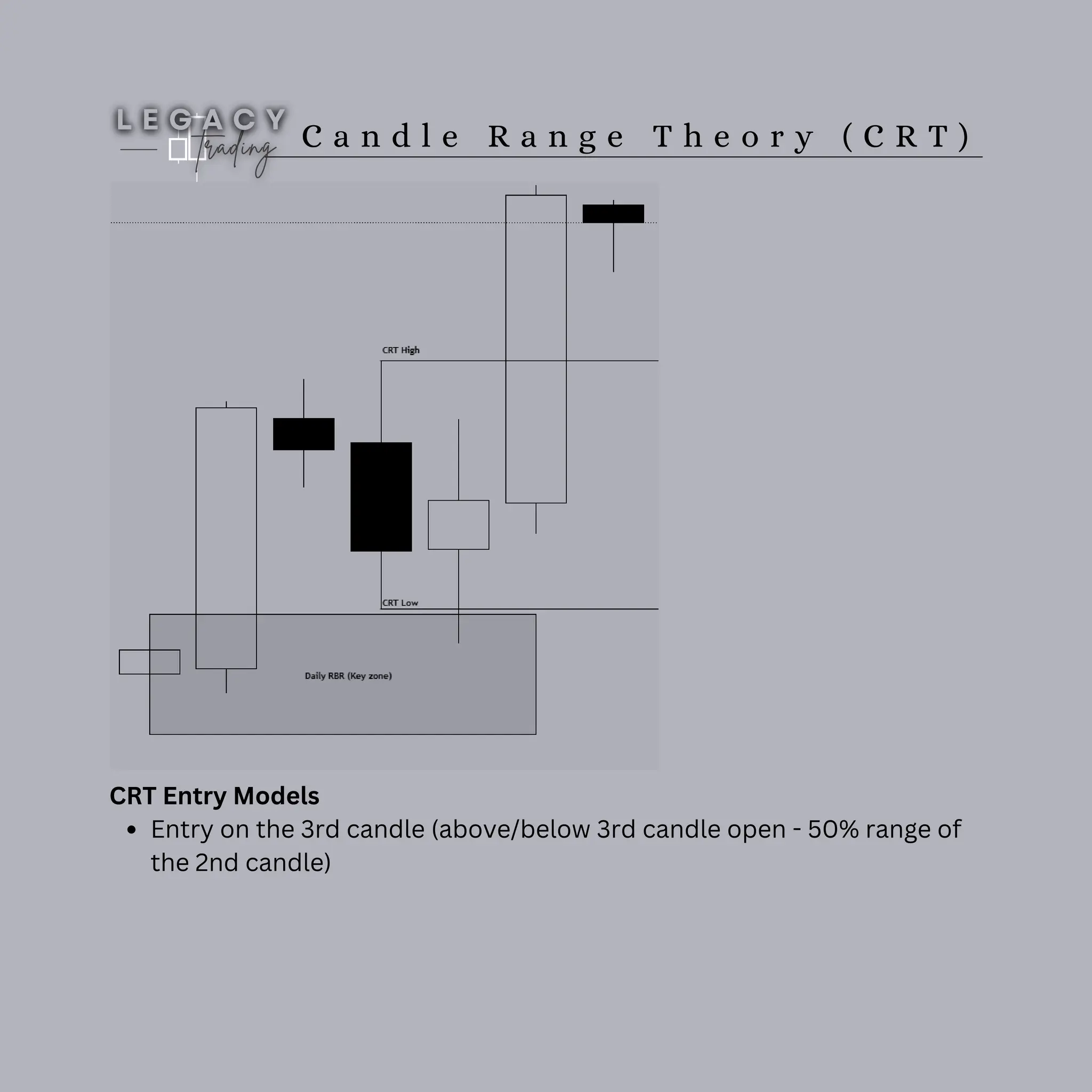
CRT Entry Models
Entry on the 3rd candle (above/below 3rd candle open - 50% range of
the 2nd candle)
C a n d l e R a n g e T h e o r y ( C R T )
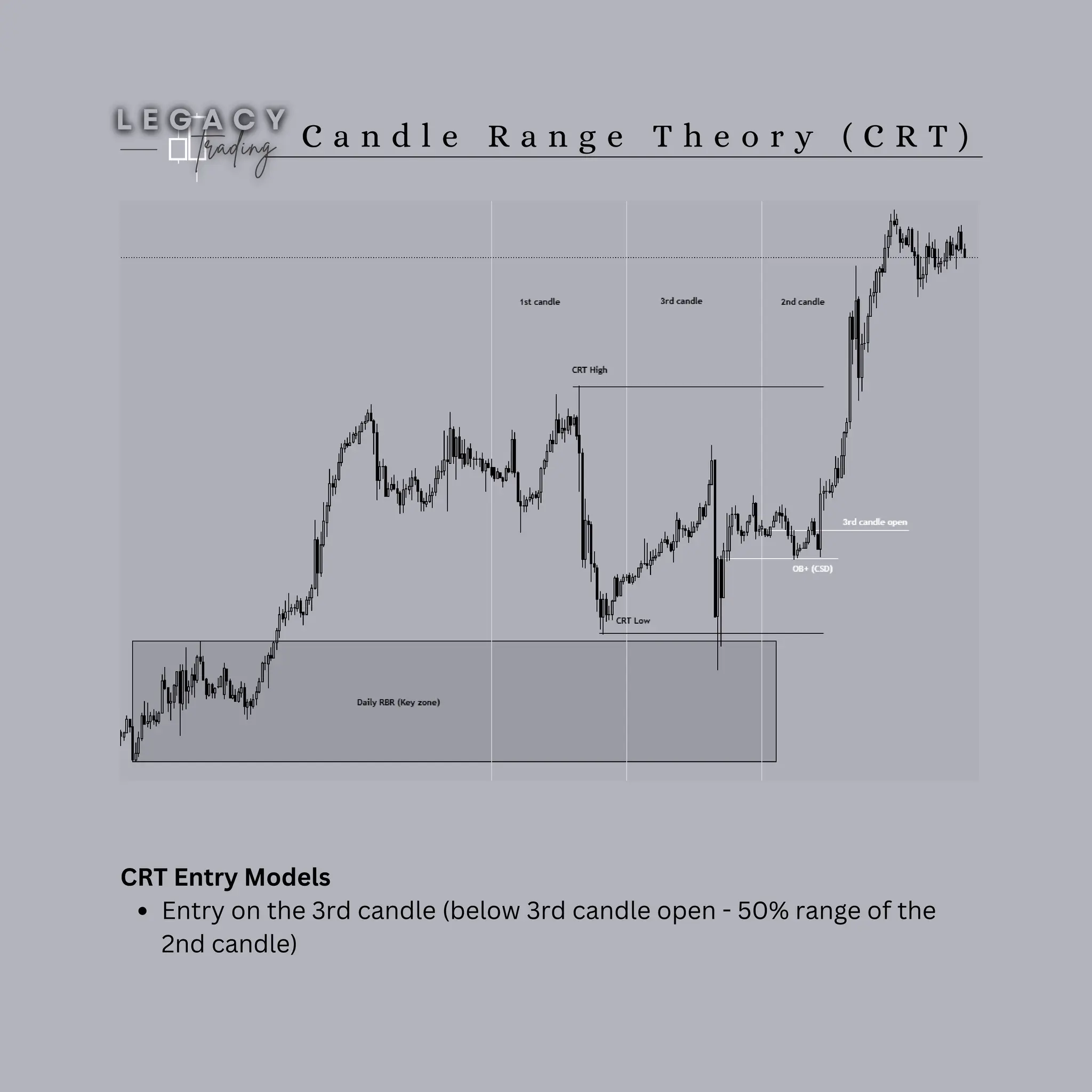
CRT Entry Models
Entry on the 3rd candle (below 3rd candle open - 50% range of the
2nd candle)
C a n d l e R a n g e T h e o r y ( C R T )
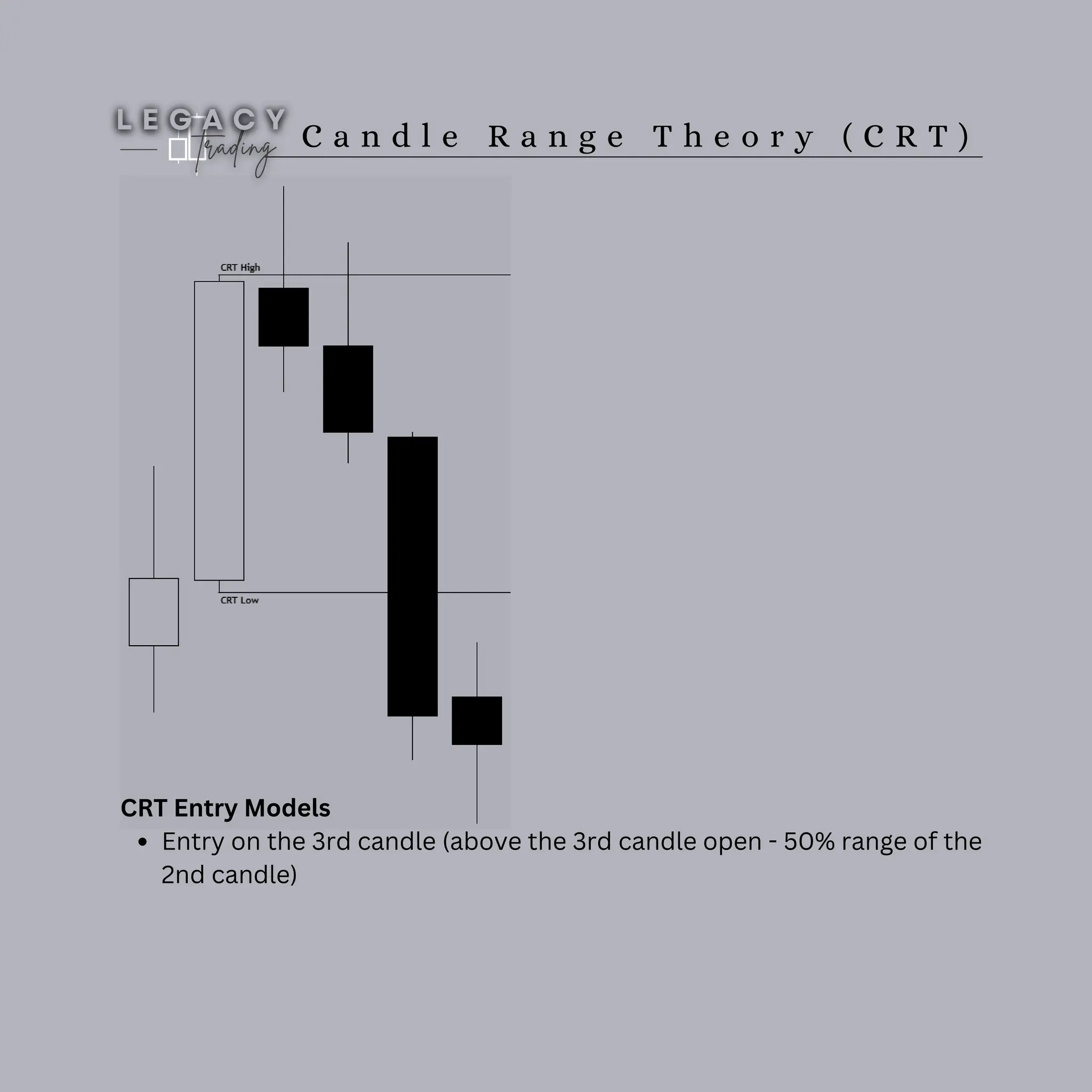
CRT Entry Models
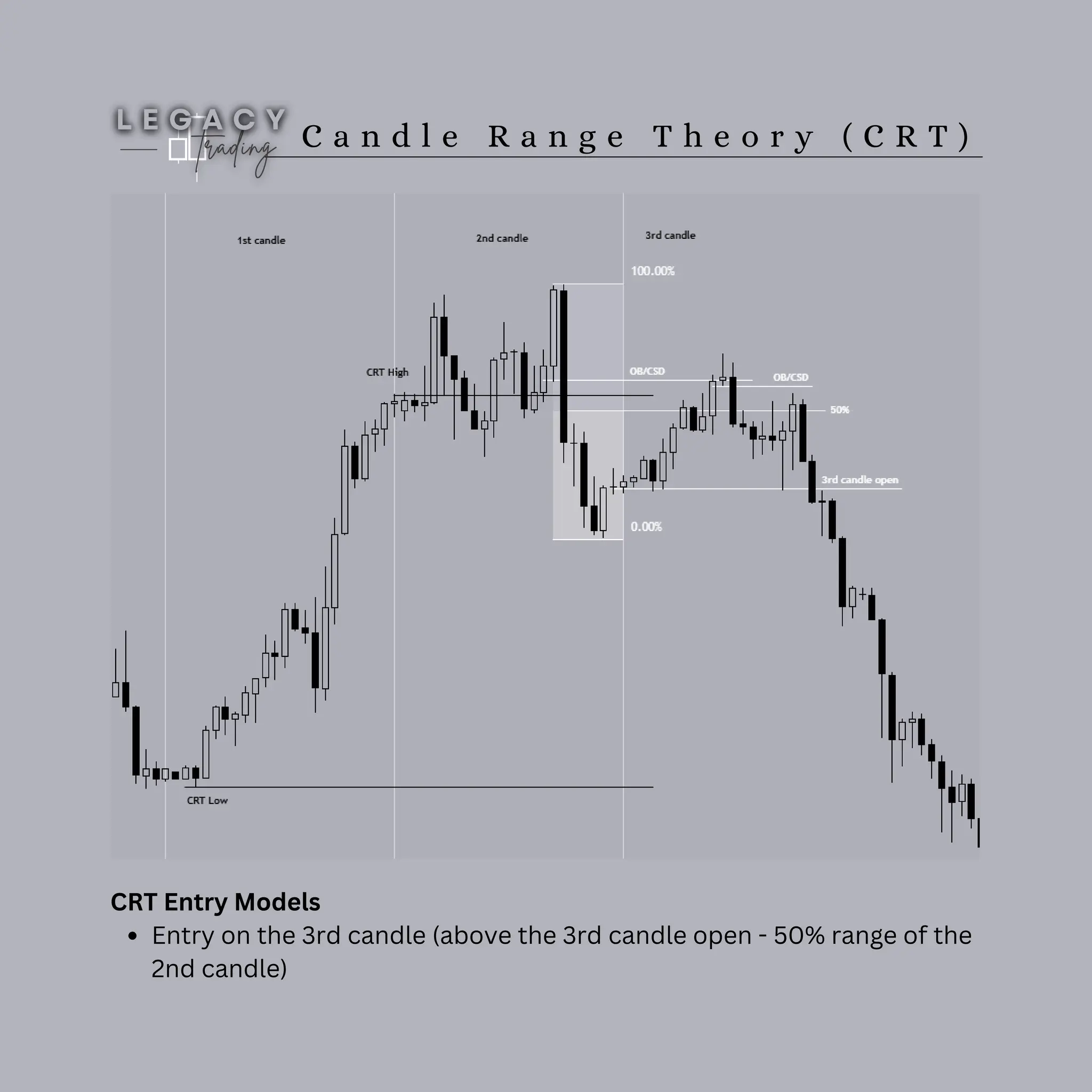
Entry on the 3rd candle (above the 3rd candle open - 50% range of the
2nd candle)
C a n d l e R a n g e T h e o r y ( C R T )
CRT Entry Models
Entry on the 3rd candle (above the 3rd candle open - 50% range of the
2nd candle)
C a n d l e R a n g e T h e o r y ( C R T )
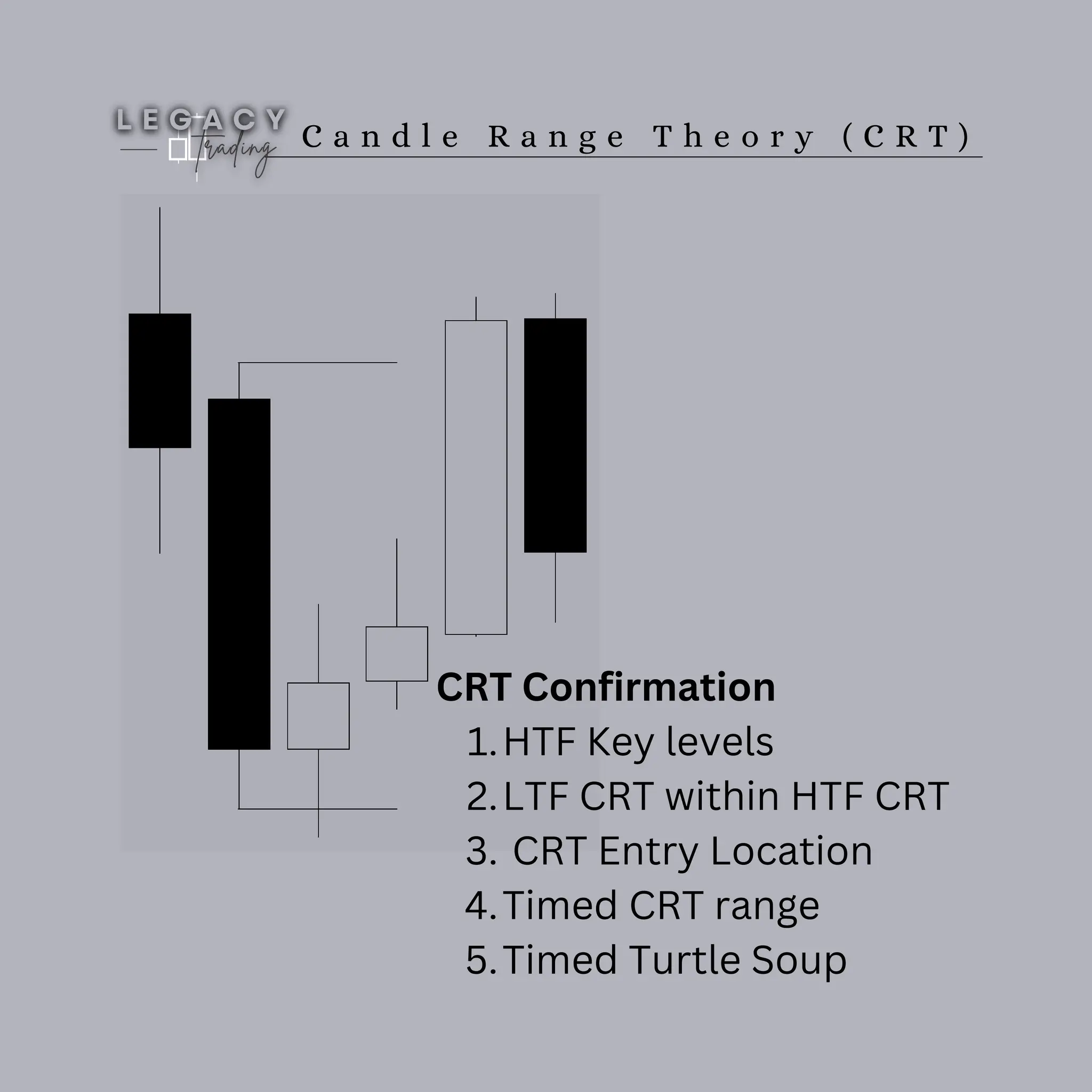
CRT Confirmation
HTF Key levels
1.
LTF CRT within HTF CRT
2.
CRT Entry Location
3.
Timed CRT range
4.
Timed Turtle Soup
5.
HTF Key level CRT TF
H4, H1 15M
D1, H4 H1
W, D1 H4
M, W D1
Y, M W
C a n d l e R a n g e T h e o r y ( C R T )
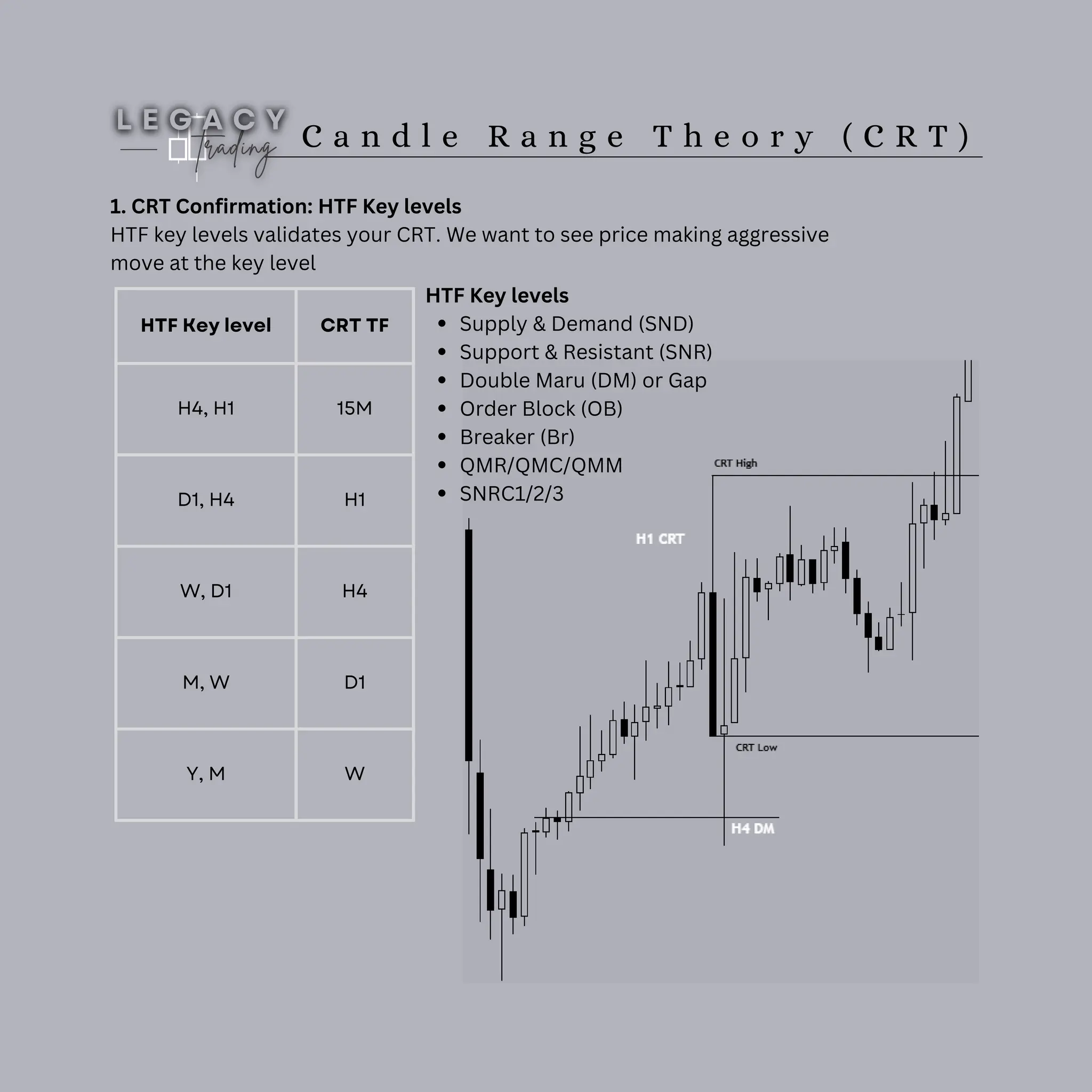
1. CRT Confirmation: HTF Key levels
HTF key levels validates your CRT. We want to see price making aggressive
move at the key level
HTF Key levels
Supply & Demand (SND)
Support & Resistant (SNR)
Double Maru (DM) or Gap
Order Block (OB)
Breaker (Br)
QMR/QMC/QMM
SNRC1/2/3
C a n d l e R a n g e T h e o r y ( C R T )
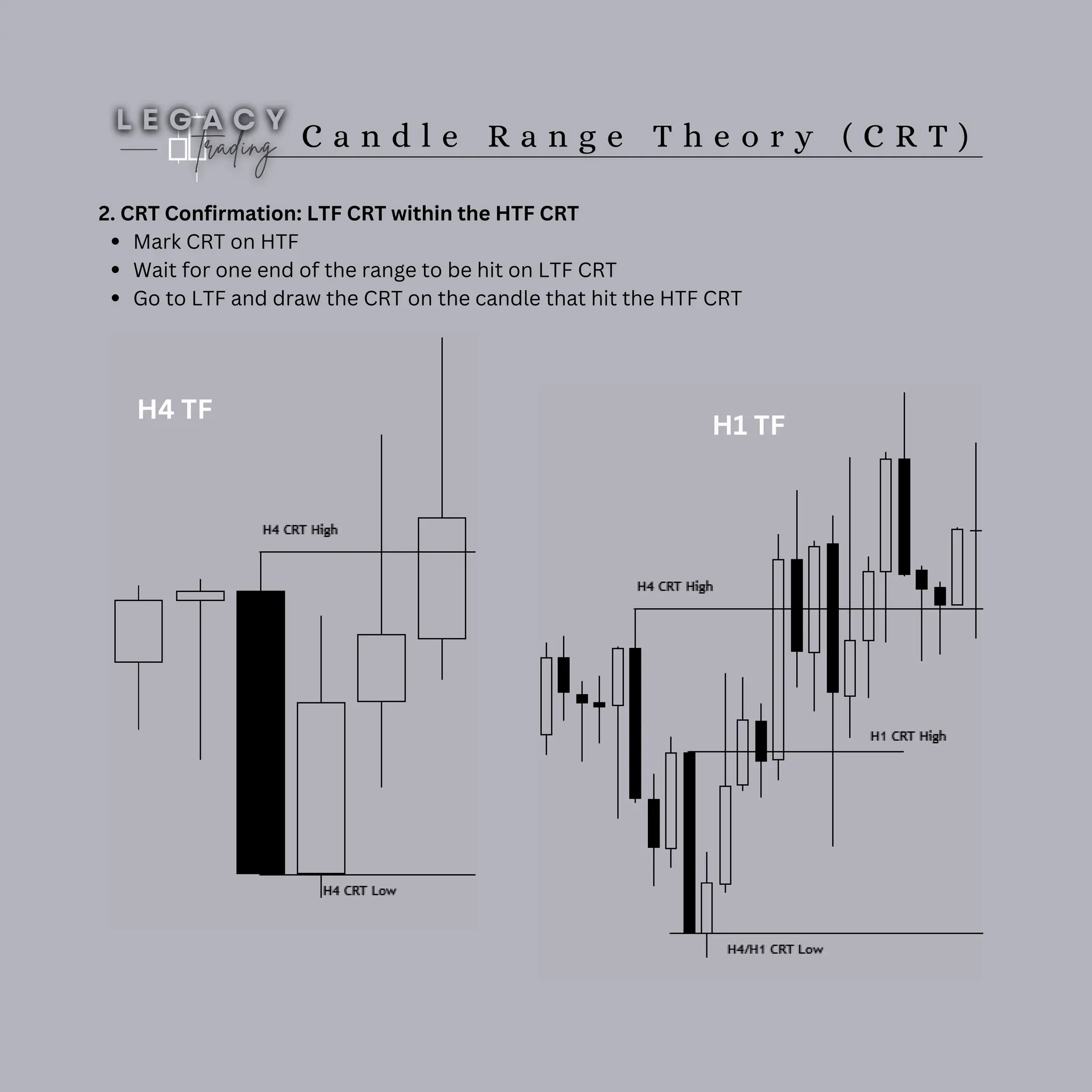
2. CRT Confirmation: LTF CRT within the HTF CRT
Mark CRT on HTF
Wait for one end of the range to be hit on LTF CRT
Go to LTF and draw the CRT on the candle that hit the HTF CRT
H4 TF
H1 TF
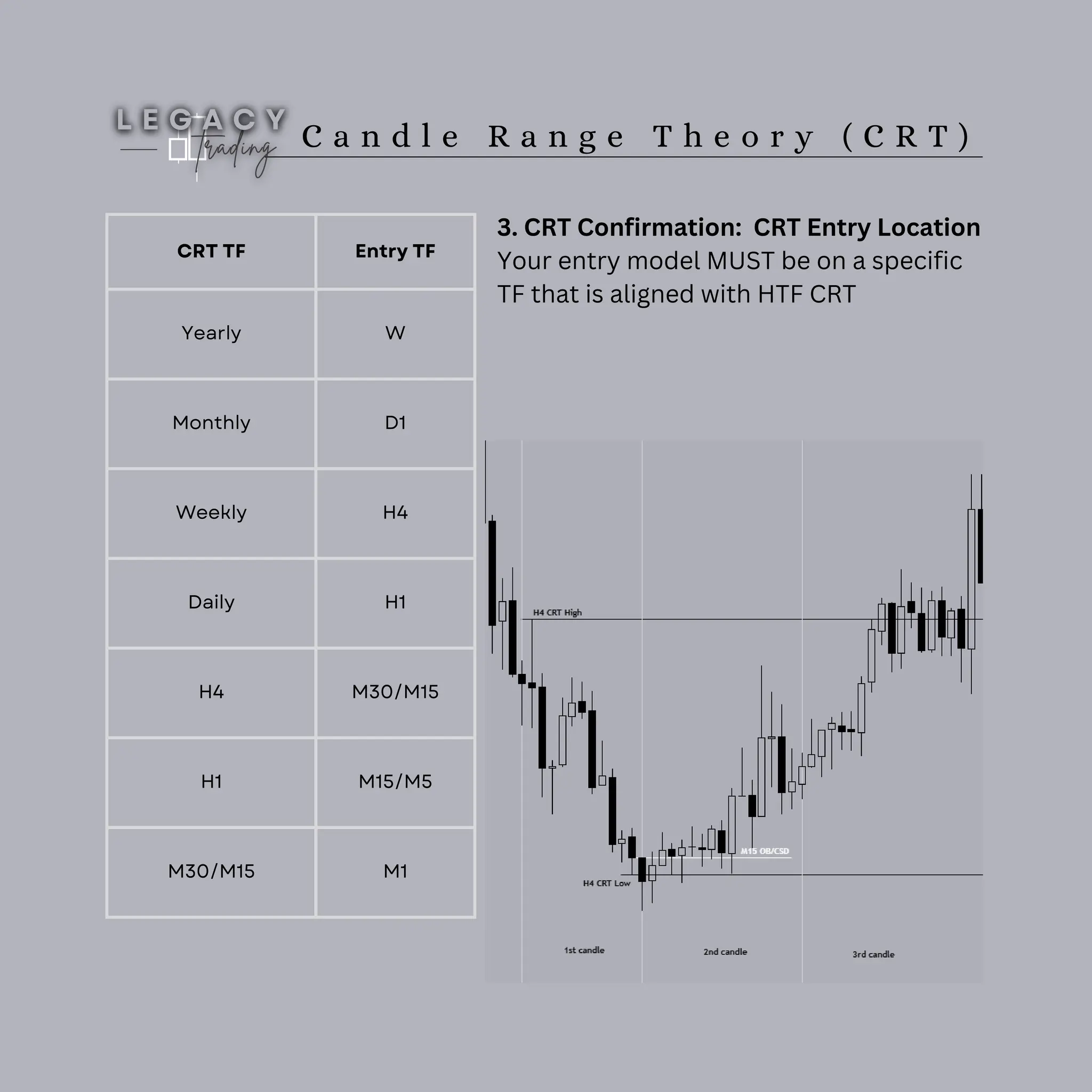
CRT TF Entry TF
Yearly W
Monthly D1
Weekly H4
Daily H1
H4 M30/M15
H1 M15/M5
M30/M15 M1
C a n d l e R a n g e T h e o r y ( C R T )
3. CRT Confirmation: CRT Entry Location
Your entry model MUST be on a specific
TF that is aligned with HTF CRT
C a n d l e R a n g e T h e o r y ( C R T )
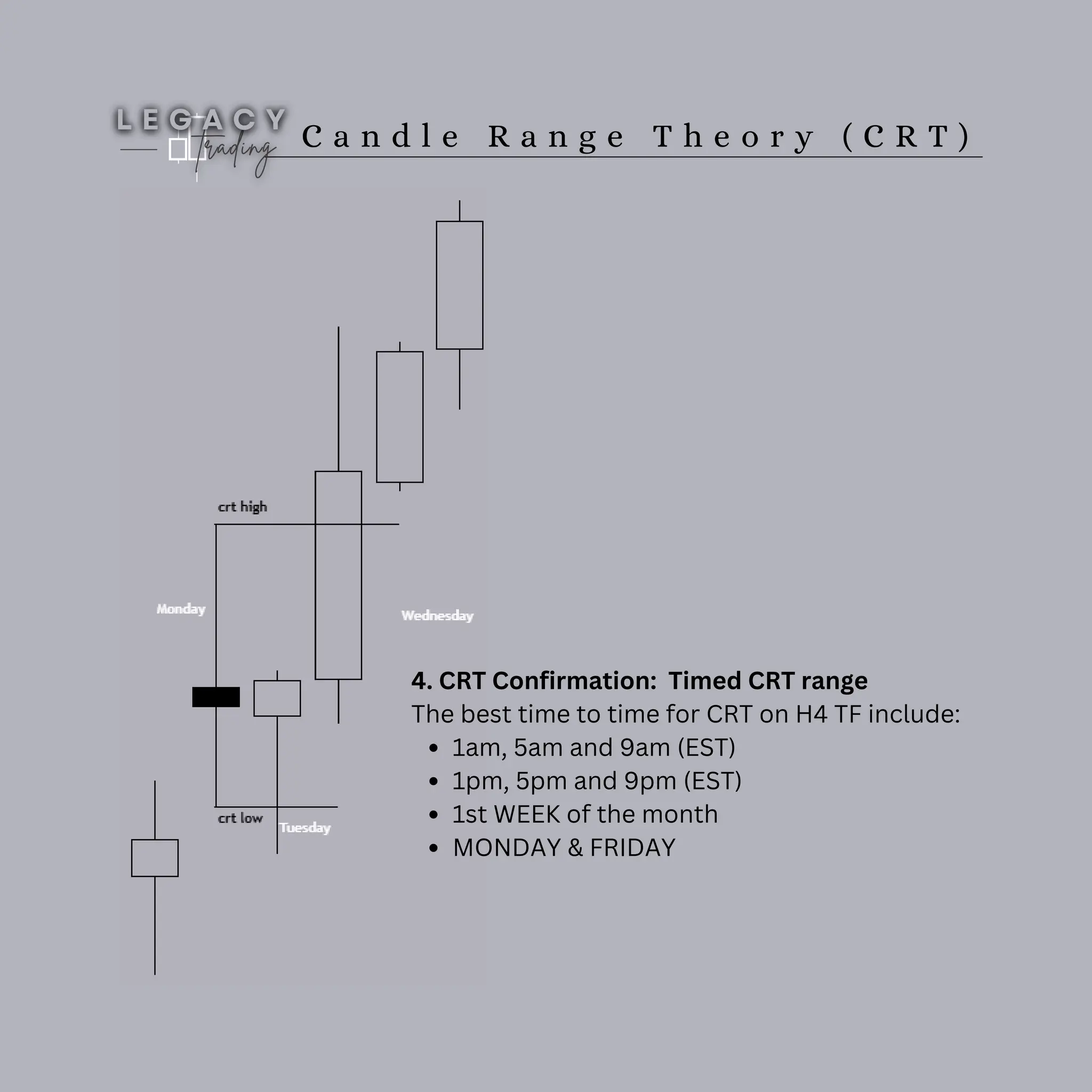
4. CRT Confirmation: Timed CRT range
The best time to time for CRT on H4 TF include:
1am, 5am and 9am (EST)
1pm, 5pm and 9pm (EST)
1st WEEK of the month
MONDAY & FRIDAY
C a n d l e R a n g e T h e o r y ( C R T )
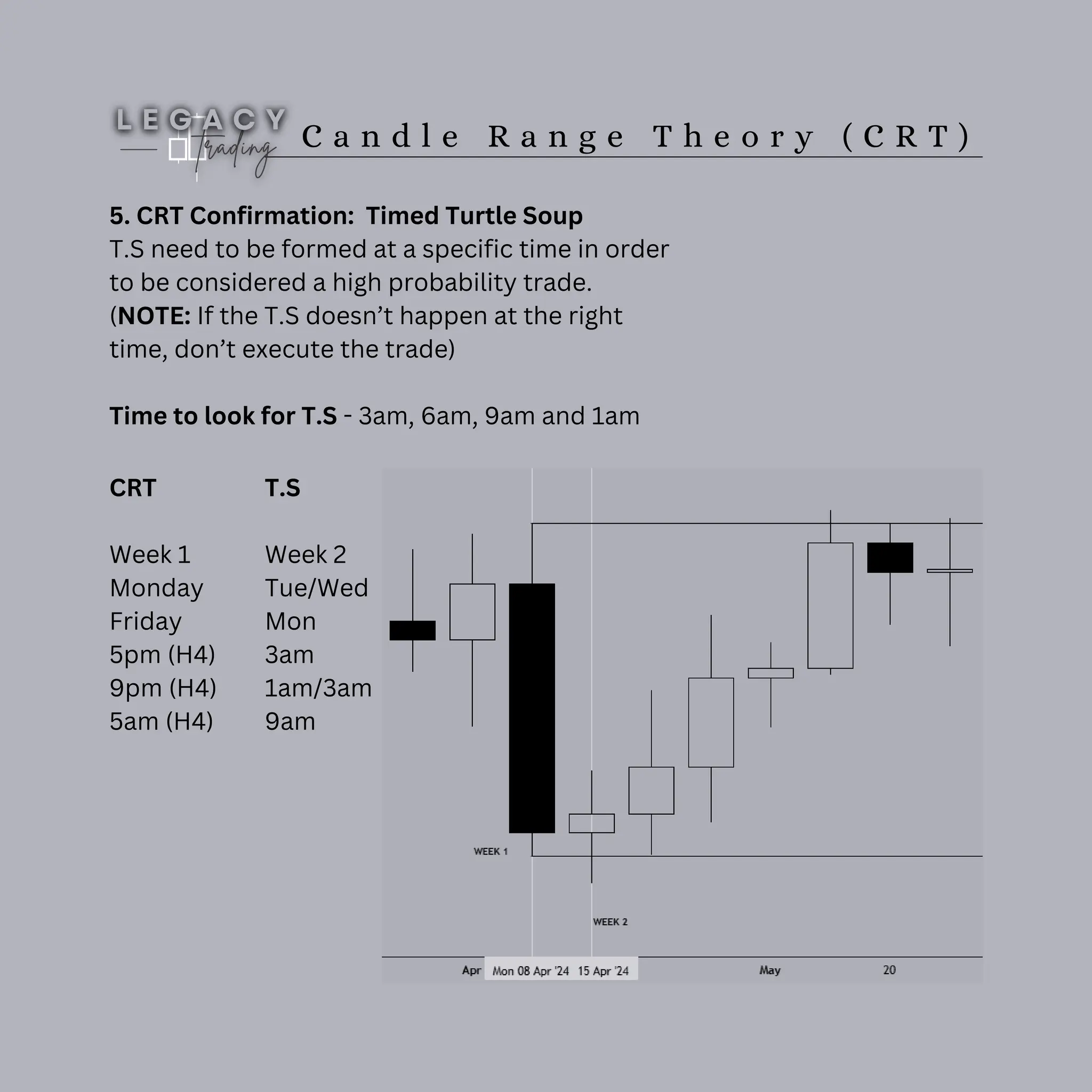
5. CRT Confirmation: Timed Turtle Soup
T.S need to be formed at a specific time in order
to be considered a high probability trade.
(NOTE: If the T.S doesn’t happen at the right
time, don’t execute the trade)
Time to look for T.S - 3am, 6am, 9am and 1am
CRT
Week 1
Monday
Friday
5pm (H4)
9pm (H4)
5am (H4)
T.S
Week 2
Tue/Wed
Mon
3am
1am/3am
9am

Candle Range Theory (CRT) by Legacy Trading.pdf

  • 1.
    F l as h c a r d s C a n d l e R a n g e T h e o r y ( C R T )
  • 2.
    C a nd l e R a n g e T h e o r y ( C R T ) CRT is usually represented with 3 candles on HTF. It includes the concept of the Power of Three (PO3) and Turtle Soup (TS). Types of CRT 3 Candles CRT (PO3) CRT + inside bar (ideal if you’re a beginner) NOTE CRT is NOT random You MUST consider the aspect of Time & Price
  • 3.
    C a nd l e R a n g e T h e o r y ( C R T ) CRT + inside bar Multiple candles inside CRT Mark High and Low on the 1st candle It takes longer to form It is Higher Probability Better for beginner (or traders who want entry on confirmation)
  • 4.
    C a nd l e R a n g e T h e o r y ( C R T ) CRT Methodology Every single candle is a range on its on (on each TF) Range can either be manipulated (turtle souped) or broken out (BO) or retested. To determine the HTF bias, look whether HTF candle has been turtle souped or not.
  • 5.
    C a nd l e R a n g e T h e o r y ( C R T ) TS & CSD TS = Turtle soup CSD = Change in State of Delivery A candle can either be broken out or it can be wicked (TS). Bullish: Wick below & close above previous candle Bearish: Wick above & close below the previous candle Wicking (manipulation) MUST happen on the HTF Key zones such as; Supply & Demand (SND) Support & Resistant (SNR) Order Block (OB) Double Maru (DM) or Gap Breaker (Br) QMR/QMC/QMM SNRC1/2/3
  • 6.
    C a nd l e R a n g e T h e o r y ( C R T ) CSD = Change in State of Delivery Closing above the last OB made before market reverses is what we call CSD.
  • 7.
    C a nd l e R a n g e T h e o r y ( C R T ) The Power of Three (PO3) PO3 is 3 candles CRT This represents 3 stages of Price Delivery Each stage has its own objectives (AMD) A = Accumulation - 1st candle M = Manipulation - 2nd candle D = Distribution - 3rd candle 1st candle: Forms the range. Mark High & Low 2nd candle: Forms the soup. The most ADVANCED entries 3rd candle: Quickest trades & easiest entries with very High Probability BEARRISH = Sell above open of the 3rd candle BULLISH = Buy below open of the 3rd candle Profits = TP 1 at 50%, TP 2 at Low/High
  • 8.
    C a nd l e R a n g e T h e o r y ( C R T ) OLHC OHLC
  • 9.
    C a nd l e R a n g e T h e o r y ( C R T ) CRT Entry Models Entry on the 2nd candle (T.S) Model #1 (OB/CSD)
  • 10.
    C a nd l e R a n g e T h e o r y ( C R T ) CRT Entry Models Entry on the 2nd candle (T.S) Model #1 (OB/CSD)
  • 11.
    C a nd l e R a n g e T h e o r y ( C R T ) CRT Entry Models Entry on the 3rd candle (above/below 3rd candle open - 50% range of the 2nd candle)
  • 12.
    C a nd l e R a n g e T h e o r y ( C R T ) CRT Entry Models Entry on the 3rd candle (below 3rd candle open - 50% range of the 2nd candle)
  • 13.
    C a nd l e R a n g e T h e o r y ( C R T ) CRT Entry Models Entry on the 3rd candle (above the 3rd candle open - 50% range of the 2nd candle)
  • 14.
    C a nd l e R a n g e T h e o r y ( C R T ) CRT Entry Models Entry on the 3rd candle (above the 3rd candle open - 50% range of the 2nd candle)
  • 15.
    C a nd l e R a n g e T h e o r y ( C R T ) CRT Confirmation HTF Key levels 1. LTF CRT within HTF CRT 2. CRT Entry Location 3. Timed CRT range 4. Timed Turtle Soup 5.
  • 16.
    HTF Key levelCRT TF H4, H1 15M D1, H4 H1 W, D1 H4 M, W D1 Y, M W C a n d l e R a n g e T h e o r y ( C R T ) 1. CRT Confirmation: HTF Key levels HTF key levels validates your CRT. We want to see price making aggressive move at the key level HTF Key levels Supply & Demand (SND) Support & Resistant (SNR) Double Maru (DM) or Gap Order Block (OB) Breaker (Br) QMR/QMC/QMM SNRC1/2/3
  • 17.
    C a nd l e R a n g e T h e o r y ( C R T ) 2. CRT Confirmation: LTF CRT within the HTF CRT Mark CRT on HTF Wait for one end of the range to be hit on LTF CRT Go to LTF and draw the CRT on the candle that hit the HTF CRT H4 TF H1 TF
  • 18.
    CRT TF EntryTF Yearly W Monthly D1 Weekly H4 Daily H1 H4 M30/M15 H1 M15/M5 M30/M15 M1 C a n d l e R a n g e T h e o r y ( C R T ) 3. CRT Confirmation: CRT Entry Location Your entry model MUST be on a specific TF that is aligned with HTF CRT
  • 19.
    C a nd l e R a n g e T h e o r y ( C R T ) 4. CRT Confirmation: Timed CRT range The best time to time for CRT on H4 TF include: 1am, 5am and 9am (EST) 1pm, 5pm and 9pm (EST) 1st WEEK of the month MONDAY & FRIDAY
  • 20.
    C a nd l e R a n g e T h e o r y ( C R T ) 5. CRT Confirmation: Timed Turtle Soup T.S need to be formed at a specific time in order to be considered a high probability trade. (NOTE: If the T.S doesn’t happen at the right time, don’t execute the trade) Time to look for T.S - 3am, 6am, 9am and 1am CRT Week 1 Monday Friday 5pm (H4) 9pm (H4) 5am (H4) T.S Week 2 Tue/Wed Mon 3am 1am/3am 9am