1
Niteen S Dharmawat
Co-Founder, Aurum Capital
Website: https://aurumcapital.in
Twitter: @CapitalAurum / @niteen_india
Email: info@aurumcapital.in
Who says elephants can't dance?
30th August 2025
2
IMPORTANT DISCLAIMER:
The information herein is used as per the available sources of bseindia.com/nseindia.com/brokers websites, company’s annual reports &
other public/private database sources. Aurum Capital is not responsible for any discrepancy in the data. Investors should seek advice of
their independent financial advisor prior to taking any investment decision based on this report or for necessary explanation of its
contents.
Future estimates mentioned herein are personal opinions & views of the analyst. Analyst Name – Niteen S Dharmawat. For queries /
grievances – support@aurumcapital.in. SEBI registration No: INH000008118
Readers/attendees/viewers are responsible for all outcomes arising of buying / selling particular scrip/ scrips mentioned here in. This
presentation indicates opinion of the author to understand the company and its business operations and it is not a recommendation
to buy or sell securities. Aurum Capital & its representatives have vested interest in above mentioned security/ies at the time of this
publication, and its partners / company have positions / financial interest in the security/ies mentioned above.
Aurum Capital, or its associates are not paid or compensated at any point of time, in last 12 months by any way from the companies
mentioned in the report.
Aurum Capital, or its representatives do not have more than 1% of the company’s total shareholding. Ownership of the stock: yes.
Recommendation to client: this stock is recommended to clients. Served as a director / employee of mentioned companies in report:
No. Any material conflict of interest at the time of publishing report: No
The views expressed in this post accurately reflect the author’s personal views about any and all of the subject securities or issuers; and
no part of the compensations, if any was, is or will be, directly indirectly, related to specific recommendation or views expressed in the
report.
3
Aurum Capital is a SEBI registered Research Analyst (SEBI Registration No:
INH000008118) services company. Started by Jiten Parmar and Niteen
Dharmawat, who together have more than 4 decades of experience investing in
equities and guiding and mentoring fellow investors.
This rich industry background helps us understand companies, complexities of
business and tipping points that make or break a company. Our approach is not
limited to just number crunching but going beyond. We focus on the business,
strategic direction, the competitive landscape, the governance process, the
background of the promoters, turnarounds, to name a few. Often these are more
critical items than just numbers. Jiten and Niteen have successfully waded through
multiple bear and bull market cycles.
4
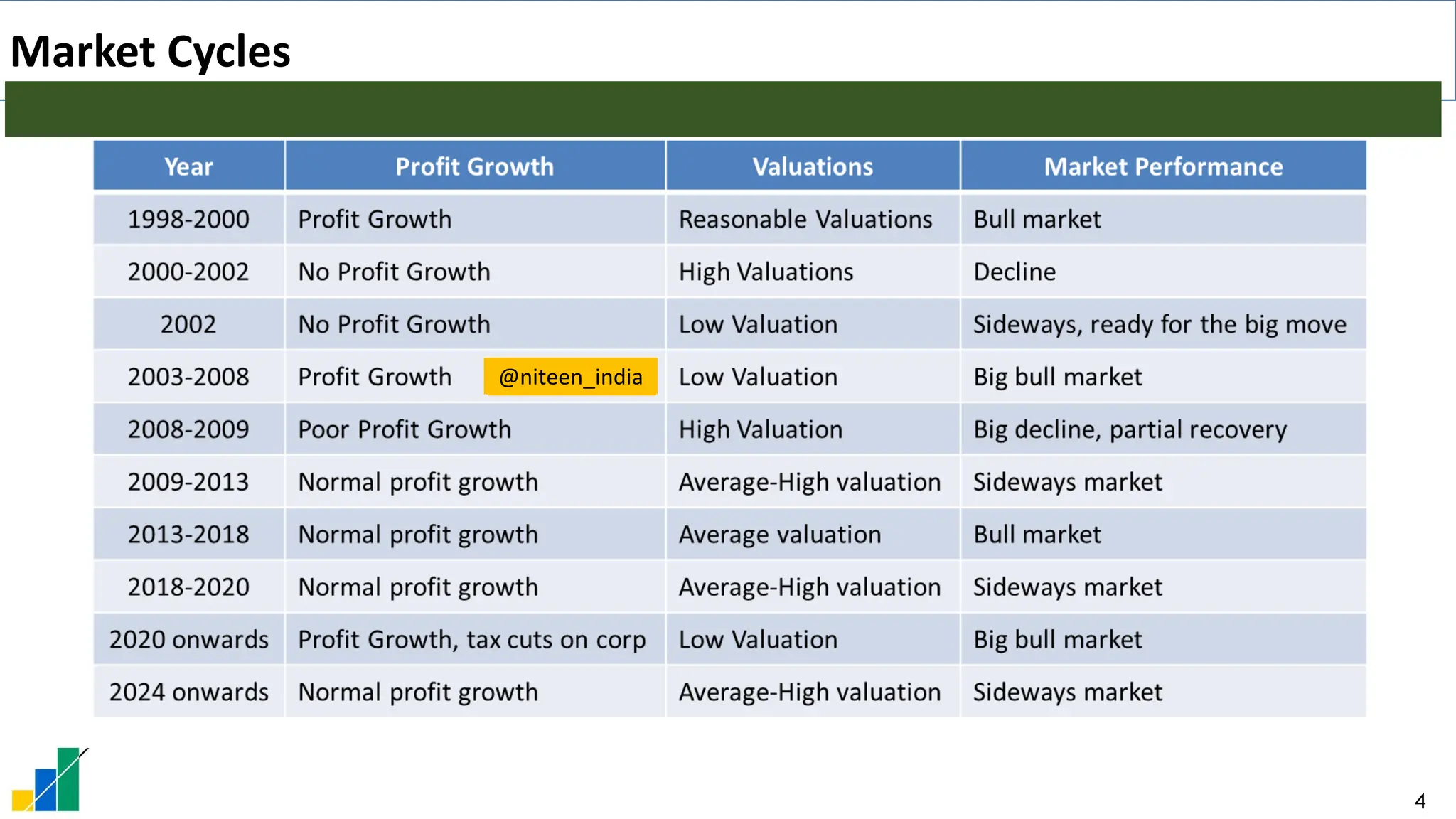
Market Cycles
@niteen_india
5
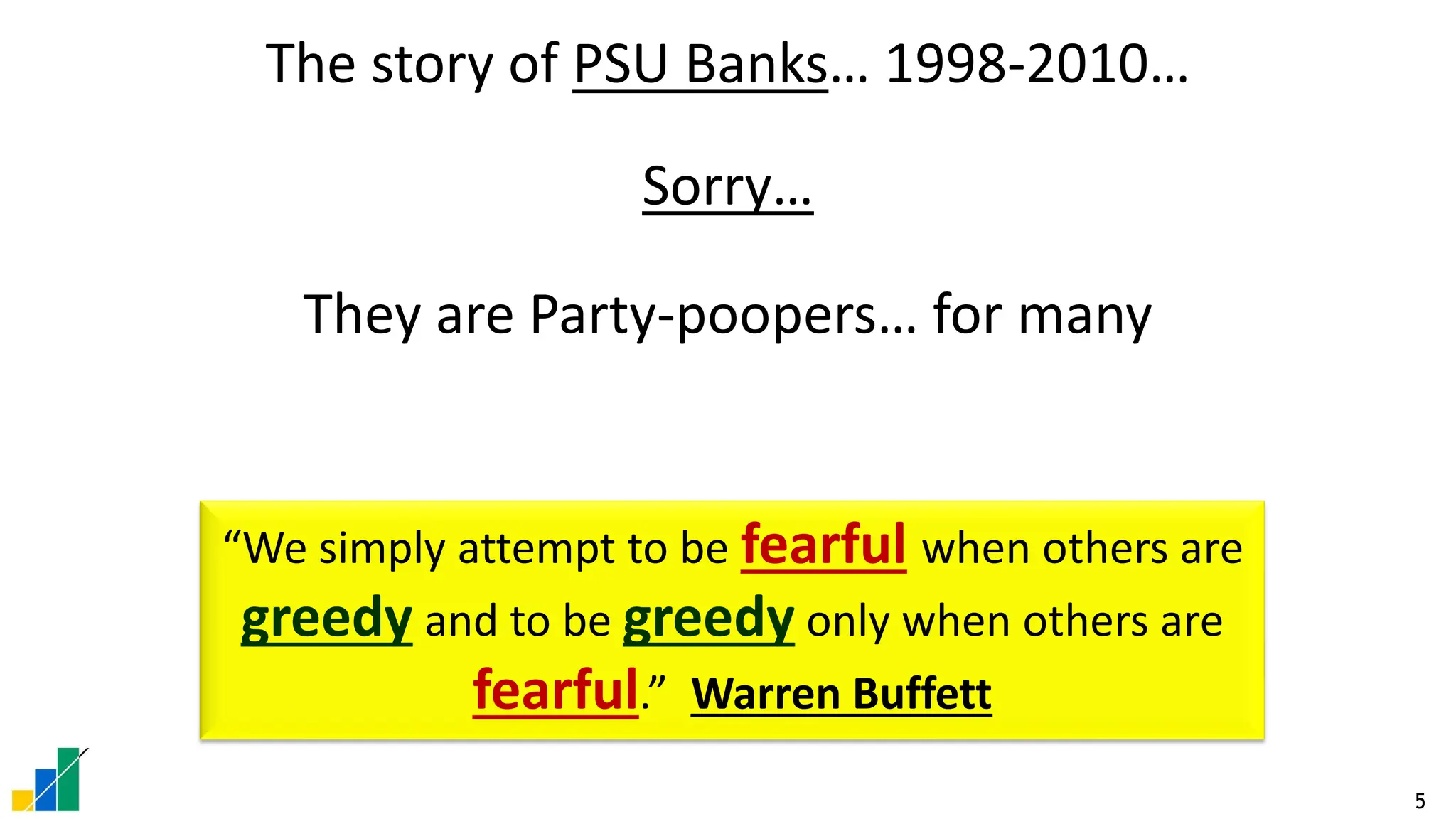
The story of PSU Banks… 1998-2010…
Sorry…
They are Party-poopers… for many
“We simply attempt to be fearful when others are
greedy and to be greedy only when others are
fearful.” Warren Buffett
6
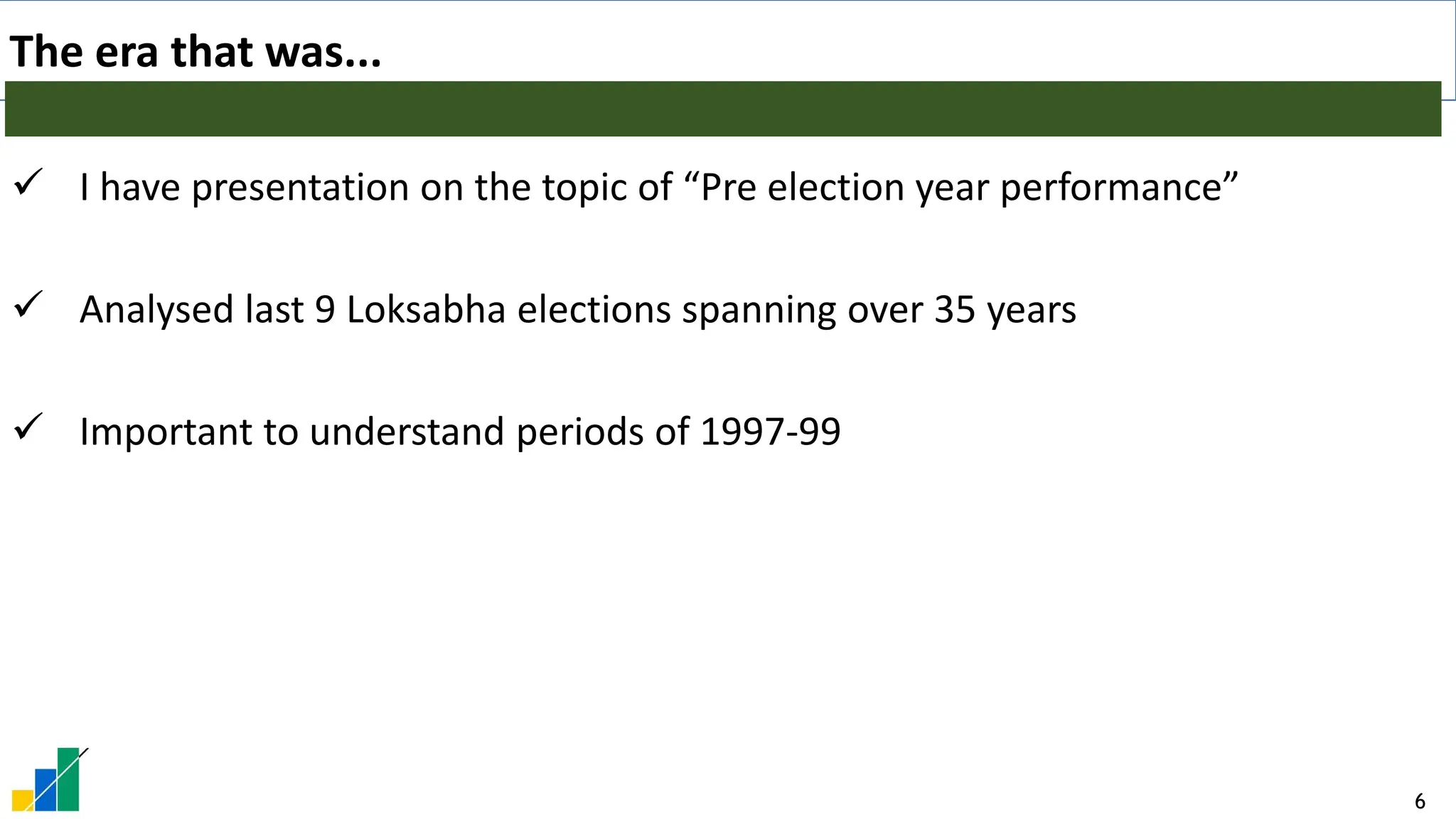
The era that was...
✓ I have presentation on the topic of “Pre election year performance”
✓ Analysed last 9 Loksabha elections spanning over 35 years
✓ Important to understand periods of 1997-99
7
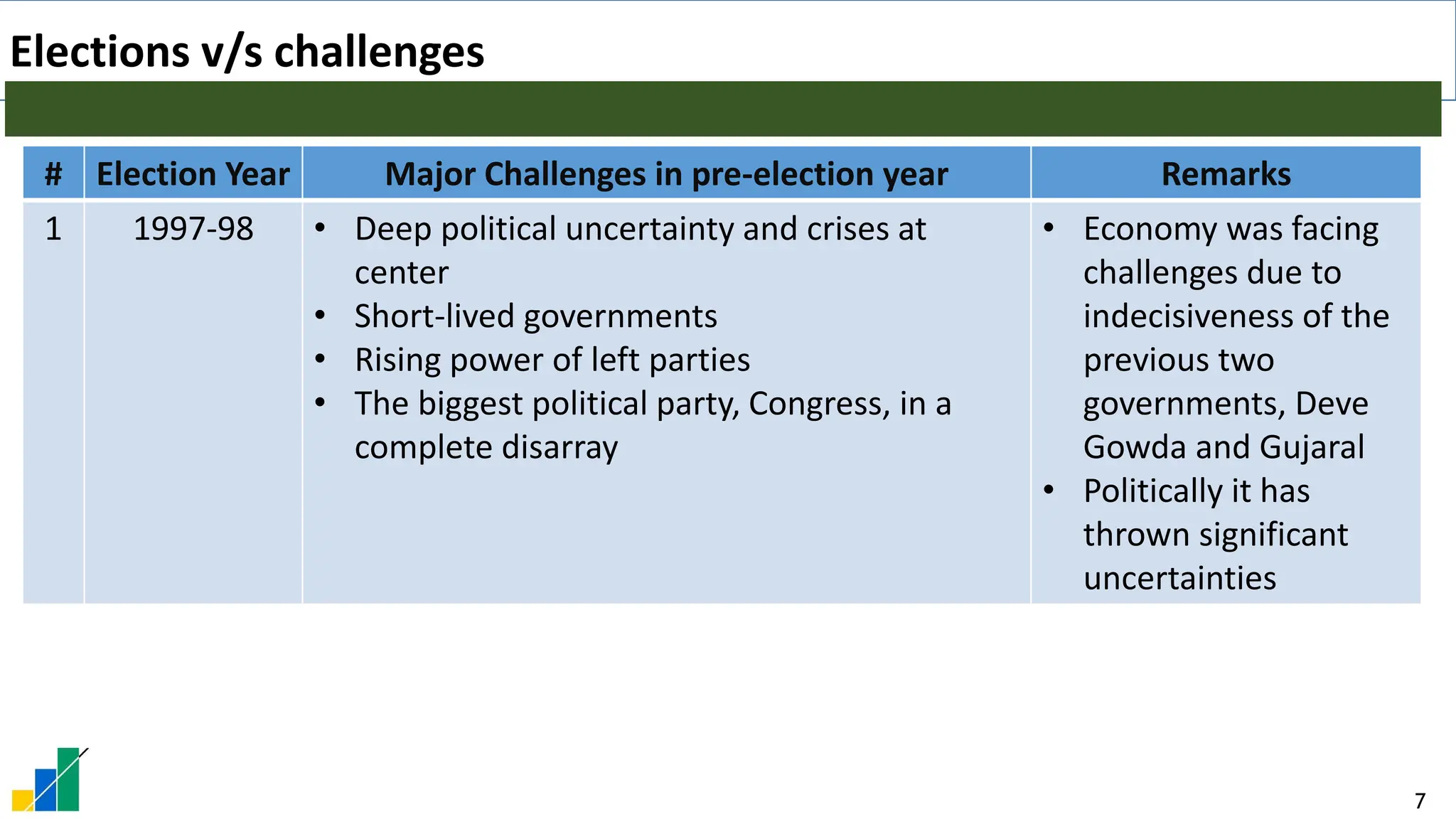
Elections v/s challenges
# Election Year Major Challenges in pre-election year Remarks
1 1997-98 • Deep political uncertainty and crises at
center
• Short-lived governments
• Rising power of left parties
• The biggest political party, Congress, in a
complete disarray
• Economy was facing
challenges due to
indecisiveness of the
previous two
governments, Deve
Gowda and Gujaral
• Politically it has
thrown significant
uncertainties
8
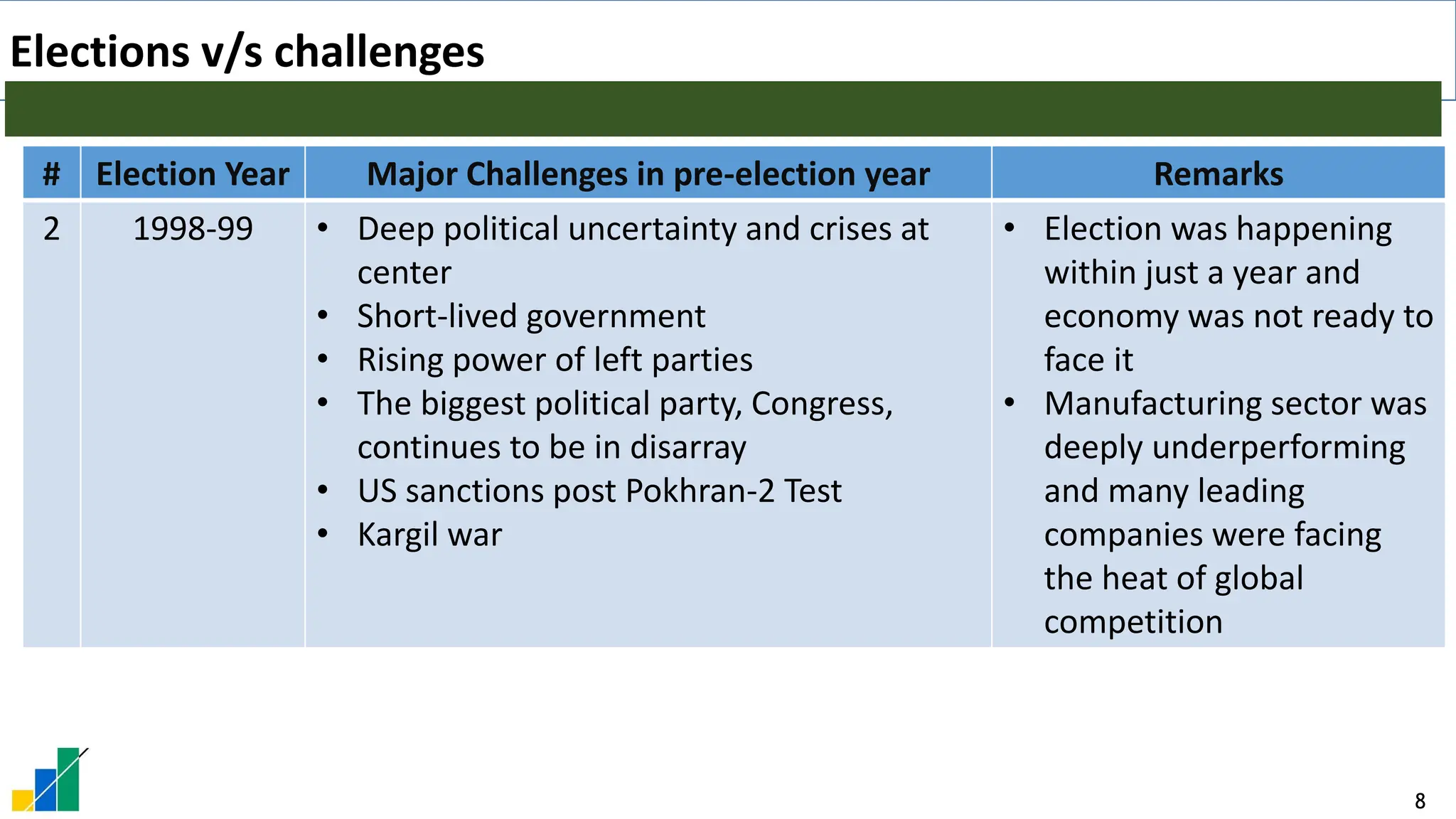
Elections v/s challenges
# Election Year Major Challenges in pre-election year Remarks
2 1998-99 • Deep political uncertainty and crises at
center
• Short-lived government
• Rising power of left parties
• The biggest political party, Congress,
continues to be in disarray
• US sanctions post Pokhran-2 Test
• Kargil war
• Election was happening
within just a year and
economy was not ready to
face it
• Manufacturing sector was
deeply underperforming
and many leading
companies were facing
the heat of global
competition
9
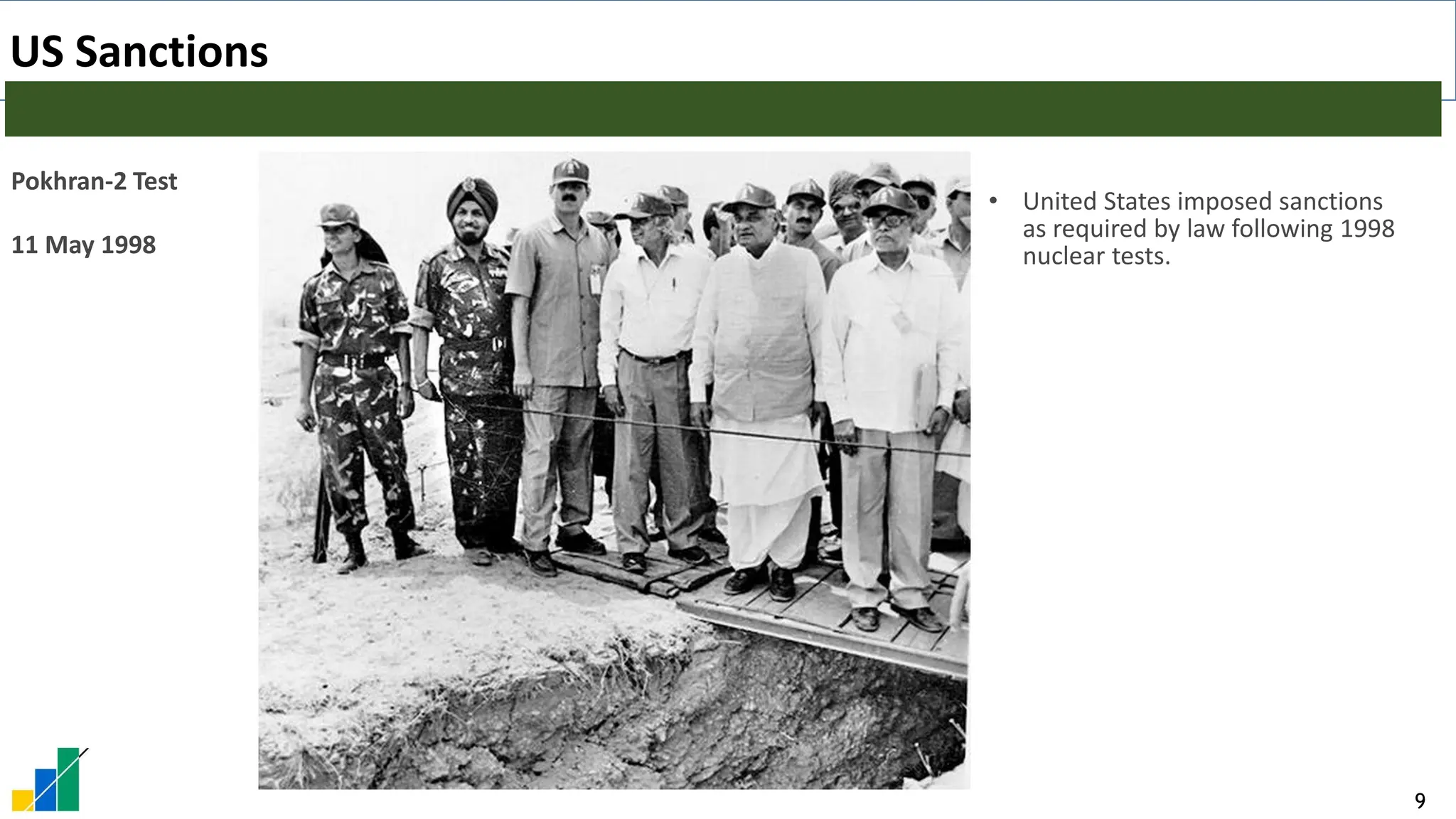
US Sanctions
Pokhran-2 Test
11 May 1998
• United States imposed sanctions
as required by law following 1998
nuclear tests.
10
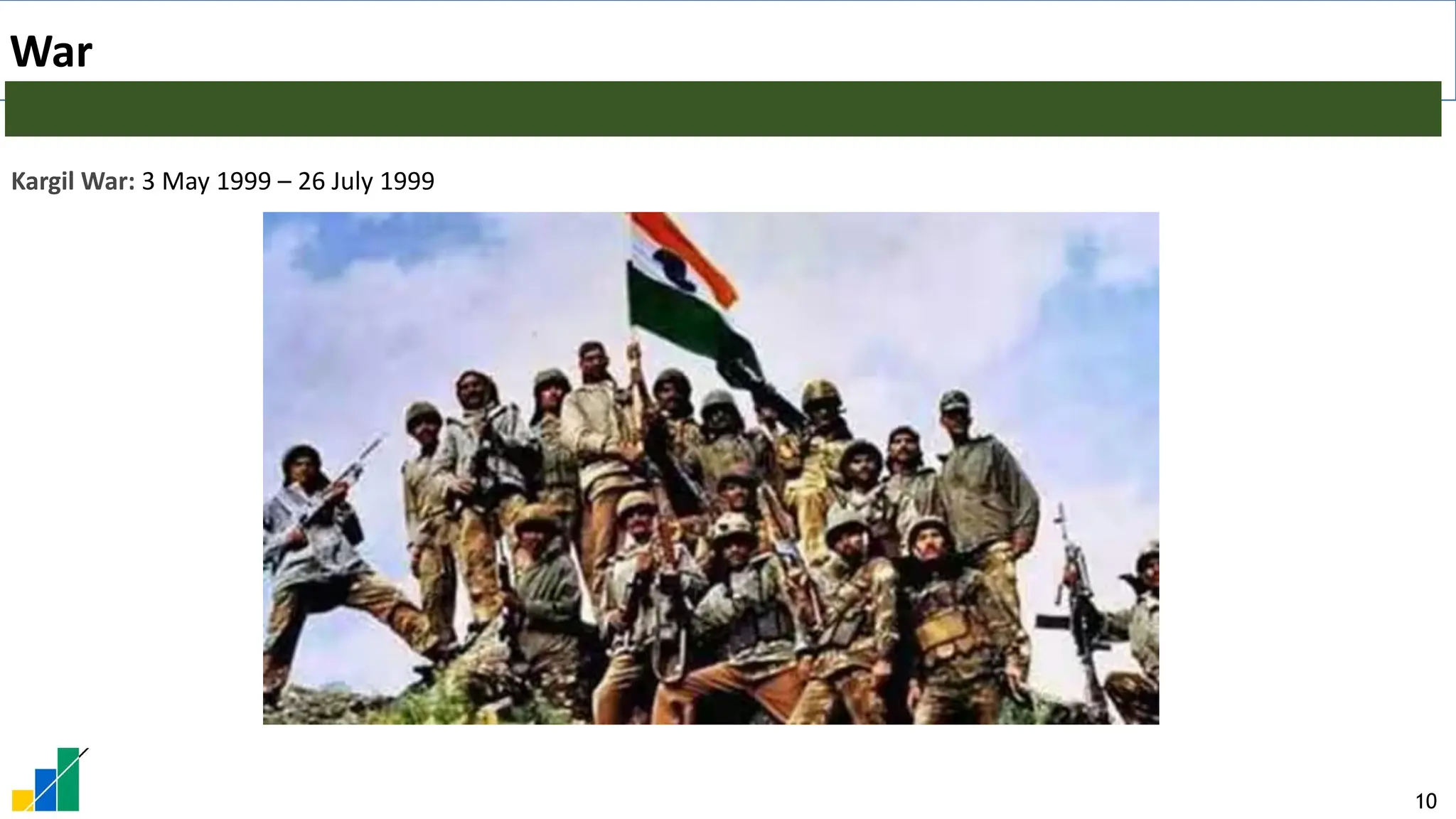
War
Kargil War: 3 May 1999 – 26 July 1999
11
Gross NPAs in some PSBs: around 2000
• SBI: 12.93% in 2001
• PNB: 8.96% in 1999
• BOB: 14.11% in 2001
• Canara: 7.8% in 2001
• BOI: 12.89% in 2000
PS Banks Gross NPAs peaked
at 16% in 1999
Source: India Budget, RBI, Bank ARs
12
Measures taken by the government: 2000-2003 period
• Game-changer: Banks got the SARFAESI Act (2002) and CDR, along with
tighter RBI norms (90-day NPA recognition, provisioning, PCA).
• Debt Recovery Tribunals (DRTs) strengthened
• For faster out of court settlement of smaller loan upto 10Lac: Lok
Adalats & Compromise Settlements
• These made banks more accountable and gave them real enforcement
powers for the first time.
• By 2004, reforms had brought the GNPA number down below 9% from
16%, setting the stage for the mid-2000s credit boom.
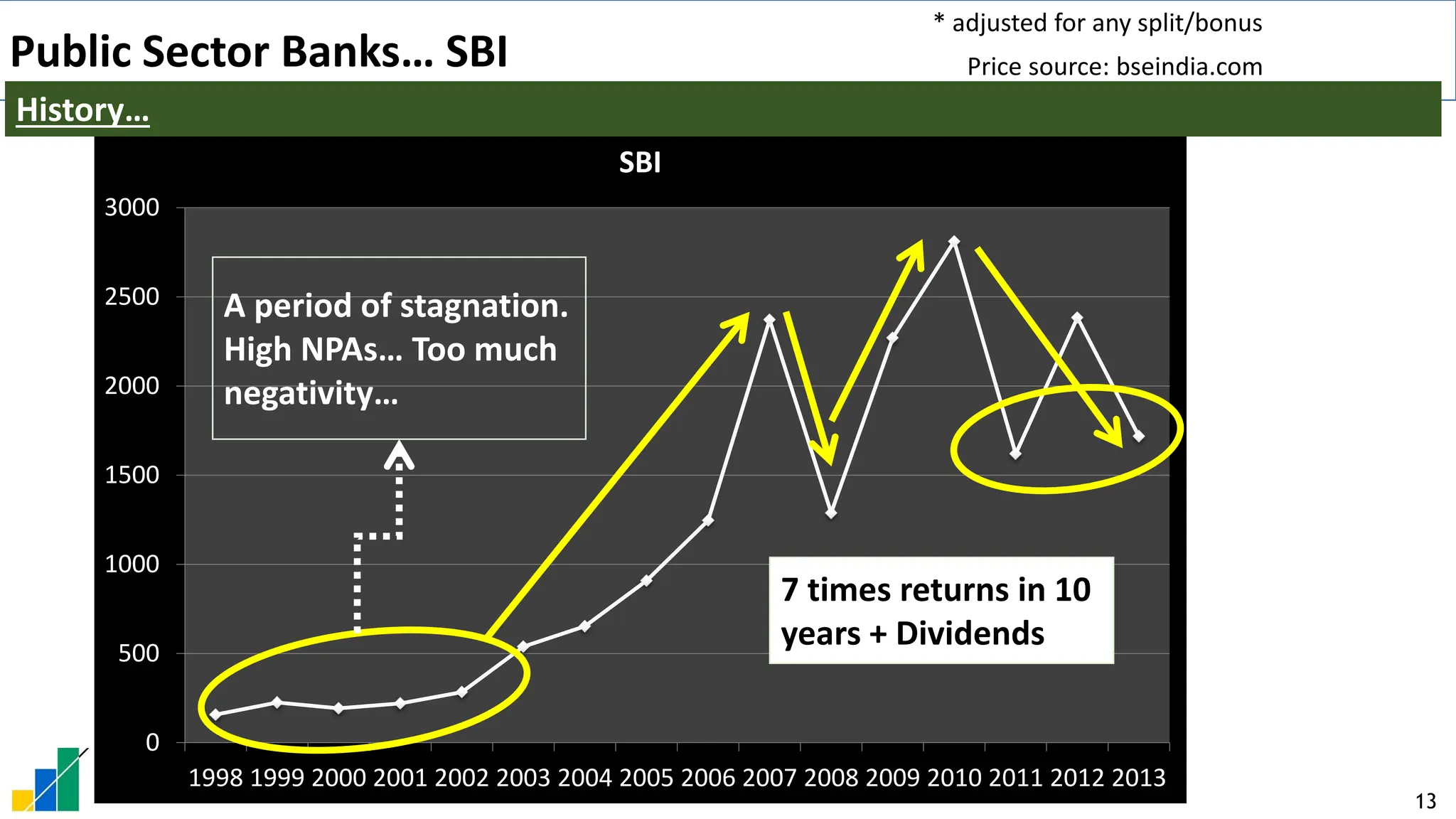
13
0
500
1000
1500
2000
2500
3000
1998 1999 2000 2001 2002 2003 2004 2005 2006 2007 2008 2009 2010 2011 2012 2013
SBI
7 times returns in 10
years + Dividends
A period of stagnation.
High NPAs… Too much
negativity…
* adjusted for any split/bonus
Public Sector Banks… SBI
History…
Price source: bseindia.com
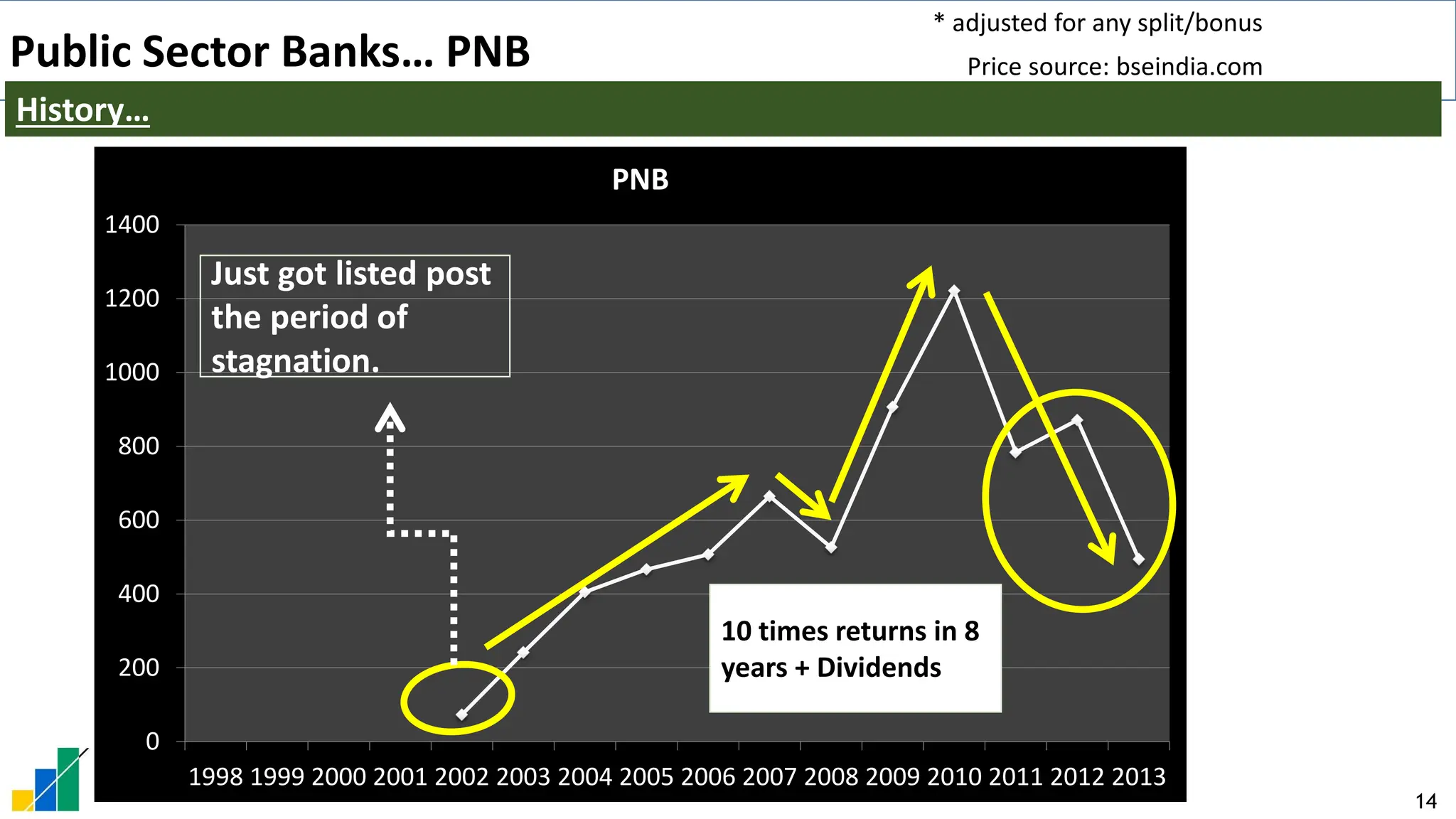
14
0
200
400
600
800
1000
1200
1400
1998 1999 2000 2001 2002 2003 2004 2005 2006 2007 2008 2009 2010 2011 2012 2013
PNB
* adjusted for any split/bonus
Price source: bseindia.com
Public Sector Banks… PNB
History…
10 times returns in 8
years + Dividends
Just got listed post
the period of
stagnation.
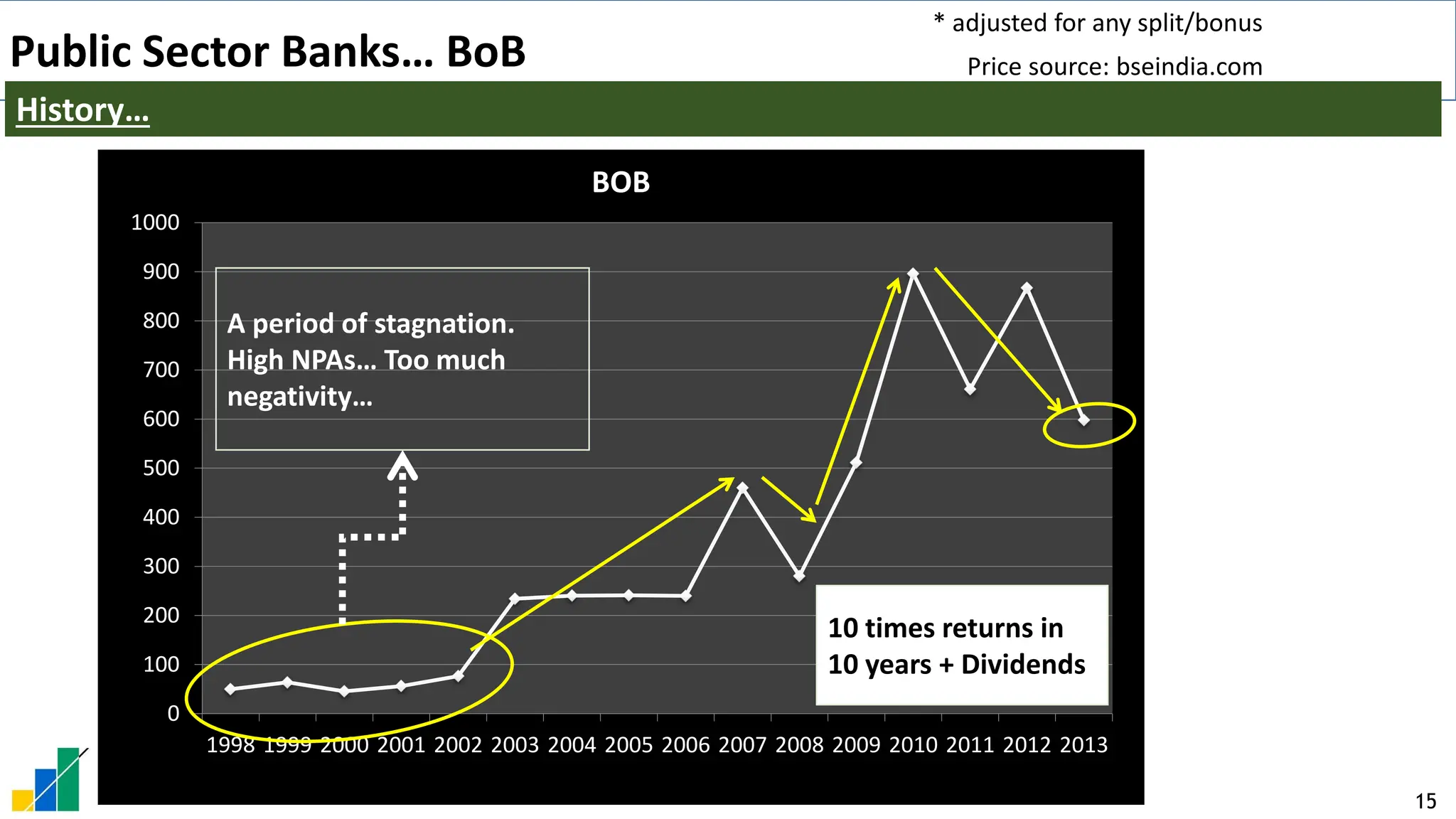
15
0
100
200
300
400
500
600
700
800
900
1000
1998 1999 2000 2001 2002 2003 2004 2005 2006 2007 2008 2009 2010 2011 2012 2013
BOB
10 times returns in
10 years + Dividends
A period of stagnation.
High NPAs… Too much
negativity…
* adjusted for any split/bonus
Public Sector Banks… BoB
History…
Price source: bseindia.com
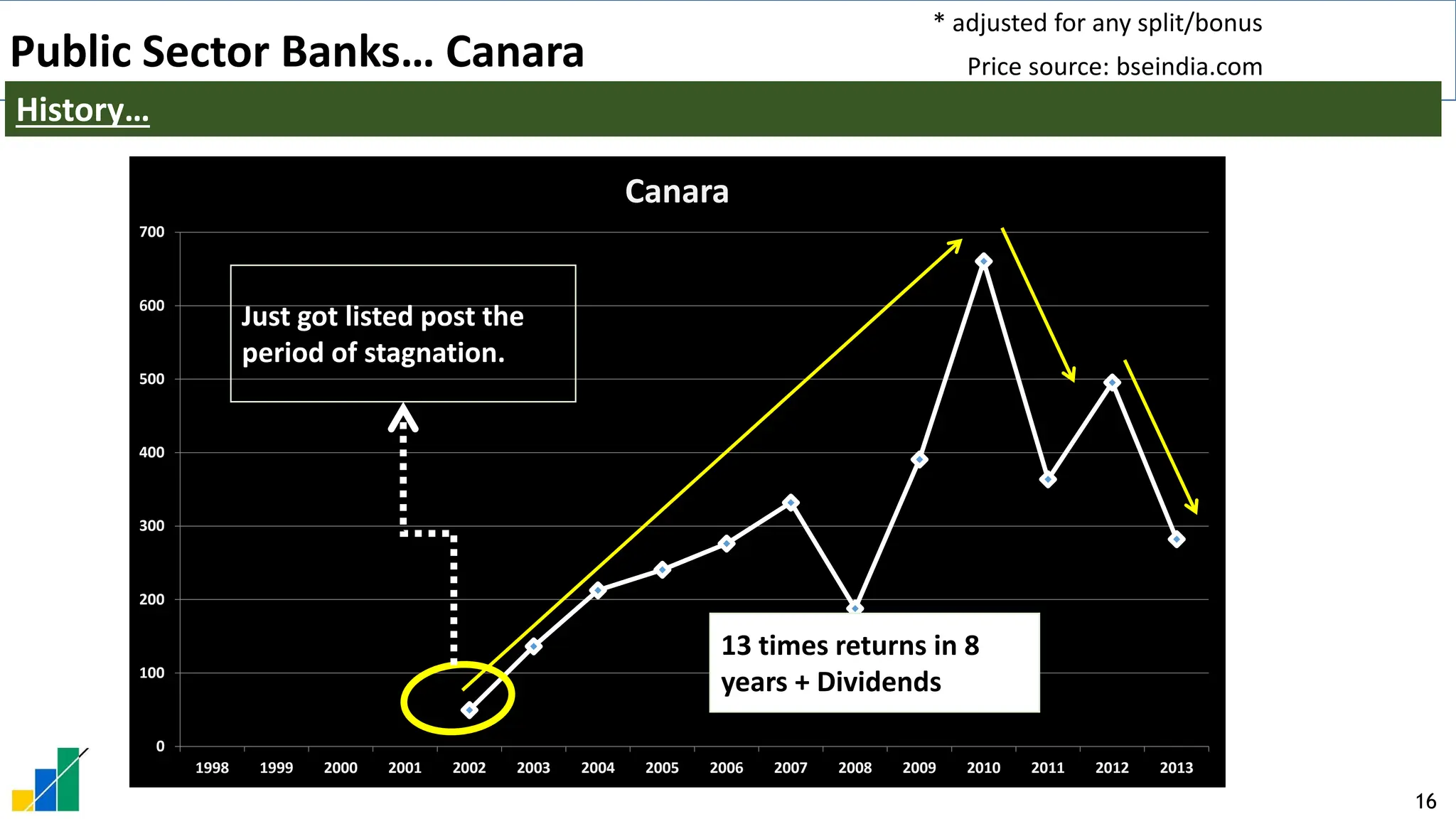
16
0
100
200
300
400
500
600
700
1998 1999 2000 2001 2002 2003 2004 2005 2006 2007 2008 2009 2010 2011 2012 2013
Canara
Just got listed post the
period of stagnation.
* adjusted for any split/bonus
Price source: bseindia.com
Public Sector Banks… Canara
History…
13 times returns in 8
years + Dividends
17
0
100
200
300
400
500
600
700
1998 1999 2000 2001 2002 2003 2004 2005 2006 2007 2008 2009 2010 2011 2012 2013
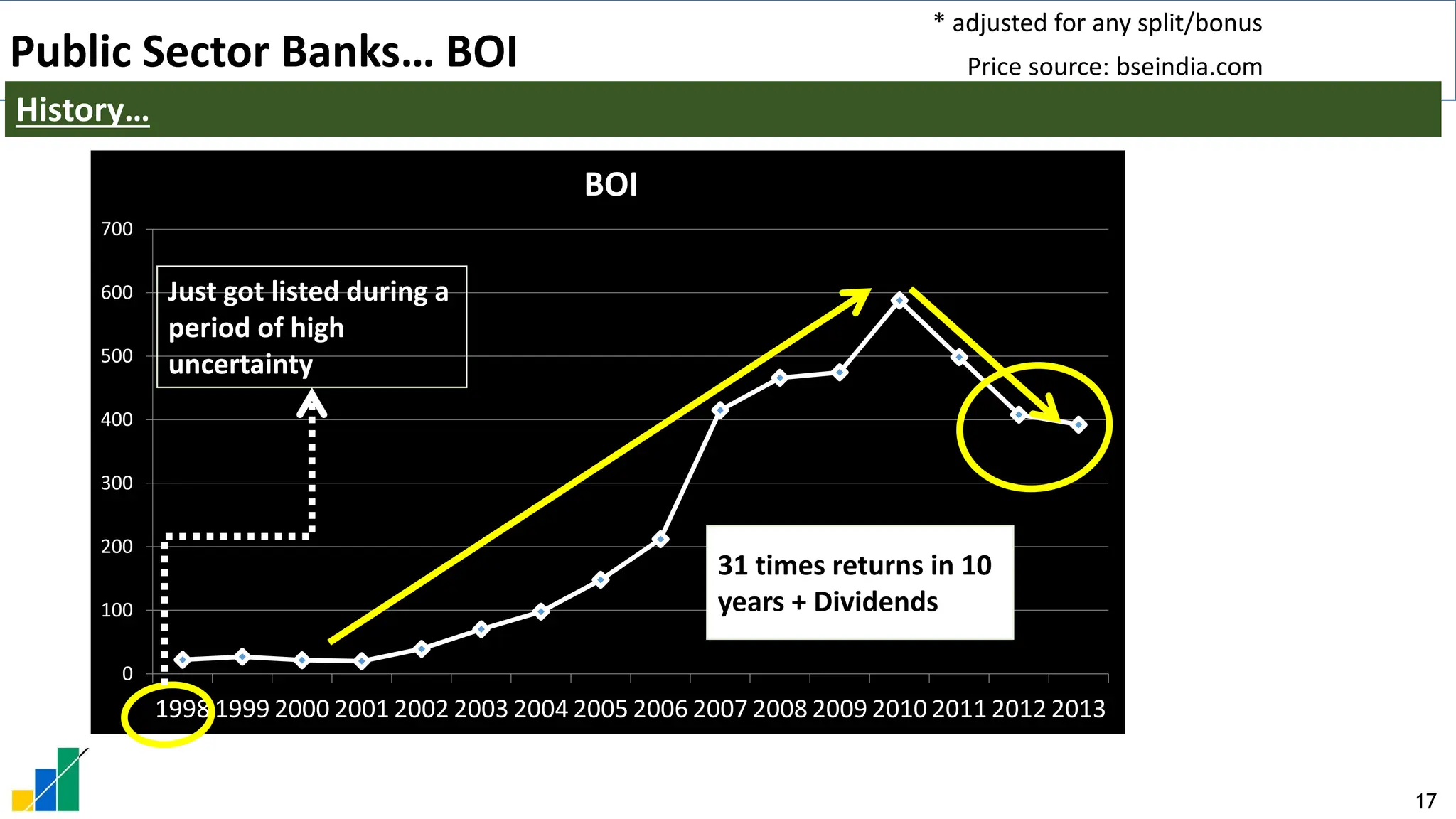
BOI
Just got listed during a
period of high
uncertainty
* adjusted for any split/bonus
Public Sector Banks… BOI
History…
31 times returns in 10
years + Dividends
Price source: bseindia.com
18
In stock market
History doesn’t “rhymes” itself
but rather "repeats“ exactly
The need for patience if big profits are to be made
from investment: Phil Fisher
19
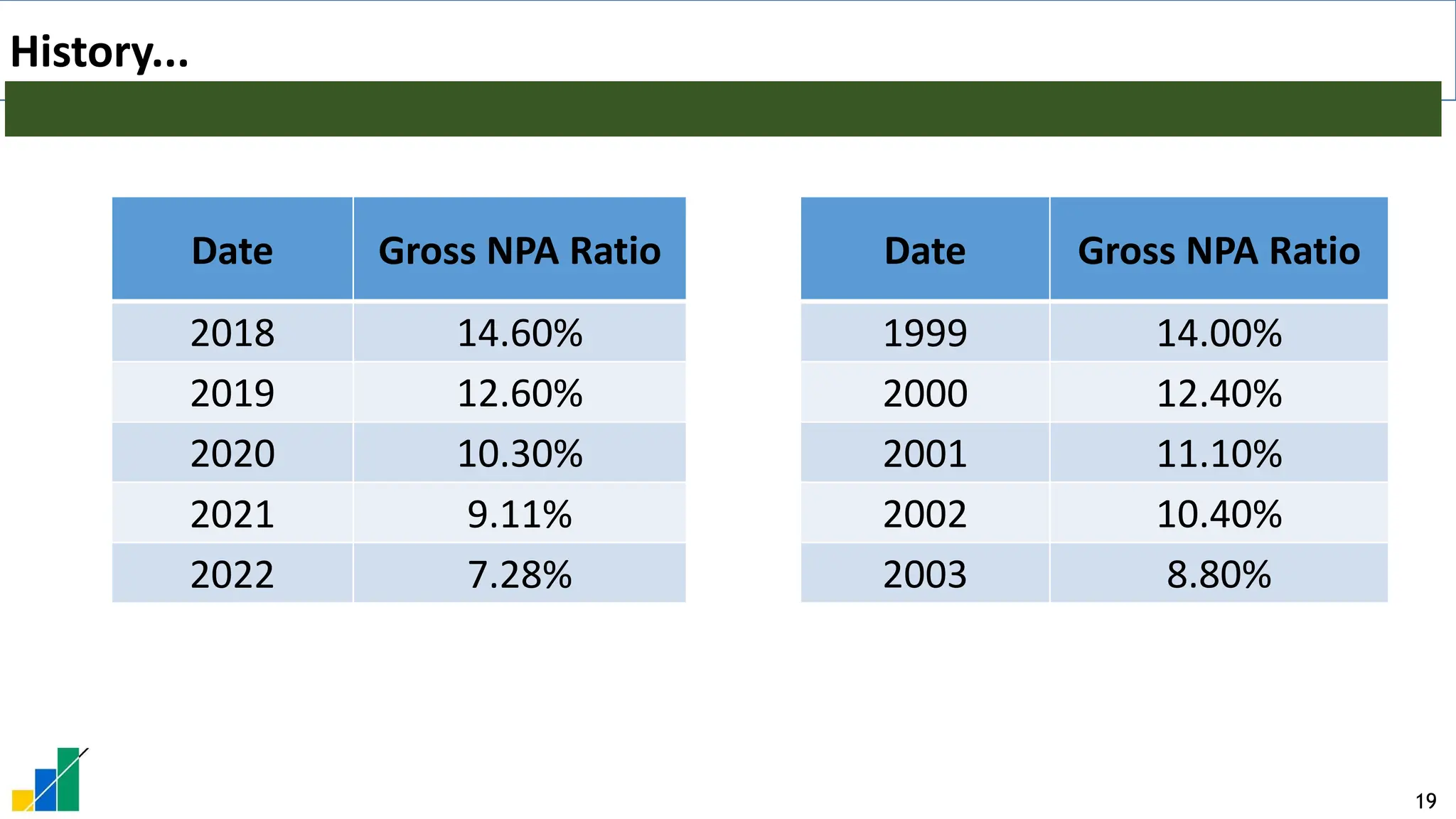
History...
Date Gross NPA Ratio
2018 14.60%
2019 12.60%
2020 10.30%
2021 9.11%
2022 7.28%
Date Gross NPA Ratio
1999 14.00%
2000 12.40%
2001 11.10%
2002 10.40%
2003 8.80%
20
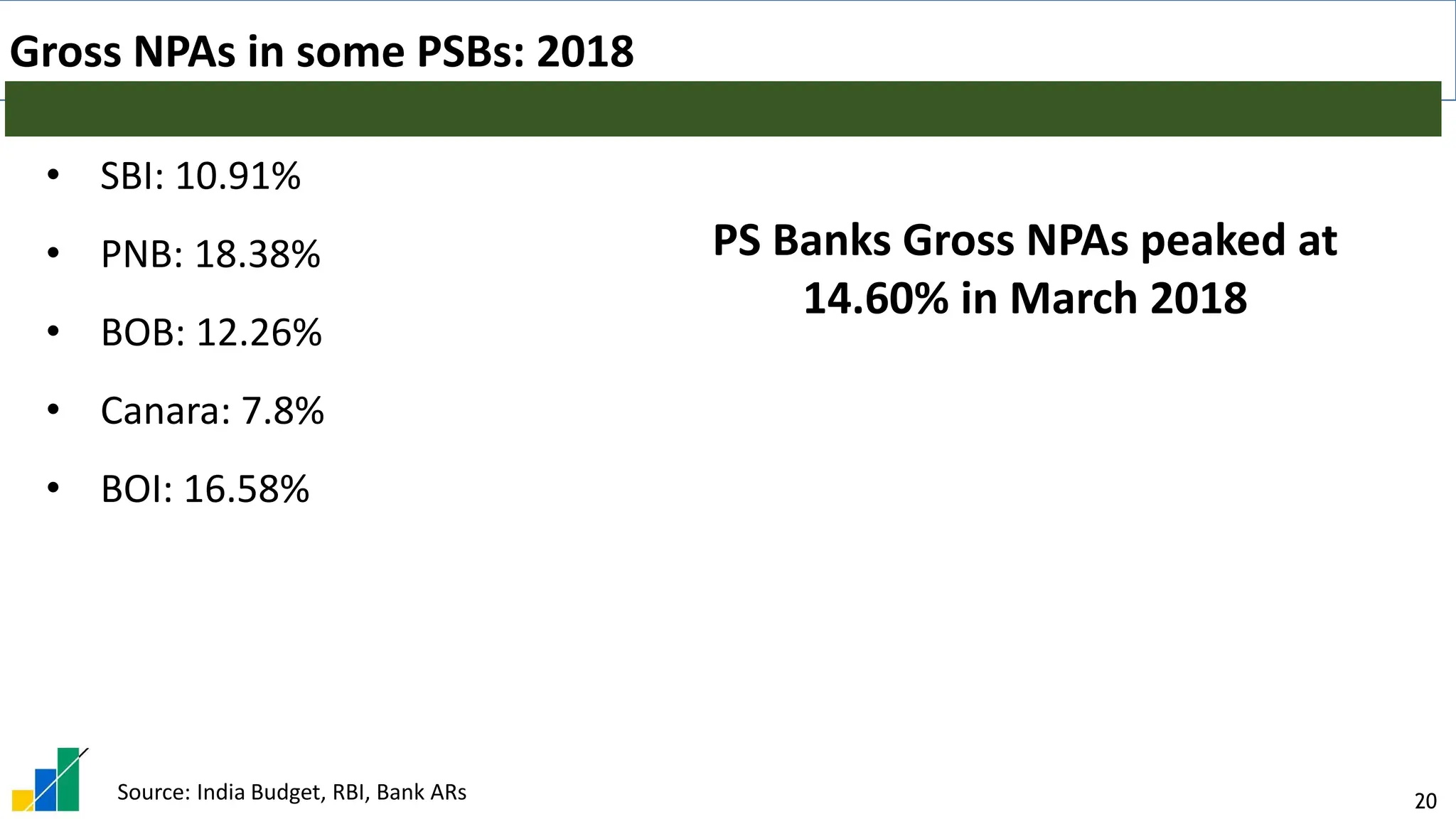
Gross NPAs in some PSBs: 2018
• SBI: 10.91%
• PNB: 18.38%
• BOB: 12.26%
• Canara: 7.8%
• BOI: 16.58%
PS Banks Gross NPAs peaked at
14.60% in March 2018
Source: India Budget, RBI, Bank ARs
21
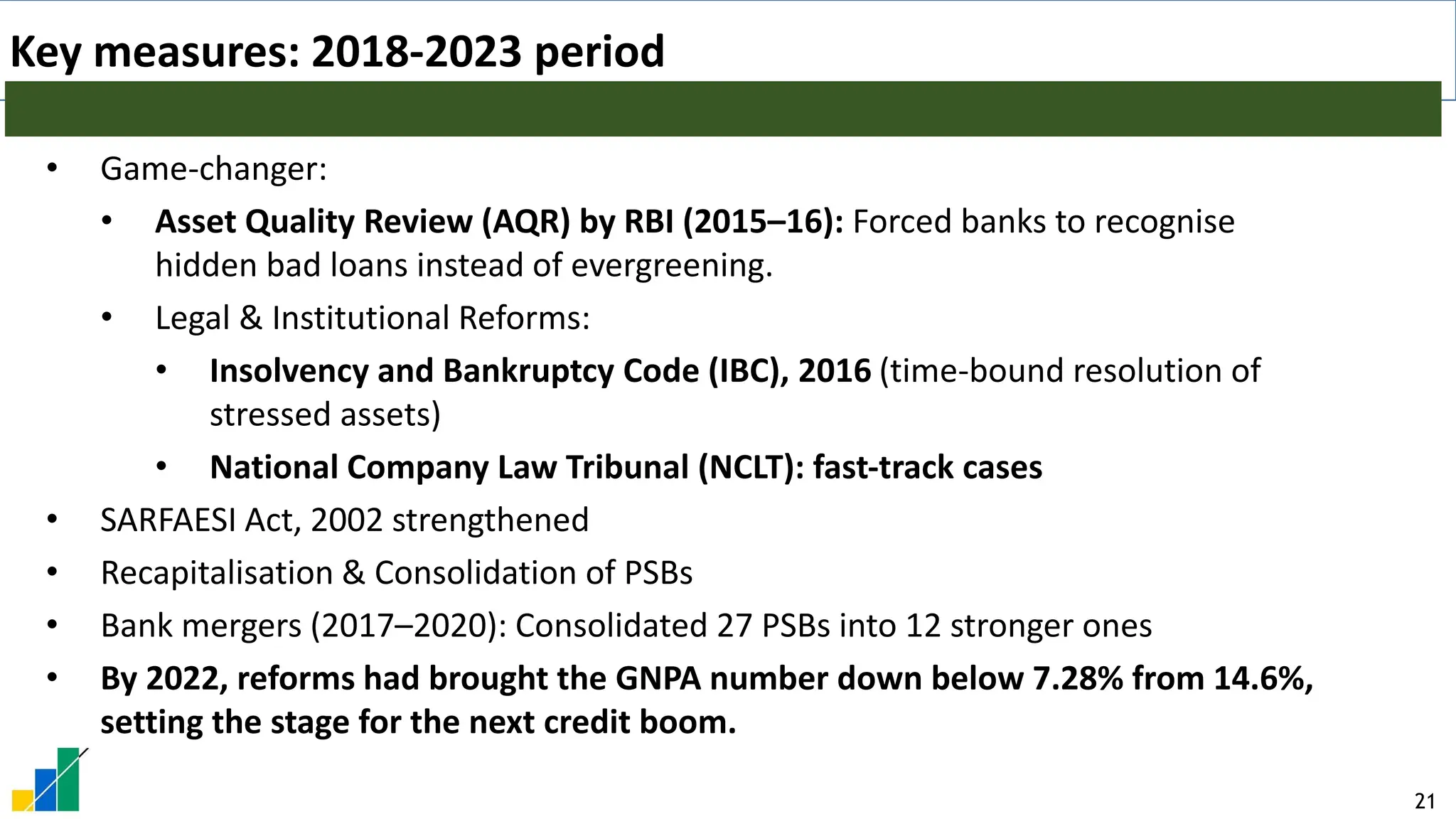
Key measures: 2018-2023 period
• Game-changer:
• Asset Quality Review (AQR) by RBI (2015–16): Forced banks to recognise
hidden bad loans instead of evergreening.
• Legal & Institutional Reforms:
• Insolvency and Bankruptcy Code (IBC), 2016 (time-bound resolution of
stressed assets)
• National Company Law Tribunal (NCLT): fast-track cases
• SARFAESI Act, 2002 strengthened
• Recapitalisation & Consolidation of PSBs
• Bank mergers (2017–2020): Consolidated 27 PSBs into 12 stronger ones
• By 2022, reforms had brought the GNPA number down below 7.28% from 14.6%,
setting the stage for the next credit boom.
Twitter - @niteen_india
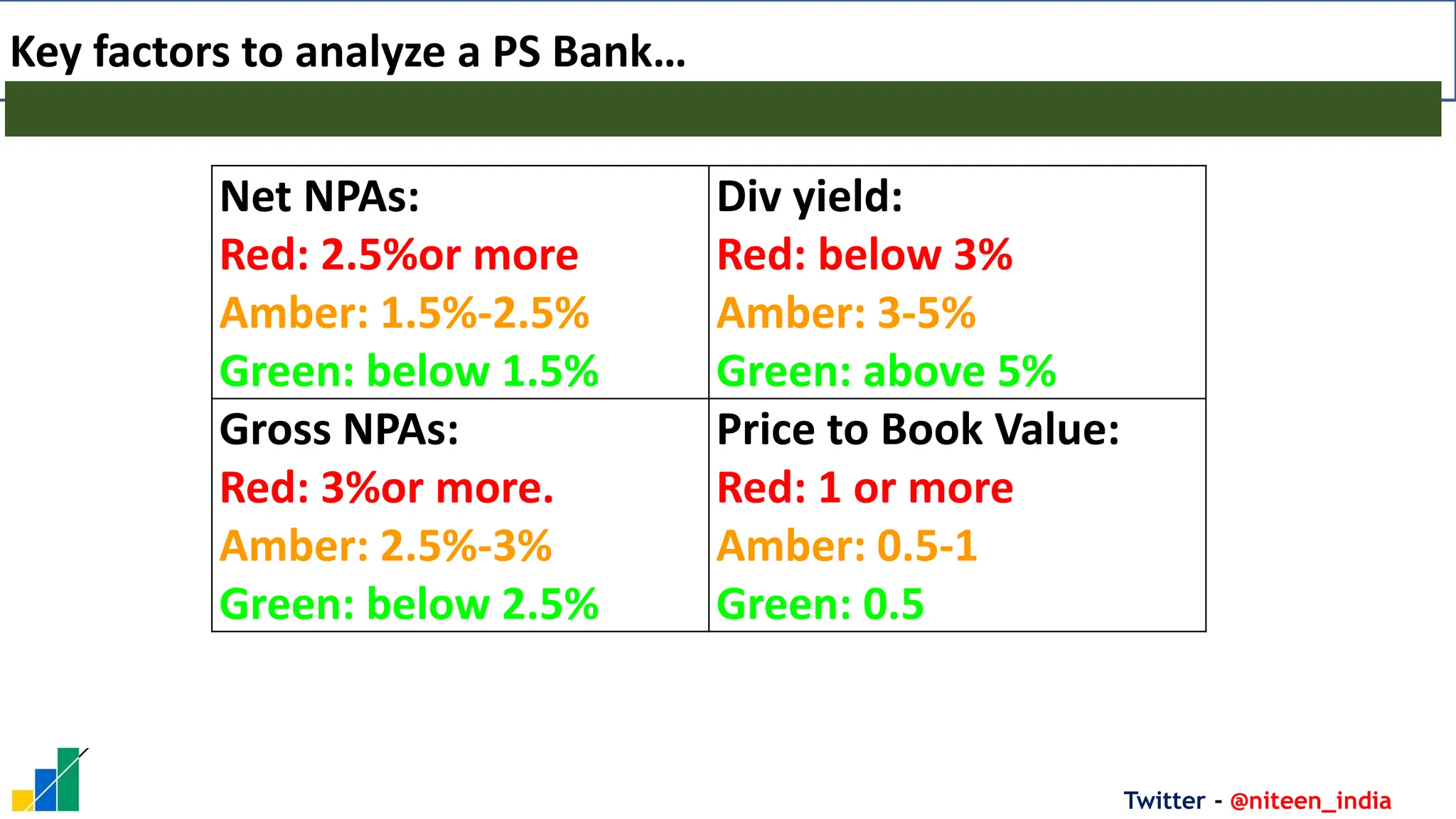
Key factors to analyze a PS Bank…
Net NPAs:
Red: 2.5%or more
Amber: 1.5%-2.5%
Green: below 1.5%
Div yield:
Red: below 3%
Amber: 3-5%
Green: above 5%
Gross NPAs:
Red: 3%or more.
Amber: 2.5%-3%
Green: below 2.5%
Price to Book Value:
Red: 1 or more
Amber: 0.5-1
Green: 0.5
Twitter - @niteen_india
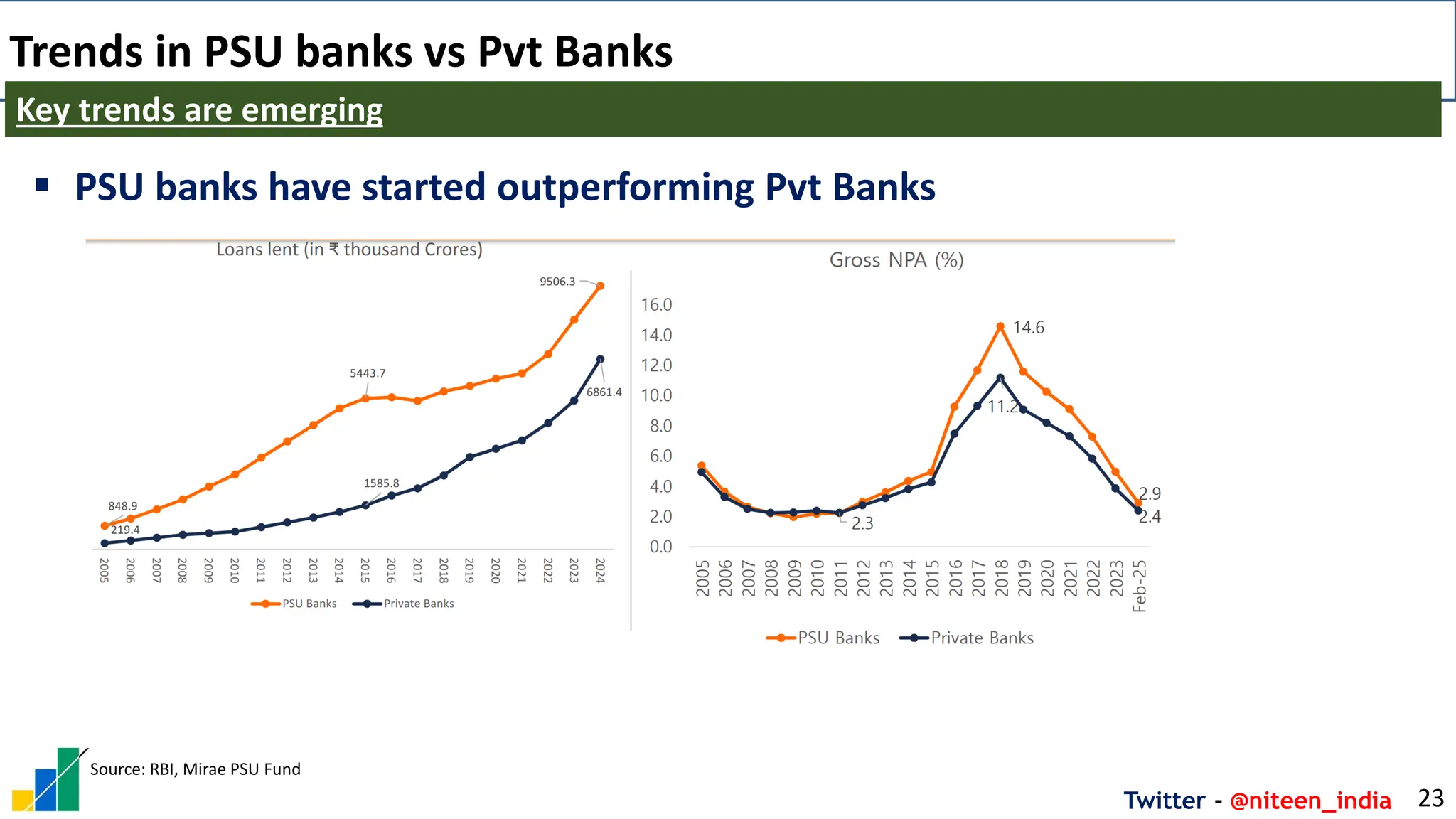
Trends in PSU banks vs Pvt Banks
23
Key trends are emerging
Source: RBI, Mirae PSU Fund
▪ PSU banks have started outperforming Pvt Banks
Twitter - @niteen_india
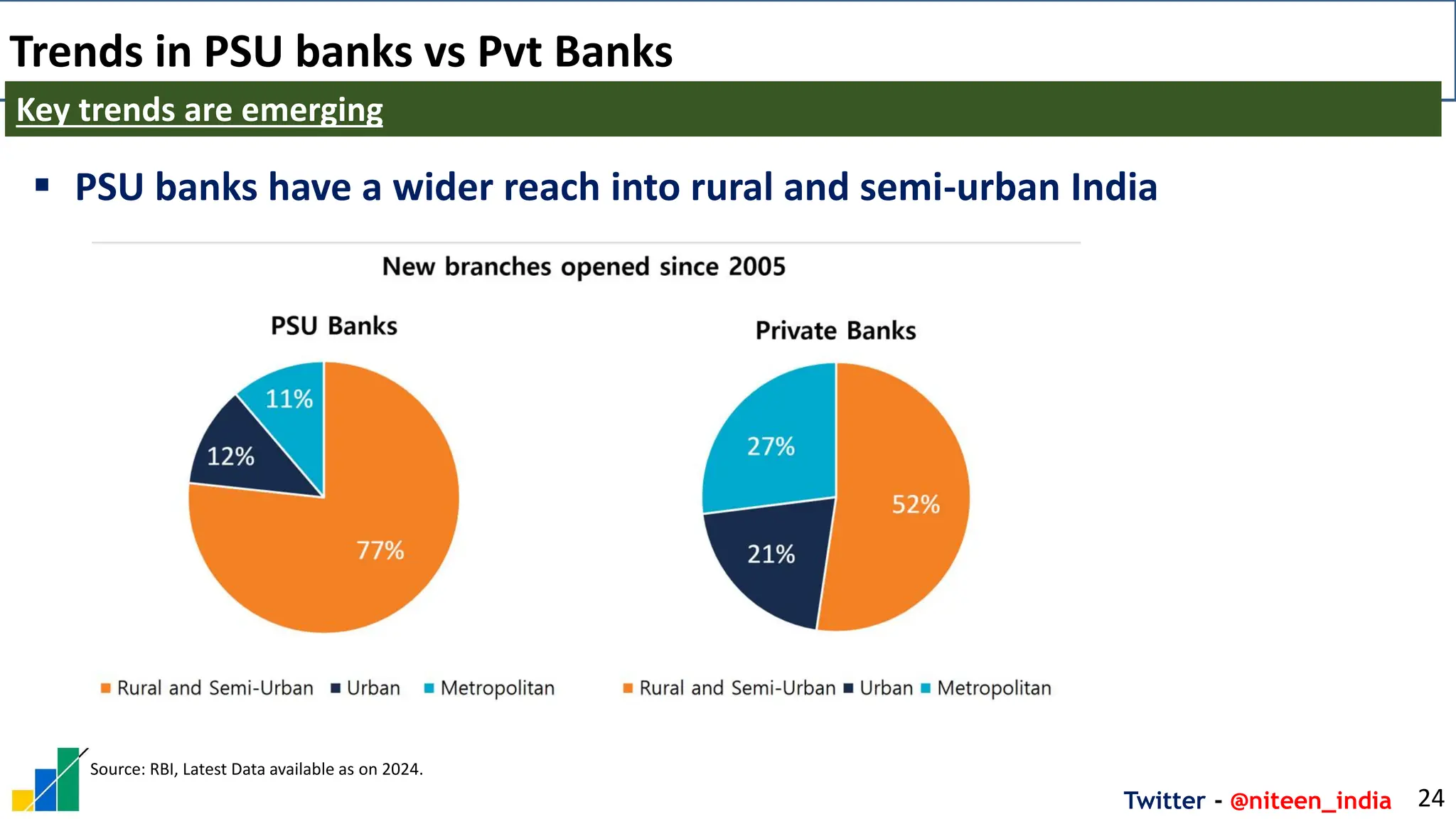
Trends in PSU banks vs Pvt Banks
24
Key trends are emerging
Source: RBI, Latest Data available as on 2024.
▪ PSU banks have a wider reach into rural and semi-urban India
Twitter - @niteen_india
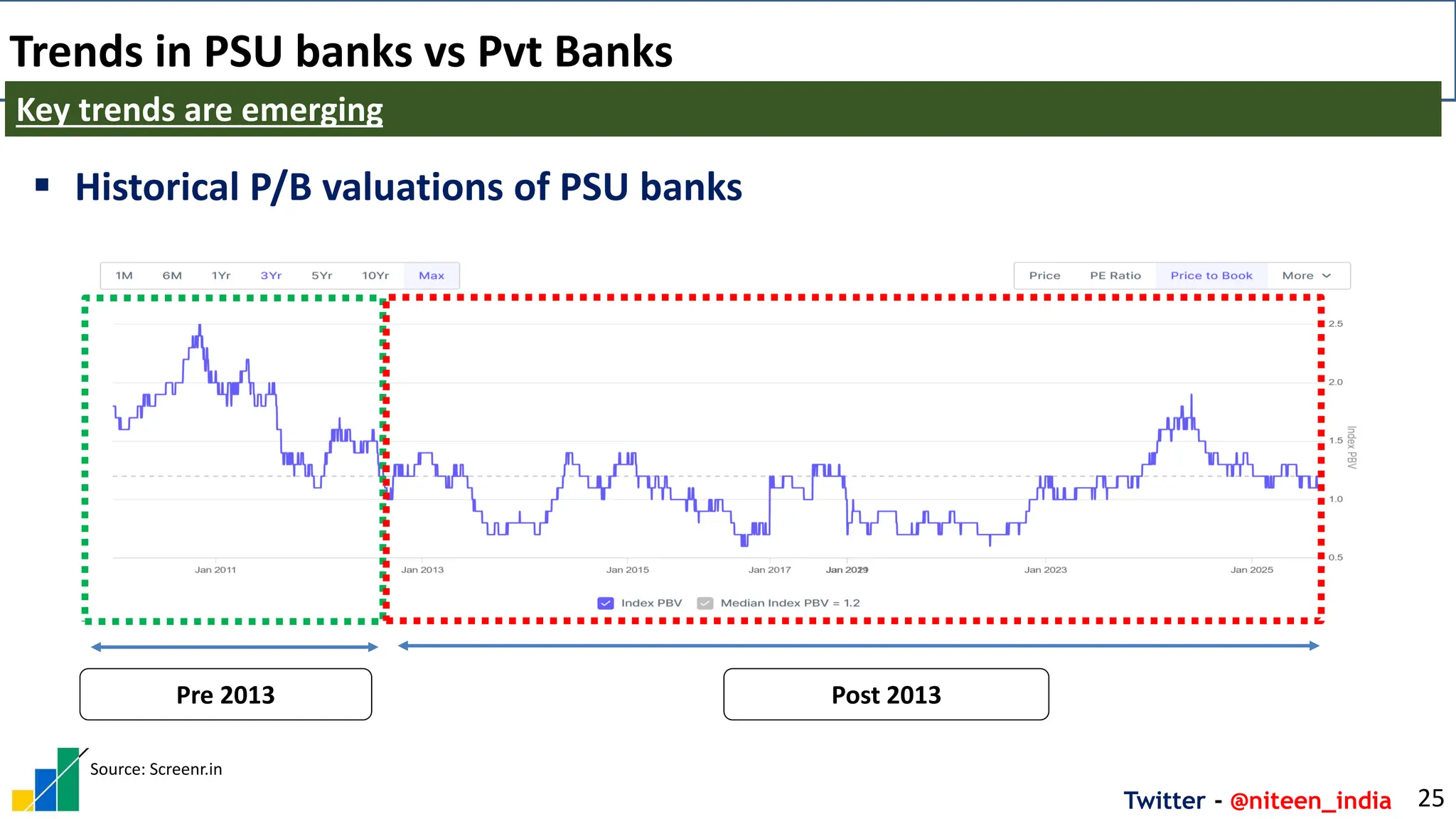
Trends in PSU banks vs Pvt Banks
25
Key trends are emerging
Source: Screenr.in
▪ Historical P/B valuations of PSU banks
Post 2013
Pre 2013
26
Bank of India Limited
Asset quality improving + Operational Performance
This is a case study to understand business and not a stock recommendation
We own this stock and we may exit too without any notice
Twitter - @niteen_india
About Bank of India
27
Background…
Source: The company announcements, Annual Reports/Quarterly results, Red Herring Prospectus, publicly available data
This is a case study to understand business and not a stock recommendation
We own this stock and we may exit too without any notice
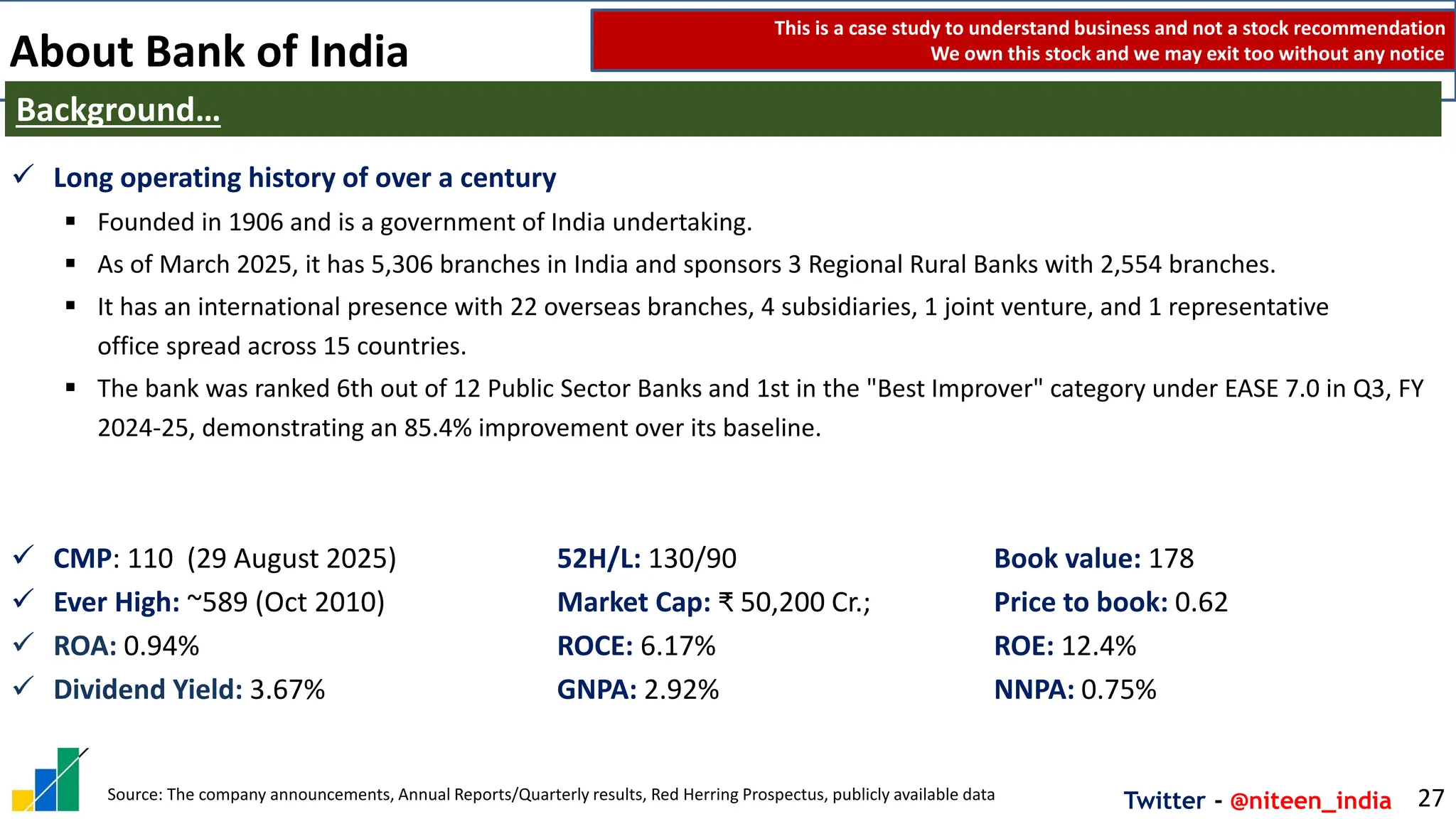
✓ Long operating history of over a century
▪ Founded in 1906 and is a government of India undertaking.
▪ As of March 2025, it has 5,306 branches in India and sponsors 3 Regional Rural Banks with 2,554 branches.
▪ It has an international presence with 22 overseas branches, 4 subsidiaries, 1 joint venture, and 1 representative
office spread across 15 countries.
▪ The bank was ranked 6th out of 12 Public Sector Banks and 1st in the "Best Improver" category under EASE 7.0 in Q3, FY
2024-25, demonstrating an 85.4% improvement over its baseline.
✓ CMP: 110 (29 August 2025) 52H/L: 130/90 Book value: 178
✓ Ever High: ~589 (Oct 2010) Market Cap: ₹ 50,200 Cr.; Price to book: 0.62
✓ ROA: 0.94% ROCE: 6.17% ROE: 12.4%
✓ Dividend Yield: 3.67% GNPA: 2.92% NNPA: 0.75%
Twitter - @niteen_india
About Bank of India
28
Background…
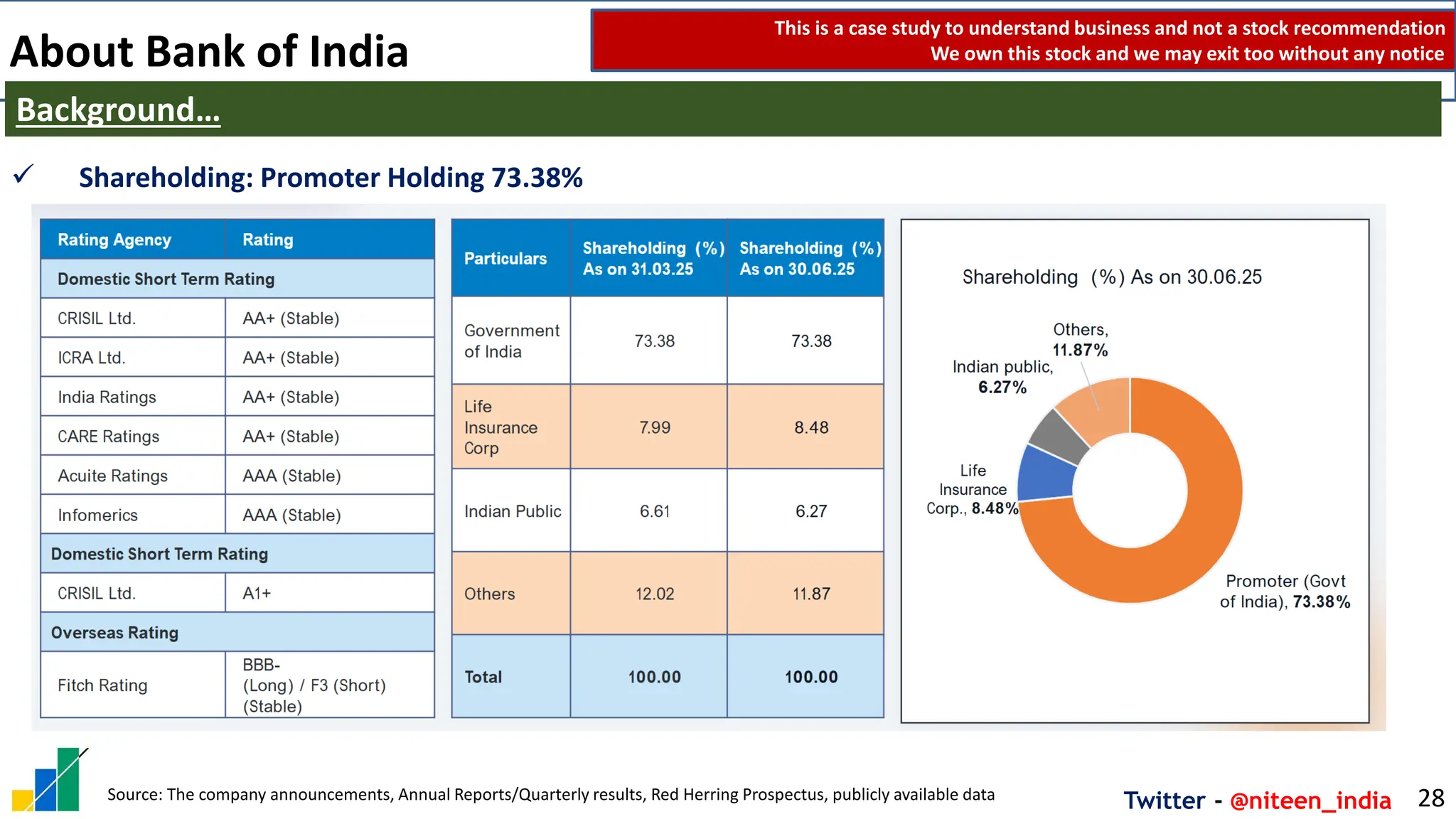
✓ Shareholding: Promoter Holding 73.38%
This is a case study to understand business and not a stock recommendation
We own this stock and we may exit too without any notice
Source: The company announcements, Annual Reports/Quarterly results, Red Herring Prospectus, publicly available data
Twitter - @niteen_india
About Bank of India
29
Background…
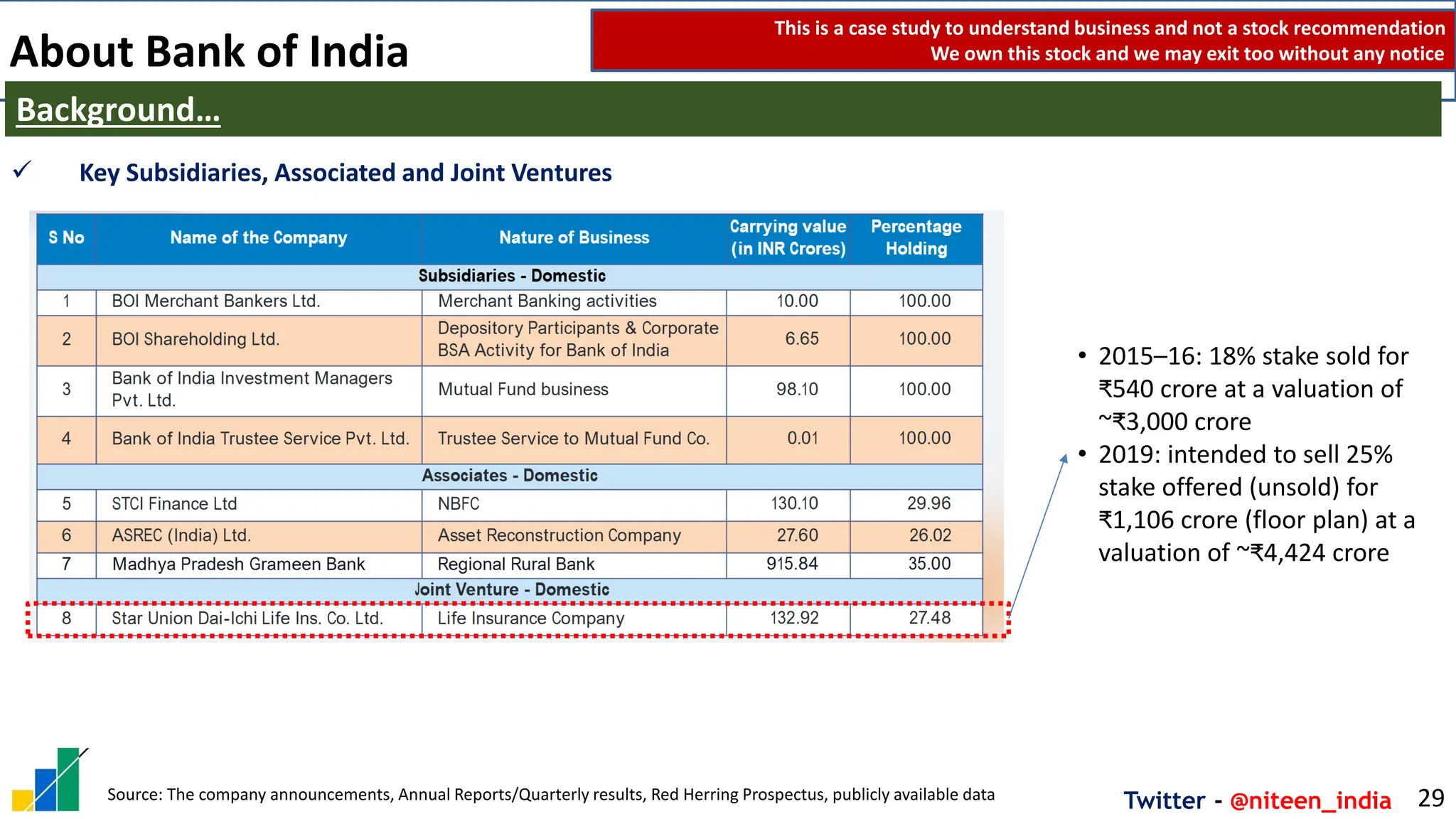
✓ Key Subsidiaries, Associated and Joint Ventures
This is a case study to understand business and not a stock recommendation
We own this stock and we may exit too without any notice
Source: The company announcements, Annual Reports/Quarterly results, Red Herring Prospectus, publicly available data
• 2015–16: 18% stake sold for
₹540 crore at a valuation of
~₹3,000 crore
• 2019: intended to sell 25%
stake offered (unsold) for
₹1,106 crore (floor plan) at a
valuation of ~₹4,424 crore
Twitter - @niteen_india
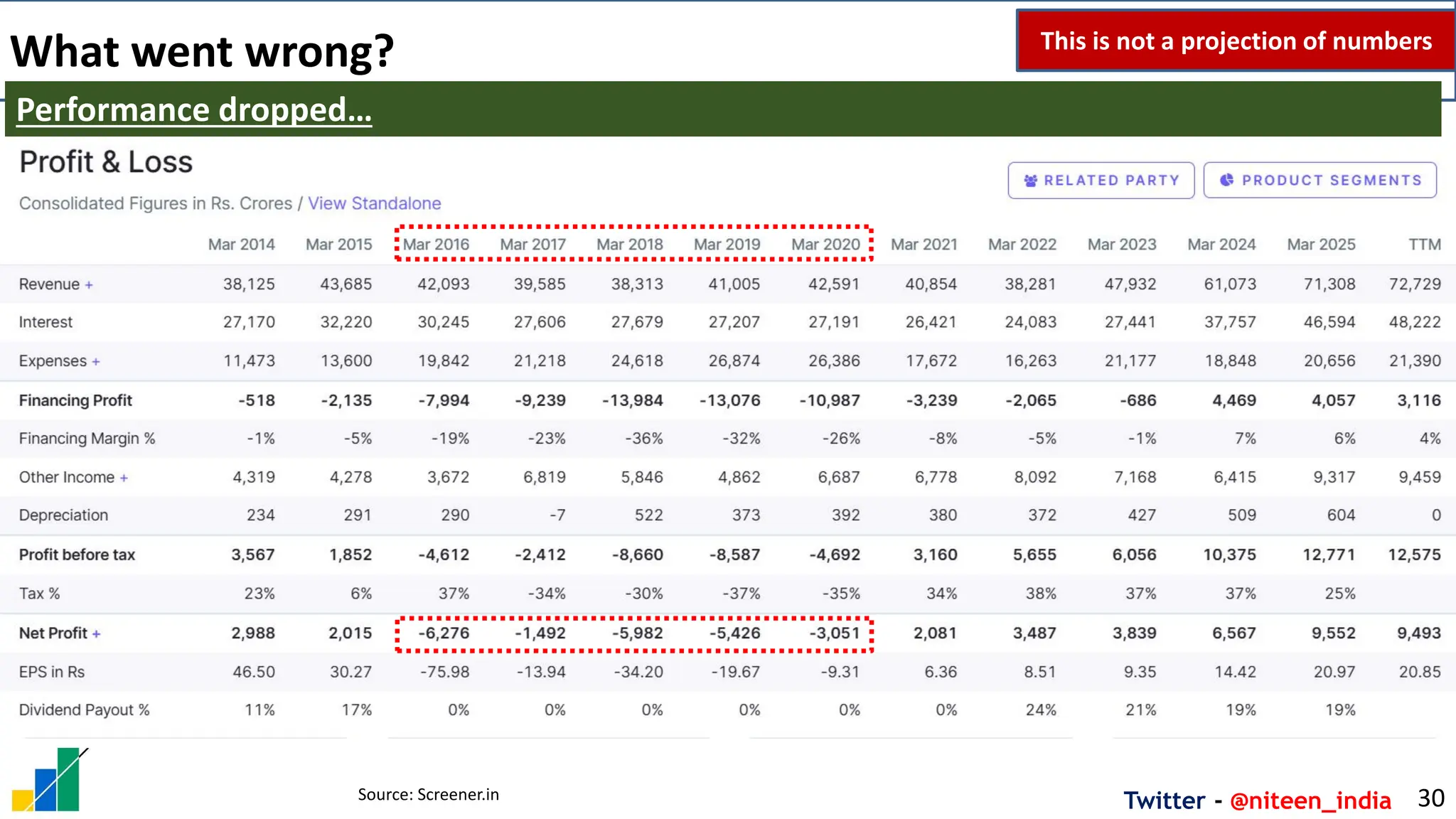
What went wrong?
30
Performance dropped…
Source: Screener.in
This is not a projection of numbers
Twitter - @niteen_india
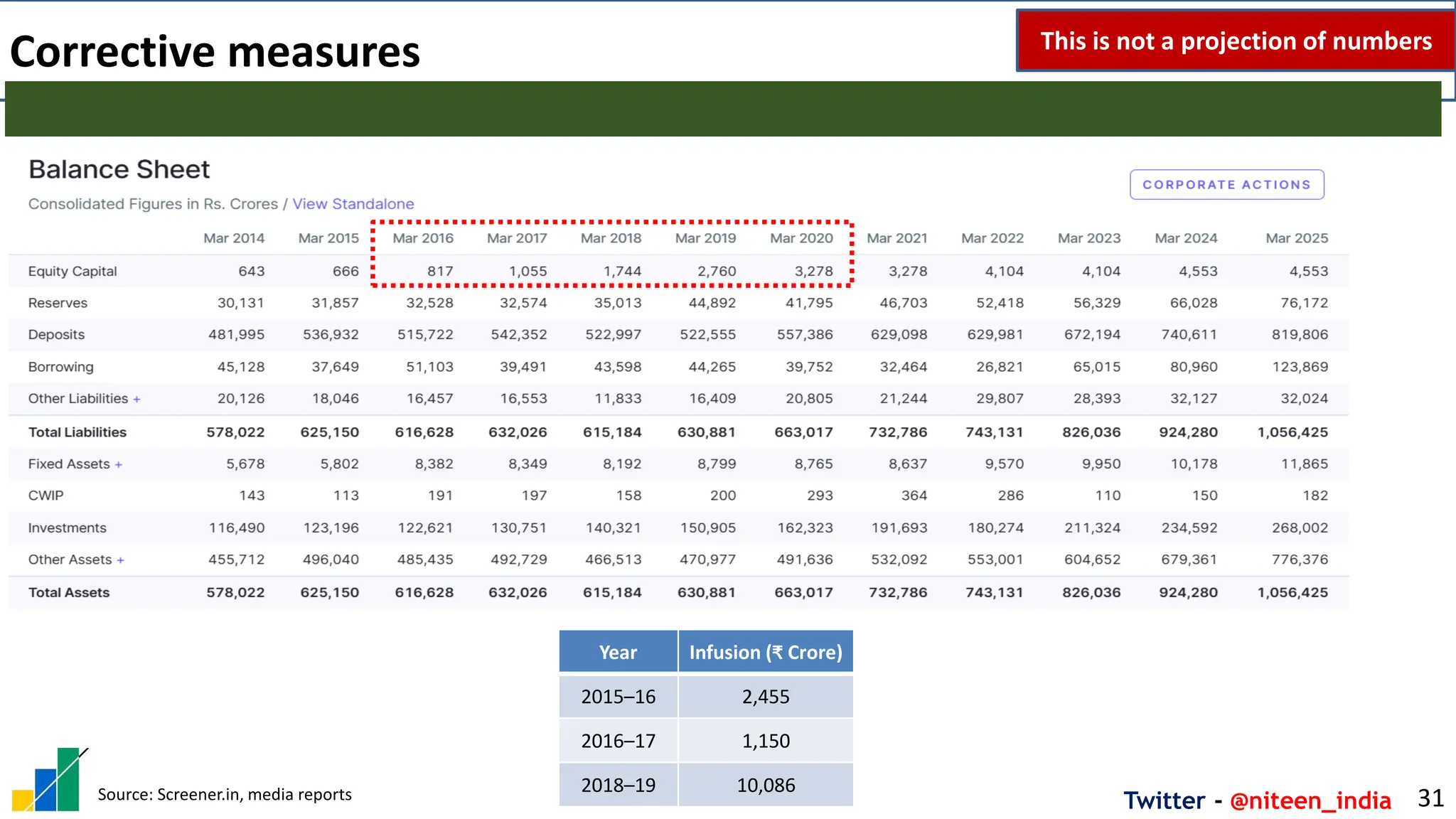
Corrective measures
31
Source: Screener.in, media reports
This is not a projection of numbers
Year Infusion (₹ Crore)
2015–16 2,455
2016–17 1,150
2018–19 10,086
Twitter - @niteen_india
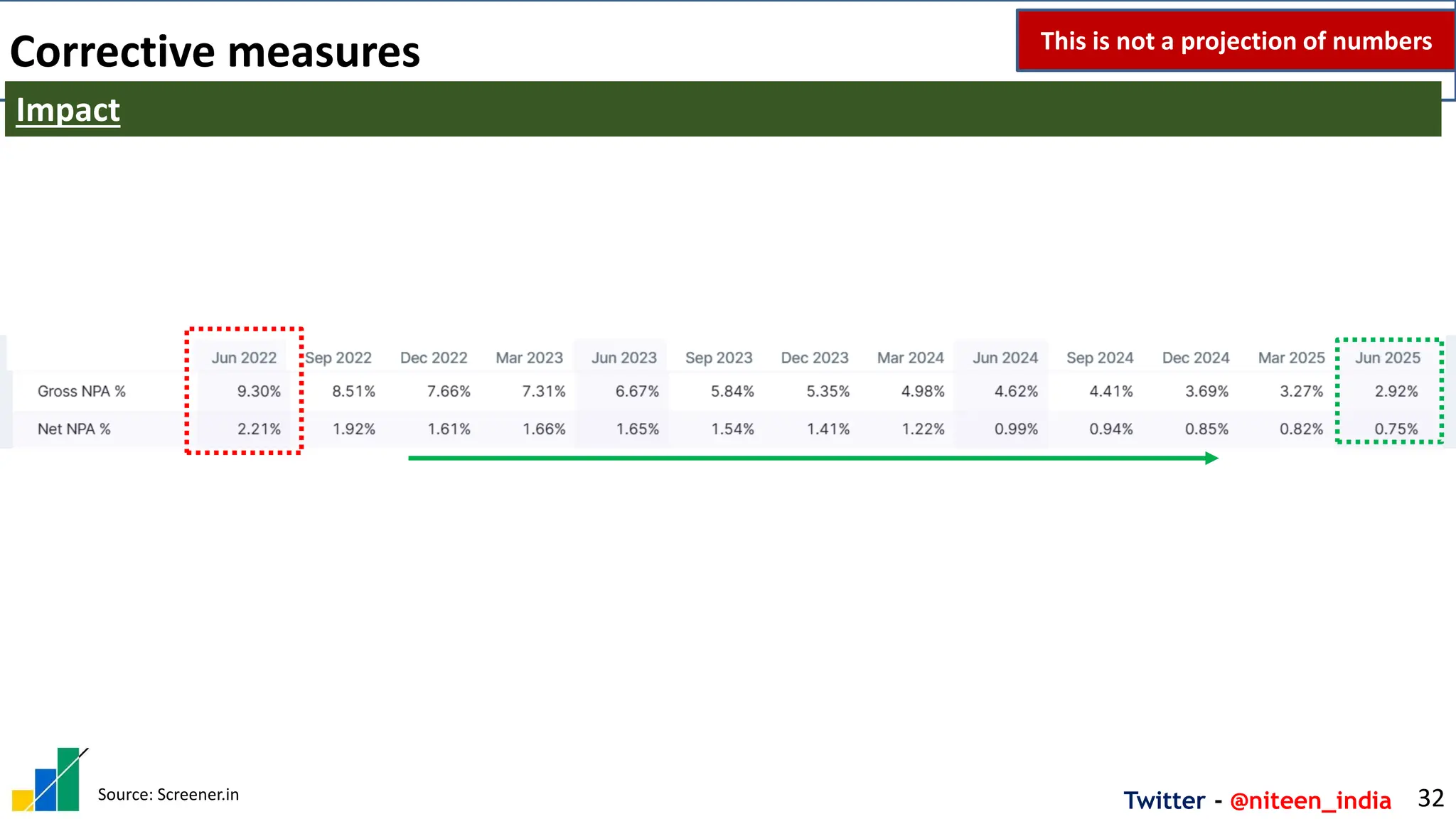
Corrective measures
32
Impact
Source: Screener.in
This is not a projection of numbers
Twitter - @niteen_india
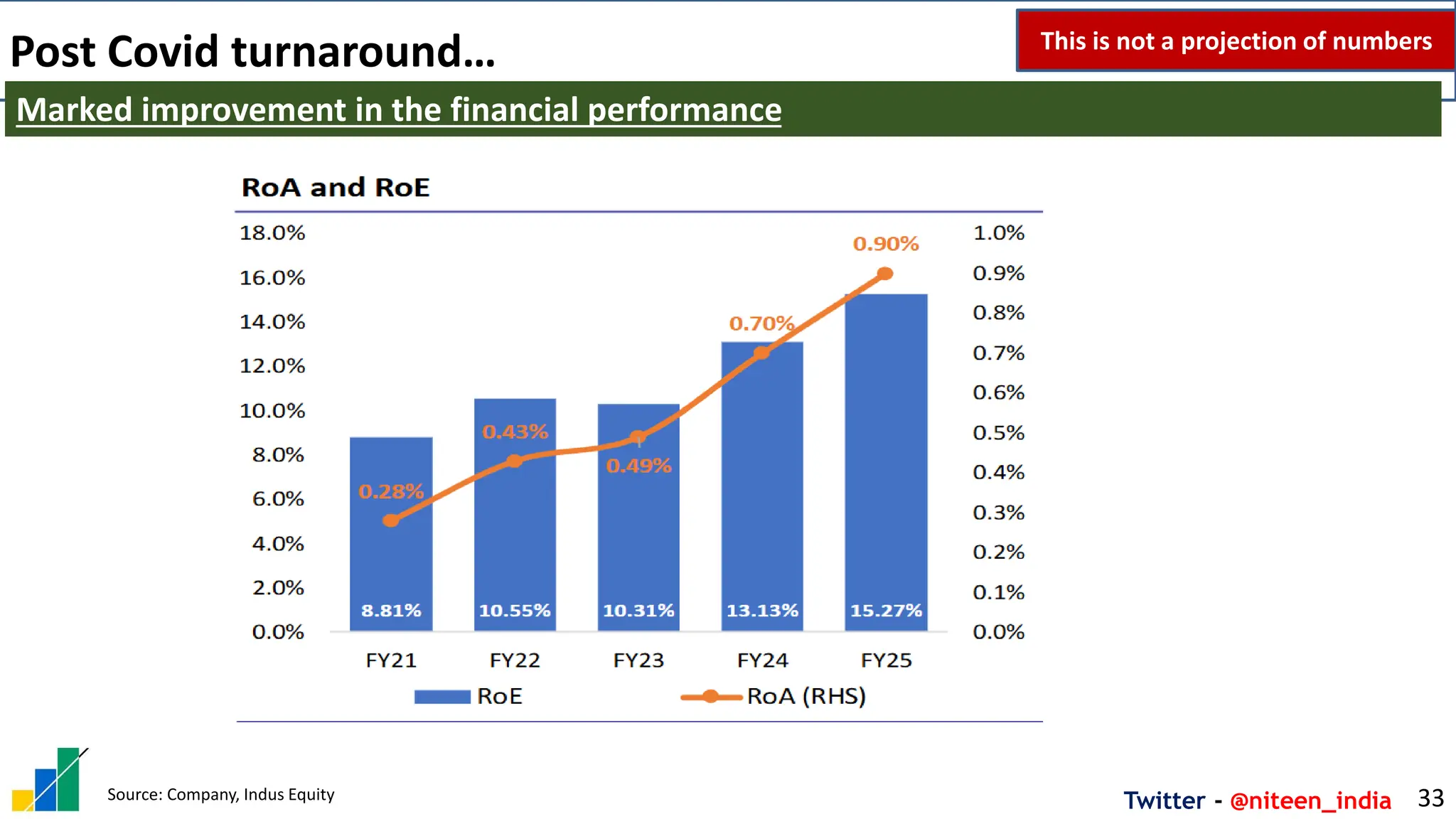
Post Covid turnaround…
33
Marked improvement in the financial performance
This is not a projection of numbers
Source: Company, Indus Equity
Twitter - @niteen_india
Post Covid turnaround…
34
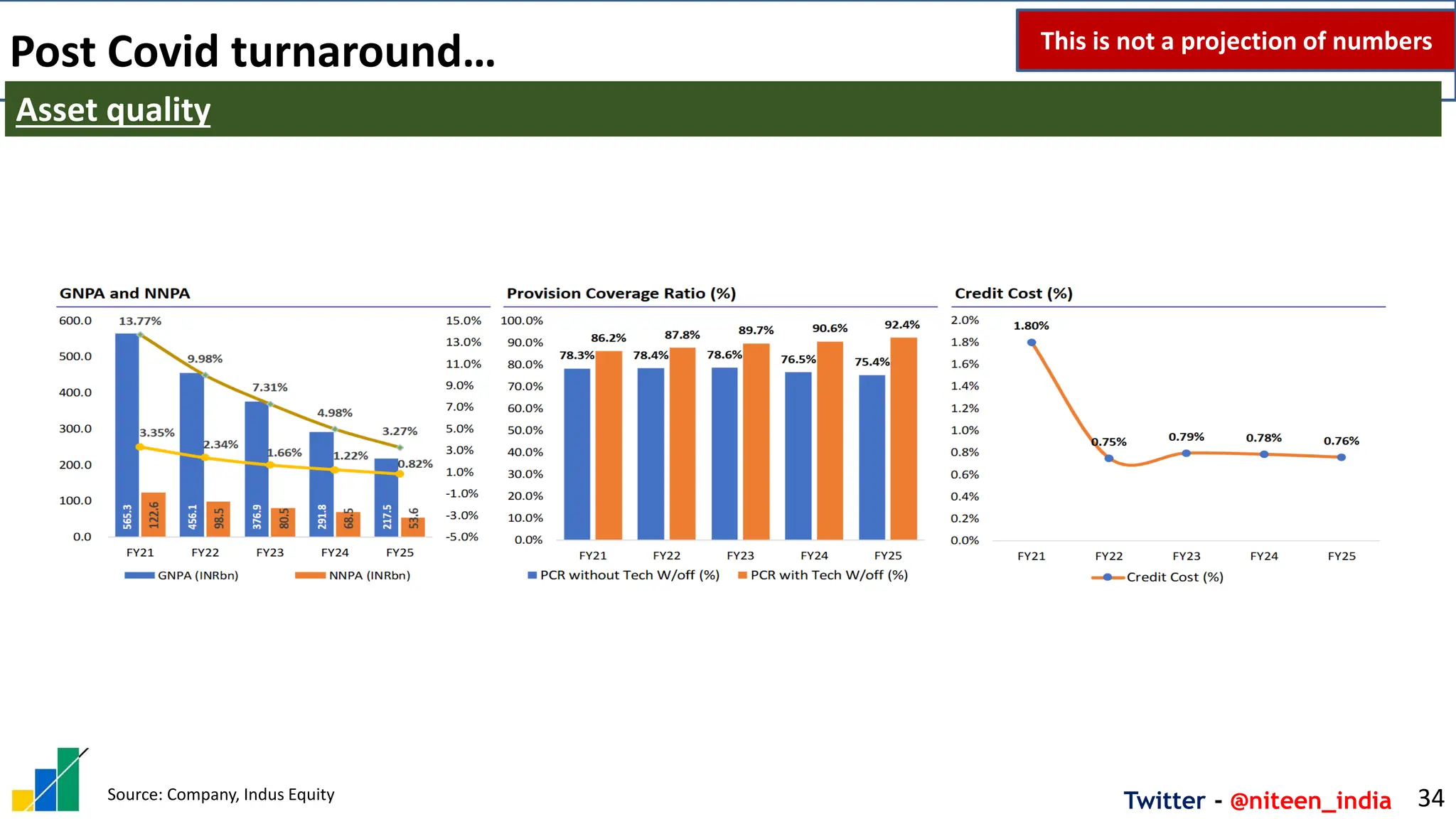
Asset quality
This is not a projection of numbers
Source: Company, Indus Equity
Twitter - @niteen_india
Who says elephant can’t dance?
35
Acting like a professional bank…
This is not a projection of numbers
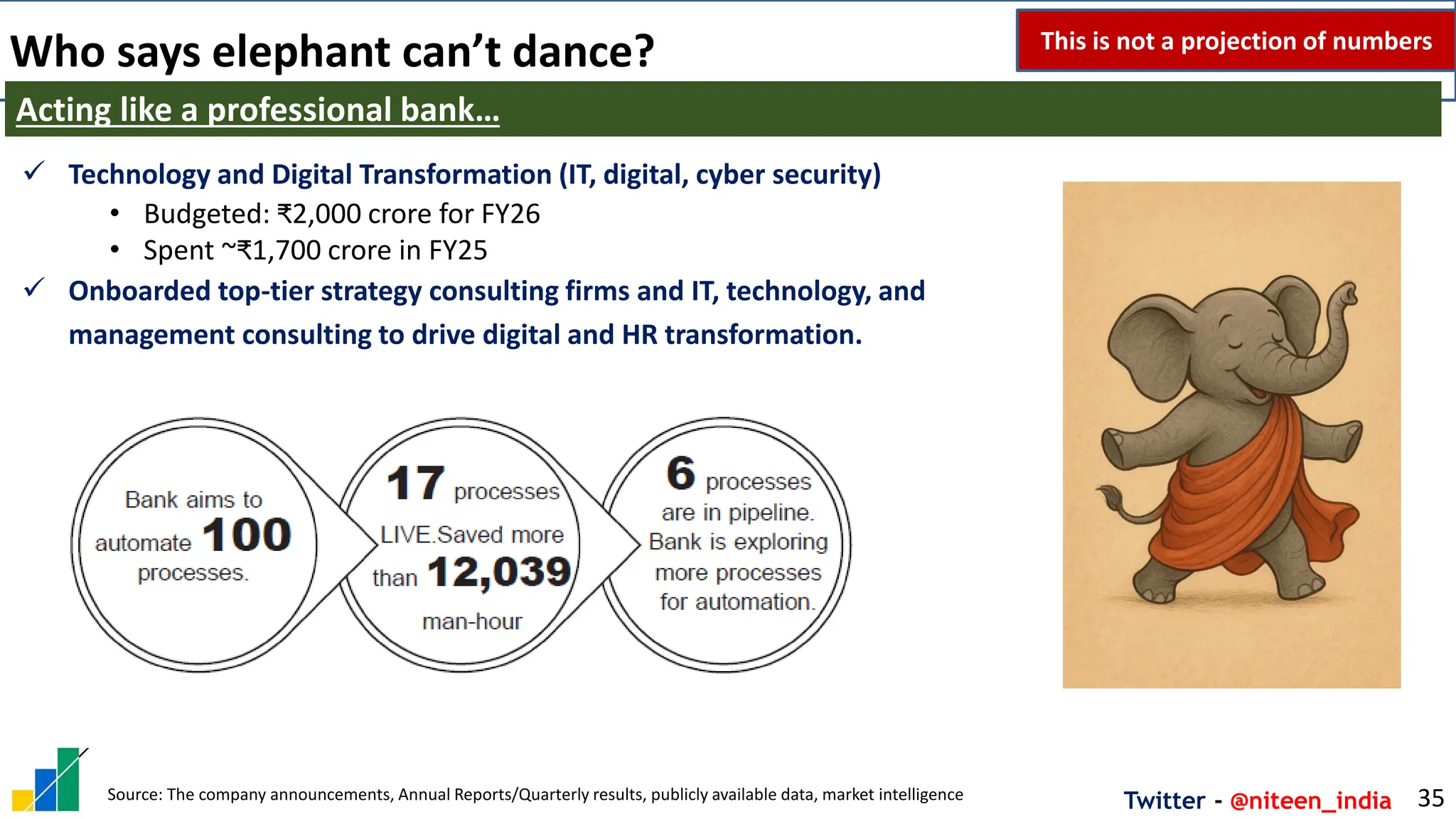
✓ Technology and Digital Transformation (IT, digital, cyber security)
• Budgeted: ₹2,000 crore for FY26
• Spent ~₹1,700 crore in FY25
✓ Onboarded top-tier strategy consulting firms and IT, technology, and
management consulting to drive digital and HR transformation.
Source: The company announcements, Annual Reports/Quarterly results, publicly available data, market intelligence
Twitter - @niteen_india
Who says elephant can’t dance?
36
Efficiency…
This is not a projection of numbers
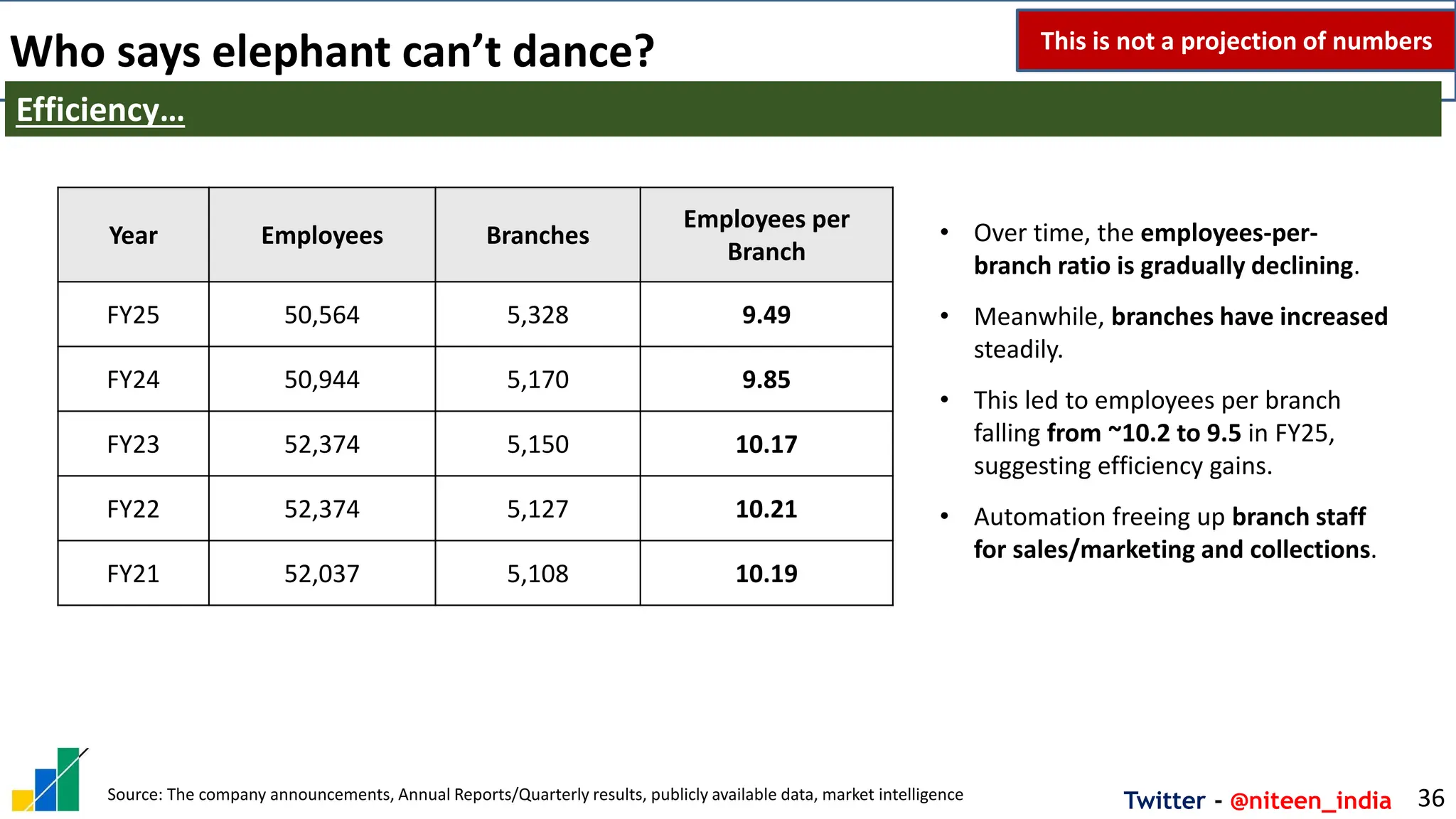
Year Employees Branches
Employees per
Branch
FY25 50,564 5,328 9.49
FY24 50,944 5,170 9.85
FY23 52,374 5,150 10.17
FY22 52,374 5,127 10.21
FY21 52,037 5,108 10.19
• Over time, the employees-per-
branch ratio is gradually declining.
• Meanwhile, branches have increased
steadily.
• This led to employees per branch
falling from ~10.2 to 9.5 in FY25,
suggesting efficiency gains.
• Automation freeing up branch staff
for sales/marketing and collections.
Source: The company announcements, Annual Reports/Quarterly results, publicly available data, market intelligence
Twitter - @niteen_india
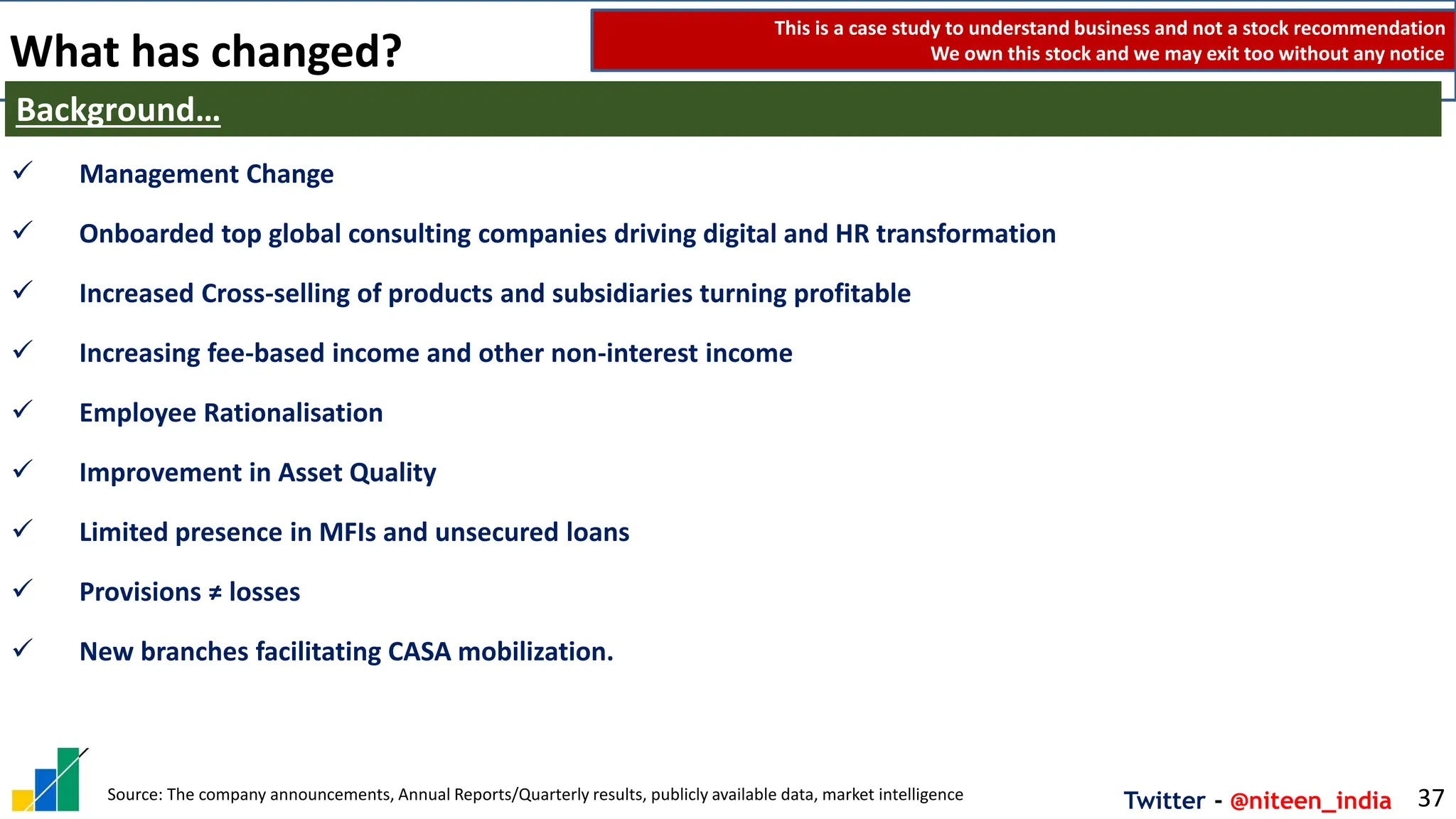
What has changed?
37
Background…
✓ Management Change
✓ Onboarded top global consulting companies driving digital and HR transformation
✓ Increased Cross-selling of products and subsidiaries turning profitable
✓ Increasing fee-based income and other non-interest income
✓ Employee Rationalisation
✓ Improvement in Asset Quality
✓ Limited presence in MFIs and unsecured loans
✓ Provisions ≠ losses
✓ New branches facilitating CASA mobilization.
This is a case study to understand business and not a stock recommendation
We own this stock and we may exit too without any notice
Source: The company announcements, Annual Reports/Quarterly results, publicly available data, market intelligence
Twitter - @niteen_india
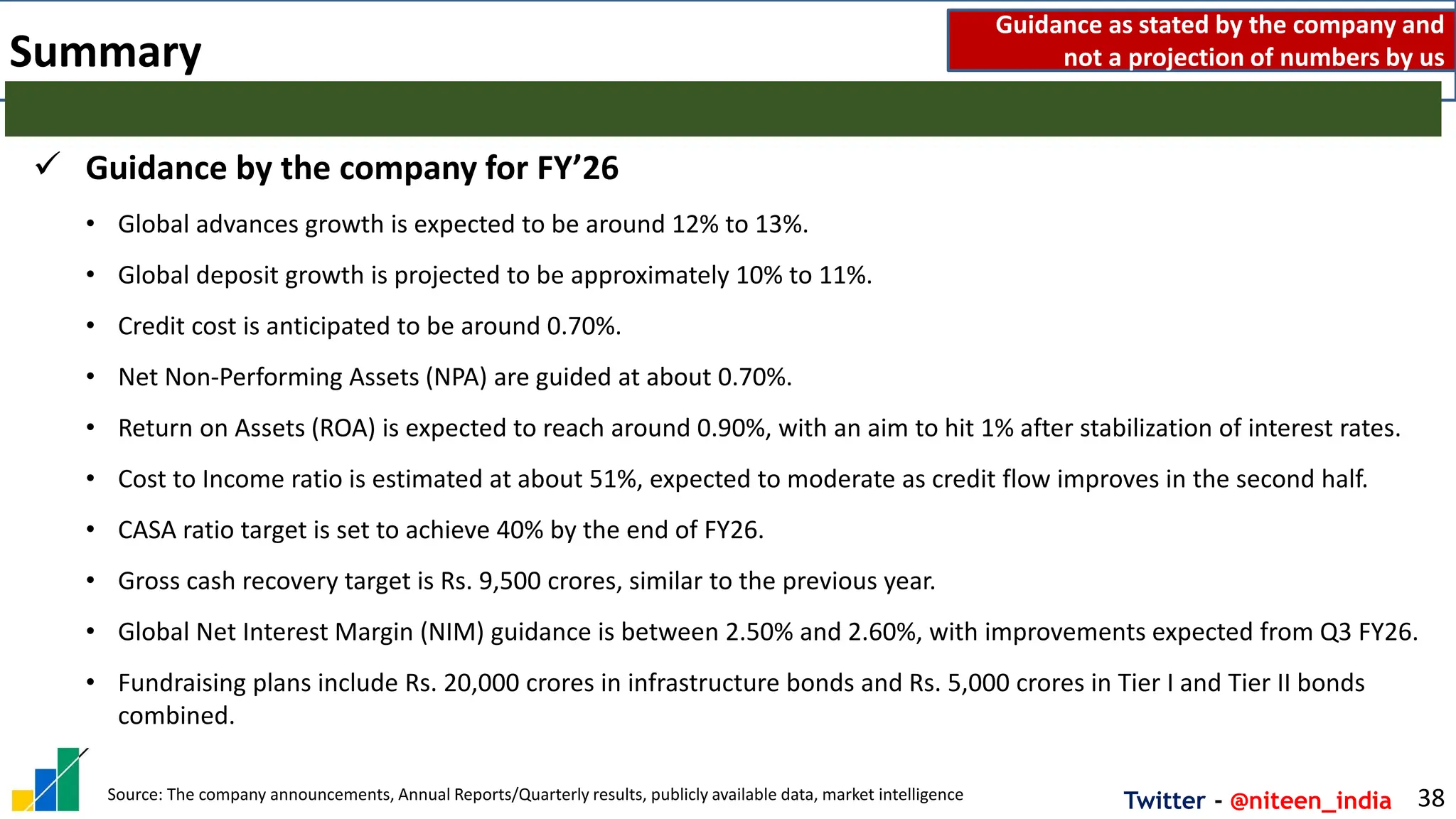
Summary
38
✓ Guidance by the company for FY’26
• Global advances growth is expected to be around 12% to 13%.
• Global deposit growth is projected to be approximately 10% to 11%.
• Credit cost is anticipated to be around 0.70%.
• Net Non-Performing Assets (NPA) are guided at about 0.70%.
• Return on Assets (ROA) is expected to reach around 0.90%, with an aim to hit 1% after stabilization of interest rates.
• Cost to Income ratio is estimated at about 51%, expected to moderate as credit flow improves in the second half.
• CASA ratio target is set to achieve 40% by the end of FY26.
• Gross cash recovery target is Rs. 9,500 crores, similar to the previous year.
• Global Net Interest Margin (NIM) guidance is between 2.50% and 2.60%, with improvements expected from Q3 FY26.
• Fundraising plans include Rs. 20,000 crores in infrastructure bonds and Rs. 5,000 crores in Tier I and Tier II bonds
combined.
Guidance as stated by the company and
not a projection of numbers by us
Source: The company announcements, Annual Reports/Quarterly results, publicly available data, market intelligence
Twitter - @niteen_india
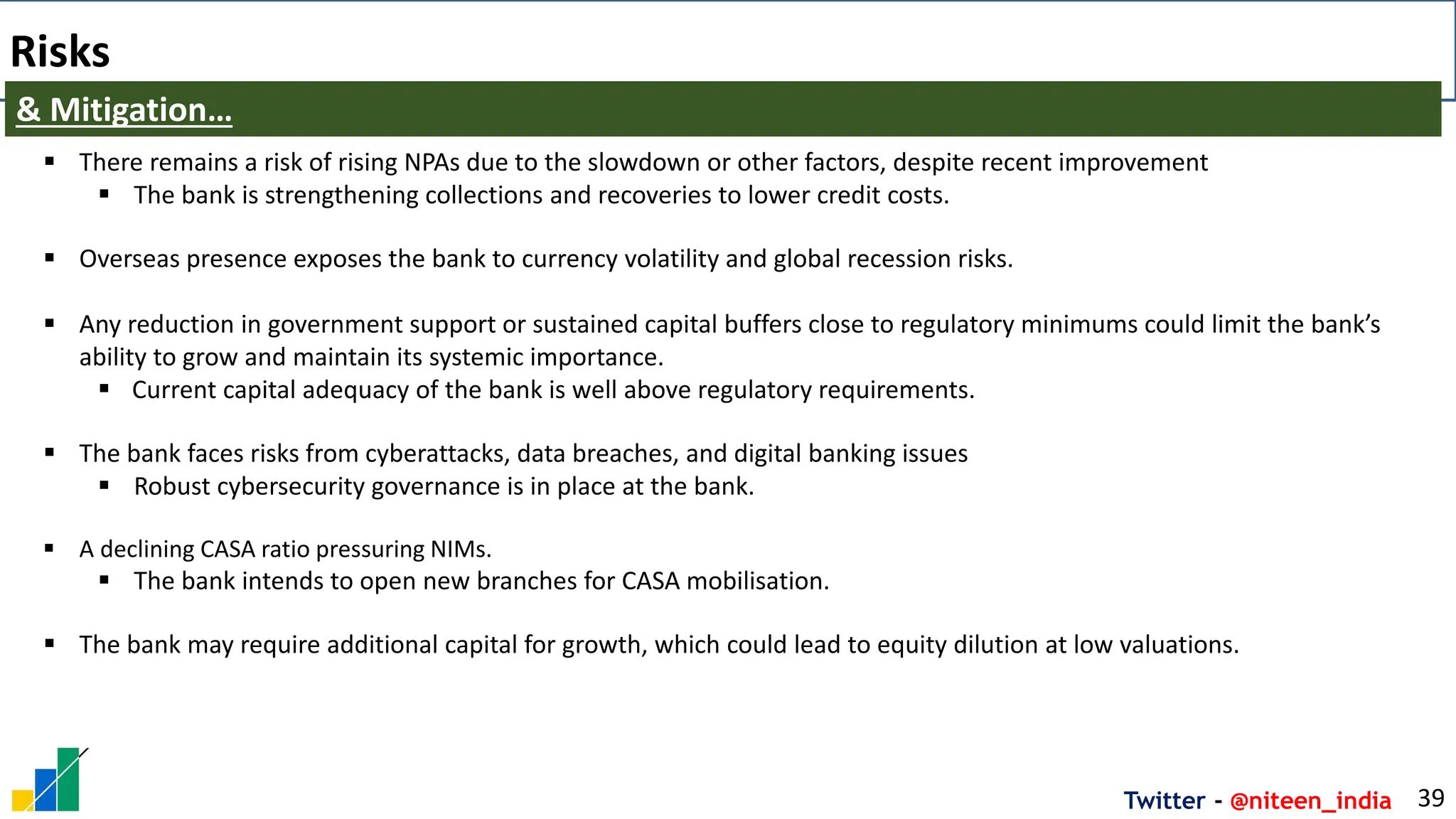
Risks
39
& Mitigation…
▪ There remains a risk of rising NPAs due to the slowdown or other factors, despite recent improvement
▪ The bank is strengthening collections and recoveries to lower credit costs.
▪ Overseas presence exposes the bank to currency volatility and global recession risks.
▪ Any reduction in government support or sustained capital buffers close to regulatory minimums could limit the bank’s
ability to grow and maintain its systemic importance.
▪ Current capital adequacy of the bank is well above regulatory requirements.
▪ The bank faces risks from cyberattacks, data breaches, and digital banking issues
▪ Robust cybersecurity governance is in place at the bank.
▪ A declining CASA ratio pressuring NIMs.
▪ The bank intends to open new branches for CASA mobilisation.
▪ The bank may require additional capital for growth, which could lead to equity dilution at low valuations.
Twitter - @niteen_india
Thank you
Email: info@aurumcapital.in
Twitter: @niteen_india
@CapitalAurum
40

Who says elephants can't dance? - Business Analysis 30 Aug 2025

  • 1.
    1 Niteen S Dharmawat Co-Founder,Aurum Capital Website: https://aurumcapital.in Twitter: @CapitalAurum / @niteen_india Email: info@aurumcapital.in Who says elephants can't dance? 30th August 2025
  • 2.
    2 IMPORTANT DISCLAIMER: The informationherein is used as per the available sources of bseindia.com/nseindia.com/brokers websites, company’s annual reports & other public/private database sources. Aurum Capital is not responsible for any discrepancy in the data. Investors should seek advice of their independent financial advisor prior to taking any investment decision based on this report or for necessary explanation of its contents. Future estimates mentioned herein are personal opinions & views of the analyst. Analyst Name – Niteen S Dharmawat. For queries / grievances – support@aurumcapital.in. SEBI registration No: INH000008118 Readers/attendees/viewers are responsible for all outcomes arising of buying / selling particular scrip/ scrips mentioned here in. This presentation indicates opinion of the author to understand the company and its business operations and it is not a recommendation to buy or sell securities. Aurum Capital & its representatives have vested interest in above mentioned security/ies at the time of this publication, and its partners / company have positions / financial interest in the security/ies mentioned above. Aurum Capital, or its associates are not paid or compensated at any point of time, in last 12 months by any way from the companies mentioned in the report. Aurum Capital, or its representatives do not have more than 1% of the company’s total shareholding. Ownership of the stock: yes. Recommendation to client: this stock is recommended to clients. Served as a director / employee of mentioned companies in report: No. Any material conflict of interest at the time of publishing report: No The views expressed in this post accurately reflect the author’s personal views about any and all of the subject securities or issuers; and no part of the compensations, if any was, is or will be, directly indirectly, related to specific recommendation or views expressed in the report.
  • 3.
    3 Aurum Capital isa SEBI registered Research Analyst (SEBI Registration No: INH000008118) services company. Started by Jiten Parmar and Niteen Dharmawat, who together have more than 4 decades of experience investing in equities and guiding and mentoring fellow investors. This rich industry background helps us understand companies, complexities of business and tipping points that make or break a company. Our approach is not limited to just number crunching but going beyond. We focus on the business, strategic direction, the competitive landscape, the governance process, the background of the promoters, turnarounds, to name a few. Often these are more critical items than just numbers. Jiten and Niteen have successfully waded through multiple bear and bull market cycles.
  • 4.
  • 5.
    5 The story ofPSU Banks… 1998-2010… Sorry… They are Party-poopers… for many “We simply attempt to be fearful when others are greedy and to be greedy only when others are fearful.” Warren Buffett
  • 6.
    6 The era thatwas... ✓ I have presentation on the topic of “Pre election year performance” ✓ Analysed last 9 Loksabha elections spanning over 35 years ✓ Important to understand periods of 1997-99
  • 7.
    7 Elections v/s challenges #Election Year Major Challenges in pre-election year Remarks 1 1997-98 • Deep political uncertainty and crises at center • Short-lived governments • Rising power of left parties • The biggest political party, Congress, in a complete disarray • Economy was facing challenges due to indecisiveness of the previous two governments, Deve Gowda and Gujaral • Politically it has thrown significant uncertainties
  • 8.
    8 Elections v/s challenges #Election Year Major Challenges in pre-election year Remarks 2 1998-99 • Deep political uncertainty and crises at center • Short-lived government • Rising power of left parties • The biggest political party, Congress, continues to be in disarray • US sanctions post Pokhran-2 Test • Kargil war • Election was happening within just a year and economy was not ready to face it • Manufacturing sector was deeply underperforming and many leading companies were facing the heat of global competition
  • 9.
    9 US Sanctions Pokhran-2 Test 11May 1998 • United States imposed sanctions as required by law following 1998 nuclear tests.
  • 10.
    10 War Kargil War: 3May 1999 – 26 July 1999
  • 11.
    11 Gross NPAs insome PSBs: around 2000 • SBI: 12.93% in 2001 • PNB: 8.96% in 1999 • BOB: 14.11% in 2001 • Canara: 7.8% in 2001 • BOI: 12.89% in 2000 PS Banks Gross NPAs peaked at 16% in 1999 Source: India Budget, RBI, Bank ARs
  • 12.
    12 Measures taken bythe government: 2000-2003 period • Game-changer: Banks got the SARFAESI Act (2002) and CDR, along with tighter RBI norms (90-day NPA recognition, provisioning, PCA). • Debt Recovery Tribunals (DRTs) strengthened • For faster out of court settlement of smaller loan upto 10Lac: Lok Adalats & Compromise Settlements • These made banks more accountable and gave them real enforcement powers for the first time. • By 2004, reforms had brought the GNPA number down below 9% from 16%, setting the stage for the mid-2000s credit boom.
  • 13.
    13 0 500 1000 1500 2000 2500 3000 1998 1999 20002001 2002 2003 2004 2005 2006 2007 2008 2009 2010 2011 2012 2013 SBI 7 times returns in 10 years + Dividends A period of stagnation. High NPAs… Too much negativity… * adjusted for any split/bonus Public Sector Banks… SBI History… Price source: bseindia.com
  • 14.
    14 0 200 400 600 800 1000 1200 1400 1998 1999 20002001 2002 2003 2004 2005 2006 2007 2008 2009 2010 2011 2012 2013 PNB * adjusted for any split/bonus Price source: bseindia.com Public Sector Banks… PNB History… 10 times returns in 8 years + Dividends Just got listed post the period of stagnation.
  • 15.
    15 0 100 200 300 400 500 600 700 800 900 1000 1998 1999 20002001 2002 2003 2004 2005 2006 2007 2008 2009 2010 2011 2012 2013 BOB 10 times returns in 10 years + Dividends A period of stagnation. High NPAs… Too much negativity… * adjusted for any split/bonus Public Sector Banks… BoB History… Price source: bseindia.com
  • 16.
    16 0 100 200 300 400 500 600 700 1998 1999 20002001 2002 2003 2004 2005 2006 2007 2008 2009 2010 2011 2012 2013 Canara Just got listed post the period of stagnation. * adjusted for any split/bonus Price source: bseindia.com Public Sector Banks… Canara History… 13 times returns in 8 years + Dividends
  • 17.
    17 0 100 200 300 400 500 600 700 1998 1999 20002001 2002 2003 2004 2005 2006 2007 2008 2009 2010 2011 2012 2013 BOI Just got listed during a period of high uncertainty * adjusted for any split/bonus Public Sector Banks… BOI History… 31 times returns in 10 years + Dividends Price source: bseindia.com
  • 18.
    18 In stock market Historydoesn’t “rhymes” itself but rather "repeats“ exactly The need for patience if big profits are to be made from investment: Phil Fisher
  • 19.
    19 History... Date Gross NPARatio 2018 14.60% 2019 12.60% 2020 10.30% 2021 9.11% 2022 7.28% Date Gross NPA Ratio 1999 14.00% 2000 12.40% 2001 11.10% 2002 10.40% 2003 8.80%
  • 20.
    20 Gross NPAs insome PSBs: 2018 • SBI: 10.91% • PNB: 18.38% • BOB: 12.26% • Canara: 7.8% • BOI: 16.58% PS Banks Gross NPAs peaked at 14.60% in March 2018 Source: India Budget, RBI, Bank ARs
  • 21.
    21 Key measures: 2018-2023period • Game-changer: • Asset Quality Review (AQR) by RBI (2015–16): Forced banks to recognise hidden bad loans instead of evergreening. • Legal & Institutional Reforms: • Insolvency and Bankruptcy Code (IBC), 2016 (time-bound resolution of stressed assets) • National Company Law Tribunal (NCLT): fast-track cases • SARFAESI Act, 2002 strengthened • Recapitalisation & Consolidation of PSBs • Bank mergers (2017–2020): Consolidated 27 PSBs into 12 stronger ones • By 2022, reforms had brought the GNPA number down below 7.28% from 14.6%, setting the stage for the next credit boom.
  • 22.
    Twitter - @niteen_india Keyfactors to analyze a PS Bank… Net NPAs: Red: 2.5%or more Amber: 1.5%-2.5% Green: below 1.5% Div yield: Red: below 3% Amber: 3-5% Green: above 5% Gross NPAs: Red: 3%or more. Amber: 2.5%-3% Green: below 2.5% Price to Book Value: Red: 1 or more Amber: 0.5-1 Green: 0.5
  • 23.
    Twitter - @niteen_india Trendsin PSU banks vs Pvt Banks 23 Key trends are emerging Source: RBI, Mirae PSU Fund ▪ PSU banks have started outperforming Pvt Banks
  • 24.
    Twitter - @niteen_india Trendsin PSU banks vs Pvt Banks 24 Key trends are emerging Source: RBI, Latest Data available as on 2024. ▪ PSU banks have a wider reach into rural and semi-urban India
  • 25.
    Twitter - @niteen_india Trendsin PSU banks vs Pvt Banks 25 Key trends are emerging Source: Screenr.in ▪ Historical P/B valuations of PSU banks Post 2013 Pre 2013
  • 26.
    26 Bank of IndiaLimited Asset quality improving + Operational Performance This is a case study to understand business and not a stock recommendation We own this stock and we may exit too without any notice
  • 27.
    Twitter - @niteen_india AboutBank of India 27 Background… Source: The company announcements, Annual Reports/Quarterly results, Red Herring Prospectus, publicly available data This is a case study to understand business and not a stock recommendation We own this stock and we may exit too without any notice ✓ Long operating history of over a century ▪ Founded in 1906 and is a government of India undertaking. ▪ As of March 2025, it has 5,306 branches in India and sponsors 3 Regional Rural Banks with 2,554 branches. ▪ It has an international presence with 22 overseas branches, 4 subsidiaries, 1 joint venture, and 1 representative office spread across 15 countries. ▪ The bank was ranked 6th out of 12 Public Sector Banks and 1st in the "Best Improver" category under EASE 7.0 in Q3, FY 2024-25, demonstrating an 85.4% improvement over its baseline. ✓ CMP: 110 (29 August 2025) 52H/L: 130/90 Book value: 178 ✓ Ever High: ~589 (Oct 2010) Market Cap: ₹ 50,200 Cr.; Price to book: 0.62 ✓ ROA: 0.94% ROCE: 6.17% ROE: 12.4% ✓ Dividend Yield: 3.67% GNPA: 2.92% NNPA: 0.75%
  • 28.
    Twitter - @niteen_india AboutBank of India 28 Background… ✓ Shareholding: Promoter Holding 73.38% This is a case study to understand business and not a stock recommendation We own this stock and we may exit too without any notice Source: The company announcements, Annual Reports/Quarterly results, Red Herring Prospectus, publicly available data
  • 29.
    Twitter - @niteen_india AboutBank of India 29 Background… ✓ Key Subsidiaries, Associated and Joint Ventures This is a case study to understand business and not a stock recommendation We own this stock and we may exit too without any notice Source: The company announcements, Annual Reports/Quarterly results, Red Herring Prospectus, publicly available data • 2015–16: 18% stake sold for ₹540 crore at a valuation of ~₹3,000 crore • 2019: intended to sell 25% stake offered (unsold) for ₹1,106 crore (floor plan) at a valuation of ~₹4,424 crore
  • 30.
    Twitter - @niteen_india Whatwent wrong? 30 Performance dropped… Source: Screener.in This is not a projection of numbers
  • 31.
    Twitter - @niteen_india Correctivemeasures 31 Source: Screener.in, media reports This is not a projection of numbers Year Infusion (₹ Crore) 2015–16 2,455 2016–17 1,150 2018–19 10,086
  • 32.
    Twitter - @niteen_india Correctivemeasures 32 Impact Source: Screener.in This is not a projection of numbers
  • 33.
    Twitter - @niteen_india PostCovid turnaround… 33 Marked improvement in the financial performance This is not a projection of numbers Source: Company, Indus Equity
  • 34.
    Twitter - @niteen_india PostCovid turnaround… 34 Asset quality This is not a projection of numbers Source: Company, Indus Equity
  • 35.
    Twitter - @niteen_india Whosays elephant can’t dance? 35 Acting like a professional bank… This is not a projection of numbers ✓ Technology and Digital Transformation (IT, digital, cyber security) • Budgeted: ₹2,000 crore for FY26 • Spent ~₹1,700 crore in FY25 ✓ Onboarded top-tier strategy consulting firms and IT, technology, and management consulting to drive digital and HR transformation. Source: The company announcements, Annual Reports/Quarterly results, publicly available data, market intelligence
  • 36.
    Twitter - @niteen_india Whosays elephant can’t dance? 36 Efficiency… This is not a projection of numbers Year Employees Branches Employees per Branch FY25 50,564 5,328 9.49 FY24 50,944 5,170 9.85 FY23 52,374 5,150 10.17 FY22 52,374 5,127 10.21 FY21 52,037 5,108 10.19 • Over time, the employees-per- branch ratio is gradually declining. • Meanwhile, branches have increased steadily. • This led to employees per branch falling from ~10.2 to 9.5 in FY25, suggesting efficiency gains. • Automation freeing up branch staff for sales/marketing and collections. Source: The company announcements, Annual Reports/Quarterly results, publicly available data, market intelligence
  • 37.
    Twitter - @niteen_india Whathas changed? 37 Background… ✓ Management Change ✓ Onboarded top global consulting companies driving digital and HR transformation ✓ Increased Cross-selling of products and subsidiaries turning profitable ✓ Increasing fee-based income and other non-interest income ✓ Employee Rationalisation ✓ Improvement in Asset Quality ✓ Limited presence in MFIs and unsecured loans ✓ Provisions ≠ losses ✓ New branches facilitating CASA mobilization. This is a case study to understand business and not a stock recommendation We own this stock and we may exit too without any notice Source: The company announcements, Annual Reports/Quarterly results, publicly available data, market intelligence
  • 38.
    Twitter - @niteen_india Summary 38 ✓Guidance by the company for FY’26 • Global advances growth is expected to be around 12% to 13%. • Global deposit growth is projected to be approximately 10% to 11%. • Credit cost is anticipated to be around 0.70%. • Net Non-Performing Assets (NPA) are guided at about 0.70%. • Return on Assets (ROA) is expected to reach around 0.90%, with an aim to hit 1% after stabilization of interest rates. • Cost to Income ratio is estimated at about 51%, expected to moderate as credit flow improves in the second half. • CASA ratio target is set to achieve 40% by the end of FY26. • Gross cash recovery target is Rs. 9,500 crores, similar to the previous year. • Global Net Interest Margin (NIM) guidance is between 2.50% and 2.60%, with improvements expected from Q3 FY26. • Fundraising plans include Rs. 20,000 crores in infrastructure bonds and Rs. 5,000 crores in Tier I and Tier II bonds combined. Guidance as stated by the company and not a projection of numbers by us Source: The company announcements, Annual Reports/Quarterly results, publicly available data, market intelligence
  • 39.
    Twitter - @niteen_india Risks 39 &Mitigation… ▪ There remains a risk of rising NPAs due to the slowdown or other factors, despite recent improvement ▪ The bank is strengthening collections and recoveries to lower credit costs. ▪ Overseas presence exposes the bank to currency volatility and global recession risks. ▪ Any reduction in government support or sustained capital buffers close to regulatory minimums could limit the bank’s ability to grow and maintain its systemic importance. ▪ Current capital adequacy of the bank is well above regulatory requirements. ▪ The bank faces risks from cyberattacks, data breaches, and digital banking issues ▪ Robust cybersecurity governance is in place at the bank. ▪ A declining CASA ratio pressuring NIMs. ▪ The bank intends to open new branches for CASA mobilisation. ▪ The bank may require additional capital for growth, which could lead to equity dilution at low valuations.
  • 40.
    Twitter - @niteen_india Thankyou Email: info@aurumcapital.in Twitter: @niteen_india @CapitalAurum 40