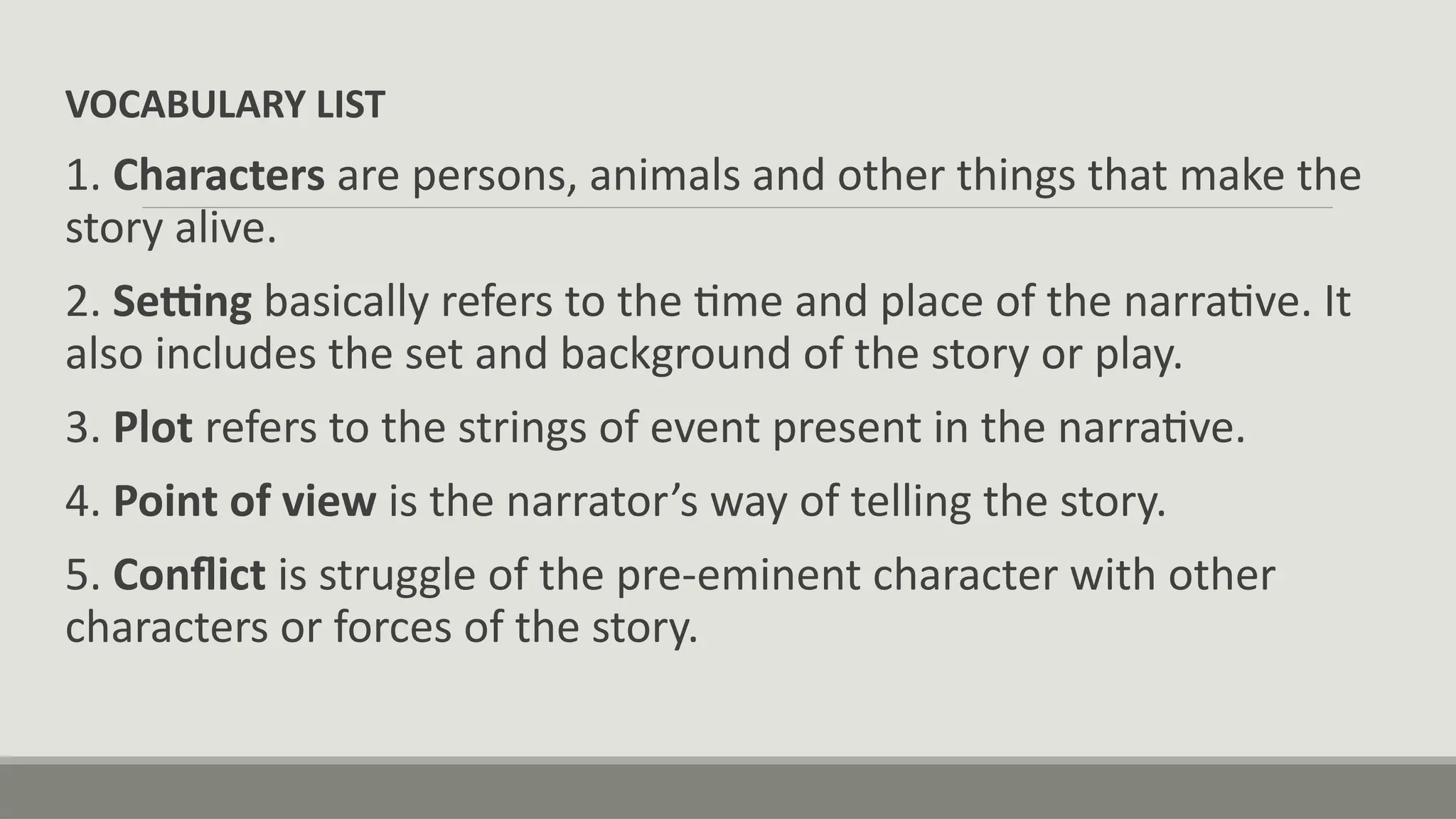
VOCABULARY LIST
1. Charactersare persons, animals and other things that make the
story alive.
2. Setting basically refers to the time and place of the narrative. It
also includes the set and background of the story or play.
3. Plot refers to the strings of event present in the narrative.
4. Point of view is the narrator’s way of telling the story.
5. Conflict is struggle of the pre-eminent character with other
characters or forces of the story.
3.
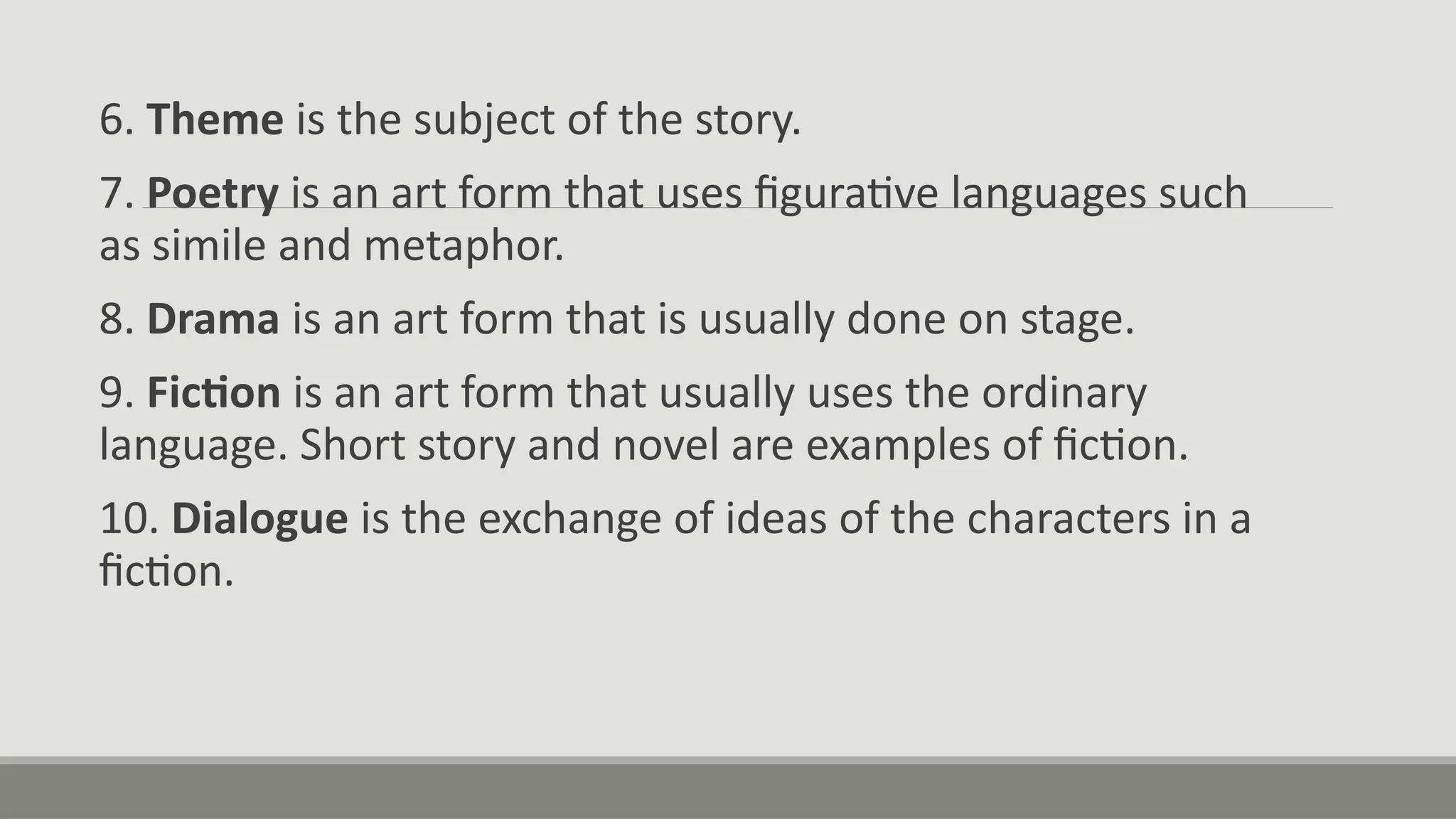
6. Theme isthe subject of the story.
7. Poetry is an art form that uses figurative languages such
as simile and metaphor.
8. Drama is an art form that is usually done on stage.
9. Fiction is an art form that usually uses the ordinary
language. Short story and novel are examples of fiction.
10. Dialogue is the exchange of ideas of the characters in a
fiction.
How does onesay that a particular work is fiction?
6.
Fiction work isnot real hence writers can utilize both the
imagination and complex figurative language to appeal to
the readers.
Fiction is also characterized by structured language,
adherence to proper grammatical pattern, and correct
mechanics.
A work of fiction may combine fantastical and imaginary
ideas from everyday life.
Written imaginatively, it comprises some important elements
like plot, setting, character, conflict, and point of view to
lead the readers to its theme.
7.
Because literature isbasically an art and not
a science, it is not always a good idea to
specifically approach fiction while looking for
these elements. Rather, it is better to read a
fiction work and examine it closely then
decide for yourself what element(s)
was/were highlighted and how important
and significant it is to what the writer is
trying to convey.
8.
For beginning fictionwriters, on the other hand,
it is important to know what makes fiction. A
chef trying to cook a particular gourmet dish
should know the ingredients and how each will
affect the flavor of the food being prepared. This
is similar to writing. With this understanding in
mind, let us find out the ingredients when
cooking up fiction.
9.
A. Character
Characters arebeings who live in the story. They can
be actual people from this planet to aliens from
somewhere in the outer space. At other times, they
can be animals, and even inanimate objects; they can
even be supernatural presences or make-believe
creatures like goblins, fairies, dragons, or elves.
10.
Characters are importantin fiction
because they are the ones with
whom the readers empathize.
Readers also look for characters to
root for or against, to fall in love with,
to care or to hate, and even dream to
meet.
11.
Readers come toknow and
understand the characters’ actions,
motivations, feelings and emotions
through what they say, what they
think, how they act, and even through
what other characters say about
them. A writer should therefore take
this in consideration when creating
the characters to life.
12.
Characters can beflat or round.
A flat character is not sufficiently developed, described very little, and
plays very minor role in the narrative. Sometimes they are simply
stock characters or those known simply as the “wicked stepmom,” or
the “loyal servant.”
A round character, on the other hand, has a leading role in the
narrative. In contrast with a flat character, a round character is
complex, multi-dimensional, and well-developed that they seem “to
come to life.” These characters may undergo change through the
circumstances where they are placed, hence making them lifelike.
13.
Characters can alsobe static or dynamic
(also called developing).
A static character remains the same throughout
the narrative while a dynamic one undergoes
change. The change can be brought by factors
and elements experienced by the character and
may impact on his or her attitudes, beliefs, or
actions.
14.
B. Setting
Simply put,setting answers the question
“where” and “when” about the narrative.
Answers to these questions give rise to the
two types of setting: the physical and
chronological setting.
15.
Physical setting refersto where the story takes place. It can be very
general like in a farm, a school, or a laboratory; or it can be specific,
like “in the Metropolitan Naga Cathedral,” or “at McDonald’s Diversion
Road branch.”
The chronological setting can also be general or specific, as during the
“Christmas season,” or “during the early morning of December 16 in
2019.”
Sometimes, the setting is immaterial to the story, as when the writer
wants to be universal and not limited by time and space
16.
Aside from thechronological and physical setting, it also
includes the following:
a) the immediate surroundings of the characters such as props
in a scene: trees, furniture, food, inside of a house or car, etc.,
b) the weather such as cloudy, sunny, windy, snow, or rain, etc.,
and
c) the geographical location including the city, state, country,
and possibly even the universe, if the writer is writing science
fiction.
17.
C. Plot
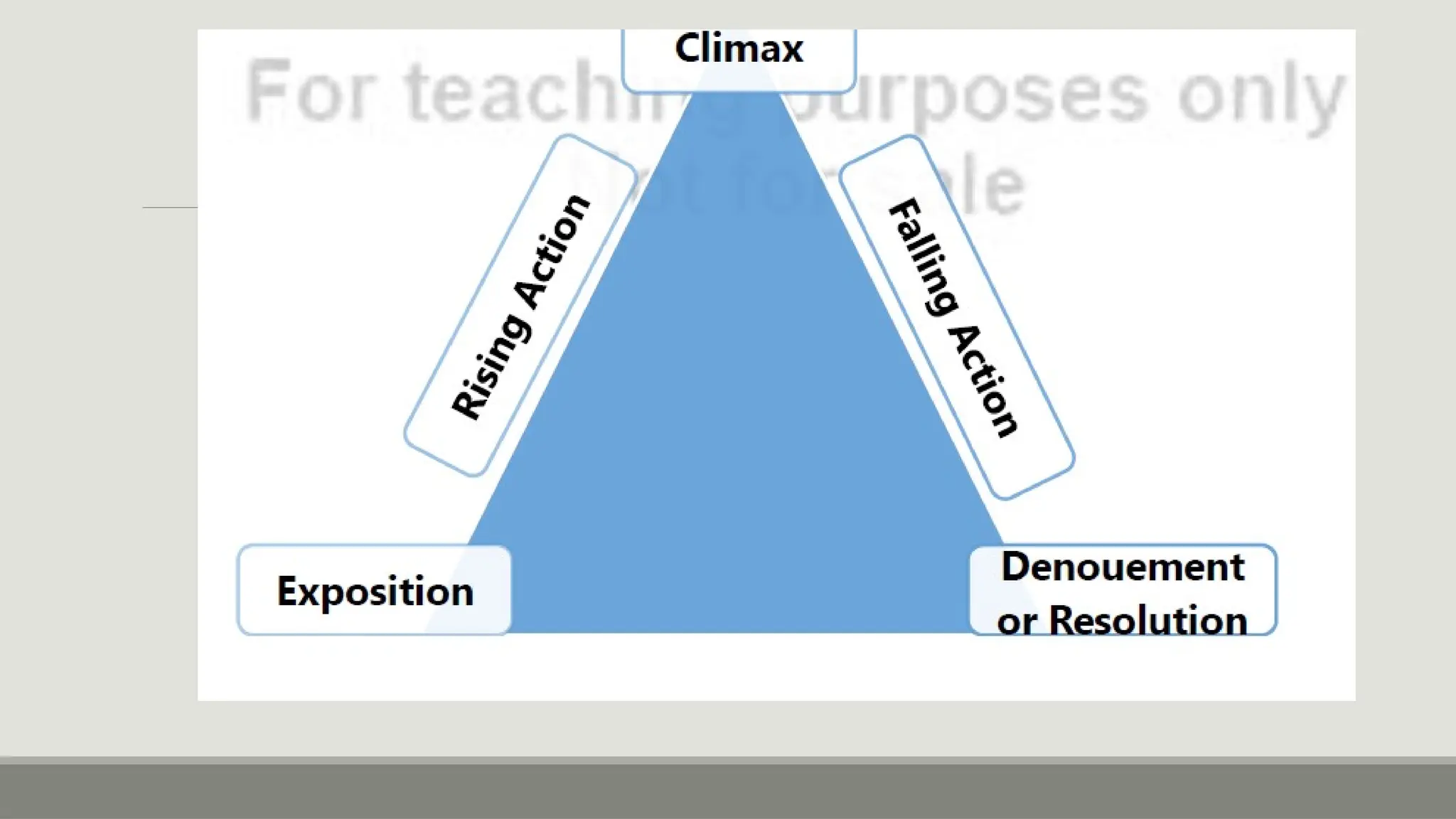
Plot isthe order of events in the story. Writers usually follow a
particular plot structure, called “Freytag’s Pyramid,” although this is
not always the case, as some may opt to start from the middle part or
ending part and go backwards to where the events began.
Freytag’s Pyramid is named after the German playwright of the
1800s, Gustav Freytag, and has the five-part plot structure which
includes the exposition, rising action, climax, falling action, and
denouement, also known as resolution.
19.
a) Exposition introducesthe characters, time, and the problem.
This occurs at the start of the story up to the point where an
inciting incident happens for the main character to handle or
solve. The exposition creates the beginning of the story.
b) Rising action includes the happenings that the main
character encounters. As each event develops, more
complications arise, making the problem more complex for the
character.
20.
c) Climax refersto the turning point in the story. This is usually a
single event with the greatest intensity and uncertainty. Here
the main character contends with the problem hence creating
the peak of interest for the readers.
d) Falling action are the events that unfold after the climax. The
resulting events after the climax create an emotional response
from the reader.
e) Denouement or resolution provides closure and ties up loose
ends in the story.
21.
D. Conflict
Conflict isthe struggle between opposing
forces or entities. The main character
encounters a conflict which may be an
adversary or any other force to contend
with.
22.
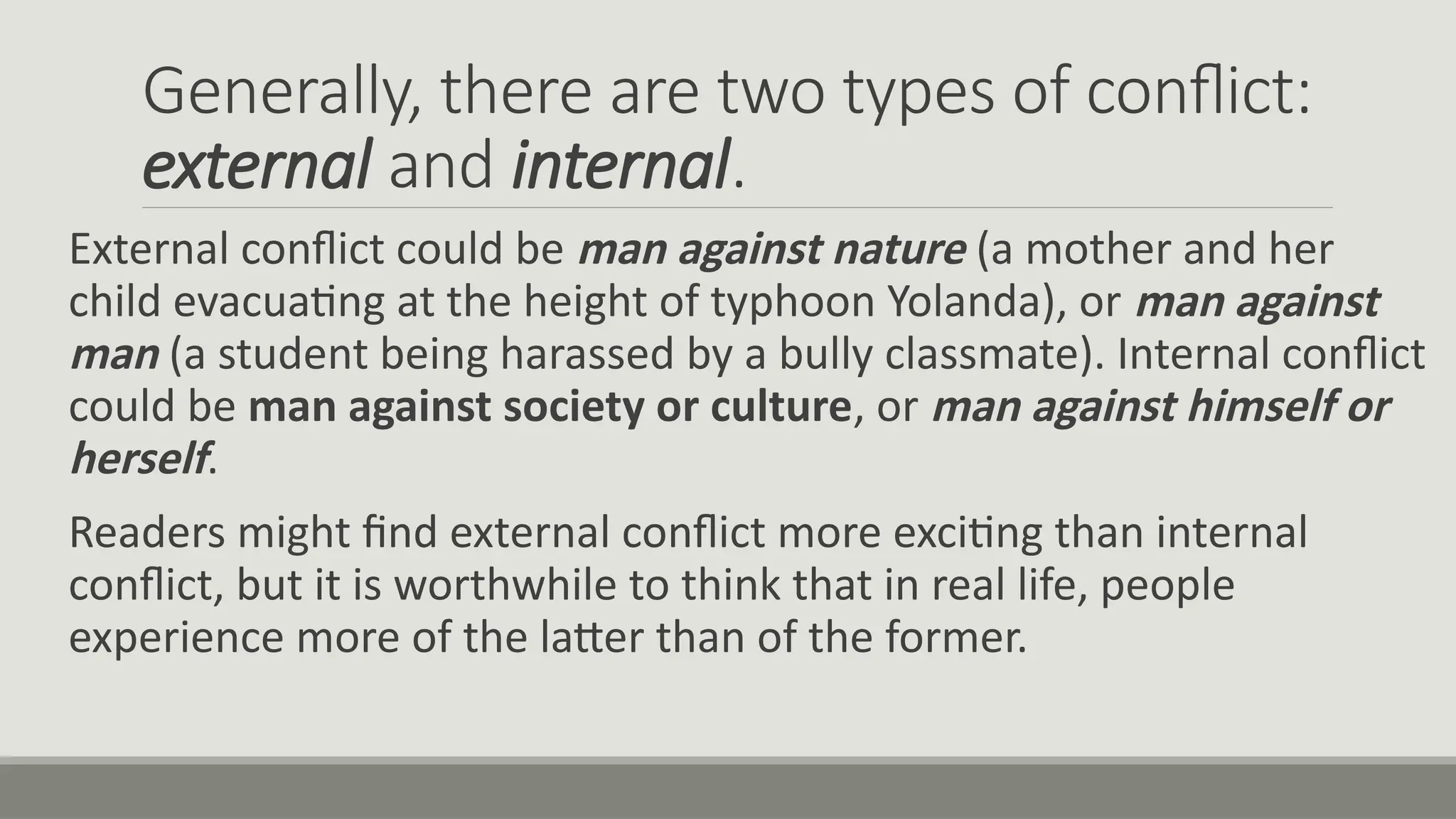
Generally, there aretwo types of conflict:
external and internal.
External conflict could be man against nature (a mother and her
child evacuating at the height of typhoon Yolanda), or man against
man (a student being harassed by a bully classmate). Internal conflict
could be man against society or culture, or man against himself or
herself.
Readers might find external conflict more exciting than internal
conflict, but it is worthwhile to think that in real life, people
experience more of the latter than of the former.
23.
E. Point ofview
Who is telling the story? How is the story
told? Point of view answers these
questions.
24.
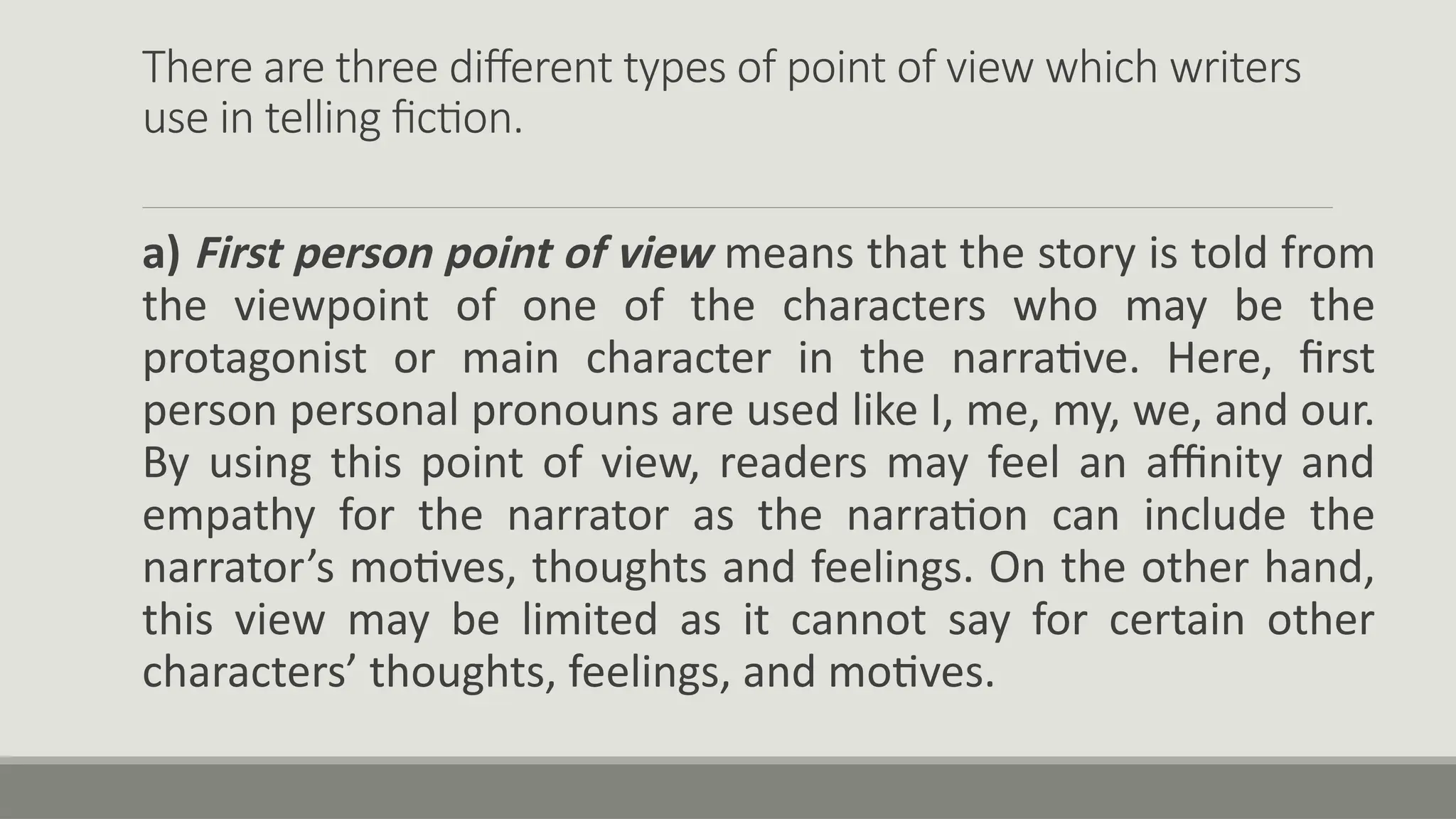
There are threedifferent types of point of view which writers
use in telling fiction.
a) First person point of view means that the story is told from
the viewpoint of one of the characters who may be the
protagonist or main character in the narrative. Here, first
person personal pronouns are used like I, me, my, we, and our.
By using this point of view, readers may feel an affinity and
empathy for the narrator as the narration can include the
narrator’s motives, thoughts and feelings. On the other hand,
this view may be limited as it cannot say for certain other
characters’ thoughts, feelings, and motives.
25.
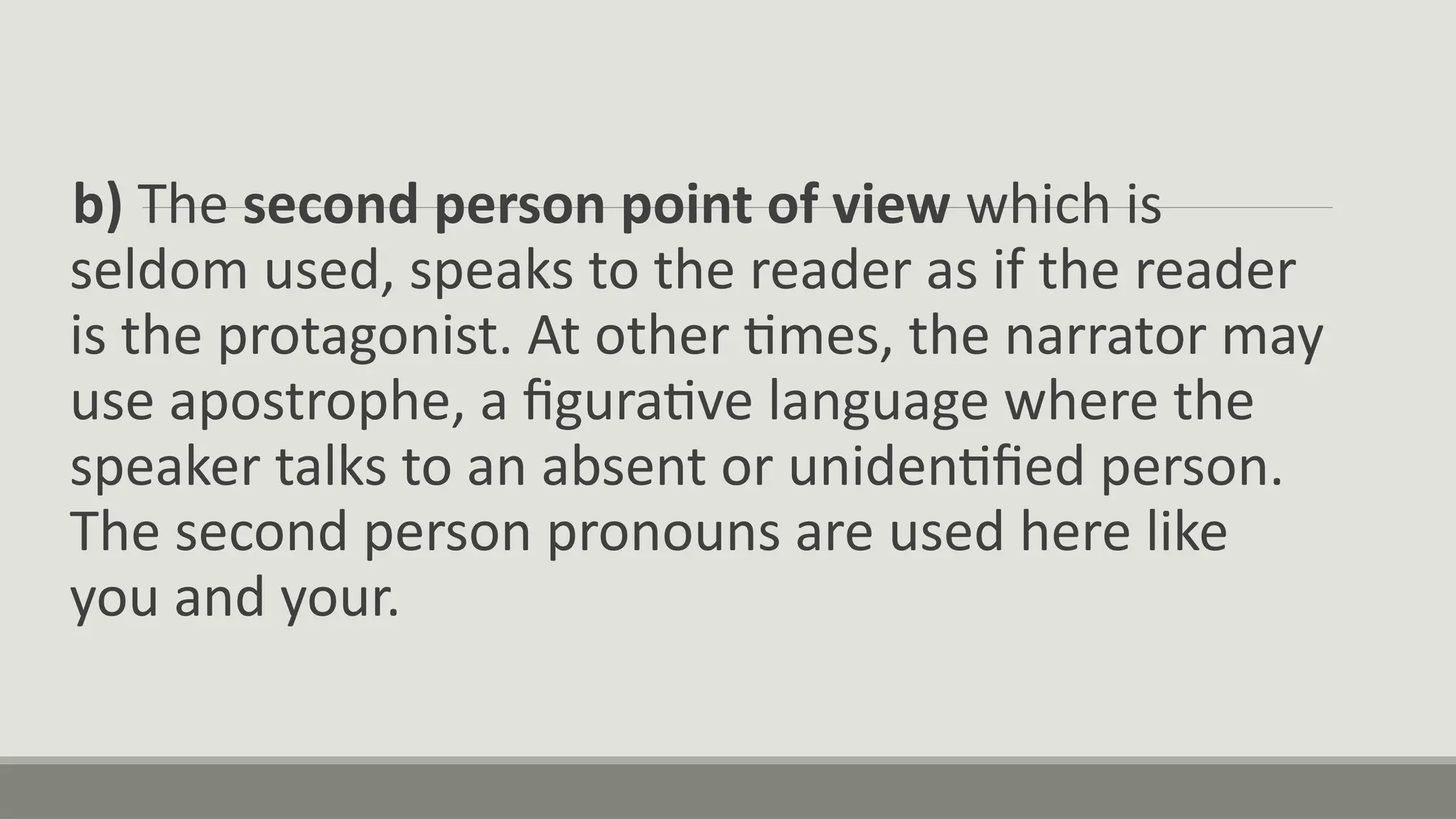
b) The secondperson point of view which is
seldom used, speaks to the reader as if the reader
is the protagonist. At other times, the narrator may
use apostrophe, a figurative language where the
speaker talks to an absent or unidentified person.
The second person pronouns are used here like
you and your.
26.
c) The thirdperson point of view is classified into third person
limited and third person omniscient. In both types of view, the
narrator is not a character nor in the story. In third person
limited, the narrator is limited only to one of the character’s
thoughts. In third person omniscient, the narrator is “all-
knowing” and “all-seeing” and knows various characters’
thoughts. This view uses third person pronouns like he, she, it,
and they.
27.
F. Theme
Theme isthe underlying truth conveyed by the author
through the story. Themes are usually universal which means
that they are understood by readers across cultures, eras, or
nationalities. Some common themes include coming of age,
circle of life, prejudice, greed, good vs. evil, and beating the
odds. Theme is different from the moral or lesson of a
narrative.
a. Rhyme
This isthe easiest feature to identify in a poem.
If the last word in the first line of poetry rhymes
with the last word in the second line, or the
third, you can easily identify a pattern. Rhyme
does not depend upon spelling; it is a matter of
sound, or pronunciation.
30.
b. Rhyme Scheme
Whenyou can identify a repeating pattern of similar-
sounding words at the ends of the lines, then you
have a rhyme scheme. Simply assign a letter of the
alphabet (starting with A, of course) to each word at
the end of a line of poetry; rhyming words are given
the same letter. Sometimes a pair of words nearly
rhymes; you assign the same letter to each of these
words also.
31.
c. Rhythm
Rhythm (ormeter) is a slightly more difficult aspect of
poetry for some students. There is a natural rise and
fall in our language: we stress certain syllables and
words more than others in order to emphasize
meaning. In poetry, these patterns of stressed and
unstressed syllables or words form a rhythm or meter.
There is a name for each of the common patterns.
32.
There were rulesin writing poetry in the past.
Poets arranged lines (also called verses) into
groups called stanzas. Usually the poems were
quite neat and evenly shaped - the lines were
roughly the same length, the stanzas all
contained a predetermined number of lines. The
rhyme schemes were regular, and the rhythm
was identifiable.
33.
Nowadays, modern poetsbreak all of these rules because
they feel that their poetry will be stilted and artificial if
they cannot write freely, hence the term free verse. At
first glance it appears that all of the conventions of poetry
have been thrown away when you read such poetry, but
in many ways free verse is more difficult to write. The
poet creates his or her own form, although the poem
must still sound like a poem; otherwise, it is prose. The
poet is free to choose whether or not to use rhyme or a
natural rhythm which does not follow a set pattern
34.
Poetry, even moreso than the other genres of
literature, employs figurative language to the best
effect. Poets use literary devices as tools to create
images or vivid word pictures, for the reader. Figures
of speech require fewer words to express these
images, and this “compact” feature lends itself
especially well to poetry, where there is usually a
limit to the length of a verse. The topic on figurative
language will be discussed in the succeeding lessons.
35.
Elements of Drama
Dramais pretty much similar in certain narrative
aspects to fiction, like the presence of characters,
plot, setting, conflict, and theme. Since drama is
intended for performance, it has particular elements,
though, which are distinct from other genres. This
includes presentation elements like venue,
costumes, set design, lighting design, and music.
36.
1. He thoughtabout Marian. She had left him nine years
ago after five years of marriage. He was fifty-two now;
that would make her just under forty. Marian had
dreams of becoming a musician, a folksinger.
(Robert James Waller, The Bridges of Madison County)
2. I’d belying if I told you I wasn’t afraid. I don’t want to die, and thanks to
my parents—my mother lived to ninety-six—I long assumed that I was
genetically capable of growing even older than I already am. Until a few
months ago, I fully believed I had half a dozen good years left. Well, maybe
not good years. That’s not the way it works at my age. I’ve been
disintegrating for a while now—heart, joints, kidneys, bits and pieces of my
body beginning to give up the ghost—but recently something else has been
added to the mix. Growths in my lungs, the doctor said. Tumors. Cancer. My
time is measured in months now, not years… but even so, I’m not ready to
die just yet. Not today. There is something I have to do, something I have
done every year since 1956. A grand tradition is coming to an end, and more
than anything, I wanted one last chance to say good-bye. (Nicholas Sparks,
The Longest Ride)
39.
3. At Kalispell,Montana, he
stopped for the night, late.
The Cozy Inn looked
inexpensive, and was. (Robert
James Waller, The Bridges of
Madison County)
40.
Aries – TheRam
Athamas, the legendary king of Thessaly, had two children, Phrixus and
Helle. He had remarried and Ino, the children’s stepmother, began to treat
them very badly. They were treated so cruelly that Hermes took pity on
them and sent a magical ram to take them away and escape their
stepmother’s wrath. Mounted on the ram’s back, the children flew over
land and sea to the east. Unfortunately, Helle failed to get a good hold on
the fleece of the ram and as they flew over the strait that separates Europe
and Asia, she fell off and was drowned in the sea far below. That sea is
called Hellespont to this day in honor of her memory. Phrixus landed safely
at Colches, which is on the edge of the Black Sea. In gratitude for his safe
deliverance, Phrixus sacrificed the ram and gave its Golden Fleece to the
king of that country. In honor of the ram’s great sacrifice in saving the
children, Zeus placed the ram’s constellation, Aries, in the night sky.
(adapted from “Constellation Legends”)
41.
Task 3 Directions:Characterize an ideal mother that
will be a part of a play. This mother may be your own
mother or the mother of your relative or friend. You
may use a bio-data so that the characterization is clear.
___________________________________________________
___________________________________________________
___________________________________________________
__________________________________________________
42.
Task 4
In thisactivity, you will create samples of narrative
elements based on your personal experience. To
be able to do this, write 2-3 sentences for each
writing prompt in your paper. Be guided by the
element being highlighted in each writing prompt.
43.
1. Point ofview
What point of view do you think would
be most effective when talking about
your personal experience? (Note: Use
that point of view as you answer the
questions in the succeeding writing
prompts.)
3. Characters
Who weretwo of the most memorable
people you have met in life? Talk about
them and describe how they look like.
46.
4. Setting
What particularplace do you like
best? What makes the place special?
Think about the particular time of
day you would want to go to your
favorite place.
47.
5. Conflict
Recall anincident when you were in
opposition with somebody/someone or
yourself. How did it feel like? How were
you able to go through the struggle?
48.
6. Plot
Think aboutthe events that led you to your
most embarrassing experience. Write about
it following Freytag’s Pyramid.