3
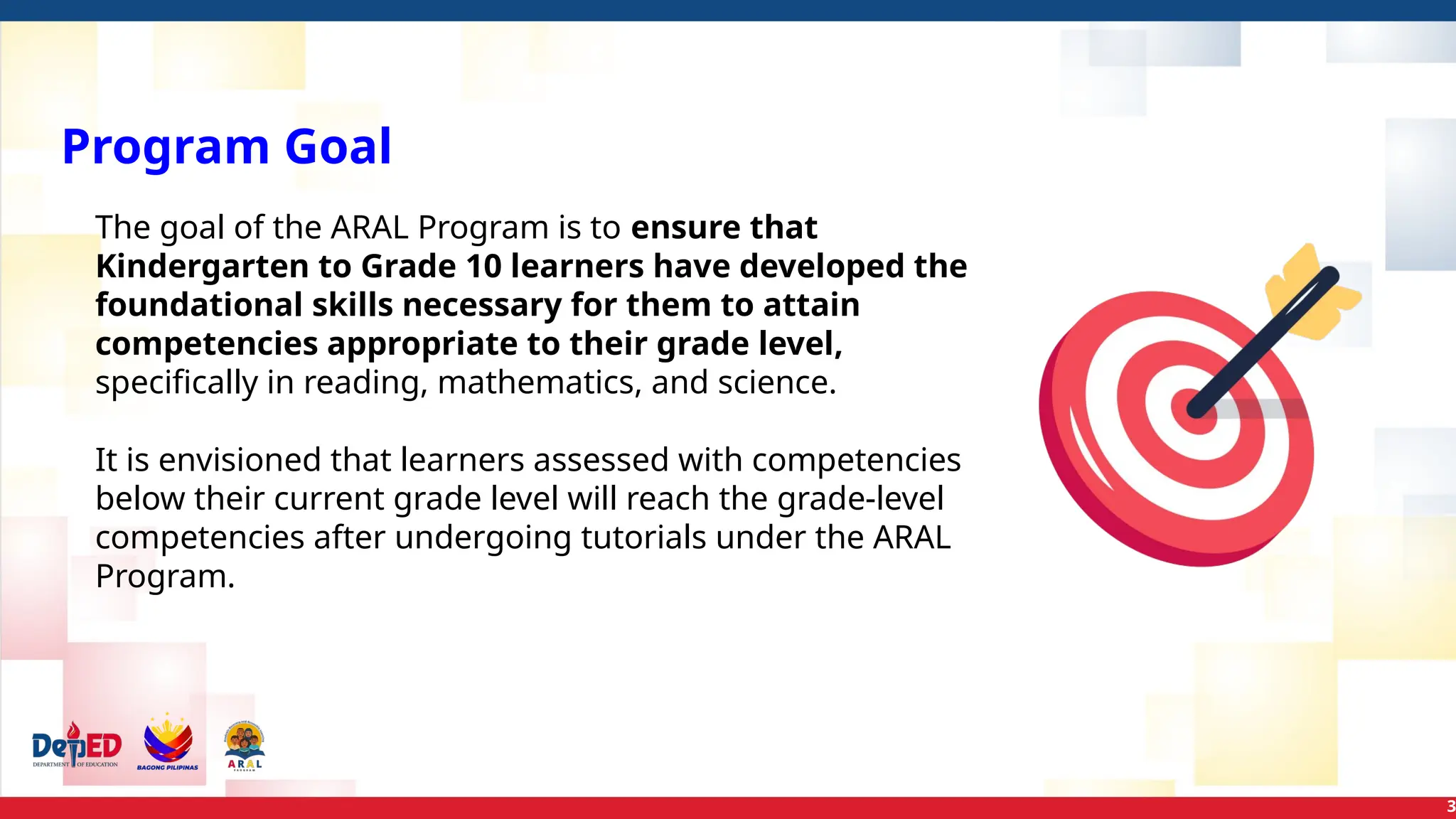
The goal ofthe ARAL Program is to ensure that
Kindergarten to Grade 10 learners have developed the
foundational skills necessary for them to attain
competencies appropriate to their grade level,
specifically in reading, mathematics, and science.
It is envisioned that learners assessed with competencies
below their current grade level will reach the grade-level
competencies after undergoing tutorials under the ARAL
Program.
Program Goal
4.
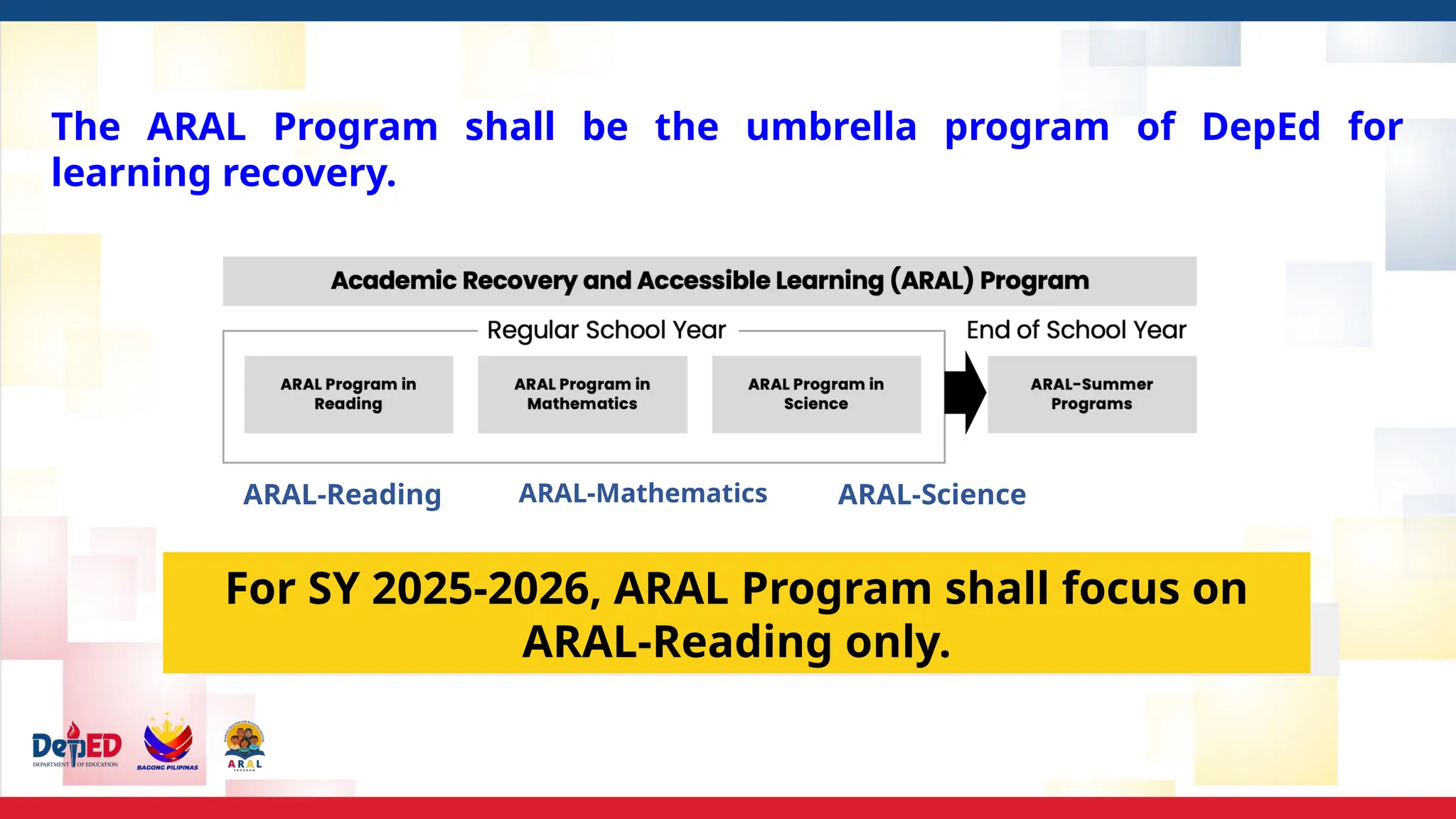
The ARAL Programshall be the umbrella program of DepEd for
learning recovery.
ARAL-Reading ARAL-Mathematics ARAL-Science
For SY 2025-2026, ARAL Program shall focus on
ARAL-Reading only.
5.
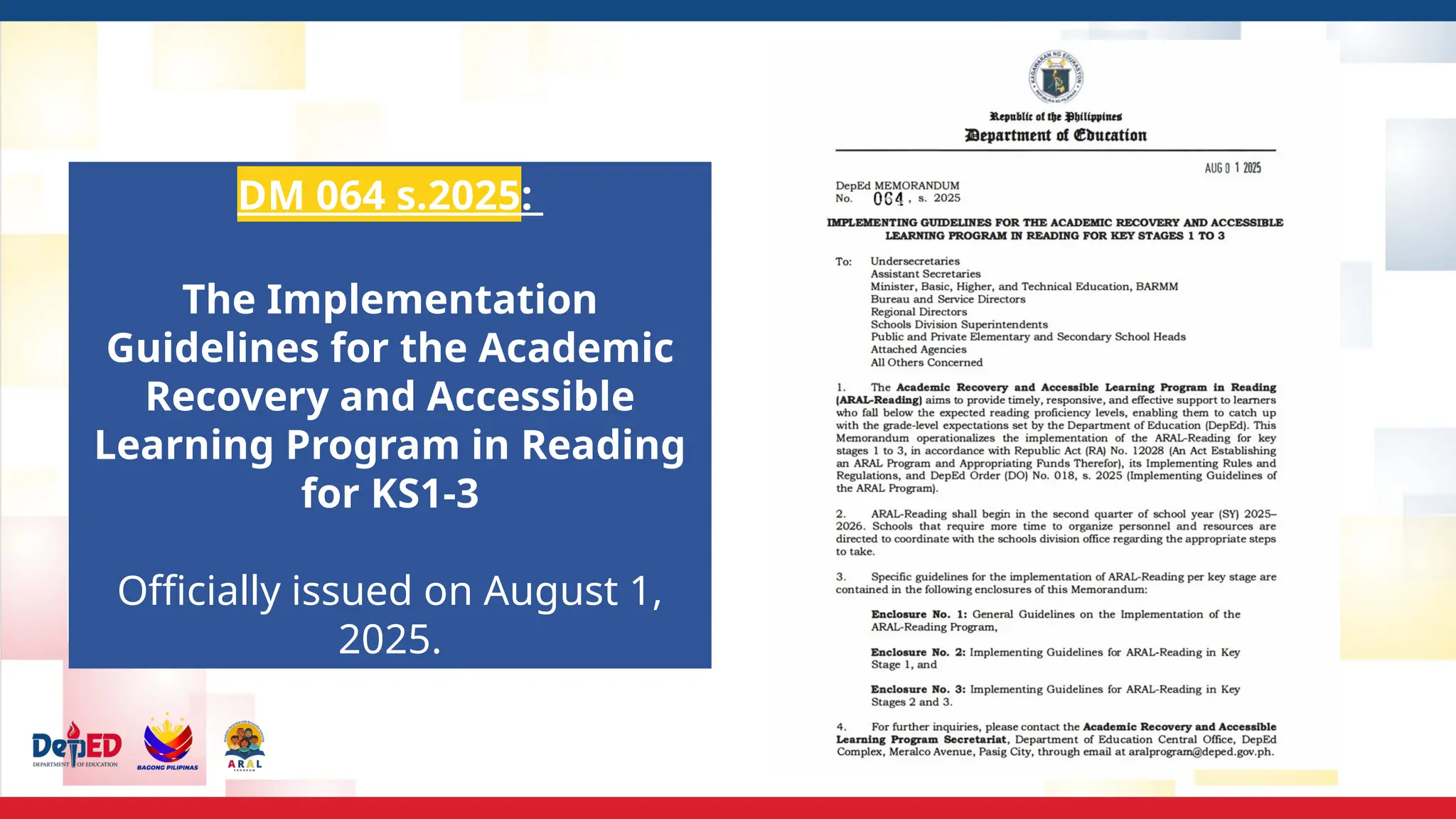
DM 064 s.2025:
TheImplementation
Guidelines for the Academic
Recovery and Accessible
Learning Program in Reading
for KS1-3
Officially issued on August 1,
2025.
6.
Relevant Issuances Description
1.Republic Act No. 12028 or the “Academic Recovery
and Accessible Learning (ARAL) Program Act of 2024”
Establishes a free and effective national learning intervention
program to ensure that all learners attain the competencies
set by the DepEd in their respective grade levels
2. DepEd Order No. 18, s. 2025, Implementing
Guidelines for the ARAL Program
Provides guidance for schools, community learning centers
(CLCs), and concerned offices across governance levels,
including qualified private institutions, in implementing the
ARAL Program
3. DepEd Memo No. 56, s. 2025, Supplemental
Guidelines on the Implementation the ARAL-SRRA
Provides guidance on the implementation of the ARAL School
Readiness and Responsiveness Audit (ASRRA) as a quality
assurance mechanism to assess school-level readiness in
delivering ARAL interventions.
4. DepEd Memo No. 64, s. 2025, Implementing
Guidelines for ARAL-Reading for Key Stages 1 to 3
Operationalizes the implementation of the ARAL Program in
Reading (ARAL-Reading) for Key Stages 1 to 3 in accordance
with RA No. 12028 [Academic Recovery and Accessible
Learning Program Act], its Implementing Rules and
Regulations, and DepEd Order No. 18, s. 2025 [Implementing
Guidelines of the Academic Recovery and Accessible Learning
Program].
7.
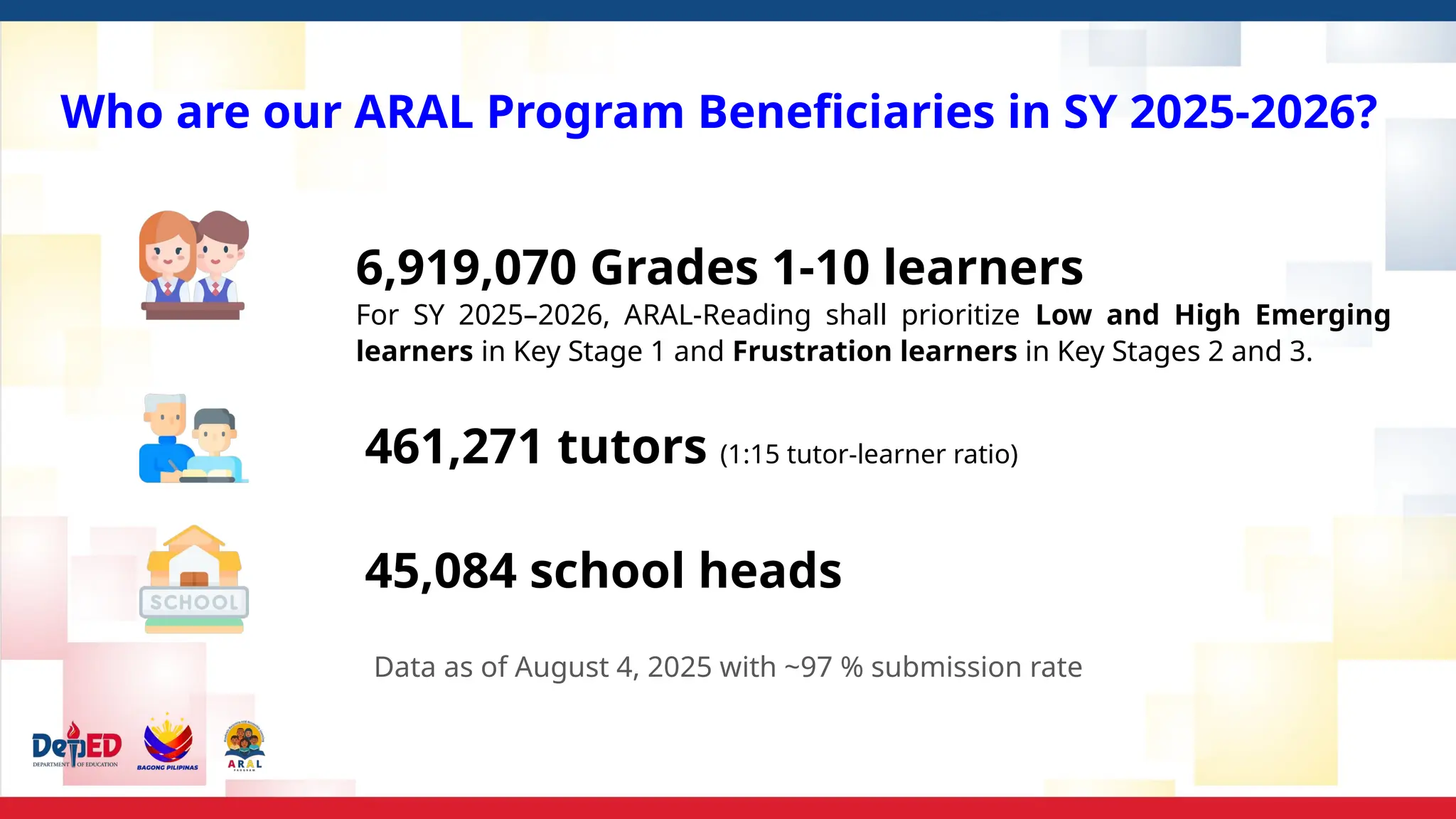
Who are ourARAL Program Beneficiaries in SY 2025-2026?
6,919,070 Grades 1-10 learners
For SY 2025–2026, ARAL-Reading shall prioritize Low and High Emerging
learners in Key Stage 1 and Frustration learners in Key Stages 2 and 3.
461,271 tutors (1:15 tutor-learner ratio)
45,084 school heads
Data as of August 4, 2025 with ~97 % submission rate
8.
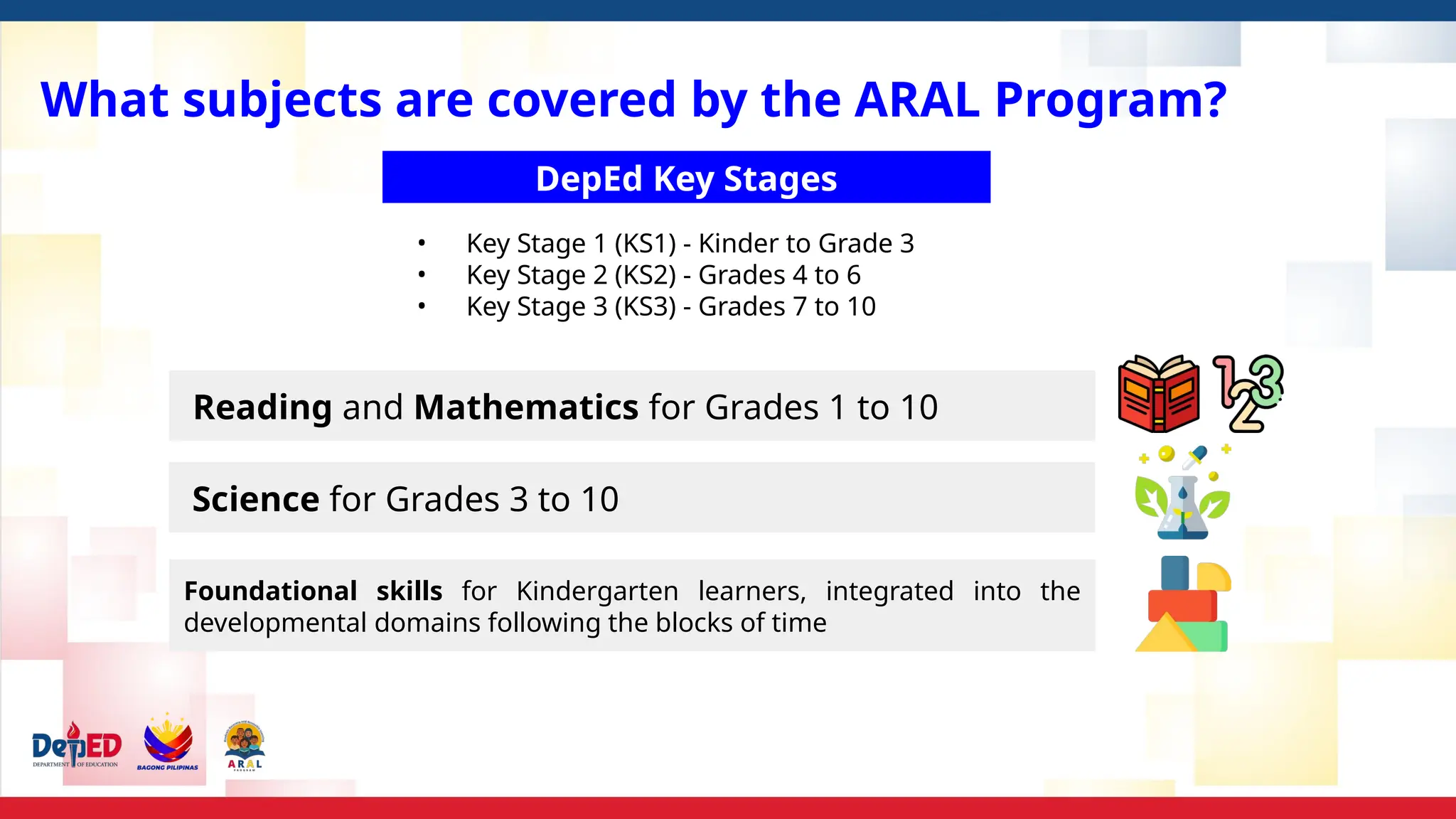
What subjects arecovered by the ARAL Program?
DepEd Key Stages
• Key Stage 1 (KS1) - Kinder to Grade 3
• Key Stage 2 (KS2) - Grades 4 to 6
• Key Stage 3 (KS3) - Grades 7 to 10
Reading and Mathematics for Grades 1 to 10
Foundational skills for Kindergarten learners, integrated into the
developmental domains following the blocks of time
Science for Grades 3 to 10
9.
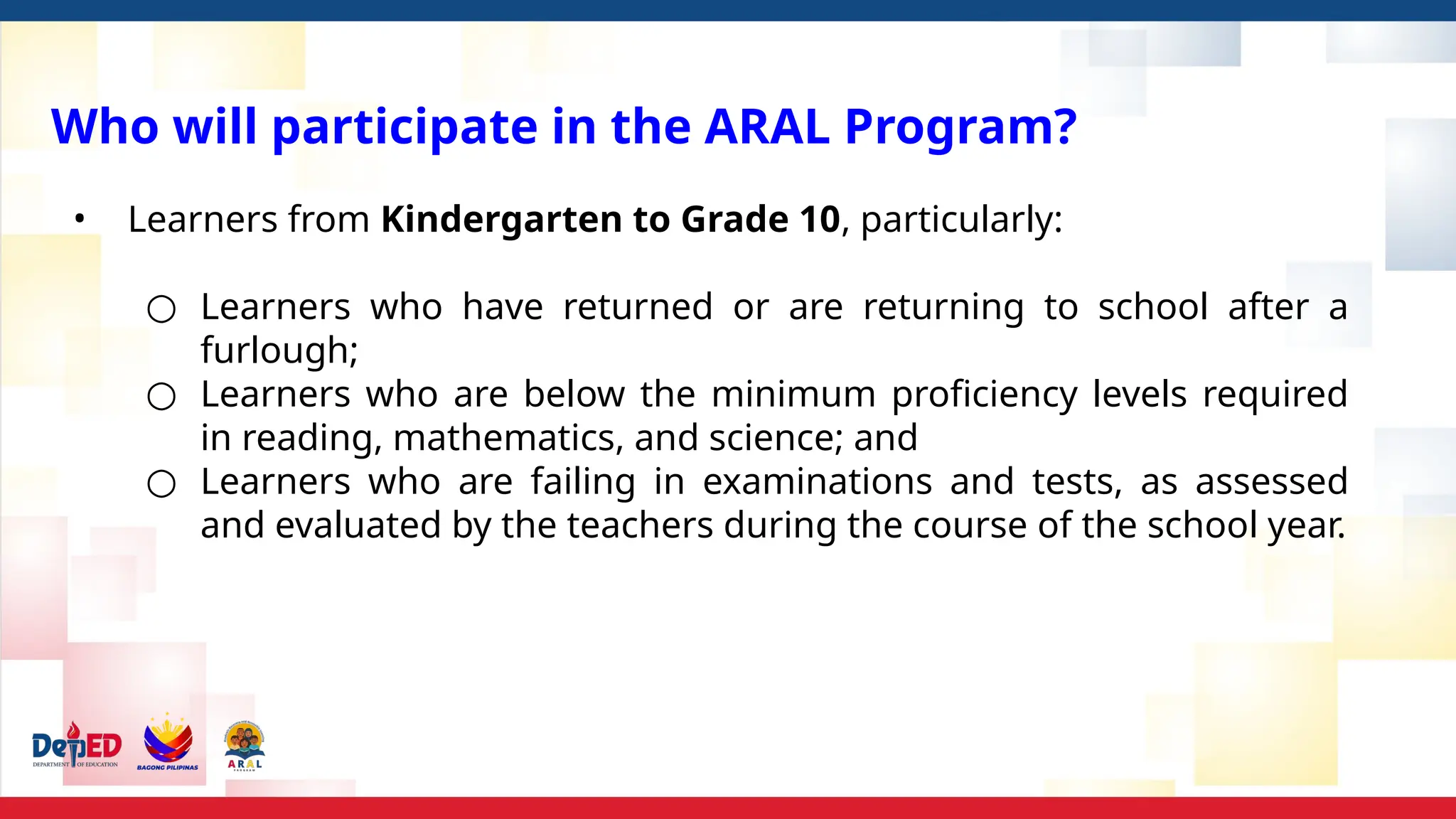
Who will participatein the ARAL Program?
• Learners from Kindergarten to Grade 10, particularly:
○ Learners who have returned or are returning to school after a
furlough;
○ Learners who are below the minimum proficiency levels required
in reading, mathematics, and science; and
○ Learners who are failing in examinations and tests, as assessed
and evaluated by the teachers during the course of the school year.
10.
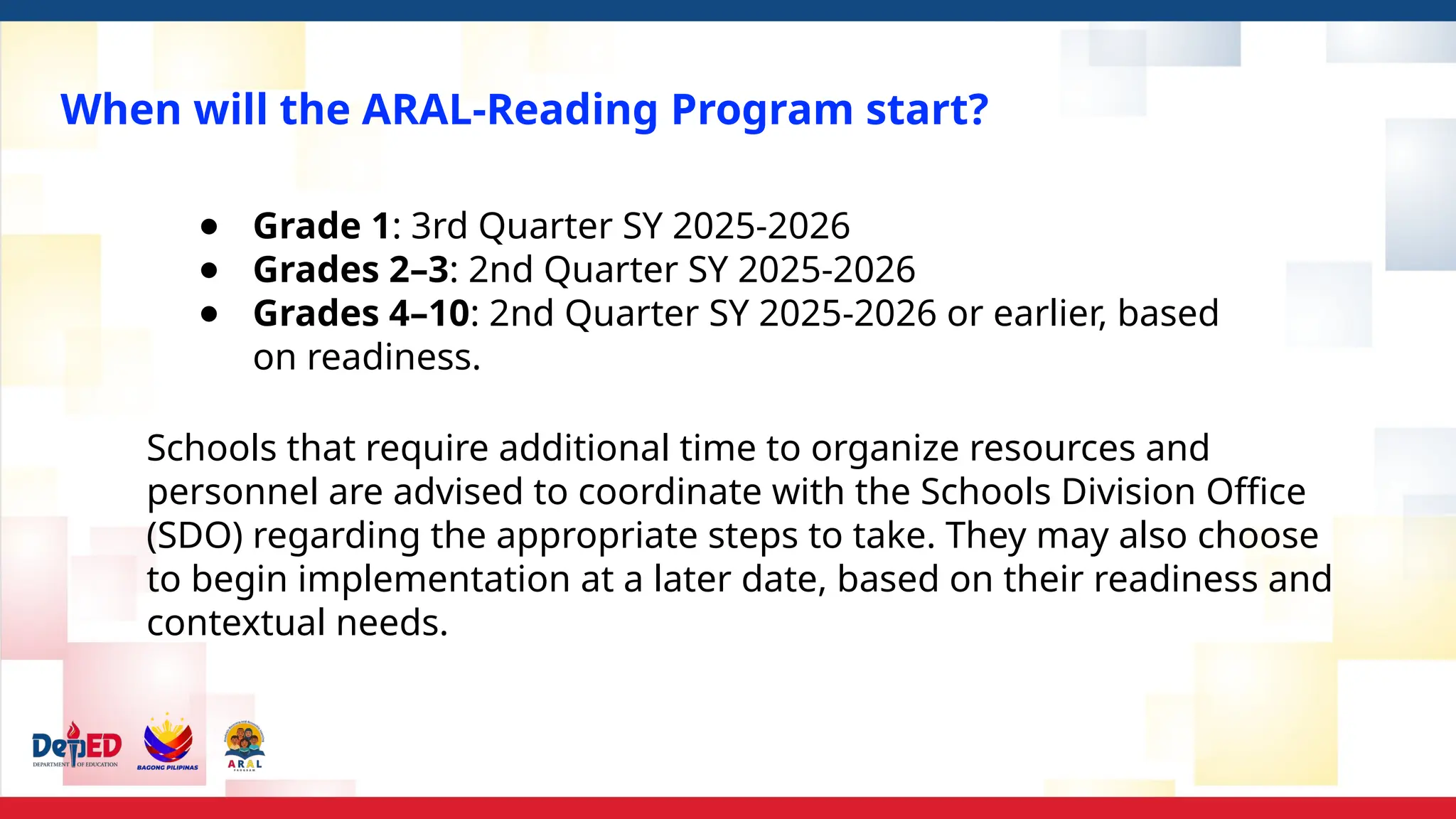
When will theARAL-Reading Program start?
● Grade 1: 3rd Quarter SY 2025-2026
● Grades 2–3: 2nd Quarter SY 2025-2026
● Grades 4–10: 2nd Quarter SY 2025-2026 or earlier, based
on readiness.
Schools that require additional time to organize resources and
personnel are advised to coordinate with the Schools Division Office
(SDO) regarding the appropriate steps to take. They may also choose
to begin implementation at a later date, based on their readiness and
contextual needs.
11.
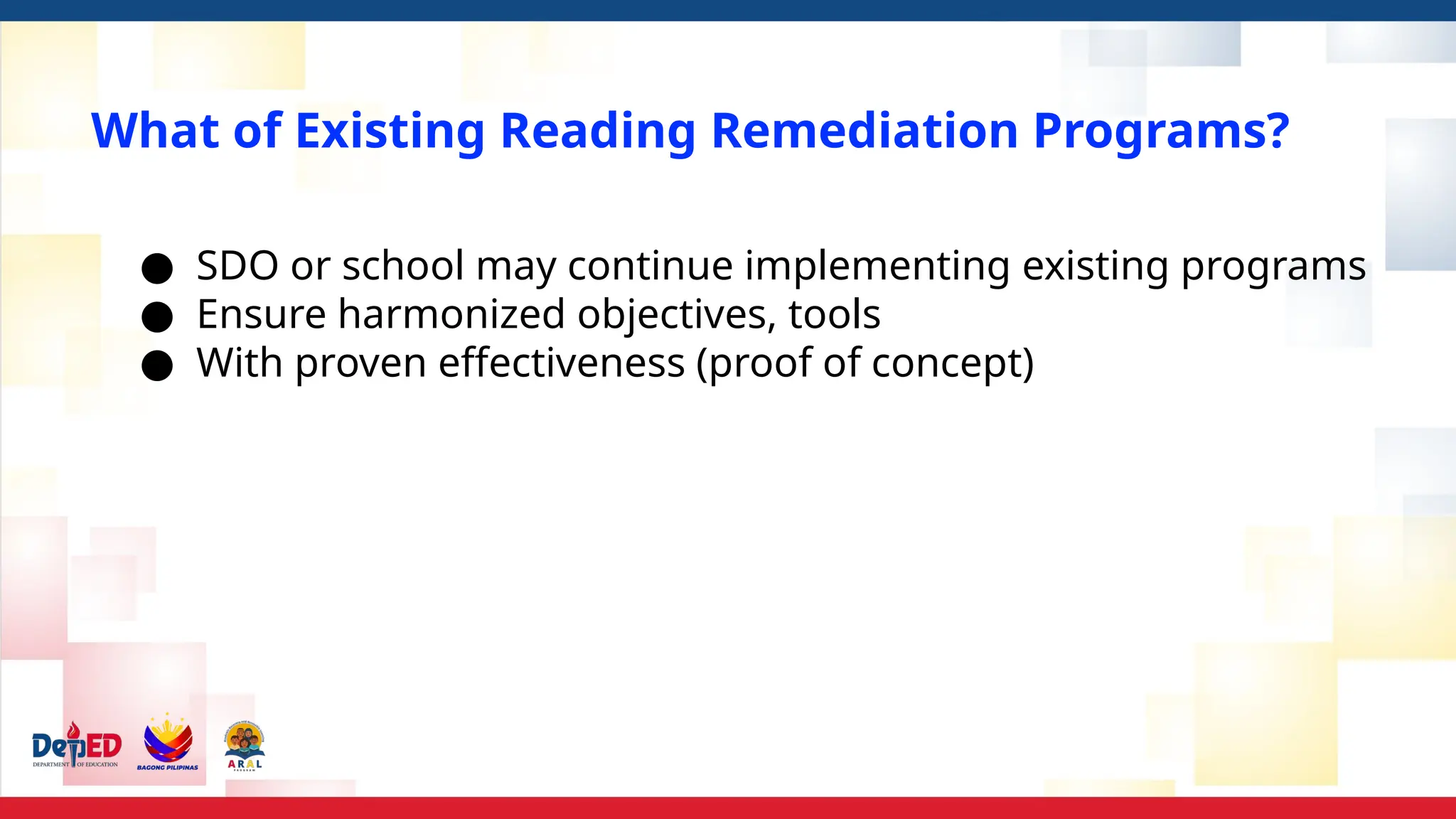
What of ExistingReading Remediation Programs?
● SDO or school may continue implementing existing programs
● Ensure harmonized objectives, tools
● With proven effectiveness (proof of concept)
12.
12
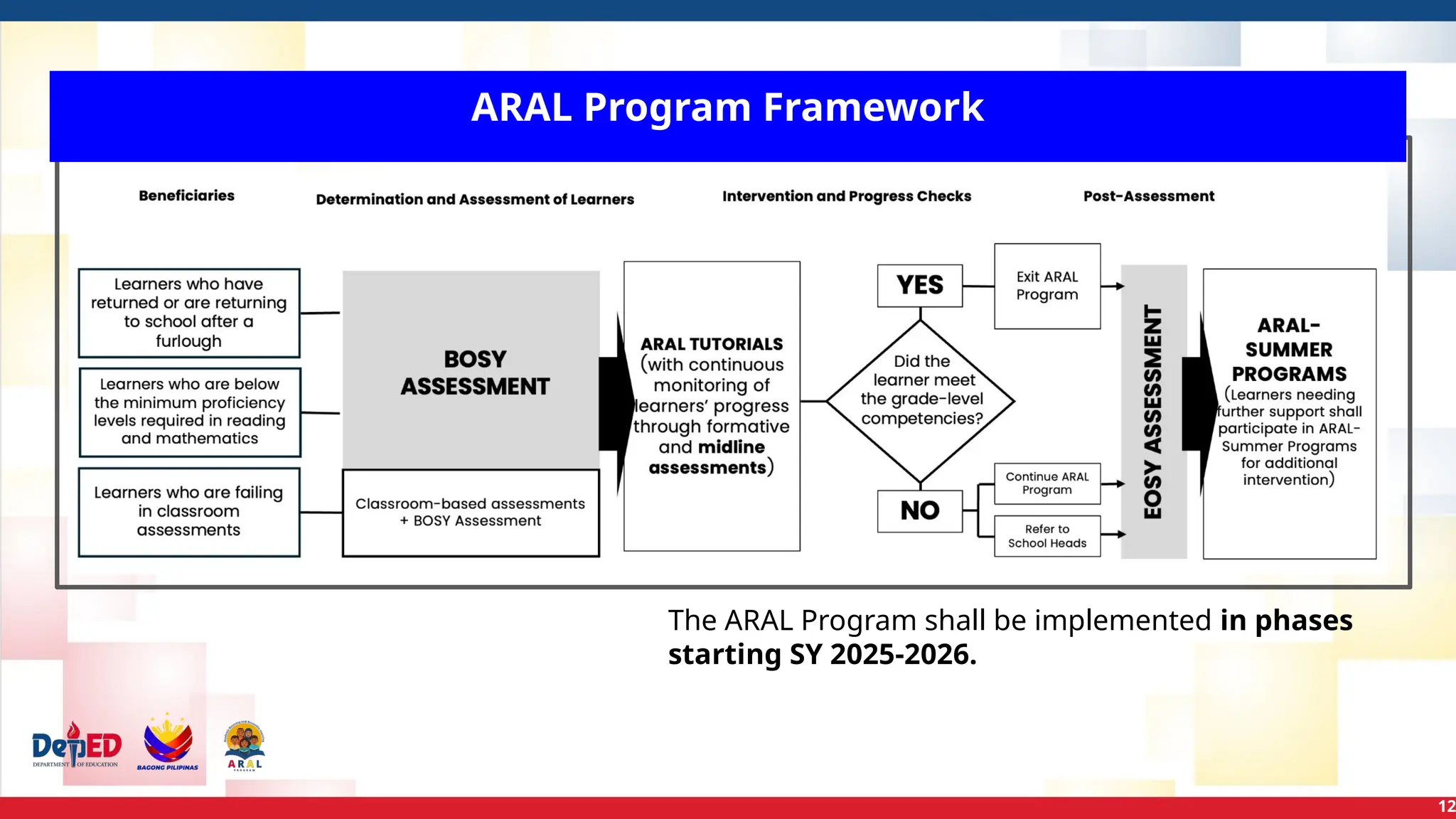
The ARAL Programshall be implemented in phases
starting SY 2025-2026.
ARAL Program Framework
13.
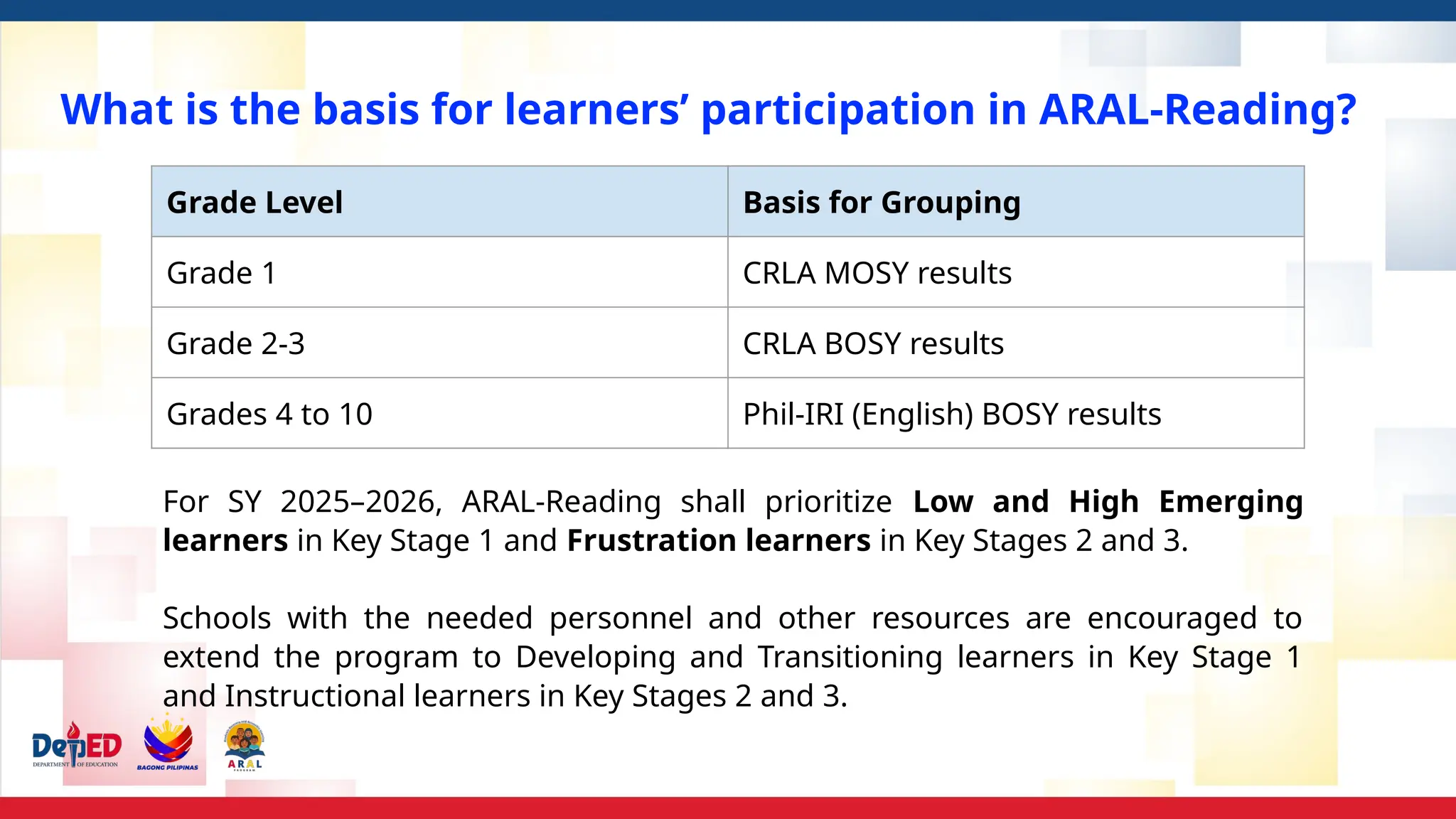
What is thebasis for learners’ participation in ARAL-Reading?
Grade Level Basis for Grouping
Grade 1 CRLA MOSY results
Grade 2-3 CRLA BOSY results
Grades 4 to 10 Phil-IRI (English) BOSY results
For SY 2025–2026, ARAL-Reading shall prioritize Low and High Emerging
learners in Key Stage 1 and Frustration learners in Key Stages 2 and 3.
Schools with the needed personnel and other resources are encouraged to
extend the program to Developing and Transitioning learners in Key Stage 1
and Instructional learners in Key Stages 2 and 3.
14.
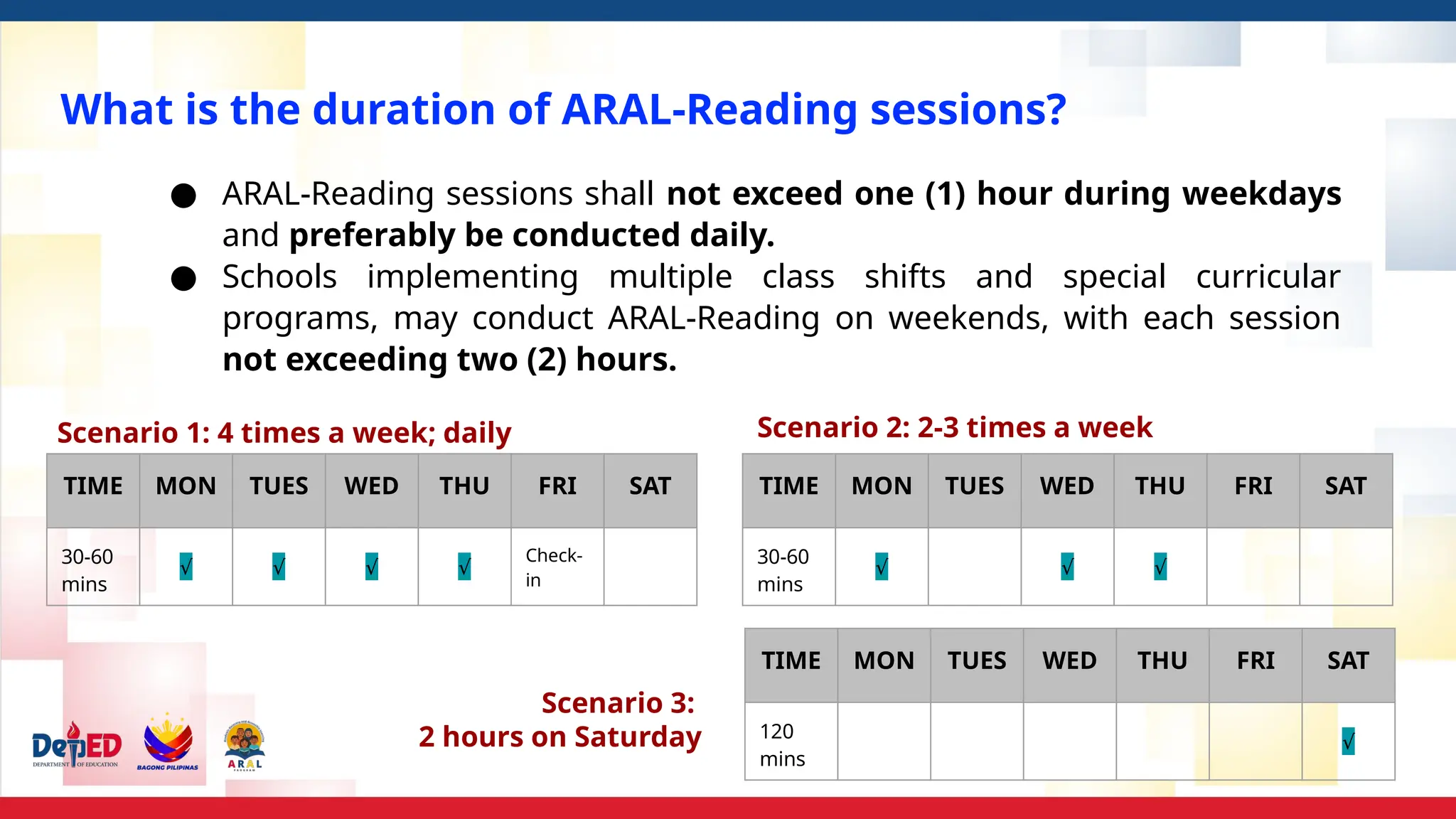
What is theduration of ARAL-Reading sessions?
● ARAL-Reading sessions shall not exceed one (1) hour during weekdays
and preferably be conducted daily.
● Schools implementing multiple class shifts and special curricular
programs, may conduct ARAL-Reading on weekends, with each session
not exceeding two (2) hours.
TIME MON TUES WED THU FRI SAT
30-60
mins
√ √ √ √
Check-
in
TIME MON TUES WED THU FRI SAT
30-60
mins
√ √ √
TIME MON TUES WED THU FRI SAT
120
mins
√
Scenario 1: 4 times a week; daily Scenario 2: 2-3 times a week
Scenario 3:
2 hours on Saturday
15.
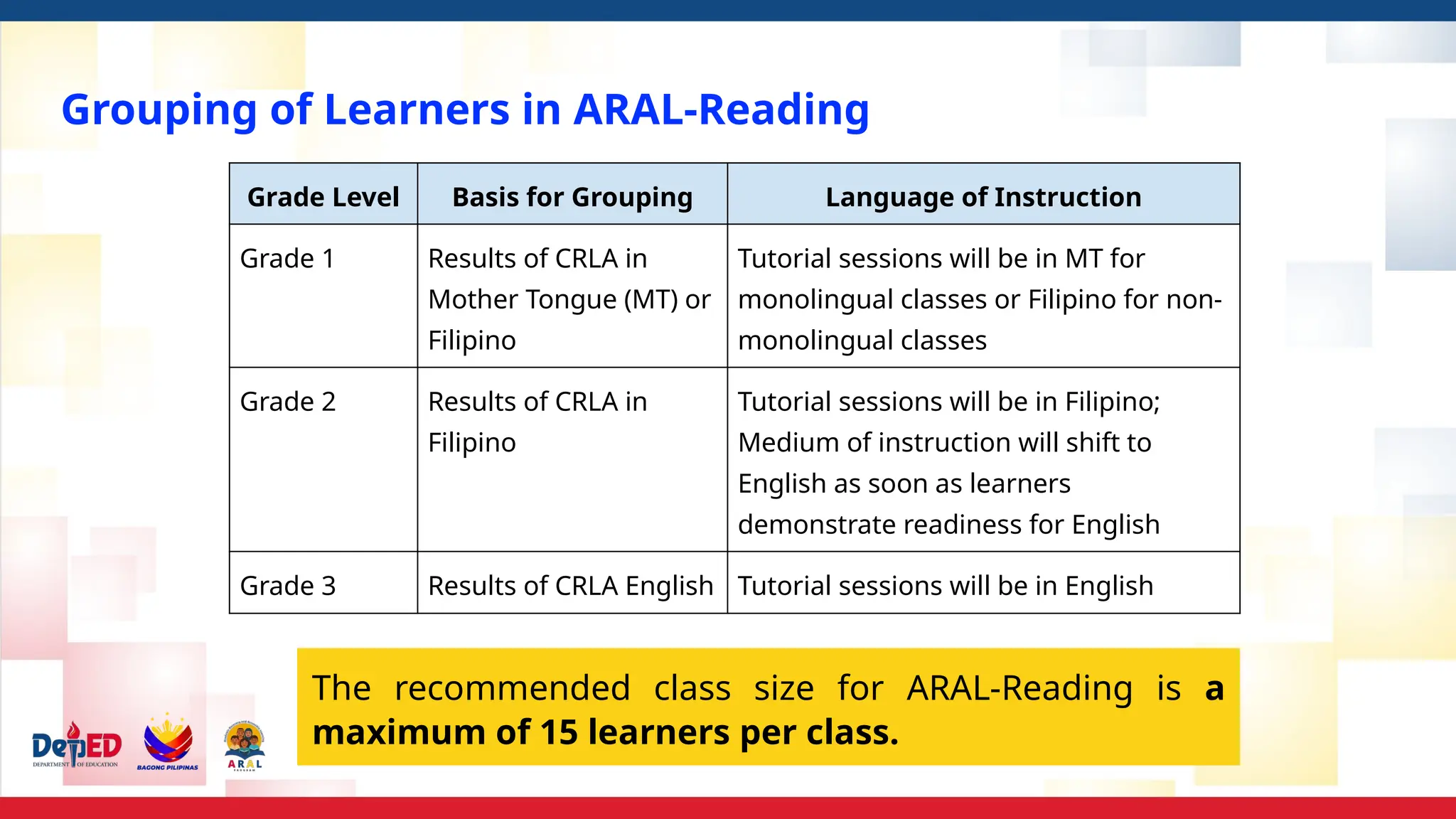
Grouping of Learnersin ARAL-Reading
Grade Level Basis for Grouping Language of Instruction
Grade 1 Results of CRLA in
Mother Tongue (MT) or
Filipino
Tutorial sessions will be in MT for
monolingual classes or Filipino for non-
monolingual classes
Grade 2 Results of CRLA in
Filipino
Tutorial sessions will be in Filipino;
Medium of instruction will shift to
English as soon as learners
demonstrate readiness for English
Grade 3 Results of CRLA English Tutorial sessions will be in English
The recommended class size for ARAL-Reading is a
maximum of 15 learners per class.
16.
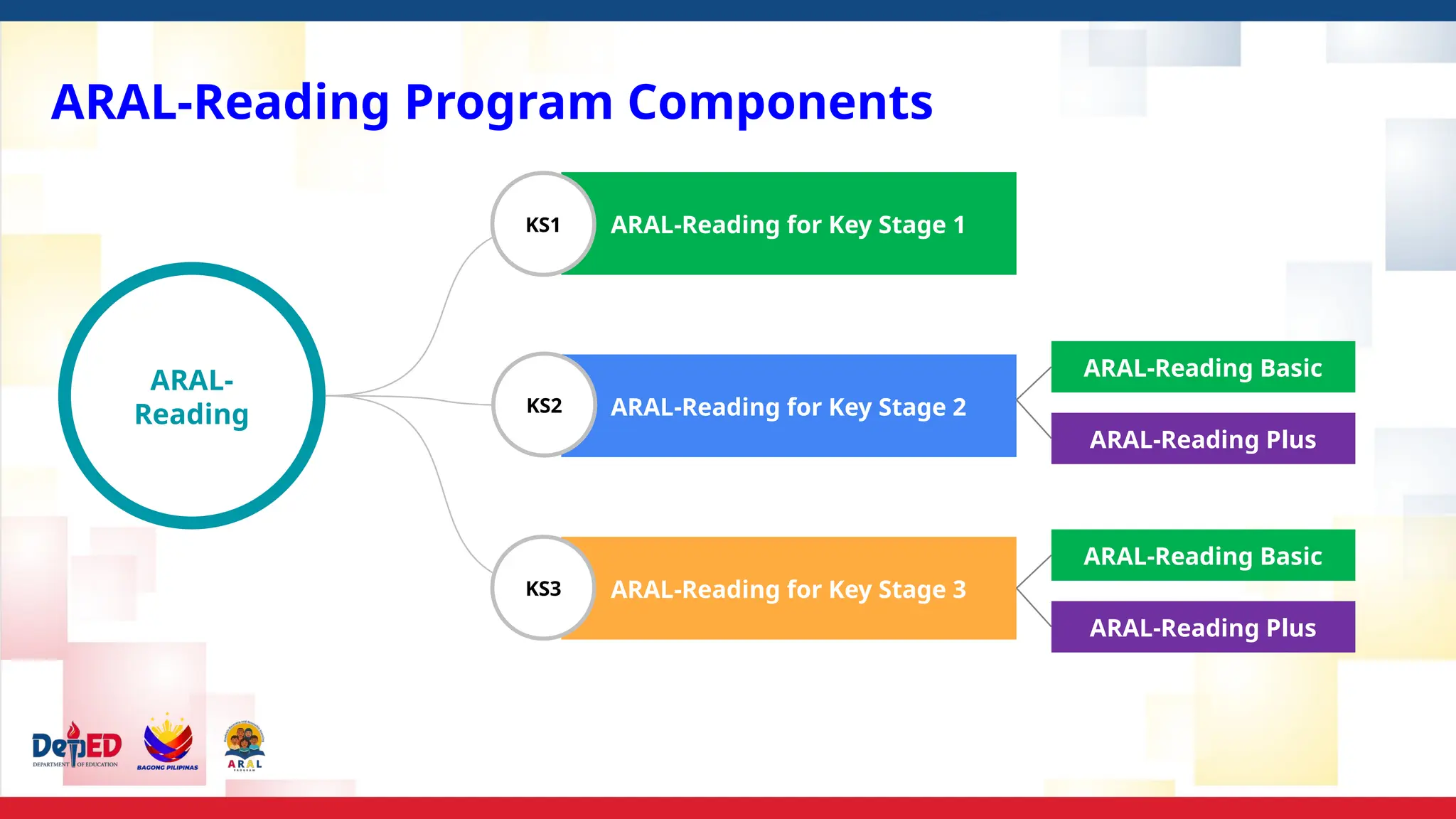
ARAL-
Reading
ARAL-Reading for KeyStage 1
ARAL-Reading for Key Stage 2
ARAL-Reading for Key Stage 3
KS1
KS2
KS3
ARAL-Reading Program Components
ARAL-Reading Basic
ARAL-Reading Plus
ARAL-Reading Basic
ARAL-Reading Plus
17.
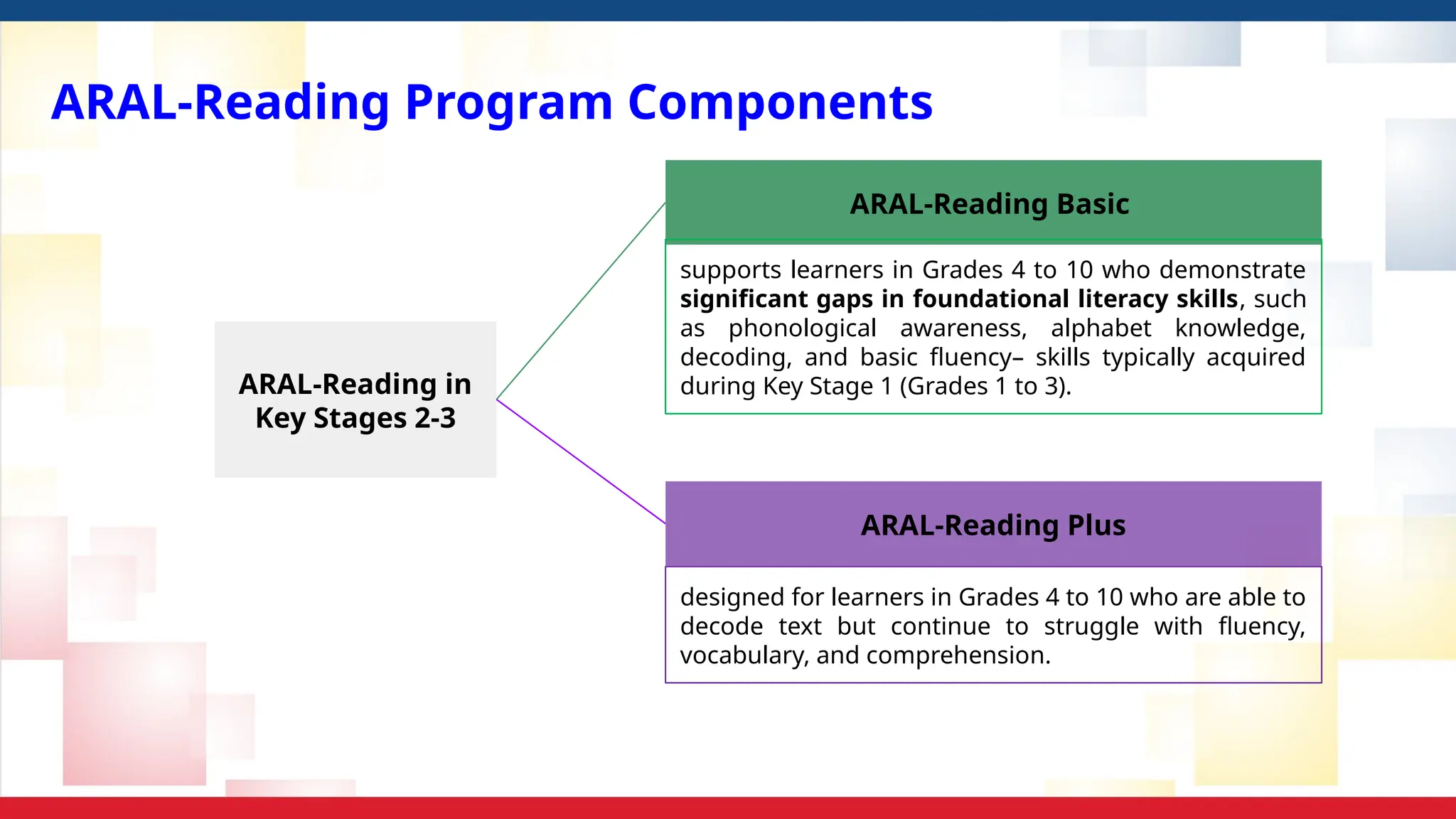
ARAL-Reading in
Key Stages2-3
ARAL-Reading Basic
ARAL-Reading Plus
supports learners in Grades 4 to 10 who demonstrate
significant gaps in foundational literacy skills, such
as phonological awareness, alphabet knowledge,
decoding, and basic fluency– skills typically acquired
during Key Stage 1 (Grades 1 to 3).
designed for learners in Grades 4 to 10 who are able to
decode text but continue to struggle with fluency,
vocabulary, and comprehension.
ARAL-Reading Program Components
18.
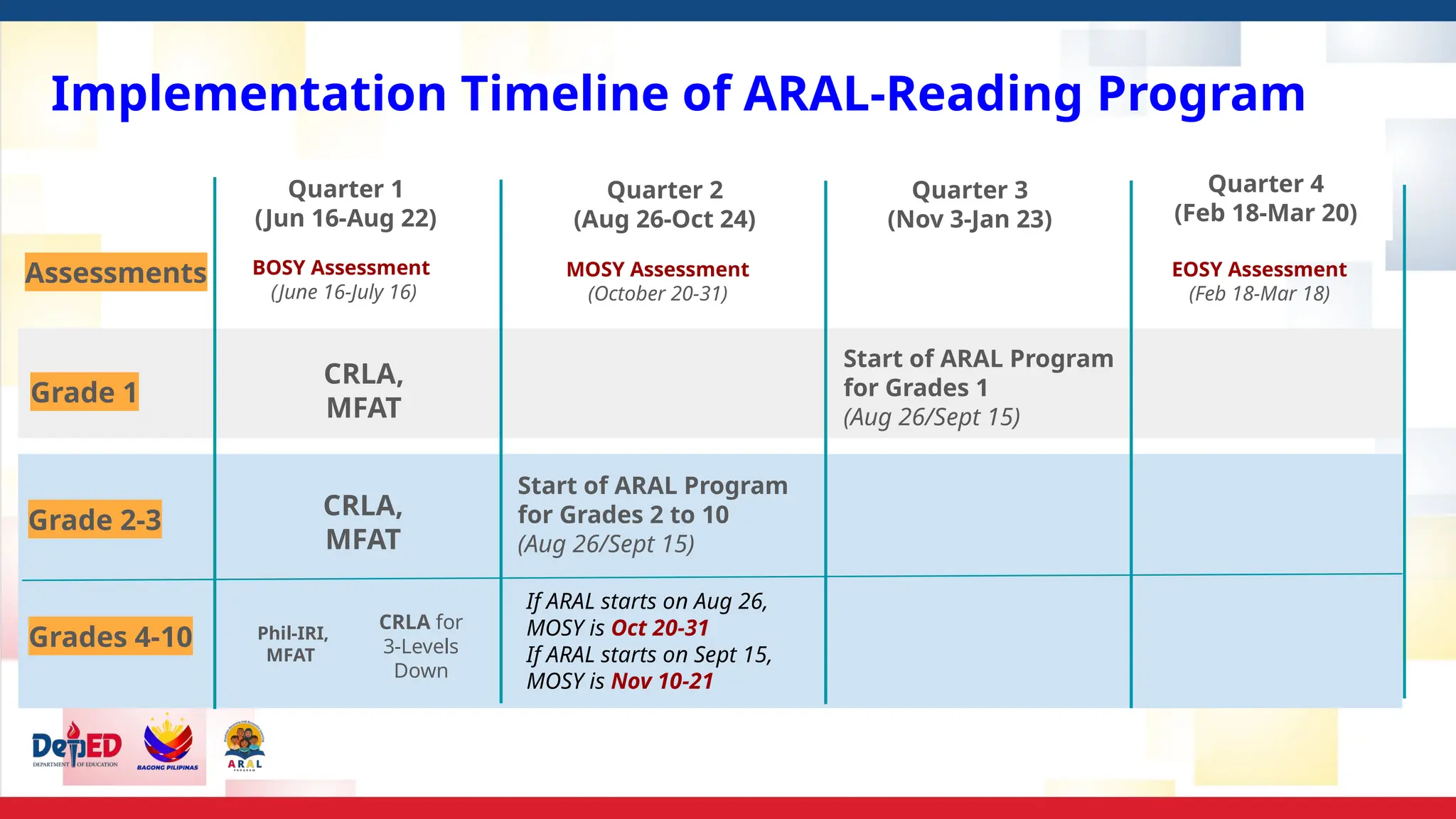
Implementation Timeline ofARAL-Reading Program
BOSY Assessment
(June 16-July 16)
Quarter 1
(Jun 16-Aug 22)
MOSY Assessment
(October 20-31)
EOSY Assessment
(Feb 18-Mar 18)
Start of ARAL Program
for Grades 2 to 10
(Aug 26/Sept 15)
Quarter 2
(Aug 26-Oct 24)
Quarter 3
(Nov 3-Jan 23)
Quarter 4
(Feb 18-Mar 20)
Start of ARAL Program
for Grades 1
(Aug 26/Sept 15)
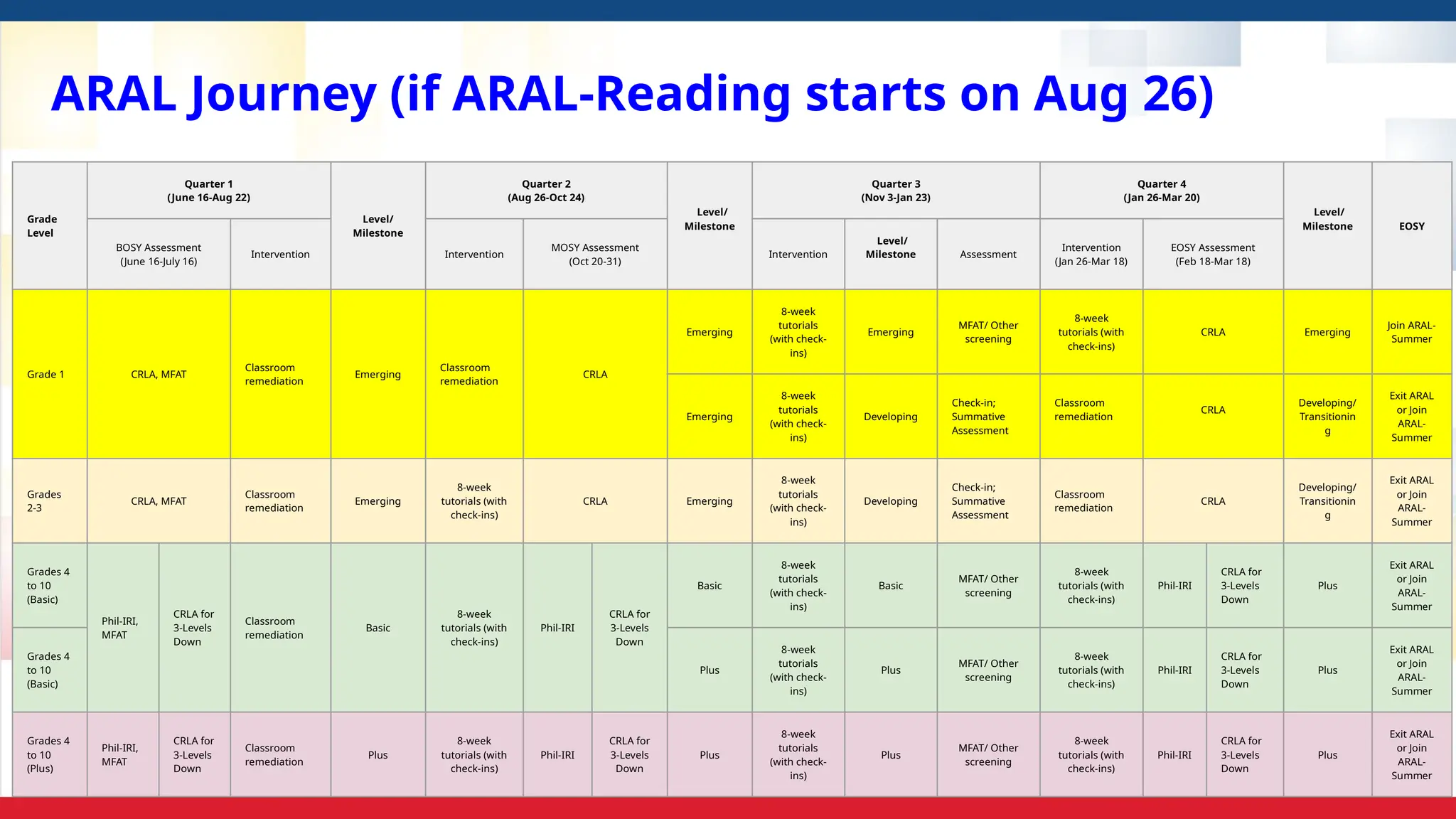
If ARAL starts on Aug 26,
MOSY is Oct 20-31
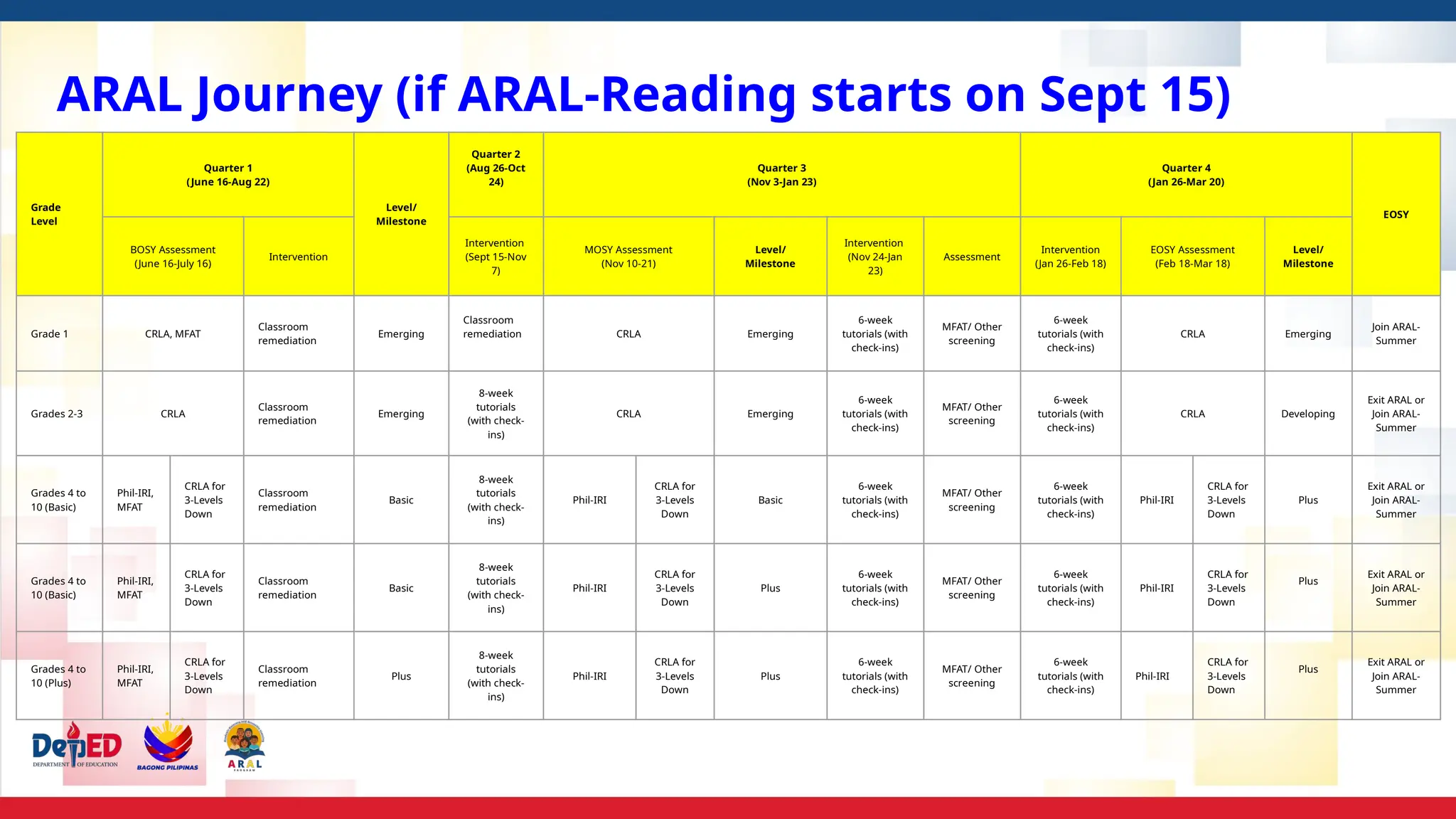
If ARAL starts on Sept 15,
MOSY is Nov 10-21
Grade 1
Grade 2-3
Assessments
CRLA,
MFAT
CRLA,
MFAT
Phil-IRI,
MFAT
Grades 4-10
CRLA for
3-Levels
Down
19.
Grade
Level
Quarter 1
(June 16-Aug22)
Level/
Milestone
Quarter 2
(Aug 26-Oct 24)
Level/
Milestone
Quarter 3
(Nov 3-Jan 23)
Quarter 4
(Jan 26-Mar 20)
Level/
Milestone EOSY
BOSY Assessment
(June 16-July 16)
Intervention Intervention
MOSY Assessment
(Oct 20-31)
Intervention
Level/
Milestone Assessment
Intervention
(Jan 26-Mar 18)
EOSY Assessment
(Feb 18-Mar 18)
Grade 1 CRLA, MFAT
Classroom
remediation
Emerging
Classroom
remediation
CRLA
Emerging
8-week
tutorials
(with check-
ins)
Emerging
MFAT/ Other
screening
8-week
tutorials (with
check-ins)
CRLA Emerging
Join ARAL-
Summer
Emerging
8-week
tutorials
(with check-
ins)
Developing
Check-in;
Summative
Assessment
Classroom
remediation
CRLA
Developing/
Transitionin
g
Exit ARAL
or Join
ARAL-
Summer
Grades
2-3
CRLA, MFAT
Classroom
remediation
Emerging
8-week
tutorials (with
check-ins)
CRLA Emerging
8-week
tutorials
(with check-
ins)
Developing
Check-in;
Summative
Assessment
Classroom
remediation
CRLA
Developing/
Transitionin
g
Exit ARAL
or Join
ARAL-
Summer
Grades 4
to 10
(Basic)
Phil-IRI,
MFAT
CRLA for
3-Levels
Down
Classroom
remediation
Basic
8-week
tutorials (with
check-ins)
Phil-IRI
CRLA for
3-Levels
Down
Basic
8-week
tutorials
(with check-
ins)
Basic
MFAT/ Other
screening
8-week
tutorials (with
check-ins)
Phil-IRI
CRLA for
3-Levels
Down
Plus
Exit ARAL
or Join
ARAL-
Summer
Grades 4
to 10
(Basic)
Plus
8-week
tutorials
(with check-
ins)
Plus
MFAT/ Other
screening
8-week
tutorials (with
check-ins)
Phil-IRI
CRLA for
3-Levels
Down
Plus
Exit ARAL
or Join
ARAL-
Summer
Grades 4
to 10
(Plus)
Phil-IRI,
MFAT
CRLA for
3-Levels
Down
Classroom
remediation
Plus
8-week
tutorials (with
check-ins)
Phil-IRI
CRLA for
3-Levels
Down
Plus
8-week
tutorials
(with check-
ins)
Plus
MFAT/ Other
screening
8-week
tutorials (with
check-ins)
Phil-IRI
CRLA for
3-Levels
Down
Plus
Exit ARAL
or Join
ARAL-
Summer
ARAL Journey (if ARAL-Reading starts on Aug 26)
20.
Grade
Level
Quarter 1
(June 16-Aug22)
Level/
Milestone
Quarter 2
(Aug 26-Oct
24)
Quarter 3
(Nov 3-Jan 23)
Quarter 4
(Jan 26-Mar 20)
EOSY
BOSY Assessment
(June 16-July 16)
Intervention
Intervention
(Sept 15-Nov
7)
MOSY Assessment
(Nov 10-21)
Level/
Milestone
Intervention
(Nov 24-Jan
23)
Assessment
Intervention
(Jan 26-Feb 18)
EOSY Assessment
(Feb 18-Mar 18)
Level/
Milestone
Grade 1 CRLA, MFAT
Classroom
remediation
Emerging
Classroom
remediation CRLA Emerging
6-week
tutorials (with
check-ins)
MFAT/ Other
screening
6-week
tutorials (with
check-ins)
CRLA Emerging
Join ARAL-
Summer
Grades 2-3 CRLA
Classroom
remediation
Emerging
8-week
tutorials
(with check-
ins)
CRLA Emerging
6-week
tutorials (with
check-ins)
MFAT/ Other
screening
6-week
tutorials (with
check-ins)
CRLA Developing
Exit ARAL or
Join ARAL-
Summer
Grades 4 to
10 (Basic)
Phil-IRI,
MFAT
CRLA for
3-Levels
Down
Classroom
remediation
Basic
8-week
tutorials
(with check-
ins)
Phil-IRI
CRLA for
3-Levels
Down
Basic
6-week
tutorials (with
check-ins)
MFAT/ Other
screening
6-week
tutorials (with
check-ins)
Phil-IRI
CRLA for
3-Levels
Down
Plus
Exit ARAL or
Join ARAL-
Summer
Grades 4 to
10 (Basic)
Phil-IRI,
MFAT
CRLA for
3-Levels
Down
Classroom
remediation
Basic
8-week
tutorials
(with check-
ins)
Phil-IRI
CRLA for
3-Levels
Down
Plus
6-week
tutorials (with
check-ins)
MFAT/ Other
screening
6-week
tutorials (with
check-ins)
Phil-IRI
CRLA for
3-Levels
Down
Plus
Exit ARAL or
Join ARAL-
Summer
Grades 4 to
10 (Plus)
Phil-IRI,
MFAT
CRLA for
3-Levels
Down
Classroom
remediation
Plus
8-week
tutorials
(with check-
ins)
Phil-IRI
CRLA for
3-Levels
Down
Plus
6-week
tutorials (with
check-ins)
MFAT/ Other
screening
6-week
tutorials (with
check-ins)
Phil-IRI
CRLA for
3-Levels
Down
Plus
Exit ARAL or
Join ARAL-
Summer
ARAL Journey (if ARAL-Reading starts on Sept 15)
21.
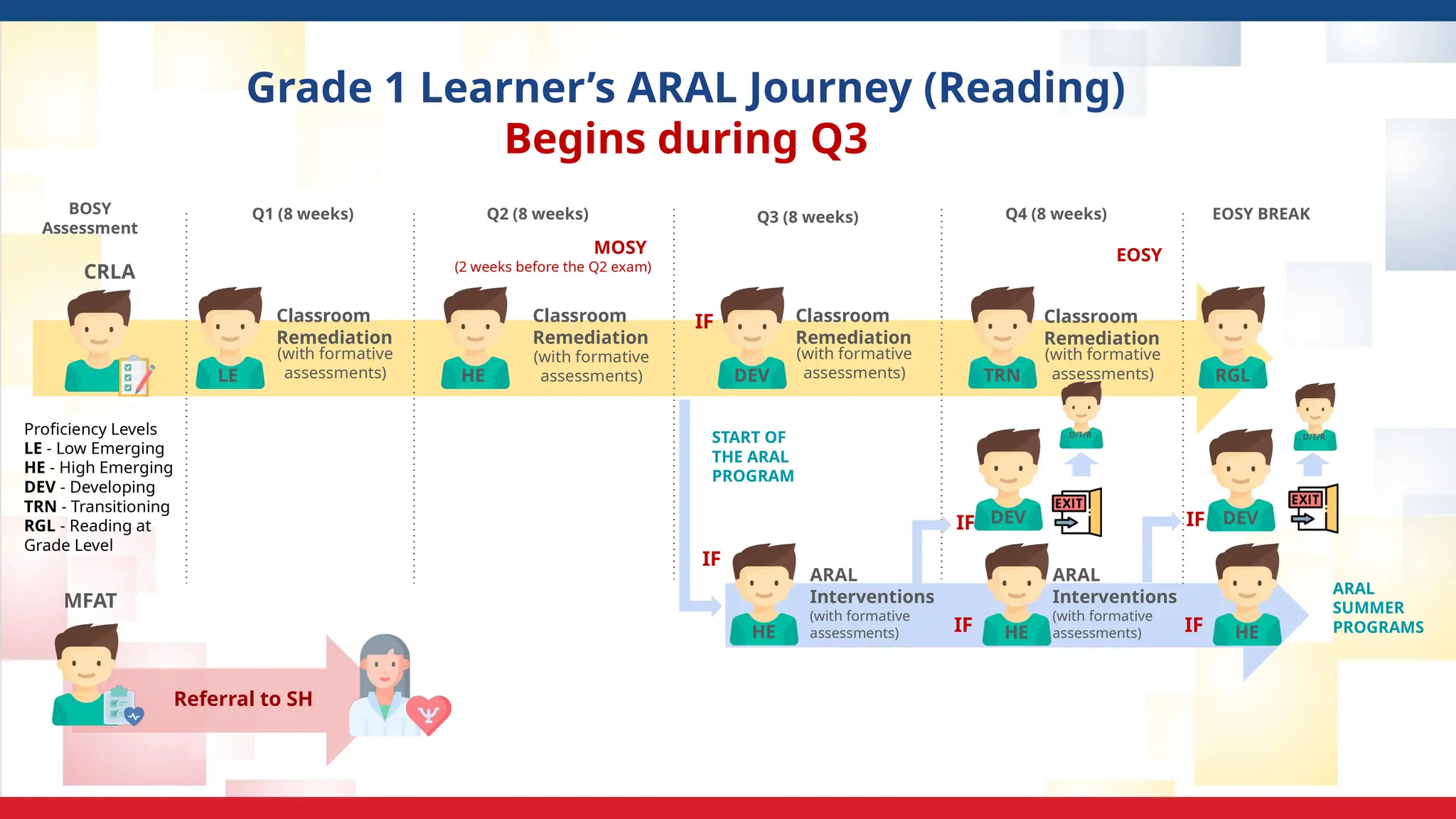
Grade 1 Learner’sARAL Journey (Reading)
Begins during Q3
LE
BOSY
Assessment
Q1 (8 weeks)
HE
Q2 (8 weeks)
DEV
Q3 (8 weeks) Q4 (8 weeks)
START OF
THE ARAL
PROGRAM
IF
IF
HE
ARAL
Interventions
(with formative
assessments)
DEV
TRN
IF
HE
IF
EOSY BREAK
EOSY
Classroom
Remediation
(with formative
assessments)
Classroom
Remediation
(with formative
assessments)
Classroom
Remediation
(with formative
assessments) RGL
Classroom
Remediation
(with formative
assessments)
D/T/R
DEV
IF
HE
IF
ARAL
Interventions
(with formative
assessments)
D/T/R
ARAL
SUMMER
PROGRAMS
Proficiency Levels
LE - Low Emerging
HE - High Emerging
DEV - Developing
TRN - Transitioning
RGL - Reading at
Grade Level
MFAT
MOSY
(2 weeks before the Q2 exam)
CRLA
Referral to SH
22.
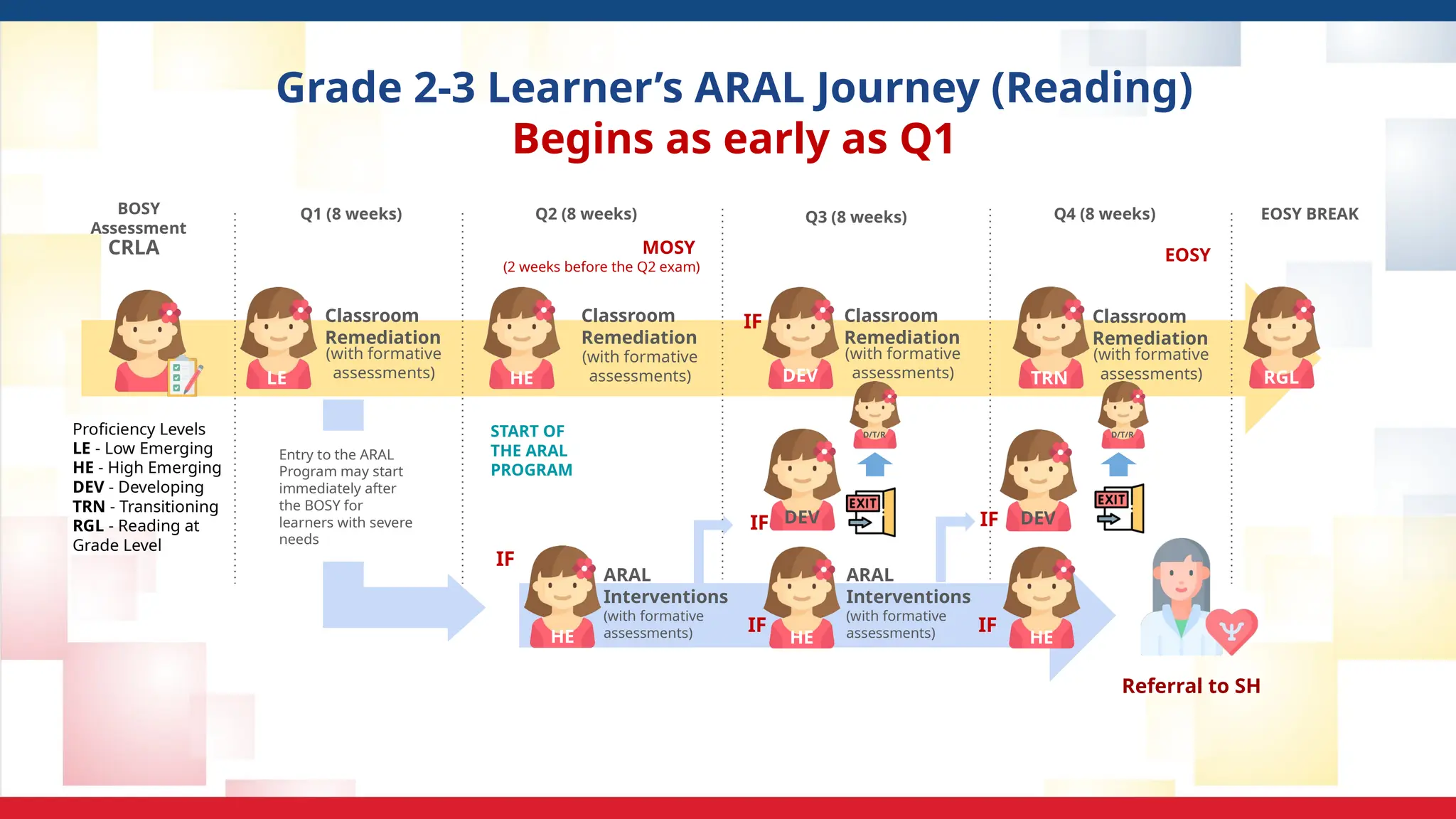
Grade 2-3 Learner’sARAL Journey (Reading)
Begins as early as Q1
LE
BOSY
Assessment
Q1 (8 weeks) Q2 (8 weeks) Q3 (8 weeks)
MOSY
(2 weeks before the Q2 exam)
DEV
Q4 (8 weeks)
START OF
THE ARAL
PROGRAM
IF
IF
ARAL
Interventions
(with formative
assessments)
DEV
TRN
IF
IF
EOSY BREAK
EOSY
Classroom
Remediation
(with formative
assessments)
Classroom
Remediation
(with formative
assessments)
Classroom
Remediation
(with formative
assessments) RGL
Classroom
Remediation
(with formative
assessments)
D/T/R
IF
IF
ARAL
Interventions
(with formative
assessments)
Proficiency Levels
LE - Low Emerging
HE - High Emerging
DEV - Developing
TRN - Transitioning
RGL - Reading at
Grade Level
Referral to SH
CRLA
HE
DEV
D/T/R
HE HE HE
Entry to the ARAL
Program may start
immediately after
the BOSY for
learners with severe
needs
23.
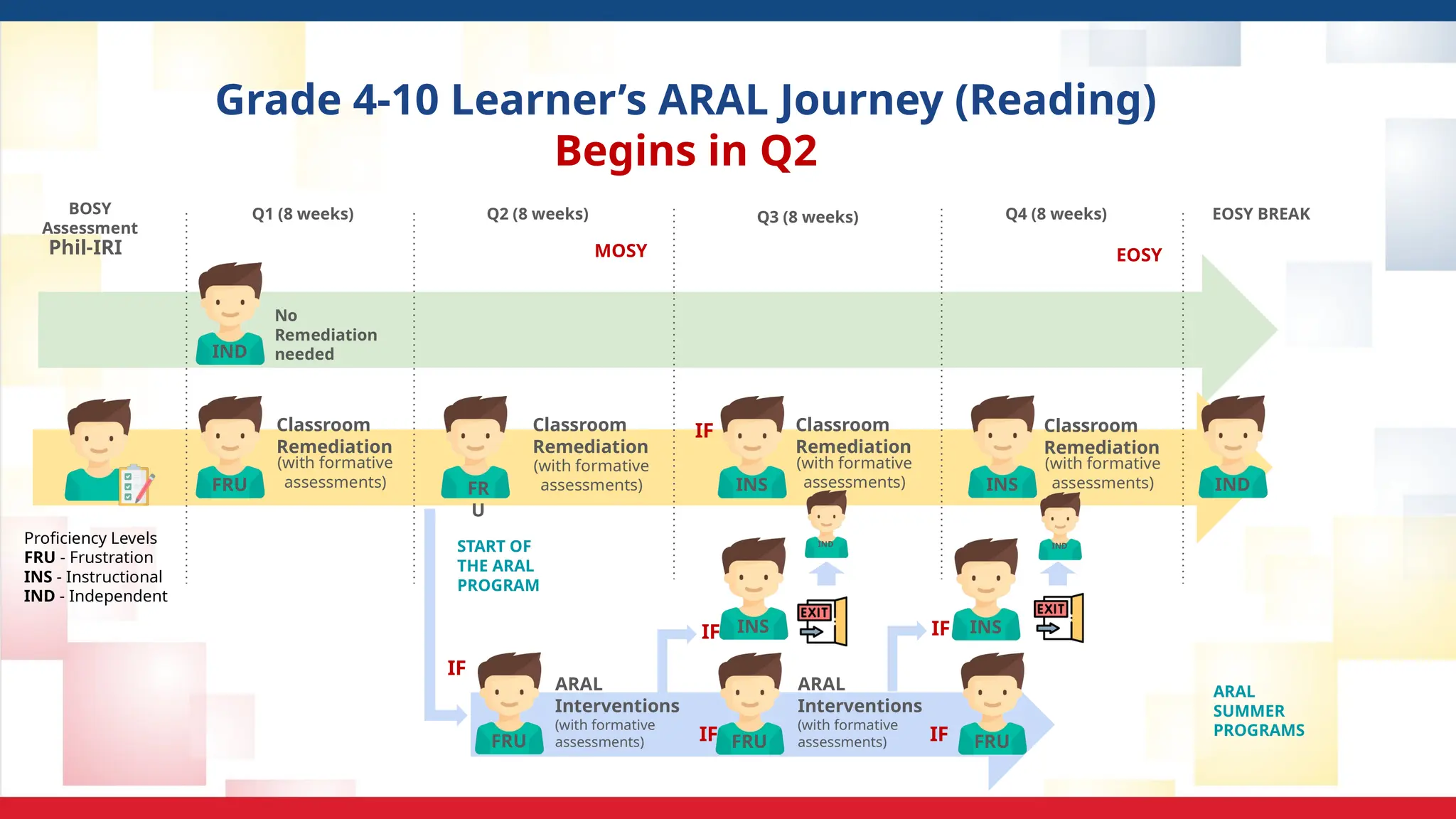
Grade 4-10 Learner’sARAL Journey (Reading)
Begins in Q2
FRU
BOSY
Assessment
Q1 (8 weeks)
FR
U
Q2 (8 weeks)
INS
Q3 (8 weeks)
MOSY
Q4 (8 weeks)
START OF
THE ARAL
PROGRAM
IF
IF
FRU
ARAL
Interventions
(with formative
assessments)
INS
INS
IF
FRU
IF
EOSY BREAK
EOSY
Classroom
Remediation
(with formative
assessments)
Classroom
Remediation
(with formative
assessments)
Classroom
Remediation
(with formative
assessments) IND
Classroom
Remediation
(with formative
assessments)
IND
INS
IF
FRU
IF
ARAL
Interventions
(with formative
assessments)
IND
ARAL
SUMMER
PROGRAMS
Proficiency Levels
FRU - Frustration
INS - Instructional
IND - Independent
Phil-IRI
IND
No
Remediation
needed
24.
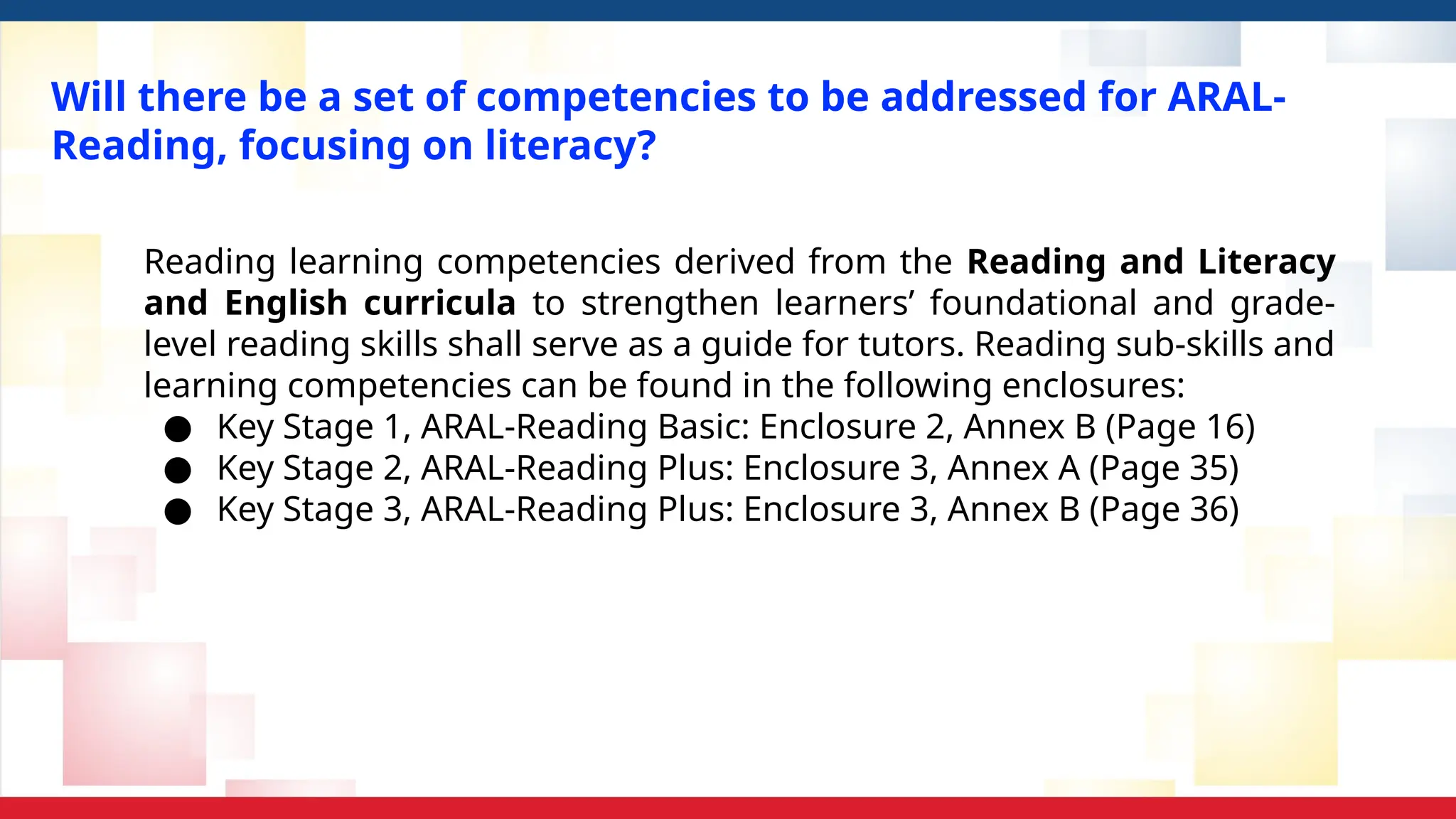
Will there bea set of competencies to be addressed for ARAL-
Reading, focusing on literacy?
Reading learning competencies derived from the Reading and Literacy
and English curricula to strengthen learners’ foundational and grade-
level reading skills shall serve as a guide for tutors. Reading sub-skills and
learning competencies can be found in the following enclosures:
● Key Stage 1, ARAL-Reading Basic: Enclosure 2, Annex B (Page 16)
● Key Stage 2, ARAL-Reading Plus: Enclosure 3, Annex A (Page 35)
● Key Stage 3, ARAL-Reading Plus: Enclosure 3, Annex B (Page 36)
25.
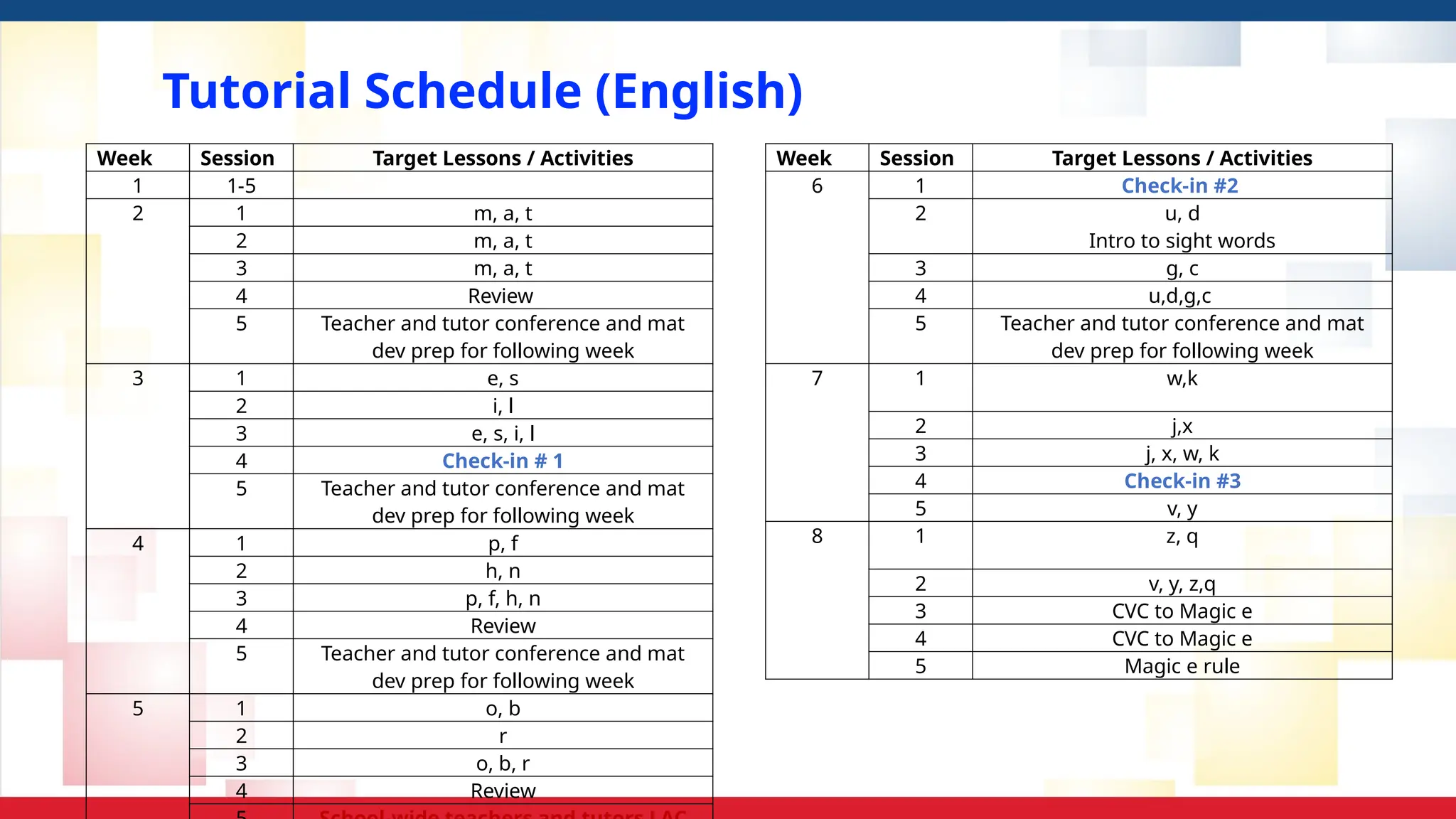
Week Session TargetLessons / Activities
1 1-5
2 1 m, a, t
2 m, a, t
3 m, a, t
4 Review
5 Teacher and tutor conference and mat
dev prep for following week
3 1 e, s
2 i, l
3 e, s, i, l
4 Check-in # 1
5 Teacher and tutor conference and mat
dev prep for following week
4 1 p, f
2 h, n
3 p, f, h, n
4 Review
5 Teacher and tutor conference and mat
dev prep for following week
5 1 o, b
2 r
3 o, b, r
4 Review
Week Session Target Lessons / Activities
6 1 Check-in #2
2 u, d
Intro to sight words
3 g, c
4 u,d,g,c
5 Teacher and tutor conference and mat
dev prep for following week
7 1 w,k
2 j,x
3 j, x, w, k
4 Check-in #3
5 v, y
8 1 z, q
2 v, y, z,q
3 CVC to Magic e
4 CVC to Magic e
5 Magic e rule
Tutorial Schedule (English)
26.
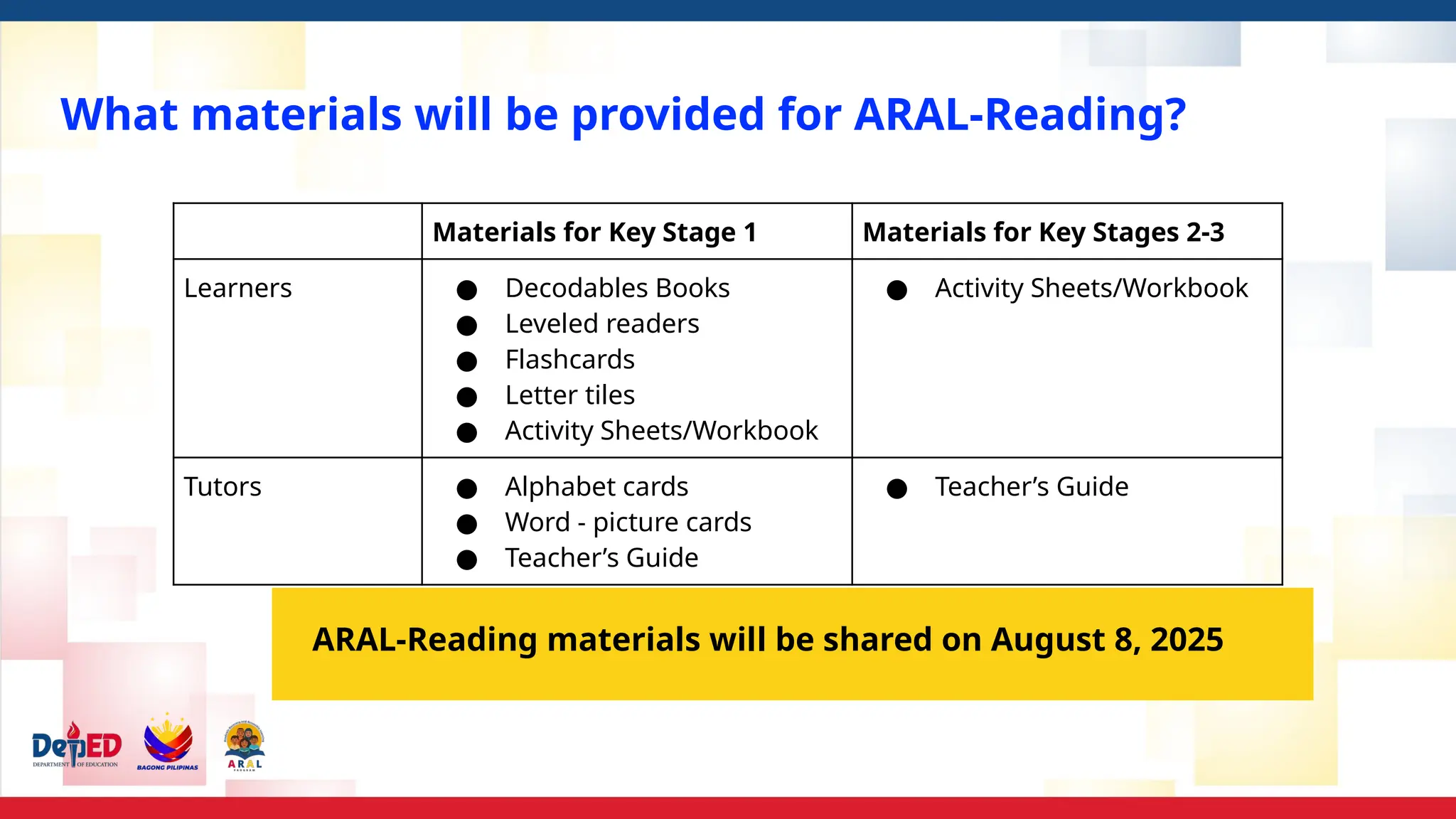
What materials willbe provided for ARAL-Reading?
Materials for Key Stage 1 Materials for Key Stages 2-3
Learners ● Decodables Books
● Leveled readers
● Flashcards
● Letter tiles
● Activity Sheets/Workbook
● Activity Sheets/Workbook
Tutors ● Alphabet cards
● Word - picture cards
● Teacher’s Guide
● Teacher’s Guide
ARAL-Reading materials will be shared on August 8, 2025
27.
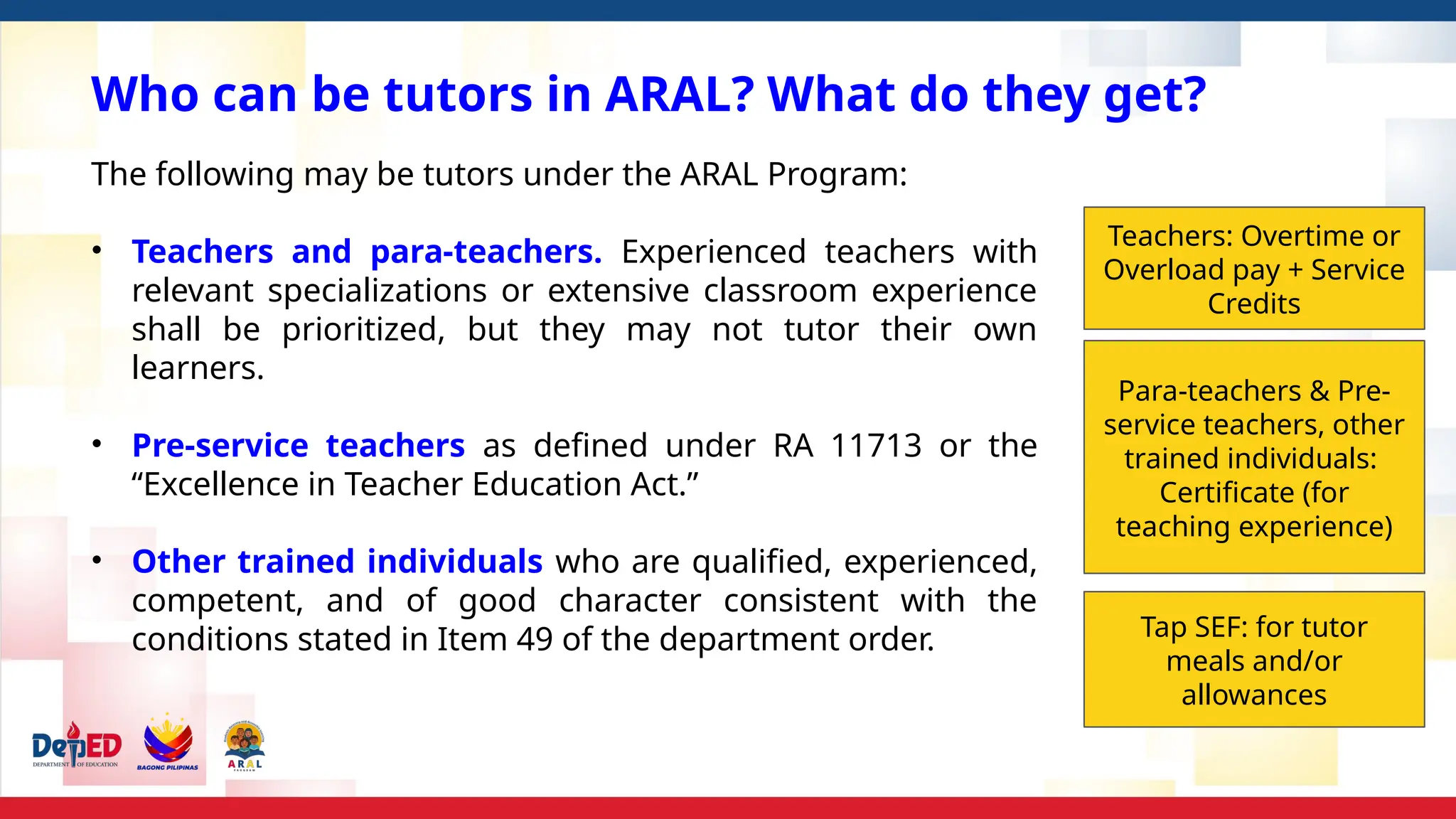
Who can betutors in ARAL? What do they get?
The following may be tutors under the ARAL Program:
• Teachers and para-teachers. Experienced teachers with
relevant specializations or extensive classroom experience
shall be prioritized, but they may not tutor their own
learners.
• Pre-service teachers as defined under RA 11713 or the
“Excellence in Teacher Education Act.”
• Other trained individuals who are qualified, experienced,
competent, and of good character consistent with the
conditions stated in Item 49 of the department order.
Teachers: Overtime or
Overload pay + Service
Credits
Para-teachers & Pre-
service teachers, other
trained individuals:
Certificate (for
teaching experience)
Tap SEF: for tutor
meals and/or
allowances
28.
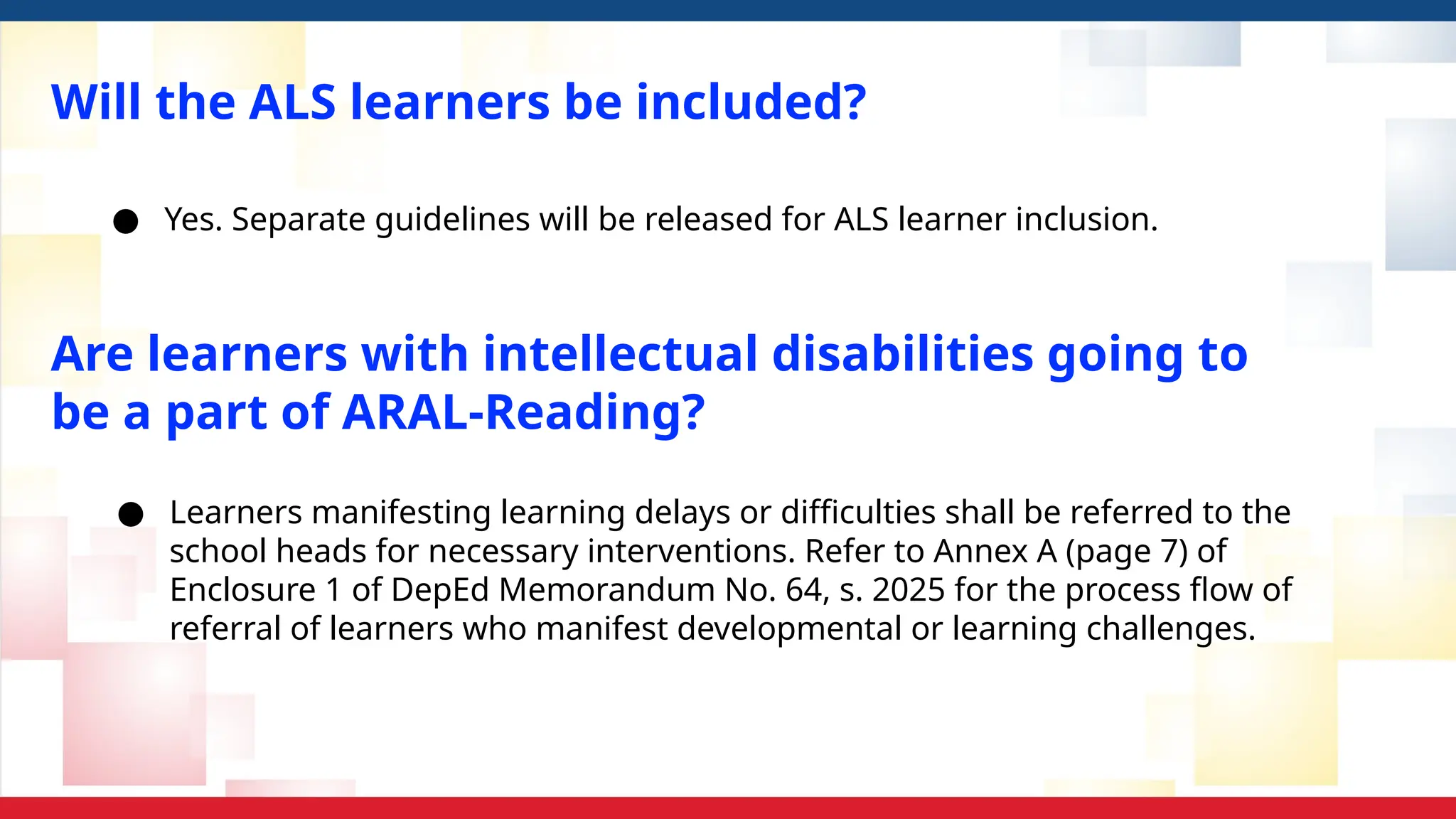
Will the ALSlearners be included?
● Yes. Separate guidelines will be released for ALS learner inclusion.
● Learners manifesting learning delays or difficulties shall be referred to the
school heads for necessary interventions. Refer to Annex A (page 7) of
Enclosure 1 of DepEd Memorandum No. 64, s. 2025 for the process flow of
referral of learners who manifest developmental or learning challenges.
Are learners with intellectual disabilities going to
be a part of ARAL-Reading?
29.
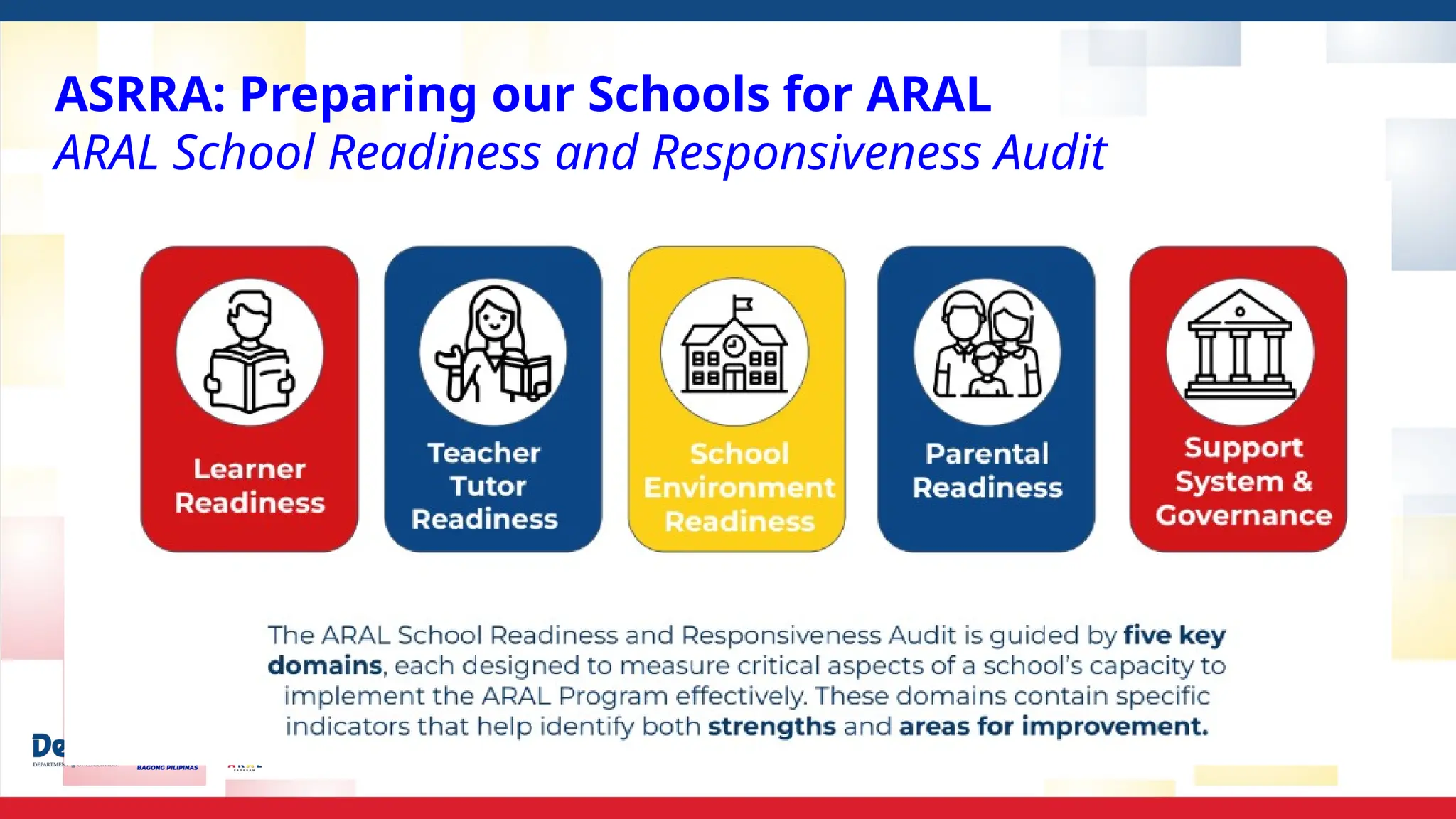
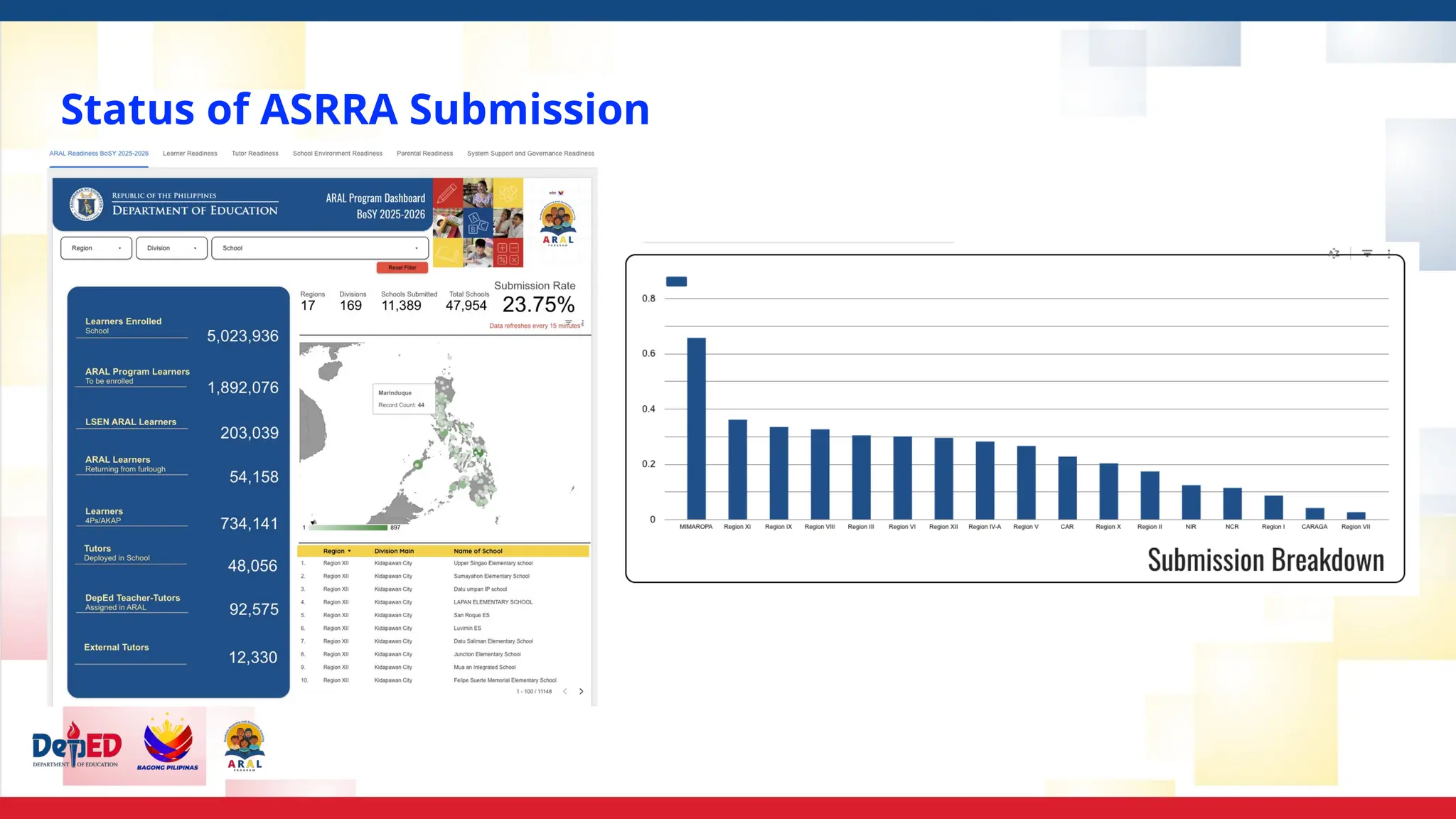
ASRRA: Preparing ourSchools for ARAL
ARAL School Readiness and Responsiveness Audit
30.
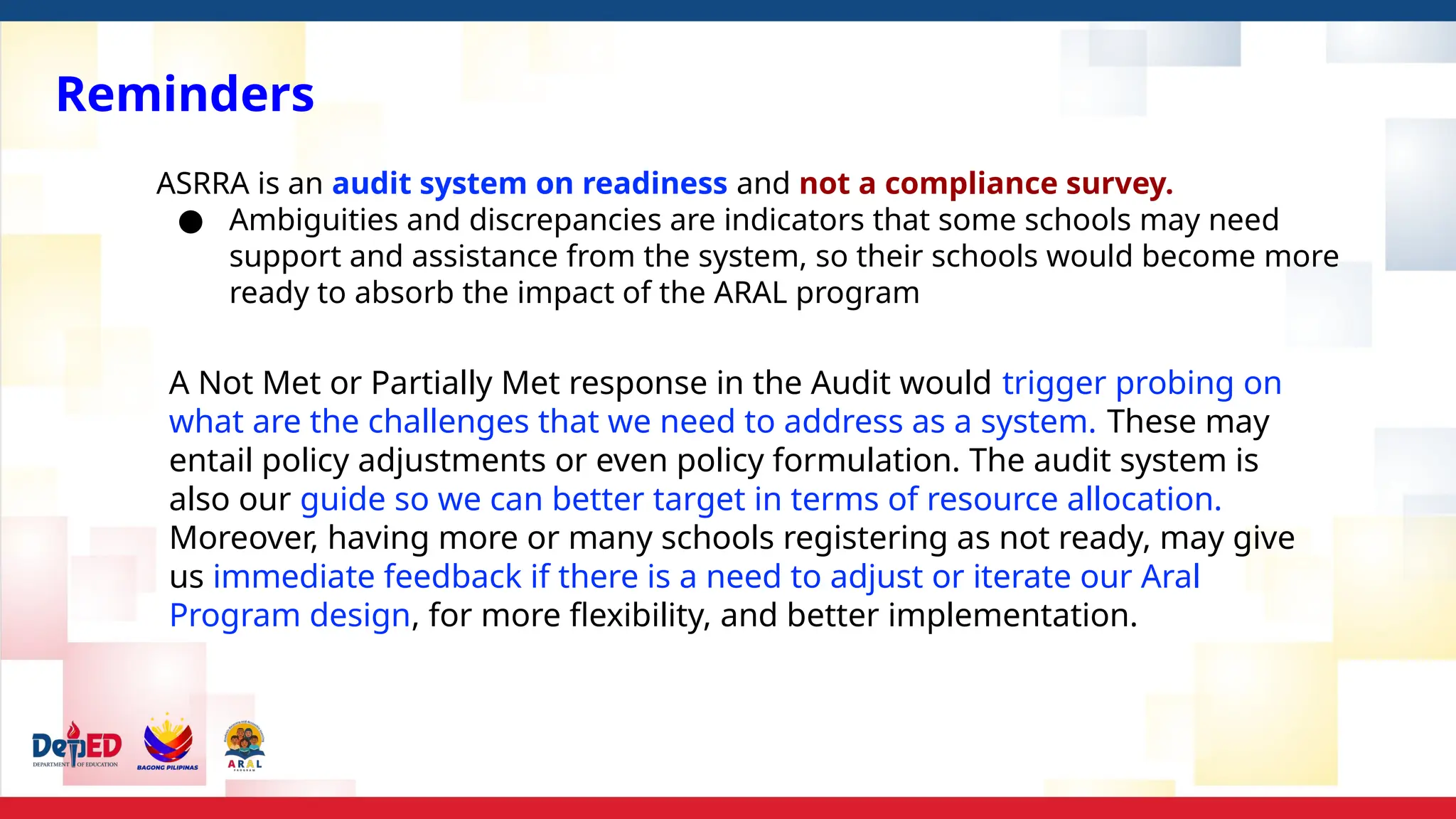
Reminders
ASRRA is anaudit system on readiness and not a compliance survey.
● Ambiguities and discrepancies are indicators that some schools may need
support and assistance from the system, so their schools would become more
ready to absorb the impact of the ARAL program
A Not Met or Partially Met response in the Audit would trigger probing on
what are the challenges that we need to address as a system. These may
entail policy adjustments or even policy formulation. The audit system is
also our guide so we can better target in terms of resource allocation.
Moreover, having more or many schools registering as not ready, may give
us immediate feedback if there is a need to adjust or iterate our Aral
Program design, for more flexibility, and better implementation.
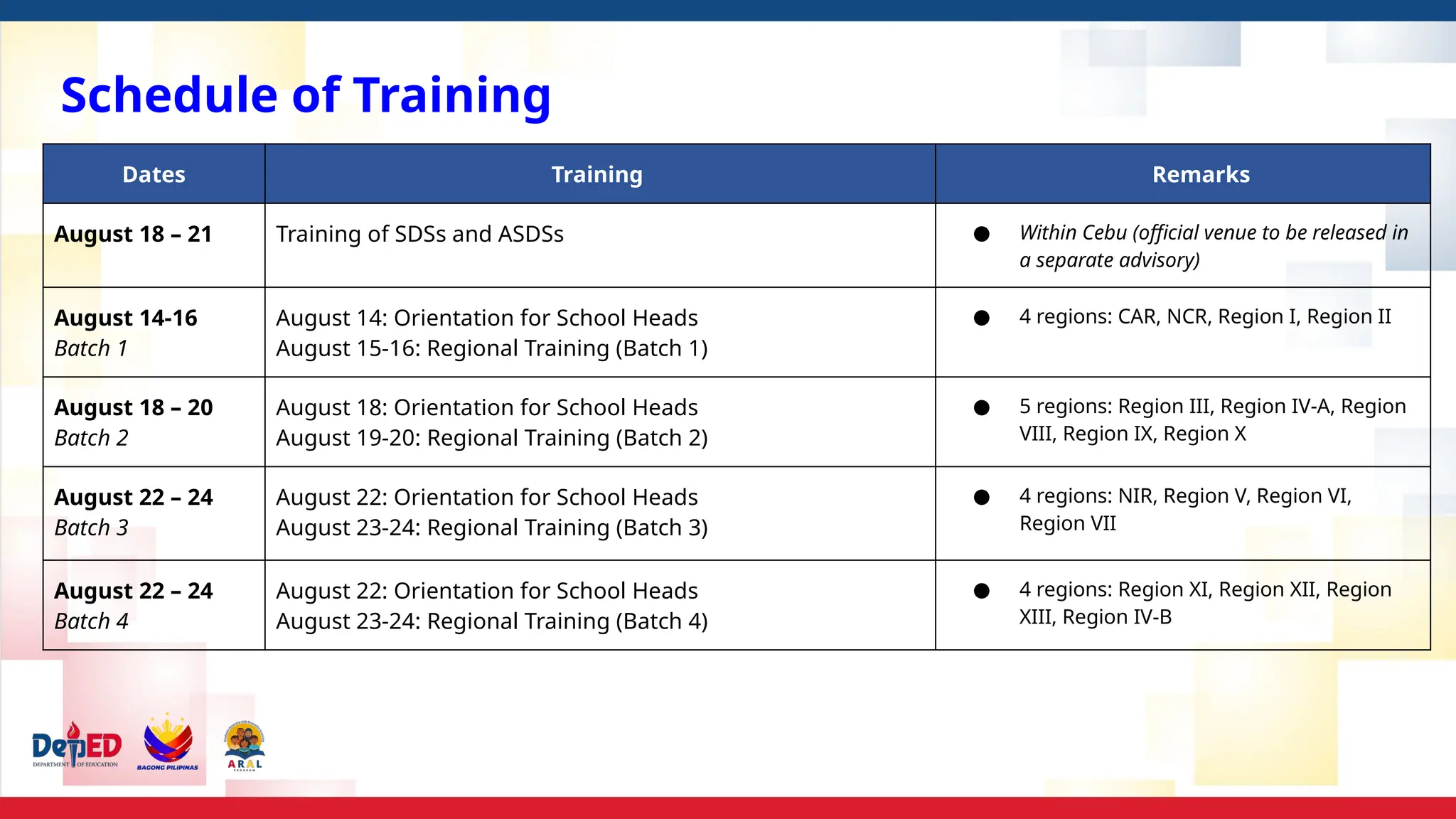
Schedule of Training
DatesTraining Remarks
August 18 – 21 Training of SDSs and ASDSs ● Within Cebu (official venue to be released in
a separate advisory)
August 14-16
Batch 1
August 14: Orientation for School Heads
August 15-16: Regional Training (Batch 1)
● 4 regions: CAR, NCR, Region I, Region II
August 18 – 20
Batch 2
August 18: Orientation for School Heads
August 19-20: Regional Training (Batch 2)
● 5 regions: Region III, Region IV-A, Region
VIII, Region IX, Region X
August 22 – 24
Batch 3
August 22: Orientation for School Heads
August 23-24: Regional Training (Batch 3)
● 4 regions: NIR, Region V, Region VI,
Region VII
August 22 – 24
Batch 4
August 22: Orientation for School Heads
August 23-24: Regional Training (Batch 4)
● 4 regions: Region XI, Region XII, Region
XIII, Region IV-B
#3 Figure 1 illustrates the goal of the ARAL Program. For example, a Grade 3 learner has been assessed to have a Grade 1 proficiency level in Reading (represented by the rectangle). The goal is to support the learner in achieving Grade 3-level competencies through the ARAL Program interventions.
The arrow in the figure symbolizes the development of grade-level competencies, building on foundational skills.
#4 Math may be implemented next year at 3rd Q or summer
Development of Science assessment still on going
#8 Learners who meet the minimum proficiency levels may be allowed to enroll in supplemental classes under the ARAL Program during the summer break. Priority shall be given to the learners as enumerated above.
Learners in qualified private basic education institutions who are below the minimum proficiency levels required in reading, mathematics, and science and failing in formative and summative assessments shall be provided the same interventions upon request in accordance with RA 12028. In case of limited slots for enrollment, preference shall be given to beneficiaries of the Educational Service Contracting Scheme.
#9 Learners who meet the minimum proficiency levels may be allowed to enroll in supplemental classes under the ARAL Program during the summer break. Priority shall be given to the learners as enumerated above.
Learners in qualified private basic education institutions who are below the minimum proficiency levels required in reading, mathematics, and science and failing in formative and summative assessments shall be provided the same interventions upon request in accordance with RA 12028. In case of limited slots for enrollment, preference shall be given to beneficiaries of the Educational Service Contracting Scheme.
#12 Figure 2 illustrates the framework of the ARAL Program, highlighting its key components, which include the beneficiaries, determination and assessment of learners, intervention delivery, progress monitoring, and post-assessment. The ARAL Program shall commence with the beginning-of-the-school-year (BOSY) assessment to determine the learners needing intervention in each type of beneficiary. Identified learners shall undergo the ARAL intervention programs with continuous monitoring of their progress through formative assessments. Learners who meet the grade-level competencies shall exit the ARAL Program, while those who do not shall continue under the program. At the end of the school year, learners shall be administered the end-of-the-school-year (EOSY) assessment, and those who need further support shall participate in ARAL-Summer Programs for additional intervention.
#27 For DepEd teachers: Teaching overload pay (based on RA 4670 or the Magna Carta for Public School Teachers, DBM guidelines, and DO 005, s. 2024) and vacation service credits (VCS) based on DO 013, s. 2024.
Para-teachers and other trained individuals: Compensation for services with an amount not below the minimum daily wage; may be engaged under Contract of Service or Job Order (based on CSC-COA-DBM Joint Circular No. 2, s. 2022)
Pre-service teachers: Services rendered shall be considered relevant teaching experience when applying for a plantilla position in DepEd.
![Relevant Issuances Description
1. Republic Act No. 12028 or the “Academic Recovery
and Accessible Learning (ARAL) Program Act of 2024”
Establishes a free and effective national learning intervention
program to ensure that all learners attain the competencies
set by the DepEd in their respective grade levels
2. DepEd Order No. 18, s. 2025, Implementing
Guidelines for the ARAL Program
Provides guidance for schools, community learning centers
(CLCs), and concerned offices across governance levels,
including qualified private institutions, in implementing the
ARAL Program
3. DepEd Memo No. 56, s. 2025, Supplemental
Guidelines on the Implementation the ARAL-SRRA
Provides guidance on the implementation of the ARAL School
Readiness and Responsiveness Audit (ASRRA) as a quality
assurance mechanism to assess school-level readiness in
delivering ARAL interventions.
4. DepEd Memo No. 64, s. 2025, Implementing
Guidelines for ARAL-Reading for Key Stages 1 to 3
Operationalizes the implementation of the ARAL Program in
Reading (ARAL-Reading) for Key Stages 1 to 3 in accordance
with RA No. 12028 [Academic Recovery and Accessible
Learning Program Act], its Implementing Rules and
Regulations, and DepEd Order No. 18, s. 2025 [Implementing
Guidelines of the Academic Recovery and Accessible Learning
Program].](https://image.slidesharecdn.com/aral-reading-dmaug4-82025-250813010229-07ed7329/75/ARAL-Reading-ARAL-Reading-DM_Aug4-82025-pptx-6-2048.jpg)