All you need to know about Ghana’s ambitious 24-Hour Economy and Accelerated Export Development Programme (24H+)
1.
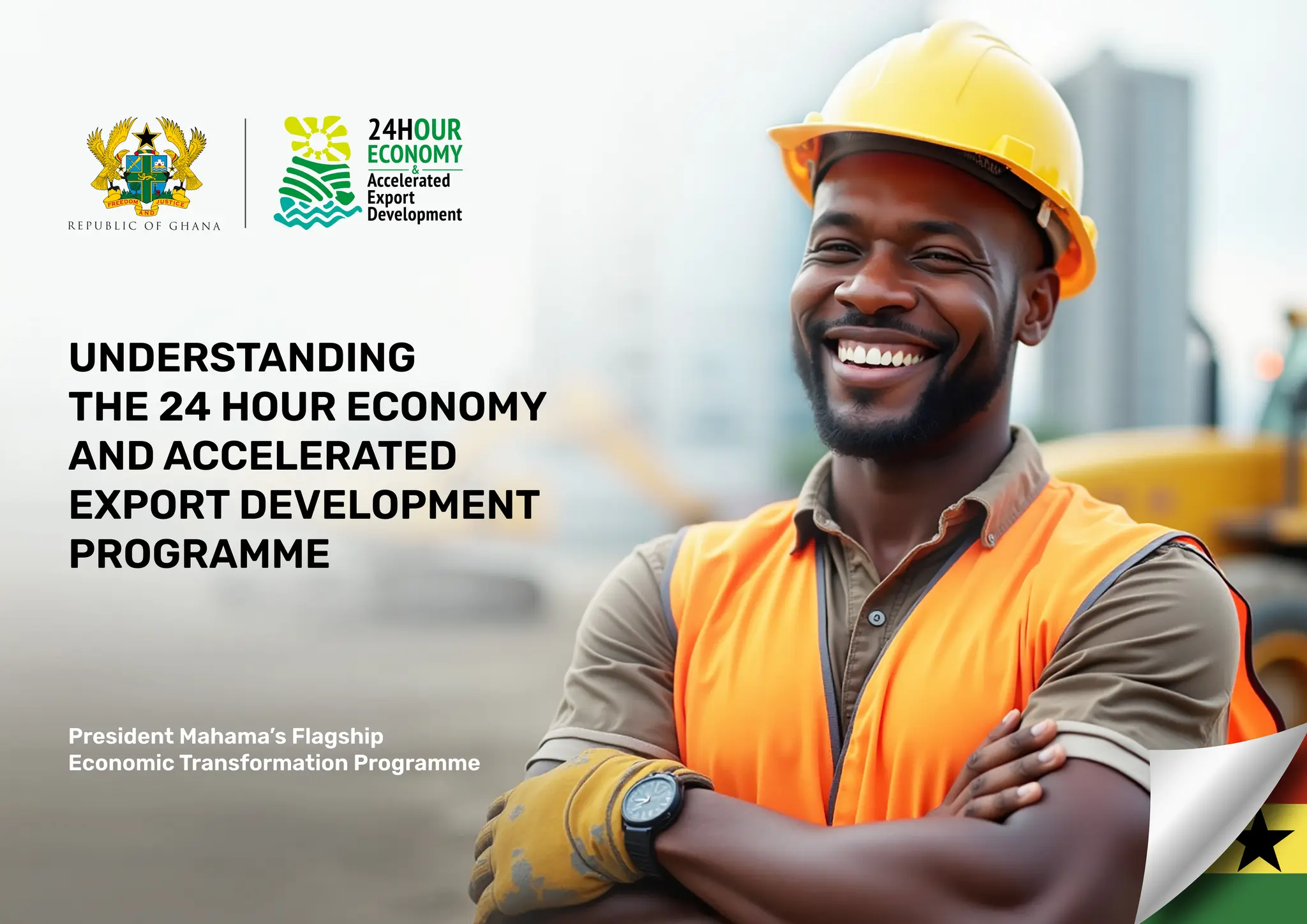
UNDERSTANDING
THE 24 HOURECONOMY
AND ACCELERATED
EXPORT DEVELOPMENT
PROGRAMME
President Mahama’s Flagship
Economic Transformation Programme
2.
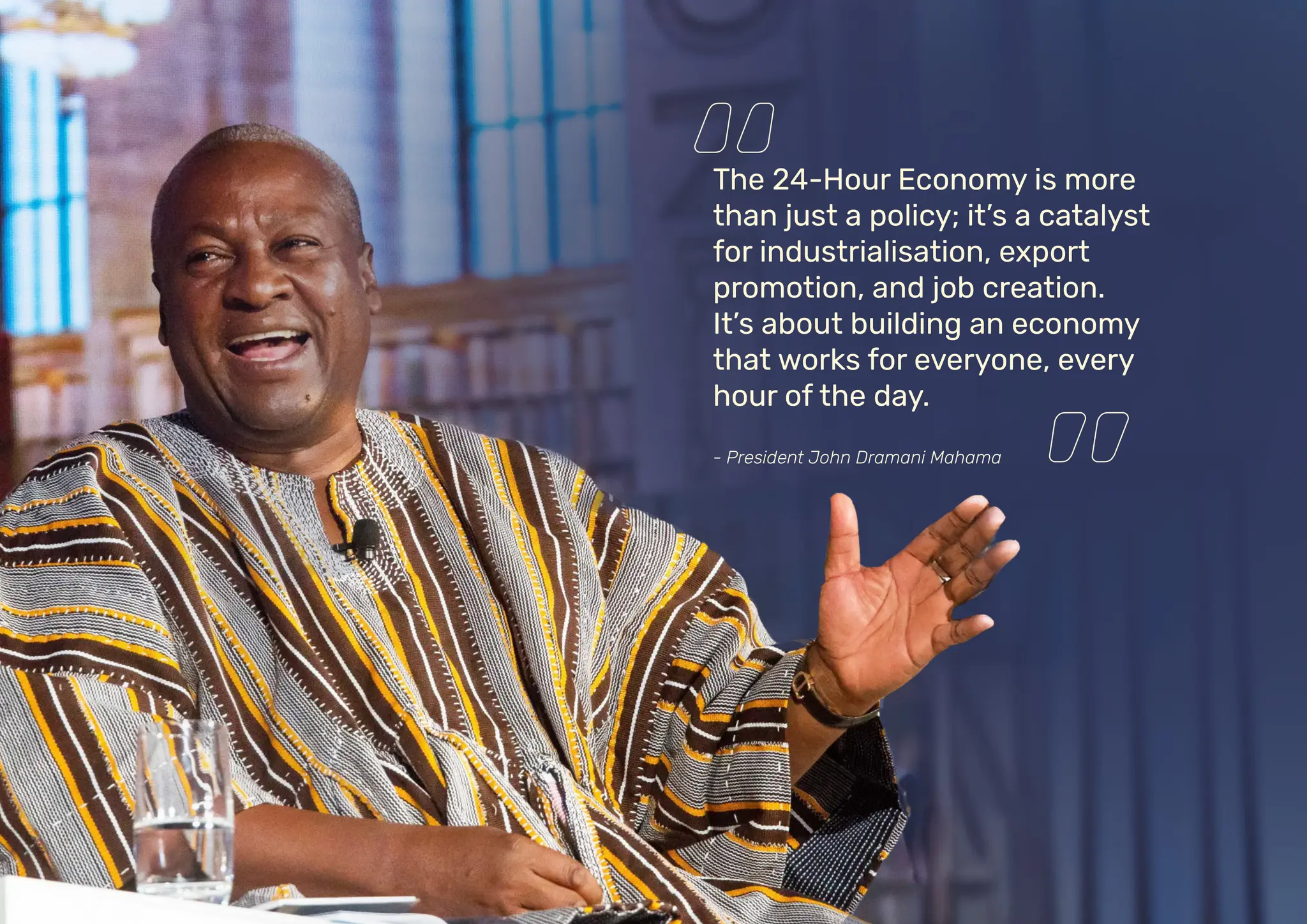
The 24-Hour Economyis more
than just a policy; it’s a catalyst
for industrialisation, export
promotion, and job creation.
It’s about building an economy
that works for everyone, every
hour of the day.
- President John Dramani Mahama
3.
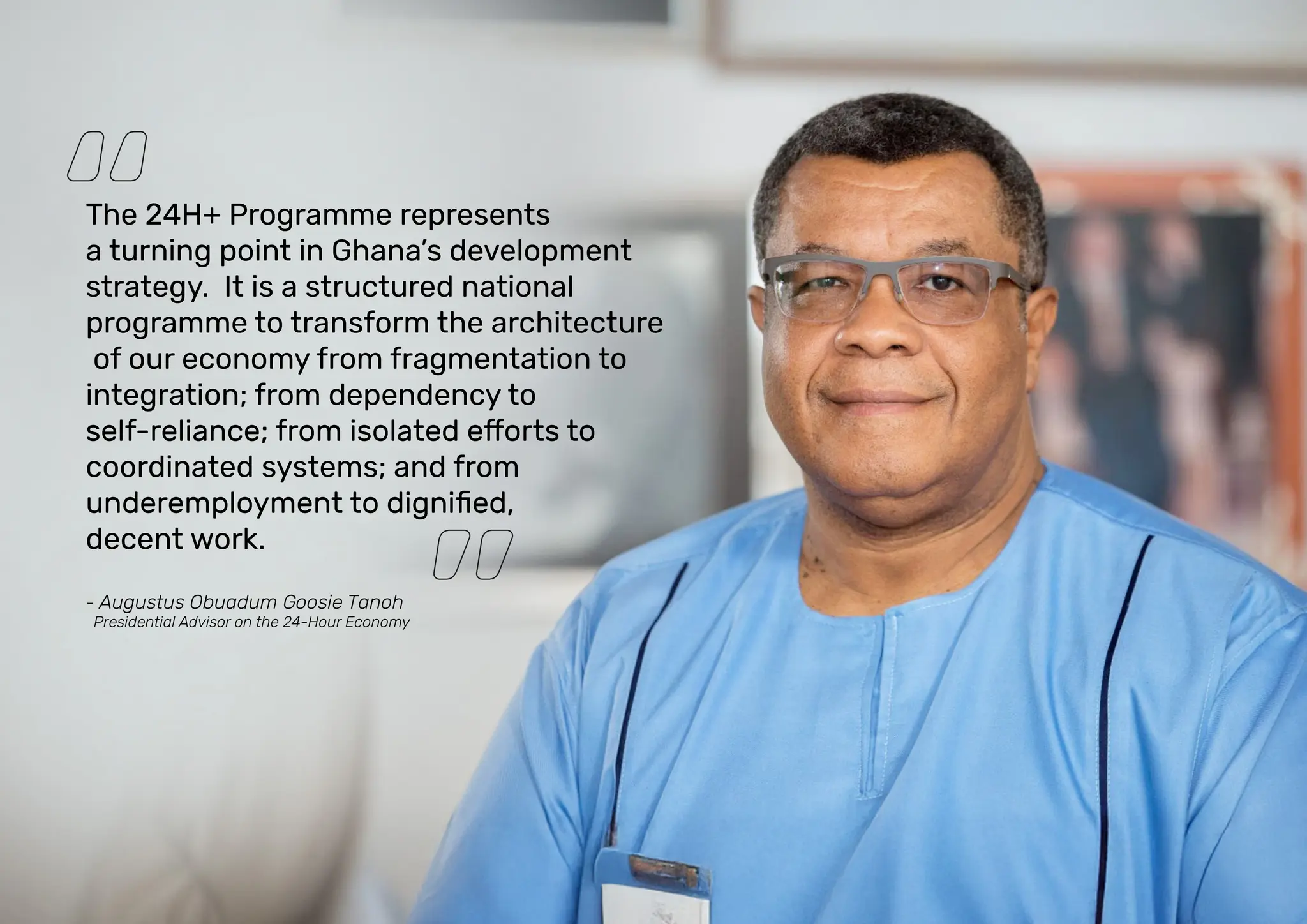
The 24H+ Programmerepresents
a turning point in Ghana’s development
strategy. It is a structured national
programme to transform the architecture
of our economy from fragmentation to
integration; from dependency to
coordinated systems; and from
decent work.
- Augustus Obuadum Goosie Tanoh
Presidential Advisor on the 24-Hour Economy
4.
GHANA’S 24H+ PROGRAMME
ANational Agenda for Productivity, Competitiveness
and Inclusive Growth
The 24-Hour Economy and Accelerated Export Development Programme, referred
to as 24H+, envisions the transformation of Ghana into a self-reliant, industrially
competitive, and export-driven economy. It seeks to build a Ghana where value
human capital is globally competitive. Central to this vision is the creation of a
resilient national economy that reduces reliance on imports, sustains decent
employment, and leverages regional and global trade integration to deliver equitable
and sustainable growth across all segments of Ghanaian society.
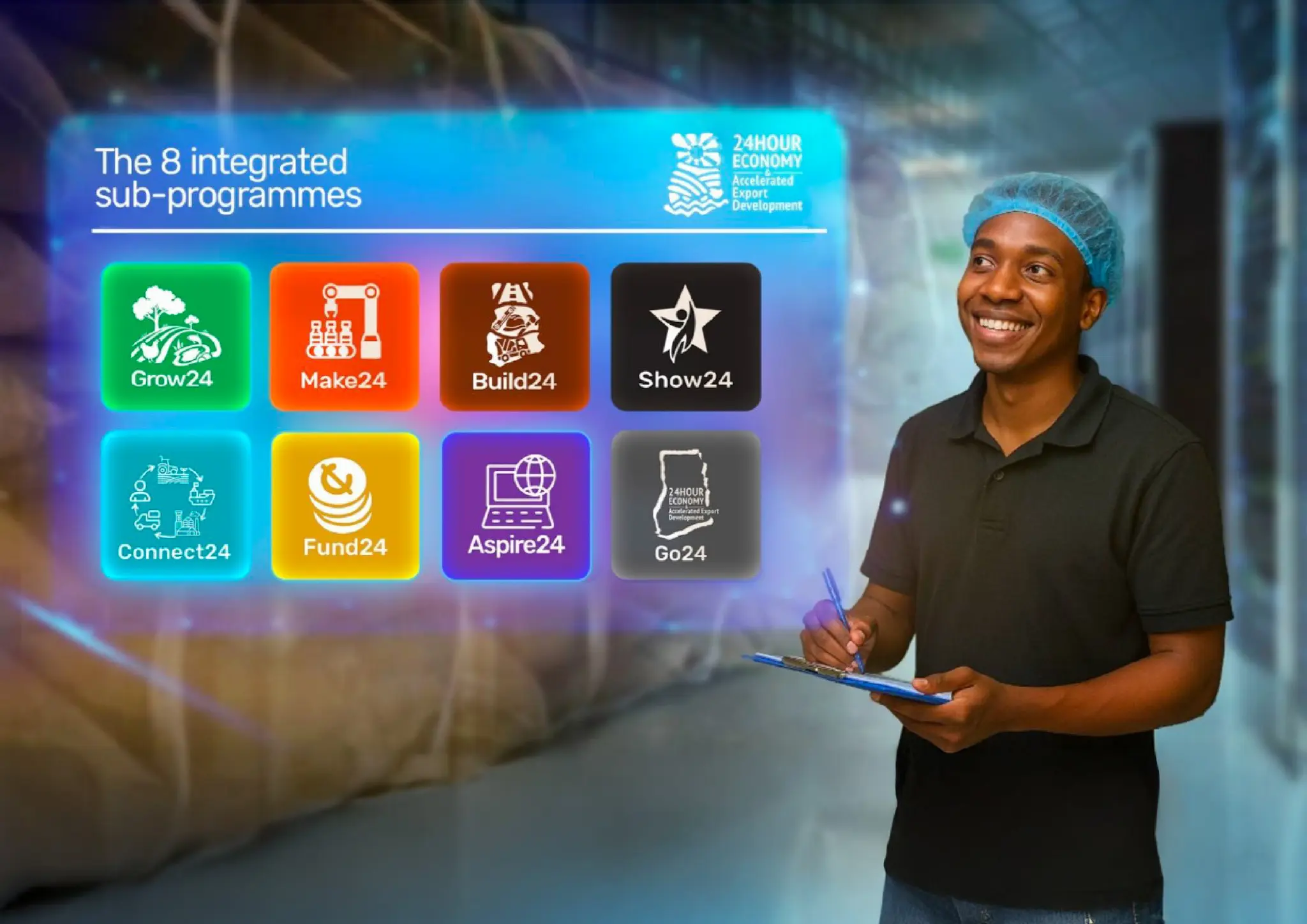
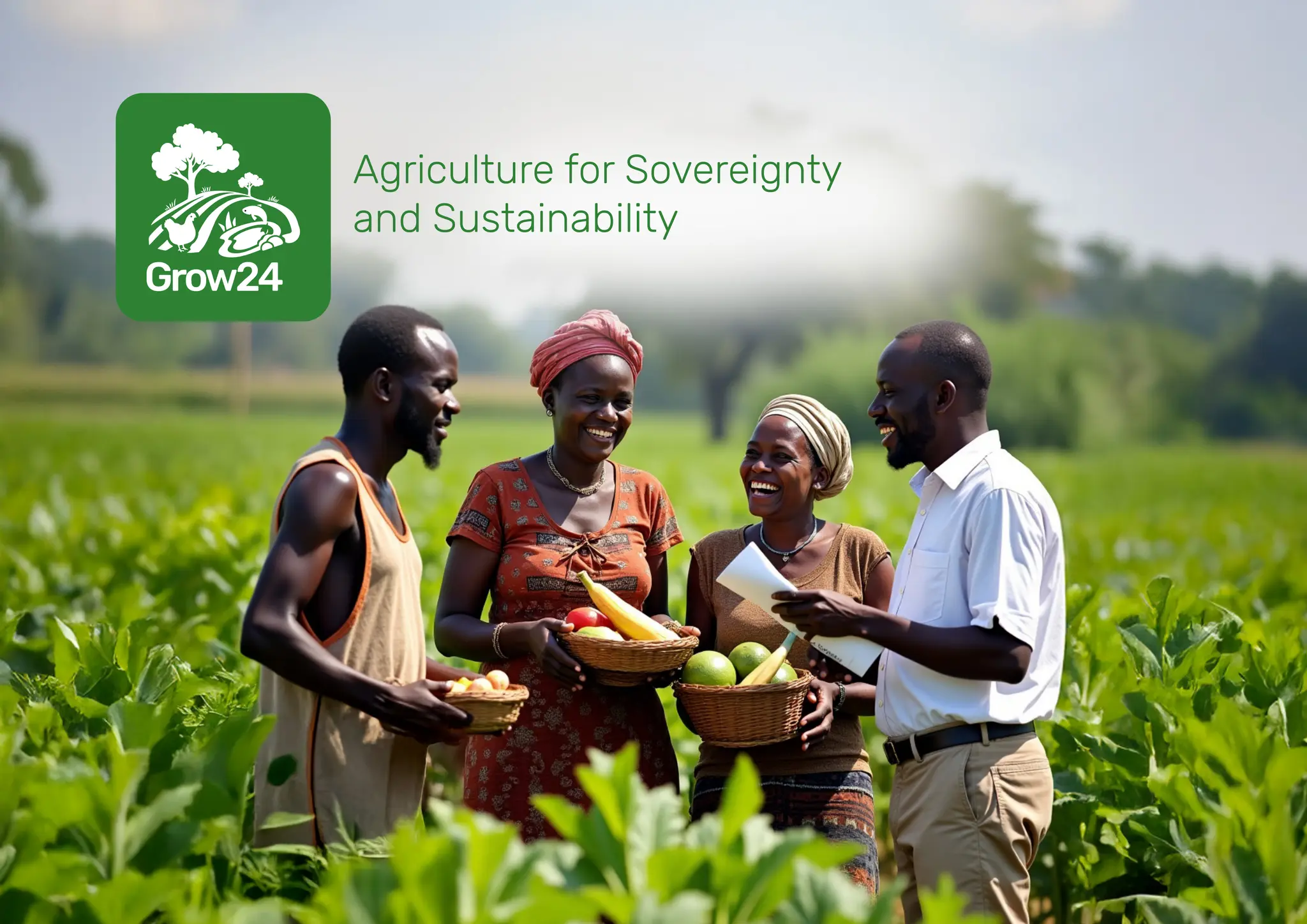
Grow24 is thefoundational pillar of Ghana’s agricultural transformation
strategy under the 24H+ programme.
It seeks to re-engineer food and feed systems by revitalising critical
Strategic Agricultural Value Chains (SAVs) with the objective of ensuring
input self-reliance, food security, and climate resilience. At its core are two
transformational initiatives: Eden Volta, which positions the Volta Basin as
the future breadbasket of West Africa, and Shikpon, an urban farming
scheme that deploys smart farming systems in Ghana’s metropolitan areas.
Through the development of agroecological parks known as Agbleduwo,
Grow24 integrates irrigation infrastructure, mechanisation hubs,
renewable energy systems, and processing facilities to boost productivity
and value addition.
GROW24
Agriculture for Sovereignty
and Sustainability
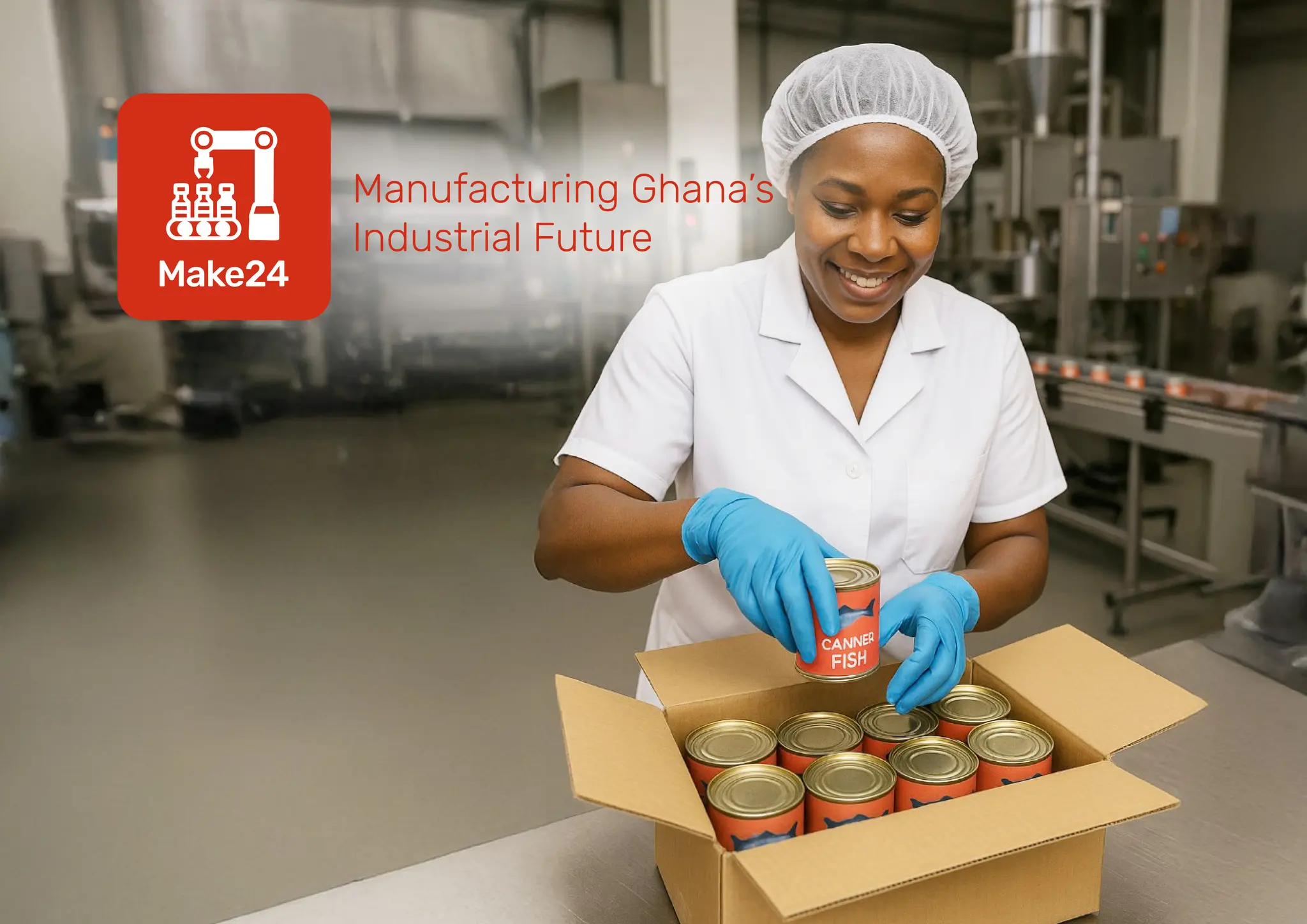
The Make24 sub-programmeis the engine of Ghana’s industrial
renaissance. It aims to reposition Ghana as a manufacturing hub for West
Africa by scaling strategic manufacturing value chains and building
productive ecosystems that are globally competitive. The sub-programme
envisions the development of 50 industrial parks nationwide, supported by
reliable infrastructure, logistics, and utilities.
Make24
Manufacturing Ghana’s
Industrial Future
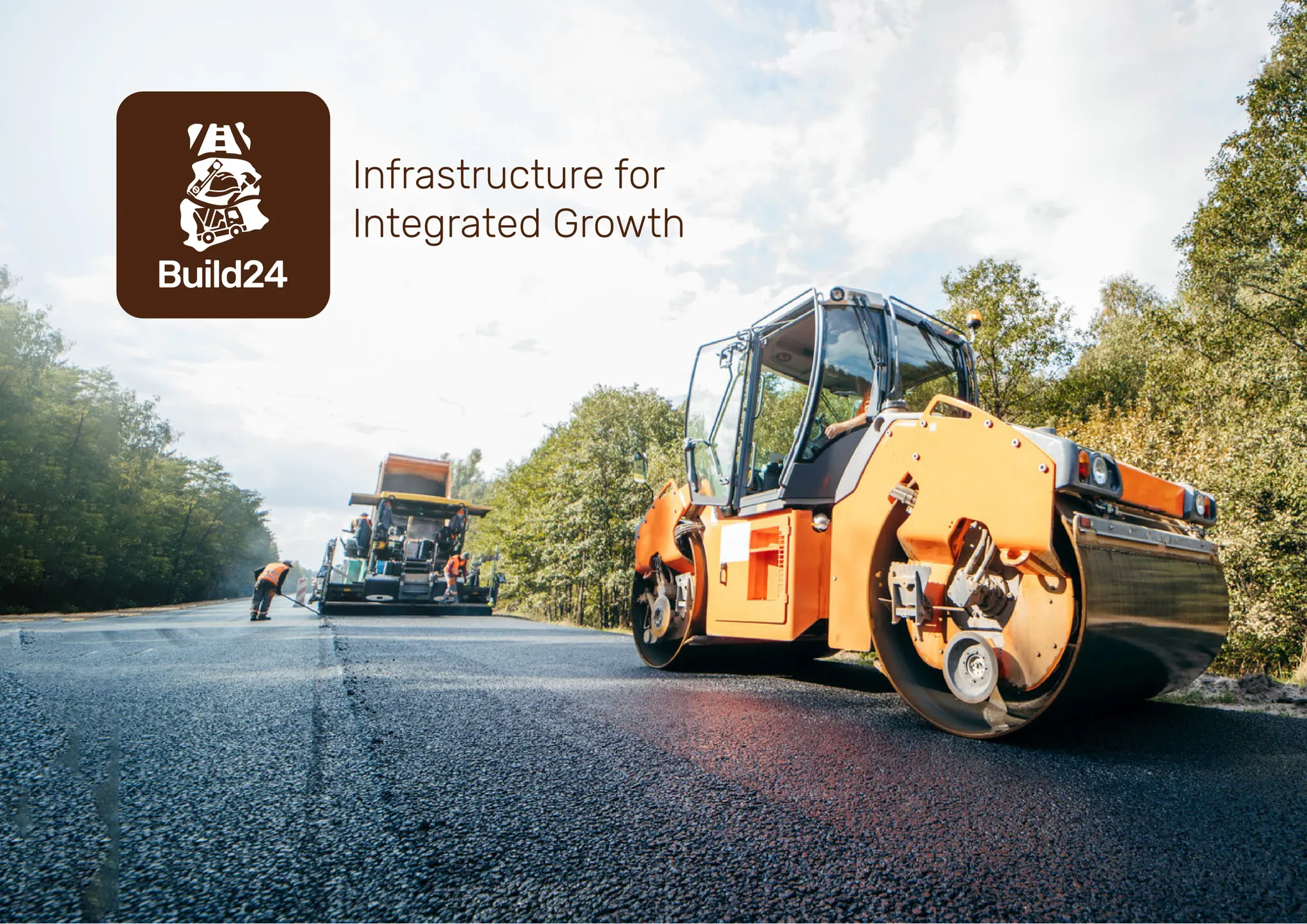
Build24 is thephysical development backbone of the 24H+ Programme.
It focuses on delivering the hard infrastructure necessary to support
agroecological parks, industrial zones, logistics systems, and resilient
urban spaces that enable 24-hour productivity. Build24 will prioritise
multimodal transport infrastructure, including the rehabilitation of key
roads, inland water transport routes along the Volta Lake, and the
development of strategic air cargo hubs.
Build24
Infrastructure for
Integrated Growth
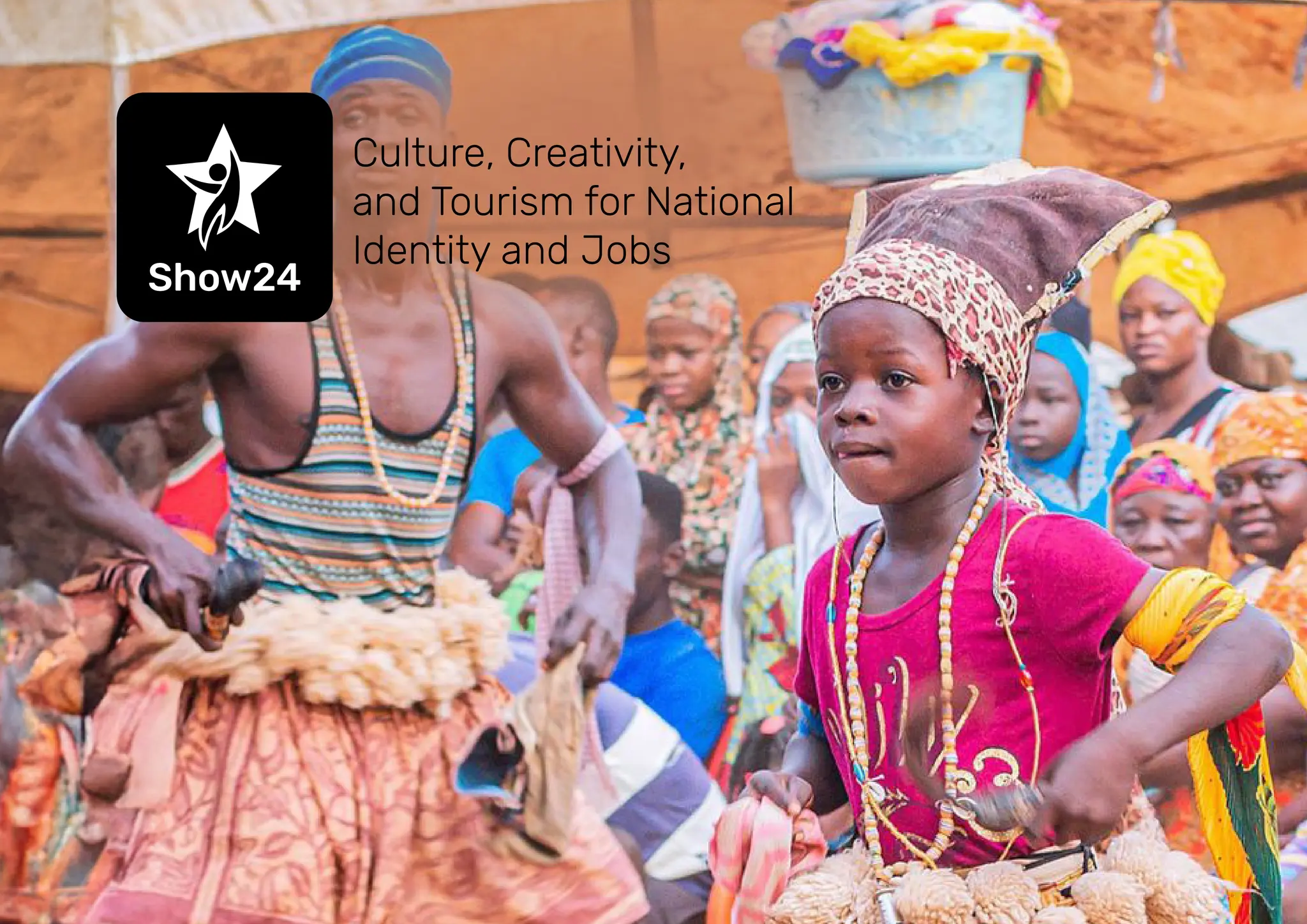
growth, national identity,and youth employment. It seeks to activate the
immense economic potential of Ghana’s arts, heritage, and tourism
industries through deliberate investment in content creation, skills
development, infrastructure, and global market access.
Show24
Culture, Creativity,
and Tourism for National
Identity and Jobs
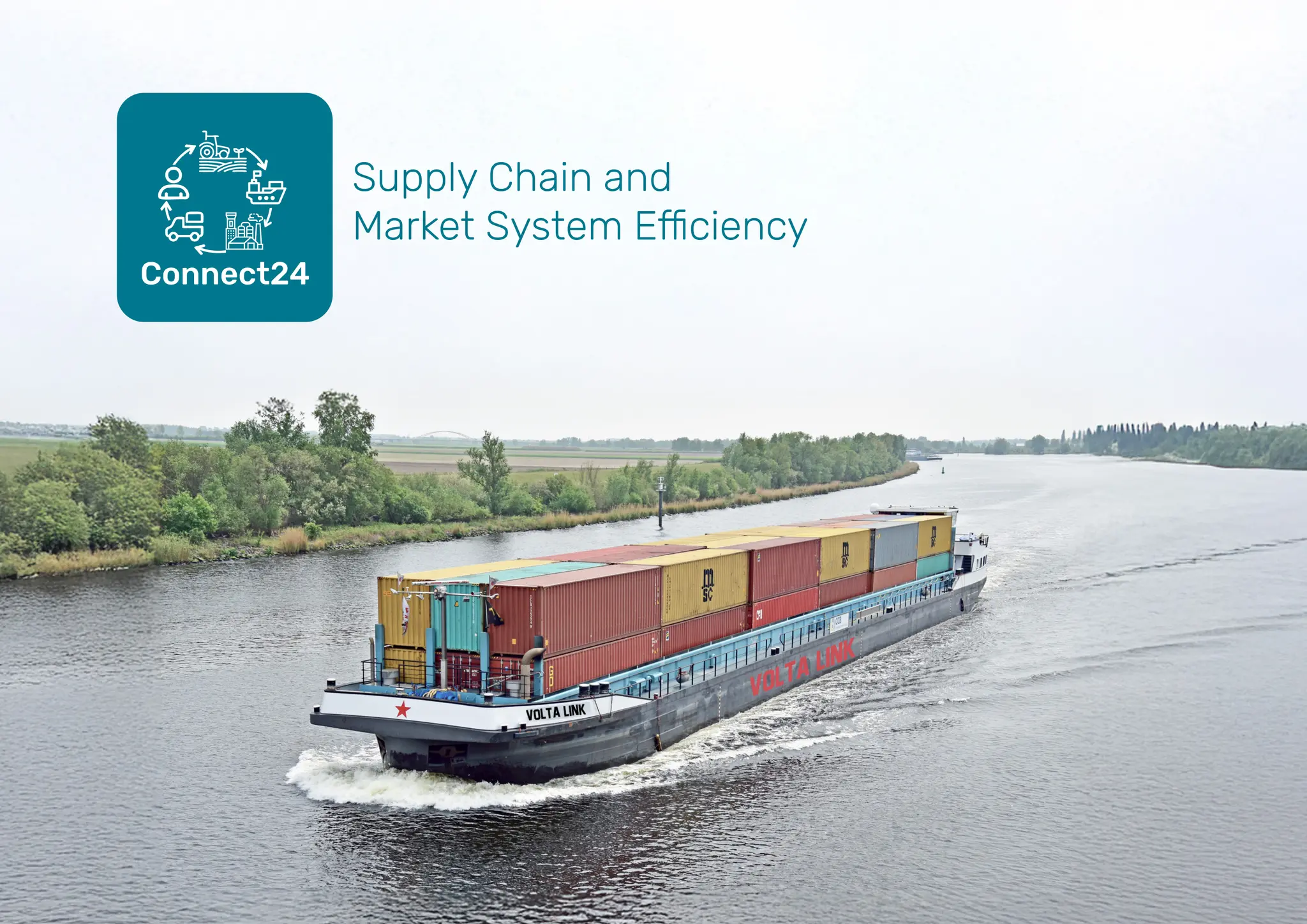
Connect24 addresses Ghana’slongstanding infrastructure and logistics
productivity, and limit market integration. This sub-programme seeks to
create a seamless, multimodal logistics and market access system
anchored on inland waterways, air cargo hubs, cold chain networks, and
digital trade platforms. The goal of the Connect24 subprogram is to
catalyse the reduction of post-harvest losses and increasing the reliability
of supply chains across the country and beyond.
Connect24
Supply Chain and
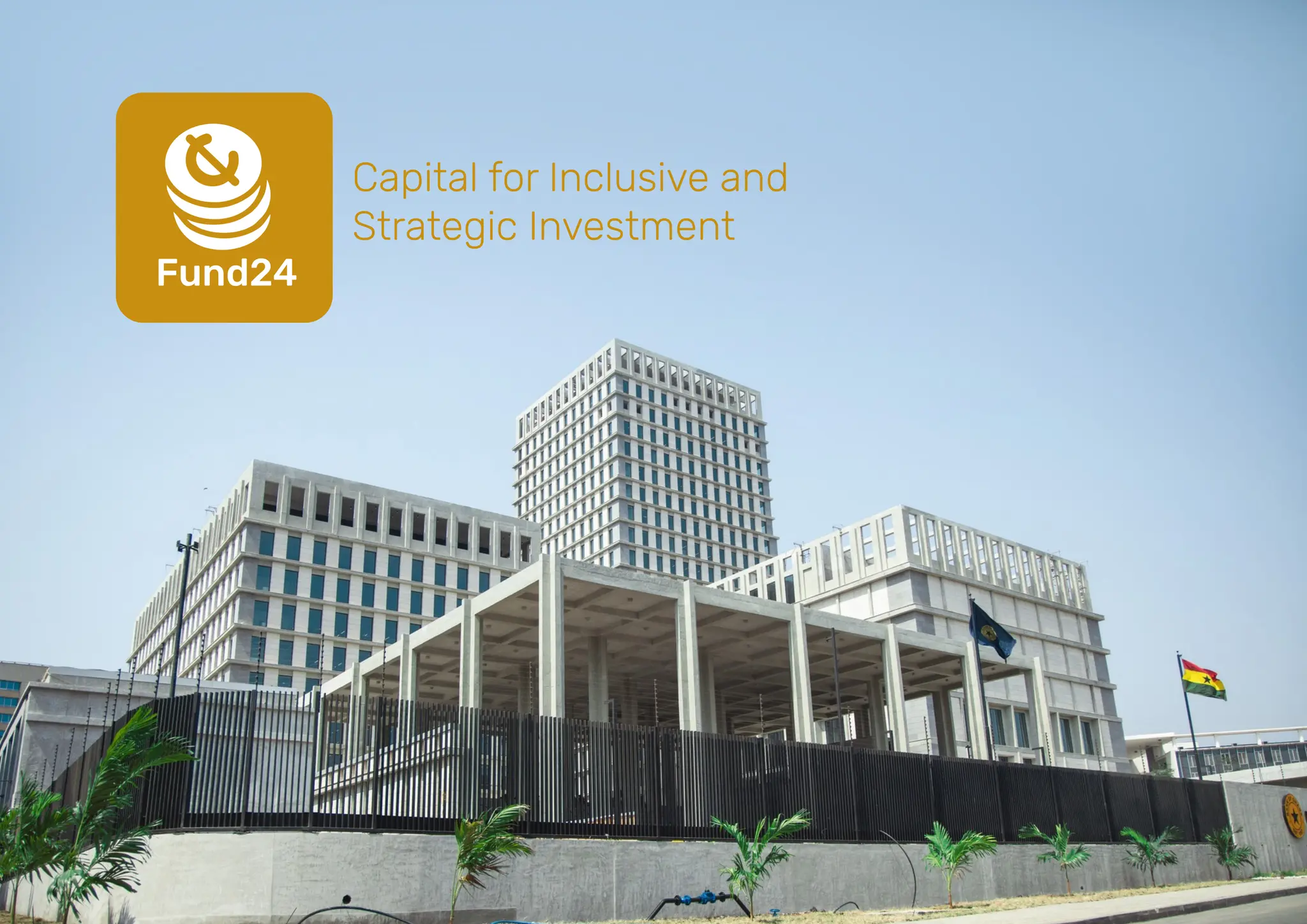
addressing two keybottlenecks: limited access to long-term enterprise
Purpose Vehicles (SPVs) seeded with public capital to catalyze private
investment into agroecological parks, industrial zones, and logistics
corridors. This sub-programme will ensure that producers, cooperatives,
and SMEs are not excluded from Ghana’s transformation due to capital
constraints. Key partners involved in the implementation of this
subprogram include Development Bank Ghana (DBG), Ghana Infrastructure
Investment Fund (GIIF), Ministry of Finance (MoF),
Ghana EXIM Bank, Bank of Ghana, among others.
Fund24
Capital for Inclusive
and Strategic Investment
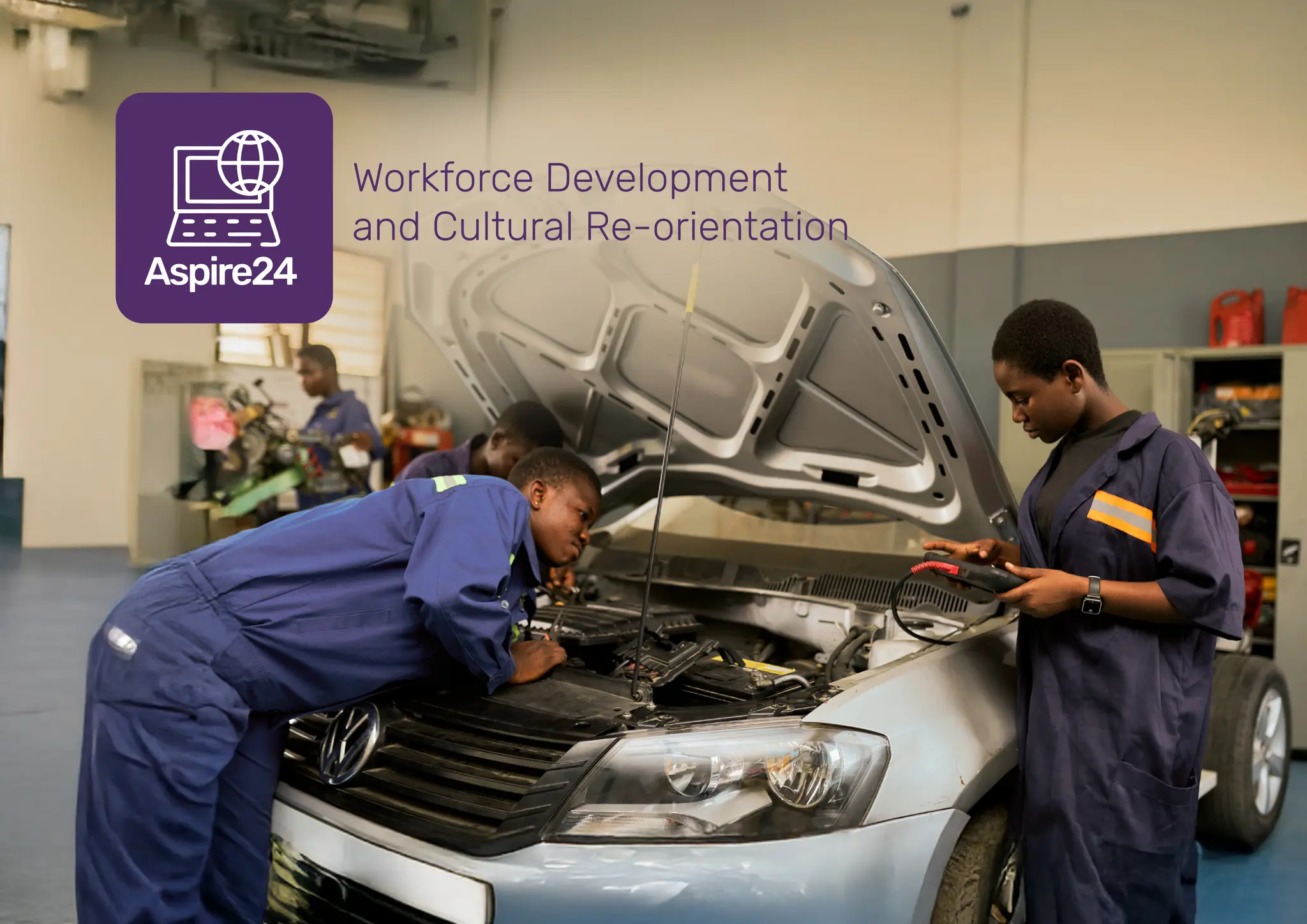
inhibit productivity andinnovation. It seeks to realign education with the
ethical grounding, and industry-relevant skills needed to drive the 24H+
economy.
Aspire24
Workforce Development
and Cultural Re-orientation
GO24 seeks toensure that the 24H+ programme is not limited to policy
directives but becomes a national movement. It embeds 24H+ goals into
the operations of MDAs and MMDAs, mandates public institutions to
extend service hours where feasible, and revises regulatory frameworks
to support night-time economic activity.
Go24
Civic Engagement
and Government Alignment
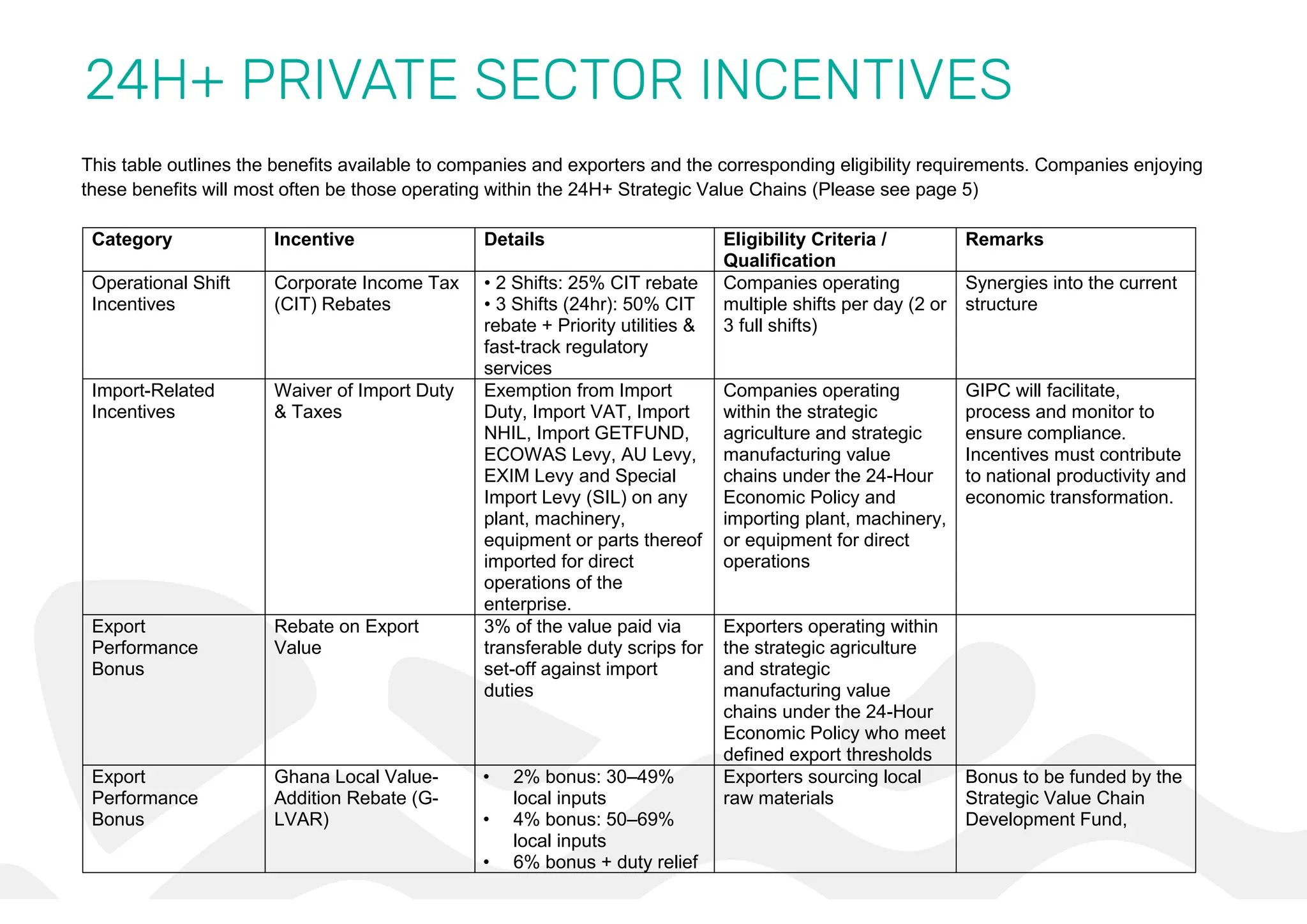
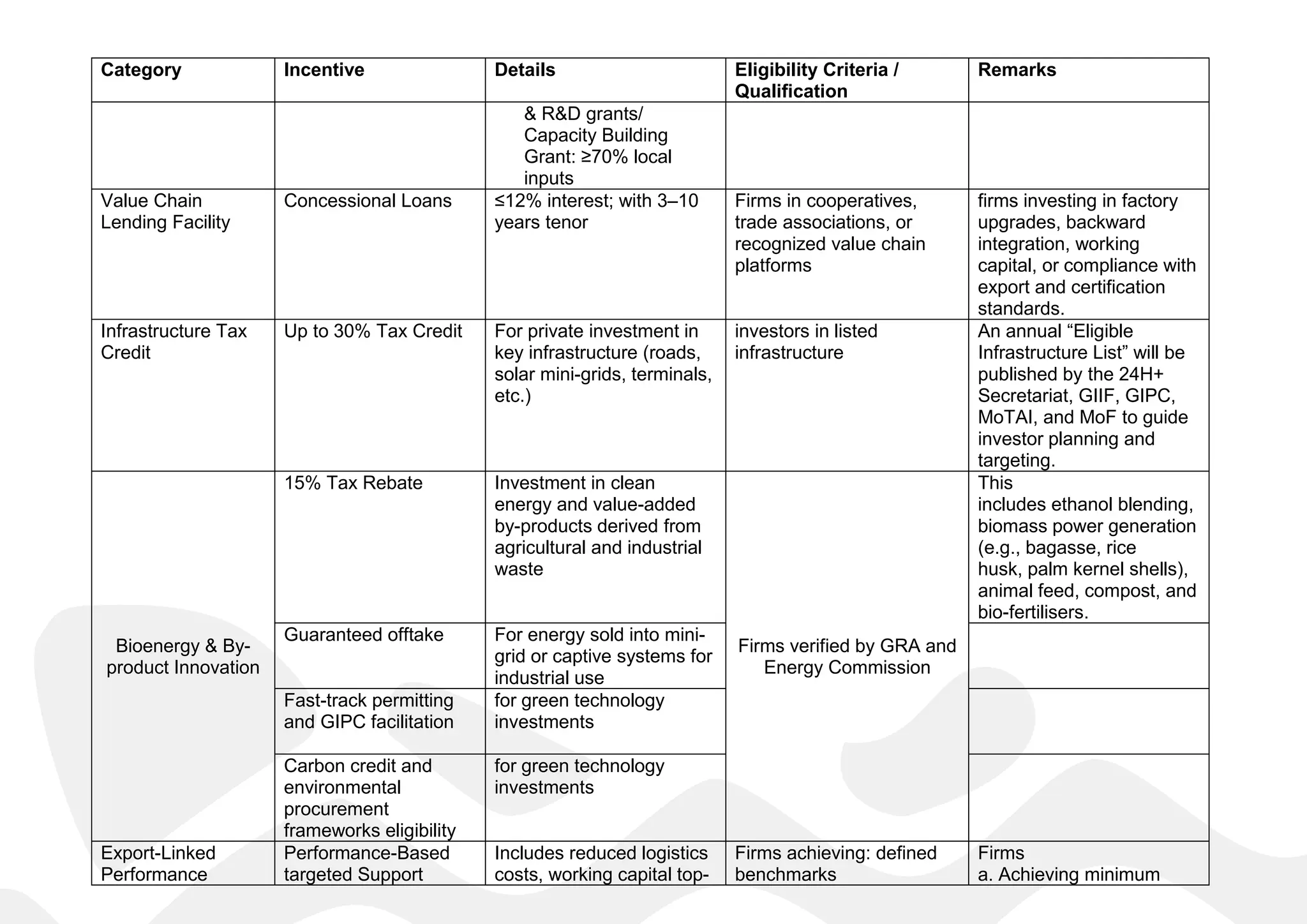
Category Incentive DetailsEligibility Criteria /
Qualification
Remarks
& R&D grants/
Capacity Building
Grant: ≥70% local
inputs
Value Chain
Lending Facility
Concessional Loans ≤12% interest; with 3–10
years tenor
Firms in cooperatives,
trade associations, or
recognized value chain
platforms
firms investing in factory
upgrades, backward
integration, working
capital, or compliance with
export and certification
standards.
Infrastructure Tax
Credit
Up to 30% Tax Credit For private investment in
key infrastructure (roads,
solar mini-grids, terminals,
etc.)
investors in listed
infrastructure
An annual “Eligible
Infrastructure List” will be
published by the 24H+
Secretariat, GIIF, GIPC,
MoTAI, and MoF to guide
investor planning and
targeting.
Bioenergy & By-
product Innovation
15% Tax Rebate Investment in clean
energy and value-added
by-products derived from
agricultural and industrial
waste
Firms verified by GRA and
Energy Commission
This
includes ethanol blending,
biomass power generation
(e.g., bagasse, rice
husk, palm kernel shells),
animal feed, compost, and
bio-fertilisers.
Guaranteed offtake For energy sold into mini-
grid or captive systems for
industrial use
Fast-track permitting
and GIPC facilitation
for green technology
investments
Carbon credit and
environmental
procurement
frameworks eligibility
for green technology
investments
Export-Linked
Performance
Performance-Based
targeted Support
Includes reduced logistics
costs, working capital top-
Firms achieving: defined
benchmarks
Firms
a. Achieving minimum
24.
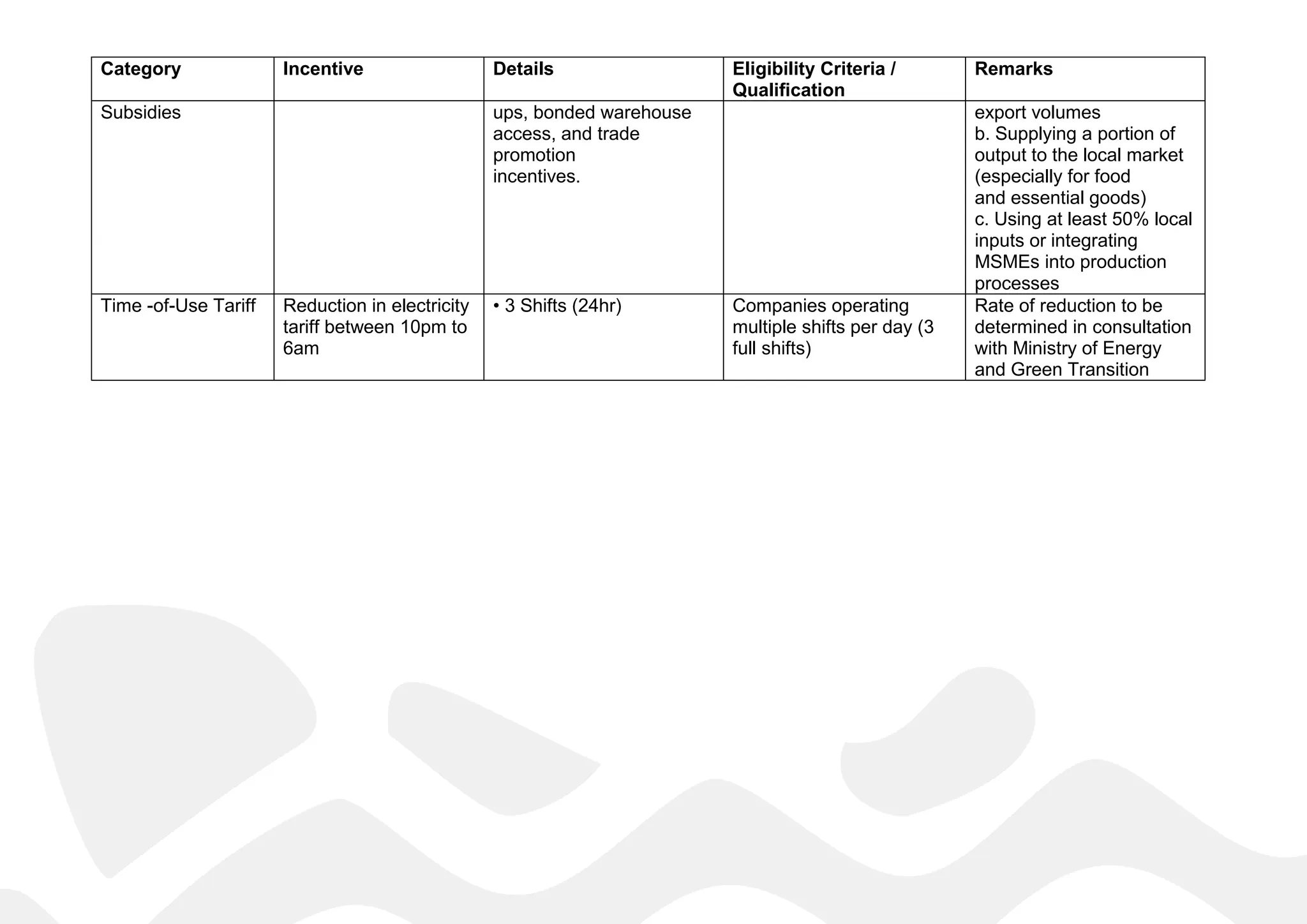
Category Incentive DetailsEligibility Criteria /
Qualification
Remarks
Subsidies ups, bonded warehouse
access, and trade
promotion
incentives.
export volumes
b. Supplying a portion of
output to the local market
(especially for food
and essential goods)
c. Using at least 50% local
inputs or integrating
MSMEs into production
processes
Time -of-Use Tariff Reduction in electricity
tariff between 10pm to
6am
• 3 Shifts (24hr) Companies operating
multiple shifts per day (3
full shifts)
Rate of reduction to be
determined in consultation
with Ministry of Energy
and Green Transition
25.
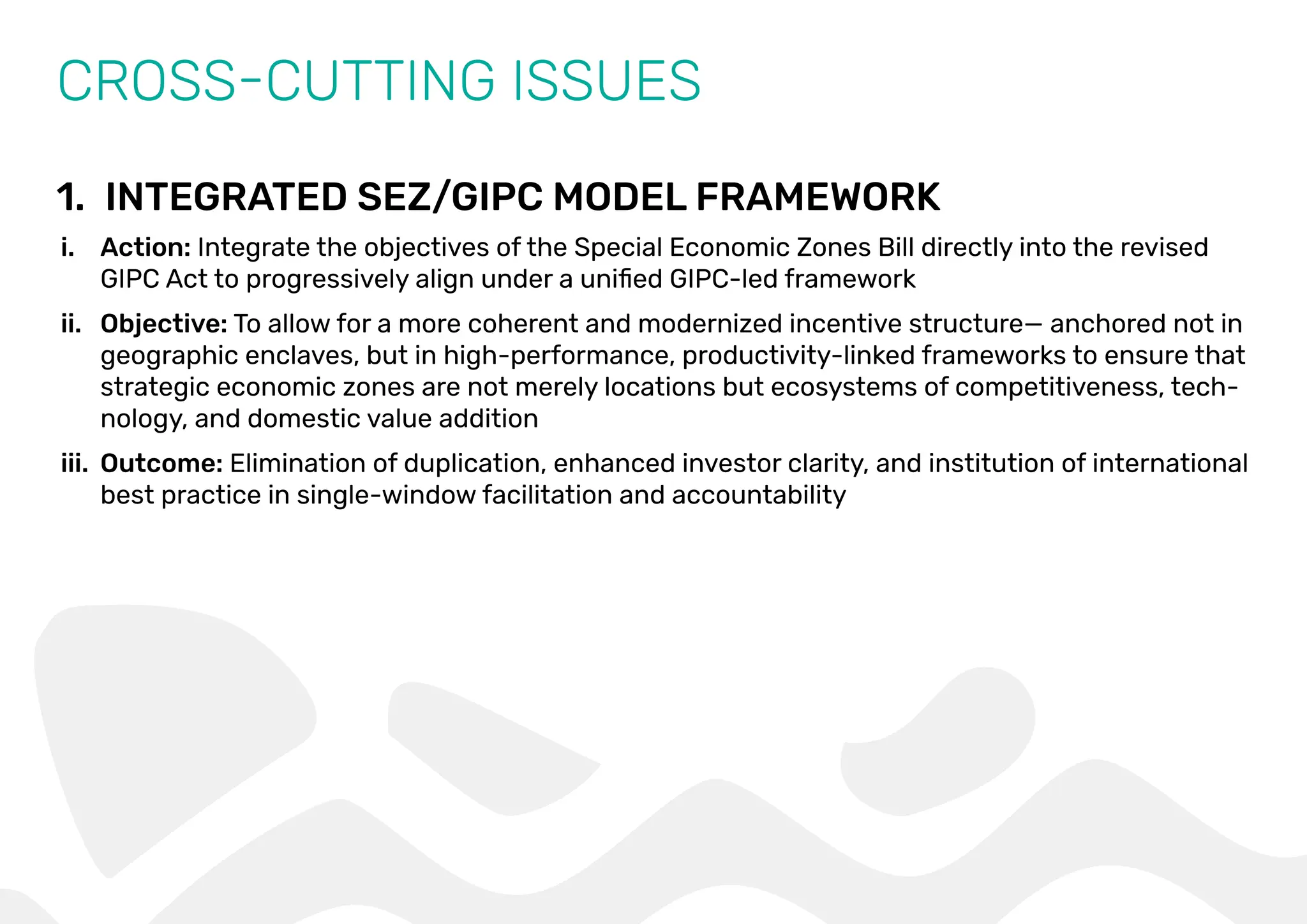
1. INTEGRATED SEZ/GIPCMODEL FRAMEWORK
CROSS-CUTTING ISSUES
i. Action: Integrate the objectives of the Special Economic Zones Bill directly into the revised
GIPC Act to progressively align under a unified GIPC-led framework
ii. Objective: To allow for a more coherent and modernized incentive structure— anchored not in
geographic enclaves, but in high-performance, productivity-linked frameworks to ensure that
strategic economic zones are not merely locations but ecosystems of competitiveness, tech-
nology, and domestic value addition
iii. Outcome: Elimination of duplication, enhanced investor clarity, and institution of international
best practice in single-window facilitation and accountability
26.
2. FUNDING
i. Action:Create a Strategic Value Chain Dev. Fund (SVCDF)
ii. Objective: Establishment of a catalytic co-financing mechanism to fund some of the incentives
and also support the value chain financing facility.
iii. Sources of funds:
The Levy in A and the excise levy in B above will be imposed on imported finished products in
sectors where Ghana has a clear potential for local substitution under 24H+ including:
a)An increase of between 0.10% to 0.25% on the existing 0.75% EXIM Levy on affected imported finished products.
b)Imposition of excise levy on selected products within the value chain
c)Strict enforcement of valuation compliance measures on products within the value chain
Strategic Agriculture Value Chains:
a. Cereals & Grains: Maize, Rice, Millet
b. Vegetables: Tomatoes, Onion, Pepper, Okra
c. Oilseeds: Soybean, Groundnut, Oil Palm
d. Roots and Tubers: Cassava, Yam, Sweet Potatoes
e. Animal Protein: Poultry, Fish
f. Sugars, Sugarcane & Sugar Beets
g. Medicinal Plants & Spices
Plastic household goods
Second-hand clothing and garments
Imported cement and construction inputs
Strategic Manufacturing Value Chains:
a. Agro-processing (within the strategic agriculture value
chains)
b. Textiles and Garments
c. Pharmaceuticals ( Medicine on Restriction of Importation of
Medicines List – E.I. 496)
d. Machinery and Technology (Equipment in the Gratis Product
Catalogue - https:/
/gratis.gov.gh/products/index.html )
e. Medicinal Herbs and Food Supplements
27.
3. 24H+ STRATEGICVALUE CHAINS
Strategic Agriculture Value Chains:
i. Cereals & Grains: Maize, Rice, Millet
ii. Vegetables: Tomatoes, Onion, Pepper, Okra
iii. Oilseeds: Soybean, Groundnut, Oil Palm
iv. Roots and Tubers: Cassava, Yam, Sweet Potatoes
v. Animal Protein: Poultry, Fish
vi. Sugars, Sugarcane & Sugar Beets
vii. Medicinal Plants & Spices
Construction
i. Cereals & Grains: Maize, Rice, Millet
ii. Vegetables: Tomatoes, Onion, Pepper, Okra
iii. Oilseeds: Soybean, Groundnut, Oil Palm
iv. Roots and Tubers: Cassava, Yam, Sweet Potatoes
v. Animal Protein: Poultry, Fish
vi. Sugars, Sugarcane & Sugar Beets
vii. Medicinal Plants & Spices
Strategic Manufacturing Value Chains:
i. Agro-processing (within the strategic agriculture value
chains)
ii. Textiles and Garments
iii. Pharmaceuticals ( Medicine on Restriction of Importa-
tion of Medicines List – E.I. 496)
iv. Machinery and Technology (Equipment in the Gratis
Product Catalogue - https:/
/gratis.gov.gh/prod-
ucts/index.html
v. Medicinal Herbs and Food Supplements
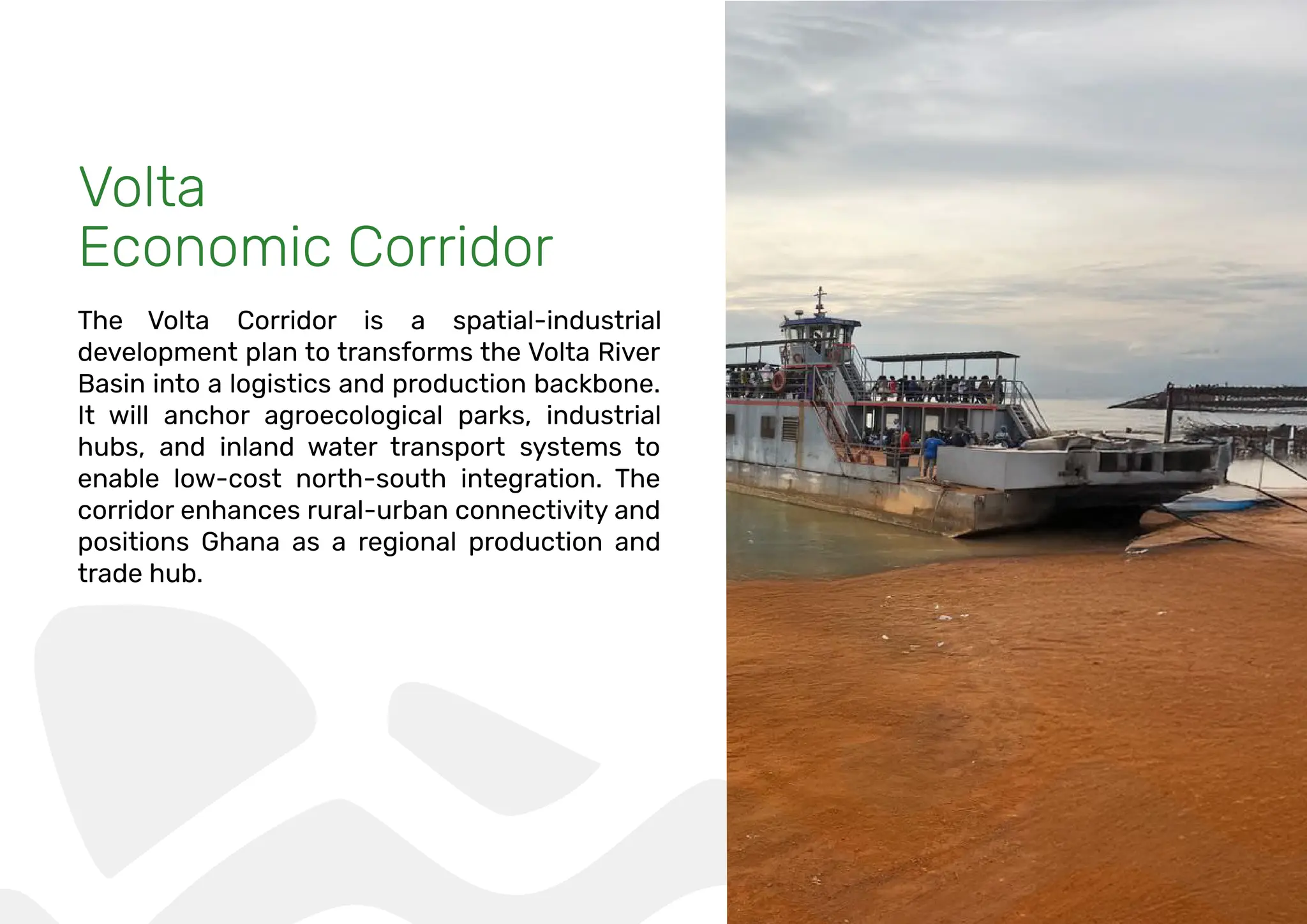
Volta
Economic Corridor
The VoltaCorridor is a spatial-industrial
development plan to transforms the Volta River
Basin into a logistics and production backbone.
It will anchor agroecological parks, industrial
hubs, and inland water transport systems to
enable low-cost north-south integration. The
corridor enhances rural-urban connectivity and
positions Ghana as a regional production and
trade hub.
30.
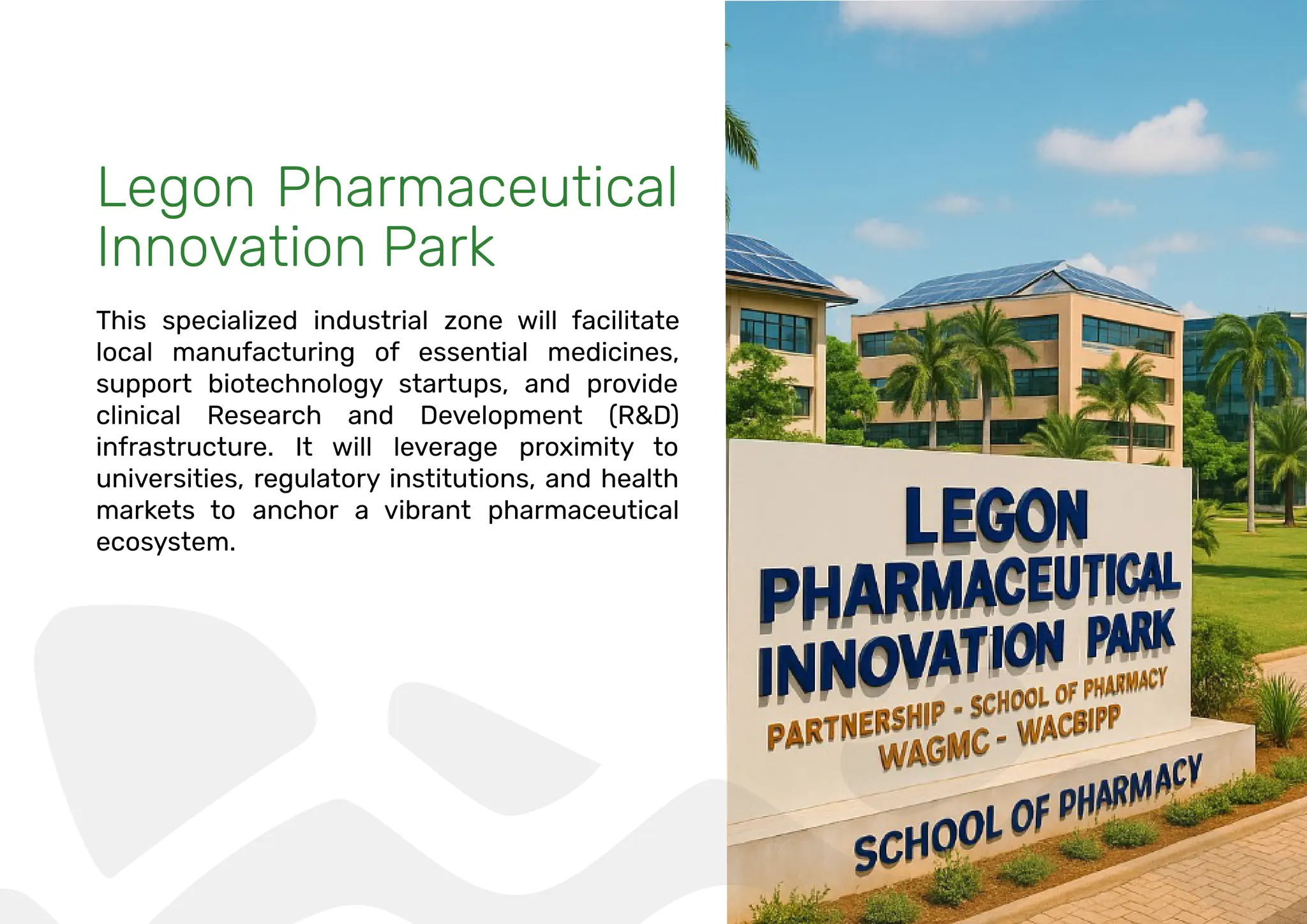
Legon Pharmaceutical
Innovation Park
Thisspecialized industrial zone will facilitate
local manufacturing of essential medicines,
support biotechnology startups, and provide
clinical Research and Development (R&D)
infrastructure. It will leverage proximity to
universities, regulatory institutions, and health
markets to anchor a vibrant pharmaceutical
ecosystem.
31.
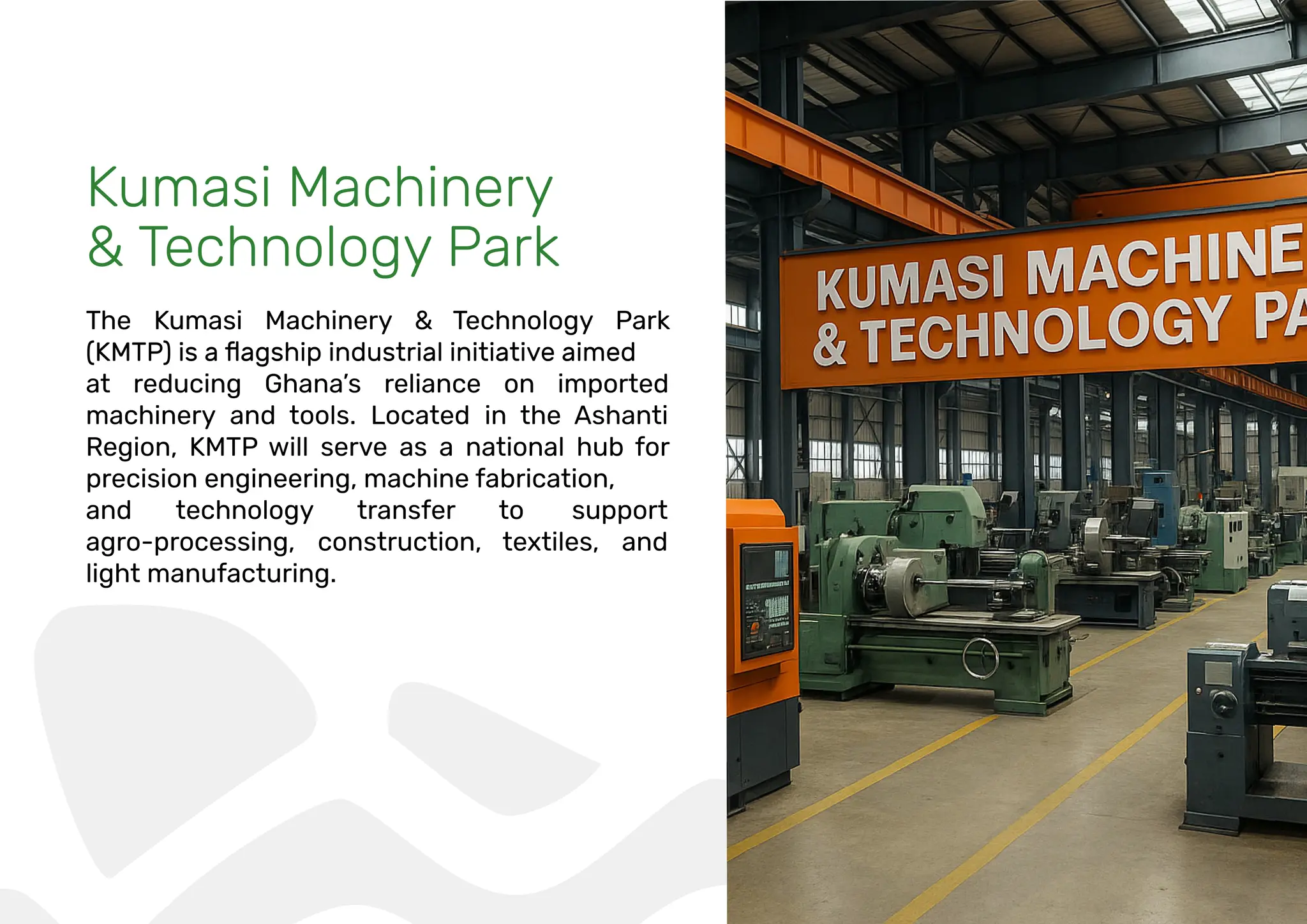
Kumasi Machinery
& TechnologyPark
The Kumasi Machinery & Technology Park
at reducing Ghana’s reliance on imported
machinery and tools. Located in the Ashanti
Region, KMTP will serve as a national hub for
precision engineering, machine fabrication,
and technology transfer to support
agro-processing, construction, textiles, and
light manufacturing.
32.
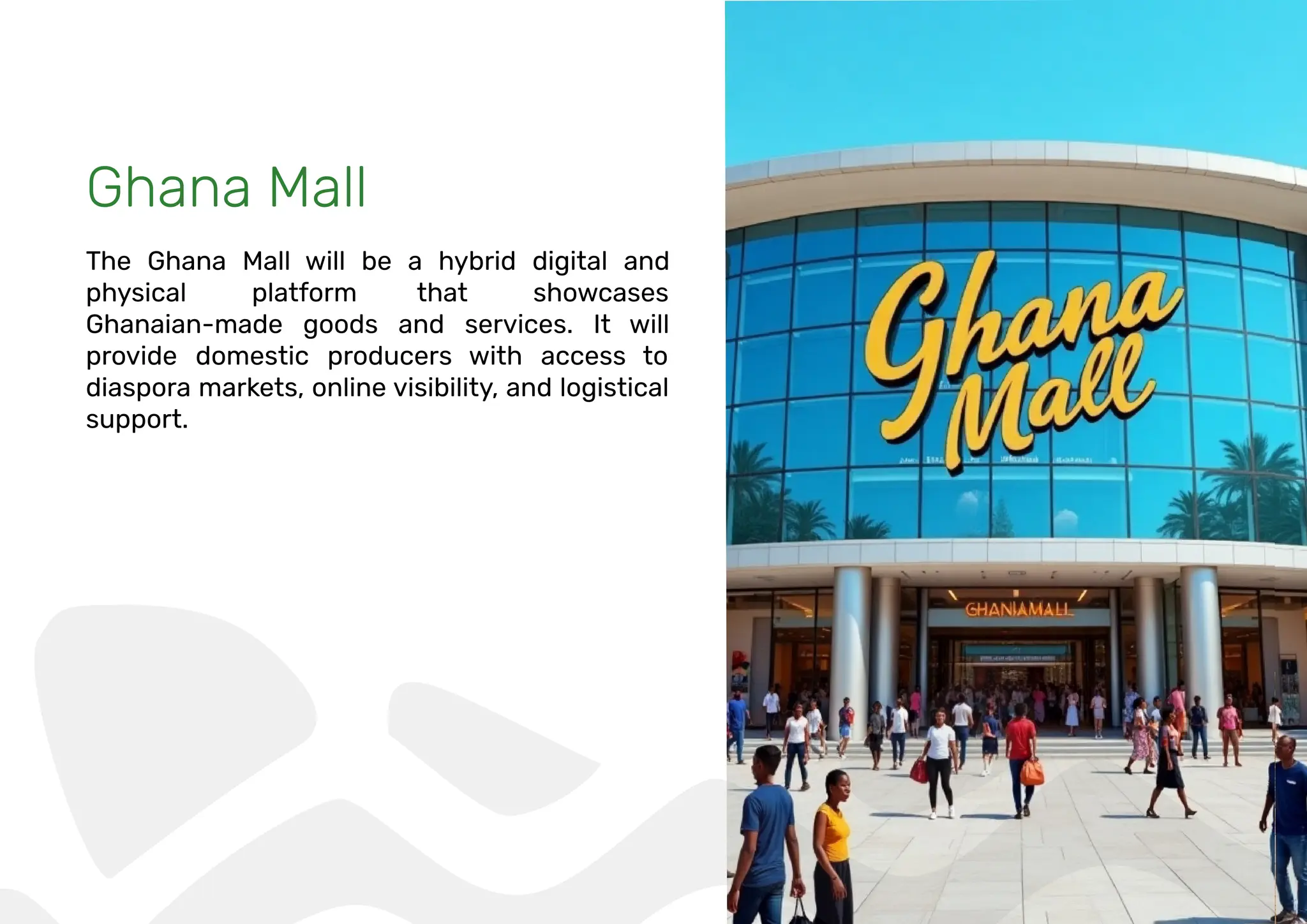
Ghana Mall
The GhanaMall will be a hybrid digital and
physical platform that showcases
Ghanaian-made goods and services. It will
provide domestic producers with access to
diaspora markets, online visibility, and logistical
support.
33.
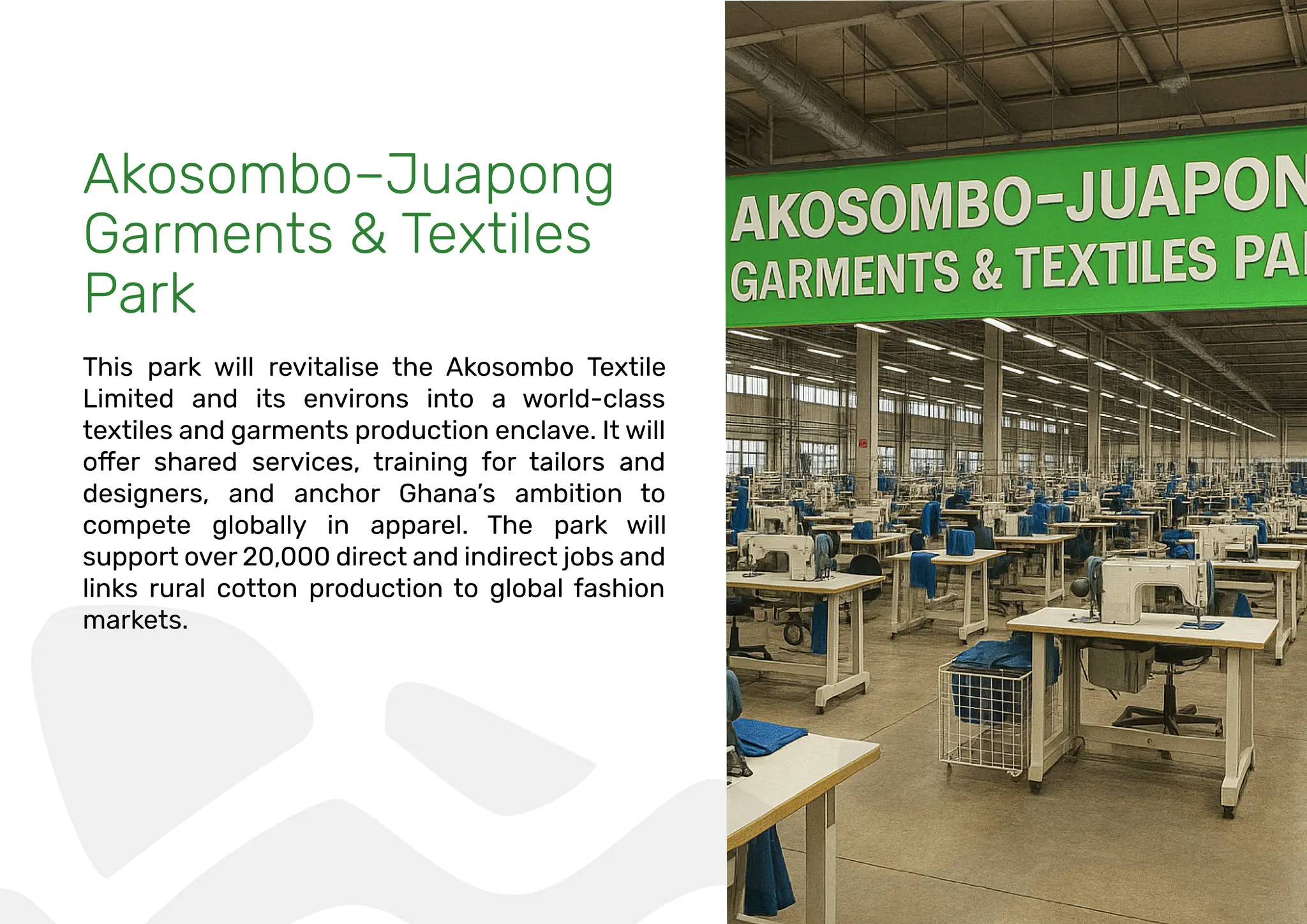
Akosombo–Juapong
Garments & Textiles
Park
Thispark will revitalise the Akosombo Textile
Limited and its environs into a world-class
textiles and garments production enclave. It will
designers, and anchor Ghana’s ambition to
compete globally in apparel. The park will
support over 20,000 direct and indirect jobs and
links rural cotton production to global fashion
markets.
34.
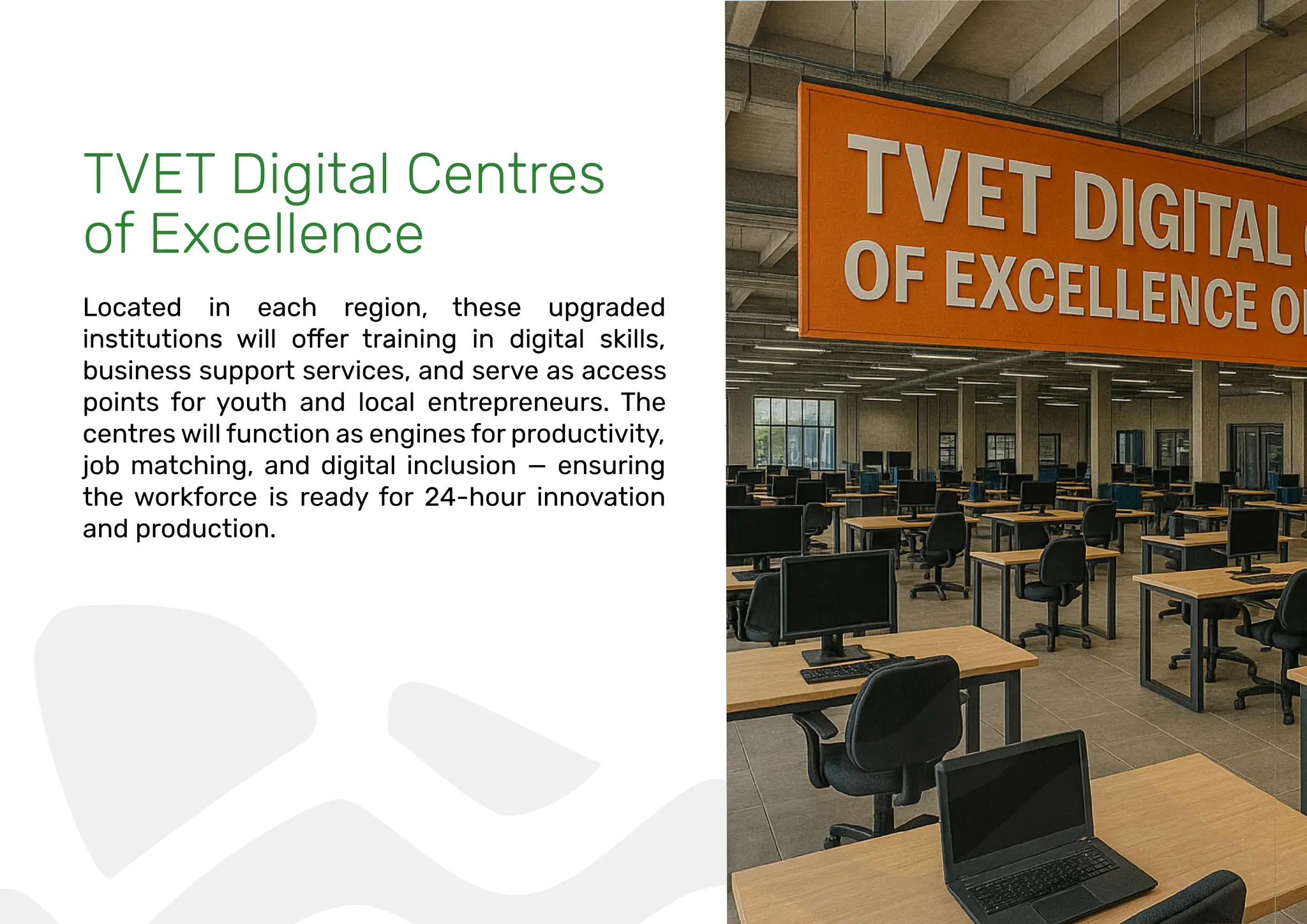
TVET Digital Centres
ofExcellence
Located in each region, these upgraded
business support services, and serve as access
points for youth and local entrepreneurs. The
centres will function as engines for productivity,
job matching, and digital inclusion — ensuring
the workforce is ready for 24-hour innovation
and production.
35.
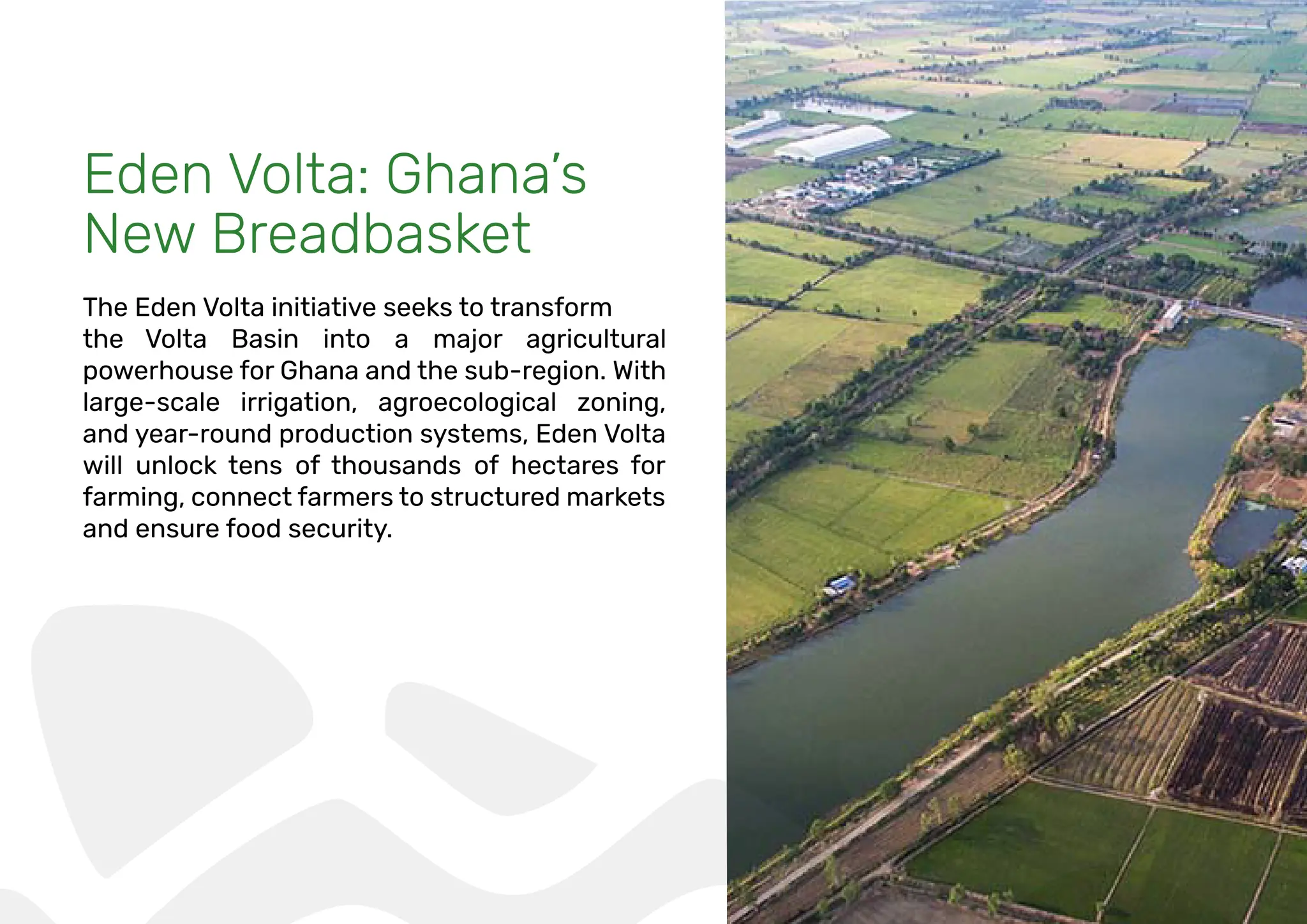
Eden Volta: Ghana’s
NewBreadbasket
The Eden Volta initiative seeks to transform
the Volta Basin into a major agricultural
powerhouse for Ghana and the sub-region. With
large-scale irrigation, agroecological zoning,
and year-round production systems, Eden Volta
will unlock tens of thousands of hectares for
farming, connect farmers to structured markets
and ensure food security.
36.
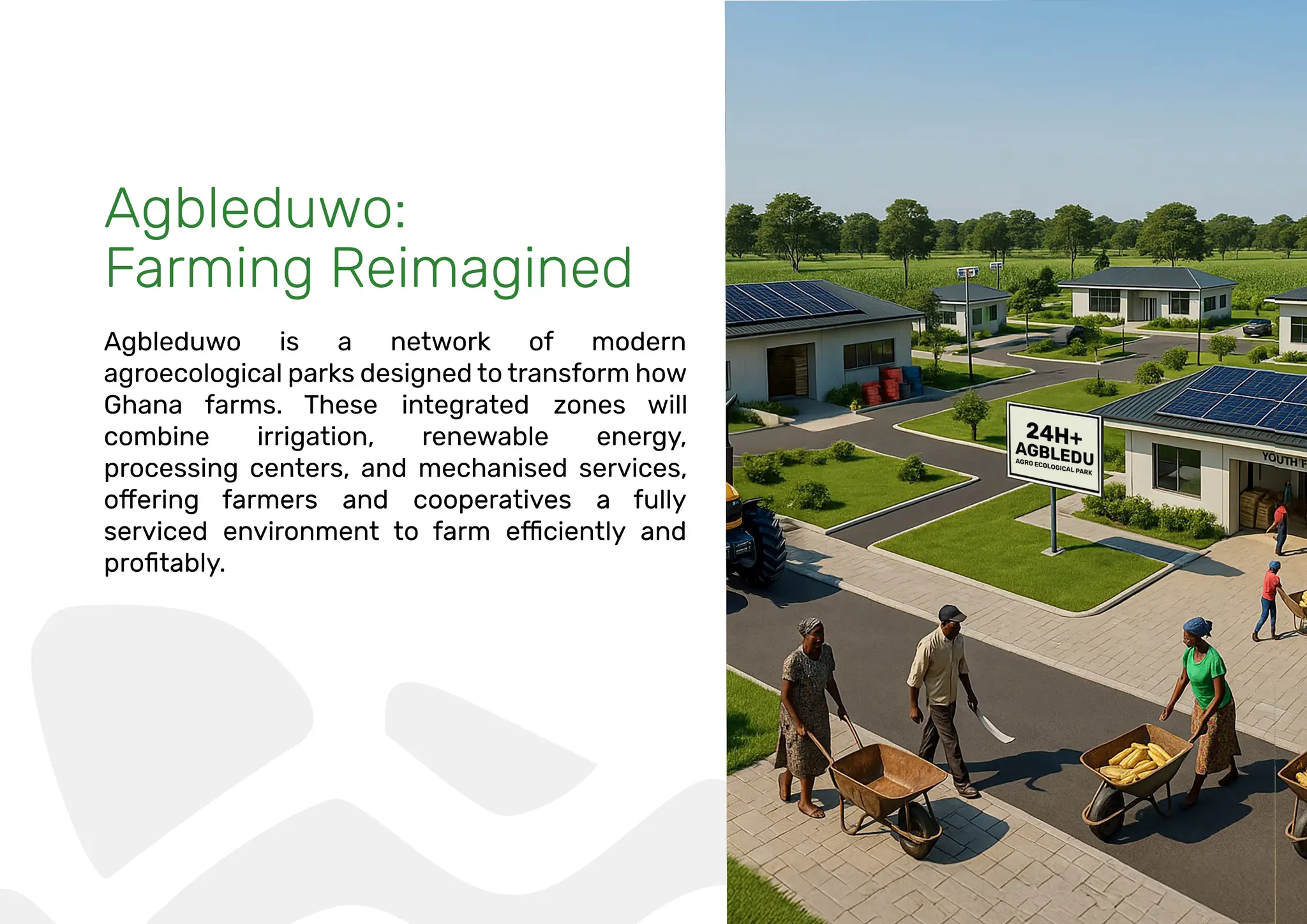
Agbleduwo:
Farming Reimagined
Agbleduwo isa network of modern
agroecological parks designed to transform how
Ghana farms. These integrated zones will
combine irrigation, renewable energy,
processing centers, and mechanised services,
37.
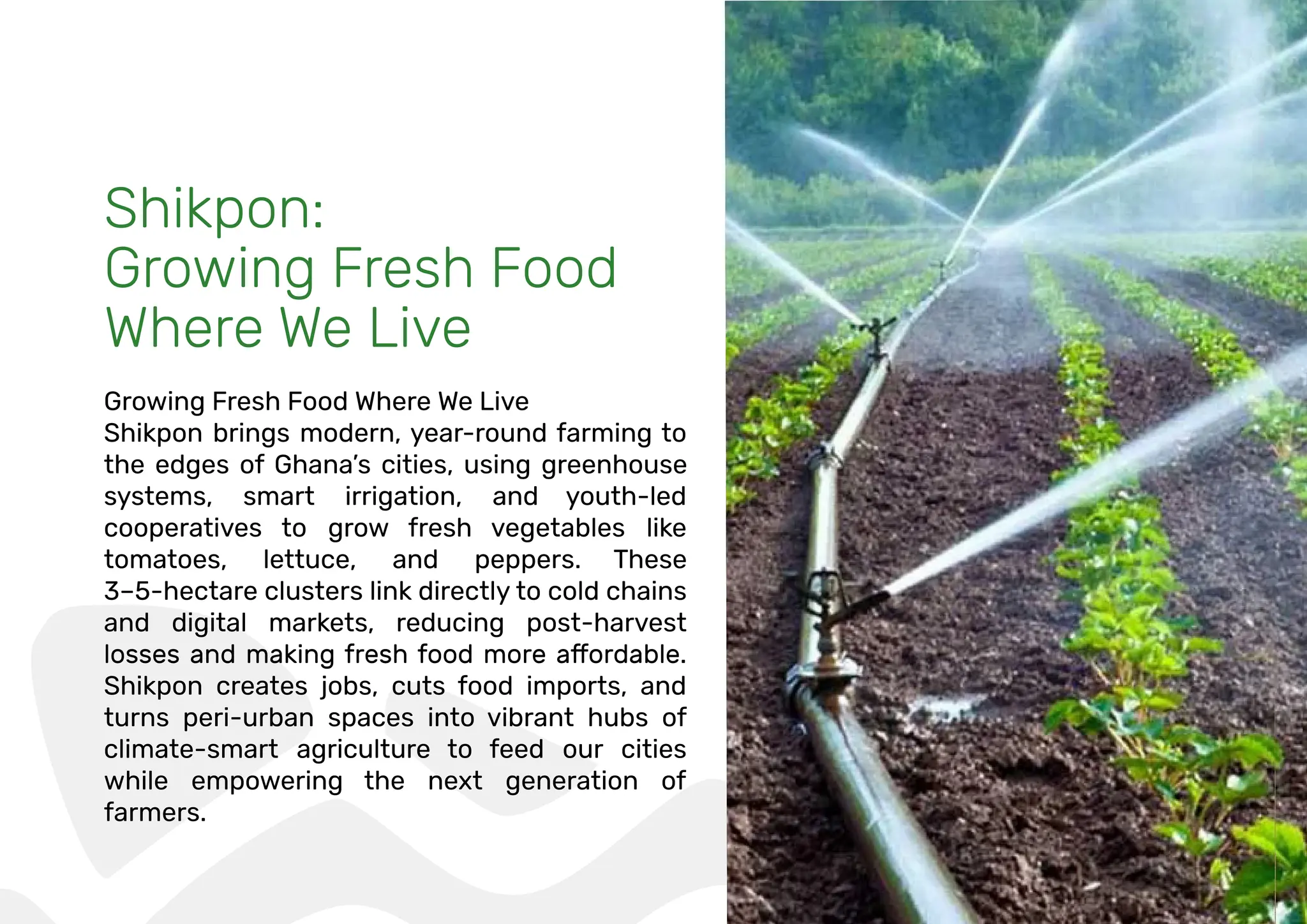
Shikpon:
Growing Fresh Food
WhereWe Live
Growing Fresh Food Where We Live
Shikpon brings modern, year-round farming to
the edges of Ghana’s cities, using greenhouse
systems, smart irrigation, and youth-led
cooperatives to grow fresh vegetables like
tomatoes, lettuce, and peppers. These
3–5-hectare clusters link directly to cold chains
and digital markets, reducing post-harvest
Shikpon creates jobs, cuts food imports, and
turns peri-urban spaces into vibrant hubs of
climate-smart agriculture to feed our cities
while empowering the next generation of
farmers.
38.
INVESTOR OPPORTUNITIES
• AgroecologicalParks (Agbleduwo): Invest in irrigated farming, greenhouse
production, input supply, mechanisation services, and agro-processing
within fully serviced zones.
• Industrial Parks Development: Partner with government to build, operate, or
Juapong-Akosombo (textiles), and Legon (pharmaceuticals).
• Logistics and Cold Chain Infrastructure: Establish warehousing,
aggregation centres, haulage services, and inland water transport systems to
serve domestic and export markets.
• Manufacturing Value Chains: Set up factories in agro-processing,
pharmaceuticals, textiles and garments, construction
39.
• Digital Infrastructure& TVET Innovation: Invest in Digital Centres of
Excellence, EdTech platforms, or tools for online work, vocational training, and
workforce productivity.
• Export Market Enablement: Leverage tax and regulatory incentives to
target the AfCFTA, ECOWAS ETLS, and global markets with Ghana-made
goods.
• Renewable Energy Solutions: Deploy solar mini-grids, time-of-use energy
systems, and storage technologies for 24-hour production zones.
• Co-invest in the SME Equity Fund or Value
Chain Financing Facility to support scalable SMEs and cooperatives with
blended capital.
• Tourism and Creative Economy Infrastructure: Develop facilities, content
platforms, or destination experiences aligned with the SHOW24
sub-programme.
• PPP Models for Infrastructure: Participate in Special Purpose Vehicles
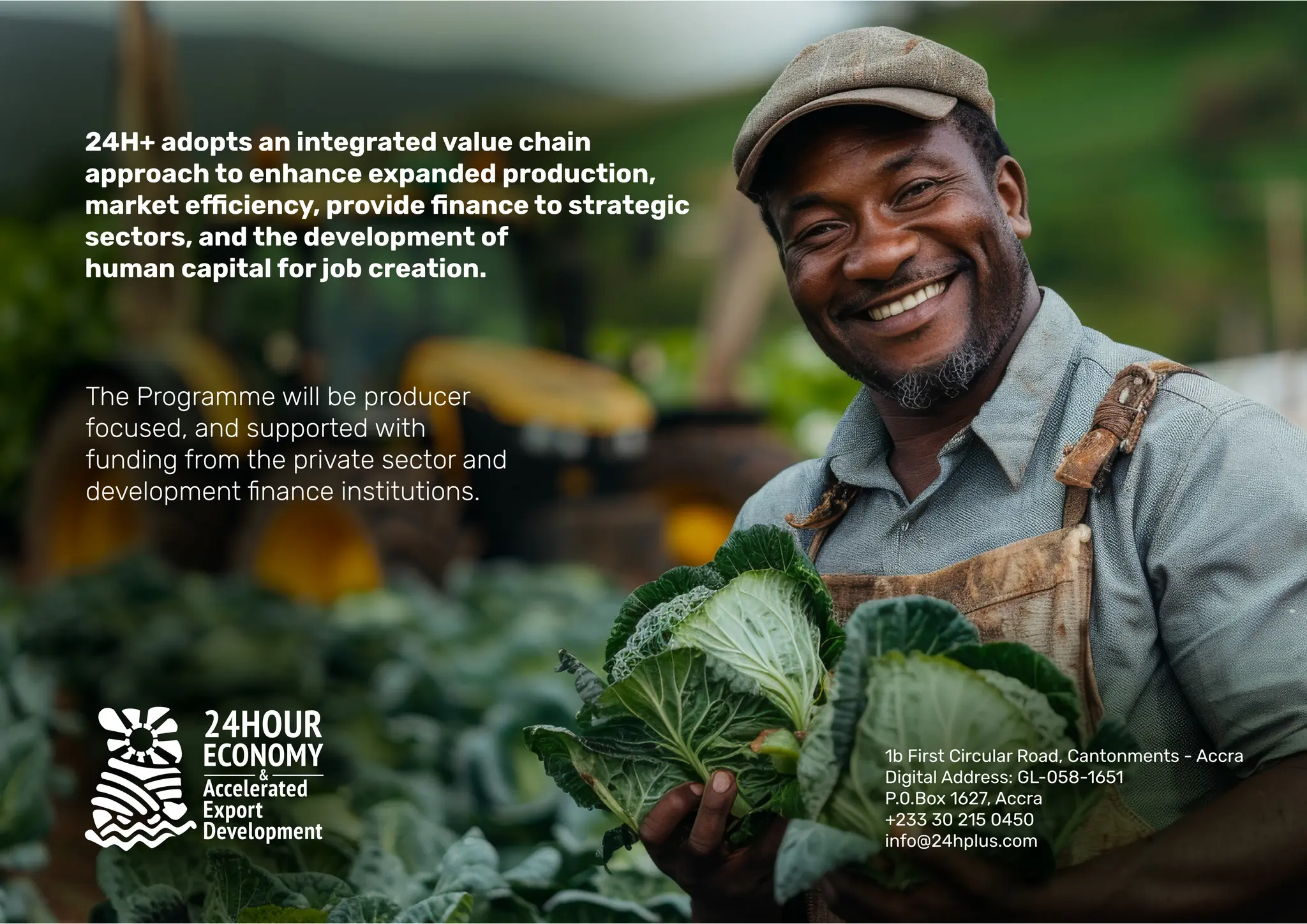
40.
24H+ adopts anintegrated value chain
approach to enhance expanded production,
sectors, and the development of
human capital for job creation.
The Programme will be producer
focused, and supported with
funding from the private sector and
1b First Circular Road, Cantonments - Accra
Digital Address: GL-058-1651
P.0.Box 1627, Accra
+233 30 215 0450
info@24hplus.com
41.
WHAT MAKES 24H+DIFFERENT?
transformative system. It empowers the everyday Ghanaian with tools,
skills, and opportunities to thrive in a productive economy that works
results-driven, and built to deliver inclusive, sustained growth for all.
42.
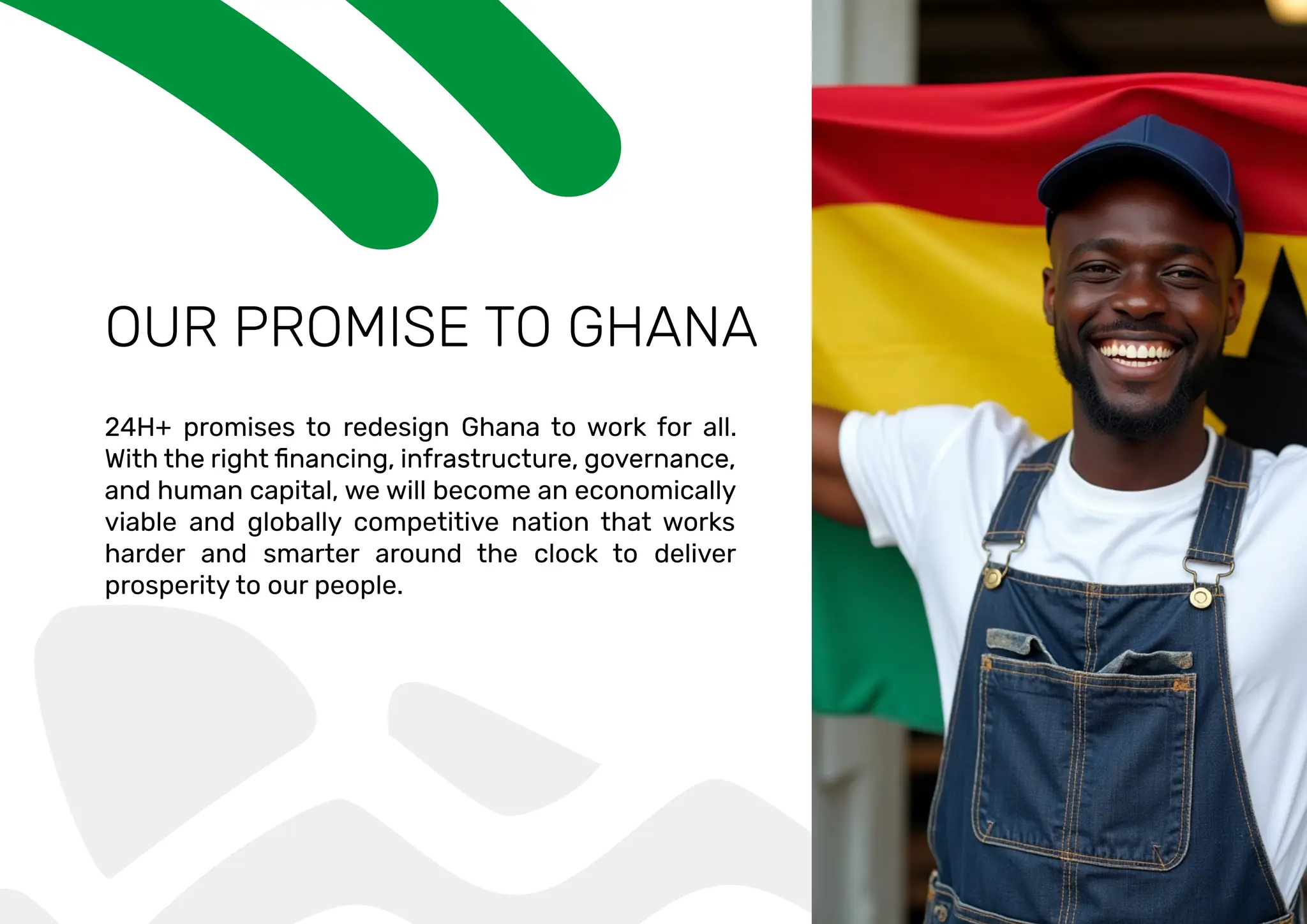
OUR PROMISE TOGHANA
24H+ promises to redesign Ghana to work for all.
and human capital, we will become an economically
viable and globally competitive nation that works
harder and smarter around the clock to deliver
prosperity to our people.
43.
WHAT’S NEXT?
THE 24-HOURREADINESS PROGRAMME
Ghana’s transition into a 24-hour productive economy is entering an exciting phase.
As part of the implementation of the 24H+ agenda, the Ghana 24/7 Readiness
Programme is set to roll out a coordinated national initiative to prepare over 5,000
businesses across all 16 regions to operate around the clock.
• Private Pilots:
incentives and recognition.
• SME Support:
• Investor Prep:
export markets.
• Finance & Incentives:
• Local Champions: Each district appoints a 24/7 Champion to promote
adoption and share success.
44.
1b First CircularRoad, Cantonments - Accra
Digital Address: GL-058-1651
P.0.Box 1627, Accra
+233 30 215 0450
info@24hplus.com
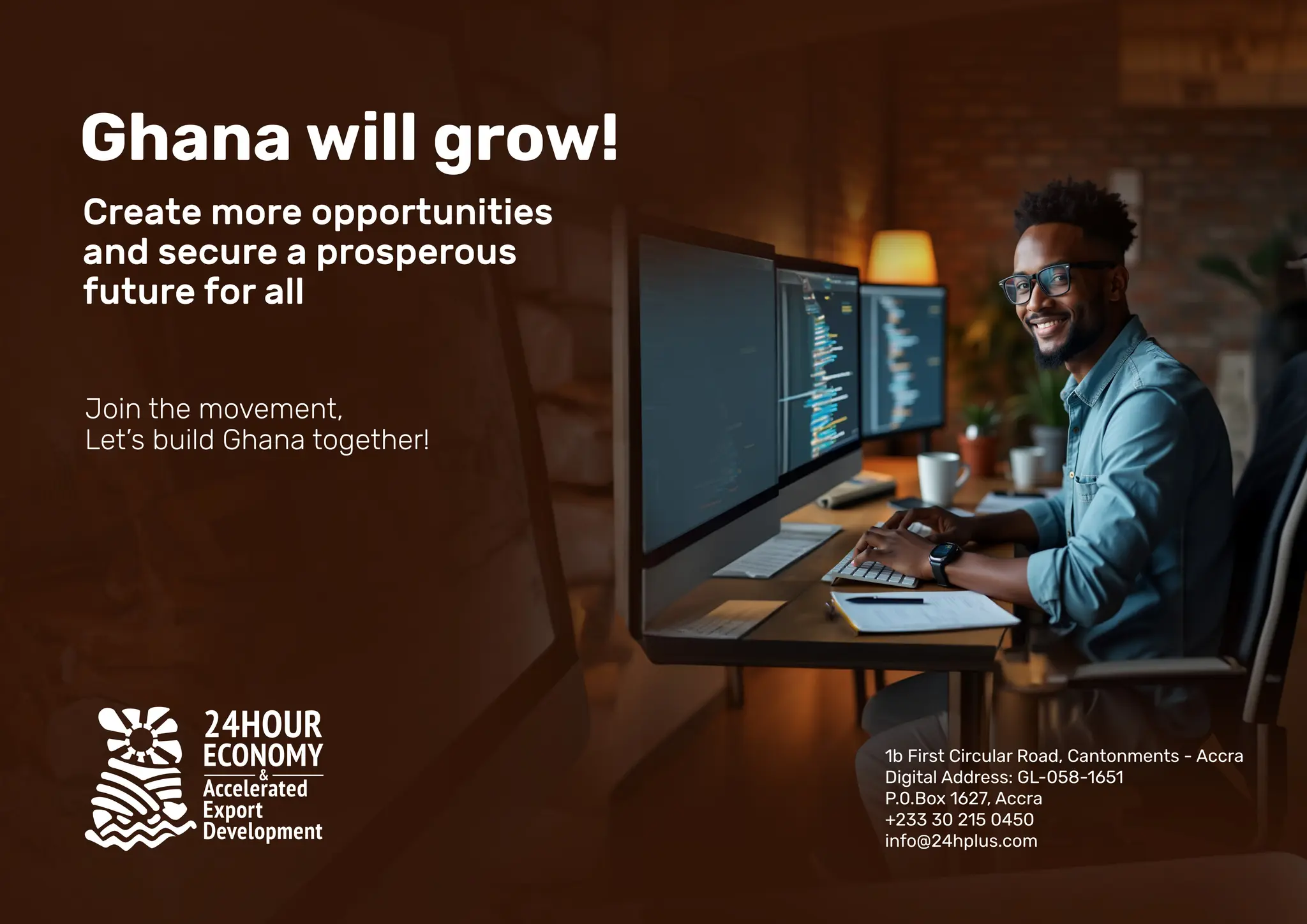
Ghana will grow!
Join the movement,
Let’s build Ghana together!
45.
Stay Informed &Involved
24H+ is a whole-of-society programme. Citizens,
businesses, diaspora, development partners—everyone
has a role. Join us in building a Ghana that works.
For everyone. Every hour.
1b First Circular Road, Cantonments - Accra
Digital Address: GL-058-1651
P.0.Box 1627, Accra
+233 30 215 0450
info@24hplus.com