English 3
Quarter I Week 5
@Edu
Maymay
Day 1
Learning Competencies:
EN3VWK-I-1 Identify high-frequency words accurately.
EN3CAT-I-2
Comprehend stories.
Note important elements from stories (characters, setting, events).
Sequence at least four to five events.
Identify the problem and solution in stories.
Infer the character’s feelings and traits.
Relate story events to one’s experience.
Identify the cause and effect of events.
Predict possible ending.
Give a summary.
EN3CCT-I-2 Use own words in retelling myths, legends, fables, and narrative poems.
EN3CCT-I-7 Make a summary of narrative text.
Day 1
Learning Objectives:
a. Identify high frequency words accurately;
b. Note important elements from stories (characters, setting,
events);
c. Identify the problem and solution in stories;
d. Relate story events to one’s experience;
e. Retell myths, legends, fables, and narrative poems using
your own words; and
f. Summarize a narrative text.
Review:
Read the sentence. Identify the subject and the verb used in the
sentence.
I eat breakfast every day.
What makes it a simple sentence?
The given sentence is a simple sentence
because it has a single independent clause
with a subject (I), a verb (eat), and a
complete thought.
Now, how do you make an imperative
sentence to make a request?
When writing imperative sentences to make a
request, start with a polite expression (PE) like
"please," followed by a verb (V) in its base form, then
the indirect object.
Example:
(PE) Please (V) pass me the salt.
How and when do you use correct
capitalization and punctuation for simple
sentences?
The first word in a sentence should always
be capitalized, and the sentence should
end with a punctuation mark.
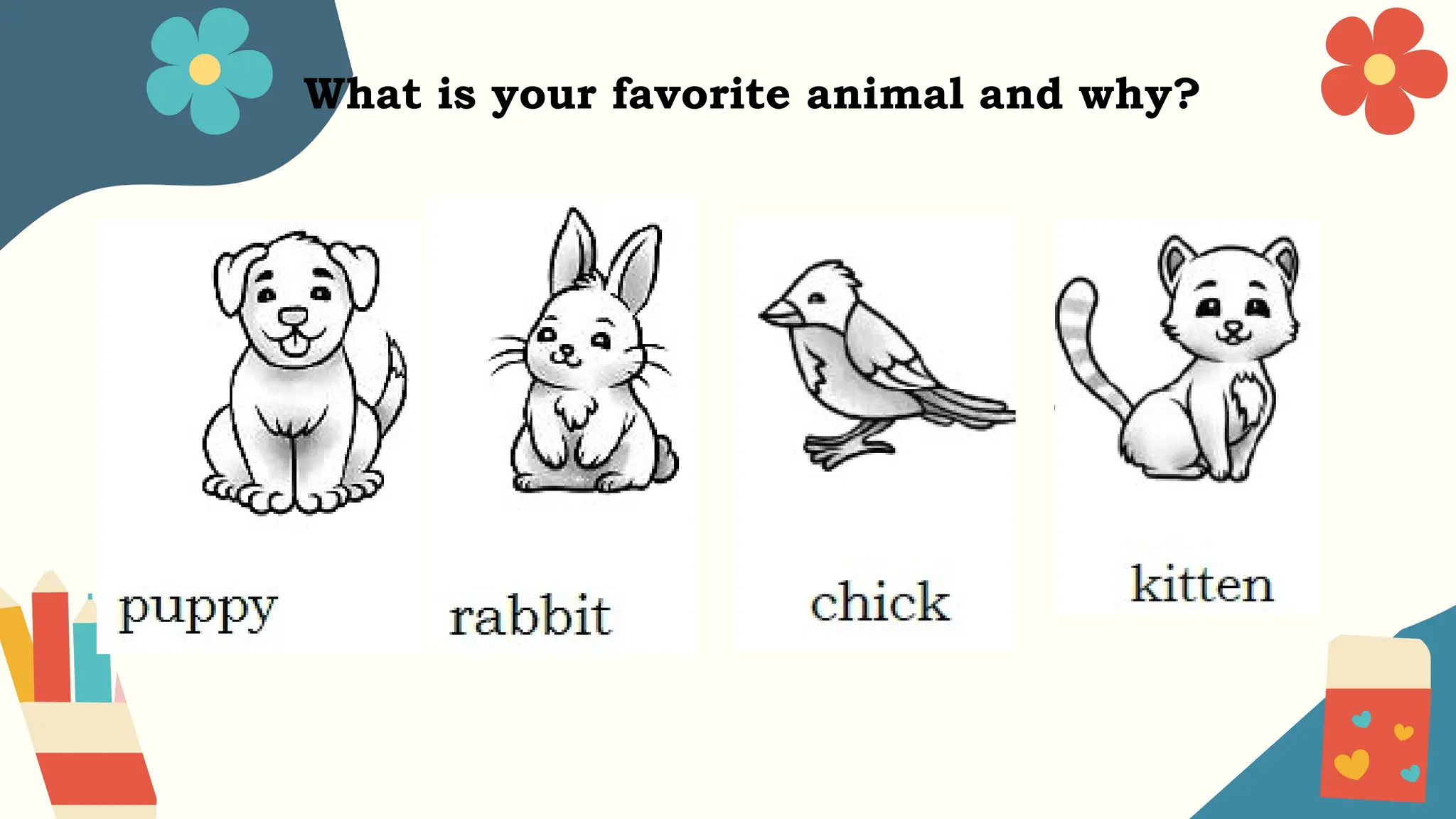
What is your favorite animal and why?
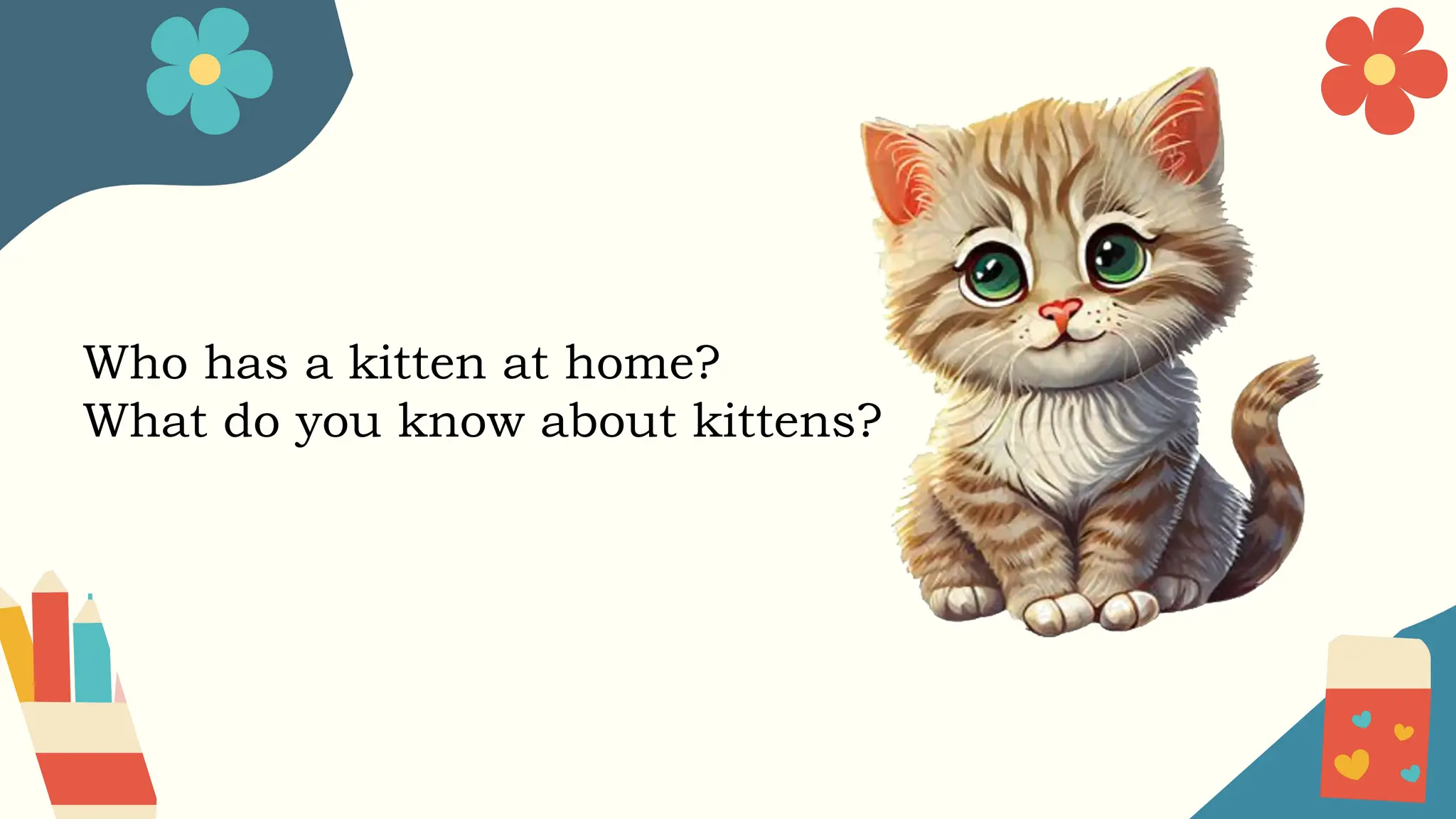
Who has a kitten at home?
What do you know about kittens?
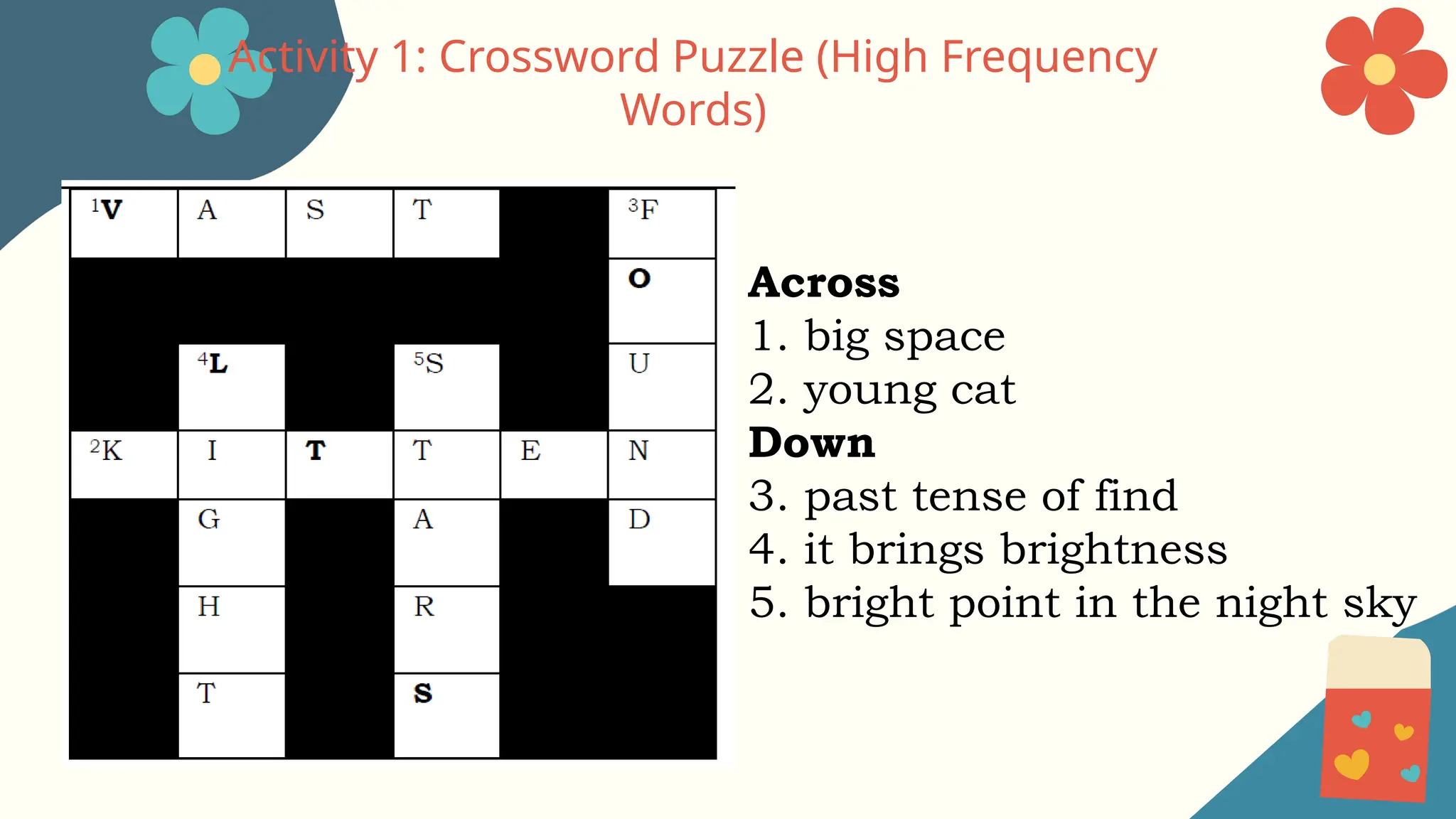
Activity 1: Crossword Puzzle (High Frequency
Words)
Across
1. big space
2. young cat
Down
3. past tense of find
4. it brings brightness
5. bright point in the night sky
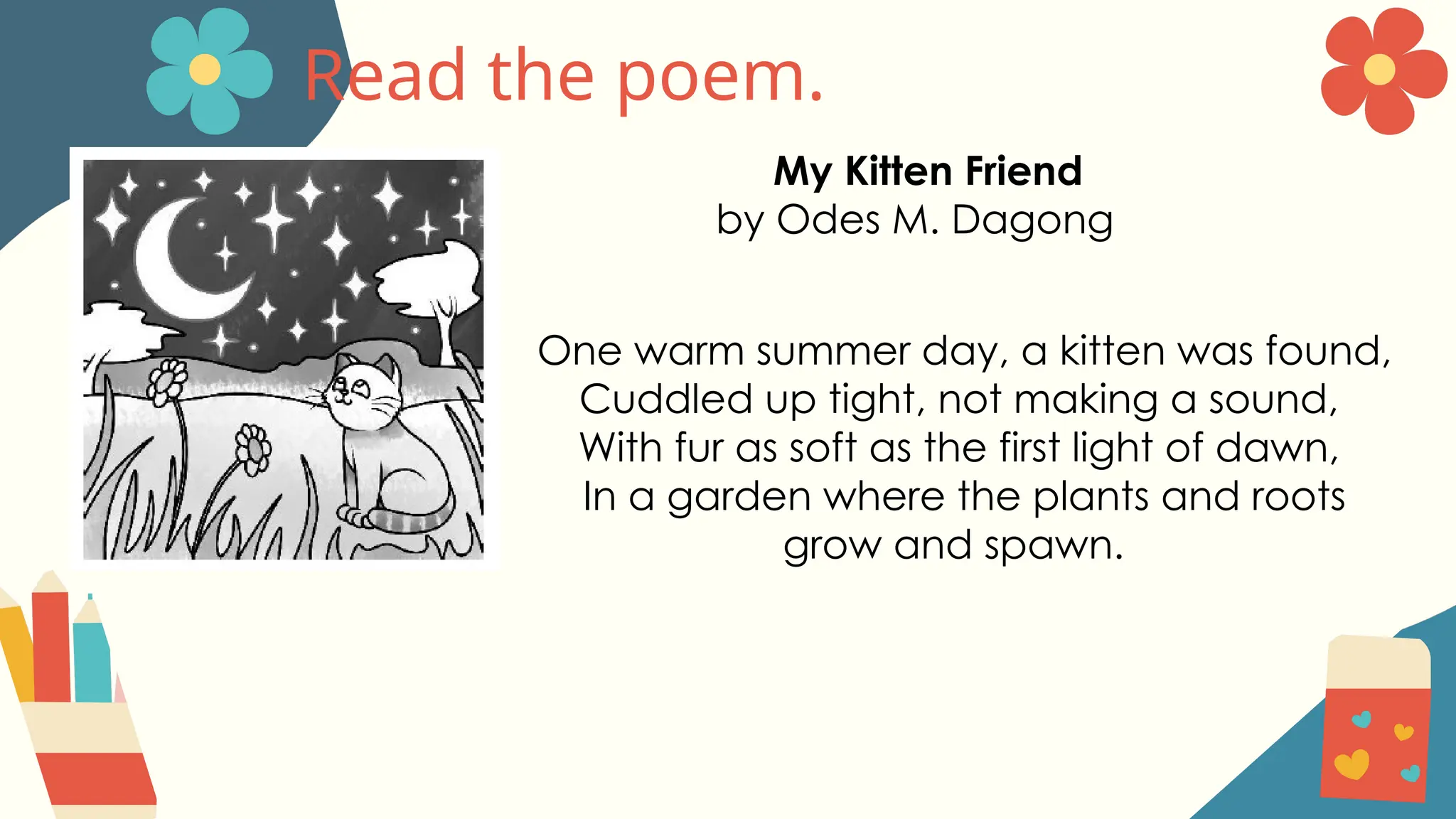
Read the poem.
My Kitten Friend
by Odes M. Dagong
One warm summer day, a kitten was found,
Cuddled up tight, not making a sound,
With fur as soft as the first light of dawn,
In a garden where the plants and roots
grow and spawn.
With a laugh and a purr, the kitten did play,
In the warmth of the sun and the light of the day,
Exploring the stems and the leaves all around,
A world full of wonders waiting to be found.
As the moon rises high, and the stars shall keep,
The kitten goes for a walk, not too far to leap,
Beneath the vast sky, with ten thousand stars to see,
The kitten finds its place, right where it should be.
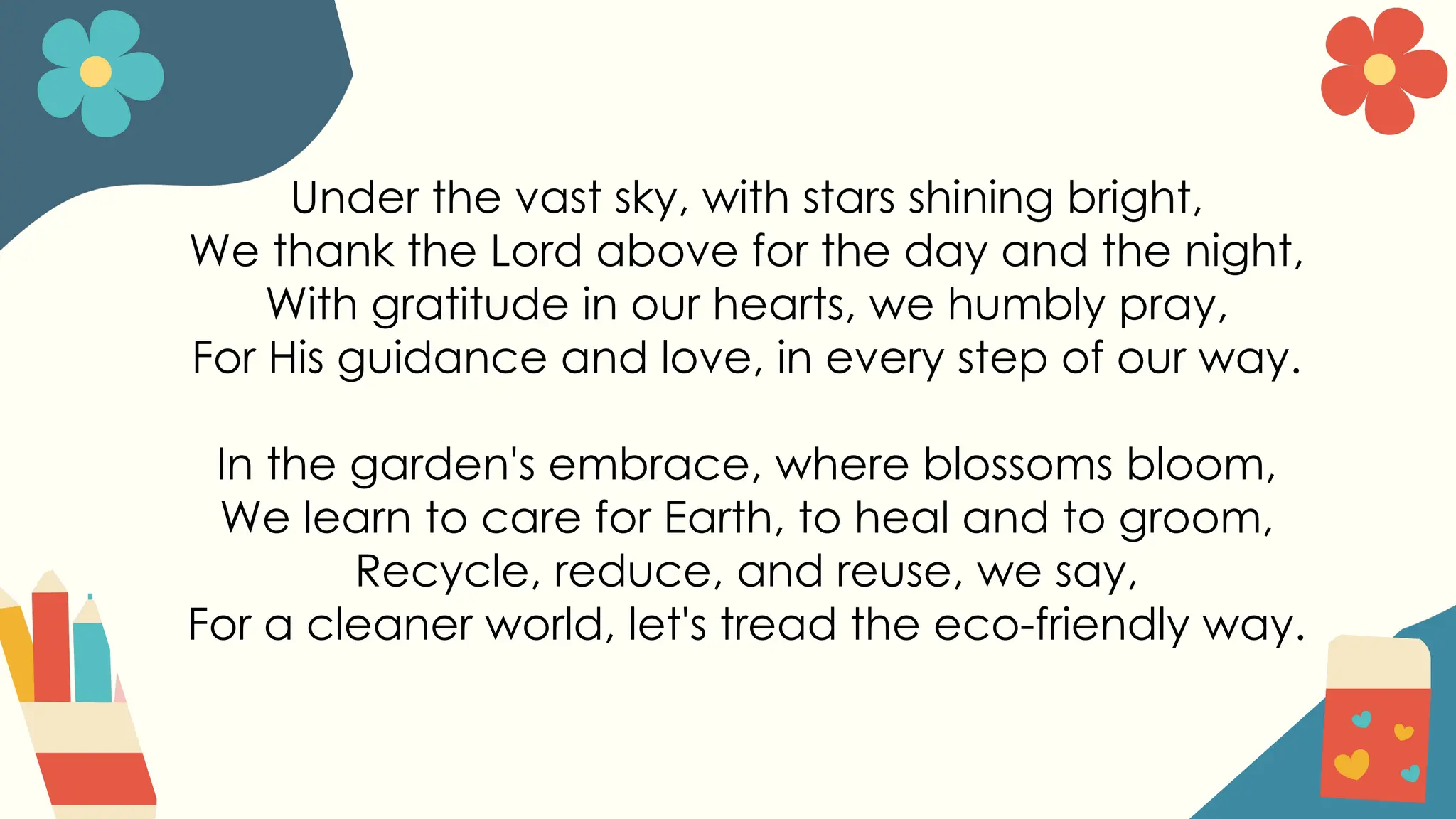
Under the vast sky, with stars shining bright,
We thank the Lord above for the day and the night,
With gratitude in our hearts, we humbly pray,
For His guidance and love, in every step of our way.
In the garden's embrace, where blossoms bloom,
We learn to care for Earth, to heal and to groom,
Recycle, reduce, and reuse, we say,
For a cleaner world, let's tread the eco-friendly way.
Answer the following questions.
1. Who are the characters in the poem?
2. What words describe the kitten? (with soft fur, happy and playful)
3. When and where was the kitten found? (summer, garden)
4. How do the words about the kitten in the poem make you feel?
(happy, excited)
5. What are the main characteristics of the kitten in the poem "My
Kitten Friend"?
6. How do these characteristics affect the overall mood of the poem?
7. How does the setting affect the actions and emotions of the kitten?
8. How do you take care of God’s creations?
9. Why is waste reduction important?
The poem you read includes characters, setting and plot that help you
understand the theme.
Character is a person, animal, or being in a story who
takes part in the events.
Setting is the time and place where the story happens.
Plot is the sequence of events in a story, including the
beginning, middle, and end.
Theme is the central message or lesson the story
conveys.
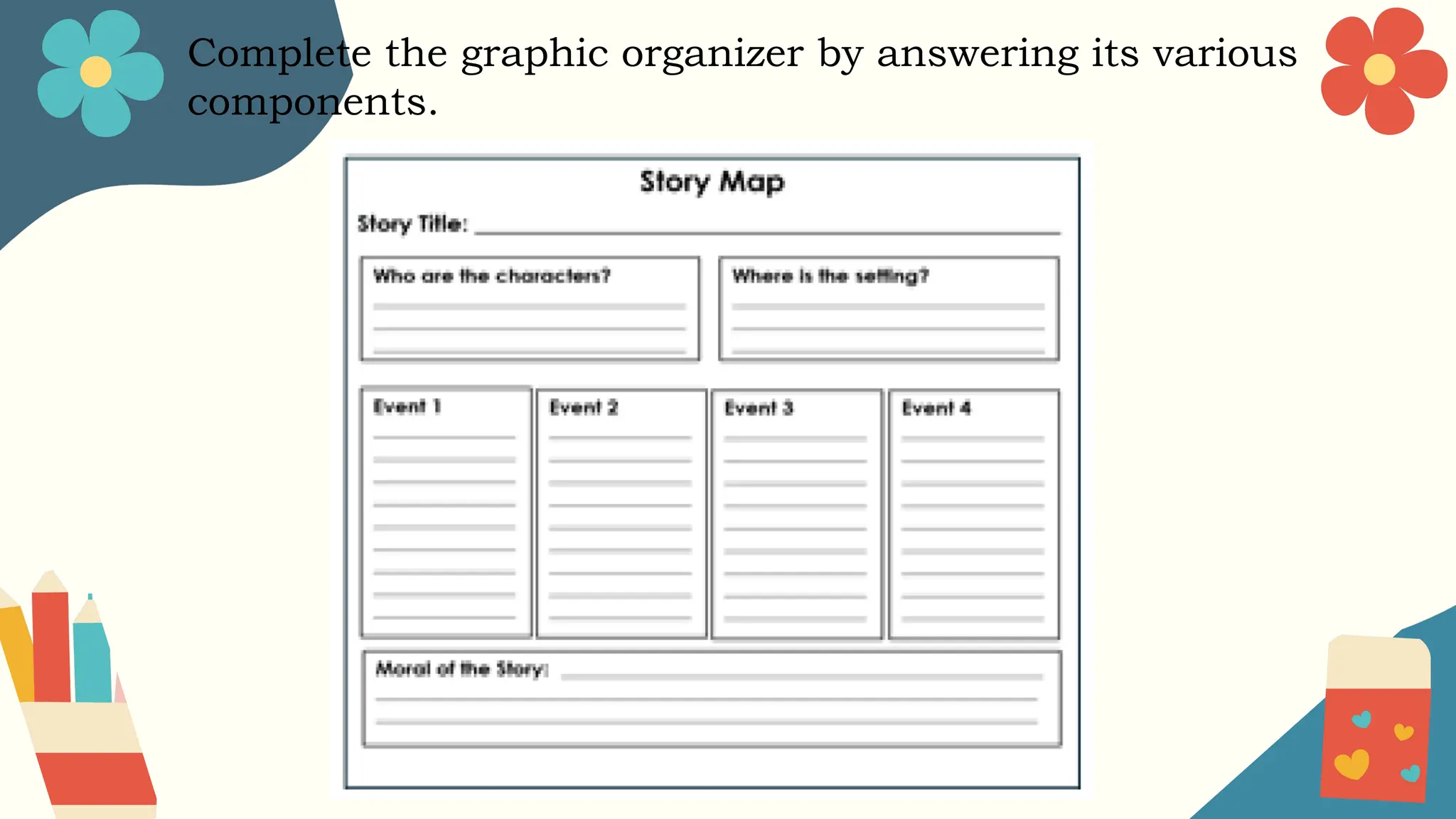
Complete the graphic organizer by answering its various
components.
Story Title: My Kitten Friend
Characters: the kitten and the speaker (the one who found the
kitten)
Setting: summer, garden
Event 1: Kitten is found.
Event 2: Kitten plays.
Event 3: Kitten goes for a walk
Event 4: Kitten finds a place to rest.
Moral of the story: We thank the Lord for His blessings and do
our part to take care of them.
Complete the following statements:
I learned that
________________________________________________
_______________.
I realized that
________________________________________________
_______________.
I promise and I will
__________________________________
_____________________
Evaluation:
Summarize the poem by completing the sentences
using words from the poem.
The kitten was found in a ____________ on a warm
summer day.
It played and explored the ____________ and leaves.
As the moon rose high, the kitten went for a
____________.
Under the vast sky, we thank the ____________
above for the day and the night.
Answer Key:
1. garden
2. stems
3. walk
4. Lord
Assignment:
Draw a simple picture of a kitten and
write two to three sentences
describing your drawing.
Day 2
Learning Competencies:
EN3PWS-I-1 Identify Grade 3 level-appropriate sight words.
EN3VWK-I-2
Use vocabulary referring to:
1. regional themes
EN3CCT-I-3 Express ideas about one’s experiences.
1. regional themes
EN3PWS-I-2 Read words accurately and automatically according
to word patterns (initial, final, medial).
1. VCCV words
EN3VWK-I-6 Read words correctly for meaning (based on word patterns).
EN3VWK-I-7 Write words legibly and correctly (based on word patterns).
Day 2
Learning Objectives:
a. Identify sight words;
b. Use vocabulary referring to regional themes;
c. Express ideas about one’s experiences;
d. Read words accurately and automatically according to
word patterns (initial, final, medial);
e. Read words correctly for meaning based on word
patterns; and
f. Write words legibly and correctly.
Review:
What are important story elements that you should
consider when discussing characters?
Why is identifying the problem and solution in a story
important for readers?
What are the high frequency words that you learned
yesterday?
kitten
stars
vast
light
found
Use them in sentences correctly.
Activity 1: Word Hunt (Sight Words)
Look for the following words in the poem.
goes
keep
grow
shall
laugh
Let us read some words under VCCV or vowel-
consonant-consonant-vowel word pattern.
1. rabbit
2. magnet
3. tennis
4. traffic
5. tablet
6. sunset
Read.
"With a laugh and a purr, the kitten did play,
In the warmth of the sun and the light of the day,
Exploring the stems and the leaves all around,
A world full of wonders waiting to be found."
Comprehension Questions
1. What sounds did the kitten make while
playing?
2. Where did the kitten find warmth and light?
3. What did the kitten explore in its
surroundings?
4. What awaited the kitten in the world it
encountered?
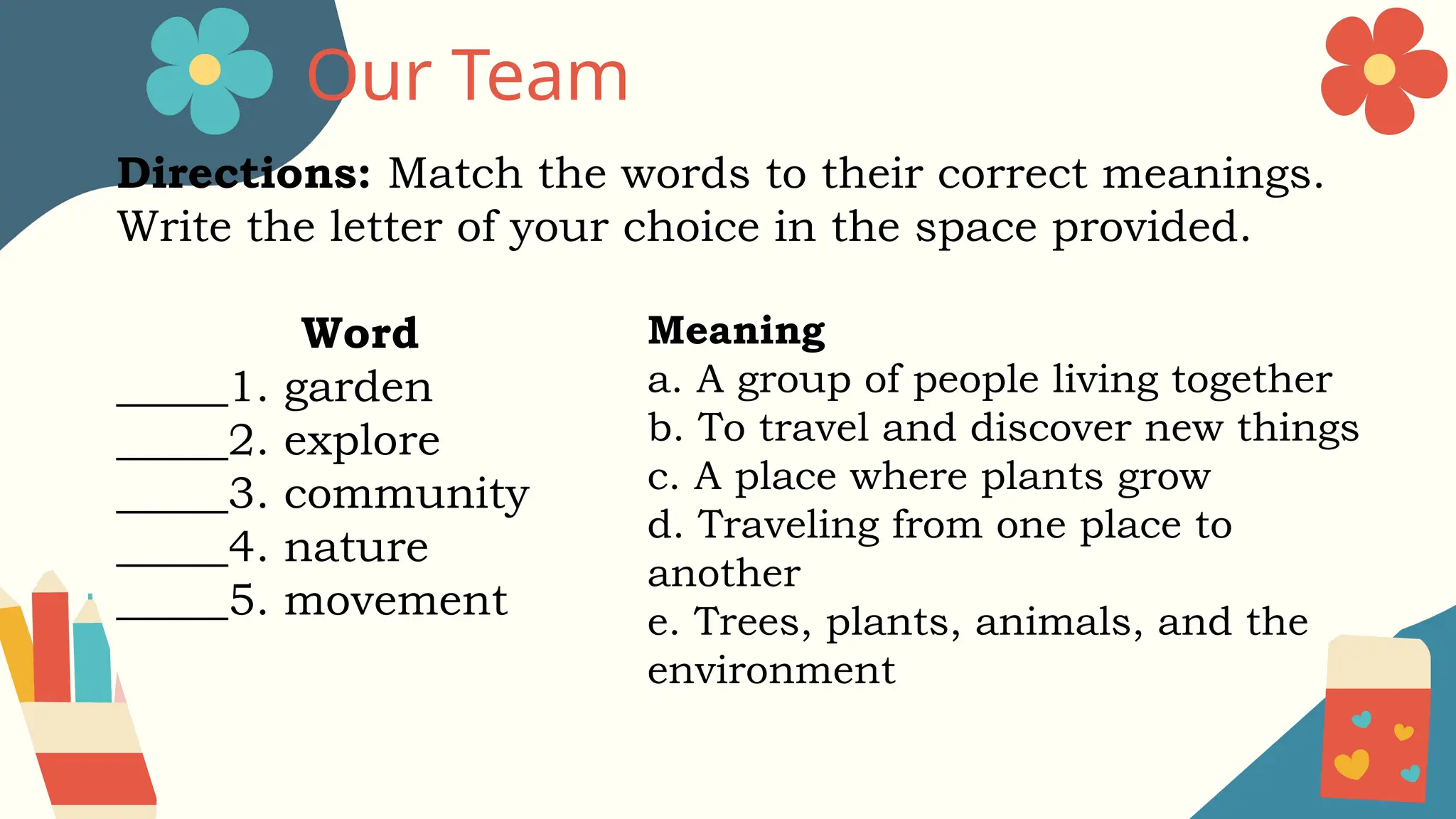
Our Team
Directions: Match the words to their correct meanings.
Write the letter of your choice in the space provided.
Word
_____1. garden
_____2. explore
_____3. community
_____4. nature
_____5. movement
Meaning
a. A group of people living together
b. To travel and discover new things
c. A place where plants grow
d. Traveling from one place to
another
e. Trees, plants, animals, and the
environment
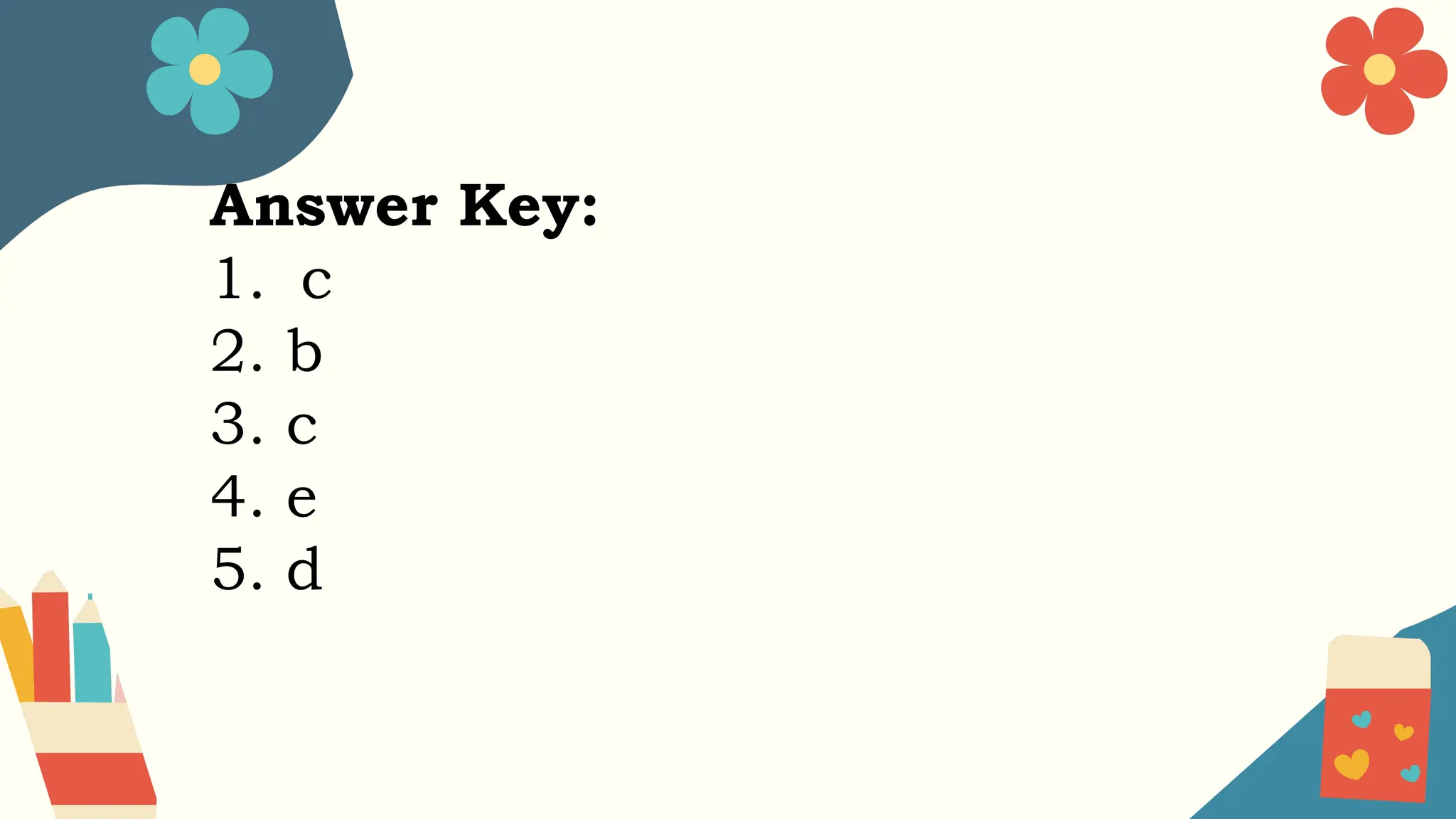
Answer Key:
1. c
2. b
3. c
4. e
5. d
Complete the following statements:
I learned that
________________________________________.
I realized that
________________________________________.
I promise and I will
__________________________________________
Evaluation:
Write sentences using the sight words and regional
themes you found.
Day 3
Learning Competencies:
EN3VWK-I-1 Identify high-frequency words accurately.
EN3CAT-I-2
Comprehend stories.
Note important elements from stories (characters, setting, events).
Sequence at least four to five events.
Identify the problem and solution in stories.
Infer the character’s feelings and traits.
Relate story events to one’s experience.
Identify the cause and effect of events.
Predict possible ending.
Give a summary.
EN3CCT-I-2 Use own words in retelling myths, legends, fables, and narrative poems.
EN3VWK-I-8 Identify roots of high-frequency words (nouns, verbs, and adjectives).
EN3CCT-I-7 Make a summary of narrative text.
Day 3
Learning Objectives:
a. Use high frequency words in complete sentences;
b. Identify the problem and solution in stories;
c. Relate story events to one’s experience;
d. Predict possible ending;
e. Retell myths, legends, fables, and narrative
poems using own words;
f. Identify roots of high-frequency words (nouns,
verbs, and adjectives; and
g. Summarize a narrative text.
Review:
What are the VCCV words you read last time?
rabbit
magnet
tennis
traffic
tablet
sunset
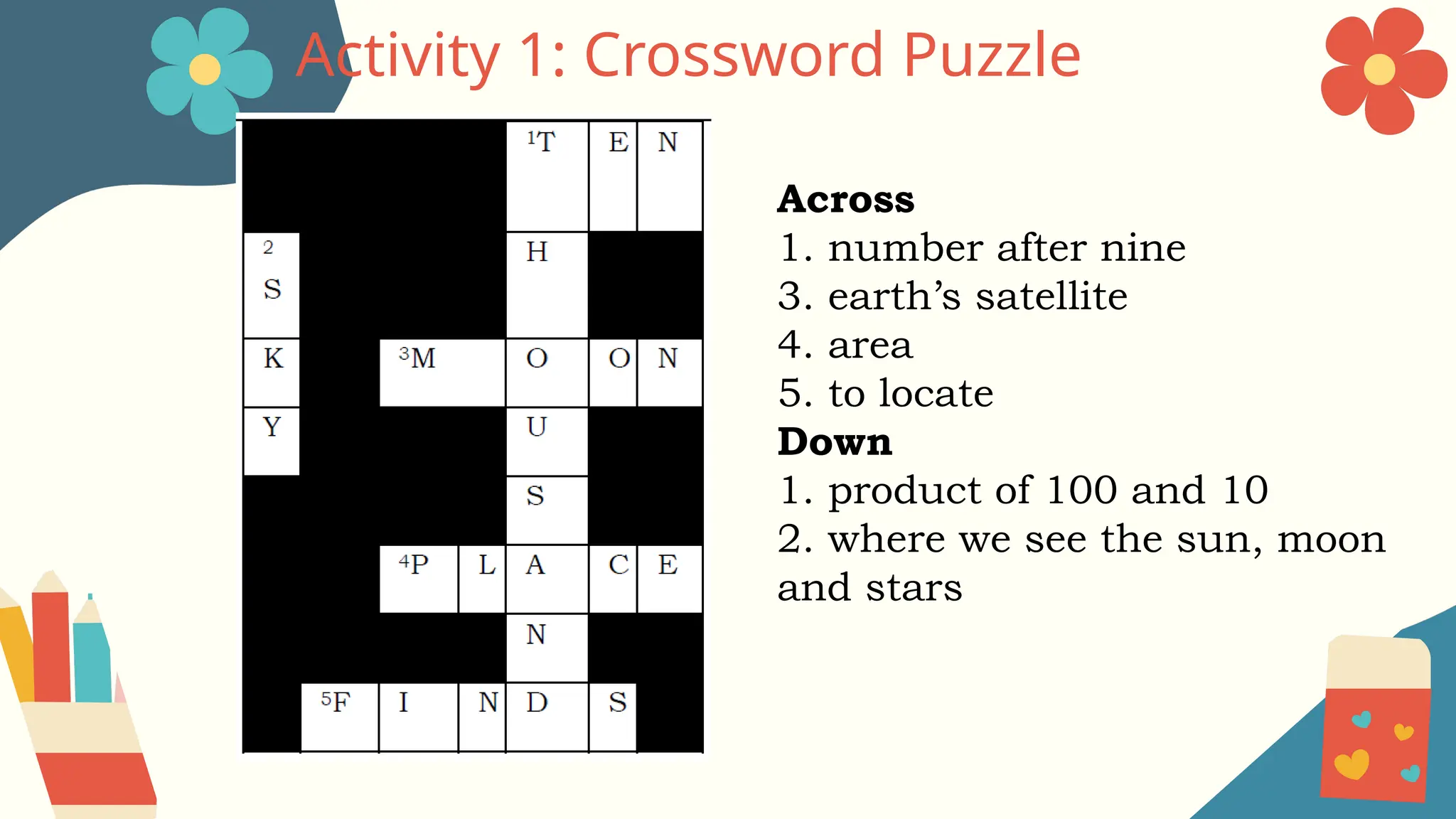
Activity 1: Crossword Puzzle
Across
1. number after nine
3. earth’s satellite
4. area
5. to locate
Down
1. product of 100 and 10
2. where we see the sun, moon
and stars
Let us dive into world of kittens and
poetry by reading the following stanza:
As the moon rises high, and the stars shall keep,
The kitten goes for a walk, not too far to leap,
Beneath the vast sky, with ten thousand stars to see,
The kitten finds its place, right where it should be.
Comprehension Questions
1. What space objects are mentioned in the stanza?
2. Where does the kitten go for a walk?
3. Why does the kitten go for a walk?
4. What might happen to the kitten when she goes for a walk?
5. What can we say about the kitten’s personality?
6. Have you ever explored outside at night? What did you
discover?
The poem "My Kitten Friend" helps us
understand important reading skills by
looking at how events unfold and
connecting them to our own
experiences.
Look at the poem again and study the
following ideas.
Problem: The kitten is exploring and
needs to find a safe place to rest.
Solution: The kitten finds its place
under the vast sky, feeling safe and
content.
Just like the kitten, we also explore new places
and look for comfort, such as finding a cozy spot at
home after a long day.
After reading about the kitten’s adventure, we
can predict that it might rest peacefully under the
stars or return home after exploring.
The kitten explores under the night sky,
surrounded by thousands of stars. After
wandering, it finds a safe place to stay, feeling at
peace in its surroundings.
A. Story Sequencing
Directions: Number the events in the correct order (1-4).
___ The kitten finds its place under the stars.
___ The moon rises, and the stars appear.
___ The kitten walks under the night sky.
___ The kitten explores but stays nearby.
Answer Key:
1 - The moon rises, and the stars appear.
2 - The kitten walks under the night sky.
3 - The kitten explores but stays nearby.
4 - The kitten finds its place under the stars.
B. Predicting the Ending
Directions: What do you think will happen next?
The kitten finds a cozy spot and ________.
a) falls asleep peacefully
b) climbs a tall tree and gets stuck
c) c) runs away into the night
Answer Key: a
Complete the following statements:
I learned that
__________________________________________
_________.
I realized that
_____________________________________.
I promise and I will
___________________________
_____________________
Evaluation:
Relate the Story to Your Own Experience
Have you ever been outside at night and looked
at the stars? How did you feel?
Day 4
Learning Competencies:
EN3PWS-I-1 Identify Grade 3 level-appropriate sight words.
EN3PWS-I-2 Read words accurately and automatically according
to word patterns (initial, final, medial).
1. VCCV words
EN3VWK-I-6 Read words correctly for meaning (based on word
patterns).
EN3VWK-I-7 Write words legibly and correctly (based on word
patterns).
EN3VWK-I-8 Identify roots of high frequency words (nouns, verbs,
and adjectives).
Day 4
Learning Objectives:
a. Identify sight words.
b. Read words accurately and automatically according to
word patterns (initial, final, and medial).
c. Read words correctly for meaning based on word
patterns.
d. Write words legibly and correctly based on word
patterns.
e. Identify roots of high- frequency words (nouns, verbs,
and adjectives).
Review:
In the poem you learned, what was the
problem of the kitten and how was it solved?
How did the story in the poem you read
develop? What happened first, second and so
on?
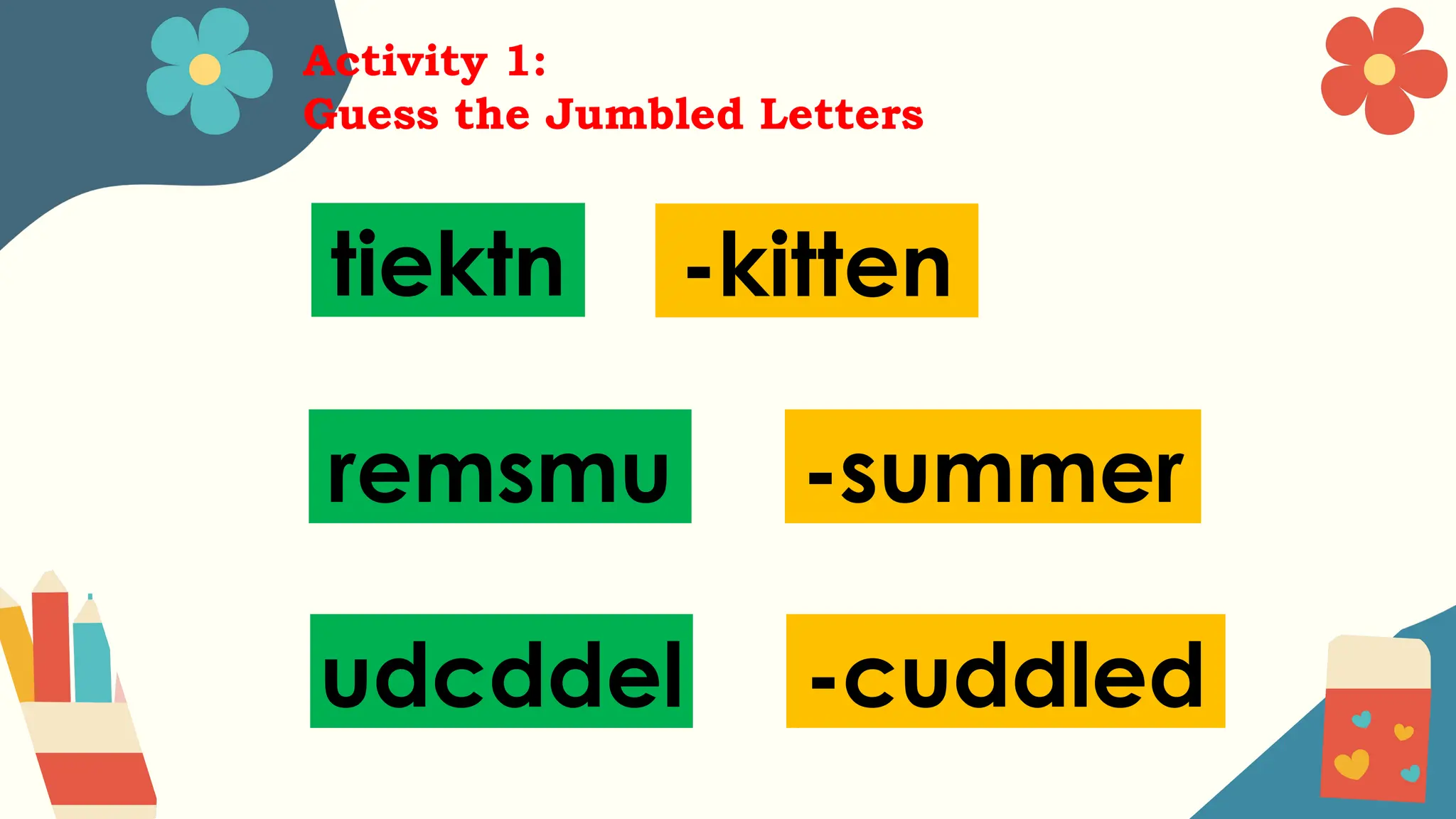
Activity 1:
Guess the Jumbled Letters
tiektn -kitten
remsmu -summer
udcddel -cuddled
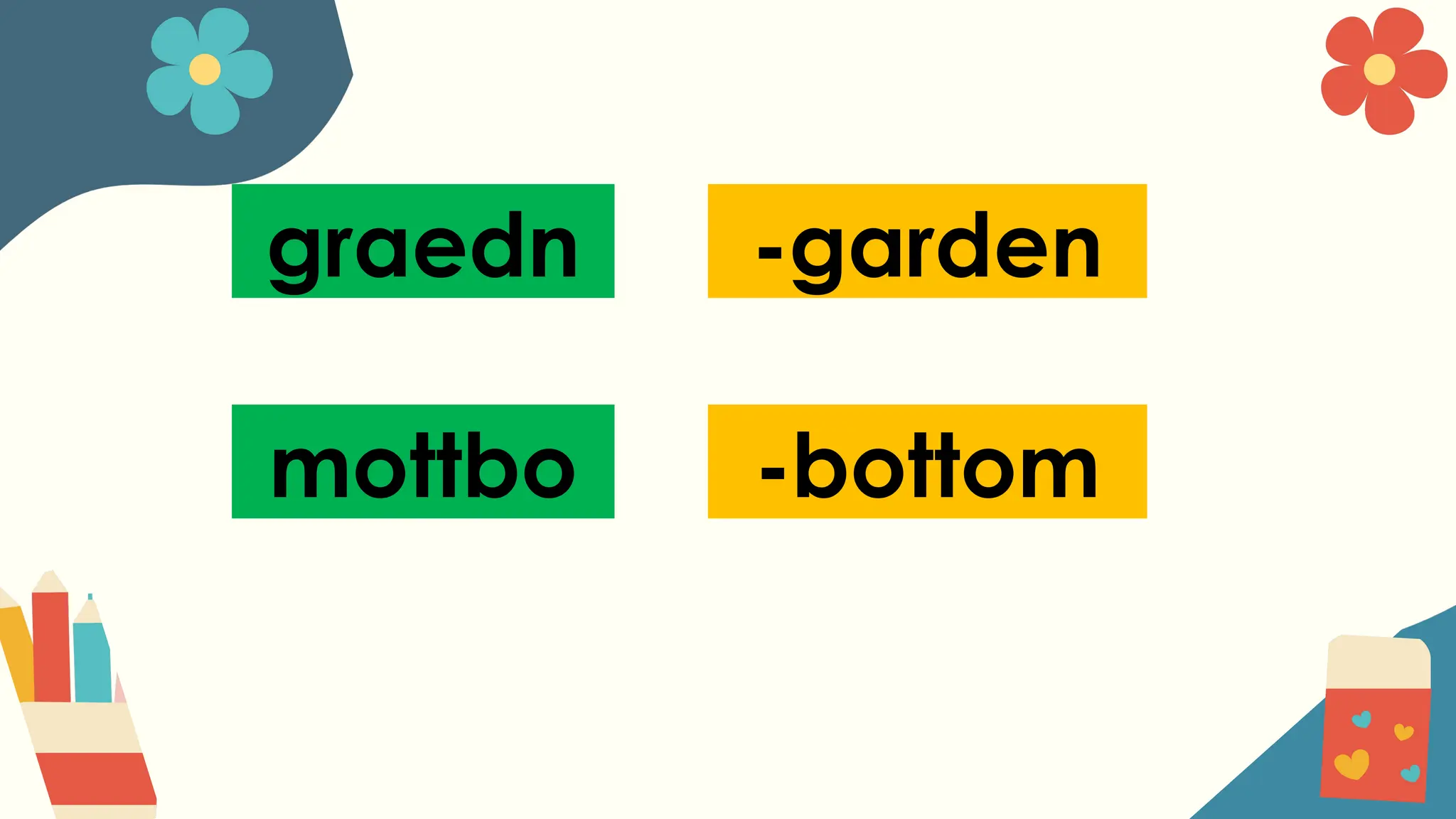
graedn -garden
mottbo -bottom
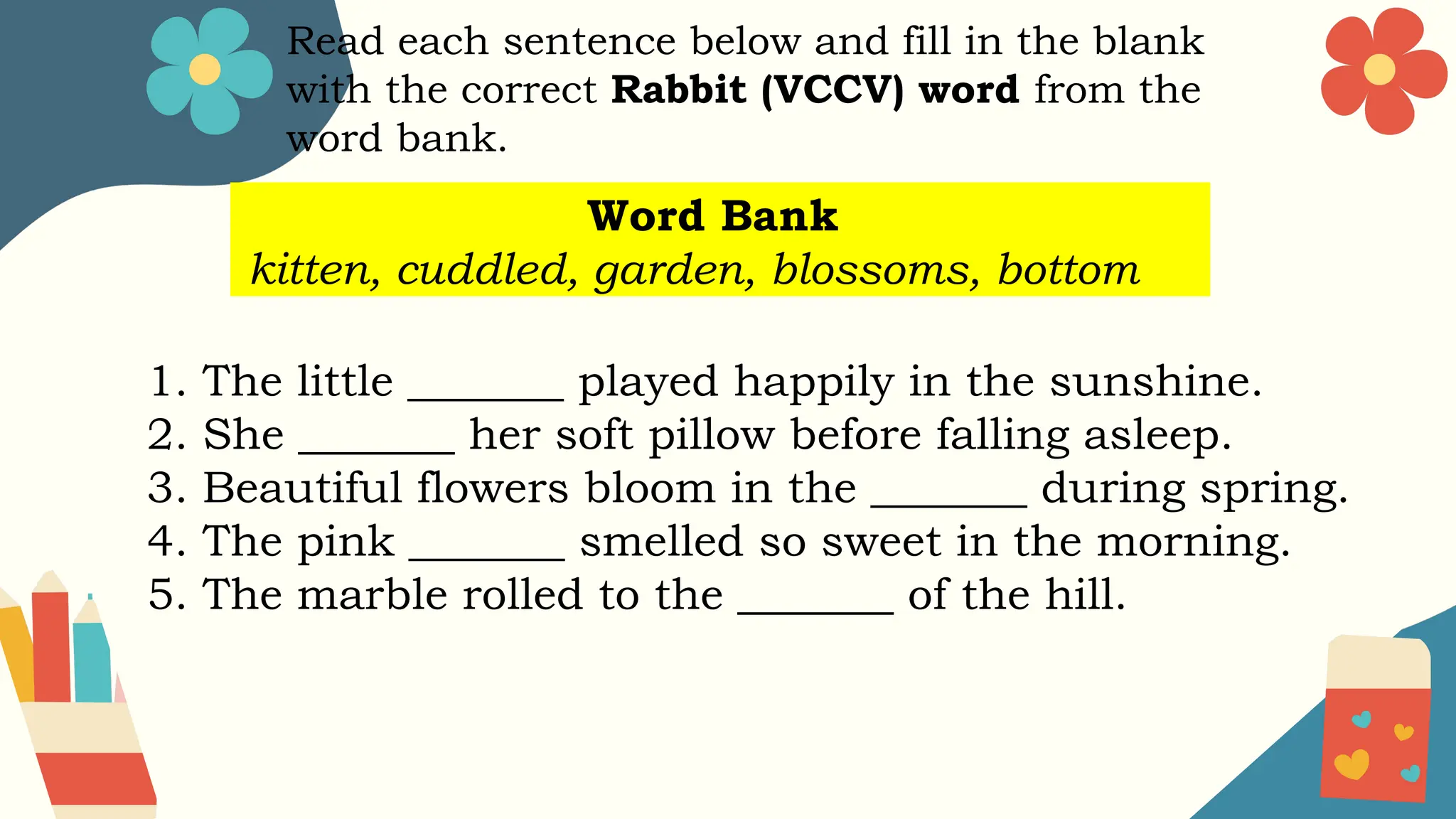
Read each sentence below and fill in the blank
with the correct Rabbit (VCCV) word from the
word bank.
Word Bank
kitten, cuddled, garden, blossoms, bottom
1. The little _______ played happily in the sunshine.
2. She _______ her soft pillow before falling asleep.
3. Beautiful flowers bloom in the _______ during spring.
4. The pink _______ smelled so sweet in the morning.
5. The marble rolled to the _______ of the hill.
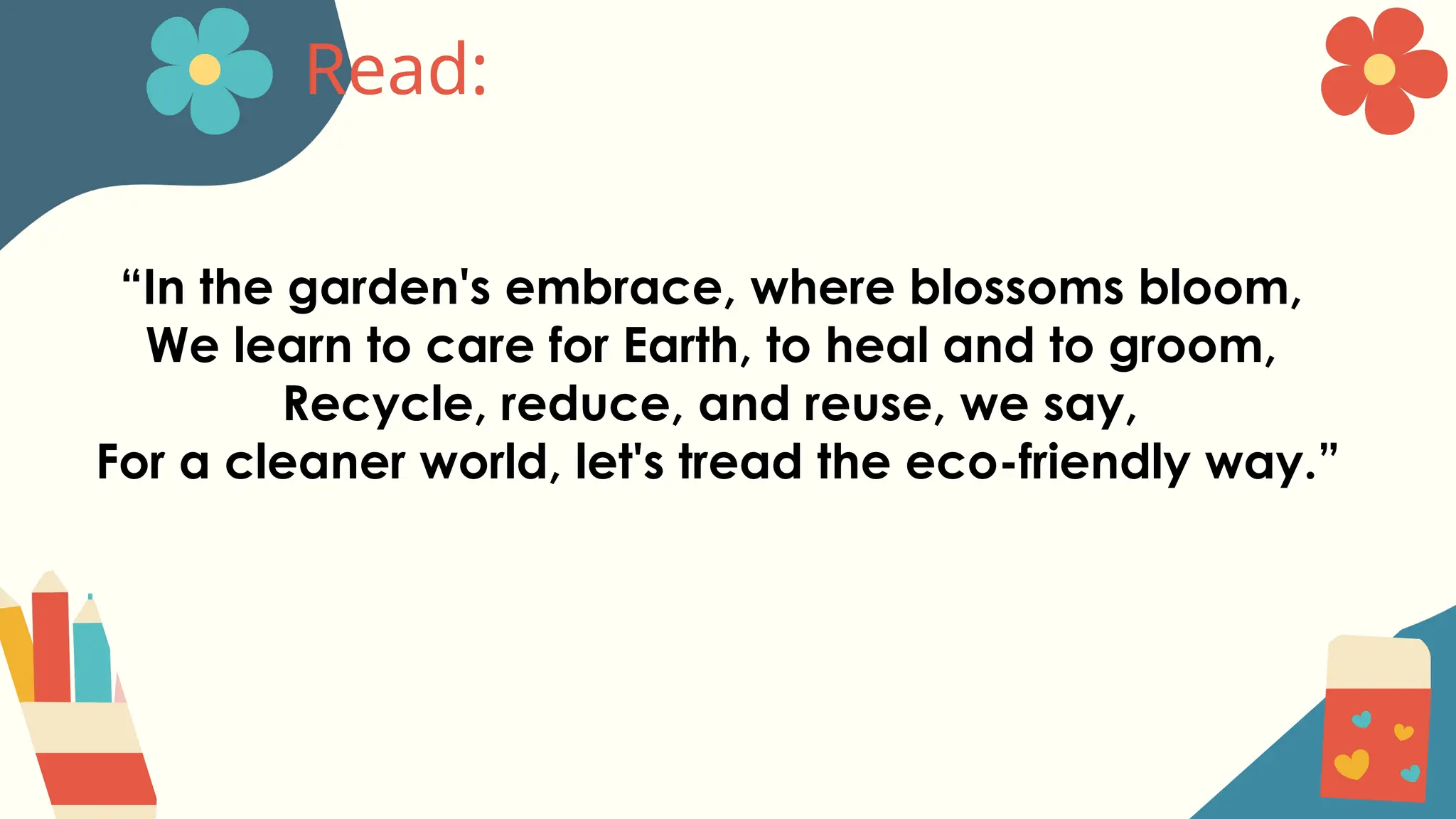
Read:
“In the garden's embrace, where blossoms bloom,
We learn to care for Earth, to heal and to groom,
Recycle, reduce, and reuse, we say,
For a cleaner world, let's tread the eco-friendly way.”
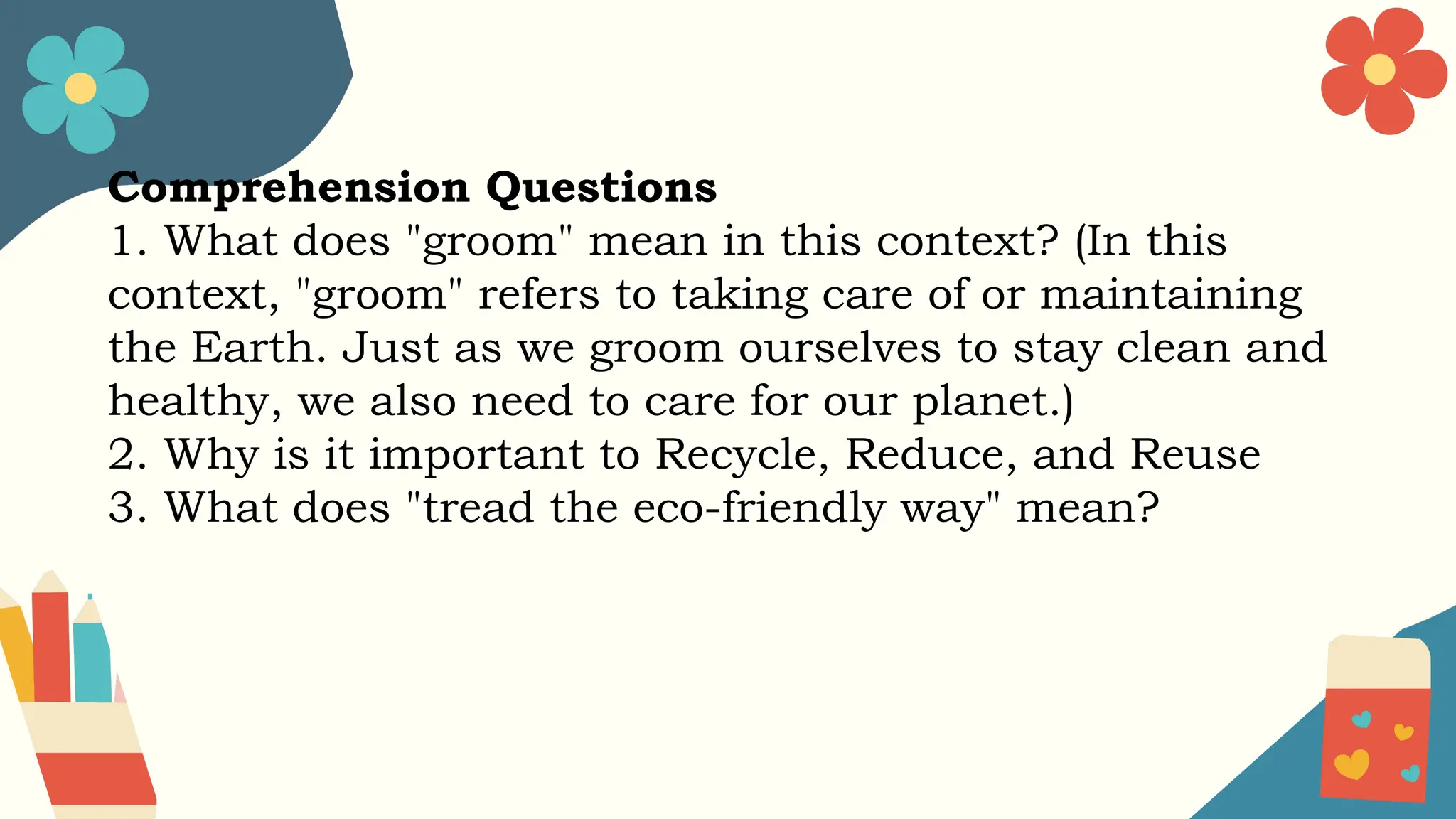
Comprehension Questions
1. What does "groom" mean in this context? (In this
context, "groom" refers to taking care of or maintaining
the Earth. Just as we groom ourselves to stay clean and
healthy, we also need to care for our planet.)
2. Why is it important to Recycle, Reduce, and Reuse
3. What does "tread the eco-friendly way" mean?
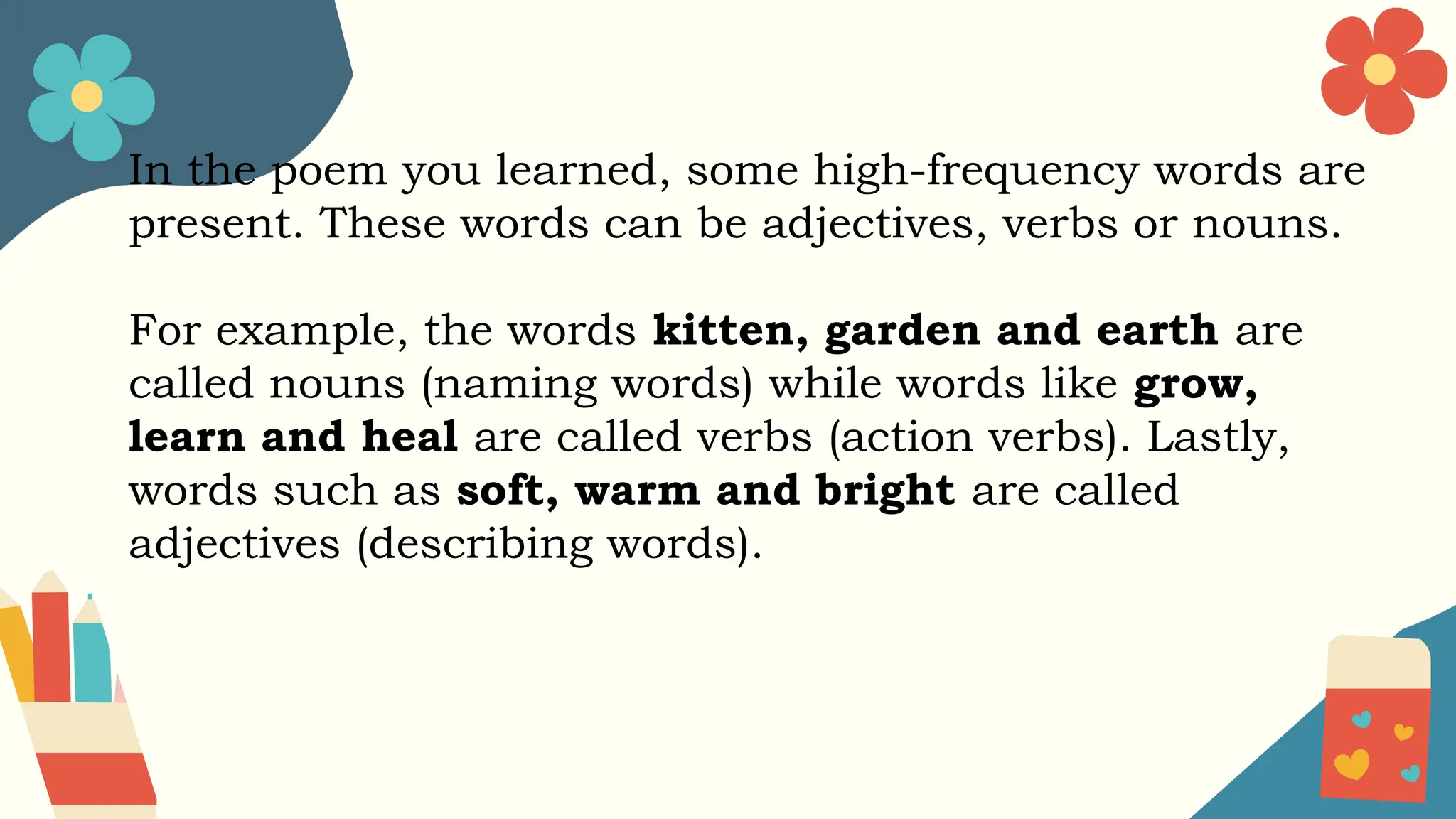
In the poem you learned, some high-frequency words are
present. These words can be adjectives, verbs or nouns.
For example, the words kitten, garden and earth are
called nouns (naming words) while words like grow,
learn and heal are called verbs (action verbs). Lastly,
words such as soft, warm and bright are called
adjectives (describing words).
Aside from the given high frequency words, what else
can you identify from the poem? Find three more
examples for each.
Nouns:
1.
2.
3.
Verbs:
1.
2.
3.
Adjectives:
1.
2.
3.
Read each statement carefully. Write True if the statement is
correct and False if it is not.
___1. The poem talks about taking care of the Earth.
___2. The poem encourages wasting resources instead of
recycling.
___3. "Blossoms bloom" in the garden means flowers are
growing.
___4. The phrase "Recycle, reduce, and reuse" suggests ways to
protect the environment.
___5. The poem teaches us to ignore nature and focus only on
ourselves.
Answer Key:
1. True
2. False
3. True
4. True
5. False
Complete the following statements:
I learned that ________________________________________.
I realized that ________________________________________.
I promise and I will
__________________________________________
Share Your Thought and Ideas
As a human, what can you do to help take care
of the Earth?
Share three ways to save the Earth.
Evaluation::
Assignment:
In your notebook, write the VCCV words
legibly and correctly that can be found in
the poem. After writing, practice reading
them correctly.
Thank
You

Q1 English3 Week5 PPT-MATATAG@edumaymay.pptx

  • 1.
    English 3 Quarter IWeek 5 @Edu Maymay
  • 2.
    Day 1 Learning Competencies: EN3VWK-I-1Identify high-frequency words accurately. EN3CAT-I-2 Comprehend stories. Note important elements from stories (characters, setting, events). Sequence at least four to five events. Identify the problem and solution in stories. Infer the character’s feelings and traits. Relate story events to one’s experience. Identify the cause and effect of events. Predict possible ending. Give a summary. EN3CCT-I-2 Use own words in retelling myths, legends, fables, and narrative poems. EN3CCT-I-7 Make a summary of narrative text.
  • 3.
    Day 1 Learning Objectives: a.Identify high frequency words accurately; b. Note important elements from stories (characters, setting, events); c. Identify the problem and solution in stories; d. Relate story events to one’s experience; e. Retell myths, legends, fables, and narrative poems using your own words; and f. Summarize a narrative text.
  • 4.
    Review: Read the sentence.Identify the subject and the verb used in the sentence. I eat breakfast every day.
  • 5.
    What makes ita simple sentence? The given sentence is a simple sentence because it has a single independent clause with a subject (I), a verb (eat), and a complete thought.
  • 6.
    Now, how doyou make an imperative sentence to make a request? When writing imperative sentences to make a request, start with a polite expression (PE) like "please," followed by a verb (V) in its base form, then the indirect object. Example: (PE) Please (V) pass me the salt.
  • 7.
    How and whendo you use correct capitalization and punctuation for simple sentences? The first word in a sentence should always be capitalized, and the sentence should end with a punctuation mark.
  • 8.
    What is yourfavorite animal and why?
  • 9.
    Who has akitten at home? What do you know about kittens?
  • 10.
    Activity 1: CrosswordPuzzle (High Frequency Words) Across 1. big space 2. young cat Down 3. past tense of find 4. it brings brightness 5. bright point in the night sky
  • 11.
    Read the poem. MyKitten Friend by Odes M. Dagong One warm summer day, a kitten was found, Cuddled up tight, not making a sound, With fur as soft as the first light of dawn, In a garden where the plants and roots grow and spawn.
  • 12.
    With a laughand a purr, the kitten did play, In the warmth of the sun and the light of the day, Exploring the stems and the leaves all around, A world full of wonders waiting to be found. As the moon rises high, and the stars shall keep, The kitten goes for a walk, not too far to leap, Beneath the vast sky, with ten thousand stars to see, The kitten finds its place, right where it should be.
  • 13.
    Under the vastsky, with stars shining bright, We thank the Lord above for the day and the night, With gratitude in our hearts, we humbly pray, For His guidance and love, in every step of our way. In the garden's embrace, where blossoms bloom, We learn to care for Earth, to heal and to groom, Recycle, reduce, and reuse, we say, For a cleaner world, let's tread the eco-friendly way.
  • 14.
    Answer the followingquestions. 1. Who are the characters in the poem? 2. What words describe the kitten? (with soft fur, happy and playful) 3. When and where was the kitten found? (summer, garden) 4. How do the words about the kitten in the poem make you feel? (happy, excited) 5. What are the main characteristics of the kitten in the poem "My Kitten Friend"? 6. How do these characteristics affect the overall mood of the poem? 7. How does the setting affect the actions and emotions of the kitten? 8. How do you take care of God’s creations? 9. Why is waste reduction important?
  • 15.
    The poem youread includes characters, setting and plot that help you understand the theme. Character is a person, animal, or being in a story who takes part in the events. Setting is the time and place where the story happens. Plot is the sequence of events in a story, including the beginning, middle, and end. Theme is the central message or lesson the story conveys.
  • 16.
    Complete the graphicorganizer by answering its various components.
  • 17.
    Story Title: MyKitten Friend Characters: the kitten and the speaker (the one who found the kitten) Setting: summer, garden Event 1: Kitten is found. Event 2: Kitten plays. Event 3: Kitten goes for a walk Event 4: Kitten finds a place to rest. Moral of the story: We thank the Lord for His blessings and do our part to take care of them.
  • 18.
    Complete the followingstatements: I learned that ________________________________________________ _______________. I realized that ________________________________________________ _______________. I promise and I will __________________________________ _____________________
  • 19.
    Evaluation: Summarize the poemby completing the sentences using words from the poem. The kitten was found in a ____________ on a warm summer day. It played and explored the ____________ and leaves. As the moon rose high, the kitten went for a ____________. Under the vast sky, we thank the ____________ above for the day and the night.
  • 20.
    Answer Key: 1. garden 2.stems 3. walk 4. Lord
  • 21.
    Assignment: Draw a simplepicture of a kitten and write two to three sentences describing your drawing.
  • 22.
    Day 2 Learning Competencies: EN3PWS-I-1Identify Grade 3 level-appropriate sight words. EN3VWK-I-2 Use vocabulary referring to: 1. regional themes EN3CCT-I-3 Express ideas about one’s experiences. 1. regional themes EN3PWS-I-2 Read words accurately and automatically according to word patterns (initial, final, medial). 1. VCCV words EN3VWK-I-6 Read words correctly for meaning (based on word patterns). EN3VWK-I-7 Write words legibly and correctly (based on word patterns).
  • 23.
    Day 2 Learning Objectives: a.Identify sight words; b. Use vocabulary referring to regional themes; c. Express ideas about one’s experiences; d. Read words accurately and automatically according to word patterns (initial, final, medial); e. Read words correctly for meaning based on word patterns; and f. Write words legibly and correctly.
  • 24.
    Review: What are importantstory elements that you should consider when discussing characters? Why is identifying the problem and solution in a story important for readers?
  • 25.
    What are thehigh frequency words that you learned yesterday? kitten stars vast light found Use them in sentences correctly.
  • 26.
    Activity 1: WordHunt (Sight Words) Look for the following words in the poem. goes keep grow shall laugh
  • 27.
    Let us readsome words under VCCV or vowel- consonant-consonant-vowel word pattern. 1. rabbit 2. magnet 3. tennis 4. traffic 5. tablet 6. sunset
  • 28.
    Read. "With a laughand a purr, the kitten did play, In the warmth of the sun and the light of the day, Exploring the stems and the leaves all around, A world full of wonders waiting to be found."
  • 29.
    Comprehension Questions 1. Whatsounds did the kitten make while playing? 2. Where did the kitten find warmth and light? 3. What did the kitten explore in its surroundings? 4. What awaited the kitten in the world it encountered?
  • 30.
    Our Team Directions: Matchthe words to their correct meanings. Write the letter of your choice in the space provided. Word _____1. garden _____2. explore _____3. community _____4. nature _____5. movement Meaning a. A group of people living together b. To travel and discover new things c. A place where plants grow d. Traveling from one place to another e. Trees, plants, animals, and the environment
  • 31.
    Answer Key: 1. c 2.b 3. c 4. e 5. d
  • 32.
    Complete the followingstatements: I learned that ________________________________________. I realized that ________________________________________. I promise and I will __________________________________________
  • 33.
    Evaluation: Write sentences usingthe sight words and regional themes you found.
  • 34.
    Day 3 Learning Competencies: EN3VWK-I-1Identify high-frequency words accurately. EN3CAT-I-2 Comprehend stories. Note important elements from stories (characters, setting, events). Sequence at least four to five events. Identify the problem and solution in stories. Infer the character’s feelings and traits. Relate story events to one’s experience. Identify the cause and effect of events. Predict possible ending. Give a summary. EN3CCT-I-2 Use own words in retelling myths, legends, fables, and narrative poems. EN3VWK-I-8 Identify roots of high-frequency words (nouns, verbs, and adjectives). EN3CCT-I-7 Make a summary of narrative text.
  • 35.
    Day 3 Learning Objectives: a.Use high frequency words in complete sentences; b. Identify the problem and solution in stories; c. Relate story events to one’s experience; d. Predict possible ending; e. Retell myths, legends, fables, and narrative poems using own words; f. Identify roots of high-frequency words (nouns, verbs, and adjectives; and g. Summarize a narrative text.
  • 36.
    Review: What are theVCCV words you read last time? rabbit magnet tennis traffic tablet sunset
  • 37.
    Activity 1: CrosswordPuzzle Across 1. number after nine 3. earth’s satellite 4. area 5. to locate Down 1. product of 100 and 10 2. where we see the sun, moon and stars
  • 38.
    Let us diveinto world of kittens and poetry by reading the following stanza: As the moon rises high, and the stars shall keep, The kitten goes for a walk, not too far to leap, Beneath the vast sky, with ten thousand stars to see, The kitten finds its place, right where it should be.
  • 39.
    Comprehension Questions 1. Whatspace objects are mentioned in the stanza? 2. Where does the kitten go for a walk? 3. Why does the kitten go for a walk? 4. What might happen to the kitten when she goes for a walk? 5. What can we say about the kitten’s personality? 6. Have you ever explored outside at night? What did you discover?
  • 40.
    The poem "MyKitten Friend" helps us understand important reading skills by looking at how events unfold and connecting them to our own experiences. Look at the poem again and study the following ideas.
  • 41.
    Problem: The kittenis exploring and needs to find a safe place to rest. Solution: The kitten finds its place under the vast sky, feeling safe and content.
  • 42.
    Just like thekitten, we also explore new places and look for comfort, such as finding a cozy spot at home after a long day. After reading about the kitten’s adventure, we can predict that it might rest peacefully under the stars or return home after exploring. The kitten explores under the night sky, surrounded by thousands of stars. After wandering, it finds a safe place to stay, feeling at peace in its surroundings.
  • 43.
    A. Story Sequencing Directions:Number the events in the correct order (1-4). ___ The kitten finds its place under the stars. ___ The moon rises, and the stars appear. ___ The kitten walks under the night sky. ___ The kitten explores but stays nearby.
  • 44.
    Answer Key: 1 -The moon rises, and the stars appear. 2 - The kitten walks under the night sky. 3 - The kitten explores but stays nearby. 4 - The kitten finds its place under the stars.
  • 45.
    B. Predicting theEnding Directions: What do you think will happen next? The kitten finds a cozy spot and ________. a) falls asleep peacefully b) climbs a tall tree and gets stuck c) c) runs away into the night Answer Key: a
  • 46.
    Complete the followingstatements: I learned that __________________________________________ _________. I realized that _____________________________________. I promise and I will ___________________________ _____________________
  • 47.
    Evaluation: Relate the Storyto Your Own Experience Have you ever been outside at night and looked at the stars? How did you feel?
  • 48.
    Day 4 Learning Competencies: EN3PWS-I-1Identify Grade 3 level-appropriate sight words. EN3PWS-I-2 Read words accurately and automatically according to word patterns (initial, final, medial). 1. VCCV words EN3VWK-I-6 Read words correctly for meaning (based on word patterns). EN3VWK-I-7 Write words legibly and correctly (based on word patterns). EN3VWK-I-8 Identify roots of high frequency words (nouns, verbs, and adjectives).
  • 49.
    Day 4 Learning Objectives: a.Identify sight words. b. Read words accurately and automatically according to word patterns (initial, final, and medial). c. Read words correctly for meaning based on word patterns. d. Write words legibly and correctly based on word patterns. e. Identify roots of high- frequency words (nouns, verbs, and adjectives).
  • 50.
    Review: In the poemyou learned, what was the problem of the kitten and how was it solved? How did the story in the poem you read develop? What happened first, second and so on?
  • 51.
    Activity 1: Guess theJumbled Letters tiektn -kitten remsmu -summer udcddel -cuddled
  • 52.
  • 53.
    Read each sentencebelow and fill in the blank with the correct Rabbit (VCCV) word from the word bank. Word Bank kitten, cuddled, garden, blossoms, bottom 1. The little _______ played happily in the sunshine. 2. She _______ her soft pillow before falling asleep. 3. Beautiful flowers bloom in the _______ during spring. 4. The pink _______ smelled so sweet in the morning. 5. The marble rolled to the _______ of the hill.
  • 54.
    Read: “In the garden'sembrace, where blossoms bloom, We learn to care for Earth, to heal and to groom, Recycle, reduce, and reuse, we say, For a cleaner world, let's tread the eco-friendly way.”
  • 55.
    Comprehension Questions 1. Whatdoes "groom" mean in this context? (In this context, "groom" refers to taking care of or maintaining the Earth. Just as we groom ourselves to stay clean and healthy, we also need to care for our planet.) 2. Why is it important to Recycle, Reduce, and Reuse 3. What does "tread the eco-friendly way" mean?
  • 56.
    In the poemyou learned, some high-frequency words are present. These words can be adjectives, verbs or nouns. For example, the words kitten, garden and earth are called nouns (naming words) while words like grow, learn and heal are called verbs (action verbs). Lastly, words such as soft, warm and bright are called adjectives (describing words).
  • 57.
    Aside from thegiven high frequency words, what else can you identify from the poem? Find three more examples for each. Nouns: 1. 2. 3. Verbs: 1. 2. 3. Adjectives: 1. 2. 3.
  • 58.
    Read each statementcarefully. Write True if the statement is correct and False if it is not. ___1. The poem talks about taking care of the Earth. ___2. The poem encourages wasting resources instead of recycling. ___3. "Blossoms bloom" in the garden means flowers are growing. ___4. The phrase "Recycle, reduce, and reuse" suggests ways to protect the environment. ___5. The poem teaches us to ignore nature and focus only on ourselves.
  • 59.
    Answer Key: 1. True 2.False 3. True 4. True 5. False
  • 60.
    Complete the followingstatements: I learned that ________________________________________. I realized that ________________________________________. I promise and I will __________________________________________
  • 61.
    Share Your Thoughtand Ideas As a human, what can you do to help take care of the Earth? Share three ways to save the Earth. Evaluation::
  • 62.
    Assignment: In your notebook,write the VCCV words legibly and correctly that can be found in the poem. After writing, practice reading them correctly.
  • 63.