Improvement in Food
Resources
Food Resources
Crop Variety Improvement
Crop Production Improvement
Crop Protection Improvement
Animal Husbandry
Topics to be Covered
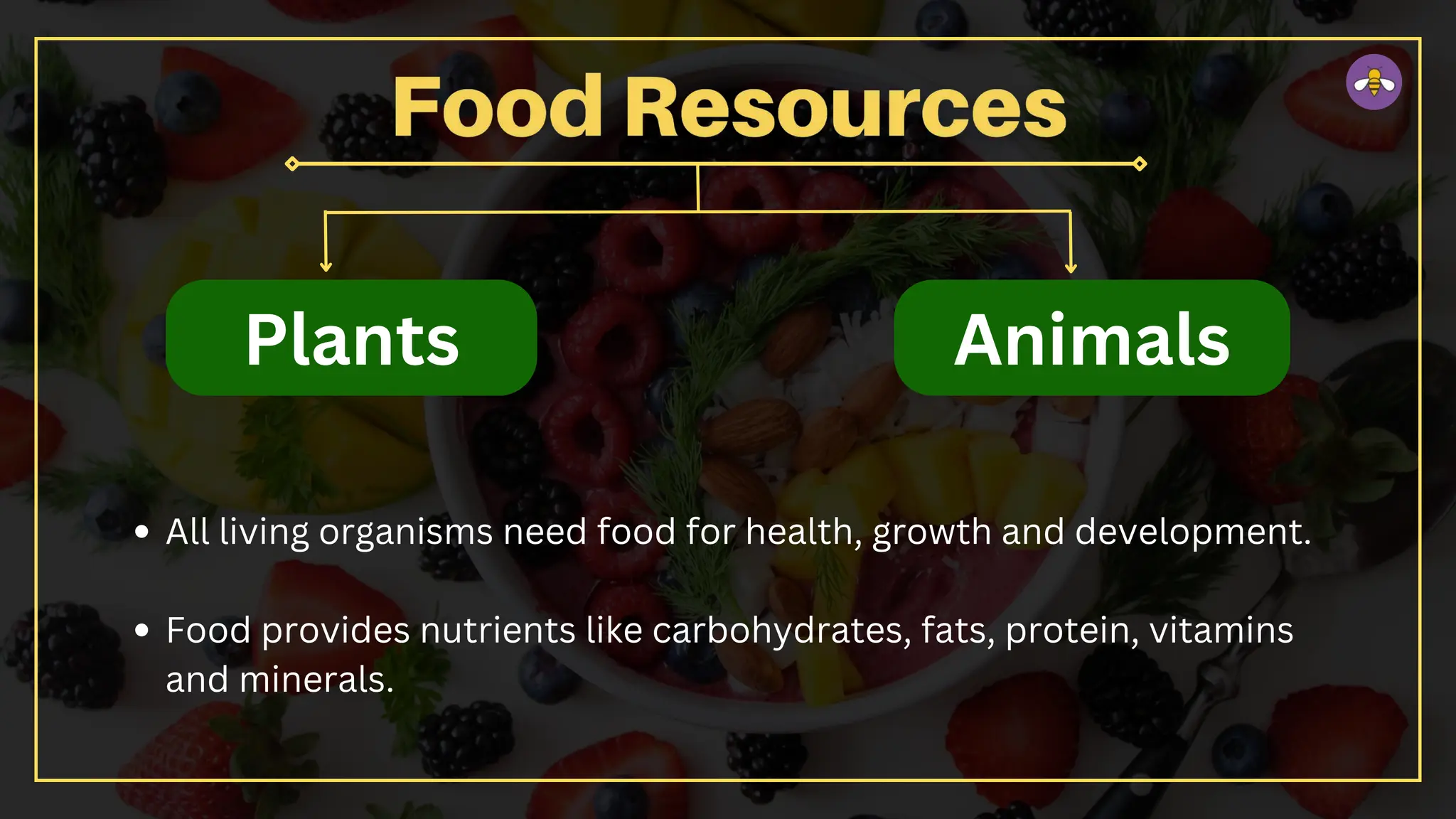
Plants Animals
All living organisms need food for health, growth and development.
Food provides nutrients like carbohydrates, fats, protein, vitamins
and minerals.
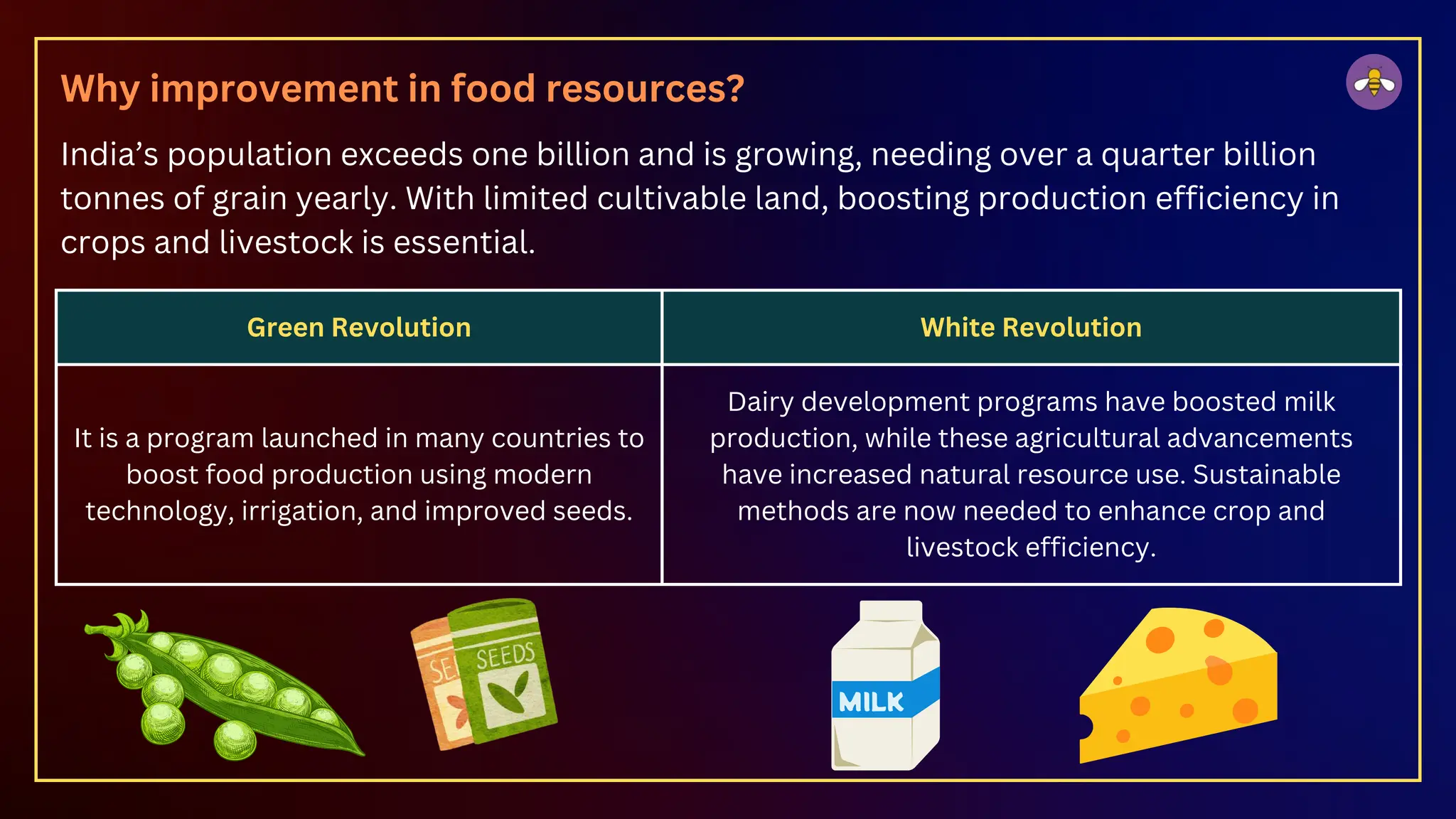
Green Revolution White Revolution
It is a program launched in many countries to
boost food production using modern
technology, irrigation, and improved seeds.
Dairy development programs have boosted milk
production, while these agricultural advancements
have increased natural resource use. Sustainable
methods are now needed to enhance crop and
livestock efficiency.
Why improvement in food resources?
India’s population exceeds one billion and is growing, needing over a quarter billion
tonnes of grain yearly. With limited cultivable land, boosting production efficiency in
crops and livestock is essential.
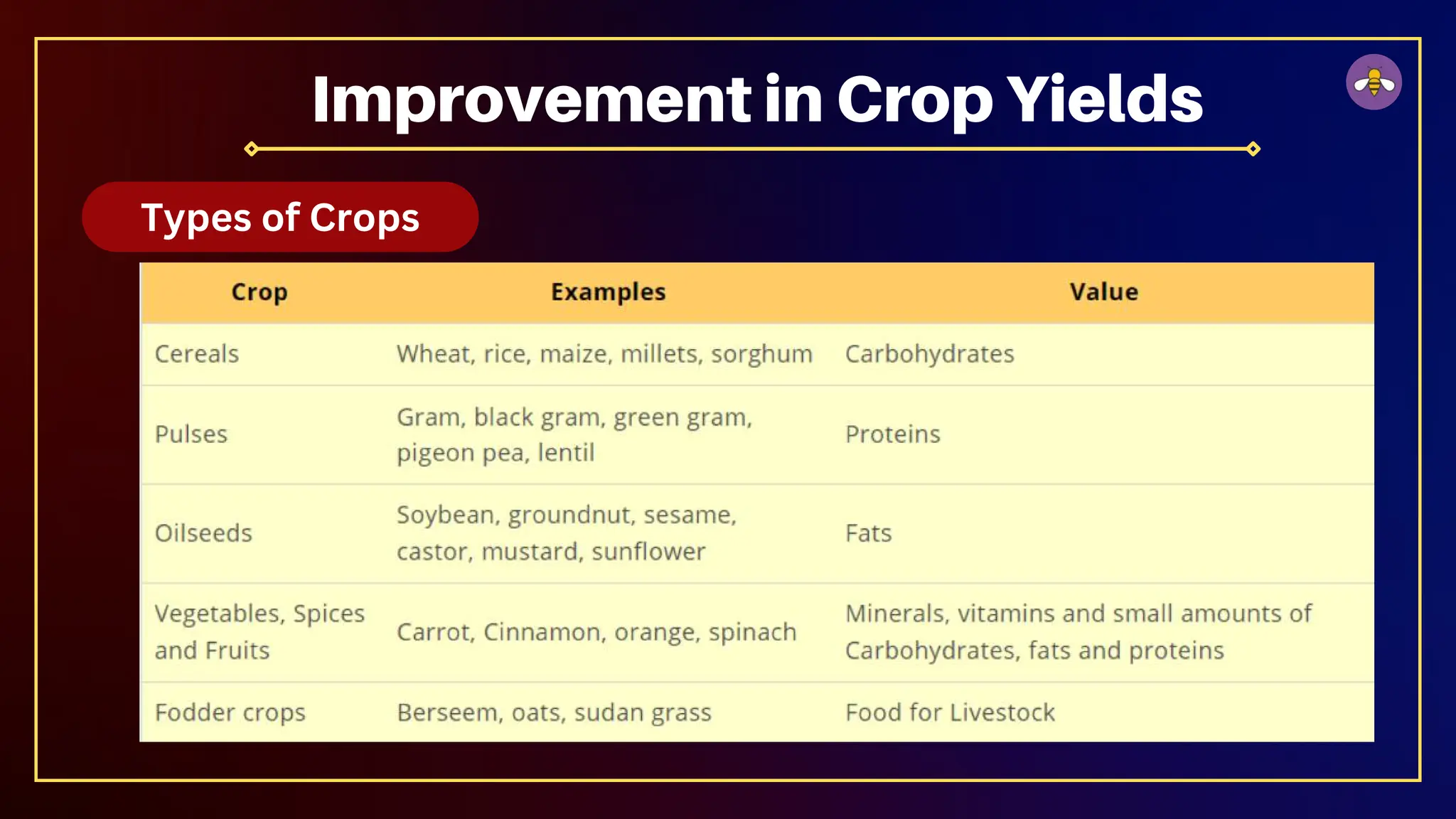
Improvement in Crop Yields
Types of Crops
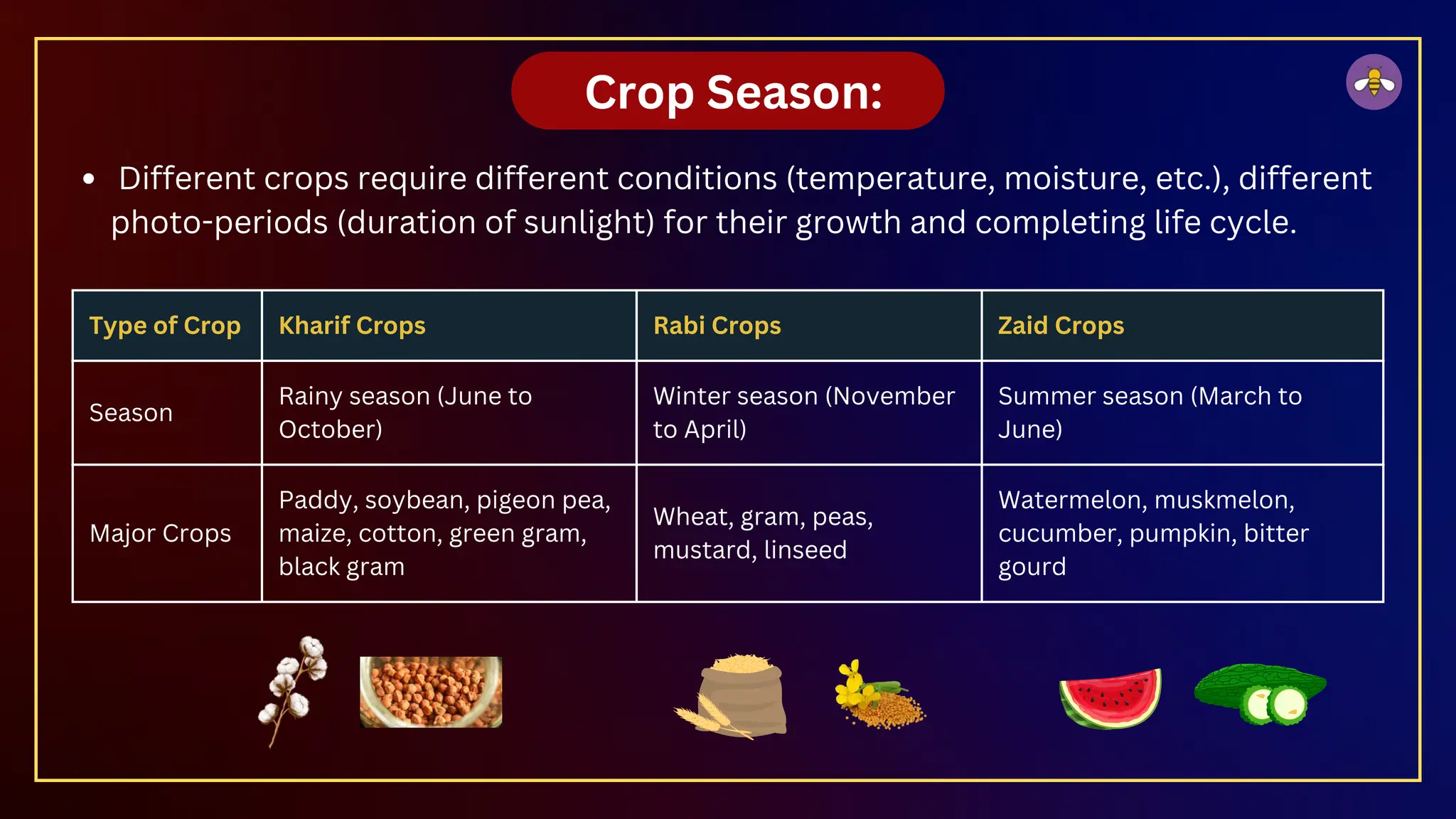
Crop Season:
Type of Crop Kharif Crops Rabi Crops Zaid Crops
Season
Rainy season (June to
October)
Winter season (November
to April)
Summer season (March to
June)
Major Crops
Paddy, soybean, pigeon pea,
maize, cotton, green gram,
black gram
Wheat, gram, peas,
mustard, linseed
Watermelon, muskmelon,
cucumber, pumpkin, bitter
gourd
Different crops require different conditions (temperature, moisture, etc.), different
photo-periods (duration of sunlight) for their growth and completing life cycle.
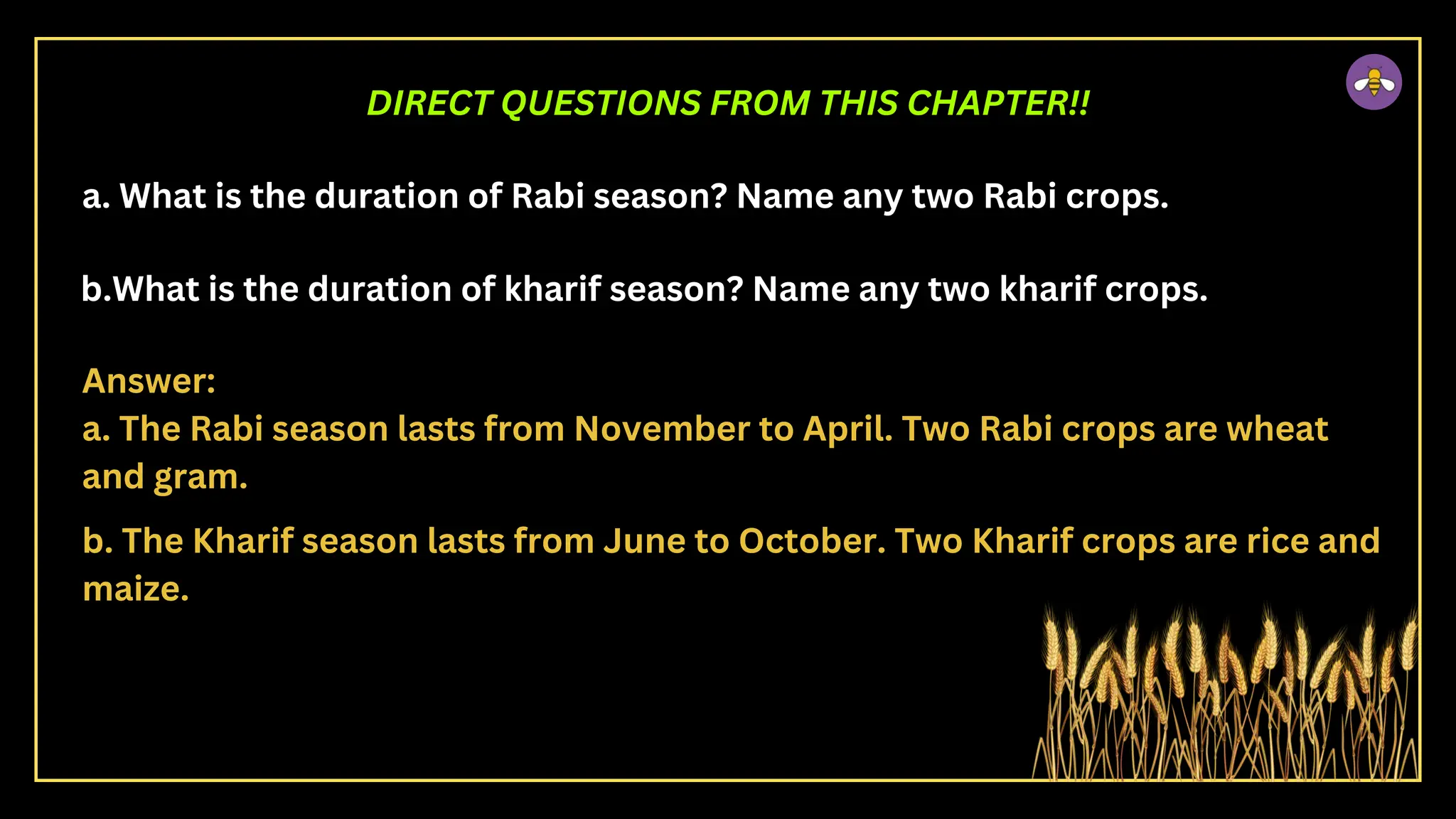
a. What is the duration of Rabi season? Name any two Rabi crops.
b.What is the duration of kharif season? Name any two kharif crops.
DIRECT QUESTIONS FROM THIS CHAPTER!!
Answer:
a. The Rabi season lasts from November to April. Two Rabi crops are wheat
and gram.
b. The Kharif season lasts from June to October. Two Kharif crops are rice and
maize.
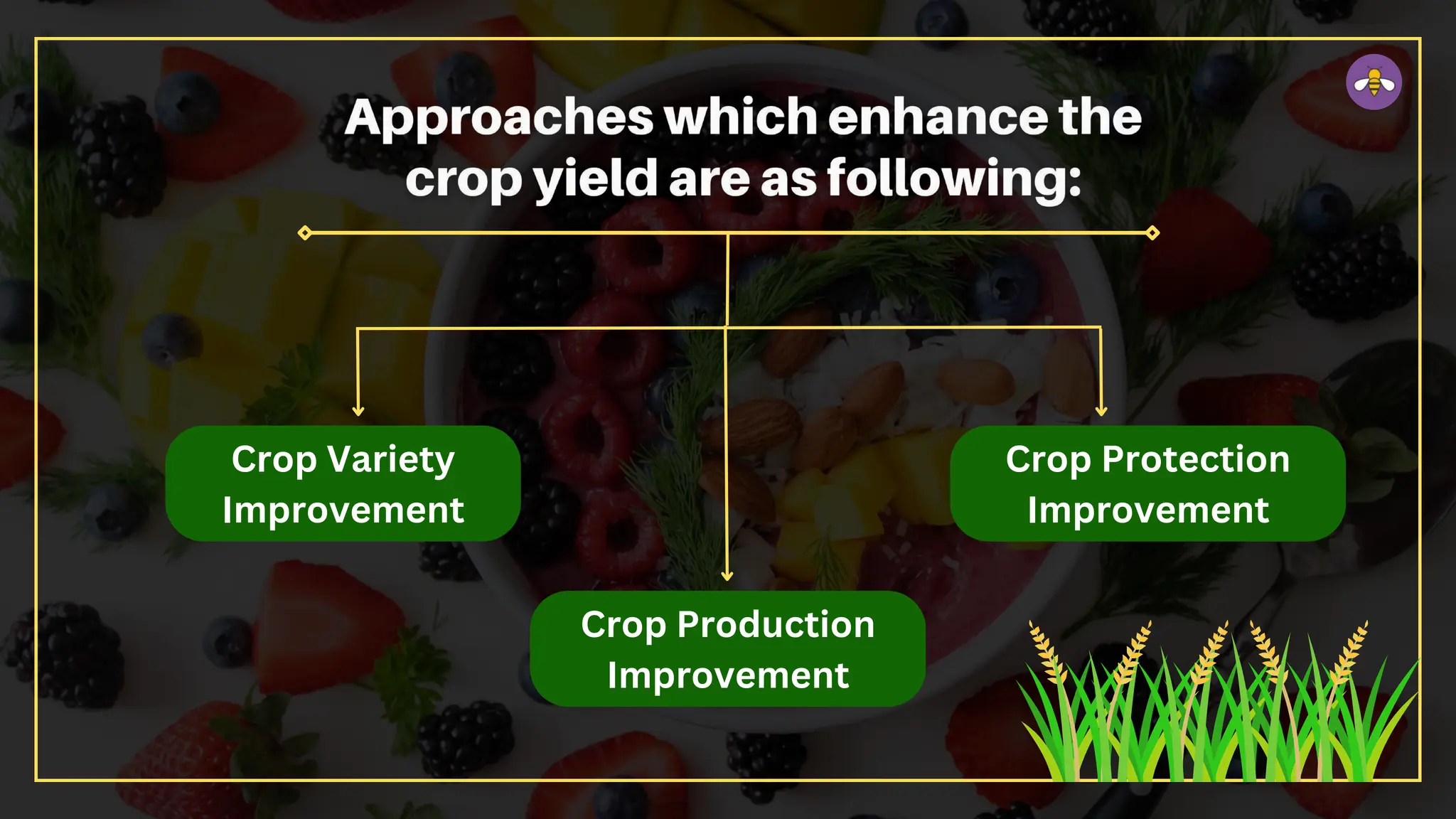
Crop Variety
Improvement
Crop Protection
Improvement
Crop Production
Improvement
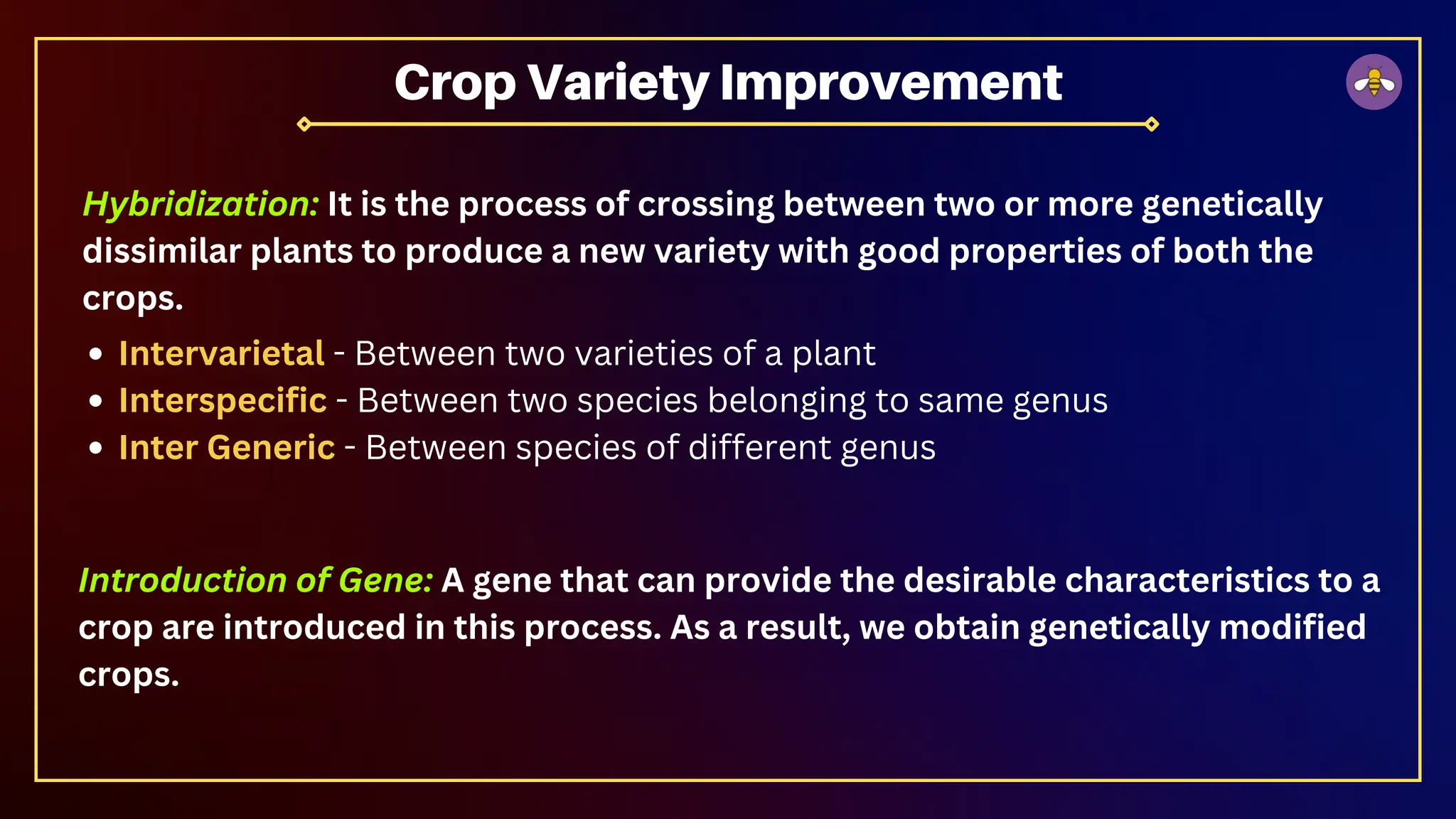
Intervarietal - Between two varieties of a plant
Interspecific - Between two species belonging to same genus
Inter Generic - Between species of different genus
Crop Variety Improvement
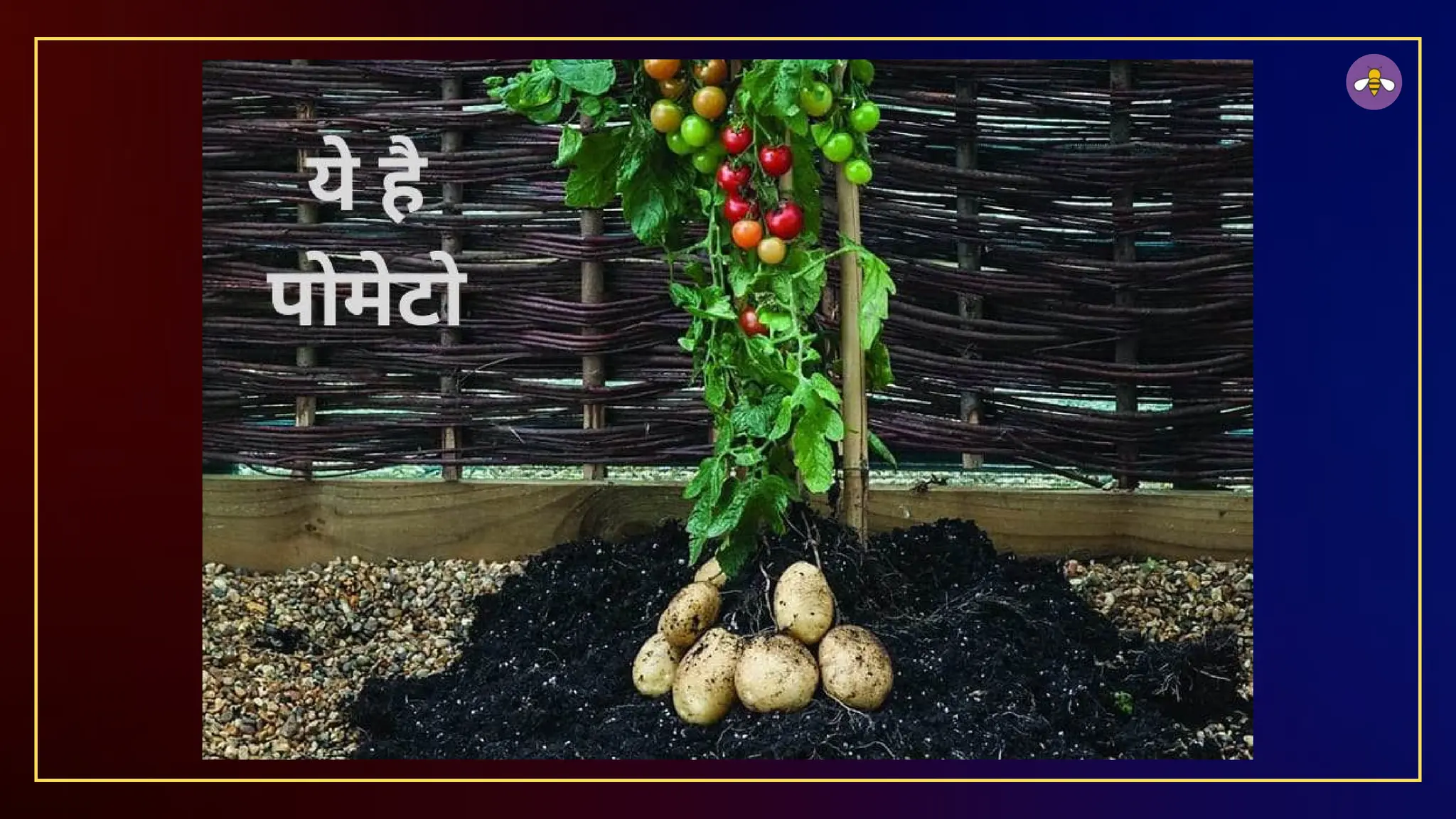
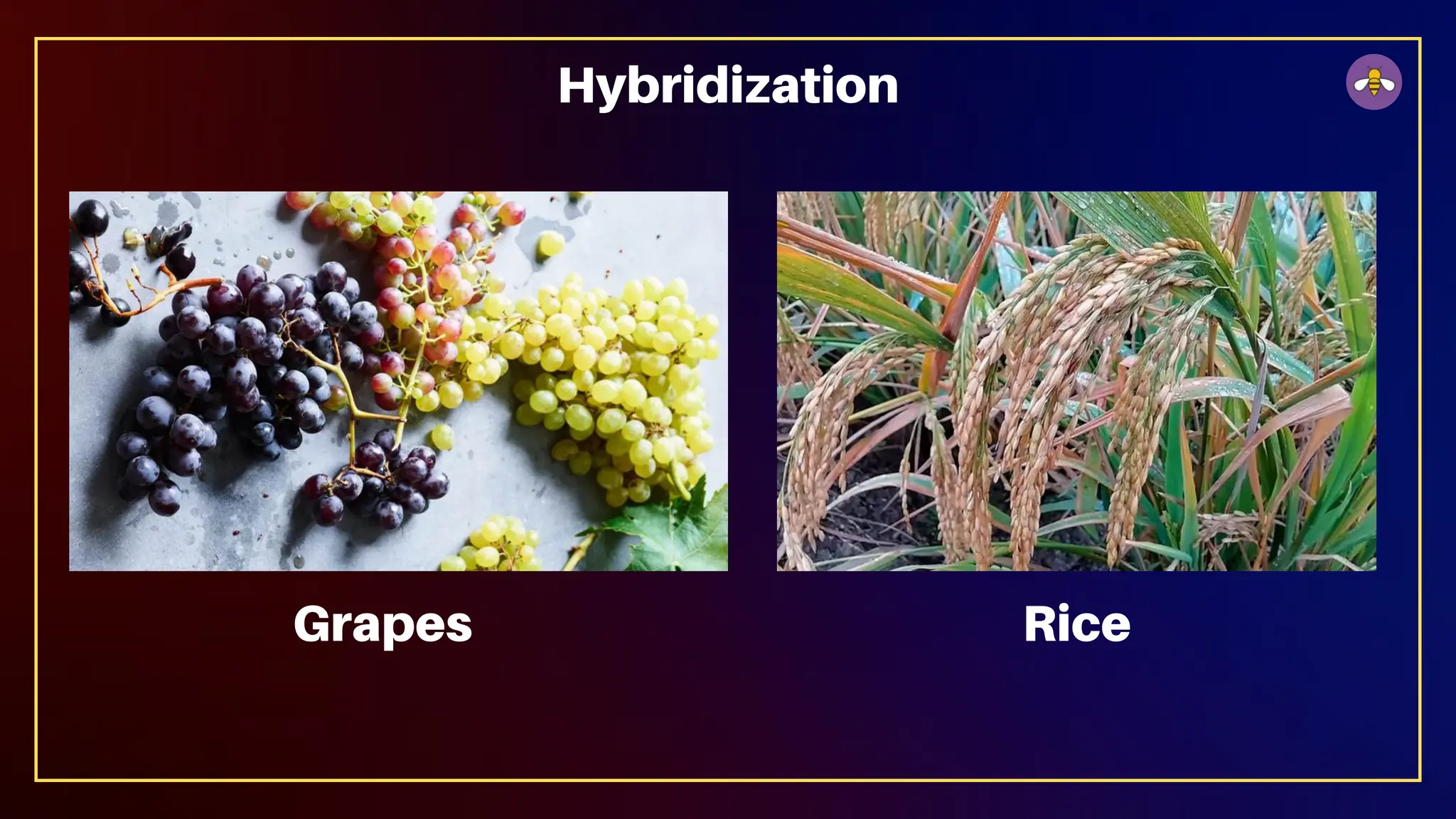
Hybridization: It is the process of crossing between two or more genetically
dissimilar plants to produce a new variety with good properties of both the
crops.
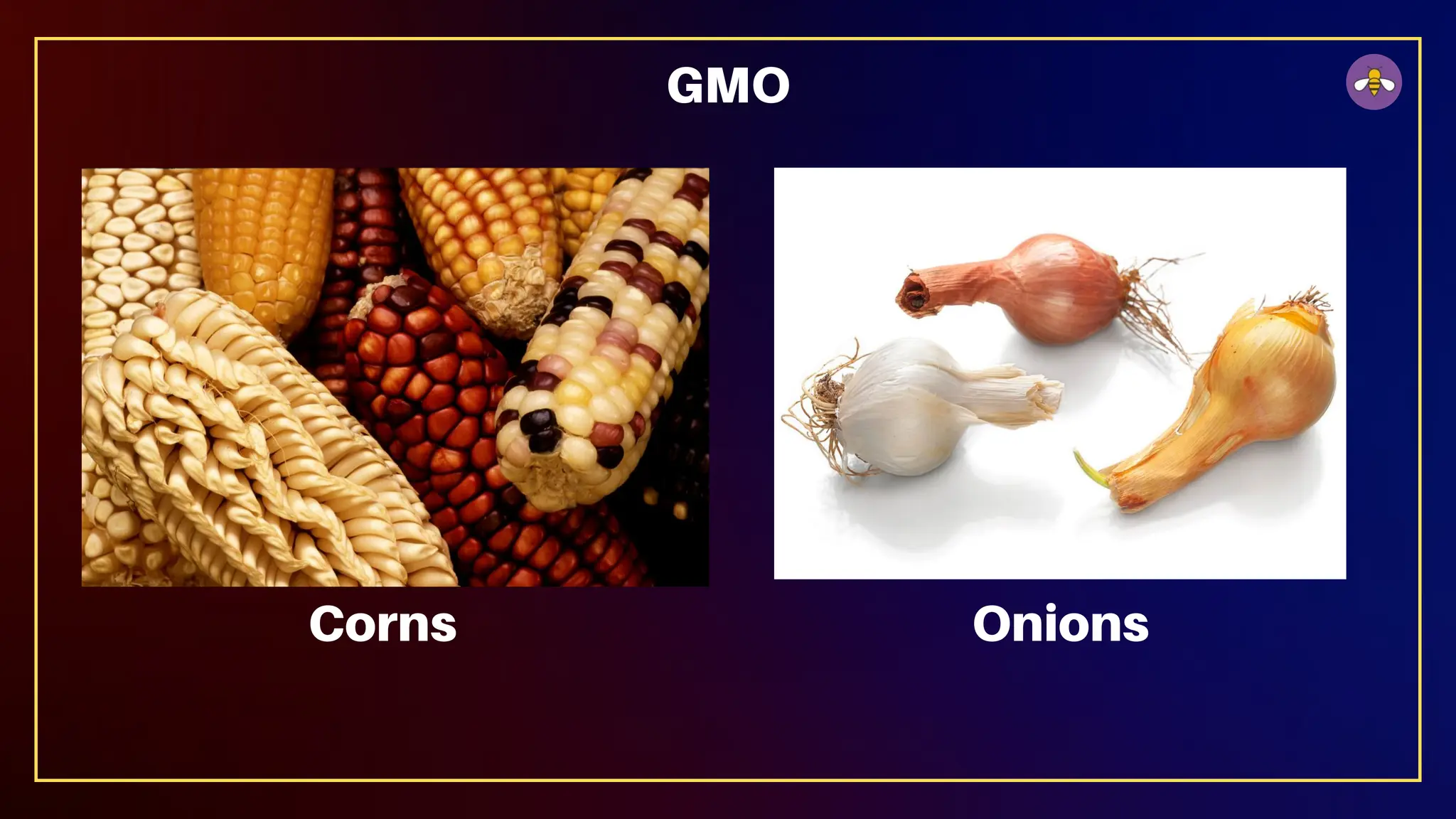
Introduction of Gene: A gene that can provide the desirable characteristics to a
crop are introduced in this process. As a result, we obtain genetically modified
crops.
Hybridization
Grapes Rice
GMO
Corns Onions
Higher Yield: To increase the productivity of the crop per acre.
Improved quality: Quality of crop products vary from crop to crop.
Biotic & Abiotic resistances: Crop production reduces due to biotic and
abiotic factors. Varieties resistant to these factors can improve crop
production.
Wider adaptability: Crops which can grow in different conditions, will help
in setting high production.
Desired agronomic traits: Crops which contain desired agronomic traits
(height, branching, leaves), sets high production.
Good and Healthy Seeds:
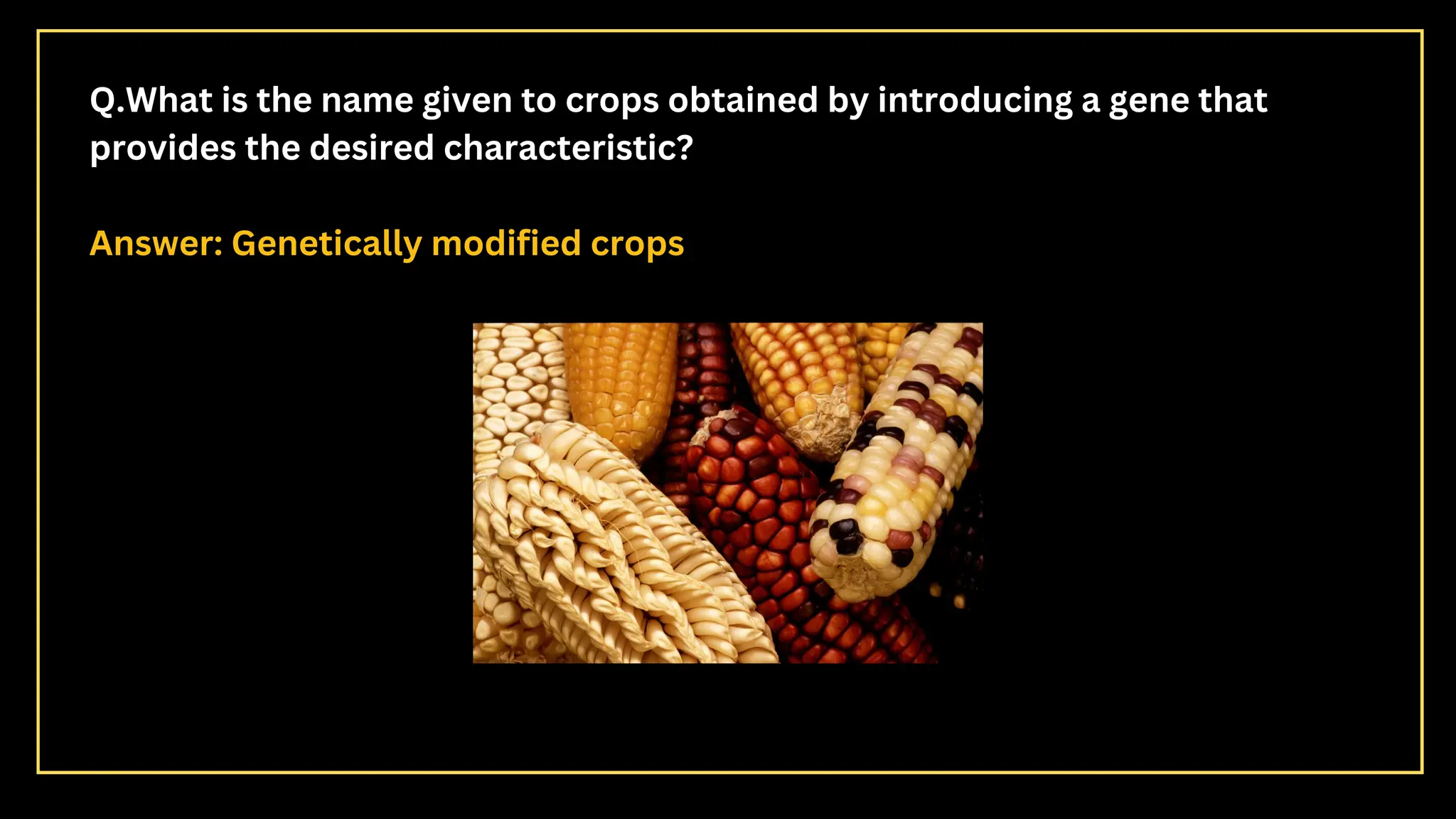
Q.What is the name given to crops obtained by introducing a gene that
provides the desired characteristic?
Answer: Genetically modified crops
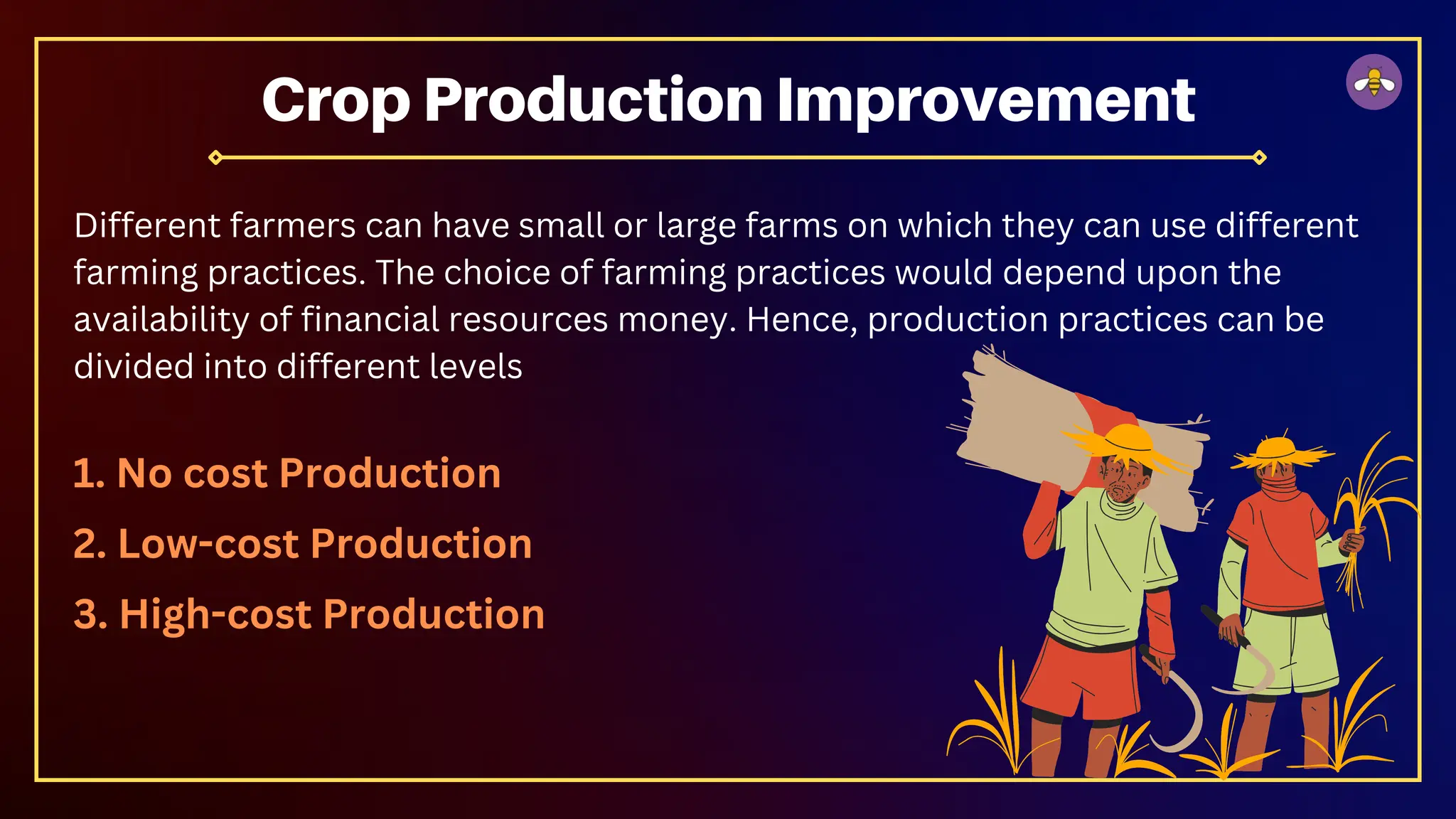
Different farmers can have small or large farms on which they can use different
farming practices. The choice of farming practices would depend upon the
availability of financial resources money. Hence, production practices can be
divided into different levels
1. No cost Production
2. Low-cost Production
3. High-cost Production
Crop Production Improvement
Q.Name the ways by which crop-yield can be increased
.
1.Crop Variety Improvement
2.Crop Production Management
3.Crop Protection Management:
Answer:
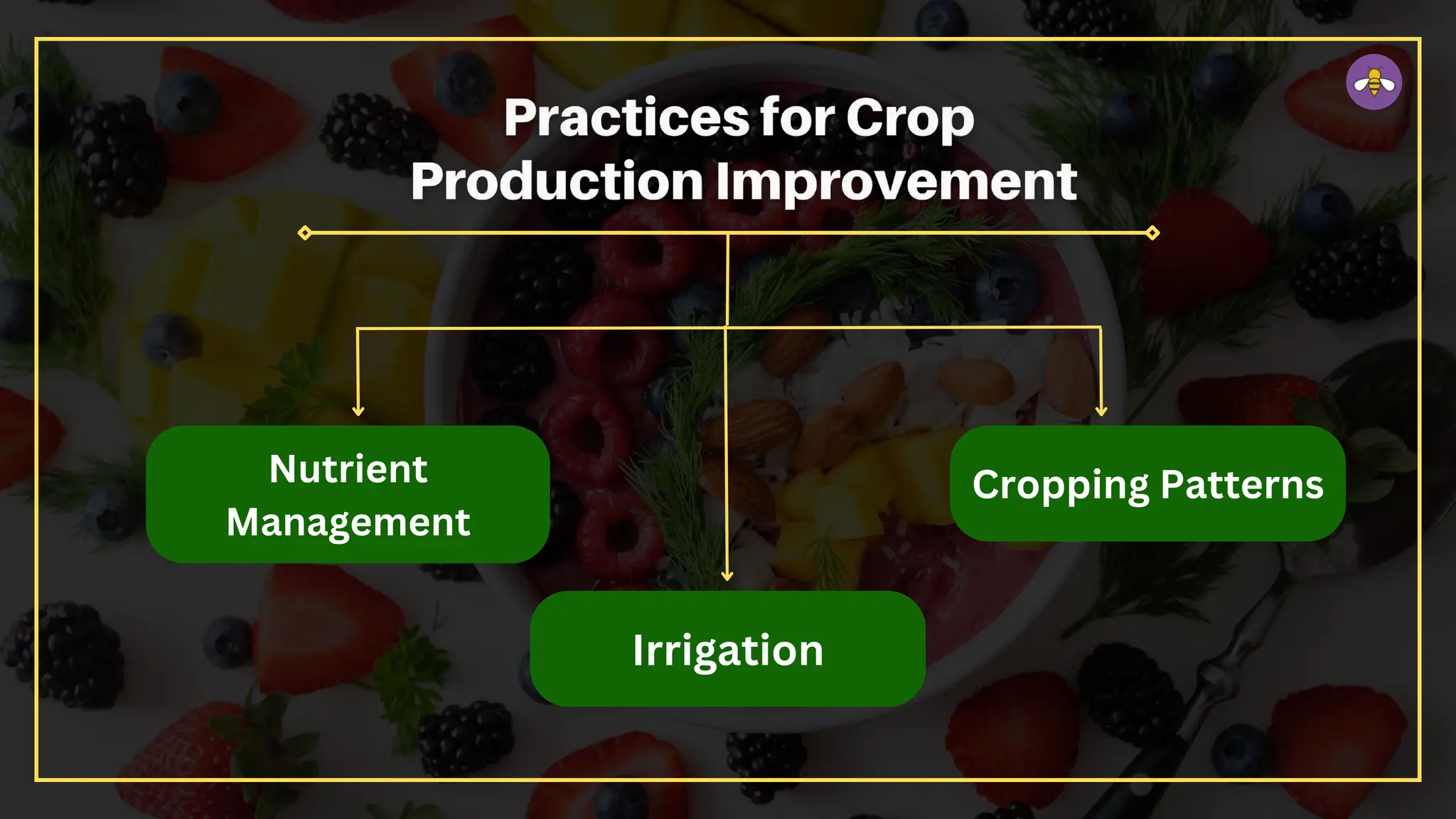
Nutrient
Management
Cropping Patterns
Irrigation
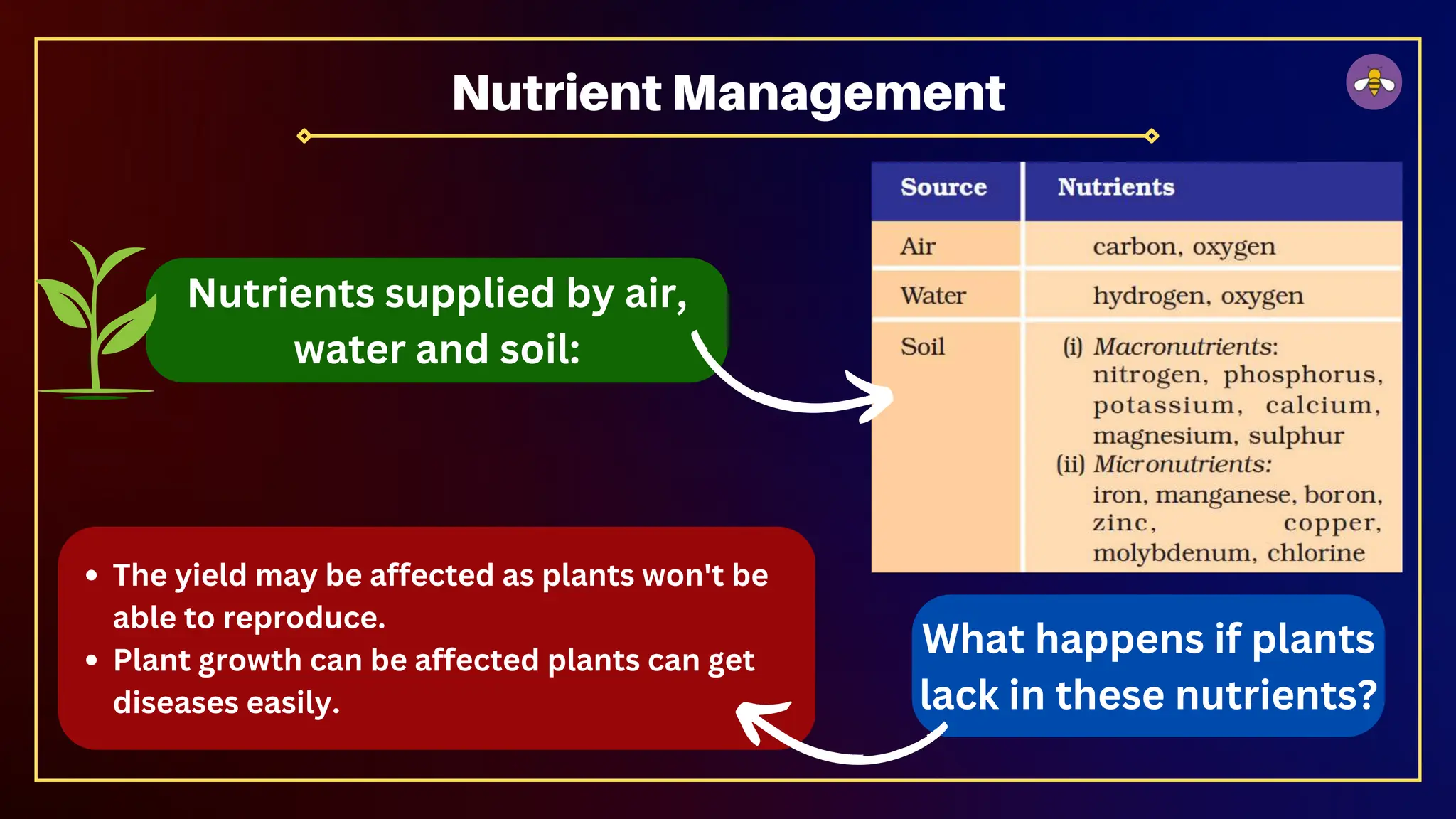
Nutrients supplied by air,
water and soil:
Nutrient Management
What happens if plants
lack in these nutrients?
The yield may be affected as plants won't be
able to reproduce.
Plant growth can be affected plants can get
diseases easily.
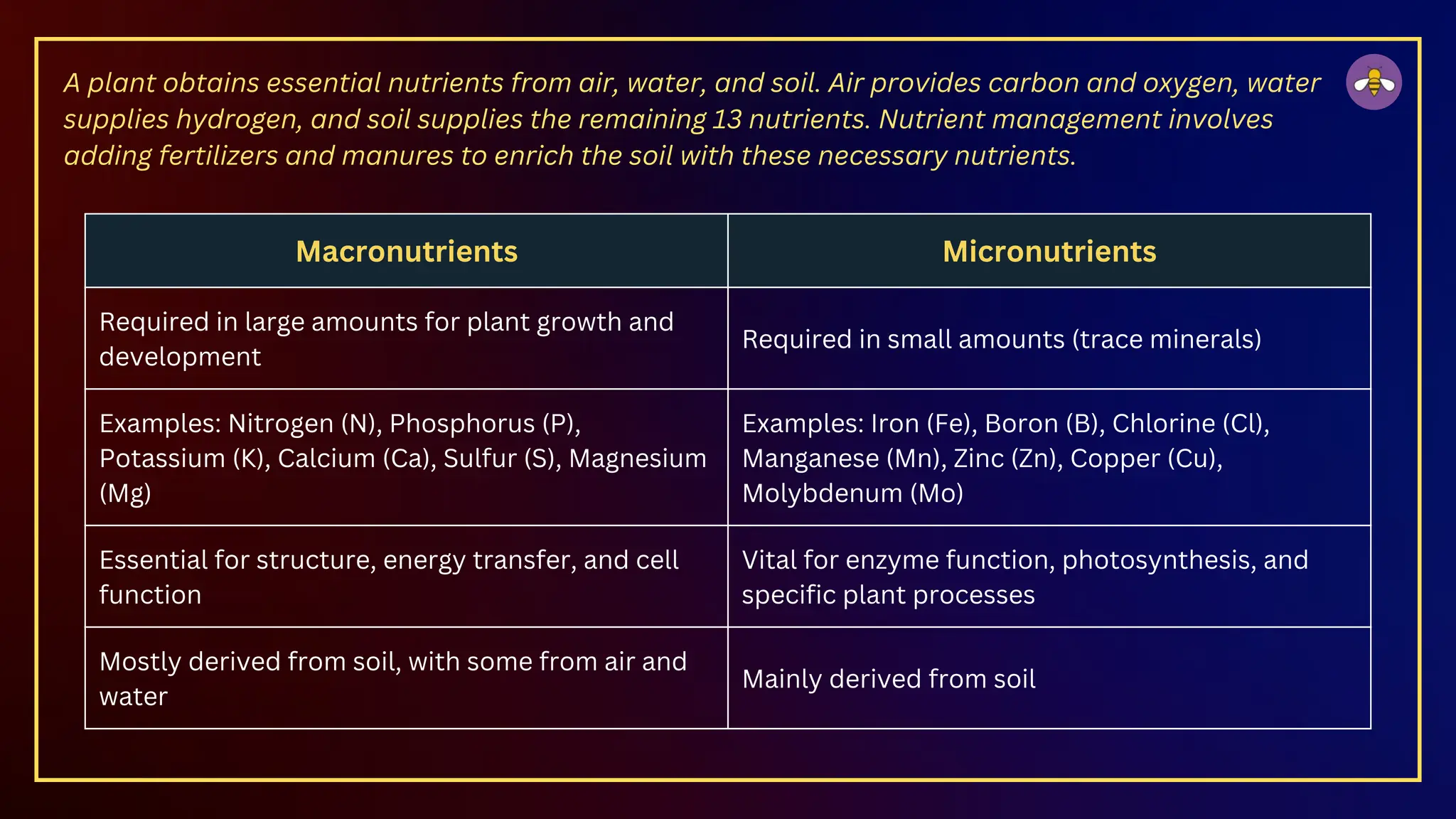
Macronutrients Micronutrients
Required in large amounts for plant growth and
development
Required in small amounts (trace minerals)
Examples: Nitrogen (N), Phosphorus (P),
Potassium (K), Calcium (Ca), Sulfur (S), Magnesium
(Mg)
Examples: Iron (Fe), Boron (B), Chlorine (Cl),
Manganese (Mn), Zinc (Zn), Copper (Cu),
Molybdenum (Mo)
Essential for structure, energy transfer, and cell
function
Vital for enzyme function, photosynthesis, and
specific plant processes
Mostly derived from soil, with some from air and
water
Mainly derived from soil
A plant obtains essential nutrients from air, water, and soil. Air provides carbon and oxygen, water
supplies hydrogen, and soil supplies the remaining 13 nutrients. Nutrient management involves
adding fertilizers and manures to enrich the soil with these necessary nutrients.
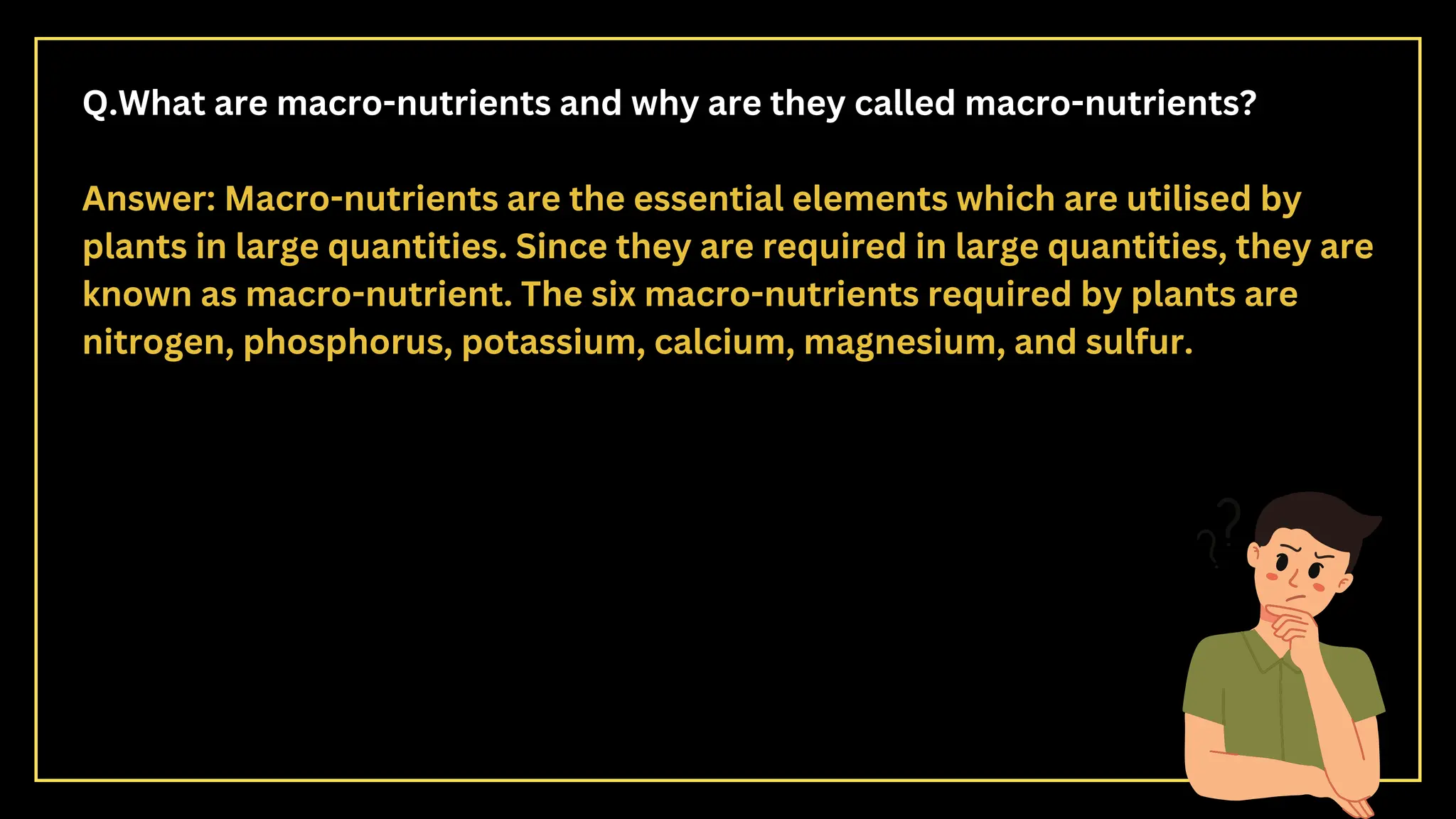
Q.What are macro-nutrients and why are they called macro-nutrients?
Answer: Macro-nutrients are the essential elements which are utilised by
plants in large quantities. Since they are required in large quantities, they are
known as macro-nutrient. The six macro-nutrients required by plants are
nitrogen, phosphorus, potassium, calcium, magnesium, and sulfur.
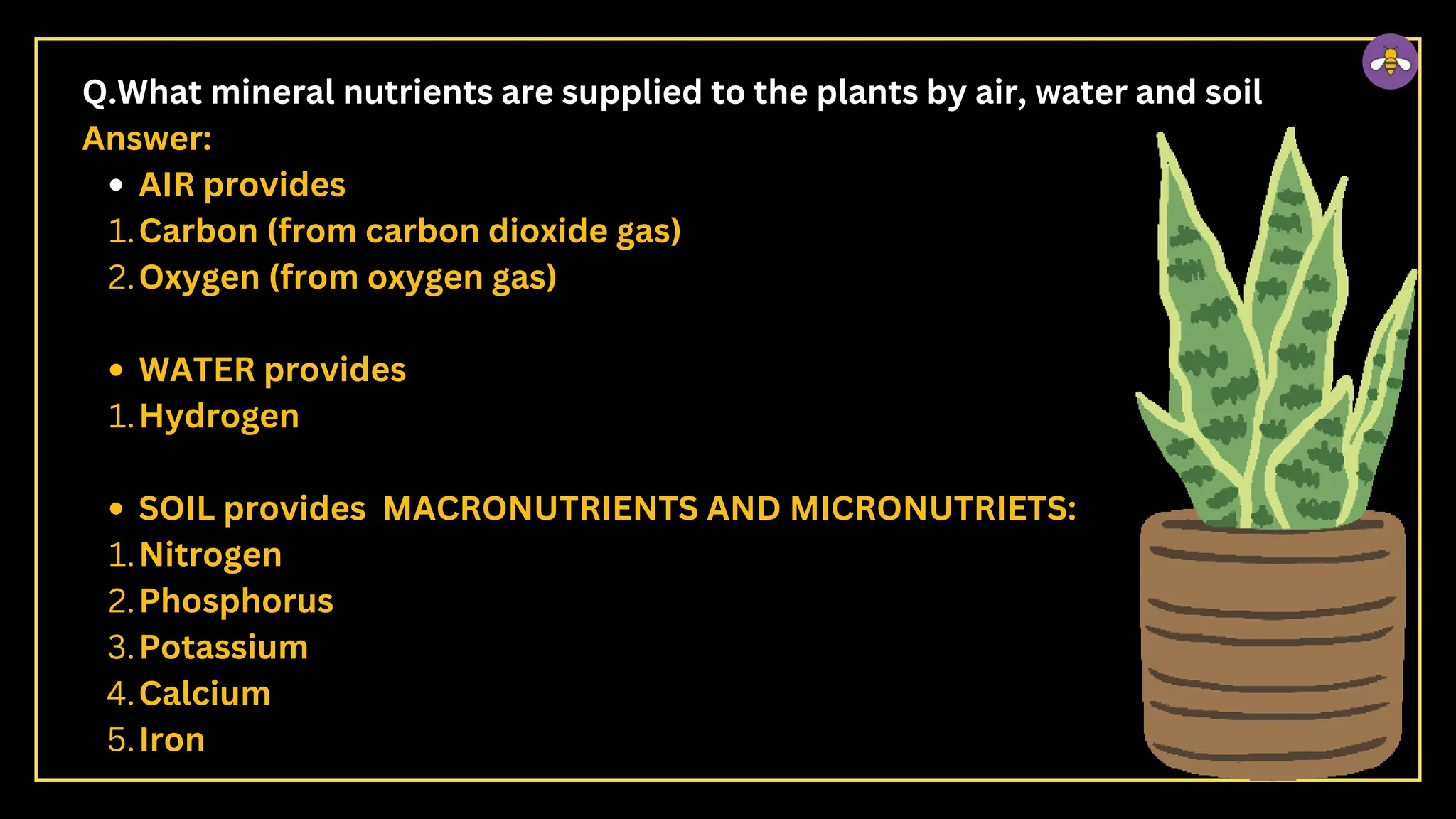
Q.What mineral nutrients are supplied to the plants by air, water and soil
Answer:
AIR provides
Carbon (from carbon dioxide gas)
1.
Oxygen (from oxygen gas)
2.
WATER provides
Hydrogen
1.
SOIL provides MACRONUTRIENTS AND MICRONUTRIETS:
Nitrogen
1.
Phosphorus
2.
Potassium
3.
Calcium
4.
Iron
5.
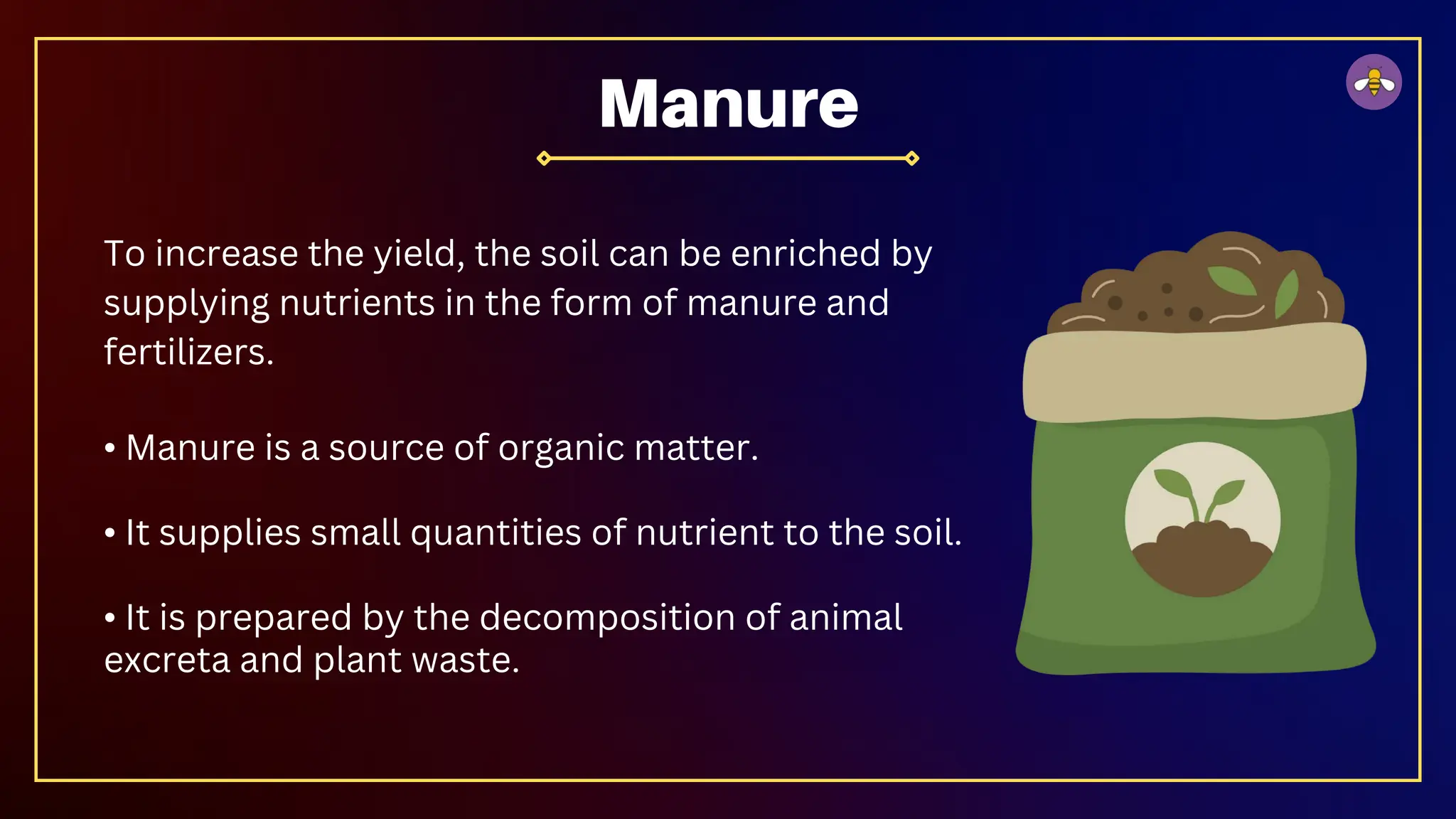
To increase the yield, the soil can be enriched by
supplying nutrients in the form of manure and
fertilizers.
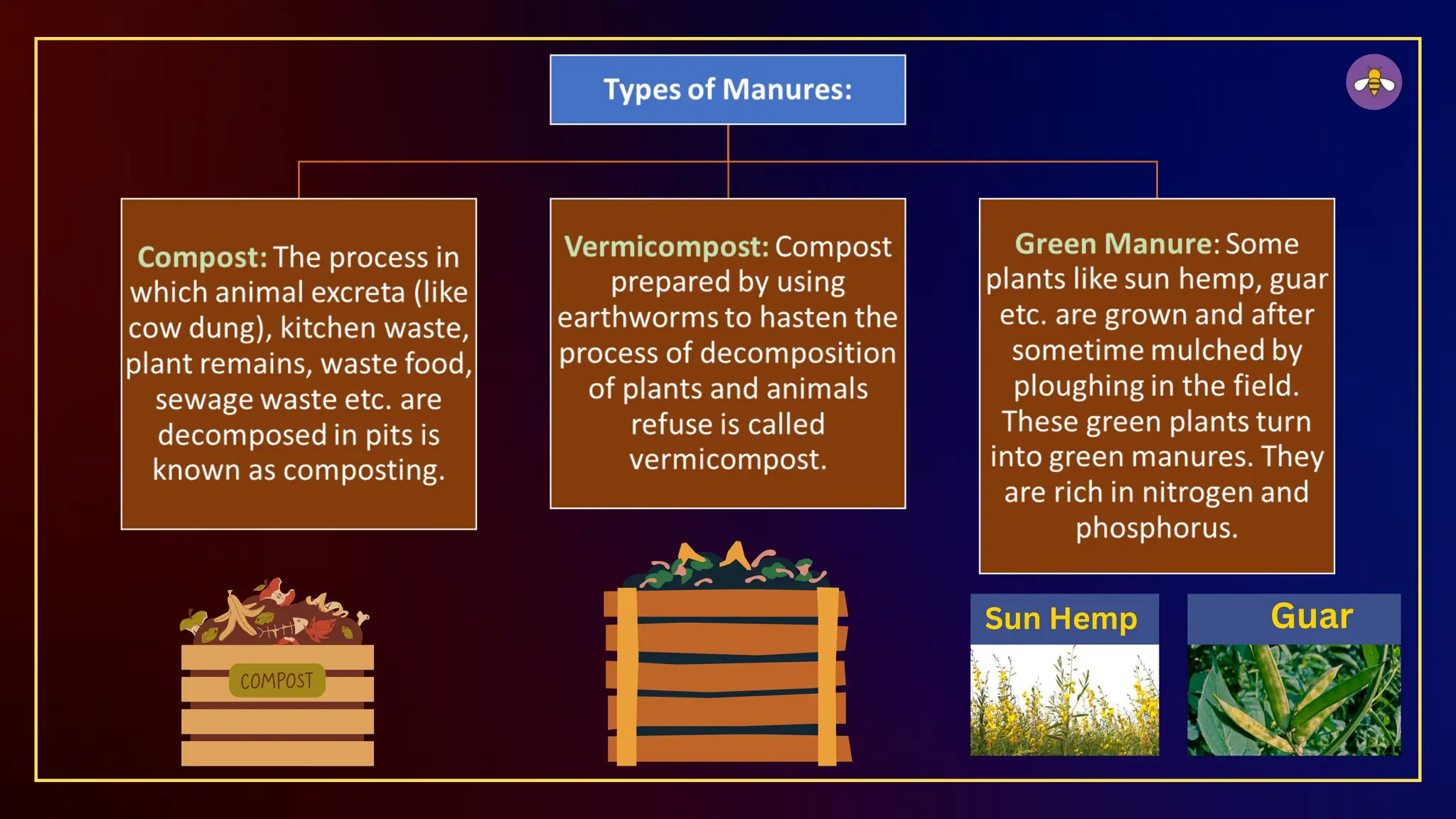
• Manure is a source of organic matter.
• It supplies small quantities of nutrient to the soil.
• It is prepared by the decomposition of animal
excreta and plant waste.
Manure
Sun Hemp Guar
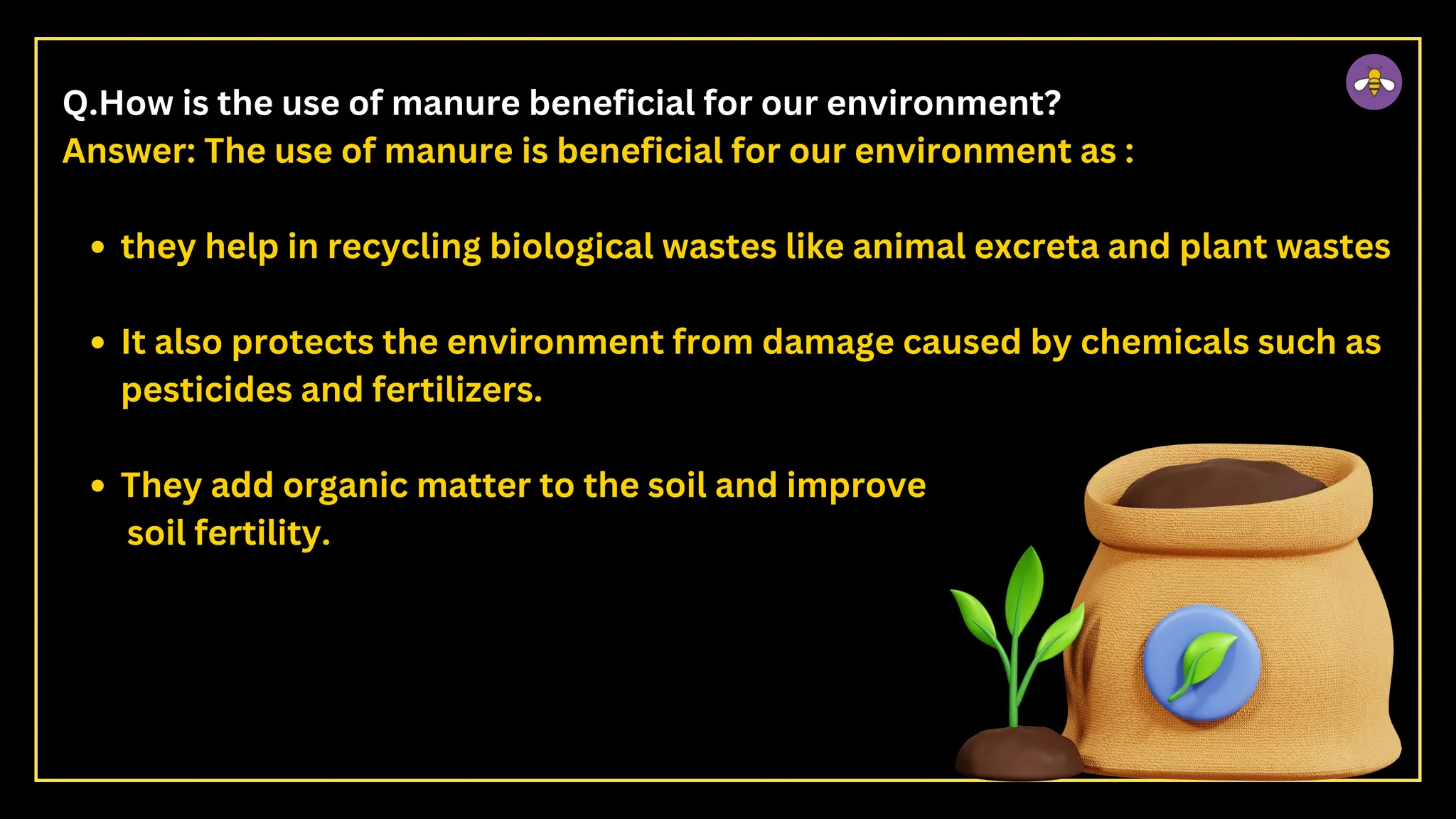
Q.How is the use of manure beneficial for our environment?
Answer: The use of manure is beneficial for our environment as :
they help in recycling biological wastes like animal excreta and plant wastes
It also protects the environment from damage caused by chemicals such as
pesticides and fertilizers.
They add organic matter to the soil and improve
soil fertility.
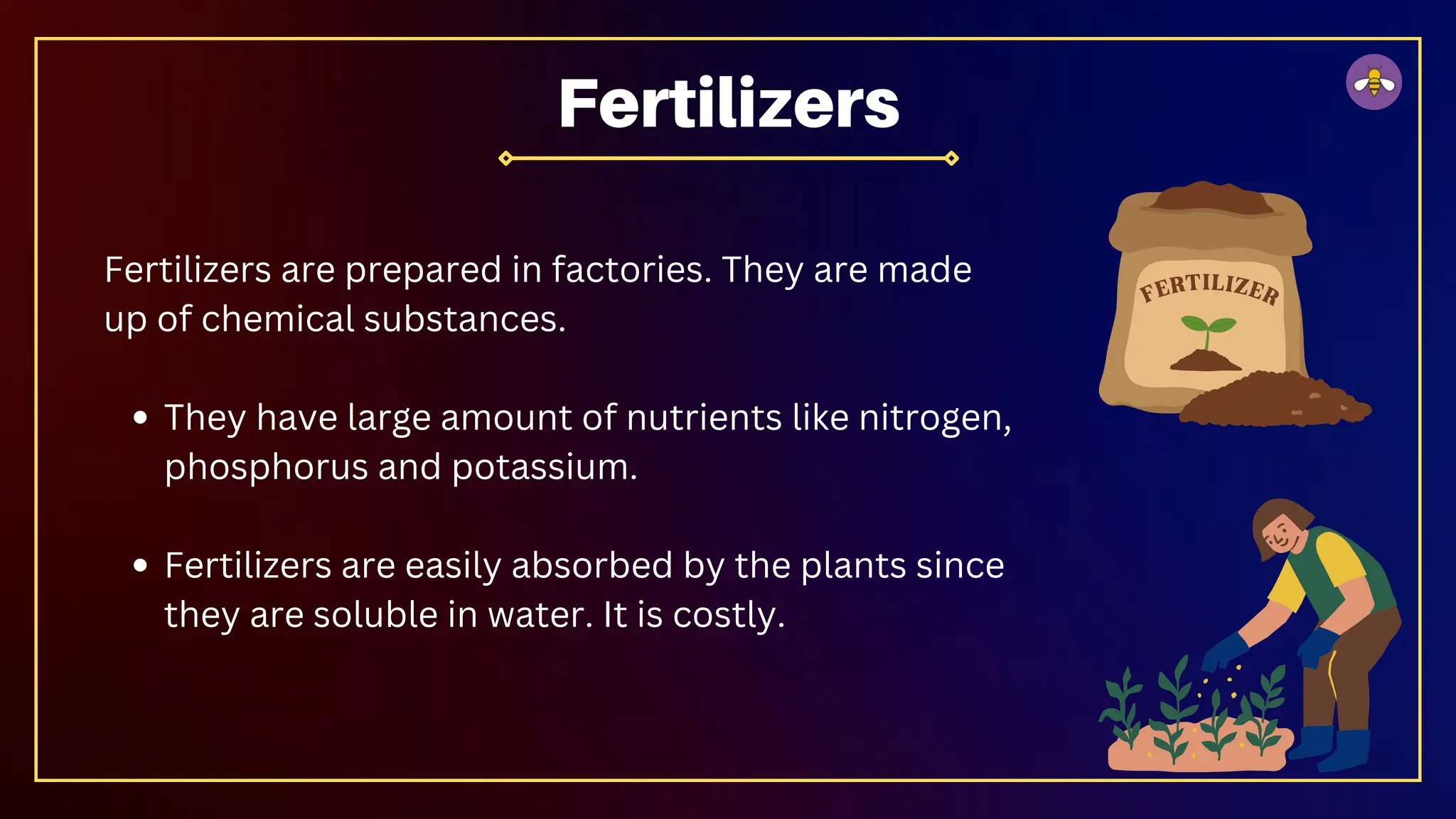
Fertilizers are prepared in factories. They are made
up of chemical substances.
They have large amount of nutrients like nitrogen,
phosphorus and potassium.
Fertilizers are easily absorbed by the plants since
they are soluble in water. It is costly.
Fertilizers
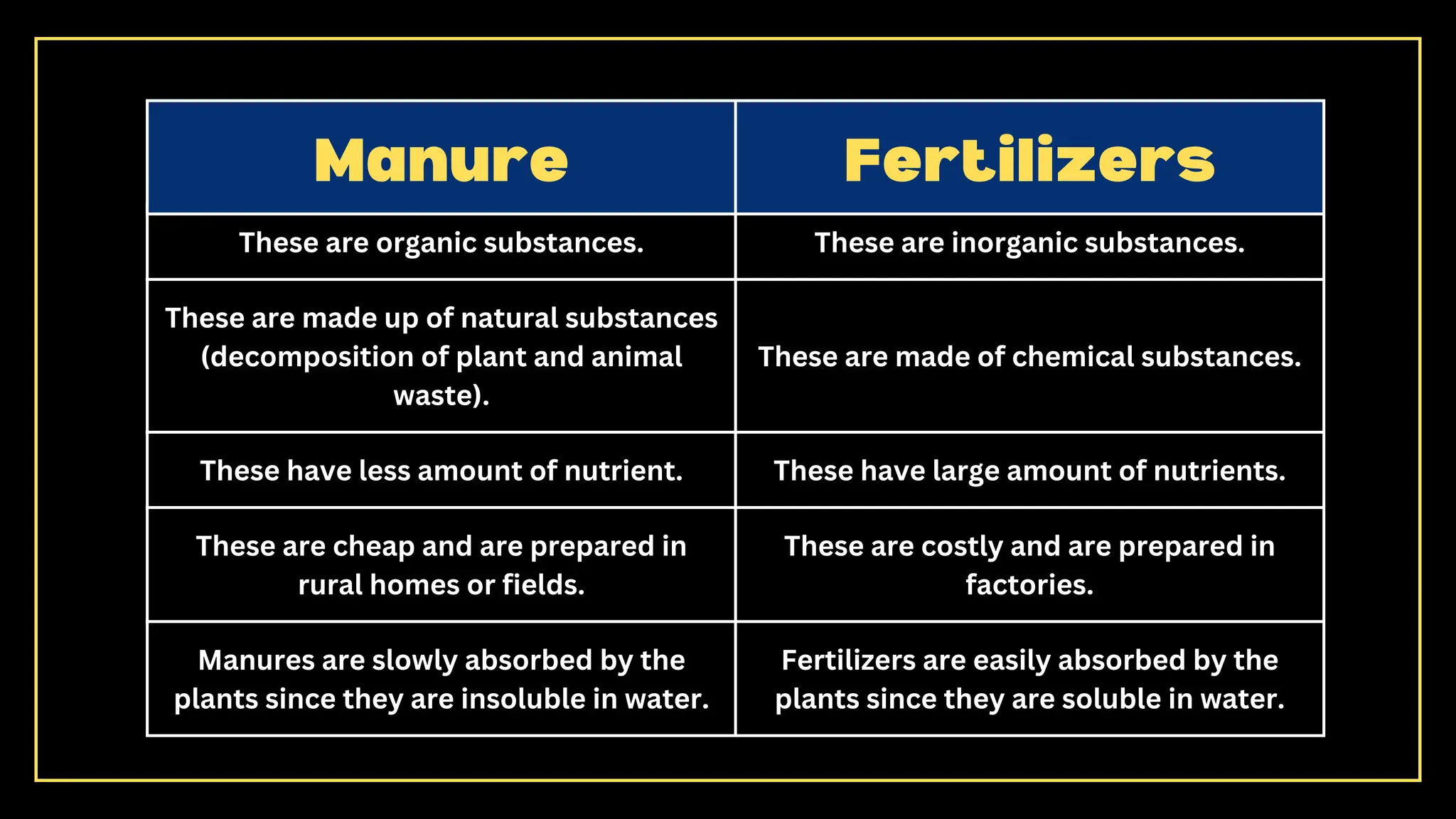
These are organic substances. These are inorganic substances.
These are made up of natural substances
(decomposition of plant and animal
waste).
These are made of chemical substances.
These have less amount of nutrient. These have large amount of nutrients.
These are cheap and are prepared in
rural homes or fields.
These are costly and are prepared in
factories.
Manures are slowly absorbed by the
plants since they are insoluble in water.
Fertilizers are easily absorbed by the
plants since they are soluble in water.
Manure Fertilizers
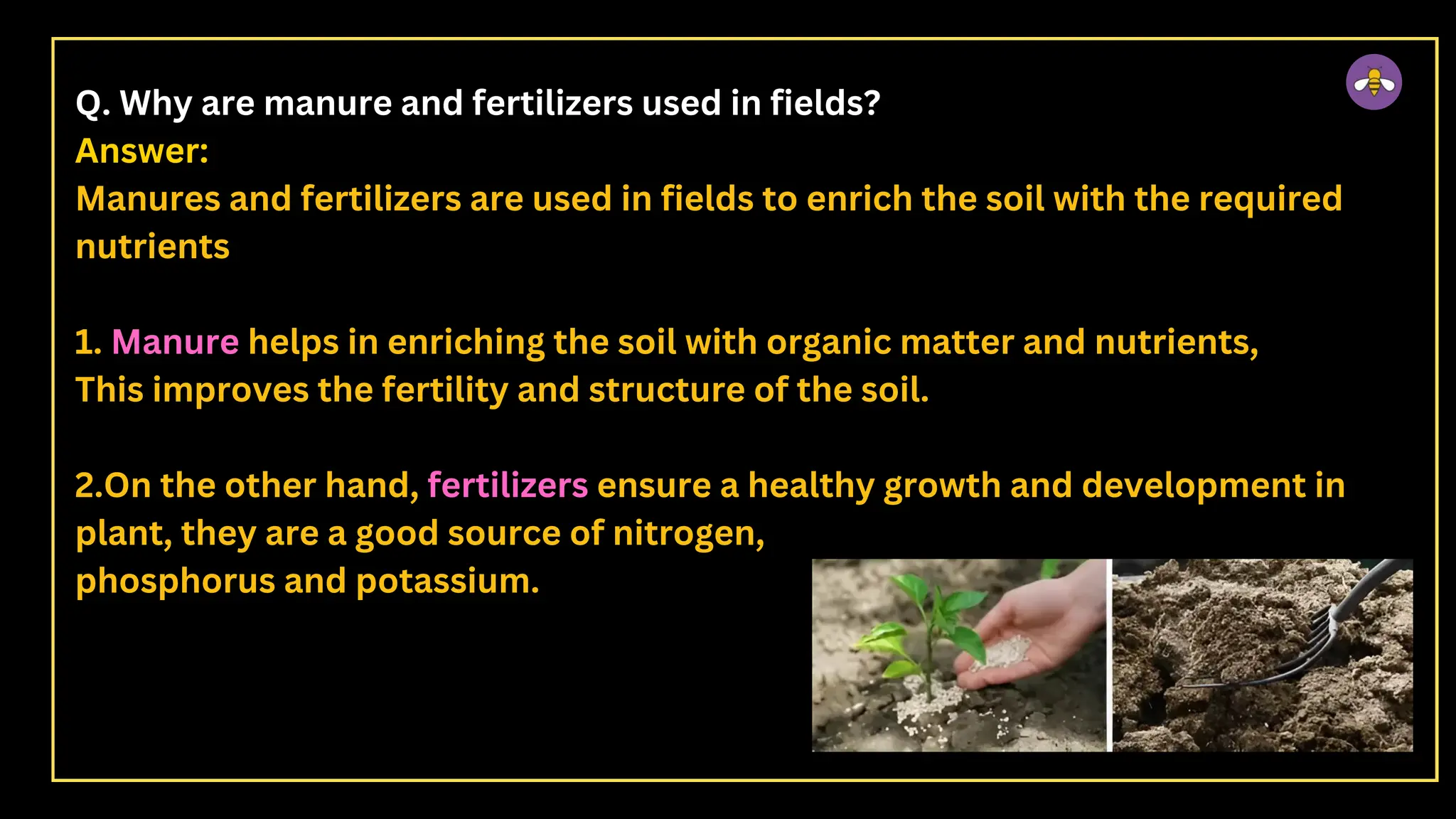
Q. Why are manure and fertilizers used in fields?
Answer:
Manures and fertilizers are used in fields to enrich the soil with the required
nutrients
1. Manure helps in enriching the soil with organic matter and nutrients,
This improves the fertility and structure of the soil.
2.On the other hand, fertilizers ensure a healthy growth and development in
plant, they are a good source of nitrogen,
phosphorus and potassium.
A farming practice which involves no use of artificial chemicals,
fertilizers and pesticides and completely relies upon organic matter
is known as organic farming.
Organic matter used in organic farming:
manure
bioagents such as blue-green algae
biofertilizers
Neem leaves and turmeric as biopesticides
Organic Farming
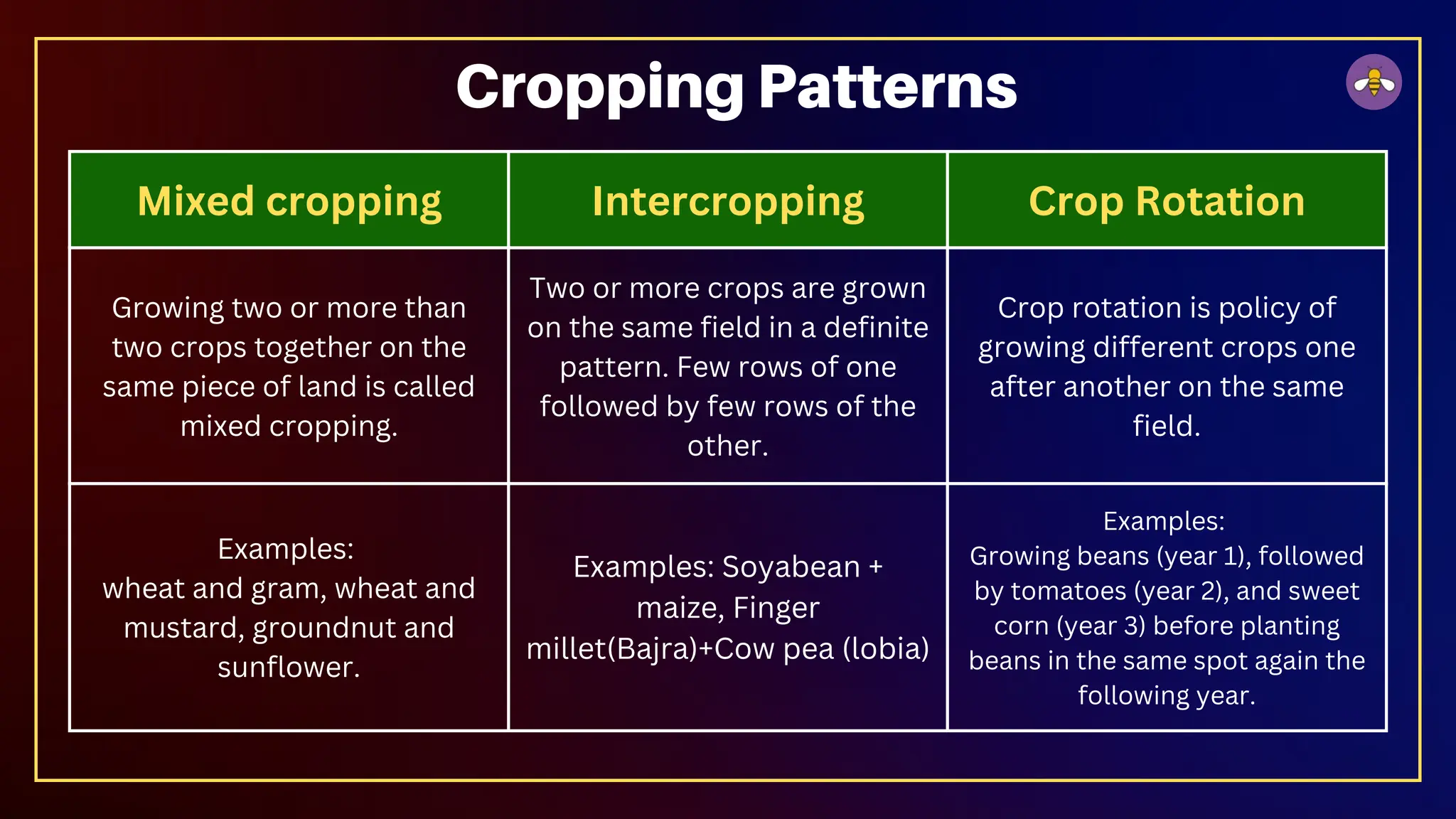
Mixed cropping Intercropping Crop Rotation
Growing two or more than
two crops together on the
same piece of land is called
mixed cropping.
Two or more crops are grown
on the same field in a definite
pattern. Few rows of one
followed by few rows of the
other.
Crop rotation is policy of
growing different crops one
after another on the same
field.
Examples:
wheat and gram, wheat and
mustard, groundnut and
sunflower.
Examples: Soyabean +
maize, Finger
millet(Bajra)+Cow pea (lobia)
Examples:
Growing beans (year 1), followed
by tomatoes (year 2), and sweet
corn (year 3) before planting
beans in the same spot again the
following year.
Cropping Patterns
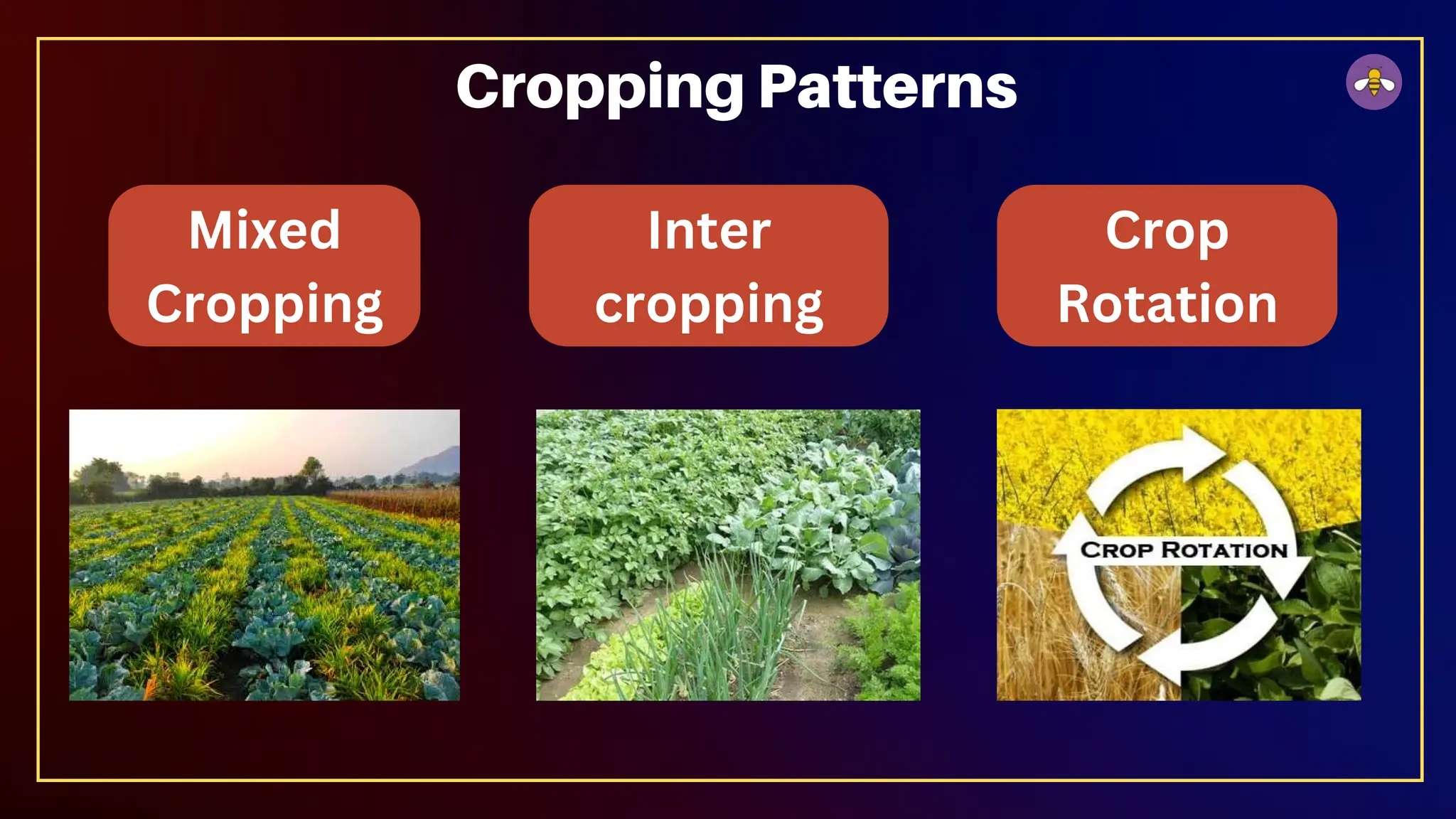
Mixed
Cropping
Inter
cropping
Cropping Patterns
Crop
Rotation
Q. What is the process of growing two or more crops in a definite pattern?
I. Crop rotation
II. Inter-cropping
III. Mixed cropping
IV. Organic cropping
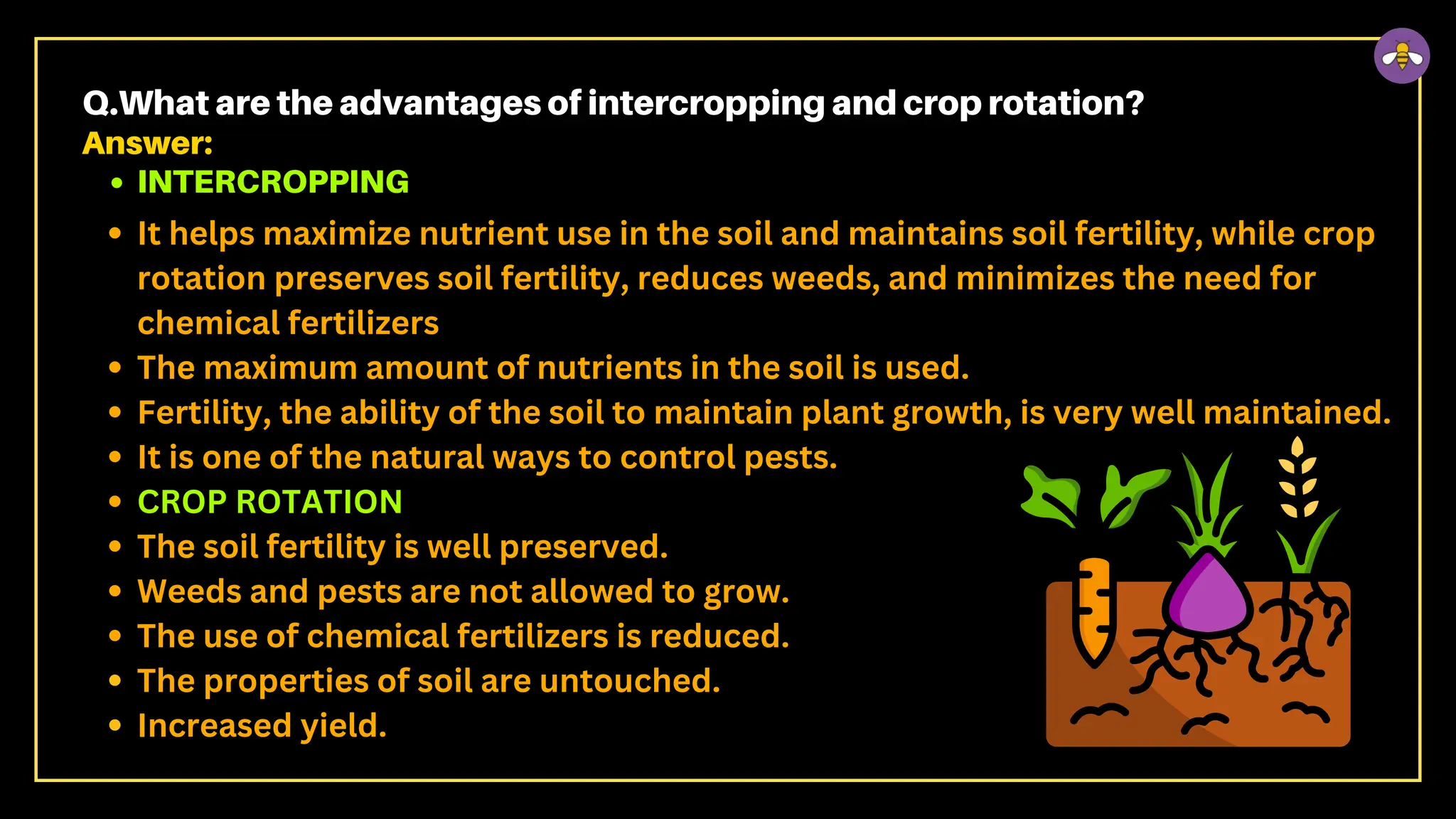
Q.What are the advantages of intercropping and crop rotation?
Answer:
INTERCROPPING
It helps maximize nutrient use in the soil and maintains soil fertility, while crop
rotation preserves soil fertility, reduces weeds, and minimizes the need for
chemical fertilizers
The maximum amount of nutrients in the soil is used.
Fertility, the ability of the soil to maintain plant growth, is very well maintained.
It is one of the natural ways to control pests.
CROP ROTATION
The soil fertility is well preserved.
Weeds and pests are not allowed to grow.
The use of chemical fertilizers is reduced.
The properties of soil are untouched.
Increased yield.
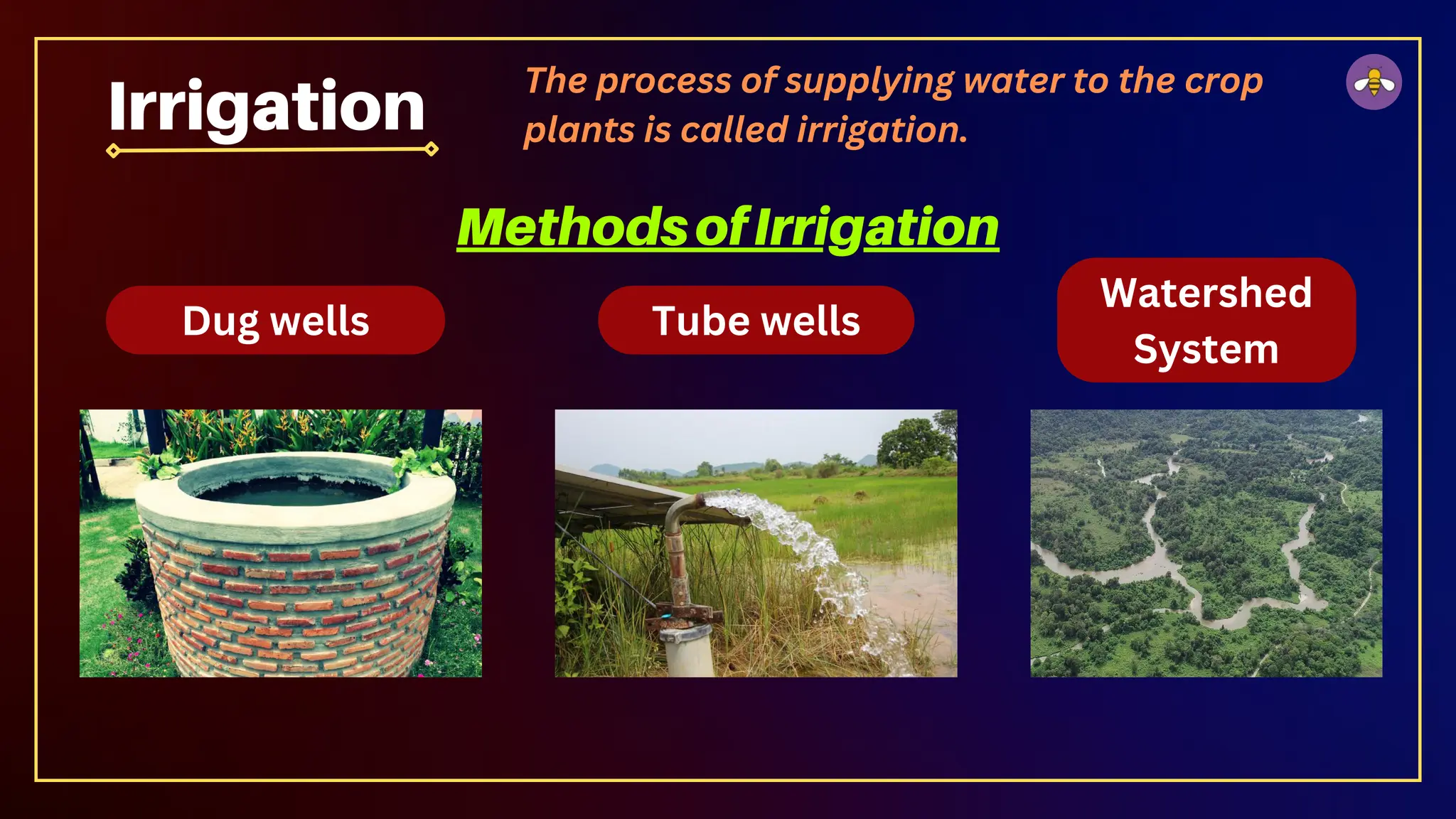
The process of supplying water to the crop
plants is called irrigation.
Irrigation
MethodsofIrrigation
Dug wells Tube wells
Watershed
System
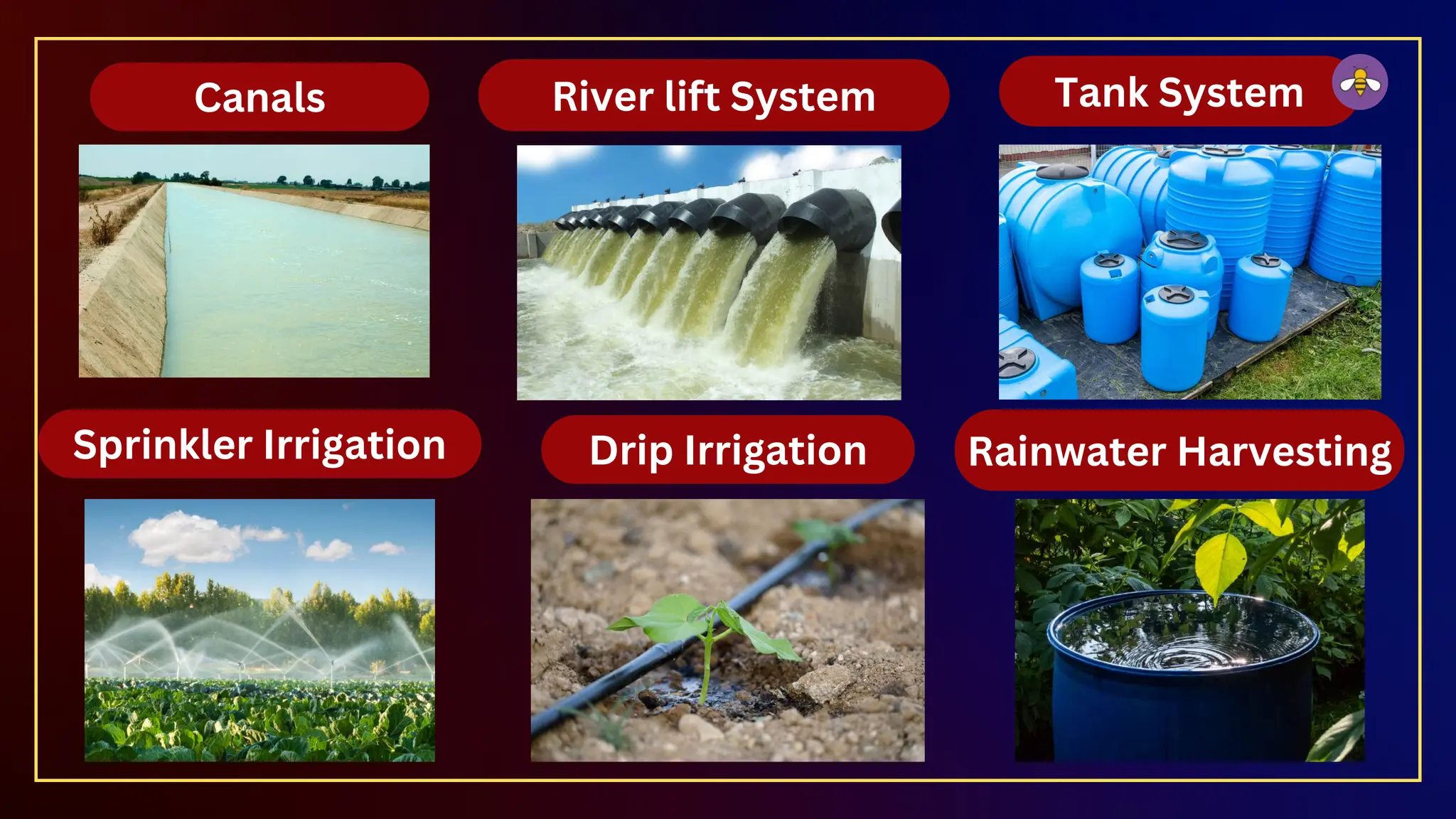
Tank System
Canals River lift System
Sprinkler Irrigation Drip Irrigation Rainwater Harvesting
Methods used to control the problems:
(i) Pest control during growth
(ii) Storage of grains
Crop Protection Management
To protect crops against diseases caused organisms and other
harming factors is called crop protection.
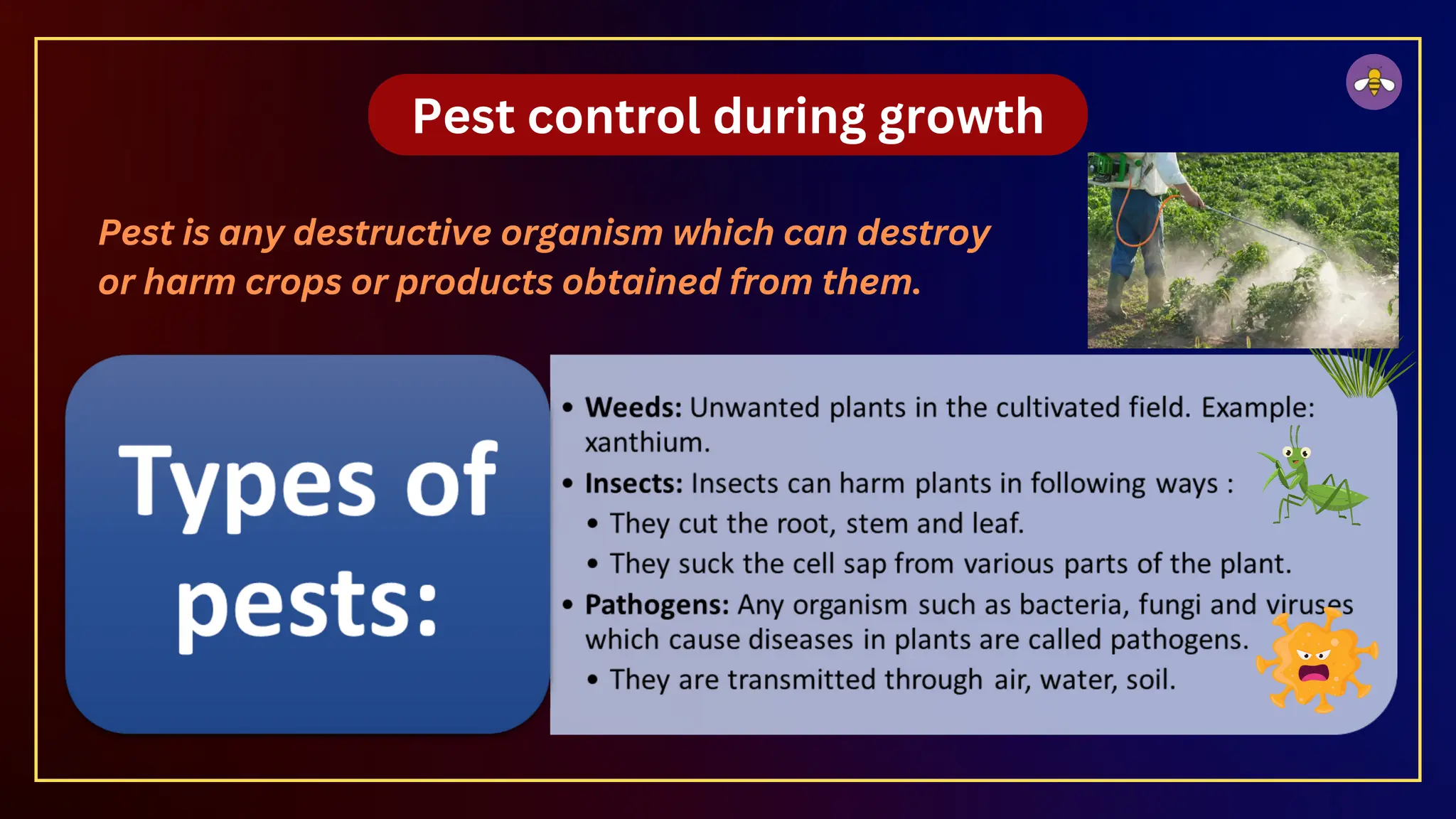
Pest control during growth
Pest is any destructive organism which can destroy
or harm crops or products obtained from them.
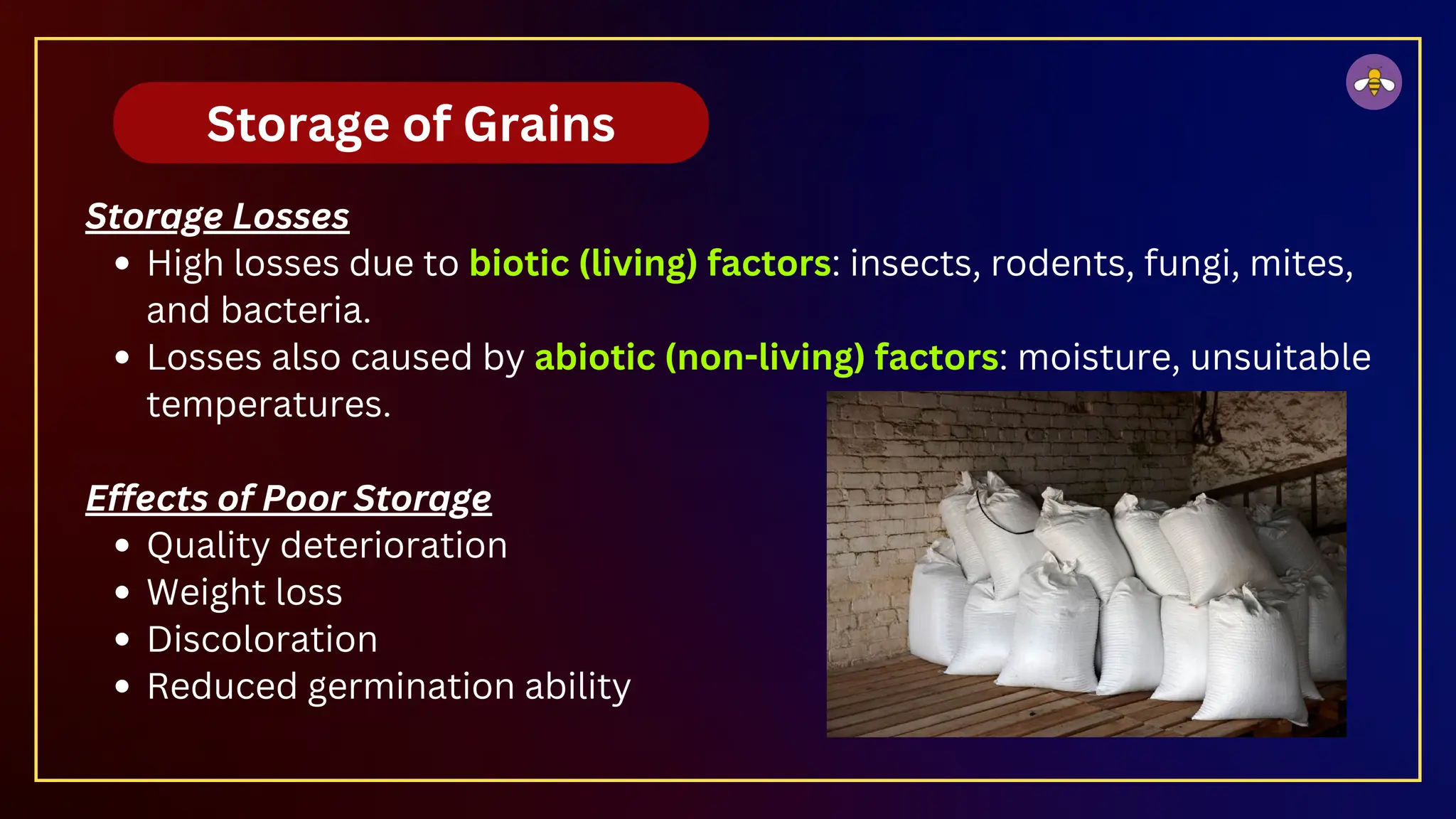
Storage Losses
High losses due to biotic (living) factors: insects, rodents, fungi, mites,
and bacteria.
Losses also caused by abiotic (non-living) factors: moisture, unsuitable
temperatures.
Effects of Poor Storage
Quality deterioration
Weight loss
Discoloration
Reduced germination ability
Storage of Grains
Storage of Grains
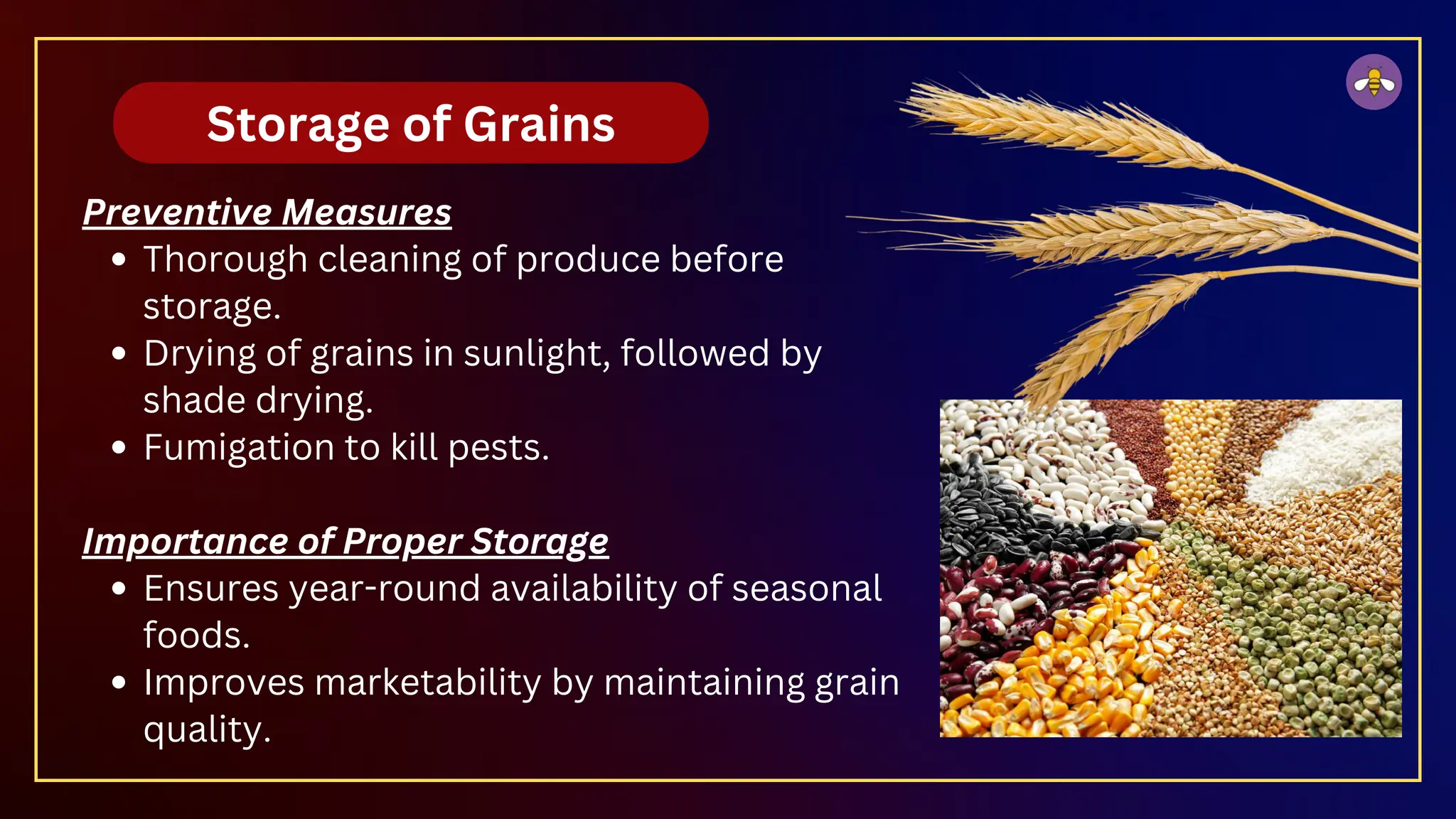
Preventive Measures
Thorough cleaning of produce before
storage.
Drying of grains in sunlight, followed by
shade drying.
Fumigation to kill pests.
Importance of Proper Storage
Ensures year-round availability of seasonal
foods.
Improves marketability by maintaining grain
quality.
1. White revolution was done for
A. Cotton
B. Milk
C. Eggs
D. Oil
Enemy Ahead!
2. Desirable agronomic characteristics for fodder crop?
A. Tallness
B. Profuse branching
C. Dwarfness
D. Both a and b
Enemy Ahead!
3. Which of the following is a biotic stress in plants?
A. Flood
B. Ultraviolet rays
C. Bacterial attack
D. Drought
Enemy Ahead!
4. Which is a micronutrient?
A. Nitrogen
B. Calcium
C. Zinc
D. Phosphorus
Enemy Ahead!
Types of Animal Husbandry:
Cattle Farming
Poultry Farming
Fish Production
Bee Keeping
Animal Husbandry
Animal husbandry is a scientific management of domestic animals in an
efficient manner to obtain food and other useful products from them.
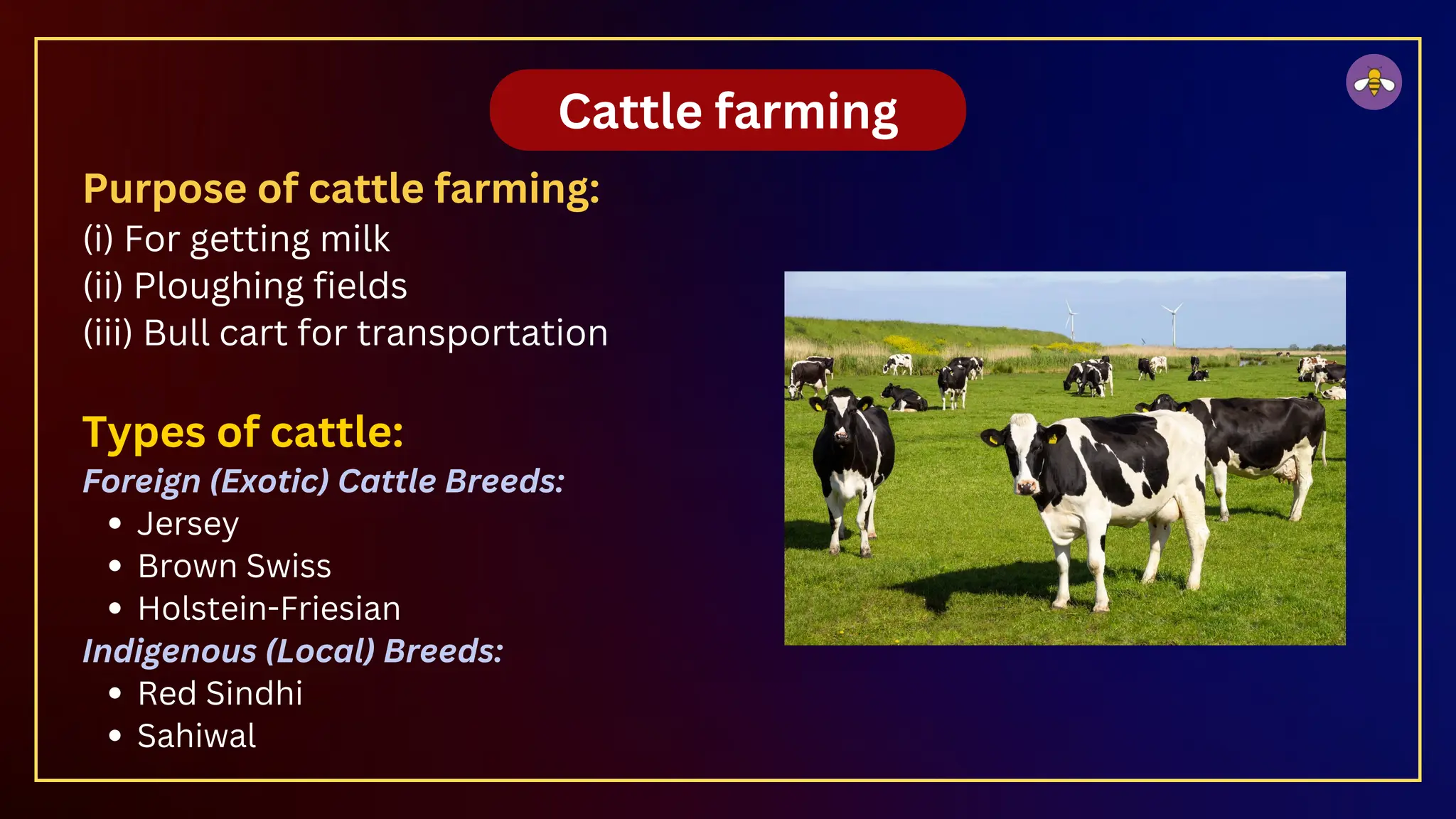
Cattle farming
Purpose of cattle farming:
(i) For getting milk
(ii) Ploughing fields
(iii) Bull cart for transportation
Types of cattle:
Foreign (Exotic) Cattle Breeds:
Jersey
Brown Swiss
Holstein-Friesian
Indigenous (Local) Breeds:
Red Sindhi
Sahiwal
Lactation Period
The period of milk production between birth of a young one and the next
pregnancy is called lactation period.
Milk production can be enhanced by increasing the lactation period in the cattle.
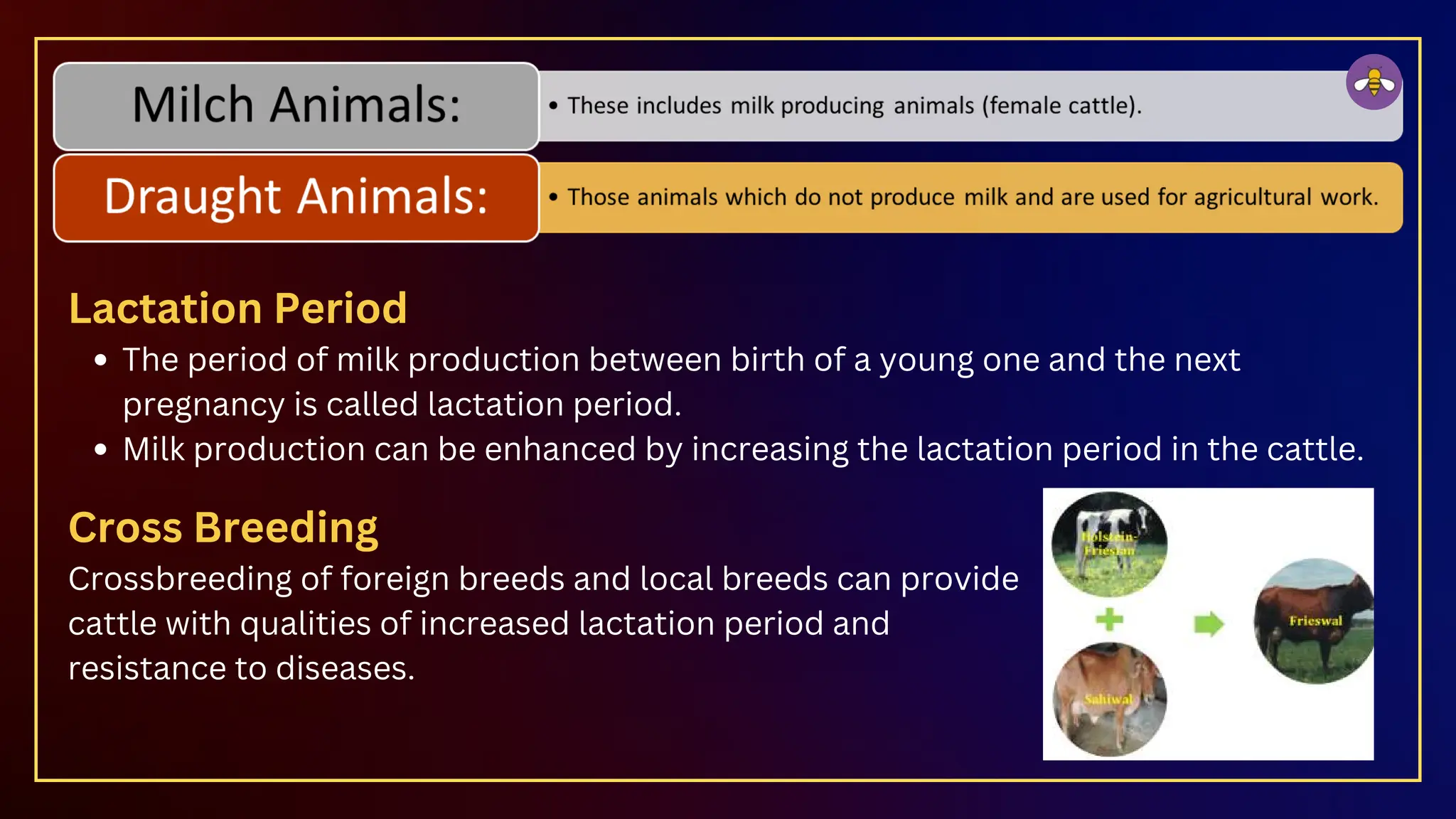
Cross Breeding
Crossbreeding of foreign breeds and local breeds can provide
cattle with qualities of increased lactation period and
resistance to diseases.
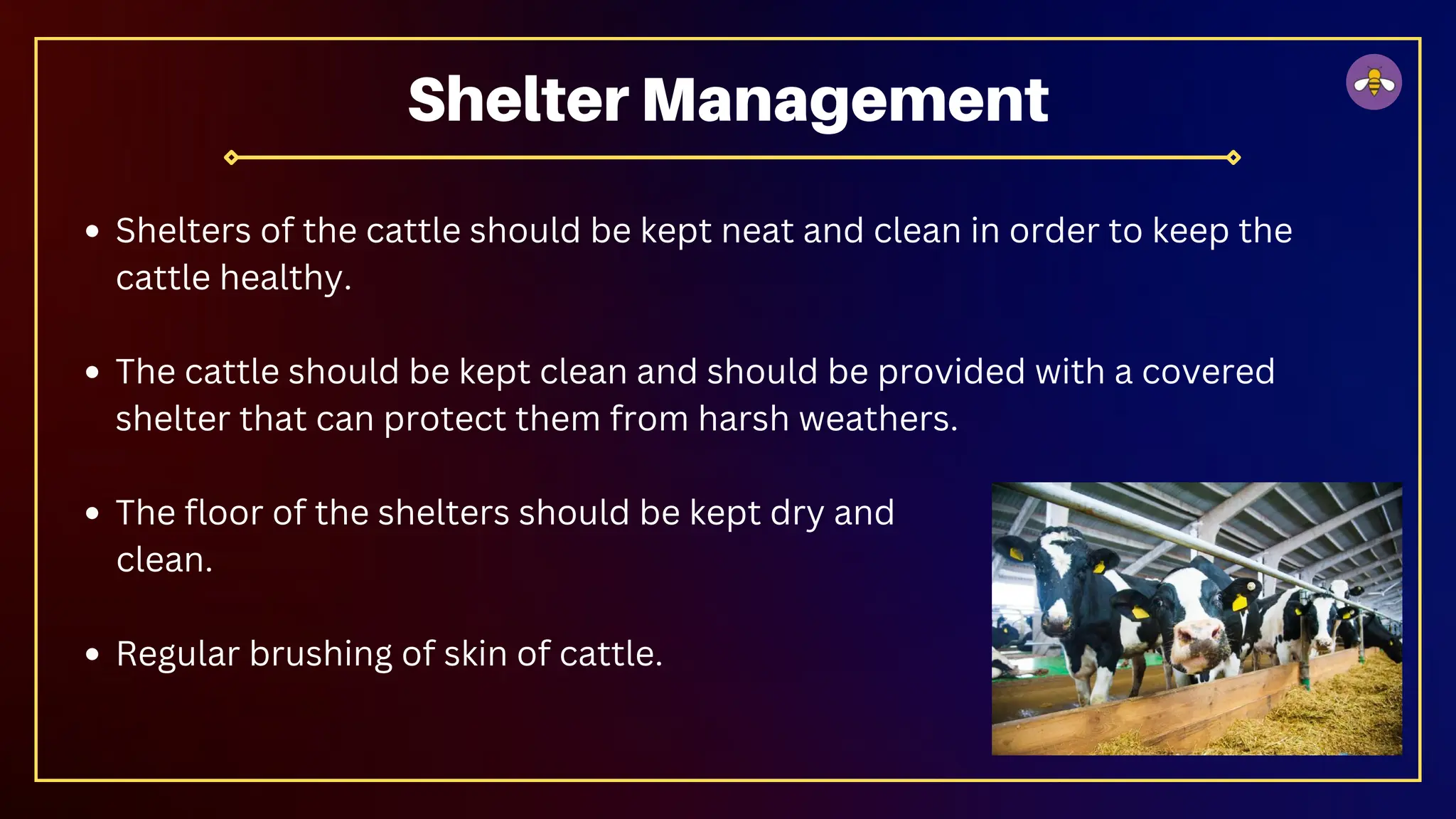
Shelters of the cattle should be kept neat and clean in order to keep the
cattle healthy.
The cattle should be kept clean and should be provided with a covered
shelter that can protect them from harsh weathers.
The floor of the shelters should be kept dry and
clean.
Regular brushing of skin of cattle.
Shelter Management
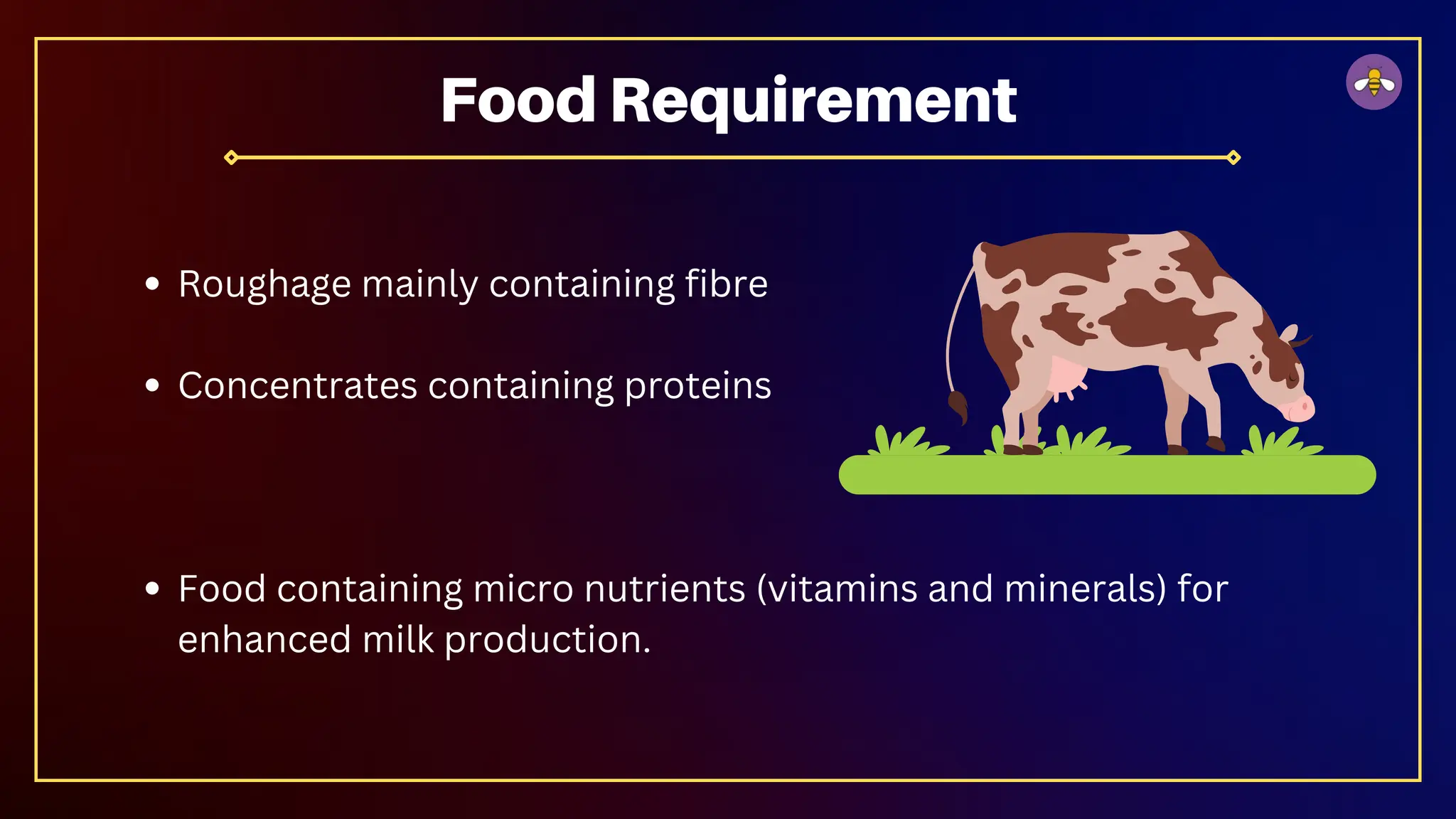
Roughage mainly containing fibre
Concentrates containing proteins
Food containing micro nutrients (vitamins and minerals) for
enhanced milk production.
Food Requirement
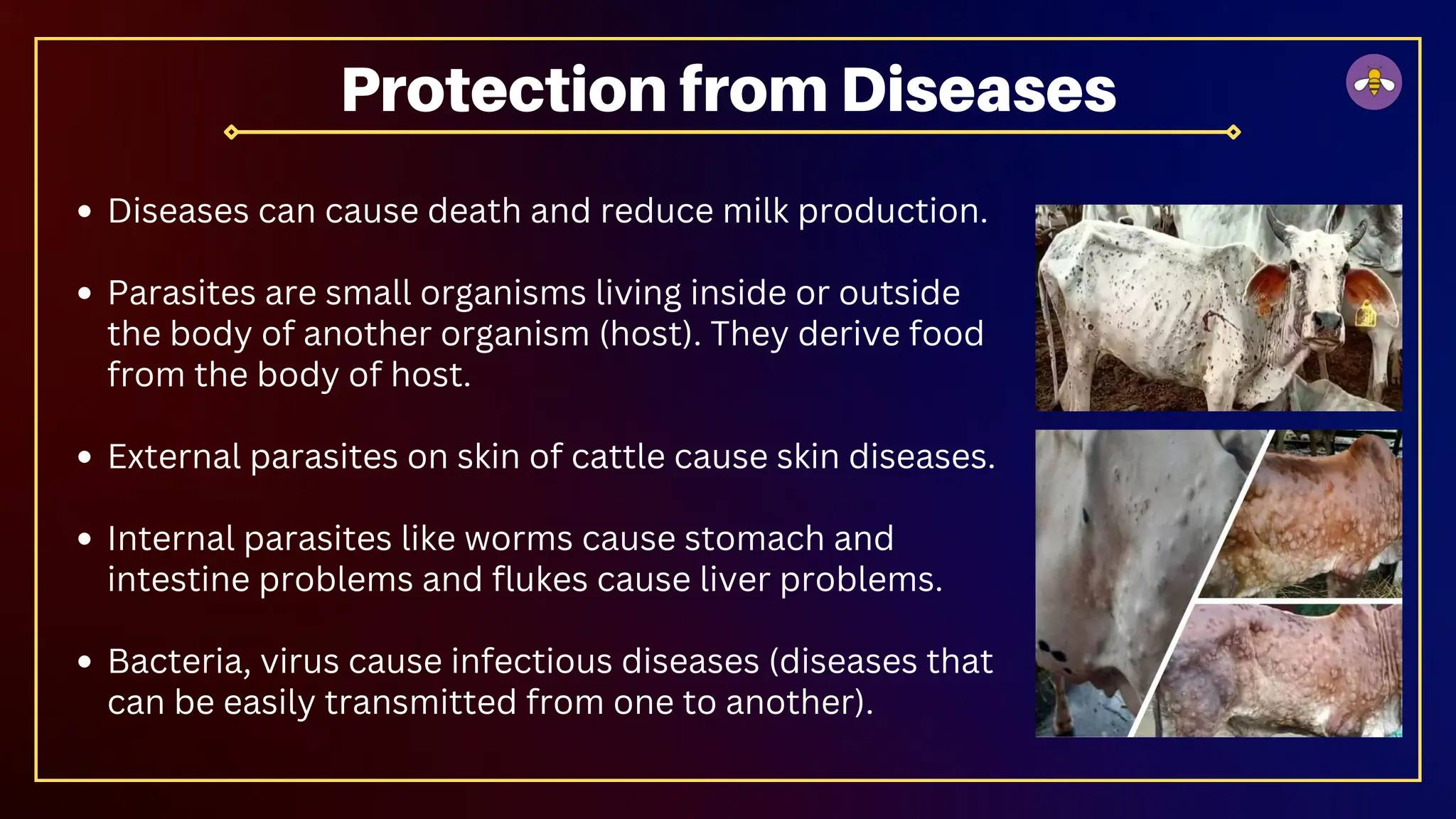
Diseases can cause death and reduce milk production.
Parasites are small organisms living inside or outside
the body of another organism (host). They derive food
from the body of host.
External parasites on skin of cattle cause skin diseases.
Internal parasites like worms cause stomach and
intestine problems and flukes cause liver problems.
Bacteria, virus cause infectious diseases (diseases that
can be easily transmitted from one to another).
Protection from Diseases
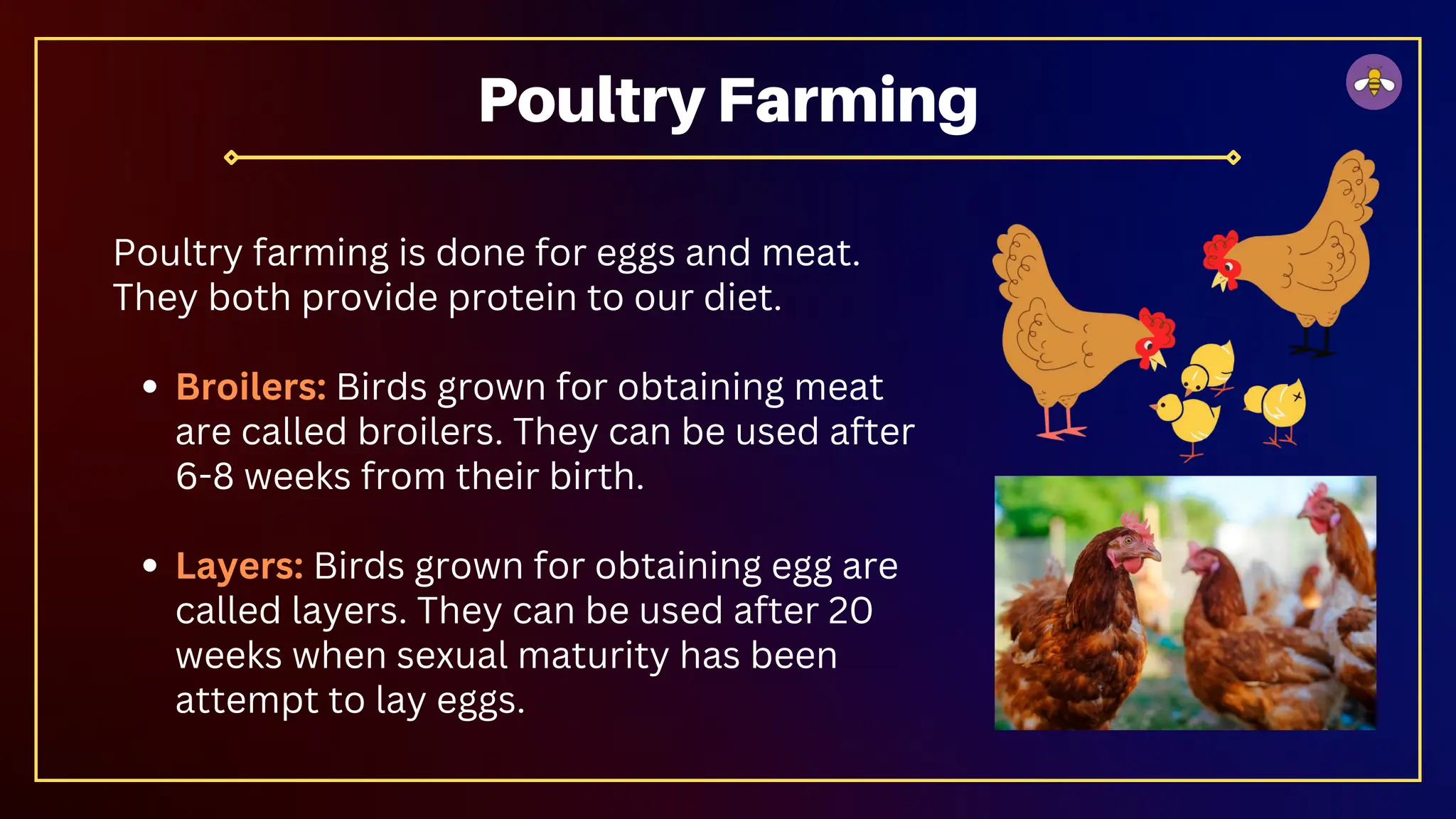
Poultry farming is done for eggs and meat.
They both provide protein to our diet.
Broilers: Birds grown for obtaining meat
are called broilers. They can be used after
6-8 weeks from their birth.
Layers: Birds grown for obtaining egg are
called layers. They can be used after 20
weeks when sexual maturity has been
attempt to lay eggs.
Poultry Farming
Most of the broilers and layers are cross-breed.
Breeding is done to enhance following properties in hens like:
(i) More and better quality chicks.
(ii) Low maintenance.
(iii) Breeding is done to produce dwarf broilers (meat-giving birds).
Feeding cost is the biggest expense in poultry farms.
Dwarf broilers need less food and can reduce cost by 30%. Also, they
can tolerate more heat.
Poultry Farming
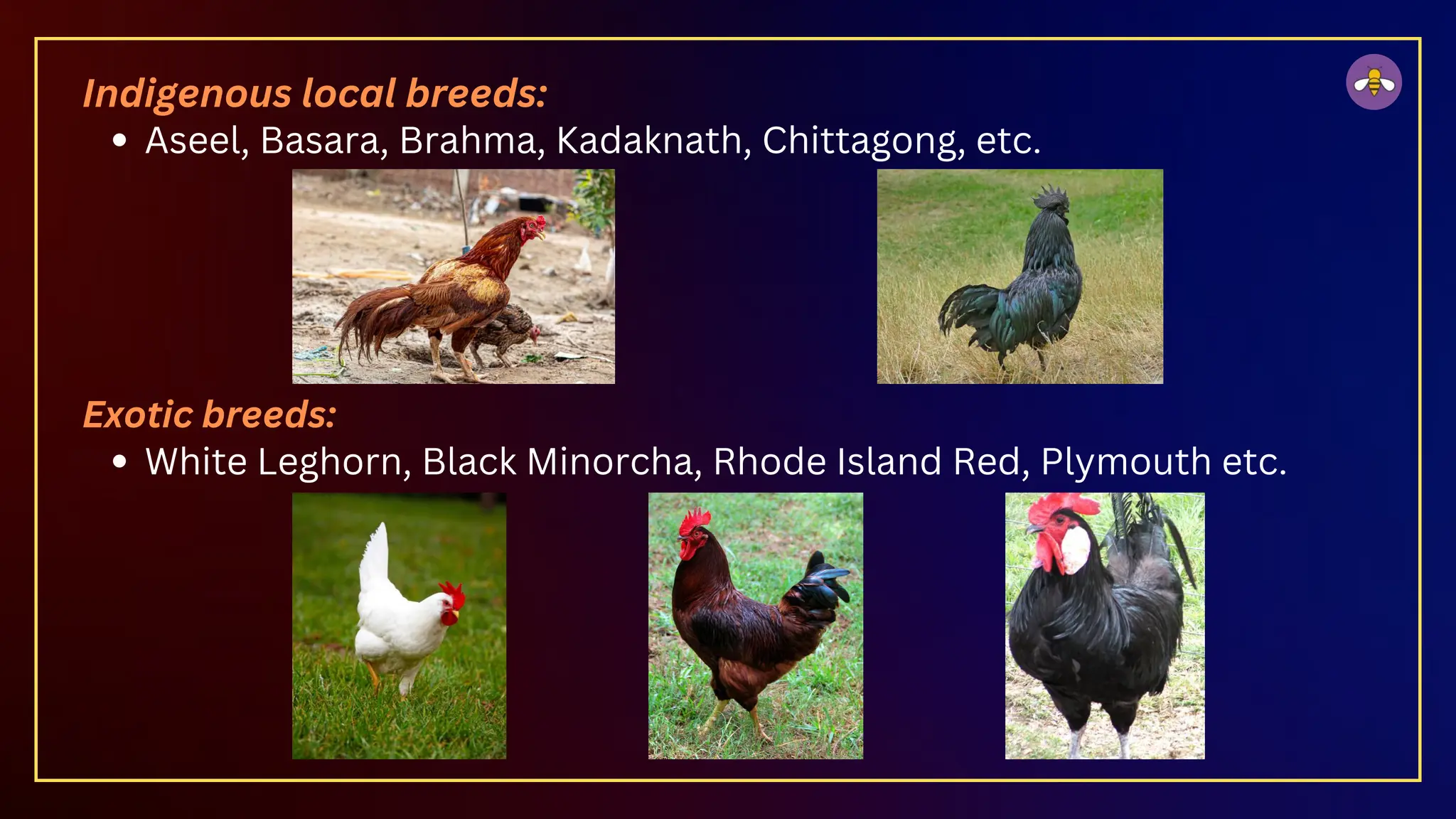
Indigenous local breeds:
Aseel, Basara, Brahma, Kadaknath, Chittagong, etc.
Exotic breeds:
White Leghorn, Black Minorcha, Rhode Island Red, Plymouth etc.
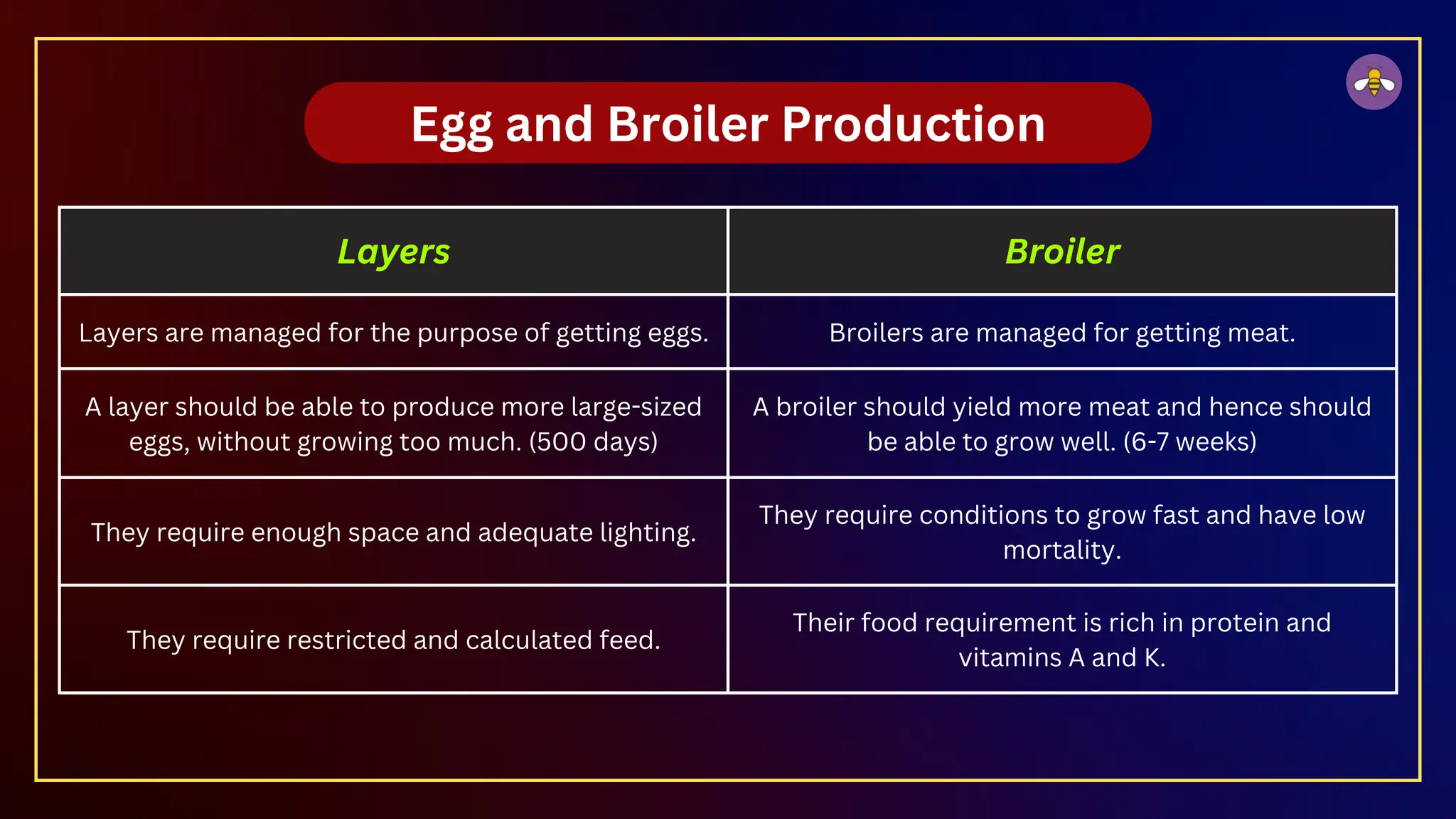
Egg and Broiler Production
Layers Broiler
Layers are managed for the purpose of getting eggs. Broilers are managed for getting meat.
A layer should be able to produce more large-sized
eggs, without growing too much. (500 days)
A broiler should yield more meat and hence should
be able to grow well. (6-7 weeks)
They require enough space and adequate lighting.
They require conditions to grow fast and have low
mortality.
They require restricted and calculated feed.
Their food requirement is rich in protein and
vitamins A and K.
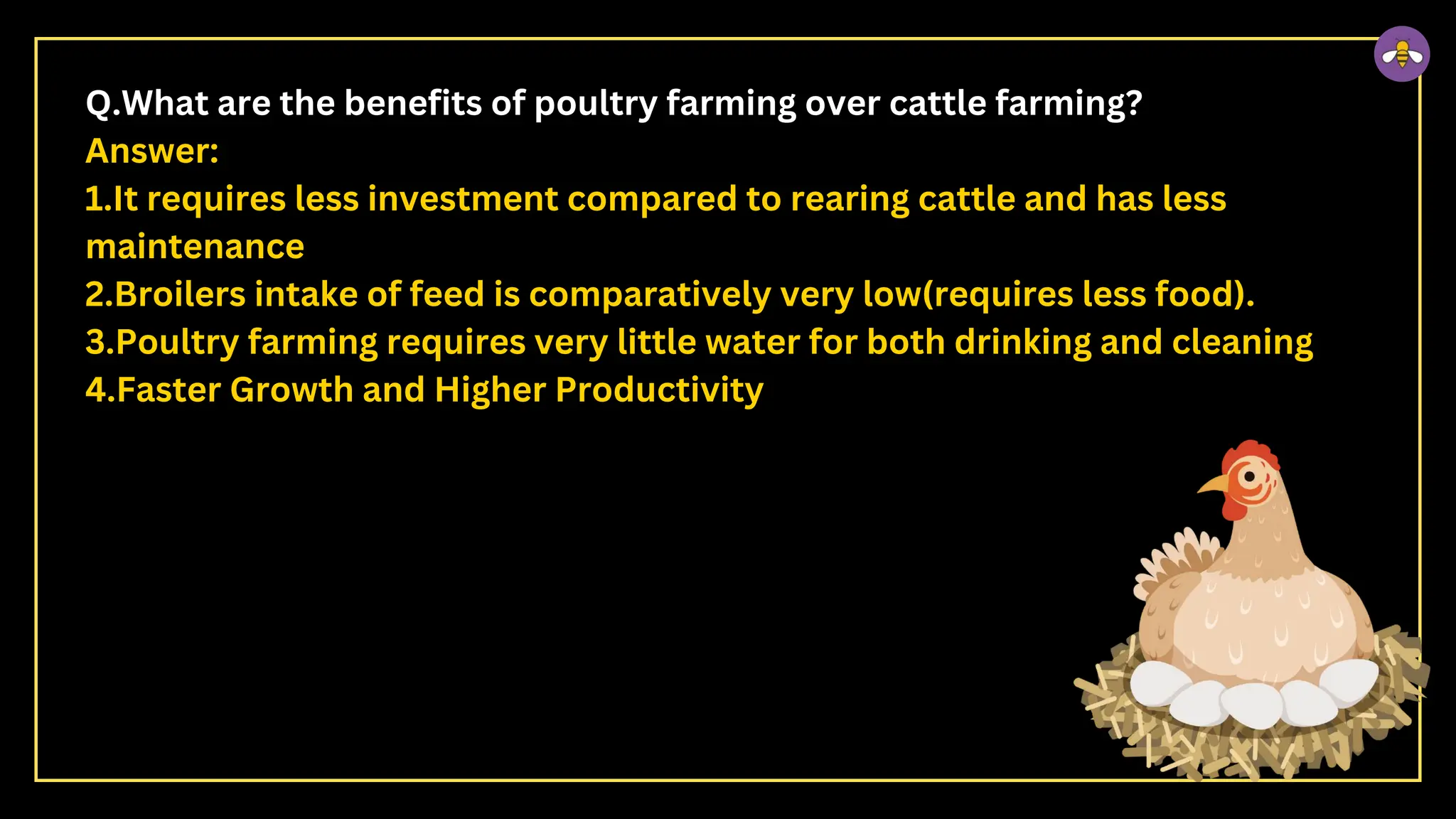
Q.What are the benefits of poultry farming over cattle farming?
Answer:
1.It requires less investment compared to rearing cattle and has less
maintenance
2.Broilers intake of feed is comparatively very low(requires less food).
3.Poultry farming requires very little water for both drinking and cleaning
4.Faster Growth and Higher Productivity
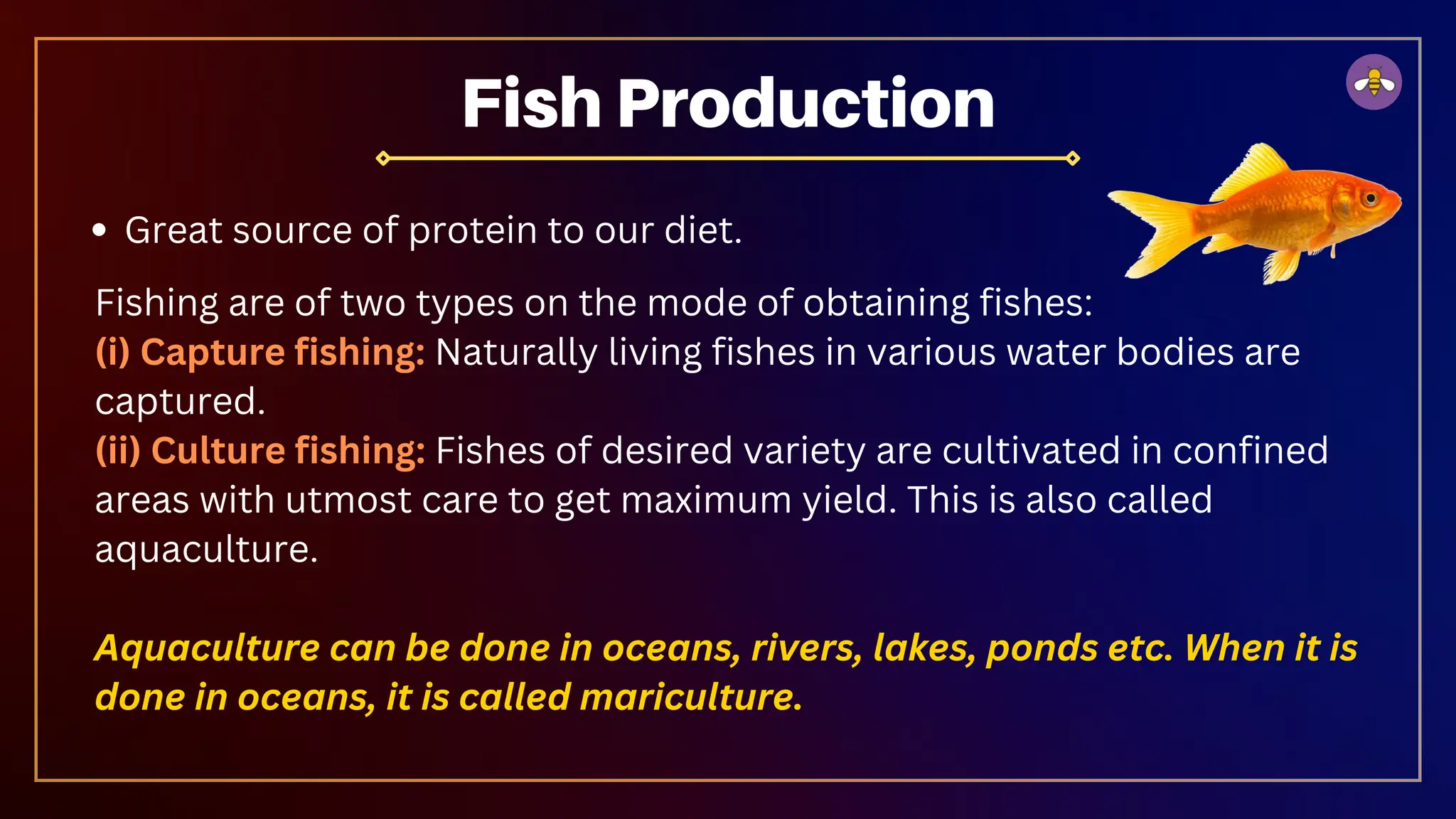
Fish Production
Great source of protein to our diet.
Fishing are of two types on the mode of obtaining fishes:
(i) Capture fishing: Naturally living fishes in various water bodies are
captured.
(ii) Culture fishing: Fishes of desired variety are cultivated in confined
areas with utmost care to get maximum yield. This is also called
aquaculture.
Aquaculture can be done in oceans, rivers, lakes, ponds etc. When it is
done in oceans, it is called mariculture.
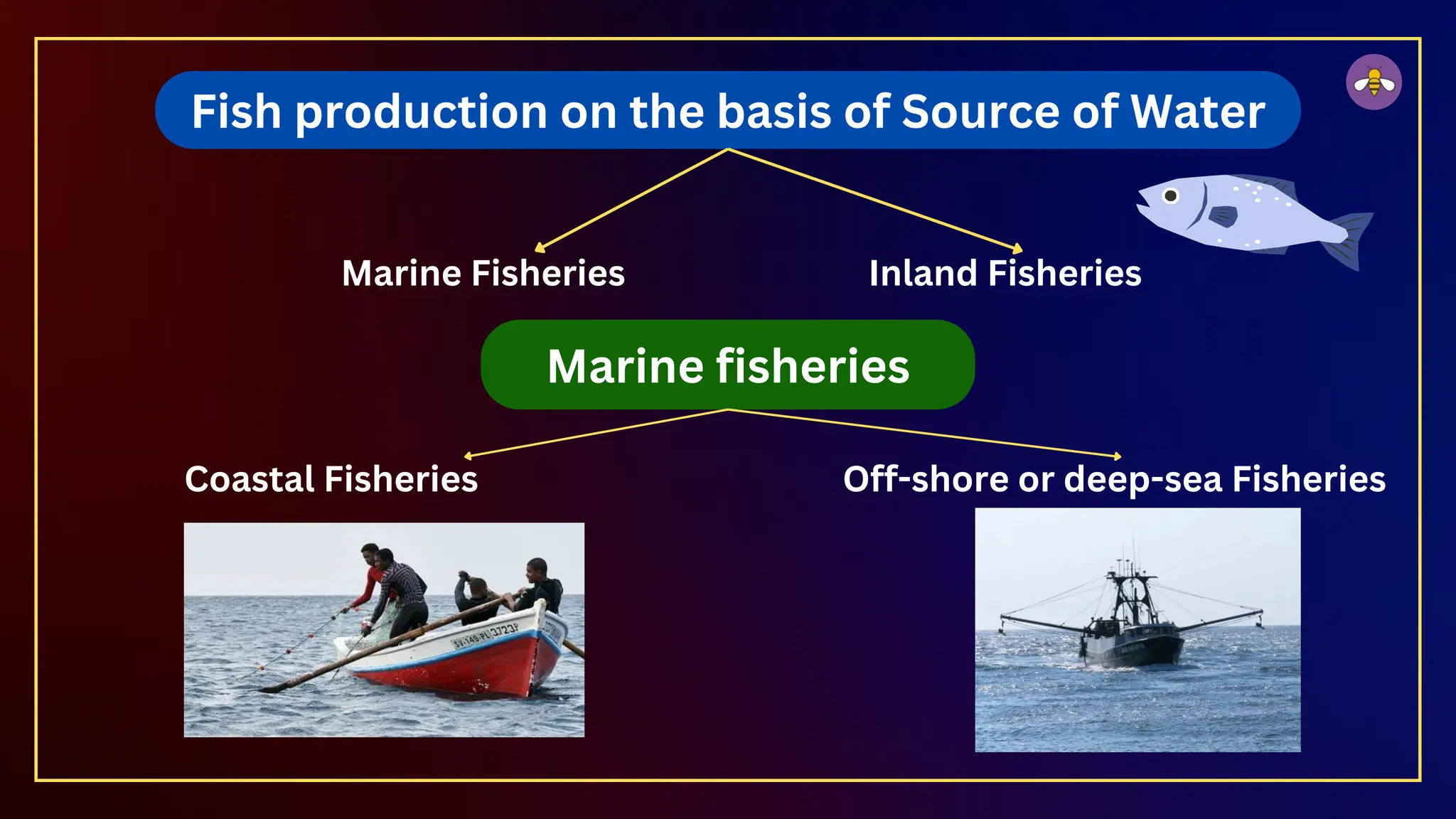
Marine Fisheries
Fish production on the basis of Source of Water
Inland Fisheries
Coastal Fisheries
Marine fisheries
Off-shore or deep-sea Fisheries
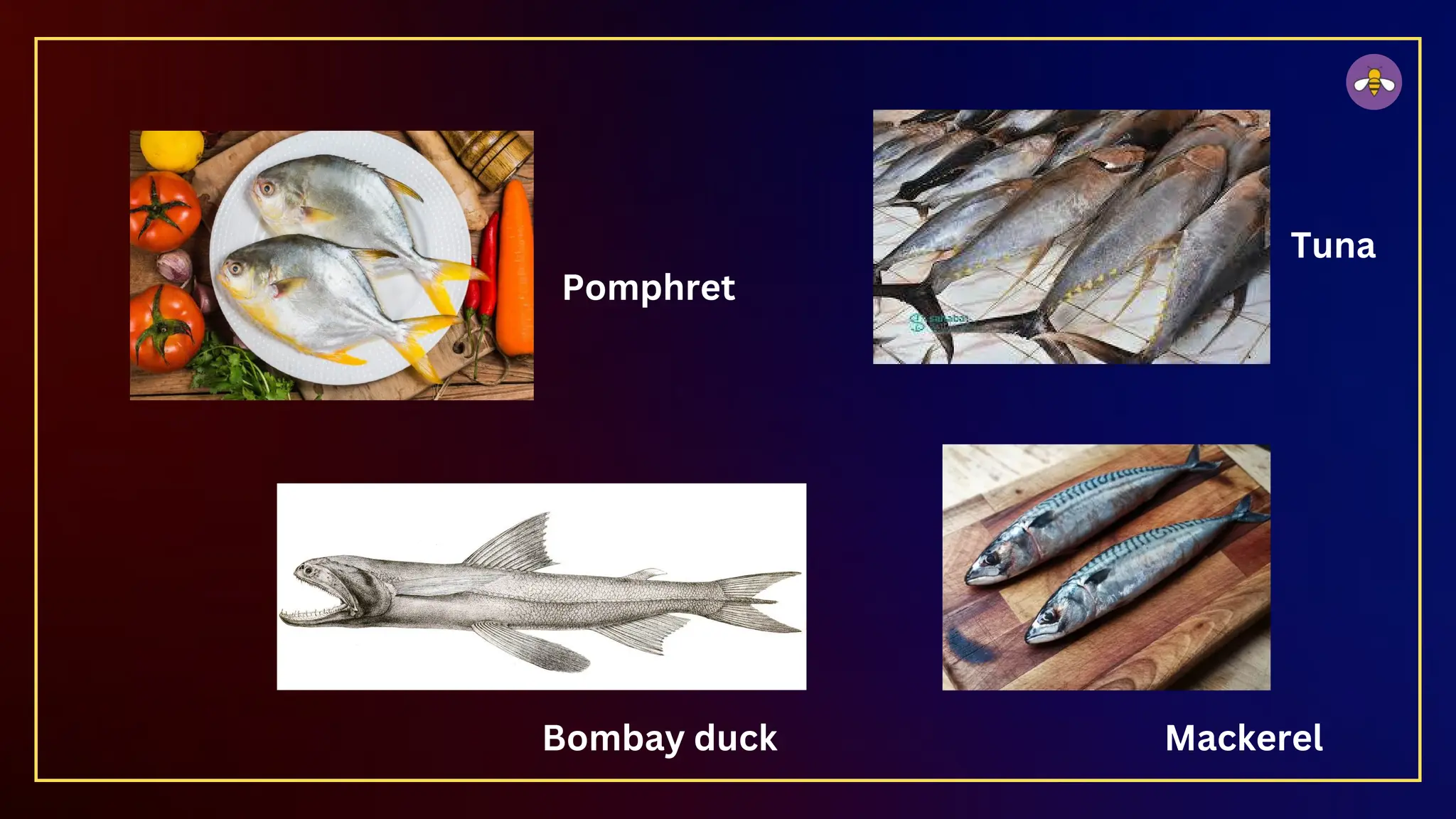
Pomphret
Mackerel
Bombay duck
Tuna
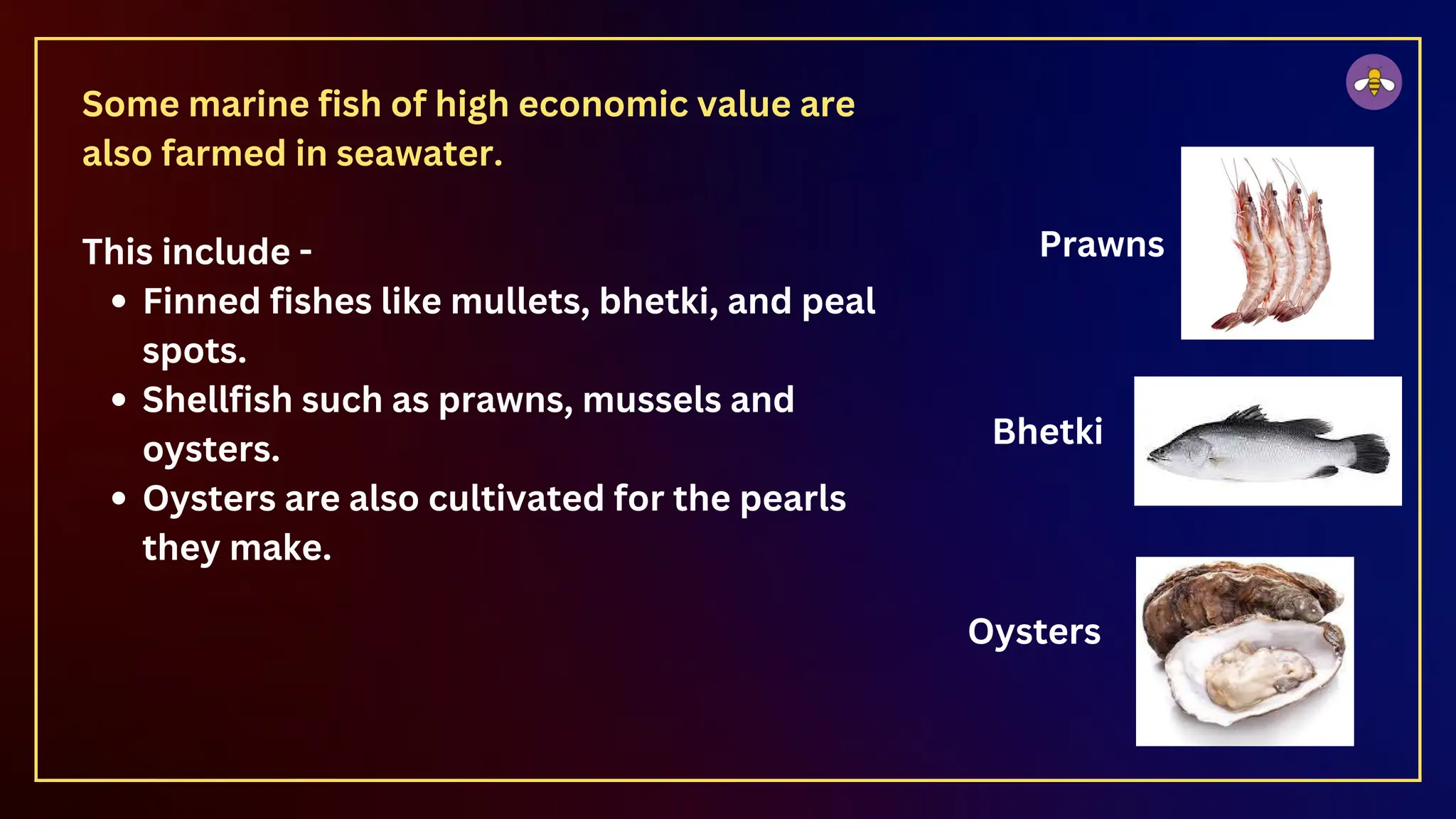
Some marine fish of high economic value are
also farmed in seawater.
This include -
Finned fishes like mullets, bhetki, and peal
spots.
Shellfish such as prawns, mussels and
oysters.
Oysters are also cultivated for the pearls
they make.
Prawns
Bhetki
Oysters
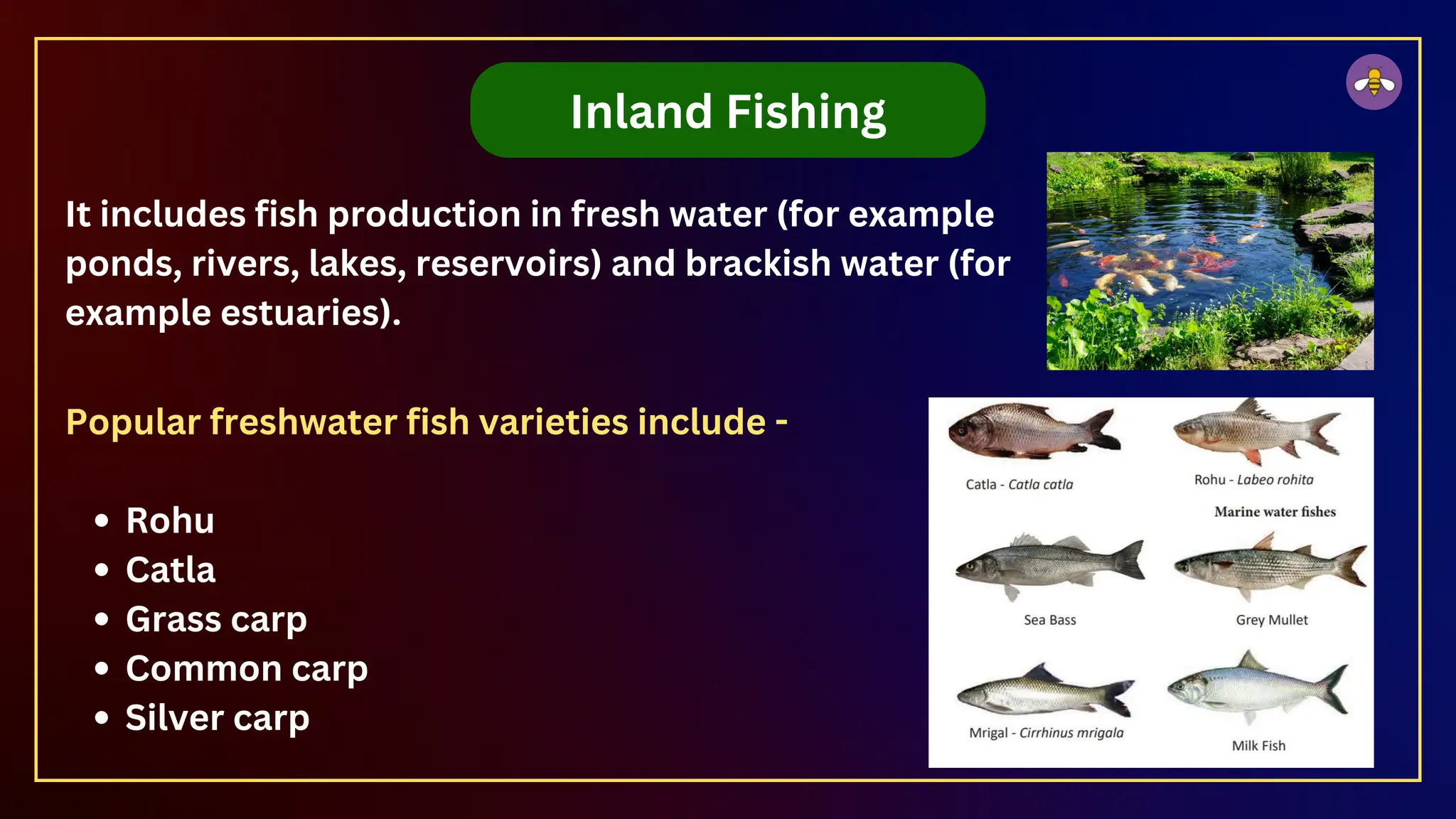
Inland Fishing
It includes fish production in fresh water (for example
ponds, rivers, lakes, reservoirs) and brackish water (for
example estuaries).
Popular freshwater fish varieties include -
Rohu
Catla
Grass carp
Common carp
Silver carp
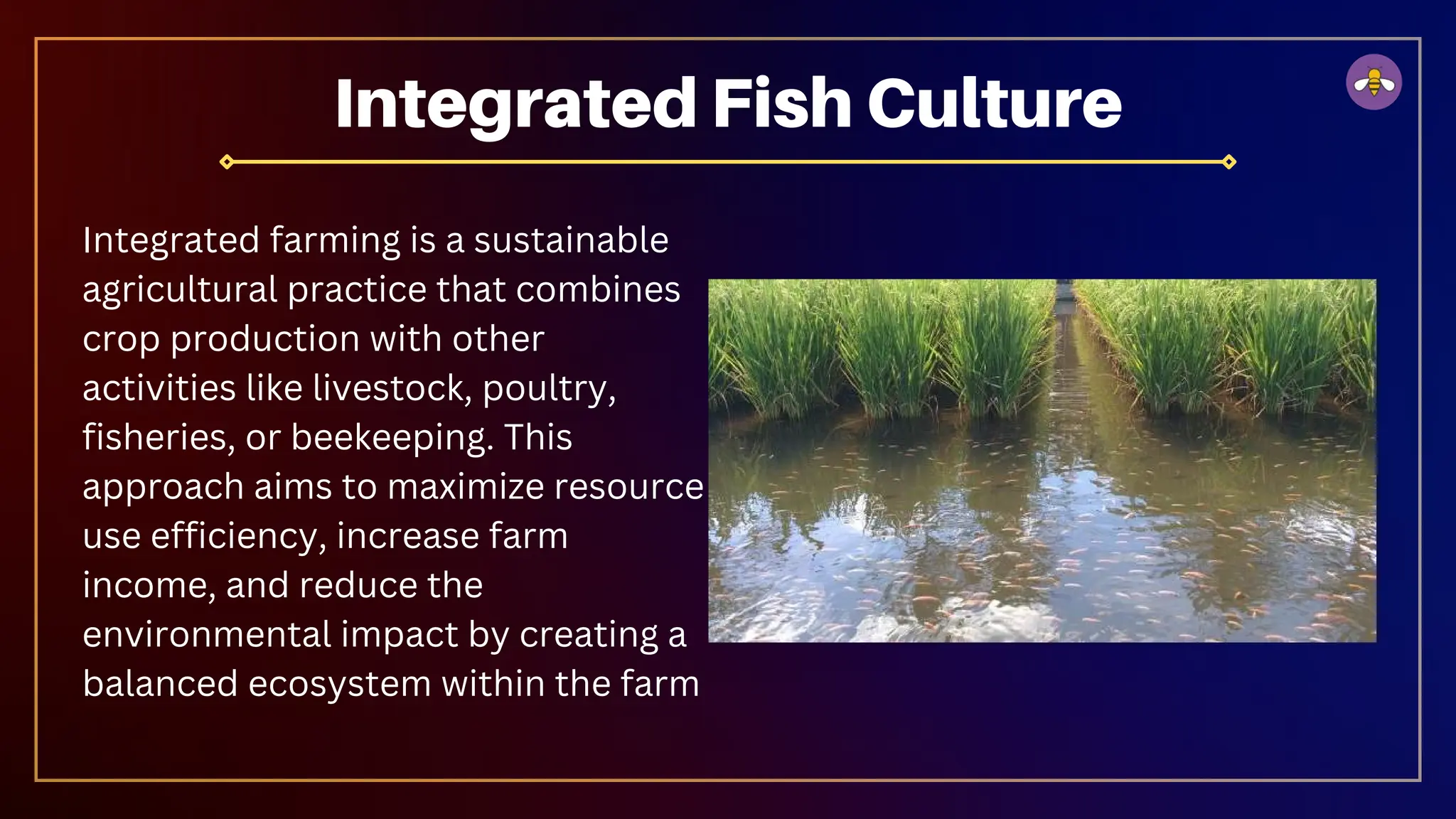
Integrated Fish Culture
Integrated farming is a sustainable
agricultural practice that combines
crop production with other
activities like livestock, poultry,
fisheries, or beekeeping. This
approach aims to maximize resource
use efficiency, increase farm
income, and reduce the
environmental impact by creating a
balanced ecosystem within the farm
Composite Fish Culture
Composite fish culture, also known as polyculture, involves growing
different types of fish in the same water source to maximize
productivity. Fish are selected based on their feeding zones to ensure
efficient use of resources.
Surface Feeders: Examples: Catla, Silver Carp
Column Feeders: Examples: Rohu, Grass Carp
Bottom Feeders: Examples: Mrigal, Common Carp
This method allows different fish species to coexist and feed at
different levels, optimizing the ecosystem within the pond or water
source.
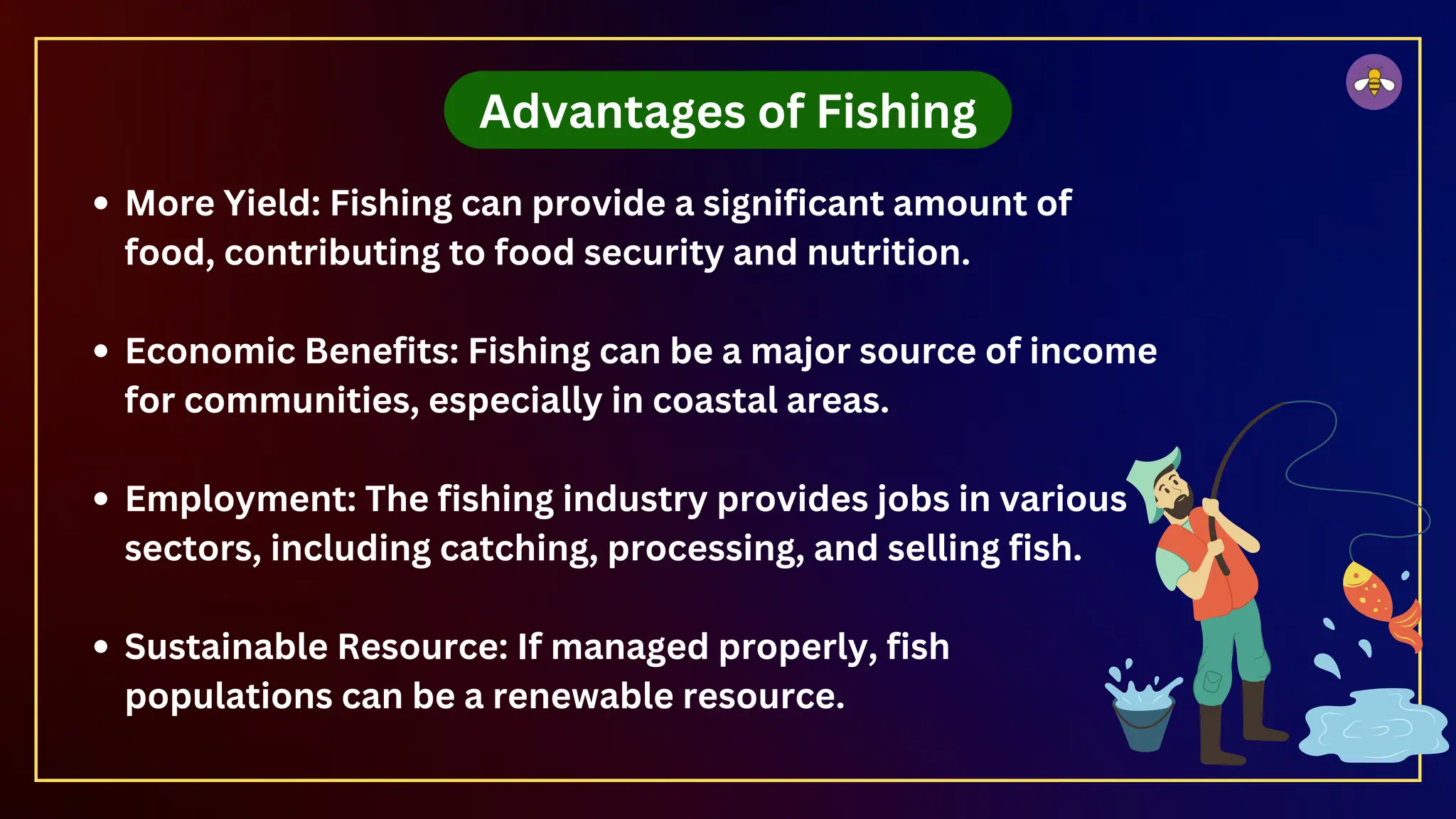
Advantages of Fishing
More Yield: Fishing can provide a significant amount of
food, contributing to food security and nutrition.
Economic Benefits: Fishing can be a major source of income
for communities, especially in coastal areas.
Employment: The fishing industry provides jobs in various
sectors, including catching, processing, and selling fish.
Sustainable Resource: If managed properly, fish
populations can be a renewable resource.
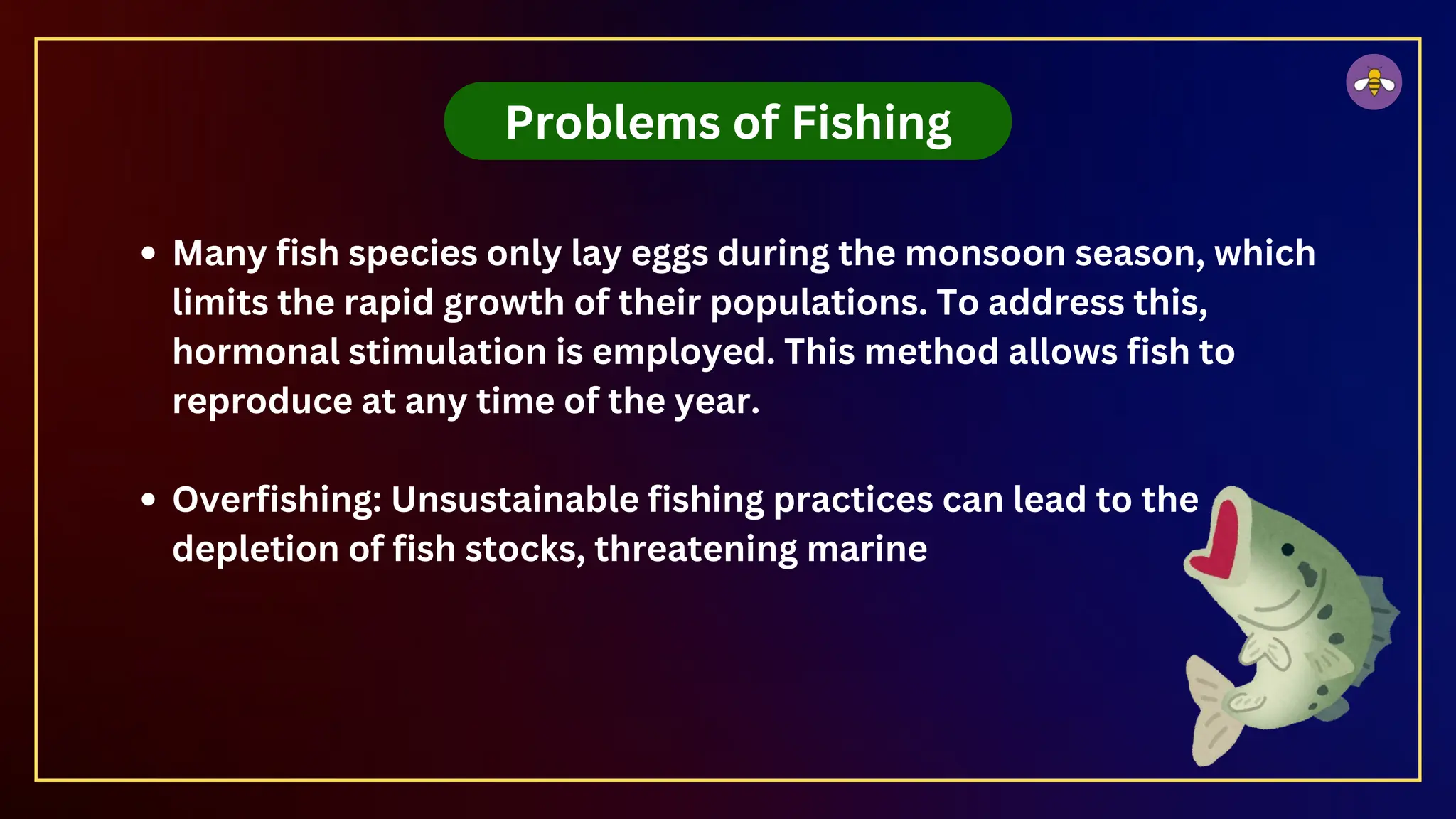
Problems of Fishing
Many fish species only lay eggs during the monsoon season, which
limits the rapid growth of their populations. To address this,
hormonal stimulation is employed. This method allows fish to
reproduce at any time of the year.
Overfishing: Unsustainable fishing practices can lead to the
depletion of fish stocks, threatening marine
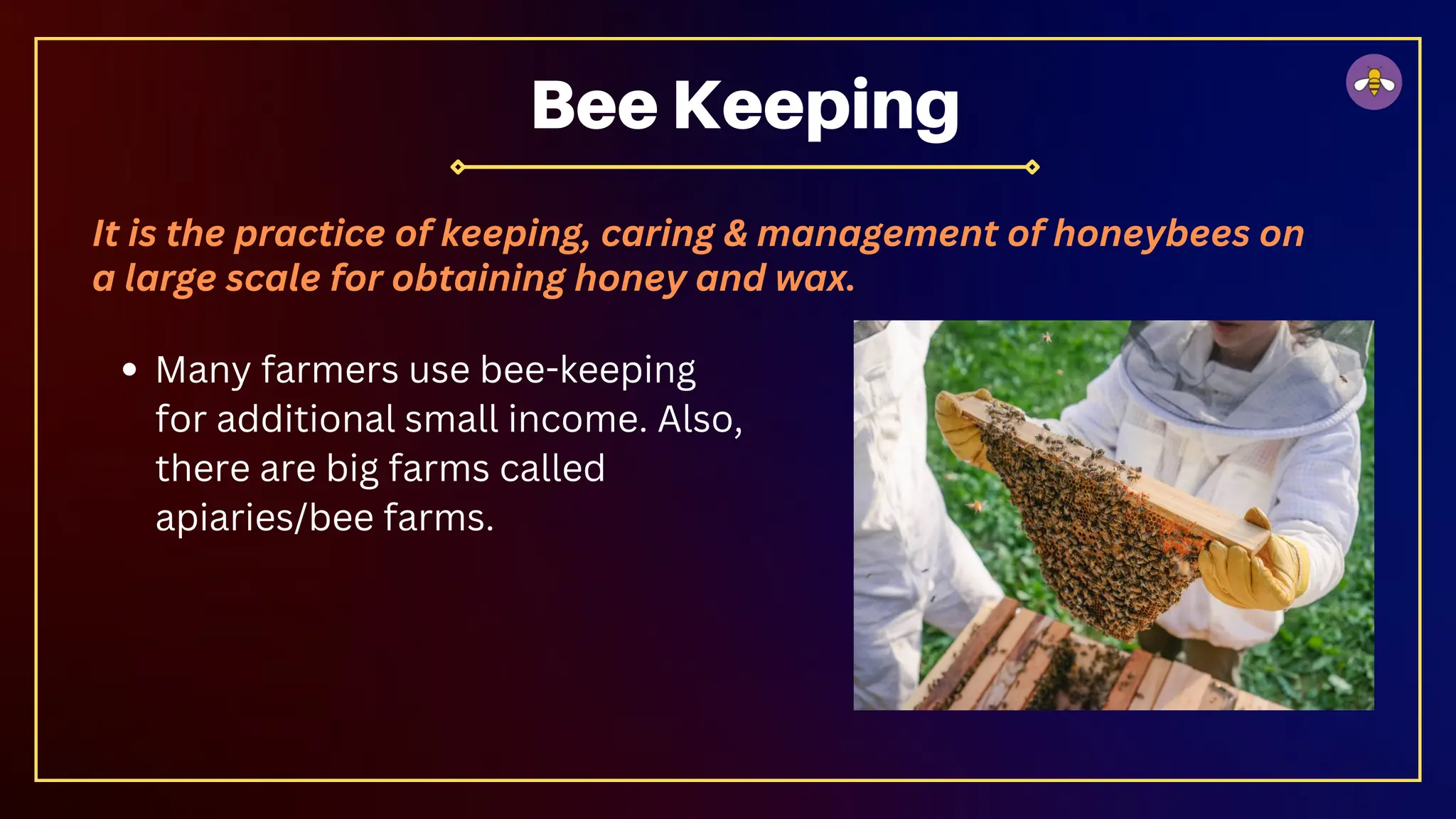
It is the practice of keeping, caring & management of honeybees on
a large scale for obtaining honey and wax.
Many farmers use bee-keeping
for additional small income. Also,
there are big farms called
apiaries/bee farms.
Bee Keeping
The setting up of a number of bee hives in desirable location in a
systematic manner that allows maximum pollen and nectar
collection.
Some common Indian varieties of bees include Apis cerana indica
(Indian bee), dorsata (rock bee), floral (little bee).
One Italian variety mellifera is also used in India for commercial
large scale production.
Bee Keeping
Apiary
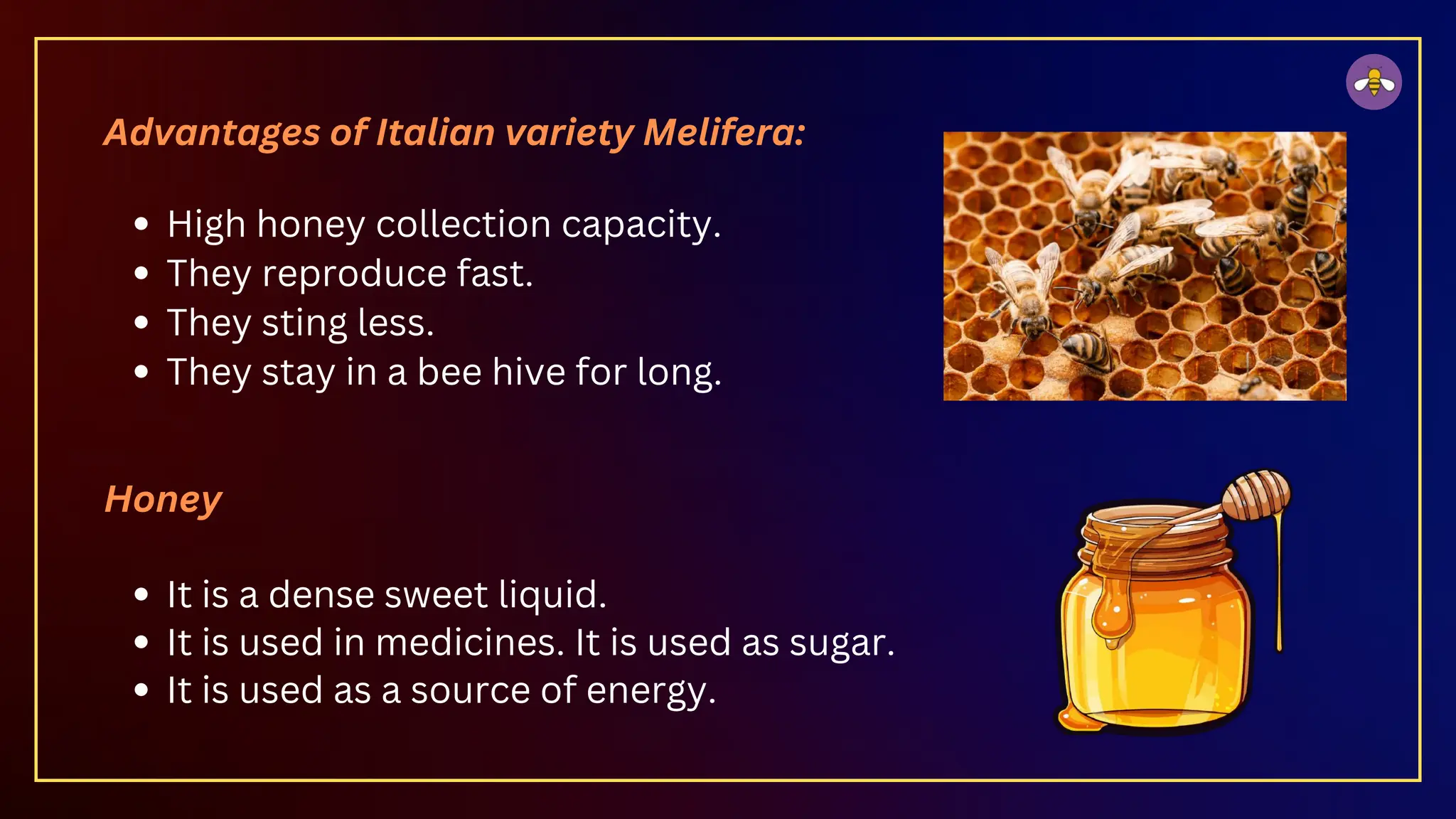
Advantages of Italian variety Melifera:
High honey collection capacity.
They reproduce fast.
They sting less.
They stay in a bee hive for long.
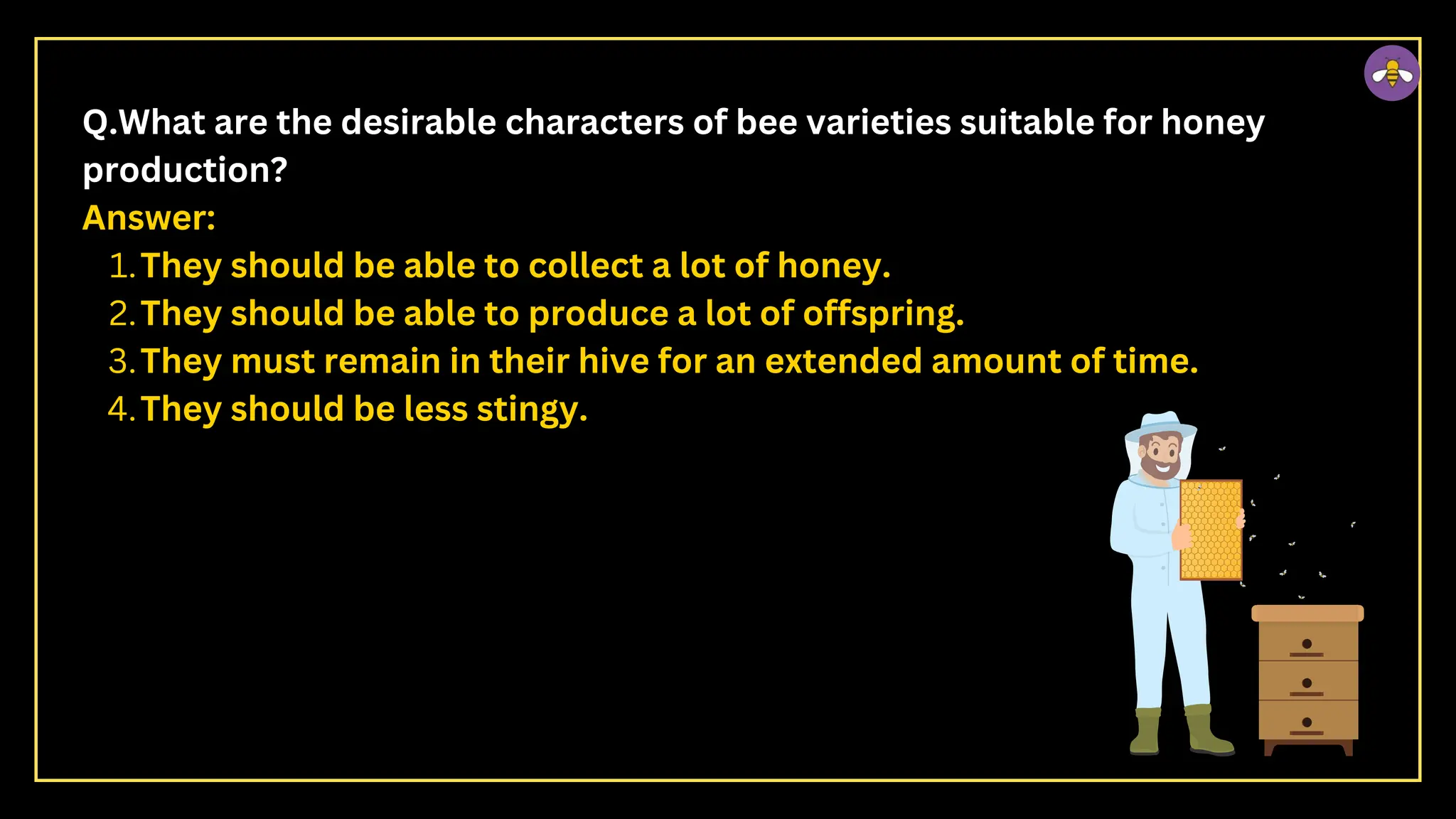
Honey
It is a dense sweet liquid.
It is used in medicines. It is used as sugar.
It is used as a source of energy.
Q.What are the desirable characters of bee varieties suitable for honey
production?
Answer:
They should be able to collect a lot of honey.
1.
They should be able to produce a lot of offspring.
2.
They must remain in their hive for an extended amount of time.
3.
They should be less stingy.
4.
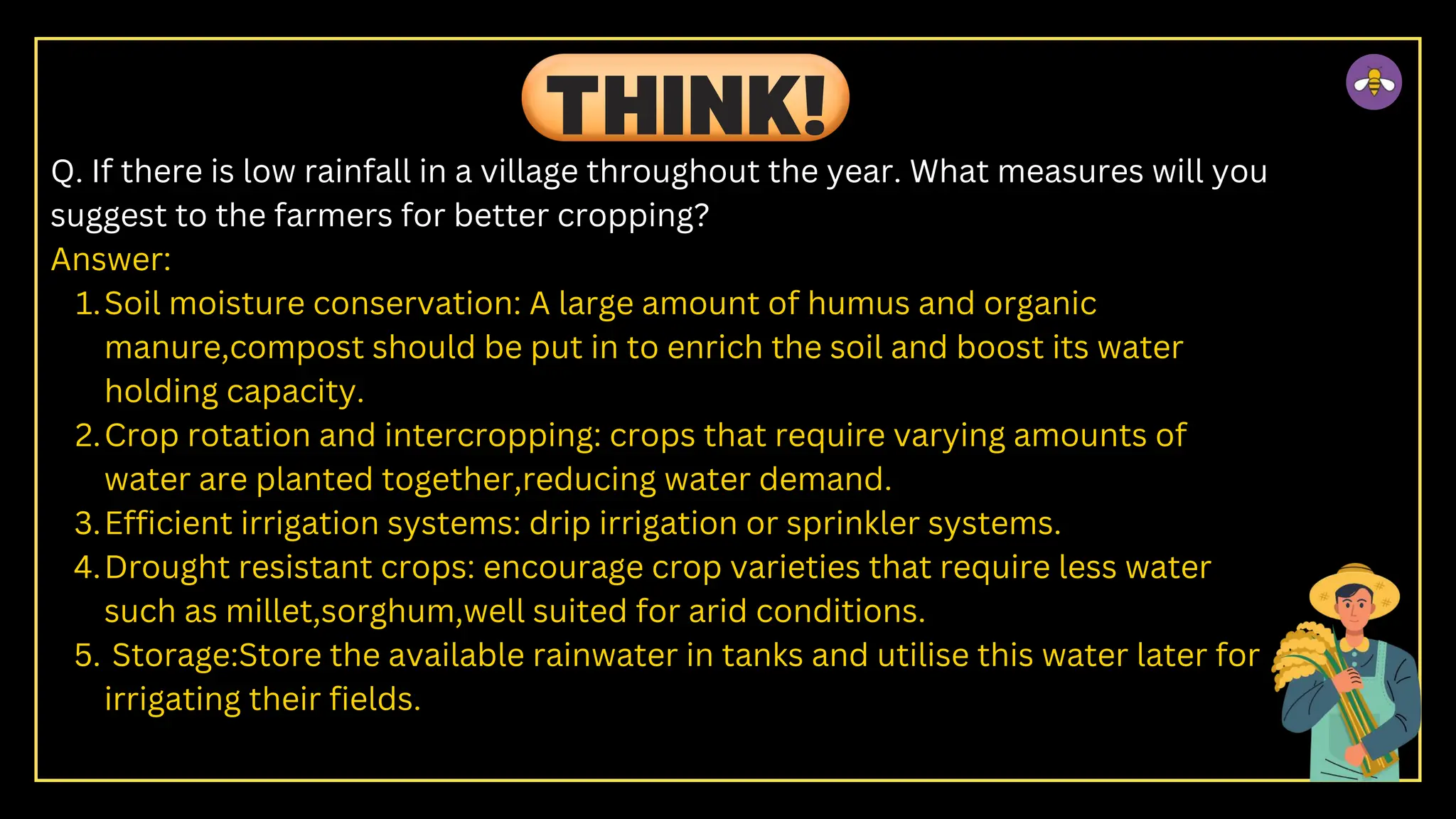
Q. If there is low rainfall in a village throughout the year. What measures will you
suggest to the farmers for better cropping?
Answer:
Soil moisture conservation: A large amount of humus and organic
manure,compost should be put in to enrich the soil and boost its water
holding capacity.
1.
Crop rotation and intercropping: crops that require varying amounts of
water are planted together,reducing water demand.
2.
Efficient irrigation systems: drip irrigation or sprinkler systems.
3.
Drought resistant crops: encourage crop varieties that require less water
such as millet,sorghum,well suited for arid conditions.
4.
Storage:Store the available rainwater in tanks and utilise this water later for
irrigating their fields.
5.
THINK!
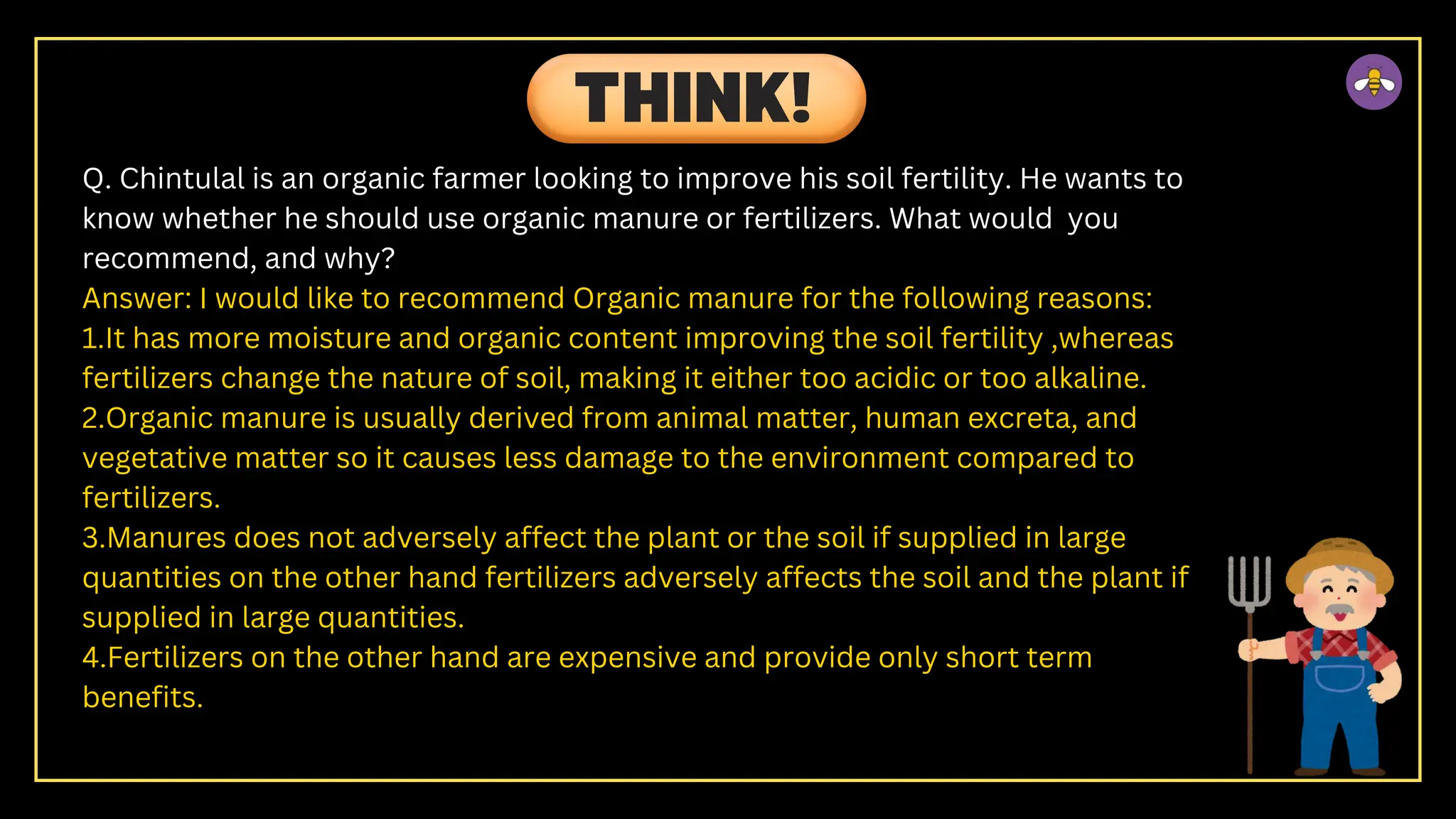
Q. Chintulal is an organic farmer looking to improve his soil fertility. He wants to
know whether he should use organic manure or fertilizers. What would you
recommend, and why?
Answer: I would like to recommend Organic manure for the following reasons:
1.It has more moisture and organic content improving the soil fertility ,whereas
fertilizers change the nature of soil, making it either too acidic or too alkaline.
2.Organic manure is usually derived from animal matter, human excreta, and
vegetative matter so it causes less damage to the environment compared to
fertilizers.
3.Manures does not adversely affect the plant or the soil if supplied in large
quantities on the other hand fertilizers adversely affects the soil and the plant if
supplied in large quantities.
4.Fertilizers on the other hand are expensive and provide only short term
benefits.
THINK!
5. Broiler is used for __________ production
A. Milk
B. Meat
C. Egg
D. All of these
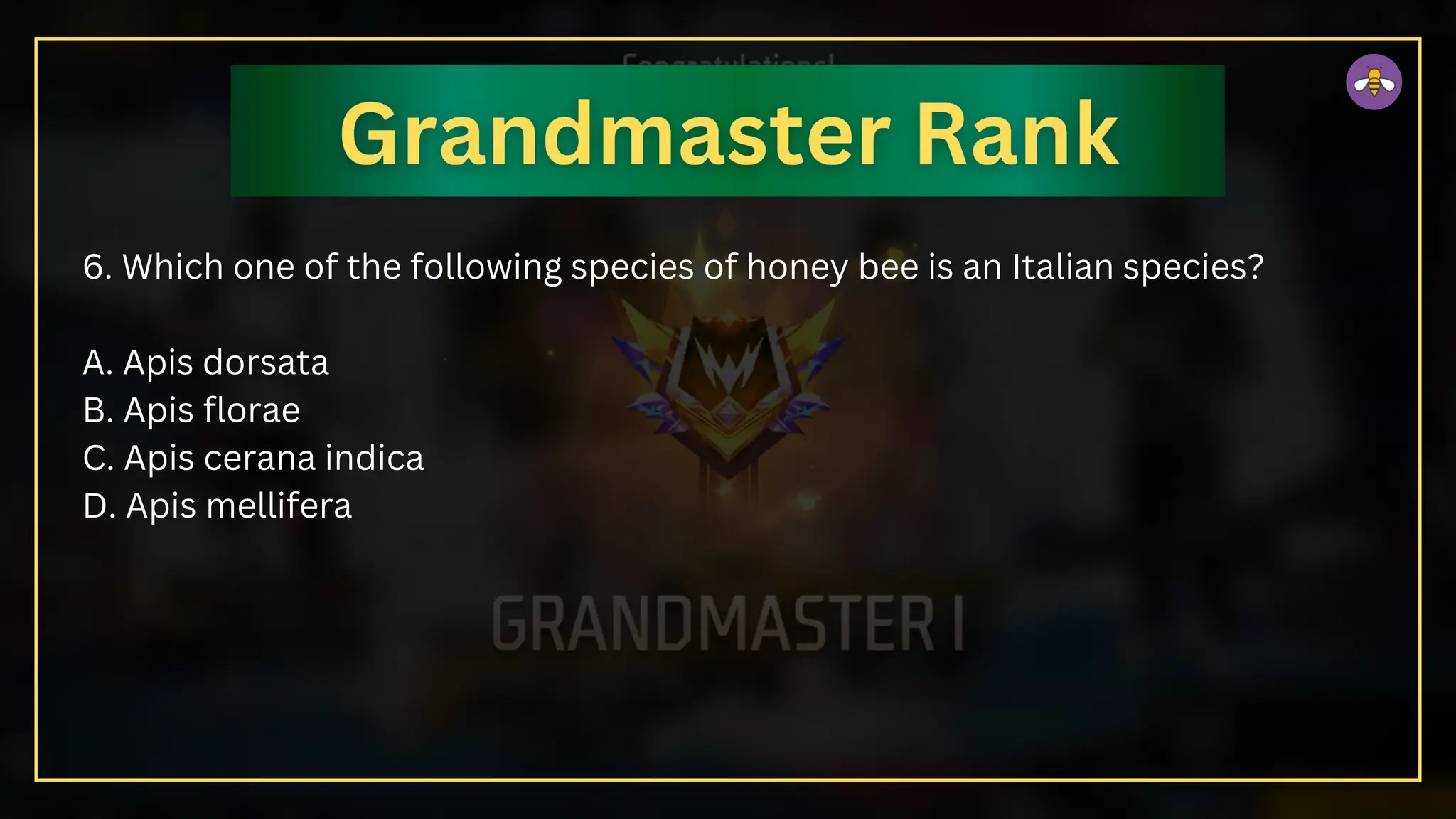
6. Which one of the following species of honey bee is an Italian species?
A. Apis dorsata
B. Apis florae
C. Apis cerana indica
D. Apis mellifera
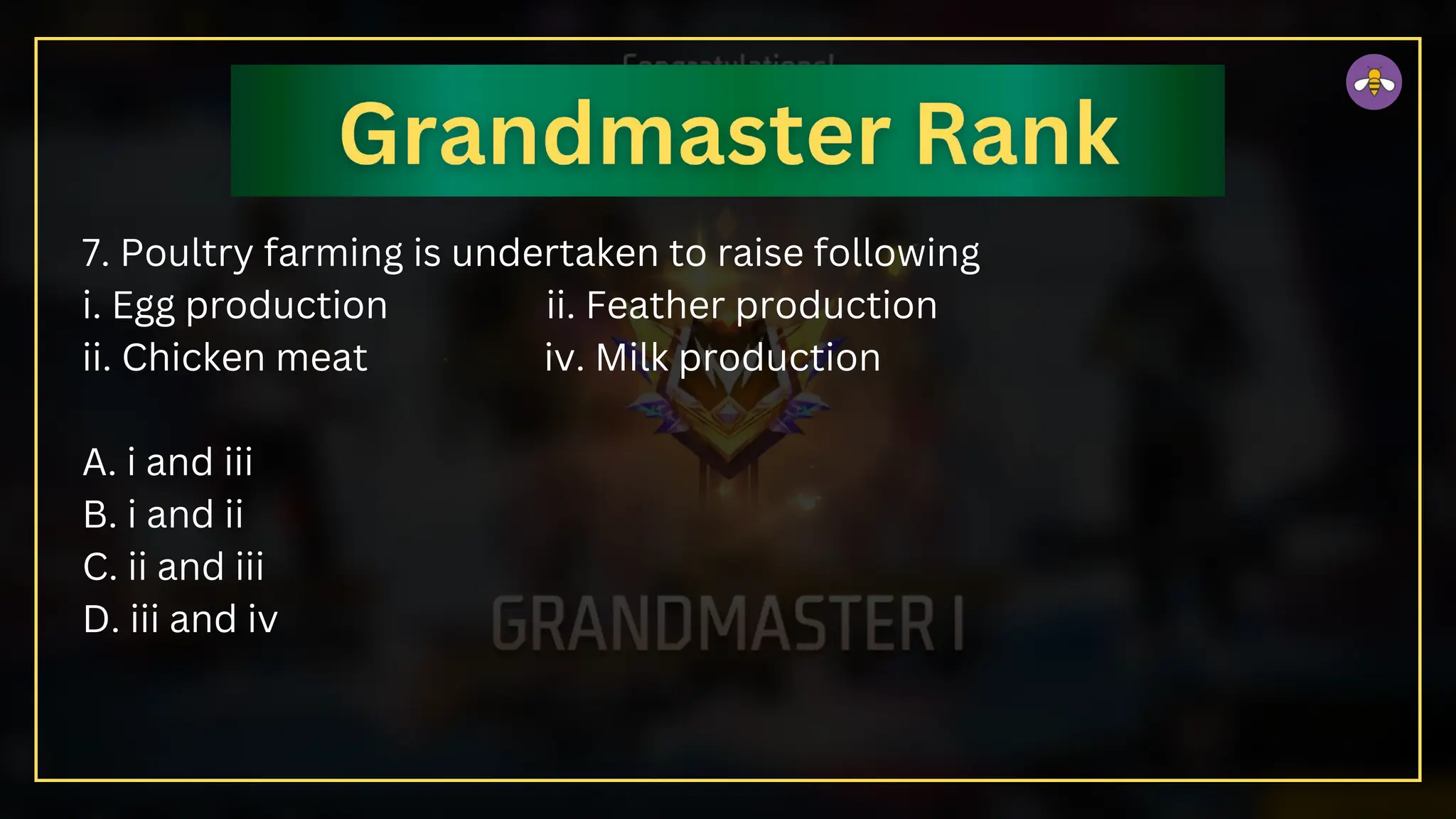
7. Poultry farming is undertaken to raise following
i. Egg production ii. Feather production
ii. Chicken meat iv. Milk production
A. i and iii
B. i and ii
C. ii and iii
D. iii and iv

“Cultivate
“Cultivate ambition
ambition, harvest
, harvest
excellence
excellence.”
.”

Class 9th- Improvement in Food Resources (Prashant Kirad).pdf-compressed.pdf

  • 1.
  • 2.
    Food Resources Crop VarietyImprovement Crop Production Improvement Crop Protection Improvement Animal Husbandry Topics to be Covered
  • 3.
    Plants Animals All livingorganisms need food for health, growth and development. Food provides nutrients like carbohydrates, fats, protein, vitamins and minerals.
  • 4.
    Green Revolution WhiteRevolution It is a program launched in many countries to boost food production using modern technology, irrigation, and improved seeds. Dairy development programs have boosted milk production, while these agricultural advancements have increased natural resource use. Sustainable methods are now needed to enhance crop and livestock efficiency. Why improvement in food resources? India’s population exceeds one billion and is growing, needing over a quarter billion tonnes of grain yearly. With limited cultivable land, boosting production efficiency in crops and livestock is essential.
  • 5.
    Improvement in CropYields Types of Crops
  • 6.
    Crop Season: Type ofCrop Kharif Crops Rabi Crops Zaid Crops Season Rainy season (June to October) Winter season (November to April) Summer season (March to June) Major Crops Paddy, soybean, pigeon pea, maize, cotton, green gram, black gram Wheat, gram, peas, mustard, linseed Watermelon, muskmelon, cucumber, pumpkin, bitter gourd Different crops require different conditions (temperature, moisture, etc.), different photo-periods (duration of sunlight) for their growth and completing life cycle.
  • 7.
    a. What isthe duration of Rabi season? Name any two Rabi crops. b.What is the duration of kharif season? Name any two kharif crops. DIRECT QUESTIONS FROM THIS CHAPTER!! Answer: a. The Rabi season lasts from November to April. Two Rabi crops are wheat and gram. b. The Kharif season lasts from June to October. Two Kharif crops are rice and maize.
  • 8.
  • 9.
    Intervarietal - Betweentwo varieties of a plant Interspecific - Between two species belonging to same genus Inter Generic - Between species of different genus Crop Variety Improvement Hybridization: It is the process of crossing between two or more genetically dissimilar plants to produce a new variety with good properties of both the crops. Introduction of Gene: A gene that can provide the desirable characteristics to a crop are introduced in this process. As a result, we obtain genetically modified crops.
  • 11.
  • 12.
  • 13.
    Higher Yield: Toincrease the productivity of the crop per acre. Improved quality: Quality of crop products vary from crop to crop. Biotic & Abiotic resistances: Crop production reduces due to biotic and abiotic factors. Varieties resistant to these factors can improve crop production. Wider adaptability: Crops which can grow in different conditions, will help in setting high production. Desired agronomic traits: Crops which contain desired agronomic traits (height, branching, leaves), sets high production. Good and Healthy Seeds:
  • 14.
    Q.What is thename given to crops obtained by introducing a gene that provides the desired characteristic? Answer: Genetically modified crops
  • 15.
    Different farmers canhave small or large farms on which they can use different farming practices. The choice of farming practices would depend upon the availability of financial resources money. Hence, production practices can be divided into different levels 1. No cost Production 2. Low-cost Production 3. High-cost Production Crop Production Improvement
  • 16.
    Q.Name the waysby which crop-yield can be increased . 1.Crop Variety Improvement 2.Crop Production Management 3.Crop Protection Management: Answer:
  • 17.
  • 18.
    Nutrients supplied byair, water and soil: Nutrient Management What happens if plants lack in these nutrients? The yield may be affected as plants won't be able to reproduce. Plant growth can be affected plants can get diseases easily.
  • 19.
    Macronutrients Micronutrients Required inlarge amounts for plant growth and development Required in small amounts (trace minerals) Examples: Nitrogen (N), Phosphorus (P), Potassium (K), Calcium (Ca), Sulfur (S), Magnesium (Mg) Examples: Iron (Fe), Boron (B), Chlorine (Cl), Manganese (Mn), Zinc (Zn), Copper (Cu), Molybdenum (Mo) Essential for structure, energy transfer, and cell function Vital for enzyme function, photosynthesis, and specific plant processes Mostly derived from soil, with some from air and water Mainly derived from soil A plant obtains essential nutrients from air, water, and soil. Air provides carbon and oxygen, water supplies hydrogen, and soil supplies the remaining 13 nutrients. Nutrient management involves adding fertilizers and manures to enrich the soil with these necessary nutrients.
  • 20.
    Q.What are macro-nutrientsand why are they called macro-nutrients? Answer: Macro-nutrients are the essential elements which are utilised by plants in large quantities. Since they are required in large quantities, they are known as macro-nutrient. The six macro-nutrients required by plants are nitrogen, phosphorus, potassium, calcium, magnesium, and sulfur.
  • 21.
    Q.What mineral nutrientsare supplied to the plants by air, water and soil Answer: AIR provides Carbon (from carbon dioxide gas) 1. Oxygen (from oxygen gas) 2. WATER provides Hydrogen 1. SOIL provides MACRONUTRIENTS AND MICRONUTRIETS: Nitrogen 1. Phosphorus 2. Potassium 3. Calcium 4. Iron 5.
  • 22.
    To increase theyield, the soil can be enriched by supplying nutrients in the form of manure and fertilizers. • Manure is a source of organic matter. • It supplies small quantities of nutrient to the soil. • It is prepared by the decomposition of animal excreta and plant waste. Manure
  • 23.
  • 24.
    Q.How is theuse of manure beneficial for our environment? Answer: The use of manure is beneficial for our environment as : they help in recycling biological wastes like animal excreta and plant wastes It also protects the environment from damage caused by chemicals such as pesticides and fertilizers. They add organic matter to the soil and improve soil fertility.
  • 25.
    Fertilizers are preparedin factories. They are made up of chemical substances. They have large amount of nutrients like nitrogen, phosphorus and potassium. Fertilizers are easily absorbed by the plants since they are soluble in water. It is costly. Fertilizers
  • 26.
    These are organicsubstances. These are inorganic substances. These are made up of natural substances (decomposition of plant and animal waste). These are made of chemical substances. These have less amount of nutrient. These have large amount of nutrients. These are cheap and are prepared in rural homes or fields. These are costly and are prepared in factories. Manures are slowly absorbed by the plants since they are insoluble in water. Fertilizers are easily absorbed by the plants since they are soluble in water. Manure Fertilizers
  • 27.
    Q. Why aremanure and fertilizers used in fields? Answer: Manures and fertilizers are used in fields to enrich the soil with the required nutrients 1. Manure helps in enriching the soil with organic matter and nutrients, This improves the fertility and structure of the soil. 2.On the other hand, fertilizers ensure a healthy growth and development in plant, they are a good source of nitrogen, phosphorus and potassium.
  • 28.
    A farming practicewhich involves no use of artificial chemicals, fertilizers and pesticides and completely relies upon organic matter is known as organic farming. Organic matter used in organic farming: manure bioagents such as blue-green algae biofertilizers Neem leaves and turmeric as biopesticides Organic Farming
  • 29.
    Mixed cropping IntercroppingCrop Rotation Growing two or more than two crops together on the same piece of land is called mixed cropping. Two or more crops are grown on the same field in a definite pattern. Few rows of one followed by few rows of the other. Crop rotation is policy of growing different crops one after another on the same field. Examples: wheat and gram, wheat and mustard, groundnut and sunflower. Examples: Soyabean + maize, Finger millet(Bajra)+Cow pea (lobia) Examples: Growing beans (year 1), followed by tomatoes (year 2), and sweet corn (year 3) before planting beans in the same spot again the following year. Cropping Patterns
  • 30.
  • 31.
    Q. What isthe process of growing two or more crops in a definite pattern? I. Crop rotation II. Inter-cropping III. Mixed cropping IV. Organic cropping
  • 32.
    Q.What are theadvantages of intercropping and crop rotation? Answer: INTERCROPPING It helps maximize nutrient use in the soil and maintains soil fertility, while crop rotation preserves soil fertility, reduces weeds, and minimizes the need for chemical fertilizers The maximum amount of nutrients in the soil is used. Fertility, the ability of the soil to maintain plant growth, is very well maintained. It is one of the natural ways to control pests. CROP ROTATION The soil fertility is well preserved. Weeds and pests are not allowed to grow. The use of chemical fertilizers is reduced. The properties of soil are untouched. Increased yield.
  • 33.
    The process ofsupplying water to the crop plants is called irrigation. Irrigation MethodsofIrrigation Dug wells Tube wells Watershed System
  • 34.
    Tank System Canals Riverlift System Sprinkler Irrigation Drip Irrigation Rainwater Harvesting
  • 35.
    Methods used tocontrol the problems: (i) Pest control during growth (ii) Storage of grains Crop Protection Management To protect crops against diseases caused organisms and other harming factors is called crop protection.
  • 36.
    Pest control duringgrowth Pest is any destructive organism which can destroy or harm crops or products obtained from them.
  • 37.
    Storage Losses High lossesdue to biotic (living) factors: insects, rodents, fungi, mites, and bacteria. Losses also caused by abiotic (non-living) factors: moisture, unsuitable temperatures. Effects of Poor Storage Quality deterioration Weight loss Discoloration Reduced germination ability Storage of Grains
  • 38.
    Storage of Grains PreventiveMeasures Thorough cleaning of produce before storage. Drying of grains in sunlight, followed by shade drying. Fumigation to kill pests. Importance of Proper Storage Ensures year-round availability of seasonal foods. Improves marketability by maintaining grain quality.
  • 39.
    1. White revolutionwas done for A. Cotton B. Milk C. Eggs D. Oil Enemy Ahead!
  • 40.
    2. Desirable agronomiccharacteristics for fodder crop? A. Tallness B. Profuse branching C. Dwarfness D. Both a and b Enemy Ahead!
  • 41.
    3. Which ofthe following is a biotic stress in plants? A. Flood B. Ultraviolet rays C. Bacterial attack D. Drought Enemy Ahead!
  • 42.
    4. Which isa micronutrient? A. Nitrogen B. Calcium C. Zinc D. Phosphorus Enemy Ahead!
  • 43.
    Types of AnimalHusbandry: Cattle Farming Poultry Farming Fish Production Bee Keeping Animal Husbandry Animal husbandry is a scientific management of domestic animals in an efficient manner to obtain food and other useful products from them.
  • 44.
    Cattle farming Purpose ofcattle farming: (i) For getting milk (ii) Ploughing fields (iii) Bull cart for transportation Types of cattle: Foreign (Exotic) Cattle Breeds: Jersey Brown Swiss Holstein-Friesian Indigenous (Local) Breeds: Red Sindhi Sahiwal
  • 45.
    Lactation Period The periodof milk production between birth of a young one and the next pregnancy is called lactation period. Milk production can be enhanced by increasing the lactation period in the cattle. Cross Breeding Crossbreeding of foreign breeds and local breeds can provide cattle with qualities of increased lactation period and resistance to diseases.
  • 46.
    Shelters of thecattle should be kept neat and clean in order to keep the cattle healthy. The cattle should be kept clean and should be provided with a covered shelter that can protect them from harsh weathers. The floor of the shelters should be kept dry and clean. Regular brushing of skin of cattle. Shelter Management
  • 47.
    Roughage mainly containingfibre Concentrates containing proteins Food containing micro nutrients (vitamins and minerals) for enhanced milk production. Food Requirement
  • 48.
    Diseases can causedeath and reduce milk production. Parasites are small organisms living inside or outside the body of another organism (host). They derive food from the body of host. External parasites on skin of cattle cause skin diseases. Internal parasites like worms cause stomach and intestine problems and flukes cause liver problems. Bacteria, virus cause infectious diseases (diseases that can be easily transmitted from one to another). Protection from Diseases
  • 49.
    Poultry farming isdone for eggs and meat. They both provide protein to our diet. Broilers: Birds grown for obtaining meat are called broilers. They can be used after 6-8 weeks from their birth. Layers: Birds grown for obtaining egg are called layers. They can be used after 20 weeks when sexual maturity has been attempt to lay eggs. Poultry Farming
  • 50.
    Most of thebroilers and layers are cross-breed. Breeding is done to enhance following properties in hens like: (i) More and better quality chicks. (ii) Low maintenance. (iii) Breeding is done to produce dwarf broilers (meat-giving birds). Feeding cost is the biggest expense in poultry farms. Dwarf broilers need less food and can reduce cost by 30%. Also, they can tolerate more heat. Poultry Farming
  • 51.
    Indigenous local breeds: Aseel,Basara, Brahma, Kadaknath, Chittagong, etc. Exotic breeds: White Leghorn, Black Minorcha, Rhode Island Red, Plymouth etc.
  • 52.
    Egg and BroilerProduction Layers Broiler Layers are managed for the purpose of getting eggs. Broilers are managed for getting meat. A layer should be able to produce more large-sized eggs, without growing too much. (500 days) A broiler should yield more meat and hence should be able to grow well. (6-7 weeks) They require enough space and adequate lighting. They require conditions to grow fast and have low mortality. They require restricted and calculated feed. Their food requirement is rich in protein and vitamins A and K.
  • 53.
    Q.What are thebenefits of poultry farming over cattle farming? Answer: 1.It requires less investment compared to rearing cattle and has less maintenance 2.Broilers intake of feed is comparatively very low(requires less food). 3.Poultry farming requires very little water for both drinking and cleaning 4.Faster Growth and Higher Productivity
  • 54.
    Fish Production Great sourceof protein to our diet. Fishing are of two types on the mode of obtaining fishes: (i) Capture fishing: Naturally living fishes in various water bodies are captured. (ii) Culture fishing: Fishes of desired variety are cultivated in confined areas with utmost care to get maximum yield. This is also called aquaculture. Aquaculture can be done in oceans, rivers, lakes, ponds etc. When it is done in oceans, it is called mariculture.
  • 55.
    Marine Fisheries Fish productionon the basis of Source of Water Inland Fisheries Coastal Fisheries Marine fisheries Off-shore or deep-sea Fisheries
  • 56.
  • 57.
    Some marine fishof high economic value are also farmed in seawater. This include - Finned fishes like mullets, bhetki, and peal spots. Shellfish such as prawns, mussels and oysters. Oysters are also cultivated for the pearls they make. Prawns Bhetki Oysters
  • 58.
    Inland Fishing It includesfish production in fresh water (for example ponds, rivers, lakes, reservoirs) and brackish water (for example estuaries). Popular freshwater fish varieties include - Rohu Catla Grass carp Common carp Silver carp
  • 59.
    Integrated Fish Culture Integratedfarming is a sustainable agricultural practice that combines crop production with other activities like livestock, poultry, fisheries, or beekeeping. This approach aims to maximize resource use efficiency, increase farm income, and reduce the environmental impact by creating a balanced ecosystem within the farm
  • 60.
    Composite Fish Culture Compositefish culture, also known as polyculture, involves growing different types of fish in the same water source to maximize productivity. Fish are selected based on their feeding zones to ensure efficient use of resources. Surface Feeders: Examples: Catla, Silver Carp Column Feeders: Examples: Rohu, Grass Carp Bottom Feeders: Examples: Mrigal, Common Carp This method allows different fish species to coexist and feed at different levels, optimizing the ecosystem within the pond or water source.
  • 61.
    Advantages of Fishing MoreYield: Fishing can provide a significant amount of food, contributing to food security and nutrition. Economic Benefits: Fishing can be a major source of income for communities, especially in coastal areas. Employment: The fishing industry provides jobs in various sectors, including catching, processing, and selling fish. Sustainable Resource: If managed properly, fish populations can be a renewable resource.
  • 62.
    Problems of Fishing Manyfish species only lay eggs during the monsoon season, which limits the rapid growth of their populations. To address this, hormonal stimulation is employed. This method allows fish to reproduce at any time of the year. Overfishing: Unsustainable fishing practices can lead to the depletion of fish stocks, threatening marine
  • 63.
    It is thepractice of keeping, caring & management of honeybees on a large scale for obtaining honey and wax. Many farmers use bee-keeping for additional small income. Also, there are big farms called apiaries/bee farms. Bee Keeping
  • 64.
    The setting upof a number of bee hives in desirable location in a systematic manner that allows maximum pollen and nectar collection. Some common Indian varieties of bees include Apis cerana indica (Indian bee), dorsata (rock bee), floral (little bee). One Italian variety mellifera is also used in India for commercial large scale production. Bee Keeping Apiary
  • 65.
    Advantages of Italianvariety Melifera: High honey collection capacity. They reproduce fast. They sting less. They stay in a bee hive for long. Honey It is a dense sweet liquid. It is used in medicines. It is used as sugar. It is used as a source of energy.
  • 66.
    Q.What are thedesirable characters of bee varieties suitable for honey production? Answer: They should be able to collect a lot of honey. 1. They should be able to produce a lot of offspring. 2. They must remain in their hive for an extended amount of time. 3. They should be less stingy. 4.
  • 67.
    Q. If thereis low rainfall in a village throughout the year. What measures will you suggest to the farmers for better cropping? Answer: Soil moisture conservation: A large amount of humus and organic manure,compost should be put in to enrich the soil and boost its water holding capacity. 1. Crop rotation and intercropping: crops that require varying amounts of water are planted together,reducing water demand. 2. Efficient irrigation systems: drip irrigation or sprinkler systems. 3. Drought resistant crops: encourage crop varieties that require less water such as millet,sorghum,well suited for arid conditions. 4. Storage:Store the available rainwater in tanks and utilise this water later for irrigating their fields. 5. THINK!
  • 68.
    Q. Chintulal isan organic farmer looking to improve his soil fertility. He wants to know whether he should use organic manure or fertilizers. What would you recommend, and why? Answer: I would like to recommend Organic manure for the following reasons: 1.It has more moisture and organic content improving the soil fertility ,whereas fertilizers change the nature of soil, making it either too acidic or too alkaline. 2.Organic manure is usually derived from animal matter, human excreta, and vegetative matter so it causes less damage to the environment compared to fertilizers. 3.Manures does not adversely affect the plant or the soil if supplied in large quantities on the other hand fertilizers adversely affects the soil and the plant if supplied in large quantities. 4.Fertilizers on the other hand are expensive and provide only short term benefits. THINK!
  • 69.
    5. Broiler isused for __________ production A. Milk B. Meat C. Egg D. All of these
  • 70.
    6. Which oneof the following species of honey bee is an Italian species? A. Apis dorsata B. Apis florae C. Apis cerana indica D. Apis mellifera
  • 71.
    7. Poultry farmingis undertaken to raise following i. Egg production ii. Feather production ii. Chicken meat iv. Milk production A. i and iii B. i and ii C. ii and iii D. iii and iv
  • 72.
    “Cultivate “Cultivate ambition ambition, harvest ,harvest excellence excellence.” .”