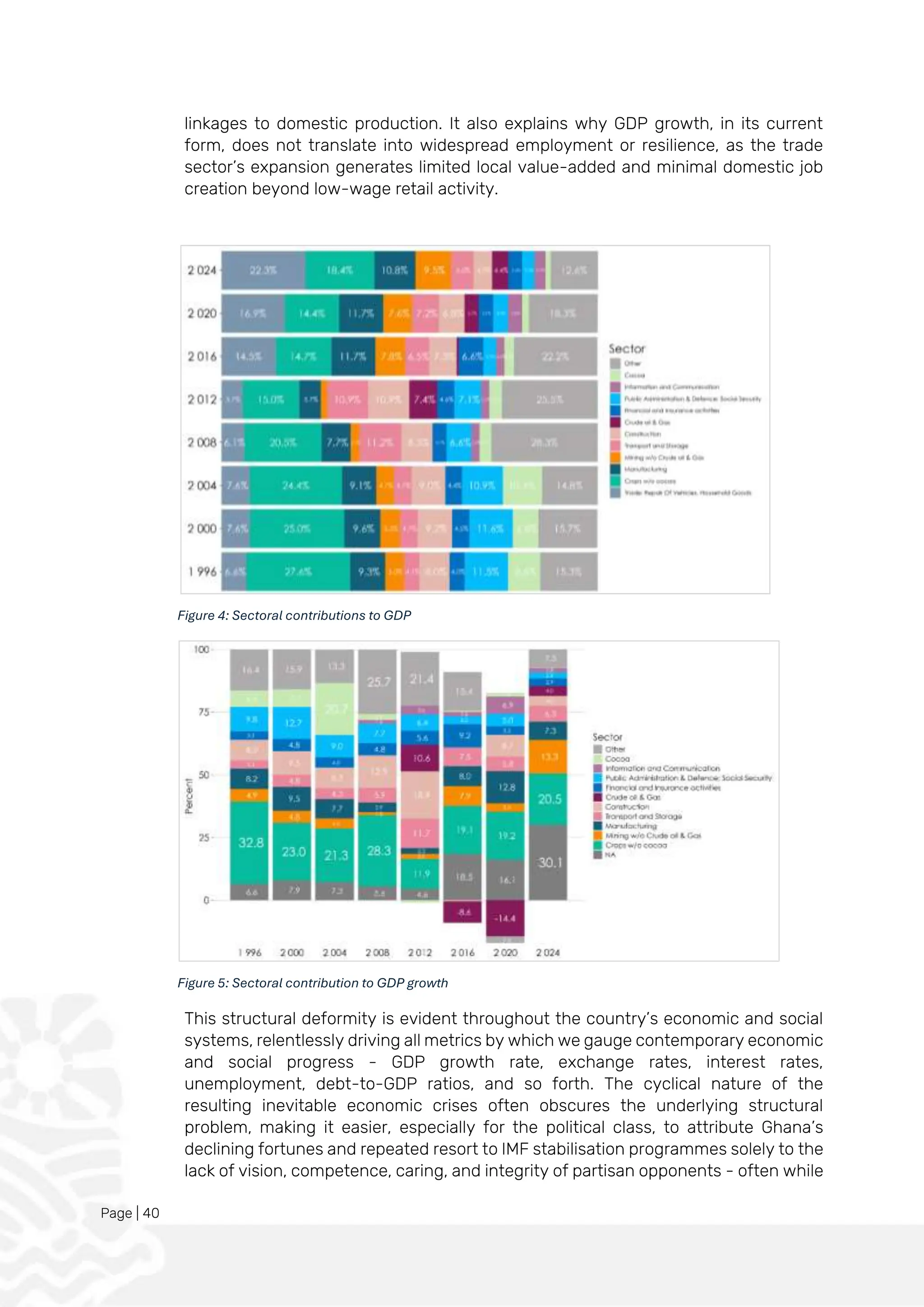
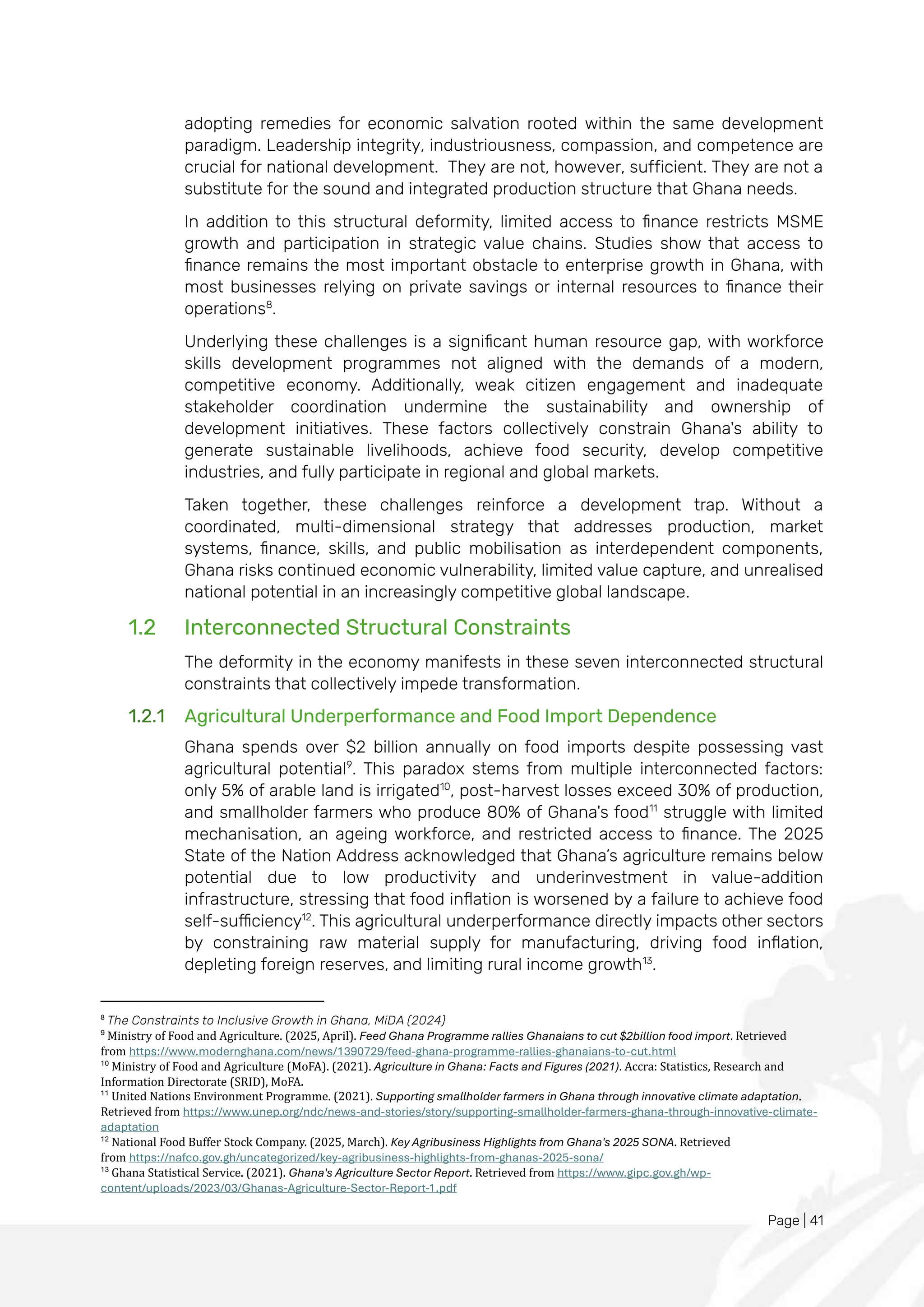
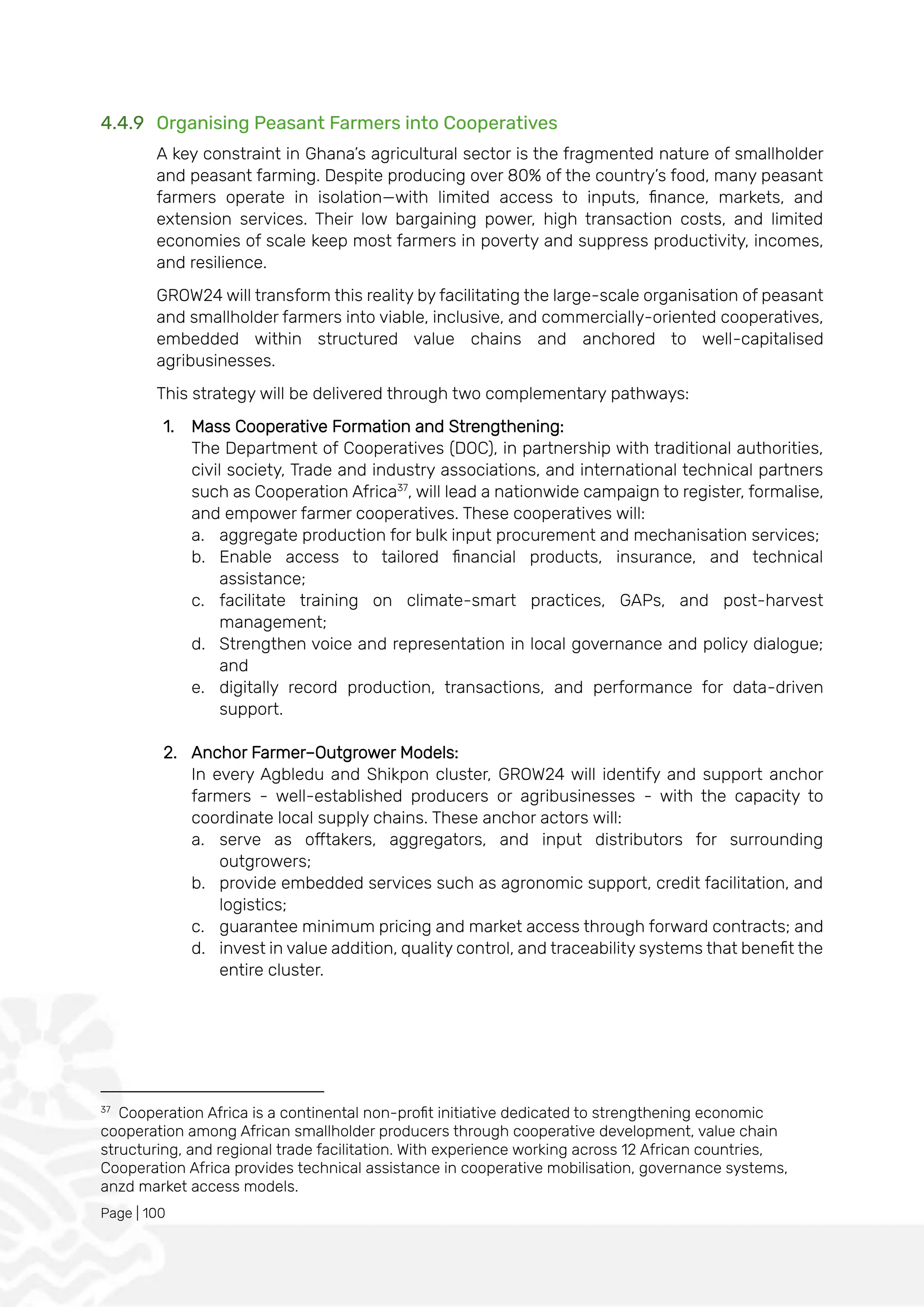
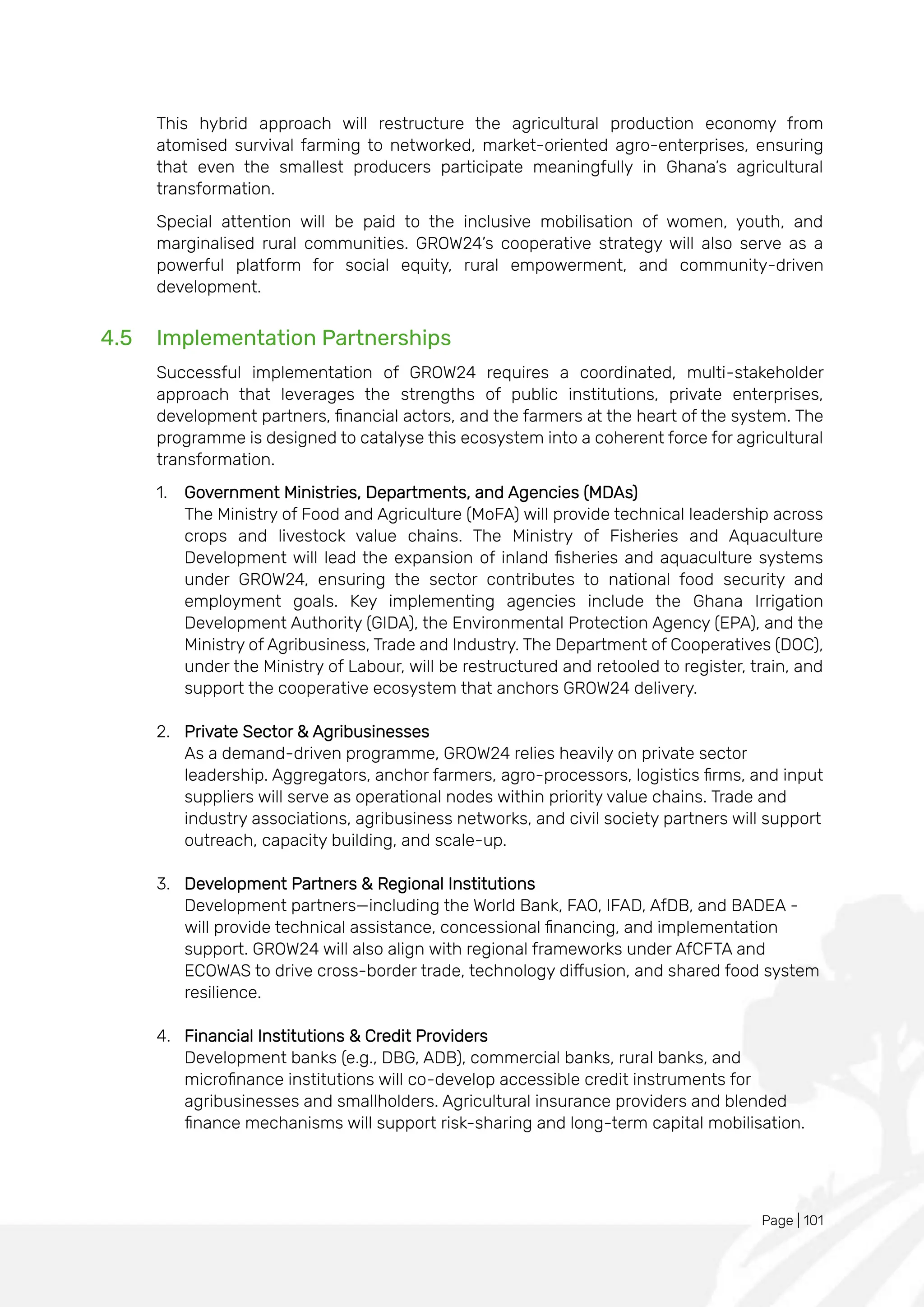
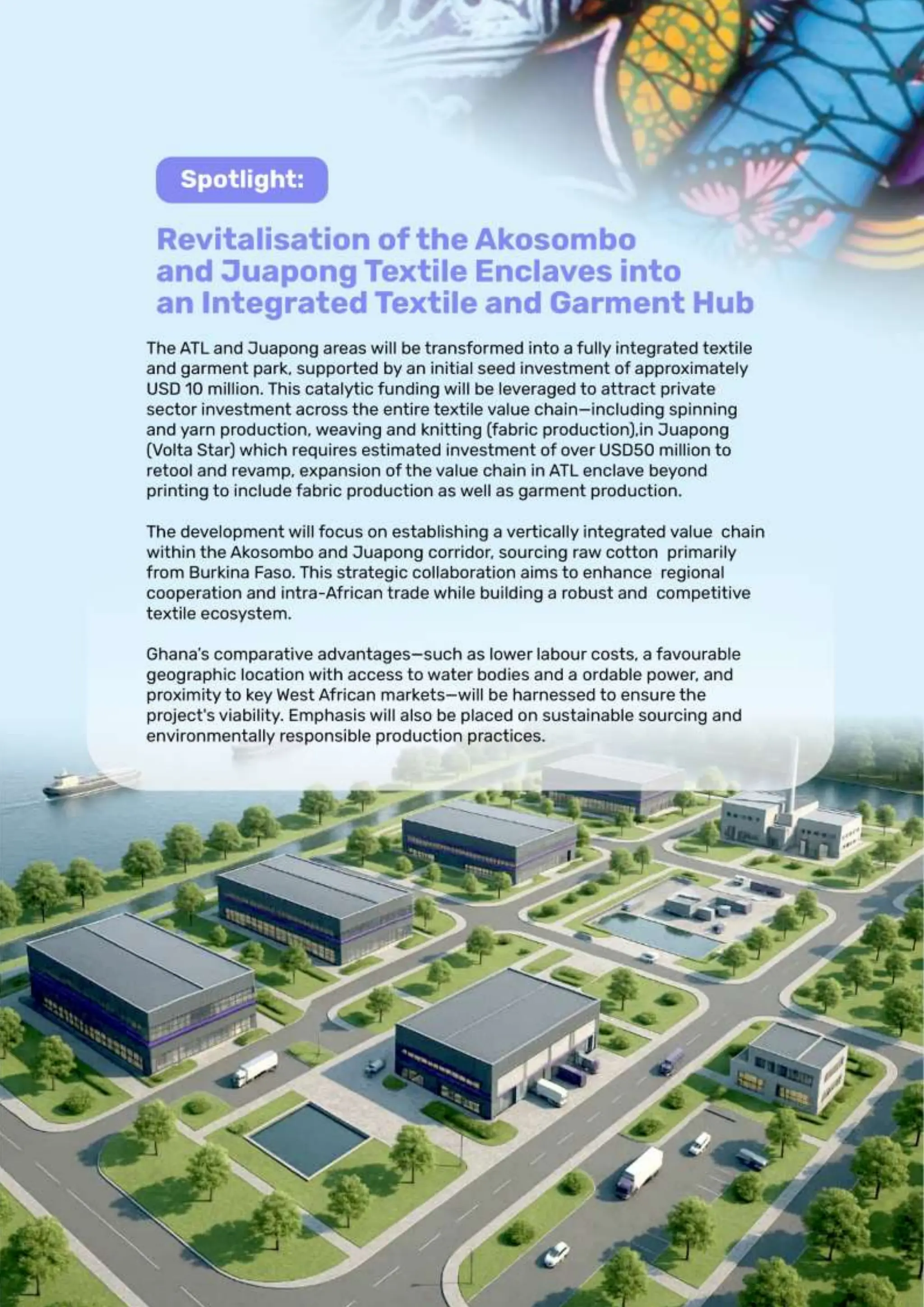
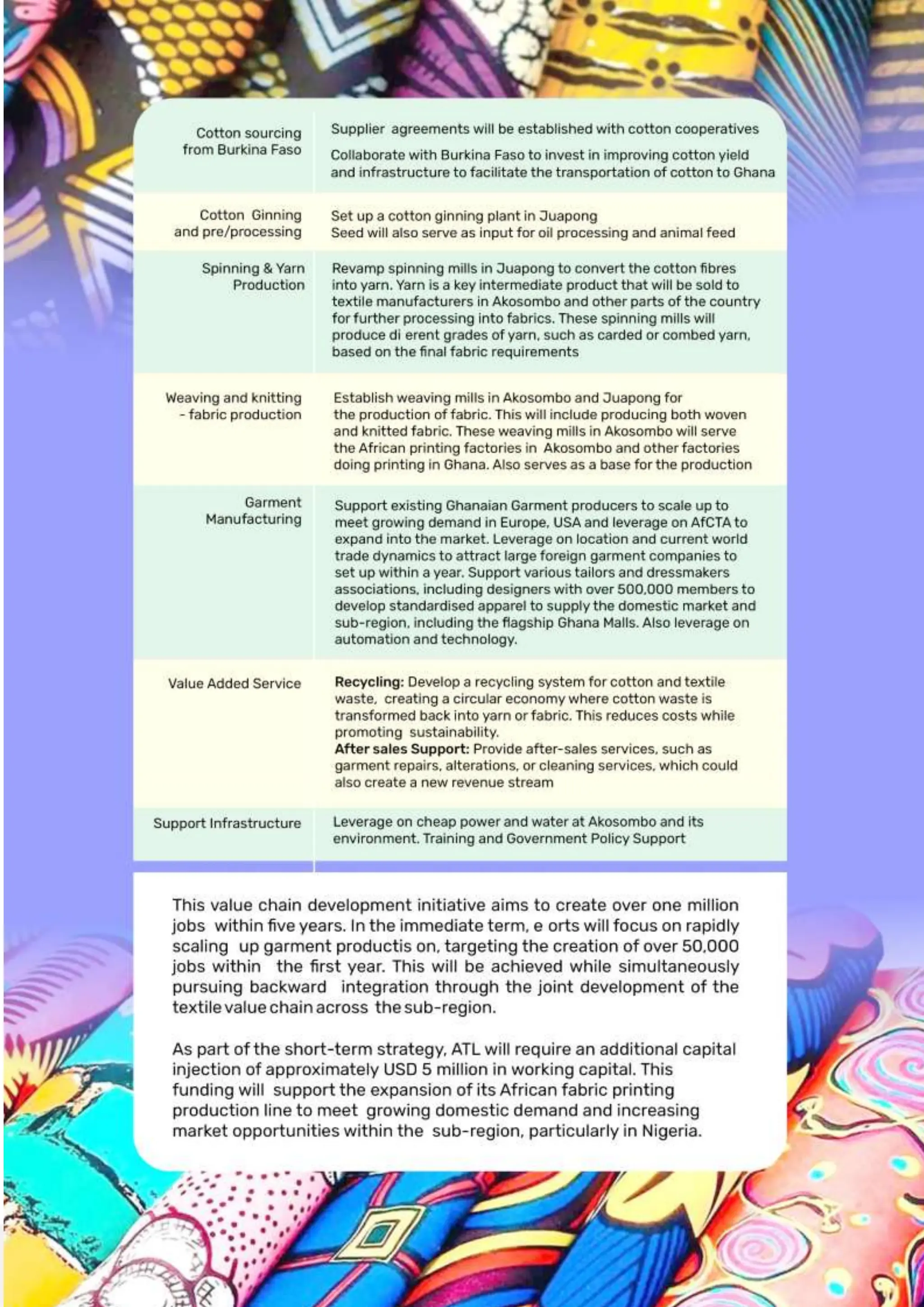
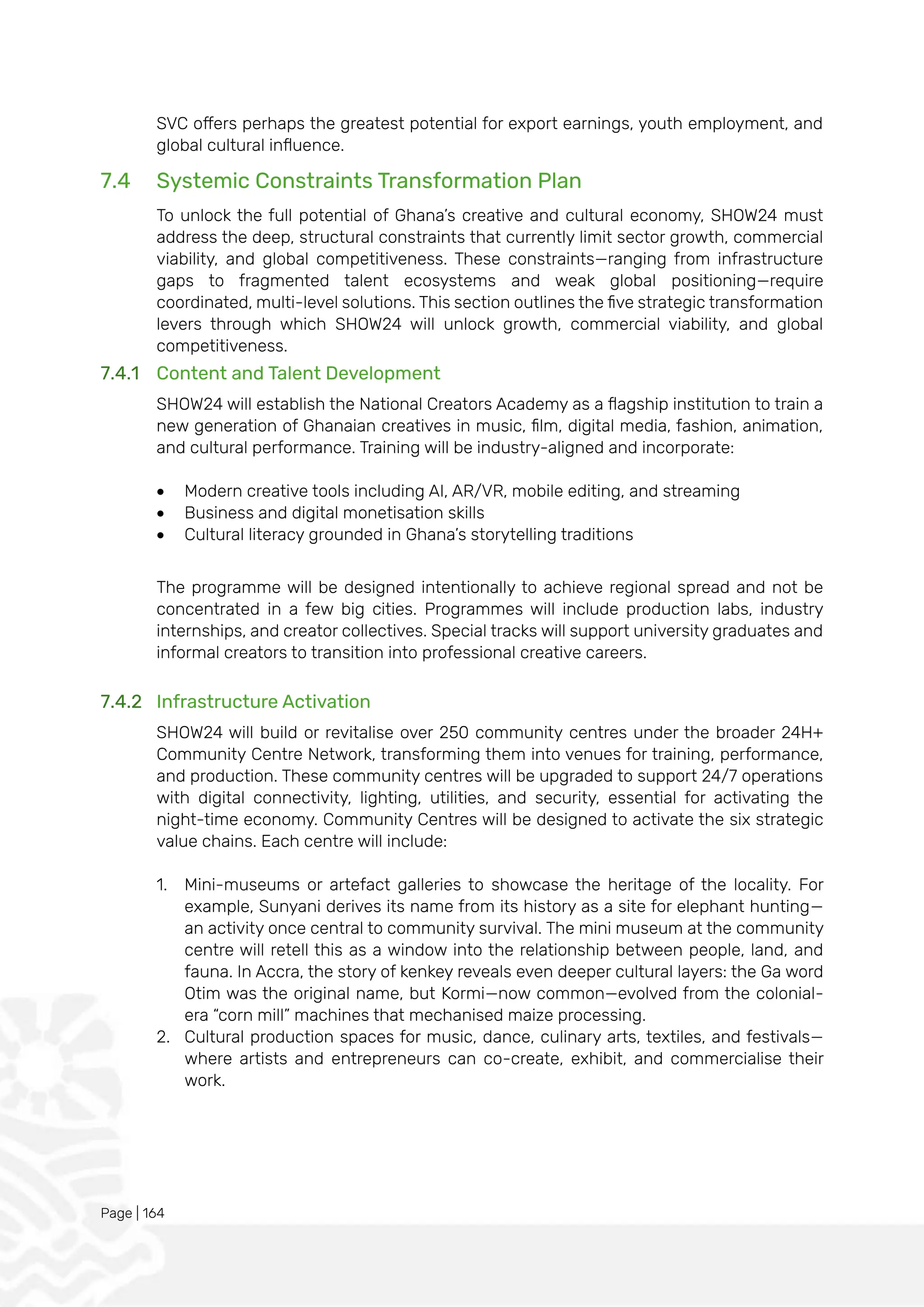
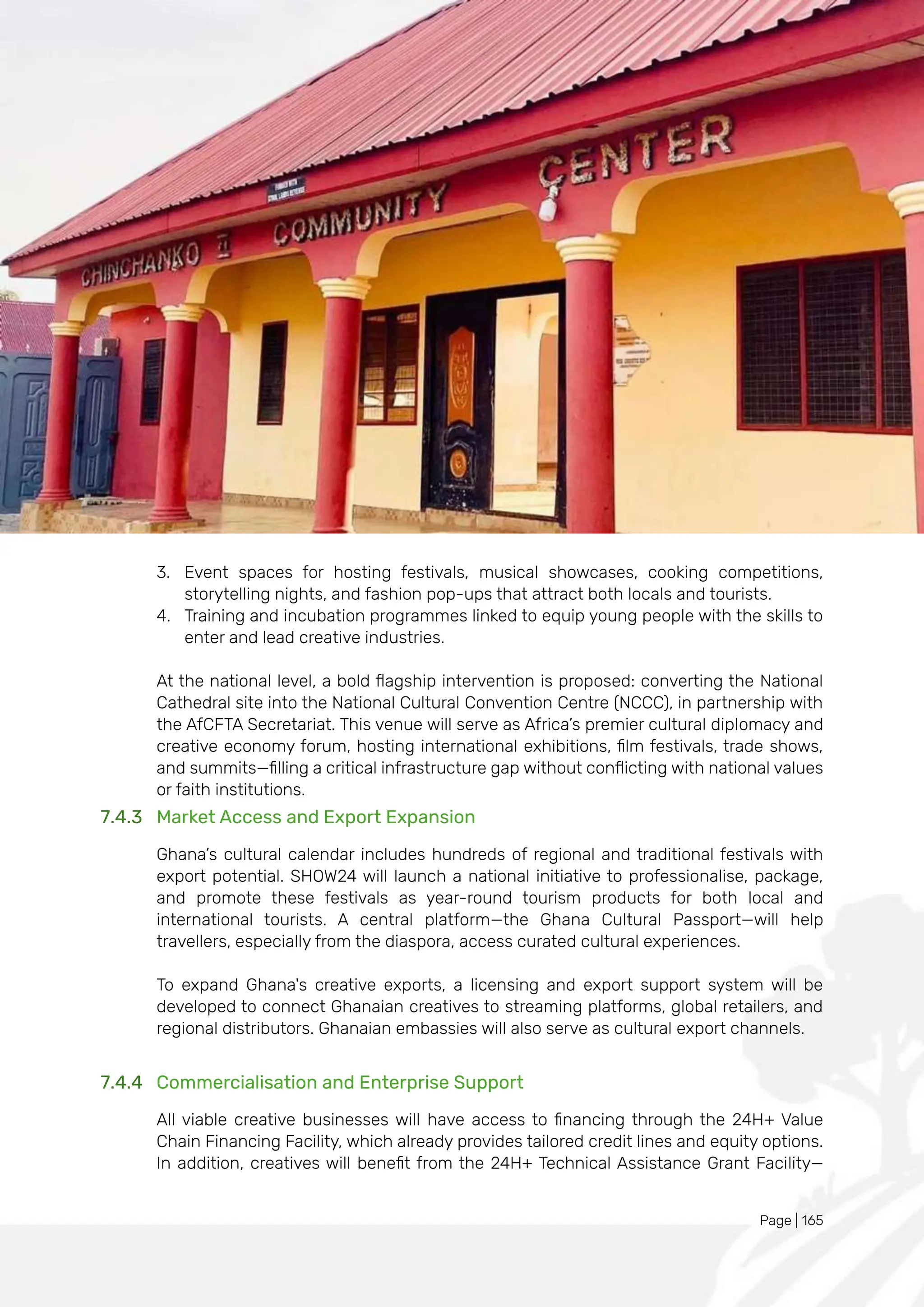
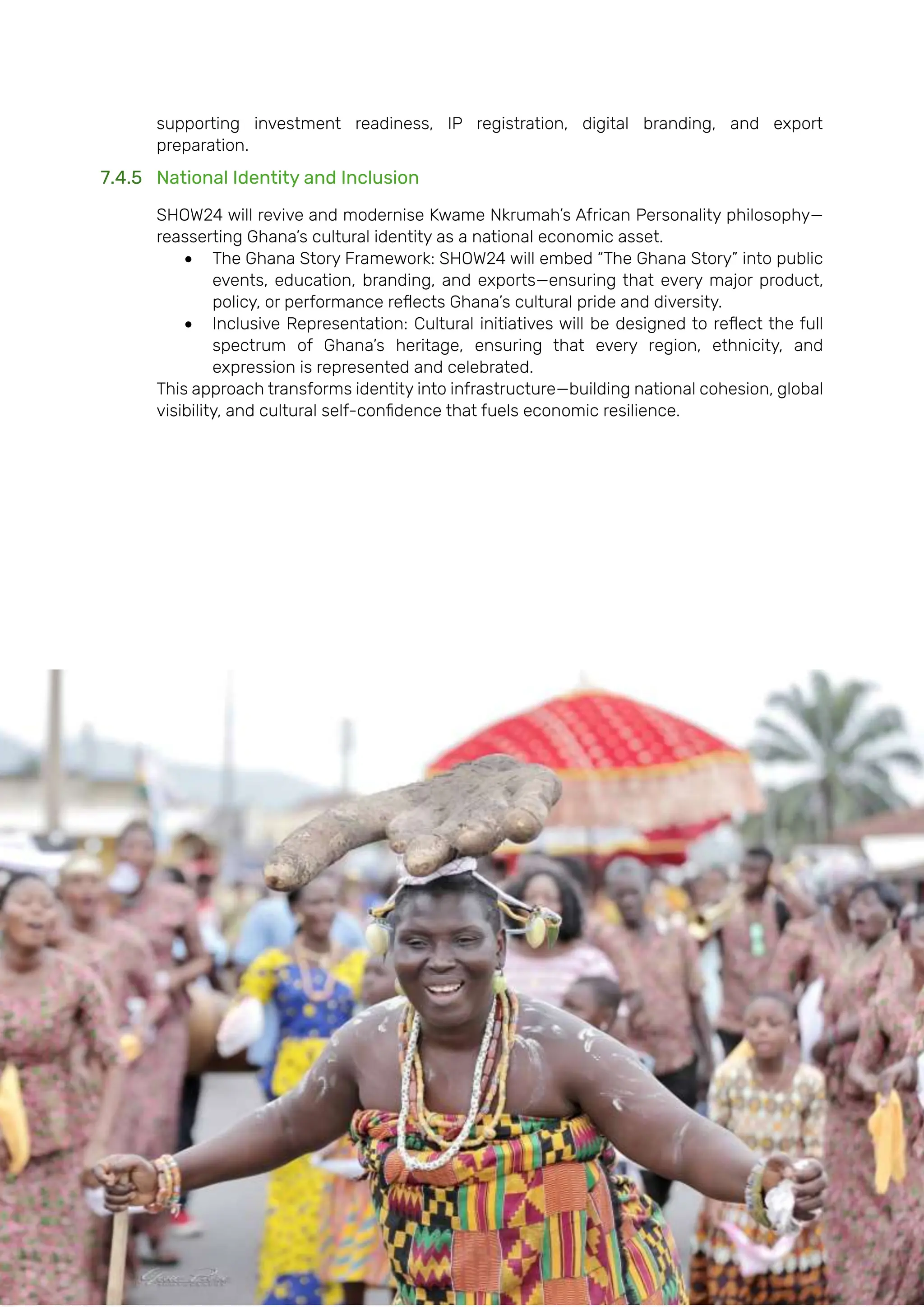
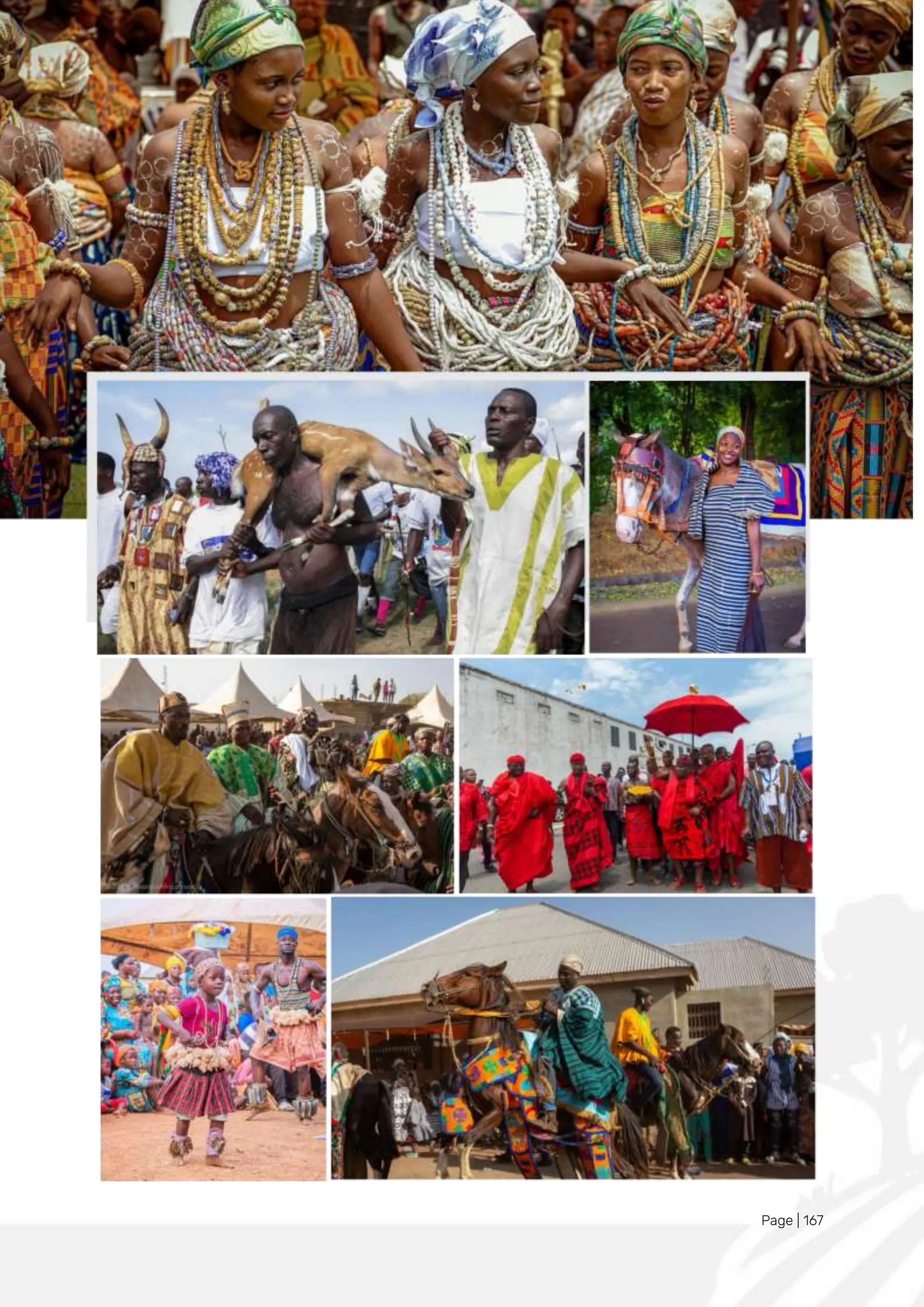
Page | 0
The 24 Hour Economy and Accelerated Export Development Programme
Ghana’s National Agenda for Productivity,
Competitiveness, and Inclusive Growth
Transforming Production, Markets, and Human Capital
Prepared by the 24H+ Secretariat
April 2025
Accra, Ghana
Page | 1
Page | 2
Disclaimer and Copyright Notice
Disclaimer
This policy and programme document is published by the Office of the President of the Republic of Ghana
as a strategic instrument of national economic transformation. It is intended to serve multiple purposes,
including guiding decision-making, articulating national priorities and expectations, promoting
transparency and accountability, and providing a foundation for ongoing evaluation, learning, and policy
refinement.
While every effort has been made to ensure the accuracy, consistency, and relevance of the information
contained herein, the Office of the President makes no warranties, express or implied, regarding the
completeness or applicability of the content to specific circumstances. The document reflects current
policy positions and programme strategies and may be updated to respond to evolving national needs and
priorities.
This publication is not intended to provide legal or financial advice. Users are encouraged to consult
appropriate authorities or professionals where necessary. References to external institutions or sources
are included for informational purposes only and do not imply official endorsement.
The Government of Ghana shall not be held liable for any consequences arising from the use,
interpretation, or implementation of this material.
Copyright © 2025 Office of the President, Republic of Ghana
All rights reserved. No part of this publication may be reproduced, stored in a retrieval system, or
transmitted in any form—electronic, mechanical, photocopying, recording, or otherwise—without the prior
written permission of the Office of the President.
This document may be cited or referenced for non-commercial, academic, or policy purposes, provided
that full and appropriate attribution is given.
For permissions or further information, please contact:
Office of the President
Jubilee House, Accra, Ghana
Email: info@presidency.gov.gh
Website: www.presidency.gov.gh
Page | 3
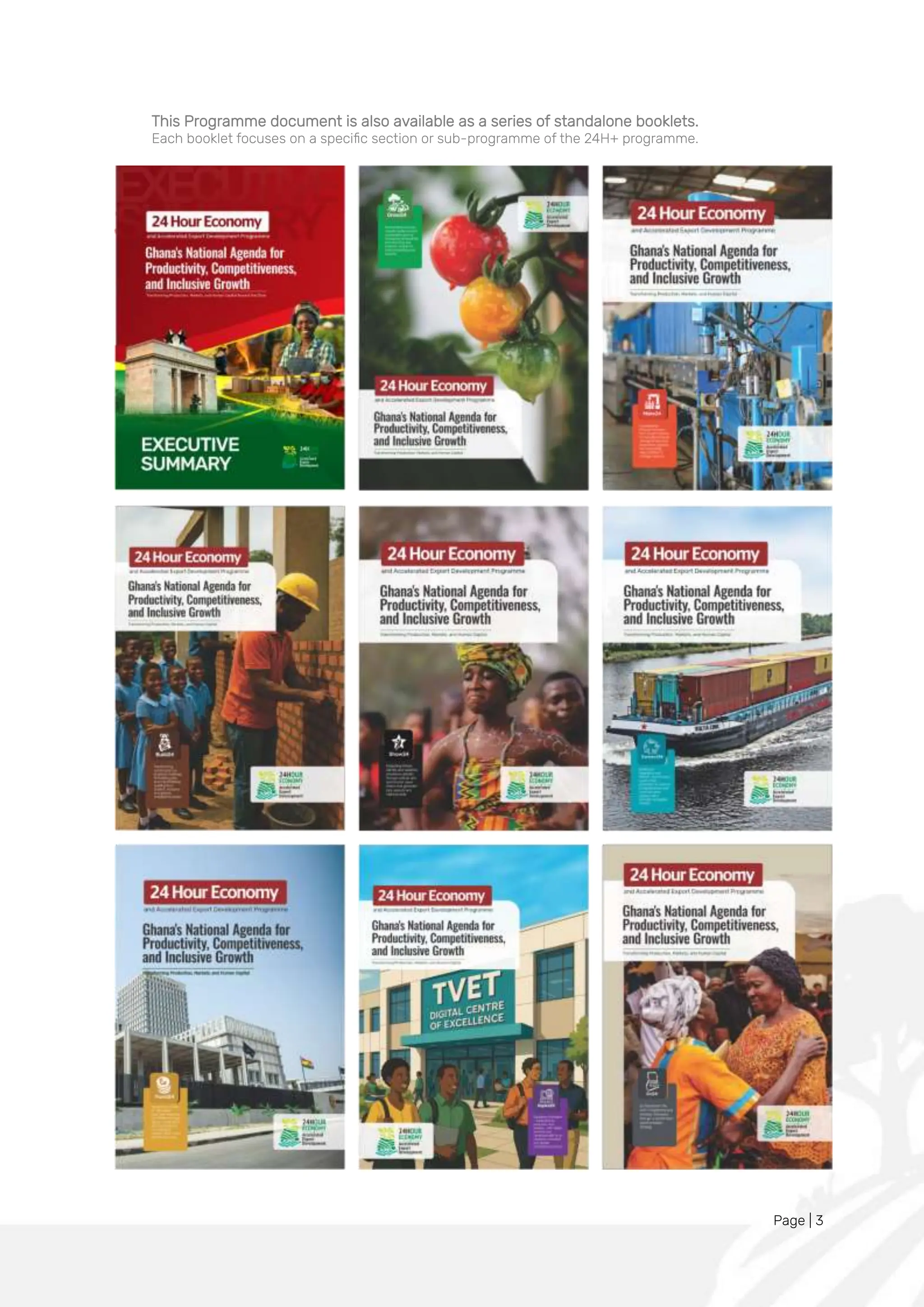
This Programme document is also available as a series of standalone booklets.
Each booklet focuses on a specific section or sub-programme of the 24H+ programme.
Page | 4
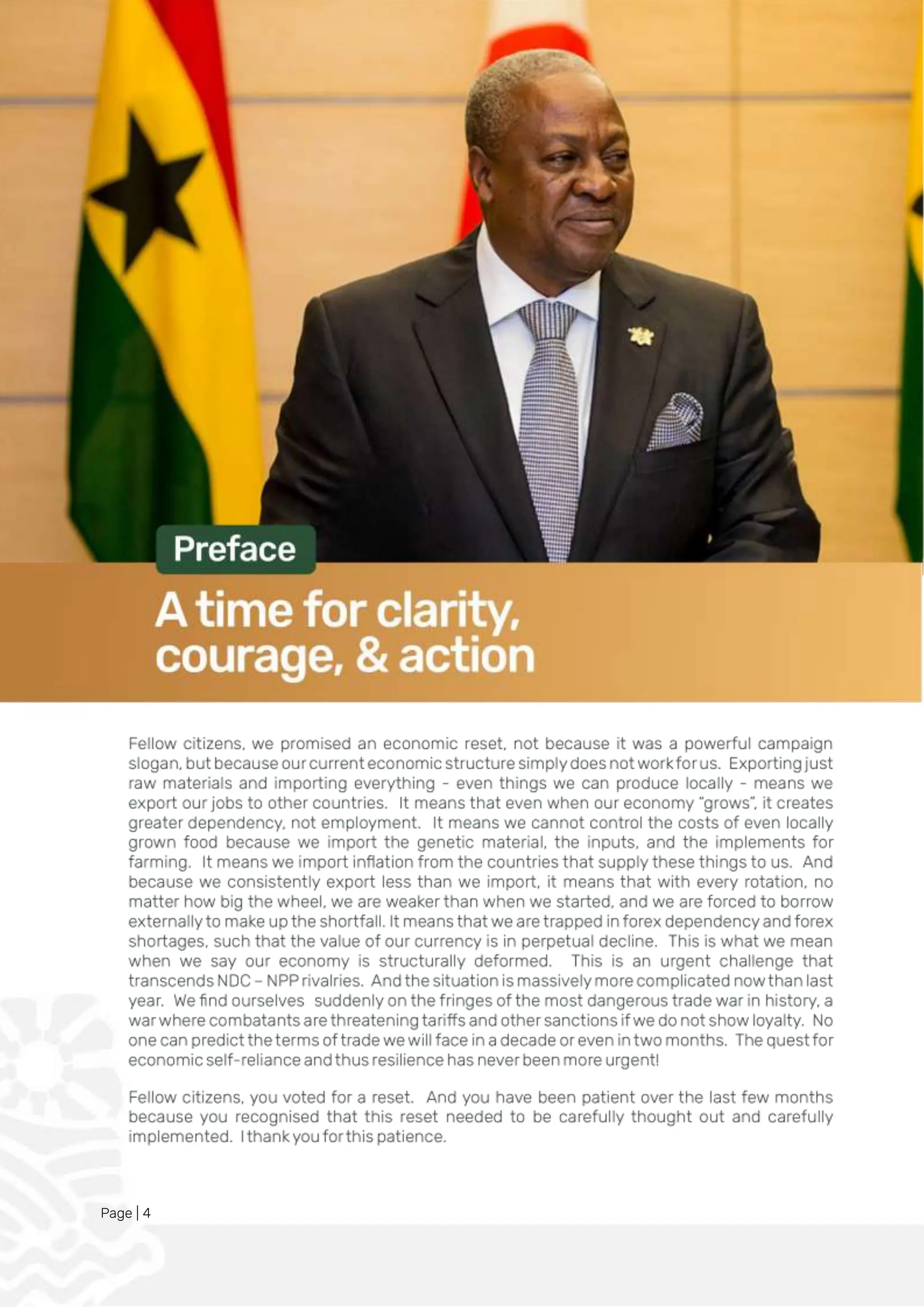
Preface
Page | 5
Page | 6
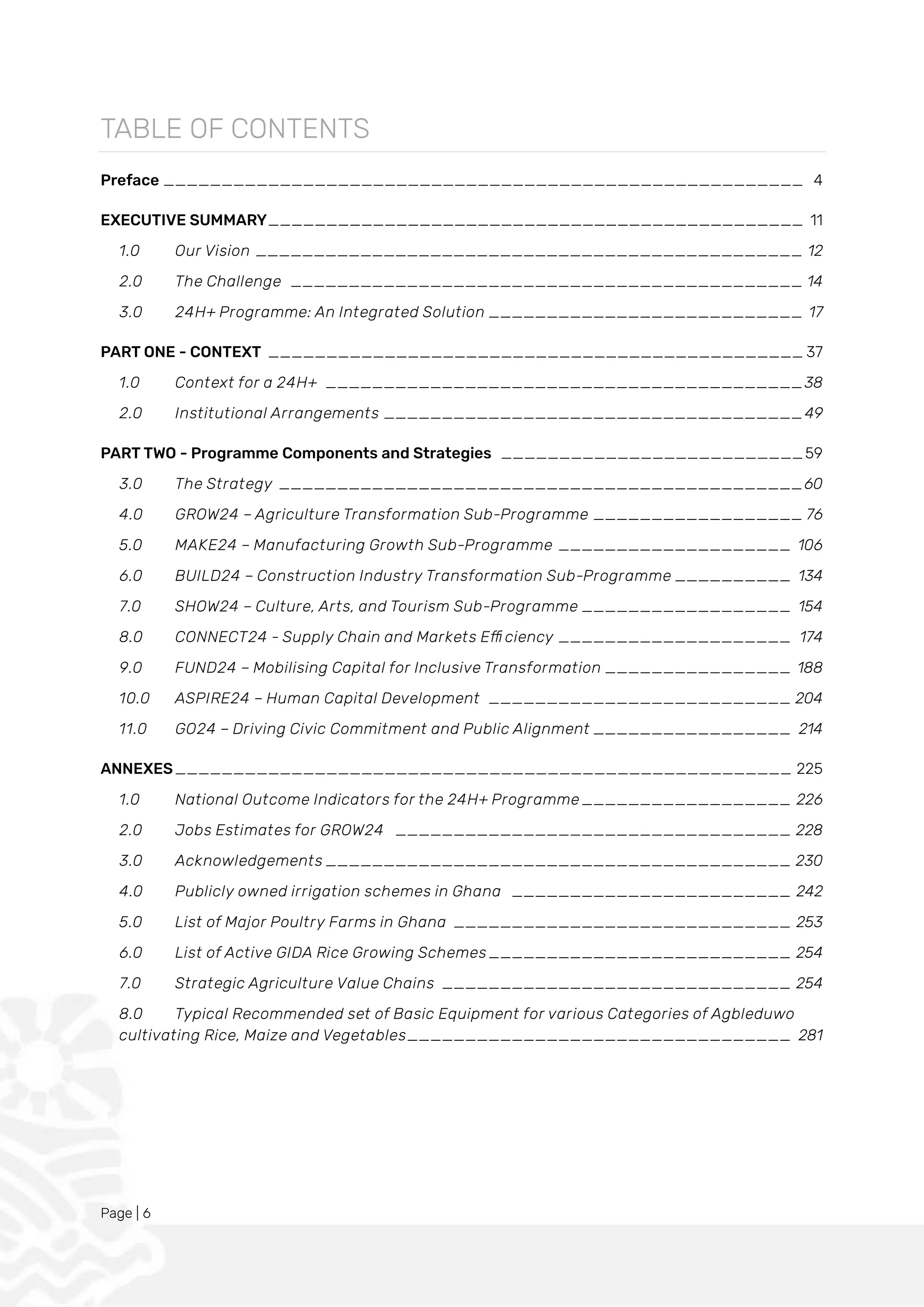
TABLE OF CONTENTS
Preface _______________________________________________________ 4
EXECUTIVE SUMMARY______________________________________________ 11
1.0 Our Vision _______________________________________________ 12
2.0 The Challenge ____________________________________________ 14
3.0 24H+ Programme: An Integrated Solution ___________________________ 17
PART ONE - CONTEXT ______________________________________________ 37
1.0 Context for a 24H+ _________________________________________38
2.0 Institutional Arrangements ____________________________________49
PART TWO - Programme Components and Strategies __________________________59
3.0 The Strategy _____________________________________________60
4.0 GROW24 – Agriculture Transformation Sub-Programme __________________ 76
5.0 MAKE24 – Manufacturing Growth Sub-Programme ____________________ 106
6.0 BUILD24 – Construction Industry Transformation Sub-Programme __________ 134
7.0 SHOW24 – Culture, Arts, and Tourism Sub-Programme __________________ 154
8.0 CONNECT24 - Supply Chain and Markets Efficiency ____________________ 174
9.0 FUND24 – Mobilising Capital for Inclusive Transformation ________________ 188
10.0 ASPIRE24 – Human Capital Development __________________________ 204
11.0 GO24 – Driving Civic Commitment and Public Alignment _________________ 214
ANNEXES_____________________________________________________ 225
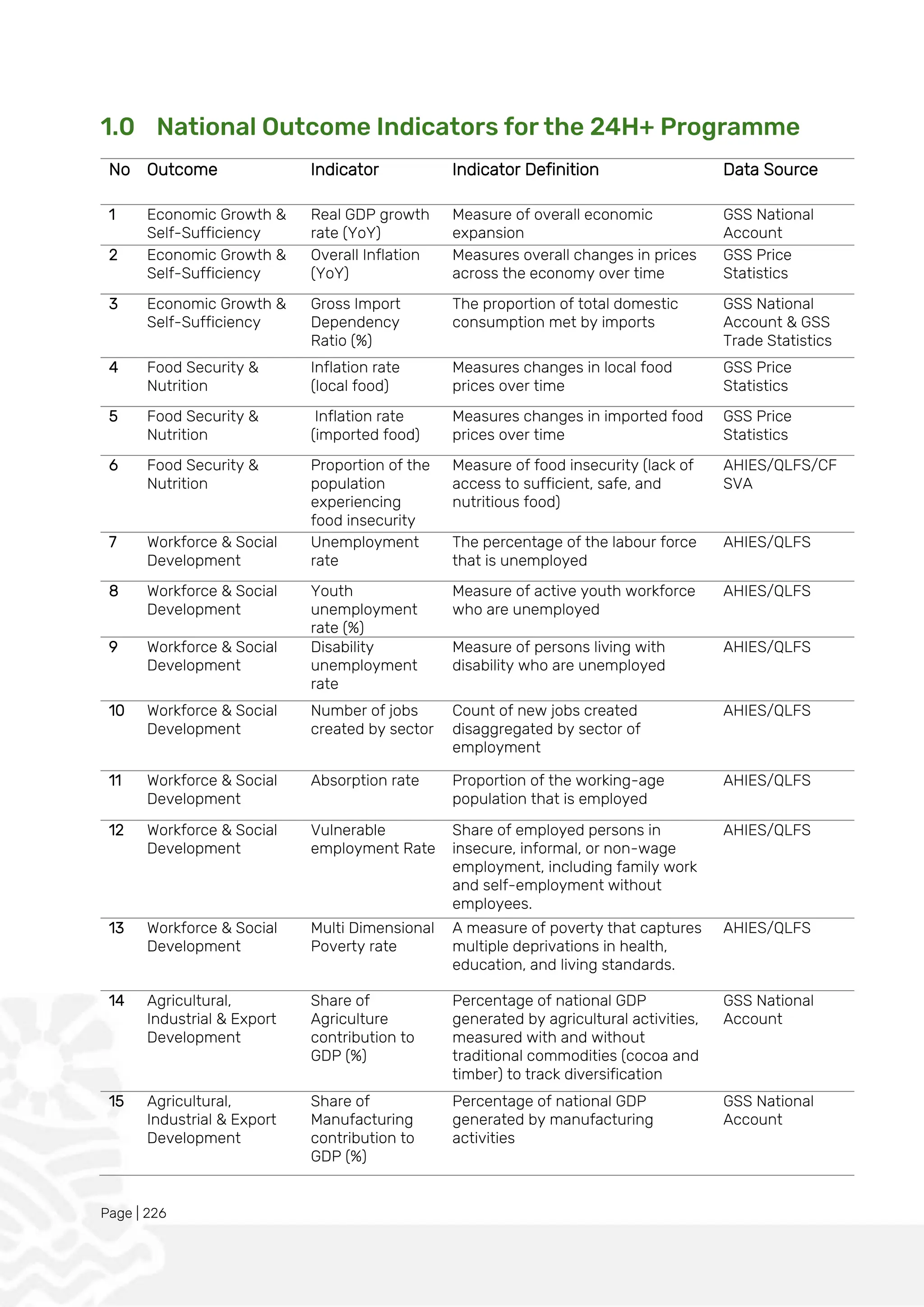
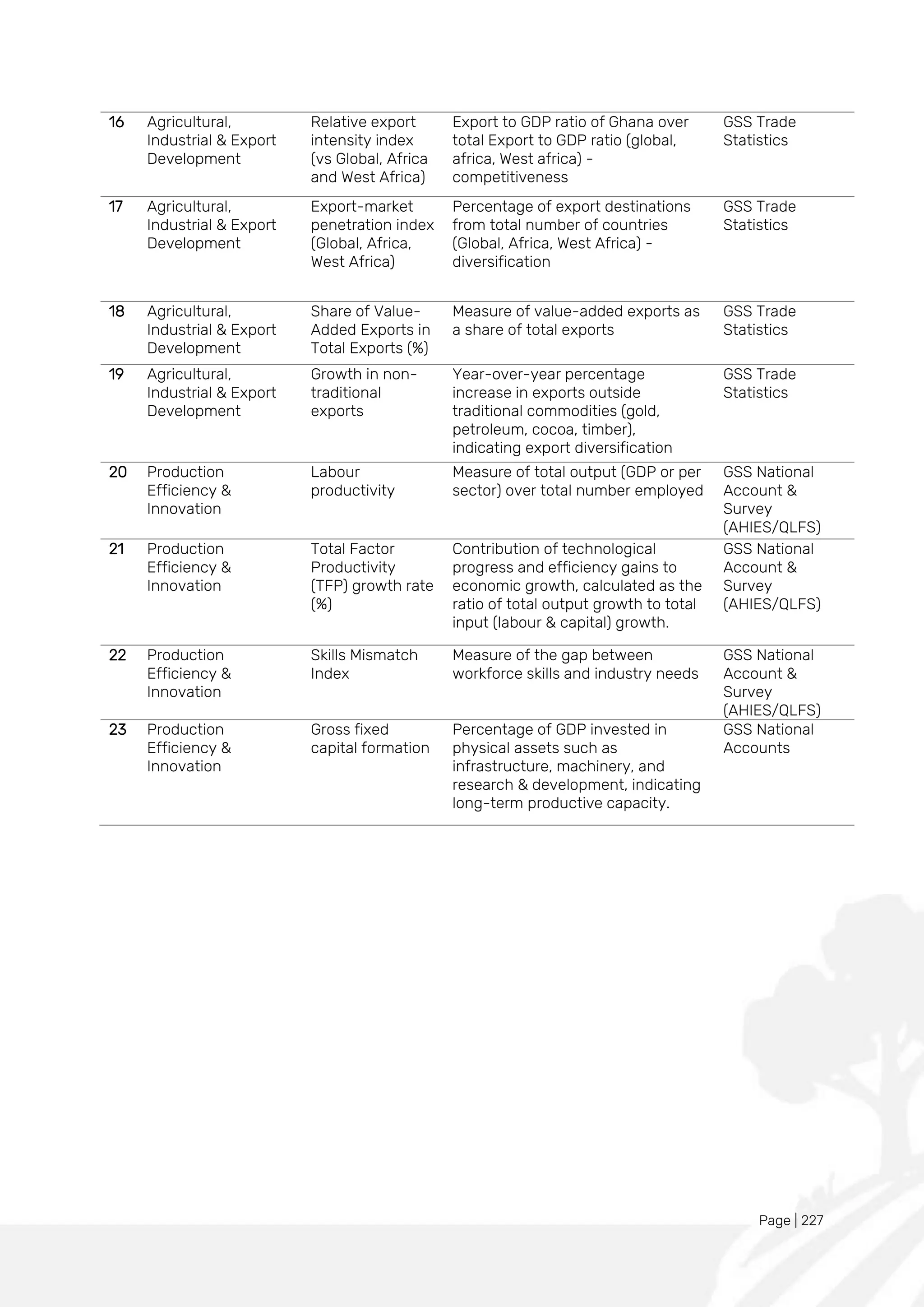
1.0 National Outcome Indicators for the 24H+ Programme __________________ 226
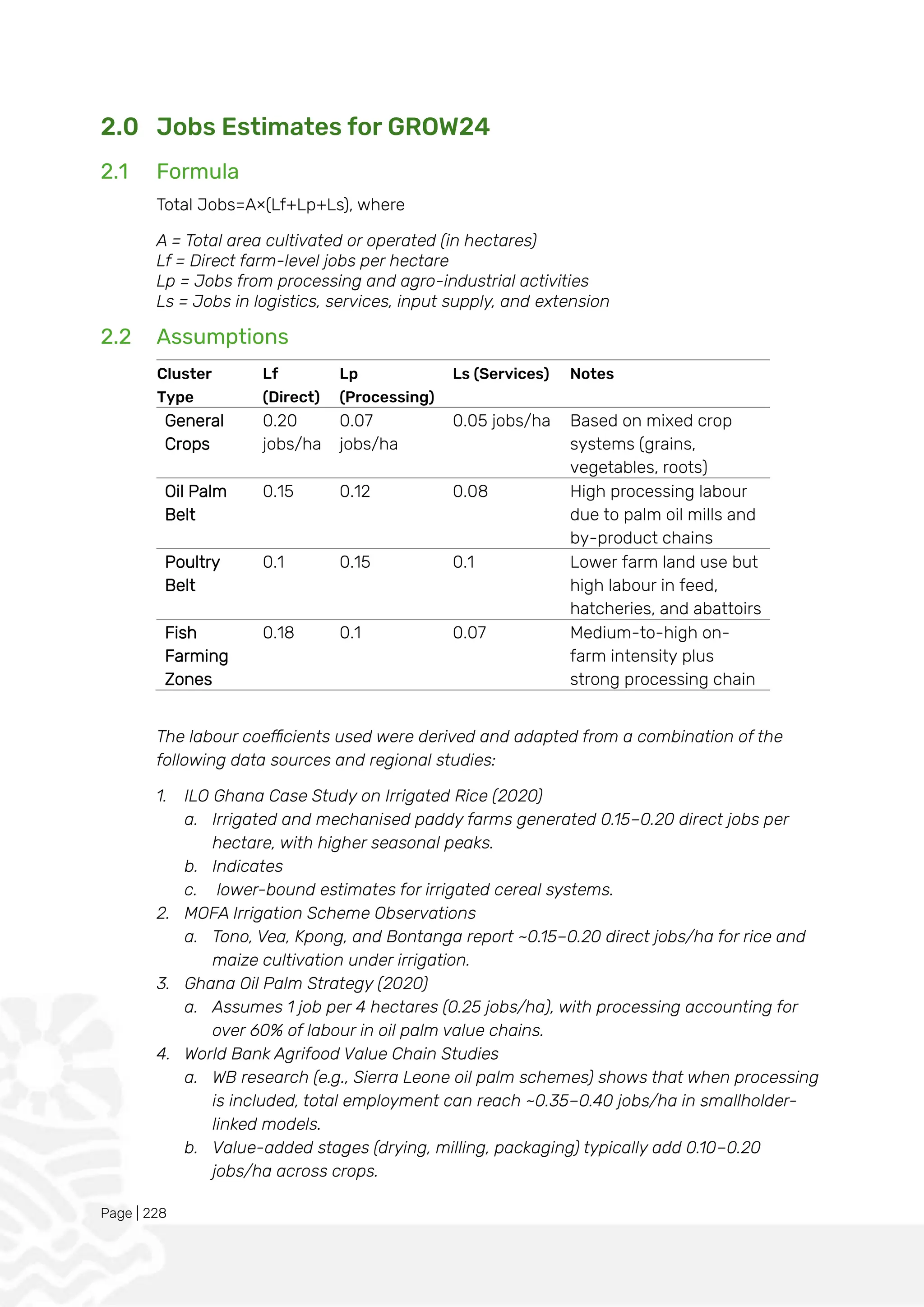
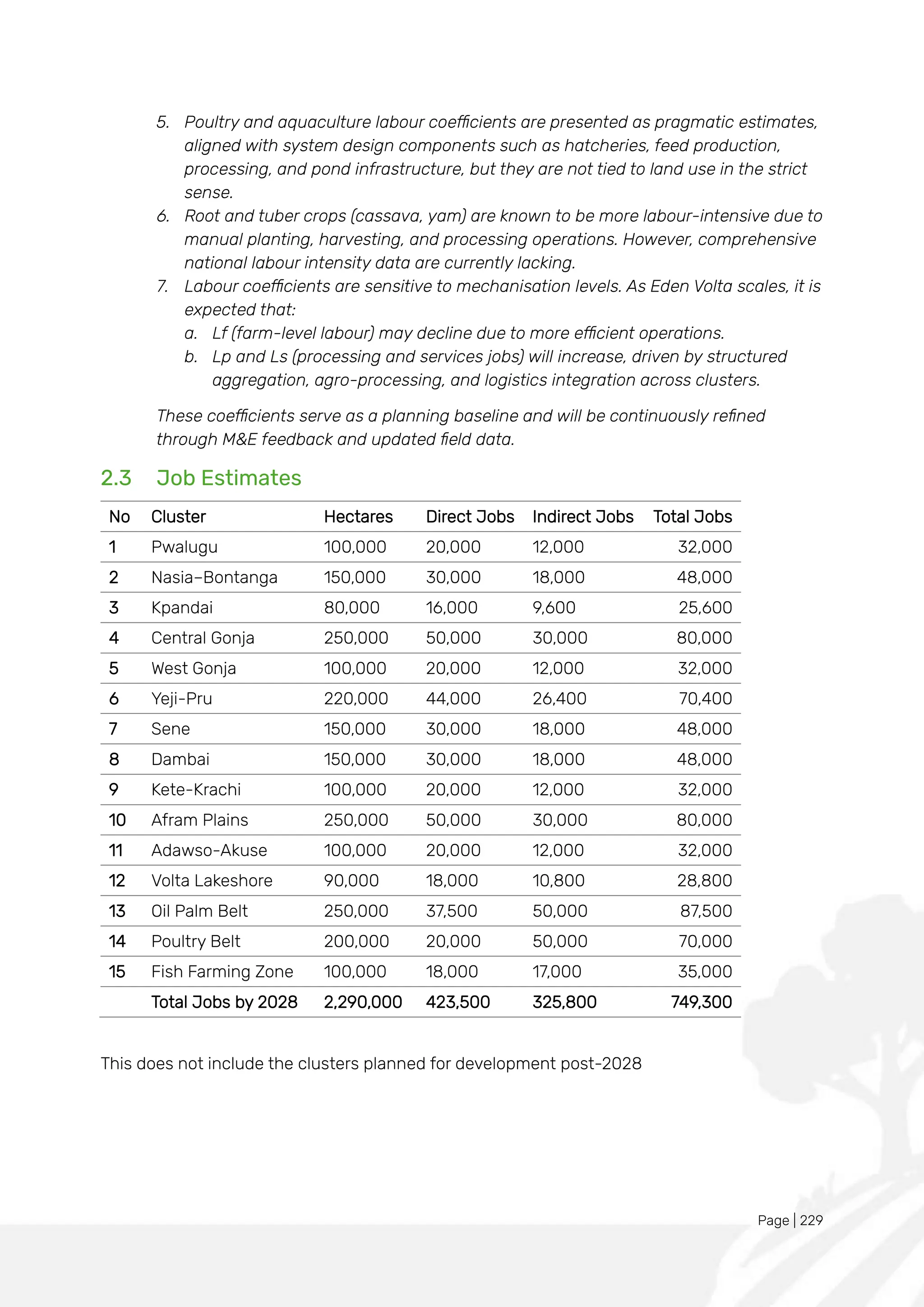
2.0 Jobs Estimates for GROW24 __________________________________ 228
3.0 Acknowledgements ________________________________________ 230
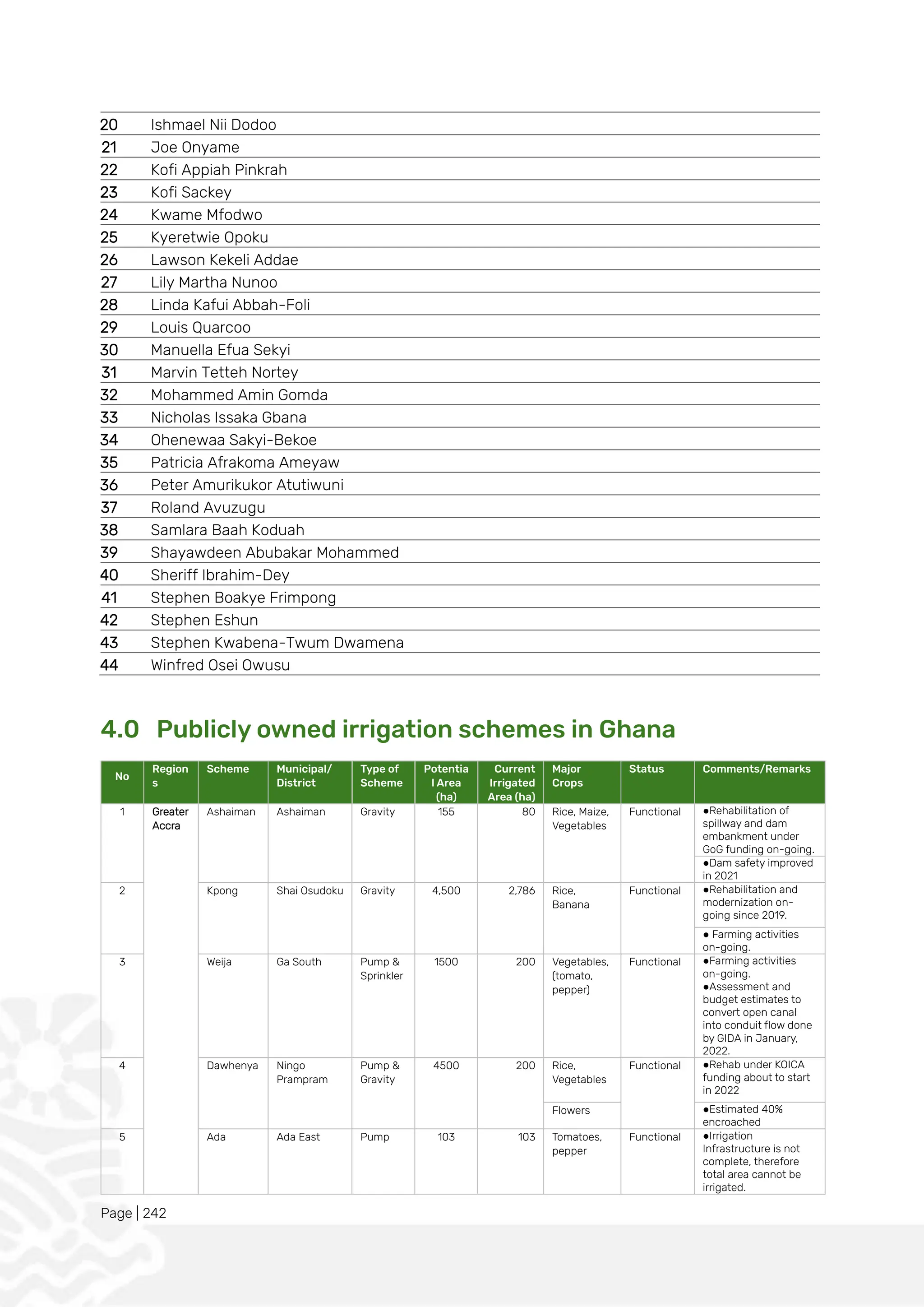
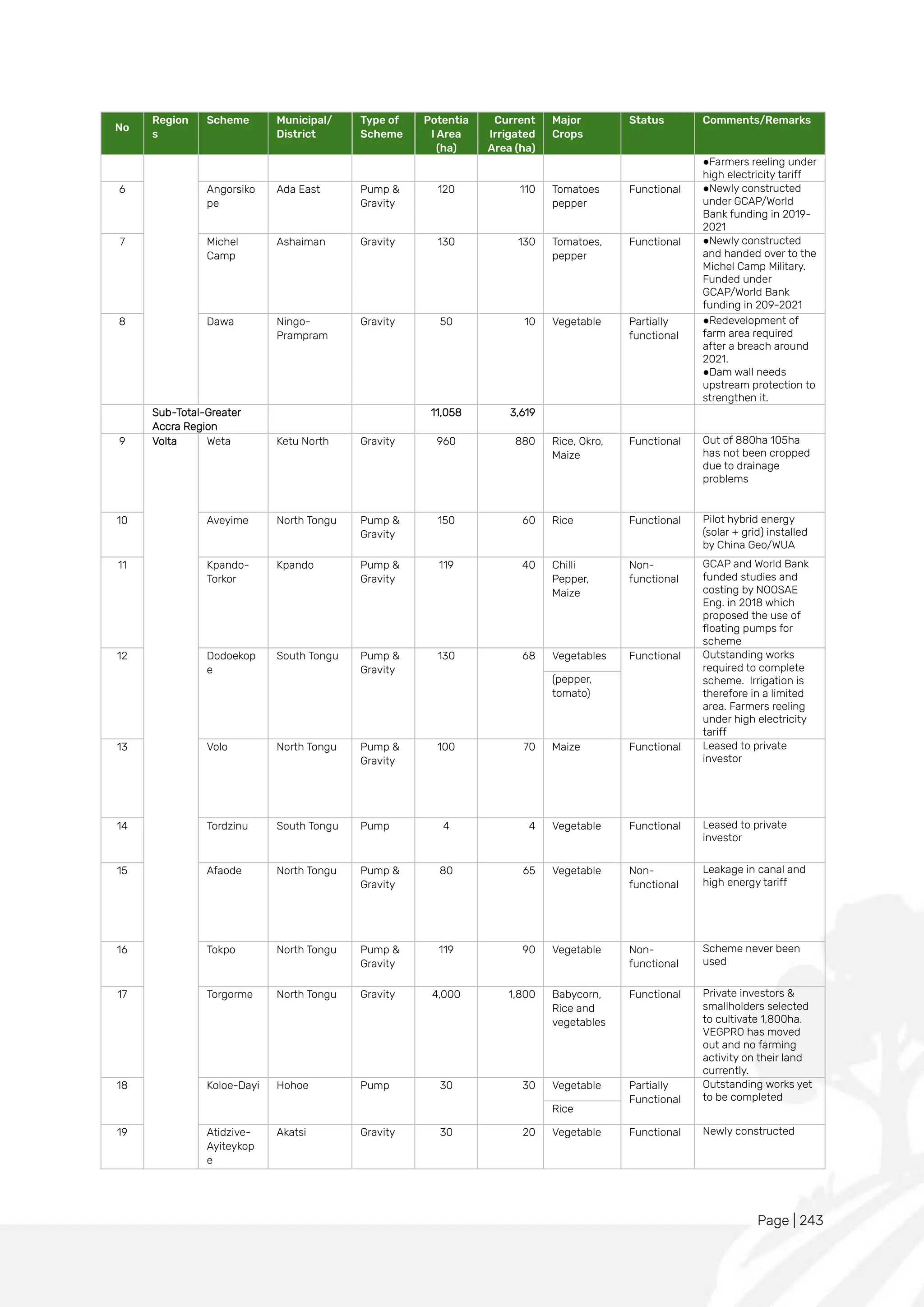
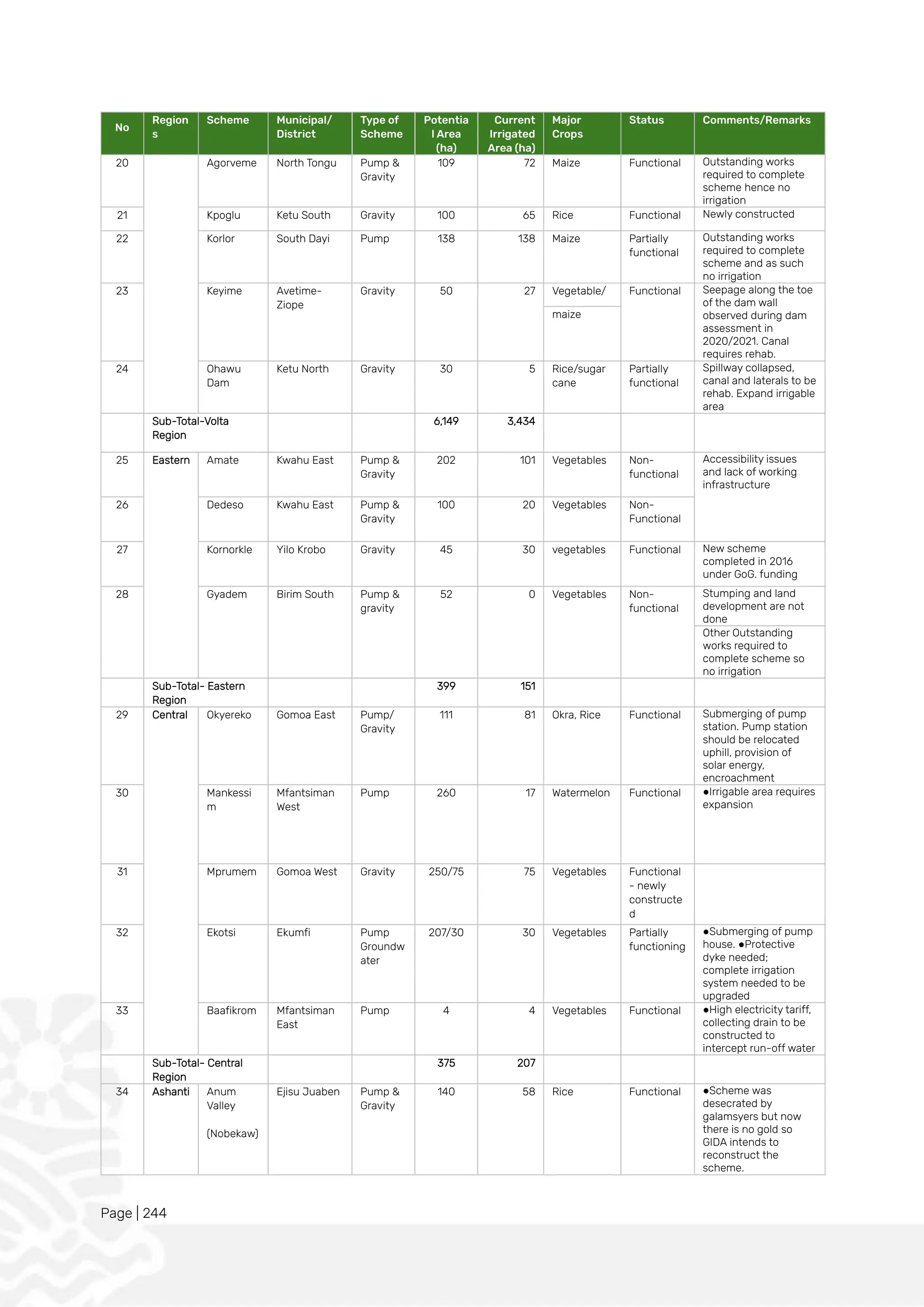
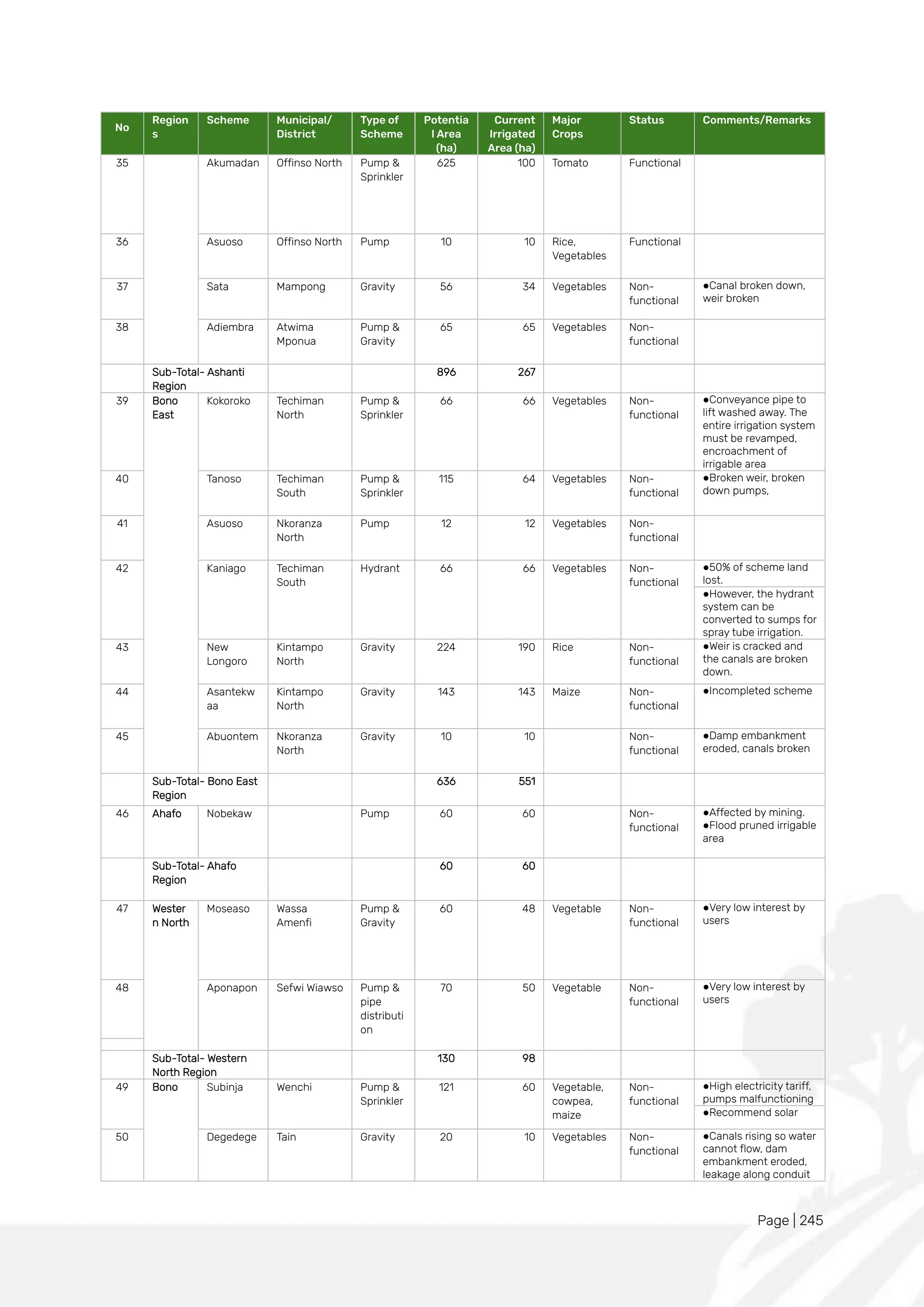
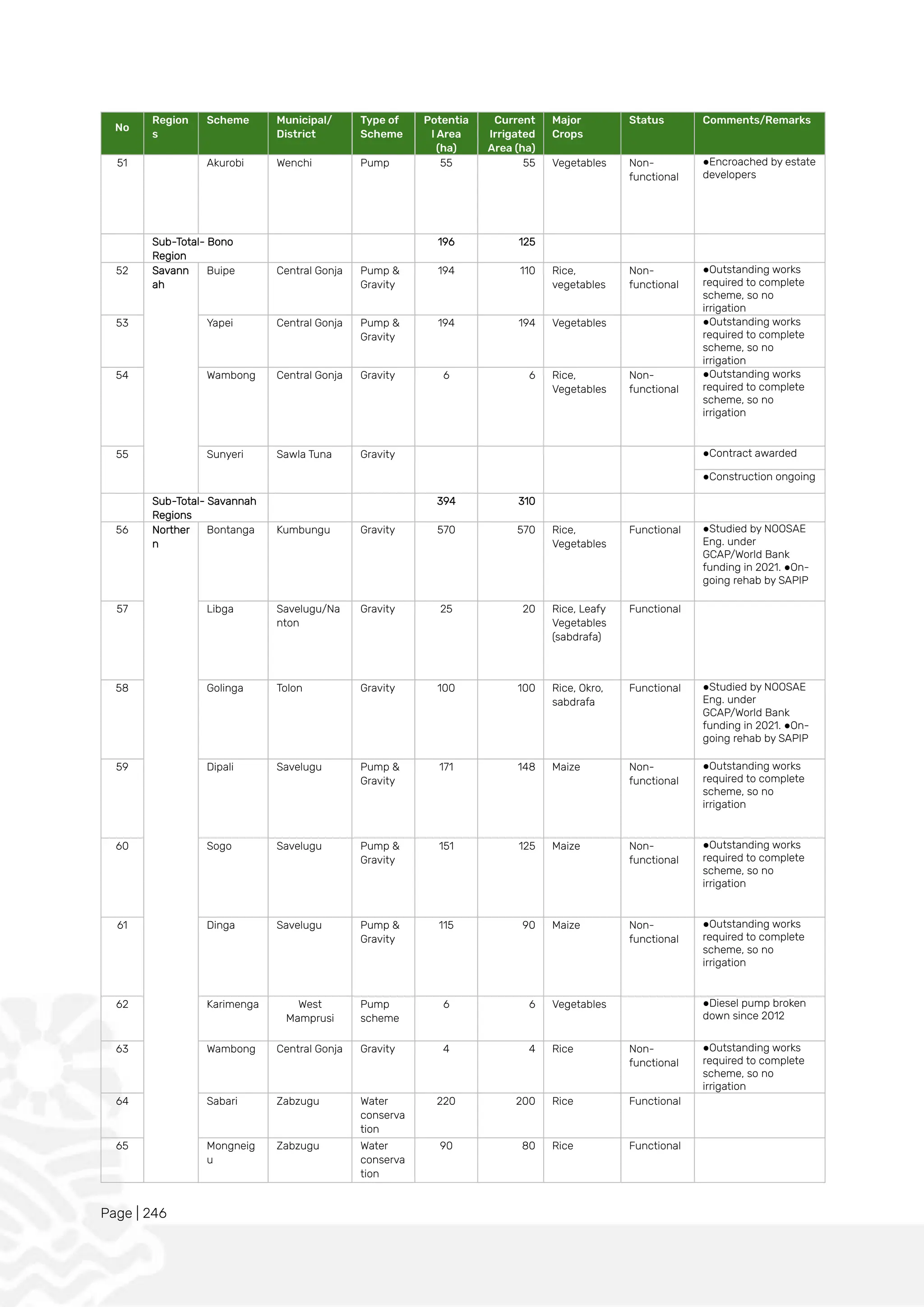
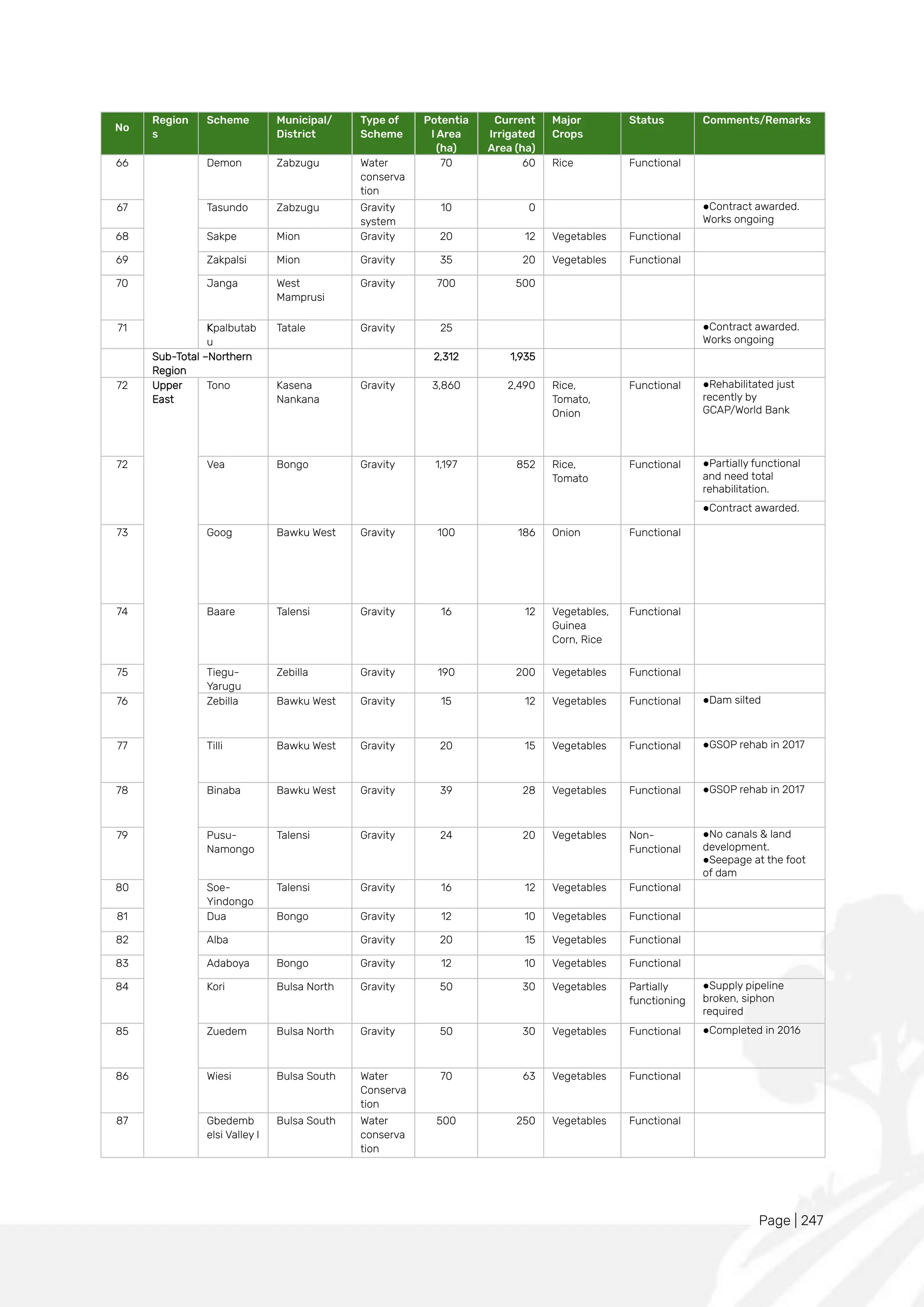
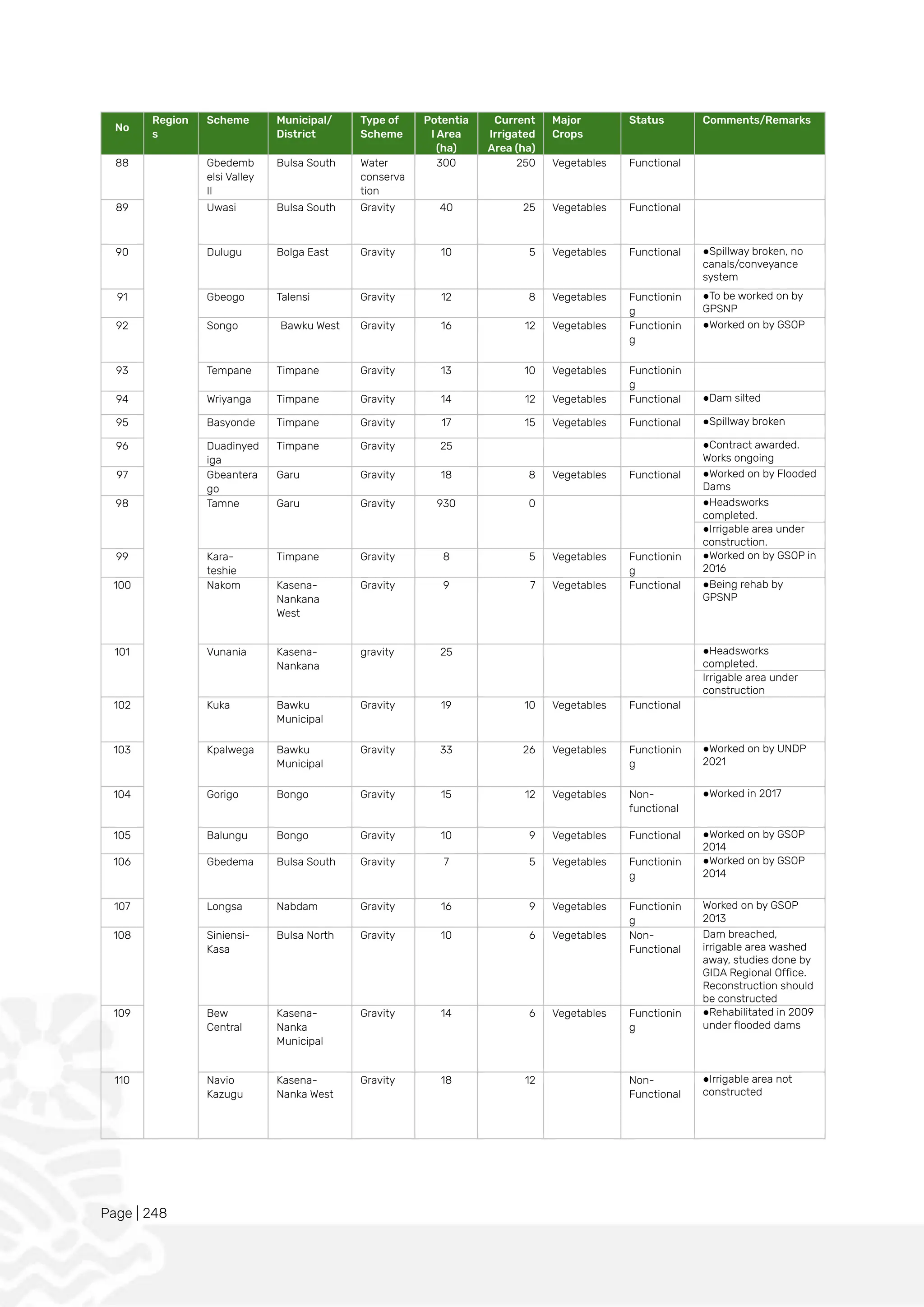
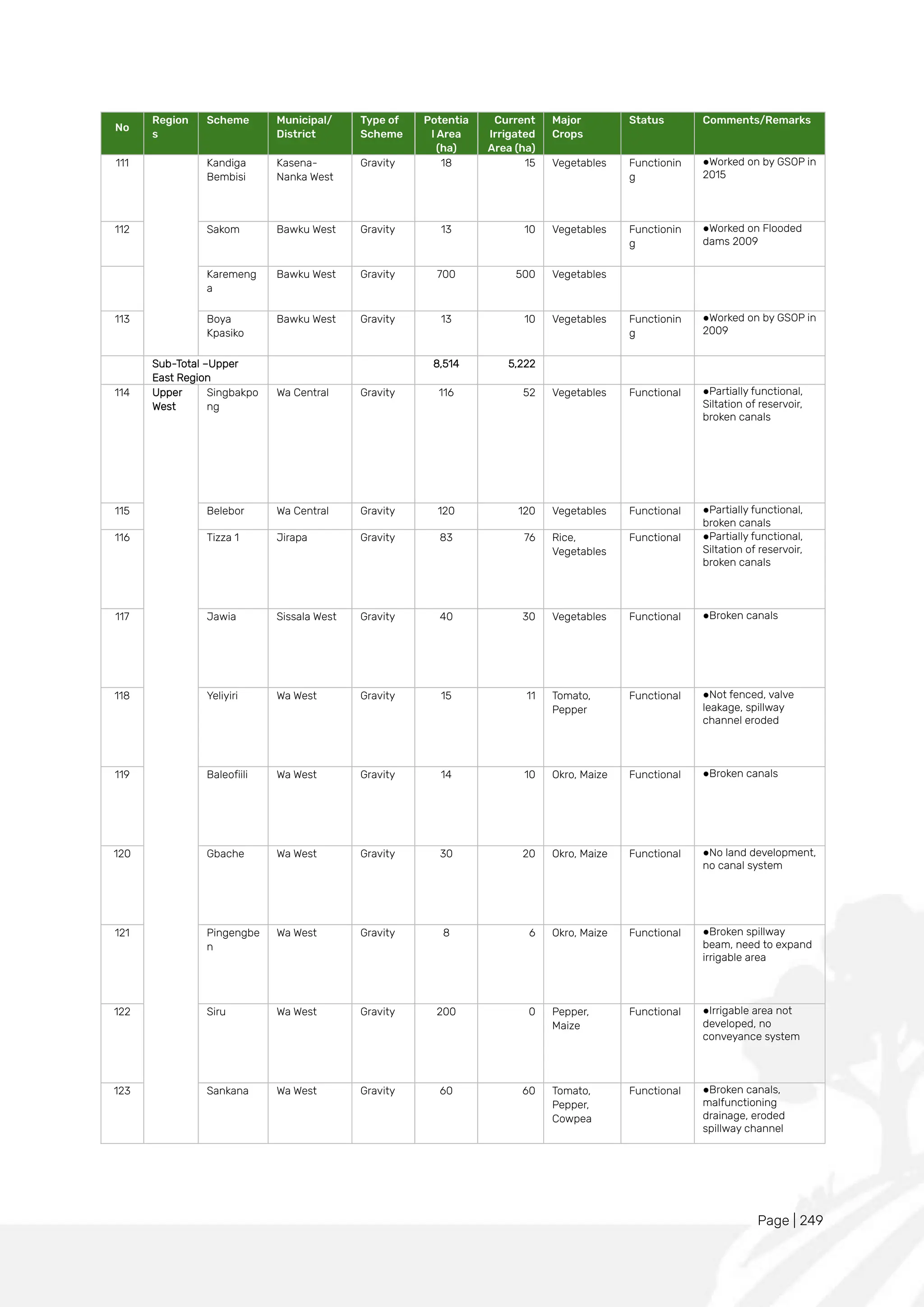
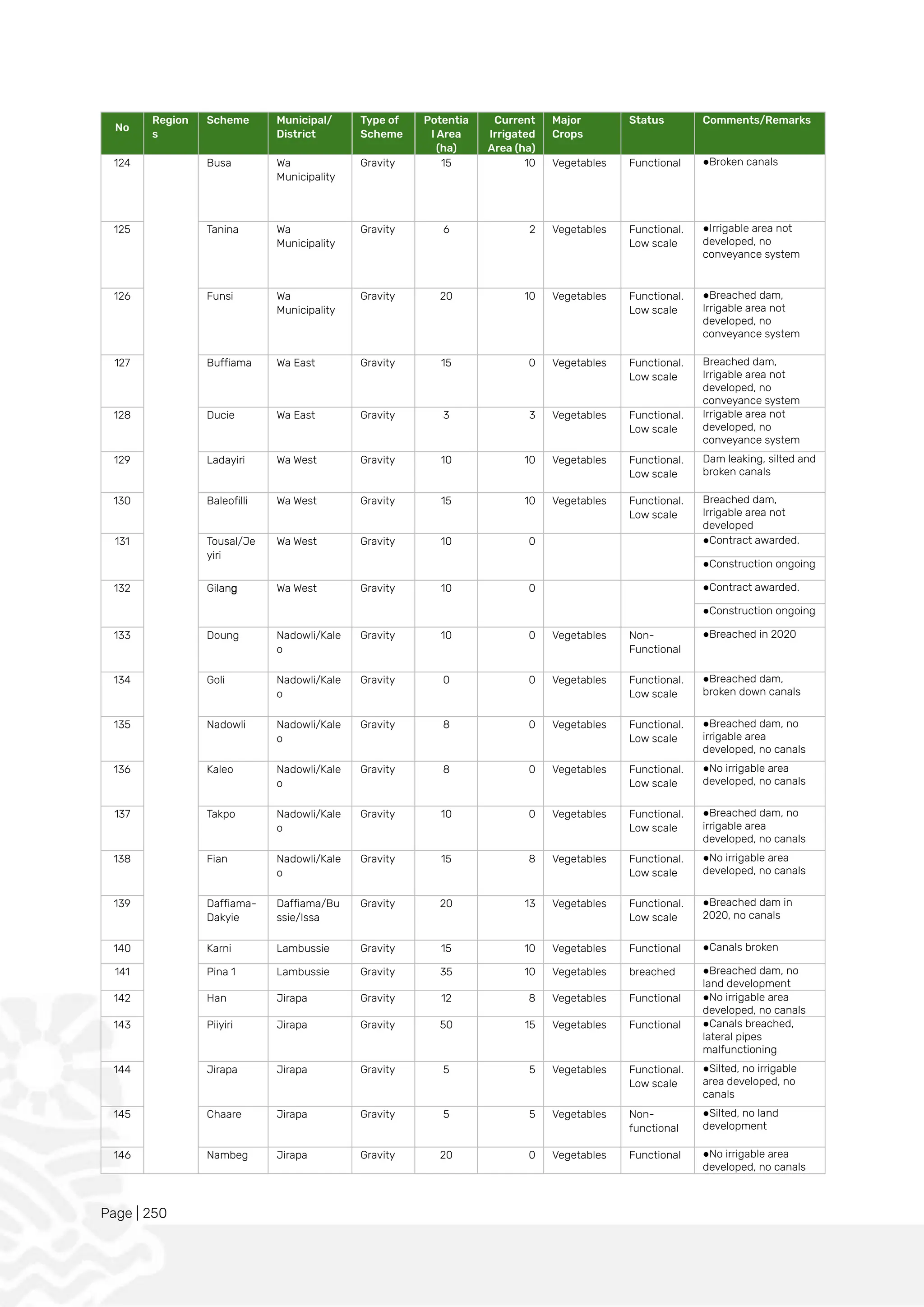
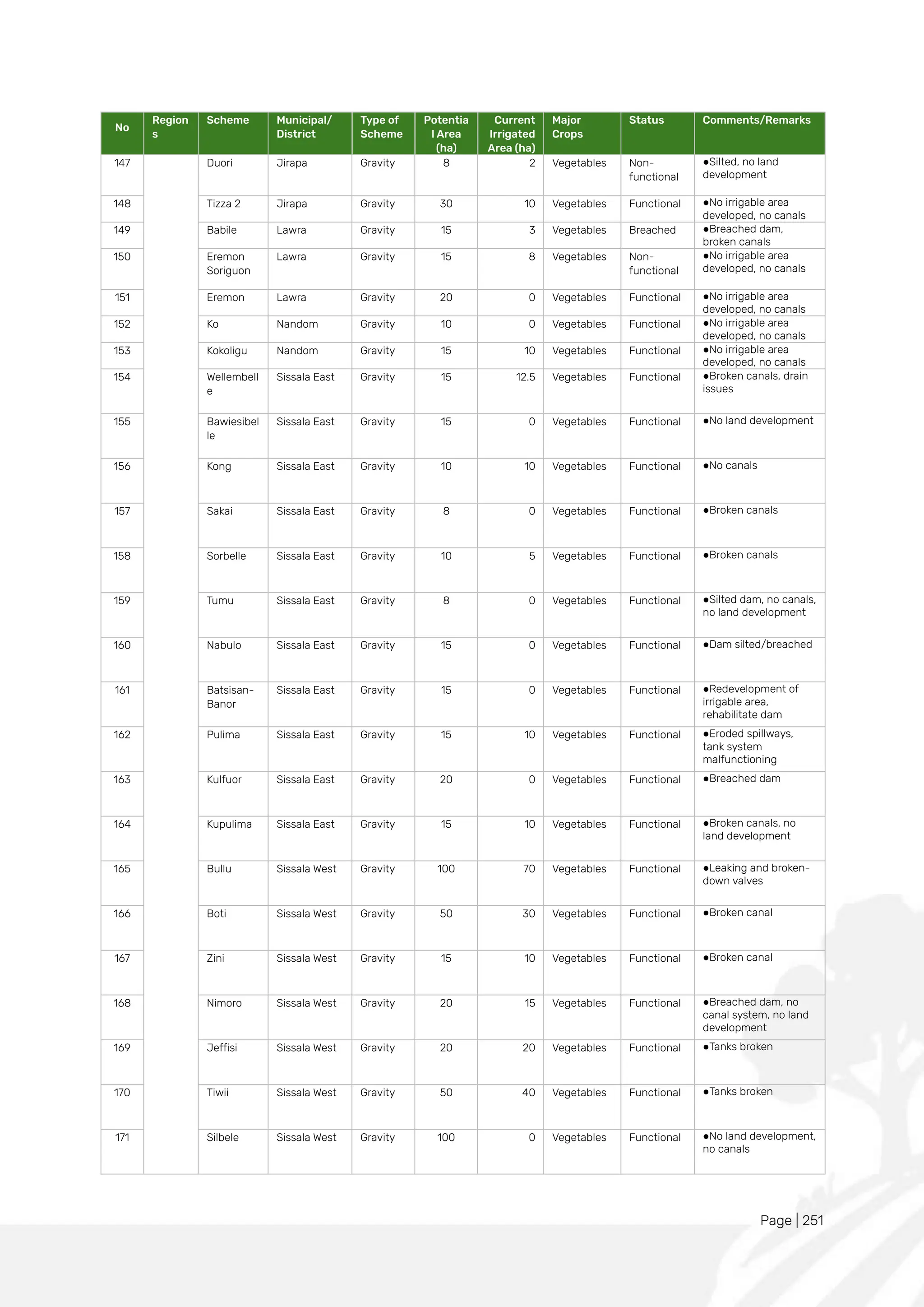
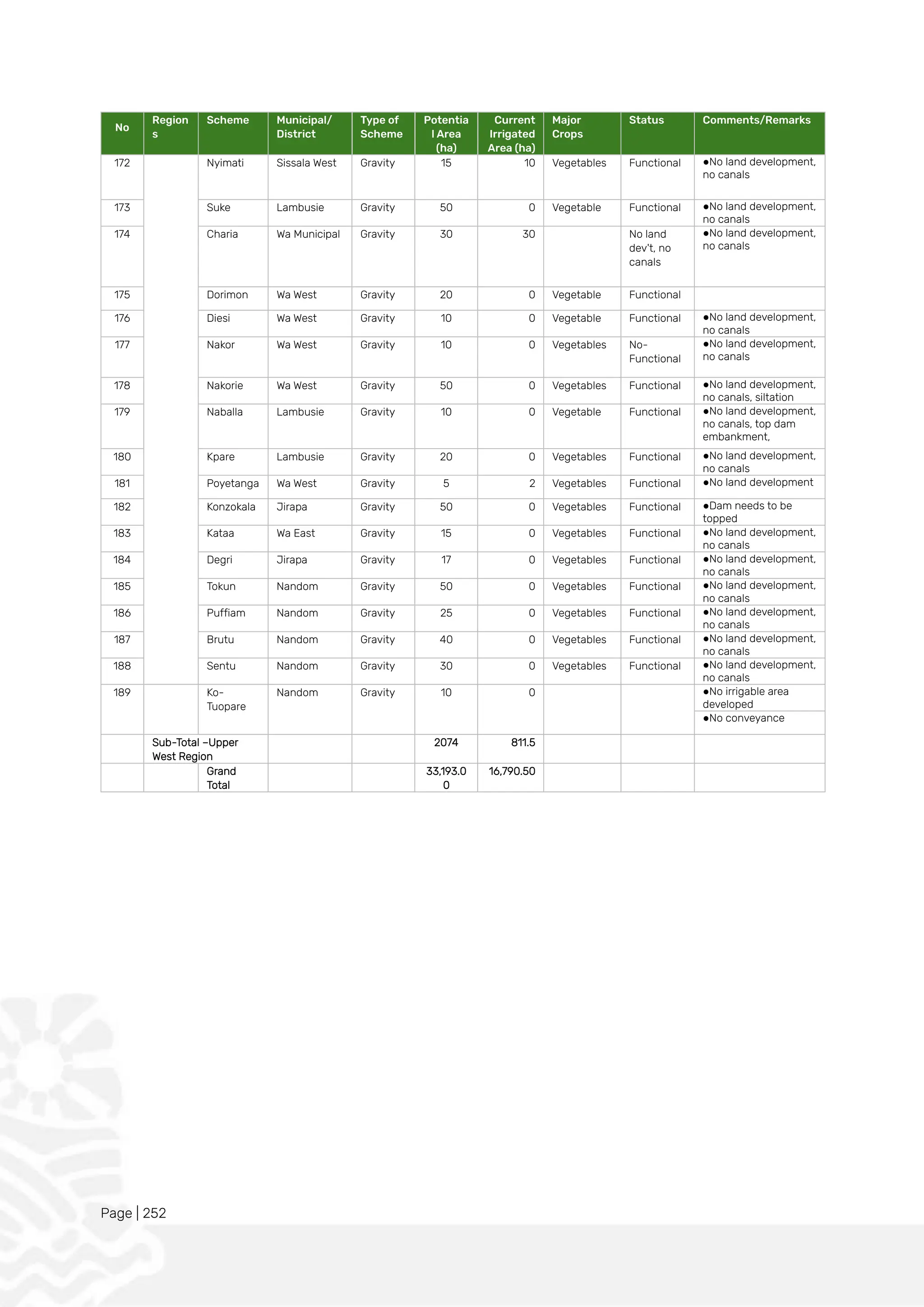
4.0 Publicly owned irrigation schemes in Ghana ________________________ 242
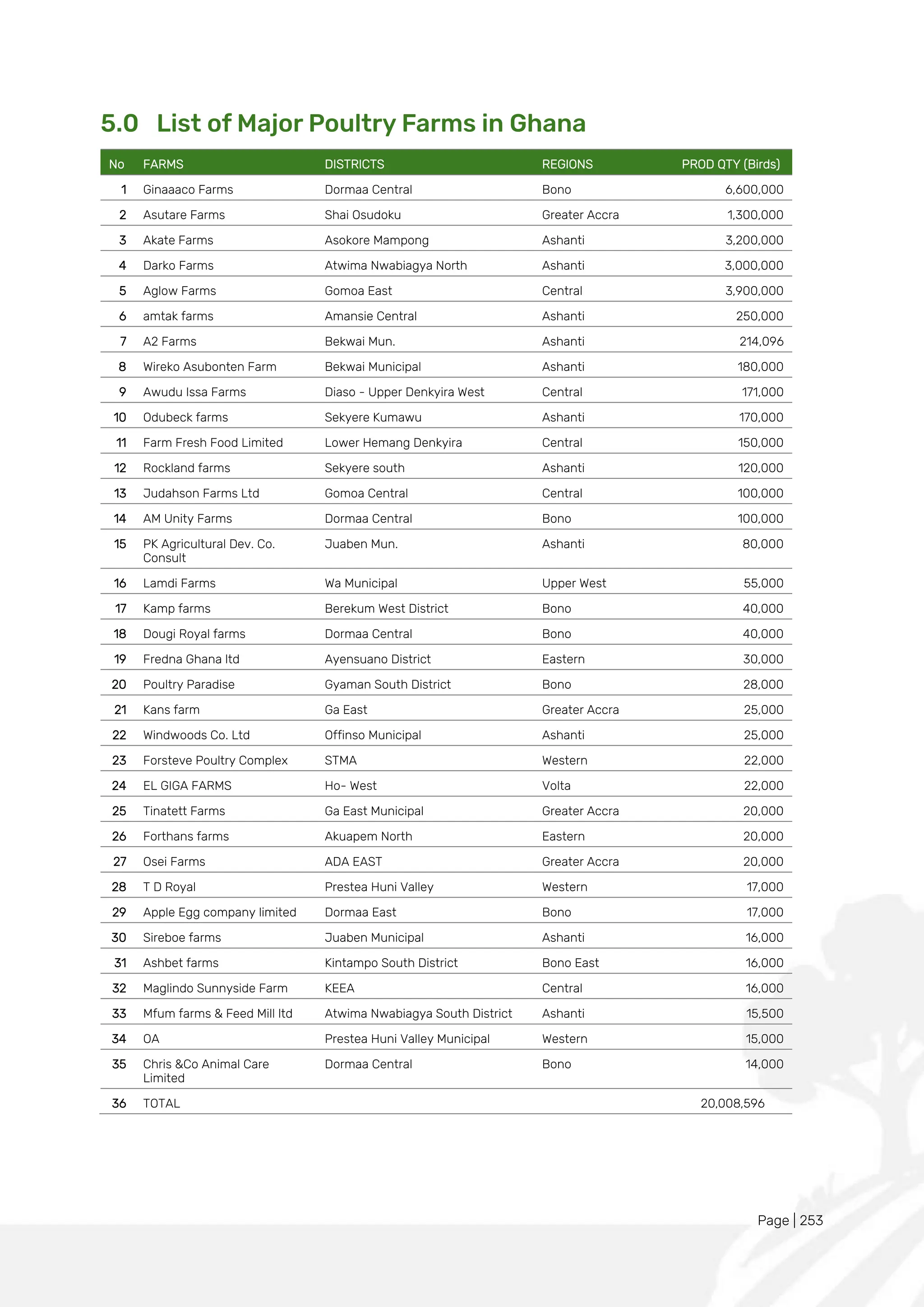
5.0 List of Major Poultry Farms in Ghana _____________________________ 253
6.0 List of Active GIDA Rice Growing Schemes__________________________ 254
7.0 Strategic Agriculture Value Chains ______________________________ 254
8.0 Typical Recommended set of Basic Equipment for various Categories of Agbleduwo
cultivating Rice, Maize and Vegetables_________________________________ 281
Page | 7
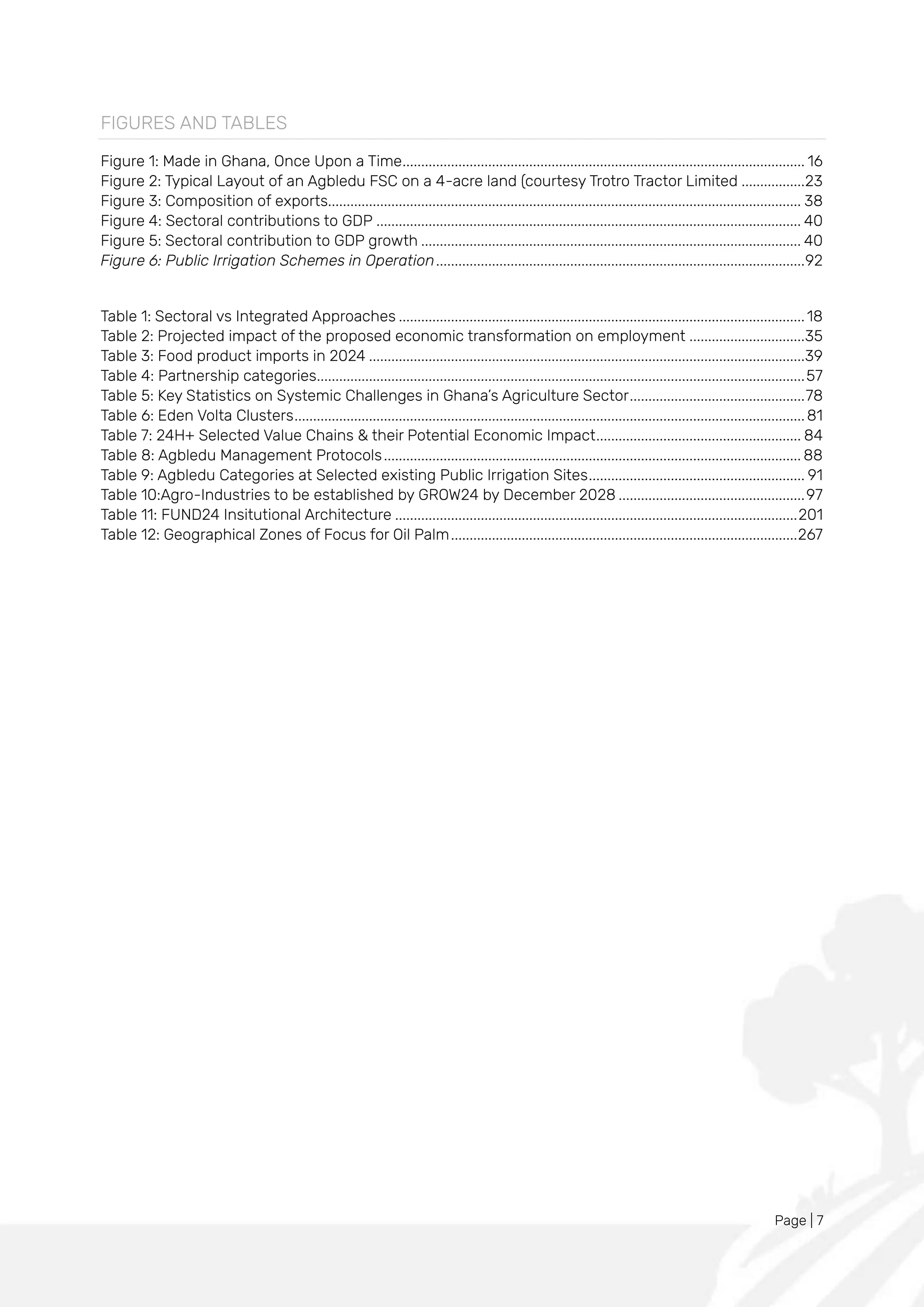
FIGURES AND TABLES
Figure 1: Made in Ghana, Once Upon a Time............................................................................................................ 16
Figure 2: Typical Layout of an Agbledu FSC on a 4-acre land (courtesy Trotro Tractor Limited .................23
Figure 3: Composition of exports............................................................................................................................... 38
Figure 4: Sectoral contributions to GDP .................................................................................................................. 40
Figure 5: Sectoral contribution to GDP growth ...................................................................................................... 40
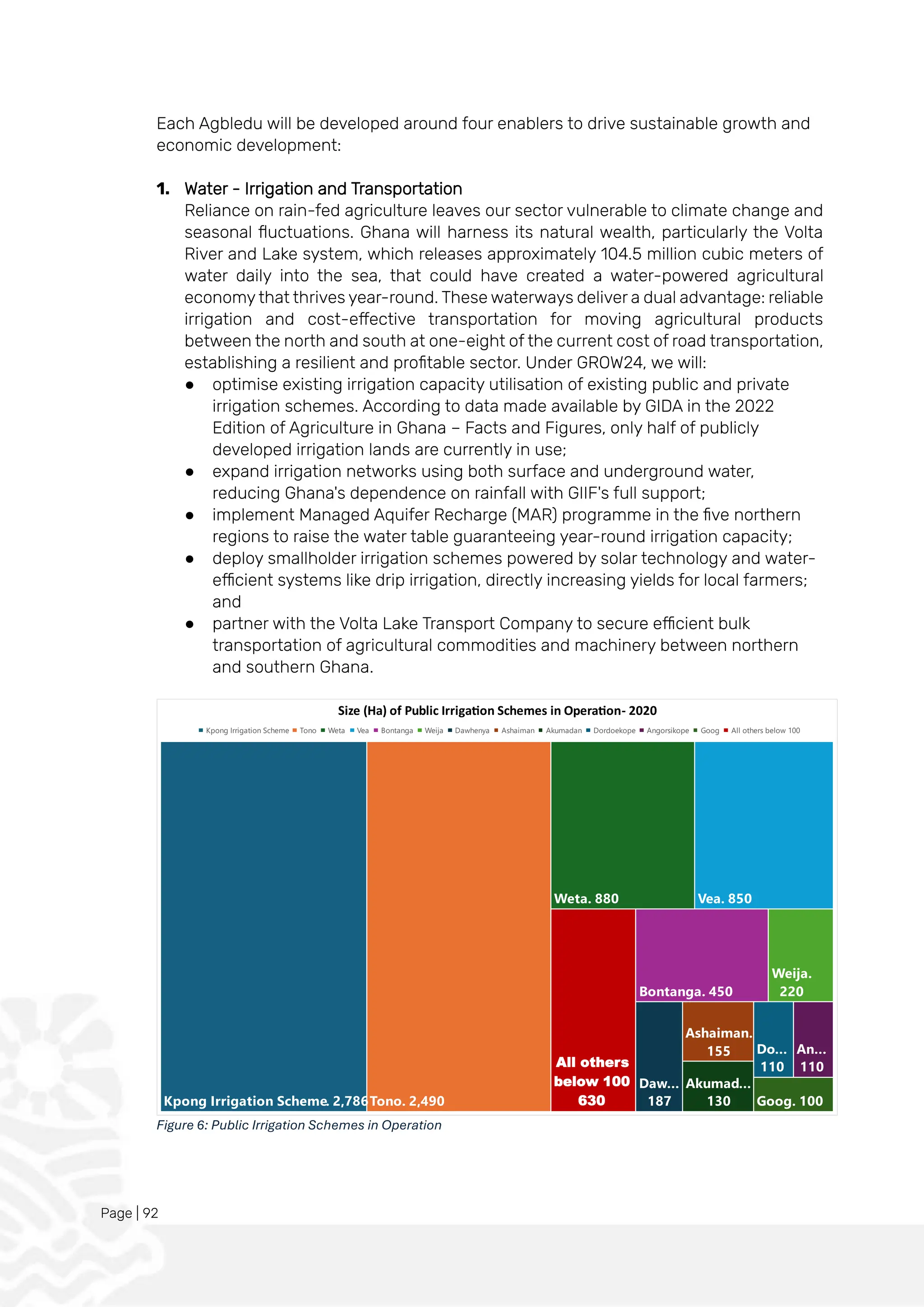
Figure 6: Public Irrigation Schemes in Operation...................................................................................................92
Table 1: Sectoral vs Integrated Approaches .............................................................................................................18
Table 2: Projected impact of the proposed economic transformation on employment ...............................35
Table 3: Food product imports in 2024 .....................................................................................................................39
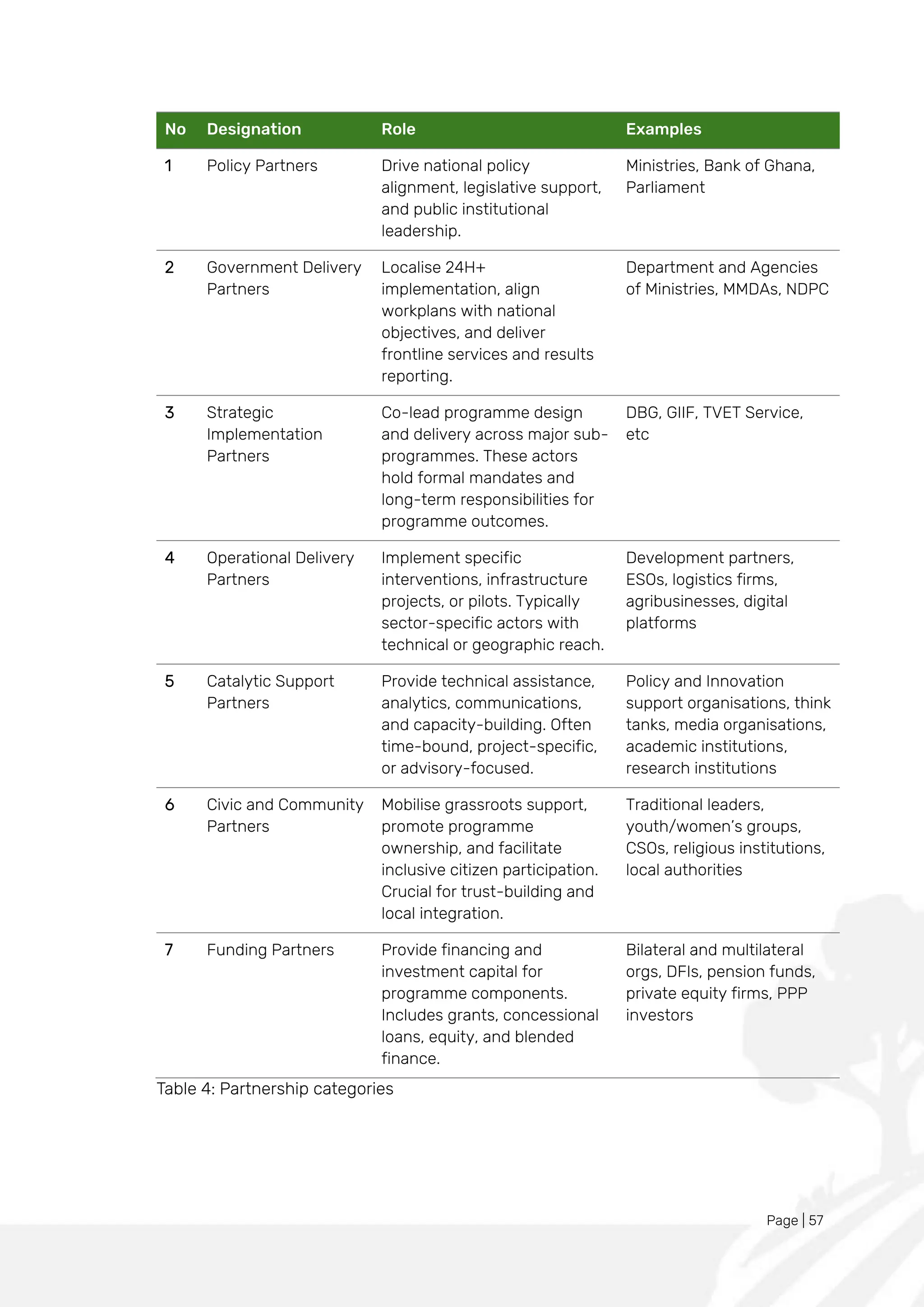
Table 4: Partnership categories...................................................................................................................................57
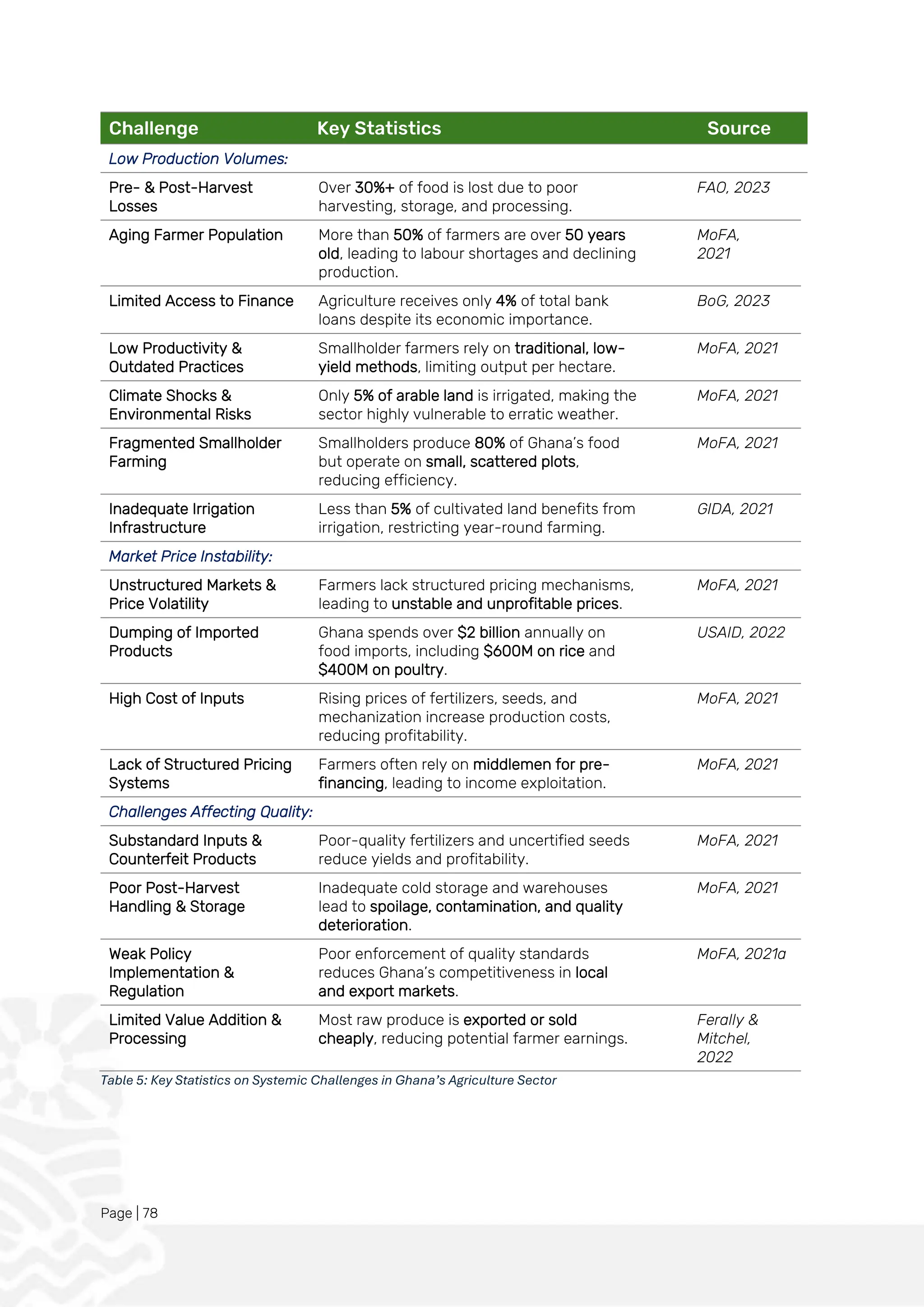
Table 5: Key Statistics on Systemic Challenges in Ghana’s Agriculture Sector...............................................78
Table 6: Eden Volta Clusters.........................................................................................................................................81
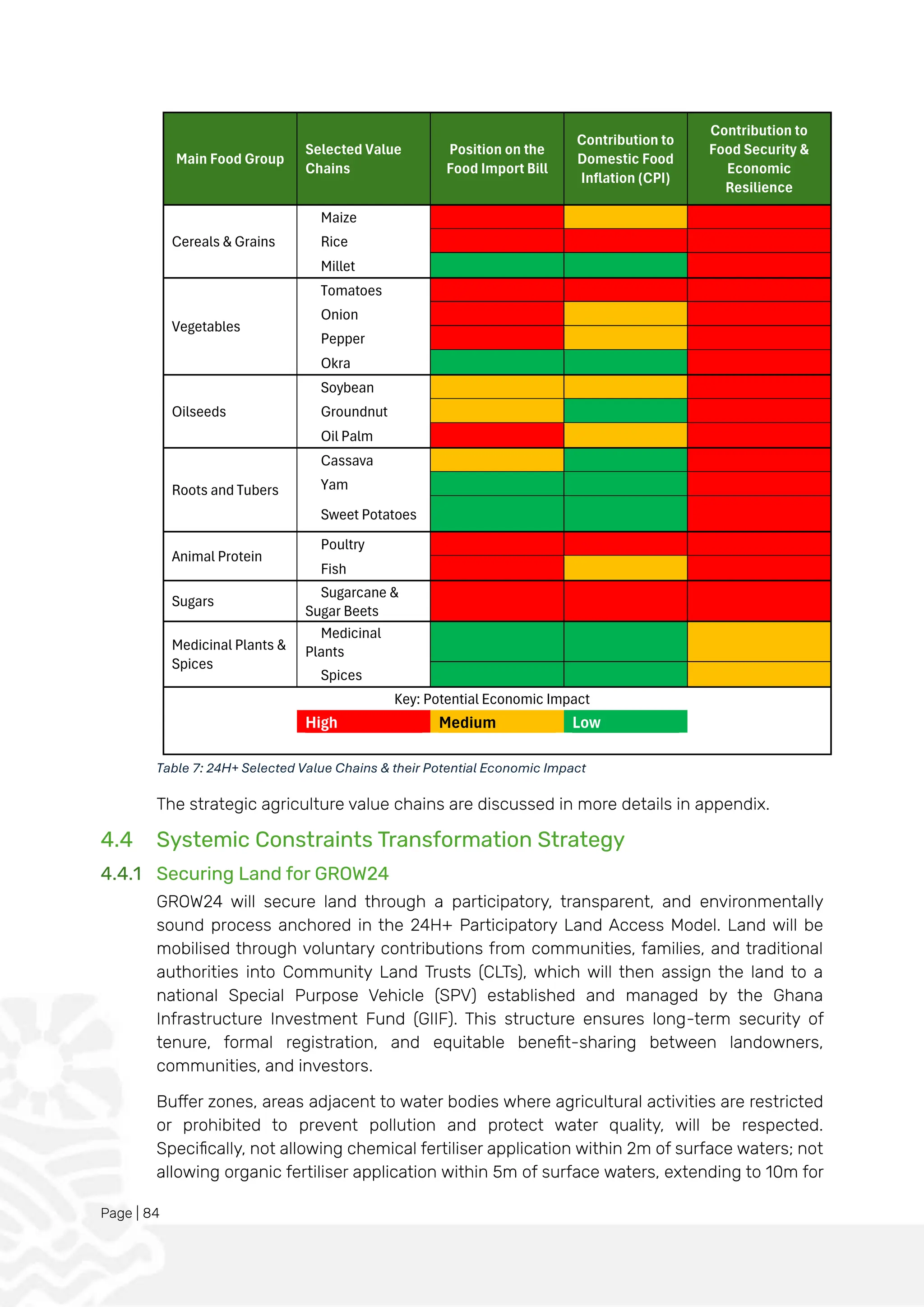
Table 7: 24H+ Selected Value Chains & their Potential Economic Impact....................................................... 84
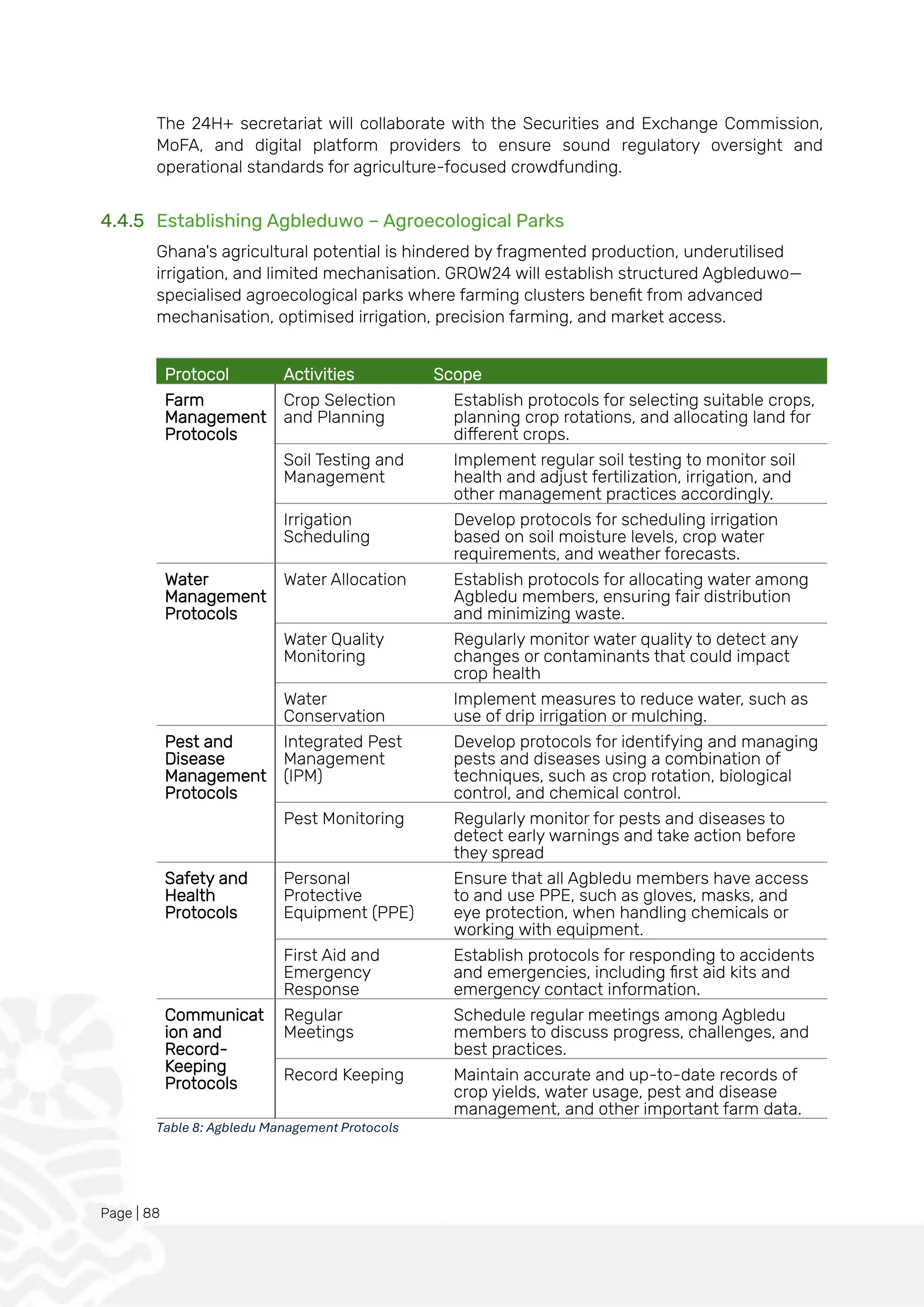
Table 8: Agbledu Management Protocols................................................................................................................ 88
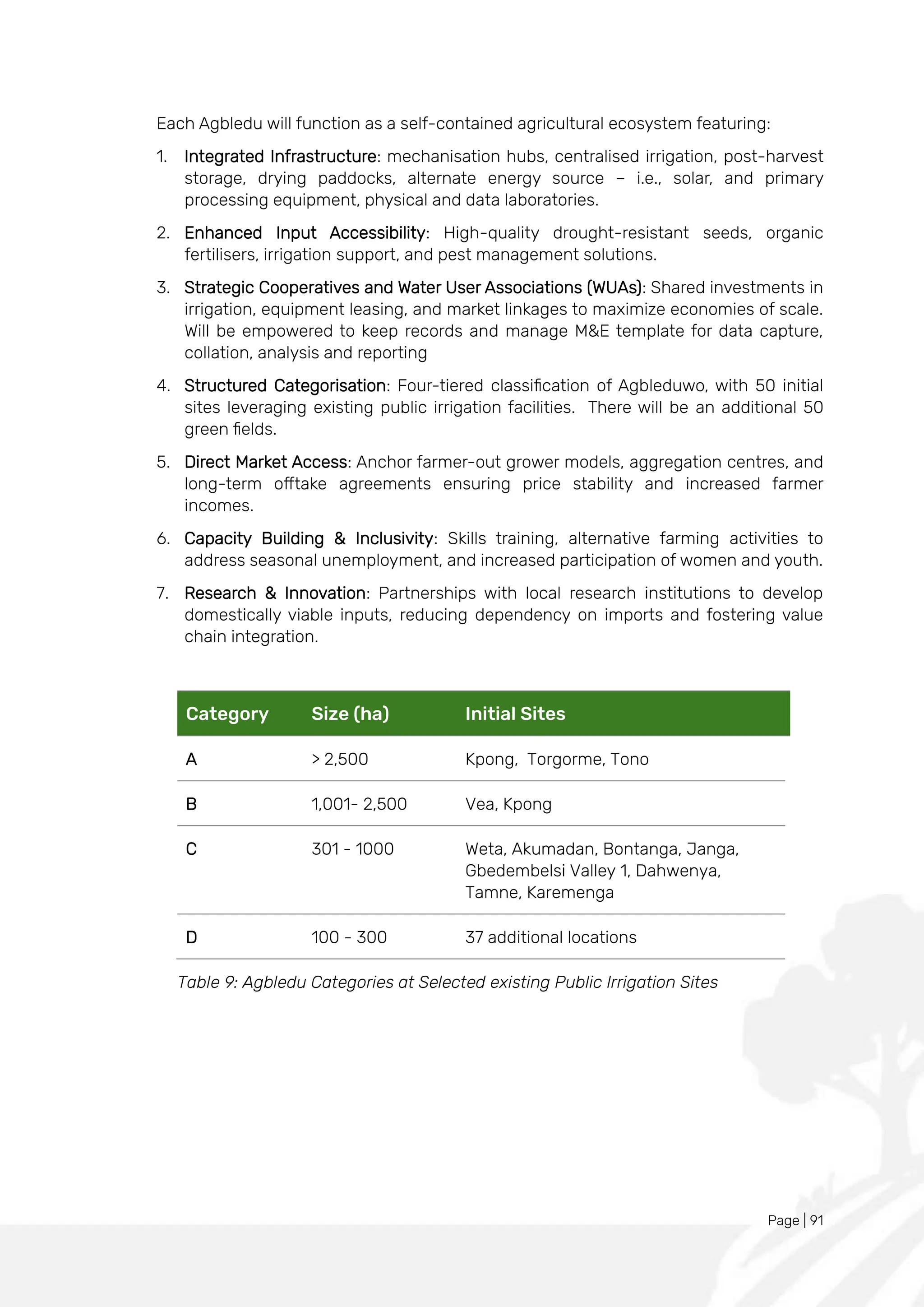
Table 9: Agbledu Categories at Selected existing Public Irrigation Sites.......................................................... 91
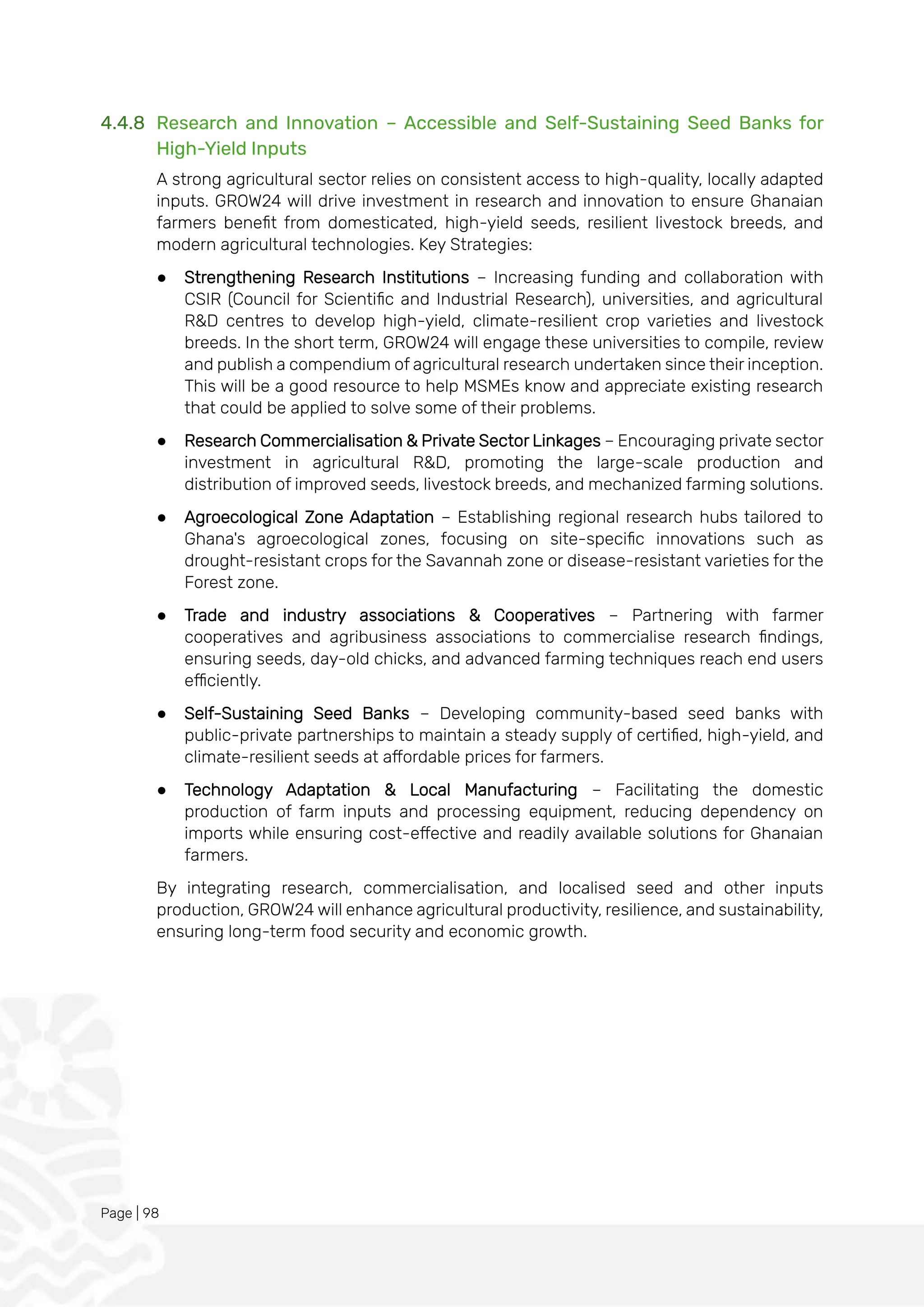
Table 10:Agro-Industries to be established by GROW24 by December 2028 ..................................................97
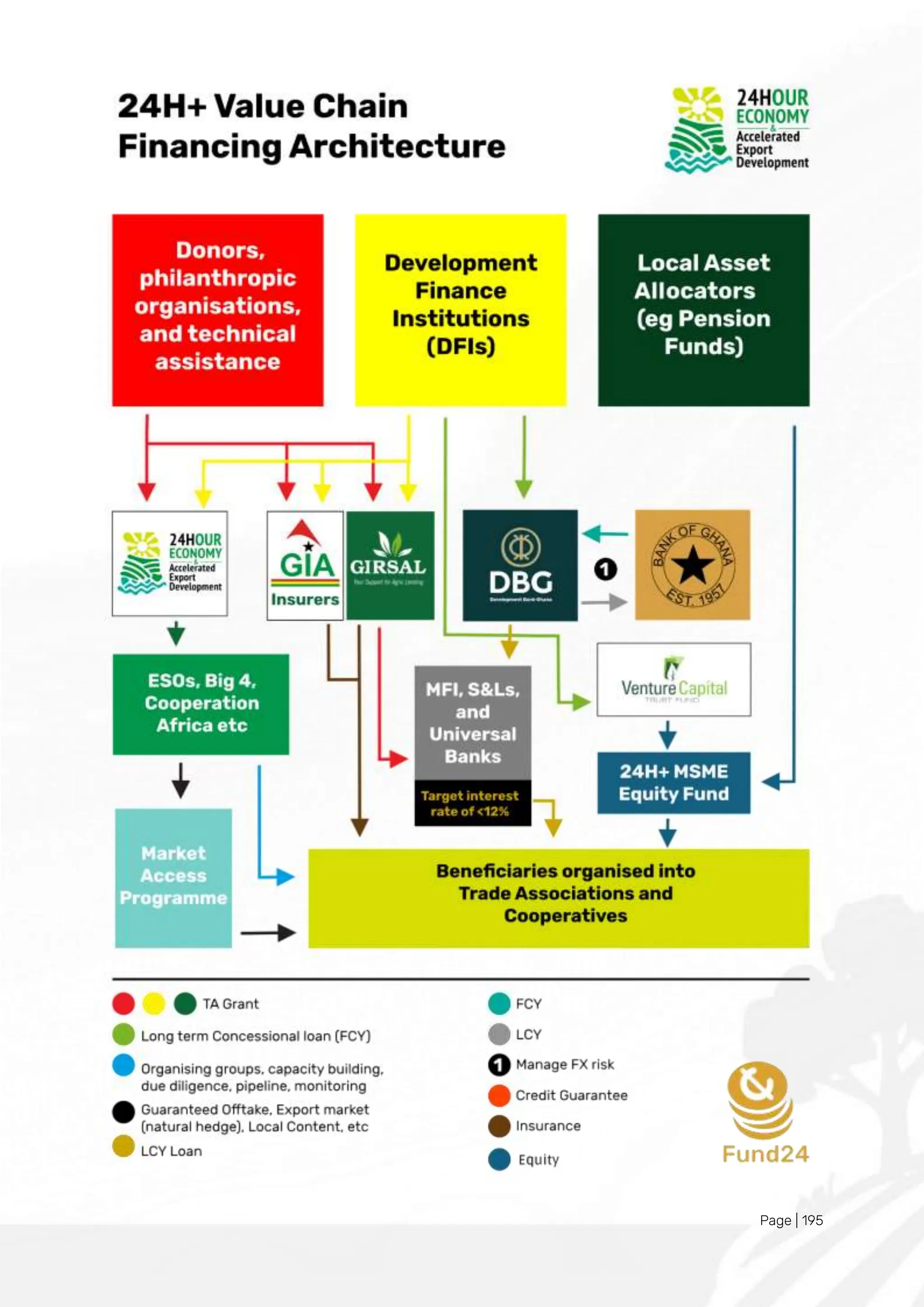
Table 11: FUND24 Insitutional Architecture ............................................................................................................201
Table 12: Geographical Zones of Focus for Oil Palm.............................................................................................267
Page | 8
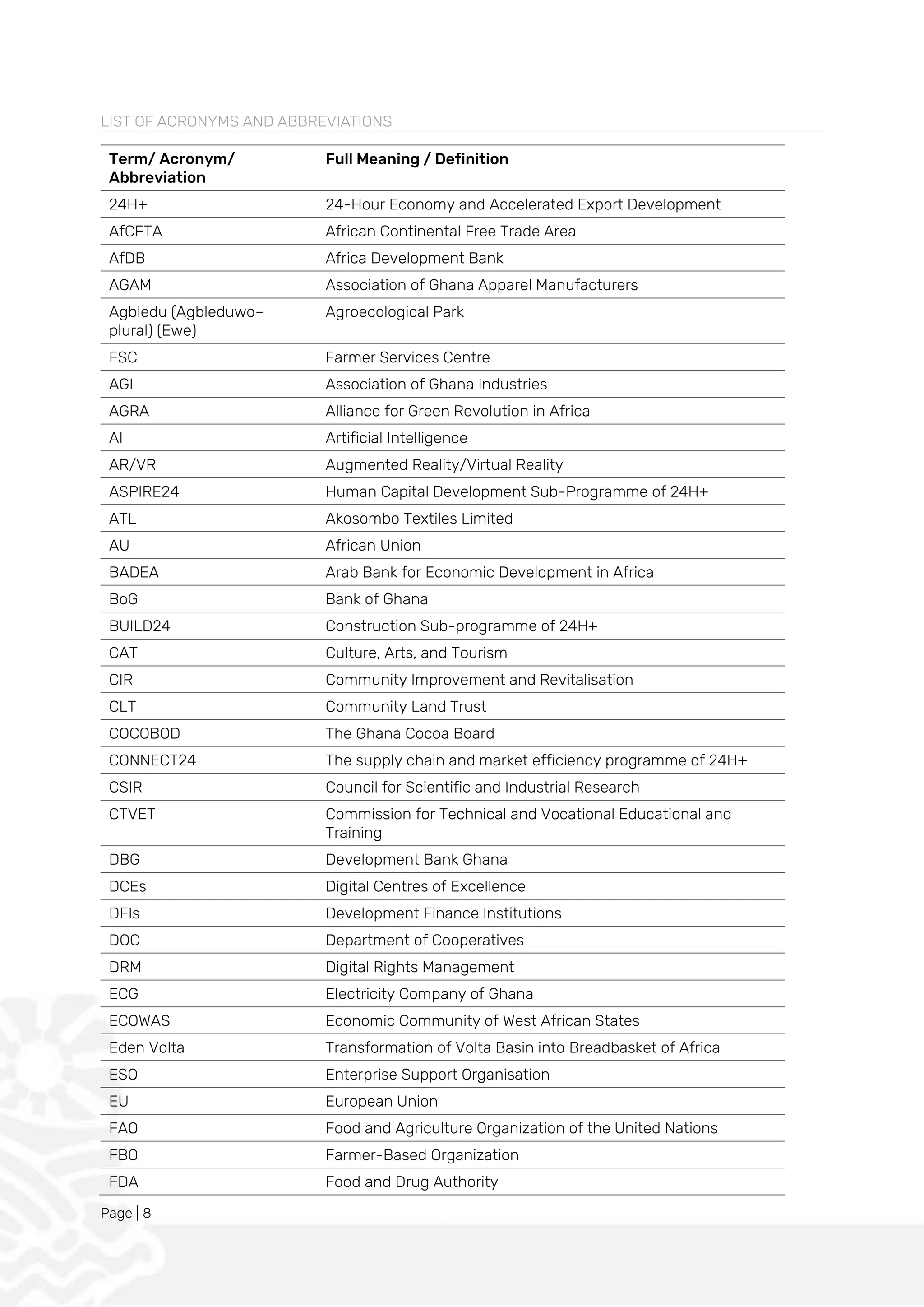
LIST OF ACRONYMS AND ABBREVIATIONS
Term/ Acronym/
Abbreviation
Full Meaning / Definition
24H+ 24-Hour Economy and Accelerated Export Development
AfCFTA African Continental Free Trade Area
AfDB Africa Development Bank
AGAM Association of Ghana Apparel Manufacturers
Agbledu (Agbleduwo–
plural) (Ewe)
Agroecological Park
FSC Farmer Services Centre
AGI Association of Ghana Industries
AGRA Alliance for Green Revolution in Africa
AI Artificial Intelligence
AR/VR Augmented Reality/Virtual Reality
ASPIRE24 Human Capital Development Sub-Programme of 24H+
ATL Akosombo Textiles Limited
AU African Union
BADEA Arab Bank for Economic Development in Africa
BoG Bank of Ghana
BUILD24 Construction Sub-programme of 24H+
CAT Culture, Arts, and Tourism
CIR Community Improvement and Revitalisation
CLT Community Land Trust
COCOBOD The Ghana Cocoa Board
CONNECT24 The supply chain and market efficiency programme of 24H+
CSIR Council for Scientific and Industrial Research
CTVET Commission for Technical and Vocational Educational and
Training
DBG Development Bank Ghana
DCEs Digital Centres of Excellence
DFIs Development Finance Institutions
DOC Department of Cooperatives
DRM Digital Rights Management
ECG Electricity Company of Ghana
ECOWAS Economic Community of West African States
Eden Volta Transformation of Volta Basin into Breadbasket of Africa
ESO Enterprise Support Organisation
EU European Union
FAO Food and Agriculture Organization of the United Nations
FBO Farmer-Based Organization
FDA Food and Drug Authority
Page | 9
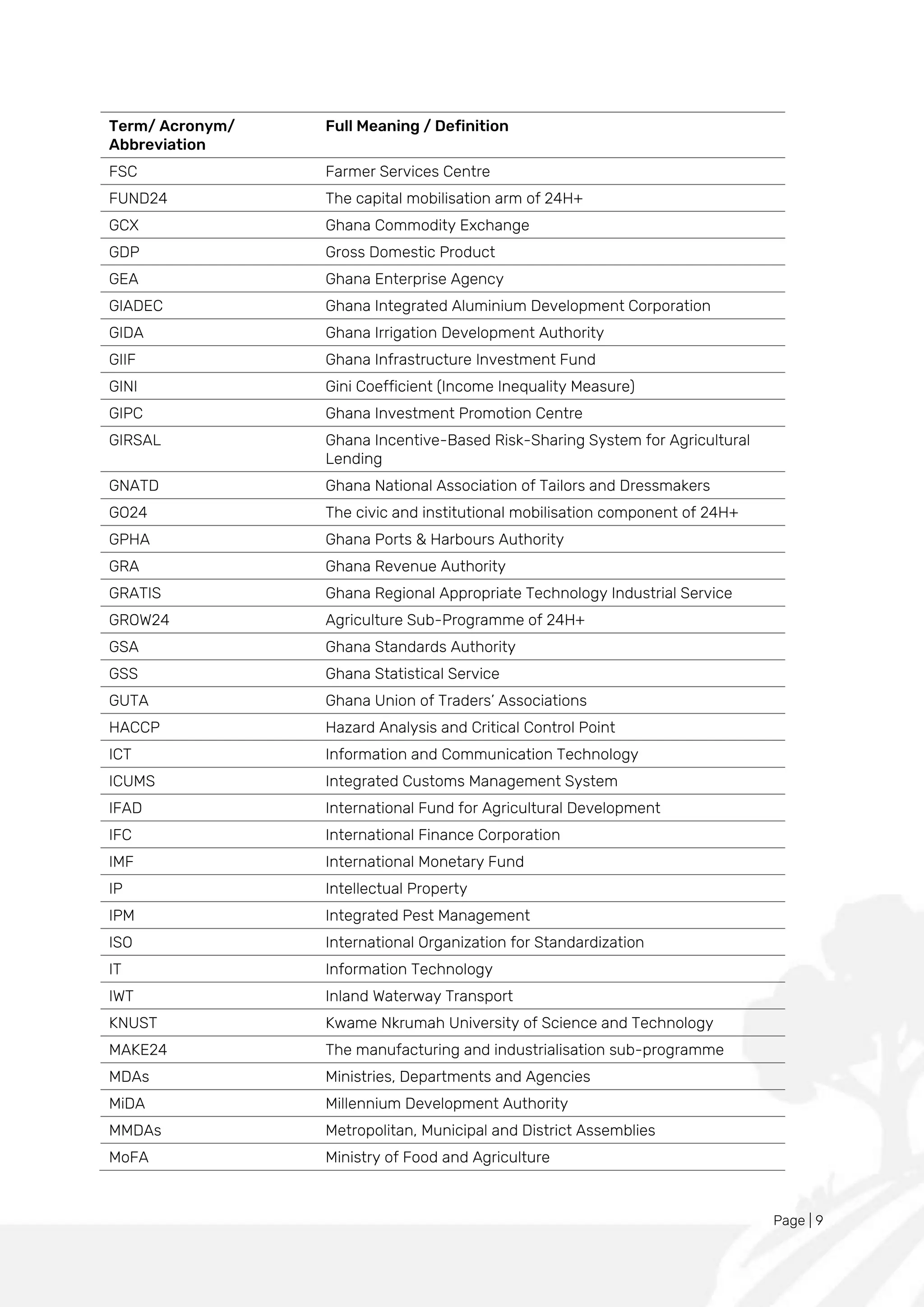
Term/ Acronym/
Abbreviation
Full Meaning / Definition
FSC Farmer Services Centre
FUND24 The capital mobilisation arm of 24H+
GCX Ghana Commodity Exchange
GDP Gross Domestic Product
GEA Ghana Enterprise Agency
GIADEC Ghana Integrated Aluminium Development Corporation
GIDA Ghana Irrigation Development Authority
GIIF Ghana Infrastructure Investment Fund
GINI Gini Coefficient (Income Inequality Measure)
GIPC Ghana Investment Promotion Centre
GIRSAL Ghana Incentive-Based Risk-Sharing System for Agricultural
Lending
GNATD Ghana National Association of Tailors and Dressmakers
GO24 The civic and institutional mobilisation component of 24H+
GPHA Ghana Ports & Harbours Authority
GRA Ghana Revenue Authority
GRATIS Ghana Regional Appropriate Technology Industrial Service
GROW24 Agriculture Sub-Programme of 24H+
GSA Ghana Standards Authority
GSS Ghana Statistical Service
GUTA Ghana Union of Traders’ Associations
HACCP Hazard Analysis and Critical Control Point
ICT Information and Communication Technology
ICUMS Integrated Customs Management System
IFAD International Fund for Agricultural Development
IFC International Finance Corporation
IMF International Monetary Fund
IP Intellectual Property
IPM Integrated Pest Management
ISO International Organization for Standardization
IT Information Technology
IWT Inland Waterway Transport
KNUST Kwame Nkrumah University of Science and Technology
MAKE24 The manufacturing and industrialisation sub-programme
MDAs Ministries, Departments and Agencies
MiDA Millennium Development Authority
MMDAs Metropolitan, Municipal and District Assemblies
MoFA Ministry of Food and Agriculture
Page | 10
Term/ Acronym/
Abbreviation
Full Meaning / Definition
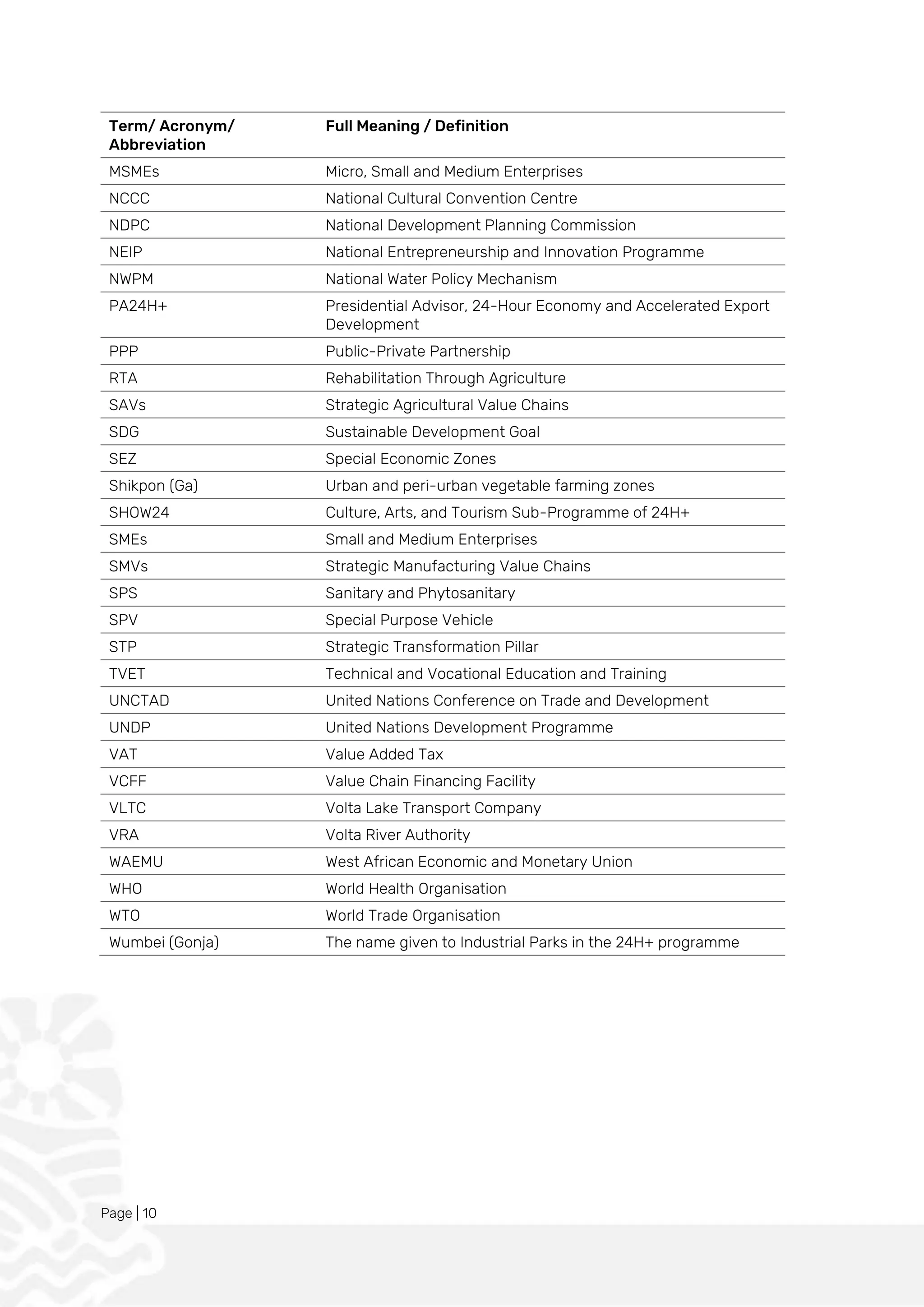
MSMEs Micro, Small and Medium Enterprises
NCCC National Cultural Convention Centre
NDPC National Development Planning Commission
NEIP National Entrepreneurship and Innovation Programme
NWPM National Water Policy Mechanism
PA24H+ Presidential Advisor, 24-Hour Economy and Accelerated Export
Development
PPP Public-Private Partnership
RTA Rehabilitation Through Agriculture
SAVs Strategic Agricultural Value Chains
SDG Sustainable Development Goal
SEZ Special Economic Zones
Shikpon (Ga) Urban and peri-urban vegetable farming zones
SHOW24 Culture, Arts, and Tourism Sub-Programme of 24H+
SMEs Small and Medium Enterprises
SMVs Strategic Manufacturing Value Chains
SPS Sanitary and Phytosanitary
SPV Special Purpose Vehicle
STP Strategic Transformation Pillar
TVET Technical and Vocational Education and Training
UNCTAD United Nations Conference on Trade and Development
UNDP United Nations Development Programme
VAT Value Added Tax
VCFF Value Chain Financing Facility
VLTC Volta Lake Transport Company
VRA Volta River Authority
WAEMU West African Economic and Monetary Union
WHO World Health Organisation
WTO World Trade Organisation
Wumbei (Gonja) The name given to Industrial Parks in the 24H+ programme
Page | 11
EXECUTIVE SUMMARY
Page | 12
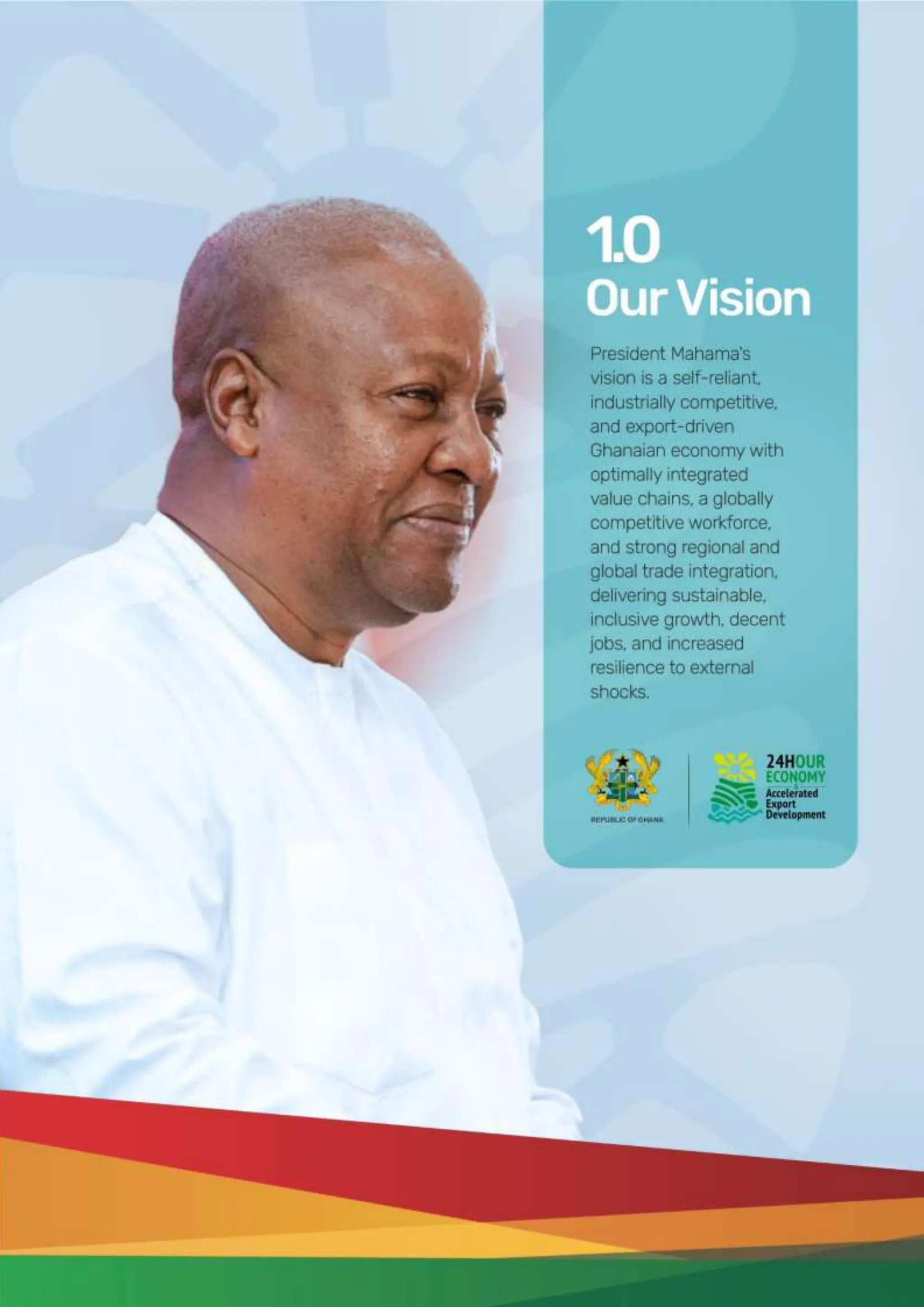
1.0 Our Vision
driven Ghanaian economy with optimally integrated value chains, a globally
competitive workforce, and strong regional and global trade integration, delivering
sustainable, inclusive growth, decent jobs, and increased resilience to external
shocks.
Page | 13
Page | 14
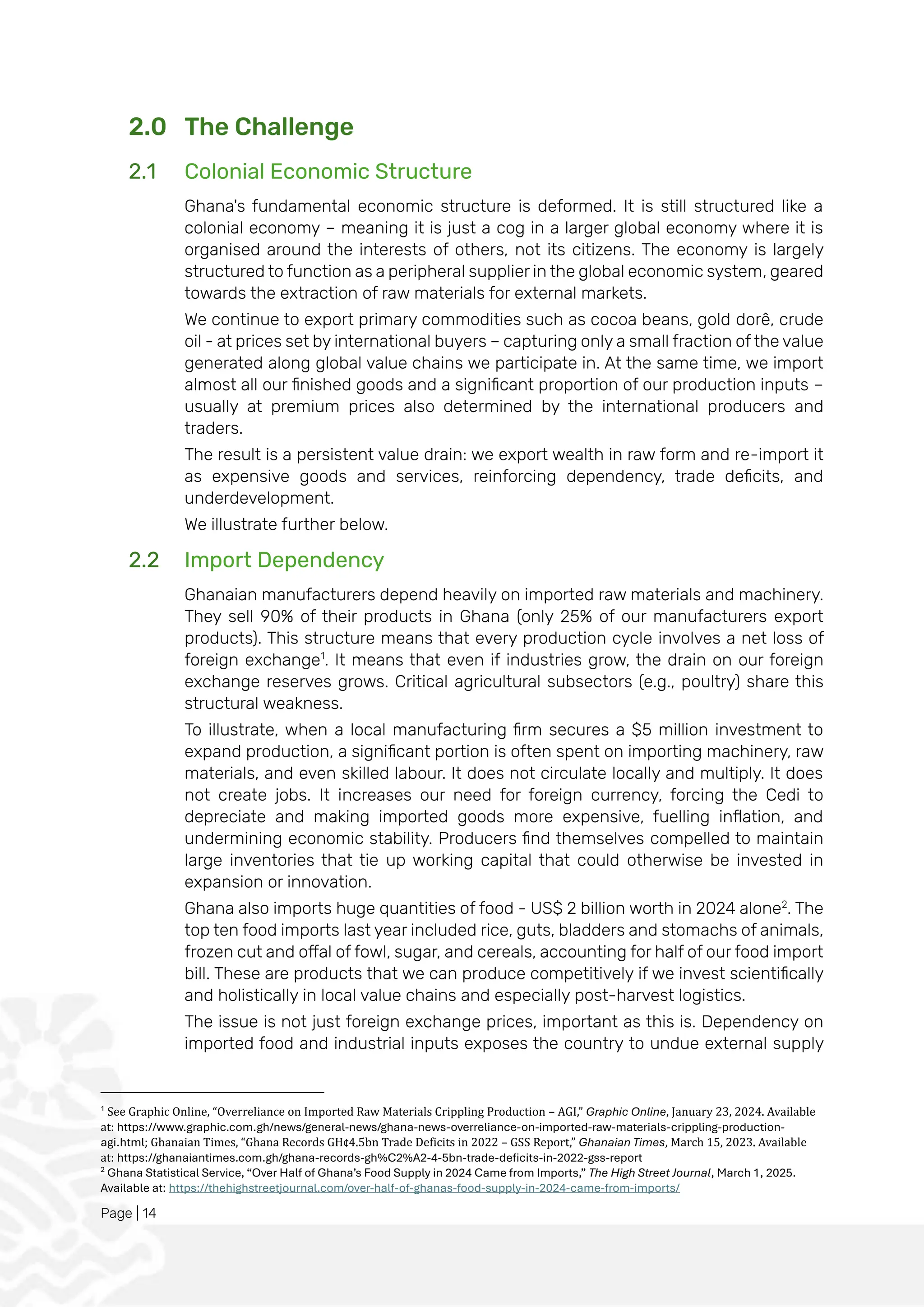
2.0 The Challenge
2.1 Colonial Economic Structure
Ghana's fundamental economic structure is deformed. It is still structured like a
colonial economy – meaning it is just a cog in a larger global economy where it is
organised around the interests of others, not its citizens. The economy is largely
structured to function as a peripheral supplier in the global economic system, geared
towards the extraction of raw materials for external markets.
We continue to export primary commodities such as cocoa beans, gold dorê, crude
oil - at prices set by international buyers – capturing only a small fraction of the value
generated along global value chains we participate in. At the same time, we import
almost all our finished goods and a significant proportion of our production inputs –
usually at premium prices also determined by the international producers and
traders.
The result is a persistent value drain: we export wealth in raw form and re-import it
as expensive goods and services, reinforcing dependency, trade deficits, and
underdevelopment.
We illustrate further below.
2.2 Import Dependency
Ghanaian manufacturers depend heavily on imported raw materials and machinery.
They sell 90% of their products in Ghana (only 25% of our manufacturers export
products). This structure means that every production cycle involves a net loss of
foreign exchange1
. It means that even if industries grow, the drain on our foreign
exchange reserves grows. Critical agricultural subsectors (e.g., poultry) share this
structural weakness.
To illustrate, when a local manufacturing firm secures a $5 million investment to
expand production, a significant portion is often spent on importing machinery, raw
materials, and even skilled labour. It does not circulate locally and multiply. It does
not create jobs. It increases our need for foreign currency, forcing the Cedi to
depreciate and making imported goods more expensive, fuelling inflation, and
undermining economic stability. Producers find themselves compelled to maintain
large inventories that tie up working capital that could otherwise be invested in
expansion or innovation.
Ghana also imports huge quantities of food - US$ 2 billion worth in 2024 alone2
. The
top ten food imports last year included rice, guts, bladders and stomachs of animals,
frozen cut and offal of fowl, sugar, and cereals, accounting for half of our food import
bill. These are products that we can produce competitively if we invest scientifically
and holistically in local value chains and especially post-harvest logistics.
The issue is not just foreign exchange prices, important as this is. Dependency on
imported food and industrial inputs exposes the country to undue external supply
1
See Graphic Online, “Overreliance on Imported Raw Materials Crippling Production – AGI,” Graphic Online, January 23, 2024. Available
at: https://www.graphic.com.gh/news/general-news/ghana-news-overreliance-on-imported-raw-materials-crippling-production-
agi.html; Ghanaian Times, “Ghana Records GH¢4.5bn Trade Deficits in 2022 – GSS Report,” Ghanaian Times, March 15, 2023. Available
at: https://ghanaiantimes.com.gh/ghana-records-gh%C2%A2-4-5bn-trade-deficits-in-2022-gss-report
2
Ghana Statistical Service, “Over Half of Ghana’s Food Supply in 2024 Came from Imports,” The High Street Journal, March 1, 2025.
Available at: https://thehighstreetjournal.com/over-half-of-ghanas-food-supply-in-2024-came-from-imports/
Page | 15
shocks such as global price volatility, global exchange rate fluctuations, and supply
chain disruptions. It means we import foreign inflation.
No amount of macroeconomic dexterity will solve this structural crisis. No amount
of hard work by producers or by State agencies will deliver the development our
people so badly need. Macroeconomic fixes like IMF stabilisation programmes that
are not accompanied by structural reform in the production system can only be
temporary and often appear to worsen the situation. We must address the structural
problems.
2.3 Structural Misalignments Within the Domestic Economy
This structural challenge is exacerbated by perverse domestic arrangements that
often reflect ad hoc, uncoordinated and piecemeal efforts to deal with the
symptoms of our structural problems over the years, and the failure of the State to
guide private players to do more. We cannot effectively promote industrialisation
without an alignment between foundational systems—energy, logistics, and
financing on the one hand, and the dynamics of the production process on the other.
These misalignments ensure that Ghana’s productive capacity remains chronically
underutilised. In 2024, Myjoyonline reported a decline in capacity utilisation in the
cement industry, from 48% in 2022 to just 38% in 20233
.
This misalignment is especially evident in Ghana’s energy system. Electricity
outages account for an average of 9.3% in lost annual sales for Ghanaian firms,
according to the World Bank Enterprise Surveys. To mitigate this, companies self-
generate approximately 16.9% of their electricity needs. Energy expenditure
accounts for between 6.6% and 8.7% of total sales4
. This makes locally produced
goods expensive and uncompetitive, especially in energy-intensive sectors like
manufacturing. In contrast, firms in Vietnam and Kenya, for example, benefit from
more stable energy supply and more affordable industrial tariffs, strengthening their
export competitiveness.
The financial system also reflects this structural disconnect. Ghana’s banking sector
has not developed to provide the kind of patient, long-term capital that industrial
development requires. Our banking sector constrains industrial growth through the
high cost and short tenor of credit. According to the Bank of Ghana and the IMF
Financial Sector Assessment reports, the average lending rate in Ghana exceeds
25% p.a, with loan tenors rarely exceeding 24 months. Moreover, collateral
requirements remain prohibitively high, often exceeding 200% of the loan value,
effectively locking out a large proportion of small and medium-sized enterprises. In
comparison, Vietnam and Kenya provide development bank support and offer
industrial credit at average rates of 8–12%, with more flexible repayment periods and
sector-specific facilities for agriculture and manufacturing.
Ghana’s export competitiveness is limited not only by high production costs but also
by weak supply chain integration and low value-addition. While manufacturing
exports account for over 40% and 85% of total exports in places like Kenya and
3
Ibrahim, A. (2024, July 18). Cement manufacturers’ capacity utilisation falls from 48% to 38% in one year, says Ishmael
Yamson. MyJoyOnline. Retrieved from https://www.myjoyonline.com/cement-manufacturers-capacity-utilisation-falls-from-48-to-38-
in-one-year-says-ishmael-yamson/
4
MiDA 2024 Constraints Analysis
Page | 16
Vietnam5
, respectively, Ghana’s figure lags below 15%, and as highlighted by
UNCTAD, Ghana’s export base remains narrow, overly reliant on primary
commodities, and underperforming in value-added goods. This disparity is even
more pronounced in specific sectors. For instance, in textiles and apparel, Vietnam
has leveraged integration into global value chains to export over $40 billion
annually6
, while Ghana's entire manufacturing export base across all sectors is under
$2 billion. Similarly, Kenya exports processed agricultural products to over 90
countries, while Ghana's processed agricultural exports reach fewer than 30
markets. Even in areas where Ghana possesses natural resource advantages, such
as cocoa processing, the country exports primarily raw or semi-processed cocoa,
while competitors increasingly capture value through finished chocolate products
and specialised derivatives.
The problem is not that Ghana imports - it’s that our society is structurally
conditioned to import as a first resort - and not just commodities but ideas and
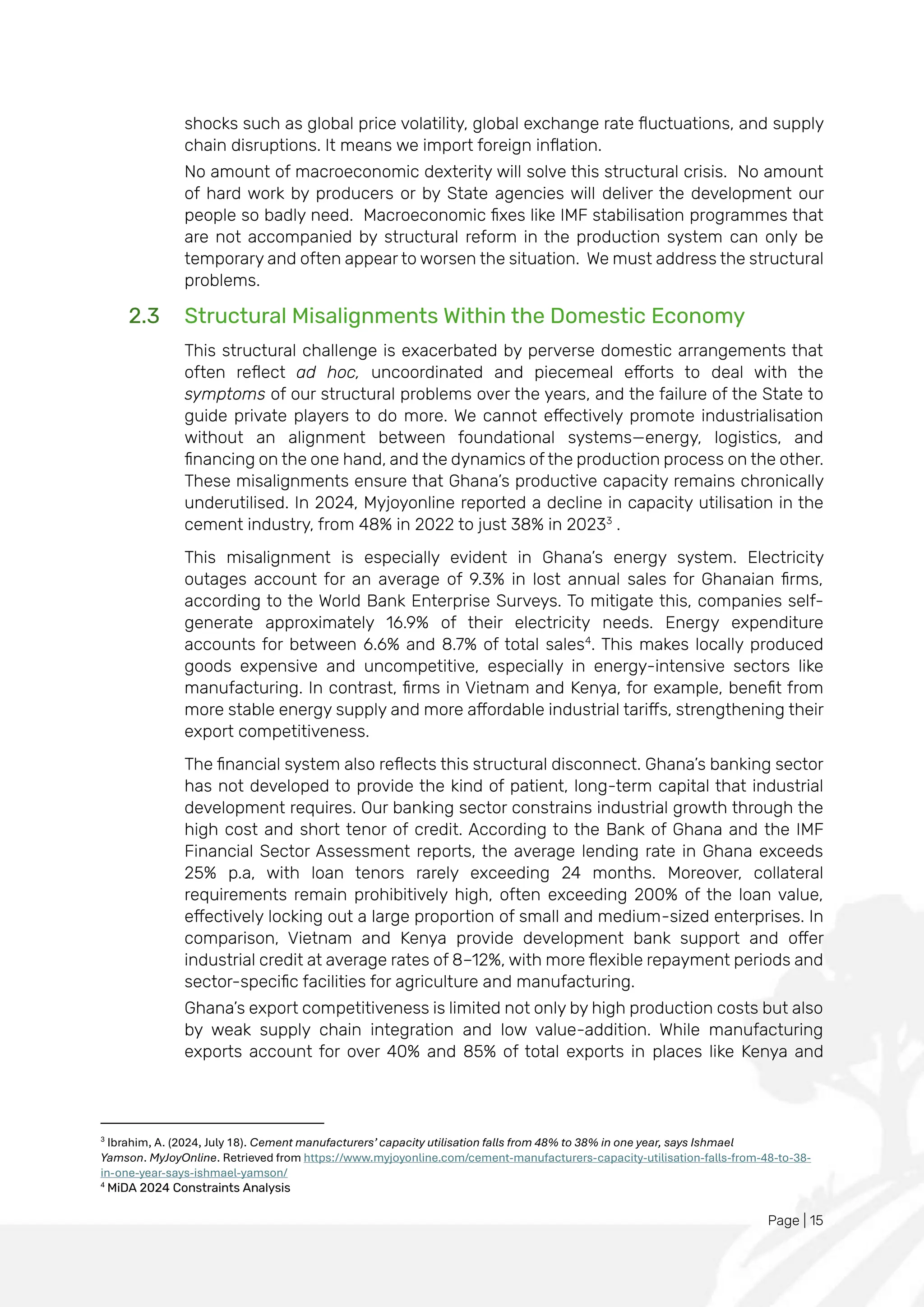
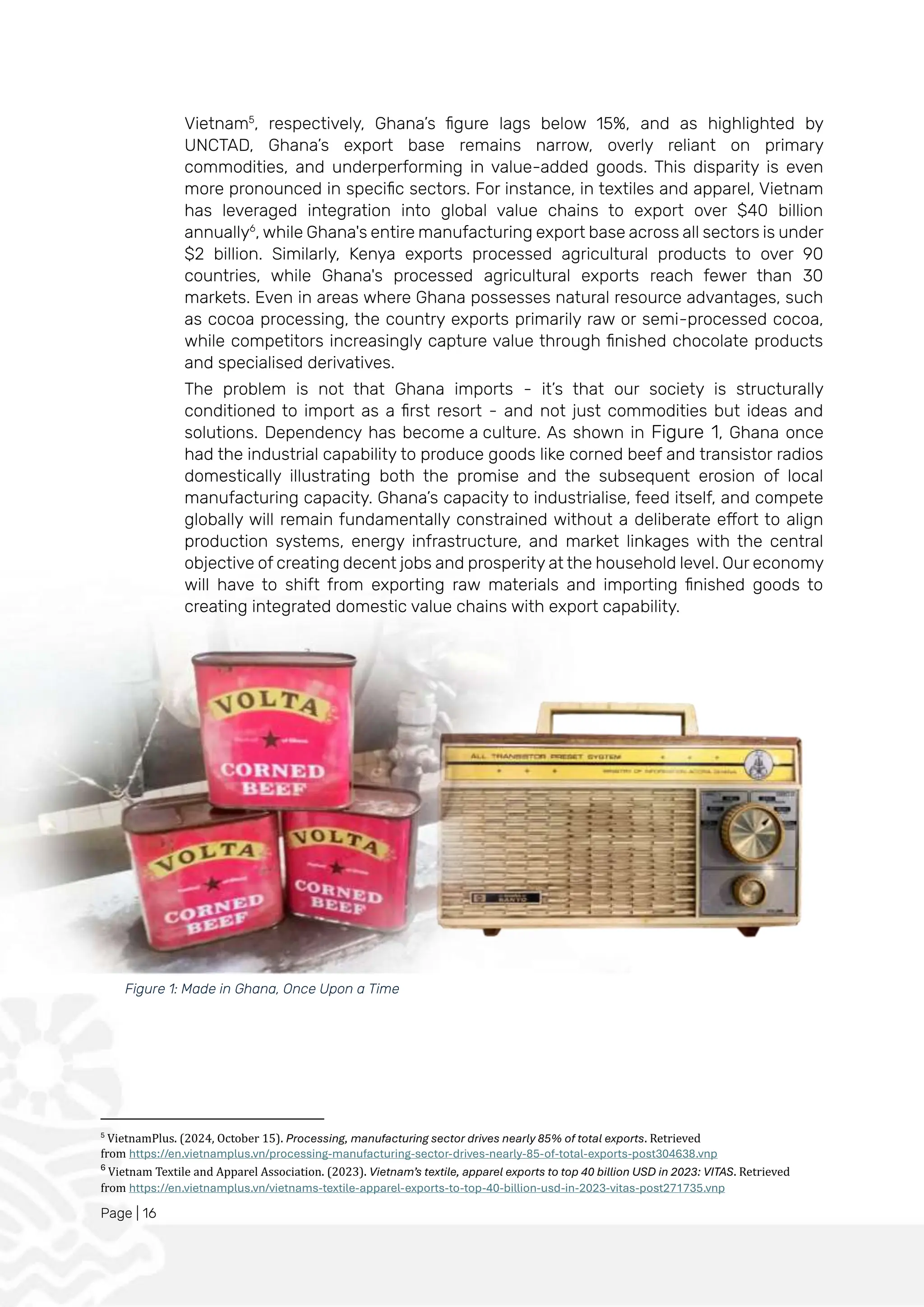
solutions. Dependency has become a culture. As shown in Figure 1, Ghana once
had the industrial capability to produce goods like corned beef and transistor radios
domestically illustrating both the promise and the subsequent erosion of local
manufacturing capacity. Ghana’s capacity to industrialise, feed itself, and compete
globally will remain fundamentally constrained without a deliberate effort to align
production systems, energy infrastructure, and market linkages with the central
objective of creating decent jobs and prosperity at the household level. Our economy
will have to shift from exporting raw materials and importing finished goods to
creating integrated domestic value chains with export capability.
5
VietnamPlus. (2024, October 15). Processing, manufacturing sector drives nearly 85% of total exports. Retrieved
from https://en.vietnamplus.vn/processing-manufacturing-sector-drives-nearly-85-of-total-exports-post304638.vnp
6
Vietnam Textile and Apparel Association. (2023). Vietnam’s textile, apparel exports to top 40 billion USD in 2023: VITAS. Retrieved
from https://en.vietnamplus.vn/vietnams-textile-apparel-exports-to-top-40-billion-usd-in-2023-vitas-post271735.vnp
Figure 1: Made in Ghana, Once Upon a Time
Page | 17
3.0 24H+ Programme: An Integrated Solution
The structural problems of Ghana’s economy cannot be successfully addressed
piecemeal. We need a holistic programme of systemic transformation that
simultaneously delivers:
a. reduced dependence on imported food and production inputs;
b. lower post-harvest losses due to improved logistics, especially in transporting
produce between northern and southern Ghana;
c. expanded domestic manufacturing;
d. affordable patient capital that unlocks MSME growth;
e. a highly skilled, Pan-Africanist, ethically grounded, digitally fluent workforce;
f. a vibrant cultural, artistic, and tourist industry that creates decent
employment and builds a positive African identity; and
g. citizen engagement, accountability, both at the private and state level, and
whole-of-government alignment.
This is the orientation of 24H+.
Achieving these outcomes requires more than isolated interventions in individual
sectors. Ghana’s past experience has shown that progress in one area, such as
agriculture or manufacturing, often fails to translate into broader economic gains.
Improvements are frequently undercut by bottlenecks in logistics, finance, or skills,
and more importantly, by the absence of deliberate linkages that allow success in
one part of the economy to trigger growth in others.
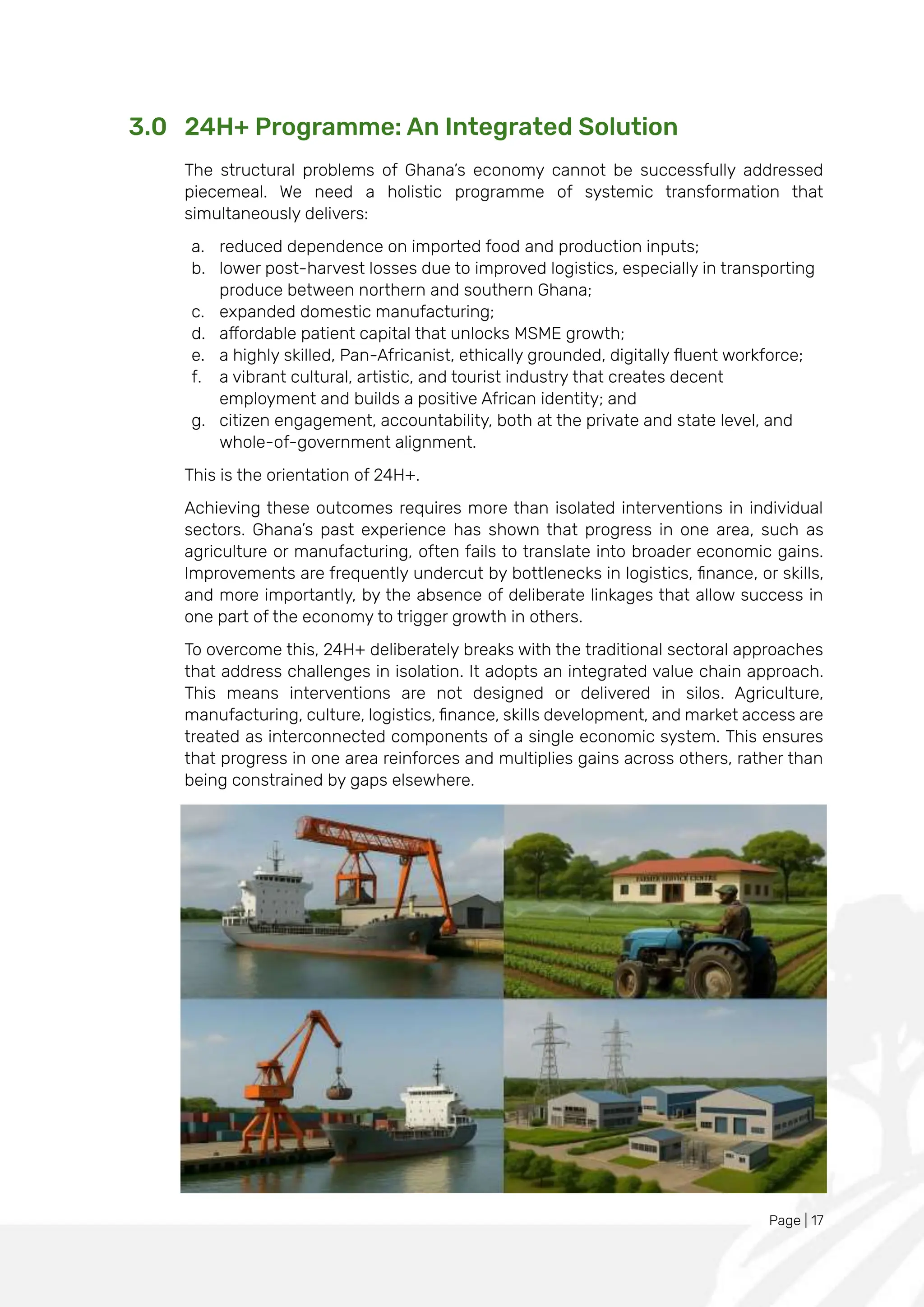
To overcome this, 24H+ deliberately breaks with the traditional sectoral approaches
that address challenges in isolation. It adopts an integrated value chain approach.
This means interventions are not designed or delivered in silos. Agriculture,
manufacturing, culture, logistics, finance, skills development, and market access are
treated as interconnected components of a single economic system. This ensures
that progress in one area reinforces and multiplies gains across others, rather than
being constrained by gaps elsewhere.
Page | 18
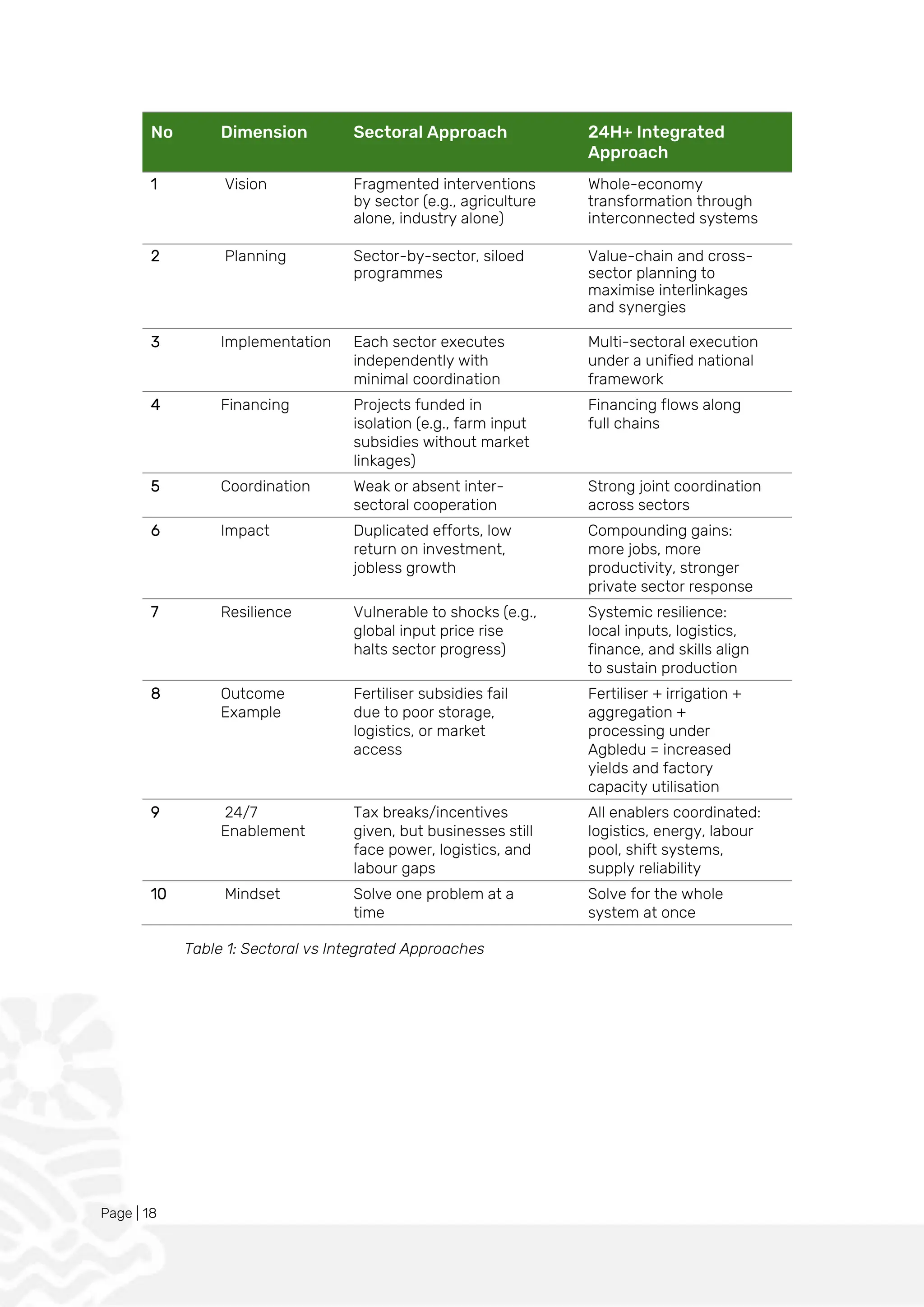
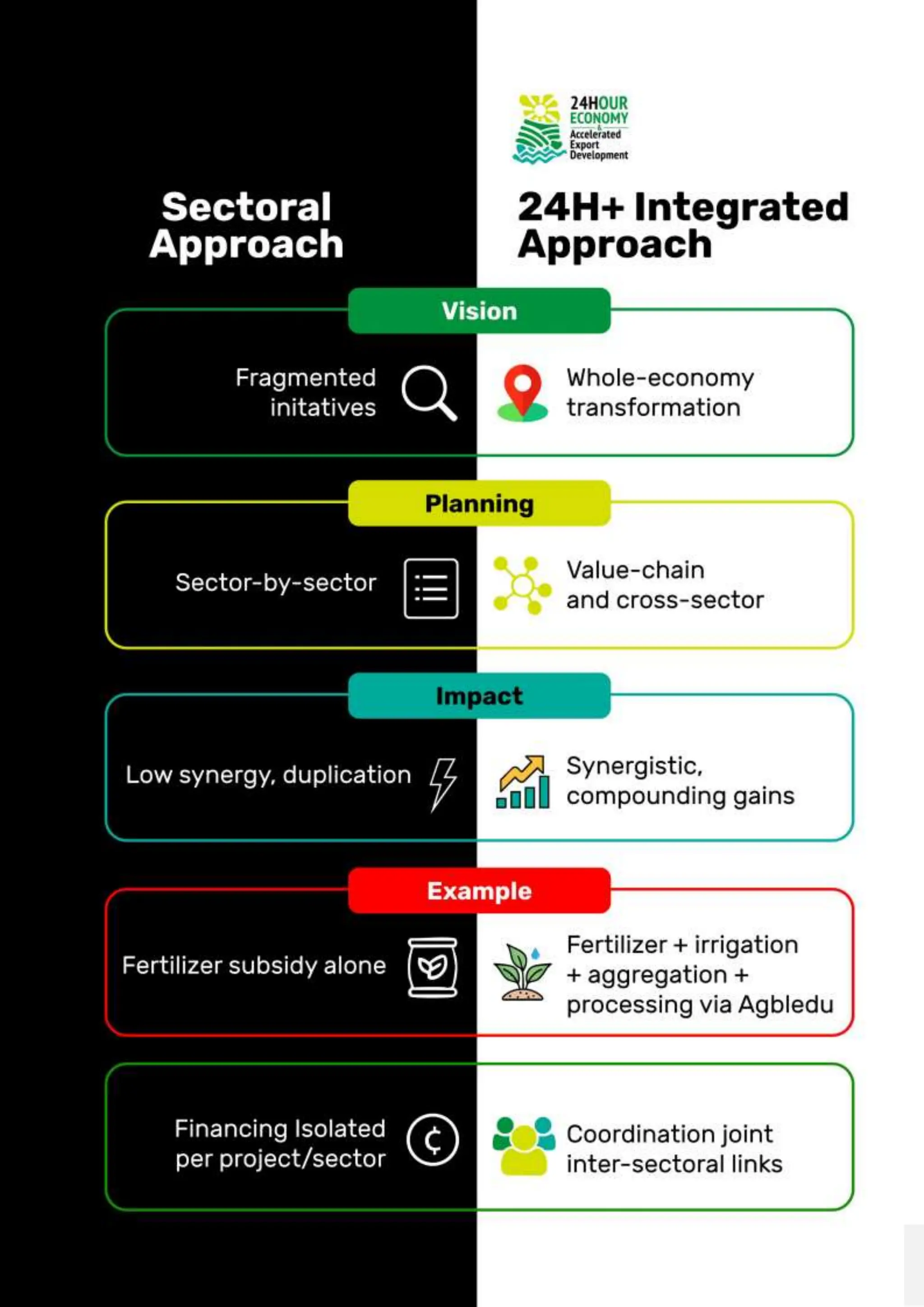
No Dimension Sectoral Approach 24H+ Integrated
Approach
1 Vision Fragmented interventions
by sector (e.g., agriculture
alone, industry alone)
Whole-economy
transformation through
interconnected systems
2 Planning Sector-by-sector, siloed
programmes
Value-chain and cross-
sector planning to
maximise interlinkages
and synergies
3 Implementation Each sector executes
independently with
minimal coordination
Multi-sectoral execution
under a unified national
framework
4 Financing Projects funded in
isolation (e.g., farm input
subsidies without market
linkages)
Financing flows along
full chains
5 Coordination Weak or absent inter-
sectoral cooperation
Strong joint coordination
across sectors
6 Impact Duplicated efforts, low
return on investment,
jobless growth
Compounding gains:
more jobs, more
productivity, stronger
private sector response
7 Resilience Vulnerable to shocks (e.g.,
global input price rise
halts sector progress)
Systemic resilience:
local inputs, logistics,
finance, and skills align
to sustain production
8 Outcome
Example
Fertiliser subsidies fail
due to poor storage,
logistics, or market
access
Fertiliser + irrigation +
aggregation +
processing under
Agbledu = increased
yields and factory
capacity utilisation
9 24/7
Enablement
Tax breaks/incentives
given, but businesses still
face power, logistics, and
labour gaps
All enablers coordinated:
logistics, energy, labour
pool, shift systems,
supply reliability
10 Mindset Solve one problem at a
time
Solve for the whole
system at once
Table 1: Sectoral vs Integrated Approaches
Page | 19
While the name “24-hour economy” may evoke images of shift work or night-time
operations, the programme goes beyond that. 24H+ is first a programme of national
mobilisation. It is the micro and real sector counterpart to the programme of sound
macroeconomic management led by the Ministry of Finance and the Bank of Ghana.
24H+ directly targets producers, most, but not all, of whom are outside the State
sector. Starting from selected strategic value chains, it will optimise our use of our
natural resources, capital, and labour power around national needs, creating
employment, slowing inflation, lowering interest rates sustainably, and improving
living standards, especially at the base of society.
In addition to optimising factor utilisation, as described above, 24H+ aims to
significantly increase input self-reliance and reduce the vulnerability of our
production systems to external shocks. It seeks to integrate strategic value chains
to produce more of the finished commodities that we and our neighbours consume.
It seeks to increase the volume and diversity of production and thereby create
decent employment (at least 1.7 million quality jobs in 4 years) and ensure permanent
production surpluses for export. 24H+ involves developing scientific marketing
strategies to effectively target and penetrate local, regional, and international
markets for our products. Finally, 24H+ will transform our national work culture -
better attitudes to production, fairer production relations up and down value chains,
and a sense of responsibility to our nation and solidarity.
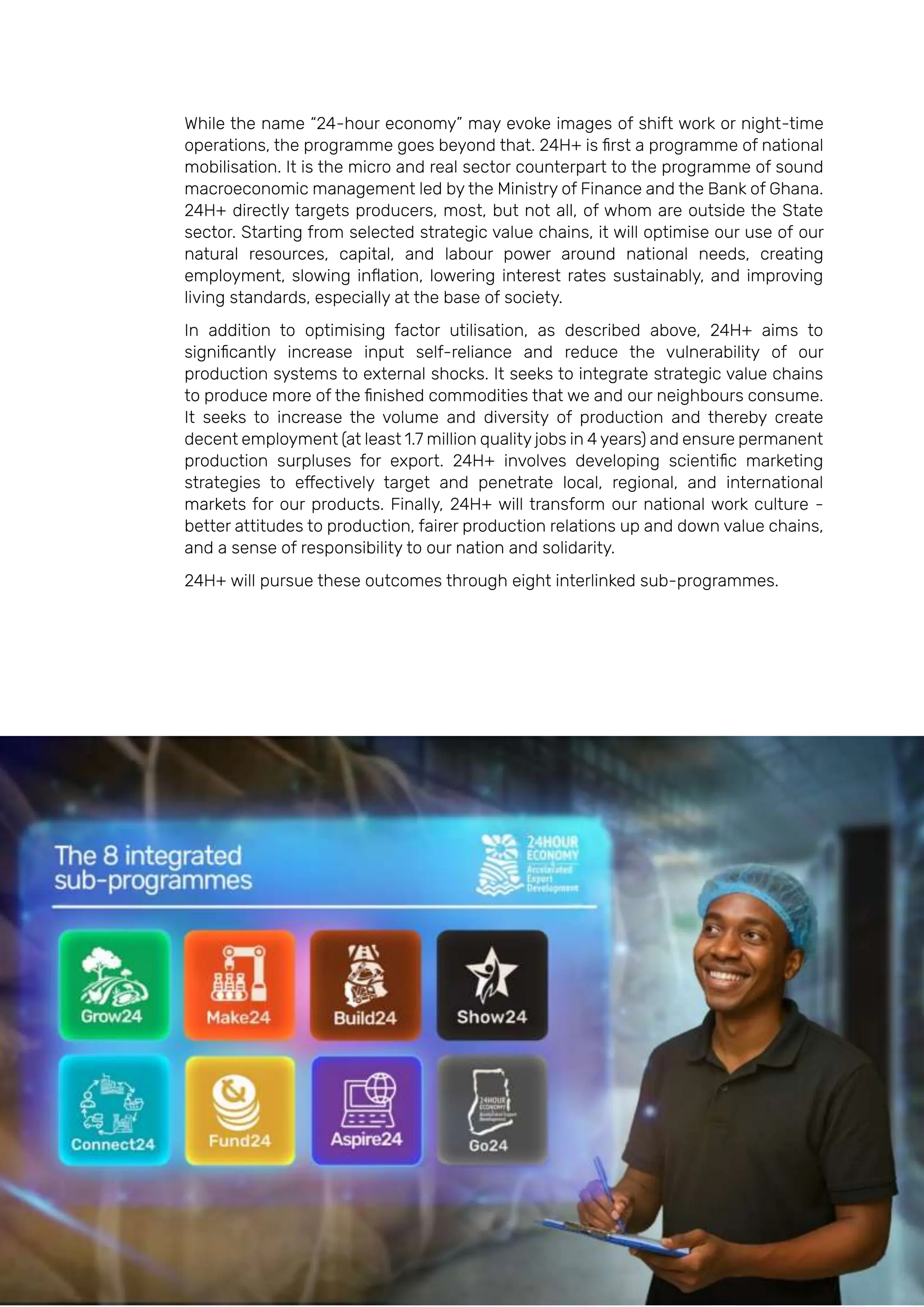
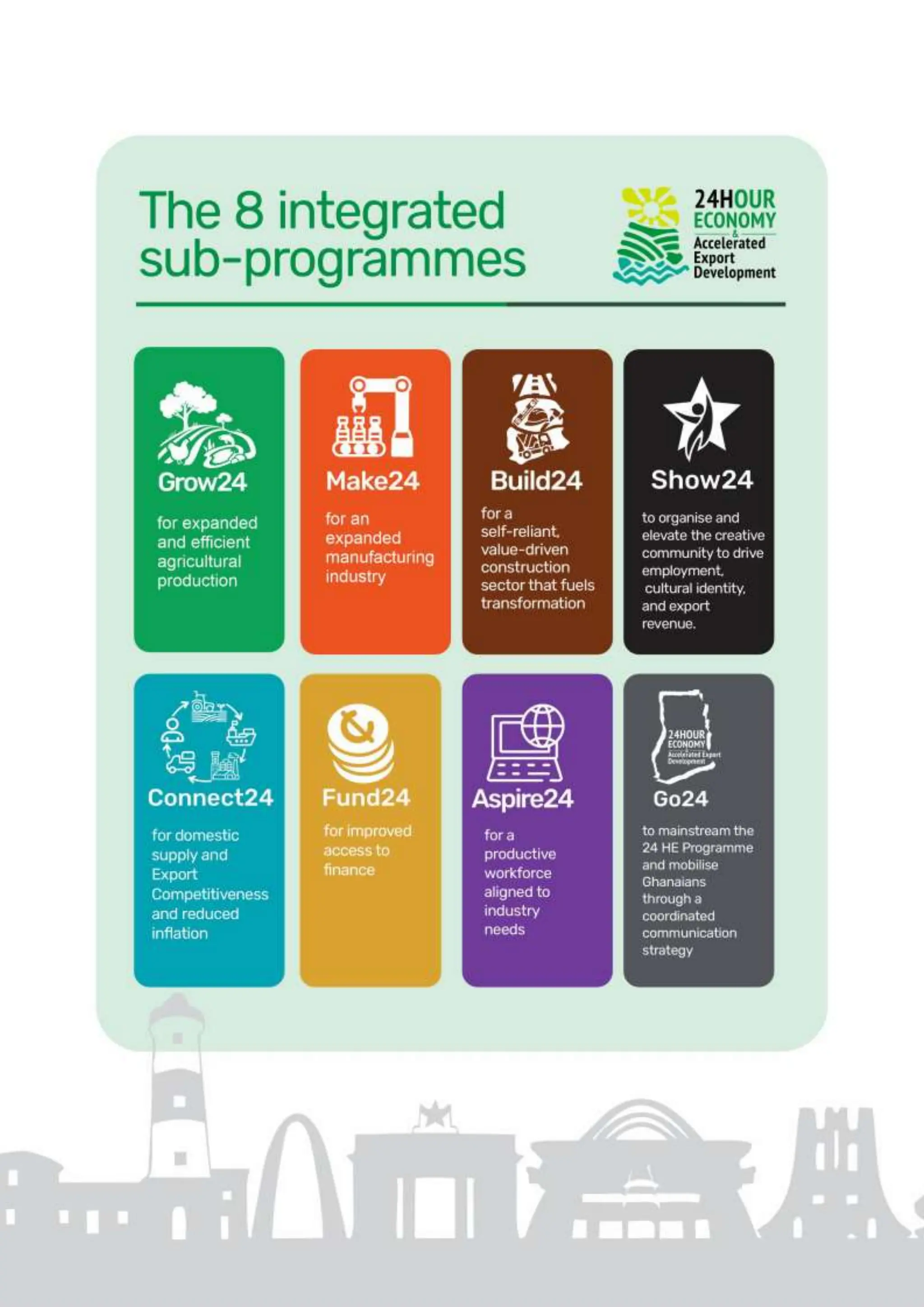
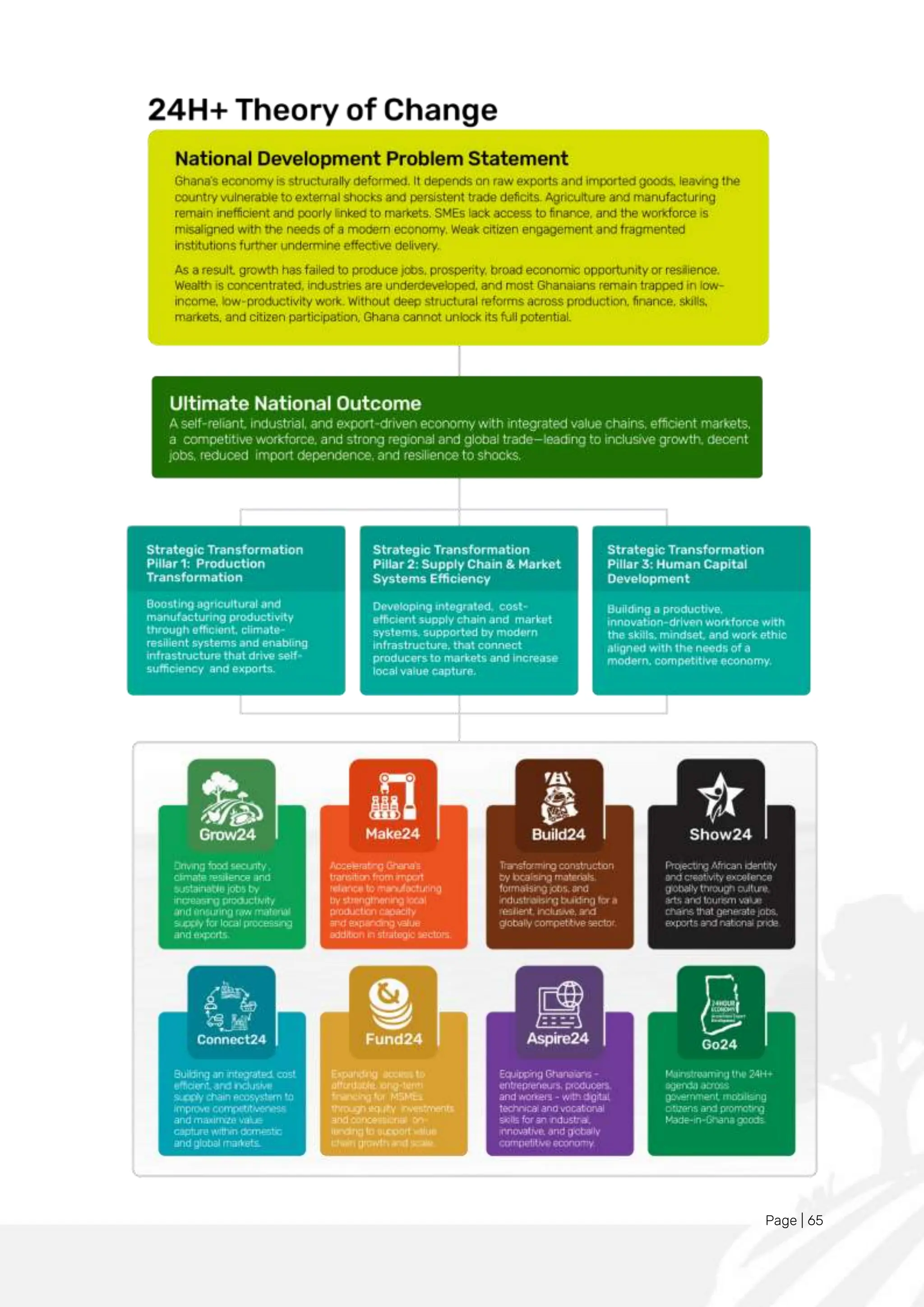
24H+ will pursue these outcomes through eight interlinked sub-programmes.
Page | 20
Page | 21
3.1 Agriculture
In the agricultural sector, the GROW24 Sub-Programme will revitalise critical
strategic agricultural value chains (SAVs) that are important for food and feed self-
sufficiency and security, manufacturing input self-reliance, sustainable job creation,
and climate resilience.
This will be driven through two flagship transformation engines:
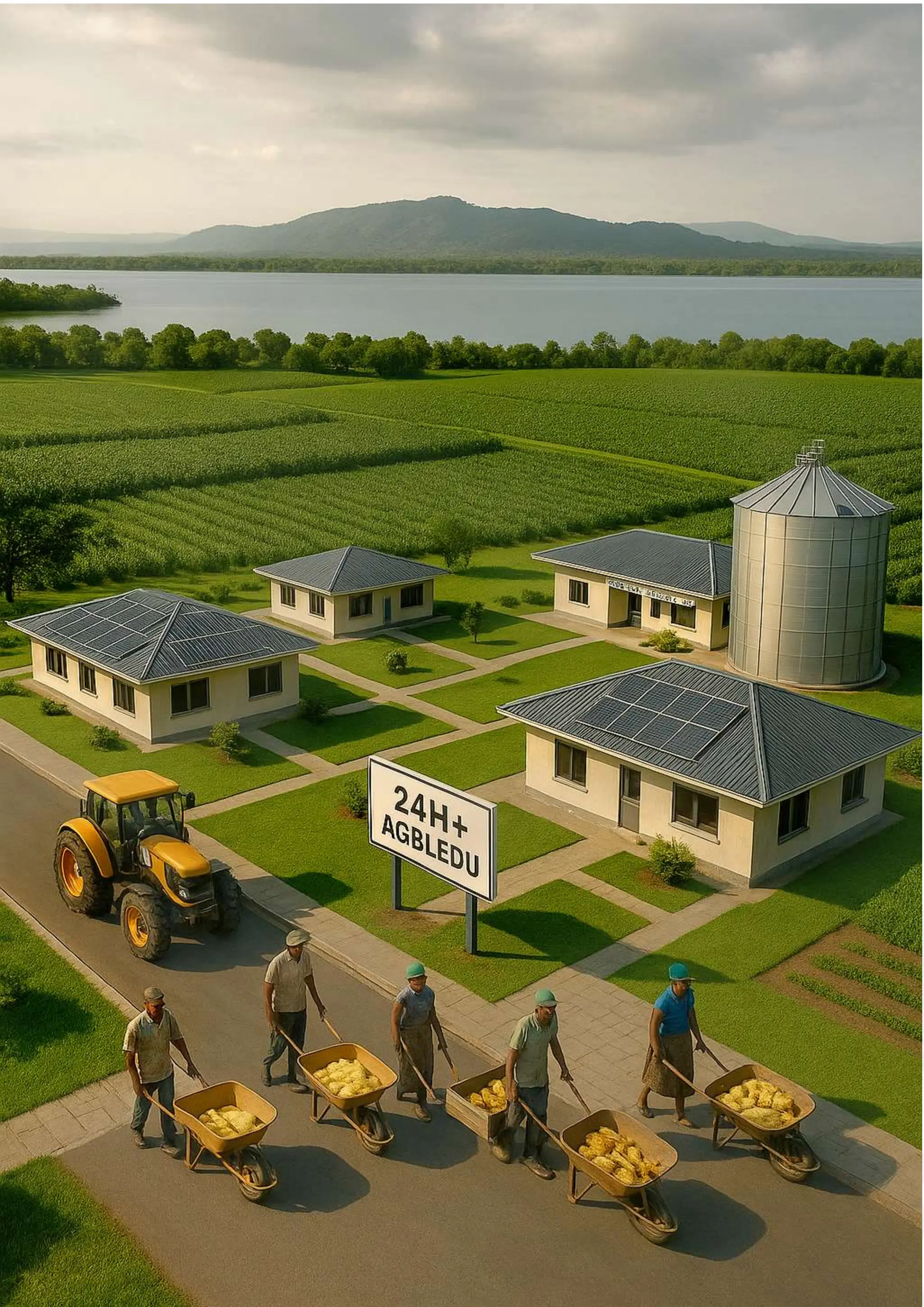
1. Eden Volta Breadbasket Project – an initiative to transform the Volta Basin into
the Breadbasket of West Africa by cultivating over 2 million hectares of arable
land under structured irrigation and climate-smart systems. This will be achieved
through the development of integrated agroecological parks ("Agbleduwo")
along the Volta Lake and its tributaries, each equipped with mechanisation hubs,
renewable energy, logistics, and primary processing facilities to drive scale and
resilience. Anchor farmers will serve as key drivers of this transformation,
coordinating production, aggregation, and value addition within each Agbledu.
Productivity in keyvalue chains is expected to increase by up to 130%, depending
on the commodity and farming system;
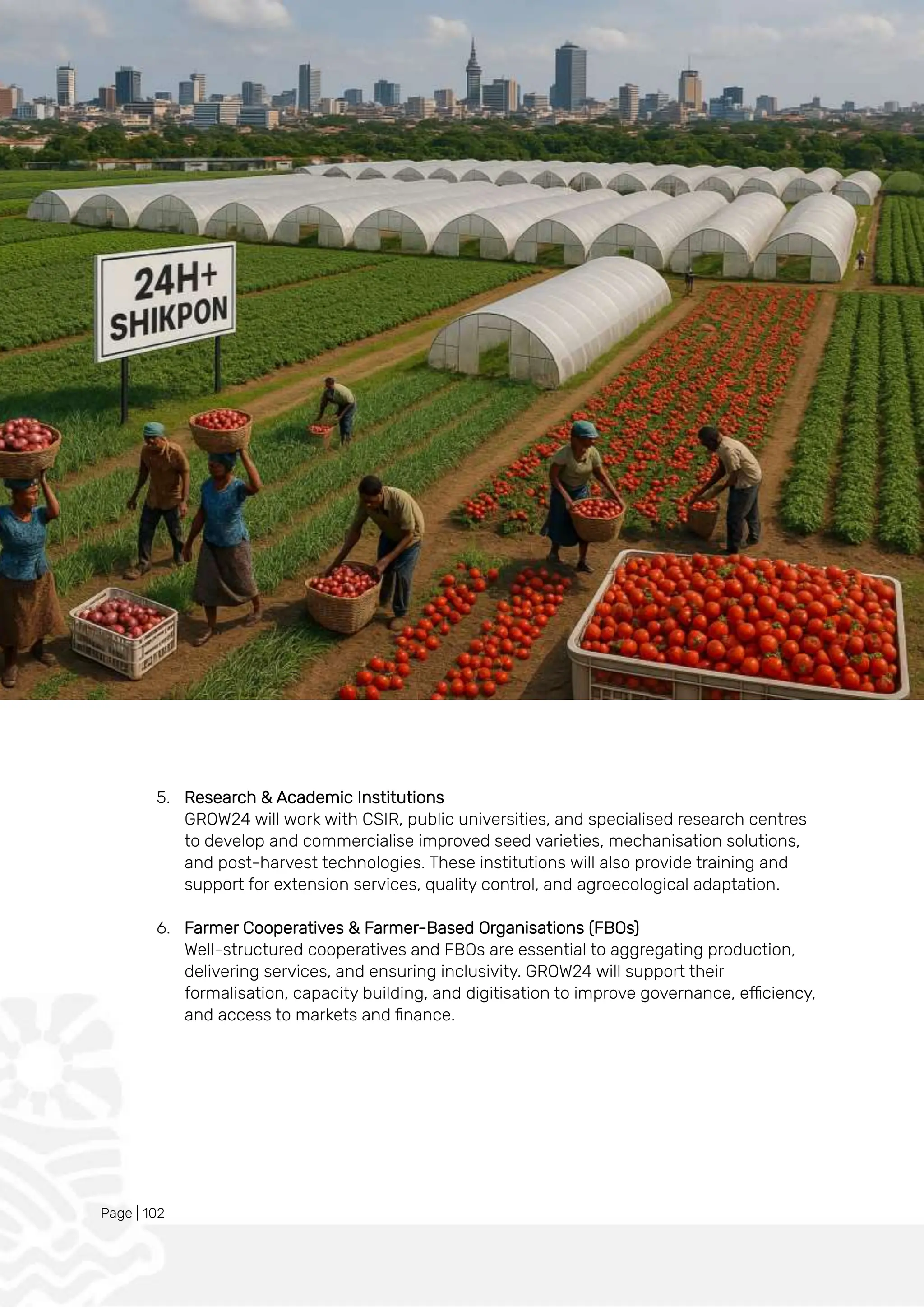
2. Shikpon Urban and Peri-Urban Farming Revolution – structured peri-urban
vegetable and fruit farming clusters around Ghana’s major cities, designed to
guarantee an affordable, year-round fresh food supply. These urban farms will
be built around 3–5 hectare plots per metro area and will deploy greenhouse
systems, micro-irrigation, and rainwater harvesting. The initiative will focus on
short-cycle, high-demand vegetables (lettuce, tomatoes, peppers, okra, onions)
and will be operated by youth-led cooperatives and agripreneurs. These clusters
will be integrated with cold chain logistics, urban aggregation points, and digital
marketplaces, enabling real-time pricing, efficient distribution, and stronger
farm-to-market linkages.
These will be designed to:
1. create agroecological parks (“Agbleduwo”) with integrated infrastructure,
mechanisation, and market access that transform fragmented smallholder
farming into productive agricultural clusters;
2. support farmers to build strong cooperatives to improve productivity, strengthen
market power, and enhance access to finance, technology, and extension
services;
3. develop Strategic Agricultural Value Chains - high-potential value chains across
seven food groups - to reduce Ghana's $2 billion food import bill;
4. cut post-harvest losses from 30%+7
to 15% through modern logistics (storage,
preservation, transportation) technologies, and processing facilities; and
5. strengthen the application of research and indigenous knowledge, including
accessible seed banks, for high-yielding climate-smart agriculture.
7
Ehrlich, D. (2025, March 17). Post-harvest food loss in Ghana’s fruit and vegetable supply chains: Evidence from the field. International
Growth Centre. Retrieved from https://www.theigc.org/publications/post-harvest-food-loss-ghanas-fruit-and-vegetable-supply-chains-
evidence-field
Page | 22
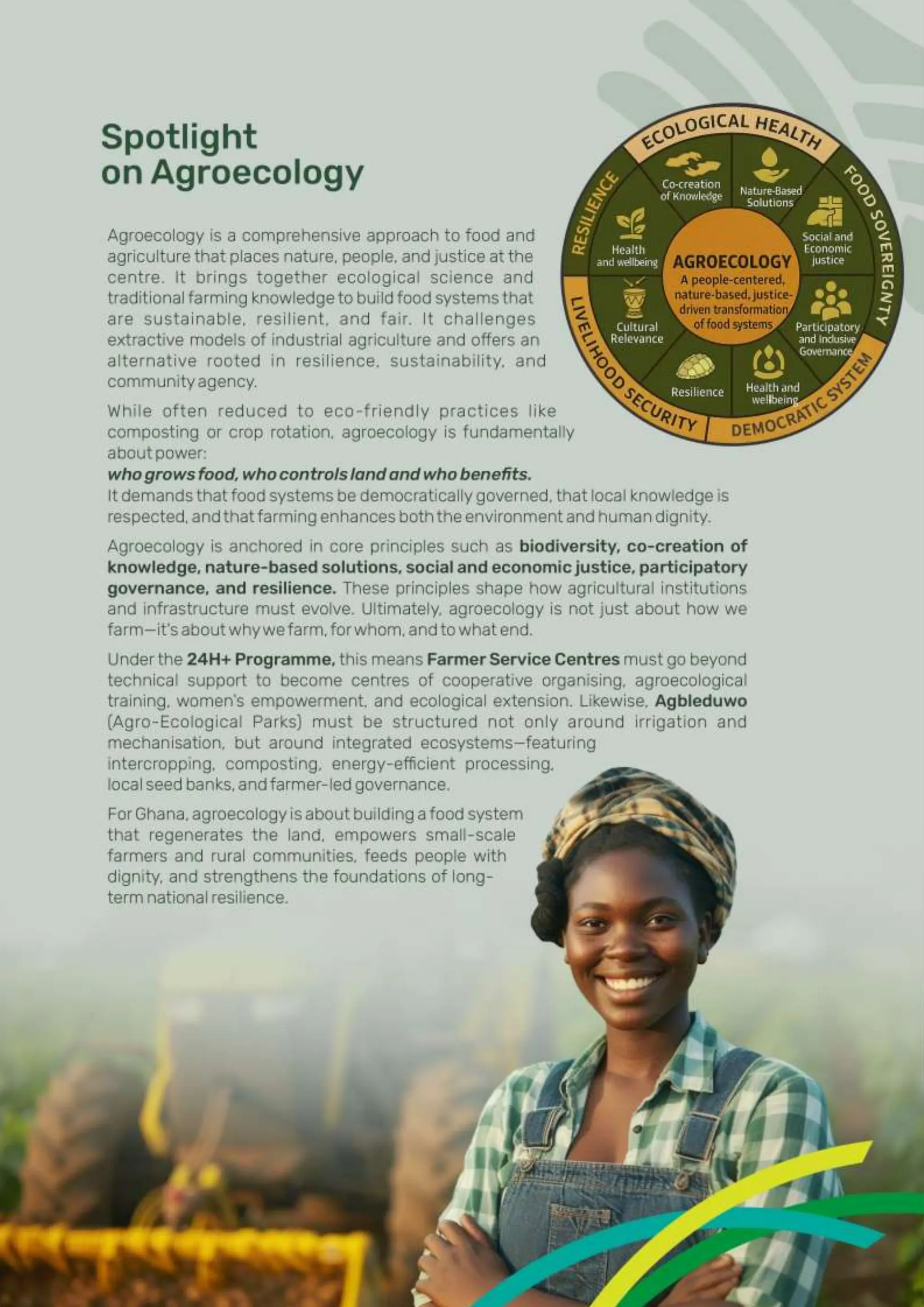
In line with the broader transformation agenda, GROW24 integrates the principles of
agroecology—not just as a set of ecological practices, but as a strategic framework
for equitable, sustainable, and locally grounded agricultural development. This
includes promoting biodiversity, supporting smallholder farmers as key economic
actors, incorporating local and traditional knowledge systems, and ensuring that
farming systems are resilient, regenerative, and socially just.
The Agbleduwo will therefore be both productive hubs and demonstration zones for
inclusive and sustainable agroecological transformation. Each park will be supported
by a Farmer Services Centre (FSC) with staff trained in agroecological values and
equipped to deliver technical support, cooperative development, value chain
literacy, and community-based services.
Page | 23
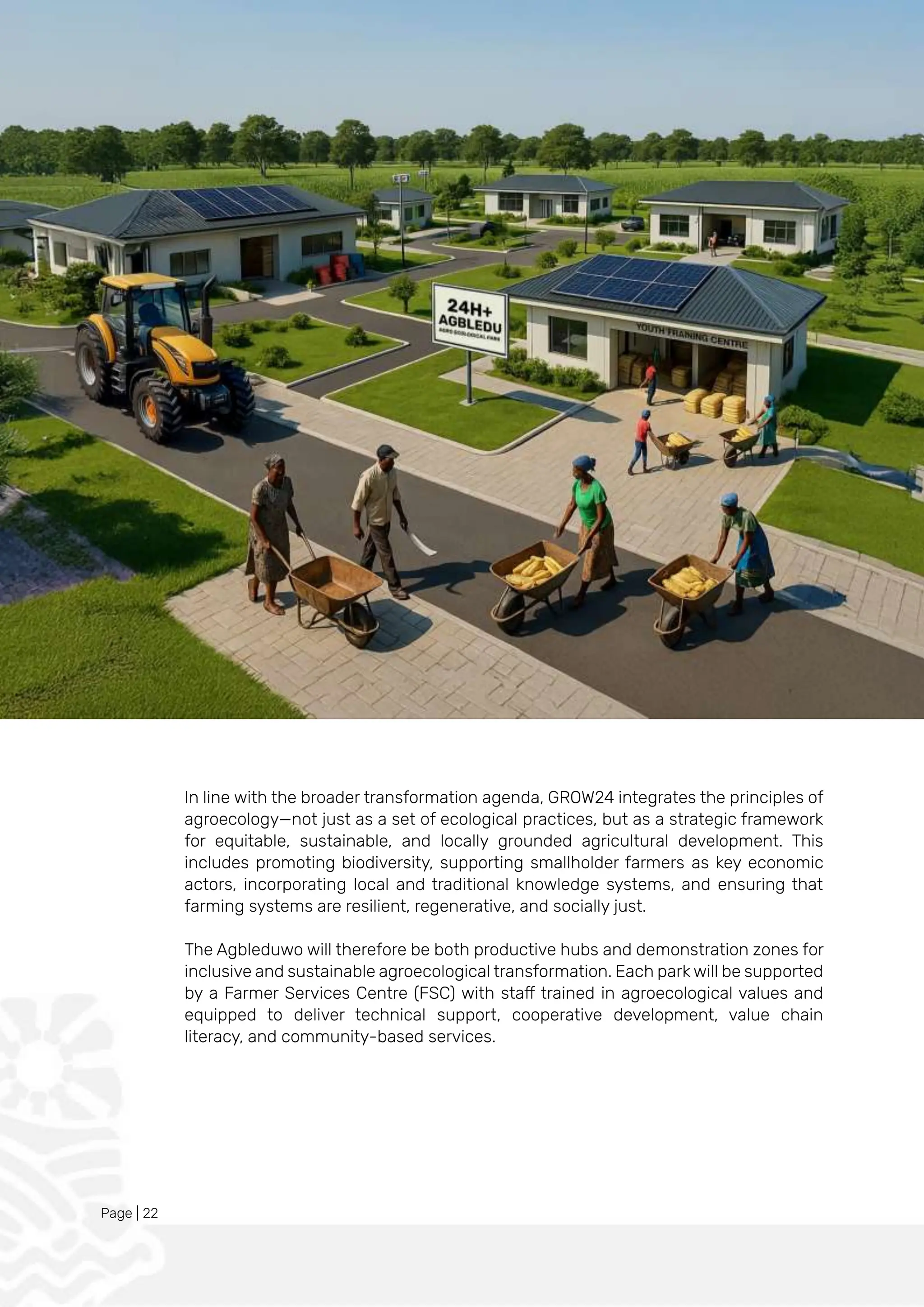
Figure 2: Typical Layout of an Agbledu FSC on a 4-acre land (courtesy Trotro Tractor Limited
Page | 24
3.2 Manufacturing
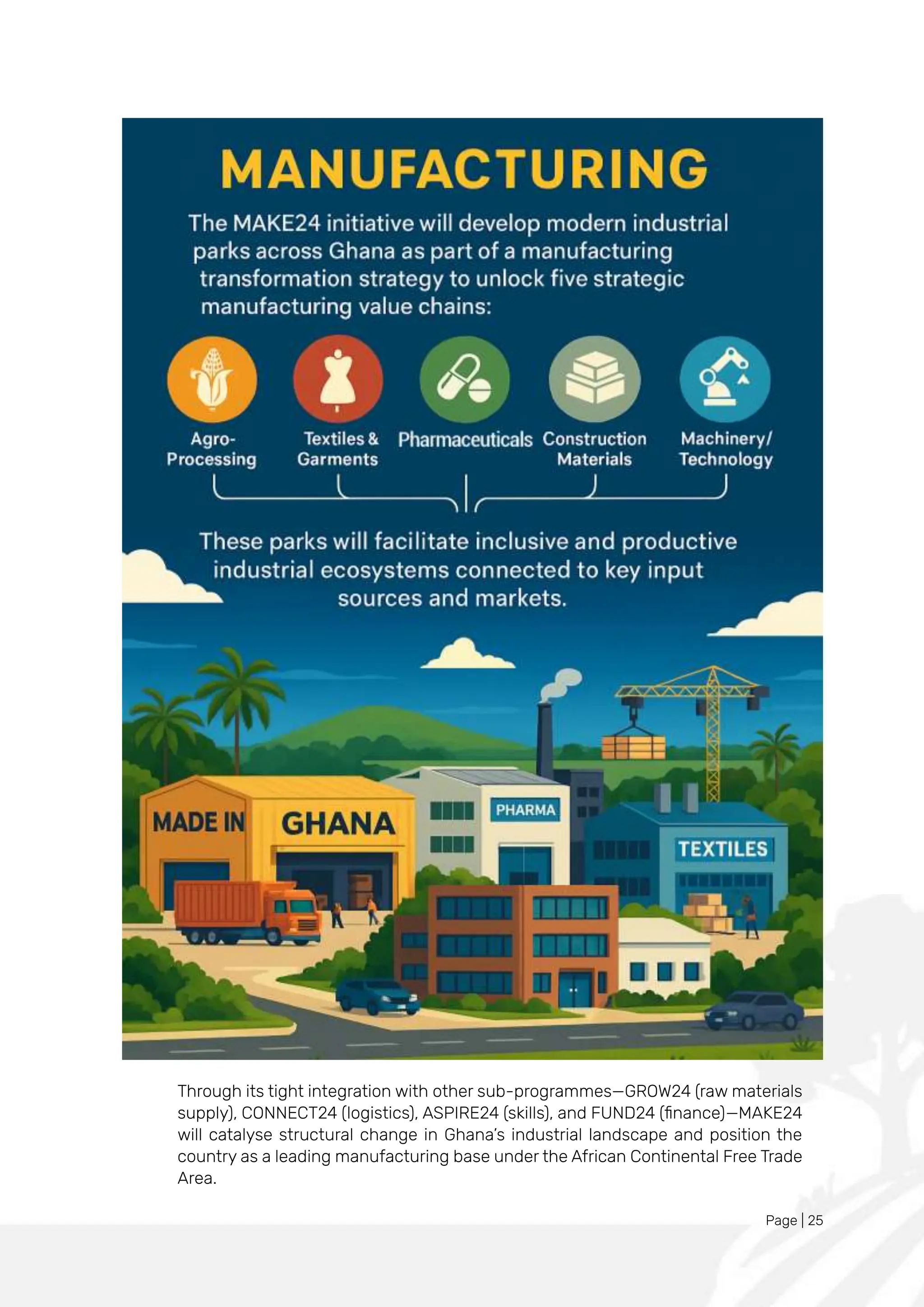
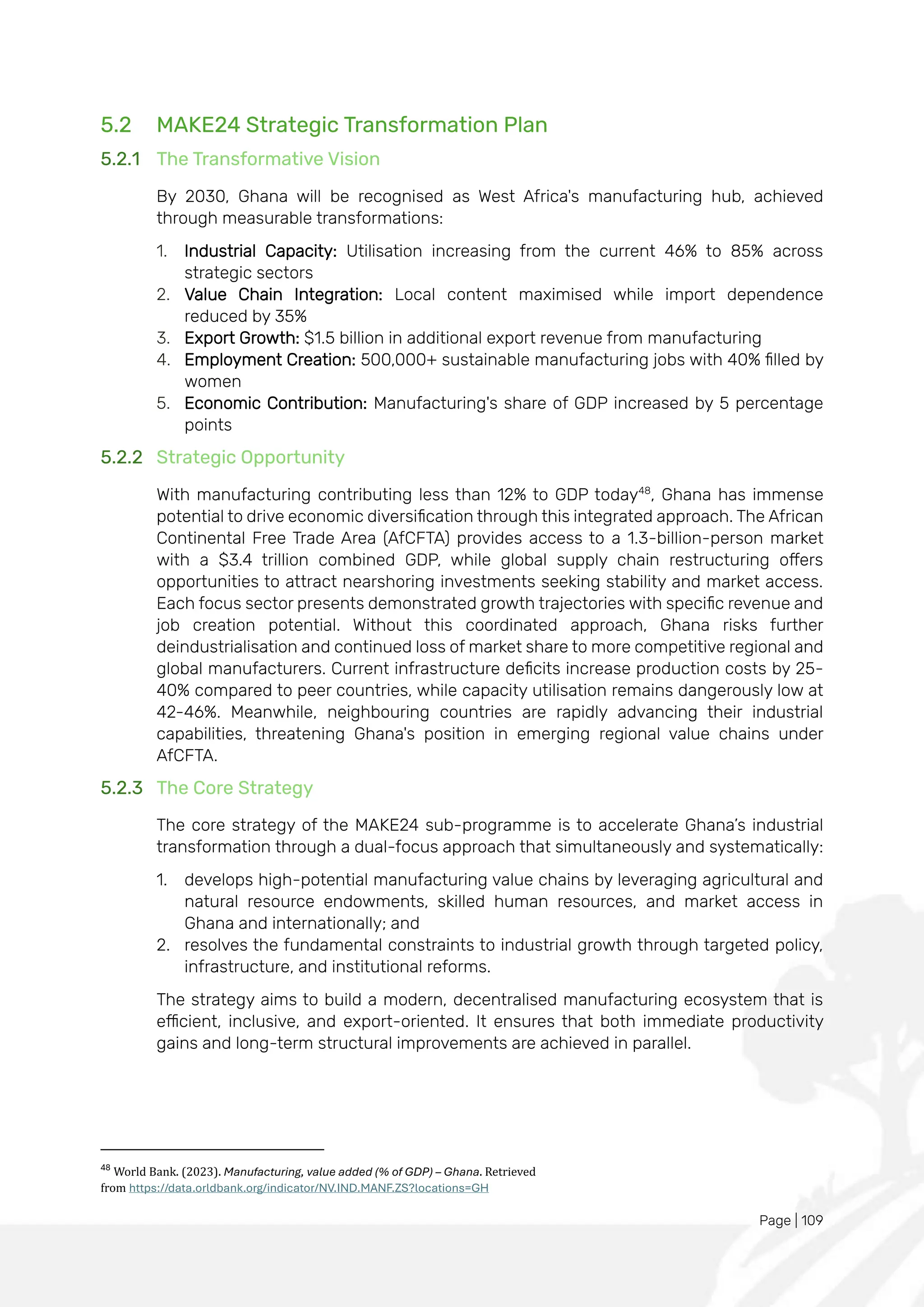
The MAKE24 Sub-Programme is Ghana’s strategy for manufacturing transformation
under the 24H+ programme. It aims to transition Ghana from an import-dependent
economy into a productive, export-oriented industrial country by leveraging
competitive advantages in five Strategic Manufacturing Value Chains (SMVs): agro-
processing, pharmaceuticals, textiles and garments, construction materials, and
machinery/technology.
MAKE24 goes beyond simply building factories. It focuses on creating inclusive and
productive industrial ecosystems that strengthen backward and forward linkages,
support formalisation and clustering, and drive long-term industrial competitiveness
under AfCFTA.
Critical to MAKE24 is the development of a national network of modern industrial
parks—the Wumbei Industrial Parks—designed to resolve the foundational constraints
holding back Ghanaian manufacturers: inaccessible land, unreliable utilities, and high
logistics and setup costs.
By 2028, 10 Wumbei Parks will be developed, with a total of 50 parks targeted within
the next decade. Each park will average 50 acres or more, and will be equipped with
shared, serviced infrastructure including:
• Reliable, renewable and/or embedded power systems;
• Piped water supply and waste treatment systems;
• Road access, internal circulation routes, and digital connectivity;
• Pre-zoned land and flexible layouts for firm expansion and clustering.
The priority for MAKE24 is unlocking land access in partnership with traditional
authorities and repurposing public lands for productive use. The Ghana Infrastructure
Investment Fund (GIIF) will establish a Special Purpose Vehicle (SPV) to acquire,
service, and manage these parks under a blended finance model supported by FUND24.
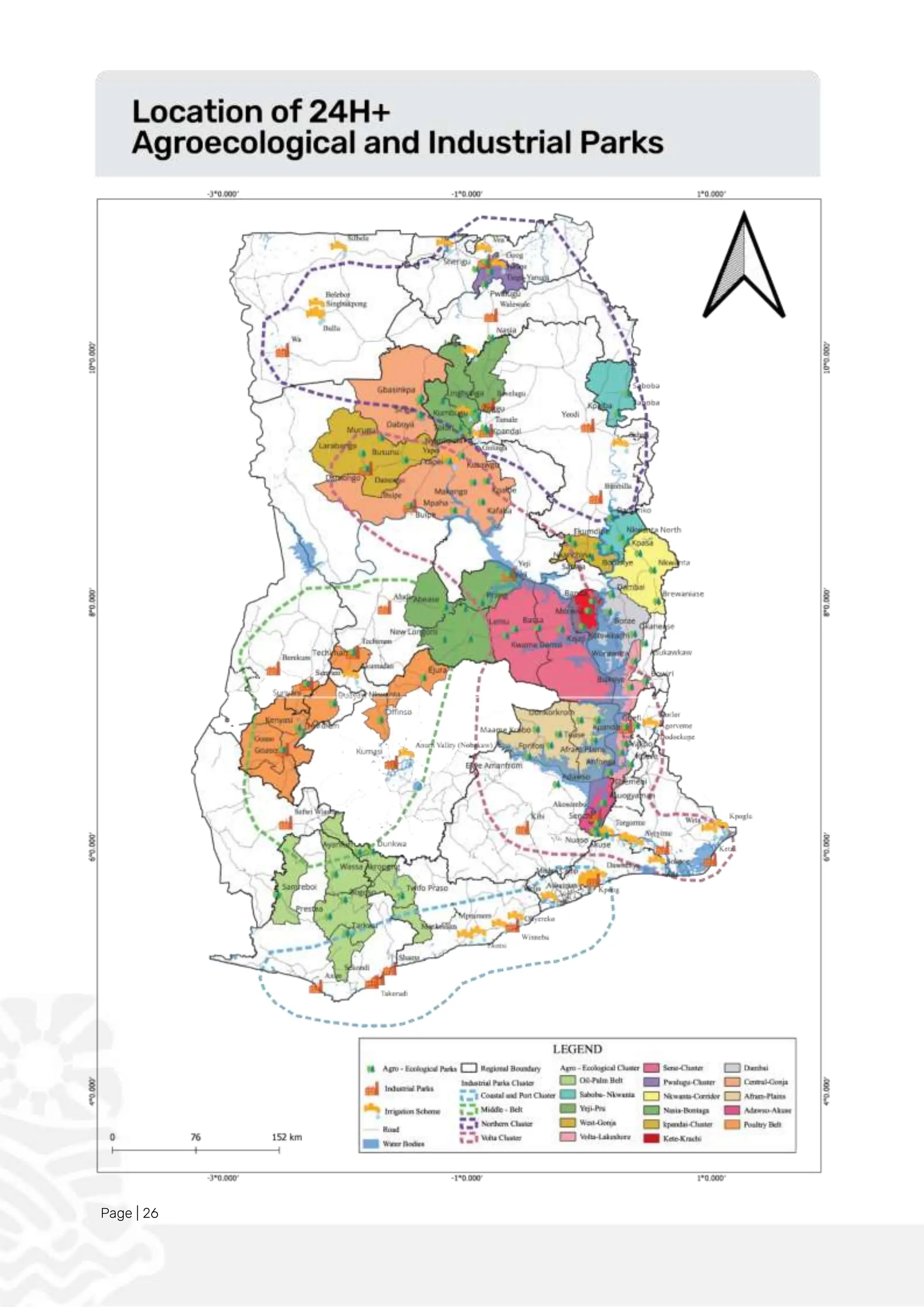
To drive spatial equity and competitiveness, most Wumbei Parks will be co-located with
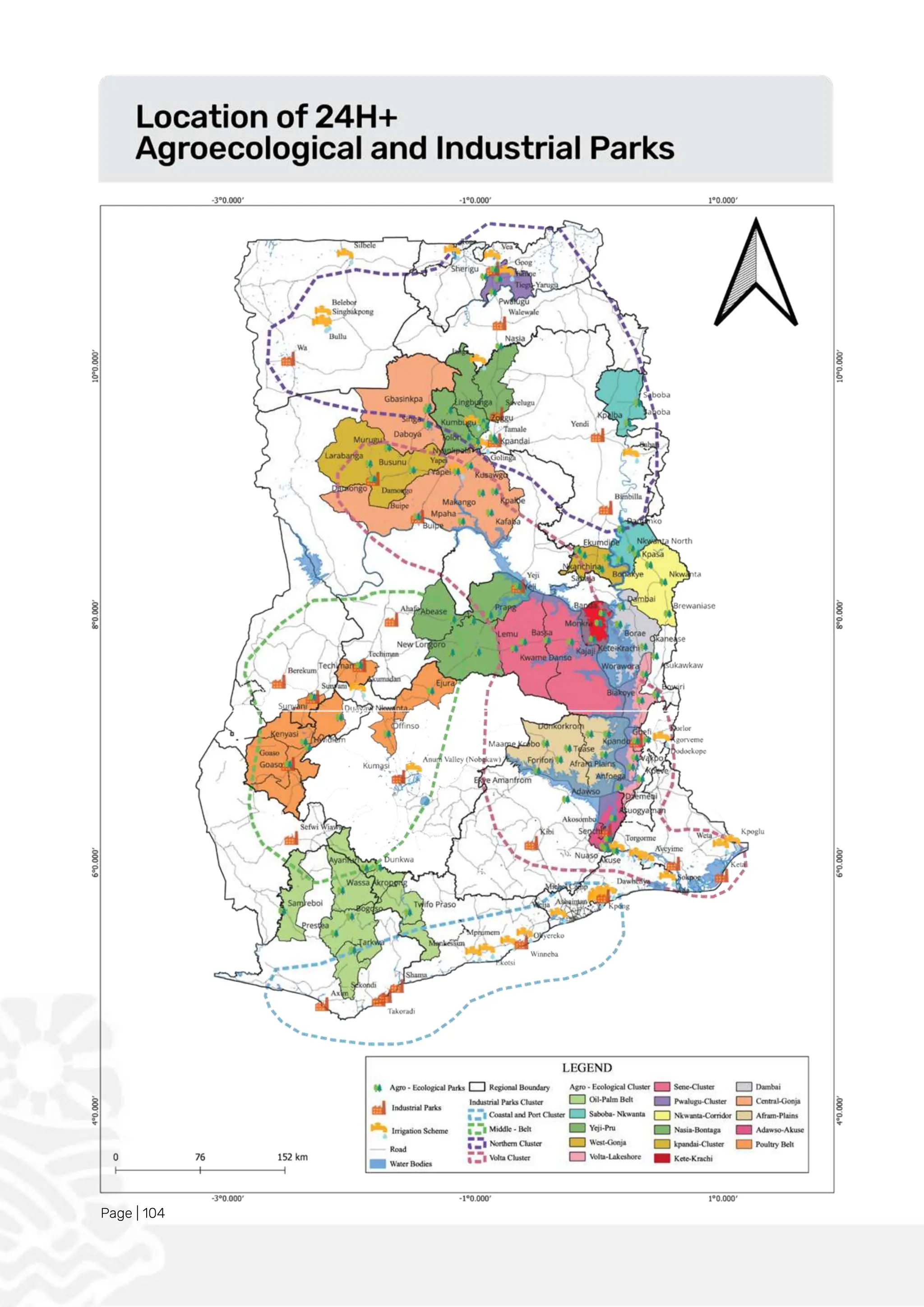
agroecological production zones under GROW24 and integrated into the Volta Lake
Industrial Corridor—Ghana’s most underutilised logistics asset. This corridor will reduce
logistics costs by up to 80%, connect the north and south, and support balanced
regional industrialisation.
MAKE24 will also:
1. Unlock the five priority SMVs by coordinating infrastructure investment, workforce
development under ASPIRE24, and access to affordable, long-term capital under
FUND24.
2. Increase average capacity utilisation in Ghanaian manufacturing from 46% to 85%
by providing targeted support to firms, structured input supply chains, and
guaranteed market access.
3. Formalise informal manufacturers and support their transition into structured
production clusters, cooperatives, and trade associations to reduce transaction
costs, enforce quality standards, and support collective market access.
Page | 25
Through its tight integration with other sub-programmes—GROW24 (raw materials
supply), CONNECT24 (logistics), ASPIRE24 (skills), and FUND24 (finance)—MAKE24
will catalyse structural change in Ghana’s industrial landscape and position the
country as a leading manufacturing base under the African Continental Free Trade
Area.
Page | 26
Page | 27
3.3 Built environment and Infrastructure
The BUILD24 Sub-Programme addresses one of the most foundational yet
underperforming sectors of Ghana’s economy: construction and the broader built
environment. The construction industry currently suffers from low productivity,
limited innovation, fragmented regulation, and a heavy reliance on imports for basic
materials and technologies. BUILD24 will transform this sector into a dynamic driver
of Ghana’s industrialisation, job creation, and economic resilience. It will do this by
pursuing a bold strategy to localise production, formalise construction services, and
modernise sector governance.
At its core, BUILD24 seeks to restructure the construction value chain to boost local
content across all major infrastructure and housing projects. It will prioritise the
development and standardisation of locally sourced construction inputs such as
bricks, tiles, cement, insulation, roofing, doors, and prefabricated components—
thereby reducing import dependency, enhancing self-reliance, and building the
foundation for a circular economy in construction. Through targeted investment and
enterprise support, BUILD24 will nurture fabrication clusters and construction input
hubs across the country, linked to the Wumbei Industrial Parks under MAKE24.
BUILD24 will also establish the Construction Industry Development Authority (CIDA)
to serve as a central coordinating body, harmonising regulations, enforcing quality
standards, driving skills certification, and overseeing a national construction
innovation strategy. This authority will work closely with public agencies such as the
Public Works Department (PWD), Architectural and Engineering Services Limited
(AESL), and industry associations to ensure effective implementation and sector-
wide transformation.
Strategic interventions under BUILD24 include:
1. Establishing a National Materials Catalogue and Standards System in
collaboration with GSA and CSIR-BRRI to support localisation and enforce
quality;
2. Rolling out a National Construction Skills Corps (linked to ASPIRE24) to upskill
artisans, technicians, and professionals in modern methods, including green
building, prefabrication, and digital site management;
3. Leveraging public procurement to stimulate demand for Made-in-Ghana
construction inputs across roads, schools, clinics, housing, and industrial parks;
4. Digitising permitting, land use planning, and construction oversight through a
National E-Build System for transparency, efficiency, and reduced costs.
BUILD24 will ensure that Ghana builds faster, better, and smarter—delivering the
infrastructure backbone needed to scale up production across agriculture,
manufacturing, logistics, and digital services. It anchors Ghana’s transformation in
strong foundations, while creating thousands of skilled jobs and a construction
sector that is inclusive, future-facing, and globally competitive.
Page | 28
3.4 Culture, Arts and Tourism as Engines of Identity and Income
The SHOW24 Sub-Programme repositions Ghana’s culture, arts, and tourism (CAT)
sectors as dynamic engines of job creation, national pride, and export growth. It
recognises that culture is not just heritage—it is a system of production, meaning-
making, and influence. Ghana’s long history—from ancient West African civilisations
and anti-colonial struggles to Pan-African leadership and diasporic connections—
offers rich material for world-class storytelling and creative enterprise. Yet, as in
agriculture and industry, these assets have long been undervalued, fragmented, and
often appropriated by others. SHOW24 shifts the narrative and the structure,
reclaiming culture as both a strategic value chain and a unifying force for national
development.
SHOW24 identifies six catalytic Cultural, Arts, and Tourism (CAT) value chains:
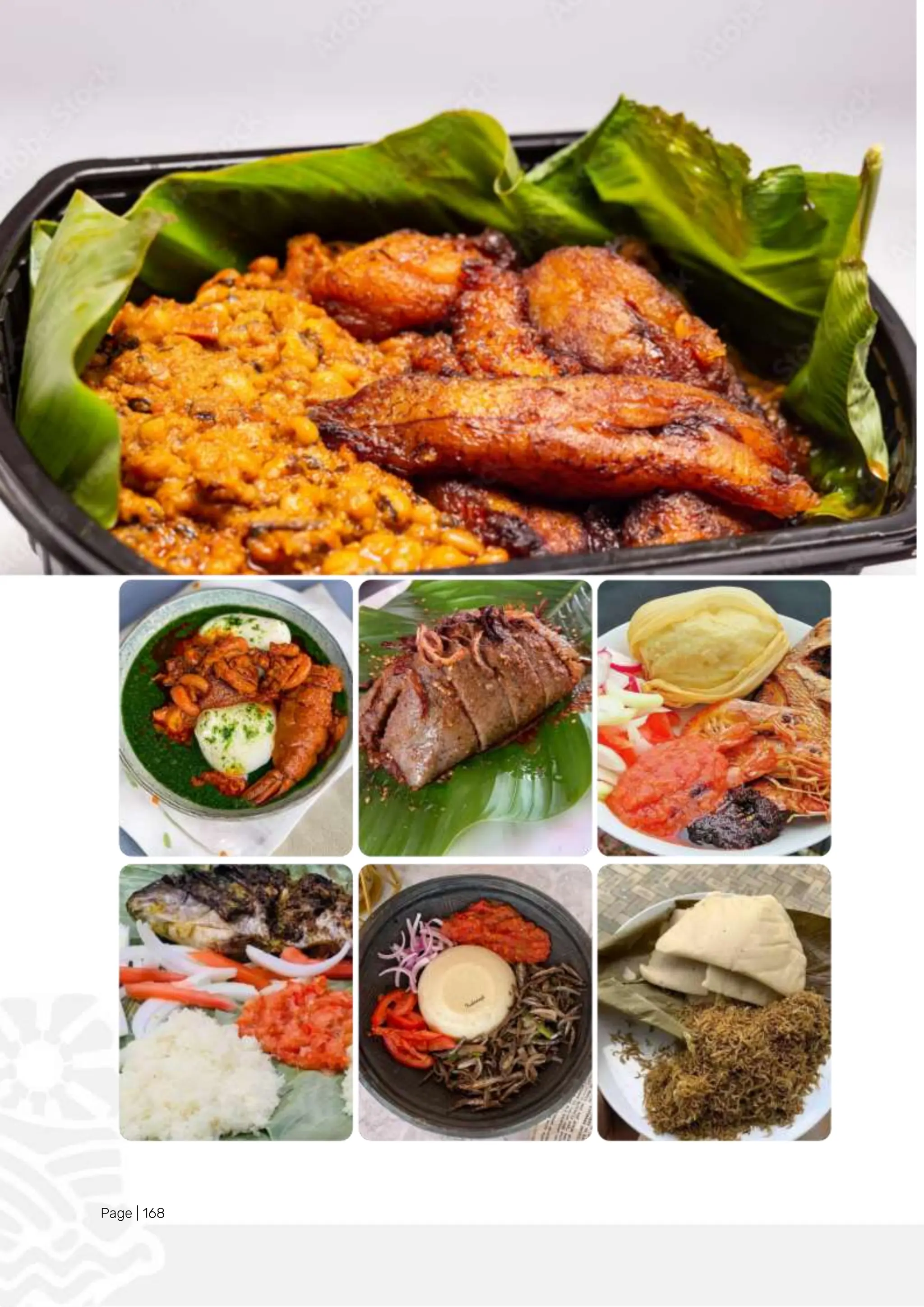
museums and monuments, the legacy of Nkrumah, culinary heritage, textiles and
fashion, re-engineered festivals, and popular music and dance. These value chains
combine cultural authenticity, commercial potential, and wide employment reach,
especially for young people and women. Ghana’s hundreds of festivals, for example,
will be revitalised and rebranded as compelling cultural experiences, capable of
attracting both domestic and international tourism, supporting creative livelihoods,
and serving as platforms for storytelling, commerce, and national identity.
To unlock this potential, SHOW24 pursues a five-part strategy: (1) developing content
and talent through a National Creators Academy and community-based arts hubs;
(2) activating infrastructure—including the revitalisation of 250 community centres
into CAT hubs; (3) scaling market access and exports through licensing platforms,
diaspora networks, and festival tourism; (4) financing CAT enterprises through the
24H+ Value Chain Financing Facility; and (5) embedding cultural identity and
inclusion into the nation’s development journey through “The Ghana Story”
framework.
SHOW24 reframes creativity as a national asset and identity as infrastructure. It
brings coherence to fragmented sectors, delivers dignified jobs, and builds a globally
competitive creative economy. With every festival scaled, museum launched, fabric
exported, or story told, Ghana becomes not only a producer of goods but a producer
of meaning, pride, and value on the global stage.
3.5 Supply Chains, Logistics and Market Systems
The CONNECT24 Sub-Programme is Ghana’s strategic blueprint for fixing the broken
links between production and prosperity. It tackles one of the most persistent
barriers to national competitiveness: inefficient, high-cost supply chains and
fragmented market systems. From post-harvest losses and rural isolation to
congested ports and informal markets, these bottlenecks drain value from every
stage of production. CONNECT24 transforms this reality by building an integrated,
multimodal logistics and market ecosystem—designed to move goods faster,
cheaper, and smarter across the country and beyond.
At the heart of CONNECT24 is the full-scale activation of the Volta Lake as Ghana’s
inland freight corridor. With dedicated investment in port terminals at Buipe, Yeji,
Akosombo, and Mpakadan, and intermodal links to farms, factories, and rail, the lake
will become the spine of a low-cost, high-capacity logistics network connecting
Page | 29
northern production zones to southern markets and ports. This will reduce logistics
costs from over 40% of product value to below 20%, unlocking national and regional
trade flows.
CONNECT24 also invests in cold chain and warehouse infrastructure, modernises
port and customs systems, expands structured aggregation and digital
marketplaces, and develops Tamale Airport into a regional air cargo hub for high-
value exports. These interventions will reduce post-harvest losses by half, enable
real-time price access for 500,000 producers, and ensure reliable input and product
flows for GROW24 and MAKE24.
CONNECT24 strengthens Ghana’s ability to compete from the farm gate to the
market to export. It ensures that goods move efficiently, reducing waste, lowering
costs, and connecting producers to structured markets and buyers across Ghana,
the region, and the world. With Volta Lake serving as a national logistics spine and
modern systems enabling reliable, 24/7 operations, Ghana will not only feed itself
and supply its industries—it will compete confidently in regional and global markets.
This is the infrastructure of a connected, productive, and export-ready economy.
3.6 Production and Infrastructure Financing
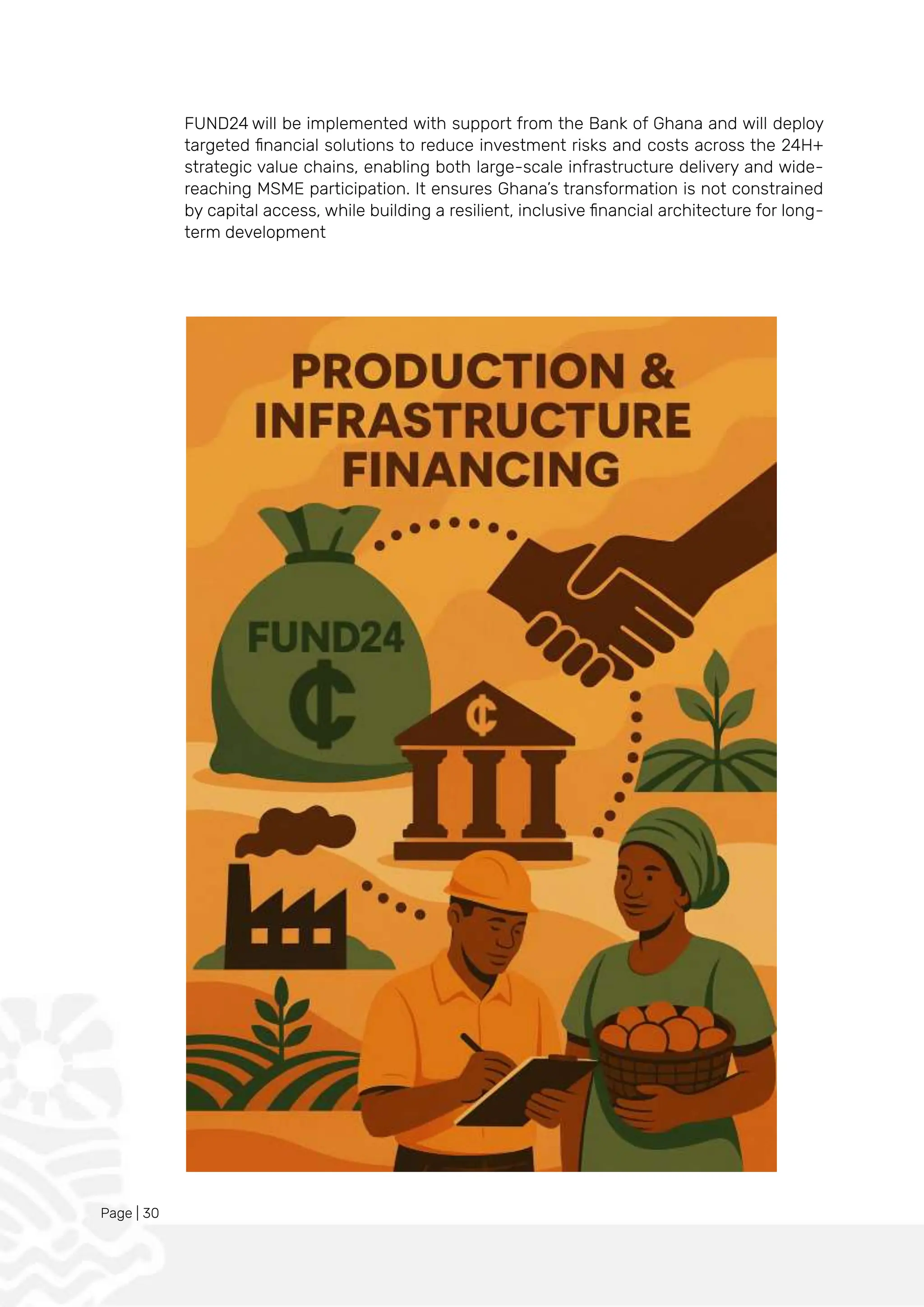
The FUND24 Sub-Programme facilitates value-chain & Infrastructure Financing to
address two key structural bottlenecks—limited access to affordable finance for
enterprises and insufficient long-term capital for productive infrastructure. The sub-
programme will unlock patient, appropriately priced capital to enable Ghanaian
producers, processors, and service providers across strategic value chains to invest,
grow, and compete.
FUND24 will
1. Unlock $1 billion+ in enterprise financing for MSMEs in strategic value chains
through a Value Chain Financing Facility, delivered by DBG through rural banks,
microfinance institutions, Savings and Loans institutions and commercial banks.
Loans will be concessional (below 12%) and tied to membership in cooperatives
or trade and industry associations to enhance credit discipline, monitoring, and
access.
2. De-risk MSME lending through a Technical Assistance Grant Fund and Credit
Insurance Scheme, supporting borrower readiness, cooperative development,
market access facilitation, credit scoring, and real-time loan tracking. This will be
implemented through Enterprise Support Organisations (ESOs) and risk-sharing
facilities in partnership with institutions like GIRSAL.
3. Support infrastructure financing through the creation of three Special Purpose
Vehicles (SPVs) under the Ghana Infrastructure Investment Fund (GIIF), focused
on Agroecological Parks, Industrial Parks, and Multimodal Logistics Systems.
These SPVs will be seeded with public capital and structured to attract blended
finance, sovereign wealth funds, and private investment through PPPs.
Infrastructure such as inland water transport along the Volta Lake corridor will be
prioritised to reduce logistics costs and enhance regional trade connectivity.
Land will be leased to investors free for the first 10 years to catalyse private
investment in farms and factories, which will be supported through the Value
Chain Financing Facility.
Page | 30
FUND24 will be implemented with support from the Bank of Ghana and will deploy
targeted financial solutions to reduce investment risks and costs across the 24H+
strategic value chains, enabling both large-scale infrastructure delivery and wide-
reaching MSME participation. It ensures Ghana’s transformation is not constrained
by capital access, while building a resilient, inclusive financial architecture for long-
term development
Page | 31
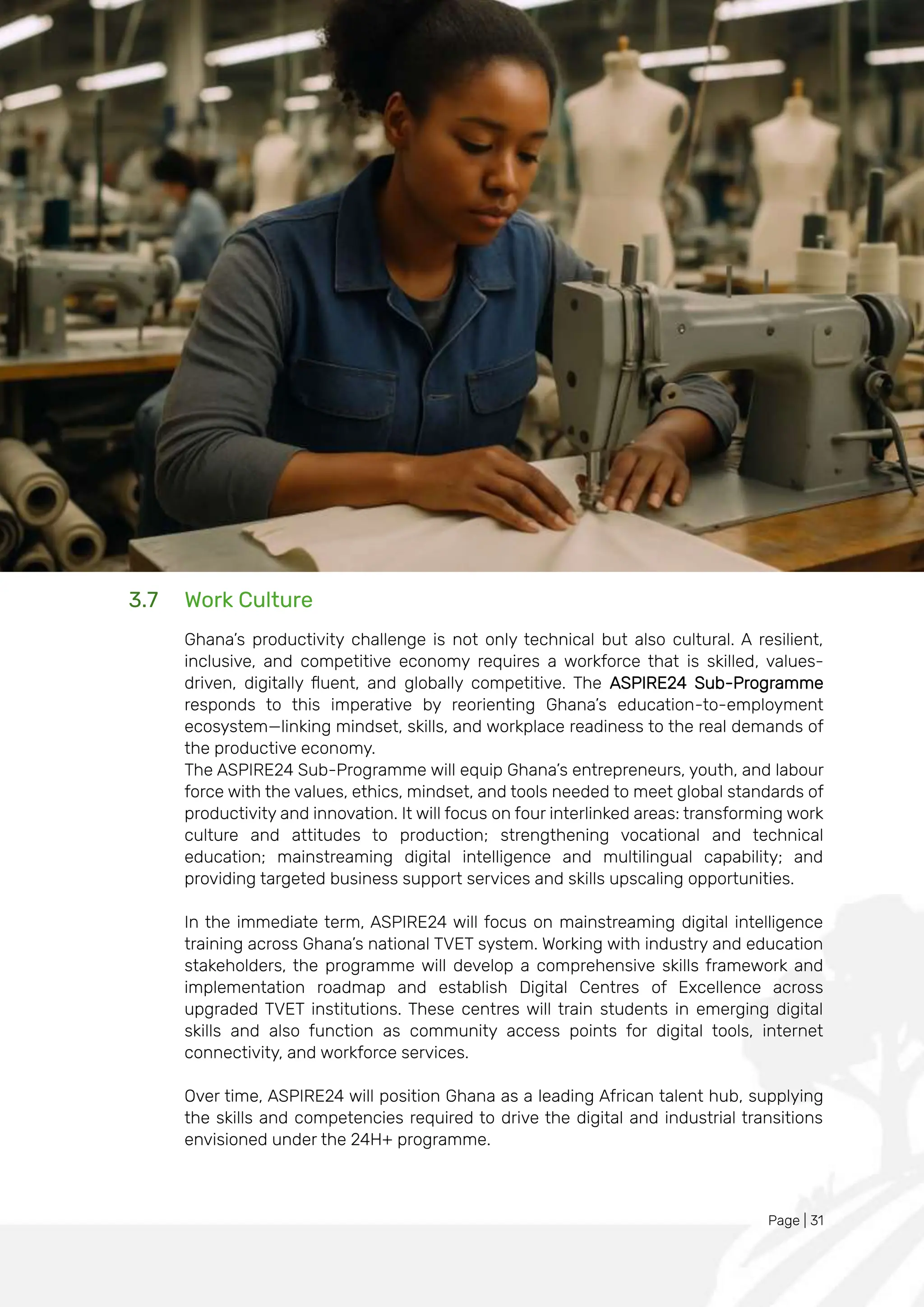
3.7 Work Culture
Ghana’s productivity challenge is not only technical but also cultural. A resilient,
inclusive, and competitive economy requires a workforce that is skilled, values-
driven, digitally fluent, and globally competitive. The ASPIRE24 Sub-Programme
responds to this imperative by reorienting Ghana’s education-to-employment
ecosystem—linking mindset, skills, and workplace readiness to the real demands of
the productive economy.
The ASPIRE24 Sub-Programme will equip Ghana’s entrepreneurs, youth, and labour
force with the values, ethics, mindset, and tools needed to meet global standards of
productivity and innovation. It will focus on four interlinked areas: transforming work
culture and attitudes to production; strengthening vocational and technical
education; mainstreaming digital intelligence and multilingual capability; and
providing targeted business support services and skills upscaling opportunities.
In the immediate term, ASPIRE24 will focus on mainstreaming digital intelligence
training across Ghana’s national TVET system. Working with industry and education
stakeholders, the programme will develop a comprehensive skills framework and
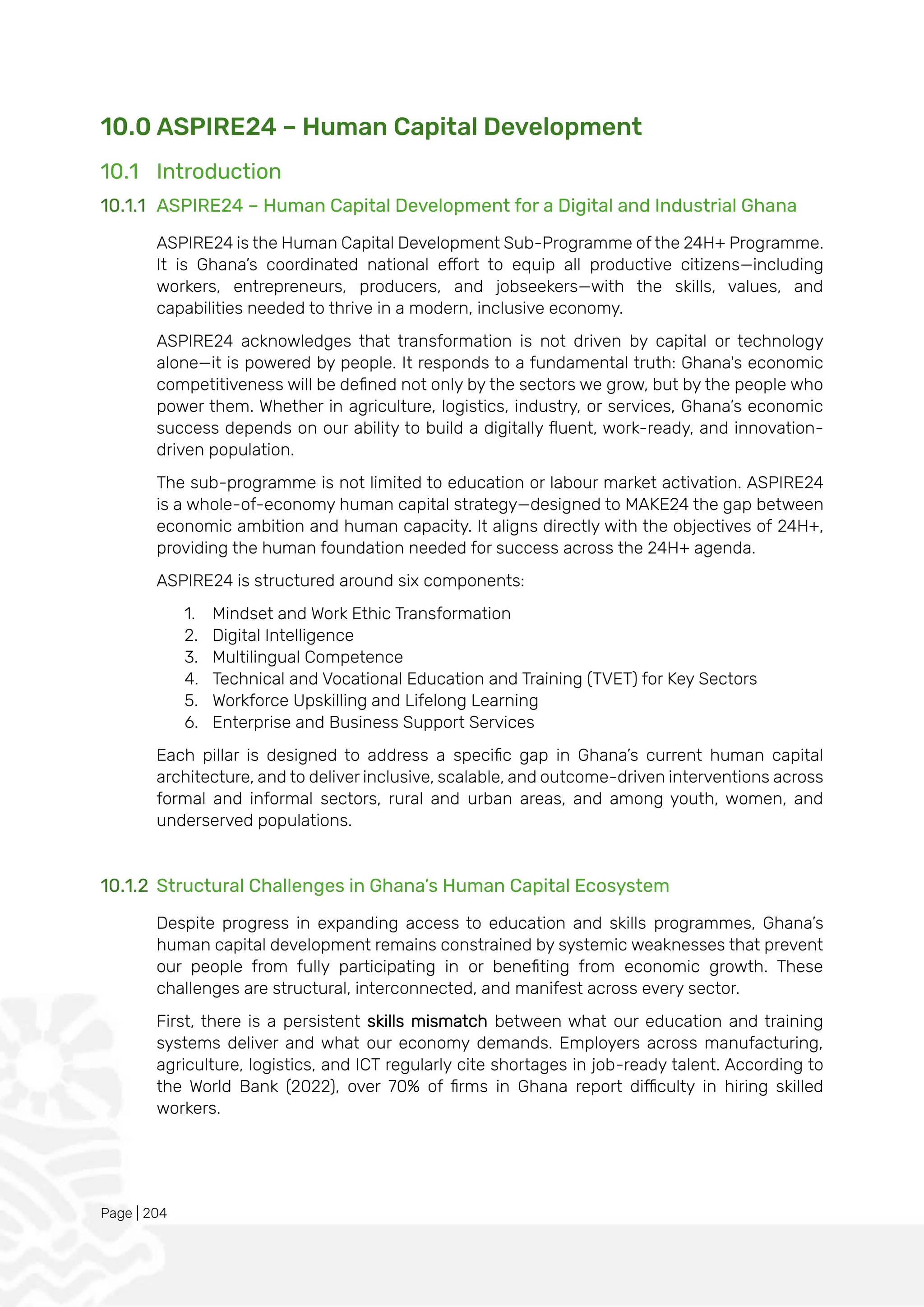
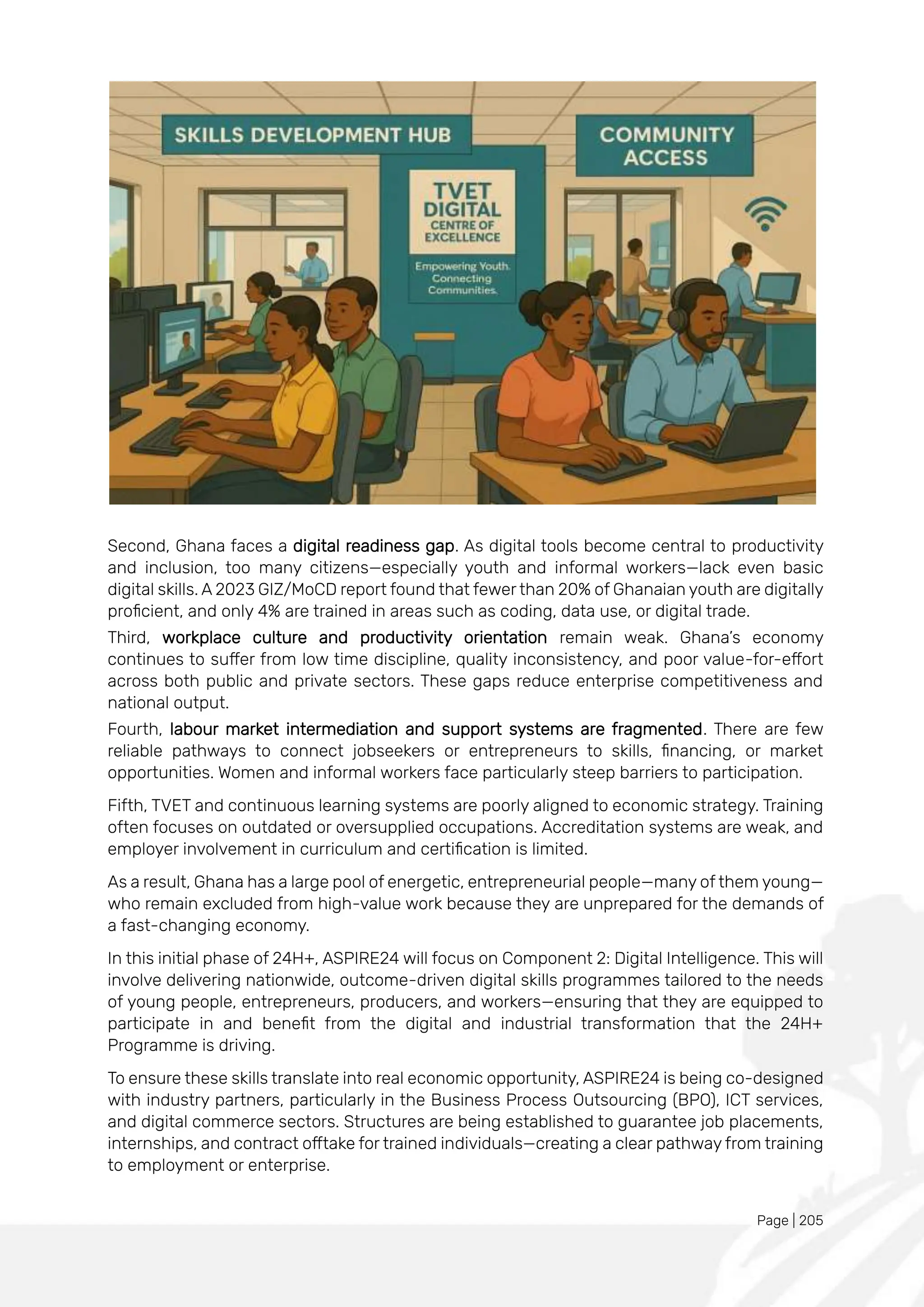
implementation roadmap and establish Digital Centres of Excellence across
upgraded TVET institutions. These centres will train students in emerging digital
skills and also function as community access points for digital tools, internet
connectivity, and workforce services.
Over time, ASPIRE24 will position Ghana as a leading African talent hub, supplying
the skills and competencies required to drive the digital and industrial transitions
envisioned under the 24H+ programme.
Page | 32
3.8 Sustainable Mobilisation
A 24-hour economy cannot be built by policy alone—it requires a shared national
commitment, active citizen engagement, and alignment across all arms of the state.
The GO24 Sub-Programme addresses two critical enablers of transformation: the
need for broad-based public mobilisation and the imperative to embed the 24H+
agenda into the everyday functioning of government and community life. GO24 will
tackle the challenge of low citizen engagement and limited state alignment by
mainstreaming the 24H+ transformation agenda across all levels of government and
mobilising the Ghanaian public around a shared national mission.
GO24 will:
1. Build public awareness and Mobilisation through national campaigns,
storytelling platforms, and education initiatives that drive citizen participation in
the 24H+ vision;
2. mainstream 24H+ across Government, requiring all MDAs and MMDAs to develop
tailored 24H+
strategies, extend essential public services for round-the-clock
productivity, and align internal operations with the programme’s objectives.;
3. revitalise Community Infrastructure by improving lighting, safety, and
beautification in public spaces to support evening and night-time commercial
activity; and
4. reform Enabling Regulations, including labour laws, local government by-laws,
and business licensing, to support expanded hours of operation and innovation
in economic activity.
GO24 will transform passive individual citizens into organised active co-creators of
Ghana’s economic future and ensure that every arm of the State becomes a
proactive partner in national transformation.
Page | 33
3.9 Integrated Virtuous Cycle of Growth and Employment
24H+ Programme is integrated in conception and rollout. Each subprogramme
targets a critical node in the economy and interacts with and reinforces others in a
virtuous cycle. As domestic production rises, foreign exchange leakage declines. As
costs fall, firms become competitive. As exports grow, macroeconomic stability
improves. Reduced import dependency preserves foreign exchange, enabling
investment in productive capacity. Increased local value addition creates demand
for domestic inputs, which creates employment. Expanded employment generates
consumer purchasing power, and rising productivity improves export
competitiveness.
Together, they form a unified matrix that:
1 reduces the food and inputs import bill by building self-reliant, climate-resilient
agricultural systems;
2 expands domestic manufacturing capacity, raising industrial output from 12%
to 20% of GDP;
3 streamlines supply chains to cut post-harvest losses and logistics costs,
especially between northern and southern Ghana through inland water
transport.
4 provides patient capital at affordable rates to unlock MSME growth in priority
value chains;
5 develops a highly skilled, ethically grounded, digitally intelligent, culturally
confident workforce;
6 catalyses a revival in our cultural, artistic, and tourism industries and inculcates
a constructive African identity in our citizens; and
7 mainstream citizen engagement, volunteer work, accountability, and whole-of-
government alignment around these goals.
The 24H+ approach offers quantifiable benefits. Internal economic modelling
demonstrates that structural transformation would improve the relationship
between economic growth and job creation (the “employment elasticity of output”)
from the current 0.29 to approximately 0.55. This means that for every percentage
point of GDP growth, employment would expand by 0.55%, nearly double the current
rate. Combined with sustained GDP growth above 6%, the impact on unemployment
would be transformative.
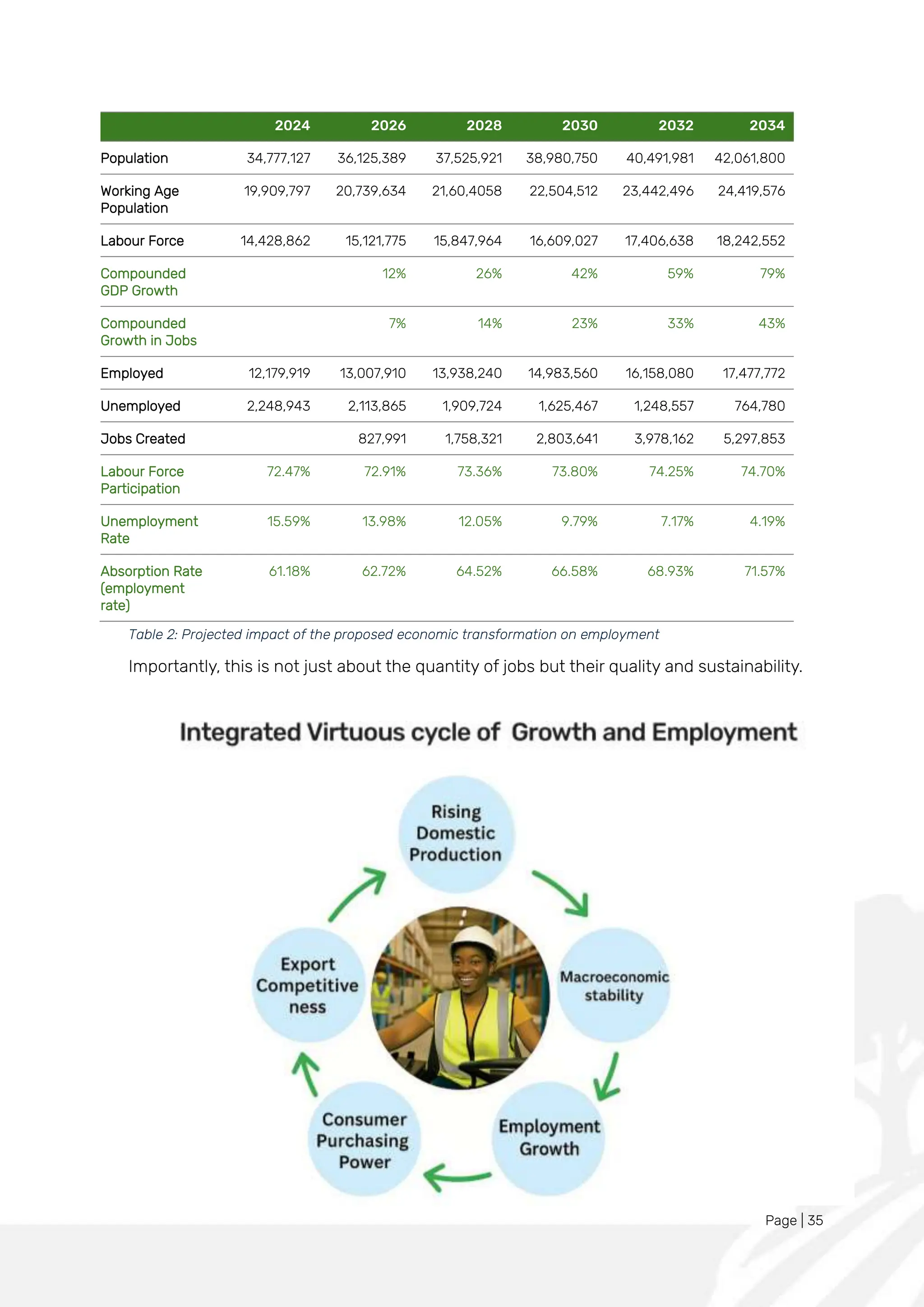
As shown in Table 2, implementing this integrated approach could create more than
827,000 new jobs within the first two years, expanding to over 1.7 million jobs by
2028 and exceeding 5.2 million jobs by 2034. This would progressively reduce
Ghana's unemployment rate to approximately 12% by 2028, under 10% by 2030, and
ultimately to just 4.19% by 2034—a level consistent with full employment when
accounting for frictional unemployment.
Page | 34
Page | 35
2024 2026 2028 2030 2032 2034
Population 34,777,127 36,125,389 37,525,921 38,980,750 40,491,981 42,061,800
Working Age
Population
19,909,797 20,739,634 21,60,4058 22,504,512 23,442,496 24,419,576
Labour Force 14,428,862 15,121,775 15,847,964 16,609,027 17,406,638 18,242,552
Compounded
GDP Growth
12% 26% 42% 59% 79%
Compounded
Growth in Jobs
7% 14% 23% 33% 43%
Employed 12,179,919 13,007,910 13,938,240 14,983,560 16,158,080 17,477,772
Unemployed 2,248,943 2,113,865 1,909,724 1,625,467 1,248,557 764,780
Jobs Created 827,991 1,758,321 2,803,641 3,978,162 5,297,853
Labour Force
Participation
72.47% 72.91% 73.36% 73.80% 74.25% 74.70%
Unemployment
Rate
15.59% 13.98% 12.05% 9.79% 7.17% 4.19%
Absorption Rate
(employment
rate)
61.18% 62.72% 64.52% 66.58% 68.93% 71.57%
Table 2: Projected impact of the proposed economic transformation on employment
Importantly, this is not just about the quantity of jobs but their quality and sustainability.
Page | 36
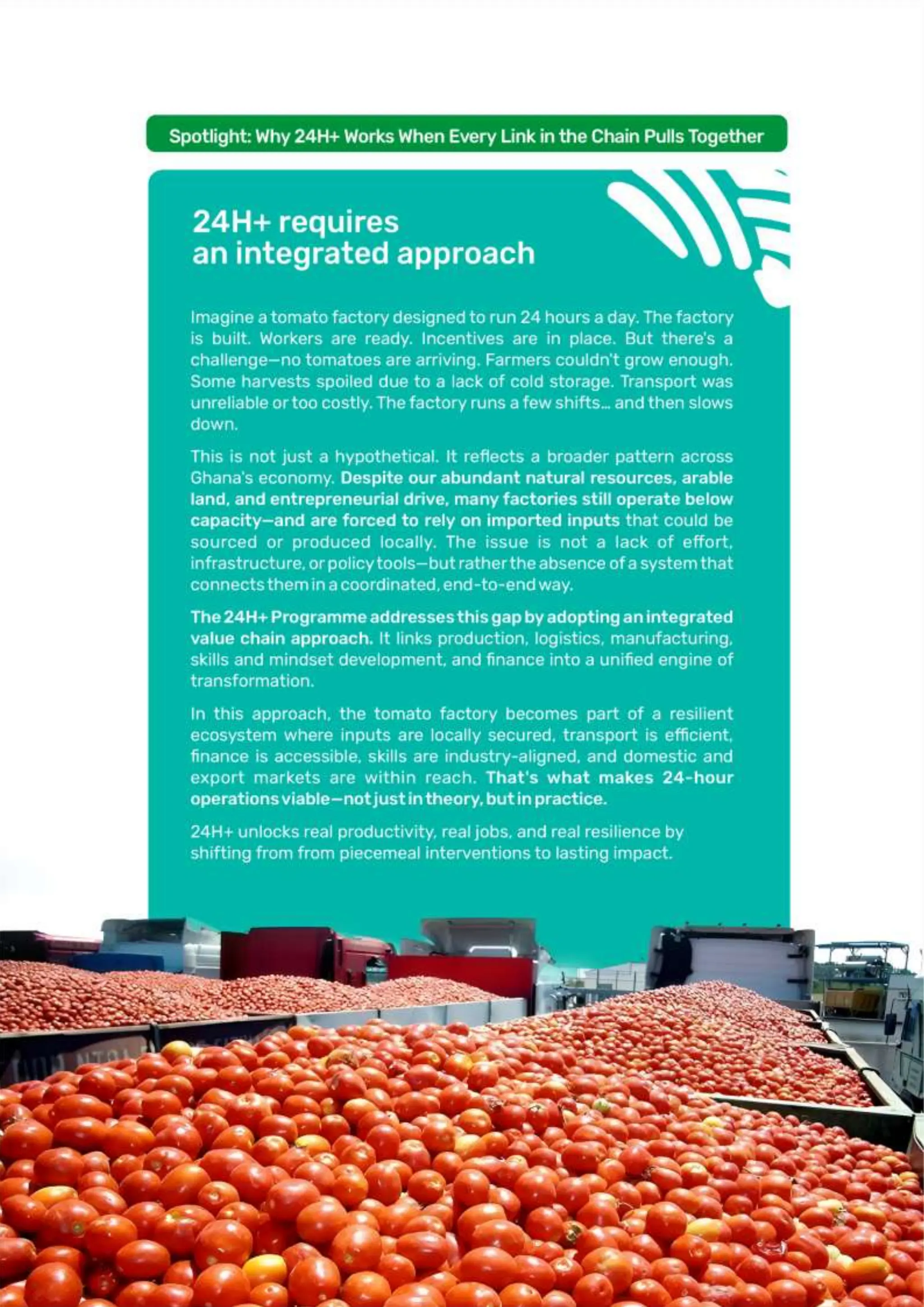
Spotlight: Why 24H+ Works When Every Link in the Chain Pulls Together
24H+ requires an integrated approach
Imagine a tomato factory designed to run 24 hours a day. The factory is built.
Workers are ready. Incentives are in place. But there’s a challenge—no tomatoes are
arriving. Farmers couldn’t grow enough. Some harvests spoiled due to a lack of cold
storage. Transport was unreliable or too costly. The factory runs a few shifts… and
then slows down.
This is not just a hypothetical. It reflects a broader pattern across Ghana’s economy.
Despite our abundant natural resources, arable land, and entrepreneurial drive,
many factories still operate below capacity—and are forced to rely on imported
inputs that could be sourced or produced locally. The issue is not a lack of effort,
infrastructure, or policy tools—but rather the absence of a system that connects
them in a coordinated, end-to-end way
The 24H+ Programme addresses this gap by adopting an integrated value chain
approach. It links production, logistics, manufacturing, skills and mindset
development, and finance into a unified engine of transformation.
In this approach, the tomato factory becomes part of a resilient ecosystem where
inputs are locally secured, transport is efficient, finance is accessible, skills are
industry-aligned, and domestic and export markets are within reach. That’s what
makes 24-hour operations viable—not just in theory, but in practice.
24H+ unlocks real productivity, real jobs, and real resilience by shifting from from piecemeal
interventions to lasting impact.
Page | 37
PART ONE - CONTEXT
Page | 38
1.0 Context for a 24H+
1.1 The Problem - Structural Deformity
Ghana faces a complex set of interrelated challenges that limit economic
performance. While Ghana’s economy is more complex than it was a century ago, it
remains fundamentally colonial, that is, fragmented and integrated into the global
economy in ways that do not serve local needs and aspirations. Like many former
colonies, Ghana’s economy was integrated into the global economy primarily as a
supplier of raw materials for Western industries in the 19th
and 20th
centuries, and a
consumer of cheap manufactured goods (both consumer and industrial) produced
by European, particularly British industry. Although independence and global
political dynamics have expanded the country’s export base and diversified trading
relations, reliance on raw material exports and, worse, a culture of import
dependency has intensified since the 1966 overthrow of Nkrumah’s First Republic
and its centrally-planned, state-led industrialisation programme. The development
of new resources, such as oil and gas, over the last 20 years has followed a similar
pattern, as little effort has been made to process these primary raw materials or
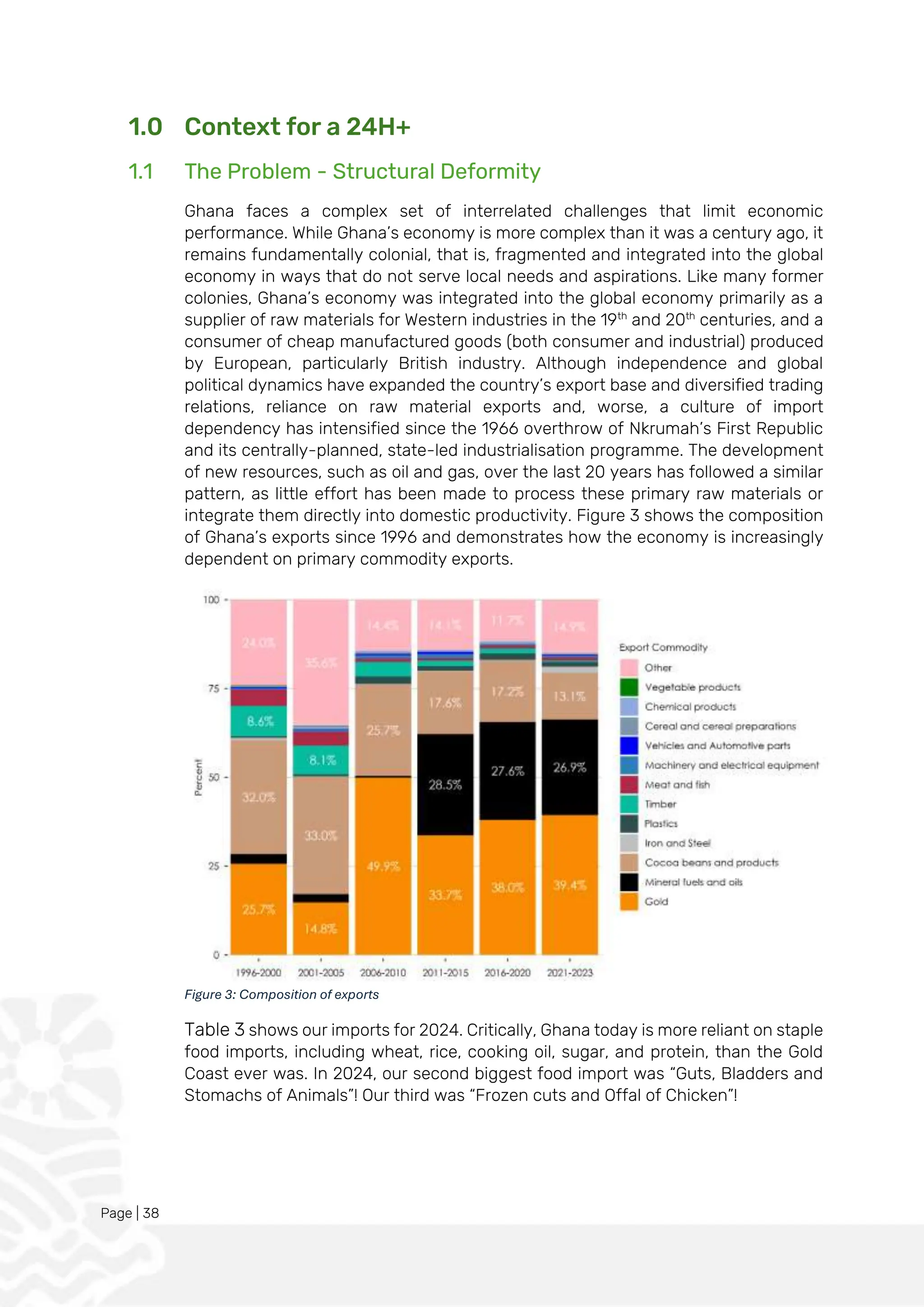
integrate them directly into domestic productivity. Figure 3 shows the composition
of Ghana’s exports since 1996 and demonstrates how the economy is increasingly
dependent on primary commodity exports.
Figure 3: Composition of exports
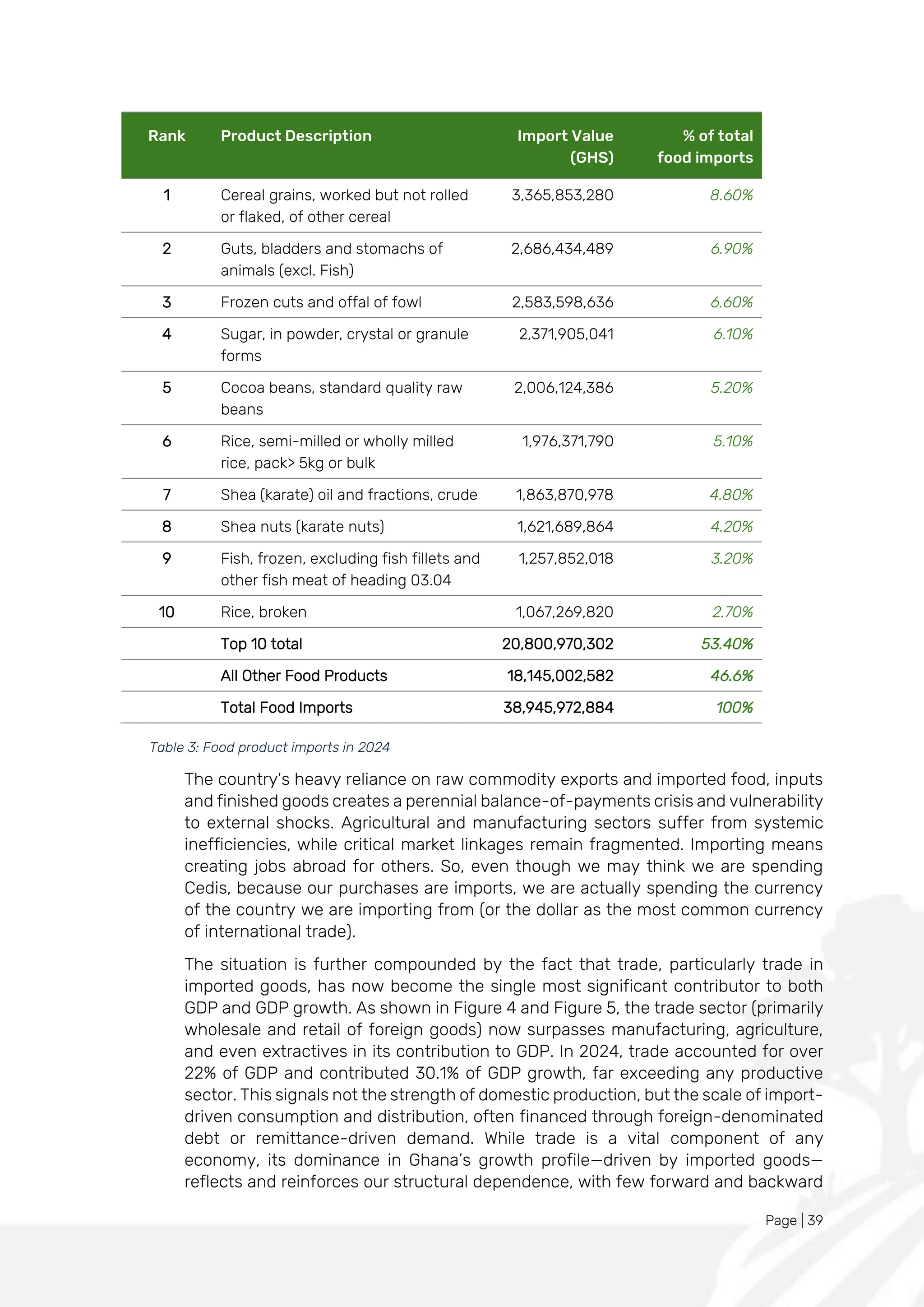
Table 3 shows our imports for 2024. Critically, Ghana today is more reliant on staple
food imports, including wheat, rice, cooking oil, sugar, and protein, than the Gold
Coast ever was. In 2024, our second biggest food import was “Guts, Bladders and
Stomachs of Animals”! Our third was “Frozen cuts and Offal of Chicken”!
Page | 39
Rank Product Description Import Value
(GHS)
% of total
food imports
1 Cereal grains, worked but not rolled
or flaked, of other cereal
3,365,853,280 8.60%
2 Guts, bladders and stomachs of
animals (excl. Fish)
2,686,434,489 6.90%
3 Frozen cuts and offal of fowl 2,583,598,636 6.60%
4 Sugar, in powder, crystal or granule
forms
2,371,905,041 6.10%
5 Cocoa beans, standard quality raw
beans
2,006,124,386 5.20%
6 Rice, semi-milled or wholly milled
rice, pack> 5kg or bulk
1,976,371,790 5.10%
7 Shea (karate) oil and fractions, crude 1,863,870,978 4.80%
8 Shea nuts (karate nuts) 1,621,689,864 4.20%
9 Fish, frozen, excluding fish fillets and
other fish meat of heading 03.04
1,257,852,018 3.20%
10 Rice, broken 1,067,269,820 2.70%
Top 10 total 20,800,970,302 53.40%
All Other Food Products 18,145,002,582 46.6%
Total Food Imports 38,945,972,884 100%
Table 3: Food product imports in 2024
The country's heavy reliance on raw commodity exports and imported food, inputs
and finished goods creates a perennial balance-of-payments crisis and vulnerability
to external shocks. Agricultural and manufacturing sectors suffer from systemic
inefficiencies, while critical market linkages remain fragmented. Importing means
creating jobs abroad for others. So, even though we may think we are spending
Cedis, because our purchases are imports, we are actually spending the currency
of the country we are importing from (or the dollar as the most common currency
of international trade).
The situation is further compounded by the fact that trade, particularly trade in
imported goods, has now become the single most significant contributor to both
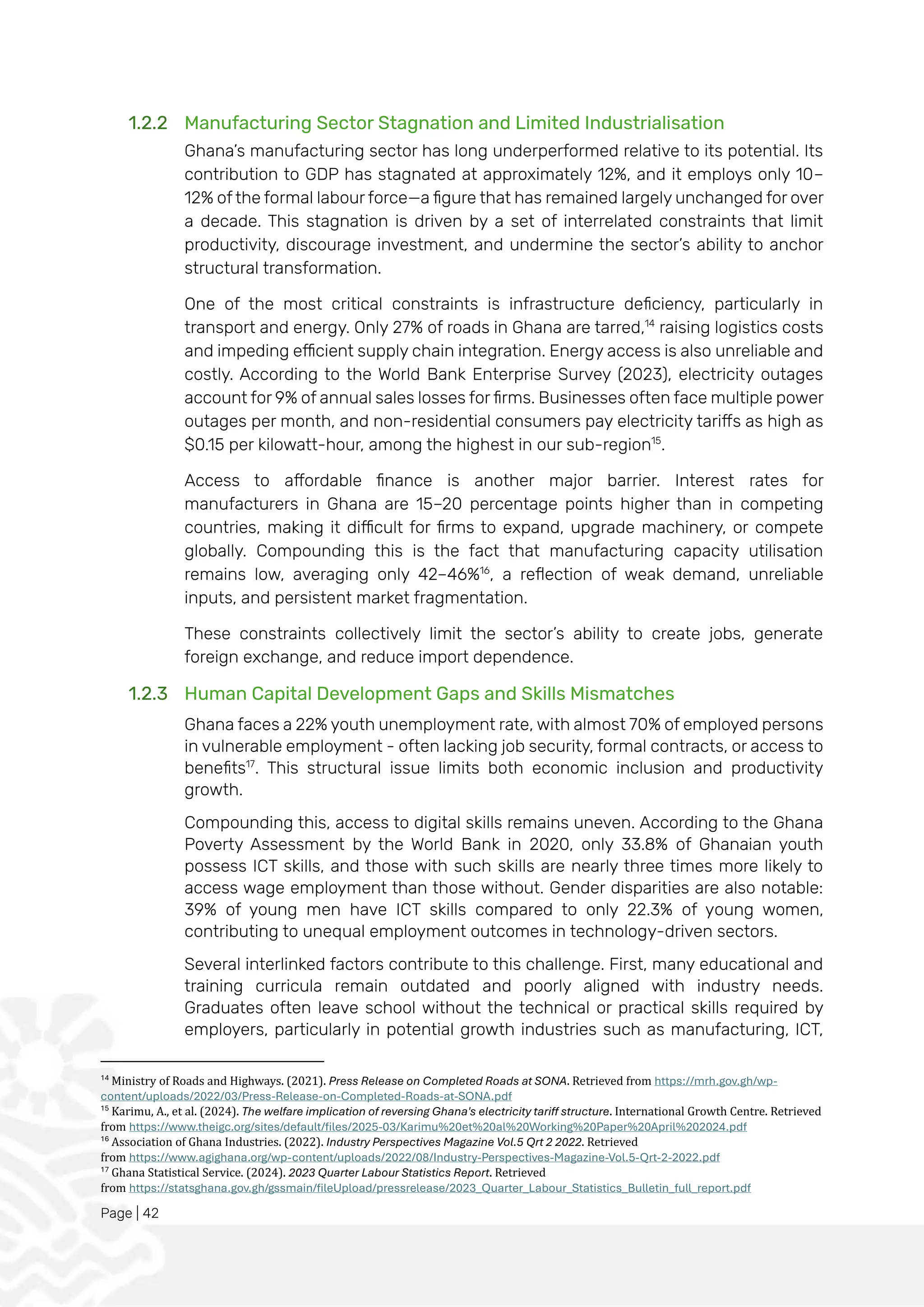
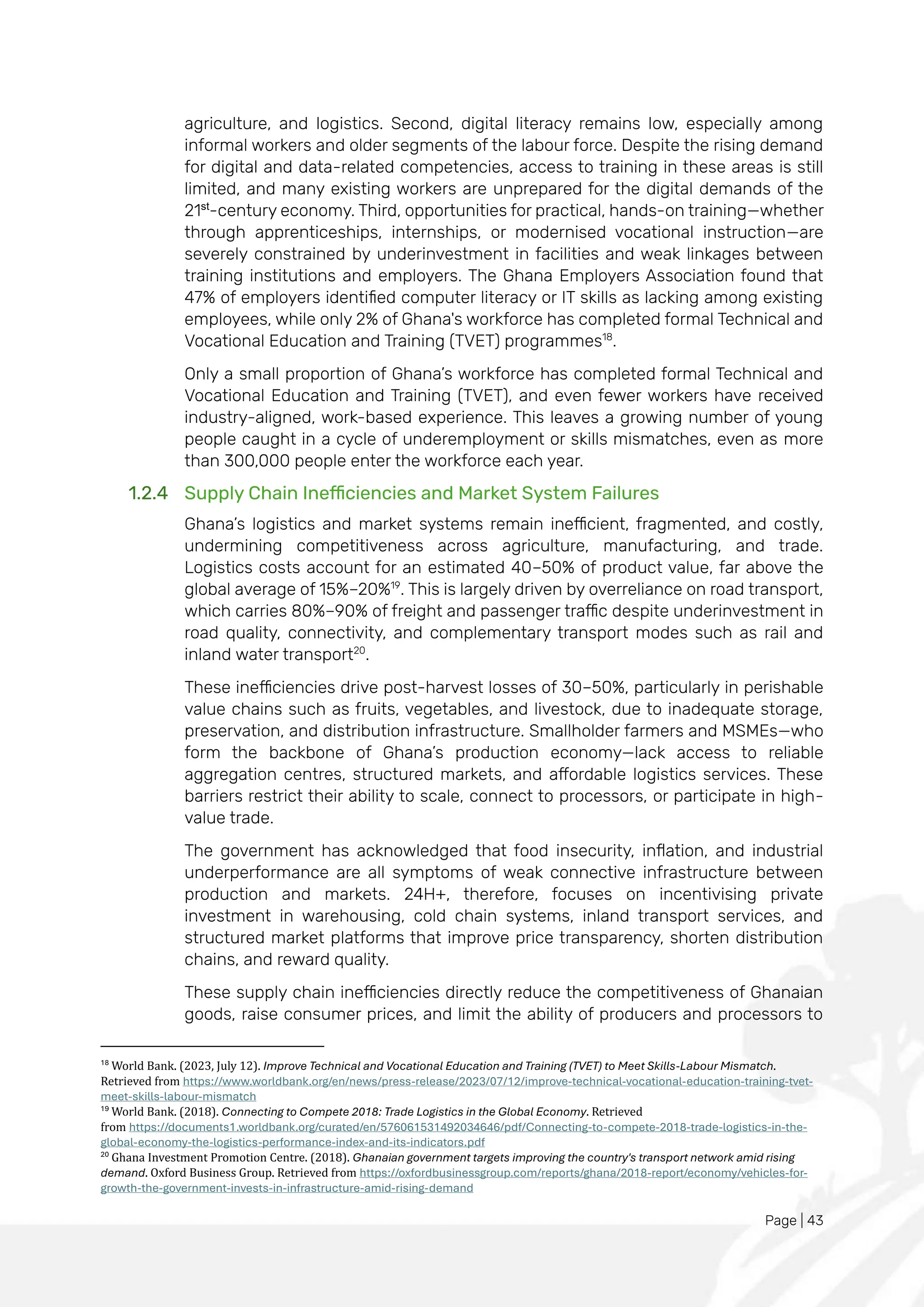
GDP and GDP growth. As shown in Figure 4 and Figure 5, the trade sector (primarily
wholesale and retail of foreign goods) now surpasses manufacturing, agriculture,
and even extractives in its contribution to GDP. In 2024, trade accounted for over
22% of GDP and contributed 30.1% of GDP growth, far exceeding any productive
sector. This signals not the strength of domestic production, but the scale of import-
driven consumption and distribution, often financed through foreign-denominated
debt or remittance-driven demand. While trade is a vital component of any
economy, its dominance in Ghana’s growth profile—driven by imported goods—
reflects and reinforces our structural dependence, with few forward and backward
Page | 40
linkages to domestic production. It also explains why GDP growth, in its current
form, does not translate into widespread employment or resilience, as the trade
sector’s expansion generates limited local value-added and minimal domestic job
creation beyond low-wage retail activity.
Figure 4: Sectoral contributions to GDP
Figure 5: Sectoral contribution to GDP growth
This structural deformity is evident throughout the country’s economic and social
systems, relentlessly driving all metrics by which we gauge contemporary economic
and social progress - GDP growth rate, exchange rates, interest rates,
unemployment, debt-to-GDP ratios, and so forth. The cyclical nature of the
resulting inevitable economic crises often obscures the underlying structural
problem, making it easier, especially for the political class, to attribute Ghana’s
declining fortunes and repeated resort to IMF stabilisation programmes solely to the
lack of vision, competence, caring, and integrity of partisan opponents - often while
Page | 41
adopting remedies for economic salvation rooted within the same development
paradigm. Leadership integrity, industriousness, compassion, and competence are
crucial for national development. They are not, however, sufficient. They are not a
substitute for the sound and integrated production structure that Ghana needs.
In addition to this structural deformity, limited access to finance restricts MSME
growth and participation in strategic value chains. Studies show that access to
finance remains the most important obstacle to enterprise growth in Ghana, with
most businesses relying on private savings or internal resources to finance their
operations8
.
Underlying these challenges is a significant human resource gap, with workforce
skills development programmes not aligned with the demands of a modern,
competitive economy. Additionally, weak citizen engagement and inadequate
stakeholder coordination undermine the sustainability and ownership of
development initiatives. These factors collectively constrain Ghana's ability to
generate sustainable livelihoods, achieve food security, develop competitive
industries, and fully participate in regional and global markets.
Taken together, these challenges reinforce a development trap. Without a
coordinated, multi-dimensional strategy that addresses production, market
systems, finance, skills, and public mobilisation as interdependent components,
Ghana risks continued economic vulnerability, limited value capture, and unrealised
national potential in an increasingly competitive global landscape.
1.2 Interconnected Structural Constraints
The deformity in the economy manifests in these seven interconnected structural
constraints that collectively impede transformation.
1.2.1 Agricultural Underperformance and Food Import Dependence
Ghana spends over $2 billion annually on food imports despite possessing vast
agricultural potential9
. This paradox stems from multiple interconnected factors:
only 5% of arable land is irrigated10
, post-harvest losses exceed 30% of production,
and smallholder farmers who produce 80% of Ghana's food11
struggle with limited
mechanisation, an ageing workforce, and restricted access to finance. The 2025
State of the Nation Address acknowledged that Ghana’s agriculture remains below
potential due to low productivity and underinvestment in value-addition
infrastructure, stressing that food inflation is worsened by a failure to achieve food
self-sufficiency12
. This agricultural underperformance directly impacts other sectors
by constraining raw material supply for manufacturing, driving food inflation,
depleting foreign reserves, and limiting rural income growth13
.
8
The Constraints to Inclusive Growth in Ghana, MiDA (2024)
9
Ministry of Food and Agriculture. (2025, April). Feed Ghana Programme rallies Ghanaians to cut $2billion food import. Retrieved
from https://www.modernghana.com/news/1390729/feed-ghana-programme-rallies-ghanaians-to-cut.html
10
Ministry of Food and Agriculture (MoFA). (2021). Agriculture in Ghana: Facts and Figures (2021). Accra: Statistics, Research and
Information Directorate (SRID), MoFA.
11
United Nations Environment Programme. (2021). Supporting smallholder farmers in Ghana through innovative climate adaptation.
Retrieved from https://www.unep.org/ndc/news-and-stories/story/supporting-smallholder-farmers-ghana-through-innovative-climate-
adaptation
12
National Food Buffer Stock Company. (2025, March). Key Agribusiness Highlights from Ghana's 2025 SONA. Retrieved
from https://nafco.gov.gh/uncategorized/key-agribusiness-highlights-from-ghanas-2025-sona/
13
Ghana Statistical Service. (2021). Ghana's Agriculture Sector Report. Retrieved from https://www.gipc.gov.gh/wp-
content/uploads/2023/03/Ghanas-Agriculture-Sector-Report-1.pdf
Page | 42
1.2.2 Manufacturing Sector Stagnation and Limited Industrialisation
Ghana’s manufacturing sector has long underperformed relative to its potential. Its
contribution to GDP has stagnated at approximately 12%, and it employs only 10–
12% of the formal labour force—a figure that has remained largely unchanged for over
a decade. This stagnation is driven by a set of interrelated constraints that limit
productivity, discourage investment, and undermine the sector’s ability to anchor
structural transformation.
One of the most critical constraints is infrastructure deficiency, particularly in
transport and energy. Only 27% of roads in Ghana are tarred,14
raising logistics costs
and impeding efficient supply chain integration. Energy access is also unreliable and
costly. According to the World Bank Enterprise Survey (2023), electricity outages
account for 9% of annual sales losses for firms. Businesses often face multiple power
outages per month, and non-residential consumers pay electricity tariffs as high as
$0.15 per kilowatt-hour, among the highest in our sub-region15
.
Access to affordable finance is another major barrier. Interest rates for
manufacturers in Ghana are 15–20 percentage points higher than in competing
countries, making it difficult for firms to expand, upgrade machinery, or compete
globally. Compounding this is the fact that manufacturing capacity utilisation
remains low, averaging only 42–46%16
, a reflection of weak demand, unreliable
inputs, and persistent market fragmentation.
These constraints collectively limit the sector’s ability to create jobs, generate
foreign exchange, and reduce import dependence.
1.2.3 Human Capital Development Gaps and Skills Mismatches
Ghana faces a 22% youth unemployment rate, with almost 70% of employed persons
in vulnerable employment - often lacking job security, formal contracts, or access to
benefits17
. This structural issue limits both economic inclusion and productivity
growth.
Compounding this, access to digital skills remains uneven. According to the Ghana
Poverty Assessment by the World Bank in 2020, only 33.8% of Ghanaian youth
possess ICT skills, and those with such skills are nearly three times more likely to
access wage employment than those without. Gender disparities are also notable:
39% of young men have ICT skills compared to only 22.3% of young women,
contributing to unequal employment outcomes in technology-driven sectors.
Several interlinked factors contribute to this challenge. First, many educational and
training curricula remain outdated and poorly aligned with industry needs.
Graduates often leave school without the technical or practical skills required by
employers, particularly in potential growth industries such as manufacturing, ICT,
14
Ministry of Roads and Highways. (2021). Press Release on Completed Roads at SONA. Retrieved from https://mrh.gov.gh/wp-
content/uploads/2022/03/Press-Release-on-Completed-Roads-at-SONA.pdf
15
Karimu, A., et al. (2024). The welfare implication of reversing Ghana's electricity tariff structure. International Growth Centre. Retrieved
from https://www.theigc.org/sites/default/files/2025-03/Karimu%20et%20al%20Working%20Paper%20April%202024.pdf
16
Association of Ghana Industries. (2022). Industry Perspectives Magazine Vol.5 Qrt 2 2022. Retrieved
from https://www.agighana.org/wp-content/uploads/2022/08/Industry-Perspectives-Magazine-Vol.5-Qrt-2-2022.pdf
17
Ghana Statistical Service. (2024). 2023 Quarter Labour Statistics Report. Retrieved
from https://statsghana.gov.gh/gssmain/fileUpload/pressrelease/2023_Quarter_Labour_Statistics_Bulletin_full_report.pdf
Page | 43
agriculture, and logistics. Second, digital literacy remains low, especially among
informal workers and older segments of the labour force. Despite the rising demand
for digital and data-related competencies, access to training in these areas is still
limited, and many existing workers are unprepared for the digital demands of the
21st
-century economy. Third, opportunities for practical, hands-on training—whether
through apprenticeships, internships, or modernised vocational instruction—are
severely constrained by underinvestment in facilities and weak linkages between
training institutions and employers. The Ghana Employers Association found that
47% of employers identified computer literacy or IT skills as lacking among existing
employees, while only 2% of Ghana's workforce has completed formal Technical and
Vocational Education and Training (TVET) programmes18
.
Only a small proportion of Ghana’s workforce has completed formal Technical and
Vocational Education and Training (TVET), and even fewer workers have received
industry-aligned, work-based experience. This leaves a growing number of young
people caught in a cycle of underemployment or skills mismatches, even as more
than 300,000 people enter the workforce each year.
1.2.4 Supply Chain Inefficiencies and Market System Failures
Ghana’s logistics and market systems remain inefficient, fragmented, and costly,
undermining competitiveness across agriculture, manufacturing, and trade.
Logistics costs account for an estimated 40–50% of product value, far above the
global average of 15%–20%19
. This is largely driven by overreliance on road transport,
which carries 80%–90% of freight and passenger traffic despite underinvestment in
road quality, connectivity, and complementary transport modes such as rail and
inland water transport20
.
These inefficiencies drive post-harvest losses of 30–50%, particularly in perishable
value chains such as fruits, vegetables, and livestock, due to inadequate storage,
preservation, and distribution infrastructure. Smallholder farmers and MSMEs—who
form the backbone of Ghana’s production economy—lack access to reliable
aggregation centres, structured markets, and affordable logistics services. These
barriers restrict their ability to scale, connect to processors, or participate in high-
value trade.
The government has acknowledged that food insecurity, inflation, and industrial
underperformance are all symptoms of weak connective infrastructure between
production and markets. 24H+, therefore, focuses on incentivising private
investment in warehousing, cold chain systems, inland transport services, and
structured market platforms that improve price transparency, shorten distribution
chains, and reward quality.
These supply chain inefficiencies directly reduce the competitiveness of Ghanaian
goods, raise consumer prices, and limit the ability of producers and processors to
18
World Bank. (2023, July 12). Improve Technical and Vocational Education and Training (TVET) to Meet Skills-Labour Mismatch.
Retrieved from https://www.worldbank.org/en/news/press-release/2023/07/12/improve-technical-vocational-education-training-tvet-
meet-skills-labour-mismatch
19
World Bank. (2018). Connecting to Compete 2018: Trade Logistics in the Global Economy. Retrieved
from https://documents1.worldbank.org/curated/en/576061531492034646/pdf/Connecting-to-compete-2018-trade-logistics-in-the-
global-economy-the-logistics-performance-index-and-its-indicators.pdf
20
Ghana Investment Promotion Centre. (2018). Ghanaian government targets improving the country's transport network amid rising
demand. Oxford Business Group. Retrieved from https://oxfordbusinessgroup.com/reports/ghana/2018-report/economy/vehicles-for-
growth-the-government-invests-in-infrastructure-amid-rising-demand
Page | 44
meet demand reliably or competitively. Addressing them will require a deliberate
shift toward multimodal logistics development, expanded post-harvest
infrastructure, and transparent, technology-enabled market systems that reward
efficiency, coordination, and local value addition.
1.2.5 Financial System Bottlenecks and Value Chain Financing Gaps
Ghana’s financial architecture remains misaligned with the needs of its productive
sectors, especially agriculture, manufacturing, and small, medium and large
enterprise development. While these sectors drive the bulk of employment and
domestic economic activity, they remain underserved by the formal financial system.
According to the International Finance Corporation (IFC) and the World Bank,
Ghanaian micro, small, and medium enterprises (MSMEs) face a financing gap of $6.1
billion, equivalent to 13% of national GDP21
. Only 20–23% of small and medium-sized
businesses access formal credit, and those that do often encounter prohibitively
high borrowing costs. Data from the Bank of Ghana’s February 2024 APR report
shows SME interest rates ranging from 29.58% to 44.24%, significantly higher than
in many peer economies22
.
The agricultural sector, which employs nearly 40% of the national workforce,
receives only about 4% of total commercial bank lending. This discrepancy reflects
deep structural weaknesses. Most available financial products are poorly suited to
the seasonal cash flow cycles typical of agricultural and manufacturing value chains.
Short repayment periods and inflexible terms undermine the viability of long-term
investments, particularly in equipment, processing, and logistics infrastructure.
Fewer than 10% of loans extend beyond a three-year tenor, constraining capital
formation across value chains.
A further constraint is Ghana’s heavily collateralised lending environment, where
most banks require physical collateral valued at 150–250% of the loan amount—most
often land or real estate. This creates a structural barrier for smallholder farmers,
informal producers, and early-stage entrepreneurs who lack titled assets. In effect,
access to credit is determined more by asset ownership than by business viability,
locking out the majority of producers from the financing they need to scale.
These interlinked bottlenecks fragment value chains, perpetuate import
dependency, and limit the productive sector’s contribution to national
transformation.
1.2.6 Limited Citizen Engagement and Civic Participation in Development
Public participation in Ghana's development initiatives remains constrained by
several interconnected factors. A significant issue is the declining trust in local
government institutions. According to Afrobarometer surveys, the proportion of
Ghanaians expressing "a lot" or "somewhat" trust in local government councils
21
World Bank. (2020). Improving Access to Finance for Ghanaian SMEs: Role for a New DFI.
22
Bank of Ghana. (2024). APR for February 2024. Retrieved from https://www.bog.gov.gh/wp-content/uploads/2024/03/APR-For-
February-2024.pdf
Page | 45
decreased from 62% in 2012 to 47% in 2017, indicating a notable erosion of
confidence in local governance structures23
.
This decline in trust is compounded by limited citizen engagement with local
government officials. In 2017, only 28% of Ghanaians reported contacting their local
government councillors at least once in the preceding year, suggesting a disconnect
between citizens and their local representatives.
Furthermore, structural challenges hinder the integration of local economies into
national development frameworks. The lack of structured local markets and
cooperatives, along with inadequate infrastructure and safety concerns, limits
round-the-clock commercial activity. Regulatory constraints also obstruct business
expansion, restricting opportunities for economic growth at the community level.
1.2.7 Structural Economic Dependency and Value Chain Fragmentation
Ghana's economy operates in a dependency loop where we export raw materials at
low value and import finished goods at high cost. In 2024, gold, crude petroleum oils,
and cocoa products together accounted for about 80% of total exports24
. On the
import side, processed consumer and industrial goods dominate. The top 10 import
items made up 33.4% of all imports, led by automotive gas oil (USD 2.4 billion) and
motor spirit (USD 2.0 billion)25
. Other key imports include cement clinker, used motor
vehicles, machinery, cereal grains, frozen meats, and herbicides. Although Ghana
recorded a nominal trade surplus in 2024, adjusted figures suggest a real trade
deficit when inflation and import composition are accounted for, underscoring the
limitations of an extractive, import-dependent growth model.
This economic structure severely limits forward and backwards linkages, meaning
growth in agriculture for example, rarely translates into broader economic activity or
job creation in manufacturing, logistics, or retail. Nearly 50% of Ghana’s total
production inputs are imported, creating vulnerability to global price volatility and
currency shocks.
This structural challenge has led to concentrated wealth creation, with the GINI
coefficient rising from 0.41 to 0.46 over the past decade (Ghana Statistical Service,
2023), indicating that economic growth does not reliably translate into broad-
based prosperity or meaningful development for most Ghanaians.
1.3 The Cascading Effects of Structural Constraints
These seven constraints interact in a self-reinforcing cycle that limits Ghana's
economic transformation:
1. Agricultural underperformance → reduces raw material supply → constrains
agro-processing → increases import dependence → depletes foreign exchange
23
Afrobarometer. (2018). Summary of Results: Afrobarometer Round 7 Survey in Ghana, 2017. Retrieved
from https://www.afrobarometer.org/wp-content/uploads/2022/02/gha_r7_sor_10042019.pdf
24
Ghana Statistical Service. (2025). 2024 Trade Full Year Report. Retrieved
from https://statsghana.gov.gh/gssmain/fileUpload/Trade/2024_Trade_Full_Year_Report-_25-02-2025_Final_Print.pdf
25
Ghana Statistical Service. (2025). Top 10 Imports in 2024. Retrieved from https://www.graphic.com.gh/business/business-news/list-
see-ghanas-top-10-imports-in-2024.html
Page | 46
→ limits resources for infrastructure development → reinforces agricultural
challenges
2. Manufacturing stagnation → reduces job creation → limits value addition →
increases import dependence → constrains export earnings → reduces tax
revenue → limits public infrastructure investment → reinforces manufacturing
constraints
3. Human capital gaps → reduce workforce productivity → limit industrial
innovation → constrain economic diversification → reduce wage growth → limit
social mobility → perpetuate skills mismatches
4. Supply chain inefficiencies → increase production costs → reduce price
competitiveness → limit market access → increase post-harvest losses →
reduce farmer incomes → limit investment in improved technologies → reinforce
inefficiencies
5. Financial system bottlenecks → restrict investment in productive sectors → limit
value chain integration → perpetuate dependency on imports → constrain local
enterprise growth → reduce job creation → reinforce economic inequality
6. Limited citizen engagement → reduces participation in economic initiatives →
constrains community-driven development → limits local economic growth →
reduces trust in governance → inhibits policy implementation → reinforces
participation gaps
7. Structural economic dependency → locks Ghana into low-value raw material
exports → increases vulnerability to external shocks → limits domestic value
addition → constrains industrial development → concentrates wealth creation
→ widens inequality → reinforces dependency cycles
The development constraints described above are not isolated challenges but rather
a complex, interconnected system that requires a holistic solution. Addressing these
barriers individually has proven insufficient, as interventions in one area are often
undermined by persistent challenges in others. The evidence suggests that we need
a fundamental restructuring of our economic architecture—one that simultaneously
addresses agricultural productivity, manufacturing capacity, human capital
development, supply chain efficiency, and civic engagement.
The 24-Hour Economy Plus (24H+) strategy represents this integrated approach,
recognising that Ghana's development challenges cannot be solved through siloed
interventions but require a comprehensive transformation of the entire economic
system.
1.4 Solution: “24H+”: A Production-Led Economic Transformation
The solution to Ghana’s economic distortions is simple in conception but challenging
in practice because of all the perverse incentives and vested interests that have
developed over the years around the status quo. President Mahama has, however,
committed to tackling this structural problem, reorganising and integrating Ghana’s
economy and repositioning our country in global markets. Ghanaian voters dubbed
the President’s vision of an integrated, self-reliant, fair, and increasingly industrial
export-driven economy that optimises the use of Ghana’s national resources,
capital, and labour-power the “24 Hour-Economy”. It is that vision that has been
reduced to a 24H+ implementable programme and is summarised here.
Page | 47
This document outlines the core programme for 24H+. As our people’s ingenuity
grows, there will be many iterations and new variations. Experimentation and
learning from practice are encouraged. The Chinese say the best way to ford a
stream is by feeling the stones; we see this as a scientific approach to development.
This document provides a starting point.
Page | 48
Page | 49
2.0 Institutional Arrangements
24H+ will be incorporated as an autonomous Authority (“the Authority”) by an Act
of Parliament. This will give it the legal personality and powers required to operate
the core Programme and deliver full political and financial accountability to direct
Programme stakeholders, the State, and citizens.
The Authority will serve as a convenor, analyst, catalyst, coordinator, and mobiliser
of this national MSME initiative. It will drive the implementation of 24H+ programme
approved by the President.
Of course, as a crosscutting Presidential Programme, each MDA and MMDA must
prepare its own sectoral programme for advancing 24H+ goals. The Authority will
coordinate and facilitate this effort with MDAs and MMDAs on an ongoing basis.
The Authority will be governed by an Executive Council chaired by the President,
consistent with his deep personal commitment to the Programme. PA24H+ will
serve as the Vice Chair of the Authority. Other Executive Council members will be
representatives of national associations of MSME’s participating in the Programme.
The Authority will receive funds and assets from the Government. The Authority will
also seek independent grant funding from approved sources for itself and for
producers' Associations, MDAs and citizens whose work culture, professional skills,
negotiating ability, and formalisation will be critical for the success of the
Programme.
2.1 Incentives, Institutional, Regulatory and Policy Reset
Ghana's 24H+ Programme demands a fundamental shift in our investment
incentive architecture — one that is performance-based, value chain-linked, and
designed to reward productivity, job creation, and strategic integration with Ghana’s
industrial and export ambitions.
Despite significant public expenditure on tax exemptions—estimated at over GHS 5
billion annually (approx. $400 million)—the impact on formal job creation, industrial
deepening, and domestic value addition has been limited. For instance, Free Zones
enterprises account for less than 10% of Ghana’s manufacturing value added, and
over 70% of their inputs are still imported. This demonstrates that status-based
incentives have not yielded sufficient integration into the local economy.
Further, over 60% of foreign direct investment inflows continue to be concentrated
in extractive industries, rather than in manufacturing or value addition sectors that
are critical for structural transformation. This reflects an incentive architecture that
rewards presence and export status over productivity, domestic linkages, and
employment outcomes.
Ghana's situation is in contrast to global reform trends. Countries like India and
Vietnam have shifted decisively toward performance-based incentives. India’s
Production Linked Incentive (PLI) scheme, for instance, has attracted over $21
billion in manufacturing investment and generated 200,000+ formal jobs within
three years. Vietnam’s targeted high-performance industrial zones—tied to value
addition and export performance—have enabled it to become Asia’s second-largest
electronics exporter, with sector-level job multipliers exceeding 1:3.
Page | 50
Ghana must evolve. We must move beyond enclave- or status-based exemptions,
toward a unified, transparent, and outcomes-driven incentive framework.
2.1.1 From Enclaves to Integration
The reforms proposed herein are grounded in a deliberate philosophical shift: from
incentivising location or status, to rewarding national value creation. This new
philosophy is informed by both Ghana’s historical experience and global best
practices. It recognises that transformation does not come merely from attracting
investors, but from the quality and structure of the investments we attract, and how
they integrate with the domestic economy.
At the heart of this shift are five core principles:
1. Productivity over presence – Incentives will be mostly earned based on
measurable contributions to job creation, value addition, and local input use—
not simply for holding export status or siting within an enclave. However, firms
located within agroecological and industrial parks developed under the 24H+
Programme will qualify for specific incentives by virtue of their participation in
structured ecosystems targeted at building strategic value chains. Even within
these zones, additional incentives can be earned based on measurable
contributions to local sourcing, job creation, value addition, and productivity.
2. Integration before extraction – Investors must demonstrate domestic linkages
through supplier development, skills transfer, and local market engagement
before qualifying for export-related benefits.
3. Simplicity and Coherence – Ghana’s incentive regime should be easy to
understand, consistent across agencies, and designed to reduce investor
uncertainty.
4. Time-Bound and Transparent Incentives – Fiscal incentives must be clearly
defined, limited in duration, and tied to measurable outcomes.
5. Joint Stewardship and Accountability – Investment promotion is a national
endeavour. Coordination across institutions ensures incentives deliver
monitored results.
Page | 51
2.1.2 Strategic Recommendations
1. Establish a Unified, Value Chain-Linked Tax Protocol
We recommend amending relevant tax laws including the Income Tax Act, 2015
(Act 896), the Excise Duty Act, 2014 (Act 878), the Value Added Tax, 2013 (Act
870) and the Exemptions Act, 2022 (Act 1083) to create a 24H+ Tax Protocol
applicable to investors in the strategic value chains- Agriculture production,
agro-processing, textile and garment, pharmaceutical, Machinery and
Technology (including fabrication) and construction. These laws should be
amended to ensure the removal of the various administrative requirements
currently needed to access tax exemptions. Instead, we recommend instituting
an automatic, time-bound tax exemption regime for qualifying companies. This
approach will significantly reduce bureaucracy, ease the burden on investors,
and promote a more business-friendly environment. The amendments should
address the following:
a. Time-bound, value chain-linked incentives in the form of outright tax
exemptions for the importation of:
i. Manufacturing and processing equipment for strategic value chains;
ii. Inputs for local production of solar panels and renewable energy
infrastructure in general
iii. Raw materials and intermediate inputs subject to local availability and
strategic fit;
iv. Utility, packaging, and logistics infrastructure (including vehicles) for
industrial use.
b. Outright exemption from corporate income tax for businesses engaged in the
primary production of agricultural products in the strategic value chains.
c. Targeted VAT exemptions and tax credits for firms operating within designated
strategic value chains to enhance competitiveness and support value-added
production.
d. To safeguard transparency and prevent misuse, we will work closely with the
Ghana Revenue Authority (GRA) to implement a robust due diligence system,
including the use of advanced digital tracking tools.
e. Deploy advanced digital technologies to strengthen surveillance and
oversight at customs entry points to reduce misapplication of the
harmonised codes for fraudulent and illegal purposes.
2. Introduce Graduated Incentives Based on Operational Shifts
To unlock the productivity benefits of the 24-Hour Economy, we propose a
performance-linked tax incentive model based on operational intensity and
productivity.
On the energy front, reforms will introduce time-of-use tariffs and reliability
guarantees for productive sectors to reduce costs and ensure the viability of
extended operations. These changes are essential to unlock optimised
productivity
Page | 52
3. Bonus System for Exporters
Exporters will receive a percentage of about 3% of their export value as a rebate,
credited as transferable duty scrips, which could be used to pay for imports of
inputs or in cash equivalent. This will be funded through the Strategic Value
Chain Development Fund.
To further incentivise domestic value addition within export-oriented industries,
we propose the Ghana Local Value-Addition Rebate (G-LVAR)—a performance-
linked rebate scheme for firms in strategic value chains that source a majority of
their inputs locally. Firms exporting at least 20% of their output and sourcing 30–
49% of their inputs locally will receive a 2% rebate on incremental export value;
those sourcing 50–69% will receive 4%, and firms exceeding 70% local input use
will qualify for a 6% rebate plus duty relief on capital equipment and eligibility for
R&D grants. The rebate will be disbursed annually based on verified performance,
reinforcing Ghana’s goal of building integrated, high-performing export
ecosystems.
4. Incentive for buying made-in Ghana
We will strongly encourage government ministries, agencies, and SOES to
prioritise local products in procurement, especially in textiles, furniture, & food.
To make Ghanaian producers competitive, the 24H+ programme will provide
targeted support via
a. Access to low-interest loans, grants, and equipment leasing
b. Subsidised input costs (e.g., raw materials, machinery)
c. Infrastructure support (industrial parks, logistics)
To incentivise the purchase of Made-in-Ghana products, the government should
enhance their visibility through the enhanced promotion of dedicated Made-in-
Ghana marketplaces, pop-up stores, regular trade expos, and e-commerce
platforms that prioritise local goods. This should be complemented by targeted
support to local producers to improve product quality, branding, and
consistency, thereby building consumer trust and competitiveness in both local
and international markets
5. Integrate the Special Economic Zones Bill with the Revised GIPC Act
As we evolve Ghana’s investment architecture, we believe there is strong merit
in integrating the objectives and provisions of the Special Economic Zones Bill
Shifts per Day Corporate Income Tax Incentive
1 Shift No additional incentive
2 Shifts 25% rebate on Corporate Income Tax (CIT)
3 Shifts (24-hour) 50% rebate on CIT + Priority access to utilities and fast-
track regulatory services
Page | 53
directly into the current GIPC Bill. This would allow for a more coherent and
modernised incentive structure—anchored not in geographic enclaves, but in
high-performance, productivity and value chain-linked frameworks.
In this regard, we recommend that Ghana’s broader incentive landscape—
including the functions currently exercised under the Free Zones Authority—be
progressively aligned under a unified GIPC-led framework. This will eliminate
duplication, enhance investor clarity, and reflect international best practice in
single-window facilitation and accountability.
6. Expand Incentive Instruments for Strategic Value Chains
To accelerate investment and enhance productivity across Ghana’s strategic
value chains, we propose a targeted suite of incentive instruments that address
persistent gaps in financing, infrastructure, and export competitiveness. These
tools are designed to unlock value addition, deepen localisation, and support
MSMEs, cooperatives, and anchor firms aligned with the 24H+ strategy.
a. Value Chain Lending Facility
A dedicated Value Chain Financing Facility (VCFF) will be deployed under
FUND24 as a blended finance platform combining concessional lending and
equity investment instruments. The Development Bank Ghana (DBG) will lead
the credit window, providing medium- to long-term loans at below-market
interest rates to enterprises investing in factory upgrades, backward
integration, working capital, and compliance with export and certification
standards. Complementing this, the Venture Capital Trust Fund (VCTF) will
lead the equity window, offering patient capital—directly or through licensed
fund managers—to high-potential SMEs and growth-stage enterprises to
reduce leverage, support expansion, and improve financial resilience.
Access to the facility will be prioritised for firms participating in cooperatives,
trade and industry associations, and in the recognised value chain platforms,
which will serve as entry points for technical screening, pipeline coordination,
and oversight. This integrated approach is designed to crowd in private
capital, de-risk enterprise financing, and catalyse productivity-enhancing
investments across 24H+ priority sectors, particularly in agro-processing,
manufacturing, logistics, and the green economy.
b. Infrastructure Tax Credit Scheme
Offer up to 30% income tax credit on qualifying private investments in
enabling infrastructure critical to the 24H+ agenda. Eligible projects include
feeder roads, industrial parks, solar mini-grids for processing hubs, inland
water transport terminals, and air cargo infrastructure. An annual “Eligible
Infrastructure List” will be published by the 24H+ Secretariat, GIIF, GIPC,
MoTAI, and MoF to guide investor planning and targeting.
c. Bioenergy and By-Product Innovation Incentives
Introduce a 10% income tax rebate (valid for 2 financial years) for firms that
invest in clean energy and value-added by-products derived from
agricultural and industrial waste. This includes ethanol blending, biomass
power generation (e.g., bagasse, rice husk, palm kernel shells), animal feed,
compost, and bio-fertilisers.
Additional incentives:
Page | 54
i. Guaranteed offtake agreements for energy sold into mini-grid or
captive systems for industrial use
ii. Fast-track permitting and GIPC facilitation for green technology
investments
iii. Eligibility for carbon credit schemes or environmental procurement
frameworks
All eligible projects will be verified through a joint framework by the GRA and
the Energy Commission, in line with Ghana’s circular economy and renewable
energy targets under 24H+.
d. Strategic Value Chain Development Fund (SVCDF)
Establish the SVCDF as a catalytic co-financing mechanism to support the
value chain financing facility for exporters and fund the export bonus. The
fund will be capitalised through a 2.5% import levy on imported finished
products in sectors where Ghana has a clear potential for local substitution
under 24H+—including:
i. Processed foods
ii. Packaged cosmetics
iii. Pharmaceuticals
iv. Plastic household goods
v. Imported cement and construction inputs
vi. Second-hand clothing and garments
vii. Sanitary pads and diapers
The criteria for determining the sectors that fall under this surcharge will
include High import volumes and existing trade deficits, Domestic productive
capacity and raw material availability, Labour intensity and rural
transformation potential and alignment with identified 24H+ strategic value
chains.
7. Reframe Export Incentives Around Performance
Firms will no longer require “export-only” status to access support; instead,
export-related benefits will be triggered upon reaching performance thresholds,
including domestic supply benchmarks and minimum export volumes (see 3.3).
This encourages firms to integrate into local supply chains before receiving
enhanced support for global expansion. This should be reflected in the new GIPC
law that will encompass the Special Economic Zones Bill.
8. Modernise Investor Services and Compliance Tracking
We propose the following institutional innovations:
• A One-Stop Investor Registration Portal integrating GIPC, RGD, GRA and
SSNIT systems for companies;
• Key Account Managers for 24H+ strategic projects to support aftercare
and resolve investor bottlenecks;
• Incentive Transparency Dashboard to track benefit uptake, job creation,
local input use, and export progress;
• Digitalised M&E in collaboration with SSNIT, GRA, and the 24H+
Secretariat.
Page | 55
9. Leverage Geographic Tax Differentiation
As part of efforts to attract investment into Ghana’s industrial and
agroecological parks, promote balanced regional development, and reduce
spatial inequalities, we will actively encourage businesses to take full advantage
of Ghana’s differentiated corporate income tax regime. These differentiated tax
regimes apply to manufacturing, information and communications technology,
agro processing, energy production, waste processing, tourism and creative
arts, horticulture and medicinal plants businesses owned by young
entrepreneurs. These businesses are exempt from corporate income tax for a
period of 5 years.
Many businesses are not fully aware of the following location-based incentives
for young entrepreneurs, after the 5 years period, which include:
• A standard corporate income tax rate of 15% for businesses operating in
Accra and Tema.
• A reduced rate of 12.5% for businesses located in regional capitals outside
Accra and the 3 Northern Regions.
• A significantly lower rate of 10% for companies operating in towns and rural
areas outside of regional capitals.
• A reduced rate of 5% for businesses within the 3 Northern Regions.
These fiscal incentives offer a compelling opportunity for firms to lower
operational costs while contributing to Ghana’s broader spatial transformation
goals under the 24H+ agenda.
10. Enhancing Expatriate Quotas in Emerging and New Sectors
To support the growth of emerging sectors such as the garment and textile
industry, there is a need to facilitate knowledge and skills transfer through the
temporary engagement of expatriate experts. This can be achieved by activating
a targeted increase in the expatriate quota for qualified trainers and technical
specialists, allowing work and residence permits to extend up to one year.
Additionally, a review of the associated permit fees should be considered to
ensure they are competitive and do not deter strategic foreign investment aimed
at capacity building and industrial revitalization
11. Reform Ghana’s Cooperative Legal Framework
Ghana’s cooperative law, governed by the Co-Operative Societies Decree, 1968
(NLCD 252), is outdated and inhibits the development of vibrant, autonomous
cooperatives. To unlock the full potential of cooperatives as drivers of rural
industrialisation and inclusive growth, we propose the following reforms:
1. Enact a new Cooperative Law that aligns with the ICA Principles and the
AU Model Law on Cooperatives for Africa.
2. Limit the powers of the Registrar to registration, book inspection, and
compliance withdrawal. Oversight functions should be shared with the
Ghana Cooperative Council (apex body).
Page | 56
3. Clearly define cooperative governance structures, including roles, board
tenure, and relationships between societies, unions, associations, and
apex bodies.
4. Legally recognise the autonomy and self-regulation of cooperatives,
allowing them to manage their finances and operations in line with
international best practices.
5. Establish a Cooperative Development Fund, financed by cooperative
member contributions and public-private partnerships, to support
training, education, digitisation, and market development.
12. Other Institutional and Regulatory Reforms
a. Amend the Cocoa Board Act to remove the exclusion of local manufacturers
from accessing strategic raw materials such as cocoa beans. The revised
legislation should facilitate easier and more equitable access for small-scale
chocolate producers and other domestic processing companies to purchase
cocoa beans directly, thereby supporting local value addition and industrial
growth.
b. We will enhance, streamline, and enforce the Single Window Clearance
System, fully integrating it with inland and sea port operations to enable
seamless movement of goods along import and export corridors, particularly
for firms operating within designated strategic value chains.
c. We will consult with industry to develop an environmental management,
performance and compliance regime appropriate to the increased
production anticipated under 24H+.
As Ghana strengthens its export capacity, the AfCFTA and ECOWAS Trade Liberalisation
Scheme (ETLS) offer powerful platforms for expansion. However, Ghana’s participation
remains limited—few firms are certified under ETLS, and awareness of its existence
among SMEs is low. Under 24H+, a coordinated national effort will be launched to
expand firm-level certification, widen product coverage, and streamline the approval
process under both AfCFTA and ETLS. A new Market Access Desk, housed at the 24H+
Secretariat and working with GEPA, the National Approvals Committee (NAC) and the
National AfCFTA Coordination Office (NCO) will be established to support firms -
especially in the strategic value chains — to become regionally competitive and take
advantage of tariff-free access to the ECOWAS and African markets.
To enable these reforms, a multi-agency Technical Working Group will be established to
harmonise existing schemes, refine legal amendments, and coordinate implementation
to ensure that Ghana’s incentive regime becomes an engine of inclusive, industrial, and
job-rich growth.
2.2 Partnerships and Partner Typologies
The success of the 24H+ Programme hinges on a collaborative implementation model
rooted in broad-based partnerships. These partnerships are essential to translating
strategy into results—mobilising resources, implementing programmes, supporting
innovation, and deepening citizen participation.
To structure this engagement, the Programme adopts a seven-part typology of
partners, each with a distinct role and contribution to the transformation agenda.
Page | 57
No Designation Role Examples
1 Policy Partners Drive national policy
alignment, legislative support,
and public institutional
leadership.
Ministries, Bank of Ghana,
Parliament
2 Government Delivery
Partners
Localise 24H+
implementation, align
workplans with national
objectives, and deliver
frontline services and results
reporting.
Department and Agencies
of Ministries, MMDAs, NDPC
3 Strategic
Implementation
Partners
Co-lead programme design
and delivery across major sub-
programmes. These actors
hold formal mandates and
long-term responsibilities for
programme outcomes.
DBG, GIIF, TVET Service,
etc
4 Operational Delivery
Partners
Implement specific
interventions, infrastructure
projects, or pilots. Typically
sector-specific actors with
technical or geographic reach.
Development partners,
ESOs, logistics firms,
agribusinesses, digital
platforms
5 Catalytic Support
Partners
Provide technical assistance,
analytics, communications,
and capacity-building. Often
time-bound, project-specific,
or advisory-focused.
Policy and Innovation
support organisations, think
tanks, media organisations,
academic institutions,
research institutions
6 Civic and Community
Partners
Mobilise grassroots support,
promote programme
ownership, and facilitate
inclusive citizen participation.
Crucial for trust-building and
local integration.
Traditional leaders,
youth/women’s groups,
CSOs, religious institutions,
local authorities
7 Funding Partners Provide financing and
investment capital for
programme components.
Includes grants, concessional
loans, equity, and blended
finance.
Bilateral and multilateral
orgs, DFIs, pension funds,
private equity firms, PPP
investors
Table 4: Partnership categories
Page | 58
All partners will be engaged through formalised arrangements - such as memoranda of
understanding, service agreements, and consortium contracts - outlining their roles,
expected contributions, and reporting lines. The Secretariat will maintain a
Partnership Register and coordinate periodic reviews to assess performance, resolve
bottlenecks, and ensure alignment with 24H+ outcomes.
Where appropriate, dedicated Steering Committees or Working Groups will be formed
around strategic clusters (e.g., logistics, youth employment, access to finance) to
deepen engagement and ensure that partners are co-owners of programme success.
Partnerships will also be guided by principles of transparency, alignment with national
priorities, local content, knowledge transfer, and mutual accountability.
Page | 59
PART TWO - Programme Components and Strategies
Page | 60
3.0 The Strategy
3.1 Objectives of the 24H+ Programme
24H+ is about building an increasingly integrated and efficient economy that works for
everyone and that never sleeps. It is a bold national strategy to transform Ghana’s
economy into a self-reliant, industrially competitive, and export-driven one - with fully
integrated value chains - that is characterised by efficient market systems, a globally
competitive workforce, and strong regional and global trade integration, resulting in
sustainable inclusive growth, decent jobs, reduced import dependency, and increased
resilience to external shocks.
While the name “24-hour economy” may evoke images of triple-shift work or night-time
operations, the programme goes beyond that. The programme aims to achieve the
following six strategic objectives:
1. significantly increase input self-reliance and reduce Ghana’s vulnerability to external
shocks by boosting local production of agricultural inputs, industrial raw materials,
tools, and technology, reducing the foreign exchange burden and insulating the
economy from global supply disruptions;
2. facilitate the comprehensive integration of value chains to produce more of our
needs, enabling us to meet more of our needs through domestic value creation;
3. optimise the utilisation of production resources, including human labour power,
natural resources, and capital, to achieve high productivity, shared prosperity and
more balanced lives. The goal is not just more growth, but better growth—growth
that uplifts people and communities;
4. increase the volume and diversity of production to meet domestic, regional, and
global demand, and thereby create at least 1.7 million quality jobs in four years,
especially for youth and women across strategic value chains;
5. develop stable production surpluses guided by market intelligence and scientific
marketing that targets concrete local, regional, and international demand. This
ensures that production is not just abundant, but profitable, competitive, and
responsive to real opportunities; and
6. equip Ghana’s productive sector with improved production attitudes, fairer
production relations, and strengthened socio-cultural values and solidarity—
nurturing a national work ethic grounded in excellence, responsibility, dignity, and
cooperation.
The 24H+ Programme is not a short-term initiative. Achieving economic self-reliance,
integrated value chains, and inclusive prosperity requires sustained effort across
political administrations, economic cycles, and generations. To this end, the 24H+
Secretariat will actively engage stakeholders from all walks of life to build national
consensus and ensure continuity and higher and higher economic integration after the
NDC’s current term of office. The 24H+ strategy is deliberately designed to be non-
partisan, rooted in Ghana’s long-term economic interest and shared prosperity.
Institutional mechanisms will be put in place to safeguard the programme’s direction
and support adaptive implementation over time.
Page | 61
3.2 Key Dimensions of the 24H+ Strategy
i. Breaking Sectoral Silos: The 24H+ strategy responds to Ghana's interconnected
economic challenges by addressing them holistically rather than in isolation. Where
agricultural underperformance currently limits manufacturing inputs and
manufacturing stagnation reduces demand for agricultural products, the 24H+
approach offers mutually reinforcing interventions that enable progress across all
sectors concurrently.
ii. Structural Transformation for Self-Reliance: At its core, 24H+ aims to restructure
Ghana's colonial economic pattern by reducing dependency on raw material exports
and imported finished goods. By promoting local value addition, strengthening
domestic supply chains, and building integrated production systems, the strategy
addresses the fundamental deformities that have constrained Ghana's economy
since independence.
iii. Strategic Value Chain Prioritisation: Rather than attempting to transform everything
at once, 24H+ focuses on high-potential strategic value chains with demonstrated
capacity for import substitution, job creation, and export competitiveness. This
targeted approach ensures efficient use of resources while maximising economic
impact in sectors where Ghana has natural advantages or established capabilities.
iv. Expanded Employment Creation and Inclusion: The 24H+ strategy directly tackles
Ghana's employment crisis, youth unemployment is 22%, and almost 70% of
employed persons are in vulnerable employment. By strengthening value chains,
activating underutilised capacity, and creating more responsive production systems,
the programme aims to create at least 1.7 million quality jobs in four years. This
approach significantly improves the employment elasticity of growth from 0.29 to
0.55, ensuring that economic expansion translates into meaningful livelihoods,
particularly for youth and women.
v. Optimising Productive Capacity: With infrastructure and industrial capacity
utilisation currently at only 42-46% and significant post-harvest losses of 30-50%,
Ghana's existing resources are severely underutilised. The 24H+ approach treats all
productive assets—land, labour, capital, and time—as precious resources that must
be maximised through improved systems, better coordination, and elimination of
inefficiencies.
vi. Private Sector Focused Transformation: The 24H+ approach recognises that
sustainable economic growth must be driven by the entrepreneurial energies of
Ghanaian people, supported and coordinated by their government using both
market-based tools and social engineering. The strategy creates inclusive pathways
for MSMEs to participate in and benefit from economic transformation. By
strengthening cooperatives, trade and industry associations, and business
networks.
vii. Systemic Constraints Resolution: Beyond sector-specific interventions, 24H+
directly addresses the cross-cutting constraints that limit growth across all value
chains, particularly access to finance, logistics bottlenecks, skills gaps, and market
fragmentation.
viii. Building Human Capacity and Cultural Renewal: The 24H+ strategy integrates
technical skills development with cultural and mindset transformation. It draws
inspiration from Nkrumah's vision of the African Personality, promoting values of
Page | 62
self-reliance, excellence, and national pride while equipping Ghanaians with the
digital, technical, and entrepreneurial capabilities needed in a modern economy.
3.3 Transformation Pillars of the 24H+ Programme
The 24H+ programme aims to achieve the Ultimate National Outcome—a self-reliant,
industrially competitive, and export-driven Ghanaian economy with fully integrated
value chains. This comprehensive agenda is delivered through eight interconnected
sub-programmes, which are strategically organised around three fundamental
transformation pillars that provide the structural framework for Ghana's economic
transformation.
These three pillars—Production Transformation, Supply Chain and Market Systems
Efficiency, and Human Capital Development—represent the core domains where
systemic change must occur to address Ghana's interconnected challenges. Each sub-
programme contributes to one or more of these pillars, creating a coordinated approach
that tackles both value chain development and the resolution of structural constraints.
This integrated design ensures that progress in any area reinforces and accelerates
development.
Page | 63
3.3.1 STP 1 - Production Transformation
This pillar focuses on breaking the colonial pattern of raw material export by promoting
local value addition. It focuses on developing efficient, climate-resilient, and competitive
production systems in agriculture, manufacturing and the creative industry, driving
increased self-sufficiency, value addition, and export growth.
This pillar directly addresses Ghana's agricultural underperformance, manufacturing
stagnation, and structural economic dependency by:
• Transforming fragmented smallholder farming into integrated, productive
agricultural clusters through the Agbledu model – anchored by commercial
farmers, supported by aggregators and structured through cooperatives.
• Positioning the Volta Lake as a strategic backbone for agricultural irrigation, inland
transport, and industrial development
• Focusing investments on strategic value chains with the highest potential for
import substitution, job creation, and export competitiveness
• Implementing sustainable production practices that enhance resource efficiency
while building resilience to climate change impacts
• Increasing capacity utilisation across industrial sectors from the current 42-46% to
85%
Through this pillar, Ghana will transition from an import-dependent economy to one
characterized by strong domestic production capabilities, reduced post-harvest losses,
and the ability to move up the value chain from raw materials to processed goods.
3.3.2 STP 2 - Supply Chain & Market Systems Enhancement
This pillar addresses the longstanding defects in our systems for moving products from
producers to consumers. Many Ghanaian producers face high transportation costs, poor
market access, and volatile pricing—all of which diminish their profitability and
discourage investment. This pillar aims to establish efficient, transparent, and inclusive
market ecosystems that facilitate connections between producers and markets, reduce
transaction costs, and maximise value-capture within domestic and export value
chains.
This pillar addresses Ghana's supply chain inefficiencies, market system failures, and
financial bottlenecks by:
• developing multimodal transportation networks centred on the Volta Lake to reduce
logistics costs from 40-50% to 15-20% of product value;
• establishing an air cargo hub in northern Ghana as a strategic export gateway,
enabling high-value, time-sensitive exports from northern Ghana to reach
European, North African, and regional markets efficiently;
• establishing modern storage infrastructure across strategic locations to reduce
post-harvest losses from 30-50% to 15%;
• creating digital market platforms that connect producers directly to buyers,
eliminating unnecessary intermediaries and ensuring fair pricing;
• implementing specialised financial products that align with the cash flow cycles of
value chain actors;
• streamlining port processes and customs clearance to ensure fast, transparent,
and predictable import and export cargo movement—improving Ghana’s trade
competitiveness under the AfCFTA and other export regimes; and
• simplifying trade facilitation processes to enhance export competitiveness under
the African Continental Free Trade Area.
Page | 64
Through these interventions, the programme aims to reduce transaction costs, improve
logistics efficiency, and improve the competitiveness of Ghanaian goods in domestic
and export markets.
3.3.3 STP 3 - Human Capital Development
The third pillar, Human Capital Development, focuses on the people who will drive and
sustain this transformation. Ghana cannot achieve an industrially competitive economy
without entrepreneurs, producers, and workers who are equipped with the right values,
mindset, and skills to drive productivity improvements and innovation across all
economic sectors.
This pillar addresses Ghana's human capital gaps, skills mismatches, and limited citizen
engagement by:
• Mainstreaming digital intelligence training through the TVET system by aligning
curricula with industry needs and establishing Digital Centres of Excellence in TVET
schools, which will serve both as training hubs for students and digital access
points for surrounding communities.
• Working with the TVET Service, CTVET and the Agric colleges to modernise
technical and vocational education to MAKE24 critical skills gaps in agriculture,
manufacturing, construction, and industrial automation.
• Providing multilingual training to aid market penetration into export markets,
enhance international employability, and position Ghana as a business process
outsourcing hub.
• Supporting entrepreneurship through incubation, mentorship, and funding for
youth-led startups.
• Fostering a culture of productivity, punctuality, and continuous improvement
through nationwide public awareness campaigns.
The goal is to ensure that Ghanaians can fully participate in and benefit from economic
transformation
Together, these three transformation pillars create a comprehensive framework that
addresses both the structural constraints and microeconomic challenges facing Ghana.
The eight sub-programmes of the 24H+ strategy are designed to work across these
pillars, creating an integrated approach where successes in one area reinforce progress
in others. By simultaneously transforming production systems, market mechanisms,
and human capabilities, the 24H+ strategy aims to create a self-reinforcing cycle of
inclusive growth that benefits all Ghanaians. Each sub-programme targets specific
aspects of the transformation agenda, ensuring that interventions are not only strategic
but also measurable, scalable, and mutually reinforcing. These sub-programmes are:
1. GROW24, focusing on agricultural transformation;
2. MAKE24, driving industrial growth and value addition;
3. BUILD24, delivering the infrastructure and construction systems;
4. CONNECT24, strengthening supply chains and market efficiency;
5. SHOW24, harnessing the creative economy and tourism to deepen national identity
and economic opportunity.
6. FUND24, providing tailored financial and infrastructure support;
7. ASPIRE24, developing the human capital base;
8. GO24, mobilising civic participation and public sector alignment.
Page | 65
Page | 66
3.4 The Strategic Value Chain Approach
Ghana’s economic transformation cannot be achieved by attempting to do everything
at once. Limited resources, institutional capacity, and financing require that we make
deliberate strategic choices about where to start. The 24H+
programme therefore begins
with a focused set of Strategic Priority Value Chains—sectors with the highest potential
to drive productivity, create decent jobs, reduce import dependency, expand exports,
and build resilience. These are sectors where Ghana has some combination of natural
endowments, existing producer bases, unmet local demand, and regional export
potential.
By concentrating initial efforts on a limited number of high-impact value chains, we can
design and test effective models, build the necessary institutional systems, and refine
implementation strategies before scaling across the wider economy. This focused
approach also ensures more efficient use of financing, greater private sector interest, and
faster demonstration of results. Once proof of concept is achieved, the same integrated
model can be expanded to other value chains with greater confidence and efficiency.
3.5 The Integrated Value Chain Approach
The Integrated Value Chain Approach is central to the 24H+ methodology because it
ensures that sector-specific interventions are comprehensive, interconnected, and
catalytic. Rather than addressing problems in isolation, we analyse and intervene along
and across entire value chains—from inputs and production to processing, distribution,
marketing, and exports—ensuring that bottlenecks are resolved at every point.
This approach allows us to maximise domestic value retention by deliberately shifting
the higher-value segments of each chain—such as processing, packaging, branding,
logistics, and market access—into the local economy. It also facilitates stronger linkages
between sectors, such as agriculture and manufacturing, by ensuring that what is
produced is also processed, distributed, and consumed locally or exported under
Ghanaian brands.
Value chain mapping helps us understand where value is created, where leakages occur,
and how different actors—farmers, manufacturers, transporters, retailers—can be better
integrated into a coherent and efficient system. An integrated value chain approach
ensures that transformation is systemic, not fragmented, delivering real change in the
structure of Ghana’s economy rather than temporary improvements in isolated sectors.
This approach is operationalised through eight interconnected sub-programmes under
24H+. Each sub-programme targets a critical node in the economy, yet they function as
a unified system designed to generate reinforcing outcomes.
• GROW24 drives food security and generates raw materials and agricultural inputs
that feed directly into MAKE24’s manufacturing value chains, while also benefiting
from local inputs and equipment developed under MAKE24.
• MAKE24 creates structured demand for agricultural output, driving upstream
investment and commercial viability. It also enhances supply chain integration by
producing farm implements and equipment for use across sub-programmes.
• BUILD24 advances national self-reliance and enables Ghana’s economic
transformation by delivering the infrastructure, materials, and construction services
needed across all sub-programmes.
Page | 67
• SHOW24 unleashes the commercial potential of Ghana’s creative industries, creating
jobs, exportable content, and strengthening African identity—while branding the
24H+ transformation.
• CONNECT24 enables efficient logistics and structured market access, linking
producers, processors, and consumers while reducing post-harvest losses and
transaction costs.
• FUND24 unlocks long-term, affordable capital for enterprises and infrastructure
across strategic value chains, ensuring investment flows to farms, factories, and
service providers.
• ASPIRE24 equips producers—farmers, factory workers, technicians, and
entrepreneurs—with the values, mindset, and technical skills to drive productivity
and innovation across all sectors.
• GO24 mobilises citizens, aligns all government units, and promotes a national
culture of productivity, accountability, and collective ownership of the 24H+ agenda.
The following sections present the implementation roadmap for each sub-programme,
detailing investment priorities, coordination mechanisms, and expected impact.
3.6 The Dual Focus Strategy
The 24H+ Programme adopts a dual transformation strategy that simultaneously
1. unlocks value in high-potential sectors and
2. resolves the systemic constraints that have long limited Ghana’s productive capacity
and competitiveness.
This integrated approach contributes to the 24H+ Programme’s ability to drive
sustained, broad-based transformation rather than isolated, short-lived interventions.
On one side, the strategy focuses on a defined set of Strategic Value Chains where
Ghana holds a comparative advantage and where the potential for self-reliance, job
creation, export growth, and structural change is highest. These include targeted chains
in agriculture, agro-processing, manufacturing, services, and creative industries. For
each, the programme supports end-to-end value chain development - from inputs and
production to processing, distribution, and domestic and foreign market access -
ensuring that Ghana retains more value domestically while expanding regional and
global trade integration.
On the other side, the programme tackles the systemic bottlenecks that cut across all
industries and inhibit the performance of even the most promising value chains. These
include inadequate and unreliable infrastructure (including land that is constrained by
Ghana’s land tenure system), expensive and poorly targeted finance, weak human
capital alignment, fragmented supply chains, limited market access, and insufficient
policy and institutional coordination. Addressing these cross-cutting barriers is
essential to unlocking the full potential of all economic actors—from smallholder farmers
and MSMEs to large-scale manufacturers and exporters.
This dual focus strategy ensures that we are not just producing more, but producing
better, faster, more competitively, and more inclusively.
Page | 68
Page | 69
3.7 Security as a Foundation for Economic Resilience
Economic transformation cannot thrive without security. As we expand economic
activity across farms, factories, ports, roads, digital networks, and public services, the
need for a reliable and responsive security system becomes more urgent. In this new
economy, security is not a side concern—it is a core enabler of productivity, investment,
and trust.
The 24H+ Programme recognises that economic security is national security. That
means safeguarding infrastructure, protecting workers, preventing cyber threats, and
ensuring the uninterrupted flow of people, goods, and services. Ghana’s security
services—including the Police, Armed Forces, Fire Service, Immigration, Ambulance
Service, Prisons, and Intelligence—will play vital roles across these fronts.
To ensure coordination and strategic focus, the 24H+ Programme will appoint a National
Security Coordinator for the 24-Hour Economy. This senior officer will serve as the liaison
across security agencies, ministries, districts, and private sector actors, with the
following responsibilities:
• monitor risks to critical economic infrastructure;
• align deployments and interventions to support key sites such as Agbleduwo
(agroecological zones), Wumbei (industrial parks), logistics hubs, and public
facilities;
• liaise with Ministries, Districts, and private actors to address emerging threats;
• oversee the rollout of national and local security measures tailored to the needs
of a 24-hour productive system;
Security services will focus on the following strategic areas:
• Agbledu and Wumbei Parks: Fire stations, patrols, and incident response teams
to protect facilities, inputs, and worker safety
• CONNECT24 Corridors: Escort and surveillance for road, rail, and air logistics; and
a dedicated Volta Lake Security Architecture to safeguard inland water transport
with marine patrols, port safety teams, and community vigilance
• Digital and Public Infrastructure: Protection of TVET Digital Centres, energy
installations, customs points, and 24-hour public service offices such as
passport and DVLA centres
• Community and Market Spaces: Partnership with local assemblies and traditional
authorities to support community-based watch groups, especially around
enterprise zones, cultural spaces, and night-time gathering points
• Cybersecurity and Critical Systems Protection: Enhancing national intelligence,
cybersecurity operations, and coordination around data centres and essential
utilities.
A strong security system must also be self-reliant. The 24H+ Programme will actively
promote local production of essential security infrastructure, tools, and technology as
part of Ghana’s broader industrialisation agenda. Working closely with DIHOC (Defence
Industries Holding Company) and Ghana’s security agencies, the programme will
support the domestic development and assembly of:
• Surveillance drones for infrastructure and border monitoring;
• Armoured personnel carriers and light patrol vehicles tailored to Ghana’s terrain;
Page | 70
• Bullion vans and secure transport vehicles for financial and goods-in-transit
safety;
• Protective gear and communication equipment for frontline responders.
Ghana’s security under 24H+ will therefore be strategic, anticipatory, and nationally
anchored—focused not only on guarding assets but on enabling productivity, building
resilience, and ensuring that the infrastructure of peace is made in Ghana, by
Ghanaians, for Ghana’s future.
Page | 71
3.8 Participatory Land Access Model for Agroecological and Industrial
Parks
A critical constraint in Ghana’s past development efforts has been the inability to access
land at scale without conflict, delay, or unsustainable financial burden. The 24H+
Programme introduces a new, community-driven solution to this challenge through a
Participatory Land Access Model. This model is designed to make land available for
Agroecological Parks and Industrial Parks in a fair, lawful, inclusive, and investment-
friendly way.
Rather than relying on compulsory acquisition and making upfront compensation, this
approach places landowners at the centre of development, as equity-holding partners
in transforming Ghana’s productive economy.
How the Model Works
1. Community Land Contribution through Trusts
Each community, traditional authority, or family contributing land will do so through
a registered Community Land Trust (CLT). These Trusts will be established for
clusters of communities or families that voluntarily agree to contribute land. The
Trust safeguards the collective interests of landowners and is governed
transparently with representation from contributing families, District Assemblies,
and independent trustees. The trustees shall include landowners’ representatives, a
District Assembly representative, and a 24H+ Secretariat representative. To
guarantee tenure security and remove legal ambiguity, the Minister responsible for
Lands shall designate the area a Land Title Registration Zone, following precedent
under AGOA industrial enclaves and the Systematic Land Title Registration process
rolled out under the Land Administration Project.
2. Assignment to the National SPV
Once the CLT is established and land documentation is complete, the Trust will
assign the land under a long-term use and benefit-sharing agreement to a national
Special Purpose Vehicle (SPV). This SPV will be established and capitalised by the
Ghana Infrastructure Investment Fund (GIIF) and mandated to own, develop, and
manage all Agroecological and Industrial Parks under the 24H+ Programme. The
assignment agreement will clearly define the rights, obligations, permitted uses, and
development milestones.
3. Community Shareholding in the SPV
In return for the land contribution, the Trust receives an equity stake in the national
SPV, reflecting the assessed value of the land. This ensures that landowning
communities:
• Receive dividends proportional to SPV profitability,
• Participate in community advisory structures linked to SPV governance, and
• Have formal access to periodic reporting, audits, and grievance redress
mechanisms.
Page | 72
4. Community Returns and Development Spending
Dividends and other returns earned by the CLT will be reinvested into local
community development. Based on lessons from NADeF, Trusts will prioritise
projects such as:
• Scholarships for students,
• Infrastructure like roads, electrification, and sanitation,
• Women’s entrepreneurship programmes and youth employment schemes.
Each Trust will set up a Community Development Committee, composed of
landowners, youth and women’s representatives, and the District Assembly, to
oversee planning, budgeting, and implementation of community projects.
5. Alternative Pathways for Landowner Participation
Landowners who do not wish to contribute land to the Trust can still make their land
available for park use and benefit from its development. They may lease their land
directly to the national SPV or approved park operators under standard agreements
that guarantee fair compensation—through annual rent, land use royalties, or profit-
sharing. These leases will be formalised with support from the Lands Commission
and District Assembly.
3.8.1 Governance, Ecological Safeguards, and Consent
All land contributions to the CLTs will be strictly voluntary and governed by Free, Prior
and Informed Consent (FPIC) principles. District Assemblies and the Lands Commission
will facilitate and verify each transaction to ensure legal validity and community
alignment.
To protect environmental integrity, particularly in riparian and high-conservation areas
such as the Volta Lake basin, all developments will comply with Ghana’s Riparian Buffer
Zone Policy and Land Act, 2020 (Act 1036). A minimum 30-metre buffer will be
respected around all water bodies and ecologically sensitive zones.
To ensure good governance, the model draws key lessons from successful
community-led initiatives such as the Newmont Ahafo Development Foundation
(NADeF). Each CLT will receive a fixed share of park revenue or dividends from the SPV,
governed by a multi-party agreement between the Trust, GIIF, and the Assembly.
Transparent and inclusive governance structures—drawing from women, youth,
traditional leaders, and civic actors—will guide development priorities. Audited annual
reports, public disclosures, and oversight mechanisms will be instituted to guard
against elite capture and misuse.
To avoid dependency, the model encourages co-investment and leverage, positioning
Trust funds as catalytic capital to unlock additional resources from government
programmes, development partners, or private investors.
3.8.2 Strategic Infrastructure Bundle
Land is not delivered in isolation. It is made viable through the integrated
infrastructure that each park provides:
Page | 73
Enabler Description
Land Secure, contiguous, investment-ready land delivered through
community trusts, with no upfront compensation cost.
Water Irrigation systems (Agroecological Parks), industrial boreholes (Industrial
Parks), and access to major basins like the Volta River.
Energy Grid-connected power, solar mini-grids, and biogas systems tailored to
the needs of agro-processing and industrial enterprises.
Connectivity High-speed broadband and telecom infrastructure to support smart
farming, processing, e-commerce, and logistics.
Access &
Transport
Integrated multimodal transport systems combining feeder and arterial
roads, internal park roads, inland waterway access via Volta Lake and
tributaries, and rail connections where available. These systems link
parks to markets, ports, and borders, co-financed by GIIF and Fund24.
3.8.3 Implementation and Scale-Up
The 24H+ Secretariat has already identified land banks in over two dozen communities
across Ghana, with initial engagements conducted with traditional leaders, district
assemblies, and landowners. In parallel, a land suitability analysis around Volta Lake
and its tributaries has confirmed that a 10 km buffer zone offers the best trade-off
between arable land quality, irrigation feasibility, and minimal ecological and social
disruption. Sites such as Afram Plains, Kpandai, Prang, Nasia, and Saboba have been
proposed for immediate development based on their crop suitability, water access, and
local support.
These pre-identified land clusters will form the first phase of agroecological and
industrial park development, anchored in the participatory land trust model and
clustered around Ghana’s inland water transport backbone.
Page | 74
Page | 75
Page | 76
4.0 GROW24 – Agriculture Transformation Sub-Programme
4.1 Introduction
4.1.1 The GROW24 Vision for Transforming Ghana’s Agriculture
GROW24 is a flagship initiative under the 24-Hour Economy and Accelerated Export
Development (24H+) Programme aimed at unlocking Ghana’s agricultural potential
through targeted, largely private sector investments in high-impact value chains. It is
designed to complement and reinforce the ongoing efforts of the Ministry of Food and
Agriculture and align with national agriculture policies and programmes.
Despite employing 33% of Ghana’s workforce and contributing 20% of GDP (GSS, 2021),
the agricultural sector remains underperforming and import-dependent, with the
country spending over $2 billion annually on food imports26
- including $600 million on
rice and $400 million on poultry and animal products. GROW24 envisions a transformed
agricultural landscape where resilient, competitive, and market-ready agribusinesses
anchor national food security, industrialisation, rural job creation, and sustainable export
growth. GROW24 will revitalise critical Strategic Agricultural Value Chains (SAVs) that are
important for food and feed self-sufficiency and security, input self-reliance, sustainable
job creation, and climate resilience. It will drive systemic agricultural modernisation and
build a future where Ghana becomes the breadbasket of West Africa and a strong player
in regional and global markets.
4.1.2 Agricultural Sector Challenges
The persistent underperformance of Ghana’s agriculture sector stems from five
fundamental structural challenges:
1. Insecure Land Tenure and Fragmented Production Systems:
Over 80% of Ghana’s land, especially farmlands, remains under undocumented
customary ownership27
. Smallholder farmers operate fragmented plots,
discouraging long-term investments in irrigation, agroforestry, and land
improvement.
2. Weak Agro-Industrial Integration and Market Connectivity:
Major production zones remain disconnected from urban consumption centres due
to poor logistics, inadequate aggregation systems, and weak uptake of structured
market platforms like the Ghana Commodity Exchange, which reaches less than 5%
of farmers.
3. Misaligned Agricultural Finance and Support Systems:
Agriculture receives less than 4% of formal bank lending28
. Financial products are
poorly adapted to the seasonal and risk profile of agriculture, while agricultural
26
Modern Ghana. (2024, April 13). Breaking Ghana's US$2 billion food import dependency: A path to self-sufficiency. Retrieved
from https://www.modernghana.com/news/1383822/breaking-ghanas-us2-billion-food-import-dependen.html
27
COLANDEF. (n.d.). Data on Traditional Areas in Ghana. Retrieved from https://colandef.org/resources/data-on-traditional-areas-in-
ghana
28
MyJoyOnline. (2024, January 31). Only 4% of bank lending goes into agric; Food security at risk. Retrieved
from https://www.myjoyonline.com/only-4-of-bank-lending-goes-into-agric-food-security-at-risk-c-energy-global-holdings/
Page | 77
extension services have deteriorated sharply, with officer-to-farmer ratios declining
from 1:1,500 in 200329
to approximately 1:3,700 by 2022.
4. Low Irrigation Development and Climate Vulnerability:
Only 5% of Ghana’s arable land is under irrigation30
, despite abundant water
resources. Farming remains heavily rainfall-dependent, exposing production to
climate variability, food supply shocks, and restricting year-round cultivation.
5. Limited Research Commercialisation and Technology Adoption:
Weak linkages between agricultural research institutions and farm-level practice
limit the adoption of improved seeds, climate-resilient practices, and mechanization,
constraining efforts to modernize and industrialize the sector.
These structural challenges have severe national consequences. They manifest in
widespread sectoral symptoms that reinforce underperformance:
• Low Agricultural Productivity: Ghana’s maize yields average 1.9 metric tons per
hectare compared to a potential 5-6 metric tons, while rice yields are around 2.4
metric tons per hectare versus a potential 6-8 metric tons31
.
• High Post-Harvest Losses: Losses exceed 30% nationally, with perishables like
tomatoes (40-45% in Bono East), yams (35-40% in Northern Ghana), and cassava
(25-30% in Volta Region) particularly affected32
.
• Price Volatility and Market Instability: Weak aggregation and logistics systems cause
extreme seasonal price fluctuations, such as tomato prices varying by up to 400%.
• Aging Farmer Population and Labor Shortages: With an average farmer age
exceeding 55 years and youth migration to urban areas, labour shortages in
agricultural regions are worsening33
.
• Food Import Dependency and Inflation: Ghana’s high reliance on imported staples
exposes the economy to external shocks and contributes significantly to food
inflation, which reached 54.2% in December 2023.
• Limited Agro-Processing and Export Competitiveness: Without sufficient integration
between production and processing, most agricultural produce is sold raw, limiting
value addition and reducing potential export earnings.
Without systemic reforms to address these structural barriers and their associated
symptoms, Ghana’s agriculture sector will continue to underperform, undermining food
sovereignty, farmer incomes, and the broader national economic transformation
agenda.
29
Medium. (2022, March 15). The ratio of Extension Agents to Smallholder Farmers In Ghana. Retrieved
from https://medium.com/@adammuhammedmuhideen/the-ratio-of-extension-agents-to-smallholder-farmers-in-ghana-
9095b8717c2c
30
Glitse, P., Nyamadi, B. V., Darkwah, K. W., & Mintah, K. A. (2021). The State of Irrigation Infrastructure in Ghana: The Way Forward. Ghana
Irrigation Development Authority (GIDA). Retrieved
from https://www.researchgate.net/publication/349050253_The_State_of_Irrigation_Infrastructure_in_Ghana_The_Way_Forward
31
Nartey, E. K. et al. (2017). “Rice yield gap analysis in Ghana.” Computers and Electronics in Agriculture, 142, 17–25.
Elsevier. https://www.sciencedirect.com/science/article/abs/pii/S0264837716313941
32
International Food Policy Research Institute (IFPRI). (2018). Reducing post-harvest loss through evidence and advocacy. Retrieved
from https://www.snv.org/update/reducing-post-harvest-loss-through-evidence-and-advocacy
33
Ministry of Food and Agriculture (MoFA). (2021). Youth in Agriculture Programme
Overview. https://mofa.gov.gh/site/programmes/youth-in-agriculture
Page | 78
Challenge Key Statistics Source
Low Production Volumes:
Pre- & Post-Harvest
Losses
Over 30%+ of food is lost due to poor
harvesting, storage, and processing.
FAO, 2023
Aging Farmer Population More than 50% of farmers are over 50 years
old, leading to labour shortages and declining
production.
MoFA,
2021
Limited Access to Finance Agriculture receives only 4% of total bank
loans despite its economic importance.
BoG, 2023
Low Productivity &
Outdated Practices
Smallholder farmers rely on traditional, low-
yield methods, limiting output per hectare.
MoFA, 2021
Climate Shocks &
Environmental Risks
Only 5% of arable land is irrigated, making the
sector highly vulnerable to erratic weather.
MoFA, 2021
Fragmented Smallholder
Farming
Smallholders produce 80% of Ghana’s food
but operate on small, scattered plots,
reducing efficiency.
MoFA, 2021
Inadequate Irrigation
Infrastructure
Less than 5% of cultivated land benefits from
irrigation, restricting year-round farming.
GIDA, 2021
Market Price Instability:
Unstructured Markets &
Price Volatility
Farmers lack structured pricing mechanisms,
leading to unstable and unprofitable prices.
MoFA, 2021
Dumping of Imported
Products
Ghana spends over $2 billion annually on
food imports, including $600M on rice and
$400M on poultry.
USAID, 2022
High Cost of Inputs Rising prices of fertilizers, seeds, and
mechanization increase production costs,
reducing profitability.
MoFA, 2021
Lack of Structured Pricing
Systems
Farmers often rely on middlemen for pre-
financing, leading to income exploitation.
MoFA, 2021
Challenges Affecting Quality:
Substandard Inputs &
Counterfeit Products
Poor-quality fertilizers and uncertified seeds
reduce yields and profitability.
MoFA, 2021
Poor Post-Harvest
Handling & Storage
Inadequate cold storage and warehouses
lead to spoilage, contamination, and quality
deterioration.
MoFA, 2021
Weak Policy
Implementation &
Regulation
Poor enforcement of quality standards
reduces Ghana’s competitiveness in local
and export markets.
MoFA, 2021a
Limited Value Addition &
Processing
Most raw produce is exported or sold
cheaply, reducing potential farmer earnings.
Ferally &
Mitchel,
2022
Table 5: Key Statistics on Systemic Challenges in Ghana’s Agriculture Sector
Page | 79
4.2 The GROW24 Strategic Transformation Plan
4.2.1 Transformative Vision – Ghana's Agricultural Future (2029)
Ghana seeks to reposition its agriculture as a dynamic pillar of national prosperity, rural
industrialisation, and global competitiveness by combining indigenous knowledge with
modern science and technology, scaling agribusiness ventures, and expanding
structured export capacity to build a resilient, market-driven agricultural economy.
By 2029, Ghana aims to become West Africa's leading agricultural hub with clear targets:
1. Transform the Volta Basin into the Breadbasket of West Africa and Mainstream
Climate-Smart Agriculture: Cultivate over 2.0 million hectares under structured
irrigation and climate-resilient farming systems across the Volta Basin and priority
agroecological zones, effectively doubling Ghana’s systematically cultivated arable
land while reaming climate-smart practices such as regenerative soil management,
low-energy irrigation, drought-resilient inputs, and environmentally adaptive
methods across all priority production zones.
2. Boost Agricultural Productivity by 40–60%: Raise yields across key food, feed, and
fibre value chains through expanded irrigation, mechanisation, regenerative
practices, and widespread adoption of improved technologies within Eden Volta
clusters, urban and peri-urban farming systems.
3. Create Over 500,000 Sustainable Agribusiness Jobs: Generate dignified
employment opportunities across farm production, agro-processing, logistics,
agritech services, and input supply chains—placing youth and women at the centre
of Ghana’s agricultural transformation. Please see annex 2 for the job estimation
from GROW24.
4. Achieve $1.5 Billion in New Agro-Export Revenues Annually: Leverage structured
production corridors, modern processing hubs, and CONNECT24 logistics
infrastructure (including inland waterways and the Tamale Airport Cargo Centre) to
drive high-value agricultural exports across West Africa and global markets.
5. Cut Food Imports by 50%, Saving $1.2 Billion Annually: Achieve food sovereignty by
attaining self-sufficiency in rice, maize, poultry, vegetable oils, horticulture, and fresh
vegetables, significantly reducing Ghana’s exposure to external food supply shocks.
4.2.2 Strategic Opportunity
The Volta Lake is one of Ghana’s greatest but most underutilised assets. As the world’s
largest artificial lake by surface area, it stretches over 400 kilometres with an extensive
tributary network and ~4,800 km of shoreline. Yet despite this enormous natural
advantage, the Volta Lake Corridor remains largely untapped for irrigated agriculture,
logistics, tourism, and agro-industrial development.. Within a 10 km buffer zone around
the lake and its major rivers, we have over 6 to 8 million hectares of cultivable land34
—
much of it with fertile alluvial soils, perennial water access, and relatively low population
density.
34
CGIAR. (2021). Ghana irrigation sector mapping report. International Water Management
Institute. https://cgspace.cgiar.org/bitstream/handle/10568/126215/Ghana%20Irrigation%20Mapping%20Report%20Final.pdf
Page | 80
Unlocking this potential through the Eden Volta Breadbasket Project will allow Ghana to
transform its agriculture, achieve food sovereignty, industrialise rural areas, and become
West Africa’s leading agricultural hub.
With AfCFTA granting access to 1.3 billion consumers35
and a government committed to
agribusiness-friendly reforms, Ghana aims to become a leading agricultural hub in West
Africa. Critical investment opportunities to fuel that transformation are:
1. Import Substitution & Value Chain Expansion: Our $2 billion spend on food imports
can be redirected into local production, boosting jobs, industrialisation, and rural
income.
2. Post-harvest & Agro-Processing Growth: Reducing 30%+ losses can save $1.2B
annually (FAO, 2023), while value-added processing can increase GDP by $1.2B
and enhance exports.
3. Irrigation & Productivity Enhancement: Optimising and expanding irrigation beyond
5% of arable land (GIDA, 2021) can triple productivity and production, enable year-
round farming, and eliminate climate risks.
4. Mechanisation & Youth Employment: With 30% youth unemployment, investments
in modern equipment and digital agri-tech can boost efficiency and attract young
talent.
5. Climate-Smart & Sustainable Agriculture: Adopting resilient farming techniques
and green technologies will ensure long-term food security and export readiness.
6. Renewable Energy for Agri-Industrialisation: The Eden Volta corridor has significant
potential for solar and hybrid renewable energy deployment. Powering irrigation
systems, agro-processing facilities, cold storage units, and mechanised farm
operations through off-grid and mini-grid renewable energy solutions can reduce
costs, lower emissions, and make agricultural clusters more competitive and
sustainable.
With the right investment mix, Ghana's agriculture can transition from subsistence-
based to an industrial, export-oriented sector.
4.2.3 Core Strategy
In line with the 24H+ Dual Focus Strategy (Section 3.5), GROW24 adopts an integrated
approach that simultaneously unlocks the strategic agriculture value chains and
dismantles the systemic barriers that have long constrained sectoral transformation.
The GROW24 Sub-Programme’s core strategy is organized around two flagship
transformation engines that will drive Ghana’s agricultural transformation: the Eden
Volta Breadbasket Project and the Shikpon Urban/Peri-Urban Vegetable and Fruit
Farming Revolution.
The Eden Volta Breadbasket Project is GROW24’s major agricultural transformation
strategy. It seeks to unlock the vast agricultural and irrigation potential of the Volta Lake
and its tributaries, creating a world-class agro-food production zone that positions
Ghana as the leading agricultural producer in West Africa. This transformation will be
driven by the development of integrated Agroecological Parks (Agbleduwo)
35
World Bank. (2020). The African Continental Free Trade Area: Economic and distributional
effects. https://www.worldbank.org/en/topic/trade/publication/the-african-continental-free-trade-area
Page | 81
systematically organised along the Volta Basin and its key corridors. Each Agbledu will
combine structured farms with advanced irrigation systems, mechanisation hubs, and
data collection and monitoring systems through Farm Service Centres, and Field Pack
Houses for field-level pre-cooling, sorting, and packing.
No Cluster Name Region
Land
Available
(Approx. ha)
Strategic Value Chains
1 Pwalugu Cluster Upper East 100,000 Rice, Maize, Millet, Tomato, Onion,
Poultry, Fish
2 Nasia–Bontanga
Cluster
Northern 150,000 Rice, Maize, Millet, Onion, Tomato,
Fish
3 Kpandai Cluster Northern 80,000 Cassava, Yam, Sweet Potato, Maize,
Millet
4 Central Gonja
Cluster
Savannah 250,000 Cassava, Maize, Yam, Livestock*,
Groundnut, Sorghum*, Millet
5 West Gonja Cluster Savannah 100,000 Sorghum*, Maize, Yam, Millet,
Medicinal Plants
6 Yeji–Pru Cluster Bono East 220,000 Rice, Maize, Millet, Cassava, Fish
Farming
7 Sene Cluster Bono East 150,000 Rice, Maize, Millet, Cassava, Yam,
Tilapia
8 Dambai Cluster Oti 150,000 Maize, Yam, Cassava, Groundnut,
Goat*, Sheep*
9 Kete Krachi Cluster Oti 100,000 Rice, Maize, Onion, Tomato, Tilapia
10 Afram Plains
Cluster
Eastern 250,000 Maize, Cassava, Yam, Oil Palm,
Poultry, Tomato
11 Adawso–Akuse
Cluster
Eastern 100,000 Rice, Tomato, Pepper, Okra, Tilapia,
Sugar
12 Volta Lakeshore
Cluster
Volta + Oti 90,000 Tomato, Okra, Pepper, Yam,
Cassava, Tilapia
13 Poultry Belt Cluster Ashanti,
Bono, Ahafo
200,000 Poultry (layers, broilers), Maize,
Soybean
14 Oil Palm Belt
Cluster
Western,
Western
North,
Central
250,000 Oil Palm, Palm Kernel, Soap, Biofuel
15 Saboba Cluster
(Future Priority)
Northern +
Oti
80,000 Rice, Maize, Millet
16 Nkwanta Corridor
(Future Expansion)
Oti 70,000 Rice, Maize, Cassava, Groundnut
Total Land
Available
2,340,000
Total Land Available (minus
future priorities)
2,190,000
Table 6: Eden Volta Clusters
Page | 82
The Eden Volta strategy is closely tied to the 24H+ industrialisation agenda through
MAKE24, ensuring direct linkages between farm production clusters and processing
industries. It is also fully integrated with CONNECT24 through the establishment of an
Airport Perishable Cargo Centre at Tamale Airport and strengthened multimodal logistics
systems—including inland water transport —that will link the Volta Basin’s output to
domestic, regional, and export markets, seeking to achieve self-sufficiency in them while
positioning Ghana to supply surplus agricultural produce to West Africa, and Global
markets.
Complementing this rural transformation is the Shikpon Urban/Peri-Urban Vegetable
and Fruit Farming Revolution, designed to guarantee abundant year-round access to
affordable, fresh produce for Ghana’s growing urban populations. This strategy focuses
on developing structured peri-urban and urban farming clusters that utilize greenhouse
technology, drip-irrigated open-field systems, and climate-smart micro-irrigation
methods. Shikpon urban farming prioritises fast-cycle, high-demand crops such as
tomatoes, peppers, okra, and onions, ensuring a stable and affordable supply of
vegetables for cities like Accra, Kumasi, Sunyani, Takoradi, and Tamale.
Urban farming clusters will be established around major metropolitan areas and
supported by cooperatives and youth agripreneurs in groups. These clusters will be
directly linked to urban aggregation points, field-pack houses, and cold storage facilities,
ensuring a continuous cold chain that reduces post-harvest losses and stabilises
consumer prices. Integration with CONNECT24’s digital marketplaces and logistics
systems will enable real-time urban produce trading, efficient market access, and
improved incomes for urban farmers.
To fully realise the ambitions of Eden Volta and Shikpon Urban Farming, GROW24
simultaneously addresses the systemic barriers that inhibit agricultural transformation.
Urgent action will be taken to secure strategic land around Volta Lake and its tributaries
for the development of Agbleduwo. This will be done through the designation and
acquisition of an agricultural buffer zone around the Volta Lake and its major tributaries
with the support of the Volta River Authority (VRA), Lands Commission (LC),
Environmental Protection Agency (EPA) and Water Resources Commission (WRC).
Alongside land acquisition, GROW24 will expand irrigation infrastructure and renewable
energy systems to drive year-round farming productivity and climate resilience. Large-
scale piped irrigation schemes, smart water management technologies, and solar-
powered energy solutions will anchor sustainable farming operations across Eden Volta
clusters and urban farming zones.
Agro-processing capacity and structured market linkages will be scaled up to retain
more value domestically, stabilize farmgate prices, and expand Ghana’s access to
regional and international markets through the Ghana National Wholesale Produce
Market (GNWPM). The GNWPM is aimed at modernising Ghana’s agricultural supply chain
by establishing a centralised wholesale market and six feeder markets to connect rural
farmers with urban centres. Modelled after top global markets, it will integrate advanced
logistics, green energy, digital commerce, and waste management, developed through
a Public-Private Partnership (PPP). The GNWPM addresses critical challenges such as
high post-harvest losses, poor market access for farmers, urban food insecurity, limited
Page | 83
value addition, and environmental degradation. It ultimately seeks to boost farmer
incomes, ensure a stable supply of quality produce to cities, and position Ghana as a
regional leader in agricultural trade. Details on the GNWPM are provided under MOVE24.
A strong emphasis is placed on research, innovation, and collaboration with national
research institutions to ensure that Ghana’s agricultural modernisation is grounded in
science, adapted to local conditions, and scaled for impact. GROW24 will partner with
institutions such as CSIR, universities, and specialised research centres to drive the local
development, commercialisation, and mass deployment of high-yield seeds, resilient
livestock breeds, climate-smart technologies, and appropriate mechanisation solutions.
The Department of Cooperatives will be restructured and retooled to support a vibrant,
sustainable cooperative movement that drives aggregation, finance access, market
negotiation, and resilience across farming communities.
4.3 Strategic Agricultural Value Chains (SAVs)
The 24H+ Agriculture Sub-Programme prioritizes agricultural value chains within seven
major food groupings based on their potential to drive sector transformation, reduce
Ghana's food import bill, stabilize food inflation, and enhance food security and
economic resilience. These value chains align with Ghana's agricultural competitiveness
strategy, focusing on productivity enhancement, value addition, and market expansion
while leveraging opportunities under the African Continental Free Trade Area (AfCFTA).
1. Cereals & Grains: Maize (nutrition and livestock feed), Rice (import
substitution, $600M savings), Millet (drought-resistant, high-nutrition).
2. Vegetables: Tomatoes (high demand, 780,000MT imports), Onions (import
reliance), Peppers & Okra (export potential).
3. Oilseeds: Soybean (poultry feed), Groundnut (cash crop), Oil Palm (import
reduction, $100M+ potential).
4. Roots & Tubers: Cassava (industrial processing), Yam (export opportunity),
Sweet Potatoes (drought-resistant, processing potential).
5. Animal Protein: Poultry ($400M import substitution), Fish (60% of animal
protein demand).
6. Sugars: Sugarcane and Sugar beets ($250M import substitution)
7. Medicinal Plants & Spices: Indigenous medicinal plants and high-value
spices for local use and export.
Page | 84
Main Food Group
Selected Value
Chains
Position on the
Food Import Bill
Contribution to
Domestic Food
Inflation (CPI)
Contribution to
Food Security &
Economic
Resilience
Cereals & Grains
Maize
Rice
Millet
Vegetables
Tomatoes
Onion
Pepper
Okra
Oilseeds
Soybean
Groundnut
Oil Palm
Roots and Tubers
Cassava
Yam
Sweet Potatoes
Animal Protein
Poultry
Fish
Sugars
Sugarcane &
Sugar Beets
Medicinal Plants &
Spices
Medicinal
Plants
Spices
Key: Potential Economic Impact
High Medium Low
Table 7: 24H+ Selected Value Chains & their Potential Economic Impact
The strategic agriculture value chains are discussed in more details in appendix.
4.4 Systemic Constraints Transformation Strategy
4.4.1 Securing Land for GROW24
GROW24 will secure land through a participatory, transparent, and environmentally
sound process anchored in the 24H+ Participatory Land Access Model. Land will be
mobilised through voluntary contributions from communities, families, and traditional
authorities into Community Land Trusts (CLTs), which will then assign the land to a
national Special Purpose Vehicle (SPV) established and managed by the Ghana
Infrastructure Investment Fund (GIIF). This structure ensures long-term security of
tenure, formal registration, and equitable benefit-sharing between landowners,
communities, and investors.
Buffer zones, areas adjacent to water bodies where agricultural activities are restricted
or prohibited to prevent pollution and protect water quality, will be respected.
Specifically, not allowing chemical fertiliser application within 2m of surface waters; not
allowing organic fertiliser application within 5m of surface waters, extending to 10m for
Page | 85
certain periods or slopes; not allowing organic fertiliser application within 20m of a lake
shoreline36
. GROW24 recognises that effective buffer zones should be located at points
where farming will likely lead to nutrient, sediment, or pesticide entry into water bodies.
The wider the buffer zone, the more effective it is in preventing runoff.
GROW24 will use the following steps to secure land for farming purposes:
• Identify Suitable Locations: Determine areas with suitable soil, climate, and water
availability for farming.
• Consult Local Authorities: Engage with local authorities, such as the Water
Resources Commission, to determine specific regulations and guidelines for
buffer zones in the Volta Lake and river areas.
• Develop Sustainable Farming Practices: Implement farming practices that
minimise environmental impact, such as using natural vegetation or native
wooded riparian zones to absorb nutrients and trap sediment; and
• Establish Buffer Zones: Create buffer zones with native vegetation or other
suitable measures to protect water quality and prevent pollution
A secondary approach is to work with large-scale farmers with existing land rights
located alongside the Volta lake and/or any of the river tributaries that feed into it. These
large-scale farmers will be supported to have outgrowers, if they do not have them
already. Where the holdings are small, the farmers would be mobilised into cooperatives
to enable them to be large enough to constitute Agbleduwo.
4.4.2 Irrigation
We do not lack water in Ghana. Every day, millions of litres flow from the Volta Lake and
its many tributaries into the sea, largely untapped and underutilised. What Ghana lacks
is a modern, affordable irrigation system that can bring this water to farms and power
year-round production.
GROW24 will fix this. Through Eden Volta, we will build a national irrigation backbone that
brings water directly to farmers, whether large anchor farmers or smallholder
cooperatives. This will be done using low-cost pipelines and irrigation technologies
designed by Ghanaian engineers to suit local conditions. Our goal is to irrigate 2 million
hectares of land across 15 high-potential agricultural clusters along the Volta Basin.
The key components of the system will be (i) the water source: Volta Lake and its
tributaries; (ii) Pipeline Network: 10km maximum distance to convey water to 15
identified land clusters; (iii) Irrigation Technologies: drip irrigation, Sprinkler systems,
Centre pivot systems, Lateral moving systems and cultivation under shade or net
houses (greenhouses). and (iv) Farmers' Connection: Farmers will connect to the
pipeline network on both sides of the pipes.
36
Buffer zone recommendations are based on environmental protection guidelines adapted from
international best practices (e.g., FAO, USDA) and contextualised to the Volta Lake ecosystem. Organic
fertilisers often carry higher biological load and nutrient concentrations, including pathogens and slow-
releasing nitrogen compounds, which pose greater long-term leaching and runoff risks—hence the need for
wider buffer zones compared to mical fertilisers.
Page | 86
Pipeline Network Design will entail using HDPE or PVC pipes with nominal diameter of
between 1000 – 1500mm for the main pipeline; 200 – 500mm for the distribution
pipelines and 50 – 200mm for the lateral pipelines. Various irrigation systems will be
deployed according to the crops they are suited for. Specifically, drip irrigation will be
used for row crops – mostly vegetables; centre pivot systems for large-scale field crops;
lateral moving systems for crops requiring precise water application and
greenhouse/net house irrigation systems for high-value crops under controlled
environments.
Full rollout of the irrigation component of the Eden Volta project will follow the following
steps.
1. Feasibility Study: Conduct detailed feasibility study to determine technical,
economic, and environmental viability;
2. Design and Planning: Design pipeline network and irrigation systems,
considering topography, soil type, and crop water requirements;
3. Pipeline Installation: Install pipeline network, including main, distribution, and
lateral pipelines;
4. Irrigation System Installation: Install irrigation systems, including drip, centre
pivot, lateral moving, and greenhouse systems;
5. Farmer Training: Provide training to farmers on irrigation system operation,
maintenance, and management; and
6. Monitoring and Evaluation: Establish monitoring and evaluation system to track
water use, crop yields, and system performance.
4.4.3 Energy
The Agbleduwo will be using a blend of energy sources made up of 40-50% Solar PV
(primary source for daytime operations): 20–30% Biogas and Waste-to-Energy (WtE) for
base-load or nighttime operations: 20–25% Gas microturbines or embedded gas
systems (back-up or reliability source): and 10-15% National electricity grid (as
supplementary or transitional supply).
It is estimated that each Agbledu will have an average energy requirement of between
1.5 and 2.5 MW (depending on processing scale). Therefore, the total energy requirement
of all 100 Agbleduwo will be 100 × 2 MW (average) = 200 MW.
Page | 87
A blended energy approach can help the Agbleduwo achieve reliability, cost-
effectiveness, and sustainability, ultimately supporting agricultural productivity and
economic growth.
1. Reliability: Combining different energy sources ensures a stable power supply,
reducing reliance on a single source.
2. Cost-effectiveness: Optimising energy sources can minimise costs, leveraging
affordable options like solar power.
3. Sustainability: Incorporating renewable energy sources like solar or biogas
reduces dependence on fossil fuels, promoting environmental sustainability.
4. Resilience: A blended energy approach enhances resilience to energy supply
disruptions, ensuring continuous farm operations.
24H+ will encourage farmers to incorporate energy storage solutions like batteries that
can optimise energy usage. They will also be supported to implement energy-efficient
practices and use of equipment that minimises energy consumption. A final
consideration is for them to leverage local energy resources and expertise to enhance
project sustainability
4.4.4 Financing Agriculture
Achieving the scale and resilience envisioned under GROW24 requires accessible and
fit-for-purpose financing across all levels of the agricultural ecosystem. While detailed
mechanisms for Value Chain and Infrastructure Financing are outlined under the
FUND24 sub-programme, their relevance to GROW24 is clear:
• Value Chain Financing, led by Development Bank Ghana (DBG) and the Ghana
Venture Capital Trust Fund (VCTF), will provide affordable capital and equity
instruments to support actors across the production, processing, and distribution
segments—especially cooperatives, anchor farmers, and youth-led agribusinesses.
• Infrastructure Financing, led by the Ghana Infrastructure Investment Fund (GIIF), will
enable the development of essential assets such as irrigation systems, solar energy
networks, agro-processing facilities, and regional packaging centres through
blended financing and public-private partnerships.
To complement these core financing streams, GROW24 will also pioneer an innovative,
community-driven Agriculture Crowdfunding mechanism. Crowdfunding offers a
unique opportunity to directly mobilise short-term capital for farmers and
agribusinesses—especially those excluded from traditional finance—by leveraging small
contributions from individuals, both locally and in the diaspora.
Under GROW24, certified crowdfunding platforms will connect investors to vetted
farming and processing projects in the Agbleduwo and Shikpon clusters. Micro-
investors may finance input packages or value-adding activities in exchange for
produce or fair financial returns. Cooperatives and outgrower schemes will serve as
trusted intermediaries, ensuring transparency, delivery, and repayment.
This approach:
• Increases access to finance for youth, women, and smallholder-led enterprises;
• Builds local and diaspora ownership of Ghana’s agricultural transformation;
• Encourages innovation, accountability, and digitally-enabled trust mechanisms.
Page | 88
The 24H+ secretariat will collaborate with the Securities and Exchange Commission,
MoFA, and digital platform providers to ensure sound regulatory oversight and
operational standards for agriculture-focused crowdfunding.
4.4.5 Establishing Agbleduwo – Agroecological Parks
Ghana's agricultural potential is hindered by fragmented production, underutilised
irrigation, and limited mechanisation. GROW24 will establish structured Agbleduwo—
specialised agroecological parks where farming clusters benefit from advanced
mechanisation, optimised irrigation, precision farming, and market access.
Protocol Activities Scope
Farm
Management
Protocols
Crop Selection
and Planning
Establish protocols for selecting suitable crops,
planning crop rotations, and allocating land for
different crops.
Soil Testing and
Management
Implement regular soil testing to monitor soil
health and adjust fertilization, irrigation, and
other management practices accordingly.
Irrigation
Scheduling
Develop protocols for scheduling irrigation
based on soil moisture levels, crop water
requirements, and weather forecasts.
Water
Management
Protocols
Water Allocation Establish protocols for allocating water among
Agbledu members, ensuring fair distribution
and minimizing waste.
Water Quality
Monitoring
Regularly monitor water quality to detect any
changes or contaminants that could impact
crop health
Water
Conservation
Implement measures to reduce water, such as
use of drip irrigation or mulching.
Pest and
Disease
Management
Protocols
Integrated Pest
Management
(IPM)
Develop protocols for identifying and managing
pests and diseases using a combination of
techniques, such as crop rotation, biological
control, and chemical control.
Pest Monitoring Regularly monitor for pests and diseases to
detect early warnings and take action before
they spread
Safety and
Health
Protocols
Personal
Protective
Equipment (PPE)
Ensure that all Agbledu members have access
to and use PPE, such as gloves, masks, and
eye protection, when handling chemicals or
working with equipment.
First Aid and
Emergency
Response
Establish protocols for responding to accidents
and emergencies, including first aid kits and
emergency contact information.
Communicat
ion and
Record-
Keeping
Protocols
Regular
Meetings
Schedule regular meetings among Agbledu
members to discuss progress, challenges, and
best practices.
Record Keeping Maintain accurate and up-to-date records of
crop yields, water usage, pest and disease
management, and other important farm data.
Table 8: Agbledu Management Protocols
Page | 89
Page | 90
Page | 91
Each Agbledu will function as a self-contained agricultural ecosystem featuring:
1. Integrated Infrastructure: mechanisation hubs, centralised irrigation, post-harvest
storage, drying paddocks, alternate energy source – i.e., solar, and primary
processing equipment, physical and data laboratories.
2. Enhanced Input Accessibility: High-quality drought-resistant seeds, organic
fertilisers, irrigation support, and pest management solutions.
3. Strategic Cooperatives and Water User Associations (WUAs): Shared investments in
irrigation, equipment leasing, and market linkages to maximize economies of scale.
Will be empowered to keep records and manage M&E template for data capture,
collation, analysis and reporting
4. Structured Categorisation: Four-tiered classification of Agbleduwo, with 50 initial
sites leveraging existing public irrigation facilities. There will be an additional 50
green fields.
5. Direct Market Access: Anchor farmer-out grower models, aggregation centres, and
long-term offtake agreements ensuring price stability and increased farmer
incomes.
6. Capacity Building & Inclusivity: Skills training, alternative farming activities to
address seasonal unemployment, and increased participation of women and youth.
7. Research & Innovation: Partnerships with local research institutions to develop
domestically viable inputs, reducing dependency on imports and fostering value
chain integration.
Category Size (ha) Initial Sites
A > 2,500 Kpong, Torgorme, Tono
B 1,001- 2,500 Vea, Kpong
C 301 - 1000 Weta, Akumadan, Bontanga, Janga,
Gbedembelsi Valley 1, Dahwenya,
Tamne, Karemenga
D 100 - 300 37 additional locations
Table 9: Agbledu Categories at Selected existing Public Irrigation Sites
Page | 92
Each Agbledu will be developed around four enablers to drive sustainable growth and
economic development:
1. Water - Irrigation and Transportation
Reliance on rain-fed agriculture leaves our sector vulnerable to climate change and
seasonal fluctuations. Ghana will harness its natural wealth, particularly the Volta
River and Lake system, which releases approximately 104.5 million cubic meters of
water daily into the sea, that could have created a water-powered agricultural
economy that thrives year-round. These waterways deliver a dual advantage: reliable
irrigation and cost-effective transportation for moving agricultural products
between the north and south at one-eight of the current cost of road transportation,
establishing a resilient and profitable sector. Under GROW24, we will:
● optimise existing irrigation capacity utilisation of existing public and private
irrigation schemes. According to data made available by GIDA in the 2022
Edition of Agriculture in Ghana – Facts and Figures, only half of publicly
developed irrigation lands are currently in use;
● expand irrigation networks using both surface and underground water,
reducing Ghana's dependence on rainfall with GIIF's full support;
● implement Managed Aquifer Recharge (MAR) programme in the five northern
regions to raise the water table guaranteeing year-round irrigation capacity;
● deploy smallholder irrigation schemes powered by solar technology and water-
efficient systems like drip irrigation, directly increasing yields for local farmers;
and
● partner with the Volta Lake Transport Company to secure efficient bulk
transportation of agricultural commodities and machinery between northern
and southern Ghana.
Figure 6: Public Irrigation Schemes in Operation
Page | 93
2. Energy - Powering Sustainable Agriculture
Ghana has one of the highest solar energy potentials in West Africa (i.e., 50-100 MW),
with relatively high solar irradiation levels in areas like Tamale, Navrongo, and Wa.
Despite this, agriculture processes and equipment remain heavily dependent on the
national electricity grid and expensive fossil fuels for energy. By investing in
renewable-energy, we aim to reduce production costs while ensuring sustainable
and eco-friendly agricultural growth. Under GROW24, we will integrate solar energy
solutions to:
● power irrigation systems, ensuring water availability even in dry seasons;
● run agro-processing plants to improve efficiency and reduce costs;
● dry agricultural produce for better storage and transportation;
● provide off-grid energy for cold storage, preventing post-harvest losses.
● mechanisation production, including solar-powered tractors and drying
facilities; and
● raise the quality of life in the communities
3. Institutional Innovations for Agricultural Productivity and Youth Employment
Unlocking Ghana’s agricultural potential requires more than increasing yields—it
demands a fundamental shift in how agricultural knowledge, land, finance,
technology, and market access are organised. GROW24 introduces a suite of
institutional innovations that aim to modernise agriculture, reduce drudgery, and
create a clear entrepreneurial path for Ghana’s youth.
With youth unemployment exceeding 20% and rural underemployment widespread,
agriculture holds untapped promise as a driver of mass employment and inclusive
growth. However, this promise can only be realised through deliberate restructuring:
making agriculture less dependent on backbreaking labour, more attractive to
financiers, and more technologically integrated.
GROW24 addresses these challenges by embedding agribusiness incubation, land
access, mechanisation, financial tools, and digital platforms into existing
institutions—from schools and prisons to cooperatives and farm service centres.
These institutional innovations form the backbone of a more efficient, modern, and
youth-driven agricultural ecosystem.
GROW24 is designed to systematically overcome these barriers through:
● Specialised Agribusiness Incubation Centres – To be established in selected
institutions in the 981 Senior High Schools and 46 Colleges of Education, these
centres will provide youth with access to technical training, linkage to financial
resources, and experienced mentorship, equipping them with the skills needed
to thrive in agribusiness.
● Access to Institutional Land – Incubation centres will offer concessional land
within school and college premises for Institutional youth-led farms, creating
practical training grounds for students while ensuring sustainable land use.
● Trade and Industry Associations and Cooperatives – Strengthening existing
farmer cooperatives, trade and industry associations to drive structured private
sector participation at the grassroots level. These groups will serve as knowledge
hubs, providing real-time industry insights to inform programme rollout,
adaptation, and policy decisions. Through technical working groups and advisory
committees, cooperatives will facilitate better access to markets, financial
support, and innovative agricultural practices, ensuring a more inclusive and
sustainable agribusiness ecosystem.
Page | 94
● Advanced Mechanisation Solutions – Introducing modern mechanised farming
techniques to reduce physical labour, increase productivity, and make
agriculture more attractive to young entrepreneurs and intrapreneurs.
● Targeted Financial Instruments – Developing accessible low-interest credit
facilities and performance-based grants to support youth-led agricultural
enterprises.
● Innovative Agricultural Technologies – Promoting precision farming systems,
drone monitoring, and digital marketplace platforms to position agriculture as a
tech-driven, scalable industry.
● Institutional Farm Service Centres (FSCs) – Organising youth-led cooperatives
with access to technical support, shared resources, and sustainable
management frameworks to ensure long-term success in agriculture.
4. Time - Unlocking Productivity through the 24-Hour Economy
Time is a valuable yet underutilised resource in Ghana's agricultural sector. By
extending operations beyond daylight hours, we can significantly increase
productivity, reduce post-harvest losses, and boost rural incomes.
● Shift-Based Farming & Processing: Implementing rotational shifts in farms and
processing centres within Agbleduwo to extend working hours, ensuring a
steady supply of fresh produce to markets and reducing seasonal bottlenecks.
● Solar-Powered Cold Storage: Expanding off-grid cold storage facilities to keep
perishable goods fresh overnight, reducing waste and improving market prices
within Agbleduwo.
● Digital Market Access: Deploying real-time digital platforms for farmers to access
market prices, weather updates, and direct sales opportunities, improving
efficiency and profitability.
By making better use of available time and infrastructure, this initiative will create
more income and investment opportunities, reduce food waste, and strengthen
Ghana's agricultural supply chain.
4.4.6 Shikpon – Scaling Peri-Urban Protected Farming Clusters
To complement the Eden Volta rural transformation and guarantee the year-round
supply of fresh, affordable food to Ghana’s growing urban population, GROW24 will scale
up Shikpon - a national initiative to establish structured peri-urban protected farming
clusters. Shikpon directly responds to food inflation, vegetable import dependence, and
the limited employment opportunities available to urban and peri-urban youth. It brings
to life the principles of the 24-Hour Economy by enabling continuous, climate-resilient,
and market-oriented food production close to consumption centres.
Each Shikpon cluster will serve as a modernised, high-efficiency farming zone,
integrating modular greenhouses, micro-irrigated open-field systems, cold storage,
digital market access, and skills development hubs. These clusters will be located
around Ghana’s major cities - Accra, Kumasi, Tamale, Takoradi, Koforidua, and Sunyani -
targeting communities with access to land, water, logistics infrastructure, and proximity
to major fresh produce markets.
Page | 95
Shikpon will empower youth and women as the primary drivers of this peri-urban
agricultural revolution. Clusters will be operated through structured cooperatives,
supported by tailored training, enterprise development services, and concessional
financing under FUND24. Greenhouse kits - ranging from basic net houses to semi-
controlled polyhouses - will be made affordable through cost-sharing schemes and
long-tenor loan packages backed by offtake guarantees and embedded crop insurance.
The programme builds on lessons from existing greenhouse initiatives such as the
Dawhenya Greenhouse Village and Agri-Impact’s demonstration farms. Through
partnerships with MoFA, EXIM Bank, NEIP, CSIR, and the private sector, GROW24 will
ensure that each Shikpon site is not only productive but also commercially viable and
environmentally sustainable. Extension services will be delivered through season-long
mentorship models, with trained agri-preneurs serving as peer trainers to accelerate
cluster replication.
Shikpon will focus on high-value, high-yield vegetable crops in the strategic agric value
chains. and off-season fruits - crops that currently account for over $100 million in
annual imports and are subject to extreme seasonal price volatility. Shikpon will enable
farmers to produce up to five times more per acre, with reduced input-use and higher
profitability. Integrated pest management, composting, and plastic recycling will ensure
long-term environmental sustainability.
Each cluster will include shared infrastructure - such as solar pumps, rainwater
harvesting systems, cold rooms, and packhouses - and will be digitally linked to urban
marketplaces, supermarkets, and institutional buyers through CONNECT24’s logistics
and e-commerce platforms. Where feasible, Shikpon clusters will also supply school
feeding programmes and export-focused processing firms.
By 2028, Shikpon will establish at least 50 peri-urban clusters nationwide, supporting
over 3,000 greenhouse units, training and employing more than 10,000 youth and
women, and producing between 70,000 and 100,000 metric tonnes of fresh produce
annually. This will reduce Ghana’s vegetable import bill by at least 30%, improve urban
food security and dietary diversity, and create a new generation of entrepreneurial
farmers rooted in modern, sustainable agriculture.
4.4.7 Enhancing Agro-Processing & Market Linkages
According to the FAO, Ghana loses 30% of food production to post-harvest losses.
GROW24 will address this challenge by strengthening agro-processing and market
access through:
● Optimising Existing Agro-Infrastructure Utilisation – Maximising use of existing
public warehouses, packhouses and other storage facilities to improve efficiency and
reduce spoilage.
● Processing Infrastructure Expansion – Upgrading warehouses, packhouses, and
storage facilities within Agbleduwo to improve effectiveness, economic attributes,
efficiency and reduce spoilage.
● Preservation Technologies – Deploying cold storage, sorting systems, and drying
facilities to extend shelf life and enhance product value.
Page | 96
● Direct Market Access – Facilitating connections between producers and
supermarkets, export markets, and institutional buyers, ensuring stable demand and
better pricing.
● Domestic Equipment Manufacturing – Supporting MSMEs in producing farm tools
and processing equipment, fostering local industrial growth.
● Export-Ready Certification & Standards – Helping farmers to meet SPS
requirements, and streamlining HACCP, ISO and GSA certification processes for
agro-processors to meet export standards. Strengthening FDA involvement will
reduced certification costs and processing time, making it easier for local
manufacturers to produce globally competitive, export-ready products with locally
sourced inputs.
● Digital Supply Chains – Leveraging blockchain-based traceability and digital
payment platforms to enhance pricing transparency and streamline transactions.
GROW24 will therefore facilitate the establishment of 1,000 small-scale feed
manufacturing factories, 2,000 small-scale poultry feed manufacturing factories, 16
regional Poultry Processing Centres, and 16 regional Packaging Service Centres. These
facilities will be fully owned by private sector operators with funding facilitated through
the Value Chain Financing Facility. The full list of agro-industries to be established is
provided in Table 10.
Page | 97
Industry Output Facilities to Be
Established
Poultry Feed (small-scale units) Feed Production 2,000
Fish Feed (small-scale units) Feed Production 1,000
Poultry Processing Whole birds, cuts, sausages 16
Packaging Service Centres Assorted packaging 16
Hatcheries (Poultry) Day-old chicks 10
Hatcheries (Fish) Fingerlings 10
Fish Processing Smoked, canned, etc 10
Oil Palm Processing Palm oil, kernel oil 5
Groundnut Oil Processing Groundnut oil, cake 5
Cassava Processing Starch, HQCF, ethanol 5
Tomatoes Processing Tomato paste, puree and
whole tomatoes in brine
3
Yam Processing Yam flour, starch, and fresh
chips
3
Sweet Potato Processing Flour, baby food, snacks 2
Total 3,085
Table 10:Agro-Industries to be established by GROW24 by December 2028
Page | 98
4.4.8 Research and Innovation – Accessible and Self-Sustaining Seed Banks for
High-Yield Inputs
A strong agricultural sector relies on consistent access to high-quality, locally adapted
inputs. GROW24 will drive investment in research and innovation to ensure Ghanaian
farmers benefit from domesticated, high-yield seeds, resilient livestock breeds, and
modern agricultural technologies. Key Strategies:
● Strengthening Research Institutions – Increasing funding and collaboration with
CSIR (Council for Scientific and Industrial Research), universities, and agricultural
R&D centres to develop high-yield, climate-resilient crop varieties and livestock
breeds. In the short term, GROW24 will engage these universities to compile, review
and publish a compendium of agricultural research undertaken since their inception.
This will be a good resource to help MSMEs know and appreciate existing research
that could be applied to solve some of their problems.
● Research Commercialisation & Private Sector Linkages – Encouraging private sector
investment in agricultural R&D, promoting the large-scale production and
distribution of improved seeds, livestock breeds, and mechanized farming solutions.
● Agroecological Zone Adaptation – Establishing regional research hubs tailored to
Ghana's agroecological zones, focusing on site-specific innovations such as
drought-resistant crops for the Savannah zone or disease-resistant varieties for the
Forest zone.
● Trade and industry associations & Cooperatives – Partnering with farmer
cooperatives and agribusiness associations to commercialise research findings,
ensuring seeds, day-old chicks, and advanced farming techniques reach end users
efficiently.
● Self-Sustaining Seed Banks – Developing community-based seed banks with
public-private partnerships to maintain a steady supply of certified, high-yield, and
climate-resilient seeds at affordable prices for farmers.
● Technology Adaptation & Local Manufacturing – Facilitating the domestic
production of farm inputs and processing equipment, reducing dependency on
imports while ensuring cost-effective and readily available solutions for Ghanaian
farmers.
By integrating research, commercialisation, and localised seed and other inputs
production, GROW24 will enhance agricultural productivity, resilience, and sustainability,
ensuring long-term food security and economic growth.
Page | 99
Page | 100
4.4.9 Organising Peasant Farmers into Cooperatives
A key constraint in Ghana’s agricultural sector is the fragmented nature of smallholder
and peasant farming. Despite producing over 80% of the country’s food, many peasant
farmers operate in isolation—with limited access to inputs, finance, markets, and
extension services. Their low bargaining power, high transaction costs, and limited
economies of scale keep most farmers in poverty and suppress productivity, incomes,
and resilience.
GROW24 will transform this reality by facilitating the large-scale organisation of peasant
and smallholder farmers into viable, inclusive, and commercially-oriented cooperatives,
embedded within structured value chains and anchored to well-capitalised
agribusinesses.
This strategy will be delivered through two complementary pathways:
1. Mass Cooperative Formation and Strengthening:
The Department of Cooperatives (DOC), in partnership with traditional authorities,
civil society, Trade and industry associations, and international technical partners
such as Cooperation Africa37
, will lead a nationwide campaign to register, formalise,
and empower farmer cooperatives. These cooperatives will:
a. aggregate production for bulk input procurement and mechanisation services;
b. Enable access to tailored financial products, insurance, and technical
assistance;
c. facilitate training on climate-smart practices, GAPs, and post-harvest
management;
d. Strengthen voice and representation in local governance and policy dialogue;
and
e. digitally record production, transactions, and performance for data-driven
support.
2. Anchor Farmer–Outgrower Models:
In every Agbledu and Shikpon cluster, GROW24 will identify and support anchor
farmers - well-established producers or agribusinesses - with the capacity to
coordinate local supply chains. These anchor actors will:
a. serve as offtakers, aggregators, and input distributors for surrounding
outgrowers;
b. provide embedded services such as agronomic support, credit facilitation, and
logistics;
c. guarantee minimum pricing and market access through forward contracts; and
d. invest in value addition, quality control, and traceability systems that benefit the
entire cluster.
37
Cooperation Africa is a continental non-profit initiative dedicated to strengthening economic
cooperation among African smallholder producers through cooperative development, value chain
structuring, and regional trade facilitation. With experience working across 12 African countries,
Cooperation Africa provides technical assistance in cooperative mobilisation, governance systems,
anzd market access models.
Page | 101
This hybrid approach will restructure the agricultural production economy from
atomised survival farming to networked, market-oriented agro-enterprises, ensuring
that even the smallest producers participate meaningfully in Ghana’s agricultural
transformation.
Special attention will be paid to the inclusive mobilisation of women, youth, and
marginalised rural communities. GROW24’s cooperative strategy will also serve as a
powerful platform for social equity, rural empowerment, and community-driven
development.
4.5 Implementation Partnerships
Successful implementation of GROW24 requires a coordinated, multi-stakeholder
approach that leverages the strengths of public institutions, private enterprises,
development partners, financial actors, and the farmers at the heart of the system. The
programme is designed to catalyse this ecosystem into a coherent force for agricultural
transformation.
1. Government Ministries, Departments, and Agencies (MDAs)
The Ministry of Food and Agriculture (MoFA) will provide technical leadership across
crops and livestock value chains. The Ministry of Fisheries and Aquaculture
Development will lead the expansion of inland fisheries and aquaculture systems
under GROW24, ensuring the sector contributes to national food security and
employment goals. Key implementing agencies include the Ghana Irrigation
Development Authority (GIDA), the Environmental Protection Agency (EPA), and the
Ministry of Agribusiness, Trade and Industry. The Department of Cooperatives (DOC),
under the Ministry of Labour, will be restructured and retooled to register, train, and
support the cooperative ecosystem that anchors GROW24 delivery.
2. Private Sector & Agribusinesses
As a demand-driven programme, GROW24 relies heavily on private sector
leadership. Aggregators, anchor farmers, agro-processors, logistics firms, and input
suppliers will serve as operational nodes within priority value chains. Trade and
industry associations, agribusiness networks, and civil society partners will support
outreach, capacity building, and scale-up.
3. Development Partners & Regional Institutions
Development partners—including the World Bank, FAO, IFAD, AfDB, and BADEA -
will provide technical assistance, concessional financing, and implementation
support. GROW24 will also align with regional frameworks under AfCFTA and
ECOWAS to drive cross-border trade, technology diffusion, and shared food system
resilience.
4. Financial Institutions & Credit Providers
Development banks (e.g., DBG, ADB), commercial banks, rural banks, and
microfinance institutions will co-develop accessible credit instruments for
agribusinesses and smallholders. Agricultural insurance providers and blended
finance mechanisms will support risk-sharing and long-term capital mobilisation.
Page | 102
5. Research & Academic Institutions
GROW24 will work with CSIR, public universities, and specialised research centres
to develop and commercialise improved seed varieties, mechanisation solutions,
and post-harvest technologies. These institutions will also provide training and
support for extension services, quality control, and agroecological adaptation.
6. Farmer Cooperatives & Farmer-Based Organisations (FBOs)
Well-structured cooperatives and FBOs are essential to aggregating production,
delivering services, and ensuring inclusivity. GROW24 will support their
formalisation, capacity building, and digitisation to improve governance, efficiency,
and access to markets and finance.
Page | 103
Page | 104
Page | 105
Page | 106
5.0 MAKE24 – Manufacturing Growth Sub-Programme
5.1 Introduction
5.1.1 Building Regional Industrial Development for Ghana's Economy
MAKE24 is the manufacturing and industrialisation engine of the 24H+ Programme. It
seeks to transition Ghana from the export of primary products and dependence on
imported finished products to an internationally competitive industrial economy.
MAKE24 does this by catalysing industrial development through the establishment of
integrated industrial parks and strategic interventions across high-potential
manufacturing value chains.
The target is the structural transformation of Ghana’s manufacturing sector - deeper
domestic input sourcing, more balanced distribution of industries, and greater
participation in AfCFTA and global trade frameworks.
The Volta Lake Industrial Corridor is a critical plank of this transformation, addressing
fundamental constraints while creating competitive advantages for Ghanaian
manufacturers.
5.1.2 Manufacturing Sector Challenges in Ghana
Despite its potential, Ghana’s manufacturing sector has consistently underperformed,
contributing on average less than 12% (about 7% in 2024) to GDP and operating at an
average of 42%–46% capacity utilisation, far below the 85% threshold required for
competitiveness38
. This chronic underperformance stems from a combination of
systemic bottlenecks: inadequate infrastructure, high cost of capital, fragmented value
chains, weak market access, and skills mismatches. At the same time, the country
imports over $16 billion in manufactured goods annually, including many that could be
competitively produced locally, while retaining little value from its own manufacturing
exports39
.
Manufactured exports have traditionally been classified under Ghana’s 'non-traditional
exports' category - alongside products like handicrafts, horticultural goods, and
processed foods - rather than being recognised as a central pillar of national export
strategy. This classification reflects the long-standing marginalisation of manufacturing
within Ghana’s export architecture and underscores the vast, untapped potential of the
sector as a significant driver of economic transformation, foreign exchange earnings,
and industrial jobs.
1. Infrastructure Deficits: Inadequate infrastructure severely constrains manufacturing
competitiveness:
a. Industrial Zones: Ghana’s manufacturing activity is heavily concentrated
around Accra but remains highly fragmented both within and beyond the
capital. Within Accra, many firms operate from dispersed, standalone facilities
rather than from co-located, well-serviced industrial parks. Severe traffic
congestion further undermines any benefits of proximity, limiting collaboration,
38
Ghana Statistical Service. (2025). Productivity Statistics Report. Retrieved
from https://statsghana.gov.gh/gssmain/fileUpload/pressrelease/Productivity%20Statistics%20Report_Final_28th%20F
ebruary%2C%202025.pdf
39
TrendEconomy. (2024). Ghana | Imports and Exports | World | ALL COMMODITIES. Retrieved
from https://trendeconomy.com/data/h2/Ghana/TOTAL
Page | 107
logistics efficiency, and access to shared services. Existing industrial parks in
Accra suffer from underutilisation and high land costs, which deter smaller
firms from locating there. Outside the capital, industrial activity is even more
scattered, with few structured zones and limited infrastructure. This
fragmentation - both spatial and systemic - prevents the emergence of
integrated industrial ecosystems that are essential for scale, competitiveness,
and regional economic balance.
b. Transport and Logistics: Only 27% of roads in Ghana were tarred as of 2021,
with 22% in poor condition and 34% in fair condition 40
According to the Ghana
Shippers Authority, logistics costs account for 20-25% of the final price of
manufactured goods, compared to just 10% in more advanced economies.
Transportation costs can increase prices by more than five times from the farm
gate to the market.41
c. Unreliable Utilities: Power outages cost businesses an average of 9% of annual
sales, with MSMEs suffering disproportionately due to limited access to backup
power.42
The 2023 World Bank Enterprise Survey identified electricity as one of
the top three constraints facing businesses.43
Unreliable electricity and water
supply increase production costs and reduce operational efficiency, especially
for MSMEs.
2. Financial Constraints: Access to affordable credit remains the primary constraint for
Ghana's manufacturing sector:
a. High Cost of Capital: Interest rates for manufacturers remain 15–20 percentage
points higher than in competitor economies, undermining manufacturers’
ability to invest, scale operations and compete effectively.
b. Limited Growth Impact: Access to finance is a major bottleneck for Ghanaian
businesses44
. According to the 2023 World Bank Enterprise Survey, it is the
number one constraint faced by firms across the country. Yet, research shows
that even a modest 1% increase in private sector credit can raise overall
economic growth by 0.17 percentage points45
- highlighting the significant
economic opportunity lost due to limited access to affordable credit
c. Lack of Targeted Financial Instruments: There are limited risk-sharing, export
financing, or equipment leasing schemes tailored to manufacturers, further
restricting growth, especially among MSMEs.
3. Skills Gaps and Weak Industry- Labour Alignment: Human capital limitations affect
both productivity and firm competitiveness:
a. Skills and Capability Gaps: The manufacturing sector struggles with significant
human capital deficiencies. Over 50% of entry-level recruits from vocational
40
Ministry of Roads and Highways. (2023, April 28). We’ll build better, safer roads in Ghana – Roads Minister. https://mrh.gov.gh/well-
build-better-safer-roads-in-ghana-roads-minister/
41
Ghana Shippers' Authority. (2023). Financial Statement 2023. Retrieved from https://shippers.org.gh/wp-
content/uploads/2024/09/Financial-Statement-2023.pdf
42
The Constraints to Inclusive Growth in Ghana- MIDA
43
World Bank. (2023). Ghana Enterprise Survey 2023. Enterprise Analysis
Unit. https://www.enterprisesurveys.org/content/dam/enterprisesurveys/documents/country/Ghana-2023.pdf
44
World Bank. (2023). Ghana Enterprise Survey 2023. Enterprise Analysis
Unit. https://www.enterprisesurveys.org/content/dam/enterprisesurveys/documents/country/Ghana-2023.pdf
45
The Constraints to Inclusive Growth in Ghana- MIDA
Page | 108
institutions lack critical thinking and problem-solving skills essential for the
sector, while more than 30% lack the necessary technical skills. 46
b. Training Misalignment: Linkages between industry and technical/vocational
institutions are weak, resulting in training that does not meet industry needs.
c. Management Capabilities: Beyond technical skills, there is a significant gap in
production management, quality control, and supply chain management
capabilities.
4. Limited Market Access: Ghanaian manufacturers face significant challenges in
accessing both domestic and export markets:
a. Limited Export Penetration: According to the Association of Ghana Industries,
only 28% of surveyed manufacturers actively export to other African markets,
citing regulatory hurdles and logistics issues.
b. Certification Barriers: Product certifications often need to be duplicated across
different markets, increasing costs and complexity for exporters.
c. Import Competition: Competition from cheap imports, especially in sectors like
textiles and garments, has led to factory closures and downsizing.
5. Value Chain Fragmentation: Weak integration between manufacturers and local raw
material suppliers creates inefficiencies:
a. Import Dependence: Many manufacturers rely heavily on imported inputs (raw
materials, intermediate goods, packaging) that could otherwise be sourced or
processed locally.
b. Post-harvest Losses: In the agro-processing sector, post-harvest losses
account for 30% of total food production, reducing farmer incomes and
creating supply instability. 47
c. Capacity Underutilization: Current capacity utilization across manufacturing
subsectors averages only 42-46%, far below the optimal 85% level required for
competitiveness.
One of the key insights emerging from stakeholder consultations within Ghana’s
manufacturing sector is the central importance of land access. Manufacturers
consistently highlight the need for readily available land in locations with reliable
infrastructure, such as roads, water, electricity, and internet connectivity, and proximity
to a functioning ecosystem of suppliers and off-takers. When these conditions are met,
many manufacturers express a willingness to establish their operations in any region of
the country, regardless of distance from the capital. This presents a significant
opportunity to decongest Accra, promote balanced regional development, and
accelerate industrialisation across the country.
The MAKE24 Sub-Programme directly addresses these constraints by developing
integrated industrial parks with reliable infrastructure, clustering production around
strategic value chains, enabling affordable long-term finance, building a fit-for-purpose
workforce, and expanding access to local and international markets. The emphasis on
regional industrialisation and structured engagement with Trade and industry
associations and cooperatives ensures that the benefits of industrial growth are broad-
based and equitably distributed across Ghana’s regions.
46
Council for Technical and Vocational Education and Training (CTVET). (2021). Skills Gap Analysis and Audit of Seven Sectors.
Retrieved from https://ctvet.gov.gh/wp-content/uploads/2021/02/FINAL-SKILLS-GAP-ANALYSIS-AND-AUDIT-REPORT-for-EBEN_2.pdf
47
Ghana Business News. (2020, October 15). Post-harvest losses still a challenge in Ghana – Study. Retrieved
from https://www.ghanabusinessnews.com/2020/10/15/post-harvest-losses-still-a-challenge-in-ghana-study/
Page | 109
5.2 MAKE24 Strategic Transformation Plan
5.2.1 The Transformative Vision
By 2030, Ghana will be recognised as West Africa's manufacturing hub, achieved
through measurable transformations:
1. Industrial Capacity: Utilisation increasing from the current 46% to 85% across
strategic sectors
2. Value Chain Integration: Local content maximised while import dependence
reduced by 35%
3. Export Growth: $1.5 billion in additional export revenue from manufacturing
4. Employment Creation: 500,000+ sustainable manufacturing jobs with 40% filled by
women
5. Economic Contribution: Manufacturing's share of GDP increased by 5 percentage
points
5.2.2 Strategic Opportunity
With manufacturing contributing less than 12% to GDP today48
, Ghana has immense
potential to drive economic diversification through this integrated approach. The African
Continental Free Trade Area (AfCFTA) provides access to a 1.3-billion-person market
with a $3.4 trillion combined GDP, while global supply chain restructuring offers
opportunities to attract nearshoring investments seeking stability and market access.
Each focus sector presents demonstrated growth trajectories with specific revenue and
job creation potential. Without this coordinated approach, Ghana risks further
deindustrialisation and continued loss of market share to more competitive regional and
global manufacturers. Current infrastructure deficits increase production costs by 25-
40% compared to peer countries, while capacity utilisation remains dangerously low at
42-46%. Meanwhile, neighbouring countries are rapidly advancing their industrial
capabilities, threatening Ghana's position in emerging regional value chains under
AfCFTA.
5.2.3 The Core Strategy
The core strategy of the MAKE24 sub-programme is to accelerate Ghana’s industrial
transformation through a dual-focus approach that simultaneously and systematically:
1. develops high-potential manufacturing value chains by leveraging agricultural and
natural resource endowments, skilled human resources, and market access in
Ghana and internationally; and
2. resolves the fundamental constraints to industrial growth through targeted policy,
infrastructure, and institutional reforms.
The strategy aims to build a modern, decentralised manufacturing ecosystem that is
efficient, inclusive, and export-oriented. It ensures that both immediate productivity
gains and long-term structural improvements are achieved in parallel.
48
World Bank. (2023). Manufacturing, value added (% of GDP) – Ghana. Retrieved
from https://data.orldbank.org/indicator/NV.IND.MANF.ZS?locations=GH
Page | 110
At the heart of the strategy is the development of a national network of industrial parks, with a
flagship focus on the Volta Lake Industrial Corridor. This corridor will leverage Ghana’s most
underutilised logistics asset—its inland water transport system—to create an integrated
manufacturing and logistics spine that connects production zones across the country.
Industrial parks will be established along this corridor and in other high-potential regions,
each equipped with shared utilities, 24/7 power, multimodal transport access, and digital
infrastructure.
In parallel, MAKE24 targets five Strategic Manufacturing Value Chains (SMVs): Agro-processing,
Pharmaceuticals, Textiles & Garments, Machinery Technology and Construction. These sectors
were selected for their high job creation potential, linkages to Ghana’s agricultural and natural
resource base, and competitiveness under AfCFTA and global nearshoring trends.
A central feature of the strategy is the transition of Ghana’s large and dynamic trading sector,
especially members of GUTA, from primarily importing and retailing foreign goods to
participating in local manufacturing. MAKE24 aims to convert trading capacity into productive
industrial capability by integrating traders into organised industrial clusters, providing access
to infrastructure, finance, and technical support, and de-risking early-stage investment. This
transition will significantly reduce Ghana’s import dependency and enable traders to capture
more value within domestic value chains.
The strategy also actively integrates trade and industry associations and cooperatives into the
manufacturing ecosystem to facilitate aggregation, self-regulation, and inclusive participation
across the value chains. SMEs and informal manufacturers will be transitioned into structured
production clusters with access to shared infrastructure, financing, technology, and training.
Page | 111
Page | 112
5.3 Strategic Manufacturing Value Chains (SMVs)
The MAKE24 programme identifies five Strategic Manufacturing Value Chains (SMVs)
as the core engines of Ghana’s industrial transformation. These value chains have
been deliberately selected not just for their individual potential, but for their strategic
function in unlocking system-wide economic gains, creating jobs, and deepening
Ghana’s self-reliance.
Each value chain was chosen based on four critical criteria:
1. Systemic Integration – Their ability to support and be supported by other
economic sectors. For instance, the Machinery and Technology value chain will
produce the tools and equipment needed for agriculture (GROW24),
construction (BUILD24), and manufacturing itself, strengthening the entire
24h+ ecosystem.
2. Production Absorption – Their capacity to serve as the downstream offtake for
Ghana’s transformed agricultural output under GROW24, thereby ensuring that
increased production leads to industrial processing, value addition, and export.
3. Emerging Competitive Advantage – Their alignment with emerging domestic,
regional, and global opportunities, such as pharmaceuticals, textiles, and
garments, where Ghana has unique positioning or growing demand under
AfCFTA and shifting global value chains.
4. High Job Creation Potential – Their labour intensity and ability to create
dignified jobs across formal and informal segments, especially for youth,
women, and artisanal producers.
Each SMV is supported by:
• Industrial infrastructure under the Wumbei Industrial Parks;
• Affordable, long-term capital through FUND24;
• Skilled workforce pipelines through ASPIRE24;
• Logistics and market access under CONNECT24;
• Raw material alignment with GROW24;
• And institutional anchoring through cooperatives and industry platforms.
The five SMVs are:
• Agro-processing
• Textiles and Garments
• Pharmaceuticals
• Machinery and Technology
• Medicinal Herbs and Food Supplements
The sections that follow detail the strategic rationale, market opportunity, investment
case, and implementation outlook for each of these transformative value chains.
5.3.1 Agro-processing: (Reference GROW24)
Agro-processing is one of Ghana’s most critical transformation pathways and is covered
in full under the GROW24 sub-programme of the 24H+ Strategy. GROW24 outlines
strategic interventions to unlock value from Ghana’s abundant agricultural output by
building processing capacity across cassava, yam, poultry, rice, tomatoes, shea, cocoa,
plantain, groundnuts, and fish.
Page | 113
Page | 114
Our engagement with industry indicates that one of the most persistent constraints
facing agro-processing firms is the inconsistent availability of quality raw materials—
often leading to underutilisation of processing capacity and missed market
opportunities.
GROW24 addresses the significant opportunities in import substitution, export growth,
and reduction of post-harvest losses, and outlines specific market, investment, and
infrastructure plans to support this sector. MAKE24 aligns fully with the GROW24
strategy and will support implementation through coordinated infrastructure (e.g., agro-
industrial parks), access to equipment financing, and backward integration into
processing-linked manufacturing.
For full details on the agro-processing strategy, investment cases, and implementation
outlook, refer to Section 4.2 of GROW24.
5.3.2 Textiles and Garments
Ghana’s textile and garment sector holds tremendous promise as a driver of job creation,
industrial deepening, and export growth. Currently marked by fragmentation and heavy
reliance on imports, the sector is well-positioned to evolve into an integrated, globally
competitive manufacturing ecosystem. Ghana’s strategic geographic location,
preferential trade access, and skilled workforce—organised through strong industry
associations—provide the foundation for this transition.
The sector’s export momentum is already evident: between 2017 and 2021, apparel
exports nearly doubled from $12.5 million to $24.7 million49
. Ghana benefits from duty-
free access to European markets through the Economic Partnership Agreement (EPA),
which provides a 10.6% tariff advantage, and from continental duty-free trade under
AfCFTA. The combined value of domestic and ECOWAS garment markets is estimated at
$16 billion. Moreover, ongoing global tariff shifts—particularly in the United States—have
created an opportunity for Ghana to attract apparel firms seeking alternatives to Asia-
based supply chains.
Targeted investment in the sector promises substantial returns. A $70 million
investment could triple Ghana’s current market share and generate 17,000 new jobs.
Scaling to $110 million could result in a sixfold market share increase and up to 24,000
jobs Ghana’s youthful demographic offers a significant labour cost advantage relative to
ageing industrial workforces in peer economies, enhancing the country’s appeal to
global fashion brands seeking agile, cost-effective production locations. Purpose-built
infrastructure, including shell factories modelled after Ethiopia’s Bole Lemi I park, with
rents as low as $1.50 per sqm per month, can be established on repurposed government
land to anchor these investments.
To realise this potential, the 24H+ programme will implement three strategic initiatives.
First, the textile industry will undergo comprehensive reorganisation to reduce
fragmentation and stimulate value addition. The Akosombo Textiles Limited (ATL) and
Tex Styles Ghana enclave will be transformed into a full-scale textile industrial zone. This
will involve expanding ATL’s capacity to meet rising demand for African prints,
repurposing over 30,000 sqm of idle space for dyeing, knitting, and finishing lines, and
49
International Labour Organization. (2022). Sector systems analysis of textiles and clothing subsector in Ghana.
Page | 115
Page | 116
reintroducing spinning to localise yarn production. Volta Star Textiles will also be
revitalised to focus on greybaft (grey cloth) for garment inputs.
Second, the garment and apparel ecosystem will be scaled at both industrial and
artisanal levels. Large-scale factories under the Association of Ghana Apparel
Manufacturers (AGAM) will be supported to expand production and reach new export
markets. At the same time, over 500,000 micro and small enterprises (MSEs) will benefit
from targeted capacity-building, access to finance, and formalisation support. Key
partnerships will be formed with industry associations such as the Ghana National
Association of Tailors and Dressmakers (GNATD), the Ghana National Association of
Garment Makers, and the Ghana Cooperative Fashion Designers to address constraints
in skills, finance, and market access.
Third, Ghana will be positioned as a global garment manufacturing hub by capitalising
on strategic trends. Proximity to Europe and North America offers a turnaround
advantage in the fast-fashion cycle, while existing industrial zones in Dawa and Tema
provide immediate entry points for investors. The 24H+ Secretariat will proactively
facilitate investor onboarding through fast-track licensing, site access, and regulatory
coordination. To strengthen domestic demand, the state will phase out imports of
finished uniforms, guaranteeing local offtake and stimulating domestic production. To
support large-scale contracts, syndicate manufacturing models will be promoted, with
tax rebates for both domestic and export-oriented consortiums.
These reforms will transform Ghana’s textile and garment sector into a modern industrial
platform capable of generating inclusive employment, expanding exports, and building
national industrial capacity.
5.3.3 Pharmaceuticals
Ghana’s pharmaceutical sector has significant potential to become a regional
manufacturing leader serving both the domestic market and the broader ECOWAS
region. With Ghana’s attainment of WHO Maturity Level 3 certification—a distinction held
by only five countries in Africa—the country now possesses a globally recognised
regulatory platform capable of supporting large-scale production of essential
medicines. This certification not only boosts investor confidence but also shortens
speed-to-market timelines, giving local manufacturers a strategic edge over importers.
The market opportunity is substantial. Ghana’s domestic pharmaceutical market is
valued at approximately $600 million, with nearly 70% of products currently imported.
This figure is projected to reach $900 million by 2030. Pharmaceuticals account for over
50% of total healthcare spending, making the sector a critical lever for both health
sovereignty and industrial growth. Regionally, the ECOWAS pharmaceutical market is
expected to expand from $7 billion to $11 billion by 2028, creating substantial export
potential. The exit of USAID from funding antiretroviral and HIV testing kits has further
opened a $150 million market gap, which Ghanaian firms can target through local
production. Moreover, Ghana is already positioning itself as the first African producer of
the malaria vaccine and is laying the groundwork for the manufacturing of other
essential vaccines for the continent.
Page | 117
The investment case for local production is compelling. Economies of scale could
reduce pharmaceutical production costs by 25–30%, while Ghana’s labour costs remain
8% lower than Indian competitors. The proximity advantage offers speed-to-market
benefits, with local production cutting delivery timelines to 7–14 days, compared to 45–
60 days for imports. These gains, combined with increased foreign exchange earnings
and the creation of 4,300–6,000 high-quality jobs—40% of which are expected to be
filled by women—position pharmaceuticals as a cornerstone of Ghana’s industrial
transformation.
To realise this opportunity, MAKE24 will implement a series of strategic initiatives,
beginning with the development of pharmaceutical manufacturing clusters in key
regions. Clusters will be established in industrial zones across Greater Accra and the
Western Region, with new dedicated parks planned in Northern Ghana. These clusters
will prioritise the local manufacture of generic drugs listed on Ghana’s Essential
Medicines List and aligned with ECOWAS demand.
A flagship initiative under this cluster strategy is the creation of the Legon
Pharmaceutical Innovation Park (LePIP). Located on the campus of the University of
Ghana and developed in partnership with the West African Genetic Medicine Centre
(WAGMC), the West African Centre for Cell Biology of Infectious Pathogens (WACCBIP),
and the University of Ghana School of Pharmacy, LePIP will serve as Ghana’s centre of
excellence for Active Pharmaceutical Ingredient (API) production, contract
manufacturing, and pharmaceutical innovation. Its university setting ensures close
integration with research institutions, access to skilled graduates, and opportunities for
advanced training and industrial collaboration—making LePIP a catalyst for
pharmaceutical sovereignty and technology transfer.
Page | 118
Additional interventions within the pharmaceutical clusters will include:
• Establishing "fill and finish" vaccine facilities for HIV treatments, targeting
Ghana’s population of over 280,000 adults and children living with HIV;
• Developing local HIV test kit production to strengthen diagnostics and
prevention;
• Launching vaccine production for malaria and childhood immunisations;
• Deploying policy tools to reduce utility and input cost disparities with competitor
nations;
• Strengthening enforcement measures to reduce counterfeit drug circulation;
• Streamlining regulatory approvals to shorten time-to-market and support
clinical trial readiness.
On the trade and regulatory front, MAKE24 will advance a bold agenda for regional
harmonisation and diplomacy. Ghana will pursue mutual recognition of pharmaceutical
certifications issued by its FDA and other accredited National Medicines Regulatory
Authorities (NMRAs) across ECOWAS and AfCFTA. This forms part of a broader push to
establish a unified African Pharmaceutical Registration System, aligned with WHO and
African Medicines Agency (AMA) standards.
Further, the government will work to reduce payment cycles for public procurement of
pharmaceuticals, targeting a maximum of 30 days after delivery to Regional Medical
Stores, to improve cash flow and working capital for domestic manufacturers. Ghana’s
diplomatic corps will also be engaged to press for timely settlement of arrears owed by
ECOWAS and AfCFTA governments to Ghanaian pharmaceutical exporters. Where debts
are significantly aged, Ghana will negotiate repayment in kind using agreed commodity
equivalents from debtor countries, settled under mutually agreed terms.
The objective is to establish Ghana as a centre of pharmaceutical production and a
strategic contributor to health security, industrial employment, and regional trade.
Page | 119
5.3.4 Machinery and Technology
Ghana’s machinery and technology sector presents a transformative opportunity to
build resilient domestic capabilities across multiple manufacturing domains. With over
GHS38.6 billion spent annually on machinery, equipment, and fabricated goods
imports50
, the country faces an urgent imperative to localise production. MAKE24 aims
to convert this import dependency into a locally anchored manufacturing economy that
delivers productivity gains, job creation, and regional competitiveness.
The strategy extends beyond agricultural and industrial equipment to include plastic
moulding and fabrication of consumer and industrial goods, including kitchenware,
electrical casings, furnishings, high-density packaging, and automotive interior
components. By upgrading artisanal clusters, crowding in industrial investment, and
leveraging technical institutions, Ghana can build an integrated production ecosystem
serving both domestic demand and export markets.
At the core of this transformation is the revival of Ghana’s machinery industrial base,
through a value chain strategy that begins with the local sourcing of raw materials.
Ghana’s vast bauxite deposits will be converted into aluminium through partnerships
with the Ghana Integrated Aluminium Development Corporation (GIADEC) and VALCO,
50
2024 Trade Full Year Report
Page | 120
forming the foundation of a domestic input supply system for machinery
manufacturing. Strategic financing will support the revitalisation of aluminium smelting
operations, including firms like ALUWORKS, to ensure a consistent supply to local
producers.
To complement this, the Foundry and CNC Machine Tooling Centre at the Ghana Atomic
Energy Commission (GAEC) will be operationalised as a national model and replicated in
other regions, particularly in the Western and Ashanti Regions, in collaboration with the
private sector. These regional foundries will be established near key agricultural zones
to reduce logistics costs and ensure timely access to spare parts and components.
A formalised scrap metal collection and recycling system will also be introduced. This
includes the digitisation and modernisation of major scrap yards like Abossey Okai and
Agbogbloshie to improve environmental sustainability while supplying raw materials for
the production of engine parts, water pumps, and agricultural implements.
MAKE24 also proposes the integration of machinery production into Farmer Service
Centres (FSCs), particularly in agroecological zones and industrial districts. These FSCs
will be equipped to provide farmers with affordable, locally made tools—such as planters,
seeders, irrigation systems, and post-harvest equipment—while also offering
maintenance services and basic training. Local foundries and fabrication units will be
linked directly to FSCs to supply and service the machinery, promoting self-sufficiency
and reducing delays caused by import dependency.
Page | 121
This approach is reinforced by targeted training programmes for farmers on equipment
use and maintenance, boosting sustainability and enhancing productivity. Meanwhile,
new low-cost, locally adapted technologies will be developed for ploughing, irrigation,
processing, and packaging, with an initial focus on high-demand crops such as maize,
cassava, and cocoa.
To accelerate design innovation and adaptation, MAKE24 will promote reverse
engineering of existing equipment from other markets, simplifying machinery designs
to suit Ghana’s specific operational and energy contexts. These technologies will be
made more modular, energy-efficient, and easier to repair and maintain.
In a complementary support strategy, Ghana will also draw on retired mechanical
engineers and technologists from around the world to support training, innovation, and
reverse engineering. Inspired by Malaysia’s successful Retiree Innovation Programme,
these experts will mentor younger technicians, support machinery design and
adaptation, and serve as resource persons at FSCs and training hubs.
Collaboration with academia will play a central role. Universities, polytechnics, and
research institutions such as CSIR, KNUST, GRATIS Foundation, and Ghana’s Technical
Universities will help develop low-cost, locally manufacturable machines tailored to
national agricultural and light industrial needs. Under ASPIRE24, a Machinery and
Plastics Engineering Skills Programme will be launched to build a skilled workforce to
power the sector’s growth.
The strategy also targets the industrial plastics manufacturing value chain, supporting
firms involved in injection moulding, extrusion, blow moulding, and composite
fabrication. These firms will prioritise components for agro-industrial packaging,
household goods, vehicle interiors, and construction-grade plastic fittings. MAKE24 will
actively foster partnerships between local firms and global original equipment
manufacturers (OEMs), particularly in tooling and die-making, to strengthen domestic
innovation capacity.
To safeguard the emerging machinery industry, a suite of protective trade policies and
incentives will be introduced. These include tariffs and import restrictions to prevent
dumping of low-quality machinery, local content requirements to ensure that a
significant portion of machinery components are sourced locally, and tax incentives,
subsidies, and grants for firms that use Ghanaian raw materials and hire local labour.
Once the sector matures, Ghana will implement an export strategy targeting ECOWAS
and broader African markets, leveraging trade agreements and demand for affordable,
adaptable equipment.
5.4 Systemic Constraints Transformation
The MAKE24 transformation strategy will deliver a coordinated and mutually reinforcing
package of interventions targeting five structural bottlenecks that have long
constrained Ghana’s manufacturing growth: inadequate infrastructure, lack of
affordable finance, skills and technology gaps, weak market access, and fragmented
value chains. These solutions are grounded in evidence and shaped through extensive
stakeholder engagement.
Page | 122
5.4.1 Infrastructure Development: Building the Foundation
At the heart of MAKE24’s strategy is the development of the Wumbei Industrial Parks—a
national network of modern, serviced industrial zones designed to overcome the
foundational barriers that have constrained Ghana’s manufacturing sector for decades.
These include limited access to ready land, high setup costs, fragmented spatial
planning, and unreliable utility services.
Learning from past initiatives, including the World Bank-sponsored industrial zones
project that struggled with land acquisition and integration issues, MAKE24 adopts a
proactive, systems-based approach to infrastructure delivery. This includes coordinated
action across land readiness, sector-specific clustering, multimodal logistics
integration, utility provision, and investor facilitation.
The Government will actively engage traditional authorities and repurpose underutilised
public land for industrial development. A dedicated Special Purpose Vehicle (SPV)—to
be established by the Ghana Infrastructure Investment Fund (GIIF)—will lead the
acquisition, servicing, and management of these parks. Over the next decade, 50
medium-scale Wumbei Industrial Parks will be established, starting with 10 flagship
parks by close of 2028, alongside targeted support to revitalise six existing industrial
zones.
Each Wumbei Park, averaging 50 acres, will host 50–100 firms and provide fully serviced
platforms with shared infrastructure including internal roads, piped water, renewable
energy systems, wastewater and solid waste treatment, broadband connectivity,
warehousing, and administrative blocks. While factory construction will remain the
responsibility of individual investors, the parks will significantly lower setup barriers and
de-risk industrial investments.
A cornerstone of this strategy is the Enabling Park Model, which provides a clear,
consistent, and attractive incentive framework for firms located within the Wumbei
Industrial Parks. In addition to park-specific support, firms operating within these parks
will also benefit from the national incentives available to all enterprises participating in
24H+ value chains, as outlined in Section 2.1 of this Programme. The combined incentive
package includes:
• Lease-free land for up to 10 years within designated industrial zones
• Import duty exemptions on eligible capital equipment, raw materials, and
intermediate inputs for up to two years
• Access to equity, quasi-equity, or revenue-sharing arrangements with the SPV,
based on negotiated project terms and sustainability assessments
• Provision of centralised shared services, including reliable utilities (power, water,
waste), maintenance, logistics coordination, and security, to reduce operational
costs and complexity
These incentives are designed to de-risk investment, lower entry barriers, and support
firms through every stage of the value chain—from setup to expansion—ensuring long-
term competitiveness and regional industrial equity.
The model is designed to shift investment beyond Accra and enable spatially balanced
industrialisation—provided firms are guaranteed reliable infrastructure and access to
supplier and buyer networks.
Page | 123
Crucially, most of the Wumbei Parks will be strategically located along the Volta Lake
Industrial Corridor—the geographic and logistical backbone of Ghana’s emerging
industrial system. These sites are being developed to take advantage of:
1. Proximity to the Agbleduwo agricultural hubs, established under Eden Volta, which
offer a consistent and large-scale supply of raw materials for agro-processing and
light manufacturing.
2. Access to Volta Lake’s inland water transport system, which significantly reduces
the cost of moving goods between inland parks and southern ports, offering
manufacturers a low-carbon, efficient alternative to road freight.
This alignment transforms the Wumbei Parks from isolated investment zones into a
connected, high-efficiency production corridor that integrate inputs, processing, and
distribution through a coordinated infrastructure spine.
Each Wumbei Park will be tailored to a specific strategic manufacturing value chain,
including:
• Agro-processing: Co-located with Agbleduwo across Eden Volta and other
production zones nationwide, ensuring close integration with primary agriculture for
raw material access, reduced post-harvest losses, and supply stability
• Textiles: Akosombo, Juapong (leveraging water availability and legacy infrastructure)
• Garments: Buipe, Tamale, Ho, Koforidua, Cape Coast, Takoradi (labour-abundant
urban centres)
• Pharmaceuticals (GMP-certified zones): Accra-Tema, Sekondi-Takoradi (featuring
cleanrooms, QC labs, and cold-chain systems)
• Machinery and Technology: Suame-Kumasi, Kokompe-Accra, Techiman, Tamale
industrial area (building on artisanal clusters and engineering talent)
All parks will integrate sustainable infrastructure—biogas, composting, rainwater
harvesting, effluent treatment, and shared utilities like steam and compressed air. The
infrastructure network will be anchored by the Volta Lake Industrial Corridor, linking
inland parks to southern ports via upgraded docking facilities, cargo ferries, and
distribution hubs at key transit points. Critical roads connecting parks to markets and
borders will be prioritised in collaboration with the Ministry of Roads and Highways.
Each Wumbei Park of about 50acres is projected to require between 5–20 MW of
electricity, with a proposed energy mix designed for reliability and cost efficiency. This
mix includes grid-connected power stations, solar plants—particularly suited for
garment production—steam generated from on-site factories, biomass sourced from
agro-park waste, and gas plants, especially for the proposed industrial park in the
Nzema East District. The program is also engaging independent power producers (IPPs)
to explore off-taker agreements, with a strong emphasis on partnering with providers
able to supply power at approximately 7 cents per kWh to ensure global competitiveness.
In parallel, MAKE24 will support underutilised parks—including Ghana Free zones
Enclave, DAWA Industrial Zone by LMI holding, West Park by Black Ivy Group, Apolonia
Business and Industrial Park, Greater Kumasi Industrial Park, and Bright Industrial Park.
These parks in total cover over 7,000 acres with less than 40% utilised. The programme
will support these parks by linking developers and tenant firms to the programme’s
financing instruments, facilitating infrastructure upgrades, providing investor-readiness
support, fiscal incentives for manufacturing companies to establish in these parks..
Page | 124
Page | 125
Page | 126
5.4.2 Access to Finance: Unlocking Capital for Growth
Access to affordable, long-term capital remains the most entrenched constraint facing
Ghanaian manufacturers. Interest rates remain 15–20 percentage points higher than in
competitor economies, and most SMEs face significant barriers due to high collateral
demands, poor investment readiness, and limited access to tailored instruments. As a
result, expansion, equipment upgrades, and export-readiness remain out of reach for
most local firms.
MAKE24 resolves this constraint by leveraging the FUND24 sub-programme, which
provides a comprehensive, dual-track financing strategy aligned with the 24H+
transformation agenda. Under FUND24:
• Track 1: Enterprise Financing, led by the Development Bank Ghana (DBG) and
Venture Capital Trust Fund (VCTF), will provide equity and concessional value chain
lending, structured project finance, equipment leasing, and export financing to
manufacturers across the strategic value chains identified under MAKE24.
• Track 2: Public Infrastructure Financing, led by the Ghana Infrastructure Investment
Fund (GIIF), will finance the development and management of the Wumbei Industrial
Parks through a dedicated SPV, using blended finance to crowd in private and
concessional capital.
These financial instruments are designed to meet the distinct needs of manufacturers
at various stages—from small-scale producers and cooperatives to anchor firms driving
large-scale processing and fabrication. For more detailed information on financing
instruments, eligibility criteria, and institutional arrangements, refer to Section 10.0
(FUND24) of the 24H+ Programme Document.
MAKE24 will also ensure that access to finance is directly linked to technical assistance,
infrastructure support, market entry services, and compliance facilitation—creating a
full-stack investment ecosystem that empowers Ghanaian firms to grow, formalise, and
compete.
Page | 127
Access to affordable, long-term capital is the most entrenched constraint facing
Ghanaian manufacturers. Despite industrial potential, local firms struggle to expand,
upgrade equipment, or enter new markets due to limited access to credit and interest
rates that are 15–20% higher than in peer economies. These financing barriers are
particularly acute for SMEs, which face the dual burden of high collateral requirements
and limited investment readiness.
One of the clearest demonstrations of this constraint—and of the opportunities that can
be unlocked with the right financial instruments—comes from the Ghana Union of
Traders Association (GUTA). Many of its members have expressed strong interest in
transitioning from trading into local manufacturing but are unable to do so due to lack
of accessible capital. A pilot programme launched under GUTA’s 24-Hour Broiler Project,
supported by concessional finance, has shown promising early results in crowding in
private capital, enhancing domestic supply, and targeting a $300 million import
substitution opportunity.
To scale these gains, MAKE24 will operationalise a Value Chain Financing Facility under
the FUND24 sub-programme. The facility will offer a suite of tailored financial products
designed to match the needs of manufacturers across different stages of growth:
1. Concessional Value Chain Lending, with interest rates capped at 12%, will support
SMEs to access working capital, purchase machinery, and obtain certifications.
2. Structured Project Finance, based on a 60/40 debt-to-equity model, will enable
anchor investments in processing plants, feed mills, and packaging centres.
3. Equipment Leasing Schemes will reduce upfront capital requirements for MSMEs,
particularly those producing agricultural and light industrial equipment.
4. Export Financing Tools will support pre- and post-shipment financing, as well as
international certification for firms seeking to access AfCFTA, West African,
European, and U.S. markets.
5.4.3 Skills and Technology: Building Capabilities
Ghana’s manufacturing sector faces a critical skills and technology gap that
undermines productivity, quality, and competitiveness. Over half of entry-level workers
lack essential problem-solving skills, and 30% fall short on basic technical
competencies, making it difficult for firms to implement modern processes and meet
quality standards.51
To close this gap, MAKE24 will partner with ASPIRE24 to deliver industry-led training
programmes with guaranteed employment outcomes. These programmes will be co-
designed with manufacturers to align with real-world requirements and integrate
internships, mentorships, and exposure to live production environments. A parallel Go-
Ghana Mindset Programme will address soft skills and workplace culture challenges,
key barriers identified by industry.
MAKE24 will also support the adoption of new technologies across strategic value
chains through subsidies for modern equipment, automation systems, and clean
energy solutions. A Manufacturing Extension Service will provide technical assistance
to SMEs and facilitate partnerships between industry and institutions like CSIR,
GRATIS, GAEC, and KNUST for technology transfer.
51
Council for Technical and Vocational Education and Training (CTVET). (2021). Skills Gap Analysis and Audit of Seven Sectors.
Retrieved from https://ctvet.gov.gh/wp-content/uploads/2021/02/FINAL-SKILLS-GAP-ANALYSIS-AND-AUDIT-REPORT-for-EBEN_2.pdf
Page | 128
5.4.4 Market Access: Connecting to Consumers
High logistics costs, fragmented supply chains, and weak certification systems continue
to limit the competitiveness of Ghanaian products. Logistics costs exceed or account
for up to 25% of final product prices—more than double the level in advanced
economies52
—and only 28% of local manufacturers export to African markets, despite
AfCFTA opportunities.
MAKE24 will address these constraints by establishing Trade Facilitation Centres to
support firms with AfCFTA compliance, customs documentation, and certification.
These centres will fast-track implementation of the national AfCFTA strategy and
promote mutual recognition of standards across member states.
A Market Linkages Programme will support procurement policies favouring local goods,
broker contracts between producers and retailers, and strengthen product branding and
certification. A complementary Supply Chain and Market Efficiency Initiative will improve
competitiveness from farmgate to factory to export, leveraging trade intelligence and
long-term buyer relationships.
To further expand reach, MAKE24 will launch the Ghana Mall, a pan-African retail brand
promoting Made-in-Ghana products.
MAKE24 will also implement robust trade defence measures to protect Ghanaian
manufacturers from unfair competition. Working with the Ministry of Trade, the Ghana
Revenue Authority, and the Ghana Standards Authority, the programme will:
• Vigorously pursue anti-dumping cases and enforce safeguards against unfair trade
practices, including trademark infringements, counterfeiting, and substandard
imports.
• Strengthen border and market surveillance for illegally imported goods that violate
design protections or undercut domestic value chains.
• Enforce intellectual property laws to prevent the unauthorised use of Ghanaian
textile motifs, traditional patterns, and cultural symbols in domestic and
international markets.
• Tokenize Ghana’s indigenous designs and patterns through a secure national
registry that uses blockchain or similar technologies to record ownership, usage
rights, and royalties—creating new economic opportunities for designers, artisans,
and communities while preserving cultural identity.
These measures will be coordinated with the Ghana Copyright Office, the Registrar
General’s Department, and AfCFTA institutions to ensure mutual recognition of IP rights
and trade remedies across African markets.
52
MyJoyOnline. (2019, August 6). Impact of transport cost on consumer goods prices: Ghana ranked 2nd worst. Retrieved
from https://www.myjoyonline.com/impact-of-transport-cost-on-consumer-goods-prices-ghana-ranked-2nd-worst/
Page | 129
5.4.5 Value Chain Integration: Creating Linkages Through Trade Industry
associations and Cooperatives
Ghana’s manufacturing value chains remain fragmented, with weak connections
between raw material suppliers, processors, and end markets. This results in
overreliance on imported inputs, high production costs, and limited bargaining power
for small producers.
MAKE24 will integrate domestic supply chains by strengthening Trade and industry
associations and establishing structured cooperatives. These platforms will enable
collective sourcing, joint production planning, and standardised quality control across
value chains. Associations such as GNATD, AGAM, and the Pharmaceutical Society will
be supported to provide self-regulation, training, and shared procurement services.
In parallel, MAKE24 will help transition GUTA members from trading to light
manufacturing, offering access to land, pre-built factory shells, equipment leasing, and
business development support. A targeted Supplier Development Programme will
upgrade the capacity of local input suppliers and facilitate the co-development of
products with manufacturers.
To promote sustainability and reduce import dependence, a Biodegradable Packaging
Initiative will be rolled out, including support for 16 regional packaging centres and
incentives to develop locally produced, eco-friendly packaging solutions for agro-
processed goods.
5.4.6 Supporting Ghana Union of Traders to Transition to Local Manufacturers and
Industrialists
Ghana Union of Traders Association (GUTA) is well-positioned to successfully backward
integrate into domestic manufacturing. With foreign entities dominating 80% of import
activities, GUTA’s shift from high-volume imports to local production is both strategic
and necessary. Key challenges such as access to capital and negative perceptions of
local manufacturing will be addressed through structured initiatives.
A pilot manufacturing program with 12 members has already shown promising results,
especially with access to low-interest financing. To scale this success, strong
governance within the association is critical, particularly for participation in the 24H+
programme. Ensuring competitive pricing of locally produced goods will enhance
market adoption. Additionally, forming a Special Purpose Vehicle (SPV) to collectively
access funding will mitigate financial risks and provide a sustainable financial model for
members. Through these strategic actions, GUTA will effectively transition into a strong
player in domestic manufacturing.
Project proposals have been received for key initiatives, including the 24-Hour Broiler
Project aimed at gradually substituting over $300 million in annual poultry imports, local
production of electrical conduits and plugs with an estimated market size of $70 million,
lead-acid battery production to capitalise on over 1,200 annual shipments, and
automotive component manufacturing, among others. These proposals will undergo a
thorough review, and 24H+ programme will provide targeted support through its
programme goods.
Page | 130
5.4.7 Targeted National Fabrication Strategy
To accelerate Ghana’s transformation into affordable, high-quality implements and
tools, MAKE24 will operationalise a targeted fabrication initiative built on six pillars:
1. Standardisation Enforcement: In collaboration with the Ghana Standards Authority
and AGI, an Industry Working and Standardisation Group will be established under
the 24H+ programme to enforce ISO and GSA-compliant production standards. This
will ensure Ghanaian-made implements, tools, and machinery meet domestic and
export requirements.
2. Strategic Product Targeting: A national programme will focus on the mass
fabrication of a priority list of everyday utility equipment and spare parts for
agriculture, storage, processing, automotive components, and packaging. This list
will be continuously expanded and reviewed based on market trends and sector
needs.
3. Fabrication Co-operatives: MAKE24 will support the voluntary formation of
fabrication cooperatives by reorganising artisanal and MSME clusters. These co-ops
will improve access to shared infrastructure, training, financing, and contract
manufacturing opportunities.
4. National Fabrication Hubs: Sekondi-Takoradi, Accra-Tema, and Kumasi will be
deliberately positioned as national fabrication hubs, anchored by gas-fired and
renewable energy-powered foundries and tooling centres. Access to gas-based
energy infrastructure will be prioritised to reduce costs and improve sustainability.
5. Repatriation into Industrial Parks: A structured repatriation programme will
encourage informal clusters to relocate to Wumbei Industrial Parks. These shared
environments will provide utilities, standards compliance facilities, and economies
of scale.
6. Fabricator Mapping and Validation: MAKE24 will commission a nationwide profiling
exercise to validate and classify Ghana’s estimated 3,600 dispersed fabricators. This
will include analysis by Location and cluster density, Workflow types and technical
capacity, Equipment availability and quality levels, Readiness for scaling, financing,
and integration. This database will inform support schemes, supplier development
programmes, and park repatriation efforts.
5.5 Implementation Partners
The initiative will leverage strategic partnerships across government,
industry, research institutions, and private sector to ensure effective
implementation:
Government Leadership:
• Ministry of Trade, Agribusiness and Industry
• Ministry of Food and Agriculture
• Ministry of Roads and Highways
• Ministry of Transport
• Ghana Investment and Infrastructure Fund (GIIF)
• Ghana Export Promotion Authority (GEPA)
• Ghana Standards Authority
Page | 131
• Ministry of Trade and Industry
• Ministry of Food and Agriculture
• Volta River Authority
• Food and Drugs Authority
• Ministry of Roads
• Ministry of Transport
• Ghana Water Company
• Community Water and Sanitation Agencies
• Electricity Company of Ghana
Industry Organisation:
• Association of Ghana Industries
• Ghana National Association of Tailors and Dressmakers, Association of
Ghana Apparel Manufacturers (AGAM), Ghana National Association of
Tailors and Dressmakers, Association of Garment Makers, Ghana
Cooperative Fashion Designers
• Ghana Union of Traders Association (GUTA)
• Pharmaceutical Society & Ghana National Chamber of Bulk Pharmacy
• Economic Zones Chamber
Research & Development Support:
• Council for Scientific and Industrial Research (CSIR)
• Kwame Nkrumah University of Science and Technology (KNUST)
• Technical Universities
• GRATIS Foundation
• Council for Technical and Vocational Education and Training (COTVET)
The list of implementing partners will be updated to reflect current
engagements and strategic objectives.
Page | 132
5.6 Implementation Plan
The implementation of MAKE24 will proceed in four phases, with the first two—policy
enablement and infrastructure rollout—beginning almost simultaneously. Together,
these initial phases will establish the foundation for investment mobilisation, industrial
park development, and enterprise engagement.
The first phase will focus on streamlining fiscal and regulatory frameworks to attract
productive investment. This will involve reviewing current bottlenecks across key
manufacturing value chains, designing a targeted incentive package for 24H+-
compliant firms, and benchmarking Ghana’s business climate against regional
competitors. In parallel, a national call to action will be issued to existing firms and
prospective investors, supported by outreach campaigns and dialogue with industry
associations to co-create a competitive, business-friendly environment.
At the same time, Phase Two will initiate the physical rollout of the programme. A Special
Purpose Vehicle (SPV), led by the Ghana Infrastructure Investment Fund (GIIF), will be
established to coordinate the development of the first ten Wumbei Industrial Parks. Land
will be secured in collaboration with local authorities and traditional leaders, while
infrastructure development—covering energy, utilities, access roads, and logistics
platforms—will begin at priority sites. Park designs will support 24-hour operations and
accommodate a range of tenants. Anchor firms and manufacturers will be recruited
early, with tailored support to accelerate readiness.
The third phase will focus on trade integration and value chain alignment. This includes
the rollout of a structured support programme for traders and SMEs, especially through
GUTA, to facilitate backward integration into manufacturing. Components will include
financing, supplier development, and production partnerships. Market linkages between
producers and buyers—ranging from supermarkets and exporters to public procurement
agencies—will be strengthened. Sector-specific clustering within parks will also be
encouraged to build economies of scale and shared services.
The final phase will prioritise performance monitoring, institutional consolidation, and
scale-up. A real-time data system will track job creation, firm output, energy usage, and
exports. Ongoing consultations with tenants and trade actors will feed into continuous
service improvement. Over time, MAKE24 will be institutionalised through policy reforms
and national planning frameworks, while preparations will begin for expanding the
programme to 50 industrial parks and introducing the model to additional sectors and
regions.
Page | 133
Page | 134
6.0 BUILD24 – Construction Industry Transformation Sub-
Programme
6.1 Introduction
6.1.1 Build 24
BUILD24 is the Construction Industry Transformation Sub-Programme under Ghana’s
24H+ economic agenda. It is designed to fundamentally restructure the construction
value chain — from fragmented, import-dependent operations to an integrated,
culturally resonant, technology-enabled, competitive industry that powers Ghana’s
development.
At its core, BUILD24 seeks to transform construction from a bottleneck into an enabler
of national growth. It will anchor Ghana’s housing, infrastructure, industrialisation, and
service sector expansion by ensuring that the materials, skills, firms, and technologies
needed to build the economy are locally available, affordable, and globally competitive.
The BUILD24 transformation is built on five key pillars:
1. Localisation: Massively increasing the domestic production of key construction
inputs — cement, steel, bricks, engineered timber, tiles, and finishes — to meet
growing national demand sustainably, strengthen economic resilience, and embed
Ghanaian identity into the built environment, while keeping more value circulating
within the local economy.
2. Industrialisation of Construction: Shifting from artisanal, site-based methods to
industrialised building processes, including prefabrication, modular systems,
ready-mix concrete, and the adoption of digital construction technologies like
Building Information Modeling (BIM) - to deliver buildings faster, at lower cost, and
with higher quality, and with architectural styles and spaces that reflect Ghana’s
climate, culture, and aspirations.
3. Human Capital and Skills: Training and certifying a new generation of construction
professionals — from artisans to engineers — to support modern, green, and safe
construction practices, while formalising the existing informal workforce.
4. Green and Resilient Infrastructure: Embedding climate-smart design, sustainable
materials, and disaster-resilient construction into all new development, while
ensuring that Ghanaian aesthetics, craftsmanship, and community values shape
how public buildings, homes, and urban spaces are designed and experienced.
5. Integration and Export Orientation: Seamlessly connecting BUILD24 initiatives with
the other 24H+ sub-programmes — providing the infrastructure for GROW24 farms,
MAKE24 industrial parks, CONNECT24 logistics hubs, and SHOW24 cultural sites —
while positioning Ghana’s construction sector to export materials, services, and
design excellence across Africa under AfCFTA.
Page | 135
By 2030, BUILD24 aims to ensure that Ghana builds:
• With Ghanaian materials,
• By Ghanaian companies,
• Employing Ghanaian youth,
• Using world-class methods,
• Expressing Ghanaian identity,
• For Ghana’s prosperity and Africa’s transformation.
6.1.2 Structural Challenges
Despite its critical importance to national development, Ghana’s construction sector
faces deep, interlocking structural constraints that limit its productivity, resilience, and
capacity for transformation. BUILD24 is designed to confront these head-on.
Five core structural challenges define the sector today:
1. High Import Dependence, Cost Vulnerabilities, and Material Supply Gaps
Ghana’s construction sector remains highly dependent on imported materials,
including cement clinker, rolled steel, ceramics, fittings, and finishes. In 2023 alone,
Ghana imported about US$300 million worth of cement products53
and over US$500
million of iron and steel products54
. Ghana is the largest importer of clinker in Africa
55
. Despite abundant local raw materials — limestone, iron ore, clay, timber —
domestic value addition remains limited. Ceramic tiles, for example, are largely
imported despite abundant clay deposits. This dependence inflates construction
costs, exposes the sector to foreign exchange shocks, and forfeits local industrial
and employment opportunities. It also weakens resilience by leaving core building
supply chains vulnerable to external disruptions.
2. Limited Access to Affordable Construction Finance and Infrastructure
Access to affordable, long-term financing remains a major constraint. High domestic
interest rates, limited specialised construction finance products, and significant
government payment arrears (~US$1 billion as of 2023)56
have strained local
contractors and developers. Moreover, logistics and infrastructure deficits — poor
roads, limited rail connectivity, high internal transport costs — further drive up
material and project costs. This environment favours foreign contractors with better
access to capital and logistical networks, marginalising local firms and slowing
project delivery.
53
Observatory of Economic Complexity. (2023). Cement clinkers in Ghana Trade. Retrieved from https://oec.world/en/profile/bilateral-
product/cement-clinkers/reporter/gha
54
Business & Financial Times. (2025, April 2). US$600m iron ore project to begin in 2025. Retrieved
from https://thebftonline.com/2025/04/02/us600m-iron-ore-project-to-begin-in-2025/
55
Business & Financial Times. (2025, April 14). Supacem’s US$100m plant to cut clinker import dependency. Retrieved
from https://thebftonline.com/2025/04/14/supacems-us100m-plant-to-cut-clinker-import-dependency/
56
International Trade Administration. (2023, November 26). Ghana - Construction and Infrastructure Industry. U.S. Department of
Commerce. Retrieved from https://www.trade.gov/country-commercial-guides/ghana-construction-and-infrastructure-industry
Page | 136
Page | 137
3. Skills Gaps, Informality, and Low Productivity
Over 91% of young people in construction work informally57
, often lacking
certification or formal technical training. While Ghana produces engineers and
architects, there is a critical shortage of skilled tradespeople (e.g., certified masons,
carpenters, electricians).
Construction sites are characterized by manual, labour-intensive methods, with
limited adoption of modern construction management, safety standards, or
technological tools.
This human capital gap reduces productivity, increases project timelines and costs,
limits innovation, and poses serious safety risks. Indeed, construction is one of
Ghana’s most hazardous industries, yet enforcement of health and safety
standards is weak and training in safety is lacking.
4. Fragmented Market, Weak Quality Assurance, and Institutional Gaps
Ghana’s construction industry is highly fragmented, with over 20,000 registered
contractors — mostly small or micro enterprises - and many unregistered
operators58
. This fragmentation prevents scale efficiencies, undermines industry
professionalism, and weakens the enforcement of quality and safety standards.
Despite the adoption of a national Building Code (GS 1207:2018), enforcement is
inconsistent, and no strong unified construction regulatory authority exists. Land
acquisition processes remain cumbersome due to dual customary and statutory
systems, while construction permits are slow and opaque. These regulatory
bottlenecks inflate project risks and deter investment.
5. Sustainability, Environmental Impact, and Climate Resilience Deficits
Current construction practices are highly resource- and carbon-intensive, relying
heavily on cement and steel without mainstreaming greener alternatives
Deforestation, limited recycling of construction and demolition waste, and a lack of
climate-adaptive building designs (such as passive cooling, rainwater harvesting,
or solar energy integration) weaken the sector’s environmental sustainability. As
international standards tighten around green building and climate resilience,
Ghana risks falling behind if sustainability is not integrated into construction
methods and materials.
57
Darko, E., & Lowe, A. (2016). Ghana's construction sector and youth employment. Overseas Development Institute. Retrieved
from https://www.scribd.com/document/484805037/10787
58
Boadu, E. F., Wang, C. C., & Sunindijo, R. Y. (2020). Characteristics of the construction industry in developing countries and its
implications for health and safety: An exploratory study in Ghana. https://doi.org/10.3390/ijerph17114110
Page | 138
6.2 BUILD24 - Strategic Transformation Plan
6.2.1 Transformative Vision
BUILD24 sets out a bold, integrated plan to transform Ghana’s construction sector from
a fragmented, import-reliant industry into a modern, resilient, Ghanaian-powered
ecosystem that anchors national development and exports excellence across Africa. It
envisions a construction industry that is proudly Ghanaian, globally competitive,
technologically advanced, and environmentally sustainable.
By 2028, Ghana’s construction sector will:
• Source the majority of its core building materials — cement, steel, ceramics, timber
products — from domestic industries, reducing exposure to global supply shocks.
• Deliver housing, infrastructure, and industrial platforms faster, more affordably, and
at higher quality through industrialized building methods such as prefabrication,
modular systems, and advanced digital construction technologies.
• Employ a skilled, certified, and formally recognised construction workforce that
reflects Ghana’s youth potential and diversity.
• Embed Ghanaian culture, climate responsiveness, and design excellence into the
built environment, ensuring that homes, markets, offices, and public spaces visibly
express national identity.
• Lead West Africa in sustainable construction practices — producing green
materials, integrating energy-efficient designs, and building resilience to climate
change.
• Compete confidently under AfCFTA as a supplier of construction services, materials,
and expertise across the region.
BUILD24 will ensure that Ghana builds Ghana — with local materials, companies, talent,
design, and pride — for a future that is resilient, prosperous, and unmistakably African.
Page | 139
6.2.2 Strategic Opportunities
Ghana’s construction sector transformation under BUILD24 recognises a strong set of
structural opportunities that, if properly harnessed, can reposition the sector as a driver
of inclusive growth, national resilience, and regional competitiveness.
• Localisation of Value Chains: Ghana possesses abundant raw materials —
limestone, iron ore, clay, timber — that are currently underutilised in domestic
construction and manufacturing. For example, while Ghana imported around
US$300 million worth of cement-related products in 202359
and is the largest
clinker importer in Africa, it also has extensive limestone reserves that could
support full clinker production domestically. Similarly, Ghana imported over US$500
million worth of steel in 202360
despite having untapped iron ore reserves in Oti,
Western North, and Northern regions. Clay deposits in the Volta Basin remain
underexploited despite high demand for ceramic tiles and sanitaryware. These
inputs offer a foundation for local material industrialisation and import substitution,
while supporting broader MAKE24 goals.
• Industrialisation of Construction: Global construction is shifting toward
prefabrication, modular systems, and digital technologies like Building Information
Modelling (BIM) — trends that can improve speed, reduce waste, and enhance cost
control. Ghana’s current construction industry is dominated by site-based, artisanal
methods, but has already seen some pilot efforts in precast concrete and modular
housing solutions. The relatively low installed base of traditional industrial
infrastructure provides a strategic opportunity for Ghana to leapfrog into modern
construction models, especially in public housing and infrastructure delivery.
• Demographic Dividend: Ghana has a youthful population, with over 70% of citizens
under 35, and high youth unemployment (22.3% as of 2023, according to the Ghana
Statistical Service). At the same time, over 91% of construction-sector youth are in
informal employment. Formalising and upgrading this workforce through targeted
skills training, certification, and structured apprenticeship programmes can unlock
mass employment, while addressing critical shortages in certified masons,
carpenters, welders, heavy equipment operators, and site supervisors. With
appropriate TVET and industry coordination (via ASPIRE24), construction can
absorb thousands of new entrants annually.
• Green Building Leadership: The global shift toward climate-resilient infrastructure
and low-carbon construction presents new commercial and compliance
opportunities. Ghana’s over-reliance on carbon-intensive clinker imports and lack
of sustainable construction standards create a performance gap — but also an
opportunity to lead regionally. Alternative materials such as compressed earth
blocks, pozzolana cement, engineered timber, and bamboo have been successfully
tested by CSIR-BRRI, and Ghana’s 2018 Building Code includes provisions for
energy efficiency and climate-adaptive design. Early adoption of these standards
across BUILD24 projects could position Ghana as a regional leader in sustainable
building.
• AfCFTA Market Expansion: Ghana is headquarters of the African Continental Free
Trade Area and one of its first movers. The AfCFTA Secretariat identifies
59
Observatory of Economic Complexity. (2023). Cement clinkers in Ghana Trade. Retrieved from https://oec.world/en/profile/bilateral-
product/cement-clinkers/reporter/gha
60
Business & Financial Times. (2025, April 2). US$600m iron ore project to begin in 2025. Retrieved
from https://thebftonline.com/2025/04/02/us600m-iron-ore-project-to-begin-in-2025/
Page | 140
construction services and building materials as priority sectors for intra-African
trade. With improved local manufacturing capacity and standards compliance,
Ghanaian construction firms and material producers can target high-growth
markets in West Africa, where housing and infrastructure demand is also rising.
Export opportunities exist for rebar, tiles, pre-cast units, prefabricated housing, and
professional services such as architectural design and engineering.
• Urbanisation and Infrastructure Gaps: Ghana is urbanising rapidly, with over 57% of
the population now living in urban areas61
— projected to rise above 65% by 2035.
The country faces a housing deficit of over 1.8 million units62
, with large unmet
needs in trunk infrastructure, industrial zones, and climate-resilient public facilities.
Government priorities such as 24H+ industrial parks, and expanded road and
logistics infrastructure under CONNECT24 create a sustained pipeline of demand
for local construction inputs, technology, and talent — if the sector is retooled to
meet it.
6.2.3 Core Strategy
BUILD24’s strategy is to transform the construction sector systemically and sustainably,
through five interconnected pillars:
1. Local Production and Material Industrialisation: Build resilient domestic supply
chains for cement, steel, ceramics, timber, and prefabricated components —
reducing cost vulnerabilities and driving industrial growth.
2. Industrialised Construction Methods and Technology Adoption: Accelerate the
shift to prefabrication, modular systems, ready-mix concrete, and digital
construction tools (e.g., Building Information Modelling), raising productivity,
quality, and affordability.
3. Workforce Development and Formalisation: Massively expand training,
certification, and formal employment pathways for artisans, technicians,
engineers, and construction managers, while promoting construction as a
viable, respected career for Ghanaian youth.
4. Quality Assurance, Regulation, and Market Organisation: Strengthen
enforcement of standards through a unified construction industry authority,
improve land acquisition and permitting systems, and promote the scaling of
capable local firms to achieve economies of scale.
5. Sustainability and Climate-Resilient Building: Mainstream green building
practices promote sustainable materials, encourage construction and
demolition waste recycling, and integrate climate adaptation into building
design.
Across all pillars, BUILD24 will integrate Ghanaian identity into the physical
landscape, ensuring that the spaces Ghana builds reflect its people, culture, and
aspirations. The strategy will be delivered through catalytic initiatives, strategic
value chain development, skills upgrading, financing innovation, and systemic policy
reforms — aligned with the broader 24H+ transformation agenda.
61
Worldometer. (2025). Ghana Population (LIVE). Retrieved May 3, 2025, from https://www.worldometers.info/world-population/ghana-
population/
62
UN-Habitat. (2025). Ghana Housing Profile. Retrieved
from https://unhabitat.org/sites/default/files/2025/02/ghana_housing_profile_final_version.pdf
Page | 141
6.3 Strategic BUILD24 Value Chains
To deliver on its dual focus of value chain development and systemic transformation,
BUILD24 will prioritise the development of a set of strategic construction value chains.
These value chains are selected based on four criteria:
• Import Exposure – High levels of dependence on imported materials with available
domestic substitutes.
• Industrial Potential – Clear backwards and forward linkages to manufacturing,
logistics, and skilled jobs.
• Infrastructure Demand – High and sustained demand from national housing,
industrial, and infrastructure programmes.
• Strategic Fit – Alignment with Ghana’s natural resource endowments, green
transition priorities, and regional export potential.
The following value chains will serve as BUILD24’s priority intervention areas.
6.3.1 Cement and Concrete
Cement is the backbone of construction, used in everything from housing foundations
to highways. Ghana’s cement industry is one of the largest manufacturing subsectors,
yet it depends on imported clinker for most of its feedstock63
. The construction sector
(infrastructure and real estate) accounts for ~15% of GDP64
, but local cement production
is constrained by clinker import costs and energy inefficiencies.
BUILD24 will fundamentally reengineer the cement and concrete value chain by:
• Partnering with firms to produce clinker locally from Ghana’s limestone deposits and
substitute imported clinker with calcined clay (LC3 technology).
• Promoting efficiency upgrades in cement plants through modern kilns, waste-heat
recovery, and the use of alternative fuels such as biomass and gas.
• Scaling up ready-mix and precast concrete production to shift the market away
from manual, on-site mixing toward factory-made concrete components like
beams, slabs, and blocks.
By the end of 2028, the goal is for the majority of concrete used in urban Ghana to
originate from automated batching or precast plants, ensuring consistent quality, faster
construction, and major reductions in material waste.
6.3.2 Clay-Based Products
Ghana has abundant clay, laterite, and other soil resources suitable for brick and block
making. Yet, the modern construction market underutilises clay bricks, relying mostly on
sandcrete blocks, which have issues with strength and insulation.
BUILD24 will revitalize Ghana’s clay products sector by:
• Supporting investment in modern brick kilns, hydraulic block presses, and
compressed earth block (CEB) technology.
• Piloting the use of stabilised soil blocks and interlocking brick systems in affordable
housing, especially in climate-appropriate areas.
63
Business & Financial Times. (2025, April 14). Supacem’s US$100 m plant to cut clinker import dependency. Retrieved
from https://thebftonline.com/2025/04/14/supacems-us100m-plant-to-cut-clinker-import-dependency/
64
International Trade Administration. (2023, November 26). Ghana – Construction and infrastructure industry. U.S. Department of
Commerce. Retrieved from https://www.trade.gov/country-commercial-guides/ghana-construction-and-infrastructure-industry
Page | 142
• Establishing standardisation and certification systems for local block production to
eliminate substandard products from the market.
Through architect training, building code reforms, and demonstration projects, BUILD24
will normalise clay brick use in modern Ghanaian construction, reduce dependence on
imported cement-based blocks, improve thermal performance and lower construction
costs.
Page | 143
6.3.3 Steel & Metal Fabrication
Steel rebar and structural metal components are critical for reinforced concrete
structures, high-rise buildings, bridges, and industrial facilities. Currently, Ghana
imports most of its rebar and structural steel, mainly from countries like China, Turkey,
and South Africa65
. This represents a major outflow of foreign exchange (over US$500M
on iron/steel in 2023) and a vulnerability for the construction industry.
BUILD24 will drive a domestic steel transformation by:
• Developing an integrated iron and steel value chain, starting with local processing
of iron ore by leveraging the iron ore deposits at Shieni and Oppon-Mansi to produce
billet, and in the interim expanding scrap-based steel recycling and rolling capacity.
• Supporting the establishment of rolling mills and steel service centers to process
locally produced and imported billets into rebar and beams locally.
• Promoting fabrication of modular steel frames for warehouses, bridges, and modular
housing units.
• Scaling up training programmes for welders, fitters, and quality control technicians
through TVET and ASPIRE24.
Through this, Ghana can cut construction costs, build industrial resilience, and position
itself as a future net exporter of processed steel products in West Africa.
65
Business & Financial Times. (2025, April 2). US$600m iron ore project to begin in 2025. Retrieved
from https://thebftonline.com/2025/04/02/us600m-iron-ore-project-to-begin-in-2025/
Page | 144
Page | 145
6.3.4 Timber & Engineered Wood Products
Ghana has a long-established timber industry (sawn wood, plywood), but the country
largely imports higher-value engineered wood products like laminated veneer lumber,
plywood panels, and cross-laminated timber (CLT). The construction sector presents an
opportunity to use sustainable timber for building, which can both reduce reliance on
steel/concrete and add value to the forestry sector.
BUILD24 will unlock timber’s full potential by:
• Facilitating investment in engineered wood manufacturing plants for structural
panels, beams, and hybrid systems.
• Promoting certified sustainable forestry and agroforestry to ensure long-term
resource availability.
• Integrating timber-frame and wood-hybrid designs into public projects such as
schools, clinics, and low-rise housing, supported by modern design standards.
In the medium term, we aim to supply a significant share of its timber building
components locally, creating rural jobs, supporting carbon-friendly construction, and
reviving our historic wood-based building traditions.
6.3.5 Finishing Materials (Tiles, Paints, Roofing, Fixtures)
Finishing materials — tiles, paints, sanitary ware, glass, roofing sheets — account for a
substantial share of building costs, and are heavily import-dependent. In fact, excluding
cement, ceramics and metal roofing sheets account for about one-third of Ghana’s
building materials market (US$1.3 billion as of 2021)66
.
BUILD24 will stimulate local finishing industries by:
• Supporting expansion and upgrading of ceramic tile and sanitaryware factories,
leveraging Ghana’s clay and feldspar deposits.
• Assisting roofing manufacturers to enhance product quality, including rust-
resistant and solar-integrated roofing systems.
• Boosting domestic production of paints, sealants, and coatings through
partnerships with petrochemical suppliers.
• Standardizing local finishing products to meet international norms and encouraging
procurement incentives favoring Ghana-made products.
Our goal is to raise local content in finishing materials from the current ~20% to over 50%
by 2030 — saving foreign exchange, creating SME clusters, and enhancing the Ghanaian
brand in architecture.
66
Build Expo Ghana. (2024). Market Insight. Retrieved from https://www.buildexpoghana.com/marketinsight
Page | 146
6.3.6 Construction Machinery & Equipment Services
Efficient construction requires reliable access to heavy and light. We mostly rent
imported equipment in Ghana, and downtime due to maintenance issues is common.
BUILD24 will strengthen the machinery ecosystem by:
• Supporting local assembly of construction machinery (e.g., excavators, backhoe
loaders) through partnerships with global OEMs.
• Establishing regional Equipment Leasing and Rental Centers through PPPs,
improving SME access to modern equipment.
• Developing maintenance, servicing, and spare parts distribution networks to
reduce downtime and extend machine lifespans.
• Launching certified operator training programmes linked to ASPIRE24 to address
the heavy-machine skills gap.
Building domestic machinery capabilities will boost construction productivity and lay
the foundation for Ghana to become a construction equipment hub for West Africa.
6.3.7 Architecture, Engineering & Digital Construction Services
The professional services segment – architects, engineers, quantity surveyors, project
managers – is crucial for delivering quality infrastructure but often Ghanaian
professionals are underutilized in projects, especially in major ones led by foreign firms.
BUILD24 will strengthen professional services by:
• Mandating greater local professional participation in large-scale public and foreign-
funded projects.
• Investing in capacity upgrades for Ghanaian firms — especially in Building
Information Modeling (BIM), GIS, energy modeling, and project management
software.
• Piloting digital construction projects (e.g., BIM-designed schools or clinics) to
demonstrate efficiency and cost benefits.
• Supporting the digitization construction processes, including e-permitting systems
at municipalities and a centralized database of contractors and materials to
enhance sector transparency.
Enhancing Ghana’s design and engineering capacity will not only improve project
delivery domestically but also enable professional services exports under AfCFTA.
Page | 147
6.3.8 Renewable & Smart Building Systems
Future construction must be energy-efficient, climate-resilient, and technology-
enabled.
BUILD24 will promote green construction systems by:
• Integrating solar PV, solar water heating, rainwater harvesting, and greywater
recycling systems into public projects.
• Supporting local assembly of solar mounting systems, batteries, and smart
metering technologies under MAKE24 initiatives.
• Establishing SME incentives for construction and demolition waste recycling
enterprises.
• Mainstreaming sustainability(including water efficiency systems like rainwater
harvesting and greywater recycling modules) as a requirement in public
infrastructure designs.
Through these interventions, Ghana will reduce construction’s environmental footprint,
create green economy jobs, and open new markets for smart and sustainable building
products.
6.4 Systemic Constraints Transformation Plan
BUILD24 is a practical, ambitious programme of structural transformation. To bring its
goals to life, Ghana must remove the persistent constraints that have held back the
construction industry: low productivity, informal employment, fragmented regulation,
and limited access to modern systems and tools.
The Systemic Constraints Transformation Plan outlines a set of high-impact
interventions that respond directly to these challenges. These are catalytic reforms,
institutional mechanisms, and demonstration investments that will set the sector on a
new trajectory — one that is Ghanaian-led, future-facing, and widely felt.
Page | 148
6.4.1 National Construction Industry Development Authority (CIDA)
One of the most persistent weaknesses of Ghana’s construction sector is that no single
authority is responsible for its development. Regulatory responsibilities are fragmented
across ministries, professional bodies, and local governments, with limited coordination
or strategic leadership. This has led to weak enforcement, informal practices, and
inconsistent standards — and has allowed major infrastructure projects to be dominated
by foreign firms, with Ghanaian companies and professionals often sidelined, underpaid,
or excluded entirely.
BUILD24 proposes the establishment of a unified Construction Industry Development
Authority (CIDA) to anchor reform. The process of creating CIDA will begin with a
structured national dialogue with contractors, artisans, engineers, architects,
developers, regulators, and industry associations. The goal is to co-create an institution
that reflects the sector’s needs and earns its support.
CIDA will be designed to:
• Classify and license contractors and firms based on capability and performance,
with clear rules for participation in public projects.
• Enforce the Ghana Building Code and promote national construction standards.
• Ensure inclusion of Ghanaian professionals and firms in major projects through
quotas, procurement rules, and active project oversight.
• Coordinate training and certification in collaboration with CTVET, ASPIRE24, and
the National Apprenticeship Programme.
• Promote local materials, green construction, and technology adoption, acting as a
strategic driver of innovation and sector modernization.
• Track and publish real-time data on construction activity, quality, and compliance
nationwide.
As part of this mandate, CIDA will collaborate closely with the Council for Scientific and
Industrial Research – Building and Road Research Institute (CSIR-BRRI). CSIR-BRRI will
serve as the technical anchor for local materials testing, standard development, and
research into sustainable and climate-appropriate construction systems. It will also
support MSMEs with technical extension services, facilitate training on alternative
materials, and help ensure quality enforcement for bricks, tiles, blocks, pozzolana, and
other Ghana-made inputs. Together, CIDA and CSIR-BRRI will form the regulatory and
technical backbone of a modern, self-reliant construction sector.
This reform is also about fairness, access, and pride. Too many Ghanaian professionals
— engineers, architects, quantity surveyors, artisans — are passed over for international
consultants or foreign contractors on projects built in their own communities. Too many
local firms are excluded from opportunities because the system is opaque, informal, or
stacked against them.
Page | 149
With CIDA, Ghana will begin to level the playing field, raise performance across the board, and
build a truly national construction economy that works for Ghanaian firms, workers, and
communities.
6.4.2 Build Ghana Demonstration Projects
The fastest way to change how Ghana builds is to show it — visibly, at scale, and with
pride.
BUILD24 will launch a national series of demonstration housing and infrastructure
projects, designed and built by Ghanaian firms, using Ghanaian materials and
expressing Ghanaian identity. At least eight flagship housing sites will be developed
between 2025 and 2028, each delivering 2,500–5,000 homes for low- and middle-
income families.
These homes will feature compressed earth blocks, LC3 cement, modular steel or
engineered timber, solar rooftops, and culturally sensitive urban layouts. In parallel,
BUILD24 will upgrade community infrastructure: markets, schools, clinics, and roads.
Led by PWD and AESL, with oversight from CIDA, these projects will also serve as training
grounds for artisans and engineers and will set new national benchmarks for quality,
cost, and delivery speed. All infrastructure under the 24H+ programme — from GROW24
to CONNECT24 — will adopt this “Build Ghana, By Ghana” model.
6.4.3 Skill and Formalise the Workforce
Ghana’s construction sector is the largest informal employer after agriculture — but
most workers lack certification, safety training, or access to formal jobs.
BUILD24 will transform this reality through a Construction Skills Compact, jointly
implemented with CTVET, and the National Apprenticeship Programme. Core
components:
• Mandatory apprenticeship quotas for all BUILD24 demonstration projects.
• Nationwide certification pathways for key trades and site management roles.
• Recognition of prior learning schemes to formalize experienced informal workers.
• Strong gender inclusion and geographic equity across all training.
Target: 50,000 certified workers annually by 2027. This is how BUILD24 turns Ghana’s
demographic pressure into productive opportunity.
Page | 150
6.4.4 Enforce Ghanaian Design and Materials in Public Infrastructure
Ghana’s buildings should reflect Ghana’s materials, climate, and culture — not foreign
templates.
BUILD24 will adopt a Ghana Building Identity Charter, developed under CIDA, to guide
all public infrastructure delivery. It will:
• Require use of local materials (timber, bricks, terrazzo, clay) where feasible.
• Standardize climate-adapted and cost-efficient building prototypes.
• Promote architecture that reflects regional identity and community function.
• Embed inclusivity, accessibility, and aesthetic quality into public procurement.
This Charter will be adopted by all MDAs and local governments — and will shape the
physical legacy of Ghana’s development for generations to come.
6.4.5 Digitise Construction Oversight and Approvals
BUILD24 will roll out a Digital Construction Platform, led by CIDA, with the following
features:
• Unified e-permitting portal for planning, fire, environmental, and utility approvals.
• Centralised contractor registry and project tracking dashboard.
• Digital inspection tools using GIS, drone footage, and remote reporting.
• Integrated materials and professionals database for transparency and project
matching.
With this, Ghana’s construction environment becomes faster, more transparent, and
more accountable — attracting investment and raising standards across the board.
6.4.6 Community-Based Brick Roads Initiative
As part of BUILD24’s commitment to local jobs, materials, and identity, the programme
will introduce a Community-Based Brick Roads Initiative within the GO24 Community
Improvement Programme.
This initiative will:
• Replace small-scale inner-city and community roads (especially in dense
settlements and peri-urban areas) with interlocking brick paving, using locally
made compressed earth or cement bricks.
• Establish decentralized brick production centres in participating districts — using
local clay or laterite — to supply road construction and other public infrastructure
projects.
• Train and employ youth and artisans in brickmaking, laying, drainage, and site
maintenance.
Page | 151
• Encourage adoption of low-cost, permeable paving techniques that reduce dust,
heat, and runoff — improving climate resilience.
This approach creates jobs, supports local enterprise, and visibly transforms neglected
communities using materials made in those very communities. It also demonstrates
how infrastructure delivery can double as industrial policy — where every block laid is
also a block of value added locally.
Target: by 2028, BUILD24 aims to complete at least 500 km of community roads and
walkways using local bricks, across all 16 regions.
6.5 BUILD24 Implementation Plan
This implementation plan outlines the sequencing, institutional roles, key milestones,
and resource mobilization strategy for BUILD24. It is designed to ensure focused
execution of BUILD24's systemic interventions and eight flagship initiatives, with
embedded feedback loops and scalable models.
6.5.1 Strategic Phasing (2025–2030)
6.5.2 Institutional Roles and Governance
• CIDA (Construction Industry Development Authority) – National coordinating body
for BUILD24 implementation (to be established through broad stakeholder
consultation by end-2025).
• PWD & AESL – Lead design and delivery of demonstration projects and standard-
setting.
• GIIF – Leads for construction finance platform and blended capital instruments.
• CTVET & National Apprenticeship Programme – Skills certification, RPL, and training
pipelines.
• MMDAs & GO24 Secretariat – Local implementation of brick roads, community
infrastructure, and procurement.
• Private Sector (contractors, producers, innovators) – Partners in supply chains,
projects, innovation, and capacity expansion.
Phase Period Focus
I 2025 Institutional setup, pilot projects, industry
engagement, CIDA consultations
II 2026–2027 Flagship rollouts, skills acceleration, digital
systems deployment
III 2028–2030 Full-scale implementation, private sector
integration, export readiness
Page | 152
6.5.3 Key Milestones and Deliverables
2025
• Stakeholder consultations on CIDA formation
• Launch of 2 Build Ghana Demonstration Sites
• LC3 cement production expansion planning (GreenCem)
• Modular housing and timber pilot project design
• Brick road pilot projects initiated in 3 urban communities
• Skills Compact finalization with ASPIRE24 & TVET bodies
2026–2027
• Enactment and operationalization of CIDA
• 6 more demonstration housing and infrastructure projects launched
• LC3 production plant commissioned in Northern Ghana
• First 5,000 homes completed using BUILD24 model
• Skills certification of 50,000 workers per year
• Online contractor registry and e-permitting portal launched
• Establishment of timber CLT facility and first showcase projects
• 250+ km of community roads paved using interlocking bricks
2028–2030
• 100,000 affordable homes delivered
• Ghana Building Identity Charter adopted across all MDAs
• Full clinker kiln operational and rebar import reduced by 50%
• 10% of public buildings constructed with timber
• BUILD24-backed firms exporting construction services and materials under
AfCFTA
• Over 200,000 certified construction workers
• National platform fully digitized and scaled
Page | 153
Page | 154
7.0 SHOW24 – Culture, Arts, and Tourism Sub-Programme
7.1 Introduction
7.1.1 SHOW24
SHOW24 is the Culture, Arts, and Tourism (CAT) Sub-Programme of the 24H+
Transformation Agenda. Culture is a societal strategy for reproduction – part of our
collective memory of how we solved problems as a community. Communities produce
artefacts, memes, narratives, rituals, and traditions in layers over time as societies
respond to different challenges. These are the source code for art forms which are in
turn the highest expressions of a culture. As such, art forms are imbued with social and
often commercial value. And importantly, they have the reflex capacity as instruments
to shape the cultures from which they emanate. Culture is produced and increasingly
deliberately so by conscious creative activity.
Ghana has a rich history. We have many different ethnic cultures with unique features
and art forms representing a pre-European contact society rooted in a wider West
African milieu that existed in active contact with Northern and Central Africa for
thousands of years. This history is increasingly of global interest now that the racist
assumptions that civilisation was an import to West Africa are fully discredited. We also
have a shared history of 500 years of brutal European economic exploitation and
hegemonic assaults on our culture – slave-raiding and classical colonial rule. And we
have the concentrated history of Nkrumah and the final defeat of the colonial machine
in sub-Saharan Africa and the cultural products that this inspired across Africa, its
diaspora, and all the Global South. We also have the history of the Global North’s
backlash against African liberation where Ghana became for a while the darling boy of
the West and its financial regulatory institutions. Ghana is still very much in pursuit of
Nkrumah’s ideal of a “New African personality”. Our story, which is the concentrated
story of the Black race has an audience across the continent, the diaspora and the global
south. And we have the talent that can raise this storytelling to world class artforms.
This means that if we are more purposeful in developing our creative industries and
encouraging the many young people who seek to create art, we can monetise our
historical and cultural assets through the development of local and international tourism
and create decent jobs. More importantly, we can unleash that narrative power to
reshape/reengineer our own society and identity to reinforce our national development
agenda. And it means that in doing this we can turn CATs into the Show Ghana 24+ of
our 24H+ programme.
Unfortunately, as in the physical production sphere, (minerals, agriculture, and
manufacturing, etc) our artefacts and artworks have been mined for raw material and
appropriated by foreign cultures. They have been hidden away from Africans for
centuries in the vaults of western museums leaving important lacunae in our narratives.
Our culture has then been coopted to support the false narrative of civilisational
superiority (e.g. the genius of the Cubist movement) or distorted and trivialised in
popular entertainment like “Coming to America” or “Wakanda” (or Beyoncé’s
renaissance). These foreign productions of more sleekly produced and powerfully
marketed Africa-themed CATs products then crowd our own indigenous creatives out
of the market for culture through foreign dominated media mega-networks. Another
Page | 155
example is how the ongoing mini-revival in local cuisines is driven by an armada of
imported food-stuffs that deny our own farmers a decent livelihood. At every step we
are undermined by self-reinforcing elements of our distorted economy and the negative
ideology that this generates.
Page | 156
7.1.2 Structural Challenges
The greatest challenge facing Ghana’s culture, arts, and tourism sectors is not just
underinvestment—it is the absence of a clear national mission to produce, protect, and
project our culture. Culture and the arts, like food or textiles, are systems of production.
They emerge from the lived experiences, histories, and knowledge systems of a people,
and—when nurtured deliberately—become engines of value creation, identity
reinforcement, and soft power. However, Ghana’s cultural production system remains
largely uncoordinated, undervalued, and vulnerable to external appropriation.
Just as colonial agriculture extracted raw commodities for export without building
domestic processing capacity, our cultural expressions—music, dance, symbols, stories,
clothing, and festivals—are often captured in raw form, repackaged abroad, and sold
back to us with greater profit, polish, and influence. What emerges is a foreign-curated
image of Africa, tailored to Western sensibilities, and retailed to Africans as aspirational.
Whether in films like Coming to America, fantasies like Wakanda, or celebrity
reinterpretations like Beyoncé’s “Black Is King,” these narratives rarely reflect the actual
aspirations, complexity, or cultural agency of Ghanaian people.
This lack of narrative sovereignty undermines national identity, economic opportunity,
and self-confidence. Until we build a deliberate national mission to produce and
distribute our own cultural output—locally and globally—we will remain locked in a
creative dependency cycle that mirrors our broader economic dependencies. This
insight underpins every structural challenge outlined below and forms the rationale for
the systemic interventions proposed under SHOW24.
These systemic constraints manifest across five critical areas:
1. Absence of a National Cultural Mission
Ghana lacks a coherent national vision for culture, arts, and tourism as sectors of
economic transformation and identity building. Cultural expression is not yet
treated as a strategic asset that contributes to GDP, employment, or national
branding. There are no defined targets for growing the creative economy, no binding
cultural export strategy, and limited institutional clarity on how culture fits within
Ghana’s broader development agenda. For example, Ghana may not compete with
East Africa’s wildlife tourism, but we have unmatched cultural capital rooted in
Black liberation, Pan-Africanism, and resistance—stories with global resonance that
are currently underutilised. This absence of purpose undermines investment,
weakens public commitment, and leaves cultural narratives vulnerable to
appropriation.
2. Poor Self-Organisation of Creative Communities
Ghana’s creative sector is officially organised into 14 “creative domains,” but most
are poorly resourced and lack cohesion. There is no unified national platform or apex
body with the credibility and capacity to coordinate, advocate, or develop sector
strategies.
This fragmentation has practical consequences. Most creatives operate in silos,
limiting opportunities for collaboration, shared infrastructure, or scale. Many lack
access to even the modest supports enabled under Act 1048, due to weak
association structures and poor information flow.
Page | 157
As a result, Ghana’s global market share remains small. The creative sector
contributes only 2.5% to GDP67
, while countries like Nigeria and South Africa have
built globally recognised film, music, and fashion export ecosystems. With the
African creative economy expected to grow to USD 17.8 billion by 203068
. Ghana
risks being left behind unless it urgently strengthens industry self-organisation,
export readiness, and market intelligence.
3. Inadequate Infrastructure
The physical and digital infrastructure needed to support creative production is
lacking at every level69
. Over 78% of community centres do not have the space,
equipment, or digital connectivity to support creative work. Only 23% of venues can
operate beyond traditional business hours, making it difficult for part-time and
emerging creatives to access consistent practice or performance space.
Ghana also lacks international-standard production studios or creative zones
capable of attracting global productions. As a result, major projects in music, film,
and animation are increasingly routed to countries like Nigeria, Rwanda, and South
Africa, where better-equipped ecosystems exist.
67
Thompson, K. (2024, November 21). Unleashing Ghana's Creative Arts Potential: Is Global Collaboration the Key? Modern Ghana.
Retrieved from https://www.modernghana.com/news/1358787/unleashing-ghanas-creative-arts-potential-is.html
68
Coherent Market Insights. (2024, January 24). Illuminating Opportunities in Africa Creator Economy Market - A Deep Dive into Market
Trends and Emerging Dynamics. EIN Presswire. Retrieved from https://www.einpresswire.com/article/683461356/illuminating-
opportunities-in-africa-creator-economy-market-a-deep-dive-into-market-trends-and-emerging-dynamics
69
Ministry of Finance. (2023). Programme Based Budget Estimates for 2023 – Ministry of Tourism, Arts and Culture. Retrieved
from https://www.mofep.gov.gh/sites/default/files/pbb-estimates/2023/2023-PBB-MTAC.pdf
In 2012, the Ghanaian contemporary artist created a performed photographic work titled “GOLDMAN.” It was created in the larger context of the work: “Cos 90 ≠0. From
Absurdity into Nihilism and Back. Something is definitely gained", a series of performed photographs for an exhibition titled: “Time, Trade and Travel” (2012).
GOLDMAN
Artist: Bernard Akoi-Jackson
Photographer: Nii Aja Quao
© Bernard Akoi-Jackson (2012)
Page | 158
Even more critically, Ghana is unable to leverage its status as the headquarters of
the African Continental Free Trade Area (AfCFTA). There is no purpose-built national
convention and exhibition centre capable of hosting large-scale cultural, trade, or
policy summits. This represents a major missed opportunity: despite having
symbolic and diplomatic credibility, Ghana cannot position itself as Africa’s
convening capital for creative economy events, diasporic cultural dialogue, or
heritage trade expos.
4. Chronic Underinvestment and Capital Gaps
Ghana’s creative economy suffers from structural underinvestment. In 2022, the
Ministry of Tourism, Culture, and Creative Arts received only GHS 115 million (~USD
10.5 million)—less than 0.2% of national expenditure70
. Meanwhile, commercial
banks allocate less than 4% of credit to creative businesses, citing high risk and lack
of collateral.
By comparison, South Korea invests over USD 5 billion annually in cultural industries
as a national soft power strategy71
. Nigeria has mobilised over USD 1 billion in private
capital for film and music72
. Ghana has no equivalent concessional finance tools,
cultural endowment funds, or targeted risk-sharing mechanisms. As a result,
creative enterprises remain informal, under-capitalised, and unable to
professionalise or scale.
5. Outdated Rules and Weak IP Enforcement
Ghana’s legal and regulatory framework is not adapted to the business models or
innovation cycles of the creative economy. Creators face the same tax burdens and
registration requirements as conventional businesses, despite highly variable
income streams and informal production models.
Permitting for shoots, residencies, and events remains inconsistent and
cumbersome. There are no tailored tax incentives—such as VAT waivers for cultural
production, artist income exemptions, or rebates for export-ready intellectual
property (IP) development.
IP enforcement is also weak. Massive potential revenue is lost to piracy73
, and only
22% of creators report having formal copyright protections. Ghana lacks the
copyright courts, digital rights management (DRM) platforms, and licensing
systems needed to properly monetise creative work.
Without these enablers, Ghana cannot build a functioning content economy—one
where rights are protected, royalties are collected, and local and foreign investors
have the confidence to participate.
70
Ministry of Finance. (2022). Programme Based Budget Estimates for 2022 – Ministry of Tourism, Arts and Culture. Retrieved
from https://www.mofep.gov.gh/sites/default/files/pbb-estimates/2022/2022-PBB-MTAC.pdf
71
Martin Roll. (2021). Korean Wave (Hallyu) - Rise of Korea's Cultural Economy & Pop Culture. Retrieved
from https://martinroll.com/resources/articles/asia/korean-wave-hallyu-the-rise-of-koreas-cultural-economy-pop-culture/
72
Bloomberg. (2025, April 25). Asset Managers Eye Nollywood For Blockbuster Returns. Retrieved
from https://www.bloomberg.com/news/articles/2025-04-25/asset-managers-eye-nollywood-for-blockbuster-returns
73
Modern Ghana. (2024, April 25). The Economic Imperative of Art and Culture: Propelling Ghana’s Creative Industries to New Heights.
Retrieved from https://www.modernghana.com/news/1306025/the-economic-imperative-of-art-and-culture-propel.html
Page | 159
Stage play by Roverman Production
Page | 160
7.2 SHOW24 - Strategic Transformation Plan
7.2.1 Transformative Vision
Show24 envisions a Ghana where our pan-African identity, our stories, and their telling
in different art forms become drivers of employment, exports, and national pride. By
2029, we aim to double the creative sector’s GDP contribution (from 2.5% to 5%), create
over 100,000 new jobs, and position Ghana as a globally recognised hub for African
storytelling and cultural production74
.
7.2.2 Strategic Opportunities
SHOW24 is anchored in five high-leverage opportunities:
1. Global Demand for Authentic African Narratives and Identity-Based Content
The global appetite for African storytelling is growing rapidly, with platforms like
Netflix, Amazon, and Spotify expanding their African content portfolios. While
comprehensive investment data remains limited, Africa’s creator economy is
projected to grow at an annual rate of 28.5%—from $3.08 billion in 2023 to $17.84
billion by 203075
. Ghana’s deep well of cultural traditions, languages, music styles,
and visual symbols—anchored in its historic leadership in Pan-Africanism—makes
it uniquely positioned to supply this demand. Ghana’s diversity offers a rich
content base that resonates across Africa and with global diaspora audiences.
2. Strategic Positioning as a Continental Convening and Soft Power Hub
Ghana hosts the AfCFTA Secretariat, is a founding member of the African Union, and
has longstanding diplomatic credibility in Pan-African affairs. However, despite this
positioning, Ghana lacks the facilities to act as a cultural and creative convening
centre for the continent. The absence of world-class cultural venues and conference
infrastructure means the country is routinely bypassed for major creative economy
and policy events. This is a missed opportunity, especially as interest in African
creativity and policy dialogue intensifies globally. Leveraging this position could
transform Ghana into the cultural "capital" of Africa - much like how South Korea
positioned Seoul through its Hallyu strategy.
3. Untapped Potential in the Night-Time Economy and Experience-Driven Tourism
Globally, the night-time economy contributes between 2–6% of GDP in cities with
strong after-hours cultural infrastructure. In 2022, the night-time economy
contributed 4.1% of the UK's GDP, amounting to £93.7 billion76
. In Ghana, the
dominance of a 9–5 economic structure means large swathes of potential revenue,
employment, and urban vibrancy go untapped. With rising interest in experience-
based tourism and nightlife among the diaspora and young domestic consumers,
Ghana’s urban and peri-urban areas are ripe for transformation through 24 hour
cultural and leisure activity.
74
Modern Ghana. (2024). Unleashing Ghana's Creative Arts Potential: Is Global Collaboration the Key? Retrieved
from https://www.modernghana.com/news/1358787/unleashing-ghanas-creative-arts-potential-is.html
75
Africa Creator Economy Report - https://tmcon.live/creatorsreport2024/
76
DWF Group. Night-time economy and 24-hour cities. February 2025. https://dwfgroup.com/en/news-and-
insights/insights/2025/2/nighttime-economy-and-24-hour-cities
Page | 161
4. Explosive Growth in the Global Digital Content Market
According to PwC's Global Entertainment & Media Outlook 2024–2028, the global
entertainment and media industry—which includes digital content sectors such as
streaming, gaming, music platforms, and digital art—is projected to grow from
US$2.8 trillion in 2023 to $3.4 trillion by 2028, with significant contributions from
digital platforms and services77
. Yet Africa’s share remains negligible. Ghana has a
young, digitally literate population and growing access to broadband and mobile
internet. However, it lacks structured systems to monetise this talent and content
globally. If properly channelled, Ghana’s youth could become significant suppliers of
global content—from animation and gaming to digital fashion and online
performances.
5. Youth Creativity and Entrepreneurship as a Scalable Jobs Engine
With over 60% of the population under 30, Ghana’s creative and cultural sectors
present a clear opportunity for large-scale employment and self-employment.
Young Ghanaians are increasingly turning to music, film, design, and digital media
as pathways to income and identity—but operate in a fragmented, under-resourced
ecosystem. Properly harnessed, this demographic energy can become a driver of
national transformation, as seen in Nigeria’s music industry or Kenya’s mobile tech
and gaming sectors
7.2.3 Core Strategy
The core strategy of SHOW24 is firmly grounded in the Dual Focus Strategy of the 24H+
Programme. This means that while SHOW24 functions both as a strategic value chain
with high commercial potential and as a systemic enabler of national identity,
productivity, culture, and inclusive growth.
This approach recognises that the creative economy is one of Ghana’s most
underleveraged engines of transformation. It combines targeted value chain
development in high-potential creative sectors (such as film, music, fashion, and
cultural tourism) with the resolution of systemic constraints—particularly those related
to financing, infrastructure, skills, and intellectual property—that inhibit the commercial
viability and global competitiveness of Ghana’s creative economy.
SHOW24 will deliver impact through five interlinked mechanisms:
1. Content and Talent Development – to unlock the full potential of Ghanaian creators.
2. Infrastructure Activation – to expand the physical base for creativity and storytelling.
3. Commercialisation and Market Access – to scale exports and grow domestic
markets.
4. Commercialisation and Enterprise Support - to provide long term affordable
financing to value chain players
5. National Identity and Inclusion – to integrate the Ghana story into all spheres of life
and position cultural diversity as an economic and social asset.
7.3 Strategic CAT value chains
SHOW24 identifies six interlinked Strategic Value Chains (SVCs) that will serve as the
core engines of transformation within Ghana’s culture, arts, and tourism economy.
77
PwC. (2024). Global Entertainment & Media Outlook 2024–2028. Retrieved from https://www.pwc.com/gx/en/news-room/press-
releases/2024/pwc-global-entertainment-and-media-outlook-2024-28.html
Page | 162
These value chains are deliberately chosen to reflect Ghana’s identity, unlock
commercial potential, and anchor the wider goals of the 24H+ Programme. Each one
combines cultural depth with job creation, exportability, and strong backward linkages
to other priority sectors such as agriculture, manufacturing, and education
7.3.1 Museums and Monuments: Telling Our Stories Through Artefacts
Ghana’s cultural history is not fully told—neither to its people nor to the world. To address
this, SHOW24 will establish a national network of museums and monuments that bring
Ghana’s history, knowledge systems, and collective memory into the public domain
through artefacts and curated experiences. Every district will be supported to develop
at least one museum, and all major public institutions—such as COCOBOD, ECG, the
Bank of Ghana, and VRA—will be encouraged to establish heritage galleries that narrate
their institutional journeys within the broader Ghana Story.
Flagship museums will also be developed to spotlight key sectors and identities,
including a Cocoa Museum, a Volta Lake Museum, and a Kokompe Innovation Museum,
among others. These institutions will not only preserve national memory—they will
stimulate cultural tourism, create jobs, and serve as anchor spaces for storytelling in
education, media, and the creative industries.
7.3.2 Nkrumah: A Strategic Value Chain of His Own
Kwame Nkrumah’s legacy represents a living, multifaceted value chain—spanning
political thought, Pan-African identity, liberation history, and cultural symbolism.
SHOW24 will treat Nkrumah not merely as a historical figure, but as a generative force
for content, branding, and education. His life and ideas will be curated and disseminated
across media formats—films, digital archives, exhibitions, literature, clothing, public
installations, and educational materials.
This SVC will link seamlessly with broader 24H+ initiatives. Nkrumah’s legacy will be
embedded in the national identity frameworks under GO24, inspire leadership modules
under ASPIRE24, and feature prominently in the narrative branding of Ghana’s exports
and diplomacy. His story will serve as a globally resonant symbol of liberation, unity, and
African agency.
Page | 163
7.3.3 Culinary Heritage: Cooking as Culture, Health, and Commerce
Food is one of Ghana’s most powerful cultural languages—and one of its most under-
leveraged creative industries. Through SHOW24, culinary heritage will be transformed
into an engine of employment, wellness, and export growth. The programme will focus
on retrieving, preserving, and modernising traditional Ghanaian recipes from every
region. Special emphasis will be placed on health foods and natural ingredients, creating
strong synergies with GROW24 and national nutrition objectives.
Support will be given to small and medium-scale eateries—building on successful
models like Azmera—to scale up operations, improve branding, and expand culinary
tourism. Ghana’s cuisine will also be positioned for global markets through the
development of packaged heritage food products, cooking content, diaspora food
festivals, and chef training programmes.
7.3.4 Textiles and Fashion: Wearing the Ghana Story
Ghanaian textiles and fashion are visual expressions of identity, heritage, and
resistance. They are also part of a globally growing demand for African fashion. SHOW24
will promote the development of a fully integrated fashion value chain—from traditional
textiles such as Kente, Fugu, Adinkra, and Batakari, to modern garment design,
production, and export.
This SVC will be closely linked to the textile and apparel initiatives under MAKE24,
ensuring that Ghanaian fashion designers have access to quality fabrics, production
hubs, and export financing. Support will also be given for fashion showcases,
merchandising, digital retail platforms, and creative education in fashion design and
branding. In doing so, fashion becomes not just a business—but a wearable archive of
the Ghana Story.
7.3.5 Re-Engineered Festivals: From Ritual to Marketable Cultural Experiences
Ghana is home to hundreds of traditional festivals—each a repository of history, music,
dance, spirituality, and communal identity. However, many of these festivals remain
under-packaged and under-promoted. SHOW24 will re-engineer Ghana’s festival
ecosystem, professionalising festival production and curating them into structured
cultural tourism experiences that can attract local, regional, and international
audiences.
Festivals will be supported to improve logistics, media coverage, digital accessibility, and
merchandising. Regional creative hubs will be equipped to serve as production bases
during festival seasons. In parallel, festivals will be tied into school curricula, diaspora
outreach, and tourism promotion efforts. The goal is to transform festivals into a
powerful convergence point of culture, commerce, and identity.
7.3.6 Popular Music and Dance: Exporting Rhythm and Identity
Music and dance remain Ghana’s most immediate and accessible cultural exports.
Ghana’s music—from Highlife and Gospel to Hiplife and Afrobeat—has long influenced
African soundscapes and youth identities. SHOW24 will build the full music and dance
value chain, from training and production to rights management, live performance, and
global distribution.
Studios, talent incubators, licensing platforms, and performance venues will be
upgraded and integrated into the broader creative infrastructure. Ghanaian dance
styles—from Adowa to Azonto—will also be documented, digitised, and promoted
globally through festivals, digital platforms, and tourism content. The music and dance
Page | 164
SVC offers perhaps the greatest potential for export earnings, youth employment, and
global cultural influence.
7.4 Systemic Constraints Transformation Plan
To unlock the full potential of Ghana’s creative and cultural economy, SHOW24 must
address the deep, structural constraints that currently limit sector growth, commercial
viability, and global competitiveness. These constraints—ranging from infrastructure
gaps to fragmented talent ecosystems and weak global positioning—require
coordinated, multi-level solutions. This section outlines the five strategic transformation
levers through which SHOW24 will unlock growth, commercial viability, and global
competitiveness.
7.4.1 Content and Talent Development
SHOW24 will establish the National Creators Academy as a flagship institution to train a
new generation of Ghanaian creatives in music, film, digital media, fashion, animation,
and cultural performance. Training will be industry-aligned and incorporate:
• Modern creative tools including AI, AR/VR, mobile editing, and streaming
• Business and digital monetisation skills
• Cultural literacy grounded in Ghana’s storytelling traditions
The programme will be designed intentionally to achieve regional spread and not be
concentrated in a few big cities. Programmes will include production labs, industry
internships, and creator collectives. Special tracks will support university graduates and
informal creators to transition into professional creative careers.
7.4.2 Infrastructure Activation
SHOW24 will build or revitalise over 250 community centres under the broader 24H+
Community Centre Network, transforming them into venues for training, performance,
and production. These community centres will be upgraded to support 24/7 operations
with digital connectivity, lighting, utilities, and security, essential for activating the
night-time economy. Community Centres will be designed to activate the six strategic
value chains. Each centre will include:
1. Mini-museums or artefact galleries to showcase the heritage of the locality. For
example, Sunyani derives its name from its history as a site for elephant hunting—
an activity once central to community survival. The mini museum at the community
centre will retell this as a window into the relationship between people, land, and
fauna. In Accra, the story of kenkey reveals even deeper cultural layers: the Ga word
Otim was the original name, but Kormi—now common—evolved from the colonial-
era “corn mill” machines that mechanised maize processing.
2. Cultural production spaces for music, dance, culinary arts, textiles, and festivals—
where artists and entrepreneurs can co-create, exhibit, and commercialise their
work.
Page | 165
3. Event spaces for hosting festivals, musical showcases, cooking competitions,
storytelling nights, and fashion pop-ups that attract both locals and tourists.
4. Training and incubation programmes linked to equip young people with the skills to
enter and lead creative industries.
At the national level, a bold flagship intervention is proposed: converting the National
Cathedral site into the National Cultural Convention Centre (NCCC), in partnership with
the AfCFTA Secretariat. This venue will serve as Africa’s premier cultural diplomacy and
creative economy forum, hosting international exhibitions, film festivals, trade shows,
and summits—filling a critical infrastructure gap without conflicting with national values
or faith institutions.
7.4.3 Market Access and Export Expansion
Ghana’s cultural calendar includes hundreds of regional and traditional festivals with
export potential. SHOW24 will launch a national initiative to professionalise, package,
and promote these festivals as year-round tourism products for both local and
international tourists. A central platform—the Ghana Cultural Passport—will help
travellers, especially from the diaspora, access curated cultural experiences.
To expand Ghana's creative exports, a licensing and export support system will be
developed to connect Ghanaian creatives to streaming platforms, global retailers, and
regional distributors. Ghanaian embassies will also serve as cultural export channels.
7.4.4 Commercialisation and Enterprise Support
All viable creative businesses will have access to financing through the 24H+ Value
Chain Financing Facility, which already provides tailored credit lines and equity options.
In addition, creatives will benefit from the 24H+ Technical Assistance Grant Facility—
Page | 166
supporting investment readiness, IP registration, digital branding, and export
preparation.
7.4.5 National Identity and Inclusion
SHOW24 will revive and modernise Kwame Nkrumah’s African Personality philosophy—
reasserting Ghana’s cultural identity as a national economic asset.
• The Ghana Story Framework: SHOW24 will embed “The Ghana Story” into public
events, education, branding, and exports—ensuring that every major product,
policy, or performance reflects Ghana’s cultural pride and diversity.
• Inclusive Representation: Cultural initiatives will be designed to reflect the full
spectrum of Ghana’s heritage, ensuring that every region, ethnicity, and
expression is represented and celebrated.
This approach transforms identity into infrastructure—building national cohesion, global
visibility, and cultural self-confidence that fuels economic resilience.
Page | 167
Page | 168
Page | 169
7.5 Implementation Plan
SHOW24 will be implemented through a partnership-led, nationally coordinated
framework that ensures coherence with the broader 24H+ Programme. Delivery will be
anchored in close collaboration with the Ministry of Tourism, Culture, and Creative Arts
(MoTCCA), supported by the 24H+ Secretariat and a range of creative, private, public,
and diaspora institutions. Implementation will focus not only on establishing
infrastructure and systems, but also on activating the cultural and creative economy in
every region of Ghana and embedding “The Ghana Story” into national identity,
economic life, and global perception.
At the strategic level, MoTCCA will serve as the lead ministry, setting policy direction and
overseeing sector-specific implementation. The 24H+ Secretariat will ensure integration
with the national transformation agenda, aligning SHOW24 with other sub-programmes
such as FUND24, ASPIRE24, and CONNECT24. A Steering Committee, co-chaired by
MoTCCA and the 24H+ Secretariat, will provide top-level oversight and policy
coordination.
SHOW24 will activate Creative Economy Councils at the regional levels to manage the
rollout of community centres, regional festivals, and skills programmes. This ensures
that the programme reaches all 16 regions, reflects cultural diversity, and generates local
ownership. A digital tracking dashboard will be developed to monitor implementation
milestones, performance indicators, and stakeholder participation in real-time.
A core pillar of the implementation strategy is the operationalisation of "The Ghana
Story"—a narrative and branding framework that positions Ghana’s cultural identity as a
central economic and civic asset. The objective is to ensure that every major product,
policy, public event, or export reflects and communicates the richness and diversity of
Ghanaian culture. This work will be directly aligned with Kwame Nkrumah’s vision of the
African Personality, which called for a confident, self-defining cultural identity as the
foundation of national progress.
To achieve this, SHOW24 will roll out a set of targeted initiatives:
• A National Cultural Branding Policy will be introduced by MoTCCA to embed
Ghanaian symbols, languages, textiles, and design aesthetics across official
infrastructure, government communication, and public ceremonies.
• In partnership with the Ministry of Education and NaCCA, review curricula to
promote Ghanaian storytelling, oral traditions, philosophy, and artistic heritage—
particularly at the basic and secondary levels.
• Ghana’s embassies and trade missions will be supported to act as cultural and
creative export hubs, showcasing curated digital and physical Ghanaian content
globally.
• A set of guidelines will ensure that all national creative and tourism content
reflects Ghana’s ethnic, gender, linguistic, and generational diversity—
positioning cultural inclusion as both an economic asset and a foundation for
national unity.
The broader implementation of SHOW24 will proceed in three major phases:
1. Phase 1 (2025–2026) will focus on institutional setup and early wins. This
includes establishing governance platforms, launching the Ghana Story
campaign, upgrading the first 50 community centres, and conducting the
feasibility studies for converting the National Cathedral site into the National
Cultural Convention Centre (NCCC).
Page | 170
2. Phase 2 (2026–2027) will drive national rollout. Key actions include launching the
National Creators Academy, rolling out regional cultural programming,
establishing five creative districts under the 24H+ Community Centre Network,
operationalising the Ghana Cultural Passport platform, and integrating Ghanaian
culture into national education systems.
3. Phase 3 (2028–2030) will focus on scaling exports, global partnerships, and
legacy infrastructure. The NCCC will be commissioned as Africa’s premier venue
for cultural diplomacy and creative economy summits. Export platforms,
diaspora investment schemes, and regional creative exchange initiatives will
also be expanded.
Throughout implementation, SHOW24 will work through inclusive public-private
partnerships, with a strong emphasis on transparency, innovation, and measurable
impact. The programme will remain adaptive—constantly iterating based on feedback,
market shifts, and lessons from the field.
7.6 Conclusion
SHOW24 is a bold economic transformation agenda rooted in the power of Ghana’s
identity. It recognises that our stories, symbols, languages, and creativity are not just
heritage—they are strategic economic assets capable of creating jobs, shaping global
perception, and building national pride.
Grounded in Kwame Nkrumah’s vision of the African Personality, SHOW24 reframes
culture as a competitive advantage. It treats the creative economy as a strategic value
chain within the 24H+ Dual Focus Strategy, with strong backward linkages to
agriculture, textiles, education, tourism, and digital innovation. And it does so by
resolving the structural barriers—financing, infrastructure, IP protection, skills, and
market access—that have long held the sector back.
With implementation now underway, SHOW24 will deliver jobs and exports, and a
renewed sense of who we are as a nation. Through every film produced, fashion
exported, story told, or festival scaled, we will tell the world—and ourselves—our Ghana
Story.
Page | 171
Page | 172
Page | 173
Page | 174
8.0 CONNECT24 - Supply Chain and Markets Efficiency
8.1 Introduction
8.1.1 CONNECT24 – Enhancing Ghana’s Supply Chains and Market Systems
CONNECT24 is the Supply Chain and Markets Sub-Programme under the 24H+
transformation agenda. It responds to one of Ghana’s most persistent structural
weaknesses: the inefficiency and fragmentation of systems that move, store, process,
and market goods across the country.
Despite gains in agricultural production and industrial activity, Ghana’s logistics and
market systems remain disconnected, overburdened, and costly. Road transport
dominates freight movement. Inland water transport remains underutilised. Post-
harvest losses are unacceptably high. Port systems are often inefficient. And large
segments of the economy continue to operate in unstructured, informal markets with
limited access to price transparency, finance, or buyers.
CONNECT24 is a coordinated national framework to transform our logistics and market
architecture into a coherent, inclusive, and efficient economic infrastructure. Through
strategic investments and institutional reforms, CONNECT24 will close the gap between
production and market value, reduce losses and costs, and position Ghana as a
functional trade and logistics hub in the AfCFTA era.
The programme delivers this transformation through four integrated pillars:
1. Building an Integrated Transport and Market Infrastructure:
GIIF establishes a multimodal transport system to reduce reliance on roads and
cut logistics costs from 40–50% of product value to 15–20%. Central to this is the
Volta Lake Inland Water Transport (IWT) system, which offers a low-cost, high-
capacity freight corridor between northern and southern Ghana. When fully
developed, this system will connect key production zones to ports via inland
terminals at Akosombo, Buipe, Yeji, Kpando Torkor, Dambai, Kete Krachi, Tapa
Abotoase, Akwamu-Korankye and Debre ports, reducing transport costs and
enabling reliable freight flows.
In addition to the IWT, CONNECT24 invests in strategically located logistics hubs,
aggregation centres, and market infrastructure that physically link farms, and
factories to retailers, and export facilities.
2. Reducing Post-harvest Losses and Supply Chain Waste:
We lose far too much of what we produce. CONNECT24 directly tackles our high
post-harvest loss rates—often exceeding 30%—by developing 500,000 metric
tons of modern storage and cold chain capacity in 20 strategic zones. This
preserves crop and livestock quality, extends shelf life, and ensures that
production translates into income, food security, and raw materials for
processing.
Page | 175
3. Transforming Port Services and Trade Systems into Growth SHOW24s:
Our ports are strategic assets, but today they are weighed down by congestion,
inefficiencies, and high transaction costs that slow down our trade and weaken
our competitiveness. Exporters face long delays; importers pay more than they
should. CONNECT24 supports a full reform of our port systems—digitising
customs, streamlining clearance processes, and improving inland connectivity.
This will help us reduce export and import costs, unlock our potential as a
regional trade gateway under AfCFTA, and ensure that our trade systems
support—not stifle—growth.
4. Expanding Structured Market Access and Price Transparency
Many of our farmers and small businesses operate in unstructured, informal
markets, characterized by limited information, low bargaining power, and
restricted access to formal buyers. We will change this by building digital trade
platforms, real-time market intelligence systems, and linking producers directly
to processors and buyers. This will help our producers earn fairer prices, make
informed decisions, and become stronger participants in domestic and regional
value chains.
Page | 176
8.1.2 Structural Challenges in Ghana's Supply Chain and Market Systems
Ghana’s supply chain and market systems face a range of structural weaknesses that
increase costs, reduce competitiveness, and limit value capture across the economy.
These challenges are not isolated—they are systemic, interconnected, and mutually
reinforcing. They affect how we move, store, price, and trade goods—and ultimately
constrain our transformation ambitions.
1. Excessive Logistics Costs Undermine Competitiveness
Ghana’s logistics system suffers from persistent inefficiencies that raise business
costs and weaken trade competitiveness. According to the Logistics Managers
Index Report (Q2 2022), Ghana recorded extremely high scores for cost drivers
across the logistics chain—transportation (96.6), warehousing (85.1), and
inventory (88.8)—on a 100-point scale, highlighting sustained cost pressures on
enterprises and supply chains.
Almost all of the national freight is moved by road, despite road transport being
the most expensive, environmentally taxing, and delay-prone mode. Rail
transport has declined significantly, and inland water transport (IWT) remains
grossly underutilised, even though Lake Volta, covering over 3,275 square miles,
represents one of the world’s largest man-made lakes and a ready-made, low-
maintenance corridor for long-haul cargo.
Ghana ranked 123rd
out of 139 countries in the World Bank’s 2023 Logistics
Performance Index (LPI), with an overall score of 2.5 out of 5. This lags behind
peer economies such as Kenya (2.6), Vietnam (3.3), and South Africa (3.4). The
combined effect of underperforming transport systems, limited modal
integration, and poor infrastructure reliability drives up the cost of doing
business, limits market access for producers, and undermines the
competitiveness of Ghanaian exports in regional and global markets.
2. High Post-harvest Losses Erode Farmer Incomes and Food Security
Ghana experiences significant post-harvest losses that drain value from
agricultural production. Nationally, 30–50% of produce is lost78
after harvest and
losses rise to over 54% for perishables such as tomatoes and leafy greens79
.
These losses are primarily due to poor rural transport infrastructure, lack of cold
chain systems, insufficient storage, and inefficient aggregation. Ghana loses
close to or over US$100 million annually in its rice value chain due to post-
harvest inefficiencies, particularly during harvesting, drying, and processing
stages—resulting in tens of thousands of tonnes of rice lost each year80
.
These losses have direct implications for rural livelihoods, food system stability,
and industrial inputs. In January 2024, food inflation reached 28.7% year-over-
year (GSS), reflecting not only macroeconomic pressures but also structural
weaknesses in the handling and distribution of food.
78
Green Climate Fund (2023) – “Re-GAIN: Scaling solutions to food loss in Africa.”
https://www.greenclimate.fund/document/re-gain-scaling-solutions-food-loss-africa
79
ResearchGate (2023) – Osei-Asare, Y.B., et al. “Valuing postharvest losses among tomato smallholder farmers: Evidence from Ghana.”
https://www.researchgate.net/publication/369098134_Valuing_postharvest_losses_among_tomato_smallholder_farmers_evidence_fro
m_Ghana
80
Africa Postharvest Losses Information System (APHLIS). “Ghana Rice Postharvest Losses.”
https://www.aphlis.net
Page | 177
3. Inefficient Ports and Trade Processes Weaken Export Competitiveness
Ghana’s domestic markets are dominated by informal trade and characterised by
fragmentation, limited competition, and poor price transparency. Most
producers—particularly smallholders—do not have access to structured markets,
real-time price information, or formal procurement relationships.
The World Bank’s 2023 assessment gives Ghana a score of just 32/100 for market
competition. The World Bank’s B-Ready Ghana Country Profile (2024) also scores
Ghana low on market competition and digital service delivery for trade. These
inefficiencies contribute to low producer margins, unstable pricing, and weak
market signals across value chains.
4. Fragmented Markets and Poor Price Transparency Limit Value Capture
Ghana’s domestic markets are characterised by fragmentation, information
asymmetry, and limited competition. A large proportion of producers operate in
informal trade systems, with no access to structured buyers, real-time price
information, or formal aggregation channels.
According to the World Bank’s B-Ready Ghana Country Profile (2024), Ghana
performs poorly on market competition and the availability of digital services for
trade, reflecting the dominance of a few intermediaries and the absence of
modern trading infrastructure.
This structure limits the ability of producers and SMEs to participate in high-
value chains, undermines fair pricing, and reduces predictability and efficiency
across both agricultural and industrial markets.
These constraints are not isolated—they are systemic and self-reinforcing. They raise
the cost of doing business in Ghana, reduce competitiveness in key sectors, and weaken
Ghana’s ability to benefit from regional and global trade opportunities.
8.2 CONNECT24 Strategic Transformation Plan
8.2.1 Transformative Vision – Ghana's Supply Chains and Market Efficiency Future
The vision of CONNECT24 is to restructure Ghana’s fragmented, high-cost logistics and
market systems into an integrated, inclusive, and high-performance economic
backbone that enables competitive value creation from farms and factories to domestic,
regional, and global markets. It aims to close the systemic gaps that disconnect
production from consumption, surplus from scale, and opportunity from inclusive
economic participation.
At the heart of this transformation is a shift from isolated, informal, and road-dependent
systems to a digitally enabled, multimodal, 24/7 operating ecosystem that delivers
efficiency, resilience, and competitiveness. CONNECT24 is designed to reduce both
logistical and market friction, while amplifying the productivity gains of GROW24 and the
industrial momentum of MAKE24.
The transformation will be driven by integrated solutions across infrastructure,
technology, market systems, and institutions, with a focus on operational reliability,
price transparency, and end-to-end connectivity.
Page | 178
8.2.2 Strategic Opportunities
Ghana presents compelling investment and growth opportunities that directly address
structural challenges in its supply chain and market systems. While output in agriculture
and industry is rising, much of this value is lost due to logistics failures, post-harvest
waste, unstructured market systems, and high trade costs. Producers and processors
are increasingly constrained by unreliable supply chains, while consumers face volatile
prices and limited product availability.
At the same time, several opportunities exist to unlock systemic efficiency:
1. Volta Lake offers a scalable, underutilised transport corridor that can anchor
inland freight movement.
2. Digital trade infrastructure is maturing, creating opportunities to formalise
market relationships and bypass informal intermediaries.
3. AfCFTA creates a regional trade space for Ghana to export competitively—if we
can lower transaction costs and streamline our trade systems.
4. Emerging urban and industrial growth nodes require structured logistics and
distribution systems to ensure stable, affordable supply of raw and processed
goods.
5. Tamale Airport's proximity to Europe, North Africa, and the Sahel offers a unique
opportunity to develop a regional air cargo hub for high-value, time-sensitive
exports (e.g., vegetables, horticulture, pharmaceuticals).
CONNECT24 capitalises on these opportunities through a coordinated national strategy
that transforms how we move goods, manage demand and supply, and link producers
to buyers.
8.2.3 Core Strategy
The CONNECT24 Sub-Programme is a foundational enabler of the Dual Focus Strategy.
While the 24H+ Programme invests in strategic value chains through GROW24, MAKE24,
and other vertical interventions, CONNECT24 is designed to resolve the systemic
constraints that inhibit efficiency, scale, and competitiveness across those value chains.
It focuses on the logistics, storage, market access, and trade systems that must work if
Ghana is to produce at scale, trade efficiently, and retain value domestically. These are
not sector-specific gaps; they are structural weaknesses that undermine all sectors—
from agriculture to light manufacturing and exports.
CONNECT24 ensures that Ghana is not just producing more—but doing so efficiently,
competitively, and at scale. The programme delivers this transformation through five
strategic levers, each aligned to a specific structural challenge and built to unlock
system-wide value.
Page | 179
No Strategic Lever Constraint Fixed How It Supports Strategic Value
Chains
1 Inland water
logistics
Road overuse, high
freight cost
Enables bulk, low-cost movement
of raw materials and goods across
production and processing zones
2 Cold chain +
storage
Post-harvest loss Preserves value, ensures reliable
industrial supply, reduces food
waste and price volatility
3 Market access
systems
Informality, opacity Connects producers to formal
markets, expands value capture
4 Port and trade
reform
Trade cost, clearance
delays
Boosts export competitiveness
and reduces import costs for
manufacturers and input
suppliers
5 Institutional
alignment
Fragmentation, weak
oversight
Aligns delivery across sectors,
ensures coherence and
accountability in implementation
8.3 Systemic Constraints Transformation Plan
Ghana’s supply chain challenges—high logistics costs, post-harvest losses, inefficient
ports, and market fragmentation—require an integrated response. Section 9.2 outlined
five strategic levers that CONNECT24 will deploy to resolve these challenges. This
section details how these levers will be operationalised through concrete, high-impact
initiatives that align with Ghana’s institutional landscape and policy priorities.
8.3.1 Volta Lake Inland Freight System
Constraint Resolved: High logistics cost due to road overdependence and weak
multimodal capacity.
Initiatives:
• GIIF-VLT SPV Establishment: GIIF will set up a Special Purpose Vehicle (SPV) to lead
infrastructure development. This SPV will receive Project Development Funding and
Viability Gap Funding from the government and raise commercial capital from
institutional investors and DFIs.
• Public-Private Inland Waterway Transport (IWT) Ecosystem: The inland water
transport system will be structured as a Public–Private Operating Company (PPOC)
anchored by a revitalised Volta Lake Transport Company (VLTC), co-owned and
operated by private investors and public agencies.
o GIIF-VLT SPV will develop and own core infrastructure while leasing operational
functions to licensed third parties.
Page | 180
o Private logistics firms (e.g., Riverfoods, Oti Barging), vessel operators, and
equipment suppliers will participate through equity stakes and long-term
concessions.
o The vessel fleet will be modernised with flat-deck barges, push tugs, and
multipurpose cargo-passenger vessels tailored for Volta Lake navigation.
o A shared terminal management model will be deployed to govern operations
across major and secondary ports (Akosombo, Buipe, Mpakadan, Afram Plains,
Yapei, Dambai).).
• Terminal Infrastructure:
o Develop and upgrade ports and terminals at Akosombo, Buipe, Afram Plains,
Dambai, and Yapei.
o Develop a new inland port at Mpakadan to act as the multimodal interface
between the Tema–Mpakadan railway line and Volta Lake. This will enable
seamless cargo transshipment between Ghana’s main seaport and inland freight
corridors, reducing pressure on Tema and facilitating dry port operations further
north.
• Intermodal Linkages: Construct 1,500km of feeder roads to connect GROW24 and
MAKE24 production zones to terminals.
Page | 181
8.3.2 National Storage and Cold Chain Infrastructure
Constraint Resolved: Post-harvest losses of 30–50% due to poor storage and
perishability.
Initiatives:
• Capacity Target: Deliver 500,000MT of structured storage and cold chain
capacity in 20 production and market corridors.
• Leverage Existing Infrastructure: Audit and rehabilitate existing public
warehouses (under GGC, Buffer Stock, etc.) to optimise use. Identify cold chain
gaps along corridors.
• Cold Chain Hubs: Build new cold chain terminals in Tamale, Techiman, Ho,
Dambai, and Kumasi aligned with GROW24 and MAKE24.
• Digital Monitoring Systems: Equip all storage with sensors for humidity,
temperature, spoilage, and inventory tracking.
• Incentives for Private Investment: Offer concessional finance, import duty
exemptions, and partial credit guarantees for logistics and cold chain investors.
8.3.3 Digital and Structured Market Access Systems
Constraint Resolved: Market fragmentation, price opacity, and exclusion from formal
trade.
Initiatives:
• Platform Architecture: Build a national digital market access platform that
integrates GCX, the National Wholesale Produce Market, private e-commerce
platforms, and GIRSAL’s Agri-Market Information System.
• Onboarding Strategy: Target cooperatives, aggregators, and SMEs. Use district-
level outreach and extension systems to link 500,000 producers.
• Smart Contracts & e-Payments: Introduce tools for traceable contracts, digital
payments, credit profiling, and buyer-seller matching.
• Market Intelligence System: Deploy live dashboards for price tracking, demand
forecasting, and logistics routing to support producers and processors.
• Standardised Aggregation Points: Develop physical aggregation centres with
grading, sorting, and cold facilities at district level.
8.3.4 Trade and Port System Modernisation
Constraint Resolved: High trade costs (23–24% of product value), port delays, and low
throughput.
Initiatives:
• End-to-End Digital Clearance: Expand GRA’s ICUMS platform to integrate port
operators, freight forwarders, and shippers.
• Dry Ports and Inland Corridors: Develop dry ports at Tamale, Yapei, and Techiman
to decongest Tema and connect northern exporters.
• 24/7 Port Logistics Protocols: Implement electronic cargo scheduling, night-
shift customs, real-time visibility systems, and hinterland haulage
synchronisation.
• Regulatory Reform:
Page | 182
o Amend the Customs Act, 2015 (Act 891) to formally recognise dry ports,
bonded corridors, and multimodal logistics integration.
o Update GPHA regulations to enable private terminal operations and dry
port PPPs.
o Enact enabling legislation to allow electronic processing of cargo beyond
port jurisdictions.
• Cost-Reduction Interventions: Rebase port tariffs and streamline inter-agency
procedures to reduce turnaround and clearance costs.
• Tamale Air Cargo Hub Development: Upgrade cargo infrastructure at Tamale
International Airport, including cold storage, customs inspection zones, and
freight handling facilities. Integrate the airport into national multimodal trade
corridors to facilitate efficient regional and international export flows.
8.3.5 Institutional Coordination and Oversight
Constraint Resolved: Fragmented policy and delivery architecture
Initiatives:
• CONNECT24 Inter-Ministerial Platform: Operationalise a Cabinet-level body
chaired by MoTAI and MoT with GIIF, GRA, GPHA, NDPC, and MoF as core
members.
• Delivery Scorecards and Dashboards: Track implementation milestones,
investment mobilisation, clearance times, and logistics performance.
• Regulatory Framework:
o Enact new National Inland Water Transport Authority Act
o Amend the Customs Act, 2015 (Act 891) to recognise dry ports and
bonded corridors
o Amend the Volta River Development Act, 1961 (Act 46) to remove VRA’s
exclusive IWT mandate and enable private participation
o Revise GPHA and maritime laws to allow third-party logistics operations
and licensing reform
8.4 Implementation Plan (2025–2030)
8.4.1 Activity plan
The CONNECT24 Activity Plan is structured across five coordinated phases to ensure
strategic rollout, early wins, and long-term impact.
The table outlines the implementation phases, major milestones, indicative timelines,
and expected quick wins.
Page | 183
Page | 184
No Phase Milestone Timeline
1 Institutional Setup and
Enabling Framework
Launch CONNECT24 Platform,
GIIF SPV, legal reforms
2025
2 Tamale Airport Cargo Hub
(Phase 1)
Design and initiate cargo terminal
development
2025
3 Digital Trade System
Design
Develop platform integrating GCX,
NWPM, GIRSAL
2025
4 Infrastructure and Pilots Construct IWT terminals, refurbish
VLTC, start cold chain & dry port
pilots
2026
5 Tamale Airport Terminal
Build
Construct and commission Phase
1 of air cargo terminal
2026
6 Digital Market Access
Pilot
Pilot platform onboarding
producers and SMEs
2026
7 National Scale-Up Expand IWT, cold chain, digital
onboarding, dry ports
2027
8 Tamale Export Services Launch full export operations
from Tamale Airport
2027
9 Consolidation Link GROW24/MAKE24 zones,
expand regional trade
2029
10 System Maturity Achieve KPIs: cost reduction,
post-harvest loss, logistics
ranking
2030
Page | 185
8.4.2 Implementation Partners
CONNECT24 will be delivered through a coalition of public institutions, private sector
actors, and development partners. Key national stakeholders include:
No. Institution Role
1 24H+ Secretariat Lead coordinating agency for CONNECT24; responsible for
cross-ministerial alignment, programme delivery oversight,
performance monitoring, and reporting to the Presidency.
2 Ghana Infrastructure
Investment Fund
(GIIF)
Anchor developer and asset integrator of the Volta Lake
Inland Water Transport system through the GIIF-VLT SPV;
leads financing strategy, PPP structuring, and investor
engagement.
3 Ministry of Trade,
Agribusiness, and
Industry (MoTAI
Policy lead for structured markets, agribusiness linkages,
industrial infrastructure, and AfCFTA integration.
4 Ministry of Transport
(MoT)
Policy and regulatory oversight for multimodal transport;
ensures IWT integration into national transport master
planning and licensing frameworks.
5 Ghana Revenue
Authority (GRA)
Leads trade facilitation reforms, customs digitalisation, port
clearance protocols, and regulatory amendments under Act
891.
6 Ghana Ports and
Harbours Authority
(GPHA)
Responsible for port infrastructure development, terminal
operations licensing, and coordination with inland dry port
infrastructure.
7 Volta River Authority
(VRA)
Coordinates inland waterway safety, energy provisioning at
ports, and asset alignment under revised Act 46.
8 Ghana Shippers
Authority (GSA)
Leads cost benchmarking, logistics policy advocacy, and
stakeholder convening around tariffs and service
performance.
9 National Development
Planning Commission
(NDPC)
Ensures alignment with national development priorities,
results frameworks, and public investment plans.
10 Ministry of Finance
(MoF)
Oversees budget allocation, public investment planning,
disbursement of VGF, and fiscal policy alignment with PPP
frameworks.
Page | 186
No. Institution Role
11 Private Logistics
Operators and
Investors
Develop and operate inland terminals, storage and cold
chain infrastructure, digital trade platforms, and third-party
logistics services.
12 Commodity
Exchanges and
Aggregators (e.g.
GCX, NWPM)
Operate structured market platforms, manage aggregation
centres, and facilitate integration of trade data systems.
13 Municipal Assemblies
and Local
Governments
Support site-level implementation of storage, aggregation,
cooperative mobilisation, and infrastructure siting.
14 Ghana Airports
Company Limited
(GACL)
Lead development and operations for Tamale cargo
terminal and air logistics integration.
8.5 Conclusion
CONNECT24 addresses a critical gap in Ghana’s transformation agenda: the ability to
move value—quickly, efficiently, and reliably—from where it is created to where it is
needed. While production capacity is growing across agriculture, agro-processing, and
industry, the systems that connect farms to markets, and factories to ports, have
remained outdated, fragmented, and costly.
This sub-programme provides a coordinated response. It brings infrastructure,
technology, and institutional reforms together to solve the persistent inefficiencies in
our logistics and market systems. From unlocking the inland water transport potential
of Volta Lake to upgrading Tamale Airport into a strategic air cargo hub, and from
modernising port operations to digitising rural market access, CONNECT24 is designed
to make Ghana’s supply chains a competitive advantage—not a constraint.
Ultimately, CONNECT24 is about building the invisible infrastructure that powers a
functional economy. It ensures that what Ghana produces—whether food, finished
goods, or industrial inputs—can reach buyers on time, at the right cost, and under the
right conditions. It is a foundation for inclusive growth, food security, industrial scale-
up, and regional trade leadership.
Page | 187
Page | 188
9.0 FUND24 – Mobilising Capital for Inclusive
Transformation
9.1 Introduction
9.1.1 FUND24 - Mobilising Capital for Ghana’s Transformation
FUND24 is the financial systems transformation sub-programme of the 24H+ Agenda.
It aims to resolve one of Ghana’s most binding constraints: the lack of long-term,
affordable, and well-structured capital to support enterprise growth, infrastructure
delivery, and productive investment across the economy.
Despite Ghana’s entrepreneurial energy and the rising momentum in sectors such as
agriculture, agro-processing, manufacturing, and logistics, structural barriers within the
financial system continue to choke growth. Interest rates remain high81
. Loan tenors are
short82
. Collateral requirements are prohibitive83
. Productive enterprises—especially
women and youth-led SMEs—are routinely excluded from capital. At the same time,
critical infrastructure projects suffer from weak capital mobilisation, fragmented
coordination, and inadequate de-risking tools. Access to land remains a major
impediment to investment, further complicated by Ghana’s land tenure system and the
high cost of serviced land.
FUND24 responds to these challenges through a three-track financing strategy
designed to deliver capital where it is most catalytic:
1. Enterprise Financing
With Development Bank Ghana (DBG) and the Ghana Venture Capital Trust Fund
(VCTF) as lead partners with Ghana Eximbank providing ancillary support, this
track focuses on unlocking long-term, affordable capital for businesses
operating within the priority value chains. It will be implemented through a
dedicated Value Chain Financing Facility (VCFF)—a blended finance platform
designed to channel both concessional and commercial capital to SMEs,
cooperatives, anchor farmers, aggregators, processors and manufacturers. The
VCFF will address financing needs across the production-to-market continuum
and provide specialised products tailored to the investment cycles of strategic
sectors.
DBG will lead the credit window of the VCFF, providing tailored debt instruments
aligned with sector-specific investment cycles. VCTF will lead the equity window,
mobilising institutional capital—especially from pension funds and other long-
term investors—into sector-focused investment vehicles that take equity
positions in high-potential enterprises. These equity instruments will help scale
promising firms, promote local ownership, and strengthen the capital base of
businesses that are often excluded from traditional finance.
81
World Bank. Improving Access to Finance for Ghanaian SMEs: Role for a New DFI. Retrieved
from https://documents1.worldbank.org/...
82
African Development Bank. Long-Term Finance in Ghana: Policy Challenges and Opportunities. Retrieved
from https://altf.afdb.org/...
83
World Bank. Ghana Rising: Accelerating Economic Transformation and Creating Jobs. Retrieved
from https://thedocs.worldbank.org/...
Page | 189
2. Public Infrastructure Financing
With Ghana Infrastructure Investment Fund (GIIF) as lead partner, this track
focuses on the delivery of the public infrastructure essential for productive
transformation. These include:
a. Agbledu (agroecologicalparks) that integrate water, energy, and land access
for food security and rural industrialisation;
b. Industrial Parks and Agro-Processing Zones to support MAKE24; and
c. A revitalised Inland Water Transport (IWT) system as the logistics backbone
for CONNECT24.
Each system will be structured as a Special Purpose Vehicle (SPV) established
by GIIF. These SPVs will be capitalised with an initial US$300 million public
investment, serving as viability gap funding and equity leverage to attract
blended capital from DFIs, private investors, and institutional financiers.
In addition to SPV-led infrastructure delivery, GIIF may also make direct
investments—both debt and equity—into anchor firms, SMEs, or cooperatives
operating within or adjacent to these transformation zones and in the strategic
value chains. These direct investments will be strategically targeted to unlock
value chain bottlenecks, catalyse commercial activity, and reinforce the link
between infrastructure and enterprise outcomes.
3. Technical Assistance and De-risking Facility
Recognising that many enterprises are not investment-ready, FUND24 includes
a dedicated Technical Assistance and De-risking Facility to improve borrower
quality, strengthen repayment performance, and expand credit eligibility. This
track will:
a. Support the formation and strengthening of cooperatives, trade and
industry associations;
b. Deliver tailored capacity building and business development support;
c. Facilitate compliance, record-keeping, and credit readiness;
d. Develop a loan and credit portal to simplify access to finance;
e. And implement market access programmes that link borrowers to
structured demand.
Key delivery partners under this track include the Department of Cooperatives,
Cooperation Africa, Fairtrade Africa, AGRA, the Big Four consulting firms, and a
network of Enterprise Support Organisations (ESOs). These partners will work
closely with DBG and participating financial institutions to build a reliable pipeline
of bankable, high-impact borrowers across the 24H+ transformation zones.
Page | 190
Page | 191
9.1.2 Structural Challenges in Ghana’s Financial Ecosystem
Ghana’s financial system is currently not designed to serve the needs of its productive
sectors at scale. The current structure is fragmented, risk-averse, and disconnected
from the long-term capital needs of agriculture, agro-processing, light manufacturing,
and export-oriented enterprises. While there is liquidity in the system—particularly in
pension funds, commercial banks, and development finance windows—these funds
remain largely inaccessible to enterprises and infrastructure developers due to deep
structural inefficiencies. This section analyses constraints – high cost of capital, short
loan tenors, collateral-based lending, underdeveloped equity markets, low investment
readiness, and limited project preparation/de-risking mechanisms – that make
productive capital both scarce and inaccessible.
1. High Cost of Capital
Ghana has one of Africa’s highest costs of capital, reflected in persistently high
interest rates. Lending rates have consistently exceeded 25–30% in nominal
terms84
—compared to 13% in Kenya85
and under 10% in Vietnam86
—making it
difficult for our farmers, processors, and manufacturers to borrow at rates that
align with their expected returns. High-income countries or even emerging peers
borrow at much lower rates, underscoring Ghana’s disadvantage in capital costs.
Several structural factors drive Ghana’s expensive capital. Chronic double-digit
inflation and large fiscal deficits have kept the Bank of Ghana’s policy rate elevated
(28% as of April 2025). This translates into steep lending rates as banks price in
inflation and risk premiums.
The problem is not just macroeconomic. Our banks operate with wide spreads,
often relying on treasury bills and short-term instruments for income. Without
deep credit markets or risk-sharing tools, lenders price aggressively to cover
potential defaults. The World Bank’s 2023 Enterprise Survey confirms what many
Ghanaian entrepreneurs already know: more than 80% of Ghanaian SMEs see the
cost of credit as a major barrier to growth. As it stands, we are trying to
industrialise on capital that is two to three times more expensive than what our
competitors pay. That is unsustainable.
2. Short Loan Tenors
A related structural challenge is the short maturity of loans in Ghana. Even when
firms can access loans, the structure of that credit is often mismatched with their
investment cycles. In Ghana, most loans are repayable within 12 to 24 months,
and only a fraction (under 10%) stretch beyond three years. That’s incompatible
with the reality of agriculture, logistics, and manufacturing—sectors where break-
even points often lie four to six years out. A cassava processor cannot scale on a
two-year loan. Nor can a transport firm acquire a new fleet on a 24-month facility.
This is partly due to how our banks are funded—short-term deposits dominate
their balance sheets—but it is also a result of risk aversion and the absence of
84
Bank of Ghana. (2023). Annual Report 2023: Interest Rate Trends. Retrieved from https://www.bog.gov.gh/economic-data/interest-
rates
85
Reuters. (2024, April 3). Kenya's central bank holds main lending rate at 13.0%. Retrieved
from https://www.reuters.com/world/africa/kenyas-central-bank-holds-main-lending-rate-130-2024-04-03
86
Trading Economics. (2025). Vietnam Interest Rate. Retrieved from https://tradingeconomics.com/vietnam/interest-rate
Page | 192
long-term financing institutions until recently. For instance, local institutional
investors (pensions, insurance) are only slowly growing and historically invested
mainly in government bonds. The creation of the Development Bank Ghana (DBG)
was a crucial step in addressing this gap, but its full impact is yet to be realized.
Until we develop the instruments and risk-sharing tools that enable lenders to
provide 5–10 year credit at scale, our transformation ambitions will remain
constrained by short-term capital constraints.
3. Collateral-Based Lending
Ghana’s lending practices are highly collateral-dependent, making credit access
difficult for those without substantial assets. Banks overwhelmingly require fixed
collateral (such as land or buildings) to secure loans – often at very high collateral-
to-loan ratios. Our banking regulations reinforce this: under the Banks and
Specialised Deposit-Taking Institutions Act, 2016 (Act 930), a loan is only
considered “secured” if backed by collateral worth at least 120% of the loan’s
value. In practice, many lenders demand even larger coverage. A World Bank note
observed that collateral requirements in Ghana routinely exceed 200% of the loan
amount (and over 250% for small firms). In other words, an SME seeking a loan
might need to pledge assets worth 2–3 times the loan principal. Similarly, the
Borrowers and Lenders Act, 2020 (Act 1052) requires all security interests to be
registered in a Collateral Registry for enforceability, a positive legal step, but it also
formalizes the emphasis on collateral. As a result, over 85% of loans in Ghana are
secured by collateral, and typically with very high asset coverage. For small
businesses, startups, and cooperatives—who often lack titled land or buildings—
this effectively shuts the door on financing. Women-owned businesses and
agribusinesses, which often have fewer titled assets, are especially constrained..
This collateral-heavy system has historical roots in credit risk management, but
it reflects structural issues: limited information on borrowers (hence banks rely on
collateral as insurance), weak contract enforcement in the past, and conservative
regulations. We continue to operate under a risk model that privileges asset
ownership over cash flow, innovation, or commercial potential. Meanwhile, peer
countries have modernised their collateral frameworks, allowing movable assets,
inventory, and receivables to be pledged. Ghana has taken some steps—like the
establishment of a Collateral Registry and GIRSAL’s risk-sharing facility—but the
default posture of our banking system remains asset-first. Until we evolve toward
a more inclusive, performance-based approach to credit, too many of our
businesses will remain locked out.
4. Underdeveloped Equity Markets
Debt alone cannot finance transformation. Yet Ghana’s capital markets –
particularly equity financing – remain underdeveloped in size and depth. The
Ghana Stock Exchange lists just 37 companies87
, and its total market
capitalisation hovers at 10–15% of GDP88
—far below Vietnam’s 50% or even
Kenya’s 20%. Private equity, venture capital, and mezzanine funds exist, but only
87
Ghana Stock Exchange. (2024). Frequently Asked Questions. Retrieved from https://gse.com.gh/frequently-asked-questions/
88
CEIC Data. (2024). Ghana Market Capitalization: % of GDP. Retrieved from https://www.ceicdata.com/en/indicator/ghana/market-
capitalization--nominal-gdp
Page | 193
in niche spaces and often backed by development partners. Meanwhile, our
pension funds—holding over GHS 40 billion in assets—remain largely invested in
government securities89
. Ghana even created the Ghana Alternative Market (GAX)
in 2013 to attract SMEs to list with relaxed requirements, yet uptake has been
minimal (fewer than 10 firms listed on GAX since inception). The Venture Capital
Trust Fund Act of 2004 established a public VC fund, but it has had limited reach.
The result is that growth-stage companies in Ghana have few options for capital
that can take risk, share upside, and support scaling. We have seen too few IPOs,
too few equity deals, and too little innovation in structured investment vehicles.
Even promising firms are forced to rely on bank debt, which, as noted earlier, is
expensive and short.
Until the equity market deepens – through improved investor confidence, more
listings, and greater investor participation – Ghana’s financial ecosystem will
remain bank-dominated and less dynamic. This structural gap in equity financing
hinders the risk-taking and innovation observed in countries with more robust
stock and venture capital markets.
5. Low Investment Readiness of Businesses
A less quantifiable but critical challenge is the low investment readiness of many
Ghanaian businesses, especially MSMEs. Weak record-keeping, informal
operations, poor governance structures, and lack of credit history make it difficult
for banks or investors to deploy capital confidently. This is not a character flaw—it
is a structural reality born of exclusion, fragmentation, and lack of support
systems.
In Ghana, the SME sector accounts for 90% of businesses and roughly 60% of
GDP90
, yet most of these enterprises are informal or semi-formal. Many do not
meet the criteria that banks or investors require to evaluate creditworthiness or
investability. Furthermore, financial literacy is an issue: entrepreneurs may not be
aware of how to maintain credit history or prepare a bankable proposal. Despite
several efforts at resolving this challenge, the financing gap remains around $4.8–
5 billion for Ghanaian SMEs91
, one of the largest in Africa. Impact investors and
development finance institutions often find few “investment-ready” enterprises
at scale in Ghana, limiting the flow of equity or mezzanine financing. In effect,
Ghanaian SMEs face a double bind: financial institutions perceive them as high-
risk due to their informal nature, while the SMEs cannot formalise or grow without
financing – a classic structural trap.
This is why the Technical Assistance Facility under FUND24 is so critical—
because access to finance is not just a supply problem. It is also a demand
readiness challenge.
89
ProPartners. (2023). TMS25: Experts to discuss rising pension assets plus fresh calls for strategic investments. Retrieved
from https://propartners.com.gh/tms25-experts-to-discuss-rising-pension-assets-plus-fresh-calls-for-strategic-investments
90
Business & Financial Times. (2023, November 24). Editorial: SME financing gap estimated at US$4.8 billion. Retrieved
from https://thebftonline.com/2023/11/24/editorial-sme-financing-gap-estimated-at-us4-8billion/
91
Business & Financial Times. (2023, November 24). Editorial: SME financing gap estimated at US$4.8 billion. Retrieved
from https://thebftonline.com/2023/11/24/editorial-sme-financing-gap-estimated-at-us4-8billion/
Page | 194
6. Limited Project Preparation and De-Risking Mechanisms
A final structural challenge is the shortage of robust project preparation and risk
mitigation mechanisms in Ghana’s financial ecosystem. This is especially
pertinent for large-scale projects (in infrastructure, energy, etc.) and for new
ventures that require significant upfront capital. Too many potentially bankable
projects—whether in logistics, industrial zones, or renewable energy—fail to get
off the ground because we lack sufficient project preparation funding and risk
mitigation tools. Without feasibility studies, transaction structuring, permits, or
financial models, most investors walk away.
Ghana recognized this gap and passed the Public-Private Partnership Act, 2020
(Act 1039) to formalize PPP processes and risk-sharing, and earlier set up the
Ghana Infrastructure Investment Fund (GIIF) in 2014 to finance and prepare
infrastructure projects. However, these mechanisms are still maturing. Beyond
project preparation, de-risking mechanisms (such as guarantees, insurance,
hedging facilities) have been limited in scale. A KPMG review in 2022 highlighted
that poorly defined planning and inadequate preparation are key factors
hindering PPP investments in Ghana. It also pointed to lengthy procurement
processes and investor concerns about macro instability (e.g. currency risk) as
further deterrents requiring de-risking.
In essence, Ghana has not been fully capturing available investment funds
because of these structural gaps. Notably, in 2021 Ghana received zero out of
$3.59 billion in certain global infrastructure investment allocations to Sub-
Saharan Africa, “not due to lack of need…but due to structural issues” in
developing and presenting projects92
.
This highlights the importance of bolstering project preparation and de-risking
to unlock financing. Infrastructure financing depends on credible pipelines. We
must build them—with proper packaging, transparency, and mechanisms that
make it easier for capital to say yes.
92
McKinsey & Company. (2018). Solving Africa’s infrastructure paradox. Retrieved
from https://www.mckinsey.com/capabilities/operations/our-insights/solving-africas-infrastructure-paradox
Page | 195
Page | 196
9.2 FUND24 Strategic Transformation Plan
9.2.1 Transformative Vision – Building Ghana’s Financial Architecture for Inclusive
Growth
The vision of FUND24 is to build a resilient, integrated, and inclusive financial
architecture that unlocks long-term capital for enterprise growth, infrastructure
transformation, and inclusive job creation across Ghana’s priority value chains. We
recognise that access to affordable, long-term finance is a systemic barrier to Ghana’s
transformation. FUND24 is our national response to this challenge.
By 2030, FUND24 aims to:
• Mobilise over $4 billion in enterprise and infrastructure capital through blended
finance instruments, institutional investment, and development finance.
• Operationalise three infrastructure Special Purpose Vehicles (SPVs) seeded with
$300 million in government funding to develop Agbledu, Wumbei Parks, and
Inland Water Transport systems.
• Operationalise a dedicated Value Chain Financing Facility (VCFF) to disburse over
USD 1 billion in SME finance via banks, NBFIs, and cooperatives with interest
rates below 12% and average loan tenors exceeding 5 years.
• Establish an independently managed SME Equity Fund to provide non-debt,
growth capital to high-potential enterprises, backed by pension and institutional
capital.
• Build a robust pipeline of investment-ready enterprises through a coordinated
Technical Assistance Grant mechanism.
• Engage pension funds, development finance institutions (DFIs), impact
investors, and the diaspora through bespoke instruments, including climate
finance, pooled trust funds, diaspora bonds, equity funds, and peer-to-peer
lending platforms.
Our goal is to transition from a high-cost, short-term, and collateral-obsessed financial
ecosystem to one that delivers long-term, patient, and inclusive capital, aligned with
Ghana’s strategic value chains and infrastructure needs.
Page | 197
9.2.2 Strategic Opportunities
FUND24 is built on the following strategic opportunities:
1. Development Bank Ghana (DBG), Venture Capital Trust Fund (VCTF) and Ghana
Infrastructure Investment Fund (GIIF) provide credible anchors for enterprise and
infrastructure financing.
2. Ghana’s pension assets exceeded GHS 42 billion ($3.5 billion) as of 2023. These
funds remain underutilised for real sector development. FUND24 provides the
vehicles (e.g., SME equity fund, infrastructure SPVs) to match these long-term
assets with real-sector returns.
3. Ghana can tap into a growing ecosystem of impact, green, climate, and diaspora
finance through instruments like green bonds, SDG-aligned private equity, debt-
for-nature swaps, and smart remittance-backed vehicles.
4. A maturing development finance ecosystem, with institutions such as GIRSAL,
Ghana EXIM, and DBG, together with emerging technology and regulatory
innovations like the Bank of Ghana’s Regulatory Sandbox, provide an enabling
ecosystem for structured credit, guarantees, risk sharing, and fintech-enabled
lending models.
5. Ghana now has a robust ecosystem of Technical Assistance partners—including
Fairtrade Africa, Enterprise Support Organisations (ESOs), and the Big 4
accounting firms—that can be mobilised to prepare SMEs, cooperatives, and
Trade and industry associations for financing.
9.2.3 Core Strategy – A Three-Track Financing Model for Inclusive Transformation
FUND24 is structured to support the Dual Focus Strategy that anchors the 24H+
Programme: on one side, unlocking value in Ghana’s highest-potential value chains, and
on the other, addressing the systemic constraints that limit productivity, scale, and
competitiveness across the economy.
To enable this dual transformation, FUND24 adopts a three-track strategy that delivers
capital, derisks investment, and builds institutional capability at scale.
1. Track 1: Enterprise Financing long-term debt and equity capital to SMEs,
cooperatives, processors, and aggregators operating across strategic value
chains. Led by DBG and VCTF, this track operates through the Value Chain
Financing Facility (VCFF). DBG will channel concessional and commercial debt
through banks, NBFIs, and cooperatives, while VCTF will operationalise an
independently managed SME Equity Fund to provide growth-stage equity
investments—particularly for youth- and women-led enterprises and those in
underserved sectors. This equity window is critical for reducing leverage,
strengthening balance sheets, and enabling scalable expansion. DBG and VCTF
will co-anchor this blended approach to ensure capital matches the growth cycle
of each enterprise.
2. Track 2: Public Infrastructure Financing addresses cross-cutting bottlenecks by
investing in transformation-enabling infrastructure—such as industrial parks,
inland water logistics, and Agbledu land-energy platforms. This track is led by
the Ghana Infrastructure Investment Fund (GIIF), which will establish Special
Purpose Vehicles (SPVs) to design, finance, and operate these assets off the
government’s balance sheet.
Page | 198
3. Track 3: Technical Assistance & Investment Readiness supports enterprise
formalisation, governance, and market access. It includes a national grant facility
and digital loan scoring platform to build a robust pipeline of creditworthy,
investment-ready enterprises. The track targets cooperatives, Trade and
industry associations, and SMEs with tailored support through partnerships with
Enterprise Support Organisations and market platforms.
9.3 Systemic Constraints Transformation Plan
FUND24 addresses the systemic constraints in the finance ecosystem through a
coordinated three-track plan that aligns enterprise finance, infrastructure investment,
and technical assistance to unlock system-wide transformation.
9.3.1 Track 1: Enterprise Financing – Unlocking Affordable, Long-Term Capital for
Strategic Value Chains
Lead Partners: Development Bank Ghana (DBG) and Venture Capital Trust Fund (VCTF)
This track addresses the fundamental structural weaknesses of Ghana’s enterprise
financing landscape—including high interest rates, short loan tenors, limited product
diversity, and the near-total absence of patient capital. It centres on the establishment
of a Value Chain Financing Facility (VCFF)—a blended finance platform that delivers
long-term debt and equity financing to enterprises operating across the 24H+ strategic
value chains.
Key Design Elements:
• Tailored Financial Instruments: The VCFF will offer a suite of debt products
aligned to the investment cycles of Ghana’s productive sectors—including
working capital, asset finance, warehouse receipt loans, input financing, invoice
discounting, and green/climate-aligned instruments. Loan terms will target 7–
12% interest and 5–7-year tenors.
• Dedicated Equity Finance: A separate SME equity fund will be established and
capitalised by Ghanaian pension funds and institutional investors. This fund will
provide equity and mezzanine financing to scalable enterprises that cannot take
on debt, with a focus on high-growth firms across agribusiness, processing,
logistics, and manufacturing. The equity component will be managed
independently of DBG and designed to crowd in private capital.
• Risk Reduction for Lenders: Derisking tools—including partial credit guarantees
and credit insurance—will support financial institutions to lend to cooperatives,
aggregators, and SMEs traditionally considered too risky.
• Fast, Transparent Access: A digital loan platform will be deployed to allow
enterprises to apply online, receive automated scoring, view eligibility and terms,
and receive decisions in minutes. This platform will improve lender efficiency,
borrower experience, and reduce turnaround times.
• Supportive Regulatory Environment: The Bank of Ghana will provide a sandbox
environment for piloting new financial products, offer regulatory forbearance
during rollout phases, and support the development of mechanisms to cushion
DBG’s exposure to foreign currency liabilities.
Page | 199
• Off-Balance Sheet Capitalisation: The VCFF will be capitalised by DFIs (e.g., AfDB,
BADEA, AFD, KfW) through direct lines of credit to DBG—without burdening the
government balance sheet. DBG will on-lend through commercial banks, rural
banks, MFIs, and S&Ls. The equity fund will operate independently, capitalised
by domestic institutional investors.
• Enterprise Aggregation and Readiness: Enterprises will be organised into
cooperatives, Trade and industry associations, and industry platforms to improve
creditworthiness and reduce transaction costs. Technical assistance will be
provided to prepare for financing and strengthen governance.
9.3.2 Track 2: Public Infrastructure Financing – Structuring and Scaling Capital for
National Productive Infrastructure
Lead Partner: Ghana Infrastructure Investment Fund (GIIF)
FUND24 will not succeed if enterprise capital flows into a broken system. Ghana’s
productive sectors remain constrained by infrastructure bottlenecks—poor connectivity,
unreliable utilities, and underdeveloped logistics. This track enables transformational
infrastructure investments through Special Purpose Vehicles (SPVs) that GIIF will
establish and capitalise to design, finance, and operate critical public infrastructure
assets. These include:
• Inland Water Transport (IWT) on the Volta Lake, connecting northern and
southern Ghana through ports at Mpakadan, Buipe, Akosombo, Dambai, and
Afram Plains.
• Agbledu Platforms, integrating land, water, and energy infrastructure in rural
production zones.
• Green Industrial Parks, with shared utilities, logistics platforms, and circular
resource systems.
The Government of Ghana will seed these SPVs with USD 300 million in Viability Gap
Funding and development capital, catalysing further private sector and DFI investment.
These SPVs will be structured to operate independently of the public balance sheet to
ensure scalability and bankability.
9.3.3 Track 3: Technical Assistance & Investment Readiness Support – Building a
Pipeline of Bankable Enterprises
Lead Coordination: 24H+ Secretariat
Finance alone is not enough. Many enterprises across Ghana’s strategic value chains
struggle to access capital—not because they lack potential, but because they lack the
governance, systems, and scale that lenders and investors require. This track addresses
that gap by investing in technical assistance, aggregation, and investment readiness to
strengthen the quality and viability of Ghana’s financing pipeline.
Key Components:
• Enterprise Aggregation: Businesses will be organised into cooperatives, Trade
and industry associations, industry associations and SME platforms to improve
creditworthiness and reduce lender risk.
Page | 200
• Loan and Governance Support: Enterprises will receive structured support to
prepare investment-grade loan applications, implement sound governance
practices, and build financial reporting systems.
• Digital Loan Portal: A national platform will profile and score applicants
automatically, match them to financial products, and reduce loan processing
time from weeks to minutes.
• Market Access Programme: Beneficiaries will be supported to secure offtake
agreements, participate in procurement schemes, and integrate into structured
trading platforms.
• Technical Assistance Grant Facility: This will fund pre- and post-loan services
such as diagnostics, restructuring, and credit monitoring—delivered through
vetted Enterprise Support Organisations and industry platforms.
9.3.4 Donor Intelligence Platform
Establishing a Donor Intelligence Platform (DIP) is the foundational step in
institutionalising a smart, data-driven approach to Fund24’s capital mobilisation. As a
dynamic, tech-enabled system, the DIP will serve as the nerve centre for donor and
investor intelligence, consolidating insights across the landscape of development
finance institutions, philanthropic foundations, impact investors, green finance
platforms, sovereign wealth funds, and commercial financiers. In its initial phase, the
platform will facilitate a comprehensive mapping of 50 priority funding institutions
whose mandates, financial instruments, and strategic interests are aligned with
Fund24’s three-track strategy: enterprise financing, infrastructure SPVs, and technical
assistance facilities.
The DIP will leverage advanced tools such as AI-assisted data mining, donor CRM
integrations, and web scraping across ODA databases, annual reports, institutional
strategies, and project funding portals. This intelligence will be supplemented by
structured interviews with in-country funder representatives, donor coordination
platforms, embassy commercial desks, and liaison officers from multilaterals. Each
institution will be profiled according to key parameters: thematic focus areas,
geographic scope, average deal size, investment cycles, decision-making timelines, and
risk appetite. In addition to capturing institutional data, the platform will evaluate
historical engagements in Ghana and Africa more broadly, enabling Fund24 to
determine not only strategic alignment but also the feasibility of fast-track engagement.
The key output of this effort will be a live, interactive “Donor Prospectus Dashboard”,
ranked by alignment and likelihood of engagement, that empowers the Fund24 team to
deploy precise, high-conviction funding proposals. This donor prospectus will be
accessible to all authorised team members and linked to periodic updates via API feeds
or manual refresh cycles, ensuring information currency.
Critically, the Donor Intelligence Platform will also operationalise a “lead assignment”
framework to drive ownership and accountability in external engagement. Each mapped
funder will be tagged to a designated “Funder Lead” within Fund24 who becomes the
point person for all communication, relationship cultivation, proposal coordination, and
post-submission follow-up. These leads will develop deep institutional knowledge,
tracking board cycles, contact hierarchies, regional strategies, and current investment
pipelines, and will design custom engagement plans that identify the most appropriate
entry points, whether through technical webinars, ministerial briefings, co-hosted
forums, or sideline diplomacy during global summits.
Page | 201
By integrating donor mapping and funder stewardship into a single digital intelligence
platform, Fund24 transitions from reactive fundraising to proactive capital mobilisation.
This systematised approach will foster institutional memory, enable performance
tracking (e.g., proposals submitted, meetings secured, funds committed), and drive a
results-oriented engagement culture. In doing so, the Donor Intelligence Platform will
not only position Fund24 as a sophisticated, investment-ready entity but will also
amplify Ghana’s ability to attract and sustain catalytic financing for its 24-Hour Economy
Plus (24H+) transformation.
9.4 FUND24 Implementation Framework
The success of FUND24 depends not only on the availability of capital, but on effective
coordination, governance, and delivery mechanisms that bring together public
institutions, private investors, development partners, and technical assistance
providers. This section outlines how the three-track FUND24 strategy will be
operationalised through dedicated implementation vehicles, institutional anchors, and
coordinated performance oversight.
9.4.1 Institutional Architecture
FUND24 will be implemented under the overall leadership of the 24H+ Secretariat, which
will serve as the central coordinating body across all three tracks. The Secretariat will
manage strategic direction, policy alignment, and performance monitoring, working
closely with lead partners and implementation agencies.
Track Lead Partner Key Responsibilities
Track 1: Enterprise
Financing
Development Bank
Ghana (DBG)
Design and manage VCFF; channel funds
to PFIs; develop loan platform; monitor
disbursements and performance
Track 2: Infrastructure
Financing
Ghana Infrastructure
Investment Fund (GIIF)
Establish and capitalise SPVs; structure
PPPs; coordinate with MoF and NDPC on
public investment alignment
Track 3: TA &
Investment
Readiness
24H+ Secretariat (via
ESO Delivery Partners)
Deploy Technical Assistance Grants;
coordinate TA delivery; manage digital
tools and enterprise pipelines
Table 11: FUND24 Insitutional Architecture
Additional collaborating institutions include:
• Ministry of Finance (MoF): Budget support for GIIF, support and no objection,
public investment policy, and fiscal oversight
• Bank of Ghana (BoG): Regulatory support (sandbox, FX, forbearance)
• Pension Fund Trustees and NPRA: Mobilisation of equity and mezzanine capital
• Development Finance Institutions (DFIs): Primary funders for the VCFF and
infrastructure pipelines
Page | 202
• Enterprise Support Organisations (ESOs): Delivery of TA, loan readiness, and
post-investment coaching
• Fairtrade Africa, Trade and industry associations, Big 4 advisory firms:
Aggregation, governance training, market access support
9.4.2 Risk Mitigation and Policy Enablers
Several policy enablers will be activated to support successful implementation:
• Regulatory Sandbox (BoG): Allows piloting of new financing instruments and
tech-enabled delivery models without immediate regulatory penalties.
• FX Hedging Tools (BoG): Protects DBG from currency risk on DFI borrowings.
• Regulatory Forbearance (BoG): Permits flexible treatment of pilot-stage
products to improve adoption by PFIs.
• NPRA Support for Pension Investment: Enables pension trustees to allocate
capital to SME-focused equity funds.
• National Credit Guarantee Schemes: Crowd in private sector financing through
risk sharing.
9.5 Conclusion
Without access to affordable, long-term capital—and the infrastructure and institutional
support that make capital productive—Ghana cannot realise the full potential of its
strategic value chains or transition into a high-growth, inclusive economy.
FUND24 is an innovative , coordinated, and practical financing framework that directly
addresses the systemic constraints that have long made enterprise and infrastructure
financing in Ghana expensive, fragmented, and risk averse. It will mobilise blended
capital through the Value Chain Financing Facility, extend affordable finance to
thousands of businesses in agriculture, industry, logistics, and services. Through
targeted SPVs, we will unlock investment in infrastructure that matters—from green
industrial parks to inland water transport. And through the Technical Assistance track,
we will ensure that the enterprises we support are not just eligible, but investable—
better governed, market-ready, and positioned for long-term success.
Most critically, FUND24 supports the Dual Focus Strategy of the 24H+ Programme:
resolving systemic constraints that cut across sectors, while enabling value chain actors
to grow, scale, and compete. It keeps Ghana’s fiscal commitments sustainable—by
structuring funding off-balance sheet—and builds confidence among domestic and
international investors through sound governance and delivery.
Page | 203
Page | 204
10.0 ASPIRE24 – Human Capital Development
10.1 Introduction
10.1.1 ASPIRE24 – Human Capital Development for a Digital and Industrial Ghana
ASPIRE24 is the Human Capital Development Sub-Programme of the 24H+ Programme.
It is Ghana’s coordinated national effort to equip all productive citizens—including
workers, entrepreneurs, producers, and jobseekers—with the skills, values, and
capabilities needed to thrive in a modern, inclusive economy.
ASPIRE24 acknowledges that transformation is not driven by capital or technology
alone—it is powered by people. It responds to a fundamental truth: Ghana's economic
competitiveness will be defined not only by the sectors we grow, but by the people who
power them. Whether in agriculture, logistics, industry, or services, Ghana’s economic
success depends on our ability to build a digitally fluent, work-ready, and innovation-
driven population.
The sub-programme is not limited to education or labour market activation. ASPIRE24
is a whole-of-economy human capital strategy—designed to MAKE24 the gap between
economic ambition and human capacity. It aligns directly with the objectives of 24H+,
providing the human foundation needed for success across the 24H+ agenda.
ASPIRE24 is structured around six components:
1. Mindset and Work Ethic Transformation
2. Digital Intelligence
3. Multilingual Competence
4. Technical and Vocational Education and Training (TVET) for Key Sectors
5. Workforce Upskilling and Lifelong Learning
6. Enterprise and Business Support Services
Each pillar is designed to address a specific gap in Ghana’s current human capital
architecture, and to deliver inclusive, scalable, and outcome-driven interventions across
formal and informal sectors, rural and urban areas, and among youth, women, and
underserved populations.
10.1.2 Structural Challenges in Ghana’s Human Capital Ecosystem
Despite progress in expanding access to education and skills programmes, Ghana’s
human capital development remains constrained by systemic weaknesses that prevent
our people from fully participating in or benefiting from economic growth. These
challenges are structural, interconnected, and manifest across every sector.
First, there is a persistent skills mismatch between what our education and training
systems deliver and what our economy demands. Employers across manufacturing,
agriculture, logistics, and ICT regularly cite shortages in job-ready talent. According to
the World Bank (2022), over 70% of firms in Ghana report difficulty in hiring skilled
workers.
Page | 205
Second, Ghana faces a digital readiness gap. As digital tools become central to productivity
and inclusion, too many citizens—especially youth and informal workers—lack even basic
digital skills. A 2023 GIZ/MoCD report found that fewer than 20% of Ghanaian youth are digitally
proficient, and only 4% are trained in areas such as coding, data use, or digital trade.
Third, workplace culture and productivity orientation remain weak. Ghana’s economy
continues to suffer from low time discipline, quality inconsistency, and poor value-for-effort
across both public and private sectors. These gaps reduce enterprise competitiveness and
national output.
Fourth, labour market intermediation and support systems are fragmented. There are few
reliable pathways to connect jobseekers or entrepreneurs to skills, financing, or market
opportunities. Women and informal workers face particularly steep barriers to participation.
Fifth, TVET and continuous learning systems are poorly aligned to economic strategy. Training
often focuses on outdated or oversupplied occupations. Accreditation systems are weak, and
employer involvement in curriculum and certification is limited.
As a result, Ghana has a large pool of energetic, entrepreneurial people—many of them young—
who remain excluded from high-value work because they are unprepared for the demands of
a fast-changing economy.
In this initial phase of 24H+, ASPIRE24 will focus on Component 2: Digital Intelligence. This will
involve delivering nationwide, outcome-driven digital skills programmes tailored to the needs
of young people, entrepreneurs, producers, and workers—ensuring that they are equipped to
participate in and benefit from the digital and industrial transformation that the 24H+
Programme is driving.
To ensure these skills translate into real economic opportunity, ASPIRE24 is being co-designed
with industry partners, particularly in the Business Process Outsourcing (BPO), ICT services,
and digital commerce sectors. Structures are being established to guarantee job placements,
internships, and contract offtake for trained individuals—creating a clear pathway from training
to employment or enterprise.
Page | 206
Page | 207
10.2 ASPIRE24 Strategic Transformation Plan
10.2.1 Transformative Vision
With ASPIRE24, we envision a Ghana where every productive citizen—regardless of age,
geography, or education—can actively contribute to and benefit from the country’s
transformation into a digital, green, and integrated industrial economy. The
transformative vision is to cultivate a resilient, values-driven, and digitally fluent
population that can power Ghana’s inclusive growth, boost enterprise competitiveness,
and unlock the full economic potential of the economy.
This transformation is not limited to formal wage employment. ASPIRE24 is built to
empower the full spectrum of Ghana’s human capital: smallholder producers,
entrepreneurs, youth, artisans, formal workers, informal traders, public sector
employees, and digital freelancers. The aim is to match people’s capabilities with the
demands of a modern economy—across sectors, value chains, and platforms.
10.2.2 Strategic Opportunities
ASPIRE24 responds to a number of high-leverage opportunities embedded in Ghana’s
current economic context:
• Rising demand for digital talent across Africa, with global BPO and digital
services firms increasingly turning to Francophone and Anglophone West Africa
as delivery hubs93
. Ghana, with its stable environment, time-zone advantage,
and young workforce, is well positioned to lead this shift—if we build the right
pipeline of digital workers.
• Demographic dividend: Over 60% of Ghana’s population is under 3594
. With the
right skilling and placement systems, this can translate into a productivity boom
and exportable human capital advantage.
• Industry demand for practical skills: Ghanaian industries—especially in agro-
processing, logistics, ICT, and light manufacturing—face serious talent gaps.
ASPIRE24 offers a mechanism to close this gap through market-aligned vo
10.3 Systemic Constraints Transformation Plan
ASPIRE24’s focus on Digital Intelligence in its initial phase is a deliberate response to
the most binding constraints in Ghana’s human capital ecosystem. We aim to build a
nationwide infrastructure and delivery model that enables every Ghanaian—whether a
student, worker, entrepreneur, or graduate—to participate meaningfully in a modern
digital economy. This requires resolving structural bottlenecks that limit access,
relevance, and outcomes in digital skills development.
The transformation will be delivered through four interlinked pillars:
93
Yieke, L. (2024, July 15). Africa’s outsourcing boom: young talent fuels industry growth. African Business. Retrieved
from https://african.business/2024/07/trade-investment/africas-outsourcing-boom-young-talent-fuels-industry-growth
94
Ghana Statistical Service. (2021). 2021 Population and Housing Census General Report: Age and Sex Profile. Retrieved
from https://census2021.statsghana.gov.gh/subreport.php?Ghana-2021-Population-and-Housing-Census-General-Report-Volume-
3B=&readreport=MjYzOTE0MjAuMzc2NQ%3D%3D
Page | 208
10.3.1 Digital Centres of Excellence (DCEs)
Constraint Resolved: Inadequate digital training infrastructure and limited community
access to quality digital facilities, especially outside major urban centres.
Transformation: ASPIRE24 will roll out a national network of Digital Centres of Excellence
(DCEs) embedded within upgraded TVET institutions. These centres will function as
both:
• Skills Development Hubs for students, entrepreneurs, informal workers, and
university graduates, offering training in market-relevant digital skills.
• Community Digital Infrastructure Nodes with high-speed internet, workspaces,
conferencing facilities, and digital resources for freelancers, startups, and
nomadic entrepreneurs.
We aim to ultimately establish DCEs across all public TVET institutions, but will begin
with six pilot centres based on four key considerations:
1. Demonstration and Proof of Concept: A focused rollout allows us to test and
refine delivery models, infrastructure standards, and industry linkages before
national scale-up.
2. Strategic and Geographic Equity: The first six centres are being located to ensure
coverage across key 24H+ economic corridors and underserved regions,
enabling broad early impact.
3. Efficient Use of Resources: Concentrating limited capital ensures each pilot
centre is high-quality, fully functional, and capable of generating results, rather
than spreading resources too thinly across the country.
4. Scalability and Replication: Lessons from the six centres will define standards for
digital infrastructure, curricula, governance, and partnerships—enabling an
efficient and cost-effective scale-up to the national level.
10.3.2 Market-Aligned, Sector-Specific Content
Constraint Resolved: Skills mismatch and outdated training content that fail to prepare
learners for actual economic opportunities.
Transformation: In partnership with CTVET, the TVET Service, and industry, ASPIRE24
will develop modular, demand-driven curricula tailored to the needs of Ghana’s
emerging sectors—especially those prioritized in the 24H+ programme. Core focus areas
will include:
• Software development, digital marketing, data analysis, cloud systems, and
applied tech for agriculture, logistics, and manufacturing.
• Curricula designed to be inclusive of TVET learners, graduates, entrepreneurs,
and informal actors.
This ensures that the training ecosystem we deliver is aligned with today’s economic
reality, not yesterday’s job market.
Page | 209
10.3.3 Labour Market Integration
Constraint Resolved: Weak linkages between training and actual job or entrepreneurial
opportunities.
Transformation: ASPIRE24 will link digital training directly to job creation and enterprise
support through:
1. Structured internships and placement pathways with BPOs, digital commerce
platforms, logistics firms, and agri-tech startups.
2. Offtake partnerships with employers to guarantee job absorption for graduates.
3. Startup incubation and enterprise enablement to support entrepreneurship as
an equally viable outcome alongside formal employment.
We will embed off-take and economic absorption into programme design to ensure that
training translates into transformation.
10.3.4 National Delivery and Coordination Platform
Constraint Resolved: Fragmented policy, limited coordination, and weak monitoring
systems.
Transformation: ASPIRE24 will be managed through a coordinated national platform led
by the 24H+ Secretariat, in partnership with the Ministry of Education, Ghana TVET
Service, CTVET, and industry associations. This will include:
1. A multi-stakeholder Steering Committee for policy alignment.
2. Clearly defined roles for technical partners, delivery institutions, and employers.
3. Results dashboards to monitor training, job placement, and digital
entrepreneurship outcomes in real time.
Through this transformation plan, ASPIRE24 builds the systems, infrastructure, and
economic connections required to make digital intelligence a national competitive
advantage.
10.4 Implementation Plan
The implementation of ASPIRE24 will proceed in a phased but integrated manner across
the period 2025–2028. The programme is designed to deliver both immediate results
and long-term system transformation, with strong alignment to the overall 24H+ vision
of productive, inclusive, and innovation-driven growth.
The first priority is to establish the foundational infrastructure and systems to deliver
future-focused human capital outcomes. In 2025, six Digital Centres of Excellence
(DCEs) will be established within upgraded TVET institutions across major zones of
economic activity. These Centres will be developed in close partnership with global and
regional technology firms, BPO employers, and Ghanaian training providers. Their
purpose is to deliver industry-relevant digital and technical training, serve as innovation
and job placement hubs, and anchor a broader revitalisation of Ghana’s workforce
readiness.
In parallel, ASPIRE24 will co-develop digital intelligence and technical curricula in
partnership with private sector employers and the Commission for TVET (CTVET). These
will cover high-growth domains such as cloud services, software development, AI/data
Page | 210
analysis, cybersecurity, digital fabrication, and green technologies. A national
certification and recognition framework will be adopted to ensure stackable credentials
and labour market relevance. The first cohort of 1,000 trainees will be enrolled in late
2025 across the six DCEs, with embedded certification, project-based learning, and job-
matching services.
From 2026, the programme will scale across all 16 regions, with DCEs replicated
nationwide and digital intelligence modules mainstreamed into public TVET institutions.
This expansion will be supported by job fairs, employer roundtables, and youth-targeted
innovation competitions. ASPIRE24 will also extend its reach beyond formal
institutions—partnering with the Non-Formal Education Division (NFED), youth-focused
NGOs, and community-based initiatives to serve out-of-school youth and underserved
populations.
To complement technical skills, ASPIRE24 will run a national mindset and productivity
campaign focused on values, patriotism and the can do spirit. punctuality, collaboration,
digital ethics, and entrepreneurship. This campaign—delivered through schools,
workplaces, and mass media—will aim to shift Ghana’s work culture in line with the
values required for a competitive and cohesive economy. Specific attention will be given
to equity, with targeted outreach to women, persons with disabilities, and
underrepresented regions.
The ASPIRE24 delivery structure is multi-actor. The 24H+ Secretariat will provide
strategic oversight, while the Ministry of Education, CTVET, and the TVET Service will
coordinate training rollout and curriculum alignment. DCEs will be run by local
management teams with oversight boards comprising representatives from
government, industry, academia, and civil society. Private sector partners—including
Microsoft, MTN, Google, and Ghanaian tech and BPO firms—will lead curriculum design
and provide job linkages. Development partners such as GIZ, Mastercard Foundation,
and AUDA-NEPAD will support implementation, capacity-building, and monitoring.
Monitoring and adaptation are embedded into the programme. Baseline indicators will
be collected before the first cohort, with quarterly tracking of completion, job placement,
employer satisfaction, and inclusion. Mid-term evaluations will inform adjustments
before full scale-up. Resilience measures include modular content delivery, early
industry partnerships, hybrid learning options, and mentorship/stipend support to
reduce attrition.
Page | 211
Key success metrics for ASPIRE24 by 2026 include:
Indicator Target
Digital Centres of Excellence operational 6
TVET institutions integrating digital curricula 50+
Total trainees enrolled 10,000
Certification completion rate >80%
Job placement rate (within 6 months) >60%
Female participation ≥40%
Employer satisfaction rate ≥85%
By 2028, ASPIRE24 will be fully institutionalised as Ghana’s flagship platform for future
workforce development, bridging the gap between education and jobs, and preparing
the next generation of Ghanaians for meaningful participation in a digital and industrial
economy.
Page | 212
Page | 213
Page | 214
11.0 GO24 – Driving Civic Commitment and Public Alignment
11.1 Introduction
11.1.1 GO24 – Civic Engagement and Institutional Mobilisation
GO24 is the civic and institutional engagement sub-programme of the 24H+ Agenda.
Its primary aim is to convert national ambition into collective action—ensuring that the
24-Hour Economy is not only designed for Ghanaians, but co-owned and co-delivered
by them.
While other sub-programmes tackle financing, infrastructure, human capital, and
cultural revitalisation, GO24 focuses on people and public institutions—how they
engage, behave, and align with the transformation agenda. It acknowledges that
policies alone are not enough. Real transformation demands public support, grassroots
participation, and a culture of delivery across every level of governance.
This is the mobilisation engine of 24H+ to ensure that citizens, communities, and
government machinery are fully activated as partners in building a 24-hour, inclusive,
and productive economy.
11.1.2 Structural Constraints to Civic Engagement and Programme Integration
Despite Ghana’s rich democratic culture and high levels of social organisation, structural
constraints continue to limit broad-based civic participation, coordinated programme
delivery, and national cohesion in the context of transformative public policy like 24H+.
These constraints are deeply embedded, often mutually reinforcing, and span
institutional, behavioural, and infrastructural domains.
1. Fragmentation Across Government and Civic Actors
Despite multiple decentralisation reforms, coordination across public institutions
remains weak. The 2021 World Bank Public Expenditure Review found that
overlapping mandates and unclear roles among MDAs (Ministries, Departments,
and Agencies) result in policy incoherence and duplication of effort. Local
governments, while constitutionally empowered, are often financially and
administratively dependent on central government, weakening vertical
integration. Meanwhile, civil society, chieftaincy, and religious institutions
operate parallel to—but rarely in synergy with—state structures. As a result,
national initiatives like 24H+ face a delivery landscape marked by fragmentation
and poor alignment across actors and levels of governance.
Page | 215
2. Limited Trust and Visibility of Government Programmes
Ghanaians express high levels of political awareness, but low levels of trust in
public institutions. According to Afrobarometer (2022, Round 9), only 25% of
citizens trusted local government officials “somewhat” or “a lot,” and just 32%
trusted the President—down from 52% in 2017. Confidence in Parliament and
political parties is even lower. This trust deficit is compounded by inconsistent
communication, delayed implementation, and politicisation of national
programmes. Visibility is also a challenge: a 2023 CDD-Ghana survey found that
58% of Ghanaians feel “poorly informed” about major public initiatives. These
gaps in trust and awareness undermine citizen engagement and reduce the
legitimacy of long-term transformation efforts. It breeds cynicism and dampens
civic momentum, particularly for newer, ambitious reforms such as the 24H+
Programme.
3. Underutilised Community Infrastructure and Social Capital
Ghana has an extensive network of faith institutions, chieftaincy structures,
youth clubs, and civic organisations that command trust and mobilisation power
at the grassroots. Over 90% of Ghanaians belong to a religious institution95
, and
traditional leaders retain high trust, particularly in rural areas. However, these
institutions are largely underleveraged in national planning and delivery. Less
than 15% of district assemblies regularly consult traditional authorities on
development projects96
.Similarly, youth and professional groups are active but
disconnected from national strategy execution. Faith-based organisations
deliver social services in every community, yet have little visibility or input in
government programme design. This disconnect squanders one of Ghana’s
greatest assets—its community-based social infrastructure.
4. Gaps in Public Sector Responsiveness and Culture
Public institutions face structural barriers to delivering responsive, citizen-
centred services. Ghana ranked 104th out of 141 countries in the 2023 Global
Competitiveness Index for “Efficiency of Public Institutions.” The 2021
Afrobarometer survey showed that 72% of Ghanaians believe that public officials
“do not care what people think.” While initiatives like the Public Services
Commission’s reform agenda are ongoing, progress is uneven and lacks strong
alignment with broader transformation initiatives like 24H+. Many public
servants face systemic limitations: outdated work processes, limited
performance incentives, weak inter-agency collaboration, and poor feedback
loops. This contributes to a governance culture that often appears transactional
rather than participatory.
5. Weak Civic Participation Pathways, Especially for Youth and Informal Workers
While Ghana’s civic space is relatively open, participation is often restricted to
urban elites or formal institutions. Ghana’s population is one of the youngest in
95
Ghana Statistical Service. (2021). 2021 Population and Housing Census: General Report – Religion. Accra: GSS. Retrieved from
https://www.statsghana.gov.gh/gssmain/fileUpload/pressrelease/2021%20PHC%20General%20Report%203C_revised%20print_28112
1a.pdf?
96
NDPC (2022). 2022 Annual Progress Report. https://ndpc.gov.gh/media/2022_National_APR.pdf
Page | 216
the world—74% under age 35—yet youth remain marginalised from governance.
Less than 4% of public boards include members under 3597
. Citizen engagement
platforms—such as town hall meetings, local development planning, or
participatory budgeting—are inconsistently applied and rarely institutionalised.
6. Disconnect Between National Identity and Everyday Governance
Ghanaians express deep pride in their national identity, but this sentiment is
rarely reflected in daily governance or public communication. Outside of major
holidays or sports events, everyday state-citizen interaction often lacks a
unifying narrative or identity frame. Urban design, public architecture, and
communications do little to project “The Ghana Story” or reinforce shared
national values. This disconnect weakens emotional connection to national
initiatives. In a 2022 survey by Future of Ghana, only 28% of youth felt that
“national programmes reflect who we are as a people.” As a result, patriotism
coexists with detachment from government—a paradox that weakens policy
ownership and national cohesion.
11.2 GO24 Strategic Transformation Plan
11.2.1 Transformative Vision
GO24 envisions a Ghana where citizens, communities, and public institutions are fully
mobilised around shared national ambitions—actively engaged in building an inclusive,
competitive, and continuously productive economy.
This is a vision of Ghana where public policy is not remote or imposed, but co-created
by a society that sees itself in its national development agenda. It is about moving
beyond fragmented service delivery and passive citizenship, towards a cohesive
national movement anchored in trust, identity, and shared purpose.
The goal is to empower citizens to shape, implement, and take ownership of national
transformation. When citizens see themselves as protagonists of change, when
communities become platforms of delivery, and when the public service operates with
responsiveness and pride, transformation becomes unstoppable.
To deliver this vision, GO24 focuses on mobilising three interconnected groups:
• The Citizenry – through deeper trust-building, open communication, and
participatory platforms;
• Communities – by activating local leaders, associations, and social networks as
anchors of programme delivery;
• The Government Machinery – by strengthening culture, systems, and
performance to align public service with the demands of a 24-hour, inclusive
economy.
GO24 is how we turn a national programme into a national movement.
As an immediate step toward building this movement, integrating with the work of
SHOW24, GO24 will amplify the “Made in Ghana” message as a unifying civic and
economic platform. This goes beyond a marketing campaign – it treats Ghana’s local
97
TheBoardroom Africa. (2024). Ghana Board Diversity Index Report 2024 – 5th Edition. Retrieved
from https://theboardroomafrica.com/wp-content/uploads/2024/10/Ghana-Board-Diversity-Index-Report-2024-5th-Edition.pdf
Page | 217
products and brands as part of the nation’s social infrastructure, binding citizens
together through shared pride and opportunity. This Made-in-Ghana focus integrates
with MAKE24 promoting the Ghana Mall. In practice, this means integrating Made-in-
Ghana ideals into everyday life, so that choosing a Ghanaian product becomes
synonymous with patriotism and progress. Improving the quality of Ghanaian products
can tap into latent patriotism to shift consumer behaviour. Ghana spent $2.6 billion in
2021 importing just 14 basic items (from rice to even brooms and wigs)98
– a costly
reliance that robust local brands could recapture for the domestic economy. By
transforming “Made in Ghana” into a national mission, GO24 will align economic
objectives (job creation, self-reliance, export promotion) with cultural identity. This
approach directly addresses the current disconnect between national identity and daily
governance; outside of holidays or sports, many citizens feel a lack of a unifying
narrative in everyday life. Embedding pride in Ghanaian products into daily routines will
make development tangible and personal for every citizen, especially the youth who
currently feel national programmes don’t reflect who they are (only 28% did, per a 2022
survey). In short, treating “Made in Ghana” as civic infrastructure turns local economic
participation into an act of civic duty – forging a collective identity where every
Ghanaian is a stakeholder in the country’s progress.
11.2.2 Strategic Opportunities
GO24 leverages several high-leverage opportunities embedded in Ghana’s democratic
and socio-cultural fabric:
1. Ghana’s High Civic Awareness and Political Engagement Ghanaian citizens are
politically engaged and follow national developments closely. Over 70% report
regularly discussing political issues99
. This awareness is a powerful foundation upon
which to build participatory governance models that translate civic dialogue into
tangible contributions to national development.
2. Trusted Social Institutions and Local Networks Traditional leaders, faith-based
organisations, and grassroots associations remain among the most trusted
institutions in Ghana. For example, over 75% of Ghanaians trust religious leaders,
compared to less than 35% who trust politicians100
. These trusted actors can serve
as vehicles for programme delivery, behaviour change, and national mobilisation—if
systematically engaged.
3. Strong Youth and Diaspora Interest in National Development The youth population
is large, digitally connected, and eager to contribute to change. Diaspora
communities are increasingly engaged through initiatives like the Year of Return and
Beyond the Return. GO24 can provide structured pathways for these groups to co-
create and support transformative projects at the local and national levels.
4. Widespread National Pride and Cultural Confidence Events like Panafest, Ghana@60,
and national sporting milestones show that Ghanaians rally around symbols of
98
Ghana Netherlands Business & Culture Council (2023). Ghana’s Import Bill on Selected Products (2021). Retrieved from
https://www.gnbcc.net/News/Item/6500#:~:text=Ghana%E2%80%99s%20import%20bill%20on%2014,brooms%20and%20other%201
0%20products
99
Afrobarometer. (2022). Ghanaians call for government action to bridge gender gaps. Afrobarometer Dispatch No. 573. Retrieved
from https://www.afrobarometer.org/wp-content/uploads/2022/11/AD573-Ghanaians-call-for-government-action-to-bridge-gender-
gaps-Afrobarometer-16nov22.pdf
100
Afrobarometer. (2022). For Africa's religious leaders, popular trust presents opportunity and challenge. Afrobarometer Dispatch No.
536. Retrieved from https://www.afrobarometer.org/wp-content/uploads/2022/08/AD536-PAP13-For-Africas-religious-leaders-popular-
trust-presents-opportunity-and-challenge-Afrobarometer-30july22.pdf
Page | 218
national pride. The “Ghana Story” framework, rooted in Nkrumah’s African
Personality philosophy, offers a powerful narrative platform to align national
ambition with cultural identity and values. Embedding this narrative across
governance and service delivery can deepen programme ownership.
5. Ongoing Public Sector Reform Momentum Several reform efforts—such as the Public
Sector Reform Strategy (2018–2023), Open Government Partnership commitments,
and digitisation efforts by GRA and Births and Deaths Registry—demonstrate
appetite for innovation in governance. GO24 can align with and accelerate these
reforms to improve transparency, responsiveness, and service culture across the
public sector.
11.2.3 Core Strategy
GO24 will execute its mandate through a three-tiered civic engagement strategy,
aligned with the Dual Focus Strategy of the 24H+ Programme. While other sub-
programmes focus on transforming production, markets, and finance, GO24 delivers the
civic infrastructure—trust, mobilisation, and alignment—needed to make those efforts
effective, participatory, and enduring.
The strategy mobilises action across three strategic fronts:
1. Engaging the Citizenry – deepening public trust, transparency, and participatory
governance by ensuring that citizens are informed, consulted, and empowered
to contribute to national transformation.
2. Activating Communities – leveraging Ghana’s local institutions, cultural
networks, and place-based assets to foster grassroots ownership and locally
adapted implementation of the 24H+ vision.
3. Energising the Government Machinery – reorienting public sector performance
and culture to deliver with urgency, responsiveness, and alignment to 24H+
priorities, especially in support of a more inclusive and continuously productive
economy.
This three-track strategy provides the civic scaffolding for 24H+—ensuring that
transformation is not only technically sound but also socially owned and nationally
energised.
Page | 219
Page | 220
11.3 Systemic Constraints Transformation Plan
To deliver on its vision of inclusive national mobilisation, GO24 must directly address the
structural, institutional, and behavioural barriers that currently limit civic participation,
community ownership, and public sector responsiveness. This transformation plan
outlines the systemic initiatives to be deployed across three interlinked engagement
tracks: the Citizenry, Communities, and the Government Machinery.
11.3.1 Engaging the Citizenry: Public Trust, Transparency, and Participation
To rebuild trust and create meaningful civic participation, GO24 will activate a national
framework for Public Stakeholder Dialogues, including:
• Town Hall Meetings: Held nationwide in markets, schools, community centres,
and workplaces to communicate programme progress, gather feedback, and co-
develop localised interventions.
• Webinars and Radio Forums: Used to reach dispersed populations—including the
diaspora and digitally connected youth—ensuring broad-based engagement in
policy discourse.
• Community Mobilisation and Development Forums (CMDFs): Established at the
district level as participatory platforms for local feedback, citizen involvement,
and joint problem-solving.
• Real-Time Citizen Engagement Platform: An interactive portal hosted on the
24H+ Secretariat’s website will include:
o Transformation Tracker: A public-facing dashboard that communicates
programme milestones, sectoral KPIs, and district-level performance
updates.
o Feedback Loop: A two-way interface where citizens can ask questions,
report delivery issues, and submit suggestions directly to MDAs and
MMDAs.
This system strengthens accountability while reinforcing the idea that citizens are not
spectators but co-creators in national transformation.
11.3.2 Activating Communities: The 24H+ Community Improvement and
Revitalisation (CIR) Programme
Mobilising Ghana’s communities is essential to making the 24H+ Programme a truly
national transformation. Communities are where citizens live, work, and organise—and
it is through local leadership, social networks, and shared spaces that national ambition
becomes practical action.
To achieve this, GO24 will deploy the 24H+ Community Improvement and Revitalisation
(CIR) Programme as a catalytic platform for community mobilisation. The CIR
Programme is a participatory development model that engages citizens directly in
shaping their local environments, enhancing civic pride, and improving the conditions
under which 24-hour productivity can thrive.
The programme will be piloted in Accra and Kumasi Central Business Districts (CBDs)
and expanded nationally after evaluation. It will include:
• Community Clean-ups and Beautification Campaigns -Facilitating
neighbourhood-led efforts to restore dignity and cleanliness to public spaces
through painting, greening, and sanitation activities.
Page | 221
• Creation of Communal Green Zones -Introducing accessible public parks and
relaxation areas to improve quality of life and support mental and social
wellbeing.
• Local Waste Management Initiatives -Supporting community-based waste
collection, sorting, and recycling systems, especially in high-density zones.
• Citizen-Led Urban Regeneration
Enabling residents to co-design improvements to walkways, lighting, signage,
and informal trading spaces in partnership with local authorities.
Each project will be co-created with local associations, faith groups, youth leaders, and
municipal assemblies, ensuring strong local ownership and alignment with community
priorities. Results will be tracked through inclusive monitoring frameworks, and pilot
successes will inform the national roll-out.
By using the CIR Programme as a mobilisation vehicle—not just a service delivery tool—
GO24 will create vibrant, engaged communities that see themselves not just as
beneficiaries, but as drivers of Ghana’s transformation.
11.3.3 Energising Government Machinery: Performance Culture and Strategic
Alignment
A key lesson from past reforms is that national transformation efforts succeed only
when the machinery of government is aligned, agile, and accountable. Fragmented
service delivery, institutional silos, and limited cross-sectoral coordination have long
undermined the impact of public programmes—even when well-funded.
GO24 addresses this by operationalising a new framework for institutional alignment
under the 24H+ Programme, starting with a common strategic tool known as the Master
Terms of Reference (MTR).
The MTR sets out the core goals, pillars, and delivery expectations of the 24H+
Programme. It serves as a foundational guide for Ministries, Departments and Agencies
(MDAs) and Metropolitan, Municipal and District Assemblies (MMDAs) to align their
operations with the national transformation agenda.
To embed this alignment:
• Each MDA and MMDA will adapt the Master Terms of Reference into their own
institutional Terms of Reference. These documents will outline how each
institution contributes to the 24H+ goals, what outcomes they commit to, and
how they will track results.
• Strategic Integration Workshops will be held across all MDAs and MMDAs. These
will:
o Introduce officials to the 24H+ vision, goals, and delivery mechanisms;
o Identify entry points for alignment between institutional mandates and
the programme’s pillars;
o Refine sectoral and district-level workplans to reflect 24H+ priorities;
o Initiate reporting mechanisms that support transparency, shared
learning, and performance tracking.
Page | 222
• The workshops will also include orientation and training modules on key
elements of the 24H+ transformation ethos—such as service excellence,
productivity culture, data-driven delivery, and proactive citizen engagement.
• Finally, cross-institutional coordination platforms will be strengthened through
inter-ministerial working groups, regional review forums, and problem-solving
task forces—ensuring that policy coherence and delivery accountability remain
at the centre of public sector performance.
Through this approach, GO24 will support the transition from fragmented bureaucracy
to a unified, mission-driven government—fully engaged in delivering the outcomes that
Ghanaians expect from a 24-hour economy.
11.4 GO24 Implementation Plan
GO24 will be delivered through a four-phase national engagement strategy spanning
from 2025 to 2028. Each phase builds on the previous, moving from awareness and
alignment to mobilisation, consolidation, and long-term institutionalisation. The
implementation plan ensures that citizens, communities, and public institutions are fully
engaged as co-drivers of the 24H+ transformation.
1. Phase 1: Awareness and Institutional Alignment (2025)
Goal: Build nationwide awareness, ensure institutional clarity, and prepare key
actors for delivery.
Key Actions:
• Launch the GO24 national communication campaign across local
languages and formats.
• Organise Public Stakeholder Dialogues (town halls, school engagements,
webinars) across all 16 regions.
• Roll out the 24H+ Results Tracker Portal to provide real-time transparency
on programme milestones.
• Conduct Strategic Integration Workshops for all MDAs and MMDAs:
o Review and adapt the 24H+ Master Terms of Reference;
o Align institutional workplans;
o Provide orientation and delivery culture training.
• Map and onboard community and civic partners for mobilisation.
2. Phase 2: Community Activation and Pilots (2026)
Goal: Mobilise local leadership, pilot revitalisation interventions, and strengthen
grassroots participation.
Key Actions:
• Launch Community Mobilisation and Development Forums
nationwide:
o Facilitate local planning and co-creation of 24H+ initiatives;
o Gather structured community feedback.
Page | 223
• Pilot the Community Improvement and Revitalisation (CIR)
Programme in Accra and Kumasi CBDs:
o Sanitation drives, green space creation, community-led
beautification;
o Local waste management partnerships with MMDAs.
• Enable youth-led citizen journalism, local transformation scorecards,
and cultural storytelling platforms.
• Establish a baseline for civic engagement metrics and update the
national Results Tracker accordingly.
3. Phase 3: National Scale-Up and Embedded Participation (2027)
Goal: Scale up tested initiatives, embed civic feedback systems, and deepen
participatory governance.
Key Actions:
• Expand the CIR Programme to additional urban centres across all regions.
• Institutionalise quarterly community dialogues led by RCCs and MMDAs.
• Localise the “What Is Your Ghana Story?” campaign:
o Integrate cultural identity into urban planning, education, public
service campaigns, and national events.
• Activate the Community Activation Fund to support place-based civic
and economic initiatives.
• Launch collaborative dashboards linking MMDAs, communities, and
central government for programme delivery and performance reporting.
4. Phase 4: Institutionalisation and National Culture Shift (2028)
Goal: Establish GO24 as a sustained civic infrastructure for national
transformation.
Key Actions:
• Integrate civic engagement mechanisms into the operational
frameworks of MDAs and MMDAs.
• Finalise the Ghana Story Framework as a tool for national identity,
diplomacy, and soft power projection.
• Embed 24H+ participation principles into civil service induction, school
curricula, and municipal planning.
• Host the inaugural Ghana Civic Innovation and National Storytelling
Summit, showcasing impact, creativity, and governance innovations.
Page | 224
“The 24-Hour Economy is more
than just a policy; it’s a catalyst for
industrialisation, export promotion,
and job creation. It’s about building
an economy that works for
everyone, every hour of the day.”
- President John Dramani Mahama
Page | 225
ANNEXES
Page | 226
1.0 National Outcome Indicators for the 24H+ Programme
No Outcome Indicator Indicator Definition Data Source
1 Economic Growth &
Self-Sufficiency
Real GDP growth
rate (YoY)
Measure of overall economic
expansion
GSS National
Account
2 Economic Growth &
Self-Sufficiency
Overall Inflation
(YoY)
Measures overall changes in prices
across the economy over time
GSS Price
Statistics
3 Economic Growth &
Self-Sufficiency
Gross Import
Dependency
Ratio (%)
The proportion of total domestic
consumption met by imports
GSS National
Account & GSS
Trade Statistics
4 Food Security &
Nutrition
Inflation rate
(local food)
Measures changes in local food
prices over time
GSS Price
Statistics
5 Food Security &
Nutrition
Inflation rate
(imported food)
Measures changes in imported food
prices over time
GSS Price
Statistics
6 Food Security &
Nutrition
Proportion of the
population
experiencing
food insecurity
Measure of food insecurity (lack of
access to sufficient, safe, and
nutritious food)
AHIES/QLFS/CF
SVA
7 Workforce & Social
Development
Unemployment
rate
The percentage of the labour force
that is unemployed
AHIES/QLFS
8 Workforce & Social
Development
Youth
unemployment
rate (%)
Measure of active youth workforce
who are unemployed
AHIES/QLFS
9 Workforce & Social
Development
Disability
unemployment
rate
Measure of persons living with
disability who are unemployed
AHIES/QLFS
10 Workforce & Social
Development
Number of jobs
created by sector
Count of new jobs created
disaggregated by sector of
employment
AHIES/QLFS
11 Workforce & Social
Development
Absorption rate Proportion of the working-age
population that is employed
AHIES/QLFS
12 Workforce & Social
Development
Vulnerable
employment Rate
Share of employed persons in
insecure, informal, or non-wage
employment, including family work
and self-employment without
employees.
AHIES/QLFS
13 Workforce & Social
Development
Multi Dimensional
Poverty rate
A measure of poverty that captures
multiple deprivations in health,
education, and living standards.
AHIES/QLFS
14 Agricultural,
Industrial & Export
Development
Share of
Agriculture
contribution to
GDP (%)
Percentage of national GDP
generated by agricultural activities,
measured with and without
traditional commodities (cocoa and
timber) to track diversification
GSS National
Account
15 Agricultural,
Industrial & Export
Development
Share of
Manufacturing
contribution to
GDP (%)
Percentage of national GDP
generated by manufacturing
activities
GSS National
Account
Page | 227
16 Agricultural,
Industrial & Export
Development
Relative export
intensity index
(vs Global, Africa
and West Africa)
Export to GDP ratio of Ghana over
total Export to GDP ratio (global,
africa, West africa) -
competitiveness
GSS Trade
Statistics
17 Agricultural,
Industrial & Export
Development
Export-market
penetration index
(Global, Africa,
West Africa)
Percentage of export destinations
from total number of countries
(Global, Africa, West Africa) -
diversification
GSS Trade
Statistics
18 Agricultural,
Industrial & Export
Development
Share of Value-
Added Exports in
Total Exports (%)
Measure of value-added exports as
a share of total exports
GSS Trade
Statistics
19 Agricultural,
Industrial & Export
Development
Growth in non-
traditional
exports
Year-over-year percentage
increase in exports outside
traditional commodities (gold,
petroleum, cocoa, timber),
indicating export diversification
GSS Trade
Statistics
20 Production
Efficiency &
Innovation
Labour
productivity
Measure of total output (GDP or per
sector) over total number employed
GSS National
Account &
Survey
(AHIES/QLFS)
21 Production
Efficiency &
Innovation
Total Factor
Productivity
(TFP) growth rate
(%)
Contribution of technological
progress and efficiency gains to
economic growth, calculated as the
ratio of total output growth to total
input (labour & capital) growth.
GSS National
Account &
Survey
(AHIES/QLFS)
22 Production
Efficiency &
Innovation
Skills Mismatch
Index
Measure of the gap between
workforce skills and industry needs
GSS National
Account &
Survey
(AHIES/QLFS)
23 Production
Efficiency &
Innovation
Gross fixed
capital formation
Percentage of GDP invested in
physical assets such as
infrastructure, machinery, and
research & development, indicating
long-term productive capacity.
GSS National
Accounts
Page | 228
2.0 Jobs Estimates for GROW24
2.1 Formula
Total Jobs=A×(Lf+Lp+Ls), where
A = Total area cultivated or operated (in hectares)
Lf = Direct farm-level jobs per hectare
Lp = Jobs from processing and agro-industrial activities
Ls = Jobs in logistics, services, input supply, and extension
2.2 Assumptions
Cluster
Type
Lf
(Direct)
Lp
(Processing)
Ls (Services) Notes
General
Crops
0.20
jobs/ha
0.07
jobs/ha
0.05 jobs/ha Based on mixed crop
systems (grains,
vegetables, roots)
Oil Palm
Belt
0.15 0.12 0.08 High processing labour
due to palm oil mills and
by-product chains
Poultry
Belt
0.1 0.15 0.1 Lower farm land use but
high labour in feed,
hatcheries, and abattoirs
Fish
Farming
Zones
0.18 0.1 0.07 Medium-to-high on-
farm intensity plus
strong processing chain
The labour coefficients used were derived and adapted from a combination of the
following data sources and regional studies:
1. ILO Ghana Case Study on Irrigated Rice (2020)
a. Irrigated and mechanised paddy farms generated 0.15–0.20 direct jobs per
hectare, with higher seasonal peaks.
b. Indicates
c. lower-bound estimates for irrigated cereal systems.
2. MOFA Irrigation Scheme Observations
a. Tono, Vea, Kpong, and Bontanga report ~0.15–0.20 direct jobs/ha for rice and
maize cultivation under irrigation.
3. Ghana Oil Palm Strategy (2020)
a. Assumes 1 job per 4 hectares (0.25 jobs/ha), with processing accounting for
over 60% of labour in oil palm value chains.
4. World Bank Agrifood Value Chain Studies
a. WB research (e.g., Sierra Leone oil palm schemes) shows that when processing
is included, total employment can reach ~0.35–0.40 jobs/ha in smallholder-
linked models.
b. Value-added stages (drying, milling, packaging) typically add 0.10–0.20
jobs/ha across crops.
Page | 229
5. Poultry and aquaculture labour coefficients are presented as pragmatic estimates,
aligned with system design components such as hatcheries, feed production,
processing, and pond infrastructure, but they are not tied to land use in the strict
sense.
6. Root and tuber crops (cassava, yam) are known to be more labour-intensive due to
manual planting, harvesting, and processing operations. However, comprehensive
national labour intensity data are currently lacking.
7. Labour coefficients are sensitive to mechanisation levels. As Eden Volta scales, it is
expected that:
a. Lf (farm-level labour) may decline due to more efficient operations.
b. Lp and Ls (processing and services jobs) will increase, driven by structured
aggregation, agro-processing, and logistics integration across clusters.
These coefficients serve as a planning baseline and will be continuously refined
through M&E feedback and updated field data.
2.3 Job Estimates
No Cluster Hectares Direct Jobs Indirect Jobs Total Jobs
1 Pwalugu 100,000 20,000 12,000 32,000
2 Nasia–Bontanga 150,000 30,000 18,000 48,000
3 Kpandai 80,000 16,000 9,600 25,600
4 Central Gonja 250,000 50,000 30,000 80,000
5 West Gonja 100,000 20,000 12,000 32,000
6 Yeji-Pru 220,000 44,000 26,400 70,400
7 Sene 150,000 30,000 18,000 48,000
8 Dambai 150,000 30,000 18,000 48,000
9 Kete-Krachi 100,000 20,000 12,000 32,000
10 Afram Plains 250,000 50,000 30,000 80,000
11 Adawso-Akuse 100,000 20,000 12,000 32,000
12 Volta Lakeshore 90,000 18,000 10,800 28,800
13 Oil Palm Belt 250,000 37,500 50,000 87,500
14 Poultry Belt 200,000 20,000 50,000 70,000
15 Fish Farming Zone 100,000 18,000 17,000 35,000
Total Jobs by 2028 2,290,000 423,500 325,800 749,300
This does not include the clusters planned for development post-2028
Page | 230
3.0 Acknowledgements
3.1 Presidency
1. Office of the President
2. Office of the Vice President
3. Chief of Staff’s Secretariat
4. Callistus Mahama (Dr) (Executive Secretary to the President)
5. Hamza Bukari Zakaria (Dr) (Economic Policy Advisor, Office of the Vice President)
6. Joyce Bawa Mogtari (Presidential Adviser & Special Aide to the President)
7. Jonathan Gador (Policy & Research Coordinator, National Anti-corruption Programme)
8. Julius Debrah (Chief of Staff)
9. Kwaku Danso-Boafo (Prof) (Cabinet Secretary)
10. Larry Gbevlo-Lartey (Special Envoy to the Alliance of Sahelian States)
11. Maxwell Obuba Mantey (Brigadier General) (Military Attaché, Office of the President)
12. Nana Oye Bampoe Addo (Deputy Chief of Staff (Operations))
13. Seth Emmanuel Terkper (Presidential Adviser on the Economy)
14. Shamima Muslim (Deputy Presidential Spokesperson)
15. Stanislav Xoese Dogbe (Deputy Chief of Staff (Operations))
16. Valerie Sawyer (Senior Presidential Adviser, Governmental Affairs)
3.2 24 Hour Economy Task Team – NDC Manifesto Committee
1 Abdul-Nasser Alidu 12 Michael Abbey
2 Affi Agbenyo 13 Michael Harry Yamson
3 Akwasi Oppong-Fosu 14 Michael Kpessa Whyte (Prof)
4 Alex Mould 15 Nana Oye Bampoe-Addoe
5 Goosie Tanoh 16 Nicholas Issaka Gbana
6 Johnson Asiama (Dr.) 17 Nii Moi Thompson (Dr.)
7 Jonathan Gador 18 Prosper Hoetu
8 Kofi Anokye Owusu Darko (Dr.) 19 Seth Tekper
9 Kwaku Danso-Boafo (Prof) 20 Shaibu Ali (Dr.)
10 Kweku Mortey Biadela 21 William Ahadzie (Dr.)
11 Marietta Brew Appiah-Oppong 22 William Oduro (Prof)
Page | 231
3.3 Ministers
NO. NAME MINISTRY
1 Agnes Naah Momo Lartey (MP) Minister for Gender, Children & Social Protection
2 Ahmed Ibrahim (MP) Minister for Local Government, Chieftaincy &
Religious Affairs
3 Cassiel Ato Forson (MP) Minister for Finance
4 Dominic Akuritinga Ayine Minister for Justice & Attorney General
5 Dzifa Abla Gomashie (MP) Minister for Tourism, Culture & Creative Arts
6 Edward Omane Boamah Minister for Defence
7 Elizabeth Ofosu Agyare (MP) Minister for Trade, Agribusiness & Industry
8 Emelia Arthur (MP) Minister for Fisheries & Aquaculture
9 Emmanuel Armah-Kofi Buah (MP) Minister for Lands & Natural Resources
10 Emmanuel Kwadwo Agyekum (MP) Minister of State in Charge of Special Initiatives
11 Eric Opoku (MP) Minister for Food & Agriculture
12 Felix Kwakye Ofosu (MP) Minister of State, Government Communications
13 George Opare-Addo Minister for Youth Development & Empowerment
14 Haruna Iddrisu (MP) Minister for Education
15 Ibrahim Murtala Mohammed (MP) Minister for Environment, Science & Technology
16 Issifu Seidu (MP) Minister of State, Climate Change & Sustainability
17 John Abdulai Jinapor (MP) Minister for Energy & Green Transition
18 Joseph Bukari Nikpe (MP) Minister for Transport
19 Kenneth Gilbert Adjei Minister for Works, Housing & Water Resources
20 Kofi Adams (MP) Minister for Sports & Recreation
21 Kwabena Mintah Akandoh (MP) Minister for Health
22 Kwame Governs Agbodza (MP) Minister for Roads & Highways
23 Muntaka Mohammed Mubarak (MP) Minister for the Interior
24 Rashid-Abdul H. Pelpuo (MP) Minister for Labour, Jobs & Employment
25 Samuel Nartey George (MP) Minister for Communication, Digital Technology &
Innovations
26 Samuel Okudzeto Ablakwa (MP) Minister for Foreign Affairs
Page | 232
3.4 Deputy Minister
NO. NAME MINISTRY
1 Alhaji Yusif Sulemana (MP) Deputy Minister for Lands & Natural Resources
2 Alhassan Sayibu Suhuyini (MP) Deputy Minister for Roads & Highways
3 Clement Abas Apaak (MP) Deputy Minister for Education
4 Ebenezer Okletey Terlabi (MP) Deputy Minister for the Interior
5 Ernest Brogya Genfi Deputy Minister for Defence
6 Gizella Tettey-Agbotui Deputy Minister for Works, Housing & Water Resources
7 John Setor Dumelo (MP) Deputy Minister for Food & Agriculture
8 Justice Srem-Sai Deputy Minister for Justice & Attorney General
9 Richard Gyan-Mensah (MP) Deputy Minister for Energy & Green Transition
10
Rita Naa Odoley Sowah
Deputy Minister for Local Government, Chieftaincy &
Religious Affairs
11 Samson Ahi Deputy Minister for Trade, Agribusiness & Industry
12 Thomas Ampem Nyarko (MP) Deputy Minister for Finance
13 Yussif Issaka Jajah Deputy Minister for Tourism, Culture & Creative Arts
Page | 233
3.5 Individuals That Contributed Directly or Indirectly To The 24H+
Programme
NO NAME DESIGNATION
1 Abdel Razaaq Adams Venividivici Ltd
2 Abeeku Entsua-Mensah PwC Ghana
3 Abla Dzifa Gomashie Ministry of Tourism, Culture & Creative Arts
4 Adotey Bing-Pappoe Formation of Cooperatives Consultant
5 Affi E. Agbenyo TVET/Skills Development Consultant
6 Agebba Kesse-Tachi Industrial Parks, Chamber of Economic Zones
7 Aisha Ayensu Christie Brown
8 Akosua Hanson Alliance Française
9 Alex Mould Millennium Development Authority (MiDA)
10 Alfredo Manfredini Böhm Tony Blair Institute for Global Change
11 Ama Ofeibea Tetteh Chapter54
12 Angela Oforiwa Alorwu-Tay Volta Lake Transport Company (VLTC)
13 Anne Sackey Ghana Climate Innovation Centre
14 Apraku Yeboah Department of Co-operatives
15 Arnold Laryea Ofori Cartographer
16 Baba Sadiq 3 Media Networks
17 Bashiru Musah Dokurugu Alliance for Green Revolution in Africa (AGRA)
18 Ben Eghan Former Cabinet Secretary
19 Ben Kusi ICT Specialist
20 Betty Mould-Iddrisu Lawyer
21 Bloomfield Attipoe Infrastructure Engineer
22 Bright Simons IMANI Centre for Policy and Education - Imani Africa
23 Cary Sullivan Producer
24 Cass Nuamah Kukuwa Fitness
25 Charles Abani United Nations Resident Coordinator for Ghana
26 Charles E. Owubah Action Against Hunger USA
27 Chris Niikoi Chinese Market Expert
28 Clement Kofi Humado Former Minister for Agriculture
29 Constance Swaniker Artist / Educator
30 Cyril-Alex Gockel 3Music TV
31 Daniel Acquaye Agri-Impact Ltd
32 Daniel Baisie Jnr. Eco Index Agro Solutions Ltd
33 Daniel Botwe Regimanuel Agro-park & Industrial Park
34 Daniel Koomson PwC Ghana
35 Daniel Szelenyi Salzburg Global
36 David Brocke PwC Ghana
Page | 234
37 David Gowu Business Outsourcing Services Association of Ghana
(BOSAG)
38 David Klutse Atlantic Lifesciences
39 David Ofosu Dortey Lawyer
40 Elizabeth Afua Sutherland Artist
41 Emmanuel Darkey TL Irrigation
42 Emmanuel Essoah Soybean Expert
43 Emmanuel Kofi Mbiah Ghana Shippers Authority
44 Eric Adu Dankwa Ghana Irrigation Development Authority (GIDA)
45 Eric Baah Ministry of Fisheries & Aquaculture Development
46 Eric Danquah The West Africa Centre for Crop Improvement (WACCI)
47 Evans Danso Flosell Farms
48 Fatima Alimohamed African Brand Warrior
49 Felix Kamassah Maphlix Trust Farms
50 Francis Doku Africa Rising
51 Frederick Amissah UK High Commission
52 Geoffrey Tamakloe Ministry of Tourism, Culture & Creative Arts
53 George Asare BDS Consultant
54 George T-M Kwadzo University of Ghana
55 Glady Boateng Tema West Constituency (Former MP)
56 Godson Amekuedi Development Consultant
57 Hamdiya Ismaila Savannah Impact Advisory
58 Hamza Bukari Zakari Economic Policy Advisor at the Office of the Vice President
59 Henry Benyah Volta Aluminum Company Limited (VALCO)
60 Henry Myerberg Architect / Salzburg Global
61 Henry Nagai Public Health Scientist
62 Ibrahim Mahama Artist
63 James Owusu Bonsu Energy Commission
64 Jeremie Desjardins French Embassy in Ghana
65 John Worla Heloo BDS & Poultry Consultant
66 Johnson Asiama Bank of Ghana (BoG)
67 Juliet Adjei Kyere Ghana Irrigation Development Authority (GIDA)
68 Jurgen Heissel Austrian Honorary Consulate in Ghana
69 Kafui Danku National Film Authority
70 Kamal Yakubu Trotro Tractor Ltd
71 Karen Davidor Salzburg Global
72 Kenneth Asare Akosombo Industrial Company Limited
73 Kinna Likimani Kinna Reads
74 Kofi Fynn Petra Trust Company Ltd
75 Kojo Akoto Boateng Agric Infrastructure Consultant
76 Kojo Hayford Eservices Africa
Page | 235
77 Kordzo Sedegah United Nations Development Programme (UNDP)
78 Korku Lumor Arts Fusion Global
79 Kow Sam Agribusiness Strategist
80 Kristina VérFoley Salzburg Global
81 Kwabena Asante-Poku Jnr British International Investment
82 Kwabena Ofosu-Appiah Magnate Intelligent Monitoring Systems (MIMS)
83 Kwame Andah Kreative Waves
84 Kwame Barfour-Osei Chosen Artists
85 Kwame Sitso Asaase Business Development Consultant
86 Kweku Mortey Legal Practitioner
87 Kwesi Etu-Bonde Technical Advisor to the Minister of Food & Agriculture
88 Kwesi Korboe Ghana Incentive-Based Risk-Sharing System for
Agricultural Lending (GIRSAL)
89 Kyle Kelhofer International Finance Corporation (IFC)
90 Lawrence Ahiah Fisheries Commission
91 Leslie Kasumba She Speaks Africa
92 Lloyd Le Page Global Agribusiness Leader
93 Majorie Abdin Federation of Associations of Ghanaian Exporters (FAGE)
94 Marcel Agbedzinu Legal Practitioner
95 Mariam Kaleem Agyeman-
Buahin
The Akuna Group
96 Martin Amenaki Poultry Farmer
97 Martin Egblewogbe PA GYA Literary Festival
98 Martin Hiles Volta Lake Transport Company Ltd (VLTC) - Former CEO
99 Martin Nartey New Age Agric Solutions Ltd
100 Mary Amoah Kwame Nkrumah of Science & Technology - KNUST
101 Matthew Armah Millennium Development Authority (MiDA)
102 Michael Barnor Cocoa Research Institute of Ghana
103 Moses Baiden Digital Technology
104 Nana Dwemoh Benneh Infrastructure Finance, Ghana Infrastructure Investment
Fund (GIIF)
105 Nana Ewusi KNUST e-HAPPY
106 Nana Kojo Safo Kantanka Group
107 Nana Somuah Kankam KNP Africa
108 Nicole Amarteifio Film Director
109 Nii Moi Thompson National Development Planning Commission (NDPC)
110 Nureeden Mohammed Northshore Apparel
111 Odile Tevie Nubuke Foundation
112 Ofeibea Sakyi-Addo Embassy of France in Ghana
113 Opeibea Omaboe Furnart Ghana Ltd
114 Patience Tetteh Independent Consultant
Page | 236
115 Paul Siameh Ministry of Food & Agriculture (MoFA)
116 Peter Boamah Otokunor Director of Presidential Initiatives in Agriculture &
Agribusiness at the Presidency
117 Peter Mwinlaari Ghana Statistical Services
118 Reggie Rockstone Rapper
119 Richard Dablah Environmental Specialist
120 Richmond Kwame-Frimpong Industrial Parks & Special Economic Zones
121 Robin Riskin Curating Artist
122 Rocky Dawuni Musician
123 Roland Quaye New Age Agric Solutions Ltd
124 Ryan Keilloh Concentrix
125 Sam Annobil African Hospitality Services Ltd
126 Sam Botchway DevOps Africa Limited
127 Samuel Kobina Annim Ghana Statistical Services
128 Sefa Gohoho Boatin Untamed Empire
129 Selassie Atadika Midunu
130 Selassie Tetevie Ramdesign
131 Seyram Kekessie Insights Africa
132 Shadrach Sarpei Kwadey Bankyekrom Ltd
133 Sheba Safo-Adu Development Bank of Ghana (DBG)
134 Sheila Azuntaba Consolidated Bank of Ghana (CBG)
135 Simon Madjie Ghana Investment Promotion Centre (GIPC)
136 Simone Appiah-Korang Chinese Market Expert
137 Thecia Wicket Industrial Parks & Special Economic Zones
138 Theophilus Dzimega Lawyer
139 Tim Armstrong Tony Blair Institute
140 Victor Bannerman eServices Africa Ltd
141 Wilfred Brentum Western North Regional Minister
142 William Baah-Boateng University of Ghana
143 William Darlie Department of Co-operatives
144 William Kotey New Age Agric Solutions Ltd
145 Wisdom Abodakpi Cyclefarms Ghana Ltd
146 Yakubu Lantam Abdul-Jabar Coldsis Ghana Ltd
147 Yao Gomado Akan Constituency (MP)
148 Zilla Limann Rockstone's Office
Page | 237
3.6 Institutions That Contributed Directly Or Indirectly To The 24H+
Programme
1 24-Hour Taskforce Team, Ghana Revenue Authority (GRA)
2 Abossey Okai Spare Parts Dealers Association
3 Accede Ghana Ltd
4 Advisor, UAE Royal Family
5 AfCFTA, National Coordinating Office
6 Africa Briefing Magazine, London
7 Africa Centre for Economic Transformation (ACET)
8 Africa Development Bank (AfDB)
9 African Business Communication
10 African Continental Free Trade Area (AfCFTA)
11 African Council for Graduates
12 African Export-Import Bank (Afreximbank)
13 Agri-Impact Group
14 AKF Group GH JV with IPMKAL
15 Akosombo Industrial Company Limited (ATL)
16 Alliance for a Green Revolution in Africa (AGRA)
17 American Tower Corporation
18 Association of Ghana Industries (AGI)
19 Association of Ghana Industries, Agribusiness
20 Association of Natural Rubber Actors of Ghana (ANGRAG)
21 Atlantic LifeSciences
22 Atlantic Lithium Ltd
23 Attentive Science LLC
24 Australia High Commission
25 Axis Pensions
26 B5 Plus Group
27 Bank of Ghana (BoG)
28 Blue Skies Global
29 Bright International Industrial Park
30 British High Commission
31 Bulk Oil Distribution Association
32 Bulk Oil Storage & Transportation Limited (BOST)
33 Business Outsourcing Services Association, Ghana (BOSAG)
34 Cashew Industry Association Of Ghana (CIAG)
35 Centre for Peace and Reconciliation
36 Chamber of Agribusiness Ghana
37 Chamber of Economic Zones
38 Chamber of Petroleum Consumers Ghana (COPEC)
39 Chartered Institute of Supply Chain Management
40 COA Research & Manufacturing Limited Company
41 Coconut Federation of Ghana
Page | 238
42 Coffee Federation of Ghana
43 Coldsis Ghana Ltd
44 Consolidated Bank of Ghana (CBG)
45 Constant Capital Ghana Ltd
46 Consulate of Austria in Ghana
47 Cosmetic Manufacturers, Traders & Professionals
48 Deloitte Ghana
49 Department of Cooperatives
50 Deutsche Gesellschaft für Internationale Zusammenarbeit (GIZ)
51 Devcap Impact Fund
52 Development Bank of Ghana (DBG)
53 Director of Presidential Initiatives in Agriculture and Agribusiness
54 E. Darkey & Associated Ltd
55 Embassy of Denmark in Ghana
56 Embassy of Hungary in Ghana
57 Embassy of Japan in Ghana
58 Embassy of Switzerland in Ghana
59 Energy Commission Ghana
60 ePack Flexible Packaging
61 Everpower Holdings
62 Everpower International Holdings Ltd
63 Exim Bank
64 Federated Commodities PLC
65 Federation of Associations of Ghanaian Exporters (FAGE)
66 Fincap Securities
67 Foreign, Commonwealth & Development Office (FCDO)
68 GB Foods Ghana
69 GCE Hire Fleet Ltd
70 General Agricultural Workers' Union (GAWU)
71 Ghana Agricultural Insurance Pool (GAIP)
72 Ghana Chamber of Bulk Distributors (CBOD)
73 Ghana Chamber of Young Entreprenuers (GCYE)
74 Ghana Commercial Mango Growers (COMANGO)
75 Ghana Electrometer Ltd
76 Ghana Export Promotion Authority (GEPA)
77 Ghana Incentive-Based Risk-Sharing System for Agricultural Lending (GIRSAL)
78 Ghana Infrastructure Investment Fund (GIIF)
79 Ghana Insurers Association
80 Ghana International Chamber of Commerce (GHICC)
81 Ghana Investment Promotion Centre (GIPC)
82 Ghana National Cocoa Farmers Association
83 Ghana Ports & Harbors Authority (GPHA)
84 Ghana Root Crop & Tubers Exporters Union (GROCTEU)
85 Ghana Rubber Estates Ltd (GREL)
86 Ghana Textiles Printing Company Ltd
Page | 239
87 Ghana Union of Traders Association (GUTA)
88 Global Shea Alliance
89 Golden Exotics Ltd
90 Gomoa Development Organisation
91 Governance Africa Foundation
92 Government Energy Group
93 Group of UN Organisations
94 Haitech Group
95 Hari Agro Industries Ghana Ltd
96 High Commission of Malta in Ghana
97 HJA Africa
98 IMANI Centre for Policy & Education - Imani Africa
99 Indian Exim
100 Inland Canoe Fishermen Council
101 Institute for Good Governance
102 Institute of Social Research & Development (ISRAD) - Ghana
103 International Advisory Group (IAG)
104 International Business and Economic Development
105 Intervalle SV
106 ITARE
107 JA&Z Limited
108 Japan International Cooperation Agency (JICA)
109 Javon Effect Ltd
110 Jekora Ventures Ltd
111 Jobs for Economic Transformation (JET)
112 JSI Research and Training Institute, Inc. (Ghana)
113 Kantanka Group
114 Katamadara Concept
115 KDHI Agriculture
116 Kestacoal Ltd
117 Keyholdings Goods & Services Ltd
118 KfW Development Bank
119 KRC Japan
120 L&E Innovative Business Solutions, LLP
121 L'aine HR
122 Leti Arts
123 Lifetime Honey
124 Long Distance Drivers Association
125 Luaoo Shandong China
126 Madison Alumina
127 Magnate Intelligent Monitoring Systems (MIMS)
128 Malta High Commission in Ghana
129 Mastercard Foundation
130 Matteo Fund
131 McDan Group
Page | 240
132 Millennium Development Authority (MiDA)
133 Mind Snacks
134 Ministry of Fisheries & Aquaculture Development
135 Ministry of National Security
136 Ministry of Trade, Agribusiness & Industry
137 National Cattle Association
138 National Inland Canoe Fishermen Council
139 NDC Cadres Front
140 Nedbank Financial Services Group
141 New Gulf Fishing Company Ltd
142 NewAge Agric Solutions Ltd
143 Northshore Apparel
144 Oakwood Green Africa
145 Oil Palm Development Association of Ghana
146 Pan-African Investment Network
147 PBC Ltd, Shea Division
148 Peasant Farmers Association of Ghana (PFAG)
149 Penresa-Forbes Africa
150 Phoenix Insurance
151 Plendify
152 Poultry Farmers Association of Ghana
153 Project Management Office, Greater Accra Regional Coordinating Council
154 ProZero Ghana Ltd
155 Purple Wave Incorporated
156 Regimanuel Agropark & Industrial Park
157 Republic of Singapore Embassy in Ghana
158 Republic of Singapore Embassy in Ghana
159 Royal Knight Consult
160 Runbal Consulting Ltd
161 Sleek Garments
162 Softcare Ltd
163 Softtribe Web
164 Special Envoy to the Alliance of Sahel States (AES)
165 Sulu Investment Ltd
166 SunAlgae Farms Limited
167 Synergy Ghana
168 TechHalo
169 Technical and Vocational Education & Training (TVET)
170 TEIN, University of Health & Allied Sciences (UHAS)
171 The Concerned Seafarers Association
172 The Council for Scientific & Industrial Research (CSIR)
173 The Little Cow Consulting Ltd
174 The United Nations
175 Tiburtech
176 Time Trust Holdings
Page | 241
177 Tony Blair Institute for Global Change
178 Topia Technology Consult Ltd
179 Transilient Technologies Ltd
180 Trans-Sahara Industries Ltd
181 Tree Crop Development Authority
182 UK High Commission / Trade
183 UK-Ghana Chamber of Commerce
184 Union of Informal Workers Associations (UNIWA)
185 United Nations Development Programme
186 United Nations Global Compact Network Ghana
187 United Nations Industrial Development Organisation (UNIDO)
188 Universal Merchant Bank (UMB)
189 Valco Daiichi
190 Vegetable Exporters Association
191 Vegetable Oil Association
192 Vester Oil Mills Limited
193 Volta Aluminium Company Limited (VALCO)
194 Volta Lake Transport Company (VLTC)
195 Volta River Authority (VRA)
196 Volta Star Textiles Limited
197 West Africa Centre for Crop Improvement (WACCI)
198 Westrafo Ghana Ltd
199 Winstep Company Ltd
200 WonderspacED
3.7 24H+ Team and Inhouse Consultants
1 Abdul-Nasser Alidu
2 Arnold Ofoli
3 Arnold Parker
4 Augustus Goosie Tanoh
5 Benjamin Titus Tsorhe
6 Charles Nornoo
7 Daniel Coffie Agboyibor
8 Daniel Forster Kokoroko
9 Daniel Sosi
10 Devine Seyram Afako
11 Ebenezer Annan
12 Emmanuel Coffie
13 Emmanuella Mawuena Ahlijah
14 Foster Boye
15 Francis Ayamgha
16 George Stephen Akrofi Frimpong
17 Grace Adusei Mensah
18 Grace Aikins
19 Harriet Mate-Kole
Page | 242
20 Ishmael Nii Dodoo
21 Joe Onyame
22 Kofi Appiah Pinkrah
23 Kofi Sackey
24 Kwame Mfodwo
25 Kyeretwie Opoku
26 Lawson Kekeli Addae
27 Lily Martha Nunoo
28 Linda Kafui Abbah-Foli
29 Louis Quarcoo
30 Manuella Efua Sekyi
31 Marvin Tetteh Nortey
32 Mohammed Amin Gomda
33 Nicholas Issaka Gbana
34 Ohenewaa Sakyi-Bekoe
35 Patricia Afrakoma Ameyaw
36 Peter Amurikukor Atutiwuni
37 Roland Avuzugu
38 Samlara Baah Koduah
39 Shayawdeen Abubakar Mohammed
40 Sheriff Ibrahim-Dey
41 Stephen Boakye Frimpong
42 Stephen Eshun
43 Stephen Kwabena-Twum Dwamena
44 Winfred Osei Owusu
4.0 Publicly owned irrigation schemes in Ghana
No
Region
s
Scheme Municipal/
District
Type of
Scheme
Potentia
l Area
(ha)
Current
Irrigated
Area (ha)
Major
Crops
Status Comments/Remarks
1 Greater
Accra
Ashaiman Ashaiman Gravity 155 80 Rice, Maize,
Vegetables
Functional ●Rehabilitation of
spillway and dam
embankment under
GoG funding on-going.
●Dam safety improved
in 2021
2 Kpong Shai Osudoku Gravity 4,500 2,786 Rice,
Banana
Functional ●Rehabilitation and
modernization on-
going since 2019.
● Farming activities
on-going.
3 Weija Ga South Pump &
Sprinkler
1500 200 Vegetables,
(tomato,
pepper)
Functional ●Farming activities
on-going.
●Assessment and
budget estimates to
convert open canal
into conduit flow done
by GIDA in January,
2022.
4 Dawhenya Ningo
Prampram
Pump &
Gravity
4500 200 Rice,
Vegetables
Functional ●Rehab under KOICA
funding about to start
in 2022
Flowers ●Estimated 40%
encroached
5 Ada Ada East Pump 103 103 Tomatoes,
pepper
Functional ●Irrigation
Infrastructure is not
complete, therefore
total area cannot be
irrigated.
Page | 243
No
Region
s
Scheme Municipal/
District
Type of
Scheme
Potentia
l Area
(ha)
Current
Irrigated
Area (ha)
Major
Crops
Status Comments/Remarks
●Farmers reeling under
high electricity tariff
6 Angorsiko
pe
Ada East Pump &
Gravity
120 110 Tomatoes
pepper
Functional ●Newly constructed
under GCAP/World
Bank funding in 2019-
2021
7 Michel
Camp
Ashaiman Gravity 130 130 Tomatoes,
pepper
Functional ●Newly constructed
and handed over to the
Michel Camp Military.
Funded under
GCAP/World Bank
funding in 209-2021
8 Dawa Ningo-
Prampram
Gravity 50 10 Vegetable Partially
functional
●Redevelopment of
farm area required
after a breach around
2021.
●Dam wall needs
upstream protection to
strengthen it.
Sub-Total-Greater
Accra Region
11,058 3,619
9 Volta Weta Ketu North Gravity 960 880 Rice, Okro,
Maize
Functional Out of 880ha 105ha
has not been cropped
due to drainage
problems
10 Aveyime North Tongu Pump &
Gravity
150 60 Rice Functional Pilot hybrid energy
(solar + grid) installed
by China Geo/WUA
11 Kpando-
Torkor
Kpando Pump &
Gravity
119 40 Chilli
Pepper,
Maize
Non-
functional
GCAP and World Bank
funded studies and
costing by NOOSAE
Eng. in 2018 which
proposed the use of
floating pumps for
scheme
12 Dodoekop
e
South Tongu Pump &
Gravity
130 68 Vegetables Functional Outstanding works
required to complete
scheme. Irrigation is
therefore in a limited
area. Farmers reeling
under high electricity
tariff
(pepper,
tomato)
13 Volo North Tongu Pump &
Gravity
100 70 Maize Functional Leased to private
investor
14 Tordzinu South Tongu Pump 4 4 Vegetable Functional Leased to private
investor
15 Afaode North Tongu Pump &
Gravity
80 65 Vegetable Non-
functional
Leakage in canal and
high energy tariff
16 Tokpo North Tongu Pump &
Gravity
119 90 Vegetable Non-
functional
Scheme never been
used
17 Torgorme North Tongu Gravity 4,000 1,800 Babycorn,
Rice and
vegetables
Functional Private investors &
smallholders selected
to cultivate 1,800ha.
VEGPRO has moved
out and no farming
activity on their land
currently.
18 Koloe-Dayi Hohoe Pump 30 30 Vegetable Partially
Functional
Outstanding works yet
to be completed
Rice
19 Atidzive-
Ayiteykop
e
Akatsi Gravity 30 20 Vegetable Functional Newly constructed
Page | 244
No
Region
s
Scheme Municipal/
District
Type of
Scheme
Potentia
l Area
(ha)
Current
Irrigated
Area (ha)
Major
Crops
Status Comments/Remarks
20 Agorveme North Tongu Pump &
Gravity
109 72 Maize Functional Outstanding works
required to complete
scheme hence no
irrigation
21 Kpoglu Ketu South Gravity 100 65 Rice Functional Newly constructed
22 Korlor South Dayi Pump 138 138 Maize Partially
functional
Outstanding works
required to complete
scheme and as such
no irrigation
23 Keyime Avetime-
Ziope
Gravity 50 27 Vegetable/ Functional Seepage along the toe
of the dam wall
observed during dam
assessment in
2020/2021. Canal
requires rehab.
maize
24 Ohawu
Dam
Ketu North Gravity 30 5 Rice/sugar
cane
Partially
functional
Spillway collapsed,
canal and laterals to be
rehab. Expand irrigable
area
Sub-Total-Volta
Region
6,149 3,434
25 Eastern Amate Kwahu East Pump &
Gravity
202 101 Vegetables Non-
functional
Accessibility issues
and lack of working
infrastructure
26 Dedeso Kwahu East Pump &
Gravity
100 20 Vegetables Non-
Functional
27 Kornorkle Yilo Krobo Gravity 45 30 vegetables Functional New scheme
completed in 2016
under GoG. funding
28 Gyadem Birim South Pump &
gravity
52 0 Vegetables Non-
functional
Stumping and land
development are not
done
Other Outstanding
works required to
complete scheme so
no irrigation
Sub-Total- Eastern
Region
399 151
29 Central Okyereko Gomoa East Pump/
Gravity
111 81 Okra, Rice Functional Submerging of pump
station. Pump station
should be relocated
uphill, provision of
solar energy,
encroachment
30 Mankessi
m
Mfantsiman
West
Pump 260 17 Watermelon Functional ●Irrigable area requires
expansion
31 Mprumem Gomoa West Gravity 250/75 75 Vegetables Functional
- newly
constructe
d
32 Ekotsi Ekumfi Pump
Groundw
ater
207/30 30 Vegetables Partially
functioning
●Submerging of pump
house. ●Protective
dyke needed;
complete irrigation
system needed to be
upgraded
33 Baafikrom Mfantsiman
East
Pump 4 4 Vegetables Functional ●High electricity tariff,
collecting drain to be
constructed to
intercept run-off water
Sub-Total- Central
Region
375 207
34 Ashanti Anum
Valley
(Nobekaw)
Ejisu Juaben Pump &
Gravity
140 58 Rice Functional ●Scheme was
desecrated by
galamsyers but now
there is no gold so
GIDA intends to
reconstruct the
scheme.
Page | 245
No
Region
s
Scheme Municipal/
District
Type of
Scheme
Potentia
l Area
(ha)
Current
Irrigated
Area (ha)
Major
Crops
Status Comments/Remarks
35 Akumadan Offinso North Pump &
Sprinkler
625 100 Tomato Functional
36 Asuoso Offinso North Pump 10 10 Rice,
Vegetables
Functional
37 Sata Mampong Gravity 56 34 Vegetables Non-
functional
●Canal broken down,
weir broken
38 Adiembra Atwima
Mponua
Pump &
Gravity
65 65 Vegetables Non-
functional
Sub-Total- Ashanti
Region
896 267
39 Bono
East
Kokoroko Techiman
North
Pump &
Sprinkler
66 66 Vegetables Non-
functional
●Conveyance pipe to
lift washed away. The
entire irrigation system
must be revamped,
encroachment of
irrigable area
40 Tanoso Techiman
South
Pump &
Sprinkler
115 64 Vegetables Non-
functional
●Broken weir, broken
down pumps,
41 Asuoso Nkoranza
North
Pump 12 12 Vegetables Non-
functional
42 Kaniago Techiman
South
Hydrant 66 66 Vegetables Non-
functional
●50% of scheme land
lost.
●However, the hydrant
system can be
converted to sumps for
spray tube irrigation.
43 New
Longoro
Kintampo
North
Gravity 224 190 Rice Non-
functional
●Weir is cracked and
the canals are broken
down.
44 Asantekw
aa
Kintampo
North
Gravity 143 143 Maize Non-
functional
●Incompleted scheme
45 Abuontem Nkoranza
North
Gravity 10 10 Non-
functional
●Damp embankment
eroded, canals broken
Sub-Total- Bono East
Region
636 551
46 Ahafo Nobekaw Pump 60 60 Non-
functional
●Affected by mining.
●Flood pruned irrigable
area
Sub-Total- Ahafo
Region
60 60
47 Wester
n North
Moseaso Wassa
Amenfi
Pump &
Gravity
60 48 Vegetable Non-
functional
●Very low interest by
users
48 Aponapon Sefwi Wiawso Pump &
pipe
distributi
on
70 50 Vegetable Non-
functional
●Very low interest by
users
Sub-Total- Western
North Region
130 98
49 Bono Subinja Wenchi Pump &
Sprinkler
121 60 Vegetable,
cowpea,
maize
Non-
functional
●High electricity tariff,
pumps malfunctioning
●Recommend solar
50 Degedege Tain Gravity 20 10 Vegetables Non-
functional
●Canals rising so water
cannot flow, dam
embankment eroded,
leakage along conduit
Page | 246
No
Region
s
Scheme Municipal/
District
Type of
Scheme
Potentia
l Area
(ha)
Current
Irrigated
Area (ha)
Major
Crops
Status Comments/Remarks
51 Akurobi Wenchi Pump 55 55 Vegetables Non-
functional
●Encroached by estate
developers
Sub-Total- Bono
Region
196 125
52 Savann
ah
Buipe Central Gonja Pump &
Gravity
194 110 Rice,
vegetables
Non-
functional
●Outstanding works
required to complete
scheme, so no
irrigation
53 Yapei Central Gonja Pump &
Gravity
194 194 Vegetables ●Outstanding works
required to complete
scheme, so no
irrigation
54 Wambong Central Gonja Gravity 6 6 Rice,
Vegetables
Non-
functional
●Outstanding works
required to complete
scheme, so no
irrigation
55 Sunyeri Sawla Tuna Gravity ●Contract awarded
●Construction ongoing
Sub-Total- Savannah
Regions
394 310
56 Norther
n
Bontanga Kumbungu Gravity 570 570 Rice,
Vegetables
Functional ●Studied by NOOSAE
Eng. under
GCAP/World Bank
funding in 2021. ●On-
going rehab by SAPIP
57 Libga Savelugu/Na
nton
Gravity 25 20 Rice, Leafy
Vegetables
(sabdrafa)
Functional
58 Golinga Tolon Gravity 100 100 Rice, Okro,
sabdrafa
Functional ●Studied by NOOSAE
Eng. under
GCAP/World Bank
funding in 2021. ●On-
going rehab by SAPIP
59 Dipali Savelugu Pump &
Gravity
171 148 Maize Non-
functional
●Outstanding works
required to complete
scheme, so no
irrigation
60 Sogo Savelugu Pump &
Gravity
151 125 Maize Non-
functional
●Outstanding works
required to complete
scheme, so no
irrigation
61 Dinga Savelugu Pump &
Gravity
115 90 Maize Non-
functional
●Outstanding works
required to complete
scheme, so no
irrigation
62 Karimenga West
Mamprusi
Pump
scheme
6 6 Vegetables ●Diesel pump broken
down since 2012
63 Wambong Central Gonja Gravity 4 4 Rice Non-
functional
●Outstanding works
required to complete
scheme, so no
irrigation
64 Sabari Zabzugu Water
conserva
tion
220 200 Rice Functional
65 Mongneig
u
Zabzugu Water
conserva
tion
90 80 Rice Functional
Page | 247
No
Region
s
Scheme Municipal/
District
Type of
Scheme
Potentia
l Area
(ha)
Current
Irrigated
Area (ha)
Major
Crops
Status Comments/Remarks
66 Demon Zabzugu Water
conserva
tion
70 60 Rice Functional
67 Tasundo Zabzugu Gravity
system
10 0 ●Contract awarded.
Works ongoing
68 Sakpe Mion Gravity 20 12 Vegetables Functional
69 Zakpalsi Mion Gravity 35 20 Vegetables Functional
70 Janga West
Mamprusi
Gravity 700 500
71 Kpalbutab
u
Tatale Gravity 25 ●Contract awarded.
Works ongoing
Sub-Total –Northern
Region
2,312 1,935
72 Upper
East
Tono Kasena
Nankana
Gravity 3,860 2,490 Rice,
Tomato,
Onion
Functional ●Rehabilitated just
recently by
GCAP/World Bank
72 Vea Bongo Gravity 1,197 852 Rice,
Tomato
Functional ●Partially functional
and need total
rehabilitation.
●Contract awarded.
73 Goog Bawku West Gravity 100 186 Onion Functional
74 Baare Talensi Gravity 16 12 Vegetables,
Guinea
Corn, Rice
Functional
75 Tiegu-
Yarugu
Zebilla Gravity 190 200 Vegetables Functional
76 Zebilla Bawku West Gravity 15 12 Vegetables Functional ●Dam silted
77 Tilli Bawku West Gravity 20 15 Vegetables Functional ●GSOP rehab in 2017
78 Binaba Bawku West Gravity 39 28 Vegetables Functional ●GSOP rehab in 2017
79 Pusu-
Namongo
Talensi Gravity 24 20 Vegetables Non-
Functional
●No canals & land
development.
●Seepage at the foot
of dam
80 Soe-
Yindongo
Talensi Gravity 16 12 Vegetables Functional
81 Dua Bongo Gravity 12 10 Vegetables Functional
82 Alba Gravity 20 15 Vegetables Functional
83 Adaboya Bongo Gravity 12 10 Vegetables Functional
84 Kori Bulsa North Gravity 50 30 Vegetables Partially
functioning
●Supply pipeline
broken, siphon
required
85 Zuedem Bulsa North Gravity 50 30 Vegetables Functional ●Completed in 2016
86 Wiesi Bulsa South Water
Conserva
tion
70 63 Vegetables Functional
87 Gbedemb
elsi Valley I
Bulsa South Water
conserva
tion
500 250 Vegetables Functional
Page | 248
No
Region
s
Scheme Municipal/
District
Type of
Scheme
Potentia
l Area
(ha)
Current
Irrigated
Area (ha)
Major
Crops
Status Comments/Remarks
88 Gbedemb
elsi Valley
II
Bulsa South Water
conserva
tion
300 250 Vegetables Functional
89 Uwasi Bulsa South Gravity 40 25 Vegetables Functional
90 Dulugu Bolga East Gravity 10 5 Vegetables Functional ●Spillway broken, no
canals/conveyance
system
91 Gbeogo Talensi Gravity 12 8 Vegetables Functionin
g
●To be worked on by
GPSNP
92 Songo Bawku West Gravity 16 12 Vegetables Functionin
g
●Worked on by GSOP
93 Tempane Timpane Gravity 13 10 Vegetables Functionin
g
94 Wriyanga Timpane Gravity 14 12 Vegetables Functional ●Dam silted
95 Basyonde Timpane Gravity 17 15 Vegetables Functional ●Spillway broken
96 Duadinyed
iga
Timpane Gravity 25 ●Contract awarded.
Works ongoing
97 Gbeantera
go
Garu Gravity 18 8 Vegetables Functional ●Worked on by Flooded
Dams
98 Tamne Garu Gravity 930 0 ●Headsworks
completed.
●Irrigable area under
construction.
99 Kara-
teshie
Timpane Gravity 8 5 Vegetables Functionin
g
●Worked on by GSOP in
2016
100 Nakom Kasena-
Nankana
West
Gravity 9 7 Vegetables Functional ●Being rehab by
GPSNP
101 Vunania Kasena-
Nankana
gravity 25 ●Headsworks
completed.
Irrigable area under
construction
102 Kuka Bawku
Municipal
Gravity 19 10 Vegetables Functional
103 Kpalwega Bawku
Municipal
Gravity 33 26 Vegetables Functionin
g
●Worked on by UNDP
2021
104 Gorigo Bongo Gravity 15 12 Vegetables Non-
functional
●Worked in 2017
105 Balungu Bongo Gravity 10 9 Vegetables Functional ●Worked on by GSOP
2014
106 Gbedema Bulsa South Gravity 7 5 Vegetables Functionin
g
●Worked on by GSOP
2014
107 Longsa Nabdam Gravity 16 9 Vegetables Functionin
g
Worked on by GSOP
2013
108 Siniensi-
Kasa
Bulsa North Gravity 10 6 Vegetables Non-
Functional
Dam breached,
irrigable area washed
away, studies done by
GIDA Regional Office.
Reconstruction should
be constructed
109 Bew
Central
Kasena-
Nanka
Municipal
Gravity 14 6 Vegetables Functionin
g
●Rehabilitated in 2009
under flooded dams
110 Navio
Kazugu
Kasena-
Nanka West
Gravity 18 12 Non-
Functional
●Irrigable area not
constructed
Page | 249
No
Region
s
Scheme Municipal/
District
Type of
Scheme
Potentia
l Area
(ha)
Current
Irrigated
Area (ha)
Major
Crops
Status Comments/Remarks
111 Kandiga
Bembisi
Kasena-
Nanka West
Gravity 18 15 Vegetables Functionin
g
●Worked on by GSOP in
2015
112 Sakom Bawku West Gravity 13 10 Vegetables Functionin
g
●Worked on Flooded
dams 2009
Karemeng
a
Bawku West Gravity 700 500 Vegetables
113 Boya
Kpasiko
Bawku West Gravity 13 10 Vegetables Functionin
g
●Worked on by GSOP in
2009
Sub-Total –Upper
East Region
8,514 5,222
114 Upper
West
Singbakpo
ng
Wa Central Gravity 116 52 Vegetables Functional ●Partially functional,
Siltation of reservoir,
broken canals
115 Belebor Wa Central Gravity 120 120 Vegetables Functional ●Partially functional,
broken canals
116 Tizza 1 Jirapa Gravity 83 76 Rice,
Vegetables
Functional ●Partially functional,
Siltation of reservoir,
broken canals
117 Jawia Sissala West Gravity 40 30 Vegetables Functional ●Broken canals
118 Yeliyiri Wa West Gravity 15 11 Tomato,
Pepper
Functional ●Not fenced, valve
leakage, spillway
channel eroded
119 Baleofiili Wa West Gravity 14 10 Okro, Maize Functional ●Broken canals
120 Gbache Wa West Gravity 30 20 Okro, Maize Functional ●No land development,
no canal system
121 Pingengbe
n
Wa West Gravity 8 6 Okro, Maize Functional ●Broken spillway
beam, need to expand
irrigable area
122 Siru Wa West Gravity 200 0 Pepper,
Maize
Functional ●Irrigable area not
developed, no
conveyance system
123 Sankana Wa West Gravity 60 60 Tomato,
Pepper,
Cowpea
Functional ●Broken canals,
malfunctioning
drainage, eroded
spillway channel
Page | 250
No
Region
s
Scheme Municipal/
District
Type of
Scheme
Potentia
l Area
(ha)
Current
Irrigated
Area (ha)
Major
Crops
Status Comments/Remarks
124 Busa Wa
Municipality
Gravity 15 10 Vegetables Functional ●Broken canals
125 Tanina Wa
Municipality
Gravity 6 2 Vegetables Functional.
Low scale
●Irrigable area not
developed, no
conveyance system
126 Funsi Wa
Municipality
Gravity 20 10 Vegetables Functional.
Low scale
●Breached dam,
Irrigable area not
developed, no
conveyance system
127 Buffiama Wa East Gravity 15 0 Vegetables Functional.
Low scale
Breached dam,
Irrigable area not
developed, no
conveyance system
128 Ducie Wa East Gravity 3 3 Vegetables Functional.
Low scale
Irrigable area not
developed, no
conveyance system
129 Ladayiri Wa West Gravity 10 10 Vegetables Functional.
Low scale
Dam leaking, silted and
broken canals
130 Baleofilli Wa West Gravity 15 10 Vegetables Functional.
Low scale
Breached dam,
Irrigable area not
developed
131 Tousal/Je
yiri
Wa West Gravity 10 0 ●Contract awarded.
●Construction ongoing
132 Gilang Wa West Gravity 10 0 ●Contract awarded.
●Construction ongoing
133 Doung Nadowli/Kale
o
Gravity 10 0 Vegetables Non-
Functional
●Breached in 2020
134 Goli Nadowli/Kale
o
Gravity 0 0 Vegetables Functional.
Low scale
●Breached dam,
broken down canals
135 Nadowli Nadowli/Kale
o
Gravity 8 0 Vegetables Functional.
Low scale
●Breached dam, no
irrigable area
developed, no canals
136 Kaleo Nadowli/Kale
o
Gravity 8 0 Vegetables Functional.
Low scale
●No irrigable area
developed, no canals
137 Takpo Nadowli/Kale
o
Gravity 10 0 Vegetables Functional.
Low scale
●Breached dam, no
irrigable area
developed, no canals
138 Fian Nadowli/Kale
o
Gravity 15 8 Vegetables Functional.
Low scale
●No irrigable area
developed, no canals
139 Daffiama-
Dakyie
Daffiama/Bu
ssie/Issa
Gravity 20 13 Vegetables Functional.
Low scale
●Breached dam in
2020, no canals
140 Karni Lambussie Gravity 15 10 Vegetables Functional ●Canals broken
141 Pina 1 Lambussie Gravity 35 10 Vegetables breached ●Breached dam, no
land development
142 Han Jirapa Gravity 12 8 Vegetables Functional ●No irrigable area
developed, no canals
143 Piiyiri Jirapa Gravity 50 15 Vegetables Functional ●Canals breached,
lateral pipes
malfunctioning
144 Jirapa Jirapa Gravity 5 5 Vegetables Functional.
Low scale
●Silted, no irrigable
area developed, no
canals
145 Chaare Jirapa Gravity 5 5 Vegetables Non-
functional
●Silted, no land
development
146 Nambeg Jirapa Gravity 20 0 Vegetables Functional ●No irrigable area
developed, no canals
Page | 251
No
Region
s
Scheme Municipal/
District
Type of
Scheme
Potentia
l Area
(ha)
Current
Irrigated
Area (ha)
Major
Crops
Status Comments/Remarks
147 Duori Jirapa Gravity 8 2 Vegetables Non-
functional
●Silted, no land
development
148 Tizza 2 Jirapa Gravity 30 10 Vegetables Functional ●No irrigable area
developed, no canals
149 Babile Lawra Gravity 15 3 Vegetables Breached ●Breached dam,
broken canals
150 Eremon
Soriguon
Lawra Gravity 15 8 Vegetables Non-
functional
●No irrigable area
developed, no canals
151 Eremon Lawra Gravity 20 0 Vegetables Functional ●No irrigable area
developed, no canals
152 Ko Nandom Gravity 10 0 Vegetables Functional ●No irrigable area
developed, no canals
153 Kokoligu Nandom Gravity 15 10 Vegetables Functional ●No irrigable area
developed, no canals
154 Wellembell
e
Sissala East Gravity 15 12.5 Vegetables Functional ●Broken canals, drain
issues
155 Bawiesibel
le
Sissala East Gravity 15 0 Vegetables Functional ●No land development
156 Kong Sissala East Gravity 10 10 Vegetables Functional ●No canals
157 Sakai Sissala East Gravity 8 0 Vegetables Functional ●Broken canals
158 Sorbelle Sissala East Gravity 10 5 Vegetables Functional ●Broken canals
159 Tumu Sissala East Gravity 8 0 Vegetables Functional ●Silted dam, no canals,
no land development
160 Nabulo Sissala East Gravity 15 0 Vegetables Functional ●Dam silted/breached
161 Batsisan-
Banor
Sissala East Gravity 15 0 Vegetables Functional ●Redevelopment of
irrigable area,
rehabilitate dam
162 Pulima Sissala East Gravity 15 10 Vegetables Functional ●Eroded spillways,
tank system
malfunctioning
163 Kulfuor Sissala East Gravity 20 0 Vegetables Functional ●Breached dam
164 Kupulima Sissala East Gravity 15 10 Vegetables Functional ●Broken canals, no
land development
165 Bullu Sissala West Gravity 100 70 Vegetables Functional ●Leaking and broken-
down valves
166 Boti Sissala West Gravity 50 30 Vegetables Functional ●Broken canal
167 Zini Sissala West Gravity 15 10 Vegetables Functional ●Broken canal
168 Nimoro Sissala West Gravity 20 15 Vegetables Functional ●Breached dam, no
canal system, no land
development
169 Jeffisi Sissala West Gravity 20 20 Vegetables Functional ●Tanks broken
170 Tiwii Sissala West Gravity 50 40 Vegetables Functional ●Tanks broken
171 Silbele Sissala West Gravity 100 0 Vegetables Functional ●No land development,
no canals
Page | 252
No
Region
s
Scheme Municipal/
District
Type of
Scheme
Potentia
l Area
(ha)
Current
Irrigated
Area (ha)
Major
Crops
Status Comments/Remarks
172 Nyimati Sissala West Gravity 15 10 Vegetables Functional ●No land development,
no canals
173 Suke Lambusie Gravity 50 0 Vegetable Functional ●No land development,
no canals
174 Charia Wa Municipal Gravity 30 30 No land
dev't, no
canals
●No land development,
no canals
175 Dorimon Wa West Gravity 20 0 Vegetable Functional
176 Diesi Wa West Gravity 10 0 Vegetable Functional ●No land development,
no canals
177 Nakor Wa West Gravity 10 0 Vegetables No-
Functional
●No land development,
no canals
178 Nakorie Wa West Gravity 50 0 Vegetables Functional ●No land development,
no canals, siltation
179 Naballa Lambusie Gravity 10 0 Vegetable Functional ●No land development,
no canals, top dam
embankment,
180 Kpare Lambusie Gravity 20 0 Vegetables Functional ●No land development,
no canals
181 Poyetanga Wa West Gravity 5 2 Vegetables Functional ●No land development
182 Konzokala Jirapa Gravity 50 0 Vegetables Functional ●Dam needs to be
topped
183 Kataa Wa East Gravity 15 0 Vegetables Functional ●No land development,
no canals
184 Degri Jirapa Gravity 17 0 Vegetables Functional ●No land development,
no canals
185 Tokun Nandom Gravity 50 0 Vegetables Functional ●No land development,
no canals
186 Puffiam Nandom Gravity 25 0 Vegetables Functional ●No land development,
no canals
187 Brutu Nandom Gravity 40 0 Vegetables Functional ●No land development,
no canals
188 Sentu Nandom Gravity 30 0 Vegetables Functional ●No land development,
no canals
189 Ko-
Tuopare
Nandom Gravity 10 0 ●No irrigable area
developed
●No conveyance
Sub-Total –Upper
West Region
2074 811.5
Grand
Total
33,193.0
0
16,790.50
Page | 253
5.0 List of Major Poultry Farms in Ghana
No FARMS DISTRICTS REGIONS PROD QTY (Birds)
1 Ginaaaco Farms Dormaa Central Bono 6,600,000
2 Asutare Farms Shai Osudoku Greater Accra 1,300,000
3 Akate Farms Asokore Mampong Ashanti 3,200,000
4 Darko Farms Atwima Nwabiagya North Ashanti 3,000,000
5 Aglow Farms Gomoa East Central 3,900,000
6 amtak farms Amansie Central Ashanti 250,000
7 A2 Farms Bekwai Mun. Ashanti 214,096
8 Wireko Asubonten Farm Bekwai Municipal Ashanti 180,000
9 Awudu Issa Farms Diaso - Upper Denkyira West Central 171,000
10 Odubeck farms Sekyere Kumawu Ashanti 170,000
11 Farm Fresh Food Limited Lower Hemang Denkyira Central 150,000
12 Rockland farms Sekyere south Ashanti 120,000
13 Judahson Farms Ltd Gomoa Central Central 100,000
14 AM Unity Farms Dormaa Central Bono 100,000
15 PK Agricultural Dev. Co.
Consult
Juaben Mun. Ashanti 80,000
16 Lamdi Farms Wa Municipal Upper West 55,000
17 Kamp farms Berekum West District Bono 40,000
18 Dougi Royal farms Dormaa Central Bono 40,000
19 Fredna Ghana ltd Ayensuano District Eastern 30,000
20 Poultry Paradise Gyaman South District Bono 28,000
21 Kans farm Ga East Greater Accra 25,000
22 Windwoods Co. Ltd Offinso Municipal Ashanti 25,000
23 Forsteve Poultry Complex STMA Western 22,000
24 EL GIGA FARMS Ho- West Volta 22,000
25 Tinatett Farms Ga East Municipal Greater Accra 20,000
26 Forthans farms Akuapem North Eastern 20,000
27 Osei Farms ADA EAST Greater Accra 20,000
28 T D Royal Prestea Huni Valley Western 17,000
29 Apple Egg company limited Dormaa East Bono 17,000
30 Sireboe farms Juaben Municipal Ashanti 16,000
31 Ashbet farms Kintampo South District Bono East 16,000
32 Maglindo Sunnyside Farm KEEA Central 16,000
33 Mfum farms & Feed Mill ltd Atwima Nwabiagya South District Ashanti 15,500
34 OA Prestea Huni Valley Municipal Western 15,000
35 Chris &Co Animal Care
Limited
Dormaa Central Bono 14,000
36 TOTAL 20,008,596
Page | 254
6.0 List of Active GIDA Rice Growing Schemes
No Scheme District Region Potential
Area (Ha)
Developed
Area (Ha)
1 Weta Ketu North Volta 960 880
2 Aveyime North Tongu Volta 150 58
3 Dawhenya Ningo Prampram Greater-
Accra
4,500 200
4 Ashaiman Ashaiman
Municipal
Greater-
Accra
155 80
5 KIS Shai Osudoku Greater-
Accra
4,500 2,786
6 KLBIS/Torgorme North Tongu Greater-
Accra
4,000 1,800
7 Okyereko Gomoa East Central 111 81
8 Anum Valley Ejisu Juaben Ashanti 140 58
9 Golinga Tolon Northern 100 100
10 Bontanga Kumbungu Northern 570 570
11 Libga Savelugu-
Nanton
Northern 25 20
12 Tono Kasena-Nankana Upper East 3,860 2,490
13 Vea Bongo Upper East 1,197 852
TOTAL 20,268 9,975
7.0 Strategic Agriculture Value Chains
The 24H+ agriculture transformation initiative prioritizes agricultural value chains
within seven major food groupings based on their potential to drive sector
transformation, reduce Ghana's food import bill, stabilise food inflation, and enhance
food security and economic resilience.
7.1 Cereals & Grains
1. Maize Value Chain: From Feed Importer to Regional Supplier
Ghana's maize sector is positioned to transform from inconsistent production to a
stable supply source for both domestic food security and the rapidly growing
livestock feed industry. With proven yield improvements from modern agricultural
practices and maize’s critical role as a staple for both human consumption and
animal feed, the sector is primed for immediate gains in productivity. Increased
output can drive value addition through processing and contribute to market
stabilization by ensuring a steady supply and reducing price volatility.
Primary Geographic Zones of Focus:
1. Northern and Savannah Regions: drought-resistant varieties
2. Ashanti Region: Yellow maize for feed industry
3. Bono and Ahafo Regions: High-yield white maize for food security
4. Volta Basin: Irrigated production for year-round supply
Page | 255
Market Opportunity
• Maize production in Ghana is expected to continue to increase, with
projections reaching 3.3 million metric tons by 2026. The Ghana grain
market is estimated to reach USD 4.40 billion by 2030, indicating significant
growth potential.
• Maize is a staple food in Ghana, with a high per capita consumption and the
growing poultry industry in Ghana also relies heavily on yellow maize as a
key feed ingredient.
• There are opportunities for investment throughout the maize value chain,
including production, processing, storage, and marketing.
• The GCX provides a platform for maize trading, connecting buyers and
sellers and facilitating access to a wider market.
• Investors need to plan for storage and logistics to avoid post-harvest
losses.
• The extent of farmer participation in the market depends on factors like
market information, marketable surplus, and socioeconomic conditions.
• The availability of quality hybrid maize seed is crucial for increasing yields
and improving the profitability of maize cultivation.
Key Initiatives to be undertaken
• Farm Expansion & Mechanization
o Expand maize farming by 62,500 hectares annually for over four
years.
o Provide farmers access to mechanized equipment, including
planters, GROW24ers, and dryers through the FSCs to improve
efficiency.
• Seed Quality & Yield Improvement
o Support PPRSD to ensure that seeds are certified and ready at
distribution points before the cropping season starts.
o Support key stakeholders representing international seed brands to
produce seeds locally with the support of CSIR and the universities.
o Introduce high-yield hybrid maize varieties suited for different
ecological zones.
o Promote yellow maize production to reduce reliance on imported feed
grains.
• Post-harvest Management & Storage
o Optimise, rehabilitate and where necessary build modern warehouses
and silos to reduce post-harvest losses from 30% to below 10%. A
Page | 256
minimum of 20 new 5,000MT capacity warehouses are planned to be
built.
o Facilitate farmer access to improved drying techniques and other
post-harvest handing techniques to prevent or minimise spoilage.
• Market Linkages & Industrial Use
o Facilitate the issuance of direct contracts between maize farmers and
feed mills.
o Promote maize-based industrial products, including starch, ethanol,
and maize flour.
Expected Impact
- Maize production increased to 5 million MT annually, ensuring stable food and
feed supply.
- Poultry, livestock and fish feed costs reduced by 30%, boosting local meat
production.
- Over 500,000 jobs created in maize farming, processing, storage, and
transportation.
2. Rice Value Chain: From Import Dependence to Self-Sufficiency
Ghana’s rice sector has the potential to transition from high import reliance to
national self-sufficiency through coordinated investments in production,
processing, and market development. With $600 million in annual rice imports that
could be locally produced, successful farming models achieving yields of over 6
MT/ha, and strong domestic demand, the sector presents significant opportunities
for enhancing local production, creating jobs, and retaining economic value within
the country.
Primary Geographic Zones of Focus
1. Volta Basin, including Oti: Major irrigation schemes and lowland valley
systems
2. Northern Region: Major irrigation schemes and Lowland valley systems
3. Upper East: Rehabilitated irrigation schemes
4. Greater Accra & Central: Peri-urban rice production
5. Ashanti: Rain-fed lowland valley systems
Market Opportunity
• Rice is a staple food in Ghana, and consumption is rising due to population
growth, urbanization, and changing consumer preferences.
Page | 257
• Consumers are increasingly seeking high-quality, fragrant, and long-grain
white rice, creating a market for locally produced rice that can meet these
standards.
• Ghana heavily relies on rice imports, making it vulnerable to international
price fluctuations and foreign exchange imbalances. Increasing local
production can help reduce this dependency.
• Ghana has the potential to significantly increase rice production, particularly
in the Interior Savannah zone, which covers a large area of the northern half
of the country.
• The vast area of inland valleys and swamps in Ghana offers significant
potential for expanding rice cultivation.
• Focus on improving post-harvest handling and storage practices can help
reduce losses and improve the quality of locally produced rice.
• Parboiled rice from the north of Ghana can find a market in neighbouring
countries like Burkina Faso and Nigeria, where parboiled rice is preferred.
• Strengthening the rice value chain, from production to processing and
marketing, can create more opportunities for local actors and improve the
competitiveness of Ghanaian rice.
• Initiatives like the "Eat Ghana Rice" campaign can help increase awareness
and demand for locally produced rice.
• Focusing on supporting smallholder farmers through access to credit,
technology, and training can help increase productivity and improve the
quality of rice.
• Investing in infrastructure, such as storage facilities, processing plants, and
transportation networks, can help reduce post-harvest losses and improve
the efficiency of the rice value chain.
Key Initiatives to be undertaken
• Expansion of Irrigated Rice Farming
○ Add 50,000 hectares to production annually to give a total of 200,000
ha additional area in 4 years. This will consist of 120,000 hectares
under irrigation in inland valleys and 80,000 hectares as upland rain-
fed farms.
○ Optimize existing developed lands for increased Production.
○ Improve land development efforts to enhance water management to
overcome dry spells in the north, in particular.
• Mechanization & Productivity Enhancement
○ Support PPRSD to ensure that rice seeds are certified and ready at
distribution points before the cropping season starts.
Page | 258
○ Introduce high-yield, drought-resistant seed varieties to boost
productivity.
○ Provide farmers with access to tractors, planters, and GROW24ers
through the FSCs to increase efficiency and attain economics of
scale.
• Processing & Post-harvest Management
○ Support private rice mills to maximize their installed milling capacities
and use of freely available drying paddocks to incentivize regular use
of the mills by farmers.
○ Upgrade drying and storage facilities to minimize post-harvest
losses.
• Market Development & Branding for Ghanaian Rice
○ Promote domestic rice consumption through branding, certification,
and consumer awareness campaigns.
○ Establish packaging centers to enhance the quality of locally
produced rice.
Expected Impact
- Local rice production increased to 2.4 million tonnes, achieving full self-
sufficiency and eliminating rice imports.
- Ghana saves approximately $600 million annually by reducing rice imports.
- Over 200,000 new jobs created across the farming, processing,
mechanization, and logistics nodes of the rice value chain.
-
3. Millet Value Chain: Climate-Resilient Nutrition Security
Ghana's millet sector represents a strategic opportunity to enhance food security
in climate-vulnerable regions while developing high-value, nutrition-focused
products for growing urban markets. With inherent drought resistance, nutritional
density, and cultural significance in northern Ghana, millet offers a pathway to
climate adaptation, dietary diversification, and economic opportunity for
smallholder farmers. It is normally used as a rotational crop on rice farms. Despite
its importance, yields remain low, averaging 1.2 metric tonnes per hectare,
compared to a potential yield of 3.0 metric tonnes per hectare. The lack of
mechanization, poor seed quality, and limited value addition further restricts its
potential.
Primary Geographic Zones of Focus
1. Upper East Region: Primary production zone
2. Northern Region: Expansion area with irrigation support
3. Upper West: Traditional variety preservation and organic production
4. Greater Accra: Processing hub for value-added products
Page | 259
Market Opportunity
• Ghanaian consumption of millet is expected to reach 146,000 metric tons
by 2026, up from 139,000 metric tons in 2021.
• Millet production in Ghana is also projected to increase, reaching 197,000
metric tons by 2026, up from 189,100 metric tons in 2021.
• Millets are a good source of fibre, iron, and other nutrients, making them a
healthy alternative to refined grains.
• Millets are gluten-free and have a low glycaemic index, making them
suitable for individuals with celiac disease, gluten intolerance, or diabetes.
• Millets are drought-resistant and tolerant to crop diseases and pests,
allowing them to survive in adverse climatic conditions.
• Expanding millet production can offer promising livelihood opportunities for
small-scale farmers in the North, since there is a market for millet flour in
Ghana, with opportunities for both domestic consumption and export.
Key Initiatives to be undertaken
• Enhancing Productivity & Climate Resilience
o Support PPRSD to ensure that seeds are certified and ready at
distribution points before the cropping season starts.
o Introduce drought-resistant and high-yield millet varieties.
o Support mechanization, including tractors and threshers to improve
efficiency.
• Post-harvest Handling & Processing
o Reduce post-harvest losses through adoption of modern storage and
drying techniques.
o Support willing private sector operators to develop millet-based
fortified foods, porridge, and flour for urban markets.
• Market Expansion & Value Chain Development
o Promote millet-based weaning foods and cereal products for both
local and export markets.
o Strengthen farmer cooperatives for better market access and price
stabilization.
Expected Impact
- Millet yields increased by 100% within 4 years, improving food security in
drought-prone areas.
- Post-harvest losses reduced by 50%, ensuring a stable supply for local
consumption and agro-processing.
- Over 100,000 jobs created in millet farming, processing, and distribution.
Page | 260
7.2 Vegetables
1. Tomato Value Chain: Year-Round Production for Processing and Fresh Markets
Ghana's tomato sector presents a critical opportunity to transform from seasonal
shortages and import dependence to consistent year-round production serving
both fresh markets and processing industries. With annual imports of 780,000 MT
primarily from Burkina Faso, proven success with greenhouse production achieving
8-10 times higher yields, and strong market demand, the sector offers immediate
potential for import substitution, value addition, and climate-resilient production.
Geographic Zones of Focus
i. Upper East Region: Rehabilitation of processing facilities
ii. Greater Accra: Greenhouse clusters for urban markets
iii. Central Region: Irrigation schemes with fresh market focus
iv. Ashanti Region: Integrated production and processing hubs
v. All regions: A Greenhouse for each SHS as part of their Institutional farm
infrastructure.
Market Opportunity
• The market demand for tomatoes in Ghana annually is approximately
800,000 metric tonnes, while Ghana produces tomato fruits between
300,000 to 400,000 metric tonnes annually. This creates a significant gap
between demand and supply, presenting opportunities for increased local
production and processing.
• The potential for higher yields exists, with average yields currently at 8.3
metric tons per hectare, while the potential is 20 metric tons per
hectare. Utilizing better quality seeds, adapted to local seasons and
climates, can significantly improve yields.
• Significant post-harvest losses (20-60%) occur due to inadequate storage
and transportation, creating a need for improved infrastructure and storage
solutions.
• Developing irrigation systems can help overcome the challenges of
seasonal rainfall and ensure consistent production.
• Effective pest and disease control measures are crucial to protect crops
and maintain yields.
• Investing in tomato processing plants can help address post-harvest losses
and create value-added products, such as tomato paste and sauces.
• Developing a market for dried tomatoes could also be a viable option, as it
extends the shelf life of the product and creates a new market segment.
• Ghana can leverage its location to become a regional hub for tomato
processing and trade, supplying neighbouring countries.
Page | 261
• Smallholder farmers often struggle to connect with buyers, leading to low
prices and income instability.
• Tomato prices fluctuate considerably throughout the year, reflecting
spatial-temporal variation in production, influenced by weather patterns,
access to irrigation, and supply from Burkina Faso.
Key Initiatives to be undertaken
• Boosting production to reduce imports
a. Ensure that more fleshy varieties of tomatoes with less water content
(i.e., Tropi, Piton, Roma VF, among others) are promoted throughout
the country
b. Expand tomato farming by 45,135 hectares annually, increasing
output by 496,487 tonnes in 4 years, using abandoned and new
greenhouses, among others.
c. Promote integrated pest management to reduce disease impact.
d. Facilitate acquisition and the requisite training on Greenhouses for
committed farmers, desirous of meeting export requirements.
e. Provide drip irrigation systems for dry-season farming.
f. Encourage climate-smart agriculture practices to improve yield
resilience.
• Processing and Market Development
a. Facilitate the establishment of two tomato processing factories at
Anloga and Akumadan to reduce post-harvest losses and provide
Ghanaians with wholesome tomato paste brands.
b. Strengthen cooperatives to improve price negotiation power for
farmers.
c. Support the Women in Agricultural Development (WIAD) Unit of MoFA
to train more women and youth on basic tomatoes processing
procedures such as
Expected Impact
• Tomato production increased by 50%, reducing imports.
• Over 451,352 farming jobs created, including in processing and logistics.
• Market access improved, stabilizing prices and reducing post-harvest
losses.
2. Onion Value Chain: Storage Infrastructure for Year-Round Local Supply
Ghana's onion sector represents a significant opportunity to reduce imports
through improved production systems, enhanced varieties, and strategic storage
infrastructure. With domestic production meeting only 60.55% of demand, imports
primarily from Burkina Faso and Niger, and well-established market channels, the
Page | 262
sector offers potential for import substitution, seasonal price stabilization, and
smallholder income enhancement.
Geographic Zones of Focus
i. Upper East Region: Main production expansion zone
ii. Northern Region: Storage hub development
iii. Bono Region: Irrigation-based production
iv. Greater Accra: Processing and value addition centre
Market Opportunity:
a. Production of 198,000 MT meeting only 60.55% of domestic demand
b. Import substitution potential worth approximately $45 million annually
c. Seasonal price fluctuations offering storage arbitrage opportunities
d. Growing demand for processed products (dried, powdered)
Key Initiatives to be Undertaken:
a. Production Enhancement Programme
i. Introduction of high-yield, storage-friendly varieties
ii. Implementation of drip irrigation for water efficiency
iii. Improved agronomic practices for quality and yield
iv. Integrated pest and disease management systems
v. Encourage climate-smart agriculture practices to improve yield
resilience.
b. Storage & Market Development
i. Construction of low-cost, solar-powered storage facilities
ii. Training in proper curing and handling techniques
iii. Development of cooperative storage and marketing systems
iv. Market information systems for optimal sales timing
3. Pepper (Chili) Value Chain: Export-Oriented Growth with Processing
Ghana's chili pepper sector presents a vibrant opportunity for both domestic
market enhancement and export development through modernized production,
value addition, and quality certification. With strong domestic and international
demand, established export channels, and varied climate zones allowing diverse
varieties, the sector offers potential for high-value exports, processing
development, and smallholder income improvement.
Geographic Zones of Focus
Page | 263
1. Volta Region: Bird's eye chili for export
2. Northern Region: Dried pepper production
3. Ashanti Region: Fresh market varieties
4. Greater Accra: Processing and export logistics hub
Market Opportunity:
a. Current production of 130,000 MT with imports of 25,000 MT annually
b. Growing export market for fresh and dried specialty chilies
c. Processing opportunities for chili powder, paste, and sauces
d. Premium pricing for organically certified products
Investment Case:
a. Expansion potential of 26,703 hectares creating 267,035 jobs
b. Value addition increasing returns by 40-100% above fresh market
c. 25-30% IRR for export-oriented operations with certification
d. Quick-return crop with multiple GROW24s per season
Key Initiatives to be Undertaken:
a. Diversified Production Programme
i. Development of variety-specific production zones
ii. Implementation of drip irrigation and fertigation under pivots, where
applicable
iii. Training in organic certification protocols
iv. Establishment of seedling nurseries for quality planting material
b. Processing & Export Development
i. Construction of solar drying facilities for export quality
ii. Development of processing for powders, pastes, and specialty
products
iii. Implementation of traceability and food safety systems
iv. Market linkages with European specialty distributors
4. Okra Value Chain: Fresh and Processed for Domestic and Export Markets
Ghana's okra sector represents an underexploited opportunity for smallholder
income generation, women's economic empowerment, and export development
Page | 264
through quality enhancement, post-harvest handling, and processing innovations.
With minimal capital requirements, quick production cycles, and established export
channels, the sector offers immediate potential for livelihood improvement,
diversification, and foreign exchange generation.
Geographic Zones of Focus
1. Volta Region: Export production clusters
2. Greater Accra: Peri-urban production for fresh markets
3. Ashanti Region: Processing development
4. Northern Region: Dry season production with irrigation
Market Opportunity:
a. Strong domestic demand across all regions of Ghana
b. Established export channels to EU ethnic markets
c. Processing potential for dried, frozen, and preserved products
d. Quick production cycle offering multiple GROW24s annually
Key Initiatives to be Undertaken:
a. Production Modernization Programme
i. Introduction of export-oriented varieties
ii. Implementation of trellising systems for quality
iii. Training in organic and GAP certification
iv. Development of seedling nurseries for quality planting material
v. Encourage climate-smart agriculture practices to improve yield
resilience.
b. Post-harvest & Market Development
i. Establishment of collection and cooling centres
ii. Development of processing for drying and freezing
iii. Implementation of export packaging systems
iv. Training in quality grading and handling protocols
7.3 Oilseeds
1. Soybean Value Chain: Strengthening Feed and Edible Oil Security
Ghana’s soybean sector represents a high-impact opportunity to reduce
dependency on imported animal feed and vegetable oils, both of which are major
contributors to food inflation and foreign exchange strain. With rapidly growing
demand from the livestock and aquaculture industries, alongside rising interest in
Page | 265
plant-based protein and edible oils, soybean stands at the intersection of feed
security, nutritional improvement, and agro-industrial development.
The sector’s transformation potential is underpinned by strong production suitability
in the northern savannah belt, critical demand linkages with domestic poultry and
fish industries, and strategic opportunities to substitute imports of crude and refined
vegetable oils. GROW24 aims to unlock this potential through a targeted set of
production and processing interventions, building an integrated value chain that
spans seed systems, mechanization, contract farming, and oil crushing
infrastructure.
Geographic Zones of Focus
● Northern Region: Primary production zone
● Upper West: Expansion area with mechanization support
● Savannah Region: Integrated production and processing
● Bono Region: Southern expansion zone
Market Opportunity:
a. Current production of 240,000 MT against rapidly growing demand
b. Critical input for poultry and aquaculture feed industries
c. Plant-based protein demand growing for human consumption
d. Oil extraction creating secondary value stream
Key Initiatives to be Undertaken:
a. Production Enhancement Programme
i. Introduction of high-yielding, disease-resistant varieties
ii. Development of mechanization systems for all production stages
iii. Establishment of community seed systems
iv. Implementation of rhizobium inoculation for yield improvement
b. Processing & Market Integration
i. Development of crushing facilities in production zones
ii. Implementation of contract farming with feed millers
iii. Quality standardization for consistent protein content
iv. Integration with livestock producers for market stability
Expected Impact
Soybean production increased to 350,000 metric tonnes, ensuring self-
sufficiency in animal feed production.
Page | 266
Poultry and aquaculture feed costs reduced by 20%, improving profitability in
these sectors.
Over 135,000 jobs created, including 100,000 in farming, 25,000 in processing,
and 10,000 in logistics.
2. Groundnut Value Chain: Nutrition and Industrial Applications
Ghana's groundnut sector presents a significant opportunity for multi-faceted
value addition through oil extraction, protein cake production, and confectionery
product development. With established production systems, cultural acceptance,
multiple revenue streams, and strong domestic demand, the sector offers potential
for value capture, women's economic empowerment, and industrial application
development.
Geographic Zones of Focus
● Northern Region: Primary production zone with largest acreage
● Upper East: High-quality varieties for export markets
● Savannah Region: Commercial processing development
● Ashanti Region: Confectionery product processing hub
● Greater Accra: Value-added product marketing centre
Market Opportunity:
a. Current production of 590,000 MT with domestic processing potential
b. Oil extraction for edible and industrial applications, renowned best oil for
deep frying.
c. High-protein cake for animal feed after oil extraction
d. Paste and confectionery product markets growing rapidly
e. Organic and specialty export potential for certified production
Key Initiatives to be Undertaken:
a. Production Enhancement Programme
i. Introduction of high-oil content varieties for processing
ii. Implementation of aflatoxin prevention protocols
iii. Mechanization of GROW24ing and shelling operations
iv. Training in conservation agriculture techniques
v. Development of certified seed systems for quality planting material
b. Processing & Value Addition Development
i. Establishment of 5 modern drying, storage, and aflatoxin control
facilities
Page | 267
ii. Development of 5 oil extraction plants in major production zones
iii. Support for groundnut paste processing for domestic markets
iv. Implementation of packaging and branding for premium products
v. Target of $100 million in annual export revenue from processed
products
Expected Impact
Groundnut production doubled to 1.2 million metric tonnes.
Post-harvest losses reduced from 20% to below 5%.
Over 135,000 jobs created, including in farming, processing, and logistics.
3. Oil Palm Value Chain: Import Substitution and Industrial Development
Ghana's oil palm sector represents a transformative opportunity to reduce the
country's vegetable oil import dependency while developing a sustainable industry
with multiple value streams from food to industrial applications. With ideal growing
conditions in the forest belt, projected CPO shortfall of 127,000 tonnes by 2024,
and palm oil imports exceeding 450,000 tonnes annually, the sector offers
significant potential for import substitution, rural job creation, and industrial
development.
Geographic Zones of Focus
Table 12: Geographical Zones of Focus for Oil Palm
Impact
regions Key Activities
● Western
Region
● Eastern
Region
● Central
Region
● Ashanti
Region
● Bono
● Ahafo
● Primary rehabilitation and expansion zone with
45,000 hectares
● Outgrower scheme development supporting 35,000
smallholders
● Processing hub development with 5 modern
extraction facilities
● Value-added product manufacturing employing
20,000 workers
● Emerging production zone with 10,000 hectares of
new plantings
● Specialty product manufacturing and logistics hub
Market Opportunity:
a. Current CPO shortfall increasing to 127,000 tonnes by 2024
Page | 268
b. Annual palm oil imports exceeding 450,000 tonnes worth over $450 million
c. Multiple revenue streams from diverse products (oil, kernel, biomass)
d. Industrial applications for soaps, cosmetics, and biofuels
e. Opportunity to develop RSPO-certified sustainable production systems
f. Growing regional and global demand for certified sustainable palm products
Investment Case:
a. Import substitution potential worth $100+ million annually
b. Creation of 141,000 direct jobs across the value chain
c. 15-20% IRR for integrated plantation and processing operations
d. Long-term revenue from perennial crop (25+ year productive life)
e. Potential for premium pricing through sustainability certification
f. Integrated value chain supporting smallholders, processors, and
manufacturers
Key Initiatives to be Undertaken:
a. Plantation Rehabilitation & Expansion
i. Rehabilitation of existing plantations with improved management
practices
ii. Introduction of high-yielding hybrid varieties yielding 18-20 MT/ha
iii. Development of smallholder outgrower schemes with secure land
rights
iv. Implementation of sustainable certification protocols (RSPO)
v. Training in best management practices for pest and disease control
vi. Introduction of cover crops for soil protection and fertility
management
b. Processing Modernization Programme
ix. Optimization of existing mills to increase extraction rates from 11% to
18%
ii. Establishment of new processing facilities in Western and Central
Regions
iii. Development of value-added product manufacturing including
specialty oils
iv. Biomass utilization for energy generation and organic fertilizer
production
Page | 269
v. Implementation of effluent management systems for environmental
protection
vi. Development of palm kernel oil extraction and refining capacity
vii. GROW24 will facilitate a gradual acquisition of 15% shares of agro-
processing facilities by the main raw material suppliers to each
facility. This way raw material availability to the facility is always
assured. For new agro-industries, this 15/85 shareholding structure
will be strictly enforced.
Expected Impact
Palm oil production increased to reduce imports by 50%, saving Ghana over
$100 million annually.
Over 141,000 direct jobs created in farming, processing, and distribution.
Ghana’s competitiveness as a leading palm oil producer in West Africa
enhanced.
7.4 Roots & Tubers
1. Cassava Value Chain: Industrial Starch and Food Security
Ghana's cassava sector stands at a pivotal moment, positioned to transform from a
predominantly subsistence crop to an industrial input producing starch, flour, and
ethanol while ensuring national food security. With production exceeding 18 million
MT, imports of 929,000 MT of cassava-based products, proven industrial
applications, and adaptability to climate change, the sector offers significant
potential for value addition, rural income generation, and industrial development.
Geographic Zones of Focus
● Bono Region: Industrial starch production hub with 50,000 MT capacity
● Eastern Region: Processing centre development for food products
● Volta Region: Export-oriented production with port access
● Central Region: Food product development centre for urban markets
● Ashanti Region: Ethanol production facility with outgrower support
● Northern Region: Drought-resistant varieties for climate adaptation
Market Opportunity:
a. Current production of 18+ million MT with only 10% processed
b. Import substitution potential worth $200 million annually for starch and
derivatives
c. Industrial applications for starch (textile, paper, pharmaceuticals)
d. Growing market for HQCF (High Quality Cassava Flour) for bakery products
Page | 270
e. Ethanol production potential for biofuel and industrial use
f. Export opportunities for processed cassava products to regional markets
g. Growing urban demand for convenient cassava-based food products
Key Initiatives to be Undertaken:
a. Production Enhancement Programme
i. Introduction of high-starch varieties (35%+) for industrial
applications
ii. Mechanization of planting and GROW24ing operations to reduce
labour costs
iii. Development of integrated pest and disease management systems
iv. Implementation of sustainable intensification practices to increase
yields
v. Establishment of rapid multiplication systems for clean planting
material
vi. Training in soil fertility management for sustainable production
b. Industrial Processing Development
i. Establishment of 2 starch processing facilities with 150,000 MT
annual capacity
ii. Development of 2 HQCF production for bakery industry substituting
wheat flour
iii. Implementation of a bioethanol production from cassava with 45
million liter capacity
iv. Creation of ready-to-eat cassava product lines for urban consumers
v. Introduction of mobile processing units for remote production areas
vi. Development of cassava-based animal feed as alternative to maize
Expected Impact
Cassava production increased to 8 million metric tonnes, achieving self-sufficiency.
Ghana’s cassava-based imports reduced by 100%, saving over $200 million
annually.
Over 300,000 jobs created in cassava farming, processing, and value chain
services.
2. Yam Value Chain: Export Excellence and Value Addition
Ghana's yam sector presents a unique opportunity to build on the country's
position as the world's third-largest producer by enhancing export quality, reducing
post-harvest losses, and developing value-added products. With established
export channels, strong domestic consumption, and growing international
Page | 271
demand, the sector offers potential for foreign exchange generation, rural
livelihood enhancement, and value addition through processing.
Geographic Zones of Focus
● Bono Region: Primary production and export hub handling 40% of exports
● Northern Region: Expansion zone with irrigation support
● Eastern Region: Processing development centre for flour and chips
● Greater Accra: Export logistics and processing hub
● Volta Region: Specialty variety development for niche markets
● Ashanti Region: Value addition and domestic market development
Market Opportunity:
a. Production exceeding 7 million MT as world's third-largest producer
b. Established export markets in Europe, US, and diaspora communities
c. 30% post-harvest losses representing $300 million in recoverable value
d. Processing opportunities for flour, frozen yam, and convenience products
e. Growing global market for gluten-free flour alternatives
f. Premium pricing for quality certified export products
g. Strong cultural value and domestic consumption base
Investment Case:
a. Expansion potential of 150,000 hectares creating 250,000 direct/indirect
jobs
b. Post-harvest loss reduction worth $300+ million annually
c. Export premium of 30-50% for quality certified products
d. 15-20% IRR for export-oriented operations
e. Processing investments yielding 22-25% returns with product
diversification
f. Quick production cycle providing returns within 8-10 months
Key Initiatives to be Undertaken:
a. Production Enhancement Programme
i. Introduction of improved varieties with export characteristics
ii. Mechanization of land preparation and GROW24ing to reduce labour
costs
Page | 272
iii. Implementation of vine multiplication systems for quality planting
material
iv. Training in Global GAP certification for export markets
v. Development of integrated pest and disease management protocols
vi. Implementation of fertility management for sustainable production
b. Post-harvest & Export Development
i. Construction of modern storage facilities with 200,000 MT capacity
ii. Development of curing and handling protocols to extend shelf life
iii. Implementation of processing for flour and frozen products
iv. Market linkages with diaspora importers in UK, US and EU markets
v. Development of quality standards and certification systems
vi. Creation of "Ghana Gold" export brand for premium positioning
c. Enabling Environment Requirements
i. Export facilitation and documentation streamlining
ii. Cold chain infrastructure at ports and airports
iii. Research support for variety improvement
iv. Quality standards enforcement and certification
Expected Impact
Yam production increased by 40%, ensuring sufficient supply for domestic and export
markets.
Post-harvest losses reduced from 30% to below 10% through better
storage, processing and handling.
Over 250,000 jobs generated across the farming, processing, and
marketing segments.
3. Sweet Potatoes Value Chain: Nutrition Security and Processing
Ghana's sweet potato sector offers a strategic opportunity for nutrition
enhancement, climate resilience, and value-added processing through orange-
fleshed varieties rich in vitamin A and rapid production cycles. With growing
awareness of nutritional benefits, processing potential for flour and snack
products, and smallholder-friendly production systems, the sector provides
immediate opportunities for dietary diversification, women's economic
empowerment, and value addition.
Geographic Zones of Focus
● Northern Region: Primary production zone with 800 hectares
● Upper East: Nutrition-focused production with school feeding integration
Page | 273
● Volta Region: Processing development centre with 2 major facilities
● Greater Accra: Premium market development and product innovation
● Eastern Region: Seed system development and vine multiplication
● Central Region: Fresh market production for urban centres
Market Opportunity:
a. Current production exceeding 1 million tonnes with significant growth
potential
b. Nutritional premium for orange-fleshed varieties addressing vitamin A
deficiency
c. Processing potential for baby food, flour, snack products, and animal feed
d. Short production cycle (3-4 months) enabling 2-3 GROW24s annually
e. Climate resilience compared to other staple crops
f. Growing market for gluten-free and nutritionally-enhanced products
g. Integration potential with school feeding and nutrition programmes
Investment Case:
a. Expansion potential of 1,650 hectares creating 33,000 direct/indirect jobs
b. Processing increasing value by 2-3x over fresh market
c. Low initial capital requirements suitable for women and youth
entrepreneurs
a. 15-20% IRR for processing operations with diverse product lines
b. Nutrition impact reducing healthcare costs related to vitamin A deficiency
c. Climate adaptation benefits in drought-prone regions
Key Initiatives to be Undertaken:
a. Production Enhancement Programme
i. Introduction of orange-fleshed varieties with 30%+ beta-carotene
content
ii. Development of vine multiplication and distribution systems
iii. Training in production techniques for yields of 25+ MT/ha
iv. Implementation of appropriate-scale mechanization for efficiency
v. Integration with existing farming systems as rotation crop
vi. Training in organic production methods for premium markets
Page | 274
b. Processing & Market Development
i. Establishment of 2 processing units for flour production
ii. Development of baby food and snack product lines for domestic
markets
iii. Implementation of solar drying technologies for chip production
iv. Integration with school feeding and nutrition programmes
v. Development of sweet potato-based animal feed as alternative to
maize
vi. Creation of branded product lines highlighting nutritional benefits
c. Enabling Environment Requirements
i. Supportive policy for biofortified crops
ii. Research partnerships for variety development
iii. Nutritional awareness campaigns
iv. School feeding programme integration
Expected Impact
Sweet potato production increased by 50%, improving food security and income
generation.
Post-harvest losses reduced by 70%, improving supply chain efficiency.
Over 300,000 jobs created, including processing and export-related employment
7.5 Animal Protein
1. Poultry Development Programme - Nkukɔ Nkitinkiti
Ghana imports over 400,000 metric tonnes of poultry products annually, valued at
approximately $400 million (USAID, 2022). Local poultry production meets only
20% of domestic demand, making the country highly dependent on imports.
Challenges such as high feed costs, limited processing facilities, and inadequate
financing contribute to higher production costs for local poultry.
Key Challenges
● High feed costs driven by expensive maize and soybean inputs
● Limited access to day-old chicks and quality veterinary services
● Inadequate processing and cold chain infrastructure
● Competition from subsidized imports undermining local production
● Limited financing for equipment and operations
GROW24 Interventions
1. Expansion of Local Hatcheries & Breeding Programmes
Page | 275
○ Increase availability of quality day-old chicks for small and large-
scale farmers
○ : Distribute 12 million birds over two years (8 million regular fowls and
4 million broiler Guinea fowls)
■ 2025: 5 million birds
■ 2026: 7 million birds
○ Special emphasis on boosting local egg production through battery
cage system
○ Provide start-up kits including cages, feed, vaccines, and training
2. Processing & Feed Infrastructure Development
○ Support 20 private existing hatcheries and establish 10 new
hatcheries
○ Set up 16 decentralized regional poultry processing centres
○ Ensure poultry feed supply by producing 90,000 tonnes annually
from GROW24 factories, using yellow maize and soybean from
GROW24-supported farmers:
■ 63,000 tonnes of yellow maize (3.25 million bags)
■ 22,500 tonnes of soybeans (1.12 million bags)
○ Support existing feed manufacturers to optimize capacities
○ Support 2,000 individual poultry farmers to own and operate their
own feed mills
3. Policy & Market Protection
○ Enforce the 60/40 quota for local vs. imported poultry
○ Establish regionally decentralized poultry slaughtering and
processing facilities
Expected Impact
● Local poultry production increased by 50% within four years
● Poultry imports reduced by 30%, saving over $120 million annually
● Over 300,000 direct and indirect jobs created in the poultry value chain
2. Aquaculture Expansion Programme
Fish provides over 60% of Ghana's animal protein intake. Domestic demand is
mostly met by imports (over 53% according to MoFA, 2021). Ghana's annual fish
demand is approximately 1.3 million metric tonnes, but only 116,000 metric tonnes
are produced locally through aquaculture. Challenges such as high feed costs,
limited access to quality fingerlings, and disease outbreaks have constrained
growth in the sector.
Key Challenges
● High cost of quality fish feed
Page | 276
● Limited access to fingerlings and broodstock
● Inadequate technical knowledge among fish farmers
● Poor market linkages and cold chain infrastructure
● Limited processing capacity for value-added products
Geographic Zones of Focus
● Volta Basin: Cage culture expansion and intensification
● Eastern Region: Processing hub development and feed production
● Ashanti Region: Urban market access and value-added processing
● Greater Accra: Premium market development and cold chain infrastructure
● Central Region: Marine aquaculture development
GROW24 Interventions
1. Direct Digital Support
○ Support the Fisheries and Aquaculture Ministry to digitalize essential
functions in managing premix distribution and monitoring vessel
movements
○ Implement traceability systems for sustainable fisheries
management
2. Doubling Aquaculture Production
○ Increase farmed fish production from 116,107 tonnes in 2023 to
238,655 tonnes by 2028 (a 106% increase)
○ Introduce improved breeding technologies and disease
management practices
○ Develop climate-resilient aquaculture systems for year-round
production
3. Expansion of Fish Feed Production
○ Support existing feed manufacturers to optimize their capacities
○ Support individual fish farmers to own and operate their own feed
mills
○ Promote locally sourced ingredients to reduce feed costs
4. Infrastructure & Market Access
○ Provide financing options for aquaculture entrepreneurs
○ Support fish farmers with cold storage and processing facilities
○ : Facilitate the conversion and/or establishment of 24/7 Fish Markets
in every regional capital
○ Support value addition for fish products before marketing
Page | 277
Expected Impact
● Farmed fish production increased by 106%, reducing imports
● Market share of farmed fish raised from 14% to 25% by 2028
● Over 300,000 direct and indirect jobs created in aquaculture value chains
● Fish is available in all regional capitals 24/7.
● Shelf-life of fish enhanced with locally processed fish products available at
affordable prices.
● Enhanced premix distribution efficiency and reduced leakage
7.6 Medicinal Plants & Spices Value Chain
Ghana is endowed with a rich biodiversity of medicinal plants and spices that have
been used for centuries in traditional medicine. The country has over 2,000 plant
species with medicinal properties, of which approximately 300 are commonly used in
traditional healthcare (MoFA, 2021). This sector offers opportunities for cultivation,
processing, marketing, and research while providing healthcare alternatives and
export potential.
Key Challenges
● Limited access to finance for producers and processors
● Lack of standardization in quality and production methods
● Insufficient and inadequate infrastructure for processing and storage
● Absence of a comprehensive regulatory framework
● Limited research and development on medicinal properties and applications
Geographic Zones of Focus
● Eastern Region: Centre for cultivation of forest zone medicinal plants
● Ashanti Region: Processing hub and research centre development
● Northern, North East, Savannah, Upper West and Upper East Regions: Drought-
resistant medicinal plants and spices
● Volta Region: Cultivation of spices and aromatic plants
● Central Region: Integration with ecotourism and cultural heritage
● Greater Accra: Market development and product innovation
GROW24 Interventions
1. Expansion of Medicinal Plant Cultivation
○ Develop 50,000 hectares for medicinal plant farming
○ Promote organic certification for premium markets
○ Establish standardized cultivation protocols for consistent quality
2. Processing & Market Linkages
○ Establish herbal processing centres for value addition
Page | 278
○ Strengthen linkages with pharmaceutical and cosmetic industries
○ Facilitate the upgrade of storage and processing infrastructure
○ : Develop export-ready certification systems for medicinal plants and
spices
3. Research & Regulatory Development
○ Partner with the Mampong Centre for Plant Medicine Research to
identify priority species
○ Support research on efficacy, safety, and applications of medicinal
plants
○ Develop and enforce a clear regulatory framework for the sector
○ Create a registry of medicinal plants with proven therapeutic properties
4. Focus Species Development
○ Prioritize high-value plants including garlic, ginger, cloves, turmeric,
moringa, nutmeg, and hibiscus
○ Develop specialized production zones for different species based on
agroecologicalsuitability
○ Create seed and propagation material banks for priority species
Expected Impact
● Medicinal plant exports increased by 60%, enhancing foreign exchange
earnings
● Over 200,000 jobs created in wild GROW24ing, farming, processing, and
herbal medicine production
● Dependence on imported medicinal ingredients reduced, boosting local
industry
● Indigenous knowledge and genetic resources related to medicinal plants
preserved.
● Ghana developed as a hub for herbal medicine in West Africa
7.7 Sugar Value Chain
Ghana spends about USD 250 million importing about 500,000 MT of sugar every year
and this demand is growing at 6% annually, increasing import bill and potentially losing
hundreds of thousands of both skilled and semi-skilled local jobs. Unfortunately, Ghana
currently cultivates only 6,391 hectares of sugarcane, that yielded 156,630MT in 2023.
Ghana has potential to grow sugarcane and therefore development of sugar industry is
agro climatically possible. Between 1966 and 1981, there were two sugar mills supported
by sugarcane plantations in Asutsuare and Komenda. Subsequently, with a $35 million
grant from the Indian government, a sugar plant with the capacity of 1,250 Tonnes
Crushing per Day (TCD) was built in Komenda. At full capacity, the factory can produce
about 25,000 tonnes of sugar annually, which is around 1/20th
the size of Ghana’s
current consumption.
Page | 279
Key Challenges
• High Import Costs: Ghana imports a significant amount of sugar annually,
incurring substantial costs.
• Shrinking Domestic Production: After the collapse of sugar factories, domestic
sugarcane production declined, leading to increased reliance on imports.
• Complex Sector: The sugar sector is complex, requiring coordination of activities
along the entire value chain.
• Climate Change Impacts: Climate change, with droughts and high temperatures,
can negatively impact sugarcane yields and production.
• Inefficient practices: Poor water management, inefficient irrigation, and improper
fertilizer use can reduce yields.
Geographical Zones:
• Central
• Eastern
• Volta:
GROW24 Interventions
• Support rehabilitation of existing plantations to enhance productivity.
o Expand cultivation of sugarcane and introduce sugar beets
o To be able to satisfy the domestic demand, cultivated area must be
expanded by 250,000 hectares, over the next 5 years.
o Although sugarcane is a ratoon crop that is amenable to multiple
GROW24s from a single planting, its gestation period is relatively
longer,14-15 months. GROW24 will introduce sugar beets that has a
gestation period of 7-8 months, as a complementary crop to feed the
factory at Komenda in the short term. It can be cultivated to give more
than one crop in a year using early GROW24 varieties.
o Trials done in Anloga by a farmer – Dr. Sena Ahiabor, yielded favourable
results, confirming that it can be successfully cultivated in Ghana. It
should be noted that, wholesale promotion of the cultivation of sugar
beets in Ghana will be posited on the outcome of further trials to be done
at Komenda and other nearby communities and generally throughout all
regions of Ghana. These trials must be rigorously and efficiently instituted
in all geographic regions of Ghana to ascertain its feasibility and confirm
what was done by Sena Ahiabor. This calls for a concerted approach,
involving CSIR and MoFA, to spearhead sugar beet trials in Ghana, using
the right agronomists and protocols.
o With the support of CSIR and the universities develop sugarcane and
sugar beets nurseries where a large quantity of seed would be made
available to farmers.
o In the short-term, seeds would be imported from other countries and
developed through micro propagation techniques.
Page | 280
o GROW24 will facilitate long term financing at reasonable cost for the
sugarcane and beet farmers in the Central region and other parts of
Ghana.
• The Need for a Comprehensive Sugar Policy: To attract new investments in sugar
production, Ghana needs a revised well-structured policy framework that
includes:
o Fiscal Incentives & Tariff Protection: Establishing tax exemptions, import
duty waivers on machinery, and tariff protection for domestic sugar
producers to compete with imported sugar.
o Backward Integration & Infrastructure Development: Implementing
backward integration policies where investors in sugar refineries are
required to develop sugarcane plantations to ensure self-sufficiency.
Provide access roads, stable power, and irrigation support.
o Sugar Levy & Research Funding: Introducing a sugar development levy
to fund research and development, providing essential infrastructure,
and promoting sustainable sugarcane cultivation.
o Capacity Building & Workforce Development: Investing in training
programmes to develop skilled labour for the sugar industry, thereby
creating thousands of direct and indirect employment opportunities.
Processing & Value Addition
• Provide enough raw material to the Komenda factory.
• Encourage sugarcane and sugar beets cooperatives union, to gradually have a
minimum share of 15% in the Komenda factory. This is to ensure that most
sugarcane and sugar beets produced are supplied to factory,
• Encourage the use of sugarcane and sugar beets processing derivatives like:
o Sugarcane: bagasse, molasses, filter cake and wax; and
o Sugar Beets: Pulp, Molasses, Vinasse, and Betaine.
Market Expansion & Export Development
• Strengthen regional trade partnerships to boost future sugar exports.
• Implement strategies to meet global sustainability standards and access
premium markets
Expected Impact
• Sugar production increased to reduce imports by 25%, saving Ghana over $100
million annually.
• Over 140,000 direct jobs created in farming, processing, and distribution of
sugarcane and sugar beets.
• Ghana’s competitiveness as a leading sugar producer in West Africa enhanced.
Page | 281
8.0 Typical Recommended set of Basic Equipment for
various Categories of Agbleduwo cultivating Rice, Maize
and Vegetables
Equipment Type
Recommended Quantity of Equipment Sets for the
Catchment Area of each Agbledu Category
A B C D
Essential Equipment
Tractor with plough,
harrow and trailer
75-100HP - - - 5-7
120 -200 HP - - 10-15 -
200-300HP - 20-30 - -
250-360HP 40-50 - - -
Rice Planters 20-25 10-15 5-7 3-Feb
Seeders 20-25 10-15 5-7 3-Feb
Combine Harvesters 20-25 10-15 5-7 3-Feb
Centre Pivot Irrigation Schemes 20-25 10-15 - -
High-Capacity Irrigation Pumps (Optional) 40-50 20-30 - -
Additional Equipment
Cultivators 20-25 10-15 5-7 3-Feb
Ploughs 20-25 10-15 5-7 3-Feb
Harrows 20-25 10-15 5-7 3-Feb
Boom Sprayers – Pest/Weed Control 10-15 5-10 3-5 2
Fertilizer Spreaders 10-15 5-10 3-5 2
Specialised Equipment (Optional)
Rice Transplanters - 5-10 3-5 2
Vegetable Planters - 5-10 3-5 2
Drones for crop monitoring, mapping &
precision agriculture
3 3 2 1
Satellite Guidance Systems 2 2 1 -
Automated Weather Stations 1 1 - -
Precision Irrigation Systems - - - -
Assumptions & Key Considerations:
Ranged Figures: The figures are given in ranges to correspond with the respective category land area limits
Equipment Sharing: Pooled equipment to be used by members to reduce costs and improve efficiency.
Maintenance and Repairs: A maintenance and repairs schedule will be established and sustained to ensure
equipment longevity and minimise down time.
Operator Training: Training will be provided for equipment operators to ensure safe and efficient operations.
Energy Efficiency: Opt for energy efficient equipment to reduce fuel consumption and operating costs.
Precision Agriculture: (For Categories A & B Only): Investments in precision agriculture technologies could
improve crop yields, reduce waste, and optimise inputs
Scalability: (For Categories A & B Only): Equipment that can be easily scaled up or down depending on the
needs of the Agbledu.
Page | 282

Full Programme_24Hplus_202505_Online.pdf

  • 1.
    Page | 0 The24 Hour Economy and Accelerated Export Development Programme Ghana’s National Agenda for Productivity, Competitiveness, and Inclusive Growth Transforming Production, Markets, and Human Capital Prepared by the 24H+ Secretariat April 2025 Accra, Ghana
  • 2.
  • 3.
    Page | 2 Disclaimerand Copyright Notice Disclaimer This policy and programme document is published by the Office of the President of the Republic of Ghana as a strategic instrument of national economic transformation. It is intended to serve multiple purposes, including guiding decision-making, articulating national priorities and expectations, promoting transparency and accountability, and providing a foundation for ongoing evaluation, learning, and policy refinement. While every effort has been made to ensure the accuracy, consistency, and relevance of the information contained herein, the Office of the President makes no warranties, express or implied, regarding the completeness or applicability of the content to specific circumstances. The document reflects current policy positions and programme strategies and may be updated to respond to evolving national needs and priorities. This publication is not intended to provide legal or financial advice. Users are encouraged to consult appropriate authorities or professionals where necessary. References to external institutions or sources are included for informational purposes only and do not imply official endorsement. The Government of Ghana shall not be held liable for any consequences arising from the use, interpretation, or implementation of this material. Copyright © 2025 Office of the President, Republic of Ghana All rights reserved. No part of this publication may be reproduced, stored in a retrieval system, or transmitted in any form—electronic, mechanical, photocopying, recording, or otherwise—without the prior written permission of the Office of the President. This document may be cited or referenced for non-commercial, academic, or policy purposes, provided that full and appropriate attribution is given. For permissions or further information, please contact: Office of the President Jubilee House, Accra, Ghana Email: info@presidency.gov.gh Website: www.presidency.gov.gh
  • 4.
    Page | 3 ThisProgramme document is also available as a series of standalone booklets. Each booklet focuses on a specific section or sub-programme of the 24H+ programme.
  • 5.
  • 6.
  • 7.
    Page | 6 TABLEOF CONTENTS Preface _______________________________________________________ 4 EXECUTIVE SUMMARY______________________________________________ 11 1.0 Our Vision _______________________________________________ 12 2.0 The Challenge ____________________________________________ 14 3.0 24H+ Programme: An Integrated Solution ___________________________ 17 PART ONE - CONTEXT ______________________________________________ 37 1.0 Context for a 24H+ _________________________________________38 2.0 Institutional Arrangements ____________________________________49 PART TWO - Programme Components and Strategies __________________________59 3.0 The Strategy _____________________________________________60 4.0 GROW24 – Agriculture Transformation Sub-Programme __________________ 76 5.0 MAKE24 – Manufacturing Growth Sub-Programme ____________________ 106 6.0 BUILD24 – Construction Industry Transformation Sub-Programme __________ 134 7.0 SHOW24 – Culture, Arts, and Tourism Sub-Programme __________________ 154 8.0 CONNECT24 - Supply Chain and Markets Efficiency ____________________ 174 9.0 FUND24 – Mobilising Capital for Inclusive Transformation ________________ 188 10.0 ASPIRE24 – Human Capital Development __________________________ 204 11.0 GO24 – Driving Civic Commitment and Public Alignment _________________ 214 ANNEXES_____________________________________________________ 225 1.0 National Outcome Indicators for the 24H+ Programme __________________ 226 2.0 Jobs Estimates for GROW24 __________________________________ 228 3.0 Acknowledgements ________________________________________ 230 4.0 Publicly owned irrigation schemes in Ghana ________________________ 242 5.0 List of Major Poultry Farms in Ghana _____________________________ 253 6.0 List of Active GIDA Rice Growing Schemes__________________________ 254 7.0 Strategic Agriculture Value Chains ______________________________ 254 8.0 Typical Recommended set of Basic Equipment for various Categories of Agbleduwo cultivating Rice, Maize and Vegetables_________________________________ 281
  • 8.
    Page | 7 FIGURESAND TABLES Figure 1: Made in Ghana, Once Upon a Time............................................................................................................ 16 Figure 2: Typical Layout of an Agbledu FSC on a 4-acre land (courtesy Trotro Tractor Limited .................23 Figure 3: Composition of exports............................................................................................................................... 38 Figure 4: Sectoral contributions to GDP .................................................................................................................. 40 Figure 5: Sectoral contribution to GDP growth ...................................................................................................... 40 Figure 6: Public Irrigation Schemes in Operation...................................................................................................92 Table 1: Sectoral vs Integrated Approaches .............................................................................................................18 Table 2: Projected impact of the proposed economic transformation on employment ...............................35 Table 3: Food product imports in 2024 .....................................................................................................................39 Table 4: Partnership categories...................................................................................................................................57 Table 5: Key Statistics on Systemic Challenges in Ghana’s Agriculture Sector...............................................78 Table 6: Eden Volta Clusters.........................................................................................................................................81 Table 7: 24H+ Selected Value Chains & their Potential Economic Impact....................................................... 84 Table 8: Agbledu Management Protocols................................................................................................................ 88 Table 9: Agbledu Categories at Selected existing Public Irrigation Sites.......................................................... 91 Table 10:Agro-Industries to be established by GROW24 by December 2028 ..................................................97 Table 11: FUND24 Insitutional Architecture ............................................................................................................201 Table 12: Geographical Zones of Focus for Oil Palm.............................................................................................267
  • 9.
    Page | 8 LISTOF ACRONYMS AND ABBREVIATIONS Term/ Acronym/ Abbreviation Full Meaning / Definition 24H+ 24-Hour Economy and Accelerated Export Development AfCFTA African Continental Free Trade Area AfDB Africa Development Bank AGAM Association of Ghana Apparel Manufacturers Agbledu (Agbleduwo– plural) (Ewe) Agroecological Park FSC Farmer Services Centre AGI Association of Ghana Industries AGRA Alliance for Green Revolution in Africa AI Artificial Intelligence AR/VR Augmented Reality/Virtual Reality ASPIRE24 Human Capital Development Sub-Programme of 24H+ ATL Akosombo Textiles Limited AU African Union BADEA Arab Bank for Economic Development in Africa BoG Bank of Ghana BUILD24 Construction Sub-programme of 24H+ CAT Culture, Arts, and Tourism CIR Community Improvement and Revitalisation CLT Community Land Trust COCOBOD The Ghana Cocoa Board CONNECT24 The supply chain and market efficiency programme of 24H+ CSIR Council for Scientific and Industrial Research CTVET Commission for Technical and Vocational Educational and Training DBG Development Bank Ghana DCEs Digital Centres of Excellence DFIs Development Finance Institutions DOC Department of Cooperatives DRM Digital Rights Management ECG Electricity Company of Ghana ECOWAS Economic Community of West African States Eden Volta Transformation of Volta Basin into Breadbasket of Africa ESO Enterprise Support Organisation EU European Union FAO Food and Agriculture Organization of the United Nations FBO Farmer-Based Organization FDA Food and Drug Authority
  • 10.
    Page | 9 Term/Acronym/ Abbreviation Full Meaning / Definition FSC Farmer Services Centre FUND24 The capital mobilisation arm of 24H+ GCX Ghana Commodity Exchange GDP Gross Domestic Product GEA Ghana Enterprise Agency GIADEC Ghana Integrated Aluminium Development Corporation GIDA Ghana Irrigation Development Authority GIIF Ghana Infrastructure Investment Fund GINI Gini Coefficient (Income Inequality Measure) GIPC Ghana Investment Promotion Centre GIRSAL Ghana Incentive-Based Risk-Sharing System for Agricultural Lending GNATD Ghana National Association of Tailors and Dressmakers GO24 The civic and institutional mobilisation component of 24H+ GPHA Ghana Ports & Harbours Authority GRA Ghana Revenue Authority GRATIS Ghana Regional Appropriate Technology Industrial Service GROW24 Agriculture Sub-Programme of 24H+ GSA Ghana Standards Authority GSS Ghana Statistical Service GUTA Ghana Union of Traders’ Associations HACCP Hazard Analysis and Critical Control Point ICT Information and Communication Technology ICUMS Integrated Customs Management System IFAD International Fund for Agricultural Development IFC International Finance Corporation IMF International Monetary Fund IP Intellectual Property IPM Integrated Pest Management ISO International Organization for Standardization IT Information Technology IWT Inland Waterway Transport KNUST Kwame Nkrumah University of Science and Technology MAKE24 The manufacturing and industrialisation sub-programme MDAs Ministries, Departments and Agencies MiDA Millennium Development Authority MMDAs Metropolitan, Municipal and District Assemblies MoFA Ministry of Food and Agriculture
  • 11.
    Page | 10 Term/Acronym/ Abbreviation Full Meaning / Definition MSMEs Micro, Small and Medium Enterprises NCCC National Cultural Convention Centre NDPC National Development Planning Commission NEIP National Entrepreneurship and Innovation Programme NWPM National Water Policy Mechanism PA24H+ Presidential Advisor, 24-Hour Economy and Accelerated Export Development PPP Public-Private Partnership RTA Rehabilitation Through Agriculture SAVs Strategic Agricultural Value Chains SDG Sustainable Development Goal SEZ Special Economic Zones Shikpon (Ga) Urban and peri-urban vegetable farming zones SHOW24 Culture, Arts, and Tourism Sub-Programme of 24H+ SMEs Small and Medium Enterprises SMVs Strategic Manufacturing Value Chains SPS Sanitary and Phytosanitary SPV Special Purpose Vehicle STP Strategic Transformation Pillar TVET Technical and Vocational Education and Training UNCTAD United Nations Conference on Trade and Development UNDP United Nations Development Programme VAT Value Added Tax VCFF Value Chain Financing Facility VLTC Volta Lake Transport Company VRA Volta River Authority WAEMU West African Economic and Monetary Union WHO World Health Organisation WTO World Trade Organisation Wumbei (Gonja) The name given to Industrial Parks in the 24H+ programme
  • 12.
  • 13.
    Page | 12 1.0Our Vision driven Ghanaian economy with optimally integrated value chains, a globally competitive workforce, and strong regional and global trade integration, delivering sustainable, inclusive growth, decent jobs, and increased resilience to external shocks.
  • 14.
  • 15.
    Page | 14 2.0The Challenge 2.1 Colonial Economic Structure Ghana's fundamental economic structure is deformed. It is still structured like a colonial economy – meaning it is just a cog in a larger global economy where it is organised around the interests of others, not its citizens. The economy is largely structured to function as a peripheral supplier in the global economic system, geared towards the extraction of raw materials for external markets. We continue to export primary commodities such as cocoa beans, gold dorê, crude oil - at prices set by international buyers – capturing only a small fraction of the value generated along global value chains we participate in. At the same time, we import almost all our finished goods and a significant proportion of our production inputs – usually at premium prices also determined by the international producers and traders. The result is a persistent value drain: we export wealth in raw form and re-import it as expensive goods and services, reinforcing dependency, trade deficits, and underdevelopment. We illustrate further below. 2.2 Import Dependency Ghanaian manufacturers depend heavily on imported raw materials and machinery. They sell 90% of their products in Ghana (only 25% of our manufacturers export products). This structure means that every production cycle involves a net loss of foreign exchange1 . It means that even if industries grow, the drain on our foreign exchange reserves grows. Critical agricultural subsectors (e.g., poultry) share this structural weakness. To illustrate, when a local manufacturing firm secures a $5 million investment to expand production, a significant portion is often spent on importing machinery, raw materials, and even skilled labour. It does not circulate locally and multiply. It does not create jobs. It increases our need for foreign currency, forcing the Cedi to depreciate and making imported goods more expensive, fuelling inflation, and undermining economic stability. Producers find themselves compelled to maintain large inventories that tie up working capital that could otherwise be invested in expansion or innovation. Ghana also imports huge quantities of food - US$ 2 billion worth in 2024 alone2 . The top ten food imports last year included rice, guts, bladders and stomachs of animals, frozen cut and offal of fowl, sugar, and cereals, accounting for half of our food import bill. These are products that we can produce competitively if we invest scientifically and holistically in local value chains and especially post-harvest logistics. The issue is not just foreign exchange prices, important as this is. Dependency on imported food and industrial inputs exposes the country to undue external supply 1 See Graphic Online, “Overreliance on Imported Raw Materials Crippling Production – AGI,” Graphic Online, January 23, 2024. Available at: https://www.graphic.com.gh/news/general-news/ghana-news-overreliance-on-imported-raw-materials-crippling-production- agi.html; Ghanaian Times, “Ghana Records GH¢4.5bn Trade Deficits in 2022 – GSS Report,” Ghanaian Times, March 15, 2023. Available at: https://ghanaiantimes.com.gh/ghana-records-gh%C2%A2-4-5bn-trade-deficits-in-2022-gss-report 2 Ghana Statistical Service, “Over Half of Ghana’s Food Supply in 2024 Came from Imports,” The High Street Journal, March 1, 2025. Available at: https://thehighstreetjournal.com/over-half-of-ghanas-food-supply-in-2024-came-from-imports/
  • 16.
    Page | 15 shockssuch as global price volatility, global exchange rate fluctuations, and supply chain disruptions. It means we import foreign inflation. No amount of macroeconomic dexterity will solve this structural crisis. No amount of hard work by producers or by State agencies will deliver the development our people so badly need. Macroeconomic fixes like IMF stabilisation programmes that are not accompanied by structural reform in the production system can only be temporary and often appear to worsen the situation. We must address the structural problems. 2.3 Structural Misalignments Within the Domestic Economy This structural challenge is exacerbated by perverse domestic arrangements that often reflect ad hoc, uncoordinated and piecemeal efforts to deal with the symptoms of our structural problems over the years, and the failure of the State to guide private players to do more. We cannot effectively promote industrialisation without an alignment between foundational systems—energy, logistics, and financing on the one hand, and the dynamics of the production process on the other. These misalignments ensure that Ghana’s productive capacity remains chronically underutilised. In 2024, Myjoyonline reported a decline in capacity utilisation in the cement industry, from 48% in 2022 to just 38% in 20233 . This misalignment is especially evident in Ghana’s energy system. Electricity outages account for an average of 9.3% in lost annual sales for Ghanaian firms, according to the World Bank Enterprise Surveys. To mitigate this, companies self- generate approximately 16.9% of their electricity needs. Energy expenditure accounts for between 6.6% and 8.7% of total sales4 . This makes locally produced goods expensive and uncompetitive, especially in energy-intensive sectors like manufacturing. In contrast, firms in Vietnam and Kenya, for example, benefit from more stable energy supply and more affordable industrial tariffs, strengthening their export competitiveness. The financial system also reflects this structural disconnect. Ghana’s banking sector has not developed to provide the kind of patient, long-term capital that industrial development requires. Our banking sector constrains industrial growth through the high cost and short tenor of credit. According to the Bank of Ghana and the IMF Financial Sector Assessment reports, the average lending rate in Ghana exceeds 25% p.a, with loan tenors rarely exceeding 24 months. Moreover, collateral requirements remain prohibitively high, often exceeding 200% of the loan value, effectively locking out a large proportion of small and medium-sized enterprises. In comparison, Vietnam and Kenya provide development bank support and offer industrial credit at average rates of 8–12%, with more flexible repayment periods and sector-specific facilities for agriculture and manufacturing. Ghana’s export competitiveness is limited not only by high production costs but also by weak supply chain integration and low value-addition. While manufacturing exports account for over 40% and 85% of total exports in places like Kenya and 3 Ibrahim, A. (2024, July 18). Cement manufacturers’ capacity utilisation falls from 48% to 38% in one year, says Ishmael Yamson. MyJoyOnline. Retrieved from https://www.myjoyonline.com/cement-manufacturers-capacity-utilisation-falls-from-48-to-38- in-one-year-says-ishmael-yamson/ 4 MiDA 2024 Constraints Analysis
  • 17.
    Page | 16 Vietnam5 ,respectively, Ghana’s figure lags below 15%, and as highlighted by UNCTAD, Ghana’s export base remains narrow, overly reliant on primary commodities, and underperforming in value-added goods. This disparity is even more pronounced in specific sectors. For instance, in textiles and apparel, Vietnam has leveraged integration into global value chains to export over $40 billion annually6 , while Ghana's entire manufacturing export base across all sectors is under $2 billion. Similarly, Kenya exports processed agricultural products to over 90 countries, while Ghana's processed agricultural exports reach fewer than 30 markets. Even in areas where Ghana possesses natural resource advantages, such as cocoa processing, the country exports primarily raw or semi-processed cocoa, while competitors increasingly capture value through finished chocolate products and specialised derivatives. The problem is not that Ghana imports - it’s that our society is structurally conditioned to import as a first resort - and not just commodities but ideas and solutions. Dependency has become a culture. As shown in Figure 1, Ghana once had the industrial capability to produce goods like corned beef and transistor radios domestically illustrating both the promise and the subsequent erosion of local manufacturing capacity. Ghana’s capacity to industrialise, feed itself, and compete globally will remain fundamentally constrained without a deliberate effort to align production systems, energy infrastructure, and market linkages with the central objective of creating decent jobs and prosperity at the household level. Our economy will have to shift from exporting raw materials and importing finished goods to creating integrated domestic value chains with export capability. 5 VietnamPlus. (2024, October 15). Processing, manufacturing sector drives nearly 85% of total exports. Retrieved from https://en.vietnamplus.vn/processing-manufacturing-sector-drives-nearly-85-of-total-exports-post304638.vnp 6 Vietnam Textile and Apparel Association. (2023). Vietnam’s textile, apparel exports to top 40 billion USD in 2023: VITAS. Retrieved from https://en.vietnamplus.vn/vietnams-textile-apparel-exports-to-top-40-billion-usd-in-2023-vitas-post271735.vnp Figure 1: Made in Ghana, Once Upon a Time
  • 18.
    Page | 17 3.024H+ Programme: An Integrated Solution The structural problems of Ghana’s economy cannot be successfully addressed piecemeal. We need a holistic programme of systemic transformation that simultaneously delivers: a. reduced dependence on imported food and production inputs; b. lower post-harvest losses due to improved logistics, especially in transporting produce between northern and southern Ghana; c. expanded domestic manufacturing; d. affordable patient capital that unlocks MSME growth; e. a highly skilled, Pan-Africanist, ethically grounded, digitally fluent workforce; f. a vibrant cultural, artistic, and tourist industry that creates decent employment and builds a positive African identity; and g. citizen engagement, accountability, both at the private and state level, and whole-of-government alignment. This is the orientation of 24H+. Achieving these outcomes requires more than isolated interventions in individual sectors. Ghana’s past experience has shown that progress in one area, such as agriculture or manufacturing, often fails to translate into broader economic gains. Improvements are frequently undercut by bottlenecks in logistics, finance, or skills, and more importantly, by the absence of deliberate linkages that allow success in one part of the economy to trigger growth in others. To overcome this, 24H+ deliberately breaks with the traditional sectoral approaches that address challenges in isolation. It adopts an integrated value chain approach. This means interventions are not designed or delivered in silos. Agriculture, manufacturing, culture, logistics, finance, skills development, and market access are treated as interconnected components of a single economic system. This ensures that progress in one area reinforces and multiplies gains across others, rather than being constrained by gaps elsewhere.
  • 19.
    Page | 18 NoDimension Sectoral Approach 24H+ Integrated Approach 1 Vision Fragmented interventions by sector (e.g., agriculture alone, industry alone) Whole-economy transformation through interconnected systems 2 Planning Sector-by-sector, siloed programmes Value-chain and cross- sector planning to maximise interlinkages and synergies 3 Implementation Each sector executes independently with minimal coordination Multi-sectoral execution under a unified national framework 4 Financing Projects funded in isolation (e.g., farm input subsidies without market linkages) Financing flows along full chains 5 Coordination Weak or absent inter- sectoral cooperation Strong joint coordination across sectors 6 Impact Duplicated efforts, low return on investment, jobless growth Compounding gains: more jobs, more productivity, stronger private sector response 7 Resilience Vulnerable to shocks (e.g., global input price rise halts sector progress) Systemic resilience: local inputs, logistics, finance, and skills align to sustain production 8 Outcome Example Fertiliser subsidies fail due to poor storage, logistics, or market access Fertiliser + irrigation + aggregation + processing under Agbledu = increased yields and factory capacity utilisation 9 24/7 Enablement Tax breaks/incentives given, but businesses still face power, logistics, and labour gaps All enablers coordinated: logistics, energy, labour pool, shift systems, supply reliability 10 Mindset Solve one problem at a time Solve for the whole system at once Table 1: Sectoral vs Integrated Approaches
  • 20.
    Page | 19 Whilethe name “24-hour economy” may evoke images of shift work or night-time operations, the programme goes beyond that. 24H+ is first a programme of national mobilisation. It is the micro and real sector counterpart to the programme of sound macroeconomic management led by the Ministry of Finance and the Bank of Ghana. 24H+ directly targets producers, most, but not all, of whom are outside the State sector. Starting from selected strategic value chains, it will optimise our use of our natural resources, capital, and labour power around national needs, creating employment, slowing inflation, lowering interest rates sustainably, and improving living standards, especially at the base of society. In addition to optimising factor utilisation, as described above, 24H+ aims to significantly increase input self-reliance and reduce the vulnerability of our production systems to external shocks. It seeks to integrate strategic value chains to produce more of the finished commodities that we and our neighbours consume. It seeks to increase the volume and diversity of production and thereby create decent employment (at least 1.7 million quality jobs in 4 years) and ensure permanent production surpluses for export. 24H+ involves developing scientific marketing strategies to effectively target and penetrate local, regional, and international markets for our products. Finally, 24H+ will transform our national work culture - better attitudes to production, fairer production relations up and down value chains, and a sense of responsibility to our nation and solidarity. 24H+ will pursue these outcomes through eight interlinked sub-programmes.
  • 21.
  • 22.
    Page | 21 3.1Agriculture In the agricultural sector, the GROW24 Sub-Programme will revitalise critical strategic agricultural value chains (SAVs) that are important for food and feed self- sufficiency and security, manufacturing input self-reliance, sustainable job creation, and climate resilience. This will be driven through two flagship transformation engines: 1. Eden Volta Breadbasket Project – an initiative to transform the Volta Basin into the Breadbasket of West Africa by cultivating over 2 million hectares of arable land under structured irrigation and climate-smart systems. This will be achieved through the development of integrated agroecological parks ("Agbleduwo") along the Volta Lake and its tributaries, each equipped with mechanisation hubs, renewable energy, logistics, and primary processing facilities to drive scale and resilience. Anchor farmers will serve as key drivers of this transformation, coordinating production, aggregation, and value addition within each Agbledu. Productivity in keyvalue chains is expected to increase by up to 130%, depending on the commodity and farming system; 2. Shikpon Urban and Peri-Urban Farming Revolution – structured peri-urban vegetable and fruit farming clusters around Ghana’s major cities, designed to guarantee an affordable, year-round fresh food supply. These urban farms will be built around 3–5 hectare plots per metro area and will deploy greenhouse systems, micro-irrigation, and rainwater harvesting. The initiative will focus on short-cycle, high-demand vegetables (lettuce, tomatoes, peppers, okra, onions) and will be operated by youth-led cooperatives and agripreneurs. These clusters will be integrated with cold chain logistics, urban aggregation points, and digital marketplaces, enabling real-time pricing, efficient distribution, and stronger farm-to-market linkages. These will be designed to: 1. create agroecological parks (“Agbleduwo”) with integrated infrastructure, mechanisation, and market access that transform fragmented smallholder farming into productive agricultural clusters; 2. support farmers to build strong cooperatives to improve productivity, strengthen market power, and enhance access to finance, technology, and extension services; 3. develop Strategic Agricultural Value Chains - high-potential value chains across seven food groups - to reduce Ghana's $2 billion food import bill; 4. cut post-harvest losses from 30%+7 to 15% through modern logistics (storage, preservation, transportation) technologies, and processing facilities; and 5. strengthen the application of research and indigenous knowledge, including accessible seed banks, for high-yielding climate-smart agriculture. 7 Ehrlich, D. (2025, March 17). Post-harvest food loss in Ghana’s fruit and vegetable supply chains: Evidence from the field. International Growth Centre. Retrieved from https://www.theigc.org/publications/post-harvest-food-loss-ghanas-fruit-and-vegetable-supply-chains- evidence-field
  • 23.
    Page | 22 Inline with the broader transformation agenda, GROW24 integrates the principles of agroecology—not just as a set of ecological practices, but as a strategic framework for equitable, sustainable, and locally grounded agricultural development. This includes promoting biodiversity, supporting smallholder farmers as key economic actors, incorporating local and traditional knowledge systems, and ensuring that farming systems are resilient, regenerative, and socially just. The Agbleduwo will therefore be both productive hubs and demonstration zones for inclusive and sustainable agroecological transformation. Each park will be supported by a Farmer Services Centre (FSC) with staff trained in agroecological values and equipped to deliver technical support, cooperative development, value chain literacy, and community-based services.
  • 24.
    Page | 23 Figure2: Typical Layout of an Agbledu FSC on a 4-acre land (courtesy Trotro Tractor Limited
  • 25.
    Page | 24 3.2Manufacturing The MAKE24 Sub-Programme is Ghana’s strategy for manufacturing transformation under the 24H+ programme. It aims to transition Ghana from an import-dependent economy into a productive, export-oriented industrial country by leveraging competitive advantages in five Strategic Manufacturing Value Chains (SMVs): agro- processing, pharmaceuticals, textiles and garments, construction materials, and machinery/technology. MAKE24 goes beyond simply building factories. It focuses on creating inclusive and productive industrial ecosystems that strengthen backward and forward linkages, support formalisation and clustering, and drive long-term industrial competitiveness under AfCFTA. Critical to MAKE24 is the development of a national network of modern industrial parks—the Wumbei Industrial Parks—designed to resolve the foundational constraints holding back Ghanaian manufacturers: inaccessible land, unreliable utilities, and high logistics and setup costs. By 2028, 10 Wumbei Parks will be developed, with a total of 50 parks targeted within the next decade. Each park will average 50 acres or more, and will be equipped with shared, serviced infrastructure including: • Reliable, renewable and/or embedded power systems; • Piped water supply and waste treatment systems; • Road access, internal circulation routes, and digital connectivity; • Pre-zoned land and flexible layouts for firm expansion and clustering. The priority for MAKE24 is unlocking land access in partnership with traditional authorities and repurposing public lands for productive use. The Ghana Infrastructure Investment Fund (GIIF) will establish a Special Purpose Vehicle (SPV) to acquire, service, and manage these parks under a blended finance model supported by FUND24. To drive spatial equity and competitiveness, most Wumbei Parks will be co-located with agroecological production zones under GROW24 and integrated into the Volta Lake Industrial Corridor—Ghana’s most underutilised logistics asset. This corridor will reduce logistics costs by up to 80%, connect the north and south, and support balanced regional industrialisation. MAKE24 will also: 1. Unlock the five priority SMVs by coordinating infrastructure investment, workforce development under ASPIRE24, and access to affordable, long-term capital under FUND24. 2. Increase average capacity utilisation in Ghanaian manufacturing from 46% to 85% by providing targeted support to firms, structured input supply chains, and guaranteed market access. 3. Formalise informal manufacturers and support their transition into structured production clusters, cooperatives, and trade associations to reduce transaction costs, enforce quality standards, and support collective market access.
  • 26.
    Page | 25 Throughits tight integration with other sub-programmes—GROW24 (raw materials supply), CONNECT24 (logistics), ASPIRE24 (skills), and FUND24 (finance)—MAKE24 will catalyse structural change in Ghana’s industrial landscape and position the country as a leading manufacturing base under the African Continental Free Trade Area.
  • 27.
  • 28.
    Page | 27 3.3Built environment and Infrastructure The BUILD24 Sub-Programme addresses one of the most foundational yet underperforming sectors of Ghana’s economy: construction and the broader built environment. The construction industry currently suffers from low productivity, limited innovation, fragmented regulation, and a heavy reliance on imports for basic materials and technologies. BUILD24 will transform this sector into a dynamic driver of Ghana’s industrialisation, job creation, and economic resilience. It will do this by pursuing a bold strategy to localise production, formalise construction services, and modernise sector governance. At its core, BUILD24 seeks to restructure the construction value chain to boost local content across all major infrastructure and housing projects. It will prioritise the development and standardisation of locally sourced construction inputs such as bricks, tiles, cement, insulation, roofing, doors, and prefabricated components— thereby reducing import dependency, enhancing self-reliance, and building the foundation for a circular economy in construction. Through targeted investment and enterprise support, BUILD24 will nurture fabrication clusters and construction input hubs across the country, linked to the Wumbei Industrial Parks under MAKE24. BUILD24 will also establish the Construction Industry Development Authority (CIDA) to serve as a central coordinating body, harmonising regulations, enforcing quality standards, driving skills certification, and overseeing a national construction innovation strategy. This authority will work closely with public agencies such as the Public Works Department (PWD), Architectural and Engineering Services Limited (AESL), and industry associations to ensure effective implementation and sector- wide transformation. Strategic interventions under BUILD24 include: 1. Establishing a National Materials Catalogue and Standards System in collaboration with GSA and CSIR-BRRI to support localisation and enforce quality; 2. Rolling out a National Construction Skills Corps (linked to ASPIRE24) to upskill artisans, technicians, and professionals in modern methods, including green building, prefabrication, and digital site management; 3. Leveraging public procurement to stimulate demand for Made-in-Ghana construction inputs across roads, schools, clinics, housing, and industrial parks; 4. Digitising permitting, land use planning, and construction oversight through a National E-Build System for transparency, efficiency, and reduced costs. BUILD24 will ensure that Ghana builds faster, better, and smarter—delivering the infrastructure backbone needed to scale up production across agriculture, manufacturing, logistics, and digital services. It anchors Ghana’s transformation in strong foundations, while creating thousands of skilled jobs and a construction sector that is inclusive, future-facing, and globally competitive.
  • 29.
    Page | 28 3.4Culture, Arts and Tourism as Engines of Identity and Income The SHOW24 Sub-Programme repositions Ghana’s culture, arts, and tourism (CAT) sectors as dynamic engines of job creation, national pride, and export growth. It recognises that culture is not just heritage—it is a system of production, meaning- making, and influence. Ghana’s long history—from ancient West African civilisations and anti-colonial struggles to Pan-African leadership and diasporic connections— offers rich material for world-class storytelling and creative enterprise. Yet, as in agriculture and industry, these assets have long been undervalued, fragmented, and often appropriated by others. SHOW24 shifts the narrative and the structure, reclaiming culture as both a strategic value chain and a unifying force for national development. SHOW24 identifies six catalytic Cultural, Arts, and Tourism (CAT) value chains: museums and monuments, the legacy of Nkrumah, culinary heritage, textiles and fashion, re-engineered festivals, and popular music and dance. These value chains combine cultural authenticity, commercial potential, and wide employment reach, especially for young people and women. Ghana’s hundreds of festivals, for example, will be revitalised and rebranded as compelling cultural experiences, capable of attracting both domestic and international tourism, supporting creative livelihoods, and serving as platforms for storytelling, commerce, and national identity. To unlock this potential, SHOW24 pursues a five-part strategy: (1) developing content and talent through a National Creators Academy and community-based arts hubs; (2) activating infrastructure—including the revitalisation of 250 community centres into CAT hubs; (3) scaling market access and exports through licensing platforms, diaspora networks, and festival tourism; (4) financing CAT enterprises through the 24H+ Value Chain Financing Facility; and (5) embedding cultural identity and inclusion into the nation’s development journey through “The Ghana Story” framework. SHOW24 reframes creativity as a national asset and identity as infrastructure. It brings coherence to fragmented sectors, delivers dignified jobs, and builds a globally competitive creative economy. With every festival scaled, museum launched, fabric exported, or story told, Ghana becomes not only a producer of goods but a producer of meaning, pride, and value on the global stage. 3.5 Supply Chains, Logistics and Market Systems The CONNECT24 Sub-Programme is Ghana’s strategic blueprint for fixing the broken links between production and prosperity. It tackles one of the most persistent barriers to national competitiveness: inefficient, high-cost supply chains and fragmented market systems. From post-harvest losses and rural isolation to congested ports and informal markets, these bottlenecks drain value from every stage of production. CONNECT24 transforms this reality by building an integrated, multimodal logistics and market ecosystem—designed to move goods faster, cheaper, and smarter across the country and beyond. At the heart of CONNECT24 is the full-scale activation of the Volta Lake as Ghana’s inland freight corridor. With dedicated investment in port terminals at Buipe, Yeji, Akosombo, and Mpakadan, and intermodal links to farms, factories, and rail, the lake will become the spine of a low-cost, high-capacity logistics network connecting
  • 30.
    Page | 29 northernproduction zones to southern markets and ports. This will reduce logistics costs from over 40% of product value to below 20%, unlocking national and regional trade flows. CONNECT24 also invests in cold chain and warehouse infrastructure, modernises port and customs systems, expands structured aggregation and digital marketplaces, and develops Tamale Airport into a regional air cargo hub for high- value exports. These interventions will reduce post-harvest losses by half, enable real-time price access for 500,000 producers, and ensure reliable input and product flows for GROW24 and MAKE24. CONNECT24 strengthens Ghana’s ability to compete from the farm gate to the market to export. It ensures that goods move efficiently, reducing waste, lowering costs, and connecting producers to structured markets and buyers across Ghana, the region, and the world. With Volta Lake serving as a national logistics spine and modern systems enabling reliable, 24/7 operations, Ghana will not only feed itself and supply its industries—it will compete confidently in regional and global markets. This is the infrastructure of a connected, productive, and export-ready economy. 3.6 Production and Infrastructure Financing The FUND24 Sub-Programme facilitates value-chain & Infrastructure Financing to address two key structural bottlenecks—limited access to affordable finance for enterprises and insufficient long-term capital for productive infrastructure. The sub- programme will unlock patient, appropriately priced capital to enable Ghanaian producers, processors, and service providers across strategic value chains to invest, grow, and compete. FUND24 will 1. Unlock $1 billion+ in enterprise financing for MSMEs in strategic value chains through a Value Chain Financing Facility, delivered by DBG through rural banks, microfinance institutions, Savings and Loans institutions and commercial banks. Loans will be concessional (below 12%) and tied to membership in cooperatives or trade and industry associations to enhance credit discipline, monitoring, and access. 2. De-risk MSME lending through a Technical Assistance Grant Fund and Credit Insurance Scheme, supporting borrower readiness, cooperative development, market access facilitation, credit scoring, and real-time loan tracking. This will be implemented through Enterprise Support Organisations (ESOs) and risk-sharing facilities in partnership with institutions like GIRSAL. 3. Support infrastructure financing through the creation of three Special Purpose Vehicles (SPVs) under the Ghana Infrastructure Investment Fund (GIIF), focused on Agroecological Parks, Industrial Parks, and Multimodal Logistics Systems. These SPVs will be seeded with public capital and structured to attract blended finance, sovereign wealth funds, and private investment through PPPs. Infrastructure such as inland water transport along the Volta Lake corridor will be prioritised to reduce logistics costs and enhance regional trade connectivity. Land will be leased to investors free for the first 10 years to catalyse private investment in farms and factories, which will be supported through the Value Chain Financing Facility.
  • 31.
    Page | 30 FUND24will be implemented with support from the Bank of Ghana and will deploy targeted financial solutions to reduce investment risks and costs across the 24H+ strategic value chains, enabling both large-scale infrastructure delivery and wide- reaching MSME participation. It ensures Ghana’s transformation is not constrained by capital access, while building a resilient, inclusive financial architecture for long- term development
  • 32.
    Page | 31 3.7Work Culture Ghana’s productivity challenge is not only technical but also cultural. A resilient, inclusive, and competitive economy requires a workforce that is skilled, values- driven, digitally fluent, and globally competitive. The ASPIRE24 Sub-Programme responds to this imperative by reorienting Ghana’s education-to-employment ecosystem—linking mindset, skills, and workplace readiness to the real demands of the productive economy. The ASPIRE24 Sub-Programme will equip Ghana’s entrepreneurs, youth, and labour force with the values, ethics, mindset, and tools needed to meet global standards of productivity and innovation. It will focus on four interlinked areas: transforming work culture and attitudes to production; strengthening vocational and technical education; mainstreaming digital intelligence and multilingual capability; and providing targeted business support services and skills upscaling opportunities. In the immediate term, ASPIRE24 will focus on mainstreaming digital intelligence training across Ghana’s national TVET system. Working with industry and education stakeholders, the programme will develop a comprehensive skills framework and implementation roadmap and establish Digital Centres of Excellence across upgraded TVET institutions. These centres will train students in emerging digital skills and also function as community access points for digital tools, internet connectivity, and workforce services. Over time, ASPIRE24 will position Ghana as a leading African talent hub, supplying the skills and competencies required to drive the digital and industrial transitions envisioned under the 24H+ programme.
  • 33.
    Page | 32 3.8Sustainable Mobilisation A 24-hour economy cannot be built by policy alone—it requires a shared national commitment, active citizen engagement, and alignment across all arms of the state. The GO24 Sub-Programme addresses two critical enablers of transformation: the need for broad-based public mobilisation and the imperative to embed the 24H+ agenda into the everyday functioning of government and community life. GO24 will tackle the challenge of low citizen engagement and limited state alignment by mainstreaming the 24H+ transformation agenda across all levels of government and mobilising the Ghanaian public around a shared national mission. GO24 will: 1. Build public awareness and Mobilisation through national campaigns, storytelling platforms, and education initiatives that drive citizen participation in the 24H+ vision; 2. mainstream 24H+ across Government, requiring all MDAs and MMDAs to develop tailored 24H+ strategies, extend essential public services for round-the-clock productivity, and align internal operations with the programme’s objectives.; 3. revitalise Community Infrastructure by improving lighting, safety, and beautification in public spaces to support evening and night-time commercial activity; and 4. reform Enabling Regulations, including labour laws, local government by-laws, and business licensing, to support expanded hours of operation and innovation in economic activity. GO24 will transform passive individual citizens into organised active co-creators of Ghana’s economic future and ensure that every arm of the State becomes a proactive partner in national transformation.
  • 34.
    Page | 33 3.9Integrated Virtuous Cycle of Growth and Employment 24H+ Programme is integrated in conception and rollout. Each subprogramme targets a critical node in the economy and interacts with and reinforces others in a virtuous cycle. As domestic production rises, foreign exchange leakage declines. As costs fall, firms become competitive. As exports grow, macroeconomic stability improves. Reduced import dependency preserves foreign exchange, enabling investment in productive capacity. Increased local value addition creates demand for domestic inputs, which creates employment. Expanded employment generates consumer purchasing power, and rising productivity improves export competitiveness. Together, they form a unified matrix that: 1 reduces the food and inputs import bill by building self-reliant, climate-resilient agricultural systems; 2 expands domestic manufacturing capacity, raising industrial output from 12% to 20% of GDP; 3 streamlines supply chains to cut post-harvest losses and logistics costs, especially between northern and southern Ghana through inland water transport. 4 provides patient capital at affordable rates to unlock MSME growth in priority value chains; 5 develops a highly skilled, ethically grounded, digitally intelligent, culturally confident workforce; 6 catalyses a revival in our cultural, artistic, and tourism industries and inculcates a constructive African identity in our citizens; and 7 mainstream citizen engagement, volunteer work, accountability, and whole-of- government alignment around these goals. The 24H+ approach offers quantifiable benefits. Internal economic modelling demonstrates that structural transformation would improve the relationship between economic growth and job creation (the “employment elasticity of output”) from the current 0.29 to approximately 0.55. This means that for every percentage point of GDP growth, employment would expand by 0.55%, nearly double the current rate. Combined with sustained GDP growth above 6%, the impact on unemployment would be transformative. As shown in Table 2, implementing this integrated approach could create more than 827,000 new jobs within the first two years, expanding to over 1.7 million jobs by 2028 and exceeding 5.2 million jobs by 2034. This would progressively reduce Ghana's unemployment rate to approximately 12% by 2028, under 10% by 2030, and ultimately to just 4.19% by 2034—a level consistent with full employment when accounting for frictional unemployment.
  • 35.
  • 36.
    Page | 35 20242026 2028 2030 2032 2034 Population 34,777,127 36,125,389 37,525,921 38,980,750 40,491,981 42,061,800 Working Age Population 19,909,797 20,739,634 21,60,4058 22,504,512 23,442,496 24,419,576 Labour Force 14,428,862 15,121,775 15,847,964 16,609,027 17,406,638 18,242,552 Compounded GDP Growth 12% 26% 42% 59% 79% Compounded Growth in Jobs 7% 14% 23% 33% 43% Employed 12,179,919 13,007,910 13,938,240 14,983,560 16,158,080 17,477,772 Unemployed 2,248,943 2,113,865 1,909,724 1,625,467 1,248,557 764,780 Jobs Created 827,991 1,758,321 2,803,641 3,978,162 5,297,853 Labour Force Participation 72.47% 72.91% 73.36% 73.80% 74.25% 74.70% Unemployment Rate 15.59% 13.98% 12.05% 9.79% 7.17% 4.19% Absorption Rate (employment rate) 61.18% 62.72% 64.52% 66.58% 68.93% 71.57% Table 2: Projected impact of the proposed economic transformation on employment Importantly, this is not just about the quantity of jobs but their quality and sustainability.
  • 37.
    Page | 36 Spotlight:Why 24H+ Works When Every Link in the Chain Pulls Together 24H+ requires an integrated approach Imagine a tomato factory designed to run 24 hours a day. The factory is built. Workers are ready. Incentives are in place. But there’s a challenge—no tomatoes are arriving. Farmers couldn’t grow enough. Some harvests spoiled due to a lack of cold storage. Transport was unreliable or too costly. The factory runs a few shifts… and then slows down. This is not just a hypothetical. It reflects a broader pattern across Ghana’s economy. Despite our abundant natural resources, arable land, and entrepreneurial drive, many factories still operate below capacity—and are forced to rely on imported inputs that could be sourced or produced locally. The issue is not a lack of effort, infrastructure, or policy tools—but rather the absence of a system that connects them in a coordinated, end-to-end way The 24H+ Programme addresses this gap by adopting an integrated value chain approach. It links production, logistics, manufacturing, skills and mindset development, and finance into a unified engine of transformation. In this approach, the tomato factory becomes part of a resilient ecosystem where inputs are locally secured, transport is efficient, finance is accessible, skills are industry-aligned, and domestic and export markets are within reach. That’s what makes 24-hour operations viable—not just in theory, but in practice. 24H+ unlocks real productivity, real jobs, and real resilience by shifting from from piecemeal interventions to lasting impact.
  • 38.
    Page | 37 PARTONE - CONTEXT
  • 39.
    Page | 38 1.0Context for a 24H+ 1.1 The Problem - Structural Deformity Ghana faces a complex set of interrelated challenges that limit economic performance. While Ghana’s economy is more complex than it was a century ago, it remains fundamentally colonial, that is, fragmented and integrated into the global economy in ways that do not serve local needs and aspirations. Like many former colonies, Ghana’s economy was integrated into the global economy primarily as a supplier of raw materials for Western industries in the 19th and 20th centuries, and a consumer of cheap manufactured goods (both consumer and industrial) produced by European, particularly British industry. Although independence and global political dynamics have expanded the country’s export base and diversified trading relations, reliance on raw material exports and, worse, a culture of import dependency has intensified since the 1966 overthrow of Nkrumah’s First Republic and its centrally-planned, state-led industrialisation programme. The development of new resources, such as oil and gas, over the last 20 years has followed a similar pattern, as little effort has been made to process these primary raw materials or integrate them directly into domestic productivity. Figure 3 shows the composition of Ghana’s exports since 1996 and demonstrates how the economy is increasingly dependent on primary commodity exports. Figure 3: Composition of exports Table 3 shows our imports for 2024. Critically, Ghana today is more reliant on staple food imports, including wheat, rice, cooking oil, sugar, and protein, than the Gold Coast ever was. In 2024, our second biggest food import was “Guts, Bladders and Stomachs of Animals”! Our third was “Frozen cuts and Offal of Chicken”!
  • 40.
    Page | 39 RankProduct Description Import Value (GHS) % of total food imports 1 Cereal grains, worked but not rolled or flaked, of other cereal 3,365,853,280 8.60% 2 Guts, bladders and stomachs of animals (excl. Fish) 2,686,434,489 6.90% 3 Frozen cuts and offal of fowl 2,583,598,636 6.60% 4 Sugar, in powder, crystal or granule forms 2,371,905,041 6.10% 5 Cocoa beans, standard quality raw beans 2,006,124,386 5.20% 6 Rice, semi-milled or wholly milled rice, pack> 5kg or bulk 1,976,371,790 5.10% 7 Shea (karate) oil and fractions, crude 1,863,870,978 4.80% 8 Shea nuts (karate nuts) 1,621,689,864 4.20% 9 Fish, frozen, excluding fish fillets and other fish meat of heading 03.04 1,257,852,018 3.20% 10 Rice, broken 1,067,269,820 2.70% Top 10 total 20,800,970,302 53.40% All Other Food Products 18,145,002,582 46.6% Total Food Imports 38,945,972,884 100% Table 3: Food product imports in 2024 The country's heavy reliance on raw commodity exports and imported food, inputs and finished goods creates a perennial balance-of-payments crisis and vulnerability to external shocks. Agricultural and manufacturing sectors suffer from systemic inefficiencies, while critical market linkages remain fragmented. Importing means creating jobs abroad for others. So, even though we may think we are spending Cedis, because our purchases are imports, we are actually spending the currency of the country we are importing from (or the dollar as the most common currency of international trade). The situation is further compounded by the fact that trade, particularly trade in imported goods, has now become the single most significant contributor to both GDP and GDP growth. As shown in Figure 4 and Figure 5, the trade sector (primarily wholesale and retail of foreign goods) now surpasses manufacturing, agriculture, and even extractives in its contribution to GDP. In 2024, trade accounted for over 22% of GDP and contributed 30.1% of GDP growth, far exceeding any productive sector. This signals not the strength of domestic production, but the scale of import- driven consumption and distribution, often financed through foreign-denominated debt or remittance-driven demand. While trade is a vital component of any economy, its dominance in Ghana’s growth profile—driven by imported goods— reflects and reinforces our structural dependence, with few forward and backward
  • 41.
    Page | 40 linkagesto domestic production. It also explains why GDP growth, in its current form, does not translate into widespread employment or resilience, as the trade sector’s expansion generates limited local value-added and minimal domestic job creation beyond low-wage retail activity. Figure 4: Sectoral contributions to GDP Figure 5: Sectoral contribution to GDP growth This structural deformity is evident throughout the country’s economic and social systems, relentlessly driving all metrics by which we gauge contemporary economic and social progress - GDP growth rate, exchange rates, interest rates, unemployment, debt-to-GDP ratios, and so forth. The cyclical nature of the resulting inevitable economic crises often obscures the underlying structural problem, making it easier, especially for the political class, to attribute Ghana’s declining fortunes and repeated resort to IMF stabilisation programmes solely to the lack of vision, competence, caring, and integrity of partisan opponents - often while
  • 42.
    Page | 41 adoptingremedies for economic salvation rooted within the same development paradigm. Leadership integrity, industriousness, compassion, and competence are crucial for national development. They are not, however, sufficient. They are not a substitute for the sound and integrated production structure that Ghana needs. In addition to this structural deformity, limited access to finance restricts MSME growth and participation in strategic value chains. Studies show that access to finance remains the most important obstacle to enterprise growth in Ghana, with most businesses relying on private savings or internal resources to finance their operations8 . Underlying these challenges is a significant human resource gap, with workforce skills development programmes not aligned with the demands of a modern, competitive economy. Additionally, weak citizen engagement and inadequate stakeholder coordination undermine the sustainability and ownership of development initiatives. These factors collectively constrain Ghana's ability to generate sustainable livelihoods, achieve food security, develop competitive industries, and fully participate in regional and global markets. Taken together, these challenges reinforce a development trap. Without a coordinated, multi-dimensional strategy that addresses production, market systems, finance, skills, and public mobilisation as interdependent components, Ghana risks continued economic vulnerability, limited value capture, and unrealised national potential in an increasingly competitive global landscape. 1.2 Interconnected Structural Constraints The deformity in the economy manifests in these seven interconnected structural constraints that collectively impede transformation. 1.2.1 Agricultural Underperformance and Food Import Dependence Ghana spends over $2 billion annually on food imports despite possessing vast agricultural potential9 . This paradox stems from multiple interconnected factors: only 5% of arable land is irrigated10 , post-harvest losses exceed 30% of production, and smallholder farmers who produce 80% of Ghana's food11 struggle with limited mechanisation, an ageing workforce, and restricted access to finance. The 2025 State of the Nation Address acknowledged that Ghana’s agriculture remains below potential due to low productivity and underinvestment in value-addition infrastructure, stressing that food inflation is worsened by a failure to achieve food self-sufficiency12 . This agricultural underperformance directly impacts other sectors by constraining raw material supply for manufacturing, driving food inflation, depleting foreign reserves, and limiting rural income growth13 . 8 The Constraints to Inclusive Growth in Ghana, MiDA (2024) 9 Ministry of Food and Agriculture. (2025, April). Feed Ghana Programme rallies Ghanaians to cut $2billion food import. Retrieved from https://www.modernghana.com/news/1390729/feed-ghana-programme-rallies-ghanaians-to-cut.html 10 Ministry of Food and Agriculture (MoFA). (2021). Agriculture in Ghana: Facts and Figures (2021). Accra: Statistics, Research and Information Directorate (SRID), MoFA. 11 United Nations Environment Programme. (2021). Supporting smallholder farmers in Ghana through innovative climate adaptation. Retrieved from https://www.unep.org/ndc/news-and-stories/story/supporting-smallholder-farmers-ghana-through-innovative-climate- adaptation 12 National Food Buffer Stock Company. (2025, March). Key Agribusiness Highlights from Ghana's 2025 SONA. Retrieved from https://nafco.gov.gh/uncategorized/key-agribusiness-highlights-from-ghanas-2025-sona/ 13 Ghana Statistical Service. (2021). Ghana's Agriculture Sector Report. Retrieved from https://www.gipc.gov.gh/wp- content/uploads/2023/03/Ghanas-Agriculture-Sector-Report-1.pdf
  • 43.
    Page | 42 1.2.2Manufacturing Sector Stagnation and Limited Industrialisation Ghana’s manufacturing sector has long underperformed relative to its potential. Its contribution to GDP has stagnated at approximately 12%, and it employs only 10– 12% of the formal labour force—a figure that has remained largely unchanged for over a decade. This stagnation is driven by a set of interrelated constraints that limit productivity, discourage investment, and undermine the sector’s ability to anchor structural transformation. One of the most critical constraints is infrastructure deficiency, particularly in transport and energy. Only 27% of roads in Ghana are tarred,14 raising logistics costs and impeding efficient supply chain integration. Energy access is also unreliable and costly. According to the World Bank Enterprise Survey (2023), electricity outages account for 9% of annual sales losses for firms. Businesses often face multiple power outages per month, and non-residential consumers pay electricity tariffs as high as $0.15 per kilowatt-hour, among the highest in our sub-region15 . Access to affordable finance is another major barrier. Interest rates for manufacturers in Ghana are 15–20 percentage points higher than in competing countries, making it difficult for firms to expand, upgrade machinery, or compete globally. Compounding this is the fact that manufacturing capacity utilisation remains low, averaging only 42–46%16 , a reflection of weak demand, unreliable inputs, and persistent market fragmentation. These constraints collectively limit the sector’s ability to create jobs, generate foreign exchange, and reduce import dependence. 1.2.3 Human Capital Development Gaps and Skills Mismatches Ghana faces a 22% youth unemployment rate, with almost 70% of employed persons in vulnerable employment - often lacking job security, formal contracts, or access to benefits17 . This structural issue limits both economic inclusion and productivity growth. Compounding this, access to digital skills remains uneven. According to the Ghana Poverty Assessment by the World Bank in 2020, only 33.8% of Ghanaian youth possess ICT skills, and those with such skills are nearly three times more likely to access wage employment than those without. Gender disparities are also notable: 39% of young men have ICT skills compared to only 22.3% of young women, contributing to unequal employment outcomes in technology-driven sectors. Several interlinked factors contribute to this challenge. First, many educational and training curricula remain outdated and poorly aligned with industry needs. Graduates often leave school without the technical or practical skills required by employers, particularly in potential growth industries such as manufacturing, ICT, 14 Ministry of Roads and Highways. (2021). Press Release on Completed Roads at SONA. Retrieved from https://mrh.gov.gh/wp- content/uploads/2022/03/Press-Release-on-Completed-Roads-at-SONA.pdf 15 Karimu, A., et al. (2024). The welfare implication of reversing Ghana's electricity tariff structure. International Growth Centre. Retrieved from https://www.theigc.org/sites/default/files/2025-03/Karimu%20et%20al%20Working%20Paper%20April%202024.pdf 16 Association of Ghana Industries. (2022). Industry Perspectives Magazine Vol.5 Qrt 2 2022. Retrieved from https://www.agighana.org/wp-content/uploads/2022/08/Industry-Perspectives-Magazine-Vol.5-Qrt-2-2022.pdf 17 Ghana Statistical Service. (2024). 2023 Quarter Labour Statistics Report. Retrieved from https://statsghana.gov.gh/gssmain/fileUpload/pressrelease/2023_Quarter_Labour_Statistics_Bulletin_full_report.pdf
  • 44.
    Page | 43 agriculture,and logistics. Second, digital literacy remains low, especially among informal workers and older segments of the labour force. Despite the rising demand for digital and data-related competencies, access to training in these areas is still limited, and many existing workers are unprepared for the digital demands of the 21st -century economy. Third, opportunities for practical, hands-on training—whether through apprenticeships, internships, or modernised vocational instruction—are severely constrained by underinvestment in facilities and weak linkages between training institutions and employers. The Ghana Employers Association found that 47% of employers identified computer literacy or IT skills as lacking among existing employees, while only 2% of Ghana's workforce has completed formal Technical and Vocational Education and Training (TVET) programmes18 . Only a small proportion of Ghana’s workforce has completed formal Technical and Vocational Education and Training (TVET), and even fewer workers have received industry-aligned, work-based experience. This leaves a growing number of young people caught in a cycle of underemployment or skills mismatches, even as more than 300,000 people enter the workforce each year. 1.2.4 Supply Chain Inefficiencies and Market System Failures Ghana’s logistics and market systems remain inefficient, fragmented, and costly, undermining competitiveness across agriculture, manufacturing, and trade. Logistics costs account for an estimated 40–50% of product value, far above the global average of 15%–20%19 . This is largely driven by overreliance on road transport, which carries 80%–90% of freight and passenger traffic despite underinvestment in road quality, connectivity, and complementary transport modes such as rail and inland water transport20 . These inefficiencies drive post-harvest losses of 30–50%, particularly in perishable value chains such as fruits, vegetables, and livestock, due to inadequate storage, preservation, and distribution infrastructure. Smallholder farmers and MSMEs—who form the backbone of Ghana’s production economy—lack access to reliable aggregation centres, structured markets, and affordable logistics services. These barriers restrict their ability to scale, connect to processors, or participate in high- value trade. The government has acknowledged that food insecurity, inflation, and industrial underperformance are all symptoms of weak connective infrastructure between production and markets. 24H+, therefore, focuses on incentivising private investment in warehousing, cold chain systems, inland transport services, and structured market platforms that improve price transparency, shorten distribution chains, and reward quality. These supply chain inefficiencies directly reduce the competitiveness of Ghanaian goods, raise consumer prices, and limit the ability of producers and processors to 18 World Bank. (2023, July 12). Improve Technical and Vocational Education and Training (TVET) to Meet Skills-Labour Mismatch. Retrieved from https://www.worldbank.org/en/news/press-release/2023/07/12/improve-technical-vocational-education-training-tvet- meet-skills-labour-mismatch 19 World Bank. (2018). Connecting to Compete 2018: Trade Logistics in the Global Economy. Retrieved from https://documents1.worldbank.org/curated/en/576061531492034646/pdf/Connecting-to-compete-2018-trade-logistics-in-the- global-economy-the-logistics-performance-index-and-its-indicators.pdf 20 Ghana Investment Promotion Centre. (2018). Ghanaian government targets improving the country's transport network amid rising demand. Oxford Business Group. Retrieved from https://oxfordbusinessgroup.com/reports/ghana/2018-report/economy/vehicles-for- growth-the-government-invests-in-infrastructure-amid-rising-demand
  • 45.
    Page | 44 meetdemand reliably or competitively. Addressing them will require a deliberate shift toward multimodal logistics development, expanded post-harvest infrastructure, and transparent, technology-enabled market systems that reward efficiency, coordination, and local value addition. 1.2.5 Financial System Bottlenecks and Value Chain Financing Gaps Ghana’s financial architecture remains misaligned with the needs of its productive sectors, especially agriculture, manufacturing, and small, medium and large enterprise development. While these sectors drive the bulk of employment and domestic economic activity, they remain underserved by the formal financial system. According to the International Finance Corporation (IFC) and the World Bank, Ghanaian micro, small, and medium enterprises (MSMEs) face a financing gap of $6.1 billion, equivalent to 13% of national GDP21 . Only 20–23% of small and medium-sized businesses access formal credit, and those that do often encounter prohibitively high borrowing costs. Data from the Bank of Ghana’s February 2024 APR report shows SME interest rates ranging from 29.58% to 44.24%, significantly higher than in many peer economies22 . The agricultural sector, which employs nearly 40% of the national workforce, receives only about 4% of total commercial bank lending. This discrepancy reflects deep structural weaknesses. Most available financial products are poorly suited to the seasonal cash flow cycles typical of agricultural and manufacturing value chains. Short repayment periods and inflexible terms undermine the viability of long-term investments, particularly in equipment, processing, and logistics infrastructure. Fewer than 10% of loans extend beyond a three-year tenor, constraining capital formation across value chains. A further constraint is Ghana’s heavily collateralised lending environment, where most banks require physical collateral valued at 150–250% of the loan amount—most often land or real estate. This creates a structural barrier for smallholder farmers, informal producers, and early-stage entrepreneurs who lack titled assets. In effect, access to credit is determined more by asset ownership than by business viability, locking out the majority of producers from the financing they need to scale. These interlinked bottlenecks fragment value chains, perpetuate import dependency, and limit the productive sector’s contribution to national transformation. 1.2.6 Limited Citizen Engagement and Civic Participation in Development Public participation in Ghana's development initiatives remains constrained by several interconnected factors. A significant issue is the declining trust in local government institutions. According to Afrobarometer surveys, the proportion of Ghanaians expressing "a lot" or "somewhat" trust in local government councils 21 World Bank. (2020). Improving Access to Finance for Ghanaian SMEs: Role for a New DFI. 22 Bank of Ghana. (2024). APR for February 2024. Retrieved from https://www.bog.gov.gh/wp-content/uploads/2024/03/APR-For- February-2024.pdf
  • 46.
    Page | 45 decreasedfrom 62% in 2012 to 47% in 2017, indicating a notable erosion of confidence in local governance structures23 . This decline in trust is compounded by limited citizen engagement with local government officials. In 2017, only 28% of Ghanaians reported contacting their local government councillors at least once in the preceding year, suggesting a disconnect between citizens and their local representatives. Furthermore, structural challenges hinder the integration of local economies into national development frameworks. The lack of structured local markets and cooperatives, along with inadequate infrastructure and safety concerns, limits round-the-clock commercial activity. Regulatory constraints also obstruct business expansion, restricting opportunities for economic growth at the community level. 1.2.7 Structural Economic Dependency and Value Chain Fragmentation Ghana's economy operates in a dependency loop where we export raw materials at low value and import finished goods at high cost. In 2024, gold, crude petroleum oils, and cocoa products together accounted for about 80% of total exports24 . On the import side, processed consumer and industrial goods dominate. The top 10 import items made up 33.4% of all imports, led by automotive gas oil (USD 2.4 billion) and motor spirit (USD 2.0 billion)25 . Other key imports include cement clinker, used motor vehicles, machinery, cereal grains, frozen meats, and herbicides. Although Ghana recorded a nominal trade surplus in 2024, adjusted figures suggest a real trade deficit when inflation and import composition are accounted for, underscoring the limitations of an extractive, import-dependent growth model. This economic structure severely limits forward and backwards linkages, meaning growth in agriculture for example, rarely translates into broader economic activity or job creation in manufacturing, logistics, or retail. Nearly 50% of Ghana’s total production inputs are imported, creating vulnerability to global price volatility and currency shocks. This structural challenge has led to concentrated wealth creation, with the GINI coefficient rising from 0.41 to 0.46 over the past decade (Ghana Statistical Service, 2023), indicating that economic growth does not reliably translate into broad- based prosperity or meaningful development for most Ghanaians. 1.3 The Cascading Effects of Structural Constraints These seven constraints interact in a self-reinforcing cycle that limits Ghana's economic transformation: 1. Agricultural underperformance → reduces raw material supply → constrains agro-processing → increases import dependence → depletes foreign exchange 23 Afrobarometer. (2018). Summary of Results: Afrobarometer Round 7 Survey in Ghana, 2017. Retrieved from https://www.afrobarometer.org/wp-content/uploads/2022/02/gha_r7_sor_10042019.pdf 24 Ghana Statistical Service. (2025). 2024 Trade Full Year Report. Retrieved from https://statsghana.gov.gh/gssmain/fileUpload/Trade/2024_Trade_Full_Year_Report-_25-02-2025_Final_Print.pdf 25 Ghana Statistical Service. (2025). Top 10 Imports in 2024. Retrieved from https://www.graphic.com.gh/business/business-news/list- see-ghanas-top-10-imports-in-2024.html
  • 47.
    Page | 46 →limits resources for infrastructure development → reinforces agricultural challenges 2. Manufacturing stagnation → reduces job creation → limits value addition → increases import dependence → constrains export earnings → reduces tax revenue → limits public infrastructure investment → reinforces manufacturing constraints 3. Human capital gaps → reduce workforce productivity → limit industrial innovation → constrain economic diversification → reduce wage growth → limit social mobility → perpetuate skills mismatches 4. Supply chain inefficiencies → increase production costs → reduce price competitiveness → limit market access → increase post-harvest losses → reduce farmer incomes → limit investment in improved technologies → reinforce inefficiencies 5. Financial system bottlenecks → restrict investment in productive sectors → limit value chain integration → perpetuate dependency on imports → constrain local enterprise growth → reduce job creation → reinforce economic inequality 6. Limited citizen engagement → reduces participation in economic initiatives → constrains community-driven development → limits local economic growth → reduces trust in governance → inhibits policy implementation → reinforces participation gaps 7. Structural economic dependency → locks Ghana into low-value raw material exports → increases vulnerability to external shocks → limits domestic value addition → constrains industrial development → concentrates wealth creation → widens inequality → reinforces dependency cycles The development constraints described above are not isolated challenges but rather a complex, interconnected system that requires a holistic solution. Addressing these barriers individually has proven insufficient, as interventions in one area are often undermined by persistent challenges in others. The evidence suggests that we need a fundamental restructuring of our economic architecture—one that simultaneously addresses agricultural productivity, manufacturing capacity, human capital development, supply chain efficiency, and civic engagement. The 24-Hour Economy Plus (24H+) strategy represents this integrated approach, recognising that Ghana's development challenges cannot be solved through siloed interventions but require a comprehensive transformation of the entire economic system. 1.4 Solution: “24H+”: A Production-Led Economic Transformation The solution to Ghana’s economic distortions is simple in conception but challenging in practice because of all the perverse incentives and vested interests that have developed over the years around the status quo. President Mahama has, however, committed to tackling this structural problem, reorganising and integrating Ghana’s economy and repositioning our country in global markets. Ghanaian voters dubbed the President’s vision of an integrated, self-reliant, fair, and increasingly industrial export-driven economy that optimises the use of Ghana’s national resources, capital, and labour-power the “24 Hour-Economy”. It is that vision that has been reduced to a 24H+ implementable programme and is summarised here.
  • 48.
    Page | 47 Thisdocument outlines the core programme for 24H+. As our people’s ingenuity grows, there will be many iterations and new variations. Experimentation and learning from practice are encouraged. The Chinese say the best way to ford a stream is by feeling the stones; we see this as a scientific approach to development. This document provides a starting point.
  • 49.
  • 50.
    Page | 49 2.0Institutional Arrangements 24H+ will be incorporated as an autonomous Authority (“the Authority”) by an Act of Parliament. This will give it the legal personality and powers required to operate the core Programme and deliver full political and financial accountability to direct Programme stakeholders, the State, and citizens. The Authority will serve as a convenor, analyst, catalyst, coordinator, and mobiliser of this national MSME initiative. It will drive the implementation of 24H+ programme approved by the President. Of course, as a crosscutting Presidential Programme, each MDA and MMDA must prepare its own sectoral programme for advancing 24H+ goals. The Authority will coordinate and facilitate this effort with MDAs and MMDAs on an ongoing basis. The Authority will be governed by an Executive Council chaired by the President, consistent with his deep personal commitment to the Programme. PA24H+ will serve as the Vice Chair of the Authority. Other Executive Council members will be representatives of national associations of MSME’s participating in the Programme. The Authority will receive funds and assets from the Government. The Authority will also seek independent grant funding from approved sources for itself and for producers' Associations, MDAs and citizens whose work culture, professional skills, negotiating ability, and formalisation will be critical for the success of the Programme. 2.1 Incentives, Institutional, Regulatory and Policy Reset Ghana's 24H+ Programme demands a fundamental shift in our investment incentive architecture — one that is performance-based, value chain-linked, and designed to reward productivity, job creation, and strategic integration with Ghana’s industrial and export ambitions. Despite significant public expenditure on tax exemptions—estimated at over GHS 5 billion annually (approx. $400 million)—the impact on formal job creation, industrial deepening, and domestic value addition has been limited. For instance, Free Zones enterprises account for less than 10% of Ghana’s manufacturing value added, and over 70% of their inputs are still imported. This demonstrates that status-based incentives have not yielded sufficient integration into the local economy. Further, over 60% of foreign direct investment inflows continue to be concentrated in extractive industries, rather than in manufacturing or value addition sectors that are critical for structural transformation. This reflects an incentive architecture that rewards presence and export status over productivity, domestic linkages, and employment outcomes. Ghana's situation is in contrast to global reform trends. Countries like India and Vietnam have shifted decisively toward performance-based incentives. India’s Production Linked Incentive (PLI) scheme, for instance, has attracted over $21 billion in manufacturing investment and generated 200,000+ formal jobs within three years. Vietnam’s targeted high-performance industrial zones—tied to value addition and export performance—have enabled it to become Asia’s second-largest electronics exporter, with sector-level job multipliers exceeding 1:3.
  • 51.
    Page | 50 Ghanamust evolve. We must move beyond enclave- or status-based exemptions, toward a unified, transparent, and outcomes-driven incentive framework. 2.1.1 From Enclaves to Integration The reforms proposed herein are grounded in a deliberate philosophical shift: from incentivising location or status, to rewarding national value creation. This new philosophy is informed by both Ghana’s historical experience and global best practices. It recognises that transformation does not come merely from attracting investors, but from the quality and structure of the investments we attract, and how they integrate with the domestic economy. At the heart of this shift are five core principles: 1. Productivity over presence – Incentives will be mostly earned based on measurable contributions to job creation, value addition, and local input use— not simply for holding export status or siting within an enclave. However, firms located within agroecological and industrial parks developed under the 24H+ Programme will qualify for specific incentives by virtue of their participation in structured ecosystems targeted at building strategic value chains. Even within these zones, additional incentives can be earned based on measurable contributions to local sourcing, job creation, value addition, and productivity. 2. Integration before extraction – Investors must demonstrate domestic linkages through supplier development, skills transfer, and local market engagement before qualifying for export-related benefits. 3. Simplicity and Coherence – Ghana’s incentive regime should be easy to understand, consistent across agencies, and designed to reduce investor uncertainty. 4. Time-Bound and Transparent Incentives – Fiscal incentives must be clearly defined, limited in duration, and tied to measurable outcomes. 5. Joint Stewardship and Accountability – Investment promotion is a national endeavour. Coordination across institutions ensures incentives deliver monitored results.
  • 52.
    Page | 51 2.1.2Strategic Recommendations 1. Establish a Unified, Value Chain-Linked Tax Protocol We recommend amending relevant tax laws including the Income Tax Act, 2015 (Act 896), the Excise Duty Act, 2014 (Act 878), the Value Added Tax, 2013 (Act 870) and the Exemptions Act, 2022 (Act 1083) to create a 24H+ Tax Protocol applicable to investors in the strategic value chains- Agriculture production, agro-processing, textile and garment, pharmaceutical, Machinery and Technology (including fabrication) and construction. These laws should be amended to ensure the removal of the various administrative requirements currently needed to access tax exemptions. Instead, we recommend instituting an automatic, time-bound tax exemption regime for qualifying companies. This approach will significantly reduce bureaucracy, ease the burden on investors, and promote a more business-friendly environment. The amendments should address the following: a. Time-bound, value chain-linked incentives in the form of outright tax exemptions for the importation of: i. Manufacturing and processing equipment for strategic value chains; ii. Inputs for local production of solar panels and renewable energy infrastructure in general iii. Raw materials and intermediate inputs subject to local availability and strategic fit; iv. Utility, packaging, and logistics infrastructure (including vehicles) for industrial use. b. Outright exemption from corporate income tax for businesses engaged in the primary production of agricultural products in the strategic value chains. c. Targeted VAT exemptions and tax credits for firms operating within designated strategic value chains to enhance competitiveness and support value-added production. d. To safeguard transparency and prevent misuse, we will work closely with the Ghana Revenue Authority (GRA) to implement a robust due diligence system, including the use of advanced digital tracking tools. e. Deploy advanced digital technologies to strengthen surveillance and oversight at customs entry points to reduce misapplication of the harmonised codes for fraudulent and illegal purposes. 2. Introduce Graduated Incentives Based on Operational Shifts To unlock the productivity benefits of the 24-Hour Economy, we propose a performance-linked tax incentive model based on operational intensity and productivity. On the energy front, reforms will introduce time-of-use tariffs and reliability guarantees for productive sectors to reduce costs and ensure the viability of extended operations. These changes are essential to unlock optimised productivity
  • 53.
    Page | 52 3.Bonus System for Exporters Exporters will receive a percentage of about 3% of their export value as a rebate, credited as transferable duty scrips, which could be used to pay for imports of inputs or in cash equivalent. This will be funded through the Strategic Value Chain Development Fund. To further incentivise domestic value addition within export-oriented industries, we propose the Ghana Local Value-Addition Rebate (G-LVAR)—a performance- linked rebate scheme for firms in strategic value chains that source a majority of their inputs locally. Firms exporting at least 20% of their output and sourcing 30– 49% of their inputs locally will receive a 2% rebate on incremental export value; those sourcing 50–69% will receive 4%, and firms exceeding 70% local input use will qualify for a 6% rebate plus duty relief on capital equipment and eligibility for R&D grants. The rebate will be disbursed annually based on verified performance, reinforcing Ghana’s goal of building integrated, high-performing export ecosystems. 4. Incentive for buying made-in Ghana We will strongly encourage government ministries, agencies, and SOES to prioritise local products in procurement, especially in textiles, furniture, & food. To make Ghanaian producers competitive, the 24H+ programme will provide targeted support via a. Access to low-interest loans, grants, and equipment leasing b. Subsidised input costs (e.g., raw materials, machinery) c. Infrastructure support (industrial parks, logistics) To incentivise the purchase of Made-in-Ghana products, the government should enhance their visibility through the enhanced promotion of dedicated Made-in- Ghana marketplaces, pop-up stores, regular trade expos, and e-commerce platforms that prioritise local goods. This should be complemented by targeted support to local producers to improve product quality, branding, and consistency, thereby building consumer trust and competitiveness in both local and international markets 5. Integrate the Special Economic Zones Bill with the Revised GIPC Act As we evolve Ghana’s investment architecture, we believe there is strong merit in integrating the objectives and provisions of the Special Economic Zones Bill Shifts per Day Corporate Income Tax Incentive 1 Shift No additional incentive 2 Shifts 25% rebate on Corporate Income Tax (CIT) 3 Shifts (24-hour) 50% rebate on CIT + Priority access to utilities and fast- track regulatory services
  • 54.
    Page | 53 directlyinto the current GIPC Bill. This would allow for a more coherent and modernised incentive structure—anchored not in geographic enclaves, but in high-performance, productivity and value chain-linked frameworks. In this regard, we recommend that Ghana’s broader incentive landscape— including the functions currently exercised under the Free Zones Authority—be progressively aligned under a unified GIPC-led framework. This will eliminate duplication, enhance investor clarity, and reflect international best practice in single-window facilitation and accountability. 6. Expand Incentive Instruments for Strategic Value Chains To accelerate investment and enhance productivity across Ghana’s strategic value chains, we propose a targeted suite of incentive instruments that address persistent gaps in financing, infrastructure, and export competitiveness. These tools are designed to unlock value addition, deepen localisation, and support MSMEs, cooperatives, and anchor firms aligned with the 24H+ strategy. a. Value Chain Lending Facility A dedicated Value Chain Financing Facility (VCFF) will be deployed under FUND24 as a blended finance platform combining concessional lending and equity investment instruments. The Development Bank Ghana (DBG) will lead the credit window, providing medium- to long-term loans at below-market interest rates to enterprises investing in factory upgrades, backward integration, working capital, and compliance with export and certification standards. Complementing this, the Venture Capital Trust Fund (VCTF) will lead the equity window, offering patient capital—directly or through licensed fund managers—to high-potential SMEs and growth-stage enterprises to reduce leverage, support expansion, and improve financial resilience. Access to the facility will be prioritised for firms participating in cooperatives, trade and industry associations, and in the recognised value chain platforms, which will serve as entry points for technical screening, pipeline coordination, and oversight. This integrated approach is designed to crowd in private capital, de-risk enterprise financing, and catalyse productivity-enhancing investments across 24H+ priority sectors, particularly in agro-processing, manufacturing, logistics, and the green economy. b. Infrastructure Tax Credit Scheme Offer up to 30% income tax credit on qualifying private investments in enabling infrastructure critical to the 24H+ agenda. Eligible projects include feeder roads, industrial parks, solar mini-grids for processing hubs, inland water transport terminals, and air cargo infrastructure. An annual “Eligible Infrastructure List” will be published by the 24H+ Secretariat, GIIF, GIPC, MoTAI, and MoF to guide investor planning and targeting. c. Bioenergy and By-Product Innovation Incentives Introduce a 10% income tax rebate (valid for 2 financial years) for firms that invest in clean energy and value-added by-products derived from agricultural and industrial waste. This includes ethanol blending, biomass power generation (e.g., bagasse, rice husk, palm kernel shells), animal feed, compost, and bio-fertilisers. Additional incentives:
  • 55.
    Page | 54 i.Guaranteed offtake agreements for energy sold into mini-grid or captive systems for industrial use ii. Fast-track permitting and GIPC facilitation for green technology investments iii. Eligibility for carbon credit schemes or environmental procurement frameworks All eligible projects will be verified through a joint framework by the GRA and the Energy Commission, in line with Ghana’s circular economy and renewable energy targets under 24H+. d. Strategic Value Chain Development Fund (SVCDF) Establish the SVCDF as a catalytic co-financing mechanism to support the value chain financing facility for exporters and fund the export bonus. The fund will be capitalised through a 2.5% import levy on imported finished products in sectors where Ghana has a clear potential for local substitution under 24H+—including: i. Processed foods ii. Packaged cosmetics iii. Pharmaceuticals iv. Plastic household goods v. Imported cement and construction inputs vi. Second-hand clothing and garments vii. Sanitary pads and diapers The criteria for determining the sectors that fall under this surcharge will include High import volumes and existing trade deficits, Domestic productive capacity and raw material availability, Labour intensity and rural transformation potential and alignment with identified 24H+ strategic value chains. 7. Reframe Export Incentives Around Performance Firms will no longer require “export-only” status to access support; instead, export-related benefits will be triggered upon reaching performance thresholds, including domestic supply benchmarks and minimum export volumes (see 3.3). This encourages firms to integrate into local supply chains before receiving enhanced support for global expansion. This should be reflected in the new GIPC law that will encompass the Special Economic Zones Bill. 8. Modernise Investor Services and Compliance Tracking We propose the following institutional innovations: • A One-Stop Investor Registration Portal integrating GIPC, RGD, GRA and SSNIT systems for companies; • Key Account Managers for 24H+ strategic projects to support aftercare and resolve investor bottlenecks; • Incentive Transparency Dashboard to track benefit uptake, job creation, local input use, and export progress; • Digitalised M&E in collaboration with SSNIT, GRA, and the 24H+ Secretariat.
  • 56.
    Page | 55 9.Leverage Geographic Tax Differentiation As part of efforts to attract investment into Ghana’s industrial and agroecological parks, promote balanced regional development, and reduce spatial inequalities, we will actively encourage businesses to take full advantage of Ghana’s differentiated corporate income tax regime. These differentiated tax regimes apply to manufacturing, information and communications technology, agro processing, energy production, waste processing, tourism and creative arts, horticulture and medicinal plants businesses owned by young entrepreneurs. These businesses are exempt from corporate income tax for a period of 5 years. Many businesses are not fully aware of the following location-based incentives for young entrepreneurs, after the 5 years period, which include: • A standard corporate income tax rate of 15% for businesses operating in Accra and Tema. • A reduced rate of 12.5% for businesses located in regional capitals outside Accra and the 3 Northern Regions. • A significantly lower rate of 10% for companies operating in towns and rural areas outside of regional capitals. • A reduced rate of 5% for businesses within the 3 Northern Regions. These fiscal incentives offer a compelling opportunity for firms to lower operational costs while contributing to Ghana’s broader spatial transformation goals under the 24H+ agenda. 10. Enhancing Expatriate Quotas in Emerging and New Sectors To support the growth of emerging sectors such as the garment and textile industry, there is a need to facilitate knowledge and skills transfer through the temporary engagement of expatriate experts. This can be achieved by activating a targeted increase in the expatriate quota for qualified trainers and technical specialists, allowing work and residence permits to extend up to one year. Additionally, a review of the associated permit fees should be considered to ensure they are competitive and do not deter strategic foreign investment aimed at capacity building and industrial revitalization 11. Reform Ghana’s Cooperative Legal Framework Ghana’s cooperative law, governed by the Co-Operative Societies Decree, 1968 (NLCD 252), is outdated and inhibits the development of vibrant, autonomous cooperatives. To unlock the full potential of cooperatives as drivers of rural industrialisation and inclusive growth, we propose the following reforms: 1. Enact a new Cooperative Law that aligns with the ICA Principles and the AU Model Law on Cooperatives for Africa. 2. Limit the powers of the Registrar to registration, book inspection, and compliance withdrawal. Oversight functions should be shared with the Ghana Cooperative Council (apex body).
  • 57.
    Page | 56 3.Clearly define cooperative governance structures, including roles, board tenure, and relationships between societies, unions, associations, and apex bodies. 4. Legally recognise the autonomy and self-regulation of cooperatives, allowing them to manage their finances and operations in line with international best practices. 5. Establish a Cooperative Development Fund, financed by cooperative member contributions and public-private partnerships, to support training, education, digitisation, and market development. 12. Other Institutional and Regulatory Reforms a. Amend the Cocoa Board Act to remove the exclusion of local manufacturers from accessing strategic raw materials such as cocoa beans. The revised legislation should facilitate easier and more equitable access for small-scale chocolate producers and other domestic processing companies to purchase cocoa beans directly, thereby supporting local value addition and industrial growth. b. We will enhance, streamline, and enforce the Single Window Clearance System, fully integrating it with inland and sea port operations to enable seamless movement of goods along import and export corridors, particularly for firms operating within designated strategic value chains. c. We will consult with industry to develop an environmental management, performance and compliance regime appropriate to the increased production anticipated under 24H+. As Ghana strengthens its export capacity, the AfCFTA and ECOWAS Trade Liberalisation Scheme (ETLS) offer powerful platforms for expansion. However, Ghana’s participation remains limited—few firms are certified under ETLS, and awareness of its existence among SMEs is low. Under 24H+, a coordinated national effort will be launched to expand firm-level certification, widen product coverage, and streamline the approval process under both AfCFTA and ETLS. A new Market Access Desk, housed at the 24H+ Secretariat and working with GEPA, the National Approvals Committee (NAC) and the National AfCFTA Coordination Office (NCO) will be established to support firms - especially in the strategic value chains — to become regionally competitive and take advantage of tariff-free access to the ECOWAS and African markets. To enable these reforms, a multi-agency Technical Working Group will be established to harmonise existing schemes, refine legal amendments, and coordinate implementation to ensure that Ghana’s incentive regime becomes an engine of inclusive, industrial, and job-rich growth. 2.2 Partnerships and Partner Typologies The success of the 24H+ Programme hinges on a collaborative implementation model rooted in broad-based partnerships. These partnerships are essential to translating strategy into results—mobilising resources, implementing programmes, supporting innovation, and deepening citizen participation. To structure this engagement, the Programme adopts a seven-part typology of partners, each with a distinct role and contribution to the transformation agenda.
  • 58.
    Page | 57 NoDesignation Role Examples 1 Policy Partners Drive national policy alignment, legislative support, and public institutional leadership. Ministries, Bank of Ghana, Parliament 2 Government Delivery Partners Localise 24H+ implementation, align workplans with national objectives, and deliver frontline services and results reporting. Department and Agencies of Ministries, MMDAs, NDPC 3 Strategic Implementation Partners Co-lead programme design and delivery across major sub- programmes. These actors hold formal mandates and long-term responsibilities for programme outcomes. DBG, GIIF, TVET Service, etc 4 Operational Delivery Partners Implement specific interventions, infrastructure projects, or pilots. Typically sector-specific actors with technical or geographic reach. Development partners, ESOs, logistics firms, agribusinesses, digital platforms 5 Catalytic Support Partners Provide technical assistance, analytics, communications, and capacity-building. Often time-bound, project-specific, or advisory-focused. Policy and Innovation support organisations, think tanks, media organisations, academic institutions, research institutions 6 Civic and Community Partners Mobilise grassroots support, promote programme ownership, and facilitate inclusive citizen participation. Crucial for trust-building and local integration. Traditional leaders, youth/women’s groups, CSOs, religious institutions, local authorities 7 Funding Partners Provide financing and investment capital for programme components. Includes grants, concessional loans, equity, and blended finance. Bilateral and multilateral orgs, DFIs, pension funds, private equity firms, PPP investors Table 4: Partnership categories
  • 59.
    Page | 58 Allpartners will be engaged through formalised arrangements - such as memoranda of understanding, service agreements, and consortium contracts - outlining their roles, expected contributions, and reporting lines. The Secretariat will maintain a Partnership Register and coordinate periodic reviews to assess performance, resolve bottlenecks, and ensure alignment with 24H+ outcomes. Where appropriate, dedicated Steering Committees or Working Groups will be formed around strategic clusters (e.g., logistics, youth employment, access to finance) to deepen engagement and ensure that partners are co-owners of programme success. Partnerships will also be guided by principles of transparency, alignment with national priorities, local content, knowledge transfer, and mutual accountability.
  • 60.
    Page | 59 PARTTWO - Programme Components and Strategies
  • 61.
    Page | 60 3.0The Strategy 3.1 Objectives of the 24H+ Programme 24H+ is about building an increasingly integrated and efficient economy that works for everyone and that never sleeps. It is a bold national strategy to transform Ghana’s economy into a self-reliant, industrially competitive, and export-driven one - with fully integrated value chains - that is characterised by efficient market systems, a globally competitive workforce, and strong regional and global trade integration, resulting in sustainable inclusive growth, decent jobs, reduced import dependency, and increased resilience to external shocks. While the name “24-hour economy” may evoke images of triple-shift work or night-time operations, the programme goes beyond that. The programme aims to achieve the following six strategic objectives: 1. significantly increase input self-reliance and reduce Ghana’s vulnerability to external shocks by boosting local production of agricultural inputs, industrial raw materials, tools, and technology, reducing the foreign exchange burden and insulating the economy from global supply disruptions; 2. facilitate the comprehensive integration of value chains to produce more of our needs, enabling us to meet more of our needs through domestic value creation; 3. optimise the utilisation of production resources, including human labour power, natural resources, and capital, to achieve high productivity, shared prosperity and more balanced lives. The goal is not just more growth, but better growth—growth that uplifts people and communities; 4. increase the volume and diversity of production to meet domestic, regional, and global demand, and thereby create at least 1.7 million quality jobs in four years, especially for youth and women across strategic value chains; 5. develop stable production surpluses guided by market intelligence and scientific marketing that targets concrete local, regional, and international demand. This ensures that production is not just abundant, but profitable, competitive, and responsive to real opportunities; and 6. equip Ghana’s productive sector with improved production attitudes, fairer production relations, and strengthened socio-cultural values and solidarity— nurturing a national work ethic grounded in excellence, responsibility, dignity, and cooperation. The 24H+ Programme is not a short-term initiative. Achieving economic self-reliance, integrated value chains, and inclusive prosperity requires sustained effort across political administrations, economic cycles, and generations. To this end, the 24H+ Secretariat will actively engage stakeholders from all walks of life to build national consensus and ensure continuity and higher and higher economic integration after the NDC’s current term of office. The 24H+ strategy is deliberately designed to be non- partisan, rooted in Ghana’s long-term economic interest and shared prosperity. Institutional mechanisms will be put in place to safeguard the programme’s direction and support adaptive implementation over time.
  • 62.
    Page | 61 3.2Key Dimensions of the 24H+ Strategy i. Breaking Sectoral Silos: The 24H+ strategy responds to Ghana's interconnected economic challenges by addressing them holistically rather than in isolation. Where agricultural underperformance currently limits manufacturing inputs and manufacturing stagnation reduces demand for agricultural products, the 24H+ approach offers mutually reinforcing interventions that enable progress across all sectors concurrently. ii. Structural Transformation for Self-Reliance: At its core, 24H+ aims to restructure Ghana's colonial economic pattern by reducing dependency on raw material exports and imported finished goods. By promoting local value addition, strengthening domestic supply chains, and building integrated production systems, the strategy addresses the fundamental deformities that have constrained Ghana's economy since independence. iii. Strategic Value Chain Prioritisation: Rather than attempting to transform everything at once, 24H+ focuses on high-potential strategic value chains with demonstrated capacity for import substitution, job creation, and export competitiveness. This targeted approach ensures efficient use of resources while maximising economic impact in sectors where Ghana has natural advantages or established capabilities. iv. Expanded Employment Creation and Inclusion: The 24H+ strategy directly tackles Ghana's employment crisis, youth unemployment is 22%, and almost 70% of employed persons are in vulnerable employment. By strengthening value chains, activating underutilised capacity, and creating more responsive production systems, the programme aims to create at least 1.7 million quality jobs in four years. This approach significantly improves the employment elasticity of growth from 0.29 to 0.55, ensuring that economic expansion translates into meaningful livelihoods, particularly for youth and women. v. Optimising Productive Capacity: With infrastructure and industrial capacity utilisation currently at only 42-46% and significant post-harvest losses of 30-50%, Ghana's existing resources are severely underutilised. The 24H+ approach treats all productive assets—land, labour, capital, and time—as precious resources that must be maximised through improved systems, better coordination, and elimination of inefficiencies. vi. Private Sector Focused Transformation: The 24H+ approach recognises that sustainable economic growth must be driven by the entrepreneurial energies of Ghanaian people, supported and coordinated by their government using both market-based tools and social engineering. The strategy creates inclusive pathways for MSMEs to participate in and benefit from economic transformation. By strengthening cooperatives, trade and industry associations, and business networks. vii. Systemic Constraints Resolution: Beyond sector-specific interventions, 24H+ directly addresses the cross-cutting constraints that limit growth across all value chains, particularly access to finance, logistics bottlenecks, skills gaps, and market fragmentation. viii. Building Human Capacity and Cultural Renewal: The 24H+ strategy integrates technical skills development with cultural and mindset transformation. It draws inspiration from Nkrumah's vision of the African Personality, promoting values of
  • 63.
    Page | 62 self-reliance,excellence, and national pride while equipping Ghanaians with the digital, technical, and entrepreneurial capabilities needed in a modern economy. 3.3 Transformation Pillars of the 24H+ Programme The 24H+ programme aims to achieve the Ultimate National Outcome—a self-reliant, industrially competitive, and export-driven Ghanaian economy with fully integrated value chains. This comprehensive agenda is delivered through eight interconnected sub-programmes, which are strategically organised around three fundamental transformation pillars that provide the structural framework for Ghana's economic transformation. These three pillars—Production Transformation, Supply Chain and Market Systems Efficiency, and Human Capital Development—represent the core domains where systemic change must occur to address Ghana's interconnected challenges. Each sub- programme contributes to one or more of these pillars, creating a coordinated approach that tackles both value chain development and the resolution of structural constraints. This integrated design ensures that progress in any area reinforces and accelerates development.
  • 64.
    Page | 63 3.3.1STP 1 - Production Transformation This pillar focuses on breaking the colonial pattern of raw material export by promoting local value addition. It focuses on developing efficient, climate-resilient, and competitive production systems in agriculture, manufacturing and the creative industry, driving increased self-sufficiency, value addition, and export growth. This pillar directly addresses Ghana's agricultural underperformance, manufacturing stagnation, and structural economic dependency by: • Transforming fragmented smallholder farming into integrated, productive agricultural clusters through the Agbledu model – anchored by commercial farmers, supported by aggregators and structured through cooperatives. • Positioning the Volta Lake as a strategic backbone for agricultural irrigation, inland transport, and industrial development • Focusing investments on strategic value chains with the highest potential for import substitution, job creation, and export competitiveness • Implementing sustainable production practices that enhance resource efficiency while building resilience to climate change impacts • Increasing capacity utilisation across industrial sectors from the current 42-46% to 85% Through this pillar, Ghana will transition from an import-dependent economy to one characterized by strong domestic production capabilities, reduced post-harvest losses, and the ability to move up the value chain from raw materials to processed goods. 3.3.2 STP 2 - Supply Chain & Market Systems Enhancement This pillar addresses the longstanding defects in our systems for moving products from producers to consumers. Many Ghanaian producers face high transportation costs, poor market access, and volatile pricing—all of which diminish their profitability and discourage investment. This pillar aims to establish efficient, transparent, and inclusive market ecosystems that facilitate connections between producers and markets, reduce transaction costs, and maximise value-capture within domestic and export value chains. This pillar addresses Ghana's supply chain inefficiencies, market system failures, and financial bottlenecks by: • developing multimodal transportation networks centred on the Volta Lake to reduce logistics costs from 40-50% to 15-20% of product value; • establishing an air cargo hub in northern Ghana as a strategic export gateway, enabling high-value, time-sensitive exports from northern Ghana to reach European, North African, and regional markets efficiently; • establishing modern storage infrastructure across strategic locations to reduce post-harvest losses from 30-50% to 15%; • creating digital market platforms that connect producers directly to buyers, eliminating unnecessary intermediaries and ensuring fair pricing; • implementing specialised financial products that align with the cash flow cycles of value chain actors; • streamlining port processes and customs clearance to ensure fast, transparent, and predictable import and export cargo movement—improving Ghana’s trade competitiveness under the AfCFTA and other export regimes; and • simplifying trade facilitation processes to enhance export competitiveness under the African Continental Free Trade Area.
  • 65.
    Page | 64 Throughthese interventions, the programme aims to reduce transaction costs, improve logistics efficiency, and improve the competitiveness of Ghanaian goods in domestic and export markets. 3.3.3 STP 3 - Human Capital Development The third pillar, Human Capital Development, focuses on the people who will drive and sustain this transformation. Ghana cannot achieve an industrially competitive economy without entrepreneurs, producers, and workers who are equipped with the right values, mindset, and skills to drive productivity improvements and innovation across all economic sectors. This pillar addresses Ghana's human capital gaps, skills mismatches, and limited citizen engagement by: • Mainstreaming digital intelligence training through the TVET system by aligning curricula with industry needs and establishing Digital Centres of Excellence in TVET schools, which will serve both as training hubs for students and digital access points for surrounding communities. • Working with the TVET Service, CTVET and the Agric colleges to modernise technical and vocational education to MAKE24 critical skills gaps in agriculture, manufacturing, construction, and industrial automation. • Providing multilingual training to aid market penetration into export markets, enhance international employability, and position Ghana as a business process outsourcing hub. • Supporting entrepreneurship through incubation, mentorship, and funding for youth-led startups. • Fostering a culture of productivity, punctuality, and continuous improvement through nationwide public awareness campaigns. The goal is to ensure that Ghanaians can fully participate in and benefit from economic transformation Together, these three transformation pillars create a comprehensive framework that addresses both the structural constraints and microeconomic challenges facing Ghana. The eight sub-programmes of the 24H+ strategy are designed to work across these pillars, creating an integrated approach where successes in one area reinforce progress in others. By simultaneously transforming production systems, market mechanisms, and human capabilities, the 24H+ strategy aims to create a self-reinforcing cycle of inclusive growth that benefits all Ghanaians. Each sub-programme targets specific aspects of the transformation agenda, ensuring that interventions are not only strategic but also measurable, scalable, and mutually reinforcing. These sub-programmes are: 1. GROW24, focusing on agricultural transformation; 2. MAKE24, driving industrial growth and value addition; 3. BUILD24, delivering the infrastructure and construction systems; 4. CONNECT24, strengthening supply chains and market efficiency; 5. SHOW24, harnessing the creative economy and tourism to deepen national identity and economic opportunity. 6. FUND24, providing tailored financial and infrastructure support; 7. ASPIRE24, developing the human capital base; 8. GO24, mobilising civic participation and public sector alignment.
  • 66.
  • 67.
    Page | 66 3.4The Strategic Value Chain Approach Ghana’s economic transformation cannot be achieved by attempting to do everything at once. Limited resources, institutional capacity, and financing require that we make deliberate strategic choices about where to start. The 24H+ programme therefore begins with a focused set of Strategic Priority Value Chains—sectors with the highest potential to drive productivity, create decent jobs, reduce import dependency, expand exports, and build resilience. These are sectors where Ghana has some combination of natural endowments, existing producer bases, unmet local demand, and regional export potential. By concentrating initial efforts on a limited number of high-impact value chains, we can design and test effective models, build the necessary institutional systems, and refine implementation strategies before scaling across the wider economy. This focused approach also ensures more efficient use of financing, greater private sector interest, and faster demonstration of results. Once proof of concept is achieved, the same integrated model can be expanded to other value chains with greater confidence and efficiency. 3.5 The Integrated Value Chain Approach The Integrated Value Chain Approach is central to the 24H+ methodology because it ensures that sector-specific interventions are comprehensive, interconnected, and catalytic. Rather than addressing problems in isolation, we analyse and intervene along and across entire value chains—from inputs and production to processing, distribution, marketing, and exports—ensuring that bottlenecks are resolved at every point. This approach allows us to maximise domestic value retention by deliberately shifting the higher-value segments of each chain—such as processing, packaging, branding, logistics, and market access—into the local economy. It also facilitates stronger linkages between sectors, such as agriculture and manufacturing, by ensuring that what is produced is also processed, distributed, and consumed locally or exported under Ghanaian brands. Value chain mapping helps us understand where value is created, where leakages occur, and how different actors—farmers, manufacturers, transporters, retailers—can be better integrated into a coherent and efficient system. An integrated value chain approach ensures that transformation is systemic, not fragmented, delivering real change in the structure of Ghana’s economy rather than temporary improvements in isolated sectors. This approach is operationalised through eight interconnected sub-programmes under 24H+. Each sub-programme targets a critical node in the economy, yet they function as a unified system designed to generate reinforcing outcomes. • GROW24 drives food security and generates raw materials and agricultural inputs that feed directly into MAKE24’s manufacturing value chains, while also benefiting from local inputs and equipment developed under MAKE24. • MAKE24 creates structured demand for agricultural output, driving upstream investment and commercial viability. It also enhances supply chain integration by producing farm implements and equipment for use across sub-programmes. • BUILD24 advances national self-reliance and enables Ghana’s economic transformation by delivering the infrastructure, materials, and construction services needed across all sub-programmes.
  • 68.
    Page | 67 •SHOW24 unleashes the commercial potential of Ghana’s creative industries, creating jobs, exportable content, and strengthening African identity—while branding the 24H+ transformation. • CONNECT24 enables efficient logistics and structured market access, linking producers, processors, and consumers while reducing post-harvest losses and transaction costs. • FUND24 unlocks long-term, affordable capital for enterprises and infrastructure across strategic value chains, ensuring investment flows to farms, factories, and service providers. • ASPIRE24 equips producers—farmers, factory workers, technicians, and entrepreneurs—with the values, mindset, and technical skills to drive productivity and innovation across all sectors. • GO24 mobilises citizens, aligns all government units, and promotes a national culture of productivity, accountability, and collective ownership of the 24H+ agenda. The following sections present the implementation roadmap for each sub-programme, detailing investment priorities, coordination mechanisms, and expected impact. 3.6 The Dual Focus Strategy The 24H+ Programme adopts a dual transformation strategy that simultaneously 1. unlocks value in high-potential sectors and 2. resolves the systemic constraints that have long limited Ghana’s productive capacity and competitiveness. This integrated approach contributes to the 24H+ Programme’s ability to drive sustained, broad-based transformation rather than isolated, short-lived interventions. On one side, the strategy focuses on a defined set of Strategic Value Chains where Ghana holds a comparative advantage and where the potential for self-reliance, job creation, export growth, and structural change is highest. These include targeted chains in agriculture, agro-processing, manufacturing, services, and creative industries. For each, the programme supports end-to-end value chain development - from inputs and production to processing, distribution, and domestic and foreign market access - ensuring that Ghana retains more value domestically while expanding regional and global trade integration. On the other side, the programme tackles the systemic bottlenecks that cut across all industries and inhibit the performance of even the most promising value chains. These include inadequate and unreliable infrastructure (including land that is constrained by Ghana’s land tenure system), expensive and poorly targeted finance, weak human capital alignment, fragmented supply chains, limited market access, and insufficient policy and institutional coordination. Addressing these cross-cutting barriers is essential to unlocking the full potential of all economic actors—from smallholder farmers and MSMEs to large-scale manufacturers and exporters. This dual focus strategy ensures that we are not just producing more, but producing better, faster, more competitively, and more inclusively.
  • 69.
  • 70.
    Page | 69 3.7Security as a Foundation for Economic Resilience Economic transformation cannot thrive without security. As we expand economic activity across farms, factories, ports, roads, digital networks, and public services, the need for a reliable and responsive security system becomes more urgent. In this new economy, security is not a side concern—it is a core enabler of productivity, investment, and trust. The 24H+ Programme recognises that economic security is national security. That means safeguarding infrastructure, protecting workers, preventing cyber threats, and ensuring the uninterrupted flow of people, goods, and services. Ghana’s security services—including the Police, Armed Forces, Fire Service, Immigration, Ambulance Service, Prisons, and Intelligence—will play vital roles across these fronts. To ensure coordination and strategic focus, the 24H+ Programme will appoint a National Security Coordinator for the 24-Hour Economy. This senior officer will serve as the liaison across security agencies, ministries, districts, and private sector actors, with the following responsibilities: • monitor risks to critical economic infrastructure; • align deployments and interventions to support key sites such as Agbleduwo (agroecological zones), Wumbei (industrial parks), logistics hubs, and public facilities; • liaise with Ministries, Districts, and private actors to address emerging threats; • oversee the rollout of national and local security measures tailored to the needs of a 24-hour productive system; Security services will focus on the following strategic areas: • Agbledu and Wumbei Parks: Fire stations, patrols, and incident response teams to protect facilities, inputs, and worker safety • CONNECT24 Corridors: Escort and surveillance for road, rail, and air logistics; and a dedicated Volta Lake Security Architecture to safeguard inland water transport with marine patrols, port safety teams, and community vigilance • Digital and Public Infrastructure: Protection of TVET Digital Centres, energy installations, customs points, and 24-hour public service offices such as passport and DVLA centres • Community and Market Spaces: Partnership with local assemblies and traditional authorities to support community-based watch groups, especially around enterprise zones, cultural spaces, and night-time gathering points • Cybersecurity and Critical Systems Protection: Enhancing national intelligence, cybersecurity operations, and coordination around data centres and essential utilities. A strong security system must also be self-reliant. The 24H+ Programme will actively promote local production of essential security infrastructure, tools, and technology as part of Ghana’s broader industrialisation agenda. Working closely with DIHOC (Defence Industries Holding Company) and Ghana’s security agencies, the programme will support the domestic development and assembly of: • Surveillance drones for infrastructure and border monitoring; • Armoured personnel carriers and light patrol vehicles tailored to Ghana’s terrain;
  • 71.
    Page | 70 •Bullion vans and secure transport vehicles for financial and goods-in-transit safety; • Protective gear and communication equipment for frontline responders. Ghana’s security under 24H+ will therefore be strategic, anticipatory, and nationally anchored—focused not only on guarding assets but on enabling productivity, building resilience, and ensuring that the infrastructure of peace is made in Ghana, by Ghanaians, for Ghana’s future.
  • 72.
    Page | 71 3.8Participatory Land Access Model for Agroecological and Industrial Parks A critical constraint in Ghana’s past development efforts has been the inability to access land at scale without conflict, delay, or unsustainable financial burden. The 24H+ Programme introduces a new, community-driven solution to this challenge through a Participatory Land Access Model. This model is designed to make land available for Agroecological Parks and Industrial Parks in a fair, lawful, inclusive, and investment- friendly way. Rather than relying on compulsory acquisition and making upfront compensation, this approach places landowners at the centre of development, as equity-holding partners in transforming Ghana’s productive economy. How the Model Works 1. Community Land Contribution through Trusts Each community, traditional authority, or family contributing land will do so through a registered Community Land Trust (CLT). These Trusts will be established for clusters of communities or families that voluntarily agree to contribute land. The Trust safeguards the collective interests of landowners and is governed transparently with representation from contributing families, District Assemblies, and independent trustees. The trustees shall include landowners’ representatives, a District Assembly representative, and a 24H+ Secretariat representative. To guarantee tenure security and remove legal ambiguity, the Minister responsible for Lands shall designate the area a Land Title Registration Zone, following precedent under AGOA industrial enclaves and the Systematic Land Title Registration process rolled out under the Land Administration Project. 2. Assignment to the National SPV Once the CLT is established and land documentation is complete, the Trust will assign the land under a long-term use and benefit-sharing agreement to a national Special Purpose Vehicle (SPV). This SPV will be established and capitalised by the Ghana Infrastructure Investment Fund (GIIF) and mandated to own, develop, and manage all Agroecological and Industrial Parks under the 24H+ Programme. The assignment agreement will clearly define the rights, obligations, permitted uses, and development milestones. 3. Community Shareholding in the SPV In return for the land contribution, the Trust receives an equity stake in the national SPV, reflecting the assessed value of the land. This ensures that landowning communities: • Receive dividends proportional to SPV profitability, • Participate in community advisory structures linked to SPV governance, and • Have formal access to periodic reporting, audits, and grievance redress mechanisms.
  • 73.
    Page | 72 4.Community Returns and Development Spending Dividends and other returns earned by the CLT will be reinvested into local community development. Based on lessons from NADeF, Trusts will prioritise projects such as: • Scholarships for students, • Infrastructure like roads, electrification, and sanitation, • Women’s entrepreneurship programmes and youth employment schemes. Each Trust will set up a Community Development Committee, composed of landowners, youth and women’s representatives, and the District Assembly, to oversee planning, budgeting, and implementation of community projects. 5. Alternative Pathways for Landowner Participation Landowners who do not wish to contribute land to the Trust can still make their land available for park use and benefit from its development. They may lease their land directly to the national SPV or approved park operators under standard agreements that guarantee fair compensation—through annual rent, land use royalties, or profit- sharing. These leases will be formalised with support from the Lands Commission and District Assembly. 3.8.1 Governance, Ecological Safeguards, and Consent All land contributions to the CLTs will be strictly voluntary and governed by Free, Prior and Informed Consent (FPIC) principles. District Assemblies and the Lands Commission will facilitate and verify each transaction to ensure legal validity and community alignment. To protect environmental integrity, particularly in riparian and high-conservation areas such as the Volta Lake basin, all developments will comply with Ghana’s Riparian Buffer Zone Policy and Land Act, 2020 (Act 1036). A minimum 30-metre buffer will be respected around all water bodies and ecologically sensitive zones. To ensure good governance, the model draws key lessons from successful community-led initiatives such as the Newmont Ahafo Development Foundation (NADeF). Each CLT will receive a fixed share of park revenue or dividends from the SPV, governed by a multi-party agreement between the Trust, GIIF, and the Assembly. Transparent and inclusive governance structures—drawing from women, youth, traditional leaders, and civic actors—will guide development priorities. Audited annual reports, public disclosures, and oversight mechanisms will be instituted to guard against elite capture and misuse. To avoid dependency, the model encourages co-investment and leverage, positioning Trust funds as catalytic capital to unlock additional resources from government programmes, development partners, or private investors. 3.8.2 Strategic Infrastructure Bundle Land is not delivered in isolation. It is made viable through the integrated infrastructure that each park provides:
  • 74.
    Page | 73 EnablerDescription Land Secure, contiguous, investment-ready land delivered through community trusts, with no upfront compensation cost. Water Irrigation systems (Agroecological Parks), industrial boreholes (Industrial Parks), and access to major basins like the Volta River. Energy Grid-connected power, solar mini-grids, and biogas systems tailored to the needs of agro-processing and industrial enterprises. Connectivity High-speed broadband and telecom infrastructure to support smart farming, processing, e-commerce, and logistics. Access & Transport Integrated multimodal transport systems combining feeder and arterial roads, internal park roads, inland waterway access via Volta Lake and tributaries, and rail connections where available. These systems link parks to markets, ports, and borders, co-financed by GIIF and Fund24. 3.8.3 Implementation and Scale-Up The 24H+ Secretariat has already identified land banks in over two dozen communities across Ghana, with initial engagements conducted with traditional leaders, district assemblies, and landowners. In parallel, a land suitability analysis around Volta Lake and its tributaries has confirmed that a 10 km buffer zone offers the best trade-off between arable land quality, irrigation feasibility, and minimal ecological and social disruption. Sites such as Afram Plains, Kpandai, Prang, Nasia, and Saboba have been proposed for immediate development based on their crop suitability, water access, and local support. These pre-identified land clusters will form the first phase of agroecological and industrial park development, anchored in the participatory land trust model and clustered around Ghana’s inland water transport backbone.
  • 75.
  • 76.
  • 77.
    Page | 76 4.0GROW24 – Agriculture Transformation Sub-Programme 4.1 Introduction 4.1.1 The GROW24 Vision for Transforming Ghana’s Agriculture GROW24 is a flagship initiative under the 24-Hour Economy and Accelerated Export Development (24H+) Programme aimed at unlocking Ghana’s agricultural potential through targeted, largely private sector investments in high-impact value chains. It is designed to complement and reinforce the ongoing efforts of the Ministry of Food and Agriculture and align with national agriculture policies and programmes. Despite employing 33% of Ghana’s workforce and contributing 20% of GDP (GSS, 2021), the agricultural sector remains underperforming and import-dependent, with the country spending over $2 billion annually on food imports26 - including $600 million on rice and $400 million on poultry and animal products. GROW24 envisions a transformed agricultural landscape where resilient, competitive, and market-ready agribusinesses anchor national food security, industrialisation, rural job creation, and sustainable export growth. GROW24 will revitalise critical Strategic Agricultural Value Chains (SAVs) that are important for food and feed self-sufficiency and security, input self-reliance, sustainable job creation, and climate resilience. It will drive systemic agricultural modernisation and build a future where Ghana becomes the breadbasket of West Africa and a strong player in regional and global markets. 4.1.2 Agricultural Sector Challenges The persistent underperformance of Ghana’s agriculture sector stems from five fundamental structural challenges: 1. Insecure Land Tenure and Fragmented Production Systems: Over 80% of Ghana’s land, especially farmlands, remains under undocumented customary ownership27 . Smallholder farmers operate fragmented plots, discouraging long-term investments in irrigation, agroforestry, and land improvement. 2. Weak Agro-Industrial Integration and Market Connectivity: Major production zones remain disconnected from urban consumption centres due to poor logistics, inadequate aggregation systems, and weak uptake of structured market platforms like the Ghana Commodity Exchange, which reaches less than 5% of farmers. 3. Misaligned Agricultural Finance and Support Systems: Agriculture receives less than 4% of formal bank lending28 . Financial products are poorly adapted to the seasonal and risk profile of agriculture, while agricultural 26 Modern Ghana. (2024, April 13). Breaking Ghana's US$2 billion food import dependency: A path to self-sufficiency. Retrieved from https://www.modernghana.com/news/1383822/breaking-ghanas-us2-billion-food-import-dependen.html 27 COLANDEF. (n.d.). Data on Traditional Areas in Ghana. Retrieved from https://colandef.org/resources/data-on-traditional-areas-in- ghana 28 MyJoyOnline. (2024, January 31). Only 4% of bank lending goes into agric; Food security at risk. Retrieved from https://www.myjoyonline.com/only-4-of-bank-lending-goes-into-agric-food-security-at-risk-c-energy-global-holdings/
  • 78.
    Page | 77 extensionservices have deteriorated sharply, with officer-to-farmer ratios declining from 1:1,500 in 200329 to approximately 1:3,700 by 2022. 4. Low Irrigation Development and Climate Vulnerability: Only 5% of Ghana’s arable land is under irrigation30 , despite abundant water resources. Farming remains heavily rainfall-dependent, exposing production to climate variability, food supply shocks, and restricting year-round cultivation. 5. Limited Research Commercialisation and Technology Adoption: Weak linkages between agricultural research institutions and farm-level practice limit the adoption of improved seeds, climate-resilient practices, and mechanization, constraining efforts to modernize and industrialize the sector. These structural challenges have severe national consequences. They manifest in widespread sectoral symptoms that reinforce underperformance: • Low Agricultural Productivity: Ghana’s maize yields average 1.9 metric tons per hectare compared to a potential 5-6 metric tons, while rice yields are around 2.4 metric tons per hectare versus a potential 6-8 metric tons31 . • High Post-Harvest Losses: Losses exceed 30% nationally, with perishables like tomatoes (40-45% in Bono East), yams (35-40% in Northern Ghana), and cassava (25-30% in Volta Region) particularly affected32 . • Price Volatility and Market Instability: Weak aggregation and logistics systems cause extreme seasonal price fluctuations, such as tomato prices varying by up to 400%. • Aging Farmer Population and Labor Shortages: With an average farmer age exceeding 55 years and youth migration to urban areas, labour shortages in agricultural regions are worsening33 . • Food Import Dependency and Inflation: Ghana’s high reliance on imported staples exposes the economy to external shocks and contributes significantly to food inflation, which reached 54.2% in December 2023. • Limited Agro-Processing and Export Competitiveness: Without sufficient integration between production and processing, most agricultural produce is sold raw, limiting value addition and reducing potential export earnings. Without systemic reforms to address these structural barriers and their associated symptoms, Ghana’s agriculture sector will continue to underperform, undermining food sovereignty, farmer incomes, and the broader national economic transformation agenda. 29 Medium. (2022, March 15). The ratio of Extension Agents to Smallholder Farmers In Ghana. Retrieved from https://medium.com/@adammuhammedmuhideen/the-ratio-of-extension-agents-to-smallholder-farmers-in-ghana- 9095b8717c2c 30 Glitse, P., Nyamadi, B. V., Darkwah, K. W., & Mintah, K. A. (2021). The State of Irrigation Infrastructure in Ghana: The Way Forward. Ghana Irrigation Development Authority (GIDA). Retrieved from https://www.researchgate.net/publication/349050253_The_State_of_Irrigation_Infrastructure_in_Ghana_The_Way_Forward 31 Nartey, E. K. et al. (2017). “Rice yield gap analysis in Ghana.” Computers and Electronics in Agriculture, 142, 17–25. Elsevier. https://www.sciencedirect.com/science/article/abs/pii/S0264837716313941 32 International Food Policy Research Institute (IFPRI). (2018). Reducing post-harvest loss through evidence and advocacy. Retrieved from https://www.snv.org/update/reducing-post-harvest-loss-through-evidence-and-advocacy 33 Ministry of Food and Agriculture (MoFA). (2021). Youth in Agriculture Programme Overview. https://mofa.gov.gh/site/programmes/youth-in-agriculture
  • 79.
    Page | 78 ChallengeKey Statistics Source Low Production Volumes: Pre- & Post-Harvest Losses Over 30%+ of food is lost due to poor harvesting, storage, and processing. FAO, 2023 Aging Farmer Population More than 50% of farmers are over 50 years old, leading to labour shortages and declining production. MoFA, 2021 Limited Access to Finance Agriculture receives only 4% of total bank loans despite its economic importance. BoG, 2023 Low Productivity & Outdated Practices Smallholder farmers rely on traditional, low- yield methods, limiting output per hectare. MoFA, 2021 Climate Shocks & Environmental Risks Only 5% of arable land is irrigated, making the sector highly vulnerable to erratic weather. MoFA, 2021 Fragmented Smallholder Farming Smallholders produce 80% of Ghana’s food but operate on small, scattered plots, reducing efficiency. MoFA, 2021 Inadequate Irrigation Infrastructure Less than 5% of cultivated land benefits from irrigation, restricting year-round farming. GIDA, 2021 Market Price Instability: Unstructured Markets & Price Volatility Farmers lack structured pricing mechanisms, leading to unstable and unprofitable prices. MoFA, 2021 Dumping of Imported Products Ghana spends over $2 billion annually on food imports, including $600M on rice and $400M on poultry. USAID, 2022 High Cost of Inputs Rising prices of fertilizers, seeds, and mechanization increase production costs, reducing profitability. MoFA, 2021 Lack of Structured Pricing Systems Farmers often rely on middlemen for pre- financing, leading to income exploitation. MoFA, 2021 Challenges Affecting Quality: Substandard Inputs & Counterfeit Products Poor-quality fertilizers and uncertified seeds reduce yields and profitability. MoFA, 2021 Poor Post-Harvest Handling & Storage Inadequate cold storage and warehouses lead to spoilage, contamination, and quality deterioration. MoFA, 2021 Weak Policy Implementation & Regulation Poor enforcement of quality standards reduces Ghana’s competitiveness in local and export markets. MoFA, 2021a Limited Value Addition & Processing Most raw produce is exported or sold cheaply, reducing potential farmer earnings. Ferally & Mitchel, 2022 Table 5: Key Statistics on Systemic Challenges in Ghana’s Agriculture Sector
  • 80.
    Page | 79 4.2The GROW24 Strategic Transformation Plan 4.2.1 Transformative Vision – Ghana's Agricultural Future (2029) Ghana seeks to reposition its agriculture as a dynamic pillar of national prosperity, rural industrialisation, and global competitiveness by combining indigenous knowledge with modern science and technology, scaling agribusiness ventures, and expanding structured export capacity to build a resilient, market-driven agricultural economy. By 2029, Ghana aims to become West Africa's leading agricultural hub with clear targets: 1. Transform the Volta Basin into the Breadbasket of West Africa and Mainstream Climate-Smart Agriculture: Cultivate over 2.0 million hectares under structured irrigation and climate-resilient farming systems across the Volta Basin and priority agroecological zones, effectively doubling Ghana’s systematically cultivated arable land while reaming climate-smart practices such as regenerative soil management, low-energy irrigation, drought-resilient inputs, and environmentally adaptive methods across all priority production zones. 2. Boost Agricultural Productivity by 40–60%: Raise yields across key food, feed, and fibre value chains through expanded irrigation, mechanisation, regenerative practices, and widespread adoption of improved technologies within Eden Volta clusters, urban and peri-urban farming systems. 3. Create Over 500,000 Sustainable Agribusiness Jobs: Generate dignified employment opportunities across farm production, agro-processing, logistics, agritech services, and input supply chains—placing youth and women at the centre of Ghana’s agricultural transformation. Please see annex 2 for the job estimation from GROW24. 4. Achieve $1.5 Billion in New Agro-Export Revenues Annually: Leverage structured production corridors, modern processing hubs, and CONNECT24 logistics infrastructure (including inland waterways and the Tamale Airport Cargo Centre) to drive high-value agricultural exports across West Africa and global markets. 5. Cut Food Imports by 50%, Saving $1.2 Billion Annually: Achieve food sovereignty by attaining self-sufficiency in rice, maize, poultry, vegetable oils, horticulture, and fresh vegetables, significantly reducing Ghana’s exposure to external food supply shocks. 4.2.2 Strategic Opportunity The Volta Lake is one of Ghana’s greatest but most underutilised assets. As the world’s largest artificial lake by surface area, it stretches over 400 kilometres with an extensive tributary network and ~4,800 km of shoreline. Yet despite this enormous natural advantage, the Volta Lake Corridor remains largely untapped for irrigated agriculture, logistics, tourism, and agro-industrial development.. Within a 10 km buffer zone around the lake and its major rivers, we have over 6 to 8 million hectares of cultivable land34 — much of it with fertile alluvial soils, perennial water access, and relatively low population density. 34 CGIAR. (2021). Ghana irrigation sector mapping report. International Water Management Institute. https://cgspace.cgiar.org/bitstream/handle/10568/126215/Ghana%20Irrigation%20Mapping%20Report%20Final.pdf
  • 81.
    Page | 80 Unlockingthis potential through the Eden Volta Breadbasket Project will allow Ghana to transform its agriculture, achieve food sovereignty, industrialise rural areas, and become West Africa’s leading agricultural hub. With AfCFTA granting access to 1.3 billion consumers35 and a government committed to agribusiness-friendly reforms, Ghana aims to become a leading agricultural hub in West Africa. Critical investment opportunities to fuel that transformation are: 1. Import Substitution & Value Chain Expansion: Our $2 billion spend on food imports can be redirected into local production, boosting jobs, industrialisation, and rural income. 2. Post-harvest & Agro-Processing Growth: Reducing 30%+ losses can save $1.2B annually (FAO, 2023), while value-added processing can increase GDP by $1.2B and enhance exports. 3. Irrigation & Productivity Enhancement: Optimising and expanding irrigation beyond 5% of arable land (GIDA, 2021) can triple productivity and production, enable year- round farming, and eliminate climate risks. 4. Mechanisation & Youth Employment: With 30% youth unemployment, investments in modern equipment and digital agri-tech can boost efficiency and attract young talent. 5. Climate-Smart & Sustainable Agriculture: Adopting resilient farming techniques and green technologies will ensure long-term food security and export readiness. 6. Renewable Energy for Agri-Industrialisation: The Eden Volta corridor has significant potential for solar and hybrid renewable energy deployment. Powering irrigation systems, agro-processing facilities, cold storage units, and mechanised farm operations through off-grid and mini-grid renewable energy solutions can reduce costs, lower emissions, and make agricultural clusters more competitive and sustainable. With the right investment mix, Ghana's agriculture can transition from subsistence- based to an industrial, export-oriented sector. 4.2.3 Core Strategy In line with the 24H+ Dual Focus Strategy (Section 3.5), GROW24 adopts an integrated approach that simultaneously unlocks the strategic agriculture value chains and dismantles the systemic barriers that have long constrained sectoral transformation. The GROW24 Sub-Programme’s core strategy is organized around two flagship transformation engines that will drive Ghana’s agricultural transformation: the Eden Volta Breadbasket Project and the Shikpon Urban/Peri-Urban Vegetable and Fruit Farming Revolution. The Eden Volta Breadbasket Project is GROW24’s major agricultural transformation strategy. It seeks to unlock the vast agricultural and irrigation potential of the Volta Lake and its tributaries, creating a world-class agro-food production zone that positions Ghana as the leading agricultural producer in West Africa. This transformation will be driven by the development of integrated Agroecological Parks (Agbleduwo) 35 World Bank. (2020). The African Continental Free Trade Area: Economic and distributional effects. https://www.worldbank.org/en/topic/trade/publication/the-african-continental-free-trade-area
  • 82.
    Page | 81 systematicallyorganised along the Volta Basin and its key corridors. Each Agbledu will combine structured farms with advanced irrigation systems, mechanisation hubs, and data collection and monitoring systems through Farm Service Centres, and Field Pack Houses for field-level pre-cooling, sorting, and packing. No Cluster Name Region Land Available (Approx. ha) Strategic Value Chains 1 Pwalugu Cluster Upper East 100,000 Rice, Maize, Millet, Tomato, Onion, Poultry, Fish 2 Nasia–Bontanga Cluster Northern 150,000 Rice, Maize, Millet, Onion, Tomato, Fish 3 Kpandai Cluster Northern 80,000 Cassava, Yam, Sweet Potato, Maize, Millet 4 Central Gonja Cluster Savannah 250,000 Cassava, Maize, Yam, Livestock*, Groundnut, Sorghum*, Millet 5 West Gonja Cluster Savannah 100,000 Sorghum*, Maize, Yam, Millet, Medicinal Plants 6 Yeji–Pru Cluster Bono East 220,000 Rice, Maize, Millet, Cassava, Fish Farming 7 Sene Cluster Bono East 150,000 Rice, Maize, Millet, Cassava, Yam, Tilapia 8 Dambai Cluster Oti 150,000 Maize, Yam, Cassava, Groundnut, Goat*, Sheep* 9 Kete Krachi Cluster Oti 100,000 Rice, Maize, Onion, Tomato, Tilapia 10 Afram Plains Cluster Eastern 250,000 Maize, Cassava, Yam, Oil Palm, Poultry, Tomato 11 Adawso–Akuse Cluster Eastern 100,000 Rice, Tomato, Pepper, Okra, Tilapia, Sugar 12 Volta Lakeshore Cluster Volta + Oti 90,000 Tomato, Okra, Pepper, Yam, Cassava, Tilapia 13 Poultry Belt Cluster Ashanti, Bono, Ahafo 200,000 Poultry (layers, broilers), Maize, Soybean 14 Oil Palm Belt Cluster Western, Western North, Central 250,000 Oil Palm, Palm Kernel, Soap, Biofuel 15 Saboba Cluster (Future Priority) Northern + Oti 80,000 Rice, Maize, Millet 16 Nkwanta Corridor (Future Expansion) Oti 70,000 Rice, Maize, Cassava, Groundnut Total Land Available 2,340,000 Total Land Available (minus future priorities) 2,190,000 Table 6: Eden Volta Clusters
  • 83.
    Page | 82 TheEden Volta strategy is closely tied to the 24H+ industrialisation agenda through MAKE24, ensuring direct linkages between farm production clusters and processing industries. It is also fully integrated with CONNECT24 through the establishment of an Airport Perishable Cargo Centre at Tamale Airport and strengthened multimodal logistics systems—including inland water transport —that will link the Volta Basin’s output to domestic, regional, and export markets, seeking to achieve self-sufficiency in them while positioning Ghana to supply surplus agricultural produce to West Africa, and Global markets. Complementing this rural transformation is the Shikpon Urban/Peri-Urban Vegetable and Fruit Farming Revolution, designed to guarantee abundant year-round access to affordable, fresh produce for Ghana’s growing urban populations. This strategy focuses on developing structured peri-urban and urban farming clusters that utilize greenhouse technology, drip-irrigated open-field systems, and climate-smart micro-irrigation methods. Shikpon urban farming prioritises fast-cycle, high-demand crops such as tomatoes, peppers, okra, and onions, ensuring a stable and affordable supply of vegetables for cities like Accra, Kumasi, Sunyani, Takoradi, and Tamale. Urban farming clusters will be established around major metropolitan areas and supported by cooperatives and youth agripreneurs in groups. These clusters will be directly linked to urban aggregation points, field-pack houses, and cold storage facilities, ensuring a continuous cold chain that reduces post-harvest losses and stabilises consumer prices. Integration with CONNECT24’s digital marketplaces and logistics systems will enable real-time urban produce trading, efficient market access, and improved incomes for urban farmers. To fully realise the ambitions of Eden Volta and Shikpon Urban Farming, GROW24 simultaneously addresses the systemic barriers that inhibit agricultural transformation. Urgent action will be taken to secure strategic land around Volta Lake and its tributaries for the development of Agbleduwo. This will be done through the designation and acquisition of an agricultural buffer zone around the Volta Lake and its major tributaries with the support of the Volta River Authority (VRA), Lands Commission (LC), Environmental Protection Agency (EPA) and Water Resources Commission (WRC). Alongside land acquisition, GROW24 will expand irrigation infrastructure and renewable energy systems to drive year-round farming productivity and climate resilience. Large- scale piped irrigation schemes, smart water management technologies, and solar- powered energy solutions will anchor sustainable farming operations across Eden Volta clusters and urban farming zones. Agro-processing capacity and structured market linkages will be scaled up to retain more value domestically, stabilize farmgate prices, and expand Ghana’s access to regional and international markets through the Ghana National Wholesale Produce Market (GNWPM). The GNWPM is aimed at modernising Ghana’s agricultural supply chain by establishing a centralised wholesale market and six feeder markets to connect rural farmers with urban centres. Modelled after top global markets, it will integrate advanced logistics, green energy, digital commerce, and waste management, developed through a Public-Private Partnership (PPP). The GNWPM addresses critical challenges such as high post-harvest losses, poor market access for farmers, urban food insecurity, limited
  • 84.
    Page | 83 valueaddition, and environmental degradation. It ultimately seeks to boost farmer incomes, ensure a stable supply of quality produce to cities, and position Ghana as a regional leader in agricultural trade. Details on the GNWPM are provided under MOVE24. A strong emphasis is placed on research, innovation, and collaboration with national research institutions to ensure that Ghana’s agricultural modernisation is grounded in science, adapted to local conditions, and scaled for impact. GROW24 will partner with institutions such as CSIR, universities, and specialised research centres to drive the local development, commercialisation, and mass deployment of high-yield seeds, resilient livestock breeds, climate-smart technologies, and appropriate mechanisation solutions. The Department of Cooperatives will be restructured and retooled to support a vibrant, sustainable cooperative movement that drives aggregation, finance access, market negotiation, and resilience across farming communities. 4.3 Strategic Agricultural Value Chains (SAVs) The 24H+ Agriculture Sub-Programme prioritizes agricultural value chains within seven major food groupings based on their potential to drive sector transformation, reduce Ghana's food import bill, stabilize food inflation, and enhance food security and economic resilience. These value chains align with Ghana's agricultural competitiveness strategy, focusing on productivity enhancement, value addition, and market expansion while leveraging opportunities under the African Continental Free Trade Area (AfCFTA). 1. Cereals & Grains: Maize (nutrition and livestock feed), Rice (import substitution, $600M savings), Millet (drought-resistant, high-nutrition). 2. Vegetables: Tomatoes (high demand, 780,000MT imports), Onions (import reliance), Peppers & Okra (export potential). 3. Oilseeds: Soybean (poultry feed), Groundnut (cash crop), Oil Palm (import reduction, $100M+ potential). 4. Roots & Tubers: Cassava (industrial processing), Yam (export opportunity), Sweet Potatoes (drought-resistant, processing potential). 5. Animal Protein: Poultry ($400M import substitution), Fish (60% of animal protein demand). 6. Sugars: Sugarcane and Sugar beets ($250M import substitution) 7. Medicinal Plants & Spices: Indigenous medicinal plants and high-value spices for local use and export.
  • 85.
    Page | 84 MainFood Group Selected Value Chains Position on the Food Import Bill Contribution to Domestic Food Inflation (CPI) Contribution to Food Security & Economic Resilience Cereals & Grains Maize Rice Millet Vegetables Tomatoes Onion Pepper Okra Oilseeds Soybean Groundnut Oil Palm Roots and Tubers Cassava Yam Sweet Potatoes Animal Protein Poultry Fish Sugars Sugarcane & Sugar Beets Medicinal Plants & Spices Medicinal Plants Spices Key: Potential Economic Impact High Medium Low Table 7: 24H+ Selected Value Chains & their Potential Economic Impact The strategic agriculture value chains are discussed in more details in appendix. 4.4 Systemic Constraints Transformation Strategy 4.4.1 Securing Land for GROW24 GROW24 will secure land through a participatory, transparent, and environmentally sound process anchored in the 24H+ Participatory Land Access Model. Land will be mobilised through voluntary contributions from communities, families, and traditional authorities into Community Land Trusts (CLTs), which will then assign the land to a national Special Purpose Vehicle (SPV) established and managed by the Ghana Infrastructure Investment Fund (GIIF). This structure ensures long-term security of tenure, formal registration, and equitable benefit-sharing between landowners, communities, and investors. Buffer zones, areas adjacent to water bodies where agricultural activities are restricted or prohibited to prevent pollution and protect water quality, will be respected. Specifically, not allowing chemical fertiliser application within 2m of surface waters; not allowing organic fertiliser application within 5m of surface waters, extending to 10m for
  • 86.
    Page | 85 certainperiods or slopes; not allowing organic fertiliser application within 20m of a lake shoreline36 . GROW24 recognises that effective buffer zones should be located at points where farming will likely lead to nutrient, sediment, or pesticide entry into water bodies. The wider the buffer zone, the more effective it is in preventing runoff. GROW24 will use the following steps to secure land for farming purposes: • Identify Suitable Locations: Determine areas with suitable soil, climate, and water availability for farming. • Consult Local Authorities: Engage with local authorities, such as the Water Resources Commission, to determine specific regulations and guidelines for buffer zones in the Volta Lake and river areas. • Develop Sustainable Farming Practices: Implement farming practices that minimise environmental impact, such as using natural vegetation or native wooded riparian zones to absorb nutrients and trap sediment; and • Establish Buffer Zones: Create buffer zones with native vegetation or other suitable measures to protect water quality and prevent pollution A secondary approach is to work with large-scale farmers with existing land rights located alongside the Volta lake and/or any of the river tributaries that feed into it. These large-scale farmers will be supported to have outgrowers, if they do not have them already. Where the holdings are small, the farmers would be mobilised into cooperatives to enable them to be large enough to constitute Agbleduwo. 4.4.2 Irrigation We do not lack water in Ghana. Every day, millions of litres flow from the Volta Lake and its many tributaries into the sea, largely untapped and underutilised. What Ghana lacks is a modern, affordable irrigation system that can bring this water to farms and power year-round production. GROW24 will fix this. Through Eden Volta, we will build a national irrigation backbone that brings water directly to farmers, whether large anchor farmers or smallholder cooperatives. This will be done using low-cost pipelines and irrigation technologies designed by Ghanaian engineers to suit local conditions. Our goal is to irrigate 2 million hectares of land across 15 high-potential agricultural clusters along the Volta Basin. The key components of the system will be (i) the water source: Volta Lake and its tributaries; (ii) Pipeline Network: 10km maximum distance to convey water to 15 identified land clusters; (iii) Irrigation Technologies: drip irrigation, Sprinkler systems, Centre pivot systems, Lateral moving systems and cultivation under shade or net houses (greenhouses). and (iv) Farmers' Connection: Farmers will connect to the pipeline network on both sides of the pipes. 36 Buffer zone recommendations are based on environmental protection guidelines adapted from international best practices (e.g., FAO, USDA) and contextualised to the Volta Lake ecosystem. Organic fertilisers often carry higher biological load and nutrient concentrations, including pathogens and slow- releasing nitrogen compounds, which pose greater long-term leaching and runoff risks—hence the need for wider buffer zones compared to mical fertilisers.
  • 87.
    Page | 86 PipelineNetwork Design will entail using HDPE or PVC pipes with nominal diameter of between 1000 – 1500mm for the main pipeline; 200 – 500mm for the distribution pipelines and 50 – 200mm for the lateral pipelines. Various irrigation systems will be deployed according to the crops they are suited for. Specifically, drip irrigation will be used for row crops – mostly vegetables; centre pivot systems for large-scale field crops; lateral moving systems for crops requiring precise water application and greenhouse/net house irrigation systems for high-value crops under controlled environments. Full rollout of the irrigation component of the Eden Volta project will follow the following steps. 1. Feasibility Study: Conduct detailed feasibility study to determine technical, economic, and environmental viability; 2. Design and Planning: Design pipeline network and irrigation systems, considering topography, soil type, and crop water requirements; 3. Pipeline Installation: Install pipeline network, including main, distribution, and lateral pipelines; 4. Irrigation System Installation: Install irrigation systems, including drip, centre pivot, lateral moving, and greenhouse systems; 5. Farmer Training: Provide training to farmers on irrigation system operation, maintenance, and management; and 6. Monitoring and Evaluation: Establish monitoring and evaluation system to track water use, crop yields, and system performance. 4.4.3 Energy The Agbleduwo will be using a blend of energy sources made up of 40-50% Solar PV (primary source for daytime operations): 20–30% Biogas and Waste-to-Energy (WtE) for base-load or nighttime operations: 20–25% Gas microturbines or embedded gas systems (back-up or reliability source): and 10-15% National electricity grid (as supplementary or transitional supply). It is estimated that each Agbledu will have an average energy requirement of between 1.5 and 2.5 MW (depending on processing scale). Therefore, the total energy requirement of all 100 Agbleduwo will be 100 × 2 MW (average) = 200 MW.
  • 88.
    Page | 87 Ablended energy approach can help the Agbleduwo achieve reliability, cost- effectiveness, and sustainability, ultimately supporting agricultural productivity and economic growth. 1. Reliability: Combining different energy sources ensures a stable power supply, reducing reliance on a single source. 2. Cost-effectiveness: Optimising energy sources can minimise costs, leveraging affordable options like solar power. 3. Sustainability: Incorporating renewable energy sources like solar or biogas reduces dependence on fossil fuels, promoting environmental sustainability. 4. Resilience: A blended energy approach enhances resilience to energy supply disruptions, ensuring continuous farm operations. 24H+ will encourage farmers to incorporate energy storage solutions like batteries that can optimise energy usage. They will also be supported to implement energy-efficient practices and use of equipment that minimises energy consumption. A final consideration is for them to leverage local energy resources and expertise to enhance project sustainability 4.4.4 Financing Agriculture Achieving the scale and resilience envisioned under GROW24 requires accessible and fit-for-purpose financing across all levels of the agricultural ecosystem. While detailed mechanisms for Value Chain and Infrastructure Financing are outlined under the FUND24 sub-programme, their relevance to GROW24 is clear: • Value Chain Financing, led by Development Bank Ghana (DBG) and the Ghana Venture Capital Trust Fund (VCTF), will provide affordable capital and equity instruments to support actors across the production, processing, and distribution segments—especially cooperatives, anchor farmers, and youth-led agribusinesses. • Infrastructure Financing, led by the Ghana Infrastructure Investment Fund (GIIF), will enable the development of essential assets such as irrigation systems, solar energy networks, agro-processing facilities, and regional packaging centres through blended financing and public-private partnerships. To complement these core financing streams, GROW24 will also pioneer an innovative, community-driven Agriculture Crowdfunding mechanism. Crowdfunding offers a unique opportunity to directly mobilise short-term capital for farmers and agribusinesses—especially those excluded from traditional finance—by leveraging small contributions from individuals, both locally and in the diaspora. Under GROW24, certified crowdfunding platforms will connect investors to vetted farming and processing projects in the Agbleduwo and Shikpon clusters. Micro- investors may finance input packages or value-adding activities in exchange for produce or fair financial returns. Cooperatives and outgrower schemes will serve as trusted intermediaries, ensuring transparency, delivery, and repayment. This approach: • Increases access to finance for youth, women, and smallholder-led enterprises; • Builds local and diaspora ownership of Ghana’s agricultural transformation; • Encourages innovation, accountability, and digitally-enabled trust mechanisms.
  • 89.
    Page | 88 The24H+ secretariat will collaborate with the Securities and Exchange Commission, MoFA, and digital platform providers to ensure sound regulatory oversight and operational standards for agriculture-focused crowdfunding. 4.4.5 Establishing Agbleduwo – Agroecological Parks Ghana's agricultural potential is hindered by fragmented production, underutilised irrigation, and limited mechanisation. GROW24 will establish structured Agbleduwo— specialised agroecological parks where farming clusters benefit from advanced mechanisation, optimised irrigation, precision farming, and market access. Protocol Activities Scope Farm Management Protocols Crop Selection and Planning Establish protocols for selecting suitable crops, planning crop rotations, and allocating land for different crops. Soil Testing and Management Implement regular soil testing to monitor soil health and adjust fertilization, irrigation, and other management practices accordingly. Irrigation Scheduling Develop protocols for scheduling irrigation based on soil moisture levels, crop water requirements, and weather forecasts. Water Management Protocols Water Allocation Establish protocols for allocating water among Agbledu members, ensuring fair distribution and minimizing waste. Water Quality Monitoring Regularly monitor water quality to detect any changes or contaminants that could impact crop health Water Conservation Implement measures to reduce water, such as use of drip irrigation or mulching. Pest and Disease Management Protocols Integrated Pest Management (IPM) Develop protocols for identifying and managing pests and diseases using a combination of techniques, such as crop rotation, biological control, and chemical control. Pest Monitoring Regularly monitor for pests and diseases to detect early warnings and take action before they spread Safety and Health Protocols Personal Protective Equipment (PPE) Ensure that all Agbledu members have access to and use PPE, such as gloves, masks, and eye protection, when handling chemicals or working with equipment. First Aid and Emergency Response Establish protocols for responding to accidents and emergencies, including first aid kits and emergency contact information. Communicat ion and Record- Keeping Protocols Regular Meetings Schedule regular meetings among Agbledu members to discuss progress, challenges, and best practices. Record Keeping Maintain accurate and up-to-date records of crop yields, water usage, pest and disease management, and other important farm data. Table 8: Agbledu Management Protocols
  • 90.
  • 91.
  • 92.
    Page | 91 EachAgbledu will function as a self-contained agricultural ecosystem featuring: 1. Integrated Infrastructure: mechanisation hubs, centralised irrigation, post-harvest storage, drying paddocks, alternate energy source – i.e., solar, and primary processing equipment, physical and data laboratories. 2. Enhanced Input Accessibility: High-quality drought-resistant seeds, organic fertilisers, irrigation support, and pest management solutions. 3. Strategic Cooperatives and Water User Associations (WUAs): Shared investments in irrigation, equipment leasing, and market linkages to maximize economies of scale. Will be empowered to keep records and manage M&E template for data capture, collation, analysis and reporting 4. Structured Categorisation: Four-tiered classification of Agbleduwo, with 50 initial sites leveraging existing public irrigation facilities. There will be an additional 50 green fields. 5. Direct Market Access: Anchor farmer-out grower models, aggregation centres, and long-term offtake agreements ensuring price stability and increased farmer incomes. 6. Capacity Building & Inclusivity: Skills training, alternative farming activities to address seasonal unemployment, and increased participation of women and youth. 7. Research & Innovation: Partnerships with local research institutions to develop domestically viable inputs, reducing dependency on imports and fostering value chain integration. Category Size (ha) Initial Sites A > 2,500 Kpong, Torgorme, Tono B 1,001- 2,500 Vea, Kpong C 301 - 1000 Weta, Akumadan, Bontanga, Janga, Gbedembelsi Valley 1, Dahwenya, Tamne, Karemenga D 100 - 300 37 additional locations Table 9: Agbledu Categories at Selected existing Public Irrigation Sites
  • 93.
    Page | 92 EachAgbledu will be developed around four enablers to drive sustainable growth and economic development: 1. Water - Irrigation and Transportation Reliance on rain-fed agriculture leaves our sector vulnerable to climate change and seasonal fluctuations. Ghana will harness its natural wealth, particularly the Volta River and Lake system, which releases approximately 104.5 million cubic meters of water daily into the sea, that could have created a water-powered agricultural economy that thrives year-round. These waterways deliver a dual advantage: reliable irrigation and cost-effective transportation for moving agricultural products between the north and south at one-eight of the current cost of road transportation, establishing a resilient and profitable sector. Under GROW24, we will: ● optimise existing irrigation capacity utilisation of existing public and private irrigation schemes. According to data made available by GIDA in the 2022 Edition of Agriculture in Ghana – Facts and Figures, only half of publicly developed irrigation lands are currently in use; ● expand irrigation networks using both surface and underground water, reducing Ghana's dependence on rainfall with GIIF's full support; ● implement Managed Aquifer Recharge (MAR) programme in the five northern regions to raise the water table guaranteeing year-round irrigation capacity; ● deploy smallholder irrigation schemes powered by solar technology and water- efficient systems like drip irrigation, directly increasing yields for local farmers; and ● partner with the Volta Lake Transport Company to secure efficient bulk transportation of agricultural commodities and machinery between northern and southern Ghana. Figure 6: Public Irrigation Schemes in Operation
  • 94.
    Page | 93 2.Energy - Powering Sustainable Agriculture Ghana has one of the highest solar energy potentials in West Africa (i.e., 50-100 MW), with relatively high solar irradiation levels in areas like Tamale, Navrongo, and Wa. Despite this, agriculture processes and equipment remain heavily dependent on the national electricity grid and expensive fossil fuels for energy. By investing in renewable-energy, we aim to reduce production costs while ensuring sustainable and eco-friendly agricultural growth. Under GROW24, we will integrate solar energy solutions to: ● power irrigation systems, ensuring water availability even in dry seasons; ● run agro-processing plants to improve efficiency and reduce costs; ● dry agricultural produce for better storage and transportation; ● provide off-grid energy for cold storage, preventing post-harvest losses. ● mechanisation production, including solar-powered tractors and drying facilities; and ● raise the quality of life in the communities 3. Institutional Innovations for Agricultural Productivity and Youth Employment Unlocking Ghana’s agricultural potential requires more than increasing yields—it demands a fundamental shift in how agricultural knowledge, land, finance, technology, and market access are organised. GROW24 introduces a suite of institutional innovations that aim to modernise agriculture, reduce drudgery, and create a clear entrepreneurial path for Ghana’s youth. With youth unemployment exceeding 20% and rural underemployment widespread, agriculture holds untapped promise as a driver of mass employment and inclusive growth. However, this promise can only be realised through deliberate restructuring: making agriculture less dependent on backbreaking labour, more attractive to financiers, and more technologically integrated. GROW24 addresses these challenges by embedding agribusiness incubation, land access, mechanisation, financial tools, and digital platforms into existing institutions—from schools and prisons to cooperatives and farm service centres. These institutional innovations form the backbone of a more efficient, modern, and youth-driven agricultural ecosystem. GROW24 is designed to systematically overcome these barriers through: ● Specialised Agribusiness Incubation Centres – To be established in selected institutions in the 981 Senior High Schools and 46 Colleges of Education, these centres will provide youth with access to technical training, linkage to financial resources, and experienced mentorship, equipping them with the skills needed to thrive in agribusiness. ● Access to Institutional Land – Incubation centres will offer concessional land within school and college premises for Institutional youth-led farms, creating practical training grounds for students while ensuring sustainable land use. ● Trade and Industry Associations and Cooperatives – Strengthening existing farmer cooperatives, trade and industry associations to drive structured private sector participation at the grassroots level. These groups will serve as knowledge hubs, providing real-time industry insights to inform programme rollout, adaptation, and policy decisions. Through technical working groups and advisory committees, cooperatives will facilitate better access to markets, financial support, and innovative agricultural practices, ensuring a more inclusive and sustainable agribusiness ecosystem.
  • 95.
    Page | 94 ●Advanced Mechanisation Solutions – Introducing modern mechanised farming techniques to reduce physical labour, increase productivity, and make agriculture more attractive to young entrepreneurs and intrapreneurs. ● Targeted Financial Instruments – Developing accessible low-interest credit facilities and performance-based grants to support youth-led agricultural enterprises. ● Innovative Agricultural Technologies – Promoting precision farming systems, drone monitoring, and digital marketplace platforms to position agriculture as a tech-driven, scalable industry. ● Institutional Farm Service Centres (FSCs) – Organising youth-led cooperatives with access to technical support, shared resources, and sustainable management frameworks to ensure long-term success in agriculture. 4. Time - Unlocking Productivity through the 24-Hour Economy Time is a valuable yet underutilised resource in Ghana's agricultural sector. By extending operations beyond daylight hours, we can significantly increase productivity, reduce post-harvest losses, and boost rural incomes. ● Shift-Based Farming & Processing: Implementing rotational shifts in farms and processing centres within Agbleduwo to extend working hours, ensuring a steady supply of fresh produce to markets and reducing seasonal bottlenecks. ● Solar-Powered Cold Storage: Expanding off-grid cold storage facilities to keep perishable goods fresh overnight, reducing waste and improving market prices within Agbleduwo. ● Digital Market Access: Deploying real-time digital platforms for farmers to access market prices, weather updates, and direct sales opportunities, improving efficiency and profitability. By making better use of available time and infrastructure, this initiative will create more income and investment opportunities, reduce food waste, and strengthen Ghana's agricultural supply chain. 4.4.6 Shikpon – Scaling Peri-Urban Protected Farming Clusters To complement the Eden Volta rural transformation and guarantee the year-round supply of fresh, affordable food to Ghana’s growing urban population, GROW24 will scale up Shikpon - a national initiative to establish structured peri-urban protected farming clusters. Shikpon directly responds to food inflation, vegetable import dependence, and the limited employment opportunities available to urban and peri-urban youth. It brings to life the principles of the 24-Hour Economy by enabling continuous, climate-resilient, and market-oriented food production close to consumption centres. Each Shikpon cluster will serve as a modernised, high-efficiency farming zone, integrating modular greenhouses, micro-irrigated open-field systems, cold storage, digital market access, and skills development hubs. These clusters will be located around Ghana’s major cities - Accra, Kumasi, Tamale, Takoradi, Koforidua, and Sunyani - targeting communities with access to land, water, logistics infrastructure, and proximity to major fresh produce markets.
  • 96.
    Page | 95 Shikponwill empower youth and women as the primary drivers of this peri-urban agricultural revolution. Clusters will be operated through structured cooperatives, supported by tailored training, enterprise development services, and concessional financing under FUND24. Greenhouse kits - ranging from basic net houses to semi- controlled polyhouses - will be made affordable through cost-sharing schemes and long-tenor loan packages backed by offtake guarantees and embedded crop insurance. The programme builds on lessons from existing greenhouse initiatives such as the Dawhenya Greenhouse Village and Agri-Impact’s demonstration farms. Through partnerships with MoFA, EXIM Bank, NEIP, CSIR, and the private sector, GROW24 will ensure that each Shikpon site is not only productive but also commercially viable and environmentally sustainable. Extension services will be delivered through season-long mentorship models, with trained agri-preneurs serving as peer trainers to accelerate cluster replication. Shikpon will focus on high-value, high-yield vegetable crops in the strategic agric value chains. and off-season fruits - crops that currently account for over $100 million in annual imports and are subject to extreme seasonal price volatility. Shikpon will enable farmers to produce up to five times more per acre, with reduced input-use and higher profitability. Integrated pest management, composting, and plastic recycling will ensure long-term environmental sustainability. Each cluster will include shared infrastructure - such as solar pumps, rainwater harvesting systems, cold rooms, and packhouses - and will be digitally linked to urban marketplaces, supermarkets, and institutional buyers through CONNECT24’s logistics and e-commerce platforms. Where feasible, Shikpon clusters will also supply school feeding programmes and export-focused processing firms. By 2028, Shikpon will establish at least 50 peri-urban clusters nationwide, supporting over 3,000 greenhouse units, training and employing more than 10,000 youth and women, and producing between 70,000 and 100,000 metric tonnes of fresh produce annually. This will reduce Ghana’s vegetable import bill by at least 30%, improve urban food security and dietary diversity, and create a new generation of entrepreneurial farmers rooted in modern, sustainable agriculture. 4.4.7 Enhancing Agro-Processing & Market Linkages According to the FAO, Ghana loses 30% of food production to post-harvest losses. GROW24 will address this challenge by strengthening agro-processing and market access through: ● Optimising Existing Agro-Infrastructure Utilisation – Maximising use of existing public warehouses, packhouses and other storage facilities to improve efficiency and reduce spoilage. ● Processing Infrastructure Expansion – Upgrading warehouses, packhouses, and storage facilities within Agbleduwo to improve effectiveness, economic attributes, efficiency and reduce spoilage. ● Preservation Technologies – Deploying cold storage, sorting systems, and drying facilities to extend shelf life and enhance product value.
  • 97.
    Page | 96 ●Direct Market Access – Facilitating connections between producers and supermarkets, export markets, and institutional buyers, ensuring stable demand and better pricing. ● Domestic Equipment Manufacturing – Supporting MSMEs in producing farm tools and processing equipment, fostering local industrial growth. ● Export-Ready Certification & Standards – Helping farmers to meet SPS requirements, and streamlining HACCP, ISO and GSA certification processes for agro-processors to meet export standards. Strengthening FDA involvement will reduced certification costs and processing time, making it easier for local manufacturers to produce globally competitive, export-ready products with locally sourced inputs. ● Digital Supply Chains – Leveraging blockchain-based traceability and digital payment platforms to enhance pricing transparency and streamline transactions. GROW24 will therefore facilitate the establishment of 1,000 small-scale feed manufacturing factories, 2,000 small-scale poultry feed manufacturing factories, 16 regional Poultry Processing Centres, and 16 regional Packaging Service Centres. These facilities will be fully owned by private sector operators with funding facilitated through the Value Chain Financing Facility. The full list of agro-industries to be established is provided in Table 10.
  • 98.
    Page | 97 IndustryOutput Facilities to Be Established Poultry Feed (small-scale units) Feed Production 2,000 Fish Feed (small-scale units) Feed Production 1,000 Poultry Processing Whole birds, cuts, sausages 16 Packaging Service Centres Assorted packaging 16 Hatcheries (Poultry) Day-old chicks 10 Hatcheries (Fish) Fingerlings 10 Fish Processing Smoked, canned, etc 10 Oil Palm Processing Palm oil, kernel oil 5 Groundnut Oil Processing Groundnut oil, cake 5 Cassava Processing Starch, HQCF, ethanol 5 Tomatoes Processing Tomato paste, puree and whole tomatoes in brine 3 Yam Processing Yam flour, starch, and fresh chips 3 Sweet Potato Processing Flour, baby food, snacks 2 Total 3,085 Table 10:Agro-Industries to be established by GROW24 by December 2028
  • 99.
    Page | 98 4.4.8Research and Innovation – Accessible and Self-Sustaining Seed Banks for High-Yield Inputs A strong agricultural sector relies on consistent access to high-quality, locally adapted inputs. GROW24 will drive investment in research and innovation to ensure Ghanaian farmers benefit from domesticated, high-yield seeds, resilient livestock breeds, and modern agricultural technologies. Key Strategies: ● Strengthening Research Institutions – Increasing funding and collaboration with CSIR (Council for Scientific and Industrial Research), universities, and agricultural R&D centres to develop high-yield, climate-resilient crop varieties and livestock breeds. In the short term, GROW24 will engage these universities to compile, review and publish a compendium of agricultural research undertaken since their inception. This will be a good resource to help MSMEs know and appreciate existing research that could be applied to solve some of their problems. ● Research Commercialisation & Private Sector Linkages – Encouraging private sector investment in agricultural R&D, promoting the large-scale production and distribution of improved seeds, livestock breeds, and mechanized farming solutions. ● Agroecological Zone Adaptation – Establishing regional research hubs tailored to Ghana's agroecological zones, focusing on site-specific innovations such as drought-resistant crops for the Savannah zone or disease-resistant varieties for the Forest zone. ● Trade and industry associations & Cooperatives – Partnering with farmer cooperatives and agribusiness associations to commercialise research findings, ensuring seeds, day-old chicks, and advanced farming techniques reach end users efficiently. ● Self-Sustaining Seed Banks – Developing community-based seed banks with public-private partnerships to maintain a steady supply of certified, high-yield, and climate-resilient seeds at affordable prices for farmers. ● Technology Adaptation & Local Manufacturing – Facilitating the domestic production of farm inputs and processing equipment, reducing dependency on imports while ensuring cost-effective and readily available solutions for Ghanaian farmers. By integrating research, commercialisation, and localised seed and other inputs production, GROW24 will enhance agricultural productivity, resilience, and sustainability, ensuring long-term food security and economic growth.
  • 100.
  • 101.
    Page | 100 4.4.9Organising Peasant Farmers into Cooperatives A key constraint in Ghana’s agricultural sector is the fragmented nature of smallholder and peasant farming. Despite producing over 80% of the country’s food, many peasant farmers operate in isolation—with limited access to inputs, finance, markets, and extension services. Their low bargaining power, high transaction costs, and limited economies of scale keep most farmers in poverty and suppress productivity, incomes, and resilience. GROW24 will transform this reality by facilitating the large-scale organisation of peasant and smallholder farmers into viable, inclusive, and commercially-oriented cooperatives, embedded within structured value chains and anchored to well-capitalised agribusinesses. This strategy will be delivered through two complementary pathways: 1. Mass Cooperative Formation and Strengthening: The Department of Cooperatives (DOC), in partnership with traditional authorities, civil society, Trade and industry associations, and international technical partners such as Cooperation Africa37 , will lead a nationwide campaign to register, formalise, and empower farmer cooperatives. These cooperatives will: a. aggregate production for bulk input procurement and mechanisation services; b. Enable access to tailored financial products, insurance, and technical assistance; c. facilitate training on climate-smart practices, GAPs, and post-harvest management; d. Strengthen voice and representation in local governance and policy dialogue; and e. digitally record production, transactions, and performance for data-driven support. 2. Anchor Farmer–Outgrower Models: In every Agbledu and Shikpon cluster, GROW24 will identify and support anchor farmers - well-established producers or agribusinesses - with the capacity to coordinate local supply chains. These anchor actors will: a. serve as offtakers, aggregators, and input distributors for surrounding outgrowers; b. provide embedded services such as agronomic support, credit facilitation, and logistics; c. guarantee minimum pricing and market access through forward contracts; and d. invest in value addition, quality control, and traceability systems that benefit the entire cluster. 37 Cooperation Africa is a continental non-profit initiative dedicated to strengthening economic cooperation among African smallholder producers through cooperative development, value chain structuring, and regional trade facilitation. With experience working across 12 African countries, Cooperation Africa provides technical assistance in cooperative mobilisation, governance systems, anzd market access models.
  • 102.
    Page | 101 Thishybrid approach will restructure the agricultural production economy from atomised survival farming to networked, market-oriented agro-enterprises, ensuring that even the smallest producers participate meaningfully in Ghana’s agricultural transformation. Special attention will be paid to the inclusive mobilisation of women, youth, and marginalised rural communities. GROW24’s cooperative strategy will also serve as a powerful platform for social equity, rural empowerment, and community-driven development. 4.5 Implementation Partnerships Successful implementation of GROW24 requires a coordinated, multi-stakeholder approach that leverages the strengths of public institutions, private enterprises, development partners, financial actors, and the farmers at the heart of the system. The programme is designed to catalyse this ecosystem into a coherent force for agricultural transformation. 1. Government Ministries, Departments, and Agencies (MDAs) The Ministry of Food and Agriculture (MoFA) will provide technical leadership across crops and livestock value chains. The Ministry of Fisheries and Aquaculture Development will lead the expansion of inland fisheries and aquaculture systems under GROW24, ensuring the sector contributes to national food security and employment goals. Key implementing agencies include the Ghana Irrigation Development Authority (GIDA), the Environmental Protection Agency (EPA), and the Ministry of Agribusiness, Trade and Industry. The Department of Cooperatives (DOC), under the Ministry of Labour, will be restructured and retooled to register, train, and support the cooperative ecosystem that anchors GROW24 delivery. 2. Private Sector & Agribusinesses As a demand-driven programme, GROW24 relies heavily on private sector leadership. Aggregators, anchor farmers, agro-processors, logistics firms, and input suppliers will serve as operational nodes within priority value chains. Trade and industry associations, agribusiness networks, and civil society partners will support outreach, capacity building, and scale-up. 3. Development Partners & Regional Institutions Development partners—including the World Bank, FAO, IFAD, AfDB, and BADEA - will provide technical assistance, concessional financing, and implementation support. GROW24 will also align with regional frameworks under AfCFTA and ECOWAS to drive cross-border trade, technology diffusion, and shared food system resilience. 4. Financial Institutions & Credit Providers Development banks (e.g., DBG, ADB), commercial banks, rural banks, and microfinance institutions will co-develop accessible credit instruments for agribusinesses and smallholders. Agricultural insurance providers and blended finance mechanisms will support risk-sharing and long-term capital mobilisation.
  • 103.
    Page | 102 5.Research & Academic Institutions GROW24 will work with CSIR, public universities, and specialised research centres to develop and commercialise improved seed varieties, mechanisation solutions, and post-harvest technologies. These institutions will also provide training and support for extension services, quality control, and agroecological adaptation. 6. Farmer Cooperatives & Farmer-Based Organisations (FBOs) Well-structured cooperatives and FBOs are essential to aggregating production, delivering services, and ensuring inclusivity. GROW24 will support their formalisation, capacity building, and digitisation to improve governance, efficiency, and access to markets and finance.
  • 104.
  • 105.
  • 106.
  • 107.
    Page | 106 5.0MAKE24 – Manufacturing Growth Sub-Programme 5.1 Introduction 5.1.1 Building Regional Industrial Development for Ghana's Economy MAKE24 is the manufacturing and industrialisation engine of the 24H+ Programme. It seeks to transition Ghana from the export of primary products and dependence on imported finished products to an internationally competitive industrial economy. MAKE24 does this by catalysing industrial development through the establishment of integrated industrial parks and strategic interventions across high-potential manufacturing value chains. The target is the structural transformation of Ghana’s manufacturing sector - deeper domestic input sourcing, more balanced distribution of industries, and greater participation in AfCFTA and global trade frameworks. The Volta Lake Industrial Corridor is a critical plank of this transformation, addressing fundamental constraints while creating competitive advantages for Ghanaian manufacturers. 5.1.2 Manufacturing Sector Challenges in Ghana Despite its potential, Ghana’s manufacturing sector has consistently underperformed, contributing on average less than 12% (about 7% in 2024) to GDP and operating at an average of 42%–46% capacity utilisation, far below the 85% threshold required for competitiveness38 . This chronic underperformance stems from a combination of systemic bottlenecks: inadequate infrastructure, high cost of capital, fragmented value chains, weak market access, and skills mismatches. At the same time, the country imports over $16 billion in manufactured goods annually, including many that could be competitively produced locally, while retaining little value from its own manufacturing exports39 . Manufactured exports have traditionally been classified under Ghana’s 'non-traditional exports' category - alongside products like handicrafts, horticultural goods, and processed foods - rather than being recognised as a central pillar of national export strategy. This classification reflects the long-standing marginalisation of manufacturing within Ghana’s export architecture and underscores the vast, untapped potential of the sector as a significant driver of economic transformation, foreign exchange earnings, and industrial jobs. 1. Infrastructure Deficits: Inadequate infrastructure severely constrains manufacturing competitiveness: a. Industrial Zones: Ghana’s manufacturing activity is heavily concentrated around Accra but remains highly fragmented both within and beyond the capital. Within Accra, many firms operate from dispersed, standalone facilities rather than from co-located, well-serviced industrial parks. Severe traffic congestion further undermines any benefits of proximity, limiting collaboration, 38 Ghana Statistical Service. (2025). Productivity Statistics Report. Retrieved from https://statsghana.gov.gh/gssmain/fileUpload/pressrelease/Productivity%20Statistics%20Report_Final_28th%20F ebruary%2C%202025.pdf 39 TrendEconomy. (2024). Ghana | Imports and Exports | World | ALL COMMODITIES. Retrieved from https://trendeconomy.com/data/h2/Ghana/TOTAL
  • 108.
    Page | 107 logisticsefficiency, and access to shared services. Existing industrial parks in Accra suffer from underutilisation and high land costs, which deter smaller firms from locating there. Outside the capital, industrial activity is even more scattered, with few structured zones and limited infrastructure. This fragmentation - both spatial and systemic - prevents the emergence of integrated industrial ecosystems that are essential for scale, competitiveness, and regional economic balance. b. Transport and Logistics: Only 27% of roads in Ghana were tarred as of 2021, with 22% in poor condition and 34% in fair condition 40 According to the Ghana Shippers Authority, logistics costs account for 20-25% of the final price of manufactured goods, compared to just 10% in more advanced economies. Transportation costs can increase prices by more than five times from the farm gate to the market.41 c. Unreliable Utilities: Power outages cost businesses an average of 9% of annual sales, with MSMEs suffering disproportionately due to limited access to backup power.42 The 2023 World Bank Enterprise Survey identified electricity as one of the top three constraints facing businesses.43 Unreliable electricity and water supply increase production costs and reduce operational efficiency, especially for MSMEs. 2. Financial Constraints: Access to affordable credit remains the primary constraint for Ghana's manufacturing sector: a. High Cost of Capital: Interest rates for manufacturers remain 15–20 percentage points higher than in competitor economies, undermining manufacturers’ ability to invest, scale operations and compete effectively. b. Limited Growth Impact: Access to finance is a major bottleneck for Ghanaian businesses44 . According to the 2023 World Bank Enterprise Survey, it is the number one constraint faced by firms across the country. Yet, research shows that even a modest 1% increase in private sector credit can raise overall economic growth by 0.17 percentage points45 - highlighting the significant economic opportunity lost due to limited access to affordable credit c. Lack of Targeted Financial Instruments: There are limited risk-sharing, export financing, or equipment leasing schemes tailored to manufacturers, further restricting growth, especially among MSMEs. 3. Skills Gaps and Weak Industry- Labour Alignment: Human capital limitations affect both productivity and firm competitiveness: a. Skills and Capability Gaps: The manufacturing sector struggles with significant human capital deficiencies. Over 50% of entry-level recruits from vocational 40 Ministry of Roads and Highways. (2023, April 28). We’ll build better, safer roads in Ghana – Roads Minister. https://mrh.gov.gh/well- build-better-safer-roads-in-ghana-roads-minister/ 41 Ghana Shippers' Authority. (2023). Financial Statement 2023. Retrieved from https://shippers.org.gh/wp- content/uploads/2024/09/Financial-Statement-2023.pdf 42 The Constraints to Inclusive Growth in Ghana- MIDA 43 World Bank. (2023). Ghana Enterprise Survey 2023. Enterprise Analysis Unit. https://www.enterprisesurveys.org/content/dam/enterprisesurveys/documents/country/Ghana-2023.pdf 44 World Bank. (2023). Ghana Enterprise Survey 2023. Enterprise Analysis Unit. https://www.enterprisesurveys.org/content/dam/enterprisesurveys/documents/country/Ghana-2023.pdf 45 The Constraints to Inclusive Growth in Ghana- MIDA
  • 109.
    Page | 108 institutionslack critical thinking and problem-solving skills essential for the sector, while more than 30% lack the necessary technical skills. 46 b. Training Misalignment: Linkages between industry and technical/vocational institutions are weak, resulting in training that does not meet industry needs. c. Management Capabilities: Beyond technical skills, there is a significant gap in production management, quality control, and supply chain management capabilities. 4. Limited Market Access: Ghanaian manufacturers face significant challenges in accessing both domestic and export markets: a. Limited Export Penetration: According to the Association of Ghana Industries, only 28% of surveyed manufacturers actively export to other African markets, citing regulatory hurdles and logistics issues. b. Certification Barriers: Product certifications often need to be duplicated across different markets, increasing costs and complexity for exporters. c. Import Competition: Competition from cheap imports, especially in sectors like textiles and garments, has led to factory closures and downsizing. 5. Value Chain Fragmentation: Weak integration between manufacturers and local raw material suppliers creates inefficiencies: a. Import Dependence: Many manufacturers rely heavily on imported inputs (raw materials, intermediate goods, packaging) that could otherwise be sourced or processed locally. b. Post-harvest Losses: In the agro-processing sector, post-harvest losses account for 30% of total food production, reducing farmer incomes and creating supply instability. 47 c. Capacity Underutilization: Current capacity utilization across manufacturing subsectors averages only 42-46%, far below the optimal 85% level required for competitiveness. One of the key insights emerging from stakeholder consultations within Ghana’s manufacturing sector is the central importance of land access. Manufacturers consistently highlight the need for readily available land in locations with reliable infrastructure, such as roads, water, electricity, and internet connectivity, and proximity to a functioning ecosystem of suppliers and off-takers. When these conditions are met, many manufacturers express a willingness to establish their operations in any region of the country, regardless of distance from the capital. This presents a significant opportunity to decongest Accra, promote balanced regional development, and accelerate industrialisation across the country. The MAKE24 Sub-Programme directly addresses these constraints by developing integrated industrial parks with reliable infrastructure, clustering production around strategic value chains, enabling affordable long-term finance, building a fit-for-purpose workforce, and expanding access to local and international markets. The emphasis on regional industrialisation and structured engagement with Trade and industry associations and cooperatives ensures that the benefits of industrial growth are broad- based and equitably distributed across Ghana’s regions. 46 Council for Technical and Vocational Education and Training (CTVET). (2021). Skills Gap Analysis and Audit of Seven Sectors. Retrieved from https://ctvet.gov.gh/wp-content/uploads/2021/02/FINAL-SKILLS-GAP-ANALYSIS-AND-AUDIT-REPORT-for-EBEN_2.pdf 47 Ghana Business News. (2020, October 15). Post-harvest losses still a challenge in Ghana – Study. Retrieved from https://www.ghanabusinessnews.com/2020/10/15/post-harvest-losses-still-a-challenge-in-ghana-study/
  • 110.
    Page | 109 5.2MAKE24 Strategic Transformation Plan 5.2.1 The Transformative Vision By 2030, Ghana will be recognised as West Africa's manufacturing hub, achieved through measurable transformations: 1. Industrial Capacity: Utilisation increasing from the current 46% to 85% across strategic sectors 2. Value Chain Integration: Local content maximised while import dependence reduced by 35% 3. Export Growth: $1.5 billion in additional export revenue from manufacturing 4. Employment Creation: 500,000+ sustainable manufacturing jobs with 40% filled by women 5. Economic Contribution: Manufacturing's share of GDP increased by 5 percentage points 5.2.2 Strategic Opportunity With manufacturing contributing less than 12% to GDP today48 , Ghana has immense potential to drive economic diversification through this integrated approach. The African Continental Free Trade Area (AfCFTA) provides access to a 1.3-billion-person market with a $3.4 trillion combined GDP, while global supply chain restructuring offers opportunities to attract nearshoring investments seeking stability and market access. Each focus sector presents demonstrated growth trajectories with specific revenue and job creation potential. Without this coordinated approach, Ghana risks further deindustrialisation and continued loss of market share to more competitive regional and global manufacturers. Current infrastructure deficits increase production costs by 25- 40% compared to peer countries, while capacity utilisation remains dangerously low at 42-46%. Meanwhile, neighbouring countries are rapidly advancing their industrial capabilities, threatening Ghana's position in emerging regional value chains under AfCFTA. 5.2.3 The Core Strategy The core strategy of the MAKE24 sub-programme is to accelerate Ghana’s industrial transformation through a dual-focus approach that simultaneously and systematically: 1. develops high-potential manufacturing value chains by leveraging agricultural and natural resource endowments, skilled human resources, and market access in Ghana and internationally; and 2. resolves the fundamental constraints to industrial growth through targeted policy, infrastructure, and institutional reforms. The strategy aims to build a modern, decentralised manufacturing ecosystem that is efficient, inclusive, and export-oriented. It ensures that both immediate productivity gains and long-term structural improvements are achieved in parallel. 48 World Bank. (2023). Manufacturing, value added (% of GDP) – Ghana. Retrieved from https://data.orldbank.org/indicator/NV.IND.MANF.ZS?locations=GH
  • 111.
    Page | 110 Atthe heart of the strategy is the development of a national network of industrial parks, with a flagship focus on the Volta Lake Industrial Corridor. This corridor will leverage Ghana’s most underutilised logistics asset—its inland water transport system—to create an integrated manufacturing and logistics spine that connects production zones across the country. Industrial parks will be established along this corridor and in other high-potential regions, each equipped with shared utilities, 24/7 power, multimodal transport access, and digital infrastructure. In parallel, MAKE24 targets five Strategic Manufacturing Value Chains (SMVs): Agro-processing, Pharmaceuticals, Textiles & Garments, Machinery Technology and Construction. These sectors were selected for their high job creation potential, linkages to Ghana’s agricultural and natural resource base, and competitiveness under AfCFTA and global nearshoring trends. A central feature of the strategy is the transition of Ghana’s large and dynamic trading sector, especially members of GUTA, from primarily importing and retailing foreign goods to participating in local manufacturing. MAKE24 aims to convert trading capacity into productive industrial capability by integrating traders into organised industrial clusters, providing access to infrastructure, finance, and technical support, and de-risking early-stage investment. This transition will significantly reduce Ghana’s import dependency and enable traders to capture more value within domestic value chains. The strategy also actively integrates trade and industry associations and cooperatives into the manufacturing ecosystem to facilitate aggregation, self-regulation, and inclusive participation across the value chains. SMEs and informal manufacturers will be transitioned into structured production clusters with access to shared infrastructure, financing, technology, and training.
  • 112.
  • 113.
    Page | 112 5.3Strategic Manufacturing Value Chains (SMVs) The MAKE24 programme identifies five Strategic Manufacturing Value Chains (SMVs) as the core engines of Ghana’s industrial transformation. These value chains have been deliberately selected not just for their individual potential, but for their strategic function in unlocking system-wide economic gains, creating jobs, and deepening Ghana’s self-reliance. Each value chain was chosen based on four critical criteria: 1. Systemic Integration – Their ability to support and be supported by other economic sectors. For instance, the Machinery and Technology value chain will produce the tools and equipment needed for agriculture (GROW24), construction (BUILD24), and manufacturing itself, strengthening the entire 24h+ ecosystem. 2. Production Absorption – Their capacity to serve as the downstream offtake for Ghana’s transformed agricultural output under GROW24, thereby ensuring that increased production leads to industrial processing, value addition, and export. 3. Emerging Competitive Advantage – Their alignment with emerging domestic, regional, and global opportunities, such as pharmaceuticals, textiles, and garments, where Ghana has unique positioning or growing demand under AfCFTA and shifting global value chains. 4. High Job Creation Potential – Their labour intensity and ability to create dignified jobs across formal and informal segments, especially for youth, women, and artisanal producers. Each SMV is supported by: • Industrial infrastructure under the Wumbei Industrial Parks; • Affordable, long-term capital through FUND24; • Skilled workforce pipelines through ASPIRE24; • Logistics and market access under CONNECT24; • Raw material alignment with GROW24; • And institutional anchoring through cooperatives and industry platforms. The five SMVs are: • Agro-processing • Textiles and Garments • Pharmaceuticals • Machinery and Technology • Medicinal Herbs and Food Supplements The sections that follow detail the strategic rationale, market opportunity, investment case, and implementation outlook for each of these transformative value chains. 5.3.1 Agro-processing: (Reference GROW24) Agro-processing is one of Ghana’s most critical transformation pathways and is covered in full under the GROW24 sub-programme of the 24H+ Strategy. GROW24 outlines strategic interventions to unlock value from Ghana’s abundant agricultural output by building processing capacity across cassava, yam, poultry, rice, tomatoes, shea, cocoa, plantain, groundnuts, and fish.
  • 114.
  • 115.
    Page | 114 Ourengagement with industry indicates that one of the most persistent constraints facing agro-processing firms is the inconsistent availability of quality raw materials— often leading to underutilisation of processing capacity and missed market opportunities. GROW24 addresses the significant opportunities in import substitution, export growth, and reduction of post-harvest losses, and outlines specific market, investment, and infrastructure plans to support this sector. MAKE24 aligns fully with the GROW24 strategy and will support implementation through coordinated infrastructure (e.g., agro- industrial parks), access to equipment financing, and backward integration into processing-linked manufacturing. For full details on the agro-processing strategy, investment cases, and implementation outlook, refer to Section 4.2 of GROW24. 5.3.2 Textiles and Garments Ghana’s textile and garment sector holds tremendous promise as a driver of job creation, industrial deepening, and export growth. Currently marked by fragmentation and heavy reliance on imports, the sector is well-positioned to evolve into an integrated, globally competitive manufacturing ecosystem. Ghana’s strategic geographic location, preferential trade access, and skilled workforce—organised through strong industry associations—provide the foundation for this transition. The sector’s export momentum is already evident: between 2017 and 2021, apparel exports nearly doubled from $12.5 million to $24.7 million49 . Ghana benefits from duty- free access to European markets through the Economic Partnership Agreement (EPA), which provides a 10.6% tariff advantage, and from continental duty-free trade under AfCFTA. The combined value of domestic and ECOWAS garment markets is estimated at $16 billion. Moreover, ongoing global tariff shifts—particularly in the United States—have created an opportunity for Ghana to attract apparel firms seeking alternatives to Asia- based supply chains. Targeted investment in the sector promises substantial returns. A $70 million investment could triple Ghana’s current market share and generate 17,000 new jobs. Scaling to $110 million could result in a sixfold market share increase and up to 24,000 jobs Ghana’s youthful demographic offers a significant labour cost advantage relative to ageing industrial workforces in peer economies, enhancing the country’s appeal to global fashion brands seeking agile, cost-effective production locations. Purpose-built infrastructure, including shell factories modelled after Ethiopia’s Bole Lemi I park, with rents as low as $1.50 per sqm per month, can be established on repurposed government land to anchor these investments. To realise this potential, the 24H+ programme will implement three strategic initiatives. First, the textile industry will undergo comprehensive reorganisation to reduce fragmentation and stimulate value addition. The Akosombo Textiles Limited (ATL) and Tex Styles Ghana enclave will be transformed into a full-scale textile industrial zone. This will involve expanding ATL’s capacity to meet rising demand for African prints, repurposing over 30,000 sqm of idle space for dyeing, knitting, and finishing lines, and 49 International Labour Organization. (2022). Sector systems analysis of textiles and clothing subsector in Ghana.
  • 116.
  • 117.
    Page | 116 reintroducingspinning to localise yarn production. Volta Star Textiles will also be revitalised to focus on greybaft (grey cloth) for garment inputs. Second, the garment and apparel ecosystem will be scaled at both industrial and artisanal levels. Large-scale factories under the Association of Ghana Apparel Manufacturers (AGAM) will be supported to expand production and reach new export markets. At the same time, over 500,000 micro and small enterprises (MSEs) will benefit from targeted capacity-building, access to finance, and formalisation support. Key partnerships will be formed with industry associations such as the Ghana National Association of Tailors and Dressmakers (GNATD), the Ghana National Association of Garment Makers, and the Ghana Cooperative Fashion Designers to address constraints in skills, finance, and market access. Third, Ghana will be positioned as a global garment manufacturing hub by capitalising on strategic trends. Proximity to Europe and North America offers a turnaround advantage in the fast-fashion cycle, while existing industrial zones in Dawa and Tema provide immediate entry points for investors. The 24H+ Secretariat will proactively facilitate investor onboarding through fast-track licensing, site access, and regulatory coordination. To strengthen domestic demand, the state will phase out imports of finished uniforms, guaranteeing local offtake and stimulating domestic production. To support large-scale contracts, syndicate manufacturing models will be promoted, with tax rebates for both domestic and export-oriented consortiums. These reforms will transform Ghana’s textile and garment sector into a modern industrial platform capable of generating inclusive employment, expanding exports, and building national industrial capacity. 5.3.3 Pharmaceuticals Ghana’s pharmaceutical sector has significant potential to become a regional manufacturing leader serving both the domestic market and the broader ECOWAS region. With Ghana’s attainment of WHO Maturity Level 3 certification—a distinction held by only five countries in Africa—the country now possesses a globally recognised regulatory platform capable of supporting large-scale production of essential medicines. This certification not only boosts investor confidence but also shortens speed-to-market timelines, giving local manufacturers a strategic edge over importers. The market opportunity is substantial. Ghana’s domestic pharmaceutical market is valued at approximately $600 million, with nearly 70% of products currently imported. This figure is projected to reach $900 million by 2030. Pharmaceuticals account for over 50% of total healthcare spending, making the sector a critical lever for both health sovereignty and industrial growth. Regionally, the ECOWAS pharmaceutical market is expected to expand from $7 billion to $11 billion by 2028, creating substantial export potential. The exit of USAID from funding antiretroviral and HIV testing kits has further opened a $150 million market gap, which Ghanaian firms can target through local production. Moreover, Ghana is already positioning itself as the first African producer of the malaria vaccine and is laying the groundwork for the manufacturing of other essential vaccines for the continent.
  • 118.
    Page | 117 Theinvestment case for local production is compelling. Economies of scale could reduce pharmaceutical production costs by 25–30%, while Ghana’s labour costs remain 8% lower than Indian competitors. The proximity advantage offers speed-to-market benefits, with local production cutting delivery timelines to 7–14 days, compared to 45– 60 days for imports. These gains, combined with increased foreign exchange earnings and the creation of 4,300–6,000 high-quality jobs—40% of which are expected to be filled by women—position pharmaceuticals as a cornerstone of Ghana’s industrial transformation. To realise this opportunity, MAKE24 will implement a series of strategic initiatives, beginning with the development of pharmaceutical manufacturing clusters in key regions. Clusters will be established in industrial zones across Greater Accra and the Western Region, with new dedicated parks planned in Northern Ghana. These clusters will prioritise the local manufacture of generic drugs listed on Ghana’s Essential Medicines List and aligned with ECOWAS demand. A flagship initiative under this cluster strategy is the creation of the Legon Pharmaceutical Innovation Park (LePIP). Located on the campus of the University of Ghana and developed in partnership with the West African Genetic Medicine Centre (WAGMC), the West African Centre for Cell Biology of Infectious Pathogens (WACCBIP), and the University of Ghana School of Pharmacy, LePIP will serve as Ghana’s centre of excellence for Active Pharmaceutical Ingredient (API) production, contract manufacturing, and pharmaceutical innovation. Its university setting ensures close integration with research institutions, access to skilled graduates, and opportunities for advanced training and industrial collaboration—making LePIP a catalyst for pharmaceutical sovereignty and technology transfer.
  • 119.
    Page | 118 Additionalinterventions within the pharmaceutical clusters will include: • Establishing "fill and finish" vaccine facilities for HIV treatments, targeting Ghana’s population of over 280,000 adults and children living with HIV; • Developing local HIV test kit production to strengthen diagnostics and prevention; • Launching vaccine production for malaria and childhood immunisations; • Deploying policy tools to reduce utility and input cost disparities with competitor nations; • Strengthening enforcement measures to reduce counterfeit drug circulation; • Streamlining regulatory approvals to shorten time-to-market and support clinical trial readiness. On the trade and regulatory front, MAKE24 will advance a bold agenda for regional harmonisation and diplomacy. Ghana will pursue mutual recognition of pharmaceutical certifications issued by its FDA and other accredited National Medicines Regulatory Authorities (NMRAs) across ECOWAS and AfCFTA. This forms part of a broader push to establish a unified African Pharmaceutical Registration System, aligned with WHO and African Medicines Agency (AMA) standards. Further, the government will work to reduce payment cycles for public procurement of pharmaceuticals, targeting a maximum of 30 days after delivery to Regional Medical Stores, to improve cash flow and working capital for domestic manufacturers. Ghana’s diplomatic corps will also be engaged to press for timely settlement of arrears owed by ECOWAS and AfCFTA governments to Ghanaian pharmaceutical exporters. Where debts are significantly aged, Ghana will negotiate repayment in kind using agreed commodity equivalents from debtor countries, settled under mutually agreed terms. The objective is to establish Ghana as a centre of pharmaceutical production and a strategic contributor to health security, industrial employment, and regional trade.
  • 120.
    Page | 119 5.3.4Machinery and Technology Ghana’s machinery and technology sector presents a transformative opportunity to build resilient domestic capabilities across multiple manufacturing domains. With over GHS38.6 billion spent annually on machinery, equipment, and fabricated goods imports50 , the country faces an urgent imperative to localise production. MAKE24 aims to convert this import dependency into a locally anchored manufacturing economy that delivers productivity gains, job creation, and regional competitiveness. The strategy extends beyond agricultural and industrial equipment to include plastic moulding and fabrication of consumer and industrial goods, including kitchenware, electrical casings, furnishings, high-density packaging, and automotive interior components. By upgrading artisanal clusters, crowding in industrial investment, and leveraging technical institutions, Ghana can build an integrated production ecosystem serving both domestic demand and export markets. At the core of this transformation is the revival of Ghana’s machinery industrial base, through a value chain strategy that begins with the local sourcing of raw materials. Ghana’s vast bauxite deposits will be converted into aluminium through partnerships with the Ghana Integrated Aluminium Development Corporation (GIADEC) and VALCO, 50 2024 Trade Full Year Report
  • 121.
    Page | 120 formingthe foundation of a domestic input supply system for machinery manufacturing. Strategic financing will support the revitalisation of aluminium smelting operations, including firms like ALUWORKS, to ensure a consistent supply to local producers. To complement this, the Foundry and CNC Machine Tooling Centre at the Ghana Atomic Energy Commission (GAEC) will be operationalised as a national model and replicated in other regions, particularly in the Western and Ashanti Regions, in collaboration with the private sector. These regional foundries will be established near key agricultural zones to reduce logistics costs and ensure timely access to spare parts and components. A formalised scrap metal collection and recycling system will also be introduced. This includes the digitisation and modernisation of major scrap yards like Abossey Okai and Agbogbloshie to improve environmental sustainability while supplying raw materials for the production of engine parts, water pumps, and agricultural implements. MAKE24 also proposes the integration of machinery production into Farmer Service Centres (FSCs), particularly in agroecological zones and industrial districts. These FSCs will be equipped to provide farmers with affordable, locally made tools—such as planters, seeders, irrigation systems, and post-harvest equipment—while also offering maintenance services and basic training. Local foundries and fabrication units will be linked directly to FSCs to supply and service the machinery, promoting self-sufficiency and reducing delays caused by import dependency.
  • 122.
    Page | 121 Thisapproach is reinforced by targeted training programmes for farmers on equipment use and maintenance, boosting sustainability and enhancing productivity. Meanwhile, new low-cost, locally adapted technologies will be developed for ploughing, irrigation, processing, and packaging, with an initial focus on high-demand crops such as maize, cassava, and cocoa. To accelerate design innovation and adaptation, MAKE24 will promote reverse engineering of existing equipment from other markets, simplifying machinery designs to suit Ghana’s specific operational and energy contexts. These technologies will be made more modular, energy-efficient, and easier to repair and maintain. In a complementary support strategy, Ghana will also draw on retired mechanical engineers and technologists from around the world to support training, innovation, and reverse engineering. Inspired by Malaysia’s successful Retiree Innovation Programme, these experts will mentor younger technicians, support machinery design and adaptation, and serve as resource persons at FSCs and training hubs. Collaboration with academia will play a central role. Universities, polytechnics, and research institutions such as CSIR, KNUST, GRATIS Foundation, and Ghana’s Technical Universities will help develop low-cost, locally manufacturable machines tailored to national agricultural and light industrial needs. Under ASPIRE24, a Machinery and Plastics Engineering Skills Programme will be launched to build a skilled workforce to power the sector’s growth. The strategy also targets the industrial plastics manufacturing value chain, supporting firms involved in injection moulding, extrusion, blow moulding, and composite fabrication. These firms will prioritise components for agro-industrial packaging, household goods, vehicle interiors, and construction-grade plastic fittings. MAKE24 will actively foster partnerships between local firms and global original equipment manufacturers (OEMs), particularly in tooling and die-making, to strengthen domestic innovation capacity. To safeguard the emerging machinery industry, a suite of protective trade policies and incentives will be introduced. These include tariffs and import restrictions to prevent dumping of low-quality machinery, local content requirements to ensure that a significant portion of machinery components are sourced locally, and tax incentives, subsidies, and grants for firms that use Ghanaian raw materials and hire local labour. Once the sector matures, Ghana will implement an export strategy targeting ECOWAS and broader African markets, leveraging trade agreements and demand for affordable, adaptable equipment. 5.4 Systemic Constraints Transformation The MAKE24 transformation strategy will deliver a coordinated and mutually reinforcing package of interventions targeting five structural bottlenecks that have long constrained Ghana’s manufacturing growth: inadequate infrastructure, lack of affordable finance, skills and technology gaps, weak market access, and fragmented value chains. These solutions are grounded in evidence and shaped through extensive stakeholder engagement.
  • 123.
    Page | 122 5.4.1Infrastructure Development: Building the Foundation At the heart of MAKE24’s strategy is the development of the Wumbei Industrial Parks—a national network of modern, serviced industrial zones designed to overcome the foundational barriers that have constrained Ghana’s manufacturing sector for decades. These include limited access to ready land, high setup costs, fragmented spatial planning, and unreliable utility services. Learning from past initiatives, including the World Bank-sponsored industrial zones project that struggled with land acquisition and integration issues, MAKE24 adopts a proactive, systems-based approach to infrastructure delivery. This includes coordinated action across land readiness, sector-specific clustering, multimodal logistics integration, utility provision, and investor facilitation. The Government will actively engage traditional authorities and repurpose underutilised public land for industrial development. A dedicated Special Purpose Vehicle (SPV)—to be established by the Ghana Infrastructure Investment Fund (GIIF)—will lead the acquisition, servicing, and management of these parks. Over the next decade, 50 medium-scale Wumbei Industrial Parks will be established, starting with 10 flagship parks by close of 2028, alongside targeted support to revitalise six existing industrial zones. Each Wumbei Park, averaging 50 acres, will host 50–100 firms and provide fully serviced platforms with shared infrastructure including internal roads, piped water, renewable energy systems, wastewater and solid waste treatment, broadband connectivity, warehousing, and administrative blocks. While factory construction will remain the responsibility of individual investors, the parks will significantly lower setup barriers and de-risk industrial investments. A cornerstone of this strategy is the Enabling Park Model, which provides a clear, consistent, and attractive incentive framework for firms located within the Wumbei Industrial Parks. In addition to park-specific support, firms operating within these parks will also benefit from the national incentives available to all enterprises participating in 24H+ value chains, as outlined in Section 2.1 of this Programme. The combined incentive package includes: • Lease-free land for up to 10 years within designated industrial zones • Import duty exemptions on eligible capital equipment, raw materials, and intermediate inputs for up to two years • Access to equity, quasi-equity, or revenue-sharing arrangements with the SPV, based on negotiated project terms and sustainability assessments • Provision of centralised shared services, including reliable utilities (power, water, waste), maintenance, logistics coordination, and security, to reduce operational costs and complexity These incentives are designed to de-risk investment, lower entry barriers, and support firms through every stage of the value chain—from setup to expansion—ensuring long- term competitiveness and regional industrial equity. The model is designed to shift investment beyond Accra and enable spatially balanced industrialisation—provided firms are guaranteed reliable infrastructure and access to supplier and buyer networks.
  • 124.
    Page | 123 Crucially,most of the Wumbei Parks will be strategically located along the Volta Lake Industrial Corridor—the geographic and logistical backbone of Ghana’s emerging industrial system. These sites are being developed to take advantage of: 1. Proximity to the Agbleduwo agricultural hubs, established under Eden Volta, which offer a consistent and large-scale supply of raw materials for agro-processing and light manufacturing. 2. Access to Volta Lake’s inland water transport system, which significantly reduces the cost of moving goods between inland parks and southern ports, offering manufacturers a low-carbon, efficient alternative to road freight. This alignment transforms the Wumbei Parks from isolated investment zones into a connected, high-efficiency production corridor that integrate inputs, processing, and distribution through a coordinated infrastructure spine. Each Wumbei Park will be tailored to a specific strategic manufacturing value chain, including: • Agro-processing: Co-located with Agbleduwo across Eden Volta and other production zones nationwide, ensuring close integration with primary agriculture for raw material access, reduced post-harvest losses, and supply stability • Textiles: Akosombo, Juapong (leveraging water availability and legacy infrastructure) • Garments: Buipe, Tamale, Ho, Koforidua, Cape Coast, Takoradi (labour-abundant urban centres) • Pharmaceuticals (GMP-certified zones): Accra-Tema, Sekondi-Takoradi (featuring cleanrooms, QC labs, and cold-chain systems) • Machinery and Technology: Suame-Kumasi, Kokompe-Accra, Techiman, Tamale industrial area (building on artisanal clusters and engineering talent) All parks will integrate sustainable infrastructure—biogas, composting, rainwater harvesting, effluent treatment, and shared utilities like steam and compressed air. The infrastructure network will be anchored by the Volta Lake Industrial Corridor, linking inland parks to southern ports via upgraded docking facilities, cargo ferries, and distribution hubs at key transit points. Critical roads connecting parks to markets and borders will be prioritised in collaboration with the Ministry of Roads and Highways. Each Wumbei Park of about 50acres is projected to require between 5–20 MW of electricity, with a proposed energy mix designed for reliability and cost efficiency. This mix includes grid-connected power stations, solar plants—particularly suited for garment production—steam generated from on-site factories, biomass sourced from agro-park waste, and gas plants, especially for the proposed industrial park in the Nzema East District. The program is also engaging independent power producers (IPPs) to explore off-taker agreements, with a strong emphasis on partnering with providers able to supply power at approximately 7 cents per kWh to ensure global competitiveness. In parallel, MAKE24 will support underutilised parks—including Ghana Free zones Enclave, DAWA Industrial Zone by LMI holding, West Park by Black Ivy Group, Apolonia Business and Industrial Park, Greater Kumasi Industrial Park, and Bright Industrial Park. These parks in total cover over 7,000 acres with less than 40% utilised. The programme will support these parks by linking developers and tenant firms to the programme’s financing instruments, facilitating infrastructure upgrades, providing investor-readiness support, fiscal incentives for manufacturing companies to establish in these parks..
  • 125.
  • 126.
  • 127.
    Page | 126 5.4.2Access to Finance: Unlocking Capital for Growth Access to affordable, long-term capital remains the most entrenched constraint facing Ghanaian manufacturers. Interest rates remain 15–20 percentage points higher than in competitor economies, and most SMEs face significant barriers due to high collateral demands, poor investment readiness, and limited access to tailored instruments. As a result, expansion, equipment upgrades, and export-readiness remain out of reach for most local firms. MAKE24 resolves this constraint by leveraging the FUND24 sub-programme, which provides a comprehensive, dual-track financing strategy aligned with the 24H+ transformation agenda. Under FUND24: • Track 1: Enterprise Financing, led by the Development Bank Ghana (DBG) and Venture Capital Trust Fund (VCTF), will provide equity and concessional value chain lending, structured project finance, equipment leasing, and export financing to manufacturers across the strategic value chains identified under MAKE24. • Track 2: Public Infrastructure Financing, led by the Ghana Infrastructure Investment Fund (GIIF), will finance the development and management of the Wumbei Industrial Parks through a dedicated SPV, using blended finance to crowd in private and concessional capital. These financial instruments are designed to meet the distinct needs of manufacturers at various stages—from small-scale producers and cooperatives to anchor firms driving large-scale processing and fabrication. For more detailed information on financing instruments, eligibility criteria, and institutional arrangements, refer to Section 10.0 (FUND24) of the 24H+ Programme Document. MAKE24 will also ensure that access to finance is directly linked to technical assistance, infrastructure support, market entry services, and compliance facilitation—creating a full-stack investment ecosystem that empowers Ghanaian firms to grow, formalise, and compete.
  • 128.
    Page | 127 Accessto affordable, long-term capital is the most entrenched constraint facing Ghanaian manufacturers. Despite industrial potential, local firms struggle to expand, upgrade equipment, or enter new markets due to limited access to credit and interest rates that are 15–20% higher than in peer economies. These financing barriers are particularly acute for SMEs, which face the dual burden of high collateral requirements and limited investment readiness. One of the clearest demonstrations of this constraint—and of the opportunities that can be unlocked with the right financial instruments—comes from the Ghana Union of Traders Association (GUTA). Many of its members have expressed strong interest in transitioning from trading into local manufacturing but are unable to do so due to lack of accessible capital. A pilot programme launched under GUTA’s 24-Hour Broiler Project, supported by concessional finance, has shown promising early results in crowding in private capital, enhancing domestic supply, and targeting a $300 million import substitution opportunity. To scale these gains, MAKE24 will operationalise a Value Chain Financing Facility under the FUND24 sub-programme. The facility will offer a suite of tailored financial products designed to match the needs of manufacturers across different stages of growth: 1. Concessional Value Chain Lending, with interest rates capped at 12%, will support SMEs to access working capital, purchase machinery, and obtain certifications. 2. Structured Project Finance, based on a 60/40 debt-to-equity model, will enable anchor investments in processing plants, feed mills, and packaging centres. 3. Equipment Leasing Schemes will reduce upfront capital requirements for MSMEs, particularly those producing agricultural and light industrial equipment. 4. Export Financing Tools will support pre- and post-shipment financing, as well as international certification for firms seeking to access AfCFTA, West African, European, and U.S. markets. 5.4.3 Skills and Technology: Building Capabilities Ghana’s manufacturing sector faces a critical skills and technology gap that undermines productivity, quality, and competitiveness. Over half of entry-level workers lack essential problem-solving skills, and 30% fall short on basic technical competencies, making it difficult for firms to implement modern processes and meet quality standards.51 To close this gap, MAKE24 will partner with ASPIRE24 to deliver industry-led training programmes with guaranteed employment outcomes. These programmes will be co- designed with manufacturers to align with real-world requirements and integrate internships, mentorships, and exposure to live production environments. A parallel Go- Ghana Mindset Programme will address soft skills and workplace culture challenges, key barriers identified by industry. MAKE24 will also support the adoption of new technologies across strategic value chains through subsidies for modern equipment, automation systems, and clean energy solutions. A Manufacturing Extension Service will provide technical assistance to SMEs and facilitate partnerships between industry and institutions like CSIR, GRATIS, GAEC, and KNUST for technology transfer. 51 Council for Technical and Vocational Education and Training (CTVET). (2021). Skills Gap Analysis and Audit of Seven Sectors. Retrieved from https://ctvet.gov.gh/wp-content/uploads/2021/02/FINAL-SKILLS-GAP-ANALYSIS-AND-AUDIT-REPORT-for-EBEN_2.pdf
  • 129.
    Page | 128 5.4.4Market Access: Connecting to Consumers High logistics costs, fragmented supply chains, and weak certification systems continue to limit the competitiveness of Ghanaian products. Logistics costs exceed or account for up to 25% of final product prices—more than double the level in advanced economies52 —and only 28% of local manufacturers export to African markets, despite AfCFTA opportunities. MAKE24 will address these constraints by establishing Trade Facilitation Centres to support firms with AfCFTA compliance, customs documentation, and certification. These centres will fast-track implementation of the national AfCFTA strategy and promote mutual recognition of standards across member states. A Market Linkages Programme will support procurement policies favouring local goods, broker contracts between producers and retailers, and strengthen product branding and certification. A complementary Supply Chain and Market Efficiency Initiative will improve competitiveness from farmgate to factory to export, leveraging trade intelligence and long-term buyer relationships. To further expand reach, MAKE24 will launch the Ghana Mall, a pan-African retail brand promoting Made-in-Ghana products. MAKE24 will also implement robust trade defence measures to protect Ghanaian manufacturers from unfair competition. Working with the Ministry of Trade, the Ghana Revenue Authority, and the Ghana Standards Authority, the programme will: • Vigorously pursue anti-dumping cases and enforce safeguards against unfair trade practices, including trademark infringements, counterfeiting, and substandard imports. • Strengthen border and market surveillance for illegally imported goods that violate design protections or undercut domestic value chains. • Enforce intellectual property laws to prevent the unauthorised use of Ghanaian textile motifs, traditional patterns, and cultural symbols in domestic and international markets. • Tokenize Ghana’s indigenous designs and patterns through a secure national registry that uses blockchain or similar technologies to record ownership, usage rights, and royalties—creating new economic opportunities for designers, artisans, and communities while preserving cultural identity. These measures will be coordinated with the Ghana Copyright Office, the Registrar General’s Department, and AfCFTA institutions to ensure mutual recognition of IP rights and trade remedies across African markets. 52 MyJoyOnline. (2019, August 6). Impact of transport cost on consumer goods prices: Ghana ranked 2nd worst. Retrieved from https://www.myjoyonline.com/impact-of-transport-cost-on-consumer-goods-prices-ghana-ranked-2nd-worst/
  • 130.
    Page | 129 5.4.5Value Chain Integration: Creating Linkages Through Trade Industry associations and Cooperatives Ghana’s manufacturing value chains remain fragmented, with weak connections between raw material suppliers, processors, and end markets. This results in overreliance on imported inputs, high production costs, and limited bargaining power for small producers. MAKE24 will integrate domestic supply chains by strengthening Trade and industry associations and establishing structured cooperatives. These platforms will enable collective sourcing, joint production planning, and standardised quality control across value chains. Associations such as GNATD, AGAM, and the Pharmaceutical Society will be supported to provide self-regulation, training, and shared procurement services. In parallel, MAKE24 will help transition GUTA members from trading to light manufacturing, offering access to land, pre-built factory shells, equipment leasing, and business development support. A targeted Supplier Development Programme will upgrade the capacity of local input suppliers and facilitate the co-development of products with manufacturers. To promote sustainability and reduce import dependence, a Biodegradable Packaging Initiative will be rolled out, including support for 16 regional packaging centres and incentives to develop locally produced, eco-friendly packaging solutions for agro- processed goods. 5.4.6 Supporting Ghana Union of Traders to Transition to Local Manufacturers and Industrialists Ghana Union of Traders Association (GUTA) is well-positioned to successfully backward integrate into domestic manufacturing. With foreign entities dominating 80% of import activities, GUTA’s shift from high-volume imports to local production is both strategic and necessary. Key challenges such as access to capital and negative perceptions of local manufacturing will be addressed through structured initiatives. A pilot manufacturing program with 12 members has already shown promising results, especially with access to low-interest financing. To scale this success, strong governance within the association is critical, particularly for participation in the 24H+ programme. Ensuring competitive pricing of locally produced goods will enhance market adoption. Additionally, forming a Special Purpose Vehicle (SPV) to collectively access funding will mitigate financial risks and provide a sustainable financial model for members. Through these strategic actions, GUTA will effectively transition into a strong player in domestic manufacturing. Project proposals have been received for key initiatives, including the 24-Hour Broiler Project aimed at gradually substituting over $300 million in annual poultry imports, local production of electrical conduits and plugs with an estimated market size of $70 million, lead-acid battery production to capitalise on over 1,200 annual shipments, and automotive component manufacturing, among others. These proposals will undergo a thorough review, and 24H+ programme will provide targeted support through its programme goods.
  • 131.
    Page | 130 5.4.7Targeted National Fabrication Strategy To accelerate Ghana’s transformation into affordable, high-quality implements and tools, MAKE24 will operationalise a targeted fabrication initiative built on six pillars: 1. Standardisation Enforcement: In collaboration with the Ghana Standards Authority and AGI, an Industry Working and Standardisation Group will be established under the 24H+ programme to enforce ISO and GSA-compliant production standards. This will ensure Ghanaian-made implements, tools, and machinery meet domestic and export requirements. 2. Strategic Product Targeting: A national programme will focus on the mass fabrication of a priority list of everyday utility equipment and spare parts for agriculture, storage, processing, automotive components, and packaging. This list will be continuously expanded and reviewed based on market trends and sector needs. 3. Fabrication Co-operatives: MAKE24 will support the voluntary formation of fabrication cooperatives by reorganising artisanal and MSME clusters. These co-ops will improve access to shared infrastructure, training, financing, and contract manufacturing opportunities. 4. National Fabrication Hubs: Sekondi-Takoradi, Accra-Tema, and Kumasi will be deliberately positioned as national fabrication hubs, anchored by gas-fired and renewable energy-powered foundries and tooling centres. Access to gas-based energy infrastructure will be prioritised to reduce costs and improve sustainability. 5. Repatriation into Industrial Parks: A structured repatriation programme will encourage informal clusters to relocate to Wumbei Industrial Parks. These shared environments will provide utilities, standards compliance facilities, and economies of scale. 6. Fabricator Mapping and Validation: MAKE24 will commission a nationwide profiling exercise to validate and classify Ghana’s estimated 3,600 dispersed fabricators. This will include analysis by Location and cluster density, Workflow types and technical capacity, Equipment availability and quality levels, Readiness for scaling, financing, and integration. This database will inform support schemes, supplier development programmes, and park repatriation efforts. 5.5 Implementation Partners The initiative will leverage strategic partnerships across government, industry, research institutions, and private sector to ensure effective implementation: Government Leadership: • Ministry of Trade, Agribusiness and Industry • Ministry of Food and Agriculture • Ministry of Roads and Highways • Ministry of Transport • Ghana Investment and Infrastructure Fund (GIIF) • Ghana Export Promotion Authority (GEPA) • Ghana Standards Authority
  • 132.
    Page | 131 •Ministry of Trade and Industry • Ministry of Food and Agriculture • Volta River Authority • Food and Drugs Authority • Ministry of Roads • Ministry of Transport • Ghana Water Company • Community Water and Sanitation Agencies • Electricity Company of Ghana Industry Organisation: • Association of Ghana Industries • Ghana National Association of Tailors and Dressmakers, Association of Ghana Apparel Manufacturers (AGAM), Ghana National Association of Tailors and Dressmakers, Association of Garment Makers, Ghana Cooperative Fashion Designers • Ghana Union of Traders Association (GUTA) • Pharmaceutical Society & Ghana National Chamber of Bulk Pharmacy • Economic Zones Chamber Research & Development Support: • Council for Scientific and Industrial Research (CSIR) • Kwame Nkrumah University of Science and Technology (KNUST) • Technical Universities • GRATIS Foundation • Council for Technical and Vocational Education and Training (COTVET) The list of implementing partners will be updated to reflect current engagements and strategic objectives.
  • 133.
    Page | 132 5.6Implementation Plan The implementation of MAKE24 will proceed in four phases, with the first two—policy enablement and infrastructure rollout—beginning almost simultaneously. Together, these initial phases will establish the foundation for investment mobilisation, industrial park development, and enterprise engagement. The first phase will focus on streamlining fiscal and regulatory frameworks to attract productive investment. This will involve reviewing current bottlenecks across key manufacturing value chains, designing a targeted incentive package for 24H+- compliant firms, and benchmarking Ghana’s business climate against regional competitors. In parallel, a national call to action will be issued to existing firms and prospective investors, supported by outreach campaigns and dialogue with industry associations to co-create a competitive, business-friendly environment. At the same time, Phase Two will initiate the physical rollout of the programme. A Special Purpose Vehicle (SPV), led by the Ghana Infrastructure Investment Fund (GIIF), will be established to coordinate the development of the first ten Wumbei Industrial Parks. Land will be secured in collaboration with local authorities and traditional leaders, while infrastructure development—covering energy, utilities, access roads, and logistics platforms—will begin at priority sites. Park designs will support 24-hour operations and accommodate a range of tenants. Anchor firms and manufacturers will be recruited early, with tailored support to accelerate readiness. The third phase will focus on trade integration and value chain alignment. This includes the rollout of a structured support programme for traders and SMEs, especially through GUTA, to facilitate backward integration into manufacturing. Components will include financing, supplier development, and production partnerships. Market linkages between producers and buyers—ranging from supermarkets and exporters to public procurement agencies—will be strengthened. Sector-specific clustering within parks will also be encouraged to build economies of scale and shared services. The final phase will prioritise performance monitoring, institutional consolidation, and scale-up. A real-time data system will track job creation, firm output, energy usage, and exports. Ongoing consultations with tenants and trade actors will feed into continuous service improvement. Over time, MAKE24 will be institutionalised through policy reforms and national planning frameworks, while preparations will begin for expanding the programme to 50 industrial parks and introducing the model to additional sectors and regions.
  • 134.
  • 135.
    Page | 134 6.0BUILD24 – Construction Industry Transformation Sub- Programme 6.1 Introduction 6.1.1 Build 24 BUILD24 is the Construction Industry Transformation Sub-Programme under Ghana’s 24H+ economic agenda. It is designed to fundamentally restructure the construction value chain — from fragmented, import-dependent operations to an integrated, culturally resonant, technology-enabled, competitive industry that powers Ghana’s development. At its core, BUILD24 seeks to transform construction from a bottleneck into an enabler of national growth. It will anchor Ghana’s housing, infrastructure, industrialisation, and service sector expansion by ensuring that the materials, skills, firms, and technologies needed to build the economy are locally available, affordable, and globally competitive. The BUILD24 transformation is built on five key pillars: 1. Localisation: Massively increasing the domestic production of key construction inputs — cement, steel, bricks, engineered timber, tiles, and finishes — to meet growing national demand sustainably, strengthen economic resilience, and embed Ghanaian identity into the built environment, while keeping more value circulating within the local economy. 2. Industrialisation of Construction: Shifting from artisanal, site-based methods to industrialised building processes, including prefabrication, modular systems, ready-mix concrete, and the adoption of digital construction technologies like Building Information Modeling (BIM) - to deliver buildings faster, at lower cost, and with higher quality, and with architectural styles and spaces that reflect Ghana’s climate, culture, and aspirations. 3. Human Capital and Skills: Training and certifying a new generation of construction professionals — from artisans to engineers — to support modern, green, and safe construction practices, while formalising the existing informal workforce. 4. Green and Resilient Infrastructure: Embedding climate-smart design, sustainable materials, and disaster-resilient construction into all new development, while ensuring that Ghanaian aesthetics, craftsmanship, and community values shape how public buildings, homes, and urban spaces are designed and experienced. 5. Integration and Export Orientation: Seamlessly connecting BUILD24 initiatives with the other 24H+ sub-programmes — providing the infrastructure for GROW24 farms, MAKE24 industrial parks, CONNECT24 logistics hubs, and SHOW24 cultural sites — while positioning Ghana’s construction sector to export materials, services, and design excellence across Africa under AfCFTA.
  • 136.
    Page | 135 By2030, BUILD24 aims to ensure that Ghana builds: • With Ghanaian materials, • By Ghanaian companies, • Employing Ghanaian youth, • Using world-class methods, • Expressing Ghanaian identity, • For Ghana’s prosperity and Africa’s transformation. 6.1.2 Structural Challenges Despite its critical importance to national development, Ghana’s construction sector faces deep, interlocking structural constraints that limit its productivity, resilience, and capacity for transformation. BUILD24 is designed to confront these head-on. Five core structural challenges define the sector today: 1. High Import Dependence, Cost Vulnerabilities, and Material Supply Gaps Ghana’s construction sector remains highly dependent on imported materials, including cement clinker, rolled steel, ceramics, fittings, and finishes. In 2023 alone, Ghana imported about US$300 million worth of cement products53 and over US$500 million of iron and steel products54 . Ghana is the largest importer of clinker in Africa 55 . Despite abundant local raw materials — limestone, iron ore, clay, timber — domestic value addition remains limited. Ceramic tiles, for example, are largely imported despite abundant clay deposits. This dependence inflates construction costs, exposes the sector to foreign exchange shocks, and forfeits local industrial and employment opportunities. It also weakens resilience by leaving core building supply chains vulnerable to external disruptions. 2. Limited Access to Affordable Construction Finance and Infrastructure Access to affordable, long-term financing remains a major constraint. High domestic interest rates, limited specialised construction finance products, and significant government payment arrears (~US$1 billion as of 2023)56 have strained local contractors and developers. Moreover, logistics and infrastructure deficits — poor roads, limited rail connectivity, high internal transport costs — further drive up material and project costs. This environment favours foreign contractors with better access to capital and logistical networks, marginalising local firms and slowing project delivery. 53 Observatory of Economic Complexity. (2023). Cement clinkers in Ghana Trade. Retrieved from https://oec.world/en/profile/bilateral- product/cement-clinkers/reporter/gha 54 Business & Financial Times. (2025, April 2). US$600m iron ore project to begin in 2025. Retrieved from https://thebftonline.com/2025/04/02/us600m-iron-ore-project-to-begin-in-2025/ 55 Business & Financial Times. (2025, April 14). Supacem’s US$100m plant to cut clinker import dependency. Retrieved from https://thebftonline.com/2025/04/14/supacems-us100m-plant-to-cut-clinker-import-dependency/ 56 International Trade Administration. (2023, November 26). Ghana - Construction and Infrastructure Industry. U.S. Department of Commerce. Retrieved from https://www.trade.gov/country-commercial-guides/ghana-construction-and-infrastructure-industry
  • 137.
  • 138.
    Page | 137 3.Skills Gaps, Informality, and Low Productivity Over 91% of young people in construction work informally57 , often lacking certification or formal technical training. While Ghana produces engineers and architects, there is a critical shortage of skilled tradespeople (e.g., certified masons, carpenters, electricians). Construction sites are characterized by manual, labour-intensive methods, with limited adoption of modern construction management, safety standards, or technological tools. This human capital gap reduces productivity, increases project timelines and costs, limits innovation, and poses serious safety risks. Indeed, construction is one of Ghana’s most hazardous industries, yet enforcement of health and safety standards is weak and training in safety is lacking. 4. Fragmented Market, Weak Quality Assurance, and Institutional Gaps Ghana’s construction industry is highly fragmented, with over 20,000 registered contractors — mostly small or micro enterprises - and many unregistered operators58 . This fragmentation prevents scale efficiencies, undermines industry professionalism, and weakens the enforcement of quality and safety standards. Despite the adoption of a national Building Code (GS 1207:2018), enforcement is inconsistent, and no strong unified construction regulatory authority exists. Land acquisition processes remain cumbersome due to dual customary and statutory systems, while construction permits are slow and opaque. These regulatory bottlenecks inflate project risks and deter investment. 5. Sustainability, Environmental Impact, and Climate Resilience Deficits Current construction practices are highly resource- and carbon-intensive, relying heavily on cement and steel without mainstreaming greener alternatives Deforestation, limited recycling of construction and demolition waste, and a lack of climate-adaptive building designs (such as passive cooling, rainwater harvesting, or solar energy integration) weaken the sector’s environmental sustainability. As international standards tighten around green building and climate resilience, Ghana risks falling behind if sustainability is not integrated into construction methods and materials. 57 Darko, E., & Lowe, A. (2016). Ghana's construction sector and youth employment. Overseas Development Institute. Retrieved from https://www.scribd.com/document/484805037/10787 58 Boadu, E. F., Wang, C. C., & Sunindijo, R. Y. (2020). Characteristics of the construction industry in developing countries and its implications for health and safety: An exploratory study in Ghana. https://doi.org/10.3390/ijerph17114110
  • 139.
    Page | 138 6.2BUILD24 - Strategic Transformation Plan 6.2.1 Transformative Vision BUILD24 sets out a bold, integrated plan to transform Ghana’s construction sector from a fragmented, import-reliant industry into a modern, resilient, Ghanaian-powered ecosystem that anchors national development and exports excellence across Africa. It envisions a construction industry that is proudly Ghanaian, globally competitive, technologically advanced, and environmentally sustainable. By 2028, Ghana’s construction sector will: • Source the majority of its core building materials — cement, steel, ceramics, timber products — from domestic industries, reducing exposure to global supply shocks. • Deliver housing, infrastructure, and industrial platforms faster, more affordably, and at higher quality through industrialized building methods such as prefabrication, modular systems, and advanced digital construction technologies. • Employ a skilled, certified, and formally recognised construction workforce that reflects Ghana’s youth potential and diversity. • Embed Ghanaian culture, climate responsiveness, and design excellence into the built environment, ensuring that homes, markets, offices, and public spaces visibly express national identity. • Lead West Africa in sustainable construction practices — producing green materials, integrating energy-efficient designs, and building resilience to climate change. • Compete confidently under AfCFTA as a supplier of construction services, materials, and expertise across the region. BUILD24 will ensure that Ghana builds Ghana — with local materials, companies, talent, design, and pride — for a future that is resilient, prosperous, and unmistakably African.
  • 140.
    Page | 139 6.2.2Strategic Opportunities Ghana’s construction sector transformation under BUILD24 recognises a strong set of structural opportunities that, if properly harnessed, can reposition the sector as a driver of inclusive growth, national resilience, and regional competitiveness. • Localisation of Value Chains: Ghana possesses abundant raw materials — limestone, iron ore, clay, timber — that are currently underutilised in domestic construction and manufacturing. For example, while Ghana imported around US$300 million worth of cement-related products in 202359 and is the largest clinker importer in Africa, it also has extensive limestone reserves that could support full clinker production domestically. Similarly, Ghana imported over US$500 million worth of steel in 202360 despite having untapped iron ore reserves in Oti, Western North, and Northern regions. Clay deposits in the Volta Basin remain underexploited despite high demand for ceramic tiles and sanitaryware. These inputs offer a foundation for local material industrialisation and import substitution, while supporting broader MAKE24 goals. • Industrialisation of Construction: Global construction is shifting toward prefabrication, modular systems, and digital technologies like Building Information Modelling (BIM) — trends that can improve speed, reduce waste, and enhance cost control. Ghana’s current construction industry is dominated by site-based, artisanal methods, but has already seen some pilot efforts in precast concrete and modular housing solutions. The relatively low installed base of traditional industrial infrastructure provides a strategic opportunity for Ghana to leapfrog into modern construction models, especially in public housing and infrastructure delivery. • Demographic Dividend: Ghana has a youthful population, with over 70% of citizens under 35, and high youth unemployment (22.3% as of 2023, according to the Ghana Statistical Service). At the same time, over 91% of construction-sector youth are in informal employment. Formalising and upgrading this workforce through targeted skills training, certification, and structured apprenticeship programmes can unlock mass employment, while addressing critical shortages in certified masons, carpenters, welders, heavy equipment operators, and site supervisors. With appropriate TVET and industry coordination (via ASPIRE24), construction can absorb thousands of new entrants annually. • Green Building Leadership: The global shift toward climate-resilient infrastructure and low-carbon construction presents new commercial and compliance opportunities. Ghana’s over-reliance on carbon-intensive clinker imports and lack of sustainable construction standards create a performance gap — but also an opportunity to lead regionally. Alternative materials such as compressed earth blocks, pozzolana cement, engineered timber, and bamboo have been successfully tested by CSIR-BRRI, and Ghana’s 2018 Building Code includes provisions for energy efficiency and climate-adaptive design. Early adoption of these standards across BUILD24 projects could position Ghana as a regional leader in sustainable building. • AfCFTA Market Expansion: Ghana is headquarters of the African Continental Free Trade Area and one of its first movers. The AfCFTA Secretariat identifies 59 Observatory of Economic Complexity. (2023). Cement clinkers in Ghana Trade. Retrieved from https://oec.world/en/profile/bilateral- product/cement-clinkers/reporter/gha 60 Business & Financial Times. (2025, April 2). US$600m iron ore project to begin in 2025. Retrieved from https://thebftonline.com/2025/04/02/us600m-iron-ore-project-to-begin-in-2025/
  • 141.
    Page | 140 constructionservices and building materials as priority sectors for intra-African trade. With improved local manufacturing capacity and standards compliance, Ghanaian construction firms and material producers can target high-growth markets in West Africa, where housing and infrastructure demand is also rising. Export opportunities exist for rebar, tiles, pre-cast units, prefabricated housing, and professional services such as architectural design and engineering. • Urbanisation and Infrastructure Gaps: Ghana is urbanising rapidly, with over 57% of the population now living in urban areas61 — projected to rise above 65% by 2035. The country faces a housing deficit of over 1.8 million units62 , with large unmet needs in trunk infrastructure, industrial zones, and climate-resilient public facilities. Government priorities such as 24H+ industrial parks, and expanded road and logistics infrastructure under CONNECT24 create a sustained pipeline of demand for local construction inputs, technology, and talent — if the sector is retooled to meet it. 6.2.3 Core Strategy BUILD24’s strategy is to transform the construction sector systemically and sustainably, through five interconnected pillars: 1. Local Production and Material Industrialisation: Build resilient domestic supply chains for cement, steel, ceramics, timber, and prefabricated components — reducing cost vulnerabilities and driving industrial growth. 2. Industrialised Construction Methods and Technology Adoption: Accelerate the shift to prefabrication, modular systems, ready-mix concrete, and digital construction tools (e.g., Building Information Modelling), raising productivity, quality, and affordability. 3. Workforce Development and Formalisation: Massively expand training, certification, and formal employment pathways for artisans, technicians, engineers, and construction managers, while promoting construction as a viable, respected career for Ghanaian youth. 4. Quality Assurance, Regulation, and Market Organisation: Strengthen enforcement of standards through a unified construction industry authority, improve land acquisition and permitting systems, and promote the scaling of capable local firms to achieve economies of scale. 5. Sustainability and Climate-Resilient Building: Mainstream green building practices promote sustainable materials, encourage construction and demolition waste recycling, and integrate climate adaptation into building design. Across all pillars, BUILD24 will integrate Ghanaian identity into the physical landscape, ensuring that the spaces Ghana builds reflect its people, culture, and aspirations. The strategy will be delivered through catalytic initiatives, strategic value chain development, skills upgrading, financing innovation, and systemic policy reforms — aligned with the broader 24H+ transformation agenda. 61 Worldometer. (2025). Ghana Population (LIVE). Retrieved May 3, 2025, from https://www.worldometers.info/world-population/ghana- population/ 62 UN-Habitat. (2025). Ghana Housing Profile. Retrieved from https://unhabitat.org/sites/default/files/2025/02/ghana_housing_profile_final_version.pdf
  • 142.
    Page | 141 6.3Strategic BUILD24 Value Chains To deliver on its dual focus of value chain development and systemic transformation, BUILD24 will prioritise the development of a set of strategic construction value chains. These value chains are selected based on four criteria: • Import Exposure – High levels of dependence on imported materials with available domestic substitutes. • Industrial Potential – Clear backwards and forward linkages to manufacturing, logistics, and skilled jobs. • Infrastructure Demand – High and sustained demand from national housing, industrial, and infrastructure programmes. • Strategic Fit – Alignment with Ghana’s natural resource endowments, green transition priorities, and regional export potential. The following value chains will serve as BUILD24’s priority intervention areas. 6.3.1 Cement and Concrete Cement is the backbone of construction, used in everything from housing foundations to highways. Ghana’s cement industry is one of the largest manufacturing subsectors, yet it depends on imported clinker for most of its feedstock63 . The construction sector (infrastructure and real estate) accounts for ~15% of GDP64 , but local cement production is constrained by clinker import costs and energy inefficiencies. BUILD24 will fundamentally reengineer the cement and concrete value chain by: • Partnering with firms to produce clinker locally from Ghana’s limestone deposits and substitute imported clinker with calcined clay (LC3 technology). • Promoting efficiency upgrades in cement plants through modern kilns, waste-heat recovery, and the use of alternative fuels such as biomass and gas. • Scaling up ready-mix and precast concrete production to shift the market away from manual, on-site mixing toward factory-made concrete components like beams, slabs, and blocks. By the end of 2028, the goal is for the majority of concrete used in urban Ghana to originate from automated batching or precast plants, ensuring consistent quality, faster construction, and major reductions in material waste. 6.3.2 Clay-Based Products Ghana has abundant clay, laterite, and other soil resources suitable for brick and block making. Yet, the modern construction market underutilises clay bricks, relying mostly on sandcrete blocks, which have issues with strength and insulation. BUILD24 will revitalize Ghana’s clay products sector by: • Supporting investment in modern brick kilns, hydraulic block presses, and compressed earth block (CEB) technology. • Piloting the use of stabilised soil blocks and interlocking brick systems in affordable housing, especially in climate-appropriate areas. 63 Business & Financial Times. (2025, April 14). Supacem’s US$100 m plant to cut clinker import dependency. Retrieved from https://thebftonline.com/2025/04/14/supacems-us100m-plant-to-cut-clinker-import-dependency/ 64 International Trade Administration. (2023, November 26). Ghana – Construction and infrastructure industry. U.S. Department of Commerce. Retrieved from https://www.trade.gov/country-commercial-guides/ghana-construction-and-infrastructure-industry
  • 143.
    Page | 142 •Establishing standardisation and certification systems for local block production to eliminate substandard products from the market. Through architect training, building code reforms, and demonstration projects, BUILD24 will normalise clay brick use in modern Ghanaian construction, reduce dependence on imported cement-based blocks, improve thermal performance and lower construction costs.
  • 144.
    Page | 143 6.3.3Steel & Metal Fabrication Steel rebar and structural metal components are critical for reinforced concrete structures, high-rise buildings, bridges, and industrial facilities. Currently, Ghana imports most of its rebar and structural steel, mainly from countries like China, Turkey, and South Africa65 . This represents a major outflow of foreign exchange (over US$500M on iron/steel in 2023) and a vulnerability for the construction industry. BUILD24 will drive a domestic steel transformation by: • Developing an integrated iron and steel value chain, starting with local processing of iron ore by leveraging the iron ore deposits at Shieni and Oppon-Mansi to produce billet, and in the interim expanding scrap-based steel recycling and rolling capacity. • Supporting the establishment of rolling mills and steel service centers to process locally produced and imported billets into rebar and beams locally. • Promoting fabrication of modular steel frames for warehouses, bridges, and modular housing units. • Scaling up training programmes for welders, fitters, and quality control technicians through TVET and ASPIRE24. Through this, Ghana can cut construction costs, build industrial resilience, and position itself as a future net exporter of processed steel products in West Africa. 65 Business & Financial Times. (2025, April 2). US$600m iron ore project to begin in 2025. Retrieved from https://thebftonline.com/2025/04/02/us600m-iron-ore-project-to-begin-in-2025/
  • 145.
  • 146.
    Page | 145 6.3.4Timber & Engineered Wood Products Ghana has a long-established timber industry (sawn wood, plywood), but the country largely imports higher-value engineered wood products like laminated veneer lumber, plywood panels, and cross-laminated timber (CLT). The construction sector presents an opportunity to use sustainable timber for building, which can both reduce reliance on steel/concrete and add value to the forestry sector. BUILD24 will unlock timber’s full potential by: • Facilitating investment in engineered wood manufacturing plants for structural panels, beams, and hybrid systems. • Promoting certified sustainable forestry and agroforestry to ensure long-term resource availability. • Integrating timber-frame and wood-hybrid designs into public projects such as schools, clinics, and low-rise housing, supported by modern design standards. In the medium term, we aim to supply a significant share of its timber building components locally, creating rural jobs, supporting carbon-friendly construction, and reviving our historic wood-based building traditions. 6.3.5 Finishing Materials (Tiles, Paints, Roofing, Fixtures) Finishing materials — tiles, paints, sanitary ware, glass, roofing sheets — account for a substantial share of building costs, and are heavily import-dependent. In fact, excluding cement, ceramics and metal roofing sheets account for about one-third of Ghana’s building materials market (US$1.3 billion as of 2021)66 . BUILD24 will stimulate local finishing industries by: • Supporting expansion and upgrading of ceramic tile and sanitaryware factories, leveraging Ghana’s clay and feldspar deposits. • Assisting roofing manufacturers to enhance product quality, including rust- resistant and solar-integrated roofing systems. • Boosting domestic production of paints, sealants, and coatings through partnerships with petrochemical suppliers. • Standardizing local finishing products to meet international norms and encouraging procurement incentives favoring Ghana-made products. Our goal is to raise local content in finishing materials from the current ~20% to over 50% by 2030 — saving foreign exchange, creating SME clusters, and enhancing the Ghanaian brand in architecture. 66 Build Expo Ghana. (2024). Market Insight. Retrieved from https://www.buildexpoghana.com/marketinsight
  • 147.
    Page | 146 6.3.6Construction Machinery & Equipment Services Efficient construction requires reliable access to heavy and light. We mostly rent imported equipment in Ghana, and downtime due to maintenance issues is common. BUILD24 will strengthen the machinery ecosystem by: • Supporting local assembly of construction machinery (e.g., excavators, backhoe loaders) through partnerships with global OEMs. • Establishing regional Equipment Leasing and Rental Centers through PPPs, improving SME access to modern equipment. • Developing maintenance, servicing, and spare parts distribution networks to reduce downtime and extend machine lifespans. • Launching certified operator training programmes linked to ASPIRE24 to address the heavy-machine skills gap. Building domestic machinery capabilities will boost construction productivity and lay the foundation for Ghana to become a construction equipment hub for West Africa. 6.3.7 Architecture, Engineering & Digital Construction Services The professional services segment – architects, engineers, quantity surveyors, project managers – is crucial for delivering quality infrastructure but often Ghanaian professionals are underutilized in projects, especially in major ones led by foreign firms. BUILD24 will strengthen professional services by: • Mandating greater local professional participation in large-scale public and foreign- funded projects. • Investing in capacity upgrades for Ghanaian firms — especially in Building Information Modeling (BIM), GIS, energy modeling, and project management software. • Piloting digital construction projects (e.g., BIM-designed schools or clinics) to demonstrate efficiency and cost benefits. • Supporting the digitization construction processes, including e-permitting systems at municipalities and a centralized database of contractors and materials to enhance sector transparency. Enhancing Ghana’s design and engineering capacity will not only improve project delivery domestically but also enable professional services exports under AfCFTA.
  • 148.
    Page | 147 6.3.8Renewable & Smart Building Systems Future construction must be energy-efficient, climate-resilient, and technology- enabled. BUILD24 will promote green construction systems by: • Integrating solar PV, solar water heating, rainwater harvesting, and greywater recycling systems into public projects. • Supporting local assembly of solar mounting systems, batteries, and smart metering technologies under MAKE24 initiatives. • Establishing SME incentives for construction and demolition waste recycling enterprises. • Mainstreaming sustainability(including water efficiency systems like rainwater harvesting and greywater recycling modules) as a requirement in public infrastructure designs. Through these interventions, Ghana will reduce construction’s environmental footprint, create green economy jobs, and open new markets for smart and sustainable building products. 6.4 Systemic Constraints Transformation Plan BUILD24 is a practical, ambitious programme of structural transformation. To bring its goals to life, Ghana must remove the persistent constraints that have held back the construction industry: low productivity, informal employment, fragmented regulation, and limited access to modern systems and tools. The Systemic Constraints Transformation Plan outlines a set of high-impact interventions that respond directly to these challenges. These are catalytic reforms, institutional mechanisms, and demonstration investments that will set the sector on a new trajectory — one that is Ghanaian-led, future-facing, and widely felt.
  • 149.
    Page | 148 6.4.1National Construction Industry Development Authority (CIDA) One of the most persistent weaknesses of Ghana’s construction sector is that no single authority is responsible for its development. Regulatory responsibilities are fragmented across ministries, professional bodies, and local governments, with limited coordination or strategic leadership. This has led to weak enforcement, informal practices, and inconsistent standards — and has allowed major infrastructure projects to be dominated by foreign firms, with Ghanaian companies and professionals often sidelined, underpaid, or excluded entirely. BUILD24 proposes the establishment of a unified Construction Industry Development Authority (CIDA) to anchor reform. The process of creating CIDA will begin with a structured national dialogue with contractors, artisans, engineers, architects, developers, regulators, and industry associations. The goal is to co-create an institution that reflects the sector’s needs and earns its support. CIDA will be designed to: • Classify and license contractors and firms based on capability and performance, with clear rules for participation in public projects. • Enforce the Ghana Building Code and promote national construction standards. • Ensure inclusion of Ghanaian professionals and firms in major projects through quotas, procurement rules, and active project oversight. • Coordinate training and certification in collaboration with CTVET, ASPIRE24, and the National Apprenticeship Programme. • Promote local materials, green construction, and technology adoption, acting as a strategic driver of innovation and sector modernization. • Track and publish real-time data on construction activity, quality, and compliance nationwide. As part of this mandate, CIDA will collaborate closely with the Council for Scientific and Industrial Research – Building and Road Research Institute (CSIR-BRRI). CSIR-BRRI will serve as the technical anchor for local materials testing, standard development, and research into sustainable and climate-appropriate construction systems. It will also support MSMEs with technical extension services, facilitate training on alternative materials, and help ensure quality enforcement for bricks, tiles, blocks, pozzolana, and other Ghana-made inputs. Together, CIDA and CSIR-BRRI will form the regulatory and technical backbone of a modern, self-reliant construction sector. This reform is also about fairness, access, and pride. Too many Ghanaian professionals — engineers, architects, quantity surveyors, artisans — are passed over for international consultants or foreign contractors on projects built in their own communities. Too many local firms are excluded from opportunities because the system is opaque, informal, or stacked against them.
  • 150.
    Page | 149 WithCIDA, Ghana will begin to level the playing field, raise performance across the board, and build a truly national construction economy that works for Ghanaian firms, workers, and communities. 6.4.2 Build Ghana Demonstration Projects The fastest way to change how Ghana builds is to show it — visibly, at scale, and with pride. BUILD24 will launch a national series of demonstration housing and infrastructure projects, designed and built by Ghanaian firms, using Ghanaian materials and expressing Ghanaian identity. At least eight flagship housing sites will be developed between 2025 and 2028, each delivering 2,500–5,000 homes for low- and middle- income families. These homes will feature compressed earth blocks, LC3 cement, modular steel or engineered timber, solar rooftops, and culturally sensitive urban layouts. In parallel, BUILD24 will upgrade community infrastructure: markets, schools, clinics, and roads. Led by PWD and AESL, with oversight from CIDA, these projects will also serve as training grounds for artisans and engineers and will set new national benchmarks for quality, cost, and delivery speed. All infrastructure under the 24H+ programme — from GROW24 to CONNECT24 — will adopt this “Build Ghana, By Ghana” model. 6.4.3 Skill and Formalise the Workforce Ghana’s construction sector is the largest informal employer after agriculture — but most workers lack certification, safety training, or access to formal jobs. BUILD24 will transform this reality through a Construction Skills Compact, jointly implemented with CTVET, and the National Apprenticeship Programme. Core components: • Mandatory apprenticeship quotas for all BUILD24 demonstration projects. • Nationwide certification pathways for key trades and site management roles. • Recognition of prior learning schemes to formalize experienced informal workers. • Strong gender inclusion and geographic equity across all training. Target: 50,000 certified workers annually by 2027. This is how BUILD24 turns Ghana’s demographic pressure into productive opportunity.
  • 151.
    Page | 150 6.4.4Enforce Ghanaian Design and Materials in Public Infrastructure Ghana’s buildings should reflect Ghana’s materials, climate, and culture — not foreign templates. BUILD24 will adopt a Ghana Building Identity Charter, developed under CIDA, to guide all public infrastructure delivery. It will: • Require use of local materials (timber, bricks, terrazzo, clay) where feasible. • Standardize climate-adapted and cost-efficient building prototypes. • Promote architecture that reflects regional identity and community function. • Embed inclusivity, accessibility, and aesthetic quality into public procurement. This Charter will be adopted by all MDAs and local governments — and will shape the physical legacy of Ghana’s development for generations to come. 6.4.5 Digitise Construction Oversight and Approvals BUILD24 will roll out a Digital Construction Platform, led by CIDA, with the following features: • Unified e-permitting portal for planning, fire, environmental, and utility approvals. • Centralised contractor registry and project tracking dashboard. • Digital inspection tools using GIS, drone footage, and remote reporting. • Integrated materials and professionals database for transparency and project matching. With this, Ghana’s construction environment becomes faster, more transparent, and more accountable — attracting investment and raising standards across the board. 6.4.6 Community-Based Brick Roads Initiative As part of BUILD24’s commitment to local jobs, materials, and identity, the programme will introduce a Community-Based Brick Roads Initiative within the GO24 Community Improvement Programme. This initiative will: • Replace small-scale inner-city and community roads (especially in dense settlements and peri-urban areas) with interlocking brick paving, using locally made compressed earth or cement bricks. • Establish decentralized brick production centres in participating districts — using local clay or laterite — to supply road construction and other public infrastructure projects. • Train and employ youth and artisans in brickmaking, laying, drainage, and site maintenance.
  • 152.
    Page | 151 •Encourage adoption of low-cost, permeable paving techniques that reduce dust, heat, and runoff — improving climate resilience. This approach creates jobs, supports local enterprise, and visibly transforms neglected communities using materials made in those very communities. It also demonstrates how infrastructure delivery can double as industrial policy — where every block laid is also a block of value added locally. Target: by 2028, BUILD24 aims to complete at least 500 km of community roads and walkways using local bricks, across all 16 regions. 6.5 BUILD24 Implementation Plan This implementation plan outlines the sequencing, institutional roles, key milestones, and resource mobilization strategy for BUILD24. It is designed to ensure focused execution of BUILD24's systemic interventions and eight flagship initiatives, with embedded feedback loops and scalable models. 6.5.1 Strategic Phasing (2025–2030) 6.5.2 Institutional Roles and Governance • CIDA (Construction Industry Development Authority) – National coordinating body for BUILD24 implementation (to be established through broad stakeholder consultation by end-2025). • PWD & AESL – Lead design and delivery of demonstration projects and standard- setting. • GIIF – Leads for construction finance platform and blended capital instruments. • CTVET & National Apprenticeship Programme – Skills certification, RPL, and training pipelines. • MMDAs & GO24 Secretariat – Local implementation of brick roads, community infrastructure, and procurement. • Private Sector (contractors, producers, innovators) – Partners in supply chains, projects, innovation, and capacity expansion. Phase Period Focus I 2025 Institutional setup, pilot projects, industry engagement, CIDA consultations II 2026–2027 Flagship rollouts, skills acceleration, digital systems deployment III 2028–2030 Full-scale implementation, private sector integration, export readiness
  • 153.
    Page | 152 6.5.3Key Milestones and Deliverables 2025 • Stakeholder consultations on CIDA formation • Launch of 2 Build Ghana Demonstration Sites • LC3 cement production expansion planning (GreenCem) • Modular housing and timber pilot project design • Brick road pilot projects initiated in 3 urban communities • Skills Compact finalization with ASPIRE24 & TVET bodies 2026–2027 • Enactment and operationalization of CIDA • 6 more demonstration housing and infrastructure projects launched • LC3 production plant commissioned in Northern Ghana • First 5,000 homes completed using BUILD24 model • Skills certification of 50,000 workers per year • Online contractor registry and e-permitting portal launched • Establishment of timber CLT facility and first showcase projects • 250+ km of community roads paved using interlocking bricks 2028–2030 • 100,000 affordable homes delivered • Ghana Building Identity Charter adopted across all MDAs • Full clinker kiln operational and rebar import reduced by 50% • 10% of public buildings constructed with timber • BUILD24-backed firms exporting construction services and materials under AfCFTA • Over 200,000 certified construction workers • National platform fully digitized and scaled
  • 154.
  • 155.
    Page | 154 7.0SHOW24 – Culture, Arts, and Tourism Sub-Programme 7.1 Introduction 7.1.1 SHOW24 SHOW24 is the Culture, Arts, and Tourism (CAT) Sub-Programme of the 24H+ Transformation Agenda. Culture is a societal strategy for reproduction – part of our collective memory of how we solved problems as a community. Communities produce artefacts, memes, narratives, rituals, and traditions in layers over time as societies respond to different challenges. These are the source code for art forms which are in turn the highest expressions of a culture. As such, art forms are imbued with social and often commercial value. And importantly, they have the reflex capacity as instruments to shape the cultures from which they emanate. Culture is produced and increasingly deliberately so by conscious creative activity. Ghana has a rich history. We have many different ethnic cultures with unique features and art forms representing a pre-European contact society rooted in a wider West African milieu that existed in active contact with Northern and Central Africa for thousands of years. This history is increasingly of global interest now that the racist assumptions that civilisation was an import to West Africa are fully discredited. We also have a shared history of 500 years of brutal European economic exploitation and hegemonic assaults on our culture – slave-raiding and classical colonial rule. And we have the concentrated history of Nkrumah and the final defeat of the colonial machine in sub-Saharan Africa and the cultural products that this inspired across Africa, its diaspora, and all the Global South. We also have the history of the Global North’s backlash against African liberation where Ghana became for a while the darling boy of the West and its financial regulatory institutions. Ghana is still very much in pursuit of Nkrumah’s ideal of a “New African personality”. Our story, which is the concentrated story of the Black race has an audience across the continent, the diaspora and the global south. And we have the talent that can raise this storytelling to world class artforms. This means that if we are more purposeful in developing our creative industries and encouraging the many young people who seek to create art, we can monetise our historical and cultural assets through the development of local and international tourism and create decent jobs. More importantly, we can unleash that narrative power to reshape/reengineer our own society and identity to reinforce our national development agenda. And it means that in doing this we can turn CATs into the Show Ghana 24+ of our 24H+ programme. Unfortunately, as in the physical production sphere, (minerals, agriculture, and manufacturing, etc) our artefacts and artworks have been mined for raw material and appropriated by foreign cultures. They have been hidden away from Africans for centuries in the vaults of western museums leaving important lacunae in our narratives. Our culture has then been coopted to support the false narrative of civilisational superiority (e.g. the genius of the Cubist movement) or distorted and trivialised in popular entertainment like “Coming to America” or “Wakanda” (or Beyoncé’s renaissance). These foreign productions of more sleekly produced and powerfully marketed Africa-themed CATs products then crowd our own indigenous creatives out of the market for culture through foreign dominated media mega-networks. Another
  • 156.
    Page | 155 exampleis how the ongoing mini-revival in local cuisines is driven by an armada of imported food-stuffs that deny our own farmers a decent livelihood. At every step we are undermined by self-reinforcing elements of our distorted economy and the negative ideology that this generates.
  • 157.
    Page | 156 7.1.2Structural Challenges The greatest challenge facing Ghana’s culture, arts, and tourism sectors is not just underinvestment—it is the absence of a clear national mission to produce, protect, and project our culture. Culture and the arts, like food or textiles, are systems of production. They emerge from the lived experiences, histories, and knowledge systems of a people, and—when nurtured deliberately—become engines of value creation, identity reinforcement, and soft power. However, Ghana’s cultural production system remains largely uncoordinated, undervalued, and vulnerable to external appropriation. Just as colonial agriculture extracted raw commodities for export without building domestic processing capacity, our cultural expressions—music, dance, symbols, stories, clothing, and festivals—are often captured in raw form, repackaged abroad, and sold back to us with greater profit, polish, and influence. What emerges is a foreign-curated image of Africa, tailored to Western sensibilities, and retailed to Africans as aspirational. Whether in films like Coming to America, fantasies like Wakanda, or celebrity reinterpretations like Beyoncé’s “Black Is King,” these narratives rarely reflect the actual aspirations, complexity, or cultural agency of Ghanaian people. This lack of narrative sovereignty undermines national identity, economic opportunity, and self-confidence. Until we build a deliberate national mission to produce and distribute our own cultural output—locally and globally—we will remain locked in a creative dependency cycle that mirrors our broader economic dependencies. This insight underpins every structural challenge outlined below and forms the rationale for the systemic interventions proposed under SHOW24. These systemic constraints manifest across five critical areas: 1. Absence of a National Cultural Mission Ghana lacks a coherent national vision for culture, arts, and tourism as sectors of economic transformation and identity building. Cultural expression is not yet treated as a strategic asset that contributes to GDP, employment, or national branding. There are no defined targets for growing the creative economy, no binding cultural export strategy, and limited institutional clarity on how culture fits within Ghana’s broader development agenda. For example, Ghana may not compete with East Africa’s wildlife tourism, but we have unmatched cultural capital rooted in Black liberation, Pan-Africanism, and resistance—stories with global resonance that are currently underutilised. This absence of purpose undermines investment, weakens public commitment, and leaves cultural narratives vulnerable to appropriation. 2. Poor Self-Organisation of Creative Communities Ghana’s creative sector is officially organised into 14 “creative domains,” but most are poorly resourced and lack cohesion. There is no unified national platform or apex body with the credibility and capacity to coordinate, advocate, or develop sector strategies. This fragmentation has practical consequences. Most creatives operate in silos, limiting opportunities for collaboration, shared infrastructure, or scale. Many lack access to even the modest supports enabled under Act 1048, due to weak association structures and poor information flow.
  • 158.
    Page | 157 Asa result, Ghana’s global market share remains small. The creative sector contributes only 2.5% to GDP67 , while countries like Nigeria and South Africa have built globally recognised film, music, and fashion export ecosystems. With the African creative economy expected to grow to USD 17.8 billion by 203068 . Ghana risks being left behind unless it urgently strengthens industry self-organisation, export readiness, and market intelligence. 3. Inadequate Infrastructure The physical and digital infrastructure needed to support creative production is lacking at every level69 . Over 78% of community centres do not have the space, equipment, or digital connectivity to support creative work. Only 23% of venues can operate beyond traditional business hours, making it difficult for part-time and emerging creatives to access consistent practice or performance space. Ghana also lacks international-standard production studios or creative zones capable of attracting global productions. As a result, major projects in music, film, and animation are increasingly routed to countries like Nigeria, Rwanda, and South Africa, where better-equipped ecosystems exist. 67 Thompson, K. (2024, November 21). Unleashing Ghana's Creative Arts Potential: Is Global Collaboration the Key? Modern Ghana. Retrieved from https://www.modernghana.com/news/1358787/unleashing-ghanas-creative-arts-potential-is.html 68 Coherent Market Insights. (2024, January 24). Illuminating Opportunities in Africa Creator Economy Market - A Deep Dive into Market Trends and Emerging Dynamics. EIN Presswire. Retrieved from https://www.einpresswire.com/article/683461356/illuminating- opportunities-in-africa-creator-economy-market-a-deep-dive-into-market-trends-and-emerging-dynamics 69 Ministry of Finance. (2023). Programme Based Budget Estimates for 2023 – Ministry of Tourism, Arts and Culture. Retrieved from https://www.mofep.gov.gh/sites/default/files/pbb-estimates/2023/2023-PBB-MTAC.pdf In 2012, the Ghanaian contemporary artist created a performed photographic work titled “GOLDMAN.” It was created in the larger context of the work: “Cos 90 ≠0. From Absurdity into Nihilism and Back. Something is definitely gained", a series of performed photographs for an exhibition titled: “Time, Trade and Travel” (2012). GOLDMAN Artist: Bernard Akoi-Jackson Photographer: Nii Aja Quao © Bernard Akoi-Jackson (2012)
  • 159.
    Page | 158 Evenmore critically, Ghana is unable to leverage its status as the headquarters of the African Continental Free Trade Area (AfCFTA). There is no purpose-built national convention and exhibition centre capable of hosting large-scale cultural, trade, or policy summits. This represents a major missed opportunity: despite having symbolic and diplomatic credibility, Ghana cannot position itself as Africa’s convening capital for creative economy events, diasporic cultural dialogue, or heritage trade expos. 4. Chronic Underinvestment and Capital Gaps Ghana’s creative economy suffers from structural underinvestment. In 2022, the Ministry of Tourism, Culture, and Creative Arts received only GHS 115 million (~USD 10.5 million)—less than 0.2% of national expenditure70 . Meanwhile, commercial banks allocate less than 4% of credit to creative businesses, citing high risk and lack of collateral. By comparison, South Korea invests over USD 5 billion annually in cultural industries as a national soft power strategy71 . Nigeria has mobilised over USD 1 billion in private capital for film and music72 . Ghana has no equivalent concessional finance tools, cultural endowment funds, or targeted risk-sharing mechanisms. As a result, creative enterprises remain informal, under-capitalised, and unable to professionalise or scale. 5. Outdated Rules and Weak IP Enforcement Ghana’s legal and regulatory framework is not adapted to the business models or innovation cycles of the creative economy. Creators face the same tax burdens and registration requirements as conventional businesses, despite highly variable income streams and informal production models. Permitting for shoots, residencies, and events remains inconsistent and cumbersome. There are no tailored tax incentives—such as VAT waivers for cultural production, artist income exemptions, or rebates for export-ready intellectual property (IP) development. IP enforcement is also weak. Massive potential revenue is lost to piracy73 , and only 22% of creators report having formal copyright protections. Ghana lacks the copyright courts, digital rights management (DRM) platforms, and licensing systems needed to properly monetise creative work. Without these enablers, Ghana cannot build a functioning content economy—one where rights are protected, royalties are collected, and local and foreign investors have the confidence to participate. 70 Ministry of Finance. (2022). Programme Based Budget Estimates for 2022 – Ministry of Tourism, Arts and Culture. Retrieved from https://www.mofep.gov.gh/sites/default/files/pbb-estimates/2022/2022-PBB-MTAC.pdf 71 Martin Roll. (2021). Korean Wave (Hallyu) - Rise of Korea's Cultural Economy & Pop Culture. Retrieved from https://martinroll.com/resources/articles/asia/korean-wave-hallyu-the-rise-of-koreas-cultural-economy-pop-culture/ 72 Bloomberg. (2025, April 25). Asset Managers Eye Nollywood For Blockbuster Returns. Retrieved from https://www.bloomberg.com/news/articles/2025-04-25/asset-managers-eye-nollywood-for-blockbuster-returns 73 Modern Ghana. (2024, April 25). The Economic Imperative of Art and Culture: Propelling Ghana’s Creative Industries to New Heights. Retrieved from https://www.modernghana.com/news/1306025/the-economic-imperative-of-art-and-culture-propel.html
  • 160.
    Page | 159 Stageplay by Roverman Production
  • 161.
    Page | 160 7.2SHOW24 - Strategic Transformation Plan 7.2.1 Transformative Vision Show24 envisions a Ghana where our pan-African identity, our stories, and their telling in different art forms become drivers of employment, exports, and national pride. By 2029, we aim to double the creative sector’s GDP contribution (from 2.5% to 5%), create over 100,000 new jobs, and position Ghana as a globally recognised hub for African storytelling and cultural production74 . 7.2.2 Strategic Opportunities SHOW24 is anchored in five high-leverage opportunities: 1. Global Demand for Authentic African Narratives and Identity-Based Content The global appetite for African storytelling is growing rapidly, with platforms like Netflix, Amazon, and Spotify expanding their African content portfolios. While comprehensive investment data remains limited, Africa’s creator economy is projected to grow at an annual rate of 28.5%—from $3.08 billion in 2023 to $17.84 billion by 203075 . Ghana’s deep well of cultural traditions, languages, music styles, and visual symbols—anchored in its historic leadership in Pan-Africanism—makes it uniquely positioned to supply this demand. Ghana’s diversity offers a rich content base that resonates across Africa and with global diaspora audiences. 2. Strategic Positioning as a Continental Convening and Soft Power Hub Ghana hosts the AfCFTA Secretariat, is a founding member of the African Union, and has longstanding diplomatic credibility in Pan-African affairs. However, despite this positioning, Ghana lacks the facilities to act as a cultural and creative convening centre for the continent. The absence of world-class cultural venues and conference infrastructure means the country is routinely bypassed for major creative economy and policy events. This is a missed opportunity, especially as interest in African creativity and policy dialogue intensifies globally. Leveraging this position could transform Ghana into the cultural "capital" of Africa - much like how South Korea positioned Seoul through its Hallyu strategy. 3. Untapped Potential in the Night-Time Economy and Experience-Driven Tourism Globally, the night-time economy contributes between 2–6% of GDP in cities with strong after-hours cultural infrastructure. In 2022, the night-time economy contributed 4.1% of the UK's GDP, amounting to £93.7 billion76 . In Ghana, the dominance of a 9–5 economic structure means large swathes of potential revenue, employment, and urban vibrancy go untapped. With rising interest in experience- based tourism and nightlife among the diaspora and young domestic consumers, Ghana’s urban and peri-urban areas are ripe for transformation through 24 hour cultural and leisure activity. 74 Modern Ghana. (2024). Unleashing Ghana's Creative Arts Potential: Is Global Collaboration the Key? Retrieved from https://www.modernghana.com/news/1358787/unleashing-ghanas-creative-arts-potential-is.html 75 Africa Creator Economy Report - https://tmcon.live/creatorsreport2024/ 76 DWF Group. Night-time economy and 24-hour cities. February 2025. https://dwfgroup.com/en/news-and- insights/insights/2025/2/nighttime-economy-and-24-hour-cities
  • 162.
    Page | 161 4.Explosive Growth in the Global Digital Content Market According to PwC's Global Entertainment & Media Outlook 2024–2028, the global entertainment and media industry—which includes digital content sectors such as streaming, gaming, music platforms, and digital art—is projected to grow from US$2.8 trillion in 2023 to $3.4 trillion by 2028, with significant contributions from digital platforms and services77 . Yet Africa’s share remains negligible. Ghana has a young, digitally literate population and growing access to broadband and mobile internet. However, it lacks structured systems to monetise this talent and content globally. If properly channelled, Ghana’s youth could become significant suppliers of global content—from animation and gaming to digital fashion and online performances. 5. Youth Creativity and Entrepreneurship as a Scalable Jobs Engine With over 60% of the population under 30, Ghana’s creative and cultural sectors present a clear opportunity for large-scale employment and self-employment. Young Ghanaians are increasingly turning to music, film, design, and digital media as pathways to income and identity—but operate in a fragmented, under-resourced ecosystem. Properly harnessed, this demographic energy can become a driver of national transformation, as seen in Nigeria’s music industry or Kenya’s mobile tech and gaming sectors 7.2.3 Core Strategy The core strategy of SHOW24 is firmly grounded in the Dual Focus Strategy of the 24H+ Programme. This means that while SHOW24 functions both as a strategic value chain with high commercial potential and as a systemic enabler of national identity, productivity, culture, and inclusive growth. This approach recognises that the creative economy is one of Ghana’s most underleveraged engines of transformation. It combines targeted value chain development in high-potential creative sectors (such as film, music, fashion, and cultural tourism) with the resolution of systemic constraints—particularly those related to financing, infrastructure, skills, and intellectual property—that inhibit the commercial viability and global competitiveness of Ghana’s creative economy. SHOW24 will deliver impact through five interlinked mechanisms: 1. Content and Talent Development – to unlock the full potential of Ghanaian creators. 2. Infrastructure Activation – to expand the physical base for creativity and storytelling. 3. Commercialisation and Market Access – to scale exports and grow domestic markets. 4. Commercialisation and Enterprise Support - to provide long term affordable financing to value chain players 5. National Identity and Inclusion – to integrate the Ghana story into all spheres of life and position cultural diversity as an economic and social asset. 7.3 Strategic CAT value chains SHOW24 identifies six interlinked Strategic Value Chains (SVCs) that will serve as the core engines of transformation within Ghana’s culture, arts, and tourism economy. 77 PwC. (2024). Global Entertainment & Media Outlook 2024–2028. Retrieved from https://www.pwc.com/gx/en/news-room/press- releases/2024/pwc-global-entertainment-and-media-outlook-2024-28.html
  • 163.
    Page | 162 Thesevalue chains are deliberately chosen to reflect Ghana’s identity, unlock commercial potential, and anchor the wider goals of the 24H+ Programme. Each one combines cultural depth with job creation, exportability, and strong backward linkages to other priority sectors such as agriculture, manufacturing, and education 7.3.1 Museums and Monuments: Telling Our Stories Through Artefacts Ghana’s cultural history is not fully told—neither to its people nor to the world. To address this, SHOW24 will establish a national network of museums and monuments that bring Ghana’s history, knowledge systems, and collective memory into the public domain through artefacts and curated experiences. Every district will be supported to develop at least one museum, and all major public institutions—such as COCOBOD, ECG, the Bank of Ghana, and VRA—will be encouraged to establish heritage galleries that narrate their institutional journeys within the broader Ghana Story. Flagship museums will also be developed to spotlight key sectors and identities, including a Cocoa Museum, a Volta Lake Museum, and a Kokompe Innovation Museum, among others. These institutions will not only preserve national memory—they will stimulate cultural tourism, create jobs, and serve as anchor spaces for storytelling in education, media, and the creative industries. 7.3.2 Nkrumah: A Strategic Value Chain of His Own Kwame Nkrumah’s legacy represents a living, multifaceted value chain—spanning political thought, Pan-African identity, liberation history, and cultural symbolism. SHOW24 will treat Nkrumah not merely as a historical figure, but as a generative force for content, branding, and education. His life and ideas will be curated and disseminated across media formats—films, digital archives, exhibitions, literature, clothing, public installations, and educational materials. This SVC will link seamlessly with broader 24H+ initiatives. Nkrumah’s legacy will be embedded in the national identity frameworks under GO24, inspire leadership modules under ASPIRE24, and feature prominently in the narrative branding of Ghana’s exports and diplomacy. His story will serve as a globally resonant symbol of liberation, unity, and African agency.
  • 164.
    Page | 163 7.3.3Culinary Heritage: Cooking as Culture, Health, and Commerce Food is one of Ghana’s most powerful cultural languages—and one of its most under- leveraged creative industries. Through SHOW24, culinary heritage will be transformed into an engine of employment, wellness, and export growth. The programme will focus on retrieving, preserving, and modernising traditional Ghanaian recipes from every region. Special emphasis will be placed on health foods and natural ingredients, creating strong synergies with GROW24 and national nutrition objectives. Support will be given to small and medium-scale eateries—building on successful models like Azmera—to scale up operations, improve branding, and expand culinary tourism. Ghana’s cuisine will also be positioned for global markets through the development of packaged heritage food products, cooking content, diaspora food festivals, and chef training programmes. 7.3.4 Textiles and Fashion: Wearing the Ghana Story Ghanaian textiles and fashion are visual expressions of identity, heritage, and resistance. They are also part of a globally growing demand for African fashion. SHOW24 will promote the development of a fully integrated fashion value chain—from traditional textiles such as Kente, Fugu, Adinkra, and Batakari, to modern garment design, production, and export. This SVC will be closely linked to the textile and apparel initiatives under MAKE24, ensuring that Ghanaian fashion designers have access to quality fabrics, production hubs, and export financing. Support will also be given for fashion showcases, merchandising, digital retail platforms, and creative education in fashion design and branding. In doing so, fashion becomes not just a business—but a wearable archive of the Ghana Story. 7.3.5 Re-Engineered Festivals: From Ritual to Marketable Cultural Experiences Ghana is home to hundreds of traditional festivals—each a repository of history, music, dance, spirituality, and communal identity. However, many of these festivals remain under-packaged and under-promoted. SHOW24 will re-engineer Ghana’s festival ecosystem, professionalising festival production and curating them into structured cultural tourism experiences that can attract local, regional, and international audiences. Festivals will be supported to improve logistics, media coverage, digital accessibility, and merchandising. Regional creative hubs will be equipped to serve as production bases during festival seasons. In parallel, festivals will be tied into school curricula, diaspora outreach, and tourism promotion efforts. The goal is to transform festivals into a powerful convergence point of culture, commerce, and identity. 7.3.6 Popular Music and Dance: Exporting Rhythm and Identity Music and dance remain Ghana’s most immediate and accessible cultural exports. Ghana’s music—from Highlife and Gospel to Hiplife and Afrobeat—has long influenced African soundscapes and youth identities. SHOW24 will build the full music and dance value chain, from training and production to rights management, live performance, and global distribution. Studios, talent incubators, licensing platforms, and performance venues will be upgraded and integrated into the broader creative infrastructure. Ghanaian dance styles—from Adowa to Azonto—will also be documented, digitised, and promoted globally through festivals, digital platforms, and tourism content. The music and dance
  • 165.
    Page | 164 SVCoffers perhaps the greatest potential for export earnings, youth employment, and global cultural influence. 7.4 Systemic Constraints Transformation Plan To unlock the full potential of Ghana’s creative and cultural economy, SHOW24 must address the deep, structural constraints that currently limit sector growth, commercial viability, and global competitiveness. These constraints—ranging from infrastructure gaps to fragmented talent ecosystems and weak global positioning—require coordinated, multi-level solutions. This section outlines the five strategic transformation levers through which SHOW24 will unlock growth, commercial viability, and global competitiveness. 7.4.1 Content and Talent Development SHOW24 will establish the National Creators Academy as a flagship institution to train a new generation of Ghanaian creatives in music, film, digital media, fashion, animation, and cultural performance. Training will be industry-aligned and incorporate: • Modern creative tools including AI, AR/VR, mobile editing, and streaming • Business and digital monetisation skills • Cultural literacy grounded in Ghana’s storytelling traditions The programme will be designed intentionally to achieve regional spread and not be concentrated in a few big cities. Programmes will include production labs, industry internships, and creator collectives. Special tracks will support university graduates and informal creators to transition into professional creative careers. 7.4.2 Infrastructure Activation SHOW24 will build or revitalise over 250 community centres under the broader 24H+ Community Centre Network, transforming them into venues for training, performance, and production. These community centres will be upgraded to support 24/7 operations with digital connectivity, lighting, utilities, and security, essential for activating the night-time economy. Community Centres will be designed to activate the six strategic value chains. Each centre will include: 1. Mini-museums or artefact galleries to showcase the heritage of the locality. For example, Sunyani derives its name from its history as a site for elephant hunting— an activity once central to community survival. The mini museum at the community centre will retell this as a window into the relationship between people, land, and fauna. In Accra, the story of kenkey reveals even deeper cultural layers: the Ga word Otim was the original name, but Kormi—now common—evolved from the colonial- era “corn mill” machines that mechanised maize processing. 2. Cultural production spaces for music, dance, culinary arts, textiles, and festivals— where artists and entrepreneurs can co-create, exhibit, and commercialise their work.
  • 166.
    Page | 165 3.Event spaces for hosting festivals, musical showcases, cooking competitions, storytelling nights, and fashion pop-ups that attract both locals and tourists. 4. Training and incubation programmes linked to equip young people with the skills to enter and lead creative industries. At the national level, a bold flagship intervention is proposed: converting the National Cathedral site into the National Cultural Convention Centre (NCCC), in partnership with the AfCFTA Secretariat. This venue will serve as Africa’s premier cultural diplomacy and creative economy forum, hosting international exhibitions, film festivals, trade shows, and summits—filling a critical infrastructure gap without conflicting with national values or faith institutions. 7.4.3 Market Access and Export Expansion Ghana’s cultural calendar includes hundreds of regional and traditional festivals with export potential. SHOW24 will launch a national initiative to professionalise, package, and promote these festivals as year-round tourism products for both local and international tourists. A central platform—the Ghana Cultural Passport—will help travellers, especially from the diaspora, access curated cultural experiences. To expand Ghana's creative exports, a licensing and export support system will be developed to connect Ghanaian creatives to streaming platforms, global retailers, and regional distributors. Ghanaian embassies will also serve as cultural export channels. 7.4.4 Commercialisation and Enterprise Support All viable creative businesses will have access to financing through the 24H+ Value Chain Financing Facility, which already provides tailored credit lines and equity options. In addition, creatives will benefit from the 24H+ Technical Assistance Grant Facility—
  • 167.
    Page | 166 supportinginvestment readiness, IP registration, digital branding, and export preparation. 7.4.5 National Identity and Inclusion SHOW24 will revive and modernise Kwame Nkrumah’s African Personality philosophy— reasserting Ghana’s cultural identity as a national economic asset. • The Ghana Story Framework: SHOW24 will embed “The Ghana Story” into public events, education, branding, and exports—ensuring that every major product, policy, or performance reflects Ghana’s cultural pride and diversity. • Inclusive Representation: Cultural initiatives will be designed to reflect the full spectrum of Ghana’s heritage, ensuring that every region, ethnicity, and expression is represented and celebrated. This approach transforms identity into infrastructure—building national cohesion, global visibility, and cultural self-confidence that fuels economic resilience.
  • 168.
  • 169.
  • 170.
    Page | 169 7.5Implementation Plan SHOW24 will be implemented through a partnership-led, nationally coordinated framework that ensures coherence with the broader 24H+ Programme. Delivery will be anchored in close collaboration with the Ministry of Tourism, Culture, and Creative Arts (MoTCCA), supported by the 24H+ Secretariat and a range of creative, private, public, and diaspora institutions. Implementation will focus not only on establishing infrastructure and systems, but also on activating the cultural and creative economy in every region of Ghana and embedding “The Ghana Story” into national identity, economic life, and global perception. At the strategic level, MoTCCA will serve as the lead ministry, setting policy direction and overseeing sector-specific implementation. The 24H+ Secretariat will ensure integration with the national transformation agenda, aligning SHOW24 with other sub-programmes such as FUND24, ASPIRE24, and CONNECT24. A Steering Committee, co-chaired by MoTCCA and the 24H+ Secretariat, will provide top-level oversight and policy coordination. SHOW24 will activate Creative Economy Councils at the regional levels to manage the rollout of community centres, regional festivals, and skills programmes. This ensures that the programme reaches all 16 regions, reflects cultural diversity, and generates local ownership. A digital tracking dashboard will be developed to monitor implementation milestones, performance indicators, and stakeholder participation in real-time. A core pillar of the implementation strategy is the operationalisation of "The Ghana Story"—a narrative and branding framework that positions Ghana’s cultural identity as a central economic and civic asset. The objective is to ensure that every major product, policy, public event, or export reflects and communicates the richness and diversity of Ghanaian culture. This work will be directly aligned with Kwame Nkrumah’s vision of the African Personality, which called for a confident, self-defining cultural identity as the foundation of national progress. To achieve this, SHOW24 will roll out a set of targeted initiatives: • A National Cultural Branding Policy will be introduced by MoTCCA to embed Ghanaian symbols, languages, textiles, and design aesthetics across official infrastructure, government communication, and public ceremonies. • In partnership with the Ministry of Education and NaCCA, review curricula to promote Ghanaian storytelling, oral traditions, philosophy, and artistic heritage— particularly at the basic and secondary levels. • Ghana’s embassies and trade missions will be supported to act as cultural and creative export hubs, showcasing curated digital and physical Ghanaian content globally. • A set of guidelines will ensure that all national creative and tourism content reflects Ghana’s ethnic, gender, linguistic, and generational diversity— positioning cultural inclusion as both an economic asset and a foundation for national unity. The broader implementation of SHOW24 will proceed in three major phases: 1. Phase 1 (2025–2026) will focus on institutional setup and early wins. This includes establishing governance platforms, launching the Ghana Story campaign, upgrading the first 50 community centres, and conducting the feasibility studies for converting the National Cathedral site into the National Cultural Convention Centre (NCCC).
  • 171.
    Page | 170 2.Phase 2 (2026–2027) will drive national rollout. Key actions include launching the National Creators Academy, rolling out regional cultural programming, establishing five creative districts under the 24H+ Community Centre Network, operationalising the Ghana Cultural Passport platform, and integrating Ghanaian culture into national education systems. 3. Phase 3 (2028–2030) will focus on scaling exports, global partnerships, and legacy infrastructure. The NCCC will be commissioned as Africa’s premier venue for cultural diplomacy and creative economy summits. Export platforms, diaspora investment schemes, and regional creative exchange initiatives will also be expanded. Throughout implementation, SHOW24 will work through inclusive public-private partnerships, with a strong emphasis on transparency, innovation, and measurable impact. The programme will remain adaptive—constantly iterating based on feedback, market shifts, and lessons from the field. 7.6 Conclusion SHOW24 is a bold economic transformation agenda rooted in the power of Ghana’s identity. It recognises that our stories, symbols, languages, and creativity are not just heritage—they are strategic economic assets capable of creating jobs, shaping global perception, and building national pride. Grounded in Kwame Nkrumah’s vision of the African Personality, SHOW24 reframes culture as a competitive advantage. It treats the creative economy as a strategic value chain within the 24H+ Dual Focus Strategy, with strong backward linkages to agriculture, textiles, education, tourism, and digital innovation. And it does so by resolving the structural barriers—financing, infrastructure, IP protection, skills, and market access—that have long held the sector back. With implementation now underway, SHOW24 will deliver jobs and exports, and a renewed sense of who we are as a nation. Through every film produced, fashion exported, story told, or festival scaled, we will tell the world—and ourselves—our Ghana Story.
  • 172.
  • 173.
  • 174.
  • 175.
    Page | 174 8.0CONNECT24 - Supply Chain and Markets Efficiency 8.1 Introduction 8.1.1 CONNECT24 – Enhancing Ghana’s Supply Chains and Market Systems CONNECT24 is the Supply Chain and Markets Sub-Programme under the 24H+ transformation agenda. It responds to one of Ghana’s most persistent structural weaknesses: the inefficiency and fragmentation of systems that move, store, process, and market goods across the country. Despite gains in agricultural production and industrial activity, Ghana’s logistics and market systems remain disconnected, overburdened, and costly. Road transport dominates freight movement. Inland water transport remains underutilised. Post- harvest losses are unacceptably high. Port systems are often inefficient. And large segments of the economy continue to operate in unstructured, informal markets with limited access to price transparency, finance, or buyers. CONNECT24 is a coordinated national framework to transform our logistics and market architecture into a coherent, inclusive, and efficient economic infrastructure. Through strategic investments and institutional reforms, CONNECT24 will close the gap between production and market value, reduce losses and costs, and position Ghana as a functional trade and logistics hub in the AfCFTA era. The programme delivers this transformation through four integrated pillars: 1. Building an Integrated Transport and Market Infrastructure: GIIF establishes a multimodal transport system to reduce reliance on roads and cut logistics costs from 40–50% of product value to 15–20%. Central to this is the Volta Lake Inland Water Transport (IWT) system, which offers a low-cost, high- capacity freight corridor between northern and southern Ghana. When fully developed, this system will connect key production zones to ports via inland terminals at Akosombo, Buipe, Yeji, Kpando Torkor, Dambai, Kete Krachi, Tapa Abotoase, Akwamu-Korankye and Debre ports, reducing transport costs and enabling reliable freight flows. In addition to the IWT, CONNECT24 invests in strategically located logistics hubs, aggregation centres, and market infrastructure that physically link farms, and factories to retailers, and export facilities. 2. Reducing Post-harvest Losses and Supply Chain Waste: We lose far too much of what we produce. CONNECT24 directly tackles our high post-harvest loss rates—often exceeding 30%—by developing 500,000 metric tons of modern storage and cold chain capacity in 20 strategic zones. This preserves crop and livestock quality, extends shelf life, and ensures that production translates into income, food security, and raw materials for processing.
  • 176.
    Page | 175 3.Transforming Port Services and Trade Systems into Growth SHOW24s: Our ports are strategic assets, but today they are weighed down by congestion, inefficiencies, and high transaction costs that slow down our trade and weaken our competitiveness. Exporters face long delays; importers pay more than they should. CONNECT24 supports a full reform of our port systems—digitising customs, streamlining clearance processes, and improving inland connectivity. This will help us reduce export and import costs, unlock our potential as a regional trade gateway under AfCFTA, and ensure that our trade systems support—not stifle—growth. 4. Expanding Structured Market Access and Price Transparency Many of our farmers and small businesses operate in unstructured, informal markets, characterized by limited information, low bargaining power, and restricted access to formal buyers. We will change this by building digital trade platforms, real-time market intelligence systems, and linking producers directly to processors and buyers. This will help our producers earn fairer prices, make informed decisions, and become stronger participants in domestic and regional value chains.
  • 177.
    Page | 176 8.1.2Structural Challenges in Ghana's Supply Chain and Market Systems Ghana’s supply chain and market systems face a range of structural weaknesses that increase costs, reduce competitiveness, and limit value capture across the economy. These challenges are not isolated—they are systemic, interconnected, and mutually reinforcing. They affect how we move, store, price, and trade goods—and ultimately constrain our transformation ambitions. 1. Excessive Logistics Costs Undermine Competitiveness Ghana’s logistics system suffers from persistent inefficiencies that raise business costs and weaken trade competitiveness. According to the Logistics Managers Index Report (Q2 2022), Ghana recorded extremely high scores for cost drivers across the logistics chain—transportation (96.6), warehousing (85.1), and inventory (88.8)—on a 100-point scale, highlighting sustained cost pressures on enterprises and supply chains. Almost all of the national freight is moved by road, despite road transport being the most expensive, environmentally taxing, and delay-prone mode. Rail transport has declined significantly, and inland water transport (IWT) remains grossly underutilised, even though Lake Volta, covering over 3,275 square miles, represents one of the world’s largest man-made lakes and a ready-made, low- maintenance corridor for long-haul cargo. Ghana ranked 123rd out of 139 countries in the World Bank’s 2023 Logistics Performance Index (LPI), with an overall score of 2.5 out of 5. This lags behind peer economies such as Kenya (2.6), Vietnam (3.3), and South Africa (3.4). The combined effect of underperforming transport systems, limited modal integration, and poor infrastructure reliability drives up the cost of doing business, limits market access for producers, and undermines the competitiveness of Ghanaian exports in regional and global markets. 2. High Post-harvest Losses Erode Farmer Incomes and Food Security Ghana experiences significant post-harvest losses that drain value from agricultural production. Nationally, 30–50% of produce is lost78 after harvest and losses rise to over 54% for perishables such as tomatoes and leafy greens79 . These losses are primarily due to poor rural transport infrastructure, lack of cold chain systems, insufficient storage, and inefficient aggregation. Ghana loses close to or over US$100 million annually in its rice value chain due to post- harvest inefficiencies, particularly during harvesting, drying, and processing stages—resulting in tens of thousands of tonnes of rice lost each year80 . These losses have direct implications for rural livelihoods, food system stability, and industrial inputs. In January 2024, food inflation reached 28.7% year-over- year (GSS), reflecting not only macroeconomic pressures but also structural weaknesses in the handling and distribution of food. 78 Green Climate Fund (2023) – “Re-GAIN: Scaling solutions to food loss in Africa.” https://www.greenclimate.fund/document/re-gain-scaling-solutions-food-loss-africa 79 ResearchGate (2023) – Osei-Asare, Y.B., et al. “Valuing postharvest losses among tomato smallholder farmers: Evidence from Ghana.” https://www.researchgate.net/publication/369098134_Valuing_postharvest_losses_among_tomato_smallholder_farmers_evidence_fro m_Ghana 80 Africa Postharvest Losses Information System (APHLIS). “Ghana Rice Postharvest Losses.” https://www.aphlis.net
  • 178.
    Page | 177 3.Inefficient Ports and Trade Processes Weaken Export Competitiveness Ghana’s domestic markets are dominated by informal trade and characterised by fragmentation, limited competition, and poor price transparency. Most producers—particularly smallholders—do not have access to structured markets, real-time price information, or formal procurement relationships. The World Bank’s 2023 assessment gives Ghana a score of just 32/100 for market competition. The World Bank’s B-Ready Ghana Country Profile (2024) also scores Ghana low on market competition and digital service delivery for trade. These inefficiencies contribute to low producer margins, unstable pricing, and weak market signals across value chains. 4. Fragmented Markets and Poor Price Transparency Limit Value Capture Ghana’s domestic markets are characterised by fragmentation, information asymmetry, and limited competition. A large proportion of producers operate in informal trade systems, with no access to structured buyers, real-time price information, or formal aggregation channels. According to the World Bank’s B-Ready Ghana Country Profile (2024), Ghana performs poorly on market competition and the availability of digital services for trade, reflecting the dominance of a few intermediaries and the absence of modern trading infrastructure. This structure limits the ability of producers and SMEs to participate in high- value chains, undermines fair pricing, and reduces predictability and efficiency across both agricultural and industrial markets. These constraints are not isolated—they are systemic and self-reinforcing. They raise the cost of doing business in Ghana, reduce competitiveness in key sectors, and weaken Ghana’s ability to benefit from regional and global trade opportunities. 8.2 CONNECT24 Strategic Transformation Plan 8.2.1 Transformative Vision – Ghana's Supply Chains and Market Efficiency Future The vision of CONNECT24 is to restructure Ghana’s fragmented, high-cost logistics and market systems into an integrated, inclusive, and high-performance economic backbone that enables competitive value creation from farms and factories to domestic, regional, and global markets. It aims to close the systemic gaps that disconnect production from consumption, surplus from scale, and opportunity from inclusive economic participation. At the heart of this transformation is a shift from isolated, informal, and road-dependent systems to a digitally enabled, multimodal, 24/7 operating ecosystem that delivers efficiency, resilience, and competitiveness. CONNECT24 is designed to reduce both logistical and market friction, while amplifying the productivity gains of GROW24 and the industrial momentum of MAKE24. The transformation will be driven by integrated solutions across infrastructure, technology, market systems, and institutions, with a focus on operational reliability, price transparency, and end-to-end connectivity.
  • 179.
    Page | 178 8.2.2Strategic Opportunities Ghana presents compelling investment and growth opportunities that directly address structural challenges in its supply chain and market systems. While output in agriculture and industry is rising, much of this value is lost due to logistics failures, post-harvest waste, unstructured market systems, and high trade costs. Producers and processors are increasingly constrained by unreliable supply chains, while consumers face volatile prices and limited product availability. At the same time, several opportunities exist to unlock systemic efficiency: 1. Volta Lake offers a scalable, underutilised transport corridor that can anchor inland freight movement. 2. Digital trade infrastructure is maturing, creating opportunities to formalise market relationships and bypass informal intermediaries. 3. AfCFTA creates a regional trade space for Ghana to export competitively—if we can lower transaction costs and streamline our trade systems. 4. Emerging urban and industrial growth nodes require structured logistics and distribution systems to ensure stable, affordable supply of raw and processed goods. 5. Tamale Airport's proximity to Europe, North Africa, and the Sahel offers a unique opportunity to develop a regional air cargo hub for high-value, time-sensitive exports (e.g., vegetables, horticulture, pharmaceuticals). CONNECT24 capitalises on these opportunities through a coordinated national strategy that transforms how we move goods, manage demand and supply, and link producers to buyers. 8.2.3 Core Strategy The CONNECT24 Sub-Programme is a foundational enabler of the Dual Focus Strategy. While the 24H+ Programme invests in strategic value chains through GROW24, MAKE24, and other vertical interventions, CONNECT24 is designed to resolve the systemic constraints that inhibit efficiency, scale, and competitiveness across those value chains. It focuses on the logistics, storage, market access, and trade systems that must work if Ghana is to produce at scale, trade efficiently, and retain value domestically. These are not sector-specific gaps; they are structural weaknesses that undermine all sectors— from agriculture to light manufacturing and exports. CONNECT24 ensures that Ghana is not just producing more—but doing so efficiently, competitively, and at scale. The programme delivers this transformation through five strategic levers, each aligned to a specific structural challenge and built to unlock system-wide value.
  • 180.
    Page | 179 NoStrategic Lever Constraint Fixed How It Supports Strategic Value Chains 1 Inland water logistics Road overuse, high freight cost Enables bulk, low-cost movement of raw materials and goods across production and processing zones 2 Cold chain + storage Post-harvest loss Preserves value, ensures reliable industrial supply, reduces food waste and price volatility 3 Market access systems Informality, opacity Connects producers to formal markets, expands value capture 4 Port and trade reform Trade cost, clearance delays Boosts export competitiveness and reduces import costs for manufacturers and input suppliers 5 Institutional alignment Fragmentation, weak oversight Aligns delivery across sectors, ensures coherence and accountability in implementation 8.3 Systemic Constraints Transformation Plan Ghana’s supply chain challenges—high logistics costs, post-harvest losses, inefficient ports, and market fragmentation—require an integrated response. Section 9.2 outlined five strategic levers that CONNECT24 will deploy to resolve these challenges. This section details how these levers will be operationalised through concrete, high-impact initiatives that align with Ghana’s institutional landscape and policy priorities. 8.3.1 Volta Lake Inland Freight System Constraint Resolved: High logistics cost due to road overdependence and weak multimodal capacity. Initiatives: • GIIF-VLT SPV Establishment: GIIF will set up a Special Purpose Vehicle (SPV) to lead infrastructure development. This SPV will receive Project Development Funding and Viability Gap Funding from the government and raise commercial capital from institutional investors and DFIs. • Public-Private Inland Waterway Transport (IWT) Ecosystem: The inland water transport system will be structured as a Public–Private Operating Company (PPOC) anchored by a revitalised Volta Lake Transport Company (VLTC), co-owned and operated by private investors and public agencies. o GIIF-VLT SPV will develop and own core infrastructure while leasing operational functions to licensed third parties.
  • 181.
    Page | 180 oPrivate logistics firms (e.g., Riverfoods, Oti Barging), vessel operators, and equipment suppliers will participate through equity stakes and long-term concessions. o The vessel fleet will be modernised with flat-deck barges, push tugs, and multipurpose cargo-passenger vessels tailored for Volta Lake navigation. o A shared terminal management model will be deployed to govern operations across major and secondary ports (Akosombo, Buipe, Mpakadan, Afram Plains, Yapei, Dambai).). • Terminal Infrastructure: o Develop and upgrade ports and terminals at Akosombo, Buipe, Afram Plains, Dambai, and Yapei. o Develop a new inland port at Mpakadan to act as the multimodal interface between the Tema–Mpakadan railway line and Volta Lake. This will enable seamless cargo transshipment between Ghana’s main seaport and inland freight corridors, reducing pressure on Tema and facilitating dry port operations further north. • Intermodal Linkages: Construct 1,500km of feeder roads to connect GROW24 and MAKE24 production zones to terminals.
  • 182.
    Page | 181 8.3.2National Storage and Cold Chain Infrastructure Constraint Resolved: Post-harvest losses of 30–50% due to poor storage and perishability. Initiatives: • Capacity Target: Deliver 500,000MT of structured storage and cold chain capacity in 20 production and market corridors. • Leverage Existing Infrastructure: Audit and rehabilitate existing public warehouses (under GGC, Buffer Stock, etc.) to optimise use. Identify cold chain gaps along corridors. • Cold Chain Hubs: Build new cold chain terminals in Tamale, Techiman, Ho, Dambai, and Kumasi aligned with GROW24 and MAKE24. • Digital Monitoring Systems: Equip all storage with sensors for humidity, temperature, spoilage, and inventory tracking. • Incentives for Private Investment: Offer concessional finance, import duty exemptions, and partial credit guarantees for logistics and cold chain investors. 8.3.3 Digital and Structured Market Access Systems Constraint Resolved: Market fragmentation, price opacity, and exclusion from formal trade. Initiatives: • Platform Architecture: Build a national digital market access platform that integrates GCX, the National Wholesale Produce Market, private e-commerce platforms, and GIRSAL’s Agri-Market Information System. • Onboarding Strategy: Target cooperatives, aggregators, and SMEs. Use district- level outreach and extension systems to link 500,000 producers. • Smart Contracts & e-Payments: Introduce tools for traceable contracts, digital payments, credit profiling, and buyer-seller matching. • Market Intelligence System: Deploy live dashboards for price tracking, demand forecasting, and logistics routing to support producers and processors. • Standardised Aggregation Points: Develop physical aggregation centres with grading, sorting, and cold facilities at district level. 8.3.4 Trade and Port System Modernisation Constraint Resolved: High trade costs (23–24% of product value), port delays, and low throughput. Initiatives: • End-to-End Digital Clearance: Expand GRA’s ICUMS platform to integrate port operators, freight forwarders, and shippers. • Dry Ports and Inland Corridors: Develop dry ports at Tamale, Yapei, and Techiman to decongest Tema and connect northern exporters. • 24/7 Port Logistics Protocols: Implement electronic cargo scheduling, night- shift customs, real-time visibility systems, and hinterland haulage synchronisation. • Regulatory Reform:
  • 183.
    Page | 182 oAmend the Customs Act, 2015 (Act 891) to formally recognise dry ports, bonded corridors, and multimodal logistics integration. o Update GPHA regulations to enable private terminal operations and dry port PPPs. o Enact enabling legislation to allow electronic processing of cargo beyond port jurisdictions. • Cost-Reduction Interventions: Rebase port tariffs and streamline inter-agency procedures to reduce turnaround and clearance costs. • Tamale Air Cargo Hub Development: Upgrade cargo infrastructure at Tamale International Airport, including cold storage, customs inspection zones, and freight handling facilities. Integrate the airport into national multimodal trade corridors to facilitate efficient regional and international export flows. 8.3.5 Institutional Coordination and Oversight Constraint Resolved: Fragmented policy and delivery architecture Initiatives: • CONNECT24 Inter-Ministerial Platform: Operationalise a Cabinet-level body chaired by MoTAI and MoT with GIIF, GRA, GPHA, NDPC, and MoF as core members. • Delivery Scorecards and Dashboards: Track implementation milestones, investment mobilisation, clearance times, and logistics performance. • Regulatory Framework: o Enact new National Inland Water Transport Authority Act o Amend the Customs Act, 2015 (Act 891) to recognise dry ports and bonded corridors o Amend the Volta River Development Act, 1961 (Act 46) to remove VRA’s exclusive IWT mandate and enable private participation o Revise GPHA and maritime laws to allow third-party logistics operations and licensing reform 8.4 Implementation Plan (2025–2030) 8.4.1 Activity plan The CONNECT24 Activity Plan is structured across five coordinated phases to ensure strategic rollout, early wins, and long-term impact. The table outlines the implementation phases, major milestones, indicative timelines, and expected quick wins.
  • 184.
  • 185.
    Page | 184 NoPhase Milestone Timeline 1 Institutional Setup and Enabling Framework Launch CONNECT24 Platform, GIIF SPV, legal reforms 2025 2 Tamale Airport Cargo Hub (Phase 1) Design and initiate cargo terminal development 2025 3 Digital Trade System Design Develop platform integrating GCX, NWPM, GIRSAL 2025 4 Infrastructure and Pilots Construct IWT terminals, refurbish VLTC, start cold chain & dry port pilots 2026 5 Tamale Airport Terminal Build Construct and commission Phase 1 of air cargo terminal 2026 6 Digital Market Access Pilot Pilot platform onboarding producers and SMEs 2026 7 National Scale-Up Expand IWT, cold chain, digital onboarding, dry ports 2027 8 Tamale Export Services Launch full export operations from Tamale Airport 2027 9 Consolidation Link GROW24/MAKE24 zones, expand regional trade 2029 10 System Maturity Achieve KPIs: cost reduction, post-harvest loss, logistics ranking 2030
  • 186.
    Page | 185 8.4.2Implementation Partners CONNECT24 will be delivered through a coalition of public institutions, private sector actors, and development partners. Key national stakeholders include: No. Institution Role 1 24H+ Secretariat Lead coordinating agency for CONNECT24; responsible for cross-ministerial alignment, programme delivery oversight, performance monitoring, and reporting to the Presidency. 2 Ghana Infrastructure Investment Fund (GIIF) Anchor developer and asset integrator of the Volta Lake Inland Water Transport system through the GIIF-VLT SPV; leads financing strategy, PPP structuring, and investor engagement. 3 Ministry of Trade, Agribusiness, and Industry (MoTAI Policy lead for structured markets, agribusiness linkages, industrial infrastructure, and AfCFTA integration. 4 Ministry of Transport (MoT) Policy and regulatory oversight for multimodal transport; ensures IWT integration into national transport master planning and licensing frameworks. 5 Ghana Revenue Authority (GRA) Leads trade facilitation reforms, customs digitalisation, port clearance protocols, and regulatory amendments under Act 891. 6 Ghana Ports and Harbours Authority (GPHA) Responsible for port infrastructure development, terminal operations licensing, and coordination with inland dry port infrastructure. 7 Volta River Authority (VRA) Coordinates inland waterway safety, energy provisioning at ports, and asset alignment under revised Act 46. 8 Ghana Shippers Authority (GSA) Leads cost benchmarking, logistics policy advocacy, and stakeholder convening around tariffs and service performance. 9 National Development Planning Commission (NDPC) Ensures alignment with national development priorities, results frameworks, and public investment plans. 10 Ministry of Finance (MoF) Oversees budget allocation, public investment planning, disbursement of VGF, and fiscal policy alignment with PPP frameworks.
  • 187.
    Page | 186 No.Institution Role 11 Private Logistics Operators and Investors Develop and operate inland terminals, storage and cold chain infrastructure, digital trade platforms, and third-party logistics services. 12 Commodity Exchanges and Aggregators (e.g. GCX, NWPM) Operate structured market platforms, manage aggregation centres, and facilitate integration of trade data systems. 13 Municipal Assemblies and Local Governments Support site-level implementation of storage, aggregation, cooperative mobilisation, and infrastructure siting. 14 Ghana Airports Company Limited (GACL) Lead development and operations for Tamale cargo terminal and air logistics integration. 8.5 Conclusion CONNECT24 addresses a critical gap in Ghana’s transformation agenda: the ability to move value—quickly, efficiently, and reliably—from where it is created to where it is needed. While production capacity is growing across agriculture, agro-processing, and industry, the systems that connect farms to markets, and factories to ports, have remained outdated, fragmented, and costly. This sub-programme provides a coordinated response. It brings infrastructure, technology, and institutional reforms together to solve the persistent inefficiencies in our logistics and market systems. From unlocking the inland water transport potential of Volta Lake to upgrading Tamale Airport into a strategic air cargo hub, and from modernising port operations to digitising rural market access, CONNECT24 is designed to make Ghana’s supply chains a competitive advantage—not a constraint. Ultimately, CONNECT24 is about building the invisible infrastructure that powers a functional economy. It ensures that what Ghana produces—whether food, finished goods, or industrial inputs—can reach buyers on time, at the right cost, and under the right conditions. It is a foundation for inclusive growth, food security, industrial scale- up, and regional trade leadership.
  • 188.
  • 189.
    Page | 188 9.0FUND24 – Mobilising Capital for Inclusive Transformation 9.1 Introduction 9.1.1 FUND24 - Mobilising Capital for Ghana’s Transformation FUND24 is the financial systems transformation sub-programme of the 24H+ Agenda. It aims to resolve one of Ghana’s most binding constraints: the lack of long-term, affordable, and well-structured capital to support enterprise growth, infrastructure delivery, and productive investment across the economy. Despite Ghana’s entrepreneurial energy and the rising momentum in sectors such as agriculture, agro-processing, manufacturing, and logistics, structural barriers within the financial system continue to choke growth. Interest rates remain high81 . Loan tenors are short82 . Collateral requirements are prohibitive83 . Productive enterprises—especially women and youth-led SMEs—are routinely excluded from capital. At the same time, critical infrastructure projects suffer from weak capital mobilisation, fragmented coordination, and inadequate de-risking tools. Access to land remains a major impediment to investment, further complicated by Ghana’s land tenure system and the high cost of serviced land. FUND24 responds to these challenges through a three-track financing strategy designed to deliver capital where it is most catalytic: 1. Enterprise Financing With Development Bank Ghana (DBG) and the Ghana Venture Capital Trust Fund (VCTF) as lead partners with Ghana Eximbank providing ancillary support, this track focuses on unlocking long-term, affordable capital for businesses operating within the priority value chains. It will be implemented through a dedicated Value Chain Financing Facility (VCFF)—a blended finance platform designed to channel both concessional and commercial capital to SMEs, cooperatives, anchor farmers, aggregators, processors and manufacturers. The VCFF will address financing needs across the production-to-market continuum and provide specialised products tailored to the investment cycles of strategic sectors. DBG will lead the credit window of the VCFF, providing tailored debt instruments aligned with sector-specific investment cycles. VCTF will lead the equity window, mobilising institutional capital—especially from pension funds and other long- term investors—into sector-focused investment vehicles that take equity positions in high-potential enterprises. These equity instruments will help scale promising firms, promote local ownership, and strengthen the capital base of businesses that are often excluded from traditional finance. 81 World Bank. Improving Access to Finance for Ghanaian SMEs: Role for a New DFI. Retrieved from https://documents1.worldbank.org/... 82 African Development Bank. Long-Term Finance in Ghana: Policy Challenges and Opportunities. Retrieved from https://altf.afdb.org/... 83 World Bank. Ghana Rising: Accelerating Economic Transformation and Creating Jobs. Retrieved from https://thedocs.worldbank.org/...
  • 190.
    Page | 189 2.Public Infrastructure Financing With Ghana Infrastructure Investment Fund (GIIF) as lead partner, this track focuses on the delivery of the public infrastructure essential for productive transformation. These include: a. Agbledu (agroecologicalparks) that integrate water, energy, and land access for food security and rural industrialisation; b. Industrial Parks and Agro-Processing Zones to support MAKE24; and c. A revitalised Inland Water Transport (IWT) system as the logistics backbone for CONNECT24. Each system will be structured as a Special Purpose Vehicle (SPV) established by GIIF. These SPVs will be capitalised with an initial US$300 million public investment, serving as viability gap funding and equity leverage to attract blended capital from DFIs, private investors, and institutional financiers. In addition to SPV-led infrastructure delivery, GIIF may also make direct investments—both debt and equity—into anchor firms, SMEs, or cooperatives operating within or adjacent to these transformation zones and in the strategic value chains. These direct investments will be strategically targeted to unlock value chain bottlenecks, catalyse commercial activity, and reinforce the link between infrastructure and enterprise outcomes. 3. Technical Assistance and De-risking Facility Recognising that many enterprises are not investment-ready, FUND24 includes a dedicated Technical Assistance and De-risking Facility to improve borrower quality, strengthen repayment performance, and expand credit eligibility. This track will: a. Support the formation and strengthening of cooperatives, trade and industry associations; b. Deliver tailored capacity building and business development support; c. Facilitate compliance, record-keeping, and credit readiness; d. Develop a loan and credit portal to simplify access to finance; e. And implement market access programmes that link borrowers to structured demand. Key delivery partners under this track include the Department of Cooperatives, Cooperation Africa, Fairtrade Africa, AGRA, the Big Four consulting firms, and a network of Enterprise Support Organisations (ESOs). These partners will work closely with DBG and participating financial institutions to build a reliable pipeline of bankable, high-impact borrowers across the 24H+ transformation zones.
  • 191.
  • 192.
    Page | 191 9.1.2Structural Challenges in Ghana’s Financial Ecosystem Ghana’s financial system is currently not designed to serve the needs of its productive sectors at scale. The current structure is fragmented, risk-averse, and disconnected from the long-term capital needs of agriculture, agro-processing, light manufacturing, and export-oriented enterprises. While there is liquidity in the system—particularly in pension funds, commercial banks, and development finance windows—these funds remain largely inaccessible to enterprises and infrastructure developers due to deep structural inefficiencies. This section analyses constraints – high cost of capital, short loan tenors, collateral-based lending, underdeveloped equity markets, low investment readiness, and limited project preparation/de-risking mechanisms – that make productive capital both scarce and inaccessible. 1. High Cost of Capital Ghana has one of Africa’s highest costs of capital, reflected in persistently high interest rates. Lending rates have consistently exceeded 25–30% in nominal terms84 —compared to 13% in Kenya85 and under 10% in Vietnam86 —making it difficult for our farmers, processors, and manufacturers to borrow at rates that align with their expected returns. High-income countries or even emerging peers borrow at much lower rates, underscoring Ghana’s disadvantage in capital costs. Several structural factors drive Ghana’s expensive capital. Chronic double-digit inflation and large fiscal deficits have kept the Bank of Ghana’s policy rate elevated (28% as of April 2025). This translates into steep lending rates as banks price in inflation and risk premiums. The problem is not just macroeconomic. Our banks operate with wide spreads, often relying on treasury bills and short-term instruments for income. Without deep credit markets or risk-sharing tools, lenders price aggressively to cover potential defaults. The World Bank’s 2023 Enterprise Survey confirms what many Ghanaian entrepreneurs already know: more than 80% of Ghanaian SMEs see the cost of credit as a major barrier to growth. As it stands, we are trying to industrialise on capital that is two to three times more expensive than what our competitors pay. That is unsustainable. 2. Short Loan Tenors A related structural challenge is the short maturity of loans in Ghana. Even when firms can access loans, the structure of that credit is often mismatched with their investment cycles. In Ghana, most loans are repayable within 12 to 24 months, and only a fraction (under 10%) stretch beyond three years. That’s incompatible with the reality of agriculture, logistics, and manufacturing—sectors where break- even points often lie four to six years out. A cassava processor cannot scale on a two-year loan. Nor can a transport firm acquire a new fleet on a 24-month facility. This is partly due to how our banks are funded—short-term deposits dominate their balance sheets—but it is also a result of risk aversion and the absence of 84 Bank of Ghana. (2023). Annual Report 2023: Interest Rate Trends. Retrieved from https://www.bog.gov.gh/economic-data/interest- rates 85 Reuters. (2024, April 3). Kenya's central bank holds main lending rate at 13.0%. Retrieved from https://www.reuters.com/world/africa/kenyas-central-bank-holds-main-lending-rate-130-2024-04-03 86 Trading Economics. (2025). Vietnam Interest Rate. Retrieved from https://tradingeconomics.com/vietnam/interest-rate
  • 193.
    Page | 192 long-termfinancing institutions until recently. For instance, local institutional investors (pensions, insurance) are only slowly growing and historically invested mainly in government bonds. The creation of the Development Bank Ghana (DBG) was a crucial step in addressing this gap, but its full impact is yet to be realized. Until we develop the instruments and risk-sharing tools that enable lenders to provide 5–10 year credit at scale, our transformation ambitions will remain constrained by short-term capital constraints. 3. Collateral-Based Lending Ghana’s lending practices are highly collateral-dependent, making credit access difficult for those without substantial assets. Banks overwhelmingly require fixed collateral (such as land or buildings) to secure loans – often at very high collateral- to-loan ratios. Our banking regulations reinforce this: under the Banks and Specialised Deposit-Taking Institutions Act, 2016 (Act 930), a loan is only considered “secured” if backed by collateral worth at least 120% of the loan’s value. In practice, many lenders demand even larger coverage. A World Bank note observed that collateral requirements in Ghana routinely exceed 200% of the loan amount (and over 250% for small firms). In other words, an SME seeking a loan might need to pledge assets worth 2–3 times the loan principal. Similarly, the Borrowers and Lenders Act, 2020 (Act 1052) requires all security interests to be registered in a Collateral Registry for enforceability, a positive legal step, but it also formalizes the emphasis on collateral. As a result, over 85% of loans in Ghana are secured by collateral, and typically with very high asset coverage. For small businesses, startups, and cooperatives—who often lack titled land or buildings— this effectively shuts the door on financing. Women-owned businesses and agribusinesses, which often have fewer titled assets, are especially constrained.. This collateral-heavy system has historical roots in credit risk management, but it reflects structural issues: limited information on borrowers (hence banks rely on collateral as insurance), weak contract enforcement in the past, and conservative regulations. We continue to operate under a risk model that privileges asset ownership over cash flow, innovation, or commercial potential. Meanwhile, peer countries have modernised their collateral frameworks, allowing movable assets, inventory, and receivables to be pledged. Ghana has taken some steps—like the establishment of a Collateral Registry and GIRSAL’s risk-sharing facility—but the default posture of our banking system remains asset-first. Until we evolve toward a more inclusive, performance-based approach to credit, too many of our businesses will remain locked out. 4. Underdeveloped Equity Markets Debt alone cannot finance transformation. Yet Ghana’s capital markets – particularly equity financing – remain underdeveloped in size and depth. The Ghana Stock Exchange lists just 37 companies87 , and its total market capitalisation hovers at 10–15% of GDP88 —far below Vietnam’s 50% or even Kenya’s 20%. Private equity, venture capital, and mezzanine funds exist, but only 87 Ghana Stock Exchange. (2024). Frequently Asked Questions. Retrieved from https://gse.com.gh/frequently-asked-questions/ 88 CEIC Data. (2024). Ghana Market Capitalization: % of GDP. Retrieved from https://www.ceicdata.com/en/indicator/ghana/market- capitalization--nominal-gdp
  • 194.
    Page | 193 inniche spaces and often backed by development partners. Meanwhile, our pension funds—holding over GHS 40 billion in assets—remain largely invested in government securities89 . Ghana even created the Ghana Alternative Market (GAX) in 2013 to attract SMEs to list with relaxed requirements, yet uptake has been minimal (fewer than 10 firms listed on GAX since inception). The Venture Capital Trust Fund Act of 2004 established a public VC fund, but it has had limited reach. The result is that growth-stage companies in Ghana have few options for capital that can take risk, share upside, and support scaling. We have seen too few IPOs, too few equity deals, and too little innovation in structured investment vehicles. Even promising firms are forced to rely on bank debt, which, as noted earlier, is expensive and short. Until the equity market deepens – through improved investor confidence, more listings, and greater investor participation – Ghana’s financial ecosystem will remain bank-dominated and less dynamic. This structural gap in equity financing hinders the risk-taking and innovation observed in countries with more robust stock and venture capital markets. 5. Low Investment Readiness of Businesses A less quantifiable but critical challenge is the low investment readiness of many Ghanaian businesses, especially MSMEs. Weak record-keeping, informal operations, poor governance structures, and lack of credit history make it difficult for banks or investors to deploy capital confidently. This is not a character flaw—it is a structural reality born of exclusion, fragmentation, and lack of support systems. In Ghana, the SME sector accounts for 90% of businesses and roughly 60% of GDP90 , yet most of these enterprises are informal or semi-formal. Many do not meet the criteria that banks or investors require to evaluate creditworthiness or investability. Furthermore, financial literacy is an issue: entrepreneurs may not be aware of how to maintain credit history or prepare a bankable proposal. Despite several efforts at resolving this challenge, the financing gap remains around $4.8– 5 billion for Ghanaian SMEs91 , one of the largest in Africa. Impact investors and development finance institutions often find few “investment-ready” enterprises at scale in Ghana, limiting the flow of equity or mezzanine financing. In effect, Ghanaian SMEs face a double bind: financial institutions perceive them as high- risk due to their informal nature, while the SMEs cannot formalise or grow without financing – a classic structural trap. This is why the Technical Assistance Facility under FUND24 is so critical— because access to finance is not just a supply problem. It is also a demand readiness challenge. 89 ProPartners. (2023). TMS25: Experts to discuss rising pension assets plus fresh calls for strategic investments. Retrieved from https://propartners.com.gh/tms25-experts-to-discuss-rising-pension-assets-plus-fresh-calls-for-strategic-investments 90 Business & Financial Times. (2023, November 24). Editorial: SME financing gap estimated at US$4.8 billion. Retrieved from https://thebftonline.com/2023/11/24/editorial-sme-financing-gap-estimated-at-us4-8billion/ 91 Business & Financial Times. (2023, November 24). Editorial: SME financing gap estimated at US$4.8 billion. Retrieved from https://thebftonline.com/2023/11/24/editorial-sme-financing-gap-estimated-at-us4-8billion/
  • 195.
    Page | 194 6.Limited Project Preparation and De-Risking Mechanisms A final structural challenge is the shortage of robust project preparation and risk mitigation mechanisms in Ghana’s financial ecosystem. This is especially pertinent for large-scale projects (in infrastructure, energy, etc.) and for new ventures that require significant upfront capital. Too many potentially bankable projects—whether in logistics, industrial zones, or renewable energy—fail to get off the ground because we lack sufficient project preparation funding and risk mitigation tools. Without feasibility studies, transaction structuring, permits, or financial models, most investors walk away. Ghana recognized this gap and passed the Public-Private Partnership Act, 2020 (Act 1039) to formalize PPP processes and risk-sharing, and earlier set up the Ghana Infrastructure Investment Fund (GIIF) in 2014 to finance and prepare infrastructure projects. However, these mechanisms are still maturing. Beyond project preparation, de-risking mechanisms (such as guarantees, insurance, hedging facilities) have been limited in scale. A KPMG review in 2022 highlighted that poorly defined planning and inadequate preparation are key factors hindering PPP investments in Ghana. It also pointed to lengthy procurement processes and investor concerns about macro instability (e.g. currency risk) as further deterrents requiring de-risking. In essence, Ghana has not been fully capturing available investment funds because of these structural gaps. Notably, in 2021 Ghana received zero out of $3.59 billion in certain global infrastructure investment allocations to Sub- Saharan Africa, “not due to lack of need…but due to structural issues” in developing and presenting projects92 . This highlights the importance of bolstering project preparation and de-risking to unlock financing. Infrastructure financing depends on credible pipelines. We must build them—with proper packaging, transparency, and mechanisms that make it easier for capital to say yes. 92 McKinsey & Company. (2018). Solving Africa’s infrastructure paradox. Retrieved from https://www.mckinsey.com/capabilities/operations/our-insights/solving-africas-infrastructure-paradox
  • 196.
  • 197.
    Page | 196 9.2FUND24 Strategic Transformation Plan 9.2.1 Transformative Vision – Building Ghana’s Financial Architecture for Inclusive Growth The vision of FUND24 is to build a resilient, integrated, and inclusive financial architecture that unlocks long-term capital for enterprise growth, infrastructure transformation, and inclusive job creation across Ghana’s priority value chains. We recognise that access to affordable, long-term finance is a systemic barrier to Ghana’s transformation. FUND24 is our national response to this challenge. By 2030, FUND24 aims to: • Mobilise over $4 billion in enterprise and infrastructure capital through blended finance instruments, institutional investment, and development finance. • Operationalise three infrastructure Special Purpose Vehicles (SPVs) seeded with $300 million in government funding to develop Agbledu, Wumbei Parks, and Inland Water Transport systems. • Operationalise a dedicated Value Chain Financing Facility (VCFF) to disburse over USD 1 billion in SME finance via banks, NBFIs, and cooperatives with interest rates below 12% and average loan tenors exceeding 5 years. • Establish an independently managed SME Equity Fund to provide non-debt, growth capital to high-potential enterprises, backed by pension and institutional capital. • Build a robust pipeline of investment-ready enterprises through a coordinated Technical Assistance Grant mechanism. • Engage pension funds, development finance institutions (DFIs), impact investors, and the diaspora through bespoke instruments, including climate finance, pooled trust funds, diaspora bonds, equity funds, and peer-to-peer lending platforms. Our goal is to transition from a high-cost, short-term, and collateral-obsessed financial ecosystem to one that delivers long-term, patient, and inclusive capital, aligned with Ghana’s strategic value chains and infrastructure needs.
  • 198.
    Page | 197 9.2.2Strategic Opportunities FUND24 is built on the following strategic opportunities: 1. Development Bank Ghana (DBG), Venture Capital Trust Fund (VCTF) and Ghana Infrastructure Investment Fund (GIIF) provide credible anchors for enterprise and infrastructure financing. 2. Ghana’s pension assets exceeded GHS 42 billion ($3.5 billion) as of 2023. These funds remain underutilised for real sector development. FUND24 provides the vehicles (e.g., SME equity fund, infrastructure SPVs) to match these long-term assets with real-sector returns. 3. Ghana can tap into a growing ecosystem of impact, green, climate, and diaspora finance through instruments like green bonds, SDG-aligned private equity, debt- for-nature swaps, and smart remittance-backed vehicles. 4. A maturing development finance ecosystem, with institutions such as GIRSAL, Ghana EXIM, and DBG, together with emerging technology and regulatory innovations like the Bank of Ghana’s Regulatory Sandbox, provide an enabling ecosystem for structured credit, guarantees, risk sharing, and fintech-enabled lending models. 5. Ghana now has a robust ecosystem of Technical Assistance partners—including Fairtrade Africa, Enterprise Support Organisations (ESOs), and the Big 4 accounting firms—that can be mobilised to prepare SMEs, cooperatives, and Trade and industry associations for financing. 9.2.3 Core Strategy – A Three-Track Financing Model for Inclusive Transformation FUND24 is structured to support the Dual Focus Strategy that anchors the 24H+ Programme: on one side, unlocking value in Ghana’s highest-potential value chains, and on the other, addressing the systemic constraints that limit productivity, scale, and competitiveness across the economy. To enable this dual transformation, FUND24 adopts a three-track strategy that delivers capital, derisks investment, and builds institutional capability at scale. 1. Track 1: Enterprise Financing long-term debt and equity capital to SMEs, cooperatives, processors, and aggregators operating across strategic value chains. Led by DBG and VCTF, this track operates through the Value Chain Financing Facility (VCFF). DBG will channel concessional and commercial debt through banks, NBFIs, and cooperatives, while VCTF will operationalise an independently managed SME Equity Fund to provide growth-stage equity investments—particularly for youth- and women-led enterprises and those in underserved sectors. This equity window is critical for reducing leverage, strengthening balance sheets, and enabling scalable expansion. DBG and VCTF will co-anchor this blended approach to ensure capital matches the growth cycle of each enterprise. 2. Track 2: Public Infrastructure Financing addresses cross-cutting bottlenecks by investing in transformation-enabling infrastructure—such as industrial parks, inland water logistics, and Agbledu land-energy platforms. This track is led by the Ghana Infrastructure Investment Fund (GIIF), which will establish Special Purpose Vehicles (SPVs) to design, finance, and operate these assets off the government’s balance sheet.
  • 199.
    Page | 198 3.Track 3: Technical Assistance & Investment Readiness supports enterprise formalisation, governance, and market access. It includes a national grant facility and digital loan scoring platform to build a robust pipeline of creditworthy, investment-ready enterprises. The track targets cooperatives, Trade and industry associations, and SMEs with tailored support through partnerships with Enterprise Support Organisations and market platforms. 9.3 Systemic Constraints Transformation Plan FUND24 addresses the systemic constraints in the finance ecosystem through a coordinated three-track plan that aligns enterprise finance, infrastructure investment, and technical assistance to unlock system-wide transformation. 9.3.1 Track 1: Enterprise Financing – Unlocking Affordable, Long-Term Capital for Strategic Value Chains Lead Partners: Development Bank Ghana (DBG) and Venture Capital Trust Fund (VCTF) This track addresses the fundamental structural weaknesses of Ghana’s enterprise financing landscape—including high interest rates, short loan tenors, limited product diversity, and the near-total absence of patient capital. It centres on the establishment of a Value Chain Financing Facility (VCFF)—a blended finance platform that delivers long-term debt and equity financing to enterprises operating across the 24H+ strategic value chains. Key Design Elements: • Tailored Financial Instruments: The VCFF will offer a suite of debt products aligned to the investment cycles of Ghana’s productive sectors—including working capital, asset finance, warehouse receipt loans, input financing, invoice discounting, and green/climate-aligned instruments. Loan terms will target 7– 12% interest and 5–7-year tenors. • Dedicated Equity Finance: A separate SME equity fund will be established and capitalised by Ghanaian pension funds and institutional investors. This fund will provide equity and mezzanine financing to scalable enterprises that cannot take on debt, with a focus on high-growth firms across agribusiness, processing, logistics, and manufacturing. The equity component will be managed independently of DBG and designed to crowd in private capital. • Risk Reduction for Lenders: Derisking tools—including partial credit guarantees and credit insurance—will support financial institutions to lend to cooperatives, aggregators, and SMEs traditionally considered too risky. • Fast, Transparent Access: A digital loan platform will be deployed to allow enterprises to apply online, receive automated scoring, view eligibility and terms, and receive decisions in minutes. This platform will improve lender efficiency, borrower experience, and reduce turnaround times. • Supportive Regulatory Environment: The Bank of Ghana will provide a sandbox environment for piloting new financial products, offer regulatory forbearance during rollout phases, and support the development of mechanisms to cushion DBG’s exposure to foreign currency liabilities.
  • 200.
    Page | 199 •Off-Balance Sheet Capitalisation: The VCFF will be capitalised by DFIs (e.g., AfDB, BADEA, AFD, KfW) through direct lines of credit to DBG—without burdening the government balance sheet. DBG will on-lend through commercial banks, rural banks, MFIs, and S&Ls. The equity fund will operate independently, capitalised by domestic institutional investors. • Enterprise Aggregation and Readiness: Enterprises will be organised into cooperatives, Trade and industry associations, and industry platforms to improve creditworthiness and reduce transaction costs. Technical assistance will be provided to prepare for financing and strengthen governance. 9.3.2 Track 2: Public Infrastructure Financing – Structuring and Scaling Capital for National Productive Infrastructure Lead Partner: Ghana Infrastructure Investment Fund (GIIF) FUND24 will not succeed if enterprise capital flows into a broken system. Ghana’s productive sectors remain constrained by infrastructure bottlenecks—poor connectivity, unreliable utilities, and underdeveloped logistics. This track enables transformational infrastructure investments through Special Purpose Vehicles (SPVs) that GIIF will establish and capitalise to design, finance, and operate critical public infrastructure assets. These include: • Inland Water Transport (IWT) on the Volta Lake, connecting northern and southern Ghana through ports at Mpakadan, Buipe, Akosombo, Dambai, and Afram Plains. • Agbledu Platforms, integrating land, water, and energy infrastructure in rural production zones. • Green Industrial Parks, with shared utilities, logistics platforms, and circular resource systems. The Government of Ghana will seed these SPVs with USD 300 million in Viability Gap Funding and development capital, catalysing further private sector and DFI investment. These SPVs will be structured to operate independently of the public balance sheet to ensure scalability and bankability. 9.3.3 Track 3: Technical Assistance & Investment Readiness Support – Building a Pipeline of Bankable Enterprises Lead Coordination: 24H+ Secretariat Finance alone is not enough. Many enterprises across Ghana’s strategic value chains struggle to access capital—not because they lack potential, but because they lack the governance, systems, and scale that lenders and investors require. This track addresses that gap by investing in technical assistance, aggregation, and investment readiness to strengthen the quality and viability of Ghana’s financing pipeline. Key Components: • Enterprise Aggregation: Businesses will be organised into cooperatives, Trade and industry associations, industry associations and SME platforms to improve creditworthiness and reduce lender risk.
  • 201.
    Page | 200 •Loan and Governance Support: Enterprises will receive structured support to prepare investment-grade loan applications, implement sound governance practices, and build financial reporting systems. • Digital Loan Portal: A national platform will profile and score applicants automatically, match them to financial products, and reduce loan processing time from weeks to minutes. • Market Access Programme: Beneficiaries will be supported to secure offtake agreements, participate in procurement schemes, and integrate into structured trading platforms. • Technical Assistance Grant Facility: This will fund pre- and post-loan services such as diagnostics, restructuring, and credit monitoring—delivered through vetted Enterprise Support Organisations and industry platforms. 9.3.4 Donor Intelligence Platform Establishing a Donor Intelligence Platform (DIP) is the foundational step in institutionalising a smart, data-driven approach to Fund24’s capital mobilisation. As a dynamic, tech-enabled system, the DIP will serve as the nerve centre for donor and investor intelligence, consolidating insights across the landscape of development finance institutions, philanthropic foundations, impact investors, green finance platforms, sovereign wealth funds, and commercial financiers. In its initial phase, the platform will facilitate a comprehensive mapping of 50 priority funding institutions whose mandates, financial instruments, and strategic interests are aligned with Fund24’s three-track strategy: enterprise financing, infrastructure SPVs, and technical assistance facilities. The DIP will leverage advanced tools such as AI-assisted data mining, donor CRM integrations, and web scraping across ODA databases, annual reports, institutional strategies, and project funding portals. This intelligence will be supplemented by structured interviews with in-country funder representatives, donor coordination platforms, embassy commercial desks, and liaison officers from multilaterals. Each institution will be profiled according to key parameters: thematic focus areas, geographic scope, average deal size, investment cycles, decision-making timelines, and risk appetite. In addition to capturing institutional data, the platform will evaluate historical engagements in Ghana and Africa more broadly, enabling Fund24 to determine not only strategic alignment but also the feasibility of fast-track engagement. The key output of this effort will be a live, interactive “Donor Prospectus Dashboard”, ranked by alignment and likelihood of engagement, that empowers the Fund24 team to deploy precise, high-conviction funding proposals. This donor prospectus will be accessible to all authorised team members and linked to periodic updates via API feeds or manual refresh cycles, ensuring information currency. Critically, the Donor Intelligence Platform will also operationalise a “lead assignment” framework to drive ownership and accountability in external engagement. Each mapped funder will be tagged to a designated “Funder Lead” within Fund24 who becomes the point person for all communication, relationship cultivation, proposal coordination, and post-submission follow-up. These leads will develop deep institutional knowledge, tracking board cycles, contact hierarchies, regional strategies, and current investment pipelines, and will design custom engagement plans that identify the most appropriate entry points, whether through technical webinars, ministerial briefings, co-hosted forums, or sideline diplomacy during global summits.
  • 202.
    Page | 201 Byintegrating donor mapping and funder stewardship into a single digital intelligence platform, Fund24 transitions from reactive fundraising to proactive capital mobilisation. This systematised approach will foster institutional memory, enable performance tracking (e.g., proposals submitted, meetings secured, funds committed), and drive a results-oriented engagement culture. In doing so, the Donor Intelligence Platform will not only position Fund24 as a sophisticated, investment-ready entity but will also amplify Ghana’s ability to attract and sustain catalytic financing for its 24-Hour Economy Plus (24H+) transformation. 9.4 FUND24 Implementation Framework The success of FUND24 depends not only on the availability of capital, but on effective coordination, governance, and delivery mechanisms that bring together public institutions, private investors, development partners, and technical assistance providers. This section outlines how the three-track FUND24 strategy will be operationalised through dedicated implementation vehicles, institutional anchors, and coordinated performance oversight. 9.4.1 Institutional Architecture FUND24 will be implemented under the overall leadership of the 24H+ Secretariat, which will serve as the central coordinating body across all three tracks. The Secretariat will manage strategic direction, policy alignment, and performance monitoring, working closely with lead partners and implementation agencies. Track Lead Partner Key Responsibilities Track 1: Enterprise Financing Development Bank Ghana (DBG) Design and manage VCFF; channel funds to PFIs; develop loan platform; monitor disbursements and performance Track 2: Infrastructure Financing Ghana Infrastructure Investment Fund (GIIF) Establish and capitalise SPVs; structure PPPs; coordinate with MoF and NDPC on public investment alignment Track 3: TA & Investment Readiness 24H+ Secretariat (via ESO Delivery Partners) Deploy Technical Assistance Grants; coordinate TA delivery; manage digital tools and enterprise pipelines Table 11: FUND24 Insitutional Architecture Additional collaborating institutions include: • Ministry of Finance (MoF): Budget support for GIIF, support and no objection, public investment policy, and fiscal oversight • Bank of Ghana (BoG): Regulatory support (sandbox, FX, forbearance) • Pension Fund Trustees and NPRA: Mobilisation of equity and mezzanine capital • Development Finance Institutions (DFIs): Primary funders for the VCFF and infrastructure pipelines
  • 203.
    Page | 202 •Enterprise Support Organisations (ESOs): Delivery of TA, loan readiness, and post-investment coaching • Fairtrade Africa, Trade and industry associations, Big 4 advisory firms: Aggregation, governance training, market access support 9.4.2 Risk Mitigation and Policy Enablers Several policy enablers will be activated to support successful implementation: • Regulatory Sandbox (BoG): Allows piloting of new financing instruments and tech-enabled delivery models without immediate regulatory penalties. • FX Hedging Tools (BoG): Protects DBG from currency risk on DFI borrowings. • Regulatory Forbearance (BoG): Permits flexible treatment of pilot-stage products to improve adoption by PFIs. • NPRA Support for Pension Investment: Enables pension trustees to allocate capital to SME-focused equity funds. • National Credit Guarantee Schemes: Crowd in private sector financing through risk sharing. 9.5 Conclusion Without access to affordable, long-term capital—and the infrastructure and institutional support that make capital productive—Ghana cannot realise the full potential of its strategic value chains or transition into a high-growth, inclusive economy. FUND24 is an innovative , coordinated, and practical financing framework that directly addresses the systemic constraints that have long made enterprise and infrastructure financing in Ghana expensive, fragmented, and risk averse. It will mobilise blended capital through the Value Chain Financing Facility, extend affordable finance to thousands of businesses in agriculture, industry, logistics, and services. Through targeted SPVs, we will unlock investment in infrastructure that matters—from green industrial parks to inland water transport. And through the Technical Assistance track, we will ensure that the enterprises we support are not just eligible, but investable— better governed, market-ready, and positioned for long-term success. Most critically, FUND24 supports the Dual Focus Strategy of the 24H+ Programme: resolving systemic constraints that cut across sectors, while enabling value chain actors to grow, scale, and compete. It keeps Ghana’s fiscal commitments sustainable—by structuring funding off-balance sheet—and builds confidence among domestic and international investors through sound governance and delivery.
  • 204.
  • 205.
    Page | 204 10.0ASPIRE24 – Human Capital Development 10.1 Introduction 10.1.1 ASPIRE24 – Human Capital Development for a Digital and Industrial Ghana ASPIRE24 is the Human Capital Development Sub-Programme of the 24H+ Programme. It is Ghana’s coordinated national effort to equip all productive citizens—including workers, entrepreneurs, producers, and jobseekers—with the skills, values, and capabilities needed to thrive in a modern, inclusive economy. ASPIRE24 acknowledges that transformation is not driven by capital or technology alone—it is powered by people. It responds to a fundamental truth: Ghana's economic competitiveness will be defined not only by the sectors we grow, but by the people who power them. Whether in agriculture, logistics, industry, or services, Ghana’s economic success depends on our ability to build a digitally fluent, work-ready, and innovation- driven population. The sub-programme is not limited to education or labour market activation. ASPIRE24 is a whole-of-economy human capital strategy—designed to MAKE24 the gap between economic ambition and human capacity. It aligns directly with the objectives of 24H+, providing the human foundation needed for success across the 24H+ agenda. ASPIRE24 is structured around six components: 1. Mindset and Work Ethic Transformation 2. Digital Intelligence 3. Multilingual Competence 4. Technical and Vocational Education and Training (TVET) for Key Sectors 5. Workforce Upskilling and Lifelong Learning 6. Enterprise and Business Support Services Each pillar is designed to address a specific gap in Ghana’s current human capital architecture, and to deliver inclusive, scalable, and outcome-driven interventions across formal and informal sectors, rural and urban areas, and among youth, women, and underserved populations. 10.1.2 Structural Challenges in Ghana’s Human Capital Ecosystem Despite progress in expanding access to education and skills programmes, Ghana’s human capital development remains constrained by systemic weaknesses that prevent our people from fully participating in or benefiting from economic growth. These challenges are structural, interconnected, and manifest across every sector. First, there is a persistent skills mismatch between what our education and training systems deliver and what our economy demands. Employers across manufacturing, agriculture, logistics, and ICT regularly cite shortages in job-ready talent. According to the World Bank (2022), over 70% of firms in Ghana report difficulty in hiring skilled workers.
  • 206.
    Page | 205 Second,Ghana faces a digital readiness gap. As digital tools become central to productivity and inclusion, too many citizens—especially youth and informal workers—lack even basic digital skills. A 2023 GIZ/MoCD report found that fewer than 20% of Ghanaian youth are digitally proficient, and only 4% are trained in areas such as coding, data use, or digital trade. Third, workplace culture and productivity orientation remain weak. Ghana’s economy continues to suffer from low time discipline, quality inconsistency, and poor value-for-effort across both public and private sectors. These gaps reduce enterprise competitiveness and national output. Fourth, labour market intermediation and support systems are fragmented. There are few reliable pathways to connect jobseekers or entrepreneurs to skills, financing, or market opportunities. Women and informal workers face particularly steep barriers to participation. Fifth, TVET and continuous learning systems are poorly aligned to economic strategy. Training often focuses on outdated or oversupplied occupations. Accreditation systems are weak, and employer involvement in curriculum and certification is limited. As a result, Ghana has a large pool of energetic, entrepreneurial people—many of them young— who remain excluded from high-value work because they are unprepared for the demands of a fast-changing economy. In this initial phase of 24H+, ASPIRE24 will focus on Component 2: Digital Intelligence. This will involve delivering nationwide, outcome-driven digital skills programmes tailored to the needs of young people, entrepreneurs, producers, and workers—ensuring that they are equipped to participate in and benefit from the digital and industrial transformation that the 24H+ Programme is driving. To ensure these skills translate into real economic opportunity, ASPIRE24 is being co-designed with industry partners, particularly in the Business Process Outsourcing (BPO), ICT services, and digital commerce sectors. Structures are being established to guarantee job placements, internships, and contract offtake for trained individuals—creating a clear pathway from training to employment or enterprise.
  • 207.
  • 208.
    Page | 207 10.2ASPIRE24 Strategic Transformation Plan 10.2.1 Transformative Vision With ASPIRE24, we envision a Ghana where every productive citizen—regardless of age, geography, or education—can actively contribute to and benefit from the country’s transformation into a digital, green, and integrated industrial economy. The transformative vision is to cultivate a resilient, values-driven, and digitally fluent population that can power Ghana’s inclusive growth, boost enterprise competitiveness, and unlock the full economic potential of the economy. This transformation is not limited to formal wage employment. ASPIRE24 is built to empower the full spectrum of Ghana’s human capital: smallholder producers, entrepreneurs, youth, artisans, formal workers, informal traders, public sector employees, and digital freelancers. The aim is to match people’s capabilities with the demands of a modern economy—across sectors, value chains, and platforms. 10.2.2 Strategic Opportunities ASPIRE24 responds to a number of high-leverage opportunities embedded in Ghana’s current economic context: • Rising demand for digital talent across Africa, with global BPO and digital services firms increasingly turning to Francophone and Anglophone West Africa as delivery hubs93 . Ghana, with its stable environment, time-zone advantage, and young workforce, is well positioned to lead this shift—if we build the right pipeline of digital workers. • Demographic dividend: Over 60% of Ghana’s population is under 3594 . With the right skilling and placement systems, this can translate into a productivity boom and exportable human capital advantage. • Industry demand for practical skills: Ghanaian industries—especially in agro- processing, logistics, ICT, and light manufacturing—face serious talent gaps. ASPIRE24 offers a mechanism to close this gap through market-aligned vo 10.3 Systemic Constraints Transformation Plan ASPIRE24’s focus on Digital Intelligence in its initial phase is a deliberate response to the most binding constraints in Ghana’s human capital ecosystem. We aim to build a nationwide infrastructure and delivery model that enables every Ghanaian—whether a student, worker, entrepreneur, or graduate—to participate meaningfully in a modern digital economy. This requires resolving structural bottlenecks that limit access, relevance, and outcomes in digital skills development. The transformation will be delivered through four interlinked pillars: 93 Yieke, L. (2024, July 15). Africa’s outsourcing boom: young talent fuels industry growth. African Business. Retrieved from https://african.business/2024/07/trade-investment/africas-outsourcing-boom-young-talent-fuels-industry-growth 94 Ghana Statistical Service. (2021). 2021 Population and Housing Census General Report: Age and Sex Profile. Retrieved from https://census2021.statsghana.gov.gh/subreport.php?Ghana-2021-Population-and-Housing-Census-General-Report-Volume- 3B=&readreport=MjYzOTE0MjAuMzc2NQ%3D%3D
  • 209.
    Page | 208 10.3.1Digital Centres of Excellence (DCEs) Constraint Resolved: Inadequate digital training infrastructure and limited community access to quality digital facilities, especially outside major urban centres. Transformation: ASPIRE24 will roll out a national network of Digital Centres of Excellence (DCEs) embedded within upgraded TVET institutions. These centres will function as both: • Skills Development Hubs for students, entrepreneurs, informal workers, and university graduates, offering training in market-relevant digital skills. • Community Digital Infrastructure Nodes with high-speed internet, workspaces, conferencing facilities, and digital resources for freelancers, startups, and nomadic entrepreneurs. We aim to ultimately establish DCEs across all public TVET institutions, but will begin with six pilot centres based on four key considerations: 1. Demonstration and Proof of Concept: A focused rollout allows us to test and refine delivery models, infrastructure standards, and industry linkages before national scale-up. 2. Strategic and Geographic Equity: The first six centres are being located to ensure coverage across key 24H+ economic corridors and underserved regions, enabling broad early impact. 3. Efficient Use of Resources: Concentrating limited capital ensures each pilot centre is high-quality, fully functional, and capable of generating results, rather than spreading resources too thinly across the country. 4. Scalability and Replication: Lessons from the six centres will define standards for digital infrastructure, curricula, governance, and partnerships—enabling an efficient and cost-effective scale-up to the national level. 10.3.2 Market-Aligned, Sector-Specific Content Constraint Resolved: Skills mismatch and outdated training content that fail to prepare learners for actual economic opportunities. Transformation: In partnership with CTVET, the TVET Service, and industry, ASPIRE24 will develop modular, demand-driven curricula tailored to the needs of Ghana’s emerging sectors—especially those prioritized in the 24H+ programme. Core focus areas will include: • Software development, digital marketing, data analysis, cloud systems, and applied tech for agriculture, logistics, and manufacturing. • Curricula designed to be inclusive of TVET learners, graduates, entrepreneurs, and informal actors. This ensures that the training ecosystem we deliver is aligned with today’s economic reality, not yesterday’s job market.
  • 210.
    Page | 209 10.3.3Labour Market Integration Constraint Resolved: Weak linkages between training and actual job or entrepreneurial opportunities. Transformation: ASPIRE24 will link digital training directly to job creation and enterprise support through: 1. Structured internships and placement pathways with BPOs, digital commerce platforms, logistics firms, and agri-tech startups. 2. Offtake partnerships with employers to guarantee job absorption for graduates. 3. Startup incubation and enterprise enablement to support entrepreneurship as an equally viable outcome alongside formal employment. We will embed off-take and economic absorption into programme design to ensure that training translates into transformation. 10.3.4 National Delivery and Coordination Platform Constraint Resolved: Fragmented policy, limited coordination, and weak monitoring systems. Transformation: ASPIRE24 will be managed through a coordinated national platform led by the 24H+ Secretariat, in partnership with the Ministry of Education, Ghana TVET Service, CTVET, and industry associations. This will include: 1. A multi-stakeholder Steering Committee for policy alignment. 2. Clearly defined roles for technical partners, delivery institutions, and employers. 3. Results dashboards to monitor training, job placement, and digital entrepreneurship outcomes in real time. Through this transformation plan, ASPIRE24 builds the systems, infrastructure, and economic connections required to make digital intelligence a national competitive advantage. 10.4 Implementation Plan The implementation of ASPIRE24 will proceed in a phased but integrated manner across the period 2025–2028. The programme is designed to deliver both immediate results and long-term system transformation, with strong alignment to the overall 24H+ vision of productive, inclusive, and innovation-driven growth. The first priority is to establish the foundational infrastructure and systems to deliver future-focused human capital outcomes. In 2025, six Digital Centres of Excellence (DCEs) will be established within upgraded TVET institutions across major zones of economic activity. These Centres will be developed in close partnership with global and regional technology firms, BPO employers, and Ghanaian training providers. Their purpose is to deliver industry-relevant digital and technical training, serve as innovation and job placement hubs, and anchor a broader revitalisation of Ghana’s workforce readiness. In parallel, ASPIRE24 will co-develop digital intelligence and technical curricula in partnership with private sector employers and the Commission for TVET (CTVET). These will cover high-growth domains such as cloud services, software development, AI/data
  • 211.
    Page | 210 analysis,cybersecurity, digital fabrication, and green technologies. A national certification and recognition framework will be adopted to ensure stackable credentials and labour market relevance. The first cohort of 1,000 trainees will be enrolled in late 2025 across the six DCEs, with embedded certification, project-based learning, and job- matching services. From 2026, the programme will scale across all 16 regions, with DCEs replicated nationwide and digital intelligence modules mainstreamed into public TVET institutions. This expansion will be supported by job fairs, employer roundtables, and youth-targeted innovation competitions. ASPIRE24 will also extend its reach beyond formal institutions—partnering with the Non-Formal Education Division (NFED), youth-focused NGOs, and community-based initiatives to serve out-of-school youth and underserved populations. To complement technical skills, ASPIRE24 will run a national mindset and productivity campaign focused on values, patriotism and the can do spirit. punctuality, collaboration, digital ethics, and entrepreneurship. This campaign—delivered through schools, workplaces, and mass media—will aim to shift Ghana’s work culture in line with the values required for a competitive and cohesive economy. Specific attention will be given to equity, with targeted outreach to women, persons with disabilities, and underrepresented regions. The ASPIRE24 delivery structure is multi-actor. The 24H+ Secretariat will provide strategic oversight, while the Ministry of Education, CTVET, and the TVET Service will coordinate training rollout and curriculum alignment. DCEs will be run by local management teams with oversight boards comprising representatives from government, industry, academia, and civil society. Private sector partners—including Microsoft, MTN, Google, and Ghanaian tech and BPO firms—will lead curriculum design and provide job linkages. Development partners such as GIZ, Mastercard Foundation, and AUDA-NEPAD will support implementation, capacity-building, and monitoring. Monitoring and adaptation are embedded into the programme. Baseline indicators will be collected before the first cohort, with quarterly tracking of completion, job placement, employer satisfaction, and inclusion. Mid-term evaluations will inform adjustments before full scale-up. Resilience measures include modular content delivery, early industry partnerships, hybrid learning options, and mentorship/stipend support to reduce attrition.
  • 212.
    Page | 211 Keysuccess metrics for ASPIRE24 by 2026 include: Indicator Target Digital Centres of Excellence operational 6 TVET institutions integrating digital curricula 50+ Total trainees enrolled 10,000 Certification completion rate >80% Job placement rate (within 6 months) >60% Female participation ≥40% Employer satisfaction rate ≥85% By 2028, ASPIRE24 will be fully institutionalised as Ghana’s flagship platform for future workforce development, bridging the gap between education and jobs, and preparing the next generation of Ghanaians for meaningful participation in a digital and industrial economy.
  • 213.
  • 214.
  • 215.
    Page | 214 11.0GO24 – Driving Civic Commitment and Public Alignment 11.1 Introduction 11.1.1 GO24 – Civic Engagement and Institutional Mobilisation GO24 is the civic and institutional engagement sub-programme of the 24H+ Agenda. Its primary aim is to convert national ambition into collective action—ensuring that the 24-Hour Economy is not only designed for Ghanaians, but co-owned and co-delivered by them. While other sub-programmes tackle financing, infrastructure, human capital, and cultural revitalisation, GO24 focuses on people and public institutions—how they engage, behave, and align with the transformation agenda. It acknowledges that policies alone are not enough. Real transformation demands public support, grassroots participation, and a culture of delivery across every level of governance. This is the mobilisation engine of 24H+ to ensure that citizens, communities, and government machinery are fully activated as partners in building a 24-hour, inclusive, and productive economy. 11.1.2 Structural Constraints to Civic Engagement and Programme Integration Despite Ghana’s rich democratic culture and high levels of social organisation, structural constraints continue to limit broad-based civic participation, coordinated programme delivery, and national cohesion in the context of transformative public policy like 24H+. These constraints are deeply embedded, often mutually reinforcing, and span institutional, behavioural, and infrastructural domains. 1. Fragmentation Across Government and Civic Actors Despite multiple decentralisation reforms, coordination across public institutions remains weak. The 2021 World Bank Public Expenditure Review found that overlapping mandates and unclear roles among MDAs (Ministries, Departments, and Agencies) result in policy incoherence and duplication of effort. Local governments, while constitutionally empowered, are often financially and administratively dependent on central government, weakening vertical integration. Meanwhile, civil society, chieftaincy, and religious institutions operate parallel to—but rarely in synergy with—state structures. As a result, national initiatives like 24H+ face a delivery landscape marked by fragmentation and poor alignment across actors and levels of governance.
  • 216.
    Page | 215 2.Limited Trust and Visibility of Government Programmes Ghanaians express high levels of political awareness, but low levels of trust in public institutions. According to Afrobarometer (2022, Round 9), only 25% of citizens trusted local government officials “somewhat” or “a lot,” and just 32% trusted the President—down from 52% in 2017. Confidence in Parliament and political parties is even lower. This trust deficit is compounded by inconsistent communication, delayed implementation, and politicisation of national programmes. Visibility is also a challenge: a 2023 CDD-Ghana survey found that 58% of Ghanaians feel “poorly informed” about major public initiatives. These gaps in trust and awareness undermine citizen engagement and reduce the legitimacy of long-term transformation efforts. It breeds cynicism and dampens civic momentum, particularly for newer, ambitious reforms such as the 24H+ Programme. 3. Underutilised Community Infrastructure and Social Capital Ghana has an extensive network of faith institutions, chieftaincy structures, youth clubs, and civic organisations that command trust and mobilisation power at the grassroots. Over 90% of Ghanaians belong to a religious institution95 , and traditional leaders retain high trust, particularly in rural areas. However, these institutions are largely underleveraged in national planning and delivery. Less than 15% of district assemblies regularly consult traditional authorities on development projects96 .Similarly, youth and professional groups are active but disconnected from national strategy execution. Faith-based organisations deliver social services in every community, yet have little visibility or input in government programme design. This disconnect squanders one of Ghana’s greatest assets—its community-based social infrastructure. 4. Gaps in Public Sector Responsiveness and Culture Public institutions face structural barriers to delivering responsive, citizen- centred services. Ghana ranked 104th out of 141 countries in the 2023 Global Competitiveness Index for “Efficiency of Public Institutions.” The 2021 Afrobarometer survey showed that 72% of Ghanaians believe that public officials “do not care what people think.” While initiatives like the Public Services Commission’s reform agenda are ongoing, progress is uneven and lacks strong alignment with broader transformation initiatives like 24H+. Many public servants face systemic limitations: outdated work processes, limited performance incentives, weak inter-agency collaboration, and poor feedback loops. This contributes to a governance culture that often appears transactional rather than participatory. 5. Weak Civic Participation Pathways, Especially for Youth and Informal Workers While Ghana’s civic space is relatively open, participation is often restricted to urban elites or formal institutions. Ghana’s population is one of the youngest in 95 Ghana Statistical Service. (2021). 2021 Population and Housing Census: General Report – Religion. Accra: GSS. Retrieved from https://www.statsghana.gov.gh/gssmain/fileUpload/pressrelease/2021%20PHC%20General%20Report%203C_revised%20print_28112 1a.pdf? 96 NDPC (2022). 2022 Annual Progress Report. https://ndpc.gov.gh/media/2022_National_APR.pdf
  • 217.
    Page | 216 theworld—74% under age 35—yet youth remain marginalised from governance. Less than 4% of public boards include members under 3597 . Citizen engagement platforms—such as town hall meetings, local development planning, or participatory budgeting—are inconsistently applied and rarely institutionalised. 6. Disconnect Between National Identity and Everyday Governance Ghanaians express deep pride in their national identity, but this sentiment is rarely reflected in daily governance or public communication. Outside of major holidays or sports events, everyday state-citizen interaction often lacks a unifying narrative or identity frame. Urban design, public architecture, and communications do little to project “The Ghana Story” or reinforce shared national values. This disconnect weakens emotional connection to national initiatives. In a 2022 survey by Future of Ghana, only 28% of youth felt that “national programmes reflect who we are as a people.” As a result, patriotism coexists with detachment from government—a paradox that weakens policy ownership and national cohesion. 11.2 GO24 Strategic Transformation Plan 11.2.1 Transformative Vision GO24 envisions a Ghana where citizens, communities, and public institutions are fully mobilised around shared national ambitions—actively engaged in building an inclusive, competitive, and continuously productive economy. This is a vision of Ghana where public policy is not remote or imposed, but co-created by a society that sees itself in its national development agenda. It is about moving beyond fragmented service delivery and passive citizenship, towards a cohesive national movement anchored in trust, identity, and shared purpose. The goal is to empower citizens to shape, implement, and take ownership of national transformation. When citizens see themselves as protagonists of change, when communities become platforms of delivery, and when the public service operates with responsiveness and pride, transformation becomes unstoppable. To deliver this vision, GO24 focuses on mobilising three interconnected groups: • The Citizenry – through deeper trust-building, open communication, and participatory platforms; • Communities – by activating local leaders, associations, and social networks as anchors of programme delivery; • The Government Machinery – by strengthening culture, systems, and performance to align public service with the demands of a 24-hour, inclusive economy. GO24 is how we turn a national programme into a national movement. As an immediate step toward building this movement, integrating with the work of SHOW24, GO24 will amplify the “Made in Ghana” message as a unifying civic and economic platform. This goes beyond a marketing campaign – it treats Ghana’s local 97 TheBoardroom Africa. (2024). Ghana Board Diversity Index Report 2024 – 5th Edition. Retrieved from https://theboardroomafrica.com/wp-content/uploads/2024/10/Ghana-Board-Diversity-Index-Report-2024-5th-Edition.pdf
  • 218.
    Page | 217 productsand brands as part of the nation’s social infrastructure, binding citizens together through shared pride and opportunity. This Made-in-Ghana focus integrates with MAKE24 promoting the Ghana Mall. In practice, this means integrating Made-in- Ghana ideals into everyday life, so that choosing a Ghanaian product becomes synonymous with patriotism and progress. Improving the quality of Ghanaian products can tap into latent patriotism to shift consumer behaviour. Ghana spent $2.6 billion in 2021 importing just 14 basic items (from rice to even brooms and wigs)98 – a costly reliance that robust local brands could recapture for the domestic economy. By transforming “Made in Ghana” into a national mission, GO24 will align economic objectives (job creation, self-reliance, export promotion) with cultural identity. This approach directly addresses the current disconnect between national identity and daily governance; outside of holidays or sports, many citizens feel a lack of a unifying narrative in everyday life. Embedding pride in Ghanaian products into daily routines will make development tangible and personal for every citizen, especially the youth who currently feel national programmes don’t reflect who they are (only 28% did, per a 2022 survey). In short, treating “Made in Ghana” as civic infrastructure turns local economic participation into an act of civic duty – forging a collective identity where every Ghanaian is a stakeholder in the country’s progress. 11.2.2 Strategic Opportunities GO24 leverages several high-leverage opportunities embedded in Ghana’s democratic and socio-cultural fabric: 1. Ghana’s High Civic Awareness and Political Engagement Ghanaian citizens are politically engaged and follow national developments closely. Over 70% report regularly discussing political issues99 . This awareness is a powerful foundation upon which to build participatory governance models that translate civic dialogue into tangible contributions to national development. 2. Trusted Social Institutions and Local Networks Traditional leaders, faith-based organisations, and grassroots associations remain among the most trusted institutions in Ghana. For example, over 75% of Ghanaians trust religious leaders, compared to less than 35% who trust politicians100 . These trusted actors can serve as vehicles for programme delivery, behaviour change, and national mobilisation—if systematically engaged. 3. Strong Youth and Diaspora Interest in National Development The youth population is large, digitally connected, and eager to contribute to change. Diaspora communities are increasingly engaged through initiatives like the Year of Return and Beyond the Return. GO24 can provide structured pathways for these groups to co- create and support transformative projects at the local and national levels. 4. Widespread National Pride and Cultural Confidence Events like Panafest, Ghana@60, and national sporting milestones show that Ghanaians rally around symbols of 98 Ghana Netherlands Business & Culture Council (2023). Ghana’s Import Bill on Selected Products (2021). Retrieved from https://www.gnbcc.net/News/Item/6500#:~:text=Ghana%E2%80%99s%20import%20bill%20on%2014,brooms%20and%20other%201 0%20products 99 Afrobarometer. (2022). Ghanaians call for government action to bridge gender gaps. Afrobarometer Dispatch No. 573. Retrieved from https://www.afrobarometer.org/wp-content/uploads/2022/11/AD573-Ghanaians-call-for-government-action-to-bridge-gender- gaps-Afrobarometer-16nov22.pdf 100 Afrobarometer. (2022). For Africa's religious leaders, popular trust presents opportunity and challenge. Afrobarometer Dispatch No. 536. Retrieved from https://www.afrobarometer.org/wp-content/uploads/2022/08/AD536-PAP13-For-Africas-religious-leaders-popular- trust-presents-opportunity-and-challenge-Afrobarometer-30july22.pdf
  • 219.
    Page | 218 nationalpride. The “Ghana Story” framework, rooted in Nkrumah’s African Personality philosophy, offers a powerful narrative platform to align national ambition with cultural identity and values. Embedding this narrative across governance and service delivery can deepen programme ownership. 5. Ongoing Public Sector Reform Momentum Several reform efforts—such as the Public Sector Reform Strategy (2018–2023), Open Government Partnership commitments, and digitisation efforts by GRA and Births and Deaths Registry—demonstrate appetite for innovation in governance. GO24 can align with and accelerate these reforms to improve transparency, responsiveness, and service culture across the public sector. 11.2.3 Core Strategy GO24 will execute its mandate through a three-tiered civic engagement strategy, aligned with the Dual Focus Strategy of the 24H+ Programme. While other sub- programmes focus on transforming production, markets, and finance, GO24 delivers the civic infrastructure—trust, mobilisation, and alignment—needed to make those efforts effective, participatory, and enduring. The strategy mobilises action across three strategic fronts: 1. Engaging the Citizenry – deepening public trust, transparency, and participatory governance by ensuring that citizens are informed, consulted, and empowered to contribute to national transformation. 2. Activating Communities – leveraging Ghana’s local institutions, cultural networks, and place-based assets to foster grassroots ownership and locally adapted implementation of the 24H+ vision. 3. Energising the Government Machinery – reorienting public sector performance and culture to deliver with urgency, responsiveness, and alignment to 24H+ priorities, especially in support of a more inclusive and continuously productive economy. This three-track strategy provides the civic scaffolding for 24H+—ensuring that transformation is not only technically sound but also socially owned and nationally energised.
  • 220.
  • 221.
    Page | 220 11.3Systemic Constraints Transformation Plan To deliver on its vision of inclusive national mobilisation, GO24 must directly address the structural, institutional, and behavioural barriers that currently limit civic participation, community ownership, and public sector responsiveness. This transformation plan outlines the systemic initiatives to be deployed across three interlinked engagement tracks: the Citizenry, Communities, and the Government Machinery. 11.3.1 Engaging the Citizenry: Public Trust, Transparency, and Participation To rebuild trust and create meaningful civic participation, GO24 will activate a national framework for Public Stakeholder Dialogues, including: • Town Hall Meetings: Held nationwide in markets, schools, community centres, and workplaces to communicate programme progress, gather feedback, and co- develop localised interventions. • Webinars and Radio Forums: Used to reach dispersed populations—including the diaspora and digitally connected youth—ensuring broad-based engagement in policy discourse. • Community Mobilisation and Development Forums (CMDFs): Established at the district level as participatory platforms for local feedback, citizen involvement, and joint problem-solving. • Real-Time Citizen Engagement Platform: An interactive portal hosted on the 24H+ Secretariat’s website will include: o Transformation Tracker: A public-facing dashboard that communicates programme milestones, sectoral KPIs, and district-level performance updates. o Feedback Loop: A two-way interface where citizens can ask questions, report delivery issues, and submit suggestions directly to MDAs and MMDAs. This system strengthens accountability while reinforcing the idea that citizens are not spectators but co-creators in national transformation. 11.3.2 Activating Communities: The 24H+ Community Improvement and Revitalisation (CIR) Programme Mobilising Ghana’s communities is essential to making the 24H+ Programme a truly national transformation. Communities are where citizens live, work, and organise—and it is through local leadership, social networks, and shared spaces that national ambition becomes practical action. To achieve this, GO24 will deploy the 24H+ Community Improvement and Revitalisation (CIR) Programme as a catalytic platform for community mobilisation. The CIR Programme is a participatory development model that engages citizens directly in shaping their local environments, enhancing civic pride, and improving the conditions under which 24-hour productivity can thrive. The programme will be piloted in Accra and Kumasi Central Business Districts (CBDs) and expanded nationally after evaluation. It will include: • Community Clean-ups and Beautification Campaigns -Facilitating neighbourhood-led efforts to restore dignity and cleanliness to public spaces through painting, greening, and sanitation activities.
  • 222.
    Page | 221 •Creation of Communal Green Zones -Introducing accessible public parks and relaxation areas to improve quality of life and support mental and social wellbeing. • Local Waste Management Initiatives -Supporting community-based waste collection, sorting, and recycling systems, especially in high-density zones. • Citizen-Led Urban Regeneration Enabling residents to co-design improvements to walkways, lighting, signage, and informal trading spaces in partnership with local authorities. Each project will be co-created with local associations, faith groups, youth leaders, and municipal assemblies, ensuring strong local ownership and alignment with community priorities. Results will be tracked through inclusive monitoring frameworks, and pilot successes will inform the national roll-out. By using the CIR Programme as a mobilisation vehicle—not just a service delivery tool— GO24 will create vibrant, engaged communities that see themselves not just as beneficiaries, but as drivers of Ghana’s transformation. 11.3.3 Energising Government Machinery: Performance Culture and Strategic Alignment A key lesson from past reforms is that national transformation efforts succeed only when the machinery of government is aligned, agile, and accountable. Fragmented service delivery, institutional silos, and limited cross-sectoral coordination have long undermined the impact of public programmes—even when well-funded. GO24 addresses this by operationalising a new framework for institutional alignment under the 24H+ Programme, starting with a common strategic tool known as the Master Terms of Reference (MTR). The MTR sets out the core goals, pillars, and delivery expectations of the 24H+ Programme. It serves as a foundational guide for Ministries, Departments and Agencies (MDAs) and Metropolitan, Municipal and District Assemblies (MMDAs) to align their operations with the national transformation agenda. To embed this alignment: • Each MDA and MMDA will adapt the Master Terms of Reference into their own institutional Terms of Reference. These documents will outline how each institution contributes to the 24H+ goals, what outcomes they commit to, and how they will track results. • Strategic Integration Workshops will be held across all MDAs and MMDAs. These will: o Introduce officials to the 24H+ vision, goals, and delivery mechanisms; o Identify entry points for alignment between institutional mandates and the programme’s pillars; o Refine sectoral and district-level workplans to reflect 24H+ priorities; o Initiate reporting mechanisms that support transparency, shared learning, and performance tracking.
  • 223.
    Page | 222 •The workshops will also include orientation and training modules on key elements of the 24H+ transformation ethos—such as service excellence, productivity culture, data-driven delivery, and proactive citizen engagement. • Finally, cross-institutional coordination platforms will be strengthened through inter-ministerial working groups, regional review forums, and problem-solving task forces—ensuring that policy coherence and delivery accountability remain at the centre of public sector performance. Through this approach, GO24 will support the transition from fragmented bureaucracy to a unified, mission-driven government—fully engaged in delivering the outcomes that Ghanaians expect from a 24-hour economy. 11.4 GO24 Implementation Plan GO24 will be delivered through a four-phase national engagement strategy spanning from 2025 to 2028. Each phase builds on the previous, moving from awareness and alignment to mobilisation, consolidation, and long-term institutionalisation. The implementation plan ensures that citizens, communities, and public institutions are fully engaged as co-drivers of the 24H+ transformation. 1. Phase 1: Awareness and Institutional Alignment (2025) Goal: Build nationwide awareness, ensure institutional clarity, and prepare key actors for delivery. Key Actions: • Launch the GO24 national communication campaign across local languages and formats. • Organise Public Stakeholder Dialogues (town halls, school engagements, webinars) across all 16 regions. • Roll out the 24H+ Results Tracker Portal to provide real-time transparency on programme milestones. • Conduct Strategic Integration Workshops for all MDAs and MMDAs: o Review and adapt the 24H+ Master Terms of Reference; o Align institutional workplans; o Provide orientation and delivery culture training. • Map and onboard community and civic partners for mobilisation. 2. Phase 2: Community Activation and Pilots (2026) Goal: Mobilise local leadership, pilot revitalisation interventions, and strengthen grassroots participation. Key Actions: • Launch Community Mobilisation and Development Forums nationwide: o Facilitate local planning and co-creation of 24H+ initiatives; o Gather structured community feedback.
  • 224.
    Page | 223 •Pilot the Community Improvement and Revitalisation (CIR) Programme in Accra and Kumasi CBDs: o Sanitation drives, green space creation, community-led beautification; o Local waste management partnerships with MMDAs. • Enable youth-led citizen journalism, local transformation scorecards, and cultural storytelling platforms. • Establish a baseline for civic engagement metrics and update the national Results Tracker accordingly. 3. Phase 3: National Scale-Up and Embedded Participation (2027) Goal: Scale up tested initiatives, embed civic feedback systems, and deepen participatory governance. Key Actions: • Expand the CIR Programme to additional urban centres across all regions. • Institutionalise quarterly community dialogues led by RCCs and MMDAs. • Localise the “What Is Your Ghana Story?” campaign: o Integrate cultural identity into urban planning, education, public service campaigns, and national events. • Activate the Community Activation Fund to support place-based civic and economic initiatives. • Launch collaborative dashboards linking MMDAs, communities, and central government for programme delivery and performance reporting. 4. Phase 4: Institutionalisation and National Culture Shift (2028) Goal: Establish GO24 as a sustained civic infrastructure for national transformation. Key Actions: • Integrate civic engagement mechanisms into the operational frameworks of MDAs and MMDAs. • Finalise the Ghana Story Framework as a tool for national identity, diplomacy, and soft power projection. • Embed 24H+ participation principles into civil service induction, school curricula, and municipal planning. • Host the inaugural Ghana Civic Innovation and National Storytelling Summit, showcasing impact, creativity, and governance innovations.
  • 225.
    Page | 224 “The24-Hour Economy is more than just a policy; it’s a catalyst for industrialisation, export promotion, and job creation. It’s about building an economy that works for everyone, every hour of the day.” - President John Dramani Mahama
  • 226.
  • 227.
    Page | 226 1.0National Outcome Indicators for the 24H+ Programme No Outcome Indicator Indicator Definition Data Source 1 Economic Growth & Self-Sufficiency Real GDP growth rate (YoY) Measure of overall economic expansion GSS National Account 2 Economic Growth & Self-Sufficiency Overall Inflation (YoY) Measures overall changes in prices across the economy over time GSS Price Statistics 3 Economic Growth & Self-Sufficiency Gross Import Dependency Ratio (%) The proportion of total domestic consumption met by imports GSS National Account & GSS Trade Statistics 4 Food Security & Nutrition Inflation rate (local food) Measures changes in local food prices over time GSS Price Statistics 5 Food Security & Nutrition Inflation rate (imported food) Measures changes in imported food prices over time GSS Price Statistics 6 Food Security & Nutrition Proportion of the population experiencing food insecurity Measure of food insecurity (lack of access to sufficient, safe, and nutritious food) AHIES/QLFS/CF SVA 7 Workforce & Social Development Unemployment rate The percentage of the labour force that is unemployed AHIES/QLFS 8 Workforce & Social Development Youth unemployment rate (%) Measure of active youth workforce who are unemployed AHIES/QLFS 9 Workforce & Social Development Disability unemployment rate Measure of persons living with disability who are unemployed AHIES/QLFS 10 Workforce & Social Development Number of jobs created by sector Count of new jobs created disaggregated by sector of employment AHIES/QLFS 11 Workforce & Social Development Absorption rate Proportion of the working-age population that is employed AHIES/QLFS 12 Workforce & Social Development Vulnerable employment Rate Share of employed persons in insecure, informal, or non-wage employment, including family work and self-employment without employees. AHIES/QLFS 13 Workforce & Social Development Multi Dimensional Poverty rate A measure of poverty that captures multiple deprivations in health, education, and living standards. AHIES/QLFS 14 Agricultural, Industrial & Export Development Share of Agriculture contribution to GDP (%) Percentage of national GDP generated by agricultural activities, measured with and without traditional commodities (cocoa and timber) to track diversification GSS National Account 15 Agricultural, Industrial & Export Development Share of Manufacturing contribution to GDP (%) Percentage of national GDP generated by manufacturing activities GSS National Account
  • 228.
    Page | 227 16Agricultural, Industrial & Export Development Relative export intensity index (vs Global, Africa and West Africa) Export to GDP ratio of Ghana over total Export to GDP ratio (global, africa, West africa) - competitiveness GSS Trade Statistics 17 Agricultural, Industrial & Export Development Export-market penetration index (Global, Africa, West Africa) Percentage of export destinations from total number of countries (Global, Africa, West Africa) - diversification GSS Trade Statistics 18 Agricultural, Industrial & Export Development Share of Value- Added Exports in Total Exports (%) Measure of value-added exports as a share of total exports GSS Trade Statistics 19 Agricultural, Industrial & Export Development Growth in non- traditional exports Year-over-year percentage increase in exports outside traditional commodities (gold, petroleum, cocoa, timber), indicating export diversification GSS Trade Statistics 20 Production Efficiency & Innovation Labour productivity Measure of total output (GDP or per sector) over total number employed GSS National Account & Survey (AHIES/QLFS) 21 Production Efficiency & Innovation Total Factor Productivity (TFP) growth rate (%) Contribution of technological progress and efficiency gains to economic growth, calculated as the ratio of total output growth to total input (labour & capital) growth. GSS National Account & Survey (AHIES/QLFS) 22 Production Efficiency & Innovation Skills Mismatch Index Measure of the gap between workforce skills and industry needs GSS National Account & Survey (AHIES/QLFS) 23 Production Efficiency & Innovation Gross fixed capital formation Percentage of GDP invested in physical assets such as infrastructure, machinery, and research & development, indicating long-term productive capacity. GSS National Accounts
  • 229.
    Page | 228 2.0Jobs Estimates for GROW24 2.1 Formula Total Jobs=A×(Lf+Lp+Ls), where A = Total area cultivated or operated (in hectares) Lf = Direct farm-level jobs per hectare Lp = Jobs from processing and agro-industrial activities Ls = Jobs in logistics, services, input supply, and extension 2.2 Assumptions Cluster Type Lf (Direct) Lp (Processing) Ls (Services) Notes General Crops 0.20 jobs/ha 0.07 jobs/ha 0.05 jobs/ha Based on mixed crop systems (grains, vegetables, roots) Oil Palm Belt 0.15 0.12 0.08 High processing labour due to palm oil mills and by-product chains Poultry Belt 0.1 0.15 0.1 Lower farm land use but high labour in feed, hatcheries, and abattoirs Fish Farming Zones 0.18 0.1 0.07 Medium-to-high on- farm intensity plus strong processing chain The labour coefficients used were derived and adapted from a combination of the following data sources and regional studies: 1. ILO Ghana Case Study on Irrigated Rice (2020) a. Irrigated and mechanised paddy farms generated 0.15–0.20 direct jobs per hectare, with higher seasonal peaks. b. Indicates c. lower-bound estimates for irrigated cereal systems. 2. MOFA Irrigation Scheme Observations a. Tono, Vea, Kpong, and Bontanga report ~0.15–0.20 direct jobs/ha for rice and maize cultivation under irrigation. 3. Ghana Oil Palm Strategy (2020) a. Assumes 1 job per 4 hectares (0.25 jobs/ha), with processing accounting for over 60% of labour in oil palm value chains. 4. World Bank Agrifood Value Chain Studies a. WB research (e.g., Sierra Leone oil palm schemes) shows that when processing is included, total employment can reach ~0.35–0.40 jobs/ha in smallholder- linked models. b. Value-added stages (drying, milling, packaging) typically add 0.10–0.20 jobs/ha across crops.
  • 230.
    Page | 229 5.Poultry and aquaculture labour coefficients are presented as pragmatic estimates, aligned with system design components such as hatcheries, feed production, processing, and pond infrastructure, but they are not tied to land use in the strict sense. 6. Root and tuber crops (cassava, yam) are known to be more labour-intensive due to manual planting, harvesting, and processing operations. However, comprehensive national labour intensity data are currently lacking. 7. Labour coefficients are sensitive to mechanisation levels. As Eden Volta scales, it is expected that: a. Lf (farm-level labour) may decline due to more efficient operations. b. Lp and Ls (processing and services jobs) will increase, driven by structured aggregation, agro-processing, and logistics integration across clusters. These coefficients serve as a planning baseline and will be continuously refined through M&E feedback and updated field data. 2.3 Job Estimates No Cluster Hectares Direct Jobs Indirect Jobs Total Jobs 1 Pwalugu 100,000 20,000 12,000 32,000 2 Nasia–Bontanga 150,000 30,000 18,000 48,000 3 Kpandai 80,000 16,000 9,600 25,600 4 Central Gonja 250,000 50,000 30,000 80,000 5 West Gonja 100,000 20,000 12,000 32,000 6 Yeji-Pru 220,000 44,000 26,400 70,400 7 Sene 150,000 30,000 18,000 48,000 8 Dambai 150,000 30,000 18,000 48,000 9 Kete-Krachi 100,000 20,000 12,000 32,000 10 Afram Plains 250,000 50,000 30,000 80,000 11 Adawso-Akuse 100,000 20,000 12,000 32,000 12 Volta Lakeshore 90,000 18,000 10,800 28,800 13 Oil Palm Belt 250,000 37,500 50,000 87,500 14 Poultry Belt 200,000 20,000 50,000 70,000 15 Fish Farming Zone 100,000 18,000 17,000 35,000 Total Jobs by 2028 2,290,000 423,500 325,800 749,300 This does not include the clusters planned for development post-2028
  • 231.
    Page | 230 3.0Acknowledgements 3.1 Presidency 1. Office of the President 2. Office of the Vice President 3. Chief of Staff’s Secretariat 4. Callistus Mahama (Dr) (Executive Secretary to the President) 5. Hamza Bukari Zakaria (Dr) (Economic Policy Advisor, Office of the Vice President) 6. Joyce Bawa Mogtari (Presidential Adviser & Special Aide to the President) 7. Jonathan Gador (Policy & Research Coordinator, National Anti-corruption Programme) 8. Julius Debrah (Chief of Staff) 9. Kwaku Danso-Boafo (Prof) (Cabinet Secretary) 10. Larry Gbevlo-Lartey (Special Envoy to the Alliance of Sahelian States) 11. Maxwell Obuba Mantey (Brigadier General) (Military Attaché, Office of the President) 12. Nana Oye Bampoe Addo (Deputy Chief of Staff (Operations)) 13. Seth Emmanuel Terkper (Presidential Adviser on the Economy) 14. Shamima Muslim (Deputy Presidential Spokesperson) 15. Stanislav Xoese Dogbe (Deputy Chief of Staff (Operations)) 16. Valerie Sawyer (Senior Presidential Adviser, Governmental Affairs) 3.2 24 Hour Economy Task Team – NDC Manifesto Committee 1 Abdul-Nasser Alidu 12 Michael Abbey 2 Affi Agbenyo 13 Michael Harry Yamson 3 Akwasi Oppong-Fosu 14 Michael Kpessa Whyte (Prof) 4 Alex Mould 15 Nana Oye Bampoe-Addoe 5 Goosie Tanoh 16 Nicholas Issaka Gbana 6 Johnson Asiama (Dr.) 17 Nii Moi Thompson (Dr.) 7 Jonathan Gador 18 Prosper Hoetu 8 Kofi Anokye Owusu Darko (Dr.) 19 Seth Tekper 9 Kwaku Danso-Boafo (Prof) 20 Shaibu Ali (Dr.) 10 Kweku Mortey Biadela 21 William Ahadzie (Dr.) 11 Marietta Brew Appiah-Oppong 22 William Oduro (Prof)
  • 232.
    Page | 231 3.3Ministers NO. NAME MINISTRY 1 Agnes Naah Momo Lartey (MP) Minister for Gender, Children & Social Protection 2 Ahmed Ibrahim (MP) Minister for Local Government, Chieftaincy & Religious Affairs 3 Cassiel Ato Forson (MP) Minister for Finance 4 Dominic Akuritinga Ayine Minister for Justice & Attorney General 5 Dzifa Abla Gomashie (MP) Minister for Tourism, Culture & Creative Arts 6 Edward Omane Boamah Minister for Defence 7 Elizabeth Ofosu Agyare (MP) Minister for Trade, Agribusiness & Industry 8 Emelia Arthur (MP) Minister for Fisheries & Aquaculture 9 Emmanuel Armah-Kofi Buah (MP) Minister for Lands & Natural Resources 10 Emmanuel Kwadwo Agyekum (MP) Minister of State in Charge of Special Initiatives 11 Eric Opoku (MP) Minister for Food & Agriculture 12 Felix Kwakye Ofosu (MP) Minister of State, Government Communications 13 George Opare-Addo Minister for Youth Development & Empowerment 14 Haruna Iddrisu (MP) Minister for Education 15 Ibrahim Murtala Mohammed (MP) Minister for Environment, Science & Technology 16 Issifu Seidu (MP) Minister of State, Climate Change & Sustainability 17 John Abdulai Jinapor (MP) Minister for Energy & Green Transition 18 Joseph Bukari Nikpe (MP) Minister for Transport 19 Kenneth Gilbert Adjei Minister for Works, Housing & Water Resources 20 Kofi Adams (MP) Minister for Sports & Recreation 21 Kwabena Mintah Akandoh (MP) Minister for Health 22 Kwame Governs Agbodza (MP) Minister for Roads & Highways 23 Muntaka Mohammed Mubarak (MP) Minister for the Interior 24 Rashid-Abdul H. Pelpuo (MP) Minister for Labour, Jobs & Employment 25 Samuel Nartey George (MP) Minister for Communication, Digital Technology & Innovations 26 Samuel Okudzeto Ablakwa (MP) Minister for Foreign Affairs
  • 233.
    Page | 232 3.4Deputy Minister NO. NAME MINISTRY 1 Alhaji Yusif Sulemana (MP) Deputy Minister for Lands & Natural Resources 2 Alhassan Sayibu Suhuyini (MP) Deputy Minister for Roads & Highways 3 Clement Abas Apaak (MP) Deputy Minister for Education 4 Ebenezer Okletey Terlabi (MP) Deputy Minister for the Interior 5 Ernest Brogya Genfi Deputy Minister for Defence 6 Gizella Tettey-Agbotui Deputy Minister for Works, Housing & Water Resources 7 John Setor Dumelo (MP) Deputy Minister for Food & Agriculture 8 Justice Srem-Sai Deputy Minister for Justice & Attorney General 9 Richard Gyan-Mensah (MP) Deputy Minister for Energy & Green Transition 10 Rita Naa Odoley Sowah Deputy Minister for Local Government, Chieftaincy & Religious Affairs 11 Samson Ahi Deputy Minister for Trade, Agribusiness & Industry 12 Thomas Ampem Nyarko (MP) Deputy Minister for Finance 13 Yussif Issaka Jajah Deputy Minister for Tourism, Culture & Creative Arts
  • 234.
    Page | 233 3.5Individuals That Contributed Directly or Indirectly To The 24H+ Programme NO NAME DESIGNATION 1 Abdel Razaaq Adams Venividivici Ltd 2 Abeeku Entsua-Mensah PwC Ghana 3 Abla Dzifa Gomashie Ministry of Tourism, Culture & Creative Arts 4 Adotey Bing-Pappoe Formation of Cooperatives Consultant 5 Affi E. Agbenyo TVET/Skills Development Consultant 6 Agebba Kesse-Tachi Industrial Parks, Chamber of Economic Zones 7 Aisha Ayensu Christie Brown 8 Akosua Hanson Alliance Française 9 Alex Mould Millennium Development Authority (MiDA) 10 Alfredo Manfredini Böhm Tony Blair Institute for Global Change 11 Ama Ofeibea Tetteh Chapter54 12 Angela Oforiwa Alorwu-Tay Volta Lake Transport Company (VLTC) 13 Anne Sackey Ghana Climate Innovation Centre 14 Apraku Yeboah Department of Co-operatives 15 Arnold Laryea Ofori Cartographer 16 Baba Sadiq 3 Media Networks 17 Bashiru Musah Dokurugu Alliance for Green Revolution in Africa (AGRA) 18 Ben Eghan Former Cabinet Secretary 19 Ben Kusi ICT Specialist 20 Betty Mould-Iddrisu Lawyer 21 Bloomfield Attipoe Infrastructure Engineer 22 Bright Simons IMANI Centre for Policy and Education - Imani Africa 23 Cary Sullivan Producer 24 Cass Nuamah Kukuwa Fitness 25 Charles Abani United Nations Resident Coordinator for Ghana 26 Charles E. Owubah Action Against Hunger USA 27 Chris Niikoi Chinese Market Expert 28 Clement Kofi Humado Former Minister for Agriculture 29 Constance Swaniker Artist / Educator 30 Cyril-Alex Gockel 3Music TV 31 Daniel Acquaye Agri-Impact Ltd 32 Daniel Baisie Jnr. Eco Index Agro Solutions Ltd 33 Daniel Botwe Regimanuel Agro-park & Industrial Park 34 Daniel Koomson PwC Ghana 35 Daniel Szelenyi Salzburg Global 36 David Brocke PwC Ghana
  • 235.
    Page | 234 37David Gowu Business Outsourcing Services Association of Ghana (BOSAG) 38 David Klutse Atlantic Lifesciences 39 David Ofosu Dortey Lawyer 40 Elizabeth Afua Sutherland Artist 41 Emmanuel Darkey TL Irrigation 42 Emmanuel Essoah Soybean Expert 43 Emmanuel Kofi Mbiah Ghana Shippers Authority 44 Eric Adu Dankwa Ghana Irrigation Development Authority (GIDA) 45 Eric Baah Ministry of Fisheries & Aquaculture Development 46 Eric Danquah The West Africa Centre for Crop Improvement (WACCI) 47 Evans Danso Flosell Farms 48 Fatima Alimohamed African Brand Warrior 49 Felix Kamassah Maphlix Trust Farms 50 Francis Doku Africa Rising 51 Frederick Amissah UK High Commission 52 Geoffrey Tamakloe Ministry of Tourism, Culture & Creative Arts 53 George Asare BDS Consultant 54 George T-M Kwadzo University of Ghana 55 Glady Boateng Tema West Constituency (Former MP) 56 Godson Amekuedi Development Consultant 57 Hamdiya Ismaila Savannah Impact Advisory 58 Hamza Bukari Zakari Economic Policy Advisor at the Office of the Vice President 59 Henry Benyah Volta Aluminum Company Limited (VALCO) 60 Henry Myerberg Architect / Salzburg Global 61 Henry Nagai Public Health Scientist 62 Ibrahim Mahama Artist 63 James Owusu Bonsu Energy Commission 64 Jeremie Desjardins French Embassy in Ghana 65 John Worla Heloo BDS & Poultry Consultant 66 Johnson Asiama Bank of Ghana (BoG) 67 Juliet Adjei Kyere Ghana Irrigation Development Authority (GIDA) 68 Jurgen Heissel Austrian Honorary Consulate in Ghana 69 Kafui Danku National Film Authority 70 Kamal Yakubu Trotro Tractor Ltd 71 Karen Davidor Salzburg Global 72 Kenneth Asare Akosombo Industrial Company Limited 73 Kinna Likimani Kinna Reads 74 Kofi Fynn Petra Trust Company Ltd 75 Kojo Akoto Boateng Agric Infrastructure Consultant 76 Kojo Hayford Eservices Africa
  • 236.
    Page | 235 77Kordzo Sedegah United Nations Development Programme (UNDP) 78 Korku Lumor Arts Fusion Global 79 Kow Sam Agribusiness Strategist 80 Kristina VérFoley Salzburg Global 81 Kwabena Asante-Poku Jnr British International Investment 82 Kwabena Ofosu-Appiah Magnate Intelligent Monitoring Systems (MIMS) 83 Kwame Andah Kreative Waves 84 Kwame Barfour-Osei Chosen Artists 85 Kwame Sitso Asaase Business Development Consultant 86 Kweku Mortey Legal Practitioner 87 Kwesi Etu-Bonde Technical Advisor to the Minister of Food & Agriculture 88 Kwesi Korboe Ghana Incentive-Based Risk-Sharing System for Agricultural Lending (GIRSAL) 89 Kyle Kelhofer International Finance Corporation (IFC) 90 Lawrence Ahiah Fisheries Commission 91 Leslie Kasumba She Speaks Africa 92 Lloyd Le Page Global Agribusiness Leader 93 Majorie Abdin Federation of Associations of Ghanaian Exporters (FAGE) 94 Marcel Agbedzinu Legal Practitioner 95 Mariam Kaleem Agyeman- Buahin The Akuna Group 96 Martin Amenaki Poultry Farmer 97 Martin Egblewogbe PA GYA Literary Festival 98 Martin Hiles Volta Lake Transport Company Ltd (VLTC) - Former CEO 99 Martin Nartey New Age Agric Solutions Ltd 100 Mary Amoah Kwame Nkrumah of Science & Technology - KNUST 101 Matthew Armah Millennium Development Authority (MiDA) 102 Michael Barnor Cocoa Research Institute of Ghana 103 Moses Baiden Digital Technology 104 Nana Dwemoh Benneh Infrastructure Finance, Ghana Infrastructure Investment Fund (GIIF) 105 Nana Ewusi KNUST e-HAPPY 106 Nana Kojo Safo Kantanka Group 107 Nana Somuah Kankam KNP Africa 108 Nicole Amarteifio Film Director 109 Nii Moi Thompson National Development Planning Commission (NDPC) 110 Nureeden Mohammed Northshore Apparel 111 Odile Tevie Nubuke Foundation 112 Ofeibea Sakyi-Addo Embassy of France in Ghana 113 Opeibea Omaboe Furnart Ghana Ltd 114 Patience Tetteh Independent Consultant
  • 237.
    Page | 236 115Paul Siameh Ministry of Food & Agriculture (MoFA) 116 Peter Boamah Otokunor Director of Presidential Initiatives in Agriculture & Agribusiness at the Presidency 117 Peter Mwinlaari Ghana Statistical Services 118 Reggie Rockstone Rapper 119 Richard Dablah Environmental Specialist 120 Richmond Kwame-Frimpong Industrial Parks & Special Economic Zones 121 Robin Riskin Curating Artist 122 Rocky Dawuni Musician 123 Roland Quaye New Age Agric Solutions Ltd 124 Ryan Keilloh Concentrix 125 Sam Annobil African Hospitality Services Ltd 126 Sam Botchway DevOps Africa Limited 127 Samuel Kobina Annim Ghana Statistical Services 128 Sefa Gohoho Boatin Untamed Empire 129 Selassie Atadika Midunu 130 Selassie Tetevie Ramdesign 131 Seyram Kekessie Insights Africa 132 Shadrach Sarpei Kwadey Bankyekrom Ltd 133 Sheba Safo-Adu Development Bank of Ghana (DBG) 134 Sheila Azuntaba Consolidated Bank of Ghana (CBG) 135 Simon Madjie Ghana Investment Promotion Centre (GIPC) 136 Simone Appiah-Korang Chinese Market Expert 137 Thecia Wicket Industrial Parks & Special Economic Zones 138 Theophilus Dzimega Lawyer 139 Tim Armstrong Tony Blair Institute 140 Victor Bannerman eServices Africa Ltd 141 Wilfred Brentum Western North Regional Minister 142 William Baah-Boateng University of Ghana 143 William Darlie Department of Co-operatives 144 William Kotey New Age Agric Solutions Ltd 145 Wisdom Abodakpi Cyclefarms Ghana Ltd 146 Yakubu Lantam Abdul-Jabar Coldsis Ghana Ltd 147 Yao Gomado Akan Constituency (MP) 148 Zilla Limann Rockstone's Office
  • 238.
    Page | 237 3.6Institutions That Contributed Directly Or Indirectly To The 24H+ Programme 1 24-Hour Taskforce Team, Ghana Revenue Authority (GRA) 2 Abossey Okai Spare Parts Dealers Association 3 Accede Ghana Ltd 4 Advisor, UAE Royal Family 5 AfCFTA, National Coordinating Office 6 Africa Briefing Magazine, London 7 Africa Centre for Economic Transformation (ACET) 8 Africa Development Bank (AfDB) 9 African Business Communication 10 African Continental Free Trade Area (AfCFTA) 11 African Council for Graduates 12 African Export-Import Bank (Afreximbank) 13 Agri-Impact Group 14 AKF Group GH JV with IPMKAL 15 Akosombo Industrial Company Limited (ATL) 16 Alliance for a Green Revolution in Africa (AGRA) 17 American Tower Corporation 18 Association of Ghana Industries (AGI) 19 Association of Ghana Industries, Agribusiness 20 Association of Natural Rubber Actors of Ghana (ANGRAG) 21 Atlantic LifeSciences 22 Atlantic Lithium Ltd 23 Attentive Science LLC 24 Australia High Commission 25 Axis Pensions 26 B5 Plus Group 27 Bank of Ghana (BoG) 28 Blue Skies Global 29 Bright International Industrial Park 30 British High Commission 31 Bulk Oil Distribution Association 32 Bulk Oil Storage & Transportation Limited (BOST) 33 Business Outsourcing Services Association, Ghana (BOSAG) 34 Cashew Industry Association Of Ghana (CIAG) 35 Centre for Peace and Reconciliation 36 Chamber of Agribusiness Ghana 37 Chamber of Economic Zones 38 Chamber of Petroleum Consumers Ghana (COPEC) 39 Chartered Institute of Supply Chain Management 40 COA Research & Manufacturing Limited Company 41 Coconut Federation of Ghana
  • 239.
    Page | 238 42Coffee Federation of Ghana 43 Coldsis Ghana Ltd 44 Consolidated Bank of Ghana (CBG) 45 Constant Capital Ghana Ltd 46 Consulate of Austria in Ghana 47 Cosmetic Manufacturers, Traders & Professionals 48 Deloitte Ghana 49 Department of Cooperatives 50 Deutsche Gesellschaft für Internationale Zusammenarbeit (GIZ) 51 Devcap Impact Fund 52 Development Bank of Ghana (DBG) 53 Director of Presidential Initiatives in Agriculture and Agribusiness 54 E. Darkey & Associated Ltd 55 Embassy of Denmark in Ghana 56 Embassy of Hungary in Ghana 57 Embassy of Japan in Ghana 58 Embassy of Switzerland in Ghana 59 Energy Commission Ghana 60 ePack Flexible Packaging 61 Everpower Holdings 62 Everpower International Holdings Ltd 63 Exim Bank 64 Federated Commodities PLC 65 Federation of Associations of Ghanaian Exporters (FAGE) 66 Fincap Securities 67 Foreign, Commonwealth & Development Office (FCDO) 68 GB Foods Ghana 69 GCE Hire Fleet Ltd 70 General Agricultural Workers' Union (GAWU) 71 Ghana Agricultural Insurance Pool (GAIP) 72 Ghana Chamber of Bulk Distributors (CBOD) 73 Ghana Chamber of Young Entreprenuers (GCYE) 74 Ghana Commercial Mango Growers (COMANGO) 75 Ghana Electrometer Ltd 76 Ghana Export Promotion Authority (GEPA) 77 Ghana Incentive-Based Risk-Sharing System for Agricultural Lending (GIRSAL) 78 Ghana Infrastructure Investment Fund (GIIF) 79 Ghana Insurers Association 80 Ghana International Chamber of Commerce (GHICC) 81 Ghana Investment Promotion Centre (GIPC) 82 Ghana National Cocoa Farmers Association 83 Ghana Ports & Harbors Authority (GPHA) 84 Ghana Root Crop & Tubers Exporters Union (GROCTEU) 85 Ghana Rubber Estates Ltd (GREL) 86 Ghana Textiles Printing Company Ltd
  • 240.
    Page | 239 87Ghana Union of Traders Association (GUTA) 88 Global Shea Alliance 89 Golden Exotics Ltd 90 Gomoa Development Organisation 91 Governance Africa Foundation 92 Government Energy Group 93 Group of UN Organisations 94 Haitech Group 95 Hari Agro Industries Ghana Ltd 96 High Commission of Malta in Ghana 97 HJA Africa 98 IMANI Centre for Policy & Education - Imani Africa 99 Indian Exim 100 Inland Canoe Fishermen Council 101 Institute for Good Governance 102 Institute of Social Research & Development (ISRAD) - Ghana 103 International Advisory Group (IAG) 104 International Business and Economic Development 105 Intervalle SV 106 ITARE 107 JA&Z Limited 108 Japan International Cooperation Agency (JICA) 109 Javon Effect Ltd 110 Jekora Ventures Ltd 111 Jobs for Economic Transformation (JET) 112 JSI Research and Training Institute, Inc. (Ghana) 113 Kantanka Group 114 Katamadara Concept 115 KDHI Agriculture 116 Kestacoal Ltd 117 Keyholdings Goods & Services Ltd 118 KfW Development Bank 119 KRC Japan 120 L&E Innovative Business Solutions, LLP 121 L'aine HR 122 Leti Arts 123 Lifetime Honey 124 Long Distance Drivers Association 125 Luaoo Shandong China 126 Madison Alumina 127 Magnate Intelligent Monitoring Systems (MIMS) 128 Malta High Commission in Ghana 129 Mastercard Foundation 130 Matteo Fund 131 McDan Group
  • 241.
    Page | 240 132Millennium Development Authority (MiDA) 133 Mind Snacks 134 Ministry of Fisheries & Aquaculture Development 135 Ministry of National Security 136 Ministry of Trade, Agribusiness & Industry 137 National Cattle Association 138 National Inland Canoe Fishermen Council 139 NDC Cadres Front 140 Nedbank Financial Services Group 141 New Gulf Fishing Company Ltd 142 NewAge Agric Solutions Ltd 143 Northshore Apparel 144 Oakwood Green Africa 145 Oil Palm Development Association of Ghana 146 Pan-African Investment Network 147 PBC Ltd, Shea Division 148 Peasant Farmers Association of Ghana (PFAG) 149 Penresa-Forbes Africa 150 Phoenix Insurance 151 Plendify 152 Poultry Farmers Association of Ghana 153 Project Management Office, Greater Accra Regional Coordinating Council 154 ProZero Ghana Ltd 155 Purple Wave Incorporated 156 Regimanuel Agropark & Industrial Park 157 Republic of Singapore Embassy in Ghana 158 Republic of Singapore Embassy in Ghana 159 Royal Knight Consult 160 Runbal Consulting Ltd 161 Sleek Garments 162 Softcare Ltd 163 Softtribe Web 164 Special Envoy to the Alliance of Sahel States (AES) 165 Sulu Investment Ltd 166 SunAlgae Farms Limited 167 Synergy Ghana 168 TechHalo 169 Technical and Vocational Education & Training (TVET) 170 TEIN, University of Health & Allied Sciences (UHAS) 171 The Concerned Seafarers Association 172 The Council for Scientific & Industrial Research (CSIR) 173 The Little Cow Consulting Ltd 174 The United Nations 175 Tiburtech 176 Time Trust Holdings
  • 242.
    Page | 241 177Tony Blair Institute for Global Change 178 Topia Technology Consult Ltd 179 Transilient Technologies Ltd 180 Trans-Sahara Industries Ltd 181 Tree Crop Development Authority 182 UK High Commission / Trade 183 UK-Ghana Chamber of Commerce 184 Union of Informal Workers Associations (UNIWA) 185 United Nations Development Programme 186 United Nations Global Compact Network Ghana 187 United Nations Industrial Development Organisation (UNIDO) 188 Universal Merchant Bank (UMB) 189 Valco Daiichi 190 Vegetable Exporters Association 191 Vegetable Oil Association 192 Vester Oil Mills Limited 193 Volta Aluminium Company Limited (VALCO) 194 Volta Lake Transport Company (VLTC) 195 Volta River Authority (VRA) 196 Volta Star Textiles Limited 197 West Africa Centre for Crop Improvement (WACCI) 198 Westrafo Ghana Ltd 199 Winstep Company Ltd 200 WonderspacED 3.7 24H+ Team and Inhouse Consultants 1 Abdul-Nasser Alidu 2 Arnold Ofoli 3 Arnold Parker 4 Augustus Goosie Tanoh 5 Benjamin Titus Tsorhe 6 Charles Nornoo 7 Daniel Coffie Agboyibor 8 Daniel Forster Kokoroko 9 Daniel Sosi 10 Devine Seyram Afako 11 Ebenezer Annan 12 Emmanuel Coffie 13 Emmanuella Mawuena Ahlijah 14 Foster Boye 15 Francis Ayamgha 16 George Stephen Akrofi Frimpong 17 Grace Adusei Mensah 18 Grace Aikins 19 Harriet Mate-Kole
  • 243.
    Page | 242 20Ishmael Nii Dodoo 21 Joe Onyame 22 Kofi Appiah Pinkrah 23 Kofi Sackey 24 Kwame Mfodwo 25 Kyeretwie Opoku 26 Lawson Kekeli Addae 27 Lily Martha Nunoo 28 Linda Kafui Abbah-Foli 29 Louis Quarcoo 30 Manuella Efua Sekyi 31 Marvin Tetteh Nortey 32 Mohammed Amin Gomda 33 Nicholas Issaka Gbana 34 Ohenewaa Sakyi-Bekoe 35 Patricia Afrakoma Ameyaw 36 Peter Amurikukor Atutiwuni 37 Roland Avuzugu 38 Samlara Baah Koduah 39 Shayawdeen Abubakar Mohammed 40 Sheriff Ibrahim-Dey 41 Stephen Boakye Frimpong 42 Stephen Eshun 43 Stephen Kwabena-Twum Dwamena 44 Winfred Osei Owusu 4.0 Publicly owned irrigation schemes in Ghana No Region s Scheme Municipal/ District Type of Scheme Potentia l Area (ha) Current Irrigated Area (ha) Major Crops Status Comments/Remarks 1 Greater Accra Ashaiman Ashaiman Gravity 155 80 Rice, Maize, Vegetables Functional ●Rehabilitation of spillway and dam embankment under GoG funding on-going. ●Dam safety improved in 2021 2 Kpong Shai Osudoku Gravity 4,500 2,786 Rice, Banana Functional ●Rehabilitation and modernization on- going since 2019. ● Farming activities on-going. 3 Weija Ga South Pump & Sprinkler 1500 200 Vegetables, (tomato, pepper) Functional ●Farming activities on-going. ●Assessment and budget estimates to convert open canal into conduit flow done by GIDA in January, 2022. 4 Dawhenya Ningo Prampram Pump & Gravity 4500 200 Rice, Vegetables Functional ●Rehab under KOICA funding about to start in 2022 Flowers ●Estimated 40% encroached 5 Ada Ada East Pump 103 103 Tomatoes, pepper Functional ●Irrigation Infrastructure is not complete, therefore total area cannot be irrigated.
  • 244.
    Page | 243 No Region s SchemeMunicipal/ District Type of Scheme Potentia l Area (ha) Current Irrigated Area (ha) Major Crops Status Comments/Remarks ●Farmers reeling under high electricity tariff 6 Angorsiko pe Ada East Pump & Gravity 120 110 Tomatoes pepper Functional ●Newly constructed under GCAP/World Bank funding in 2019- 2021 7 Michel Camp Ashaiman Gravity 130 130 Tomatoes, pepper Functional ●Newly constructed and handed over to the Michel Camp Military. Funded under GCAP/World Bank funding in 209-2021 8 Dawa Ningo- Prampram Gravity 50 10 Vegetable Partially functional ●Redevelopment of farm area required after a breach around 2021. ●Dam wall needs upstream protection to strengthen it. Sub-Total-Greater Accra Region 11,058 3,619 9 Volta Weta Ketu North Gravity 960 880 Rice, Okro, Maize Functional Out of 880ha 105ha has not been cropped due to drainage problems 10 Aveyime North Tongu Pump & Gravity 150 60 Rice Functional Pilot hybrid energy (solar + grid) installed by China Geo/WUA 11 Kpando- Torkor Kpando Pump & Gravity 119 40 Chilli Pepper, Maize Non- functional GCAP and World Bank funded studies and costing by NOOSAE Eng. in 2018 which proposed the use of floating pumps for scheme 12 Dodoekop e South Tongu Pump & Gravity 130 68 Vegetables Functional Outstanding works required to complete scheme. Irrigation is therefore in a limited area. Farmers reeling under high electricity tariff (pepper, tomato) 13 Volo North Tongu Pump & Gravity 100 70 Maize Functional Leased to private investor 14 Tordzinu South Tongu Pump 4 4 Vegetable Functional Leased to private investor 15 Afaode North Tongu Pump & Gravity 80 65 Vegetable Non- functional Leakage in canal and high energy tariff 16 Tokpo North Tongu Pump & Gravity 119 90 Vegetable Non- functional Scheme never been used 17 Torgorme North Tongu Gravity 4,000 1,800 Babycorn, Rice and vegetables Functional Private investors & smallholders selected to cultivate 1,800ha. VEGPRO has moved out and no farming activity on their land currently. 18 Koloe-Dayi Hohoe Pump 30 30 Vegetable Partially Functional Outstanding works yet to be completed Rice 19 Atidzive- Ayiteykop e Akatsi Gravity 30 20 Vegetable Functional Newly constructed
  • 245.
    Page | 244 No Region s SchemeMunicipal/ District Type of Scheme Potentia l Area (ha) Current Irrigated Area (ha) Major Crops Status Comments/Remarks 20 Agorveme North Tongu Pump & Gravity 109 72 Maize Functional Outstanding works required to complete scheme hence no irrigation 21 Kpoglu Ketu South Gravity 100 65 Rice Functional Newly constructed 22 Korlor South Dayi Pump 138 138 Maize Partially functional Outstanding works required to complete scheme and as such no irrigation 23 Keyime Avetime- Ziope Gravity 50 27 Vegetable/ Functional Seepage along the toe of the dam wall observed during dam assessment in 2020/2021. Canal requires rehab. maize 24 Ohawu Dam Ketu North Gravity 30 5 Rice/sugar cane Partially functional Spillway collapsed, canal and laterals to be rehab. Expand irrigable area Sub-Total-Volta Region 6,149 3,434 25 Eastern Amate Kwahu East Pump & Gravity 202 101 Vegetables Non- functional Accessibility issues and lack of working infrastructure 26 Dedeso Kwahu East Pump & Gravity 100 20 Vegetables Non- Functional 27 Kornorkle Yilo Krobo Gravity 45 30 vegetables Functional New scheme completed in 2016 under GoG. funding 28 Gyadem Birim South Pump & gravity 52 0 Vegetables Non- functional Stumping and land development are not done Other Outstanding works required to complete scheme so no irrigation Sub-Total- Eastern Region 399 151 29 Central Okyereko Gomoa East Pump/ Gravity 111 81 Okra, Rice Functional Submerging of pump station. Pump station should be relocated uphill, provision of solar energy, encroachment 30 Mankessi m Mfantsiman West Pump 260 17 Watermelon Functional ●Irrigable area requires expansion 31 Mprumem Gomoa West Gravity 250/75 75 Vegetables Functional - newly constructe d 32 Ekotsi Ekumfi Pump Groundw ater 207/30 30 Vegetables Partially functioning ●Submerging of pump house. ●Protective dyke needed; complete irrigation system needed to be upgraded 33 Baafikrom Mfantsiman East Pump 4 4 Vegetables Functional ●High electricity tariff, collecting drain to be constructed to intercept run-off water Sub-Total- Central Region 375 207 34 Ashanti Anum Valley (Nobekaw) Ejisu Juaben Pump & Gravity 140 58 Rice Functional ●Scheme was desecrated by galamsyers but now there is no gold so GIDA intends to reconstruct the scheme.
  • 246.
    Page | 245 No Region s SchemeMunicipal/ District Type of Scheme Potentia l Area (ha) Current Irrigated Area (ha) Major Crops Status Comments/Remarks 35 Akumadan Offinso North Pump & Sprinkler 625 100 Tomato Functional 36 Asuoso Offinso North Pump 10 10 Rice, Vegetables Functional 37 Sata Mampong Gravity 56 34 Vegetables Non- functional ●Canal broken down, weir broken 38 Adiembra Atwima Mponua Pump & Gravity 65 65 Vegetables Non- functional Sub-Total- Ashanti Region 896 267 39 Bono East Kokoroko Techiman North Pump & Sprinkler 66 66 Vegetables Non- functional ●Conveyance pipe to lift washed away. The entire irrigation system must be revamped, encroachment of irrigable area 40 Tanoso Techiman South Pump & Sprinkler 115 64 Vegetables Non- functional ●Broken weir, broken down pumps, 41 Asuoso Nkoranza North Pump 12 12 Vegetables Non- functional 42 Kaniago Techiman South Hydrant 66 66 Vegetables Non- functional ●50% of scheme land lost. ●However, the hydrant system can be converted to sumps for spray tube irrigation. 43 New Longoro Kintampo North Gravity 224 190 Rice Non- functional ●Weir is cracked and the canals are broken down. 44 Asantekw aa Kintampo North Gravity 143 143 Maize Non- functional ●Incompleted scheme 45 Abuontem Nkoranza North Gravity 10 10 Non- functional ●Damp embankment eroded, canals broken Sub-Total- Bono East Region 636 551 46 Ahafo Nobekaw Pump 60 60 Non- functional ●Affected by mining. ●Flood pruned irrigable area Sub-Total- Ahafo Region 60 60 47 Wester n North Moseaso Wassa Amenfi Pump & Gravity 60 48 Vegetable Non- functional ●Very low interest by users 48 Aponapon Sefwi Wiawso Pump & pipe distributi on 70 50 Vegetable Non- functional ●Very low interest by users Sub-Total- Western North Region 130 98 49 Bono Subinja Wenchi Pump & Sprinkler 121 60 Vegetable, cowpea, maize Non- functional ●High electricity tariff, pumps malfunctioning ●Recommend solar 50 Degedege Tain Gravity 20 10 Vegetables Non- functional ●Canals rising so water cannot flow, dam embankment eroded, leakage along conduit
  • 247.
    Page | 246 No Region s SchemeMunicipal/ District Type of Scheme Potentia l Area (ha) Current Irrigated Area (ha) Major Crops Status Comments/Remarks 51 Akurobi Wenchi Pump 55 55 Vegetables Non- functional ●Encroached by estate developers Sub-Total- Bono Region 196 125 52 Savann ah Buipe Central Gonja Pump & Gravity 194 110 Rice, vegetables Non- functional ●Outstanding works required to complete scheme, so no irrigation 53 Yapei Central Gonja Pump & Gravity 194 194 Vegetables ●Outstanding works required to complete scheme, so no irrigation 54 Wambong Central Gonja Gravity 6 6 Rice, Vegetables Non- functional ●Outstanding works required to complete scheme, so no irrigation 55 Sunyeri Sawla Tuna Gravity ●Contract awarded ●Construction ongoing Sub-Total- Savannah Regions 394 310 56 Norther n Bontanga Kumbungu Gravity 570 570 Rice, Vegetables Functional ●Studied by NOOSAE Eng. under GCAP/World Bank funding in 2021. ●On- going rehab by SAPIP 57 Libga Savelugu/Na nton Gravity 25 20 Rice, Leafy Vegetables (sabdrafa) Functional 58 Golinga Tolon Gravity 100 100 Rice, Okro, sabdrafa Functional ●Studied by NOOSAE Eng. under GCAP/World Bank funding in 2021. ●On- going rehab by SAPIP 59 Dipali Savelugu Pump & Gravity 171 148 Maize Non- functional ●Outstanding works required to complete scheme, so no irrigation 60 Sogo Savelugu Pump & Gravity 151 125 Maize Non- functional ●Outstanding works required to complete scheme, so no irrigation 61 Dinga Savelugu Pump & Gravity 115 90 Maize Non- functional ●Outstanding works required to complete scheme, so no irrigation 62 Karimenga West Mamprusi Pump scheme 6 6 Vegetables ●Diesel pump broken down since 2012 63 Wambong Central Gonja Gravity 4 4 Rice Non- functional ●Outstanding works required to complete scheme, so no irrigation 64 Sabari Zabzugu Water conserva tion 220 200 Rice Functional 65 Mongneig u Zabzugu Water conserva tion 90 80 Rice Functional
  • 248.
    Page | 247 No Region s SchemeMunicipal/ District Type of Scheme Potentia l Area (ha) Current Irrigated Area (ha) Major Crops Status Comments/Remarks 66 Demon Zabzugu Water conserva tion 70 60 Rice Functional 67 Tasundo Zabzugu Gravity system 10 0 ●Contract awarded. Works ongoing 68 Sakpe Mion Gravity 20 12 Vegetables Functional 69 Zakpalsi Mion Gravity 35 20 Vegetables Functional 70 Janga West Mamprusi Gravity 700 500 71 Kpalbutab u Tatale Gravity 25 ●Contract awarded. Works ongoing Sub-Total –Northern Region 2,312 1,935 72 Upper East Tono Kasena Nankana Gravity 3,860 2,490 Rice, Tomato, Onion Functional ●Rehabilitated just recently by GCAP/World Bank 72 Vea Bongo Gravity 1,197 852 Rice, Tomato Functional ●Partially functional and need total rehabilitation. ●Contract awarded. 73 Goog Bawku West Gravity 100 186 Onion Functional 74 Baare Talensi Gravity 16 12 Vegetables, Guinea Corn, Rice Functional 75 Tiegu- Yarugu Zebilla Gravity 190 200 Vegetables Functional 76 Zebilla Bawku West Gravity 15 12 Vegetables Functional ●Dam silted 77 Tilli Bawku West Gravity 20 15 Vegetables Functional ●GSOP rehab in 2017 78 Binaba Bawku West Gravity 39 28 Vegetables Functional ●GSOP rehab in 2017 79 Pusu- Namongo Talensi Gravity 24 20 Vegetables Non- Functional ●No canals & land development. ●Seepage at the foot of dam 80 Soe- Yindongo Talensi Gravity 16 12 Vegetables Functional 81 Dua Bongo Gravity 12 10 Vegetables Functional 82 Alba Gravity 20 15 Vegetables Functional 83 Adaboya Bongo Gravity 12 10 Vegetables Functional 84 Kori Bulsa North Gravity 50 30 Vegetables Partially functioning ●Supply pipeline broken, siphon required 85 Zuedem Bulsa North Gravity 50 30 Vegetables Functional ●Completed in 2016 86 Wiesi Bulsa South Water Conserva tion 70 63 Vegetables Functional 87 Gbedemb elsi Valley I Bulsa South Water conserva tion 500 250 Vegetables Functional
  • 249.
    Page | 248 No Region s SchemeMunicipal/ District Type of Scheme Potentia l Area (ha) Current Irrigated Area (ha) Major Crops Status Comments/Remarks 88 Gbedemb elsi Valley II Bulsa South Water conserva tion 300 250 Vegetables Functional 89 Uwasi Bulsa South Gravity 40 25 Vegetables Functional 90 Dulugu Bolga East Gravity 10 5 Vegetables Functional ●Spillway broken, no canals/conveyance system 91 Gbeogo Talensi Gravity 12 8 Vegetables Functionin g ●To be worked on by GPSNP 92 Songo Bawku West Gravity 16 12 Vegetables Functionin g ●Worked on by GSOP 93 Tempane Timpane Gravity 13 10 Vegetables Functionin g 94 Wriyanga Timpane Gravity 14 12 Vegetables Functional ●Dam silted 95 Basyonde Timpane Gravity 17 15 Vegetables Functional ●Spillway broken 96 Duadinyed iga Timpane Gravity 25 ●Contract awarded. Works ongoing 97 Gbeantera go Garu Gravity 18 8 Vegetables Functional ●Worked on by Flooded Dams 98 Tamne Garu Gravity 930 0 ●Headsworks completed. ●Irrigable area under construction. 99 Kara- teshie Timpane Gravity 8 5 Vegetables Functionin g ●Worked on by GSOP in 2016 100 Nakom Kasena- Nankana West Gravity 9 7 Vegetables Functional ●Being rehab by GPSNP 101 Vunania Kasena- Nankana gravity 25 ●Headsworks completed. Irrigable area under construction 102 Kuka Bawku Municipal Gravity 19 10 Vegetables Functional 103 Kpalwega Bawku Municipal Gravity 33 26 Vegetables Functionin g ●Worked on by UNDP 2021 104 Gorigo Bongo Gravity 15 12 Vegetables Non- functional ●Worked in 2017 105 Balungu Bongo Gravity 10 9 Vegetables Functional ●Worked on by GSOP 2014 106 Gbedema Bulsa South Gravity 7 5 Vegetables Functionin g ●Worked on by GSOP 2014 107 Longsa Nabdam Gravity 16 9 Vegetables Functionin g Worked on by GSOP 2013 108 Siniensi- Kasa Bulsa North Gravity 10 6 Vegetables Non- Functional Dam breached, irrigable area washed away, studies done by GIDA Regional Office. Reconstruction should be constructed 109 Bew Central Kasena- Nanka Municipal Gravity 14 6 Vegetables Functionin g ●Rehabilitated in 2009 under flooded dams 110 Navio Kazugu Kasena- Nanka West Gravity 18 12 Non- Functional ●Irrigable area not constructed
  • 250.
    Page | 249 No Region s SchemeMunicipal/ District Type of Scheme Potentia l Area (ha) Current Irrigated Area (ha) Major Crops Status Comments/Remarks 111 Kandiga Bembisi Kasena- Nanka West Gravity 18 15 Vegetables Functionin g ●Worked on by GSOP in 2015 112 Sakom Bawku West Gravity 13 10 Vegetables Functionin g ●Worked on Flooded dams 2009 Karemeng a Bawku West Gravity 700 500 Vegetables 113 Boya Kpasiko Bawku West Gravity 13 10 Vegetables Functionin g ●Worked on by GSOP in 2009 Sub-Total –Upper East Region 8,514 5,222 114 Upper West Singbakpo ng Wa Central Gravity 116 52 Vegetables Functional ●Partially functional, Siltation of reservoir, broken canals 115 Belebor Wa Central Gravity 120 120 Vegetables Functional ●Partially functional, broken canals 116 Tizza 1 Jirapa Gravity 83 76 Rice, Vegetables Functional ●Partially functional, Siltation of reservoir, broken canals 117 Jawia Sissala West Gravity 40 30 Vegetables Functional ●Broken canals 118 Yeliyiri Wa West Gravity 15 11 Tomato, Pepper Functional ●Not fenced, valve leakage, spillway channel eroded 119 Baleofiili Wa West Gravity 14 10 Okro, Maize Functional ●Broken canals 120 Gbache Wa West Gravity 30 20 Okro, Maize Functional ●No land development, no canal system 121 Pingengbe n Wa West Gravity 8 6 Okro, Maize Functional ●Broken spillway beam, need to expand irrigable area 122 Siru Wa West Gravity 200 0 Pepper, Maize Functional ●Irrigable area not developed, no conveyance system 123 Sankana Wa West Gravity 60 60 Tomato, Pepper, Cowpea Functional ●Broken canals, malfunctioning drainage, eroded spillway channel
  • 251.
    Page | 250 No Region s SchemeMunicipal/ District Type of Scheme Potentia l Area (ha) Current Irrigated Area (ha) Major Crops Status Comments/Remarks 124 Busa Wa Municipality Gravity 15 10 Vegetables Functional ●Broken canals 125 Tanina Wa Municipality Gravity 6 2 Vegetables Functional. Low scale ●Irrigable area not developed, no conveyance system 126 Funsi Wa Municipality Gravity 20 10 Vegetables Functional. Low scale ●Breached dam, Irrigable area not developed, no conveyance system 127 Buffiama Wa East Gravity 15 0 Vegetables Functional. Low scale Breached dam, Irrigable area not developed, no conveyance system 128 Ducie Wa East Gravity 3 3 Vegetables Functional. Low scale Irrigable area not developed, no conveyance system 129 Ladayiri Wa West Gravity 10 10 Vegetables Functional. Low scale Dam leaking, silted and broken canals 130 Baleofilli Wa West Gravity 15 10 Vegetables Functional. Low scale Breached dam, Irrigable area not developed 131 Tousal/Je yiri Wa West Gravity 10 0 ●Contract awarded. ●Construction ongoing 132 Gilang Wa West Gravity 10 0 ●Contract awarded. ●Construction ongoing 133 Doung Nadowli/Kale o Gravity 10 0 Vegetables Non- Functional ●Breached in 2020 134 Goli Nadowli/Kale o Gravity 0 0 Vegetables Functional. Low scale ●Breached dam, broken down canals 135 Nadowli Nadowli/Kale o Gravity 8 0 Vegetables Functional. Low scale ●Breached dam, no irrigable area developed, no canals 136 Kaleo Nadowli/Kale o Gravity 8 0 Vegetables Functional. Low scale ●No irrigable area developed, no canals 137 Takpo Nadowli/Kale o Gravity 10 0 Vegetables Functional. Low scale ●Breached dam, no irrigable area developed, no canals 138 Fian Nadowli/Kale o Gravity 15 8 Vegetables Functional. Low scale ●No irrigable area developed, no canals 139 Daffiama- Dakyie Daffiama/Bu ssie/Issa Gravity 20 13 Vegetables Functional. Low scale ●Breached dam in 2020, no canals 140 Karni Lambussie Gravity 15 10 Vegetables Functional ●Canals broken 141 Pina 1 Lambussie Gravity 35 10 Vegetables breached ●Breached dam, no land development 142 Han Jirapa Gravity 12 8 Vegetables Functional ●No irrigable area developed, no canals 143 Piiyiri Jirapa Gravity 50 15 Vegetables Functional ●Canals breached, lateral pipes malfunctioning 144 Jirapa Jirapa Gravity 5 5 Vegetables Functional. Low scale ●Silted, no irrigable area developed, no canals 145 Chaare Jirapa Gravity 5 5 Vegetables Non- functional ●Silted, no land development 146 Nambeg Jirapa Gravity 20 0 Vegetables Functional ●No irrigable area developed, no canals
  • 252.
    Page | 251 No Region s SchemeMunicipal/ District Type of Scheme Potentia l Area (ha) Current Irrigated Area (ha) Major Crops Status Comments/Remarks 147 Duori Jirapa Gravity 8 2 Vegetables Non- functional ●Silted, no land development 148 Tizza 2 Jirapa Gravity 30 10 Vegetables Functional ●No irrigable area developed, no canals 149 Babile Lawra Gravity 15 3 Vegetables Breached ●Breached dam, broken canals 150 Eremon Soriguon Lawra Gravity 15 8 Vegetables Non- functional ●No irrigable area developed, no canals 151 Eremon Lawra Gravity 20 0 Vegetables Functional ●No irrigable area developed, no canals 152 Ko Nandom Gravity 10 0 Vegetables Functional ●No irrigable area developed, no canals 153 Kokoligu Nandom Gravity 15 10 Vegetables Functional ●No irrigable area developed, no canals 154 Wellembell e Sissala East Gravity 15 12.5 Vegetables Functional ●Broken canals, drain issues 155 Bawiesibel le Sissala East Gravity 15 0 Vegetables Functional ●No land development 156 Kong Sissala East Gravity 10 10 Vegetables Functional ●No canals 157 Sakai Sissala East Gravity 8 0 Vegetables Functional ●Broken canals 158 Sorbelle Sissala East Gravity 10 5 Vegetables Functional ●Broken canals 159 Tumu Sissala East Gravity 8 0 Vegetables Functional ●Silted dam, no canals, no land development 160 Nabulo Sissala East Gravity 15 0 Vegetables Functional ●Dam silted/breached 161 Batsisan- Banor Sissala East Gravity 15 0 Vegetables Functional ●Redevelopment of irrigable area, rehabilitate dam 162 Pulima Sissala East Gravity 15 10 Vegetables Functional ●Eroded spillways, tank system malfunctioning 163 Kulfuor Sissala East Gravity 20 0 Vegetables Functional ●Breached dam 164 Kupulima Sissala East Gravity 15 10 Vegetables Functional ●Broken canals, no land development 165 Bullu Sissala West Gravity 100 70 Vegetables Functional ●Leaking and broken- down valves 166 Boti Sissala West Gravity 50 30 Vegetables Functional ●Broken canal 167 Zini Sissala West Gravity 15 10 Vegetables Functional ●Broken canal 168 Nimoro Sissala West Gravity 20 15 Vegetables Functional ●Breached dam, no canal system, no land development 169 Jeffisi Sissala West Gravity 20 20 Vegetables Functional ●Tanks broken 170 Tiwii Sissala West Gravity 50 40 Vegetables Functional ●Tanks broken 171 Silbele Sissala West Gravity 100 0 Vegetables Functional ●No land development, no canals
  • 253.
    Page | 252 No Region s SchemeMunicipal/ District Type of Scheme Potentia l Area (ha) Current Irrigated Area (ha) Major Crops Status Comments/Remarks 172 Nyimati Sissala West Gravity 15 10 Vegetables Functional ●No land development, no canals 173 Suke Lambusie Gravity 50 0 Vegetable Functional ●No land development, no canals 174 Charia Wa Municipal Gravity 30 30 No land dev't, no canals ●No land development, no canals 175 Dorimon Wa West Gravity 20 0 Vegetable Functional 176 Diesi Wa West Gravity 10 0 Vegetable Functional ●No land development, no canals 177 Nakor Wa West Gravity 10 0 Vegetables No- Functional ●No land development, no canals 178 Nakorie Wa West Gravity 50 0 Vegetables Functional ●No land development, no canals, siltation 179 Naballa Lambusie Gravity 10 0 Vegetable Functional ●No land development, no canals, top dam embankment, 180 Kpare Lambusie Gravity 20 0 Vegetables Functional ●No land development, no canals 181 Poyetanga Wa West Gravity 5 2 Vegetables Functional ●No land development 182 Konzokala Jirapa Gravity 50 0 Vegetables Functional ●Dam needs to be topped 183 Kataa Wa East Gravity 15 0 Vegetables Functional ●No land development, no canals 184 Degri Jirapa Gravity 17 0 Vegetables Functional ●No land development, no canals 185 Tokun Nandom Gravity 50 0 Vegetables Functional ●No land development, no canals 186 Puffiam Nandom Gravity 25 0 Vegetables Functional ●No land development, no canals 187 Brutu Nandom Gravity 40 0 Vegetables Functional ●No land development, no canals 188 Sentu Nandom Gravity 30 0 Vegetables Functional ●No land development, no canals 189 Ko- Tuopare Nandom Gravity 10 0 ●No irrigable area developed ●No conveyance Sub-Total –Upper West Region 2074 811.5 Grand Total 33,193.0 0 16,790.50
  • 254.
    Page | 253 5.0List of Major Poultry Farms in Ghana No FARMS DISTRICTS REGIONS PROD QTY (Birds) 1 Ginaaaco Farms Dormaa Central Bono 6,600,000 2 Asutare Farms Shai Osudoku Greater Accra 1,300,000 3 Akate Farms Asokore Mampong Ashanti 3,200,000 4 Darko Farms Atwima Nwabiagya North Ashanti 3,000,000 5 Aglow Farms Gomoa East Central 3,900,000 6 amtak farms Amansie Central Ashanti 250,000 7 A2 Farms Bekwai Mun. Ashanti 214,096 8 Wireko Asubonten Farm Bekwai Municipal Ashanti 180,000 9 Awudu Issa Farms Diaso - Upper Denkyira West Central 171,000 10 Odubeck farms Sekyere Kumawu Ashanti 170,000 11 Farm Fresh Food Limited Lower Hemang Denkyira Central 150,000 12 Rockland farms Sekyere south Ashanti 120,000 13 Judahson Farms Ltd Gomoa Central Central 100,000 14 AM Unity Farms Dormaa Central Bono 100,000 15 PK Agricultural Dev. Co. Consult Juaben Mun. Ashanti 80,000 16 Lamdi Farms Wa Municipal Upper West 55,000 17 Kamp farms Berekum West District Bono 40,000 18 Dougi Royal farms Dormaa Central Bono 40,000 19 Fredna Ghana ltd Ayensuano District Eastern 30,000 20 Poultry Paradise Gyaman South District Bono 28,000 21 Kans farm Ga East Greater Accra 25,000 22 Windwoods Co. Ltd Offinso Municipal Ashanti 25,000 23 Forsteve Poultry Complex STMA Western 22,000 24 EL GIGA FARMS Ho- West Volta 22,000 25 Tinatett Farms Ga East Municipal Greater Accra 20,000 26 Forthans farms Akuapem North Eastern 20,000 27 Osei Farms ADA EAST Greater Accra 20,000 28 T D Royal Prestea Huni Valley Western 17,000 29 Apple Egg company limited Dormaa East Bono 17,000 30 Sireboe farms Juaben Municipal Ashanti 16,000 31 Ashbet farms Kintampo South District Bono East 16,000 32 Maglindo Sunnyside Farm KEEA Central 16,000 33 Mfum farms & Feed Mill ltd Atwima Nwabiagya South District Ashanti 15,500 34 OA Prestea Huni Valley Municipal Western 15,000 35 Chris &Co Animal Care Limited Dormaa Central Bono 14,000 36 TOTAL 20,008,596
  • 255.
    Page | 254 6.0List of Active GIDA Rice Growing Schemes No Scheme District Region Potential Area (Ha) Developed Area (Ha) 1 Weta Ketu North Volta 960 880 2 Aveyime North Tongu Volta 150 58 3 Dawhenya Ningo Prampram Greater- Accra 4,500 200 4 Ashaiman Ashaiman Municipal Greater- Accra 155 80 5 KIS Shai Osudoku Greater- Accra 4,500 2,786 6 KLBIS/Torgorme North Tongu Greater- Accra 4,000 1,800 7 Okyereko Gomoa East Central 111 81 8 Anum Valley Ejisu Juaben Ashanti 140 58 9 Golinga Tolon Northern 100 100 10 Bontanga Kumbungu Northern 570 570 11 Libga Savelugu- Nanton Northern 25 20 12 Tono Kasena-Nankana Upper East 3,860 2,490 13 Vea Bongo Upper East 1,197 852 TOTAL 20,268 9,975 7.0 Strategic Agriculture Value Chains The 24H+ agriculture transformation initiative prioritizes agricultural value chains within seven major food groupings based on their potential to drive sector transformation, reduce Ghana's food import bill, stabilise food inflation, and enhance food security and economic resilience. 7.1 Cereals & Grains 1. Maize Value Chain: From Feed Importer to Regional Supplier Ghana's maize sector is positioned to transform from inconsistent production to a stable supply source for both domestic food security and the rapidly growing livestock feed industry. With proven yield improvements from modern agricultural practices and maize’s critical role as a staple for both human consumption and animal feed, the sector is primed for immediate gains in productivity. Increased output can drive value addition through processing and contribute to market stabilization by ensuring a steady supply and reducing price volatility. Primary Geographic Zones of Focus: 1. Northern and Savannah Regions: drought-resistant varieties 2. Ashanti Region: Yellow maize for feed industry 3. Bono and Ahafo Regions: High-yield white maize for food security 4. Volta Basin: Irrigated production for year-round supply
  • 256.
    Page | 255 MarketOpportunity • Maize production in Ghana is expected to continue to increase, with projections reaching 3.3 million metric tons by 2026. The Ghana grain market is estimated to reach USD 4.40 billion by 2030, indicating significant growth potential. • Maize is a staple food in Ghana, with a high per capita consumption and the growing poultry industry in Ghana also relies heavily on yellow maize as a key feed ingredient. • There are opportunities for investment throughout the maize value chain, including production, processing, storage, and marketing. • The GCX provides a platform for maize trading, connecting buyers and sellers and facilitating access to a wider market. • Investors need to plan for storage and logistics to avoid post-harvest losses. • The extent of farmer participation in the market depends on factors like market information, marketable surplus, and socioeconomic conditions. • The availability of quality hybrid maize seed is crucial for increasing yields and improving the profitability of maize cultivation. Key Initiatives to be undertaken • Farm Expansion & Mechanization o Expand maize farming by 62,500 hectares annually for over four years. o Provide farmers access to mechanized equipment, including planters, GROW24ers, and dryers through the FSCs to improve efficiency. • Seed Quality & Yield Improvement o Support PPRSD to ensure that seeds are certified and ready at distribution points before the cropping season starts. o Support key stakeholders representing international seed brands to produce seeds locally with the support of CSIR and the universities. o Introduce high-yield hybrid maize varieties suited for different ecological zones. o Promote yellow maize production to reduce reliance on imported feed grains. • Post-harvest Management & Storage o Optimise, rehabilitate and where necessary build modern warehouses and silos to reduce post-harvest losses from 30% to below 10%. A
  • 257.
    Page | 256 minimumof 20 new 5,000MT capacity warehouses are planned to be built. o Facilitate farmer access to improved drying techniques and other post-harvest handing techniques to prevent or minimise spoilage. • Market Linkages & Industrial Use o Facilitate the issuance of direct contracts between maize farmers and feed mills. o Promote maize-based industrial products, including starch, ethanol, and maize flour. Expected Impact - Maize production increased to 5 million MT annually, ensuring stable food and feed supply. - Poultry, livestock and fish feed costs reduced by 30%, boosting local meat production. - Over 500,000 jobs created in maize farming, processing, storage, and transportation. 2. Rice Value Chain: From Import Dependence to Self-Sufficiency Ghana’s rice sector has the potential to transition from high import reliance to national self-sufficiency through coordinated investments in production, processing, and market development. With $600 million in annual rice imports that could be locally produced, successful farming models achieving yields of over 6 MT/ha, and strong domestic demand, the sector presents significant opportunities for enhancing local production, creating jobs, and retaining economic value within the country. Primary Geographic Zones of Focus 1. Volta Basin, including Oti: Major irrigation schemes and lowland valley systems 2. Northern Region: Major irrigation schemes and Lowland valley systems 3. Upper East: Rehabilitated irrigation schemes 4. Greater Accra & Central: Peri-urban rice production 5. Ashanti: Rain-fed lowland valley systems Market Opportunity • Rice is a staple food in Ghana, and consumption is rising due to population growth, urbanization, and changing consumer preferences.
  • 258.
    Page | 257 •Consumers are increasingly seeking high-quality, fragrant, and long-grain white rice, creating a market for locally produced rice that can meet these standards. • Ghana heavily relies on rice imports, making it vulnerable to international price fluctuations and foreign exchange imbalances. Increasing local production can help reduce this dependency. • Ghana has the potential to significantly increase rice production, particularly in the Interior Savannah zone, which covers a large area of the northern half of the country. • The vast area of inland valleys and swamps in Ghana offers significant potential for expanding rice cultivation. • Focus on improving post-harvest handling and storage practices can help reduce losses and improve the quality of locally produced rice. • Parboiled rice from the north of Ghana can find a market in neighbouring countries like Burkina Faso and Nigeria, where parboiled rice is preferred. • Strengthening the rice value chain, from production to processing and marketing, can create more opportunities for local actors and improve the competitiveness of Ghanaian rice. • Initiatives like the "Eat Ghana Rice" campaign can help increase awareness and demand for locally produced rice. • Focusing on supporting smallholder farmers through access to credit, technology, and training can help increase productivity and improve the quality of rice. • Investing in infrastructure, such as storage facilities, processing plants, and transportation networks, can help reduce post-harvest losses and improve the efficiency of the rice value chain. Key Initiatives to be undertaken • Expansion of Irrigated Rice Farming ○ Add 50,000 hectares to production annually to give a total of 200,000 ha additional area in 4 years. This will consist of 120,000 hectares under irrigation in inland valleys and 80,000 hectares as upland rain- fed farms. ○ Optimize existing developed lands for increased Production. ○ Improve land development efforts to enhance water management to overcome dry spells in the north, in particular. • Mechanization & Productivity Enhancement ○ Support PPRSD to ensure that rice seeds are certified and ready at distribution points before the cropping season starts.
  • 259.
    Page | 258 ○Introduce high-yield, drought-resistant seed varieties to boost productivity. ○ Provide farmers with access to tractors, planters, and GROW24ers through the FSCs to increase efficiency and attain economics of scale. • Processing & Post-harvest Management ○ Support private rice mills to maximize their installed milling capacities and use of freely available drying paddocks to incentivize regular use of the mills by farmers. ○ Upgrade drying and storage facilities to minimize post-harvest losses. • Market Development & Branding for Ghanaian Rice ○ Promote domestic rice consumption through branding, certification, and consumer awareness campaigns. ○ Establish packaging centers to enhance the quality of locally produced rice. Expected Impact - Local rice production increased to 2.4 million tonnes, achieving full self- sufficiency and eliminating rice imports. - Ghana saves approximately $600 million annually by reducing rice imports. - Over 200,000 new jobs created across the farming, processing, mechanization, and logistics nodes of the rice value chain. - 3. Millet Value Chain: Climate-Resilient Nutrition Security Ghana's millet sector represents a strategic opportunity to enhance food security in climate-vulnerable regions while developing high-value, nutrition-focused products for growing urban markets. With inherent drought resistance, nutritional density, and cultural significance in northern Ghana, millet offers a pathway to climate adaptation, dietary diversification, and economic opportunity for smallholder farmers. It is normally used as a rotational crop on rice farms. Despite its importance, yields remain low, averaging 1.2 metric tonnes per hectare, compared to a potential yield of 3.0 metric tonnes per hectare. The lack of mechanization, poor seed quality, and limited value addition further restricts its potential. Primary Geographic Zones of Focus 1. Upper East Region: Primary production zone 2. Northern Region: Expansion area with irrigation support 3. Upper West: Traditional variety preservation and organic production 4. Greater Accra: Processing hub for value-added products
  • 260.
    Page | 259 MarketOpportunity • Ghanaian consumption of millet is expected to reach 146,000 metric tons by 2026, up from 139,000 metric tons in 2021. • Millet production in Ghana is also projected to increase, reaching 197,000 metric tons by 2026, up from 189,100 metric tons in 2021. • Millets are a good source of fibre, iron, and other nutrients, making them a healthy alternative to refined grains. • Millets are gluten-free and have a low glycaemic index, making them suitable for individuals with celiac disease, gluten intolerance, or diabetes. • Millets are drought-resistant and tolerant to crop diseases and pests, allowing them to survive in adverse climatic conditions. • Expanding millet production can offer promising livelihood opportunities for small-scale farmers in the North, since there is a market for millet flour in Ghana, with opportunities for both domestic consumption and export. Key Initiatives to be undertaken • Enhancing Productivity & Climate Resilience o Support PPRSD to ensure that seeds are certified and ready at distribution points before the cropping season starts. o Introduce drought-resistant and high-yield millet varieties. o Support mechanization, including tractors and threshers to improve efficiency. • Post-harvest Handling & Processing o Reduce post-harvest losses through adoption of modern storage and drying techniques. o Support willing private sector operators to develop millet-based fortified foods, porridge, and flour for urban markets. • Market Expansion & Value Chain Development o Promote millet-based weaning foods and cereal products for both local and export markets. o Strengthen farmer cooperatives for better market access and price stabilization. Expected Impact - Millet yields increased by 100% within 4 years, improving food security in drought-prone areas. - Post-harvest losses reduced by 50%, ensuring a stable supply for local consumption and agro-processing. - Over 100,000 jobs created in millet farming, processing, and distribution.
  • 261.
    Page | 260 7.2Vegetables 1. Tomato Value Chain: Year-Round Production for Processing and Fresh Markets Ghana's tomato sector presents a critical opportunity to transform from seasonal shortages and import dependence to consistent year-round production serving both fresh markets and processing industries. With annual imports of 780,000 MT primarily from Burkina Faso, proven success with greenhouse production achieving 8-10 times higher yields, and strong market demand, the sector offers immediate potential for import substitution, value addition, and climate-resilient production. Geographic Zones of Focus i. Upper East Region: Rehabilitation of processing facilities ii. Greater Accra: Greenhouse clusters for urban markets iii. Central Region: Irrigation schemes with fresh market focus iv. Ashanti Region: Integrated production and processing hubs v. All regions: A Greenhouse for each SHS as part of their Institutional farm infrastructure. Market Opportunity • The market demand for tomatoes in Ghana annually is approximately 800,000 metric tonnes, while Ghana produces tomato fruits between 300,000 to 400,000 metric tonnes annually. This creates a significant gap between demand and supply, presenting opportunities for increased local production and processing. • The potential for higher yields exists, with average yields currently at 8.3 metric tons per hectare, while the potential is 20 metric tons per hectare. Utilizing better quality seeds, adapted to local seasons and climates, can significantly improve yields. • Significant post-harvest losses (20-60%) occur due to inadequate storage and transportation, creating a need for improved infrastructure and storage solutions. • Developing irrigation systems can help overcome the challenges of seasonal rainfall and ensure consistent production. • Effective pest and disease control measures are crucial to protect crops and maintain yields. • Investing in tomato processing plants can help address post-harvest losses and create value-added products, such as tomato paste and sauces. • Developing a market for dried tomatoes could also be a viable option, as it extends the shelf life of the product and creates a new market segment. • Ghana can leverage its location to become a regional hub for tomato processing and trade, supplying neighbouring countries.
  • 262.
    Page | 261 •Smallholder farmers often struggle to connect with buyers, leading to low prices and income instability. • Tomato prices fluctuate considerably throughout the year, reflecting spatial-temporal variation in production, influenced by weather patterns, access to irrigation, and supply from Burkina Faso. Key Initiatives to be undertaken • Boosting production to reduce imports a. Ensure that more fleshy varieties of tomatoes with less water content (i.e., Tropi, Piton, Roma VF, among others) are promoted throughout the country b. Expand tomato farming by 45,135 hectares annually, increasing output by 496,487 tonnes in 4 years, using abandoned and new greenhouses, among others. c. Promote integrated pest management to reduce disease impact. d. Facilitate acquisition and the requisite training on Greenhouses for committed farmers, desirous of meeting export requirements. e. Provide drip irrigation systems for dry-season farming. f. Encourage climate-smart agriculture practices to improve yield resilience. • Processing and Market Development a. Facilitate the establishment of two tomato processing factories at Anloga and Akumadan to reduce post-harvest losses and provide Ghanaians with wholesome tomato paste brands. b. Strengthen cooperatives to improve price negotiation power for farmers. c. Support the Women in Agricultural Development (WIAD) Unit of MoFA to train more women and youth on basic tomatoes processing procedures such as Expected Impact • Tomato production increased by 50%, reducing imports. • Over 451,352 farming jobs created, including in processing and logistics. • Market access improved, stabilizing prices and reducing post-harvest losses. 2. Onion Value Chain: Storage Infrastructure for Year-Round Local Supply Ghana's onion sector represents a significant opportunity to reduce imports through improved production systems, enhanced varieties, and strategic storage infrastructure. With domestic production meeting only 60.55% of demand, imports primarily from Burkina Faso and Niger, and well-established market channels, the
  • 263.
    Page | 262 sectoroffers potential for import substitution, seasonal price stabilization, and smallholder income enhancement. Geographic Zones of Focus i. Upper East Region: Main production expansion zone ii. Northern Region: Storage hub development iii. Bono Region: Irrigation-based production iv. Greater Accra: Processing and value addition centre Market Opportunity: a. Production of 198,000 MT meeting only 60.55% of domestic demand b. Import substitution potential worth approximately $45 million annually c. Seasonal price fluctuations offering storage arbitrage opportunities d. Growing demand for processed products (dried, powdered) Key Initiatives to be Undertaken: a. Production Enhancement Programme i. Introduction of high-yield, storage-friendly varieties ii. Implementation of drip irrigation for water efficiency iii. Improved agronomic practices for quality and yield iv. Integrated pest and disease management systems v. Encourage climate-smart agriculture practices to improve yield resilience. b. Storage & Market Development i. Construction of low-cost, solar-powered storage facilities ii. Training in proper curing and handling techniques iii. Development of cooperative storage and marketing systems iv. Market information systems for optimal sales timing 3. Pepper (Chili) Value Chain: Export-Oriented Growth with Processing Ghana's chili pepper sector presents a vibrant opportunity for both domestic market enhancement and export development through modernized production, value addition, and quality certification. With strong domestic and international demand, established export channels, and varied climate zones allowing diverse varieties, the sector offers potential for high-value exports, processing development, and smallholder income improvement. Geographic Zones of Focus
  • 264.
    Page | 263 1.Volta Region: Bird's eye chili for export 2. Northern Region: Dried pepper production 3. Ashanti Region: Fresh market varieties 4. Greater Accra: Processing and export logistics hub Market Opportunity: a. Current production of 130,000 MT with imports of 25,000 MT annually b. Growing export market for fresh and dried specialty chilies c. Processing opportunities for chili powder, paste, and sauces d. Premium pricing for organically certified products Investment Case: a. Expansion potential of 26,703 hectares creating 267,035 jobs b. Value addition increasing returns by 40-100% above fresh market c. 25-30% IRR for export-oriented operations with certification d. Quick-return crop with multiple GROW24s per season Key Initiatives to be Undertaken: a. Diversified Production Programme i. Development of variety-specific production zones ii. Implementation of drip irrigation and fertigation under pivots, where applicable iii. Training in organic certification protocols iv. Establishment of seedling nurseries for quality planting material b. Processing & Export Development i. Construction of solar drying facilities for export quality ii. Development of processing for powders, pastes, and specialty products iii. Implementation of traceability and food safety systems iv. Market linkages with European specialty distributors 4. Okra Value Chain: Fresh and Processed for Domestic and Export Markets Ghana's okra sector represents an underexploited opportunity for smallholder income generation, women's economic empowerment, and export development
  • 265.
    Page | 264 throughquality enhancement, post-harvest handling, and processing innovations. With minimal capital requirements, quick production cycles, and established export channels, the sector offers immediate potential for livelihood improvement, diversification, and foreign exchange generation. Geographic Zones of Focus 1. Volta Region: Export production clusters 2. Greater Accra: Peri-urban production for fresh markets 3. Ashanti Region: Processing development 4. Northern Region: Dry season production with irrigation Market Opportunity: a. Strong domestic demand across all regions of Ghana b. Established export channels to EU ethnic markets c. Processing potential for dried, frozen, and preserved products d. Quick production cycle offering multiple GROW24s annually Key Initiatives to be Undertaken: a. Production Modernization Programme i. Introduction of export-oriented varieties ii. Implementation of trellising systems for quality iii. Training in organic and GAP certification iv. Development of seedling nurseries for quality planting material v. Encourage climate-smart agriculture practices to improve yield resilience. b. Post-harvest & Market Development i. Establishment of collection and cooling centres ii. Development of processing for drying and freezing iii. Implementation of export packaging systems iv. Training in quality grading and handling protocols 7.3 Oilseeds 1. Soybean Value Chain: Strengthening Feed and Edible Oil Security Ghana’s soybean sector represents a high-impact opportunity to reduce dependency on imported animal feed and vegetable oils, both of which are major contributors to food inflation and foreign exchange strain. With rapidly growing demand from the livestock and aquaculture industries, alongside rising interest in
  • 266.
    Page | 265 plant-basedprotein and edible oils, soybean stands at the intersection of feed security, nutritional improvement, and agro-industrial development. The sector’s transformation potential is underpinned by strong production suitability in the northern savannah belt, critical demand linkages with domestic poultry and fish industries, and strategic opportunities to substitute imports of crude and refined vegetable oils. GROW24 aims to unlock this potential through a targeted set of production and processing interventions, building an integrated value chain that spans seed systems, mechanization, contract farming, and oil crushing infrastructure. Geographic Zones of Focus ● Northern Region: Primary production zone ● Upper West: Expansion area with mechanization support ● Savannah Region: Integrated production and processing ● Bono Region: Southern expansion zone Market Opportunity: a. Current production of 240,000 MT against rapidly growing demand b. Critical input for poultry and aquaculture feed industries c. Plant-based protein demand growing for human consumption d. Oil extraction creating secondary value stream Key Initiatives to be Undertaken: a. Production Enhancement Programme i. Introduction of high-yielding, disease-resistant varieties ii. Development of mechanization systems for all production stages iii. Establishment of community seed systems iv. Implementation of rhizobium inoculation for yield improvement b. Processing & Market Integration i. Development of crushing facilities in production zones ii. Implementation of contract farming with feed millers iii. Quality standardization for consistent protein content iv. Integration with livestock producers for market stability Expected Impact Soybean production increased to 350,000 metric tonnes, ensuring self- sufficiency in animal feed production.
  • 267.
    Page | 266 Poultryand aquaculture feed costs reduced by 20%, improving profitability in these sectors. Over 135,000 jobs created, including 100,000 in farming, 25,000 in processing, and 10,000 in logistics. 2. Groundnut Value Chain: Nutrition and Industrial Applications Ghana's groundnut sector presents a significant opportunity for multi-faceted value addition through oil extraction, protein cake production, and confectionery product development. With established production systems, cultural acceptance, multiple revenue streams, and strong domestic demand, the sector offers potential for value capture, women's economic empowerment, and industrial application development. Geographic Zones of Focus ● Northern Region: Primary production zone with largest acreage ● Upper East: High-quality varieties for export markets ● Savannah Region: Commercial processing development ● Ashanti Region: Confectionery product processing hub ● Greater Accra: Value-added product marketing centre Market Opportunity: a. Current production of 590,000 MT with domestic processing potential b. Oil extraction for edible and industrial applications, renowned best oil for deep frying. c. High-protein cake for animal feed after oil extraction d. Paste and confectionery product markets growing rapidly e. Organic and specialty export potential for certified production Key Initiatives to be Undertaken: a. Production Enhancement Programme i. Introduction of high-oil content varieties for processing ii. Implementation of aflatoxin prevention protocols iii. Mechanization of GROW24ing and shelling operations iv. Training in conservation agriculture techniques v. Development of certified seed systems for quality planting material b. Processing & Value Addition Development i. Establishment of 5 modern drying, storage, and aflatoxin control facilities
  • 268.
    Page | 267 ii.Development of 5 oil extraction plants in major production zones iii. Support for groundnut paste processing for domestic markets iv. Implementation of packaging and branding for premium products v. Target of $100 million in annual export revenue from processed products Expected Impact Groundnut production doubled to 1.2 million metric tonnes. Post-harvest losses reduced from 20% to below 5%. Over 135,000 jobs created, including in farming, processing, and logistics. 3. Oil Palm Value Chain: Import Substitution and Industrial Development Ghana's oil palm sector represents a transformative opportunity to reduce the country's vegetable oil import dependency while developing a sustainable industry with multiple value streams from food to industrial applications. With ideal growing conditions in the forest belt, projected CPO shortfall of 127,000 tonnes by 2024, and palm oil imports exceeding 450,000 tonnes annually, the sector offers significant potential for import substitution, rural job creation, and industrial development. Geographic Zones of Focus Table 12: Geographical Zones of Focus for Oil Palm Impact regions Key Activities ● Western Region ● Eastern Region ● Central Region ● Ashanti Region ● Bono ● Ahafo ● Primary rehabilitation and expansion zone with 45,000 hectares ● Outgrower scheme development supporting 35,000 smallholders ● Processing hub development with 5 modern extraction facilities ● Value-added product manufacturing employing 20,000 workers ● Emerging production zone with 10,000 hectares of new plantings ● Specialty product manufacturing and logistics hub Market Opportunity: a. Current CPO shortfall increasing to 127,000 tonnes by 2024
  • 269.
    Page | 268 b.Annual palm oil imports exceeding 450,000 tonnes worth over $450 million c. Multiple revenue streams from diverse products (oil, kernel, biomass) d. Industrial applications for soaps, cosmetics, and biofuels e. Opportunity to develop RSPO-certified sustainable production systems f. Growing regional and global demand for certified sustainable palm products Investment Case: a. Import substitution potential worth $100+ million annually b. Creation of 141,000 direct jobs across the value chain c. 15-20% IRR for integrated plantation and processing operations d. Long-term revenue from perennial crop (25+ year productive life) e. Potential for premium pricing through sustainability certification f. Integrated value chain supporting smallholders, processors, and manufacturers Key Initiatives to be Undertaken: a. Plantation Rehabilitation & Expansion i. Rehabilitation of existing plantations with improved management practices ii. Introduction of high-yielding hybrid varieties yielding 18-20 MT/ha iii. Development of smallholder outgrower schemes with secure land rights iv. Implementation of sustainable certification protocols (RSPO) v. Training in best management practices for pest and disease control vi. Introduction of cover crops for soil protection and fertility management b. Processing Modernization Programme ix. Optimization of existing mills to increase extraction rates from 11% to 18% ii. Establishment of new processing facilities in Western and Central Regions iii. Development of value-added product manufacturing including specialty oils iv. Biomass utilization for energy generation and organic fertilizer production
  • 270.
    Page | 269 v.Implementation of effluent management systems for environmental protection vi. Development of palm kernel oil extraction and refining capacity vii. GROW24 will facilitate a gradual acquisition of 15% shares of agro- processing facilities by the main raw material suppliers to each facility. This way raw material availability to the facility is always assured. For new agro-industries, this 15/85 shareholding structure will be strictly enforced. Expected Impact Palm oil production increased to reduce imports by 50%, saving Ghana over $100 million annually. Over 141,000 direct jobs created in farming, processing, and distribution. Ghana’s competitiveness as a leading palm oil producer in West Africa enhanced. 7.4 Roots & Tubers 1. Cassava Value Chain: Industrial Starch and Food Security Ghana's cassava sector stands at a pivotal moment, positioned to transform from a predominantly subsistence crop to an industrial input producing starch, flour, and ethanol while ensuring national food security. With production exceeding 18 million MT, imports of 929,000 MT of cassava-based products, proven industrial applications, and adaptability to climate change, the sector offers significant potential for value addition, rural income generation, and industrial development. Geographic Zones of Focus ● Bono Region: Industrial starch production hub with 50,000 MT capacity ● Eastern Region: Processing centre development for food products ● Volta Region: Export-oriented production with port access ● Central Region: Food product development centre for urban markets ● Ashanti Region: Ethanol production facility with outgrower support ● Northern Region: Drought-resistant varieties for climate adaptation Market Opportunity: a. Current production of 18+ million MT with only 10% processed b. Import substitution potential worth $200 million annually for starch and derivatives c. Industrial applications for starch (textile, paper, pharmaceuticals) d. Growing market for HQCF (High Quality Cassava Flour) for bakery products
  • 271.
    Page | 270 e.Ethanol production potential for biofuel and industrial use f. Export opportunities for processed cassava products to regional markets g. Growing urban demand for convenient cassava-based food products Key Initiatives to be Undertaken: a. Production Enhancement Programme i. Introduction of high-starch varieties (35%+) for industrial applications ii. Mechanization of planting and GROW24ing operations to reduce labour costs iii. Development of integrated pest and disease management systems iv. Implementation of sustainable intensification practices to increase yields v. Establishment of rapid multiplication systems for clean planting material vi. Training in soil fertility management for sustainable production b. Industrial Processing Development i. Establishment of 2 starch processing facilities with 150,000 MT annual capacity ii. Development of 2 HQCF production for bakery industry substituting wheat flour iii. Implementation of a bioethanol production from cassava with 45 million liter capacity iv. Creation of ready-to-eat cassava product lines for urban consumers v. Introduction of mobile processing units for remote production areas vi. Development of cassava-based animal feed as alternative to maize Expected Impact Cassava production increased to 8 million metric tonnes, achieving self-sufficiency. Ghana’s cassava-based imports reduced by 100%, saving over $200 million annually. Over 300,000 jobs created in cassava farming, processing, and value chain services. 2. Yam Value Chain: Export Excellence and Value Addition Ghana's yam sector presents a unique opportunity to build on the country's position as the world's third-largest producer by enhancing export quality, reducing post-harvest losses, and developing value-added products. With established export channels, strong domestic consumption, and growing international
  • 272.
    Page | 271 demand,the sector offers potential for foreign exchange generation, rural livelihood enhancement, and value addition through processing. Geographic Zones of Focus ● Bono Region: Primary production and export hub handling 40% of exports ● Northern Region: Expansion zone with irrigation support ● Eastern Region: Processing development centre for flour and chips ● Greater Accra: Export logistics and processing hub ● Volta Region: Specialty variety development for niche markets ● Ashanti Region: Value addition and domestic market development Market Opportunity: a. Production exceeding 7 million MT as world's third-largest producer b. Established export markets in Europe, US, and diaspora communities c. 30% post-harvest losses representing $300 million in recoverable value d. Processing opportunities for flour, frozen yam, and convenience products e. Growing global market for gluten-free flour alternatives f. Premium pricing for quality certified export products g. Strong cultural value and domestic consumption base Investment Case: a. Expansion potential of 150,000 hectares creating 250,000 direct/indirect jobs b. Post-harvest loss reduction worth $300+ million annually c. Export premium of 30-50% for quality certified products d. 15-20% IRR for export-oriented operations e. Processing investments yielding 22-25% returns with product diversification f. Quick production cycle providing returns within 8-10 months Key Initiatives to be Undertaken: a. Production Enhancement Programme i. Introduction of improved varieties with export characteristics ii. Mechanization of land preparation and GROW24ing to reduce labour costs
  • 273.
    Page | 272 iii.Implementation of vine multiplication systems for quality planting material iv. Training in Global GAP certification for export markets v. Development of integrated pest and disease management protocols vi. Implementation of fertility management for sustainable production b. Post-harvest & Export Development i. Construction of modern storage facilities with 200,000 MT capacity ii. Development of curing and handling protocols to extend shelf life iii. Implementation of processing for flour and frozen products iv. Market linkages with diaspora importers in UK, US and EU markets v. Development of quality standards and certification systems vi. Creation of "Ghana Gold" export brand for premium positioning c. Enabling Environment Requirements i. Export facilitation and documentation streamlining ii. Cold chain infrastructure at ports and airports iii. Research support for variety improvement iv. Quality standards enforcement and certification Expected Impact Yam production increased by 40%, ensuring sufficient supply for domestic and export markets. Post-harvest losses reduced from 30% to below 10% through better storage, processing and handling. Over 250,000 jobs generated across the farming, processing, and marketing segments. 3. Sweet Potatoes Value Chain: Nutrition Security and Processing Ghana's sweet potato sector offers a strategic opportunity for nutrition enhancement, climate resilience, and value-added processing through orange- fleshed varieties rich in vitamin A and rapid production cycles. With growing awareness of nutritional benefits, processing potential for flour and snack products, and smallholder-friendly production systems, the sector provides immediate opportunities for dietary diversification, women's economic empowerment, and value addition. Geographic Zones of Focus ● Northern Region: Primary production zone with 800 hectares ● Upper East: Nutrition-focused production with school feeding integration
  • 274.
    Page | 273 ●Volta Region: Processing development centre with 2 major facilities ● Greater Accra: Premium market development and product innovation ● Eastern Region: Seed system development and vine multiplication ● Central Region: Fresh market production for urban centres Market Opportunity: a. Current production exceeding 1 million tonnes with significant growth potential b. Nutritional premium for orange-fleshed varieties addressing vitamin A deficiency c. Processing potential for baby food, flour, snack products, and animal feed d. Short production cycle (3-4 months) enabling 2-3 GROW24s annually e. Climate resilience compared to other staple crops f. Growing market for gluten-free and nutritionally-enhanced products g. Integration potential with school feeding and nutrition programmes Investment Case: a. Expansion potential of 1,650 hectares creating 33,000 direct/indirect jobs b. Processing increasing value by 2-3x over fresh market c. Low initial capital requirements suitable for women and youth entrepreneurs a. 15-20% IRR for processing operations with diverse product lines b. Nutrition impact reducing healthcare costs related to vitamin A deficiency c. Climate adaptation benefits in drought-prone regions Key Initiatives to be Undertaken: a. Production Enhancement Programme i. Introduction of orange-fleshed varieties with 30%+ beta-carotene content ii. Development of vine multiplication and distribution systems iii. Training in production techniques for yields of 25+ MT/ha iv. Implementation of appropriate-scale mechanization for efficiency v. Integration with existing farming systems as rotation crop vi. Training in organic production methods for premium markets
  • 275.
    Page | 274 b.Processing & Market Development i. Establishment of 2 processing units for flour production ii. Development of baby food and snack product lines for domestic markets iii. Implementation of solar drying technologies for chip production iv. Integration with school feeding and nutrition programmes v. Development of sweet potato-based animal feed as alternative to maize vi. Creation of branded product lines highlighting nutritional benefits c. Enabling Environment Requirements i. Supportive policy for biofortified crops ii. Research partnerships for variety development iii. Nutritional awareness campaigns iv. School feeding programme integration Expected Impact Sweet potato production increased by 50%, improving food security and income generation. Post-harvest losses reduced by 70%, improving supply chain efficiency. Over 300,000 jobs created, including processing and export-related employment 7.5 Animal Protein 1. Poultry Development Programme - Nkukɔ Nkitinkiti Ghana imports over 400,000 metric tonnes of poultry products annually, valued at approximately $400 million (USAID, 2022). Local poultry production meets only 20% of domestic demand, making the country highly dependent on imports. Challenges such as high feed costs, limited processing facilities, and inadequate financing contribute to higher production costs for local poultry. Key Challenges ● High feed costs driven by expensive maize and soybean inputs ● Limited access to day-old chicks and quality veterinary services ● Inadequate processing and cold chain infrastructure ● Competition from subsidized imports undermining local production ● Limited financing for equipment and operations GROW24 Interventions 1. Expansion of Local Hatcheries & Breeding Programmes
  • 276.
    Page | 275 ○Increase availability of quality day-old chicks for small and large- scale farmers ○ : Distribute 12 million birds over two years (8 million regular fowls and 4 million broiler Guinea fowls) ■ 2025: 5 million birds ■ 2026: 7 million birds ○ Special emphasis on boosting local egg production through battery cage system ○ Provide start-up kits including cages, feed, vaccines, and training 2. Processing & Feed Infrastructure Development ○ Support 20 private existing hatcheries and establish 10 new hatcheries ○ Set up 16 decentralized regional poultry processing centres ○ Ensure poultry feed supply by producing 90,000 tonnes annually from GROW24 factories, using yellow maize and soybean from GROW24-supported farmers: ■ 63,000 tonnes of yellow maize (3.25 million bags) ■ 22,500 tonnes of soybeans (1.12 million bags) ○ Support existing feed manufacturers to optimize capacities ○ Support 2,000 individual poultry farmers to own and operate their own feed mills 3. Policy & Market Protection ○ Enforce the 60/40 quota for local vs. imported poultry ○ Establish regionally decentralized poultry slaughtering and processing facilities Expected Impact ● Local poultry production increased by 50% within four years ● Poultry imports reduced by 30%, saving over $120 million annually ● Over 300,000 direct and indirect jobs created in the poultry value chain 2. Aquaculture Expansion Programme Fish provides over 60% of Ghana's animal protein intake. Domestic demand is mostly met by imports (over 53% according to MoFA, 2021). Ghana's annual fish demand is approximately 1.3 million metric tonnes, but only 116,000 metric tonnes are produced locally through aquaculture. Challenges such as high feed costs, limited access to quality fingerlings, and disease outbreaks have constrained growth in the sector. Key Challenges ● High cost of quality fish feed
  • 277.
    Page | 276 ●Limited access to fingerlings and broodstock ● Inadequate technical knowledge among fish farmers ● Poor market linkages and cold chain infrastructure ● Limited processing capacity for value-added products Geographic Zones of Focus ● Volta Basin: Cage culture expansion and intensification ● Eastern Region: Processing hub development and feed production ● Ashanti Region: Urban market access and value-added processing ● Greater Accra: Premium market development and cold chain infrastructure ● Central Region: Marine aquaculture development GROW24 Interventions 1. Direct Digital Support ○ Support the Fisheries and Aquaculture Ministry to digitalize essential functions in managing premix distribution and monitoring vessel movements ○ Implement traceability systems for sustainable fisheries management 2. Doubling Aquaculture Production ○ Increase farmed fish production from 116,107 tonnes in 2023 to 238,655 tonnes by 2028 (a 106% increase) ○ Introduce improved breeding technologies and disease management practices ○ Develop climate-resilient aquaculture systems for year-round production 3. Expansion of Fish Feed Production ○ Support existing feed manufacturers to optimize their capacities ○ Support individual fish farmers to own and operate their own feed mills ○ Promote locally sourced ingredients to reduce feed costs 4. Infrastructure & Market Access ○ Provide financing options for aquaculture entrepreneurs ○ Support fish farmers with cold storage and processing facilities ○ : Facilitate the conversion and/or establishment of 24/7 Fish Markets in every regional capital ○ Support value addition for fish products before marketing
  • 278.
    Page | 277 ExpectedImpact ● Farmed fish production increased by 106%, reducing imports ● Market share of farmed fish raised from 14% to 25% by 2028 ● Over 300,000 direct and indirect jobs created in aquaculture value chains ● Fish is available in all regional capitals 24/7. ● Shelf-life of fish enhanced with locally processed fish products available at affordable prices. ● Enhanced premix distribution efficiency and reduced leakage 7.6 Medicinal Plants & Spices Value Chain Ghana is endowed with a rich biodiversity of medicinal plants and spices that have been used for centuries in traditional medicine. The country has over 2,000 plant species with medicinal properties, of which approximately 300 are commonly used in traditional healthcare (MoFA, 2021). This sector offers opportunities for cultivation, processing, marketing, and research while providing healthcare alternatives and export potential. Key Challenges ● Limited access to finance for producers and processors ● Lack of standardization in quality and production methods ● Insufficient and inadequate infrastructure for processing and storage ● Absence of a comprehensive regulatory framework ● Limited research and development on medicinal properties and applications Geographic Zones of Focus ● Eastern Region: Centre for cultivation of forest zone medicinal plants ● Ashanti Region: Processing hub and research centre development ● Northern, North East, Savannah, Upper West and Upper East Regions: Drought- resistant medicinal plants and spices ● Volta Region: Cultivation of spices and aromatic plants ● Central Region: Integration with ecotourism and cultural heritage ● Greater Accra: Market development and product innovation GROW24 Interventions 1. Expansion of Medicinal Plant Cultivation ○ Develop 50,000 hectares for medicinal plant farming ○ Promote organic certification for premium markets ○ Establish standardized cultivation protocols for consistent quality 2. Processing & Market Linkages ○ Establish herbal processing centres for value addition
  • 279.
    Page | 278 ○Strengthen linkages with pharmaceutical and cosmetic industries ○ Facilitate the upgrade of storage and processing infrastructure ○ : Develop export-ready certification systems for medicinal plants and spices 3. Research & Regulatory Development ○ Partner with the Mampong Centre for Plant Medicine Research to identify priority species ○ Support research on efficacy, safety, and applications of medicinal plants ○ Develop and enforce a clear regulatory framework for the sector ○ Create a registry of medicinal plants with proven therapeutic properties 4. Focus Species Development ○ Prioritize high-value plants including garlic, ginger, cloves, turmeric, moringa, nutmeg, and hibiscus ○ Develop specialized production zones for different species based on agroecologicalsuitability ○ Create seed and propagation material banks for priority species Expected Impact ● Medicinal plant exports increased by 60%, enhancing foreign exchange earnings ● Over 200,000 jobs created in wild GROW24ing, farming, processing, and herbal medicine production ● Dependence on imported medicinal ingredients reduced, boosting local industry ● Indigenous knowledge and genetic resources related to medicinal plants preserved. ● Ghana developed as a hub for herbal medicine in West Africa 7.7 Sugar Value Chain Ghana spends about USD 250 million importing about 500,000 MT of sugar every year and this demand is growing at 6% annually, increasing import bill and potentially losing hundreds of thousands of both skilled and semi-skilled local jobs. Unfortunately, Ghana currently cultivates only 6,391 hectares of sugarcane, that yielded 156,630MT in 2023. Ghana has potential to grow sugarcane and therefore development of sugar industry is agro climatically possible. Between 1966 and 1981, there were two sugar mills supported by sugarcane plantations in Asutsuare and Komenda. Subsequently, with a $35 million grant from the Indian government, a sugar plant with the capacity of 1,250 Tonnes Crushing per Day (TCD) was built in Komenda. At full capacity, the factory can produce about 25,000 tonnes of sugar annually, which is around 1/20th the size of Ghana’s current consumption.
  • 280.
    Page | 279 KeyChallenges • High Import Costs: Ghana imports a significant amount of sugar annually, incurring substantial costs. • Shrinking Domestic Production: After the collapse of sugar factories, domestic sugarcane production declined, leading to increased reliance on imports. • Complex Sector: The sugar sector is complex, requiring coordination of activities along the entire value chain. • Climate Change Impacts: Climate change, with droughts and high temperatures, can negatively impact sugarcane yields and production. • Inefficient practices: Poor water management, inefficient irrigation, and improper fertilizer use can reduce yields. Geographical Zones: • Central • Eastern • Volta: GROW24 Interventions • Support rehabilitation of existing plantations to enhance productivity. o Expand cultivation of sugarcane and introduce sugar beets o To be able to satisfy the domestic demand, cultivated area must be expanded by 250,000 hectares, over the next 5 years. o Although sugarcane is a ratoon crop that is amenable to multiple GROW24s from a single planting, its gestation period is relatively longer,14-15 months. GROW24 will introduce sugar beets that has a gestation period of 7-8 months, as a complementary crop to feed the factory at Komenda in the short term. It can be cultivated to give more than one crop in a year using early GROW24 varieties. o Trials done in Anloga by a farmer – Dr. Sena Ahiabor, yielded favourable results, confirming that it can be successfully cultivated in Ghana. It should be noted that, wholesale promotion of the cultivation of sugar beets in Ghana will be posited on the outcome of further trials to be done at Komenda and other nearby communities and generally throughout all regions of Ghana. These trials must be rigorously and efficiently instituted in all geographic regions of Ghana to ascertain its feasibility and confirm what was done by Sena Ahiabor. This calls for a concerted approach, involving CSIR and MoFA, to spearhead sugar beet trials in Ghana, using the right agronomists and protocols. o With the support of CSIR and the universities develop sugarcane and sugar beets nurseries where a large quantity of seed would be made available to farmers. o In the short-term, seeds would be imported from other countries and developed through micro propagation techniques.
  • 281.
    Page | 280 oGROW24 will facilitate long term financing at reasonable cost for the sugarcane and beet farmers in the Central region and other parts of Ghana. • The Need for a Comprehensive Sugar Policy: To attract new investments in sugar production, Ghana needs a revised well-structured policy framework that includes: o Fiscal Incentives & Tariff Protection: Establishing tax exemptions, import duty waivers on machinery, and tariff protection for domestic sugar producers to compete with imported sugar. o Backward Integration & Infrastructure Development: Implementing backward integration policies where investors in sugar refineries are required to develop sugarcane plantations to ensure self-sufficiency. Provide access roads, stable power, and irrigation support. o Sugar Levy & Research Funding: Introducing a sugar development levy to fund research and development, providing essential infrastructure, and promoting sustainable sugarcane cultivation. o Capacity Building & Workforce Development: Investing in training programmes to develop skilled labour for the sugar industry, thereby creating thousands of direct and indirect employment opportunities. Processing & Value Addition • Provide enough raw material to the Komenda factory. • Encourage sugarcane and sugar beets cooperatives union, to gradually have a minimum share of 15% in the Komenda factory. This is to ensure that most sugarcane and sugar beets produced are supplied to factory, • Encourage the use of sugarcane and sugar beets processing derivatives like: o Sugarcane: bagasse, molasses, filter cake and wax; and o Sugar Beets: Pulp, Molasses, Vinasse, and Betaine. Market Expansion & Export Development • Strengthen regional trade partnerships to boost future sugar exports. • Implement strategies to meet global sustainability standards and access premium markets Expected Impact • Sugar production increased to reduce imports by 25%, saving Ghana over $100 million annually. • Over 140,000 direct jobs created in farming, processing, and distribution of sugarcane and sugar beets. • Ghana’s competitiveness as a leading sugar producer in West Africa enhanced.
  • 282.
    Page | 281 8.0Typical Recommended set of Basic Equipment for various Categories of Agbleduwo cultivating Rice, Maize and Vegetables Equipment Type Recommended Quantity of Equipment Sets for the Catchment Area of each Agbledu Category A B C D Essential Equipment Tractor with plough, harrow and trailer 75-100HP - - - 5-7 120 -200 HP - - 10-15 - 200-300HP - 20-30 - - 250-360HP 40-50 - - - Rice Planters 20-25 10-15 5-7 3-Feb Seeders 20-25 10-15 5-7 3-Feb Combine Harvesters 20-25 10-15 5-7 3-Feb Centre Pivot Irrigation Schemes 20-25 10-15 - - High-Capacity Irrigation Pumps (Optional) 40-50 20-30 - - Additional Equipment Cultivators 20-25 10-15 5-7 3-Feb Ploughs 20-25 10-15 5-7 3-Feb Harrows 20-25 10-15 5-7 3-Feb Boom Sprayers – Pest/Weed Control 10-15 5-10 3-5 2 Fertilizer Spreaders 10-15 5-10 3-5 2 Specialised Equipment (Optional) Rice Transplanters - 5-10 3-5 2 Vegetable Planters - 5-10 3-5 2 Drones for crop monitoring, mapping & precision agriculture 3 3 2 1 Satellite Guidance Systems 2 2 1 - Automated Weather Stations 1 1 - - Precision Irrigation Systems - - - - Assumptions & Key Considerations: Ranged Figures: The figures are given in ranges to correspond with the respective category land area limits Equipment Sharing: Pooled equipment to be used by members to reduce costs and improve efficiency. Maintenance and Repairs: A maintenance and repairs schedule will be established and sustained to ensure equipment longevity and minimise down time. Operator Training: Training will be provided for equipment operators to ensure safe and efficient operations. Energy Efficiency: Opt for energy efficient equipment to reduce fuel consumption and operating costs. Precision Agriculture: (For Categories A & B Only): Investments in precision agriculture technologies could improve crop yields, reduce waste, and optimise inputs Scalability: (For Categories A & B Only): Equipment that can be easily scaled up or down depending on the needs of the Agbledu.
  • 283.