LOOKINGAHEAD
ESG2030PREDICTIONS
OVERVIEWUNIVERSALIMPACTS
PRICING
ESGdoesn’tcomeforfree
anditcertainlydoesn’tgrow
ontrees
ESG products, services
and company valuations
will reflect the costly nature
of ESG compliance and
practices.
CONSEQUENCESOFPOORESGPERFORMANCE
ESG-ruptcyleadstoblacklistingandpersonalliability
Demand for transparent and proven ESG policies and
practices will lead to the introduction of mandatory ESG
ratings and certification processes, with consistent non-
compliances met with severe consequences.
TECHNOLOGY
DigitalTwinsenableanewESGreality
There will be broad uptake of Digital Twin technology,
enabling organisations to monitor and adjust their
business activities in real-time.
DATA GEOPOLITICS
TheGreatESGDataBoom
An exponential increase
in the amount of ESG data
will drive accountability
and accelerate progress
against organisational
ESG objectives and the
United Nation’s Sustainable
Development Goals.
CONSUMERS
Therise(andthefall)
oftheESGCowboy
As the lucrative nature of
successful sustainable
business models become
apparent, bad actors will
attempt to exploit the
‘wild ESG west.’
Newcracksforminthe
geopoliticallandscape
Defining a global ESG policy
will be fraught with danger
for transnational corporations
as world governments, trade
consortiums and political
blocks increasingly assert
their influence to progress
their individual agendas.
57%
OFCONSUMERSPLEDGEDTOSHOPATSTORES
WITHASTRONGFAIRTRADECOMMITMENT.
FACTORSINCLUDED:NOCHILDLABOR,TACKLING
POVERTYANDPROTECTINGAGAINST
DEFORESTATION.
UNIVERSALIMPACTS
65%
OFINTERNATIONALDEALMAKERSBELIEVE
ESGISAKEYCONSIDERATIONWHENMAKING
INVESTMENTSANDINMERGERS&ACQUISITIONS
(M&A)DECISIONS.
2
KPMG
2030
ESG
PREDICTIONS
REPORT
©2021 KPMG, an Australian partnership and a member firm of the KPMG global organisation of independent member firms affiliated with KPMG international limited, a private english company limited by guarantee. 
All rights reserved. The KPMG name and logo are trademarks used under license by the independent member firms of the KPMG global organisation. Liability limited by a scheme approved under professional standards legislation.
2
3
0
0
BIODIVERSITY
55
20
%
%
Youdon’tknowwhatyou’vegot‘tilit’sgone...
If you break it – you own it. Biodiversity, and the ecological
impact of human and economic activities, will be assessed,
measured and valued as a new asset class, with all living
creatures becoming key stakeholders.
OFGLOBALGROSSDOMESTICPRODUCT(GDP),
EQUALTOUS$41.7TRILLION,DEPENDSONHIGH-
FUNCTIONINGBIODIVERSITYANDECOSYSTEMS,
WITHAFIFTHOFCOUNTRIESGLOBALLYATRISK
OFTHEIRECOSYSTEMSCOLLAPSING.
OFELECTRICVEHICLEBUYERSWOULDGOBACK
TOAFOSSILFUELCARDUETOLACKOFPUBLIC
CHARGINGINFRASTRUCTUREANDNOSUITABLE
CHARGINGFACILITYATHOME.
CLIMATEAMBITION
Carbonnegativeisthenewnorthstar
The accelerated path to zero emissions has a new
North Star, as organisations shift away from avoidance
and offsetting to abatement and removal.
SUSTAINABLEASSURANCE
TraceabilityallthewayfromAtoZ(andbacktoAagain)
ESG priorities will transform supply chains, with sustainable
technologies leveraged to verify end-to-end ESG credentials.
ENVIRONMENT
OVERVIEWENVIRONMENT
2
KPMG
2030
ESG
PREDICTIONS
REPORT
©2021 KPMG, an Australian partnership and a member firm of the KPMG global organisation of independent member firms affiliated with KPMG international limited, a private english company limited by guarantee. 
All rights reserved. The KPMG name and logo are trademarks used under license by the independent member firms of the KPMG global organisation. Liability limited by a scheme approved under professional standards legislation.
3
3
0
0
MAKINGASTAND
63%
Putyourmoneywhereyourheartis:Theriseoforganisations
asactivists
Organisations will need to demonstrate their commitment
to key social issues - sitting on the fence will no longer be
an option. CORPORATESSURVEYEDINCREASINGLY
ENTERSTRATEGICPARTNERSHIPSTOADDRESS
PURPOSE-LEDISSUESTHATCREATESOCIETAL,
ORGANISATIONALANDSTAKEHOLDERVALUE.
PARTNERSHIPSECOSYSTEMS
Co-opetition...Togetherforbetter
Co-opetition will be in full force in 2030: a whole-of-systems
approach between organisations will be required to implement
and drive ESG change.
TALENTACQUISITION
AIidentifiesyourperfectESGmatch
ESG priorities will transform supply chains, with sustainable
technologies leveraged to verify end-to-end ESG credentials.
SOCIAL
FIRSTNATIONSENGAGEMENT
Indigenousvoices,Constitutionalenshrinement
andtransparentimpact
Greater cultural awareness will drive organisations to learn
from, support and amplify Indigenous voices to address
issues facing Indigenous peoples, resulting in support
for a First Nations Voice to Parliament and Constitutional
recognition.
OVERVIEWSOCIAL
2
KPMG
2030
ESG
PREDICTIONS
REPORT
©2021 KPMG, an Australian partnership and a member firm of the KPMG global organisation of independent member firms affiliated with KPMG international limited, a private english company limited by guarantee. 
All rights reserved. The KPMG name and logo are trademarks used under license by the independent member firms of the KPMG global organisation. Liability limited by a scheme approved under professional standards legislation.
4
3
0
0
REMUNERATION
ShowmetheFAIRmoney
Organisations will lead the charge on the pay gap agenda,
with legislation eventually enacted around maximum
permissible pay gaps across all employee groups.
99%
OFWOMENWORKINGFORCITIWEREPAID
MORETHANMEN,ONANADJUSTED,LIKE-
FOR-LIKE,BASIS
ORGANISATIONROLES
NewrolesandremitsattheC-suitetable
The C-suite will expand to include new ESG-centric leadership
teams which will adapt and change rapidly over the coming
years, as organisational mindsets shift to embedding an
‘ESG culture.’
CORPORATECITIZENSHIP
Demonstratingsociallicencewillbedemanding–
it’sanESGjungleoutthere
Corporate citizenship will transform and organisations will be
forced to navigate a jungle of regulation, policy, legal action,
whistleblowing and institutional activism, as they work to
build and maintain consumer trust.
GOVERNANCE
OVERVIEWGOVERNANCE
2
KPMG
2030
ESG
PREDICTIONS
REPORT
©2021 KPMG, an Australian partnership and a member firm of the KPMG global organisation of independent member firms affiliated with KPMG international limited, a private english company limited by guarantee. 
All rights reserved. The KPMG name and logo are trademarks used under license by the independent member firms of the KPMG global organisation. Liability limited by a scheme approved under professional standards legislation.
5
3
0
0
INTRODUCTION
3
2 INTRODUCTION
KPMG
2030
ESG
PREDICTIONS
REPORT
6
0
0
©2021 KPMG, an Australian partnership and a member firm of the KPMG global organisation of independent member firms affiliated with KPMG international limited, a private english company limited by guarantee. 
All rights reserved. The KPMG name and logo are trademarks used under license by the independent member firms of the KPMG global organisation. Liability limited by a scheme approved under professional standards legislation.
INTRODUCTION
BY2030,
THEESGLANDSCAPE
WILLHAVEEXPANDED
ANDTRANSFORMED...
2
KPMG
2030
ESG
PREDICTIONS
REPORT
©2021 KPMG, an Australian partnership and a member firm of the KPMG global organisation of independent member firms affiliated with KPMG international limited, a private english company limited by guarantee. 
All rights reserved. The KPMG name and logo are trademarks used under license by the independent member firms of the KPMG global organisation. Liability limited by a scheme approved under professional standards legislation.
7
3
0
0
INTRODUCTION
Acombinationofregulatorypush,
mandatingESGdisclosures,andpull
fromarangeofstakeholderswill
increasethestakesonESGaction
(orinaction).Organisationsthat
transformtheirbusinessmodels
overthenextdecadeandputESG
frontandcentreoftheiroperations
andculture,willreaptherewards.
Prizes for swift adoption may include greater brand
loyalty, the ability to secure capital, increased profits
and valuations. Those who fail to adapt, or who do
so disingenuously, will face a reduction in market
share, black-listing, severe penalties and potentially
imprisonment.
The ESG road to 2030 will not be an 
easy one to
navigate and there will be transitionary disruption,
as private industry charges ahead of policy and
regulation. Organisations will need to meaningfully
engage with a range of stakeholders and demonstrate
tangible actions, beyond PR stunts. ESG mandates
for transparency will propel the need for radical
digital transformation.
Thorough oversight and high-quality data and analysis
will be essential to measure and assess performance
against organisational objectives and regulatory
frameworks.
Fortunately, this road will not be a lonely one. With the
emergence of new roles within organisations and a
regulatory shift to enable co-opetition, ESG initiatives
will be well supported by those with shared interests.
Organisational stances on key ESG issues will be vital
to attracting top talent. First Nations people will hold
critical roles in the creation of new ESG initiatives
and will work together with organisations to amplify
Indigenous voices and enhance cultural protection,
resulting in Constitutional recognition.
Although the investment costs of transitioning to
an ESG focus may deter some, ultimately the cost
of complacency will be far greater. Will your organisation
be an ESG leader or will it be left behind? What is clear...
in 2030 there is no room for sitting on the fence.
2
KPMG
2030
ESG
PREDICTIONS
REPORT
©2021 KPMG, an Australian partnership and a member firm of the KPMG global organisation of independent member firms affiliated with KPMG international limited, a private english company limited by guarantee. 
All rights reserved. The KPMG name and logo are trademarks used under license by the independent member firms of the KPMG global organisation. Liability limited by a scheme approved under professional standards legislation.
8
3
0
0
INTRODUCTION
3
2 UNIVERSALIMPACTS
KPMG
2030
ESG
PREDICTIONS
REPORT
9
0
0
UNIVERSALIMPACTS
©2021 KPMG, an Australian partnership and a member firm of the kpmg global organisation of independent member firms affiliated with KPMG international limited, a private english company limited by guarantee. 
All rights reserved. The KPMG name and logo are trademarks used under license by the independent member firms of the kpmg global organisation. Liability limited by a scheme approved under professional standards legislation.
Disputes regarding ESG issues have wiped more than
US$500 billion off the value of large United States
(US) organisations over the past five years, with fines
amounting over US$243 billion paid by US banks since
the financial crisis4
.
A dominant player in the Energy sector lost two seats
on its Board to members of a climate activist hedge
fund. After years of unsatisfactory climate efforts, their
shareholders chose real climate action over business
as usual5
.
65%
OFINTERNATIONALDEALMAKERSBELIEVE
ESGISAKEYCONSIDERATIONWHENMAKING
INVESTMENTSANDINMERGERSACQUISITIONS
(MA)DECISIONS.
UNIVERSALIMPACTS
UNIVERSALIMPACTS
What 2030 will look like What We Are Seeing Today
DemandfortransparentandprovenESGpolicies
andpracticeswillleadtotheintroduction
ofmandatoryESGratingsandcertification
processes,comparablebyindustry.
Investors and shareholders will have high ESG
expectations and poor performing organisations
will be starved of capital and see impacts on
their share price.
By 2030, poor performers have been weeded
out and consistent non-compliance will be met
with severe consequences including penalties,
public naming, a prohibition to operate and even
imprisonment. The C-Suite and Directors will
now be personally liable for ESG breaches.
International organisations, such as the Task Force
on Climate-related Financial Disclosures, the United
Nations (UN), International Sustainability Standards
Board (ISSB) and the World Economic Forum (WEF)
are aiming to standardise international disclosure
requirements.
The European Union (EU) is one of the drivers for
a standardised process, with Taxonomy Regulation
outlining a classification that systematises what
economic activities are environmentally sustainable.
This standardisation system could be extended
to social and governance factors1
.
65% of international dealmakers believe ESG
is a key consideration when making investments
and in Mergers  Acquisitions (MA) decisions2
.
Share trading platforms are streamlining the
ethical investment process for retail investors with
ESG ratings based on non-financial analysis of
environmental, social, governance and corporate
controversy metrics3
.
Unanswered questions

What does consistent non-compliance look like?
Which breaches have greater consequences
than others?

Will a market develop centered on identifying
and exploiting ESG loopholes for organisations,
similar to tax avoidance?

How will ESG ratings, particularly Social and
Governance factors, be comparable across
countries? What agreements will occur between
governments to create harmony?

Will we see a new class of private equity emerge
focusing on non-compliant businesses and
making them compliant to sell for a profit?
CONSEQUENCESOFPOORESGPERFORMANCE
ESG-ruptcy leads to blacklisting and personal liability
1
Australian Institute of International Affairs, Mandatory Reporting for Environmental Social Governance Metrics, July 2021.
2
Smart Company, How poor ESG performance can stop a merger or acquisition in its tracks, June 2021.
3
Self Wealth, Your Guide to ESG Investing, October 2021.
4
Financial Times, ESG controversies wipe $500bn off value of US companies, December 2019.
5
Reuters, Exxon Loses Board Seats to Activist Hedge Fund in Landmark Climate Vote, May 2021.
2
KPMG
2030
ESG
PREDICTIONS
REPORT
©2021 KPMG, an Australian partnership and a member firm of the KPMG global organisation of independent member firms affiliated with KPMG international limited, a private english company limited by guarantee. 
All rights reserved. The KPMG name and logo are trademarks used under license by the independent member firms of the KPMG global organisation. Liability limited by a scheme approved under professional standards legislation.
10
3
0
0
6
Corrs Chambers Westgarth, Corporate ‘greenwashing’ the latest target for climate litigation, September 2021.
7
Bloomberg, Fund Managers Feel Heat in SEC Crackdown of Overblow ESG Labels, September 2021.
8
The Guardian, Competition Watchdog Gives Firms Deadline on Ending ‘Greenwashing’, September 2021
9
ACCR, Australasian Centre for Corporate Responsibility files landmark case against Santos in Federal Court, August 2021.
UNIVERSALIMPACTS
UNIVERSALIMPACTS
What 2030 will look like What We Are Seeing Today
Asthelucrativenatureofsuccessfulsustainable
businessmodelsbecomeapparent,badactors
willattempttoexploitthe‘wildESGwest.’
ESG Cowboys and profiteering ESG advisors will
benefit from disingenuous and unsubstantiated
claims, until consumers and society demand to
view and validate their ESG credentials.
There will be increased scrutiny of organisations
which only deploy ESG strategies in some parts
of their business but fundamentally have
unsustainable business models, such as in
fashion and manufacturing. Genuine action and
measurable follow through on key ESG issues
will be key to maintaining customer loyalty and
avoiding regulatory discipline.
‘Green’ competition between organisations has
propelled the frequency of climate and sustainability-
related business targets and product claims6
.
United States (US) regulators are cracking down
on $35 trillion in sustainable assets. The Securities
and Exchange Commission (SEC) is reviewing
standards adopted by ESG-focused funds, due to
concerns about misrepresentation and mis-labeling
of environmental credentials7
.
Criticism of profiteering has been increasingly
directed at fast fashion brands that launch eco-
conscious lines to appeal to Gen Z consumers,
whilst also running unsustainable business models
that rely upon exponential growth and production.
After finding that up to 40% of organisations’ ‘green
claims’ were misleading, the UK Competition and
Markets Authority (CMA) established a Green Claims
Code (Code). The Code includes guidelines around
information transparency and consideration for full
product lifecycle, with transgressions resulting in
fines, sanctions and potential imprisonment8
.
Litigation has commenced in the Federal Court of
Australia, challenging the accuracy of an organisation’s
net zero emissions target and their claims based
on technological advancements that have not yet
occurred9
.
Unanswered questions

As greenwashing becomes more sophisticated
and harder to detect, how will consumers,
auditors and regulators seek new methods
of assurance?

Will future actions atone for past sins? How
forgiving will consumers be after an ESG breach?

Will a market form around ESG remediation
to address disingenuous and unsubstantiated
claims?
CONSUMERS
The rise (and the fall) of the ESG Cowboy
57%
OFCONSUMERSPLEDGEDTOSHOP
ATSTORESWITHASTRONGFAIRTRADE
COMMITMENT.FACTORSINCLUDED:NO
CHILDLABOR,TACKLINGPOVERTYAND
PROTECTINGAGAINSTDEFORESTATION.
2
KPMG
2030
ESG
PREDICTIONS
REPORT
©2021 KPMG, an Australian partnership and a member firm of the KPMG global organisation of independent member firms affiliated with KPMG international limited, a private english company limited by guarantee. 
All rights reserved. The KPMG name and logo are trademarks used under license by the independent member firms of the KPMG global organisation. Liability limited by a scheme approved under professional standards legislation.
11
3
0
0
UNIVERSALIMPACTS
UNIVERSALIMPACTS
What 2030 will look like What We Are Seeing Today
AstheESGagendamovestotheforefront
ofcorporatestrategies,organisationswill
quicklyrealisethetruecostofESGcompliance
andpractices.
ESG products, services and company valuations
will reflect the cost of doing ‘ESG business.’
These costs will either be absorbed by the
business or passed onto the consumer,
however, we will see some backlash from lower
socioeconomic consumers who aren’t willing to
pay the ESG premium.
Consumer purchasing behaviour will now be
influenced by a broader range of social and
governance issues. This will create a market for
high ESG-rated products which despite being
more costly, gives them the ‘ESG edge.’ This
will filter down to mainstream retailers, such
as supermarkets and clothing stores, selling
all-encompassing ESG conscious products
and services which allocate profits to social,
governance and environmental causes.
Cost of business remains a concern due to the
pandemic. Small and mid-sized organisations that
do not invest in sustainable operations struggle
to address the growing ESG demands from
a range of stakeholders10
.
The costs associated with environmental initiatives
and reporting include: hiring professionals, data
related expenditure, equipment costs and training
costs11
.
Consumer buying behaviours have evolved into a
values-based system, with some people willing
to pay a premium for ethically sound products.
Consumer goods company, Thankyou, has led the
charge: “…the intrinsic value of [their] products
have resulted in market-leading repeat purchase and
customer loyalty…”12
Health food or organic stores highlight the rise of
the specialised product store. For example, green
shopping online: 100% ecofriendly, 100% Australian
owned and operated and trusted quality.14
PRICINGPOSITIONING
ESG doesn’t come for free and it certainly doesn’t grow on trees
10
Investor Update Market Intelligence, ESG What Will It Cost, November 2021.
11
Market Business News, Sustainability Reporting: What is the Cost?, May 2021.
12
Business Australia, Thank you: On a Mission To Fight Poverty.
13
Fair Trade International, Half of global consumers used their buying power to make a positive difference during the pandemic, July 2021.
14
Green Shop Online, Kitchenware- Eco Friendly Kitchenware Online.
Unanswered questions

Will ESG associated costs cause inflation?
How will government play a role in easing
financial pressures associated with the cost
of ESG for both consumers and
organisations?

What impact will the cost of ESG business
have on established organisations that
have transitional ESG expenses, compared
to ventures that already have ESG costs
factored into their business model?

Will there still be a demand for low cost,
mass produced, lower quality (ESG
unfriendly) products and retailers?
100%ECOFRIENDLY,
100%AUSTRALIANOWNED
ANDOPERATEDAND
TRUSTEDQUALITY
2
KPMG
2030
ESG
PREDICTIONS
REPORT
©2021 KPMG, an Australian partnership and a member firm of the KPMG global organisation of independent member firms affiliated with KPMG international limited, a private english company limited by guarantee. 
All rights reserved. The KPMG name and logo are trademarks used under license by the independent member firms of the KPMG global organisation. Liability limited by a scheme approved under professional standards legislation.
12
3
0
0
UNIVERSALIMPACTS
UNIVERSALIMPACTS
What 2030 will look like What We Are Seeing Today
Theneedtomeasureanddemonstrate
progressagainststatedESGobjectives
willfacilitatebroaduptakeofDigitalTwin
technology.Thiswillenableorganisations
tomonitorandadjusttheirbusinessactivities
inreal-time,supportedbypredictiveand
prescriptiveanalyticscapabilities.
Energy and Manufacturing sectors will lead the way
using Digital Twins to simulate work environments,
removing humans to perform safety uplifts, detect
and fix faults and optimise production times.
Their implementation will decrease ESG compliance
costs, enabled by greater systems integration and
automation. By 2030, the first online marketplaces
for Digital Twins will have emerged, enabling
organisations to trade and leverage the technology
across and within industry to further decrease costs.
The partnership between humans and technology
will still exist but technology will increasingly
assume a larger role. The unintended consequence
of adopting this technology will be the reduction
of labour-intensive jobs, with particular impact on
developing economies.
Prompted by COVID-19 events, it is anticipated that
by 2023, one-third of mid-to-large-size organisations
that have implemented Internet of Things (IoT) will
have at least one Digital Twin use case15
.
Virtual Singapore is a Singapore Government
initiative to re-envision the metropolitan city as a
3D Digital Twin and collaborative data platform. The
platform will enable designers, town planners and
policy makers to conduct virtual experiments and
urban planning decisions16
.
The development of more than 75% of global wind
power and 85% of electronic vehicle uses Virtual
Twin technology to enhance and virtually assess
engineering and performance17
.
The global Extended Reality (XR) market size is
estimated to be worth US$31 billion in 2021 and
is predicted to rise to approximately US$300 billion
by 2024, extending beyond gaming and
entertainment sectors18
.
TECHNOLOGY
Digital Twins enable a new ESG reality
15
Gartner, Gartner Survey Reveals 47% of Organizations Will Increase Investments in IoT Despite the Impact of COVID-19, October 2020.
16
National Research Foundation, Prime Minister’s Office Singapore, Virtual Singapore, February 2021.
17
Accenture, Accelerating Sustainability with Virtual Twins, January 2021.
18
KPMG, Understanding the Extended Reality Landscape, July 2021.
Unanswered questions

How will risk share models for Digital Twin
technology evolve to handle conflicts between
profits and harmful ESG outcomes?

How can we hold organisations accountable for
displaced workers and ensure that meaningful
upskilling, retention and redeployment
addresses Digital Twin skill deficiencies and
maintain their social licences?

How can organisations streamline the planning,
implementation and maintenance of the digital-
physical interface to enable an accelerated
uptake of Digital Twin technology?
2
KPMG
2030
ESG
PREDICTIONS
REPORT
©2021 KPMG, an Australian partnership and a member firm of the KPMG global organisation of independent member firms affiliated with KPMG international limited, a private english company limited by guarantee. 
All rights reserved. The KPMG name and logo are trademarks used under license by the independent member firms of the KPMG global organisation. Liability limited by a scheme approved under professional standards legislation.
13
3
0
0
DATAANDINFORMATION
AREQUICKLYBECOMINGFIERCELY
CONTESTEDGLOBALRESOURCES.
UNIVERSALIMPACTS
2
©2021 KPMG, an Australian partnership and a member firm of the KPMG global organisation of independent member firms affiliated with KPMG international limited, a private english company limited by guarantee. 
All rights reserved. The KPMG name and logo are trademarks used under license by the independent member firms of the KPMG global organisation. Liability limited by a scheme approved under professional standards legislation.
3
0
0
KPMG
2030
ESG
PREDICTIONS
REPORT
14
UNIVERSALIMPACTS
UNIVERSALIMPACTS
What 2030 will look like What We Are Seeing Today
Therewillbeanexponentialincreaseinthe
amountofESGdatatomanageandanalyse
globally,comingfrommultiplesourcesandin
somecases,real-time.Thegrowingneedfor
organisationstooverseeESGoperationswill
resultinimproveddataarchitectureandnew
categoriesofsoftwareproductswithbuilt-in
ESGdatafactorswillemerge.
WewillalsoseethebirthofnewESGdata-
basedbusinessmodels,start-upactivityand
significantventurecapitalfunding.
The disclosure of these ESG datasets will be of
increasing interest to employees, shareholders,
investors and community groups, covering everything
from biodiversity, the offsetting of infrastructure
requirements with natural infrastructure investment,
contribution to disability employment, human rights
responses or ratings, to sexual harassment complaints.
At a global level, this dramatic rise in information
availability and transparency will drive accountability
and accelerate progress against the United Nation’s
Sustainable Development Goals.
At the 2021 Bloomberg Data and Tech Summit,
81% of respondents reported that their firms had
witnessed an increased demand for ESG data over
the 2020-2021 period19
. Demand for ESG data is
also growing among individual consumers and
employees, who seek information on corporate,
social and environmental activities20
.
The ESG data market could reach US$1 billion by
2021. It was found that 60% of ESG spending came
from Europe due to regulatory requirements21
.
International Data Corporation (IDC) predicts that
by 2023, 50% of the Global 2000 will name a
Chief Trust Officer, responsible for data quality and
transparency across business functions. By 2025,
two-thirds of the Global 2000 Boards will ask for a
formal trust initiative focusing on enterprise’s data
security, privacy and ethical execution22
.
The importance of big data analytics is anticipated to
grow, as organisations focus on monitoring end-to-
end supply chains, demonstrating accountability and
balancing a range of ESG-related objectives23
.
DATA
The Great ESG Data Boom
19
Bloomberg, How ESG Data is Going Mainstream, July 2021.
20
Harvard Business Review, An ESG Reckoning Is Coming, March 2021.
21
Opimas, ESG Data Market: No Stopping Its Rise Now, March 2020; SP Global Market Intelligence, Spending on ESG data could hit $1B in 2021 – Opimas, March 2020.
22
TechTarget, The future of trust must be built on data transparency, March 2021.
23
Goby, Why big data matters for ESG, May 2021.
Unanswered questions

How will organisations extract strategic value
from ESG data in ways that extend beyond
compliance?

What is the relationship between regulation
and business practices in setting ESG data
standards?

With ESG data becoming the new oil,
what cyber-security measures need to be
implemented for organisations to protect
themselves and their intellectual property?

How will the ‘veracity’ of ESG Big Data be
managed and maximised on the global stage?
2
KPMG
2030
ESG
PREDICTIONS
REPORT
©2021 KPMG, an Australian partnership and a member firm of the KPMG global organisation of independent member firms affiliated with KPMG international limited, a private english company limited by guarantee. 
All rights reserved. The KPMG name and logo are trademarks used under license by the independent member firms of the KPMG global organisation. Liability limited by a scheme approved under professional standards legislation.
15
3
0
0
UNIVERSALIMPACTS
UNIVERSALIMPACTS
What 2030 will look like
Worldgovernments,tradeconsortiumsand
politicalblockswillincreasinglyasserttheir
influencetoprogresstheirindividualagendas,
particularlyonthe‘E’front.Pointsofalignment
andmisalignmentbetweentrade,ESGvalues
andsecuritywillimpactpolicy.
Organisations will need to be agile in adapting
their practices to the changing geopolitical
environment. Defining a global ESG policy
will be fraught with danger for transnational
corporations, as the clash of diverse international
value systems brings about accusations of
social interference and a raft of unintended
consequences.
There will be greater alignment around the ‘E’,
due to irrefutable evidence of climate change.
The next point of focus, and source of real
tension for 2030, will be on the ‘S’.
GEOPOLITICS
New cracks form in the geopolitical landscape
24
Australian Institute of International Affairs, EU Carbon Border Adjustment Mechanism Compliance With WTO Rules, August 2021.
25
KPMG, 30 Voices on 2030: The Future of Energy, September 2021.
26
World Trade Organization, Future WTO environment work in the spotlight, as members report on two new initiatives, November 2020.
27
Australian National University, The Geopolitics of Information, October 2021; The National Law Review, Data Localization and the Limits of “Everything from Everywhere”, February 2021.
28
New York Time, Global Brands Find It Hard to Untangle Themselves From Xinjiang Cotton, July 2021.
Unanswered questions

How do organisations ensure they engage
with local communities, as well as diverse and
vulnerable stakeholders to understand local
context, cultures and social expectations?
How can organisations meaningfully grant
agency?

How can organisations establish continuity
plans for local communities that may experience
unintended negative consequences due to ESG
initiatives, financial or otherwise?

With private industry leading the ESG charge,
how can governments work together to
minimise geopolitical friction and raise
overall ESG standards?
What We Are Seeing Today
The European Union (EU) Carbon Border Adjustment
Mechanism will put a carbon price on specified
imports and is a key policy in their journey to carbon
neutrality by 2050. This will have significant financial
implications for organisations who will have to pay for
carbon certificates to demonstrate that cost of carbon
pricing has already been incurred24
.
Geopolitical tensions are already building as nation
States seek to ensure stable supply of critical earth
minerals to support the electrification of the energy
grid, electronic vehicles and meet carbon reduction
goals. There is a renewed focus on diversification
after the supply chain disruptions resulting from the
COVID-19 pandemic25
.
The Agreement on Climate Change, Trade and
Sustainability (ACCTS) is in the process of being
established between Costa Rica, Fiji, Iceland, Norway
and Switzerland, with the intention of lowering barriers
for climate-friendly technologies, addressing fossil fuel
reform and establishing guidelines for eco-labels26
.
Increasing local-global tensions around cyber-security
are seen through the rise of data localisation laws,
requiring personal and commercial data to be stored,
and in some cases, processed inside specified
territories. Data and information are quickly becoming
fiercely contested global resources27
.
Transnational corporations are experiencing
challenges where local consumers have acted against
contentious business practices occurring in foreign
jurisdictions. Differing perspectives on the matter,
however, have resulted in retaliatory action from local
consumers in the foreign jurisdiction. This has been
observed recently within the cotton industry regarding
forced labour and working conditions28
.
2
KPMG
2030
ESG
PREDICTIONS
REPORT
©2021 KPMG, an Australian partnership and a member firm of the KPMG global organisation of independent member firms affiliated with KPMG international limited, a private english company limited by guarantee. 
All rights reserved. The KPMG name and logo are trademarks used under license by the independent member firms of the KPMG global organisation. Liability limited by a scheme approved under professional standards legislation.
16
3
0
0
3
2 ENVIRONMENT
KPMG
2030
ESG
PREDICTIONS
REPORT
17
0
0
ENVIRONMENT
©2021 KPMG, an Australian partnership and a member firm of the KPMG global organisation of independent member firms affiliated with KPMG international limited, a private english company limited by guarantee. 
All rights reserved. The KPMG name and logo are trademarks used under license by the independent member firms of the KPMG global organisation. Liability limited by a scheme approved under professional standards legislation.
ENVIRONMENT
ENVIRONMENT
What 2030 will look like
Biodiversity,andtheecologicalimpact
ofhumanandeconomicactivities,willbe
assessed,measuredandvaluedasanew
assetclass.Therewillbeashifttowards
greatersystemsthinking,acknowledgingthat
everythingisinterconnected,resultingina
regenerativeapproachandcirculareconomy
principlesbeingadopted.
The key metric for these approaches will be
‘Environmental Profit’, the measurable benefit
of a decision on the natural world, becoming a
component of Return on Investment (ROI). This
will drive a collective focus on the importance of
habitats, ecosystems and the diversity of flora
and fauna.
All living creatures will become key stakeholders
in the ESG agenda and nature will become
recognised as a living entity with its own set
of rights. Extinction, endangerment and loss of
habitat arising from economic activities will not
be tolerated – if you break it, you own it.
BIODIVERSITY
You don’t know what 
you’ve got ‘til it’s gone...
29
Swiss Re, A fifth of countries worldwide at risk from ecosystem collapse as biodiversity declines, reveals pioneering Swiss Re index, September 2020.
30
Secretariat of the Convention on Biological Diversity, Global Biodiversity Outlook 5, 2020.
31
Cision PR Newswire, Nineteen Leading Companies Join Forces to Step Up Alternative Farming Practices and Protect Biodiversity, for the Benefit of Planet and People, September 2019.
32
Social Ventures Australia, SROI Revolution or Evolution, April 2018.
33
Taskforce on Nature-related Financial Disclosures, Nature loss presents financial risk to organisations, 2021.
34
Australian Earth Laws Alliance, Blue Mountains City Council becomes First Council in Australia to Adopt Rights of Nature as a Foundational Principle, April 2021.
Unanswered questions

Who will speak on behalf of nature and be held
accountable for ensuring responsible ecosystem
stewardship? Would we need to introduce a
nature bail-out fund? Who is picking up the bill
for biodiversity destruction?

Academics, corporates and startups: who will
lead the way in evolving thinking beyond climate
impact, to broader biodiversity and natural capital
issues?

How will these principles be implemented
consistently for shared habitats, such as oceans,
that are by their very nature international?

How will organisations accredit the value of
‘Environmental Profit’? Will a body emerge to
develop standards?
What We Are Seeing Today
55% of global Gross Domestic Product (GDP), equal
to US$41.7 trillion, depends on high-functioning
biodiversity and ecosystems, with a fifth of countries
globally at risk of their ecosystems collapsing29
.
The fifth UN Global Biodiversity Outlook report
highlighted the importance of biodiversity in fighting
climate change 
and ensuring long-term food security,
as well as the link between unprecedented biodiversity
loss and the spread of disease30
.
At the 2019 United Nations (UN) Climate Action
Summit, nineteen forward-thinking agricultural
companies joined forces with the World Business
Council for Sustainable Development (WBCSD) to
launch One Planet Business for Biodiversity. This
initiative focused on alternative farming practices, as
well as protecting and restoring biodiversity within
companies’ supply chains and product portfolios31
.
Over the past decade, demand for Social Return on
Investment (SROI) reporting has grown exponentially in
Australia. Stakeholders are demanding explicit accounts
for value beyond financial returns32
.
The Taskforce on Nature-related Financial Disclosures
(TNFD) was formed to develop risk management
and disclosure frameworks for climate-related risk,
enabling organisations to incorporate these risks and
opportunities into their strategic planning33
.
The Blue Mountains City Council unanimously decided
to embed ‘Rights of Nature’ into long-term strategic
and operational activities, making it the first Australian
local council and government entity to do so34
.
2
KPMG
2030
ESG
PREDICTIONS
REPORT
©2021 KPMG, an Australian partnership and a member firm of the KPMG global organisation of independent member firms affiliated with KPMG international limited, a private english company limited by guarantee. 
All rights reserved. The KPMG name and logo are trademarks used under license by the independent member firms of the KPMG global organisation. Liability limited by a scheme approved under professional standards legislation.
18
3
0
0
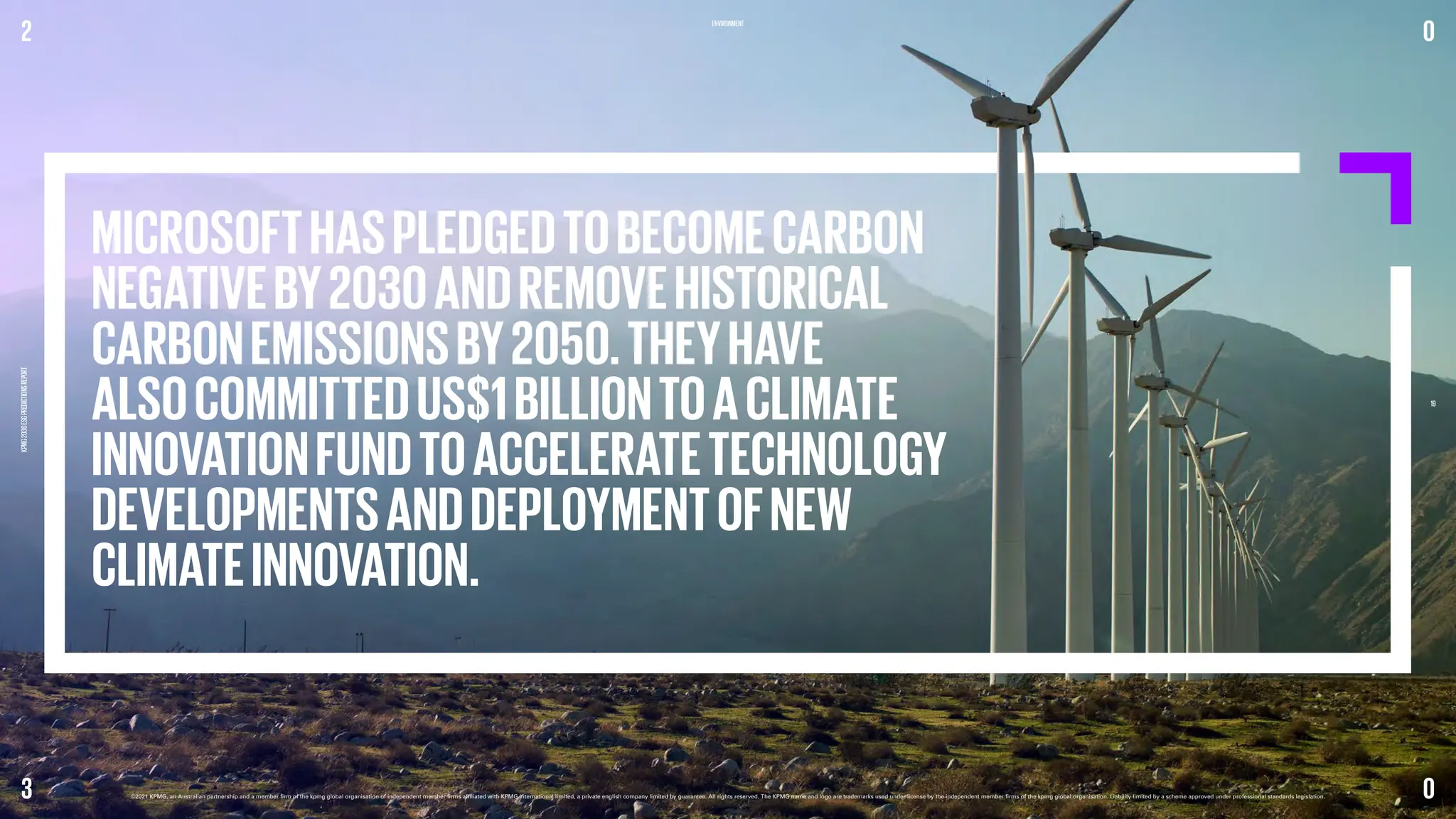
MICROSOFTHASPLEDGEDTOBECOMECARBON
NEGATIVEBY2030ANDREMOVEHISTORICAL
CARBONEMISSIONSBY2050.THEYHAVE
ALSOCOMMITTEDUS$1BILLIONTOACLIMATE
INNOVATIONFUNDTOACCELERATETECHNOLOGY
DEVELOPMENTSANDDEPLOYMENTOFNEW
CLIMATEINNOVATION.
0
0
19
©2021 KPMG, an Australian partnership and a member firm of the kpmg global organisation of independent member firms affiliated with KPMG international limited, a private english company limited by guarantee. 
All rights reserved. The KPMG name and logo are trademarks used under license by the independent member firms of the kpmg global organisation. Liability limited by a scheme approved under professional standards legislation.
3
KPMG
2030
ESG
PREDICTIONS
REPORT
2 ENVIRONMENT
ENVIRONMENT
ENVIRONMENT
What 2030 will look like
Theacceleratedpathtozeroemissionshas
anewNorthStar.Whileclimateambitionswill
escalateaheadofthefirst‘dropdead’interim
targetdateof2030,executionofthese
ambitionswillfaceconstraints.By2030,
organisationswillhaveshiftedawayfrom
avoidanceandoffsettingtoabatement
andremoval.
This shift will be influenced by a number of push
and pull factors, including rising insurance
premiums due to the risk of climate inaction.
Organisations that demonstrate a clear pathway
to beyond net zero will be reputationally more
resilient but they will need to clearly demonstrate
how their projects address the underlying cause, as
simply paying to offset carbon will be insufficient.
In the race to decarbonise, a level of transitionary
disruption will ensue due to consumer demand
and organisational aspiration outpacing policy and
planning.
CLIMATEAMBITION
Carbon negative is the new north star
35
Microsoft, Microsoft will be carbon negative by 2030, January 2020.
36
KPMG Australia, 30 Voices On 2030: The Future of Energy, September 2021
37
Taylor Fry, RADAR 2020, September 2020.
38
Scott Hardman and Gil Tal, Understanding Discontinuance Amongst California’s Electronic Vehicle Owners, Nature Energy, 2021.
Unanswered questions

What will be the catalyst that shifts
organisational mindsets from carbon
offsetting to carbon removal?

What happens after carbon negative?
Will ESG front runners make contributions
towards paying down the carbon debt
of other organisations?

How can organisations change but remain
agile amidst shifting sustainability goal posts?
What We Are Seeing Today
Microsoft has pledged to become carbon negative
by 2030 and remove historical carbon emissions by
2050. They have also committed US$1 billion to a
climate innovation fund to accelerate technology
developments and deployment of new climate
innovations35
.
Tim Buckley, Director of the Institute for Energy
Economics and Financial Analysis (IEEFA), notes
that: “in 2030, you cannot operate a company
which destroys the environment.
”36
Climate change and natural perils are top concerns
facing the insurance industry, particularly in the wake
of $1.3 billion in claims from the 2019 Australian Black
Summer bushfires37
.
Transitionary disruption is evidenced in a recent study.
In California, where EV per capita is second highest
in the world, results showed that nearly 20% of EV
buyers would go back to a fossil fuel car due to lack of
public charging infrastructure and no suitable charging
facility at home38
.
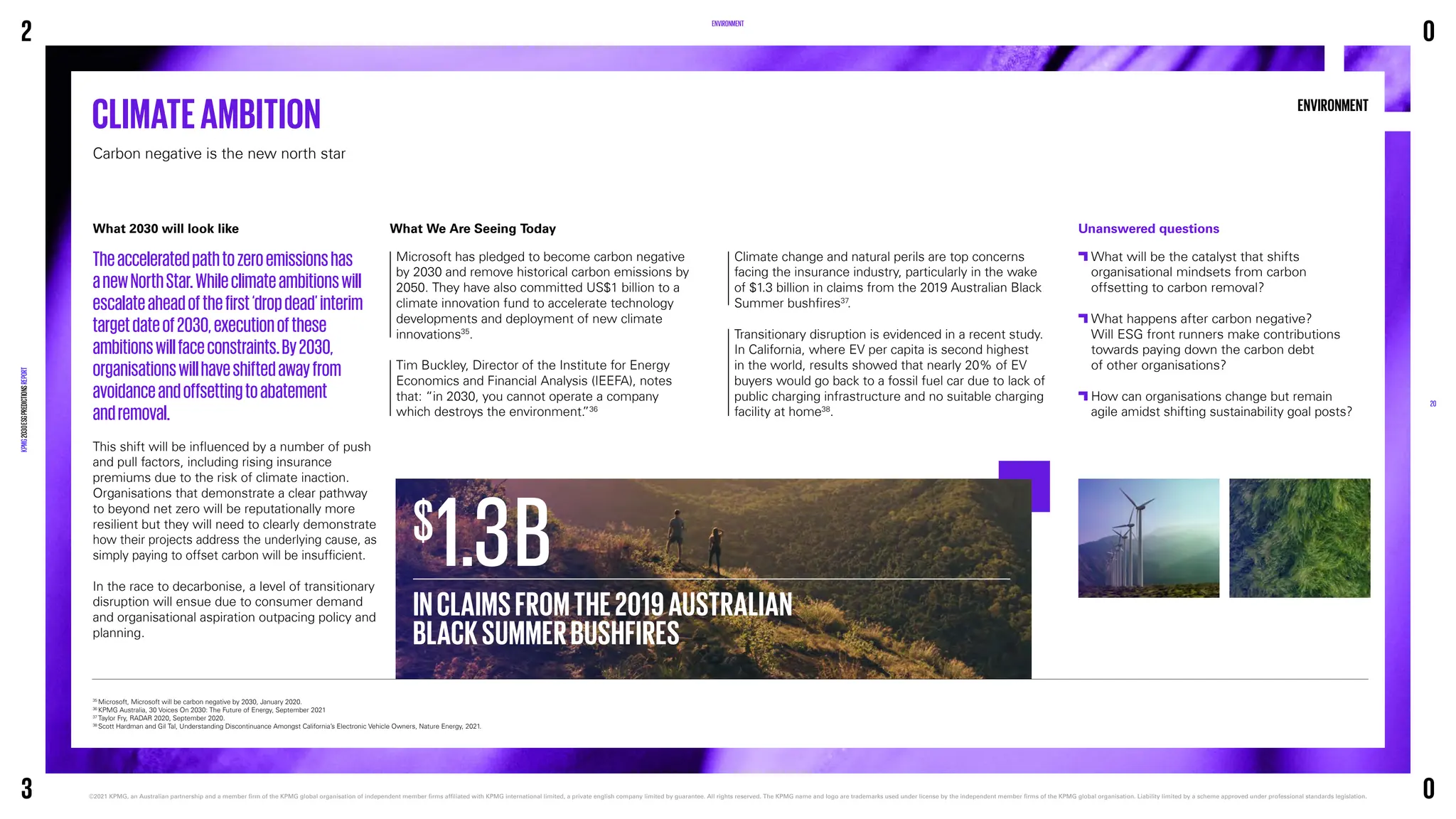
INCLAIMSFROMTHE2019AUSTRALIAN
BLACKSUMMERBUSHFIRES
1.3B
$
2
KPMG
2030
ESG
PREDICTIONS
REPORT
©2021 KPMG, an Australian partnership and a member firm of the KPMG global organisation of independent member firms affiliated with KPMG international limited, a private english company limited by guarantee. 
All rights reserved. The KPMG name and logo are trademarks used under license by the independent member firms of the KPMG global organisation. Liability limited by a scheme approved under professional standards legislation.
20
3
0
0
ENVIRONMENT
ENVIRONMENT
What 2030 will look like
Purchasingdecisionswillbecomeincreasingly
sophisticated,swayedbymorethanjustthe
‘MadeinX’label.Consumerswilldemandproof
ofethicalprocurement,renewableenergy
use,appropriatewastemanagementand
recyclingbestpracticesbeforecommitting
topurchases.
ESG priorities will transform supply chains,
with organisations moving to more open
and transparent production, underpinned by
principles of circularity. Sustainable technologies,
including eco-friendly blockchain39
and the Internet
of Things (IoT), will be leveraged to verify the end-
to-end ESG credentials of products and services.
Fast movers in this space will be Agriculture,
Energy and Manufacturing sectors. This
technology-enabled oversight will assist
organisations and regulatory bodies to better
combat fraud and corruption, support root-
cause failure identification, enable more efficient
product recalls, improve working conditions
and increase consumer confidence.
SUSTAINABLEASSURANCE
Traceability all the way from A to Z (and back to A again)
39
Eco-friendly blockchain is blockchain that is powered by sustainable resources.
40
KPMG Australia, KPMG Australia CEO Outlook: Plugged-in people-first, purpose-led, 2021.
41
KPMG Australia, KPMG Origins.
42
Green Queen, Evocco: This App Calculates Your Food Footprint With Your Grocery Store Receipts, March 2021.
43
Modern Slavery Act 2018 (Cth).
44
The N100 refers to a worldwide sample of 4,900 companies comprising the top 100 companies by revenue in each of the 49 countries researched in this study.
45
KPMG Impact, The time has come: The KPMG Survey of Sustainability Reporting 2020, December 2020.
Unanswered questions

How will digital solutions monitor and measure
social impact? How will organisations integrate
impact metrics of different stakeholder groups?

What needs to be created to support equal
access to emerging assurance technologies for
smaller organisations and organisations
in developing countries?

How will sustainable assurance be
communicated to consumers in a consistent,
meaningful and accessible way across diverse
stakeholder groups and international borders?
What We Are Seeing Today
58% of global Chief Executive Officers (CEO) state
they are experiencing an increasing demand for ESG
reporting and transparency40
.
Distributed Ledger Technology is being deployed with
success in the food and agri-business sector, enabling
greater transparency of global food supply chains to
verify product quality and improve traceability41
.
Evocco, a carbon footprint app in the United Kingdom
(UK), tracks the climate impact of grocery shopping
and offers consumers lower carbon alternatives42
.
The Modern Slavery Act 2018 (Cth) established a
national Modern Slavery Reporting Requirement
which applies to large Australian businesses and other
entities to address modern slavery risks and maintain
responsible and transparent supply chains43
.
The number of N10044
companies investing
in independent third-party assurance for their
sustainability information has exceeded 50%
for the first time since 199345
.
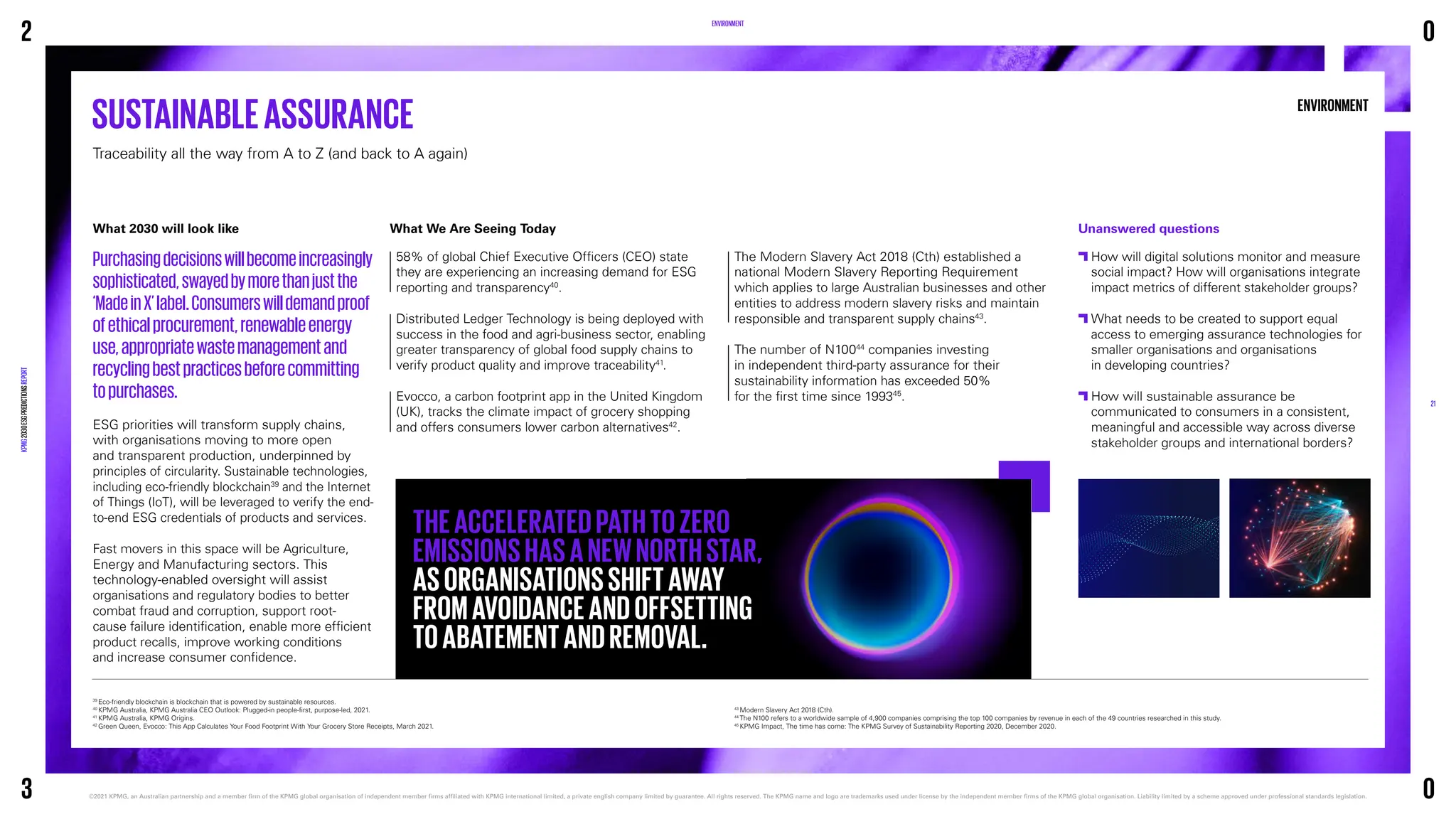
THEACCELERATEDPATHTOZERO
EMISSIONSHASANEWNORTHSTAR,
ASORGANISATIONSSHIFTAWAY
FROMAVOIDANCEANDOFFSETTING
TOABATEMENTANDREMOVAL.
2
KPMG
2030
ESG
PREDICTIONS
REPORT
©2021 KPMG, an Australian partnership and a member firm of the KPMG global organisation of independent member firms affiliated with KPMG international limited, a private english company limited by guarantee. 
All rights reserved. The KPMG name and logo are trademarks used under license by the independent member firms of the KPMG global organisation. Liability limited by a scheme approved under professional standards legislation.
21
3
0
0
2 SOCIAL
22
0
0
SOCIAL
KPMG
2030
ESG
PREDICTIONS
REPORT
3 ©2021 KPMG, an Australian partnership and a member firm of the KPMG global organisation of independent member firms affiliated with KPMG international limited, a private english company limited by guarantee. 
All rights reserved. The KPMG name and logo are trademarks used under license by the independent member firms of the KPMG global organisation. Liability limited by a scheme approved under professional standards legislation.
SOCIAL
What 2030 will look like
By2030,organisationswillneedto‘puttheir
moneywheretheirmouthis’anddemonstrate
theircommitmenttotransformation.
Consumerbehaviourwillbesignificantly
influencedbyorganisationalcommitment
andactiontowardssocialissuessuchas
equality,homelessnessandgeopolitical
issues–sittingonthefenceisnolonger
anoption.
Organisations that transform their business models
to become social enterprises will have a competitive
edge. Consumer demand to understand organisational
action will result in some organisations creating a public
register outlining their positions on key social issues.
This transparency will filter into organisational
operations and structures, with every decision
influenced by impact on the community. Employees
will be encouraged to voice opinions through
involvement in social movements and activism.
However, organisational involvement in social issues
will not be without its challenges.
Organisations will be held accountable for ESG
transgressions, faux pas and disingenuous actions.
To safeguard against social blacklisting, stronger
and more robust crisis management plans and
stakeholder engagement strategies will be vital.
MAKINGASTAND
Put your money where your heart is: the rise of organisations as activisits
46
Forbes, Airbnb Offers Free Housing to Refugees, Says Proper Safeguards Will Be in Place, August 2021.
47
Forbes, Canva Raises at $40 Billion Valuation – Its Founders Are Pledging Away Most Of Their Wealth, September 2021
48
Washington Post, As Big Corporations Say ’Black Lives Matter,’ Their Track Records Raise Scepticism, June 2020.
49
NPR, ‘SNL
’ Fires Comedian Shane Gillis For Racist Remarks, September 2019.
Unanswered questions

How will public social issues registers be
responsibly managed, addressing privacy
and ethical considerations?

What happens to individual employees who
don’t agree with an organisation’s stance?
Do they lose their voice?

Will organisations develop a blacklist of social
causes that employees cannot be involved in?

What is the saturation point for organisations
in their activist pursuits? Will organisations
retreat into their shell?
What We Are Seeing Today
Airbnb has demonstrated on-going support for the
Afghanistan refugee crisis by announcing in August
2021 it will house up to 20,000 refugees for free
through contributions from the charity entity, Airbnb.
org, and its co-founder, Brian Chesky46
.
Canva co-founders Melanie Perkins and Cliff Obrecht
have pledged to donate a 30% stake in the company
towards a foundation that invests in social causes,
such as eliminating extreme poverty in Southern
Africa47
.
Organisations were accused of “performative
allyship”, as the authenticity of their actions was
questioned after pledging support to address
inequalities during the Black Lives Matter movement48
.
A Saturday Night Live comedian was fired after
historical racial and homophobic comments had
surfaced49
.
SOCIAL
2
KPMG
2030
ESG
PREDICTIONS
REPORT
©2021 KPMG, an Australian partnership and a member firm of the KPMG global organisation of independent member firms affiliated with KPMG international limited, a private english company limited by guarantee. 
All rights reserved. The KPMG name and logo are trademarks used under license by the independent member firms of the KPMG global organisation. Liability limited by a scheme approved under professional standards legislation.
23
3
0
0
What 2030 will look like
Greaterculturalawarenesswilldriveorganisations
tolearnfrom,supportandamplifyIndigenousvoices
toaddressissuesfacingIndigenouspeoplesinways
thatenableself-determinationandagency.
FirstNationsexpertswillguideorganisationsinthe
formulationofstrategy,alternativebusinessmodel
developmentandinthecreationofnewinitiatives
whichchampionIndigenouscommunities.
Prior Informed Consent, outlined in the United Nations
Declaration on the Rights of Indigenous Peoples (UNDRIP),
will become the expected standard, embedding and
promoting Indigenous voice and consultation. There will
be an increased focus on impact investing, with more
sophisticated modelling of expected social dividends.
New procurement policies and frameworks for decision
making will result in Indigenous owned and run
organisations frequently winning large government
and private sector tenders.
Accelerator programs to upskill Indigenous
communities will be mainstream, increasing
representation across professional fields, while
ensuring alignment with Indigenous peoples’
values and lives.
Core business strategy will involve a focus on
creating sustainable employment opportunities for
Indigenous communities. Corporate sector actions
will highlight that the government is increasingly
out of step, resulting in a groundswell of
organisations and individuals lending their support
for a First Nations Voice to Parliament, resulting in
Constitutional recognition.
The consultation and refresh of Closing The
Gap initiatives with Indigenous and Torres Strait
Islanders peoples in 2020, will lead to greater
transparency and reporting on their impact.
FIRSTNATIONSENGAGEMENT
Indigenous voices, Constitutional enshrinement and transparent impact
SOCIAL
SOCIAL
2
KPMG
2030
ESG
PREDICTIONS
REPORT
©2021 KPMG, an Australian partnership and a member firm of the KPMG global organisation of independent member firms affiliated with KPMG international limited, a private english company limited by guarantee. 
All rights reserved. The KPMG name and logo are trademarks used under license by the independent member firms of the KPMG global organisation. Liability limited by a scheme approved under professional standards legislation.
24
3
0
0
SOCIAL
Unanswered questions

How can community leaders navigate and
coalesce a diverse range of individual opinions
to help organisations understand the collective
goals and aspirations of Indigenous peoples,
to define success in a way that is meaningful
for them?

How can local organisations engage with
Indigenous groups from other countries to
learn from global best practice?

What place-based solutions will emerge to
address Indigenous disadvantage in all its
shapes and forms?

How will the embedding of Indigenous values,
priorities and peoples into organisations
help shape the long-term approach to ESG
initiatives?

What will transparency, accountability and
integrated impact reporting on Closing The Gap
look like?
SOCIAL
The destruction of the 46,000 year-old Juukan Gorge
rock shelters has prompted a radical rethinking of
Australia’s cultural heritage laws, with particular focus
on practices within the energy and natural resources
industry. There has been a call from traditional owners
to rethink and redesign investment decision making
processes and for a right to veto industrial activities53
.
This is consistent with Free Prior Informed Consent
outlined in UNDRIP.
In 2019, the Business Council of Australia launched
the Raising the Bar project to grow the Indigenous
procurement capability and impact of Business
Council companies. Its key components include a
3% Indigenous procurement target over five years,
reporting and activities that develop Indigenous
suppliers54
.
Accelerators such as the Yarpa program aim to assist
high performing Indigenous companies looking to scale
their business55
. Other examples include the Pūhoro
Science, Technology, Engineering and Mathematics
(STEM) Academy in New Zealand, to enable Māori
representation in STEM-related industries56
.
What We Are Seeing Today
In 2019, the Response to the Uluru Statement
was developed by a range of organisations in
consultation with Aboriginal and Torres Strait
Islanders leaders within the organisations.
At that time, there were more than 1,000
Reconciliation Action Plans and 24 Elevate
Reconciliation Action Plans, reflecting the
highest level of endorsement in advancing
reconciliation. In 2020, more than 80% of
Australians recognised the importance
of Constitutional recognition50
.
For the first time in 2020, the Closing The Gap
targets were refreshed in consultation with
Indigenous and Torres Strait Islanders peoples
and the limited progress in closing the gap to
date has been noticeable51
.
In 2019, Minister for Indigenous Australians Ken
Wyatt committed to “develop[ing] and bring[ing]
forward a consensus option for constitutional
recognition to be put to a referendum during the
current parliamentary term.
”52
50
Reconciliation Australia, Australian Reconciliation Barometer 2020, 2020.
51
ABC News, Closing the Gap agreement reset with 16 new targets to improve lives of Aboriginal and Torres Strait Islanders Australians, July 2020.
52
KPMG, Alison Kitchen, Australian Chairman responds to Wyatt’s pledge for Indigenous recognition, July 2019.
53
Australian Broadcasting Corporation, First Nations leaders urge NSW to adopt Juukan Gorge inquiry protections, October 2021.
54
Business Council of Australia, Indigenous engagement.
55
Yarpa NSW Indigenous Business and Employment Hub, 15 Indigenous Businesses Graduate Intensive Indigenous Business Growth Program, November 2020.
56
New Zealand Government, New Partnership to Grow Māori success in STEM, May 2021.
FIRSTNATIONSENGAGEMENT(CONTINUED)
Indigenous voices, Constitutional enshrinement and transparent impact
2
KPMG
2030
ESG
PREDICTIONS
REPORT
©2021 KPMG, an Australian partnership and a member firm of the KPMG global organisation of independent member firms affiliated with KPMG international limited, a private english company limited by guarantee. 
All rights reserved. The KPMG name and logo are trademarks used under license by the independent member firms of the KPMG global organisation. Liability limited by a scheme approved under professional standards legislation.
25
3
0
0
FIRSTNATIONSEXPERTSWILLGUIDE
ORGANISATIONSINTHEFORMULATION
OFSTRATEGY,ALTERNATIVEBUSINESS
MODELDEVELOPMENTANDINTHE
CREATIONOFNEWINITIATIVESWHICH
CHAMPIONINDIGENOUSCOMMUNITIES.
0
0
26
©2021 KPMG, an Australian partnership and a member firm of the kpmg global organisation of independent member firms affiliated with KPMG international limited, a private english company limited by guarantee. 
All rights reserved. The KPMG name and logo are trademarks used under license by the independent member firms of the kpmg global organisation. Liability limited by a scheme approved under professional standards legislation.
3
KPMG
2030
ESG
PREDICTIONS
REPORT
2 SOCIAL
PARTNERSHIPSECOSYSTEMS
Co-opetition... Together for better
SOCIAL
57
C  E Advisory, CE Corporate-NGO Partnerships Barometer 2020, 2020.
58
Alliance To End Plastic Waste, About, September 2021.
59
Nasdaq, New Microsoft Partnership Highlights ‘S’  ‘G’ Elements of the ‘E’ in the ESG, August 2021.
60
Herbert Smith Freehills, ESG collaboration and competition law: change on the horizon?, March 2021.
SOCIAL
What 2030 will look like
Co-opetitionwillbeinfullforcein2030.
ESGissuescannotbesolvedbyasingle
organisation:acollaborative,whole-of-systems
approachwillberequiredtoimplementchange,
particularlyonthe‘Social’front.
Regulatoryandlegislativeapproacheswillbe
turnedontheirheadsoverthenextdecade.
Competitionlawswillfavourorganisational
collaborationsthatdemonstratebenefits
toconsumersandsociety.
Shared ESG initiatives will be bolstered by information
and resource sharing. Purpose-led ecosystems
comprising organisations, educational institutions,
start-ups, not-for-profits and government bodies,
will come together to tackle complex challenges
across industries such as preserving natural capital
and addressing climate risks, employee pay gaps
and diversity and inclusion.
The complimentary reach and capabilities of these
diverse organisations will drive innovative and creative
interventions. New backbone entities will emerge and
will play leading roles in orchestrating these alliances,
connecting entities using a values-based approach.
Unanswered questions

How can organisations balance the tension
between individual decision making and
accountability for collective commitments?

What safeguards will emerge to ensure that
the benefits of co-opetition are realised?

What is the role of these ecosystems in
establishing and driving best practice operations,
benchmarks and organisational activities?
What We Are Seeing Today
63% of corporates surveyed in 2020 stated that their
organisations increasingly enter strategic partnerships
to address purpose-led issues, that create societal,
organisational and stakeholder value57
.
The Alliance to End Plastic Waste is an alliance of over
80 member companies, project partners, allies and
supporters working in conjunction with policy makers,
Non-Governmental Organisations (NGOs) and local
communities to end plastic waste and protect the
environment58
.
Microsoft engaged in a partnership with Volt Energy
to allocate a portion of profits to community impact
funding initiatives supporting programs that bring
renewables to underserved communities without
access to clean energy. This demonstrates the
interconnected nature of ESG issues, with social and
environmental injustice often going hand in hand59
.
A progressive voice by comparison to other jurisdictions,
The Dutch Authority for Consumers and Markets
(ACM), has stipulated that certain types of sustainability
agreements will not be in breach of competition law
where they do not substantially discourage competition,
where the benefits of collaboration offset any
competition issues and if organisations act in good
faith, they will not face fines60
.
63%
CORPORATESSURVEYEDINCREASINGLY
ENTERSTRATEGICPARTNERSHIPSTO
ADDRESSPURPOSE-LEDISSUESTHAT
CREATESOCIETAL,ORGANISATIONAL
ANDSTAKEHOLDERVALUE.
2
KPMG
2030
ESG
PREDICTIONS
REPORT
©2021 KPMG, an Australian partnership and a member firm of the KPMG global organisation of independent member firms affiliated with KPMG international limited, a private english company limited by guarantee. 
All rights reserved. The KPMG name and logo are trademarks used under license by the independent member firms of the KPMG global organisation. Liability limited by a scheme approved under professional standards legislation.
27
3
0
0
TALENTAQUISITION
AI identifies your perfect ESG match
SOCIAL
61
The Verge, The next frontier in hiring is AI-driven, January 2019.
62
Seek, Psychometric assessments – what to expect if you’re asked to complete one.
63
Ibid.
64
Forbes, Can AI Improve Your Job Search? It Already Has, July 2020.
SOCIAL
What 2030 will look like
Increasinglydigitisedrecruitmentsystems
willsupportapersonalisedapproachtotalent
acquisitionandfurtherdiversityandinclusion
efforts.ArtificialIntelligence(AI)willaidin
theassessmentandalignmentofemployer
andprospectivecandidatevaluesystems,
achievingsuccessful‘ESGmatches.’
AI-enabled quasi-personality tests will also
be used for detecting ESG risks, such as
the likelihood of inappropriate conduct or
misalignment of values. This will increase the
competition for talent, with both parties vying
to demonstrate their desired credentials.
However, AI ESG matching will lead to a ‘stranded
people agenda’, with lower socioeconomic
workers at greater risk of being neglected.
Whilst ESG pedigree and potential will be critical,
organisations must consider how to incorporate
humanity, diversity, equity and inclusion into
talent acquisition and retention.
Unanswered questions

Will the increased integration of technology
evolve into a black-listing/green-lighting approach
to employee vetting? Is past behaviour truly
indicative of future performance?

How will organisations tailor their ESG initiatives
to increase relevance to attract the best talent?

What types of disclosures will organisations have
to make regarding the metrics and algorithms
behind their AI recruitment systems?

What privacy, ethics and discrimination
factors need to be considered when filtering
candidates based on personal behavior?
Will these technologies trump reference
checks and feedback?
What We Are Seeing Today
Frrole DeepSense AI uses social profiles to infer key
characteristics regarding situational leadership and
emotional intelligence61
.
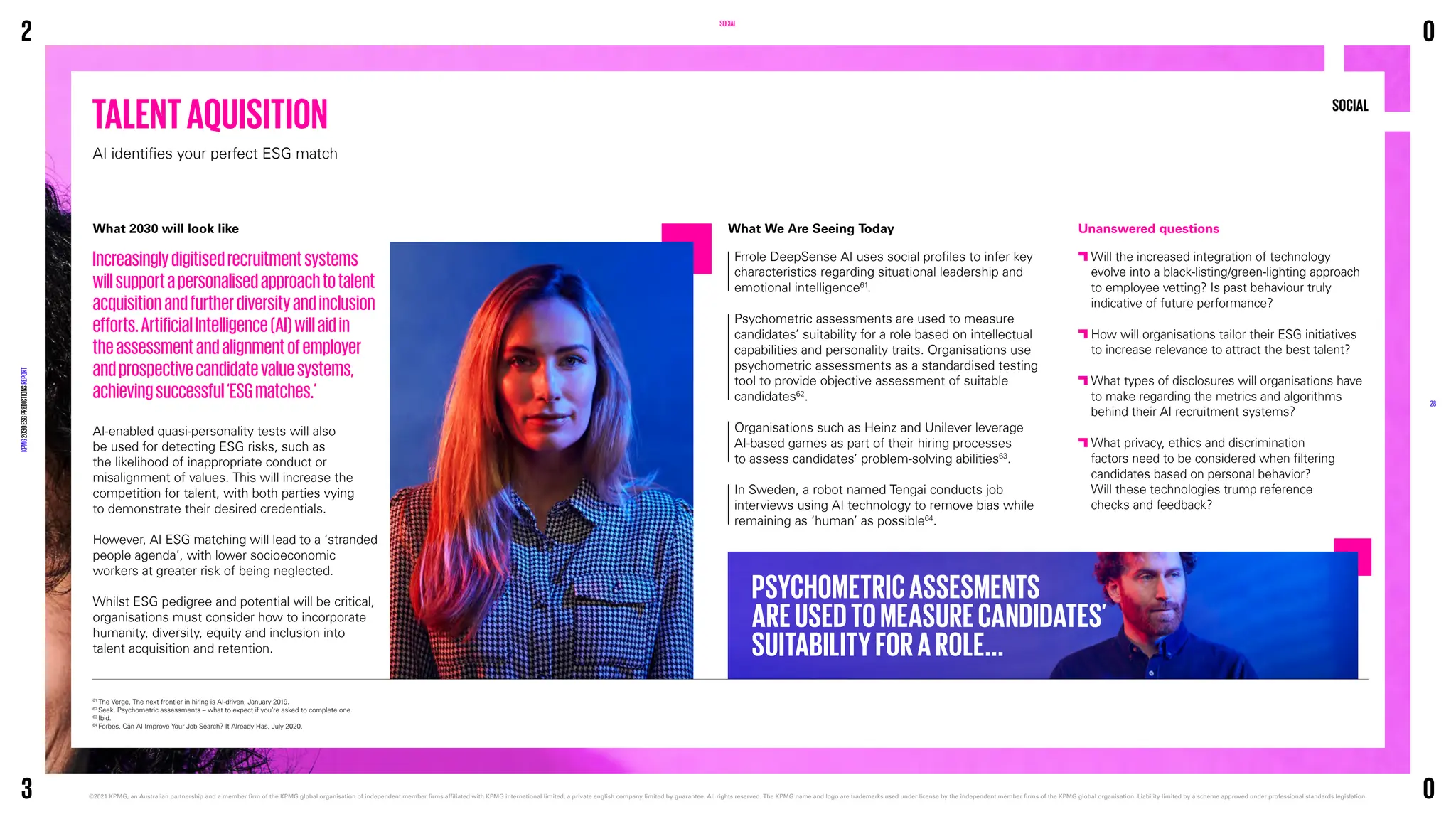
Psychometric assessments are used to measure
candidates’ suitability for a role based on intellectual
capabilities and personality traits. Organisations use
psychometric assessments as a standardised testing
tool to provide objective assessment of suitable
candidates62
.
Organisations such as Heinz and Unilever leverage
AI-based games as part of their hiring processes
to assess candidates’ problem-solving abilities63
.
In Sweden, a robot named Tengai conducts job
interviews using AI technology to remove bias while
remaining as ‘human’ as possible64
.
PSYCHOMETRICASSESMENTS
AREUSEDTOMEASURECANDIDATES’
SUITABILITYFORAROLE...
2
KPMG
2030
ESG
PREDICTIONS
REPORT
©2021 KPMG, an Australian partnership and a member firm of the KPMG global organisation of independent member firms affiliated with KPMG international limited, a private english company limited by guarantee. 
All rights reserved. The KPMG name and logo are trademarks used under license by the independent member firms of the KPMG global organisation. Liability limited by a scheme approved under professional standards legislation.
28
3
0
0
3
2
KPMG
2030
ESG
PREDICTIONS
REPORT
29
0
0
GOVERNANCE
©2021 KPMG, an Australian partnership and a member firm of the KPMG global organisation of independent member firms affiliated with KPMG international limited, a private english company limited by guarantee. 
All rights reserved. The KPMG name and logo are trademarks used under license by the independent member firms of the KPMG global organisation. Liability limited by a scheme approved under professional standards legislation.
ENVIRONMENT
WILLORGANISATIONS
NEEDTOBETRANSPARENT
REGARDINGTHEREASONS
BEHINDDIFFERENCESINPAY?
GOVERNANCE
2
KPMG
2030
ESG
PREDICTIONS
REPORT
©2021 KPMG, an Australian partnership and a member firm of the KPMG global organisation of independent member firms affiliated with KPMG international limited, a private english company limited by guarantee. 
All rights reserved. The KPMG name and logo are trademarks used under license by the independent member firms of the KPMG global organisation. Liability limited by a scheme approved under professional standards legislation.
30
3
0
0
REMUNERATION
Show me the FAIR money
GOVERNANCE
65
Fortune, EU considering pay transparency rules to help close gender pay gap, March 2021.
66
Citigroup, Citi’s Latest Update on Global Pay Equity, January 2021.
67
KPMG Australia, Replace Paid Parental Leave scheme: move to equal parenting model, April 2021.
68
Pipeline, Pipeline.
GOVERNANCE
What 2030 will look like
Organisationswillleadthechargeonthe
paygapagenda,withlegislationeventually
enactedaroundmaximumpermissiblepay
gapsacrossallemployeegroups.Thiswill
specifycriteriaguidingfairpay,balancing
theneedtoimprovesocialinequities,
addressdiscriminationandrecognise
merit,informedbysocio-culturalchanges
andhumanrightsstandards.
Artificial Intelligence (AI) will be broadly
deployed to identify potential discrimination
factors, for example intersectional identities.
These technologies will evaluate employment
variables, creating benchmarks and making
recommendations to reduce pay disparity
across the employee lifecycle.
They will interface directly with the regulator
so pay discrepancy alerts are automatically
triggered and actioned, with sanctions
imposed for repeat organisational offenders.
The European Union (EU) Commission has proposed
pay transparency legislation to help close gender pay
gaps, with non-compliance resulting in penalties. Large
organisations would be required to publish information
on pay and provide detailed information to staff65
.
The pay gap is being analysed and actioned based on
data. Citi analysed their 2021 pay results, disclosing
that globally, women were paid more than 99% of men
on an adjusted, like-for-like, basis. Additionally, they
found that there was no statistically significant pay gap
between minorities and non-minorities in United States
(US)66
.
In South Africa, a Bill has been put forward for
consultation, requiring publicly listed organisations and
stated-owned enterprises to disclose pay gaps between
Directors and workers in annual financial statements67
.
Pipeline has launched software using AI to help
organisations track their gender equity metrics,
identify internal areas of unconscious bias and actively
make recommendations to increase gender equity68
.
Unanswered questions

Will organisations need to be transparent
regarding the reasons behind differences
in pay, enabling employees to proactively
address them (e.g. the need to acquire
a new skill)?

Will organisations be required to address
historical pay gaps and what will be the
extent of this?

How will non-financial elements of work
(e.g. flexible working arrangements and
unlimited leave) be balanced within the
award of equal pay?

How will organisations ensure that
accurate and timely data is used for
determining appropriate remuneration?
What We Are Seeing Today
2
KPMG
2030
ESG
PREDICTIONS
REPORT
©2021 KPMG, an Australian partnership and a member firm of the KPMG global organisation of independent member firms affiliated with KPMG international limited, a private english company limited by guarantee. 
All rights reserved. The KPMG name and logo are trademarks used under license by the independent member firms of the KPMG global organisation. Liability limited by a scheme approved under professional standards legislation.
31
3
0
0
ORGANISATIONROLES
New roles and remits at the C-suite table
GOVERNANCE
69
Forbes, A Sustainability Revolution Is Coming, Are Leaders Ready?, March 2021.
70
KPMG Australia, ESG, Corporate Purpose, Cyber, Top List of CEO Priorities, KPMG Outlook, September 2021.
71
Seek, Job Search: ESG, 2021.
72
Financial Times, Jobs Bonanza in Stewardship and Sustainable Investing Teams, March 2020
73
KPMG Australia, ESG, corporate purpose, cyber, top list of CEO priorities, September 2021.
GOVERNANCE
What 2030 will look like
WithESGcommitmentsdrivingorganisational
practices,therewillbeincreasingdemandfor
newESG-centricleadershipteams.TheC-suite
willexpandtoincludeadditionalrolessuchas
aChiefImpactOfficer,ChiefPurposeOfficer
andChiefESGEthicist,whowillworkalongside
theChiefSustainabilityOfficer.Theseroles
willbesupportedbyenvironmentalandsocial
scienceexperts,includingESGstrategists.
Financial and Energy sectors will lead the way,
with others quickly following suit. This team will
be accountable for ensuring ESG targets are
met and compliance activities are completed
to a high standard.
However, these roles are transitionary and will
adapt and change rapidly over the coming years as
organisational mindsets shift to embedding an ‘ESG
culture,’ ensuring that ESG is everyone’s responsibility.
Key performance indicators (KPI) for employees
and executive compensation will be directly tied
to positive ESG outcomes, resulting in ESG practices
becoming part of business as usual.
Leaders are already recognising that dysfunctional
cultures that prioritise short-term decision making
and profits over long-term sustainability goals destroy
organisational value, as demonstrated by a string of
high-profile emissions scandals69
.
42% of global Chief Executive Officers (CEO) admitted
that they were “struggling to articulate a compelling
ESG story” to their stakeholders70
.
ESG specific roles such as ESG Program Manager, ESG
Specialist and Associate Director of ESG are already
growing in demand, with hundreds of open positions
in Australia alone71
.
In the global finance industry, dedicated stewardship
teams overseeing ESG issues at portfolio companies
doubled between 2017-2020, with other dedicated
ESG jobs increasing fourfold72
.
More than 46% of Australian CEOs and 30% of global
CEOs reported that their pay was based, at least partly,
on ESG issues, as well as financial performance. 70%
believed they were being evaluated by key stakeholders
through an ESG lens73
.
Unanswered questions

Will compensation tied to ESG outcomes
move beyond the C-suite? Will all employees
eventually have their remuneration tied in part
to ESG outcomes?

Will a separate class of ESG-linked share
options form part of executive compensation,
with vesting periods and claw back terms linked
to outcomes over the long-term?

As ESG issues come to the forefront of
Board conversations, will this result in
fewer organisational silos due to operational
alignment?
What We Are Seeing Today
42%
GLOBALCHIEFEXECUTIVEOFFICERS(CEO)
ADMITTEDTHATTHEYWERE“STRUGGLING
TOARTICULATEACOMPELLINGESGSTORY”
TOTHEIRSTAKEHOLDERS
2
KPMG
2030
ESG
PREDICTIONS
REPORT
©2021 KPMG, an Australian partnership and a member firm of the KPMG global organisation of independent member firms affiliated with KPMG international limited, a private english company limited by guarantee. 
All rights reserved. The KPMG name and logo are trademarks used under license by the independent member firms of the KPMG global organisation. Liability limited by a scheme approved under professional standards legislation.
32
3
0
0
CORPORATECITIZENSHIP
Demonstrating social licence will be demanding – it’s an ESG jungle out there
GOVERNANCE
74
Intelligize, Activist Claims Oatly’s ESG Program is More Sizzle Than Steak, August 2021.
75
ABC News, Facebook Defamation Ruling by High Court Exposes All Page Owners to Lawsuits, Not Just the Media, September 2021.
76
Business Insider, Australians‘ Trust in Banks Below Global Standards, May 2019.
77
Australian Financial Review, Heavy is the Head that Wears the ESG Crown, August 2021.
GOVERNANCE
What 2030 will look like
AstheESGmandatebecomesincreasingly
multi-faceted,corporatecitizenshipasitis
knowninthelate2020swillbetransformed
andbecomeintegratedintobusinessas
usual.However,theobstaclesorganisations
willhavetofacetodemonstratetheirsocial
licencewillbedemanding.
Organisations will be forced to navigate a jungle
of regulation, policy, legal action, whistleblowing
and institutional activism,
as they work to build and maintain
consumer trust.
In the face of environmental and social licence
issues, particularly in Mining and Agriculture
sectors, there will be a need to look beyond
traditional approaches to governance and
risk management and operationalise these
behaviours in every role and at every level.
A shareholder class action was recently launched
against a food production organisation on the basis
of poor accounting practices, internal controls and using
its ESG program to greenwash74
.
Moderating content on social media and a range of
stakeholder views is becoming increasingly challenging.
The High Court of Australia found that media
organisations are legally responsible for comments
made on their social media pages, irrespective of
author, as facilitator and moderator of comments75
.
The theme of trust is prevalent, as seen in the fallout
from the Banking Royal Commission, resulting in wide-
spread mistrust in Australia’s financial sector, insurance
and other related industries. In 2019, 33% of Australians
reported decreased trust in banks, compared to 13% in
the United States (US)76
.
The pricing of ESG-related risk is requiring greater
sophistication, with challenges compounded by a lack
of information. However, 60% of large organisations are
now sharing data, up from 10% a decade ago77
.
Unanswered questions

What technologies will be established to
enable organisations to keep their fingers
on the pulse regarding ESG issues?

Will members of Parliament need to tangibly
demonstrate their social licence to operate?

Will we see the rise of ESG litigation funds
or ESG-related ‘no win, no fee’ firms emerge,
reducing the cost barriers to entry to start
a cause of action?
What We Are Seeing Today
33%
OFAUSTRALIANSREPORTED
DECREASEDTRUSTINBANKS
13%
INTHEUNITEDSTATES(US)
COMPAREDTO
2
KPMG
2030
ESG
PREDICTIONS
REPORT
©2021 KPMG, an Australian partnership and a member firm of the KPMG global organisation of independent member firms affiliated with KPMG international limited, a private english company limited by guarantee. 
All rights reserved. The KPMG name and logo are trademarks used under license by the independent member firms of the KPMG global organisation. Liability limited by a scheme approved under professional standards legislation.
33
3
0
0
The information contained in this document is of a general nature and is not intended to address the objectives, financial situation or needs of any particular individual or entity. It is provided for information purposes only and does not constitute, nor should it be regarded in any manner whatsoever, as advice and is not
intended to influence a person in making a decision, including, if applicable, in relation to any financial product or an interest in a financial product. Although we endeavour to provide accurate and timely information, there can be no guarantee that such information is accurate as of the date it is received or that it will
continue to be accurate in the future. No one should act on such information without appropriate professional advice after a thorough examination of the particular situation.
To the extent permissible by law, KPMG and its associated entities shall not be liable for any errors, omissions, defects or misrepresentations in the information or for any loss or damage suffered by persons who use or rely on such information (including for reasons of negligence, negligent misstatement or otherwise).
©2021 KPMG, an Australian partnership and a member firm of the KPMG global organisation of independent member firms affiliated with KPMG International Limited, a private English company limited by guarantee. All rights reserved.
The KPMG name and logo are trademarks used under license by the independent member firms of the KPMG global organisation.
Liability limited by a scheme approved under Professional Standards Legislation.
December 2021. 803231466FIRM.
KPMG.COM.AU

KPMG – ESG Predictions 2030 | Future Trends in Sustainability & Governance

  • 1.
  • 2.
    OVERVIEWUNIVERSALIMPACTS PRICING ESGdoesn’tcomeforfree anditcertainlydoesn’tgrow ontrees ESG products, services andcompany valuations will reflect the costly nature of ESG compliance and practices. CONSEQUENCESOFPOORESGPERFORMANCE ESG-ruptcyleadstoblacklistingandpersonalliability Demand for transparent and proven ESG policies and practices will lead to the introduction of mandatory ESG ratings and certification processes, with consistent non- compliances met with severe consequences. TECHNOLOGY DigitalTwinsenableanewESGreality There will be broad uptake of Digital Twin technology, enabling organisations to monitor and adjust their business activities in real-time. DATA GEOPOLITICS TheGreatESGDataBoom An exponential increase in the amount of ESG data will drive accountability and accelerate progress against organisational ESG objectives and the United Nation’s Sustainable Development Goals. CONSUMERS Therise(andthefall) oftheESGCowboy As the lucrative nature of successful sustainable business models become apparent, bad actors will attempt to exploit the ‘wild ESG west.’ Newcracksforminthe geopoliticallandscape Defining a global ESG policy will be fraught with danger for transnational corporations as world governments, trade consortiums and political blocks increasingly assert their influence to progress their individual agendas. 57% OFCONSUMERSPLEDGEDTOSHOPATSTORES WITHASTRONGFAIRTRADECOMMITMENT. FACTORSINCLUDED:NOCHILDLABOR,TACKLING POVERTYANDPROTECTINGAGAINST DEFORESTATION. UNIVERSALIMPACTS 65% OFINTERNATIONALDEALMAKERSBELIEVE ESGISAKEYCONSIDERATIONWHENMAKING INVESTMENTSANDINMERGERS&ACQUISITIONS (M&A)DECISIONS. 2 KPMG 2030 ESG PREDICTIONS REPORT ©2021 KPMG, an Australian partnership and a member firm of the KPMG global organisation of independent member firms affiliated with KPMG international limited, a private english company limited by guarantee. All rights reserved. The KPMG name and logo are trademarks used under license by the independent member firms of the KPMG global organisation. Liability limited by a scheme approved under professional standards legislation. 2 3 0 0
  • 3.
    BIODIVERSITY 55 20 % % Youdon’tknowwhatyou’vegot‘tilit’sgone... If you breakit – you own it. Biodiversity, and the ecological impact of human and economic activities, will be assessed, measured and valued as a new asset class, with all living creatures becoming key stakeholders. OFGLOBALGROSSDOMESTICPRODUCT(GDP), EQUALTOUS$41.7TRILLION,DEPENDSONHIGH- FUNCTIONINGBIODIVERSITYANDECOSYSTEMS, WITHAFIFTHOFCOUNTRIESGLOBALLYATRISK OFTHEIRECOSYSTEMSCOLLAPSING. OFELECTRICVEHICLEBUYERSWOULDGOBACK TOAFOSSILFUELCARDUETOLACKOFPUBLIC CHARGINGINFRASTRUCTUREANDNOSUITABLE CHARGINGFACILITYATHOME. CLIMATEAMBITION Carbonnegativeisthenewnorthstar The accelerated path to zero emissions has a new North Star, as organisations shift away from avoidance and offsetting to abatement and removal. SUSTAINABLEASSURANCE TraceabilityallthewayfromAtoZ(andbacktoAagain) ESG priorities will transform supply chains, with sustainable technologies leveraged to verify end-to-end ESG credentials. ENVIRONMENT OVERVIEWENVIRONMENT 2 KPMG 2030 ESG PREDICTIONS REPORT ©2021 KPMG, an Australian partnership and a member firm of the KPMG global organisation of independent member firms affiliated with KPMG international limited, a private english company limited by guarantee. All rights reserved. The KPMG name and logo are trademarks used under license by the independent member firms of the KPMG global organisation. Liability limited by a scheme approved under professional standards legislation. 3 3 0 0
  • 4.
    MAKINGASTAND 63% Putyourmoneywhereyourheartis:Theriseoforganisations asactivists Organisations will needto demonstrate their commitment to key social issues - sitting on the fence will no longer be an option. CORPORATESSURVEYEDINCREASINGLY ENTERSTRATEGICPARTNERSHIPSTOADDRESS PURPOSE-LEDISSUESTHATCREATESOCIETAL, ORGANISATIONALANDSTAKEHOLDERVALUE. PARTNERSHIPSECOSYSTEMS Co-opetition...Togetherforbetter Co-opetition will be in full force in 2030: a whole-of-systems approach between organisations will be required to implement and drive ESG change. TALENTACQUISITION AIidentifiesyourperfectESGmatch ESG priorities will transform supply chains, with sustainable technologies leveraged to verify end-to-end ESG credentials. SOCIAL FIRSTNATIONSENGAGEMENT Indigenousvoices,Constitutionalenshrinement andtransparentimpact Greater cultural awareness will drive organisations to learn from, support and amplify Indigenous voices to address issues facing Indigenous peoples, resulting in support for a First Nations Voice to Parliament and Constitutional recognition. OVERVIEWSOCIAL 2 KPMG 2030 ESG PREDICTIONS REPORT ©2021 KPMG, an Australian partnership and a member firm of the KPMG global organisation of independent member firms affiliated with KPMG international limited, a private english company limited by guarantee. All rights reserved. The KPMG name and logo are trademarks used under license by the independent member firms of the KPMG global organisation. Liability limited by a scheme approved under professional standards legislation. 4 3 0 0
  • 5.
    REMUNERATION ShowmetheFAIRmoney Organisations will leadthe charge on the pay gap agenda, with legislation eventually enacted around maximum permissible pay gaps across all employee groups. 99% OFWOMENWORKINGFORCITIWEREPAID MORETHANMEN,ONANADJUSTED,LIKE- FOR-LIKE,BASIS ORGANISATIONROLES NewrolesandremitsattheC-suitetable The C-suite will expand to include new ESG-centric leadership teams which will adapt and change rapidly over the coming years, as organisational mindsets shift to embedding an ‘ESG culture.’ CORPORATECITIZENSHIP Demonstratingsociallicencewillbedemanding– it’sanESGjungleoutthere Corporate citizenship will transform and organisations will be forced to navigate a jungle of regulation, policy, legal action, whistleblowing and institutional activism, as they work to build and maintain consumer trust. GOVERNANCE OVERVIEWGOVERNANCE 2 KPMG 2030 ESG PREDICTIONS REPORT ©2021 KPMG, an Australian partnership and a member firm of the KPMG global organisation of independent member firms affiliated with KPMG international limited, a private english company limited by guarantee. All rights reserved. The KPMG name and logo are trademarks used under license by the independent member firms of the KPMG global organisation. Liability limited by a scheme approved under professional standards legislation. 5 3 0 0
  • 6.
    INTRODUCTION 3 2 INTRODUCTION KPMG 2030 ESG PREDICTIONS REPORT 6 0 0 ©2021 KPMG,an Australian partnership and a member firm of the KPMG global organisation of independent member firms affiliated with KPMG international limited, a private english company limited by guarantee. All rights reserved. The KPMG name and logo are trademarks used under license by the independent member firms of the KPMG global organisation. Liability limited by a scheme approved under professional standards legislation.
  • 7.
    INTRODUCTION BY2030, THEESGLANDSCAPE WILLHAVEEXPANDED ANDTRANSFORMED... 2 KPMG 2030 ESG PREDICTIONS REPORT ©2021 KPMG, anAustralian partnership and a member firm of the KPMG global organisation of independent member firms affiliated with KPMG international limited, a private english company limited by guarantee. All rights reserved. The KPMG name and logo are trademarks used under license by the independent member firms of the KPMG global organisation. Liability limited by a scheme approved under professional standards legislation. 7 3 0 0
  • 8.
    INTRODUCTION Acombinationofregulatorypush, mandatingESGdisclosures,andpull fromarangeofstakeholderswill increasethestakesonESGaction (orinaction).Organisationsthat transformtheirbusinessmodels overthenextdecadeandputESG frontandcentreoftheiroperations andculture,willreaptherewards. Prizes for swiftadoption may include greater brand loyalty, the ability to secure capital, increased profits and valuations. Those who fail to adapt, or who do so disingenuously, will face a reduction in market share, black-listing, severe penalties and potentially imprisonment. The ESG road to 2030 will not be an easy one to navigate and there will be transitionary disruption, as private industry charges ahead of policy and regulation. Organisations will need to meaningfully engage with a range of stakeholders and demonstrate tangible actions, beyond PR stunts. ESG mandates for transparency will propel the need for radical digital transformation. Thorough oversight and high-quality data and analysis will be essential to measure and assess performance against organisational objectives and regulatory frameworks. Fortunately, this road will not be a lonely one. With the emergence of new roles within organisations and a regulatory shift to enable co-opetition, ESG initiatives will be well supported by those with shared interests. Organisational stances on key ESG issues will be vital to attracting top talent. First Nations people will hold critical roles in the creation of new ESG initiatives and will work together with organisations to amplify Indigenous voices and enhance cultural protection, resulting in Constitutional recognition. Although the investment costs of transitioning to an ESG focus may deter some, ultimately the cost of complacency will be far greater. Will your organisation be an ESG leader or will it be left behind? What is clear... in 2030 there is no room for sitting on the fence. 2 KPMG 2030 ESG PREDICTIONS REPORT ©2021 KPMG, an Australian partnership and a member firm of the KPMG global organisation of independent member firms affiliated with KPMG international limited, a private english company limited by guarantee. All rights reserved. The KPMG name and logo are trademarks used under license by the independent member firms of the KPMG global organisation. Liability limited by a scheme approved under professional standards legislation. 8 3 0 0 INTRODUCTION
  • 9.
    3 2 UNIVERSALIMPACTS KPMG 2030 ESG PREDICTIONS REPORT 9 0 0 UNIVERSALIMPACTS ©2021 KPMG,an Australian partnership and a member firm of the kpmg global organisation of independent member firms affiliated with KPMG international limited, a private english company limited by guarantee. All rights reserved. The KPMG name and logo are trademarks used under license by the independent member firms of the kpmg global organisation. Liability limited by a scheme approved under professional standards legislation.
  • 10.
    Disputes regarding ESGissues have wiped more than US$500 billion off the value of large United States (US) organisations over the past five years, with fines amounting over US$243 billion paid by US banks since the financial crisis4 . A dominant player in the Energy sector lost two seats on its Board to members of a climate activist hedge fund. After years of unsatisfactory climate efforts, their shareholders chose real climate action over business as usual5 . 65% OFINTERNATIONALDEALMAKERSBELIEVE ESGISAKEYCONSIDERATIONWHENMAKING INVESTMENTSANDINMERGERSACQUISITIONS (MA)DECISIONS. UNIVERSALIMPACTS UNIVERSALIMPACTS What 2030 will look like What We Are Seeing Today DemandfortransparentandprovenESGpolicies andpracticeswillleadtotheintroduction ofmandatoryESGratingsandcertification processes,comparablebyindustry. Investors and shareholders will have high ESG expectations and poor performing organisations will be starved of capital and see impacts on their share price. By 2030, poor performers have been weeded out and consistent non-compliance will be met with severe consequences including penalties, public naming, a prohibition to operate and even imprisonment. The C-Suite and Directors will now be personally liable for ESG breaches. International organisations, such as the Task Force on Climate-related Financial Disclosures, the United Nations (UN), International Sustainability Standards Board (ISSB) and the World Economic Forum (WEF) are aiming to standardise international disclosure requirements. The European Union (EU) is one of the drivers for a standardised process, with Taxonomy Regulation outlining a classification that systematises what economic activities are environmentally sustainable. This standardisation system could be extended to social and governance factors1 . 65% of international dealmakers believe ESG is a key consideration when making investments and in Mergers Acquisitions (MA) decisions2 . Share trading platforms are streamlining the ethical investment process for retail investors with ESG ratings based on non-financial analysis of environmental, social, governance and corporate controversy metrics3 . Unanswered questions What does consistent non-compliance look like? Which breaches have greater consequences than others? Will a market develop centered on identifying and exploiting ESG loopholes for organisations, similar to tax avoidance? How will ESG ratings, particularly Social and Governance factors, be comparable across countries? What agreements will occur between governments to create harmony? Will we see a new class of private equity emerge focusing on non-compliant businesses and making them compliant to sell for a profit? CONSEQUENCESOFPOORESGPERFORMANCE ESG-ruptcy leads to blacklisting and personal liability 1 Australian Institute of International Affairs, Mandatory Reporting for Environmental Social Governance Metrics, July 2021. 2 Smart Company, How poor ESG performance can stop a merger or acquisition in its tracks, June 2021. 3 Self Wealth, Your Guide to ESG Investing, October 2021. 4 Financial Times, ESG controversies wipe $500bn off value of US companies, December 2019. 5 Reuters, Exxon Loses Board Seats to Activist Hedge Fund in Landmark Climate Vote, May 2021. 2 KPMG 2030 ESG PREDICTIONS REPORT ©2021 KPMG, an Australian partnership and a member firm of the KPMG global organisation of independent member firms affiliated with KPMG international limited, a private english company limited by guarantee. All rights reserved. The KPMG name and logo are trademarks used under license by the independent member firms of the KPMG global organisation. Liability limited by a scheme approved under professional standards legislation. 10 3 0 0
  • 11.
    6 Corrs Chambers Westgarth,Corporate ‘greenwashing’ the latest target for climate litigation, September 2021. 7 Bloomberg, Fund Managers Feel Heat in SEC Crackdown of Overblow ESG Labels, September 2021. 8 The Guardian, Competition Watchdog Gives Firms Deadline on Ending ‘Greenwashing’, September 2021 9 ACCR, Australasian Centre for Corporate Responsibility files landmark case against Santos in Federal Court, August 2021. UNIVERSALIMPACTS UNIVERSALIMPACTS What 2030 will look like What We Are Seeing Today Asthelucrativenatureofsuccessfulsustainable businessmodelsbecomeapparent,badactors willattempttoexploitthe‘wildESGwest.’ ESG Cowboys and profiteering ESG advisors will benefit from disingenuous and unsubstantiated claims, until consumers and society demand to view and validate their ESG credentials. There will be increased scrutiny of organisations which only deploy ESG strategies in some parts of their business but fundamentally have unsustainable business models, such as in fashion and manufacturing. Genuine action and measurable follow through on key ESG issues will be key to maintaining customer loyalty and avoiding regulatory discipline. ‘Green’ competition between organisations has propelled the frequency of climate and sustainability- related business targets and product claims6 . United States (US) regulators are cracking down on $35 trillion in sustainable assets. The Securities and Exchange Commission (SEC) is reviewing standards adopted by ESG-focused funds, due to concerns about misrepresentation and mis-labeling of environmental credentials7 . Criticism of profiteering has been increasingly directed at fast fashion brands that launch eco- conscious lines to appeal to Gen Z consumers, whilst also running unsustainable business models that rely upon exponential growth and production. After finding that up to 40% of organisations’ ‘green claims’ were misleading, the UK Competition and Markets Authority (CMA) established a Green Claims Code (Code). The Code includes guidelines around information transparency and consideration for full product lifecycle, with transgressions resulting in fines, sanctions and potential imprisonment8 . Litigation has commenced in the Federal Court of Australia, challenging the accuracy of an organisation’s net zero emissions target and their claims based on technological advancements that have not yet occurred9 . Unanswered questions As greenwashing becomes more sophisticated and harder to detect, how will consumers, auditors and regulators seek new methods of assurance? Will future actions atone for past sins? How forgiving will consumers be after an ESG breach? Will a market form around ESG remediation to address disingenuous and unsubstantiated claims? CONSUMERS The rise (and the fall) of the ESG Cowboy 57% OFCONSUMERSPLEDGEDTOSHOP ATSTORESWITHASTRONGFAIRTRADE COMMITMENT.FACTORSINCLUDED:NO CHILDLABOR,TACKLINGPOVERTYAND PROTECTINGAGAINSTDEFORESTATION. 2 KPMG 2030 ESG PREDICTIONS REPORT ©2021 KPMG, an Australian partnership and a member firm of the KPMG global organisation of independent member firms affiliated with KPMG international limited, a private english company limited by guarantee. All rights reserved. The KPMG name and logo are trademarks used under license by the independent member firms of the KPMG global organisation. Liability limited by a scheme approved under professional standards legislation. 11 3 0 0
  • 12.
    UNIVERSALIMPACTS UNIVERSALIMPACTS What 2030 willlook like What We Are Seeing Today AstheESGagendamovestotheforefront ofcorporatestrategies,organisationswill quicklyrealisethetruecostofESGcompliance andpractices. ESG products, services and company valuations will reflect the cost of doing ‘ESG business.’ These costs will either be absorbed by the business or passed onto the consumer, however, we will see some backlash from lower socioeconomic consumers who aren’t willing to pay the ESG premium. Consumer purchasing behaviour will now be influenced by a broader range of social and governance issues. This will create a market for high ESG-rated products which despite being more costly, gives them the ‘ESG edge.’ This will filter down to mainstream retailers, such as supermarkets and clothing stores, selling all-encompassing ESG conscious products and services which allocate profits to social, governance and environmental causes. Cost of business remains a concern due to the pandemic. Small and mid-sized organisations that do not invest in sustainable operations struggle to address the growing ESG demands from a range of stakeholders10 . The costs associated with environmental initiatives and reporting include: hiring professionals, data related expenditure, equipment costs and training costs11 . Consumer buying behaviours have evolved into a values-based system, with some people willing to pay a premium for ethically sound products. Consumer goods company, Thankyou, has led the charge: “…the intrinsic value of [their] products have resulted in market-leading repeat purchase and customer loyalty…”12 Health food or organic stores highlight the rise of the specialised product store. For example, green shopping online: 100% ecofriendly, 100% Australian owned and operated and trusted quality.14 PRICINGPOSITIONING ESG doesn’t come for free and it certainly doesn’t grow on trees 10 Investor Update Market Intelligence, ESG What Will It Cost, November 2021. 11 Market Business News, Sustainability Reporting: What is the Cost?, May 2021. 12 Business Australia, Thank you: On a Mission To Fight Poverty. 13 Fair Trade International, Half of global consumers used their buying power to make a positive difference during the pandemic, July 2021. 14 Green Shop Online, Kitchenware- Eco Friendly Kitchenware Online. Unanswered questions Will ESG associated costs cause inflation? How will government play a role in easing financial pressures associated with the cost of ESG for both consumers and organisations? What impact will the cost of ESG business have on established organisations that have transitional ESG expenses, compared to ventures that already have ESG costs factored into their business model? Will there still be a demand for low cost, mass produced, lower quality (ESG unfriendly) products and retailers? 100%ECOFRIENDLY, 100%AUSTRALIANOWNED ANDOPERATEDAND TRUSTEDQUALITY 2 KPMG 2030 ESG PREDICTIONS REPORT ©2021 KPMG, an Australian partnership and a member firm of the KPMG global organisation of independent member firms affiliated with KPMG international limited, a private english company limited by guarantee. All rights reserved. The KPMG name and logo are trademarks used under license by the independent member firms of the KPMG global organisation. Liability limited by a scheme approved under professional standards legislation. 12 3 0 0
  • 13.
    UNIVERSALIMPACTS UNIVERSALIMPACTS What 2030 willlook like What We Are Seeing Today Theneedtomeasureanddemonstrate progressagainststatedESGobjectives willfacilitatebroaduptakeofDigitalTwin technology.Thiswillenableorganisations tomonitorandadjusttheirbusinessactivities inreal-time,supportedbypredictiveand prescriptiveanalyticscapabilities. Energy and Manufacturing sectors will lead the way using Digital Twins to simulate work environments, removing humans to perform safety uplifts, detect and fix faults and optimise production times. Their implementation will decrease ESG compliance costs, enabled by greater systems integration and automation. By 2030, the first online marketplaces for Digital Twins will have emerged, enabling organisations to trade and leverage the technology across and within industry to further decrease costs. The partnership between humans and technology will still exist but technology will increasingly assume a larger role. The unintended consequence of adopting this technology will be the reduction of labour-intensive jobs, with particular impact on developing economies. Prompted by COVID-19 events, it is anticipated that by 2023, one-third of mid-to-large-size organisations that have implemented Internet of Things (IoT) will have at least one Digital Twin use case15 . Virtual Singapore is a Singapore Government initiative to re-envision the metropolitan city as a 3D Digital Twin and collaborative data platform. The platform will enable designers, town planners and policy makers to conduct virtual experiments and urban planning decisions16 . The development of more than 75% of global wind power and 85% of electronic vehicle uses Virtual Twin technology to enhance and virtually assess engineering and performance17 . The global Extended Reality (XR) market size is estimated to be worth US$31 billion in 2021 and is predicted to rise to approximately US$300 billion by 2024, extending beyond gaming and entertainment sectors18 . TECHNOLOGY Digital Twins enable a new ESG reality 15 Gartner, Gartner Survey Reveals 47% of Organizations Will Increase Investments in IoT Despite the Impact of COVID-19, October 2020. 16 National Research Foundation, Prime Minister’s Office Singapore, Virtual Singapore, February 2021. 17 Accenture, Accelerating Sustainability with Virtual Twins, January 2021. 18 KPMG, Understanding the Extended Reality Landscape, July 2021. Unanswered questions How will risk share models for Digital Twin technology evolve to handle conflicts between profits and harmful ESG outcomes? How can we hold organisations accountable for displaced workers and ensure that meaningful upskilling, retention and redeployment addresses Digital Twin skill deficiencies and maintain their social licences? How can organisations streamline the planning, implementation and maintenance of the digital- physical interface to enable an accelerated uptake of Digital Twin technology? 2 KPMG 2030 ESG PREDICTIONS REPORT ©2021 KPMG, an Australian partnership and a member firm of the KPMG global organisation of independent member firms affiliated with KPMG international limited, a private english company limited by guarantee. All rights reserved. The KPMG name and logo are trademarks used under license by the independent member firms of the KPMG global organisation. Liability limited by a scheme approved under professional standards legislation. 13 3 0 0
  • 14.
    DATAANDINFORMATION AREQUICKLYBECOMINGFIERCELY CONTESTEDGLOBALRESOURCES. UNIVERSALIMPACTS 2 ©2021 KPMG, anAustralian partnership and a member firm of the KPMG global organisation of independent member firms affiliated with KPMG international limited, a private english company limited by guarantee. All rights reserved. The KPMG name and logo are trademarks used under license by the independent member firms of the KPMG global organisation. Liability limited by a scheme approved under professional standards legislation. 3 0 0 KPMG 2030 ESG PREDICTIONS REPORT 14
  • 15.
    UNIVERSALIMPACTS UNIVERSALIMPACTS What 2030 willlook like What We Are Seeing Today Therewillbeanexponentialincreaseinthe amountofESGdatatomanageandanalyse globally,comingfrommultiplesourcesandin somecases,real-time.Thegrowingneedfor organisationstooverseeESGoperationswill resultinimproveddataarchitectureandnew categoriesofsoftwareproductswithbuilt-in ESGdatafactorswillemerge. WewillalsoseethebirthofnewESGdata- basedbusinessmodels,start-upactivityand significantventurecapitalfunding. The disclosure of these ESG datasets will be of increasing interest to employees, shareholders, investors and community groups, covering everything from biodiversity, the offsetting of infrastructure requirements with natural infrastructure investment, contribution to disability employment, human rights responses or ratings, to sexual harassment complaints. At a global level, this dramatic rise in information availability and transparency will drive accountability and accelerate progress against the United Nation’s Sustainable Development Goals. At the 2021 Bloomberg Data and Tech Summit, 81% of respondents reported that their firms had witnessed an increased demand for ESG data over the 2020-2021 period19 . Demand for ESG data is also growing among individual consumers and employees, who seek information on corporate, social and environmental activities20 . The ESG data market could reach US$1 billion by 2021. It was found that 60% of ESG spending came from Europe due to regulatory requirements21 . International Data Corporation (IDC) predicts that by 2023, 50% of the Global 2000 will name a Chief Trust Officer, responsible for data quality and transparency across business functions. By 2025, two-thirds of the Global 2000 Boards will ask for a formal trust initiative focusing on enterprise’s data security, privacy and ethical execution22 . The importance of big data analytics is anticipated to grow, as organisations focus on monitoring end-to- end supply chains, demonstrating accountability and balancing a range of ESG-related objectives23 . DATA The Great ESG Data Boom 19 Bloomberg, How ESG Data is Going Mainstream, July 2021. 20 Harvard Business Review, An ESG Reckoning Is Coming, March 2021. 21 Opimas, ESG Data Market: No Stopping Its Rise Now, March 2020; SP Global Market Intelligence, Spending on ESG data could hit $1B in 2021 – Opimas, March 2020. 22 TechTarget, The future of trust must be built on data transparency, March 2021. 23 Goby, Why big data matters for ESG, May 2021. Unanswered questions How will organisations extract strategic value from ESG data in ways that extend beyond compliance? What is the relationship between regulation and business practices in setting ESG data standards? With ESG data becoming the new oil, what cyber-security measures need to be implemented for organisations to protect themselves and their intellectual property? How will the ‘veracity’ of ESG Big Data be managed and maximised on the global stage? 2 KPMG 2030 ESG PREDICTIONS REPORT ©2021 KPMG, an Australian partnership and a member firm of the KPMG global organisation of independent member firms affiliated with KPMG international limited, a private english company limited by guarantee. All rights reserved. The KPMG name and logo are trademarks used under license by the independent member firms of the KPMG global organisation. Liability limited by a scheme approved under professional standards legislation. 15 3 0 0
  • 16.
    UNIVERSALIMPACTS UNIVERSALIMPACTS What 2030 willlook like Worldgovernments,tradeconsortiumsand politicalblockswillincreasinglyasserttheir influencetoprogresstheirindividualagendas, particularlyonthe‘E’front.Pointsofalignment andmisalignmentbetweentrade,ESGvalues andsecuritywillimpactpolicy. Organisations will need to be agile in adapting their practices to the changing geopolitical environment. Defining a global ESG policy will be fraught with danger for transnational corporations, as the clash of diverse international value systems brings about accusations of social interference and a raft of unintended consequences. There will be greater alignment around the ‘E’, due to irrefutable evidence of climate change. The next point of focus, and source of real tension for 2030, will be on the ‘S’. GEOPOLITICS New cracks form in the geopolitical landscape 24 Australian Institute of International Affairs, EU Carbon Border Adjustment Mechanism Compliance With WTO Rules, August 2021. 25 KPMG, 30 Voices on 2030: The Future of Energy, September 2021. 26 World Trade Organization, Future WTO environment work in the spotlight, as members report on two new initiatives, November 2020. 27 Australian National University, The Geopolitics of Information, October 2021; The National Law Review, Data Localization and the Limits of “Everything from Everywhere”, February 2021. 28 New York Time, Global Brands Find It Hard to Untangle Themselves From Xinjiang Cotton, July 2021. Unanswered questions How do organisations ensure they engage with local communities, as well as diverse and vulnerable stakeholders to understand local context, cultures and social expectations? How can organisations meaningfully grant agency? How can organisations establish continuity plans for local communities that may experience unintended negative consequences due to ESG initiatives, financial or otherwise? With private industry leading the ESG charge, how can governments work together to minimise geopolitical friction and raise overall ESG standards? What We Are Seeing Today The European Union (EU) Carbon Border Adjustment Mechanism will put a carbon price on specified imports and is a key policy in their journey to carbon neutrality by 2050. This will have significant financial implications for organisations who will have to pay for carbon certificates to demonstrate that cost of carbon pricing has already been incurred24 . Geopolitical tensions are already building as nation States seek to ensure stable supply of critical earth minerals to support the electrification of the energy grid, electronic vehicles and meet carbon reduction goals. There is a renewed focus on diversification after the supply chain disruptions resulting from the COVID-19 pandemic25 . The Agreement on Climate Change, Trade and Sustainability (ACCTS) is in the process of being established between Costa Rica, Fiji, Iceland, Norway and Switzerland, with the intention of lowering barriers for climate-friendly technologies, addressing fossil fuel reform and establishing guidelines for eco-labels26 . Increasing local-global tensions around cyber-security are seen through the rise of data localisation laws, requiring personal and commercial data to be stored, and in some cases, processed inside specified territories. Data and information are quickly becoming fiercely contested global resources27 . Transnational corporations are experiencing challenges where local consumers have acted against contentious business practices occurring in foreign jurisdictions. Differing perspectives on the matter, however, have resulted in retaliatory action from local consumers in the foreign jurisdiction. This has been observed recently within the cotton industry regarding forced labour and working conditions28 . 2 KPMG 2030 ESG PREDICTIONS REPORT ©2021 KPMG, an Australian partnership and a member firm of the KPMG global organisation of independent member firms affiliated with KPMG international limited, a private english company limited by guarantee. All rights reserved. The KPMG name and logo are trademarks used under license by the independent member firms of the KPMG global organisation. Liability limited by a scheme approved under professional standards legislation. 16 3 0 0
  • 17.
    3 2 ENVIRONMENT KPMG 2030 ESG PREDICTIONS REPORT 17 0 0 ENVIRONMENT ©2021 KPMG,an Australian partnership and a member firm of the KPMG global organisation of independent member firms affiliated with KPMG international limited, a private english company limited by guarantee. All rights reserved. The KPMG name and logo are trademarks used under license by the independent member firms of the KPMG global organisation. Liability limited by a scheme approved under professional standards legislation.
  • 18.
    ENVIRONMENT ENVIRONMENT What 2030 willlook like Biodiversity,andtheecologicalimpact ofhumanandeconomicactivities,willbe assessed,measuredandvaluedasanew assetclass.Therewillbeashifttowards greatersystemsthinking,acknowledgingthat everythingisinterconnected,resultingina regenerativeapproachandcirculareconomy principlesbeingadopted. The key metric for these approaches will be ‘Environmental Profit’, the measurable benefit of a decision on the natural world, becoming a component of Return on Investment (ROI). This will drive a collective focus on the importance of habitats, ecosystems and the diversity of flora and fauna. All living creatures will become key stakeholders in the ESG agenda and nature will become recognised as a living entity with its own set of rights. Extinction, endangerment and loss of habitat arising from economic activities will not be tolerated – if you break it, you own it. BIODIVERSITY You don’t know what you’ve got ‘til it’s gone... 29 Swiss Re, A fifth of countries worldwide at risk from ecosystem collapse as biodiversity declines, reveals pioneering Swiss Re index, September 2020. 30 Secretariat of the Convention on Biological Diversity, Global Biodiversity Outlook 5, 2020. 31 Cision PR Newswire, Nineteen Leading Companies Join Forces to Step Up Alternative Farming Practices and Protect Biodiversity, for the Benefit of Planet and People, September 2019. 32 Social Ventures Australia, SROI Revolution or Evolution, April 2018. 33 Taskforce on Nature-related Financial Disclosures, Nature loss presents financial risk to organisations, 2021. 34 Australian Earth Laws Alliance, Blue Mountains City Council becomes First Council in Australia to Adopt Rights of Nature as a Foundational Principle, April 2021. Unanswered questions Who will speak on behalf of nature and be held accountable for ensuring responsible ecosystem stewardship? Would we need to introduce a nature bail-out fund? Who is picking up the bill for biodiversity destruction? Academics, corporates and startups: who will lead the way in evolving thinking beyond climate impact, to broader biodiversity and natural capital issues? How will these principles be implemented consistently for shared habitats, such as oceans, that are by their very nature international? How will organisations accredit the value of ‘Environmental Profit’? Will a body emerge to develop standards? What We Are Seeing Today 55% of global Gross Domestic Product (GDP), equal to US$41.7 trillion, depends on high-functioning biodiversity and ecosystems, with a fifth of countries globally at risk of their ecosystems collapsing29 . The fifth UN Global Biodiversity Outlook report highlighted the importance of biodiversity in fighting climate change and ensuring long-term food security, as well as the link between unprecedented biodiversity loss and the spread of disease30 . At the 2019 United Nations (UN) Climate Action Summit, nineteen forward-thinking agricultural companies joined forces with the World Business Council for Sustainable Development (WBCSD) to launch One Planet Business for Biodiversity. This initiative focused on alternative farming practices, as well as protecting and restoring biodiversity within companies’ supply chains and product portfolios31 . Over the past decade, demand for Social Return on Investment (SROI) reporting has grown exponentially in Australia. Stakeholders are demanding explicit accounts for value beyond financial returns32 . The Taskforce on Nature-related Financial Disclosures (TNFD) was formed to develop risk management and disclosure frameworks for climate-related risk, enabling organisations to incorporate these risks and opportunities into their strategic planning33 . The Blue Mountains City Council unanimously decided to embed ‘Rights of Nature’ into long-term strategic and operational activities, making it the first Australian local council and government entity to do so34 . 2 KPMG 2030 ESG PREDICTIONS REPORT ©2021 KPMG, an Australian partnership and a member firm of the KPMG global organisation of independent member firms affiliated with KPMG international limited, a private english company limited by guarantee. All rights reserved. The KPMG name and logo are trademarks used under license by the independent member firms of the KPMG global organisation. Liability limited by a scheme approved under professional standards legislation. 18 3 0 0
  • 19.
    MICROSOFTHASPLEDGEDTOBECOMECARBON NEGATIVEBY2030ANDREMOVEHISTORICAL CARBONEMISSIONSBY2050.THEYHAVE ALSOCOMMITTEDUS$1BILLIONTOACLIMATE INNOVATIONFUNDTOACCELERATETECHNOLOGY DEVELOPMENTSANDDEPLOYMENTOFNEW CLIMATEINNOVATION. 0 0 19 ©2021 KPMG, anAustralian partnership and a member firm of the kpmg global organisation of independent member firms affiliated with KPMG international limited, a private english company limited by guarantee. All rights reserved. The KPMG name and logo are trademarks used under license by the independent member firms of the kpmg global organisation. Liability limited by a scheme approved under professional standards legislation. 3 KPMG 2030 ESG PREDICTIONS REPORT 2 ENVIRONMENT
  • 20.
    ENVIRONMENT ENVIRONMENT What 2030 willlook like Theacceleratedpathtozeroemissionshas anewNorthStar.Whileclimateambitionswill escalateaheadofthefirst‘dropdead’interim targetdateof2030,executionofthese ambitionswillfaceconstraints.By2030, organisationswillhaveshiftedawayfrom avoidanceandoffsettingtoabatement andremoval. This shift will be influenced by a number of push and pull factors, including rising insurance premiums due to the risk of climate inaction. Organisations that demonstrate a clear pathway to beyond net zero will be reputationally more resilient but they will need to clearly demonstrate how their projects address the underlying cause, as simply paying to offset carbon will be insufficient. In the race to decarbonise, a level of transitionary disruption will ensue due to consumer demand and organisational aspiration outpacing policy and planning. CLIMATEAMBITION Carbon negative is the new north star 35 Microsoft, Microsoft will be carbon negative by 2030, January 2020. 36 KPMG Australia, 30 Voices On 2030: The Future of Energy, September 2021 37 Taylor Fry, RADAR 2020, September 2020. 38 Scott Hardman and Gil Tal, Understanding Discontinuance Amongst California’s Electronic Vehicle Owners, Nature Energy, 2021. Unanswered questions What will be the catalyst that shifts organisational mindsets from carbon offsetting to carbon removal? What happens after carbon negative? Will ESG front runners make contributions towards paying down the carbon debt of other organisations? How can organisations change but remain agile amidst shifting sustainability goal posts? What We Are Seeing Today Microsoft has pledged to become carbon negative by 2030 and remove historical carbon emissions by 2050. They have also committed US$1 billion to a climate innovation fund to accelerate technology developments and deployment of new climate innovations35 . Tim Buckley, Director of the Institute for Energy Economics and Financial Analysis (IEEFA), notes that: “in 2030, you cannot operate a company which destroys the environment. ”36 Climate change and natural perils are top concerns facing the insurance industry, particularly in the wake of $1.3 billion in claims from the 2019 Australian Black Summer bushfires37 . Transitionary disruption is evidenced in a recent study. In California, where EV per capita is second highest in the world, results showed that nearly 20% of EV buyers would go back to a fossil fuel car due to lack of public charging infrastructure and no suitable charging facility at home38 . INCLAIMSFROMTHE2019AUSTRALIAN BLACKSUMMERBUSHFIRES 1.3B $ 2 KPMG 2030 ESG PREDICTIONS REPORT ©2021 KPMG, an Australian partnership and a member firm of the KPMG global organisation of independent member firms affiliated with KPMG international limited, a private english company limited by guarantee. All rights reserved. The KPMG name and logo are trademarks used under license by the independent member firms of the KPMG global organisation. Liability limited by a scheme approved under professional standards legislation. 20 3 0 0
  • 21.
    ENVIRONMENT ENVIRONMENT What 2030 willlook like Purchasingdecisionswillbecomeincreasingly sophisticated,swayedbymorethanjustthe ‘MadeinX’label.Consumerswilldemandproof ofethicalprocurement,renewableenergy use,appropriatewastemanagementand recyclingbestpracticesbeforecommitting topurchases. ESG priorities will transform supply chains, with organisations moving to more open and transparent production, underpinned by principles of circularity. Sustainable technologies, including eco-friendly blockchain39 and the Internet of Things (IoT), will be leveraged to verify the end- to-end ESG credentials of products and services. Fast movers in this space will be Agriculture, Energy and Manufacturing sectors. This technology-enabled oversight will assist organisations and regulatory bodies to better combat fraud and corruption, support root- cause failure identification, enable more efficient product recalls, improve working conditions and increase consumer confidence. SUSTAINABLEASSURANCE Traceability all the way from A to Z (and back to A again) 39 Eco-friendly blockchain is blockchain that is powered by sustainable resources. 40 KPMG Australia, KPMG Australia CEO Outlook: Plugged-in people-first, purpose-led, 2021. 41 KPMG Australia, KPMG Origins. 42 Green Queen, Evocco: This App Calculates Your Food Footprint With Your Grocery Store Receipts, March 2021. 43 Modern Slavery Act 2018 (Cth). 44 The N100 refers to a worldwide sample of 4,900 companies comprising the top 100 companies by revenue in each of the 49 countries researched in this study. 45 KPMG Impact, The time has come: The KPMG Survey of Sustainability Reporting 2020, December 2020. Unanswered questions How will digital solutions monitor and measure social impact? How will organisations integrate impact metrics of different stakeholder groups? What needs to be created to support equal access to emerging assurance technologies for smaller organisations and organisations in developing countries? How will sustainable assurance be communicated to consumers in a consistent, meaningful and accessible way across diverse stakeholder groups and international borders? What We Are Seeing Today 58% of global Chief Executive Officers (CEO) state they are experiencing an increasing demand for ESG reporting and transparency40 . Distributed Ledger Technology is being deployed with success in the food and agri-business sector, enabling greater transparency of global food supply chains to verify product quality and improve traceability41 . Evocco, a carbon footprint app in the United Kingdom (UK), tracks the climate impact of grocery shopping and offers consumers lower carbon alternatives42 . The Modern Slavery Act 2018 (Cth) established a national Modern Slavery Reporting Requirement which applies to large Australian businesses and other entities to address modern slavery risks and maintain responsible and transparent supply chains43 . The number of N10044 companies investing in independent third-party assurance for their sustainability information has exceeded 50% for the first time since 199345 . THEACCELERATEDPATHTOZERO EMISSIONSHASANEWNORTHSTAR, ASORGANISATIONSSHIFTAWAY FROMAVOIDANCEANDOFFSETTING TOABATEMENTANDREMOVAL. 2 KPMG 2030 ESG PREDICTIONS REPORT ©2021 KPMG, an Australian partnership and a member firm of the KPMG global organisation of independent member firms affiliated with KPMG international limited, a private english company limited by guarantee. All rights reserved. The KPMG name and logo are trademarks used under license by the independent member firms of the KPMG global organisation. Liability limited by a scheme approved under professional standards legislation. 21 3 0 0
  • 22.
    2 SOCIAL 22 0 0 SOCIAL KPMG 2030 ESG PREDICTIONS REPORT 3 ©2021KPMG, an Australian partnership and a member firm of the KPMG global organisation of independent member firms affiliated with KPMG international limited, a private english company limited by guarantee. All rights reserved. The KPMG name and logo are trademarks used under license by the independent member firms of the KPMG global organisation. Liability limited by a scheme approved under professional standards legislation.
  • 23.
    SOCIAL What 2030 willlook like By2030,organisationswillneedto‘puttheir moneywheretheirmouthis’anddemonstrate theircommitmenttotransformation. Consumerbehaviourwillbesignificantly influencedbyorganisationalcommitment andactiontowardssocialissuessuchas equality,homelessnessandgeopolitical issues–sittingonthefenceisnolonger anoption. Organisations that transform their business models to become social enterprises will have a competitive edge. Consumer demand to understand organisational action will result in some organisations creating a public register outlining their positions on key social issues. This transparency will filter into organisational operations and structures, with every decision influenced by impact on the community. Employees will be encouraged to voice opinions through involvement in social movements and activism. However, organisational involvement in social issues will not be without its challenges. Organisations will be held accountable for ESG transgressions, faux pas and disingenuous actions. To safeguard against social blacklisting, stronger and more robust crisis management plans and stakeholder engagement strategies will be vital. MAKINGASTAND Put your money where your heart is: the rise of organisations as activisits 46 Forbes, Airbnb Offers Free Housing to Refugees, Says Proper Safeguards Will Be in Place, August 2021. 47 Forbes, Canva Raises at $40 Billion Valuation – Its Founders Are Pledging Away Most Of Their Wealth, September 2021 48 Washington Post, As Big Corporations Say ’Black Lives Matter,’ Their Track Records Raise Scepticism, June 2020. 49 NPR, ‘SNL ’ Fires Comedian Shane Gillis For Racist Remarks, September 2019. Unanswered questions How will public social issues registers be responsibly managed, addressing privacy and ethical considerations? What happens to individual employees who don’t agree with an organisation’s stance? Do they lose their voice? Will organisations develop a blacklist of social causes that employees cannot be involved in? What is the saturation point for organisations in their activist pursuits? Will organisations retreat into their shell? What We Are Seeing Today Airbnb has demonstrated on-going support for the Afghanistan refugee crisis by announcing in August 2021 it will house up to 20,000 refugees for free through contributions from the charity entity, Airbnb. org, and its co-founder, Brian Chesky46 . Canva co-founders Melanie Perkins and Cliff Obrecht have pledged to donate a 30% stake in the company towards a foundation that invests in social causes, such as eliminating extreme poverty in Southern Africa47 . Organisations were accused of “performative allyship”, as the authenticity of their actions was questioned after pledging support to address inequalities during the Black Lives Matter movement48 . A Saturday Night Live comedian was fired after historical racial and homophobic comments had surfaced49 . SOCIAL 2 KPMG 2030 ESG PREDICTIONS REPORT ©2021 KPMG, an Australian partnership and a member firm of the KPMG global organisation of independent member firms affiliated with KPMG international limited, a private english company limited by guarantee. All rights reserved. The KPMG name and logo are trademarks used under license by the independent member firms of the KPMG global organisation. Liability limited by a scheme approved under professional standards legislation. 23 3 0 0
  • 24.
    What 2030 willlook like Greaterculturalawarenesswilldriveorganisations tolearnfrom,supportandamplifyIndigenousvoices toaddressissuesfacingIndigenouspeoplesinways thatenableself-determinationandagency. FirstNationsexpertswillguideorganisationsinthe formulationofstrategy,alternativebusinessmodel developmentandinthecreationofnewinitiatives whichchampionIndigenouscommunities. Prior Informed Consent, outlined in the United Nations Declaration on the Rights of Indigenous Peoples (UNDRIP), will become the expected standard, embedding and promoting Indigenous voice and consultation. There will be an increased focus on impact investing, with more sophisticated modelling of expected social dividends. New procurement policies and frameworks for decision making will result in Indigenous owned and run organisations frequently winning large government and private sector tenders. Accelerator programs to upskill Indigenous communities will be mainstream, increasing representation across professional fields, while ensuring alignment with Indigenous peoples’ values and lives. Core business strategy will involve a focus on creating sustainable employment opportunities for Indigenous communities. Corporate sector actions will highlight that the government is increasingly out of step, resulting in a groundswell of organisations and individuals lending their support for a First Nations Voice to Parliament, resulting in Constitutional recognition. The consultation and refresh of Closing The Gap initiatives with Indigenous and Torres Strait Islanders peoples in 2020, will lead to greater transparency and reporting on their impact. FIRSTNATIONSENGAGEMENT Indigenous voices, Constitutional enshrinement and transparent impact SOCIAL SOCIAL 2 KPMG 2030 ESG PREDICTIONS REPORT ©2021 KPMG, an Australian partnership and a member firm of the KPMG global organisation of independent member firms affiliated with KPMG international limited, a private english company limited by guarantee. All rights reserved. The KPMG name and logo are trademarks used under license by the independent member firms of the KPMG global organisation. Liability limited by a scheme approved under professional standards legislation. 24 3 0 0
  • 25.
    SOCIAL Unanswered questions How cancommunity leaders navigate and coalesce a diverse range of individual opinions to help organisations understand the collective goals and aspirations of Indigenous peoples, to define success in a way that is meaningful for them? How can local organisations engage with Indigenous groups from other countries to learn from global best practice? What place-based solutions will emerge to address Indigenous disadvantage in all its shapes and forms? How will the embedding of Indigenous values, priorities and peoples into organisations help shape the long-term approach to ESG initiatives? What will transparency, accountability and integrated impact reporting on Closing The Gap look like? SOCIAL The destruction of the 46,000 year-old Juukan Gorge rock shelters has prompted a radical rethinking of Australia’s cultural heritage laws, with particular focus on practices within the energy and natural resources industry. There has been a call from traditional owners to rethink and redesign investment decision making processes and for a right to veto industrial activities53 . This is consistent with Free Prior Informed Consent outlined in UNDRIP. In 2019, the Business Council of Australia launched the Raising the Bar project to grow the Indigenous procurement capability and impact of Business Council companies. Its key components include a 3% Indigenous procurement target over five years, reporting and activities that develop Indigenous suppliers54 . Accelerators such as the Yarpa program aim to assist high performing Indigenous companies looking to scale their business55 . Other examples include the Pūhoro Science, Technology, Engineering and Mathematics (STEM) Academy in New Zealand, to enable Māori representation in STEM-related industries56 . What We Are Seeing Today In 2019, the Response to the Uluru Statement was developed by a range of organisations in consultation with Aboriginal and Torres Strait Islanders leaders within the organisations. At that time, there were more than 1,000 Reconciliation Action Plans and 24 Elevate Reconciliation Action Plans, reflecting the highest level of endorsement in advancing reconciliation. In 2020, more than 80% of Australians recognised the importance of Constitutional recognition50 . For the first time in 2020, the Closing The Gap targets were refreshed in consultation with Indigenous and Torres Strait Islanders peoples and the limited progress in closing the gap to date has been noticeable51 . In 2019, Minister for Indigenous Australians Ken Wyatt committed to “develop[ing] and bring[ing] forward a consensus option for constitutional recognition to be put to a referendum during the current parliamentary term. ”52 50 Reconciliation Australia, Australian Reconciliation Barometer 2020, 2020. 51 ABC News, Closing the Gap agreement reset with 16 new targets to improve lives of Aboriginal and Torres Strait Islanders Australians, July 2020. 52 KPMG, Alison Kitchen, Australian Chairman responds to Wyatt’s pledge for Indigenous recognition, July 2019. 53 Australian Broadcasting Corporation, First Nations leaders urge NSW to adopt Juukan Gorge inquiry protections, October 2021. 54 Business Council of Australia, Indigenous engagement. 55 Yarpa NSW Indigenous Business and Employment Hub, 15 Indigenous Businesses Graduate Intensive Indigenous Business Growth Program, November 2020. 56 New Zealand Government, New Partnership to Grow Māori success in STEM, May 2021. FIRSTNATIONSENGAGEMENT(CONTINUED) Indigenous voices, Constitutional enshrinement and transparent impact 2 KPMG 2030 ESG PREDICTIONS REPORT ©2021 KPMG, an Australian partnership and a member firm of the KPMG global organisation of independent member firms affiliated with KPMG international limited, a private english company limited by guarantee. All rights reserved. The KPMG name and logo are trademarks used under license by the independent member firms of the KPMG global organisation. Liability limited by a scheme approved under professional standards legislation. 25 3 0 0
  • 26.
    FIRSTNATIONSEXPERTSWILLGUIDE ORGANISATIONSINTHEFORMULATION OFSTRATEGY,ALTERNATIVEBUSINESS MODELDEVELOPMENTANDINTHE CREATIONOFNEWINITIATIVESWHICH CHAMPIONINDIGENOUSCOMMUNITIES. 0 0 26 ©2021 KPMG, anAustralian partnership and a member firm of the kpmg global organisation of independent member firms affiliated with KPMG international limited, a private english company limited by guarantee. All rights reserved. The KPMG name and logo are trademarks used under license by the independent member firms of the kpmg global organisation. Liability limited by a scheme approved under professional standards legislation. 3 KPMG 2030 ESG PREDICTIONS REPORT 2 SOCIAL
  • 27.
    PARTNERSHIPSECOSYSTEMS Co-opetition... Together forbetter SOCIAL 57 C E Advisory, CE Corporate-NGO Partnerships Barometer 2020, 2020. 58 Alliance To End Plastic Waste, About, September 2021. 59 Nasdaq, New Microsoft Partnership Highlights ‘S’ ‘G’ Elements of the ‘E’ in the ESG, August 2021. 60 Herbert Smith Freehills, ESG collaboration and competition law: change on the horizon?, March 2021. SOCIAL What 2030 will look like Co-opetitionwillbeinfullforcein2030. ESGissuescannotbesolvedbyasingle organisation:acollaborative,whole-of-systems approachwillberequiredtoimplementchange, particularlyonthe‘Social’front. Regulatoryandlegislativeapproacheswillbe turnedontheirheadsoverthenextdecade. Competitionlawswillfavourorganisational collaborationsthatdemonstratebenefits toconsumersandsociety. Shared ESG initiatives will be bolstered by information and resource sharing. Purpose-led ecosystems comprising organisations, educational institutions, start-ups, not-for-profits and government bodies, will come together to tackle complex challenges across industries such as preserving natural capital and addressing climate risks, employee pay gaps and diversity and inclusion. The complimentary reach and capabilities of these diverse organisations will drive innovative and creative interventions. New backbone entities will emerge and will play leading roles in orchestrating these alliances, connecting entities using a values-based approach. Unanswered questions How can organisations balance the tension between individual decision making and accountability for collective commitments? What safeguards will emerge to ensure that the benefits of co-opetition are realised? What is the role of these ecosystems in establishing and driving best practice operations, benchmarks and organisational activities? What We Are Seeing Today 63% of corporates surveyed in 2020 stated that their organisations increasingly enter strategic partnerships to address purpose-led issues, that create societal, organisational and stakeholder value57 . The Alliance to End Plastic Waste is an alliance of over 80 member companies, project partners, allies and supporters working in conjunction with policy makers, Non-Governmental Organisations (NGOs) and local communities to end plastic waste and protect the environment58 . Microsoft engaged in a partnership with Volt Energy to allocate a portion of profits to community impact funding initiatives supporting programs that bring renewables to underserved communities without access to clean energy. This demonstrates the interconnected nature of ESG issues, with social and environmental injustice often going hand in hand59 . A progressive voice by comparison to other jurisdictions, The Dutch Authority for Consumers and Markets (ACM), has stipulated that certain types of sustainability agreements will not be in breach of competition law where they do not substantially discourage competition, where the benefits of collaboration offset any competition issues and if organisations act in good faith, they will not face fines60 . 63% CORPORATESSURVEYEDINCREASINGLY ENTERSTRATEGICPARTNERSHIPSTO ADDRESSPURPOSE-LEDISSUESTHAT CREATESOCIETAL,ORGANISATIONAL ANDSTAKEHOLDERVALUE. 2 KPMG 2030 ESG PREDICTIONS REPORT ©2021 KPMG, an Australian partnership and a member firm of the KPMG global organisation of independent member firms affiliated with KPMG international limited, a private english company limited by guarantee. All rights reserved. The KPMG name and logo are trademarks used under license by the independent member firms of the KPMG global organisation. Liability limited by a scheme approved under professional standards legislation. 27 3 0 0
  • 28.
    TALENTAQUISITION AI identifies yourperfect ESG match SOCIAL 61 The Verge, The next frontier in hiring is AI-driven, January 2019. 62 Seek, Psychometric assessments – what to expect if you’re asked to complete one. 63 Ibid. 64 Forbes, Can AI Improve Your Job Search? It Already Has, July 2020. SOCIAL What 2030 will look like Increasinglydigitisedrecruitmentsystems willsupportapersonalisedapproachtotalent acquisitionandfurtherdiversityandinclusion efforts.ArtificialIntelligence(AI)willaidin theassessmentandalignmentofemployer andprospectivecandidatevaluesystems, achievingsuccessful‘ESGmatches.’ AI-enabled quasi-personality tests will also be used for detecting ESG risks, such as the likelihood of inappropriate conduct or misalignment of values. This will increase the competition for talent, with both parties vying to demonstrate their desired credentials. However, AI ESG matching will lead to a ‘stranded people agenda’, with lower socioeconomic workers at greater risk of being neglected. Whilst ESG pedigree and potential will be critical, organisations must consider how to incorporate humanity, diversity, equity and inclusion into talent acquisition and retention. Unanswered questions Will the increased integration of technology evolve into a black-listing/green-lighting approach to employee vetting? Is past behaviour truly indicative of future performance? How will organisations tailor their ESG initiatives to increase relevance to attract the best talent? What types of disclosures will organisations have to make regarding the metrics and algorithms behind their AI recruitment systems? What privacy, ethics and discrimination factors need to be considered when filtering candidates based on personal behavior? Will these technologies trump reference checks and feedback? What We Are Seeing Today Frrole DeepSense AI uses social profiles to infer key characteristics regarding situational leadership and emotional intelligence61 . Psychometric assessments are used to measure candidates’ suitability for a role based on intellectual capabilities and personality traits. Organisations use psychometric assessments as a standardised testing tool to provide objective assessment of suitable candidates62 . Organisations such as Heinz and Unilever leverage AI-based games as part of their hiring processes to assess candidates’ problem-solving abilities63 . In Sweden, a robot named Tengai conducts job interviews using AI technology to remove bias while remaining as ‘human’ as possible64 . PSYCHOMETRICASSESMENTS AREUSEDTOMEASURECANDIDATES’ SUITABILITYFORAROLE... 2 KPMG 2030 ESG PREDICTIONS REPORT ©2021 KPMG, an Australian partnership and a member firm of the KPMG global organisation of independent member firms affiliated with KPMG international limited, a private english company limited by guarantee. All rights reserved. The KPMG name and logo are trademarks used under license by the independent member firms of the KPMG global organisation. Liability limited by a scheme approved under professional standards legislation. 28 3 0 0
  • 29.
    3 2 KPMG 2030 ESG PREDICTIONS REPORT 29 0 0 GOVERNANCE ©2021 KPMG, anAustralian partnership and a member firm of the KPMG global organisation of independent member firms affiliated with KPMG international limited, a private english company limited by guarantee. All rights reserved. The KPMG name and logo are trademarks used under license by the independent member firms of the KPMG global organisation. Liability limited by a scheme approved under professional standards legislation. ENVIRONMENT
  • 30.
    WILLORGANISATIONS NEEDTOBETRANSPARENT REGARDINGTHEREASONS BEHINDDIFFERENCESINPAY? GOVERNANCE 2 KPMG 2030 ESG PREDICTIONS REPORT ©2021 KPMG, anAustralian partnership and a member firm of the KPMG global organisation of independent member firms affiliated with KPMG international limited, a private english company limited by guarantee. All rights reserved. The KPMG name and logo are trademarks used under license by the independent member firms of the KPMG global organisation. Liability limited by a scheme approved under professional standards legislation. 30 3 0 0
  • 31.
    REMUNERATION Show me theFAIR money GOVERNANCE 65 Fortune, EU considering pay transparency rules to help close gender pay gap, March 2021. 66 Citigroup, Citi’s Latest Update on Global Pay Equity, January 2021. 67 KPMG Australia, Replace Paid Parental Leave scheme: move to equal parenting model, April 2021. 68 Pipeline, Pipeline. GOVERNANCE What 2030 will look like Organisationswillleadthechargeonthe paygapagenda,withlegislationeventually enactedaroundmaximumpermissiblepay gapsacrossallemployeegroups.Thiswill specifycriteriaguidingfairpay,balancing theneedtoimprovesocialinequities, addressdiscriminationandrecognise merit,informedbysocio-culturalchanges andhumanrightsstandards. Artificial Intelligence (AI) will be broadly deployed to identify potential discrimination factors, for example intersectional identities. These technologies will evaluate employment variables, creating benchmarks and making recommendations to reduce pay disparity across the employee lifecycle. They will interface directly with the regulator so pay discrepancy alerts are automatically triggered and actioned, with sanctions imposed for repeat organisational offenders. The European Union (EU) Commission has proposed pay transparency legislation to help close gender pay gaps, with non-compliance resulting in penalties. Large organisations would be required to publish information on pay and provide detailed information to staff65 . The pay gap is being analysed and actioned based on data. Citi analysed their 2021 pay results, disclosing that globally, women were paid more than 99% of men on an adjusted, like-for-like, basis. Additionally, they found that there was no statistically significant pay gap between minorities and non-minorities in United States (US)66 . In South Africa, a Bill has been put forward for consultation, requiring publicly listed organisations and stated-owned enterprises to disclose pay gaps between Directors and workers in annual financial statements67 . Pipeline has launched software using AI to help organisations track their gender equity metrics, identify internal areas of unconscious bias and actively make recommendations to increase gender equity68 . Unanswered questions Will organisations need to be transparent regarding the reasons behind differences in pay, enabling employees to proactively address them (e.g. the need to acquire a new skill)? Will organisations be required to address historical pay gaps and what will be the extent of this? How will non-financial elements of work (e.g. flexible working arrangements and unlimited leave) be balanced within the award of equal pay? How will organisations ensure that accurate and timely data is used for determining appropriate remuneration? What We Are Seeing Today 2 KPMG 2030 ESG PREDICTIONS REPORT ©2021 KPMG, an Australian partnership and a member firm of the KPMG global organisation of independent member firms affiliated with KPMG international limited, a private english company limited by guarantee. All rights reserved. The KPMG name and logo are trademarks used under license by the independent member firms of the KPMG global organisation. Liability limited by a scheme approved under professional standards legislation. 31 3 0 0
  • 32.
    ORGANISATIONROLES New roles andremits at the C-suite table GOVERNANCE 69 Forbes, A Sustainability Revolution Is Coming, Are Leaders Ready?, March 2021. 70 KPMG Australia, ESG, Corporate Purpose, Cyber, Top List of CEO Priorities, KPMG Outlook, September 2021. 71 Seek, Job Search: ESG, 2021. 72 Financial Times, Jobs Bonanza in Stewardship and Sustainable Investing Teams, March 2020 73 KPMG Australia, ESG, corporate purpose, cyber, top list of CEO priorities, September 2021. GOVERNANCE What 2030 will look like WithESGcommitmentsdrivingorganisational practices,therewillbeincreasingdemandfor newESG-centricleadershipteams.TheC-suite willexpandtoincludeadditionalrolessuchas aChiefImpactOfficer,ChiefPurposeOfficer andChiefESGEthicist,whowillworkalongside theChiefSustainabilityOfficer.Theseroles willbesupportedbyenvironmentalandsocial scienceexperts,includingESGstrategists. Financial and Energy sectors will lead the way, with others quickly following suit. This team will be accountable for ensuring ESG targets are met and compliance activities are completed to a high standard. However, these roles are transitionary and will adapt and change rapidly over the coming years as organisational mindsets shift to embedding an ‘ESG culture,’ ensuring that ESG is everyone’s responsibility. Key performance indicators (KPI) for employees and executive compensation will be directly tied to positive ESG outcomes, resulting in ESG practices becoming part of business as usual. Leaders are already recognising that dysfunctional cultures that prioritise short-term decision making and profits over long-term sustainability goals destroy organisational value, as demonstrated by a string of high-profile emissions scandals69 . 42% of global Chief Executive Officers (CEO) admitted that they were “struggling to articulate a compelling ESG story” to their stakeholders70 . ESG specific roles such as ESG Program Manager, ESG Specialist and Associate Director of ESG are already growing in demand, with hundreds of open positions in Australia alone71 . In the global finance industry, dedicated stewardship teams overseeing ESG issues at portfolio companies doubled between 2017-2020, with other dedicated ESG jobs increasing fourfold72 . More than 46% of Australian CEOs and 30% of global CEOs reported that their pay was based, at least partly, on ESG issues, as well as financial performance. 70% believed they were being evaluated by key stakeholders through an ESG lens73 . Unanswered questions Will compensation tied to ESG outcomes move beyond the C-suite? Will all employees eventually have their remuneration tied in part to ESG outcomes? Will a separate class of ESG-linked share options form part of executive compensation, with vesting periods and claw back terms linked to outcomes over the long-term? As ESG issues come to the forefront of Board conversations, will this result in fewer organisational silos due to operational alignment? What We Are Seeing Today 42% GLOBALCHIEFEXECUTIVEOFFICERS(CEO) ADMITTEDTHATTHEYWERE“STRUGGLING TOARTICULATEACOMPELLINGESGSTORY” TOTHEIRSTAKEHOLDERS 2 KPMG 2030 ESG PREDICTIONS REPORT ©2021 KPMG, an Australian partnership and a member firm of the KPMG global organisation of independent member firms affiliated with KPMG international limited, a private english company limited by guarantee. All rights reserved. The KPMG name and logo are trademarks used under license by the independent member firms of the KPMG global organisation. Liability limited by a scheme approved under professional standards legislation. 32 3 0 0
  • 33.
    CORPORATECITIZENSHIP Demonstrating social licencewill be demanding – it’s an ESG jungle out there GOVERNANCE 74 Intelligize, Activist Claims Oatly’s ESG Program is More Sizzle Than Steak, August 2021. 75 ABC News, Facebook Defamation Ruling by High Court Exposes All Page Owners to Lawsuits, Not Just the Media, September 2021. 76 Business Insider, Australians‘ Trust in Banks Below Global Standards, May 2019. 77 Australian Financial Review, Heavy is the Head that Wears the ESG Crown, August 2021. GOVERNANCE What 2030 will look like AstheESGmandatebecomesincreasingly multi-faceted,corporatecitizenshipasitis knowninthelate2020swillbetransformed andbecomeintegratedintobusinessas usual.However,theobstaclesorganisations willhavetofacetodemonstratetheirsocial licencewillbedemanding. Organisations will be forced to navigate a jungle of regulation, policy, legal action, whistleblowing and institutional activism, as they work to build and maintain consumer trust. In the face of environmental and social licence issues, particularly in Mining and Agriculture sectors, there will be a need to look beyond traditional approaches to governance and risk management and operationalise these behaviours in every role and at every level. A shareholder class action was recently launched against a food production organisation on the basis of poor accounting practices, internal controls and using its ESG program to greenwash74 . Moderating content on social media and a range of stakeholder views is becoming increasingly challenging. The High Court of Australia found that media organisations are legally responsible for comments made on their social media pages, irrespective of author, as facilitator and moderator of comments75 . The theme of trust is prevalent, as seen in the fallout from the Banking Royal Commission, resulting in wide- spread mistrust in Australia’s financial sector, insurance and other related industries. In 2019, 33% of Australians reported decreased trust in banks, compared to 13% in the United States (US)76 . The pricing of ESG-related risk is requiring greater sophistication, with challenges compounded by a lack of information. However, 60% of large organisations are now sharing data, up from 10% a decade ago77 . Unanswered questions What technologies will be established to enable organisations to keep their fingers on the pulse regarding ESG issues? Will members of Parliament need to tangibly demonstrate their social licence to operate? Will we see the rise of ESG litigation funds or ESG-related ‘no win, no fee’ firms emerge, reducing the cost barriers to entry to start a cause of action? What We Are Seeing Today 33% OFAUSTRALIANSREPORTED DECREASEDTRUSTINBANKS 13% INTHEUNITEDSTATES(US) COMPAREDTO 2 KPMG 2030 ESG PREDICTIONS REPORT ©2021 KPMG, an Australian partnership and a member firm of the KPMG global organisation of independent member firms affiliated with KPMG international limited, a private english company limited by guarantee. All rights reserved. The KPMG name and logo are trademarks used under license by the independent member firms of the KPMG global organisation. Liability limited by a scheme approved under professional standards legislation. 33 3 0 0
  • 34.
    The information containedin this document is of a general nature and is not intended to address the objectives, financial situation or needs of any particular individual or entity. It is provided for information purposes only and does not constitute, nor should it be regarded in any manner whatsoever, as advice and is not intended to influence a person in making a decision, including, if applicable, in relation to any financial product or an interest in a financial product. Although we endeavour to provide accurate and timely information, there can be no guarantee that such information is accurate as of the date it is received or that it will continue to be accurate in the future. No one should act on such information without appropriate professional advice after a thorough examination of the particular situation. To the extent permissible by law, KPMG and its associated entities shall not be liable for any errors, omissions, defects or misrepresentations in the information or for any loss or damage suffered by persons who use or rely on such information (including for reasons of negligence, negligent misstatement or otherwise). ©2021 KPMG, an Australian partnership and a member firm of the KPMG global organisation of independent member firms affiliated with KPMG International Limited, a private English company limited by guarantee. All rights reserved. The KPMG name and logo are trademarks used under license by the independent member firms of the KPMG global organisation. Liability limited by a scheme approved under Professional Standards Legislation. December 2021. 803231466FIRM. KPMG.COM.AU