KPMGglobal
techreport
2022
Global technology leaders share their digital
transformation progress and explore how to
strengthen ongoing digital maturity.
September 2022 home.kpmg/techreport2022
Contents
05
09
15
18
Digital momentum is growing,
but threats persist
Seven
defining traits
of today’s
digitally-
mature
organizations
Cyber security
teams are
struggling to
keep up
Tech enthusiasm for
customer engagement
burns brightly
© 2022 Copyright owned by one or more of the KPMG International entities. KPMG International entities provide no services to clients. All rights reserved. KPMG global tech report 2022 2
Organizations today are operating in tense conditions. As they grapple with rising
costs, economic uncertainty, geopolitical turmoil and a global talent crisis, they must
defend their market share by strengthening customer loyalty and enhancing their
offerings with innovative, market-leading products and services.To achieve these goals,
proficient application of new and emerging technologies will likely be vital.
The good news is that KPMG’s latest global tech report finds a resilient, forward-
looking attitude among global technology professionals. Companies are enthusiastic
about disruptive new tools and determined to further embrace ongoing digital
transformation to enhance the customer experience.
The surge in tech investment and innovation seen during the COVID-19 pandemic has
given organizations new confidence in the potential of technology to revitalize their
businesses. In our 2020 global CIO research, 61 percent of respondents told us that the
crisis increased the influence of technology leaders within businesses. Seven in 10 said
it strengthened collaboration between the technology team and the wider business.
As seen in this year’s report, the digital evolution, accelerated by the pandemic, is
fueling record-high confidence levels around digital-transformation capabilities.This
raising of industry standards can help redefine digital leadership.
To explore how companies are looking to sustain this digital momentum in an uncertain
economic landscape, this year we widened the scope of our KPMG annual global CIO
study to create the KPMG global tech report.We surveyed more than 2,200 executives
and conducted a series of in-depth discussions with industry experts to uncover the
technology strategies businesses are using to help outsmart their competitors in a time
of unprecedented market volatility.
Foreword
© 2022 Copyright owned by one or more of the KPMG International entities. KPMG International entities provide no services to clients. All rights reserved. KPMG global tech report 2022 3
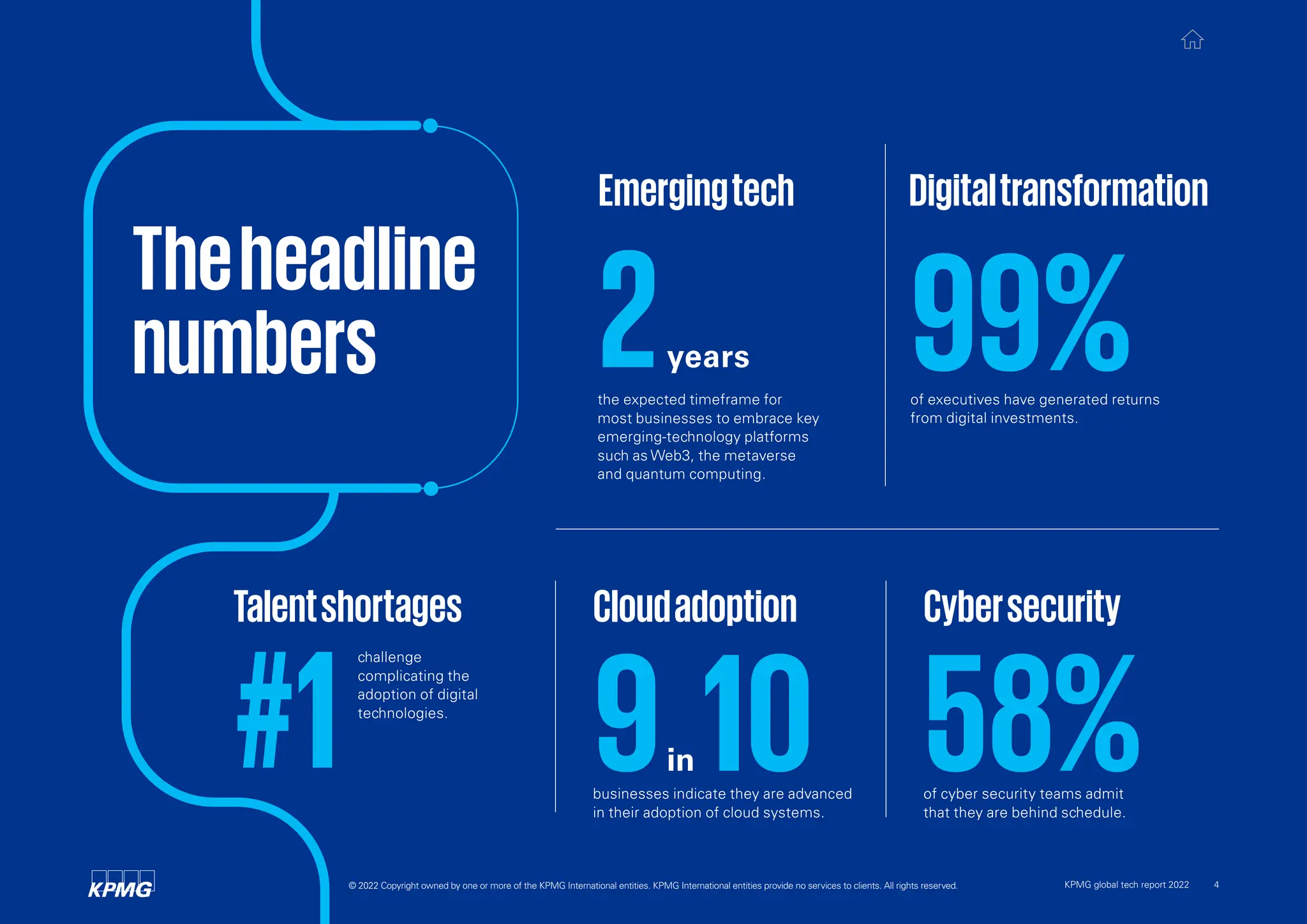
Emergingtech Digitaltransformation
Cybersecurity
Cloudadoption
years
2
the expected timeframe for
most businesses to embrace key
emerging-technology platforms
such as Web3, the metaverse
and quantum computing.
of executives have generated returns
from digital investments.
businesses indicate they are advanced
in their adoption of cloud systems.
of cyber security teams admit
that they are behind schedule.
99%
Talentshortages
challenge
complicating the
adoption of digital
technologies.
#1 9in 10 58%
Theheadline
numbers
© 2022 Copyright owned by one or more of the KPMG International entities. KPMG International entities provide no services to clients. All rights reserved. KPMG global tech report 2022 4
Techenthusiasm
forcustomer
engagement
burnsbrightly
© 2022 Copyright owned by one or more of the KPMG International entities. KPMG International entities provide no services to clients. All rights reserved. KPMG global tech report 2022 5
Digital transformation is living up to
its promise. In recent years, leadership
teams have tasted success as a result
of their transformation activities and
remain optimistic about what they can
achieve in the future. Despite market and
geopolitical tensions, our research finds
businesses embracing new technologies
and poised to invest in new tools.
Almost all respondents to our survey say that their
organizations’ digital transformations have improved
profitability and/or performance over the past 2 years.
They also appear to be reaching key implementation
milestones sooner than expected. Respondents are
20%
27%
21%
30%
38%
39%
33%
25%
30%
35%
40%
Where will your organization invest the most over the next year
and years from now?
years from now
Application modernization
Intelligent automation
Intelligent operations/IT
service management
Businesses expect to downscale over time,
after hitting implementation milestones.
more likely to prioritize app modernization and intelligent
automation during the next year than 3 years from now,
which suggests that most expect to reach maturity in
these capabilities sooner rather than later.
Our survey also reveals widespread appetite for new
technology, even if it is untried and potentially disruptive.
An average of 67 percent expect to embrace emerging
platforms within 2 years, including the metaverse, non-
fungible tokens (NFTs) andWeb3. Seventy-two percent
expect to have invested in quantum computing within
the same timeframe.
Customer value is a primary driver of IT
activity
Our survey suggests that customer experience is one
of the primary levers that unlocks budget for digital
transformation.This continues the trend we have seen
in previous years.
Customer-centric experiences involve designing
workflows, services and products to meet customers’
needs in the most effective way possible.This approach
also has commercial benefits. A study by Microsoft
discovered that 96 percent of customers surveyed felt
quality of customer service directly influenced whether
they would purchase from a brand again. Furthermore,
56 percent of customers in that study admitted a
frustrating customer experience would stop them from
returning to a company.1
Our respondents indicate that Marketing, Customer
Service and Sales functions are benefiting the most from
digital-transformation programs, a direct result of the
customer-centric techniques respondents are deploying.
Customer experience is
substantially motivating
enterprise investments in IT
and is becoming synonymous
with digital transformation.
Tech strategies are anchored
to creating loyalty-winning
experiences, to safeguard income
and encourage [high] levels of
repeat revenue from customers.
”
Barry Brunsman
Global Leader, CIO Center of Excellence,
KPMG International & Principal Advisory,
CIO Advisory at KPMG in the US
1
http://info.microsoft.com/rs/157-GQE-382/images/EN-CNTNT-
Report-DynService-2017-global-state-customer-service-en-au.pdf
© 2022 Copyright owned by one or more of the KPMG International entities. KPMG International entities provide no services to clients. All rights reserved. KPMG global tech report 2022 6
This mission to boost customer loyalty through
technology is certainly a reality for Sedef Gavaz, Head of
Digital Product at the UK’s Natural History Museum.
To answer this question, the Natural History Museum
is undertaking a transformation to modernize its ways
of working. One example is the museum giving greater
decision-making powers to product and digital teams.
“We are prioritizing which problems we solve and which
products we optimize,
” Gavaz adds. “This is about
understanding how to get the best returns from where
we invest our time and resources and linking this back to
our product vision and strategy.
”
But what is the role that emerging technologies, such
as non-fungible tokens (NFTs), can play in customer
engagement, when many companies are still at the
earliest stage of business-case development?
Konrad Dobschuetz, Head of Digital Innovation at
Novartis at the time of interview, says that new
technologies could empower clients to monetize their
data. One example being patients in private healthcare.
Enterprise technology gives a smoother
customer journey
Companies are giving enterprise technology a key
role in their strategic ambitions to enrich customer
experiences. And respondents tell us that customer-
centricity is the primary motivation for investing in it.
Because customer interactions require collaboration
across multiple departments, a lack of alignment
between front, middle and back-office functions
and systems adds complexity and slows down the
engagement process.This fragmentation could
sabotage otherwise successful customer journeys
and hold back operational efficiencies, prolonging or
exacerbating customer issues or even introducing errors
in how cases are managed.
About nine in 10 respondents (89 percent) say they have
enterprise applications that are streamlined for each
function (51 percent) or streamlined and integrated
enterprise-wide (38 percent). Despite this progress,
62 percent of respondents still have work to do to
remove silos between functions.
By re-engineering enterprise technology and breaking
down silos between departments, companies can
help improve the customer experience. Dedication to
designing new ways of working to nurture seamless
internal collaboration has become a key differentiator
between businesses in today’s landscape.
Reliable experiences earn customers’ trust
Customer loyalty is built on — or broken by — whether
customers trust the brand. So, embedding cyber
security in digital-transformation initiatives from the
beginning helps to build the reliable, trustworthy
experiences for customers that can lead to trusting
relationships.
It follows, therefore, that reinforcing customer
experiences is one of the most powerful factors
unlocking additional cyber security spending. Rather
than seeing it as just a compliance burden, businesses
in our research stress that cyber security is a growth
enabler — a tool to build trust into business models and
enrich the customer experience.
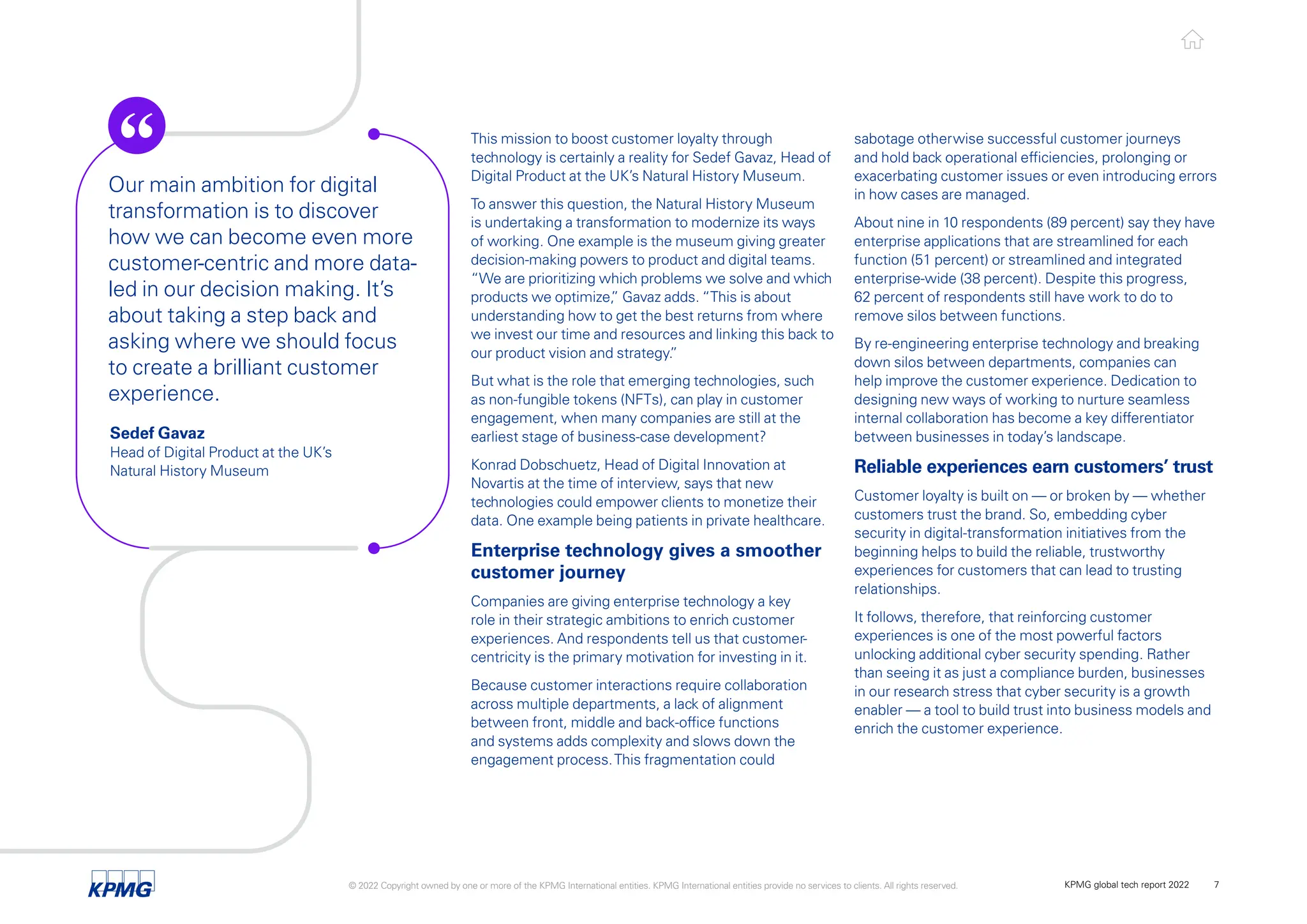
Our main ambition for digital
transformation is to discover
how we can become even more
customer-centric and more data-
led in our decision making. It’s
about taking a step back and
asking where we should focus
to create a brilliant customer
experience.
Sedef Gavaz
Head of Digital Product at the UK’s
Natural History Museum
© 2022 Copyright owned by one or more of the KPMG International entities. KPMG International entities provide no services to clients. All rights reserved. KPMG global tech report 2022 7
In the decentralized world,
patients should be able to decide
who has access to their health
data,
” he suggests. “Their primary
doctor (GP) is an obvious option,
but which companies would they
be happy to sell and share their
healthcare data to, through NFTs?
Whenever the data is sold on,
the patient would get a chunk of
money as well. For me, that’s a
key opportunity.
”
Konrad Dobschuetz
Head of Digital
Innovation at Novartis
© 2022 Copyright owned by one or more of the KPMG International entities. KPMG International entities provide no services to clients. All rights reserved. KPMG global tech report 2022 8
Digital
momentumis
growing,but
threatspersist
© 2022 Copyright owned by one or more of the KPMG International entities. KPMG International entities provide no services to clients. All rights reserved. KPMG global tech report 2022 9
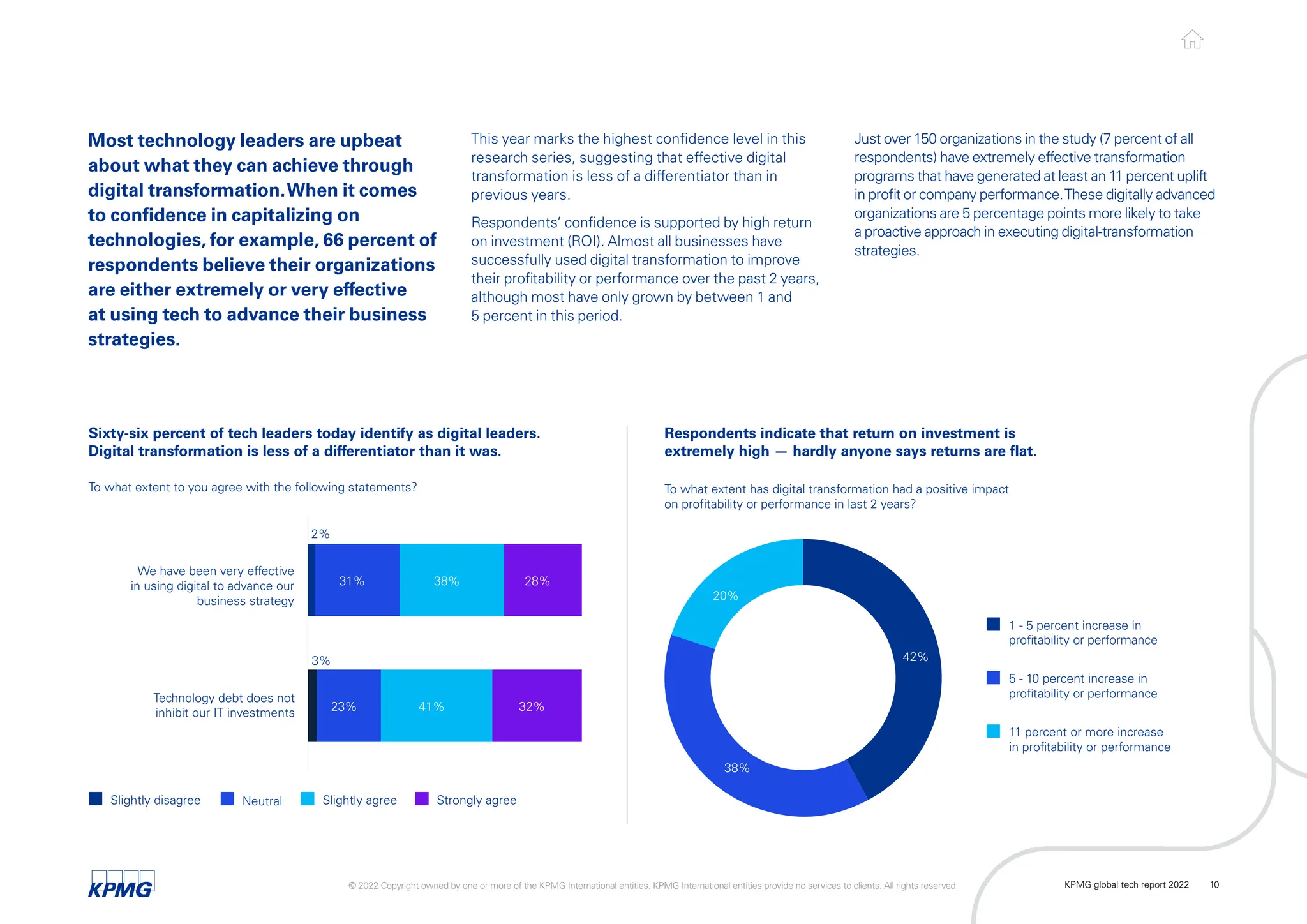
Sixty-six percent of tech leaders today identify as digital leaders.
Digital transformation is less of a differentiator than it was.
To what extent to you agree with the following statements?
Slightly disagree Neutral Slightly agree Strongly agree
We have been very effective
in using digital to advance our
business strategy
Technology debt does not
inhibit our IT investments
2%
31% 38% 28%
3%
23% 41% 32%
Respondents indicate that return on investment is
extremely high — hardly anyone says returns are flat.
To what extent has digital transformation had a positive impact
on profitability or performance in last 2 years?
1 - 5 percent increase in
profitability or performance
5 - 10 percent increase in
profitability or performance
11 percent or more increase
in profitability or performance
20%
42%
38%
Most technology leaders are upbeat
about what they can achieve through
digital transformation.When it comes
to confidence in capitalizing on
technologies, for example, 66 percent of
respondents believe their organizations
are either extremely or very effective
at using tech to advance their business
strategies.
This year marks the highest confidence level in this
research series, suggesting that effective digital
transformation is less of a differentiator than in
previous years.
Respondents’ confidence is supported by high return
on investment (ROI). Almost all businesses have
successfully used digital transformation to improve
their profitability or performance over the past 2 years,
although most have only grown by between 1 and
5 percent in this period.
Just over 150 organizations in the study (7 percent of all
respondents) have extremely effective transformation
programs that have generated at least an 11 percent uplift
in profit or company performance.These digitally advanced
organizations are 5 percentage points more likely to take
a proactive approach in executing digital-transformation
strategies.
© 2022 Copyright owned by one or more of the KPMG International entities. KPMG International entities provide no services to clients. All rights reserved. KPMG global tech report 2022 10
percent more confident than the market average in their
ability to build metaverse andWeb3 features in-house.
About three-quarters of respondents (73 percent) indicate
that "technology debt" (the long-term maintenance costs
attached to new systems), has little-to-no impact on
their IT ambitions. In comparison to the global average,
respondents operating from India are most likely to
feel that their IT ambitions are inhibited by tech debt,
although only 11 percent said this. Just over half of total
respondents (53 percent) usually address enterprise IT
upgrades in line with an agreed schedule. Poorly managed
tech debt can trigger integration issues and lower overall
productivity levels.
To avoid creating fragmentations that could harm
customer interactions, blueprints for emerging
technologies should not overlook the importance of
minimizing tech-debt responsibilities.
Konrad Dobschuetz, Head of Digital Innovation at Novartis,
suggests that a strong focus on returns should be the
guiding light for digital transformation:“Businesses should
be past the point where strategies are driven by ‘nice-to-
haves’ and ‘because our competitors are doing it’,
” he says.
“If you don't showcase value and impact, why are you
doing what you're doing?”
Businesses are drawing up their
roadmaps for emerging tech
Respondents acknowledge the potential of emerging
technologies and are laying the foundations for their
implementation. Nearly half (46 percent) are making
plans for future investment and implementation of
emerging technologies, although, for the majority
(65 percent), little to no movement has been made yet.
When it comes to the metaverse, most respondents, even
the most digitally effective and profitable organizations,
admit that they are waiting for either competitors to adopt
the relevant technologies or for customers to demand
products and services reliant on these technologies before
investing themselves. Compared with other industries,
financial services has the biggest appetite for investing in
the metaverse within the next year; energy and chemicals
markets expressed the least appetite to invest in this
concept within that timeframe.
At a recent online event, Ioana Matei, Head of
Emerging/ImmersiveTechnologies at P&G, said
that companies must offer compelling metaverse
experiences to generate interest from customers.
There are signs that in-house capabilities around emerging
tech are in short supply.Thirty-seven percent more
businesses are looking to partner with tech companies to
tap into the metaverse andWeb3 than to build capabilities
in-house.Those who are extremely effective at digital
transformation and are seeing the highest ROI are 5
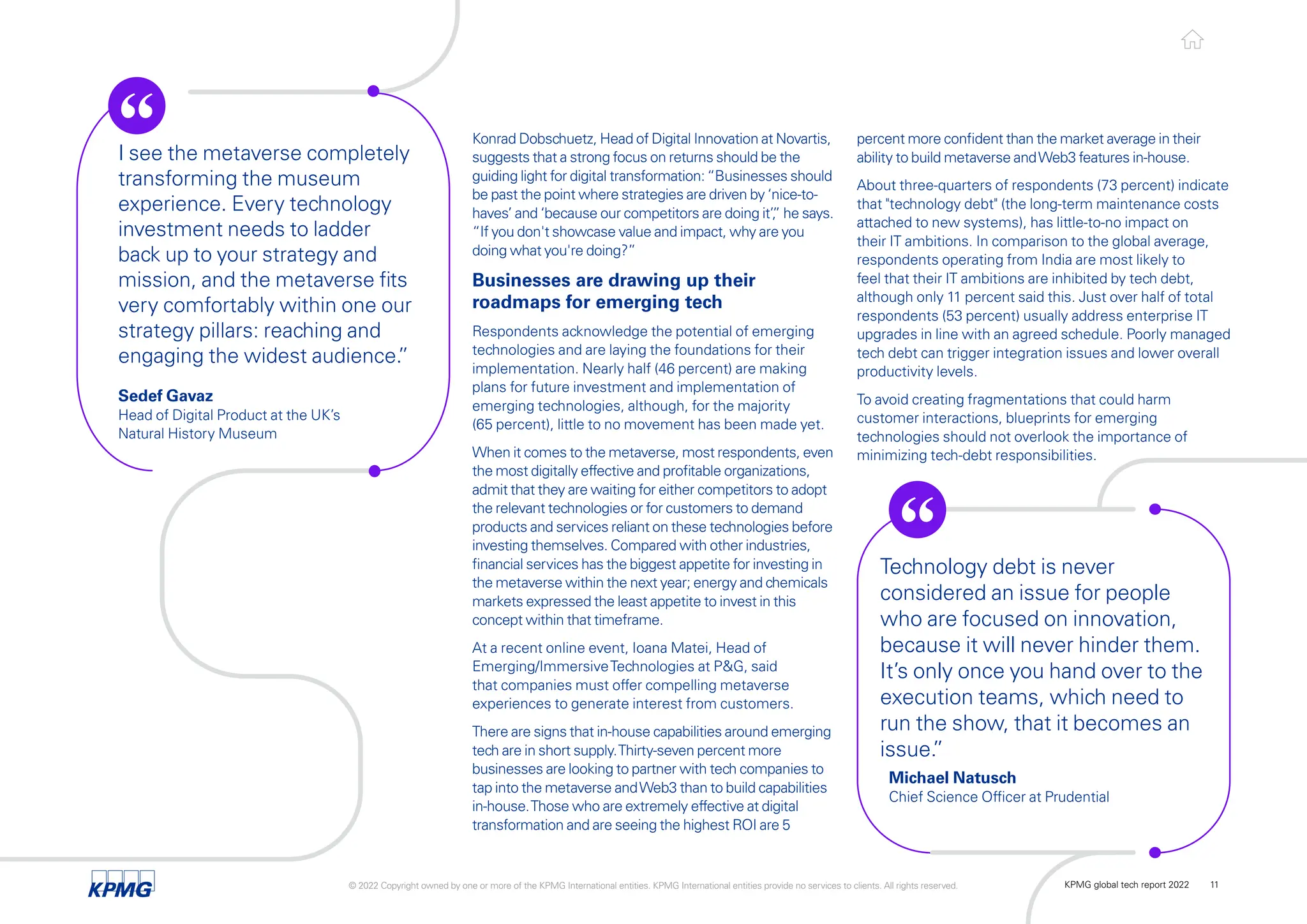
I see the metaverse completely
transforming the museum
experience. Every technology
investment needs to ladder
back up to your strategy and
mission, and the metaverse fits
very comfortably within one our
strategy pillars: reaching and
engaging the widest audience.
”
Technology debt is never
considered an issue for people
who are focused on innovation,
because it will never hinder them.
It’s only once you hand over to the
execution teams, which need to
run the show, that it becomes an
issue.
”
Sedef Gavaz
Head of Digital Product at the UK’s
Natural History Museum
Michael Natusch
Chief Science Officer at Prudential
© 2022 Copyright owned by one or more of the KPMG International entities. KPMG International entities provide no services to clients. All rights reserved. KPMG global tech report 2022 11
Natusch adds: “It’s very easy to build pretty prototypes; it
is very hard to build features that actually go live with real
customers, while minimizing the chances of technology
debt becoming an issue.
” Incorporating feedback from
IT execution teams into early planning for emerging
technologies can help these innovation efforts support
seamless engagement with customers.
Cloud adoption is no longer the mark
of a digital leader, merely the logical
evolution of IT
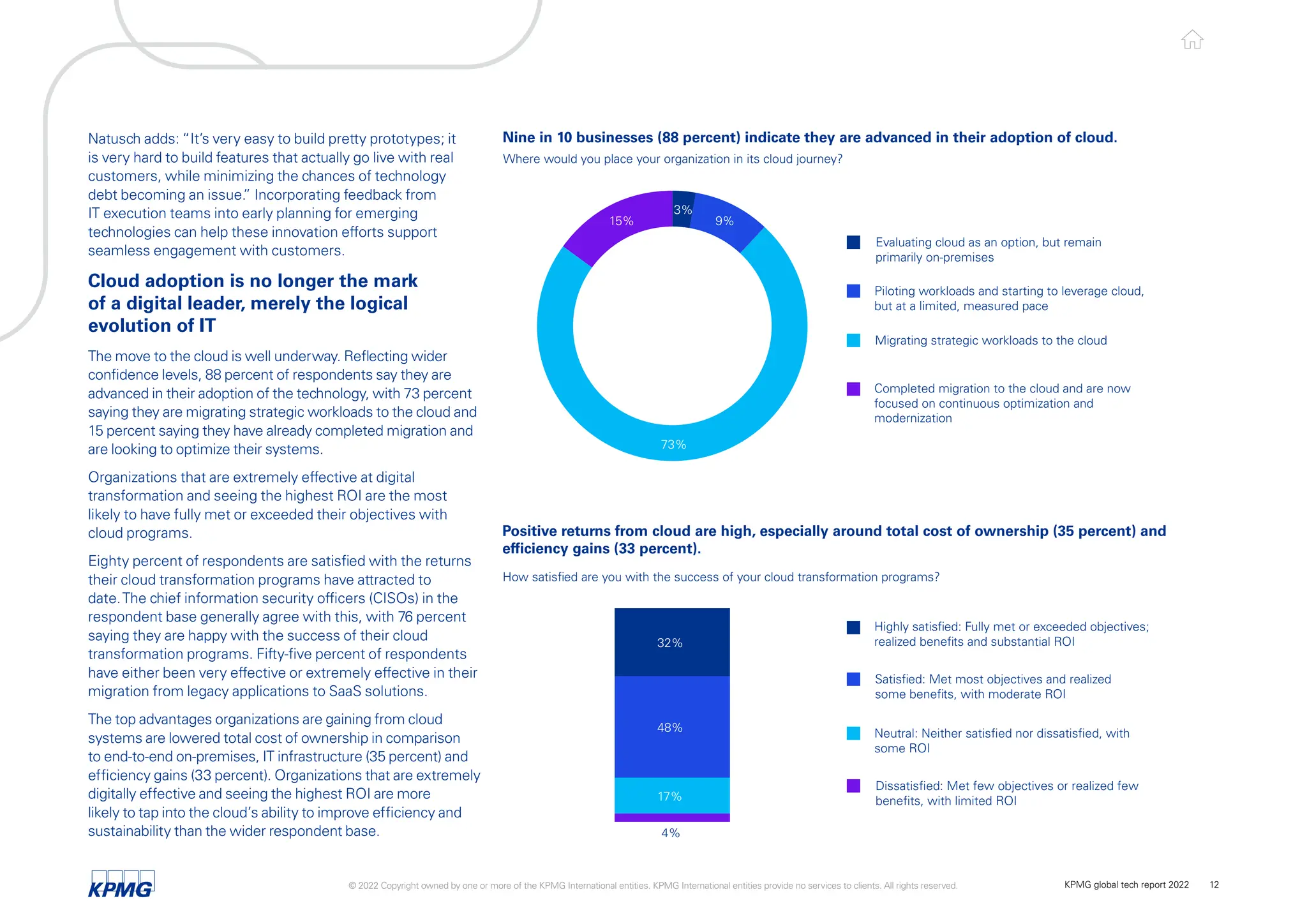
The move to the cloud is well underway. Reflecting wider
confidence levels, 88 percent of respondents say they are
advanced in their adoption of the technology, with 73 percent
saying they are migrating strategic workloads to the cloud and
15 percent saying they have already completed migration and
are looking to optimize their systems.
Organizations that are extremely effective at digital
transformation and seeing the highest ROI are the most
likely to have fully met or exceeded their objectives with
cloud programs.
Eighty percent of respondents are satisfied with the returns
their cloud transformation programs have attracted to
date.The chief information security officers (CISOs) in the
respondent base generally agree with this, with 76 percent
saying they are happy with the success of their cloud
transformation programs. Fifty-five percent of respondents
have either been very effective or extremely effective in their
migration from legacy applications to SaaS solutions.
The top advantages organizations are gaining from cloud
systems are lowered total cost of ownership in comparison
to end-to-end on-premises, IT infrastructure (35 percent) and
efficiency gains (33 percent). Organizations that are extremely
digitally effective and seeing the highest ROI are more
likely to tap into the cloud’s ability to improve efficiency and
sustainability than the wider respondent base.
Piloting workloads and starting to leverage cloud,
but at a limited, measured pace
Nine in 10 businesses (88 percent) indicate they are advanced in their adoption of cloud.
Where would you place your organization in its cloud journey?
Migrating strategic workloads to the cloud
Evaluating cloud as an option, but remain
primarily on-premises
Completed migration to the cloud and are now
focused on continuous optimization and
modernization
3%
9%
73%
15%
Positive returns from cloud are high, especially around total cost of ownership (35 percent) and
efficiency gains (33 percent).
How satisfied are you with the success of your cloud transformation programs?
Satisfied: Met most objectives and realized
some benefits, with moderate ROI
Highly satisfied: Fully met or exceeded objectives;
realized benefits and substantial ROI
Neutral: Neither satisfied nor dissatisfied, with
some ROI
Dissatisfied: Met few objectives or realized few
benefits, with limited ROI
4%
17%
48%
32%
© 2022 Copyright owned by one or more of the KPMG International entities. KPMG International entities provide no services to clients. All rights reserved. KPMG global tech report 2022 12
AndrewWhytock, Head of Digitalization, Pharmaceutical
Division at Siemens explains that Siemens is focusing
on making itself an even more desirable employer in
order to retain people and attract new staff. “Even at a
company like Siemens, it has become hard to find new
recruits with the appropriate skillsets,
” he says. “It must
be very hard for small and medium-sized companies to
attract young talent.
”
Limited budgets appear to be exacerbating the issue.
Insufficient funding for training employees and recruiting
talent is having a widespread impact across enterprises,
complicating the adoption of new enterprise systems,
cloud progress and cyber security initiatives.
Change-resistant organizations appear to threaten
digital innovation. Risk-averse cultures are ranked
among the top five digital-transformation challenges,
holding back initiatives for 24 percent of respondents.
Those who are extremely effective and seeing the
highest ROI from implementing digital technologies
are 11 percent less likely to see digital transformation
projects damaged by cultural hesitancy. Of all the
sectors in the research, consumer retail and life
sciences companies are the most likely to suffer from
risk-averse cultures. Risk-averse cultures in life sciences
are rooted in the industry’s stringent compliance
requirements that protect patient safety.
Life sciences expert Konrad Dobschuetz believes that
companies could make progress here by rethinking
where responsibility for innovation should sit.
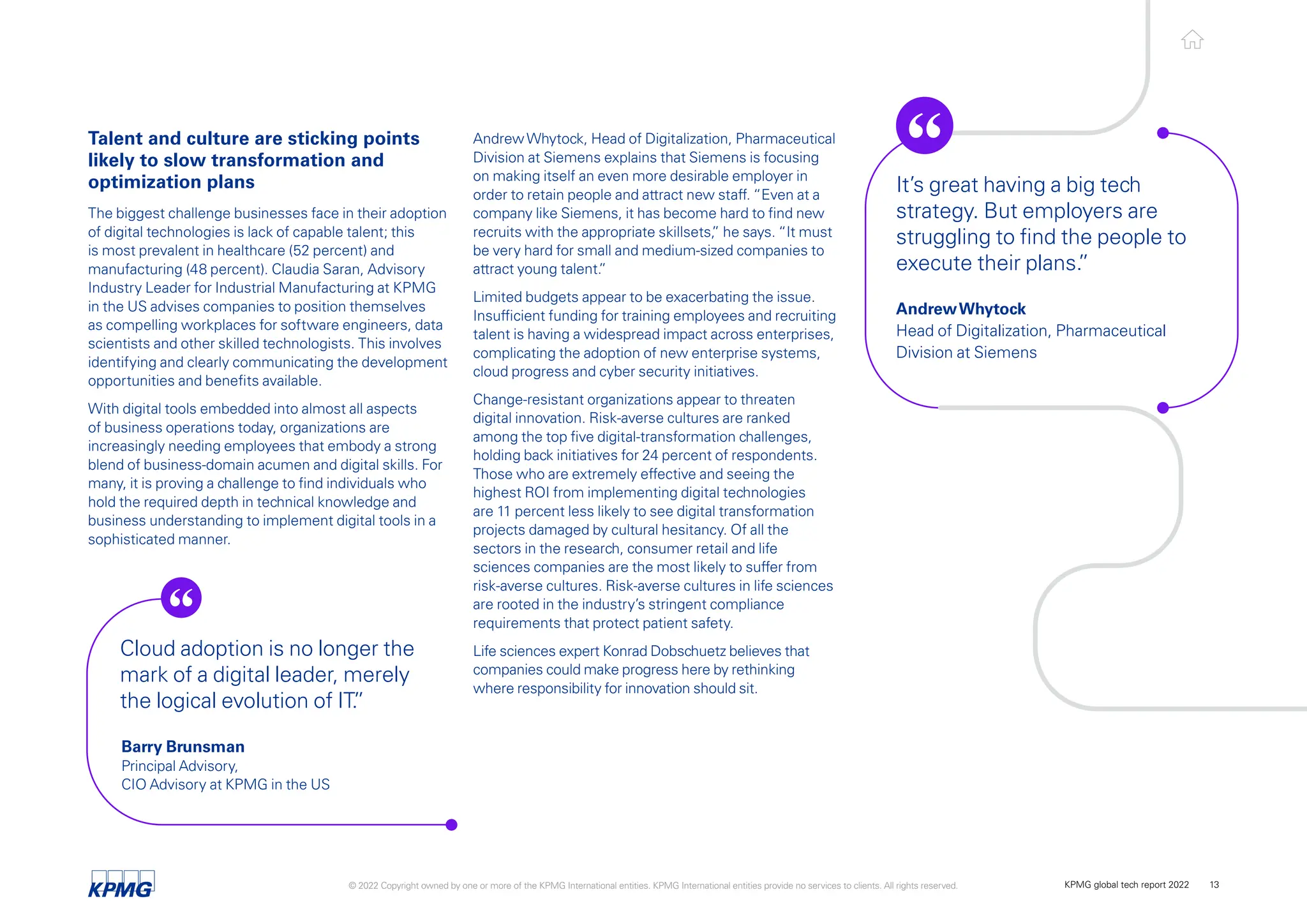
Talent and culture are sticking points
likely to slow transformation and
optimization plans
The biggest challenge businesses face in their adoption
of digital technologies is lack of capable talent; this
is most prevalent in healthcare (52 percent) and
manufacturing (48 percent). Claudia Saran, Advisory
Industry Leader for Industrial Manufacturing at KPMG
in the US advises companies to position themselves
as compelling workplaces for software engineers, data
scientists and other skilled technologists. This involves
identifying and clearly communicating the development
opportunities and benefits available.
With digital tools embedded into almost all aspects
of business operations today, organizations are
increasingly needing employees that embody a strong
blend of business-domain acumen and digital skills. For
many, it is proving a challenge to find individuals who
hold the required depth in technical knowledge and
business understanding to implement digital tools in a
sophisticated manner.
It’s great having a big tech
strategy. But employers are
struggling to find the people to
execute their plans.
”
AndrewWhytock
Head of Digitalization, Pharmaceutical
Division at Siemens
Cloud adoption is no longer the
mark of a digital leader, merely
the logical evolution of IT.
”
Barry Brunsman
Principal Advisory,
CIO Advisory at KPMG in the US
© 2022 Copyright owned by one or more of the KPMG International entities. KPMG International entities provide no services to clients. All rights reserved. KPMG global tech report 2022 13
Lack of capable talent (data scientists, engineers, etc.)
High cost of new systems and adding necessary talent
Lack of skills to implement or fully take advantage of new
systems
Sub-optimal data management
Risk-averse corporate culture that is slow to embrace change and
disruption
Inability to secure data housed by systems
Lack of clear and transparent digital governance policies
throughout the organization
Legacy technology and/or technology debt 14%
15%
16%
24%
28%
29%
32%
44%
When they need to, innovators can navigate resistance
from even the most skeptical colleagues. A supportive
culture is vital for digital innovation to succeed.
Budget inadequacy is an issue
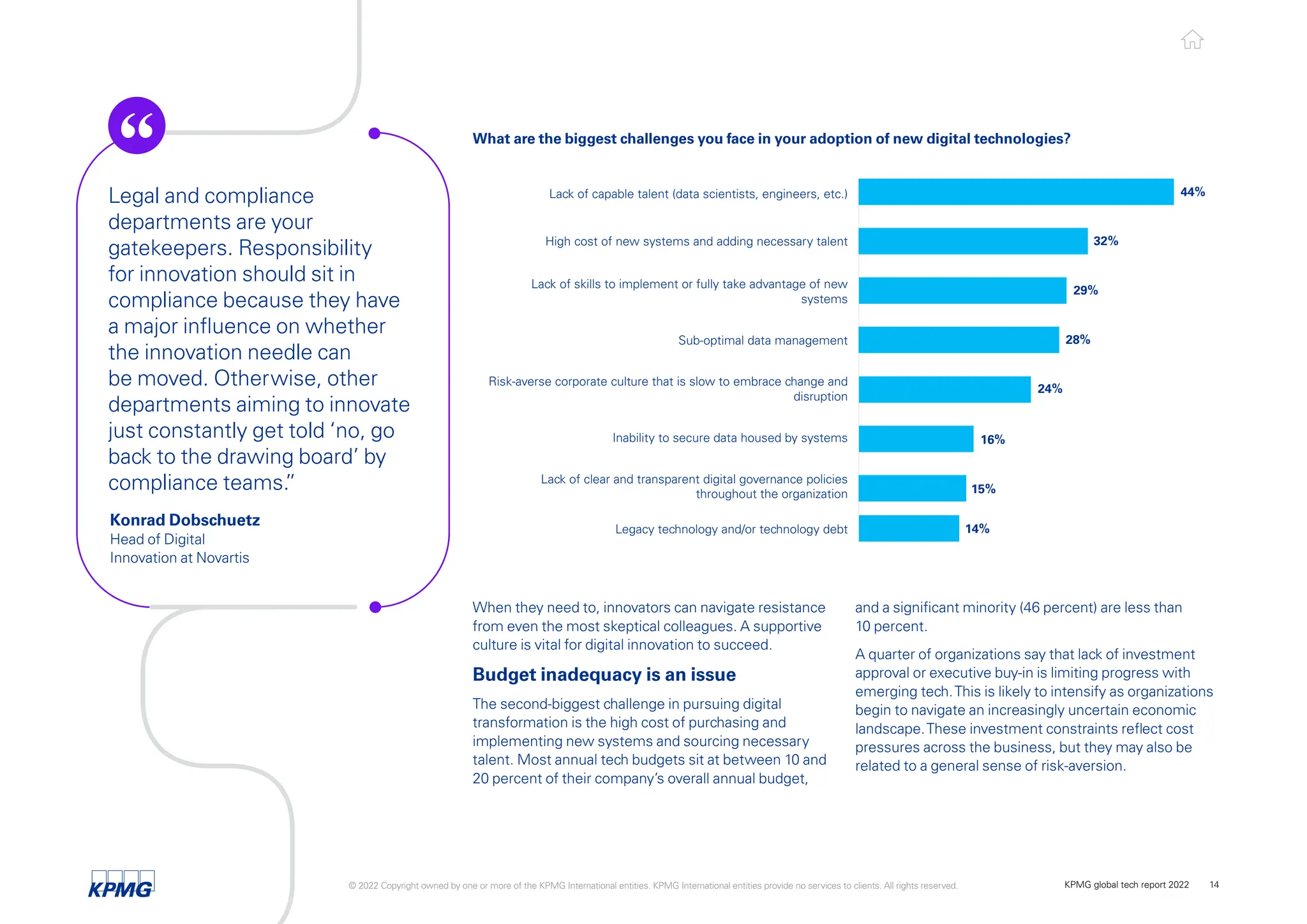
The second-biggest challenge in pursuing digital
transformation is the high cost of purchasing and
implementing new systems and sourcing necessary
talent. Most annual tech budgets sit at between 10 and
20 percent of their company’s overall annual budget,
and a significant minority (46 percent) are less than
10 percent.
A quarter of organizations say that lack of investment
approval or executive buy-in is limiting progress with
emerging tech.This is likely to intensify as organizations
begin to navigate an increasingly uncertain economic
landscape.These investment constraints reflect cost
pressures across the business, but they may also be
related to a general sense of risk-aversion.
What are the biggest challenges you face in your adoption of new digital technologies?
Legal and compliance
departments are your
gatekeepers. Responsibility
for innovation should sit in
compliance because they have
a major influence on whether
the innovation needle can
be moved. Otherwise, other
departments aiming to innovate
just constantly get told ‘no, go
back to the drawing board’ by
compliance teams.
”
Konrad Dobschuetz
Head of Digital
Innovation at Novartis
© 2022 Copyright owned by one or more of the KPMG International entities. KPMG International entities provide no services to clients. All rights reserved. KPMG global tech report 2022 14
Cybersecurity
teamsare
strugglingto
keepup
© 2022 Copyright owned by one or more of the KPMG International entities. KPMG International entities provide no services to clients. All rights reserved. 15
KPMG global tech report 2022
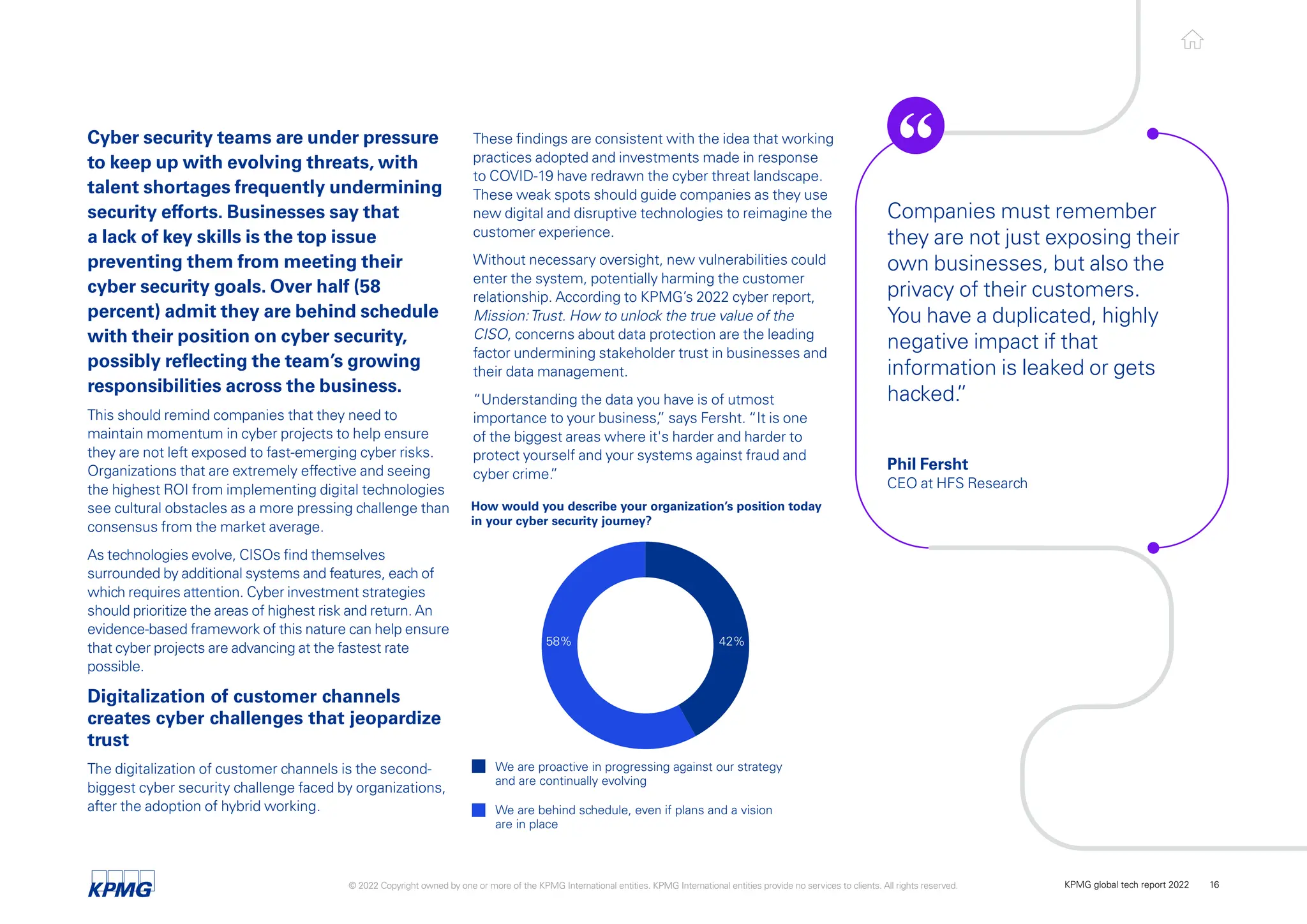
Cyber security teams are under pressure
to keep up with evolving threats, with
talent shortages frequently undermining
security efforts. Businesses say that
a lack of key skills is the top issue
preventing them from meeting their
cyber security goals. Over half (58
percent) admit they are behind schedule
with their position on cyber security,
possibly reflecting the team’s growing
responsibilities across the business.
This should remind companies that they need to
maintain momentum in cyber projects to help ensure
they are not left exposed to fast-emerging cyber risks.
Organizations that are extremely effective and seeing
the highest ROI from implementing digital technologies
see cultural obstacles as a more pressing challenge than
consensus from the market average.
As technologies evolve, CISOs find themselves
surrounded by additional systems and features, each of
which requires attention. Cyber investment strategies
should prioritize the areas of highest risk and return. An
evidence-based framework of this nature can help ensure
that cyber projects are advancing at the fastest rate
possible.
Digitalization of customer channels
creates cyber challenges that jeopardize
trust
The digitalization of customer channels is the second-
biggest cyber security challenge faced by organizations,
after the adoption of hybrid working.
How would you describe your organization’s position today
in your cyber security journey?
We are proactive in progressing against our strategy
and are continually evolving
We are behind schedule, even if plans and a vision
are in place
42%
58%
These findings are consistent with the idea that working
practices adopted and investments made in response
to COVID-19 have redrawn the cyber threat landscape.
These weak spots should guide companies as they use
new digital and disruptive technologies to reimagine the
customer experience.
Without necessary oversight, new vulnerabilities could
enter the system, potentially harming the customer
relationship. According to KPMG’s 2022 cyber report,
Mission:Trust. How to unlock the true value of the
CISO, concerns about data protection are the leading
factor undermining stakeholder trust in businesses and
their data management.
“Understanding the data you have is of utmost
importance to your business,
” says Fersht. “It is one
of the biggest areas where it's harder and harder to
protect yourself and your systems against fraud and
cyber crime.
”
Companies must remember
they are not just exposing their
own businesses, but also the
privacy of their customers.
You have a duplicated, highly
negative impact if that
information is leaked or gets
hacked.
”
Phil Fersht
CEO at HFS Research
© 2022 Copyright owned by one or more of the KPMG International entities. KPMG International entities provide no services to clients. All rights reserved. KPMG global tech report 2022 16
To help ensure that tech innovations enhance
customer trust and loyalty, rather than put it at risk,
security should be incorporated into planning from the
beginning, rather than added later as an afterthought.
“Customer experience is reliant on customers trusting
the technologies they need to use to engage with a
company,
” explains Barry Brunsman, Principal Advisory,
CIO Advisory at KPMG in the US. “Businesses must
build in cyber security and CISO involvement into
digital-transformation initiatives as early as possible.
This will depend on embedding cross-departmental
communication between cyber teams, the business
and IT to enable collaborative customer-centric
conversations across the enterprise.
”
Confidence to navigate the terrain ahead
Despite these problems, respondents are confident in
their cyber capabilities. More than 50 percent are either
very or extremely confident in combatting various cyber
threats, including from organized crime groups, insiders
and compromised supply chains.
Digital customer-interaction points create security
risks, but the digitalization of contact channels requires
a higher degree of risk protection. For example,
customers no longer need to provide handwritten
signatures on contracts and then email them as PDFs;
instead, they can sign legal documents in encrypted,
secure digital environments.
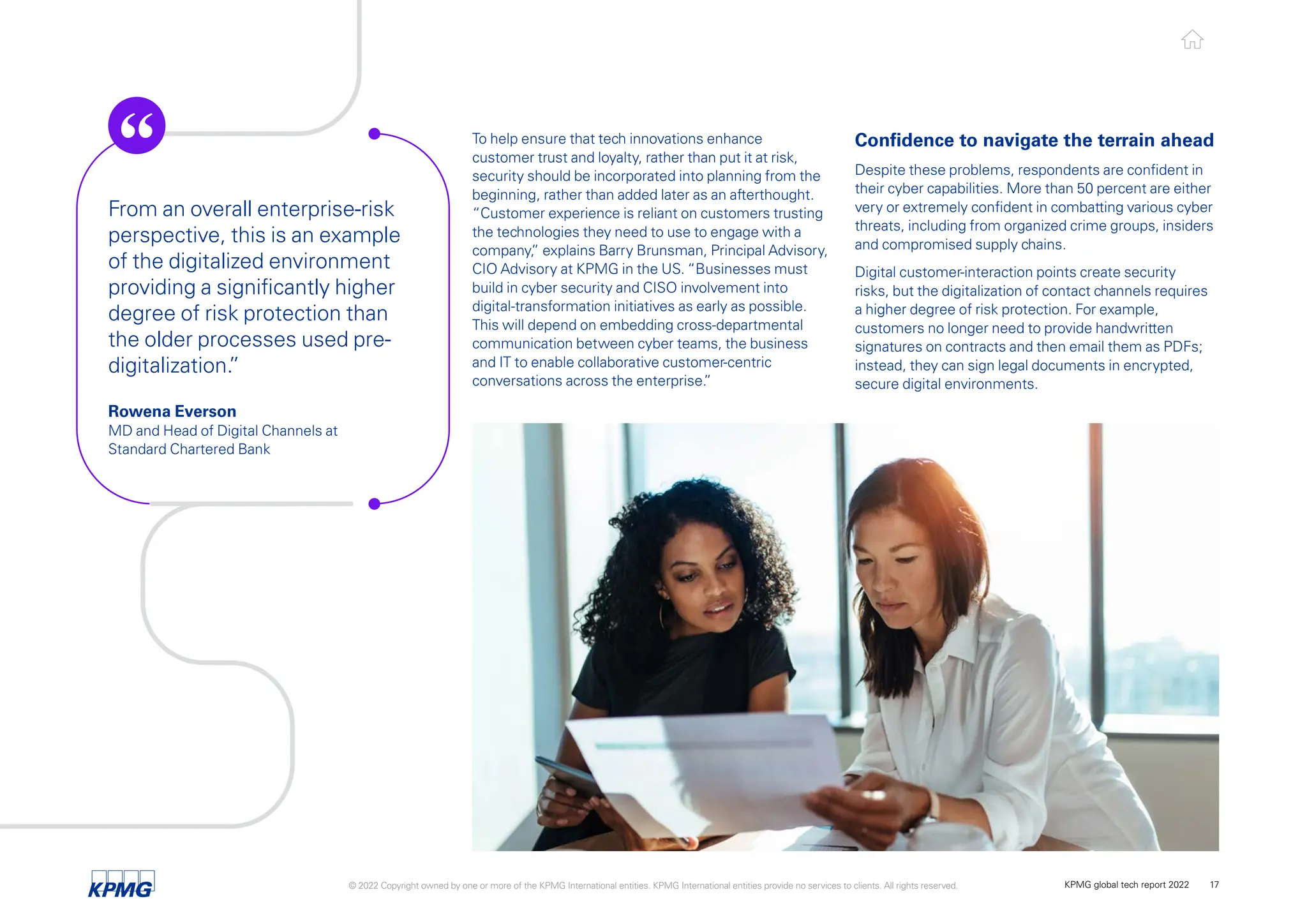
From an overall enterprise-risk
perspective, this is an example
of the digitalized environment
providing a significantly higher
degree of risk protection than
the older processes used pre-
digitalization.
”
Rowena Everson
MD and Head of Digital Channels at
Standard Chartered Bank
© 2022 Copyright owned by one or more of the KPMG International entities. KPMG International entities provide no services to clients. All rights reserved. KPMG global tech report 2022 17
Sevendefining
traitsoftoday’s
digitally-mature
organizations
© 2022 Copyright owned by one or more of the KPMG International entities. KPMG International entities provide no services to clients. All rights reserved. KPMG global tech report 2022 18
To date, most technology leaders report
positive returns from their transformative
efforts to improve their competitive edge
through technology.Almost all businesses
have enhanced their profitability or other
metrics of performance over the past 2
years through digital transformation.
With confidence levels around digital
effectiveness at a record high, our study
shows us that digital-transformation
success is fast becoming a baseline
requirement for businesses.
In previous KPMG CIO studies we defined digital leaders
as any organization that was either very or extremely
effective at using digital technologies to advance their
business strategies.This surge in digital competency
will help reshape our definition of digital leaders in future
instalments of this research series.
To begin our journey of mapping out the new definition of
digital leadership, here we present seven traits we have
observed in today’s most digitally advanced organizations.
These traits work together to optimize the output of IT,
ensuring digital-transformation efforts are sustainable and
continue to add value and contribute to loyalty-winning
customer experiences in the long term.
© 2022 Copyright owned by one or more of the KPMG International entities. KPMG International entities provide no services to clients. All rights reserved. KPMG global tech report 2022 19
Today’s digitally-mature organizations…
1
Tear down silos so the voice of the
employee can be heard between
departments
Tech investments should remove points of friction from
customer journeys and build convenience into points
of interaction. However, when tech-implementation
plans fail to incorporate feedback from key stakeholder
groups, new digital investments can create
inefficiencies that inflate operational costs and irritate
customers.
To avoid creating unnecessary inefficiencies with
tech-innovation efforts, digital leaders are tearing down
siloes so projects can draw continually on employee
feedback from key stakeholder groups. Here, the voice
of the employee guides innovation efforts away from
flawed implementations that could damage customer
experiences. Early strategy calls include involving the
likes of cyber, procurement, IT and business functions to
achieve a holistic perspective on the best path forward.
This spirit of collaboration lives on through the daily
operations of digitally advanced businesses. As IT
expertise is increasingly required across various
business functions, routine cross-departmental
collaboration and education allow business and IT
employees to resolve misunderstandings and gain
clarity on each other’s perspective.This healthy
dynamic enhances team productivity and can identify
opportunities to introduce more convenience into
customer experiences.
2 Are part of the solution for the talent
crisis
The talent crisis is not going to resolve itself, especially
when it comes to in-demand skills in new and emerging
technologies. For technology teams, the short-term
challenge is likely to worsen as businesses review
their hiring plans to mitigate the impact of economic
uncertainty and consider putting a freeze on new hires.
Progressive businesses are recalibrating their
approaches to hiring and training specialist talent from
the ecosystem. Long-term talent strategies should
encourage organizations to widen their perspectives
and expand the universe of talent.
Companies become part of the solution by restocking
the talent pools available. Outreach programs with
colleges and universities can educate and inspire
individuals approaching entry-level jobs to develop the
most in-demand skills.
At the same time, mature businesses ensure their staff
feel supported in their professional growth. “Managers
should constantly be trained so they can develop their
teams,
” says HFS Research’s Phil Fersht. “People
often get frustrated and feel very boxed in if their direct
manager isn’t helping them. Consider breaking out of
rigid management structures and build frameworks
based on a matrix model. Employ more of an open
structure to mentoring programs, so employees can
learn from multiple people.
”
Rather than recruit candidates
exclusively from [our industry
of focus] within media and
advertising, we can open our
industry to gifted people from
a wide range of backgrounds,
experiences and even
geographies.We have to cast a
wide net in all forms as it builds
diversity and it improves our
ability to drive change more
rapidly.
”
Hayley Cochrane
VP of Digital and Advanced Ad Sales, Global,
at NBCUniversal
© 2022 Copyright owned by one or more of the KPMG International entities. KPMG International entities provide no services to clients. All rights reserved. KPMG global tech report 2022 20
cloud journey. “Advanced businesses operate from a
strong understanding of the needs of the business and
IT departments,
” says Brunsman from KPMG in the US.
“A unified strategic vision of the cloud’s organizational
returns for stakeholders drives a sophisticated
implementation and enablement of cloud-based
systems.
”
4 
Ensure cyber specialists have early
involvement in tech selection and staff
education
This year’s research suggests that businesses increasingly
see cyber security as a golden thread running through
growth and success, rather than just a compliance
requirement. According to KPMG’s 2022 cyber report,
Mission:Trust. How to unlock the true value of the CISO,
Technology leaders are looking to automation to
address staff shortages and repair skill gaps. By
automating workflows to take on the low-complexity,
high-volume tasks, companies can redeploy staff and
upskill teams to fill more strategic gaps elsewhere in
the business. “One of the biggest issues right now is
under-employment — a shortage of people to service
businesses,
” says Fersht. “For example, touchpoints
with customers can be critical. Leveraging automation
can really help where there are particularly staff
shortages.
”
3
Build airtight alignment between cloud
stakeholders
Technology leaders are capitalizing on cloud’s efficiency
and cost benefits by optimizing their ways of working,
with addressing stakeholder conflicts a key focus area.
Stakeholder misalignment is a major factor holding back
cloud migration for the majority of businesses. CISOs
say that stakeholder misalignment on outcomes is a
bigger cloud challenge than security and compliance
requirements.
Misalignment tends to occur between the IT team’s
vision of how cloud capabilities should be enabled and
the cloud priorities of other business departments.
“This misalignment tends to create a very disjointed
cloud implementation,
” says Barry Brunsman, Principal
Advisory, CIO Advisory at KPMG in the US. “Business
units have their own distinct priorities and, as a result,
their cloud approaches often become siloed and
disconnected from the work of other departments.
”
Some digitally-mature businesses are making progress
in this area by appointing a dedicated head of cloud
who considers the requirements of each stakeholder
group and creates a strategy to optimize the business’s
enhancing corporate trustworthiness can increase
profitability, as well as the size of customer base.
Digitally-mature businesses operate with tech-
innovation workflows that include cyber specialists early
on. In our research, CISOs say the internet of things
(IoT) is highly likely to receive investment attention over
the next year, but they also admit that IoT services can
present a major cyber security risk. As such, to show
digital maturity, organizations should ensure CISOs and
their cyber teams engage in early-stage discussions
about how and where the technology is going to be
used, and what this means for customer experiences.
With staff behavior and low cyber security awareness
constituting significant sources of risk, digitally mature
companies empower CISOs to conduct regular
education in risk management.
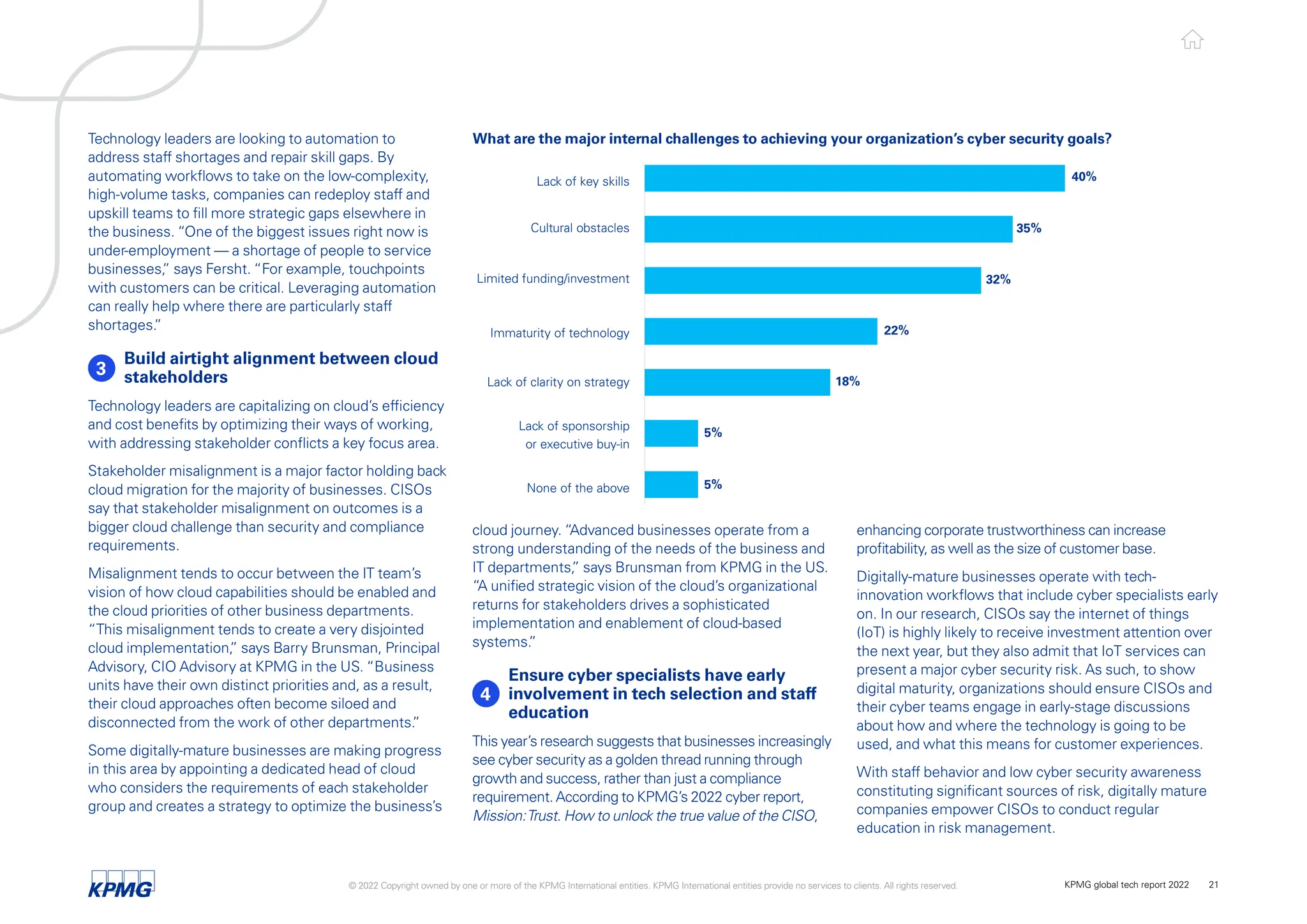
What are the major internal challenges to achieving your organization’s cyber security goals?
Lack of key skills
Cultural obstacles
Limited funding/investment
Immaturity of technology
Lack of clarity on strategy
Lack of sponsorship
or executive buy-in
None of the above
40%
35%
32%
22%
18%
5%
5%
© 2022 Copyright owned by one or more of the KPMG International entities. KPMG International entities provide no services to clients. All rights reserved. KPMG global tech report 2022 21
Security teams in these organizations educate staff
through a variety of teaching mechanisms, training
sessions and simulations. “I think a lot of employees see
cyber security as just ‘I've got a virus on my computer’.
It’s far more dangerous than that,
” says AndrewWhytock
from Siemens. Cyber-attacks can trigger widespread
disruption to supply chains and populations. “It's
important to assess the value of the impact,
” says
Whytock. “That shouldn't mean you avoid using a
technology, but you need to have safeguards in place.
”
“To navigate the shortage of cyber security skills
and democratize accountability, CISOs should work
to build multidisciplinary teams that support digital-
transformation security across the enterprise,
” says
Brunsman from KPMG in the US. “It is not just the
CISO who should be driving cyber resilience — this is a
broader business issue.
”
5
Allow the voice of the customer to guide
emerging-technology strategies
To retain customers and market share, companies must
continuously improve their digital capabilities and think
differently about how to use technologies to meet, and
exceed, expectations.
This means constantly evaluating whether technology
selection and workflow design is aligned with customer
needs and expectations. Cross-functional workshops
can provide real-life insights that stress-test the value of
certain technologies.
Michael Natusch, Chief AI Officer at Prudential, says
that the business has seen success with workshops
that bring together disparate stakeholders, including
customers.These sessions test prototypes and assess
a technology’s potential to provide meaningful value to
target audiences.
Digitally mature businesses direct their emerging-
technology investments towards capabilities that
have the potential to deliver the outcomes that are of
most value to customers.This approach can help keep
more customers loyal to a brand in times of economic
uncertainty.
“It would be wonderful to have a perfect predictive
model showing where to direct investments but,
unfortunately, that’s not realistic,
” says Rowena
Everson, the MD and Head of Digital Channels at
Standard Chartered Bank. “A productive approach is to
focus on customer desires and behaviors and consider
which technologies could support these areas.We
need to assess technologies and concepts against four
key customer needs that are driving demand: security,
speed of execution, choice and flexibility.
”
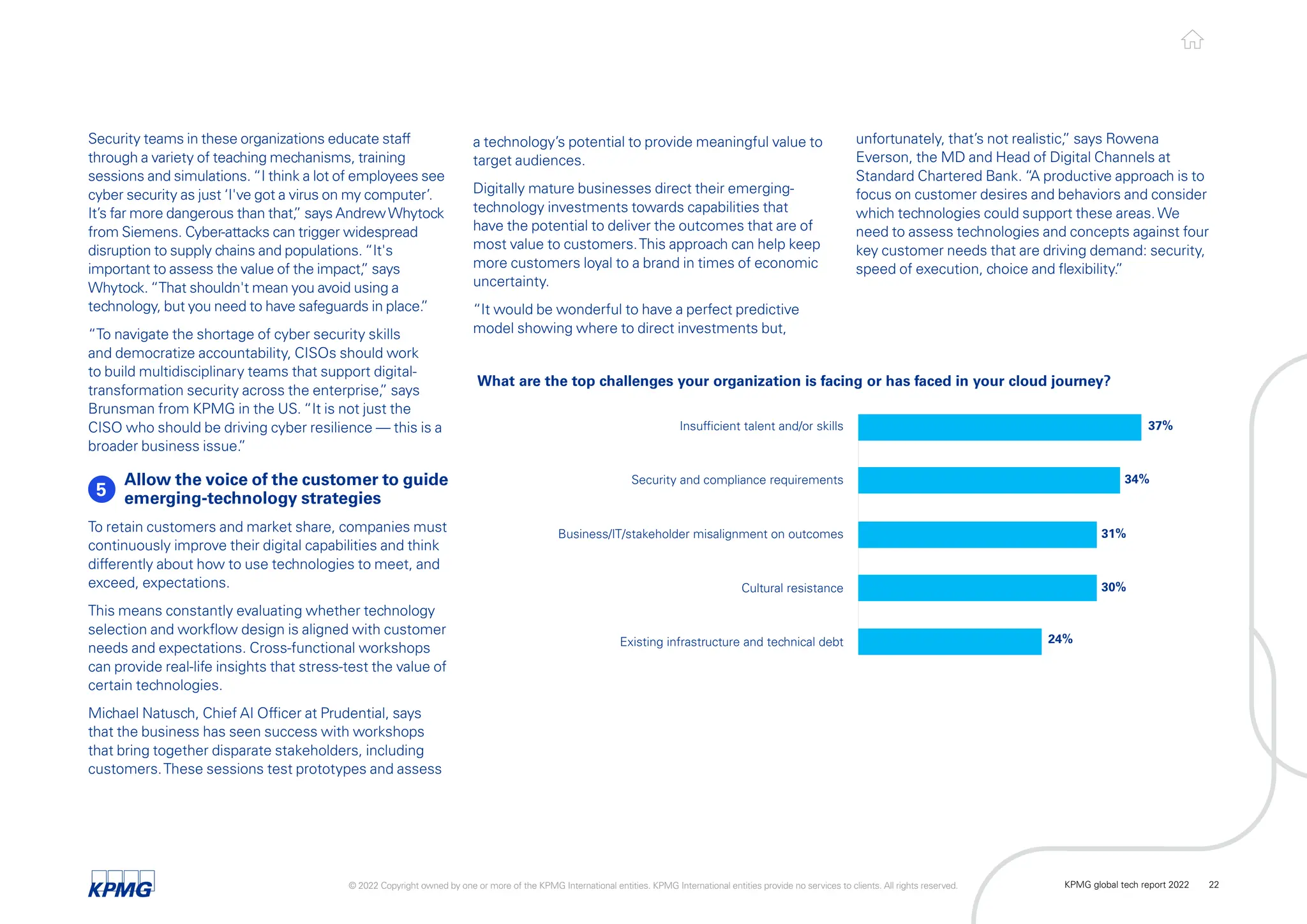
What are the top challenges your organization is facing or has faced in your cloud journey?
Insufficient talent and/or skills
Security and compliance requirements
Business/IT/stakeholder misalignment on outcomes
Cultural resistance
Existing infrastructure and technical debt
37%
34%
31%
30%
24%
© 2022 Copyright owned by one or more of the KPMG International entities. KPMG International entities provide no services to clients. All rights reserved. KPMG global tech report 2022 22
seamless interaction points in customer experiences.
Application programming interface (API) integration is
assessed carefully to avoid creating silos that introduce
fragmentation into customer journeys. “Every business
must ensure that the entire organization — front, middle
and back — is aligned to deliver on its brand promise
and customer expectations,
” agrees Brunsman from
KPMG in the US.
7 Aren’t afraid to experiment wisely
Digitally mature companies ensure that their success
does not create an overly protective or perfectionist
culture that stifles innovation.
“If you attempt to achieve a 100-percent level of
certainty over everything, you are hoping for a false level
of precision,
” says Standard Chartered Bank’s Rowena
Everson. “All this will do is paralyze experimentation
in the business, which will ultimately paralyze growth.
The only answer is to ensure that transformation and
investment strategies can adapt.
”
This involves moving away from traditional investment
frameworks that are structured to achieve benefits
only at the very end of the initiative. Instead, says
Everson: “Achieve objectives on the way to the
ultimate objective. Set your program objectives to
have an ultimate outcome but acknowledge upfront
that the actual path you take could deviate from initial
expectations.This allows you to pivot as you progress
and bank wins as you go.
”
It is important to recognize that some avenues may
turn out to be dead ends. “If you have this practice of
breaking down your ultimate end-goals into achievable
objectives on the route,
” says Everson, “then you
can access beneficial outcomes, even if you decide
that either your original investment strategy has been
superseded by the external environment or your
business goals have changed.
”
6
Are prepared to switch platform
providers to enhance customer
experiences
There is a desire within corporate digital ecosystems
to find one platform, or at least a reduced stack of
enterprise technologies, which will meet business
needs.This simplification of enterprise-system
networks would have various benefits, including the
reduction of technical debt. However, this aspiration
to consolidate tech stacks will always be complicated
by how capabilities advance and solution-provider
landscapes shift.
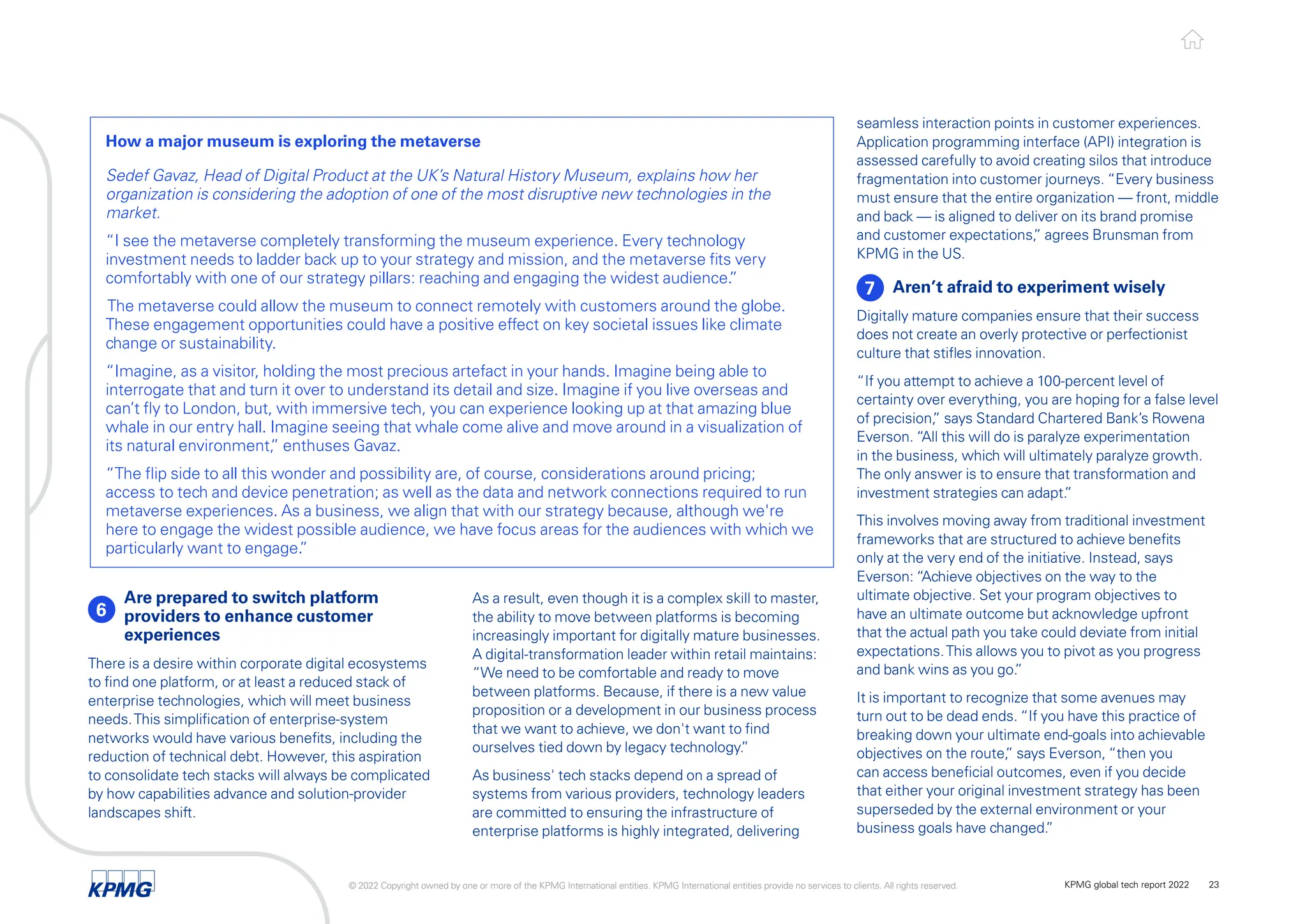
How a major museum is exploring the metaverse
Sedef Gavaz, Head of Digital Product at the UK’s Natural History Museum, explains how her
organization is considering the adoption of one of the most disruptive new technologies in the
market.
“I see the metaverse completely transforming the museum experience. Every technology
investment needs to ladder back up to your strategy and mission, and the metaverse fits very
comfortably with one of our strategy pillars: reaching and engaging the widest audience.
”
The metaverse could allow the museum to connect remotely with customers around the globe.
These engagement opportunities could have a positive effect on key societal issues like climate
change or sustainability.
“Imagine, as a visitor, holding the most precious artefact in your hands. Imagine being able to
interrogate that and turn it over to understand its detail and size. Imagine if you live overseas and
can’t fly to London, but, with immersive tech, you can experience looking up at that amazing blue
whale in our entry hall. Imagine seeing that whale come alive and move around in a visualization of
its natural environment,
” enthuses Gavaz.
“The flip side to all this wonder and possibility are, of course, considerations around pricing;
access to tech and device penetration; as well as the data and network connections required to run
metaverse experiences. As a business, we align that with our strategy because, although we're
here to engage the widest possible audience, we have focus areas for the audiences with which we
particularly want to engage.
”
As a result, even though it is a complex skill to master,
the ability to move between platforms is becoming
increasingly important for digitally mature businesses.
A digital-transformation leader within retail maintains:
“We need to be comfortable and ready to move
between platforms. Because, if there is a new value
proposition or a development in our business process
that we want to achieve, we don't want to find
ourselves tied down by legacy technology.
”
As business' tech stacks depend on a spread of
systems from various providers, technology leaders
are committed to ensuring the infrastructure of
enterprise platforms is highly integrated, delivering
© 2022 Copyright owned by one or more of the KPMG International entities. KPMG International entities provide no services to clients. All rights reserved. KPMG global tech report 2022 23
Digital-transformation triumphs are empowering
today’s businesses to face the uncertainty ahead
with a confident spirit.The returns and performance
improvements earned to date have branded
customer-centric technology strategies as lifesaving
tools in any business' survival kit.
The widespread surge in digital transformation
effectiveness redefines what it means to be a digital
leader in today’s economy. Deeper examination of the
behaviors we observed in many digitally advanced
companies will be a key consideration for future
editions of the KPMG global technology research
series.
As you progress through the challenging business
landscape, you can help maximize your company’s
resilience and performance by considering these the
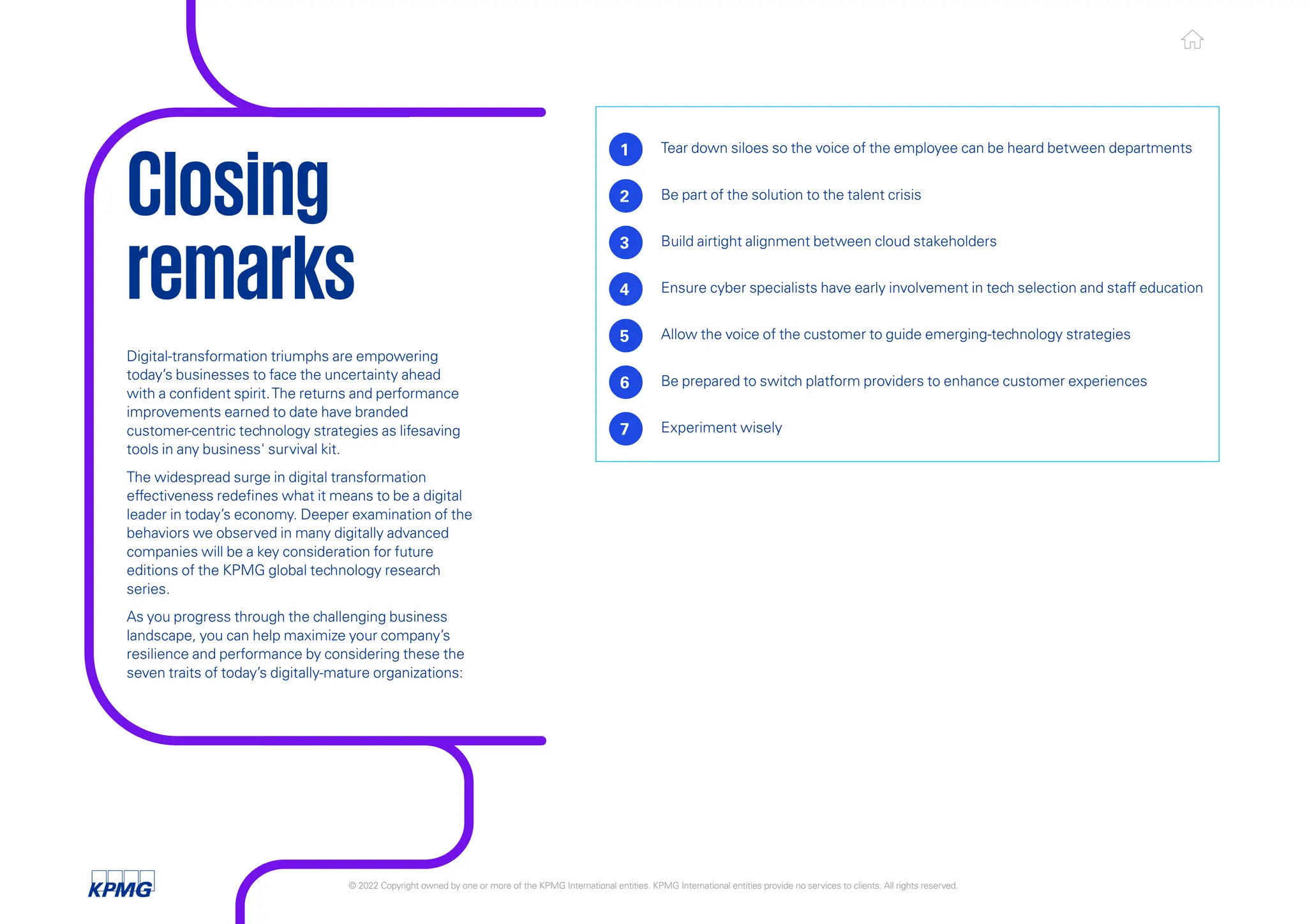
seven traits of today’s digitally-mature organizations:
1 Tear down siloes so the voice of the employee can be heard between departments
2 Be part of the solution to the talent crisis
3 Build airtight alignment between cloud stakeholders
4 Ensure cyber specialists have early involvement in tech selection and staff education
5 Allow the voice of the customer to guide emerging-technology strategies
6 Be prepared to switch platform providers to enhance customer experiences
7 Experiment wisely
Closing
remarks
© 2022 Copyright owned by one or more of the KPMG International entities. KPMG International entities provide no services to clients. All rights reserved. KPMG global tech report 2022 24
Aboutthe
research
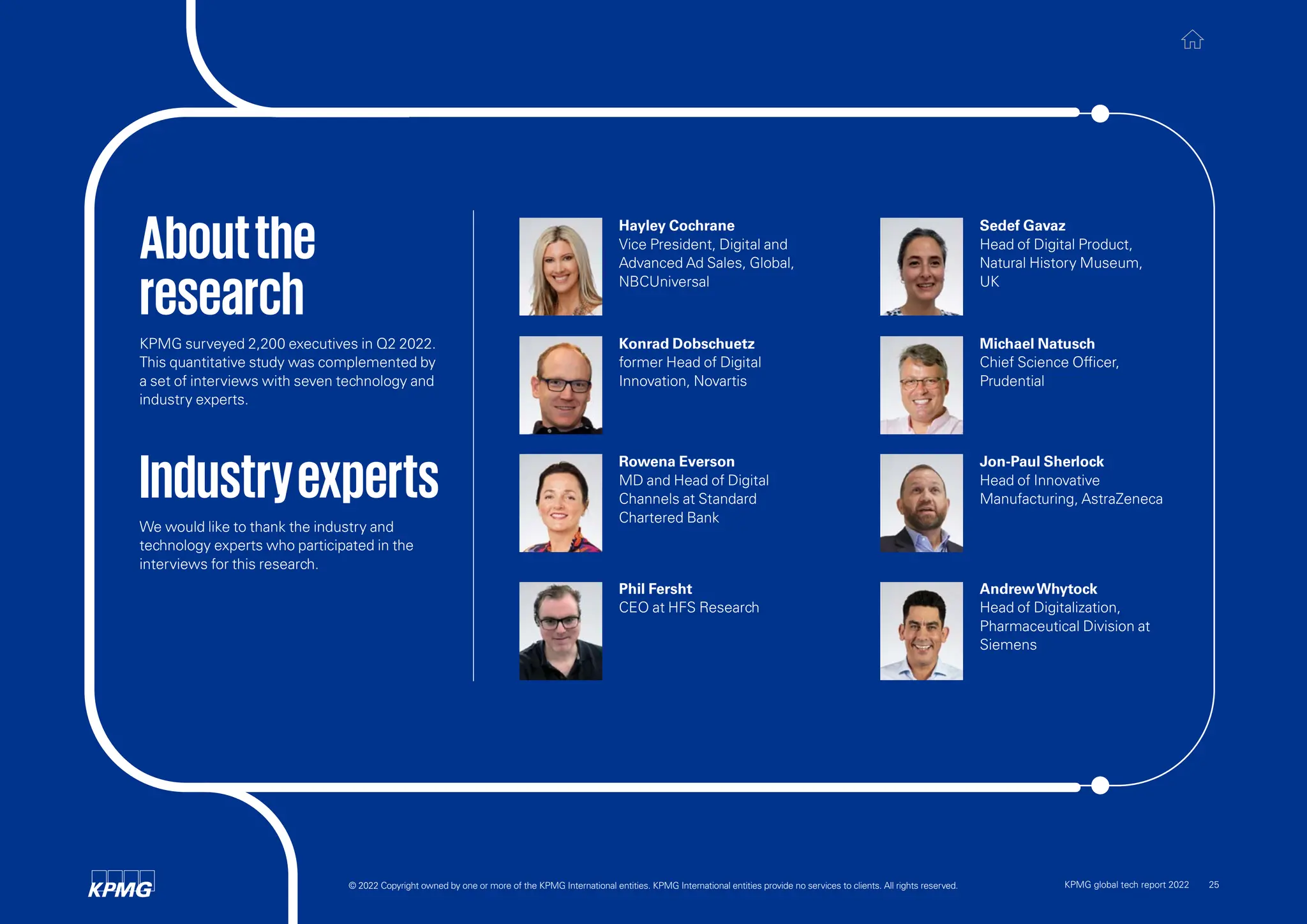
KPMG surveyed 2,200 executives in Q2 2022.
This quantitative study was complemented by
a set of interviews with seven technology and
industry experts.
Industryexperts
We would like to thank the industry and
technology experts who participated in the
interviews for this research.
Hayley Cochrane
Vice President, Digital and
Advanced Ad Sales, Global,
NBCUniversal
Jon-Paul Sherlock
Head of Innovative
Manufacturing, AstraZeneca
Konrad Dobschuetz
former Head of Digital
Innovation, Novartis
Sedef Gavaz
Head of Digital Product,
Natural History Museum,
UK
AndrewWhytock
Head of Digitalization,
Pharmaceutical Division at
Siemens
Rowena Everson
MD and Head of Digital
Channels at Standard
Chartered Bank
Michael Natusch
Chief Science Officer,
Prudential
Phil Fersht
CEO at HFS Research
© 2022 Copyright owned by one or more of the KPMG International entities. KPMG International entities provide no services to clients. All rights reserved. KPMG global tech report 2022 25
The information contained herein is of a general nature and is not intended to address the circumstances of any particular individual or entity. Although we endeavor to provide accurate
and timely information, there can be no guarantee that such information is accurate as of the date it is received or that it will continue to be accurate in the future. No one should act on
such information without appropriate professional advice after a thorough examination of the particular situation.
© 2022 Copyright owned by one or more of the KPMG International entities. KPMG International entities provide no services to clients. All rights reserved.
KPMG refers to the global organization or to one or more of the member firms of KPMG International Limited (“KPMG International”), each of which is a separate legal entity. KPMG
International Limited is a private English company limited by guarantee and does not provide services to clients. For more detail about our structure please visit home.kpmg/governance.
The KPMG name and logo are trademarks used under license by the independent member firms of the KPMG global organization.
Throughout this document, unless otherwise indicated by quotation marks, “we”
, “KPMG”
, “us” and “our” refers to the global organization or to one or more of the member firms of KPMG
International Limited (“KPMG International”), each of which is a separate legal entity.
Designed by Evalueserve.
Publication name: KPMG global tech report 2022
Publication number: 138286-G
Publication date: September 2022
home.kpmg/socialmedia
Some or all of the services described herein may not be permissible for KPMG audit clients and their affiliates or related entities.
Contactus
Bobby Soni
GlobalTechnology
Consulting Lead
KPMG International
E: bobbysoni@kpmg.com
T: +1 408 367 1585
Barry Brunsman
Global Leader, CIO Center
of Excellence, KPMG
International  Principal
Advisory, CIO Advisory at
KPMG in the US
E: bbrunsman@kpmg.com
T: +1 612 305 5155

KPMG – Global Tech Report 2022 | Web3, Metaverse & Digital Transformation Trends

  • 1.
    KPMGglobal techreport 2022 Global technology leadersshare their digital transformation progress and explore how to strengthen ongoing digital maturity. September 2022 home.kpmg/techreport2022
  • 2.
    Contents 05 09 15 18 Digital momentum isgrowing, but threats persist Seven defining traits of today’s digitally- mature organizations Cyber security teams are struggling to keep up Tech enthusiasm for customer engagement burns brightly © 2022 Copyright owned by one or more of the KPMG International entities. KPMG International entities provide no services to clients. All rights reserved. KPMG global tech report 2022 2
  • 3.
    Organizations today areoperating in tense conditions. As they grapple with rising costs, economic uncertainty, geopolitical turmoil and a global talent crisis, they must defend their market share by strengthening customer loyalty and enhancing their offerings with innovative, market-leading products and services.To achieve these goals, proficient application of new and emerging technologies will likely be vital. The good news is that KPMG’s latest global tech report finds a resilient, forward- looking attitude among global technology professionals. Companies are enthusiastic about disruptive new tools and determined to further embrace ongoing digital transformation to enhance the customer experience. The surge in tech investment and innovation seen during the COVID-19 pandemic has given organizations new confidence in the potential of technology to revitalize their businesses. In our 2020 global CIO research, 61 percent of respondents told us that the crisis increased the influence of technology leaders within businesses. Seven in 10 said it strengthened collaboration between the technology team and the wider business. As seen in this year’s report, the digital evolution, accelerated by the pandemic, is fueling record-high confidence levels around digital-transformation capabilities.This raising of industry standards can help redefine digital leadership. To explore how companies are looking to sustain this digital momentum in an uncertain economic landscape, this year we widened the scope of our KPMG annual global CIO study to create the KPMG global tech report.We surveyed more than 2,200 executives and conducted a series of in-depth discussions with industry experts to uncover the technology strategies businesses are using to help outsmart their competitors in a time of unprecedented market volatility. Foreword © 2022 Copyright owned by one or more of the KPMG International entities. KPMG International entities provide no services to clients. All rights reserved. KPMG global tech report 2022 3
  • 4.
    Emergingtech Digitaltransformation Cybersecurity Cloudadoption years 2 the expectedtimeframe for most businesses to embrace key emerging-technology platforms such as Web3, the metaverse and quantum computing. of executives have generated returns from digital investments. businesses indicate they are advanced in their adoption of cloud systems. of cyber security teams admit that they are behind schedule. 99% Talentshortages challenge complicating the adoption of digital technologies. #1 9in 10 58% Theheadline numbers © 2022 Copyright owned by one or more of the KPMG International entities. KPMG International entities provide no services to clients. All rights reserved. KPMG global tech report 2022 4
  • 5.
    Techenthusiasm forcustomer engagement burnsbrightly © 2022 Copyrightowned by one or more of the KPMG International entities. KPMG International entities provide no services to clients. All rights reserved. KPMG global tech report 2022 5
  • 6.
    Digital transformation isliving up to its promise. In recent years, leadership teams have tasted success as a result of their transformation activities and remain optimistic about what they can achieve in the future. Despite market and geopolitical tensions, our research finds businesses embracing new technologies and poised to invest in new tools. Almost all respondents to our survey say that their organizations’ digital transformations have improved profitability and/or performance over the past 2 years. They also appear to be reaching key implementation milestones sooner than expected. Respondents are 20% 27% 21% 30% 38% 39% 33% 25% 30% 35% 40% Where will your organization invest the most over the next year and years from now? years from now Application modernization Intelligent automation Intelligent operations/IT service management Businesses expect to downscale over time, after hitting implementation milestones. more likely to prioritize app modernization and intelligent automation during the next year than 3 years from now, which suggests that most expect to reach maturity in these capabilities sooner rather than later. Our survey also reveals widespread appetite for new technology, even if it is untried and potentially disruptive. An average of 67 percent expect to embrace emerging platforms within 2 years, including the metaverse, non- fungible tokens (NFTs) andWeb3. Seventy-two percent expect to have invested in quantum computing within the same timeframe. Customer value is a primary driver of IT activity Our survey suggests that customer experience is one of the primary levers that unlocks budget for digital transformation.This continues the trend we have seen in previous years. Customer-centric experiences involve designing workflows, services and products to meet customers’ needs in the most effective way possible.This approach also has commercial benefits. A study by Microsoft discovered that 96 percent of customers surveyed felt quality of customer service directly influenced whether they would purchase from a brand again. Furthermore, 56 percent of customers in that study admitted a frustrating customer experience would stop them from returning to a company.1 Our respondents indicate that Marketing, Customer Service and Sales functions are benefiting the most from digital-transformation programs, a direct result of the customer-centric techniques respondents are deploying. Customer experience is substantially motivating enterprise investments in IT and is becoming synonymous with digital transformation. Tech strategies are anchored to creating loyalty-winning experiences, to safeguard income and encourage [high] levels of repeat revenue from customers. ” Barry Brunsman Global Leader, CIO Center of Excellence, KPMG International & Principal Advisory, CIO Advisory at KPMG in the US 1 http://info.microsoft.com/rs/157-GQE-382/images/EN-CNTNT- Report-DynService-2017-global-state-customer-service-en-au.pdf © 2022 Copyright owned by one or more of the KPMG International entities. KPMG International entities provide no services to clients. All rights reserved. KPMG global tech report 2022 6
  • 7.
    This mission toboost customer loyalty through technology is certainly a reality for Sedef Gavaz, Head of Digital Product at the UK’s Natural History Museum. To answer this question, the Natural History Museum is undertaking a transformation to modernize its ways of working. One example is the museum giving greater decision-making powers to product and digital teams. “We are prioritizing which problems we solve and which products we optimize, ” Gavaz adds. “This is about understanding how to get the best returns from where we invest our time and resources and linking this back to our product vision and strategy. ” But what is the role that emerging technologies, such as non-fungible tokens (NFTs), can play in customer engagement, when many companies are still at the earliest stage of business-case development? Konrad Dobschuetz, Head of Digital Innovation at Novartis at the time of interview, says that new technologies could empower clients to monetize their data. One example being patients in private healthcare. Enterprise technology gives a smoother customer journey Companies are giving enterprise technology a key role in their strategic ambitions to enrich customer experiences. And respondents tell us that customer- centricity is the primary motivation for investing in it. Because customer interactions require collaboration across multiple departments, a lack of alignment between front, middle and back-office functions and systems adds complexity and slows down the engagement process.This fragmentation could sabotage otherwise successful customer journeys and hold back operational efficiencies, prolonging or exacerbating customer issues or even introducing errors in how cases are managed. About nine in 10 respondents (89 percent) say they have enterprise applications that are streamlined for each function (51 percent) or streamlined and integrated enterprise-wide (38 percent). Despite this progress, 62 percent of respondents still have work to do to remove silos between functions. By re-engineering enterprise technology and breaking down silos between departments, companies can help improve the customer experience. Dedication to designing new ways of working to nurture seamless internal collaboration has become a key differentiator between businesses in today’s landscape. Reliable experiences earn customers’ trust Customer loyalty is built on — or broken by — whether customers trust the brand. So, embedding cyber security in digital-transformation initiatives from the beginning helps to build the reliable, trustworthy experiences for customers that can lead to trusting relationships. It follows, therefore, that reinforcing customer experiences is one of the most powerful factors unlocking additional cyber security spending. Rather than seeing it as just a compliance burden, businesses in our research stress that cyber security is a growth enabler — a tool to build trust into business models and enrich the customer experience. Our main ambition for digital transformation is to discover how we can become even more customer-centric and more data- led in our decision making. It’s about taking a step back and asking where we should focus to create a brilliant customer experience. Sedef Gavaz Head of Digital Product at the UK’s Natural History Museum © 2022 Copyright owned by one or more of the KPMG International entities. KPMG International entities provide no services to clients. All rights reserved. KPMG global tech report 2022 7
  • 8.
    In the decentralizedworld, patients should be able to decide who has access to their health data, ” he suggests. “Their primary doctor (GP) is an obvious option, but which companies would they be happy to sell and share their healthcare data to, through NFTs? Whenever the data is sold on, the patient would get a chunk of money as well. For me, that’s a key opportunity. ” Konrad Dobschuetz Head of Digital Innovation at Novartis © 2022 Copyright owned by one or more of the KPMG International entities. KPMG International entities provide no services to clients. All rights reserved. KPMG global tech report 2022 8
  • 9.
    Digital momentumis growing,but threatspersist © 2022 Copyrightowned by one or more of the KPMG International entities. KPMG International entities provide no services to clients. All rights reserved. KPMG global tech report 2022 9
  • 10.
    Sixty-six percent oftech leaders today identify as digital leaders. Digital transformation is less of a differentiator than it was. To what extent to you agree with the following statements? Slightly disagree Neutral Slightly agree Strongly agree We have been very effective in using digital to advance our business strategy Technology debt does not inhibit our IT investments 2% 31% 38% 28% 3% 23% 41% 32% Respondents indicate that return on investment is extremely high — hardly anyone says returns are flat. To what extent has digital transformation had a positive impact on profitability or performance in last 2 years? 1 - 5 percent increase in profitability or performance 5 - 10 percent increase in profitability or performance 11 percent or more increase in profitability or performance 20% 42% 38% Most technology leaders are upbeat about what they can achieve through digital transformation.When it comes to confidence in capitalizing on technologies, for example, 66 percent of respondents believe their organizations are either extremely or very effective at using tech to advance their business strategies. This year marks the highest confidence level in this research series, suggesting that effective digital transformation is less of a differentiator than in previous years. Respondents’ confidence is supported by high return on investment (ROI). Almost all businesses have successfully used digital transformation to improve their profitability or performance over the past 2 years, although most have only grown by between 1 and 5 percent in this period. Just over 150 organizations in the study (7 percent of all respondents) have extremely effective transformation programs that have generated at least an 11 percent uplift in profit or company performance.These digitally advanced organizations are 5 percentage points more likely to take a proactive approach in executing digital-transformation strategies. © 2022 Copyright owned by one or more of the KPMG International entities. KPMG International entities provide no services to clients. All rights reserved. KPMG global tech report 2022 10
  • 11.
    percent more confidentthan the market average in their ability to build metaverse andWeb3 features in-house. About three-quarters of respondents (73 percent) indicate that "technology debt" (the long-term maintenance costs attached to new systems), has little-to-no impact on their IT ambitions. In comparison to the global average, respondents operating from India are most likely to feel that their IT ambitions are inhibited by tech debt, although only 11 percent said this. Just over half of total respondents (53 percent) usually address enterprise IT upgrades in line with an agreed schedule. Poorly managed tech debt can trigger integration issues and lower overall productivity levels. To avoid creating fragmentations that could harm customer interactions, blueprints for emerging technologies should not overlook the importance of minimizing tech-debt responsibilities. Konrad Dobschuetz, Head of Digital Innovation at Novartis, suggests that a strong focus on returns should be the guiding light for digital transformation:“Businesses should be past the point where strategies are driven by ‘nice-to- haves’ and ‘because our competitors are doing it’, ” he says. “If you don't showcase value and impact, why are you doing what you're doing?” Businesses are drawing up their roadmaps for emerging tech Respondents acknowledge the potential of emerging technologies and are laying the foundations for their implementation. Nearly half (46 percent) are making plans for future investment and implementation of emerging technologies, although, for the majority (65 percent), little to no movement has been made yet. When it comes to the metaverse, most respondents, even the most digitally effective and profitable organizations, admit that they are waiting for either competitors to adopt the relevant technologies or for customers to demand products and services reliant on these technologies before investing themselves. Compared with other industries, financial services has the biggest appetite for investing in the metaverse within the next year; energy and chemicals markets expressed the least appetite to invest in this concept within that timeframe. At a recent online event, Ioana Matei, Head of Emerging/ImmersiveTechnologies at P&G, said that companies must offer compelling metaverse experiences to generate interest from customers. There are signs that in-house capabilities around emerging tech are in short supply.Thirty-seven percent more businesses are looking to partner with tech companies to tap into the metaverse andWeb3 than to build capabilities in-house.Those who are extremely effective at digital transformation and are seeing the highest ROI are 5 I see the metaverse completely transforming the museum experience. Every technology investment needs to ladder back up to your strategy and mission, and the metaverse fits very comfortably within one our strategy pillars: reaching and engaging the widest audience. ” Technology debt is never considered an issue for people who are focused on innovation, because it will never hinder them. It’s only once you hand over to the execution teams, which need to run the show, that it becomes an issue. ” Sedef Gavaz Head of Digital Product at the UK’s Natural History Museum Michael Natusch Chief Science Officer at Prudential © 2022 Copyright owned by one or more of the KPMG International entities. KPMG International entities provide no services to clients. All rights reserved. KPMG global tech report 2022 11
  • 12.
    Natusch adds: “It’svery easy to build pretty prototypes; it is very hard to build features that actually go live with real customers, while minimizing the chances of technology debt becoming an issue. ” Incorporating feedback from IT execution teams into early planning for emerging technologies can help these innovation efforts support seamless engagement with customers. Cloud adoption is no longer the mark of a digital leader, merely the logical evolution of IT The move to the cloud is well underway. Reflecting wider confidence levels, 88 percent of respondents say they are advanced in their adoption of the technology, with 73 percent saying they are migrating strategic workloads to the cloud and 15 percent saying they have already completed migration and are looking to optimize their systems. Organizations that are extremely effective at digital transformation and seeing the highest ROI are the most likely to have fully met or exceeded their objectives with cloud programs. Eighty percent of respondents are satisfied with the returns their cloud transformation programs have attracted to date.The chief information security officers (CISOs) in the respondent base generally agree with this, with 76 percent saying they are happy with the success of their cloud transformation programs. Fifty-five percent of respondents have either been very effective or extremely effective in their migration from legacy applications to SaaS solutions. The top advantages organizations are gaining from cloud systems are lowered total cost of ownership in comparison to end-to-end on-premises, IT infrastructure (35 percent) and efficiency gains (33 percent). Organizations that are extremely digitally effective and seeing the highest ROI are more likely to tap into the cloud’s ability to improve efficiency and sustainability than the wider respondent base. Piloting workloads and starting to leverage cloud, but at a limited, measured pace Nine in 10 businesses (88 percent) indicate they are advanced in their adoption of cloud. Where would you place your organization in its cloud journey? Migrating strategic workloads to the cloud Evaluating cloud as an option, but remain primarily on-premises Completed migration to the cloud and are now focused on continuous optimization and modernization 3% 9% 73% 15% Positive returns from cloud are high, especially around total cost of ownership (35 percent) and efficiency gains (33 percent). How satisfied are you with the success of your cloud transformation programs? Satisfied: Met most objectives and realized some benefits, with moderate ROI Highly satisfied: Fully met or exceeded objectives; realized benefits and substantial ROI Neutral: Neither satisfied nor dissatisfied, with some ROI Dissatisfied: Met few objectives or realized few benefits, with limited ROI 4% 17% 48% 32% © 2022 Copyright owned by one or more of the KPMG International entities. KPMG International entities provide no services to clients. All rights reserved. KPMG global tech report 2022 12
  • 13.
    AndrewWhytock, Head ofDigitalization, Pharmaceutical Division at Siemens explains that Siemens is focusing on making itself an even more desirable employer in order to retain people and attract new staff. “Even at a company like Siemens, it has become hard to find new recruits with the appropriate skillsets, ” he says. “It must be very hard for small and medium-sized companies to attract young talent. ” Limited budgets appear to be exacerbating the issue. Insufficient funding for training employees and recruiting talent is having a widespread impact across enterprises, complicating the adoption of new enterprise systems, cloud progress and cyber security initiatives. Change-resistant organizations appear to threaten digital innovation. Risk-averse cultures are ranked among the top five digital-transformation challenges, holding back initiatives for 24 percent of respondents. Those who are extremely effective and seeing the highest ROI from implementing digital technologies are 11 percent less likely to see digital transformation projects damaged by cultural hesitancy. Of all the sectors in the research, consumer retail and life sciences companies are the most likely to suffer from risk-averse cultures. Risk-averse cultures in life sciences are rooted in the industry’s stringent compliance requirements that protect patient safety. Life sciences expert Konrad Dobschuetz believes that companies could make progress here by rethinking where responsibility for innovation should sit. Talent and culture are sticking points likely to slow transformation and optimization plans The biggest challenge businesses face in their adoption of digital technologies is lack of capable talent; this is most prevalent in healthcare (52 percent) and manufacturing (48 percent). Claudia Saran, Advisory Industry Leader for Industrial Manufacturing at KPMG in the US advises companies to position themselves as compelling workplaces for software engineers, data scientists and other skilled technologists. This involves identifying and clearly communicating the development opportunities and benefits available. With digital tools embedded into almost all aspects of business operations today, organizations are increasingly needing employees that embody a strong blend of business-domain acumen and digital skills. For many, it is proving a challenge to find individuals who hold the required depth in technical knowledge and business understanding to implement digital tools in a sophisticated manner. It’s great having a big tech strategy. But employers are struggling to find the people to execute their plans. ” AndrewWhytock Head of Digitalization, Pharmaceutical Division at Siemens Cloud adoption is no longer the mark of a digital leader, merely the logical evolution of IT. ” Barry Brunsman Principal Advisory, CIO Advisory at KPMG in the US © 2022 Copyright owned by one or more of the KPMG International entities. KPMG International entities provide no services to clients. All rights reserved. KPMG global tech report 2022 13
  • 14.
    Lack of capabletalent (data scientists, engineers, etc.) High cost of new systems and adding necessary talent Lack of skills to implement or fully take advantage of new systems Sub-optimal data management Risk-averse corporate culture that is slow to embrace change and disruption Inability to secure data housed by systems Lack of clear and transparent digital governance policies throughout the organization Legacy technology and/or technology debt 14% 15% 16% 24% 28% 29% 32% 44% When they need to, innovators can navigate resistance from even the most skeptical colleagues. A supportive culture is vital for digital innovation to succeed. Budget inadequacy is an issue The second-biggest challenge in pursuing digital transformation is the high cost of purchasing and implementing new systems and sourcing necessary talent. Most annual tech budgets sit at between 10 and 20 percent of their company’s overall annual budget, and a significant minority (46 percent) are less than 10 percent. A quarter of organizations say that lack of investment approval or executive buy-in is limiting progress with emerging tech.This is likely to intensify as organizations begin to navigate an increasingly uncertain economic landscape.These investment constraints reflect cost pressures across the business, but they may also be related to a general sense of risk-aversion. What are the biggest challenges you face in your adoption of new digital technologies? Legal and compliance departments are your gatekeepers. Responsibility for innovation should sit in compliance because they have a major influence on whether the innovation needle can be moved. Otherwise, other departments aiming to innovate just constantly get told ‘no, go back to the drawing board’ by compliance teams. ” Konrad Dobschuetz Head of Digital Innovation at Novartis © 2022 Copyright owned by one or more of the KPMG International entities. KPMG International entities provide no services to clients. All rights reserved. KPMG global tech report 2022 14
  • 15.
    Cybersecurity teamsare strugglingto keepup © 2022 Copyrightowned by one or more of the KPMG International entities. KPMG International entities provide no services to clients. All rights reserved. 15 KPMG global tech report 2022
  • 16.
    Cyber security teamsare under pressure to keep up with evolving threats, with talent shortages frequently undermining security efforts. Businesses say that a lack of key skills is the top issue preventing them from meeting their cyber security goals. Over half (58 percent) admit they are behind schedule with their position on cyber security, possibly reflecting the team’s growing responsibilities across the business. This should remind companies that they need to maintain momentum in cyber projects to help ensure they are not left exposed to fast-emerging cyber risks. Organizations that are extremely effective and seeing the highest ROI from implementing digital technologies see cultural obstacles as a more pressing challenge than consensus from the market average. As technologies evolve, CISOs find themselves surrounded by additional systems and features, each of which requires attention. Cyber investment strategies should prioritize the areas of highest risk and return. An evidence-based framework of this nature can help ensure that cyber projects are advancing at the fastest rate possible. Digitalization of customer channels creates cyber challenges that jeopardize trust The digitalization of customer channels is the second- biggest cyber security challenge faced by organizations, after the adoption of hybrid working. How would you describe your organization’s position today in your cyber security journey? We are proactive in progressing against our strategy and are continually evolving We are behind schedule, even if plans and a vision are in place 42% 58% These findings are consistent with the idea that working practices adopted and investments made in response to COVID-19 have redrawn the cyber threat landscape. These weak spots should guide companies as they use new digital and disruptive technologies to reimagine the customer experience. Without necessary oversight, new vulnerabilities could enter the system, potentially harming the customer relationship. According to KPMG’s 2022 cyber report, Mission:Trust. How to unlock the true value of the CISO, concerns about data protection are the leading factor undermining stakeholder trust in businesses and their data management. “Understanding the data you have is of utmost importance to your business, ” says Fersht. “It is one of the biggest areas where it's harder and harder to protect yourself and your systems against fraud and cyber crime. ” Companies must remember they are not just exposing their own businesses, but also the privacy of their customers. You have a duplicated, highly negative impact if that information is leaked or gets hacked. ” Phil Fersht CEO at HFS Research © 2022 Copyright owned by one or more of the KPMG International entities. KPMG International entities provide no services to clients. All rights reserved. KPMG global tech report 2022 16
  • 17.
    To help ensurethat tech innovations enhance customer trust and loyalty, rather than put it at risk, security should be incorporated into planning from the beginning, rather than added later as an afterthought. “Customer experience is reliant on customers trusting the technologies they need to use to engage with a company, ” explains Barry Brunsman, Principal Advisory, CIO Advisory at KPMG in the US. “Businesses must build in cyber security and CISO involvement into digital-transformation initiatives as early as possible. This will depend on embedding cross-departmental communication between cyber teams, the business and IT to enable collaborative customer-centric conversations across the enterprise. ” Confidence to navigate the terrain ahead Despite these problems, respondents are confident in their cyber capabilities. More than 50 percent are either very or extremely confident in combatting various cyber threats, including from organized crime groups, insiders and compromised supply chains. Digital customer-interaction points create security risks, but the digitalization of contact channels requires a higher degree of risk protection. For example, customers no longer need to provide handwritten signatures on contracts and then email them as PDFs; instead, they can sign legal documents in encrypted, secure digital environments. From an overall enterprise-risk perspective, this is an example of the digitalized environment providing a significantly higher degree of risk protection than the older processes used pre- digitalization. ” Rowena Everson MD and Head of Digital Channels at Standard Chartered Bank © 2022 Copyright owned by one or more of the KPMG International entities. KPMG International entities provide no services to clients. All rights reserved. KPMG global tech report 2022 17
  • 18.
    Sevendefining traitsoftoday’s digitally-mature organizations © 2022 Copyrightowned by one or more of the KPMG International entities. KPMG International entities provide no services to clients. All rights reserved. KPMG global tech report 2022 18
  • 19.
    To date, mosttechnology leaders report positive returns from their transformative efforts to improve their competitive edge through technology.Almost all businesses have enhanced their profitability or other metrics of performance over the past 2 years through digital transformation. With confidence levels around digital effectiveness at a record high, our study shows us that digital-transformation success is fast becoming a baseline requirement for businesses. In previous KPMG CIO studies we defined digital leaders as any organization that was either very or extremely effective at using digital technologies to advance their business strategies.This surge in digital competency will help reshape our definition of digital leaders in future instalments of this research series. To begin our journey of mapping out the new definition of digital leadership, here we present seven traits we have observed in today’s most digitally advanced organizations. These traits work together to optimize the output of IT, ensuring digital-transformation efforts are sustainable and continue to add value and contribute to loyalty-winning customer experiences in the long term. © 2022 Copyright owned by one or more of the KPMG International entities. KPMG International entities provide no services to clients. All rights reserved. KPMG global tech report 2022 19
  • 20.
    Today’s digitally-mature organizations… 1 Teardown silos so the voice of the employee can be heard between departments Tech investments should remove points of friction from customer journeys and build convenience into points of interaction. However, when tech-implementation plans fail to incorporate feedback from key stakeholder groups, new digital investments can create inefficiencies that inflate operational costs and irritate customers. To avoid creating unnecessary inefficiencies with tech-innovation efforts, digital leaders are tearing down siloes so projects can draw continually on employee feedback from key stakeholder groups. Here, the voice of the employee guides innovation efforts away from flawed implementations that could damage customer experiences. Early strategy calls include involving the likes of cyber, procurement, IT and business functions to achieve a holistic perspective on the best path forward. This spirit of collaboration lives on through the daily operations of digitally advanced businesses. As IT expertise is increasingly required across various business functions, routine cross-departmental collaboration and education allow business and IT employees to resolve misunderstandings and gain clarity on each other’s perspective.This healthy dynamic enhances team productivity and can identify opportunities to introduce more convenience into customer experiences. 2 Are part of the solution for the talent crisis The talent crisis is not going to resolve itself, especially when it comes to in-demand skills in new and emerging technologies. For technology teams, the short-term challenge is likely to worsen as businesses review their hiring plans to mitigate the impact of economic uncertainty and consider putting a freeze on new hires. Progressive businesses are recalibrating their approaches to hiring and training specialist talent from the ecosystem. Long-term talent strategies should encourage organizations to widen their perspectives and expand the universe of talent. Companies become part of the solution by restocking the talent pools available. Outreach programs with colleges and universities can educate and inspire individuals approaching entry-level jobs to develop the most in-demand skills. At the same time, mature businesses ensure their staff feel supported in their professional growth. “Managers should constantly be trained so they can develop their teams, ” says HFS Research’s Phil Fersht. “People often get frustrated and feel very boxed in if their direct manager isn’t helping them. Consider breaking out of rigid management structures and build frameworks based on a matrix model. Employ more of an open structure to mentoring programs, so employees can learn from multiple people. ” Rather than recruit candidates exclusively from [our industry of focus] within media and advertising, we can open our industry to gifted people from a wide range of backgrounds, experiences and even geographies.We have to cast a wide net in all forms as it builds diversity and it improves our ability to drive change more rapidly. ” Hayley Cochrane VP of Digital and Advanced Ad Sales, Global, at NBCUniversal © 2022 Copyright owned by one or more of the KPMG International entities. KPMG International entities provide no services to clients. All rights reserved. KPMG global tech report 2022 20
  • 21.
    cloud journey. “Advancedbusinesses operate from a strong understanding of the needs of the business and IT departments, ” says Brunsman from KPMG in the US. “A unified strategic vision of the cloud’s organizational returns for stakeholders drives a sophisticated implementation and enablement of cloud-based systems. ” 4 Ensure cyber specialists have early involvement in tech selection and staff education This year’s research suggests that businesses increasingly see cyber security as a golden thread running through growth and success, rather than just a compliance requirement. According to KPMG’s 2022 cyber report, Mission:Trust. How to unlock the true value of the CISO, Technology leaders are looking to automation to address staff shortages and repair skill gaps. By automating workflows to take on the low-complexity, high-volume tasks, companies can redeploy staff and upskill teams to fill more strategic gaps elsewhere in the business. “One of the biggest issues right now is under-employment — a shortage of people to service businesses, ” says Fersht. “For example, touchpoints with customers can be critical. Leveraging automation can really help where there are particularly staff shortages. ” 3 Build airtight alignment between cloud stakeholders Technology leaders are capitalizing on cloud’s efficiency and cost benefits by optimizing their ways of working, with addressing stakeholder conflicts a key focus area. Stakeholder misalignment is a major factor holding back cloud migration for the majority of businesses. CISOs say that stakeholder misalignment on outcomes is a bigger cloud challenge than security and compliance requirements. Misalignment tends to occur between the IT team’s vision of how cloud capabilities should be enabled and the cloud priorities of other business departments. “This misalignment tends to create a very disjointed cloud implementation, ” says Barry Brunsman, Principal Advisory, CIO Advisory at KPMG in the US. “Business units have their own distinct priorities and, as a result, their cloud approaches often become siloed and disconnected from the work of other departments. ” Some digitally-mature businesses are making progress in this area by appointing a dedicated head of cloud who considers the requirements of each stakeholder group and creates a strategy to optimize the business’s enhancing corporate trustworthiness can increase profitability, as well as the size of customer base. Digitally-mature businesses operate with tech- innovation workflows that include cyber specialists early on. In our research, CISOs say the internet of things (IoT) is highly likely to receive investment attention over the next year, but they also admit that IoT services can present a major cyber security risk. As such, to show digital maturity, organizations should ensure CISOs and their cyber teams engage in early-stage discussions about how and where the technology is going to be used, and what this means for customer experiences. With staff behavior and low cyber security awareness constituting significant sources of risk, digitally mature companies empower CISOs to conduct regular education in risk management. What are the major internal challenges to achieving your organization’s cyber security goals? Lack of key skills Cultural obstacles Limited funding/investment Immaturity of technology Lack of clarity on strategy Lack of sponsorship or executive buy-in None of the above 40% 35% 32% 22% 18% 5% 5% © 2022 Copyright owned by one or more of the KPMG International entities. KPMG International entities provide no services to clients. All rights reserved. KPMG global tech report 2022 21
  • 22.
    Security teams inthese organizations educate staff through a variety of teaching mechanisms, training sessions and simulations. “I think a lot of employees see cyber security as just ‘I've got a virus on my computer’. It’s far more dangerous than that, ” says AndrewWhytock from Siemens. Cyber-attacks can trigger widespread disruption to supply chains and populations. “It's important to assess the value of the impact, ” says Whytock. “That shouldn't mean you avoid using a technology, but you need to have safeguards in place. ” “To navigate the shortage of cyber security skills and democratize accountability, CISOs should work to build multidisciplinary teams that support digital- transformation security across the enterprise, ” says Brunsman from KPMG in the US. “It is not just the CISO who should be driving cyber resilience — this is a broader business issue. ” 5 Allow the voice of the customer to guide emerging-technology strategies To retain customers and market share, companies must continuously improve their digital capabilities and think differently about how to use technologies to meet, and exceed, expectations. This means constantly evaluating whether technology selection and workflow design is aligned with customer needs and expectations. Cross-functional workshops can provide real-life insights that stress-test the value of certain technologies. Michael Natusch, Chief AI Officer at Prudential, says that the business has seen success with workshops that bring together disparate stakeholders, including customers.These sessions test prototypes and assess a technology’s potential to provide meaningful value to target audiences. Digitally mature businesses direct their emerging- technology investments towards capabilities that have the potential to deliver the outcomes that are of most value to customers.This approach can help keep more customers loyal to a brand in times of economic uncertainty. “It would be wonderful to have a perfect predictive model showing where to direct investments but, unfortunately, that’s not realistic, ” says Rowena Everson, the MD and Head of Digital Channels at Standard Chartered Bank. “A productive approach is to focus on customer desires and behaviors and consider which technologies could support these areas.We need to assess technologies and concepts against four key customer needs that are driving demand: security, speed of execution, choice and flexibility. ” What are the top challenges your organization is facing or has faced in your cloud journey? Insufficient talent and/or skills Security and compliance requirements Business/IT/stakeholder misalignment on outcomes Cultural resistance Existing infrastructure and technical debt 37% 34% 31% 30% 24% © 2022 Copyright owned by one or more of the KPMG International entities. KPMG International entities provide no services to clients. All rights reserved. KPMG global tech report 2022 22
  • 23.
    seamless interaction pointsin customer experiences. Application programming interface (API) integration is assessed carefully to avoid creating silos that introduce fragmentation into customer journeys. “Every business must ensure that the entire organization — front, middle and back — is aligned to deliver on its brand promise and customer expectations, ” agrees Brunsman from KPMG in the US. 7 Aren’t afraid to experiment wisely Digitally mature companies ensure that their success does not create an overly protective or perfectionist culture that stifles innovation. “If you attempt to achieve a 100-percent level of certainty over everything, you are hoping for a false level of precision, ” says Standard Chartered Bank’s Rowena Everson. “All this will do is paralyze experimentation in the business, which will ultimately paralyze growth. The only answer is to ensure that transformation and investment strategies can adapt. ” This involves moving away from traditional investment frameworks that are structured to achieve benefits only at the very end of the initiative. Instead, says Everson: “Achieve objectives on the way to the ultimate objective. Set your program objectives to have an ultimate outcome but acknowledge upfront that the actual path you take could deviate from initial expectations.This allows you to pivot as you progress and bank wins as you go. ” It is important to recognize that some avenues may turn out to be dead ends. “If you have this practice of breaking down your ultimate end-goals into achievable objectives on the route, ” says Everson, “then you can access beneficial outcomes, even if you decide that either your original investment strategy has been superseded by the external environment or your business goals have changed. ” 6 Are prepared to switch platform providers to enhance customer experiences There is a desire within corporate digital ecosystems to find one platform, or at least a reduced stack of enterprise technologies, which will meet business needs.This simplification of enterprise-system networks would have various benefits, including the reduction of technical debt. However, this aspiration to consolidate tech stacks will always be complicated by how capabilities advance and solution-provider landscapes shift. How a major museum is exploring the metaverse Sedef Gavaz, Head of Digital Product at the UK’s Natural History Museum, explains how her organization is considering the adoption of one of the most disruptive new technologies in the market. “I see the metaverse completely transforming the museum experience. Every technology investment needs to ladder back up to your strategy and mission, and the metaverse fits very comfortably with one of our strategy pillars: reaching and engaging the widest audience. ” The metaverse could allow the museum to connect remotely with customers around the globe. These engagement opportunities could have a positive effect on key societal issues like climate change or sustainability. “Imagine, as a visitor, holding the most precious artefact in your hands. Imagine being able to interrogate that and turn it over to understand its detail and size. Imagine if you live overseas and can’t fly to London, but, with immersive tech, you can experience looking up at that amazing blue whale in our entry hall. Imagine seeing that whale come alive and move around in a visualization of its natural environment, ” enthuses Gavaz. “The flip side to all this wonder and possibility are, of course, considerations around pricing; access to tech and device penetration; as well as the data and network connections required to run metaverse experiences. As a business, we align that with our strategy because, although we're here to engage the widest possible audience, we have focus areas for the audiences with which we particularly want to engage. ” As a result, even though it is a complex skill to master, the ability to move between platforms is becoming increasingly important for digitally mature businesses. A digital-transformation leader within retail maintains: “We need to be comfortable and ready to move between platforms. Because, if there is a new value proposition or a development in our business process that we want to achieve, we don't want to find ourselves tied down by legacy technology. ” As business' tech stacks depend on a spread of systems from various providers, technology leaders are committed to ensuring the infrastructure of enterprise platforms is highly integrated, delivering © 2022 Copyright owned by one or more of the KPMG International entities. KPMG International entities provide no services to clients. All rights reserved. KPMG global tech report 2022 23
  • 24.
    Digital-transformation triumphs areempowering today’s businesses to face the uncertainty ahead with a confident spirit.The returns and performance improvements earned to date have branded customer-centric technology strategies as lifesaving tools in any business' survival kit. The widespread surge in digital transformation effectiveness redefines what it means to be a digital leader in today’s economy. Deeper examination of the behaviors we observed in many digitally advanced companies will be a key consideration for future editions of the KPMG global technology research series. As you progress through the challenging business landscape, you can help maximize your company’s resilience and performance by considering these the seven traits of today’s digitally-mature organizations: 1 Tear down siloes so the voice of the employee can be heard between departments 2 Be part of the solution to the talent crisis 3 Build airtight alignment between cloud stakeholders 4 Ensure cyber specialists have early involvement in tech selection and staff education 5 Allow the voice of the customer to guide emerging-technology strategies 6 Be prepared to switch platform providers to enhance customer experiences 7 Experiment wisely Closing remarks © 2022 Copyright owned by one or more of the KPMG International entities. KPMG International entities provide no services to clients. All rights reserved. KPMG global tech report 2022 24
  • 25.
    Aboutthe research KPMG surveyed 2,200executives in Q2 2022. This quantitative study was complemented by a set of interviews with seven technology and industry experts. Industryexperts We would like to thank the industry and technology experts who participated in the interviews for this research. Hayley Cochrane Vice President, Digital and Advanced Ad Sales, Global, NBCUniversal Jon-Paul Sherlock Head of Innovative Manufacturing, AstraZeneca Konrad Dobschuetz former Head of Digital Innovation, Novartis Sedef Gavaz Head of Digital Product, Natural History Museum, UK AndrewWhytock Head of Digitalization, Pharmaceutical Division at Siemens Rowena Everson MD and Head of Digital Channels at Standard Chartered Bank Michael Natusch Chief Science Officer, Prudential Phil Fersht CEO at HFS Research © 2022 Copyright owned by one or more of the KPMG International entities. KPMG International entities provide no services to clients. All rights reserved. KPMG global tech report 2022 25
  • 26.
    The information containedherein is of a general nature and is not intended to address the circumstances of any particular individual or entity. Although we endeavor to provide accurate and timely information, there can be no guarantee that such information is accurate as of the date it is received or that it will continue to be accurate in the future. No one should act on such information without appropriate professional advice after a thorough examination of the particular situation. © 2022 Copyright owned by one or more of the KPMG International entities. KPMG International entities provide no services to clients. All rights reserved. KPMG refers to the global organization or to one or more of the member firms of KPMG International Limited (“KPMG International”), each of which is a separate legal entity. KPMG International Limited is a private English company limited by guarantee and does not provide services to clients. For more detail about our structure please visit home.kpmg/governance. The KPMG name and logo are trademarks used under license by the independent member firms of the KPMG global organization. Throughout this document, unless otherwise indicated by quotation marks, “we” , “KPMG” , “us” and “our” refers to the global organization or to one or more of the member firms of KPMG International Limited (“KPMG International”), each of which is a separate legal entity. Designed by Evalueserve. Publication name: KPMG global tech report 2022 Publication number: 138286-G Publication date: September 2022 home.kpmg/socialmedia Some or all of the services described herein may not be permissible for KPMG audit clients and their affiliates or related entities. Contactus Bobby Soni GlobalTechnology Consulting Lead KPMG International E: bobbysoni@kpmg.com T: +1 408 367 1585 Barry Brunsman Global Leader, CIO Center of Excellence, KPMG International Principal Advisory, CIO Advisory at KPMG in the US E: bbrunsman@kpmg.com T: +1 612 305 5155